
Waste-Free Wednesdays promote sustainability
Campus groups encourage students to waste less food through weekly

Community celebrates Día de los Muertos
By MARISA IATI News Writer
Notre Dame and South Bend community members commemorated the lives of deceased loved ones at a Día de los Muertos celebration Tuesday evening in the Hesburgh Center for International Studies.
The event featured performances by student groups Mariachi ND, Ballet Folklorico Azul y Oro and Coro Primavera de Nuestra Señora. It was sponsored by the Institute for Latino Studies, the Kellogg Institute
for International Studies and the Snite Museum of Art.
In Mexican tradition, Nov. 1 is the one day each year when the souls of the dead return to the mortal world, said sophomore Briana Cortez, who performed with Mariachi ND and Coro Primavera.
“It’s the one day where you can spend time with your family and friends that have passed on to the next life,” she said.
“Instead of it being eerie, the way Halloween is portrayed,
‘Clean Plate Club’ at dining halls
By NICOLE TOCZAUER News Writer
In September, Notre Dame students wasted an average of 4.63 ounces of food after each meal in the dining hall, said William Yarbrough, associate director in the Food Services Administration.
“If 4,000 students eat a meal, that’s 1,157 pounds of food and beverage wasted for that meal,” Yarbrough said.
In an effort to combat food and liquid waste at the University, GreeND, Food Services and the Office of Sustainability partnered together this year to sponsor Waste-Free Wednesdays, a weekly event in the month of November that asks students to think about the food they throw out.
Senior Elizabeth Davis, chair of the sustainability project, said Waste-Free Wednesdays will
take place in the dining halls from 6 to 7 p.m. every week in November.
“The goal of Waste-Free Wednesdays is twofold,” Davis said. “One: to reduce the amount of fluid and food waste. Two: To raise awareness and have people feel empowered for not wasting.”
The project began last year when Davis was on the Student Energy Advisory Board. She worked with ND Food Services, the eND Hunger Campaign, student government, GreeND, the Holy Cross Food Drive and the Office of Sustainability to create the project.
“By the end, the results showed that we cut food waste in half and raised enough money to provide 6,300 meals in the South Bend community,” Davis said. “It really emphasized the season of giv-
Film producer discusses mini-series
By ANNA BORINI News Writer
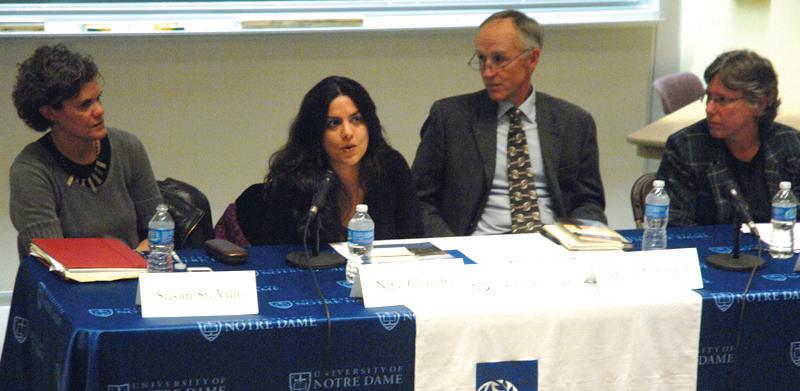
Part four of the five part documentary mini-series, titled “Women, War and Peace,” aired Tuesday on PBS. The series, which focuses on women’s roles in warfare, was produced in part by Nina Chaundry, who spoke on a panel Tuesday about the documentaries.
“The creators of the series, Pamela Hogan, Abigail Disney and Gini Reticker, first met about the project in the fall of 2007,” Chaundry said. “They had each individually noticed a similar trend in reporting: a focus on the men and the guns and a dearth of stories about
the women and families who are disproportionately targeted in today’s conflict zones — but seldom covered in news reports.”
Chaundry said the idea for the film series was born after this conversation.
“Disproportionate attention has been paid to men in conflict, and we hope that this series is the beginning of a dialogue and that more films and more reporting will look at conflict through women’s eyes,” she said.
When choosing the stories to tell in the documentary, she said the producers and filmmakers wanted to give underreported stories the attention
they deserve.
“Deciding which conflicts to cover was one of the most difficult decisions we had to make,” she said. “We researched stories around the world, including Asia, Central America, Chechnya, Georgia, Israel and Palestine, Northern Ireland, Congo, Sudan, Guinea as well as the stories in Bosnia, Colombia and Afghanistan.”
After all their research was collected, the filmmakers decided to tell the story of how war had changed in the last 20 years since the end of the Cold War, Chaundry said.
“Since the end of the Cold
SUZANNA PRATT/The Observer
Notre Dame students wasted about 4.63 ounces of food per meal during the month of September. Waste-Free Wednesdays encourage students to think twice about wasting food.
SUZANNA PRATT/The Observer
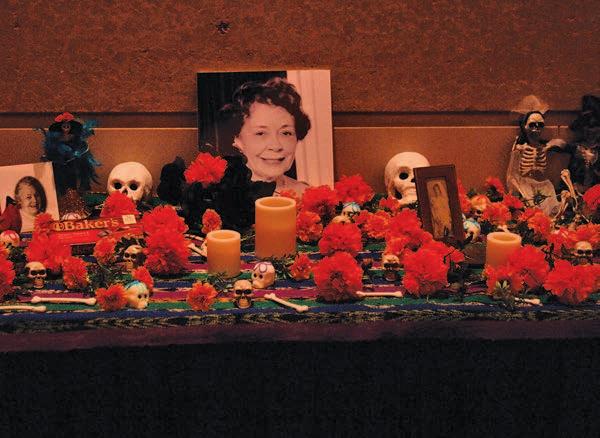
An ofrenda by artist Ana Teresa Fernandez was displayed at the Hesburgh Center during the Dia de los Muertos celebration Tuesday.
SUZANNA PRATT/The Observer
Film producer Lisa Chaundry, center, describes the process of making the PBS documentary miniseries, “Women, War and Peace.” The mini-series relates the stories of women involved in warfare. see WASTE/page 5
www.ndsmcobserver.com
P.O. Box 779, Notre Dame, IN 46556
024 South Dining Hall, Notre Dame, IN 46556
Editor-in-Chief Douglas Farmer
Managing Editor Sarah Mervosh Business Manager Jeff Liptak
a s st.
Managing Editor: A driana Pratt
a s st. Managing Editor: C hris Masoud
Ne ws Editor: Me gan Doyle
V iewpoint Editor: Meghan Thomassen
Sports Editor: A llan Joseph
Sce ne Editor: M aija Gustin
S aint Mary’s Editor: C aitlin E. Housley
Photo Editor: Pat Coveney
G raphics Editor: Brandon Keelean
a dvertising Manager: K atherine Lukas
a d Design Manager: A manda Jonovski
C ontroller: Jason Taulman
Systems a d ministrator: W illiam Heineman
Office Manager & General Info (574) 631-7471 Fax (574) 631-6927
Advertising (574) 631-6900 observad@nd.edu
Editor-in-Chief (574) 631-4542 dfarmer1@nd.edu
Managing Editor (574) 631-4542 smervosh@nd.edu
Assistant Managing Editors (574) 631-4541 apratt@nd.edu, cmasoud@nd.edu
Business Office (574) 631-5313
News Desk (574) 631-5323 obsnews.nd@gmail.com
Viewpoint Desk (574) 631-5303 obsviewpoint@gmail.com
Sports Desk (574) 631-4543 observersports@gmail.com
Scene Desk (574) 631-4540 mgustin@nd.edu Saint Mary’s Desk chousl01@saintmarys.edu
Photo Desk (574) 631-8767 obsphoto@gmail.com Systems & Web Administrators (574) 631-8839
Policies
The Observer is the independent, daily newspaper published in print and online by the students of the University of Notre Dame du Lac and Saint Mary’s College. Editorial content, including advertisements, is not governed by policies of the administration of either institution. The Observer reserves the right to refuse advertisements based on content. T he news is reported as accurately and objectively as possible. Unsigned editorials represent the opinion of the majority of the Editor-in-Chief, Managing Editor, Assistant Managing Editors and department editors. Commentaries, letters and columns present the views of the authors and not necessarily those of The Observer.
V iewpoint space is available to all readers. The free expression of all opinions through letters is encouraged. Letters to the Editor must be signed and must include contact information.
Question regarding Observer policies should be directed to Editor-in-Chief Douglas Farmer.

Emily Ehrman junior Badin
“I can ride a unicycle!”

Brandon West sophomore Fisher
“I can make dolphin noises.”

Meredith Angell junior Pangborn
“I can whistle with my hands.”

Norah Robinson freshman Lewis
“I can recognize cars by their headlights.”

CJ Kelly senior Duncan
“My ability to eat three pounds of gummy bears in one sitting.”

Danny Jackson senior Dillion
“I have an amazing voice. People say it’s a mix of Fergie and Jesus.”

cart was in better condition after firefighters hosed down the smoking parts.
In brIef
Today till Friday, Nov. 4, there is an open-enrollment program titled, “Unleashing Your Leadership Potential,” offered by Executive Education, Mendoza College of Business. This program is for emerging leaders with 5 or more years of work experience who wish to accelerate their transition to a greater leadership role. This event will take place in Giovanni Commons in the lower level of Mendoza College of Business. Application and acceptance required.
The blood drive continues today from 11 a.m. to 5:30 p.m. in the Rolfs Sports Recreation Center. Register for a donation time online or by calling RecSports.
Sailor saved by mobile call after falling off boat
AJACCIO, Corsica — French sailing star Florence Arthaud fell off her boat during a pee break but rescuers whisked her from Mediterranean waters in the early hours of Sunday after she called her mother by mobile phone.
Arthaud, winner in 1990 of the Route du Rhum single-handed transatlantic sailing race, was located and rescued near the island of Corsica thanks to a headlamp and the GPS system on her phone.
“I quite simply fell into the water while preparing to take a pee,” the 54-year-old told BFM television.

Arthaud, alone on her 10-meter boat when she fell overboard, managed to hold her phone, protected by a plastic bag, above water and call her mother to raise the alarm.
Cold cash given to woman instead of cold cuts
BERLIN — A butcher shop employee in the German town of Braunschweig inadvertently handed a customer a bag containing more than 2,000 euros ($2,835) in cold cash rather than the cold cuts she usually gets.
The 79-year-old pensioner paid five euros for her package of cold cuts and veal steaks. She said she was surprised to find more than


she bargained for when she opened the package at home.
She called the butcher shop but it had already closed. So she called the police, who later returned it.
The owner of the butcher shop had packed the day’s take in a paper bag and placed it, as he usually does, next to the cash register. The employee mistook it for the customer’s cold cuts and unwittingly handed her the package.
The honest pensioner got a 100 euro reward from the butcher and a free basket of sausages.
Information compiled from the Associated Press.

This evening from 5 to 7 p.m., there is a lecture titled, “Nightwatch: Time, Emergency, and the French Revolution.” Marie-Helene Huet, from Princeton University, will be giving the lecture, with an introduction by Professor Julia Douthwaite. The event will take place in Room 112 in McKenna Hall. A reception will follow.
Tonight from 6:30 to 7:30 p.m. there will be an information session on the Catholic Social Traditions (CST) Minor in 234 Geddes Hall. Stop by the information session to learn more about the CST Minor.
Watch the Women’s Basketball team take on Windsor tonight at 7 p.m. in the Purcell Pavillion at the Joyce Center
To submit information to be included in this section of The Observer, email detailed information about an event to obsnews.nd@gmail.com
PAT COVENEY/The Observer
A golf cart parked outside of O’Shaughnessy Hall overheated on Tuesday afternoon, causing the fire department to respond to the untimely incident. The golf
Group votes on club allocations
By KRISTEN RICE News Writer
The Saint Mary’s Student Government Association (SGA) met Tuesday to discuss budget allocations for clubs on campus, including two appeals from campus clubs.
Both the Biology Club and the Social Work Club appealed the allotments received from SGA. Every club on campus is given the option to appeal its allotment and bring the issue to one of the SGA meetings.
Clubs can only appeal a decision “if a procedural error has been made by the finance committee,” according to SGA finance committee bylaws.
After hearing the appeals, SGA members discussed as a group whether or not to grant appeals for both of the organizations. Many questions came up during the discussion.
“What exactly is a sponsorship?” senior class vice president Noelle Radko asked. “I’m not sure exactly what it is, and I know there may be some confusion about that among different clubs.”
Student body president Nicole Gans explained that sponsorships, according to the finance bylaws, “serve to cover recognized clubs and organizations’ expenses that are campus-wide events or travel-related.”
“It is important for all of you and any club on campus to come to see me if you have questions. I’m always in the SGA office,”
SGA Executive Treasurer Liz Busam said. “If anyone is ever unclear on anything concerning allotments or finances, you can ask.”
SGA Executive Secretary Emma Brink echoed Busam’s offer.
“If you hear of any clubs
having lingering questions, you can tell them to visit the SGA office and we can explain things to them there,” Brink said.
According to the bylaws of the SGA finance committee, the purpose of allotments is “to fund the ‘material’ expenses of the club,” including “equipment and material for regular operations.” SGA give student clubs the option of applying for sponsorship from SGA for other expenses.
SGA concluded its meeting by voting on the appeals.
“I’m really proud of everyone for being able to make a decision on allotments,” Gans said. “We were able to work through things pretty fast, so I’m happy that we were able to get all of our allotments finished.”
Contact Kristen Rice at krice01@saintmarys.edu


Sorin Scholars engage in research, discussion

By TORI ROECK News Writer
In the group’s second year on campus, the Sorin Scholars continue to “act as catalysts” for undergraduate research and intellectual discussion outside of the classroom, said Philippe Collon, associate director of the Center for Undergraduate Scholarly Engagement (CUSE) and the group’s faculty mentor.
The Sorin Scholars, comprised of about 30 students per class, is the only University-wide honors program, Collon said. Students are chosen by recommendations from faculty advisors and teachers after their freshman year.
Collon said the group, sponsored by CUSE, formed last year to carry on University founder Fr. Edward Sorin’s legacy of academic leadership.
“We call them the Sorin Scholars [so] they would act as catalysts for all the other students at the University, like Fr. Sorin, who not only managed to create the University but was a really strong catalyst for getting things started and getting things off the ground,” Collon said. “We wanted these students to have Fr. Sorin as their example as being the real catalyst to get students to think early on about scholarly engagement, undergraduate research and making the most out of their four years at Notre Dame.”
CUSE also sponsors many other activities, such as monthly coffee house discussions, trips to see plays, ice cream socials and educational workshops.
“It is up to the students to define what they want to do and how they want that research to be as fruitful as possible,” he said.
Junior Michael Fronk said participating in these activities as a Sorin Scholar allows him to engage in intellectual dialogue outside of the classroom.
“It’s been really helpful and insightful in sparking engaging thinking,” Fronk said.
Fronk, who is on the steering committee for the group, said the research opportunity he gained through Sorin Scholars was invaluable.
As an English and mathematics major, Fronk said he received $3,000 to spend the summer in London studying Anglo-Caribbean culture and literature.
“I made the connections that helped me to get the $3,000 grant to go abroad over the summer,” Fronk said.
“We call them the Sorin Scholars [so] they would act as catalysts for all the other students at the University, like Fr. Sorin, who not only managed to create the University but was a really strong catalyst for getting things started and getting things off the ground.”
The objective of the group is to provide opportunities for the students involved to further supplement their academics through thought-provoking discussion and research, Collon said.
Philippe Collon director Center for Undergraduate Scholarly Engagement
Junior chemistry major Patrick Kramer said he used his connections through Sorin Scholars to perform chemistry research at Indiana University Purdue University Indianapolis last summer and continue research on campus this fall. Kramer said the benefits he has gained through the program will help him discern what to do after college.
“We want this to be an additional opportunity for students to have mentors, to have a place to meet and to have opportunities to discuss and to grow, then, to become ambassadors of undergraduate research here on campus,” he said.
To accomplish these goals, CUSE chooses students from all colleges to participate in the group, provides a lounge for them and helps them coordinate research projects, Collon said.
“I’m hoping to go to med school eventually, but I don’t know if I want to combine that with clinical research,” Kramer said. “[Sorin Scholars] gave me a window to explore that opportunity and also to look at post-graduate opportunities involved with research.”
Kramer said meeting new people through the group was just as beneficial as making important connections.
“It’s a good group of people to collaborate with on different ideas,” he said.
Contact tori Roeck at vroeck@nd.edu
Photo courtesy of Phillippe Collon
The Sorin Scholars is an honors program comprised of 120 students who participate in intellectual discussion and research.
SMC students sell popcorn for class

By JILL BARWICK News Writer
While selling gourmet popcorn may sound like an easy task to accomplish, the students of the Sales Management and Professional Selling course at Saint Mary’s College learned differently in a national collegiate competition held during fall break.
Robert Williams, assistant professor of Business and Economics at Saint Mary’s, said he wanted to gear the coursework for this semester toward real life experiences of professional selling, especially after he learned about this competition.
“When I started preparing for this course, I looked around online to see if there was anything interesting ways to professionally sell,” Williams said.
“I came across the National Team Selling Competition, which is held at Indiana University in Bloomington, and decided that, even though it was short notice, the course would be designed toward competing in this competition.”
Students were given the first part of the contest a week before the competition was to be held, which included the case material the team needed to start planning how they would sell their product. This is when they learned that their goal was to introduce a private-label popcorn line into their mock stores.
“After receiving the case material, our class broke down into groups based on their individual strengths using approaches to sampling, packaging and social media plans for the product,” Kellogg said.
Once at the competition, the teams met with mock buyers. The students then had to align their presentations to fit their buyers’ needs.
Having about four hours to complete this task, the teams then presented their ideas for selling the private-label popcorn and were judged by sales executives from Altria Group Distribution Company.
“After receiving the case material, our class broke down into groups based on their individual strengths using approaches to sampling, packaging and social media plans for the product.”
Kate Kellogg junior
Williams said he knew the biggest challenge would be preparing in a short amount of time, because the competition took place over fall break. His class would also be competing against schools that have entire divisions on selling.
“Even though I knew it was a short period of time to prepare, being close to where the competition was being held definitely helped me decide to have my class participate,” Williams said.
Kate Kellogg, a junior at Saint Mary’s and member of the team, knew that this would be a great learning experience for herself as an individual, as well as a good team building experience.
“It was hectic at times, trying to prepare material about a real-life selling situation, but it was definitely a great learning experience,” Kellogg said.
Group participates in NaNoWriMo
By ANNA BOARINI News Writer
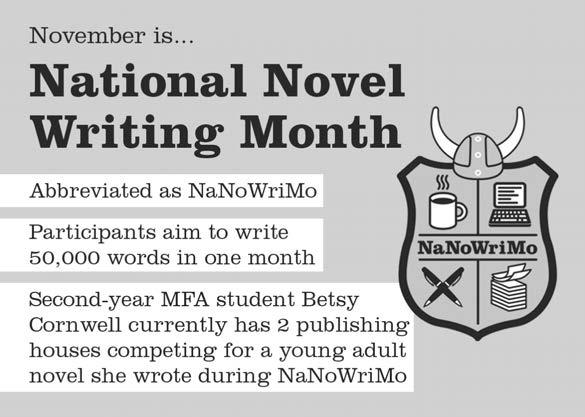
Every November, writers across the country put pen to paper in hopes of reaching 50,000 words during National Novel Writing Month (NaNoWriMo).
Second-year MFA student Betsy Cornwell is leading aspiring Notre Dame novelists in an on-campus writing group.
Cornwell first participated in NaNoWriMo in 2008 when she was a junior undergraduate.
“The draft I wrote in 2008, I am just now getting a book deal on,” she said. “Two publishing houses are actually bidding on it. This year, I’m doing a steam punk version of Cinderella and actually the publishing houses have offered preemptively on this one as well.”
Cornwell’s book that is currently being bid on is a young adult magical realism book, called “Tides.”
“I was working at a teen magazine at the time, and we got all these letters about how they either hated things like Twilight or they liked it, but wanted to make it more literary,” she said. “I said, ‘You know what, I agree, I’m going to try to do that.’”
Cornwell teaches a fictionwriting course and has encouraged her students to participate. Of her 15 students, 10 have chosen to write 50,000 words this November instead of turning in a final portfolio of all their work.
“I really encourage people to do it, because you write this messy bad draft, and then you revise it,” she said.
Cornwell said she believes people who have never written a novel or have no idea how to
approach fiction writing benefit the most from NaNoWriMo.
“People who think this is a big impossible thing, because it really is about plunging in without knowing what you’re doing and forcing yourself to do it,” she said.
One of Cornwell’s students, senior Darsie Malynn decided to attempt the 50,000 word challenge.
“I am attempting to do NaNoWriMo because it seems like a cool, challenging and rewarding project,” Malynn said.
“Also if we do it, we are not required to turn in a final portfolio for our class, so it’s hopefully not a completely unmanageable amount of writing.”
Malynn is not the only student participating this month.
Junior Leah Coming, the president of Notre Dame’s creative writing club, Mustard, is participating in her own way.
“Mustard traditionally has done a couple write-ins during NaNoWriMo, but usually members do it on his or her own,”
she said.
Coming said she uses her capacity as president of Mustard to help spread the word about more structured write-ins led by Cornwell in the University Writing Center. When Coming is not helping Cornwell get the word out about NaNoWriMo, she will also take part.
“I’m doing pansy NaNo,” she said. ”I’m only doing 15,000 words [this November].”
Coming said she decided to do a smaller word count because she is already working on a large project that she has chosen to extend during NaNoWriMo.
“Usually when people do a NaNo, they come up with a crazy new plot, the plot twists and turns and they write total nonsense to get to the word count,” Coming said. “I figured if I reduced it, I would not be writing total nonsense to get the count.”
Contact a n na Boarini at aboari@saintmarys.edu
“I think, considering the time frame we had, it was a very rewarding experience for my students to have participated in this competition,” Williams said.
“They were emphatic about my classes participating in next year’s competition.”
Williams said after competing this year, he and his students now know they must pick out the more important information given rather than what they think the judges will want to see.
Though they did not place in the winners of the competition, some students said they look forward to next year.
“I would definitely like to participate again next year in the competition,” Kellogg said.
“Since it is mostly seniors in the class, it will be a good opportunity for next year’s class to know what happens at the competition from a past participant.”
Contact Jill Barwick at jbarwi01@saintmarys.edu

LiSA HOEYNCK | Observer g r aphic
Council discusses ND gameday music
By JOHN CAMERON News Writer
Following Saturday’s modified canned, or recorded, music usage during the football game, the Council of Representatives focused its Tuesday meeting on reviewing student feedback and debating changes.
Student body president Pat McCormick outlined what he perceived to be the general consensus on campus.
“For those who follow the viewpoints and general conversation, there seem to be two general views,” McCormick said. “One, that this is part of a longer trajectory that will put us in a place to modernize the Notre Dame football experience while maintaining tradition; and another that says we should prioritize tradition and continue to make that a principal focus.”
McCormick said student government could help find a compromise between the diverging perspectives.
“It looks like we may take a more assertive role in offering feedback to Gameday Operations,” he said. “There’s a huge opportunity to find middle ground here ... How do we maintain tradition while creating the best, competitive environment for our team?”
At last week’s meeting, representatives discussed the implications of the canned music on the band members. First Undergraduate Experience in Leadership (FUEL) director Ricky Bevington outlined the results of a survey sent to the band.
“It appeared that they kind of had a mixed review on the situation just like the rest of the student body,” Bevington said. “The important thing to the
band is that, because they’re part of the gameday experience, they should be part of the discussion. We need to make sure the gameday experience is more than just an athletic thing, that it considers a lot of students on campus.”
Sophomore class president Nicholas Schilling offered some of the opinions he had personally gathered from band members.
“One guy said he doesn’t want to get out there and bust his butt every night for a week just to have AC/DC play over him,” he said. “The other recurring theme was the concern that when you start [changing gameday music traditions], where and how do you stop?”
Junior class president Kevin Doherty said the band was not the only group on the field affected by the music.
“I noticed that when the canned music was playing, the players got more excited ... I don’t see that as much with just the band on the field,” he said. “If we’re talking about interest groups to look at, I think players on the field are important.”
McCormick said Doherty’s observation was evident in player interviews.
“Player excitement is supported by post-game interviews,” he said. “They commented that the atmosphere was much more electric and the canned music seemed to contribute to that.”
Schilling argued for tradition over modernization.
“I guess I’m more of a purist in that I’m going to take the band over Guns ‘n Roses or AC/ DC any day,” he said. “The band is what makes Notre Dame different.”
Contact John Cameron at jcamero2@nd.edu

Waste
continued from page 1
ing.”
Yarbrough said this year GreeND, Food Services and the Office of Sustainability have been key supporters of the project.
“Food Services provides necessary funding for marketing materials, the Office of Sustainability provides T-shirts and support through a student intern — Elizabeth Davis — on their staff and GreeND provides volunteers to work with diners and measure the food and beverage,” he said.
Davis said two volunteers stationed at the dish line will give students raffle tickets if they do not have food or liquid waste on their trays. These students, members of the “Clean Plate Club,” can then enter the tickets into a box at the front of the dining hall for the chance to win 100 flex points, courtesy of Food Services.
Weigh-ins will measure the de-
Cold War
continued from page 1
War, it has become more dangerous to be a woman in a conflict zone than a soldier,” she said.
The filmmakers wanted to make sure to demonstrate this was a global occurrence, Chaundry said. They did this by committing to covering as many regions of the world as they could.
The films focused on four countries, with a final piece tying all the themes together and discussing how war has changed in a post-Cold War world.
“I Came to Testify,” the first episode of the mini-series, told the story of how 16 Bosnian women testified against their rapists in international court.
“We decided on Bosnia, because it was the first time that women were successful in getting rape prosecuted as a war crime, setting a major precedent in international law which is now being used globally,” Chaundry said.
She said the process of finding and interviewing the women for “I Came to Testify” was a very delicate process.
“Filmmaker Pamela Hogan and her associate producer Jessie Beauchaine initially reached out to the investigators and prosecutors that the women had trusted from The Hague,” Chaundry said. “When Hogan and Beauchaine first met the women, they then had to gain their trust, which was no easy task.”
The women did not particularly want to talk to journalists and even suffered from headaches and other physical ills because
Muertos
continued from page 1
it’s more of a celebratory holiday.”
During Día de los Muertos celebrations, people create ofrendas, or altars, to honor the dead, Cortez said.
“One thing everybody does is have ofrendas, which consists of putting food and flowers on the gravestones of your loved ones and in your home, so when the spirits come back to visit you they can eat [and] see the different images,” Cortez said.
The Día de los Muertos celebration featured an ofrenda by internationally known Mexican
crease in waste over the course of Waste-Free Wednesdays, Davis said.
Yarbrough said food waste usually started off high in the fall and decreased as more education on waste was provided to students.
“This year it started lower than last year at 4.63 ounces per diner, and I think this can be attributed to the work done by our volunteer students last year,” he said. “We started last year at 6.27 ounces per diner and by the end of the year we were down to 3.11 ounces.”
Davis said the team working on Waste-Free Wednesdays planned to hold a Waste-Free Week in spring as well. She said she hoped the program would expand.
“Future events could include a competition between different schools, or even just North and South to see who could waste less,” she said. “I think South would have to work hard because they’ve tended to waste more in the past.”
Davis said she encouraged stu-
telling their story is so traumatizing, Chaundry said.
Chaundry said building relationships with these women was difficult, but a journalist’s emotions can help build trust and rapport.
“As journalists we are charged with being objective storytellers, but it’s impossible to check your emotions, especially when you are covering such intimate stories,” she said. “In fact, I find it’s important to allow yourself to have the emotions. It’s essential for building trust and rapport with the people you are filming.”
The second week’s episode, “Pray the Devil Back to Hell,” was a film already made by Abigail Disney.
“We already knew that the series would include ‘Pray the Devil Back to Hell,’ the story of the women who came together and brought an end to the civil war in Liberia,” Chaundry said.
Week three’s episode, “Peace Unveiled,” focused on Afghanistan, where the filmmakers tell the story of female activists.
“We felt obligated as Americans to tell the story of women in a conflict in which we were directly involved,” she said.
Filming in Afghanistan posed some very real security problems, especially in the Kandahar region when interviewing women’s rights activist Shahida Hussein, Chaundry said.
“We exercised extreme caution in that case and respected the wishes of the activist Shahida Hussein,” she said. “At one point in the filming, she asked that she be filmed by an Afghan male who could then appear to others as a male relative and would then not draw too much attention to her or her family. At another time,
artist Ana Teresa Fernandez.
The ofrenda included orange and yellow marigolds and small models of human skulls and bones.
Fernandez also covered four ladders in black feathers and arranged them in a diamond shape in the Hesburgh Center to signify transportation between the worlds of the living and the dead.
“I wanted to play with the space and create almost an infinity sign where you don’t know whether it’s going up or down,” Fernandez said at the celebration. “Heaven’s supposed to be an allegorical space, but we get put under the ground [when we die].”
The ladders symbolized the
dents to volunteer or suggest new ideas.
“Volunteers get a shirt that says ‘wasted’ on the front. It’s a hilarious reward for only an hour’s volunteer work,” she said. “On the back it says ‘Waste-Free Wednesdays.’”
Waste-Free Wednesdays worked in a positive way to change habits, she said.
“You don’t want to guilt trip people,” Davis said. “You want to empower them not to waste. Whether you waste or not, you can work not to the next time.”
Yarbrough said Waste-Free Wednesdays answered a social responsibility.
“There are too many people in the U.S. and other parts of the world that are hungry. We support the Hope Rescue Mission and the Center for the Homeless with leftover food from the meals we serve,” he said. “However, the foods that diners return on their trays is lost.”
Contact Nicole toczauer at ntoczaue@nd.edu
she wanted a woman to film with her and we even experimented filming from behind the burqa!”
While there were specific threats against the activists in Afghanistan, safety was a concern almost everywhere the mini-series was filmed, Chaundry said.
“Threats were already a part of the daily lives of several of the women we feature in the series and I’m not sure if the threats intensified as a result of our filming, but we were aware throughout production — and even now — that it was a possibility,” she said. “The courage these women have shown in their lives and in sharing their stories with us is a responsibility that the entire team feels and one that we take very seriously.”
The fourth episode in the series, “The War We are Living,” focuses on a conflict in Colombia, which has displaced more people than any other place in the world, other than the Sudan, Chaundry said.
“In Colombia, as in the rest of the world, the majority of the internally displaced people are women and their dependents,” she said.
Throughout the filming process, the filmmakers wanted to make sure the women were not just portrayed as victims, Chaundry said. In many cases women are usually seen as such, and their work towards peace is undermined.
“All of these women are taking personal risks, risks that jeopardize not only themselves but also their children and extended families,” she said.
Contact a nna Boarini at aboari01@saintmarys.edu
dead’s ability to lift themselves from the ground into heaven, Fernandez said.
“I was taking the more utilitarian ladders as a way for them to climb up and down and be able to wear wings and transport themselves,” she said. Cortez said the Día de los Muertos celebration included traditional Mexican elements, such as bread that is usually placed on ofrendas for the dead, as well as candles meant to ward off evil spirits.
Fernandez’s ofrenda will be on display in the Great Hall of the Hesburgh Center through Thursday.
Contact Marisa Iati at miati@nd.edu
NBA players overseas
Looks like Kobe Bryant won’t be wearing the Laker purple and gold at all this year. No, he didn’t get traded, but the increasing hostilities between NBA owners and the Players Association is making it more and more likely there will be no season this year.
So, where will they play?
Wherever the money is, and right now, the cash is overseas.
Money is the only reason NBA stars are considering playing internationally.
What once was reserved for collegiate players who could not make NBA rosters, Europe and other international locations have become attractive to elite stars because of lucrative contracts available. Many of the international teams are owned by wealthy companies and business owners who are more than willing to open their wallets to attract American talent.
Yes, stars like Kevin Durant, Deron Williams and Dwight Howard will be paid handsomely and will, without a doubt, excel against inferior talent, but the cultural adjustment will be more than any paycheck can compensate for.
NBA players are used to a cushy lifestyle. They play in beautiful arenas, stay at five-star hotels and travel from city to city on private jets. They live the good life. This, however, would not be the case if they play overseas.
In international leagues, players will stay at flea-bitten motels and play in dark, 8,000-seat arenas with limited security. In addition, they will play in front of certain anti-Jewish and anti-American audiences, especially in Turkey (where Williams plans to play).
In an interview with ESPN’s Rick Reilly, former UCLA star Josh Shipp, who now plays for Galatasaray in the Turkish Basketball League, gave an account of his experience overseas.
“I made a winning shot on the road one night,” said Shipp, “And next thing you know, I was getting pelted with batteries, cell phones, you name it. I had to run for it. But that’s nothing. I played with a guy who said they won a game on their rival’s court once and the whole crowd rushed the court. They had to punch people just to get into the locker room.”
Kobe, has that ever happened to you after a buzzer-beater in Madison Square Garden?
There is another story of Jimmy Baron, a former player at the University of Rhode Island who also plays in Turkey. He said in order to stop the team’s losing streak his Turkish coach superstitiously chopped off a goat’s head in the locker room.
I do not think that is a part of Phil Jackson’s Zen coaching technique.
Players like Bryant and Howard are grown men who can handle some of the distraction, but can you see them playing in Italy, in the equivalent of an American high school gym?
How much money does it take to buy happiness?
I understand the players want to play, but here is a message to those who are considering playing overseas: Try and negotiate with the owners instead of your travel agent.
A persevering peace
Recently I was fortunate to hear AFLCIO president Richard Trumka give his analogy for any social movement: a dummy that is hit by a linebacker during practice. When the dummy is first hit, it recoils, pushing the linebacker back; however, as the linebacker continues to push, he feels the dummy start to slide forward, and the harder he pushes, the faster and easier it begins to slide. Any social movement, Trumka meant, takes perseverance no matter how hard the surrounding forces cause it to recoil.

In 2008, the peace sign — the symbol of the Peace Movement — turned 50. Only three years later in 2011, a product of that movement also turned 50: the Peace Corps. Notre Dame professor Gerard Rice termed it “the Bold Experiment,” and after 50 years, the Peace Corps is continuing to grow. Officially established March 1, 1961, by President John F. Kennedy, the Peace Corps has served in 139 countries, with more than 200,000 volunteers. In 2009, the number of applicants grew 18 percent from the number of applicants in 2008. The age group of volunteers over 55 is growing because of the desire of volunteers to use their specialties in order to help a community.
The requirements of Peace Corps volunteers are not easy. For entry into the Peace Corps volunteers must “prepare [themselves] … to make a commitment to serve abroad for a full term of 27 months” and “serve where the Peace Corps asks [them] to go, under conditions of hardship, if necessary, and
with the flexibility needed for effective service.” For 50 years, the Peace Corps has been committed to developing sustainable peace in a developing world. Professor George Lopez, the Rev. Theodore M. Hesburgh, C.S.C., Chair in Peace Studies at Notre Dame, says that three things that the Peace Corps and its volunteers do extremely well in order to create real linkages to a sustainable peace are listening to the community needs rather than applying a deductive framework to a community whose needs differ from what the framework provides, focusing on creating projects that can be sustained by the local people and creating an ethos that facilitates projects being passed on from village to village, area to area.
Lopez says that Peace Corps volunteers display the great American values, “the importance of individuals making a difference and loyalty to the values of freedom and justice.” The Peace Corps reflects the characteristics that are possible for America as a whole to espouse. President Obama stated in his Anniversary proclamation the Peace Corps “remains an enduring symbol of our Nation’s commitment to encouraging progress, creating opportunity and fostering mutual respect and understanding throughout the world.”
These activities to which Peace Corps volunteers dedicate their time demonstrate heroism — heroism to represent America through one’s every action, heroism to fully integrate into a new and unique culture, heroism to take responsibility for not only his or herself, but also for the entire community in which the volunteer lives and heroism to give selflessly. By acknowledging fully the characteristics of courage, loyalty and heroism to the brave men and women who serve the United States of America through the Peace Corps,
we begin to redefine the values of our society, not in action, but in deed. The Peace Corps volunteers represent the values we want other nations to see in America and we want to see in our own nation.
The perseverance of the Peace Corps can be seen in part of the name itself: peace. The fact that “peace” stands to define the name of one of America’s greatest institutions is an enormous victory. Many in the early years of the Peace Corps’ existence did not view the word kindly. Sargent Shriver, the first Peace Corps director, said that he chose the word because peace “truly was our business.” Sargent Shriver and the Peace Corps began to plant the seeds of peace in countries around the world.
The Peace Corps is the creation of idealists, like John F. Kennedy, like Sargent Shriver, like the 200,000 plus who have volunteered. These idealists used the Peace Movement and slowly but surely pushed until the movement slid faster and faster in the right direction.
The Peace Corps represents the great values of American society. The strength of the Peace Corps today is “miraculous,” according to Lopez, and a testament that a fundamentally sound structure will endure. When we think of how we, as a nation, want to be viewed around the world, we must look to the Peace Corps and the heroes who have paved the way for the Peace Movement in the last 50 years. Today, tomorrow and the next, thank a peace veteran and continue to plant the seeds of the ever-growing Peace Movement. Here’s to the next 50 years.
Alex Coccia is a sophomore. He can be contacted at acoccia@nd.edu
The views expressed in this column are those of the author and not necessarily those of The Observer.

Quote of the day
“Drawing on my fine command of the English language, I said nothing.”
Robert Benchley
American author Contact Joe Wirth at jwirth@nd.edu
The views expressed in the Inside Column are those of the author and not necessarily those of The Observer.

edItorIal Cartoon
Joe Wirth Sports Writer
Alex Coccia Shard of Glass
Wednesday, November 2, 2011
Groupon — the financial crisis reincarnated
Welcome to the Groupon Economy. We’ve entered a new age where couponclipping grandmas of the world live in harmony with 20-something-year-olds.
Labeled by “Forbes Magazine” as the fastest growing company ever, Groupon merges internet retail with brick-andmortar stores, providing cost-conscious customers staggering discounts for everyday products and services.
Marc Anthony Rosa Bro Meets World
But, to a handful of wary merchants, this is too good to be true. Originally hailed as the savior of small business, Groupon represents a machine that could cause the death of small business itself. And the “et tu Brute” of it all is that we’ve seen this story before: The fundamental mechanics behind the Groupon business model share a striking similarity to those of the subprime mortgage industry. To make sure we’re on the same page, that’s not good. Groupon’s business model is nothing short of fascinating. Groupon is a daily deals site that sells heavily-discounted gift certificates for a variety of businesses. Millions of users receive emails about Daily Deals, which feature products or services at significant discounts. Users opt in for these deals, and once a threshold is reached, “the deal is on.” Thanks to the committed buying power of large groups, Groupon is able to offer discounts between 50 and 90 percent. Why would any merchant offer their
letters to the edItor
products at unrecoverable low prices? Advertising. In theory, these heavy discounts lure in an untapped, pricesensitive market. The name of the game is to target on-the-fence consumers, get them into the store and ultimately convert this to repeat sales. This is especially beneficial for struggling local businesses, where immediate cash needs and a desire for new customers are high on their lists.
The business model is touted as a “win-win-win.” Customers reap the benefits of insane bargains, businesses reap the benefits of repeat business and Groupon, all the while, gets a piece of the action. Unfortunately, it’s a model that’s severely flawed. Let’s see why:
The average Groupon is 50 percent off of a normally-marked item. Right off the bat, any business just eliminated half its revenue. From there, Groupon pockets half of those sales just for just being Groupon, so what looks like 50 percent is actually only 25 percent for the retailer. Take this to the next level: Groupon pays a third of sales after five days, waits a month to pay 1/3 more and then waits another month before paying the last 1/3. An item that normally goes for $50 ultimately returns under $13 dollars for any given business, spread unevenly over a quarter of a year. Long story short: Businesses working with Groupon are being sold an advertising campaign that resembles a very, very expensive loan. With a Groupon, the business is given a small amount of cash over three months from the coupon sales from
Golden evening at the Golden Dome
How is your love life? Are you in a happy, long-term relationship? Are you out and about, looking for a mate? Or are you thinking there is no one out there for you and you’re thinking about giving up casting your net into the sea?
Well, as the cold weather is approaching, there is the perennial turn to the dormand off-campus party. From these flows the hook-up culture. Even though Valentine’s Day is over three months away, Pillars and OADE, sponsored by the GRC, are hosting 49 ½ First Dates. The event will consist of speed dating/“friending” and a panel discussion on the role of healthy relationships. Delicious mocktails will be served throughout the evening by your wonderful peers. Come out to meet new friends and perhaps connect with your true love.
Groupon and in exchange, businesses must sell customers tremendously undercut products.
This is a machine that Bernie Madoff would be smitten with. And worst of all, the goal that makes it worth it for businesses — to target new repeatable sales — lacks any substance. The benefits should come in the form of a larger loyal market, but the reality is that Groupon buyers aren’t actually any of those promised loyal consumers. Instead, Groupon purchasers represent a pricesensitive, bargain hunting demographic with little to zero expressed loyalty in Groupon businesses, outside of that initial discount.
Step back and take a deeper look into the mechanics. You begin to realize something eerily reminiscent of the mid2000’s, when housing financing instruments were boundless. A keen look into the Groupon model reveals cash flow mechanics that parallel the subprime mortgage industry. Replace “business” with “mortgage-bearers,” “Groupon consumer” with “subprime mortgage investor” and “Groupon” with “security issuer” and it suddenly becomes an analogy for debt securities considering how cash flows between parties. Take a pen and paper and actually trace the money flow for both Groupon and MBS issuances. It’s mind-blowing because the mechanics are parallel.
Sure, I could probably create analogies between the yogurt industry and Ponzi schemes if I wanted to, but the main point is to illustrate what happens when
All are invited, whether you are in a long-term relationship, are looking for love or friendship or are just curious as to the noise coming from the Ballroom in LaFun. Come on over on Wednesday night at 8 p.m — there’s a surprise in store. We promise to have a fun-filled evening while considering the role of healthy relationships in college students’ lives. This will be a great way to celebrate healthy relationships in light of Sexual Violence Awareness Week, and how we as a community can work together to bring about the brighter side of things.
Justin Sena sophomore Siegfried Hall
Nov. 1
Awareness benefits all
The campus wide e-mail once a week covering the latest sexual assault on campus has, unfortunately, become a little too familiar to us here at Notre Dame. On campus, while we know we are safe, there is always that statistical probability for which we can never be fully prepared. Although we can do our part to remain safe and use various strategies to caution against an undesirable incident, we definitely must never underestimate the traumatic experiences of those unfortunate enough to have lived through such a tragedy. This week, not only are we remembering and sympathizing with victims of sexual assault on campus, but we are also consciously making an extra effort towards preventing future assaults and understanding why this issue is so important. The Gender Relations Center, the Office of Alcohol and Drug Education, Campus Ministry and a host of other
organizations on campus have come together to promote a week filled with fun activities, educational learning experiences and forums to have your voices heard. So go on out there and be a part of the Notre Dame spirit. Provide a sense of community to those who need it most and let one another know that support is never far away.
Do not fret over what has happened in the past, but use those lessons as important guiding stones in a quest for what is hopefully a positive and beneficial outcome for society as a whole. Share your knowledge and do not be afraid to ask hitherto unasked questions in your search for truth and justice.
Nikitha Taniparti sophomore Badin Hall Oct. 31
the Groupon ecosystem crumbles. It all comes down to the weakest link, which in this case is the struggling local businesses that are resorting to advertisements. What happens if they go out of business because of the Groupon? What happens if they anticipate bankruptcy and refuse Groupons halfway through? In both cases, businesses and customers lose. And, in both instances, buyers flock to Groupon to make a claim against their purchase. Because Groupon constantly needs cash to finance new Groupons, rebating these customers would upset a truly vicarious cash flow balancing act. Slowly but surely, a machine too big to fail can suffer from the same incremental micro-events that occurred during the housing crisis, collapsing Groupon and bankrupting thousands of small businesses whose Groupon account receivables well exceed their almostnonexistent cash balances.
Rational people would never submit to this. But thousands of struggling businesses are doing so in record droves. You can’t fault them. Millions of consumers are buying Groupons because they’re worth it, building unprecedented buzz that small business owners have zero reason to question. Until now.
Marc Anthony Rosa is a senior management entrepreneurship major. He can be reached at mrosa@nd.edu
The views expressed in this column are those of the author and not necessarily those of The Observer.
Lauren Studios under fire
I’m not a big fan of protest — and I don’t plan to Occupy Wall Street now or in the near future — but when something’s wrong, it’s wrong and deserves to be addressed.
One of the worst business practices I have seen is the Notre Dame/Lauren Studios affiliation providing seniors with yearbook pictures. For those unfamiliar, Notre Dame requires students wishing to appear in the yearbook to pay Lauren Studios for a sitting (aren’t these normally free with decent photographers?) and then offers opportunities to purchase overpriced prints.
On top of the atypical charges, the quality of the Lauren Studio’s service is unacceptable. Not only were the sittings usually running 30-plus minutes late, but the photographers were terrible. No, I don’t want to say “Megan Fox” or “My best friend’s girlfriend” in order for you to shoot five times when I’m not ready and ship me out.
Maybe I’m over-agitated about the quality. Anyone who knows me knows I have no potential for a good photo anyway. Let’s move on to step two in how to create the nastiest business possible: Mail out un-requested proofs to everyone and mandate they be returned at a specified time and place or else a student incurs a fee of $25 per un-retouched two-by-three proof. Sounds about right. Just for good measure, don’t mention the fee in any e-mails — hide it in the finer print of a brochure no one reads. Bingo! You owe Lauren Studios $250. Next time I take a picture I’m going to mail it to everyone and add a similar clause. I could make a lot of money! This is at best unethical, and at worst illegal.
To Lauren Studios: Really? Your lack of photography skill is laughable, lack of business skill is sad and lack of morals is just plain wrong.
To Notre Dame: Come on, you’ve gotta be smarter than this. I’m sure Lauren Studios is paying you well for the exclusive contract, but did you look over their practices? If you did, and you’re okay with it, I just lost respect for this great University. Let’s change it.
Matt Jensen senior off campus
Nov. 1


BC: If I can say so, you have a history of playing somewhat creepy characters. Are you drawn to those more sinister roles or are you drawn to the other roles?
Actor and Notre Dame alumnus William Mapother is bringing his latest film, “Another Earth,” to the DeBartolo Performing Arts Center. Mapother plays a composer who crosses paths with a young girl (Brit Marling) after a tragic accident, which coincides with the discovery of another planet in the solar system that looks just like Earth. After premiering at the Sundance Film Festival, “Another Earth” has played in limited release throughout the United States.
Mapother took the time to speak on the phone with Scene staff writer Brandy Cerne.
Brandy Cerne: What is it like for you to return to campus? You’re coming back next weekend for the screening.
William Mapother: I love coming back. I have very fond memories of my time at ND. So I love coming back. It’s not only nostalgic, but it’s doubly enjoyable because I have an ongoing relationship with the University in the form of coming back for shows and working with the students, so it’s definitely gratifying. I’ve come back twice before. Once with a horror movie with Sarah Michelle Gellar called “The Grudge.” And then a couple years ago or so I came back with a documentary I narrated called “Mountaintop Removal” about that destructive coal-mining process. It covers eastern Kentucky and West Virginia. Both of those screened at DPAC and I did a Q&A after.
BC: You talked about your fond memories here, which most of us have at Notre Dame. What was your experience like here?
WM: Well people often ask if I was happy there or if I liked it. The challenge in answering that is that I didn’t go anywhere else, so I have nothing to compare it to. But I did. I had some growing pains in my transition to adulthood and Notre Dame was a very supportive environment for that. I lamented while I was there some of the homogeneity of the student population, but looking back I think it was helpful for me during my transition. The student population now, I believe, is a lot more heterogeneous than when I was there. The one thing that stands out for me during my time at Notre Dame was the friendships I made there and that I still maintain. I was a member of a group of about 12 guys and we’re still in close contact. It’s rare among old people I know who went to different universities.
BC: Besides personally, do you think that ND prepared you for your career as an actor?
WM: Well, I spent four years there and I’m lucky enough to get acting work, so I must have done something right. It was inadvertent, because I didn’t study acting at Notre Dame. I was an English major, and learning to understand and interpret text certainly prepared me for acting.
BC: And then you taught for a few years after graduating, right?
WM: Yes, after graduating I was first a production assistant, which is more commonly known as a peon. They do everything on film sites. They are gophers basically. And then I worked in development and that means reading scripts, working with writers, meeting with agents. So after doing that for three years, I thought that maybe I didn’t want to be in the movie industry, so I taught junior high and high school in East L.A. for a few years.
BC: So what made you make the transition to acting?
WM: I realized that teaching was not for me. It takes a very special person to be a teacher. I knew that intellectually, but it wasn’t until I experienced it that really sunk in. I went to New York for a while and directed a play. I took a couple of acting classes almost as a lark and found them a hell of a lot more fun and a hell of a lot more challenging than I expected. And challenging intellectually as well. And I came back to L.A. and was lucky enough to find one of the few good acting schools. I went to a two-year acting school and started when I was 32. So I started much, much later than most actors.
WM: No, I’m drawn to being employed. And it’s a very, very competitive business. It’s gotten even more competitive than ever in the last few years. And Hollywood seeks to reduce risk. Nobody knows if a TV show or movie is going to be successful. That’s a very scary proposition for a business. One way to lessen the risk is to hire actors for roles you know they can play, so once you get known for one thing, they are a bit reluctant to let you try something else. And that’s one reason why a lot of actors like myself do smaller independent films because they trade on the value of your face and name, and in exchange, you get to play different roles. And that brings us to “Another Earth.” I play a grieving father and husband.
BC: What else drew you to the film?
WM: I hadn’t read a story like this. The genesis of my involvement is kind of an interesting story. December of 2009 I was in New York at a Shakespeare lab at the public theater that puts on Shakespeare in the Park. For a full summer, they teach you to play Shakespeare soup to nuts. While I was there, I sent some casting directors’ names to my manager and asked him to set up meetings. A big part of being an actor is being a self-starter. You have to be very proactive to look for opportunities everywhere, so I thought as long as I’m in New York I’m going to try and meet with some people. I met with one casting director. There was construction on the building, it was loud and dusty, a 20 minute meeting. Very inauspicious. Two weeks later, they sent me a script in L.A. and the offer basically was, “We’d like you to play this role, it is a first time director, the actress is so new she’s not even in [the Screen Actors’ Guild] yet, and we’re going to pay you as little as your union allows us. Are you interested?” So I read the script and liked the script, and I also liked the fact that I had never played a role like this. Also, the director and the producer, who’s also the costar, sent along footage they had already shot and I could see that the director and the lead actress knew what they were doing, even if they were new and young. And finally, I met with them in person and we got along like a house on fire.
BC: You mentioned the wages. I know it was made for very little money, but it’s getting a lot of attention, starting with the success at Sundance. How was your experience actually filming it?
WM: It was a fantastic experience. Our crew was so small it could have fit in a station wagon. So while on the one hand that can be a disadvantage because you have to make compromises, on the other hand there are some advantages. One is that it requires a lot of creativity from the crew. Another is that with the smaller crew and by using a digital camera, there’s really more time available for shooting instead of setting up the shot. Because what requires the most time usually on a movie set is arranging the lights. Because the director shot with natural light and because we used digital, the set up time was very short. Which meant that we had more time to shoot, to explore, to improvise, to experiment. So I would far prefer having that opportunity over making more money and having a fancy trailer.
BC: It has sci-fi elements but it’s not your typical sci-fi film with huge CGI, why not?
WM: Yes! You know, women traditionally run away from sci-fi, so while we can’t deny the sci-fi elements, we’re fond of saying it’s a character drama with a sci-fi backdrop. It is really about the characters. Women in particular really love this movie. You know, the lead character is approximately your age. It’s a story of redemption and forgiveness. To return to where you were headed, you’re absolutely right that science fiction, especially in recent years, has become about explosions and big budgets, and this movie returns to what traditionally was science fiction, and that’s the exploration of ideas and alternatives.
BC: It seems like it has really interesting themes. Do
you think there are any themes in particular that will appeal to ND students?
WM: Redemption and forgiveness are hallmarks of Catholicism and Catholic education. That’s the first thing. The second is the lead character is the same age as most Notre Dame students. I think they will find her situation very compelling. She is at the beginning of her life, and makes a mistake, and has to decide how to cope with the consequences.
BC: It seems like there will be many people who can relate to that, especially as we’re making our transition into the real world.
WM: Yeah, and in addition, the story poses some fascinating philosophical questions. You know, what’s come out in science this year. One, we’re discovering that there are new universes that we weren’t aware of and similarly, a book by Brian Greene, a very esteemed physicist has proposed parallel universes. When the director and the star co-wrote the script they were unaware of that, but it dovetails nicely into the release of this book and it’s gotten a lot of attention.
BC: Yeah, very timely.
WM: Exactly, and it explores the question of what would you do if you met yourself.
BC: And then of course, I have to ask you about “Lost,” because for many fans, I would say that the role of Ethan is pretty iconic. Even just remembering that moment of when we found out you weren’t on the plane freaks me out. So what was it like to be a part of that show?
WM: It’s tough to put into words and not sound clichéd or glib. It was lucky. And it was an honor. Given the quality of a lot of mainstream entertainment, it was an honor to be a part of “Lost,” which proved that entertainment didn’t have to be dumbed down to be popular.
BC: I agree also, I was a big fan. What can we expect to see you in next?
WM: I have an independent film coming out in December called “A Warrior’s Heart” in which I play a lacrosse coach. It stars two of the actors from the Twilight series, Ashley Greene and Kellan Lutz.
BC: That also seems like a different role for you.
WM: Yeah, it is a different role. And then in January, I’m in a Lifetime movie with Rob Lowe about Drew Peterson, an infamous police officer in Illinois accused of killing two of his wives.
BC: I have seen the pictures of Rob Lowe and his new hair for that film.
WM: It’s creepy how similar he looks. I also am the cofounder of Slated.com, and we are doing something that’s never existed before. We’ve created an online platform for investing in film. We are bringing investors and filmmakers together online.
BC: How do you think that will change things in the industry?
WM: Right now there is very little capital available for independent film, and yet, there are wealthy individuals all around the country who would love to invest in movies but they don’t know any filmmakers.
“Another Earth” is screening at 6:30 and 9:30 p.m. this Friday, Nov. 4, with Mapother in attendance for an introduction and Q&A.
Mapother is also appearing on “The Mentalist” this Thursday, Nov. 3, on CBS at 10 p.m.
Contact Brandy Cerne at bcerne1@nd.edu

BRANDY CERNE Scene Writer
Photo Courtesy of Fox Searchlight Films

LAUREN CHVAL Scene Writer
I was seven when I climbed into the green rocking chair in our living room with Harry Potter’s first adventure. I didn’t enjoy reading much because my brother Craig, who trails me two years in age, had been reading longer and was much better at it. I liked to stick to the things I was better at, like coloring and handwriting, and Craig could have those inconsequential little skills like reading and math.
The first page dragged for me, as did the second and third. I flipped ahead to see how long the first chapter was — 17 pages. The daily routine of the Dursleys did nothing for me. Mr. Dursley drives to work, yells at people, thinks about drills, buys a doughnut … I groaned and scrambled out of the chair to return the book on the shelf.
“What are you doing?” my mother asked sharply, coming out of nowhere as mothers do.
“It’s boring,” I wailed, hoping the sheer pitch of my complaint would deter her.
“That book is a gift from your grandma, and you will read it. At least the first chapter, missy.”
I sat back in the rocking chair, grumbling about my Miss Manners mother. I still had 14 pages to go, but it only took another four for Albus Dumbledore to show up on Privet Drive. No one ever had to bully me into reading again.
If Hagrid rescued Harry from a life of misery with the Dursleys, he rescued me from second-grade nothingness. I was so shy that every social interaction had me horrifically anxious and so scattered that one moment I was obnoxiously correcting other kids’ responses in class and the next forgetting to do my homework. I had no athletic talent to discover, no faithful sidekick to push me along — no great love of anything at all.
In the most over-the-top, cliché way imaginable, Harry changed that for me. I drank in that first book faster than anything I had tasted in my young life. I loved the world J.K. Rowling created for me, I loved the characters, I loved magic — but most of all, I loved reading. I had already received all the lectures about how important reading was in my young life. Teachers, assemblies, “Reading Rainbow” — they all stressed to me with almost frantic urgency how FUN reading was supposed to be, all the while books just felt like more homework for me to struggle through.
And yet, books were never the same to me after Harry. “The Sorcerer’s Stone” shoved me through the door to all literature, not just the kind written by J.K. Rowling. Almost overnight, I developed a passion for characters and words and stories. I immersed myself in Helen of Troy’s tragedy, the mysteries of Nancy Drew, and the quaint tales of Laura Ingalls. It is hard to remember a time after falling into Harry’s world when I didn’t have a bookmark in between two pages somewhere. In the next few years, I would come to love stories and characters so much that I wanted to create some of my own.
So it was Harry Potter who turned me into a reader and then, eventually, a writer. And as life complicates itself, the economy crumbles, and everyone tries to sway me from sticking it out as an English major, I remember that green rocking chair and the book that plucked me from my elementary school woes.
Over the years my parents moved us crosscountry a couple of times, and somewhere along the way, we got rid of the rocking chair. But when I sat down to reread the first Harry Potter book at the old age of 20, I realized it was the same paperback copy my grandma bought me when I was seven. Some things, I guess, just stay with you forever.
Contact Lauren Chval at lchval@nd.edu

CLAIRE STEPHENS Scene Writer
Fred Nelson, president of the People’s Choice Awards and 1987 Notre Dame graduate, arrives at Notre Dame this week through the Film, Television and Theater Department to give a talk about what he has learned from movies, TV and music.
Though the Film, Television and Theater major did not exist when Nelson attended Notre Dame, he took classes with the Department of American Studies and understands what issues FTT majors face.
“I’m used to having to defend the notion that pop culture is a serious field of study,” said Nelson. “I had a lot of friends who were [in the Program of Liberal Studies] … while I was writing a paper on ‘Charlie’s Angels.’ So they’d give [me] a hard time and would tease me that it wasn’t going anywhere.”
Nelson has worked in magazines, television, ad agencies and more, including positions at Time, Esquire, Entertainment Weekly and Leo Burnett Advertising. He was co-executive producer of VH1’s “The World Series of Pop Culture” and has shared his entertainment expertise on “Access Hollywood,” “Entertainment Tonight,” E!, Bravo and network television stations.
“Whenever there was a news report or talking heads shows to comment on pop culture, I became one of those people that producers would call,” Nelson said. “I ended up being on TV talking about my pop culture expertise.”
He is currently president of the People’s Choice Awards that airs yearly on CBS. He is responsible for the whole franchise, including working on press
conferences, hiring executive producers and working with sponsors and talent bookers; both producing TV and managing a franchise.
Nelson’s talk, titled “Popular Culture is Not an Oxymoron,” will provide tips for career advancement in film, television, theater, publishing and advertising.
He said he hopes to give his talk about what he would have wanted to hear as a student attending a talk like this, giving wisdom from his past 25 years reflected by pop culture at the time and his career in the time.
“I want to give little tidbits of wisdom I’ve gained over the years career-wise, tied back to what pop culture taught us,” Nelson said. “My training at Notre Dame was education, supplemented by a really strong training program taught me to work in the business world.”
With his many experiences in jobs involving media entertainment, Nelson has a lot to tell about different working environment for students hoping to pursue similar careers.
“Because of the nature of the output, it’s just always different,” he said. “No two days are alike. You’re working on a variety of things and different levels of development.”
Looking back, Nelson admitted he was naïve when he graduated, because it’s impossible to know something until you do it. An important virtue Nelson learned through his experiences is the value of patience.
“One of the things I’ll talk about is about patience. I did find if you’re dedicated, hardworking and talented, you’ll reach the level of success you deserve,” Nelson said. “We have the tendency to want it now.
I found for me that I thought it would happen a lot sooner, that I wouldn’t have to have patience over the long haul, and that’s definitely not the case.”
Another aspect of his career important to Nelson is loving what he does for a living.
“For the most part, because you’re surrounded by like-minded people interested in the subject matter,” Nelson said. “No matter how hard you’re working it’s inherently fun.”
Contact Claire Stephens at cstephe4@nd.edu
On campus
What: “Popular Culture is Not an Oxymoron” with Fred Nelson
Where: Browning Cinema
When: Thursday, Nov. 3, 4 p.m.
How Much: Free, tickets available at Debartolo Performing Arts Center
ticket office
Learn More: performingarts.nd.edu
Pay day for Sabathia
Carsten Charles Sabathia. It’s a big name, he’s a big man and now he’s got an even bigger contract than before.
With the opportunity to test free agency and opt out of the final four years of his deal with the Yankees, in which he was slated to earn $92 million, CC agreed to an extension that will add one year and $30 million to his preexisting agreement. Already 31 years old, Sabathia is now locked up through the 2016 season, by which time he will be $122 million richer.
and all-too-proven A.J. Burnett. Their lack of depth in the rotation undoubtedly contributed to the Yankees’ willingness to shell out big bucks to retain the lone bright spot of their starting staff.
Governor rules out tax increase
Associated
Press
ST. PAUL, Minn. — Gov. Mark Dayton ruled out a tax increase as a way to help pay for a new Minnesota Vikings stadium on Tuesday, blowing a $350 million hole in the team’s plan to build a $1.1 billion home in the suburbs north of the Twin Cities.
Joe Monardo Sports Writer
The deal that originally put Sabathia in pinstripes in 2008 was worth $161 million over seven years, paying the hefty lefty an average of $23 million per season. His new deal factors out to an average of $24.4 million each year. If Sabathia tosses 240 innings per year, he would be earning $101,666 per inning. That is almost $34,000 earned for every out.
While the numbers of Sabathia’s deal seem to be more fitting as components of a GDP than as the salary of an individual, the agreement shouldn’t come as much of a surprise to anyone.
Sabathia has recorded 59 wins for the Yankees over the past three seasons and earned a 19-8 record in 2011. CC’s 3.00 ERA last season was the second lowest mark of his 11-year career. In 2011, the massive starter also accumulated his lowest totals for walks, runs, earned runs and home runs — and the highest strikeout total — of his three seasons in New York. All of this came in 237.1 innings pitched, his fifth straight year equaling at least 230 innings pitched in a season.
Befitting of his build and stature, the 6’7” hurler has earned a reputation and made a living as a workhorse (not because he is as big as some horses) and innings-eater (not only because he looks to eat plenty). It is a good thing that Sabathia has this to hang his hat on, because although his statistics place him among the realm of elite pitchers, they certainly do not set him apart. CC finished in the top five in innings pitched and wins for the 2011 season, but drifted towards the outskirts of the top 20, or even beyond, in most other categories.
Despite the imperfections in the ace’s numbers, CC is of an immeasurable value to the Yankees. Well, then again, $122 million pretty much covers it. Behind their number one starter, the Bronx Bombers turn to unproven Ivan Nova
The circumstances surrounding the extension set in place between Sabathia and the Yanks amounted to a perfect storm of sorts. A number of factors contributed to create the possibility, or even the necessity, of a monumental deal being reached between the two parties.
Understandably, Sabathia’s success throughout his career and in his years with the Yankees encouraged the team to do whatever it took to hold on to the largest man in baseball. Due to the lack of production from their starting arms numbered two through five, the Yankees needed to secure someone to headline their staff that rarely misses time due to injury. With no other pitcher on the market this offseason approaching Sabathia’s ability or resume, the Yankees had no other viable options than to chase their star. And most obviously, the Yankees are absolutely loaded. Few teams would be able to match the type of money offered by the team from New York and even fewer teams would be willing to tie up that much money in a single player.
But even with all the reasons that this deal makes sense, there are plenty of reasons it doesn’t. CC is seemingly past or, at best, at his prime. By 2016, when Sabathia will be in his upper 30s, it is highly doubtful that he will be worth anything near the $25 million he will be due. Especially for an athlete of Carsten’s size, maintaining a reasonable weight and staying in shape figure to be difficult tasks for one reaching the top of the proverbial “hill.” Already this year, Sabathia seems to have faded down the stretch, going 3-3 in the months of August and September before posting unsightly numbers in the postseason. CC allowed batters to hit .323 against him while he racked up a 2.08 WHIP and an ERA of 6.23 while the Yankees fell to the Tigers in the ALDS.
But ultimately, it’s business as usual for the Yanks, and Sabathia will now be held to even higher standards than before. 30 wins sounds reasonable, right?
The views expressed in this column are those of the author and not necessarily those of The Observer.
Contact Joe Monardo at jmonardo@nd.edu
Stadium supporters on the Ramsey County Board had proposed raising the county sales tax by half a cent to come up with the $350 million local share of the overall cost. But Dayton, after conferring with leading lawmakers from both parties, said there is not enough support in the Legislature to exempt any proposed tax increase from a public vote — either in Ramsey County, or in Minneapolis if a stadium plan lands there instead.
Without that exemption, a vote couldn’t be held until November 2012, long after the team wants construction to begin. And most observers believe voters would reject any tax increase to fund a replacement for the Metrodome, where the Vikings are in the final year of their lease.
The stumbling block is likely to put renewed attention on three potential locations for a new stadium in downtown Minneapolis: the current Metrodome site, and two sites near the Minnesota Twins’ Target Field. Minneapolis Mayor R.T. Rybak quickly issued a press release after Dayton’s announcement, calling his city “the best location for the Vikings, because it is the least expensive.”
Dayton and others have said they take seriously the possibility that the Vikings will leave for another city without a new stadium. The governor said he doesn’t have a preference between Arden Hills and Minneapolis. But the Minneapolis sites are likely to offer a lower overall price tag, since the Arden Hills land is a former Army ammunition plant, and expected to carry significant added costs tied to environmental cleanup and transportation improvements.
Vikings vice president Lester Bagley said the team’s focus remains on partnering with Ramsey County despite the setback.
“We have to put our heads together with our partner and see how we can move this project forward,” Bagley said, adding. “We think we have the ideal site. There are

finance options on the table to make this happen. We’re encouraged that our leaders believe this is an urgent situation.”
Bagley said the Vikings haven’t had any formal discussions with Minneapolis leaders since focusing on Arden Hills. Ramsey County commissioners Rafael Ortega and Tony Bennett, the team’s two strongest allies on the county board, said in a statement they had always preferred a payment method that spread the obligation wider than Ramsey County taxpayers, and that they would continue to push that site despite the latest development.
Under the Arden Hills proposal, the county was to contribute $350 million with the state putting in $300 million and the Vikings covering $407 million, plus any cost overruns. Dayton, who previously pledged the state would not exceed $300 million, refused Tuesday to hold to that vow.
“That assumed a local contribution of $350 million, and that’s not now available, so we have to go to Plan B at this point,” Dayton said. He said discussions would continue on several, previously mentioned possibilities.
Those include tax revenue from expanded gambling in one of several permutations: a brand new casino in downtown Minneapolis; the addition of video slot machines at two horse-racing tracks near the Twin Cities; or allowing bars and restaurants to shift from offering paper pull-tabs to electronic ones. That lat -
ter option alone has been estimated by legislative researchers to raise up to $42 million a year, and Dayton said he sees the strongest support coalescing around that approach.
“I think the electronic pull-tabs probably has the most promise at this point in terms of drawing enough support in the Legislature,” Dayton said. “My sense is that’s probably the most immediately available and plausible source right now.”
Another approach mentioned recently is to divert money from the state’s socalled “Legacy” sales tax, approved by voters in 2008 to dedicate money to arts and cultural programs, outdoor preservation and clean water initiatives. Dayton said that would not be his preferred approach but that he is not ready to rule it out, either.
The Vikings have sought a replacement for the Metrodome for years, calling the Minneapolis venue no longer sufficiently profitable. In recent weeks, Dayton has thrown considerable weight behind the new stadium push; the Democratic governor hoped to call a special legislative session before the end of the year to dispatch with the issue.
Dayton said Tuesday he didn’t see the latest development as a setback, that it narrows the range of options in front of stadium supporters and that he still hoped to call a special session either right before or just after Thanksgiving.
personal
UNPLANNED PREg N ANCY?
Don’t go it alone. Notre Dame has many resources in place to assist you. if you or someone you love needs confidential support or assistance, please call Sr. Sue Dunn at 1-7819 or Ann Firth at 1-2685. For more information, visit ND’s website at: http:// pregnancysupport@nd.edu
AP
Minneapolis Mayor R.T. Rybak proposes three sites being considered to build a new Vikings stadium during a news conference in St. Paul, Minn., on Thursday.
Bruins halt losing streak, defeat Sens
Associated Press
BOSTON — Johnny Boychuk and Daniel Paille scored 47 seconds apart to break open a tie game in the third period, and the Boston Bruins ended a three-game losing streak with a 5-3 win over the Ottawa Senators on Tuesday night.
Chris Kelly had a goal and an assist, and Zdeno Chara had two assists for the defending Stanley Cup champions, who finished the first month of the season with the worst record in the Eastern Conference (3-7).
The Bruins also snapped the Senators’ six-game winning streak.
Boston outshot Ottawa 16-7 in the second period and took a 3-2 lead on goals by Patrice Bergeron and Chris Kelly, then put in two more after Ottawa’s Jared Cowen tied it at 3-all on his first NHL goal with 14:56 left.
Boychuk gave Boston a 4-3 lead with a slap shot from the point, and less than a minute later Paille scored on a breakaway to put the Bruins up by two.
That was a big enough cushion for Tim Thomas (4-4), who finished with 23 saves.
Craig Anderson (6-3) stopped 36 shots for Ottawa, which hadn’t lost since Oct. 18.
Nick Foligno finished with a
goal and two assists, and Stephane DaCosta had a goal and an assist for Ottawa.
After getting outplayed in the second, the Senators grinded out the early part of the third and tied it when Folingo dropped a pass back to the point to Cowen, who fired a slap shot past a screen of players and Thomas’ right pad.
But Boychuk tied it on a blast from the point with 13:19 to go, and Paille took a pass from Shawn Thornton for a breakaway and scored on Anderson with 12:42 left.
Folingo gave Ottawa a 1-0 lead in the first period when he grabbed a loose puck and lofted a backhander off Thomas’ blocker. The puck dropped behind him, and Bobby Butler crashed the net for Ottawa, occupying Thomas and the Bruins as the puck trickled across the goal line.
Milan Lucic tied it with a power-play goal with 12:48 left in the first, lifting a rebound over Anderson, but Ottawa struck again barely a minute later.
Folingo pounced on a loose puck and slid a backward pass between his legs to Stephane DaCosta, who poked a shot past Thomas as the details of Lucic’s goal were being announced to the crowd.
Belles finish season at .500
By KATIE HEIT Sports Writer
The Belles closed out the regular season with a strong 3-0 victory over Hope College on Tuesday, securing their 10th victory of the season.
“I think our work rate was incredible this afternoon,” Belles coach Michael Joyce said. “Players really gave everything they had.”
Saint Mary’s (10-10, 6-10 MIAA) scored within the first 10 minutes of the first half when senior midfielder Taylor Paton aimed a corner kick at freshman defender Kerry Green, who secured her first collegiate goal.
The Flying Dutch (12-7, 10-6) had two shots on goal in the first half, but Saint Mary’s freshman goalkeeper Chanler Rosenbaum blocked both.
“Today we made the big stops where we needed them and converted well on offense,” Joyce said.
Heading into the second half, Saint Mary’s countered another pair of shots from Hope before gaining the upper hand offensively. Sophomore forward Kaitlin Teichman threaded a pass to fellow sophomore forward Jordan Diffenderfer, who buried the ball into the bottom right corner of the net.
Rounding out the scoring, Diffenderfer dodged her defender and slipped a sideways pass to senior defender and co-captain Michelle Marshall, who scored the third and final goal of the game. Tuesday’s victory marked the first time


in seven seasons Saint Mary’s defeated Hope.
“Having one of our seniors score in their last game with a few minutes to go was icing on the cake,” Joyce said.
Rosenbaum saved seven shots from the Flying Dutch and secured her second shutout of the season.
“We played 19 players during the game and everyone played exceptional,” Joyce said. “It was such a team effort.”
While the Belles finished just one victory short of a winning season, the Belles put together their best season in the last five years. They started 5-0 for the first time in program history and finished the season ranked sixth in the conference. They also had six shutouts between their two fresh-
men goalies, Rosenbaum and Natalie Warner.
“It’s the biggest win for the program since I’ve been here,” Joyce said. “We talk about how we’re competitive with the top schools, but until you really prove it, it is all talk.”
Joyce, who completed his second season at the helm of the Belles with the win, said he intends to use the off-season productively in order to further his program’s success.
“We’ve got to start thinking and training in the off-season like the top schools,” Joyce said. “I think we’re headed in the right direction.”
Contact Katie Heit at kheit@nd.edu

COURTNEY ECKERLE/The Observer
Saint Mary’s senior midfielder Taylor Paton, right, chases down a ball during the Belles’ 3-0 win over Olivet on Sept. 14.
Opener
continued from page 16
beyond the arc. Though Abromaitis will miss the first four regular season games due to eligibility issues, Irish coach Mike Brey said fans need to be aware of just how good of a player he is.
“I hope our fans realize that [Abromaitis] is just a beautiful player to watch,” Brey said. “He’s one of the best players in the country ⎯ enjoy it. He was a rock for us tonight with young guys running all over the place at times. He kind of steadied us.”
Despite only 23 minutes on the floor, junior forward Jack Cooley recorded a double-double in his first start in an Irish uniform, snatching a teamhigh 11 rebounds and chipping in 14 points.
“I was really pleased with [Cooley] playing 23 minutes,” Brey said. “I think he could’ve played more. I thought [he] was pretty productive. I don’t think he ever got worn out, and we didn’t play him for too long a segment. It’s his first start, I have to remind myself of that. But he was really ready to go. I wish he could do what he did tonight [consistently]. That was a blueprint of what we could use ⎯ 14 and 11 in 23 minutes, and there were some guys bruised up on the other team and [he had] a couple blocked shots.”
The third sure-starter for the Irish, sophomore point guard Eric Atkins, added 19 points and six assists in the Notre Dame victory. Brey said Atkins did a good job of embracing his role as a game manager while still managing to score.
“I was really pleased with [Atkins] for the most part,” he said. “I think we need to work on him defensively, but in terms of running the team and finding ways to score, because he’s going to need to do that, it was a really good night where he’s the guy. He had to be the guy and he gave us that. If you get a defensive rebound and get the ball to Eric Atkins, good things are going to happen.”
The Irish jumped out to a five-point lead early in the game and extended it to double-digits at the 3:40 mark in the first half, where the margin remained for the rest of the game. The Cougars hung around, led by sophomore guard Brad Karp’s 25 points and nine rebounds.
“I thought that was a good team for us to play because they’re older, they’ve played together and they really run their stuff,” Brey said. “They really challenged us. We couldn’t guard them sometimes. We weren’t very good defensively sometimes, and then we had some good possessions, so I think it’s a great learning tape to watch. We’re really trying to evaluate our group.”
Irish freshman Pat Connaughton came out strong in his Notre Dame debut, finishing the game with seven points, including two three-pointers, and five rebounds. Brey said he was extremely excited about the freshman’s performance.
“I was very pleased with Connaughton,” he said. “That’s how he’s practiced. He played a lot older than he is and he’s going to be important for us. When [he] played like he did in the first half, I really wanted to get him some minutes quickly with some key guys in a key part of the game, because I was really impressed and I
thought that we really learned a lot there. He’s just not afraid of the lights ⎯ he loves it, and so I was pleased with that.”
The two other Irish starters, junior guard Joey Brooks and sophomore guard Jerian Grant, struggled to get into a rhythm offensively, combining for just seven points on 2-for-13 shooting from the floor.
Notre Dame played without senior Scott Martin, who was sidelined with an ankle injury. Martin averaged almost 10 points and five rebounds last season for the Irish, and Brey said he hopes Martin will be back for their next exhibition game against Stonehill on Monday.
“If it was a regular season game, we probably would have pushed it,” he said. “I’m not sure about next Monday. Certainly we need him the first four games, so I’m trying to see if we can get him back in practice midweek next week as we go into that stretch without [Abromaitis]. He’s been through a lot of practices, so if we can give him a little time to tune up before that stretch, that’s the goal.
“Here are some things to look at. It’s going to be little steps

with this group. I’m kind of excited to see how we go week to week, and now we’ve got one under our belt, and we’ll try to learn from it.”
Notre Dame will take on Stonehill in their second and
final exhibition game Monday before hosting Mississippi Valley State on Nov. 12 to start the regular season.
Contact Eric Prister at eprister@nd.edu
Canada
continued from page 16
Wright Memorial Tournament in Toronto. They lost for the first time this season Sunday to the Regina Cougars of Alberta. The Lancers finished 34-2 last season, won their conference title and became national champions after winning the Canadian Interuniversity Sport title, Canada’s version of the NCAA championships.
Two players from Windsor’s team represented Canada at the World University Games. Former Lancer Raelyn Prince and current guard Miah-Marie Langlois made the trip to Asia to represent Canada.
“There is a lot of excitement building for us, and we have to see what we’re going to do,” McGraw said.
The Irish tip off at 7 p.m. against the Lancers in their only exhibition game of the season.
Contact Molly Sammon at msammon@nd.edu

PAT COVENEY/The Observer
Irish sophomore point guard Eric Atkins dribbles down the sideline during Tuesday’s 90-72 exhibition win over St. Xavier.

Observer
Irish junior forward Ryan Finley dribbles past a defender during Notre Dame’s 4-0 victory over Seton Hall on Tuesday.
Clark
continued from page 16
had good solid defense in the first half. I thought we handled [Seton Hall] very well in that period.”
Fittingly, the only score of the first half was delivered in the 30th minute by junior defender Grant Van De Casteele, who collected a loose ball at the top of Seton Hall’s box and slammed it past Pirate sophomore goalkeeper Anthony Reichwaldt with his left foot.
“He definitely showed our strikers how to finish,” Clark said. “It was a really well-hit goal.”
Not to be outdone, junior forward Ryan Finley answered for the strikers when he utilized a fantastic dribbling display to create space and notch a goal of his own in the 50th minute. Shortly after going up 2-0, the Irish escaped unharmed as Seton Hall freshman forward Jeremy Witherspoon sent the Pirates’ best scoring opportunity of the day high of the net.
“[In the] second half, we got off to a great start,” Clark said. “Perhaps I thought we almost relaxed too much because I felt that after that [second] goal we let them into the game just a little bit. But once the third goal came and then the fourth goal came, it was pretty comfortable for us.”
Senior midfielder Michael Rose delivered the third goal for Notre Dame in the 68th minute as he sliced through the Seton Hall defense and netted the goal from close range. In the 74th minute, Finley scored the
game’s final goal for his second of the day, giving him a team leading seven scores this season. For the Irish, the multitude of goals scored in the game signals a welcome development.
“It was good to score goals, today,” senior defender Greg Klazura said. “That’s something that we feel that we are capable of but at times we have been unable to do.”
A common theme for the Irish in 2011 has been an inability to convert scoring chances into goals, but no such problem plagued the team Tuesday, even against a Seton Hall team coming off an upset over No. 7 Connecticut on Sunday.
“Seton Hall’s a pretty good team,” Klazura said. “Once we got on the board, and once we got on the board [again] in the second — it was Seton Hall’s last game of the season — so I think we kind of broke them a little bit once we scored that second goal. We also finished well today. We took advantage of our opportunities instead of getting a lot of them and not scoring one at all.”
With the win, the Irish clinched the fourth seed in the Big East Blue Division. Had they lost, the Irish would have travelled to St. John’s for the first round of the conference tournament, but now will host Villanova on Thursday at 7:30 p.m. in Alumni Stadium.
“That’s our next challenge,” Clark said. “If we win that, we would go to South Florida … on Sunday. But we’ve obviously got to beat Villanova first.”
Contact Joseph Monardo at jmonardo@nd.edu

Wake
continued from page 16
the best care.
“But I think my philosophy is always about how you finish and not how you start. Clearly our teams have played well in November. You know, each year is a different year.”
Wake Forest (5-3) will present a challenge for Notre Dame (5-3) defensively with its several playmakers, Kelly said.
“I think [their receivers are] the strength of their football team,” he said. “There’s no question. [Redshirt junior receiver Chris] Givens is a play-
Kubinski
continued from page 14
five good scores per round that we need in order to compete.”
Tuesday thus brought to a close the fall season, as the Irish now enter into a threemonth hiatus before the start of the spring season in February. The final tournament proved to be a microcosm of a disappointing fall for Kubinski and the Irish.
The Irish did receive encouraging performances Tuesday from seniors Max Scodro and Chris Walker, who both carded scores of one-under par. Though Scodro lost the opportunity for a highlight round with three bogeys on the back nine, the senior was once again a stalwart for the Irish.
“Ever since Max won the Big East in the spring, he’s been a much better, more confident player,” Kubinski said. “He’s really a true number one
maker. With [redshirt sophomore running back Josh] Harris and [redshirt senior Brandon] Pendergrass at the running back position they’ve got a quarterback now with a little bit more experience. Obviously getting the ball to their playmakers is how they call the game.
“Each and every week we get different players, we get different skill sets,” Kelly said. “This is a deep and talented group that we’re going to be challenged with on the back end of our defense and on our linebacking corps. We’re going to have to obviously get the ball out of their hands quickly.”
Kelly said the focus is on defeating Wake Forest, rather than developing a “road war-
for us where we didn’t always necessarily have one. Other than just a couple rounds, he’s played superbly this fall.”
Sophomore Niall Platt chipped in with a +1 score on the round, making him, other than Scodro, the most consistent golfer for the Irish through the two-day tournament. Though he struggled at times during the fall, Platt has come on strong in the last couple tournaments and is playing as Notre Dame’s No. 2 behind Scodro.
rior” mentality with three of the final four games of the regular season away from Notre Dame Stadium.
“We’re so far into it right now, you know, that we’re developing in areas that go to winning,” he said. “So we played well on the road. I like our maturity on the road. We’re really focused, so I didn’t talk much about [developing a mentality]. I have in the past with other teams. But I think, you know, nine games into the season, they know what to do and how to do it.”
The Demon Deacons and the Irish will kick-off in Winston-Salem, N.C., on Saturday at 8 p.m.
Contact a ndrew o wens at aowens2@nd.edu
“We’re looking to improve over the break and get ready for the spring. The offseason is arriving at a pretty good time for us.”
Jim Kubinski Irish coach
“Last year at times he was our number two, and I think a lot of his issues at the beginning of this year were due to the lengths of the courses we were playing and the conditions,” Kubinski said. “But he’s played a lot better of late.”
Junior Paul McNamara and se-
nior Tom Usher rounded out the five for the Irish with scores of +6 and +7 respectively. For Usher, who tied for the Big East individual championship title in 2010, the match ended a rough fall that saw the senior try to recover from a hand injury sustained in the spring and implement changes to his swing in the midst of a demanding schedule. With time now to regroup, Kubinski hopes that the offseason will give his team some needed rest and time for improvement “For Tom and for all of us, we’re looking to improve over the break and get ready for the spring,” Kubinski said. “The offseason is arriving at a pretty good time for us.”
Contact Conor Kelly at ckelly17@nd.edu

SARAH O’CONNOR/The





Published Monday through Friday, The Observer is a vital source of information on people and events in the Notre Dame and Saint Mary’s Community.
Join the more than 13,000 readers who have found The Observer an indispensible link to the two campuses. Please complete the accompanying form and mail it today to receive The Observer in your home.
HENRy ARNOLD MIKE ARGIRION
Jumble
ALEx GRISWOLD and LEE HAGGENJOS
the london express
the Clammy handshake
Wednesday, November 2, 2011
Mr. November
By ANDREW OWENS Associate Sports Editor
Following a 56-14 thumping of Navy on Saturday, Notre Dame begins its final third of the season at Wake Forest aiming to continue the success of Brian Kelly-coached teams in November.
The Irish coach, who is 21-6 in his last 27 games in November and December, currently boasts a 13-game winning streak in November, a stretch that includes a 3-0 finish to the 2010 regular season.
“I think if you’re mentally strong in November, your body feels good, your mind is right, you have a chance to carry that over on Saturdays,” Kelly said.
“So we want to keep our guys fresh. We keep our practices to a minimum. We really try to take care of our guys from an injury standpoint and give them

Notre Dame concludes fall season
By CONOR KELLY Sports Writer
After 36 holes of play Monday at the Royal Oaks Intercollegiate, the Irish sat in 11th place with one round to play in a tough 14-team field. After firing a second-round total of 289 Monday afternoon, the Irish and coach Jim Kubinski were hoping that a strong finish Tuesday could propel the Irish up the leaderboard.
But at the end of the day and the tournament, 11th place was where the Irish would finish. No. 29 Texas A&M barely edged No. 27 Duke for the outright victory, winning by just two strokes.
“I was disappointed by our play these past couple days and with our fall season in general. The whole team is [disappointed],” Kubinski said. “We had a first great tournament in Minnesota, but after that we just struggled to achieve any consistency. We haven’t been getting the four or see KUBINSKI/page 14
By MOLLY SAMMON Sports Writer
The last time the Irish took the court, they finished their season six points shy of becoming national champions. Looking to build upon its second place finish, Notre Dame starts fresh in an exhibition game tonight against Windsor, the reigning Canadian national champion, at the Purcell Pavilion.
“We have lot of confidence
By ERIC PRISTER Senior Sports Writer
It was a night of familiar faces for the Irish in their first exhibition game of the 2011-2012 campaign.
The three active players on Notre Dame’s roster who saw significant playing time last season combined for just over two-thirds of the Irish points in their 90-72 victory over NAIA opponent St. Xavier Tuesday night.
Fifth-year forward Tim Abromaitis led all Irish scorers with 28 points, including three baskets on nine attempts from
and we’ve set our goals high,” Irish coach Muffet McGraw said. “The summer especially helped us get better.”
While most of the team took on individual workout regimes over the break, three members of the Irish squad played together for the United States in the World University Games in Shenzhen, China.
Senior guard Natalie Novosel, junior guard Skylar Diggins and fifth-year senior forward Devereaux Peters represented
the Irish on the 12-person squad that beat Taiwan 10166 for the world champion title.
“Their summer games allowed them to train and play at a high level,” McGraw said. “They all came back ready to lead the team.”
With all but one member of last year’s team returning to play for the Irish, a similarlooking squad and momentum from last season’s success should help not only in

Tuesday’s opening exhibition game, but throughout the season.
Three new freshmen join the team in guards Madison Cable and Whitney Holloway and forward Markisha Wright.
“Because we have so many returning players, we’re going to let the freshmen take their time and learn,” McGraw said.
At the top of the preseason Big East rankings, the Irish will begin competitive play
against the Lancers, a new opponent for McGraw.
“We were not able to get any tape on [the Lancers], so all we have is their stats,” McGraw said. “We’ll just have to see how the game goes.”
From Windsor, Ontario, the Lancers (4-1) opened their season Oct. 14 and wrapped up their first competitive weekend with three wins and the top spot at the Darcel
By JOSEPH MONARDO Sports Writer
After stumbling against West Virginia on Saturday, the Irish had to deliver in the regular season finale against Seton Hall to improve their positioning for the postseason. The Irish faithful can now breathe easily. Notre Dame delivered in a big way, racking up goal after goal in a 4-0 rout of the Pirates.
No. 19 Notre Dame (9-4-4, 5-3-1 Big East) turned in its best offensive output of the
season against Seton Hall (5-11-2, 1-8-0), putting an emphatic stamp on the 2011 regular season, improving the team’s seed for the Big East Tournament and helping to move the Irish toward securing a spot in the NCAA tournament. The performance featured an effective attack, but the team was equally impressive on defense, Irish coach Bobby Clark said.
“It was a very good performance,” he said. “I thought we
PAT COVENEY/The Observer
Irish sophomore guard Jerian Grant drives to the basket during Notre Dame’s 90-72 win over St. Xavier on Tuesday.
JAMES DOAN/The Observer
Irish coach Brian Kelly calls a play during Notre Dame’s 31-17 loss to USC on Oct. 22. Kelly looks to add to his 13-game November winning streak when the Irish visit Wake Forest on Saturday.