

![]()


Venmo has canceled our account, but you can still pay using Square! You must identify your vendor so we know where to send the payment. Here's how:
your phone camera and scan the QR code on this page. This will take you to the landing page: thecontributor.org/pay.
After clicking “checkout,” type your vendor's name and four-digit badge number in the “Required” field. This allows us to know which vendor to pay.


Since The Contributor started in 2007, more than 3,200 different vendors have purchased $2.3 million worth of The Contributor and sold over six million copies, generating over $15 million in income for themselves.
In 2019, our C.O.V.E.R. Program (Creating Opportunity for Vendor Employment, Engagement, and Resources) was the natural expansion of our mission of removing obstacles to housing. We now offer full case management, assistance with housing and rental expenses, addiction recovery, health insurance, food benefits, and SSI/SSDI assistance.


In the early 2000s, I was a reporter for The Nashville City Paper, a free weekly newspaper that circulated in Nashville until 2013. As part of my beat, I covered homelessness. I distinctly remember one event in 2004 held at Room In The Inn, where then-Tennessee Gov. Phil Bredesen announced the creation of the Governor’s Interagency Council on Homelessness.
Besides the governor’s office and state commissioners, Phil Mangano, who served as executive director of the U.S. Interagency Council on Homelessness under the George W. Bush Administration, was present, as were representatives from the Mayor’s Office, Charlie Strobel, the founder of Room In The Inn, a lot of other local nonprofit leaders, businesses representatives, nonprofit frontline staff, activists, people with lived experience, and reporters like me.
In short, everyone who was working on homelessness issues back then seemed to be at this event at Room In The Inn. The message was bipartisan and everyone seemed to pull in the same direction. Until one person with lived experience stood up and announced that if everyone in this room, especially Nashville churches, wanted to end homelessness and were serious about it, they could have solved it already.
I watched from my back row seat and stayed put until after the official program was completed and most of the invited dignitaries had left. Mangano stayed. He talked patiently to everyone — mostly frontline staff, advocates and activists who came up to him and literally yelled at him. He stayed and responded patiently.
But this scene has remained with me for over 20 years. That day I learned that when the cameras are on, everyone is on the same page. Even when people with lived experience speak up, the people in power nod politely and tune the message out immediately. But when the cameras are off, the true discontent and disconnectedness become visible, and the frontline staff and people who usually are silenced dare to speak up to whoever is willing to listen to their frustration about the current, fraught system.
The main question that has haunted me ever since is, why is there such a disconnect between people who all claim to have the same goal, namely ending homelessness?
Occasionally, someone brings up the term Nonprofit Industrial Complex as an explanation for this ongoing dissonance. But I think nonprofits, government, business and everyone who controls how resources are deployed avoid talking openly about it. I realize that the term is widely ignored as it makes us understandably uncomfortable to speak about the roles we play in the Nonprofit Industrial Complex. Furthermore, I doubt that many of us truly understand or have taken the time to learn
BY JUDITH TACKETT
what it means with all its implications.
Yet, without understanding and talking about what the term even describes, are we able to keep our different missions truly focused on serving the most vulnerable people in our communities? Can we, as we like to claim, put the people we try to assist truly before the organizations we serve? I believe we cannot.
Here is how I came to that conclusion. I recently wrote a column about The Village, a local incubator that supports grassroot nonprofits headed by Black leaders to help increase capacity, access and resources. In the same issue (Feb. 11, 2026) I also had the privilege of interviewing Erika Burnett, the executive director of The Village.
Burnett used the term Nonprofit Industrial Complex in one of her responses and said, “The Nonprofit Industrial Complex is real. Once we understand what fuels that machine, we also gain clarity around its limitations.”
When asked about how she would define the Nonprofit Industrial Complex, she responded as follows:
“I think of the Nonprofit Industrial Complex as a machine. And the main components of this machine are: local/ state government/agencies, federal government, private business, private foundations and nonprofits. Historically the requirements, pressures and allegiance necessary to satisfy funders, donors, policy/decision makers has existed in tension with the mission-aligned outcomes for the nonprofits, the nonprofit professionals, and the populations they serve. At a super high-level, I use it to make meaning of the tension that has been created as service becomes a commodity.”
In my conversation with Michael Durham (on page 4), we did not discuss his role as the founder of an unincorporated national organization called Anti-Capitalist Solidarity for Nonprofit Workers, which is a coalition of nonprofit workers “whose burnout is [connected] with the reinforcement of capitalism and state violence that nonprofits are complicit in.”
Durham gave me the following definition for the Nonprofit Industrial Complex, which he uses for his coalition members, “The Nonprofit Industrial Complex is the modality by which the state and the ruling class align to control dissent and suppress mass movements under the guise of the public good in order to expand the power and profits of the corporate elite.”
He elaborated on that, explaining that the 501(c)3 designation is a tax exemption from the government, which essentially serves as a grant itself. When we look at it from that lens, a nonprofit can be viewed as a company that would ordinarily be paying taxes as a corporation, but because it serves the public good, the government is waiving those taxes.
“So it’s like a reverse grant in a certain
sense,” Durham said. “And by ascribing to the 501(c)3 infrastructure, you are functionally submitting to the will of the state.”
Ultimately, this is how the state – or government – controls what any kind of dissent looks like. It seems apparent to conclude that governments will never fund anything that threatens their own powers. We know of examples, even at the local level, where outright intimidation was used by government officials to rein in advocates from the nonprofit sector.
This is exactly why we need to further discuss what the Nonprofit Industrial Complex ultimately is. While I mention intimidation tactics by governments, the largest funders of nonprofits, the reality is that even philanthropy is built on the wealth and power amassed through historic exploitation.
“All philanthropy traces the origins of its wealth, at least in the broadest sense, to the origins of this country, which are chattel slavery and the genocide of indigenous people,” Durham told me in our recent conversation. “So, I often remind folks in other talks that it is no wonder that the United States became the richest country on earth because they got free land and free labor through violence and exploitation.”
Essentially, foundations are also not likely to fund anything that threatens their power. Which in essence means that the Nonprofit Industrial Complex is about protecting the power of the people in charge of the resources.
Why does it matter when the folks in charge still do so much good?
For one, status quo and doing good enough is not sufficient when we know we can do better. Secondly, we still leave grassroots folks, like the organizations that participate in The Village, out of the conversation. They do not have the same access as the established and approved nonprofits in our communities.
Teen Vogue published an article in 2022, that compares the term Nonprofit Industrial Complex to similar terms like the Prison Industrial Complex or the Military Industrial Complex, “which describe how the private and public sectors partner to profit off human suffering under the guise of safety and national defense, respectively,” according to Sophie Hayseen, who penned the article called The Nonprofit Industrial Complex: What Is It and How Does It Work? in the Sept. 7, 2022-issue of Teen Vogue.
Remember when I described the event at Room In The Inn that took place in 2004 at the beginning of this column? Coincidence will have it that this was also the year when the Nonprofit Industrial Complex framework was popularized by INCITE!.
INCITE! describes itself as “a network of radical feminists of color organizing to end state violence and violence in our
homes and communities. They organized a conference in 2002, in which they defined the Nonprofit Industrial Complex the following way (copied from https:// incite-national.org/beyond-the-non-profit-industrial-complex):
The non-profit industrial complex (or the NPIC) is a system of relationships between:
• the State (or local and federal governments);
• the owning classes;
• foundations;
• and non-profit/NGO social service & social justice organizations that results in the surveillance, control, derailment, and everyday management of political movements.
The state uses non-profits to:
• Monitor and control social justice movements;
• Divert public monies into private hands through foundations;
• Manage and control dissent in order to make the world safe for capitalism;
• Redirect activist energies into career-based modes of organizing instead of mass-based organizing capable of actually transforming society;
• Allow corporations to mask their exploitative and colonial work practices through “philanthropic” work;
• Encourage social movements to model themselves after capitalist structures rather than to challenge them.
If you, like me, do not identify yourself as a radical, you may join me in feeling a little uncomfortable, cautious, and/or defensive of current systems. For me, the reason for this discomfort lies in the fact that I have been working in the existing system for years. I know the people who are trying to work within it and do their best to serve people in need of assistance. I support philanthropists in their quest to do good.
At the same time, I have also grown increasingly frustrated with the silence from the nonprofit and philanthropy sectors when government actors start to behave like little, controlling dictators who waste money that could be used to help more people we all are dedicated to serving.
I hope this column gives you an incentive to further explore with me what the Nonprofit Industrial Complex means, where it originated, and what possible ways are to continue our work despite it. My goal is to no longer look away because doing so will enforce the continuation of the status quo.
And if data — including the stories from people with lived expertise and experience — show us anything, it is that the status quo is not good enough!
Judith Tackett is a longtime homelessness expert and advocate for housing-focused, person-centered solutions. Opinions in this column are her own.
Michael Durham is a national leader who has fought all his life for housing justice and solutions to homelessness.
Durham’s parents served as missionaries in Switzerland and Holland and settled in Nashville when he was six years old. He became interested in the plight of people experiencing homelessness early on and started homelessness outreach through his church when growing up. After studying political science in Chattanooga, he returned to attend Divinity School at Vanderbilt University, which he called a “movement seminary.”
“Many in the homelessness advocacy community have passed through Vanderbilt Divinity School,” said Durham, who has recently served as the board president of The Village at Glencliff, a local medical respite program for people experiencing homelessness.
After graduation, he worked at the National Health Care for the Homeless Council, which is headquartered in Nashville for nine years before moving on to take a job as the Director of Networks with Funders Together to End Homelessness, which changed its name last year to Funders Together for Housing Justice.
Tell us about what your organization does and why it changed its name.
Funders Together for Housing Justice is an association of foundations and other grant makers across the country who work across the spectrum of housing precarity from homelessness services to homelessness prevention to more structural interventions like social housing or rent control or affordable housing development.
We changed our name in the middle of last year to catch up to the way that we have been conceptualizing our core focus for many years beforehand. The term “housing justice” has really come into the zeitgeist just in the last handful of years. I think it still means different things to different people. But for us, it’s meant to connote a couple of different things. One, that no work to end homelessness is effective or ethical without a sincere commitment to racial justice, [meaning] that homelessness is the product of structural racism. That’s what the justice part is meant to convey.
It’s also meant to convey that reparations are owed. Both in the literal sense in terms of reparations for slavery, and also in the broader sense of being reparative. Philanthropy’s role, especially because its wealth is rooted in the same systems that we are trying to address –philanthropy owes repair for all the harms it’s caused. Because homelessness is the product of conscious policy decisions, we have to repair and reverse those decisions in order to achieve housing justice.
Finally, the other component that housing justice is meant to convey is that we have to dismantle all of the systems that produce homelessness in the first place and not simply just move people inside. So, definitely a focus on prevention is implied in our name change. And what we do is … we are the national body that convenes, educates and mobilizes foundations to be more effective with their grantmaking and all of their power and influence in the work of housing justice.
BY JUDITH TACKETT
Let’s talk about the dismantling of institutional racism in the nonprofit sector. When we talk about institutional racism in the nonprofit sector, what are we really talking about?
I think that this requires a lot of nuance. Because in a certain sense, when we’re talking about nonprofits embodying institutional racism, that should be no surprise, because we live in a racist country in which black and brown and indigenous people are considered second-class citizens. In that sense, you would expect that any institution that exists in the United States would reflect the racism that describes the entire country.
But I think that there is actually something quite distinct about the ways in which nonprofits embody institutional racism. Because as organizations that purport to be mission-focused, they capitalize on the goodwill and the sense of responsibility of those they employ to do work that is making a difference in the world. They get away with really harmful practices like drastically underpaying their workforce and exploiting the mission commitment that their employees embody. So there’s something particularly sinister about the ways that nonprofits embody racist practices.
Another way that this is manifested is that, unlike [in] the for-profit workforce or the corporate world, actually women occupy more leadership positions; but almost entirely white women [are] in these leadership positions. So the nonprofit workforce is maybe more diverse than the for-profit workforce, at least the corporate workforce, but those in leadership positions are still overwhelmingly white folks. So there is this really interesting nuance of white feminism that shows up in the nonprofit sector that we definitely need to confront.
To answer your question, what are we really talking about when we’re talking about institutional racism? We’re talking about how nonprofits embody all of the racist ideology that is descriptive of our culture at large but weaponizing that against people who feel they have no other choice in their life than to do work that is for their black and brown siblings and oppressed people.
What do you see happening across the nation since the U.S. Supreme Court upheld Grants Pass v. Johnson and essentially determined that the Eighth Amendment’s protection against cruel and unusual punishment does not prevent a city from enforcing a ban on public encampments?
I want to be really clear that it is true that the Grants Pass decision was apocalyptic for the homelessness advocacy community. I think the primary effect of it was that it gave permission to government entities at all levels – state, local, county, etc. – to lock people up for living outside. It has been devastating. Probably the most concrete example of that is how even so-called progressive leaders, like Governor Newsom in California, for example, have taken that and run with it and use that as a tool to expand incarceration as a response to homelessness.
But what is also true is that homelessness was already criminalized. Every county in the United States used incarceration as a tool, as a
weapon really, against unhoused people. Certainly black and brown people and indigenous people who are homeless were already living under this apartheid where the police harassed them for living where they were.
So I just want to be clear that it’s both of those things. Yes, Grants Pass was terrible, but things were really terrible before then, too.
Are our homelessness systems truly connecting with the health care systems in a way that is beneficial to people experiencing homelessness?
I would imagine if you asked the major health systems or MCOs (Managed Care Organizations) across the country this question, they would say, of course, that there was a lot more work to be done, but that they have taken great strides to make the healthcare system work better for people who are homeless. But I doubt anybody living outside really feels that.
So we’ve seen really well-known MCOs and hospital systems make big grants for nonprofits who work on homelessness, embrace initiatives like FUSE — Frequently Used Systems Engagement — or other initiatives that work to address the social determinants of health. Health systems are much more accustomed to housing as a social determinant of health. In some ways, that’s been embraced in policy, like in California, where there’s different provisions now to use Medicaid dollars to fund services, including rental assistance or medical respite care that address the non-medical factors that affect people who are homeless.
But because of the way our health system is set up, which is a for-profit industry where competing agencies — even if they are technically nonprofit hospitals themselves — are ultimately looking to make profits [and] address their bottom line. The system is intentionally complex, so that ultimately, if somebody’s sleeping outside in Nashville tonight, they may now have access to a street medic that comes out every other Thursday that a certain hospital is able to pilot. But that’s doing very little to benefit their overall experience of being homeless.
That was a long-winded way of saying there has been a lot of improvement. Hospitals are investing in things like medical, respite, or recuperative care at unprecedented levels. And those are life-saving interventions, but they are not the structural interventions that would actually benefit people who are outside tonight.
In your view, how could street outreach and encampment closures be strengthened? Or do you believe the current approaches, as implemented by Nashville and other cities, are sufficient?
Again, we need nuance here. I think it is really important to be clear that nobody thinks that encampments are a good thing. Nobody wants encampments outside of their homes, and people don’t want to be sleeping outside. The people who live in encampments don’t want to be homeless. And for communities who are responsible for managing encampments — Continuums of Care, city government, etc. — I want to acknowledge that they only have bad options. By the time people are sleeping outside, we have already failed them in so many ways. And the
only meaningful and humane way to close encampments is to prevent people from sleeping outside in the first place.
But by the time encampments are formed, they can provide really meaningful community and safety and some sort of predictability and routine for people who choose to live in them, as opposed to living isolated on the street, having to move constantly from place to place. And to evict somebody from the encampment literally is no different than if I came to your house, I threw all of your stuff into a dumpster, and I slapped you with a big fine that you will never be able to pay, and therefore, there is a warrant out for your arrest because you’re in violation of the law. That is what it is like to evict people from encampments.
So what Nashville has done, again, to be clear, is not unique compared to other cities. Even the most progressive cities in the country are still evicting people from their homes. I mean, there was news last week that Mayor Mamdani, our first socialist mayor in the biggest city in the country, has returned to encampment closures that had been postponed against the advice of all the homelessness advocacy community there. So I don’t want to characterize Nashville’s approach as especially problematic.
However, it is definitely the case that police should not be involved in encampment closures at all. And in my view, not be involved in homelessness services in any capacity because they always escalate situations and further run the risk of embroiling people in carceral systems that only make their homelessness work.
Encampments should not be closed unless people have a stable housing option to be referred to. I don’t want to suggest that it’s simple, because maybe there are conditions that make encampments just really not ideal to be living there. But it’s just really important to remember that people aren’t choosing to live outside, and they only have bad options. And so, to evict people from where they are, the only stable place that they’re able to build a tiny community is of violence.
So no, our approaches are not sufficient. I want to acknowledge here too, there are a lot of nuanced, different takes about the role of so-called sanctioned encampments. What the National Health Care for the Homeless Council has actually coined as temporary supported communities. For many, these are just outdoor shelters that operate in the same sort of carceral ways and punitive ways that shelters often can. But for others, they provide some sort of stability where at least folks who live there know that they’re not going to be evicted because their presence has been authorized in a certain respect. I want to acknowledge that in the absence of permanent supportive housing, it may be the case that we need to stand up more interim housing options, but they should always be provided voluntarily and not coercively.
Do you want to elaborate more about better options?
It’s really nuanced because shelters do not end homelessness. I am not advocating that we need to build more shelters or expand
CONTINUED ON PAGE 5
After months of closure due to a fire in the parking garage, the downtown Main Library branch is tentatively set for a March 30 open date, according to a release from the Nashville Public Library. The release says the independent restoration company leading the reopening process at the Main Library set a reopen date pending a final Fire Marshal and Metro Codes inspection required before Library staff can reoccupy the building. The Nashville Department of Transportation (NDOT) is leading plans for the parking garage attached to the Main Library as NDOT owns this garage, which operates independently of the Main Library. If the inspection finds the property is able to open, the library would open for its regular weekday hours, from 9 a.m. until 6 p.m. Readers, customers and guests will be able to browse the Library collection, check out books and materials, sign up for library cards and use public computers and WiFi Customers will be able to access all public areas of the Main Library, except for the Conference Center area, where restoration work will continue long term. The release also noted that hundreds of free programs, activities and helpful services have continued at NPL’s branch locations across Davidson County since the Main Library’s temporary closure.
National housing justice leader Tara Raghuveer will speak about tenant organizing and the fight against displacement during an upcoming event in the Community Over Chaos speaker series, part of the 250 Conversations on America initiative in collaboration with Dialogue Vanderbilt. The event will be at 4 p.m. on March 17 at Vanderbilt Divinity School. Raghuveer, director of the Tenant Union Federation, will discuss the root causes of the nation’s housing crisis, share stories from the frontlines of tenant organizing, and explore strategies communities are using to build belonging and protect residents from displacement. A leading voice in the housing justice movement, Raghuveer has helped train thousands of tenants and organize campaigns to secure federal tenant protections while also founding the Kansas City tenant union KC Tenants.

A measure to allow physicians to provide abortions to save a mother’s life without potentially facing criminal charges failed in a Tennessee House subcommittee in late February.
A Tennessee House panel rejected legislation Tuesday that would have allowed doctors to end a pregnancy to save the life of the mother without facing criminal charges. The Republican-controlled Population Health Subcommittee voted 8-2 against HB179, sponsored by Democratic Rep. Yusuf Hakeem of Chattanooga, keeping it from moving to the full Health Committee. The measure would have allowed physicians to perform abortions in cases of rape and incest without the threat of a felony charge under the state’s restrictive abortion law. The vote came after a young woman testified that she was conceived in rape. “I recognize that these situations are unimaginably painful,” she said.
“But ending the life of an unborn child does not undo the violence that was done. It creates another loss, another life ended.” Hakeem told the panel his bill “creates narrow, clearly-defined exceptions for the most tragic situations.” Re-
sponding to questions, he said the bill wouldn’t require women to end pregnancies in cases of rape and incest. “When we’re talking about the life of the mother, I don’t think we take it as seriously as we should,” Hakeem said. He described a Louisiana case in which a woman was forced to carry a dead fetus to term and a situation in which a Tennessee woman had to be carried by ambulance for six hours to another state where she could receive treatment. Republican lawmakers, though, appeared swayed by the woman’s testimony. Rep. Paul Sherrell of Sparta said he believes life begins at conception and told the young woman he appreciated her courage in speaking to the committee. “Your mother done [sic] the right decision,” he said. Sam Stockard | TN Lookout
The informal review period for homeowners seeking a property assessment in Davidson County opened Jan. 20 for the 2026 Assessment year, according to a release from the Assessor of Property Vivian Wilhoite.
In the release, she said “if you plan to appeal your property value or its classification, the Assessor of Property Wilhoite wants residential and commercial property owners to know the option to file an Informal Review for the 2026 assessment year is the time for property owners to share information regarding their property that could support a change in value or classification.” The best way to file an is to visit the Assessor of Property’s website at www.padctn.org. Access property records according to the directions, then click on the review/appeal tab. The deadline for filing an Informal Review for the 2026 Assessment year is April 17, 2026, at 4 p.m. If you need assistance in filing your Informal Review, please call (615) 862-6080. Decisions will be mailed by May 20, 2026. Wilhoite said in the release that it is important to remember that any Informal Review Decision resulting in a change of value or classification will affect the 2026 tax bill and not the 2025 tax bill that was mailed by the Trustee to property owners in October 2025. Property owners cannot appeal the increased tax rates that were set by the Mayor and the Metro Council in June of 2025.
shelter capacity. Because every dollar we put in a shelter, we could have been putting into permanent housing. It is also the reality under our current conditions that makes affordable housing development so difficult and so expensive that it could be a more humane option to use hotels or other interim options for folks, so long as they are offered voluntarily.
You mentioned prevention earlier. Is there a solution to encampments without prevention efforts?
We are not going to solve outdoor homelessness or encampments until we prevent homelessness in the first place. You can move them out of town and out of the view of tourists, but that’s not doing anything other than displacing people, which actually makes their living situations more dire, more deadly, and will prolong their homelessness.
It’s actually cheaper, ultimately, to prevent homelessness before it starts. Having some sort of universal rental assistance or housing voucher or guaranteed basic income would be a far cheaper solution to help keep people housed and meet their own needs than all the infrastructure we have stood up to serve people once they’ve already reached rock bottom.
Actually, there are programs like Denver Basic Income that just give cash to people
who are already homeless. [While] that’s not homelessness prevention, it has proven to be a much more effective way to resolve homelessness for people. Because homelessness ultimately is about an inability to compete in the housing market. It’s about the distance between your income and the rent. So we can make rent less expensive, we can do things on that side, or we can put more cash in people’s wallets to help fill that gap. But that’s the gap that we’re trying to cover for.
Written by Chris Scott Fieselman, Vendor #0015
Like a leaf on the wind, Blowing down the street. Back-pack carrying everything I need. Like a Bedouin, Gypsy or Refugee. I always seem to catch them, staring at me. Well, I do o.k.
To make it through the day, But it’s a fight to survive the night. Find a little place? That’s out of the way, And try to stay out of sight.
Can a Happy Homeless Camper find?
A place to lay their head?
A tent’s protection from the elements, And a sleeping-bag for a bed.
I don’t need a lot, just a little spot, And I promise not to make a mess.
Can a Happy Homeless Camper find?
A place to lay their head?
Now, trying to get by, And live a simple life’s, Not as easy as it seems. There’s a price to pay? When you live this way, Trying to chase your dreams. Find a good spot? In the woods that’s not, A problem or disturbing the peace. And sooner or later?
Someone’s going to make you, Pack up all of your stuff and leave. Usually, it’ll be the Police.
Can a Happy Homeless Camper find?
A place to lay their head?
A tent’s protection from the elements, And a sleeping-bag for a bed.
I don’t need a lot, just a little spot, And I promise not to make a mess.
Can a Happy Homeless Camper find?
A place to lay their head?
Why can’t they leave well enough alone?
We’re trying to make it on our own. In the struggle to survive, We’re fighting for our lives, With no place to stay?
And no place to call home?
Can a Happy Homeless Camper find?
A place to lay their head?
A tent’s protection from the elements, And a sleeping-bag for a bed. I don’t need a lot, just a little spot, And I promise not to make a mess.
Can a Happy Homeless Camper find?
A place to lay their head?
Written by Chris Scott Fieselman, Vendor #0015
It’s true we got no electric, And no running water too. But we got our own kind of comfort. We do it like the pioneers do. We got a cooler for all our food, And a tent to climb on in.
A sleeping bag and pillow for our head, And we keep each other warm by snuggling.
Life is Good, Living Out in the Wood. Get a little peace of mind.
Life is Good, Living Out in the Wood. Leave your troubles and your cares behind.
Shower at a truck stop or mission. Time it right to do a number two. Got to get yourself some insect repellant, Or the mosquitoes will be eating on you. Thank the Lord for that morning fire, And a percolator coffee pot.
It may take a little while… Cook real slow…
But it’s good, It wakes you up, And it’s hot.
Life is Good, Living Out in the Wood. Get a little peace of mind.
Life is Good, Living Out in the Wood. Leave your troubles and your cares behind.
Things get different come evening?
When the day turns into night.
Sit by the fire,
Till it’s time to retire,
Then you grab your trusty flashlight.
Another thing you’ll have to get used to?
Living in the wilderness.
The lullaby, of the frogs and crickets, When, you lay your head down to rest.
Now, I hope this helps, If you try it yourself?
I’m pretty sure, you’ll probably see.
It’s all worth the cost? What you gain and what’s lost?
It’s the simple things? That make you happy…
Life is Good, Living Out in the Wood. Get a little peace of mind.
Life is Good, Living Out in the Wood. Leave your troubles and your cares behind.
Life is Good, Living Out in the Wood. You never know? What you’ll find?
Life is Good, Living Out in the Wood. You really ought to try it sometime…

ACROSS
1. Abbreviation, abbr.
5. Corvine bird’s sound
8. Aquarium dweller
12. Sandwich shop
13. Half human, half cobra in Hinduism
14. Blatant
15. Don’t go
16. *Tony Stark, a.k.a. ____ Man
17. High-quality black tea
18. *Leader of Guardians of the Galaxy
20. Research facil. 21. Words to live by 22. Leo month
23. ____ Tree National Park
26. Period between linked activities (2 words)
30. Not safe in baseball
31. Drunk’s speech?
34. Sitar music
35. Doughy snack of Jewish origin
37. Rage
38. Seize a throne
39. Common hosiery shade
40. Nom de guerre
42. “Wow!”
43. What emergency workers do
45. Choice word
47. Young newt
48. Passport stamps
50. Vomit
52. *Doctor Doom’s frequent ally (2 words)
55. Deserved consequence
56. One of Great Lakes
57. Iranian money
59. Like Vitruvian Man, e.g.
60. Prima donnas’ problems
61. Author Murdoch
62. Like Regina George
63. “____ My People Go”
64. *Sandman can transform his body into this
DOWN
1. Pop-ups, e.g.
2. Risky business, pl.
3. Cry plaintively
4. Capital of Saudi Arabia
5. Billiards bounce
6. Ancient Greek marketplace
7. Diagon Alley purchase
8. *Captain America’s team
9. Albanian monetary units
10. Small cave
11. What Pac-Man did to strawberry
13. Largest Asian antelope
14. Poppy seed derivative
19. Just outside a fairway
22. Inflation matter
23. *Batman’s arch-nemesis
24. 1/16th of a pound
25. Not shakes, as in bartender
26. *____ Titans, cyborgs’ team
27. L in LOL
28. Acquiesce
29. Rubbernecker
32. Tough spot
33. *Leonardo to Michelangelo
36. *One from Krypton
38. Inuit skin boat
40. *Size-changing ____Man
41. Yeses, alt. sp.
44. Butcher’s refuse
46. Trouble, in Yiddish
48. Threshold
49. “Complete ____’s Guides”
50. Bid, past tense
51. Particular region
52. Comes on a rod
53. Turkish currency
54. Been in bed
55. *____ Possible
58. Lysergic acid derivative, acr.

BY FREEPRESSGMA, CONTRIBUTOR VENDOR
Benefits of using a CPAP machine: You wake up and everything smells like ironed clothes. Believe me, my nose smells like ironed clothes. She likes this.
She insists on being called She, even though the rest of us are they/them.
I asked her why this is, and she said,
“Because I am very feminine!
Really? This honker?
“Well, I’ve been in fashion several times over the centuries.”
OK, fine.
What were we saying? Oh yes, CPAP machines. They make sure that you always have the side of the bed that you want. CPAP machines have a way of taking up space. Much like the family dog.
They even slobber when you set the humidity too high. Of course, my nose thinks this is disgusting and immediately wakes me up to tell me about it.
Anyway, we’re not here to talk about CPAP machines. Or are we?
I wouldn’t be here and this functional if it hadn’t been for the SOAR team at The Contributor, who helped me with all my disabilities.

Created by Mccollonough Ceili


BY NORMA B., CONTRIBUTOR VENDOR
My mind is muddled
Mystified misunderstood
Meltdown in minutes
Tall trees with roots fall
Roots unearthed stumps splinter Leaves scatter around
Disillusionment
Often leads to discontent Fear of the unknown
Mangled messages
My brain misfiring Mystify my mind
A mirror reflects A miserable misfit A mind misinformed
Accumulation
Of snow and ice inches thick Trapped inside for days
Anticipation
The wonder of things to come Leads to contentment
Appreciation Gratitude Thankfulness
For things great and small
Authenticity
A quality hard to find
Among fakes today
Clarification
An effort to clear up things Once misunderstood
Cooperation
People working together To achieve a goal
In the cycles of life there are steps and stages and levels and degrees that everyone must mature through. The journey from understanding to actual acceptance is sometimes a very harsh reality process. The lesson of “don’t touch a hot stove” brings about the sounds of pain, sounds that derive from the teacher as well as the participating individual.
If every culture has their own concept of what and how {living} is to be, then the major factor behind each and every aspect in the whole world is the conclusion that Allah/ God’s will is in each entity’s own life.
As the male/man is the agent used for the continuation of the creation of mankind and the female/woman is the agent used for the development of family-ties then the responsibility to create the next generation lays at
BY MIKKEL S. , CONTRIBUTOR VENDOR
Music City, a place of all cultures and all religions, in my belief muses that EOE, equal opportunity for employment, is in Full Effect 24/7, 365 to 367. The people want you to succeed no matter what color, race or religion.
BY FREFOREVER, CONTRIBUTOR VENDOR
Thank you for this lovely day
Thank you for the people I met along the way. Thank you for sending Melissa to give me a ride and allowing us to discover you were our guide. Thank you for never leaving nor forsaking me, Thank you for what you did on Calvary.
Thank you for holding my hand, as I travel through the highways and byways of this land. Thank you for giving me the ability to withstand all the trials and temptations from the enemy’s hand.
Thank you for letting me know that I am more than enough just as I am.
BY FREFOREVER, CONTRIBUTOR VENDOR
Gone is the day—Bye. Never to grace the surface, Of my fleeting thoughts.
BY DREW B., CONTRIBUTOR VENDOR
Pretty birdie feeding flying on sidewalks here it worries not for crumbs. God’s mercies abound to us.
If man would worry less or see God’s righteous plans not by will or magic. He brings us all our needs.
Sell papers start stop
Improving myself is not fate
Honest hope that is proving Maybe ideas bring a value
Watching phone
My watch battery is dying. Time to enter, bring my smile. A breeze from God.
A heart happy to behold. Every poem, entry or printing combines a mosaic of life, a tapestry of holy precision. Will you teach me or reach me? Will we sit together?
BY MAURICE B., CONTRIBUTOR VENDOR
the feet of each participant.
Respectfully, responsibility is a whole different subject, a whole different ballgame, but also is a major part of “living with.” (The whole new subject/ the whole different ballgame of being responsible verses irresponsible in which our modified behaviors bring about the modification of learning curves.)
The storms of life come about, yeah, the harshness of the sun, rain, sleet & snow beat down and it becomes hard to self improve, but irresponsible actions come at ease.
Only by taking a token from the generation creators do we see what’s in the future. Up under “Responsibility” there is “Individual Responsibility” or accountability, personal conduct; “Social Responsibility” or justice and fairness; “Environmental Responsibil-
ity” or stewardship of the Earth; “Spiritual Responsibility” or obedience to Allah/God. These are facts that many refuse to actually acknowledge.
Many refuse to revere the womb that bore us or even merely honor our mothers and fathers and that, too, is an action that must be “lived with.” As the single mind of each entity veers off into its own state and on its own paths the foundation which had been laid is its own choice to follow.
If “love” is an action word then the only way to apply and approach love is by the direct detainment of and for one entity from another or others. As love is that action of both “logical feelings and emotions” the twist allows individuals to express themselves but at the same time become manipulated or manipulate others.
Take a person thinking that their life is a hard movie until they realize that in the game of life someone always plays harder than the next and that’s from the sandboxes all the way to the box in which you are carried by six to that hole where everyone gives that entity their flowers. Huh, something in which we “live with” that’s just another circle in the cycle of this life.
It’s within the circles that people form for themselves where one is most likely to see their future outcome in life. Just as that old saying goes, “if you want to know what your future is going to look like, then show me or tell me who your friends are.” Either way you’ll rub off on that entity or that entity will rub off on you. Inshallah “may it be Allah/God’s will” that it’s not the blind leading the blind.


Saturday, April 11 10:30 a.m. - 11:30 a.m.

Sheri Sellmeyer
Nashville's New Americans w/ Cynthia Abrams
Saturday, March 7 10:30 a.m. - 12:30 p.m.
Mary Ellen Pethel Don Cusic w/ Mary Beth Pruett
HOWDY!
The Minnie Pearl Story


Saturday, August 8 10:30 a.m. - 12:30 p.m.
Timothy Johnson
Robert Neyland
The West Point Engineer Who Built Tennessee Football


Saturday, May 11 10:30 a.m. - 11:30 a.m.
Scott Williams
Townmania: Marcus Winchester and the Making of Memphis


Helpers: This is the second in a series about people pitching in for their neighbors, friends and community in ways big and small.


‘When we help people, we help pets stay in their homes’
BY AMANDA HAGGARD
Helpers: This is the second in a series about people pitching in for their neighbors, friends and community in ways big and small.
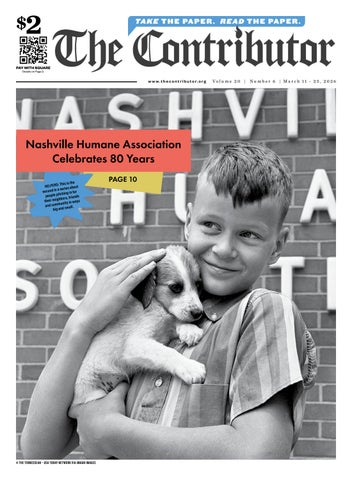
As the Nashville Humane Association celebrates its 80th anniversary in 2026, the organization is reflecting on decades of work protecting homeless, adoptable and at-risk pets while continuing to meet the evolving needs of animals and families across Middle Tennessee.
The milestone announcements and celebration also comes during a busy season
for the shelter. In early March, Nashville Humane Association was experiencing overcrowding, a result of the ongoing need for adoptions, foster families and community support as the pet population continues to grow.
“Nashville Humane would not be where it is today without our staff, dedicated volunteers, and community,” says Laura Baker, executive director of NHA. “Celebrating 80 years is an incredible accomplishment.
While our mission has grown and evolved over the years, our focus has always been serving Nashville and its animals.”
Originally incorporated in 1946 to protect the well-being of animals in Davidson County, Nashville Humane Association has expanded its work over the decades to include pet adoptions, low-cost vaccine and spay/ neuter clinics, a weekly Pet Food Bank, foster care, disaster relief and humane education. In 2025 alone, the organization helped 2,691
pets find homes, partnered with 69 shelters, transported more than 2,200 animals to safety and distributed more than 35,000 pounds of pet food to families in need.
Throughout 2026, the organization will mark its 80th year with special programming and events, including its signature fundraisers — Unleashed, Mutt Strut, Cause for Paws, and Dog Day Festival — as well as a free community open house at the shelter on March 26.
Baker answered a few questions for The Contributor about all the work that goes into serving animals in Nashville.
As the Nashville Humane Association is celebrating 80 years in 2026, what do you see as the most significant ways the organization has evolved since its founding in 1946?
Honestly, the easier question might be how we haven’t evolved. When Nashville Humane was founded in 1946, our mission was to protect children and horses. As Nashville grew and changed, so did we. In the 1960s and ‘70s we focused on rabies control, in the ‘80s and ‘90s we moved into field operations and cruelty investigations, and in the 2000s we launched our mobile spay/neuter unit, ROVER, to tackle pet overpopulation head-on.
We moved into our current facility in 2004 and later became the first shelter in the Southeast to be KultureCity certified so we could truly welcome the entire community. During COVID we pivoted to Zoom adoptions, and in recent disasters we’ve focused on providing resources and support that help keep pets with the families who love them.
The common thread through all 80 years is simple: we evolve to meet the needs of our community — and if Nashville keeps changing, you can bet we’ll keep changing right along with it for the next 80 years.
Nashville Humane now reports a 98 percent save rate. What strategies or programs have helped the shelter reach that level of success?
A 98 percent save rate doesn’t happen because of one program — it happens because of a community. It really does take a village. At Nashville Humane, our strategy is rooted in being humane to humans and animals alike. When we help people, we help pets stay in their homes.
That’s why we offer services like no-cost sterilization, training support, grant-funded landlord deposits, a weekly pet food bank and community vaccination clinics. These programs help remove the barriers that sometimes force families to surrender beloved pets.
For the more than 3,000 shelter dogs and cats and 15,000 community dogs and cats we serve each year, we invest deeply in every animal that comes through our doors. We regularly pull from our partner shelter, Metro Animal Care and Control, as well as surrounding rural counties, and we specialize in helping animals with medical or behavioral challenges.
Programs like FOSPICE are a great example of the compassion behind our work — our veterinary team provides medical care while a foster family provides a loving home allowing animals who might not otherwise survive to experience comfort, dignity, and love.
At the end of the day, our save rate reflects something bigger than the shelter
itself. It reflects Nashville — a city full of people who are willing to step up for animals and for each other.
What are some of the key events or initiatives the community can look forward to during the 80th anniversary celebration year?
This is truly a year to celebrate. We’re kicking things off with an Open House for the community on March 26 from 1–7 p.m., where people can come see their local animal shelter, meet the team, and learn more about the work happening behind the scenes to help animals in Middle Tennessee.
The following evening, March 27 from 6–9 p.m., we’re hosting a tented donor celebration called Top Tails with a fun nod to 1946 — complete with music from the era — to honor the people who helped build Nashville Humane into what it is today. We are a cornerstone of our community because of some incredible pillars in our community like Robin Patton, Will Cheek, John Colton and Jim Delanis.
We’re also working toward launching a Nashville Humane specialty license plate through the State of Tennessee so supporters can literally drive our mission forward.
And one of our biggest community traditions returns on May 17: Mutt Strutt at Shelby Bottoms. It’s a one-mile walk or 5K you can do with your pup, and nearly 900 people typically come out to enjoy the beautiful weather, spend time in nature, and celebrate their love for animals while supporting our work.
There’s a lot planned this year, but the heart of it all is bringing the community together to celebrate 80 years of helping animals — and the people who make that work possible.
As you look ahead, what are the biggest challenges and opportunities for animal welfare in Nashville over the next decade?
The biggest challenge — and opportunity — for animal welfare in Nashville over the next decade is continuing to evolve alongside our community. In my 17 years working in animal welfare, I’ve seen needs and priorities ebb and flow. The key for organizations like Nashville Humane is to stay connected, listen closely to our community, and step in where we’re needed most.
Nashville is growing quickly, which means the challenges will keep changing — from access to veterinary care to disaster response to keeping pets and families together during tough times. Our goal is to remain flexible, innovative, and deeply rooted in the community we serve.
At the end of the day, we’re here for Nashville. Whatever the challenge — growth, economic shifts, or the unexpected — we’ll keep showing up and adapting, because that’s what our community and its animals deserve.


Contributor Executive Director and Chair of INSP North America, Will Connelly, gives his analysis of the main discussion points of the Knight Foundation Forum in Miami
On 11 February 2026, at the Knight Media Forum in Miami, Maribel Pérez Wadsworth, President and CEO of the Knight Foundation, stood before a room of journalists, funders, technologists and civic leaders and framed the stakes in constitutional terms.
“The First Amendment is democracy’s firewall,” she said. “If it falls, America falls with it.”
Her speech was not abstract. She pointed to journalists harassed in the streets, public media funding cut, arts organizations threatened, and growing pressure on institutions designed to inform and connect communities. She also offered a counterpoint: nine out of 10 Americans still believe that the First Amendment is fundamental. The public, she argued, is defending it.
For those of us working in street papers, that language lands close to home. We operate at the edges of markets and the margins of policy conversations. We publish stories that are often overlooked. And we do so in direct, face-to-face relationship with readers.
But if Pérez Wadsworth offered the constitutional frame, the clearest illustration of journalism as civic infrastructure came later, from Erik Langner, Executive Director of the Public Media Bridge Fund, and Mariana Robertson, General Manager of KCAW Raven Radio in Sitka, Alaska.
Langner described how the sudden elimination of federal funding for public broadcasting destabilized stations across the country, particularly in rural communities. The Bridge Fund moved quickly, distributing tens of millions of dollars to prevent mass shutdowns. Seventy-four grantees operating 186 stations
BY WILL CONNELLY

across 29 states and territories were stabilized.
But the deeper question, he said, is how to move from emergency response to long-term sustainability.
That is where Raven Radio in Alaska comes in.
Raven Radio operates with just four fulltime staff members. Before the cuts, there were five. That reduction may sound small. In a four-person organization, it represents a 20 percent loss. Robertson described serving Sitka and seven additional remote communities, including federally recognized tribal communities and fishing towns scattered across a vast stretch of coastline. Broadband is unreliable. Cell service can fail. In her first summer in Sitka, internet and cellular networks were down for 16 days. Raven Radio never left the air.
When an emergency alert sounds, people turn to the radio to hear a calm, trusted voice explain what is happening and what
to do next. In parts of Alaska, radio is the backbone of the emergency alert system and the connective tissue of daily life.
That story reframes the conversation about journalism.
This is not simply about articles, clicks, or subscriptions. It is about reliability, trust, and presence.
Street papers understand this distinction instinctively.
In cities around the world, street paper vendors stand on sidewalks and outside transit stations offering a publication and a point of contact. The paper becomes an entry into conversation. The street paper vendor becomes a trusted presence. The newsroom becomes a platform for voices rarely centered elsewhere.
Individually, a street paper may look small. Collectively, across the International Network of Street Papers (INSP), the movement reaches millions and operates in dozens of countries.
Like Raven Radio and the 186 stations supported by the Bridge Fund, street papers often function as civic infrastructure in communities where traditional markets fall short.
Langner emphasized that stabilization is only the first phase. The next is transformation: building durable networks, shared services, and sustainable business models that allow local media to remain rooted while benefiting from regional and national collaboration.
Robertson spoke of this moment as a crisis and as an opportunity. Financial constraint forced Raven Radio to sharpen its focus on what matters most: local news and local voices. Across Alaska, 27 public media stations have intensified collaboration, sharing engi-
neering services and coordinating strategy so that scarce resources are used where they matter most.
This turn toward collaboration echoes across the broader local news ecosystem. Philanthropic coalitions like Press Forward are mobilizing hundreds of millions of dollars. Organizations like Report for America and the American Journalism Project are scaling network models and shared infrastructure. Policy advocates are advancing public funding approaches that protect editorial independence while recognizing journalism as a public good.
The language used at the forum like “infrastructure, public good, resilience” is language street papers have long embodied, even if not always recognized as such.
As INSP seeks support to stabilize and strengthen the North American street paper network, the example from Alaska offers a powerful reminder: small teams can anchor vast communities. Modest budgets can sustain essential services. And trust, once built, becomes the most durable asset of all.
Pérez Wadsworth closed her remarks with a call to action: the First Amendment was demanded by the people, and it must be upheld by the people.
Street papers have always been of the people and for the people.
If local journalism is being reimagined as civic infrastructure like a firewall, a lifeline, and a backbone, then street papers belong squarely within that design. They are part of its foundation.
Courtesy of INSP.ngo

• March 16, 1-2:30 p.m.
• March 16, 3-4:30 p.m.
• March 18, 1-2:30 p.m.
• March 20, 12-1:30 p.m.
• March 24, 2-3:30 p.m.
How to sign up for the tour: Sign up at thecontributor.org/unseennashville-tours and scroll to the calendar or email unseen@thecontributor.org.
Important: Tours require a minimum of 6-8 people per tour to cover costs.
Once signed up, please wait for a confirmation from The Contributor with the meeting time and meeting location to confirm your desired date. If there aren’t enough participants for the tour you requested, The Contributor will work with you to find an appropriate date.
Cost: $20 per person.
Tour information is available at thecontributor.org/unseen-nashville-tours.


When I go out of town, my neighbor takes care of the cats. Twice a day she’ll stop in and give Sourpatch his digestion pills and scoop up Mr. Lincoln and pet her sweet little head. She makes sure they’re fed and sends me pictures to let me know everybody’s still up-and-running. And I wish I had little daily reassurances like that in every aspect of my life. Little check-ins that say “everything’s fine. You’re doing just fine.” And, of course, I can’t get that all the time, Pisces. But it reminds me how much it helps to give it.
That wild storm broke off a huge branch in my neighbor’s biggest tree. It fell most of the way down, but got perfectly caught in some vines. So now it’s just hovering over my parking space, swaying when the wind blows. Today I parked on the street and tied a rope to the branch, tried to pull it down. But those vines are too strong. They won’t let it go. I know it will fall eventually, I just can’t know when. Sometimes, Aries, our fears just hang there. And they say they’ll come for us eventually, but they won’t say when. The challenge is to keep living. To do what we can to manage the fall, but show up and park anyway.
When I grow up, I want to be the “Skip Ad” button that pops up at the bottom of the screen while you’re waiting for the video to start. Everybody loves the “Skip Ad” button. You mean, we don’t have to watch this whole thing? What a relief! And when I do it, Taurus, I won’t even make you wait the mandatory 15 seconds. I’ll let you go after 5. But until we can get a great job like that, we’ll just have to make some peace with the fact that not everybody likes us all the time. Be who you are, Taurus not who you think everybody wants you to be.
How much water are you drinking, Gemini? I’m on my third bottle today and, honestly, I’m not even sure it’s doing anything. There’s so much we have to do each day just to keep moving forward to the next. And then there are all the extra things that people say will make you healthy or happy or better at life. I’m gonna call it for today, Gemini. If you aren’t thirsty, you’ve probably had all you need. If maxing-out is getting exhausting, it’s fine to shoot for the minimum.

One of my weaknesses as a human being is that I haven’t met a lot of babies. I suppose I was a baby at some point, but I was the youngest child so everybody I knew was older than me. Now whenever I’m in the room with a baby, I just assume I don’t have much to offer. Most of them don’t read horoscopes and they can’t eat my famous vegan shepherd’s pie (too spicy). But lately I’ve been wondering if I need to get over all that. You get it, right, Cancer? We think we have to contribute to the future, but maybe the best thing we can do is to simply engage with it. Maybe I can’t teach or provide, but what if I could just learn something or make a friend? Try it out, Cancer.
Everybody loves the sound of a train off in the distance. The lonely howl of the faraway whistle over the rumble of steel and power. But I’m not loving the proximity of the railroad crossing to this sensory deprivation spa. Just about the time I finally relax and slide a little closer to enlightenment, here comes the train again—blasting its blare through the walls and the water. The host says that’s just another opportunity to practice being in a body. The rumbles will come, but how will we respond, Leo? Try to push it away, or let reality enter the space we try so hard to protect? Here it comes again.
Some people say human consciousness is an illusion. Well, consider me completely fooled. Because I’m absolutely lost in the experience of my own mind. All those thoughts and sensations and feelings and memories; I’m still pretty sure those are happening to me. But I do think it’s a useful notion—that I’ve been duped into believing that I am a self—if it helps me see that my experience is no more central to the story than anyone else’s. That I’m not the main character. And neither is humanity. You and me, Virgo, were just little pieces of reality who think we’re alone. But everybody is right here.
What happened was, Libra, couldn’t find my astrologer’s rod, which I use, like, all the time. But I remembered I had an old seeing orb in the cabinet over the fridge so I grabbed the stepstool out of the broom-closet but when I was coming down with the orb I stepped back too far off the top of the stool and landed hard on my right leg: I felt something pop. I didn’t know calf muscles could go “pop” but it turns out they can. Anyway, Libra, I’m gonna stay home today and rest, ice, and elevate. For you I recommend easing-up on the pace and just doing things one slow step at a time. Best way to avoid a pop.
Mr. Mysterio is not a licensed astrologer, a
Want more? Visit mrmysterio.com Or just give him a call at
They put the war on the TV again. Right here in the dermatologist office waiting room, of all places. And it’s such a strange thing to be so connected to the worst things in the world and also so disconnected from them. All I can really do about the global atrocities of this exact moment, is get this suspicious mole removed. Take care of yourself and your neighbors, Scorpio. Let them take care of you. Try not to soak up too much of the troubles you can’t control in the meanwhile.
I’ve heard that when astronomers and physicists need to look deep into the universe, they might be lucky enough to reserve time on the James Webb Space Telescope. They probably don’t save any slots for amateur astrologers like me. But if they did, I’d use it to find a mirror out there in space. And if it was just the right distance away, Sagittarius, and the light took just the right amount of time to get out there and bounce back to my lens, maybe it would be reflecting an image of the day you were born. And I’d send you a picture and remind you that it’s ok to be here. And just because it’s the only place to be doesn’t mean it’s not also the best. But since I don’t have a picture, we’ll just have to remember that together.
To whom it may concern, I was told these new vacuum-sealing microwaveable bowls would be virtually indestructible. That has not proven to be the case. The second time I washed this bowl I tapped it on the faucet while rinsing it and a crack appeared that has since split the bowl in two. For this reason, I would hesitate to give this item a rating of higher than two stars (One star for the comfortable curve of the base. One for the pleasant floral pattern on the lid.) However, Capricorn, I did learn yet another valuable lesson about impermanence—the lesson we all must learn again and again—and for that, I will add a third star to my review. Purchase only if you need to be reminded that nothing lasts.
It’s a beautiful day out there, Aquarius. Seemed like a great one to eat dinner on the front porch. And things were going pretty well until I tried to leave the house holding a bowl of lentil soup and a glass of grapefruit juice. My sleeve got caught in the front door handle again and now I’ve got a hole in my shirt, some mopping to do, and a pizza on the way. The sun keeps doing its thing, Aquarius. Who are we to do otherwise. Let’s give it another try tomorrow.
BY LORA V., CONTRIBUTOR VENDOR
Well, we had our winter storm for the winter season. Now a month later we are having incredibly good and warm weather. The news said it is 15-20 degrees above normal for this time of year.
The poor trees don’t know if they are supposed to be blooming or still bare. But the bad thing about the blooming is the pollen going up.
It is also confusing the bees and wasps. They shouldn’t be out yet! Also, the flowers. It is lovely to see them, but it is not time for them.
I love the warm weather and not having to wear sweaters or jackets. But when the calendar says Spring Time the weather usually turns cooler.
SUBMITTED
BY
HOWARD P., CONTRIBUTOR VENDOR
There is a mechanic who works out of his backyard because he can’t afford to work out of a business. Well, he has a dog named Mace. Mace loves to eat grass so this mechanic has to keep Mace locked up in the house or he would eat up all of the grass.
Well this mechanic has a very particular car that he is working on and he had to go pay $150 for one special wrench that only fits this particular model car. And while working on this car he drops the wrench into the tall grass. He looks all over and because he works all of the time he don’t have enough time to mow his grass. So he can’t find the wrench in the grass and he decides to call it a day. He decided to break out his weed eater in the morning and do some weed eating to find his wrench. Well, somehow Mace escaped into the backyard sometime in the evening and ate up all of the grass.
In the morning the mechanic came out to the backyard with weed eater in hand and noticed the grass all chewed down, and Mace standing there wagging his tail. The man look up to heaven and proclaimed ... (You’re gonna hate me for this!)
A Grazing Mace How Sweet The Hound That Saved A Wrench For Me!!!!
COMIC BY DENNIS T.
BY “SHORTY” R., CONTRIBUTOR VENDOR
The shutdown started Feb 14, 2026. We are still at it as I’m writing this on March 1, 2026. Congress has returned to Washington, but now they are taking care of other business:
1. They had a party for the men’s USA Hockey Team winning the gold medal at the Winter Olympics.
2. I think they took a few days for Rev. Jesse Jackson dying.
3. This attack on the Middle East. Are we going into war or not?
The TSA is only going to get a small paycheck. When will it all settle down so they can vote on a deal to open all the government back up?
SUBMITTED BY JIM
P., CONTRIBUTOR VENDOR
“If we have no peace, it is because we have forgotten that we belong to each other.”
- Mother Teresa

“The Contributor” está trabajando con uno de los principales periódicos en español La Noticia para llevar contenido a más lectores en Middle Tennessee. Nuestros vendedores de periódicos han pedido durante mucho tiempo que nuestra publicación incluya contenido que apele al interés de residentes de habla hispana en nuestra comunidad.
“The Contributor” is working with one of the leading Spanish-language newspapers La Noticia to bring content to more readers in Middle Tennessee. Our newspaper vendors have long requested that our publication include content that appeals to the interest of Spanish-speaking residents in our community.

s t s *
( S i n d i c at o d e
Actores de Cine y F e d e r a c i ó n

Estadounidense de Ar tistas de Televisión y Radio) ocupan un lugar par ticular dentro de l a t e m p o r a d a d e p r e m
o s d e Hollywood A d i f e
g a l a r d o n
a d e
n c
í n o vo t
c r í t i c o s n i p e r i o d i s t a s , s i n o l o s p r o p i o s a c t o r e s qu e i n t e g r a n e l s i n d i c at o
E n e s e n c i a , s e t r a t a d e u n r e c o n o c i m i e n t o e n t r e c o l e g a s
En esa conversación inter na de la industria, las voces latinas comienzan a sentirse con mayor claridad. Durante la más reciente ceremonia, uno de los nombres destacados fue el del actor puer tor riqueño Benicio del Toro, nominado en la cate goría de Mejor Actor de Re par to por su papel en la película *One Battle After Another* Aunque el galardón finalmente fue para otro intér prete, su n o m i n a c i ó n vo l v i ó a s i t u a r a u n actor latino entre los talentos más respetados del cine contemporáneo
C o n u n a c a r r e r a q u e i n c l u ye s u histórico Óscar por *Traffic* y una trayectoria marcada por personajes complejos, Del Toro re presenta a una ge n e r a c i ó n d e a r t i s t a s q u e a b r i ó c a m i n o p a r a mu c h o s o t r o s i n t é rpretes latinos en Hollywood
E n p a r a l e l o, f i g u r a s c o m o Je n n a


O r t e g a , Au b r ey P l a z a y S e l e n a Gome z estuvieron presentes como par te de una generación más joven de intér pretes latinos que hoy ocupan espacios cada ve z más visibles dentro de la industria del entretenimiento Su presencia en escenarios globales refleja una transfor mación que, aunque g radual, resulta cada ve z más evidente
Au n a s í , l a r e p r e s e n t a c i ó n s i g u e s i n
r e fl e j a r p l e n a m e n t e e l p e s o d e m o g rá f i c o y c
d a d e r a m e n t e s u s p u e r t a s
E s t e m o m e n t o t a m b i é n r e fl e j a u n
d i á l o g o i n t e r e s a n t e e n t r e g e n e r ac i o n e s Po r u n l a d o , a r t i s t a s c o n -
s o l i d a d o s c o m o B e n i c i o d e l To r o
c o n t i n ú a n d e m o s t r a n d o l a p r o f u n -
Conoce tus derechos: ¿Que hacer en caso de una redada?
Mantenerse callado
Sólo dar nombre y apellido No mentir
Nunca acepte/lleve documentos falsos No revelar su situación migratoria No llevar documentación de otro país
En caso de ser arrestado, mostrar la Tarjeta Miranda sados en la Quinta Enmienda de la Constitución, derechos de guardar silencio y contar con un ogado fueron denominados Derechos Miranda go de la decisión de la Suprema Corte de Justicia Estados Unidos en el caso Miranda vs Arizona, 4 U S 436, de 1966

d i d a d y ve r s a t i l i d a d d e l t a l e n t o l a t i n o Po r o t r o , u n a n u eva c a m a d a
d e i n t é r p r e t e s c r e c e e n u n c o n t e x t o
d i s t i n t o , d o n d e l a i d e n t i d a d l a t i n a y a n o a p a r e c e n e c e s a r i a m e n t e
c o m o u n e l e m e n t o m a r g i n a l d e n t r o
d e l a s h i s t o r i a s
Hoy vemos actores latinos protagonizando series globales, par ticipando e n g r a n d e s p r o d u c c i o n e s c i n ematog ráficas o moviéndose con naturalidad entre el cine inde pendiente y los g randes estudios Muchos de ellos son bilingües y culturalmente
híbridos, capaces de conectar con audiencias diversas dentro y fuera de Estados Unidos
El cambio tampoco se limita a la actuación Cada ve z más ar tistas latinos par ticipan en el desar rollo de proyectos como productores, guionistas o creadores Esa presencia detrás de cámaras resulta fundamental para ampliar las historias que se c u e n t a n D u r a n t e d é c a d a s , Hollywood retrató a los latinos a través de estereotipos simplificados; hoy esas nar rativas comienzan, poco a poco, a expandirse
Más allá de quién levante una estatuilla cada año, la presencia latina en eventos como los SAG-AFTRA Actors Awards refleja algo más profundo: una industria que lentamente reconoce que el talento latino for ma par te esencial del presente y del futuro del cine y la televisión
Y q u i z á l o m á s i m p o r t a n t e e s e l m e n s a j e q u e e s t o e nv í a a l a s nu eva s ge n e r a c i o n e s Pa r a mu c h


Oscar-winning director Morgan Neville (“20 Feet From Stardom”) crafted his new Amazon documentary “Man on the Run” as an intimate portrait of Paul McCartney’s turbulent decade following the Beatles’ dissolution. The film focuses exclusively on the 1970s, beginning the moment the Beatles officially break up in April 1970 and spanning through John Lennon’s death in 1980. Neville’s movie uniquely focuses on the singer-songwriter’s creative process and growth while also keeping tabs on the struggles of McCartney’s bandmates to make meaningful music in the shadow of Beatlemania.
At 27, McCartney and his wife Linda retreated to a remote farm in Scotland. Paul is battling depression, grieving the loss of his friends, and wondering if he’ll ever write another song. The film chronicles his legal war with manager Allen Klein, the public perception that he destroyed the Beatles, and the critical savaging of his early solo work. Here, albums like “McCartney” and “Ram,” dismissed as disappointments at the time, receive reassessment through new interviews with McCartney and archival audio from Linda, who died in 1998.
BY JOE NOLAN, FILM CRITIC
The documentary charts Wings’ formation with Linda on keyboards and ex-Moody Blues guitarist Denny Laine, tracking the band through multiple lineup changes. Neville uses unprecedented access to previously unseen footage, Linda’s extraordinary photography, home movies, and Paul’s handwritten diaries to document the chaotic Lagos recording sessions for Band on the Run, McCartney’s 1980 marijuana arrest in Japan, and the band’s evolution from barn rehearsals to stadium tours. McCartney’s Scottish retreat echoes the broader back-to-land movement of the era and even Bob Dylan’s withdrawal to Woodstock. McCartney’s lo-fi home recording on “McCartney” and “Ram” anticipates today’s bedroom studio culture by about 30 years. Like Dylan and the Band’s “Basement Tapes,” these artistic retreats created music ahead of its time — raw, intimate recordings that would influence generations of indie musicians decades in the future. Even the ukulele on “Ram On” sounds like it could’ve been plucked from the hipster heyday of the 2010s. Linda’s decision to join Wings despite min-
imal keyboard experience prefigures punk’s embrace of spirited amateurism over technical musicianship. The first Wings bus tour of random small college venues plays like a tiny version of Bob Dylan’s Rolling Thunder Revue. In a voiceover comment, McCartney says it was like returning to the early days of The Beatles learning their chops night after night at the Cavern Club in Liverpool and in Hamburg where the band cut their teeth.
Director Morgan Neville makes a brilliant formal choice by using voiceover-only interviews with no talking heads. Contemporary conversations with McCartney, his children, and collaborators play over the captivating archival footage, keeping viewers locked in the 1970s rather than cutting to white-haired rock stars in contemporary settings. New interviews with Sean Ono Lennon, Mick Jagger, Chrissie Hynde and surviving Wings members provide perspective on McCartney’s struggle to step out from The Beatles’ shadow while building a family band. Editor Alan Lowe’s assembled archival material showcases McCartney’s transformation from wounded
ex-Beatle to confident bandleader, capturing what Neville frames as a story about growing up in the public eye.
“Man on the Run”’s creative focus delivers priceless insights into McCartney’s artistic process and the meanings behind specific songs, and the artist himself talks about the therapeutic role music played during his grieving for his lost band and his struggles to stand on his own two feet. Knowing the decades of brilliant work McCartney has produced since this period makes it startling to hear him admit he had genuine doubts about ever writing another note after the Beatles broke up. These vulnerable insights and confessions give the documentary an intimacy and emotional weight not typically found in music career retrospectives.
Man on the Run is streaming on Amazon Prime Video.
Joe Nolan is a critic, columnist and performing singer/songwriter based in East Nashville. Find out more about his projects at www.joenolan.com.
