editor-in-chief and the corresponding section editor. The Cascade reserves the right to edit submissions for clarity and length and will not print any articles or be a platform for any contributor or contractor who has shared racist, sexist, homophobic, or libellous content online in any form. Letters to the editor, while held to the same standard, are unedited, and should be under 200 words. Opinions expressed do not necessarily reflect that of UFV, The Cascade’s staff and collective, or associated members.
The Cascade is published on the traditional, unceded
Editorial // Two girls walk into a bar...
As women operating in a patriarchal society, it can be easy to feel angry, sometimes even a little helpless. With International Women’s Day having passed on Mar. 8, there’s lots of focus on women in this issue of The Cascade We discuss equal birth control on page 10, a review of The Bride! on pages 20-21, and the idea of bringing menstrual leave to Canada on page 8. For a very special interview, venture to page 18 where we have a spotlight on renowned female poet and writer, Sadiqa de Meijer, who just recently visited UFV’s Abbotsford campus to read some of her work and share her wisdom with students.
Our feature this issue on pages 12-14 presents you with ideas from the women who make up the behind the scenes of The Cascade and highlights personal notions on what womanhood is to us.
I’ll leave you with a segment from Brenda Shaughnessy’s poem, “Postfeminism,” as we reflect on Women’s Day:
“There are two kinds of people, soldiers and women, as Virginia Woolf said. Both for decoration only.
Now that is too kind. It’s technical: virgins and wolves. We have choices now. Two little girls walk into a bar, one orders a shirley temple. Shirley Temple’s pimp comes over and says you won’t be sorry. She’s a fine piece of work but she don’t come cheap. Myself, I’m in less fear of predators than of walking around in my mother’s body. That’s sneaky, that’s more than naked. Let’s even it up: you go on fuming in your gray room. I am voracious alone. Blank and loose, metallic lingerie. And rare black-tipped cigarettes in a handmade basket case. Which of us weaves the world together with a quicker blur of armed seduction: your war-on-thugs, my body stockings. Ascetic or carnivore.”
Cassie Williams
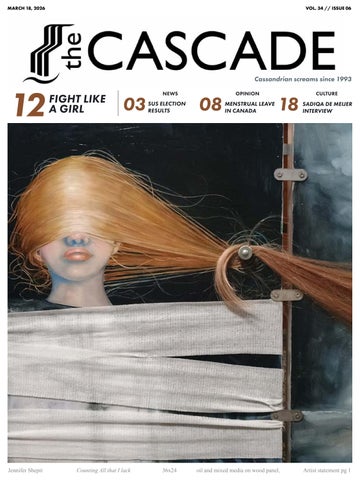
Artist Statement
JENNIFER SHEPIT
“This piece was created for an exhibition that asked about the artist’s relationship with hair. The first association I had from the prompt was that due to a disability diagnosed at a young age I had to have my hair kept very short. My disability and my cropped hair were the first ways I felt othered from the girls in my community, and were complex catalysts for my ongoing evaluation of the general idea of gender, as well as my own personal relationship with the concept of womanhood.”
NEWS BRIEFS
PROVINCIAL//
It’s the end of daylight savings for B.C.
After springing forward by one hour on Sunday, Mar. 8, B.C. has decided that they will no longer be observing the bi-annual daylight savings time changes. According to Premier David Eby, reasons for this provincial decision include enhancing good health, and avoiding any interruptions to daily routines the time changes may cause families.
However, this action could also create problems in the future for businesses, a point brought up by Bridgitte Anderson, president and CEO of the Greater Vancouver Board of Trade.
“The unilateral change in time is an unwelcome distraction that will make it more difficult to attract and retain businesses in British Columbia.”
As reported by CBC News, the B.C. government stated in their press release that there is the option for towns and cities in the province to decide what they want to do.
“Just as they can today, local governments will retain the power to determine what time zone they observe.”
While B.C. is no longer observing the time changes, Alberta is now also considering taking a similar step.
RACHEL TAIT
PROVINCIAL// NATIONAL//
Outcry as copper mine expansion approved
On Feb. 20, the B.C. provincial government approved the revitalization and expansion of the Copper Mountain Mine — an old open pit mine — close to Princeton, on the Upper Similkameen and Lower Similkameen territories. The expansion will reopen the Ingerbelle gold and copper mine owned by Hudbay Minerals and extend its operational life till 2047. This will also include raising the tailing dam by 87 metres and provide around 800 jobs for the local community.
However, while the B.C. government stated that local Indigenous people were engaged in the project review process, the Upper and Lower Similkameen nations issued a joint statement condemning B.C. for moving forward with the project which received no prior and informed consent from the two nations. The statement noted that while the Similkameen nations signed participation agreements with the Ingerbelle mine earlier in February, the agreements clearly stated that no advanced consent was given.
The senior Vice President of Hudbay, Robert Carter, thanked the Upper and Lower Similkameen for their cooperation and assured that the expansion would comply with B.C.’s environmental standards. However, multiple previous offences, including the dumping of 3,000 litres of mine tailings on the land, raise concerns over further environmental damage.
LIAM PYPER
Travel advisories in effect for Canadians
Since February 2026, there have been various ongoing situations around the globe which have prompted the Government of Canada to inform Canadian travellers to be extremely careful while travelling to, or around, certain countries. The magnitude of the conditions are outlined by the risk levels on the Canadian government’s travel advice and advisories by destinations web page.
Due to conflicts in the Middle East, there are several nations which Canadians have been warned to avoid completely, including Iran and the United Arab Emirates (UAE). Connecting flights between these countries have also been cancelled as airspaces are limited or closed.
Despite recent circumstances of cartel-related violence, Mexico is not included on the avoid list. However, the Canadian government has advised citizens to be on high alert if planning to visit.
The conditions in Mexico have caused some Canadian travellers to shift their plans. However, according to a survey conducted by Leger 360, there are still many Canadians who are willing to make the trip.
“While concern is clearly present, 46 per cent still plan to travel to Mexico as originally intended.”
These advisories are not solely limited to particular destinations, but have been impacting the status of travel worldwide.
JASLEEN SANDHU
LOCAL//
Highway 1 overpass lane closures starting Mar. 9
The BC Ministry of Transportation and Transit recently announced that Abbotsford’s Highway 1 overpass will be under construction, downsizing it to two traffic lanes instead of the existing three. This project was set to begin on Mar. 9, in an effort to help extend the overpass to five lanes in total, which will affect commuters until the end of 2026.
This construction is part of the city’s 104 million dollar Mount Lehman Road Interchange Project. According to the project plan, they intend to widen Highway 1 by 3.5 kilometres, among other perks.
The project will allow for other benefits and expansions, including a new southbound lane and northbound left-turn lane, a multi-use path for pedestrians, and seismic improvements for safety.
The B.C. Ministry claimed that the overpass is also supposed “to more easily connect Abbotsford to the Fraser Highway and Abbotsford International Airport.”
The additional developments will help create a safer road environment, provide more efficient transportation of goods and services, and help local communities.
VERONICA POWELL
SUS // 2026 SUS election results
Insight into the referendum and the future president’s expectations
VERONICA POWELL
The Student Union Society (SUS) released the 2026 SUS Election results on Mar. 7 on their website, and the elected members took the majority by a long shot. For President, Tanvir Hundal was elected as the new SUS president with 66 per cent of the votes totalling at 492 ballots, and her term begins May 1. Runner up Gurpreet Singh had a total of 258 votes, or 34 per cent of the votes. There were 750 votes tallied and 74 abstentions.
Current SUS President Bilal Faisal Faheem gave insight on any new expectations for the new president in the next term.
“Along with the standard expectations that you would have from any SUS president starting their term, navigating the way forward after the Health and Dental Referendum failed [will] be a key thing on their plate. Another big responsibility [will] be to work with the SUS executive director to ensure that SUS remains in a strong position amidst the low student enrollment that we are seeing everywhere from international students. There will be more work to do on the UFV Properties Trust, SUS representation, and continuing the FVX 66 advocacy.”
For Vice President Internal (VPI), Prabujot Bagri was elected with 45 per cent of the votes, tallied from 732 votes in total. Zack Castiglia was voted as Vice President External (VPE), with 53 per cent of the votes tallied from 742 in total. Vice President Students (VPS) was determined to be Saif Qazilbash with 55 per cent of the votes tallied from 699 votes in total. Nine student representatives at large were elected with Chloe Boughen, Amtoj Brar, Gurarmaan Dhillon, Balkarn Singh Gill, Prabcharn Singh Mahal, Josh Parson, Pranya Rana, Rudhar Sachdeva, and Abhayjeet Singh.
Along with determining SUS’s new presidential members, students were also casting votes for whether or not they agreed with the referendum, which asks students on behalf of the SUS Board of Directors if they support an increase in UFV’s Health and Dental Plan fee to $249 per year, with CPI indexing, from the current 2025/26 fee of $195. The price hasn’t changed for 12 years, and would still give students an opt-out option, but out of 369 votes, 52 per cent of students voted no for the fee increase, and 48 per cent said yes.
Faheem shared his response on how the referendum will affect students.
“The failure of the referendum vote [means] the fee won’t be increased and will remain at $196 [per] year. Unfortunately, with the rising costs, the fee will not be enough for the current benefits and coverage. The SUS team would work with Alumo, previously known as StudentCare, to see where we can reduce the benefits and still keep the program running with the current fee. The goal would be to maximize the coverage with what we have but students can expect some cuts to the current plan benefits and coverages in the next year. Ultimately, SUS will work to get the best deal for UFV students with the limited fee.”
Votes came in fairly steadily within the first two days of the voting period but then declined, and very few votes were entered on the final day. This year’s election saw a slight decrease in turnout and number of voters compared to 2025. There was an eight per cent voter turnout with a total of 824 student voters in 2026 compared to 990 student voting and a nine per cent turnout in 2025.
Additionally, the 2026 election had a great amount of complaint activity during the voting period with seven complaints and five warnings having occurred, and the majority was regarding candidate campaigning online and/or in-person or UFV Clubs and Associations promoting them. The campaign period experienced 30 complaints mostly about misplaced posters, club endorsements, and ethical behavior.
Faheem added that they plan to have more tactics for getting students to engage after experiencing a lower turnout and more complaints.
“To get more feedback on how the elections were for the candidates, the elections officer (EO) will be sending out a feedback form to all the candidates to get their valuable input which will help us strengthen our policies with the changing environments. The next executive team will also be tasked with revising and strengthening the elections policies even further after keeping in account the recommendations from the EO.”
Professor Profile: Professor Sadhra reflects on the demanding yet rewarding experience of teaching
Discussing the importance of embracing authenticity as an educator
Were you in a bachelor’s for education or did you have a different path?
Professor Sarine Sadhra is an academic advisor and assistant professor in the School of Education at UFV.
Professor Sadhra has been at UFV since August 2025. She is currently teaching Teaching and Learning Practices (EDUC 300) and works with students as both an advisor and supervisor for practicums. She is nearing the completion of her doctorate, which addresses major questions about authentic identity as an educator. Sadhra spoke with The Cascade about her teaching journey and gave some advice to hopeful educators.
What drew you to this career path?
“I finished my degree and went straight into a teaching program at UBC. It was nice mostly because I loved working with children. I was passionate about education. I really felt like education has the power to make change in our society, so I was drawn to that field. Once I got into it, about eight years later, I started to ask those questions about how it can have an even greater impact, because I started noticing lots of systemic issues and broader issues that I wanted to have an impact in. That’s when I made the transition to teacher education and I got to support student-teachers while they were [on] their journeys, and I just loved that role.”
“I started a Bachelor of Arts degree. I was headed in a very different path. I was doing political science, international relations, and then I switched to family science.I still didn’t know I wanted to be a teacher. I share with my students often that I fell into teaching. It wasn’t something that I knew I always wanted to do.”
How do you find balancing your roles as both an advisor and professor?
“It was a lot to learn last semester when I was new, because I’ve never been an advisor before. … I had a lot of guidance from my colleagues in our department. What I like about it is I get to meet people who want to be teachers really early on. In the past, I’ve only worked with people who are already in the program. It gives me a broader view of the different pathways people take to becoming a teacher.”
What advice would you give to students hoping to pursue teaching?
“Go volunteer in a classroom, and see how you feel in that environment.You can try different grade levels … if you enjoy being around kids [and] enjoy the process of the classroom. I think that’s the number one thing you should do so that you know what you’re getting into … We’ve all been to school, we know how school works, [but] we’ve never experienced it from the side of the teacher. … I think it would
be good for [you as] students to make an appointment with an advisor. Either [your] degree advisor or a BEd advisor. … Just to ensure that if this is a pathway you want to pursue, that you understand what course requirements you need and all of that. Also talk to teachers that you may know in your circle and ask them what do they enjoy about their work? What makes them excited to do it?And what the challenges are, because it’s important that people understand those as well.”
What’s the most important part of educating future teachers?
“Learning how to do a lesson plan and unit plan is only one small aspect of teaching. It’s really the broader understanding of how much impact we have as teachers upon our society. Thinking about how are we going to use the power that we have as teachers to actually benefit society? … How do we understand how caring for children actually has a positive impact on our community? I think these are really important questions for us to consider as teachers. Even more so than the unit or the curriculum. How do we engage with children in positive ways? And teenagers.”
Are there any projects you’re currently working on?
“I’m just finishing up my doctorate right now. I’m going to be defending that in April. My project that I’ve been working
on for several years is how to support the professional identity of new teachers where they can embrace their cultural selves. How can we authentically be ourselves as we’re becoming teachers? By that, I mean embracing our culture and the many identities that we have within our teacher identity. That’s a question that I’ve been pursuing for a long time, that teaching doesn’t have to look one way. There [are] many different ways to be a teacher, and we should be embracing all of those if we want to be authentic.”
Q&A has been edited for length and clarity.
SUS and CASA advocate to maintain Canada student financial aid at its current level
Beginning July 2026, the Canada Student Financial Assistance (CSFA) program will return to its original annual maximum of $3,000 instead of the current $4,200 due to a lack of interest by the Canadian government to renew it. The non-profit post-secondary student advocacy organization, Canadian Alliance of Student Associations (CASA), is petitioning for the federal government to keep the present amount. The Student Union
Society’s (SUS) President Bilal Faisal Faheem shared with The Cascade more about their joint advocacy work with CASA.
What is the CSFA?
“Currently, how it stands is that students get $4,200 per year for the Canada Student Grant and $300 per week for the Canada Student Loans. If you have the Canada Student Grant supplements for students with dependents, then it would be $2,688 per year, per dependent, and $2,800
per year with the CSG supplements for students with disabilities. Those are the four categories that we have, and this is for full-time [domestic] students only. This is not for international students.
“The problem that we’re facing right now is that the budget 2025 that came in had [no] interest to continue the investment in the Canada Student grant at the $4,200 level. This means that currently, if no investment is made before July 2026, the level will go back to its permanent level of $3,000, and as a result, over
700,000 students all across Canada would be affected.”
How will SUS and CASA advocate to maintain the CSFA?
“Some things that we’ve done [are], we’re writing letters to our MPs, we’re reaching out to our campus newspapers, different media platforms, different university bodies, [and] to MLAs, just to make sure
Photo courtesy of
Professor Sarine Sadhra
JASLEEN SANDHU
that we’re able to get this thing back up and running.
“We were able to get in contact with one of the MPs, their name is Leah Gazan. … she’s the member of Parliament from the NDP caucus from the Winnipeg Center in Manitoba. She was able to help us put this petition up on the House of Commons website … The petition went live on Jan. 20, 2026, and it’ll be live until Apr. 20, 2026 … what we’re targeting is as many signatures as we can get from students or residents of Canada. That’s what it requires. You need to be a citizen or a resident of Canada.
“If you’re able to support this petition and get more signatures, it makes our
case super strong over there, and getting 10,000 signatures on a petition is a huge deal. Currently, we are at 8,249 signatures … [if] you get 10,000 signatures or more, [then] it gets to the next level.”
Why is it important to maintain this financial aid for students?
“In May 2024, CASA polled on poverty indicators for students, and what we found … was that in the most recent semester, at least 29 per cent of the domestic students had opted out of buying the textbooks due to financial struggles. There were 21 per cent that had skipped a class to work, 23 per cent had missed paying bills, 14 per cent had used a food bank, and 3 per cent students experienced homelessness.
That’s a huge amount for a population where we have so many young Canadians that are just here to study and make sure that they’re able to excel in their career.
“We see the leaders on both the provincial and the federal front talking about these things that the youth is the future … but cutting the funding for the youth doesn’t reflect the same energy. Even with the current elevated levels in the student assistance that we have, more than a quarter of university and college students are thinking about dropping out of the school just due to the rise of the cost of tuition that we’re seeing, the cost of rent that’s going so high, [and] the cost of groceries.
“Right now we’re sitting at $4,200 for CST. If that doesn’t get approved or
International // Iran closes Hormuz amid conflict
Iran closes Strait of Hormuz amid growing conflict
Dr. Michael Batu is an associate professor in the department of economics at UFV.
On Feb. 28, 2026, the United States and Israel launched a series of strikes against Iran with the stated aim of regime change and crippling Iran’s nuclear program. In the days since the initial strikes, the conflict has continued to escalate, with Iran retaliating against Gulf Nations. Over a thousand people have lost their lives in Iran due to U.S. and Israeli strikes. Recently, Iran effectively closed the Strait of Hormuz, a vital chokepoint at the end of the Persian Gulf, which exports over a quarter of the world’s oil. This has led to concerns of how this could further exacerbate economic issues that are already present. Dr. Batu spoke with The Cascade and explained the global implications the closure of the Strait of Hormuz has as it supplies almost a quarter of the world’s oil.
“About 20 per cent of global oil supply goes [through] this narrow body of water. Now, since the operation began, there’s been fewer and fewer ships that are passing.”
Regarding Canada and how this could impact citizens, Dr. Batu speculates that if the closure is maintained, consumers will likely begin to see the effects in rising costs of shipping and gas, but also an increase in grocery prices and online retail services such as Amazon.
“Let’s say you’re buying stuff from China, coming here [to Canada] Of course, those items don’t swim in the ocean by themselves. They have to be [brought] into ships and those ships make use of petroleum [and] crude oil. So, shipping costs will go up, not to mention, food.”
However, it could turn into a benefit if Canada is able to sell its natural energy to balance out the strait’s closure.
“Energy prices are determined globally, not within Canada, so we can get the benefit from that. So higher crude oil prices would [be] good for Alberta, Saskatchewan, [and] Newfoundland, because these are the provinces that produce petroleum energy.”
Dr. Batu thinks that the next escalation in the war could be a targeted strike on Gulf Nations’ desalination plants, which provide the majority of drinkable water to countries such as Saudi Arabia, Kuwait, and Qatar.
“You know what [Iran is] going to do next? Water. These countries in the Middle East, they don’t have fresh water … they have these desalination plants all over. What [they are] going to do is put extract drones with those desalination plants and voilà, there’s no more fresh water here.”
On Mar. 8, the U.S. struck an Iranian desalination plant, cutting off drinkable water to over 30 villages. Later that day, Bahrain reported that an Iranian drone damaged a desalination plant in the UAE.
Furthermore, Dr. Batu was skeptical that the United States goal of regime change was even possible. Iranian Supreme Leader Ayatollah Khamenei was killed during the strikes, and there was an expectation that this would bring about Iranian surrender, as with Venezuela. However, as Dr. Batu explained, Iran’s theocratic regime cannot be dismantled so easily. The killing of Khamenei, while celebrated by many Iranians, has also made him a martyr for his supporters, and the recent appointment of his son as the new Supreme Leader has made the possibility of regime change appear distant.
renewed, it goes back to the 2019 maximum value, which was $3,000 per year. Imagine all the inflation that you’ve seen from 2019 in the past seven years, all the tuition, rent, housing car insurance [and] transit fees that [have] gone up, all of those things just goes down the drain because the money is not there for the students that rely on this.”
How can people support this advocacy?
“If you go on the SUS executive Instagram account, you can find the QR code over there where students can scan it and then fill out their petition.”
Q&A has been edited for length and clarity.
“They took off the head, the regime still functions … If the mission of the objective is to eliminate the regime, and there are so many to eliminate, they’re gonna be there for a while.”
Batu further argued that the war could be looked at through the lens of political economy, pointing to the way the American military industrial complex has often profited from prolonged conflict. Stocks such as Lockheed Martin and Northrop Gumman have increased since the war.
“These companies are part of the military industrial complex of the United States. Whenever there are things happening like this, always follow the money. We can see that it’s in their best interest [and], I would expect this to continue on simply because these companies are profiting from it.”
As the war progresses, it will become clearer what the economic consequences of the closure will be.
Illustration by Hannah Bricknell / The Cascade
LIAM PYPER
International // Discord delays controversial ID scanning update
The platform’s new age verification processes adjustments
NATALIA TOSCANO MURUA
On Feb. 24, the popular communication platform Discord announced it would be delaying their global age assurance update to the latter half of the year. The age verification update, originally announced on Feb. 9, would require certain users to either record a video of themselves or take a scan of a government photo ID to complete the process. In case the user was deemed to be below the minimum required age to use the platform in their specific country, a ban would be issued to said user’s account.
The usual age requirement is 13 in most countries, including Canada, while other nations require up to 16 years of age. However, the amount of backlash the controversial announcement received prompted Discord to adjust their course by reworking the details of the update and its ultimate goal of providing an age-appropriate experience that caters to every user.
Discord’s Chief Technology Officer (CTO) Stanislav Vishnevskiy mentioned in an official blog post that the update was
meant as a means to keep Discord’s user experience the same while making sure everyone was getting adequate engagement for their age. Vishnevskiy clarified that they learned valuable lessons from the Oct. 3, 2025 incident, where an estimated 70,000 people’s sensitive information, like IDs, were leaked due to a data breach of the third party provider that stored that information.
This incident generated distrust in the company’s handling of IDs and how the information was being kept and utilized.
Vishnevskiy assured through an official blog post that Discord was no longer collaborating with that service provider company whose information database became compromised, confirming they had cut the ties to that provider.
Vishnevskiy reflected that the company should have done a better job at relaying the information properly to their user base to let them know what were their intentions behind the controversial update, and that it would have been better to be clearer about how the process works. The CTO revealed that most of the users, accounting for more than 90 per cent,
FVX 66 pilot in the works
New pilot program could start Winter 2027
On Monday, Mar. 9, UFV Student Union Society’s (SUS) president Bilal Faisal Faheem sat with The Cascade in an interview to share new information on changes coming to BC Transit’s Fraser Valley Express 66 bus (FVX 66) that will benefit UFV students.
Faheem highlighted that the FVX 66 is important for UFV students, because this bus is responsible for connecting to cities such as Lougheed, Langley, Chilliwack, and Abbotsford. He added that although the existing campus shuttle service does travel to both the Abbotsford and the Chilliwack campus, there are students that live west of UFV. who rely on the FVX 66 as their only means of commuting to campus.
Additionally, Bilal shared that UFV’s statistics show that the student population that lives outside of Abbotsford has increased rapidly in the last six years — meaning more students rely on a bus service that, as it stands, is too costly for campus bound riders.
would not see any difference in the use of the platform. It would only be for the remaining less than 10 per cent where further age verification action will be required.
Vishnevskiy disclosed more information on how the system to identify which accounts need verification works, explaining that an internal Large Language Model (LLM) AI system identifies specific signals that indicate the age of the user, such as the antiquity of the account, if there is a registered payment method associated with the profile, server activity, and general patterns of activity.
The system, which is named “DERE,” short for Discord’s Entity-Relationship Embeddings relies on user relations and interactions with the platform to assess the estimated age of the user without reading their personal messages.
For the users that need to be verified, Discord is currently working on more alternative and transparent ways of handling their sensitive information. Users that chose not to verify will be allowed to keep their account and stay a part of the servers they are inside of,
with the only difference being that they would not be able to access age-restricted content.
Discord is currently compliant with countries that require age verification processes for their platform to be used, such as in the United Kingdom, Australia, and Brazil. For most Discord users worldwide, there should not be a prompt asking for age verification and user experience should remain unaffected.
“There’s no other way to come into the Fraser Valley except for that bus. And the bus is absolutely unaffordable for students.”
Faheem explained that the bus costs five Canadian dollars per ride, amounting to $10 for a round trip. However, the cost of the FVX 66 is not included on the U-Pass provided to students, and any fares paid for that bus service are on top of
what students already pay for the U-Pass every semester.
He mentioned that SUS has been in talks with the UFV community and local provincial government partners such as Mission’s Mayor Paul Horn and Abbotsford’s Mayor Ross Siemens. This was done in effort to make changes to the Fraser Valley transit system, approved by the board of the Fraser Valley Regional
District (FVRD), to better support students.
“That is something that we are trying to work on. To make sure that [the] Fraser Valley Express can complement the already existing central Fraser Valley transit system that we have for Abbotsford and Mission, and to support students more.”
Faheem was also ecstatic to share good news regarding the progress achieved in relation to making the FVX 66 more affordable for students. Effective immediately, post-secondary students will be eligible for the FVX 66 concession pass, which lowers the monthly pass cost from $100 to $85. This allows students to save $15 on transport per month.
Another milestone was an increase in service hours for the FVX 66, adding 9,500+ service hours to the route, which started on Jan. 1, 2026, enabling the bus to run more trips during the mornings and evenings. Although Faheem is content with the progress made, he remarked that
NATALIA TOSCANO MURUA
CONTINUED FROM PAGE 06
more steps need to be taken to continue supporting students who use transit.
SNAPSHOT
Connection > convenience
Humans are not convenient. They are unpredictable, tiring, and complicated. Interaction takes more emotional energy, time, risks embarrassment, and is prone to error.
A pattern that I’ve been pondering recently is that when we are given a product that is cheap and convenient, what is often cut is the human element. Delivery apps, self checkouts, ordering online, and scrolling through internet reviews. They all are very convenient. But what we save in money and time, we lose in connection.
So I’ve been trying to find small ways to choose human. Going to the cashier instead of the self checkout, saying “Good day!” to the security guard at the door, talking to a stranger for a recommendation, and asking a friend for help. It might just be little habits that build a greater feeling of community.
One can never be perfect, but it is a worthy pursuit. It is less convenient, but I would rather lose a few more dollars, or minutes than lose the understanding of how we are all connected.
BY KARA DUNBAR
“Still there’s more work to be done over there, [but] that’s where we are with [the FVX 66]. I’m sure that’s gonna help quite a few students with saving and also show them that yes, there is work being done.”
He talked about an initiative that students could expect to see come to fruition in the near future. He confirmed that SUS is working on a proposal to present to BC Transit and the FVRD, with the goal of offering a new transit pilot program with a limited number of seats for students that meet certain criteria. The final details of the program are yet
to be ironed out, but Faheem pointed out that there is work being done to create a program that supports students relying on the FVX 66 that can also be viable for BC Transit.
Furthermore, Faheem explained that in the past seven years, capacity and budget were an impediment for a pilot program such as this one to exist. However, with more service added to the route, the issue of budget still remains — which is what this pilot is working to balance. Faheem hopes the program can begin in the Winter 2027 semester.
“We’re getting [the draft] approved internally, and then we’ll be sending that out to all the parties. [In terms of] what that pilot will look like, we are trying to propose this for the Winter 2027 semester
where students can actually [enroll] into the pilot in the late Fall 2026 semester.”
He is grateful to the student body for being patient with SUS throughout the long advocacy process for getting more benefits for students taking the FVX 66. Faheem expressed confidence about more details on the pilot program coming soon, and that the end goal is to make the whole process as simple and accessible as possible for UFV students.
“Thank you for being patient with us and showing us your support for these things. We’ll get the results very soon. [These are] just some highlights of us getting results, but we will actually get the final result very soon.”
THE ENVIRONMENTALIST: when war falls from the sky
How nature becomes another casualty
Welcome to The Environmentalist, your column for understanding the natural world. Usually, rain is supposed to clear the air. In Tehran, it became part of the danger of war.
After strikes on oil facilities around Tehran on Mar. 7, massive plumes of black smoke rose over the city. Residents were advised by the Red Crescent to stay indoors as reports described dark residue and so-called “black rain” falling from the sky. According to Reuters, the strikes hit oil depots and refineries, igniting fires that released a toxic mix of pollutants into the air. The World Health Organization (WHO) later warned that these emissions posed serious risks to human health and the environment.
This is one of the clearest reminders that war does not only destroy through explosions, but it also lingers in the atmosphere, seeps into soil, and settles into water. When oil infrastructure burns, it can release hydrocarbons, sulfur oxides, nitrogen compounds, soot, and other hazardous particles into the air. In Tehran, sulfur dioxide and nitrogen oxides mixed with moisture in the air, creating a dangerous acidic rainfall that can cause chemical burns on skin and severe lung damage. What fell was not just water — it was pollution returned to earth that directly harms the human population.
The adverse health effects are immediate. Officials spoke of respiratory problems, skin and eye irritation, and headaches, especially for children, elders, and people with existing illnesses. But the environmental effects are broader, and easier to overlook. Toxic rain
can contaminate urban surfaces, wash pollutants into drainage systems, and carry residues into surrounding soils and waterways. Experts say there’s soil and water contamination as well as long-term ecosystem damage from soot, heavy compounds, and oil residues, adding to the human and environmental cost of this war.
That is the thing about environmental destruction in war: it rarely stays contained to a single target. A bomb may strike a refinery, but the damage spreads outward through air currents, rainfall, runoff, and food systems. Smoke does not stop at military boundaries.
Polluted water does not ask who supported the conflict, who was against it and who stayed neutral. The atmosphere carries violence far beyond the site of impact.
We often talk about war in terms of territory, strategy, and casualties. We should also talk about it as an environmental event. Forests burn. Water systems are contaminated. Agricultural land is exposed to toxins. Wildlife habitat is disrupted. In cities, civilians are left breathing the aftermath. Tehran’s blackened rainfall shows that environmental harm is not a secondary side effect of war — it is one of the main outcomes.
When oil facilities explode, the battlefield does not remain on the ground. It rises into the air, mixes with the clouds, and comes back down on the people and ecosystems below. In Tehran, even the rain became part of the war. As the Lorax once said, “Unless someone like you cares a whole awful lot, nothing is going to get better.” So, let’s care.
FABIOLA CRUZ ALDERETE
Illustration by Iryna Presley
Lifestyle //
Can I please bleed at home instead of work?
Why I think Canada should offer menstrual leave
Recently, I had really bad cramps, also known as dysmenorrhea, at work. My job demands being on your feet at all times and moving around a lot. Enter me, carrying two four-litre milk jugs in each hand, subsequently kneeling down and contorting my body to try to store them at the back of the fridge while avoiding my coworker’s legs. I almost wanted to plop down on the floor at that moment because of the pain I was in — it felt like my uterus wanted me dead. I thought to myself, if only I would’ve been allowed to stay home and ride out the pain in a safer, comfier place, that would’ve made a big difference. For women in countries that allow menstrual leave, that’s doable.
Menstrual leave allows people undergoing menstruation to take time off work
if their symptoms are making it difficult to perform their duties. I’m lucky that my bad periods only go as far as heavy cramping and fatigue, but for other people, symptoms can include nausea, migraines, and diarrhea, among other severe effects. It makes sense to me why offering the ability to ride out one’s period and not go to work for even a day or two makes sense; having a bad period day can be very physically taxing after all. The first time I heard menstrual leave was a thing, I had two thoughts: one, that makes so much sense and two, why don’t we have it in Canada?
Imagine how blown away I was to learn that Japan introduced menstrual leave all the way back in 1947, and that currently, other countries including Spain, South Korea, and as of 2024 Mexico, offer this benefit. Credit where credit is due,
there are some Canadian employers that offer menstrual leave, such is the case of nixit and DIVA. These period product companies founded in Canada offer their employees period-specific paid time off from work. Still, there is no official recognition within the Canadian Labour Code that specifically covers menstrual leave. If you want to take a day off work due to feeling ill because of your period, it’s going to be taken from your personal sick days or vacation hours.
I believe it is important to recognize that periods can affect people very differently, and that being sick is very different from having a period. This is why having a system that enables people to take time to care for their health when going through menstruation is important. Actually, saying it is important may be putting it lightly — I think it is essential
It is refreshing to learn about more initiatives being created to encourage menstrual health, and I think that offering menstrual leave is something that has the potential to help people with periods feel more supported. I am aware that the details and logistics on how menstrual leave could be offered by law in Canada is something that we’ll have to discover if and when it’s ever implemented, but using Japan as an example, being able to take up to three days of menstrual leave per month when needed sounds reasonable to me.
Sadly, I also think there would have to be a lot of reform made to perceive menstrual leave as something that makes sense and is done in the interest of good health, rather than something that may just cause more discrimination against people who menstruate. I hate to admit it, but I can also see this having a cobra effect and causing employers to favour hiring non-menstruating employees over employees that do to avoid having to offer paid menstrual leave.
This is why I believe there are many changes that need to happen, and I think one of them is to start seeing employees as people. If a person you know and love is feeling unwell, wouldn’t you like them to take the day off and care for their health? Wouldn’t it make sense to you to be able to provide that support? We need to start caring for everyone as individuals. We need more menstrual support for women and people with periods. We need a system that recognizes, respects, and provides menstrual leave.
SNAPSHOT
People that know me say I’m pretty calm — sometimes even too calm. “How can you not feel angry about that?” is a question I’ve gotten more than once when something happens that could understandably make someone angry, but not me. Perhaps the simple answer is that I don’t like feeling angry, so I choose not to be. The real answer, however, is that I’m not immune to anger, but rather I am very picky about when to get angry.
Anger is very intense, it demands a lot of energy, it can strain the body if taken to an extreme. Yet, completely disregarding it is not healthy either. I like to care for my energy as much as possible, so I’ve always found ways to process my anger differently. Whether by analyzing how one thing led to another and ultimately that understanding washes anger away, or by channeling it through different methods.
Most of the time, I find that life’s happenings aren’t worth my anger. If there’s another way to go about it, I will likely find it and spare the strain. If one day, however, you catch me openly saying that I’m pissed off, you’ll know shit got real.
BY NATALIA TOSCANO MURUA
I’m pissed off
Illustration by Iryna Presley
NATALIA TOSCANO MURUA
SNAPSHOT
(Expensive) free market baloney
by Iryna Presley
This week, I read an op-ed in the National Post by Conservative leader Pierre Poilievre. He claimed that Adam Smith’s infamous theory of free market economics was the key to rebuilding the wealth of our nation. He argued such economies equalized the market by raising wages, lowering costs, and lifting people out of poverty. Criticizing government intervention, he raised Smith’s “Theory of Moral Sentiments,” suggesting that we will inherently care for one another out of our own self-interest.
What a load of crap. First off, it is not 1820 and collective morality doesn’t exist. We all have our own ideas of what is or is not moral, and our society is socialized to hoard wealth and ignore the suffering of others. Corporations that act freely (run by people that Poilievre claims would act in the interest of others) have exploited areas of the world that lack the regulatory standards to protect themselves. The way I see it, the reason the lower and middle classes suffer is not because of government interference, it’s because of the unregulated growth of concentrated wealth. I don’t know what free market Poilievre sees for the 21st century, but let’s not forget that unchecked growth is a cancer.
BY DARIEN JOHNSEN
Mental Health // Self-care in scary times
Taking care of yourself during political crises
LIAM PYPER
As students, I find we are often exposed to news and world events through our peers, professors, and the local studentrun newspaper. As the year progresses, and more historical events keep happening, it can be easy to be overwhelmed by all the headlines and data points flying around out there.
Not only is there political instability, worse, it goes hand in hand with social instability. The Trump regime continues to roll back hard won progress, just last week Kansas revoked the driver’s licenses of every transgender person who did not have their gender assigned at birth on their ID.
My main concern is how to maintain my mental health while still staying informed. I like to be on top of the news as often as I can, but the consistent stream of information that I consume has recently begun to affect my sleep, my grades, and my overall health.
The amount of disinformation and misinformation on the internet is vast and it can be overwhelming to find even one piece of information that is accurate. If you’re anything like me, your news consumption comes from an unhealthy mix of TikTok, Substack, and news outlets like Al Jazeera and Reuters. Make sure that the source of the information you’re consuming, especially on TikTok, is verifiable. Mis- and disinformation
often exaggerate, make up, or skew news, and this can compound with authentic disturbing news, making the anxiety even worse. Another tip is to avoid comment sections — most are filled with bots and only add to the stress.
An article released by Purdue University Northwest, gives students some tips that they can utilize to manage political uncertainty. They recommend limiting the amount of media you consume while still staying informed by giving yourself 15 minutes, either at morning or night, to get caught up. While this is important, staying away from the news, connecting with friends, and practicing self care in the meantime are necessary as well. The Mental Health Commission of Canada also recommends setting up time in your day for reading the news, it encourages staying informed but managing the “information overload” that can often overwhelm and depress. Peachey Counselling explains that political anxiety comes from increasing political and social instability, and can cause depression, panic attacks, and can disproportionately affect minority groups, such as 2SLGBTQIA+ and BIPOC people who have already seen their rights attacked and subverted, especially those living south of the border.
Another strategy I find helpful is to focus on what you can control. The world feels insane right now, and the main takeaway is that it is not your fault. But
in my case this often leads to a feeling of helplessness which can further increase any anxiety I’m already feeling. The main issue is that if we become so caught up in the news, we miss the actual point of being informed. Because, what are you going to do with that information? What we can control is our interaction with others and our community, while the grand scale of the events can make the things happening in our local places feel insignificant — they are not. If we want to see change happen, we need to start with ourselves and our communities.
In wake of the recent conflicts, I found that being with friends and family helped me the most. Try to take time out of your day to hang out with people, even if politics are brought up, it helps me compartmentalize and ground myself without giving into the panic. I also suggest talking to your professors. Whether you are struggling with assignments due to political anxiety or want to be better informed, I recommend speaking with UFV’s professors, even if you’re not in their class. Trust me, it’s worth it.
I hope that these tips help. For me it’s hard to get into the habit of limiting how much news I consume — it’s become a sort of obsession. If you are dealing with a significant amount of anxiety or if you are personally connected to a conflict in some way, Foundry Abbotsford can provide free counselling and other mental health services to people ages 12-24.
Illustration by Hannah Bricknell / The Cascade
Illustration
Sex Life //
Birth control: what’s there and what isn’t?
Women have a whole menu of birth control options, but what about men?
Disclaimer: terms referring to men and women in this article are used alongside terms like “people with prostates”, and “people who can get pregnant” to be trans inclusive.
From talks with friends, cousins, and even acquaintances, I have been in many conversations about birth control ups and downs. I am grateful that I’ve been surrounded by people who feel comfortable sharing their experiences in order to learn from each other. These conversations though, have all been between women and people who can get pregnant.
There are a lot of options for these people when it comes to birth control. The most commonly known is often called “the pill” which is an easily reversible form of contraception that requires one to take a daily pill, preventing ovulation and changing the mucus levels in the opening of the uterus, which prevent sperm from meeting the egg and beginning a pregnancy.
Amongst the conversations I have had, mention of the copper intrauterine device (IUD) has been frequent, as the small metal T is not a hormonal product, but rather prompts an immune response
from the body that ultimately makes uterine egg implantation difficult. The implant, injection, patch, and vaginal ring are hormonal contraceptives that stop the ovaries from releasing an egg by increasing progestogen levels; these methods are reversible and have different maintenance levels, giving a good choice for diverse needs.
If one is confident in their lack of desire for pregnancy or for more pregnancy, then there is the option to be sterilised. The “morning after pill” on the other hand is an emergency contraceptive pill that can stop a pregnancy from developing by preventing an egg being released from the ovaries, but should only be used as the last line of defense. In British Columbia (B.C.), a lot of contraceptives are now covered with national pharmacare funding, and are available to B.C. residents.
“Natural family planning” often refers to one tracking the hormonal cycle and calculating ovulation, though this is the least effective form of birth control. Data from abortion clinics in England and Wales found that a rise in demand for their services has been fuelled by women coming off hormonal contraceptives like the pill and using natural methods instead.
If we take a look at the birth control options for people with prostates, the list is a lot shorter. The practical and effective birth control methods are mainly condoms, thin pouches that cover the penis during sex provide a physical barrier that provides a guard from both pregnancy and sexually transmitted infections, and a vasectomy which is a procedure that stops sperm from being ejaculated during sex by sealing or cutting sperm ducts.
So even if those with prostates do want to take on the responsibility, they don’t have a lot of options available to do so. But why the disparity?
Historically, Margaret Sanger and Katherine McCormick, two of “the pill’s” pioneers, prioritised its development in order to give people more agency and control over their bodies; they didn’t want people who can get pregnant to rely on others to prevent pregnancy. The consequences of an unplanned pregnancy fall more tangibly on the pregnant one, and thus pressure on protection against it has been heavier.
It is not that the research for male birth control hasn’t been done, there’s been birth control for prostate-having people in the works since the 1970s, it just has yet to go very far. There are challenges with anatomy itself; testicles create millions of sperm a day, while the uterus only produces an egg a month. A number of studies have been plagued by side effects, reversibility, and efficiency issues. Though, it is worth mentioning that there have been some recent potential male contraceptives to keep an eye out for in the future, including a contraceptive implant, pill, and gel. In the United States, there is also a Male Contraceptive Initiative which works specifically to help provide funding and advocacy work for male birth control.
Nonetheless, the social pressure and thus funding has just not been there, and isn’t really there, to develop birth control for people with prostates on large scales. I believe that the pressure for these products will need to come from all sides of the conversation to significantly move forward. Across the world and at home, women got birth control by advocating for it, and men will likely have to do the same.
Medical disclaimer: this is not professional advice, do your own research and talk to your doctor before making a decision for your reproductive health.
SNAPSHOT
I had a life once — then the pursuit of truth entered the chat
I’ve always held great respect for journalism. Growing up in a place where it’s nearly impossible to get accurate information, you learn to treat the truth like a rare mineral — precious, out of reach. Why is the truth so hard to uncover? I didn’t fully grasp the struggle until I started working at The Cascade I can’t help myself once something piques my attention and I realize something’s inherently wrong. Why would I? I remember three-hour commutes, juggling crash-courses in law and economics, endless emails, and hours of transcription. I think of the thousand words I wrote that barely covered two coffees and a bus ride, and I can’t help but reconsider that “why would I?” Then I think of my co-workers — braving the pouring rain to reach the farmlands, advocating for communities, witnessing horrors and hostility. They see fear, gaslighting, bureaucratic blockages, apathy. Still, they fight for a better world.
When someone’s story gets the validation they were owed, something in me steadies. It’s time to get to work. Dear reader, I can’t ask you to care. But I hope you remain aware, because systemic corruption doesn’t begin outside the university. It’s right here, if you’re willing to see it.
BY SKY S. TERRONES
KARA DUNBAR
Lifestyle
More than just the usual weight gain
Understanding the symptoms and causes of different types of thyroid disease
PRATI KAPOOR
“Are you okay?” my co-worker asked me as she glared at my belly, convinced something was wrong. To avoid any awkward confrontation, I laughed and brushed it away as if it were a joke. But there was nothing funny about that conversation.
The truth is, her constant staring and repeated questioning of whether I was okay or not — simply because I looked bloated — shattered my confidence into pieces. That evening, I couldn’t face myself in the mirror without hating every inch of my body. Days like those are when self-loathing takes over. All I wanted was to starve myself until I lost all my weight, wishing I could wake up the next day magically skinnier and more beautiful.
It wasn’t the first time something like this had happened, but conversations like these make me feel as though people are shoving my thyroid condition in my face. My condition, called underactive thyroid, prevents my thyroid gland from making the right amount of hormones, something people don’t consider when they make comments about others’ appearance.
The thyroid gland is located at the front of the neck and under the skin. Though small, it plays a significant role in the body. It produces hormones that regulate one’s metabolism, a combination of processes that also affect how the body converts the food we consume into energy.
When this gland isn’t properly functioning, it can affect your entire body; including your cardio-vascular system, nervous system, digestive system, and reproductive system. There are four main conditions that can affect your thyroid: hypothyroidism, hyperthyroidism, goitre and thyroid cancer.
I got diagnosed with hypothyroidism — a condition where the thyroid
gland does not produce sufficient thyroid hormones and slows down the metabolism — in the summer of 2024. For me, in practice, it felt like constant exertion and as though I might faint when I rest, fragile nails, and unintentional weight gain. Beyond these external symptoms, what affects me the most is how much it makes my body unrecognizable. Hypothyroidism decides how my body will look on any given day. On some days, I feel moderately okay, while on others I visibly look either skinnier or crazily bloated. It’s a constant battle that my body doesn’t always look the way I want it to be.
I am currently on medication to regulate my hormones, but I admit it was hard for me to start taking it seriously. I used to convince myself that if I ignored it, it might actually disappear, but it never did. Instead, it got worse — I started gaining unhealthy weight. It took a hot minute for it to fully sink in: this is something I will likely have to deal with for the rest of my life.
Hyperthyroidism on the other hand is a condition where the thyroid gland produces hormones in excess. This can lead to symptoms including sensitivity to heat, irregular menstrual cycles, and difficulties falling asleep.
Conditions like goitres are when the thyroid gland grows unusually large in size and develops small lumps under the skin. It can lead to conditions including obesity and metabolic resistance.
Around 200 million people around the world suffer from thyroid disease. Despite the staggeringly high statistics, thyroid disease is often misunderstood or overlooked. Many symptoms including fatigue and weight fluctuations can resemble everyday lifestyle influences. Hence why it is easier to brush these symptoms off as poor diet or lack of physical activity.
For students and young adults, the thin line can be deceiving. Being a university student myself, when I faced these symptoms, I blamed it on my busy schedule rather than investigating the underlying medical condition.
That’s why awareness matters.
Understanding how the thyroid gland works can help people recognize when something in their body feels off. There is still good news — thyroid disease can be regulated through medications and other treatments including surgery and radiation. However, early awareness can help in taking the necessary steps and receiving care in time.
For me, learning to live with hypothyroidism has been a learning curve. It has meant looking at myself through a kinder lens, paying attention to changes in my body, and especially listening to what my body needs.
Honestly, it is very hard to love myself on days when my body doesn’t look the way I want it to, but I try to remind myself that my body is trying its best to keep me healthy, and that it is already beautiful no matter the shape.
If I could offer you one piece of advice, it would be: take care of your body and be kind toward it.
Illustration by Natasha Zilcosky / The Cascade
feature@ufvcascade.ca
Features Editor — Caitlyn Carr
LIKE A GIRL
THE CASCADE
On Mar. 8, Canada recognized International Women’s Day to celebrate the accomplishments of women-identifying people around the world. Except sometimes, it’s hard to feel like celebrating when the fight is far from over. Misogyny still runs rampant across the globe from microaggressions in casual conversation to full-blown hate crimes and sexist legislation.
Sure, some corporations might highlight Women’s Day in their advertisements, but what about the rest of the month when their female employees are still making 23 per cent less on average than their male coworkers? What about the fact that on a global scale, women still only have about 64 per cent of the legal rights of men? What about the nearly one in three women who will experience intimate partner and/or sexual violence in their lives? Womanhood deserves to be celebrated, but never forget that our rights and well-being deserve to be fiercely fought for.
Womanhood resists any one definition. That’s why, for this issue of The Cascade, we looked inward and explored our individual relationships with it. What do we admire about the women around us? What gendered challenges have we had to overcome? And what advice would we give to the little girls we once were?
Fabiola Cruz Alderete Columnist
When my mom was pregnant with me, her grandmother — my great-grandmother — kept asking what the baby was going to be. When my mom said, “a girl,” she was disappointed. My mom asked why, and my great-grandmother replied that women are lovely, but they suffer too much. That story has stayed with me because, in many ways, it feels like my first lesson in womanhood: to be a woman is to be born into both beauty and burden. To me, womanhood is not something simple or soft. It is shaped by violence, by expectation, by unpaid labour, by impossible beauty standards, and by the constant feeling that no matter how much you do, someone will still tell you it is not enough. It is growing up in a world where femicide exists, where women are made to feel ashamed of their bodies at any moment and for any reason, and where survival itself can feel gendered. In my own family, I have seen this clearly. On my dad’s side, my grandmother was abused by her husband. On my mom’s side, both my great-grandmother and grandmother were left widowed very young and had to fend for themselves and their children with limited earning opportunities.
And yet, womanhood is also deeply beautiful. My relationship with it is complicated, but full of love. Women are community, tenderness, endurance,
“To be a woman is to be born into both beauty and burden.”
a widow, I increasingly admire everything she has carried and everything she has done for me with strength I can barely put into words. Women in my family did not just survive, they rebuilt worlds — and I truly think that that’s who all of us are as women!
humour, and acceptance. We are often the glue that keeps families, workplaces, and entire societies running, even when that work goes unseen. What I admire most about womanhood is this power to create, to sustain, and to rebuild. The same grandmother of mine who was abused became one of the first women in her country to get divorced, kicked that man out, opened a salon, and pulled herself and her four children out of poverty. My great-grandmother, after becoming a widow, opened a dairy store. My maternal grandmother opened a soap and knitting business. My mother built a full life: a high-ranking position in a bank, a career, a marriage, and then me. Now that she is
If I could give advice to my younger self, I would tell her not to waste so much time worrying about how her body looks or how soon she will get a boyfriend. One day, she will understand those anxieties were never measures of her worth — just products of a world that profits from women feeling small.
This Women’s Day, there is so much to celebrate in how far women have come, but the fight is nowhere near over. We must remember the women still facing oppression across the world, and we must amplify the voices of Indigenous, Black, trans, disabled, and other marginalized women whose womanhood is too often erased or ignored. As The Lorax (1971) once said, “Unless someone like you cares a whole awful lot, nothing is going to get better. It’s not.” So, let’s care.
Painting by Iryna Presley / The Cascade
The Cascade celebrates Women’s Day
Cassie Williams Managing Editor
Womanhood for me is cranking my head over each shoulder when I walk to my car in a short dress after work. Womanhood is holding my keys with the sharpest one pointed out, or planning how to use my water bottle in case someone comes up behind me. Womanhood is clutching my drink at the bar and covering it with my hand the whole time. It’s being told things like “yeah but she’s only in that position because a man allowed it.”
Womanhood is many beautiful things, but these are the less-than-magical ones I worry we all go through on an often daily basis.
Womanhood is fear. So what do I admire about it? The resistance to give into that fear.
Through conversations I’ve had with the women in my life I’ve seen fear shift to anger, and sometimes there’s defeat, but the one thing there should never be is acceptance. There are so many magical things I adore about women and about being a woman, but I chose to highlight these things, not because I want to complain, but because these are the moments that I fear we have begrudgingly accepted.
There is a reality that our gender places bounds on new experiences or regular actions that make us unequal in the world. It’s important that amidst that, we never shrink to fit into societal expectations or limit ourselves to what we think we can achieve, or think we should achieve.
If I could give some advice to myself at 13, I would say: don’t place barriers for yourself when there are already so many that exist. Don’t dream of only the “safe” things available to you in life when others don’t have to think twice. You are destined for so many adventures and great accomplishments in this life. So be vigilant, and be smart, but never be accepting.
Caitlyn Carr Features Editor
Womanhood is a broad, hard to define term that looks different for all women. For me, it comes across as more of a feeling.
I feel it when I’m sitting in a meeting next to other women who are all bringing something meaningful to the table just by sharing unique perspectives. I feel it when I make subtle eye-contact with a woman being harassed at a bar and there’s that unspoken understanding that we’re now best friends for the rest of the night — even if we’d been total strangers before. When that girl at the mall compliments my shirt and I instantly tell her where I bought it. I feel it when I call people out for saying something misogynistic, ableist, or racist. Even when I butt heads with another woman because at least that means neither of us are afraid to take up space by speaking our minds.
Each of these things happen when a woman resists the behaviours that have historically been imposed on us for far too long. For the longest time, we weren’t allowed a seat in professional meetings, much less the ability to voice our thoughts. We’ve
also been depicted in movies and TV shows as boy crazy and often fighting amongst each other for male attention — rather than prioritizing our friendships with other women. We’ve been portrayed as jealous and insecure, always tearing each other down rather than building each other up. We’ve been conditioned to be agreeable and easygoing, when instead we should be encouraged to be honest and unafraid of confrontation.
To me, a large part of womanhood is resistance — resisting expected behaviours, but also resisting the idea that any one of our actual expressions or preferences can solely be attributed to our gender. These things instead simply come from who we are as human beings. A woman who likes to wear converse is just as much of a woman as someone who prefers to wear high heels; or a woman whose favourite colour is pink and a woman who prefers green. To attribute any one thing solely to a woman’s gender is to rob her of part of her identity. I don’t just like fruity cocktails and The Vampire Diaries (2009-2017) because I’m a woman; I like them because I hate whiskey and love vampires. We can reclaim some of these stereotypically “feminine” traits society imposes on us by recognizing that they are not necessarily tied to our womanhood, but to who we are as unique individuals. Alternatively, we can resist these imposed traits with equal validity if by doing so,
we are remaining true to who we are as human beings. Only after society stops expecting specific behaviours and preferences from women, will we ever truly be seen.
Prati Kapoor Staff Writer
Call me biased, but for me, womanhood is the most gorgeous thing to ever exist. It’s a privilege to experience life as a woman; to be gentle, kind, sensitive, loving and magical all at once. There is something beyond explanation to be fierce and strong but also gently ethereal at the same time.
For me, the girl in the mirror — who once was an innocent girl holding a Barbie phone with baby hands — won’t let me settle until I become the woman of her dreams. Seeing glimpses of her reminds me of how far I’ve come, and that there’s still a long way to go. She helps keep my tender and soft side alive, protecting it at all costs.
If I could give some advice to my younger self about being a woman, it would be:
1. Live for yourself. Don’t let anything stop you from chasing your happiness. You are not selfish for prioritizing your dreams. It is your life and you have the right to unapologetically live the way you want.
2. Make your heart the prettiest thing about you. Yes, you’re beautiful — you are the hottest person
Illustration by Hannah Bricknell / The Cascade
I know — but beauty is temporary. A good heart, gentle soul, and strong values outweigh anything physical.
3. Protect your softness. Don’t let it die. Continue to grow into a fierce and outspoken woman but don’t let the world harden your soft side.
4. Dream. Imagine the most unrealistic things and chase every single one down. There is nothing you cannot achieve. Literally nothing. You were sent to experience this beautiful life so don’t take the opportunity for granted. Keep pushing through. When you lose, don’t let it stop you from trying again. But more importantly, when you do win, remember to not sit on your laurels.
Good intentions will help you define your destiny. You are fully capable of writing your happy ending and remember if it’s not happy, it’s not the ending.
Jasleen Sandhu Staff Writer
Something I greatly admire about womanhood is when a woman shares her strangest experiences or feelings and other women validate her with a classic, “That’s not weird at all!” The sentence is short, but the comfort it provides is enduring. There are many aspects of womanhood which I admire, but the capacity of understanding between women when we share our experiences with unabashed honesty is what I admire most. Many of the most defining moments of my life have resulted due to conversations I have had with other women. Each interaction is different: the more raw topics are reserved for those closest to me, but even surface level conversations I have had with strangers are significant. Around women, I feel that I can be my most embarrassing and peculiar self. It’s also the reciprocity of this circumstance that means a lot to me as a woman: the fact that I get to share my inner-most thoughts, and that other women feel comfortable enough to share theirs with me too.
Ultimately, I find these conversations are about being brave — brave enough to share your truth and brave enough to respond in earnest. It would be far easier for each individual to only concern herself with her own affairs, but in my experience,
women are willing to share their lives and have dialogue with one another, for each of us to listen and be listened to. Even if I don’t always understand the feelings or motivations of every woman I’ve known, and vice-versa, there remains a commitment to at least try.
Over the course of my life, the conversations I have had with women have made me reconsider the ways I look at life, reaffirm my belief in myself, and, above all else, have given me the courage to go out into the world as I am with the strength to become kinder and more open towards others. Womanhood is wonderful in the way that our conversations can allow us to challenge one another to be better and encourage each other to embrace our most authentic selves.
Darien Johnsen Editor-in-Chief
Womanhood. What a wild thing to try and describe. I grew up in the early 2000s, a time when gender was assumed and toxic ideas of what it meant to be a woman were constantly shoved in our faces. It was the era of Girls Gone Wild (1997), American Pie (1999), The Girl Next Door (2004), and worst of all, early Family Guy (1999-) — before everyone realized how shitty it was. What those things taught me was that being a young woman meant being sexy and submissive, being an old woman meant you were a mother or caretaker, and if you were childless, unmarried, or considered “ugly,” you were worthless. I wish I could say that I saw or was taught that there was more to it, but to my impressionable young eyes, womanhood was a mold that I couldn’t fit into.
I’m grateful for coming into my young adult life in the 2010s, when gender started to be questioned and ideas of how we are socialized to follow certain norms were being blown apart. It was revolutionary, women were taking back their power! What a time it was! Until, it wasn’t anymore. Lately, trad wife trends, thinspiration, and conservative ideas of womanhood seem to be gaining popularity once again, and I can feel all those dormant neural pathways that formed my early conditioning being reactivated.
A few years ago, I started to really see things for what they were — misogyny was so obvious, and it was everywhere I looked. I’m often overcome by feelings of suffocation when I experience it in any form — which is far, far too often. When asked to define my relationship with womanhood, I cannot help but define it by the things that are oppressive, that seek to shape it to their own will. I want to talk about the beauty of femininity, how we’re graceful, caring, and soft, but to me, it’s not that simple. I see womanhood as a battle, a constant striving to simply understand a self that has been objectified, ridiculed, or bullied into submission. I cannot define it, I don’t know what it truly looks like, or what I would tell my younger self.
Here’s what I do know: womanhood is mysterious and unique to each of us. I suppose that for me, it is a striving toward the divine feminine: a connection to my intuition, a practice toward being nurturing, toward healing, and an embrace and facilitation of community. But womanhood is also about tough love, rage, and standing up for those we care about. It is a constant oscillation between liberation and repression, and a balance between the toughness of healing and the softness of being healed.
“I see womanhood as a battle, a constant striving to simply understand a self that has been objectified, ridiculed, or bullied into submission.”
“Marry, Stitch, Die or Do Worse...” by Natasha Zilcosky, 2025 Photo Intaglio on Upcycled Fabric, Embroidery
Lifestyle // Reversing brainrot
A reflection on critical thought from Marvel and bad books
XAVIER IBRAHEEM
During my tenure at UFV as an undergraduate, I’ve made the wise decision to enroll in a few creative writing courses. One of these was with Dr. John Carroll, Creative Writing: Novel ENGL 311, a course for writing the beginning portion of a manuscript. Unsurprisingly, the burden of textbooks was not lifted from the class, despite it being a creative writing course. No fault to Dr. Carroll, though. What he did assign to us represented the current state of the book market.
Dr. Carroll assigned Colleen Hoover’s Verity (2018), and Sara Gran’s Come Closer (2003). I deign to belabour my personal disdain for these two books; they are an insanely intimate act of construction. We can all recognize that it takes a considerable effort to compose a full-length novel. However, I would feel a bit disingenuous if I didn’t comment on at least the horrible prose. The plots are painfully simple and avoid embracing any nuance, or details beyond the surface level. I follow Martin Scorsese’s ideology about Marvel movies: these novels, much like Marvel movies, are merely symptoms of a broader bread and circuses program to disable higher-level reading comprehension and engagement. Verity and Come Closer do not rely on the reader to think about what they are reading, the only imperative is a consistent focus on the plot. There is no room for interpretation, you are merely watching the ride go along, waiting to get off.
These are not isolated examples. Take a look into your local bookstore and survey what is on the shelves and you will find mass-produced, soulless novels staring back at you. I have no qualms with erotica or smut, but give me something to ruminate on and think about after reading
it. I want a book that will have me thinking about its concepts, scenes, or ideas for days after. I want ideas, interpretations to haunt me while I sleep. However, my wants are a tear droplet in a bucketful of rainwater — it does not matter in the larger picture.
As for the small picture, here is what I do know: individual thought and engagement build up a mind that is primed to think about things from multiple angles. We all have the ability to better ourselves and expand our knowledge through reading. I mean, isn’t this why you’re still here, reading, giving me a chance?
I digress. I see Verity and Come Closer as a microcosm of the intellectually vapid proclivity that is ongoing with all of our consumable media. We are being trained to be bystanders and not to absorb worthwhile information. I believe critical thought is dying with thunderous applause. I perceive that books like these, and the slop we consume now are composed of purposefully limiting language. I’m convinced that an essential premise of reducing a person’s ability to engage with higher-level thought is to take away their tools. When one does not have the words to express themselves, they are limited to primal body language. I am haunted by Ludwig Wittgenstein’s quote: “Language is a part of our organism and no less complicated than it.” When we reduce our complexity by engaging with these low-quality novels and media, we are destroying part of ourselves. We are headlong into an era of human existence that will not prize nor cherish the complexities of language and higher thought.
What I am getting at is the need to defend ourselves from this rampant anti-intellectualism. I know I am preaching to the choir here — I mean you’re
reading a university newspaper article in 2026. Marvel movies will be churned out ad nauseum, we cannot stop them. But, we can take conscience and stymie them from disabling critical engagement and thought. Collective action falls upon deaf ears and blind eyes; we must take to reversing the brainrot ourselves. Get stuck solving riddles in James Joyce’s Ulysses (1922), wade through the dense descriptors of Joseph Conrad’s Heart of Darkness (1899), and perhaps most challenging of all, figure out just what the heck Hegel was talking about. Go out and read some more, check to see if there is actually anything inside your local library. Nerd out on history documentaries. As long as you apply sincere engagement with enlightening sources,
you will be actively fighting against the tide of anti-intellectualism.
This all points me to the following conclusion: you are being subconsciously trained by every algorithm and low-effort piece of content you engage with. Enough is enough. The epistemic basis of our existence, to know and seek knowing, is a tradition we have inherited from the first sentient ancestors of our human race. To cut out this fundamental engagement with the world is to doom ourselves to an oblivion of our own making. Break the training and honour humanity’s tradition of knowing and seeking out more. There is a light at the end of the tunnel, and it is up to us to decide if it is a way out or a train barrelling toward us.
Tan Quanshu, Shores of the Mind (Xinling zhi an), 1998. Woodcut print.
Courtesy of the Art Institute of Chicago.
SLAP SHOT
Ballpark Essentials
Spring is nearly here, and to me that means one thing: baseball is back! And while the game is great entertainment, the star of the show is always going to be the food. So, here are my top five essential snacks that you should enjoy while taking in a ballgame.
#5) Frozen lemonade
An absolute treat of a beverage, perfect for hot days in the sun when you forgot to wear sunscreen. Bonus points if it is strawberry flavoured!
#4) Nachos
Something straight out of a horror movie for my fellow lactose-intolerant people, but worth every bite of those chips and cheese.
#3) Ice cream
From soft serve to Dippin’ Dots, ice cream at a ball game is a must-have for those with a sweet tooth, especially if it comes in a souvenir helmet cup.
#2) Chicken strips and fries
This may be a hot take, but I believe this dish tastes the best in a stadium. Served crispy and hot, few things beat this classic combo.
#1) Hotdog
What else could it be? The champion of ballpark cuisine hits the spot every single time. And with countless combinations when it comes to toppings, the hotdog will always be the best of the best.
Play ball!
BY ETHAN PAULSON
World Sports // My 2026 Winter Olympics honorable mentions
Skating, curling, skiing, and passionate people
Every Olympic season that comes and goes, there are countless recap articles that all discuss the same things: best moments, worst moments, biggest WTF moments, etc. In my reflection of this year’s 2026 Winter Olympics, I’ve chosen to highlight moments in the sports I most enjoyed watching that embody what I consider the top values of sports: respect, fairplay, and integrity. Also, I want to spotlight some deserving people that were behind the scenes. This isn’t to say that these moments are the only ones that mattered. Every person who took part in the Olympics in any way deserves a medal for their hard work, but these are the moments that stuck out to me.
Respect
One of the most sought-after alpine ski racers, American Olympic medallist Lindsey Vonn returned to the Olympic games after retiring due to a history of many detrimental injuries. Having won gold at the 2010 Winter Olympics, she came out of retirement this year intending to make a tremendous comeback and take home one final win despite her physical trauma––but it didn’t turn out as expected. In her final downhill race, she took a horrifying crash only 13 seconds into it. It resulted in a broken leg that was near amputation, and a complete tibia fracture in her left. For this career-ending moment, Vonn deserves so much respect because of her impressive resilience and ability to be positive as she recovers, and accept no longer being number one in women’s downhill standings.
Fairplay
American figure skater and “Quad God” Ilia Malinin skated his absolute heart out while competing in the men’s free skate and short program, but the pressure and nerves of being America’s favourite with all hope to win gold for his country caused him to fall short –– literally. Malinin placed eighth in his free skate after falling out of his quad axle and quad salchow-triple axle. He’d been undefeated, holding a world record of 238.24 in the free program, but scored only 156.33 points in this year’s competition. Despite his devastation about his heavy loss after a long-time winning streak, he set it aside to celebrate and give recognition to the gold medal winner, Mikhail Shaidorov for Kazakhstan. The medal was also
the first for his country. I got chills after learning that Malinin went on to receive the Milano Cortina 2026 Fair Play Award for his sportsmanship.
Integrity
Canadian curler Marc Kennedy was accused of cheating by his Swedish opponent Oskar Eriksson. Sweden believed Kennedy performed the illegal move of double-touching which is when the curling stone is touched after it crosses the hog line. No proof of cheating was found, but a video surfaced after the match of their heated argument as a result, and Kennedy believed it was a “premeditated attack,” the accusation coming from them feeling a loss closing in and were “grasping at straws trying to stay alive.” Eriksson commented on his perspective: “We tried to play an honest and fair game and it’s been on the wall the last couple of years … people are touching the rock after the hog line.” Olympic officials issued the Canadian team a warning under rule R.19. While Canadians weren’t happy about Kennedy’s response of using foul language, the important part here is that when interviewed, Kennedy’s response conveyed a protectiveness of his team that asserted his trust and belief in them.
Mentorship
Athletes couldn’t get through the Olympics without coaches and mentors. Former competitive skater Benoît Richaud, or “kiss and cry royalty,” is a prolific choreographer of ice skating, building his way
up from teaching grandmothers to skate to coaching some of the top skaters in the world. This year, he was the coach of 16 different ice skaters from 13 countries. In the kiss and cry zone of the rink, he went viral for his extensive coat wardrobe rotation, changing his attire for each skater as he repped every one of his athletes during their performances. It has to be intensive work to mold one athlete into an Olympian, nevermind 16. Not only do I admire his ambition, but his perseverance and dedication to the sport after almost quitting skating all together when he lost his parents in 2025.
Dedication
Of course, it would be the coolest experience if we all had the chance to attend the Winter Olympic Games in person, but there’s those that attend the games whom we are to thank for allowing us to witness it from afar while still feeling the impact of a success or failure –– particularly 84-year-old sports photographer Giuliano Bevilacqua. This year marked his 30th year of photographing the Olympic Games and his age has not weakened his eye for a fabulous shot or his passion for capturing the moment. His passion ignited while photographing the 1964 Tokyo Olympics and he intends to keep the momentum going so he can photograph the 2028 Olympics in Los Angeles. It’s inspiring to see that just as much passion and drive flows from behind the scenes of the Olympics as it does from the athletes in the spotlight.
VERONICA POWELL
Illustration by Iryna Presley
Campus Recreation // Casual competition: intramurals create community at UFV
Check out one of Campus Recreation’s fast-paced programs
Have you ever wondered how you can stay active at school, make new friends, and compete against your fellow UFV students? Well dear reader, you are in luck as Campus Recreation’s intramural sports are low pressure and plenty of fun, all while being located within the heart of campus.
Currently, Campus Rec. offers a co-ed futsal league and two co-ed volleyball leagues. Brooke Biggin, a student at UFV and the senior intramural assistant for Campus Rec. has been working for and participating in UFV’s intramurals for over three years. Biggin joined The Cascade in March to discuss her time with the program, and how it has grown in the time she has been there.
“When I first started ... there were usually four [futsal] teams a semester. Last semester there [were] six teams and this [semester] there’s five teams, so there’s more participants in general. With volleyball we’ve been able to make
World Sports //
a competitive league and a recreational league. We did that last semester, and it worked well, there were about twelve teams for volleyball.”
The steady growth of the intramural programs is due in large part to the hard-working staff at Campus Rec., but they also have the open courts to thank for bringing this community together. Campus Rec offers drop-in sports for students to come and play games such as basketball, pickleball, and badminton. Drop-ins are great ways for students to get together in a gym, play a new sport, and learn about UFV’s intramurals.
“Sometimes a few people will be interested in joining intramurals, but maybe they don’t have a team. Sometimes what will happen is they’ll meet someone from drop-in and say, ‘Hey why don’t we go on a team together?’ Drop-in is a great way to meet someone for intramurals.”
Putting yourself out there is always intimidating. From the fear of fitting in to self-doubt about your own skills, trying something new requires a leap into the
unknown. Luckily for UFV students, Campus Rec. has created a friendly and welcoming environment for their intramural programs, making it the perfect atmosphere to go outside of your comfort zone and try a new sport.
“You can be any level and join intramurals and have fun. That’s the beauty of the rec. sports that we offer, everyone’s super welcoming so you never have to worry about any judgement. Everyone’s
there to have fun, but at the same time there is still a little bit of competitiveness to it.”
While the intramural programs are designed for students to make community and enjoy playing sports, it doesn’t mean that there aren’t any stakes. Every semester, UFV’s intramural champions take on the best teams from Trinity Western University in the Valley Cup to claim the title as the best intramural team in the Fraser Valley. It is competitions like these that help to solidify bonds between teammates and create lifelong memories that go beyond the gymnasium.
A saying that gets thrown around all the time is “school is what you make of it.”
Trying new programs like intramurals is a great step toward making your post-secondary experience more than just going to class and doing homework. From making new friends to trying a new sport and even having a shot at winning the Valley Cup and bringing glory to UFV, intramurals are the best place to make memories and stay active while on campus.
A new set of regulations for a new season
Your guide to F1 in 2026
On Mar. 9, 2026 in Melbourne, Australia the newest season of Formula 1 (F1) kicked off, but this season looks a little different than the past three seasons with regulation changes making cars almost unrecognizable, new teams, and two more drivers on the grid. Here at The Cascade we wanted to demystify the changes to make watching F1 this season a little easier.
New regulations
To start off with, the cars are shorter and narrower in an attempt to make them easier to maneuver. We are no longer in the era of “ground-effect” floor boards. These new ones are flatter with larger diffusers. The idea is to make the cars have less downforce and a higher ride height which would hopefully help provide teams with a variety of set up options. The cars’ front and back wings have changed. They are simpler now, less complex and with a greater opportunity for development by teams.
Active Aero is the new DRS (drag reduction system). That’s right DRS is gone — every new fan is now saved from that annoying question “do you even know what DRS stands for?” — and instead the angle of the wing can be adjusted depending on the car’s location on track. With DRS gone an “Overtake Mode” can be used within one second of the car in front of a driver to access extra electrical energy. This can help with overtaking or putting pressure on the driver ahead.
The new power units are still 1.6 litre V6 turbo hybrids but now have an internal combustion output that has been tripled so there’s a 50-50 split between petrol and electric energy being used. Which has been a very controversial decision. The engine unit uses an ERS or Energy Recovery System to recharge the battery every lap. This is replacing the old heat recovery system which added a lot of weight to the car. Teams will also be running on Advanced Sustainable Fuels which uses carbon capture, municipal waste, and non-food biomasses, creating a more sustainable fuel.
Finally there have been updates to driver safety. The survival cell — where the drives sits — is now being subjected to more rigorous tests and the roll hoop has been strengthened to take up 23 per cent more impact.
New teams
While the sport is not new to a fluctuating amount of teams on grid, this is the first time in almost a decade that there will be more than 10 teams lining up at the start line. With Cadillac F1 joining this season they become the second American F1 team — along with TGR Haas F1 — in a European dominated sport. The team chose experience when picking their two drivers. Sergio Perez is a seasoned driver with 282 race starts, six race wins and over 1638 career points. Last time Perez was on the grid he was driving for Red Bull Racing before a sad departure breaking his contract with the team two-years before it expired. His teammate Valtteri Bottas has 10 race wins to his name with 247 race starts and 1797 points as of season start. He has previously driven for
Mercedes-AMG F1 and Stake F1 Team Kick Sauber. For a team just starting out, having two drivers that will give you the feedback you need to make the car as fast as possible is definitely a huge asset. If you’re staring at the grid and wondering where did Stake F1 Team Kick Sauber go? Look no further than Audi Revolut F1 team. Even with their new look, new partnerships, and new power engine, the team is still headed up by team principal Jonathan Wheatley and they have maintained their two drivers, Nico Hulkenberg and one of last season’s rookies Gabriel Bortoleto.
Two more drivers
With two more drivers on the grid, are Free Practices and Qualifications going to change? Well, yes and no. Free practices will be the same just with an extra two cars on track. The structure of Qualifying sessions will be the same except an extra driver will be eliminated at the end of each session. So instead of the last five drivers being out it will be the bottom six. The final session will still be the top 10 shoot-out we know and love.
Photo submitted by Cheryl Johnson
ETHAN PAULSON
Literature // The poetic voice of Sadiqa de Meijer
A conversation on writing non-fiction, poetry, and being vulnerable
ANNA MCCAUSLAND
Sadiqa de Meijer was born in Amsterdam before moving to Kingston, Ontario at the age of 12. Currently she holds the position of Poet Laureate for the City of Kingston. She has two poetry collections — Leaving Howe Island (2013) and The Outer Wards (2020). She received the 2021 Governor General literary award for non-fiction and a 2022 Mayor’s Arts Award for alfabet/ alphabet: a memoir of a first language (2020). On Mar. 17, 2026, de Meijer held a reading of her latest essay collection: In the Field (2025) as well as new writing at UFV’s Abbotsford library. I got the chance to talk to her briefly before the reading about how she approaches writing, translation, and some advice on writing creative non-fiction and starting out as a writer.
Both of de Meijer’s essay collections play with place and language. When asked about how that shapes her as a writer de Meijer talked about how interconnected both are within each other.
“I think, place continues to be a conversation that we’re having with our surroundings all the time … in [alfabet/ alphabet], certainly I explore how land and language are intimately connected. And so that’s also gotten me more interested in place because as writers, that’s
our instrument, right? So if our instrument is something that at least is meant to have a close relationship to where we live. Obviously in these colonial languages that we’re speaking right now, that’s not the case, then what position does that put us in to cultivate a relationship to where we are?”
As a writer that works with both poetry and non-fiction prose, de Meijer talked about her inclination toward a more poetic voice, how that carries over into writing non-fiction, and the way poetry can really help out aspiring writers.
“I think that I’m poetically inclined anyway. I mean, whether I think that has its strengths and its drawbacks. Every writer has certain inclinations in their voice, right? And that’s how my mind tends to work. So it carries over into my
essays … I do think any creative writing student, any aspiring writer, should attempt [poetry] at least for a while because it is a great training ground or just understanding [of] the valency of each word, each phrase.
“I don’t think prose is interesting without its own cadence and rhythm and waveforms within it … You may not want it to rhyme but I think whenever we look at really beautiful prose writing, there’s always a sort of [cadence] quality, at least in the voice. If you were to remove the words and hum out the cadence or tap it out, you would still hear something musical there. So I think that is a carryover between poetry and prose.”
De Meijer also talked about how writing in non-fiction can be vulnerable — writing the complete truth without being able to invent in the same way a writer can in poetry.
“I think it’s for every writer to know what you’re ready to make public and to deal with as artistic material. Because art has its healing properties for me. That healing and writing takes place in my journal, it’s a more private writing. What I’m ready to put out in the world, I’ve already metabolized. It doesn’t feel any longer … [otherwise] I’d be asking to be witnessed and that’s a very understandable human need we all have, right? I
Clubs and Associations // Spreading humanity with the HKL club
should be witnessed by people who know me and care about me, right? My gesture with readers is not that direction. It’s my gift to them. So it’s me offering something that I’m already done with on that kind of emotional level.”
Finally de Meijer gave advice for all students who want to pursue writing:
“Every student should read as widely as possible. That is crucial. I feel like there’s no other absolute rule, but that is one. I think of writing as a translation of our attention. And so I think it starts with cultivating and attention that is engaged with the world, with the material … with that feeling of, this is my consciousness, now if I give it language, what would it say? That’s the gesture. And once you get going on that, I think that’s the pleasure and the satisfaction that will keep you going back again and again to each project … my privilege is, I don’t make a lot of money at what I’m doing, but I love it. Sure those decisions can be tricky. You can’t, I don’t think, have a really comfortable middle class existence as a Canadian writer, unless you are exceptionally successful at it. But to do what you love, there’s something to be said for it for sure.”
Read the full interview on our website: ufvcascade.ca
Humility, Kindness, and Love club shares its mission to create a welcoming space for everyone at UFV
PRATI KAPOOR
UFV’s Humility, Kindness, and Love (HKL) club is the one of the newest clubs on campus, aiming to spread positivity and foster inclusivity through simple acts of kindness. The Cascade recently spoke with President Jappat Sidhu about the club’s origin, upcoming events, and goals.
The idea behind the HKL originates from the global Humility, Kindness, and Love movement which started on Nov. 13, 2024 from Sri Harmandir Sahib in Amritsar, Punjab, India. As over 10,000 people from across the world participated in the launch, the initiative set out with the goal for the world to become a much kinder space.
Sidhu shared that the HKL club at UFV is the campus chapter of this global movement.
“There [are] multiple [HKL] clubs [in] different universities all over the world. I
believe there’s one at SFU as well right now. There’s some in Toronto, California, they’re starting up everywhere. So that’s why we decided to start one at UFV.”
The club will primarily focus on spreading compassion and including everyone on campus irrespective of their background.
“We just hope to make it an open space for anybody to join. We’re trying to create an environment [where] everyone is welcome and basically just [trying] to spread these values [around] campus.”
The club aims to centre its activities around kindness and inclusivity. For example, HKL recently had a tabling event where they organized small games to foster engagement and handed out kindness cards with positive messages on them. Sidhu shared that the club is planning additional events throughout the semester.
“We have a HKL Games Night on
Mar. 24 that’s open to everybody [for free]. We’re [also] going to give out flowers one day to students during finals [to] help everybody out.”
According to Sidhu, accepting differences among people is a key aspect of building an inclusive community. Sidhu encourages people to shift their focus from being judgemental and focus on building self-compassion.
“I feel you just gotta accept the fact that everyone’s different. And I feel a lot of people stereotype or they like to discriminate against people.
“To be kind, first you have to be kind to yourself. And if you’re kind to yourself, then it creates a ripple effect and then you’re able to spread that positively. But if you’re not kind to yourself, you can’t really do anything. So we try to focus on growing ourselves and spread that.”
Sidhu believes that students don’t need to do something extravagant to contribute
to a positive campus environment. Instead, she says that small, easy steps can make the biggest difference.
“Honestly, I feel like the simplest thing is just smiling at others when you walk past [them], holding the door open [and] just acknowledging everybody’s presence.”
For students interested in joining the club, Sidhu recommends connecting with HKL’s instagram where all the links to their events and rubric membership can be found.
As HKL at UFV continues alongside the global HKL movement, the message is simple, universal and incredibly valuable: be kind. Through small acts of compassion, the club hopes to build a stronger, kinder and more positive community at UFV.
Photo submitted by Sadiqa de Meijer
UFV //
UFV on a budget
A first-year’s guide to cheap eats, free crafts, and finding your place
MINAHIL YASIN
As a newcomer to UFV, my friends and I are constantly struggling to budget meals while navigating our busy schedules. It’s hard to find your way around during your first semester, especially when you’re still learning where to socialize and where to find the best deals. This guide is for all my fellow first-semester students who are trying to figure it all out. Eating on campus doesn’t have to mean draining your bank account. Whether you’re a commuter looking for a “real” meal or a dorm student needing a snack, you can actually eat well at UFV for $10–$15. Here is your guide to navigate the campus food scene on a budget.
The “real” meal: Cascade’s Cafeteria
The new weekly menu is out, and let’s just say I’m very intrigued to try a few things myself as a first-timer. While the daily specials rotate, the pricing structure is one of the most reliable things on campus. You should budget between $9 and $14 for a dependable meal at the Cascade Cafeteria, depending on how hungry
you are. For a quick pick, Sammie’s Deli offers a dependable wrap or sub for $8.99, or you can opt for a warm daily soup starting at just $4. If you are looking for a more substantial sit-down meal, the Chef’s Field to Table hot entree remains a consistent $13.50, while the Vegetarian “Catch of the Day” is a steady $11.50. Additionally, if you are a fan of custom bowls, be sure to visit on Wednesdays and Thursdays when the stir-fry station takes over the main floor.
Pro tip: Make sure to check the weekly menu every Monday to plan your meals. Also, don’t forget to use your Campus Card for a faster transaction — it’s much easier than digging for cash, and you should check at the till for any applicable student discounts!
The social hub: Fairgrounds
Don’t want to go all the way to the cafeteria? If you want a light snack and coffee while you work at the Student Union Building (SUB) or on your way to class, Fairgrounds is your best bet. With almost all drinks under $6, it’s a great spot to park with a laptop. Grab the chocolate-covered
pretzels while you’re at it; with a menu that changes weekly, keep an eye on their social media for discounts and new treats.
The morning routine: Tim Hortons
If you are an early bird, Tim Hortons remains the king of budget breakfasts. You can consistently get a Farmer’s Breakfast Wrap ($5.99) or a Bagel B.E.L.T. ($6.19). For a caffeine kick, an original blend coffee or a latte under $4 keeps you well under your $15 limit.
UFV
Bookstore
While the bookstore provides ample cute stationery, it also offers instant ramen bowls, bags of chips, beverages, and more for students working late or living in the dorms.
Beyond snacks, the bookstore offers discounts on select books for up to 50 per cent off the actual price — meaning you can snag classics like Jane Eyre or Arabian Nights for about $10.
Getting creative with GDSA
I recently attended the Tote Bag and Keychain Workshop hosted by the
Campus Fashion: the cowboy boot phenomenon
Wrangle your best denim because a certain good old Western staple has got a firm grip on me. It’s made its rounds around generations of pop culture and is only getting more popular –– the cowboy boot. It’s everywhere. I’ve seen it worn on the runways of fashion week, at concerts, weddings, and in the office. It’s a fascinating piece of fashion that has been consistently reinvented, but is a piece that has never changed in actual design while modern-day style evolves around it.
The cowboy boot is not just a style, but is a symbol of country culture; the labour life, and horsemanship of the American West. The values of authenticity, practicality, and functionality come first and speak to tradition, hard work, and freedom. Their unchanging design represents that, and there’s a natural classicness to them that charms any modern-day fit and doesn’t steer away the storytelling aspect of fashion. Along with those values come versatility in style and season. We can dress it up with an all-denim suit for fall or dress it down with a mini dress in summer and it will still look good. It can turn
into a business-up-top-and-rebellious-down-low fit, pairing the boots with a blazer and tucked jeans. You’ll look chic without even trying. A leather jacket and skirt combo? Nothing says confidence like a rich and edgy aesthetic.
Pop culture hasn’t just evolved around the cowboy boot but the Western style itself, and a cultural shift has happened with how people have interpreted the symbol of it. Wearing them has become an outlet of expression, not just lifestyle. In the late 60s and 70s iconic artists like Jimi Hendrix and The Rolling Stones tapped into Western wear as an act of rebellion in the Rock and roll genre. Despite worldwide success in multiple genres like blues, rock and roll, and gospel, Elvis Presley was influenced by the Western aesthetic, as country was his roots. In current times, the style has become more glamourized but still claims the rough-and-tough personality, from artists like Lil Nas X, Kelsea Ballerini, and even Taylor Swift.
I wore a pair of cowboy boots for the first time not long ago and they were surprisingly comfortable, and turns out they can actually provide long-term support. Their high shaft supports your ankles and calves, and
Graphic Design Student Association (GDSA). It was a perfect Friday afternoon “brain break” where you get to tap into your creative side and walk away with a custom tote. It’s a great way to meet people from other departments and a perfect, low-pressure event to bring a classmate (or a crush!) for some quality time. Best of all? The overall cost was $0, with snacks included.
Coming up next: Mystery Night!
A very trendy way to spend your time is by solving crimes! UFV is bringing Mystery Night: Unsolved Cases to campus, hosted by SUS and Housing at Evergreen.
• When: Thursday, Mar. 12, 2026, at 6:00 PM.
• The perks: there is a complimentary nacho bar and a photobooth.
Note:This specific event is for housing students only, so if you live in the dorms, make sure to saddle up!
cushioned insoles make long wear feel less impactful, preventing soreness. In another way, wearing cowboy boots roped in a level of my self-confidence. I’m not sure if it was the pointed toe or that they were wrapped in smooth, rich leather, but it made me feel like I had suddenly stepped into a community that was bona fide and raw. In other words, I didn’t feel trendy by wearing them, but grounded and respected. So, will I be wearing cowboy boots more often? Yes, yes I will.
Illustration by Gabriela Gonzalez / The Cascade
VERONICA POWELL
Fashion that sticks to its roots
Television // Grief is powerful, so is friendship
Mystery, humour, and girl power are the perfect combination
JASLEEN SANDHU
Lisa McGee’s done it again. Derry Girls (2018-2022) creator’s newest series, How to Get to Heaven From Belfast (2026-), is a peculiar one as it digs into past traumas, but does so in an extremely humorous way.
The series isn’t meant to be watched casually, it’s an edge-of-your-seat viewing experience that demands your entire attention.
If you’re the kind of viewer who needs immediate answers, then binge-watching will feel like a blessing. But if, like me, you prefer to sit with what you’ve seen to ponder all the theories, then it’s worth dedicating a week or two of your life to this series.
The series follows three women in their late 30s — Saoirse (Roisin Gallagher), Dara (Caoilfhionn Dunne), and Robyn
(Sinéad Keenan) — and it opens with their discovery that a friend from their youth, Greta (Natasha O’Keeffe), has passed away. But the past they share with her refuses to stay buried, with old memories that now feel like clues pointing toward the suspicious circumstances surrounding Greta’s death.
The first episode follows the three friends attending Greta’s wake. The solemn affair only prompts speculation as Greta’s family seems dubious, especially her husband Owen (Emmett J. Scanlan) and her mother Margo (Michelle Fairley), who add to the unsettling ambience of the show which defines each episode. Soon the series leaves viewers wondering: is Greta still alive?
This question doesn’t merely haunt the narrative — it plagued my thoughts as well. Whenever I wasn’t actively watching the episodes, I was already looking
Movies //
forward to the next time I would be able to journey alongside the characters in pursuit of the truth.
The eight episodes travel back and forth in time, with many twists and turns, to find answers to the questions that the protagonists, as well as the viewers, have about Greta’s mysterious character and their shared past.
There are other characters who make the series what it is: Booker (Bronagh Gallagher) is a tenacious woman with her own set of knowledge about the past, and unclear connections to Greta make her suspect yet all the more intriguing to watch. Liam (Darragh Hand), a Guard working with Greta’s husband, remains the most accessible character for the audience — just like us, he is figuring out the timeline of circumstances as someone not directly affected by the situation but drawn into their fallout.
Setting, as well as the characters, play a major role in the plot. While the story is rooted in Northern Ireland, it frequently shifts to England, the Republic of Ireland, and even Portugal, following the characters as they embark on side quests to uncover meanings of the past.
In relation to Ireland, the Irish language becomes essential to the plot as it provides both characters and viewers pieces of the answers they’re searching for. McGee’s series is not merely a thriller or a dark comedy; it also incorporates social commentary and references to historical contexts that outline Irish identity and experiences.
If you’re a Derry Girls fan, from one certified enthusiast to another, I can
Here comes the motherfucking bride
The Bride! is this month’s must-watch
assure you: there are plenty of nods to McGee’s freshman work, and familiar faces slip into the cast as well. Remember Father Peter (Art Campion)? In this series, he takes on the role of a distressed, yet dutiful husband.
While How to Get to Heaven From Belfast fits as a mystery series, it still challenges conventions of the genre, successfully juxtaposing its darker narrative threads with a soundtrack of 2000s bangers and silly one-liners — two things that, I believe, enhance any viewing experience.
Ultimately, the series leans into the energy of a conspiracy theory: have these characters done terrible things, or is something else at play? As the truth unfolds, the series circles back to a core question: how much of who we are is shaped by our past, and how much can we choose to leave behind?
As of yet, a second season hasn’t been announced, but this off-beat series is still well worth devoting some of your time. It intertwines humour with the harsher realities of the world, and despite it all, its characters endure, finding spaces for moments of sincerity — emphasizing girl power, navigation of queer identity, forgiving one’s self and others, and how to be a good friend during times of hardship.
This series has everything: comedy, a creepiness factor, and morally ambiguous characters. If you’re a fan of mystery, enjoy a good laugh, or are just in need of something gripping to watch, I highly recommend that you give this critically acclaimed series a chance.
The Bride! follows (you guessed it) The Bride, portrayed by Jessie Buckley, a murdered escort in 1930s Chicago. After being resurrected by Frankenstein’s creature (Frank) — played by Christian Bale — the two criss-cross the country on a wild, hedonistic journey of self-discovery CAITLYN CARR
If you liked Guillermo del Toro’s Frankenstein (2025), you need to see Maggie Gyllenhaal’s The Bride! (2026). Released on Mar. 6, The Bride! is a remake of James Whale’s Bride of Frankenstein (1935) and has quickly proved itself an example of feminist horror done right.
while evading law enforcement (Penélope Cruz & Peter Sarsgaard) in true Bonnie and Clyde fashion.
Other than giving its titular character more than five minutes of screentime, Gyllenhaal’s remake differs from the 1935 film by heavily exploring the story’s inherent theme of consent through a feminist lens. While I have little tolerance for depictions of sexual assault, The Bride! is an exception. Rather than just using it for shock-value or fetish-content, the film incorporates sexual assault to emphasize its major themes regarding the necessity of autonomy — an especially relevant topic for women.
The role of consent is broadened in the story to also highlight the importance of basic free will in non-sexual settings. Whether she’s sneaking out or biting a pervert’s tongue off, every decision The Bride makes highlights her ferocity and complexity, making her a refreshingly active female protagonist.
The strength of the film’s leading lady comes not only from Gyllenhaal’s layered writing, but also from Buckley’s jaw-dropping performance as The Bride herself. Largely known for Hamnet (2025) and I’m Thinking of Ending Things (2020), Buckley’s talent knows no bounds in The Bride! Delivering punchy,
powerful, and perverse lines in a striking variety of voices, she successfully brings multiple distinct characters together in a chaotic and deeply satisfying storm.
Seeing as The Bride is only reanimated to serve as Frank’s companion, the film also offers rich commentary on the male loneliness epidemic and the role that some modern men impose on women as no more than commodities or solutions to their solitude. Through Frank’s own subconscious complicity with these patriarchal views, it would be easy to write him off as a misogynist.
CONTINUED ON PAGE 21
Photograph by Christopher Barr / Courtesy Netflix
CONTINUED FROM PAGE 20
However, Gyllenhaal’s expertise in crafting complex characters is also displayed through Frank as he navigates his own sexist flaws and blind spots.
Even though Frank’s choices sometimes disappointed me, I couldn’t help but occasionally sympathize with him due to Bale’s compelling delivery of such a nuanced character. Known for his work in Christopher Nolan’s Dark Knight trilogy (2005-2012) and American Psycho (2000), Bale puts everything he has into every one of his roles, and The Bride! is no exception.
The wild and layered nature of both The Bride and her dynamic with Frank is further explored via the movie’s score. Composed by Hildur Guðnadóttir — who previously won an Oscar for her work on Joke r (2019) — the music behind The Bride! blends exhilarating beats with suspenseful yet heartfelt strings, all wrapped up in a whirlwind of wild, romantic rhythms. Of course, this jazzy film also features classic 1930s
Manga //
swing-dancing, old-fashioned vocals, and entire choreographed dance sequences — all of which make the movie that much more fun.
An interesting direction The Bride!
takes is the use of Mary Wollstonecraft Shelley — author of Frankenstein (1818) — as an actual character in the movie, also played by Buckley. At first, I wasn’t sure how I felt about this decision. It wasn’t
Kagurabachi is the real deal — a stellar finale and promising future
An explosive Part One ending proves this
BRANDON GILL
I am trying to write this as calmly as possible even though my feelings for Kagurabachi (2023) are… strong, to say the least. The best way to explain it is through a thought exercise. First, think of the coolest action manga you’ve read — may I suggest One-Punch Man (2012), with its unbelievable art and sense of motion so intense the panels feel like they’re vibrating off the page? (note that I said manga, not anime). Then bring in the best sword-driven, hype-heavy series you know — obviously Bleach (2004), with its iconic character design, fantastic fights, and “Bankai” moments that always hit just right. Add a cast full of charm with depth and development, a steady drip-feed of need-to-know information, easily digestible and also intriguing world building, and a plot that is simple yet layered. Top it off with cinematic flair and John Wick (2012) style, you might end up scratching the surface of Kagurabachi
The story follows Chihiro, the son of a famous blacksmith who forged the legendary enchanted blades that ended the war and saved Japan. After the war, his father was murdered and the legendary blades were stolen by a shadowy organization with unclear motives. Now Chihiro is out to learn who killed his father, why they took the blades, and for vengeance — a
is anime’s next big hit
simple premise that quickly unravels into juicy layers of factions, dramatic events, spectacular fights, and ever-rising stakes. The main character has a lot of depth that is steadily explored and explains who he is and why he is on this path for revenge, while still making the world feel like it is living and evolving.
The manga starts off with a particularly strong arc, where the events set in motion are both thrilling in the moment and gain more significance as the story progresses.
Recently, Chapter 112 marked the end of Part One — an important milestone, since it closes out the first three major arcs and sets the stage for whatever Part Two will bring. There is much speculation already about where the story goes next.
The end of Part One was particularly unique for me since it hooked me quickly and grabbed my attention more than any manga has before. Within minutes of starting Chapter One, I was taking screenshots and sending them in the group chat, annoying everyone as I gushed about how awesome the art was, how cool the moments were, and how incredibly excited I was for the next page.
Despite page after page of fantastic moments, I think the coolest part of the first 112 chapters was the last moment before Part One ended. I won’t spoil anything, but after seeing these characters develop and cry and bleed and struggle
and win and lose — after seeing the world evolve, the dynamics shift, and the stakes climb higher and higher — the part that hit hardest was a full circle moment I did not expect, and then a giant double-page spread of a title card: Kagurabachi. PART ONE -END-. It felt like watching a super
what I was expecting, and I wondered how meta the story was going to get. However, this plot device wound up winning me over and I ultimately enjoyed the way the film used one of history’s most notable feminists to successfully fuel its progressive themes.
As much as I personally adore The Bride!, its box-office numbers unfortunately do not reflect the movie’s true quality. The film only made about $13.6 million globally during its opening weekend, compared to the studio’s projected $16-18 million — and its total $90 million budget.
Regardless of its box-office performance, if you ask me, The Bride! is undoubtedly worth watching. A dark and comedic celebration of fun, romance, and horror, The Bride! empowers women to be loud, to take up space, and to make our own decisions based on what we actually want. With its talented cast, nuanced characters, and, most of all, its anti-patriarchal commentary, The Bride! stands as a true feminist horror masterpiece.
intense opening which seamlessly led into an incredible movie and you’re thinking “wow! this is a really good movie,” and then the title drops and you’re like “oh… we… just started…”
Obviously, for me, the manga is an 11/10, and all the rumours swirling about the anime adaptation are getting me to a steady simmer. Unfortunately, nothing has been officially announced yet, but the rumors sound promising. There is also plenty of speculation that studios have high hopes — and even higher expectations — for a Kagurabachi anime, especially as companies look for their next flagship franchise now that big titles, like My Hero Academia (2014), have come to an end.
Ultimately, out of the hundreds of anime and manga series I have gone through, Kagurabachi is one of the best. Part of the fun I had with it was adding the social element — talking to (annoying) friends and going online to see the memes and jokes about it (tenoi). Since Part One just ended, this is also a huge invitation for everyone to come and read it, and then take a breather to process. Alternatively, if you’re feeling brave, join me for weekly releases to stay up to date! Kagurabachi is officially released weekly by VIZ and the anime will hopefully release in late 2026 or early 2027. Let’s get fired up.
Niko Tavenise/Warner Bros. Pictures
Image via Shonen Jump
Cascade Rewind: platypuses, promises, and pixelated devastation
Celebrating the game that stole my heart, my wallet, and my emotional stability
SKY S. TERRONES
As spring battles to settle, the cold remains and wills the night to stand still. I walk the empty pier staring at the full moon, the tide pulling at my thoughts like it’s trying to remind me of something I’ve forgotten. At last, I come to rest at the edge of an old, abandoned lighthouse, and suddenly, I remember. A single thought follows the memory and overtakes my mind: it’s time to replay To the Moon (2011).
Luckily for me, one of my best friends was visiting from Toronto and was curious about the game that had stolen my heart (and my wallet; the merch addiction is real, y’all) — a game that crowned itself my favourite of all time. It would’ve been wrong not to show her, am I right?
To the Moon is a puzzle-light, 16 -bit, 2D role-playing indie game about two doctors, Dr. Eva Rosalene and Dr. Neil Watts, who enter a dying man’s memories to grant him his final wish: to go To the Moon. A description that barely hints at the heart beating underneath. What it really is — what it’s always been — is a story about the fragile architecture of a life. The dreams we build, the promises we make, the people we tether ourselves to, even when we don’t quite know how to bridge the rift between our words and our feelings toward them.
So much of To the Moon’s magic comes from Kan Gao — the writer, composer, and quiet designer of this utter, devastating heartbreak (no sir, you won’t be forgiven for causing such agony). To this day, Gao’s score remains the most gorgeous music I’ve ever heard in a video game. It doesn’t just accompany the story, it haunts it, like a recollection you can’t quite place but aches in your chest. It whispers everything’s alright, even though it isn’t.
With this in mind, my friend, and I braved a journey of laughter, mystery, and melody. Though nothing could prepare us for what we were about to behold. This is a game about love, but it’s also a game about loss. You’re granting dying wishes, yes, but more than that, you’re witnessing Johnny’s and River’s lives — the couple at the centre of To the Moon’’s emotional gravity — reaching for each other across a lifetime as their dreams collide and unravel in all their tenderness and fracture.
You ride horses. You eat olives (yuck), you play whack-a-mole. You follow the trail of paper rabbits until they lead you into something unbearably raw and human — and then, of course, there’s the platypus.
The most chaotic emotional support animal in gaming history. Every time it appeared, my friend would look at me like, “Why?” and I’d just
shrug because, honestly? That’s the whole point: this strange, quirky, endearing little constant that shouldn’t make sense and yet somehow does. It becomes a motif, a reminder that love is often awkward, mismatched, stitched together from pieces that shouldn’t fit but do — a metaphor for this game’s tone.
This masterpiece turns 15 this August, and giving it space in this rewind feels like the least I can do to honour it. The truth is, I hardly ever meet anyone who’s even heard of this game, which makes loving it feel a bit like holding a secret constellation — one you only show to the people willing to listen.
To the Moon might not be the most popular but it’s still highly regarded in its niche, eventually growing into a series of games — A Bird Story (2014), Finding Paradise (2017), Impostor Factory (2021), and Just a To the Moon Series Beach Episode (2024) — each one orbiting the same themes of memory, longing, and the curious ways we try to make sense of our lives. Trust me when I say they’re all worth your time, or don’t, you can
always fact-check me by reading the overwhelmingly positive reviews on Steam.
With the animated film in production and Last Hour RPG update, set to be the final chapter, it feels like the series is preparing to say goodbye. But maybe that’s fitting. To the Moon has always been about endings — and the beauty within them.
As the last sound bite blended into the music and the credits rolled, tears staining all our cheeks, I felt that old certainty again: that creating something this magical, this tender, this quietly devastating is something I could see myself doing for the rest of my life.
Later that night, standing once again at the pier with the lighthouse dark and the moon impossibly bright, I realize that maybe that’s the real rewind — not just returning to a game I love but returning to the version of myself who first believed stories could save us, and letting them guide me once more.
Photo courtesy of Freebird Games
ARTS
Creative Corner:
Creative Corner showcases original creative work from UFV students.
Isolde
My uncle died last year.
And I’m starting to think he was on to something. A handmaiden let slip philter and tonic so sweet it might turn blind an eye, still a tongue, deaf an ear, to the recreant ring of restraint.
Love, they called it once. Or something close enough.
Or hatred and blame and other, moronic inheritance.
Look at him and his little-more-than-a-name, wrapped in sorrow and joy.
Sons but not twins.
Quiet echo. Quiet ploy. Widening bruise.
Something in their lives— In their T’s—and it’s ironic that my uncle died last year from overuse. Because I’m starting to feel the pulling of a tide.
The way his found him— Chasing my own Isolde, While it draws me back in.
Sons and not twins.
And tiles lain in the bathroom floor… the rising ground meeting his limbs, shelter only gifted on a whim. Oh, how sweet-lipped. How glass-bottled.
Brangane, could they have ever pulled away from their union wrought by patient fate?
ZACKERY FITZPATRICK
CHARTS SHUFFLE
Hi, I’m Cam The Man, back with another CIVL Radio Shuffle! This shuffle features more independent artists who’ve cracked the CIVL Radio Top 30 list for 2025 and so far in 2026.
Alex Little - “Forever”
Alex Little is a B.C. artist who brings flair to her latest EP, Spider in the Sink (2025). She has been as high as number one on the CIVL Top 30 chart for six weeks straight up, until this past Tuesday, when she fell off the chart as of Mar. 3, 2026.
Madisyn Gifford - “Sisterhood”
Madisyn Gifford is a B.C. country artist, and a 2025 FVMA Country Artist of the Year nominee. Her song “Sisterhood” was my favourite, because it’s such a powerful song about a friendship breakup. She cracked the CIVL Top 30, making it up to number 25 on Dec. 16, 2025.
Cody Lawless“Sunsets on the River”
A rising B.C. artist bringing great music with his album Heaven Has a Special Place For You. My favourite song of Cody’s, on a separate EP, is “Sunsets on the River” — a tribute song to his friends. Cody made CIVL’s Top 30 as high as number one, May 13, 2025.
Cameron Whitcomb - “Fragile”
An ascendant B.C. country artist who’s really taking off now. He’s currently nominated for five JUNO awards! My favourite song of Cameron’s is “Fragile,” from his album The Hard Way, because it’s a song about heartbreak. Cameron made his debut on the CIVL Top 30 last week at number 21.
01. MIKE VAN EYES BAND Ain’t That Loving You, Baby
COLE Fire Child
SEYBLU Day Dream
DAVID IVAN NEIL I Can Still Hope
ANNIKA CATHARINA You and Me EP
WILSON
Thing Goin
Is Going To Get You 13. COOTIE CATCHER Something we all got
WILSON
A rupture a canyon a birth 20. AQUAKULTRE 1783
Where your music taste matters by CIVL’s Music Director, Stephen Munga.