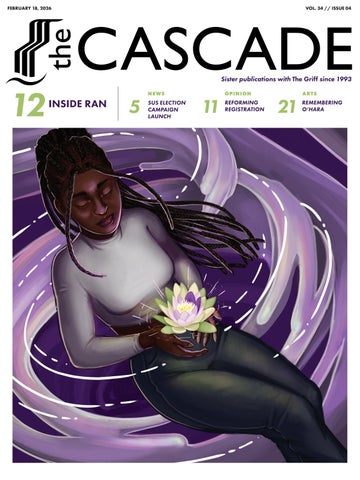
The Cascade is UFV’s autonomous student newspaper and alternative press for the Fraser Valley. It originated under its current name in 1993, and achieved autonomy from the university and the Student Union Society in 2002. The Cascade is funded with UFV student funds, is a forum for UFV students to have their journalism published in an entirely student-run setting and is overseen by The Cascade Journalism Society Board, a body run by a student majority.The Cascade is published every other Wednesday with a print circulation of 800 and is distributed at Abbotsford, Chilliwack (CEP), Clearbrook, and Mission UFV campuses and throughout the surrounding communities.
In order to be published in the newspaper, all work must first be approved by The Cascade’s editor-in-chief and the corresponding section editor. The Cascade reserves the right to edit submissions for clarity and length and will not print any articles or be a platform for any contributor or contractor who has shared racist, sexist, homophobic, or libellous content online in any form. Letters to the editor, while held to the same standard, are unedited, and should be under 200 words. Opinions expressed do not necessarily reflect that of UFV, The Cascade’s staff and collective, or associated members.
The Cascade is published on the
Editorial // The Cascade cultivates
This past weekend, seven members of The Cascade’s dedicated team attended NASH 88 — Canada’s largest annual conference held for student journalists. The theme of this year’s NASH was “Cultivate.” This word holds many different meanings — to grow, to create, to keep company with…
So what does cultivate mean to us?
Over the three days of the conference The Cascade did a lot of cultivating, whether that be newfound friendships or skull-crushing hangovers from one too many tequilas at the afterparty.
Cultivating to us at The Cascade means sharing the fruits of our labour after working together as a team through many late nights and a shared mission to create and put our paper out into the community every other week — since 1993.
To quote the conference’s closing keynote speaker and founder of Paper Rag zine, Blue Jay Walker, “Stories are the connective tissue of human culture.” The Cascade is here to serve the students, yes, we cover hard truths, yes, we sometimes cry, sweat, and stay up all night agonizing over our little publication, but somehow, someway, in the process (maybe in spite of the process) we are having a hell of a lot of fun.
So finally, we want to thank you, reader, for you are the reason we are here, for your stories, for your community, to talk about you and your life here at the University of the Fraser Valley. We love you.
Photo submitted by The Cascade
NEWS BRIEFS
Downtown Abbotsford construction builds problems for local businesses
Construction on Downtown Abbotsford’s West Railway Street and Montvue Avenue has been ongoing since June 2025. The city is creating a public amenity space that will be ideal for community events such as social get-togethers, performances, and public markets.
Local businesses on the side of the construction site, including Angry Otter Liquor and Night Owl Kitchen & Bar, have been negatively impacted by road closures leading to limited foot-traffic and a decrease in sales.
The setbacks in construction have been mainly due to supply delays and the atmospheric river which hit the lower mainland earlier in Dec. 2025.
Sean Weatherly, Angry Otter’s community relations manager, spoke to CBC on how construction has affected business.
“We’re down about 40 to 45 per cent, when it comes to our sales.”
Gurminder Gahir, Night Owl’s owner, emphasized how stressful the situation is for him and his business.
“I am trying to keep up with everything, but it’s getting hard, because if we don’t get customers, we don’t have revenue, we can’t do anything.”
However, Abbotsford Mayor Ross Siemens assured the public about the city’s plans.
“It’s going to be a short term pain, but long term gain.”
The anticipated completion date is near the beginning of March of this year.
JASLEEN SANDHU
Record-breaking temperatures for B.C
For the first time since the winter of 1982, B.C.’s winter season is experiencing spring weather in winter, with the expectation that it will remain snowless. However, other Canadian cities like Toronto and Southern Ontario are being blasted with snow. Reports from December of 2025 said that communities all over B.C. have been breaking national heat records, Bella Bella was the warmest with 19.5 degrees celsius on Feb. 4. December 2025 was the first month to see new record temperature highs. Vancouver broke a 13.3 degree record from 1962, hitting 15.7 degrees celsius, and a 13.3 degree record in Pitt Meadows from 1939 warmed to 15.2 degrees celsius this year.
Favourable temperatures have enabled the Grouse Grind trail on Grouse Mountain to open earlier, the usual time being between April and May. Stanley Park has witnessed joggers, bees pollinating, and cherry blossoms already starting to bloom. Bob Sekhon, an Environment Canada meteorologist, told CBC News about the unusually warm weather.
“The mild conditions are being driven by repeated ridges of high pressure, creating stable air over B.C., resulting in winter weather only lasting for a week or two in many parts of the province.”
International // U.S. Department of Justice releases new Epstein files
Celebrity ties to the files
VERONICA POWELL
As of early February, the U.S. Department of Justice (DOJ) has uncovered and publicly released over three million pages of new files related to the investigation of Jeffrey Epstein, along with over 180,000 images and 2,000 videos under the Epstein Files Transparency Act. It’s one of the largest releases since the first publication on Dec. 19, 2025, with many of the documents including details about the countless celebrities Epstein was associated with, such as Elon Musk and former Prince Andrew Mountbatten-Windsor.
The second Epstein release came on Jan. 30, 2026 with much more information than the first. The FBI found more images, documents, and videos featuring President Donald Trump, who quickly denied allegations of involvement in criminal activity. The DOJ made a statement looking to clarify the veracity of the claims.
INTERNATIONAL //
Pattison
Federal court to uphold Salmon farm ban
On Jan. 29, in a landmark decision, the Federal Court of Appeal supported the ban of B.C.’s Discovery Islands salmon farms. By 2029, the Canadian government will close all open net salmon farms around the island. An appeal made by Mowi Canada West was dismissed by the Court, affirming a decision to not renew farming licenses in 2029. The closure of the farms has led to heated debates over sustainability versus economic benefit. According to B.C. Salmon Farmers Association there may be a 1.2 billion dollar loss in B.C. and they pointed out that approximately 4,000 families make a living from this industry.
However, research conducted by a group of scientists in 2025 showed a potential connection between the farms and an increase in lice amongst wild salmon populations. The farms operate on a major migration route for wild salmon, who come in contact with and may get parasites from the farmed salmon. And since 2020, as farms began to close, parasite numbers have decreased. While First Nations Wild Salmon Alliance have said the closures spark concerns that this will infringe on Indigenous rights in B.C., over 120 First Nations across B.C. support phasing out open-net salmon farms in B.C.
cancels warehouse sale to ICE as Vancouverites protest at Hootsuite HQ
On Jan. 30, 2025, Jim Pattison Developments cancelled the sale of its warehouse in Virginia to the U.S. Department of Homeland Security (DHS) after learning that the DHS planned to use it as an Immigration and Customs Enforcement (ICE) facility. This announcement came after days of public pressure from B.C. citizens and politicians, with many calling for boycotts of Pattison-owned companies.
According to a CBC article, hundreds of people gathered outside the Vancouver headquarters of the Pattison-owned social media management platform, Hootsuite, on the 30th. Protests were mixed with celebration in light of the cancellation of the warehouse sale. However, the protest continued due to a statement from Hootsuite CEO Irina Novoselsky, which made no comment about ending the social media management company’s contract with the U.S. DHS.
This is not the first time a Canadian company has been criticized for ties to ICE. In early December 2025, the British newspaper The Independent reported that an Ontario-based armoured vehicle company, Roshel, had sold 20 bulletproof vehicles to ICE for over 7 million dollars.
Hootsuite has made no further comments at the time of writing, and The Cascade will continue to report as updates continue.
“Some of the documents contain untrue and sensationalist claims against President Trump that were submitted to the FBI right before the 2020 election.”
Elon Musk and Howard Lutnick’s names were also present in the files, showing emails between Musk and Epstein in 2012 and 2013 in which he encouraged Musk to visit Epstein’s private island. Musk reportedly rejected the invitations and reiterated that he had very limited interaction with Epstein. Lutnick broke off his relationship with Epstein around the same time after also being invited to his island.
Mountbatten-Windsor’s involvement with Epstein implies — through a collection of emails — that he had invited
Epstein to Buckingham Palace after Epstein was looking for privacy after release from his house arrest in 2010. Epstein also arranged for him to meet a young woman, to which MountbattenWindsor agreed. There are unclear accounts to confirm whether or not that interaction took place.
Further files show evidence of Epstein’s relationship with Peter Mandelson, containing three payments of $25,000 from Mandelson to Epstein, which Mandelson claimed to have no memory of.
“I have no record and no recollection of receiving these sums and do not know if the documents are authentic.”
Other names made public include Richard Branson, Brett Ratner, Bill Gates, and Sarah Ferguson.
Despite the Transparency Act stating that the DOJ is allowed to withhold personal information about victims, there were still a number of censored names and faces of potential offenders in images that some transparency advocates and lawyers say should be made public. On Feb. 8, during Superbowl Sunday, an advertisement was run featuring a group of survivors of Epstein’s abuse advocating for a full release without censorship. According to two correspondents for PBS News, the DOJ made redactions due to attorney-client privilege and other various rights. Challenges for prosecution remain, given that witness declarations or affidavits alone are not enough to bring to court for criminal prosecution.
Although the release signifies work being done, victims of Epstein’s crimes believe there is still a long road ahead to receive the utmost justice.
VERONICA POWELL
Geoff Livingston, CC BY-SA 4.0, via Wikimedia Commons
Canada // Praise and threats in wake of Carney’s Davos speech
Carney’s speech at the Davos sparks praise and controversy
LIAM PYPER
Dr. Edward Akuffo is the department head and associate professor of the Political Science Department at UFV. He studied at the University of Alberta where he earned his PhD in International Relations and Comparative Politics in Developing Countries.
On Jan. 20, Prime Minister Mark Carney addressed the World Economic Forum at Davos, located in Switzerland. The forum hosts a meeting in Davos every year, where world leaders from a number of countries come to discuss and address world problems and call for collective action to solve them. Carney attended the event to speak directly to global, political, and business leaders about changes in today’s world.
During his speech, Carney illustrated a world that was experiencing a dramatic shift, suggesting that the existing system is vanishing, and to pretend otherwise is risky.
“It seems that every day we’re reminded that … the rules-based order is fading. That the strong can do what they can, and the weak must suffer what they must.”
Rather than framing current instability as a temporary disruption, Carney described it as a fundamental break in the norm.
“Let me be direct. We are in the midst of a rupture, not a transition.”
However, Dr. Akuffo explained that this shift isn’t a sudden occurrence, as Carney suggested, but a slow, ongoing process that has already been happening for years.
“When you talk about rupture, it is like a sudden break from the past, but that is not exactly what we are witnessing. We are witnessing a gradual, deep structural transformation from this liberal, international, economic order to a form of order that we are yet to see and yet to put a name.”
Carney described a lie that countries like Canada have been participating in, which is the belief that the international rules based order applies equally to all countries, which is not the case.
“We knew the story of the international rules-based order was partially false. That the strongest would exempt themselves when convenient.”
This marks a departure from the usual language and attitude utilized by Canadian leaders, who have historically emphasized the importance of
the rules-based order, and have never questioned its legitimacy. However, Dr. Akuffo explained that while Carney’s speech is new in its fairly direct criticism of the United States and his questioning of the rules-based international order, the actual content of his speech harkens back to traditional, realist international politics.
“He is playing on an old, tried and tested idea of international politics and the way states behave, and bringing that to give it a new kind of understanding and application to the economic relationship between Canada and other countries.”
Canada’s place on the world stage has often been described as a middle power — one that relies heavily on multilateralism, institutions, and alliances to navigate the international world. Carney embraces this identity and advocates that middle powers go further and work closer together to reduce their vulnerability as the great powers increasingly excuse themselves from the rules.
“The question for middle powers, like Canada, is not whether to adapt to this new reality. We must. The question is whether we adapt by simply building higher walls — or whether we can do something more ambitious.”
Rather than building a fortress, Carney calls for the middle powers to build new relationships, creating a counterbalance to great powers such as the U.S. and China. He warned that economic coercion is increasingly being used by the powerful to control smaller nations, making cooperation a defensive necessity.
“We know the old order is not coming back. We should not mourn it. Nostalgia is not a strategy. But we believe that from the fracture, we can build something better, stronger, and more just. This is the task of the middle powers, the countries that have the most to lose from a world of fortresses and the most to gain from a world of genuine cooperation.”
Dr. Akuffo explained that as Canada
pursues friendships with other countries, it may need to expand its idea of “middle power” to include non-traditional members, such as those on the African continent and the African Union.
“[Middle powers] will include countries beyond that traditional group of states. Countries like South Africa, Nigeria, Morocco, Egypt; those could be potential allies in trying to build a coalition of states or a new kind of economic relationship that will help to advance the interests of the Canadian state. But to make it even more interesting is the point that there seems to be a more unified voice from the African continent, so it is possible that the term will also include regional [and] sub-regional groupings from the African continent.”
Whether Carney’s address at Davos has embarked Canada in a new direction, or is a simple rehash of past strategy, remains to be seen.
Illustration by Hannah Bricknell / The Cascade
National //
Motion to support Canadians fast tracked
Unanimous agreement by Parliament provides immediate economic relief for Canadians
NATALIA TOSCANO MURUA
On Monday, Feb. 2, Members of the Parliament of Canada (MPs) united in agreement over the Conservative’s motion to quickly pass a bill proposed by the Liberals. The bill presented an initiative to support Canada’s low income sector by both giving a single lump sum payment equivalent to 50 per cent of the annual 2025-26 value of the Goods and Services Tax (GST) Credit, and the Canada Groceries and Essentials Benefit will accumulate by 25 per cent beginning in July of this year.
This new benefit, introduced by Finance Minister François-Philippe Champagne, will replace the GST Credit, and will maintain the additional 25 per cent throughout the following five years. The benefit was approved by Royal Assent on Feb. 12, and it will help over 12 million Canadian residents with lower income across the country starting in Spring 2026.
The Department of Finance Canada stated that they recognise many Canadians are in need of immediate economic relief to afford food in the face of over 30 per cent increase in grocery costs since 2019, as shown by TD Economic’s research. The support credit is intended to be paid out as early as possible, and will feature $3.1 billion Canadian dollars being distributed to people that already receive GST credit.
Also, $8.6 billion Canadian dollars would be distributed to existing recipients of the GST credit and an additional 500,000 new people and households over
the 2026-27 period, following through until the 2030-31 period. The 25 per cent increase is projected to last over the next five years. For example, this wouldshould provide an additional $402 to single individuals with no children.
The Government of Canada stated on their website that to be eligible for the new Canada Groceries and Essentials Benefit,
people must meet two main criteria. Qualified individuals must be considered Canadian residents both during the month prior and the beginning of the month when the Canada Revenue Agency makes a payment (CRA). They must also be 19 years of age or older to qualify.
The CRA also recommended taxes be filed before Apr. 30 to avoid delays
UFV SUS elections 2026
An inside look at what to expect
RACHEL TAIT
On Jan. 8, the annual Student Union Society election officially began, where students could nominate themselves for the four executive board roles and nine members at large positions. SUS President Bilal Faisal Faheem spoke with The Cascade about the 2026 election, and why students should consider getting involved in governance. Note: there was a tabling event held on Feb. 11 and a candidates’ debate on Feb. 12 that are mentioned below, but have since passed by the time of publication.
What are the SUS elections?
“[The] SUS election is the time when all
the students put in the nominations to be the leaders of the organization for the next 12 months. Then the students get the opportunity to review their candidate statements, see what exactly they’re running [for], what their platform is, and then choose who they want their next SUS board of directors [to] be.”
What qualifications do candidates need?
“[Candidates] do need to meet a certain CGPA just because … it’s a full-time position, so they need to be in good standing with UFV. They need to be a current UFV student [and] they need to have a minimum CGP of three if they’re running
for one of the [executive] positions … and they [must have] no current charges with UFV security … [or] any conflict of interest.”
What happens during the campaign period?
“During this time, we host three different types of events, and the idea for those events is to give all the candidates a fair opportunity to engage with the students and for the students to come and see who their candidates are.
“The first event that we do is the candidates tabling. This event is going to happen on Feb. 11 from 11:45 a.m. to 1:15 p.m., and is going to happen at the
and complications in issuing payments. There is no additional registration process needed to receive the bonus should an individual already be registered to get the GST Credit.
Other actions being taken by the Canadian Government to help ease food security challenges are to dedicate $500 million Canadian dollars from the Strategic Resource Fund and direct them to meet supply chain-related costs. A sum of $20 million Canadian dollars will also be granted to support food banks and organisations that are able to provide items of higher nutritional value to individuals in need.
Conservative MPleader Andrew Scheer said that these steps being taken are not a long term solution to Canada’s rising grocery costs affecting residents. He also expressed his belief that the amount provided may not be enough to cover one grocery bill for an average working family, and equated it to former Canadian Prime Minister Justin Trudeau’s actions back in 2022, when he doubled the GST for half a year.
Sheer also emphasized that Conservatives will not pose an obstacle for any actions taken to help aid Canadians. Carney stated that during this time, there is a recognized need for additional financial aid for low income citizens and families who are struggling to make ends meet.
“The rise in food prices means that a lot of those Canadians need more support right now.”
Chilliwack campus … in the atrium [of] Building A … and [candidates will] be talking to students about their platforms.
“Then we have the candidates debate … [which] is happening Feb. 12, and is going to start at 10 a.m. … it’s going to happen right in the SUB, in Evered Hall.
“With the debate, usually the theme is one question, which is the same question that is asked to all the candidates [for the same position]. Then the second question is specific to their candidate statement, which is submitted by them … [and] there’s a time limit of how much they get to answer those questions.
Illustration by Natasha Zilcosky / The Cascade
NEWS
CONTINUED FROM PAGE 05
“The third event that we have is a Q&A session which is going to be on Feb. 23 from four p.m to six p.m., and that’s going to happen on [the] second floor, at the SUB hub. It’s going to be a drop by session where all the candidates will be there [and] it’s going to be an opportunity for students to come and ask any questions to their candidates.”
How can students vote?
“It’s very simple, every student gets an online ballot, [and] the voting period is from the second of March till the fifth of March … they get an e-mail on their student e-mail [and] it’s going to be a unique online ballot that they get … so [they] can’t use that to vote multiple times.
“There’s going to be an option to spoil your ballot in case you don’t agree with
any of the platforms that are there … For the executive positions, you can only choose one option, and for the student reps at large, you can choose multiple options because those are more positions on the board. And this year we’ll be running a referendum [which] is also going to be part of the same voting link.
“This year we’re running a referendum on the health and dental fees … [asking if] you support increasing the fee to $249 per year with CPI indexing to maintain the current benefits. The health and dental plan fee has remained unchanged for the past 12 years, and an option to opt out will still remain available for students with equivalent coverage.”
Why is it important to have annual SUS elections?
“It’s important to host the elections every single year because you get the change in
leadership, and because students graduate … It just wouldn’t make sense for somebody who is not a UFV student to make decisions for the UFV students. So that’s why we run a one-year term for all the students, which starts from May 1 [and] It goes on to Apr. 30.”
What advice would you give to candidates?
“Be true to yourself, know why you’re running, and know that when the students vote for you, it’s not just a four-day event where students vote and then they’ll forget about you. They’ll remember the promises that you’re trying to make … If you’re genuine, students see that there is a legitimate reason why you weren’t able to do what you wish you could have done during your term. So just give it your best.”
The candidates for 2026 are as follows:
Tanvir Hundal, Eeman Kaur and Gurpreet Singh for SUS President. Prabujot Bagri, Trimaan Singh Bhatti, Toshit Dawar, and Prasoon Tyagi for Vice President Internal. Arveen Bhatti, Zack Castiglia, and Manmeet Chhabra for Vice President External. Jahan Arora, Soum Majumdar, Saif Qazilbash, and Mridul Sharma for Vice President Students.
Candidates for Student Representatives at Large include: Chloe Boughen, Amtoj Brar, Gurarmaan Dhillon, Balkarn Singh Gill, Prabcharn Singh Mahal, Josh Parson, Pranya Rana, Rudhar Sachdeva, Mayur Sharma and Abhayjeet Singh.
Q&A has been edited for length and clarity.
University plans post-protest debrief; encourages students to report
Jackie Hogan talks protest
DARIEN JOHNSEN
On Jan. 20, an unsanctioned group of protestors gathered outside the Student Union Building. This group was documented engaging in anti-trans rhetoric, and residential school denialism. A student and UFV staff member reported to The Cascade that they were shoved and witnessed anti-LGBTQIA rhetoric. The Cascade sat down with Jackie Hogan, VP administration, to understand the university’s response to the demonstrators.
What was the rationale and the logistics behind allowing the protesters to stay on campus when the protest was unsanctioned?
“We did have unsanctioned activity. It didn’t go through our usual process. We didn’t have a request to be on campus. We respond to that in terms of managing the safety and security of the campus, and we follow our processes in that regard, thinking about safety first.
“There was some knowledge that they may be attending UFV… and we did put in some planning around what [we] would do if they did attend, so … security was available and [they] did monitor activities to ensure that safety was considered.”
Were there fears of repercussions if the university asked them to leave?
“I wouldn’t frame it that way. I think that inside buildings [are] definitely different [from] outside buildings.
“We welcome people to campus … we follow our safety processes, our standard
operating procedures in terms of what we do with situations like this … were they impeding our operations? Were they disturbing our operations? And so those were some of the considerations. Security was on hand to monitor that situation and were aware that if things were impeding or if there were altercations, that they were available to support.”
What constitutes disturbing operations?
“I think because it was unsanctioned and we weren’t aware of what was planned … [I]t’s not black and white. It’s sort of a gray area where we would need to assess the situation in real time … It does depend on the situation.”
Is our university public or private property?
“It is [a] held land title by the university, so we can restrict access. We can make decisions about the management of our property.”
Were you aware that they had entered the building at one o’clock that day?
“I was not at the time.”
Was the administration involved in the decision-making process around campus security response on the day of the event?
“There are some parts of the security planning that I won’t go into full detail, because these are plans that we need for any event that happens on campus, but
we do set up a structure that allows us to communicate and that we can advise and give guidance to security on the ground.”
To your knowledge, did security receive reports of violence, hate speech, or anti-2SLGBTQIA+ sentiment?
“To my knowledge, security has not received any formal reports of incidents for follow-up, other than you had mentioned the one about filming in D building, and so that’s one that we have received. I would encourage that staff member [who was shoved] to file a report so that we can document that … and the same with the student.
“I know it’s a step, but then at least we have record … So they have told security, but do we have enough detail to be able to follow up … so do we have the student’s name? Do we have the time … all of those details so we need to actually have sort of a summary of what happened, so that we can actually follow up.”
“Our focus was on managing the situation on-site and ensuring physical safety, making sure that supports were available.”
How does the university measure harm, and is it just physical harm that’s measured?
“Our focus was on managing the situation on-site and ensuring physical safety, making sure that supports were available. There was an attempt to create a safe space where faculty, staff, students could go to be away from anything that was distressing. At the time, security was directing folks that were looking for that to that space. They were supports there, including Indigenous supports for the content that was being discussed.”
Is the university involved in discussions around how to respond to events like this in the future?
“Always after an event like this, we do a debrief and after-action. What went well? What can we improve on? That would be our usual course of action.”
Capilano University recently implemented guidelines for protests. Are there plans to put a policy in place around protestors that come to campus?
“We have policies to guide our actions right now … it may come out that that’s something we should look into. We haven’t gone through that debrief and after-action activity yet to determine whether or not there’s something that we would recommend.”
Q&A has been edited for length and clarity.
opinion@ufvcascade.ca
Opinion Editor - Natalia Toscano Murua
SNAPSHOT
A gala? Bold of you to assume I even own clothes
A few days ago, I heard one of the most horrific statements I could’ve possibly come across: “Ayer encontré qué llevarme a la gala del sábado.”
For those who don’t know, this is an ancient Spanish spell meaning: “you’re fucked.” I’m half-kidding. It actually means, “Yesterday I found something to wear to Saturday’s gala,” said by a dear friend who was attending the same event I was — the same event I had somehow failed to realize was formal Immediately, my I-should-just-goin-my-pyjamas self began internally crying. Formal? In this economy? What were they thinking? What even counts as “formal”? Or a “gala”? I hate this. My friend — bless her heart — tried to quell my tiny freak-out and reassured me it would be fine. But I don’t quite know how to explain to her that with my autistic traits flaring at certain fabrics, my ongoing battle with overtly feminine clothing, and my beautiful yet challenging curves, actually finding something that fits me is… very nearly impossible.
I have many friends who adore shopping for clothes, and I’ve always thought that if it didn’t make me feel like I don’t fit in even more than usual, maybe I could enjoy it too. Alas.
BY SKY S. TERRONES
Lifestyle // Faking it ‘til I make it
How
fooling myself helped me become confident
NATALIA TOSCANO MURUA
For most of my life, insecurities and self-scrutiny were the everyday norm of my existence. I remember how the mere thought of exposing myself to potential failure was enough to trigger my anxiety, and sometimes, even a full blown panic attack. I felt incompetent, and that my skills were lacking, insufficient, and unsurprising — I used to feel like there was always so much to improve before I even got to a place worthy of recognition. But for the most recent 10 per cent of my life, the exact opposite has been true. What type of magic trick did I pull off to transition from a place of insecurity to one of empowerment? I’m a witch who gatekeeps no spells, so let me share the one that worked for me: I faked it until I made it.
That’s correct. The very same “spell” I used to refute and reject when I was younger turned out to be an accurate summary of what I did to achieve the confidence I have today. Well, for the most part. “Fake it until you make it” is, in essence, pretending or practicing something until it pays off or gives favourable results. In a way, it is a motto that allows you to fake confidence that you feel you may not have, and in turn allows you to close the gap to the performance you want to achieve or complete the goal you desire to accomplish. What I came to discover was that faking something did not necessarily mean to become something I am not — that would be unrealistic. Instead, it became a window through which I could tap into the potential hidden deep inside me. That may sound cliché, but we’ve just begun peeling the layers of this onion here. It gets juicier.
At the beginning, my lack of confidence meant that I felt too limited to even know what to start faking in the first place. I was convinced that me faking something would be too unnatural and a dead giveaway of my incompetence. So, who was the first person I had to fool? Myself, of course. I know I am not the first nor will I be the last to get imposter syndrome —when you don’t feel good enough when compared to others despite the position you are in, and fear for the day you get exposed for being an incompetent faker. That ideology kept me in a negativity spiral that was very hard to break away from. I tried pulling an Uno reverse card on my imposter syndrome by asking myself:
“Well, what if I can actually do it despite being almost certain I can’t?”
This was my breakthrough. In Parmenides’ words, “nothing comes from nothing.” You can’t spawn something out of nowhere. The way I internalized this knowledge is that whatever I chose to do — no matter if true or a facade — has to be coming from something that already exists within me. That capable persona that was born when I decided to step up whatever the cost was not fake at all, it was just hiding outside limits that I hadn’t explored before. I fooled my imposter syndrome, the one that insisted I was not enough, to let me impersonate a version of me that could actually do it. I wasn’t becoming another person by doing this, I was merely tapping into knowledge that normally I didn’t materialize.
For me, it was important to start small and build that capable persona little by little. Talking to other people used to be incredibly daunting, so I faked it. I thought about what I would do if I actually
UFV response during Jan. 20 protest
Why I believe UFV’s inaction did more harm than good
COLE JENNINGS
As previously reported on by The Cascade, on Tuesday, Jan. 20, a group of Residential School denialists gathered outside UFV’s Student Union Building. I was shocked to hear some students and staff not only felt harassed and intimidated by the people invading our campus, but were reportedly shoved, shouted at, and subjected to homophobic, transphobic, and racist abuse. The group also filmed students and posted their faces to social
media, and a library staffer reported feeling anxious and tense while the crowd later chanted outside Building G. I could only wonder: what did UFV do to help everyone feel safe at a time like this?
As I eventually learned, despite the protestor’s actions, UFV’s security stood by and did nothing. The day after, UFV President James Mandigo stated in an email that the group had “engaged in unsanctioned activity that was not affiliated with UFV and did not follow our event planning or safety processes.”
Given that the event was unsanctioned by UFV, why was it allowed to continue?
This strikes me as a serious failure by UFV to ensure student safety on campus. This crowd should have been told to leave when students began to feel unsafe.
UFV’s response seems inadequate to me when compared to other universities who faced similar demonstrations. Widdowson held similar rallies alongside OneBC at the University of Victoria on Dec. 2, 2025 and at the University of British Columbia (UBC) on Jan. 22. These
knew how to approach people, what to say to them, how to react, and when I had my answer, I went for it. I embodied that hypothetical version of myself that was able to talk to other people, without realizing that it was just me all along. With time, talking to new people did not feel daunting anymore, because I already knew how to do it. Talking to new people turned into asking for opportunity leads, and looking for those opportunities led to job hunting, and that led to professional branding. All of which I didn’t think I could do, when I was indeed capable of doing so all along. It’s crazy how a small step turned into a massive leap. I bet 16-year-old Natalia would be blown away with how much I’ve gotten away with by fooling myself into doing stuff. I hope I’ve made her proud.
events included the same Residential School denialist rhetoric that was observed at UFV. In both cases, OneBC and Widdowson were on campus without permission and were eventually removed by police. Decisive action by these universities and their student bodies prevented OneBC from targeting students, and our campus community should have followed in similar steps. This isn’t just an administrative
“self portrait” by Shawn Chin, CC BY-SA 2.0
CONTINUED FROM PAGE 07
failure. This also reflects a lack of action taken by UFV students to demand that the denialists be removed from campus. According to an article from CBC, it was the UBC student body mobilizing that ultimately led to the group’s removal from their campus.
“‘When it became clear that there were potential safety risks, Campus Security, with the support of the RCMP, directed the visitors to leave the campus for their own safety,’ said UBC in a statement.”
Psychology //
“Given that the event was unsanctioned by UFV, why was it allowed to continue? This strikes me as a serious failure by UFV to ensure student safety on campus. This crowd should have been told to leave when students began to feel unsafe.”
Despite the failure to remove the protestors from campus that day, I have seen signs that UFV might learn from its mistake. The protestors attempted to return to our campus the evening following their initial rally, but were cut short when UFV security asked them to leave. I think this action is a step in the right direction, and should be upheld going forward. If UFV wishes to “work toward peace and reconciliation” as stated by President Mandigo in his email, they need to show the Residential School denialists that they are not welcome at our university.
What a growth mindset actually is
Spoiler: it isn’t just about manifesting success
PRATI KAPOOR
I don’t regret any decisions, even if they didn’t turn out as planned, because there’s always something worth taking away. I think that I can learn from success, but I can learn even more from failures.
For me, a growth mindset is having awareness to make decisions that will contribute toward my future self and having the strength to say no to what hampers my growth. Even more importantly, recognizing what is actually worth investing my energy into and whether it’s something my future self would be proud of is paramount to find growth.
The term “growth mindset” has become very popular in recent times, it is basically on top of everyone’s minds! But what does it truly mean?
According to Harvard’s Business Review, it is the concept that skills can be developed through hard work, good techniques, and feedback from others. It’s not just about having goals and wanting to grow, but also about the strength to make tough decisions that may not work out, the ability to work through constant
feedback, and accepting rejection without taking it to heart.
Personally, some of my biggest growth has come from emotional experiences. For instance, it took me years to comprehend not everyone’s my friend and there’s absolutely no shame in calling most people an acquaintance. Before that point, I was a version of me who got disheartened when acquaintances didn’t show up like real friends. I learned that having one real friend is enough, that I can still enjoy acquaintances’ company without considering them friendships, and to be grateful for the close friends I do have. Now, I fully invest in my core friendships and draw strict boundaries for the rest. This emotional clarity and growth didn’t come from having that boundary defining mindset, but learning my lessons as I experienced life as well.
Having a growth oriented mindset has shaped how I approach my professional life too. When a job doesn’t work out or I don’t get a job I wanted, I look at it from a different perspective. There are always two factors: those I can control, and those that I cannot. For the ones that I can control, I reflect back on them — sometimes I find my answer and sometimes I don’t. After I’ve done all I can on my end, I resort to my belief that it didn’t happen because it wasn’t meant to be and something better may be awaiting me.
Having a growth mindset can appear similar to having a positive mindset, but these are not one in the same. A positive mindset relates more to making the most out of a fixed situation, however, a growth perspective looks at potential ways to change the situation itself. Everyone experiences a mix of positive and growth mindset, which continuously evolves with experience. These both need to co-exist for successful growth. Optimism is helpful when working hard, trying your best, and staying hopeful that it will work out.
Another misconception is that a
growth mindset is just about rewarding effort, but it’s not. Outcomes and results matter, but so does the progress. It’s so crucial to take mindful steps, reflect on past failures, seek feedback, and overall, have the willingness to improve. Solely believing in growth is not enough to achieve success. Believing in growth itself is important but there’s so much more that goes behind being successful, like the choices you make, the risks you take, your intent, and your behaviour, all contribute to finding success
A growth mindset isn’t striving to be perfect nor avoiding failures, it’s about learning along the way and always aiming to do your best. There is no one-size-fitsall guideline to achieve it, but I personally found Stanford University’s tips to be useful. Here are a few steps you can take to foster one:
1. Valuing your efforts is important! Sometimes despite putting in the effort, you won’t win, and that’s okay. Instead of having a self-critical mindset, turn those failures into lessons and opportunities for growth.
2. I’m not there yet. This is something I practice in my personal life quite often. By using “yet” at the end of a sentence brings the focus to the ever-present scope of something better. For instance, “I am not the world’s best writer yet” helps me strive to write something better each time I do.
3. Be compassionate with yourself. This practice involves dissecting the compassion you have for others toward yourself. This helps combat negative emotional thoughts and foster a kind mindset.
A growth mindset isn’t always winning a trophy, it’s about learning and experiencing. That is what makes it more valuable than an actual trophy.
SNAPSHOT
Do I need a neon yellow vest or..?
The crosswalk at Clearbrook Road and Hillcrest Avenue needs flashing yellow pedestrian lights. I mean it.
For reasons beyond my understanding, spotting pedestrians walking from the Clearbrook side onto Hillcrest on the opposite side to the McDonald’s appears to be very hard for vehicles. This isn’t the case for the crosswalk connecting the McDonald’s to the Abbotsford Supermarket side, I’ve never had any problems when using that side of the crosswalk. However, the one nearest to Long & McQuade is an accident waiting to happen.
I’ve been nearly ran over a handful of times — the tipping point was a black SUV missing me by about three inches or so. I had to jump out of the way to avoid getting hit, and the car didn’t even notice me until I was right in front of it. It has even made me question if I’m crossing wrong, but I’ve checked the rules and I’m abiding by them. I firmly believe that flashing yellow pedestrian lights are necessary in addition to the existing pedestrian control signal. I’m convinced that for some reason, pedestrian visibility is funky at that crosswalk, and drivers need extra cues to help them spot people crossing.
BY NATALIA TOSCANO MURUA
Illustration by Hannah Bricknell / The Cascade
SNAPSHOT
Rep writing party time
My house gets mail from our local Member of Parliament, and recently, they asked a question and prompted people to write an answer to send back to their office in Ottawa. What caught my eye about this was the little square in the corner that noted “No postage needed.” So I did a quick browse of the Canada Post website and found out that mail to Members of Parliament is free to send. Members of Parliament work for the citizens, and if they are worth their salt, they want to hear what the people they serve care about.
Writing a letter to your representative doesn’t have to take long. A lot of advocacy groups have prewritten letters on the issues they advocate for. Just remember to double check that the issue falls under the work of the federal government and not your municipal or provincial representatives. It doesn’t have to be a boring endeavour either, there are examples online of groups getting together for letter writing parties with music, drinks, and snacks. Political participation doesn’t have to be complicated or boring, maybe it’s time to grab the gang and send some free letters to your reps.
BY KARA DUNBAR
The Environmentalist: the invisible oxygen producers
Who should you thank with every breath you take?
FABIOLA CRUZ ALDERETE
Welcome to The Environmentalist, your column for understanding the natural world. Today, we’re exploring photosynthesis and who really produces the oxygen we breathe.
Forests feel alive in a way that’s easy to love. They’re visible, towering, and green — obvious symbols of oxygen and life. Photosynthesis, the process through which plants turn light into their food, makes them seem like Earth’s natural life-support system. But the story of where our oxygen comes from doesn’t end on land. In fact, it doesn’t even begin there.
First, we need to talk more about photosynthesis, but before you yawn, consider that it is one of the most powerful processes on Earth. Using sunlight as energy, plants pull carbon dioxide from the air and water from the soil, turning them into sugar for growth and releasing oxygen as a byproduct — what a miracle! Over millions of years, this quiet chemical process reshaped the planet itself during The Great Oxidation Event, where oxygen built up in the atmosphere, making complex life possible and allowing animals to breathe. Early algae mats and plants helped regulate the Earth’s carbon cycle, and some time after, forests cooled the climate and stabilized soils. It’s no exaggeration to say that photosynthesis turned a hostile planet into a livable one.
But here’s the thing: oxygen doesn’t primarily come from forests, actually, not even from plants. While trees may dominate our imaginations, they aren’t working alone. What if the largest contributors to the air we breathe aren’t towering at all? What if they’re so small that we rarely notice them? To find them, we have to leave the forest behind and look toward… the coast?!
Yes, out in the open ocean, far from forests and shorelines, live the planet’s most important oxygen producers: phytoplankton. Defining them is a complex ordeal, since some can be bacteria or protists but, in essence, most are single cell plants. These microscopic organisms drift near the ocean’s surface and use sunlight to photosynthesize just like plants do, except they exist in staggering numbers, to the point that their seasonal blooms can be seen from space!
Together, phytoplankton and other photosynthetic microorganisms produce over half of the oxygen present on Earth, quietly releasing massive amounts of oxygen into the atmosphere with every sunlit day. They are small, fragile, and largely unseen — but their collective impact is ginormous. Every breath you take is likely owed not to a tree, but to the sea.
What makes phytoplankton easy to overlook is exactly what makes them vulnerable. Because they’re invisible to the naked eye, we tend to ignore them and the oceans that sustain them. Treating seas as if they were endless and secondary to land has resulted in warming waters, ocean acidification, and pollution that are already disrupting plankton communities, threatening the systems that quietly keep our atmosphere breathable. So, the next time you picture oxygen in your mind, imagine not just leaves reaching for sunlight, but microscopic life drifting through blue water.
As the Lorax once said, “Unless someone like you cares a whole awful lot, nothing is going to get better.” So, let’s care.
Illustration by Iryna Presley
Cullen-Unsworth L, Jones B, Lilley R and Unsworth R, CC BY 4.0, via Wikimedia Commons
Lifestyle // Emotional dysregulation in an overstimulating world
How to manage emotions when everything seems to conspire against you
LIAM PYPER
Stop me if you’ve heard this before: you’re at a family dinner, out with friends, or having a classroom discussion, when suddenly, a topic that you are passionate about comes up, or an insecurity is brought up — the conversation accidentally turns into an argument. We’ve all had moments where staying calm would have been better, but we didn’t.
I recently had an experience where I didn’t realize that I was having strong emotions and an adrenaline rush until after the fact, when I was stuck in my dorm bathroom having a panic attack and feeling sick. It can be hard to realize that internally our bodies are freaking out and that we’re overwhelmed at the exact moment where it is all happening. But why does this happen?
Our strong emotional reactions don’t come out of nowhere, they can be formed by our genetics, past experiences, stress, and neurodivergence. It’s hard to find a technique that helps us manage these emotions, especially with what’s going on in the world right now. We are constantly exposed to distressing news
and it increases our baseline stress levels, making it even harder to regulate our emotions.
Emotional dysregulation is what happens when you struggle to manage your emotions in a way that is appropriate to the situation. Basically, things can suddenly stress you out or cause an outburst, when they perhaps shouldn’t. It does not mean we’re being too emotional, it’s just that our emotional system activates quicker and more intensely than it should, which takes longer to calm down from.
Emotional dysregulation can be caused by extremely stressful situations, but is also more common in neurodivergent people, such as those with ADHD. I think we all at some point have heard of breathing methods for calming down, or paying attention to our feelings and emotions to help regulate. These methods are pretty common, and I have tried them, but they often fall short for me. I have ADHD, and sometimes one thing can suddenly bring on disproportionate emotions that are hard for me to handle. After some additional research, I was able to find a number of alternative techniques
by Natasha Zilcosky / The Cascade
for managing emotions for people with ADHD, and who are neurodivergent in general.
It’s important to take care of yourself after experiencing intense emotions. Earlier I mentioned my panic attack — it happened after I was in a situation where I had to talk to multiple people at once, who all had cameras and were recording me, and were generally quite horrible. After my panic attack I thought I would be fine, that I went through it and it was done, but for a couple weeks after I still felt strong emotions and got triggered. Regulating after all that requires self-compassion instead of shame. I would constantly replay the situation in my head and stress about what I could have said or done differently. This is a pointless battle because no amount of overthinking can change what’s already happened, and to get out of that loop I found that journalling helped a lot. According to Open Arms Wellness, reflective journaling helps make sense of our experiences and strengthens a deeper self awareness. It lets us figure out the positive and negative takeaways of what happened and prepares us for future conflicts.
One of the techniques that I found has worked the best is pre-planning my triggers. Let’s talk about family. I am sure that many readers have had an argument with a family member, where one might experience stronger emotions than normal. For me this comes up when I discuss politics with them, and especially when we disagree. I feel different than I do when just talking to a non-family member. Part of my pre-planning now comes with an escape method. I do enjoy talking with my family about politics, but sometimes I hit a wall and I don’t feel prepared to continue on. When that happens, it’s time to start setting boundaries. An article from Achieve Counseling & Wellness suggests setting topic barriers which I found most helpful, because avoiding topics that can cause tension and communicating clearly that you don’t want to participate in something is a great way to approach it — at least in my experience.
I have to be honest, I haven’t given all these techniques an actual real try yet, but I plan to, and I think we all should give it a shot when it comes down to it. There are a million things out there everyday that have the potential to disturb your peace, and I believe that it’s important to take a step back and focus on yourself. We can’t help the world without helping ourselves first.
SNAPSHOT
In the corner of every book store are shelves of books the size of your back pocket with some ambiguous or slightly racy cover, and thin yellowing pages. If you’ve ever wondered what that format of books is called, I’ve got you: mass market paperbacks. And soon, all that will remain of them will be the ones circulating second-hand stores. Mass market paperbacks make books cheaper, more readily available to the public, and were vital for launching numerous careers like that of Stephen King. Now, E-books have taken the demand of the beloved format — so much so that the biggest book distributor ReaderLink has decided to stop distributing the format.
With the current want for physical media, I propose we bring back the demand for mass market paperbacks. Especially in a time where the typical paperback book is usually upwards of $25 at Indigo (when not on sale), mass market books could be our answer to making physical books more available for the public again. So please don’t stop reading those awkwardly long books that fit just right in your back pocket.
BY ANNA MCCAUSLAND
Illustration
Illustration by Iryna Presley
UFV // Let us shop for classes
If education is a choice, then education should provide students with choices too
JASLEEN SANDHU
I find UFV’s registration system frustrating. Some of my many grievances with our registration process is the fact that registration order is based on credits, that the timetables are released semesterly and not yearly, and that class times often conflict.
Sure, it’s not easy to confirm that thousands of students will get all the classes they need, but could we at least try to make the system more balanced?
In a philosophy class I took a few years ago, the professor pointed out that UFV has a specific culture where students sign up for a class and stick with it, rather than exploring other options. If I hadn’t already realized how restrictive our system is, that would’ve been a mind-blowing statement.
Drawing inspiration from all the coming of age TV shows I’ve watched, I propose a “shopping week” for classes. Shopping week is a dedicated time at the very beginning of a semester where students get to sit-in on a variety of classes and “taste test” the content of the courses they might be interested in. Through the shopping week process, students are better able to gauge which classes fit well with their schedules, requirements, and interests. A shopping week’s ultimate goal is to help students decide how many, and the types of, classes that work best for them.
I’m aware that this would be difficult for the institution to organize as we have to keep budgetary restrictions and faculty schedules in mind. Maybe an entire shopping week might be difficult to orchestrate,
but I still think it would be worth a try.
It doesn’t have to be chaotic. Let’s imagine it together: what if the first two days of a semester weren’t formal classes, but informal drop-ins instead? Classes could be open to “sample” for blocks of time where professors give overviews of what to expect for the semester and students could ask questions, so we can decide for ourselves whether we want to commit to certain courses.
Would a shopping week really be so inconvenient? If so, can we please at least get access to syllabi before the semester begins?
Also, what’s up with class add/drop
being linked to tuition rates? It doesn’t seem very fair that a certain amount of tuition is withheld if you don’t withdraw from the class before the semester starts. This withdrawal deadline really needs to be revised.
It’s not very fun being a student trying to create your own schedule from a timetable that provides limited options. It’s annoying being stuck in a class you didn’t really want to take, but signed up for anyway because you have to graduate at some point right?
It’s incredibly frustrating being caught in an elective-heavy semester, unable to take a single required class. However,
I’ll admit, I’m a firm believer that things happen for a reason. If you signed up for a random elective that you didn’t want to take, maybe you learned something from it and gained a whole new perspective! When life gives you lemons right… Now for my biggest vexation with the registration process: why does bureaucracy take precedence over learning?
Sure, it might be overwhelming for everyone to register at once, but why is the registration order divided by the number of credits? Why can’t it be organized by major? If we can make consistent changes to our institution — whether that be a new cafeteria or the switch from Blackboard to Brightspace — why can’t our system advance in the way of creating personalized registration portals for each student? It would be convenient if these portals provided more insight into a student’s degree progress rather than having to cross-reference with MyGRADplan.
It sounds like a lot of work, but it would help students a great deal, and helping others doesn’t seem like a wasted effort to me.
Despite how many times I’ve grumbled about limited class selections I should still give credit, because I’m sure UFV is trying. Who knows, there might be upcoming developments to our registration system; but that notion isn’t as comforting when I’m nearing the end of my undergraduate career.
I just think that there should be better ways to access the education we all require and deserve.
Photo by Anjali Randhawa / The Cascade
Features Editor — Caitlyn Carr
R A N AGAINST RACISM
Discover the organization that fights for the power of your voice
Lately, I’ve become more observant of my ethnicity, race, and background and have invested more energy into noticing how they influence everything about myself. Most times this is very nuanced, so it’s easy to miss their impact in daily life. Whenever someone made a comment along the lines of “you don’t look like you’re from Mexico” or “your skin is very light in comparison to the others,” I used to brush it off as a simple observation — but now that I’ve started to question the forces at play fuelling these comments, I’m realizing more and more how blurry the lines can be when identifying racist behaviours.
Racist behaviour can be so discreet that it might be hard to catch, but that doesn’t mean it’s not there. This has led me to be more intentional and conscientious of the way my identity interacts with others, so that I can catch any subtle behaviours that may not have a positive effect, and become more mindful of them going forward. I think that because of the wide range of both nuance and obviousness of racist behaviours, it is a challenging topic that can affect anyone.
NATALIA TOSCANO MURUA
Illustration by Natalia Toscano Murua / The Cascade
Discovering RAN
As it happens, my journey of becoming more aware about the influence of race and ethnicity among other factors led me to discover the Race and Antiracism Network (RAN) at UFV. I immediately became a fan of the work they do, their resilience, and their mission. Started in 2006, RAN was known as the Discussion on Racism Group, before changing their name in 2010. A volunteer-based independent organization, RAN is committed to being a safe space for people affected by racism, sexism, homophobia, and other forms of prejudice. They develop strategies, outline potential policies, host events, and tackle projects to combat issues related to intolerance not only within the university, but also the Fraser Valley and society in general.
Still, right after learning about this initiative, one thought immediately came to mind:
Why am I just hearing about this now?
As a student, I feel like a network such as RAN holds a lot of importance in our university. UFV has a wide variety of students from all around the globe, each with distinct backgrounds, bringing immense diversity that is worth celebrating and protecting. I believe a body such as RAN is instrumental to supporting this, and yet, it was alarming to me that I had heard nothing about it until a couple of months ago. With this in mind, I want to spread the word to help RAN get the spotlight I’m convinced it deserves.
“The end goal is to make UFV a place free of racism and safe and welcoming for everyone. So, whoever has that vision is welcome to take on RAN.”
The leaders behind RAN
To understand more about RAN and highlight their role within UFV, I spoke with past and present chairs of RAN, who both shed some light on what RAN has to offer. Alongside Dr. Jas Uppal Hershorn, Dr. Ghizlane Laghzaoui is a current cochair of RAN. Her passion for RAN’s mission is partly due to the personal experience she has with intolerance.
RAN’s “Showcasing Antiracism Scholarship, Activism, and Advocacy” 2024 March 21st event, in the photos Dr Amy Tang (member), Dr Adrienne Chan (founder) and Dr Satwinder Bains (former chair)
“The battle is something that was very close to my heart, being myself for so many years [a] victim of discrimination, and particularly racism and Islamophobia … It informed my position but it also informed my involvement in that fight against racism wherever it rises.”
Laghzaoui taught at Simon Fraser University’s French department for over a decade before joining UFV in 2011, where she was invited to join RAN by her fellow colleagues. Her research centres around immigrant teachers, particularly from French communities, and the challenges they face in professional integration, such as discrimination and underemployment. She currently helps mentor Francophone women new to British Columbia to integrate in professional spaces.
Laghzaoui shared that one of RAN’s greatest strengths is that as an independent initiative, members can speak their minds without being influenced by any administration. Laghzaoui shared what it was like to become a part of RAN, and the powerful impression this group left on her.
“What I loved the most about [RAN] when I first stepped in the room was the free spirit; we were all free regardless of where we were coming from [and] what our position was in the university. I’m speaking about a room made of senior admin people of colour, faculty members, staff, even [a] few students. Walking in there and seeing that [there was] no hierarchy and [that no one was] being singled out because of who [they were] was amazing to witness. RAN was, and still is, an amazing experience.”
Dr. Sharanjit “Sharn” Kaur worked as a co-chair of RAN for one full term. She is now a sessional faculty member in the History department at UFV, with a doctorate in History through a critical race theory lens. She is an avid anti-racism advocate and the co-author of Challenging Racist BC: 150 Years and Counting, and served as the coordinator of UFV’s South Asian Studies Institute for 12 years.
Elaborating on the work RAN does within the
university, Kaur highlighted the importance of the work they do and the power it holds given that it draws from facts and research.
“I think the criticality of what the Race and Antiracism Network fosters is unlike any other organization on campus. The way we call for accountability within the institution is very powerful, but that accountability is also based on research, academic grounding, and lived experiences of people who are within academic spaces. So it’s not just calling for accountability for the sake of it, it’s based [on] facts and truths. I’m really proud of that work over more than a decade that this organization has been doing.”
Kaur mentioned that RAN holds monthly meetings to discuss happenings on campus, current research being done, and to provide a space for faculty, staff, and students who have been racialized to speak about their experiences, all in an effort to seek accountability from the system that may have enabled it to happen in the first place.
Kaur described RAN’s role within UFV, she spoke about how their group has always hosted an event to honour the International Day for the Elimination of Racial Discrimination which takes place on Mar. 21. She listed some of the activities they’ve done in the past to prepare for this date, such as hosting student panels, bringing in speakers at UFV, and using their reports to determine their progress in building anti-racist and inclusive communities at UFV.
RAN will host the event for the National Day for the Elimination of Racial Discrimination on Mar. 19, this year’s event is titled Anti-racist Praxis in Post-Secondary: Action at Work.
RAN’s strengths and challenges
However, according to Kaur, throwing these events has not been without its share of challenges.
“We don’t have any consistent funding [so] it’s
hard to be able to devote the time and energy. Faculty members don’t get forced releases to do this work or to be co-chairs. It’s all volunteer-based. So because of that, space and time is limited.”
Kaur mentioned that despite RAN’s limited ability to host more events, they do hold monthly online meetings to discuss happenings on campus, current research, and to provide a space for faculty, staff, and students who have been racialized to speak about their experiences, all in an effort to seek accountability from the system that may have enabled it to happen in the first place.
Despite RAN’s greatest asset being the amount of freedom they have to speak without any form of censorship, Laghzaoui explained that this liberty often comes at the price of the work being exhausting because of their limited amount of resources.
Part of the work RAN has been involved in is advocacy efforts, including the establishment of an accountability process at UFV to promote anti-racism in different areas of leadership, operations, and governance. This process also aims to urge UFV to design an accountability policy specifically to prevent and counter racism within the university. Kaur expressed that one of the most frustrating aspects about UFV not having a specific anti-racism policy is that the supposed development of said policy has been going on for over five years, which she explained is a long time for one policy to be established. She mentioned that, to her, this comes off as UFV not truly caring about forming an anti-racism policy, and that she feels like they are just performatively going through the motions.
“I’ve been hearing about this for at least four or five years since [the] Black Lives Matter resurgence. The cynic in me is just like ‘do you actually wanna make policy change? Or is it just [to] tick [a] box?’ Just pretending to have the conversation for the sake of pretending like you care.”
Laghzaoui mentioned that another big challenge that RAN faces is their visibility. Since they operate independently from UFV and all their work is done by volunteers, it leaves them in a position where their resources are very limited and they rely heavily on networking to spread word about their work and events. She explained that when there is something they’d like to share with UFV students, they often reach out to the Student Union Society (SUS) to help them generate engagement, with mixed results.
“We always wanted to have more students participating in the life and the work of [RAN], yet it was a little bit difficult. We would reach [out] to the executive of [SUS] because we thought that’s where it was going to happen, and they would share the information [with us]. They [eventually] would do their part, but it was very hard to get the [SUS] executive on board. Very hard.”
Since they do not have great visibility, it can become complicated to find new people willing to take on voluntary anti-racism work. Currently on her third co-chair term, Laghzaoui mentioned she is happy to have Uppal onboard for the adventure of co-chair on her first term, and grateful that
Uppal has brought a new and refreshing leadership to RAN. Laghzaoui affirms that even if the work they do can be taxing, they will continue to do it. They strive to be there for every student that feels powerless and in a vulnerable position, to help them feel like they belong and to encourage them to use their voices.
RAN’s impact
One situation that Kaur and Laghzaoui brought up to exemplify the work RAN has done for students in the past was the fact that RAN was the first group to become aware and respond to the issue of Baker House — one of UFV’s student residences — attempting to force all of its international students to leave the building during the COVID-19 pandemic. Laghzaoui expressed that the most meaningful part of the work done started with students trusting them enough to ask for help and guidance at a vulnerable moment when they did not know where to turn. Laghzaoui shared the type of support RAN was able to provide for them.
“On the public side, we were the first ones because we [were] alerted by students. We managed to get information around it, alert various services, alert the faculties, deans, and say that something needed to be done to support international students in terms of COVID, [the] closing of borders, being either imprisoned here or asked to leave, [and to find out] what was going on.”
RAN exists for the students at UFV, to provide them with a space to be able to share their experiences of racism and to offer an ongoing strategy for change in the community. Kaur stressed that what happens within UFV does not happen in isolation, but instead, she believes it is a reflection of the community of Abbotsford. She shared that her personal goal is to help students feel like they have a voice, and that they belong, explaining that a mission of hers is to help students understand how oppression works and to embolden students to speak up against social injustice.
“I want those alumni to see the benefits of mentoring other racialized students or currently part of the UFV community”
However, according to Kaur, since RAN broke the story about Baker wanting to evict the international students during COVID, she feels they have been perceived as an enemy by the UFV administration. Still, Kaur believes that holding someone responsible does not automatically mean you’re on opposing teams. On the contrary, she believes that ensuring accountability is a way of showing up for the UFV community.
“We are not an adversary to the president’s office, to the VPs, to admin, to the deans. We are nobody’s adversary. We are simply here to, from a research and a critical lens perspective, shed light on some of the things that we see take place on campus, and that doesn’t make us an adversary. It means we’re actually trying to build a better community.”
Ghizlane further shared that RAN has recently been collaborating with students to flag various issues they’ve noticed on campus.
“This semester we already did work with some students on a few issues that were really important to them. We don’t always have solutions … but our strength is that we are able to speak on their behalf.”
Echoing a message
Learning about RAN and what they have to offer made me want to use my voice to help them get more visibility, because I truly believe they deserve it. The work they are doing is meaningful, tangible, impactful, and to me, there is a special kind of beauty and empowerment that comes from doing something out of passion and belief. Putting in the effort to create a positive impact even when you might not get anything in return is something I greatly admire and respect.
When asked if they had a message they wanted to convey to UFV’s community, Kaur noted the unique challenges faced by racialized alumni and encouraged them to consider mentoring current students.
“Racialized alumni get the short end of the stick … We have the benefits of being in a community where you can get a lot of opportunities, but at the same time, those opportunities still continue to be afforded [only] to a certain group of people … I want those alumni to see the benefits of mentoring other racialized students or currently part of the UFV community to call into account the same way RAN does … My ask for UFV alumni would be to continue to mentor students who are currently on campus so that they can get the opportunities, because I don’t think they’re gonna be handed to them yet by the institution.”
As for Laghzaoui, she shared a desire for students to take advantage of what RAN has to offer.
“One of our dreams is to have a RAN run by students, like a branch that they would [use to] do things that matter to them. [For them to know] that they [can] cooperate with us in terms of advocacy, lobbying, [and that] we would participate. It’s important that we tackle this issue on all fronts, and any front is welcome.”
Sports Editor - Jeffrey Kennett
SLAP SHOTS
Weather or not?
Illustration by Iryna Presley
Playing sports while growing up in B.C. is a unique experience. I remember dreading late-night winter soccer practices, knowing I would be out in the cold instead of staying home, wrapped in a blanket, watching sports on TV was devastating as a kid. The sheer wind chill, torrential rain coming down sideways, or the frozen ground we played on were not for the faint of heart.
When I switched to the indoor sport of kickboxing, I realized how much the elements made outdoor sports unique. Gone were the days of laughing with my teammates while we jumped in rain puddles, replaced instead by the low hum of a faulty air conditioner and the stale smell of sweat.
Now that I no longer play organized sports, I look back on those outdoor seasons with far more appreciation than I had as a kid. The weather was rarely enjoyable, but it made the moments of fresh air and shared hardship meaningful. For that, I am strangely grateful for the cold, rainy nights.
BY ETHAN PAULSON
Volleyball // UFV to host MacEwan in play-in round
Redemption run begins for battle-tested Cascades
ETHAN PAULSON
Playoffs bring heightened intensity in Canada West (CW), where every serve and spike carries added weight. With the regular season concluding on Valentines Day, the UFV Cascades enter the 2025-26 postseason focused and prepared.
Redemption is a central theme this season.
After falling to Alberta in the 2024 CW bronze-medal match, UFV responded with an electric 17-3 regular season in 2024-25, finishing first in the conference. That momentum ended with an early playoff exit, a result that still resonates within the program.The stakes are especially high for a veteran group playing its final year together. Fifth-year players Lauren Attieh, Cailin Bitter, Zoe Arca, Kinna Fisher, and Sydney Wright aim to close their careers with a statement and are determined to leave behind a legacy defined by resilience.
Attieh leads the team with 27 service aces, while Bitter has recorded 586. Key contributions from Naomi Unger (54 blocks), Mandi Feist (134 digs), and Talia Attieh (209 kills) have anchored the Cascades throughout the 2025-26 campaign.
UFV’s 10-10 record isn’t what fans have come to expect, but the Cascades have shown they can compete with the conference’s top teams.
In early November, UFV split a weekend series with the defending CW champion, the Alberta Pandas, earning a
five-set victory before falling in another five-set match the following night. The Cascades later earned splits against nationally ranked Thompson Rivers and Saskatchewan — the team that ended UFV’s playoff run last season.
Canada West remains one of the most competitive conferences in U SPORTS, and securing a national championship berth is never guaranteed. This marks UFV’s second-worst record since joining the conference in 2021-22, placing the Cascades in unfamiliar territory. Still, with experienced leaders such as the Attieh sisters and Bitter, UFV remains a dangerous postseason opponent.
The Cascades enter the playoffs as the seventh seed and will face the tenth seed MacEwan Griffins in a best-of-three play-in series.
MacEwan improved to 7-13 this season after finishing 3-17 in 2024-25. The Griffins’ major step forward was led by fifth-year setter Payton Shimoda, who has 625 assists, and outside hitter Ayshia Bryks who has 278.5 points. MacEwan comes into the contest on a cold streak since the calendar flipped over to 2026, going just 3-7 with two of their victories coming against the last place Brandon Bobcats.
Since 2021-22, UFV has a perfect 9-0 record against the Griffins through exhibition, regular season, and post-season contests.
Luckily for the Cascades, UFV will be hosting the series at the UFV Athletic Centre. UFV has played much better at
home this season at 7-4 compared to 3-6 on the road. MacEwan had a respectable 5-5 record at home while going 2-8 on the road which is tied for second-worst in the conference. The programs last met in the playoffs during the 2023-24 CW quarterfinals, when UFV swept MacEwan with a pair of 3-1 set victories in the best-ofthree series prior to their bronze medal loss to Alberta.
If the Cascades advance, they will face UBC with a CW Final Four berth at stake.
Photo by Anjali Randhawa / The Cascade
Basketball // Cascades’ playoff push halted by Golden Bears
O’Connor shines against Regina, but Alberta’s pace proves too much in season-ending defeat
JEFFREY KENNETT
The UFV Cascades rode a wave of momentum into the Canada West Quarter-Finals Saturday, but their 202526 campaign came to an end in an 80-66 playoff loss to the host Alberta Golden Bears.
Just 24 hours earlier at the Saville Community Sports Centre, the Cascades punched their ticket to the quarter-finals after a gutsy 73-67 win over the University of Regina Cougars. It was a contest defined by razor-thin margins. The game was tied on eight different occasions and featured five lead changes.
UFV led by as many as eight early, before Regina knotted the score at 65 late in the fourth.
UFV responded with composure.
Closing on an 8-2 run, the Cascades escaped the play-in round with a six point victory and a date with Alberta on Valentine’s Day.
Hockey
//
“This was a great win for us today,” point guard Bennett O’Connor said post-game.
“Regina is a really good team, and it was a physical game. Just happy to get this one and focus on tomorrow. We have a very experienced team, and we play composed. Every day in practice we go as hard at each other as we can. And that’s what makes us so strong, mentally and physically.”
O’Connor poured in a game high 22 points, adding four rebounds and three assists. He was nearly automatic from the free-throw line, knocking down 11 of 12 attempts from the charity stripe.
But Saturday told a different story.
From the opening tip, the third-seeded Golden Bears imposed their tempo. Kyle Varner and Isaac Simon led Alberta with 21 and 19 points, respectively, as crisp ball movement created clean looks and stretched UFV beyond the arc. The Bears were just as sharp defensively, disrupting
the Cascades’ rhythm and limiting their ability to generate quality opportunities.
Alberta generated scoring bursts with pace, a trait UFV had leaned on all season. The Cascades, meanwhile, struggled to string together sustained runs and too often settled for early three-point attempts. The Golden Bears capitalized, pulling away in the second half.
The numbers told the story. UFV shot just five for 29 from beyond the arc — a 17 per cent conversion rate — compared to Alberta’s 35 per cent from three.
In the final game of his U SPORTS career, fifth year star Dario Lopez led UFV with 24 points and seven rebounds, but support was limited in the second leg of a back-to-back.
Sharpshooter Dilveer Randhawa logged just 12 minutes and was held scoreless, after scoring 13 on Friday and playing a huge part in UFV’s victory over Regina. Fresh off a Canada West player of the week nod, Ismael Hernandez also
All (golden) eyes on Vancouver
What the team needs to improve on and what’s working
JASLEEN SANDHU
Dr. Brett Pardy is an assistant professor in UFV’s School of Culture, Media, and Society — and the university’s go-to hockey expert.
Are you surprised by how quickly the PWHL expanded out west?
“Yes, because I think I’m on record from last year saying I think it would be a couple years.”
20, to be exact…
“Oh, was it that long? Wow. So clearly don’t ask me about future predictions. I was surprised, because I think travel has been a bit of a factor in the fact that Vancouver’s really good at home and not good on the road at all. Obviously that was an extremely pleasant surprise that they took the risk rather than going a safer route.”
It’s exciting that there are two teams out west now. What do you think about the interest the Goldeneyes have gained?
“The Goldeneyes set a record for a weekday game and how many people go. It’s really cool how the Goldeneyes have made the Pacific Coliseum their own. I went
to the home opener and it was amazing — I was worried there’d be drop off — but there really hasn’t been. The team is maybe not as good as people were hoping for, but the vibes are still very high.”
That leads me to asking, how would you analyze Vancouver’s roster right now?
“They’re clearly a lot better when Sarah Nurse plays. I don’t think their forwards have cohered as much as I’d hoped. Like [Michelle] Karvinen is kind of getting going now. Hannah Miller’s been not as productive as I was expecting. They juggle forward lines a lot and it doesn’t seem like they’ve really found something that works. But I also think it’s very exciting that last Olympics, Nurse and [Claire] Thompson were two of Canada’s best players. And now we get to watch the Olympics and be like, ‘those are our players.’”
What do you think the team needs to improve on?
“It’s hard to say. Because for a long time, their two leading scorers were on defence, which was unique. Not surprising because they’re both really good, but … I think consistent lines.
“And they’ve had some good
contributions. One of the cool things about the professional league players that are not on the national team, but are still likeable players, like Izzy Daniel and Abby Boreen, have been really good.”
How would you assess the team’s coaching?
“[Brian Idalski] doesn’t seem great, but he doesn’t seem horrible. He just seems like a guy there. I don’t feel we have great coaching, but there’s nothing he really does that I can claim that ‘this is really annoying.’”
What do you think the Goldeneyes are doing well right now?
“I think they’re doing a good job marketing how much the players enjoy being professional athletes in Vancouver, how much having their own arena, their own logo at centre ice, means to them. I think they’re doing a good job of showing the team is a cohesive group that likes each other and likes playing hockey. I’m not sure you could ask for better players to represent your franchise than Nurse and Thompson.”
What do you expect to see from the team after the Olympics?
“They play a lot of home games after the
struggled, managing just one point against Alberta. With his shins heavily taped, the Spaniard appeared to be battling through injury.
The Cascades showed fight, opening the third quarter with six straight points in just over a minute, but never found the late-game surge that carried them past the Cougars on Friday afternoon.
For a program that closed the regular season 6-1 over its last seven games, punched above its weight in a physical first-round playoff win, and leaned on veteran leadership from Lopez and Matthias Klim all season, the loss will sting.
Still, the 2025-26 campaign signalled real progress, with UFV flashing highlevel competitiveness in a rugged Canada West landscape. The foundation is in place. The next step is learning to absorb — and answer — the kind of playoff runs a program of Alberta’s caliber can unleash.
Olympic break. So in a league where you get three points for regulation wins and every team is pretty close — I’m not writing off their playoff chances.”
Because this is our first professional women’s hockey team since the early 2000s, what kind of effect do you see the Goldeneyes having on Vancouver?
“I think going to a Goldeneyes game is really interesting, because you see people that you expect to see at a hockey game and then you see people that would probably never go to a men’s hockey game. Some of that is it’s affordable, but sometimes it’s also like it’s a totally different environment.”
Anything else you’re hoping to see with regards to the team in their inaugural season?
“I was just hoping for a pro-team in the next 20 years. So we’ve accomplished that. My real hope is I want to see a goldeneye in the wild, the bird.”
Stay tuned for more Goldeneyes content in our next issue!
Q&A has been edited for length and clarity.
Campus Fashion: what’s new for 2026
Five on-trend styles of the year
This is Campus Fashion, your source of inspiration for seasonal trends, cool finds, and wardrobe basics to keep you looking stylish throughout the year. February fashion is all about colour, structure, and style. From vibrant colours to well designed handbags, it’s time to take a look at some stylish investment pieces that will carry you through the semester in style! The Cascade compiled a list of five trends that will look great this winter season.
Red
A nod to Valentine’s Day, red is a great colour to include in your wardrobe as it brings a sophisticated splash of colour to any outfit, when done right, it can also be a great statement piece of the season. A red wool coat pairs well with a white knit turtleneck sweater, black dress pants, a black chain strap purse, and black ankle boots. For a more toned down outfit, wear a black sweater, black jeans, black tall leather boots, a white double breasted peacoat, and a red scarf to help accent the look.
Structured handbags
A simple, yet structured handbag can really bring an ensemble together. A cream cable-knit midi sweater dress, a brown leather belt, tights, tall brown leather boots, a camel wool coat, and a cream structured handbag looks elegant and chic. For a more casual look, add a black structured handbag with an olive knit turtleneck, indigo jeans, black ankle boots, a black leather jacket, and aviator sunglasses.
A trench coat for all seasons
A trench coat is always a wardrobe staple, but having one with an optional liner is an investment piece to add to your closet. In the early winter, wear a trench coat with the liner over a fair isle sweater, blue jeans, lace up boots, a cream scarf, and brown leather gloves. In the spring, wear the trench on its own over a floral midi dress, ballet flats, and sunglasses.
Sunglasses
Sunglasses are not just for the summer, and can add class to any outfit. Whether it’s dramatic oversized sunglasses or cool aviators, there are sunglasses that suit everyone’s personalities. For a casual day out, wear a pair of tortoise-shell, narrow framed sunglasses with a dark brown yoga suit, brown running shoes, and a long black puffer vest. For a more glamorous look, add a pair of dramatically oversized sunglasses with a little black dress, a black wool coat with a faux fur collar. As an accent, don some sheer tights and black heels.
Rain boots
While B.C. didn’t get 56 cm of snow like Ontario, it does get its fair share of rain. Wearing a comfortable pair of ankle navy blue rain boots with jeans, a hoodie and a cream soft shell coat will help keep you warm and dry on even the wettest of days. For a more formal look, wear a pair of tall black rain boots, a cream sheath sweater dress, a thin black belt, and a cream trench coat.
There you have it, a list of some trending pieces that you can wear and accessorize this season as you walk around campus in style!
RACHEL TAIT
Crossword // STUDY BREAK
In spirit of our team having just returned from NASH, here is a crossword that’s theme aims to highlight other student publications across Canada! If you aren’t aware of these already, it will hopefully serve as an opportunity to discover more student-run journalism at a national level.
Horoscopes //
By: The Cascade Coven
Aries - Mar. 21 to Apr. 19
Go lie down.
Taurus - Apr. 20 to May 20
Cut it out eager beaver. You need to take your fellow beavers’ feelings into account. It takes a village to build a dam.
Gemini - May 21 to Jun. 20
In the wise words of Shia LaBeouf: “Just do it.”
Cancer - Jun. 21 to Jul. 22
Yeah, you fucked up, but if you keep thinking about how much you fucked up, you’re going to keep fucking up, so just fucking move on already. You’re not as bad as you think you are.
Leo - Jul. 23 to Aug. 22
Sit down, shut up, and listen.
Virgo - Aug. 23 to Sept. 22
As they say in the Bible, probably dude -aronamy or something, sleep with that baddie in your art class or have that baddie sleep with your art.
Libra - Sept. 23 to Oct. 22
We know you like cheese, but don’t spread yourself as thin as the brie. Knock it off the charcuterie board so the cats can eat it.
Scorpio - Oct. 23 to Nov. 21
The baddies know where it’s at, and they’re motherfucking here.
Sagittarius - Nov. 22 to Dec. 21
You’re being an emotional vampire, and you’re realizing that it’s possible to overdose. Lay off, and you won’t wake up with a hangover anymore.
Capricorn - Dec. 22 to Jan. 19
Don’t be a crow.
Aquarius - Jan. 20 to Feb. 18
Hold space for everything but your ego. You need to make room for new growth and get over yourself. Good luck!
Pisces - Feb. 19 to Mar. 20
You need some minions to do your bidding.
Events // The Cascade takes NASH 88: Cultivate
Annual
student journalism conference brings campus publications together
DARIEN JOHNSEN
Over this past weekend, The Cascade had the privilege of attending the Canadian University Press’s NASH 88: Cultivate, an annual, Canada-wide student journalism conference. Each year, a different university paper is nominated to host, and this year it was held in North Vancouver by Capilano University’s student paper the Capilano Courier.
For three days over Valentine’s weekend, our team slept very little, ate meals on the fly off paper plates with shitty forks, and engrossed ourselves in mentorship from some of Canada’s leading journalists. Each seminar, panel, and roundtable had the team buzzing with chatter as we hustled our way to one seminar after another. During lunches, dinners, galas, and one very late night at The Roxy, we bonded with other editors, other writers, and other designers. We built friendships with people who live across the country (shoutout The Muse, we love you!) and those just a skip over the BC-Alberta border (we adore our sister publication, The Griff !).
Each cohort of budding journalists had their own unique energy, look, and goals, but often the struggles were the same, we are all trying to manage shit we are so wildly underqualified to deal with — yet somehow we still deal, we still put out amazing work, we find ways to support each other, and we all create something amazingly unique to our own campus.
Student journalism may not look like much from the outside, but once you’re in it, you realize what a crazy whirlwind it is. You develop a love for the world of journalism, for truth-telling, and fact-checking, and the value of a narrative
rooted in the truth of a specific people in a specific place, at a specific time. This isn’t just about finding facts and putting them on a page, this is about exploring deeper concepts of truth, bias (yup, we all have
one), and humanity.
Journalists are the ones that hold those in charge accountable, that uplift voices that are silenced, and expose hidden but important information in a way that
makes sense. Student journalists have a love for one another, they have a love for their campus communities, and above all they have a passion that, when crammed into a lecture hall, becomes electric.
The Cascade
Cascade Rewind: School of Rock is the man
“I serve society by rocking.”
Today, tomorrow, and 10 more years from now, the assignment will always be the same: kick some ass. School of Rock (2003) has a class that does it best. The film follows manic wannabe rockstar Dewey Finn (Jack Black) as he takes over a Horace Green Prep’s classroom full of musically gifted fourth graders, all while pretending to be his substitute-teacher roommate. Its high-energy and fearless delivery gave me that thrilling urge to break the rules and live way hardcore, while the humour of prim, modest 10-year-olds turning into budding rockstars captures my inner child. I don’t need to listen to rock and roll to feel the passion — I can see it through Finn’s fingers strumming his deep red Gibson SG as he teaches a new generation how to rock.
Finn/Schneebly absolutely did “get the Led out” — a wink to Led Zeppelin — and one of his first lessons to the class was that to rock, you must be pissed off. Thanks to Black, that philosophy carried the entire movie. As a down-on-his-luck punk rocker, he embodied the genre completely, channeling his energy through physical movements and line delivery to an almost exaggerated level. He used every limb in his body and every muscle in his face, and it showed the genuine heart, soul, and chaotic emotion that define rock music. He never shied away from a playful theatricality that highlights his instinctive comedic timing. It was easily one of Black’s strongest performances, and I couldn’t imagine the film reaching success without him playing the lead.
The kids were unbelievably skilled in their roles — understandably so, since most of them were reallife musicians rather than practiced actors. Their punchy attitudes felt effortless even though their characters were supposed to be tightly disciplined, which brought a priceless hilarity. From rebel drummer Freddy Jones (Kevin Alexander Clark) aka Spazzy McGee (my favourite), to future-president Summer “Tinkerbell” Hathaway (Miranda Cosgrove), every kid embraced the spirit of punk rock and challenged the rigid expectations of their parents and school. It was badass and deeply satisfying to watch their eyes light up as they realized their potential as artists — and that by leaning into those talents, not just their academic skill, they could still find success in life.
I can’t talk about this film without mentioning how essential the writing was. It showed just how much a shift in style can change a story’s expression. Partially due to the characters’ ages, the dialogue leaned less on research-coded precision and more on playfulness and improvisation. You could tell that the writer was having fun with it and letting the characters lead, which made the conversations
10 times more entertaining. Sometimes articulation doesn’t have to be strategic — spontaneity can do the work. Even as the script grounded us in a fundamental sense of mentorship and leadership, that looseness helped viewers develop a deeper love and connection with the characters. I know I did.
Much of the soundtrack was pulled from real rock and roll legends like Fleetwood Mac, Black Sabbath, Motörhead, and AC/DC. The film introduced an entire generation to the genre, making decades-old tracks feel fresh and catchy. I’d give an A and a shiny gold star to the final scene’s stage-shredding “Battle of the Bands” performance. Between Finn/Schneebly’s spot-on replication of Angus Young’s AC/DC move known as “The Dying Bug,” his fearless stage dive, Zach “ZachAttack” Mooneyham (Joey Gaydos Jr.)’s guitar solo, and the students rocking behind the curtains as security detail, it’s an impressive, perfect climax to this earworm of a film.
School of Rock may be a family film, but it’s the personality pulsing through that pulled me in. On
the surface, the premise is cute and playful, yet the movie treats its comic subject matter — learning the art of rock music — with unflinching, deadpan seriousness. Looking at it 23 years after its release, much of the story feels rooted in the idea of staying committed to the pursuit of something you love, despite others telling you to give up. That’s a message that never loses value and continues to inspire one generation of kids after the next. We need more uplifting spirit in the world, and the film sums up the key to success and fulfillment right there. The fundamental idea of rock and roll — in this film at least — is being hardcore enough to choose the unconventional and push back against authority. Doing so opens the door to exploration and progress, the kind that lets one stand out and embrace differences in one another.
So, in the words of AC/DC spoken by Dewey Finn, we shall always “roll tonight, to the guitar bite.”
Celebrity deaths don’t usually phase me, but Catherine O’Hara’s passing on Jan. 30 left me crushed. Whether it was watching her or just hearing her voice, she’s been a constant presence on my screen for basically my whole life, which is why losing her feels like a real blow. To celebrate O’Hara’s extensive career as one of television’s most beloved actresses, I’ve put together a list of what I believe to be her top five roles.
Home Alone (1990) & Home Alone 2: Lost in New York (1992)
Arguably O’Hara’s most notable role, the mom from Home Alone stands out as a strong, memorable character in these time-honoured films. After accidentally leaving her son, Kevin (Macaulay Culkin) alone at Christmastime, Kate must find a
Musicians //
way back to him during the busiest travel season of the year while also confronting her own flaws as a parent. With a solid balance of heartfelt moments and hilarious lines that still get quoted year-round, O’Hara’s performance as Kevin’s questionable, but ultimately loving mother remains an unforgettable classic.
Another mother with controversial parenting tactics, Delia’s vibrantly entertaining character simply would not exist without O’Hara. A narcissistic sculptor, Delia faces a series of challenges after moving from flashy New York to the modest town of Winter River — including her strained relationship with her step-daughter, Lydia (Winona Ryder) and, of course, the ghosts haunting their attic. With an amusing flair for the dramatic, O’Hara’s appearances in both Beetlejuice movies guarantees laughter.
3. Dutchess Rowena
Barbie in the 12 Dancing Princesses (2006)
Though this O’Hara role ranks third on my list, it will forever be my innerchild’s favourite. O’Hara embodies the film’s antagonist so well that I’m pretty sure she was the first fictional character my six-year-old self ever truly hated. I mean, anyone who literally poisons their cousin and abuses his daughters has got to be evil.
Now, when I shamelessly rewatch this movie as an adult, that childhood hatred has softened into admiration for O’Hara’s voice-acting talent. I just wish there were behind-the-scenes clips of her recording as Rowena because it’s still crazy to me that she voiced this iconic childhood villain.
2. Sally
The Nightmare Before Christmas (1993)
Who could forget Halloween Town’s greatest ragdoll? When Jack Skellington (played by both Chris Sarandon and Danny Elfman) tries to appropriate Christmas traditions, Sally does everything she can to prevent the fallout while also seeking freedom from her creator (William Hickey).
O’Hara’s acting skills are put on full display in this movie, especially when you consider how different Sally is from her other roles. As Sally, she shows off a gentler voice and sings like a haunted angel. Her moving performance brings to life Sally’s kind and levelheaded nature — a far cry from the hilariously melodramatic characters she often played.
On my love for Kendrick Lamar
1. Moira Rose
Schitt’s Creek (2015-2020)
While every one of O’Hara’s characters was played to perfection, her time as the endlessly eccentric— and (rightfully) egotistical — Moira Rose left the most lasting impact. There are so many reasons this role (and the entire show, really) deserves the hype. Schitt’s Creek was produced and filmed in O’Hara’s homeland of Ontario, Canada. More than that, it was created by her long-time friend and collaborator Eugene Levy, and his son, Dan, who also starred alongside her on the show. The personal nature of Schitt’s Creek allowed for O’Hara’s own creative flair to shine through the screen, as seen when O’Hara crafted Moira’s unique accent and suggested the character’s array of wigs — both beloved staples of the character.
Aside from all the behind-the-scenes context, O’Hara’s portrayal of Moira is also just plain hilarious. Iconic lines like “stop acting like a disgruntled pelican” and her unforgettable pronunciation of “bébé” are in no short supply. Other times, Moira could be surprisingly emotional, giving O’Hara the chance to display the character’s range.
It’s hard to imagine anyone else pulling off these compelling characters the way O’Hara did. Her endless hilarity, creative spirit, and unmistakable charm make it easy to see why she was, quite simply, the best.
Let’s discuss how K. Dot worked his way to the top life.”
CASSIE WILLIAMS
Pulitzer Prize winner. 27 GRAMMYs. A hip-hop icon and architect whose influence runs deeper than charts or headlines. See: Kendrick Lamar.
He’s fuelled many of my late-night editing sessions, but my respect for this groundbreaking artist stems far beyond the playlists that keep me awake and his musical prowess. I’ll admit — I had been a somewhat tepid fan before GNX (2024) dropped, but then everything changed. My love flourished until suddenly, I wasn’t just listening — I was tracing the threads and diving deeper into the lore of what makes Kendrick Kendrick
So let’s unpack this legend’s career together, shall we?
Initially performing under the name K. Dot, Lamar quickly made waves after launching his debut album, Section.80, in 2011. He was discovered at 16-years-old when he signed with Tiffith’s Top Dawg Entertainment in 2005 which later led to a joint deal with Dr. Dre’s Aftermath Entertainment and Interscope Records. Lamar’s second studio album and first major release, good kid, M.A.A.D City (2012) explored his experiences growing up in Compton, California. Through its narrative structure, the album depicts how young people in his community were profiled by police, brutalized, exposed to
gang violence, and forced to navigate the nuances of coming of age in this challenging environment.
In 2018, Lamar won the Pulitzer Prize for Music, awarded for his album DAMN (2017). This recognition marked a historic moment for hip-hop as this was the first time an artist in a genre outside of classical or jazz music won the Prize. DAMN. is more than just an album — it blends Black American struggles with Lamar’s poetic lyricism, exploring themes of race and faith while calling out systemic issues, in tracks like “DNA” and “HUMBLE.” The Pulitzer Committee praised the work for offering “affecting vignettes capturing the complexity of modern African American
Now in 2026, Lamar has once more made history — this time on Feb. 1 at the 68th Annual GRAMMY Awards. Surpassing Jay-Z as the most awarded rapper, he now holds 27 total GRAMMY wins, including five this year across categories such as Best Rap Album, Best Rap Song, and Record of the Year. Lamar and SZA took home Record of the Year for their duet “luther,” which samples Luther Vandross’s “If This World Were Mine.” In honour of the big Bowl having just passed (go Hawks!!), I’d be remiss not to point out that Lamar was the first solo
CONTINUED ON PAGE 22
Home Alone / 20th Century Fox
Barbie in the 12 Dancing Princesses / Universal Studios Home Entertainment
5. Kate McCallister
CONTINUED FROM PAGE 21
rapper to headline the Super Bowl. Not only did he make history (again) at SBLIX in New Orleans, but he transformed the biggest stage into a cultural exhibition, featuring an all-Black ensemble of dancers and bold political statements.
“The revolution about to be televised; You picked the right time but the wrong guy.”
A reference to Gil Scott-Heron’s poem “The Revolution Will Not Be Televised,” Lamar opened with an inverted line that extends Heron’s critique of media erasure. Heron highlighted the invisibility of revolution and how Black violence has systematically been left off-screen. Lamar used the reference as a call for people to actively fight against modern media’s selective storytelling. His opening also served as a critique of the current United States president, emphasizing that meaningful change comes from individuals, not media institutions or
Media Care Package // Sex Ed is in Session
Sex talk doesn’t have to be awkward with these resources
KARA DUNBAR
From my experience, sexual education class was one of the most dreaded and uncomfortable classes taken in school — outdated videos, a set of intimidating diagrams, and a teacher who clearly did not want to be there. Yet these classes and conversations shape one of the most intimate and personal parts of our lives. Sex can be meaningful and fun, but it can also be confusing, uncomfortable, or even painful, and the way we talk about it matters.
Sharing our sexual experiences and perspectives is often how we learn what feels “normal” and acceptable. But awkwardness and shame can build a barrier that keeps these conversations from happening at all. Personally, I’ve found that education is the only thing that really softens that discomfort, teaching us how to better care for our bodies, and the people we love.
These are a few resources that can help open that conversation.
Sex Ed: The Documentary (2013) asks a simple question: how did you learn about sex? Tracing the history of sex education in America from the early 1900s to today, it reveals patterns that feel similar to how sex education has played out in Canada. Available for free on Kanopy with a local library card, this film explores how what we learn — and the way we learn it — affects how we think about safety, identity, relationships, and intimacy.
This was — first of all — funny. It acknowledges how awkward the
conversation can be and leans into it. But it also creates space for critical reflection on what we learn about our bodies and how they interact with each other.
Sex in the Middle Ages (2024) is a docuseries for the history nerds. Told in short, engaging episodes, it offers a fun look back at medieval life and shows that we’re not so different from our ancestors when it comes to sex. The series explores how many of the norms and myths about sex from that era have evolved and continue to influence our own cultural moment. We also get to take a look at how the government and church played prominent roles in shaping the sexual landscape, and how experiences varied across social groups — from priests to peasants.
While it was made by The Great Courses, it’s available for free on Kanopy.
The podcast Stuff Mom Never Told You covers a wide range of topics across science, history, and culture, with a focus on the challenges faced by women and marginalized communities, as well as the solutions we can imagine to address them. Episodes that I would specifically highlight for their focus on sex education are “Gynecology and Gender,” “How Estrogen Works,” and “The Spectrum of Sexuality.” The podcast returns to issues related to sex and sex education frequently, though, so it’s worth browsing their catalogue to see what catches your curiosity.
The last recommendation here isn’t actually meant to be educational, but it earns an honorary spot for how thoughtfully it handles the subject — the TV
large corporations. The line challenged the audience directly, asserting activism on the biggest stage in America. Not to mention his fierce performance of the five-time GRAMMY-winning song, “Not Like Us,” openly dissing Drake in front of roughly 128 million viewers — and permanently cementing my respect after lots of debate on whether he’d perform the song.
With so many celebrities integrating political issues into their acceptance speeches at this year’s GRAMMYs, it brings up the question “are celebrities doing enough with their platform?”
Kendrick Lamar stands out as a model for what making a real difference can look like. He uses his voice — both within his music and beyond — to take firm political stances, and he backs that up with tangible actions. Lamar has donated to school districts in his hometown, and organized charity tours, including one in 2011 supporting homeless women and children and another in 2014 where all proceeds
went to Habitat for Humanity and the city of Compton.
All of this speaks to Lamar’s impact on culture — but on a personal level, one question comes up: what’s my favourite song? For me, “euphoria” takes that spot, and if not my all-time number one, it’s definitely sitting in my top three. It gives me an outlet to express the rage I feel toward the “Drake” in my life. Come on, we all have one.
One of the greatest lyricists of our generation, with bold lines and no fear, Lamar delivers what very few others can — and he does so without apology.
Kendrick said it best himself: “he deserves it all.”
show Sex Education (2019-2023). The series depicts a heartfelt, honest look at sex in all its messiness and complexity. It follows teenager Otis Milburn (Asa Butterfield), whose mother is a sex therapist, as he and a classmate set up an underground sex-therapy clinic at their high school.
This is a coming-of-age show that brings us into the lives of characters who are all at different points in exploring their identities, sexualities, and relationships. It’s fun and genuinely funny, and it was one of the first pieces of media that helped
me become comfortable with conversations surrounding sex.
Learning about sex doesn’t have to be awkward. It can be funny, comforting, and even emotional. Sex is different for everyone, and the kind of education that will be helpful to each of us will be just as varied. When we approach these conversations with curiosity instead of shame, they can help guide us to make healthier, more informed choices about our bodies and our relationships.
Promotional poster: Top to Bottom, Left to Right, TV show Sex Education / SexEd, The Documentary (2013) / Documentary Sex in the Middle Ages / Podcast Stuff Mom Never Told You
Kenny Sun from Boston, CC BY 2.0, via Wikimedia Commons
ARTS
Tier Lists // Cascade Picks : we will go down with these ships
Valentine’s is over, but we’re still in our feels
THE CASCADE
Ah, February… love is in the air, and my heart knows it — as do the many open tabs of Archive of Our Own fanfiction currently haunting my browser.
That’s right: romance and friendship are the themes of the month. And now that the 14th has come and gone, we’re still clinging to the pink ribbons, heartshaped chocolates, and red roses. (I’m half convinced Valentine’s Day exists purely to brighten winter’s cold, rainy days.)
Here at The Cascade, life gets so hectic that romance often slips to the bottom of the to-do list. So, in the spirit of honouring connection — and living vicariously through our favourite pairings — here’s a list of dynamic duos from our very own Cascade team.
Anna McCausland, Production Assistant
1. Percy Jackson/Annabeth Chase from Percy Jackson and the Olympians (2005-2009)
2. Shane Hollander/Ilya Rozanov from Heated Rivalry (2019)
3. Kate Sharma/Anthony Bridgerton from Bridgerton Season 2 (2020-)
4. Erin Quinn/James Maguire from Derry Girls (2018-2022)
5. Professor Quirell/Voldemort from A Very Potter Musical (2009)
Caitlyn Carr, Features Editor
1. Magnus Bane/Alec Lightwood from Shadowhunters (2016-2019)
2. Bilbo Baggins/Thorin Oakenshield from The Hobbit, or There and Back Again (1937)
3. Gomez Addams/Morticia Addams from The Addams Family (1991)
4. Harley Quinn/Poison Ivy from Harley Quinn (2019-)
5. Dean Winchester/Castiel from Supernatural (2005-2020)
Darien Johnsen, Editor-in-Chief
1. Seymour/Enid from Ghost World (2001)
2. William “Spike” Pratt/Buffy Summers from Buffy the Vampire Slayer (1997-2003)
3. Anastasia Steele/Christian Grey from Fifty Shades of Grey (2015)
4. Glinda/Fiyero from Wicked: For Good (2025)
5. Michael Myers/Laurie Strode from Halloween (1978)
Cole Jennings, Contributor
1. Winry Rockbell/Edward “Ed” Elric from Fullmetal Alchemist: Brotherhood (2009-2010)
2. Korra/Asami Sato from The Legend of Korra (2012-2014)
3. Vengeful Spirit/Skywrath Mage from Defense of the Ancients 2 (Dota 2) (2013)
4. Tomo Aizawa/Junichiro “Jun” Kubota from Tomo-chan Is a Girl! (2023)
5. Elster (LSTR-512)/Ariane Yeong from SIGNALIS (2022)
Natalia Toscano Murua, Opinion Editor
1. Pearl Houzuki/Marina Ida from Splatoon 2 (2017)
2. Optimus&Megatron from Transformers Prime (2010-2013)
3. Sonic&Blaze from Sonic Rush (2005)
4. Ira Gamagoori/Mako Mankanshoku from KILL la KILL (2013-2014)
5. Link/Mipha from The Legend of Zelda: Breath of the Wild (2017)
Sherryl Agingu, Production Manager
1. Sylus/Sherryl [MC (Main Character)] from Love and Deepspace (2023)
2. Persephone “Sephie”/Adrik from The Underworld Series (2023)
3. Jake Sully/Neytiri from Avatar (2009)
4. Zuko/Mai from Avatar: The Last Air Bender (2005-2008)
5. Quaritch/Varang from Avatar: Fire and Ash (2025)
Sky S. Terrones, Arts Editor
1. Kara Danvers/Lena Luthor from Supergirl (2015-2021)
2. Beca Mitchell/Chloe Beale from Pitch Perfect (2012)
3. Catra/Adora from She-Ra and the Princesses of Power (2018-2020)
4. Wednesday Addams/Enid Sinclair from Wednesday (2022-)
5. Robin Buckley/Nancy Wheeler from Stranger Things (2016-2025)
In fan fiction tagging, the slash (/) indicates a romantic or sexual pairing; the ampersand (&) indicates a platonic or familial relationship.
CHARTS SHUFFLE
CIVL’s Aaron Levy is introducing this semester’s TASK program work-experience placement, Taysen Gabrielson, who’s selected the below list of songs to tell you about in this week’s shuffle. They’re tracks he personally enjoys, and wanted to share the variety with the entire UFV community.
Dr. Dooom - “Dr. Dooom’s in the Room”
Dr. Dooom is one of the most nuts MCs to come out of the underground. He talks about being misunderstood and does things by his own rules, rapping about body bags and being the best on the mic. It is a must-listen. Enjoy!
Martial Law -
“Darkest Before the Dawn” Martial Law was one of the best high-energy bands to see live back in the day. They were loud, and ripped live. The track “Darkest Before the Dawn” was on their Demo (2005) release, and you can find this song on YouTube. Listen!
MF DOOM - “One Beer”
“One Beer” by MF DOOM is off his second record, MM..FOOD (2024). It’s one of his best tracks — really catchy, and just wonderful. MF DOOM is another one of the greatest MCs to come out of the underground. RIP.
AFI - “The Lost Souls”
“The Lost Souls” by AFI is a great song. It’s very loud and punk. AFI was inspired by The Cure and many others. It is a master class of horror punk, and it is off their record The Art of Drowning (2000), which is itself a landmark of the genre, and a must-listen for fans of the goth scene as well. Boo!
01. ALEX LITTLE Spider in the Sink 02. RAQUEL COLE Fire Child
03. SAVANNAH JADE Savannah Jade 04. NEIL, DAVID IVAN & RAKE, ALEX, AND THE LEAVES Hot Cow Summer 05. THE SYLVIA PLATTERS Will Tomorrow Be Enough [Ep] 06. WILLIAM PRINCE Further From The Country 07. SEYBLU Day Dream 08. SHAD Start Anew 09. BEGONIA Fantasy Life 10. ARIEL FITZ-PATRICK ARIEL 11. COLTAN FULLER Long Distance Blues EP 12. LIL CJ Friday Night Alone (Single) 13. AUSTRA Chin Up Buttercup 14. ANNIKA CATHARINA You and Me EP 15. TY WILSON Good Thing Goin EP 16. DANNY BROWN Stardust 17. HÉLÈNE BARBIER Panorama 18. KATIE TUPPER Greyhound 19. ALEX CUBA Indole
20. THE DARTS (U.S.) Nightmare Queens
Where your music taste matters by CIVL’s Music Director, Stephen Munga.
XÁWS TE SKW’EXÓ:S
“THE MOON IS NEW”
The first sliver of moon that appears after the burned-out moon marks the beginning of each Stó:lō month. In English, it is called the “young” moon.
YUWÁL LHSÉQ’ TE SKW’EXÓ:S
“FIRST HALF-MOON”
The right half of the moon is bright. In English, it is called the “waxing quarter” moon.
SXW’EXÓ:S (MOON) — PHASES
The Stó:lō calendar is a lunar calendar, with each month based on a full moon cycle (about 29 ½). Each month in a syílólèm (full turning of the seasons/a year) begins with x áws te skw’exó:s (the first sliver moon) following th’é x te skw’exó:s (the burnt-out moon). In the past, people kept
track of days and months by tying knots in string or spiking sticks into the ground. The different phases of the moon in each month have the following names in Halq’eméylem:
LHÍ X WES KWÓTES TE SKW’EXÓ:S
“THREE-QUARTERS MOON”
Three-quarters of the right side of the moon is bright. In English, it is called the “waxing gibbous” moon.
SELÍTS’ TE SKW’EXÓ:S
“THE MOON IS FULL”
The whole moon is bright. In English, it is called the “full” moon.
TH’ÉX TE SKW’EXÓ:S
“THE MOON IS BURNT-OUT”
The whole moon is black. In English, it is called the “new” moon.
TH’ÉTH’ E X TE SKW’EXÓ:S
“THE MOON IS BURNING OUT”
The last silver of the left side of the moon is bright. In English, it is called the “old” moon.
LHÍ X WES KWÓTES TE SKW’EXÓ:S
“THREE-QUARTERS MOON”
Three-quarters of the left side of the moon is bright. In English, it is called the “waning gibbous” moon.
LHSÉQ’ TE SKW’EXÓ:S “SECOND HALF-MOON”
The left half of the moon is bright. In English, it’s called the “last quarter” moon.