The Cascade is UFV’s autonomous student newspaper and alternative press for the Fraser Valley. It originated under its current name in 1993, and achieved autonomy from the university and the Student Union Society in 2002. The Cascade is funded with UFV student funds, is a forum for UFV students to have their journalism published in an entirely student-run setting and is overseen by The Cascade Journalism Society Board, a body run by a student majority.The Cascade is published every other Wednesday with a print circulation of 800 and is distributed at Abbotsford, Chilliwack (CEP), Clearbrook, and Mission UFV campuses and throughout the surrounding communities.
In order to be published in the newspaper, all work must first be approved by The Cascade’s editor-in-chief and the corresponding section editor. The Cascade reserves the right to edit submissions for clarity and length and will not print any articles or be a platform for any contributor or contractor who has shared racist, sexist, homophobic, or libellous content online in any form. Letters to the editor, while held to the same standard, are unedited, and should be under 200 words. Opinions expressed do not necessarily reflect that of UFV, The Cascade’s staff and collective, or associated members.
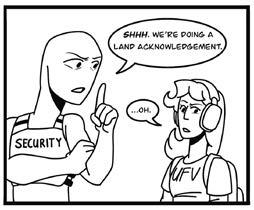
The Cascade is published on the traditional, unceded territory of the Stó:lō peoples. We are grateful to be able to work and learn on this beautiful land.
Editorial // On Black brilliance
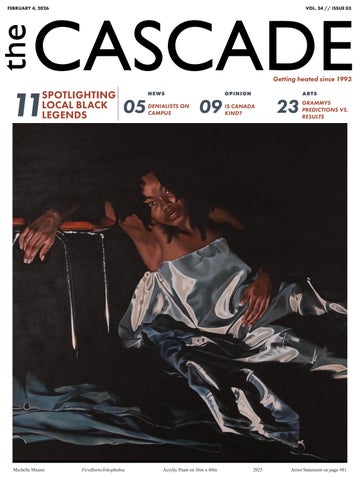
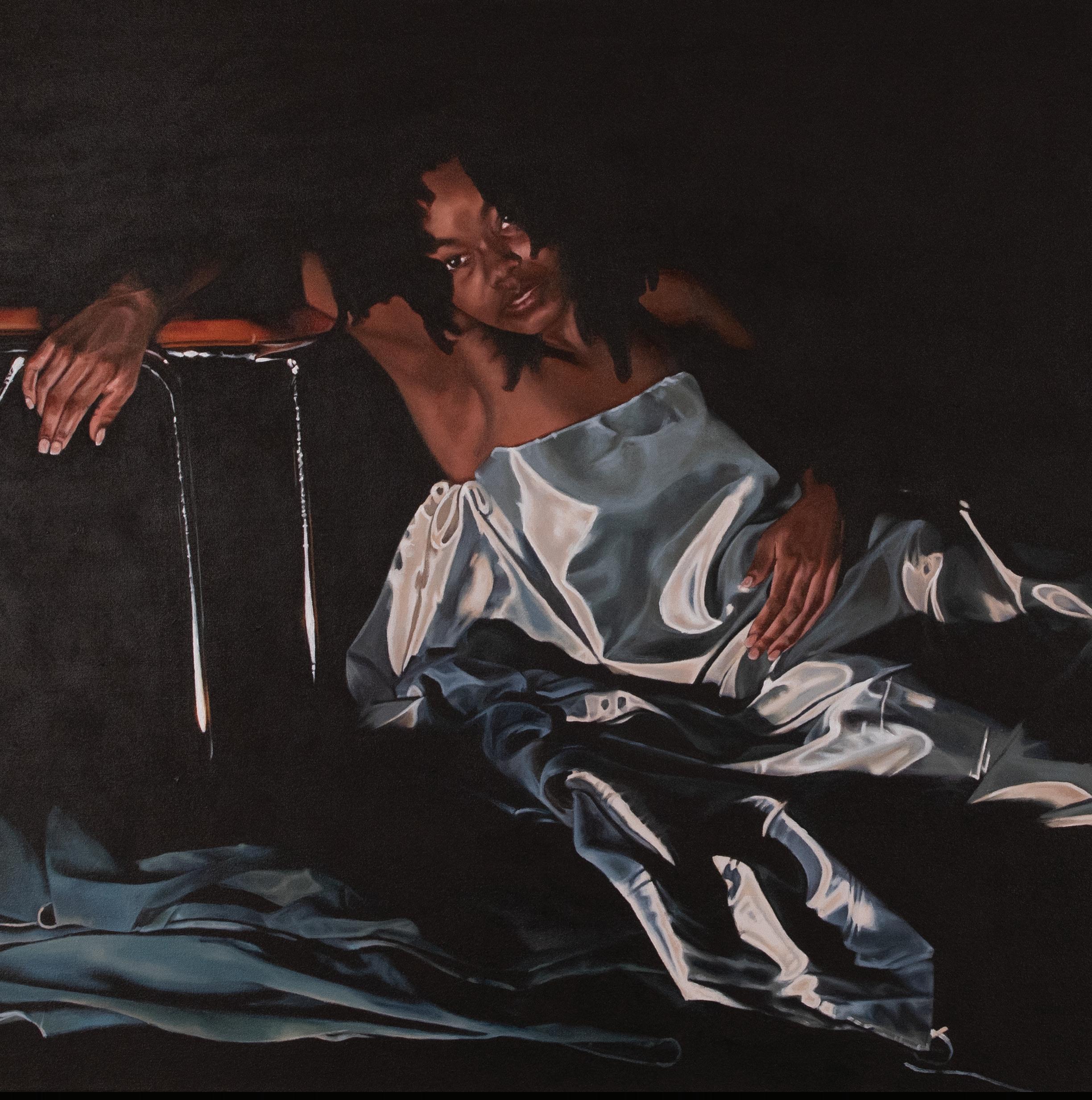
Black History Month occurs every February in Canada and is a dedicated time to acknowledge and celebrate the contributions of Black Canadians. Our featured cover artist this issue is someone I consider exceptionally brilliant. Michelle Msami is a UFV alumna and winner of the 2025 UFV Bachelor of Fine Arts Annual Graduate Award. She’s been featured at The Reach, was last year’s cover artist for UFV’s literary magazine Louden Singletree, and has been hired by the City of Abbotsford as a featured artist. Msami was born and raised in Botswana and is a multidisciplinary artist whose primary medium is painting.
Msami describes her art as existing in a space that stands still. And what does it mean to stand still for a moment alongside someone or something? It means to clear yourself of all your you-ness and attempt something of a communion with another — to try to understand by listening, seeing, and feeling. I invite our readers this issue to suspend themselves for a moment. To standby, to clear their minds and experience on a sensory, emotional, and human level. I believe this is the only way that we will become more in tune with each other, more empathetic toward each other, and ultimately a more loving, gracious, and resilient society.
Darien Johnsen
Residence British Columbia, Canada
Contact m.msami.art@gmail.com Website msami.art
Social media @msami.art
My work serves as a reflection into the intersection of vulnerability, resilience and spiritual introspection through the rendering of figures that emerge from the darkness embodying moments of tension.
The draping of fabric serves as both physical and metaphorical elements – symbolizing fragility, strength and universality. I am drawn to the symbolic and transformative potential of fabric – it flows, binds, protects and constrains. In my paintings, the fabric actively participates in the narrative, mirroring our desires for freedom, security and self-expression.
While the themes I explore are contemporary: the weight of existence, the pursuit of self-awareness and the dialogue between struggle and transcendence, the compositions are rooted in historical art and storytelling, with each pose and gesture inviting the viewer to step into a shared emotional landscape where time seems to stand still. In essence, my art is an invitation to pause, witness and connect with the beauty and complexity of the human condition. I ask viewers to sit with their emotions and recognize their vulnerability and resilience. My art is a meditation on what it means to endure, rise, and find grace amid our journey on earth.
NEWS BRIEFS
LOCAL // PROVINCIAL //
Federal government workers facing layoffs
At the beginning of 2026, thousands of Canadian federal employees received letters warning of potential layoffs, as part of the government’s plan to cut costs outlined in the Canada Strong Budget. CBC has reported that a number of federal jobs will be cut in the coming years.
“The federal budget … is set to slash 16,000 positions, or about 4.5 per cent of the public service workforce, over the next three fiscal years to return the size of the bureaucracy to a more ‘sustainable level.’”
Federal workers across the nation are questioning the cuts.
“[The union is] demanding the government explain why experienced public servants are facing waves of workforce reductions as outsourcing spending reaches record highs.”
CTV News explained how these job cuts are changing the dynamics of federal workers’ lives.
“[The notices are] forcing public servants to fight for their jobs, as the federal government begins to implement its plans to cut 28,000 jobs over the next four years.”
According to Sean O’Reilly, the president of the Professional Institute of the Public Service of Canada, additional job cuts are anticipated in the upcoming weeks.
BC healthcare fears mayhem from FIFA World Cup
The 2026 FIFA World Cup is set to take place in Toronto starting June 12, and in Vancouver on June 18, but the B.C healthcare system is concerned they won’t have the capacity to provide additional medical attention, as they are currently overworked.
Dr. Catherine Varner, the Canadian Medical Association Journal’s deputy editor and emergency Toronto surgeon, has done research that shows hospitals are put under a lot of stress during large social gatherings that cause disease outbreaks and excessive alcohol consumption. Concerns for outbreaks like measles and COVID19 remain relevant, as many sports events in history have resulted in serious illnesses.
On the other hand, Toronto Surgeon Dr. Andrew Beckett believes proper preparations will be made.
“We’re looking at ways of being able to surge capacity within the hospitals by shutting down some elective surgeries if needed. Also recalling [staff] that may be in the area and available to help out in a crisis.”
UFV // January 2026 Senate recap
AI in education and discontinuation of programs
Senate serves as UFV’s academic governing body, making decisions that shape the daily experience of students and faculty. It advises the Board of Governors — responsible for the university’s business affairs — on matters of shared interest. Monthly public meetings are open to all members of the UFV community. This article will recap key agenda items of the hybrid Senate meeting held on Friday, Jan. 16, 2026
Dr. Sameena Karim Jamal, assistant professor of adult education, gave a presentation on AI in higher education. She highlighted how some universities are beginning to embrace AI into their curriculum, and that employers are looking for employees who are able to effectively utilize AI as a skill set. Jamal also pointed out that if taught correctly, AI can be a valuable tool.
Budget Townhall meeting for 20262027, that took place at the Chilliwack campus, on Jan. 23 from 2-3 p.m.. He also emphasized that there is a public web page entitled UFV’s Plan for Financial Sustainability, that provides important information and updates on the budget for this upcoming year.
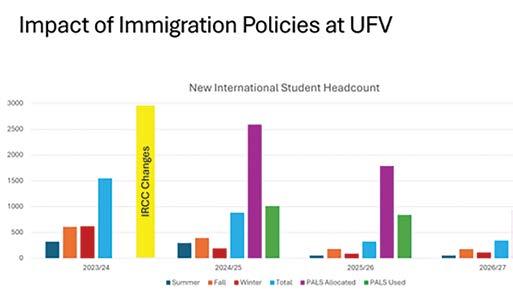
Mandigo also informed the Senate that there have been decreases in the number of study permits made by the federal government for 2026. B.C. only received 32,596 study permits, which is a 57 per cent decrease in comparison to last year. Mandigo mentioned that the number of provincial attestation letters (PAL) given to UFV has also gone down in comparison to 2024 and 2025, totalling only 928 PALs.
“This represents a 48 per cent drop from the 2025 PAL allocation and 64 per cent drop compared to the 2024 PAL allocation.”
PROVINCIAL //
Drug decriminalization program discontinued in B.C.
On Jan. 14, B.C. NDP Minister of Health Josie Osborne stated that the province would be stopping its drug decriminalization project at the end of the month. This project has been in operation for the past three years on a trial basis, and has enabled people to carry small doses of illegal drugs, and attempted to remove stigma surrounding usage, which prevented users from seeking aid due to fears of prosecution.
The project was first created in 2016 after a public health emergency was declared in response to B.C.’s drug crisis, which is responsible for thousands of deaths caused by overdose. However, Osborne claimed that the reason for shutting down the project was because the results failed to meet the initial objective to save lives.
However, SFU Professor of Public Policy, Dr. Kora DeBeck, told CBC that this discontinuation signals a further lack of understanding of the drug crisis.
“I felt that really the overall announcement was, in a large way, a move away from evidence-informed policy and the reality and challenges that we have with the toxic drug crisis.”
Beginning Jan. 31, police will be able to enforce the Controlled Drug and Substances act fully, and anyone carrying illegal substances may be prosecuted.
UFV’s Communist Club on probation by SUS
On Jan. 23, UFV’s Communist Revolutionary Student Club (CRSC) was placed on probation until the end of the winter semester by the Student Union Society (SUS). This sanctionary action was taken after CRSC created a petition and pamphlet voicing the need for a student strike demanding economic and tuition reform within UFV. The petition was circulated among UFV students during the Campus Community Engagement Expo on Jan. 14.
SUS communicated to the CRSC after the Expo that they saw the pamphlets as an implication that both parties would coordinate a student strike.
SUS claimed that this was as a misrepresentation of the Society and stated that CRSC speaking on behalf of SUS violates their Clubs and Associations Guidelines, which led to an initial suspension of the club. CRSC told The Cascade that they were not trying to impersonate SUS and that they saw the issue as having been remediated during a conversation with SUS President Bilal Faisel at the Expo.
“[He said] I understand … you’re not actually acting as the Student Union Society … if you could just cross it out and not hand these out … So I crossed it out immediately.”
The CRSC submitted an appeal for the suspension, resulting in the club avoiding suspension but remaining on probation.
“AI literacy is already expected in fields such as [blogging], content creation, business analytics, and more. By avoiding AI, we’re leaving students underprepared for AI augmented workplaces that are increasingly becoming the norm worldwide. By not teaching students how to use AI ethically and responsibly, we are doing them a disservice.”
David Johnston, registrar and associate vice-president, enrollment management, made a motion for Senate to approve changes made to the Physics honour, major and minor programs. Revisions for the Physics honours program include having a CGPA of at least 3.33. In the major program, students now have the option to take PHYS 118 in order to declare their major. The number of upper level courses in PHYS or ENPH has also gone down to 15 instead of the original 27. For the Physics minor, students will now need to take mandatory prerequisite courses to get into specific upper level classes.
According to a memo from the Education Committee Chair, Dr. Dana Landry, department head and associate professor of arts and integrated studies, to Dr. James Mandigo, president and vice chancellor, these revisions were made to the entire Physics program to help lower the number of needed credits down to 120 from 132. It also enables them to incorporate a new module course into the physics program. The motion was voted on and carried.
In the President’s Report, Mandigo encouraged people to come to the hybrid
During the Provost Report, Dr. Tracy Ryder Glass, provost and vice president academic, said she was grateful for all the hard work the Senate board did in 2025. She also expressed her anticipation for what 2026 has to offer.
“This new year brings fresh opportunities for innovation, collaboration, and celebration of student success. Together, we’ll continue to advance our academic mission, support our students, and strengthen our community. I’m excited about what we will accomplish as we build on our successes and embrace the challenges ahead.”
RACHEL TAIT
JASLEEN SANDHU
LIAM PYPER
VERONICA POWELL
Illustration by Eseniia Bondar
NATALIA TOSCANO MURUA
UFV //
Budget Town Hall confirms significant financial gaps
UFV’s financial plan in the midst of 21.9 million deficit
NATALIA TOSCANO MURUA
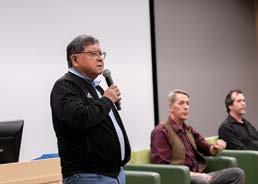
On Jan. 23, 2026, the University of the Fraser Valley (UFV) held its Budget Town Hall about the planned budget for 2026-2027, hosted by the Senior Resource Allocation Committee (SRAC). The meeting was moderated by Al Wiseman, UFV’s university secretary, and presented by Dr. James Mandigo, UFV’s president and vice chancellor. The Cascade attended the event to report on the information shared to the UFV community.
Mandigo explained that the preliminary budget for 2026-2027 will begin as soon as there is an approved operational budget by the Board of Governors. This takes around 12 months to finalize before being given its final approval by the board. The preliminary budget was first presented in October 2025, and was driven by predicted enrollments, both domestic and international, for the next fiscal year created with the help of UFV’s departmental deans, heads and directors in tandem with the Office of Registrar.
The budget is then adjusted with feedback from the UFV community that is kept in mind until March, when the last Budget Town Hall occurs before going to the Senate and the Board of Directors. Mandigo announced that because of the financial challenges being faced by Canadian universities tied to the international student cap and immigration policy changes, he wants to ensure UFV is navigating this situation with as much openness as possible.
from Budget Town Hall
the deficit and close the gap in revenue and expenses. One of which is to make programs more sustainable by offering courses that align with the community’s wants and needs. The goal is to maximize the number of students that are enrolled for those classes as much as possible to combat the 12 per cent forecasted drop in overall course enrollment for the 20262027 academic year.
“We’re committed to being able to share as much as we can, being transparent and doing this work with as much care and compassion as we can.”
Mandigo assured that finding ways to avoid cutting jobs at UFV remains a top priority. He added that finding a balanced approach to the budget while exploring opportunities to increase revenue where possible are important to help create a sustainable plan moving forward.
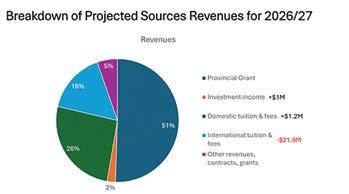
Mandigo mentioned that the provincial government will not be providing any additional funding, and that using the existing resources efficiently has become a top priority for UFV. Despite experiencing a $1.2 million increase in revenue from domestic students and fees, Mandigo shared that the $21.9 million
deficit is tied directly to the decrease in international student enrolments, with less than 500 new international students forecasted to join UFV for 2026-2027.
“Clearly it’s the international tuition and fees where we are projecting that we will see a $21.9 million decrease in the amount of revenue that we’ll be able to generate.”
This deficit is due to the federal government implementing a 48 per cent decrease in the amount of Provincial Allocation Letters (PALs) UFV has been granted to offer to international students starting in 2026. They were only given a total of 928 PALs compared to last year’s approximately 1,800.
Mandigo shared some of the strategies being employed to help mitigate
Mandigo mentioned that another cost reducting strategy is decreasing the amount of money invested in discretionary budgets, such as travel, furniture, memberships, sponsorships, special events, and more. They are also seeking to use on-campus resources and UFV’s facilities to the maximum instead of outsourcing spaces for events. Mandigo clarified that this reduction is necessary for long term sustainability.
“[This] doesn’t mean that we’re not doing these things anymore, because we still need to. The university still needs to do the business of a university, but [with] a lot more tightly controlled investigation around the necessity for some of these costs moving forward.”
Part of the uncertainties being faced by UFV are the possibility of layoffs. Mandigo disclosed that there are individuals who have been offered retirement or leaving the university through their voluntary departure program. To date, 41 people have been offered a voluntary departure program, out of which 20 have already accepted. The number of possible layoffs depends on the total number of people that willingly agree to depart the university. However, Mandigo confirmed the unfortunate truth that at least 40 layoffs are expected to occur across the university.
“The very last thing that we looked at was, unfortunately, the need to do layoffs. This was clearly not something that we … want to do, but [it’s] necessary to help us to achieve our budget.”
Mandigo affirmed that despite the challenges and uncertainties being faced by Canadian universities across British Columbia, UFV is perceived as being in a good financial position.
“I know it’s tough news today, but in the sector, we’re seen as being very stable, having good financial stewardship and fiscal sustainability.”
He reinforced that the university remains committed to working alongside its faculty association to achieve long term sustainability, and that all indications from UFV’s Board of Directors are of contentment with the plan.
Screenshots
Screenshots from Budget Town Hall
Broken trust: denialists on campus
Safety, cultural competency, and institutional response at UFV
DARIEN JOHNSEN
On the afternoon of Jan. 20, a group of demonstrators — some of whom were associated with the unrecognized political party OneBC — gathered outside of the Student Union Building (SUB) at UFV’s Abbotsford campus. The group arrived without prior authorization to challenge indigenization efforts on university campuses, and what they called “false narratives” about residential school history. Demonstrators engaged with students, and both a staff member and student said they were shoved. Although UFV security monitored the area, several students reported feeling unsafe.
Former Mount Royal Professor Francis Widdowson, who led the demonstration, told The Cascade she was at UFV to question Dr. Sarah Beaulieu — an assistant professor of social, culture, and media studies and a faculty associate with the Community Health and Social Innovation (CHASI) Hub — about the Ground Penetrating Radar (GPR) work conducted at the former Kamloops Indian Residential School in 2021, which identified 200 targets of interest consistent with potential human burials.
An incident report filed by Dr. Michael Batu, associate professor of economics, stated that the group entered Building D around 1 p.m. looking for Beaulieu. After learning she was not there, they attempted to locate her classroom before ultimately setting up outside the SUB.
The group also demanded that the UFV library change wording on documents pertaining to the possible Kamloops burial sites. Kenley Neufeld, UFV’s acting university librarian, told The New Westminster Times that the wording was changed in response to the demonstrators’ demands.
“We went ahead and made some changes to the website in order to better reflect what we believe occurred and some resources for follow-up by the students… we don’t say 215 dead children, which is what it said before.”
UFV leadership addressed the incident the following day. Dr. James Mandigo, president and vice-chancellor, issued a statement reaffirming the university’s commitment to truth-telling, reconciliation, and relationships with Indigenous communities. He emphasized that the demonstration was unsanctioned and that “behaviour involving harassment, intimidation, or physical contact is not acceptable at UFV.”
Video footage obtained by The Cascade shows the demonstrators engaging in transphobic rhetoric with students. A UFV staff member, whose name is being withheld for safety reasons, told The Cascade that they were shoved and mocked during an interaction with the group.
“I got shoved, and I told the cameraman ‘come on, that’s not necessary.’ Then a student was trying to get by, and he shoved him.”
They added that the encounter felt especially jarring given the sense of safety they usually experience at UFV.
“I [have] gratefulness [for] the privilege of having protected safe spaces and work — so many people can’t have that … I took it very personally when that unsanctioned protest happened; that it violated that safety.”
The UFV staff member said they reported the incident to campus security immediately, but no action was taken to remove the group. They took the next day off work due to the emotional impact.
Jordan Holmes, a student present at the demonstration, said that it must be
made clear that demonstrators like this are not welcome at UFV.
“These are not people that any of us want on campus. These are homophobes. These are racists … They want people to not organize and actually fight back. And I think that that’s kind of what UFV wanted, too.”
Mandigo’s statement also included links to support resources for students and employees. The previously referenced staff member commented they appreciated the statement but felt it did not address concerns about future safety procedures.
“Those links and resources … they are helpful [and] good, but I think a follow-up very quickly about procedure change to reinstate safety … what about next time? What’s the protocol? What’s the [next] steps? And everyone should know.”
Student, staff, and faculty sources told The Cascade that they knew the demonstrators planned to come to campus, but no official warning was issued by the university to students prior to the group’s arrival.
The demonstrators returned to Building A on the evening of Jan. 21, attempting to attend an event hosted by the Debate Club and the Political Science Student Association. Security was called and they were escorted off campus.
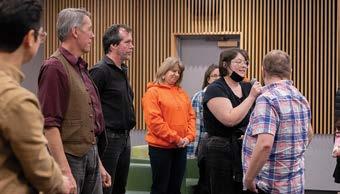
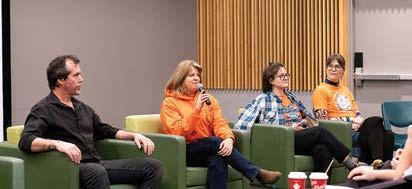
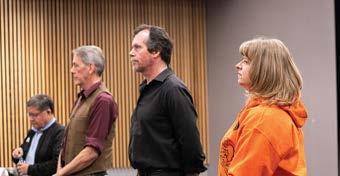
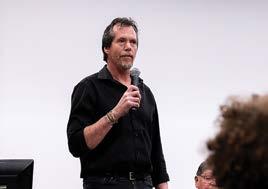
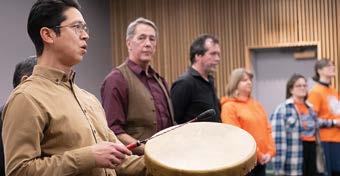
At the Xyólhmet Ye Syéwiqwélh (Taking Care of Our Children) panel hosted by UFV’s Peace and Reconciliation Center (PARC) on Jan. 22, The Cascade spoke with Mandigo about the incidents of Jan. 20 and 21.
“It was an unsanctioned event. They showed up on our property, and we have no control over [that]. [We monitor] the situation, make sure people are safe and we’re not poking the bear.”
Mandigo said he was “not aware that
there was hate speech that was involved,” adding that any evidence of physical contact or hate speech should be shared with security.
He did not answer The Cascade’s question on whether the university plans to put safeguards in place should future events like this happen, but praised the Debate Club for their handling of the Jan. 21 event.
“I was so proud of [the students], they didn’t take the bait … As soon as security got there, they escorted them out.”
Keith Carlson, Director of PARC, explained at the event that phrases like “show me the bodies” echo a long colonial history of settlers desecrating Indigenous graves. For many Indigenous people, speech and signs like those carried by the demonstrators evoke generations of stolen remains and broken trust.
Seven days after the demonstrators came to UFV, the British Columbia Assembly of First Nations issued a public call for universities to ban residential school denialists from campuses.
“The BCAFN strongly condemns the continued OneBC demonstrations occurring at several university campuses across British Columbia. These demonstrations undermine and diminish the impacts of residential schools and the lived experiences of First Nations in BC, the effects of which must be taken seriously by BC’s post-secondary institutions.”
This incident has raised a broader question among staff and students: how does the university plan to move forward after what the community feels is a violation of safety and a failure to uphold commitments to reconciliation?
Additional files obtained by Sky S. Terrones.
Interviews have been edited for length and clarity
Provincial // Extortion crisis continues
The increasing number of extortion-related cases in B.C.
JASLEEN SANDHU
The beginning of 2026 has seen a rise in the number of extortion-related cases in British Columbia. Back in 2025, the city of Surrey alone had 132 attempted blackmail cases. Out of those reported incidents, 49 of them resulted in shootings. In the first month of 2026, Surrey alone was impacted by 35 extortion cases, and Abbotsford has seen 38 reported extortion-related threats since November of 2023.
This extortion crisis has been an ongoing issue in B.C. since Nov. 2023, and these threats are primarily targeting South Asian-owned businesses and individuals through social media apps like WhatsApp.
The cases have been increasing across Canada, in places such as Edmonton and Brampton. However, they are repeatedly being reported in cities such as Surrey, Delta, and Abbotsford.
Over the past few years, extortion threats have been sent through different mediums such as letters, phone calls, text messages, social media, or from anonymous figures; all demanding money. The CBC has reported that these violent escalations have been linked to India by investigators.
“The India-based Bishnoi gang has claimed responsibility for some Canadian shootings on social media, and police have said there is evidence connecting the Bishnoi gang to Indian government agents.”
Galib Bhayani, former chief superintendent of RCMP Metro Vancouver
Operations and criminology instructor at Kwantlen Polytechnic University has described how the tense relations between India and Canada have led to turmoil which have resulted in extortion-related occurrences in recent years.
“These [extortion attempts] are happening from India … Our relationship with India in terms of information sharing is not good. At other levels, it’s not good as well.”
Extortion activity has not been limited to everyday individuals, but South Asian stars as well — comedian Kapil Sharma and singer AP Dhillon living in the lower mainland have been affected as well.
Leaders in B.C. have provided conflicting stances on the crisis. In Jan. 2026, the RCMP’s Assistant Commissioner, John Brewer, claimed that the extortion situation is not a crisis.
“There’s not a crisis … This is a threat to public safety, absolutely, and I take it very seriously.”
B.C.’s Premier, David Eby, has criticized the statement made by Brewer, and expects him to take this situation seriously.
“If Mr. Brewer does not feel that urgency, does not feel this is a crisis, perhaps he’s not the right person to head up this task force. The reason we established this task force … was to respond to a crisis.”
Since Eby’s statement, Brewer has apologized for not initially deeming the extortion situation a crisis.
“Our efforts have never been limited because of a term. Extortions remain one of our highest priorities.”
After Eby and Brewer’s respective statements, B.C.’s Ministry of Public
Environment // Canada suffocated by relentless snow
Safety revealed that it is funding $600,000 in order to expand the province’s forensic firearms lab. According to Chek News, the funding will be used to increase the lab’s ability to tackle cases relating to gun violence in order to deliver forensic results more proficiently.
As extortion cases continue to surge at an alarming rate, Surrey’s Mayor Brenda Locke is calling for more resources and is imploring for Ottawa to address this issue seriously at a national level.
The province currently has an Extortion Task Force which was established in Sept. 2025, and it includes over 40 police representatives from municipal to federal such as the B.C. RCMP, Surrey Police Services, Delta Police, Abbotsford Police, etc. Nina Krieger, minister of public safety and solicitor general, gave a clear statement concerning the objective of the task force.
“The B.C. Extortion Task Force sends a clear and firm message: if you choose to inflict harm on our communities, we will find you and we will hold you accountable.”
Last September, the Abbotsford Police Department (APD) launched Operation Community Shield, a dedicated task force within the APD to respond to the threats.
The APD have put up a page on their website detailing what extortion is, how they are dealing with its impact on the community, and how to report any extortion-related activity. The police department is urging citizens to be aware of this issue, and to not hesitate to report cases of extortion.
How Eastern Canada was severely affected by an historically cold weather phenomenon
NATALIA TOSCANO MURUA
On the weekend of Jan. 23-25, a powerful cold front known as a polar vortex, brought extremely cold weather to the majority of Eastern Canada, with temperatures dropping as low as -50 degrees Celsius in northwestern Ontario and the prairies. Unstable winter conditions of winds blowing at 40 kilometres per hour in southwestern Quebec made travel dangerous and ill advised throughout the weekend and at the beginning of the week. Downtown Toronto saw a record-breaking amount of snowfall reaching more than 50 centimetres,
beating the previous record of 48.3 centimetres back on Jan. 11, 1994 by 13 additional centimetres. Jan. 25, 2026 now holds the new record at 56 centimetres of snow.
This bone chilling environmental phenomenon was intensified by the effects of an atmospheric river that coincided with the polar vortex. This in itself was caused by a warmer than average Arctic that allowed the frigid arctic air to travel lower than normal. This difference in temperature bred the perfect conditions for an abnormally severe snow storm. Prior to this, the Weather Network forecasted on Jan. 19 that areas
such as Atlantic Canada, the Prairies, Ontario, and Quebec would be at a high risk of receiving arctic air, while British Columbia and the West Coast would remain at a low risk.
There were severe effects felt countrywide, where air travel was also significantly impacted by the snow storm. Approximately 65 per cent of all flights inbound and 64 per cent outbound flights from Toronto’s Pearson International Airport were directly impacted with delays and cancellations from Saturday, Jan. 24 to Sunday, Jan. 25. In Montreal, the old Hempstead Substation suffered equipment failures that left more than
12,000 individuals with no electricity, and over 5,300 homes were still impacted throughout Montreal as of early Monday, Jan. 26.
The extreme cold and electricity outage has already claimed the lives of at least two people in Quebec, who perished due to hypothermia. In these conditions, when the outside temperature is below -30 degrees Celcius, it is so cold that frostbite can occur in less than half an hour.
The snow in Ontario may be sticking around for several days as the temperature will stay below 0 throughout the
CONTINUED ON PAGE 07
Illustration by Hannah Bricknell / The Cascade
CONTINUED FROM PAGE 06
upcoming days, meaning the snow will not be melting away anytime soon. 24 hours later, Ontario’s police officials reportedly attended and helped around 200 vehicles that became involved in accidents because of the treacherous transit
conditions. An additional 150 cars that were stuck in ditches also received aid from this department.
In Toronto, schools reopened on Tuesday, but the effort to clean up after the historic snowfall continues. Over 600 plows and 1,300 people were contracted to help restore passage through roads and
sidewalks. The heavy snowfall of Sunday, Jan. 25 delivered enough snow to bring up Toronto’s monthly total to 88.2 centimetres — the highest it has ever been, cementing this year’s snowfall in the history books.
SNAPSHOT
I’m something of a plant myself, you know
Illustration by Iryna Presley
My plants are dying and so am I. And I don’t mean the existential “every day I inch closer to death” dying (let’s try not to think about that one too much), but a metaphorical, seasonal death.
With winter comes a whole lot of feeling for me — not only do I have regular depression that stays with me year round, but I was also blessed with the “Super Fun Bleak Times Combo Pack” that comes with a bonus: seasonal affective depression (free of charge!). This means that I would be hard pressed to qualify as an actual, fully functioning human adult during the cold months of the year.
As my plants wilt and lose their leaves from the lack of sun, so too do I. When I look around my graveyard of a bedroom at all the drooping leaves all I can think is “bro, same.” Someone please water us and tell us we’re still pretty, it’s getting kind of scary in here.
BY DARIEN JOHNSEN
Politics // Canada-China trade deal
Renewed relations with China after Carney’s new strategy
LIAM PYPER
Dr. Michael Batu is an associate professor of economics at the University of the Fraser Valley.
During an official visit to Beijing, China from Jan. 13-17, Prime Minister Mark Carney unveiled a new strategic partnership that made significant progress in warming Canadian-Chinese trade relations. In an email conversation with The Cascade, Batu shed some light on this new trade agreement and what it could mean for Canada.
“In the short run, the United States is unlikely to view this favourably. The U.S. sees China as its primary strategic rival and does not want a neighbouring country in this hemisphere becoming too closely aligned with Beijing.”
The deal between Canada and China included promises to cooperate on energy and agriculture, with a focus on climate competitiveness and clean power. Furthermore, China and Canada expressed joint commitments to transnational security, multilateralism, and cultural exchange. As a tangible result of this deal, a maximum of 49,000 Chinese Electric Vehicles (EVs) will be permitted into the Canadian market with a low 6.1 per cent tariff rate, which will increase in the next five years to 70,000 vehicles.
In a win for Canadian agriculture, China will also lower its tariffs on canola seed exports to approximately 15 per cent in March, and lifted an import ban on Canadian beef that had been in place since 2021.
While the agreement is not considered a free trade deal, it does mark one of the most pivotal economic resets between the two countries in nearly a decade. Carney commented on the merit of this new deal.
“By leveraging our strengths and focusing on trade, energy, agri-food, and areas where we can make huge gains, we are forging a new strategic partnership that builds on the best of our past, reflects the world as it is today, and benefits the people of both of our nations.”
Batu expressed both concern and cautious optimism at the deal. With the United States presenting an ever more unruly “ally,” the need to diversify Canada’s trade partners is an economic
priority. However, this particular deal may have some consequences for the country.
“In the short term, this strategy could actually be destabilizing [for Canada]. The U.S. remains Canada’s most important trading partner, and President Trump has shown a willingness to use tariffs aggressively and, at times, personally. I would not be surprised to see tariffs return at higher levels than before.”
Batu’s warning highlights the fragility of Canada’s position between two competing economic powers, where diversification may provoke retaliation before it delivers long-term stability. By diversifying who Canada does business with, it could reduce its reliance on the United States and benefit Canadians, as well as provide access to cheaper EVs.
“Affordability is a major potential benefit. Some Chinese-made EVs sell for under $8,000, which could dramatically improve access to transportation, especially for younger Canadians. There are also potential job gains in agriculture and energy, driven by expanded export opportunities.”
When asked about if the deal had any future, Dr. Batu explained that it really was based on geopolitics.
“At the moment, China appears attractive to Canada, and China also has incentives to maintain friendly relations with a country that borders the United States. Much of this is driven by the current political climate south of the border.”
However, this could change quickly if Canada is drawn back to the United States, which would again distance China.
“The durability of the deal will also depend on China’s behavior. China tends to prefer bilateral arrangements and expects political alignment. If Canada is perceived as simply following U.S. policies that are adversarial to China, the relationship may not last.”
The deal has already drawn the ire of United States President Donald Trump, who has threatened Canada with retaliatory 100 per cent tariffs if it makes a trade agreement with China. Carney responded by assuaging the belief that this would lead to a free trade deal with China, and emphasized that the deal constitutes an effort to smooth relations.
At first, Trump was unconcerned and agreed that the deal made sense. It was after Carney’s speech at the Davos World Economic Forum, that Trump changed his tune, threatening tariffs and labelling Carney as a “governor.” He also posted about Carney and his deal with China on Truth Social.
“If Governor Carney thinks he is going to make Canada a ‘Drop Off Port’ for China to send goods and products into the United States, he is sorely mistaken.”
Carney’s strategy with China may test Canada’s economic autonomy, and reveal whether or not the country can diversify and break away from its biggest trading partner, the United States.
Interview has been edited for length and clarity.
Photo by Peter Xie
THE ENVIRONMENTALIST: they want us to give up — let’s not
Trying not to lose my mind in a world that keeps burning
FABIOLA CRUZ ALDERETE
Welcome to The Environmentalist, your column for understanding the natural world. In this edition I will be trying to not lose my mind.
With so much news about violence and suffering in our current world, how could you not feel hopeless and tired? Everyday I open social media and am bombarded with information that makes me feel despair. Just this morning, I learned about the severe forest fires that are happening in Patagonia — one of the many tragedies happening around the world. The article could be about any of them, but honestly, I am struggling as I am sure many of you are, so come with me to try to redirect those negative emotions. I understand how our push and motivation to protect the environment can be draining and taxing at times, so one way to help redirect negative emotions surging from environmental injustice can be to measure how much one can get involved with the environmental events happening worldwide. With this, I don’t mean the classic “avoid reading the news” — I think that bringing attention to these issues is the most important action we can take — but I think it is important to do it conscientiously. For example, one way to do it can be by asking yourself: what media or news channels are you choosing to pour your attention and energy into? Are you doing it in a healthy way that is not negatively affecting your mental health?
I find that local action can always heal your heart a little bit. Wherever you live, I can assure you there is a place you can volunteer or donate to that directly impacts your community and places close to it. Bonus points if volunteering requires you to be outside more! I understand it may not be easy to leave home in a time of turmoil, but maybe you can work at a soup kitchen or clean up a local public park. Seeing my surroundings change because of the action I take has seriously improved the way that I approach social action, so I recommend trying it out. Changing the world can start by making one person’s day a little brighter. It’s valid to feel like giving up sometimes, and I get it. When I feel like my effort is in vain, I tell myself: YOU CAN’T LET THEM GET AWAY WITH IT! Even if sometimes it’s tiring and can seem awful, I’ll join the group of people standing in the way of greedy corporations any day. We are living through strange times, so don’t let them overrun your passion and your care for the natural and human world. Stay connected to the ones you love and remember that as the Lorax once said, “Unless someone like you cares a whole awful lot, nothing is going to get better.” So, let’s care.
Lifestyle //
The Titanic goes deeper
Yes, this 100-year-old wreck has more relevancy in my life than I thought
NATALIA TOSCANO MURUA
Out of all the special interests out there that I could’ve explored, I somehow got deep into the Titanic’s history. To this day, I am deeply fascinated by its story, and the more I learn about it, the more insatiable my thirst becomes to find out even more. This made me wonder, why is it that I, along with many others who share this interest, are mesmerized by an ocean liner that sank more than 100 years ago? What is it about this particular ship that keeps tugging me in? The answer turned out to be even more entangled than the remains of Titanic itself.
I clearly remember being introduced to the Titanic with James Cameron’s film. At only 10 years old, the imagery of the bow singing underneath the waves and the water violently gushing into the grand staircase became permanently engraved
in my mind. This propelled me to look for more information online, where I found further footage on YouTube. This included bits of new documentaries featuring Cameron’s exploration of the wreck and the digital recreation of its sinking to the bottom of the ocean. My interest in the Titanic took on a forensic quality — I felt intrigued by the presence of such a monumental steel structure laying in the dark, deep Atlantic ocean, twisted and plagued by rusticles. Perhaps this was morbid curiosity stemming from my submechanophobia — the fear of man-made objects submerged in water — but beside this being a potential anchor, what kept me returning for more was not the wreck itself, but the secrets it holds within.
The hypnotising beauty of the Turkish Baths’ blue tiles, perfectly preserved in place despite the ship’s impact on the
sediment, were thrilling to discover. How the air waves were bursting alive for hours as the Titanic’s wireless operators incessantly called for help and the Carpathia’s subsequent limit breaking dash to the rescue, to me that’s heroism at its best. That chilling account of an unlikely survivor that was swallowed by water gushing into one of the funnels leading to the ship’s core only to be saved by a burst of hot wind from inside the ship’s bowels and sparing his life, almost hard to believe. There are a thousand more bits of the same story, and they all connect and form a part of a larger picture. All of them fascinate me. They all live in my mind. I could go on for a thousand more words talking about everything that fascinates me about the Titanic — my friends can testify on that one. But after giving it
CONTINUED ON PAGE 09
SNAPSHOT
Read that book that sounds stupid
I have hesitated picking up a book because it looked, well, stupid. Or of a lower class than typically “respected” literature. Or it didn’t sound useful. Or it wasn’t popular. It wouldn’t make me more cultured, or give me information, so why bother?
First of all, have fun with reading, it’s worth it. Books, especially fiction, can serve as a much needed escape from screens and reality. Second, it all teaches you something a bit less tangible than numbers and history. That something for me is empathy. Empathy is a hard thing to measure, but research has shown that people that read tend to have better social cognition, and another study vouched for reading fiction specifically. Immersing yourself in someone else’s head like you do with fiction allows you to, if only for a moment, see the world through someone else’s eyes.
Romance, fantasy, sci-fi, thriller, mystery, literary, and everything in between have something to teach you. It doesn’t have to be popular to grow your ability to connect with your neighbours and open up your perspective, so pick up that random weird sounding book you noticed on the library shelf.
BY KARA DUNBAR
Illustration by Iryna Presley
The Superstore hellscape SNAPSHOT
I’d rather shoot myself in the foot than go to Superstore. Actually, no. I’d rather starve. It’s a real pain in the ass to grocery shop there now. I swear the store reconfigures the aisles and product locations every single week. It doesn’t matter if I need one or two items, it takes one or two years to find what I need. It’s frustrating — why must they make our lives more difficult?
If I may shed a logical theory, they want more sales. Since we have to walk around the entire store before we finally find what we need at the very back corner, we’re passing all the other aisles where we’ll inevitably spot something else potentially intriguing. If they leave the store the same way for weeks on end, we’ll get used to the layout and stroll right past. That or, whoever’s in charge is extremely discombobulated.
BY VERONICA POWELL
SNAPSHOT
Cherry blossoms when?
I can’t wait for the cherry blossoms to be in season again. I struggle to describe the magical feeling I get whenever they start to blossom; I can best describe it as my soul being filled with tranquility. The muted and delicate pink of their petals, ever so delightfully complimented by their cherry coloured centre is something that never ceases to remind me how beautiful nature can be. As it so happens, my birthday is in early April, which is about the time their blooming starts. I think this also makes them feel more special to me, because every time I get to see these unique and ephemerous flowers adorn the landscape, it means I’ve made it through another cycle around the sun.
Last year I didn’t get the chance to catch the cherry blossoms in Clearbrook’s International Friendship Garden, which was a bummer. This year I will make sure to visit as soon as they blossom, and I’ll take the chance to reminisce on yet another year passing. It might sound more melancholous than intended, but really it’s super enjoyable.
I’m also looking forward to all the sakura flavoured desserts, shoutout to Boba Run’s sakura matcha latte!
BY NATALIA TOSCANO MURUA
CONTINUED FROM PAGE 08
a lot of thought and finding the relation it has to my present life, I’ve discovered that, for me, it’s the witnessing of a grand tale composed of thousands of parts, stories, lives, and more. Facts and myths, fantasies and realities; the abyssal gap of what events transpired is completely surreal to me, because we will never know exactly what it was like — we only have glimpses into it.
I think that the history of how the Titanic sunk is so well known because of the impact it had on people. From the passengers and crew that perished, to the heroes that rose to the occasion, this tale lives through the eyes of history, which is
told and lived by people. It might be an odd thought but, I am people. Everything I learn about the lives of those who were a part of this event ultimately gains another life through me. The collection of information I’ve gained on the topic throughout the years is ultimately to reconstruct and connect with a story that I relate to.
The Titanic is special to me because of what it has taught me. I’m certain we all know that Titanic was called “unsinkable,” and how this brought more shock when the news broke that it had sunk on its maiden voyage. There have been plenty of situations in my life that, in retrospect, I realize I was taking at face value without question. Because hey,
Canada // Has Canada truly earned its kind reputation?
this ship can’t sink, right? I’ve learned to never forget that everything can sink. Understanding what led to the sinking also taught me that no tragedy originates from a single action; it is always made of a long series of events that create the ultimate catastrophic coincidence. Now, I aim to understand all the moving parts that lead to a catastrophe. The answer is always in the details.
Ultimately, the Titanic is not only a special interest of mine, but a reflection on human actions and human consequences, that in this case left behind a mammoth metal monument 3.8 kilometres beneath the waterline. I think that’s why I keep returning to it — it always has more secrets to tell.
Are we truly a beacon of hospitality and inclusion, or a diet United States?
ABBY HANSEN
We’ve all heard the stereotype that Canadians are friendly people. It’s a narrative that has pervaded the mainstream. Our country is not only rated as the friendliest in the world by World Population Review, but we are also ranked first in global reputation by RepCore Nations in 2025. The United States-based non-profit Freedom House even rates Canada as the fifth freest country in the world. Canada also has a history of being portrayed as the final safe haven amidst the chaos of authoritarian regimes in pop culture, such as in Margaret Atwood’s novel The Handmaid’s Tale (2011).
This reputation is something many Canadians may pride themselves on, and it is often contrasted with the public image of our neighbours in the United States.
I have a unique perspective on social and political issues in both countries, having family and friends on both sides of the border. On one side, Americans are waking up to systemic issues within their current political and economic structures and the injustices enacted by their current administration. On the other hand, a sentiment I frequently hear from Canadians about our current social and political climate is the dismissal of any comparison we may have with the U.S. — glancing at the rise of authoritarianism in the United States and breathing a metaphorical sigh of relief that we are not them. However, there has been a disturbing recent trend that suggests we may not be as different from our Southern neighbours as we would like to think.
We are more than one year into U.S. President Donald J. Trump’s second term.
Since his inauguration in early 2025, he has wasted no time in enacting a wave of reactionary policies that have devastated the lives and safety of many residing in the United States, regardless of citizenship or status. It is a situation that hits close to home for me, and not only because I am a dual U.S./Canadian citizen. Just a few weeks ago, on Jan. 16, 2025, the U.S. Immigration and Customs Enforcement (ICE) detained a seven-year-old girl and her parents from Oregon’s Adventist Health Portland medical centre — the hospital where I was born.
This political turmoil has largely stemmed from anti-immigrant rhetoric that has been continually pushed by Trump and other right-wing figures since the president’s first term back in 2016. Now, the goalpost seems to have expanded to include anyone from any marginalized demographic.
Canadian media often portrays Canada as multicultural, open, and accepting of immigrants. This exterior is quickly called into question when comparing Canada’s representation of its acceptance of immigrants to actual public opinion. I have noticed that anti-South Asian sentiments specifically are becoming more and more common in Canadian online spaces.
In a CBC article, Josiah Sinanan reports on online hatred targeting South Asians, exposing several young Indian students’ experiences with online harassment and hostility. They witnessed social media posts with hundreds, if not thousands of interactions that claim immigration from India is somehow to blame for problems in Canada regarding housing and employment.
This online rhetoric is not only widely racist, but it also has devastating realworld consequences. A 2023 study by Focus Canada reported that an increasing number of Canadians believe that we have “too much immigration.” This hostility is not only evidenced by thoughts and opinions alone. According to Statistics Canada, hate crimes against Canada’s South Asian population have risen by 143 per cent from 2019 to 2022.
We can use all the inclusive language and multicultural imagery that we want — but do words and pictures truly mean anything if not followed by action? That is where I think the problem truly lies. I believe that there is a difference between being kind and being good. Without goodness and humanity to support it, kindness is simply a facade.
Despite our outward appearance, in my eyes, a growing number of Canadians seem to be making the same mistakes as Americans — scapegoating an entire demographic of people due to social and political instability. I believe that can, and will, grow like it has in America unless we speak up now.
I do not write this in an attempt to discourage readers. Rather, I hope this will be a call to action. To call out injustice where you see it. Like any form of radicalism, what we are seeing in the U.S. did not come from nowhere, and does not exist in a vacuum. Our proximity to this hate seems to be bleeding into our own social perceptions. If not addressed and challenged, I fear that we are on the same pathway to fascism as the United States.
Science // Dreams are the ultimate sensory experience
The
what, why, and how
VERONICA POWELL
of what our brains do during sleep
I consider the entirety of the human brain to be an anomaly, but dreaming in particular has always fascinated me. Sleep medicine expert Dr. Michelle Drerup has come to the conclusion that most dreams happen during the Rapid Eye Movement (REM) phase during sleep. It’s an active cycle our mind goes through, produced by the brainstem which causes dreams. Dreams are like mini movies playing in our heads. They can be compelling and fantastic, but also frightening and confusing. I tend to have really weird dreams, but the most bizarre part is that most times I’m never able to describe them, explain why they happen, or even recall them the moment I wake from sleep. I’ve taken the time to research it in hopes for a better conclusion about the mysterious way our brains work during sleep.
The theories that I’ve heard consistently over my childhood and early adult years is that dreams are either our minds reliving a past experience, predicting something that might happen, or attempting to process a current emotional situation. As odd as it sounds, it’s not all a myth. One study by psychiatry
Music //
professors Yuval Nir and Giulio Tononi at the University of Wisconsin, say that dreams may come from a person’s imagination, memories, thoughts, and wishes.
A neuroscience professor Dr. Erin J. Wamsley at Furman University in South Carolina claims that dreams come from the hippocampus, a part of our brain associated with memory, which is further evidence that memories are a leading cause of dreams.
I’m not even joking when I say the night after I started writing this article, I had three weird dreams consecutively. One in particular was extremely uncomfortable to experience and subsequently remember after waking, but why can dreams be so strange? It could have to do with our neurotransmitters and how active our brain is while asleep, where the chemicals such as acetylcholine and dopamine are present, with some researchers finding dopamine to be potentially related to hallucinations. I only remember a few images from my dreams and the rest is forgotten. Turns out that even though our brain can be as active in sleep mode as it is while awake, during REM sleep the long-term memory areas of our brains are mostly deactivated, causing short-term
memories to last in dreams for about 30 seconds.
There is more to dreams than meets the eye. Cognitive processing doesn’t stop during sleep, because dreams are essential in continuing emotional processing of things that go on in our life. One example is how when dreaming, anxiety levels go down because of a decrease in noradrenaline, which is known to trigger the body’s fight or flight response. It’s also said that dreams may enhance the strength of our memory.
I know that when I wake up from a dream, the way I speak to others and the way I feel is affected. This is because our mood can change based on what we dream. If you have a dream that involves death or anxiety for example, it can induce a negative mood, whereas dreams about pleasurable experiences like leisurely activity, eating and drinking, and being around others you love can result in positive moods.
There’s one dream in particular that plagued my tween years and early adolescence, which was honestly more of a nightmare, but it came about once every month. That pattern stopped when I got into my late teenage years. I found
Diverse music is the spice of life
Our strangest playlists reveal how culture and experience shape what we love
LIAM PYPER
What’s the weirdest music you’ve ever listened to? Was it a new genre you experimented with, something oddly stimulating? Do you still listen to it or does it make you cringe now?
I love asking people these sorts of questions because I think that your music taste really reveals a lot about a person. There actually is science to back this up, according to a study in the Journal of Cross-Cultural Psychology your musical taste is not innate wiring — it is formed by one’s early listening experiences and cultures. I can relate, my father is an immigrant from Scotland, and I grew up listening to a folk band called The Corries. I also have a Yiayia (my Greek Grandma), so I listened to Greek folk too.
Our music is not only formed by the culture we are raised in, but by the ones we adopt during our lives as well. Some may like to think that certain types of music are superior to others, but it might just depend on lineage. For example, researchers from
the Massachusetts Institute of Technology and Brandeis University found that while Westerners preferred consonant chords, an Indigenous group in the Amazon, with little to no exposure to Western music, had no preference. This dismantles the idea that there we can naturally tell good music from bad, but that all music has
subjective value.
A study from the University of Cambridge also found that our musical preference will often change over our lifetime: as youth we tend to gravitate toward more intense music, and as we age this mellows out and we begin to listen to more emotionally layered and complex music. This would explain why we can’t stand listening to some of the music we used to, and while I certainly will come back to music I listened to in my early days, there’s some I cannot bear.
While my musical taste has changed as much as I have over the years, there are a few artists that have stuck with me. I want to give them a shoutout as well as explore why I listen to them, and why you should too!
Cosmo Sheldrake, an artist I hope everyone will go look up after reading this, is an experimental folk artist — at least that’s how I would describe him. His music often utilizes sounds of the natural world, like a bird chirping, a river bubbling, or a cedar creaking.
out it wasn’t a common nightmare, but rather a kind of recurring dream that takes more effort and time to get past. Recurring dreams reflect parts of you as a person rather than a one-time experience you may have had. According to dream researcher Deirdre Barrett, recurring dreams come from our associations with certain topics and experiences and how we feel about them. For example, I know of someone who dreamt about being spit in the face by a black hole because they were scared that someone might be hiding in the dark closet in their bedroom.
I’m someone who dreams a lot, and I find that dreams can be as much of a gift as they can be a curse. Regardless of what research might say about it, I like to think it means I’m an imaginative person, or that my dreams are a trademark of my ambition. It feels like dreaming is some kind of superpower allowing us insight into ourselves on a completely mystifying level. When I curl up in my bed each night, I am grateful to dream, whether it makes me feel good or bad, because then at least I’ll know that my mind is alive and well.
The HU is a folk/rock/metal band from Mongolia, and if you ever played Star Wars: Jedi Fallen Order (2019), you would recognize them for “Sugaan Essena” which plays at the opening of the game. The feeling I get when listening to one of their songs is indescribable, I love every moment. Their music can be soft and fun, or angry and powerful, sometimes all at once!
And a final shoutout to Fever Ray, who perhaps takes the place of my favourite artist. Their work is incredible, heady, queer electronic music. They are incredibly weird and genderfluid, I really recommend checking out “If I had a Heart” and “What they call us”, as those are two of my favorite pieces of theirs.
Artists like Cosmo, The HU, and Fever Ray appeal not just because they are unusual, but because they engage with me on an emotional and cultural level. With these artists in particular I feel that my life experiences contribute to the musical experience, they reflect me and the things I care about.
Illustration by Natasha Zilcosky / The Cascade
LOCAL BLACK LEGENDS
A visual tribute to Black Canadians who broke barriers
ANJALI RANDHAWA & CAITLYN CARR
Every February, Canadians recognize Black History Month to celebrate the many achievements of Black people and communities throughout history. For The Cascade’s first issue of this important time of reflection, we took a trip out to Vancouver to see how the contributions of local Black Canadians are being celebrated in everyday monuments.
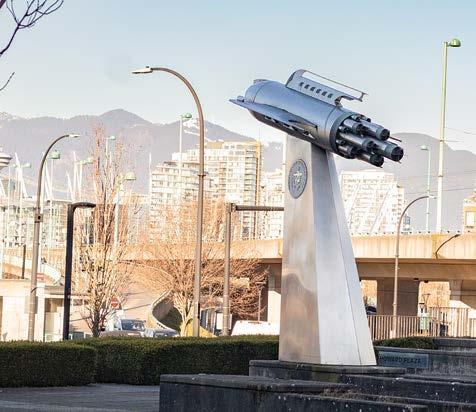
Barbara Howard Plaza
A born and raised Vancouverite, Barbara Howard (1920-2017) was the first black athlete to represent Canada in an international competition. When she was 17, Howard competed in the Canadian British Empire Games trials, running 100 yards in just 11.2 seconds.
In early 1938, Howard won both silver and bronze medals at the British Empire Games in Sydney, Australia as part of the Canadian team. Howard might have gone on to compete in the Olympic Games if not for World War II, which led to the cancellation of the 1940 and 1944 Olympics.
After graduating from what is known as a “normal school” to become a teacher, Howard began teaching in Port Alberni before becoming the first person of colour hired by the Vancouver School
Board. In 1959, she received her Bachelor of Education from the University of British Columbia (UBC). In total, Howard taught for 43 years, 14 of which she spent as a physical education instructor.
Howard won a Remarkable Women Award from the Vancouver Park Board in 2010. Two years later, she was named to the BC Sports Hall of Fame, before also being inducted into Canada’s Sports Hall of Fame in 2015.
The Barbara Howard Plaza, formerly known as The Cambie Street Plaza, was renamed in 2018 as part of an initiative to recognize prominent Vancouverites.
Photos by Anjali Randhawa / The Cascade
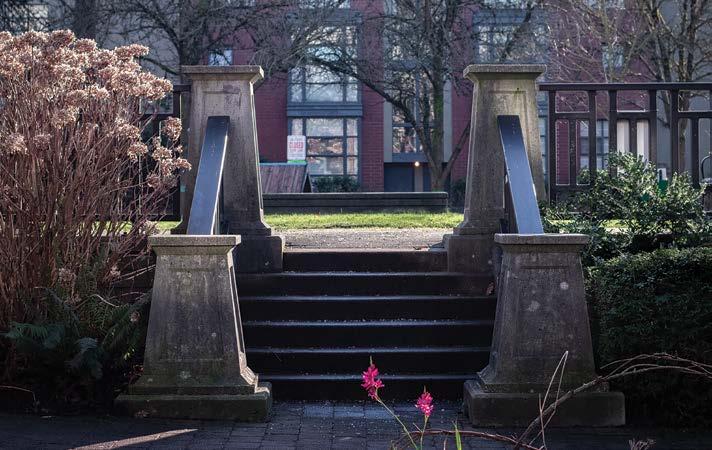
Joe Fortes Memorial Drinking Fountain
Seraphim “Joe” Fortes (1863/65-1922) was born in Port of Spain, Trinidad and Tobago. After working as a sailor on a damaged ship, he found himself stranded in Vancouver in 1885 and decided to settle there. Eventually, he became unofficially known as the guardian of English Bay Beach due to his skill at swimming and frequent volunteer work there.
In the early 1900s, Fortes began earning a living from the city for his work as Vancouver’s first official lifeguard and for patrolling the beach as a special constable. Fortes taught three generations of children in Vancouver to swim and rescued at least 29 people from drowning. In 1986, Fortes was named the “Vancouver Citizen of the Century” by the Vancouver Historical Society.
After Fortes’ death from pneumonia, a civic funeral was held at Holy Rosary Cathedral which saw roughly ten thousand attendees filling a number of Vancouver streets including Granville and Main. His funeral remains the largest in Vancouver’s history.
The Joe Fortes Memorial Drinking Fountain was sculpted in 1927 by Charles Marega. The fountain remains standing today in Alexandra Park and currently faces the same beach Fortes spent much of his life serving.
Photos by Caitlyn Carr / The Cascade
Rosemary Brown Park
Rosemary Brown (1930-2003) was born in Kingston, Jamaica before immigrating to Canada in 1951 to study social work at McGill University. After graduating, she also went on to receive a Masters of Social Work from UBC.
In the 1960s, Brown worked as a co-founder and Ombudswoman of the Vancouver Status of Women Council. Then, after becoming a New Democratic Party candidate and winning the Vancouver-Burrard electoral district in 1972, Brown became the first black woman to sit on the Legislative Assembly of British Columbia. In 1975, Brown also became the first black woman to be in the running to lead a federal party, campaigning with the slogan “Brown is Beautiful.”
After retiring in 1988, Brown began teaching women’s studies at Simon Fraser University (SFU) and fulfilled many roles in the MATCH International Women’s Fund (now the Equality Fund) including President. Then, in 1991, she helped launch the Canadian Women’s Foundation — a nonprofit promoting nationwide gender equality.
Throughout her life, Brown received the Order of Canada, the Order of British Columbia, a United Nations’ Human Rights Fellowship, and 15 honorary doctorates from a number of Canadian universities.
Located in Kitsilano, Rosemary Brown Park opened in 2005.
Photos by Anjali Randhawa / The Cascade
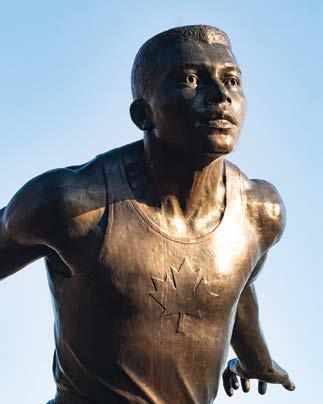
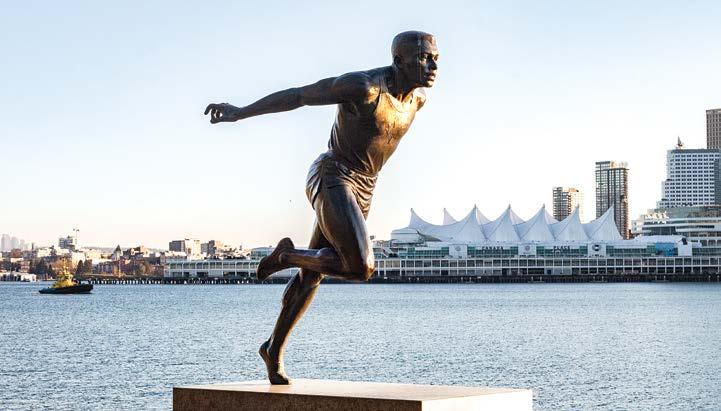
Harry Jerome Statue
Harry Jerome (1940-1982) was born in Prince Albert, Saskatchewan, and in 1952, his family moved to North Vancouver. A skilled athlete, Jerome found immense success as a runner. When he was 18, Jerome broke the Canadian record for the 220-yard dash at 21.9 seconds, earning him a scholarship from the University of Oregon, where he later received both his Bachelors and Masters of Science in physical education. After running the 100 metre dash in 10 seconds at the 1960 Canadian Olympic trials, Jerome officially became the first Canadian to hold a world track record.
After a string of successes including setting seven world records and winning bronze at the 1964 Tokyo Olympics, Jerome retired from competing internationally in 1968. Throughout the mid to late ‘60s, Jerome also worked as a teacher for the Richmond School Board and the Vancouver School Board.
An avid advocate, Jerome pushed for better coaching, financial and medical support, and media representation for minority athletes. In 1971, Jerome received the Order of Canada and was named Athlete of the Century by the province of British Columbia. Shortly after, he founded the Premier’s Sports Awards Program and sat on the BC Human Rights Commission. To this day, the Harry Jerome International Track Classic is an annual event held in his honour.
The Harry Jerome Statue was erected in 1988 and is located in Stanley Park.
Photos by Anjali Randhawa / The Cascade
Sports
SLAPSHOTS
Get your brand off my jersey!
Advertising is both invasive and distracting. Yet despite this, professional and collegiate sports continue to welcome advertisers with open arms — and open bank accounts.
The NCAA’s recent decision to allow sponsor patches on team jerseys got me thinking about just how deeply advertising has embedded itself in the sports world.
NCAA jersey patches are simply the latest domino to fall in a long line of questionable, revenue-driven decisions that leagues have made in recent years. Advertising throughout a stadium is one thing; fans expect it and can largely tune it out. But the moment brand logos are plastered directly onto jerseys and merchandise, the line is crossed. Jerseys are meant to represent teams, cities, and traditions — not corporate greed.
I love rocking my favourite team’s jersey, and the last thing I want is to be a walking advertisement for a random company stitched onto my sleeve. Merchandise is already expensive enough. Fans shouldn’t have to pay a premium for gear that makes them look like a billboard on the side of a highway.
BY ETHAN PAULSON
Athleisure’s cool, but so is objectivity
Athletes have developed visual alter egos. They go from being geared up and sweaty to dripping in high-fashion brands, creating their own catwalk. The pre-game arrival routine — or the “tunnel walk” — has become a pillar of modern sports culture. It’s not necessarily a bad thing, but I’m torn on whether the growing relationship between fashion and sports risks making athletics too subjective.
To be clear, I’m not suggesting that athletes’ off-duty fashion is harmful or that it invades sport. In many ways it enhances showmanship and personal branding. However, fashion is a powerful and influential industry, and I worry it can introduce bias across sports. If one league is perceived as more stylish than another, fans may gravitate toward it based on aesthetic appeal rather than athletic merit. This can result in greater visibility and acclaim for certain spots while others are overlooked. The NBA and Formula 1, for example, are often associated with high fashion, and their athletes tend to attract more followers and cultural attention than those in less fashion-forward sports.
Ultimately, I hope the defining measure of sport remains the skill, discipline, and hard work required to compete at the highest level, with fashion serving as an addition rather than a partition.
BY VERONICA POWELL
Coaches //
“The goal is to win” — Jepson sets the standard
Now an established winner, Jepson is focused on player development as well as
victories
VERONICA POWELL
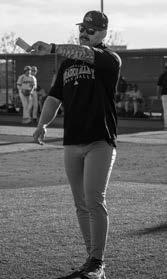
Baseball is in his blood, and Riley Jepson has proven he’s meant for the game. Now the head coach of UFV Men’s Baseball, Jepson’s journey has taken him from playing at UFV into the Chicago White Sox system, and back to the diamond in the Fraser Valley. Growing up in Salmon Arm, his childhood revolved around baseball where he developed his competitive edge that continues to define him today.
Jepson also spent time playing for the University of Texas, Winston Salem-Dash in North Carolina, and in the Pioneer League with the Great Falls Voyagers. He told The Cascade that being on such a wide variety of teams shaped the way he approaches the game today.
“When you’re in the pro ranks you’re playing with guys from all over, not just kids from Texas and British Columbia.”
The upcoming baseball season, beginning in March, will mark Jepson’s third year as a coach. When he first stepped into the role, he leaned on his experience and approach to establish a professional coach-athlete relationship, particularly because he had trained with some of the players during previous off-seasons, he explained.
“I was learning on the go and there [were] kids who I had personally played with, who I was now coaching. I would say on the player-coach side of it, I was more relaxed. There’s times when guys knew that we had to be a little bit serious, but I think just maintaining relationships one-on-one and in a group setting was kind of what helped me at the start. Build their trust and go from there.”
Jepson’s mentality reflects the Cascades’ “climb and conquer” philosophy, with his focus firmly on pushing his team to the top each season while embracing challenges, such as managing a roster that includes 30 more new athletes than last year while still striving to be competitive.
“There’s expectations –– you got to win, right? You got to compete and you got to be at the top,” Jepson said. “Last year we won the regular season, we had the best record we’ve ever had and then we lost in the playoffs … to try and get them all on the same page and get them on the same path to buy in and realize this is how we do things — sometimes it doesn’t go well and sometimes it goes great, but you got to find a way to meet in the middle
every single day and not [let] your highs get too high and your lows too low.”
Reflecting on his career, Jepson is grateful for the many people he has learned from throughout his time as a professional player and now a coach, though there is one mentor that stands out.
“Tommy Thompson, I played for him for three years and I really enjoyed his structure and how he went about it, and his energy every single day. So I really try to base [my coaching] off of him. He just brought a lot of juice to every single day.”
Jepson’s first year as head coach was special for him as he brought the Cascades to a championship victory, mirroring his final season of experience as a student when he achieved the same feat as a player at UFV.
“As a player, I feel like you have a lot of control on how the game gets dictated … as a coach you have very minimal.”
Jepson plans to maintain a stream of good work ethic and progress in his players in order to be successful, an attitude that he has no doubt been conditioned to have throughout his career from a rookie who wanted to play baseball, to a pro whose work has paid off in his success.
“At the end of the day, if you compete and you work hard — regardless if you win [or] if you lose — we’re okay with that … but the goal is always to win.”
Interview has been edited for length and clarity.
Editor - Jeffrey Kennett
Illustration by Iryna Presley
Illustration by Iryna Presley
Thomas Richards
Volleyball // From “no chance” to carrying the program
Roan McCarthy is the centrepiece of a rebuilding Cascades squad
JEFFREY KENNETT
The first time Nathan Bennett tried to recruit Roan McCarthy out of high school in Lake Country, the multisport standout had a quick and simple answer.
“UFV? No chance.”
Four years later, McCarthy is one of the lone bright spots on a winless Cascades team in transition. UFV’s offense runs through him, as the 6-foot-6 outside hitter ranks fourth in the country in total attacks per set (at the time of writing) — a clear indicator of just how much UFV relies on its captain.
McCarthy spent his first two years of eligibility at UBC prior to his transfer to UFV. Once Bennett had lured McCarthy’s close friend Easton Sarich to the Cascades, McCarthy decided it was also time for a fresh start to revitalize his U SPORTS careers.
In his first year with the Cascades, McCarthy achieved his primary focus of playing regularly and contributing on the court, though his role looked different from what he was used to. He comes from a talented family of athletes; his older brother Flynn is a professional volleyball
player on the Canadian national team, and his sister Ellie was a prolific basketball player at MacEwan university. With Nimo Benne and Jonas Van Huizen occupying the outside positions, McCarthy was forced to the right side, an unnatural position.
This season though, McCarthy is back in his natural left side position, and because of that puts added pressure on himself.
“At the start of the year, in preseason, I kind of knew that I [could] be one of the better players in this whole country. And now [I’ve] got to hold myself to that standard — I need to be the best,” McCarthy said.
Since then, he’s taken the same approach as his team: to get a little bit better week by week. While the Cascades have been outmatched most weekends this season, evident in their 0-16 record (as of Feb. 4), McCarthy’s remaining goal for this season is to get his squad into the win column.
“It’s hard for me to think of actual benchmarks for this team,” he said. “We’ve kind of taken a step back, which is unfortunate, but I think a good goal is
to just keep on improving this team and building the foundation for the years to come. When guys get older and we get more recruits and whatnot. So I think just trying to get better every day is going to be the most important thing for this team.”
Some of the best players in Bennett’s program — including Benne and Van Huizen — arrived as transfers, and with McCarthy and Sarich now in their fourth years, Bennett’s ability to replenish the lineup will be tested. UFV will cross their fingers the coach can once again persuade underutilized players in need of a fresh start to come to the Fraser Valley. While a winless season might dampen
the program’s short term optimism, McCarthy noted that his coach hasn’t always been dealt the best hand.
“I definitely believe in him,” McCarthy said. “At the end of the day, it’s on the players, and there’s only so much he can do. And I think he’s done a lot for us this year and kind of [pushed] us in the direction. But I really think it comes down to us as players. I think we need to realize that we’re U SPORTS athletes, and we’re all good — and we [have] to start playing like that.”
Interview has been edited for length and clarity.
Basketball // UFV’s house of horrors stifles Birds
ETHAN PAULSON
It’s not every day that UFV fans get to see royal blue throwback jerseys on the court, but for one night at least, it felt a little bit like the early ‘00s at the UFV Athletic Centre.
“We looked at alumni night, and wanted to honour the past,” said head coach Joe Enevoldson. “Those jerseys are essentially replicas of the teams that won the national championship in 2000, 02, and 04.”
With uniforms paying homage to those championship teams — led by former Cascades head coach Pat Lee and his son and star player Mike Lee, now the father of current Cascades Jaylen and Isaiah Lee — UFV took the court determined to make a statement. And they did exactly that, showing Canada West that they mean business heading into playoff season.
After dropping their first two games of 2026 in Victoria to open the second half of the season, the Cascades returned home to Abbotsford and put on a clinic
against the No. 3 nationally ranked UBC Thunderbirds. UFV delivered a dominant performance, sweeping the weekend series and maintaining their third place standing in the Pacific Division.
“I said to the guys in the team room, ‘This can’t be the best we play this year,’” Enevoldson said. “‘We’re still two weeks out before playoffs — this can’t be our national championship.’”
With the postseason looming, every win matters for the Cascades as they push
for home-court advantage. Against perennial powerhouse UBC, Enevoldson’s squad rose to the occasion, further cementing their place among Canada’s elite.
“We’re starting to hit our stride, [and] we knew all along that we had the pieces in place that could make it happen. You want to be playing your best basketball going into playoffs.”
The spark that Bennett O’Connor has brought to the Cascades has been nothing short of incredible. The third-year guard exploded for a season high 27 points in Saturday’s game, shooting 9-for-18 from the field, 3-for-6 from beyond the arc, and a perfect 6-for-6 from the free throw-line.
Despite O’Connor’s best performance as a Cascade, the Fall City, Washington hooper is not content just yet.
“[We] just got to keep going — can’t be satisfied at all — come back and practice and keep getting better. The best teams peak at around this time, hopefully that can be us.”
The Cascades could not have picked a better venue to take down UBC. The
Athletic Centre has been a house of horrors for visiting men’s teams this season. UFV holds a 7-2 record at home this year, tied for third best in Canada West alongside UBC, trailing only Winnipeg and Mount Royal at 8-2, and Victoria at 8-1.
Much of the Cascades’ success in the standings has been fueled by their improved play at home, a significant jump from last season’s disappointing 5-6 record in the Valley.
“We just have a different level of energy,” Enevoldson said after the team’s sixth straight home win. “We don’t get rattled at home, teams are generally better at home, and it’s hard to win on the road in Canada West. You got to take care of business, and we did that against the number three team in the country this weekend.”
As the Canada West playoffs approach, securing home-court advantage will be critical for Enevoldson’s squad as they look to climb the postseason ladder and punch their ticket to Calgary for the 2026 Men’s Final 8.
Interview has been edited for length and clarity.
O’Connor and the Cascades put on a show in blue and white
Photo courtesy of UFV Cascades
Photo courtesy of UFV Cascades
Event Coverage // A valley take on the scottish play
Mandy Knopp’s run of Macbeth with Bard in the Valley
ZACKERY FITZPATRICK
As far as tragedies go, Shakespeare’s Macbeth is pretty high up there in terms of familiarity. Often quoted and referenced, even if it’s just “that play you read in high school” most people can recall some sort of touchstone. But director Mandy Knopp’s take on it for Bard in the Valley’s run of the Scottish play is far from typical, and reimagines the classic through the lens of a single question: “What if [the witches] are the ones pulling all the strings?”
The Cascade had the opportunity to sit down with Knopp to discuss her vision for the play, and what sets Bard in the Valley’s production apart. Central to that vision is the idea of expanding the roles of the Weird Sisters and their impact on events throughout the play. She spoke on the inspiration behind the choice, rooted in gender roles and female representation in theatre.
“I’m always interested in enhancing and giving more to women in theatre … because in Shakespeare you don’t get a lot of interesting female roles.”
The enhanced presence of the three witches is achieved in a number of ways, transforming them from mere mouthpieces of fate, into active manipulators.
Through clever double-casting, onstage costume changes, and more, the sisters linger and subtly steer the characters toward transformative action. Whether this is a nudge in a direction they were already leaning, thus revealing true colours, or more deliberate puppeteering, the through line between themes of female agency and the pursuit of power becomes evident. Power itself demands transformation. A resounding refrain especially evident in how Knopp’s interpretation handles Lady Macbeth.
“She’s often portrayed as angry and cold and shut down, but she’s not. She was just so focused on giving her husband power … and there are little parts in the script that talk about her and motherhood, which we really wanted to explore.”
That humanity gives emotional texture to the production’s second half, as Lady Macbeth begins to play a lesser role. The absence feels intentional, and the feeling of something lacking resonates as an abrupt loss that mirrors Macbeth taking matters into his own hands. Knopp described how this reimagining acts to give depth to the character.
“The isolation of her husband going off and making decisions without her is really what draws her into this.”
The production’s aesthetic reinforces
this as well. The costuming was inspired by gothic fantasy, and was set in an intentionally nondescript period, meant to emulate that sense of possibility and isolation. Knopp wanted it to give off that “anything can happen when you’re walking through … A blend of supernatural and natural, and everybody is on the brink of trouble.” The fact that they were able to portray these themes of danger and agency in subtle ways such as wardrobe show the level of nuance brought to this refreshing interpretation.
And, of course, with any big swing, there are challenges. In bringing this innovative take on Macbeth’s characters and themes to the stage, Knopp faced the most common challenge of all: timing. It took nearly three years for Bard in the Valley to be able to do her vision justice, and she commented further on what prompted the delay.
As one of Bard in the Valley’s most technically demanding productions, perfection would be hard to strive for, but the level of talent and dedication delivered by cast and crew alike prove that experimentation pays off, and a narrative which centres those typically pushed to the fringe can strike a chord in unexpected ways.
“We don’t want to be a safe theatre company,” Knopp said. “We want to take chances.”
With deep ties in the Fraser Valley theatre scene, a plethora of UFV alumni contributing, and a willingness to take those risks, Bard in the Valley’s commitment to inclusion and community rings true. Their broader history of experimentation and reinterpretive productions — such as last year’s Rotten in the State of Denmark — only grows with this take on Macbeth, which runs until Feb. 8, with tickets going for $35 each. This summer they have a production of Henry IV that I’m sure will be one you won’t want to miss.
Interview has been edited for length and clarity.
“It started when we were talking as a company about doing a winter production … The show was so much more ambitious than where we’re at as a company, so I needed to wait a little bit before I could actually do it. I also timed it perfectly with all of my friends being able to take part in this production as well. Not only with set design, projections, hair and makeup, costumes, fight choreography, it just all came together in this beautiful kind of perfect moment in time.”
Campus Fashion: gentlemen prefer dressing for success
Climbing to the top in style
This is Campus Fashion, your source of inspiration for seasonal trends, cool finds, and wardrobe basics to keep you looking stylish throughout the year. When it comes to men’s fashion, this year is all about dressing well. Trends are showing that men are preferring a more elegant style of clothing that is both empowering and appealing. The Cascade looked at five of the top styles men are wearing today that represent this trend.
Half zips
A half zip sweater is a great layering piece that can be worn in both casual and formal settings. For a casual look, a navy blue merino wool half zip pairs well with a white cotton crew neck shirt, straight fit jeans, a white vest, and white running shoes. For a more formal occasion, pair the same merino half zip sweater with cream suit, brown leather Oxford shoes and a charcoal grey wool coat.
Three-button suits
The three-button suit is one of the emerging fashion styles of 2026. Wearing suits for business presentations and important meetings help establish a level of respectability, empowerment and confidence to the wearer because of its professional appearance. A classic charcoal grey suit goes well with a white button down shirt, and dark brown leather shoes for a day in the office. For a more casual setting, pair a camel cashmere, three-button blazer, a black turtleneck, dark wash denim jeans, and black dress shoes.
Loafers
Loafers are both comfortable and dressy, transforming even the most basic of outfits into a sophisticated look.
A pair of brown leather loafers adds refinement to a plain white button-down shirt and blue jeans are perfect for running around town doing errands. For an evening out, add a pair of black loafers with black dress pants, a cream v-neck sweater, and a cream wool peacoat.
White button-down shirts
White button-down shirts look great on their own and is a great layering piece under suits, sweaters and jackets.
For a spring casual look, wear a white button down shirt with khaki chinos and white tennis shoes. For cooler weather, a white button down shirt looks good under a navy v-neck cashmere sweater, grey wool chino dress pants, black dress shoes, light grey merino wool scarf, and dark brown gloves.
Car coats
A stylish way to keep warm this winter, car coats are tailored, yet versatile investment pieces that you can wear year after year. Wear a black leather car coat with indigo jeans, a camel merino wool turtleneck, sunglasses, and black boots. For a more formal occasion, wear a white button down shirt, a beige blazer, a navy wool car coat, a khaki plaid scarf, and black dress boots.
There you have it, a compilation of five great ways to dress to impress as you move your way up to the top in your academics this semester.
RACHEL TAIT
STUDY BREAK
Horoscopes //
By: Lilith of Rhiannon
Aries - Mar. 21 to Apr. 19
Oh my god, please move the fuck on. You know that saying “one foot in the grave and the other…” — actually, I can’t remember the rest of that saying. Regardless, you have at least one foot in some grave or another and the rats are about to gnaw them off if you don’t get out real quick. Oh! A banana peel! Your other foot — it’s on a banana peel.
Taurus - Apr. 20 to May 20
Brag about your perfectly organized schedule some more, why don’t you? Try falling apart like the rest of us for once.
Gemini - May 21 to Jun. 20
You’ve done it. You’ve conquered your enemies and now you stand victorious, the spoils of war tight in your grasp! Now, you can rest easy at night in your newly acquired castle, the kingdom is yours. Surely no one will ever try to avenge the deaths of your enemies and overturn your rightfully earned throne! (Surely… right?)
Cancer - Jun. 21 to Jul. 22
You’re galloping around campus on a sick horse. It’s grossing people out. Please take him to the horse doctor. And maybe eat something while you’re at it? When was the last time you had a vegetable?
Leo - Jul. 23 to Aug. 22
Inside of you are two wolves, and they hate each other. But I have faith in them, they’ll probably chill out soon. Try talking to the moon or something.
Virgo - Aug. 23 to Sept. 22
Mummy loves her dollies, her pretty, pretty dollies.
Libra - Sept. 23 to Oct. 22
You need to slow down and smell the roses or something, you’re blazing into dangerous territory carrying bold ideas with no fucking map or shield. Check yourself before you get thoroughly wrecked by yourself.
Scorpio - Oct. 23 to Nov. 21
Quod est superius est sicut quod inferius, et quod inferius est sicut quod est superius. Google it.
Sagittarius - Nov. 22 to Dec. 21
Once, you were just a blob of tissue, breathing through tracheal tubes, but you’re not a larvae anymore. It’s time to come out of your cocoon and show off your beautiful wings to all the other hot butterflies.
Capricorn - Dec. 22 to Jan. 19
It’s all comin’ up Milhouse.
Aquarius - Jan. 20 to Feb. 18
Look, life isn’t always going to be a barrel of monkeys. Actually, that sounds really chaotic. Why would you want a barrel of monkeys? Where would you even get one of those? Have you ever seen those TikTok videos of people who have pet monkeys? It’s a fucking nightmare. They jump all over the house and knock all your shit over. You’ll do fine on your own, you don’t need a pet monkey, let alone an entire barrel of them, so put the idea to bed.
Pisces - Feb. 19 to Mar. 20
Have you ever seen The Karate Kid (1984)? Great movie. You should watch it.
Illustration by Hannah Bricknell / The Cascade, written by Sky Terrones / The Cascade
Indigenous // PARC hosts Xyólhmet Ye Syéwiqwélh (Taking Care of Our Children) discussion
Panel brings residential school research to the community
THE CASCADE
On Thursday, Jan. 22, UFV’s Peace and Reconciliation Centre (PARC) hosted the Xyólhmet Ye Syéwiqwélh (Taking Care of Our Children) Residential School Panel in B101. The panel focused on discussing and responding to questions about ongoing residential school research being done by the Stó:lō Research and Resource Management Centre, including the Ground Penetrating Radar work being done at local former residential schools. The event included panelists Grand Chief Dr. Clarence (Kat) Pennier, Dr. Keith Carlson, Dr. David Schaepe, and senior researchers Amber Kostuchenko, Kathleen Bertrand, and Kristina Celly. The event was facilitated by Winchester Victor from Cheam First Nation.
This panel was the first in a series where PARC will be bringing information and opportunity for Q&A to other parts of the Valley over the coming year. Future sessions are set to be held in Abbotsford, Chilliwack, and Mission. Follow UFV PARC to keep an eye out for future events.
Photos by Anjali Randhawa / The Cascade
Video Games // Cascade Rewind : HYAAH!!! The Legend lives on
A brief look at a timeless console classic: past, present, and future
JACK KEATING
We were visiting family friends on the outskirts of Edmonton when I first sensed something was off. My playmate, who’d normally barrel toward the door to greet me, was nowhere in sight. I eventually found him sitting cross-legged in a dark living room, transfixed by their massive tube television. On screen, a small green-capped figure braved a thunderstorm rendered so convincingly it stunned me. The anxious, rising notes of the looping soundtrack wrapped me in tension and excitement. I watched the figure scramble over a bridge and around castle walls, working his way to an innocuous bush. He lifted it to reveal a black hole, and for the first time I heard the iconic music cue now intrinsically tied to hidden secrets. The tiny swordsman dropped into a torch-lit corridor. My jaw followed. This was 1992’s A Link to the Past
Feb. 21 marks the 40th anniversary of The Legend of Zelda (1986) (LoZ)’s original release on Nintendo’s Famicom system in Japan. Rooted in Shigeru Miyamoto’s childhood adventures, and shaped by his and Takashi Tezuka’s shared love of The Lord of the Rings book series (1954-1955), LoZ has since grown into one of the most influential and enduring video game franchises in the world.
The plot seldom strays from the familiar template: in Hyrule, Link is the hero, Ganon is the villain, and Zelda is the princess — sometimes in peril, sometimes kicking ass in the hack and slash Hyrule Warriors(2014-2025) spin-offs. So, how has this seemingly by-the-numbers fantasy adventure remained so compelling?
Simply put, a LoZ game is a sure thing — a proven system-seller across four decades and seven console generations. Even while sticking close to the narrative framework established in 1986, the series has kept pace with technical leaps: handhelds, 3D, motion controls, sprawling open worlds. LoZ has done it all, delivering unforgettable moments to countless players of every era.
To see where that legacy began, you have to rewind to 1987. Released in North America, the original LoZ was the first NES cartridge with an internal battery, letting players save their progress without entering a cumbersome alphanumeric code. Kids everywhere thanked the gaming gods for sparing them the frantic hunt for pen and paper every time they shut off the console. Revisiting it years later — through emulation entirely legal means, of course — I was struck by how deep its gameplay still felt, even alongside other 1987 NES heavyweights like Metroid and Castlevania
As 3D gaming took off on consoles like PlayStation, 1998’s Ocarina of Time set a new standard for scale and immersion. Millions of fans explored a familiar land from a newly immersive perspective — which is a more dignified way of admitting I spent too many hours ripping across Hyrule Field at breakneck speed on the back of Link’s horse and trusted companion, Epona.
GameCube’s 2003 entry, The Wind Waker, dropped players into a flooded Hyrule where Link sails from island to island. Its cartoony, cel-shaded style introduced “Toon Link” and spawned several
bright, playful spin-offs (spirit rails and talking sailboats — am I right?). The mixed reception to this look prompted a sharp pivot to a darker, more realistic presentation for 2006’s Twilight Princess. For longtime LoZ fans, the tonal whiplash was nothing new; the post- Ocarina of Time debate over whether 2000’s Majora’s Mask ’s and its anxiety-inducing time-limit mechanic are brilliant or baffling continues amongst my friend group to this day.
2017’s Breath of the Wild opened up the land and the lore of Hyrule like never before. Its roughly 80 square in-game kilometres of playable environment, packed with shrines, side quests, and enemy camps, meant adventure was never in short supply. 2023’s Tears of the Kingdom essentially doubled that scope, adding Studio Ghibli-inspired settings above and below a subtly redesigned Hyrule. My Link behaved more like Nausicaä, gliding across the sky on a hastily assembled Zonai creation, steering clear of larger enemies until I was ready to engage.
You can jump in at virtually any point in the series and play in any order — a freedom that might be LoZ’s greatest attribute. Its recurring (though rarely identical) characters, locations, and items are cherished reference points for both newcomers and weathered old adventurers. Heart pieces, bottles, the Master Sword, cuccos… These iconic elements bridge decade-long gaps and pull me back to lazy afternoons or late nights spent with friends solving puzzles and fighting through ancient temples.
Having sold over 150 million units, with the last two entries accounting for more than a third of that, each new game offers hours — sometimes hundreds (damn you, Koroks…) — of exploration that keeps fans invested. With Lego sets and a live-action film coming, The Legend of Zelda is only growing. If Nintendo keeps balancing tradition with innovation, this legend will continue evolving, pulling fresh generations into its shimmering lineage of fantasy storytelling.
The Legend of Zelda by Nintendo
The Legend of Zelda by Nintendo
Televison // Hockey’s heating up
The importance of representation through a Canadian lens
JASLEEN SANDHU
Canada has many major exports: among those are minerals, lumber, and Heated Rivalry (2025-).
If you’re a fan of hockey, really good TV, or both, I assure you Heated Rivalry is worth the watch. It’s complex, beautiful, heart-wrenching, and oh so Canadian.
The series’ meteoric rise is a testament to how vital representation is in storytelling. The Crave original has become a worldwide phenomenon. It has already earned critical acclaim, with episode five, “I’ll Believe in Anything,” now considered one of the best episodes in TV history.
Heated Rivalry began humbly, adapted from the second book in Rachel Reid’s Game Changers (2018-) series — a story shaped by Reid’s awareness of hockey culture’s exclusionary roots and its history of misogyny, racism, and homophobia.
The series follows Shane Hollander (Hudson Williams) and Ilya Rozanov (Connor Storrie) just before they are drafted into Major League Hockey. They start as rookie rivals but quickly become much more. Across six episodes, the show spans over a decade of their relationship, tracing how they grow together and navigate their respective identities as gay and bisexual men.
What Heated Rivalry does so well is celebrate authenticity and queer identity, without erasing the reality that homophobia still exists — and that there are moments where it rears its ugly head. The show highlights how each character deals with it, inside and out, in their own unique ways. Heated Rivalry isn’t changing the culture of sport overnight, but it is creating conversation.
Series’ creator Jacob Tierney doesn’t limit the plot to competition; instead, he explores the rawness of human intimacy
Anime //
and sense of self. Heated Rivalry strikes the perfect balance of hockey, homoeroticism, and a whole lot of heart.
Heated Rivalry isn’t a simple unfolding of rivals to lovers. The show doesn’t shy away from how exhausting it can be for queer people to be in spaces that weren’t built with them in mind. Each
episode offers thoughtful character exploration and conflicts that meaningfully shape the resolutions still to come.
It’s a story entrenched in harsh truths about the world and the sport, yet it also encompasses love in many forms. Romantic relationships, family dynamics, and the navigation of friendship all give
Jujutsu Kaisen ’s cursed music choices
Execution, Season 3, and Modulo from the page to the screen
ZACKERY FITZPATRICK
It’s prime lobotomy season folks, Jujutsu Kaisen (2020-) (JJK ) is back and better (?) than ever! After recapping the “Shibuya Incident” and setting the stage for the winter 2026 anime lineup, JJK: Execution (2025) segued perfectly into the beginning of season 3 of this much-anticipated
series. This comes alongside other heavy hitters such as season 2 of Frieren: Beyond Journey’s End (2023-), the back of half of Fire Force (2019-) season 3, and a handful of other amazing releases that have this year hard to beat in terms of hype! But does JJK live up to it? With a fandom known for its high expectations — and for approaching the
series through a literary lens, dissecting theme and intention — any adaptation of the source material is bound to be scrutinized a tad too closely. Rather than unpack every character arc and bit of symbolism, let’s zero-in on the one facet of the series that’s been rubbing fans the wrong way: the music.
the series a rich sense of nuance as it continually ties back to hockey.
We get glimpses of many characters throughout the series, but Scott Hunter (François Arnaud) and Christopher “Kip” Grady (Robbie G.K.) stand out, with their own relationship explored alongside Shane and Ilya’s.
A quick note: Heated Rivalry does get sexually explicit, but the intimacy is handled with respect and intention. For years, Shane and Ilya’s relationship is primarily physical, and that’s where their closeness first takes shape — through sex we see them learn each other’s vulnerabilities and build the foundations for something deeper.
Although some viewers complained there wasn’t enough hockey, it’s worth remembering how rare it still is for a queer couple to take a much-deserved centre stage in a series like this. Heated Rivalry gives us just enough on-ice action to leave us wanting more — almost as much as its delicious slow burn does. Without which, of course, we wouldn’t have the now-iconic club scene featuring the 2000s banger “All The Things She Said” by t.A.T.u. (thank you, Scotty Taylor).
As a hockey fan, I’m thankful for how the series is genuinely growing the game. Heated Rivalry is slowly, but steadily making impactful changes to the world of hockey — so much so that players from different leagues, including the NHL and PWHL, have emphasized the story’s importance.
Season two is expected sometime in 2027, but in the meantime Reid is working on Unrivaled, the seventh installment of the Game Changers series set for Sept. 29 of this year. I guess we’ll just have to keep rewatching the first season until then.
— specifically the “Shibuya Incident” — the opening song “SPECIALZ” by King Gnu drew mixed reactions, especially once it was used as the backing track of a scene meant to convey pure anguish and despair. Its refrain, “you are my special,” clashed with the tone, coming across as
Winding the clock back to season 2 CONTINUED ON PAGE 22
SABRINA LANTOS/HBO
CONTINUED FROM PAGE 21
unintentionally silly to many Englishspeaking viewers, and undercutting the season’s more macabre atmosphere.
Jump forward to Execution. After years of waiting for season 3, fans saw this recap film as the perfect chance to create a cleaner transition into the even grimmer “Culling Game.” However, many of season 2’s issues went unaddressed, while the preview of season 3 took front and centre. Absolutely understandable — but then why rerelease years-old content without even acknowledging the frustrations surrounding it? And it’s not as if this is JJK ’s first movie — JJK 0 earned much more acclaim.
Either way — mistakes made, lessons learned, on to 2026! Season 3 has continued more or less beautifully. The animation, sound design, art direction, have all been sensational, and for a while it seemed like it would surpass anything the franchise had produced thus far… only for the Zen’in clan massacre to come around. In the manga, it’s a harrowing sequence: beloved character, Maki,
wiping out an entire clan in an act of justice and revenge. But instead of treating it as the serious, emotional moment it is, the adaptation set the whole scene to an upbeat battle track — thoroughly confusing manga enthusiasts, and pulling many viewers out of the moment. Some anime-only fans weren’t as taken aback by it, prompting others in the fandom to remind them that, unlike many series in the genre, JJK isn’t just about fights
— it’s a deeply philosophical exploration of spirituality, religion, humanity, and grief. Turns out JJK can live up to the hype… and sometimes focus a little too much on it.
Rather than just being an odd production choice, this was a moment where it became overtly clear that the anime strayed heavily from the manga’s intent — and that the series’ overall vision wasn’t aligning as closely as fans had hoped for.
Speaking of adapting the manga — coming from someone who’s read all the way to the end because I couldn’t wait for the anime anymore — I do agree that mood, theme and music don’t necessarily have to align. Fan favourite Hakari comes along with silly theming and music but is a combatant in some of the best fight sequences in the series. And within the fandom, there’s even a running bit that Lady Gaga’s “Judas” should underscore the biggest fight sequence in the series. Do I actually believe they should — or would — do that? No, what a terrible idea… but it would be funny. Now, though, I have less faith that they won’t just give in to the fan animations and edits and throw Gaga in for the views. But there is hope yet: whilst all this has been happening, quietly in the background the sequel series JJK: Modulo is being written and illustrated. So, the stage is set for years of future translation and adaptation, hopefully teeing Mappa up to listen to the buzzing online conversation around the series and adapt more faithfully in the years to come.
Movies // A hopeless romantic’s guide to surviving
Valentine’s Day
Love is confusing, so here’s some movies that understand love better than we do
SKY S. TERRONES
The other day, I was grocery shopping when suddenly I saw it: my favourite brand of chocolates on a HUGE sale. Sure, they were heart-shaped, but it’s not like they’d taste any different, right? Naturally, I bought them — and suddenly remembered that a certain cupid’s day is rapidly creeping up. Which, of course, sent me spiraling into that classic February rabbit hole: love itself.
And what is love anyway? Why do so many chase it, fear it, detest it, cherish it? Here’s what your trusted rainbow dealer thinks: no one knows. But we can always explore how others have tried to understand it.
So, in honour of celebrating love, here’s a list of films that explore it in all its messy, tender, chaotic forms.
Kajillionaire (2020)
Is love conditional? Transactional? What happens when the only version of affection you’ve ever known is wrapped in scams and survival? This wonderfully odd little queer film follows a girl raised by grifters who suddenly realizes that love doesn’t have to be rationed like canned beans — it can be soft, abundant, and terrifyingly real. A nuanced exploration of unlearning the preconceptions you grew up with
and discovering that love doesn’t have to follow the script you were handed. Perfect if you’ve ever felt like you were learning love in a language no one taught you.
P.S. I Love You (2007)
Be ready to cry. Honestly. How can a movie be this romantic when the main couple has been torn apart by life itself? Here, grief becomes a love letter — literally — as a widow receives messages from her late husband guiding her back to herself with the gentleness he carried in life. It’s messy, cathartic, and proof that love doesn’t disappear; it just changes shape.
While this is a movie about grief, it’s also about love — and how, despite its sometimes ephemeral nature, it still makes every moment worth it.
Kimi no na wa (Your Name.) (2016) Who doesn’t want a rom-com sprinkled with cosmic weirdness? Relationships rarely happen overnight, and this one certainly doesn’t. Two strangers begin swapping bodies, building a connection through borrowed mornings and mismatched routines until the universe itself starts conspiring to keep them apart (curse you, universe). It’s tender, whimsical, and perfect for anyone who believes love can be both ordinary and mystical at
the same time.
Sleepless in Seattle (1993)
Bless her, but my mother would actually kill me if I didn’t include this Meg Ryan and Tom Hanks classic. Is it a tiny bit creepy that a woman hears a man talk about his dead wife on the radio and goes “Yes, he’s the one”? Maybe. But this film is really about longing — the fated, irrational, slightly magical kind — as two strangers orbit each other across the country until the universe finally nudges them together. It’s nostalgia in movie form, and sometimes that’s exactly what love feels like.
WALL·E (2008)
What do you mean WALL·E isn’t a rom-com?! He literally goes to space to rescue the love of his life. In a lonely, trash-covered future, a tiny robot with a big heart falls for a luminous high-tech wanderer who instantly steals his whole circuitry, delivering one of cinema’s most earnest “I would cross galaxies for you” arcs. This 98-minute masterpiece turns love-at-first-sight and opposites-attract into a cosmic little waltz, blending philosophical dystopia with a romance that unfolds in a gorgeously silent film-esque way. Hands down, one of the sweetest romances ever animated — a love story
told through beeps and devotion that will absolutely steal your heart.
100 Nights of Hero (2025)
Have you ever heard of The Thousand and One Nights? You know, the story where survival depends on storytelling? Now imagine that, but sapphic and filled with loyalty sharp enough to cut through a patriarchal world. Set in a myth-touched landscape, this live-action adaptation follows two women who use storytelling and devotion to protect each other against a world determined to silence them, turning love and narrative into their greatest weapons.
Love and Monsters (2020)
What’s more romantic than a man in shining armour travelling miles to save his girlfriend? A completely hopeless boy throwing himself to the wolves (and giant amphibians) to attempt to find her — that is, if he doesn’t get eaten first. In a monster-ridden apocalypse, our anxious hero embarks on a perilous trek that becomes less about the girl and more about discovering courage he didn’t know he had. It’s goofy, heartfelt, and proof that love can be the spark that gets you moving, even if the journey changes you.
Image: MAPPA / Crunchyroll
Awards // My GRAMMYs predictions
Join me in experiencing the 2026 GRAMMYs — did I win?!
VERONICA POWELL
I don’t watch many award shows — they tend to drag on, and the winners are too predictable. Still, when that time of the year comes for that gorgeous, gilded gramophone to shine under the stage lights, I get a little giddy. Suddenly, I’m willing to sit through a three-to-four hour broadcast (I blame the commercials for inducing painful anticipation).
Before we find out the winners, come along as I deep-dive into the main-category nominations to search for my favourite artists and place my bets — usually with family and friends joining the fun.
Record of the Year
When it comes to Record of the Year, ROSÉ’s “APT” with Bruno Mars could easily win for its unexpected blend of KPop and American Pop — two genres that are widely loved and undeniably trendy — but I believe Kendrick Lamar and SZA would beat them if it was a one-on-one matchup as they execute the softer side of rap with “luther.”
Bad Bunny’s “DtMF” is another strong contender, effortlessly swaying the Latin American music scene and spreading cultural pride with every beat. Then there’s Sabrina Carpenter’s “Manchild,” a hit among listeners who appreciate her sharp, witty take on male behavior.
Ultimately, as an artist that continuously surprises me with her unique and diverse artistic palette, Gaga has my vote first. Her song “Abracadabra” hooks me from the first beat with its power, strength, and resilience. Dark pop is in, and fans are thrilled to see her leaning back into her transformative, theatrical era.
My bet: “Abracadabra” by Lady Gaga Winner: “luther” by Kendrick Lamar with SZA
Album of the Year
I’ve always rooted for Bieber, and seeing him win a GRAMMY for SWAG would feel like celebrating the fact that he’s made it to the other side of the rough moments he experienced through his career. It would also mark his first win in this category. The album is a testament
to how he’s grown and who he’s chosen to become, and I love how he brings his R&B roots back to the surface.
That said, I have a strong feeling Sabrina Carpenter’s Man’s Best Friend is on the winning roster. If I think about what’s dominated radio play and conversation this past year, she definitely takes the cake — especially since winning Best Pop Vocal Album for Short n’ Sweet at the 2025 GRAMMYs.
Kendrick Lamar’s GNX album won’t be far behind in the running to claim the trophy. His track record speaks for itself, but it’s his cultural voice — the truth-telling, the advocacy, the depth — that gives the album a resonance few can match.
My bet: SWAG by Justin Bieber
Winner: DeBÍ TiRAR MáS FOToS by Bad Bunny
Song of the Year
I felt genuinely torn choosing my vote in this category because every song has captured so many people in its own way. “WILDFLOWER” tugs at your emotions from the very first guitar strum. Eilish’s voice is magnificently calming, the lyricism is tender, and sensory in a way that makes me want to replay the song the moment it ends.
I’m equally compelled by Gaga’s “Abracadabra,” with its story-driven lyricism, and Kendrick Lamar’s “luther.” Those two feel neck-and-neck to me, though I find myself favouring Lamar for similar reasons as before — the cultural weight he carries and the way his innovative wordplay and rhythmic versatility shape messages that feel unusually meaningful within the rap genre.
My bet: “WILDFLOWER” by Billie Eilish
Winner: “WILDFLOWER” by Billie Eilish
I’m writing this ahead of the ceremony, but by the time you read it the winners will be known. Did your favourites end up taking home the gramophone, or were you yelling at the screen like I was?
Final Tally: 1/3
CHARTS SHUFFLE
CIVL’s Aaron Levy prepares for a Super Bowl broadcast that he’ll likely only barely watch — if at all — due to the NFL’s unreasonable, unfair, and inequitable treatment of America’s team, or what should be their team, the Buffalo Bills. What a terrible matchup this year.
Drake“First Person Shooter”
The song that caused all the hubbub, where Aubrey repeatedly reinforces how large and in charge he and his are — so large and so in charge that it’s comparable to the size of the largest sporting event in North American history, the annual gridiron battle known as the Super Bowl.
Matthew Good Band“I Miss New Wave”
A song that has no direct relevance to the Super Bowl, though it does mention a different bowl game of a differently scaled variety: the Rose Bowl, which is part of American college football’s annual smorgasbord of season-ending games that are not also national championships… or, like, something.
Kendrick Lamar“Poetic Justice”
Previously shuffled as evidence of the split between the above-referenced non-Super Bowl performer, Drake, and last year’s Super Bowl halftime star — back when they’d collaborated on the original Kendrick’s mega-hit good kid, m.A.A.d city, where we hear about Rihanna’s travel plans and family bonds.
Foo Fighters“February Stars”
Because it’s February, but also because this artist’s song “Best of You” was covered in the all-time greatest Super Bowl halftime performance, when Prince took to the stage in 2007 with an all-time-great medley for the occasion. No Nirvana at the games, to my knowledge, quite yet.
01. ALEX LITTLE Spider in the Sink 02. RAQUEL COLE Fire Child 03. SAVANNAH JADE Savannah Jade
SHAD Start Anew 05. SIFTERS, THE Your Biggest Fan (EP)
DEXTER IN THE NEWSAGENT Time Flies
Killed
NINAJIRACHI I Love My Computer
SYDNEY SPRAGUE Peak Experience
TOPS Bury The Key
ANNAHSTASIA Tether
WHITNEY Small Talk
RACHEL BOBBITT Swimming Towards The Sand
WILLIAM PRINCE Further From The Country
BEGONIA Fantasy Life
AFTERNOON BIKE RIDE Running With Scissors
WEDNESDAY Bleeds
SEYBLU Day Dream
ANNIKA CATHARINA You and Me EP
MIKAYLA GEIER HOT POT!
Where your music taste matters by CIVL’s Music Director, Stephen