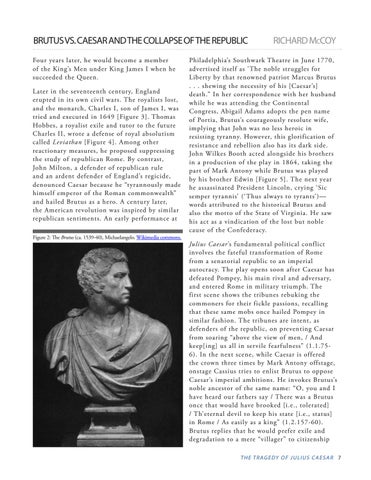
BRUTUS VS. CAESAR AND THE COLLAPSE OF THE REPUBLIC Four years later, he would become a member of the King’s Men under King James I when he succeeded the Queen. Later in the seventeenth century, England erupted in its own civil wars. The royalists lost, and the monarch, Charles I, son of James I, was tried and executed in 1649 [Figure 3]. Thomas Hobbes, a royalist exile and tutor to the future Charles II, wrote a defense of royal absolutism called Leviathan [Figure 4]. Among other reactionary measures, he proposed suppressing the study of republican Rome. By contrast, John Milton, a defender of republican rule and an ardent defender of England’s regicide, denounced Caesar because he “tyrannously made himself emperor of the Roman commonwealth” and hailed Brutus as a hero. A century later, the American revolution was inspired by similar republican sentiments. An early performance at Figure 2: The Brutus (ca. 1539-40), Michaelangelo. Wikimedia commons.
RICHARD McCOY
Philadelphia’s Southwark Theatre in June 1770, advertised itself as 'The noble struggles for Liberty by that renowned patriot Marcus Brutus . . . shewing the necessity of his [Caesar’s] death.” In her correspondence with her husband while he was attending the Continental Congress, Abigail Adams adopts the pen name of Portia, Brutus’s courageously resolute wife, implying that John was no less heroic in resisting tyranny. However, this glorification of resistance and rebellion also has its dark side. John Wilkes Booth acted alongside his brothers in a production of the play in 1864, taking the part of Mark Antony while Brutus was played by his brother Edwin [Figure 5]. The next year he assassinated President Lincoln, crying ‘Sic semper tyrannis’ (‘Thus always to tyrants’)— words attributed to the historical Brutus and also the motto of the State of Virginia. He saw his act as a vindication of the lost but noble cause of the Confederacy. Julius Caesar’s fundamental political conflict involves the fateful transformation of Rome from a senatorial republic to an imperial autocracy. The play opens soon after Caesar has defeated Pompey, his main rival and adversary, and entered Rome in military triumph. The first scene shows the tribunes rebuking the commoners for their fickle passions, recalling that these same mobs once hailed Pompey in similar fashion. The tribunes are intent, as defenders of the republic, on preventing Caesar from soaring “above the view of men, / And keep[ing] us all in servile fearfulness” (1.1.756). In the next scene, while Caesar is offered the crown three times by Mark Antony offstage, onstage Cassius tries to enlist Brutus to oppose Caesar’s imperial ambitions. He invokes Brutus’s noble ancestor of the same name: “O, you and I have heard our fathers say / There was a Brutus once that would have brooked [i.e., tolerated] / Th’eternal devil to keep his state [i.e., status] in Rome / As easily as a king” (1.2.157-60). Brutus replies that he would prefer exile and degradation to a mere “villager” to citizenship T H E T R A G E DY O F J U L I U S C A E S A R 7