THEATRE FOR A NEW AUDIENCE Polonsky Shakespeare Center
Robert E. Buckholz
CHAIR
Jeffrey Horowitz
FOUNDING ARTISTIC DIRECTOR
Presents
A TEATRO LA PLAZA PRODUCTION
HAMLET
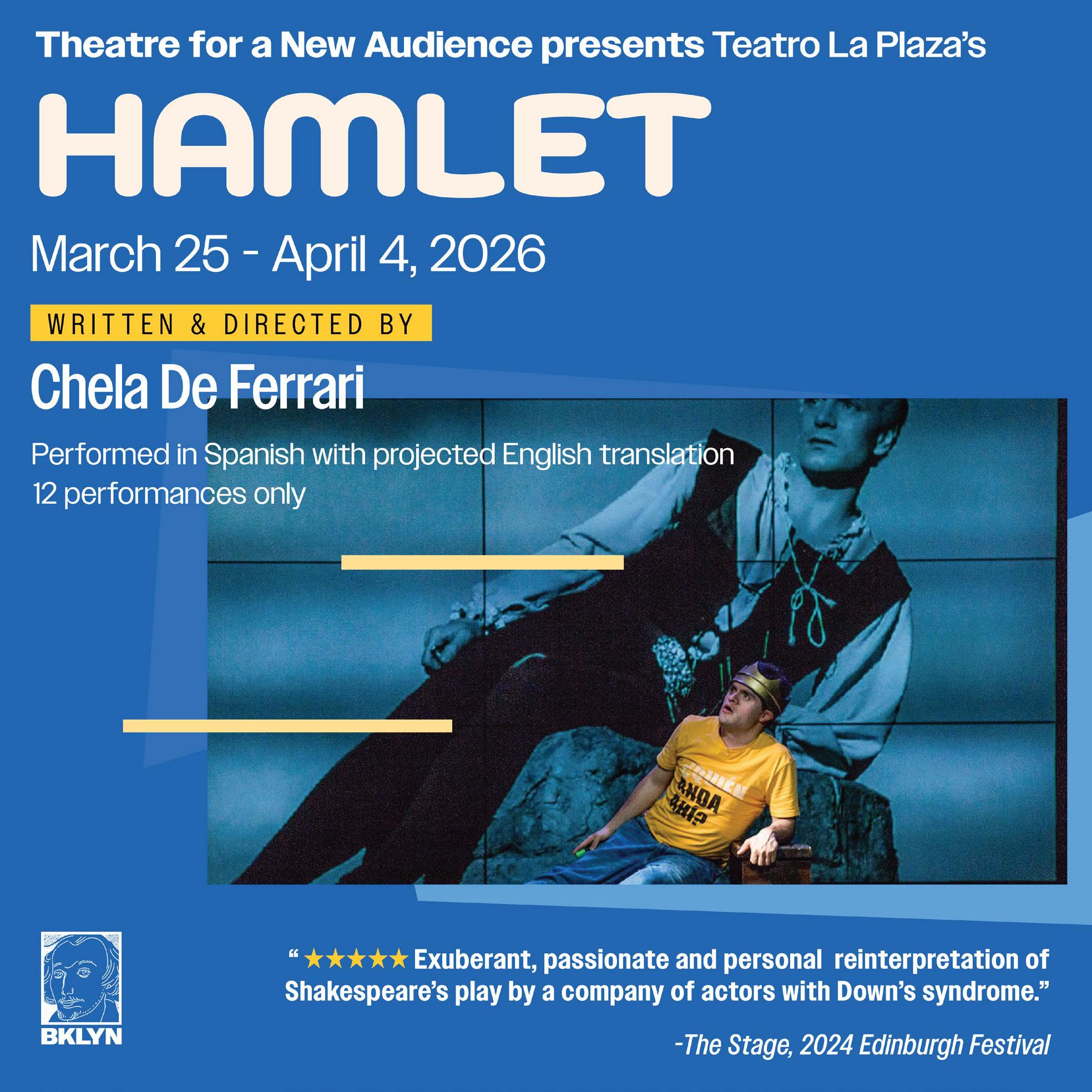
written and directed by CHELA DE FERRARI
On the Samuel H. Scripps Mainstage
Dorothy Ryan EXECUTIVE DIRECTOR
Featuring OCTAVIO BERNAZA, LUCAS DEMARCHI, JAIME CRUZ, MANUEL GARCÍA, DIANA GUTIÉRREZ, CRISTINA LEÓN BARANDIARÁN, XIMENA RODRÍGUEZ, ÁLVARO TOLEDO
Associate Directors & Associate Playwrights JONATHAN OLIVEROS, CLAUDIA TANGOA, LUIS ALBERTO LEÓN
Visuals LUCHO SOLDEVILLA
Properties Supervisor JON KNUST
Lighting Design JESÚS REYES
Tour Manager ROXANA RODRÍGUEZ
General Manager CHLOE KNIGHT
Choreography MIRELLA CARBONE
Lighting Operator ANDRES NUNTON
Vocal Training ALESSANDRA RODRÍGUEZ
Production Stage Manager RENATO COSTA
Video Operator YIDONG LIANG
Press Representative BLAKE ZIDELL & ASSOCIATES
Sound Operator JHOSIMAR SULLÓN
First preview March 25, 2026 | Opening night March, 26 2026
This production is represented by Aurora Nova
Additional support for the presentation of Teatro La Plaza’s Hamlet is provided by the SHS Foundation
Special support for Community and Humanities Programming for Hamlet is provided by Ponce Bank
Additional marketing support provided by the Peruvian Consulate General in New York
Deloitte and Bloomberg Philanthropies are Theatre for a New Audience’s 2025-2026 Season Sponsors.
Principal support for Theatre for a New Audience’s season and programs is provided by Alan Beller and Stephanie Neville, Robert E. Buckholz and Lizanne Fontaine, The Charina Endowment Fund, Constance Christensen, The Hearst Foundations, the Howard Gilman Foundation, the Jerome L. Greene Foundation Fund at the New York Community Trust, The Estate of Robert MacNeil, The SHS Foundation, The Shubert Foundation, and The Thompson Family Foundation. Major season support is provided by The Achelis and Bodman Foundation, Sally Brody, The DuBose and Dorothy Heyward Memorial Fund, The Harold and Mimi Steinberg Charitable Trust, The Hearst Corporation, Herbert Smith Freehills Kramer LLP, Latham & Watkins LLP, Audrey Heffernan Meyer and Danny Meyer, The Fan Fox and Leslie R. Samuels Foundation, Marcia Ricklis, The Starry Night Fund, Stockel Family Foundation, Anne and William Tatlock, The Tow Foundation, Kathleen Walsh and Gene Bernstein, The White Cedar Fund, and The Whiting Foundation. Theatre for a New Audience’s season and programs are also made possible, in part, with public funds from the National Endowment for the Humanities; Shakespeare in American Communities, a program of the National Endowment for the Arts in partnership with Arts Midwest; the New York State Council on the Arts with the support of the Office of the Governor and the New York State Legislature; and the New York City Department of Cultural Affairs in partnership with the City Council. Open captioning is provided, in part, by a grant from NYSCA/TDF TAP Plus.
Performed in Spanish with projected English translation.
This performance includes a projected video of a live birth with blood, a simulated gunshot, loud sound effects, haze effects, and strobe lights.
This event is meant to welcome audiences of all backgrounds and varied access needs.
This Theatre operates under an agreement between the League of Resident Theatres and Actors’ Equity Association, the Union of Professional Actors and Stage Managers in the United States.
The stage managers employed in this production are members of Actors’ Equity Association, the union of professional actors and stage managers in the United States.
The scenic, costume, lighting, and sound designers in LORT Theatres are represented by United Scenic Artists, Local USA-829 of the IATSE.
The Director is a member of the Society of Stage Directors and Choreographers, Inc., an independent national labor union.
TABLE OF CONTENTS
5 We Are All Hamlets by Paul Heritage & Pedro Pérez Rothstein
10 Hamlet : A Conversation in Letters Tanya Pollard in conversation with Chela De Ferrari
22 Hamlet in Adaptation by Ayanna Thompson
25 Bios: Cast and Creative Team
30 About Theatre For a New Audience
Notes
Front Cover: Design by Paul Davis Studio / Paige Restaino.
This Viewfinder will be periodically updated with additional information. Last updated March, 31, 2026.
Credits
Hamlet 360° | Edited by Zoe Donovan
Resident Dramaturg: Jonathan Kalb | Council of Scholars Chair: Tanya Pollard | Designed by: Milton Glaser, Inc.
Publisher: Theatre for a New Audience, Arin Arbus, Artistic Director
Hamlet 360° Copyright 2026 by Theatre for a New Audience. All rights reserve d.
With the exception of classroom use by teachers and individual personal use, no part of this Viewfinder may be reproduced in any form or by any means, electr onic or mechanical, including photocopying or recording, or by any information or retrieval system, without permission in writing from the publishers. Some materials herein are written especially for our guide. Others are reprinted with permission of their authors or publishers.
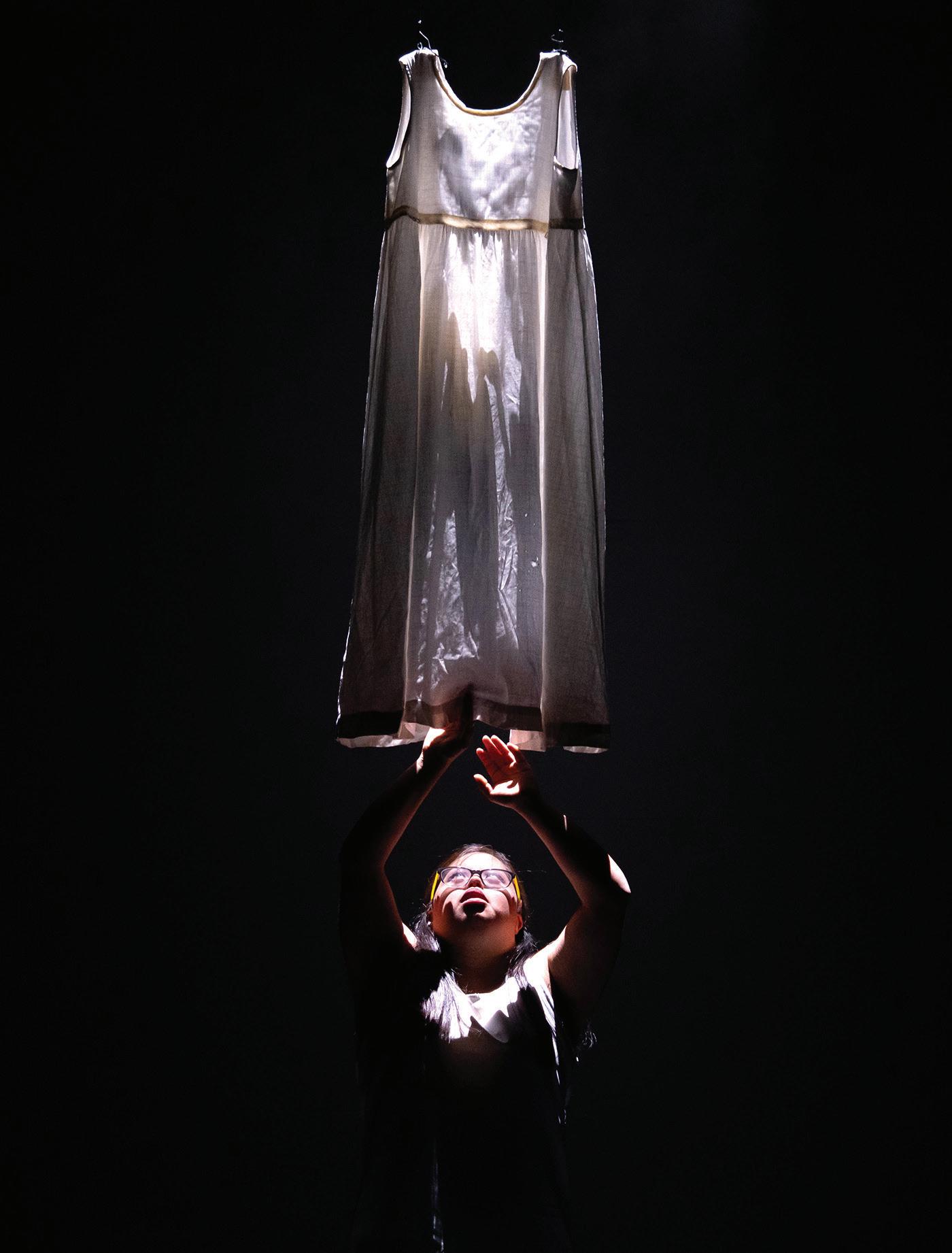
Lucas Demarchi. Photo by Julieta Cervantes..
WE ARE ALL HAMLETS
BY PAUL HERITAGE & PEDRO PÉREZ ROTHSTEIN IN CONVERSATION WITH JONATHAN OLIVEROS, ROXANA RODRIGUEZ, AND MEMBERS OF THE COMPANY OF HAMLET
Hamlet: A Very Free Version [in Spanish, Hamlet: Una Versión Recontralibre] premiered at Teatro La Plaza in Peru on 28th September 2019. After the Covid-19 interregnum, the cast and crew began a global tour of major theatres and international festivals, conquering audiences and critics in Spain, France, Brazil, Chile, Portugal, Colombia, Germany, China, Poland, UK, Belgium, USA, South Korea, Turkey, Canada, Australia, Ireland, Norway, and Taiwan.
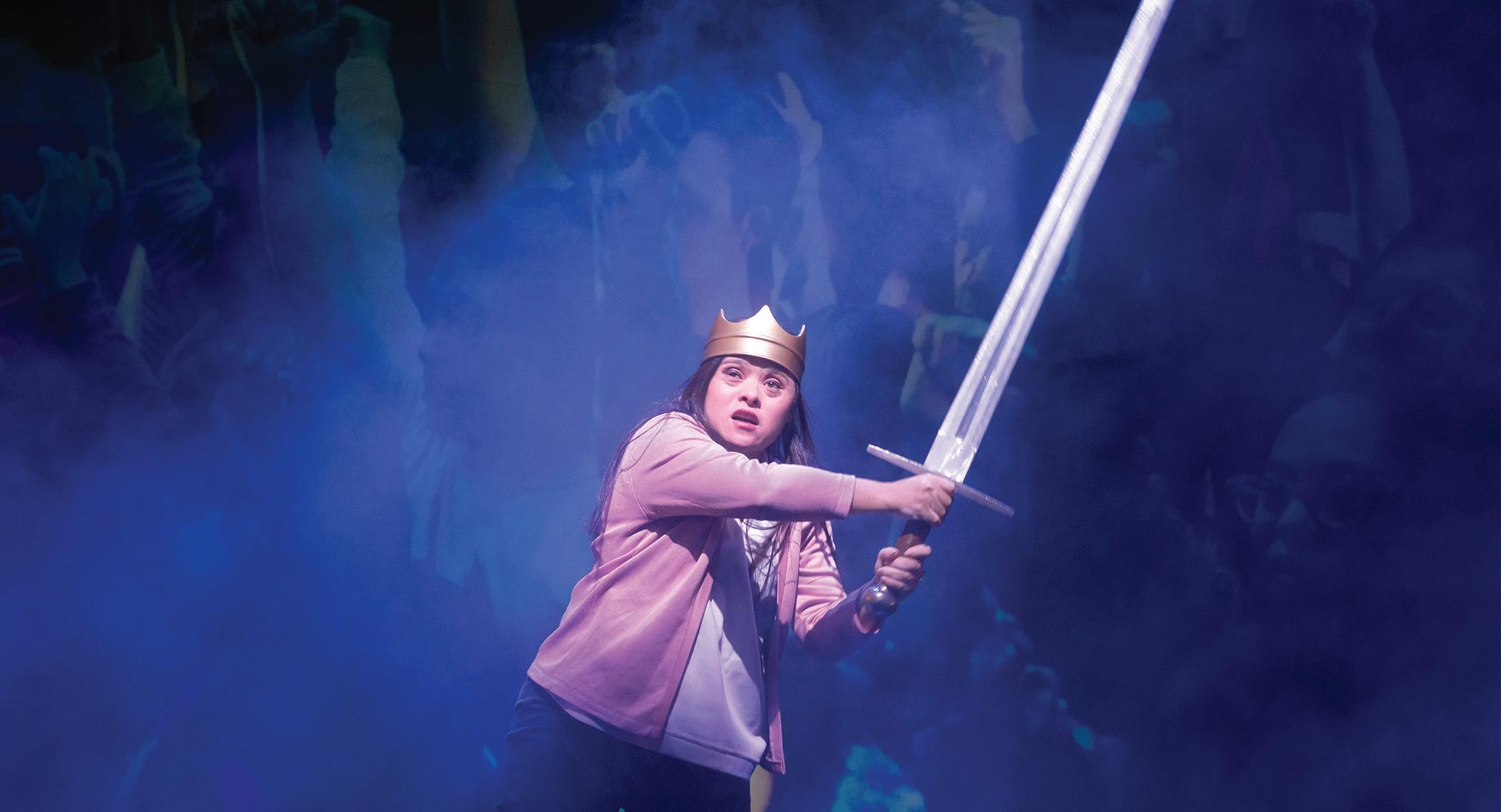
In the production, a group of actors with Down syndrome and learning disabilities alternate playing Hamlet and other characters from Hamlet as well as themselves. They combine scenes and passages from the original Shakespeare play with stories and themes from their own lived experiences of discrimination and exclusion. By swapping the prince’s crown amongst themselves, the entire cast shares the role of Hamlet, thus transforming his dilemmas into a collective struggle that is shared with the audience.
Directed by Chela de Ferrari, this Peruvian production of Hamlet places theatre as a vehicle for empowerment and gives
the actors a platform to show other ways of being and acting. In contrast with a usual contemporary theatre production that might take 4-8 weeks of rehearsal, the process of creating this version of Hamlet took over a year. Instead of thinking of features of the actors’ neurodiversity as limitations, in the La Plaza production they became a fundamental dramaturgical strategy: unscripted long pauses, stuttering words, memory lapses, unexpected rhythm or intonations were embraced as part of an innovative performative language rather than a mistake or a technical flaw. This is communicated upfront at the beginning of the show where the actors introduce themselves, wryly and pointedly advising the audience to adjust their expectations and curb their own anxieties and prejudices. This practical strategy is an invitation for the audience to fine-tune their gaze and admire the beauty of different ways of being. For their tour manager Roxana Rodríguez, this defined the production:
Everyone introduces themselves by name, and it breaks down any barriers you might see between the audience and them.
Ximena Rodríguez. Photo by Julieta Cervantes.
“WE
ARE ALL HAMLETS” PAUL HERITAGE & PEDRO PÉREZ
They say things like, “We may forget our lines.” They ask for patience, as sometimes they take a while to say a line. They tell us that Cristina has tics, and that nobody should worry, and if you don’t like it, you can leave. I love that, it’s so much fun. It lays the groundwork for what’s going to happen and opens a door to their world, to this world they’re going to present to us. And I think that opening of a door, is wonderful. I’ve never seen anything like it in a play. It makes it more personal. It brings the stage as close as possible to something so intimate.
The verb to be has two translations in Spanish: “ser” and “estar.” The standard translation of Hamlet’s “To be or not be” is “Ser o no ser,” which speaks to a fixed quality of being: something that describes and defines an individual’s identity. Hamlet poses the question to himself in a way that is usually interpreted as a way of trying to understand the very purpose of life and death. In the context of La Plaza’s Hamlet, the being in question is considered as ‘un-fixed’ and shifting, with the focus on the value of difference. New critical layers and qualifiers are added to the meaning of existence: to be or not to be ‘normal,’ to be or not to be ‘different,’ to be or not to be ‘neurotypical,’ to be or not to be ‘disabled,’ to be or not to be an actor, to be or not to be ‘functional,’ to be or not to be a ‘productive and valuable member of society.’ These questions underline the social stigmas faced by people with Down syndrome, and by extension other neurodivergent communities or anyone that escapes a certain pattern or expectation of ‘normality’ in mind or body.
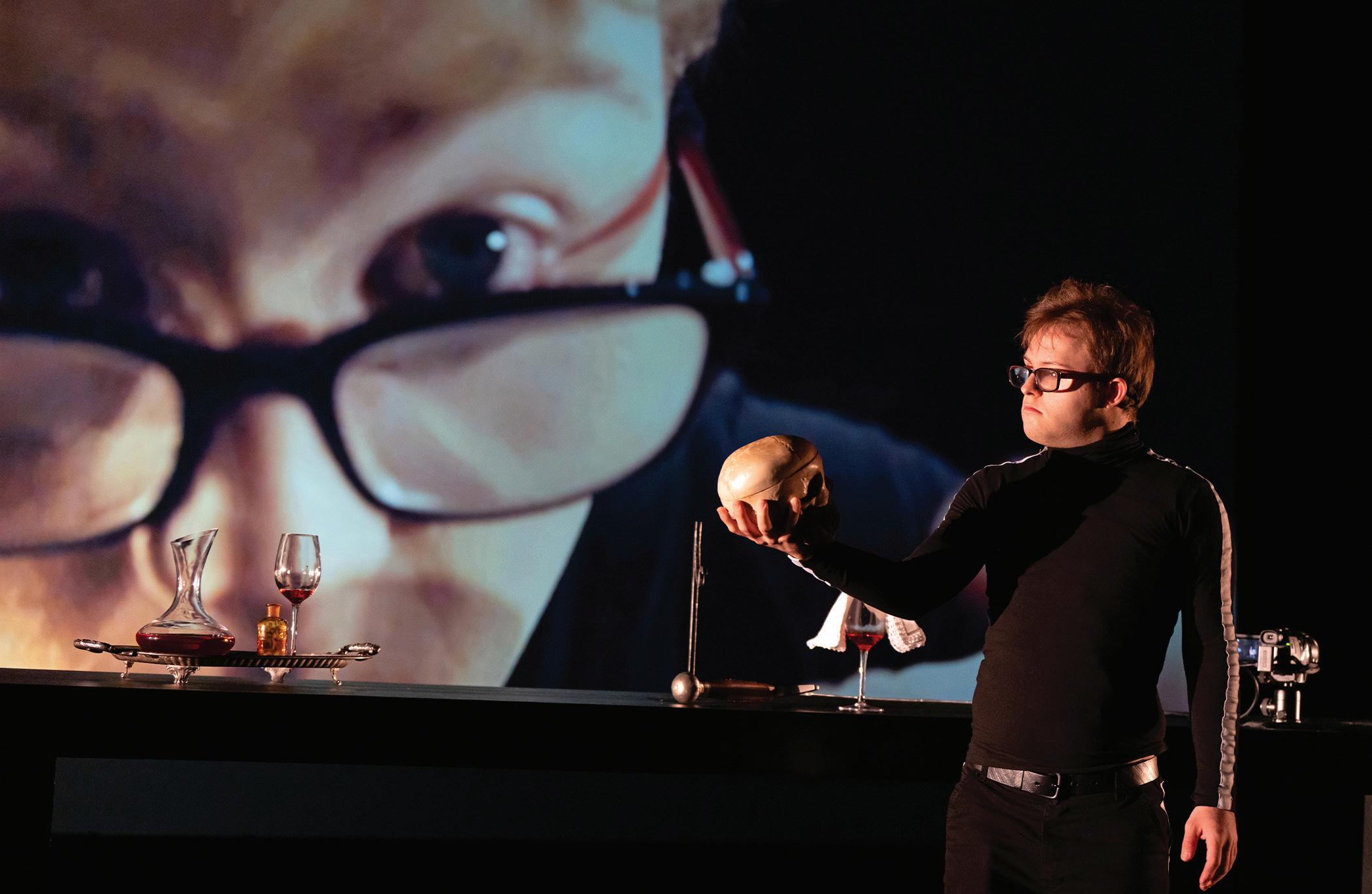
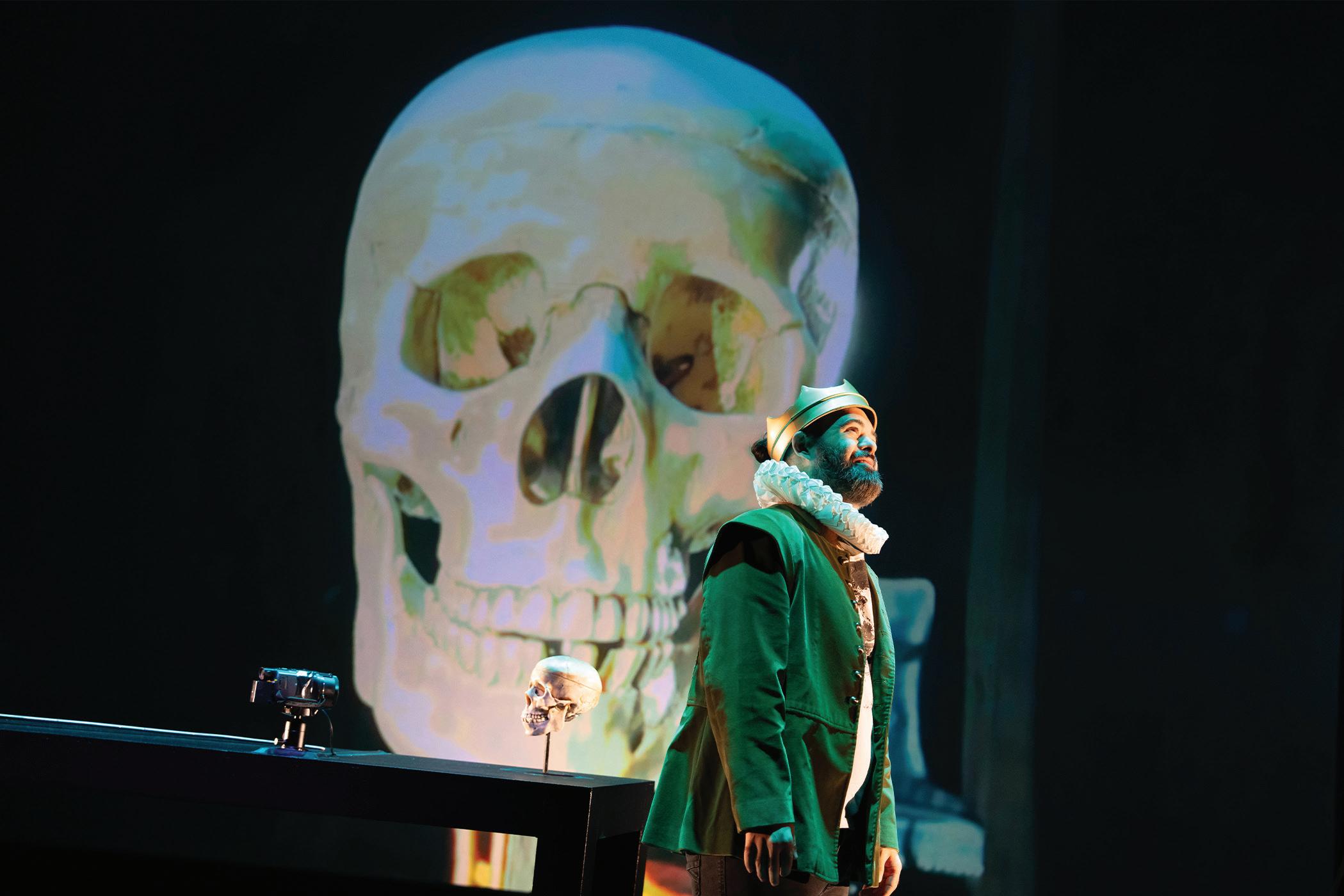
But Hamlet’s famous question can also be translated in Spanish as “Estar o no estar.” Estar expresses a more transitional and situated being space and time: one that requires physical presence. To be on stage is to be visible, to be empowered and ultimately to belong in that place. This sense of belonging and doubt is most powerful when Jaime Cruz, one of the actors playing Hamlet, stands in front of images and videos of previous performers who have embodied the character, from Laurence Olivier to Kenneth Branagh, from Benedict Cumberbatch to Papa Essiedu. The scene follows with a recorded phone call conversation with Sir Ian McKellen where Cruz enquires how he should approach the role. In response, all the other actors dissuade Hamlet/Jaime from trying to copy Olivier’s or any other actor who has played the part before and instead, to find his own way, from the truth of his lived experience.
Anger and dissatisfaction burn through the cast’s performances as they articulate a need for societal recognition that exceeds
the realm of the play. In the words of cast member Cristina León Barandiarán:
It’s a demand directed at society. Because sometimes they don’t include us. They really don’t include us. And that’s why we’re making this demand, so that society will include us and so that we can participate, do other workshops, and, for example, go to university and study performing arts.
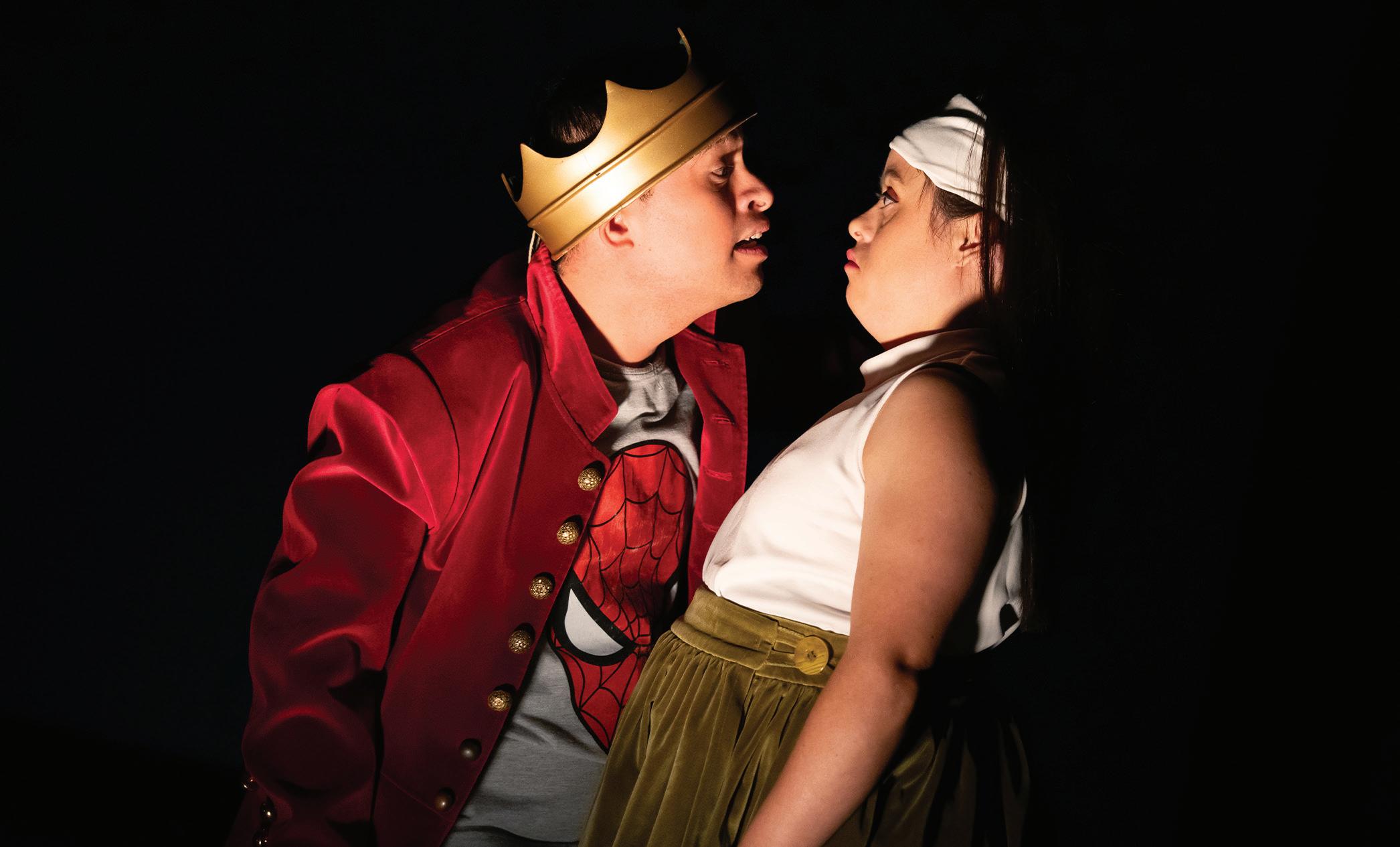
Questions of love, sexual desire and freedom are brought most vividly to the surface in a kissing scene between Hamlet (interpreted by Octavio Bernaza) and Ophelia (interpreted by Ximena Rodríguez). The two actors lying on the floor are captured by a live camera above them which projects the scene in a cinematic zoom that enhances the intimate beauty of the moment. This is one of Ximena’s favorite scenes because:
That’s where the chemistry—the love—between the actors really shines. And I bring that to my character, to the characters we’re playing. And every time we immerse ourselves in it, we start to fall more in love. And sometimes we even flirt. […] Before, I couldn’t be around a boy with Down syndrome. But little by little, I had a psychologist who explained things to me, and I decided to improve my interactions with people with my disability, and I accepted it.
The performance of the ‘play within the play’—The Murder of Gonzago nicknamed ‘The Mousetrap’ by Hamlet—entails a moment of direct participation, where the actors invite a few members of the audience to come on stage. The cast instructs the audience members on how to play a tree and the moon, commanding and coaching the volunteer participants. The actors become the directors, demonstrating their full control of a situation which becomes a lesson not only to the wider audience, but to society at large. Breaking stigmas for audiences is one of the strongest messages of this disassembled Hamlet but the process of creating the production has done the same for the actors, as Jaime Cruz, who was an usher at Teatro La Plaza before joining the project, reflected:
I didn’t accept myself as a person with my abilities. I was like a neurotypical person. But now I’ve seen things and traveled. One trip that changed me was to the UN, where I was able to speak about us, and from there I began to accept myself as a person with Down syndrome, but also, as I said, as a person with abilities. I combine those two things, and I am who I am, and I live a normal and peaceful life.
“WE
ARE ALL HAMLETS” PAUL HERITAGE & PEDRO PÉREZ
The long process of making this Hamlet through improvisations, adaptations and conversations also had a profound impact on other creatives involved in the ensemble, like assistant director Luis Alberto León (alias Pepo):
On a personal level, and quite selfishly, it was important for me because I learned, or rather, honed my ability to listen and communicate. When I came here after a few weeks, I wasn’t coming to work with my colleagues with Down syndrome; I was just coming to work with my colleagues. In a way, those distinctions, those prejudices that my mind had formed, vanished in the face of the empathy shown in action, the efficiency of thought, and the effectiveness of communication.
The project was important in Peru as a landmark of what an inclusive theatre can be and what it can look like. It showed the need and the possibilities of working to a different sense of time: with more patience, care and solidarity. It also proved that people with Down syndrome have the right to participate integrally in social and cultural life. Working as professional actors gave everyone involved a sense of agency and fulfillment that they carry to other parts of their lives, in their homes with
their families, in the streets, with friends and colleagues. When asked about what they take from Hamlet in their day-to-day, Manuel Garcia highlights,
…having responsibilities, having get-togethers, learning about communicating effectively because we’re a team and we all listen to and understand each other. There are always things that need improvement, and we need to strengthen them even more.
The humanity of Shakespeare’s text is juxtaposed with the humanity of a group of human beings who have different abilities but share feelings and desires of love, fear, surprise, joy, sadness, or freedom. Hamlet may usually be conceived as a tragedy about a dysfunctional family, but Teatro La Plaza’s production turns that concept around and offers a version of the play that is built on acceptance, tenderness, respect and collective dreams.
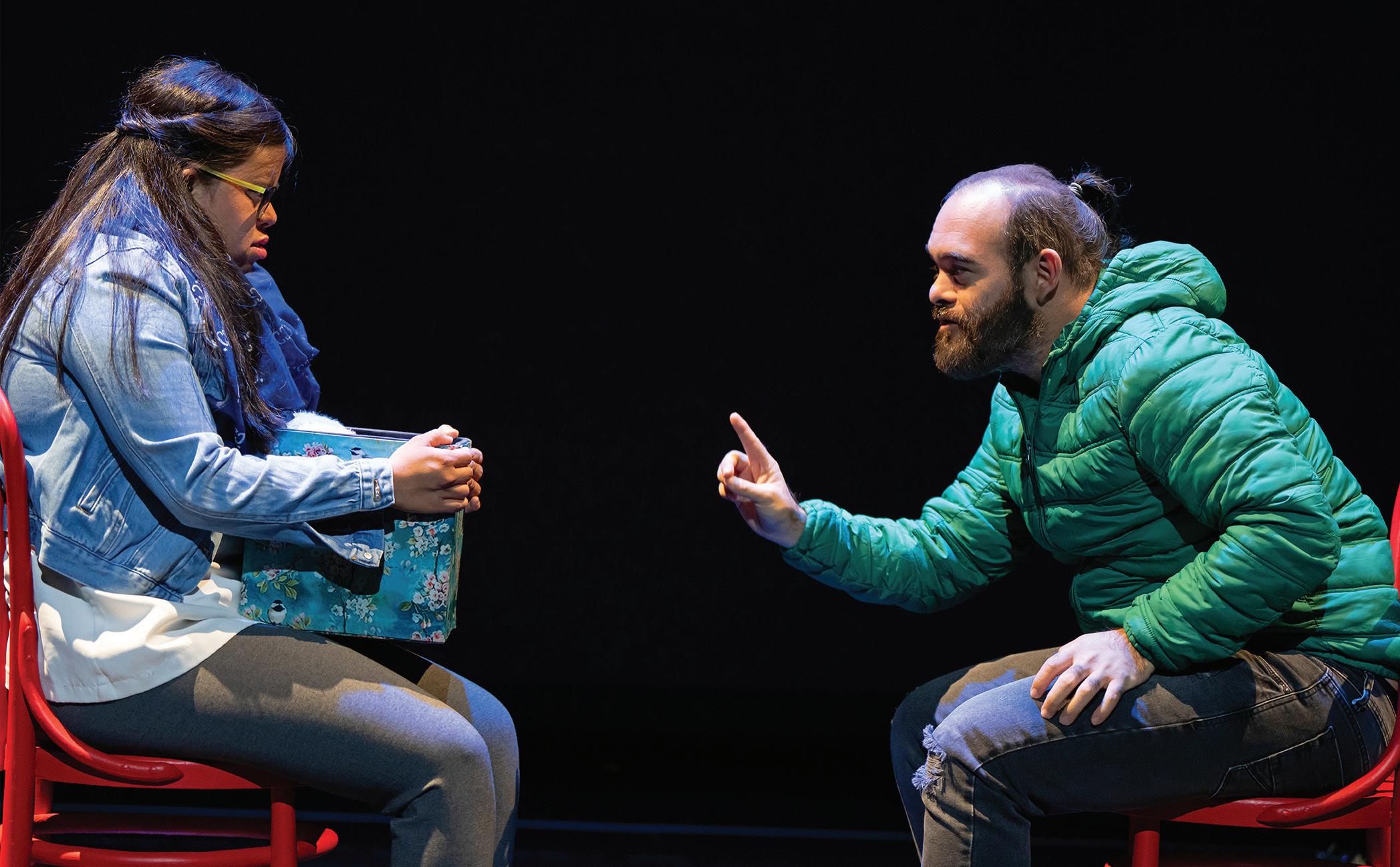
The interplay between Shakespeare’s family drama and the actors’ lives is well illustrated in the company’s approach to Act II Scene I which brings together Ophelia (played by Ximena Rodriguez) and her father Polonius (played by Manuel Garcia). They reveal the
Octavio Bernaza and Ximena Rodríguez. Photo Source: Teatro La Plaza.
“WE
ARE ALL HAMLETS” PAUL HERITAGE & PEDRO PÉREZ
overprotective nature of the father in relation to his daughter, but it is intermixed with accounts from the actors’ own experience with their parents. In the scene, they explore issues like independence, autonomy, trust, and safety which are common concerns that parents of neurodivergent children and adults have in society. As assistant director Claudia Tangoa, recollects:
Manuel is on stage as Polonius, and he’s had a fight with Ophelia, who leaves upset, like a rebellious daughter. […] And then, as the lights change, and Manuel feels them change, he turns and looks at the audience. And he says: “And all of you who are looking at me, do you think it’s easy having a daughter with Down syndrome?” And at that moment, I think it’s a great performance by Manuel. He embodies that father, and it moves me; it really moves me.
The acting, the stage presence, the use of videos, props, music and a careful lighting design all exemplify the potential of the language of theatre to create alternative, imagined worlds of possibility and change. The magic of theatre enables for other affects and alternative meanings to be forged and shared between performers and audience in ways that resonate beyond the stage. In the words of cast member Diana
Gutierrez: “we talk about our dreams, we want to have our dreams, and we have rights. Rights of oneself.”
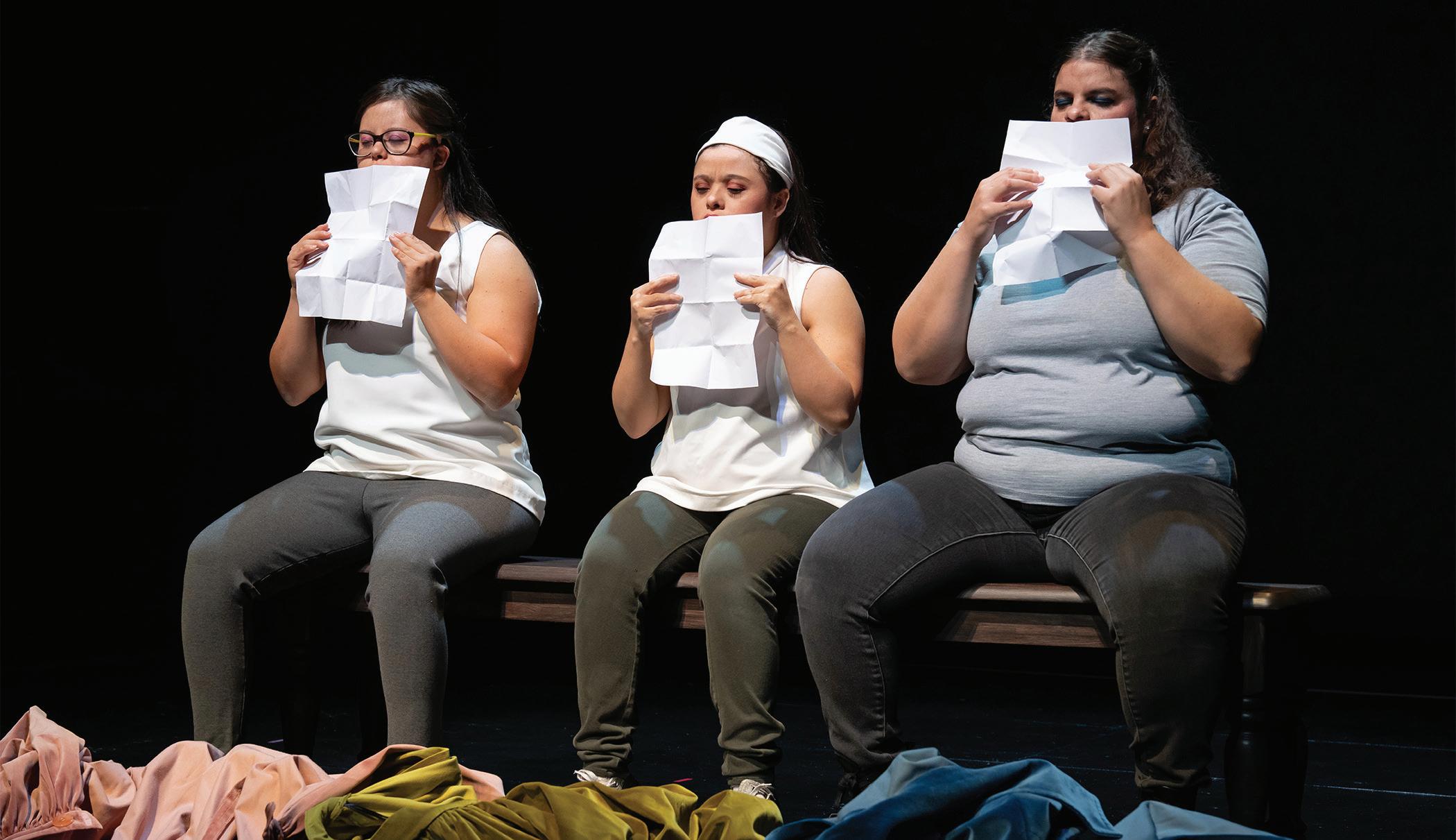
The concept of autonomy is explored further with the three Ophelias reading letters that raise questions related to their own bodies, their womanhood and desires of motherhood which are all taboo topics when it comes to women with down syndrome. Can they have a child? How are they going to support them, educate them? The questions are also posed to the audience by the three performers. For Cristina, this is “the dream of the three women, because Ximena talks about independence, Diana talks about wanting to be a mother, and I talk about wanting to find love, and they all come together, which I find very entertaining.”
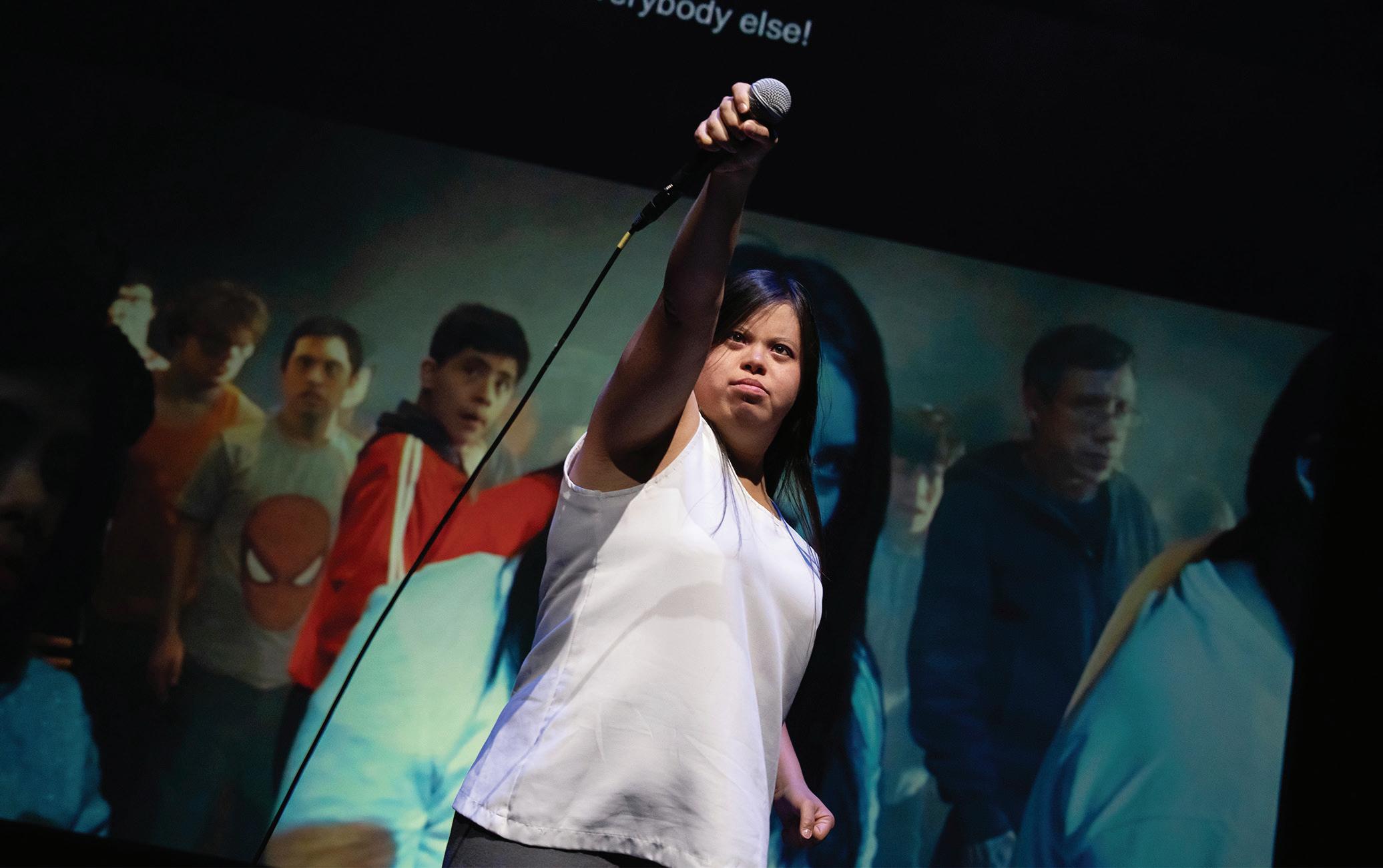
In one of the most powerful moments of the play, Octavio Bernaza, playing Hamlet, goes into the auditorium and addresses the public directly to claim theatre as a last resource: the last place the cast found to be themselves authentically. “My favorite moment from Hamlet is my monologue. I think it’s because at that moment when I stand up in the audience, face to face, it really gives me a rush of adrenaline. It makes me unleash all the power I have inside. And it makes me feel like myself because I can empower myself.”
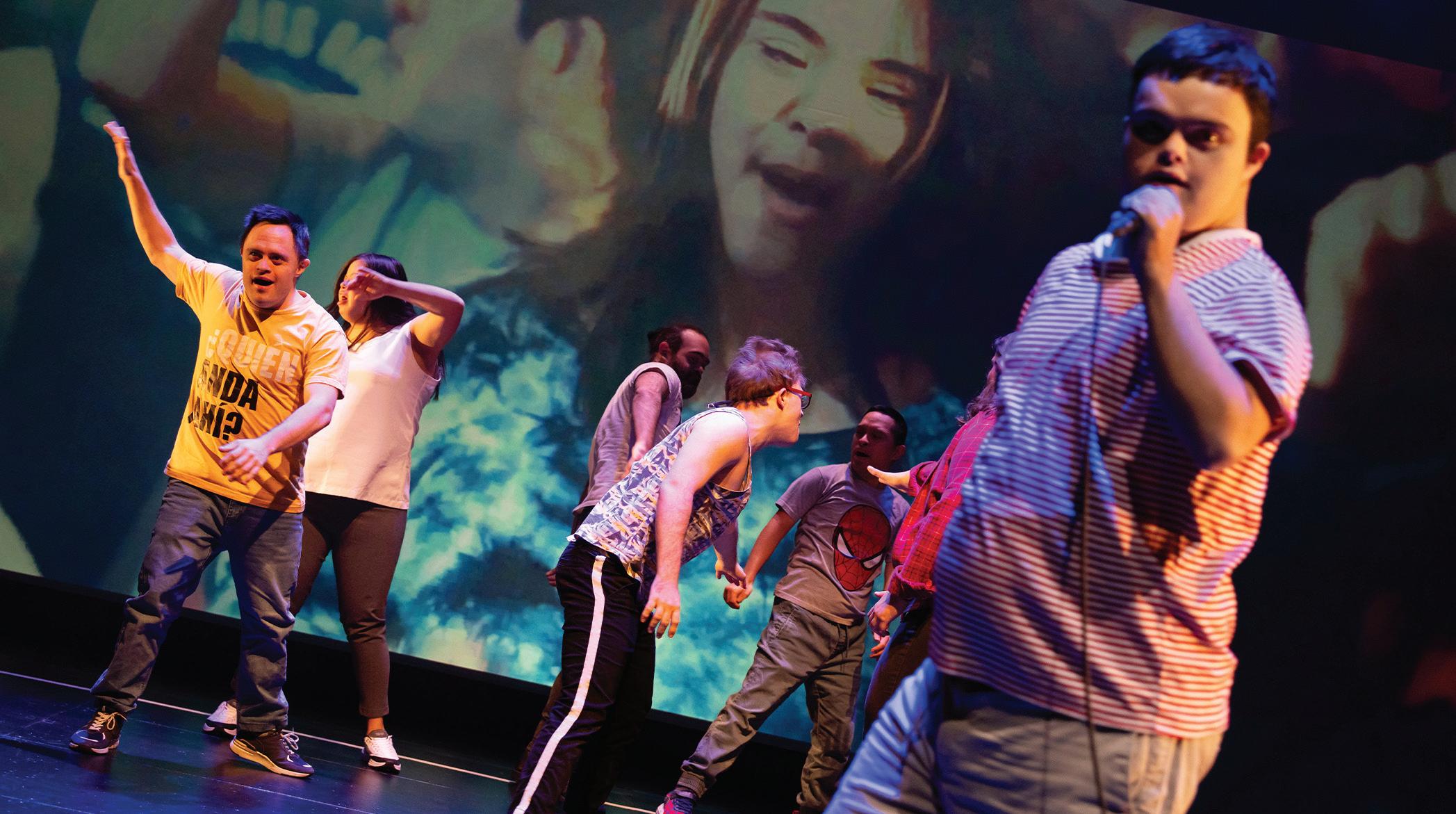
The play ends with festivity, mixing actors and the public in a celebration of joy and diversity. For assistant director Jonathan Oliveros, this is the moment when everyone comes together in the theatre,
…when everyone sees each other’s faces and shares. That’s the moment where we are all equal, where there are no differences, where we realize that theatre is a space for inclusion, not just for getting close and telling stories. And what stories? The lives of each of them. […] it’s wonderful when other people with Down syndrome come up on stage and share it with them. It’s marvelous because it creates a sense of identification. Those people with Down syndrome feel like we are also telling their stories. They unite us.
The power of La Plaza’s ensemble amplifies individual voices and creates a new kind of family, a renewed sense of belonging, of being together [in Spanish, estar juntos]. As Álvaro Toledo expresses it:
Hamlet is like a team. We’re all getting along well, right? I love it because I’m supportive of everyone. I’m getting along well with everyone, and day to day, I’ve also been posting everything related to Hamlet [on social media], and I love it.
Watching this Hamlet is to see a creative experiment in how to communicate, listen and learn in unconventional
ways and to watch a group of neurodivergent actors celebrate their existence and their friendships every time and everywhere they perform. In so doing, they open a dialogue with new audiences across the world.
Paul Heritage is Professor of Drama and Performance at Queen Mary, University of London, and Director of People’s Palace Projects (PPP). For more than three decades, he has led award-winning cultural projects addressing social injustices, including Shakespeare Forum, which took place in Rio de Janeiro, Salvador, São Paulo, Brasília and Belo Horizonte (1995-2016) and Late Corazón, a research collaboration between Flute Theatre (UK) and Teatro La Plaza (Peru) that engaged young people with autism in performing Shakespeare (2021-2023).
Pedro Pérez Rothstein is a theatre director, dramaturg, researcher and educator who strongly believes in the power of the performing arts to promote collective healing and social change. Since 2020, Pedro has been working with People’s Palace Projects in the area of creativity and mental health. He holds a PhD in Drama from Queen Mary University of London and currently works as a Performance Tutor at Mountview Academy of Theatre Arts (UK).
Álvaro Toledo and ensemble. Photo by Julieta Cervantes.
HAMLET : A CONVERSATION IN LETTERS
This winter, Chela De Ferrari shared her thoughts about the experience of directing this production with Tanya Pollard, the Chair of TFANA’s Council of Scholars, in a conversation that took place through e-mail. The messages that follow trace that exchange.
Dear Chela,
I’ve now had a chance to watch the recording of your Hamlet, and I was really stunned by it. I found the production extraordinary: both moving and revelatory. I’d like to start our conversation at the beginning, by asking if you could say a bit about how this production came about. What inspired the idea to work with these actors, and how did you decide on Hamlet as the play? How did the premise develop, and who was involved in the early planning? I’m curious to hear any thoughts about this wonderful project’s origins, and I look forward to following up with more questions as the story builds!
Warmly, Tanya
TANYA POLLARD IN CONVERSATION WITH CHELA DE FERRARI
Chela De Ferrari and Tanya Pollard. Photo by Zhe Pan.
“ HAMLET : A CONVERSATION IN LETTERS” TANYA POLLARD & CHELA DE FERRARI
Dear Tanya,
Thank you for your generous words. I’m very happy to begin this conversation with you slowly and with space for things to unfold. You asked about the origins of the project. The idea to work with these actors didn’t emerge from a concept, but from a very concrete human encounter. Shakespeare has long been central to my work, and Hamlet had been on my mind for many years. Yet I kept postponing it for the same reason: I couldn’t find the “right” actor. I was looking for a presence capable of carrying the weight of the role: its contradictions, its doubts, its intelligence. I couldn’t find the actor that would make the play feel truly urgent again.
That changed with Jaime Cruz. During an internal meeting at Teatro La Plaza, the entire team was introducing themselves to the cast of the next production in our season. When it was Jaime’s turn, instead of presenting himself as an usher, which had been his role at the theatre for more than three years, he introduced himself as an actor. Looking back, I think he wanted to capture my attention. And he did. After the meeting, I invited him for coffee, and we ended up having a long and very rich conversation. During that exchange, something shifted. For some reason, I saw him wearing Hamlet’s crown. I imagined those famous words spoken by someone whose right “to be” in public space, in professional life, in art, is constantly questioned. While having our coffee, I realized I had been asking the wrong question. The issue wasn’t finding someone who could fit the traditional mold of Hamlet but allowing Hamlet to be transformed by another perspective. That encounter made me aware of myself as a neurotypical person, of my own ignorance and prejudices, but also, at the same time, of a genuine desire for exchange. I believe that tension between ignorance and the desire for connection is what the audience experiences.
Early planning involved a long period of research and listening. Jaime was fundamental at this stage: he introduced me to the Down syndrome community, to families, institutions, and daily realities I didn’t know firsthand. At the same time, I studied Shakespeare deeply. I kept asking myself what resonates, and what doesn’t. What happens when these words pass through different bodies, different rhythms, different ways of being in the world?
The decision to have eight actors share the role of Hamlet emerged directly from that process. We were fully aware that, within the dominant theatrical tradition, Hamlet is almost always embodied by a single virtuosic actor, someone who concentrates authority, intelligence, linguistic mastery, and symbolic power in one exceptional body. That tradition reflects a broader political logic: the idea that complexity, leadership, and depth belong to a few, and that certain bodies are more legitimate than others when it comes to representing thought on stage.
“
HAMLET : A CONVERSATION IN LETTERS” TANYA POLLARD &
As I write all this to you, I realize it might give the impression that everything was clear from the start. It wasn’t. At the beginning of the process, I was full of doubts: Is it possible for actors with cognitive disabilities to engage with the complexity of Hamlet? Will they want, or need, to speak through Shakespeare? How far can I go in weaving my own artistic questions with theirs without imposing them? And am I truly prepared to give up control, to let the play be transformed by voices and rhythms I cannot fully predict?
Those questions never disappeared; they accompanied the entire process. But rather than obstacles, they became an ethical compass. They forced me to work from listening rather than certainty, from trust rather than mastery. In that sense, Hamlet did not emerge from an answer, but from the decision to stay with the question, and to allow the stage to become a space where doubt itself could be shared, where doubt could exist without needing to be resolved.
To be continued...
Chela
Octavio Bernaza. Photo by Julieta Cervantes.
CHELA DE FERRARI
“
HAMLET :
A
CONVERSATION
IN LETTERS” TANYA POLLARD & CHELA DE FERRARI
Dear Chela,
Thank you for this rich and beautiful account of the project’s origins! I love the way the production began with a human encounter and conversation, rather than an intellectual abstraction - it explains so much of its emotional power. I’m especially struck by your closing point that these questions “forced me to work from listening rather than certainty, from trust rather than mastery. In that sense, Hamlet did not emerge from an answer, but from the decision to stay with the question, and to allow the stage to become a space where doubt itself could be shared, where doubt could exist without needing to be resolved.” I can imagine this process illuminating any play, but it’s especially striking how apt it is for this particular play. Hamlet, which famously opens with a question (“Who’s there?”), has often been described as a play about uncertainty. To highlight just a few of the play’s core crises of knowledge, Hamlet is haunted by uncertainty about the ghost’s account and his father’s death; Ophelia is haunted by uncertainty about who to believe and how to behave in the face of conflicting orders; and Gertrude is uncertain about whether to be loyal to her son or her new husband. Shakespeare’s revisions on his source material (in which Claudius had killed the king openly, and everyone was aware of the murder) were designed to amplify and intensify this uncertainty - you’ve highlighted something that’s really at the heart of the play.
I also love your beautiful observation about letting the play be shaped by its cast: “The issue wasn’t finding someone who could fit the traditional mould of Hamlet but allowing Hamlet to be transformed by another perspective.” As a scholar who writes on Shakespeare and his acting company, I think that this approach also applies to Shakespeare’s own experience of creating Hamlet. As you may know, there was at least one earlier play called Hamlet staged in Shakespeare’s lifetime before the version we’ve inherited, and it was based on earlier prose histories of the story as well. When Shakespeare remade the play for his company, he redesigned the story and its protagonist to reflect his leading actor, Richard Burbage, a man who seems to have been brilliant, eloquent, ambitious, and prone to sudden bursts of violence. (I’ve actually just finished writing a book about Shakespeare’s relationship with Burbage; I’m fascinated by his impact on the plays, which I don’t think has ever been fully acknowledged and explored.) This is to say, it strikes me that your process in making this play is quintessentially Shakespearean: starting with a person, a conversation, a relationship, and expanding to a group, then finding the story from and within those people. I find this very moving.
“ HAMLET : A CONVERSATION IN LETTERS” TANYA POLLARD & CHELA DE FERRARI
I would love to hear more about how your experiences of listening to these actors led to some of the particular decisions made in the production. One scene that I found especially affecting was the one in which the three women playing Ophelia tell us their dreams, and then watch those dreams die. Their dreams feel so vivid, so pleasurable, so real, and - for neurotypical people - relatively ordinary and achievable. And yet for these actors they become wistful invocations of impossible worlds, which melt away before they can be fully grasped. For me, this scene was more heartbreaking than the play’s actual deaths, and it captured the tragedy of Ophelia - her entrapment, her helplessness, her subjection to endless constraints and losses - more powerfully than any other production of the play I’ve seen. Could you say a bit about how you and these women arrived at this story?
Tanya
Dear Tanya,
I’m having such a beautiful time engaging in this dialogue with you, encountering the piece through your reading and suddenly recognizing new layers, new connections, new ways of understanding what we did. I will continue the conversation by taking up a few of the threads you opened.
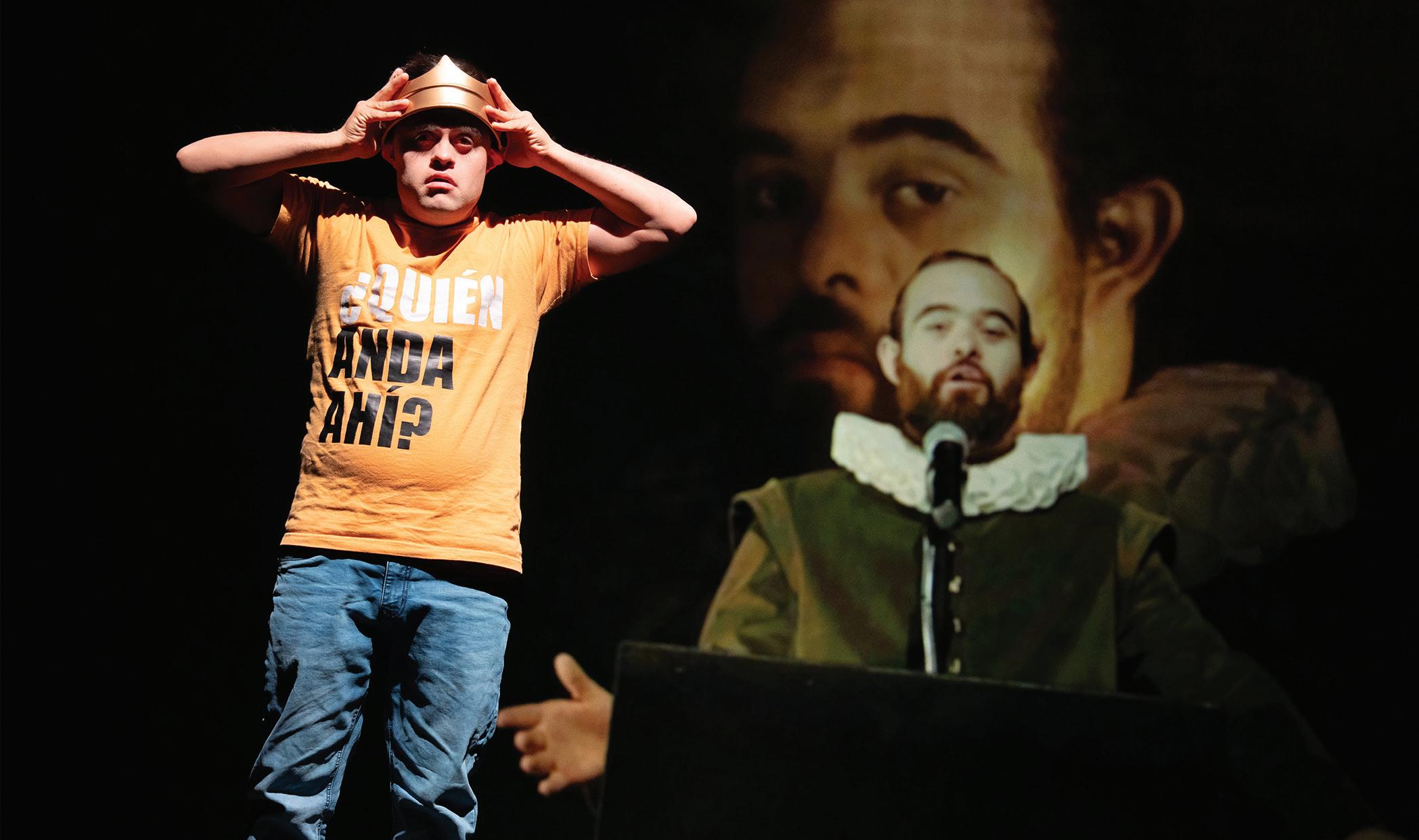
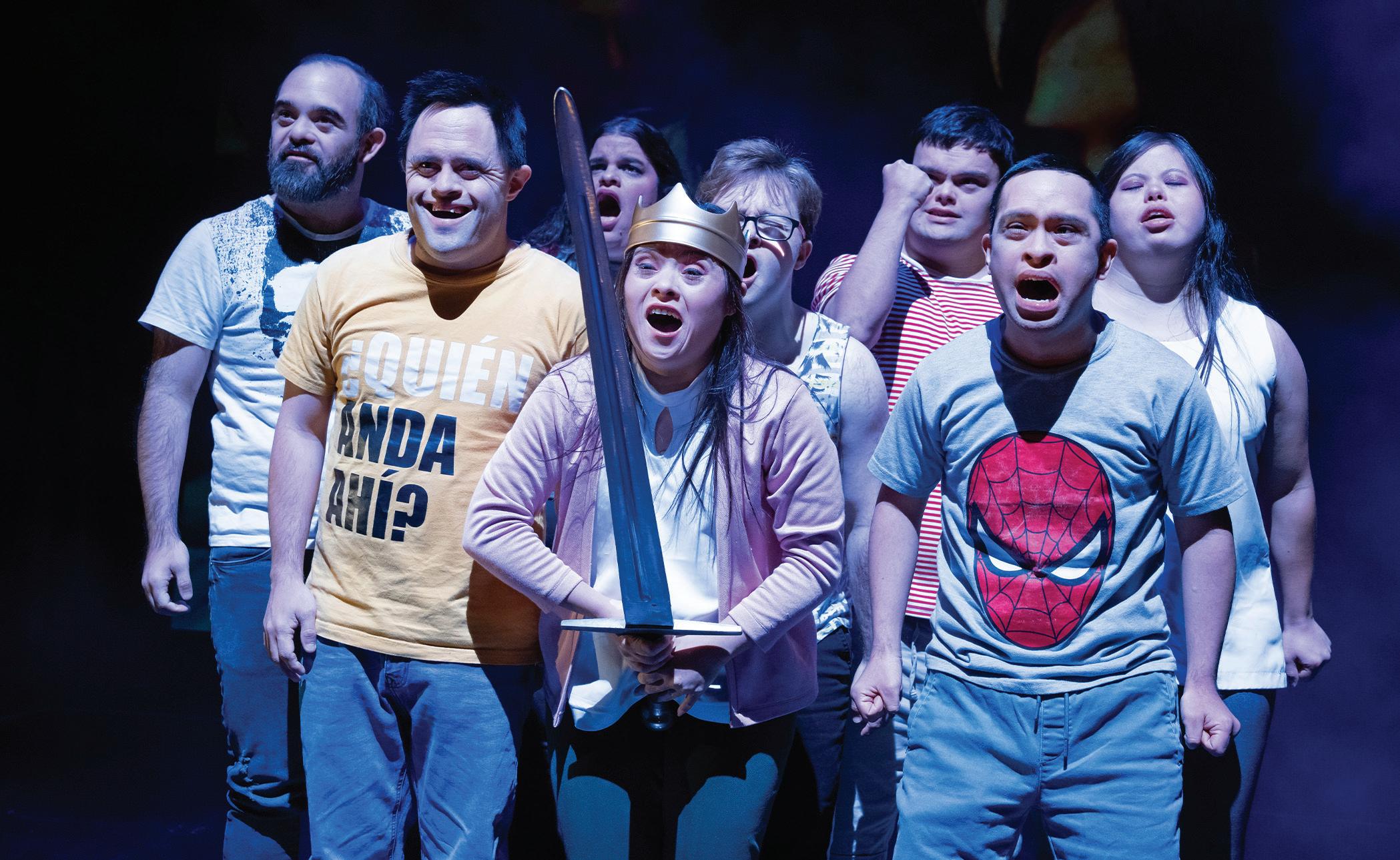
I found it especially compelling that you mention the famous line with which Shakespeare opens the play: “Who’s there?” It’s a question that has accompanied me throughout the entire process, and one that continues to haunt me. Before going deeper into that idea, I’d like to share a small production detail that I don’t know if you noticed. Throughout the play, Jaime appears wearing a T-shirt that reads, in Spanish, “¿Quién anda ahí?”, a direct translation of “Who’s there?” It’s never announced or explained; it’s simply there. For me, it became one of the quiet anchors of the piece. The question is no longer only spoken by a guard in the shadows; it is worn on the body of a man with Down syndrome and offered directly to the audience: Who’s there? Who is this person in front of me? And I hoped it might carry an additional charge, that the question might rebound and expose the viewer’s own uncertainty, expectations, and assumptions. In that sense, doubt could become relational: no longer belonging only to Hamlet or to the characters on stage but circulating between the actors and the audience. Of course, the T-shirt is written in Spanish. During our last tour, I wondered whether we should also have one in English.
“
HAMLET : A CONVERSATION IN LETTERS” TANYA POLLARD & CHELA DE FERRARI
Working with this ensemble made us very aware that uncertainty is not distributed equally. In neurotypical bodies, doubt is often read as philosophical depth; in neurodivergent bodies, it is frequently interpreted as incapacity. One of the things this process allowed us to do was to reclaim uncertainty as a shared human condition, and to insist that these actors have every right to inhabit it publicly, without needing to resolve it or overcome it. This is why, at the beginning of the performance, they address the audience directly and ask them to relax if there are blank moments, hesitations, or stuttering. They reassure the audience that they are fine.
I was deeply moved by your reflection on Shakespeare and Richard Burbage, by the way you describe Hamlet as emerging from a concrete relationship rather than from abstraction, and by the parallel you draw with my first encounter with Jaime. Our conversation, our mutual curiosity, and the imbalance of knowledge between us began to reshape the questions of the play, not only the most obvious one, to be or not to be , but also the other great question: Who’s there?
Jaime Cruz. Photo by Julieta Cervantes.
“
HAMLET : A CONVERSATION IN LETTERS” TANYA POLLARD & CHELA DE FERRARI
I’m grateful for the care with which you watched the scene of the three Ophelias and I am happy to speak more concretely about how it came into being and about the difficulty it posed for me and my colleagues.
We called the scene “I dream that I dream.” We wanted to create a moment centered on the three women in the cast. Although they also play Hamlet at different points, here we were interested in portraying three Ophelias. We asked each of them a very simple question: What do you dream of? And we asked them to write their dreams freely. Cris dreamed that the boy she had met online would come from France to Peru to visit her for the first time. Ximena dreamed of living alone in an apartment, having a good job, being independent, inviting her parents to dinner, and paying with her own credit card. Diana dreamed of having children with her boyfriend Gaspar and watching them grow up so that one day they could be Hamlets.
As you noted, these dreams might seem entirely achievable from a neurotypical perspective: love, family, independence, children… But we knew that for the three women in the cast, these dreams were extremely difficult, if not impossible, to achieve. And yet, for them, at least initially, they were not fantasies or metaphors; they were possible futures.
Ximena Rodríguez, Octavio Bernaza. Photo by Julieta Cervantes.
“ HAMLET : A CONVERSATION IN LETTERS” TANYA POLLARD & CHELA DE FERRARI
At that point, I began to feel deeply uneasy. I realized I was standing inside a trap of my own making. I was the one who had proposed the exercise, who had invited them to dream freely. I began to worry: Was I using their hope? Was I relying on a form of innocence or naivety for poetic effect? I knew I couldn’t move forward unless I was absolutely certain that they fully understood the weight of what they were saying, and the distance between those dreams and the realities that surround them.
Out of that tension came the metaphor of paper and stones. In the scene, their dreams are written on sheets of paper. They crumple them and place them in Ophelia’s treasure box, a box the audience has already seen in the “ Get thee to a nunnery ” scene, filled with objects of love and memory. Later, when Ophelia prepares to die, she opens the box again. The crumpled papers are still there, but they have become stones. She offers the three stones, the dreams, to the audience. Then she places the stones in her dress and drowns, like Virginia Woolf. At the time, I was reading her.
Arriving at that image took time, and many conversations with the three actresses and the artistic team. The metaphor had to be strong enough to carry the weight of loss and constraint but also clear enough to be truly understood by the actresses themselves. Only when we were certain that they fully grasped what those stones meant, dreams made heavy, desires that remain but cannot float, did we feel able to keep the scene.
We hope to release this year a documentary called Being Hamlet , shot over the course of a year and focused entirely on the creative process inside the rehearsal room. There is a moment in the film that I would love to share with you. It appears near the end of the film. We are saying goodbye to the space before moving to the theatre for the premiere. I ask the actors to choose a corner of the room, a costume, or an object that holds special meaning for them, and to tell the camera why they chose it. Ximena chooses a particularly dark corner. She sits with the dream box on her lap and says goodbye to her dreams. For me, that farewell carries an extraordinary dignity. It’s not naïve, and it’s not sentimental. It’s lucid and devastating.
At the very beginning of the process, I had serious doubts about how to approach death in the piece. I was afraid it might be read too closely through the logic of the original play, as a consequence of errors, excesses, or individual failures. That possibility worried me, especially given the histories and vulnerabilities of the people on stage. But fortunately, I realized quite soon that the reading would inevitably be different, because the conditions from which this work emerged were different.
“ HAMLET : A CONVERSATION IN LETTERS” TANYA POLLARD &
CHELA DE FERRARI
Death in our Hamlet is not only an ending, but a witness to a system of overprotection, exclusion, and restrictive love, a presence that accompanies. More than that, death is already there, as a horizon. At the same time, and very consciously, we felt the need to counterbalance that horizon. Following the tradition of Shakespeare’s own theatre, where plays often ended with actors dancing, a practice that continues today at Shakespeare’s Globe, we chose to include a dance at the end of the performance. But here, the actors don’t simply dance: they dance their favorite songs and invite the audience to join them. That moment of collective celebration, where bodies meet beyond roles and narratives, is where I believe life insists most strongly.
Finally, I wanted to tell you how much I’m looking forward to reading your book when it’s published. Our conversation has resonated with my current experience with this company, particularly as we begin work on Twelfth Night. I find myself once again shaping the text in response to the specific bodies, rhythms, and sensibilities of the actors, attentive to the ways in which Shakespeare worked in close dialogue with his company.
To be continued…
With warm gratitude, Chela
Dear Chela,
Thank you for this beautiful set of reflections. I’m also really grateful for this chance to re-explore the play through our conversation - sometimes Hamlet can feel very familiar and cerebral, but the play now feels really new to me, and vividly, urgently human. I love your account of how differently uncertainty is perceived in neurodivergent bodies, and your realization of the importance of deliberately embracing uncertainty in the production. I also really appreciate your sensitive handling of the acute challenges of developing and staging the women’s dreams. I’ve watched the clip of Ximena saying goodbye to her dreams, and I share your sense of the clarity and dignity she brings to this painful acknowledgment: it’s as beautiful as it is painful. It really heightens my sense of this production’s achievement, not only artistically but ethically. Thank you for sharing it.
“ HAMLET : A CONVERSATION IN LETTERS” TANYA POLLARD & CHELA DE FERRARI
One other topic that I wanted to ask you about was how the company approached the play’s parent-child relationships. This production really underscores the ways in which neither Hamlet nor Ophelia is allowed control over their own lives - their parents see them as incapable of making consequential decisions. Could you say a little about what it was like to explore these scenes and tensions with this set of actors? I would guess that there were a lot of strong emotions that went into staging these interactions: was it painful to approach those scenes? liberating? Both, other? I’d also be curious to hear a little about how this play’s experience is shaping the work on Twelfth Night that you mentioned that you’re now exploring with this same company. Has that process inspired additional reflections on Hamlet , and about the difference between tragedy and comedy for this group? Hamlet has a lot of embedded comedy, and Twelfth Night similarly has a lot of darkness; I wonder if you think the experience of working with these actors heightens one side or the other of this generic tension?
I realize that we’re approaching March, when this stage of our conversation will wrap up, so if there are aspects of the production that I haven’t touched on that you’d like to discuss, please feel free! I look forward to meeting you in person when the play comes to New York, where we’ll get a chance to continue our discussion face to face!
Warmly,
Tanya
Dear Tanya,
I’m also very much looking forward to finally meeting you in Brooklyn. Our conversation has been a meaningful part of this journey with Hamlet. It has allowed me to see the work again from another perspective, and sometimes to understand things about the production that became visible through your questions.
You asked about the parent/child relationships in the play, and how we approached those scenes with this group of actors. In many ways, that theme quickly became central to our process. Even though they are all adults, they live in environments where decisions about their lives are still strongly mediated by parents, institutions, or forms of care that can easily slip into control. So, the tension that Shakespeare writes between Hamlet and his parents, or between Ophelia and Polonius, was not something abstract for them. It resonated very directly with their own lives.
“ HAMLET : A CONVERSATION
IN LETTERS”
TANYA
POLLARD & CHELA DE FERRARI
One of the actors, Manuel, would often describe his mother to us as “a Polonia.” By this he meant someone who loves order and discipline, someone who is always giving advice, always telling him what he should do or say. Manuel would often share with the group, sometimes with a lot of frustration, that he felt she had almost complete control over his life and that he could rarely tell her what he truly thought. At the same time, he spoke about her with enormous tenderness. He would say that she was the person he loved most, and that he knew she loved him deeply and did everything because she knew what the best for him was.
When we began looking for a scene that could somehow express or release that tension, we thought of the moment when Hamlet confronts his mother in her chamber and speaks to her with extraordinary harshness. At first Manuel could not bring himself to say the word “whore” to Gertrude. He told us that he could not use bad language because he was very well educated, and certainly not to his mother. In other occasions he also said he could not insult Diana, the actress playing Gertrude. This became an opportunity to talk about the difference between fiction and reality, and about what it means to embody a character.
Little by little Manuel began to master the scene, and it eventually became one of the moments he most enjoys performing. One day he asked me what I thought his mother would say when she saw the play. I asked him what he thought she would think. “I hope she will think that I am insulting Gertrude.”
Later, Manuel asked if he could also play a father. He told me he had always dreamed of becoming a father himself, and that perhaps he could experience that through theatre. So, we gave him the scene in which Polonius gives advice to Laertes (in our version to Ophelia). He drew directly from his experience of his own mother: loving, protective, but also frustrated with a child who wants to assert independence. Through this process his understanding of his relationship with his mother became more complex, but above all it allowed him to grow as an actor.
Your question about Twelfth Night is very present for me right now, because we are just beginning that process. In some ways Hamlet has deeply shaped how I approach this new work, especially in the sense that I have learned to allow the text to emerge from the encounter between Shakespeare and the actors in the rehearsal room.
At the same time, there is an important difference between the two projects. When we began Hamlet , I had never worked with actors with Down syndrome before, and I barely knew the cast. Everything had to be discovered slowly through listening and time together. Now, after seven years working with this company, I know them well: their humor, their interests, their fears, and the particular ways each of them sees the world. That familiarity allows me to begin from a different place. For Twelfth Night , I have been able to write a first draft of the text already informed by what I know about them.
“ HAMLET : A CONVERSATION IN LETTERS” TANYA POLLARD
& CHELA DE FERRARI
Of course, this does not mean that the actors will not actively participate in the creation of the piece, their contributions remain essential to the process. We will probably not rehearse for as long as we did with Hamlet, which took more than a year, but we plan to spend at least eight months developing the work together.
In fact, during our last tour we already had a short residency where we spent two weeks testing a couple of scenes from the first draft in rehearsal. Almost immediately the text began to change through the actors’ contributions, especially around the theme of love, which is something the company feels very strongly about.
The choice of Twelfth Night itself also emerged from my familiarity with the actors. There are several themes in the play that I know resonate strongly with this group. One is the relationship between siblings. In our version, one of the twins will have Down syndrome and the other will be neurotypical, which opens questions that many of the actors recognize in their own families: what does it mean to grow up alongside a brother or sister with a disability who receives more attention, protection, and care? What is it like to grow up feeling like a burden to the other? What happens when parents are no longer there to mediate that relationship.
Another central theme is love. Over the years I have seen how deeply interested this company is in speaking about love in all its forms. Twelfth Night, with its confusions of desire, unrequited love, and fluid identities, offers an extraordinary terrain for that exploration. Shakespeare approaches these questions with remarkable freedom, and that freedom resonates strongly with the actors’ own need to think about love and sexuality beyond the taboos that often surround people with cognitive disabilities.
The third theme that interests us is bullying. The famous humiliation of Malvolio reveals a form of cruelty disguised as humor. Within the context of this cast, that theme takes on particular weight. Many of the actors know very well what it means to be laughed at or underestimated.
As for your question about comedy and tragedy, I can’t say very much yet, but I have the intuition that the boundaries between the two will be quite blurred.
So once again the process will consist of weaving Shakespeare’s play together with the lives and imaginations of the actors. But this time the starting point is different: the work begins from a deeper knowledge of who we all are.
As we bring this exchange to a close, I want to say how grateful I am for our conversation. I’m very happy that we’ll soon be able to continue it in person.
Warmly, Chela
HAMLET IN ADAPTATION
In the past 20 years, adaptations of Hamlet have been some of the most exciting theatre I have experienced. While Hamlet is not necessarily in need of resuscitation—it has been popular since it first appeared onstage in Shakespeare’s lifetime, and it has never gone out of favor—recent adaptations reveal just how much life there is still left in the 400-year-old play. Teatro La Plaza’s stunningly brilliant Hamlet has several key connections with other recent adaptations, and they fill me with hope for the future of Shakespeare in performance.
When Ben Brantley’s New York Times review of the Wooster Group’s 2007 adaptation of Hamlet was published, I rushed to buy a ticket to New York so that I could catch the show before it closed. I had to rearrange my life to get to NY on short notice, but I have continued to be grateful that I did because the show has haunted me for years. The production was an attempt to recreate motion by motion a 1964 Broadway production starring Richard Burton that was “recorded from 17 camera angles and edited into a film that was shown for only two days in 2000 movie houses across the United States,” according to the Wooster Group’s Playbill. Burton’s performance was recorded through “Electronovision” to create a new form called “Theatrofilm,” and the Wooster Group claimed that “Our Hamlet attempts to reverse the process, re-constructing a hypothetical theatre
piece from the fragmentary evidence of the edited film, like an archeologist inferring a temple from a collection of ruins.”1 The Wooster Group had digitally reedited the Burton film so that some figures were erased or obscured, and the running time play was shortened by their innovative uses of fast forwards and jump cuts.
As many performance scholars have observed, the production was about haunting—about how Hamlet is haunted by his father, and how any actor who plays Hamlet is haunted by his predecessors. The production seemed to ask: Can you inhabit the past? Who gets to inhabit the past? And what is lost or gained when one attempts to do so? Writing about the production several years later, I posited that the adaptation was “not merely ‘channeling the ghost’ of a past performance but also channeling the ghost of past socio-racial politics of performance with all of their attendant goods and ills.”2 Something deep was unlocked for me by this innovative and challenging adaptation. It was like I could see both Hamlet and the present state of performance more clearly after having watched that show. To me, that is what
1 The Wooster Group, “The Wooster Group Hamlet,” Playbill, November 2007.
2 Ayanna Thompson, “Introduction: Popular Shakespeares: Modes, Media, Bodies,” JNT: Journal of Narrative Theory 41.3 (2011): 314.
AYANNA THOMPSON
Álvaro Toledo. Photo by Julieta Cervantes.
“ HAMLET IN ADAPTATION” AYANNA THOMPSON
the best adaptations achieve—clarity and insights on multiple levels in multiple timeframes.
Although operating in a different performance mode, Annie Dorsen’s 2013 adaptation of Hamlet called A Piece of Work also successfully shook my sense of knowing. Dorsen’s “algorithmic theatre” was a collaboration between human and non-human entities, which she explained “conveys a different relationship to digital technology—an investigation into the dramaturgy of algorithms themselves, which is to say their way of ordering the world, the particular kinds of meanings they make, they kinds of narrative structures they imply.”3 For A Piece of Work, Dorsen and her human collaborators created a code that would create an adaptation of Hamlet nightly according to certain predetermined algorithmic principles. The resulting performances changed each night, with the first two acts performed by computer generated voices, the third act performed on alternating nights by Scott Shepherd and Joan MacIntosh, and the last two acts returning to the computergenerated voices. As Dorsen explained, while theatre aspires to create a sense of immediacy and unpredictability, “in practice it is a medium made of memory.”4
The effect of A Piece of Work was haunting, familiar, disorientating, and wholly new all at the same time. There were moments when Shakespeare’s Hamlet seemed to float right below the surface of the computer-generated words and voices. All the language comes from Shakespeare’s Hamlet after all, but the reordering by the algorithm, which does not have a sense of meaning, can veer very far from or hover extremely close to the original at random moments. Like Hamlet, who questions the meaning and essence of the ghost, the audience of Dorsen’s adaptation was invited to question central tenets of theatre, especially the role of the audience in meaning making: Are we meant to fill in the gaps—historical, textual, and grammatical? Are we cocreators in meaning making with the algorithm? Have we always been co-creators with a ghost, Shakespeare?
James Ijames’ 2021 adaptation, Fat Ham, could not be further theatrically, stylistically, and tonally from Dorsen’s A Piece of Work, and yet it too allowed the audience to question both the utility and endurability of Shakespeare’s Hamlet. Working within a realistic, American kitchen-sink drama framework, Fat Ham transposed Hamlet to a contemporary black family, whose dynasty resides in a barbeque establishment instead of a kingdom. Juicy, Ijames’s Hamlet, is black, queer, sensitive, and a self-described mama’s boy
3 Annie Dorsen, “Talk about A Piece of Work: A Group Interview,” TDR: The Drama Review 59.4 (Winter 2015): 133.
4 Annie Dorsen, “Talk about A Piece of Work: A Group Interview,” TDR: The Drama Review 59.4 (Winter 2015): 135.
who sings Radiohead’s “Creep” and delivers entire soliloquies from Hamlet. Informed by the extremely popular black urban theatre circuit, which produces independent plays that blend melodrama, comedy, and gospel music, Fat Ham treated its black families and black lives as complex, three-dimensional, and ultimately self-contained entities—i.e., threats to the family were not from the white, external world, but instead were internal from the black community.
Ijames, not unlike Dorsen, treats Shakespeare’s Hamlet as a bouncing pad that allows him to jump in the directions that can veer far from Shakespeare. While he is not mixing and matching Shakespeare’s words by computer, Ijames wove in Shakespeare’s language when it most suited the narrative, but he does not treat the text with reverence. In fact, the greatest departure from Hamlet was Ijames’ refusal to end in death and destruction. Instead of Shakespeare’s pile of corpses at the end of the show, Ijames ended Fat Ham with a joyous disco in which all the characters danced and sang, rebelliously eschewing a portrait of black death and destruction. Written and originally performed in the immediate aftermath of George Floyd’s murder, which was recorded and then seen by the world, Ijames adaptation was radical not only in its blending Shakespeare with the urban circuit style, but also in its refusal to represent another black death. Beloved by audiences, Ijames won the Pulitzer Prize for drama in 2022, and Fat Ham’s transfer to Broadway garnered five Tony nominations in 2023. Although radically different from Fat Ham, Hamlet Hail to the Thief shared one touchpoint with Ijames’ adaptation, the inclusion of music by the alternative rock band Radiohead. Originally performed in 2025 at Manchester’s Factory International and then at the Royal Shakespeare Company, Hamlet Hail to the Thief is a theatrical production that combines Shakespeare’s Hamlet with equal parts movement and a live-performed, deconstructed score of Radiohead’s 2003 album, Hail to the Thief. Co-created by Christine Jones, Steven Hoggett, and Thom Yorke (of Radiohead), Shakespeare’s Hamlet was radically cut with the vision that the storytelling could be told through movement, song, or words. Jones, a self-described Radiohead fan, realized that Radiohead’s album, Hail to the Thief, which was written in the wake of George W. Bush’s Iraq war, mapped onto Hamlet in eerily surprising ways, especially since the lyrics consistently question power and authority. Once again, a sense of haunting dominates the production, but the haunting is both an eerie sense that Radiohead’s music and Shakespeare’s play have been re-mixed, edited, and performed in unfamiliar ways and forms. You couldn’t
“ HAMLET IN ADAPTATION” AYANNA THOMPSON
quite touch either because something new was formed from the pieces that had been rendered uncanny.
Like Ijames’ Fat Ham, Hamlet Hail to the Thief managed to attract audiences that were unused to going to the theatre, let alone to a Shakespeare production. The RSC recorded more new audience members (those who had never been to the RSC before) and younger audiences, and the run sold out instantly. While traditional productions of Hamlet tend to favor older, traditional audiences, adaptations can attract new audiences based on the focus, casting, and design employed.
And that leads me to Chela de Ferrari’s brilliant adaptation of Hamlet that was co-created by the cast of Peruvian actors who have Down syndrome. This highly acclaimed production shares many of the best features of the adaptations discussed above. Like the Wooster Group’s Hamlet, De Ferrari’s production has one of the actors attempting to imitate another earlier Hamlet, Sir Laurence Olivier, in a moment that is painful, funny, and ultimately uplifting.
Like Dorsen’s A Piece of Work, De Ferrari’s Hamlet asks what it means to co-create with Shakespeare. In a thoughtprovoking moment at the beginning of the production, an actor declares that throughout the production he is both Hamlet and Jaime (his name): he is “Jaimlet.” He invites the audience to see both as he ponders “To be or not to be.” Like Ijames’ Fat Ham, De Ferrari’s production refuses to end in death and instead ends in a joyful dance number. And finally, like Jones’ Hamlet Hail to the Thief, De Ferrari’s Hamlet allows music and movement to tell central parts of the story. Language is not the only method of storytelling, and, in fact, some of the most effecting moments in De Ferrari’s production contain no language at all.
Perhaps we are entering into a new phase of adaptation that is not unlike the Restoration period, when the theatres in London reopened after about 20 years of closure. Shakespeare’s plays were among the first to be staged on the newly reopened Restoration stages, but the plays were radically rewritten with new endings, new characters, and even musical numbers (Davenant’s Macbeth had a flying cat!). The Restoration rewritings of Shakespeare did not signal the death of his plays; rather, they signaled a new way of engaging with his works. My hope is that as we enter the next quarter of the 21st century, that we too will begin to create new ways of engaging with his works. The five adaptations discussed above point us in the right directions.
AYANNA THOMPSON is a Regents Professor of English at Arizona State University, and the Director of the Arizona Center for Medieval & Renaissance Studies (ACMRS). She is the author
of Blackface (Bloomsbury, 2021), Shakespeare in the Theatre: Peter Sellars (Arden Bloomsbury, 2018), Teaching Shakespeare with Purpose: A Student-Centred Approach, co-authored with Laura Turchi (Arden Bloomsbury, 2016), Passing Strange: Shakespeare, Race, and Contemporary America (Oxford University Press, 2011), and Performing Race and Torture on the Early Modern Stage (Routledge, 2008). She wrote the new introduction for the revised Arden3 Othello (Arden, 2016), and is the editor of The Cambridge Companion to Shakespeare and Race (Cambridge University Press, 2021), Weyward Macbeth: Intersections of Race and Performance (Palgrave, 2010), and Colorblind Shakespeare: New Perspectives on Race and Performance (Routledge, 2006). She is currently collaborating with Curtis Perry on the Arden4 edition of Titus Andronicus. In 2020 Thompson became a Shakespeare Scholar in Residence at The Public Theater in New York. In 2021, she joined the boards of the Royal Shakespeare Company, the Folger Shakespeare Library, the National Parks Arts Foundation, and Play On Shakespeare. Previously, she served as the President of the Shakespeare Association of America, one of Phi Beta Kappa’s Visiting Scholars, a member of the Board of Directors for the Association of Marshall Scholars, and a member of the Woolly Mammoth Theatre board.
JXimena Rodríguez. Photo by Julieta Cervantes.
THE PRODUCTION CAST AND CREATIVE TEAM
OCTAVIO BERNAZA (Ensemble) was born on March 6, 1995. Starting at 17 days old, he received early stimulation, with the active participation of his parents and brother. At 15 months, he began preschool at Kallpa, and at the age of 7, he enrolled in Colegio Los Reyes Rojos, where he completed his secondary studies. He started swimming at four months old and became a freestyle swimming champion at the 2010 Pan American Games in Puerto Rico. At the age of 10, he began tennis lessons and participated in internal championships. After finishing high school, he took a styling course while also working on weekends as a waiter in his family restaurant. From 2014 to 2017, he took dance classes at D1 and won national championships in group salsa dance and pair bachata, as well as the Latin International Dance Cup in group salsa and second place in pair bachata, in 2017 in Orlando. In 2016, he worked as an assistant to the Minister of Labor. From the end of 2016 until February 2018, he worked part-time at Saga Falabella while continuing his dancing. In 2018, he worked full-time at his family’s restaurant, but the demanding hours and limited rest time led him to work at Holiday Inn instead.
LUCAS DEMARCHI (Ensemble) was born in Buenos Aires on October 25, 2000. He has always been a cheerful person, greeting everyone as if they were his friends. At 15 days old, he started early stimulation. When he lived in Córdoba, Argentina, he practiced competitive swimming. He attended a regular school until the age of 12 when he moved to Peru and joined Kallpa, a school for people with disabilities. There, he participated in sports, theater, singing, and dance. He has designed stage sets and costumes. He studied cooking at the Instituto Columbia and participated in a play at Liberarte Talleres Especiales. After living in Peru for six years, he returned to Argentina just as he began rehearsing Hamlet , and has continued traveling back to Lima periodically to rehearse. He loves dancing, often performing in the street and passing the hat. Last year, he participated in the Special Olympics in Lima. He plans to study psychology at university and is a creative individual who can craft things even with just a wire.
JAIME CRUZ (Ensemble) has had a deep passion for sports, technology, and theater from a young age. He joined Kallpa and later attended Colegio Champagnat, where he completed his studies. He worked as an assistant at the Ministry of Labor and studied computer science. He later worked as a waiter at the Crown Plaza Hotel. Since the age of five, Jaime has been involved in swimming, serving as the captain of his team and winning the national butterfly stroke championship at the Special Olympics. He has taken workshops at Teatro La Plaza and traveled to Colombia and New York, where he represented the Peruvian Down Syndrome Society at various conferences. Jaime is also an advocate for the rights of people with disabilities and is involved in organizations like Liberarte, Retos, and Best Buddies. In the past year, he has been working at Starbucks, honing his work and customer service skills. Jaime enjoys playing basketball, football, practicing yoga, going to the theater, watching Peruvian films, reading, and spending time with his friends.
MANUEL GARCÍA (Ensemble) was born on December 9, 1992. When he was 15 days old, he met Dr. Elba Zúñiga, who guided his parents in how to enhance his capabilities, starting a routine of continuous learning. He also received psychomotor therapy and reading therapy at the Centro Médico Peruano Japonés. At six years old, he enrolled in CEBE San Juan Bosco, where he studied with friends with different abilities and participated in various theater performances, which sparked his passion for theater. At 10, he transferred to CEBE Santa Teresa de Couderd, where he learned about baking. He studied electronic organ and reached an advanced level. He also studied kung fu at the Club Peruano Chino, earning a red belt with a star. He met Professor Jonathan Oliveros, who taught him musical theater, and he continues to be his student at the Liberarte Theater School.
DIANA GUTIÉRREZ (Ensemble) was born on January 11, 1990, at the Almenara Hospital, as the youngest of six siblings. From a young age, she received many therapies in various centers. She completed primary school until the age of 16 at an inclusive school and finished her alternative basic education at 20. Since childhood, she practiced swimming, aerobics, and dance, and she studied computer science at 24. She attended the Himawari Center, where she received work training. She joined the Peruvian Down Syndrome Society (SPSD) and participated in a Life Project workshop. She had her first job at the REPSOL Santa María gas station as a store assistant and later worked as a messenger for the UNDP. Diana is currently a self-manager at SPSD.
THE PRODUCTION CAST AND CREATIVE TEAM
CRISTINA LEÓN BARANDIARÁN (Ensemble) was has extensive work experience in different areas, having worked in merchandising at a jewelry store, as an assistant swimming instructor, and as an intern at the municipal library in Miraflores. She is currently training in shot put, a sport she loves because it relaxes her and makes her feel good about herself. She has taken singing, painting, and theater classes, particularly excelling in acting workshops at Teatro sin Límite. Over the past year, she has been working at Starbucks, where she is further developing her professional skills. Her hobbies include watching horror films, romantic dramas, anything related to the paranormal, and her two great passions: anime and having deep conversations with someone very special to her.
XIMENA RODRÍGUEZ (Ensemble) was born on June 25, 1999, in perfect health. She has an older brother and a younger sister. She attended a regular preschool and later completed her secondary studies. She participated in the soap opera Girasoles para Lucía when she was only days old and also took part in several school performances. She played the role of Juliet in the play Romeo and Juliet during primary school. This year, she recorded a commercial for the Universidad Peruana de Ciencias. Ximena has always loved dancing, especially traditional dances and reggaeton. She took ballet classes until she was eight, after which she started modern dance lessons. At the age of 14, she enrolled in reggaeton classes. At 12, she participated in a race at the Special Olympics, held at the AELU club, and competed in swimming for OMAPED of Pueblo Libre in 2017. In her free time, she creates choreographies and dances, which is her favorite pastime. Over the past year, she has been working at Starbucks, where she has continued to build her customer service skills.
ÁLVARO TOLEDO (Ensemble) is an actor born on October 7, 2000. He is part of the Liberarte Talleres Especiales family. He attended Kallpa and then Colegio Los Reyes Rojos, where he won the 2013, 2017, and 2018 floral games and became the champion in black dance. He has worked as a waiter at the Marina kiosk and also in the school library. He is a black belt in karate and trains tennis every Monday, Tuesday, and Wednesday. In 2015, he won the swimming championship at the Terrazas club. He studied photography at the Peruvian Down Syndrome Society. He enjoys painting and has sold several paintings to the Hamlet family. Álvaro loves singing “Despacito” at home while watching YouTube. He also enjoys organizing small, medium, and large parties, going to the movies with his Hamlet friends and those from his high school. His favorite series and movies are El Chavo del Ocho, Descendants, The Lion King, Shrek, and Kung Fu Panda.
CHELA DE FERRARI (Adaptor/Director) Born in Lima, Peru. Director and playwright. She is the founder of Teatro La Plaza , a non-profit institution founded in 2003, and artistic director since its foundation until 2021. La Plaza defines itself as a space for theatrical creation that investigates and interprets reality in order to build a critical point of view in dialogue with its community. Through new plays and classics reconsidered through a contemporary lens, its programming is committed to the construction of a theater capable of critiquing, reflecting, and remembering, and in which no one feels excluded. In 2013 she created Sala de Parto , Teatro La Plaza’s program to stimulate the birth of new Peruvian playwriting. In 13 years, working with local and international partners (such as the Royal Court in London), it has helped give birth to more than 70 plays. Recently, they have emphasized women creators, supporting them in their process of creating new plays. In recent years, De Ferrari’s work as a director and playwright has focused on the adaptation and direction of Shakespeare plays ( Richard III in 2013, Much Ado About Nothing in 2016, and Hamlet in 2019) and new Peruvian playwriting. In close creative collaboration with Peruvian playwright Luis Alberto León, she has premiered: La cautiva in 2014, Savia in 2017, and La Barragana in 2023, a trilogy about three moments of extreme violence in the history of Peru. In 2024, she presented a version of Anton Chekhov’s The Seagull with visually impaired actors. It premiered at the Avignon Festival and the National Drama Center of Spain. She is currently working on a documentary film: Ser Hamlet , which tells the story of the creative process of eight actors and actresses with Down syndrome and cognitive disabilities rehearsing Hamlet . The documentary will premiere this year.
TEATRO LA PLAZA is a space for theatrical creation that investigates and interprets reality to build a critical point of view in dialogue with its community. Teatro la Plaza opened its doors in 2003 with the purpose of offering works that question, provoke and surprise. In new plays and classics reconsidered through a contemporary lens, their works ask key questions that allow us to better understand our reality, the hectic times we live in, and the complex nature of being human. With the intention of collaborating in the development of local playwrights, in 2013 La Plaza created Sala de Parto, a program that stimulates the birth of new Peruvian plays and authors.
THE PRODUCTION CAST AND CREATIVE TEAM
JON KNUST (Properties Supervisor) Selected credits include: Frankie and Johnny in the Clair de Lune (Broadway); The Wild Duck, Prosperous Fools, Henry IV, We Are Your Robots, Waiting for Godot, Des Moines, The Merchant of Venice, Gnit, The Winter’s Tale, The Skin of Our Teeth, About Alice, The Father, and A Doll’s House (TFANA); We Live In Cairo (NYTW); A Bright New Boise, Painted Rocks at Revolver Creek, Big Love, and Appropriate (Signature); and Peter and the Starcatcher (tour). Jon got his start in props at the Williamstown Theatre Festival and graduated from Eastern Connecticut State University.
MARCELO MARTÍNEZ GARCÍA (he/him/él) (Technical and Design Liaison) is a proud Mexican Scenic Designer and Architect. Off-Broadway: Manahatta (The Public Theater), The Wind and The Rain (EnGarde Arts & Vineyard Theater). Regional: The Heart Sellers (Studio Theater), AZAD: the rabbit and the wolf (Hakawati & Golden Thread), Lady Day at Emerson’s Bar and Grill (Gulfshore Playhouse), Dial M for Murder (Alley Theater & CPIP), Sandra (TheaterWorks Hartford), The Garbologists (TheaterWorks Hartford), Torera (Alley Theater), The Woman in Black (Weston Theater Company), Mojada: A Medea in Los Angeles (Yale Repertory Theater). Associate/Assistant Credits: SUFFS (Broadway), Lempicka (Broadway), Scene Partners (Vineyard Theater), Spelling Bee (Off-Broadway). Martínez holds a degree in Architecture from ITESM MTY, a specialization in Scenic Design from CENTRO CDMX, and an MFA in Theater Design from Yale School of Drama. www.marcelomg.com / @marcelomtzg
BLAKE ZIDELL & ASSOCIATES (Press Representative) is a Brooklyn-based public relations firm representing arts organizations and cultural institutions. Clients include St. Ann’s Warehouse, Playwrights Horizons, Signature Theatre, Soho Rep, NYU Skirball, the Under the Radar Festival, Powerhouse: International, Yale Repertory Theatre and the David Geffen School of Drama, PEN America, StoryCorps, Symphony Space, the Fisher Center at Bard, Irish Arts Center, Building for the Arts, Bedlam, Ballet Tech, the Onassis Foundation, The Playwrights Realm, PlayCo, the Common Senses Festival, Catapult Opera, Noche Flamenca, and more.
ACTORS' EQUITY ASSOCIATION (“Equity”), founded in 1913, is the U.S. labor union that represents more than 50,000 actors and stage managers. Equity seeks to foster the art of live theatre as an essential component of society and advances the careers of its members by negotiating wages and working conditions and providing a wide range of benefits including health and pension plans. Actors’ Equity is a member of the AFL-CIO and is affiliated with FIA, an international organization of performing arts unions. #EquityWorks
Diana Gutiérrez. Photo by Julieta Cervantes.
THE PRODUCTION CAST AND CREATIVE TEAM
STAFF FOR HAMLET
Technical and Design Liaison.........................................................................................................Marcelo Martínez García
Carpenters & Riggers...................................................................Cory Asinofsky, Amanda Chisholm, Killian Coffinet, Jules Conlon, Talia Hankin, Helen Hylton, Ben Johnson, Hassan Khan, Toby Segal, Max Frank, Alan Knight, Giordano Cruz
Electricians...................................................................................................Michael Cahill,Tony Mulanix, Cat Dawes, Evan Gomez, Bonnie Puk, Luke Wilson
Audio...................................................................Ryan Hall, Hayden Bearden, Jim Petty, Michael Burgos, Patrick Blair
Video.............................................................................................................................Daniel Santamaria, Pedro Lima
Run Crew.....................................................................................................................................................Henry Cruz
Lighting and video gear provided by 4Wall. Video gear provided by PRG. Sound and video support provided by 5 Ohm.
Octavio Bernaza, Jaime Cruz, Cristina León Barandiarán, Diana Gutiérrez, Lucas Demarchi, Álvaro Toledo, Manuel García, Ximena Rodríguez. Photo by Julieta Cervantes.
THEATRE FOR A NEW AUDIENCE LEADERSHIP
ARIN ARBUS (Artistic Director). Arbus served as Associate Artistic Director at TFANA for a decade, during which time she directed: Othello, Measure for Measure, Macbeth, Taming of the Shrew, Much Ado About Nothing, King Lear, A Doll’s House, The Father, The Skin of Our Teeth (Obie). Upon leaving this post, Arbus served as TFANA’s Resident Director, directing Des Moines, Waiting for Godot, and The Merchant of Venice , starring John Douglas Thompson as Shylock, also playing at Shakespeare Theatre Company in DC and Royal Lyceum Theatre, Edinburgh. Outside TFANA: Deep Blue Sound by Abe Koogler for Clubbed Thumb; The Lehman Trilogy , at Shakespeare Theatre Company and the Guthrie; Frankie and Johnny in the Clair de Lune , (Tony Nom for best revival) starring Audra McDonald and Michael Shannon; and Verdi’s La Traviata for Canadian Opera Company (8 Dora nominations), Lyric Opera of Chicago, and Houston Grand Opera.
DOROTHY RYAN (Executive Director) joined Theatre for a New Audience in 2003 after a ten-year fundraising career with the 92nd Street Y and Brooklyn Museum. Ryan began her career in classical music artist management and also served as company manager and managing leader for several regional opera companies. She is a Brooklyn Women of Distinction honoree and was a founding member of the Downtown Brooklyn Arts Alliance.
CHLOE KNIGHT (General Manager) is a graduate of the David Geffen School of Drama at Yale’s Theater Management program, and recipient of Yale’s 2024 Morris J. Kaplan Prize in Theater Management. Knight has served as Associate Managing Director of the Yale Repertory Theatre, assistant to the president of LORT, CoManaging Director of the Yale Summer Cabaret, Company Manager at Yale Rep, and Management Fellow at Lincoln Center Theater. Before earning her MFA, she held myriad fundraising positions at Page 73, consulting firm Advance NYC, and The Lark.
JEFFREY HOROWITZ (Founding Artistic Director) began his career in theatre as an actor and appeared on Broadway, Off-Broadway and in regional theatre. In 1979, he founded Theatre for a New Audience. Horowitz has served on the panel of the New York State Council on the Arts, on the board of directors of Theatre Communications Group, the advisory board of the Shakespeare Society and the artistic directorate of London’s Globe Theatre. Awards: 2003 John Houseman Award from The Acting Company, 2004 Gaudium Award from Breukelein Institute, 2019 Obie Lifetime Achievement and TFANA’s 2020 Samuel H. Scripps.
For the TFANA bio, I received an update from Dorothy recently that changed the first paragraph to:
Founded in 1979 by Jeffrey Horowitz and now led by Arin Arbus as Artistic Director and Dorothy Ryan as Executive Director, Theatre for a New Audience (TFANA) is a New York home for Shakespeare and other contemporary playwrights. It nurtures artists, culture, and community.
STAFF
Artistic Director Arin Arbus
Executive Director Dorothy Ryan
Founding Artistic Director
Jeffrey Horowitz
General Manager Chloe Knight
Director of Institutional Advancement
James J. Lynes
Finance Director Mary Sormeley
Education Director Lindsay Tanner
Director of Marketing & Communications
Eddie Carlson
Facilities Director Rashawn Caldwell
Director of Production Jeff Harris
Technical Director Ellie Engstrom
Associate Director of Development
Sara Billeaux
Artistic Associate Peter Cook
Associate Producer Allison Benko
Company Manager Molly Burdick
Theatre Manager Lawrence Dial
Box Office Manager Allison Byrum
Marketing Manager Angela Adamo
Education Manager Emma Griffone
Coordinator, Administration & Humanities Programs
Zoe Donovan
New Deal Program Coordinator Zhe Pan
Institutional Giving Associate Madison Wetzell
Finance Associate Jeramie Welch
Development Associate Suzanne Lenz
Development Associate Gavin McKenzie
Facilities Associate Tim Tyson
TFANA Teaching Artists
Matthew Dunivan, Melanie Goodreaux, Albert Iturregui-Elias, Margaret Ivey, Elizabeth London, Erin McCready, Marissa Stewart, Kea Trevett
House Managers
Denise Ivanoff, Jasmine Louis, Regina Pearsall, Nancy Gill Sanchez
Press Representative
Blake Zidell & Associates
Resident Casting Director Jack Doulin
Resident Dramaturg Jonathan Kalb
Resident Voice and Text Director
Andrew Wade
TFANA Council of Scholars
Tanya Pollard, Chair
Jonathan Kalb, Alisa Solomon, Ayanna Thompson
Concessions Sweet Hospitality Group
Legal Cleary, Gottlieb, Steen & Hamilton
Accounting: Sax LLP
With Shakespeare as its guide, TFANA explores the ever-changing forms of world theatre. TFANA has produced thirty-five of Shakespeare’s thirtyeight play canon and builds a dialogue spanning centuries between the language and ideas of Shakespeare and diverse authors, past and present. TFANA is committed to building long-term associations with artists from around the world and supporting the development of plays, translations, and productions through residences, workshops, and commissions through the Merle Debuskey Studio Program. TFANA performs for an audience of all ages and backgrounds; and promotes a vibrant exchange of ideas through its humanities and education programs.
TFANA’s productions have been played nationally, internationally, and on Broadway. In 2001, it became the first American theatre company invited to bring a production of Shakespeare to the Royal Shakespeare Company. TFANA has just partnered with Edinburgh’s Royal Lyceum Theatre for The Shakespeare Exchange in a transatlantic partnership: In spring of 2024, TFANA presented the Lyceum’s Macbeth (An Undoing). In January 2025, the Lyceum presented TFANA’s The Merchant of Venice, featuring John Douglas Thompson as Shylock and directed by Arin Arbus.
TFANA honors the Lenape and Canarsie people, on whose ancestral homeland Polonsky Shakespeare Center is built Theatre for a New Audience Education Programs Theatre for a New Audience’s education programs introduce students to Shakespeare and other classics with the same artistic integrity that we apply to our productions. Through our unique and exciting methodology, students engage in hands-on learning that involves all aspects of literacy set in the context of theatre education. Our residencies are structured to address City and State Learning Standards both in English Language Arts and the Arts, the New York City DOE’s Curriculum Blueprint for Teaching and Learning in Theater, and the New York State Common Core Learning Standards for English Language Arts. Begun in 1984, our programs have served more than 140,000 students, ages 9 through 18, in New York City Public Schools city-wide.
A Home in Brooklyn: Polonsky Shakespeare Center
Theatre for a New Audience’s home, Polonsky Shakespeare Center, is a centerpiece of the Brooklyn Cultural District.
Designed by celebrated architect Hugh Hardy, Polonsky Shakespeare Center is the first New York City theatre conceived and built for classic drama since Lincoln Center’s 1965 Vivian Beaumont. The 27,500-squarefoot facility is a uniquely flexible performance space. The 299-seat Samuel H. Scripps Mainstage, inspired by the Cottesloe at London’s National Theatre, combines an Elizabethan courtyard theatre with modern theatre technology. It allows the stage and seating to be reconfigured for each production. The facility also includes the Theodore C. Rogers Studio (a 50seat rehearsal/performance studio), and theatrical support spaces. The City of New York-developed Arts Plaza, designed by landscape architect Ken Smith, creates a natural gathering place around the building. In addition, Polonsky Shakespeare Center is also one of the few sustainable (green) theatres in the country, with LEED-NC Silver rating from the United States Green Building Council. Now with a home of its own, Theatre for a New Audience is contributing to the continued renaissance of Downtown Brooklyn. In addition to its season of plays, the Theatre has expanded its Humanities offerings to include lectures, seminars, workshops, and other activities for artists, scholars, and the general public. When not in use by the Theatre, its new facility is available for rental, bringing much needed affordable performing and rehearsal space to the community.
BOARD OF DIRECTORS
Board Chair
Robert E. Buckholz
Vice Chair
Kathleen C. Walsh
Executive Committee
Alan Beller
Robert E. Buckholz
Constance Christensen
Seymour H. Lesser
Larry M. Loeb
Philip R. Rotner
Kathleen C. Walsh
Josh Weisberg
Members
Arin Arbus
John Berendt*
Bianca Vivion Brooks*
Ben Campbell
Robert Caro*
Jonathan R. Donnellan
Sharon Dunn*
Matthew E. Fishbein
Riccardo Hernandez*
Kathryn Hunter*
Jeffrey Horowitz*
Tom Kirdahy*
John Lahr*
Harry J. Lennix*
Catherine Maciariello*
Marie Maignan*
Lindsay H. Mantell*
Audrey Heffernan Meyer*
Alan Polonsky
J.T. Rogers*
Dorothy Ryan
Doug Steiner
Michael Stranahan
John Douglas Thompson*
John Turturro*
*Artistic Council
Emeritus
Francine Ballan
Sally Brody
William H. Burgess III
Dana Ivey*
Caroline Niemczyk
Janet C. Olshansky
Theodore C. Rogers
Mark Rylance*
Joseph Samulski*
Daryl D. Smith
Susan Stockel
Monica G.S. Wambold
Jane Wells
THEATRE FOR A NEW AUDIENCE MAJOR SUPPORTERS
CONTRIBUTORS TO THEATRE FOR A NEW AUDIENCE’S ANNUAL FUND
May 1, 2024 – March 12, 2026
Even with capacity audiences, ticket sales account for a small portion of our operating costs. Theatre for a New Audience thanks the following donors for their generous support toward our Annual Campaign. For a list of donors $250 and above, go to www.tfana.org/annualdonors.
PRINCIPAL BENEFACTORS
($100,000 and up)
The Bay and Paul Foundations
City of New York Department of Cultural Affairs
Constance Christensen
The Ford Foundation
The Hearst Foundations
The Howard Gilman Foundation, Inc.
Jerome L. Greene Foundation Fund at The New York Community Trust
National Endowment for the Humanities
The Estate of Robert MacNeil
The SHS Foundation
The Shubert Foundation, Inc.
The Thompson Family Foundation, Inc.
LEADING BENEFACTORS
($50,000 and up)
Alan Beller
Bloomberg Philanthropies
Robert E. Buckholz and Lizanne Fontaine
The Charina Endowment Fund
Deloitte & Touche LLP
The DuBose and Dorothy Heyward Memorial Fund
Kathleen Walsh and Gene Bernstein
The Whiting Foundation
MAJOR BENEFACTORS
($20,000 and up)
Arete Foundation
Natalie and Matthew Bernstein
Sally Brody
Ben Campbell and Yiba Ng
The Fan Fox and Leslie R. Samuels Foundation
Gibson, Dunn & Crutcher LLP
Matt Fishbein and Gail Stone
The George Link Jr. Foundation
Monica Gerard-Sharp / The GerardSharp Wambold Foundation
The Harold and Mimi Steinberg Charitable Trust
The Hearst Corporation
Penny Brandt Jackson and Thomas Campbell Jackson
Herbert Smith Freehills Kramer LLP
Latham & Watkins LLP
Seymour H. Lesser
Kristin and William Loomis
K. Ann McDonald
Audrey Heffernan Meyer and Danny Meyer
National Endowment for the Arts/Arts Midwest
Caroline Niemczyk
Marcia Riklis
Fiona and Erin Rudin
The Seth Sprague Educational and Charitable Foundation
Robert and Cynthia Schaffner
Kerri Scharlin and Peter Klosowicz
The Starry Night Fund
Douglas C. Steiner
The Stockel Family Foundation
Anne and William Tatlock
Michael Tuch Foundation, Inc.
Barbara and John Vogelstein
The White Cedar Fund
Maureen White and Steven Rattner
SUSTAINING BENEFACTORS
($10,000 and up)
Anonymous (1)
The Claire Friedlander Family Foundation
The Cornelia T. Bailey Foundation
Jean and Louis Dreyfus Foundation
Jill and Jay Bernstein
Natalie and Matthew Bernstein
Elaine and Norman Brodsky
Deenie and Frank Brosens
Michele and Martin Cohen
M. Salome Galib and Duane McLaughlin
Ashley Garrett and Alan Jones
Penny Brandt Jackson and Thomas Campbell Jackson
The Gladys Krieble
Delmas Foundation
The Howard Bayne Fund
JKW Foundation
The J.M. Kaplan Fund
King & Spalding LLP
Larry and Maria-Luisa Loeb
Leon Levy Foundation
Katherine and Raymond Mendez
Ronay and Richard Menschel
McDermott Will & Emery
Michael Tuch Foundation, Inc.
New York State Council on the Arts
Janet C. Olshansky
Orrick, Herrington & Sutcliffe LLP
Paul, Weiss, Rifkind, Wharton & Garrison LLP
Anne Prost and Olivier Robert
Philip and Janet Rotner
The Roy Cockrum Foundation
Sarah I. Schieffelin Residuary Trust
Select Equity Group, Inc
Sidley Austin LLP
The Speyer Family Foundation
Susan Stockel
Tarter Krinsky & Drogin LLP
Julie Taymor and Elliot Goldenthal
Josh and Jackie Weisberg
PRODUCERS CIRCLE—
ARTISTIC DIRECTOR’S SOCIETY
($5,000 and up)
Anonymous (2)
Americans For the Arts
Axe-Houghton Foundation
Dominique Bravo and Eric Sloan
Hilary Brown and Charles Read
The Bulova Stetson Fund
Walter Cain and Paulo Ribeiro
Janel Callon
Lisa and Richard Cashin
Charney Companies
Jane Cooney
Mary Beth Coudal
Christine Cumming
Katharine and Peter Darrow
Jodie and Jonathan Donnellan
Aileen Dresner and Frank R. Drury
Sharon Dunn and Harvey Zirofsky
Jennifer and Steven Eisenstadt
Therese Esperdy and Robert Neborak
Wendy Ettinger
Jenny and Jeff Fleishhacker
Cynthia Crossen and James Gleick
Linda Genereux and Timur Galen
Debra Goldsmith Robb
Kathy and Steven Guttman
Russ Heldman, Vanderbilt University OLLI Instructor
Nora Wren Kerr and John J. Kerr
Andrea Knutson
Sandy and Eric Krasnoff
Cathy and Christopher Lawrence
Miyoung Lee and Neil Simpkins
Anna and Peter Levin
Litowitz Foundation, Inc.
Diane and William F. Lloyd
Nancy Meyer and Marc N. Weiss
Bethany and Bob Millard
New York City Council
New York City Tourism Foundation
The Norwegian Consulate General in New York
Estelle Parsons
Anne Prost and Olivier Robert
Richenthal Foundation
Philip and Janet Rotner
Joseph Samulski and Cynthia Hammond
Shakespeare Center of Los Angeles
Susan Schultz and Thomas Faust
Daryl and Joy Smith
Theatre Development Fund
Ayanna Thompson
Laurie M. Tisch Illumination Fund
The Venable Foundation
Margo and Anthony Viscusi
Sigourney Weaver and Jim Simpson
Anna L. Weissberger Foundation
PRODUCERS CIRCLE—EXECUTIVE
($2,500 and up)
Anonymous (2)
Elizabeth Beller-Dee and Michael Dee
Nancy Blachman and David desJardins
Lani and Dave Bonifacic
Margaret and Pedro Castillo
Dennis M. Corrado / The Breukelein Institute
Stephano and Monica Corsi
Carla Craig and Stuart Freedman
The Barbara Bell Cumming Charitable Trust
DeLaCour Family Foundation
Suzan and Fred Ehrman
Patricia and Alex Farman-Farmaian
Foley Hoag LLP
Lisa Wood and Matt Miller
Roberta Garza
Pamela Givner
Lauren Glant and Michael Gillespie
Marion and Daniel Goldberg
Katherine Goldsmith
Grace Harvey
Thomas Healy and Fred P. Hochberg
Sarah Hill and Steve Cohen
Jeffrey Horowitz
Sophia Hughes
The Irwin S. Scherzer Foundation
Maxine Isaacs
Flora and Christoph Kimmich
Kirkland & Ellis Foundation
Lucille Lortel Foundation
Rebecca and Stephen Madsen
Susan Martin and Alan Belzer
Marta Heflin Foundation
Kathleen Maurer
Barbara Forster Moore and Richard Wraxall Moore
Catherine Nyarady and Gabriel Riopel
Ellen Petrino
Elizabeth and Clifford Press
Riva and Stephen Rosenfield
Dorothy Ryan and John Leitch
Sandra and Steven Schoenbart
Jeremy T. Smith
Laura Speyer and Josef Goodman
Barbara Stimmel
Mary Tanner
Barbara Tober
Caroline and Auke Van Scheltinga
THEATRE FOR A NEW AUDIENCE MAJOR SUPPORTERS
PRODUCERS CIRCLE—ASSOCIATE
($1,000 and up)
Anonymous (4)
Actors’ Equity Foundation
Karim Aoun
Jackie and Jacob Baskin
Elizabeth Bass
Deborah Berke and Peter McCann
Nadia Bernstein
Cece and Lee Black
Mary Bockelmann Norris and Floyd Norris
William H. Burgess, III
Deborah Buell and Charles Henry
Joan and Robert Catell
Andrea and Tim Collins
Bonnie and David Covey
Susan Cowie
Jeff Cronin
Robert Currie
Ian Dickson and Reg Holloway
Ev and Lee
Melinda Feinberg
Grace Freedman
Mara Goldstein and Ben Saltzman
Anne and Paul Grand
Alba Greco-Garcia and Roger Garcia
Kathleen and Harvey Guion
Susan Hilferty
Laura and Robert Hoguet
The Holiman Hackney Family Fund
Anne and Tom Haubenstricker
Hughes Hubbard & Reed LLP
Elizabeth Humes
Denise and Al Hurley
Sally and Alfred Jones
Miriam Katowitz and Arthur Radin
Kirsten Kern
Robert Knowles
Fran Kumin
Jessie McClintock Kelly
Susan Kurz Snyder
Michael Lasky
Steve Levitan
Marion Leydier and Brooks Perlin
Margaret Lundin
Jeffrey and Wendy Maurer
MATCHING GIFTS
John Mauriello
Leslie and Jordan Mayer
Scott C. McDonald and Michael Heyward
Marlene Marko and Loren Skeist
Carol Murray
Mimi Oka and Jun Makihara
Helena Park
Lori and Lee Parks
Annie Paulsen and Albert Garner
Margaret and Carl Pfeiffer
Ponce Bank
Rajika Puri
Carol and Michael Reimers
Susan and Peter Restler
David A.J. Richards
Susan and William Rifkin
Paul Rosenberg
Joan H. Ross
Eliza and James Rossman
Cynthia and Thomas Sculco
Nandana Sen and John Makinson
Sarah and Hank Slack
Susan Sommer and Stephen A. Warnke
The Bernard and Anne Spitzer Charitable Trust
Lauren and Jay Springer
Steven Statsinger
Wendy and Tom Stephenson
Danna and Harvey Stone
Kathleen and Michael Stringer
Margaret Sullivan
Sweet Hospitality Group
Giulia and Marc Weisman
Fran and Barry Weissler
Elena and Louis Werner
Tappan Wilder
Debra Winger and Arliss Howard
Carol Yorke and Gerard Conn
Jennifer Wilent
Barbara and Michael Zimmerman
Audrey Zucker
YOUNG PATRONS ASSOCIATION
($250 and up)
Gemma Corsi
Ryan Fanek
Katie Kuzin
Saeed Malami
Sarah Vickery
Daniela Wambold
Dominica Wambold
Dana Weidman
IN HONOR OF
In honor of Arin Arbus
Karen Brooks Hopkins
In honor of Robert E. Buckholz
Steven and Jennifer Eisenstadt
Susan and William Rifkin
Barbara and Michael Zimmerman
In honor of Matt Fishbein
Michael Lasky
In honor of Monica Gerard-Sharp
Deenie and Frank Brosens
Lisa and Richard Cashin
Andrea and Tim Collins
Amity and Seth Lipsky
Katherine and Raymond Mendez
Bethany and Bob Millard
Rafa de la Sierra
Sarah and Henry Slack
In honor of Jeffrey Horowitz
Maxine Isaacs
In memory of Barbara Faye
Peavy Howard
Debra Winger
In memory of Timothy P. McCarthy, Jr.
Kathy and Chris McCarthy
In honor of Audrey Meyer
Deborah Berke and Peter McCann
Pamela Givner
Shauna Holiman and Robert Hackney
Mimi Oka and Jun Makihara
Stacy Schiff and Marc de la Bruyere
Laurie Tisch
In honor of Caroline Niemczyk
The Bernard and Anne Spitzer Charitable Trust
In memory of Leonard Polonsky
Marion and Daniel Goldberg
Daniel Polonsky
Marcia Riklis
In memory of Steven Jackson Popkin
Susan Kurz
In honor of Dorothy Ryan
Leslie and Andrew Schultz
In honor of Gene Bernstein and Kathleen Walsh
Natalie and Matthew Bernstein
In honor of Kathleen Walsh
Jill and Jay Bernstein
Natalie and Matthew Bernstein
Michele and Martin Cohen
Melinda Feinberg
Deborah Gold
Michelle and Kevin Harrington
Anne and Thomas Haubenstricker
Denise and Al Hurley
Lesley and David Koeppel
Wendy and Jeff Maurer
Leslie and Jorden Mayer
Michael Niceberg
Sandra and Steven Schoenbart
Lisa and Mitch Solomon
Eileen Walsh
Jennifer Wilent
In memory of Ruth Winger
Debra Winger
The following companies have contributed through their Matching Gift Programs: If your employer has a matching gift program, please consider making a contribution to Theatre for a New Audience and making your gift go further by participating in your employer’s matching gift program.
Deutsche Bank Americas Foundation Bank of America
The Hearst Corporation International Business Machines JP Morgan Chase
PUBLIC FUNDS
Theatre for a New Audience’s season and programs are also made possible, in part, with public funds from the National Endowment for the Humanities; Shakespeare in American Communities, a program of the National Endowment for the Arts in partnership with Arts Midwest; the New York State Council on the Arts with the support of the Office of the Governor and the New York State Legislature; and the New York City Department of Cultural Affairs in partnership with the City Council.
THEATRE FOR A NEW AUDIENCE MAJOR SUPPORTERS
THE JEFFREY HOROWITZ LEGACY FUND
May 1,2024 – August 18, 2025
After 46 years of visionary leadership and singular accomplishments in American Theatre—and especially in American productions of Shakespeare— Jeffrey Horowitz, Founding Artistic Director of Theatre for a New Audience, stepped down on August 31, 2025. The Jeffrey Horowitz Legacy Fund was established to celebrate him as well as well as provide support for Arin Arbus, who took up the mantle as TFANA’s new Artistic Director on September 1, 2025. The resources of Jeffrey Horowitz Legacy Fund will allow Arin to maximize special opportunities and implement her artistic vision. For more information, or to make a gift, please contact James Lynes, Director of Institutional Advancement, at jlynes@tfana.org
Alan Beller
Robert E. Buckholz and Lizanne Fontaine
Katherine and Gary Bartholomaus
The Jerome and Marlène Brody Foundation
Sally Brody
Marc de la Bruyere
Ben Campbell and Yiba Ng
Constance Christensen
Charles Cunningham
Peter and Katharine Darrow
Jonathan and Jodie Donnellan
Richard Feldman
Matt Fishbein and Gail Stone
Marion and Daniel Goldberg
Norma Green
Gail Hochman
Jeffrey Horowitz
Steven Horowitz
Penny and Thomas Jackson
Michael M. Kaiser and John S. Roberts
Seymour H. Lesser
Larry and Maria-Luisa Loeb
Catherine Maciariello
Robert and Donna MacNeil Charitable Trust
Danielle Mowery
Nancy Meyer and Marc N. Weiss
Asha and D.V. Nayak
Catherine Nyarady and Gabriel Riopel
Mary Beth Peil
Ellen Petrino
The Polonsky Foundation
Anne Prost and Olivier Robert
Dorothy Ryan
Joseph Samulski and Cynthia Hammond
Kerri Scharlin and Peter Klosowicz
The SHS Foundation
Miriam Schneider
Katherine and Bill Schubart
Eugene Skowronski
Joan and Laurence Sorkin
Jennifer Shotwell
Susan Stockel◊
Anne and William Tatlock
Julie Taymor and Elliot Goldenthal
Margo and Anthony Viscusi
Kathleen Walsh and Gene Bernstein
Debra Winger and Arliss Howard
SHAKESPEARE WORKS IN BROOKLYN: CULTURE, COMMUNITY, CAPITAL
Theatre for a New Audience recognizes with gratitude the following donors to Theatre for a New Audience’s Capital Campaign to support ambitious programming, access to affordable tickets and financial resiliency.
Named funds within the Capital Campaign include the Henry Christensen III Artistic Opportunity Fund, the Audrey H. Meyer New Deal Fund and the Merle Debuskey Studio Fund . Other opportunities include the Completing Shakespeare’s Canon Fund, Capital Reserves funds and support for the design and construction of New Office and Studio Spaces.
To learn more, or to make a gift to the Capital Campaign, please contact James Lynes at jlynes@tfana.org or by calling 646-553-3886.
$1,000,000 AND ABOVE
Mr.◊ and Mrs. Henry Christensen III
Ford Foundation
The Howard Gilman Foundation
New York City Department of Cultural Affairs
The Thompson Family Foundation
$250,000-$999,999
Booth Ferris Foundation
Robert E. Buckholz and Lizanne Fontaine
Merle Debuskey◊
Irving Harris Foundation
The Stairway Fund, Audrey Heffernan Meyer and Danny Meyer
The Andrew W. Mellon Foundation
Kathleen Walsh and Gene Bernstein
◊deceased
$100,000–$249,999
Alan Jones and Ashley Garrett
Carol Sutton Lewis and William M. Lewis, Jr.
Seymour H. Lesser
The Polonsky Foundation
Charlene Magen Weinstein◊
$50,000–$99,999
Bloomberg Philanthropies
Aileen and Frank Drury
Agnes Gund
The Dubose and Dorothy Heyward Memorial Fund
New York State Council on the Arts
Abby Pogrebin and David Shapiro
John and Regina Scully Foundation
Marcia T. Thompson◊
$20,000–$49,999
Peggy and Keith Anderson
Elaine and Norman Brodsky
Kathy and Steve Guttman
THE NATIONAL ENDOWMENT FOR THE HUMANITIES
Rita & Alex Hillman Foundation
Cynthia and Robert Schaffner
Kerri Scharlin and Peter Klosowicz
Daryl and Joy Smith
Susan Stockel
Anne and William Tatlock
Earl D. Weiner
$10,000–$19,999
Diana Bergquist
Sally R. Brody
New York State Energy Research and Development Authority
Linda and Jay Lapin
Janet Wallach and Robert Menschel◊
Alessandra and Alan Mnuchin
Anne Prost and Robert Olivier
Allison and Neil Rubler
Lizzie and Jonathan Tisch
Michael Tuch Foundation
Jackie and Josh Weisberg
$5,000–$9,999
Alan Beller
Katharine and Peter Darrow
Bipin and Linda Doshi
Marcus Doshi
Downtown Brooklyn Partnership
Susan Schultz and Thomas Faust
Barbara G. Fleischman
Jane Garnett and David Booth
Penny Brandt Jackson and Thomas Jackson
Miriam Katowitz and Arthur Radin
Mary and Howard Kelberg
Kirsten and Peter Kern
Susan Litowitz
Ronay and Richard Menschel
Ann and Conrad Plimpton
Priham Trust/The Green Family
Alejandro Santo Domingo
Marie and Mark Schwartz
Cynthia and Thomas Sculco
Nancy Meyer and Marc N. Weiss
A 2011 Challenge Grant from the National Endowment for the Humanities (NEH) established a Humanities endowment fund at Theatre for a New Audience to support in perpetuity the 360° Series: Viewfinders as well as the TFANA Council of Scholars and the free TFANA Talks series. Leading matching gifts to the NEH grant were provided by Joan and Robert Arnow, Norman and Elaine Brodsky, The Durst Organization, Perry and Marty Granoff, Stephanie and Tim Ingrassia, John J. Kerr & Nora Wren Kerr, Litowitz Foundation, Inc., Robert and Wendy MacDonald, Sandy and Stephen Perlbinder, The Prospect Hill Foundation, Inc., Theodore C. Rogers, and from purchasers in the Theatre’s Seat for Shakespeare Campaign, 2013-2015. Any views, findings, conclusions, or recommendations expressed in this Viewfinder or the Theatre’s Humanities programming do not necessarily represent those of the National Endowment for the Humanities.