


veryone in Texas is tied up with football, while the ones who aren’t watching or attend a football game are deer or duck hunting. Texans must make choices between all the sports they love so well. The Texas Longhorns will play the Texas A&M Aggies on Nov. 28, so all bets are off for anything but football on that day.
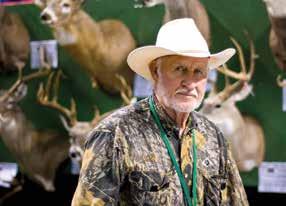
This letter is the last one for the 50th anniversary year, and TTHA has had an exciting year with President and CEO Christina Pittman announcing the new Texas Trophy Hunters Foundation. TTHA also celebrated the 50th year with a new book for the occasion, “Stringtown to the Kokernot,” an autobiography by Yours Truly. The 304-page hardback refers to my early years in Arkansas and East Texas, 33 years with Texas Parks and Wildlife, and my 30 years with TTHA. Christina has a letter in it, addressed to all Texas Trophy Hunter members, celebrating our 50th Anniversary.
We threw a bash in San Antonio during the Hunters Extravaganza on Aug. 16, where Platinum Life Members, other members, and guests enjoyed a banquet of food and frolic. We gave awards to deserving personalities, and Christina thanked everyone who made the first 50 years of Texas Trophy Hunters a resounding success. Christmas is coming, so don’t forget to hang your stocking and put a special TTHA ornament on the tree. Dec. 25 is always a wonderful holiday, and I can remember many hunts on Christmas—quail, deer, ducks—that were all special hunts for the holiday.
Clement Clark Moore’s poem, “A Visit from St. Nicholas,” now known as “The Night Before Christmas,” began: “Twas the night before Christmas when all through the house, not a creature was stirring—not even a mouse. The stockings were hung by the chimney with care, in hopes that St. Nicholas would soon be there.” Old St. Nick was known for his generosity with children, and Santa Claus came from the 4th century saint at Christmas time. Santa Claus is Dutch for St. Nicholas.
Dr. Deer tells me buck quality in the nation’s deer herds is fading, but one of the states that’s holding deer quality is Texas. There are reasons for that, and private property is a big factor. See Dr. Deer’s Prescription on page 18.
The sport of hunting is having a hard time competing with all the other outdoor and indoor activities pulling on the interests of Americans. About 11.4 million deer hunters are helping to keep hunting alive, and Texas is still the No. 1 whitetail hunting state in the nation.
A lot of Texans are out hunting during these last two winter months of the year for deer, ducks, squirrels, and of course, hogs. Texas has a generous supply of rooters, and the hunter who wants some pork can usually find a wild pig. We call the feral hogs bad names, but when the chips are down, a hog hunt is a good way to salve your need for outdoor recreation and some good eating. Tally ho, the hog!
Let’s all enjoy the seasons, both Christmas and hunting. The last days of TTHA’s first 50 years will end soon, and we will begin the next 50 years of being “The Voice of Texas Hunting.”
Keep ’em running, swimming, and flying, and I’ll see you down the road.
Horace Gore, Editor
North
East Texas Field Editor
Graphic Designers Faith Peña
Dust Devil Publishing/Todd & Tracey Woodard
Contributing Writers
Sophia Berry, John Goodspeed, Riley Hornback, Judy Jurek, Fredrick Koehler, Dannielle Pope, Steve Southards, Eric Stanosheck
Advertising Production
Debbie Keene 210-288-9491 deborah@ttha.com
Sales Representative
Tristan Summy 210-685-1205 tristan@ttha.com
Marketing Manager Logan Hall 210-910-6344 logan@ttha.com
Finance & Administration Manager
Laura Garcia
210-512-4927 laura@ttha.com
Events Manager
Jennifer Beaman 210-640-9554 jenn@ttha.com
Events Assistant Manager Natasha Delgado 210-512-8045 natasha@ttha.com
Membership Manager Valkyrie Myklebust 210-767-9759 valkyrie@ttha.com
To carry our magazine in your store, please call 210-288-9491 • deborah@ttha.com

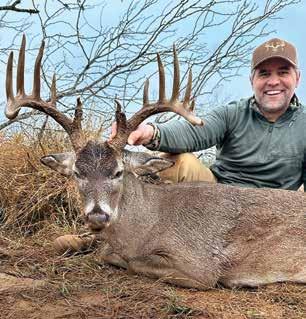
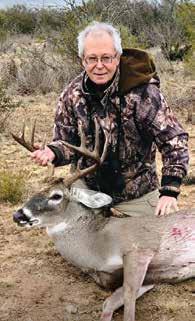
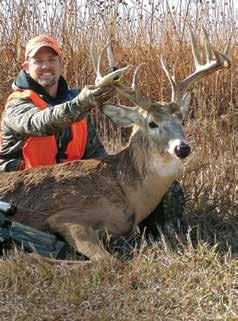
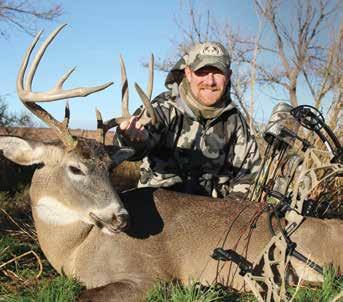

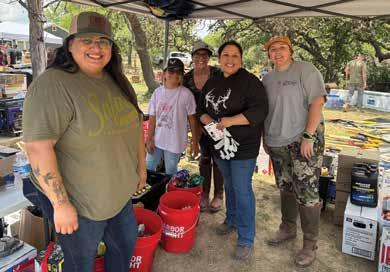
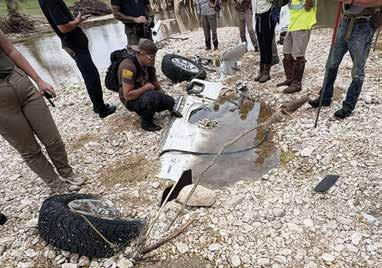
TTHA staff spent the July 11 weekend contributing to flood relief for our fellow Hill Country neighbors. We delivered meat to Casey May, who cooked meals for those in need and for volunteers. We made multiple supply drops at Comfort High School, Center Point, and for Intrepid Care, which set up base camp in the Saddle Wood neighborhood for recovery opera-

Valkyrie Myklebust, our new Membership Manager, is a native Texan, calls Spring Branch her home, and is a graduate of Tarleton State University. If you need her help with any aspect of your TTHA membership, please call her at 210-767-9759, or email valkyrie@ttha.com.


tions along the Guadalupe River. With Intrepid Care, the TTHA and SCI San Antonio teams delivered and organized supplies and helped create “go buckets” for volunteers in the field to help with search and recovery efforts. It warmed our hearts to see people from all walks of life band together to help people overcome this tragedy.

At our 50th Anniversary Banquet in San Antonio in mid-August, we bestowed honors upon a select handful of individuals who’ve supported the organization through thick and thin. Marty Berry received recognition for Artistic Contribution to The Journal, via his deer photography. Dr. Deer, James Kroll, received recognition as TTHA Educator & Advocate. Mark Herfort received recognition as Original TTHA Platinum Life Member No. 1. We thank these gentlemen for their unwavering support and their exemplary contributions that have enriched TTHA.





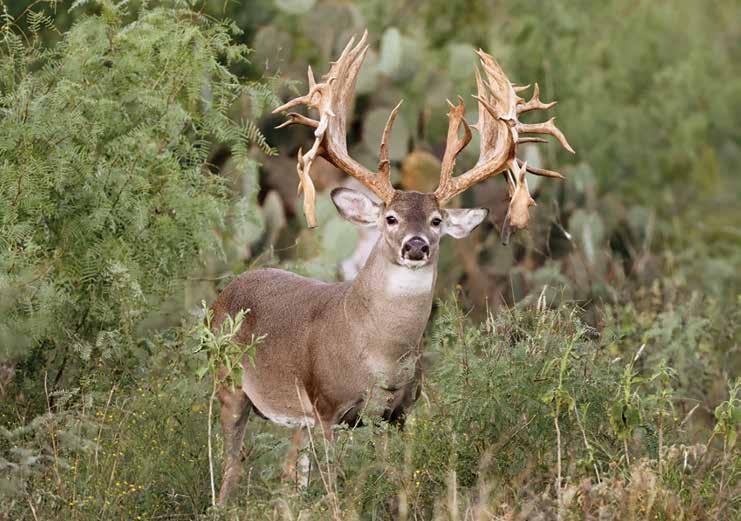
By Jake Legg
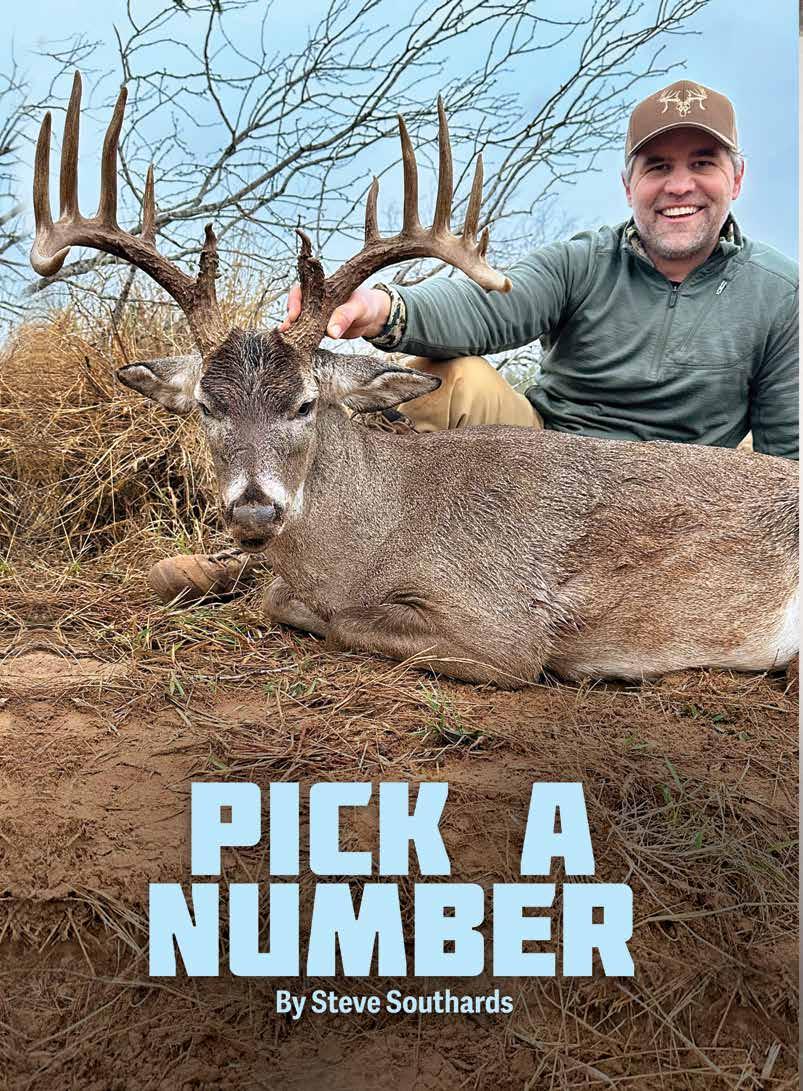
Ihad a hunting buddy in the old days—Harry Moss. We hunted deer every season, and both of us had taken our share of good bucks. One year, just before the opening of deer season, Harry came by, and we started talking about deer hunting. We pulled the cork, and Harry got to bragging about the
biggest bucks he had killed. “I feel plumb ashamed of all my big bucks,” he said with some concern. “I need to reform, and let you kill a big buck.”
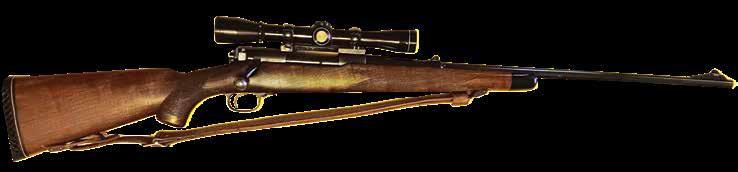
Harry was a good deer hunter. His favorite rifle was a Winchester Model 70 in .257 Roberts, and he could put three in the paper no bigger than a quarter. I
saw him kill several bucks and they all dropped like a rock. My Remington 721 was a good shooting .270, but nothing to compare to his .257.
We sat around for an hour, talking about deer hunting and the coming season. Suddenly, Harry stood up, tipped his glass, and smiled. “Tell you what,
Hoss. From now on I’m going to shoot only bucks with eight slick points.”
I looked at Harry in disbelief. “Have you lost your mind? Only bucks with eight slick points?” This was not the Harry I knew.
“Yes. I have come to my senses. A buck with eight slick points is as hard to find as any buck, and from now on that’s the buck for me.” Harry put his glass on the table and leaned back. I could tell that he meant business. When Harry made up his mind, it was for good and ever more. I could see he would never kill any buck that didn’t have eight slick points.
The night was getting along, and finally Harry went to his pickup, mumbling something about “eight slick points” as he pulled away toward town. I sat for a while, thinking of what Harry had just said, and I knew Harry. He meant what he said. I knew I would never see him again with any buck that didn’t have eight slick points.
A few days before the deer season started, Harry came by, and we sharpened our knifes and discussed a hunting plan for the first day. There were a lot
of deer on the ranch, and we liked to sit in a big store-bought ground blind and watch for good bucks. That would be our plan for opening day, to hunt from a big ground blind near a corn feeder.
Nov. 16 came on Wednesday, and Harry and I sat in the blind before daylight. “You still stuck on the idea of eight slick points?” I asked as we pushed up the windows and placed a stick to keep them open. I had come out earlier and knocked the two wasp nests in the blind. We didn’t have anything against the wasps. We just wanted them to stay put when we got in the blind. Anyone knows wasps only sting when they’re protecting their nest, and when it’s gone, the wasps don’t attack.
Harry and I got settled in the blind, and I thought of ribbing him a little. “If you’re so sure of nothing but eight slick points, will you swear to that on a paralyzed oath?” Harry turned around in his swivel chair and replied, “If it will clear your mind of my intentions, I will swear.” We faced each other in the dim morning light, Harry raised his right hand, and said, “I swear on a paralyzed oath that I
will kill nothing unless it has eight slick points,” and rolled around to look out the window.
“Are we going to draw straws?” I asked Harry as I took a small flashlight out of my coat. “We always draw straws to see who gets the first shot. What about it?” Harry smiled and reached in his coat pocket and pulled out a small mesquite twig. “I’ve already thought about it.” He pulled off two pieces of the twig, one short and one long. He hid both in his fingers to show both to be the same and pushed them over to me.
“Draw. The short piece gets first shot.” I studied the two ends for a moment and pulled out the long twig. “You get the first shot,” I declared, and we leaned back in our swivel chairs, waiting for the feeder to go off.
The corn feeder was set to go off at 7, and it was right on time. We heard it spin, and I could see the dust float away from the corn in the distance. “Things will pick up, now,” I said.
Harry’s .257 stood in his corner with the bolt up. He liked to keep the bolt up and close it when he got ready to
shoot. As the sun rose, we could see a few does and small bucks mingling around the feeder. I kept thinking of a big non-typical staying in the area, an old buck that had a rack full of long points. I had gotten a glimpse of him just before season and his antlers were huge, but I hadn’t mentioned the buck to Harry.
The early morning fog had cleared a bit, as more deer became visible. The does had moved away from the feeder, as if to be evading some type of danger. Suddenly, a big buck emerged from the brush, and I saw immediately it was the big non-typical with multi-pointed antlers. Harry saw him, too, and reached for his .257 standing in the corner, closing the bolt and checking the safety.
I looked over at Harry and said, “You’re not going to shoot that big buck, are you? You swore on a paralyzed oath to shoot only bucks with eight slick points.” Harry smiled and replied, “You’re right, Hoss. I forgot. You go ahead and shoot him.”
In my mind, I had Harry over a barrel. I had drawn the long stem; he had the first shot at the biggest buck we had ever seen on the ranch; he had sworn to shoot only bucks with eight slick points; and now, he wanted ME to shoot the buck.
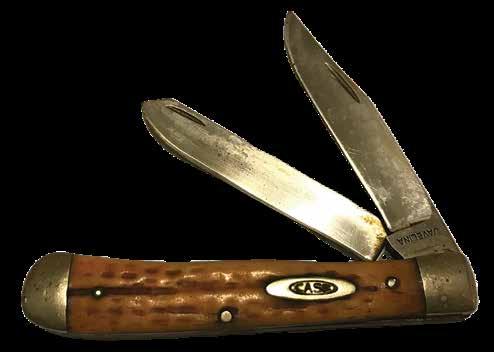
“No, No. I’m not going to shoot that buck!” I said with a grin on my face. “It’s
Harry’s Case knife that’s “sharp enough to shave hair off your arm.”
shoot bucks with eight slick points.” Harry waited until the old buck turned so that he could get his favorite shot, where the neck joined the shoulder. I sat in the swivel chair, wondering if Harry would actually shoot the biggest buck we had ever seen on the ranch.
Harry’s finger was on the trigger and the rifle roared—KA-BOOM. The 100-grain Hornady found its mark, as
his knife. He went through our usual ritual by pulling up his left sleeve to spit on his bare arm, rub it with his forefinger, and shave off the hair slick to show that his knife was ready. We stared out the blind window at the biggest buck we had ever seen.
“Let’s go out there and gut my buck. He looks like he has about 25 points, a typical 10 with long tines, and about 15
“I swear on a paralyzed oath that I will kill nothing unless it has eight slick points.”
- Harry Moss
your shot, so go ahead. You have had that ‘eight slick points’ on your brain till I’m sick of it. So, what are you going to do, now, Mr. Moss?” Harry studied the buck again through his binoculars, and slowly put his thumb on the safety. I watched in disbelief, as he pushed the rifle barrel out the window.
“You’re not going back on your oath, are you?” I quickly asked. “You swore on a paralyzed oath that you would only
the old buck fell in his tracks, kicked his back legs a few times, and lay dead.
“I can’t believe it. You went back on your paralyzed oath. You said, ‘no bucks that didn’t have eight slick points.’ How could you do such a thing?” I ragged Harry something terrible.
“Hold on, Hoss.” Harry kicked the empty hull from his rifle. “I believe I have some explaining to do.” He put the .257 back in the corner and pulled out
more long, odd points. I’m sure that we can find ‘eight slick points’ somewhere in his big rack.”
The morning was getting long as I held the buck’s front legs steady while Harry wielded his knife on the pelvis. He had put the shuck on me with the “nothing but eight slick points” and had even offered me the first shot. I had been bushwhacked, but what could I say? The old buck had “eight slick points,” and more.

The Muy Grande Deer Contest reached a new milestone this year, celebrating its 60th anniversary awards ceremony. Freer is home to Muy Grande, the state’s oldest deer contest. Originally founded in 1965 by the late Leonel “Muy” Garza, the contest is still going strong and running smoothly thanks to co-owners Kenneth and Imelda Sharber, and the Garza family, with all of the sponsors and hunters who participate every year.
Muy’s No. 1 rule was, “Always take care of the hunters.” The longevity of the contest is proof the Garza family has followed through and taken very good care of the hunters. Of course, in return the hunters have taken good care of them, and everyone involved is considered to be a part of the “Muy Grande family.”
Aside from numerous awards highlighting the harvests of the prior season’s Muy Grande bucks, a handful of special awards are also presented. Among these are the Muy Grande Hall of Fame inductees. Muy started the hall of fame in 2007 to recognize individuals for their contributions to the hunting industry and the deer contest.
This year’s Muy Grande Hall of Fame inductees include Jason Shipman, John Goodspeed, John Morris Walker, Jr., Robert John Hart, and Edwin Espey Jr. Shipman is a private wildlife biologist and consultant with over 25 years of field experience and the South Texas field editor for The Journal of Texas Trophy Hunters. Goodspeed is a freelance outdoor writer and contributing writer for The Journal of Texas Trophy Hunters. Walker, Jr. is a seventh-generation landowner/rancher
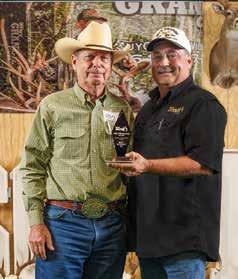
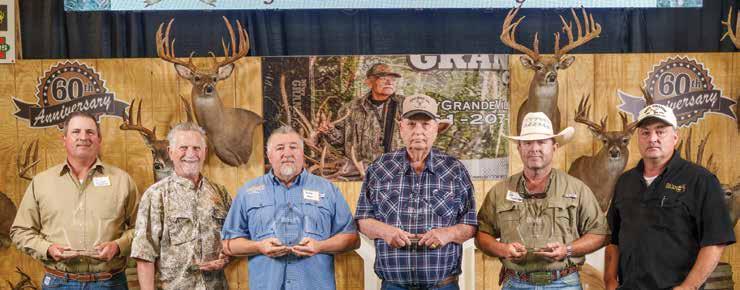
and operates a local ranch brokerage service. Hart is a fourth-generation gunsmith well known for his custom guns and barrels. Espey, Jr. is a local landowner, rancher, and wildlife enthusiast.
A few years ago, Muy Grande established the Muy Grande Lifetime Achievement Award. This year’s recipient was Roy Hindes III. I can’t think of a more deserving person to receive this recognition than “Little Roy.” He operates the family ranch and is known throughout South Texas for his tracking dogs that have found hundreds of wounded deer. Many deer hunters owe him a debt of gratitude for finding their trophy bucks that would have otherwise been lost.
Many familiar faces attended the festivities, including Jerry Johnston, founder of Texas Trophy Hunters; Mark Herfort, TTHA Platinum Life Member No. 1; Elda Garza, Muy’s widow; and the rest of the Garza family. Shane Greenville, Kelly Kenning, and Daniel Adami provided some festive musical entertainment. Congratulations to this year’s inductees and awardees. —Bob Wire
The Texas Game Warden investigation known as “Ghost Deer” has reached a possible conclusion after two additional suspects turned themselves in on felony charges. This brings the total number of individuals implicated in the case to 24, with approximately 1,400 charges filed across 11 Texas counties.
Ken Schlaudt, 64, of San Antonio, the owner of four deer breeding facilities and one release site, along with facility manager Bill Bowers, 55, of San Angelo, surrendered to the Travis County District Attorney’s Office on charges of felony tampering with a governmental record. Both men allegedly entered false information into the Texas Wildlife Information Management System (TWIMS) to facilitate illegal smuggling of white-tailed breeder deer. They also face more than 100 misdemeanor charges related to unlawful breeder deer activities in Tom Green County.
The investigation has uncovered widespread, coordinated deer breeding violations including, but not limited
to smuggling captive breeder deer and free-range whitetail deer between breeder facilities and ranches; chronic wasting disease testing violations; license violations; and misdemeanor and felony drug charges relating to the possession and mishandling of prescribed sedation drugs classified as controlled substances.
Suspects charged in the case include: Evan Bircher, 59, San Antonio; Vernon Carr, 55, Corpus Christi; Jarrod Croaker, 47, Corpus Christi; Terry Edwards, 54, Angleton; Joshua Jurecek, 41, Alice; Justin Leinneweber, 36, Orange Grove; James Mann, 53, Odem; Gage McKinzie, 28, Normanna; Herbert “Tim” McKinzie, 47, Normanna; Eric Olivares, 47, Corpus Christi; Bruce Pipkin, 57, Beaumont; Dustin Reynolds, 38, Robstown; Kevin Soto, 55, Hockley; Jared Utter, 52, Pipe Creek; Reed Vollmering, 32, Orange Grove; Clint West, 56, Beaumont; James Whaley, 49, Sevierville, Tenn.; Ryder Whitstine, 19, Rockport; Ryker Whitstine, 21, Rockport; Claude Wilhelm, 52, Orange.
Cases are pending adjudication in Bandera, Bee, Brazoria, Duval, Edwards, Jim Wells, Live Oak, Montgomery, Tom Green, Travis, and Webb counties. The investigation began in March 2024 when game wardens discovered the first violations during a traffic stop. That incident led wardens to the much larger network of violations, resulting in one of the largest deer smuggling operations in Texas history. —courtesy TPWD
On July 4, the One Big Beautiful Bill Act, the comprehensive bill that has been the focus of Congress since the beginning of the 119th Congress in January, was signed into law. While this legislation is a large and all-encompassing, there are a few particular provisions of note that will impact sportsmen and women across the country.
Most important, the Act omitted the mandate to sell-off certain federal public lands across 11 western states, which was an effort strongly opposed by the Congressional Sportsmen’s Foundation (CSF). While there were a number of
proposals to sell off public lands that were considered throughout the process of developing the Act, CSF strongly opposed the consideration of any public land disposal through this process. As a result of CSF’s efforts, the language to mandate the sale of certain public lands was ultimately removed from the final bill that became law.
The Act included a provision to reduce the $200 National Firearms Act Form4 tax stamp to $0 for the purchase of firearm suppressors and certain types of firearms. Prior to the enactment of the Act, each time an individual purchased a suppressor they needed to pay a onetime $200 tax stamp. Under new law, individuals will no longer have to pay the $200 for the tax stamp each time they purchase a suppressor, but they must still file the requisite paperwork and undergo the attendant background check.
Additionally, several of the Farm Bill’s conservation programs and previous investments made through the Inflation Reduction Act of 2022 are now officially considered to be part of the Farm Bill’s baseline. This means that current funding levels will serve as the base once Congress begins the hard work of writing the next iteration of the Farm Bill. Likewise, the Act’s language for these programs removed many of the climate limitations that, as pointed out by many within the sporting-conservation community, failed to include many key practices that benefit wildlife habitat and mitigate impacts commonly attributed to climate change. This bill also included $105 million to continue the successful Feral Swine Eradication and Control Program and, most important to hunters and anglers, included $70 million for the Voluntary Public Access – Habitat Incentive Program (VPA-HIP) which provides financial incentives for private landowners to voluntarily open their properties to public hunting access in many states.
Further, the Act includes significant forest management provisions to support the long-term sustainability of U.S. Forest Service (USFS) and Bureau of Land Management (BLM) lands by
improving forest resilience to wildfire and other threats through increased timber sales. Specifically, the reconciliation bill directs the USFS to increase the volume of timber sold over the next ten fiscal years by a minimum of 250 million board feet annually more than the prior fiscal year and directs the BLM to increase the volume of timber sold over the same period by a minimum of 20 million board feet annually more than the previous fiscal year. Additionally, the Act aims to provide stability by requiring the USFS to enter a minimum of 40 20-year timber sale contracts and requiring the BLM to enter at least five 20-year timber sale contracts. The mandated and incrementally increasing timber sales align with Executive Order 14225, Immediate Expansion of Timber Production; Secretary’s Memorandum 1078-006, Increasing Timber Production and Designating an Emergency Situation on National Forest System Lands; and the USFS’s new National Active Forest Management Strategy. After two and a half decades of relatively stagnant federal timber sales that resulted in overstocked, unproductive forests for wildlife, the increased timber harvests will improve habitat diversity and increase forest resiliency to support fish and wildlife habitat and access for hunters and anglers. —courtesy Congressional Sportsmen’s Foundation
Safari Club International proudly congratulates Brian Nesvik on his confirmation as the next Director of the U.S. Fish and Wildlife Service (USFWS). His appointment brings a seasoned conservationist, decorated military leader, and proven wildlife manager to one of the most important conservation roles in the federal government.
“Brian Nesvik is a strong and experienced choice to lead the U.S. Fish and Wildlife Service,” said W. Laird Hamberlin, CEO of Safari Club International. “His decades of service in wildlife management, coupled with his distinguished leadership as Director of Wyoming Game and Fish and as a Brigadier
General in the Wyoming Army National Guard, reflect a steady hand and a clear vision rooted in science, discipline, and public service. His leadership will be essential in guiding the Service through the complex challenges of modern wildlife management. SCI looks forward to working closely with Director Nesvik to ensure hunters and science-based conservation have a seat at the table.”
Nesvik brings over 38 years of combined experience in natural resource management and military service. He served as director of the Wyoming Game and Fish Department from 2019 to 2024.
—courtesy SCI
The Sportsmen’s Alliance Foundation and its partners, Safari Club International and the Rocky Mountain Elk Foundation, appealed a court judgment vacating the Fish and Wildlife Service’s (FWS) decision declining to relist gray wolves in the Northern Rocky Mountain region to the Ninth Circuit Court of Appeals.
The coalition of sportsmen’s groups have filed a notice of appeal and will continue to fight for sound wildlife management. This latest ruling in support of the activists’ petitions would seem to demand that until wolves are recovered across the entirety of the Lower 48, including active, protective, management throughout its historic range, that all wolves everywhere should remain protected under the Endangered Species Act.
Congress declared the wolves in the Northern Rocky Mountain region—Idaho, Montana, Wyoming, eastern Oregon and Washington, and north-central Utah—recovered in 2011. Since then, the wolves have thrived, and expanded into surrounding areas, including northern California, western Washington and Oregon, and Colorado. Several animal-rights organizations asked FWS to combine the recovered Northern Rocky Mountain wolves with wolves in the neighboring western states and list them as an endangered species.
“They asked FWS to use the wolf’s recovery against it,” said Michael Jean, Litigation Counsel for Sportsmen’s Al-
liance Foundation. “They want to push the boundaries of the recovered population to include the areas where it is currently expanding to dilute the overall recovery.”
FWS rejected the petitions from multimillion-dollar activist groups, including Center for Biological Diversity, Western Watersheds Project, WildEarth Guardians, Humane Society of the United States and Sierra Club. The inevitable lawsuits followed, and the Sportsmen’s Alliance intervened in each of them.
District Court Judge Donald Molloy in Montana’s District Court has now ruled against FWS’ denial of those petitions.
“We had to appeal this decision,” Jean continued. “This decision seems to hold that unless a species is not recovered across its entire historical range, then it has to stay listed—regardless of thriving populations. It’s difficult to see how the wolf, or other listed species, will ever be deemed recovered under that standard.”
“SCI is frustrated that the court ignored the reality of successful wolf conservation in the Western U.S. and instead ruled in favor of the plaintiffs’ arguments that are clearly biased against state wildlife management and counter to the law and the science,” said SCI CEO W. Laird Hamberlin. “SCI will appeal this mistaken ruling as soon as possible in order to defend legal, regulated hunting as part of science driven, state wildlife management programs for wolf species.”
“This ruling is the latest string of nonstop litigation by environmental groups seeking to frustrate the original intent of the ESA, which is to recover endangered species and return them to state-based management, not keep them perpetually listed and under the authority of the federal government,” said Rocky Mountain Elk Foundation President and CEO Kyle Weaver. “Whether it’s the wolf or the grizzly bear, once an animal receives ESA protections, it becomes nearly impossible to remove them, even if populations meet recovery criteria over an extended period of time. The ESA needs an adjustment to renew its focus on real species recovery.” —courtesy Sportsmen’s Alliance Foundation, SCI, and Rocky Mountain Elk Foundation
By Dr. James C. Kroll
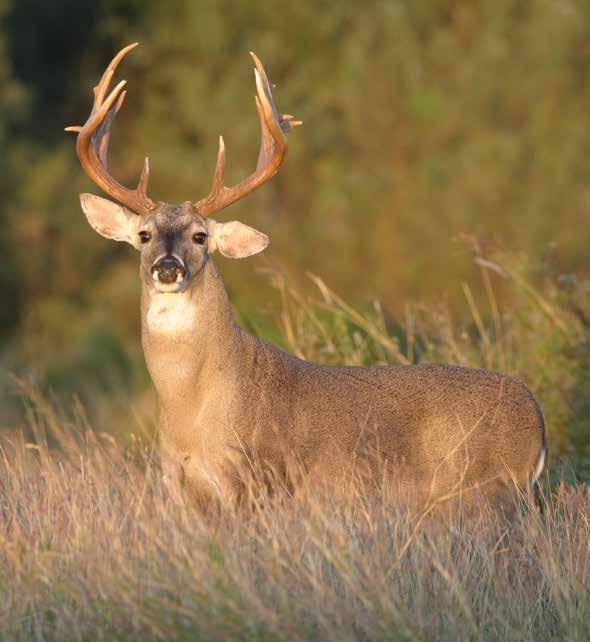
The author says deer populations are high, but hunters only take about 6 million of the estimated 36 million animals. That’s less than 17% of the herd.
The estimated population of white-tailed deer in North America now stands at around 36 million. That’s pretty impressive, considering estimates of the pre-Columbian population are somewhere between 20-30 million. And, it’s estimated about 6.3 million deer are harvested annually, amount-

ing to about 315 million pounds of venison. The number of Boone & Crockett qualifying bucks from 2020-23 for the top 15 states and provinces was almost 1,000 (see sidebar). The average state record typical net score holds at around 194 inches (range=176-211 4/8, n=43). Given this information, why

Increa sing= 6, Decreasing= 7, Steady= 1, New= 1
Source: boone-crockett.org/top-trophy-whitetail-states-2023
should I even continue? Things look pretty good in the world of the whitetail and whitetail hunting, right? Let’s take a deep dive into the facts, beginning with the turn of the 20th century. In 1900, an estimated 300,000 whitetails were left in the continental U.S. How do we know this? How do we really know how many there are today? Well, we really do not. Both the 1900 number and the 2024 number are a best guess, maybe with a small amount of science thrown in. What’s important is that we do know there were very few deer left after the overexploitation into the 1800s.
Once folks realized deer were in danger of extinction, conservation-minded private landowners, hunters, and newly formed state agencies undertook an impressive restoration program, with Texas, North Carolina, Wisconsin and Michigan being the
most common stocking sources. In Texas, landowners deserve a great deal of the credit for supporting restoration efforts.
The goal was to restore deer populations, and little consideration was given to what subspecies they represented. So, most of the existing deer populations cannot be considered as truly “native.” For example, in Texas, large numbers of deer were moved over the state from South Texas and the Gulf Coast, two races of whitetails. Deer stocked in Georgia came from their coastal islands, Texas, and Wisconsin. Pennsylvania stocked deer from Michigan, Ohio, Kentucky, Maine, New York, and New Jersey, and even Pennsylvania deer breeders. Deer were sourced from wherever they could be found.
New game departments developed seasons and bag limits to protect growing populations. The Pittman-Robertson Act of

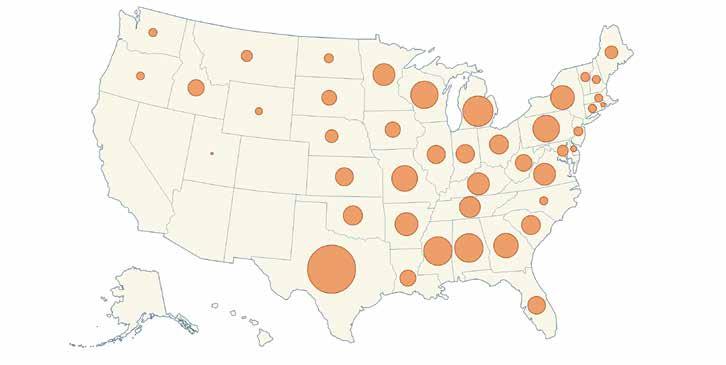
Texas reigns supreme by having the most deer in the U.S., with 5.2 million deer within its borders. Michigan ranks second at 2 million, with Alabama and Mississippi tied at third with 1.75 million. Wisconsin has 1.6 million deer, and Pennsylvania has 1.5 million deer.
1937 figured significantly as financial support for restoration. By the time I was born in 1946, a minimum of 11 states had established deer seasons, with deer populations in those states totaling approximately 304,000.
When I began my career in 1973, deer numbers had increased to at least 10 million, credited to protection and significant habitat improvement. In the Midwest, millions of acres once occupied by prairies were converted to agriculture by the early 1900s. In the Lake States—Michigan, Wisconsin, and Minnesota—old growth timber had been cut, followed by massive wildfires, which led to lush growth of deer foods. In the South, southern pine and hardwood forestry adopted clearcutting as the preferred sylvicultural practice.
This also produced millions of acres of deer forage. So, as I began studying deer in the 1970s, high deer densities were common in much of the U.S. The mortality agents deer face today did not even exist. State game agencies were riding high on year after year reports of “record deer harvests.”
It quickly occurred to several of us young deer biologists that we had created a monster. In the early days of restoration, we had to change attitudes of hunters. Whereas, grandpa would have shot any deer in range, restoration discouraged shooting does so herds could grow. The attitude change became ingrained. We had focused on restoration, without considering that someday, deer would have to be managed. The “runaway train was building up steam, and it was about to roll over us.
Two different deer management models were developed for northern versus southern states. In the north, deer management was aimed at managing hunters rather than habitat.
Emphasis was on public hunting opportunities, while in the South and Texas, we saw a culture of private land ownership and hunting clubs. Quite logically, the latter focused on habitat management, as well as deer population management. Aldo Leopold knew full well the private landowner was the key to wildlife management; especially with 80% of the wildlife living on 60% of the land.
I wasn’t the only one worried about the future sustainability of deer and deer hunting. Several of my colleagues expressed the same concerns. Deer management at that point in time depended on a concept known as a “compensatory response.” Put simply, if you remove a large number of deer each year, the improvement in available nutrition would stimulate a larger fawn crop and recruitment.
The concept was solid until the world changed. In the mid ’70s, deer management was simple, and there were fewer limiting factors to consider. There were very few predators, low incidence of disease, and plenty of deer food. In short order, the perfect storm struck.
In much of the country, there were very few predators, especially coyotes. However, sheep and goat ranching in the Texas Plateau allowed coyotes to cross over that country eastward. In the North, wolf elimination had also encouraged coyotes, and they expanded eastward. By 1980, eastern deer populations were being attacked from the north and the southwest. Bear populations also were increasing, as were the large cats. An entire suite of predators developed, each with its unique specialty.
Then came a real killer—hemorrhagic disease. It had been reported in New Jersey and Michigan in late 1950, but had

been considered a minor mortality agent only showing up sporadically. That also changed, as the two most common strains underwent changes, and soon, EHD and its companion, Bluetongue, were significant mortality agents.
Then the land itself began to change. Gentrification gained a foot hold in traditionally rural areas. Intensive forest management relied heavy on herbicides, and clearcuts once flush with deer foods turned into nutritional deserts. Fewer landowners hunted or even allowed hunting. Compensatory response disappeared.
In 1994, Dr. Harry Jacobson and I were invited to the 3rd International Conference on the Biology of Deer to give the Plenary presentation. And boy did we do that! Our presentation was entitled: “The White-tailed Deer: The most managed and mismanaged species.” We outlined how deer management, as it had been practiced by states, was not working and that serious consequences would follow. To say our presentation was not well-received is an understatement, but it proved prophetic. We even predicted disease would soon be a problem.
Earlier, at Mississippi State University, my colleagues Drs. Jacobson and David Guynn came up with an ingenious new model for deer management. Since most of the deer lived on private land, why not develop a deer management research and assistance program, which involved the landowner?
The DMAP was the most effective deer management tool in history. It worked wonderfully, but there was one problem: There are only so many biologists to service demand. States that had adopted the program soon backed away due to heavy workloads.
Populations have continued to grow, with some minor declines in the late 1990s. Hemorrhagic disease became a serious issue, when a new strain, EHD-6 Indiana, showed up devastating local populations. Then, a new disease appeared that had been hidden from public attention for almost 30 years—chronic wasting disease.
When CWD magically jumped to southern Wisconsin from Colorado around 2001, it shocked the deer world. Gloom and doom prevailed, and massive efforts developed to “eradicate” it by “population reduction,” which fit well with a professional philosophy that we need much fewer deer. To date, thousands of deer have died since 2002, not from CWD, but the treatment for it. To date, no state has experienced a population decline scientifically demonstrated from CWD.
At the same time, there has been a significant decline in hunters. The cause(s) are complex factors, including urbanization, changing lifestyles, increased cost to participate, and loss of societal support for hunting. During all of this, deer populations ebbed and flowed.
The wildlife management profession has also changed, with fewer professionals hunting or fishing themselves. Hunters are looked upon less and less as necessary for population management, and the momentum worldwide is headed in the direction of “re-wilding” the deer woods. In recent times, support
for replacing or joining hunters with apex predators such as wolves, bears and lions has emerged. This has created a raging conflict between hunters, landowners, and resource management professionals.
So, what is the state of the union of deer management and hunting? There is a state of flux that concerns me. Yes, deer populations may be high, but hunters only take about 6 million of the estimated 36 million animals, less than 17% of the herd. Recruitment often is as high as 40%, and standard practice supports at least a 30% harvest. The habitat is deteriorating, even in places where trophy bucks have been the norm.
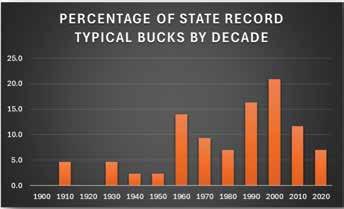
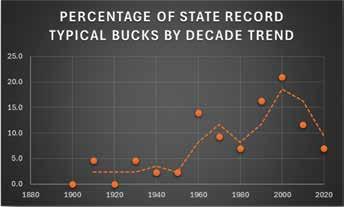
I also analyzed the records for 43 states with whitetails (see graphs) and looked at when each state record typical buck was harvested. It appears we reached the peak in new state records at the turn of the 21st century, but we are only halfway through the 2020s, so, time will tell. There are only two possible reasons: we either have reached the genetic limit for the species, or herds are more nutritionally and socially stressed.
In summary, we are at a crossroads in the history of deer hunting and management. There is no way we can continue to allow deer populations to increase. Sustainability is the key issue. As hunters, landowners, and professional managers, we soon will have to develop a new direction for our favorite recreation and our favorite animal.
We either make these change or settle for a world in which hunters are no longer regarded as critical to conservation. I prefer that there will always be a place for the hunter in our natural world.
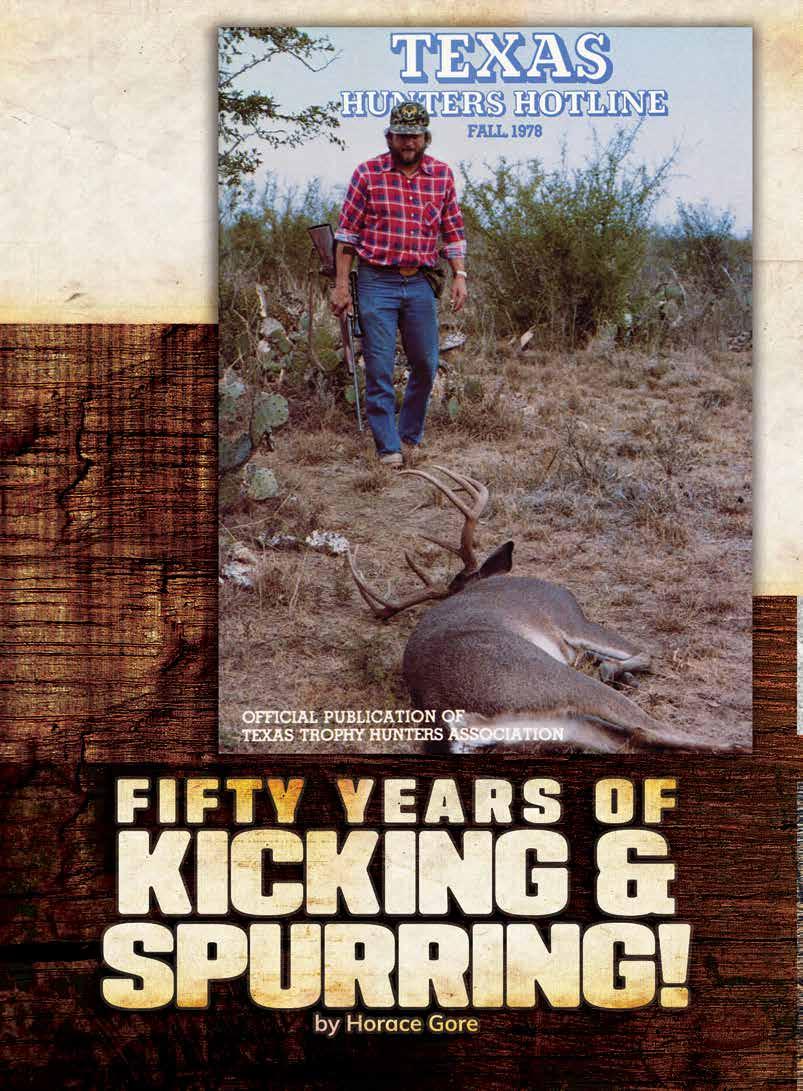
Left: TTHA’s founder Jerry Johnston and his big buck, circa 1978, on the cover of Texas Hunters Hotline, before he changed the name to The Journal of the Texas Trophy Hunters
Right: We celebrate 50 golden years of The Journal, and look forward to blazing a trail through the next 50 years.
Texas Trophy Hunters Association is 50 years old and still kicking and spurring as “The Voice of Texas Hunting.” The first 50 years was a resounding success, and we are now beginning a new 50 years of showing Texas and the world the exciting experiences of the hunt and the joys of the outdoors.
The “kicking and spurring” part of the title, is an old Texas phrase describing exactly what we were doing at TTHA when I joined the team in 1995: raising $350,000 for Operation Game Thief; weekly award-winning television shows; a magazine that reached 325 pages in 2003-2005; and three Hunters Extravaganza shows in Houston, Fort Worth, and San Antonio, with crowded aisles from Friday through Sunday. The record would show that Texas was enjoying the heyday of TTHA.
My second career with TTHA that started 30 years ago has

been a distinct pleasure. After 33 years with the Texas Parks and Wildlife Department, and a lot of successful work with deer, quail, and wild turkey, I could have retired and spent the rest of my days hunting and fishing, writing, trading guns, and just loafing around. However, I picked up another career when Jerry Johnston called, and the wheels as editor of The Journal of the Texas Trophy Hunters started turning.
Jerry was in his 18th year after creating TTHA in 1975, and things were popping when I retired from TPWD in 1993. The Journal was growing, and Jerry needed an editor who knew the ropes of writing, hunting, guns, politicking, and had a respected knowledge of Texas wildlife.
I must admit I wasn’t too enthused about the offer from Jerry in September 1995. I was more interested in living on the vast Kokernot Ranch in Gonzales County and enjoying everything the ranch had to offer, which was the nearest
thing to heaven for a wildlife biologist and hunter. When Jerry agreed that I stay on the Kokernot and work a couple of days each week in the San Antonio office, I took the job as extra labor—30 years ago.
The thrills and excitement driven by TTHA have continued to promote hunting, shooting, conservation, and camping through the last 50 years, and now the Texas Trophy Hunters Foundation will push for membership, TTHA Chapters, wildlife research, and publicity that is needed for Texas hunting.
Safari Club International acquired Texas Trophy Hunters in 2021 and moved their operational headquarters from Tucson to San Antonio in 2024. The future looks bright for both SCI and TTHA as they work together not only for the benefit of the Texas hunting, camping and everything outdoors—but for hunting and conservation worldwide.
Everyone at TTHA is geared for the next 50 years. Hunters Extravaganzas are going strong; membership plans are in the works; an Outdoors Extravaganza will continue in Dallas; The Journal is the best hunting magazine in the Southwest; and the new TTH Foundation is pursuing needed goals.
Promoting hunting and the outdoors of Texas will be more difficult during the next 50 years because hunting and camping is challenged by a variety of activities that require decisions from the outdoor crowd. With 90% of Texans now living urban, TTHA is under more pressure to ensure that hunters will continue to buy licenses and enjoy the outdoors, despite all the pulls of urban living that are taking a toll on outdoor sports.
The growing whitetail population on 100 million acres of Texas habitats are a plus for deer hunters and worth $4 billion to the Texas economy. Some of the best bucks taken in the nation come from Texas, and the average of one deer harvested per hunter is the best of all deer hunting states. Some 800,000 deer hunters take that many deer, and Texans consume 15 million pounds of venison annually. In essence, deer hunting has never been better.
Dove hunters are now pushing 400,000 and spend some 2 million days afield shooting 15 million shotguns shells to take home 5 to 6 million doves each season. Both mourning and white-wing doves are consumed in specialty dishes for months after the season, and the future looks bright for dove hunting in Texas.
Although deer and dove make up most of Texas hunters, wild
turkey have their share of both spring and fall hunters. There was a time when turkeys were taken during deer season by hunters using rifles. Things changed when a spring season was approved for a first season in 1969. Today, some 100,000 spring hunters take about 50,000 birds, based on weather conditions and turkey reproduction. To say that the spring season has been a success would be an understatement!
Like any new hunting sport, Texans were slow to take up spring turkey hunting because they didn’t know how to hunt spring turkey. For the first 10 years, many hunters carried deer rifles and ambushed strutting gobblers. As time passed and hunters got the hang of calling in gobblers to the shotgun, the sport took hold from the Panhandle to Brownsville and the Pecos to the Brazos—that area where Rio Grande turkey flourish in Texas.
With 50 years of success in getting Texans into the wilds and promoting hunting and other outdoor activities, TTHA will be looking for ways to “keep ’em running, swimming, and flying” during the next 50 years. We will continue publishing an excellent Journal; push membership with Extravaganzas and the Foundation, and get the kids into the wilds of Texas by promoting hunting, fishing, shooting, and just enjoying the outdoors. Texas Trophy Hunters will continue to be “The Voice of Texas Hunting,” and that’s where we’ll be kicking and spurring for the next 50 years.
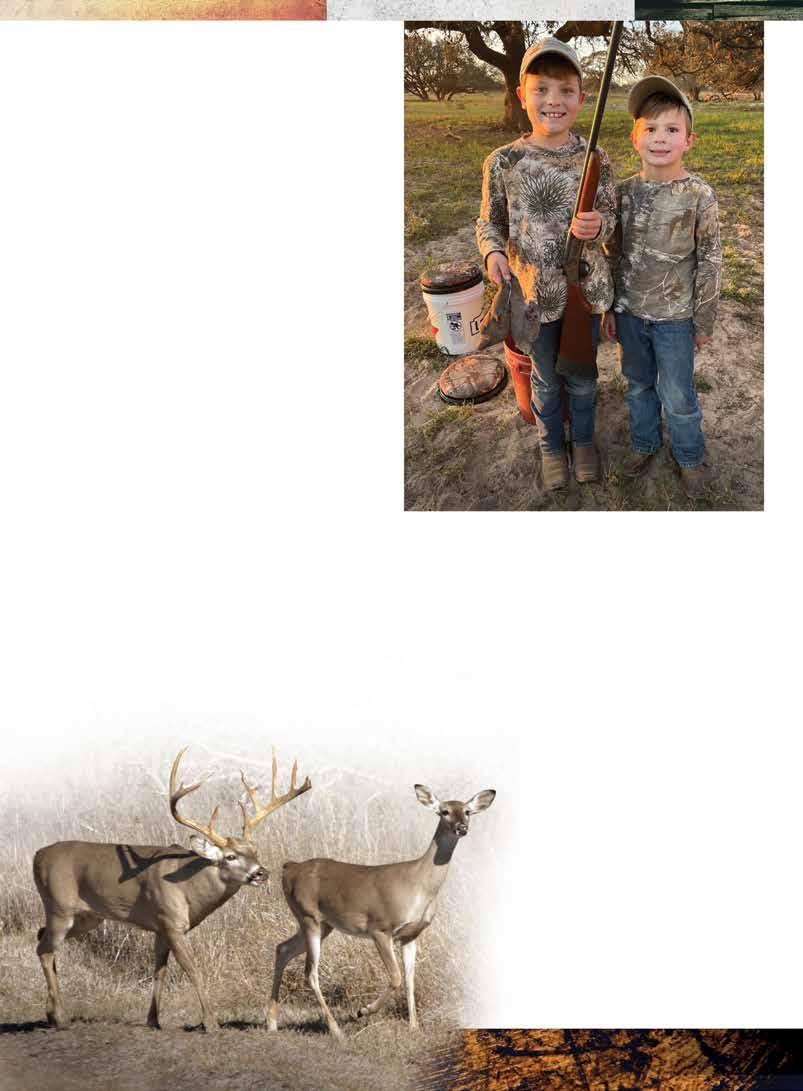
We look forward to promoting Texas whitetail hunting and sharing whitetail hunting stories for the next 50 years.

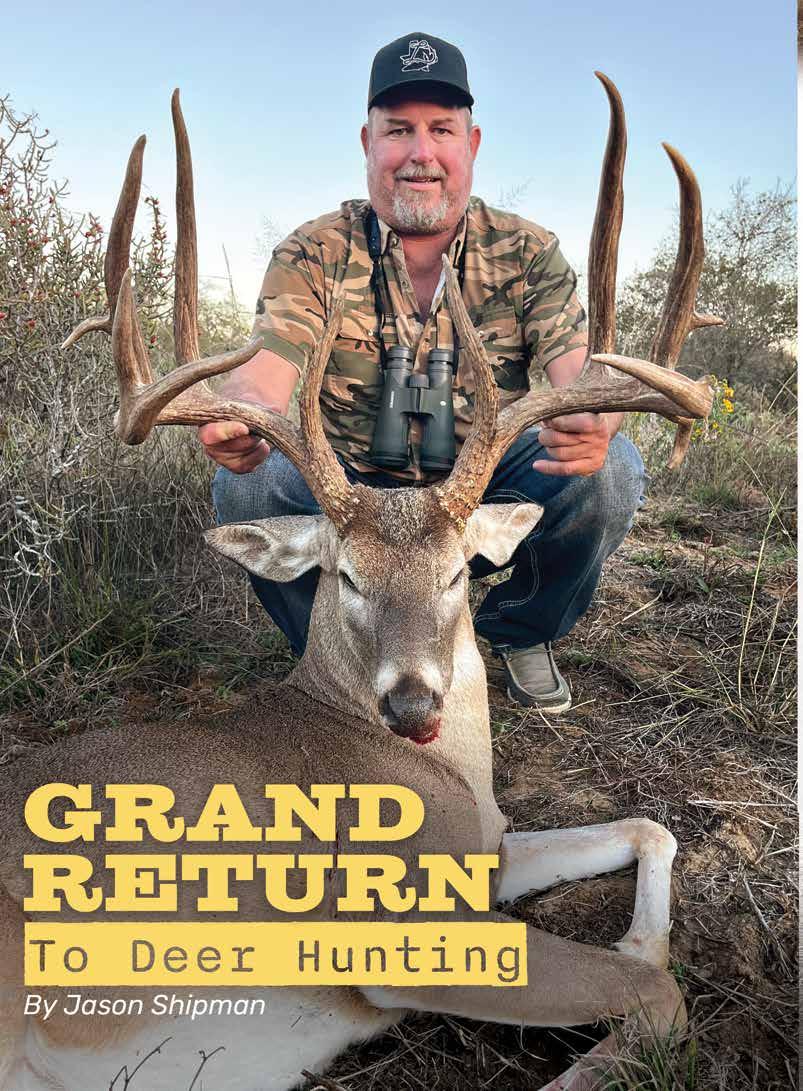
Ten years is a long time. It’s a decade to be exact, and quite awhile to sit idly by on the sidelines. We’ve all heard of someone making a grand entrance. This is the story of someone making a grand return. A comeback story of sorts.
John Naegelin grew up hunting and has been an avid deer hunter his entire life. He lives in Devine, located just south of San Antonio where the live oak trees make the transition into the brush country. He’s a farmer by trade and enjoys spending what free time he has hunting and fishing with his kids.
Throughout the years, John has enjoyed making lasting memories and has taken some great deer. About 10 years ago he killed an exceptional buck that was featured in The Journal. The buck was a big typical 10-point that grossed
194 5⁄8 and netted 1835⁄8 . The buck was entered in the Texas Big Game Awards and was later recertified by Horace Gore, an official B&C measurer, at 1831⁄8 net B&C. With an exceptional typical score, the buck was the third largest high fence typical killed in the state that season according to the TBGA standings.
“After taking that big 10, I felt like I had topped out and decided to hunt with my kids for a while,” John said. At the time, his children, Ace and Khloe, were just beginning to hunt. “I still wanted to hunt,” he said, “but I redirected my efforts to my kids. I wanted them to be able to experience the opportunities.” John set his gun aside and forgot about it. For about the next 10 years he hunted with Ace and Khloe and helped them take some tremendous deer. “I watched them grow up hunting, and we had a great time,” he said. “I wouldn’t change a thing.”
Ace and Khloe are all grown up now. They still love to hunt but are old enough to do their own thing. For the past couple of years, John has felt the urge to hunt again. “I’ve had the itch to hunt big deer,” John said. Rather than ease back in to hunting, last season John made a grand return to the sport.
Last year, early in the hunting season, John learned of a huge typical framed buck on a ranch nearby. The old buck was extraordinary, and more important, the ranch owners were friends and agreed to allow him the opportunity to hunt the monster buck. “We had the discussion about hunting the deer and then the ball was in my court,” John said. “I didn’t have to think about it for a long time. The decision was easy. I was ready to hunt!”
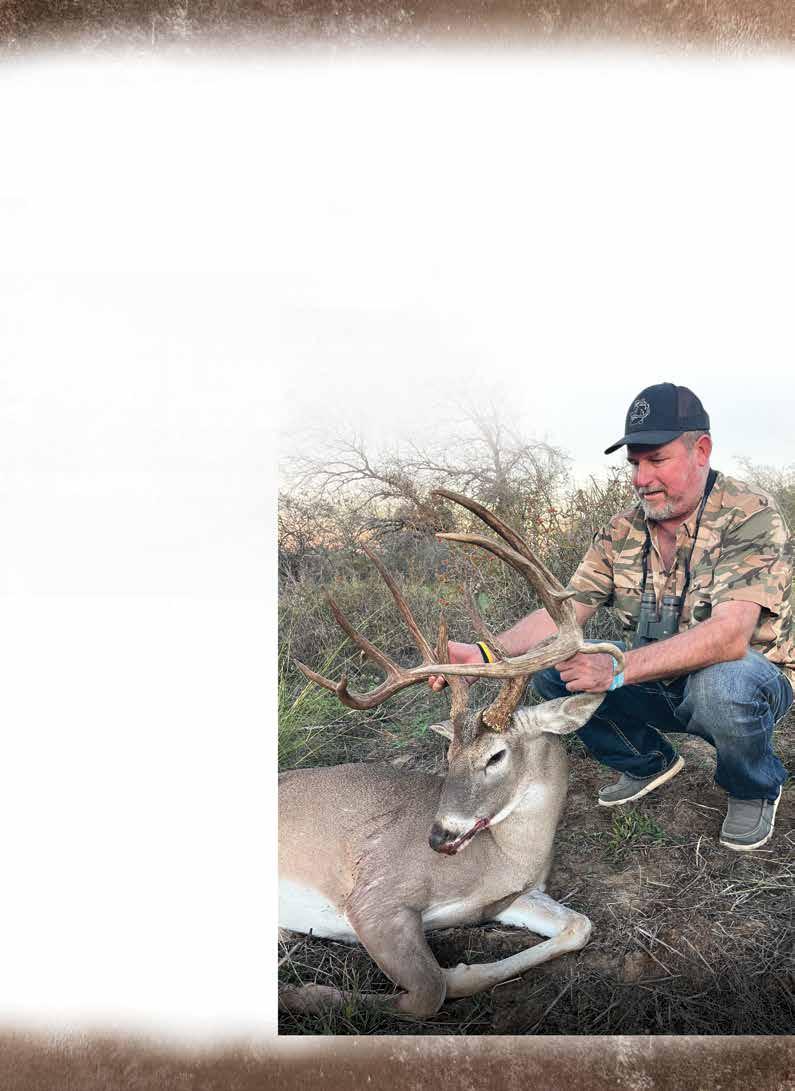
John was out of town for a couple of days but planned to hunt the buck when he returned. “It was already mid-December. The rut was on, and the bucks were moving, but their patterns were fairly unpredictable,” John said. “Ace accompanied me, and the first evening out we saw some great bucks, but not the one we were after,” John added.
The next morning, they returned to the ranch and went to the same blind located in an area the old buck was known to frequent. “We saw more of the same, but the big buck was a no show,” he said. Around midmorning they decided to call it quits and head in. On the way back they saw the big buck that had been eluding them. “He was chasing a doe in some motte country. He was an absolute giant deer and a sight to behold. He was working that doe like a cutting horse,” John said.
The buck and doe were several hundred yards away, so they quickly made a plan to get closer for a shot. The wise old buck was aware of their presence and on to their game. “Every time we tried to get closer, he would move out a little farther,” John said. The buck didn’t exactly want to the leave the doe, but wasn’t going to cooperate with the hunters either. “The cat and mouse game went on for a while before we finally decided to ease out and return in the evening,”
That evening they returned to the same blind. It was close to the area where they had seen the buck that morning. “We hoped the doe would come in to feed or maybe the buck would come by to check for does,” John said. As the afternoon wore on, their wish came true when the big buck skirted the brush line they had been watching. “The buck was briskly walking and obviously on a mission. It did not appear like he was planning to stick around.”
As the buck went behind a motte of brush and out of sight, John quickly eased his gun out the window of the blind and readied for the shot. A few seconds later the buck reappeared, still keeping up the pace. The sun was setting and turned everything a beautiful golden orange hue. Suddenly the old buck stopped and looked up the hill at the blind as if he knew he’d just made a grave mistake. It was pictureperfect moment that would be etched in the hunters’ minds for eternity.
Knowing it couldn’t get any better, John quickly settled the crosshairs on the buck. At a distance of about 175 yards, the buck went down instantly as the gunshot broke the silence of the evening. A quick celebration followed as they waited a few minutes to be sure the fallen trophy had expired.
“Thoughts were racing through my mind as we made our way to the buck,” John
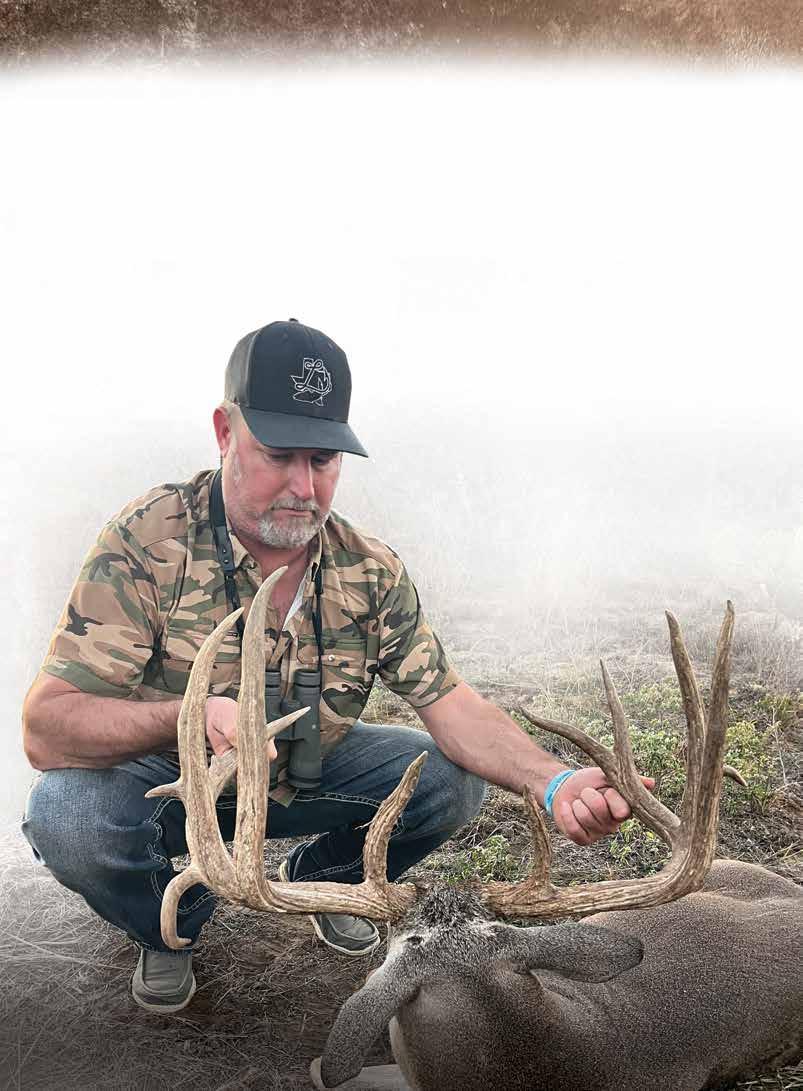
said. “I knew he was big, but everything happened so fast.” His anticipation grew and felt tense as they approached the downed buck. “When we got to him, I literally could not believe how big he was,” he said. “He was HUGE! I just knelt down beside him, grabbed his antlers, and admired him in amazement!”
The huge buck had excellent tine length including 9-inch brows and 15-inch G2s. Perhaps even more impressive was his huge frame with main beams just shy of 29 inches and almost 40 inches of mass. Additionally, the buck’s mainframe nine-point rack sported two kickers and a drop tine for added character. Simply put, John’s amazing buck had it all, and when everything was said and done, scored 203 4⁄8 gross.
With many years of hunting experience to his credit, John knew the kind of deer he had taken and offered a matter-of-fact explanation. “He is the buck of a lifetime and will certainly be hard to top,” he said, “but I love to hunt and look forward to the challenge of trying to best him. I just hope I don’t have to wait another 10 years.”





In the pre-dawn darkness, I climbed the steps of the elevated stand, assisted by my pocket flashlight, before 6 a.m. I used the light to load my rifle, hang my binoculars around my neck, and open the front and sidewindows. Then I fell back into the blackness of this early mid-December day. As predicted by my guide, Rusty, who just dropped me off, a coyote yodeled off to the northwest, answered by some yelping to the southeast. Twenty-five miles south of Uvalde, Texas, the mood was set for my first of three planned days of whitetail deer hunting. I settled into my chair and waited for daylight.
Out of my right-side window, the faint glow of dawn began to brighten the eastern sky. Many minutes passed and I began to discern the two senderos extending out in front of me. And then two dark forms took shape in the northwestern one, 40 yards out, and they seemed to jiggle or move in my binoculars—deer feeding. With time, I thought I glimpsed an antler on the edge of the larger mass. And then, too soon, before decent shooting light, the buck was gone. The other, a doe, remained.
Dawn came slowly, calm and partially overcast, about 50 degrees in temperature as I recall. I hoped to see more deer come out and eat the corn Rusty had poured out from the driver’s seat of his truck after dropping me off earlier in the dark. Two different spike bucks came out at different times in the next two hours. One walked a good ways in from the southeast. A fork horn also joined the doe.
Rusty had told me I could shoot a spike for meat or a mature buck, but not a forky. Just after 8, I gently stuck my rifle barrel out the right window and carefully leveled it at the spike’s chest 50 yards out on the northwestern sendero. Along the full breadth of that windowsill, I had a rock-solid rest. The deer looked up at my stand. I was tempted to shoot it for meat but held out. I wanted a bigger buck.
The deer drifted downrange. Three continued to feed intermittently in front of me at about 125 yards. I thought they’d be the only game I’d see that morning. I began to read the book I’d brought along in my rucksack on the bank-and-train-robbing history of the Dalton Gang in the early 1890s. Whenever I’m faced with the prospect of sitting in a deer blind for long hours, I always tote along a good book. It’s almost as important as my rifle. Suddenly, at exactly 8:45, a new development changed everything. A dark brown form dashed into the sendero, and it looked larger to my naked eye than the other three deer it joined. I grabbed my 15-power binoculars and instantly spotted five points on one side
of what seemed to be a symmetrical set of horns. It was just what I’d been waiting for.
I nearly panicked with pure, raw, wild excitement, jolted by a full slamming blast of adrenaline. In a mere split second, I was transformed into an entirely different hunter. That’s what big bucks suddenly appearing out of the blue can do to me.
Some decisions to shoot in hunting are dispassionate, debated, and slow in coming, but not this one. Somehow, I had the presence of mind to clamp my earmuffs on before seizing my rifle and aiming it out the right window again, but this time, with the speed of a man possessed. Yes, indeed, I was possessed. I had the burning desire to shoot this buck post haste.
I thrust my rifle firmly down along the right windowsill, slid off its safety and scrambled to find the animal in the 10-power riflescope. He must have heard me because he looked up at my blind when my crosshairs found his chest. I fired instantaneously. My rifle recoiled, and when it recovered, all four deer were gone.
I had a hunch they’d bolted east into the chaparral between the two senderos. But I saw no definite hide nor hair of any ungulate after the shot. The open ground in front of me became entirely devoid of game for the first time this morning.
Anxiously, I relived the shot, hastily hurling my rifle out the window to test the steadiness of its shooting rest. It seemed good, but nothing could
believed
the
rather hastily. He grappled with that feeling until his guide helped him track down the buck.
assuage the fact I’d reacted so furiously, engulfed as I was in 7 seconds of intense buck fever. I was drowning in self-doubt. Where once there was exhilaration, there was now angst.
I was distraught. I had fired too quickly. I heard no bullet hit. I was not sure where those four deer ran.
I convinced myself I had missed. I was so nervous, I ripped open my snack bag of corn nuts and chomped down on three different helpings in the next 15 minutes. I was too embarrassed to text or call my guide until I got down and looked for blood.
I climbed down and walked out and impetuously studied the ground, treading east between the two senderos, amongst the loose scrub, yucca plants, oak brush and scattered prickly pear cacti. No blood. Not a drop. I was despondent.
Any hope I had was fading fast. And in its place, heartbreak and despair. Reluctantly and gloomily, I texted Rusty, “I just shot at a 10-pointer. Come over.”
When he got there, he took one look at my long, drawn face and sensed my grief. I felt stupid telling him I thought the big buck ran east, because I really didn’t know for sure. I was certain we’d be looking for this deer the rest of the day.
But Rusty was unruffled. He’d been guiding me for nearly 10 years now and we have killed and found many deer together. I took him down the northwestern sendero and we cut east again based on my best guess. Less than two minutes later, and 40 yards away, Rusty howled out, “There he is!”
Out in the open, near the edge of the northeastern sendero lay my buck. Stone dead. Fully manifest. A vision of grandeur.
The feeling seized me, shook me, and shocked me. It was incredulous! I dashed over to the buck’s side. The great lump of woe growing within my throat disappeared.
I was beside myself with joy, excitement and relief. I shook Rusty’s hand most earnestly and enthusiastically. I could not be subdued. Without question, this was the high-water mark of my Texas whitetail deer hunt.
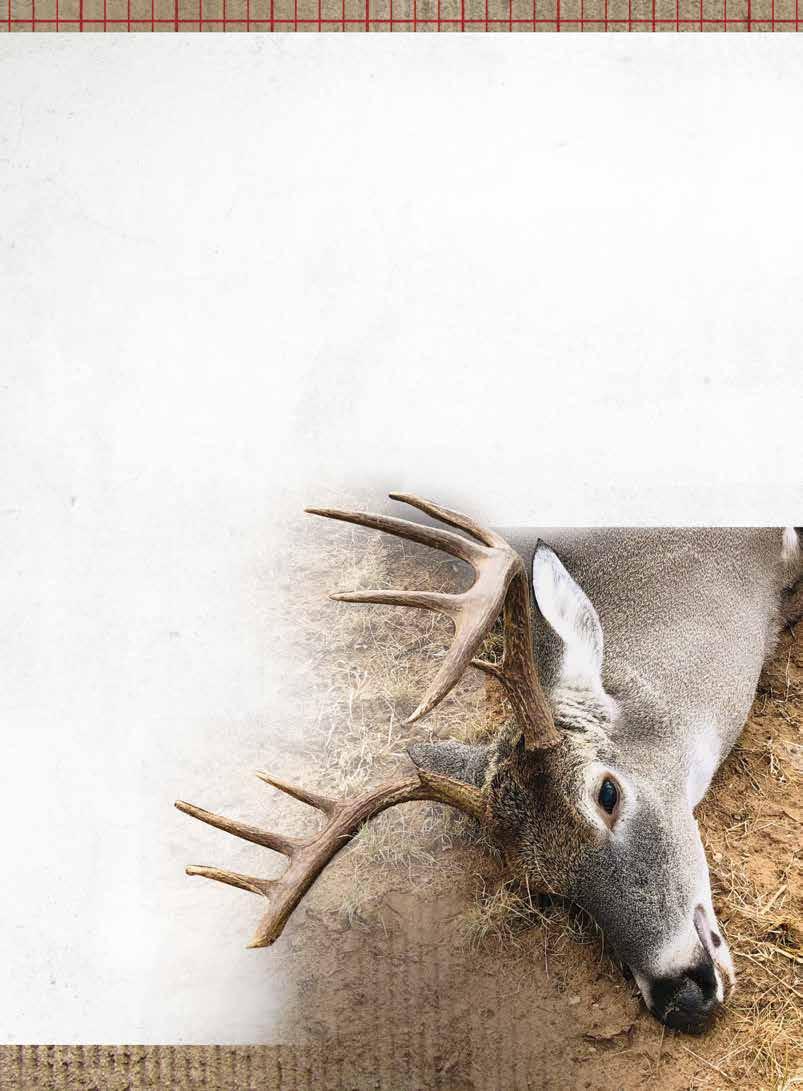
The buck was exactly as I had imagined from my snapshot glimpse of him through my binoculars right before my headlong shot. A 19-inch wide, perfectly symmetrical, South Texas 10-point buck, cleanly killed, with an estimated live weight, according to Rusty, close to 190 pounds. I was extremely pleased with this deer.
After cell phone pictures, Rusty eviscerated the buck and discovered my bullet had center punched its heart. I poked
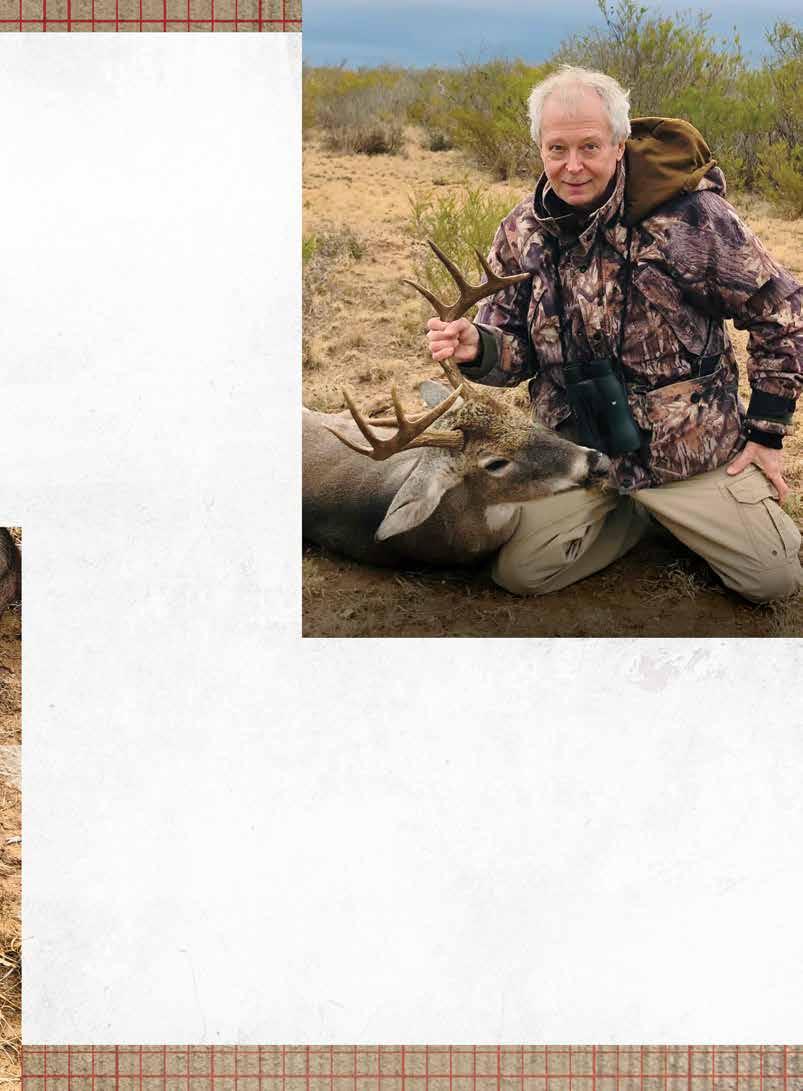
my finger into that vital organ and found the hole’s diameter matched my index finger’s thickness. What a profound revelation to go from fearing I had missed and lost this fine buck, to finding it dead, shot through the heart, a half-hour later.
Things had gone from being Friday the 13th for me, to being Friday the 13th for the deer. It had been quite an eventful morning, and a particularly emotional one for me. Hunting takes me places like nothing else on Earth.



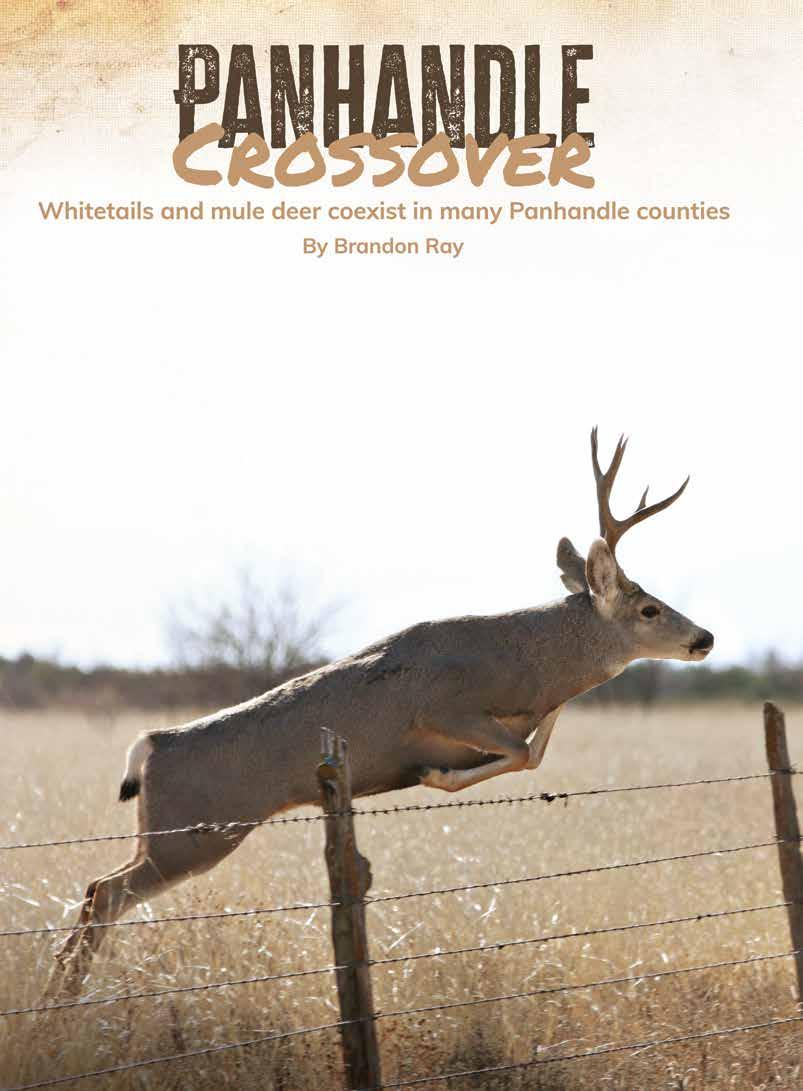
Not far from the muddy banks of the Canadian River, my spotting scope found a fine buck. I spied on him from an elevated bluff 600 yards away. Through the clear lens, I counted 12 typical points. The rack was 150 inches or better. The big-bodied whitetail stood near a corn feeder, under the canopy of an ancient cottonwood tree. Bow season had just started, and my friend waited on the right wind direction to hunt that creek drainage. With 20 minutes of daylight remaining, we backed out and drove back to the ranch headquarters.
As we crossed rolling, steep ravines dotted with mesquites and cholla cactus, a small herd of mule deer trotted out from one of those ravines. They stopped on the far side of the draw to look back. In the herd was a typical 10-point. His back forks were like giant sling shots, the front forks like crab-claws. His antlers were wide, spreading past his ears. I guessed his rack would score 160 inches. As daylight faded, the herd bounced like pogo sticks over the far ridge.
Encounters like that one in the northwestern Panhandle, seeing both deer species on the same afternoon, are what make hunting at the top of Texas so unique. The two species overlap in many Panhandle counties, although each deer species prefers slightly different habitat. Whitetail numbers are highest in the eastern counties and the further west you go the more likely you are to find mule deer. I asked Texas Parks and Wildlife Department biologist Shawn Gray for his insight on the overlapping range of whitetails and mule deer in the Panhandle.
“It used to be more on the eastern side of the Panhandle where the two species overlapped,” he
said, “but there are observations of white-tailed deer all over the Panhandle now. So, I would say the range overlaps across the entire Panhandle. Mule deer prefer more open country, a brush density of over 33% is generally not used by mule deer. In contrast, white-tailed deer are better suited to thicker brush densities.
“In broad terms, white-tailed deer will mostly be found in bottoms and drainages, while mule deer prefer the more open hilly topography, but you can find either in all habitat types in the Panhandle, just not as often as what they really prefer. Surveys from this past winter indicate an increasing trend in mule deer numbers, which is a very welcome change. White-tailed deer are also on an increasing trend. The main contributing factor to increasing white-tailed deer range across the Panhandle, is the impact of brush encroachment.
“Again, too much brush is better for white-tailed deer and
at 6½ years
significantly reduces the habitat quality for mule deer. Habitat is always the key. Obviously, they do interbreed, but it is uncommon. We recently conducted a mule deer DNA research project that spanned from the Trans-Pecos and Panhandle, we documented only 5% of interbreeding with white-tailed deer.”
There’s a location in the central Panhandle that I’ve hunted for 30 years. It’s a windmill surrounded by flat prairie dotted with a few mesquites and cedars. South of the windmill is a steep, brushy canyon with oak brush and mountain mahogany. For many years that location was a prime mule deer-only area. However, over the past 10 years, it has slowly started to include sightings of whitetails. And in the past five years, almost every time I hunt there, I see at least a couple of whitetails. What has changed? Over the past decade the brush on the flat area has significantly increased.
Thirty years ago, it had a 10-20% brush density around the windmill. Today, it’s probably 30-50% brush, therefore favoring whitetails. The mesquites were recently sprayed with Sendero herbicide, which should open the landscape and eventually make the habitat more appealing to mule deer again. Mesquite removal also benefits cattle grazing. In many locations a ranch manager must decide, “Do I want this area more favorable for whitetails or mule deer?”
Whatever county you hunt, know the season dates and antler restrictions for both species. Research season dates on the TPWD website. Since you might be looking for a big whitetail, but instead encounter a trophy-sized mule deer, be sure it is legal to shoot. For many Panhandle counties, there are now antler restrictions on mule deer to improve trophy quality.
Current counties included in the antler restrictions are Andrews, Armstrong, Bailey, Briscoe, Castro, Childress, Cochran, Collingsworth, Cottle, Dawson, Donley, Floyd, Foard, Gaines, Hale, Hall, Hardeman, Hockley, Lamb, Lynn, Lubbock, Martin, Motley, Parmer, Randall, Swisher, Terry, Terrell, and Yoakum
counties. A legal buck deer is defined as a buck with an outside antler spread of the main beams of 20 inches or greater. Mule deer antler restrictions do not apply to MLDP properties. Also, mule deer antler restrictions do not apply within any CWD zone.
Last fall, my daughter, Emma Ray, hunted a special Panhandle buck. For many years we watched that whitetail grow and evade us. He lived in classic Panhandle whitetail habitat; a river bottom flanked by mature cottonwood trees with mesquites and cedars in the surrounding flats. On that creek bottom, we rarely saw a mule deer.
Going into the 2024 season, Emma and I collected nine sheds from the old buck we called “Longhorn,” including a matched set from the previous year. He earned the nickname from his oddball rack that was always a big six-point with extra points around both bases. We jokingly said he looked like he was a crossbreed with one of the stray longhorn cattle that roamed that river drainage. Despite multiple attempts over the years to harvest that buck, we only had one previous close call.
In the fall of 2021, Longhorn came within 20 yards of our brush blind on a quiet evening in November. Emma was hunting with a crossbow. When she clicked the safety off, the smart buck heard the metallic “click” and bolted for the creek. He was no dummy!
It was our fourth sit in the creek bottom blind of the 2024 season when Longhorn finally made a mistake. At sunset, the old buck approached our blind in the company of two does. Broadside at 20 yards, Emma steadied her Browning .243 rifle over forked shooting sticks. She squeezed the trigger; the hit was solid.
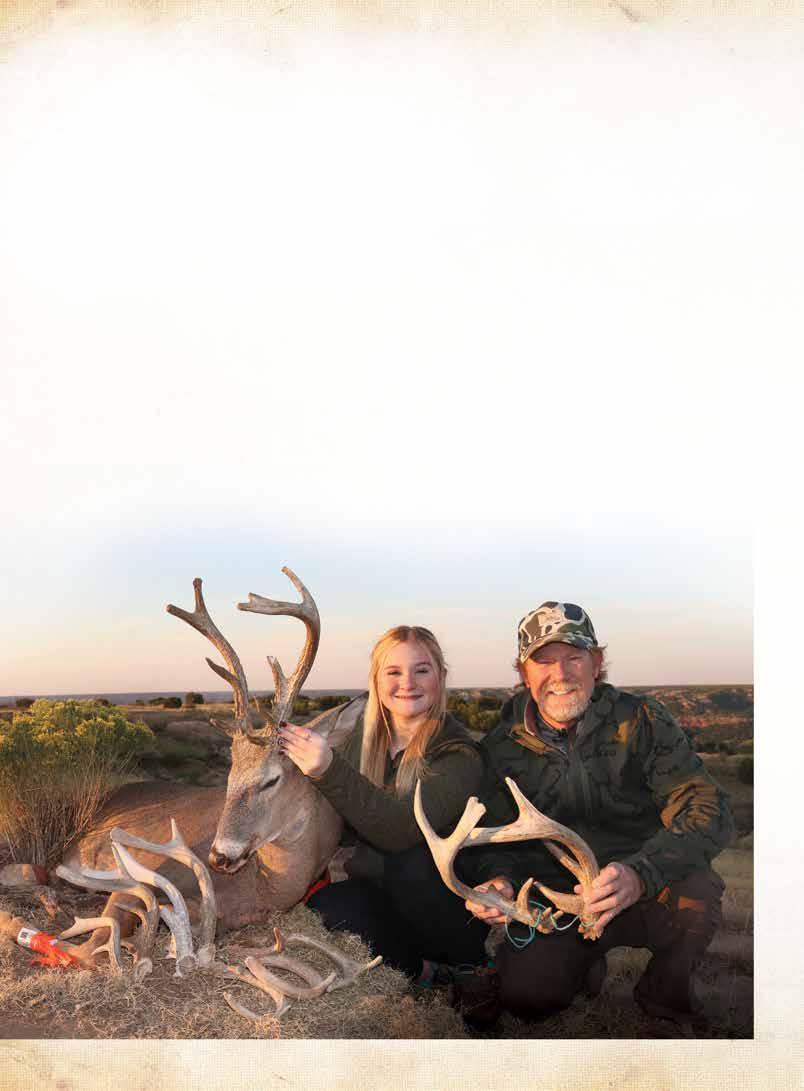
Brandon and his daughter, Emma Ray, with Emma’s 2024 Texas buck. Many years of history made finally taking the 9½-year-old buck “Longhorn” extra special.
The following are the top three TBGA entries for typical and non-typical whitetails and mule deer from the Panhandle, Region 2, for the 2024 season. Over the past ten years, the top whitetails have usually come from the eastern counties and the top mule deer entries are usually from the southwestern counties. Look close at the numbers. These entries represent bucks as big as you might find anywhere in North America.
Typical Whitetail Hunter’s
J
Non-Typical Whitetail
Typical Mule Deer
Non-Typical Mule Deer
Hunter’s
Longhorn trotted 30 yards and tipped over. The old Panhandle buck’s back teeth were worn smooth as glass. Going off tooth wear and all the trail camera images we cataloged of him over many years, we estimated his age at 9½ years old. His rack carried 11 points.
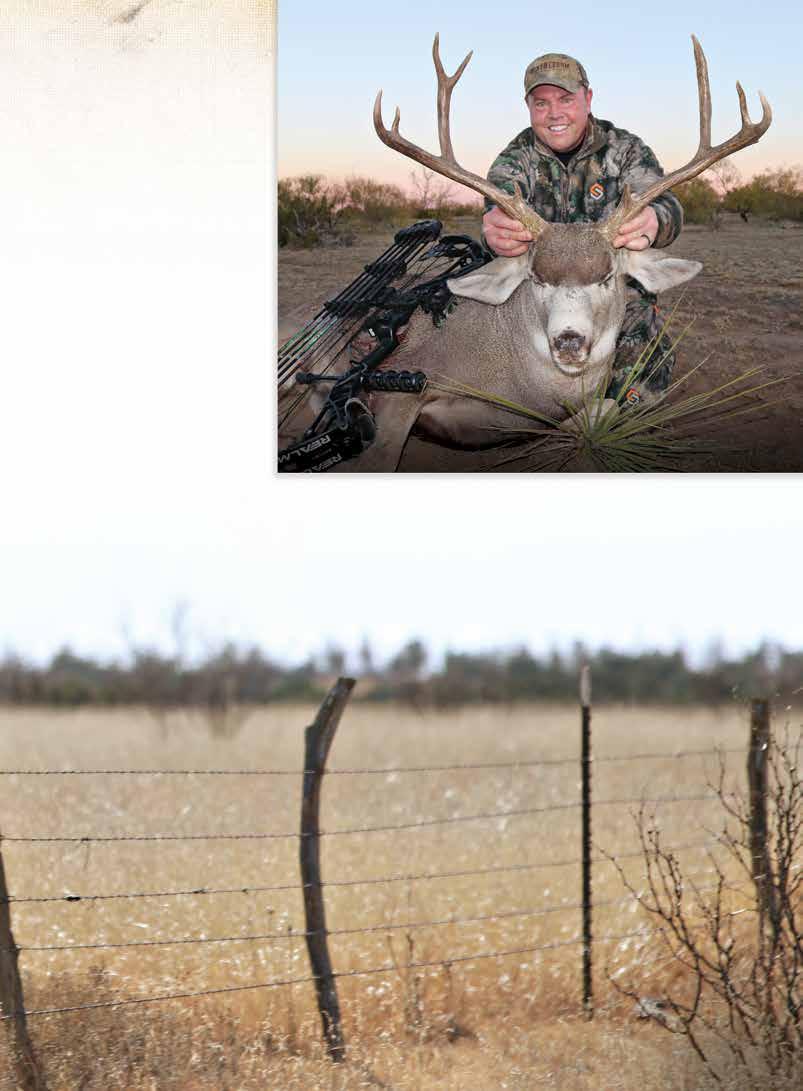
Jeff Kelley’s focus for the 2024 season was a quality mule deer buck. Hunting in crossover country in the Panhandle, he saw both whitetails and mule deer, but a wide nine-point he’d seen the year before was his target. The buck was big-bodied with a distinctive, wide-antlered rack with short forks. A faint double throat patch also made the buck easy to identify from one year to the next.
It was during the early stages of the rut, Dec. 1 to be exact, when Jeff got his chance. Hunting from a pop-up blind near a feed station, the mature buck strolled within range at sunset following several mulie does. Jeff steadied his Bowtech bow and fired an arrow perfectly through the broadside deer’s heart. The big buck trotted a short 60 yards and tipped over. The bull-necked mule deer weighed an estimated 250 pounds live weight. The deer’s rack was 27 inches wide at its widest point and aged at 6½ years old.
The Texas Panhandle is home to more than just tumbleweeds and jackrabbits. Over the past 10 years, whitetails have expanded their range, mostly due to brush invasion. Whether you prefer hunting whitetails or hunting mule deer, trophy quality is excellent in this sometimesoverlooked region of Texas.
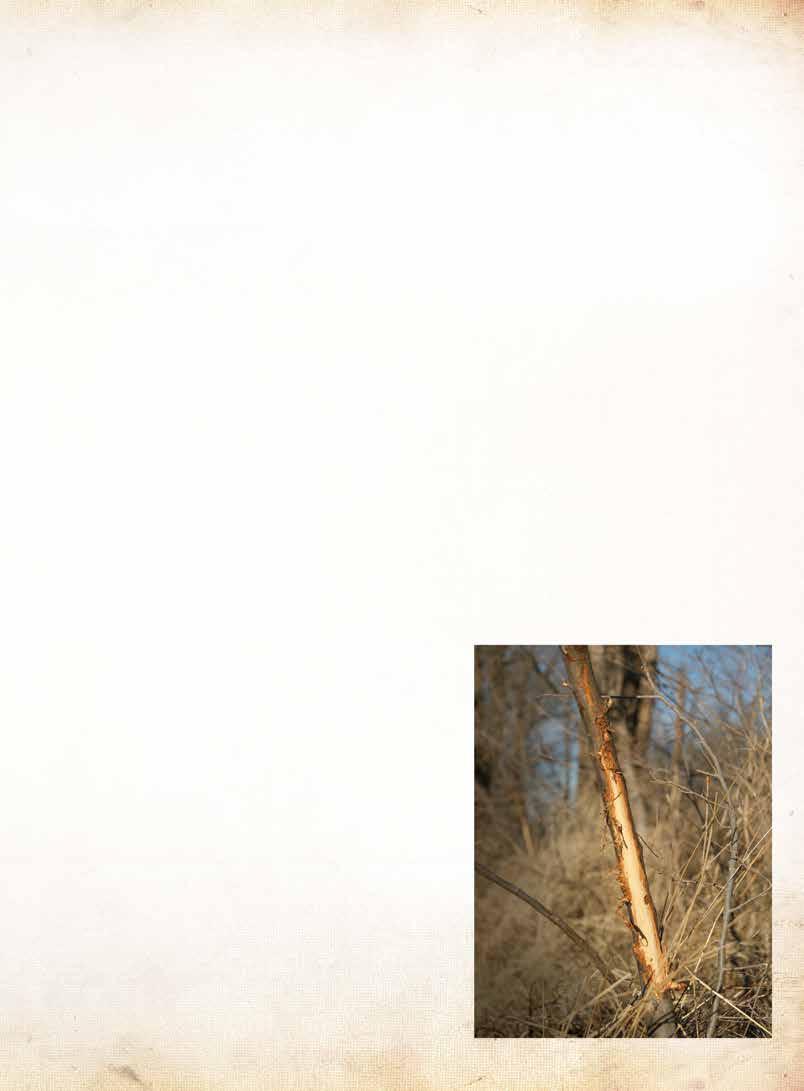
A fresh rub in the Panhandle. In many locations, unless you see the deer make the rub, you don’t know if it was made by a whitetail or a mule deer.

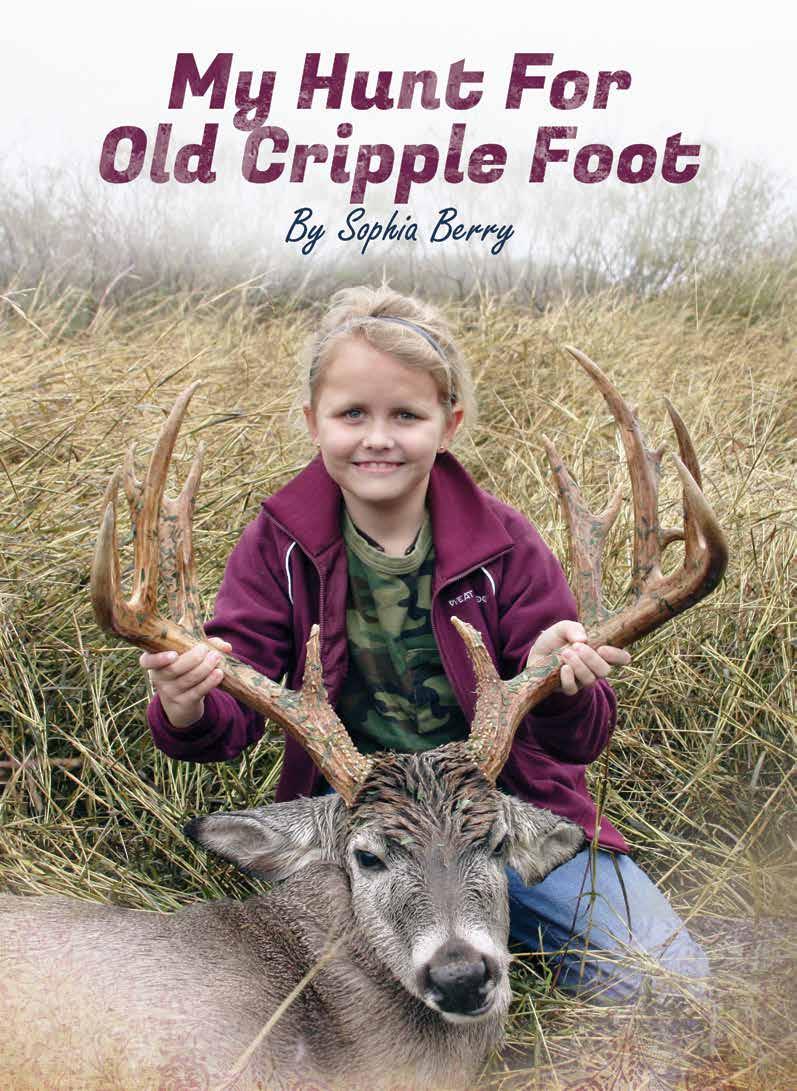

Editor’s note: This cover story appeared in our May/June 2010 edition.
My deer hunt started months before I killed the buck we’d call “Cripple Foot.” I asked my dad if he had seen a buck with 16 points that I could shoot this year. I wanted a buck with antlers over 15 points because one of my friends had killed a 15-point.
One day in November, Dad said he might have seen a deer for me to hunt, but there was one problem; he had 18 to 20 points. I told him that was no problem. Dad said we called him Cripple Foot because he was injured years ago in a fight and has favored his right foot ever since. Dad said he was very old now. He always had a 10-point rack, but with old age he had added kickers to his tines, giving him a lot more points.
We first tried to hunt Cripple Foot from a blind, but had no luck. We hunted from the blind about four or five times. It seems he did not like the corn we put out. We saw some other bucks, but my dad said I should be patient and keep hunting for Cripple Foot. So, I passed on buck after buck after buck.
On the day I shot my deer, I got up early, about 5:30 or so, and got dressed in my camo shirt over my brown long sleeved shirt with my jeans and boots. When I got downstairs I met Dad by the front door and Mom handed me my jacket and said, “Good luck,” as she hugged me goodbye. Dad and I got in his truck and headed off. We picked up breakfast on the way to our ranch.
It was cold and drizzling and my dad said it was a good day to find Cripple Foot. My dad said that we would be hunting out of the truck. I really prefer to hunt out of a blind. When I
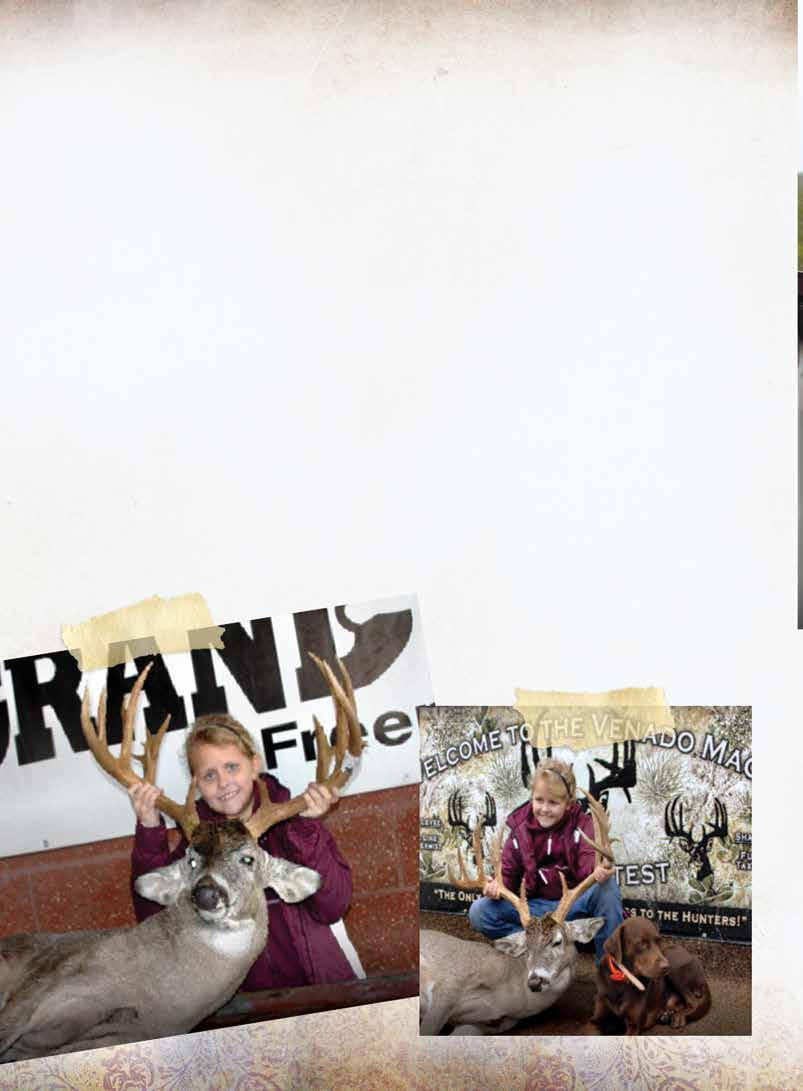
killed my first buck two years ago, we hunted out of a blind. It was easier to rest the gun on the window and the deer are not scared, which gives you more time for the shot. My first buck was a 29½-inch nine-point. Dad said Cripple Foot would be even bigger.
When we got there we met up with Mr. Hubbard and his son Colton. While Mr. Hubbard and Dad got the corn feeder ready for our hunt, Colton and I talked about school, because we go to the same one. When my dad was ready, he showed me how to shoot a gun out of a truck because I had never done that before. I would be shooting a .243 Winchester.
This was the same gun I shot my first deer with two years before. I borrowed it from Dad’s friend, Mr. Ward. The stock had been cut off with a hacksaw and there was a soft pad on the butt of the gun. I felt comfortable with it and was ready to go hunting. Dad showed me how to place the gun on the mirror of the door and then we were ready.
I had shot this .243 only one time when I killed the wide nine-point when I was 9 years old. All of my other shooting was with a pellet gun and one of Dad’s .22 rifles.
We went into the pasture and started looking for Cripple Foot. My dad gave us a description of a buck that was with Cripple Foot and some does the evening before. Colton spotted that buck and then we saw the does. We parked the truck and waited for Cripple Foot to show himself. And he did.
When the big buck got close enough, I looked in the scope and my dad asked me, “Can you see anything?” I said, “I can see the white spot on his neck.” Then he told me to shoot. When I did, I blinked and my dad shut his eyes. When the gun smoke cleared, I saw that Cripple Foot had disappeared.
As my dad opened his eyes, he said, “Did you get him?” Mr. Hubbard, Colton, and I laughed and said he was down and then they all congratulated me. When I first saw the deer on the ground I could not believe my eyes. My dad said he was much bigger than the 175 inches that he had expected. I didn’t
know about that but I quickly counted 18 points and was very excited.
After that my dad took some pictures and told me that this deer was 11 years old, just about one month older than me. Then we said goodbye to Mr. Hubbard and Colton and headed home to show Mom the deer. She was so proud of me when she
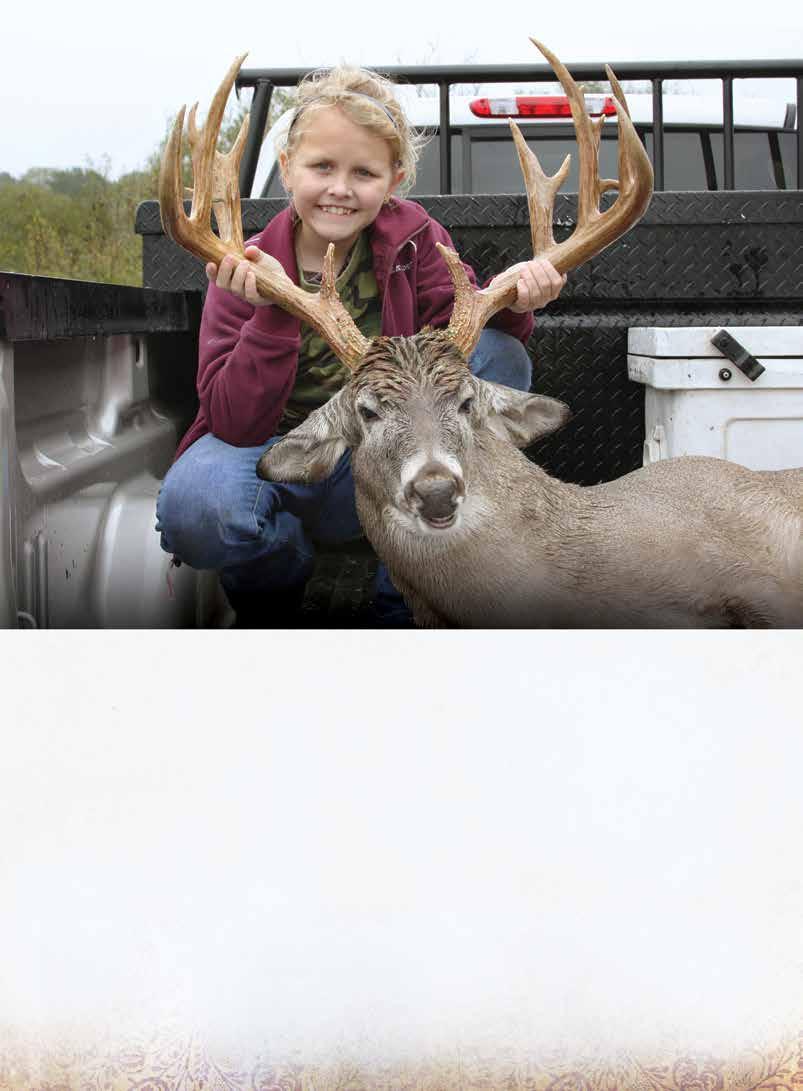
a big buck. She had signed me up earlier in the year for the Muy Grande and made sure we were heading to Freer to enter my deer.
I wanted a buck with antlers over 15 points because one of my friends had killed a 15-point. One day in November, Dad said he might have seen a deer for me to hunt, but there was one problem; he had 18 to 20 points. I told him that was no problem.
saw Cripple Foot in the back of the truck, but not surprised. She said she knew I could do it.
We then left to find my Mammaw, Laura Berry. She really loves to hunt and had already entered a deer in the Muy Grande Deer Contest and won second in overall. She was so happy for me and kept hugging me and congratulated me for getting such
My uncle Roy joined us and we headed off to Freer. When we got there we went to the Muy Grande headquarters. They scored my deer and he ended up scoring 190. I answered lots of questions from other hunters and even let some of them take pictures with my buck. It’s funny how a big deer can make people so friendly. So far, I was in first place in the youth division. We left to go to another contest called Freer Deer Camp where my deer also scored first place.
When we were through in Freer, we left for Kingsville to go by Hibler’s Taxidermy and drop my deer off to be mounted before we headed home. What a day! I can’t wait for next year. Maybe we will get the chance to make the same trip again with a bigger buck!



“Come look!” came loud whispered words from the dining room. “Oh my gosh! Look at this buck!”
Have you ever experienced hearing those words coming from someone standing at a window in your house? Or perhaps you’re standing in the yard and suddenly you see a whitetail buck staring back at you. It’s also possible, depending on where you live, to see an axis, blackbuck, or any number of exotic animal species now free ranging across many areas of Texas.
It’s especially exciting when you most certainly were not expecting to see one. And it can be equally exciting IF you’re in an area where perhaps you may kill the buck legally and safely
A backyard buck refers to one that’s literally in the backyard of your property. It may be outside the house on a city lot surrounded by other homes. Or standing near the lodge, cabin or RV camp area on a 10,000-acre ranch. It could show up anywhere in between, whether a busy suburb or remote rural country but still inside what’s considered the yard area.
Backyard bucks and does can often be creatures of habit due to the three things they need most: food, water, and shelter. They are also capable of adapting however they need for survival. Most city and urban areas have green belt areas for a variety of reasons with one being for the
benefit of wildlife. Deer adjust to these quickly.
Texas has no state law regarding the amount of acreage required to legally hunt. However, in 1933, a law was passed allowing each county to prohibit hunting on lots or acreage less than 10 acres in unincorporated areas of the county in a subdivision. A subdivision being defined as any land tract previously part of a larger tract. Contact your county government to ask about any restrictive ordinance. Some counties or developments require owning 10.1 acres to legally hunt. Shooting may also be regulated to archery only.
Ordinances are enforced by sheriff departments, not state game wardens. Be aware there are laws about projectiles crossing property lines. Your bullet or arrow cannot cross a property line without landowner permission which is best to have in writing before hunting. It is also illegal to shoot toward a residence.
A wounded animal or bird cannot be legally pursued onto
neighboring property without landowner permission. A game warden cannot authorize it, only the landowner can. Trespassing laws come into effect as well as potential criminal negligence with possibly other violations. Know your game laws. Use common sense and always keep safety in mind.
Many towns and cities have deer and exotic populations living among thousands of humans, pets, vehicles, and skyscrapers. It can be amazing, and quite tempting when it’s a trophy animal.
Every year, game wardens check out reports of a subdivision or park’s “pet” buck, suddenly missing from its normal routine. It may have been found dead or headless with reports of possibly “who done it.”
Social media plays a big role in helping solve cases due to photos posted of outstanding live backyard bucks. Some may say exactly where the buck is located. When found dead, reported missing, or rumors abound of someone taking it, game wardens often check the internet. A posted trophy kill photo may easily match live deer pictures. The same applies to game wardens checking local taxidermists with good photos.
As stated earlier, backyard bucks may be on small or large acreage. One may be known to all residents or park visitors, especially if someone is feeding them. Tom, a New Braunfels homeowner on a quarteracre, lines his driveway daily with protein feed just to watch the deer.
For three years now, an awesome 12-pointer has been a regular visitor. Tom and the neighbors landscaped with greenery deer don’t find palatable, thus he feeds to enjoy seeing and helping sustain the deer in his tight urban suburb. He’d like to put it on his wall but cannot legally do so.
A huge 3,200-acre Brazoria County development hosts an over abundant deer population. It’s not unusual to see 50 or more whitetails grazing or bedded anywhere on the property year-round. During deer season, homeowners may take backyard bucks and
does using bows only on their own property in an effort to help control deer numbers.
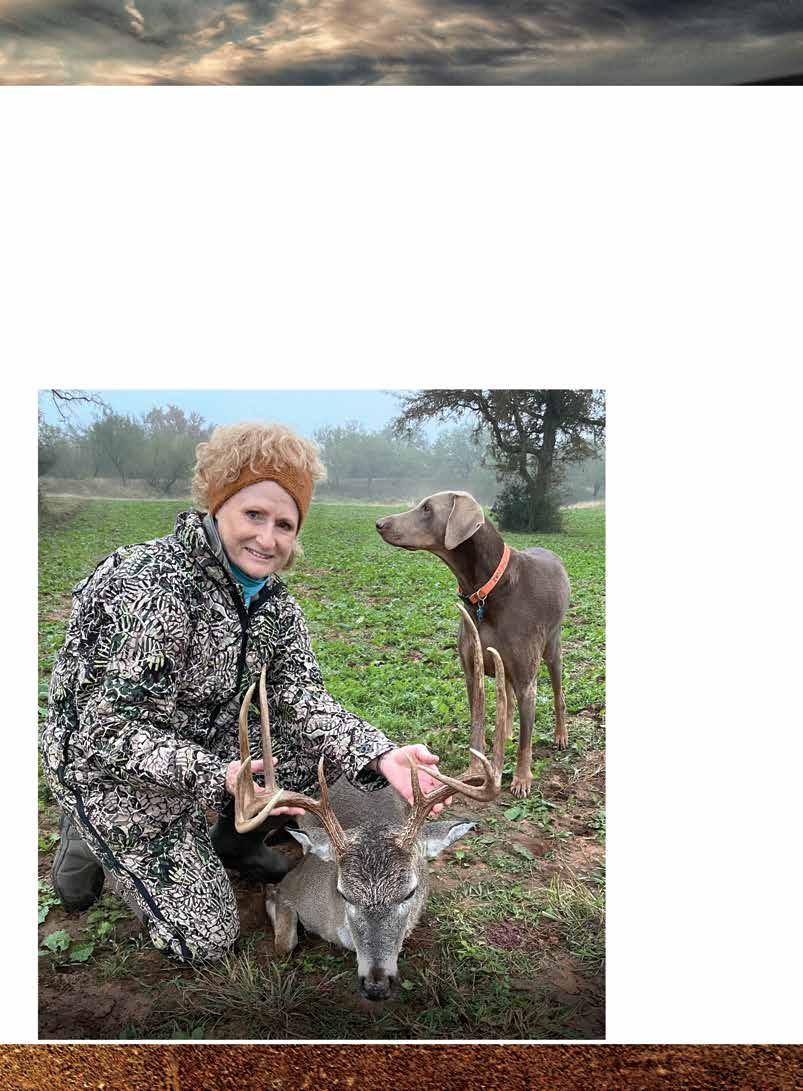
Veteran huntress Laura Berry was playing cards with a friend when a massive antlered buck appeared outside the ranch house. Berry was quick to get her rifle and add the buck to her always growing trophy room.
Jack and Johnice Anderson live on the Lakeway Air Park runway with no fencing. It’s not uncommon to see whitetail bucks and does in their backyard, as the deer are accustomed to airplane noise. In residing there for 34 years, few deer airplane incidents have occurred. Jack once landed on a deer, resulting in some damage to his plane, but the buck ran off apparently unscathed.
Val Verde County’s Riley family lives near the Devil’s River on a small tract. Mom Allison took a nice aoudad off the back porch. Dad Shon and two sons Jax and Sawyer have all taken backyard bucks while youngest son Ridge has hopes for one this season.
After years spent on a South Texas hunting lease, Charles Brookhouser took his best buck in his own backyard outside Van Vleck. He never expected to see a buck at his house worth shooting and mounting. The heavy typical 10-pointer sported an extra 5-inch tine straight off the main beam, more of a side tine than drop tine. His grandsons have benefited often hunting Charles’ 10 acres for both deer and varmints.
This writer took a nice typical 10-point on our Mills County 38 acres after seeing it several times from inside the house. It was dubbed the “Bedroom Window Buck” and featured in the July/August 2023 issue of The Journal. With binoculars at every window, my husband and I check feeders and look across the
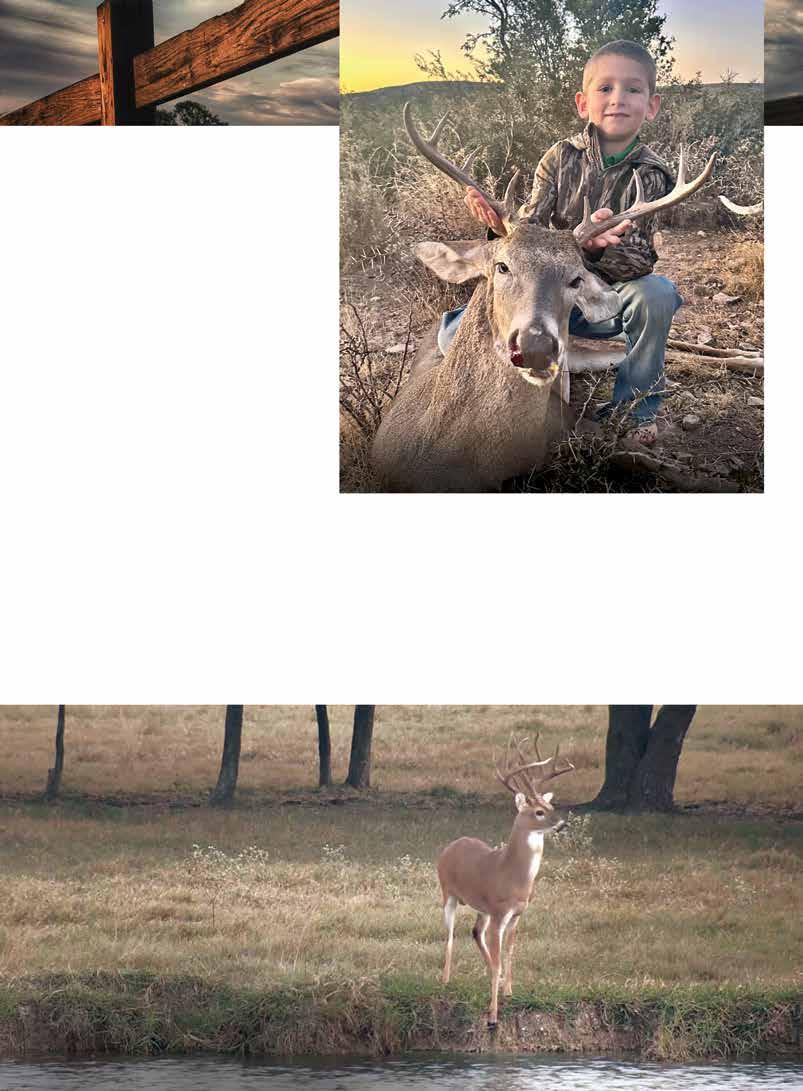
This fine antlered backyard buck with kickers was well known in a rural Victoria County subdivision. Last season, a neighbor put it on his wall.
at deer and other wildlife all year long.
Backyard bucks, does, and even exotics, may be right in your backyard. Know your state game laws regarding legal hunting regulations. Be sure to check your county as well as your homeowners or property owners’ associations for ordinances and restrictions. Keep safety in mind at all times.
It’s also wise to know your surrounding neighbors in case you have a wounded animal. Remember, practice makes perfect for expert marksmanship for a quick, drop-in-their-tracks kill and no blood trailing. Keep your eyes open because you never know if a backyard buck might appear.

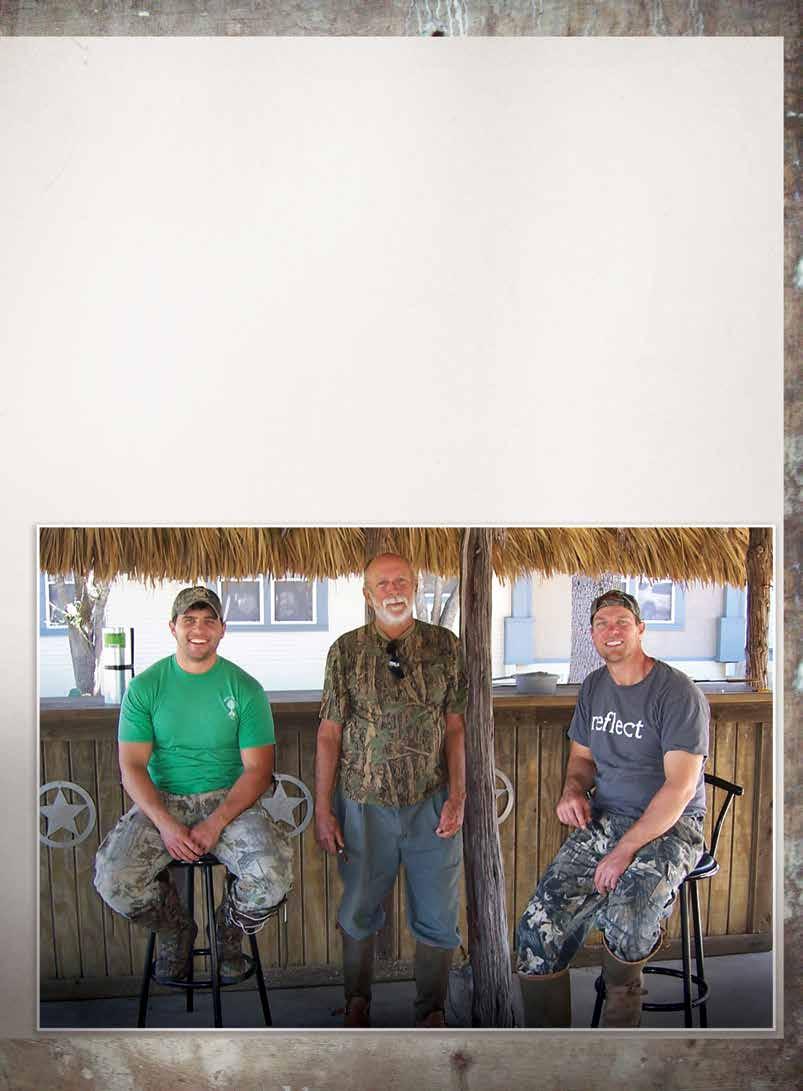
Igot my buck on the evening of Jan. 9, 2025, but the journey towards it began nearly 20 years ago when I met a friend named Larry. Larry and I were a part of the same church in Bradenton, Florida, and though there’s a gap in age, our love for God and the outdoors brought us together. Larry invited me to join him on a hunt at his brother’s ranch in South Texas. Having read about Texas hunting, I dreamed of experiencing it firsthand and assumed this bucket list hunt would be accomplished in retirement.
Little did I know this once-in-a-lifetime trip would happen in my early twenties and then become an annual hunt for close to two decades now. While I thought moving to Florida to become a youth pastor meant sacrificing my desire to hunt, it led to some of the best hunting and finest experiences of my adult life. To this day, that sandy soil in the South Texas brush country serves as a reminder of God’s goodness and the generosity of His people.
For many years, the focus has been on hogs, coyotes, does, and wily, old eight-point bucks. Finding a deer with those iconic chocolate-colored antlers, distinctive to South Texas, has been deeply satisfying. Over the years, my longtime friend Andy and I have made it a goal to find a unique management buck together, and we’ve made some great memories along the way.
Going into the hunt this year, Larry shared with Andy and me that one of us would have the opportunity to pursue a trophy buck. Knowing there were some nice bucks on the
ranch, Larry’s request was that the buck be special and, if possible, 160 inches or bigger. The ranch certainly has impressive deer, but with limited time and intel, seeing it all come together would be no small task.
With a desire to each have an opportunity, the plan was one hunter would have the tag for 24 hours, and then it would go to the other man. Without a coin to flip, we had to guess the number Larry had in his head, either 1 or 2. Andy picked and guessed correctly with lucky number 2. This meant the tag was his for the first evening, and the next day, would switch hands at lunch. J.B., the ranch manager, planned to hunt with whoever had the tag, which was a special experience because he’s knowledgeable about wildlife, habitat, and is an all-around great guy.
Several nice deer were seen in the first couple of hunts, and one buck in particular had Andy’s attention. With Andy electing to pass, the tag became mine for the next 24 hours.
J.B. and I hunted from one of my favorite blinds, and we saw a deer that would have looked good on anyone’s wall, but we agreed this buck needed another year or two to reach maturity.
The tag went back to Andy at lunch, and he and J.B. encountered a number of impressive bucks over the next 24 hours. Knowing an opportunity like this was rare, and considering Larry’s request, we had just not seen the right buck yet. At lunch, Andy gave me a high five, symbolizing the official transfer of the tag for the remainder of the hunt.
With less than 24 hours left, and a storm blowing in, the pressure was on.
Earlier that morning, while Andy and J.B. were hunting, I saw a mature deer with long main beams and 13 main frame points on the north end of the ranch. Desiring to get a better look, J.B. and I decided we would head out early after lunch with the hope the buck was still in the area. After getting settled in, a few younger deer appeared in the misty rain. The cloudy afternoon headed toward evening, and with it, brought a few more deer.
Movement caught our eye to the south, and I quickly knew it was the buck. The long beams and extra points made him easy to identify from a couple hundred yards as he walked through the mesquite. Immediately, I could feel the intense heart pounding. As J.B. focused on getting a good look at him, the deer quickly moved out of sight. Knowing he was the kind of deer we were after, I wondered if I just missed my opportunity as the deer disappeared.
After a while, we spotted the buck sneaking his way through the mesquite, once again, not presenting a shot opportunity. Seeing where he was headed, J.B. coached me to stay focused on a sendero to the west. Eventually, the buck stepped onto an opening within 150 yards. I steadied the Tikka .30-06 and flipped the safety off.
Just before pulling the trigger, the deer turned, presenting a less-than-ideal shot. Flipping on the safety, I focused on my breathing and tried to settle the “big buck shakes” coursing through my body. This happened five other times. The buck would present a shot, so I would flip the safety off, and just before the shot, he would turn, and the safety would go back on.
Finally, a flock of sandhill cranes flew overhead. The noise of the birds spooked the buck and caused him to take the needed step, and the Tikka sounded off. The buck jolted and headed into the tall grass and mesquite. While it was disappointing he didn’t drop in his tracks, I was confident in the shot and prayed he did not run far.
The moments after the shot are a mixture of celebration, adrenaline, analyzing, and waiting. Even though I’ve had the privilege of killing a number of deer, I still get the shakes, and to share that moment with a friend is a special
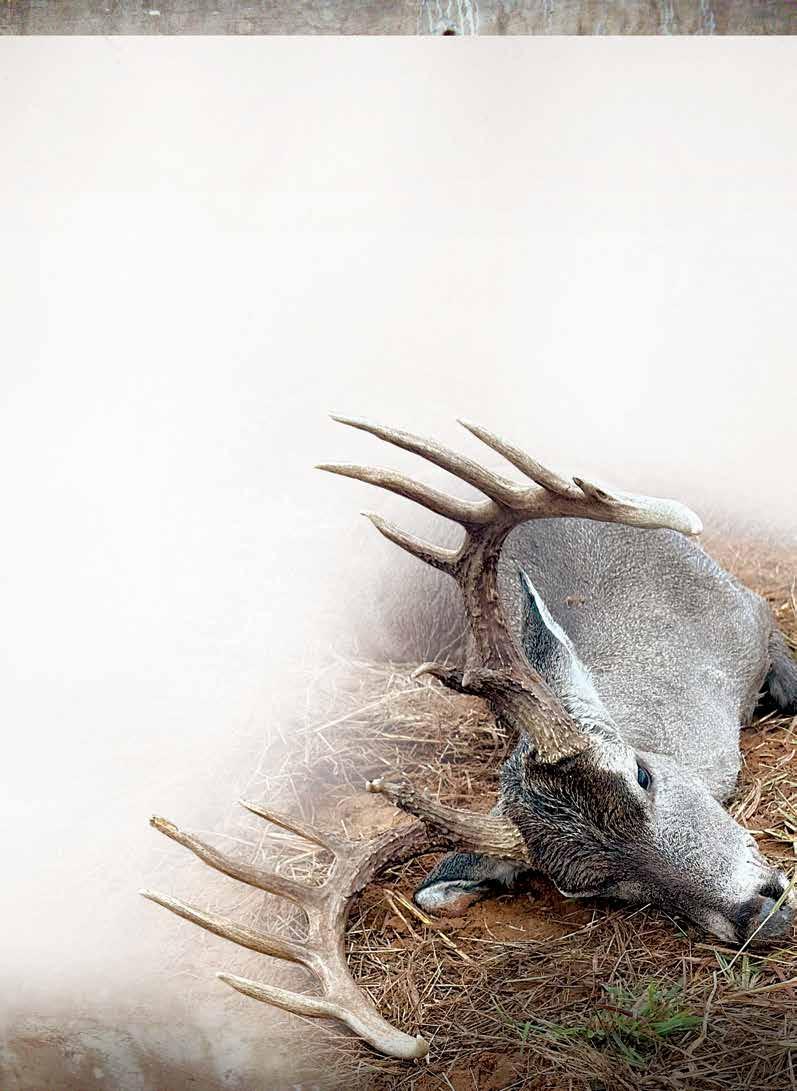
experience. J.B. and I laughed at how many times the safety was flipped and I’m confident he could hear my heart beating out of my chest. Eventually, we made our way down the sendero to look for the deer, and thankfully, we found the buck only 50 yards away in the brush.
J.B. and I celebrated. and quickly called Larry and Andy, who were on other parts of the ranch, to share the news. Andy, who was naturally disappointed not to fill the tag earlier, was quick to celebrate with me, revealing the depth of his character and the quality of our friendship. In fact, he insisted J.B. and I come and get him so he could be a part of the experience. After capturing some pictures, we headed back to celebrate with the others at camp.
The night was capped off with a table full of grown men who have mutual respect for one another, sharing a passion for hunting, God, and enjoying one of the best meals of the hunt, J.B.’s famous smoked brisket. The 7.5-year-old buck ended up having 14 points and scored 1624⁄8 inches. As Larry says, “I love it when a plan comes together!”

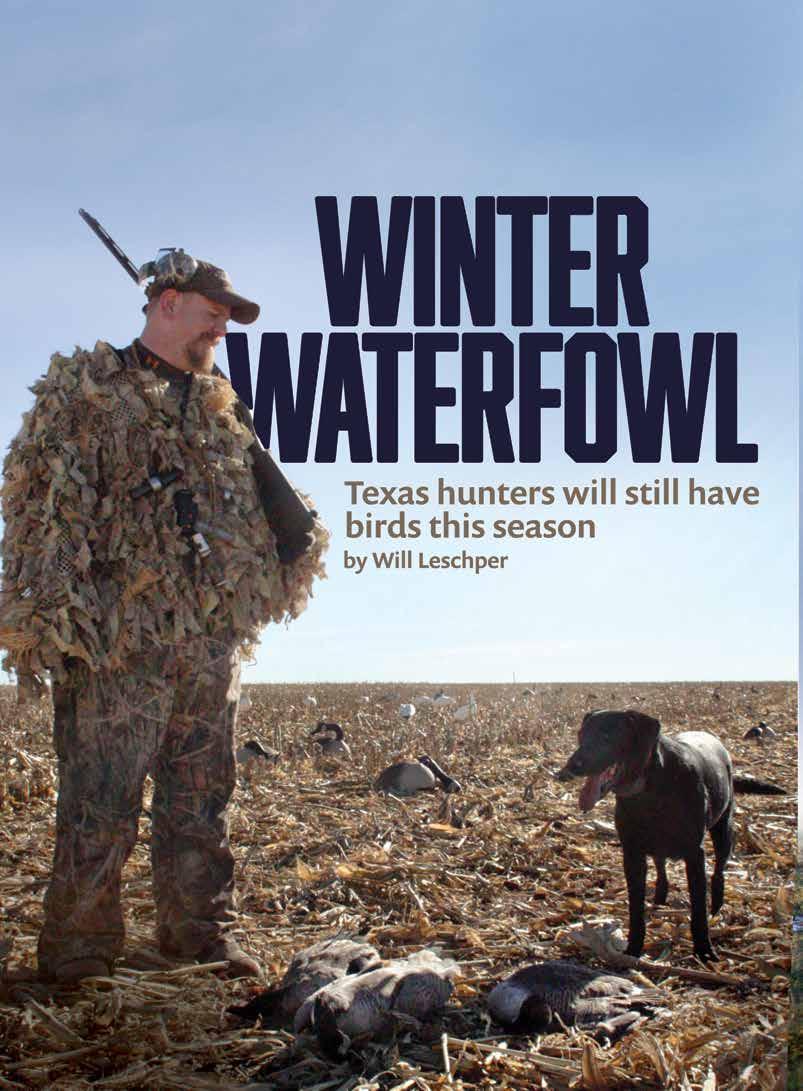
The best Texas goose hunting is now done in the Panhandle and Rolling Plains, a shift from the rice prairie paradise that had been the go-to area for decades.
Texas waterfowl hunting has changed in recent decades namely due to smaller bird populations and a shift in land uses. That being said, duck and goose hunting is still worth the effort.
Late country music legend Toby Keith had a smash hit with lyrics addressing the good ol’ days, opining, “May not be good as I once was but I’m as good once as I ever was.”
Toby may have been discussing many varying intricacies of life, but his words truly are applicable to the state of waterfowl hunting in Texas. It’s true that those entire seasons of vast rafts of ducks and geese patrolling notable hot spots across the Lone Star state may be over. However, as wise Toby said—and he could have been speaking directly on waterfowl— this season could be a bounce back year, harkening back to the glory days afield.
If there’s one defining trait of seasoned waterfowlers, it’s that they’re eternal optimists, and they must be with all the extensive toil that goes into the pursuit when hunting multiple days or weeks in tough conditions. At the end of the day, one good season can make all that trial and error worth every second.
Heading into fall and winter frameworks, the overall
outlook shaped up as being another unpredictable season due in large part to Mother Nature. U.S. Fish and Wildlife Service surveys across the “waterfowl production” areas including the Dakotas and Canada in the late spring and early summer showed decreased pond counts due to lingering drought. All reports from those biologists pointed to what could be a decrease in waterfowl counts.
It should be noted last year’s estimates, released annually in late summer, showed almost 2 million more ducks on the landscape from the previous year. The overall count registered at almost 34 million, which is a far cry from the prime years when more than 45 million birds were estimated. Hunters can almost certainly bank on seeing the trend continue.
That being said, Texas hunters will still have birds, especially when those northern cold fronts push them down later in the season. Of note, one lingering aspect for recent generations of hunters that seems to be toughest of all is the changing nature of migrating ducks and land-use practices that have altered the traditional hot spots. These changes have made it harder to kill steady bag limits of birds particularly for coastal hunters looking to navigate a vast area of open water.
and other moisture-holding locations not far from metro areas.
However, Mother Nature also has a way of concentrating birds for a variety of factors, namely drought, which actually can be a good thing for hunters if birds coming down have limited options to raft up.
First and foremost, waterfowl hunting caters to public lands hunters more than any other outdoors pursuit in Texas. That’s especially true on the coast in traditional hot spots spanning from Port Mansfield and Corpus Christi up to south of Houston and to the Louisiana border. Numerous Wildlife Management Areas offer day hunts open to anyone with an annual public hunting permit. And, in fact, any navigable waterway is conducive to hunting for a number of species including redheads and pintails.
As with other public hunting pursuits, there is stiff competition for waterfowl honey holes but going this route is much more affordable than joining a private waterfowl hunting club or anteing up for an annual lease that could range into the thousands of dollars.
If you’re looking to book a guided hunt, you’re in luck because there are countless options including many fishing guides who dabble in waterfowl as well as trout, redfish and flounder. A guided hunt typically will run at least a couple of hundred dollars per person, but that’s still far below pricier waterfowl options. As always is advised, conducting research is important when booking any hunt and a good guide should have references and be willing to answer any of the
Duck Bag Limit:
• 6 per day in the aggregate to include no more than 5 mallards (of which only 2 may be hens)
• 3 wood ducks
• 2 redheads
• 2 canvasbacks
• 3 pintails
• 1 scaup
• 1 “dusky duck” (mottled, black or Mexican-like) may only be taken after the first 5 days of the season
• All other species: 6
Coots:
15 per day. Possession limit is 3 times the daily bag limit for all migratory game birds.
Goose Bag Limits: 5 birds, to include no more than 2 white-fronted geese.
Sandhill Crane Bag Limit:
Zones A and B: Bag Limit: 3, possession limit 9
Zone C: Bag Limit: 2, possession limit 6
Hiring a reputable guide is worth the investment if you’re targeting ducks, geese or sandhill cranes, as they’ve often put in many hours you’ll never see.
multiple questions that go along with using them as a resource. Using a guide is certainly advised in other notable waterfowl spots such as the Panhandle, Rolling Plains and Pineywoods, as those locales don’t offer the open water the coast does. Another option is to ask permission from a landowner, which even in this day and age could be fruitful, especially if you’ve observed waterfowl holding in a specific area.
Pinpointing the best hunting locales across the state is straightforward, despite changes in migration patterns and changing landscapes. Along the coast, it’s hard to overlook any of the bay systems for having a surplus of waterfowl when others don’t. To the north and the Rolling Plains, Haskell and Shackelford counties have long been the epicenter of good duck and goose hunts for years, and in the Panhandle the counties in a ring around the Amarillo area will always hold waterfowl, especially near urban areas where birds have found effluent water holding areas to be suited to their needs.
If you hunt with a guide, they should have already done scouting, possibly leased their own spread and are dialed in on birds, which is why that’s usually the easiest waterfowl hunting option. However, if you’re hunting on your own, you can up your odds in many ways. It sounds straightforward, but if you don’t have consistent water and forage sources, you won’t have waterfowl. Preseason scouting for DIY excursions is invaluable, but even if you can’t go afield ahead of time, it’s not a deal-breaker.
Finding water, more importantly steady water, goes without saying when looking to bring in and hold waterfowl. If you’re planning a hunt in the Cross Timbers and Post Oak Savannah areas or other locales without constant water sources,

it’s advised to focus your efforts on stock tanks or irrigation ponds, especially in dry seasons. If you’re focusing on those areas, you’re also likely to have some kind of good food sources nearby, which only adds to why waterfowl may find a good spot and want to set up shop.
One skill that’s vital in predicting a good—and legal—hunt is being able to identify waterfowl on the flight path. Texas has an aggregate bag limit with some species more heavily restricted than others. While a veteran duck hunter may be able to instinctively look at a small group of birds floating on the horizon and declare them to be wigeons or gadwalls without the slightest hesitation, properly identifying waterfowl can be tricky. Novice duck hunters may not be able to decipher right away what types of waterfowl are loafing toward them until they make a pass over the decoy spread. That means you might accidentally shoot more birds than you’re allowed, which is certainly a large no-no.
Texas had been in the Hunter’s Choice program in past seasons when it came to waterfowl limits in the Central Flyway—a program intended to decrease the harvest of less-abundant species while keeping opportunities available for burgeoning ones. Under more liberal frameworks in place during more recent seasons the past few decades, hunters are allowed to kill six ducks a day in the aggregate. Of note, the limit on pintails— among the most prized waterfowl, especially a mature male “bull sprig”—remains at one per day. Chief among the ways to identify ducks are looking at plumage, size, flight pattern and noise, with different species carrying their own distinctive calling card.



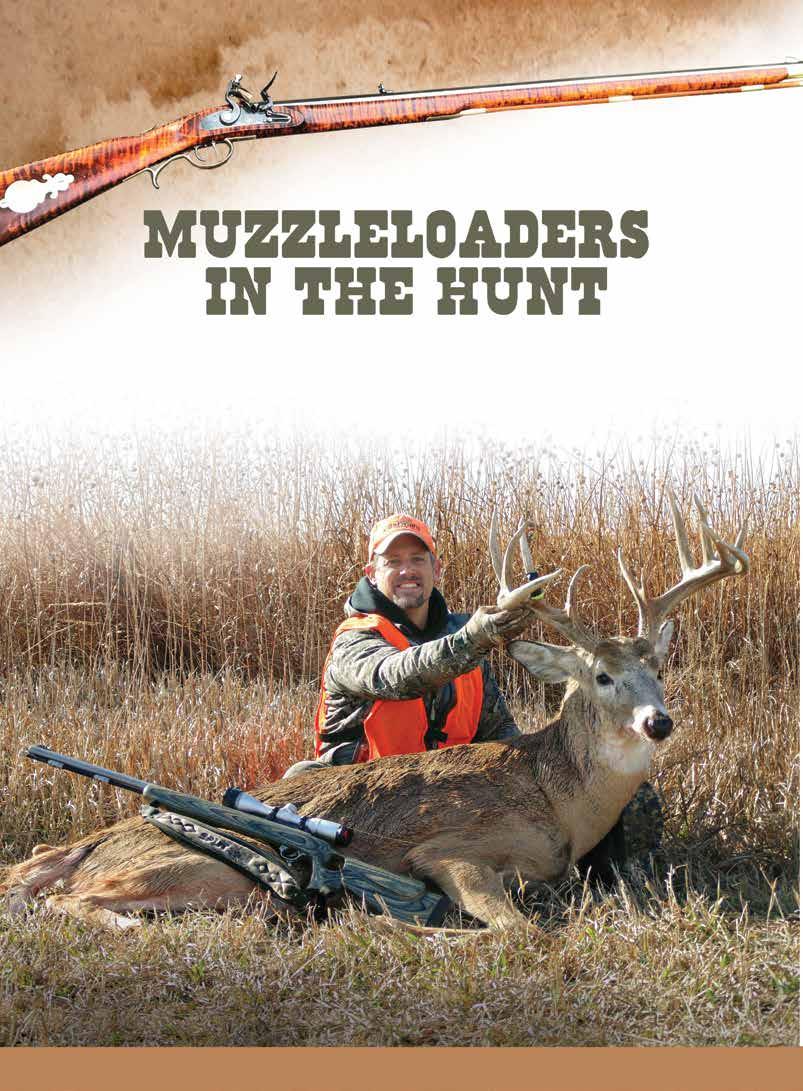
by Eric Stanosheck
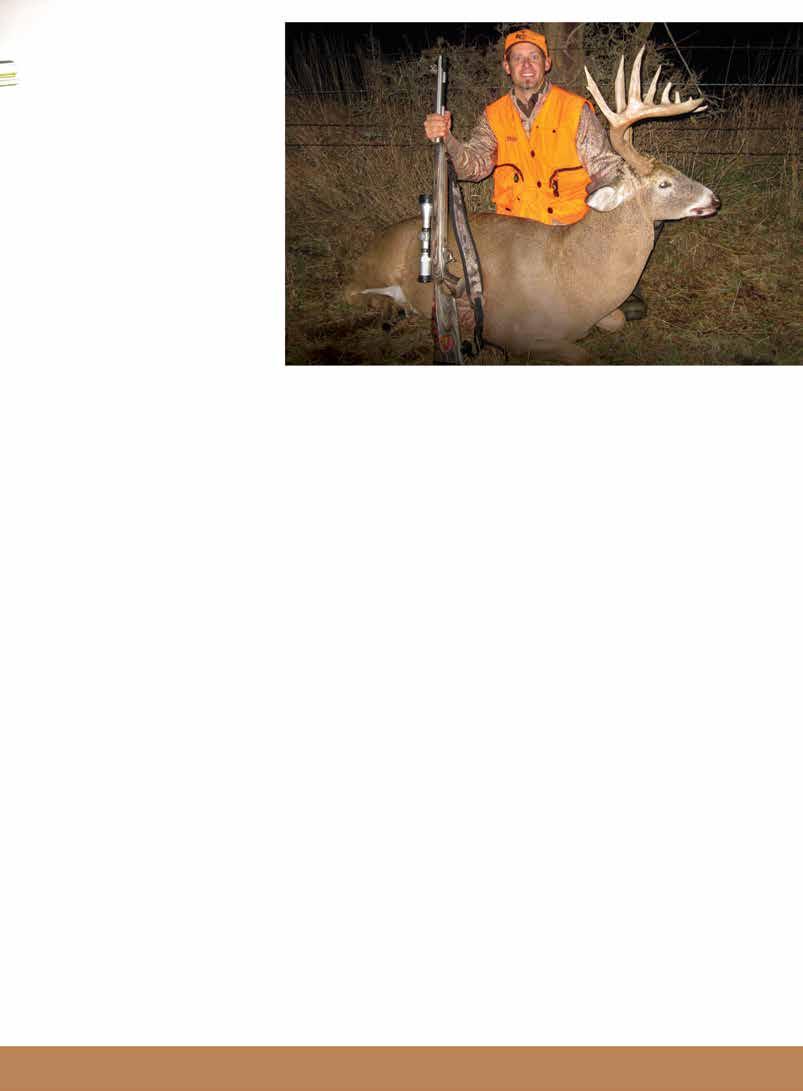
I’m not sure if there’s an animal more suited for muzzleloader hunting than the whitetail deer. Large herds are spread across 44 states, which provide hunting opportunities during regular and special muzzleloader seasons. It’s possible to hunt whitetails with a muzzleloader almost continuously from September through January, if you are willing to travel.
I’ve been fortunate enough to use my muzzleloader on whitetails everywhere from Texas to Saskatchewan, Canada, but the Midwest has been my favorite place to hunt them. Growing up in the Midwest, I’ve always had big farm-fed whitetails on my mind and rarely a year goes by that I don’t venture to Nebraska or Kansas.
After an early season muzzleloader hunt in Kansas, I was left with an unfilled tag that was still good for the late firearms season. On Dec. 3, my dad and I were on a hunt, and I was getting ready to pull the trigger when a new buck with six does came trotting in from afar. There were points everywhere on this buck and we quickly recognized him as an exceptional non-typical buck last seen in velvet in early September.
The big buck was dogging a doe that apparently was in her second cycle when we ran out of legal shooting light. I knew if the hot doe stayed there, he’d be right beside her. The next morning it was freezing cold as we waited for the sun to rise on the milo field the deer were in the night before. A dozen or more deer were in the same spots, including the big buck.
We worked around to the far east side of the field to get the wind right and started to crawl in. At 150 yards I was faced with the toughest pass of my life. The buck was standing in the field where we had permission to hunt, but was just a few feet away from a posted property that nobody can hunt. So, I lost my chance when the doe and buck disappeared into the posted property.
Later that day at 3 p.m., Dad and I slipped into the sunflower-choked waterway that meanders through the eastern third of the milo field. The wind was perfect, and we were there long before the deer came out of the CRP grass into the milo field. I’d need a bit of luck to close the distance.
Proof that even the best laid plans can self-destruct I carried my backpack,
shooting sticks, decoy, and gun into the weedy waterway only to jump the big buck and his doe that were bedded right there. I dropped everything, had estimated 160 yards, and led the buck only to graze his shoulder. I could only watch as the buck flagged his tail and ran a long circle and stopped to look back as he stepped onto the posted CRP property. He stood there for a minute, and I could tell he had only a flesh wound, if anything.
Crushed and dejected I sat there and soon realized in all the commotion, the doe was still feeding where I’d shot at Mr. Big. The next 15 minutes she slowly made her way on his trail through the milo and eventually disappeared into the CRP. We decided to sit until dark just in case he’d return to the milo, even though I knew a mature buck doesn’t get that big by making mistakes.
I looked at my phone as the sun faded away—5:38 p.m. Deer were coming from the CRP into the milo field, and right on their heels was the big non-typical. He was still a long distance away, so I pulled on my backpack, grabbed my decoy and gun and ran directly toward him using the thick weeds as cover. I knew my time was limited and as I got parallel to the group of deer, I stuck the decoy in a tumbleweed which drew the deer’s attention, including the non-typical.
I looked at my phone—5:44 p.m. The big buck stepped up on a terrace at 122 yards, exposing his full body. I cocked the hammer and pulled the trigger, and as the white smoke cleared, only the smaller bucks and four does remained
standing. I sat there counting my blessings, not believing my tremendous fortune. I’d been in range of this buck four times in a 24-hour period and grazed his shoulder 3½ hours before I finally sealed the deal on the biggest whitetail of my life.
I sometimes hunt with my uncles and my father. One late season in Nebraska on a cold December day, everything came together in my pursuit of a good buck. Dad and I were hunting together, and I had passed several young bucks holding out for a trophy, and with 20 minutes of daylight left we were looking at a big buck tending a doe. The only problem: he was far away across the highway from where my dad and I were sitting for the evening.
We made a fast and flawless stalk and crossed the highway with a few minutes of legal shooting light to spare. We were at a snail’s pace when the buck was less than 200 yards away. A lone cedar tree on the edge of a field was our cover as we closed the distance to 82 yards.
I peered around the left side of the cedar while Dad took the right side. We both had our hammers cocked and waiting for the buck to come out of his hiding spot. The doe appeared to the left and the buck was right behind her, which gave me a split second to get him in the scope. With the squeeze of the trigger and a cloud of white smoke, the trophy whitetail buck was mine.
Some advice to all you muzzleloader aficionados: Find a state, buy a tag, shoot straight, and blow some smoke at a whitetail this year.


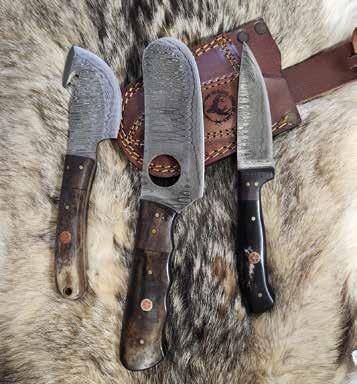
ruggededgeblades.com

Rugged Blades’ Damascus 3 Piece Hunting Set includes three essential hunting knives, each crafted with precision and detail. These blades are forged from Damascus steel, renowned for its distinctive patterns and exceptional durability. The razor-sharp edges ensure superior cutting performance for any hunting situation. Designed for versatility, the set features a large boning knife with a finger hole for heavy duty tasks, a droppoint knife for precision cuts, and a gut hook for effortless field dressing. All three pieces conveniently fit in its custom, genuine leather sheath which is included.

chiappafirearms.com

Chiappa Firearms is expanding its acclaimed Rhino series by introducing two new revolvers chambered in the powerful, versatile 10mm Auto. Available in a 6-inch matte black model and a 3-inch nickel-finished variant, these new handguns blend the unmistakable Rhino design with the hard-hitting performance of 10mm, offering shooters an exciting new option for defense, hunting, and sport shooting. Both models feature fiber optic front sights, adjustable rear sights, ergonomic grips, and Chiappa’s reliable double/single-action trigger system — all designed to make the most of the 10mm Auto’s impressive ballistics.

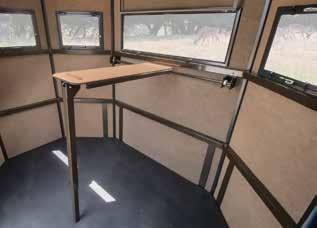
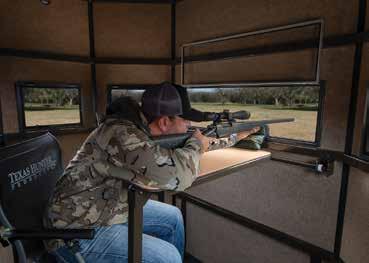
The Precision Shooting Table can be mounted in most hunting blinds. It just needs 42 inches of width to mount. It silently slides from left to right to accommodate both right-handed and left-handed shooters. This table provides extra stability for more accurate shots, and can fold up and out of the way for convenience. With a support structure of powder-coated steel, and a durable rubberized top mat for padding and sounddampening, this table is built to last. It also adjusts up and down to provide ultimate support for your shooting needs. Tabletop dimensions: 10 inches wide x 32 inches long.
MACS – Mobile Gun Care offers top-quality firearm care and accessories. Whether you need same-day gun cleaning, optic installation, or muzzle device mounting, they bring discreet, professional service straight to your doorstep—no more waiting weeks at a traditional gunsmith. Shop their extensive online accessory inventory of premium firearm accessories and schedule hassle-free installation with their Mobile Armory Vans—all without leaving your home or office. texashunterproducts.com
Encased in a durable ABS plastic housing, the Plasma Lighter XRL boasts a water-resistant design, achieving an IPX6 rating, which provides a reliable edge in rainy or wet environments. Its 250mAh lithiumion battery recharges via USB-C in approximately an hour and offers over 100 ignitions per charge. A power/charge indicator displays remaining energy at a glance, and the protective locking cover ensures the lighter is safe to pack, store, or carry.

It includes an integrated three-mode LED flashlight, capable of emitting up to 55 lumens on high for one hour, 35 lumens on low for two hours, or functioning in strobe mode for emergency signaling.
Walker’s Razor Slim Electronic Muffs are now available in two bold new designs. From vibrant sprinkle patterns to neon and pastel color combos taking the competitive shooting world by storm, these best-selling muffs combine unique styles with serious hearing protection. Available in pink, gold, and blue—each accented with eye-catching teal hardware—they make a bold statement on the range while delivering a Noise Reduction Rating (NRR) of 23 dB, safeguarding wearers’ hearing in the most intense shooting environments.
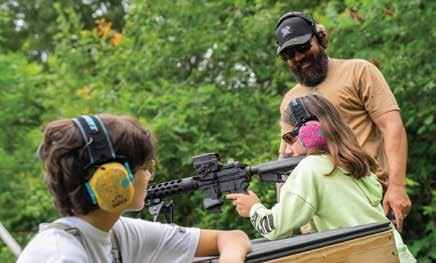
Each pair is outfitted with Sound Activated Compression (SAC) technology to instantly reduce harmful noise while ensuring awareness of ambient sounds, like conversations and range commands.
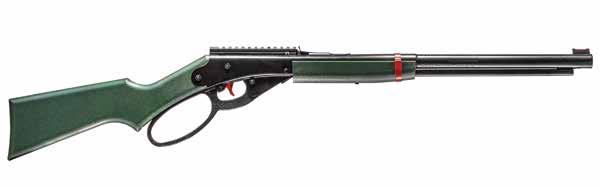
The new Woodland Trail Model 1999 lever action BB gun features a large loop lever, fiber optic front sight and adjustable rear sight, plus a Picatinny rail for adding optics. It also features a forest green buttstock and forearm with a red barrel band and trigger. It fires .177 caliber BBs at velocities of up to 350 feet per second. The lever-cocking spring air action paired with a loop lever handle delivers a smooth, satisfying shooting experience with every shot—mimicking the feel of iconic Western firearms. It features a massive 650-count internal BB magazine, so you’ll spend more time shooting and less time reloading.

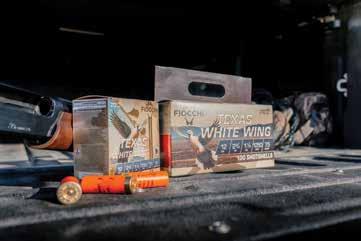
Built for the ultimate wing-shooting experience, Fiocchi’s Texas White Wing shotshell is engineered for precision, power, and performance in every shot. This 12-gauge, 2¾-inch shell delivers a 11⁄8 -ounce payload of No. 7.5 shot at 1,250 fps, delivering hard-hitting effectiveness and smooth, reliable cycling. The result is the perfect balance of pattern density and velocity to keep hunters in the action from sunrise to sundown.
The new 4-box field carton features a sturdy handle for easy transport, making it as functional in the field as it is on the range.
The Shinenyx G1A Thermal + Night Vision Fusion Monocular / Goggle is a cutting-edge tool built by engineers and hunters with firsthand experience in real-hunt challenges.
Its real-time Fused Image Technology (F.I.T.) seamlessly integrates thermal and night vision. Rapid Target Outline (RTO) function simplifies the user’s ability to lock onto targets with speed.
Its 50Hz high frame rate and low latency design eliminates lag and ensures fluid movement tracking. Proprietary Shinenyx E2E 7-Aspherical-lenses provide distortion-free, edge-to-edge clarity with wide 60.4 degree field of view.
A 2.1-inch high-resolution LCD and pancake eyepiece bring bright, clear and immersive visuals.
Compact and lightweight at just 16.76 ounces, it can also be used as fast aiming scope or goggle.

shinenyx.com
Flambeau’s Scrapper Buck stops cruising bucks in their tracks to ensure they close the distance and investigate the intruder on their home turf. Based on a carving by award-winning sculptor Chris Schiller, it’s designed to present a fight for hormone-crazed rutting bucks. The designed inferior size and rack represent a young buck encroaching on prime territory.
It has adjustable ears for simulating alert and sneaking positions, while the detailed paint scheme matches those of an adolescent buck. The weather-resistant faux tail moves in the slightest breeze. Scent can also be applied to the faux tail for an added level of realism.
Its parts nest inside the body cavity when disassembled. The provided blaze orange carry bag enables convenient transportation. Threaded, locking lugs on the legs equip it for maximum security and stability. holes in the plastic hooves and provided square head stakes fasten the decoy firmly to the ground.

Hey kids, have you ever thought about a Texas Ram Slam? Do you know what the Texas Ram Slam is? We have had lots of kids at our summer camps and on our hunts who have achieved this accomplishment. They sure did have a lot of fun and dreaming along the way to reach this lofty goal.
The Texas Ram Slam refers to a hunting achievement when a hunter successfully takes one of each of the four

different ram species: the Texas Dall, black Hawaiian, Corsican, and mouflon. It is sometimes referred to as the Texas Grand Slam.
So, the next question for you is the following: Do you know how to identify the different rams? If not, it’s not a big deal, and we can start to give you the knowledge right here for you to identify each of the different rams. Of course, you can do your own research and learn a lot
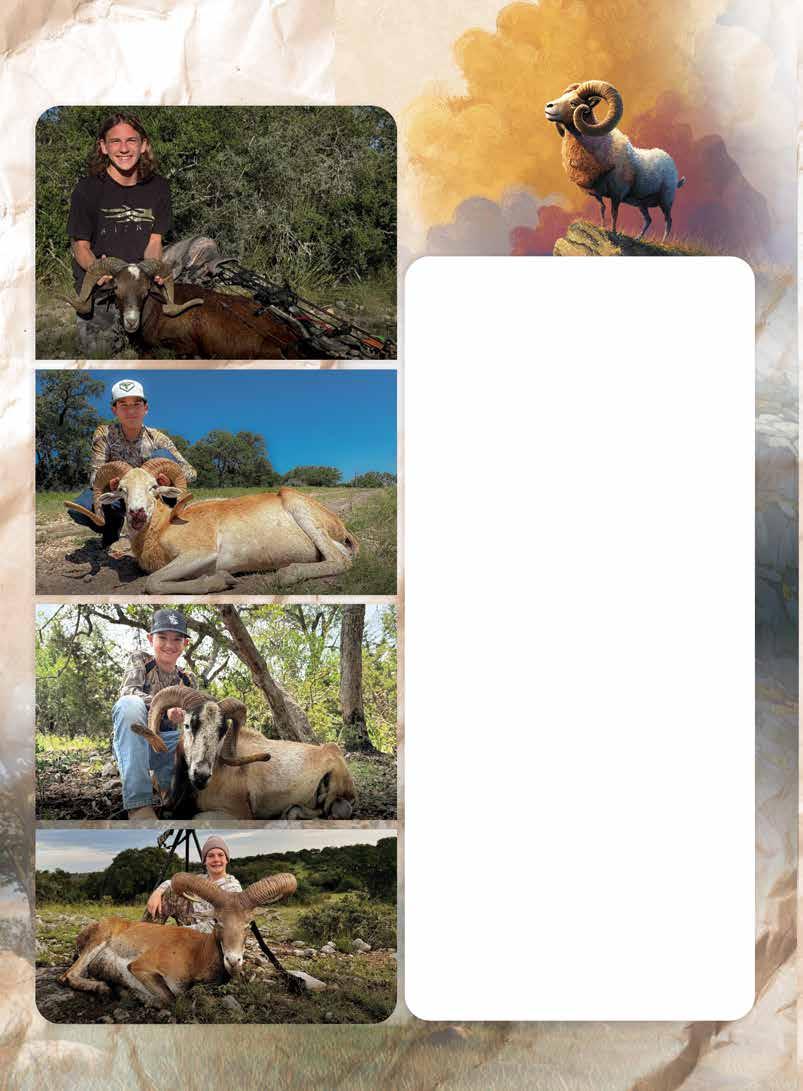
more, but the following information, courtesy of the Record Book of Exotics, will give you a good guideline and help you get started.
“Texas Dall sheep are a hybrid breed of sheep known for their distinctive white coat and large, curled horns. They are a popular choice for hunting due to their size, appearance, and the challenge they offer. These sheep are a mix of European mouflon and domestic Barbados sheep, originating from the historic Y.O. Ranch in Texas.
“The origin of the black Hawaiian ram is not definitively known, but it’s believed to a hybrid, likely a cross between a mouflon sheep and black-haired sheep from the Hawaiian Islands, or Barbados sheep with a color gene dilution. They are not native to Hawaii but were developed in the United States, particularly in Texas, for hunting purposes.
“Corsican rams are a hybrid breed of sheep that originated in Texas. They were developed through crossbreeding between the European mouflon and various other sheep breeds, including the Barbados blackbelly, around the mid-1900s. This hybridization resulted in the unique characteristics of the Corsican ram, such as their impressive horns and adaptable nature, making them a popular trophy hunting animal.
“Mouflon rams, a type of wild sheep, are believed to have originated on the islands of Corsica, Sardinia, and Cyprus in the Mediterranean. They are thought to be closely related to the ancestors of modern domestic sheep. Over time, they were introduced to other parts of the world, including Europe and the United States.”
The nice thing about hunting rams is that you can do it year-round, and use all sorts of hunting equipment. We have had a lot of people use rifles, bows, crossbows, and even muzzleloaders. I have even noticed some guys using spears and air rifles. I know all of it can be challenging and a lot of fun, and can be done when you’re not in school.
I cannot speak for all areas of the state, as all our rams are around the Texas Hill Country and we are blessed with a lot of hills and valleys to chase these
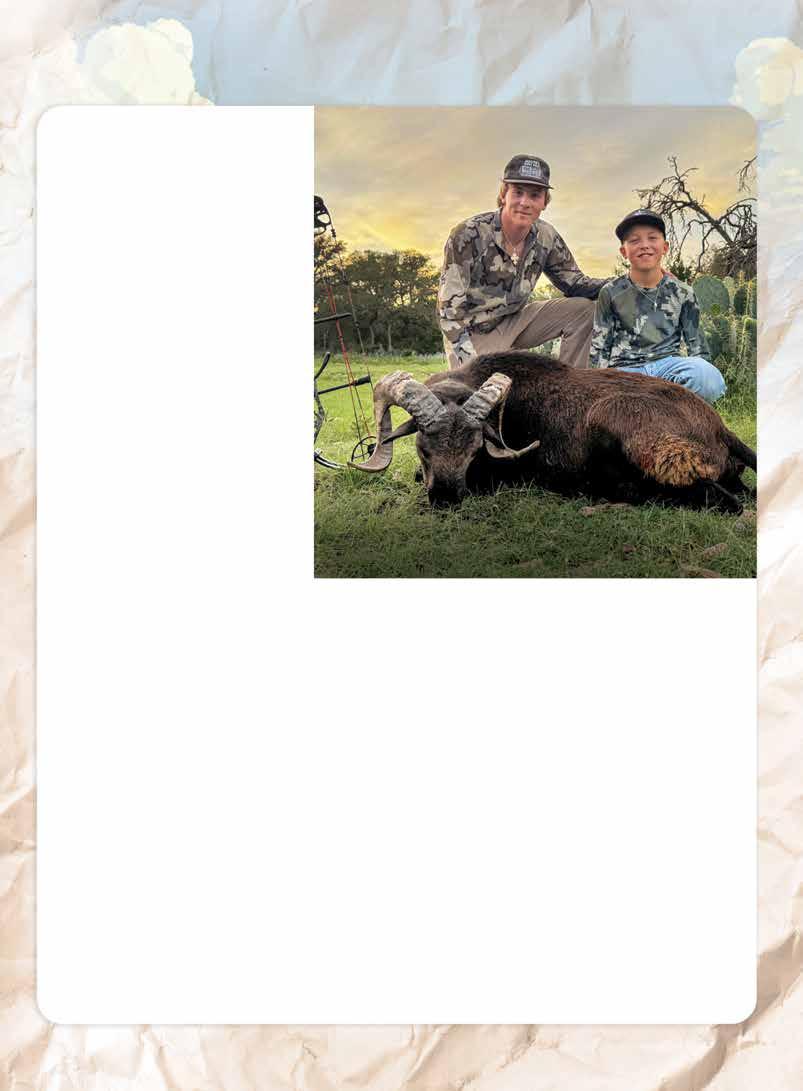
cool critters. I would say 95% of the time we do spot-and-stalk and glass from hilltops. We always try to work the wind and stay ahead of the herd. They’re traditionally herd animals and travel in small to large groups. You will have lots of eyes and noses that will be scanning and looking for any and all predators.
The Record Book of Exotics is a great resource to study. It will have pictures and stories that can teach you all about the different species of rams, as well as all the other great Texas exotics. Good luck on your upcoming outdoor adventures and your potential “Ram Slam.”
Michael Marbach is the CEO of the Christian Outdoor Alliance, www.mycoa. org; 210-827-9802. COA’s mission is to guide youth and outdoorsmen to a relationship with Jesus Christ through experience in God’s great outdoors.

Each year during the month of August, deer hunters of all ages from Texas, Mexico, and out-of-state, bring their bucks to the Hunters Extravaganza Annual Deer Competition in Houston, Fort Worth and San Antonio. Young hunters proudly enter their trophy—sometimes their first buck—hoping to win a prize. TTHA is proud to recognize some of these young hunters and their trophy bucks.


TBy Horace Gore
he Rohde family of La Vernia are deer hunters. Randy has a general contracting company going strong, and his two eldest children, sons Rhett and Remington, have followed him as deer hunters. The trio have hunted the
Galvan Ranch in Webb County for 10 years after Randy’s father, Ronnie, leased some Galvan pastures years ago. Rhett and Remington killed their first buck on the Galvan. Rhett killed a nine-point when he was 8, and Remington killed an eight-point when he was also 8 years old.
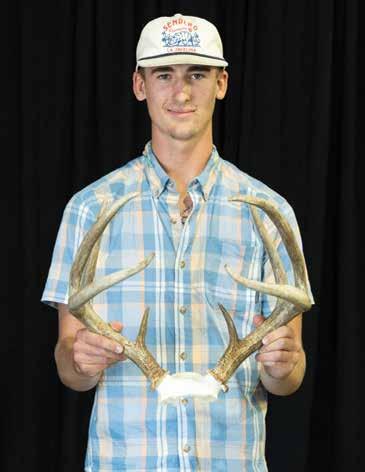
The Galvan Ranch is a 67,000-acre spread near Laredo. A foundation runs the ranch operations and exercises monetary benefits to Texas A&M Foundation to assist student curriculum and other college projects. The ranch has long been known for its Texas history and excel-
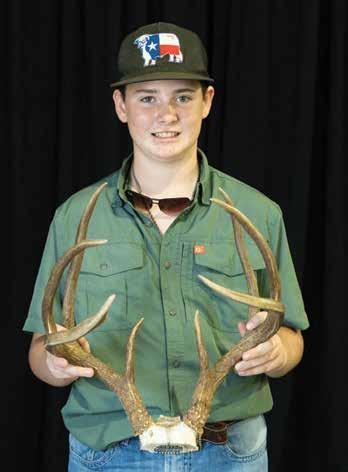
Rhett Rohde took his eight-point buck from a high blind on the Galvan Ranch near Laredo. See Rhett’s “Best of Show” buck from the 2025 Deer Contest on page 86.
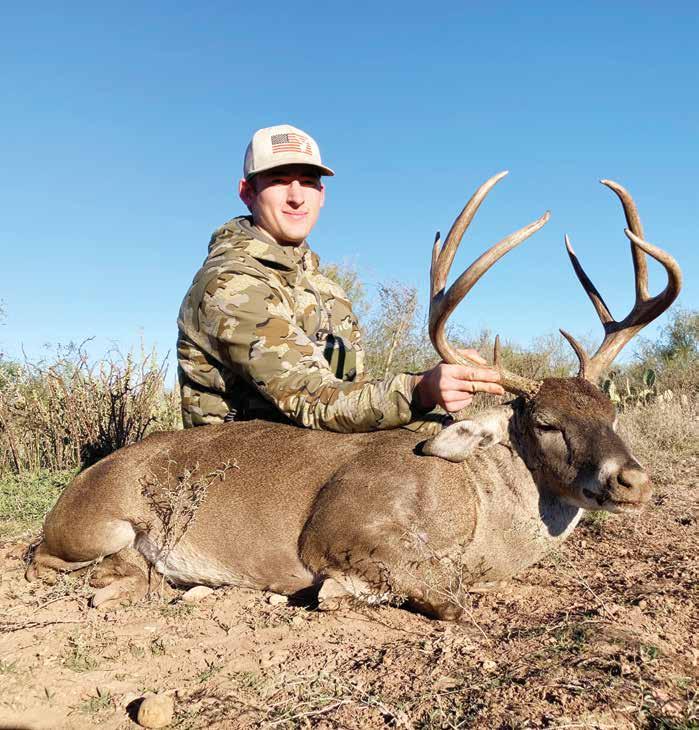
lent white-tailed deer. Since the ’70s, the ranch has signed annual deer leases to groups of hunters.
Rhett is out of high school at La Vernia where he played baseball, participated in 4-H shooting sports, and attended several Texas Brigades camps. He’s now planning to attend Tarleton State University in Stephenville and will join R.L. Rohde General Contracting after college. Remington will be a senior at La Vernia High and plays football and baseball. Both boys have attended practically every Texas Brigade camp across the state.
This story is about the 2023-24 deer season

and the two eight-point bucks Rhett and Remington shot from the same high blind, on different days, while hunting on the Galvan. Rhett, 16, was in the high blind with his 7mm Mag., watching a group of bucks. The program was culling, and Rhett was interested in a big eight-point going in and out of the brush.
The buck finally gave Rhett a clear shot, and the 7mm Mag. with a muzzle brake rang out across the countryside. The buck fell in his tracks, and Rhett was thinking about the Hunters Extravaganza Deer Competition as he counted the long eight points
Remington Rohde has taken other big bucks with his muzzle-braked 7mm Remington Magnum.
on the old buck, perhaps a Best Perfect 8 winner.
Remington, 15, was hunting with his dad and Rhett on a later day in the season. After Rhett had killed his big eight-point, he told Remington he had seen another big eightpoint at the feeder where he had hunted. Remington decided to try for the eightpoint and went to the high blind. The hunt was short when the big eight came to the feeder, mingling with other deer.
Remington waited for a good shot, and his 7mm Mag. with muzzle brake roared like a lion as he put a 150-grain bullet into the big buck’s shoulder. The buck reared up and fell over backward and expired. Remington had the same thoughts as Rhett when he looked at the big eight-point—also a potential winner at the Hunters Extravaganza Deer Competition in San Antonio.
The 7mm Mag. has a history of wounding bucks in South Texas. The recoil is just too much for some hunters, and they flinch at the recoil, resulting in poor shot placement. I asked the Rohde boys If they had ever lost a crippled deer. The answer was quick. All the Rohde hunters have muzzle brakes on their 7 Mags, which results in recoil about like a .270, and no wounded bucks. This might be a good tip for those 7mm Mag. shooters who are tired of being kicked around.
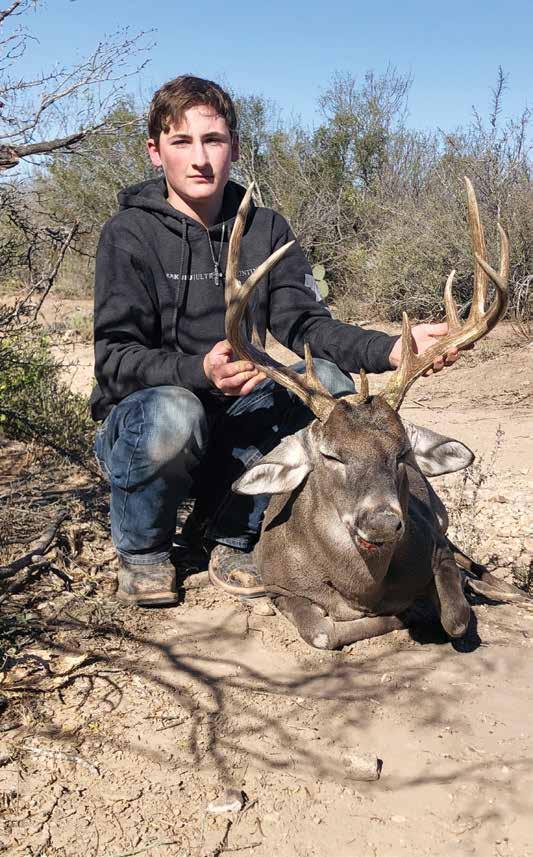
Rhett and Remington entered their two eight-point bucks in the 2024 Hunters Extravaganza An-
nual Deer Competition in San Antonio. Remington’s buck scored 144 3⁄8 and won first place in the Best Perfect 8 Youth Division. Rhett’s buck scored 1437⁄8 , and came in second place. The scores were only a half-inch difference in the two bucks, which were examples of highscoring eight-point bucks in the contest.
Neither of the hunters had ever entered a buck in the Extravaganza deer contest, and Remington was on cloud nine with his winning buck. There’s a good chance Rhett or Remington, or their dad, will kill a big buck on the Galvan, a ranch well known for big bucks. So, it’s mucha suerte for the Rohde hunters.

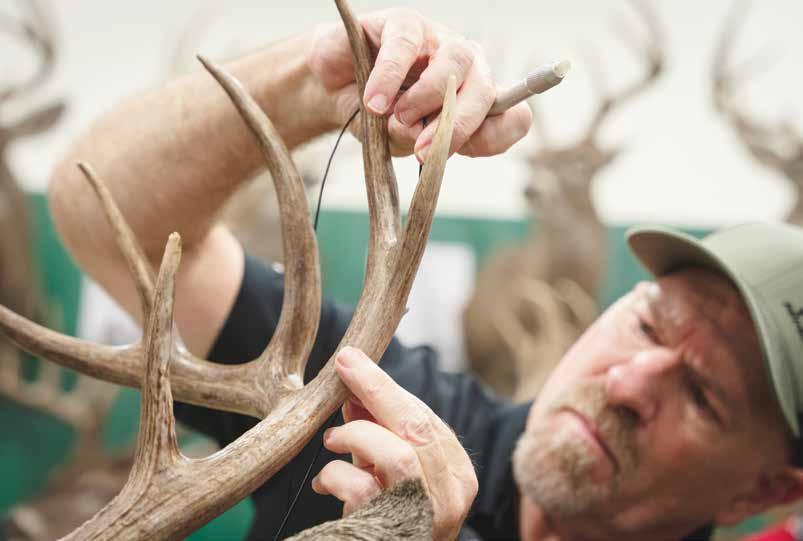

The 2024-25 deer season went fairly well for most folks, despite the ongoing drought across the state. Unfortunately, the intense rain the Texas Hill Country received during the July 4 weekend did more harm than good. Recovery of flora, fauna, and people, in that region will take a very long time. Meanwhile, our Hunters Extravaganza Annual Deer Competition, hosted by SCI, provided some welcomed respite for our Hill Country neighbors. They, along with many other attendees, got to see some of the best bucks last season had to offer. For those who couldn’t make it to the Extravaganzas, we present the contest winners at the Houston, Fort Worth, and San Antonio shows. We congratulate all contest participants and hope to see you again in 2026, which will mark the 50th anniversary of Hunters Extravaganzas. — MM
Note: All scores listed are per SCI measuring system.





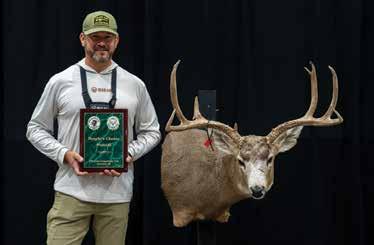

PEOPLE’S CHOICE
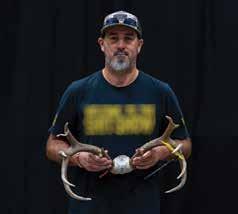
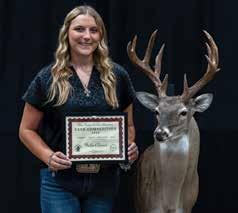
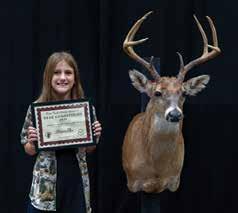
MODERN ARMS OPEN RANGE
William Fincher, 1st adult male, typical, 140, Schleicher County.
Jared Poole, 2nd adult male, typical, 129, Mason County.

Jared Poole, 3rd adult male, typical, 1274⁄8, Webb County.
Fallon Clepper, 1st adult female, typical, 1303⁄8, Uvalde County.
Victoria Fincher, 2nd adult female, typical, 1083⁄8, Schleicher County. Harper Rice, 1st youth female, typical, 1192⁄8, Shelby County.
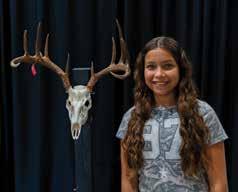
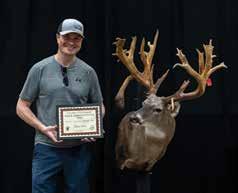
MODERN ARMS OPEN RANGE OUT OF STATE
Sophia Cantu, 1st youth female, typical 1422⁄8, Mexico.
MODERN ARMS HIGH FENCE
Travis Short, 1st adult male, nontypical, 2572⁄8, Bandera County.
Cadhla Riley, 1st youth female, nontypical, 2257⁄8, Lee County.
ARCHERY OPEN RANGE
Nick Fincher, 1st adult male, typical, 1232⁄8, Schleicher County.
Jared Poole, 2nd adult male, typical, 112, Mason County.
Jane Hale, 1st adult female, typical, 1654⁄8, Duvall County, Best of Show.
Ryanne Fincher, 2nd adult female, typical, 114, Schleicher County.
Rhonda Pitts, 1st adult female, non-typical, 1517⁄8, Wilbarger County.
ARCHERY OPEN RANGE OUT OF STATE
Michael Boyd, 1st adult male, non-typical, 1376⁄8, Oklahoma.
BEST WHITETAIL IN PREVIOUS FIVE SEASONS, OUT OF STATE
Josh Brown, 1st adult male, typical, 1894⁄8, Indiana.
BEST TEXAS MULE DEER
Christian Chatellier, 1st adult male, typical, 1535⁄8, Erath County, People’s Choice.

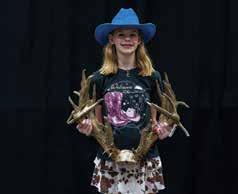
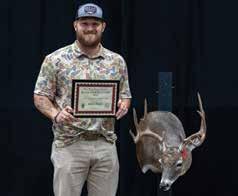

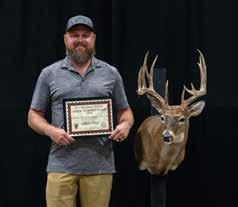
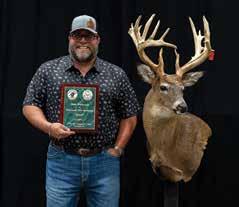


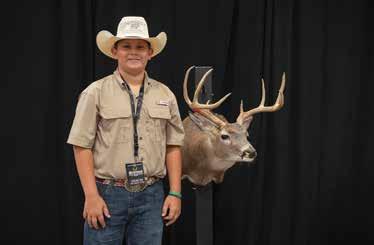
Wyatt ChanCe PEOPLE’S CHOICE
ogle
MODERN ARMS OPEN RANGE
Lane Ogle, 1st adult male, typical, 1797⁄8, Wood County.
Manuel Trelino, 2nd adult male, typical, 1671⁄8, King County.
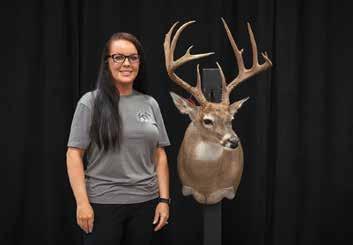
karol smith BEST OF SHOW
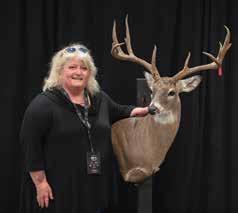
Randy Sargent, 3rd adult male, typical, 1634⁄8, Stephens County.
Patricia Muir Bullard, 1st adult female, typical, 1545⁄8, Parker County.
Shelley Fisher, 2nd adult female,
typical, 1454⁄8, Wilbarger County. Mindy Cox, 3rd adult female, typical, 145, Wise County.
Casen Whitten, 1st youth male, typical, 1477⁄8 Young County.

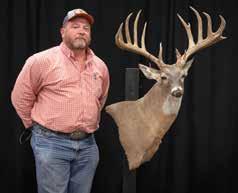
Riggin Morris, 2nd youth male, typical, 1465⁄8, Erath County.
Cooper Cross, 3rd youth male, typical, 1436⁄8 , Tarrant County
Wyatt Chance, 1193⁄8, Archer County, People’s Choice.
Kennedy Schumacher, 1st youth female, typical, 137, King County.
Meadow Whitten, 2nd youth female, typical, 1316⁄8, Stephens County.
Jonathan Schulz, 1st adult male, non-typical, 1993⁄8, McMullen County.
MODERN ARMS OPEN RANGE OUT OF STATE
Corbin Aday, 1st youth male, typical, 111, Oklahoma.
MODERN ARMS HIGH FENCE
Michael L. Raines, 1st adult male, typical, 1517⁄8, Frio County.
Brandon Bearden, 2nd adult male, typical, 1507⁄8, Parker County.
Tommy Fulford, 1st adult male, non-typical, 4784⁄8, Bell County.
R.Y. Gann, 2nd adult male, non-typical, 420, Stevens County.
Blane Murphy, 3rd adult male, non-typical, 3765⁄8, Wise County.
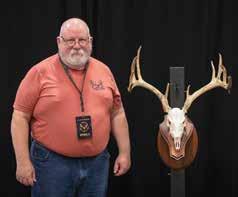
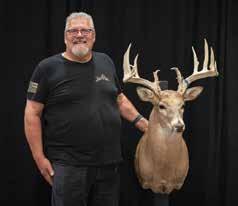
MODERN ARMS HIGH FENCE OUT OF STATE
Brandon S. Hay, 1st adult male, typical, 1594⁄8, Shannon County, Missouri.
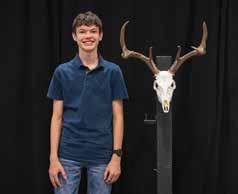


ARCHERY OPEN RANGE
TJ Miller, 1st adult male, typical, 1734⁄8, Dickens County.
Aaron Gilbreath, 2nd adult male, typical, 157, Roberts County.
Keith Aikens, 3rd adult male, typical, 1422⁄8, Tarrant County. tJ miller
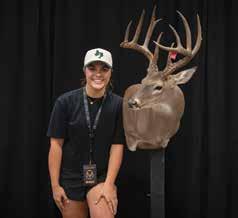
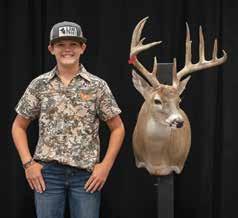
tate miles
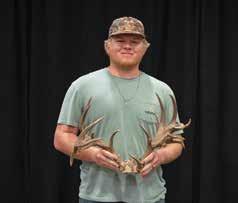
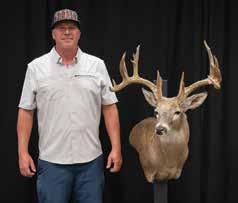
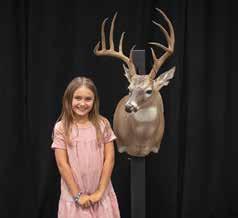
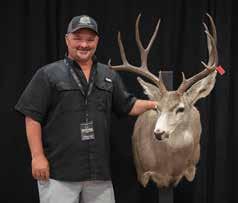
ARCHERY OPEN RANGE (CONTINUED)
Kaylee Black, 1st adult female, typical, 1483⁄8, Stephens County.
Karol Smith, 2nd adult female, typical, 1481⁄8, Palo Pinto County, Best of Show.
Tate Miles, 1st youth male, typical, 1375⁄8, Shackelford County.
Tanner Miles, 2nd youth male, typical, 1327⁄8, Shackelford County.
Collins Miles, 1st youth female, typical, 1425⁄8, Shackelford County.
Grace Waller, 2nd youth female, typical, 1422⁄8, Shackelford County.
Elliott Miles, 3rd youth female, typical, 1146⁄8, Shackelford County.
Colby Cox, 1st adult male, non-typical, 1951⁄8, Wise County.
Trace Sanders, 2nd adult male, non-typical, 1844⁄8, Comanche County.
Tony Lavigne, 3rd adult male, non-typical, 1703⁄8, Shackelford County.
BEST WHITETAIL IN PREVIOUS FIVE SEASONS
Brent Schumacher, 1st, typical, 1561⁄8, King County.
Sandi Leichliter, 2nd, typical, 1254⁄8, Wise County.
BEST TEXAS MULE DEER
Paul Smith, 1st, typical, 159, Hemphill County.
Aaron Gilbreath, 2nd, typical, 1496⁄8, Roberts County.
Brent Schumacher, 3rd, typical, 1456⁄8, King County.
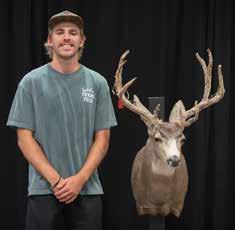

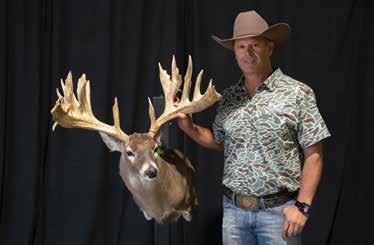
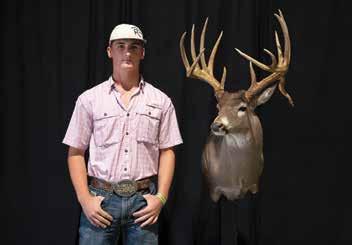
rusty Badillo PEOPLE’S CHOICE
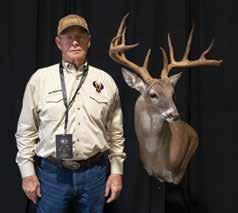
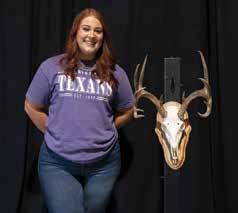
MODERN ARMS OPEN RANGE
C. Lee Newton 1st adult male, typical, 1675⁄8, La Salle County. Lonnie Seipp, 2nd adult male, typical, 114, Llano County.
Bailey Crippen, 1st adult female, typical, 1313⁄8 Medina County.
rhett rohde BEST OF SHOW
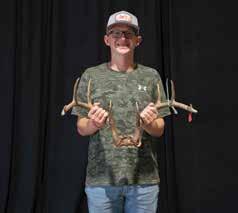
Ben Seipp, 1st youth male, typical, 1244⁄8, Llano County. Aidan Stokes, 2nd youth male, typical, 937⁄8, Houston County.
MODERN ARMS OPEN RANGE CONTINUED
Coco Spencer, 1st youth female, typical, 1094⁄8, Duvall County.
Robert Martin, 1st adult male, non-typical, 1542⁄8 Bexar County.
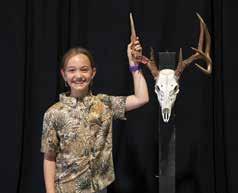

MODERN ARMS OPEN RANGE OUT OF STATE
Robert Frank Carver, 1st adult male, typical, 1646⁄8, Alberta, Canada.
MODERN ARMS HIGH FENCE
David Pembleton, 1st adult male, non-typical, 3694⁄8, Bell County.
Adam Lemoster, 2nd adult male, non-typical, 3133⁄8, Coryell County.
Rusty Badillo, 3rd adult male, non-typical, 2497⁄8 Frio County, People’s Choice.
MODERN ARMS HIGH FENCE CONTINUED
Cole Dutton, 1st youth male, non-typical, 2433⁄8, Frio County.
Zyler Spencer, 2nd youth male, non-typical, 1522⁄8 Duval County.
ARCHERY OPEN RANGE
Tony Pierino, 1st adult male, typical, 1583⁄8, Coryell County.
Lonnie Seipp, 2nd adult male, typical, 1146⁄8, Llano County.
Seth Stokes, 3rd adult male, typical, 1082⁄8, Houston County.
Rhett Rohde, 1st youth male, typical, 1837⁄8 Webb County, Best of Show.
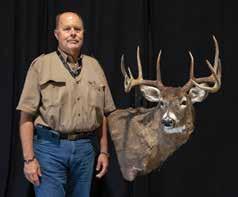
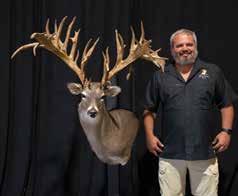
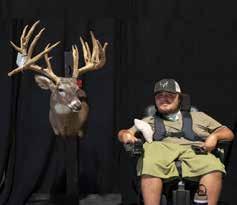
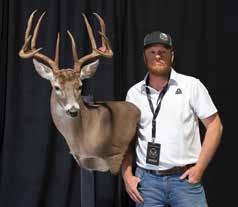
ARCHERY HIGH FENCE
Matt Walker, 1st adult male, non-typical, 2202⁄8, Bell County
Jason Johnson, 2nd adult male, non-typical, 2064⁄8, Blanco County
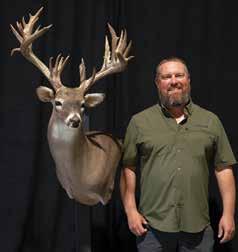
ARCHERY HIGH FENCE CONTINUED
Carolyn Johnson, 1st adult female, non-typical, 2305⁄8, Blanco County
DEER
Benny Rodriguez, 1st, typical, 1584⁄8, Brewster County
Spensor Phipps, 2nd, typical, 1551⁄8, Gaines County

Isidro “Chilo” Alaniz drove all the way from Laredo to spend time with his two grandsons, Trey, 4, and Mateo, 3, who live in San Antonio. Grandpa Chilo took them to the Hunters Extravaganza in San Antonio, where they found the deer mounts on display, the tractors, and the hunting gear, fascinating. The boys’ father was featured in a story in the September/October 2007 issue of The Journal, “Initiation by Javelina.” Grandpa said he and the boys had a wonderful time at the show, as well as carrying on a family tradition.
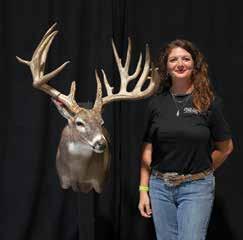
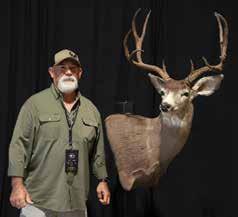



In the fall of 2022, during my family’s second year on a South Texas deer lease, I had a new challenge. I would hunt an elusive buck known as “Jester.” He was estimated to be at least 9 years old, and had eluded hunters for years. I was determined to make him mine.
Bow season opened at the end of September, and I hit the brush with my bow, driven by trail cam photos of Jester in daylight just two days before. But like any seasoned South Texas hunter knows, luck doesn’t come easy. Jester vanished.
For three weeks, I hunted relentlessly—30-plus hunts with no sign of him. Halloween approached, and as I watched the Astros playoff game, Jester made a surprise appearance on camera. My hopes soared for the next morning. But once again, I had nothing.
As Thanksgiving arrived, I planned to extend our trip. I repositioned feed stations and cameras along what I believed was Jester’s travel route as he headed west for the rut. My girlfriend, Syd, was initially reluctant to stay longer, especially with rain in the forecast, which in South Texas means mud as slick as ice. But with some convincing, she agreed to stay until Tuesday.
On Monday, with my good friend Gunnar’s Can-Am, we placed feed stations every 1,500 yards along the suspected route I believed he was headed, based on his previous rut patterns. I promised Syd I wouldn’t return to the ranch until Jester appeared on camera. At this point, it had been another three weeks with no pictures of him, with no idea where he was or even if he was alive. We headed home Tuesday. That same evening, at 6:30 p.m. as we sat at dinner at one of our favorite
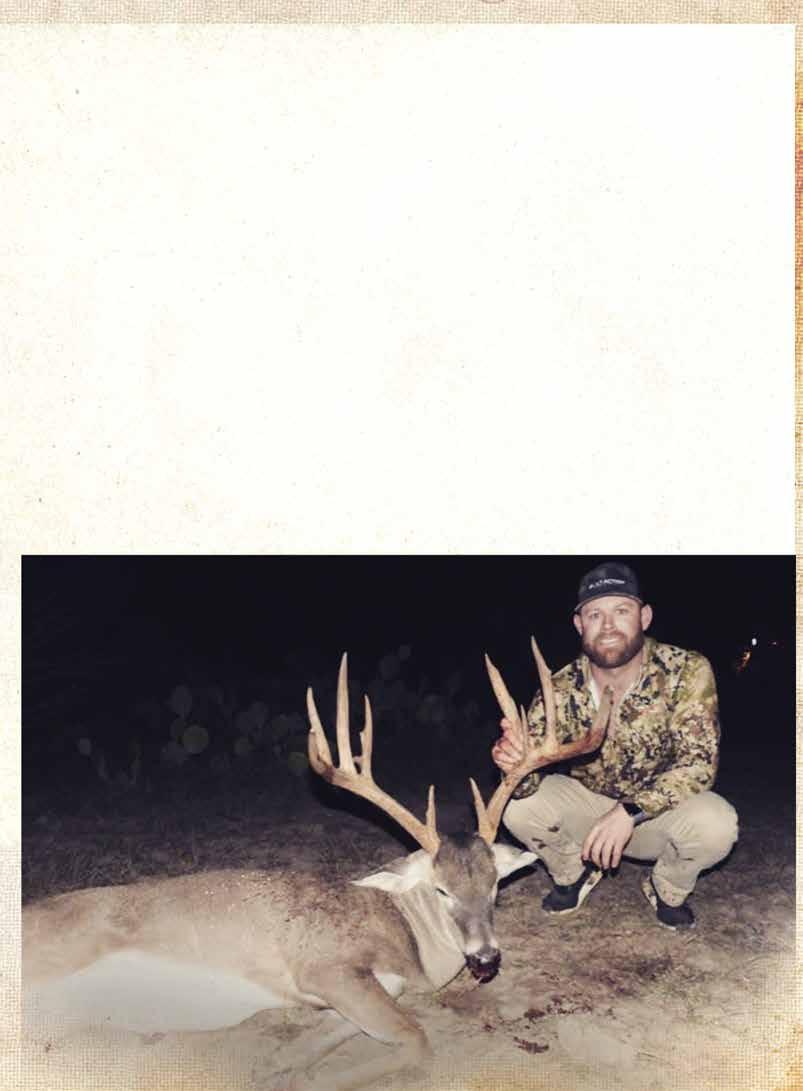
restaurants, Jester stood over a cottonseed pile—5 miles from where I had been hunting him.
With a grin, I turned to Syd and said, “Sorry, babe. A deal’s a deal. I’m heading back in the morning.” She knew my passion for hunting and, with a reluctant smile, said, “Go get him.”
Less than 12 hours after arriving home, I went back on the road for the five-hour trip. I didn’t have a stand set up where Jester appeared, so I scrambled to move one into position. Everything seemed to go wrong, and I finally settled into the stand at 3:30 p.m., with little hope.
Deer began to show up: a familiar 180-inch, 5-year-old nicknamed “Benny,” and several does. Distracted by texts to my dad and my brother Ryan, I glanced up at 5:20 p.m. but Benny had vanished. I turned to check behind me, and saw Benny. I turned around to where I’d been looking, and then saw Jester. He had bullied the younger buck out of the area.
Without hesitation, I lined up my .300 Win. Mag., loaded with a 212-grain Hornady ELD-X bullet, and took the shot. The suppressed rifle cracked, and I heard the bullet hit. But Jester didn’t drop. He ran.
I texted my dad and Ryan: “I just shot him.”
My brother immediately called me, and said, “Well, did you smoke him or what?”
I replied, “I hope, but he sure didn’t look hurt running off.”
I rushed to the spot, armed with only my phone’s flashlight and wearing tennis shoes, not prepared to track a deer at all. I saw no blood or sign, but luckily I saw a small open area. I spotted him just 20 yards away. He didn’t make it far in the
South Texas brush.
With adrenaline pumping, I dragged Jester out myself. My friend, Mr. Randy, helped me load Jester onto his truck. The surreal feeling of accomplishing a lifelong goal washed over me.
My hunting journey had started in Matagorda County on my grandfather’s cattle pasture, with dreams of taking an 18-inch-wide buck, then a 140-inch deer as we moved to hunting several different deer leases in South Texas. I never imagined a 170-inch buck was within reach. But Jester was mine—170 inches of South Texas whitetail.
Levee’s legacy
In 2024, my dad was on the hunt for another monarch, a buck named “Levee.” He was believed to be over 8 years old, and bore a striking resemblance to Jester. But trail cam photos raised doubts about his size. Was he as big as we hoped?
One Sunday morning in October, my dad and Ryan returned home, and I took it upon myself to put out fresh cottonseed near where I had taken Jester and stick it out for the evening hunt. I had two questions: Does Levee have the mass? Is his right G-2 eight inches?
If the answers were yes to both, Levee could push 170 inches. That evening, Levee appeared. Despite friends suggesting he was only 155 inches, I believed he was worthy of the chase, based on my opinion after seeing him on-the-hoof. I was excited for my dad and Ryan to hunt him together, just as I had shared a blind with my dad when he took a 195-inch giant a few years ago.
On Saturday night, while Texas played Georgia, I sat on the trailer porch, waiting. Ryan sent a video of Benny standing in the road. Moments later, I received a picture on my cell cam.
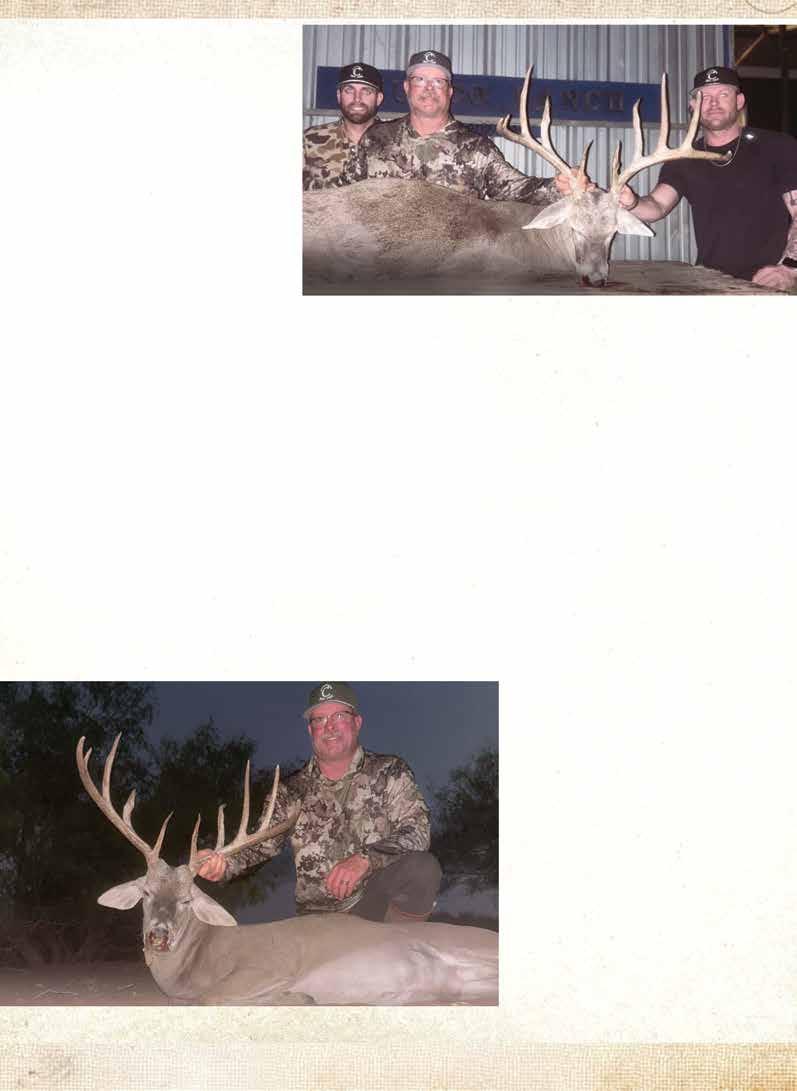
Benny was in the pen but had been pushed out of the road in front of them. Another buck had bullied him out.
Turning to my friend Zach and Mr. Randy, I said, “Mark my words—Levee is in the road, and it won’t be long.” Within two minutes, my phone buzzed with the text I had been waiting for from Ryan: “He’s dead.”
Much like the moment with Jester, I immediately called Ryan. Levee laid dead in the road, as I started to question Ryan, who initially thought Levee wasn’t as big as we had hoped, based on his first up close observation.
“Is his right G-2 eight inches?”
“Yes.”
“How’s his mass?”
“Good.”
“Is he 24 (inches) wide?”
“Yes.”
“Are his beams 25 (inches)?”
“Yes.”
As I smiled on the other side of the phone and replied, “Okay, so what am I missing? Sounds like he’s everything we thought.”
With adrenaline pumping on his end, he replied, “Yeah, I guess it just happened so fast I can’t think. But get Dad and I a drink ready—we’re on our way back to camp to celebrate!”
Levee scored 1687⁄8 inches, just shy of Jester’s 170. Whether they are father and son, or brothers, both bucks embodied the spirit of South Texas hunting.
Ultimately, it’s not just about the inches or the trophies. It’s about the shared moments in the wild, the bonds between family and friends, and the stories that will be told around campfires for years to come. Jester and Levee—two South Texas monarchs—remind us why we hunt. And for that, I’m forever grateful.
They were taken less than 0.8 miles apart, despite spending most of their years more than 5 miles from each other. Both pushed Benny out before their time came. Both brought an incredible amount of joy to my family and friends.

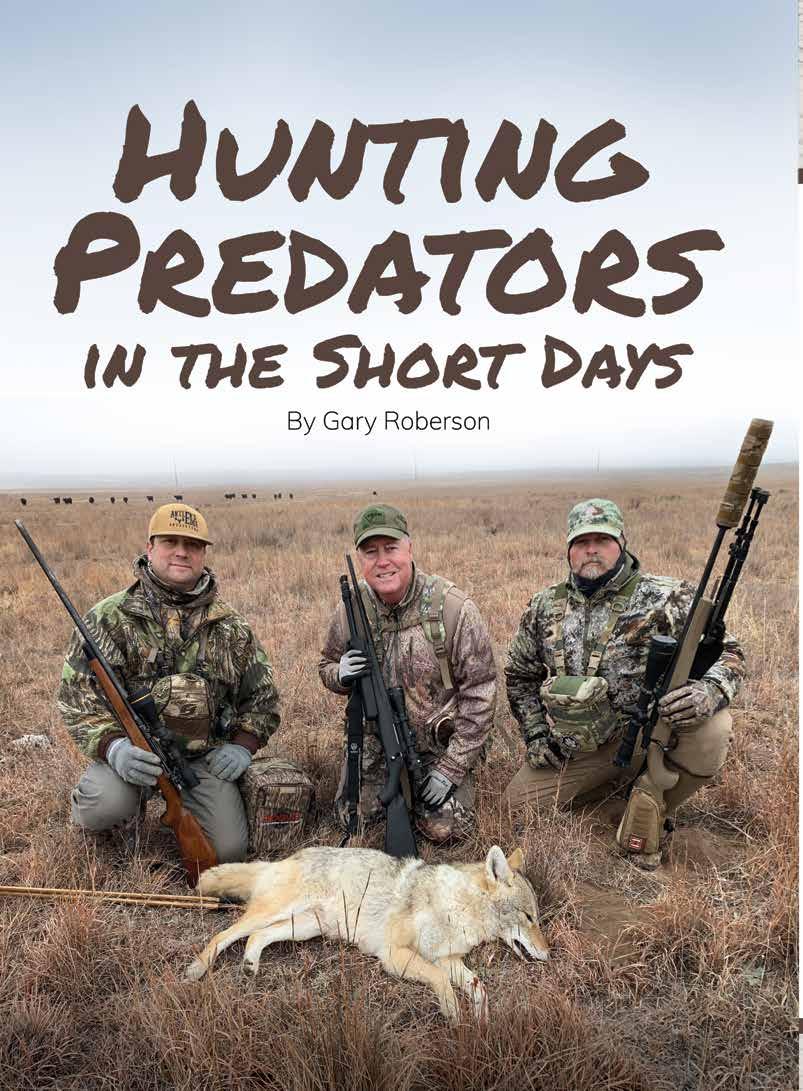
When Steve and I loaded our gear to hunt with buddies Casey Carter and Pecos Hagler near McLean, Texas, the forecast was for lows in the high 30s and highs in the 50s. With the typical low humidity of the Panhandle, I wouldn’t need my heavy coat or insulated overalls. I would layer up with my vest and lightweight jacket and should be comfortable without feeling bulky. My phone didn’t show the symbol for wind when I used the Weather Channel app, so I expected a couple of days of great weather for calling coyotes.
It was early January, a few days past winter solstice. This is the time of the year that the North Pole tilts farthest from the sun, so the days are shorter. Since days are shorter this time of the year, temperatures are generally colder. When predators are cold, they burn more calories, and they’re hungrier. The hungrier the predator, the greater the chance they will respond to something that sounds like dinner. Therefore, hunting in December and January when the days are shorter is more productive.
Coyotes and cats generally mate in February. When they’re mating, they become more difficult to call. March and April aren’t generally as productive because of winds. The wind sure knows how to blow in the Texas Panhandle, and if you wait until spring to hunt, you don’t worry about having your hat blown away. You worry about getting blown off your feet.
Casey and Pecos are not only good friends, but both are also experienced hunters. Casey owns an outfitting business, “Antlers Edge,” and leases thousands of acres across several Panhandle counties. To prove his versatility, Casey is also pastor of One Way Church in McLean, the largest church in town. Pecos is one of the very best wildlife photographers in the country as well as a manager of several ranches.
Hunting with Steve, Casey, and Pecos is easy. When we walk in to make a call, everyone knows how to set up using
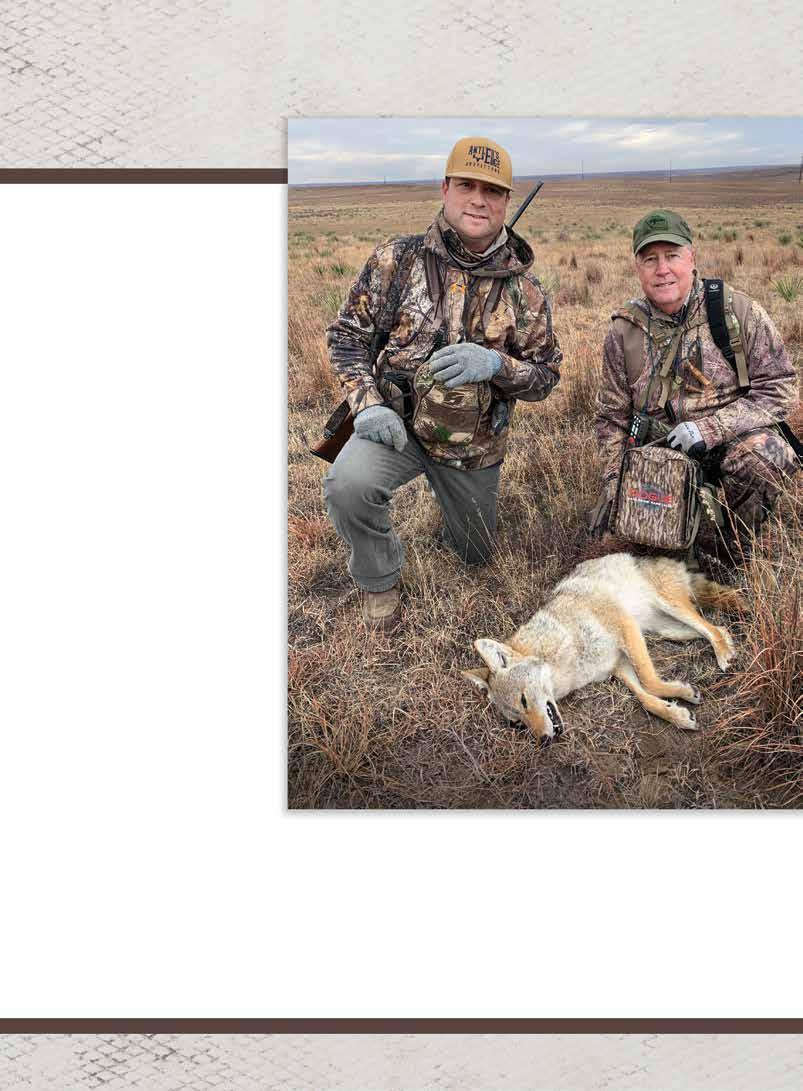
the available cover, which is sparse in this wide-open terrain. They know how and when to move, and both are excellent marksmen.
The first day of the hunt, the weather was almost perfect, starting out in the 30s and warming into the upper 40s with a steady breeze out of the west. We called up eight coyotes and killed five. It seemed that we were successful on every stand where there was fresh sign along the roads.
The next day, the temperature was about the same as the previous day, but there was more cloud cover. It seemed that if a coyote heard the electronic FREQ caller, the coyote
would respond. Since it was cloudy, we were not as concerned about keeping the sun at our back because it was not an issue. About mid-morning, after we had set up to make a call, the sun popped out, shining in our faces. I decided to go ahead and try the set-up because everyone was already in place.
After playing a series of cottontail distress calls, I saw a coyote roll over a ridge about 350 yards away. He was not respond-
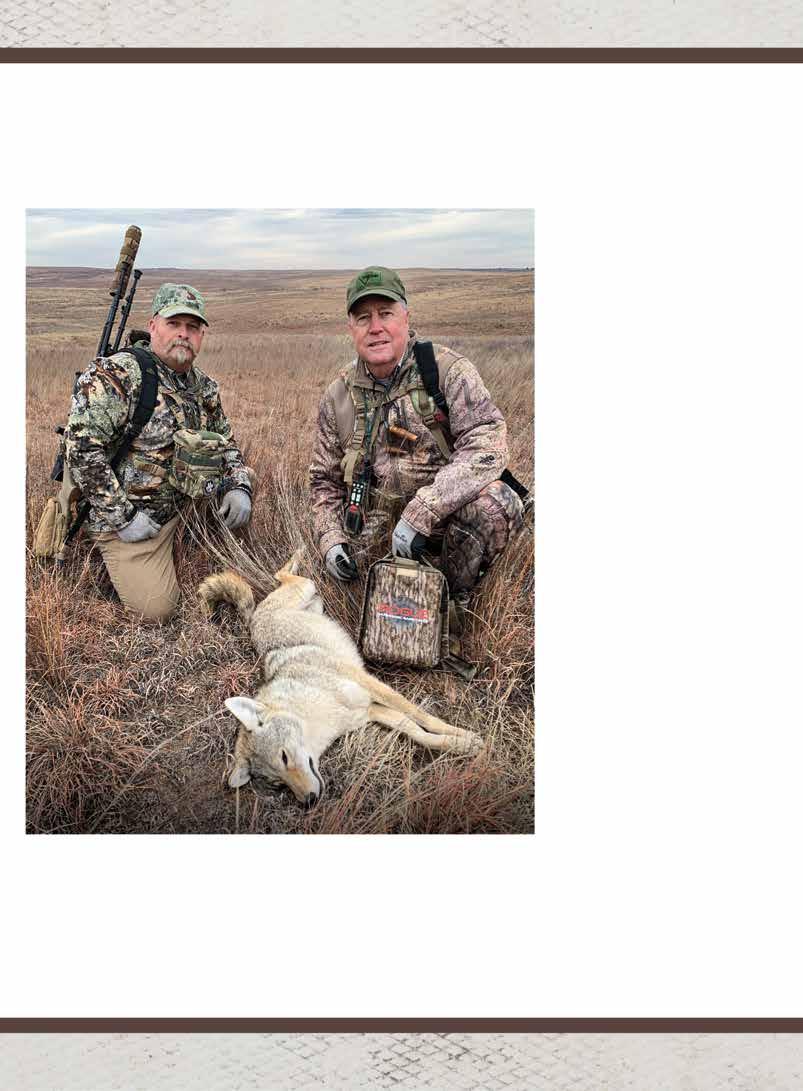
ing aggressively and stopped shortly after topping the ridge. I switched sounds to the “Money Bunny,” a distress sound of a baby cottontail, and lowered the volume. The change of sound seemed to excite him as he moved another 25 steps closer, but then he drew a line in the sand. After staring at us for a couple of minutes, we realized he was not coming closer. Pecos ranged the dog at just over 300 yards, got a steady rest on his shooting sticks, and dumped the coyote in his tracks.
We killed several more coyotes that day and planned to move
to another ranch farther north the next morning. About 3 a.m., I was awakened by wind blowing from the north and a light rainfall. When Steve and I stepped out of the house the next morning, we knew then we didn’t pack enough clothes.
As we drove farther north, more moisture saturated the air, so Pecos ran his wipers more often. We drove onto the ranch and sat in the truck waiting for a shower to pass before unloading the UTV we would hunt from. Thank God that Casey has a cab on this Polaris.
As we stepped from the UTV to make the first call of the morning, the temperature was 28 degrees, with light drizzle and wind from the north at approximately 15 mph. Steve and I found out quickly the lightweight vests and jackets were no match for this weather. I told the “boys” the coyotes better come quickly because I wasn’t going to sit out there and wait on them.
The first stand produced a coyote we saw moving in the canyon, but he seemed to disappear in the fog. To this day, I have no idea where he went. We hustled back to the UTV.
The second stand didn’t produce anything but a runny nose and a lot of shivers. Steve and I were beginning to whine about the weather. I don’t think Pecos and Casey were enjoying it either.
We decided to make one more call before throwing in the towel. Topping a low ridge, we could see about 30 cows and calves about a half-mile to the west. After the second series of “Killer Cotton” calls, I saw a coyote loping around the herd and swinging in our direction. At 125 yards, he stopped, and looked up the hill. I leveled the crosshairs on his chest and squeezed the trigger.
I have killed hundreds of coyotes in my lifetime. Of all the Texas coyotes, this was the largest. I did not have any scales, but I estimated him close to 40 pounds with a beautiful blonde, prime coat.
We took a few photos and hustled off to the buggy. Steve and I were absolutely miserable. While calling in the short days is no doubt my favorite time of the year, always be prepared for a sudden change of weather. Concentrating one’s efforts to control the predator population before mating season and before the winds blow makes sense, and it’s why I believe it’s the absolute best time of the year for calling predators.



There is no season for predator hunting, and every coyote, bobcat or fox is a trophy because calling them in close enough for a shot requires patience, skill and — more often than not — the right equipment. The latest electronic callers are marvels of engineering, microprocessors and software that can fool wary predators into thinking they’re stalking their next meal instead of a squeal from a speaker. In this roundup of the latest products and some equipment that continues to evolve there are two that use ultrasonic calls — sounds that humans cannot hear
By John Goodspeed
but predators can — to seal the deal.
Most electronic callers, which use a remote control and a wireless speaker placed well away from the hunter, come with plenty of recorded sounds of prey in distress. One has nearly 400, and others can hold up to 2,000 recordings. While electronic callers also come with higher price tags, there still are old-school handheld, mouth-blown callers including an open-reed design that can produce a variety of sounds for less than $20. The following is a roundup of some of the latest products. All prices are MSRP.
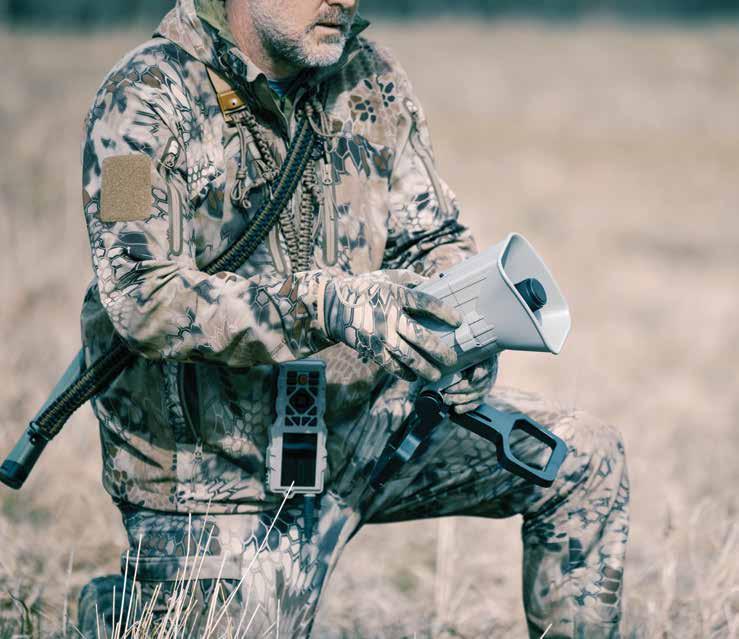
l burnhambrothers.com
l Freq Ultrasonic Game Call, $1,999
The three-month West Texas Big Bobcat Contest, the highestpaying hunting competition in the country, proved that the Freq works. The January contest, with 763 teams competing, was won by one using the ground-breaking ultrasonic caller to take the most cats, 10. The team that killed 11 to win the February contest, with 812 entrants, also used a Freq. “We won two months in a row, and that’s huge,” Gary Roberson of Burnham Brothers said.
What makes the Freq different than most electronic callers is its ultra-high-frequency sounds and the ability of the unit and its speakers to broadcast them, Roberson explained. Most others produce sounds within the range of human hearing. This one does, too, but it also broadcasts ultrasonic sounds that people can’t detect. Predators can, though.
The Freq can play sounds up to 50,000 hertz. Its prey-indistress calls can top 40,000 hertz. Ordinary callers peak out at 17,000 to 18,000 hertz. Humans can hear up to 20,000 hertz; coyotes up to 45,000 hertz; and bobcats, 64,000 hertz.
Roberson planned to release the Freq in 2019, but delays began with production of the speakers, the COVID-19 pandemic disrupting the supply chain, and tweaks to the software and speakers. Roberson secured seven patents for the Freq, which was introduced in 2023. Roberson added about 70 more ultra-
l convergenthunting.com
l Bullet HP Complete Bluetooth Game Calling System, $359.95
While this electronic caller package is not quite an oldie after being introduced in 2022, it’s still a goodie — and Convergent Hunting Solutions’ most popular product. Plus, the MSRP is $40 less than when it debuted. There is no wonder why the package is so popular because it comes with just about everything but a firearm. The kit includes the caller, a built-in decoy, a spike to anchor them, a picatinny rail to mount a smartphone on a weapon for controlling and recording, and a carrying bag.
Mounting a phone onto a firearm makes it easy to access the controls or record the hunt while reducing movement when using the app. The app features controls for volume, sounds, decoy and four programmable calls. The Predator Pro App download, which works on Android or iOS devices, includes more than 50 sounds of prey in distress. Sounds stored on a phone also can be played.
The decoy features dual directional erratic movement. The special Bluetooth range is up to 300 feet, which is about 10 times the distance of normal Bluetooth. The Bluetooth connection allows playing predator calls or music stored on the phone. The call’s 10-watt amplifier produces sounds of more than 100 decibels.
The integrated lithium-ion battery can run for 10 hours at full
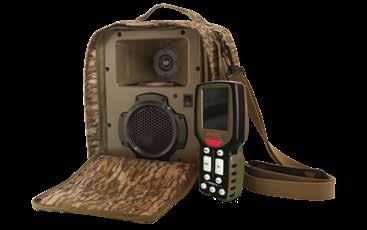
sonic animal sounds recorded on special equipment to the Freq’s internal memory over the last year. It has nearly 400; more than 300 are ultrasonic. “If you own a Freq, you can download those new sounds for free,” Roberson said.
The Freq’s two favorites folders can hold up to 20 sounds each. It also includes three 15-minute sequences compiled by Roberson for coyote, bobcat and fox. The caller can be mounted on a tripod. A 3.5mm mono jack is compatible with approved decoys. The Mastermind Remote’s range is about 300 yards line of sight. The unit includes two rechargeable NiMh batteries, a charger, a builtin padded case, a USB cord and a bag to store hand calls, ammo and more.
The Freq comes with a two-year warranty as well as a 30day, money-back guarantee if a customer is not satisfied that it performs better than other callers.
volume and is rechargeable with a USB cable for use in a vehicle or with a 110-volt outlet. A stainless-steel stake, which stores in a special compartment on the caller, anchors the unit. The stake is designed to get the speakers and decoy above vegetation. Fully extended, the Bullet HP stands more than 20 inches tall.
It also comes with a tripod mount to get the unit even higher and above taller vegetation or shrubs. The system packs into a waterresistant camo bag with a zippered pocket for accessories. The call also is available with sounds for deer, turkey, feral hogs, crows and snow geese. It weighs 4.9 pounds and measures 10½ inches by 14½ inches and is 6 inches tall. A limited lifetime warranty is included.
This new model delivers sounds from 200 hertz to more than 40,000 hertz — in the ultrasonic range that humans cannot hear but predators can — with a horn speaker and a new tweeter. It’s done with 32-bit recordings, which allows for a wider dynamic range without distortion. The horn speaker is called an XHD+ speaker — or Xtreme High Definition. The X48 includes 250 preloaded sounds, including 10 sounds from the MFK library, and can store up to 2,500 calls.
FoxPro collaborated with Made for Killing Game Calls for the recordings from live coyotes of such sounds as distress, vocalizations, howls and yips. Also included are 10 Pro Hunts selected by the FoxPro staff for hands-free use. FoxFusion, which plays two sounds at the same time, and FoxPitch, which changes the pitch of any sound, share a new screen that allows the two features to work together. The 32-bit ultrasound files can only go down in pitch.
FoxFusion can play two 16- to 32-bit sounds simultaneously plus FoxPitch at the same time. FoxPilot can use the included Pro Hunts or customized ones to control sounds, volume, mute, decoy on/off/speed/light, FoxFusion and FoxPitch. The TX-2000 remote control boasts a large color LCD screen, categories and subcategories for sound selections and a built-in weight scale. Additional features include an improved external gauge for temperature and barometric pressure, a moon phase indicator, battery level indicators for the call and the remote and a stand timer.
The caller’s handle folds out to increase elevation or for hanging from a limb. Also included is a 5200 mAh lithium-ion battery pack and a charger. The caller’s other features include FoxData, which records sounds played and weather conditions; FoxMotion, which simulates moving prey by fading sound to an external speaker, sold separately; and FoxBang, which resets the caller to a predetermined setting after firing a shot. The X48 can work with the X-Decoy, sold separately. It includes a five-year warranty.
This call can throw a full range of coyote sounds including yips, howls, kiyis, distress and pup cries. With the tone board crafted from a rubberized material, it ensures a more natural sound that closely mimics the real sounds of wildlife. While an open-reed call can be difficult to operate in cold weather or under pressure, its pitch can be varied much more than a closed reed design with a little practice. It also resists freezing. The tone board can easily transition from low- to high-pitched sounds, such as a bird, down to raspy, jackrabbit distress sounds. Because it can produce a wide variety of sounds, an open-reed call is a go-to design for many professional hunters.

The Outlaw+ Programmable Predator Call/Decoy Combo offers a high level of sound quality, volume, durability and a remote control that can work up to 300 yards regardless of the line of sight. The combo includes the AD400 Electronic Decoy with two separate prey toppers, a speed dial for customizing the rotation speed of the decoy and an LED for night hunting. It uses four AA batteries, which are not included. The front of the Outlaw+ caller is elevated to allow sounds to blast out over ground cover. It comes with 165 sounds, including 15 from Tony Tebbe of Predator University, an organization that provides guided predator hunts and calling schools in Texas and New Mexico. Up to 2,000 sounds can be stored on the included 32GB SD card. ICOtec provides a free online converter to create .wave files from .mp3 files and store them on the Outlaw+ SD card. A mini-USB to USB cable is included for downloading sound files.
The caller can be mounted on a tripod, and uses 10 AA batteries, which are not included. The included Bluetooth transmitter can send sounds up to 100 yards to any Bluetooth speaker on the market. With a large, easy-to-read display and day and night options, the GCX+ Remote can play two sounds at the same time with separate play and pause buttons. It can store up to 20 sounds in two separate favorites banks. It uses four AA batteries, which are not included.
One of Lucky Duck’s latest predator calls, this model builds off the reputation of the Super Revolt with a rugged, updated design housed in a silicone protective cover. The two high-output speakers in the electronic caller produce an ear-piercing volume of 140 decibels. The caller also uses a tweeter for high-frequency sounds and a remote-controlled rotational base that can broadcast sounds in 360 degrees. It also is topped by a larger motorized decoy with an erratic motion and a taller tripod that helps throw sounds farther.
The four-channel remote can play different sounds on each channel to broaden the sound path. It features 300 preloaded sounds compiled by Rick Paillet of The Verminator Predator Calls. It can hold up to 2,000 sounds. The Super Revolt 2.0 includes a rechargeable lithium-ion battery and charger and a 10 AA battery pack.
The LD3X remote control features buttons that are back-lighted, a 3.25-inch LCD screen, dawn/day/night modes with 10 levels of brightness and a range of more than 300 yards. The remote stores on the back of the caller. It comes with a bag for transportation and a five-year warranty.

Built around a 24-bit sound system for maximum volume while maintaining clarity, the Double Take’s two speakers on either end are independently adjustable so the sound can be spread over a wide area or focused for maximum range. Adjustable legs help get the speakers above brush or deep grass and can be retracted and folded for easy transport and storage. The electronic caller comes with 100 sounds and includes 15 pre-programmed Expert Hunt call sequences that start with the push of a button. The remote control with a full-color backlit screen works up to 200 yards. The integral decoy attachment allows the unit to operate with or without a decoy. It also provides an attachment point for the remote control for transport or storage. The Double Take comes with a rechargeable battery pack. Sound updates for the SD card are available from Primos.

When early explorers first saw the American pronghorn, they didn’t know what they were looking at. Its similarity to African antelope eventually resulted in the widespread name “Pronghorn Antelope.” But further evaluation revealed this was not a true antelope. Pronghorn are weird and not like the other big game, but it was too late, and the name stuck. A buck
collected in Nebraska by the Lewis and Clark Expedition in September 1804 finally brought this animal to the attention of scientists. It was given the scientific name Antilocapra americana, which literally means “American antelope-goat.” To be technically accurate—and to reduce confusion—biologists refer to them simply as “pronghorn.”

Southwestern pronghorn, like this Arizona herd, live on more arid and less productive grasslands.
The pronghorn is uniquely North American because its entire evolutionary history and current distribution is solely on this continent. The first pronghorn-like ancestors appeared in the fossil record about 19 million years ago with horns in all different kinds of odd shapes resembling miniature moose, deer, and cattle. Some sported long spiraled horns, forked horns, and later, there were pronghorn with two, four, and even six horns. Out of this large and diverse family of animals, the only survivor is the one we now know as the American pronghorn.
Pronghorn originally ranged from the grasslands of northern Mexico to those of southern Canada, from the Pacific Ocean east to the Mississippi River. This general outline still roughly describes the area this animal is found, but the populations that remain are smaller and occur across a fragmented landscape. Living in the grassland has resulted in adaptations to see long distances and run fast. They have the largest eyes of any North Ameri-
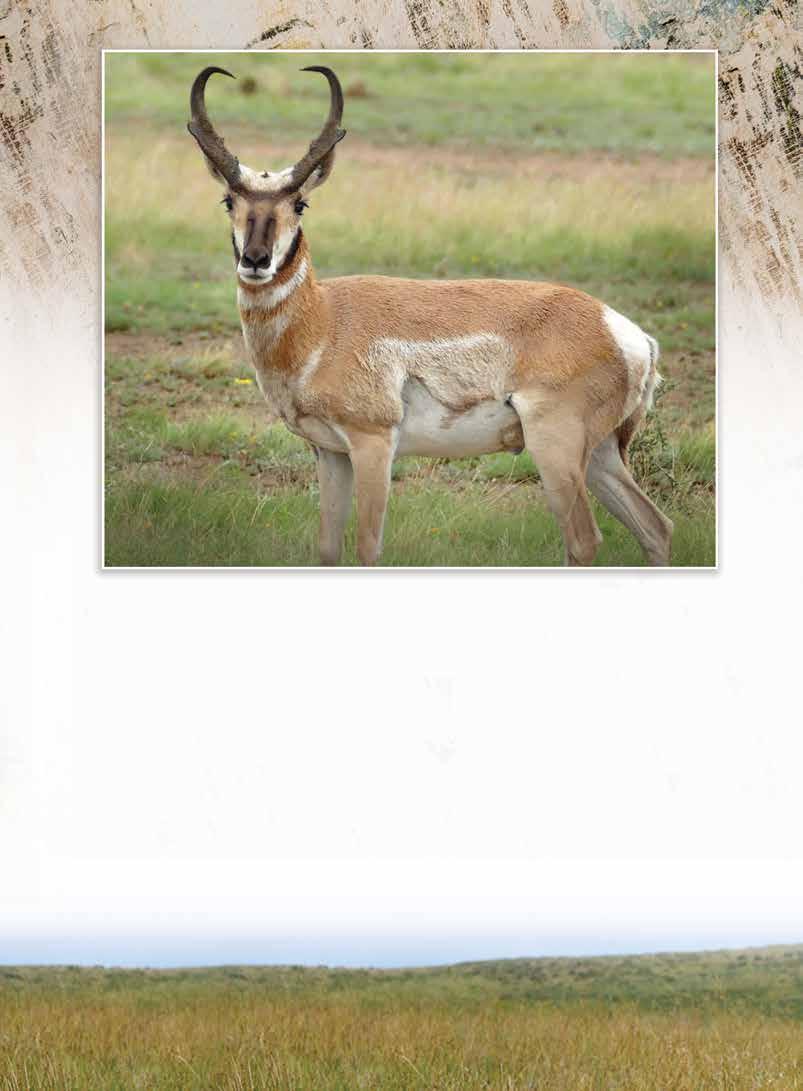
can animal in relation to its size and they are placed high on the skull to give them nearly a 300-degree arc of vision without moving their head.
Five subspecies have been described, but science doesn’t support differences between all of them. Research on genetic and physical differences has failed to provide a clear set of characteristics that we can tell these different subspecies apart. The most common subspecies is the northern pronghorn, Antilocapra americana americana, that occupies the greatest range in North America, extending southward from Canada into northern Arizona, northern New Mexico, and northern Texas. It is generally a little larger and genetic analyses have found some genetic differences to identify them, but they are not dramatically different from other pronghorn. What differences do occur, can probably be attributed to just living in a different environment.
In the Southwest, the Mexican pronghorn, A. a. mexicana, are thought to have historically occurred throughout north-central Mexico northward into southeastern Arizona, southern New Mexico, and West Texas. Peninsular pronghorn, A. a. peninsularis, occur on the Baja Peninsula of Mexico. A fourth subspecies, the Sonoran pronghorn, A. a. sonoriensis, was historically much more widely distributed throughout southwestern Arizona, northwestern Sonora, and northeastern Baja, Mexico.
Early research in the Southwest identified a genetic variant in pronghorn populations in West Texas that seemed to identify the Mexican subspecies. Later work in Arizona showed that this genetic marker was found all over and did not identify any subspecies. The reality is, the Mexican subspecies probably never existed. The habitat where pronghorn lived stretched throughout the Great Plains continuously down into the grasslands of Coahuila and Chihuahua Mexico. It doesn’t seem to make sense to divide these northern Mexico pronghorn from the others in the southern great plains and there are no physical or genetic ways to set them apart from northern pronghorn. The issue is certainly moot now because Wyoming and northern New Mexico pronghorn have been translocated to northern Mexico to reestablish those herds.
The U.S. Fish and Wildlife Service listed the Sonoran pronghorn as an endangered species in 1967, and a Sonoran Pronghorn Recovery Team oversees their recovery. Legal hunting for Sonoran pronghorn has never occurred in the U.S., and has been illegal in Mexico since 1922. The Sonoran pronghorn population plummeted to only 21 individuals in the U.S. about 20 years ago. There are now about 550 Sonoran pronghorn in Mexico and another 400 in the U.S. thanks to an aggressive recovery program that included captive breeding and supplemental food and water. Currently, these pronghorn occupy a portion of the Sonoran desert from southwestern Arizona
southward into Sonora Mexico.
Although on the endangered species list, the original description of the Sonoran subspecies was based on only two specimens. These specimens were described as smaller and paler in color. This is not a very scientific way to describe a subspecies and later skull measurements with a few more skulls failed to find differences between Sonoran pronghorn and other types. Likewise, recent genetic work has had a hard time showing the Sonoran pronghorn is different from those farther east and north. But all these studies have suffered from small sample size and sometimes more-primitive methods. Small genetic differences that have been found are probably the result of those populations being cut off from each other in the last 100 years.
The peninsular pronghorn is also on the Endangered Species List, and its status has also been in question for a while. In 2010, Mexican biologists failed to find a single peninsular pronghorn on their annual surveys, but today they are counting more than 300. There are small genetic differences between it and the Sonoran pronghorn to the east, but no physical differences have been described. The peninsular pronghorn now lives in the central part of Mexico’s Baja Peninsula, but used to roam most of the northern portion as well. Sonoran pronghorn also ranged into northern Baja so subspecies designations get murky in that region. If Sonoran and peninsular pronghorn were once part of an intermixing larger population in the early 1900s, they probably would not have had time to separate to 2 subspecies by now.
The lack of obvious genetic and physical distinctiveness in the Sonoran and peninsular pronghorn doesn’t mean we should stop all our conservation efforts for them. The pronghorn populations in Chihuahua and Coahuila no longer resemble what was there naturally, so it makes little sense to worry about subspecies. We sometimes get too hung up on subspecies names
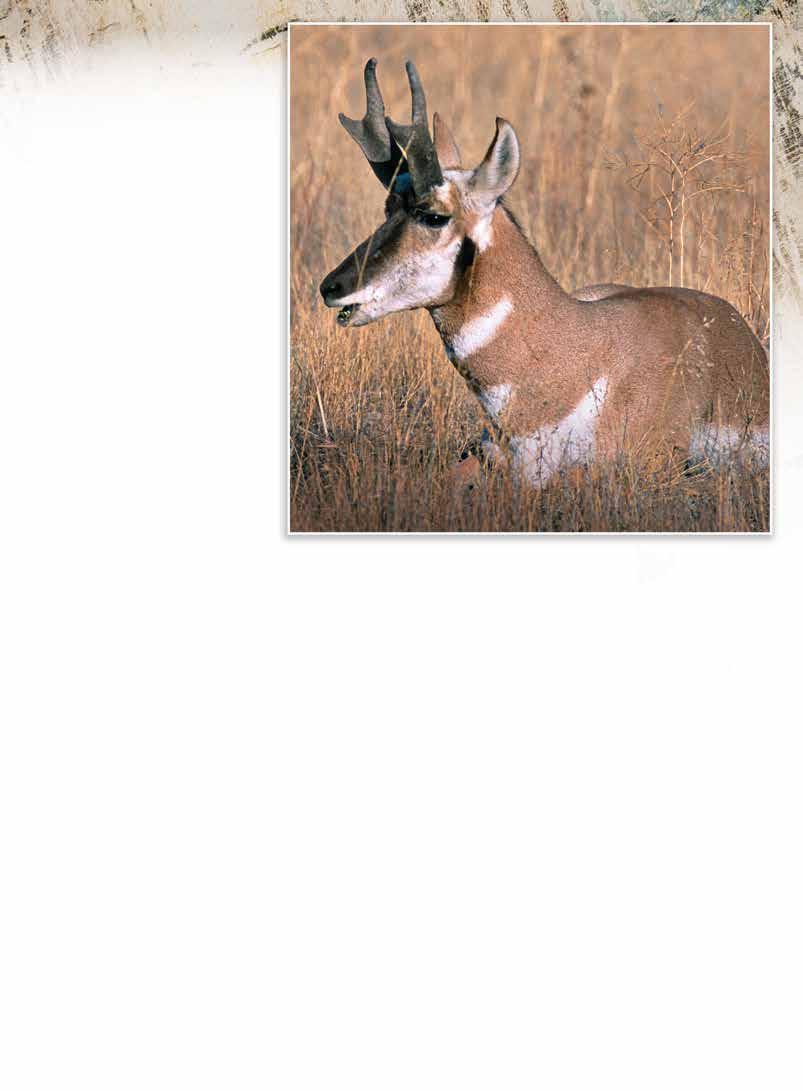
when we should focus on conserving the animals no matter what flavor. Regionally different variations of a species should be conserved to make sure we are preserving the whole species and all its diversity. The ability of southwestern types of pronghorn to exists in marginal habitat may be important to the future survival of the whole species as conditions and habitat continue to change.
We almost lost this amazing creature to extinction in the late 1800s as we were figuring out how to conserve North American wildlife, but we will not risk losing them again. Today, pronghorn in the Southwest have a lot to worry about: predators, human encroachment into their habitat, over-use of the rangelands, blocked movement corridors, drought, energy development, and competition with a multitude of other land uses. We should not worry so much about all the name-calling and make sure we are not changing their environment faster than they can adapt with it.




By Dannielle Pope
Ididn’t find Texas Brigades on my own. My brother Dalton did.
He was the one who stepped into camp unsure and walked out with purpose. It wasn’t in a classroom where things clicked for him—it was in a West Texas field, standing shoulder to shoulder with conservation professionals, learning the kind of lessons that shape character: leadership, responsibility, land and habitat management, and wildlife biology.
When Dalton came home from that week, he was different, not in a loud or dramatic way—but in a steady, clear-eyed way. He was more confident. More focused. He had found a place that didn’t just teach him facts—it ignited his passion for the outdoors and expected him to lead. Texas Brigades saw the leader in him before the rest of the world did.
Of course, those of us who knew Dalton already saw something special. He grew up in camouflage and a coonskin cap, earned the rank of Eagle Scout with Troop 4990 in Wallis, received the 4-H Gold Star Award, and competed at nationals in shooting sports with the Fort Bend County 4-H Club. The outdoors had always been part of his life—but it was Texas Brigades that fired him up. It took everything he already loved and gave it direction, purpose, and a voice he hadn’t yet fully stepped into.
And then, in 2019, we lost him in a car accident—just a few months shy of his 33rd birthday.
As an Army combat veteran, I’ve served in high-stakes environments and carried responsibilities that shaped who I am. I’ve led soldiers and served missions bigger than myself. But losing Dalton rewrote everything I thought I knew about service. Because the kind of impact he made—sparked by his time spent at Texas Brigades—was the kind that lives on. Quietly. Powerfully.
In the days immediately after his death, people kept asking where they could donate in his memory—and the only answer that came to mind was Texas Brigades. We set up a memorial fund in his name. Then, I did what felt right: I got involved. I joined the Board and committed to helping build the same experience that had shaped him.
Texas Brigades isn’t just a camp. It’s a launchpad—for confidence, for conservation, and for leadership. It gave Dalton more than knowledge. It gave him a voice. And in his absence, it gives me a mission that is different from any I have known before, one that’s personal, enduring, and rooted in my connection to him.
Dalton first attended the Bobwhite Brigade, the flagship camp of Texas Brigades. He returned transformed—not just more informed, but more alive with purpose.
Bobwhite Brigade is a five-day, immersive camp focused on the ecology and stewardship of northern bobwhite quail. Cadets learn everything from anatomy and biology to habitat needs, covey behavior, and predator-prey dynamics. But more than facts, it instills a deep sense of stewardship.
At camp, Dalton learned to assess habitat quality, identify native grasses, and understand brush management practices like edge feathering and prescribed burns. He studied biodiversity, the role of predators, and how to balance land use with conservation.
And for the first time, he had the confidence to speak about it.
“Tell me, and I forget. Show me, and I remember. Involve me, and I understand.” That’s the Texas Brigades motto. And it was true for Dalton. He wasn’t just told or shown—he was involved. That involvement turned knowledge into purpose.
Cadets don’t just absorb information—they communicate it. They practice public speaking, conduct mock interviews, and present to real audiences. Dalton, who once avoided public speaking, started giving talks on habitat fragmentation and quail population decline.
He spoke to our community, taught kids about quail calls, and educated landowners about brush management. He explained how restoring habitat for bobwhite benefits deer, turkey, pollinators—even water quality. He began to see the land not just as something to enjoy, but something to protect.
Bobwhite Brigade gave him the words for what he felt. It turned curiosity into confidence and helped him chart a path—one that led him to Texas Tech, where he earned a Wildlife and Range Management degree in 2010.
After college, he worked as an environmental inspector, farmer, rancher, and more. He was meticulous and tenacious, but above all, people remember his generosity, humor, and how deeply he cared for others.
Texas is changing—fast. In the last decade, we’ve lost over 2.2 million acres of native landscapes to urban development. That’s 650 acres a day. As cities grow, fewer young Texans maintain a direct connection to the land.
Today, fewer than 1% of Texans own land—and most landowners are aging. Over the next two decades, Texas faces a massive generational land transfer. Without educated, motivated young people to step up, we risk losing these vital resources to short-sighted development and neglect.
Texas Brigades meets this challenge head-on. As a 501(c)(3) nonprofit, it prepares youth to become conservation ambassadors through hands-on education and real-world leadership. Its vision: to create conservation leaders in every community.
Programs include:
Summer Camps – Five-day residential camps focused on species-specific ecosystems (quail, deer, bass, waterfowl, ranching, and more).
Texas Brigades Experiences – One-day, accessible events introducing youth to conservation principles.
Each year, Texas Brigades trains over 300 youth from 1,000+ communities—rural, urban, and everywhere in between— building a statewide network of young conservation leaders. Cadets leave camp not just informed but empowered.
It takes a village to grow conservation leaders—and there’s a role for everyone:
Apply – Youth ages 13–17 can apply at www.texasbrigades. org.
Spread the word – Know a teen who’d thrive? Share the opportunity.
Donate – Support tuition, travel, and gear for deserving youth.
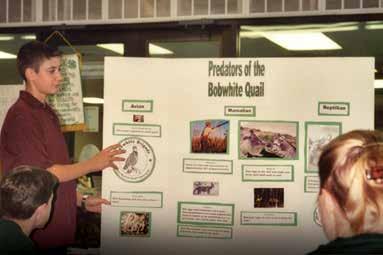
Dalton giving a presentation during his time as a Brigades cadet.
Volunteer – Conservationists, educators, communicators— your expertise matters.
Join the board – Passionate about the mission? Inquire about board service.
Be an adult leader – Mentor cadets and lead field activities. Every hour, dollar, and effort helps raise the next generation of stewards.
Texas Brigades is for any teen who:
• Loves wi ldlife, nature, or being outside
• Is curious about science, leadership, or making an impact
• Has untapped potential—whether they’re loud or quiet
• Would benefit from mentorship and challenge
• Wants to build confidence and direction
• Cares about their community and environment
No land ownership or rural background is required—just heart, curiosity, and the courage to apply.
If Dalton were here, he’d tell you what Texas Brigades meant to him—the friendships, the knowledge, the confidence, the direction. He left a quiet mark on the world by showing up, doing the work, and making people feel seen.
Since he can’t tell you, I will.
This is our story—the impact of Texas Brigades, and why I’ll never stop sharing it.
This is where it started for him. Where could it take you?
After losing her younger brother Dalton, Dannielle was drawn to Texas Brigades, the same program that had helped shape his confidence, purpose, and voice. Today, she serves as vice president of the Texas Brigades Board of Directors, working to ensure other youth discover the same leadership spark he did. A fifth-generation Texan and Army combat veteran, Dannielle is a graduate of the U.S. Military Academy at West Point and holds a Master of Public Health from Texas Tech University. She now channels her experience into championing youth development, rural conservation, and public health across the state.

By Horace Gore
When you’ve hunted as long as I have, in as many places as I have, the chances of something going wrong come easy. I never had a problem keeping things together on deer, elk, pronghorn, nilgai, aoudad, or coyote hunts. My problems were usually associated with quail hunting. When you have dogs, and especially a hunting companion, you have many things on your mind.
Quail hunting has been my nemesis when it comes to forgetting something. I remember a couple of times when the agony was almost more than I could bear. Both times had to do with my shotgun, and both times I was handling dogs and hunting with a friend.
Murph Bledsoe had a hunting camp in Pearsall that Ted Clark and I frequented quite often. On one winter weekend, Murph invited Ted and me down to shoot some quail. It was a banner quail year and I met Murph and Ted at Pearsall with my English pointer, “Ruff,” my favorite quail gun, and plenty of shells.
Murph had a dog kennel for the dog, and I left my shotgun behind the seat of my locked pickup, along with hunting vest and shells. Before bedtime, Ted asked for my keys to get something out of my truck.
Saturday morning, Ted and I loaded Ruff and headed to the hunt, as Murph yelled, “Kill enough quail for supper!” The lease property was about 20 miles from town, and we could hear quail whistling in the brush as I turned Ruff loose in the crisp dawn.
I reached for my shotgun behind the seat. No gun! “Where’s my shotgun?” Ted saw me looking for the shotgun and said, “Oh! I forgot to tell you that I took your gun out of the truck
and put it in the trailer last night.”
I was stunned! Here I was in a pasture full of quail, with a good dog, and no gun. Should I go back to Pearsall for my shotgun? The round trip would take more than an hour, and Ted was anxious to hunt. I ended up being the dog handler while Ted shot quail over my dog. He had a bag full of quail by mid-morning while I watched.
On another occasion, Treldon Cutbirth and I went on a quail hunt in San Saba County, east of Richland Springs. He had a good English setter, and I had Ruff. I put the dogs into my pickup dog box while Treldon got his shotgun and stuff from the house.
We had shot a few clay birds that morning near the barn, and I had leaned my Winchester 20-gauge against a Spanish oak and forgot about it.
We got to the hunting spot about 25 miles toward San Saba, and when I released the two dogs, it occurred to me I didn’t have my gun. I had left the 20-gauge leaning against the tree at the barn.
The dogs worked well, and we flushed four or five coveys between three o’clock and sundown. Treldon felt bad that I had no gun and let me shoot a couple of singles with his Browning 20-gauge. We went to the truck at dusk with one limit of 12 bobwhites.
Needless to say, the evening was rather drab without a shotgun. When we got back to the ranch, I saw my 20-gauge standing against the oak. Treldon’s wife, Minnie, met us at the door and exclaimed, “I hope you guys got a lot of quail!” I replied, “Treldon did!”
The sound of hooves shuffling through dried leaves put my head on a swivel. With arrow nocked and release on the string, I waited. Moments later a doe came at a slow trot, paralleling the small creek under my ladder stand. She was nervous, glancing over her shoulder.
Maybe three minutes later, more shuffling came from behind me. A mature eight-point, with nose to the ground, followed the same trail. When he neared my stand, I grunted with my

voice while bringing my Mathews bow to full draw. The arrow whistled through the ribs. The buck crow-hopped across the creek, stood for a few seconds, then tipped over.
The November air was bitter cold that morning on that eastern Colorado river bottom. I remember ice crunching when I crossed the creek. Just as I lifted the dead buck’s antlers out of the brown leaves, I heard grunting and more chaos near the stand I’d just climbed down from. There, almost directly under
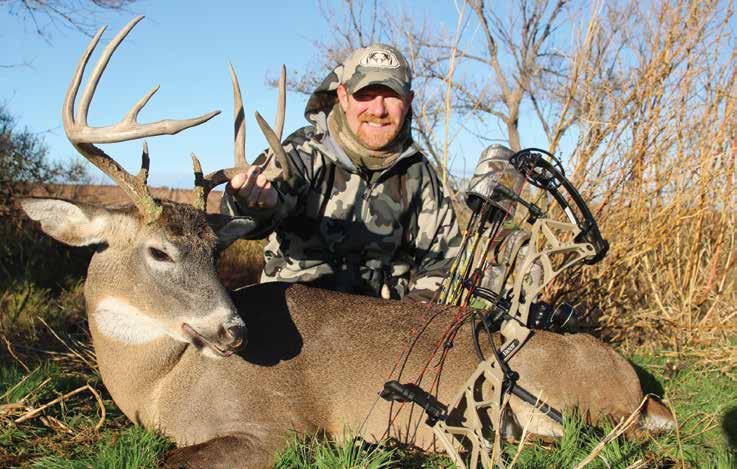
Brandon shot this nine-point in Hall County on Nov. 17, 2015.
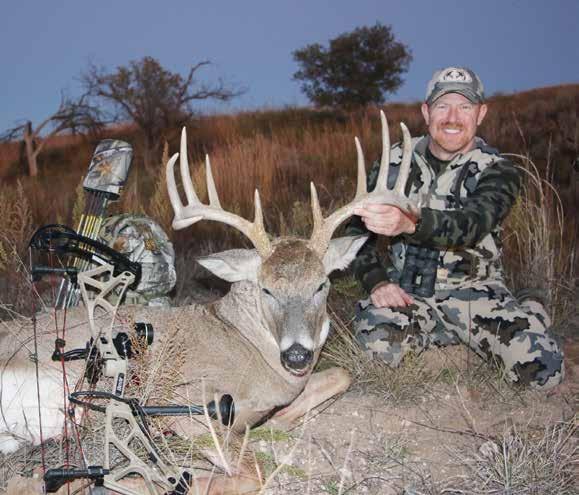
my stand, was a bull-necked eight-point.
I’d guessed his heavy-beamed rack at 140-inches. He stared at me while panting like a dog. I was only 40 yards away in plain sight. The buck was not concerned in the least by my presence.
He continued down the trail that flanked the creek. Five minutes later, another stud buck came trotting down the same trail, grunting at every stride. I barely remember the previous three days of slow activity, but I vividly remember those three bucks trailing that single doe on a cold morning in November 2009.
If you hunt whitetails from middle Texas all the way north up through the Midwestern states and into Canada, November is your month. Studies across multiple states show that peak breeding occurs in November. Bucks that were sneaky and nocturnal in October may suddenly be wandering around at midday in November looking for love.
The biggest change from October activity is this: Bucks start to leave their core home area as the first does come into estrus. Also, daylight movement increases. That means while you may have been seeing the same bucks over and over in October, come November a new buck could pass through your property at any time. That’s exciting.

The author arrowed this wide 11-point in Roberts County on Nov. 6, 2015.
Look for the sign. Fresh rubs, scrapes and tracks will show you where bucks are traveling. For the western river bottom-type habitats I usually hunt, there’s often a well-worn game trail that will parallel the course of the water system. Setting up somewhere along that high-traffic trail is a good strategy.
My friend and wildlife biologist, Jeff Bonner, has 30-plus years of experience. He has often said prime rut action in the Texas Panhandle occurs one week either side of Thanksgiving Day. Ask a biologist in your hunt area when rut action peaks.
Bucks can move great distances in pursuit of females. Especially in low deer density areas, places like the Texas Panhandle, the Oklahoma Panhandle, eastern Colorado or western Kansas, deer often move further than deer found in higher density locations. Patches of suitable habitat and fewer does are spread across larger landscapes. I recall a story a friend shared about a southwestern Kansas hunt.
In early November, he saw a huge eight-point with a distinct, 7-inch drop tine on its right side. The buck passed his ladder stand out of range. A week later, he saw the same buck from a different stand along that same river bottom. There was no mistaking the curved, 7-inch drop tine on the buck’s right side. The distance between the two sightings was 5 miles.
Calls are handy to coax a cruising buck within range. Rattling antlers, grunt calls and can calls should all be within easy reach. Way back on Nov. 12, 2000, half-frozen to a cottonwood tree in a ladder stand in eastern Colorado, I spotted a large buck at sunset cruising through the snow-covered river bottom. He was 100 yards away.
I grunted once on my plastic grunt call. The buck stopped. The air was so cold, the moisture from my mouth froze the plastic reed in my call. I took my Thunderhead broadhead and chipped the ice away, then let out two more grunts before the call froze again.
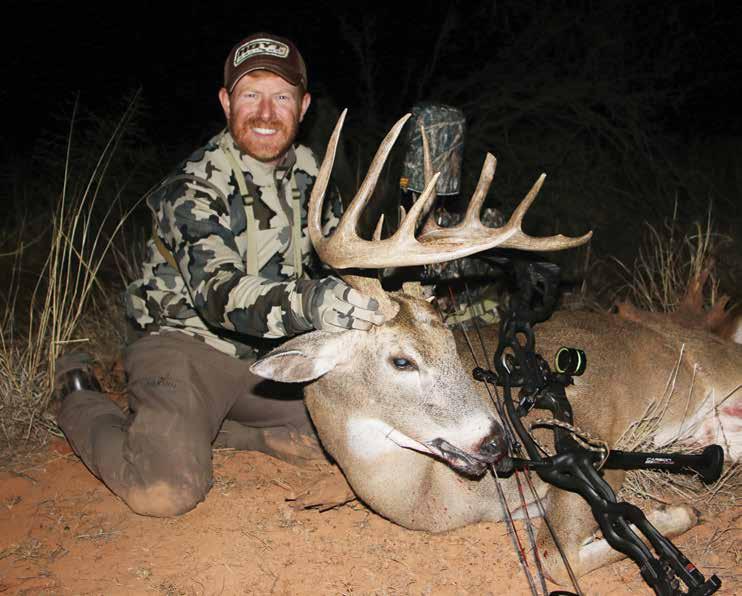
The buck turned and came my way like a guided missile. I arrowed that large-bodied prairie buck at under 20 yards. His rack gross-scored 163-inches with several points broken. Without the call, there would have been no shot opportunity.
On Nov. 21, 2014, hunting in the Texas Panhandle, a previously unseen 10-point buck showed up. The best buck I’d seen all season. My arrow zipped through the vitals, and he only went 40 yards before tipping over.
His rack gross-scored 142-inches. Moments later, another previously unseen buck of similar size walked by. He sniffed my blood-soaked arrow that was stuck in the ground, licked the fletching, and then continued wandering down the creek! Sometimes it takes a decade to appreciate the good times. Back in the fall of 2015, armed with a 60-pound Bear Arena 34 bow, Victory VAP arrows, and Slick Trick broadheads, I had an epic November. Hunting in three different Texas Panhandle counties–Roberts, Hall and Randall—I arrowed three fine bucks.
Brandon arrowed this Texas Panhandle 10-point on Nov. 21, 2014.

First, while hunting a friend’s lease in the rolling, big country of Roberts County on Nov. 6, a wide 11-point wandered within 25 yards of my pop-up blind at sunset. That 22-inch wide, 11-point rack gross-scored 159 inches. The buck weighed 250 pounds live weight.
Next, on the morning of Nov. 17, hunting with Plaska Lodge out of Memphis, I got another chance. Waiting in a ladder stand surrounded by thick mesquites in Hall County, a 125-inch nine-point followed a doe within 24 yards of my setup. Finally, the following day, on Nov. 18, while hunting family land in Randall County, a previously unseen 11-point wandered down the trail by my brush blind. His wrinkled face and arthritic gait made him look old.
My arrow zipped through the ribs at 18 yards. That old buck’s back teeth were worn down as smooth as a ceramic countertop. His rack gross-scored 152-inches. All three bucks are proof that any date in the month of November can be a winner.
What memories will sweet November bring this year?

Encompassing 25,852 acres, the J. D. Murphree Wildlife Management Area is one of the largest WMAs in the Texas. Part of the Texas Chenier Plain resting along the westernmost geologic delta of the Mississippi River, it features fresh, intermediate, and brackish water wetlands. Headquartered near Port Arthur, its Jefferson County landscape is vast.
The state acquired the original 8,312 acres in 1958. It added additional parcels in 1983, 1997, and 2019 to form its boundaries today. Officials named the WMA in 1963 for John David Murphree, a game warden murdered in Jasper County by a duck poacher.
Wetlands play critical roles in today’s ecosystem by providing habitat for year-round and migratory wintering waterfowl. They are considered irreplaceable for supporting wildlife of all kinds. The marshy areas also aid in storm surge protection, flood control and water purification while providing breeding and nesting grounds. Numerous mammals, reptiles, amphibians, and birds of many species call Murphree WMA home.
Michael Rezsutek, Project Leader for the Upper Coast Wetlands Ecosystem Project (UCWEP), has spent his entire 24-year TPWD career at Murphree WMA , having started as a migratory game bird biologist.
“This is such a great place to be. It’s most important to all ecosystems by the sheer size of it,”
Rezsutek said. “The intermediate
and brackish water covers 15,000 acres with very diverse aquatic plants. The Big Hill Unit supports aquatic plants as well as seed producing plants necessary for ducks.”
The terrain may appear much the same, because its flat land as far as the eye can see. Covered with native marsh hay cordgrass, seashore paspalum, bulrushes, cattails, Phragmites (cane), and aquatic plants, it’s what is hidden inside and under the water that defines it and makes it unique.
Like many areas across the Lone Star state, invasive species of various kinds are found here as well. Giant salvinia, common water hyacinth, and deep rooted sedge are just a few. Rezsutek said, “Keeping these invasives in check is a constant struggle necessary to maintain the habitats that keep wildlife coming back to Murphree WMA.”
Rezsutek said they rarely have any whitetail deer although deer live only a few miles north. Access to Murphree WMA is by boat only and not conductive to bird watchers as they have no trails or roads, no overnight provisions. and you may not want to walk due to the alligator population here.
Alligators are abundant. The American alligator is the single most important reptile and predator here with the highest density of the upper Texas coast. It’s hard to estimate the exact number, but they are plentiful.
Each year Murphree WMA has drawings for alligator hunts. Last season 2,097 applicants vied for 150 permits; success rate was 48%. For 10 youthonly permits, 641 applied and the lucky chosen ones had 100% success.
“The average alligator taken here is 7 ½ to eight feet, as they simply get smarter as they get older and larger,” Rezsutek said. “The Murphree WMA
Check the Public Hunting Lands booklet or TPWD website for days and times open for Murphree WMA waterfowl hunting. Duck hunters can hunt in the marsh or open water of Murphree WMA but must check in to register. Hunters must possess an Annual Public Hunt permit (APH), valid hunting license, appropriate tags and stamps. Anglers must possess an APH or a Limited Public Use permit to fish within the Murphree WMA unless all activity is confined to a boat within navigable waters. A valid fishing license with appropriate stamps is also required. Many fishing map apps can provide information to advise if within Murphree WMA boundaries. Call 409-736-2551 or visit tpwd.texas.gov/huntwild/hunt/ public/annual_public_hunting/need-to-know/.
record is a 12-foot 9-inch gator.”
Murphree WMA is also known for its waterfowl hunting. Green-winged teal, canvasbacks, and gadwalls along with many other duck species create topnotch hunting for wing shooters. It’s first come, first serve, and hunters are often camped out waiting for the gate to open for registration.
Hunter numbers and their success naturally depends on the weather along with accuracy of shooters. The overall average is about 2.7 ducks per hunter on a trip and an overall harvest of about 4,000 ducks taken per season.
In addition to gators and waterfowl, Murphree WMA has a long list of mammals including nutria, river otter, mink, swamp rabbits, and muskrats. Similar to much of Texas, raccoons, cottontails, skunks, armadillo, opossum, bobcats and many mice and rat species call this place home.
“We have a good population of hogs. Who doesn’t?’ Rezsutek said, laughing. “Hog hunting takes place Feb. 1 until the end of April. You can take all you want!” Hunters must have an Annual Public Hunt permit and use a boat or UTV to access hunting areas.
One might think hogs wouldn’t be in coastal saline flatlands but they are here. Hogs, like many creatures, can adapt to their surroundings without a problem.
Fresh and saltwater fish common to the Texas coast can be found in the Murphree WMA. March 1 through Aug. 31, anglers can fish various compartments and ditches 30 minute before sunrise to 30 minutes after sunset.

wetlands habitat for ducks, other birds, and aquatic wildlife is
Shore birds and cranes of all kinds are abundant in Murphree WMA. Some areas may close to not disturb nesting activities. Murphree WMA plays a critical ecological role for a diverse group of avian classes as well as frogs and turtles.
Like most WMAs, Murphree has research projects for multiple purposes. Since the late 1990s, the contents of mottled duck gizzards have been checked for lead shot. Steel shot for waterfowl hunting has been in effect since 1978. Every year a few hunters are found to be in violation of this law. Some by forgetfulness and others are deliberate. Steel shot shells are more expensive.
Lead shot from years past still remain in soil and plants where ducks feed. Discovering it in gizzards seems to have hit a plateau. Approximately 5% of ducks tested in recent years still have lead pellets so it’s still essential to check and record.
Stephen F. Austin graduate students have been conducting an alligator breeding study. The research consists of vocalizations, acoustics, and monitoring all movement and activity around nests. They are trying to identify preferred nesting areas.
If you’re a waterfowl, hog. alligator hunter or fisherman, perhaps you should check out Murphree WMA to see if there’s something for you. Nature lovers and conservationists can be assured that this vital WMA for the Texas Gulf Coast will be active for decades to come.


The author reminisces about his long, storied, hunting career, and a bit of knowledge on his favorite outdoor subject.
by Horace Gore
The white-tailed deer is unquestionably America’s favorite game animal. Eleven million hunters across the nation are lured to chasing the whitetail from Canada to Mexico. For 58 years I was a devoted whitetail hunter, having taken both bucks and does from most of Texas’ whitetail range. As a fledgling wildlife biologist out of Texas A&M University, I found it very exciting to hunt and eat Texas whitetails.
My teen years were spent in the flatwoods of Bowie County, near the Red River, where there were no deer or turkey. I took my first whitetail in 1958, a yearling five-point with minuscule antlers, from an oats patch in Brazos County. I took another three-point yearling buck from the same 10-acre property the following season, before graduating with a B.S. in wildlife science in 1960. Although I had a broad hunting repertoire, I was getting hooked on whitetails.
While working for Texas Game and Fish Department, and running a deer check station in Brownwood in 1961, I met Treldon Cutbirth, a rancher in south Brown County. I hunted with Treldon when I took my first trophy whitetail—a perfect 10 pointer that scored 150 B&C—a very good buck in 1961.
We moved to Brownwood, and for the next four years, Treldon and I took many fat does for hamburger and sausage. In the fall of 1965, I moved to Waco but still returned to deer, dove and quail hunt with the Cutbirth family.
After I moved to Austin, I continued to hunt with Treldon, but I also spent deer and dove time in Webb County with an old Aggie buddy, Al Brothers. In 1978 I shot my first South Texas buck with Brothers—an 11-point with an 18-inch spread. It was the first of several good bucks from South Texas.
During my first years with TTHA, I got an opportunity to hunt the diminutive Carmen Mountain whitetail, which has a range of southern West Texas into Coahuila, Mexico. A large ranch owned by Rodolfo de los Santos and his wife, Patricia, is home to Carmen whitetails and desert mule deer in Coahuila, and Rodolfo invited me down for a hunt.

I drove to Eagle Pass where a pilot met me in a small plane to fly the two miles across the border to Piedras Negras International Airport. The pilot filed a flight plan to Rancho Cimmaron about 50 miles due south of the Big Bend. We were met at the ranch runway for a three-day hunt and visit with Rodolfo, Patricia, and some California hunting guests.
The first morning my guide and I hunted “safari style” for a good Odocoileus virginianus carminis buck, but saw only a few whitetail does mixed with desert mule deer. When we returned to the lodge for lunch, one of the visiting hunters from California asked that I look at his buck, which might be a whitetailmule deer hybrid.
I looked at the buck for the tell-tale signs of a hybrid. After inspecting the head, tail, and lower hind-leg scent glands, I was convinced it was a hybrid. I had already noticed mixed herds of whitetails and mule deer, and it was no surprise that the ranch would have hybrid offspring.
After lunch and a siesta, we went looking for a shooter Carmen buck. As we descended a rough ranch road about sundown, a Carmen buck appeared far below us in a narrow valley. My Mexican guide said, “Cola blanca,” as he stopped the truck. Through the binocs, the deer looked like a 3-year-old six-pointer. The guide nodded “yes,” and I chambered a round in my .270, which was sighted for long shots.
I waited for the buck to turn, holding the crosshairs of the Weaver K-4 just behind the shoulder. The deer stood broadside at about 250 yards as I took a rest on the rearview mirror and squeezed the trigger. The shot echoed across the valley, and in a short moment the buck fell in his tracks. My guide slapped me on the shoulder and quipped, “Muy bueno! Tiro largo! Bueno tiro,” as we descended toward the dead buck.
Mexico had a fever tick quarantine for taking a deer—even a deer head and hide—into the U.S. When the guest hunter who had killed the hybrid and another big eight-point asked if he could have my six-point, I didn’t hesitate. He had a large

hunting museum and wanted to take all three Carmen bucks for full-body mounts. So, I left Rodolfo and Patricia with my Winchester .270 over my shoulder and memories of my only Carmen Mountain whitetail hunt.
I took only three of my many whitetail bucks outside of Texas: the Carmen in Mexico, a Mexican 10-point for a TV show, and an old “swamp buck” in Wisconsin. On a TV filming jaunt with Brian Hawkins and Steve Grams, I was the shooter for a North Woods show about Wisconsin whitetails.
Wisconsin winters are extremely cold, and I wore thin camouflage. A brisk north wind brought the temperature down to a 0-degree chill factor, and Steve and I shivered in a dilapidated blind two days without seeing a single buck. Brian wisely stayed at the lodge, recuperating from an appendix operation.
On the third day, I shuddered in the cold about an hour before departure time, when an old heavy-antlered eight-point “swamp buck” appeared and quickly met his demise from my borrowed .30-06. The buck had come out of the wooded brush about a stone’s throw from Lake Superior. Steve filmed the shot, and when the hunting scenes were completed, we headed for the airport to get out of the Badger state and back to Texas— post haste.
Today, Texas has a healthy deer herd, and whitetails are increasing faster than deer hunters. This is not problematic yet, because deer have increased their range to some 100 million acres in the last few years. However, Texas deer hunters make up only 4.7% of license-age residents, taking a harvest of 800,000 whitetails annually from a growing population of some 5 million.
The annual loss of whitetails is about 22 percent, considering 16% harvested and another 6% loss of adults to natural and man-made causes. These losses are negated by fawn recruitment, and deer populations continue to grow and expand.
Whitetail habitats continue to be fragmented as large properties are divided into smaller tracts. Dense deer numbers give hunters a wide choice for harvesting animals, and trail cameras and feeders allow hunters to pick and choose. More money is spent to hunt and manage deer than ever before, making Texas deer hunting worth a reported $4.3 billion.
To say that Texas leads the nation in deer quality and quantity is an understatement. Hunters from all over the world come to Texas, and landowners put a lot of effort into producing quality bucks, making whitetails the premier species for Texas hunting.
The economics of whitetail hunting goes deep into the livelihood of many rural communities in the Edwards Plateau and South
Texas—the hot spots for both quality and quantity in whitetails. The cash registers start to ring at the beginning of deer season. Everything from gas stations, restaurants, and cold storage— down to sporting goods, grocery, and feed stores—provide for deer hunters, and money changes hands in a hurry.
Deer hunting has seen many changes since that November evening in 1958, when a scrawny Texas Aggie shot his first buck from a live oak limb. The addition of spikes, antlerless (doe) deer, five-month seasons, telescoped rifles, compound and crossbows, corn feeders, fancy blinds, and trail cameras have doubled the deer harvest. Deer numbers and buck quality have also increased, making Texas the “go-to” state for the best whitetail hunting in America.
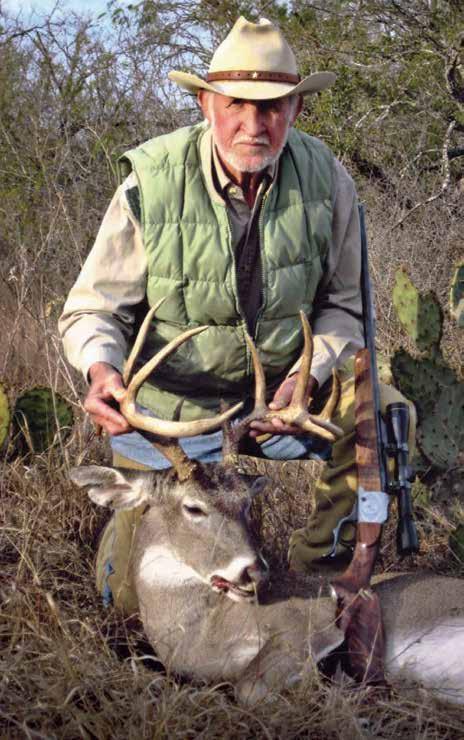








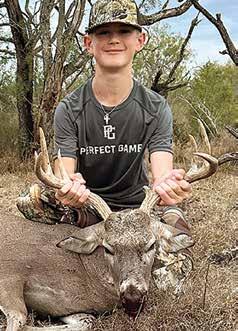
CANNON KLOSTERMANN: whitetail taken 12/1/24 in McMullen County. GEAR: rifle.
OUTFITTER: family lease.
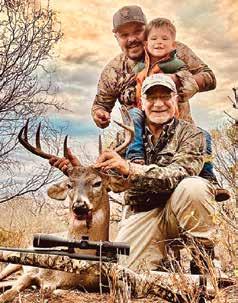
ERIC TREVIÑO: whitetail eight-point buck (first big deer) taken 12/21/24 Hidalgo County.
GEAR: Mossberg .243 youth rifle, Herter’s .243 Win. 100-grain soft point ammo, 3-9X40 Vortex VXFreedom scope.
OUTFITTER: Peña-Chapa Ranch.
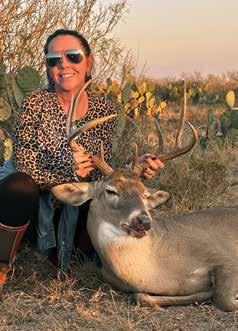
MONICA HENRY: whitetail eightpoint shot 12/27/24 in Webb County.
GEAR: rifle.
OUTFITTER: family lease.
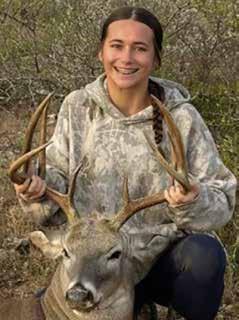
MORGAN BARRETTO: whitetail ninepoint with 16½-inch inside spread, scoring 138 4⁄8 B&C, taken 11/30/24 in Jim Wells County.
GEAR: Howa rifle, 7mm-08 ammo, Leupold 3-9X scope.
OUTFITTER: Papa.
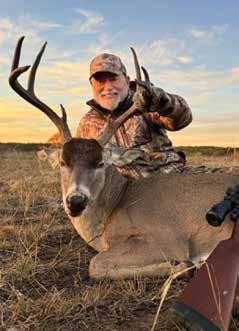
ELDRED MULLINNIX: whitetail eightpoint with 18-inch inside spread taken 11/22/24 in Motley County.
GEAR: Winchester Model 70 Featherweight .308, 4-12X Vortex Diamondback scope.
OUTFITTER: self.
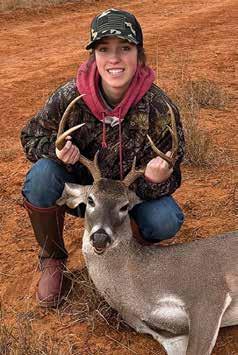
JULIET STALLINGS: whitetail sevenpoint (first buck) taken 12/22/24 in Webb County.
GEAR: rifle.
OUTFITTER: family lease.
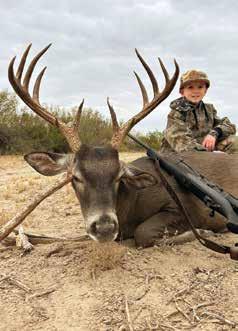
EASTON BROWN: whitetail 12-point with 18½-inch inside spread, scoring 142 B&C, taken 11/29/24 in Webb County.
GEAR: 7mm-08.
OUTFITTER: Dad.
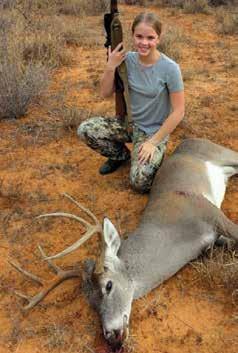
JENNA CHRISTIAN: whitetail ninepoint (first buck) taken 12/14/24 in Webb County.
GEAR: .270
OUTFITTER: Dad.
NOTE: Only TTHA members or immediate family may submit photos. Do not paperclip or staple photos, as this can damage them. Prints must be no larger than 4x6 inches and printed on photo-quality paper. Photos may also be emailed to HuntsEnd@ttha.com. If sent by email, please make sure to include all information from the form and limit your photo size to less than 5MB. Send a separate e-mail for each entry. No photos will be returned. Photos become the
of



First Quarter: Nov. 28 • Dec. 28


Last Quarter: Nov. 13 • Dec. 12







he Journal likes bringing you high-quality articles throughout the year. So, just in case you’ve missed a few, we’ve made your life a little easier by compiling this handy index of all this year’s articles. We’ve broken it down into three convenient categories. We hope you put it to good use. —TTHA Staff
Predator Hunting: Then and Now, Gary Roberson
Four-wheeler Roundup, John Goodspeed
Newest Crossbows for 2025, John Goodspeed
Compound Bow Roundup, John Goodspeed
2025 Optics, John Goodspeed
Riflescopes: New for 2025, John Goodspeed
Predator Call Roundup, John Goodspeed
Science
Mexico’s Whitetails, Dr. James Kroll
Food Plots for Deer in East Texas, Dr. James Kroll
Managing Small Lands For Whitetails, Dr. James Kroll
The Incredibly Adaptable and Delicious Axis Deer, Dr. James Kroll
Thorny Fawns, Dr. James Kroll
White-tailed Deer State of the Union 2025, Dr. James Kroll
Instructional/Informative
The Chaparral Wildlife Management Area, Judy Jurek
Preferred Mule Deer Habitat, Jim Heffelfinger
Coastal Late Waterfowl, Will Leschper
Muzzleloader Hunting in 2025, Eric Stanosheck
Hunting Alaska Muskox, Lee Leschper
Whitetail Tactics for Mule Deer, Brandon Ray
Mason Mountain WMA, Judy Jurek
Coastal Turek & Trout, Will Leschper
High Plains Turkeys, Brandon Ray
Spring in the Southwest, Jim Heffelfinger
Spring Turkey Prep, Brandon Ray
Texas Mountain Lion Project, Gary Roberson
Panhandle Rooters, Brandon Ray
Cuisine of the Wild, Judy Jurek
Coastal Choice, Will Leschper
Great Alaska Combos for Non-resident Hunters, Lee Leschper
Kerr Wildlife Management Area, Judy Jurek
Panhandle Uplands, Brandon Ray
Jan/Feb-p.76
Mar/Apr-p.90
May/Jun-p.98
July/Aug-p.97
Sep/Oct-p.80
Nov/Dec-p.98
Jan/Feb-p.18
Mar/Apr-p.18
May/Jun-p.18
Jul/Aug-p.18
Sep/Oct-p.18
Nov/Dec-p.18
Jan/Feb-p.10
Jan/Feb-p.38
Jan/Feb-p.58
Jan/Feb-p.62
Jan/Feb-p.84
Jan/Feb-p.114
Mar/Apr-p.34
Mar/Apr-p.55
Mar/Apr-p.84
Mar/Apr-p.103
Mar/Apr-p.116
May/Jun-p.38
May/Jun-p.42
May/Jun-p.94
May/Jun-p.112
May/Jun-p125
May/Jun-p.134
Jul/Aug-p.70
Matador WMA, Judy Jurek
Snakes of the Southwest, Jim Heffelfinger
Powderhorn Axis, Will Leschper
Rams in a Rut, Brandon Ray
High Plains Pronghorns, Brandon Ray
Texas Whitewings, Will Leschper
Muzzleloader Hunting For Beginners, Eric Stanosheck
Hunting Desert Mule Deer, Jim Heffelfinger
Elk Are A Challenge, The Old Hunter
Elk of Alaska, Lee Leschper
Is There A Perfect Texas Deer Rifle?, Horace Gore
Make October Count, Brandon Ray
Gus Engling Wildlife Management Area, Judy Jurek
Panhandle Crossover, Brandon Ray
Winter Waterfowl, Will Leschper
Southwestern Pronghorns, Jim Heffelfinger
Sweet November, Brandon Ray
J.D. Murphree Wildlife Management Area
Jul/Aug-p.84
Jul/Aug-p.88
Jul/Aug-p.92
Jul/Aug-p.108
Jul/Aug-p.126
Sep/Oct-p.38
Sep/Oct-p.44
Sep/Oct-p.62
Sep/Oct-p.86
Sep/Oct-p.90
Sep/Oct-p.98
Sep/Oct-p.102
Sep/Oct-p.106
Sep/Oct-p.116
Nov/Dec-p.36
Nov/Dec-p.56
Nov/Dec-p.102
Nov/Dec-p.112
Nov/Dec-p.116

Don’t forget to use your free classified ad! It’s once per year and you must have an active membership in good standing. Send to:
654 Richland Hills, Ste. 160, San Antonio,
You may fax your ad to (210) 523-8871, Attn: Debbie Keene or e-mail to Deborah@ttha.com. Send your ad in by November 7 to run in the next issue!
Available to current members of Texas Trophy Hunters Association only! Limit 25 words per ad. Each member may run 1 FREE ad in one issue per year. 25 word ads after FREE issue are $40 each. WE RESERVE THE RIGHT TO EDIT OR REFUSE ANY AD.
TROPHY WHITETAIL DEER Hunts - superior genetics, approx. 200-acre high fence ranch in Victoria County TX. 3-day guided stands and feeders. boondockbuckstx@ gmail.com.
WILDLIFE EXEMPTIONS – Texas
Rangeland Management provides TurnKey Wildlife Services to keep your Property Taxes LOW! Contact Wildlife Biologist Sergio Morales: 210-526-1522 | www. TexasRangeManagement.com.
HUNT SOUTH TEXAS Deer, Hogs, Turkey, Quail, Dove, Javelina, Varmints. 350 acres near Freer. Low fence. Fully equipped 3 BR, 2ba ranch house with satellite TV. Starting at 150.00 per person per day. Trophy buck, 2500.00. References. 361-947-0584.
WILDLIFE & HABITAT Consulting. Commercial hunts available. Contact Certified Wildlife Biologist Jason Shipman 210-508-8447 or jasonashipman@gmail. com.
S.M FENCING, Welding and Bulldozing. Contact Shawn Mangham. 325-451-7120.
RUGGED EDGE BLADES - a husband & wife Veteran owned company offering beautiful, quality Damascus knives at a reasonable price. Whether you’re out on a hunt, or at the campsite cooking, we have the perfect knife for you. Backed with lifetime warranty and #1 customer satisfaction! Find us at www. ruggededgeblades.com or give us a call at 682-239-0137. Rugged Knives for Rugged Adventures.
WELDED STRUCTURES: Custom Clearing and Fab LLC handles metal buildings, welded structures, and livestock pens throughout the hill country and south Texas. Call Dustin Stareck 316-323-7673. www. customclearingandfab.com.
MACS MOBILE GUN CARE in DFW - Expert Cleaning/Maintenance, and Premium Accessories with Install for Top Tier Firearms. All at Your Front Door! Book Now: CLEANMYGUNS.COM.
THERMAL DRONE WILDLIFE SURVEYS by premier wildlife consulting firm Spring
Creek Outdoors! Professional full time wildlife biologists. Contact matthew. nuernberg@gmail.com.
SPECIALIZED INSURANCE for outdoor recreation & hospitality businesses. Hunting & fishing lodges/preserves, guides, outfitters, ranges, & more. Comprehensive coverages incl. property, general liability, business auto. Contact Devin 361-208-4404 or devinp@jacobs-weber.com.
TXN HOME SERVICES - America’s Toughest Gutter Guards with Leaf Blaster Pro. Built to last. Proven to protect. 40-Year Warranty. Gutters that got you covered. 346-460-9199 | TXNHomeServices.com.
TECOMATE PLOTMASTER 600. Includes: Dual Disc Harrow, Chisel Points, plow & Sweep Points. Used once $4450. Call Bill Hohertz 830-305-4009 or tresluna49@ icloud.com.
BIG TIME HUNTS – World-Class adventures across Southern & Northern BC, Canada! Hunt Stone Sheep, Moose, Goat, Cougar & more. All-inclusive, guided packages. Book your hunt today! www.bigtimehunts.com | bigtimehunts@gmail.com.
TRIPLEJMANUFACTURING@YAHOO. com. One membership available on 2,400 acre hunting lease in Webb County. Each membership is $13,000 with a total of 3 memberships on the 2,400 acres. Contact John at 830-688-2462 or 210-289-3231 for more details.
HILL COUNTRY ADVENTURES offers quality trophy exotic hunts on family land. First class lodging and meals. Visit us at: hillcountryadventuresllc.com or call: 337368-4686.
AMERICAN FEEDER - Fish Feeders. Catch and grow larger, healthier fish. All new aluminum fish and deer feeders from American Feeder. Visit http://www. american-feeder.com for details.
RESERVE RANCH, a Sportsman’s Paradise near La Pryor, Texas offering full service hunts for Whitetail Deer, Red Stag, Dove and Quail to individuals and Corporate clients. www.reserveranch.com.
VETERANS CREED OUTDOORS Team Texas. Outdoor Trips for Veterans and First Responders. Find us on Facebook on our page and group.
JOIN THE MISSION! Support our veterans and first responders with outdoor adventures through Patriots First Outdoors. Donate or become a member today at www.patriotsfirstoutdoors.org.
MAP MY RANCH specializes in developing printed maps for all your outdoor needs. We can create basic boundary maps, or those with customized features - locations of deer blinds, feeders, food plots, ponds, etc. Contact today to get started! www. MapMyRanch.com or 713-302-2028.
HELP FEED THE HOMELESS – donate excess game animals to feed the homeless, orphans, and needy families. Go to www. trinityoaks.org “contact us” tab.
LIMITED EDITION Book. SCI Past President Craig L Kauffman takes the reader on hunting adventures around the world. Signed copies $57. Call 717-917-8173.
MEXICO RANCH: 8,500+ ac Ranch available for serious & management minded Group. Excellent Whitetail - Density & Genetics, Blinds, Feeders - Corn & Protein, 4 Bdr House exclusive for Hunt Group! Protein fed for last 2 years. Exc.Ranch for 4 Hunters. 210-379-7510. email: jharlan29@ gmail.com.
THE LONE STAR Bowhunters Association. Preserving and Promoting bow hunting in Texas since 1974. Join today at www. lonestarbowhunter.com. Take a kid hunting.
KEI VALLEY SAFARIS offering plains game in the Eastern Cape of South Africa. Package hunts or build your safari. Deep sea fishing, photo safaris, and park excursions available upon request. Keivalleysafaris@gmail.com. Keivalleysafaris.com.
S & D WHITETAILS – Limited hunts avail. Booking 2021 now. All native S TX deer from 140-230 class. Deer & Dove hunts Central TX. Over 7500 ac. 24-yrs experience. 5 Star rating. 325-642-7596.