“Education. Advocacy. Promotion. The Texas Pork Producers Association is dedicated to the advancement of a sustainable and profitable pork industry.”
EXECUTIVE COMMITTEE
President - Peter Baumert, Dalhart
President Elect - Cory Rains, Fredericksburg
Vice President - Carrie Brockman, Montgomery
Executive Member - Todd Beyers, Abernathy
Executive Member - Doug Alderson, Marion
Executive Member - Jeremy Rounsavall, Purdon
Immediate Past President - Josh Krohn, Lamesa
BOARD OF DIRECTORS
Coby Berger, Giddings
Ryan Basler, Kerrville
Luke Lindner, Comfort
Dr. Bo Williams, Stratford
Jason Foote, Lubbock
Josh Campbell, Grandview
Glen Blount, Denison
Dan Reed, Krum
STAFF
Executive Director
Colby Ferguson colby@texaspork.org
Director of Youth and Communications
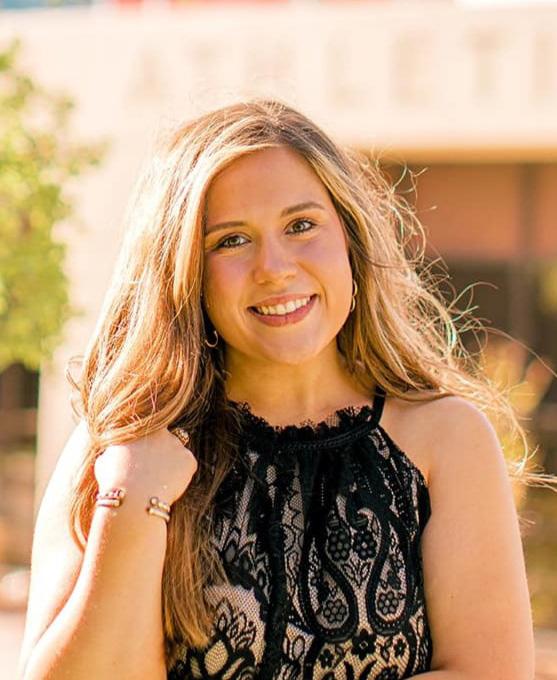
Riley Reep
riley@texaspork.org
FEBRUARY
MARCH
Producer Connection
Producer Connection is the official publication of the Texas Pork Producers Association and is published by the Texas Pork Producers Association. All inquiries should be directed to the TPPA office.
To place an ad or for advertising rates and guidelines, please contact Texas Pork Producers Association at (806) 705-6800 or tppa@texaspork.org.
EXECUTIVE REPORT
Now that 2025 has come and gone, it’s time to focus on 2026. The Texas Pork Producers Association (TPPA) is focused on making the Texas pork industry better than ever through implementing our strategic plan that was completed back in June. This plan outlines four key priorities moving forward for TPPA.
Our first priority is swine health and wellbeing. We will promote animal disease preparedness and prevention to our producers and exhibitors through events, panel discussions, and written materials that will be shared through our online platforms. It is crucial that we improve our biosecurity best practices to not only prepare for possible foreign animal diseases, like the New World Screwworm and African Swine Fever, but also endemic diseases like PRRS, swine flu and PEDv. Additionally, we will focus on increasing the swine veterinarian care in the state through both recruitment and education efforts.
Secondly, industry education is another priority moving forward. TPPA has a strong influence and following in the youth development side of our industry. We plan on expanding this area of influence by delivering relevant and engaging education that empowers youth. Our team will create content tailored to key show industry audiences. In addition, we will partner with ag educators, advisors, universities, and professional associations to expand our reach of information about the pork industry and careers in agriculture.
The third priority focuses on collaboration, engagement, and promotion. Without an informed and motivated consumer, the pork industry will struggle to grow. Our plans are to build and maintain partnerships with allied industry and collaborators. We will continue to support national demand building efforts through uniquely Texas opportunities to engage influencers and the public. Lastly, we will continue to position TPPA as a trusted voice in policy discussions through strategic communication and relationship building with decision makers.
Our final priority of the plan is organizational success. If TPPA is to be a trusted professional association, we must be known as a high-performing, adaptive organization that delivers lasting value to our members and consumers. We will continue to strengthen the board and staff through ongoing development and engagement, as well as foster a culture of planning, execution, and accountability. We are dedicated to maintaining financial stability while allowing room for innovation and calculated risk-taking to improve membership reach and engagement.
These are bold strategies the TPPA will work towards in 2026, and in the years to come. We thank you for being a loyal member and follower of TPPA and want to challenge you to join our quest to make the pork industry better than ever.
Colby Ferguson
CAPITOL REPORT
UPDATE ON THE NATIONAL SWINE HEALTH STRATEGY
The National Pork Board (NPB) has completed their initial draft of a national swine health strategy. State associations are reviewing the strategies and NPB will be submitting the final draft to the Pork Act delegates at the Pork Forum in March 2026. The Texas Pork Producers Association (TPPA) has reviewed the document as well.
The first is to reduce the impact of domestic diseases with a focus on Porcine reproductive and respiratory syndrome (PRRS) elimination, porcine epidemic diarrhea virus (PEDv) elimination and reducing domestic disease spread. The second strategy is to keep foreign & emerging diseases out of the US. Focus on primary foreign animal diseases (FAD) like African swine fever and foot & mouth disease along with other issues like the New World Screwworm (NWS).
TASTE WHAT PORK CAN DO WITH A TEXAS INFLUENCE
NPB’s new marketing campaign, Taste What Pork Can Do, is in full swing. Texas is one of the key states targeted for consumer advertising as Houston, San Antonio, and Dallas are priority cities. TPPA continues to partner with NPB on marketing and consumer engagement opportunities where we can focus on the health and nutrition of fresh pork, along with the unique taste and flavor that pork owns.
Pork not only has the best taste and most flavor nuances of all the meat proteins but is easier on the pocketbook as well. To see for yourself, keep an eye out for the delicious pork advertisements in your area at Walmart, Sam’s Club, H-E-B, Albertson’s, and more along with several other retailers are using the “Taste What Pork Can Do” marketing campaign.
FARM RELIEF PACKAGE IN RELATION TO THE SWINE INDUSTRY
The swine industry will not be seeing any of the $12 billion farm relief package that
the Trump administration is rolling out. The relief package is a response to temporary trade market disruptions and American producers struggling to keep up with high production costs.
Even though pork trade was disrupted with the administration’s trade wars with key pork export countries, this funding is primarily focused on the crop side of the US ag industry. Fortunately, pork producers have seen a rebound in pork exports due to new trade markets in Asia and the Middle East along with shoring up strained existing trade markets. TPPA joined more than 200 other state and federal associations in a letter asking the administration to continue the United StatesMexico-Canada Agreement (USMCA) trade deal. Mexico and Canada
are two of U.S.’s largest trade partners for pork exports with Mexico sitting at number one.
The farm relief program will assist the US corn and soybean producers directly. This should help those producers deal with low grain prices through 2026. These low grain prices are the main reason for pork profitability over the last 18-24 months. If this assistance will keep grain prices low for the foreseeable future, it will help the American pork producer.
NPPC PROPOSED
FAIR, COMPREHENSIVE STRATEGY TO DEFINE ‘ULTRA-PROCESSED FOODS’ IN OCOTOBER
The National Pork Producers Council (NPPC) has raised concerns to the Trump administration about the FDA’s planned definition of “ultraprocessed foods” ahead of the Dietary Guidelines for Americans. NPPC argues that current approaches—such as the NOVA classification—overemphasize processing methods instead of nutritional value and could unfairly label pork products.
The organization urged FDA not to classify foods as ultraprocessed solely based on processing, to avoid penalizing ingredients that improve food safety, shelf life, and nutrient availability, and to ensure any definition aligns with FDA Standards of Identity. Citing a lack of scientific consensus on “ultra-processed foods,” NPPC recommends focusing on nutritional composition and using
the term “discretionary foods” instead to better address dietrelated chronic disease.
AGRICULTURE
NEWS FROM ACROSS THE STATE OF TEXAS
REPORT LONESTAR
AN UPDATE ON NEW WORLD SCREWWORM IN RELATION TO TEXAS’
ANIMAL HEALTH
In 2025, the animal health disaster that consumed the time of so many, was the New World Screwworm (NWS). Even though it had become an issue to the United States Department of Agriculture (USDA) back in November 2024, it did not surface as a big deal until early last summer.
The Texas Pork Producers Association (TPPA) was alerted of the possible invasion and asked to be involved is several task forces, committees, and coalitions throughout the state and in Washington D.C. Through significant surveillance, engagement, treatment, and prevention practices, Mexico has been able to stop the movement of the NWS fly and keep it from moving out of southern Mexico.
There have been a few cases over the last six months consisting of infected livestock being shipped into NWS free states in Mexico. Fortunately, all of those cases were effectively treated and prevented the mature fly from pupating from the larvae. This is great news for
livestock until they heal. The NWS fly needs an open wound to lay her eggs. Preventing this from happening is the first line of defense.
the Texas livestock producer. As long as Mexico contains the NWS fly movement and prevents infected livestock from entering Mexican states near the US border, there is a real possibility that the fly won’t make it to the US.
However, that does not mean that we can let our guard down. Remain vigilant with fly control around your barn and make sure to clean and inspect any cuts or open wounds on your
SUPPORTING AGRICULTURAL
CANDIDATES IN 2026
With the election year of 2026, Texas primary election day is Tuesday, March 3, 2026, and the General election day is Tuesday, November 3, 2026. While TPPA does not endorse any candidates for the elections, we do want to encourage everyone to first, ensure you find time to vote, and second, to do your homework and know who you are voting for.
All politics are local. So, make sure you know not just your city mayor or county commissioner, but also your state representative and your US representative. All of those seats are up for grabs. Keep the candidates that will support Texas
agriculture and our rural way of life in office at the forefront of your priorities.
RFID TAGS AVAILABLE TO SWINE PRODUCERS AT NO COST WITH ASSISTANCE FROM THE NATIONAL PORK BOARD
In July 2025, the U.S. Department of Agriculture’s Animal and Plant Health Inspection Service (APHIS) awarded Merck Animal Health a contract to supply Radio Frequency Identification (RFID) tags to swine producers at no cost over the next five years. Through National Pork Board (NPB) cooperative agreements with USDAAPHIS, RFID equipment is also being made available at no cost.
These funds support RFID implementation in cull sow market channels, such as sorting stations and processing plants, and swine exhibition sites. Equipment options vary based on facility type and operational needs, with up to four handheld RFID readers available for qualifying exhibition sites. The program’s goal is to enhance the speed and accuracy of swine disease tracking, assist state animal health officials with risk-based decision making in disease outbreaks, and help maintain and regain market access and
support the economic stability of U.S. pork producers.
This means swine producers, big and small, can get free RFID ear tags for their pigs that they choose to sell. And it means that auction barns, county fair sites, and other swine exhibition halls can get free RFID tag readers to use with check in and livestock sales.
Texas swine validation tags are RFID tags which means that these same readers are compatible with those tags as well. If you are a producer and are interested in learning about how get free tags, please visit www.840swinetags.com. If you would like to request the tag readers or have further questions about the tag reader program, please email Brent Pepin at bpepin@pork.org.
Why the ShowTec Family chooses ShowTec! Real Stories, Real Success!
“In a day and age when more and more show pigs are heavier and heavier muscled, we utilize 14560 ShowTec 14.5/6 to keep pigs in check. It will keep one chilled out while still allowing them to bulk and stay fresh without getting them fat.”
Cameron Knight – Knight Show Pigs – Shallowater, Texas
“15350 ShowTec Lo Fat 15 is a staple for our program. It is our base feed across the board- it maintains muscle and shape without adding fat or mass. In an industry where the needle is constantly moving, the current need for lean muscle shape is hard to come by. 15350 allows us to maintain that shape without adding unwanted fat early in the feeding phase, while also keeping you in bounds in terms of width and flex. It stands for a great lower protein base at the end when we are incorporating other ShowTec Feeds to achieve the final finish.”
“In my personal opinion, 11256 ShowTec Finisher Paylean is the best feed MoorMan’s ShowTec has ever made. It adds muscle, mass and the “show pigs shape” that it takes to win big shows. Probably the most under-utilized feed by school programs. It is the most cost effective way to get paylean into kids’ projects without having to use multiple products. For us, most all of our barrows will see 11256 within the last 30 days before show. There just isn’t a feed that compares in terms of getting one ready in the last 30 days.”
Riggin Barham – RB2 Showpigs – Barry, Texas
MoorMan’s® ShowTec®
Prestarter w/DF No. 22097PLVD4
Performance counts from birth to show ring, and you can count on your show pig’s first step
Build champions from the start with backing from the performance and researchproven technologies
MoorMan’s ShowTec Shazam™ No. 82000AAA1M
Provides dietary support with key nutrients known to influence hair growth and integrity
MoorMan’s ShowTec Lo Fat 15 BMD No. 15350
The perfect complement of protein and fat to manage muscle and structure while maintaining proper finish
MoorMan’s ShowTec MoorGame™ No. 12383AAAJN
A top-dress supplement that supports more back shape, more spread, and more flesh
SHOW FEED SPECIALISTS
MoorMan’s ShowTec 14.5/6 BMD No. 14560
To enhance cover for the show pig with a bit too much muscle
More Customers. More Demand.
More People Eating More Pork.
SEE THE CAMPAIGN THAT MAKES YOUR PORK SIZZLE.
Your new brand campaign is highlighting porkʼs rich flavor and versatility to millennials and Gen Z consumers. And itʼs just the beginning. See the campaign thatʼs making your pork cool, making them drool and building a bigger, never-ending appetite for your pork at porkcheckoff.org/sizzle.
Slow cooker
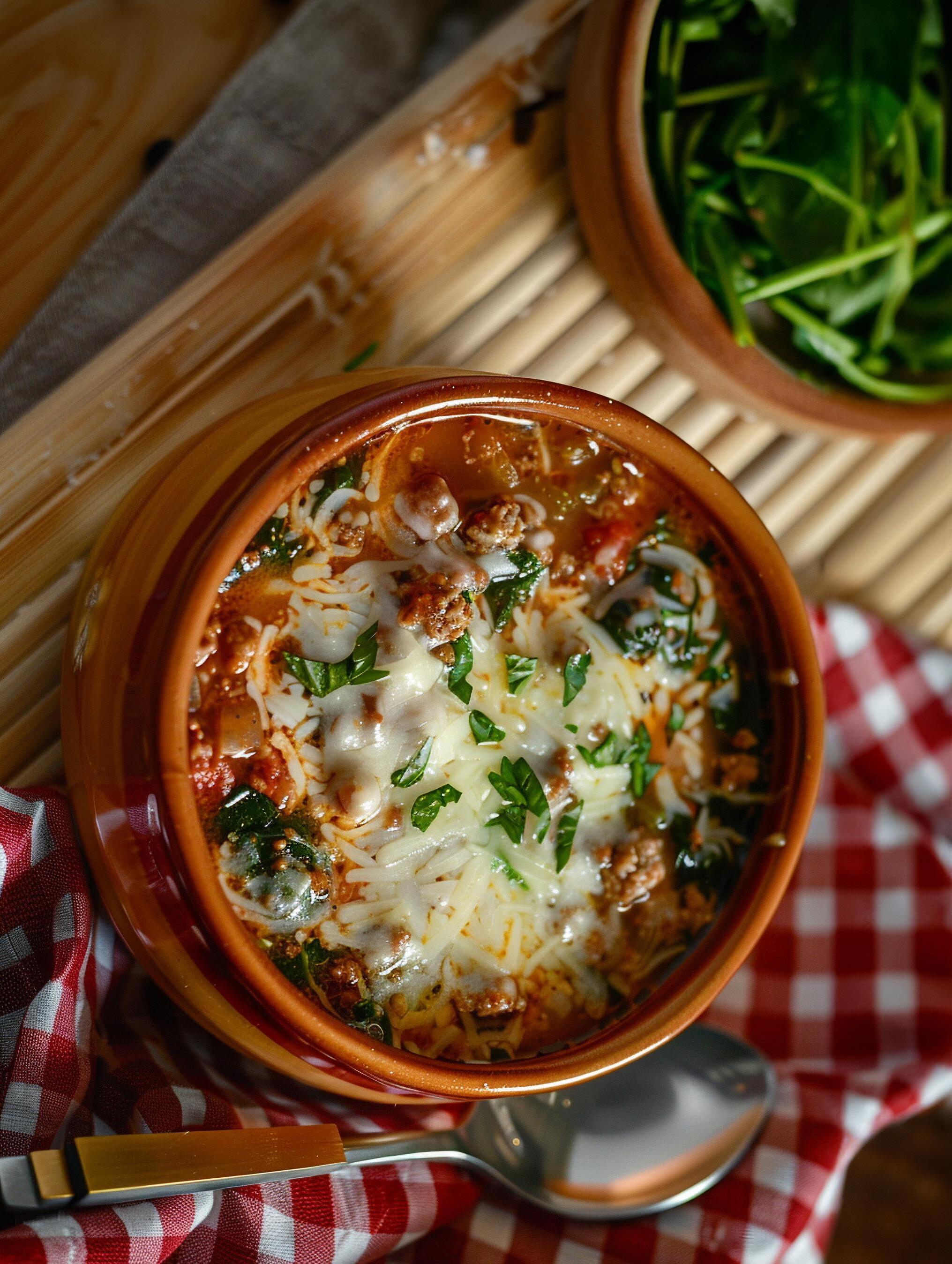
LASAGNA SOUP WITH ITALIAN SAUSAGE
1 lb Italian sausage, mild or spicy
1 small onion, diced
3 cloves garlic, minced
1 (28 oz) can crushed tomatoes
1 (14.5 oz) can diced tomatoes
4 cups reduced-sodium chicken broth
1 (6 oz) can tomato paste
1 tbsp Italian seasoning
¼ tsp red pepper flakes
1 tsp salt
½ tsp black pepper
8 lasagna noodles, broken into bitesized pieces
½ cup ricotta cheese
½ cup Parmesan cheese, grated (optional)
1 tbsp chopped flat-leaf parsley (optional)
1. In a large skillet over high heat, brown the Italian sausage for 4 minutes. Break apart the sausage as it browns. Add onion and garlic, then cook for another 1–2 minutes.
2. Remove from heat and drain the extra grease. Transfer the cooked sausage and onion to a slow cooker.
3. To the slow cooker, add the tomatoes, chicken broth, tomato paste, Italian seasoning, pepper flakes, salt, and pepper. Stir to combine well.
4. Cook on high for 3 hours, then add the noodles and stir to incorporate. Set to low heat, then cook for another 30 minutes.
5. To serve, scoop into bowls and garnish with a tablespoon of ricotta cheese, chopped parsley, and grated Parmesan cheese.
*Ground pork is safe to eat when cooked to 160°F.
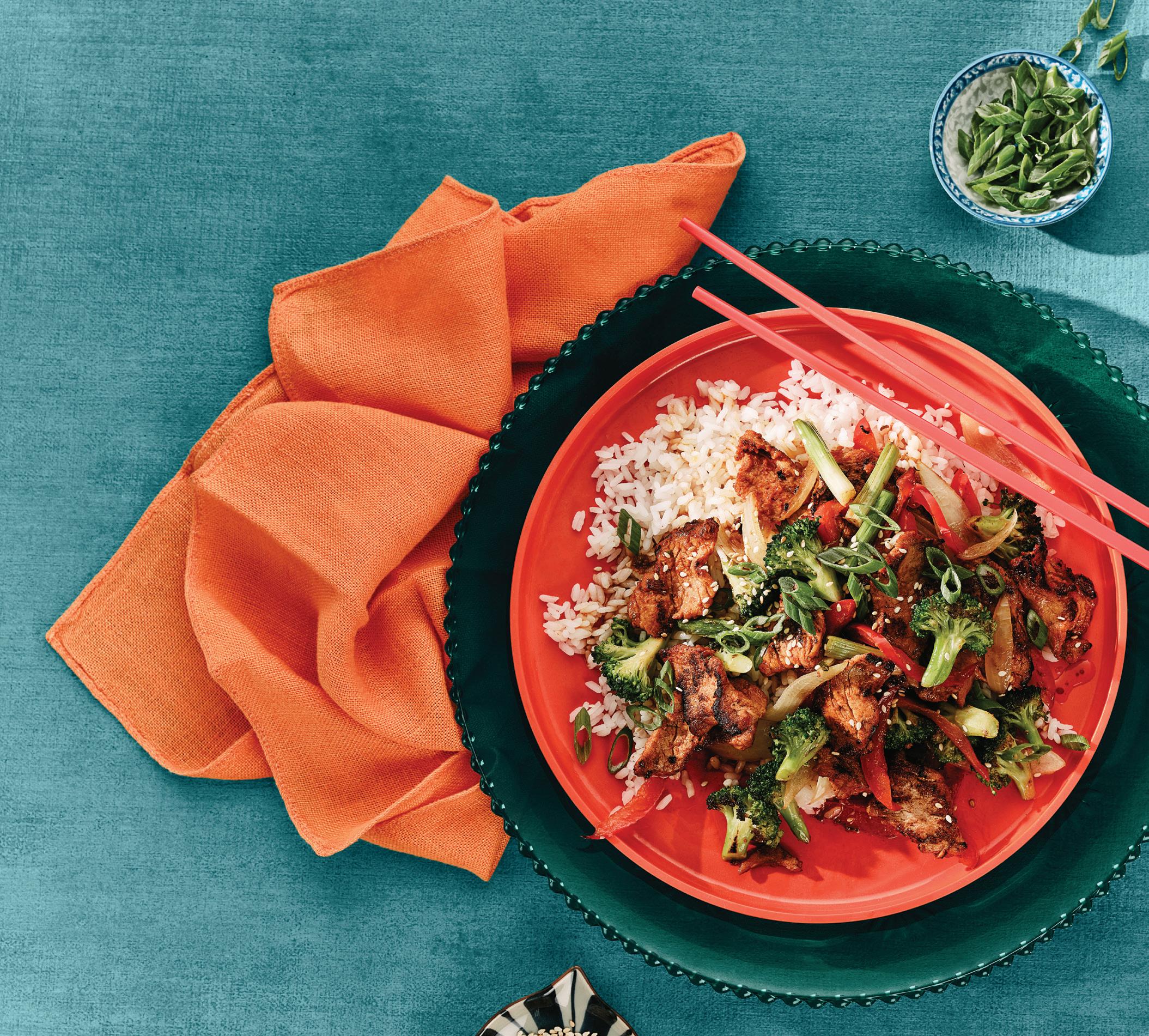
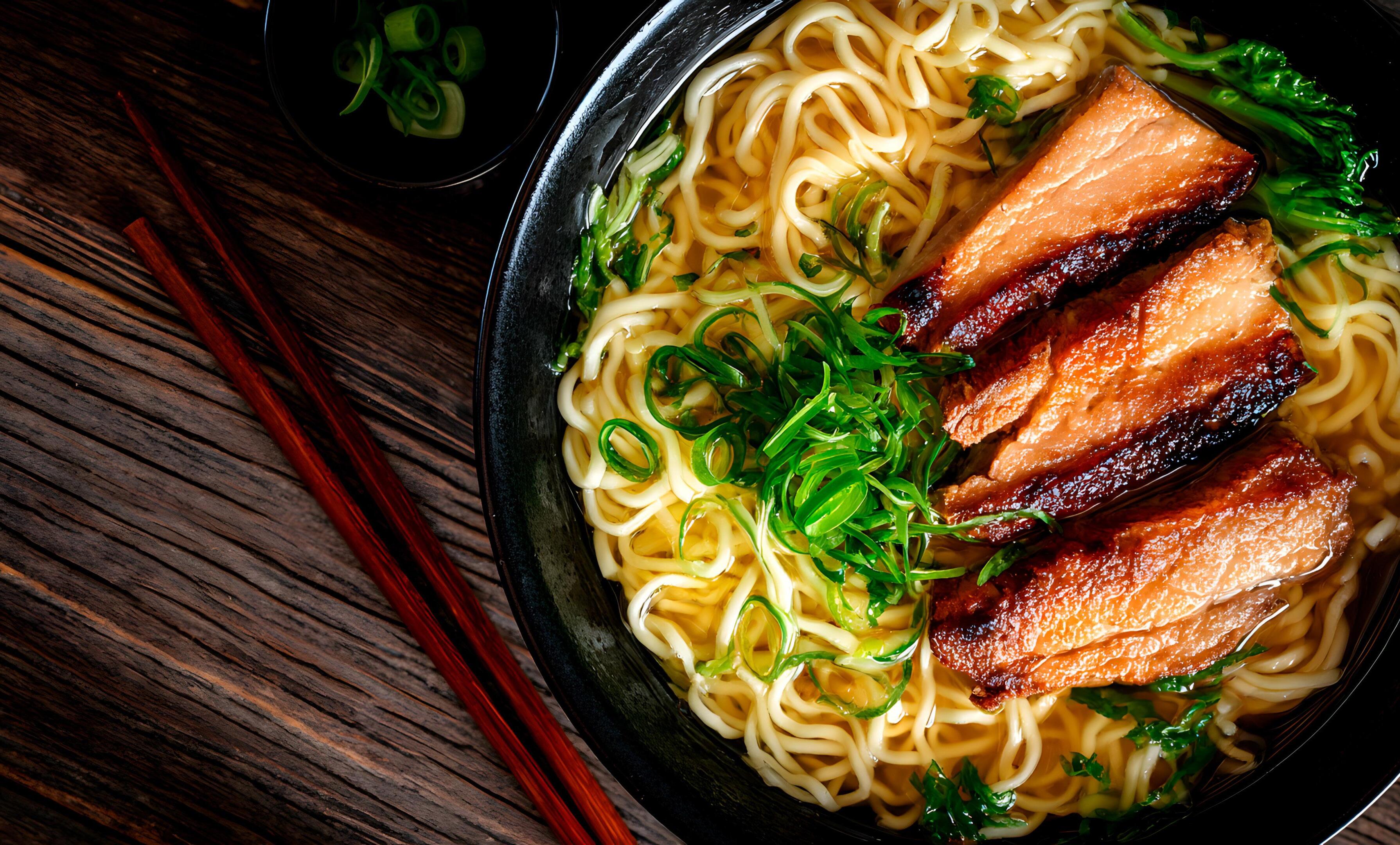
PORK RAMEN SOUP
4 bone-in pork chops
1 bunch scallions (thinly sliced, optional)
2 tbsp miso paste*
1-inch piece fresh ginger (peeled) or 1 tsp jarred ginger
4 garlic cloves (peeled)
6 cups of water
Pinch of salt and black pepper (optional)
2 packets of ramen noodles (3 oz each, plain)
1 bag frozen Asian-style vegetables or stir-fry vegetable blend (16 oz)
½ cup creamy peanut butter
3 tbsp reduced sodium soy sauce
3 tbsp rice vinegar
1 tbsp chili crisp or sambal (optional)
1 tsp sesame seeds (optional)
1. Cut roots off scallions and discard. Cut an additional 1 inch off scallion bottoms, splitting the white and green sections. Leave the white bottoms whole, and thinly slice the green tops. Set aside.
2. Place pork chops, miso paste,* ginger, garlic and white scallion bottoms, if desired, into a slow cooker. Add 6 cups of water and season with a pinch of salt and pepper.
3. Cook on high for 2 hours and 30 minutes. Cook pork until internal temperature reaches 145°F, followed by a 3-minute rest.
4. In a large skillet over high heat, brown the Italian sausage for 4 minutes. Break apart the sausage as it browns.
5. Add onion and garlic, then cook for another 1–2 minutes.
6. Remove from heat and drain the extra grease. Transfer the cooked sausage and onion to a slow cooker.
7. To the slow cooker, add the tomatoes, chicken broth, tomato paste, Italian seasoning, pepper flakes, salt, and pepper. Stir to combine well.
8. Cook on high for 3 hours, then add the noodles and stir to incorporate. Set to low heat, then cook for another 30 minutes.
9. To serve, scoop into bowls and garnish with a tablespoon of ricotta cheese, chopped parsley, and grated Parmesan cheese.
dessert
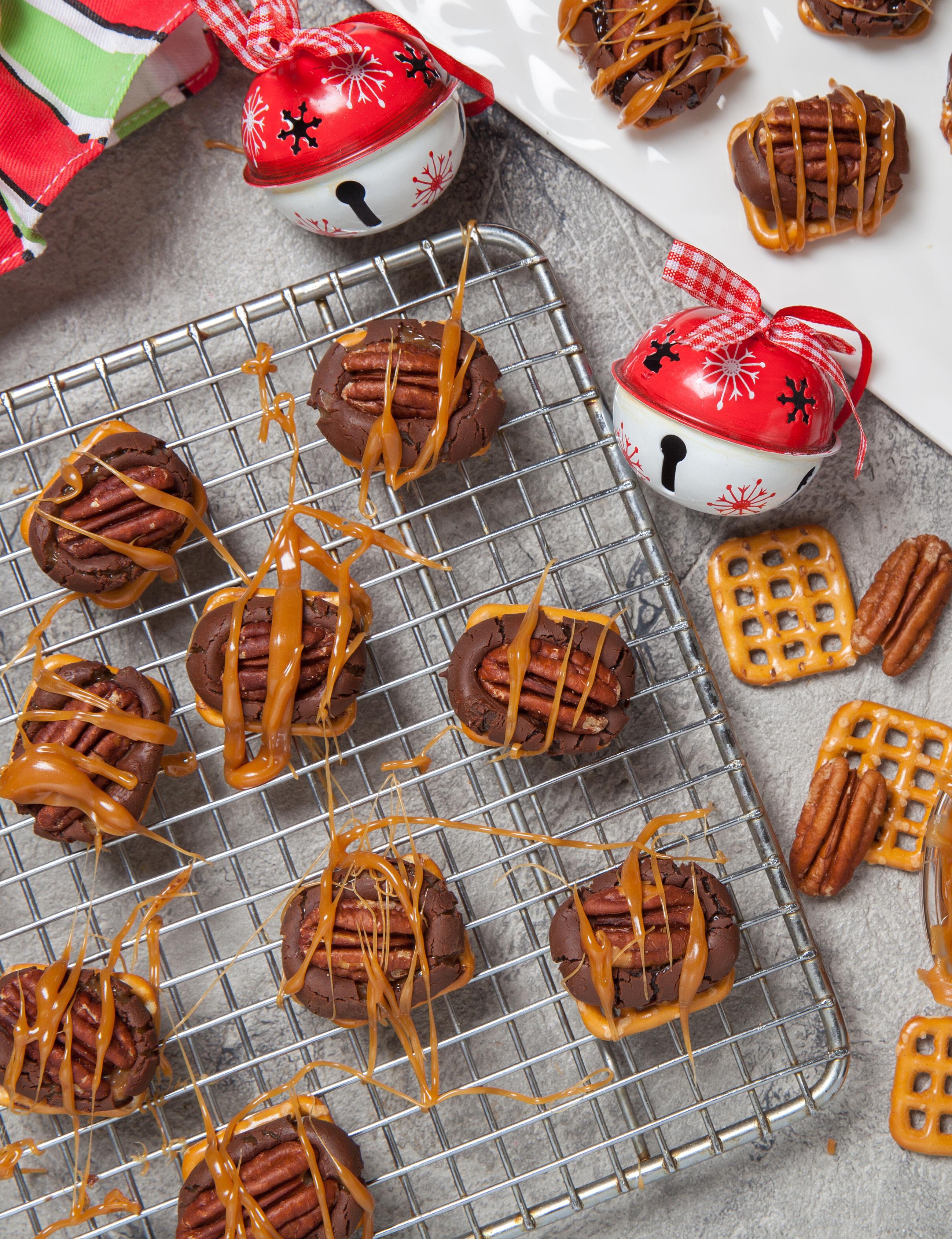
Candied Bacon Rolo Pretzel Treats
Mini pretzels (square snaps work best)
Rolo candies, unwrapped
Bacon (regular or thick-cut)
Brown sugar
Optional seasonings for bacon: black pepper, crushed red pepper, or cayenne pepper for a little heat
4. Remove from the oven and let the candied bacon cool slightly on a plate lined with paper towels to drain excess grease. Once cool, chop the bacon into small, bite-sized pieces.
5. Reduce oven temperature to 250°F (120°C). Line a separate cookie sheet with parchment paper.
6. Lay the mini pretzels in a single layer on the prepared sheet.
1. Preheat the oven to 375°F. Line a baking sheet with parchment paper or a wire rack set over foil to allow the grease to drain.
2. In a small bowl, combine brown sugar with optional black pepper, crushed red pepper, or cayenne pepper.
Dredge individual strips of bacon in the brown sugar mixture, making sure both sides are well coated.
3. Place the coated bacon slices on the prepared wire rack/baking sheet. Bake for 15-25 minutes, or until the bacon is crispy and the sugar has caramelized.
7. Place one unwrapped Rolo candy in the center of each pretzel.
8. Bake in the preheated oven for 3-5 minutes, just until the Rolo candies begin to soften and look glossy, but do not let them melt completely into a puddle.
9. Immediately remove the pan from the oven and gently press a piece of the prepared candied bacon onto the center of each softened Rolo.
10. Let the treats cool and set completely at room temperature or in the refrigerator to speed up the process.
SHOW PIG BIOSECURITY
As major show season begins, remember to practice proper biosecurity measures to do your part in protecting the entire pork industry.
As an exhibitor, you can play a huge role in the pork industry. Just as you take each step to ensure your show pig remains healthy, you share the responsibility of making sure all pigs, show pig or not, stay in the best of health. With over 1 million pigs involved in the show industry in our country, we all must do our part in supporting swine health and biosecurity.
Biosecurity is a term used to reduce the risk of diseases being transmitted through a variety of factors including people, animals, equipment, and/or vehicles. With pigs being susceptible to disease, it is important to follow biosecurity practices to protect your show projects. Follow along as we share a few tips and tricks on how to protect your pigs and others this show season.
TRANSMISSION OF DISEASES
Diseases can be transmitted easily if we are not being diligent.
The most common transmission types include:
•Contact Transmission – nose-to-nose contact with other pigs that leads to infection.
• Aerosol Transmission – exposure through coughing, sneezing, and dust from infected pigs near by
•Fecal Transmission – infected manure or bedding.
The transmission risks don’t end here. Indirect transmission can include any dirty objects used with a sick pig such as brushes, spray bottles, trailers, and more. Although there are many risk factors for spreading disease, there are 21
general practices of biosecurity that can be implemented.
BEFORE THE SHOW
Before attending any show, be sure you are prepared to always protect your pig’s health. A good rule of thumb would be to document all of your pig’s treatments and vaccinations. Be sure to work with your veterinarian to determine if any vaccinations are necessary. In addition, only take clean and properly disinfected equipment to the show. Ensure you have adequate supplies needed for the duration of the show, so you do not have to borrow from others.
Most importantly, only take healthy pigs to a show to minimize the risk of a disease outbreak. If your pigs is not eating normally, coughing, having trouble breathing, or showing any disease symptoms, it is in the best interest of your pig and others to reconsider exposing the pig elsewhere.
DURING THE SHOW
While at the show, continue to monitor your pig for any signs of illness. If you suspect your pig may be sick, inform the veterinarian on site as soon as possible. Wash your hands before coming into contact with pigs or equipment.
AFTER THE SHOW
Once you return home from any show, try to isolate the pig exposed as much as possible. During the isolation process, you have the chance to monitor your animal to see if it shows any signs of disease. Be sure to wear different shoes and clothing from each barn, as well as those that you wore at the show.
Cleaning and disinfecting play a vital role in reducing the risk of your pigs getting
sick after the show. Before loading your trailer with pigs again, be sure to remove all bedding/manure and equipment from the trailer and clean thoroughly. This includes, but is not limited to:
•Feeders
•Waters
•Buckets
•Panels
•Brushes
•Show boxes and equipment
When disinfecting your trailer, barns, and equipment, be sure to properly apply the disinfectant according to its instructions. After this process, allow the equipment to fully dry using sunlight or a heat source to kill the remaining pathogens.
In addition, reduce exposure to other people. If visitors need to attend your farm, supply clean boots or plastic boot covers. All visitors need to wear clean clothing and wash their hands before stepping foot in your barn. When your visitors are leaving, ask them to remove their plastic boot covers and place in a garbage bag. Then make sure to dispose of them in a designated location or away from clean supplies. If you supply visitors with clean boots, make sure to disinfect those boots after each visit. Everyone should clean their hands with sanitizer or wipes before entering the vehicle.
Taking the necessary precautions is important right now to protect the health of our industry. While it may be simple to just rid the pens of shavings, disinfect your barns, and more, it can play a vital role in ensuring the health of the pork industry.
Article content is referenced to A Champion’s Guide to Biosecurity by the National Pork Board. To read the entire document, view this article on our website at www.texaspork.org/news.
TRUSTED BY CHAMPIONS TO FEED THEIR ENTIAL
P E
AWARDS & PRIZES
• New honors such as...
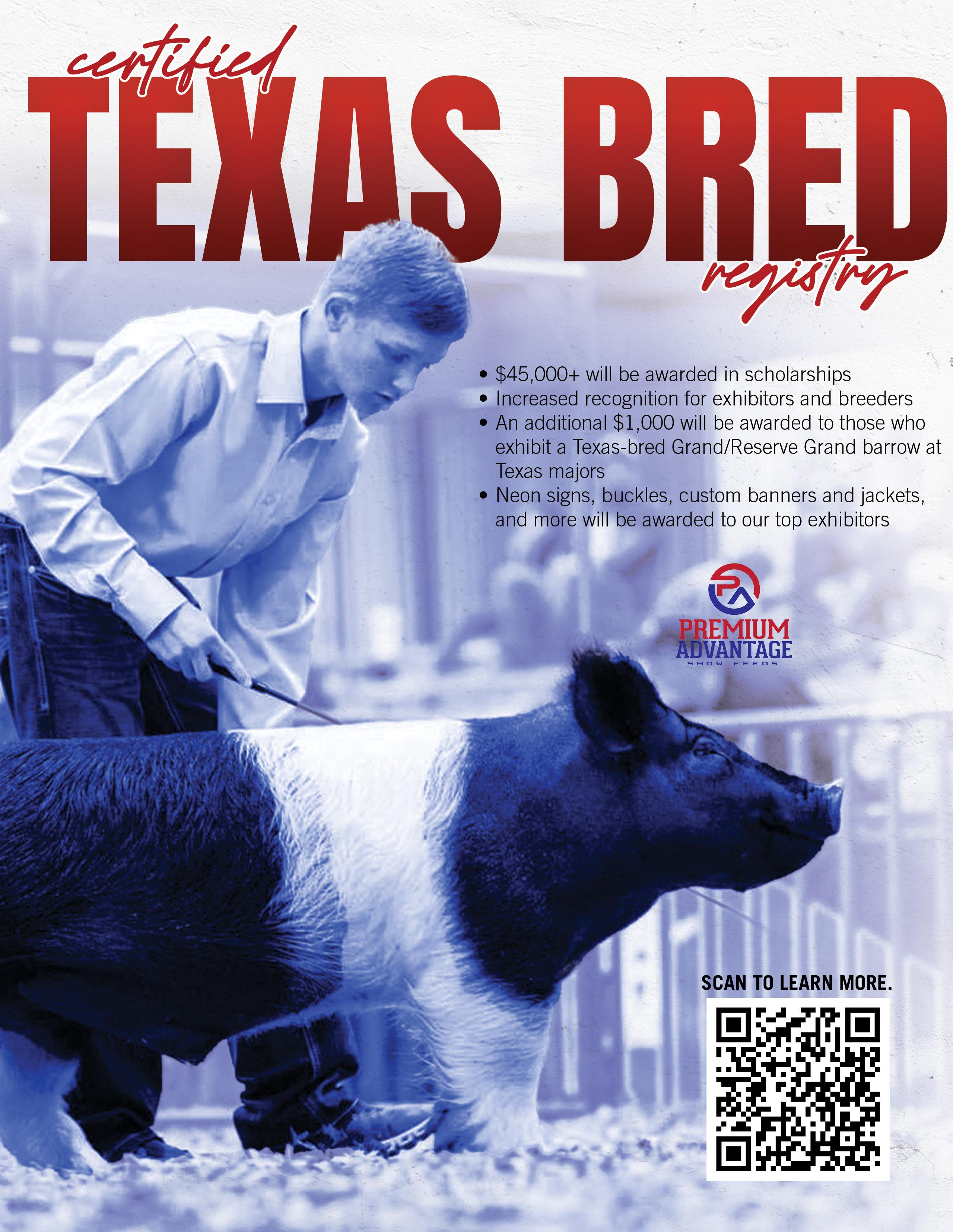
• Premier Exhibitors of the Certified Texas Bred Registry
• Top 25 Exhibitors of the Certified Texas Bred Registry
• Best of Breed
• Champion Exhibitors
• Custom buckles, jackets, neon signs, banners, and more!
INDUSTRY LEADERS UNITE TO STRENGTHEN FOREIGN ANIMAL DISEASE PREPAREDNESS Putting Texas to the Test:
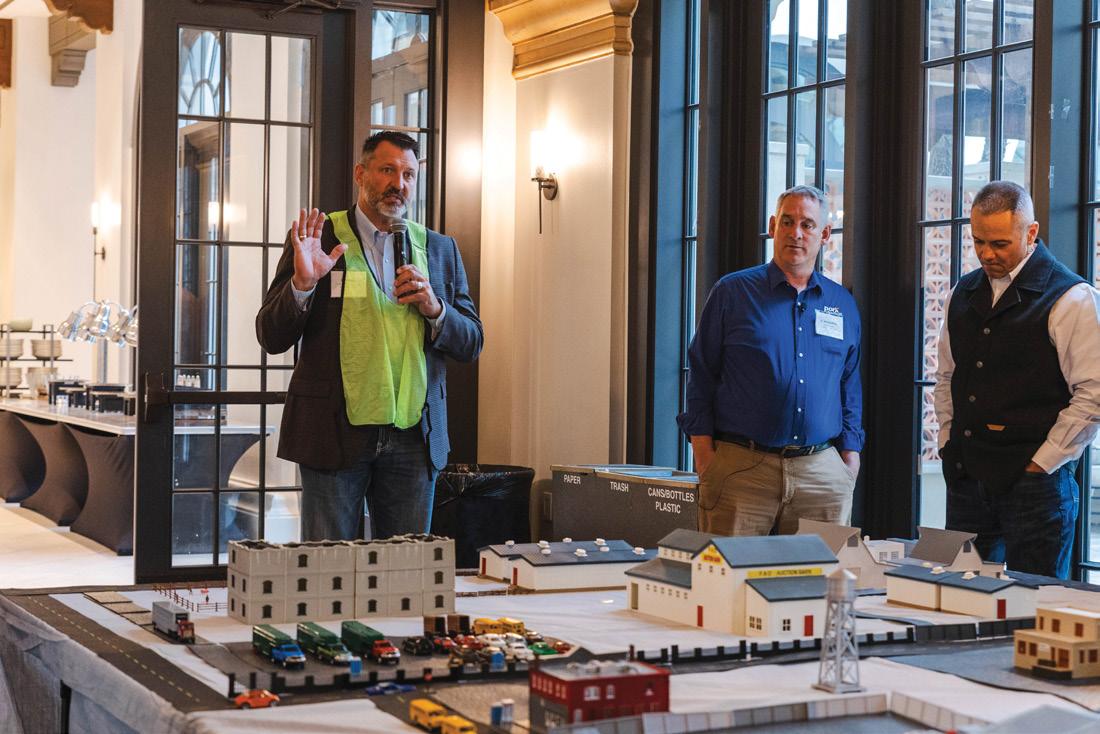
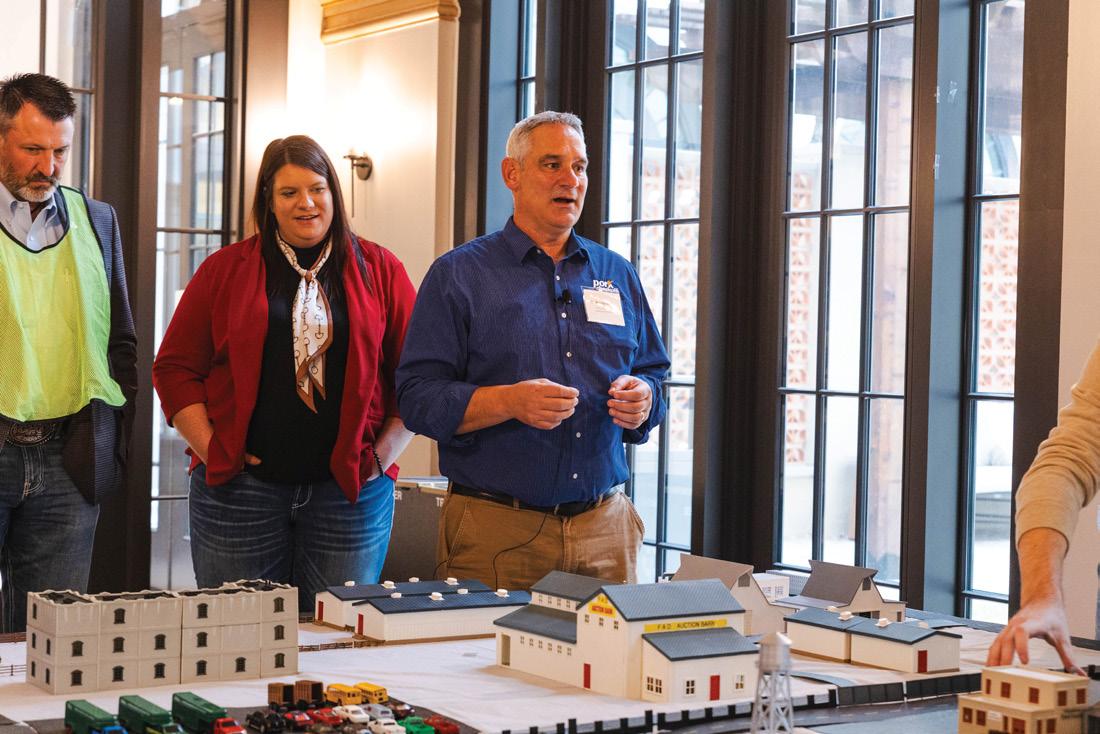
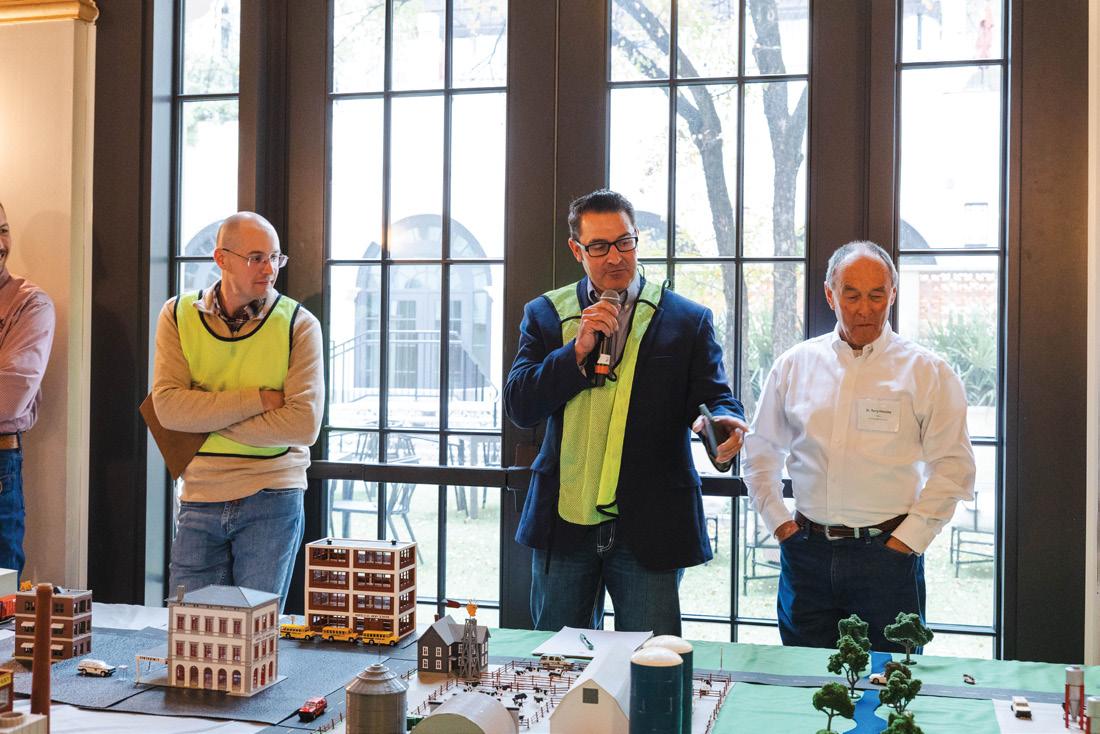
Leaders from across the Texas swine industry met in Austin, Texas, from December 3–4 for the Texas Exhibition Swine Traceability (TEST) Summit, a two-day event designed to strengthen the state’s readiness in the event of a Foreign Animal Disease (FAD) outbreak.
Hosted by the Texas Pork Producers Association (TPPA) in partnership with the Pork Checkoff and Texas A&M AgriLife Extension, the summit drew representatives of the major stock shows, Texas FFA validation, Texas Animal Health Commission, Texas 4-H. and other industry partners to test preparedness plans, explore practical traceability solutions, and build a unified
strategy for protecting the Texas swine exhibition industry. Being that Texas is home to numerous major livestock shows, swine jackpot shows, and county livestock shows, it is critical that industry leaders share the same understanding of how each sector would respond if an FAD outbreak would occur.
At the heart of the event was a shared understanding that an FAD outbreak, such as African swine fever, could bring significant and long-lasting consequences to Texas agriculture. Therefore, the goals of the TEST summit were to strengthen stakeholder understanding of FAD threats, demonstrate the impact of an FAD
event, identify potential outcomes, emphasize the importance of swine traceability, and explore incorporating tools to support traceability efforts and real-time disease response capabilities. By the end of the summit, participants were committed to finding ways to increase education and awareness of the importance of protecting swine health in Texas.
“Foreign Animal Disease preparedness is one of the most critical issues facing our industry,” said Colby Ferguson, executive director of the Texas Pork Producers Association. “By strengthening traceability and response systems now, we’re taking the next steps in safeguarding the future of our industry.”
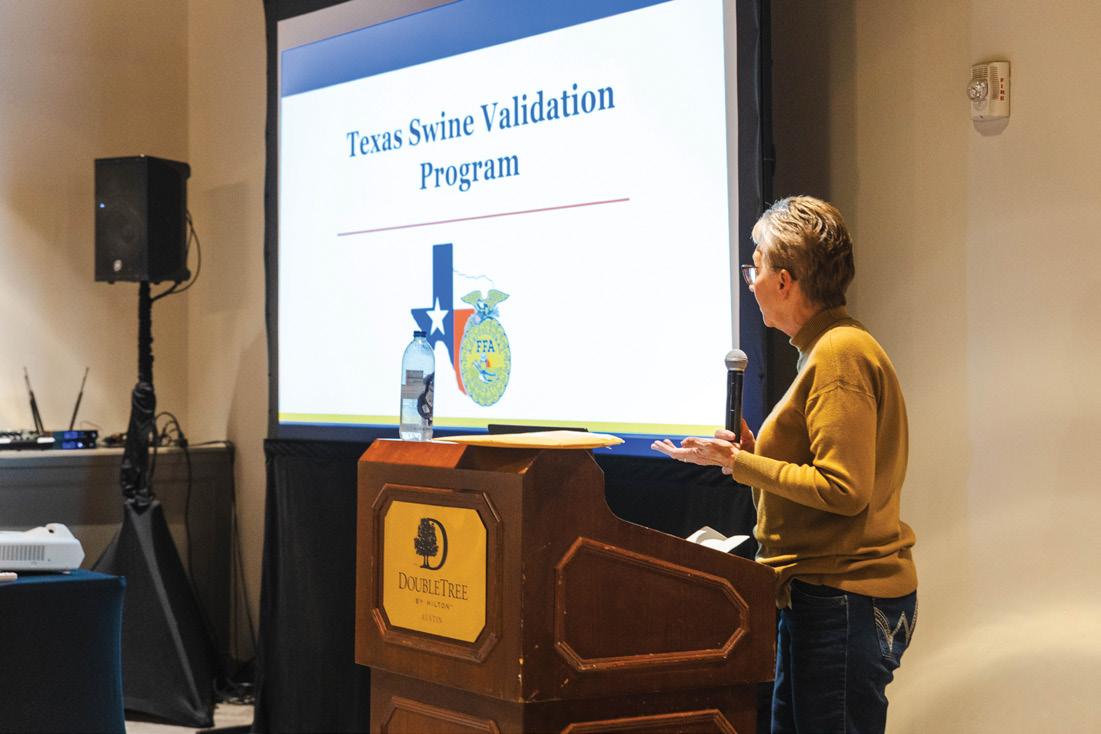
One of the summit’s most immersive components was the full-day tabletop exercise which is a scenario-based simulation that guided attendees through an unfolding FAD outbreak. The exercise allowed participants to identify vulnerabilities, clarify roles, and outline coordinated response actions among stock shows, state agencies, and industry partners. Throughout the event, attendees also heard from experts across the field. Presentations from the Texas Animal Health Commission, the National Pork Board, and Texas FFA validation offered valuable insights into disease preparedness, the importance of traceability, and the evolving needs of the show pig industry.
Texas is home to one of the most active youth livestock communities in the nation, with roughly 27,000 show pigs validated each year. With increasing movement of people and animals, reducing the risk of an FAD event remains as a top priority. With continued conversations beyond the TEST summit, we can ensure Texas is prepared, resilient, and ready to protect our industry.
For more information about the TEST Summit, contact the TPPA office at 806-705-6800 or tppa@texaspork.org.
AGVIEW the next step in tracability
AgView is a free solution from the National Pork Board (NPB) that helps producers of all sizes and types provide disease status updates and pig movement data. To offer an accessible avenue to provide data to state animal health officials, AgView can be utilized by all hog farmers across the state to report foreign animal disease (FAD) as soon as possible. Below is a step-by-step guide on how to set up your AgView account.
WHAT IS AGVIEW?
Dr.Jeff Wiegert, swine extension specialist for the Texas A&M AgriLife Extension and professor at Texas A&M University, provided insight on the value of using AgView for Texas swine producers.
“Traceability refers to knowing where animals are located, where they’ve been, and when they’ve been there,” said Dr. Wiegert. “Funded by the National Pork Board, AgView is a free and confidential animal movement software. With your decision to use AgView, the information that you enter will increase our chances of getting in front of a potential virus outbreak. This information will help to isolate the virus and could also be helpful to determine the risk that your herd may be infected. If this information sharing can be accomplished quickly and accurately, we may have a good chance of stopping the spread and eradicating the virus.”
Data collected will only be visible to the state animal health officials and will not be subject to the public. As technology continues to grow, so does the swine industry. Producers, showmen, and
larger commercial breeders should think of how this simple task could help us in the future.
“Everybody is encouraged to sign up for AgView,” said Dr. Wiegert. “No pig farm is too small, and no pig movement is inconsequential. Every show, every sale, every driving the boar down to the neighbor’s farm to breed the gilt that just came in heat - it’s all important.”
STEP ONE: CREATE AN ACCOUNT
Go to Agview.com and select Create an Account. While signing up on AgView.com, it will ask for your information along with your farm name or business. After signing up for Agview, it will take you to the home screen where you can choose 6 different accessible tabs Map, Premises, Movement, Labs, Request, and Permits.
TWO: REGISTER YOUR FARM & ANIMALS
Click on Premises. This is where you will register your farm with your state-given Premises ID number. You will fill out the information about
your farm as in location, contact information, the capacity of animals, and the number of barns. You may also add important files and a mapping template. These tools will help ensure that the data entered is 100% accurate.
STEP THREE:TRACK YOUR MOVEMENT
Movement will be the most frequently used tab. In this tab, you will fill out the source and location details for the movement of your swine. You must also collect data for all of your hogs and enter all their movements from the show barn, veterinarian, breeding purposes, and more. You can also enter recurring movements. For example, if you take your animals to a different location often, you can enter that data once and simply update when the recurring movement happens.
AgView: A New Tool for a Unified, Real-Time Approach for Foreign Animal Disease Response
Also, the section Maps allows you to discover other swine producers who also use Agview to collect data. On tabs Labs, Request, and Permits, health officials and state veterinarians can contact you to request papers if there is an outbreak or a cause, that’s where these tabs come into use.
“In spring 2024, delegates at the National Pork Industry Forum endorsed several resolutions that will impact show pigs in Texas,” Dr. Wiegert said. “Once approved by the USDA, all show pigs will be required to be tagged with an AIN (animal identification number) RFID (radio frequency identification) tag. Additionally, all swine owners will need to register for a Premise ID Number (PIN) and electronically record key pig movement data, including the PIN of the origin farm, the PIN of the destination farm, the date of movement, the pig type, and any other official identification data within three business days of the movement event. These resolutions are expected to be implemented by 2027, and producers are strongly encouraged to be ahead of the game and begin recording this information and complying with the resolutions now,” said Dr.Wiegert
A rapid, informed response is vital for quickly containing a foreign animal disease (FAD) outbreak. While reporting protocols are in place on local and state levels, AgView is a free, opt-in technology solution that helps producers provide disease status updates and pig movement data to state animal health officials in real-time. When producers grant permission to share this data, it can be invaluable to creating a faster response to a suspected or confirmed FAD.
AgView's Value to the Industry
ADDITIONAL INFORMATION
You may request a demo with Pork Checkoff over AgVeiw visit AgView.com and fill out a contact detail to speak with a consultant.
As a swine producer, it is vital that we all do our part in protecting the future of our industry. TPPA highly encourages all producers within our state to begin to utilize AgView to prepare for the future. For more information, please visit our Producer Resources and Information page on our website at www.texaspork.org.
The AgView platform promotes business continuity for America’s pig farmers by uniquely making disease traceback and pig movement data available to the USDA and state animal health officials on Day 1 of a foreign animal disease incident.
AgView Features
FEBRUARY 12-14, 2026
HILL COUNTRY YOUTH EVENT CENTER KERRVILLE, TX
LEAD JUDGE
JIM KILMER Monticello, IN
SIFT JUDGE
JAKE HEGE Rensselaer, IN
42,000 $ + GIVEN BACK IN 2025 PREMIUMS
4,261 $ SALE AVERAGE (75 LOTS IN 2025)
Klondike FFA
show SCHEDULE
• Friday, Feb. 13th - Show starts at 3:30 PM
• Saturday, Feb. 14th - Show starts at 7:30 AM
• Gilts of Distinction Sale at 8:00 PM
Further details listed below.
exhibitor
FUN NIGHT
• Free meal for exhibitors and their families
• Educational panel let by industry professionals
• Games and prizes to follow Specific times and date will be released soon.
THURSDAY, FEB. 12TH
• Arrival from 2:00 PM to 11:00 PM
• Check-in from 4:00 PM to 11:00 PM
FRIDAY, FEB. 13TH
• Arrival from 6:00 AM to 11:00 AM
• Check-in from 8:00 AM to 1:00 PM
• SHOW BEGINS AT 3:30 PM
• Chester
• Landrace
• Hampshire
• Poland
• Spot
• Yorkshire
• Light Crossbred
SATURDAY, FEB. 14TH
• SHOW RESUMES AT 7:30 AM
• Berkshire
• Duroc
• Dark Crossbred
• Buckle Recognition Ceremony
• Champion Purebred & Crossbred Drives
• Supreme Champion Drive
• Sale Preview at 6:30 PM
• Certified Texas Bred Registry “Scholars of Honor” Recognition
• Gilts of Distinction Sale at 8:30 PM
2026 AWARD SPONSORS
SHOW TITLE SPONSOR
Champion Overall Purebred Rock Award
Champion Overall Crossbred Rock Award
Reserve Champion Overall Purebred Rock Award
Poppers donated by:
Reserve Champion Overall Crossbred Rock Award
Supreme Champion - $5,000 & Cimarron
Stock Box
Reserve Supreme Champion - $3,000 & Cimarron
Stock Box
BUCKLE SPONSORS
BERKSHIRE CHAMPION
Kneese Show Pigs
RESERVE CHAMPION
M&S Livestock
HAMPSHIRE CHAMPION
Real Hog Farm
RESERVE CHAMPION
Ralston Hog Farm
SPOT CHAMPION
HP Genetics
RESERVE CHAMPION
Link Showpigs
DIVISION I
DARK CROSSBRED
Rival Genetics
DARK CROSSBRED CHAMPION
TRI Genetics
RESERVE CHAMPION
Rival Genetics
CHESTER CHAMPION
JDF Farms
RESERVE CHAMPION
Slott Show Stock
LANDRACE CHAMPION
MT Heart Livestock
RESERVE CHAMPION
Reed Livestock
YORKSHIRE CHAMPION
Reeves & Smythe Genetics
RESERVE CHAMPION
G5 Showpigs
DIVISION II
DARK CROSSBRED
Rival Genetics
DUROC CHAMPION
F-2 Genetics
RESERVE CHAMPION
Tongate Showpigs
POLAND CHAMPION
E6 Farms
RESERVE CHAMPION
Reeves & Smythe Genetics
LIGHT CROSSBRED CHAMPION
Alderson Farms
RESERVE CHAMPION
DL Showpigs
DIVISION III
DARK CROSSBRED
Golddamer Show Stock
Trophies donated & awards created by:
Innovator Level
Stanley Young
MAJOR SHOW CALENDAR
Fort Worth
FEBRUARY 3-5
San Antonio
FEBRUARY 10-12
Purebred & Crossbred Gilts
FEBRUARY 20-26
Junior Market Barrows
Texas’ ELite Showcase
FEBRUARY 12-14
SAn Angelo
FEBRUARY 12-15
FEBRUARY 16-18
Junior Market Barrows
MARCH 14-19
Junior Market Barrows
MARCH 21-23
JARROT & DWIGHT FOOTE
SEMINOLE, TX
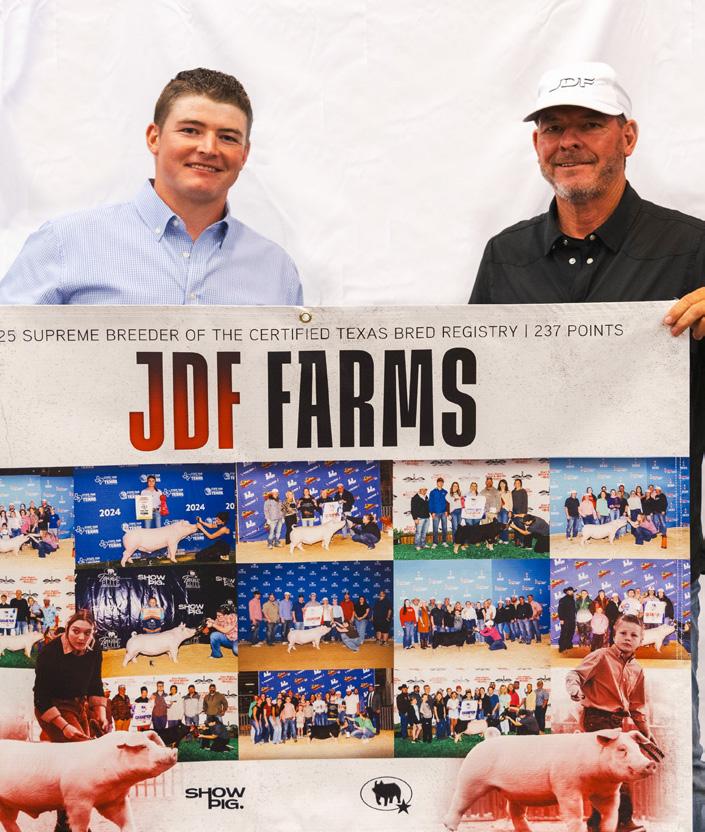
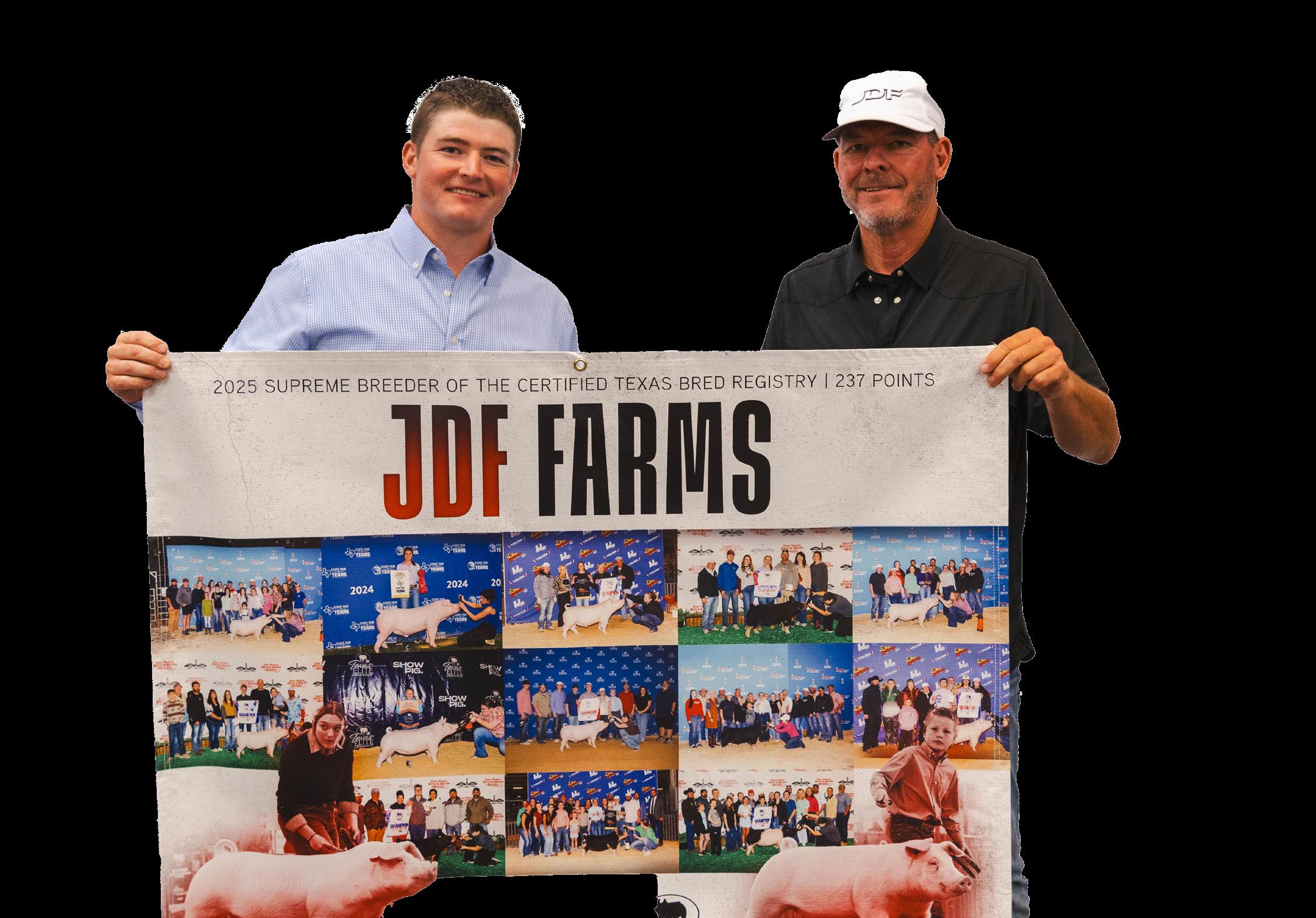
JDF FARMS
In an industry filled with opportunity, possibly one of the greatest is to have the chance to create long-lasting memories with those that we hold close. For Jarrot and Dwight Foote, raising show pigs together created the foundation to find value in something far greater than they imagined.
“The biggest reason we started raising pigs is because it gave us something to do as a father and a son where we get to work together and achieve our goals,” Jarrot and Dwight said.
The two have raised a handful of show pigs together for many years. However, in 2020, the father and son duo began a fresh start with JDF Farms in Seminole, Texas. Their operation has grown to between 40-60 sows mostly consisting of Chesters, Durocs, Crossbreds, and recently Berkshires. The pair said their operation farrows all sows during the summer; however, they are in the early stages of breeding more in their off-season to expand their market.
Prior to starting their operation, both Jarrot and Dwight pursued degrees in agricultural education at Texas Tech University. With a recent career change, Jarrot moved back to the farm in Seminole. Although this has eased day-to-day management of their operation, Jarrot gives his father credit for all that he does to ensure their farm continues to move in the right direction.
“My father is without a doubt the greatest help on the farm,” Jarrot said. “My dad has lived on the farm since the beginning and never misses a day. He is the one who takes care of daily chores, no matter what, and never looks for recognition. There is no way we could do this without him.”
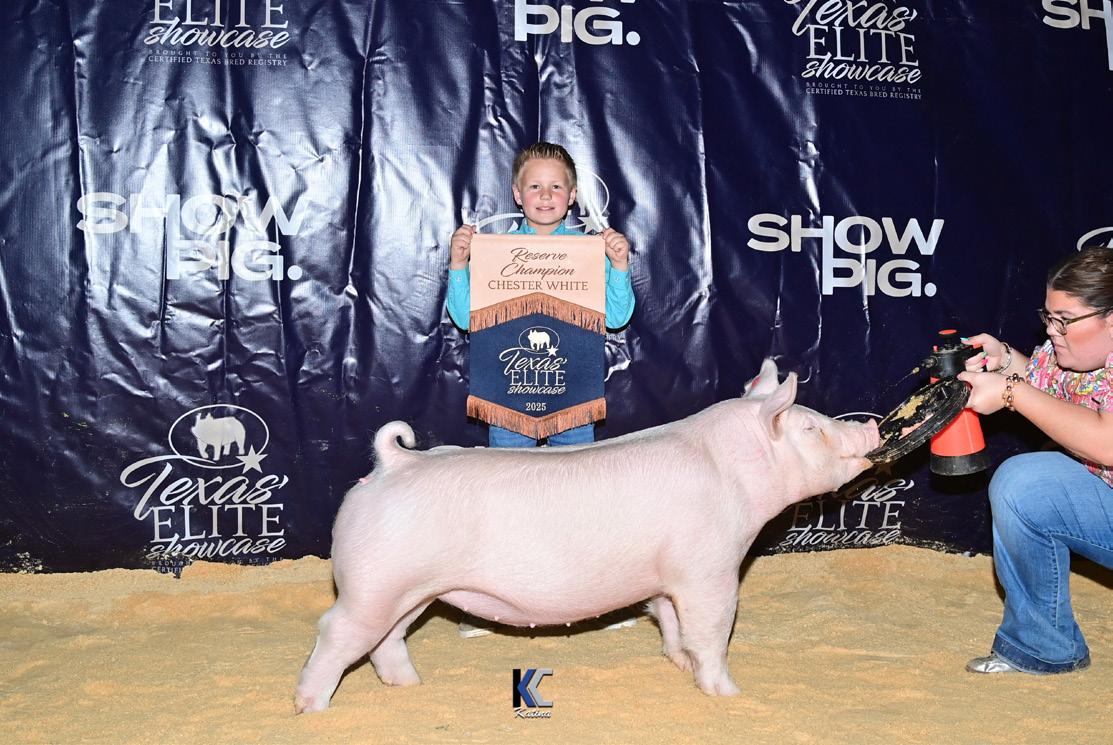
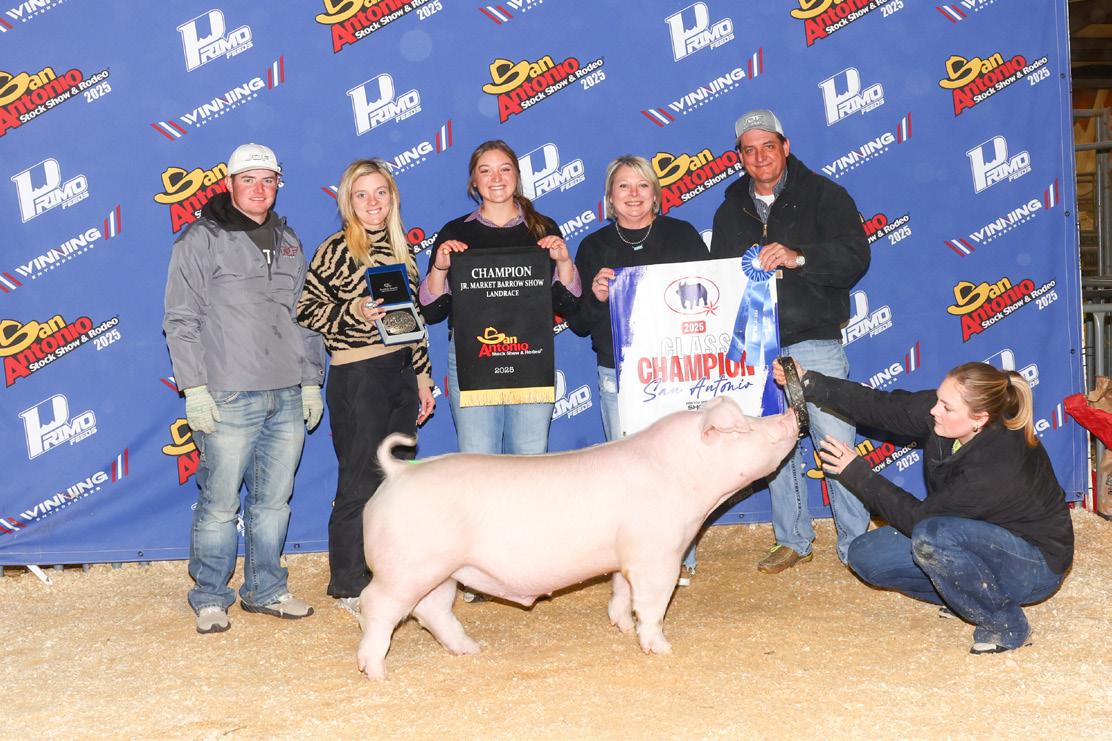
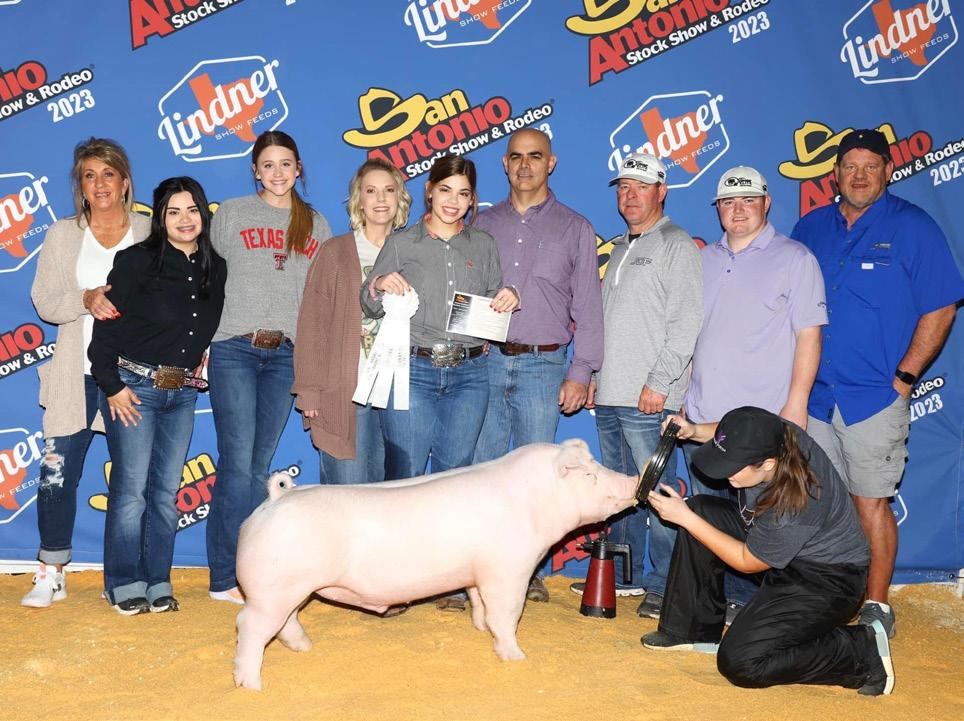
Over the past five years, JDF Farms has had a tremendous start within the Texas major show circuit. With an initial focus on the Chester and Duroc breeds, the duo has had much success. In 2025, they raised the Champion Landrace barrow at San Antonio and the Reserve Champion Chester gilt at Texas Elite, as well as several CTBR class champions. However, their win a the 2023 Texas’ Elite Showcase will always hold a special place in their hearts.
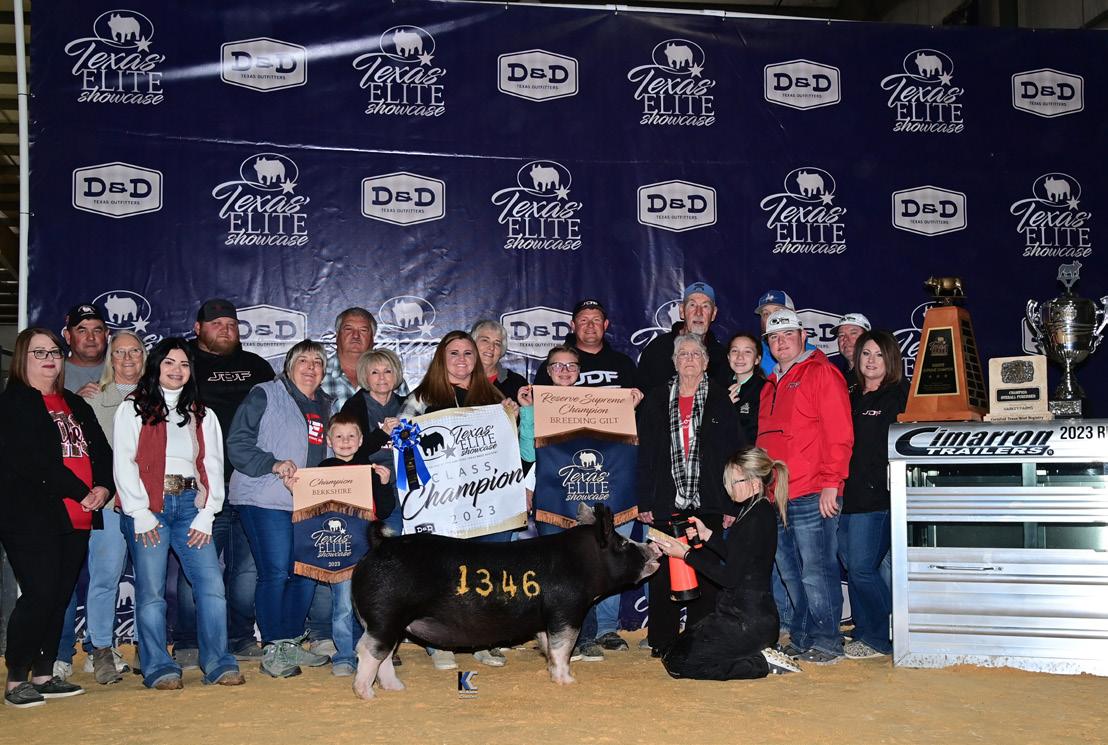
“In 2023, we raised a very special Berkshire gilt that we would say will be very hard to replicate,” the duo said. “This gilt ended up Champion Purebred and Reserve Overall Supreme at the Texas’ Elite Showcase. This is undoubtedly our highest achievement. For reasons other than the banners, we were able to accomplish that with a family that has been with us from the start which made that much more special.”
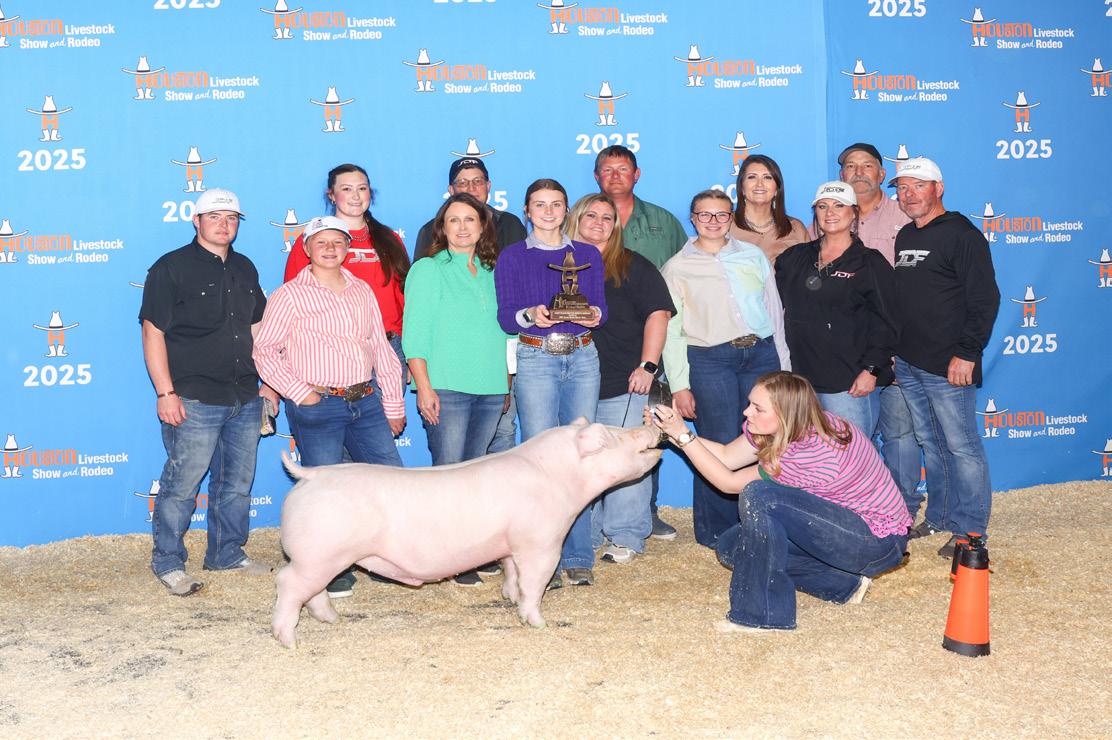
In addition to this accomplishment, JDF Farms has also produced the Reserve Champion Duroc gilt at the 2023 Texas’ Elite Showcase, the Reserve Champion Chester barrow at San Angelo in 2022, as well as the Reserve Champion Chester barrow at San Antonio and Reserve Champion Poland barrow at Houston in 2021.
There have been several genetic lines that have had an impact on the Foote’s herd; however, there are two operations that have not only impacted this operation, but Jarrot and Dwight as well.
“Within our Chester herd, Beyers Farms, TX genetic line is in almost all of our Chester sows. The
line on our Berks and Durocs,” Jarrot said. Both of those firms have always been there for help and advice when needed. Without their impact, JDF Farms wouldn’t be where it is today.”
Speaking of influential people, Jarrot says his greatest role models have been his father and his uncle, Jason.
“Dad is and always has been my greatest role model because he is the most selfless person I know. He always says to trust the process and everything will work out,” Jarrot said. “My uncle, Jason, has also had a huge impact on the way I look at pigs. He started hauling me to shows at a very young age and exposed me to all aspects of this industry.”
Jarrot is a prime example of the impact that this industry can have on youth. From earning a CTBR Foundation Gilt Scholarship in 2017 to helping kids achieve their goals, he said this industry has molded him into who he is today.
“T h i s indu s t r y h a s taught me th a t su c c e s s only c o m e s f r o m h a r d work, being h u m b l e , and n e v e r giv i ng up, ” J a rr o t s a i d “ T h e valu e o f t his ind u s t r y c a n’t b e p u t i nto words. You a re su rrou n d e d b y peop l e t h a t tr ul y would do an yt h i n g f o r e a c h o t her. T h a t i s s o m e t h i n g that’s h a rd t o f ind ”
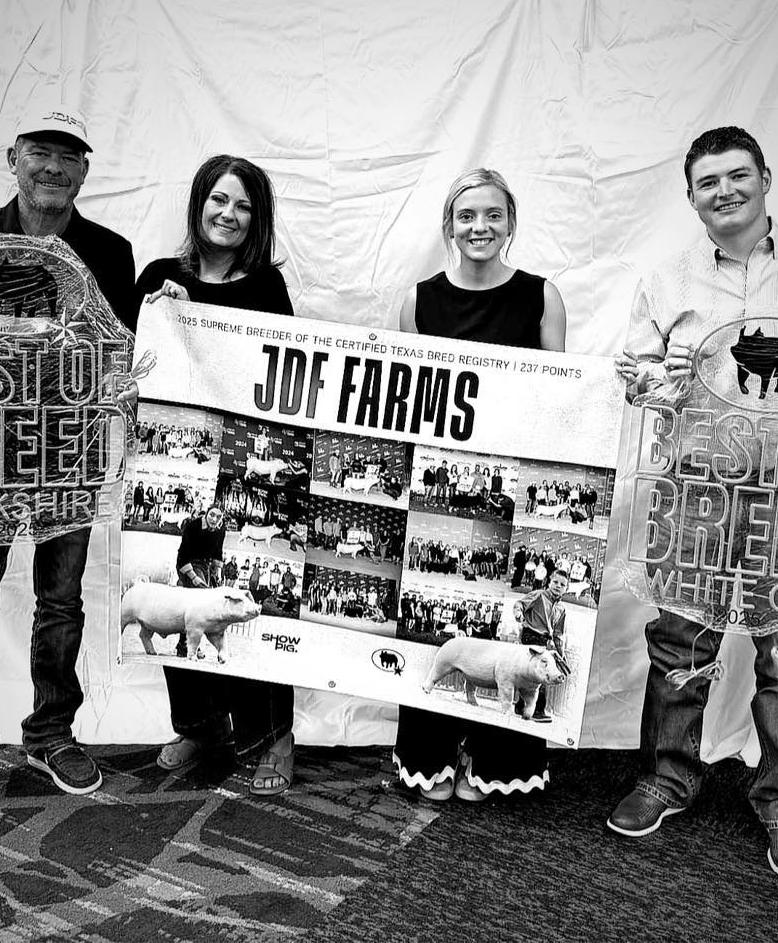
As with any successful operation, it is crucial to establish goals to help continue success in the future. The duo said starting out, one of their goals was to earn a spot as a Supreme Breeder within the CTBR program. Since then, the firm has far surpassed their goal with earning a spot as a Supreme Breeder in 2023, 2024, and 2025, as well as earning the Best of Breed award for the White OPB in 2025.
Moving forward, the pair hopes to continue to raise pigs that will help their customers conquer their goals. However, at the end of the day, the Foote’s find their biggest value in having a part of producing the future of agriculture.
“ Seeing a kid ach ie ve success is without a doubt our biggest motivation,” Jarro t said. “There are good da ys and bad days in th is i ndustr y, but heari n g kids say ‘I neve r thought I c ould do this’ motiv ates us to get up e very day a n d work harde r. We k n o w that the kids w e see
in the barn are the future, and to know we will have played a role in their appreciation for agriculture is what helps dad and I continue to pursue our goals.”
JDF Farms will be donating the Foundation Female this year at Texas’ Elite Showcase. This female will sell as Lot 3 in the Gilts of Distinction sale beginning at 8:30 PM on Saturday, February 14. All proceeds will benefit the CTBR scholarship program. On behalf of the Texas Pork Producers Association, we would like to thank JDF Farms for their significant contribution to the youth of Texas.
TIPS AND TRICKS FOR FIRST-TIME SHOWMEN AT MAJORS From the Seniors:
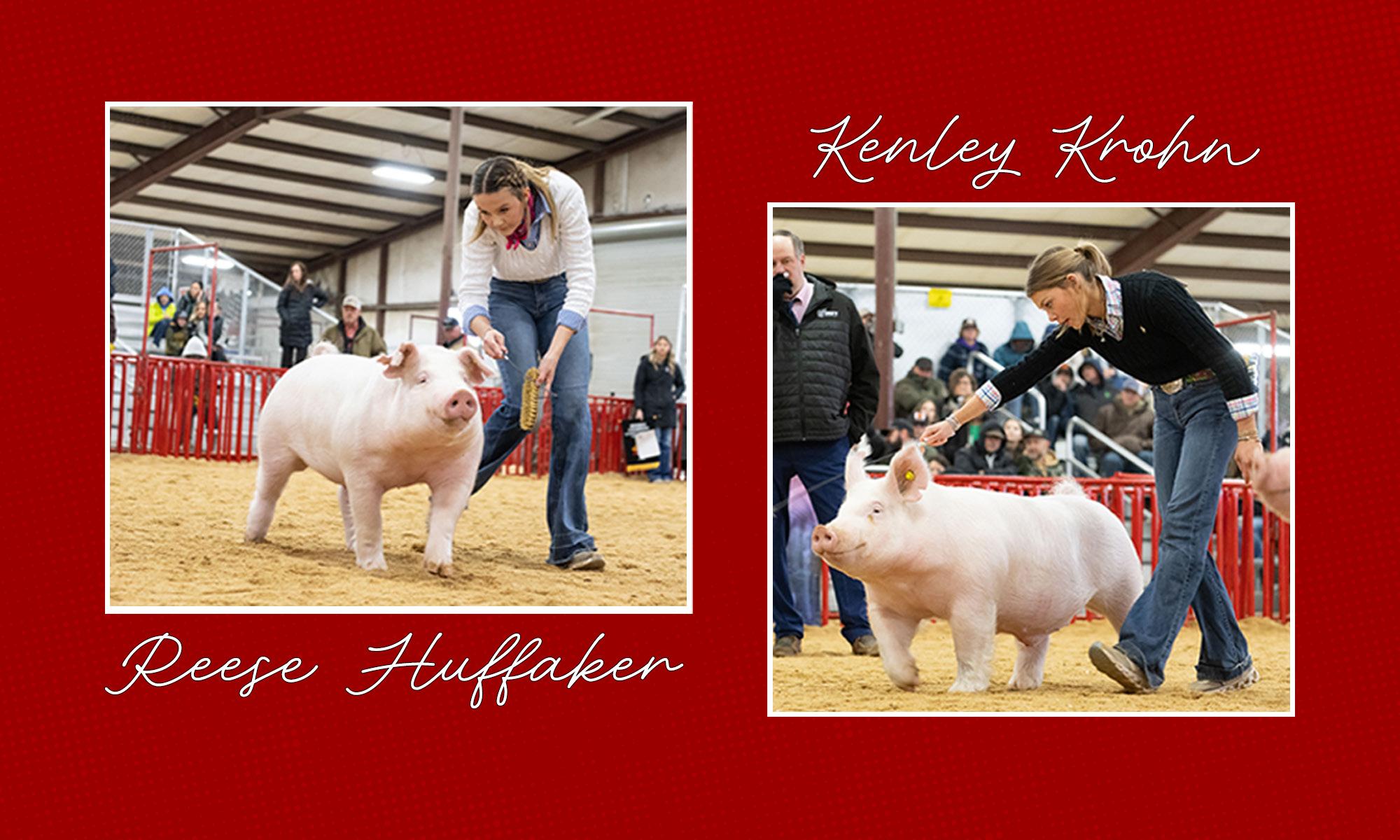
For seniors Kenley Krohn of Klondike High School and Reese Huffaker of Post High School, the show ring has never been unfamiliar ground. Both girls began showing pigs at just three years old, growing up alongside their projects and learning lessons that can’t be found in a rulebook.
Fourteen years later, as their senior seasons wind down, Krohn and Huffaker are passing along the habits, mindset, and hard-earned wisdom they hope will help first-time exhibitors step confidently into their first major show.
Both agree that success in the ring starts long before the gate ever opens. For Krohn,
preparation is rooted in attention to detail and daily discipline.
“I always want to take the initiative to make sure that my skin and hair is always as good as it can be,” she said. “I just want to make sure that I have put in the most work into that project to make sure that I am getting the best look as possible.”
Huffaker echoed that sentiment, emphasizing consistency as a non-negotiable.
“I always make sure my pigs are walked enough on a weekly basis to have that stamina,” she said. “As well as working skin and hair on a regular basis to make sure we are to that level—
you just have to, or you’re going to be below everyone else.”
To prepare for real show-ring conditions, both seniors treat everyday barn time as practice.
Huffaker said she’s focused on showmanship fundamentals, like eye contact, since she was young.
“Pick a spot and act like that’s the judge,” she said. “That’ll help you as a showman—being able to know how you’re going to show them when they get to that point.”
According to both exhibitors, the first steps into the ring can set the tone for an entire class. “How you present yourself is how the judge is going to remember you,” Huffaker said. “If you walk in there and you act like you’re not really caring, they can pick up on that.”
Details matter, she added—everything from driving with purpose to making sure there are no shavings left on a pig’s nose as it enters the ring.
Krohn believes mental preparation is just as critical as physical readiness.
“You want to make sure you’re not lost in la-la land,” she said. “You want to make sure that you’re confident enough to walk into the ring and present what you’ve been working on.”
Looking back, Krohn said confidence is something she wishes she had embraced earlier in her showing career.
“I would definitely tell [my younger self] to admire other showmen, but do not compare yourself to them,” she said. “Everyone is on their own scale in the show ring.”
She recalled feeling insecure when she chose not to show with a brush, even though it seemed like everyone else was.
“I just felt like that was kind of my downfall, but still to this day I don’t use one,” she said. “Looking back now, I would tell younger Kenley that it’s actually a plus and to do whatever is comfortable for her.”
Huffaker offered similar advice, encouraging younger exhibitors to stay open to feedback.
“Growing up, you have all of this information thrown at you,” she said. “Maybe you believe that you’re a great showman, but there is still so much you have to work on. Listen to everything everyone has to offer.”
Both seniors agree that the fastest way to improve is simple: spend time in the ring.
“You can mimic it at home, but nothing beats being in the ring,” Huffaker said. “Use the jackpot shows to your advantage because they will teach you a lot.”
Krohn added that learning doesn’t stop once a class ends.
“Go sit up at the ring and watch,” she said. “Me and my dad still do to this day, even though I am a senior. We’ll plan out how I’m going to come out of the ring, what I’m going to do.”
For first-time exhibitors heading to a major show, Huffaker offered practical reminders. “Make sure that you have your spatial awareness,” she said. “Know where the judge is at all times and breathe. Just take a moment and breathe.”
Krohn added her own advice: keep the pig between you and the judge, and never take barn time for granted. Despite the pressure and intensity of major shows, both seniors say the joy of showing is what keeps them motivated.
“You’ve been working on this all year long,” Huffaker said. “Have fun when you’re in the ring and get your pig shown to the best of your ability.”
Krohn shared the phrase she uses to hold herself accountable on long, exhausting days.
“Are you working as hard as the guy next door?” she said. “Because if you want to be the best, you have to work just as hard as everyone else.”
For first-time showmen preparing for that daunting first major, Krohn and Huffaker hope their advice provides reassurance—and a reminder that the lessons learned along the way matter far beyond banners and buckles.
“The harder you work, the more you will receive,” Krohn said. “Knowing that you put your all into it really makes that win so much better.”
DIRECTOR OF YOUTH & COMMUNICATIONS
CONNECTING CONSUMERS THROUGH THE VOICES OF TOMORROW
This past year, our youth and communications efforts deepened across Texas Pork programs, from establishing educational assets to innovating new ways to encourage youth to find their place in our industry. However, our goal remained the same in sharing a vision of potential, power, and promise for the future of our industry.
At the core of this work was a commitment to our industry in molding the next generation of criticalthinkers, innovators, and strategic leaders. These programs don’t just prepare young people to serve our industry; they prepare them to share their agricultural story with confidence and integrity.
As many of you are aware, we recently completed our strategic plan for the next five years. This plan serves not only as a roadmap for times ahead, but also as a framework for new ideas, challenges, and improvements. Our plan allows us to expand and enhance our association in numerous ways.
I firmly believe that one of the greatest components that we, in Texas Pork, can offer the industry is our young people. Texas youth who raise and exhibit pigs are already among the most passionate, informed, and trusted pork advocates in the country. Consumers trust people, especially young people, who speak from experience and tell authentic stories. That trust is invaluable.
While Texas is not a large pork production state, our human population is expected to reach 31,853,800 by the end of 2025, making us the second most populous state in the nation. That reality presents both a challenge and an opportunity. By leveraging the power of our youth and connecting them with the diverse realm of Texas pork brands and retailers, we can begin to bridge the gap between production and consumption.
This vision comes to life through the newly established Texas Pork “ChopTalk Advocate Program,” which will be a short course designed to craft youth into influential spokespeople while promoting Texas pork brands to consumers. Though a grant with the National Pork Board, the course will equip young advocates with communication skills, brand awareness, and confidence, all while empowering them to represent pork in conversations that matter.
As we look ahead, the path forward is filled with endless opportunities. By investing in youth to strengthen connections between people and pork, we are not just communicating the industry’s story — we are shaping its future, one authentic voice at a time.
Riley Reep Director of Youth & Communications
The purpose of this internship is for the selected student(s) to become involved in the pork industry by actively engaging in the daily functions of the Texas Pork Producers Association. Intern(s) will not only work to enhance the development & delivery of program activities, but also assist in providing communications & educational opportunities for producers, youth and the public about the pork industry.
RESPONSIBILITIES
INTERNSHIP opportunity
• Observe the functions of an agricultural organization.
• Gain communications and public relations experience.
• Learn about producer and youth educational programs.
• Learn about marketing, promotional & public relations programs.
• Be involved in the development & implementation of said programs.
• Represent TPPA in a professional & positive manner throughout the internship.
SCHEDULE
10-12 week internship during the summer, with details, will be determined on an individual basis. The intern will be actively involved in various activities and tasks, including but not limited to the following:
• Represent TPPA at industry events.
• Assist with marketing & pork promotion; design advertisements, build web content.
• Prepare, organize & carry out functions of the Texas Pork Youth Retreat, Texas Pork Industry Awards Banquet, Texas Pork Leadership Camp, and junior ambassador events. Be involved in the writing of press releases and feature stories for the Producer Connection magazine and TPPA website.
Applicants must be a Texas resident. In addition, applicants must be a full-time college student with an agricultural-related major that has experience in communications, marketing and journalism.
FINANCIAL ASSISTANCE
The intern will be paid on an hourly basis to help cover expenses. Details will be discussed prior to the beginning of the internship.
APPLICATION PROCESS
To apply, please visit our website at www.texaspork.org.
Over the course of two (2) years, junior ambassadors motivate and educate the youth of Texas while learning more about the swine industry. The goal of this program is to generate visible agricultural advocates through industry tours, development sessions, networking opportunities, and more. Ages 17-21 are welcome to apply from March 1 to May 1.
INTERNSHIPS
TPPA offers summer internships for students continuing their education in the state of Texas. During the summer months, interns can assist with major association events related to the ambassador program, youth programs, and more. In addition, interns play a vital role in creating the largest issue of the year for the Producer Connection magazine. Applications are due by March 15th.
TEXAS PORK LEADERSHIP CAMP
Texas Pork Leadership Camp is an intense, progressive, and thought-provoking week, full of activities, tours, and presentations featuring all aspects of the pork production industry. Students will join TPPA staff for a week travelling to different businesses and operations. Camp is held every odd year. Applicants must be between the ages of 16-18.
TEXAS PORK YOUTH RETREAT
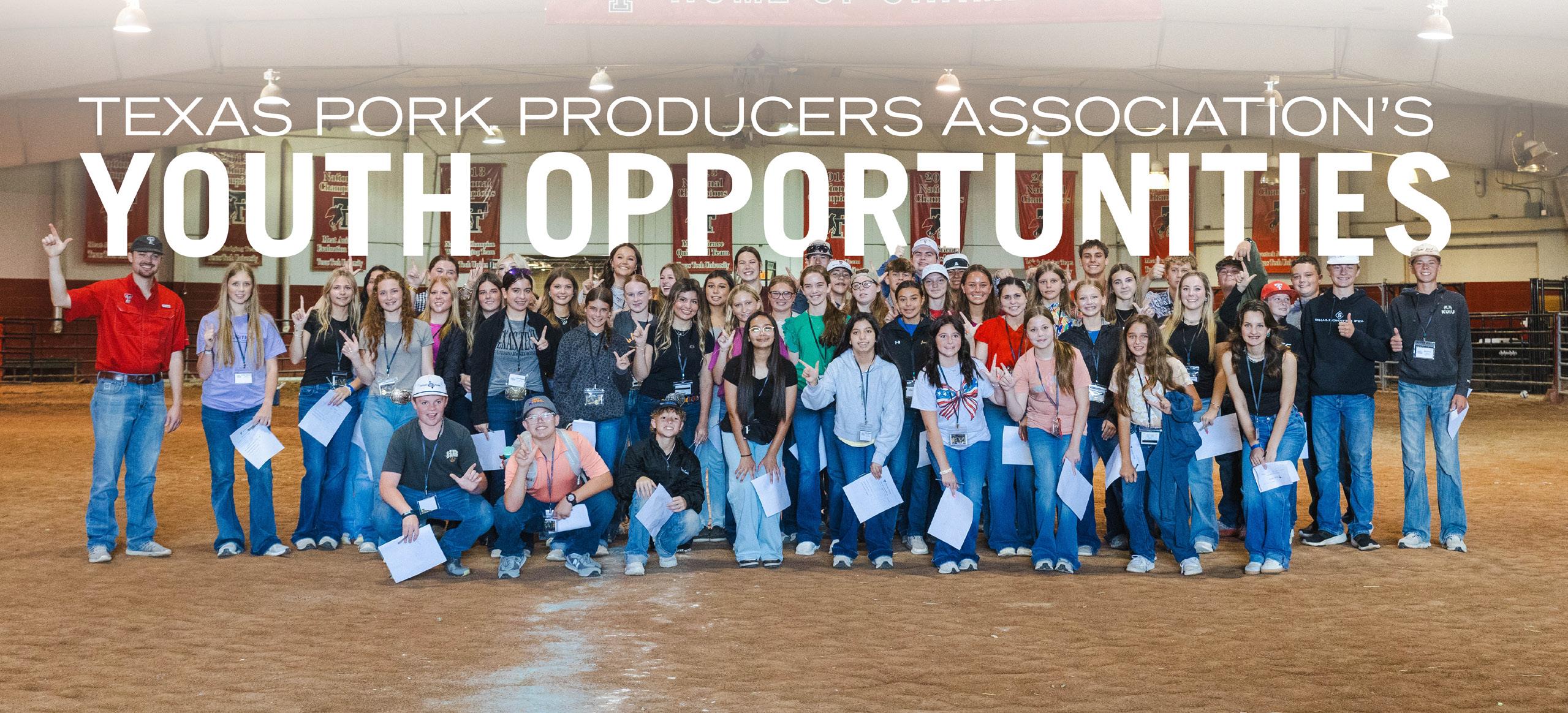
Texas Pork Youth Retreat, led by the Texas Pork Junior Ambassadors, allows youth to engage in all aspects of the pork industry, development activities, and of course, a whole lot of fun! This event is open to students grades 7th-12th who have an interest in the growing within the swine industry. The youth retreat will be from June 11-14 at Texas A&M University. Registration opens on March 1st.
SCHOLARSHIPS
For more than a decade, the Certified Texas Bred Registry has given back over $184,500 to Texas youth through scholarship programs. The Certified Texas Bred Registry aims to award more students who exhibit Texas-bred barrows and gilts.
Learn more at www.texaspork.org 806.705.6800 | riley@texaspork.org
Young livestock exhibitors often learn hard work, responsibility, and creativity in the barn.
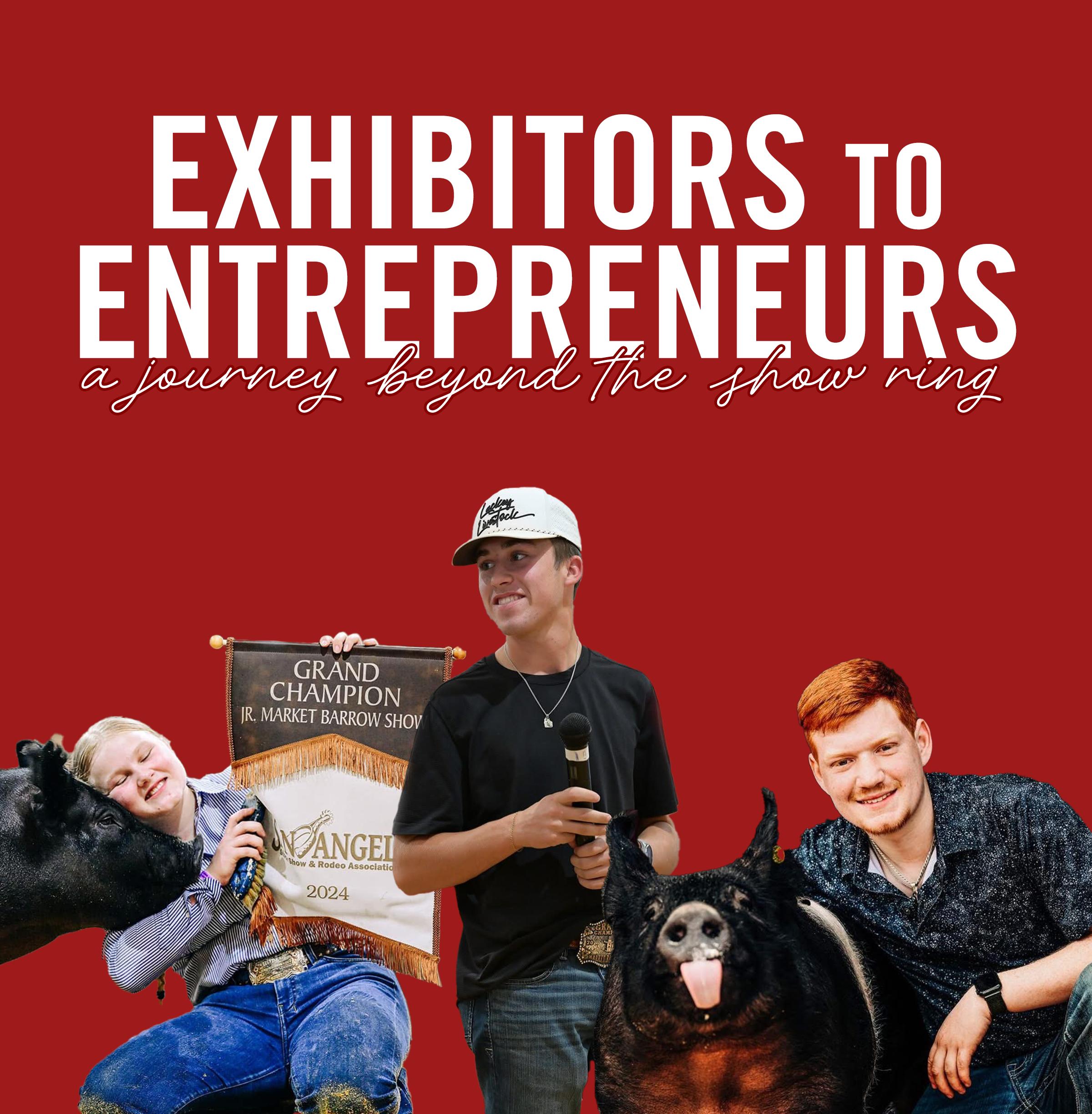
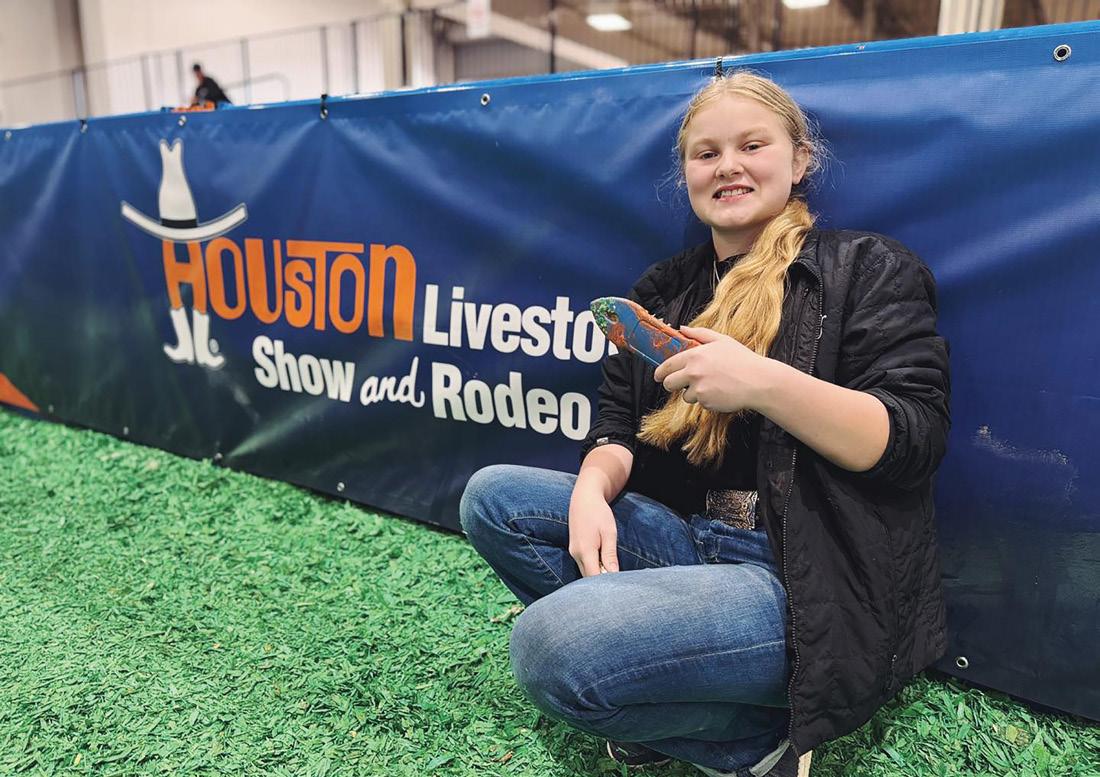
For three students, those lessons turned into businesses aimed at helping other showmen and spreading a message they believe in. Kamlynn Mason, Weston Lackey, and Archer Albracht each started ventures tied to the show industry: 2nd Gear Show
Brushes, Light in the Barn, and Stinger Show Sticks. It is no secret that our youth are our greatest asset in the Texas livestock show industry. Follow along as we hear from these exhibitors about how their enterprises grew from problems they encountered or values they wanted to share, all while their family, community, and faith guided them to this endeavor.
KAMLYNN MASON | 2ND GEAR SHOW BRUSHES
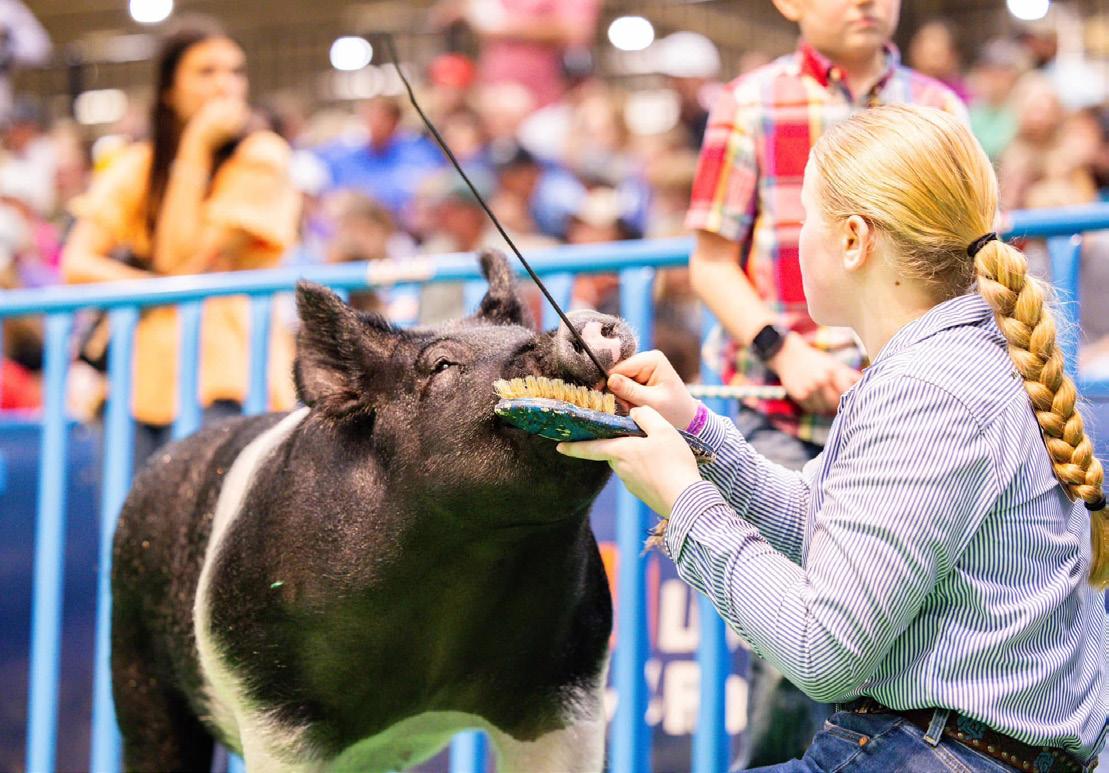
Kamlynn Mason, a 14-year-old from Montgomery County 4-H, created 2nd Gear Show Brushes a few years ago as a personal solution.
“In 2021, my barrow at the state fair had to be shown with a brush, but my hands were too small to hold a normal-sized brush,” Mason said. “We had to figure out a way to modify the brush to fit my small hands and be efficient.”
After hours of brainstorming and what felt like hundreds of tries, and with help from family and friends, Kamlynn came up with our half-bristle design, and the first 2nd Gear Show Brush hit the ring and was a success. Although her design was custommade specifically for the pig ring, they can be used on any species.
“I started mass-producing them in 2023 after several people had seen me use mine and wanted one of their own,” Mason said. “Orders started coming in left and right and still are.”
Kamlynn credited her friends and family for helping her make her dreams a reality.
“From lending me some money to start everything up, to having ‘brush making parties,’ helping me with production at layovers, teaching me how to run a business and advertise, and everything in between,” Mason said. “I would not be able to do this without them.”
One memorable moment was at a 2023 sale when Kamlynn said that a generous donor bought a brush and told her to look around the barn and find a young
showman who looked like they loved showing and give it to them. She described handing a brush to a young boy who was holding a brush that barely fit in his hand, then hearing later that the boy had been admiring small brushes online.
“When my stepdad told me that, I got goose bumps,” Mason said.
Kamlynn says agriculture has shaped her life since she was a baby. From going to shows when she was two weeks old until now, she has truly fallen in love with the livestock industry. She described lessons she has learned as both practical and spiritual.
“It taught me to never give up,” Mason said. “Hard things will pass, and because they happened, you will be stronger, to have endless determination and perseverance, and to never give up because you don’t know what God has in store. It is all in His hands, and everything that happens is His perfect plan.”
Kamlynn’s advice to other young entrepreneurs: “Find something you find interesting and that you’re good at and don’t be afraid to try. It won’t be perfect at first, and you will fail multiple times, but that’s the risk you take when you start a new adventure. Don’t ever be afraid to ask for help or start over.”
Mason added a note on what many customers may not know. “Every brush is handmade. There are about six steps in making every brush. My community and I try to do them all to the best of our ability to deliver a product to help all exhibitors succeed in the show ring and point them to Christ.”
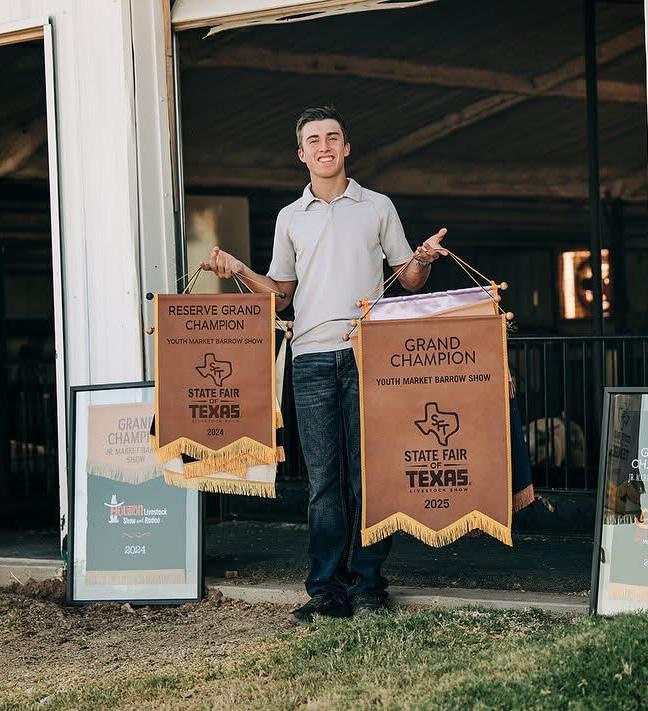
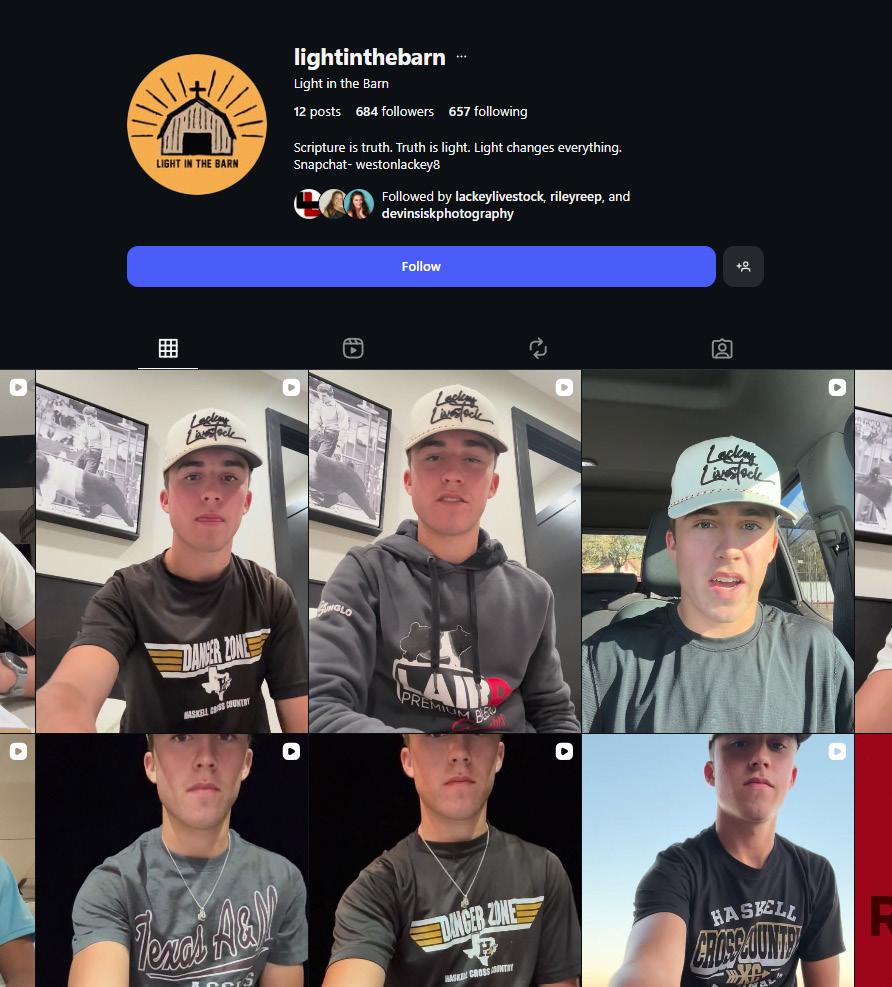
WESTON LACKEY | LIGHT IN THE BARN
Weston Lackey, a 17-year-old from Haskell FFA, is currently a senior at Haskell High School. The company that he has created is called Light in the Barn, which is a business that combines two of his passions: the show industry and God.
Lackey said the idea emerged from a personal moment of faith after injury. On December 26, 2023, Weston faced a knee injury, and faith played a huge role in his recovery.
“When my knee injury happened, God spoke to me in ways I can’t even explain,” Lackey said. “When I wanted to quit and be done with everything, God was right there to pick me up, whether that was through the Bible, social media, or other people.”
He launched Light in the Barn on Oct. 15, 2025, with plans for social media outreach and an apparel line. Family and community were essential to getting the venture off the ground.
“My family has by far been my biggest supporters,” Lackey said. “Without them, none of this would be a reality,” Lackey said, adding that his town and “all of my lovely livestock friends” helped the idea expand quickly.
Weston described his biggest challenge as selfdoubt about whether he was the right person to spread his message.
“I was terrified and extremely unsure if I should be the person who would be spreading God’s word,” Lackey said. “I had to realize that only one man has walked this Earth and lived a perfect lifestyle. I didn’t let the Devil’s words in my mind telling me not to create this takeover, because now I get the privilege of helping so many kids in need of hearing the word of God.”
Lackey’s proudest moments are the responses from people who say his work has helped them grow closer to God.
“All of the people who have reached out telling me that what I’ve been doing has made an impact,” Lackey said, “They have been getting closer in their relationship with God and have felt so much better since I’ve posted my content.”
Lackey advised other young agriculture entrepreneurs to be true to who they are and to block out critics.
“If you truly love what you’re doing, nothing will get in the way of that. Make sure to be true to yourself and those around you. Honesty is the most important part of our lives.”
ARCHER ALBRACHT | STINGER SHOW STICKS
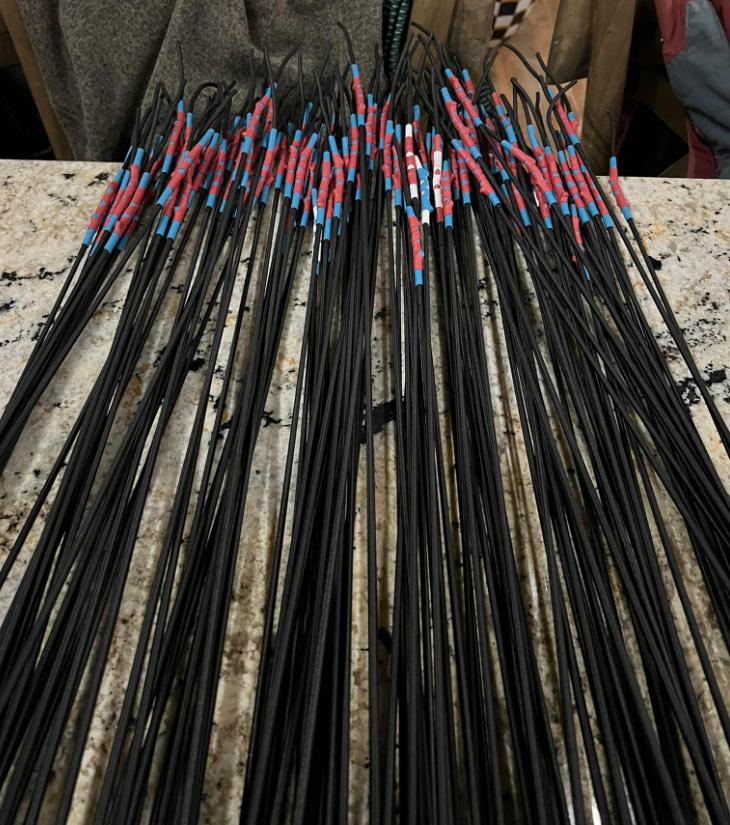
Archer Albracht, a 19-year-old student at Texas Tech University, is the founder and owner of Stinger Show Sticks. He described his product as a custom pig whip that is reinforced at the joint for longevity and has custom colors for a more standout design. Albracht launched Stinger Show Sticks on Jan. 1, 2024, after repeatedly returning from shows with broken or missing whips.
“The idea of Stinger Show Sticks is to change that,” Albracht said. “We reinforce the joint, so it lasts five times as long as the standard whip. With the custom colors, it allows you to have your own color pattern so you can tell the difference between a Stinger and a normal whip.”
Family support has also been important for Archer.
“Stingers have been used throughout our family and show group,” Albracht said. “They were the first buyers of my whips and have always promoted them. My dad is the person who helped me start this business and figure out all the right designs and the proper steps to make this become what it is today.”
Archer said his biggest challenge has been balancing the business with college.
“The biggest challenge I’ve had to this day would probably be being able to work on making Stingers and being a full-time student at Texas Tech,” Albracht said. “The best way I have overcome these challenges is through time management. I spend my mornings at school learning and nights making whips and preparing the necessary steps to make the whips.”
Albracht’s proudest moment came when a major buyer praised his product. He recalled selling a batch of fifty whips to Premium Blend Genetics.
“They are the biggest boar stud in the country, and they texted my dad and me and said that Stinger Show Sticks are their favorite whips and not another boar on their place would be walked with anything but a Stinger.”
Archer said one piece of advice for young entrepreneurs is to reach out, don’t be afraid to talk to people, and don’t be afraid to try new things.
“You may be different for a while, but it’s okay to be different; that is what makes you stick out and grow. Don’t ever give up on what you’re passionate about.”
Shaping Tomorrow’s Industry Leaders
ARE YOU
9 Between the ages of 18 and 22?
9 Passionate about pigs?
9 Eager to expand your professional and peer networks?
9 Excited about advocacy and policy?
9 Seeking resume builders in the swine industry?
9 Have experience with or a strong interest in show pigs and livestock programs?
If you said yes to the above, then this investment opportunity is for you!
BENEFITS
• Daily and weekly communication on critical policy and regulatory issues that may assist with class presentations
• Exclusive access to investor alerts, updates, and webinars
• Free World Pork Expo admission and parking
• Networking with policy leaders
• Opportunity to apply for Washington, DC trips
• Exclusive scholarship opportunities
• Communications and advocacy trainings
WHAT WE DO
The National Pork Producers Council is committed to shaping the future leaders of our industry into empowered advocates. Through the unique intersection of pigs and policy, the Young Pork Advocates Strategic Investment Program SIP will equip you with the tools to become knowledgeable about current issues, strengthen your network, and advance your career readiness within the pork industry.
INVEST IN YOUR FUTURE
For a discounted rate of $50, invest in yourself and the future of the pork industry.
Sign up today by scanning the QR Code or email invest@nppc.org.
JUNIOR AMBASSADORS
LYNLEY ALBERT
FRESHMAN AT TEXAS TECH UNIVERSITY STRATFORD, TX
ALLIE CADDELL
My first year as a Texas Pork Junior Ambassador has been a tremendous blessing filled with new knowledge, meaningful experiences, friendships, and connections. From our first training this summer to our Texas pork industry tour, I have been able to grow as a leader within the pork industry. I have seen firsthand how the Texas Pork Producers Association truly invests in the future by empowering youth to learn, lead, and advocate. Throughout the year, I have gained new insights into how pork is produced in Texas, from biosecurity practices on farms to government laws and regulations. These experiences have strengthened my understanding of the industry and deepened my appreciation for Texas pork producers. I hope to continue approaching leadership with confidence and passion, knowing that I have the ability to empower others. One of the most impactful parts of my year was building connections with fellow ambassadors and industry leaders who share a commitment to agriculture. It is a great privilege to serve as a Texas Pork Junior Ambassador, and I am grateful for all I gained during my first year. I am looking forward to my second term as I continue to support youth and help this amazing industry grow in awareness and connection.
As a first year Texas Pork Junior Ambassador, I can truly say this experience has already been a blessing only six months in. The first big lesson as an ambassador was getting to collaborate with like-minded people. I got to meet my team for the first few days of training week and fell in love with the way they supported, advocated, and looked to impact the pork industry. Each of us came in with different ideas and options, but the same goal in mind; leave an impact on the Texas Pork industry. After leaving our first official week as Ambassadors, I felt inspired to ignite change across the industry. Texas Pork isn’t just an industry focused on the show side of things, but also a commercial industry that lacks advocates statewide. We traveled the state learning from a variety of pork industry workers from lobbyist, grain mill owners, breeders, and fair developers. As young advocates for a vital industry, it was important to broaden our educational horizons. I’ve been truly blessed with the opportunity to serve an industry that has provided me so much. I hope to continue to learn, grow, and impact the pork industry through my term as a Junior Ambassador.
HANNAH GARCIA
FRESHMAN AT TEXAS TECH UNIVERSITY PLAINVIEW, TX
ADDISON SHOOK
FRESHMAN AT TEXAS TECH UNIVERSITY SEMINOLE, TX
My first year as a Texas Pork Producer’s Junior Ambassador has left a mark on my heart that I will carry forever. This role became a bridge between who I was and who I am becoming, reminding me that some passions don’t end, they simply grow deeper. The swine industry is where I learned what it feels like to love something so deeply that closing the book after I graduated was never an option. Being a Texas Pork Producer Ambassador has been eye-opening in ways I never expected. I’ve seen the heart of the Texas Pork Producers Association up close, the people, the purpose, and the pride behind every producer and family. I’ve met individuals who are just as passionate, driven, and dedicated to this industry as I am, and sharing that energy and purpose with them is the best part. Every conversation, every event, and every moment of advocacy has reminded me of the impact we can make together and the responsibility we hold as the next generation to stand up for this industry, protect it, and share its story with honesty and passion. And the wildest part? This is just the beginning. I’m still learning, still growing, still chasing every chance to show up for this industry, and I wouldn’t want to do it without the people who feel the same fire I do, my team. Being a Texas Pork Ambassador isn’t a title; it’s a daily reminder of what matters, who matters, and why I’m exactly where I’m supposed to be.
From the beginning, I felt welcomed by my team and quickly realized how meaningful it is to work alongside people who share the same passion for the pork industry. The relationships I’ve built with my team members have been the most valuable part of this year. Collaborating with individuals who are motivated and supportive has helped me grow, gain confidence, and better understand the importance of teamwork. One of the most impactful parts of this experience has been seeing a side of the pork industry that goes beyond just the livestock aspect. While production is a huge foundation of the industry, learning about advocacy and outreach has given me a broader perspective. It was eyeopening to see how much work goes on behind the scenes to support producers, educate consumers, and strengthen the industry as a whole. This experience has also deepened my appreciation for the dedication and responsibility involved in producing safe, high-quality pork. Being surrounded by people who genuinely care about the future of the industry makes the work even more meaningful. This first year has been a great learning experience, and I’m grateful for the relationships I’ve built and the chance to be involved in an industry I’m proud to support.
JUNIOR AMBASSADORS
HARPER PARSON
DEVINE, TX | EDUCATION DIRECTOR JUNIOR AT TEXAS A&M UNIVERSITY
BRYCE BORCHARDT
KRUM,
TX | MEMBERSHIP DIRECTOR
JUNIOR
From 30-degree mornings washing gilts at the San Antonio Stock Show, to sitting across from congressmen the swine industry, these past two years have led to a multitude of experiences. Through them all, it is the people who make it worth it. When I get on the plane back from an excursion to Lubbock, I reflect on what exactly happened in the last week. Without fail, I am thankful for Riley and Colby as we simply would not have this program without them. With Riley, her attention to detail and passion for excellence is an inspiring image that I strive to attain. Then with Colby, I can talk for hours gaining insight into how the industry fares and what my place could be in it. Thank you to both for their impact not only on my life, but the future generations of pig farmers. The ambassadors I have had the opportunity to serve with are some of the most distinguished and impressive individuals I have ever met. In each case, their passion started with hogs in the backyard and has culminated into wanting to do more for an industry that has laid the foundation for their entire lives. Thank you to all of them for their friendship and support over the last few years. I would not be where I am today if my parents didn’t decide we needed to show livestock. I am truly grateful for all who have gotten me where I am today. Thanks, and Gig ‘em.
As my time with the Texas Pork Producers Association (TPPA) ends and I reflect on my experience as an ambassador, I am filled with gratitude for all the ways it has enriched my life. TPPA has been more than an organization to me, it has been a community that challenged me, supported me, and shaped the leader I am today. With each experience, I have been reminded that the future of agriculture is strong because of the people willing to step up and serve it. To the youth members who are beginning their journey: never underestimate the power of your voice or your passion. There will be moments when the path feels difficult. During those times, remember, growth often comes from discomfort, and perseverance is what separates good leaders from great ones. Stay involved, ask questions, and seek mentors. Take the chance even when you’re unsure of the outcome. Most importantly, remember why you started. Lead with integrity, serve with humility, and never forget the responsibility we carry as advocates for the pork industry and agriculture as a whole. Thank you for the memories, the lifelong friendships, the lessons, and the opportunity to serve. The future of agriculture is in good hands.
EMILY MUEHLSTEIN
STAMFORD, TX | COMMUNICATIONS DIRECTOR
AT TEXAS TECH UNIVERSITY
ALYNA GARCIA
RAYMONDVILLE, TX | EVENTS DIRECTOR JUNIOR AT TEXAS A&M UNIVERSITY
The Texas Pork Junior Ambassador program has truly been an experience for the books. Not only have I had the opportunity to meet tremendous and successful individuals, but I have also found people who will be in my life far beyond wherever the livestock industry may take me. I met my college roommates through this program, traveled the world by car, plane, and on foot, but most importantly, I learned a lot about who I truly am. One thing I will always remember is that even during moments of chaos and frustration, there was an overwhelming amount of love and support. Riley and the entire team were always caring, understanding, and intentional, recognizing that we were all doing our best. One of my favorite memories was at the Texas Pork Youth Retreat, where I had the opportunity to help lead Pigs and Praise. That experience reminded me that our purpose is greater than any recognition we may receive. It is about how we make others feel. You never truly realize how much of an impact you can have on someone’s life through something as simple as a handshake or a smile. Even when life gets busy, I know I will always have good people backing me up and standing in my corner. Thank you, TPJA, not only for the unforgettable experiences, but for the incredible people this program has brought into my life. Forever indebted.
The past two years of my life have been surreal, and I never would have imagined this opportunity would come along my path. I have absolutely loved every second of this program and how much it has grown since I first got involved with Texas Pork. We have increased our member numbers as well as youth activities. This year, I was tasked with being the Event Director. I had a chance to work on our youth retreat as well as the new activities we added to the Texas Elite Showcase. Being an ambassador allowed me to expand my knowledge in all aspects of the commercial and market swine industries. My absolute favorite part of being an ambassador was talking to youth from across the state. One of my favorite memories was from our first youth retreat when I was teaching my group of kids about the commercial industry. I’m truly grateful for these past two years with Texas Pork Producers. I’m excited to see how much more this program and organization will grow. It has been an honor working with an amazing group of ambassadors as well as the Texas Pork Producers members.
By Cash Martin, TPPA Intern
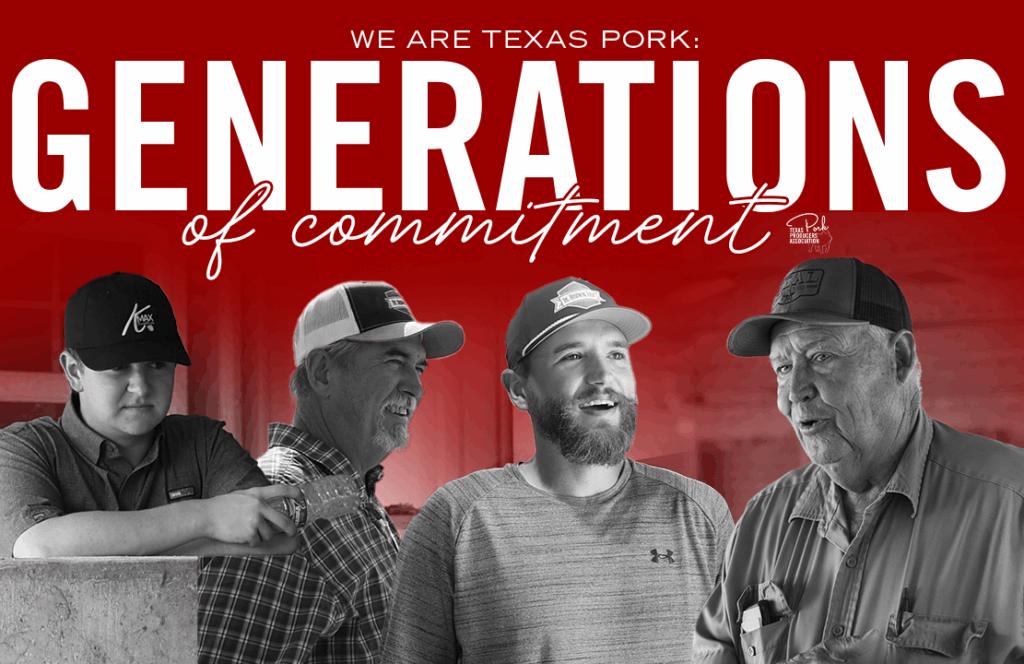
The story of the Texas pork industry is built on many generations who have dedicated their lives to their farms and strengthening the foundation of agriculture for decades. From legacy producers to the young producers stepping into leadership roles today, each generation has carried forward a shared commitment to hard work, innovation, and integrity.
Together we are, and always will be, Texas Pork.
VINCE AND CAID FRANKOWIAK | St. Hedwig, TX
For Vince and Caid Franckowiak of St. Hedwig, Texas, raising show pigs isn’t just a business, it’s a family tradition rooted in generations of hard work and passion. The Franckowiaks’ involvement in the swine industry dates back to the late 1930s and early 1940s, when Vince’s father and grandfather raised Durocs and Poland Chinas on the same farmland the family still operates on today.
Vince began showing pigs at a young age with two highly competitive ag teachers who pushed him to excel in the show ring. What began as showing market animals soon grew into raising
their own gilts and setting the foundation for what has become a thriving show pig operation. His son, Caid, carried that same drive into his own showing career, competing from eighth grade through high school before attending Hardin Simmons University in Abilene. After college, Caid returned to the family farm, combining his love for competition with his passion for raising quality livestock.
Today, the Franckowiaks maintain around 125 sows and several gilts, including Crossbreds, Yorkshires, Hampshires, Spots, Berkshires, and Chesters, but Durocs remain their mainstay, with about 50 sows of the breed. Beyond breeding and selling show pigs, the family is dedicated to helping 4-H and FFA members with feeding, doctoring, and showmanship, continuing to support the next generation of exhibitors.
The Franckowiak family also owns and operates St. Hedwig Feed and Supply, a business they started from their garage nearly 40 years ago in 1985. What began as a way to support their growing herd has now become a staple in the community.
“You make lifelong friends and meet some really neat people, and it’s so rewarding in that aspect,” Vince said. For Caid, choosing to return to the farm was an easy decision, it’s a career that lets him grow alongside his family while continuing a legacy that’s in their blood.
KOTTON WEST | TAFT, TX
Raising show pigs has been his lifelong dream for high school senior Kotton Max West. Since starting his operation, KMAX Livestock, in 2014, Kotton has built a name for himself in the Texas show pig world through hard work, determination, and a passion for helping others. As a young breeder, he said that convincing others to buy pigs from someone his age can be challenging, but he’s learned that professionalism and confidence go a long way.
“It can be difficult to try and convince people to buy a pig from a 17-year-old kid,” Kotton said. “But the way you present yourself in those situations tells them a lot about who you are as a person.”
Over the years, Kotton’s dedication has led to impressive achievements. His show career started strong when he won Champion Chester at his very first major, San Angelo. In 2023, he raised the Champion Division I Yorkshire at the San Antonio Barrow Show, a milestone he considers his proudest moment as a young breeder. Guided by mentors like longtime ag teacher Jerry Howell, who taught him the ins and outs of breeding, and Luke Lindner, a role model since the State Fair of Texas in 2019, Kotton continues to grow both his skills and his herd.
For Kotton, the most rewarding part of raising pigs is helping kids his own age succeed with their projects. He credits his family and faith for his success and strives to inspire others who share his goals.
“Without my family and God, none of this would be possible,” Kotton said.
As a sixth-generation farmer, Kotton’s roots in agriculture run deep. His family has farmed in Taft for more than a century, raising grain, sorghum, cotton, and corn.
As he looks ahead to graduation, Kotton plans
to continue his academic and livestock judging career at a junior college before transferring to Texas Tech University. Ultimately, he hopes to return home to expand his sow herd and carry on the family tradition.
“Come back to what raised you,” Kotton said. “It’s important for kids to come back and help their families continue tradition. It’s my job, and future farmers’ jobs, to help our industry survive.”
CHUCK REAL | MARION, TX
For Chuck Real, the Texas pork industry has always been rooted in family, faith, and perseverance. Growing up on a diversified farm in Marion, Real’s passion for livestock began in 1964 when his brother bought a Berkshire gilt for $75, a purchase that launched a lifetime in hog farming.
“What started as a simple show project turned into a lifelong commitment to doing what’s right and producing quality livestock,” Chuck said.
Guided by lessons from family and local ag teachers, he built a respected berkshire herd that endured droughts, economic shifts, and decades of change. After teaching and serving as a county agent, Chuck returned home in 1978 to farm full time, raising his children in the same tradition he grew up in.
“We got to raise our kids like we wanted to,” Chuck said. “I wouldn’t trade anything for it.”
A veteran of more than 60 years in the industry, including 43 as a director for the Texas Pork Producers Association, Real points to Texas’ strong youth programs through 4-H and FFA as key to the state’s success.
Chuck believes that winning is important, but it’s not everything. He said that how you win and how you do things is much more important. From his view, Texas stands apart for its unique blend of purebred and commercial producers and the people behind them.
“Hog barns have always been the place where I find the most genuine people,” Chuck said. “That’s what makes this industry special.”
SCAN THE QR CODE BELOW TO VIEW THE CURRENT
FLIP TO VIEW THE
TEXAS PORK PORDUCERS ASSOCIATION ACTIVE
MEMBERSHIP
takeaways from the
INTERNATIONAL PIG LIVABILITY CONFERENCE
by Colby Ferguson, TPPA Executive Director
The International Conference on Pig Livability, held in Omaha, Nebraska, brought together producers, researchers, veterinarians, and industry professionals to address one of the most pressing challenges facing modern pork production: pig livability. While discussions spanned housing systems, health protocols, and production practices, one theme consistently rose to the top.
For years, tension has existed between segments of the swine industry. Commercial producers often express concerns over biosecurity risks associated with the show pig sector, while show pig producers worry about disease transmission from commercial operations, particularly through manure application. Despite these differences, both sectors share a common challenge; finding, training, and retaining quality
employees. That shared issue emerged as a central factor influencing pig livability across production systems.
Prior to the conference, common assumptions about pig livability often focused on structural challenges such as confinement housing or the concentration of swine farms in major production regions. While these factors contribute to the issue, conference discussions revealed they are not the primary drivers of increased pig and sow mortality. Instead, many of the challenges trace back to execution at the farm level.
The commercial swine industry relies on large-scale production systems, with individual farms housing thousands, and in some cases tens of thousands, of sows. Managing operations of that size requires a substantial workforce. Because many swine operations are located in remote areas and struggle to attract domestic labor, producers increasingly rely on foreign workers. These employees often come from regions where swine are raised under vastly different production models, resulting in limited familiarity with modern commercial systems. When language barriers and limited training are added to the equation, even the most advanced nutrition, genetics, and herd health programs can fall short.
Conference discussions repeatedly emphasized that pig livability is less about a lack of expertise at the design level and more about how well daily tasks are executed. Veterinarians, nutritionists, and geneticists may develop exceptional programs, but outcomes ultimately depend on whether those programs are properly implemented by on-farm employees.
Housing systems provided a clear example of this challenge. Conversations comparing Proposition 12–compliant group housing systems to traditional individual sow stalls revealed higher sow mortality rates in many group housing operations. While sow aggression is a contributing factor, presenters emphasized that missed welfare checks play a larger role. In group housing environments, it can be more difficult for employees to routinely observe each sow, identify lameness or illness, and intervene early. Without consistent daily checks, problems escalate quickly, impacting both animal welfare and productivity.
Several best practices emerged throughout the conference. One key takeaway was the importance of measurable animal welfare standards. If welfare can be measured, it can be managed. Another emphasized addressing major issues before attempting to correct minor ones, as large systemic problems often create downstream challenges.
Most importantly, presenters stressed the need for effective employee training. Research shows that visual tools such as photos and videos significantly improve learning outcomes compared to written standard operating procedures alone. Written protocols require informed employees, and many new workers enter the industry without prior exposure to commercial swine production.
The takeaway for both commercial and show pig producers is clear: pig livability is ultimately a people issue. Regardless of operation size, success depends on disciplined execution of daily tasks. Checklists, clear expectations, and consistent training help turn good intentions into repeatable actions.
Whether managing five sows or 50,000, the people working on a farm can be its greatest asset, or its greatest liability. Investing in training, communication, and accountability is essential to improving pig livability and ensuring long-term success across all sectors of the swine industry.