Founded in 1838 by the Episcopal Church as a mission to the people of Texas, the Diocese of Texas has been guided continuously by the Holy Spirit to plant ministries and congregations to partner with and serve the wider community. Today, the Diocese of Texas spans nearly 70,000 square miles and encompasses 81 counties. Headquartered in historic downtown Houston with offices in Austin, Tyler, and Fort Worth, we are led by the Rt. Rev. C. Andrew Doyle, ninth Bishop of Texas. We are nearly 450 clergy, 174 congregations, 70 missional communities, 27 campus missions, chaplaincies, foundations, institutions, and over 72,000 parishioners serving our neighbors. We embrace all people with mutual love and respect. We are one Church reconciled by Jesus Christ, joining God’s mission to reconcile others and build up the kingdom of God.
*Boilerplate will be updated as content related to facts change. Staff will be updated accordingly via email and boilerplate will also be updated in this online style guide.
WE ARE...
WHo WE ARE
We, Episcopalians, believe in a loving, liberating, and life-giving God: Father, Son, and Holy Spirit. As constituent members of the Anglican Communion in the United States, we are descendants of and partners with the Church of England and the Scottish Episcopal Church, and are part of the third largest group of Christians in the world.
We believe in following the teachings of Jesus Christ, whose life, death, and resurrection saved the world.
We have a legacy of inclusion, aspiring to tell and exemplify God’s love for every human being; women and men serve as bishops, priests, and deacons in our church. Laypeople and clergy cooperate as leaders at all levels of our church. Leadership is a gift from God, and can be expressed by all people in our church, regardless of sexual identity or orientation.
We believe that God loves you – no exceptions.
The Episcopal Diocese of Texas - Visual Style Guide
DESiGN ELEmENTS...
LoGoS
The Episcopal Diocese of Texas
The Episcopal Diocese of Texas
The Episcopal Diocese of Texas
The Episcopal Diocese of Texas - Visual Style Guide
LoGo USAGE
The Episcopal Diocese of Texas
The Episcopal Diocese of Texas
The Episcopal Diocese of Texas
The Episcopal Diocese of Texas - Visual Style Guide
The Episcopal Diocese of Texas
The Episcopal Diocese of Texas
82, 100, 11, 2
RGB
88, 44, 131
72, 0, 38, 0
0, 191, 179
100, 92, 0
42, 100, 0
1, 84, 0
0, 43
163, 0
234, 72
CMYK 100, 88, 42, 51
Tint of
4, 30, 66
Tint
Tint
foNTS
Gotham | Bold
Gotham | Bold
Gotham | Medium
Gotham | Medium
Gotham | Book
Gotham | Light
Gotham | Light Italic
LEmoN miLk | boLD
Lemon miLk | boLd itaLic
Lemon miLk | medium
Lemon miLk | medium itaLic
LEMON MiLk | REgULAR
Lemon miLk | reguLar itaLic
Lemon miLk | Light
Lemon miLk | Light itaLic
Arial | Bold
Arial | Bold Italic
Arial | Regular
Arial | Italic
Mrs Eaves | Bold
Mrs Eaves | Roman
Mrs Eaves | Roman Lining
Mrs Eaves | petite caps
Mrs Eaves | all petite caps
Mrs Eaves | small caps
Mrs Eaves | all small caps
Mrs Eaves | Italic
Minion Pro | Bold
Minion Pro | Semibold
Minion Pro | Medium Italic
Minion Pro | Italic
Minion Pro | Regular
Minion Pro | Bold Cond
Minion Pro | Bold Cond Italic
STATIoNERY
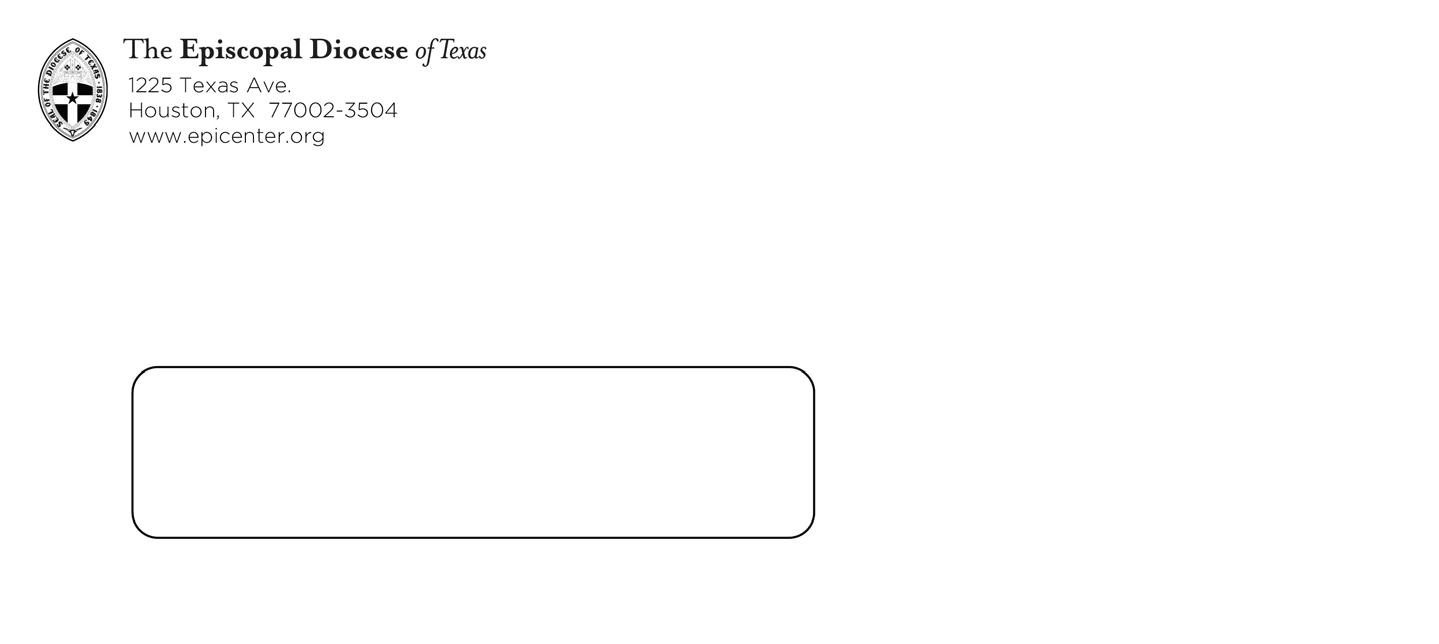
Other stationery pieces may be in use; however, this collection is the most up-to-date version of stationery (that will ultimately replace other stationery designs, over time) and contains the most commonly used pieces. It is not necessary to discard current stationery. The newer designs will be phased in at the point of reorder. Bishops who, by chance, have excess stationery bearing the Houston address may simply return such inventory to the Houston office (when convenient) and it can be utilized at a much higher volume to help with the transition. We will replace the older envelopes at other offices with new ones as envelope inventory runs low. It is not our intention to waste paper or currently used stationery; however, moving forward, the goal is to transition to this ensemble.
It will be made available in the mailroom in the Houston office once current inventory runs low. Other diocesan centers should contact Angela Hider at ahider@epicenter.org to place stationery orders whenever necessary.
Customized stationery can be designed as necessary.
STAFF MEMBER NAME
Staff Member Title
Department
Direct: 713.520.6444
Mobile: 832.777.1234 281.456.7890
Email: name@epicenter.org
Address: 1225 Texas Avenue, Houston, TX 77002
www.epicenter.org
LETTERHEAD
The Episcopal Diocese of Texas
STATIoNERY: THE bISHoPS
C. ANDREW DOYLE IX Bishop of Texas
Direct: 713.520.6444
Mobile: 713.666.7160
Email: adoyle@epicenter.org
Address: 1225 Texas Avenue, Houston, TX 77002
Website: www.epicenter.org
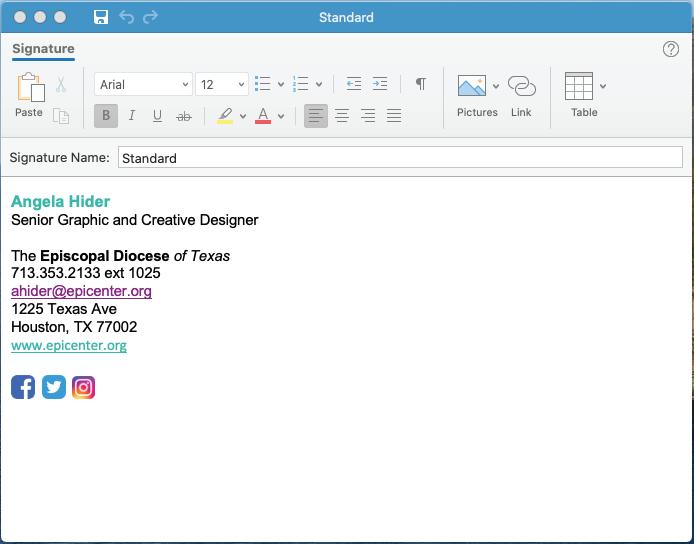
EmAIL SIGNATURE
Instructions:
• First, copy the email signature below.
• Open Outlook.
• Go to File and select Options or Outlook and select preferences.
• Select Mail on the left hand side.
• Find Signatures to the right and select.
• In the Edit signature area, paste the email signature text from below.
• Update the signature with your name, title, and phone number.
• Make sure new messages and replies/forwards on the right has your name selected.
• Click the OK button at the bottom right to save.
Template FONT and Sizes:
Make sure to use the same font and size below.
Name (Arial size 12)
Title, Company, Phone, Address, Email, Website (Arial sie 11)
Angela Hider
Senior Graphic and Creative Designer
The Episcopal Diocese of Texas 713.353.2133 ext 1025 ahider@epicenter.org 1225 Texas Ave Houston, TX 77002 www.epicenter.org
For further assistance regarding email signature, please contact Angela Hider at ahider@epicenter.org
The Episcopal Diocese of Texas - Visual Style Guide
WHEN PRESENTiNG...
PoWERPoINT PRESENTATIoN
PRomoTIoNAL ITEmS
Episcopal Diocese of Texas - Visual Style Guide
The
The Episcopal Diocese of Texas
The Episcopal Diocese of Texas
The DioceseEpiscopal ofTexas
The DioceseEpiscopal ofTexas
The Episcopal Diocese of Texas
The Episcopal Diocese of Texas
The Episcopal Diocese of Texas
The Episcopal Diocese of Texas
The DioceseEpiscopal ofTexas
bRIEf DIcTIoNARY of TERmS
ANGLICAN COMMUNION: Churches around the world that are in communion with each other and with the See of Canterbury, (i.e., Church of England) and that hold the same faith, order, and worship. According to the Anglican Consultative Council, the Anglican Communion is composed of 38 autonomous churches together with a small group of extra-provincial dioceses and approximately 85 million members. There are Anglican congregations or jurisdictions in more than 160 countries.
ARCHBISHOP OF CANTERBURY: The Primate of All England, Metropolitan of the Province of Canterbury, “first among equals” of all Anglican bishops, and the spiritual leader of the Anglican Communion. The See of Canterbury was founded in 597 with the arrival of St. Augustine, who established his first church in the town. The present Archbishop of Canterbury is the Most Rev. and Right Hon. Justin Welby.
ASSISTING BISHOP: A previously consecrated bishop who is appointed by a diocesan bishop with the consent of the standing committee and diocesan council to provide additional episcopal services in the diocese for a specific term.
BAPTISM: This is full initiation by water and the Holy Spirit into Christ’s Body, the church. God establishes an indissoluble bond with each person in baptism. God adopts us, making us members of the church and inheritors of the Kingdom of God (BCP, pp. 298, 858). In baptism we are made sharers in the new life of the Holy Spirit and the forgiveness of sins. Baptism is the foundation for all future church participation and ministry.
BISHOP: The third of the three orders of ordained ministry (deacon, priest, bishop). The major functions are to preside over a diocese, consecrate to the episcopate, ordain to the ministry, administer confirmation, and administer ecclesiastical discipline.
BISHOP COADJUTOR: A bishop who is elected to assist the bishop of a diocese and upon the latter’s death, retirement, or resignation, succeed the diocesan bishop in office.
BISHOP SUFFRAGAN: A bishop elected to assist the bishop of a diocese but without the right of succession to the office.
BOOK OF COMMON PRAYER: The title of the book of worship of the Episcopal Church. The Book of Common Prayer contains doctrine that the church requires to be taught and believed, and a collection of historical documents. It sets forth the standard authorized liturgical texts used in the Episcopal Church. The most recent revision of the Book of Common Prayer was adopted in 1979.
The Episcopal Diocese of Texas - Visual Style Guide
bRIEf DIcTIoNARY of TERmS
CANON: A law of the church set forth by an ecclesiastical council or convention. This term also refers to a person who is connected to a cathedral, usually a staff priest, or a priest of some other high standing.
DEACON: The first of the three orders of ordained ministry (deacon, priest, bishop). Deacons function in most liturgical and pastoral ministries – not in consecrating the elements – and often assist priests in some way. Its institution is found in Acts 6:1-7.
DIOCESE: The territorial limits of jurisdiction of a diocesan bishop.
EUCHARIST: From the Greek word for “giving of thanks,” this refers to the service of Holy Communion or the Lord’s Supper as a sacrifice of praise or thanksgiving. The sacrament of the Lord’s Supper was ordained by Jesus Christ for the continued remembrance of the sacrifice of his death. It may also be called the Mass, Divine Liturgy, Blessed Sacrament, or Holy Sacrifice.
EXECUTIVE COUNCIL: This governing body carries out the programs and policies of General Convention between sessions of the General Convention. It may initiate and develop such new works as it deems necessary. It is composed of 38 members: 20 members elected by General Convention (four bishops, four priests or deacons, 12 lay persons), and two members elected by each of the nine provinces.
PRESIDING BISHOP: The chief executive, primate, and spiritual leader of the church and the president of the Executive Council and House of Bishops. He or she is elected by the House of Bishops with confirmation by the House of Deputies for a term of 9 years, and when elected, he/she must resign his/her jurisdiction.
PRIEST: The second of the three orders of ordained ministry (deacon, priest, bishop). The word is a shortened form of “presbyter,” or elder. Priests officiate at any of the sacraments and services of worship other than confirmation, ordination, and consecration.
PROVINCE: A group of dioceses, usually in the same region, whose bishops and delegates meet in synod annually or in those years when the General Convention does not meet. A province is also a term used for a self-governing church body that belongs to the Anglican Communion, such as the Episcopal Church or the Church of England.
The Episcopal Diocese of Texas - Visual Style Guide
AcRoNYmS
BCP Book of Common Prayer
ECUSA Episcopal Church in the United States of America
TEC The Episcopal Church
GC General Convention
HOB House of Bishops
HOD House of Deputies
PB Presiding Bishop
DFMS Domestic and Foreign Missionary Society
UTO United Thank Offering
EYE Episcopal Youth Event
EPPN Episcopal Public Policy Network
The Episcopal Diocese of Texas - Visual Style Guide
The primary worship and liturgical text of the Episcopal Church.
Older name for The Episcopal Church, still sometimes used.
Official name of the denomination in the U.S. and 15 other countries.
The governing body of the Episcopal Church, meeting every three years.
One of two houses in General Convention, made up of bishops.
The other house in General Convention, made up of elected lay and clergy deputies.
The chief pastor and primate of the Episcopal Church.
The legal and corporate entity of the Episcopal Church.
A ministry that supports mission and ministry through grants.
A triennial gathering of Episcopal youth from around the world.
Advocacy ministry of the Episcopal Church Office of Government Relations.
AcRoNYmS
DOK Daughters of the King
EFM Education for Ministry
ECW Episcopal Church Women
CREDO Clergy Renewal, Education, Discernment, and Opportunities
An order for women who pledge to a rule of prayer, service, and evangelism.
A program of theological education for lay people.
An organization of lay women committed to ministry and service.
A wellness program for clergy and church leaders.
FWM Forward Movement
PIM Partnership in Mission
SSJE Society of Saint John the Evangelist
ODU Office of Development and University
A ministry that produces Christian formation and devotional resources.
Church program supporting global and domestic mission relationships.
An Anglican monastic community for men, based in Massachusetts.
A diocesan or national office related to development and education
The Episcopal Diocese of Texas - Visual Style Guide
WHEN WRiTiNG...
WRITING STYLE GUIDE
Addressing a Parish in our Diocese
• Name, City. Example: St. Christopher’s, Houston
- If using it in a sentence, for example: The story of Emmanuel, Houston, is in direct alignment with Hebrews 6:11
- Make sure to add a comma (,) after the location of the parish.
Referring to Clergy
• Religious titles are formal titles. They should be capitalized when attached before names of individuals, and they should be lowercase when they stand alone. A religious title is appropriate on first reference before the name of a clergyman or clergywoman.
- Example: The program included a message from the Rev. Stephen Porter.
• On second reference, use only the individual’s last name.
• In cases where a figure has taken a religious name as part of a title, maintain usage of this name throughout.
- Example: Hotels were fully booked in advance of the visit by Bishop Curry. The popularity of the presiding bishop was plainly evident, as a massive crowd gathered to receive Curry.
• Avoid using the Rev. Dr. before a name unless reference to an individual’s earned doctoral degree is relevant. Do not include Dr. for honorary doctor of divinity degrees.
- Instead it should be referred as this: the Rev. George Campbell, Ph.D.
• Avoid using such words as father, pastor and curate before individuals’ names. In direct quotations, however, capitalize these terms when used as titles before names.
- Example: “The church is very blessed to have Pastor Steve,” said one parishioner.
• ‘The’ is only capitalized when starting a new sentence
- Example: The Rev. John Davis, center, and the Rev. Will Adams set up cellphones to test out live video feeds for future services at the new location for St. John’s Episcopal Church. In this case, the second ‘the’ doesn’t need to be capitalized.
The Episcopal Diocese of Texas - Visual Style Guide
WRITING STYLE GUIDE
Referring to Bishops
• On first reference, capitalize Bishop names. On subsequent references, use either the individual’s last name or the title by itself in lowercase.
- Example: Later, Bishop Andy Doyle stopped by the school. A group of students presented a gift to the bishop. Doyle accepted it gladly.
• If appropriate in the context, substitute the Most Rev. as applicable to certain bishops and archbishops.
• Use the Rt. Rev. _____ as their formal titles
Referring to Seminary of the Southwest
• First reference is a contained story or presentation, please use ‘Seminary of the Southwest’.
o Note the absence of ‘the’; this is intentional.
• Subsequent references can be ‘Southwest’ (not SSW)
• In the appropriate context, ‘the seminary’ may be used.
o Note lowercase
The Episcopal Diocese of Texas - Visual Style Guide
AI GUIDELINES
Responsible Use Within the Diocese
Purpose
• AI tools (ChatGPT, Canva AI, image generators, etc.) can support creativity, efficiency, and idea development.
• AI should enhance human discernment — not replace it.
• All users remain responsible for the content and materials they produce.
• AI outputs must always be evaluated to ensure they reflect the Episcopal Diocese of Texas’ commitment to inclusivity, compassion, and respect for all people.
Pastoral & Theological Use
AI may assist with:
• Brainstorming sermon themes or illustrations
• Editing for clarity and grammar
• Summarizing research
• AI may automate repetitive tasks like scheduling or data management.
• AI-powered tools may be used to create captions, translations, or other features to improve accessibility for diverse audiences
AI may not:
• Write sermons from scratch
• Generate theological positions without clergy review
• Replace pastoral voice, prayer, or lived experience
The Episcopal Diocese of Texas - Visual Style Guide
Brand & Design Standards
Our visual identity is unified and strategic. AI tools may be used but must ensure alignment with the tone and branding of our style guide. For writing, the preference is to ask AI to edit, not create. Contact Communications for any questions.
Churches may use AI for:
• Draft captions
• Brainstorming ideas
• Early design exploration
AI may not be used to:
• Create or alter official logos
• Build new event brands without approval
• Produce scalable identity systems for conferences
If a design will appear on:
Posters
Signage
T-shirts
Lanyards
Stickers
Stage backdrops
Large-scale print
It must be professionally designed in vector format (AI, EPS, SVG) — not JPEG or PNG.
AI GUIDELINES
Ethical Responsibility
• Do not upload confidential or pastoral information
• Verify all facts
• Review outputs for bias or inaccuracies
• Edit all AI-generated content
AI is a tool — not an authority.
Decision-Making in Sensitive Areas
AI will not be used for decisions involving hiring, pastoral care, or sensitive member communications.
Surveillance or Monitoring
AI will not be employed for surveillance of staff, volunteers, or members.
Quick Reference Checklist
a Appropriate Use
c Brainstorming ideas
c Editing grammar or clarity
c Drafting social captions
c Research summaries
c Exploring visual directions
c Creating internal mockups
i Requires Review
c Public-facing theological content
c Large event branding
c Diocese-wide initiatives
c Printed materials for distribution
c Apparel or merchandise
When in doubt a Contact Communications.
r Not Permitted
c Writing sermons from scratch
c Creating new logos
c Altering official branding
c Generating scalable event identities
c Uploading confidential information
c Replacing pastoral discernment
SocIAL mEDIA
Facebook
YouTube
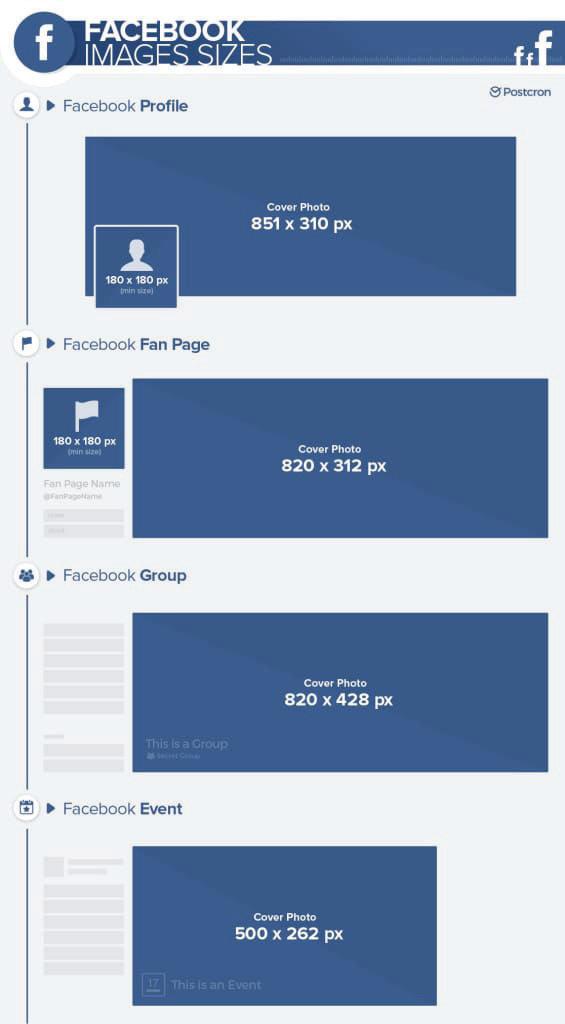
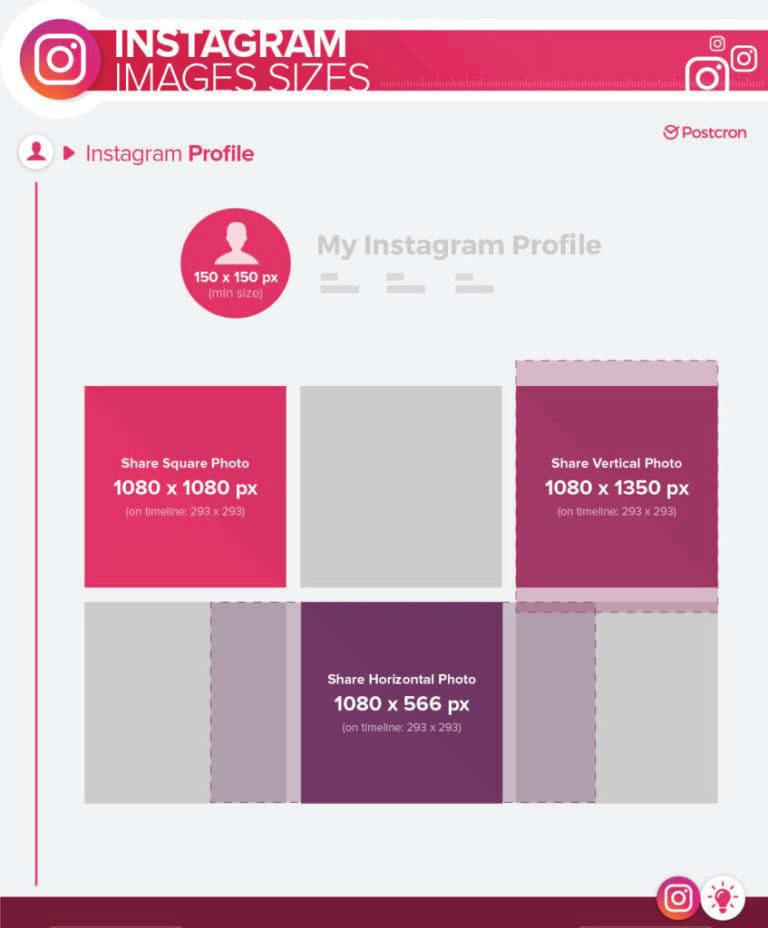
Social media content should be image-focused, with short text and a call-to-action. Video should be dynamic, center upon people as much as possible, and include consistent Episcopal Diocese of Texas branding. Images should be of good resolution, in-focus, and if possible include people rather than empty spaces. While optimized image dimensions on various social media platforms change often, a square 1080p x 1080p image or graphic will generally post well. External resources such as Hootsuite can provide more insight into current optimal social media resolution specifications per platform. Official social media sites within the diocese are managed by the Communications division. Contact Communications staff regarding social media promotional campaigns, messaging, and consultation. Twitter twitter.com/ TexasDiocese Instagram
www.facebook.com/ TexasDiocese
www.instagram.com/ TexasDiocese
www.youtube.com/ TexasDiocese
The Episcopal Diocese of Texas - Visual Style Guide