Solutions for Payroll Accounting 2018 28th Us Edition by Bieg
CHAPTER 2
Learning Objectives
After studying this chapter, students should be able to:
1. Explain the major provisions of the Fair Labor Standards Act.
2. Define hours worked.
3. Describe the main types of records used to collect payroll data.
4. Calculate regular and overtime pay.
5. Identify distinctive compensation plans.
Contents
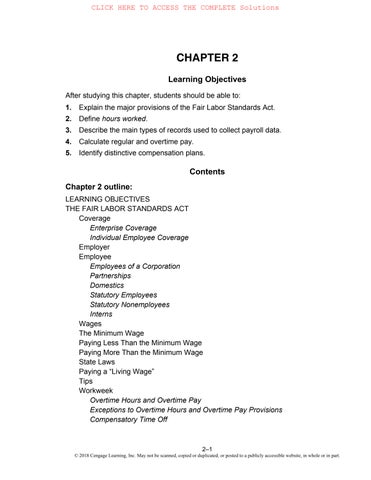
Chapter 2 outline: LEARNING OBJECTIVES
THE FAIR LABOR STANDARDS ACT
Coverage
Enterprise Coverage
Individual Employee Coverage
Employer
Employee
Employees of a Corporation
Partnerships
Domestics
Statutory Employees
Statutory Nonemployees
Interns
Wages
The Minimum Wage
Paying Less Than the Minimum Wage
Paying More Than the Minimum Wage
State Laws
Paying a “Living Wage”
Tips
Workweek
Overtime Hours and Overtime Pay
Exceptions to Overtime Hours and Overtime Pay Provisions
Compensatory Time Off
Exemptions from FLSA Requirements
White-Collar Workers
Test of Exemption
Salary Basis
Blue-Collar Workers
Equal Pay Act
Child-Labor Restrictions
Nonfarm Occupations
Agricultural Occupations
Certificate of Age
Wage Theft
Penalties
Misclassified Workers
Wage and Hour Provisions (Willful Violations)
Providing False Data
Repeated Violations
Child-Labor Provisions Violations
Areas Not Covered by the FLSA DETERMINING EMPLOYEE’S WORK TIME
Principal Activities
Clothes-Changing Time and Wash-Up
Travel Time
Idle Time
Waiting Time
Rest Periods and Coffee Breaks
Meal Periods
Taking Work Home
Sleep Time
Training Sessions
Doctor’s Appointments
Preliminary and Postliminary Activities
Fractional Parts of an Hour
Absences
Tardiness
RECORDS USED FOR TIMEKEEPING
Time Sheets
Time Cards
Computerized Time and Attendance Recording Systems
Next Generation
Touch-Screen Technology
Internet
Biometrics
IVR
METHODS OF COMPUTING WAGES AND SALARIES
Time Rate
Calculating Overtime Pay
Converting Weekly Wage Rates to Hourly Rates
Converting Biweekly Wage Rates to Hourly Rates
Converting Monthly Salary Rates to Hourly Rates
Converting Semimonthly Salary Rates to Hourly Rates
Salaried Nonexempt Employees
Salaried with Fluctuating Workweek
BELO Plan
Piece Rate
Overtime Earnings for Pieceworkers—Method A
Overtime Earnings for Pieceworkers—Method B
Special Incentive Plans
Commissions
Nondiscretionary Bonuses
Profit-Sharing Plans
KEY TERMS
ANSWERS TO SELF-STUDY QUIZZES
KEY POINTS SUMMARY
Matching Quiz (p. 2–33)
Questions for Review (p. 2–33)
1. The two bases of coverage provided by the FLSA are enterprise coverage and individual employee coverage. Under enterprise coverage, all the employees of an enterprise are covered if the enterprise has at least two employees who engage in interstate commerce or produce goods for interstate commerce and if the enterprise has annual gross sales of at least $500,000.
Under individual employee coverage, the FLSA covers a worker if the employee either engages in interstate commerce or produces goods for such commerce. Employment in a fringe occupation closely related and directly essential to the production of goods for interstate commerce constitutes engagement in the production of goods for interstate commerce.
2. The IRS groups the items of evidence into behavioral control, financial control, and the relationship of the parties.
3. Retail or service establishments, farms, and institutions of higher education may employ full-time students at 85 percent of the minimum wage.
4. The living wage in Miami is $12.63 per hour (if the employer provides health insurance) or $15.52 per hour without insurance.
5. A tipped employee engages in an occupation in which tips of more than $30 a month are customarily and regularly received. An employer can credit up to $5.12 of a tipped employee’s minimum wage as coming from tips actually received.
6. State employees working in the area of public safety may accumulate compensatory time off up to 480 hours. (The 480-hour limit represents 320 hours of overtime actually worked at the one and one-half overtime rate.) The employees may “bank” their hours and use them later as time off at time and one-half during the course of their employment.
7. An employee would be paid for compensatory time off in the following two cases:
(1) At termination of employment.
(2) Upon reaching the “bank” maximum of 480 or 240 hours.
8. The following employees are exempt from some of the requirements of the FLSA:
a. Amusement park employees are exempt from the minimum wage, equal pay, and overtime provisions.
b. Taxicab drivers are exempt from only the overtime provision.
c. Casual baby sitters are exempt from the minimum wage, equal pay, and overtime provisions.
d. Elementary school teachers are exempt from the minimum wage and overtime provisions.
e. Outside salespersons are exempt from the minimum wage and overtime provisions.
9. The types of exempt white-collar employees are executives, administrators, professionals, highly compensated employees, computer professionals, creative professionals, and outside salespersons.
10. To be classified as a highly compensated employee, he or she must:
(1) Earn $134,004* or more.
(2) Perform nonmanual work.
(3) Regularly perform one of the exempt duties of an executive, administrator, or professional employee.
11. The following conditions must be met:
(1) All work must be performed outside school hours.
(2) There is a maximum 3-hour day and 18-hour week when school is in session (8 and 40, respectively, when not in session).
(3) Work must be performed between 7 A.M. and 7 P.M. (9 P.M. in summer).
* Being held up in court, the old level of $100,000 still applies.
12. The principal activities of employees are those they must perform and include any work of consequence performed for the employer. Principal activities include those that are indispensable to the performance of productive work and those that are an integral part of a principal activity.
13. The time spent by employees in traveling to and from work counts as time worked only if contract, custom, or practice so requires. In some instances, however, travel time between home and work counts as time worked. For example, when an employee receives an emergency call outside the regular working hours and must travel a substantial distance to perform a job away from the usual work site for one of the employer’s customers, the travel time counts as time worked.
14. “Engaged to wait” is considered working time. An example would be workers required to be at a car wash at a scheduled time waiting for car wash service volume. “Waiting to be engaged” is not working time. This involves waiting for the start of the working hours.
15. Nonexempt employees must be paid for all hours worked, even those outside the regular workplace. This also applies when employees take work home even if expressly told not to do so.
16. The time spent by employees in attending lectures or training sessions does not count as working time when all of the following conditions are met:
a. Attendance by the employee is voluntary.
b. The employee does not produce any goods or perform any other productive work during the meeting or lecture.
c. The meeting or lecture takes place outside regular working hours.
d. The meeting or lecture is not directly related to the employee’s work.
17. Preliminary and postliminary activities would be counted as time worked if required by custom or contract. In addition, if these activities are integral or indispensable to the employee’s main activities, compensation is required for this time. These times can also be excluded from time worked and be considered clothes changing under a collective agreement between the employer and the unionized workforce.
18. A biometric time clock identifies an employee’s unique fingerprint, handprint, voice, iris, or whole face.
19. The Wage and Hour Division allows employers to round off employees’ work time to the nearest five, six, or fifteen minutes. This process must be applied consistently to all employees.
20. The overtime premium pay is calculated by multiplying the overtime hours by an overtime premium rate of one-half the regular hourly rate.
21. To calculate the overtime hourly rate for employees who are paid biweekly, divide by 2 to arrive at the weekly salary. Divide the weekly salary by the regular number of hours worked to obtain the hourly rate. Multiply this rate by one and one-half to obtain the overtime rate.
22. The regular rate of pay for a salaried nonexempt employee is found by dividing the number of hours expected to be worked each week into the weekly salary.
23. In the case of a salaried employee with fluctuating workweeks, overtime pay is found by dividing the normal salary by the total hours worked, and then dividing in half to get the extra half-rate which is paid for all the overtime hours.
An alternative method would be to divide the fixed salary by 40 hours to determine a fixed hourly rate of pay, and then divide this in half to get the fixed extra half-rate.
24. Commissions are considered to be payments for hours worked and must be included in determining the regular hourly rate.
25. Bonuses that are known in advance or that are set up as inducement to achieve goals are nondiscretionary bonuses. This type of bonus is part of the employees’ wage rates.
Questions for Discussion (p. 2–34)
1. The FLSA requires overtime pay for hours physically worked over 40 in a workweek. Hours that are paid for, but not actually worked, do not count toward the 40 hours. In addition, the hourly rate of pay is determined by dividing the total regular pay actually earned by the total number of hours actually worked.
2. No. Sanchez Printers, like other employers, may be inadvertently violating the FLSA by giving employees a four-day Thanksgiving weekend and then expecting them to make up the lost time later. Although there is no problem when an employer grants Thanksgiving Day and the following Friday as holidays, either with or without pay, a violation arises if the employees are asked to work extra hours without proper compensation in some other workweek to make up for the time lost. Such an arrangement could violate payment of time and one-half for hours over 40 in any workweek.
3. Under the Fair Labor Standards Act, if the correct amount of overtime compensation cannot be determined until after the regular pay period, the company may make the overtime payment as soon as is practicable but no later than the next payday.
4. In a case similar to the one described (69 LA 573), it was noted that the employer was more diligent in trying to correct paycheck errors that involved more than $30. It was decided that there is no sufficient business reason why an error in a small amount cannot be corrected as promptly as an error in a large amount. It was ruled that the employer should look into the matter and inspect its records at the earliest practicable moment. Further, it was concluded that errors should be attended to as soon as feasible, irrespective of the amount due.
5. First of all, the company pays Banta at two different wage rates based on the hours worked at each separate job. As far as the overtime pay, there are three options: (1) pay him one and one-half the higher rate for the overtime hours, (2) calculate an average overtime rate based on the total time worked, or (3) if agreed in advance, base the overtime rate on the job actually worked during the overtime hours.
Problem Sets (p. 2–35)
The principles and practices of payroll accounting discussed in Chapter 2 are applied in the Problem Sets as shown below.
Principle or Practice
Problem Set No. (A and B)
1. Paying less than the minimum wage (exception to the FLSA) 2–1
2. Computing the tip credit 2–2, 2–5
3. Computing gross earnings 2–3
4. Computing regular earnings, overtime earnings, and total gross earnings 2–4 through 2–22
5. Computing salary—exempt employee 2–6
6. Reading time cards to determine hours worked 2–9, 2–10 2–11 (continental system)
7. 4/40 workweek 2–11
8. Converting monthly and annual salary rates to hourly rates 2–14, 2–15
9. Using the decimal system for “docking” 2–10
10. Piece-rate systems 2–18, 2–19
11. Commissions 2–20, 2–21
12. Bonuses 2–22
Solutions—Problem Set A
2–1A. (a) 37 hours × $4.20 = $155.40
(b) Yes. Beck, a full-time student in a university, may be employed by a retail establishment for at least 85% of the minimum wage, or $6.17 (85% × $7.25 = $6.1625, which the government rounds to $6.17). Since Beck is being paid a rate less than $6.17, the wage rate violates the FLSA.
*In order to be able to pay just the minimum ($85.20) for a 40-hour week, the employee must receive at least $204.80 in tips ($290.00 $85.20).
2–3A.
2–4A.
2–7A. (a)
2–12A.
2–13A.
2–14A.
2–17A. (a)
2–22A.
$975 ÷ 13 weeks = $75/week
$75 ÷ 43 hours = $1.74 bonus per hour
$1.74 × 0.5 = $0.87 extra overtime rate
$0.87 × 3 overtime hours/week × 13 weeks = $33.93
Solutions—Problem Set B
2–1B.
(a) 33 1/4 hours × $5.25 = $174.56
(b) Yes. Cross, a full-time student in a university, may be employed by a retail establishment for at least 85% of the minimum wage, or $6.17 (85% × $7.25 = $6.1625, which the government rounds to $6.17). Since Cross is being paid a rate less than $6.17, the wage rate violates the FLSA.
*In order to be able to pay just the minimum ($85.20) for a 40-hour week, the employee must receive at least $204.80 in tips ($290.00 $85.20).
2–4B.
2–11B.
2–12B.
2–13B.
2–22B. $2,000 ÷ 52 weeks = $38.46/week
$38.46 ÷ 44 hours = $0.87 bonus per hour
$0.87 × 0.5 = $0.44 extra overtime rate
$0.44 × 4 overtime hours/week × 52 weeks = $91.52
Continuing Payroll Problems (p. 2–50)
See the completed payroll registers on pages CPP–1 through CPP–6.
Case Problems (p. 2–52)
Case 2–1
Some potential solutions that Delgado should consider are:
1. Limit vacation accruals to a maximum, such as two or three weeks. This move would reduce the current cost of payouts for earlier vacations granted at lower wage rates.
2. Combine sick leave and vacation leave into one category called “annual leave.” This practice enables a worker to use the leave time for any purpose—sick leave, vacation time, child care, parental care, etc.
3. Adopt flexible time scheduling to enable workers to handle personal business, such as medical and dental appointments, while they are flexing during the workday.
Case 2–2
John should be made aware of the fact that the FLSA requires overtime pay for hours physically worked over 40 in a workweek. Time paid for but not worked because of holidays, vacations, sickness, jury duty, etc., is not included in the employee’s regular rate of pay and does not count toward 40 hours worked.
2
PAYROLL ACCOUNTING
Bieg/Toland
Section A—DIRECTIONS: Each of the following statements is either true or false. Unless directed otherwise by your instructor, indicate your choice in the Answers column by writing “T” for a true answer or “F” for a false answer. (2 points for each correct answer)
1. An enterprise is covered under the FLSA if there are at least two employees engaged in interstate commerce and if the enterprise has a gross annual sales volume of at least $100,000. .... 1.
2. Under the FLSA, “mom and pop stores” are excluded from enterprise coverage. ........................... 2.
3. If a small amount of tips is turned over to the employer, the tip credit can still be applied against the minimum wage. .................................................................................................... 3.
4. Employers must pay employees for working overtime hours even if the overtime was not authorized or approved.. ...................................................................................................... 4.
5. Employees who regularly work less than 20 hours a week are not covered by the minimum wage requirements. ...........................................................................................................
6. A full-time student may be employed by a retail shop at 85 percent of the minimum wage.
7. An employer may only credit up to half of a tipped employee’s minimum wage as coming from
15. Violators of the minimum wage provisions of the FLSA must reimburse the offended employees at the rate of $15.00 per hour for the hours paid at the hourly rate below the minimum. ..........
16. A worker who is regularly paid on a biweekly basis should receive 24 paychecks each year. .......
17. In order to qualify for the “white-collar” exemption as outside salespeople, the employees must be paid a minimum salary of at least $1,000/week. .................................................................
18. Commissions are considered to be payments for hours worked and must be included in determining the regular hourly rate. .........................................................................................
19. In calculating the overtime premium pay, the overtime hours are multiplied by one-half the regular hourly rate. ...........................................................................................................................
20. A nondiscretionary bonus is one that is either known in advance or is set up as an inducement to achieve certain goals. ................................................................................................... 20.
Section B DIRECTIONS: Solve the following problems and record the answers in the Answers column. Carry each hourly rate and each overtime rate to 3 decimal places and then round off to 2 decimal places. (6 points for each correct answer)
Answers For Scoring
1. Diane Duke works a standard 40-hour workweek. She is paid time and one-half for all hours over 40 in each workweek. Her regular hourly wage rate is $10.90. One week, Duke worked 49 hours. Her total gross earnings for the week are.................................... $ 1.
2. Charles Rollins earns $2,400 each month and works 35 hours each week. (a) His hourly rate is ....................................................................................................... $ 2a. (3 pts.) (b) His overtime rate is ..................................................................................................... $ 2b. (3 pts.)
3. Ken Gorman is paid $810.00 for a 37½-hour workweek. Overtime is paid at time and one-half for hours beyond 40 in each workweek. One week, Gorman works 48 hours. If he is paid his regular hourly rate for the first 40 hours, Gorman’s gross pay is ............. $ 3.
4. Susan Tate receives an hourly wage of $11.25 for a 40-hour week of 5 days, 8 hours daily. For Saturday work, she is paid 1½ times the regular rate. For Sunday work, she is paid 2 times the regular rate. One week, she worked 50 hours—4 hours of which were on Saturday and 6 hours on Sunday. Her total earnings for the week are ......................... $ 4.
5. Ronald Dowd receives an annual base salary of $87,500 as a salesman in the Southern region, which has an annual sales quota of $450,000. For all sales over this quota, Dowd receives a commission of 4½ percent. For the current year, sales in the Southern region total $698,000. The amount of salary and commissions due to Dowd is ................ $ 5.
6. Charles Geiger is a salaried employee who works fluctuating workweeks. He is paid $1,520 per workweek. This week, he worked 50 hours. Determine Geiger’s total gross pay if his employer uses the special half-rate (based on total hours worked) for overtime pay. ................................................................................................................ $ 6.
7. Ron Morris earns $11.80 per hour and worked 44 hours this week. In addition, he earned a production bonus of $35.20 for the week. His gross pay for the week is ............ $ 7.
8. Bob Knox is paid on a piece-rate basis. He is paid 30 cents for each unit he produces. For overtime work, he receives in addition to his piece-rate earnings a sum equal to one-half the regular hourly pay multiplied by the hours worked in excess of 40 in a week. During a particular week, Knox worked 45 hours and produced 1,890 units. His total earnings for the week are .......................................................................................... $ 8.
9. Carson Morris worked two separate jobs for Horwath Company during the week. Job A consisted of 36 hours at $16.00 per hour; Job B entailed 14 hours at $17.50 per hour. Determine his gross pay for that week if the employer uses the average rate basis for the overtime pay. ........................................................................................................... $ 9.
10. Cecil Green is a waiter who regularly receives $90 each week in tips and works 40 hours each week. Green’s employer claims the maximum weekly tip credit that is allowed in this case. The gross weekly pay, excluding tips, that the restaurant should pay Green without violating the FLSA is.......................................................................... $ 10.
PAYROLL ACCOUNTING
Bieg/Toland
Section A—DIRECTIONS: Each of the following statements is either true or false. Unless directed otherwise by your instructor, indicate your choice in the Answers column by writing “T” for a true answer or “F” for a false answer. (2 points for each correct answer)
1. An enterprise is covered under the FLSA if there are at least two employees engaged in interstate commerce and if the enterprise has a gross annual sales volume of at least $100,000. ....
2. Under the FLSA, “mom and pop stores” are excluded from enterprise coverage. ...........................
3. If a small amount of tips is turned over to the employer, the tip credit can still be applied against the minimum wage. ....................................................................................................
4. Employers must pay employees for working overtime hours even if the overtime was not authorized or approved. ......................................................................................................
5.
6. A full-time student may be employed by a retail shop at 85 percent of the minimum wage.
7. An employer may only credit up to half of a tipped employee’s minimum wage as coming from the tips actually received. ......................................................................................
8. There are some states that have a higher minimum wage rate than the federal minimum.
9. The FLSA provides for the payment of “double
11. Blue-collar workers do not have to be paid for overtime if they
16. A worker who is regularly paid on a biweekly basis should receive 24 paychecks each year. .......
17. In order to qualify for the “white-collar” exemption as outside salespeople, the employees must be paid a minimum salary of at least $1,000/week. .................................................................
18. Commissions are considered to be payments for hours worked and must be included in determining the regular hourly rate. .........................................................................................
19. In calculating the overtime premium pay, the overtime hours are multiplied by one-half the regular hourly rate. ........................................................................................................................... T 19.
20. A nondiscretionary bonus is one that is either known in advance or is set up as an inducement to achieve certain goals. ...................................................................................................
Section B DIRECTIONS: Solve the following problems and record the answers in the Answers column. Carry each hourly rate and each overtime rate to 3 decimal places and then round off to 2 decimal places. (6 points for each correct answer)
Answers For Scoring
1. Diane Duke works a standard 40-hour workweek. She is paid time and one-half for all hours over 40 in each workweek. Her regular hourly wage rate is $10.90. One week, Duke worked 49 hours. Her total gross earnings for the week are [(40 × $10.90) + (9 × $10.90 × 1.5)] ........................................................................................................... $ 583.15 1.
2. Charles Rollins earns $2,400 each month and works 35 hours each week. (a) His hourly rate is [($2,400 × 12) ÷ 52 ÷ 35] ................................................................ $ 15.82 2a. (3 pts.) (b) His overtime rate is ($15.82 × 1.5) .............................................................................. $ 23.73 2b. (3 pts.)
3. Ken Gorman is paid $810.00 for a 37½-hour workweek. Overtime is paid at time and one-half for hours beyond 40 in each workweek. One week, Gorman works 48 hours. If he is paid his regular hourly rate for the first 40 hours, Gorman’s gross pay is $810 ÷ 37½ = $21.60/hour; [$810 + (2.5 × $21.60) + (8 × $32.40)] ................................
4. Susan Tate receives an hourly wage of $11.25 for a 40-hour week of 5 days, 8 hours daily. For Saturday work, she is paid 1½ times the regular rate. For Sunday work, she is paid 2 times the regular rate. One week, she worked 50 hours—4 hours of which were on Saturday and 6 hours on Sunday. Her total earnings for the week are [(40 × $11.25) + (4 × $16.88) + (6 × $22.50)] ..........................................................................................
5. Ronald Dowd receives an annual base salary of $87,500 as a salesman in the Southern region, which has an annual sales quota of $450,000. For all sales over this quota, Dowd receives a commission of 4½ percent. For the current year, sales in the Southern region total $698,000. The amount of salary and commissions due to Dowd is [$87,500 + ($248,000 × 0.045)] ........................................................................................
6. Charles Geiger is a salaried employee who works fluctuating workweeks. He is paid $1,520 per workweek. This week, he worked 50 hours. Determine Geiger’s total gross pay if his employer uses the special half-rate (based on total hours worked) for overtime pay. ($1,520 ÷ 50 = $30.40 × 0.5 = $15.20 × 10 = $152.00 + $1,520) .............. $ 1,672.00 6.
7. Ron Morris earns $11.80 per hour and worked 44 hours this week. In addition, he earned a production bonus of $35.20 for the week. His gross pay for the week is (44 × $11.80 = $519.20 + $35.20 = $554.40 ÷ 44 = $12.60 × 0.5 = $6.30 × 4 = $25.20 + $554.40)...... $ 579.60 7.
8. Bob Knox is paid on a piece-rate basis. He is paid 30 cents for each unit he produces. For overtime work, he receives in addition to his piece-rate earnings a sum equal to one-half the regular hourly pay multiplied by the hours worked in excess of 40 in a week. During a particular week, Knox worked 45 hours and produced 1,890 units. His total earnings for the week are (1,890 × $0.30 = $567.00 ÷ 45 = $12.60 × 0.5 = $6.30 × 5 = $31.50 + $567.00) .................................................................................................................... $ 598.50 8.
9. Carson Morris worked two separate jobs for Horwath Company during the week. Job A consisted of 36 hours at $16.00 per hour; Job B entailed 14 hours at $17.50 per hour. Determine his gross pay for that week if the employer uses the average rate basis for the overtime pay. [(36 × $16.00) + (14 × $17.50) = $821 ÷ 50 = $16.42 × 0.5 = $8.21 × 10 = $82.10 + $821.00]
10. Cecil Green is a waiter who regularly receives $90 each week in tips and works 40 hours each week. Green’s employer claims the maximum weekly tip credit that is allowed in this case. The gross weekly pay, excluding tips, that the restaurant should pay Green without violating the FLSA is (40 × $7.25 = $290.00 – $90.00) ....................................... $ 200.00 10.
F 1. 2–2
T 2. 2–2
F 3. 2–2
F 4. 2–3
F 5. 2–4
F 6. 2–4
T 7. 2–4
F 8. 2–4
F 9. 2–5
T 10. 2–5
F 11. 2–6
F 12. 2–6
T 13. 2–6
T 14. 2–8
F 15. 2–8
T 16. 2–9
CHAPTER 2
True-False Questions
Under the FLSA enterprise coverage test, hospitals and nursing homes are only covered if their annual charges for services are at least $500,000.
Institutions of higher education are extended coverage under FLSA without regard to their annual sales volume.
If a business does not meet the enterprise coverage test, none of its workers qualify for individual employee coverage.
Domestics are excluded from coverage under the FLSA individual employee coverage.
A discretionary bonus is included in an employee’s regular rate of pay.
All interns in the for-profit sector are exempt from the minimum wage and overtime requirements of the FLSA.
Employees paid biweekly receive their remuneration every two weeks.
In January 2018, workers who receive the minimum hourly wage are paid $6.10 an hour.
A retail shop may employ a full-time student at $5.00 per hour.
A college may employ its own full-time students at 85 percent of the minimum wage.
All major cities have enacted ordinances establishing a so-called “living wage” at $10.25 per hour.
The FLSA defines a tipped employee as one who regularly receives tips of more than $20 a month.
An employer can credit up to $5.12 of a tipped employee’s minimum wage as coming from the tips received by that employee.
The FLSA requires that workers receive overtime pay for all hours worked in excess of 40 in a workweek.
The FLSA requires that workers receive overtime pay of twice the employees’ regular hourly rate for hours worked on Sunday.
Employees who are receiving remedial education may work up to 10 hours overtime each week without receiving overtime pay.
T 17. 2–9
Public safety employees of a state can be granted compensatory time off in lieu of overtime compensation.
F 18. 2–9 All employers can grant compensatory time off to employees in place of overtime pay.
F 19. 2–10
Exempt professional employees are exempt from all provisions of the FLSA—minimum wages, overtime pay, and equal pay.
T 20. 2–10 Employees paid by the hour without a guarantee of a weekly minimum salary do not qualify for the salary test for white-collar workers.
F 21. 2–10 One of the tests to be met for the white-collar exemption for an executive is to be paid a salary of at least $1,000 per week.
F 22. 2–13 The Equal Pay Act stipulates that there cannot be any wage differentials between the sexes.
F 23. 2–13 Under no conditions may children under age 16 be employed in food service establishments.
F 24. 2–13 The FLSA sets no limits upon the number of hours that a 15-year-old person may work so long as the overtime pay provisions are met.
F 25. 2–14 Violators of the overtime provision of the FLSA are required to pay the unpaid overtime at triple the employee’s hourly rate.
F 26. 2–16 When employees spend time changing clothes on the employer’s premises, this time must be counted as part of their principal activities for which they are always fully compensated.
T 27. 2–17
Provided employees can use the on-call time for their own purposes, this time is not compensable.
F 28. 2–17 The FLSA requires that employees be given at least two 15-minute rest periods each workday.
T 29. 2–17 Bona fide meal periods when the employee is completely relieved from duty are not considered working time.
F 30. 2–17 “Engaged to wait” and “waiting to be engaged” are both considered work time.
F 31. 2–17 Hourly employees who take work home without the permission of the employer do not have to be paid for the work done at home.
T 32. 2–19 Employers may adopt the practice of recording an employee’s starting and stopping time to the nearest quarter of an hour.
F 33. 2–19 The FLSA contains detailed specifications of the methods that employers must follow in keeping time records.
T 34. 2–20
Under the continental system of recording time, 9:00 A.M. is recorded as 900 while 9:00 P M. is recorded as 2100.
F 35. 2–25 In converting semimonthly wage rates to hourly rates, divide the semimonthly rate by 4 to arrive at the weekly rate, then divide this rate by the standard number of hours.
T 36. 2–28
F 37. 2–30
Under the piece-rate system, workers are paid according to their output.
Although commissions are considered payments for hours worked, in all cases they are excluded when determining the regular hourly rate.
T 38. 2–30 To calculate the overtime pay rate for a commissioned worker, divide the total commission by the hours worked, and then take one-half of the resulting rate of pay.
T 39. 2–31 Nondiscretionary bonuses are part of the determination of regular rate of pay.
T 40. 2–31 Payments made to a bona fide profit-sharing plan that meets the standards set by the secretary of labor’s regulations are not deemed wages in determining the regular rate of pay.
Multiple-Choice Questions
d 1. 2–2
Under enterprise coverage, all employees of a business are covered by the FLSA if the organization is:
a. a nursing home.
b. a public agency.
c. a hospital.
d. all of the above.
e. none of the above.
d 2. 2–2
Under individual employee coverage, the worker is covered by the FLSA if:
a. the worker produces goods for interstate commerce.
b. the worker is a housekeeper in a private home for 16 hours a week.
c. the domestic receives cash wages of at least $2,000 from the employer in the calendar year.
d. all of the above.
e. none of the above.
a 3. 2–4
Under the FLSA, regular rate of pay does not include:
a. vacation pay.
b. severance pay.
c. overtime pay.
d. earned bonuses.
e. All of the above are considered wages.
e 4. 2–4
e 5. 2–6
In January 2018, the minimum hourly wage was:
a. $9.35.
b. $12.15.
c. $10.00.
d. $8.15.
e. none of the above.
The tips received by a tipped employee are less than $5.12 of the minimum hourly tip credit rate. The maximum permissible tip credit is:
a. $30 a month.
b. $5.12 an hour.
c. 45% of the employee’s minimum wage.
d. 50% of the employee’s minimum wage.
e. the amount of tips actually received by the employee.
c 6. 2–8
e 7. 2–11
Under the FLSA, overtime pay is required for:
a. any hours worked in excess of 8 in one day.
b. all work on Sunday.
c. all hours worked in excess of 40 in a workweek.
d. all hours worked on Christmas.
e. all of the above.
Workers exempt from all of the FLSA requirements include:
a. employees paid by the hour.
b. clerk-typists earning less than $200 a week.
c. taxicab drivers.
d. motion picture theater employees.
e. none of the above.
c 8. 2–13
a 9. 2–14
Under the Equal Pay Act:
a. employers must pay a married male a higher wage rate than a single female if both are performing equal work.
b. white-collar workers are exempt from its requirements.
c. wage differentials based on a seniority system are allowed.
d. if there is an unlawful pay differential, employers may reduce the higher rate to equal the lower rate.
e. none of the above.
If an employer is unable to obtain a certificate of age or a work permit for a minor employee, the employer may rely upon what document as evidence of age?
a. Baptism record
b. Mother’s statement as to date of birth
c. High school enrollment form showing date of birth
d. Minor employee’s statement as to date of birth
e. None of the above
e 10. 2–15
d 11. 2–15
Which of the following is not required by the FLSA?
a. Extra pay for work on holidays
b. Two weeks’ vacation pay after one year of service
c. Restriction on hours worked by a 17-year-old worker
d. All of the above are required.
e. None of the above is required.
Those tasks that employees must perform and which include any work of consequence performed for the employer are known as:
a. preliminary activities.
b. postliminary activities.
c. work activities.
d. principal activities.
e. none of the above.
d 12. 2–17
Rest periods and coffee breaks may be required by all of the following except:
a. a union contract.
b. a state legislation.
c. a municipal legislation.
d. the FLSA.
e. none of the above.
b 13. 2–18
Training sessions are counted as working time when the following condition is met:
a. the employee’s attendance is voluntary.
b. the employer requires the employee’s attendance.
c. the training sessions are for the primary benefit of the employee.
d. the session takes place outside the regular working hours.
e. the session is not directly related to the employee’s work.
d 14. 2–19
The Wage and Hour Division allows the practice of recording an employee’s starting and stopping time to:
a. the nearest five minutes.
b. the nearest tenth of an hour.
c. the nearest quarter of an hour.
d. all of the above.
e. none of the above.
c 15. 2–19
The FLSA requires:
a. that employers use time cards to record the employees’ time worked.
b. that employers use the continental time system to record all time worked by employees.
c. that employers keep records that show the hours each employee worked each workday and each workweek.
d. that employees sign each clock card.
e. none of the above.
c 16. 2–20
e 17. 2–23
Under the continental system of recording time, 9:20 P M. is recorded as:
a. P2120.
b. 9:20P.
c. 2120.
d. 2220.
e. none of the above.
If an employee works two jobs at two different wage rates for the same employer during the same pay week, any overtime pay must be calculated by using an overtime hourly rate of:
a. one and one-half the higher of the two wage rates.
b. one and one-half the lower of the two wage rates.
c. one-half of the higher of the two wage rates.
d. one-half of the two rates combined.
e. none of the above.
e 18. 2–26
Employers may pay nonexempt employees who work fluctuating schedules a fixed salary. In these cases, the extra pay is:
a. calculated at a time and one-half rate.
b. calculated at a double time rate.
c. calculated at the regular rate of pay.
d. unpaid.
e. none of the above.
a 19. 2–28
To determine a pieceworker’s regular hourly rate for one week:
a. divide the total weekly earnings from piece rates and all other sources by the hours worked in the week.
b. divide the total weekly earnings from piece rates by the number of pieces produced.
c. divide the total weekly earnings from piece rates, less earnings from other sources, by the hours worked in a week.
d. add the total weekly earnings from piece rates and all other sources and divide by the total number of pieces produced.
e. do none of the above.
b 20. 2–30
A stated percentage of revenue paid an employee who transacts a piece of business or performs a service is called:
a. a piece rate.
b. a commission.
c. a regular hourly rate.
d. a remunerative salary.
e. none of the above.
Problem-Solving
NOTE: In all problems, unless instructed otherwise, compute the hourly and overtime rates as follows:
1. Carry the hourly rate and the overtime rate to 3 decimal places and then round off to 2 decimal places (round the hourly rate to 2 decimal places before multiplying by one and one-half to determine the overtime rate).
2. If the third decimal place is 5 or more, round to the next higher cent.
3. If the third decimal place is less than 5, drop the third decimal place.
Also, use the minimum hourly wage of $7.25 in solving these problems and all that follow.
1. Abel works a 37½-hour week at $10.75 an hour. Overtime hours are paid at 1½ times the regular rate.
(a) Abel’s regular weekly earnings are (37½ × $10.75) ........................ $403.13 (b) Abel’s overtime rate is ($10.75 × 1.5) ............................................. $16.13 (c) Abel works 6 hours overtime during one week. Abel’s weekly gross earnings are [$403.13 + (6 × $16.13)] ............ $499.91
2. Jack Kentson works a 40-hour week with overtime paid at 1½ times his regular rate of pay of $14.88. This week he worked 42 hours, which resulted in a gross pay of [(40 × $14.88) + (2 × $14.88 × 1.5)] ..... $639.84
3. Carolyn Clark, a full-time student at Atlanta State University, works at the Barclay Dress Shop. In order not to violate the FLSA, the least salary that Barclay could pay Clark for her 28-hour workweek is (28 × $6.17) ......... $172.76
4. Bakker is paid an hourly rate of $10.65. For 130 minutes spent on a certain job, Bakker is paid ($10.65 × 130/60) .......................................... $23.08
5. Annette Henri is paid an hourly wage of $10.90 for a 32-hour workweek of 4 days, 8 hours daily. For any work on the fifth day and on Saturdays, she is paid one and one-half times her regular hourly rate. During a certain week, in addition to her regular 32 hours, Henri worked 6 hours on the fifth day and 5 hours on Saturday. For this workweek, Henri’s total earnings are [(32 × $10.90) + (11 × $10.90 × 1.5)] ..........................
6. Jose Cruz earns $2,275 each month and works 37½ hours each week. His employer pays him overtime (for hours beyond 37½) and uses the overtime premium approach. Cruz’s overtime premium hourly rate is ($2,275 × 12 = $27,300 ÷ 52 = $525 ÷ 37½ = $14.00 × ½) .....................
$528.65
$7.00
7. Every two weeks, Linda Corson is paid $650. Corson works a 32-hour week. For overtime, she receives extra pay at the regular hourly rate up to 40 hours. For any hours beyond 40 during the workweek, she receives time and one-half. During one biweekly pay period, she worked 17 hours overtime. Only 3 hours of the overtime were beyond 40 hours in any one week. Corson’s gross earnings for the biweekly pay period are {$650 ÷ 64 = $10.16; [$650 + (14 × $10.16) + (3 × $10.16 × 1.5)]} .... $837.96
8. Carla Maloney is a waitress who regularly receives $80 each week in tips and works 40 hours each week. The minimum gross weekly pay, excluding tips, that the restaurant could pay Maloney without violating the FLSA is [(40 × $7.25) – $80]........................................................... $210.00
9. Elder is paid a monthly salary of $2,250. Overtime is paid for hours beyond 40 in each workweek. One week, Elder works 7 hours overtime. Elder’s gross pay for the week is {(12 × $2,250) ÷ 52 = $519.23 ÷ 40 = $12.98; [$519.23 + (7 × $12.98 × 1.5)]} ............................................. $655.52
10. Kevin Kurtz is a newly hired exempt employee who earns an annual salary of $67,600. Since he started work on Thursday (5-day week ends on Friday), his pay for the first week of work would be [($67,600 ÷ 52) × 2/5] .................................................................................................... $520.00
11. Fall is paid a biweekly salary of $937.50. Overtime is paid for hours beyond 40 in each workweek. One week, Fall works 3 hours overtime. Fall’s pay for this biweekly pay period is ($937.50 ÷ 80 = $11.72 × 1.5 = $17.58 × 3 = $52.74 + $937.50) ........................................................ $990.24
12. Gates is paid a semimonthly salary of $900.00. Overtime is paid for hours beyond 40 in each workweek. One week, Gates works 6¾ hours overtime. Gates’ pay for this semimonthly pay period is (24 × $900 = $21,600 ÷ 52 = $415.38 ÷ 40 = $10.38 × 1.5 = $15.57 × 6¾ = $105.10 + $900) ................................................................................................. $1,005.10
13. Stacy Forvour is a salaried employee who works fluctuating workweeks. She is paid $680 per workweek. This week, she worked 46 hours. Forvour’s total gross pay if her employer uses the special half-rate (based on total hours worked) for overtime pay is ($680 ÷ 46 = $14.78 × ½ = $7.39 × 6 = $44.34 + $680) ........................................................ $724.34
14. Casey Klemons’ agreement (BELO plan) with his employer provides for a pay rate of $16.50 per hour with a maximum of 50 hours. How much would Klemons be paid for a week in which he worked 46 hours? [50 × $16.50 = $825; (10 × 0.5 × $16.50 = $82.50 + $825)] ....................... $907.50
15. Hall receives 18½ cents for every unit produced. Hall produces 575 units in an 8-hour workday. Hall’s daily wages are (575 × $0.185) ............... $106.38
16. Ides receives 16 cents for every unit produced. Ides produces 2,976 pieces in a 43-hour workweek. For overtime, Ides is paid a sum equal to one-half the regular hourly pay rate multiplied by the number of overtime hours. Ides’ total piecework and overtime earnings are (2,976 × $0.16 = $476.16 ÷ 43 = $11.07 × 0.5 = $5.54 × 3 = $16.62 + $476.16) ..........
17. Gorman is paid $10.50 per hour for a 35-hour workweek. This past week, he worked an extra 10 hours on a job at a pay rate of $13.00 per hour. If he is only paid overtime for hours over 40 and the employer uses the average rate method, his total earnings for the 45 hours of work were [(35 × $10.50) + (10 × $13.00) = $497.50 ÷ 45 = $11.06 × 0.5 = ($5.53 × 5) + $497.50] .......................................................................
$492.78
$525.15
18. Kenneth Anderson works two separate jobs for Mesa Company. During the week, Job A consisted of 38 hours at $20 per hour; Job B involved 15 hours at $14 per hour. If Mesa uses the average rate basis for calculating overtime, Anderson’s pay for that week is [(38 × $20) + (15 × $14) = $970 ÷ 53 = $18.30 × 0.5 = $9.15 × 13 = $118.95 + $970]................... $1,088.95
19. Kerr receives an annual $25,700 base salary for working the territory in Arizona. A quota of $900,000 in sales has been set for that state. Kerr receives an 8% commission on all sales in excess of $900,000. This year, the sales are $965,000. The total earnings due Kerr this year are ($965,000 – $900,000 = $65,000 × 0.08 = $5,200 + $25,700) ....... $30,900.00
20. Kelli England earns $12.30 per hour and has earned a production bonus this week of $37.10. If England worked 44 hours this week, her gross pay is (44 × $12.30 = $541.20 + $37.10 = $578.30 ÷ 44 = $13.14 × 0.5 = $6.57 × 4 = $26.28 + $578.30) ................................. $604.58