MULTIPLE CHOICE
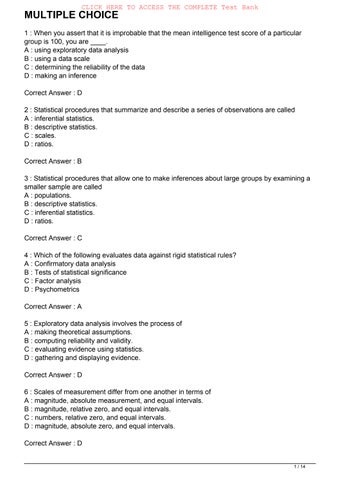
1 : When you assert that it is improbable that the mean intelligence test score of a particular group is 100, you are ____.
A : using exploratory data analysis
B : using a data scale
C : determining the reliability of the data
D : making an inference
Correct Answer : D
2 : Statistical procedures that summarize and describe a series of observations are called
A : inferential statistics.
B : descriptive statistics.
C : scales.
D : ratios.
Correct Answer : B
3 : Statistical procedures that allow one to make inferences about large groups by examining a smaller sample are called
A : populations.
B : descriptive statistics.
C : inferential statistics.
D : ratios.
Correct Answer : C
4 : Which of the following evaluates data against rigid statistical rules?
A : Confirmatory data analysis
B : Tests of statistical significance
C : Factor analysis
D : Psychometrics
Correct Answer : A
5 : Exploratory data analysis involves the process of
A : making theoretical assumptions.
B : computing reliability and validity.
C : evaluating evidence using statistics.
D : gathering and displaying evidence.
Correct Answer : D
6 : Scales of measurement differ from one another in terms of
A : magnitude, absolute measurement, and equal intervals.
B : magnitude, relative zero, and equal intervals.
C : numbers, relative zero, and equal intervals.
D : magnitude, absolute zero, and equal intervals.
Correct Answer : D
7 : Which of the following scales has the properties of magnitude, absolute zero, and equal intervals?
A : Ordinal
B : Interval
C : Nominal
D : Ratio
Correct Answer : D
8 : A scale that allows one to determine only if there is more, less, or an equal amount of the attribute in comparison to another observation is called a(n) ____ scale.
A : nominal
B : ordinal
C : interval
D : ratio
Correct Answer : B
9 : A property of a scale that implies the complete absence of the measured attribute is called a(n)
A : magnitude.
B : absolute zero.
C : equal interval.
D : ratio.
Correct Answer : B
10 : Many feel that the difference between an IQ of 100 and 105 is not the same as the difference between an IQ of 70 and 75. These people feel that IQ tests lack ____.
A : absolute zeroes
B : magnitudes
C : ratios
D : equal intervals
Correct Answer : D
11 : Which of the following scales would be used when the information is qualitative rather than quantitative?
A : Ordinal
B : Interval
C : Nominal
D : Ratio
Correct Answer : C
12 : When the relationship between the unit of measurement of a scale (strength) and an outcome (pounds lifted) can be described by a linear equation Y = a + bX, the scale is said to have what property?
A : Magnitude
B : Equal intervals
C : Absolute zero
D : Nominal
Correct Answer : B
13 : The speedometer on your car uses what kind of scale measurement?
A : Nominal
B : Ordinal
C : Interval
D : Ratio
Correct Answer : D
14 : A scale that allows us to rank individuals or objects, but not to say anything about the meaning of the differences between the ranks, is a(n)
A : nominal scale.
B : ordinal scale.
C : interval scale.
D : ratio scale.
Correct Answer : B
15 : The Fahrenheit scale of temperature (32°F = freezing; 212°F = boiling) is best described as
A : nominal.
B : ordinal.
C : interval.
D : ratio.
Correct Answer : C
16 : In which scales can you make meaningful interpretation of an arithmetic operation such as addition?
A : Nominal scale and ordinal scale
B : Ordinal scale and interval scale
C : Interval scale and nominal scale
D : Ratio scale and interval scale
Correct Answer : D
17 : Which type of scale simply ranks observations?
A : Nominal
B : Ordinal
C : Interval
D : Ratio
Correct Answer : B
18 : An equal interval scale is found on which of the following?
A : A list of telephone numbers
B : A ruler
C : A ranking of National Football League team standings
D : A students IQ score report
Correct Answer : B
19 : What do the rules used in measurement do?
A : Transform the qualities of attributes into numbers
B : Identify and correct for potential sources of bias
C : Relate individual scores to those of the normative populations
D : Allow for the determination of reliability and validity
Correct Answer : A
20 : If a scale allows one to say whether a particular instance has more, less, or the same amount of an attribute as another instance, the scale is said to have
A : cross-validity.
B : measurement.
C : magnitude.
D : comparativity.
Correct Answer : C
21 : If the relationship between a scales measured units and some outcome can be described by a straight line or linear equation, the scale is said to have
A : predictive validity.
B : magnitude.
C : linear significance.
D : equal intervals.
Correct Answer : D
22 : Which type of scale does not have magnitude, does not have equal intervals, and does not have an absolute zero?
A : Ordinal
B : Nominal
C : Ratio
D : Interval
Correct Answer : B
23 : Which type of scale has magnitude and equal intervals but does not have an absolute zero?
A : Ordinal
B : Nominal
C : Ratio
D : Interval
Correct Answer : D
24 : Which of the following is a permissible operation for nominal data?
A : Multiplication of data points
B : Creation of frequency distributions
C : Comparison of scores to determine relative quantities
D : Rank-ordering the individual scores
Correct Answer : B
25 : Which of the following is an accurate description of percentile ranks?
A : They are the ratio of the number of cases below a score of interest to the total number of cases.
B : They are a measurement of the extent to which scores are normally distributed.
C : They must be computed in order to use most statistical analysis techniques.
D : While they are useful in describing nominal scales, they cannot be used with interval and ratio scales.
Correct Answer : A
26 : Which of the following is true of percentiles?
A : They are the inverse of percentile ranks.
B : They indicate what percentage of scores fall below a given score.
C : They describe the relationship of test scores to the hypothesized constructs.
D : They divide the total frequency for a set of observations into hundredths.
Correct Answer : D
27 : In a frequency distribution, the scores, from lowest to highest, are typically arranged
A : on the horizontal axis.
B : on the vertical axis.
C : in the legend.
D : in the title.
Correct Answer : A
28 : There are more people with incomes on the low end as compared to the high end. What kind of distribution does this illustrate?
A : Normal
B : Positively skewed
C : Negatively skewed
D : Bell curve
Correct Answer : B
29 : In order to rank group members in relationship to the number of other members of groups of arbitrary size, you would use the
A : class interval.
B : simple rank.
C : percentile rank.
D : mean.
Correct Answer : C
30 : In order to calculate a percentile rank, you need to know
A : how many cases are below the score of interest.
B : whether the distribution is normal or skewed.
C : the standard deviation of the scores.
D : the nature of the underlying scale.
Correct Answer : A
31 : Suppose there were 50 people in your class and you obtained the 20th highest score. Your percentile rank would be
A : 20.
B : 40.
C : 50.
D : 60.
Correct Answer : D
32 : A percentile rank is a measure of
A : actual performance.
B : relative performance.
C : absolute performance.
D : peak performance.
Correct Answer : B
33 : Suppose you are in the 87th percentile on a test. This means
A : you are among the top 13 students in the class.
B : 87% of the students got a score lower than yours.
C : you got 87% of the test items correct.
D : 87% of the students got a score higher than yours.
Correct Answer : B
34 : Calculate the mean for the following set of scores: 4, 8, 3, 7.
A : 3.0
B : 4.5
C : 5.5
D : 6.0
Correct Answer : C
35 : In statistics, the Roman letter S refers to
A : the variance of a population.
B : the variance of a sample.
C : the standard deviation of a population.
D : the standard deviation of a sample.
Correct Answer : D
36 : The standard deviation
A : reflects the similarity among a set of scores.
B : equals the sum of all scores minus the mean squared.
C : is an approximation of the average deviation around the mean.
D : always equals 0.
Correct Answer : C
37 : A measure of how much scores within a distribution differ among themselves is the A : mean.
B : frequency.
C : variance.
D : median.
Correct Answer : C
38 : If you are given X= 57 and S = 4, what is the variance?
A : 2.0
B : 14.25
C : 16.0
D : 30.5
Correct Answer : C
39 : Which of the following set of scores contains the most variability?
A : 151515151515
B : 343434
C : 142516
D : 252725272527
Correct Answer : C
40 : A Z score
A : is the difference between a raw score and the sample mean, divided by the standard deviation.
B : is always a positive number.
C : is a measure of the standard normal distribution.
D : is the standard deviation of a population.
Correct Answer : A
41 : In a distribution where X = 21 and S = 3, what is the Z score of a raw score of 15?
A : ?12
B : ?2
C : 2
D : 12
Correct Answer : B
42 : When deviation scores around the mean are added up, their mean will be
A : indeterminate.
B : <0.
C : 0.
D : >0.
Correct Answer : C
43 : In a symmetrical binomial probability distribution, the greatest frequency of scores is near the
A : ends of the distribution.
B : center of the distribution.
C : top of the distribution.
D : bottom of the distribution.
Correct Answer : B
44 : If a score is equal to the mean, its Z score will be
A : <0.
B : exactly 0.
C : >0.
D : impossible to calculate.
Correct Answer : B
45 : A Z score of 1.0 is associated with approximately the A : 16th percentile.
B : 50th percentile.
C : 75th percentile.
D : 84th percentile.
Correct Answer : D
46 : The square root of the variance is the A : true variance.
B : standard deviation.
C : mean.
D : variability of the population.
Correct Answer : B
47 : One advantage of using Z scores is that
A : they are always positive.
B : they can show the effects of test bias.
C : they are standardized units.
D : they allow the researcher to manipulate information.
Correct Answer : C
48 : A Z score of 0 would correspond to approximately what percentile?
A : 0
B : 1
C : 16
D : 50
Correct Answer : D
49 : A Z score of 3 is approximately how many standard deviations above the mean?
A : 0
B : 3
C : 6
D : 99
Correct Answer : B
50 : A Z score of ?1 would correspond to approximately what percentile?
A : 0
B : 16
C : 50
D : 84
Correct Answer : B
51 : A score at the 98th percentile is approximately how many standard deviations above the mean?
A : 0
B : 1
C : 2
D : 98
Correct Answer : C
52 : A score at the 50th percentile is approximately how many standard deviations above the mean?
A : 0
B : 1
C : 2
D : 50
Correct Answer : A
53 : McCalls T scores have
A : a mean of 0 and a standard deviation of 1.
B : a mean of 5 and a standard deviation of 2.
C : a mean of 10 and a standard deviation of 2.
D : a mean of 50 and a standard deviation of 10.
Correct Answer : D
54 : Approximately what percentage of scores falls below the mean in a standard normal distribution?
A : 1%
B : 16%
C : 34%
D : 50%
Correct Answer : D
55 : In the standard normal distribution,
A : most of the scores cluster on the ends of the distribution.
B : more scores fall above the mean than below the mean.
C : more scores fall below the mean than above the mean.
D : approximately 95% of all scores fall between plus and minus two standard deviations from the mean.
Correct Answer : D
56 : Distributions of scores can be divided into how many equal deciles?
A : 5
B : 9
C : 10
D : 25
Correct Answer : C
57 : A raw score is also called a(n)
A : estimated score.
B : predicted score.
C : sigma.
D : obtained score.
Correct Answer : D
58 : Interquartile range is bounded by the
A : bottom 25% of the distribution.
B : middle 25% of the distribution.
C : middle 50% of the distribution.
D : top 50% of the distribution.
Correct Answer : C
59 : When discussing scores in terms of quartiles, three-fourths of all scores in a distribution fall
A : below Q2.
B : above Q2.
C : below Q3.
D : above Q3.
Correct Answer : C
60 : What scoring system is standardized to have a mean of 5 and a standard deviation of approximately 2?
A : Decile
B : McCalls T
C : Stanine
D : Quartile
Correct Answer : C
61 : Within the quartile system, the second quartile is the
A : 20th percentile.
B : 50th percentile.
C : 75th percentile.
D : 80th percentile.
Correct Answer : B
62 : If you score in the upper quartile,
A : you scored in the 25th percentile.
B : you scored in the 75th percentile or higher.
C : three-fourths of the others scored better than you..
D : 60% of the others scored better than you.
Correct Answer : B
63 : The mean of a standardization sample is
A : zero.
B : a norm.
C : the same for every sample.
D : always a Z score.
Correct Answer : B
64 : The performance by a defined group on a particular test is called a(n)
A : quartile.
B : median.
C : norm.
D : tracking score.
Correct Answer : C
65 : Suppose that a doctor weighs your child and finds her to be in the 25th percentile for weight at age 2. The doctor rechecks your child every few months to be sure that she is staying near the 25th percentile. This is an example of
A : tracking.
B : leafing.
C : quartiles.
D : percentile monitoring.
Correct Answer : A
66 : Comparing an individuals test score only with members of his or her own racial group is an example of
A : tracking.
B : within-group norming.
C : norm monitoring.
D : criterion monitoring.
Correct Answer : B
67 : The Triple ZZZ Corporation had 87% black male employees. However, only 50% of the applicant pool was composed of black males. This is an example of
A : translocation.
B : normalization.
C : overselection.
D : representativeness.
Correct Answer : C
68 : In the Civil Rights Act of 1991, Section 106,
A : within-group norming was made legal.
B : employers were prohibited from using test scores in hiring decisions.
C : within-group norming was made illegal.
D : employers were prohibited from transforming test scores.
Correct Answer : C
69 : A test that compares each person with a norm is called a
A : transformed test.
B : criterion-referenced test.
C : norm-referenced test.
D : within-group norming test.
Correct Answer : C
70 : Jennifer took a test in school that indicated that she was meeting the learning targets for reading but not for math. She probably took what kind of test?
A : Criterion-referenced
B : Norm-referenced
C : Personality
D : Projective
Correct Answer : A
71 : Logical deductions about events that cannot be observed directly are referred to as
A : data.
B : inferences.
C : statistics.
D : distributions.
Correct Answer : B
72 : Which type of scale does not permit mathematical manipulations?
A : Nominal
B : Ordinal
C : Ratio
D : Interval
Correct Answer : A
73 : A researcher tracks the weights of babies born in a particular hospital. She identifies the number of babies falling in each of the following weight classes: 02 lbs, 2.14 lbs, 4.16 lbs, 6.18 lbs, 8.110 lbs. A graph of this information is called a(n)
A : standard deviation.
B : norming distribution.
C : interval scale.
D : frequency distribution.
Correct Answer : D
74 : A researcher tracks the weights of babies born in a particular hospital. She identifies the number of babies falling in each of the following weight classes: 02 lbs, 2.14 lbs, 4.16 lbs, 6.18 lbs, 8.110 lbs. What is the class interval for this frequency distribution?
A : 0
B : 10
C : 2
D : 1
Correct Answer : C
75 : The particular score below which a defined percentage of scores falls is known as a A : ratio.
B : Z score.
C : percentile rank.
D : percentile.
Correct Answer : D
76 : The mean of a distribution of Z scores is always
A : 50
B : 0
C : equal to the mean of the raw score squared.
D : 1
Correct Answer : B
77 : One difference between distributions of Z scores and distributions of T scores is that they do not have the same
A : skew.
B : frequency.
C : mean.
D : magnitude.
Correct Answer : C
78 : The second quartile is also the
A : mean.
B : median.
C : interquartile range.
D : 25th percentile.
Correct Answer : B
ESSAY
79 : Develop an example of each of the following scales: nominal, ordinal, interval, and ratio.
Correct Answer : Answer not provided.
80 : Explain why the mean of a distribution of Z scores is equal to 0.
Correct Answer : Answer not provided.
81 : Compare and contrast norm-referenced and criterion-referenced tests.
Correct Answer : Answer not provided.
82 : Compute the percentile rank for each of the following scores. Show your work.17, 42, 36, 9, 11, 24, 23, 44, 41, 29
Correct Answer : Answer not provided.
83 : Explain the process of standardization. Why is it that any system of standardization works equally well?
Correct Answer : Answer not provided.
84 : List the steps for going from raw scores to stanines.
Correct Answer : Answer not provided.