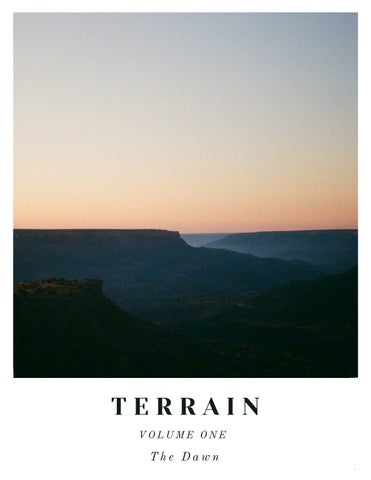
T E R R A I N V O L U M E O N E T h e D a w n 1
2
Contents Letter from the Editor ..................................................................... Does God Like It When We Learn? .................................................. Rebuilding the City on a Hill .......................................................... The Daybreak Sonnet ....................................................................... Postmodernism and the Unbeliever .................................................. Heavy Metal and the Gospel Truth ................................................... Your Beautiful Existence ................................................................... The New Earth ................................................................................. Rare Emotions ................................................................................. Do You Know St. Anthony of the Desert? ........................................ December Morning .......................................................................... The Dawn of Skepticism................................................................... A Contemplation of Work, Rest, and the Schedule .......................... Melody of This Hour ....................................................................... Realism and Idealism: A Hopeless Pursuit Without God .................. The Myth of Adam & Eve ................................................................ Writers on Writers ............................................................................ About the Contributors .................................................................... Appendix of Images .......................................................................... Works Cited ..................................................................................... About Us .......................................................................................... Dedication ....................................................................................... 1 2 8 16 18 23 30 33 40 50 60 62 68 74 76 89 98 102 106 107 108 109 3

4
Dear reader,
Before you launch into the contents of our inaugural issue, I think it’s important that we get acquainted. In November of 2023, I went in search for a group of people who would be willing to write for an academic Christian journal at The University of Texas. Over the span of only a week, a group of more than ten people formed, and we grew in number as the weeks went on. Now, just a few months later, we’re presenting to you our very first issue. How did we get here? The answer I think has something to do with our theme for this semester: The Dawn.
The Dawn is not a just cliché metaphor for this journal’s genesis. It is a metaphor for our faith. C.S. Lewis famously stated, “I believe in Christianity as I believe the sun has risen; not because I see, it but because by it, I see everything else.” This group of people did not form on the basis of blind allegiance, collective consciousness, or inherited religion. TERRAIN exists because we believe Christianity really is the best explanation of reality.
The Dawn also represents an attitude toward the many questions faith entails. While we believe Christianity is true, there are many parts of it that defy easy comprehension. There’s no way to get around this. So instead, with the same attitude of wonder with which we observe the rising sun, we turn to art and discourse. For as long as the Christian tradition has persisted, art has been used to make sense of our God, ourselves, and our experiences. Similarly, we also find in ourselves an innate desire to develop our questions and doubts through writing, and through discussion. As TERRAIN grows, we hope you see in it our love for the variety of ways in which we express our striving for understanding: whether through poems, stories, traditional essays, photography, or even graphic design, we are wrestling each in our own way with the truth.
TERRAIN took shape because of the vigour of these shared values. If you find this in your hands, I hope you will consider it an invitation to participate in a community that desires to humbly and passionately engage with difficult conversations. I hope you find in it something of the universal, something magnificent, something astounding — something like The Dawn.
Faithfully,
Madelyn Hajovsky
“Because of the tender mercy of our God, whereby the Dawn shall visit us on high, and guide our feet in the way of peace.”
–
Luke 1:78-79
1
Does God Like It When We Learn?
by Mitchell Schultz
In my (admittedly brief) life experience, the modern American layman holds a vague idea that Christianity and intellectualism are fundamentally incompatible ways of life. Most non-believers – and even some believers – point to the seeming dichotomy between the Judeo-Christian creation story and the scientifically reviewed and supported Theory of Evolution as a definitive sign that faith in a God and serious intellectual thought are incompatible. Describing Creationism as in direct conflict with Evolution is the second wholesale rejection of science, after the Galileo Affair (the church’s rejection of heliocentrism) between 1610 and 1633. This dichotomous relationship, where each seems to reject the other without compromise, has continued to propagate within churches in recent years. There is a concerning trend
in certain sects of Christianity of rejecting Christian intellectualism outright in favor of an imitative culture, where popular opinion takes precedent over critical thought.
This historical dichotomy between faith and intelligence is often used to justify widely accepted Christian interpretations of the Bible. 2 Corinthians 5:7 says that the Christian “live(s) by faith, not by sight.” This verse appears to directly reject one of the core tenets of the scientific method: observation. Since faith is, from Hebrews, “being certain of things we cannot see,” rational explanation is devalued. A lack of understanding is not ignorance, but a necessary part of the equation for faith (not seeing). This interpretation of the verse denounces the seeking of a rational explanation for faith as antithetical to faith
2
itself — because a faith that is completely irrefutable is not faith at all. Additionally, sin itself, the very enemy of perfection and goodness, originated from Eve’s desire to “be like God, knowing good and evil,” according to Genesis 3:5. Eve’s desire to be knowledgeable eclipses her reverence for God, and she disobeys in pursuit of knowledge, believing that her own ability to deduce life directives surpasses God’s, and rupturing God’s perfect plan for humanity. Eve’s disobedience to God has informed the modern idea of the pursuit of knowledge in Christianity, inextricably linking knowledge with temptation and sin. This implicit condemnation of knowledge is crucial in influencing the modern divorce between Christianity and curiosity.
The great philosopher Friedrich Nietzsche observed similar ideas to this cultural rejection of knowledge as a virtue in his refutations of Christianity. He argues that the systems of ethics observed by most world religions are no more than reflexive reactions to their own positions of weakness. For example, he claims that Christianity espouses that “the weak are weak; it is good to do nothing for which we are not strong enough.” Essentially, Nietzsche argues that given that Abrahamic religions originated from the traditions of enslaved Israelites, and the Israelites would have pent - up resentment at their captors, it makes sense that they would imagine up a God that asks His followers to refrain from struggle, with the promise of eventual, divinely executed vengeance. He lists the prized Christian virtues of humility, charity, and obedience
3
as examples of natural positions for a weak people, and proposes that the reason. Why Christianity is so enticing is because weak people naturally lean towards the behavior that Christianity praises. In so doing, Christianity becomes a self-selecting religion of members that follow because they simply have no other option. Instead of arguing whether Christianity is good or not, he simply says that it doesn’t matter, because Christians are not strong enough to choose any other way of living. Conversely, the strong men and women of history, Nietzsche argues, have the agency to be either conquerors or conquered, and therefore choose the option that is more beneficial to them — conqueror. Knowledge is power, and the more accumulated knowledge a person has, the more difficult it will be for them to submit to Christian teachings of humility, deference, and obedience. This is also why Christians tend to reject new ideas: the act of onboarding new ideas tests the very structural integrity of their beliefs. A compelling reason to stray from Biblical teachings can only be defeated by a more compelling reason to keep it — or a total avoidance of reasons to stray in the first place.
Up to this point, the defense of the Christian Intellectual seems to be fraught with peril. If accumulation of knowledge increases the difficulty of obedience to God, as is suggested by the story of the fall, why should the Christian pursue knowledge? Why should the intellectual be Christian? I posit this: knowledge is directly proportional to agency. The informed man is aware of many of the philosophies and principles that are present in his life. If the completely ignorant man is a Christian, what credit is that to him? That is all he knows to do. He has never known another philosophy, so he lives a Christian life almost by default. God gave humanity free will so we could choose Him, and our ability to learn of alternatives to Him is part of the process that allows us to have choice. Humanity would still be in the Garden if God had either not created the tree of knowledge of Good and Evil — or simply prevented us from discovering it. We would be in paradise,
4
because God would have given us no commands that we had the agency to disobey. What kind of paradise is this? We would be like microwaves, which “live” in perfect harmony with us because of their inability to disobey. Knowledge provides humans with the option to both recognize and deny sinful actions. This was the birth of human agency. This is the good gift of our free will.
Since knowledge, and by extension curiosity, the impulse to seek knowledge is clearly a gift of God, designed for our good, we are right to exercise it. Learning about the world, and the things in it, is like studying the paint strokes of a multitude of Monet masterpieces. There is a familiarity and intimacy to be had with a creator by studying his creation. This is precisely why we are curious beings. We are designed for knowledge. However, Nietzsche is not wrong: when given power through knowledge, humans tend to be corrupted.
If agency, and by extension curiosity and knowledge, were a bad thing, as evidenced by the total destruction caused by the Fall, then Nietzsche would be right about the human tendency to only do what is in his own best interest, within his own ability. Since this is simply human nature, there would be nothing we can do about the absolutely corrupting nature of power. We would always act in self-interest, and as we grow more intelligent, we would devise more devious, cunning, and serpentine ways to exploit our fellow man. What can be done about this? How can the Christian Intellectual expand his horizons while keeping his path straight?
The answer, as usual, does not come from us but from above. The Bible categorizes what we think of as intelligence into two camps: knowledge and wisdom. Knowledge, as discussed above, is what Eve sought out, a means to agency. This agency is good but easily corrupted without guidance, and we default to our own self-serving, sinful tendencies that Nietzsche insightfully
5

points out. It becomes clear that an intercessory force is needed. Wisdom presents an entirely different dimension. In 1 Kings 3, God appears to Solomon in a dream and says, “ask for whatever you want me to give you.” Solomon’s response, famously, is a request for wisdom, but the Hebrew word, , or bin, transliterated, is more similar in meaning to “discernment.” Solomon asks for “a discerning heart, to govern (God’s) people and distinguish between right and wrong,” according to verse nine. Where Eve seeks to know about the things that are good and evil, Solomon asks to distinguish between the two. This is what wisdom is. To this point, if God is all that is good, wisdom is the ability to discern God’s good plan for what we have been given. This includes our material blessings, as well as the gifts of knowledge and agency. The only way to utilize our agency in a way that preserves its original, good intent is to submit it to God willingly. Solomon’s request to submit his own ideas of right and wrong to God pleases
Him so much that he heaps additional blessings upon Solomon, making him rich and powerful, and giving him a long life in which to enjoy these things. God is pleased by his pursuit of wisdom.
Wisdom is the key to unlocking the full capacity of the gift of knowledge, since a divine discernment the only thing that can direct us through the contradictions and complexities of the world we live in without falling into malicious selfservice and idolatry of knowledge itself. A world of wise, discerning Christians does not conform to Nietzsche’s observations of Christianity and humanity, since the wise Christian has depth of knowledge of alternatives to Christianity, and therefore the agency to choose them, and yet, still does not conform to these self-serving ideologies. The wise Christian is able to discern the path that leads to life from the many paths that leads to life from the many paths that lead to death.
6
Christian intellectuals are distinguished from others by their connection to and intimate knowledge of God’s creation, the laws that govern it, art that His people have created, and systems of governance and reasoning that have inklings of His true Justice. They are also differentiated by their ability to distinguish godly from perversions of His creation. Therefore, they can see a clear picture of what is right and what is wrong, distinguishing between the two. This process is ultimately driven by God, because alone, we will fall to our self-
serving desires. In James 1:5, James promises that “If any one of you lacks wisdom, ask for it, and it will be given to you.” In a similar vein, I would like to echo Paul’s prayer for the Philippians for modern Christians and budding Christian Intellectuals. “This is my prayer: that your love may abound more and more in knowledge and depth of insight, so that you may be able to discern what is best and may be pure and blameless for the day of Christ.”
7
Rebuilding the City on a Hill
Kierkegaard and Scholarship In the Modern Church
by Josiah A. Jones

8
Søren Kierkegaard, a 19th-century philosopher and theologian, once wrote, “The greatest danger to Christianity is, I contend, not heresies, not heterodoxies, not atheists, not profane secularism - no, but the kind of orthodoxy which is cordial drivel mediocrity served up sweet. There is nothing that so insidiously displaces the majestic as cordiality” (“The Greatest Danger” 16-17). In 1854, he began writing one of his most prescient works: a scathing critique of the Danish church entitled The Attack Upon Christendom. He argued that despite Denmark’s status as an overwhelmingly Christian nation, the church had become an apathetic shadow of its true calling. If the state of the church during his lifetime was enough to inspire such condemnations, I have no doubt that the modern church would leave Kierkegaard speechless. From ideological decay to dramatic increases in international conflict, rising mental disorder rates to widespread hedonistic escapism, one thing is clear: a strong, healthy church is needed now more than ever.
9
But, by every measurable statistic, Christianity’s influence is dwindling. Each year, the percentage of Americans who identify as Christian shrinks. Pew Research reported that 78.4% of Americans saw themselves as Christians in 2007, down from over 90% in the 1990s. In 2014, that number dropped to 70.4% (2). In 2022, at the time of the most recent poll, just 63% of Americans were Christians (4-5). To further highlight America’s recent and rapid movement toward secularism, Pew Research reports that in a study of twenty-three countries, more than two-thirds of them consider America equally or less religious than other countries of similar wealth (1-8). In Matthew 5:14, Jesus called His followers to be “the light of the world” and “a city set upon a hill.” Do these statistics paint a promising picture of the church’s ability to be the light of the world?
The troubling reality is that this mandate has been all but forgotten, which has left an impact on both Christianity and the world at large. It is imperative that the church remembers its calling: to be the light that the world desperately needs. After examining the causes of American Christianity’s descent into cordial apathy, some conclusion can be reached regarding the steps that must be taken for a new dawn of passionate faith in America. Comparing modern American Christianity to the radical faith of the early church in Rome presents a striking contrast with which we must grapple. Many believers idealize the fearless martyrs who rebelled against the most powerful government in the world to practice their faith under the penalty and fear of death. More than just a part of their life, their faith was their center. In America, there is no analogue to the Roman church’s radical devotion, and the statistics demonstrate a notable shift away from that kind of Christianity. According to a study done
10
by the American Bible Society, only 39% of American Christians are active Bible users. The criterion for this classification is simply using the Bible three to four times per year (12). According to a Pew Research report from 2021, less than 45% of U.S. adults prayed daily (Fig. 1). Gallup reported that in 2020, a record low of only 20% of Americans believed that the Bible was the word of God (1-8). However, as Kierkegaard’s critique of his own country demonstrates, the church did not suddenly become lukewarm and apathetic overnight. This raises the question: What has caused this gradual decay? Several factors are partially to blame. The first, and perhaps most important, is ideology. As citizens of Western nations that value democracy, both Americans and Europeans tend to place significant value on tolerance. However, while freedom of thought and expression are undoubtedly important, there is a difference between tolerance and acceptance. At the time of Attack Upon Christendom’s writing, Europe
was feeling the full effects of the Enlightenment and all that it entailed. The burgeoning ideology of Relativism is of particular note. Immanuel Kant’s assertion that knowledge of the world was constrained by individual perception lent validity to beliefs that contradicted not only the Bible, but all reason (4.2). After all, if objective knowledge is impossible, judgment of other worldviews is unreasonable and meaningless. Relativism continues to act as a shield against criticism and an excuse for not having a consistent and reasonable ideology. Today, it rears its head in related movements like universalism and unitarianism (The Gospel Coalition, 1-12; Stanford Encyclopedia of Philosophy, 1-4). The connection between the belief that no objective knowledge of the world is possible and the belief that all faiths are equally true and equally capable of saving a believer’s soul is not a difficult one to make.
11
12
If these ideologies are incompatible with Christianity, why have they managed to infiltrate it? The underlying commonality between them is the dismissal of truth. Referring back to Kierkegaard’s diagnosis of the greatest problem in the church, enlightenment ideologies have given Christians and non-Christians alike an excuse to view faith with cordial apathy. It is no wonder that, according to a study conducted by the Public Religion Research Institute, just 16% of American Christians attend church each week (11). And, who can blame them? In a world that teaches them to accept all other beliefs as different but equivalent truths, why should they care? One would expect a truth as beautiful and life-changing as Christianity to have some comparative advantage over these hollow philosophies, but the disturbing reality is that modern Christianity is often equally hollow. In a vain effort to turn the tide of secularism, Western Christendom has developed an obsession with simplifying sacred mysteries for easy digestion by the common twenty-first-century person. To accommodate the attention span of a world that requires a constant injection of information into the bloodstream, the clergy has opted to talk down to their communities.1 Kierkegaard provided an ominously prescient diagnosis of the disease that plagues the church today: “Perhaps too it is without an analogy in history that a religion has been abolished by flourishing. But note that in saying ‘flourishing’ Christianity is understood as the opposite of what the New Testament understands by Christianity. The religion of suffering has become the religion of mirth, but it retains the name un-changed.” The city that once was set upon a hill now bears a closer resemblance to the ruins of something that once was great.
Considering the state of the modern church, it naturally follows to ask what can be done. Is Christianity in the West a failed experiment, given way to popular Christendom? Perhaps. However, one must take care not to exclusively blame institutions for the failings of their members. In Matthew 16:24, Jesus commanded his disciples, “If anyone would come after me, let him deny himself and take up his cross and follow me.” What
does it mean to take up one’s cross in an age when the phrase has become a platitude and the cross little more than a sentimental icon? Why are we so quick to turn to the cross as a symbol of hope and comfort while forgetting the pain that Christ endured as he carried it to Golgotha? Just as he indicted the institution of the church, Kierkegaard had equally strong words for the individuals who composed the collective body of Christendom.
“The Bible is very easy to understand. But we Christians are a bunch of scheming swindlers. We pretend to be unable to understand it because we know very well that the minute we understand, we are obliged to act accordingly. Take any words in the New Testament and forget everything except pledging yourself to act accordingly. ‘My God,’ you will say, ‘if I do that my whole life will be ruined. How would I ever get on in the world?’ Herein lies the real place of Christian scholarship. Christian scholarship is the Church’s prodigious invention to defend itself against the Bible, to ensure that we can continue to be good Christians without the Bible coming too close. Oh, priceless scholarship, what would we do without you? Dreadful it is to fall into the hands of the living God.” (“Kill the Commentators” essay, from Provocations)
In these words, the root of the problem can be found, as well as its solution. By condemning “Christian scholarship,” Kierkegaard is not condemning the study or understanding of the Bible. Rather, he is attacking the interpretation of the Bible as a set of principles to study performatively and set aside. The true Christian life has been sacrificed in the interest of hypocrisy and false scholarship. By the American church, yes, but also by the members it claims to serve. The church has elevated false doctrines. The church has reduced the Bible to a collection of clichés and axioms. The church has apathetically cast faith aside in favor of worldly things. But, are we not the church? Calling oneself a Christian is incredibly easy, while conversely, taking up the cross and living the Christian life is a task that demands ortitude, commitment, and devotion.
1 For example: reducing the mystery of the Trinity to an illustration of a clover, or decontextualizing John 3:16 to such an extent that virtue is considered optional in Christian life.
13
In Romans 12:1-2, Paul says, “I appeal to you therefore, brothers, by the mercies of God, to present your bodies as a living sacrifice, holy and acceptable to God, which is your spiritual worship. Do not be conformed to this world, but be transformed by the renewal of your mind, that by testing you may discern what is the will of God, what is good and acceptable and perfect” (ESV). We are called to be the metaphorical body of Christ, and every part of that body is indispensable. The weight of that calling should not be understated, which effectively would subvert the purpose of striving to achieve it. As
followers of Christ, we must choose to be Christians, accepting all that the term entails: we must be scholars, not in a performative sense, but with sincerity and curiosity. In doing so, we must reclaim the mystery and complexity of the Bible while acknowledging that our best efforts to understand the God we serve will fall infinitely short. We must be advocates for truth, even as objectivity and reason continue to fall out of fashion. We must walk the Christian walk in a meaningful way, engaging with and transforming the global church rather than simply leaving an inspirational Bible verse
14
in our social media profiles. Finally, we would be wise to honor the warnings with which Soren Kierkegaard left us almost two hundred years ago, and be wary of allowing our zeal for Christ to lapse into false scholarship and performative Christendom. The body of Christ is needed for its hope, reason, and light more today than at any other time in history, and it falls to us to replace the infection of cordial apathy in the church with genuine Christianity in rhetoric and action. The institution of the church demands change, and we as Christian individuals are called to change it. If we
accept this calling, we can rebuild these ruins into a beacon of hope for the world to see: a city set upon a hill that cannot be hidden.
15
The Daybreak Sonnet
by Noah Thomanson
16
The briny, brackish, tidal night retires; Its duty done, the heavens soaked in black. The lustrous constellations blaze as fires, Their dark domain become their heav’nly track. Swept up, the seashells of the stars attract
The moon, both pulled by Him who placed them well, And now, the dayspring glow, by darkness back’d, Is herald of the day in which we dwell.
With daybreak, Eos Rhododaktylos, Unfurl your gentle hands, let light run free.
Call forth the sun, the sandy gold it throws, That by it all things we may clearly see.
The sun is ris’n, yet even more assured, The Son is ris’n, perpetual, Logos, Lord.
17
Postmodernism and the Unbeliever
by Cara McMillan
Everyone puts their faith in something, whether that be religion, philosophy, a wise friend, or even themselves. When we put our faith in something we consult it, seek guidance from it, and create expectations around it. American society increasingly identifies as postChristian, so we must ask the question: what is our civilization trusting in? Different groups of people have reached several answers. Some say the answer to that question is technology, politics, or the booming selfhelp book industry. These are valid avenues through which people attempt to make sense of the world and their place in it, but for the time being, I would like us to examine one school of thought – we could even call it a school of faith – that is commonly found on college campuses: postmodernism.
Postmodernists, who now dominate a significant space in academia, posit that universal truth, objectivity, and absolute reality do not exist. Rather, postmodernism

emphasizes the multiplicity of perspectives and the equal validity of each. Most religions are built on a foundation of an asserted and exclusive absolute truth, so many long-held worldviews cannot coexist with this philosophical stance. It may seem that postmodernism would hinder the religious person the most, but I aim to show that it is especially problematic for those of us who walk through life without a religious faith. This should matter deeply to adherents of the Christian faith because, after all, we are called to bear one another’s burden and hurt with those who are hurting.
To examine this issue, let us first consider the origins of philosophy and the paragon of the philosophic way of life. Both of these are embodied in Socrates. Socrates held that “the unexamined life is not worth living,” and as such, he devoted his life to seeking truth. In contrast to pre-Socratic thinkers, Socrates investigated deeply human questions regarding justice, virtue, and
18
fulfillment rather than confining himself to scientific or rhetorical matters. He reportedly did not accept pay for his teachings, devoted every ounce of his time to questioning virtue and convention, and ultimately died for his ideals. His life was and is considered a pure pursuit of truth – a perfect example of ‘the philosophic life.’ No one dedicates their life to searching for something that they do not believe can be found, so we can conclude that Socrates’ way of life differs from the philosophic narrative today precisely because it asserts the existence of absolute truth. You may say that Socratic philosophy in and of itself does nothing to call postmodernism into question, but the roots of philosophy as a method of seeking truth greatly destabilize the foundations of postmodernism as a ‘philosophy’.
Additionally, if we look deeper into postmodernism, it appears that the doctrine itself is somewhat contradictory. In the same way that rejecting religious faith in God
19
is still a kind of faith in itself, rejecting the existence of truth is still asserting an absolute truth about the universe. Claiming no objective reality means accepting a universe where nothing – nothing – is real, true, wrong, or just. When a person accepts this idea, whether that be believing in universalism or the right of a person to live out ‘their truth’ in several ways that diverge from reality, it condemns a person to an unexamined life. After all, if someone accepts every answer as equally untrue and subjective, there is no point in engaging with life’s biggest questions. Ultimately, I think this comes out of a disillusionment with seeking truth in the wrong places and finding no soul-satisfying answer.
This mindset has real, psychological and cultural consequences. Rejecting truth, rejecting a philosophic life in which you examine everything, has the potential of degrading the value of human life. Harming people can’t be unjust; there is no justice. Lying isn’t wrong;

20
there is no right. Killing isn’t amoral; morality is but an illusory social construct. To prove that such an outlook especially harms the nonbeliever, let’s illustrate the issue with a small thought experiment.
Let’s say that as Christians, we accepted the idea that God existed and created us but had fluctuating definitions of justice and morality that no human being could discern. He would interfere in human affairs at random, condemn actions, and bless others inconsistently. We’ll call this faithful postmodernism. In faithful postmodernism, our creation by a higher power would protect the value of our lives, even if the exercise of His sovereignty was arbitrary and completely random. In faithless postmodernism, by contrast, there is no higher power, so there is no purpose for human life and no reason for the individual’s existence. Very harsh, I know. This is not to say that postmodernists around Austin have no value – it’s to present the idea that even if postmodernists fully believed in a lack of
absolute truth, they would likely rebut against the awful thought that their lives are meaningless.
So, why say all of this? What right does a 19-year-old college student have to say these things? Well, I’d like to say that none of this is intended to sufficiently refute postmodernism. There are people much more fit for that than I am. Instead, I want to encourage people of faith to step with empathy into the shoes of postmodernists and relativists to understand alternative perspectives on the human experience. Encourage them, in turn, to investigate life. Examine justice, virtue, religion, government, and institutions with an eye that seeks truth, even when it seems out of grasp. Read up on classical philosophy if that’s your thing, and help them engage with the age-old philosophical life. Encourage them to seek light, and maybe they’ll stumble into the path of the ultimate Truth.

21

22
Heavy Metal and the Gospel Truth
by Isaiah Pyle
Despite its reputation of glorifying the occult and taking an anti-religious stance, heavy metal contains and revolves around Biblical and Christian imagery. In fact, Christianity is both explored and proclaimed by numerous songs within the genre, illustrating the universal desire for truth and salvation that transcends all else.
Since its birth, metal has drawn controversy for its apparent embrace of demonic imagery. Prominent artists have embraced the resulting publicity, including Ozzy Osbourne (known in the metal community as The Prince of Darkness), Judas Priest, and Black Sabbath, with whom Osbourne sang for a time. Unfortunately, certain elements of some of these musicians’ personal lives did not help to discourage these controversies. However, despite their lifestyles, many metal artists have maintained a staunch opposition to the occult and even endorsed some version of Christianity. Consider Judas Priest lead singer Rob Halford, who was introduced to the faith after becoming sober and giving up a life of debauchery, or Ozzy Osbourne, who once reported that he is a practicing member of the Church of England and prays before each concert. These are just two of the more well-known examples. The apparent contradiction between their professed personal beliefs and their reputations has resulted in some controversy both in and out of the metal community.
23
Much of metal’s negative reputation comes from the fact that most metal bands refuse to shy away from heavy topics such as death, loss of conscience, and the structural flaws that plague many established institutions. A key element of metal music is a staunch commitment to authenticity. This frankness and focus on dark, complicated, and at times graphic content has greatly contributed to the negative perception of the genre. However, this bluntness is often used as a means of pointing out what is wrong with the world and advocating for social change, and metal frequently employs religious imagery to achieve this goal. Christianity in particular has a strong presence within the genre.
A few of the songs that most clearly reflect metal’s relationship with Christianity are “Lord of This World” and “After Forever,” both of which are by Black Sabbath, and “Crown of Horns” by Judas Priest. The first focuses on the brokenness of the world and the consequences of sin. The second is an acknowledgement of Christ’s divinity and a call for the listener to accept Jesus’ sacrifice before it’s too late. The third discusses the complexity of adhering to the Christian faith while being part of a community that has historically had a rocky relationship with the established church.
“Lord of This World,” one of Black Sabbath’s more explicitly religious songs, mirrors C. S. Lewis’ The Screwtape Letters in that it is sung from the point of a devil speaking to those he deceived. In it, Ozzy sings, “Your world was made for you by someone above / But you chose evil ways instead of love… You think you’re innocent, you’ve nothing to
fear / ‘You don’t know me,’ you say, but isn’t it clear? / You turn to me in all your worldly greed and pride / But will you turn to me when it’s your turn to die?” Apart from the bold approach of portraying the singer as a devil, the lyrics reflect several teachings found in the Bible. In six short lines, the song references five crucial points of Christianity.
Line one establishes the fact that God created the world, and that he did so with humanity’s wellbeing in mind. This reflects Genesis 1: 29, where God, after blessing Adam and Eve, tells them, “I have given you every seed-bearing plant on the surface of the entire earth and every tree whose fruit contains seed. This will be food for you.” Essentially, humanity was given an environment where it could thrive; God provided shelter and sustenance in a perfect, sinless world. This makes it clear that God did not fall short in His provision for us, nor was he in any way responsible for the fall. This leads into the next line, which summarizes the fall, specifically pointing out that it was a choice that we made: a choice between accepting or rejecting God’s love. The third line, “You think you’re innocent, you’ve nothing to fear,” speaks to how we deceive ourselves into believing that it is actually God who is in the wrong and that we are the victims. We make excuses and explain away our failures by blaming God, resulting in a rapid descent into self-deception. Line five highlights the fact that, whether intentionally or otherwise, we each ultimately chose to serve the devil by rejecting God. The last line serves as a reminder that in the end everyone will recognize that sin holds no lasting protection from the consequences of their choices, reflecting Philippians 2:10-11, which declares that “at the
24
25
name of Jesus every knee will bow… and every tongue will confess that Jesus Christ is Lord.” Together, these lines paint a vivid picture of the theological history of the world and introduce the concept of divine judgement.
This picture of Christianity is incomplete, however. It is not enough to address God’s justice without observing his love. “After Forever,” which was part of the same album as “Lord of This World,” is another heavily Christian song of Black Sabbath’s. It complements “Lord of This World” by addressing the merciful nature of God’s love. It opens by directly asking the listener whether they have considered what will happen to their soul when they die and whether they had accepted Christ into their lives. Later in the song, Ozzy
brings up the social pressure that people often face for accepting Christ. However, he concludes that because God is the only way to love, trusting in Him is worth the potential consequences. The climax of the song occurs in the final verse, in which Ozzy sings, “Perhaps you’ll think before you say that God is dead and gone, / Open your eyes, just realize that He’s the one, / The only one who can save you now from all this sin and hate.” The inclusion of an altar call at the end of the song is a testament to the musicians’ devotion to sharing the love of God with their audience.
All things considered, there is more explicit theology in this song than there is in many contemporary Christian albums. However, these two songs are not the only representatives
26
of Christianity within metal music. “Crown of Horns” by Judas Priest, which oscillates between a personal account of a struggle for identity and an acknowledgement of Christ’s ultimate dominion over the singer’s life, is a good example of another aspect of Christianity’s influence on metal. The title itself is a play on words summarizing the struggle documented within. On the one hand, “Crown of Horns” is a clear reference to the Biblical crown of thorns that is known for being both a symbol of Christ’s sovereignty and the pain inflicted upon him by mankind. On the other hand, the substitution of the word “thorns” for “horns” is a reference to the “sign of the horns” hand gesture which is in this case representative of metal culture as a whole. The title reflects the duality of being both a Christian and a member of
a community often stigmatized and shunned by the church.
Although the verses touch on the emptiness and despair that comes from living a secular life, the chorus praises Jesus’ sacrifice and tells of the profound impact it has had on the Halford’s life. The transition between the verses mourning the apparent lack of purpose within the world and the chorus reinforces the redemptive nature of Jesus’ death and resurrection. In the chorus, Halford proclaims, “Heavy is the crown of horns / That rests upon this head. / Heavy is the crown of horns / From all the blood He shed. / Heavy is the crown of horns / That kept the faith so bright. / Heavy is the crown of horns / That gave me all this life.” The first line acknowledges the immense weight
27

28

of the sin that Christ bore in our stead, while the second highlights the suffering we inflicted upon Him. The third serves as a reminder of how Jesus’ sacrifice gives us the hope to endure the sufferings of this life, and the fourth tells of the resuscitative effect of redemption. Later in the song, the focus shifts away from the lostness of the world to the joy of being found. In the final verse, Halford sings of answered prayers and places of rest, and in the bridge, he orders the lister to rejoice in the salvation that awaits them and to never be afraid. As “Lord of This World” and “After Forever” did before it, “Crown of Horns” packs a powerful, raw Christian message into a metal ballad to help bring the gospel to those it might not otherwise reach.
As these three songs illustrate, there are two main camps that Christian-influenced metal songs fall into; the first consists of songs that call for the judgement of evil, and the second involves songs that tell of mercy and faith acting as a guiding light through times of pain. The common thread between these two categories is the theme of the world’s brokenness, which is a fairly consistent theme within the genre. This acknowledgement of brokenness naturally raises the question of what can be done to repair the damage that has been inflicted. Although some metal
songs suggest that a surface level love of humanity is the solution, many songs go deeper and state that in order to fix our world someone greater than us must intervene. This suggestion implies the need for divine redemption. Metal’s raw realism allows it to see the world’s need for a savior.
It is worth noting that several of the bands who have the most explicitly Christian-themed songs are those whose band members have often been criticized for living sinful lifestyles. Ozzy Osbourne is a prime example, having lived a life that in some ways blatantly contradicts traditionally held Christian values. And yet, he has famously penned several songs that discredit the allegations of satanism while openly acknowledging and affirming God’s sovereignty. Essentially, these musicians reflect humanity’s subconscious desire to be found and acknowledge that there is someone out there looking for them. Their words call John 10:27-28 to mind, where Jesus proclaims, “My sheep hear my voice, and I know them, and they follow me.” All are called by the Good Shepherd, and everyone is faced with the decision to either heed the call or reject it. In this way, despite its reputation, metal music is a medium through which the gospel of Jesus Christ is powerfully shared.
29
Your Beautiful Existence
by McKay Lawless
At the sight of dawn, darkness scatters and at the delicate touch of the sun’s beams, perched dew caves
Transfixed on earth’s rhythmic cycle, you learn the word beauty at a young age
Haunting comparison begins, and the yearning leaves you outraged
Beauty is a product of bias. It traps you in a cage
Why do you engage
Why
Why do you obey
When called beautiful, you challenge what they say
You don’t challenge the beauty of the sky’s warm hues that start your day
The world’s preeminent sculptor crafted this scene and noted it good but still felt dismay
Until He created mankind and proclaimed it was very good, made to reflect Him in every way
This divine creator breathed life in you and it’s in your nature to represent this artist
You are a product of beauty with a beautiful purpose: to exist
The beauty war is won, there’s no need to persist
How could you resist
30

31

32
The New Earth
by Molly Tompkins
The rush and roar of the wave crashes through Leila. Wind beats through her imagination, and she plunges underwater to behold the kaleidoscopic shimmer of the sun breaking through the membrane of the wave.
“The sun is rising,” her mother calls.
She ignores her mother. The sun will rise again in a few hours, and again after that. From the space ship’s window, she could watch the sun rise sixteen times per day if she wanted to. She prefers the sun in her memory, though, the sun that sends the droplets of ocean skidding off her upturned eyes and face once she plunges up out of the water.
“It’s time for dinner. Come out.” Leila grunts and unbuckles herself from her seat in front of the screen. Floating to the main cabin, she joins her parents to eat canned chicken and slurp baggies of sweet potatoes. The crew will eat after the passengers finish. The only other couple on board The New Earth discuss what they want to do first when they return
to Earth: eat pesto pasta at their favorite restaurant, go to Central Park, watch a Knicks game. They wonder where they’ll travel next, and whether having children would keep them from visiting Japan.
Listening to their fellow travelers rehash their plans for the thousandth time, Leila’s mother hugs herself. “I want to get myself elbow deep in dish suds,” she says.
“I want a sunburn,” says Leila. “All over my body.”
Leila’s father puts his chin in his hand and cocks his head, as if weighing their desires in his mind.
“What do you want?” Leila asks him.
“I want what I’ve always wanted. For you to be happy.” He strokes Leila’s hair, “That’s what I want most in the world.”
After dinner, Leila changes into one of her dad’s spare sweaters. She had long since outgrown the Disney nightgowns

33
and matching sets that she had packed for their journey. After brushing her teeth, she joins the astronauts who control the satellites that film the people on Earth. Sitting in front of one of the screens, she zooms in to find her own home in Florida. In the Earth’s shadow, it seems like nightime on the ship, but the day on the screen is bright and sunny. A brown haired girl in a pink bikini bangs through the screen door of Leila’s condo, carrying an armload of pool noodles. Behind her trails a smaller boy dragging a fishing net on a wooden pole. Although the girl appears a few years older than Leila, with a brother and brown hair instead of blonde, she knows they would be best friends. Leila mouths alongside the girl, who she has named Landry, as she says something to her brother that makes him run inside and re-emerge with a plastic cup. Then, Leila talks to him as the siblings walk over the boardwalk. Pulling the screen with her fingers, Leila moves to the ocean where the two ride the noodles over gentle swells. She closes her eyes, pretending the ship’s swaying is the ocean carrying her.
While she watches Landry, mouthing a conversation she holds with her brother, light splits the darkness from the darkness. The sun pours out the Earth like paint, blues and greens spilling over the blackness. Leila glances out the window for long enough to see the world unfurl. Thin clouds feather the ocean, and Leila shudders to think of how vulnerable
Landry is to anything that could fall out of the sky.
Landry’s family eats lunch on the patio of their condo. They are the placeholders for her own family — renters of their condo until they return from space. Leila imagines they must be talking about school, and she answers the questions directed at Landry. She likes reading, but not math. There was a bully in her class, but her friends protected her. Leila does not know how to read well, but she imagines that Landry does. So she tells her father that she likes the book that her teacher had read to them in class today. Leila thinks that the conversation is a casual one, but then Landry throws back her chair and storms inside. Scrambling for a reason to be angry, Leila decides that Landry’s father had called her stupid. So, when her own father appears to tell her to go to bed, Leila snaps at him.
“When are we going home? You said we would go home soon. They’re living in our house instead of us.” She gestures at the screen. “Landry is replacing me.”
“Landry’s not her real name,” he reminds her.
“Where will she live when we come back? Can she stay with us?”
“She has her own family. You’re having an experience that Landry wishes she could have. You’re living her dreams.” He

34
hugs her and unbuckles her from her seat. “Enjoy seeing the world while you have the chance.”
During the fifty minutes that she’d joined the family’s lunch, the Earth had been erased again. “It’s not there,” she says.
Turning back to the screen, where the daylight still blazes brightly, she points at Landry’s empty chair. “It’s there.”
When Landry’s friends first began coming over to swim and make sandcastles, Leila had named them Sarah and Ana. Now, while they lie tanning on braided mats on the sand, Leila fits words into their moving mouths. First, they gossip about a classmate. Then, they discuss whether Landry’s parents are fighting. Finally, Landry wonders about Leila, whether she’s still floating in space. She hopes that Leila will reclaim her house soon, so that the two girls can become friends.
When Leila turns nine, her parents tell her to make a wish. They light a candle, but Leila stares at it for so long that her mother blows it out for her before it burns down the wax stem. “What did you wish for?” they ask.
“To go home.”
The couple applaud, and her parents nod. “We’re working on it, honey.”
“You’ve said that before. You said we would go to space for one year when I turned six.”
“It takes a long time to reenter the world. You have to wait for the perfect angle at the perfect moment, and then you have to blast through without hesitation.”
“Why did we come here, if we can’t get back?”
“Space tourism was perfectly safe. No one has ever died. It’s safer than being on Earth.”
“But we’re stuck.”
“Being stuck is safer than other things.”
“I wish for a birthday party. I’ll invite Sarah and Ana.” Orion fills the window, but theship outstrips his frozen stride.
Looking through the window at the ruffles and tendrils of clouds twirling around the world, Leila remembers the Florida aquarium, where she stood in a glass tunnel while sharks flitted around her. Exiting the aquarium, Leila had felt confused because she was sure her mother had taken her into a tunnel carved into the ocean, but the sea was so far off that she couldn’t even hear the rush and tug of waves. They hadn’t gone into the ocean, her mother explained. People had moved

...
35
the ocean into that building.
The pane of glass feels cold beneath Leila’s fingers, and she wonders whether a person could put the stars and planets in an aquarium. Then, they wouldn’t have had to leave Earth to look at them. When Leila tries to take her plate to the viewing room, so that she can eat with Landry’s family, her dad forbids her from watching Landry anymore.
“You can’t do that,” she protests. “I’ll miss what happens. I won’t know if my friends come over, or if my parents fight, or if I do my first cartwheel.”
“Leila!” Her dad grips her shoulders, keeping her from floating past him. “They’re not your family. I’m your dad. You live here.”
“Landry’s living my life! You let her have my bedroom and make my friends. By the time I get back, I’ll have missed everything.”
Her mother joins her father, partially blocking the view of an orange Uhaul pulling away from Landry’s house. “They’re moving! They’re leaving our house. You have to let me watch, I’m going to lose Landry. I have to see where they drive to.”
The screen goes dark. “Landry’s not you,” her mother says. “You took me away from
my real friends, and now you’re taking me away from the onesI’ve made. You can’t even let me pretend to be happy.”
“I want you to be happy. I thought you’d be happy up here, looking at the world and the stars. Most people wish they could say they’d been to space.” Her father’s voice sounds thicker and deeper than it usually does. His hands tremble on her shoulders.
Leila’s mother clears her throat. “That’s not the only reason,” she says. “I wanted to see the heavens. After you were born, I felt terrified of losing you all the time. If we flew here, I thought I might find out what happens when we die. Maybe there would be a god hiding in the stars, or a peaceful oblivion in space. I’m sorry, but I wanted to see where you or your dad might go if you left me.”
“We just become flaming mounds of dust.” Leila’s dad gestures out the window at the big dipper. “That look like angels.”
“I thought,” her mother hesitates. “There might be something beyond Earth. Your dad was sure there wasn’t.” Around them, the astronauts flip screens from farmland, to New York, to a snowy tundra. “He was right.”
“I wanted to see the world before I die, Leila.” He folds her hands between his own.

36
“And I needed to see if there was a heaven before I kept living.” Her mother glides backward and turns on the screen. “You’ll understand one day.” The moving truck had vanished from the house. The condo stands still and vacant. Behind it, sand stretches into the gulf of the waves that crash one after another, as if they rise and fall in time with an unheard rhythm.
For several days, she refuses to come out of her room. When she emerges, she floats straight to the window. By pressing one cheek against the window and pulling her eyeballs against the right side of her head, she can see the tip of their craft. The tarnished silver tail reminds her of the crumpled tin soda cans that had sometimes bumped against her in the ocean. When they had arrived in space, she’d hoped to meet aliens — small, friendly creatures like rabbits, or tall green men who wobbled when they walked. Looking at the tail of the ship, grimy and crumpled amidst the infinite trove of glittering stars, she feels small and ashamed. ...
The ship ignites. Leila thinks they will burn alive. Like a falling star, they re-enter the atmosphere.
On Earth, a girl, whose name is not really Landry, stands on a Florida beach, listening to the roar of the waves in the
darkness. She feels like the vast emotion within her belongs outside of her, with the infinite, churning darkness that cycles from sea to sky. Her skin feels like an artificial barrier, a layer of paint poured to cordon her feelings off from the rest of the unshaped darkness, the unformed yearning. She wades into the surf to make sure the water is real, and that the sounds of molting darkness aren’t just issuing from her mind. Looking up into the heavens, black water, cold and invisible drenching her ankles, she sees a star falling. I wish my parents would stay together, she thinks. She hesitates to speak, not wanting to separate herself from the sounds of spray, cries, and rushing that emerge from sources she cannot make out in the darkness.
The star fizzles out, leaving its core, a metal ship. For a few minutes after the flames fade, the family holds hands but does not speak. Finally, Leila asks if they had died.
“No,” the captain says. “We have successfully re-entered Earth’s atmosphere.” ...
After months of learning how to walk, performing physical tests, and filling out paperwork, Leila’s family journeys to their home in Florida. When Leila meets Landry on the doorstep of their condo,

37
Leila calls out her name. Landry frowns and looks at her mother.
“Who’s that?”
“That’s not what you’re supposed to say!” Leila frowns at Landry. “You’re supposed to say, ‘Leila! I missed you. I kept your room perfect for you to play in. I hope we can still be friends when I move.”
Landry cocks an eyebrow and places her hand on her hip. “I don’t want to say that.”
Leila continues to talk to herself, demonstrating what Landy should be saying. Her parents move to stand in front of her. She suddenly feels the falling sensation that she had felt aboard the ship when she looked out the window expecting to see the world, only to realize that it had vanished. She keeps feeling it while her parents converse with Landry’s parents. Landry’s little brother makes faces at her as if she’s something strange, a creature that would alarm him if his parents didn’t stand between him and the girl who somehow already knew that his swim shirt had a crab on the front.
When her family climbs in the car and drives away, rather than move their few possessions back into their house, Leila looks at the sun. Although she half expects it to have vanished, it still hovers overhead, impassive to the sudden
changes beneath it. They cannot repossess their house, her parents explain, because they had made a one year contract. Their plans had not accounted for being stranded in space for an additional two years.
Homeless, her family returns to the launch site to demand compensation for the two years they lost in space. For a few months, they stay in the bunker-like headquarters of the world’s foremost space tourism company. Spaceships dot the fields outside, some gleaming like defined boulders, and others jutting up like apocalyptic pines. Eventually, her dad tells her they will move to Houston. He does not mention that in Houston he can get treatment for the cancer that first made him want to see earth and his wife need to find heaven. Leila only knows that there are no oceans in Houston. She refuses to move anywhere except Florida. Her friends are there. She wants to feel the sun through water, not glass. Her parents pack her duffel bag for her. She refuses to look at any of the options for their future home in Houston, but they pick out one with a pool for her.
A few days before they leave, the repaired New Earth launches again, toting a new crew of tourists to space. Leila’s parents go outside to watch the launch. They assume she stays inside sulking. Leila has begun having conversations with Ana and Sarah about how she wants to celebrate

38
her tenth birthday. Her parents have already scheduled an appointment with a counselor in Houston. When the couple watch the craft dart like a bullet toward the stars, they have no idea that Leila has snuck into her old bedroom onboard the ship. While the new tourists press their faces against the windows, she straps herself into the sleeping bag and burrows beneath the blankets. When the spaceship reaches cruising altitude, she emerges to watch Landry on the satellite screen. Her friend sits on the beach, pushing the sand into mounds and pyramids that she immediately knocks down. When the astronauts radio Earth to tell Leila’s parents that their daughter will have to remain in orbit for the next year, she zooms in on the space station to watch their reactions on screen.
Her parents stand in the bare patch from which the ship had launched an hour ago. They hug one another. Her mother’s voice crackles through the radio.
“Is she watching us?” She asks.
The astronaut responds. Her mother keeps talking, but Leila doesn’t hear her. She watches her parents’ lips form words on the screen. Her mother says I love you. Her father promises that they can move to Florida when Leila lands. She thinks she hears him say, “We’ll start again.”

39
Rare Emotions
by Birdie Anderson

40
On a summer day in Georgia, with peachsticky fingers and wiry limbs strong from days on thetrail, four kids set off on a final hike down Tallulah Gorge.
(Their parents and grandparents were with them as well, but that doesn’t sound quite as adventurous, does it).
A thousand steps, many slippery rocks, and a delightfully dangerous rope bridge later, they reached the holiest of holies: the sliding rock at the bottom of the gorge. Clothes flew off into the moss and mud, sunscreen abandoned in the presence of clouds and absence of patience, and shrieking and tumbling, they clambered to the top of the rock and slid down the grand, slick surface into the freezing pool of dark water at the bottom. They did this over and over, their parents joining in, their grandparents watching through phone screens videoing an archetypical family scene.
Sufficiently worn out, my grandmother wrapped our trembling grasshopper bodies in the brightly striped towels, vigorously rubbing the goosebumps from our arms, scrubbing my brothers’ heads and leaving their hair like dandelions, spiked and fluffy on heads still slightly too big for their littleboy bodies.
And as we started our return, we were barely fifteen steps back up the gorge when the heavens opened, fat raindrops whizzing down like millions of locusts. Somehow, in a whirl of Spanglish shouts and wobbly runs to various shelters, the family dispersed among the natural caves in the rocks to wait until the storm passed. Crouched beneath a cleft with my mother and brother, we watched as the walls of the gorge split into dozens of waterfalls, pouring thunderous streams of water onto the granite below. As the sky sounded ominous octaves above us, and the deep green trees shook, and rain and falls filled the depths below us, I pulled my towel as tightly as I could around my trembling shoulders, and felt my heart completely overwhelmed. Pressed against my mother, peering through the thick torrent, we were totally at the mercy of the waters that were rising below us. And at that age, I couldn’t understand much, but I was just aware enough to feel the hint of the notion that I was perhaps much, much smaller than I realized.
And this was one of the more significant experiences in my life with the feeling of reverence.
41
INTRODUCTION
There are common emotions and rare ones. This frequency has nothing to do with importance: happiness and sorrow are experienced often over the course of the human life and they are certainly necessary to our growth as people. But we pay a lot of attention in writing and research to these common emotions, and I have recently been wondering: what are the emotions we might only feel a few times throughout our lives? There has been some recent thought about this; interestingly enough, mainly taking place in Internet forums as people around the world seek to define experiences that are less frequently acknowledged or defined in the common vernacular (see: The Dictionary of Obscure Sorrows, Koenig, 2021). In thinking about this question, and conversing with other members of this publication about the themes of religion, the dawn, and commonalities between religious and nonreligious people, the emotion of reverence emerged as a concept necessary to explore.
The term reverence comes from a Latin verb meaning “to stand in awe of,” but is defined by Oxford Dictionary as a “deep respect.” I am utterly dissatisfied with this definition both emotionally and scientifically, and here is why: it seems to me that the human experience of reverence is at the same time transcendent and existential, and the word “respect” does jack to convey this fact. And if there is something to reverence that does get at an intangible reality, not just admiration, then we have something to talk about. Indeed, we have something very important to talk about, as there are not many emotions that are universally experienced, rare, and that force us out of our selfish, narrow worlds.
But of course, my opinion alone doesn’t amount for much in commentary on a subjective emotion. And you, dear reader, don’t want a stuffy statistical survey, or a poem that tries to pull at the heartstrings to get you convinced. But both statistics and poems serve their purpose, so thus I present to you: a pilot study.
42
Reverence: How People Report Experiencing It, and What That Might Mean: A Semi-Scientific Approach
METHODS
Two groups: one group of intensely religious people ( 7 male, 7 female) and one group of non/vaguely religious people (7 male, 7 female) ages 18 - 80.
Participants were texted out of the blue or asked in person with no context besides “it’s for something I’m writing” or “for a photo project I’m working on.”
They were asked the question: When/where have you felt the most reverent?
43
RESULTS
Non/Vaguely religious
1. Seeing the Madonna of Bruges, visiting the Henri-Chapelle American cemetery.
2. Anywhere in nature, watching sunsets from their apartment’s balcony.
3. Growing up and realizing the advice older people give you is proving true.
4. Caught in a rainstorm on the Appalachian Trail, seeing a bull moose in Glacier National Park.
5. Every time they think of their mom silently holding the weight of their entire family, reading anything by Zora Neale Hurston, watching a friend perform their own poetry.
6. At live music events, watching an artist enter a dissociative state as they completely merge their skill and performance.
7. When the winter storm in Texas happened, hearing their mother recite Goodnight Moon by heart, and thinking of how she had raised three kids with that book, and was still using it to soothe them as adults.
8. Has never felt the feeling of reverence.
9. Experiencing film and music, feeling reverence towards both the art and artists as they produced excellent work and just killed it.
10. In a tiny, rundown chapel in Jamaica, where it was evident how much the people did to take care of the building and their community.
11. The first house show they ever put on, seeing their community show up and pitch in to an event that was months in the making, going to a Dead and Company show in Boulder, CO and experiencing the entire audience completely locked in and attentive to the performance, transforming the atmosphere of the stadium into that of a dive bar.
12. Visiting their grandparents’ tomb with their brother, cleaning it, and thinking of the life the two Lithuanian immigrants had built for them and their family.
13. Using conditioner for the first time after only having used three-inone their whole life.
14. On the edge of the Sahara desert under the stars and thinking: are there more stars in the sky or grains of sand in the desert?
44
Intensely religious
1. Any time in a building that is designed to have a lot of people in it is empty and you are in it alone.
2. Walking into St. Peter’s Basilica, hiking Zion National Park.
3. Looking at the stars while singing and playing guitar with friends.
4. Watching Les Miserables on Broadway, the moment when Jean Valjean sees Fantine in her heavenly glory with a great chorus of others who have passed before him gathered to honor his passing with beautiful singing.
5. On the Llano RIver, in a basilica in Ravenna.
6. Reading through Revelations and thinking of the holiness of God, being with their baby niece and considering Jesus as a baby, looking at the mountains.
7. The Duomo in Florence and feeling the need to be quiet and careful and allow your eyes to be drawn upwards to the heavens, in the presence of someone sick and dying being a holy moment and feeling a sense of reverence both for a passing soul and for the others grieving in the room, their wedding day and standing before the officiant and listening to the words that sealed their union.
8. A stranger offering to renovate their family’s home for free.
9. Outside where skies are vast.
10. A moment of communal worship when they felt the Holy Spirit moving everyone to praise the Lord.
11. Alone in nature (mostly the mountains), studying alone.
12. Seeing the Pieta in Rome.
13. The moment during the 5am daily communal prayer held by Korean churches when they shout the name of Jesus in unison before starting the service and thinking of Jesus as a King who deserves facedown worship from all peoples.
14. Driving towards the bay and witnessing an enormous lightning storm in the darkness, and it was crazy and powerful and violent, and awestruck by the idea that the same god who directs the path of the lighting directs their life
45
DISCUSSION
So, what do we have here? Lists that you can certainly peruse for similarities and differences, and there are some potentially noteworthy ones. We could talk about statistical significance and percentages and implications for a larger sample size. But that isn’t quite the point. And we don’t want to beat the mystery and splendor of reverence into the ground by
over-explaining it. So I will share my thoughts after considering the responses I received, and attempting to see the threads that weave them together. Then I will leave you with a couple poems that I think pertain to the current state of reverenvce; but that’s a topic for your personal consideration, or perhaps another article altogether.
CONCLUSION
In almost every case, the feeling of reverence is triggered by the realization that you are seeing or experiencing or understanding an inkling of something incomprehensibly vast. And this is where I think reverence must collide with the ineffable, or the transcendent, or whatever that mystical missing piece is: you maybe be able to articulate your own positionality and emotion in front of mountains or by the bed of a passing loved one, but you certainly can’t articulate or understand how large El Capitan is, even if you’ve
free-soloed it. You certainly can’t articulate what it means for your mother to carry the weight of the knowledge of the generations before, and of the ones here, and of the ones to come. Reverence is an epiphany that transitions the human mind from the moment in front of you to the consideration of questions such as: what is my value? Where do I fit in the great schema of things? Is this all purely chance? And to the discovery of meaning such as: the strength of a mother’s love, the power of art, and the eminence of death.
46
Writing this article has been an incredible experience because I discovered that asking the question:
When/where have you felt the most reverence?
Is perhaps one of the best questions I have asked the people in my life. It took them to the moments where they had revelations about their identity, their relationships, and their beliefs. To moments when they felt the most peace, awe, or sorrow. It helped me understand them better, and opened conversations it may have otherwise taken us years to stumble across. Everyone I asked was a friend in some capacity, but a dozen of the responses were from people I barely know at all. The “so what” of this piece is that asking about reverence is just an amazing question to ask. And I think it is a valuable catalyst for initiating
conversations about spiritual life (which is, in my opinion, a reality for every human) in a way that isn’t automatically reduced to religion.
So I strongly exhort you, dear reader, whether it's the seeds of a strawberry or the burning, breaking dawn over the Grand Canyon, seek experiences of reverence that force your mind and heart to consider the meaning and wonder of your life. And ask your friends, ask your family, ask your grandparents especially, ask your peers and coworkers about when they’ve felt the most reverent. See where it takes you. And report back.
47
God's Grandeur
By Gerard Manley Hopkins
The world is charged with the grandeur of God. It will flame out, like shining from shook foil; It gathers to a greatness, like the ooze of oil Crushed. Why do men then now not reck his rod? Generations have trod, have trod, have trod; And all is seared with trade; bleared, smeared with toil; And wears man's smudge and shares man's smell: the soil Is bare now, nor can foot feel, being shod.
And for all this, nature is never spent; There lives the dearest freshness deep down things; And though the last lights off the black West went Oh, morning, at the brown brink eastward, springs — Because the Holy Ghost over the bent World broods with warm breast and with ah! bright wings.
“Reverence begins in a deep understanding of human limitations; from this grows the capacity to be in awe of whatever we believe lies outside our control.”
-Paul Woodruff
48
The World Is Too Much With Us
By William Wordsworth
The world is too much with us; late and soon, Getting and spending, we lay waste our powers;— Little we see in Nature that is ours; We have given our hearts away, a sordid boon! This Sea that bares her bosom to the moon; The winds that will be howling at all hours, And are up-gathered now like sleeping flowers; For this, for everything, we are out of tune; It moves us not. Great God! I’d rather be A Pagan suckled in a creed outworn; So might I, standing on this pleasant lea, Have glimpses that would make me less forlorn; Have sight of Proteus rising from the sea; Or hear old Triton blow his wreathèd horn.
“It is quite futile to argue that man is small compared to the cosmos; for man was always small compared to the nearest tree.”
-
G.K. Chesterton, Orthodoxy
49
Do You Know St. Anthony of the Desert?
by Hunter Rapp
50
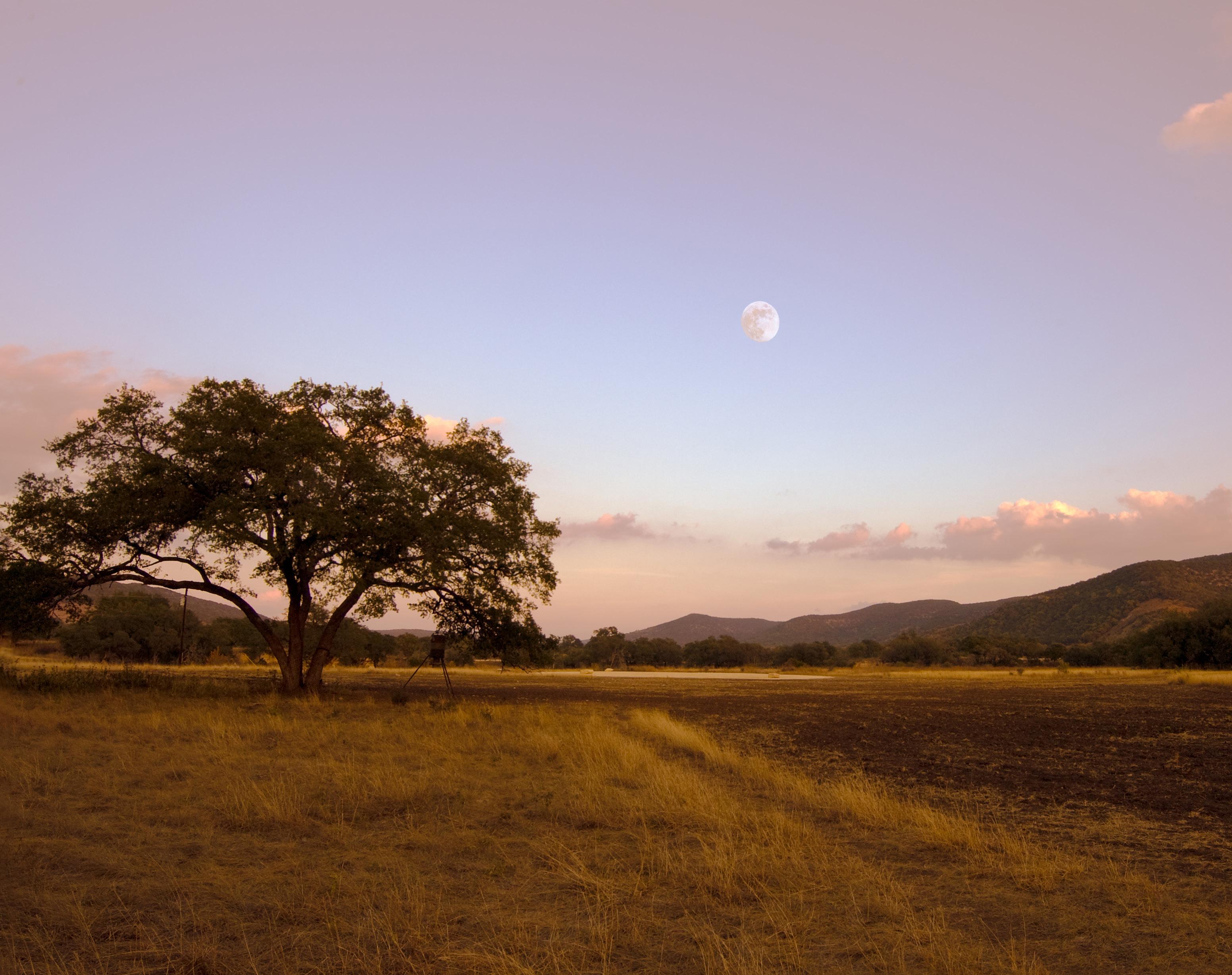
Father Amos knew him well. He spoke to him on the long roads and quiet trails, across trampled dust and through settling dusk. In Amos’s imagination, the deserts that ancient monk made his home were not dissimilar from his own Texas plains, and praying familiar words aloud offered some measure of comfort on those haunted stretches.
It was a well-worn recitation: O Holy St. Anthony, gentlest of saints...
Upon this night, however, Father Amos led his horse into a dry wilderness, and that plea for intercession carried newfound weight.
The priest found his mind drifting back to the stories that had fascinated him as a younger man: how St. Anthony had forsworn earthly luxuries and given his wealth to the poor; how he had devoted himself to the ascetic life, subsisting on mere bread and salt; how he had dueled with demons in Egypt and overcome them through fervent prayer. While in seminary, Amos had wondered if he might one day accomplish anything comparable — even finding some excitement in the possibility that he would encounter some infernal spirit to vanquish for himself.
How vain that wish seemed now.
Your love for God and charity for His creatures made you worthy, when on earth, to possess miraculous powers.
Father Amos prayed with his eyes open, careful to follow the coyote prints that guided is path — though they were becoming harder to make out as he went. The sun had begun to reclaim the light it bestowed at dawn; had his destination been a stop on his ordinary circuit, Amos would have long past paused his journey. He did not know how far he might have to ride this evening though, and he feared what might settle upon him should he stop to rest.
51
Amos shook his head. Encouraged by this thought, I implore you to obtain for me…
What to ask for? At this point, what was left?
“Obtain for me deliverance from death this night,” he said finally, with a trembling voice and nought but his horse to hear it.
Knowing the reddening sun would soon sink behind far-off hills, Father Amos urged his steed to a faster pace, resolved to follow the coyote’s prints as far as they took him. But as he rode on, he considered whether deliverance and death weren’t, in this case, the same thing. ***
Father Amos had not expected to spend most of his priesthood on horseback. Yet it was to the untamed American west that the Church had called him to minister, and those sparse territories required such a mobile presbyterate.
He shepherded more than a half-dozen parishes, and the roads between each town were lengthy and lonely. Some communities in his makeshift diocese had enough people to be called cities and others had hardly enough to count as towns in the first place, and Catholics made up a mere fraction of those populations. Still, as long as souls thirsted for living water, Father Amos would be there.
Goldstead was a larger community on his circuit, and one of which Amos was especially fond. When he rode into town, Sunday mass was a celebration: families from the city and surrounding homesteads would gather at the courthouse, all arrayed in their best dress, to hear

52
his homily and partake in the sacrament together. Afterwards, there would be lunch, blessings, confessions, and perhaps a wedding to boot.
Father Amos would spend the afternoon in good company. The barber and his wife, a pair of Irish immigrants twenty years his senior, always let him stay at their house. The nights he spent there would last long over cards and conversation.
“You know, I didn’t reckon a priest could even play poker,” the barber said one evening, while he dealt out the deck, “what with lying being a sin and all.”
His wife smacked his shoulder. “Rowan, that’s not respectful.”
The priest laughed. “I think the Good Lord can appreciate a game between friends.”
The old man raised his eyebrow at this. “Well tell me, Father, what’s He think of some whiskey to accompany said game between friends?”
“All things are good,” Father Amos said, before adding, with a smile, “in moderation.”
The barber’s wife laughed and went to fetch a bottle. And when the lamps were finally extinguished and the couple retired to their bedroom, the priest went to bed with a warm belly and a full heart. Such was the rhythm of every visit to Goldstead.
The joys of the day, however, lingered faintly. As Amos lay in his cot, his thoughts would turn inexorably to the long road that awaited him the next morning. And in the restless space between waking and sleeping, he would dream of the things that would meet him along the way.

53
They were dark creatures, clawing things, phantoms that whispered and rattled and shrieked—ghastly long faces with slit noses and winged silhouettes. They wore a hundred skins and mocked in a hundred voices, and the priest knew not whether he conjured them or they had crawled out of some chasm to enter his unguarded mind. One shape was particular to him, haunting him every night with panting breaths and hellfire eyes. It spoke to a naked and unraveled Amos saying, You will meet me in the desert.
The priest would pray for liberation, for exorcism even, but the words he uttered to the Almighty were like stones thrown into the dark. The Holy Ghost offered no sense of peace greater than that offered by his exhausted body when it finally compelled him to sleep.
He would get up in the morning, bid his hosts goodbye, and continue his circuit, hoping to find solace in the next town.
Soon enough, the night was lit by a waxing moon and scored with howls. His steed whinnied concern, and Amos rubbed the horse’s neck, assuring her that he liked the night no more than she did. The darkness darkened his thoughts, and he was grateful to have another creature for company.
“O Holy St. Anthony, gentlest of saints…” he murmured.
The barber had bid him go first thing that morning. Amos had listened because he felt he had no other options. He rode out of Goldstead at first uncertain of his direction, but in time noticed prints in the ground which he knew would guide his way. The priest still did not know what he would do if he located the creature from his dreams. It might

***
54
save him or it might kill him, and the two fates seemed dreadfully interlocked.
He shuddered when he thought about how close he had been...
All of a sudden, his horse reared on her hind legs, braying something terrible. Amos only had one hand on the reins and tried to grab ahold of the other, but couldn’t find it in the dark. The horse leapt and kicked like mad, and Amos tumbled off, freeing his wrist before he would be dragged. He fell to the dust as the creature galloped off.
Heart beating at a panicked pace, Amos tried to stand. When he crawled to his knees he found a coyote sitting directly in front of him, eyes shining in the moonlight.
The barber had discovered him on his cot, a pathetic thing holding his pistol and breathing heavy. The old man had only come downstairs for a drink; had he chosen to go back to sleep, it likely would have been a gunshot instead of thirst that got him out of bed.
“Father Amos,” the barber said, placing a hand on his shoulder. “This is no way to go.”
Amos shook his head. “I’m sorry, Rowan. This has nothing to do with you.”
“Nor this anything to do with you.” Gently, he removed the pistol from the priest’s hands. The younger man chose not to fight him.
“I think it’s the Devil in me,” Amos said. “I’m tormented.”

***
55
“You know as well as I do that Satan can’t be thwarted with mortal weapons.”
Amos said nothing. Until now, he had given his parishioners no indication of the specters he faced. How could he explain the quiet desperation he felt on the trails between towns? How was he to describe that his loneliness was not just loneliness? He could not take anyone to places his mind went as he tried to sleep, and that burden was not something he wished on any soul. The barber must surely be at a loss to see his priest in such a state.
Whatever his appraisal was, the old man spoke thus:
“I heard tale once of a man who sought to live a life in service to the Lord. When his ministry began, he went into the desert by himself — to fast and pray and such. Satan came to him there, and he threw all sorts of accusations and assaults his way. Ambushed his mind while he was all by his lonesome. But this man, he threw holy words right back at him, and beat the old bastard back into the dirt.”
Then the barber chuckled: “Forgive me for being tongue-in-cheek, Father. You know the man I’m talking about.”
“Yes,” said Amos, staring off into the distance. “I read The Life of St. Anthony in seminary.”
The barber looked surprised. “Well, I don’t know who the hell that is. I was talking about Jesus. I just think that maybe you ought to try the same thing.”

*** 56
“Are you the Devil?” Amos asked.
The coyote stared back at him.
“You bit my horse’s ankle and now I’ve lost her. I don’t know what I’m supposed to do now. I don’t carry a gun, and even if I did, I doubt shooting you would change anything. Maybe you’re not the Devil at all, just some desert fiend that likes to joke. I’ve heard the Navajo talk about you; they call you Trickster. Are you Coyote from the stories? Or maybe, worse than that, you’re just an animal, and I’m here ranting to you like a madman.”
He stood up, but the coyote didn’t move. So Amos sat down again, cross-legged, and spoke quietly. “I am a man of God. I came here to overcome the Devil. I need some release from my mind. Please.”
And then the coyote spoke. I cannot release you.
Somehow, hearing speech from the lupine body did not shock the priest.
You are a sorrowful creature, it said. What grieves you?
“Nothing.”
Who has broken your heart?
“No one.”
Then why do you cry without tears, Man-of-God?

57
Amos replied, “I don’t know,” and his voice broke as he said it.
The coyote stood up and circled the sad man, sniffing him. I am a creature who exists between Spirit and Animal. These natures dance within me. You are of these same natures, yet within you they are at war. I cannot fully understand this myself. You have pains and joys I cannot possess. You know your God and your Devil differently than I know them.
The coyote stopped in front of Amos, and Amos stared back into its glowing eyes.
If there is a cure for your ailment, you will not find it in the desert. My joy is mischief. Your joy is in your cubs. You lead many packs, and love them well. Remember they love you too. But do not seek to be Spirit and forget you are Animal.
The coyote began to walk away, before turning its head back.
You have ridden a long way into this dry country, human. Are you thirsty?
Amos opened his mouth to respond and realized just how parched he had become during his journey. His “Yes” caught in his throat.
The coyote walked away without saying anything else.
As the trickster’s shape faded into the night, the sound of a thunderstorm crackled overhead, and the dark sky began to pour.
Father Amos looked up into the rain. After a few moments, he laughed.

58

59

60
December Morning
 by Madelyn Hajovsky
1.
It is only your fickle heart learning some sense of permanence as you pass from womb to womb, making room for the eternal Present
2.
is what I would say if I thought you would believe it. As of late, I’m not so sure that you would understand, what with the way the light lay like fallen gods today.
You saw it seize the room with a shudder and the sepulchral sense that if you went back to sleep you would stay there.
3.
I wonder if, when the sun is daily buried in the darkling cradle of the earth, it is afraid
or if, on the weary days, it breaks in cold protest against its redundant nativity.
4. Give it time.
This is only the morning mile between life, death, and life again.
61
The Dawn of Skepticism: Revisiting the Historic Conflict Between Scripture and Science
by Margaret Grace Voelter
62
The stars have prompted both religious and scientific inquiry for thousands of years. As Plato once wrote, “This study [astronomy] certainly compels the soul to look upward and leads it away from things here to those higher things.” (Plato) For the majority of human history, people considered the fields of science and religion to be one and the same. However, in our modern era, most consider them to be mutually exclusive. When did this paradigm begin to crumble, and what caused it? With a glance at history, it is apparent that this conflict originated with the study of our solar system, when Renaissance astronomers’ technological innovations revealed that the universe was ordered contrary to the Catholic Church’s doctrine.
Until just a few hundred years ago the academic world was dominated by a Christian worldview. Only after the start of the Protestant Reformation around 1500 AD, did minds such as Nicolus Copernicus or Galileo Galilei begin to investigate and challenge the teachings of the Church. At that time, the Church asserted that the planets, sun, and everything visible in our solar system revolved around the earth. Church leaders or clergy members supported this claim with isolated verses from scripture. For example, Psalm 104:5, states that God, “Set the earth on its foundations, so that it should never be moved” (Psalm 104:5). Three popes, Paul V, Urban VIII and Alexander VII, believed in the authenticity of geocentrism based on choice verses of scripture such as this. The Church made a strong claim about the interpretation of this psalm and its implications; earth must remain stationary in the cosmos. The church then committed to promoting a geocentric model with a stationary earth as their explanation of Biblical knowledge and minimal external scientific information. Copernicus, however, observed and recorded the Earth moving around the sun (Sobel). He researched and experimented with theoretical compositions of the stars and planets, ultimately landing on one model that could accurately explain all he had seen. In his book, Copernicus wrote, “All spheres surround the Sun as though it were in the middle of all of them, and therefore the center of the universe is near the Sun,”(Sobel). Galileo’s later work with more powerful telescopes further evidenced Copernicus’ theory. In discovering new celestial

bodies orbiting Jupiter, Galileo gave credence to the idea that the universe does not revolve around Earth. At the time this theory and its evidence was received as a blasphemous criticism of the Church. But in reality, Copernicus’ and Galileo’s findings shed light on the scripture rather than discrediting the Biblical text. Psalm 104, which the Church used in defense of a geocentric universe, is taken dramatically out of context. The previous verses read, “covering yourself with light as with a garment, stretching out the heavens like a tent. He lays the beams of his chambers on the waters; he makes the clouds his chariot; he rides on the wings of the wind; he makes his messengers winds, his ministers a flaming fire” (Psalm 104: 2-4). These words describing God’s relationship with the world are metaphorical and poetic. These verses are not aiming to make a statement about the literal and physical construction of the
63

64
light, the waters, the clouds or the winds. The passage simply paints a picture of God’s glory in the reader’s mind. The poetic language is a clue to the reader that this passage is best understood as an analogy for understanding the metaphysical concepts of God rather than outlining diagrams of the natural world. This misinterpretation of the Christian scriptures has led many to view faith and science as incompatible worldviews, whevn truly the incompatibility is with the perceiver.
Another notable misinterpretation which the Church used to defend the geocentric model of the universe is in Isaiah 40, which could possibly be interpreted to describe a stationary and flat earth. The passage reads, “It is [God] who sits above the circle of the earth, and its inhabitants are like grasshoppers; who stretches out the heavens like a curtain, and spreads them like a tent to dwell in” (Isaiah 40:22). Taken at face value, the text describes a circular mass, which has an above and a below; despite the fact that this is
indeed compatible with our magnetic model of a spherical globe having a north and south poles, clergy of that era squeezed its meaning to align with their impression of a flat earth. Additionally, the description of the heavens as a tent for small grasshoppers does not imply a literal, scientific interpretation of this verse. These similes and metaphors are cues to the interpreter that this image is not an exact or definite depiction of God watching over us in a tangible cosmos but rather rhetorical imagery which the author uses to convey a sense of spiritual closeness to God. Once again this becomes a very effective example of careless interpretation creating needless conflict between scientists and Church leaders.
Further examination of more verses used to justify the narrative of geocentrism reveals a pattern to the verses which have been set in conflict with modern science. As the Church sought to interpret Genesis literally, they lost sight of the poetic subtleties which are just as central to a proper interpretation as knowledge of the literal details. The text reads, “God said, ‘Let there be an expanse in the midst of the waters, and let it separate the waters from the waters.’ And God made the expanse and separated the waters that were under the expanse from the waters that were above the expanse… And God called the expanse Heaven” (Genesis 1:6-8). For a time these words were explained as a picture of a flat earth with a dome of water arching overhead, labeled the ‘firmament’. This loose interpretation dramatically contradicts the most well-supported scientific explanations for the color of the sky and the curvature of the earth over the horizon. It is important to take scientific context and literary genre into account when reading Genesis. Dr Lesleigh Stahlberg explains in an article published in the Notre Dame journal of Religion and Literature,
65
“To read the Bible…is to read literarily. It is to attend to narrative structure, character development, word choice. It is to think about repetitions and refrains, recastings of earlier narratives, inner-biblical allusions. It is to think about what the text means, and what it means to us. It is to think about how it was read by its first readers and how it is read now, even as the how and the now—to say nothing of the why — of these questions are constantly shifting” (Stahlberg).
What she is essentially highlighting is the need to look outside of the ‘literal’ meaning of the words to find the ‘literary’ meaning of the narrative. If the creation story was written as an entirely historical record, then a flat earth covered by a ‘firmament’ would be quite a reasonable picture to draw from Genesis. However, Genesis contains a uniquely complex dichotomy; renowned philosopher and biblical

scholar William Lane Craig discusses the two distinguished characteristics of the text; the first being its function to record history and the second being the mythological aspect which passed down lessons in Jewish culture. In the first chapters of Genesis, he reminds us that “persons and events have been clothed in the metaphorical and figurative language of myth.”(Craig). But on the other hand, these narratives of Genesis “ are interspersed with genealogical notices that include the principal characters in lines of descent, thus turning the primeval narratives into a primeval history… the genealogies meld seamlessly into the historical period of the -patriarchs, where the historical interest is obvious and not in dispute” (Craig). So is Biblical creation as told in Genesis history or fiction? Simply put: It is both. While Adam and Eve seem to be firmly placed in history, the epic poem of creation also acts as a memory device for generations of Jews to remember the people, places and lessons foundational to their
66

culture. Through this contextual lens, we no longer force the creation story to fit the box of any preconceived physical model of the universe. Being conscientious of vague language, the repetition of crucial phrases and the overall brevity of the creation narrative, all point to a conclusion of poetic ambiguity. It follows that Genesis does not make any assertive claim to the construction of the cosmos as it has been misinterpreted.
Taken at face value, Biblical scriptures can at times appear to be diametrically opposed to scientific reality. However, when viewed with the proper historical, literary and scientific context, it is obvious that the modern scientific model of the universe poses no direct objection to the Christian scriptures. Throughout history, disagreement between the people who represent the church and the scientific community have polarized and separated what used to be an interdisciplinary study of philosophy through the observable world
around us. In the interest of truth, consider that neither side may be right or wrong, but that each has valuable information to offer and that together through sharing ideas, we can come to a clearer picture of the universe that surrounds us.
67
A Contemplation of Work, Rest, and the Schedule
by Deborah Chu

68
“Burning the midnight oil.” “Burning the candle at both ends.” Or to put these sayings into modern terms: “pulling an all-nighter.” Phrases such as these roll into our daily conversations as easily as melting wax rolls down the sides of a candle. In our culture that values high productivity, speed, and instant results, deprioritizing sleep, rest, and self-care has become common. In college especially, where we control our schedules and ourselves exposed to many exciting opportunities and experiences, biting off more than we can chew becomes disturbingly easy — at the expense of our sleep and well-being.
This spring semester, I and my schedule overloaded yet again and an impending sense of burnout threatens me. This repeating cycle in my life leads me to contemplate a few quetions: In a competitive environment where the driving philosophy is productivity and quantity and accomplishments measure individual worth, is there a better way to approach our time and schedules? How can we respond to pressure to meet the increasingly unattainable standards that society sets for us, and should we take the liberty to take control of our lives and schedules independent of external pressures? What do God and the Bible say about work, rest, and our schedules, and to what extent do they compel us to strive for excellence?

In approaching these questions, I think we should start with what God’s word says about our bodies. Paul writes, “Do you not know that your bodies are temples of the Holy Spirit, who is in you, whom you have received from God? You are not your own; you were bought at a price. Therefore honor God with your bodies.” (1 Corinthians 6:19-20) First, Paul states that the human body is a temple of the Holy Spirit. Temples are holy and sacred places of worship and communion, and hence they need to be maintained and cared for properly. Our bodies being temples for God himself in the form of the Holy Spirit entails that we must maintain and take care of our bodies to keep them holy and fitting for the Holy Spirit to dwell and work within us. Maintenance includes acts of self-care such as eating and drinking well, avoiding harmful substances for our bodies, nurturing our minds and exercising our bodies, and obviously, learning how to sleep and rest well.
Paul also says we do not belong to ourselves. We belong to God because he bought us and our salvation with the price of his blood, saving us from eternal death and separation from the Father. In our lives, we treat gifts from others with love, and we take care to return items to their owners in their original state - or even better condition. Hence, why should we not handle ourselves with the same love and carefulness since we belong to God? With this view, sucient rest and sleep become an indispensable priority within our schedules for obeying the wishes of our heavenly Father who gives us such commands for our own sake.
Furthermore, God built an inherent schedule for the world during Creation. The very first chapter of the Bible states, “And God said, “Let there be light,” and there was light. God saw that the light was good, and he separated the light from the darkness. God called the light “day,” and the darkness he called “night.” And there was evening, and there was morning—the rst day.” (Genesis 1:3-5) One of God’s first actions is to establish a distinction between day and night. This distinction confirms that day and night are fundamentally different and have different uses. From our natural capacities and inabilities such as our lack of nocturnal vision, we can infer that the day should be utilized for hard work, and night for a time of rest.
God also creates the Sabbath day, on which even He rests during Creation. He goes as far as to call the
69
Sabbath day holy, commanding, “Remember the Sabbath day by keeping it holy. Six days you shall labor and do all your work, but the seventh day is a Sabbath to the Lord your God.” (Exodus 20:810) God does not need rest as He is omnipotent, however, He sets a precedent for us very clearly in taking rest from His work.
God has differentiated time for us to get our crucial sleep and rest. If he intentionally set aside time in the form of “night” in the schedule of the Earth, he makes it quite clear that we should use this time to sleep and rest. Nature itself decrees that we rest and sleep at night, yet
human innovation has deed even this guideline with the inventions of electricity and technology. Even with this reality, we should still make it a priority to protect ample time for rest and sleep within our daily schedules since this is what God intended for humankind and our own good.
This then raises the question of balance. Should we even value work at all if rest and taking care of ourselves are so important? If work is valued, how can we justify the lost time and work that prioritizing rest will cause in our schedules?
The answer to the first question is a simple yes. God does validate work as important and good. He condemns laziness, ordering that we use our time productively. In Proverbs, he provides a myriad of verses addressing laziness, including: “Lazy hands make for poverty, but diligent hands bring wealth.” (Proverbs 10:4) Interestingly, one of God’s first instructions to Adam is to work: “The LORD God took the man and put him in the Garden of Eden to work it and take care of it.” (Genesis 2:15) The rest of the Bible is filled with wisdom about rising early at dawn to make the most of the day and other instructions on being productive.
70
Clearly, God is not saying that work itself is inherently bad; instead, it’s a good and noble tool that gives us purpose and goals for our lives, as well as a sense of accomplishment and satisfaction. However, work is meant to serve us. The inverse is false: we are not meant to serve work. This means that we should not need to subscribe to the ideology of “workaholism” or accept losing sleep to get ahead as a new “normal” in our lives as much of the world has already done. We do not need to embrace the grind-till-dawn lifestyle as a norm of college life. This sometimes means that we need to say “no” to adding new activities to our schedules, even if they are
amazing opportunities. I have had to realize that it is sometimes more beneficial to let go of such amazing opportunities so that I can work in moderation and provide myself with much-needed time to rest and nurture my soul.
Answering the second part of my question, I would argue that creating more time for rest and sleep increases our productivity, although it may decrease the time we have to work. When we are better rested, our ability to concentrate on work efficiency and quality both improve, thus heightening our productivity. Furthermore, God should be the
motivation for our work: Without Him, all of our work is as pointless as the act of chasing the wind. As Solomon in Ecclesiastes states, “So I hated life, because the work that is done under the sun was grievous to me. All of it is meaningless, a chasing after the wind.” (Ecclesiastes 2:17) The Bible further makes a point by declaring “In vain you rise early and stay up late, toiling for food to eat — for he grants sleep to those he loves,” (Psalms 127:2) noticeably emphasizing God-given sleep as a reward and the fruitlessness of our toiling without God’s support.
71
This Psalm recognizes my personal struggles to and purpose. Multiple times this year, exhaustion has forced me to stop and contemplate what the end of all my striving is. Every day presents a full schedule and endless activities, and I cannot help but wonder if any of it has any purpose. I may feel productive in the moment and rack up a list of impressive achievements in this life, but at the end of the day, many of these will hold no importance or meaning when my life ends. Without the presence of God or the existence of eternity, my life becomes a hamster wheel in which I run myself to exhaustion every day. If I fail to inscribe my name in the annals of man’s finite history, my death can only lead to oblivion. Not the brightest reality, but seemingly the reality I live in at the University of Texas.
However, God takes this bleak monotony and breathes purpose into my work and striving. Colossians 3:23 states “Whatever you do, work at it with all your heart,
as working for the Lord, not for human masters.” The Lord encourages and validates excellence and hard work, and furthermore, he lifts the burden of striving for the fickle approval of fellow man. As God now serves as my main motivation for working, rather than acquiring the approval of man or accomplishing success, I have finally learned about the value of adhering to His guidelines for work, which include proper rest. As for the hyper competitive environment we currently live in, the Bible has one solution: “Don’t compare yourself with others. Just look at your own work to see if you have done anything to be proud of. You must each accept the responsibilities that are yours.” (Galatians 6:4-10)
What an antidote to the immense pressure we face as small parts of a fast-paced consumer society. Instead of succumbing to the urge to rank our work and worth by the undulating standard of our surroundings we just need to focus on elevating the quality of our work to the best it can be.
72

However, the obliteration of comparison should not prevent us from putting forth our best foot. God still charges us with accepting the “responsibilities that are yours.” Our world functions around rankings: class rankings, top company rankings, and even government evaluations. These hierarchies remain in the foremost part of our minds and vision boards. Yet, when stripped down to the core, these rankings are all man-made constructions created to satisfy the human need for structure and power. However, God transcends such human structures. Hence our worldview can also transcend such limited constructions to the everexpansive perspective of eternity. We can operate on a whole new playing field when it comes to work, and in fact, should aim to exist on this plane, for as Paul states in Galatians 1:10, “For am I now seeking the approval of man, or of God? Or am I trying to please man? If I were still trying to please man, I would not be a servant of Christ.”
God’s words, actions, and creation fuse together to point us toward rest and peace. Simultaneously, they compel us to strive for excellence and responsibility in our work for the sake of perpetuating the Lord’s work throughout our world. Embracing the eternity-mindset instead of limiting ourselves to a human time span enables us to realize that in the scope of forever, our physical work is less relevant than the ultimate purpose we have been called to. Hence we can spare ourselves time in our schedules to rest and revel in the Lord. In the words of the famous hymn by Helen Lemmel, “Turn your eyes upon Jesus. Look full in His wonderful face. And the things of earth will grow strangely dim in the light of His glory and grace.”
73
Melody of This Hour
by Jessica Jang
Just like the last notes of a cadence Man is caught in growing ebbs and fast flows, the present, a moving melody that taunts in its tension
running towards harmonic resolution yet remaining, lingering, in the time before those final notes ring sweet.
In the suspense of eternity, we are called to perpetual progress. Chests pound and cheeks glisten in work and song for the coming King Con moto! Dissonant, quick Bare feet on the pavement, running from deep shadows of indulgence, shouts of mirth, tyranny on earth with pants of praise, praise, praise
The hour before eternity remains in stillness, even so. sitting, yet without idleness praying, and not in vain
This caesura, a break in the flow, to absorb and prepare, as Silence hums a summer song, delightfully soft, “Come restyearning for heaven can be quiet.”
And itching for the crescendo of life to end, invisible pummeling of souls toward holy redemption …
Trust! that each day, the horizon draws closer to the dawn of the true Morning Star. each moment, the growing light compels with warmth, promising fiery glory.
So in the foretaste of goodnessright until the imminent moment when The curtain is torn!
The heavens and earth kiss!
The melodies of eternity lose their echo, fading into the endless symphony of praise, we race and wait.
74

75

Realism and Idealism: A Hopeless Pursuit Without God
by Zach Lacy
76

The labyrinthine depths of Tlön invite us inward, towards a world where the very fabric of the universe is malleable to the minds of man. Thus, it leaves us to face the blurred lines between perception and reality: a concept not unfamiliar to our own world and its philosophical traditions. In his short story entitled “Tlön, Uqbar, Orbis Tertius,” Argentine author Jorge Luis Borges examines the rational consequences of realism and idealism in a highly plastic world. Created by a secret society of intellectuals, the fictional world of Tlön represents a foil to our own world. Tlön embraces idealism wholly, with a metaphysical structure lacking any material existence. This world relies solely on perception: what is not perceived simply does not exist. The language of Tlön embraces this ideal, as “there are no nouns in Tlön,” but merely “impersonal verbs…with an adverbial value” (Borges 8). Borges exemplifies this concept further, for in Tlön
there is no “word ‘moon,’ but there is a verb which in English would be ‘to moon’ or ‘to moonate’” (Borges 8). This rejection of the material extends into every crevice of the Tlönian’s being, rejecting any notion of a material world into even their language. Borges builds this world as the antithesis of our own, and yet this conception of reality doesn’t seem so far from the one many know.
In his examination of the metaphysics of Tlön, Borges forges a world in which a lost object may be found simply by wishing of a seeker — whether they be the original owner or not — however, it should be incapable of existing outside of the perception of the mind. If the idealist reality of Tlön is true and no object is permanent, there should be no way in which an object could be “found.” This “found object,” a physical embodiment of one’s desire, is called a hrönir
77
by the Tlönians. The author posits that “centuries of idealism have not failed to influence reality,” but rather that the manifestation of the mind may hold enough power to will substance into being (Borges 13). The reader is told that one of the prison directors of Tlön informed his inmates of buried remnants that never existed (in a world of idealism, the conception of history is incoherent), and upon their search, these artifacts were found: “a golden mask [and] an archaic sword,” crafting material existence not before existent (Borges 14). And this is perfectly in line with the world they know, for within perfect idealism, nothing is permanent, nothing is lasting, and nothing can truly be material without perception.
In the story, while Tlön’s world of idealism begins to crack, actual material objects coming into concrete being through the hrönir rather than remaining ideas, our earthly world of concrete realism reveals cracks which are a mirror image of those in Tlön. The stories of Tlön are heard and repeated through public consciousness, gaining mass following in the cultures of Earth. On earth, pieces of idealist Tlön begin to appear; the narrator recalls an encounter in a bar one evening in which the man was found with “small, very heavy cones” with the iconography of “certain religions in Tlön” in his pockets, cones that should have been mere fictions (Borges 17). Borges shifts, noting our world’s own materialist reality rending and meshing with the immaterial ideal of Tlön. Neither world can preserve its own reality without remnants of the other invading it, and both are unable to find a foundation in reality. Borges does not solve this problem for the reader, but his various philosophical references and allusions to our own reality provide a clear call to action to investigate the problem: that these views cannot and will not be reconciled without God.
78
79
Outside of Borges’s depictions of these opposing philosophical forces, these ideologies are irreconcilable with our social norms. Idealism, in the wrong hands, fosters a toxic individualism and nihilism by focusing on the self without a recognition of the reality or continuity of others. The undergraduate student, eager for salvation from their crushingly surface-level reality, is lured into a trap with a logical terminus that the world is devoid of truth outside of the mind. This extreme relativism plagues the university classroom and polarizes the student. Fabricated truths lead to fabricated divisions. On the opposing end, radical materialism, or realism, is cultivated by the new atheism of Richard Dawkins and others, wherein men “are not immaterial selves or souls…and they don’t contain any immaterial substance.”1 Dawkins, a pillar of the new atheism movement and selfproclaimed ‘militant and self-proclaimed ‘militant atheist,’ personifies this realism. A related strain of these realists redefines an ‘objective reality’ within a subjective framework, focusing less on the truth and more on the perceived truth. This materialism is epitomized in the embracing of social and physical science which places qualitative value on the world with no questioning of why things function, only apparently how.
Perhaps this is a pessimistic depiction of our present condition, but these views are based in a much older philosophical

80
tradition. For the sake of this paper, I will use René Descartes as the paradigm realist – by accepting the independent existence of the material – and George Berkeley as the paradigm idealist (the very same Berkeley mentioned in the Borges piece). Descartes’s realism differs from the modern conception very drastically, but sets up the fundamental school of realist thought within the mindbody problem—the notion that the material body and the immaterial soul exist as independent substances, but must react in some way in order for man to function. He creates a distinction between the mind and body as separate entities and substances and affirms the reality of an exterior extended world, while maintaining the existence of a soul that exists outside of the body and continues past the existence of the body. On the opposing side of argument, George Berkeley rejects this dualism and the idea of identities independent of the mind, relying on perception for existence. This debate can be epitomized in rather quaint latin statements: the battle between cogitō ergo sum and esse est percipi – “I think, therefore I am” versus “to be is to be perceived.” These statements hinge upon their respective philosophies and draw a helpful picture of these opposing views.
In Borges's materialist world of today, the ideas that Descartes – the father of modern realism – postulated have developed into the societal ills and relativism discussed above: perhaps the soul exists, but what function
81
can it serve? I am a “thing that thinks”2 and “corporeal things exist,”3 but this perspective seems to create a sense of dismal hopelessness. Descartes’s most notable phrase is memorized by every hopeful physics and philosophy student: “I think, therefore I am.” In order to convince oneself of some conception, there must exist some thing which holds the capacity to be convinced. Descartes carries his argument further and establishes the existence of quasi-reliable sensory experience, granting the existence of a world which reflects our present reality and is based on sensory experience. These two ideas converge in the mind–body union, giving birth to an independent notion of identity. The soul and the body exist as separate entities, but without God, how could this be possible? Without God, what purpose does an immaterial soul serve in the absence of an afterlife? Descartes, setting out in his Meditations to prove the existence of God, clearly reaches an answer to this, but later interpreters of realism reject this logical leap. Dawkins, for example, rejects the very idea of a soul, arguing that while Descartes’s realism may serve
a function in the corporeal world, the soul is purely material; therefore, the self is purely material.
On the opposing philosophical side, Tlön is embodied by the secret society of Orbis Tertius, founded by George Berkeley, a real Irish philosopher and father of idealism. Berkeley addresses the problem of idealism’s impossibility within the world, viz., the problem of the persistence of material objects which are apparent to common sense. In his attempt to reconcile this idealism within a visibly materialistic conception of reality, Berkeley establishes a mantra to summarize his philosophy of idealism: esse est percipi–to be is to be perceived. Berkeley rejects the fundamentals of materialism, “he attacks Cartesian and Lockean dualism…[and] rejects…that material things are mindindependent things or substances.”4 Berkeley holds that, although objects exist only within perception, this perception appears to be grounded in a reality outside of the mind, a reality which cannot help but be based in concrete matter. But again, the world is found in a
82
stalemate. Can truth and reality be reconciled within this radical idealism? Immanuel Kant’s transcendental idealism attempts to brace this question with a quasiPlatonic view, that what one sees is not a material object, but a mere “representation [that] cannot exist outside our mind,”5 representations that merely appear to be material, but form a conception of something outside oneself (Kant 437). What one sees may in fact have some ontological material basis, but what we see is only the reflection of a higher material form from which this basis is grounded. And yet, both Kant and Berkeley’s conceptions seem to lack a sense of grounding in our reality.
It appears that both realism and idealism have formed a breaking point and stalemate, they cannot be argued and they cannot be reconciled. The materialists venerate the field of science to cement their views in quantitative evidence without considering the philosophical possibilities; the idealists’ viewpoint is self-confirming. The idealists cannot consider the material world because
all they know is subjective, while the materialists go against the very basis of idealism by rejecting any notion of immateriality. This stalemate extends outside of the textbook and into the classroom with relativists proving their own beliefs through the very fact that their opposition holds a different position to theirs, and the atheists rejecting all sense of the immaterial through scientific “proofs” of the functions of nature. Stuck in this despair, Berkeley and Descartes find the same way out, the solution to Borges’s problem: God.
Berkeley reaches this conclusion in the Three Dialogues Between Hylas and Philonous, where he finds the necessity of God through the very idealist framework he established. While it accords to man’s common sense to accept a material grounding of reality, this notion leads to skepticism of the immaterial and must be avoided, so Berkeley finds. To exist is to be perceived, though we must inquire as to the identity of the perceiver, Berkeley qualifies. The character of Philonous asserts his claim of idealism (representing Berkeley’s stance):
83

84
that the reality of the things he senses exists purely in the mind and “cannot exist otherwise than in a mind or spirit” (Berkeley 46). However, the appearance of materiality –the continuity of things in space and time – challenges this claim: sensible things appear not by man’s thought, but by thought of another greater; therefore, “there must be some other mind wherein they exist” (Berkeley 46). Through this lens, Berkeley, through Philonous, concludes the existence of God through the existence of sensible objects outside of the mind and one’s own perception. To exist is to be perceived, but not to be perceived in one’s own mind, but the mind of God to whom sensory perception and sensory experience of all the senses is credited. Idealism is reconciled with perceptions of reality, placing the power of true perception into the higher Being of God, creating objective reality and meaning within God’s understanding.
On the alternative side of the debate, Descartes sheds light on material senses through the understanding of God. Descartes reaches this conclusion through a variety of methods, initially using God to establish a corporeal reality, then using God to understand man’s capacity for sensory error, and finally to escape a dismal trap of repetitive doubt. To begin, in his third Meditation,
85
Descartes considers the seemingly infinite regress of sensory experience without an understanding of God: for example, the idea of heat “cannot exist in me unless it is put there by some cause which contains at least as much reality as I conceive to be” in temperatures which are hotter than average (Descartes 28). But for this idea to be in my mind, that itself must have been put there by some cause which contains at least as much reality as that idea. This continues to an apparent infinite regress, if there exists not an original cause: God, the primary cause. Under this foundation, God exists and allows for corporeal reality in sensory experience. Descartes then continues, through his fourth meditation, to create an understanding of man’s capacity for error, because of God’s gift of free-will to man. The will is greater than the knowledge of man, so when man makes a decision based on the will rather than knowledge, a will subject to the limitations of man’s nature, error is able to occur. This is not a defect of God, but a defect of man made possible through free-will. Finally, Descartes is able to concretely rely on the existence of God to create an
objective reality and sense of truth. Descartes uses the example of a triangle, which contains properties that can be understood through man’s understanding of geometry, and can be relied on axiomatically. However, without a conception of God, how could anyone rely on continuing truth when the proof of the triangle is no longer accessible to them? These axioms would have to be continually proved ad infinitum; nonetheless, with the conception of God one can see that “the certainty and truth of all knowledge depends uniquely on my awareness of the true God” (Descartes 49). Because God exists and does not deceive, truth can be continually perceived, corporeal reality can be relied on, and the error of man can be reconciled without undermining God’s perfection. Relating this back to realism, Descartes’s arguments use the existence and nature of God to create objective meaning, prove the existence of an immaterial substance of God, and prove the existence of a material, corporeal world existent outside of the perception and sense of man.
86
To conclude, Borges presents an intricate problem with deep roots in the scholarship of philosophy. Both idealism and realism reach a stalemate and begin to crack our understanding of reality, just as the very foundation of Tlön begins to, as the story reaches its end. Embodied in the modern world’s relativistic tendencies and general lack of objectively perceived truth, this issue especially plagues the minds of undergraduates, politicians, academics, not to mention everyone else existing in our social world. Berkeley and Descartes both reach a compelling conclusion to their respective ideologies, namely, that God creates the understanding of our reality. God’s existence creates meaning in a meaningless world, reality in a world without truth, and hope in a nihilistic world. Whether idealism or materialism wins the age old debate, only through the understanding of God can one truly embrace their reality; only then can one find meaning.
87
88

The Myth of Adam & Eve
by Ava Malcolm
Most of us were raised on a steady diet of Percy Jackson, Magnus Chase, Marvel, and other modern myths. Although we may think of them as retellings of ancient narratives, no one would deny that they feel real, relatable, and immersive. They seem to reflect the stories of our own lives. Even though Bible stories aren’t wrapped up in the Rick Riordan packaging, Bible stories can also be viewed as pertaining to our own lives. We can take a similar a proach in applying the principles found within them as we do to myths and demi-god stories.
89
The story of Adam and Eve is one such tale. In the literal story, Eve wanders peacefully through the most ecologically pristine place that has ever existed, the Garden of Eden. Here, biodiversity flourishes more than at any subsequent time in history, and humans live in perfect harmony with the plants and creatures around them. Meanwhile, the Enemy sets out to “kill, steal, and destroy.” He wishes to bring all the beauty of creation crashing to the ground. The Enemy, in the form of a serpentine dragon, slithers down to Eve, lisping temptations in her ear. Eve succumbs, eating forbidden fruit which will seal her fate, dooming her to a lifetime of suffering and an eventual demise. She acquires the capacity to sin, which will be passed on to the rest of humanity, opening up their minds to doing evil. Eve then offers a bite of the fruit to Adam. Adam knows full well that what he is about to do is wrong, but on the other side of the arm holding the fruit out to him is his beautiful mate, his only companion in paradise. He, too, is curious to know what it feels like to experience the effects of the forbidden fruit. He takes the fruit into his own hand, and takes the second bite. At this moment, the deed is complete; suddenly, “their eyes are opened,” and the fate of all the humans which will descend from Adam and Eve is eternally changed.
To decode the symbolic value of Adam and Eve, we must illuminate what concepts each character represents. In the ancient Greek myths, deities personify the natural world. Many of their names have become our modern English words, and because of this familiarity, that which they symbolize has become concrete to us. In most Biblical stories, however, the characters are not so obviously connected to the concepts they symbolize, but they similarly represent concepts which we can apply to our own experiences. There are a multitude of takeaways from each Biblical story, but to me this story illuminaties the two equal factors that contribute to bad actions, misdeeds or genuine evils.
90
91

If we interpret this story symbolically, we should first define its symbols and what its symbols represent. First, we must define the ‘original sin.’ This results from the combined actions of Adam and Eve. Although the sin is separated into two segments, Eve’s temptation and Adam’s giving in, they are two parts of the same act. In the story, the act’s symbolic function was to indelibly change the brains of humans, severing them from being a perfect part of a perfect ecosystem. This act was the “first sin,” but what does that mean? The word ‘sin’ has been hopelessly muddled by centuries of misinterpretation (intentional or otherwise), but in the original Hebrew, a sin is simply a kha-ta, or a mess up. A kha-ta is anything which deviates from what is good and perfect or does not increase beauty and virtue in the world.1 So, the mythical truth of the Garden of Eden applies to anything in your life which has gone wrong, hurt you, or damaged the place where you live and the people around you. In the Biblical sense, this sin could be that senselessly cruel thing your family member said to you, the night out that turned bad, the embezzling politician.
92
Turning away from the abstract terminology of sin, analysis of the story of Adam and Eve naturally raises the question of what its subjects represent. Who, or what, is Eve? Literally, she is the first one to partake of the forbidden fruit. Some Bible scholars in centuries past have erroneously used this fact to justify misogyny. They place the entire fault of the Original Sin on Eve; however, God makes it exceedingly clear that this was not the case. Metaphorically, Eve symbolizes all external factors which motivate Adam to seal the act. She is the only other human who Adam has to share the planet with, and she provides his only earthly source of conversation, pleasure, and companionship. Her being his sole source of companionship greatly influences her wants and desires. When Eve succumbs to the serpent’s temptation and eats the fruit of the forbidden tree, she is changed forever. If Adam refuses to also partake of the fruit, he would be separated from her forever. This does not mean he is forced to join her; he always retained agency. From this evidence, we see that Eve symbolizes all the motivations, conducive circumstances, and justifications for someone to do something wrongly.
93

94
While Eve’s role is more mysterious and requires greater inference to understand, Adam’s part is crystal clear. He chooses to cross the literal and metaphorical gulf between himself and his mate to partake of the forbidden fruit, completing the second part of the unified act. While Eve succumbed to the temptation of the serpent, he reacted to the temptations around him, directly contradicting the instructions which God had given them. The moment Adam takes his fateful bite, the eyes of both humans are suddenly opened. Within this myth, Adam symbolizes the individual person whose desire to make a bad choice is superlative to any reasons not to.
Who is to blame? In order to gain clarity about this, it’s important to note that the myth does not end when Adam and Eve’s eyes are opened. This chapter of Biblical history comes to a close with the punishment that Adam and Eve will suffer because of their actions. Both are thrown out of the garden, no longer capable of living in a perfect ecosystem where they live in symbiotic harmony with all other living things. Further than that, God announces that both will suffer their respective punishments. These punishments are separate in what they prescribe but equal in magnitude. From the equal (yet differentiated) punishments for both of them, we can glean that both Adam and Eve share equal culpability for the original sin, though they are at fault for different portions of the same act.
95
By decoding the symbolism in the myth, the story of Adam and Eve illuminates how to perceive sin (kha-ta) in our world. Under the framework presented by the story, each kha-ta can be split into two parts which hold equal responsibility for the outcome. One half, the half which Eve symbolizes, is all of the context in the life of the person whose choice it is to commit to a sin or not. This is the poverty which degrades the person’s soul, the childhood trauma which makes them think such a terrible thing is fine to say or do, the corruption of the people around them. The other half, symbolized by Adam, is the person’s ultimate decision in their heart to silence their conscience and accept that the pressure from their surroundings is forceful enough for them to justify buckling.
In many places in our treatment of sin, our division of these two parts of the whole is apparent. For example, in one wing of the judicial system we try the criminal, while the risk factors correlated with such crimes are mediated by separate arms of the bureaucracy through social work and relief programs.2 In the treatment of criminality, this framework is generally accepted as the standard for maintaining order In communities, but in our run-of-the mill daily interactions, full of offenses, irritants, and smaller misdeeds, being observant of each part of these misdeeds can direct our own responses towards a more peaceful and truthful resolution.
2 This is not to say that all crimes (for example, peaceful civil disobedience) are sin, or that all sin can be defined by the law. Again, sin, in the true Biblical sense, is a deviation from anything which is perfect and good. In perfectly legal interactions, for example, defamation or gossip would qualify
96

Ultimately, this story is not given to us with the intention that we attempt to perfectly punish and control people in order to achieve perfection. No society created by humans will ever completely remove imperfection. The best we can do is strive to create a more beautiful future by changing our own actions, becoming lights to the world around us, just as the dawn illuminates our skies with washes of colorful light. The story of Adam and Eve gives us a vision for how to become like the dawn by reconciling the wrongs done to us and by us.
97
Writers On Writers
98
Hunter Rapp on “Does God Like it When We Learn”
Philip Pullman’s novel The Golden Compass offers a revisionist interpretation of the Fall narrative, suggesting that humanity’s disobedience in Eden was basically good. A loss of innocence, Pullman argues, is a necessary part of being human, and should be embraced. Given your claim that knowledge is proportional to agency, and the traditional Christian understanding of the Fall as tragedy, what do you think of Pullman’s argument? Is the knowledge of good and evil incompatible with innocence?
Mitchell’s response: Innocence is often ill-defined, so I will try to lay out what I believe Christian innocence is. Jesus encourages an innocent, child-like faith, not with regards to what we know but what we are corrupted by. A child is pure, not because they are ignorant, but because they have not been corrupted by the world they inhabit. It is virtuous for a child to learn about the world around them, but it is not virtuous to acquiesce to its corrupt ways. Innocence, then, is not inverse to knowledge; with God’s help, the two exist simultaneously. The Spirit, in wisdom, helps us not only to learn about our surroundings, but to judge the virtue of each new thing that we learn, allowing us to resist the everpervasive loss of innocence.
Mitchell Schultz on “Postmodernism and the Unbeliever”
I agree with your assertion that the absolute subjectivity of cultural post-modernism is an obvious precursor to thoughts of a meaningless life. However, I don’t think this is a hopeless condemnation for most post-modernists; instead, it feels like freedom. If nothing is real or true, then people are free to say, do, and act as anything they want! As Christians we know that this is simply slavery to desire, but its initial presentation is that of freedom from oppressive morality — that’s what makes it so appealing. How would you explain to a non-believing post-modernist that their "freedom" is actually condemnation, as Christians know it to be?
Cara’s response: This is a valid point. I would add that cultural post-modernism does not stop a nonbeliever from seeking satisfaction in something. Relativism and post-modernism may seem liberating and comfortable, but a person who adheres to these beliefs still seeks fulfilment in careers, hobbies, or institutions all while doctrinally rejecting the idea that there can ever be one absolute, fulfilling thing to put faith and trust in. It is the constant seeking inherent in human nature that leads me to believe that comfort found in a freedom from "oppressive morality" is really no freedom at all. Rather, the nonbelieving post-modernist has closed herself off to the possibility of absolute peace and satisfaction by closing herself off to the idea of absolute truth.
99
Zach Lacy on “The New Earth”
A lone observer far removed, watches an idyllic, idealized home where she herself should be; implanting her own experience unto her counterpart, the protagonist is wrought by meaninglessness, concluding a nihilistic optimism which can only be achieved through the lives of others. “The New Earth” is a work of fiction, and yet it touches the heart of the American household: finding hope in the lives of others, the only difference being the screen by which one watches. While the short story is a beautiful representation of a hopeless world, I think many of the dramatic elements used in the latter half of the story reduce a sense of realism and feel more dramatic than useful, specifically with the father’s cancer diagnosis. It is perfectly imaginable that this character would escape his troubles in an attempt to find meaning in the world through his family and a religious quest, yet a lot of those details felt thrown in on the last page, which removed the reader from the depth of the story a bit. Overall, “The New Earth” is an impactful, heartfelt, and incredible depiction of an aspect of American life, necessitating the Lord as a sense of meaning.
Molly’s response: Thank you for your kind praise of my story. I am glad that you picked up on the way that we place our hope in others’ lives when we lack it in our own. I also totally agree with you that the sensationalism of the cancer diagnosis and subsequent discussion distractedfrom the meaning of the story. I wanted to show that different kinds of tourism can stem from our fear of facing our own ending lives, but I think that theme could have been conveyed in a more subtle way.
Jessica Jang on “A Contemplation of Work, Rest, and the Schedule”
Debbie, your work beautifully examines what rest is in light of what Scripture says about the human body, the earth, and work. I believe that separating your paragraphs with a more systematic organization would bring increased clarity to your points. The repeated ideas of rest, balance, sleep, and work can easily blur with one another, so having clear distinctions between the subpoints of your thesis would be helpful to the reader. Finally, I would love to see you expand more on the idea of moderation, the balance, that you write about. You mention letting go of opportunities while also talking about not having “lazy hands,” and I would argue that if you spent a little more time explaining what Godly rest looks like practically, it would refine the ideas of what non-lazy yet non-workaholic rest is.
Debbie’s response: Originally, I intended to use this repetition of ideas to emphasize and parallel their necessarily repetitious nature within our lives, however, upon further contemplation, I agree with you that clarity of the thesis takes all precedence. I propose this thesis instead: Balance and Godly rest can indeed be found while maximizing the productivity of work. This becomes possible when the achievement of productivity is not at the expense of relationships with God and others or physical, mental, and emotional health. Healthy limits and boundaries must be defined, and it is up to the individual to prayerfully decide their limitations. Once the work and rest aspects of life no longer intrude upon each other and instead coexist harmoniously a balance.
100
Josiah Jones on “Realism and Idealism: A Hopeless Pursuit Without God”
Zach, while your essay perfectly summarizes why the theories of Berkeley and Descartes require the existence of God, I feel like you also leave a lingering question unsatisfied: the question of a Biblical metaphysical worldview. Whether God favors materialism or idealism, we are still left with two theories that you assert are incoherent and incompatible with social norms. Further, God’s omnipotence could solve the problems with virtually any faulty metaphysical theory. A tertiary theory that synergizes with or even supports a theistic worldview would have left the reader with some sense of direction.
Zach’s response: Josiah, while I understand the significance of reaching a conclusion and providing an alternative worldview to the dismal options presented, my paper served the function of analyzing differing philosophical views within the lens of Christianity and a fictional short story; I did not claim to or attempt to provide a normative claim for how to understand the world, rather I just wanted to discuss the ways various beliefs interact and shape the modern political realm and university. Just as how Descartes knew he needed to appeal to the nonbelievers by writing his Meditations without the support of Biblical text, I attempted to write this paper as an appeal to different schools of thought without relying heavily on personal doctrine taught by the church.
101
About the Contributers
Birdie Anderson
Birdie is a third-year Pyschology major who enjoys shooting film, collecting vinyl, fostering puppies, and songwriting. She is a research assistant in the Kid’s Socioemotional Development Lab, a teaching assistant in a class on Civic Engagement, and teaches gardening at Austin State Hospital. But mostly, she just likes talking to people and writing about what she learns from them.
Deborah Chu
Deborah is a first-year Plan II and Government major from the Woodlands, Texas. Beside Terrain, she is in the Jefferson Scholars Program, pursuing a Business and Public Policy minor, and involved in Student Government, Senate of College Councils, and Ignite. In her free time she loves hiking, playing cello and piano, singing, laughing with friends, taking persality tests, exploring her vivid Korean and Chinese family history, and fighting for her life in Korean class.
Madelyn Hajovsky
Maddie is a second-year English and Linguistics major. She likes going on hikes, drinking coffee, writing poetry, having one-on-one conversations with people, and collecting far more books than she is able to read. She’s worked as an editorial intern at Greenleaf Book Group, volunteered with Austin Bat Cave’s afterschool writing workshops, and is currently a research assistant in the Linguistics department.
Jessica Jang
Jessica is a first-year Pre-Physician’s Assistant Biochemistry major from Allen, TX. She is passionate about people, poetry, pork dumplings, powerful folk music, piano, and pursuing Christ. Outside of class, you might find her volunteering at St. David’s Medical Center, in Christian community, or enjoying nature with friends. She is usually deep in conversation, contemplation, eating apples, or singing.
102
Josiah Jones
Josiah is from Fort Worth, Texas, and is studying Public Relations in the Moody Honors Program He has a passion for classic literature, philosophy, and history, and he is active in the Jefferson Scholars Program. Josiah enjoys music, board games, cooking, reading, snowboarding, and traveling. In his free time, Josiah coaches and mentors students in high school speech and debate. He loves Austin and is on a mission to visit every coffee shop and music venue in the city.
Zach Lacy
Zach is a first-year Government and Philosophy major from Southlake, Texas. Outside of TERRAIN, Zach is active in the Jefferson Scholars Program, the UT Student Government, and the Thomistic Institute. In his free time, Zach loves reading and writing, attending local concerts, playing jaz guitar, and working in the community.
McKay Lawless
McKay is a first-year Plan II Honors and Health and Society major. She is from Houston, Texas and adores the liveliness of the city at home and here in Austin. She enjoys reading political OpEds, acting and filmmaking, crafting, being spontaneous, and exploring the outdoors. Along with TERRAIN, McKay is involved in Ignite Texas, the Plan II Student Association, and will be a Pine Cove counselor this summer.
Ava Malcom
Ava is a Neuroscience and Spanish major from Austin, Texas. In her free time, Ava enjoys hiking outdoors, gardening indoors, and petting any dog she comes across. Outside of TERRAIN, she is active in the Jefferson Scholars program, loves hanging out at the Biomanufacturing FRI lab, and is involved in a pre-health sorority.
103
Cara McMillan
Cara is a first-year International Relations and Asian Studies major from Waco, Texas. She loves learning languages, exploring the great outdoors, reading the New York Times, and consuming cookie dough (only Nestle, Pillsbury is treacherous). In addition to writing for TERRAIN, Cara is involved in a sorority, nonprofit consulting, and leadership at her church.
Alayna Parlevliet
Alayna is a sophomore majoring in Plan II and International Relations, earning a minor in history through the Normandy Scholars Program. At UT, Alayna has edited for TERRAIN, researched for the Innovations for Peace and Development, and organized volunteer opportunities for Plan II students. She also works in the DC think tank space at the Center for Strategic and International Studies to broaden the reach and impact of the US-Australia alliance. In her free time, Alayna loves dancing with Dance Action on campus and attending concerts hosted by the UT Symphony Orchestra.
Zoe Pelton
Zoe is a second-year Design major student. She enjoys getting to know people on a more intimate level, going on hikes, walking, soccer and playing with pets. She is also involved with Ignite Texas as a merchandise designer, created the layout for TERRAIN and is interested in all types of design.
Isaiah Pyle
Isaiah is a freshman Business and Plan II Honors student from Houston, Texas. He is a member of several Christian organizations including Ignite Texas, Young Life, and Hill House. In his free time, he enjoys playing sports, listening to music, hiking, reading and writing, and spending time with his friends and family.
Hunter Rapp
Hunter is a fourth-year English major who sees words as the means to a more enchanted world. He writes a fledgling Substack publication, has co-written (and co-directed) a short film, and is currently working on a novel as a Creative Writing Honors project. Outside of his writing, he is a WyldLife leader at O. Henry Middle School, a lover of books and movies, an explorer of the outdoors, and is known in his spare time to engage in Shenanigans and Tomfoolery.
104
Mitchell Shultz
Mitchell is a first-year Chemical Engineering and Plan II student with a passion for understanding how aspects of life work together, and how we can use that understanding to solve problems. He is active in several on-campus Chrstian ministries, carbon capture research, and an acapella group. Mitchell lovespuzzling, running and jumping, getting music recommendations, and doing things he’s never done before. He is roughly as tall as a rather small tree.
Hannah Spikes
Hannah Spikes is a first year Pre-Veterinary Biochemistry major from Lufkin, Texas. Hannah is in the Health Science Honors Scholars Program and the Freshman Research Initiative Program at the University. In her free time she enjoys reading, playing the violin, and being active through sports or the gym. She works at a local veterinary clinic in her hometown during school breaks, and is interning at her local church in Austin. She loves to stay in and hang out with friends!
Noah Thomanson
Noah is a first year Biomedical Engineering and Plan II Honors student from Dallas, Texas. He is also pursuing a Certificate in Core Texts and Ideas, and perhaps a History minor. Ever on the precipice of overburdening himself, i. e., utter ruin, he is involved in a plethora of Christian ministries, the Civitas Institute, and the Jefferson Scholars Program. He enjoys thinking that he has no limitations and pondering the works of Aristotle, Confucius, and others. In his free time, he enjoys reading, reminiscing, and reflecting (and alliterating).
Molly Tompkins
Molly is a second year studying Plan II Honors and English Honors, as well as pursuing certificates in Creative Writing and Core Texts and Ideas. During her time at the university, she has had the pleasure of writing and editing for different campus publications, including Hothouse and The Daily Texan. Given her love of writing, it is no surprise that she works as a Plan II Head Writing Fellow. She has also enjoyed volunteer teaching through Mission Possible and Posada Esperanza.
Margaret Grace Voelter
Margaret Grace (MG) is a Rhetoric and Writing student who has a passion for Jesus and creating art. She has gotten involved with Ignite Texas and The Austin Stone since coming to UT in the fall. She loves serving in the kids ministry at her church and when she is not studying, she enjoys trying new coffee shops all over the beautiful city of Austin!
105
Appendix of Images
Unless otherwise noted, all images are from the Lady Bird Johnson Wildflower Center and taken by Birdie Anderson.
Cover Photo by Jeremiah Anderson.
Page 0: Dawn breaking over the Austin hill country.
Pages 4-5, 7: The Philosophers’ Rock at Barton Springs.
Page 8: The Austin skyline as viewed from Zilker Park.
Page 9: A trail to Barton Springs.
Page 12: Texas Capitol Building.
Page 40: Finding reverence in domestic moments.
Page 48-49: The Texas hill country on film.
Page 50: The Texas hill country on iStock.
Page 63: A scene from an Austin community garden.
Page 80-81: Deep learning.
106
Works Cited
Rebuilding City on Hill
American Bible Society. “State of the Bible.” American Bible Society,
“America’s Changing Religious Landscape.” Pew Research Center’s Religion & Public Life Project, Pew Research Center, 12 May 2015,
“Fewer than Half of U.S. Adults Pray Daily.” Pew Research Center’s Religion & Public Life Project, Pew Research Center, 8 Dec. 2021,
“How U.S. Religious Composition Has Changed in Recent Decades.” Pew Research Center’s Religion & Public Life Project, Pew Research Center, 13 Sept. 2022,
Kierkegaard, Søren, and Charles E. Moore. Provocations: Spiritual Writings. Plough PublishingHouse, 2014.
Kramer, Stephanie. “The U.S. Is Not Widely Seen as Highly Religious.” Pew Research Center, Pew Research Center, 31 July 2023
Newport, Frank. “Fewer in U.S.. Now See Bible as Literal Word of God.” Gallup.Com, Gallup, 7 Feb. 2024
Rohlf, Michael. “Immanuel Kant - Stanford Encyclopedia of Philosophy.” Stanford Encyclopedia of Philosophy, Stanford University, 28 July 2020,
Strange, Daniel. “Universalism: Will Everyone Finally Be Saved?” The Gospel Coalition
Tuggy, Dale. “Unitarianism - Stanford Encyclopedia of Philosophy.” Stanford Encyclopedia of Philosophy, Stanford University
The Dawn of Skepticism
Craig, William Lane. "The Historical Adam." First Things, Oct. 2021,
The Holy Bible. English Standard Version, Crossway, 2011.
Plato, and Paul Shorey, Translator. Plato. The Republic. London, Heinemann.HeinOnline
Sobel, Dava. A More Perfect Heaven. New York City, Walker Publishing Company, 2011.
Stahlberg, Lesleigh Cushing. “Reading Genesis Literarily in the Liberal Arts Setting: A Case Study.” Religion & Literature, vol. 47, no. 1, 2015, pp. 209–15. JSTOR
Realism and Idealism
1https://www.abc.net.au/religion/science-or-naturalism-the-contradictions-of-richard dawkins/10100636
2 Descartes, Meditations, 18
3 Descartes, Meditations, 55
4 https://plato.stanford.edu/entries/berkeley/
5 Kant, Critique of Pure Reason
Adam and Eve
1 “H2398 - - Strong’s Hebrew Lexicon (KJV).” Blue Letter Bible.

107
About Us
TERRAIN is a Christian undergraduate journal at the University of Texas at Austin. We are a collective of writers, artists, and academics seeking to engage in virtuous and meaningful discourse across UT’s diverse landscape of thought.
Have something to say? We’d love to hear it.
Contact Us
Instagram: @ut.terrain
Email: terrainjournal@gmail.com
Subscribe to our substack and get the best of this issue in your inbox

108
Dedication and Benediction
We’d like to express our sincere and heartfelt gratitude to Matson Duncan and Bill Walker, for their spiritual, emotional, logistical, and financial support of this journal. We truly couldn’t have done it without you. Over them and over ourselves we pray the following:
O God, whom saints and angels delight to worship in heaven: Be ever present with your servants who seek through art and music to perfect the praises offered by your people on earth; and grant to them even now glimpses of your beauty, and make them worthy at length to behold it unveiled for evermore; through Jesus Christ our Lord. Amen.*
-The Book of Common Prayer
109