Did you know that The Wall Street Journal/College Pulse ranked Detroit Mercy No. 36 in 2026 for all U.S. universities? And according to U.S. News & World Report, UDM ranked No. 22 in overall value among all universities and colleges this year.
RANKED AMONG THE
FLEXIBLE & STACKABLE
Our graduate certificates and master’s programs are structured with professionals in mind. Online and in-person options available.
With programs in robotics, electric vehicles, data science, vehicle cyber engineering, systems engineering and more. ENHANCE YOUR SKILLSET
IN THE U.S. FOR OVERALL CAREER EARNINGS. (Georgetown University Center on Education and the Workforce)
ENGINEER YOUR FUTURE
See our undergraduate and accelerated program options.
OF ENGINEERING & COMPUTER SCIENCE UNDERGRADUATES HAVE CAREER-RELEVANT PAID WORK EXPERIENCES.
ADVANCE YOUR CAREER
See our graduate certificate and master’s program options.
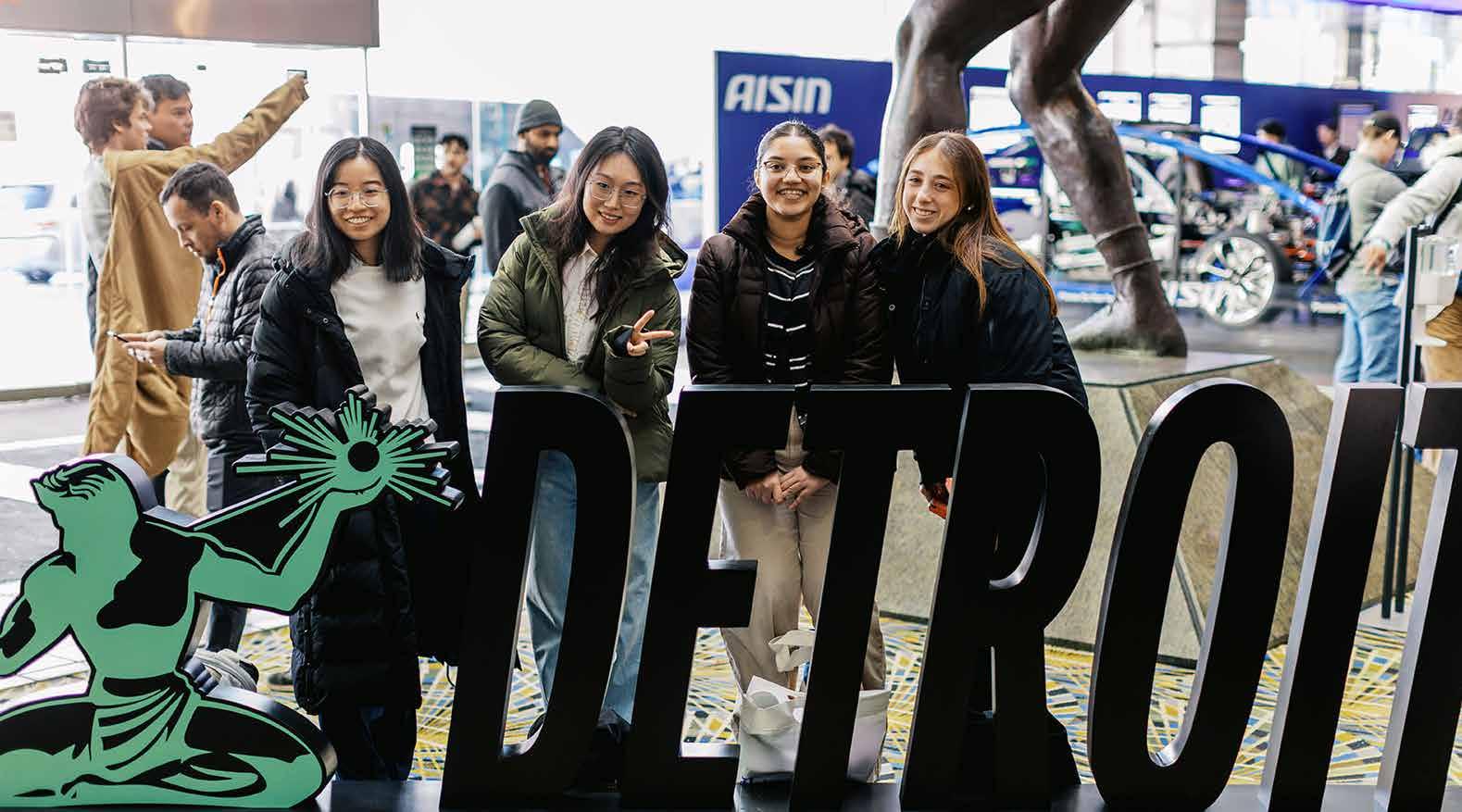
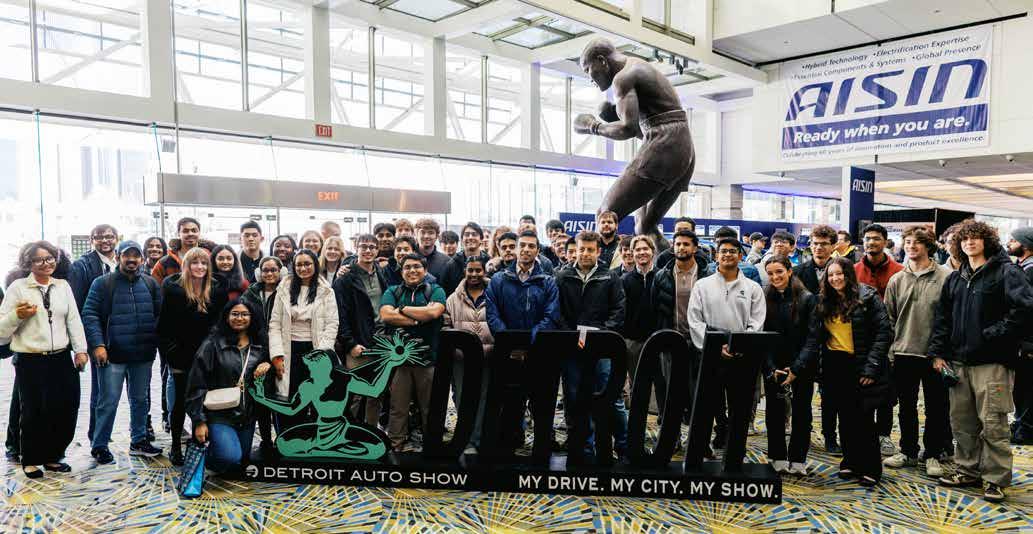
ESD hosted students at the Auto Show Industry Preview Day in January.
ESD SUSTAINING AND CORPORATE MEMBER ORGANIZATIONS
AECOM Hunt
AKT Peerless Environmental Services
Alberici Constructors, Inc.
American Cancer Society
American Society of Employers
Arcadis
AUCH Construction
Barr Engineering
The Bartech Group
Barton Malow Family of Companies
Central Michigan University
The Christman Company
Chrysan Industries
Civil & Environmental Consultants
Clark Hill, PLC
Construction Association of Michigan
Cornerstone Environmental , a Tetra Tech Co.
CPCII
Dale Prentice Company
Dearborn Mid-West Company
DENSO International America, Inc.
Detroit Metro Convention & Visitors Bureau
DTE Energy
DTE Energy Gas Operations
Dürr Systems, Inc.
Eastern Michigan University
Electro-Matic Ventures, Inc.
Energy Sciences
Executive Energy Services, LLC
Farbman Group
FEV
Financial One, Inc.
FirstMerit Foundation
Fishman Stewart PLLC
Frank Rewold & Sons
Fusion Welding Solutions
Gala & Associates, Inc.
GHD
General Dynamics
General Motors Company
Ghafari Associates, LLC
Global Auto Mobility
GLOBAL Automation Technologies
GZA GeoEnvironmental, Inc.
HED
Havel an EMCOR Company
Hubbell, Roth & Clark, Inc.
IBI
Ideal Contracting
Innovative Engineered Solutions, Inc.
JNE Consulting
Kettering University
Knovalent, Inc.
Kostal North America
Lake Superior State University
Lansing Board of Water and Light
Lawrence Technological University
LIFT
Limbach Company, Inc.
Link Engineering Co.
LTI Information Technology
Macomb Community College
Maner, Costerisan & Ellis, PC
MEDA Engineering & Technical Services
Metro Engineering Solutions
Michigan State University
Michigan Technological University
Midwest Steel Inc.
Neumann/Smith Architecture
Newman Consulting Group, LLC
NexTech Professional Services
NorthStar Clean Energy
Northern Industrial Manufacturing Corp.
NTH Consultants, Ltd.
Oakland University
Original Equipment Suppliers Association
R.L. Coolsaet Construction Co.
ROWE Professional Services Company
Rumford Industrial Group
Ruby+Associates, Inc.
Saginaw Valley State University
Savills Detroit
SMS Group of Companies
Stellantis
Step Up Recruiting, LLC
System Strategy, Inc.
Testing Engineers & Consultants
Tetra Tech
ThermalNetics
Troy Chamber of Commerce
Universal Compressed Air
University of Detroit Mercy
University of Michigan
University of Michigan-Dearborn
Vital Tech Solutions, LLC
Wade-Trim
Walbridge
Wayne State University
The Whiting Turner Contracting Company
WSP USA
ZF Group
MEMBER BENEFIT PARTNER:
tech century
V.31
I N.1 Spring 2026
20700 Civic Center Drive, Suite 450 • Southfield, MI 48076 248–353–0735 • 248–353–0736 fax • esd@esd.org • esd.org
TECHNOLOGY CENTURY® EDITORIAL BOARD
CHAIR: Karyn Stickel, Hubbell, Roth & Clark
Utpal Dutta, PhD, FESD, University of Detroit Mercy
Richard, Hill, PhD, University of Detroit Mercy
William A. Moylan, Jr., PhD, PMP, FESD, Retired, Eastern Michigan University
Janice K. Means, PE, LEED AP, FESD, FASHRAE, Retired, Lawrence Technological University
Olivia Racette, Endo Pharmaceuticals
Herschel Rogers, Ghafari Associates
Matt Roush, Retired, Lawrence Technological University
Rajiv Shah, PE, ACSCM
Michael Stewart, Fishman Stewart Intellectual Property
Cyrill Weems, Burns & McDonnell
Yang Zhao, PhD, Wayne State University
ESD BOARD OF DIRECTORS
PRESIDENT: Robert A. Richard, DTE Gas
VICE PRESIDENT: Marc Hudson, Hum Internet
TREASURER: Alex F. Ivanikiw, AIA, LEED AP, FESD, OAC Advisers, LLC
SECRETARY: Robert Magee, The Engineering Society of Detroit
PAST PRESIDENT: Kirk T. Steudle, PE, FESD, Steudle Executive Group
Paul C. Ajegba, PE, FESD, Infrastructure Engineering, Inc.
Carla Bailo, FESD, ECOS Consulting, LLC
Katherine M. Banicki, FESD, Testing Engineers and Consultants
Michael Bassier, Stellantis
Jeffrey L. Baxa, Barton Malow Company
Mike Boss, Dürr Systems, Inc.
Louay Chamra, PhD, Oakland University
Sean P. Conway
Peter Ghafari, Ghafari Associates
Dan Milot, ZF Group
Claude Molinari, Visit Detroit
Scott Penrod, Walbridge
Sergio Pujols, DENSO International America, Inc.
Trevor Sherts, Ford Motor Company
Kristen M. Siemen
Jasmine L. Sisson, PE, FESD, WSP USA Inc.
Karen A. Thole, PhD, University of Michigan
Shawn Verlinden, AUCH Construction
Terry J. Woychowski, FESD, Caresoft Global
TECHNOLOGY CENTURY STAFF
PUBLISHER: Robert Magee, ESD Executive Director
MANAGING EDITOR: Nick Mason, ESD Director of Operations
Hello to all of our TechCentury readers. We thank you for your continued support of this publication, and we extend our appreciation to the sponsor of this issue, the Michigan Department of Transportation. We hope you enjoy their feature article.
The theme of this issue is The Future of the Great Lakes and Freshwater Engineering . As the Great Lakes state, Michigan is inextricably tied to the Great Lakes system and relies on the lakes for commerce, transportation, recreation, and economic development throughout the state. Because of these ties, Michigan often takes a leading role in water resource engineering, climate-resilient infrastructure, and Great Lakes innovation.
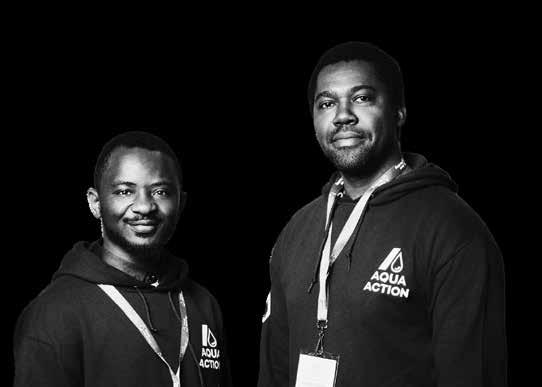
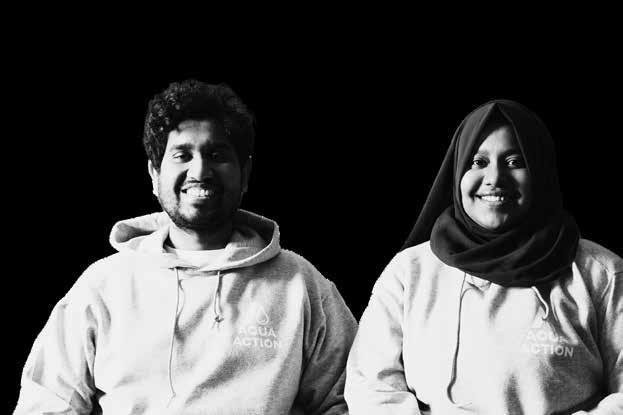
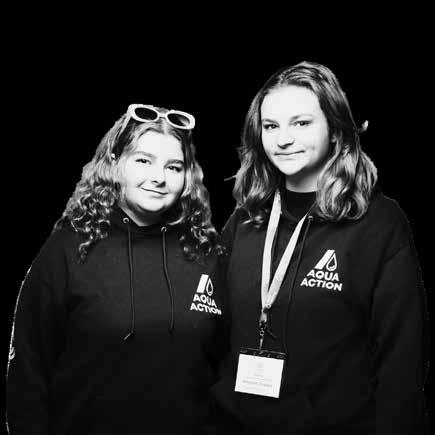
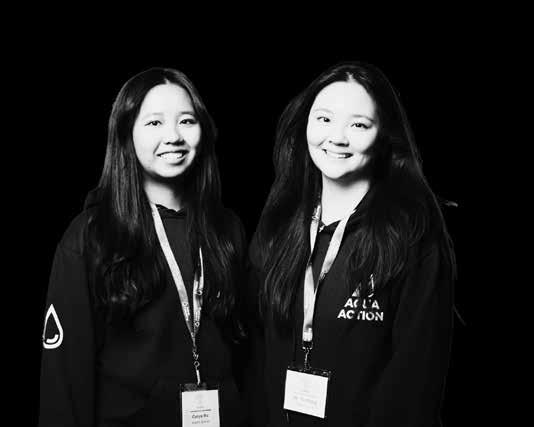
This issue includes articles on water initiatives at Michigan universities, including Michigan Technological University’s Great Lakes Research Center. We also feature Aqua Action and the Urban Tech Exchange and their work in water and sustainability.
You won’t want to miss articles highlighting climate resiliency, including a feature from SEMCOG, the Southeast Michigan Council of Governments.
You can help support TechCentury —while gaining valuable industry and business exposure— by sponsoring and advertising in future editions. Your support allows us to continue providing high-quality content to our readers and gives you the opportunity to share your expertise with more than 20,000 engineers and technical leaders across Michigan.
Building the Next Generation of Great Lakes Leadership Through Collaboration
Water infrastructure is foundational to Michigan’s future—supporting public health, economic growth, environmental stewardship, and global trade. As weather patterns intensify and infrastructure systems age, the responsibility to protect and modernize the Great Lakes increasingly rests with engineers who understand both the scale of the challenge and the opportunity for innovation.
This Spring issue of TechCentury explores The Future of the Great Lakes, showcasing Michigan’s leadership in water resource engineering, climate-resilient infrastructure, and integrated systems thinking. These stories reflect the kind of multidisciplinary, solutionsoriented engineering that the Engineering Society of Detroit exists to advance.
Collaboration is essential. ESD’s partnership with DTE Energy exemplifies how industry leadership can accelerate progress through sustained investment in
infrastructure modernization, a strong commitment to environmental responsibility, and active support of Michigan’s engineering workforce. DTE’s focus on resilient systems, long-term planning, and talent development reinforces the critical connection between water, energy, and community reliability. Together, ESD and DTE work to elevate engineering excellence, foster emerging talent, and encourage collaboration across sectors.
This issue’s features—from MDOT’s workforce recruitment efforts and university-led water research to low-impact design, green infrastructure, and the Soo Locks’ role in global trade—highlight how engineering decisions made today will shape Michigan’s resilience for decades to come.
At ESD and DTE, we believe leadership means convening expertise, supporting innovation, and preparing the next generation of engineers to steward the Great Lakes responsibly. The future of our water depends on it.
Bob Richard
President, The Engineering Society of Detroit President and Chief Operating Officer, DTE Gas, DTE Energy
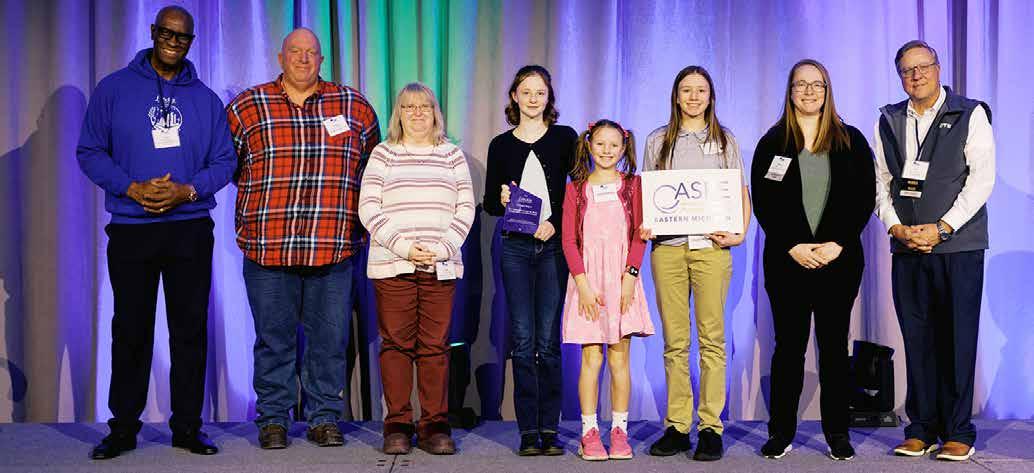
A team from DeWitt Middle School won the Most Innovative Design for Water Conservation and Reuse Award, sponsored by the American Society of Plumbing Engineers, Eastern Michigan Chapter at ESD’s Future City Competition in January. The DTE Foundation is a presenting sponsor of the competition. ESD Executive Director Robert Magee is pictured at the far left, and ESD President Bob Richard is at the far right; between them are the Dewitt team with their teachers and engineer mentor. This is collaboration at work.
JKL Bahweting Anisnabe Academy Takes the Win!
BY MATT ROUSH
team from Michigan’s Upper Peninsula won the 31st edition of the Michigan Regional Future City Competition, hosted by The Engineering Society of Detroit (ESD), an annual celebration of science, engineering, creativity, and future-forward thinking to design and build a scale model of a city at least 100 years from now.
AFor the third year in a row, the team from the Joseph K. Lumsden Bahweting Anishnabe Academy in Sault Ste. Marie was the winner with its Future City, called Tkaranto.
Future City begins with a fundamental question: How can we make the world a better place? This year’s theme, Farm to Table, challenges students to design a futuristic city that eliminates food waste by creating innovative, sustainable systems for producing, distributing, and consuming food, ensuring citizens remain healthy and safe. Teams must engineer solutions for everything from futuristic farms (like regenerative agriculture) to wastereducing food distribution, reimagining the entire food system to be circular and resourceful. Teams build a scale model of their city, write an essay about their city, and make a seven-minute presentation about their city to a panel of judges.
Thirty-five teams comprised of hundreds of middle
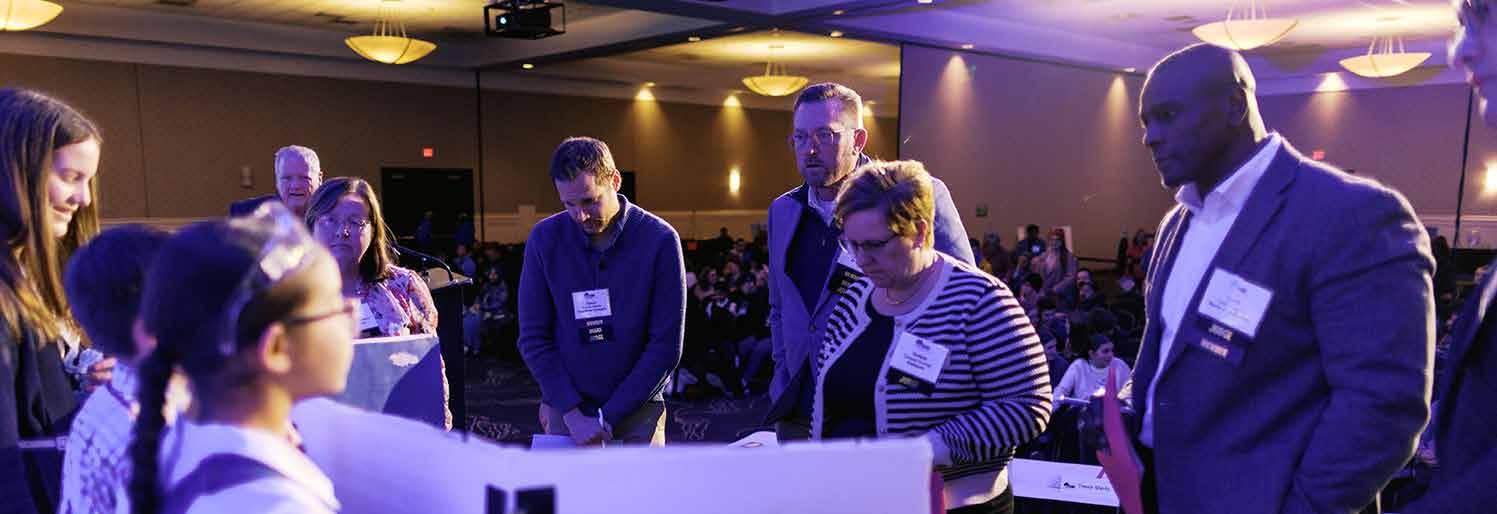
school students competed for first place in the event, held in the Vibe Credit Union Showplace in Novi. Students made presentations on city models built of recycled materials to a panel of esteemed judges, comprised of professionals from engineering, architecture, and urban planning.
The Tkaranto team advanced to the National Future City Finals in Washington, D.C.
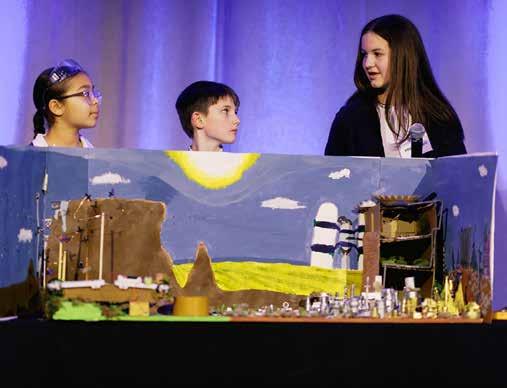
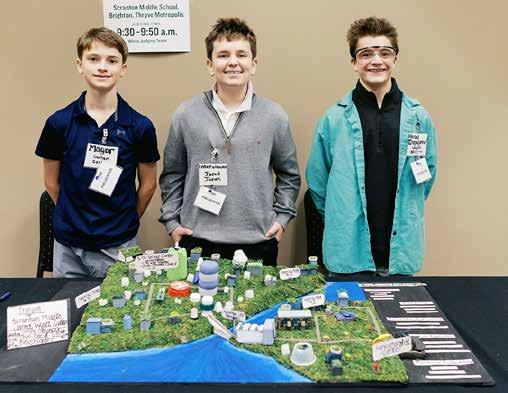
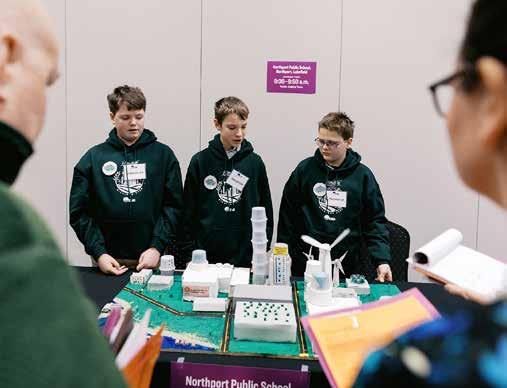
Second place in the event went to Team Sorpresa from Pierce Middle School in Grosse Pointe Park, while third went to Team Thryve Metropolis from Scranton Middle School in Brighton . Fourth place went to the AgriTown team from AGBU Alex & Marie Manoogian School, Southfield , and fifth place was the Lakefield team from Northport Public School, Northport.
More than 30 special awards were also awarded by sponsors that included engineering companies, technical societies, and higher education institutions.
Future City was created to inspire middle school students in STEM, involving them in designing sustainable future cities through a hands-on competition.
For information on how to become part of building a Future City, or to volunteer as a mentor or judge, visit esd.org/futurecity, or contact program manager Allison Marrs at amarrs@esd.org or (248) 353-0735, ext. 121.
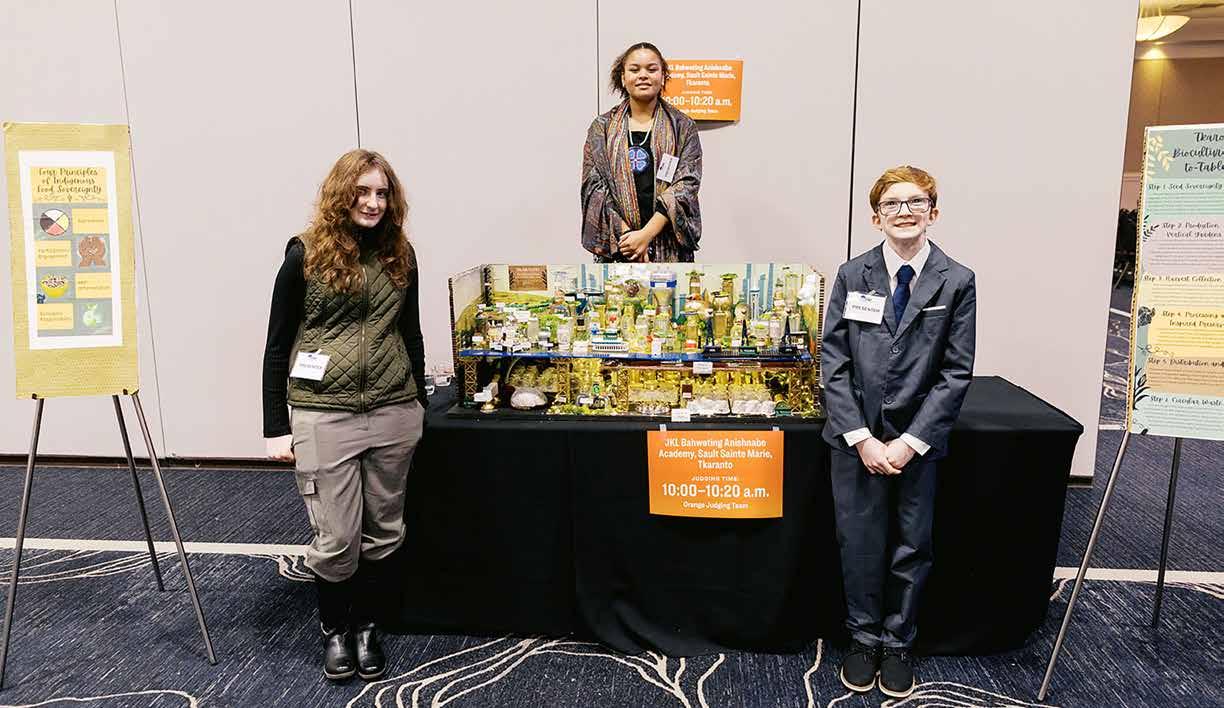
The winning team from JKL Bahweting
Anishnabe Academy in Sault Ste. Marie
The third place team from Scranton Middle School in Brighton present their city, Thryve Metropolis.
The second place team from Pierce Middle School from Grosse Pointe Park presenting their model city, Sorpresa.
The fifth place team (and Rookie of the Year winner) from Northport Public School in Northport with their city, Lakefield.
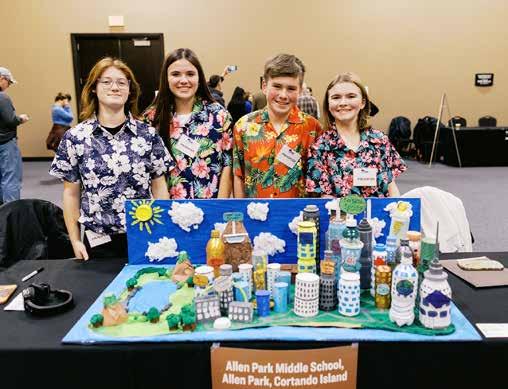
One of the teams from Allen Park Middle School with their city, Cortando Island.
The fourth place team from AGBU Alex & Marie Manoogian School in Southfield with their city AgriTown and their teacher and mentor.
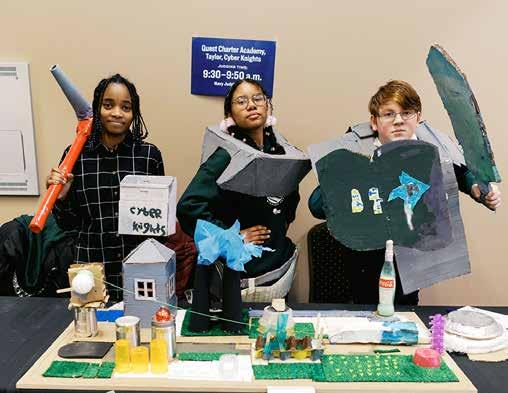
The Cyber Knights team from Quest Charter Academy in Taylor won the Most Innovative Moving Part award.
2026 FUTURE CITY SPECIAL AWARD SPONSORS AND WINNERS
Thank you to our award sponsors, listed in italics. Awards with no sponsor listed were sponsored by The Engineering Society of Detroit.
BEST COMMUNICATION SYSTEM AWARD
Society of Women Engineers, Detroit Professional Section
Scranton Middle School, Brighton – Genesis City team
BEST ENGINEERED PROJECT AWARD
NTH Consultants
Beagle Middle School, Grand Ledge – Ecoterra team
BEST ESSAY AWARD
LEO Michigan Labor and Economic Opportunity
JKL Bahweting Anishnabe Academy, Sault Ste. Marie – Tkaranto team
BEST INTEGRATED DESIGN AWARD
Sidock Group
Comstock STEM Academy, Kalamazoo – Terra Vitae team
BEST LAND SURVEYING PRACTICES AWARD
National Council of Examiners for Engineering and Surveying
Scranton Middle School, Brighton – Thryve Metropolis team
BEST USE OF ALTERNATIVE OR RENEWABLE FUELS AWARD
Dürr Systems, Inc.
Michigan Islamic Academy, Ann Arbor – Islamate team
BEST USE OF ENERGY AWARD
DTE Energy Foundation
Bryant Middle School, Dearborn – FoodFans team
BEST USE OF GREEN PRINCIPLES AWARD
U.S. Green Building Council – Michigan
Northport Public School, Northport – Kahaluu-Keauhou team
BEST USE OF MATERIALS AWARD
ASM International, Detroit Chapter
AGBU Alex & Marie Manoogian, Southfield – AgriTown team
BEST WASTE MANAGEMENT AND RECYCLING AWARD
East Michigan Air & Waste Management Association & WM
Pierce Middle School, Grosse Pointe Park – Sorpresa team
BUILDING WITH THE AMERICAN SPIRIT: PEOPLE, PROJECTS, COMMUNITIES AWARD
Barton Malow Company
Bates Academy, Detroit – Zooropia Hills team
DON BRAMLETT ACHIEVEMENT AWARD
IEEE Southeast Michigan Chapter
JKL Bahweting Anishnabe Academy, Sault Sainte Marie – Tkaranto team
ENERGY PROBLEM SOLVERS AWARD
TC Energy
Comstock STEM Academy, Kalamazoo – Terra Vitae team
ENERGY RESILIENCE AWARD
Enbridge
Scranton Middle School, Brighton – Genesis City team
ENGINEERING DESIGN PROCESS AWARD
Detroit Country Day School, Beverly Hills – Solaria team
EXCELLENCE IN INNOVATION AND TECHNOLOGY AWARD
Burns & McDonnell
Scranton Middle School, Brighton – Quantum Harvest team
HERBERT W. LINK VISIONARY AWARD
Link Engineering Company
Bryant Middle School, Dearborn – FoodFans team
INCORPORATION OF PLASTIC MATERIALS AWARD
Society of Plastics Engineers, Detroit Section
Allen Park Middle School, Allen Park – Ceres City team
INNOVATIVE MOVING PART AWARD
Quest Charter Academy, Taylor – Cyber Knights team
INNOVATIVE SUSTAINABILITY AWARD
University of Detroit Mercy
Harper Creek Middle School, Battle Creek – Iron Star team
INNOVATIVE USE OF MATERIALS AWARD
TWB
Pierce Middle School, Grosse Pointe Park – Sorpresa team
MOST INNOVATIVE DESIGN FOR WATER CONSERVATION AND REUSE AWARD
American Society of Plumbing Engineers, Eastern Michigan Chapter
DeWitt Middle School, DeWitt – Demeterra team
MOST LIVABLE CITY AWARD
Bates Academy, Detroit – Magnus City team
MOST TEAM SPIRIT AWARD
Allen Park Middle School, Allen Park – Cortando Island team
MULTIMODAL EXCELLENCE AWARD
WTS (Women’s Transportation Seminar)
Michigan Islamic Academy, Ann Arbor – Islamate team
OUTSTANDING FOOD PACKAGING AWARD
Bryant Middle School, Dearborn – Emerald City team
PEOPLE’S CHOICE AWARD
Allen Park Middle School, Allen Park – Poseidonia team
OUTSTANDING PROJECT MANAGEMENT AWARD
Project Management Institute Educational Foundation
AGBU Alex & Marie Manoogian, Southfield – AgriTown team
RECREATIONAL SPACES AWARD
Bates Academy, Detroit – Wham City team
ROOKIE TEAM OF THE YEAR AWARD
Northport Public School, Northport – Lakefield team
SMART FARMING SOLUTIONS AWARD
Scranton Middle School, Brighton – Los Ecos team
SUSTAINABLE CITY AWARD
Ideal Contracting
JKL Bahweting Anishnabe Academy, Sault Ste. Marie – Tkaranto team
TEAM COLLABORATION AWARD
Scranton Middle School, Brighton – Thryve Metropolis team
TRANSPORTATION INFRASTRUCTURE AWARD
MDOT Michigan Department of Transportation
Pierce Middle School, Grosse Pointe Park – Sorpresa team
URBAN FARMING DESIGN AWARD
Allen Park Middle School, Allen Park – Nazione Irrigua team
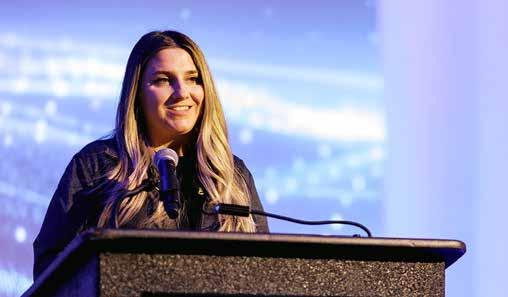
ESD President Bob Richard from DTE Energy.
Special thanks to our judges who evaluated the top three teams: Peter Ghafari from Ghafari Associates, Teresa Hodder from Stellantis, Renee Lounsberry, LEED AP B D+C, from Walbridge, Dan Milot from ZF Group, Trevor Sherts from Ford Motor Company, and Cyrill Weems from Burns & McDonnell.
Detroit Chapter
Michigan Detroit
Sponsor Kirstie Staelens from Enbridge.
ESD Hosts Students at Auto Show Industry Preview
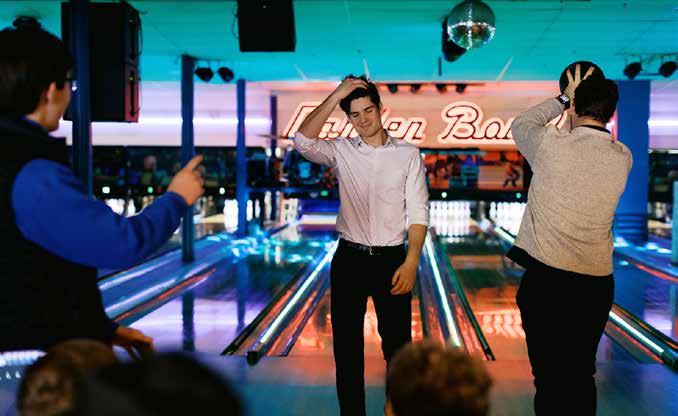
ESD hosted 300 students from Michigan universities at the 2026 Detroit Auto Show’s Industry Preview Day as part of the Future Leaders Forum on January 15. The Fulkerson Group sponsored the sold-out event.
Students got an early look at the Auto Show, where they gained expo -
sure to emerging vehicle technologies, electrification, and mobility innovation. At the show, students were able to connect with the companies and industry leaders shaping Michigan’s automotive sector.
Following the show, the group went to Rock N Bowl on Woodward in
Detroit, for pizza, bowling, and informal networking time.
The event was offered at no cost to students. The Future Leaders Forum is designed to connect Michigan engineering students with industry and support the state’s mobility talent pipeline. Students in ESD Student Chapters at the following universities were invited to attend:
Central Michigan University
Eastern Michigan University
Grand Valley State University
Kettering University
Lake Superior State University
Lawrence Technological University
Michigan State University
Michigan Technological University
Oakland University
Saginaw Valley State University
University of Detroit Mercy
University of Michigan—Ann Arbor
University of Michigan—Dearborn
University of Michigan—Flint
Wayne State University
Western Michigan University
Engineering students from MSU at the Auto Show Industry Preview Day.
After the Auto Show, students went to Rock N Bowl for bowling, pizza, and networking.
SOLID WASTE TECHNICAL CONFERENCE
March 3 & 4, 2026
Celebrating 35 years, the Solid Waste Technical Conference focuses on cutting-edge technological innovations and solutions related to the solid waste industry. The conference brings together national experts to explore the latest technological breakthroughs, regulatory changes and future trends for the industry. A post-conference training day is also planned.
Sponsored by ESD and the Michigan Waste and Recycling Association, the conference will be held at the Kellogg Hotel & Conference Center in East Lansing. Sponsorships are available. For more information or to register to attend, visit esd.org, or contact Leslie Smith, CMP, at lsmith@esd.org or 248-3530735, ext. 152.
ENGINEERS GET HIRED JOB FAIR
March 12, 2026
Employers: Exhibit space is available for those looking to hire. Meet in person with engineering and tech professionals, college students and recent graduates eager to find their next opportunity.
Job Seekers: Whether you are a seasoned professional, a recent graduate, or an in-between careers job seeker, you’ll find your next position at ESD’s job fair. Employers will be recruiting for full and part-time positions, as well as internships and co-ops.
The job fair will be held at the Vibe Credit Union Showplace in Novi from 2-7 p.m. For more information on exhibiting or attending, visit esd.org or contact Leslie Smith, CMP, at 248353-0735, ext. 152, or lsmith@esd.org.
GOLD AWARD RECEPTION & RECOGNITION
March 18, 2026
Join ESD’s Affiliated Technical Societies as we come together to honor and recognize engineers, scientists and technical professionals whose leadership and service have made a lasting impact within their respective Societies.
Hosted by ESD and its Affiliate Council, the event will feature a presentation by the 2026 Gold Award honoree, Michael Vinarcik, PE, FESD , nominated by the International Council on Systems Engineering – Michigan Chapter. The Ann O. Fletcher Award for Distinguished Service will be presented to Roy H. Link, FESD
The event will take place at ESD Headquarters in Southfield. For more information or to register, visit esd.org or contact Elana Shelef at eshelef@esd.org or 248-353-0735, ext. 119.
New Engineering Futures Series BOCCE WITH THE BOARD
March 26, 2026
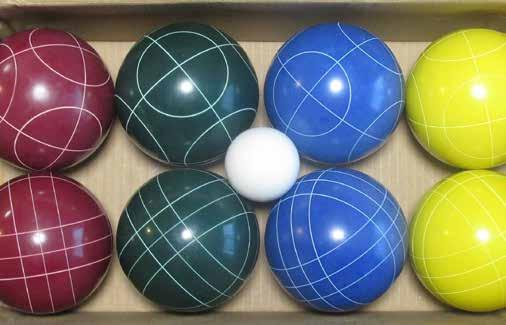
ESD’s new Engineering Futures Series: Talks, Workshops & Tours for Modern Professionals offers a dynamic lineup of educational talks, hand-on workshops and exclusive tours designed to spotlight the latest trends and innovations shaping the industry. Join us in March for Bocce with the Board—an exclusive evening of networking, camaraderie, and friendly competition. With limited spots available, attendees will have the unique opportunity to connect with peers and members of the ESD Board while enjoying a lively game of bocce ball.
The event will be held at the Palazzo di Bocce in Lake Orion. Sponsorship packages are available, but limited, so secure your spot today. For more information and to register, visit esd.org or contact Leslie Smith, CMP, at lsmith@esd.org or 248-353-0735, ext. 152.
SELFRIDGE MILITARY AIR MUSEUM TOUR
—
Hosted by ESD and SAE
April 24, 2026
Discover the fascinating world of aviation with a guided tour of the Selfridge Military Air Museum in Harrison Township. Explore indoor exhibits, the new Aviation Education Center, and the impressive outdoor Air Park, featuring full-scale aircraft from multiple branches of the U.S. military. This experience offers a rare opportunity to explore aviation history and engineering up close. ESD members can register online at esd.org or call 248-353-0735 to register by phone. For more info, contact Elana Shelef at 248-353-0735, ext. 119 or eshelef@esd.org. SAE members can register at SAE.org.
MICHIGAN ENERGY EFFICIENCY CONFERENCE AND EXHIBITION — Hosted
by
DTE and ESD
May 5, 2026
Now in its 27th year, this premier event is designed to educate small to large commercial and industrial businesses on technology, products, and services that will assist them in successful energy management. New this year – a revamped program experience!
The conference will take place at the Vibe Credit Union Showplace in Novi and will include a morning general session with speakers, educational tracks and dozens of exhibitors offering energy-related products and services. Back by popular demand, live product demonstrations will be showcased in the exhibit hall.
For more information or to register online, visit esd.org or call 248-353-0735 to register by phone.
Interested in sponsoring or exhibiting? Contact Leslie Smith, CMP, at lsmith@esd.org or 248-353-0735, ext. 152.
ESD ANNUAL GOLF OUTING
June 1, 2026
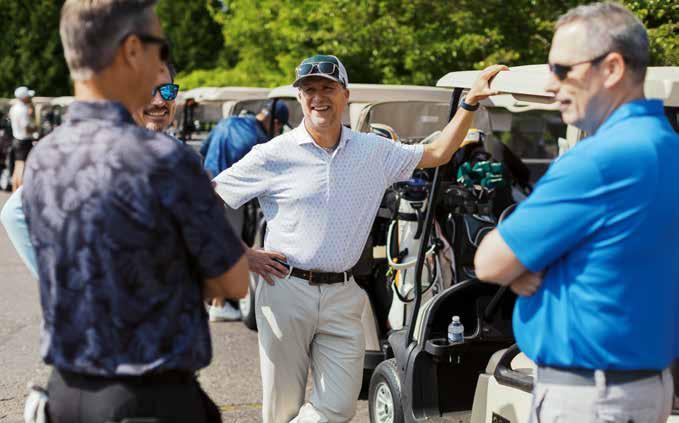
Dust off your clubs and get ready for sunshine, great company, and a day on the course! ESD’s 15th Annual Golf Outing returns to Oak Pointe Country Club in Brighton for a day filled with golf, networking, and fun with colleagues and friends. Your participation helps support ESD’s outreach and educational programs, making a lasting impact on the future of engineering. Sponsorship are available. Visit esd.org or contact Heather Lilley by email at hlilley@esd.org or 248-353-0735, ext. 120.
ESD ANNUAL DINNER
Late June
A celebration to honor impressive accomplishments and applaud great achievements as we pay tribute to the best, brightest, and most diverse group of engineering, design, and construction professionals in Southeast Michigan. The event will feature ESD’s Construction & Design Awards and Annual Awards. Visit esd.org for more information. (Date and location not available at time of magazine printing.)
ESD AFFILIATE COUNCIL MEETINGS
Third Wednesday of Each Month
Made up of representatives from more than 90 technical societies, ESD established the Affiliate Council to encourage cross-society cooperation and communication.
Meetings typically include a technical prese ntation, and the topics change every month. ESD members are invited to attend.
Meetings are currently being held at ESD Headquarters along with an online option, from 6 –7 p.m. the third Wednesday of each month.
For more information or to register, contact Elana Shelef at eshelef@esd.org or 248-3530735, ext. 119.
We honor the lives and contributions of ESD members who have recently passed away.
IN MEMORIAM
GEORGE C. SCHUMACHER
Retired, TRW Automotive Senior Manager CAE/NVH, Lucas Varity Light Brake Systems Member since 1995
RACHEL GUTIERREZ PROMOTED AT IDEAL CONTRACTING
Ideal Contracting has promoted Rachel Gutierrez to Director of Marketing. In her expanded role, she will lead strategic marketing initiatives, strengthen brand presence, and elevate internal and external communications while supporting employee engagement and community outreach. Gutierrez has spent more than eleven years within the Ideal family of companies, contributing across multiple roles and helping shape the company’s brand identity and visibility. Gutierrez serves on the boards of the ACE Mentor Program of Southeast Michigan and SMPS Southeast Michigan.
HUBBELL, ROTH & CLARK, INC. APPOINTS NEW BOARD MEMBER
Hubbell, Roth & Clark, Inc. (HRC) appointed Brian K. Davies, PE , to its Board of Directors. Davies, who joined HRC in 2009, now serves as Principal and Vice President/ Partner. With more than 20 years of experience in civil and transportation engineering, he has led major projects involving roads, bridges, utilities, stormwater systems, ADA upgrades, and construction management. He also oversees HRC’s mentoring program and career development initiatives for young engineers. Headquartered in Bloomfield Hills with eight locations statewide, HRC specializes in municipal engineering, transportation, water, and wastewater systems.
DTE ENERGY AWARDS 2025 EMERGING TECHNOLOGY FUND GRANTS
Geotechnical Engineering Design
Pile Dynamic Analysis (PDA)
Geotechnical Instrumentation
Vibration Monitoring
BARTON MALOW’S GABE RODRIGUEZ NAMED TO CRAIN’S 40 UNDER 40
DTE Energy has announced the 2025 recipients of its Emerging Technology Fund. Yvette Johnson , DTE vice president of Electric Sales & Marketing, said the fund demonstrates how publicprivate partnerships can advance mobility and grid resilience. It helps innovators bring affordable charging solutions to communities while supporting Michigan’s leadership in transportation electrification. This year’s awardees include Volt Harbor, EV Energy, Voltpost, it’s electric, Forth Mobility, and Metro Consulting Associates at the Grosse Ile Airport.
Gabe Rodriguez , Vice President of Strategy + Environmental Analysis at Barton Malow, has been named to Crain’s Detroit Business “40 Under 40” Class of 2025. Rodriguez joined the company in 2023, bringing more than a decade of experience in economic development, consulting, and strategic analysis. Rodriguez has built a strong reputation for anticipating emerging trends.
FISHMAN STEWART COO
Fishman Stewart PLLC has appointed Brian T. Corby as the firm’s first Chief Operating Officer as it approaches its 30th anniversary in 2026. Corby brings 35 years of law-firm administration experience, including nearly two decades as COO for a major Detroit-area criminal defense firm. Corby holds a degree in political science from Wayne State University.
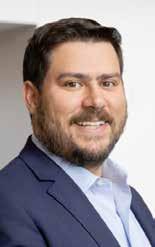
Brian Corby
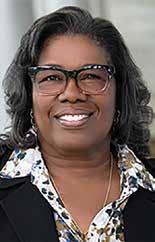
Rachel Gutierrez
Yvette Johnson
Gabe Rodriguez
Brian Davies
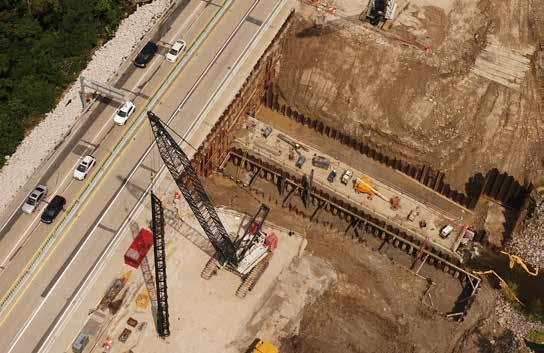
At G2, our goal is simple: Deliver Smart. Results. Fast. G2’s geotechnical engineering services maximize support for your structure while collecting real-time data to minimize interruptions during construction.
2025 ESD Writing Contest WINNERS
The Engineering Society of Detroit is pleased to announce the winners of the seventh annual ESD Engineering Student Writing Contest.
Launched in 2018, the contest was created to promote and elevate student voices while encouraging thoughtful dialogue about the evolving engineering profession. The competition is open to engineering students enrolled at Michigan universities across all engineering and related disciplines. The top three essays for 2025 are featured below.
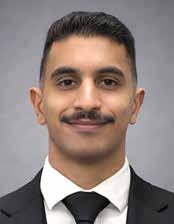
This year’s top award-winning essay was written by Hamad Sheer, a computer engineering student at Lawrence Technological University. Hamad will receive a $1,000 scholarship, generously sponsored by Fishman Stewart, and will be recognized at the 2025 Gold Award Reception.
We thank all students who entered this year’s contest and commend them for their insight, creativity, and commitment to the field of engineering. Please enjoy reading the top three essays from these promising future engineers.
The themes for next year’s competition will be announced in the summer and will have a fall deadline. For more information on the contest please visit esd.org or email Susan Thwing at sthwing@esd.org.
THANK YOU TO OUR SPONSOR:
ESD WRITING CONTEST
FIRST PLACE
HAMAD SHEER is a computer engineering student at Lawrence Technological University who graduated in Fall 2025 and authored the top-ranked essay in the 2025 ESD Engineering Student Writing Contest.
Hamad wrote about Technology Through Time: “Select an emerging technology from a past era (20+ years ago) and explain how it paved the way for progress in today’s engineering landscape. What was the innovation, and what lasting impact has it had?”
The Microprocessor Revolution: A Past Innovation that
Paved the Way for Today’s Engineers
The microprocessor emerged as a groundbreaking innovation that transformed not only computing but also the broader discipline of engineering.
Introduced in the early 1970s and rapidly evolving through the 1980s and 1990s, the microprocessor condensed a room-sized computer’s logic onto a single integrated circuit. Although many technologies from that era shaped modern society, few match the microprocessor in lasting influence. Its introduction marked the moment when computing shifted from specialized machines used by governments and large corporations to accessible, scalable tools embedded in everyday life.
Today’s engineering landscape, from artificial intelligence and robotics to healthcare devices and sustainable infrastructure, rests on the foundational breakthroughs of microprocessor technology. By examining the microprocessor as an emerging technology of its time, it becomes clear how it paved the way for contemporary progress and still shapes innovation across numerous disciplines with consistent, transformative impact.
The original microprocessors of the 1970s represented a radical shift in how engineers approached problemsolving. Before their introduction, computers relied on racks of vacuum tubes or transistors, making them enormous, fragile, and energy-intensive. The microprocessor integrated thousands of transistors into a single silicon chip, making computation faster, more efficient, and dramatically more compact.
Early processors such as Intel’s 4004 and 8080 were primitive by today’s standards, but they marked the beginning of programmable, general-purpose computing
at a small scale. Engineers quickly recognized that these chips could be embedded into a wide range of devices rather than existing only in standalone computers. This idea, that computation could be distributed and built into other systems, has defined the next fifty years of technological progress in surprising and powerful ways that continue to evolve.
As microprocessors improved through the 1980s and 1990s, they enabled the development of personal computers, which reshaped both engineering education and research. Before microprocessors, only large institutions had access to computers; afterward, students and engineers could run simulations, automate calculations, and design digital systems from their own desktops. This democratization of computing power accelerated innovation across fields. Mechanical engineers could model stress patterns in materials, electrical engineers could design circuits digitally, and civil engineers could use early CAD programs to plan infrastructure with greater precision. The microprocessor changed not only devices but also the mind-set and workflow of engineers, laying the groundwork for the digital methodologies that dominate the field today.
The microprocessor also paved the way for embedded systems, one of the most important engineering developments of the last twenty years. Embedded systems are specialized computing units built into machines ranging from automobiles to medical devices to industrial robots. Without early microprocessors proving that complex logic could be compact and reliable, modern embedded systems would not exist. Today, cars contain dozens of microprocessors coordinating everything from fuel optimization to crash-avoidance systems. Biomedical devices such as pacemakers and insulin pumps rely on embedded processors to monitor and respond to patient needs in real time. Even renewable energy systems, like solar inverters and smart grids, use microprocessors to manage power flows efficiently and consistently across varying environmental conditions.
Another lasting impact of microprocessor innovation is the rise of modern software engineering. Writing programs for small, reusable processors encouraged the development of high-level languages, compilers, and operating systems. As microprocessors grew more powerful, software became increasingly modular and scalable. The smartphone revolution of the mid-2000s was only possible because software engineers could develop sophisticated applications for processors millions of times more powerful than the early 4004. Today’s breakthroughs in artificial intelligence similarly rely on advanced processors such as GPUs and specialized accelerators, which inherit principles, parallel processing, integration, and programmability originating from the earliest microprocessor designs.
Finally, the microprocessor’s lasting impact extends to the global economy and the broader culture of engineering innovation. Microprocessors fueled the rise of Silicon Valley and helped create industries centered around digital communication, automation, and cloud computing. They enabled engineers to design devices that connect people, gather data from remote sensors, and respond instantly to complex inputs. Even emerging technologies such as autonomous vehicles, smart cities, and the Internet of Things are direct descendants of early microprocessor breakthroughs that reshaped expectations for speed and reliability.
The microprocessor is among the most influential emerging technologies of the past half-century. What began as a compact silicon chip became the foundation for personal computing, embedded systems, modern software engineering, and the digital infrastructure that defines the twenty-first century. Its innovation reshaped the engineering landscape by making computation accessible, efficient, and ubiquitous, creating the path on which nearly all modern technological advancements now travel with remarkable continuity and expanding possibility.
ESD WRITING CONTEST RUNNER
UP
CORDELIA SORRELLE, a native of Wyoming, Michigan, is a biomedical engineering student at the University of Michigan with an anticipated graduation date of May 2029. Cordelia wrote about Mentorship, Motivation and the Future of STEAM: “What advice would you give to future engineers, including younger students or peers, about pursuing a career in engineering or a STEAM-related field? Reflect on your own journey and how you would inspire the next generation.”
Mentorship, Motivation and the Future of STEAM
I have always wanted to be an engineer. As a kid, I was obsessed with knowing how things work and how they are put together. However determined, this curiosity could not always be satisfied. I often ran into the problem of not having the resources to fulfill my desire to learn.
First lesson in problem-solving: how do I obtain this crucial information as a kid in the inner city? I visited libraries, read books on topics that interested me, and talked
about them—a lot. My mom used to say I was an eighty-yearold stuck in an eight-year-old’s body. I attempted to spark intellectual conversations with my family and peers, with varying degrees of success. I understood from a young age that I could learn from others.
Every great project has a team of incredible minds behind it. Whether it’s learning from teachers at school or sharing opinions and ideas with friends, we can all learn from each other. It is essential to listen to others and hear different perspectives from all kinds of people. This skill will translate into your future in STEAM. To solve problems and make the world a better place, we all have to work together and use our differences to move the world forward.
Growing up, I was (and still am) interested in many things. Too many, some would say. Whether it was art, math, science, or dance, I always gave one hundred percent. I love creating and performance, just as much as I love problem-solving and learning about new topics. I could see myself in so many different professions and career paths. So, when I decided to come to the University of Michigan to study biomedical engineering, how did I know this was the perfect match? Honestly, I still don’t know. I do know that some of my biggest passions lie in the health sector, innovation, and helping others. Biomedical engineering encompasses all three. What I get to study is so interesting to me, but I feel I could be happy doing a lot of things.
You don’t have to know your exact path right now, and it’s perfectly fine to change directions when something else inspires you. Now is the time to explore your passions and see that your options are limitless. I am excited to delve into the biomedical field more over the next few years and see how I can make a difference in people’s lives.
Throughout my education, I have realized that a career in engineering is hard. I’ve spent many nights cramming for exams, doing practice problems, and writing lab reports.
At times, it has been difficult to manage. It is a harsh reality, and I don’t expect it to get easier. In times of struggle, I try to look at the bright side. I feel so lucky to have the chance to do something I love and to learn and grow.
A professor and dear friend of mine once said, “This is not meant to break you, but to stretch you.” I think of this in moments when I feel as though I am breaking. Looking back on such experiences, I realize I always come out stronger and learn something new about myself. Doing hard things isn’t bad; in fact, it’s the opposite. Pushing yourself to become the best version of yourself is the only way to grow as an individual. However, as I say this, I want to give a reminder that it is imperative to take care of yourself and take breaks as needed. Mental health is a vital part of your well-being, and seeking the support or resources you need is just as important as any goal you pursue.
The last note I want to leave is that you have to believe in yourself because that is half the battle. If you do not
believe in yourself, how do you expect anyone to believe in you? Follow your passions and your determination to success, whatever that looks like for you. It might sound cliché, but in the end, do what makes you happy. That is the most important thing.
ESD WRITING CONTEST RUNNER UP
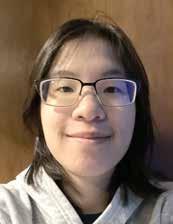
JAMIE HUNG, from Troy, Michigan, is an electrical engineering student at the University of Michigan and is expected to graduate in May 2029. Jamie also wrote about Mentorship, Motivation and the Future of STEAM
Mentorship, Motivation and the Future of STEAM
As an aspiring engineer, I’ve come to cherish certain insights about being an engineer that I would like to share with both younger students and peers:
COMMUNITY
Since the beginning of high school, I have volunteered for Habitat for Humanity, where one of my most memorable experiences with them was the Rock the Block event. Among the various teams that were tasked with embellishing and improving a Farmington neighborhood, my family and I were part of the landscaping team that helped an elderly lady clean out her lawn, where endless shrubs and vicious weeds invaded her home.
That day, I had the good fortune to witness other volunteers help build a ramp for a lady with a wheelchair, and still more good Samaritans painting another house. Ever since then, I’ve acquired a deeper sense of community; however, it was until much later that I began to reflect on the direct relationship between a sense of community and being an engineer.
What I’ve realized is as follows: spotting problems in the world is essential to being an engineer; however, the excessive use of this skill could undermine the journey of finding solutions. To counter this, a community warmly directs an engineer’s attention to a part of the impairment while maintaining their sense of wonder and appreciation for the other parts of the world. Hence, I would like to advise my fellow and soon-to-be engineering students to find their own communities because communities are their compasses for orienting the various knowledge
AQUAHACKING BINATIONAL
GREAT LAKES AND ST LAWRENCE
and skills they’ve acquired. At its core, engineering is a discipline distinctly human-oriented, because true engineering solutions are the ones genuinely applicable to human lives. Thus, it is only by finding a group of people that you care about, can you pay sufficient attention to that community’s problems and create solutions that better their lives. Sometimes, even if your engineering solution only solves one person’s problem, that is enough because what you consider to be simple could make a whole lot of difference—after all, it is not the complexity of a solution that matters, but its usefulness for the people you care about.
EXPLORATION
In the summer of 2023, I participated in the University of Michigan’s Coding program for high schoolers. At first, I was a bit doubtful of the online program; however, I quickly learned to appreciate the clear, step by step instructions of the course, the real-life application of what we learned, the full accessibility of many student teaching assistants, as well as the consolidation of all enrolled students’ questions for each section along with specific answers in addressing these issues. Not only did this experience make that summer a true joy; it also solidified my decision to become a U of M student.
I think most experiences come across as doubtful at first because of their inherent uncertainty, but just like
without my Joy of Coding experience, I wouldn’t be able to ascertain the characteristics of a U of M education— without different and perhaps initially skeptical experiences, people won’t be able to make judgments for themselves. More importantly, without your own judgments, you would hardly be a qualifying engineer, where you must constantly make decisions and cultivate the courage to stand behind them. When you start or have started your pursuit of becoming an engineer, I imagine that you are at a stage in life where you’ve come to increasingly appreciate your independence from the world; however, individualism doesn’t come from wishful desires but develops over time from each experience of making judgments for yourself. This is because judgments, including the ones outside of the discipline of engineering, are the marks you make in the world that carry values closest to your heart and express what is essential to you.
For those who aspire to be engineers, it’s invigorating to know that what I believe engineering can cultivate in a person—that of belonging in a community and a sense of exploration—is aligned with a way of life that focuses on discovering the potential of each human being. In my journey of becoming an engineer, I’ve come to realize that engineering is so much more than mere technical skills (although they’re important, too); engineering as a discipline is very likely to transform you into a better, more humane, and curious individual.
THE FUTURE IS NOW
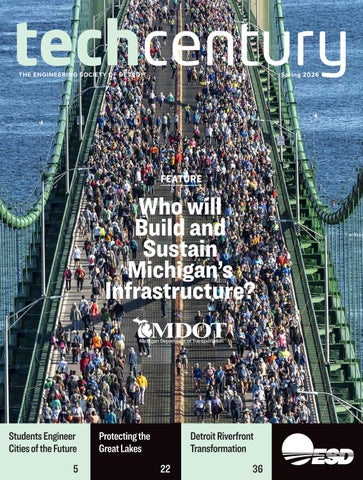
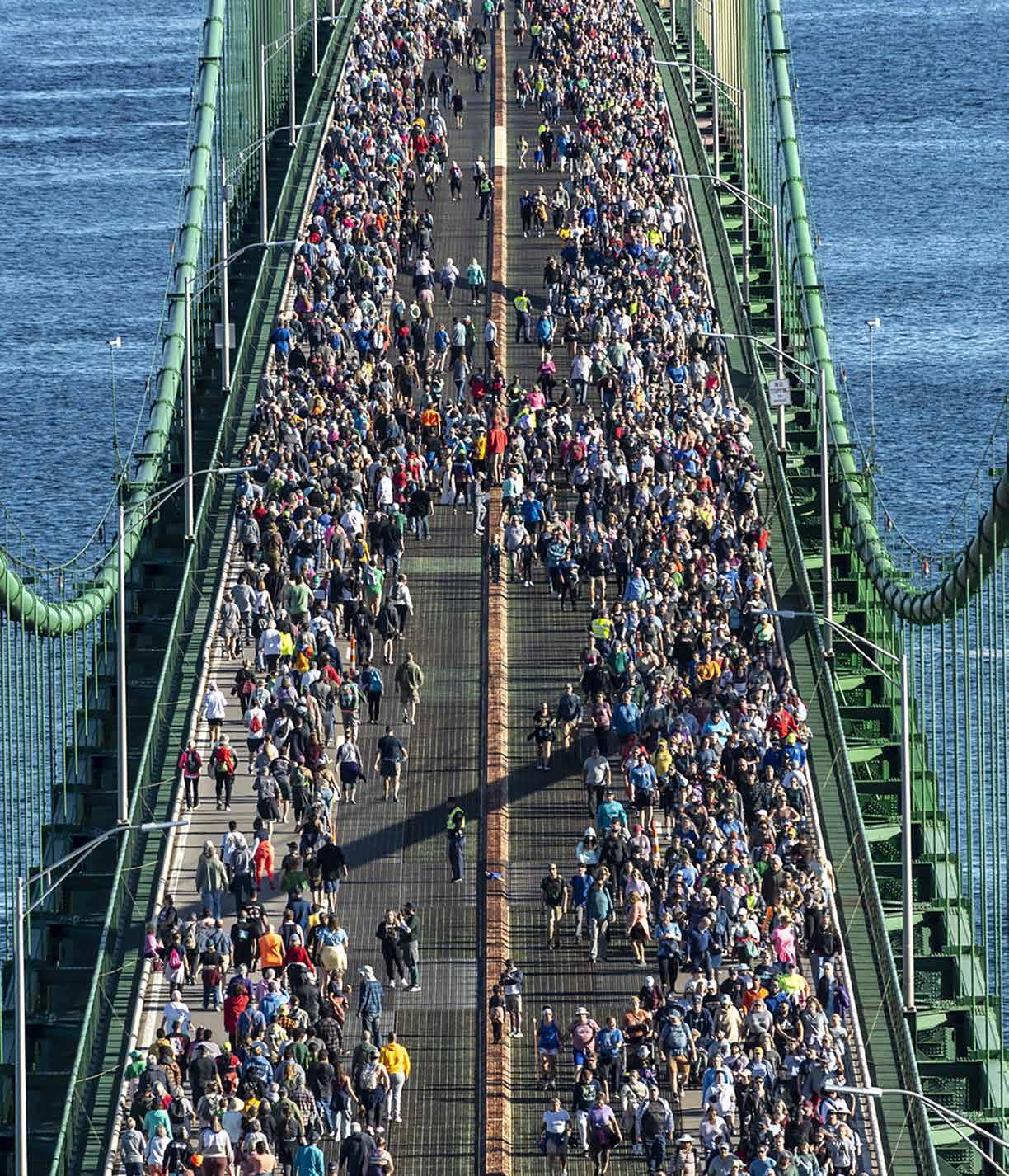
Who Will Build and Sustain Michigan’s Infrastructure?
MICHIGAN’S INFRASTRUCTURE MOMENT AND ITS HIDDEN RISK
Michigan is investing in transportation infrastructure at historic levels. Roads, bridges, transit systems and freight corridors are being modernized to drive economic growth, improve safety and strengthen resilience. Yet beneath this momentum lies a risk that funding alone cannot solve.
Michigan does not have a capital problem. It has a workforce opportunity.
Over the next decade, the state’s ability to plan, deliver, operate and maintain infrastructure will depend on whether talent pipelines keep pace with investment. Without engineers, technicians, planners, inspectors and leaders ready to step forward, projects slow, costs rise and institutional knowledge erodes.
This challenge is not cyclical. It is structural.
According to Lightcast’s Demographic Drought research, declining birth rates, accelerating retirements and lower labor force participation are converging to shrink the available workforce nationwide. These forces are longterm and enduring, reshaping how employers must think about talent development.
In Michigan, the impact is already visible.
Transportation-critical occupations are experiencing sustained shortages, where projected annual openings
far exceed the number of degrees awarded statewide. Surveyors, civil engineers and civil engineering technicians sit at the center of this gap, roles essential to project delivery and system stewardship.
The implication is clear: workforce development must now be treated as core infrastructure.
THE WORKFORCE REALITY
What Changed After the Pandemic
T he pandemic did not create Michigan’s workforce challenges but it did accelerate them.
First, retirements became permanent. Many experienced professionals exited earlier than planned, taking decades of institutional knowledge with them. Second, career expectations shifted. Emerging professionals now seek purpose, growth, flexibility and visible pathways, not just job titles. Third, competition intensified. Engineering firms, utilities, technology companies and public agencies are recruiting from the same shrinking talent pool.
These pressures show up first in delivery and operations, where experience, licensure and professional judgment cannot be rushed. Planning and capital investment mean little if organizations lack the capacity to execute.
“If we build faster than we develop people, the system eventually breaks.”
— James Fults, MDOT
Workforce Development as Infrastructure
A PERSPECTIVE FROM JAMES FULTS, WORKFORCE PROGRAMS AND RECRUITMENT SECTION MANAGER, MDOT
At the Michigan Department of Transportation (MDOT), workforce develo pment is no longer adjacent to the mission; it is embedded within it.
In 2020, MDOT established the Workforce Programs and Recruitment Section (WPRS) within the Office of Organizational Development to strengthen long-standing efforts through intentional, data-informed strategy. The goal was alignment: connecting labor market intelligence, education pipeline data and internal workforce analytics to real operational needs.
Since then, MDOT has advanced a coordinated portfolio that includes early exposure initiatives, internships and experiential learning, technician and engineering pathways, veteran transitions, recruitment modernization and continuous upskilling.
The lesson is simple: workforce strategy must move at the same pace as infrastructure investment.
FROM EXPOSURE TO PREPAREDNESS
Early
Exposure:
Where
the Pipeline Begins A PERSPECTIVE FROM LAURA BENSINGER, WORKFORCE PROGRAMS MANAGER, MDOT
At a recent Construction Science Expo, students were asked what transportation careers they knew. Most could name only road construction.
That moment revealed the challenge. Transportation is not a primary pillar of career exposure in traditional education. Many students discover it only through family connections, mentorship or chance.
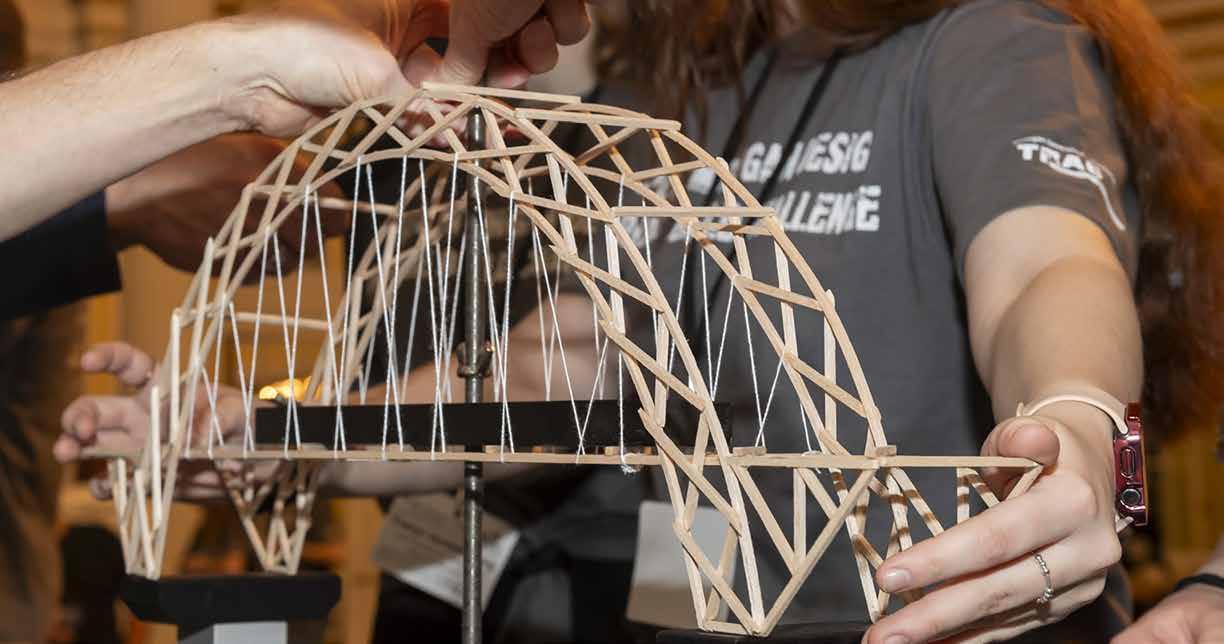
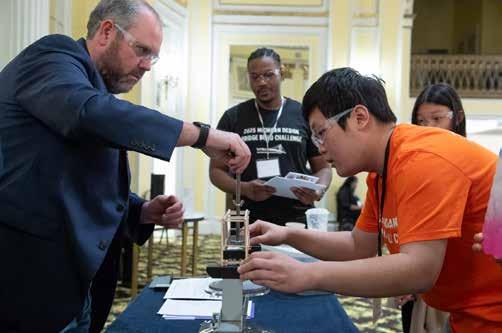
Programs like the MDOT Bridge Challenge change that trajectory. They show students how math, science and technology connect to real systems and help them see themselves as future engineers and problem-solvers. They also allow students to seeing themselves as taking an active role in building their future infrastructure.
Since the early 2000s, MDOT’s STEM outreach has impacted more than 100,000 students, while the Bridge Challenge alone has engaged 10,000-plus students statewide. At the 2025 competition, a senior shared how the experience led him to pursue civil engineering at Michigan State University, urging peers to consider their role in building Michigan’s future.
Without an early introduction, the pipeline does not narrow, it disappears.
MDOT Bridge Challenge
Clear Pathways Replace Guesswork
A PERSPECTIVE FROM NATHAN HANSELMAN, CAREER PATHWAYS PROGRAM COORDINATOR, MDOT
Traditional education often assumes students will figure out their careers along the way. Many do not.
The Transportation Career Pathways Program (TCPP) exists to replace uncertainty with clarity. Students explore three specific pathways in a skilled trades approach. The program outlines the education, credentials and experiences required for each.
Through career fairs, school partnerships, pathway materials and a hands-on summer workforce program, students gain real-world experience working alongside MDOT professionals on active projects.
Success is not just placement. It is informed decisionmaking and sustained engagement.
PREPARATION, RETENTION AND PURPOSE
Industry Preparedness and Upskilling
A PERSPECTIVE FROM JAMES JACKSON, TRANSPORTATION DEVELOPMENT AND RECRUITMENT PROGRAM (TDRP) COORDINATOR, MDOT
Today’s challenge is not whether talent exists, it is whether talent is ready. Industry preparedness requires earlier immersion in applied environments, stronger alignment between education and practice, and structured transitions from student to professional. Internships and experiential learning are no longer optional; they are the new front door to the profession.
At the same time, upskilling must become cultural. Transportation engineering is evolving rapidly, through digital delivery, asset management, sustainability and emerging technologies. Organizations that invest in continuous learning retain talent longer and lead more effectively.
People stay where they grow.
Recruitment Modernization: Making Public Service Aspirational
Public service has an image problem it did not earn but must now actively address. Transportation engineering in the public sector is not slow or secondary. It is impactdriven, interdisciplinary and consequential. It offers stability with purpose, leadership without volatility and the opportunity to shape communities on a scale. There are a great number of opportunities for stable careers in transportation engineering and infrastructure.
This is not a fallback career. It is a front-line profession.
A student in ESD’s Girls in Engineering Academy learns about MDOT Workforce Programs.
Veterans as a Leadership Pipeline A PERSPECTIVE FROM MELVIN “JAY” DURNELL, VETERANS COORDINATOR, MDOT
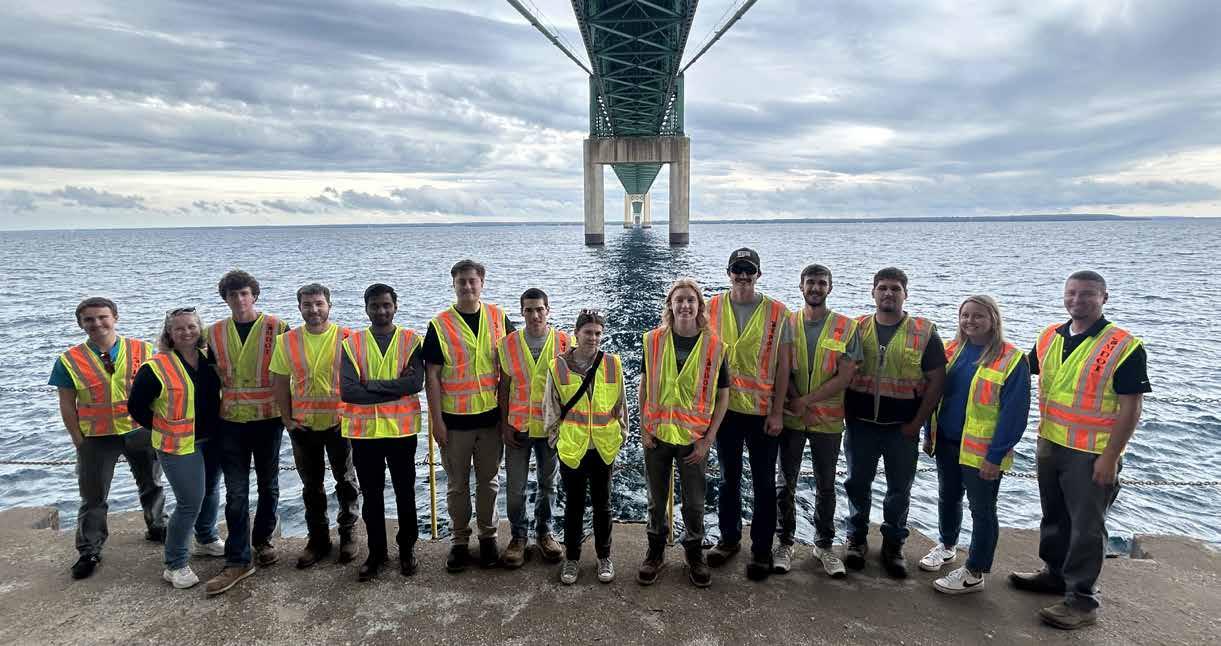
Since 2008, MDOT’s Veteran Internship Program has supported service members transitioning into civilian careers. The program is fully funded by the Federal Highway Administration (FHWA), which covers the cost of the two-year, paid internship.
The program provides hands-on work aligned with veterans’ military skills and experience, along with mentorship and professional development. Participants gain real-world experience in transportation, engineering, planning, maintenance and administrative roles. They also learn how to navigate the civilian and state government workplace.
The goal is to create a clear bridge to long-term employment. Interns strengthen their résumés, build professional networks and develop pathways to full-time careers at MDOT or in related fields.
Since 2019, the program has achieved a 76 percent placement rate. MDOT has also been recognized as a GoldLevel Veteran-Friendly Employer for 10 consecutive years.
Veterans bring leadership, discipline and systems thinking—strengths that directly support the state’s transportation system.
A COLLECTIVE CALL TO ACTION
While these efforts are critical, no single organization can solve Michigan’s workforce challenge alone. That is why MDOT, in partnership with the Michigan Department of Labor and Economic Opportunity (LEO) and the American Council of Engineering Companies of Michigan (ACEC Michigan), is launching the state’s first Transportation Infrastructure Employer Collaborative , an employerled, data-driven initiative focused on long-term talent sustainability.
The collaboration begins with strengthening the engineering and technician pipeline and expands toward shared solutions for shared workforce risk.
Organizations interested in joining are encouraged to contact: Amy Kraatz , Talent Development Liaison, Michigan LEO, at KraatzA@Michigan.gov.
The future of Michigan’s infrastructure will not be defined by what we fund. It will be defined by who is prepared to build and sustain it.
Join MDOT, LEO, and ACEC Michigan in the Transportation Infrastructure Employer Collaborative.
Two Hubs, One Mission: Protecting the Great Lakes
Across Michigan’s university landscape, two powerhouse hubs are shaping the future of the Great Lakes. In Houghton, Michigan Technological University’s Great Lakes Research Center serves as a hands-on freshwater innovation lab, where scientists and engineers study everything from winter limnology to under-ice robotics. At the University of Michigan and Michigan State, Michigan Sea Grant translates cutting-edge research into community action—supporting coastal resilience, fisheries, harbors, and policy. Together, these Michigan university centers demonstrate how academic research, engineering, and community partnerships are building a more resilient future for the world’s largest freshwater system.
BY SUSAN THWING
O Inside Michigan Tech’s Great Lakes Research Center
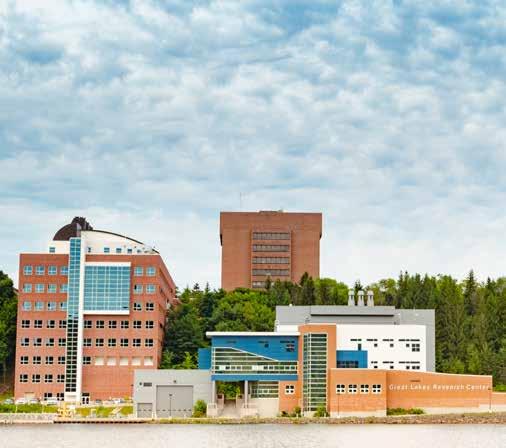
n the edge of Michigan Technological University’s campus in Houghton, the Great Lakes Research Center (GLRC) feels less like a traditional academic building and more like a launch pad. Research vessels tie up just outside on the Keweenaw Waterway, under-ice robots and autonomous subsurface vehicles are prepped for deployment, and teams of biologists, engineers, chemists, and computer scientists move between wet labs, control rooms, and classrooms.
The mission: to understand, protect, and engineer the future of the Great Lakes at a moment when the stakes have never been higher.
“We are blessed by having an abundance of water, and that’s going to make us an attractive place as water availability changes across the landscape,” says Amy Marcarelli, professor of biological sciences and director of GLRC’s Ecosystem Science Center. “Being poised to think about the opportunities and challenges that arise from that is something that is really pressing in Michigan.”
At GLRC, that preparation happens on multiple fronts: from climate and coastal resilience to winter limnology, emerging contaminants, and the engineering tools needed to monitor a system that is both vast and vulnerable.
A DYNAMIC SYSTEM UNDER MULTIPLE STRESSORS
Marcarelli is quick to dispel the notion that there is a single “biggest threat” to the Great Lakes.
“If it were one threat, it would be easy to address,” she said. “In most cases, and the Great Lakes are no exception, there are many different interacting stresses happening at the same time. These include invasive species, nutrient loading, harmful algal blooms, increasing storm frequency, and shoreline erosion. The real challenges come when those things interact and amplify each other.”
Understanding those interactions across scales— physical, chemical, biological, social—is a central challenge
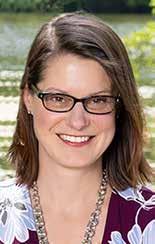
Amy Marcarelli
for GLRC researchers. Climate change is reshaping everything from water temperatures and ice cover to disease dynamics and infrastructure performance. At the same time, population growth and development patterns are shifting toward water-rich regions like the Great Lakes.
“We’re in a dynamic time,” Marcarelli said. “We need continuity of information so we can make the big decisions that need to be made.”
That continuity depends on monitoring systems, modeling tools, and collaborative teams that can keep pace with a changing lake system, and that’s where GLRC’s engineering strength comes in.
THE LAKES AS BUFFER—AND WARNING SYSTEM
For Hayden Henderson, Senior Research Engineer, Assistant Director of the Center for Environmental Engineering, Sensing, and Integrated Modeling, one of the most important realities of the Great Lakes is also one of the least understood outside scientific circles.
“One of the eye-opening stats about the Great Lakes is that we have more miles of shoreline than the contiguous 48 Atlantic and Pacific coasts combined,” Henderson said. “Where do people interact with water? At the shoreline. So we almost have this concentration in proximity to water that the oceans can’t even compete with.”
That shoreline, he stresses, is where the impacts of climate change will be felt most acutely, through flooding, erosion, infrastructure strain, and shifting ecosystems.
Henderson also describes the Great Lakes as a kind of regional climate “buffer,” but he’s careful to unpack what that really means.
“The heat capacity of water is massive,” he said. “As climate change is occurring, the Great Lakes are going to absorb a lot of that thermal regime. We don’t experience changes in air temperature as abruptly as somewhere like Nebraska because of our proximity to the lakes. That
GREAT LAKES
sounds nice when you say it, but buffer means they’re being impacted. They’re suffering for our benefit, whether that’s temperature or other things.”
Meanwhile, water quality issues are evolving faster than many systems can react. “We’re still figuring out how to treat PFAS—that’s been decades in the making,” Henderson noted. “We haven’t even begun to fully turn our attention to pharmaceuticals and other emerging contaminants in our water supply.”
HIGH-TECH EYES ON A CHANGING FRESHWATER WORLD
To anticipate and adapt to these changes, GLRC is investing in advanced observing systems and modeling tools. Henderson leads several multi-year projects funded through NOAA’s Great Lakes programs, including one that is measuring CO 2 flux at the water surface at high resolution—effectively, ‘acidification research’ for the Great Lakes.
“You hear a lot about the oceans acidifying,” he said. “We really don’t know what that looks like for the Great Lakes, and the reality is that it means different things at different times of year for different lakes.”
Part of the challenge is that we often talk about “the Great Lakes” as if they were a single entity. Henderson argues for a more nuanced view.
“Lake Superior could not be more different than Lake Erie, from a biological perspective, a physical perspective, everything,” he said. “I’d argue we should talk about Upper Great Lakes and Lower Great Lakes. Population density, stressors, even the kinds of infrastructure issues you see are vastly different.”
Another of Henderson’s projects focuses on realtime coastal water level data and erosion concerns, in which they are developing high-frequency, highresolution coastal water level monitoring systems that give communities and engineers better tools to design resilient shorelines and plan for extreme events such as seiches and storm surges.
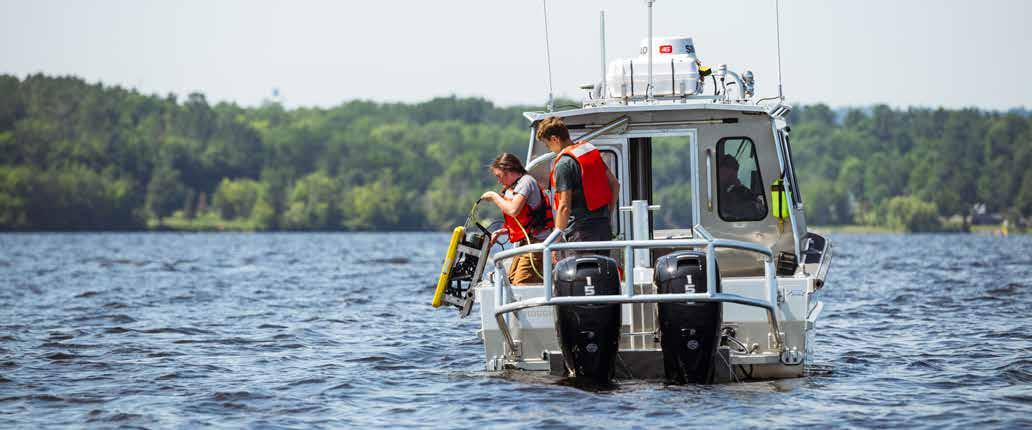
These engineering efforts are supported by GLRC’s fleet: surface vessels such as the RV Agassiz and RV Soliton, monitoring buoys, and a subsurface fleet that includes remotely operated vehicles (ROVs) and autonomous underwater vehicles (AUVs). Together, they enable researchers to capture sonar images, deploy sensors, and sample under ice across seasons and at scales that match the complexity of the lakes themselves.
WINTER AS A LIVING LABORATORY
While many people think of Great Lakes research as a summer endeavor, GLRC treats winter as a critical window and a time historically underserved by scientific data but increasingly important as the climate warms and ice regimes shift.
The Great Lakes Research Center in Houghton.
Hayden Henderson
“One of the areas where I think we’ve been really at the forefront in the GLRC community is trying to understand winter conditions,” Marcarelli said. She points to work led by colleagues such as Trista VickMajors and others in the biological sciences. “They’ve been characterizing winter ecological and chemical dynamics across the Great Lakes, and there have been increased coordinated sampling efforts.”
Michigan Tech’s location—with consistent snowpack and ice cover right outside the center’s doors—makes it an ideal testbed. Researchers deploy instruments under ice, develop technology for cold-region operations, and even extend their findings to Arctic applications.
“The same group doing winter sampling also has a DoD-funded project to understand how ice-dwelling bacteria might help the U.S. military operate in cold conditions,” Marcarelli explained. “We do a lot at this interface of biotechnology and environmental research.”
POWER FROM BROWN WATER AND OTHER CROSSDISCIPLINARY SOLUTIONS
Marcarelli’s own work highlights GLRC’s deeply interdisciplinary approach. One of her major projects asks a deceptively simple question: Can the organic matter that turns rivers and lakes “brown” be used as a power source?
“We’re trying to understand how organic matter in the water column, the stuff that makes water look brown, can fuel microbial fuel cells to generate power in nearshore environments,” she said. The project brings together teams from GLRC, mechanical engineering, environmental engineering, and biological sciences.
This kind of cross-cutting collaboration is the norm rather than the exception at GLRC. Another major initiative, led by faculty member Pengfei Xue and others, is the DOE-funded Center for Climate-Driven Hazard Adaptation, Resilience, and Mitigation (C-CHARM).
“That group includes PIs from engineering, social sciences, economics, and more,” Marcarelli said. “The goal is to provide solutions to climate-driven challenges facing
rural communities in the Great Lakes, things like extreme storms, flooding, sinkholes, and to translate applied science into actionable strategies that help communities prepare for climate change.”
ADAPTING, NOT JUST REACTING
When it comes to climate change, both Henderson and Marcarelli emphasize a dual mission: understanding what’s coming and helping communities adapt.
“I think it’s all of the above,” Henderson said. “You need interdisciplinary teams to make sure the right conversations happen at the right time. Core science can get hyper-focused, and that’s valuable, but bigger teams can point out what you might be overlooking in your excitement about a given topic.”
On the ecology side, Marcarelli sees GLRC’s role less as “stopping” climate change than enabling intelligent adaptation.
“Most of the folks I work with are thinking about how you adapt to it,” she explained. “That could mean assisted migration of tree species, changing forest management strategies for water availability and temperature, or using forest management to influence how much water reaches streams and nearshore zones.”
GLRC researchers also participate in the Northern Institute of Applied Climate Science (NIACS), a multi-university consortium that works directly with landowners, foresters, and communities to translate climate science into practical decisions—whether it’s managing forests, mitigating coastal erosion, or planning local infrastructure.
At its core, the Great Lakes Research Center is as much about people and place as it is about instruments and models.
“One of the things that’s really unique about Michigan Tech is that it’s a STEM school with core strength in engineering, but we also have an amazingly rich community of people across disciplines who care deeply about the environment and about this place,” Marcarelli said.
A Great Lake Research Center crew on one of their vessels.
Michigan Sea Grant Bridges Science, Community, and the Great Lakes
BY SUSAN THWING
Michigan sits at the heart of the world’s most remarkable freshwater system—20 percent of the planet’s usable surface freshwater, more than 3,500 species of plants and animals, and a network of coastal communities whose economies, cultures, and daily lives revolve around the Great Lakes. Stewarding this resource is both a privilege and a profound responsibility, one that Michigan Sea Grant (MISG) has embraced for more than half a century through research, education, community engagement, and multi-sector partnerships that stretch from small harbors to international agencies.
For Silvia Santa Maria Newell, Director of Michigan Sea Grant and Professor in the University of Michigan School for Environment and Sustainability, the next decade represents a critical inflection point—one filled with both urgent challenges and promising momentum.
“The biggest challenge in the next 5–10 years is ensuring that the Great Lakes remain a top priority for investment in research, education, and outreach at both the state and federal levels,” she explained. “The Great Lakes are the beating heart of our region… They support a $5 billion fishery, a $19 billion shipping industry, and millions in coastal tourism. Their ecological and economic importance cannot be overstated.”
Michigan Sea Grant is uniquely positioned to help safeguard this future. As a collaboration between the University of Michigan, Michigan State University Extension, and NOAA’s National Sea Grant College Program, MISG brings together research expertise, engineering innovation, and grassroots outreach. The result is a rare science-to-community pipeline—one that delivers real-world solutions directly to local leaders, educators, and industries who depend on the Great Lakes every day.
COASTAL RESILIENCE IN A CHANGING CLIMATE
As climate change accelerates, Michigan’s shoreline communities are already experiencing the consequences: fluctuating lake levels, high-intensity storms, erosion, flooding, and infrastructure strain. MISG’s proactive work in coastal resilience and stormwater management has become essential.
“Managing unprecedented growth along the Michigan shoreline, revitalizing urban waterfronts, and supporting coastal businesses are all part of our statewide efforts,” Newell said. “We provide education about soft engineering, habitat protection, and restoration so leaders can develop solutions that recognize the ties between a healthy ecosystem and a vital economy.”
One example is the Clean Marina Stormwater Toolkit, a resource designed to help marina owners implement best management practices to filter and manage runoff before it enters the lakes. Another is the Michigan Boating Pumpout Grants Program, which provides funding for marinas to build or upgrade sewage pumpout and dump stations—reducing pollution and improving water quality.
These programs are more than environmental safeguards. They support local tourism, protect fisheries, and strengthen the economic engines that sustain coastal towns.
SMALL HARBORS, BIG IMPACT
Michigan is home to more than 80 public marinas and harbors—critical infrastructure for recreation, shipping, fishing, and local commerce. Yet many small harbors struggle with aging infrastructure, economic shifts, or changing uses.
MISG’s Sustainable Small Harbors (SSH) initiative has become one of the program’s most transformative efforts. By helping communities identify barriers and create revitalization strategies, SSH supports long-term resilience.
“We work with land-use planners, citizens, and local government leaders to help communities revitalize their waterfronts to attract business and enhance quality of
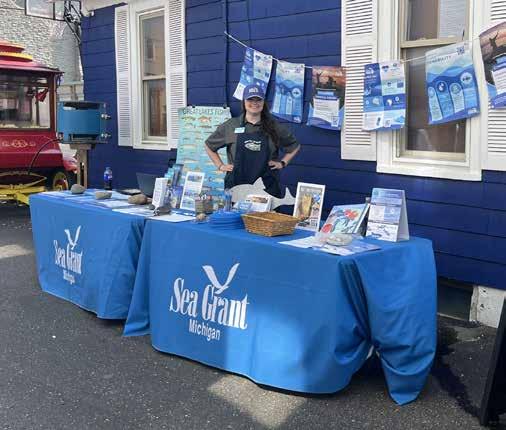
A fish fry at the Michigan capitol 2025
Silvia Santa Maria Newell
life,” Newell said. “We equip leaders with tools to assess and strengthen their waterfront assets.” This approach has produced concrete results: stronger tourism economies, updated master plans, and infrastructure funding aligned with environmental best practices. The model is now being examined as a template for other Great Lakes states.
CONNECTING RESEARCH TO REAL NEEDS
One of MISG’s most distinctive strengths is its Extension network. By placing educators and outreach specialists in Michigan communities, the organization maintains a feedback loop between local needs and research priorities.
“The way we are structured allows us to directly impact communities,” Newell explained. “Extension staff work to understand community needs and ensure the results of our work are delivered in a format they can use.”
For K–12 teachers, the Center for Great Lakes Literacy provides classroom activities, trainings, and connections with other educators across the basin. MISG also co-hosts a summer 4-H camp that immerses youth in hands-on Great Lakes science.
These examples illustrate what Newell emphasizes repeatedly: science is only powerful if people can use it.
DATA AND TOOLS FOR DECISION MAKERS
To help policymakers, engineers, and planners make informed choices, MISG developed a Coastal Resilience Hub—a curated, Michigan-specific portal that sifts through the overwhelming number of climate and infrastructure resources available nationwide.
“The hub gathers best-available resources and contacts for planning, policy, funding, and technical assistance,” Newell said. It allows municipalities—especially small ones without dedicated environmental staff—to access credible, actionable information quickly.
MISG’s research coordination extends beyond state borders. The program helped fund a region-wide sampling event led by Dr. Tristy Vick-Majors and partnered closely
with Canadian agencies and the International Joint Commission (IJC). In 2024, MISG, the IJC, and the Great Lakes Commission launched a new Great Lakes Fellowship for early-career professionals. The inaugural cohort excelled so significantly that their contracts were extended for another year.
“These coordination efforts demonstrate how much we can achieve when we work across boundaries—even across national borders,” Newell noted.
THE NEXT GENERATION OF GREAT LAKES STEWARDS
MISG invests heavily in education at every level—from elementary students to future PhDs.
This model has led to innovative, community-driven projects—from habitat restoration to invasive species management to infrastructure improvement.
A recent example: a Michigan Sea Grant graduate fellow, Dustin Brewer, collaborated with U.S. Fish and Wildlife Service biologists to test whether audio recordings could attract migratory rails to restored wetland areas. The work proved successful and shaped a new MDNR strategy for increasing rail populations.
At the undergraduate level, MISG interns partnered with the Michigan Department of Natural Resources to map user-created trails in state parks along Lake Michigan—information now being used to guide restoration and reduce habitat disturbance.
At the university level, fellowships and internships place students in research labs, state agencies, and field projects.
“All of our funded research includes students,” Newell said. “Many of them go on to become the next generation of researchers and resource managers.”
This continuity, education, research, and practice, creates a pipeline of talent that Michigan’s water-driven industries will depend on in the decades ahead.
A MODEL FOR FRESHWATER STEWARDSHIP
When asked what lessons Michigan’s approach offers to other states, Newell points to broad-based stewardship.
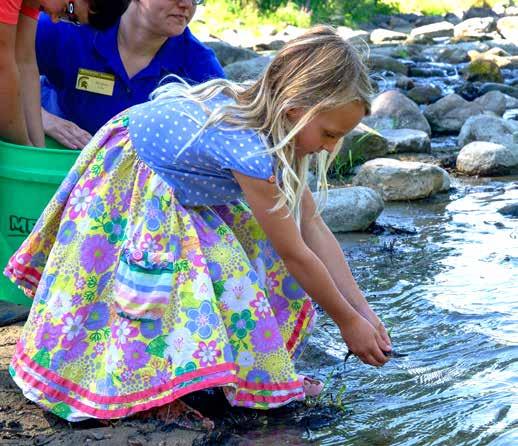
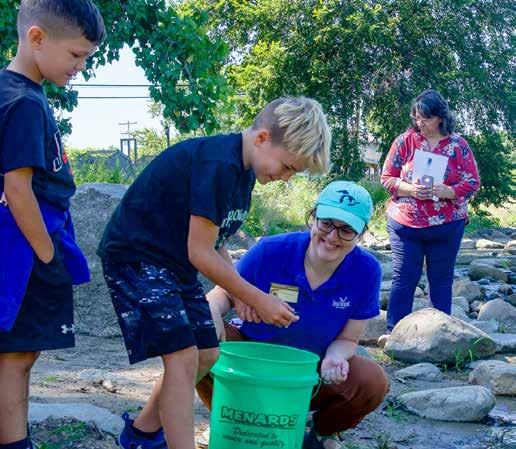
MISG staff helps kids release Lake Sturgeon into Saginaw Bay.
“People here overwhelmingly say they care about protecting the Great Lakes, partly because they feel connected to them through education and recreation,” she said. “We’re working hard to build this stewardship from K–12 students to adult learners to graduate students.”
That connection, rooted in identity as much as in science, is a major reason MISG’s model has become a national benchmark.
A FUTURE BUILT ON PARTNERSHIP AND PURPOSE
Partnerships, Newell stresses, are the core of Michigan Sea Grant’s success. Between 2018 and 2023, MISG collaborated with 86 government entities, 16 industry organizations, 11 Tribal groups, 34 academic institutions, 102 nonprofits, and 10 Sea Grant programs nationwide.
Through these efforts, MISG turned $19 million in state and federal funding into nearly $86 million in direct economic benefits. In 2024 alone, the program generated $10 in value for every $1 in core funding.
“Sea Grant is a national program with real, measurable impacts,” Newell said. “We are proud to be working in so many communities and with so many partners throughout Michigan.”
For a region defined by water, that work is not just valuable—it is indispensable.
Michigan’s University Water and Tech Powerhouses
Great Lakes Research Center and Michigan Sea Grant (highlighted in the previous articles) are part of a much broader network—several other Michigan universities are driving significant freshwater research, technology development, and community-focused innovation across the state.
University of Michigan – Graham Sustainability Institute Water Center & Cooperative Institute for Great Lakes Research (CIGLR)
At U-M, the Graham Sustainability Institute’s Water Center and the Cooperative Institute for Great Lakes Research (CIGLR) pair scientists with agencies to tackle issues like fluctuating lake levels, coastal resilience, and ecosystem health across the basin.
Michigan State University – Institute of Water Research
MSU’s Institute of Water Research develops science-based tools, modeling, and outreach to address water quality, land use, and watershed management challenges in Michigan and the Great Lakes region.
Wayne State University – Healthy Urban Waters
Based in Detroit, Healthy Urban Waters focuses on water in urban settings, linking research on contamination, infrastructure, and public health to restoration and policy solutions along the Rouge and Detroit rivers.
Grand Valley State University – Annis Water Resources Institute (AWRI)
Located on Muskegon Lake, AWRI integrates research, education, and outreach on freshwater ecosystems, operating research vessels and offering robust hands-on opportunities in aquatic science and water quality.
Central Michigan University – Institute for Great Lakes Research (IGLR)
CMU’s IGLR leads multidisciplinary studies of Great Lakes wetlands, nearshore zones, and coastal ecosystems, including immersive fieldwork at its Biological Station on Beaver Island.
Lake Superior State University – Center for Freshwater Research and Education (CFRE)
In Sault Ste. Marie, CFRE combines a teaching hatchery, research labs, and K–12 outreach to advance freshwater science and Great Lakes stewardship on the St. Marys River.
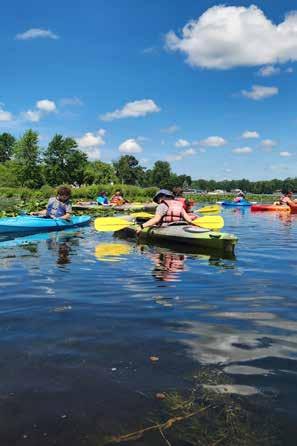
MISG Paddle Stewards Training.
Thinking in Systems: A Primer
BY DONELLA MEADOWS
REVIEW BY ABDUL SALAM ABDUL KARIM
Donella Meadows is a master of clear thinking in Thinking in Systems: A Primer . The book offers a practical framework for understanding complex systems, particularly for engineers, analysts, and decision-makers. Meadows reminds readers that even elegant technical solutions often fail when developed without a proper understanding of system behavior and interactions. Her writing style is straightforward and engaging, grounded in practical examples drawn from a wide range of fields.
Feedback loops, stocks, flows, and leverage points are presented with a level of precision that respects the reader’s intelligence without overwhelming them. The chapters follow a logical progression, reinforcing the reader’s understanding of how systems behave dynamically over time. Meadows avoids unnecessary jargon, making the material accessible to both beginners and experienced professionals. Her voice is instructional yet conversational, encouraging reflection as well as practical application. One of the book’s key strengths is its balance between theory and practice, supported by effective use of diagrams and models to clarify abstract concepts.
Meadows gives readers practical thinking tools that travel well across business, ecology, and public policy— especially the habit of making feedback loops, delays, and information flows visible. She also warns against
common traps such as oversimplification, linear cause-and-effect thinking, and ignoring feedback. Her examples show how hidden structure produces unintended consequences, and why reductionist “fix one variable” approaches often push problems elsewhere instead of resolving them.
What ultimately makes the book stand out is how well these fundamentals scale to modern engineering practice in a globalized, data-driven world. Meadows’ core point still holds: if you don’t understand feedback, delays, and interaction, even “good” solutions can behave badly at scale. For engineers working across teams, suppliers, and stakeholders, her approach helps frame technical decisions in terms of system behavior—not just local optimization.
Meadows also addresses the emotional dimension of systems thinking. She acknowledges that systems can frustrate, surprise, and resist change. Among her key suggestions is cultivating patience, humility, and curiosity when dealing with complexity. These are essential qualities for engineers working in uncertain and unpredictable environments. While the book’s tone remains positive, it does not ignore the realities of systemic inertia and failure.
Meadows emphasizes that meaningful change and innovation are enabled through a deep understanding of systems. Her simple thermostat example is especially effective, showing how a basic feedback structure can create stability—or oscillation—
depending on delays and settings. She introduces leverage points as strategic places where targeted interventions can produce significant change. These include modifying information flows, rules, and system goals. One of the book’s most practical contributions is the concept of leverage points, which encourages engineers to identify highimpact interventions that can improve system behavior without unnecessary disruption.
Meadows draws examples from multiple domains—including public policy and real-world systems that affect daily life—to show how small changes can trigger larger shifts over time. The book is built for rereading— key ideas return in different forms, so understanding accumulates chapter by chapter. A helpful glossary provides quick reference to core terms such as ‘system,’ ‘stock,’ and ‘feedback loop.’ At just over 200 pages, it’s manageable for busy professionals, yet it stays with you because the insights apply long after you finish the last page.
Meadows’ writing style is straightforward, gracious, and purpose-driven. She avoids unnecessary detail in favor of clarity and effectiveness, making the book easy to follow without oversimplifying its ideas. Notably, her prose
reflects the very systems principles she teaches—structure, flow, and feedback are evident not only in the content but also in the way her arguments are constructed. The lasting legacy of Thinking in Systems lies in its continued relevance across disciplines. It remains foundational reading for educators, consultants, and policymakers, with influence extending into sustainability, organizational development, and public health. The systems lens Meadows introduces has reshaped how complex problems are framed, understood, and addressed, reinforcing the book’s enduring value for professionals navigating interconnected challenges.
The book’s timelessness lies in its versatility and depth. Chapters invite repeated reading, offering new insights as the reader’s understanding and experience grow.
Meadows’ strength is that she connects human systems and technical systems in a way that feels natural to engineers. The book closes the gap between analysis and real understanding. It pushes you to think beyond components and equations toward structure, purpose, and the long-term behavior your decisions create. In that sense, Thinking in Systems is a quiet call to action: be more intentional about feedback, delays, and unintended consequences. For TechCentury readers working in complex products and organizations, it’s a practical, well-structured guide that earns a place on the shelf—and it’s worth revisiting when a problem refuses to behave the way your spreadsheet says it should.
Abdul Salam Abdul Karim is a Lead Hardware Systems Engineer with over two decades of experience in automotive and mobility electronics. His work spans safetycritical ECU design, ADAS hardware, lighting systems, electrification, and functional safety (ISO 26262), with roles at global OEMs and Tier-1 suppliers. He is an IEEE Senior Member, a published author in IEEE and international engineering journals, and an active reviewer for IEEE, SAE, and other technical publications.
Why the Soo Locks Matter
Located in Sault Ste. Marie, Michigan, the Soo Locks form one of North America’s most critical transportation corridors. Connecting Lake Superior to the lower Great Lakes, they enable the movement of raw materials that sustain manufacturing, construction, and energy production across the Midwest and beyond.
DID YOU KNOW?
Each year, approximately 7,000 to 8,000 commercial vessels pass through the Soo Locks during the navigation season. They transport 70+ million tons of cargo annually, making the locks one of the busiest inland navigation systems in the world.
The Soo Locks provide the only deep-draft passage for large vessels traveling out of Lake Superior. Without them, iron ore, coal, limestone, and grain from ports in Minnesota, Michigan, and Ontario would require costly and inefficient overland transport.
More than 80 percent of all U.S. iron ore shipments pass through this corridor. That ore supplies steel mills in Michigan, Ohio, Indiana, and Pennsylvania, supporting industries from automotive manufacturing to infrastructure construction.
The Soo Locks support an estimated $90 billion to $100 billion in annual economic activity and tens of thousands of jobs across the Great Lakes region. Disruptions can quickly ripple through supply chains, affecting steel production, power generation, and major construction projects.
Great Lakes freighters routinely carry 60,000 to 70,000 tons of cargo per trip—more than 700 railcars or 2,800 semi-trucks.
First opened in 1855, the Soo Locks are operated by the U.S. Army Corps of Engineers. Today, the system includes four parallel chambers, but nearly all large-vessel traffic depends on the Poe Lock, which measures 1,200 feet long and 110 feet wide . This creates a major vulnerability. A prolonged failure of the Poe Lock could halt most iron ore shipments from Lake Superior. To address this risk, the Corps is constructing a new 1,200-foot lock, expected to provide long-term redundancy and system resilience.
Waterborne shipping through the Soo Locks reduces fuel consumption per ton-mile, lowers greenhouse gas emissions, relieves highway and rail congestion and stabilizes shipping costs.
Handling more than 70 million tons of cargo and thousands of ships each year , the Soo Locks quietly sustain the backbone of the Midwest economy. They are not simply a regional waterway feature, but a nationally significant piece of industrial infrastructure.
Building Resilience
How SEMCOG Is Preparing Southeast Michigan for a Wetter, Less Predictable Future
BY SUSAN THWING
Southeast Michigan is no stranger to water. With the Detroit River at its edge and the Great Lakes shaping the region’s identity, water has always been a defining asset. But over the last decade, it has also become one of its biggest challenges. Three major federal disaster declarations regarding flooding in the past five years underscore an unmistakable trend: flooding is increasing in both frequency and intensity, and the infrastructure built decades ago was never designed to handle the rain events communities are now experiencing.
“Flooding is really at the core of the issue,” said Katherine Grantham, Planner III in SEMCOG’s (Southeast Michigan Council on Government) Environment & Infrastructure department. “We’re seeing more frequent, higher-intensity rain events, and we have an aging infrastructure system that just wasn’t built for this reality.”
Communities across Southeast Michigan are feeling the impact firsthand: flooded basements, impassable roads, compromised infrastructure, business disruptions, and declining water quality from increased runoff. While climate change often becomes a politically charged phrase, Grantham said the lived experience is now impossible to ignore.
“When you go to communities and simply ask, ‘Have you experienced flooding?’ the answer is yes across the board,” she said. “Whether or not people want to attribute it to climate change, everyone is dealing with the consequences.”
A New Regional Flooding and Resilience Plan SEMCOG’s most significant current initiative is the development of a comprehensive Flooding and Resilience
Plan for Southeast Michigan, scheduled for release in March 2027. The work is supported by funding from the Federal Highway Administration’s PROTECT Program, which helps metropolitan planning organizations create long-term resilience strategies, as well as the Michigan Department of Transportation and the Erb Family Foundation.
“The plan will outline projects that can be realistically implemented in both the short term—five to 10 years— and also looking 25 to 50 years into the future,” Grantham explained. “These could include transportationrelated storage solutions like tunnels or tanks, updates to emergency response plans, and large-scale green infrastructure projects.”
Large-scale is the key. SEMCOG is specifically identifying nature-based or green infrastructure areas of 10 acres or more that could store stormwater, manage runoff, and reduce downstream flooding.
“It’s about designing spaces throughout Southeast Michigan that can hold water back so we’re not overburdening the stormwater collection systems, downstream communities or critical transportation corridors,” she said.
Working With, Not Against, Nature
Grantham emphasized that green infrastructure has emerged as a top strategy, not because it’s trendy, but because it is practical, cost-effective, and multifunctional.
“We can’t build our way out of this problem,” she said. “The amount of gray infrastructure needed would be immense. So, communities are looking at how green and gray systems can work together.”
Nature-based solutions, such as expanded wetlands, restored floodplains, large-scale green infrastructure solutions, and naturalized retention areas, create multiple public benefits beyond flood mitigation. They can improve water quality, increase property values, enhance neighborhood aesthetics, and create new recreational opportunities.
“Communities really like that nature-based solutions don’t just solve a single problem,” Grantham said. “When you implement a green approach, you’re also improving quality of life.”
Data at the Heart of Decision-Making
As a regional planning organization, SEMCOG’s strength lies in its data-driven approach. For this initiative, Grantham’s team is developing a detailed vulnerability assessment for the entire region: one of the foundational steps in any resilience planning process.
“We’re inventorying culverts and looking at the transportation network to see where flooding is already occurring and where it’s likely to happen in the future,” she said. “Then we look at how this affects access to core services such as hospitals, employment centers, schools.”
Katherine Grantham
SEMCOG is also performing a sophisticated analysis of nature-based opportunities. Using land cover, land use, and park system data—alongside modeling collaborations with the Great Lakes Water Authority (GLWA) and U.S. Army Corps of Engineers—the team is identifying places where green infrastructure can have the strongest regional impact.
Two publicly accessible online tools help communities act on this information:
The Nature-Based Solutions Opportunities Dashboard , which reveals where large-scale green infrastructure could be most effective.
“We’re not just analyzing the data we’re sharing it back with communities in a usable way,” Grantham said. “And we’re ground-truthing it. Talking with communities, validating what we’re seeing, and updating our tools based on real feedback.”
Collaboration as a Cornerstone
Because water ignores municipal boundaries, collaboration is not optional. It is essential.
“Water doesn’t stop at a city line,” Grantham said. “Building resilience requires everyone working together.”
SEMCOG convenes a regional flooding task force that brings together local planners, engineers, emergency managers, utilities, nonprofits, academic partners, and state agencies. The group meets regularly to share needs, challenges, and emerging research.
“We want to know what communities need from us,” Grantham emphasized. “Policy guidance? Engineering standards? Best practices for master planning? We’re shaping the resilience plan around these conversations.”
SEMCOG also participates in a collaborative work group with GLWA, the Army Corps, and university researchers to coordinate hydrological modeling efforts.
“We don’t want to duplicate work because that’s inefficient and costly,” she said. “This group ensures that when someone develops new data or a new model, we’re all aligned and can support each other instead of repeating research.”
Preparing Engineers and Planners for the Future
For engineers, planners, and designers Grantham’s message is clear: collaboration and innovation must be central to future infrastructure solutions.
“We can’t stay in our silos,” she said. “Engineering teams need to be talking to planning teams, and vice versa. Solutions must benefit everyone across departments.”
She also emphasized the importance of innovation and creativity. “It’s going to be really hard to build our way out of this. We have aging systems and limited budgets,” she said. “So we need to think differently. We need to look at what other regions or countries are doing, and adapt those ideas for Southeast Michigan.”
Another key step is taking inventory of local assets: where the critical systems are, where hazards occur, and where investments can make the biggest impact. “That’s how communities get the most bang for their buck,” Grantham said, adding that one of the biggest hurdles for infrastructure projects is funding. “Unlike local rate structures for drinking water and wastewater, most local agencies do not have a dedicated funding source for stormwater infrastructure improvements. While recent court cases have provided some cover for communities looking to implement stormwater utilities, SEMCOG and other stakeholders are working to pass state legislation that clearly outlines the legal stormwater utility structure.”
A Regional Path Forward
Ultimately, SEMCOG’s work is about building a stronger, more resilient, more informed Southeast Michigan—one where communities understand their vulnerabilities and have actionable strategies to address them.
“If I could leave readers with one takeaway, it’s that resilience is achievable,” Grantham said. “But it will take time, collaboration, and a willingness to do things differently. Water will always be central to who we are as a region. Our task now is to ensure that we’re prepared for what the future brings.”
Susan Thwing is a freelance editor and writer based in Rochester, Michigan. Thwing specializes in the technology, healthcare, nonprofit and higher education sectors.
Flooding in Clinton Township.
A Flooding Task Force meeting at SEMCOG.
Great Lakes States’ Greatest Resource: Abundant Fresh Water
BY JANICE K. MEANS
How is Climate Change affecting our relationship with water? How can we control, preserve and protect water, people, and property with sustainable practices?
sustain them, and because warmer weather stays longer, the insects are remaining active for longer periods of time.
The Great Lakes’ Basin contains 84% of the surface fresh water in North America.1 Since living in the state bounded by four of the five Great Lakes, Michiganders tend to take water for granted and expect to have safe and abundant water forever. However, Michigan’s relationship with water is changing due to climate change. This article addresses the changes and how we can adapt to preserve fresh clean water while protecting people, buildings and communities from the more destructive effects.
Global climate change has major consequences for water and its effects on people and communities: glaciers are melting; water cycles and precipitation patterns are altered; sea levels are rising; and, perhaps surprisingly so, it is even causing drought. As the atmosphere heats up, more water is evaporated into the atmosphere leading to more intense downpours, more severe storms, and consequential flooding. In areas with lower humidity levels, the evaporated water remains aloft resulting in drought, especially if the atmosphere retains all of the evaporations or moves the gathered moisture elsewhere.
The Great Lakes and other water bodies are affected by increasing temperatures and changes in precipitation. Figure 1 shows Michigan’s temperatures have increased by 2 to over 3.5 degrees F (depending on location) between 1901 and 2023. Following the hottest year ever recorded (2024), the global temperature (averaged over the last 30 years) has increased about 2.4 degrees F since the late 1800s per Dr. Donald J. Wuebbles, Harry E. Preble Professor of Atmospheric Science, University of Illinois Urbana-Champaign and principal author of at least one IPCC report. Therefore, most of Michigan is heating up faster than the global average. Michigan temperatures are expected to increase by 4 to over 5 degrees F depending on location by mid-century.2
Warmer temperatures encourage animals to move to more preferred climate zones. As an example, diseasecarrying vector insects (mosquitoes, ticks, and others) are moving into areas which previously were too cold to
“The Michigan Climate and Health Adaptation Program, run by the state, has identified vector-borne illnesses like Lyme disease and West Nile Virus as a top health effect associated with climate change and milder winter temperatures.” Cases of Lyme disease have increased 168% during the recent five-year period in Michigan.3 In areas with increased precipitation, standing water is more likely to accumulate, thus providing an increase in breeding areas for mosquitoes, and in turn, diseases they inflict on humans. This leads us to the next effect of climate change on our state: precipitation.
Michigan is experiencing more frequent precipitation in both higher amounts and at faster rates. Figure 2 shows that between 1901 and 2023, nearly half of the lower peninsula’s precipitation increased 20 percent and the other sections of the state also increased, but at the lower rates of 2 to 20
Figure 1. Rate of Temperature Change in the U.S., 1901-2023
Great Lakes Basin
WATER AND CLIMATE CHANGE
percent. The total precipitation on the heaviest one percent of days has also increased by 45 percent in the Great Lakes region.4 By mid-century, Michigan is projected to receive an average increase of 2.4 to over 4 more inches of precipitation annually.5 While winter and spring precipitation is projected to increase, summer and autumns are predicted to vary in precipitation with intermittent drought.6
Higher temperatures combined with heavier rainfall cause intermittent flooding (especially in urban areas with less vegetation and more impervious surfaces), and in turn, increases deaths, property damage, stress on plants, and the inability to plant or harvest crops. Due to higher flow rates and consequent greater flow speeds, agricultural and lawn chemicals are swept up and dumped into rivers and lakes. Infrastructure, in the form of storm drains, originally designed for lower flow rates, are now often overflowing. The surge of storm water currently being experienced is sometimes also inundated with overflowing untreated sanitary sewer water. Such drainage into natural water systems results in contaminating fresh water systems with algal blooms and an increase in bacterial growth (water borne pathogens) leading to human illness.
Climate change affects Michigan’s water bodies directly and, in turn, also affects our use of them. Sources for agricultural irrigation are at risk. Lake levels are unstable and surface temperatures are increasing with seasonal stratification of temperatures happening earlier in the year. Lake ice cover is declining. Winter sports including ice skating and ice fishing are consequently negatively affected
and become more dangerous. On the positive side, open water extends commercial navigation season for the Great Lakes.7
What can we do to protect water and adapt to changing precipitation?
There are many options that individuals, businesses, communities and governments can take to adapt to a changing climate and protect our health and property with respect to water. Part of such response must include using water sustainably. Conservation is key even in an area such as Michigan, which is blessed with so much fresh water. Governing bodies can promote sustainability by passing legislation to make buildings more resilient in view of stronger storms with heavier precipitation and to protect water bodies—including the preservation of wet lands. The following is a list of positive actions.
Protect water and health on properties:
Stop using toxic chemicals on lawns or (preferred) replace grass lawns and exotic garden plants with native varieties which survive with natural rainfall
Eliminate the potential for standing water breeding grounds for mosquitoes
Water gardens only when needed and (preferred) use rainwater
Never dump grease (or most chemicals including medications) down a drain
Compost in place of using a sink garbage disposal
Create a riparian buffer zone to protect water bodies from chemicals and other contaminants during heavy rainfall. (See the Low Impact Development section below for details)
Conserve and protect water:
Install water-efficient appliances, toilets and shower heads
Minimize running water; don’t let the water run when brushing teeth and take shorter showers
Fix leaky faucets promptly
Run clothes and dish washers only with full loads
Eat less meat; relative to vegetable production, meat production uses a tremendous amount of water; estimates vary but the range for the production of meats are beef about 1,700 gallons per pound, pork 600 to over 6,000, and chicken under 500 to under 5000, while soybeans use under 200 gallons, corn and wheat about 100 each, and rice just over 30.8
Switch to building materials using less water in their processing; 75,000 gallons of water (of this between 13,000 and 23,000 gallons are fresh water due to recycling) are needed to produce one ton of steel. Wood products processing uses on average 16,000 gallons of water per ton of product. 9 In contrast, concrete production uses about 74 gallons of water per ton.10
Figure 2. Change in Precipitation in the U.S., 1901-2023
WATER AND CLIMATE CHANGE
Protect buildings and their equipment from water damage:
Slope the ground surrounding a building such that water flows away rather than toward the building
Provide protection for vulnerable equipment from potential flooding by locating it at higher levels (note that flooding may occur in areas not previously flooded)
Ensure that eave troughs and downspouts are sized to carry the increasing storm water flows and keep them clean and in good repair
Properly size and regularly maintain basement sump pumps taking into account increasing storm water flows
Build on higher ground
Employ Low Impact Development (LID) to keep water on the building property and out of the storm drains:
Plant rain gardens (Figure 3): position at low points (or create one) to encourage water to naturally flow into them; dig a hole adding top soil and possibly compost to encourage water absorption and filtration; consider adding underdrains; and plant with flowering native plants. (For preferred plant selection, see the Friends of the Rouge Organization’s Recommended Rain Garden Native Plants and Appendix C of SEMCOG’S Low Impact Development Manual, both listed in the sidebar.)
Construct a bioswale (Figure 4): dig out a ditch and plant it with native grasses, shrubs, and trees (as specified in Appendix C of SEMCOG’S Low Impact Development Manual) in a soil mixture which will filter water runoff. This works especially well when constructed beside a paved area (e.g., a parking lot) especially if the pavement is sloped toward the bioswale.
Create permeable pavements using porous cement or porous pavers in place of conventional concrete
or blacktop for driveways, sidewalks, parking lots, and patios.
Add a vegetated roof (Figure 5) and harvest the stormwater it receives.
Add a cistern to store storm water for plant watering or for flushing toilets.
Create a riparian buffer zone: plant native Michigan plants, e.g., swamp milkweed, blue vervain, wild rye, and native sedges to maintain the shore along a lake or along a river or stream to protect the water from being contaminated by lawn and agricultural chemicals especially during heavy rainfall.11
In summary, climate change is affecting Michigan’s water both due to increasing heat and increasing precipitation. As the water is affected, so are our homes, business, communities and most importantly, people’s health. However, we can adapt by following the suggested actions listed above.
4. Jay, A.K., A.R. Crimmins, C.W. Avery, T.A. Dahl, R.S. Dodder, B.D. Hamlington, A. Lustig, K. Marvel, P.A. Méndez-Lazaro, M.S. Osler, A. Terando, E.S. Weeks, and A Zycherman, 2023: Ch. 1. Overview: Understanding risks, impacts, and responses. In: Fifth National Climate Assessment. Crimmins, A.R., C.W. Avery, D.R. Easterling,K.E. Kunkel, B.C. Stewart, and T.K. Maycock, Eds. U.S. Global Change Research Program, Washington, DC, USA. Fig. 2.8
An experienced engineer and educator, Janice K. Means, PE, LEED AP, FESD, FASHRAE , has consulted internationally for analyzing blasting effects to pipelines and energy sustainability and taught environmental and alternative energy courses at the university level. She is Professor Emerita at Lawrence Technological University. A 2021 Engineering Society of Detroit Gold Awardee, she is also a member of the TechCentury Editorial Board and past recipient of the John G. Petty Image Award.
Sources for designing and constructing Low Impact Development features:
Visit the campus of Lawrence Technological University in Southfield, MI where you can walk the campus to see and learn about Low Impact Development options. A campus map showing LID locations can be found at: https:// www.ltu.edu/wp-content/uploads/2024/12/Low-ImpactDevelopment-Tour-121024.pdf . Informational signs with more sources can be found at the LTU LID stations.
SEMCOG’S Low Impact Development Manual—A Design Guide for Implementers and Reviewers https:// watershedcouncil.org/wp-content/uploads/2023/04/ lidmanual.pdf
Bioretention Design Handbook--Designing Holistic Bioretention for Performance and Longevity “This document serves as a guide to designing, implementing, and maintaining bioretention facilities; selection of and specifications for individual facility designs should be based on a thorough analysis of site conditions and awareness of local regulations.” https://www.epa.gov/system/files/ documents/2023-11/bioretentiondesignhandbook_ plainnov2023.pdf
Green Streets Handbook https://www.epa.gov/sites/default/ files/2021-04/documents/green_streets_design_manual_ feb_2021_web_res_small_508.pdf
Saving the Rain Green Stormwater Solutions for Congregations https://www.epa.gov/sites/default/files/2020-06/ documents/stormwatersolutionscongregations_508.pdf
Soil Constraints and Low Impact Development Careful Planning Helps LID Work in Clay Soils https://www.epa.gov/ sites/default/files/2015-09/documents/bbfs8clay_0.pdf
The American Society of Civil Engineers offers several on-demand courses as well as conferences on LID. Course Descriptions: https://www.asce.org/search#q=LID&sort=re levancy&f:topicsflat=[Water%2B%26%2BWater%2BResourc es]&f:location=[Online]
Michigan State University Gardening in Michigan’s Smart Shorelands: Waterfront Plants to Enhance Your Shoreline https://www.canr.msu.edu/resources/smart-waterfrontplants-to-enhance-your-shoreline
Friends of the Rouge Organization’s Recommended Rain Garden Native Plants which not only lists several plants for rain gardens in Michigan, but also includes photos and plant needs: https://therouge.org/wp-content/uploads/2025/03/ Recommended-Native-Plants-for-Rain-Gardens.pdf
FROM INDUSTRIAL EDGE TO
PUBLIC TREASURE:
The Transformation of Detroit’s Riverfront
BY SUSAN THWING
When Stephen White looks out over Detroit’s vibrant riverfront today, he still sees the ghosts of what once dominated the shoreline—rusted bulkheads, parking lots, abandoned industrial pads, and miles of fencing that cut Detroiters off from their own waterfront.
But he also sees something else: a three-decade transformation that he has personally witnessed from the ground up. “I started working on the riverfront in 1998,” said White, ASLA, OALA, LEED AP, Chief Strategy Officer and Senior Vice President at Albert Kahn Associates. “That was before the Conservancy even existed. Detroit had an extremely industrialized water’s edge. It was derelict, left in decay, very inaccessible.”
Today, that same edge is the Detroit International RiverWalk, named the best riverwalk in the country three years running. The difference, White said, is the result of “almost 30 years of continuous work” by partners across public, private, and civic sectors. And Albert Kahn Associates has led many of its most complex and catalytic phases.
A City Cut Off From Its Water
Before the first shovel ever hit soil, Detroit’s waterfront was a study in contradiction. It sat along a major international waterway, yet residents couldn’t reach it. “People forget that Detroit’s riverfront was private for most of its history,” said Stephanie Meiers, Director of Marketing at Albert Kahn. “Originally, it was French ribbon farms. Then it was industrialized. It went from private farmland to private industry. It wasn’t until recently that we truly opened it to the public. And that’s what makes it so special.”
White recalls the context driving the earliest stages: Detroit’s 300th birthday in 2001. “When the city was turning 300, dozens of tall ships were coming in,” he says. “There was no place for them to moor up. No infrastructure, no power, no access. That urgency really accelerated planning.”
A Firm Rooted in Detroit—and in Its Waterfront
Albert Kahn Associates has designed waterfront structures for more than a century, from Belle Isle’s iconic marble lighthouse to the Detroit Harbor Terminal. But the modern riverfront effort marked a shift from industry to community.
“Anybody who lives in Michigan knows how important water is,” said Stephanie Meiers, Director of Marketing. “And when you zoom in on Detroit, it’s home. Albert Kahn has been headquartered in Detroit for 130 years. We’ve never left the city. We’ve stayed through the good, the bad, the everything. So connecting the public back to the waterfront is extremely important to us.”
White had already worked on the redevelopment of multiple riverfront segments before the Detroit Riverfront Conservancy officially formed in 2003. As he explains, “We worked on several pieces before General Motors even started their portion.”
That “portion” became the GM Riverfront Plaza. It was a transformative project requiring an enormous amount of hidden engineering.
Engineering the Invisible
One of the RiverWalk’s biggest challenges is the part no visitor sees. “Everything you do not see above grade—that’s where the real challenge is,” White said. “Waterfronts were filled in over decades with industrial material. We’ve uncovered old buildings, foundations, cofferdams, even vehicles.” On one site across the river, he said, “We literally found a city bus buried underground.”
The GM Plaza presented a different problem: unstable fill. “The site couldn’t support a plaza without the threat of structural damage,” White explained. “We had to design 12 to 14 feet of Geofoam under the riverfront so it wouldn’t continually settle. It could even support the heaviest military vehicle GM makes.”
The water feature there, now beloved by joggers, cyclists, and kids, was another innovation. “That became the first splash pad where people could actually interact with the water as intended,” White said. “We engineered and filtered it as if it were a swimming pool. Kids were drinking it, running through it, cyclists were washing their bikes.”
Mechanical engineering played a huge role across the riverfront, said Filza Waters, Director of Mechanical Engineering. “Mechanical, electrical, civil, structural, IT, we are all involved,” she said. “The systems underneath the RiverWalk are extremely complex. There are power requirements, pumps, filtration systems, lighting systems, and
The redesigned Mount Elliott Park.
drainage—all engineered to work in an environment that wants to move and flood.”
Fighting the River—and Working With It
Detroit sits at the outer edge of a powerful bend in the river. The current surges south from Lake Huron, through Lake St. Clair, and then whips around the curve that forms Detroit’s shoreline. “You’re fighting nature,” White said. “There’s nothing more natural than a stream meandering. The Detroit River wants the land to move with it. And we’re trying to hold it still.”
Climate change and fluctuating water levels only intensify the challenge. “There’s never truly a separation between land and water in this environment,” White said. “You build something permanent, and the water tries to make it fluid.”
Mitigation now involves not just steel bulkheads, but “living edges” or naturalized revetments, plantings, and stormwater strategies that mimic more natural shoreline conditions.
Technology also makes a difference. “Photogrammetry, drones, bathymetric sonar; these have changed how we analyze waterfronts,” White said. “It’s much easier now to understand what’s under the water before you start digging.”
Reconnecting People to the Water
Beyond engineering, the project required cultural and community work. “There’s no point in building a beautiful waterfront if it’s not used by the community living around it,” Meiers said. “Public engagement was critical.”
The firm learned early that the most important voices weren’t always the loudest. “You must engage the right communities,” Meiers said. “Not just business groups, but the neighborhoods, the church pastors, the people who actually live there. It builds trust.”
White added a story that still makes him smile: “On the very first phase, every morning the construction crew had to ask the fishermen to move so they wouldn’t get hurt,” he said. “The second the fence came down, people claimed the riverfront. That ownership helped keep it safe. You don’t see a lot of graffiti down there. People protect it.”
Once the Atwater Marina was renovated, he said, boaters made the riverfront their game-day destination.
“On Tigers or Lions game days, you cannot get a transient slip unless you book ahead,” he said. “People spend the night at the marina now. That didn’t exist 30 years ago.”
A Myriad of Projects Create a Continuous Experience
Over three decades, Kahn led or contributed to a long list of interconnected riverfront nodes:
The Civic Center Promenade near Huntington Place
The Underground Railroad Memorial integration
Bates Street Outfall and infrastructure
GM Riverfront Plaza and Promenade
Atwater Street improvements
Multiple “garden rooms”
The Aretha Franklin Amphitheater Plaza restoration
Mount Elliott Park redesign (twice in 30 years)
Gabriel Richard Park improvements
Sustainable car park
The Uniroyal Promenade and shoreline remediation
Each project opened more of the water’s edge, turning fenced-off fragments into a seamless, walkable experience. “It’s become a destination before the city even fully did,” White said. “People came downtown for the riverfront first.”
Lessons for Other Great Lakes Cities
Kahn’s team has since advised waterfront revitalization in Windsor, Port Huron, and Erie, Pennsylvania, cities where industrial legacies still shape access.
Asked about the biggest lessons learned, White doesn’t hesitate: “Double or triple your budget,” he said. “There are always unknowns underground.” Meiers adds another: “Listen to the people who live closest to the water. They need to be part of it from the beginning.”
A Vision Still Expanding
The Detroit Riverfront Conservancy recently opened the expansive Ralph C. Wilson Jr. Centennial Park on the west side. Connecting the riverwalk to the Ambassador Bridge, and eventually to the new Gordie Howe International Bridge, will require unlocking segments still under private ownership.
“That’s the biggest barrier now, ownership,” White said. “But the beauty is that the greenways now all connect to the river. You can bike from the Dequindre Cut to the river, then all the way to the Gordie Howe Bridge, cross into Canada, and keep going.”
For a firm celebrating 130 years in Detroit, the symbolism is not lost. Helping reconnect the city to its river reflects more than a single project. It represents decades of technical knowledge, collaboration, and long-term stewardship applied in service of public life. “Helping Detroit reconnect with its river,” White said, “has been one of the most meaningful things we’ve ever done, and it continues to shape how we approach waterfronts and civic spaces everywhere.”
An aerial view of the Promenade along the Detroit River.
Turning Detroit into a Freshwater Innovation Testbed
HOW AQUAACTION IS CONVENING ENGINEERS, ENTREPRENEURS, AND CIVIC
PARTNERS TO ACCELERATE WATER SOLUTIONS IN MICHIGAN
When global watertechnology organizations look for places to tackle the toughest urban water challenges, Detroit increasingly rises to the top of the list. That reality is a key reason AquaAction, a binational water-tech charity founded in Canada, selected Detroit as the home of its first U.S. headquarters, located at the Urban Tech Exchange (UTX) hub.
For Michigan engineers, AquaAction’s arrival is more than an organizational milestone. It reflects a growing recognition that Southeast Michigan’s water challenges — aging infrastructure, flooding, pollution, and affordability—are also a powerful proving ground for innovation.
“Aging infrastructure, flooding, pollution, and affordability are the top issues we’re focusing on in Southeast Michigan,” said Brittany VanderBeek, Director of Development at AquaAction, who is based in Detroit. “Detroit is the testbed for us to be able to address some of the toughest water issues, because we’re the hub of the Great Lakes.”
Detroit brings together a dense built environment, complex waterways, and a strong manufacturing legacy; conditions that help stress-test new technologies in realistic settings.
“We have a strong manufacturing presence and history, and several different types of companies and waterways all in one region,” VanderBeek said. “It’s a really good place for us to be able to test technologies and address key challenges.”
AquaAction’s approach is built around one core role: connector. The organization convenes cross-sector partners (municipalities, industry, universities, and entrepreneurs) to translate early-stage ideas into deployable technologies. Global partners include organizations such as the Great Lakes St. Lawrence Cities Initiative and the Great Lakes St. Lawrence Governors and Premiers, providing a municipal and government lens alongside industry input.
The engine behind the work is AquaHacking, a seven-month innovation challenge that provides education, mentorship, connections, and pitch opportunities to aspiring watertech entrepreneurs—for who it costs nothing to join. It is AquaAction’s largest challenge yet, with 1,000 participants expected from both Canada and the U.S.. Detroit will the finale event to date in November 2026, when
hundreds will converge to watch the finalists give their “shark tank” style pitch for a chance at the thousands in prize seed funding. The challenge will address a wide range of issues, from water efficient manufacturing and energy (think A.I.) to improving water quality from pressures of pollution and invasive species to ensuring communities have access to clean and affordable water..
“We’re empowering local talent right here, and also bringing talent from Canada to address key water issues,” VanderBeek said, “and emphasize that we in Detroit are the hub of water innovation.”
Michigan has already seen early outcomes from AquaAction’s model. In 2023, the organization partnered with Northwestern Michigan College in Traverse City to bring the first AquaHacking Great Lakes program to the state. That challenge produced
Motmot uses robots to detect lead and chlorine in water pipes.
more than 100 solutions, with finalists pitching ideas focused on Great Lakes priorities, including PFAS detection, microfiber capture, and leak detection.
Among the standout examples is MotMot, a startup that uses autonomous underwater robots to detect lead service lines and measure chlorine levels in water pipes. The technology, VanderBeek explains, helps solve lead issues by acting as “the eyes and ears of pipes.” In a region where many pipes were installed more than a century ago, that capability could meaningfully change how communities assess risks and prioritize repairs. MotMot has since grown to more than 40 pilots across the U.S., including a Michigan pilot inspecting a 12-inch cast-iron water main feeding into a local community.
Another solution, WaveLumina, focuses on rapid PFAS detection, an engineering pain point that can slow response times and inflate costs. Environmental teams often wait weeks for lab results; faster on-site detection can compress the timeline for identifying contamination and evaluating mitigation strategies. As PFAS regulation evolves and public awareness grows, tools that speed assessment can be especially relevant for municipalities, consultants, and industrial operators managing complex sites.
AquaAction’s Detroit headquarters also strengthens a partnership with UTX and Bedrock, aligning water innovation with the broader smartcity ecosystem.
“UTX is a platform for smart cities and smart home technologies,”
VanderBeek said. “A lot of their technologies are focused on energy efficiency. We’re focused on water efficiency so the two together are really helping each other in commercial and residential real estate.”
So far, the collaboration has emphasized awareness-building and education, as well as panels and community events that tackle questions like “Why water, why now, why Detroit?” These are paired with technology showcases where attendees can see solutions demonstrated in person. Looking ahead, the partnership is moving from convening to piloting, with plans to test stormwater and wastewater technologies in Detroit buildings and scale what works.
AquaAction is also expanding partnerships that reflect Detroit’s binational and industrial context, including work with ports. VanderBeek notes planned collaboration
with the Port of Detroit, alongside an existing project with the Port of Quebec.
For engineers, the opportunity is clear: Detroit is becoming a place where new freshwater technologies can be built, tested, validated, and adopted.
“The private sector can provide testbeds and pathways to procurement,” VanderBeek said, “turning promising concepts into pilots, contracts, and real-world outcomes.”
Registration for the next binational AquaHacking program opens in early February, with an in-person pitch competition planned for early November in downtown Detroit.
In a state defined by the Great Lakes, AquaAction is betting that Michigan’s water challenges can become Michigan’s innovation advantage—and that Detroit can lead the way.
HOW TO PLUG IN TO AQUA ACTION IN 2026
AquaHacking Detroit 2026 (Binational Program)
Registration opens: early February
Program length: seven months
Scale: more than 1,000 participants expected
Focus areas: water access & community resilience; industrial efficiency & energy; Great Lakes circular economy; and, water quality & ecosystem health.
How it works: participants receive education, mentorship, and connections; the program narrows to finalists over the summer, culminating in an in-person pitch competition in early November in downtown Detroit.
For more information, visit https://aquaaction.org.
Building a Water Secure Future at Urban Tech Xchange.
ESD Academies Foster Tomorrow’s Engineers
The Engineering Society of Detroit is preparing the next generation of engineers through its Girls and Boys in Engineering Academies. The programs are designed for sixth- through twelfth-graders and combine a three-week summer session with academic-year instruction to build strong foundations in math, science and problem-solving.
Each academy begins with a summer program held on a university campus, followed by multiple Saturday sessions from October through May. Students study five core areas: pre-algebra, computer science, mechanical engineering and physics, drone technology, and English/language arts. The approach is hands-on and project-based. Participants design engineering projects, work in teams, visit engineering facilities and meet practicing professionals. College engineering students serve as mentors and tutors throughout the year.
Returning participants build on prior coursework each year. Parents report measurable academic gains, including honor roll performance and increased confidence in math and science.
Registration is $400 per year, and applications for returning students are due May 1, 2026.
These academies reflect ESD’s long-standing commitment to developing engineering talent early. By combining curriculum, mentoring and practical experience, they aim to equip students with the skills and confidence to pursue STEM pathways in high school, college and beyond.
Boys in Engineering Academy students demonstrate their knowledge during a showcase at the end of last year’s program.
One cohort of students in ESD’s Girls in Engineering Academy with their certificates of completion of last year’s summer program. They are joined by teachers and ESD Executive Director Robert Magee and Program Director Dr. Gerald Thompkins, both standing in the back.