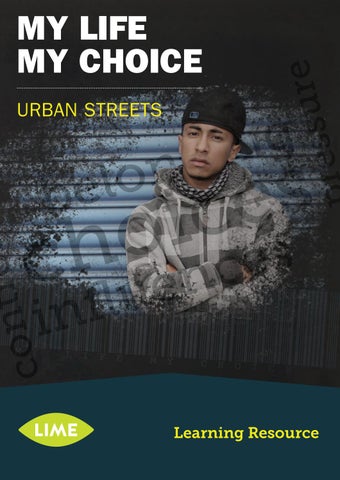
MY LIFE MY CHOICE
MY LIFE MY CHOICE Urban Streets
........................................................................................................
URBAN STREETS
Learning Resource 01
Urban Streets
CONTENTS
MY LIFE MY CHOICE
MY LIFE MY CHOICE Session Session Session Session Session Session Session
1 2 3 4 5 6 7
Page 03 04 06 07 08 09 10
Urban Streets Starter Ground rules 10 mins
Objectives To establish ground rules for working together To explore stereotypes
• Discuss why ground rules are beneficial. • Ask the group to propose their own ground rules, displaying them on a whiteboard/flipchart. Alternatively, using the example ground rules, ask the group to consider their importance and rephrase in their own words. • Tell the group about your responsibilities as a teacher (see below).
Examp le Groun d Rules: + Listen to others when they talk + Use approp riate language + Respec t everyo ne in the room + Discuss ions should be treate d confide ntially + Respec t everyo ne’s right to their own views, even if yours are differe nt + Be willing to agree that you disagre e + Use the third person when you describ e a situati on or experie nce
The My Life | My Choice learning resource features a 30-minute film and seven accompanying sessions. Each has an overarching theme and includes suggestions for a starter, learning activities, plenary and home learning/extension tasks. There are varying numbers of activities in each session. The intention is that you will select the most relevant activities in each session – those that you feel will draw out key perceptions, opinions and attitudes from your group – rather than use all of the activities in all of the sessions.
Activity Stereotypes 1 20 mins
EVALUATION
My Life | My Choice is designed to change attitudes and behaviour among young people. In order to monitor the programme’s effectiveness in achieving this aim, it is important to evaluate the impact on those who go through it. Please remember to complete the pre-programme questionnaire with your group before showing them the film and taking them through the activities. Likewise, once you have completed the programme, please remember to ask your group to complete the post-programme questionnaire.
YOUR YOUNG PEOPLE CAN SHAPE THIS RESOURCE
During the course of the programme, some of your young people will undoubtedly complete excellent pieces of work. Please forward these to chat@engagelime.com, so that we can incorporate them into future resources or showcase them on our website.
Setting the Scene
Teac her’s Note s
HOW TO USE THIS RESOURCE
Some are written, some are discussion-based, some are interactive and some are creative. Please choose the ones that will work best with your group and reflect the time you have available. Some of the home learning/extension tasks can be used as assessment opportunities.
Session 1 of 7
Activity Film 30 mins
Plenary Stereotypes 2 10 mins
• Ask the group to assign labels to the characters in the film based on their first impressions of their pictures, using Handout 1 (or the the character images that have been supplied digitally) and Handout 2. This can take place in a number of ways. For example: • Invite some people to explain the + Displaying images around the room and asking reason for their choices for each members of the group to physically stand by (or write down) which character they think best character and make a note of the label matches one label. assigned by the majority. + Asking the group or individuals to assess each • Ask if there are any other labels they picture using labels more than once if needed, or would use. an unprompted description. • Draw out stereotypes and ask who they think are gang members and which roles the girls might play in the group. • Discuss how we communicate not only with our words but by our actions, appearance, etc. • Ask what role the media play in influencing these stereotypes (e.g. music, ethnic stereotyping etc). • Watch the film. • Record initial reactions to explore in more detail in the next session. • Ask what they think of individual characters.
• Look again at the pictures of the 10 characters. • Remind them of the label the majority assigned to each one, and ask if their opinions have changed as a result of watching the film and, if so, how and why.
Home Learning/Extension Activity www.engagelime.com 02
Teache r’s Respo nsibili ty It is vital to inform the young people that if they tell you or anothe r profes sional leading the activit y about an inciden t or event where a young person has suffere d serious harm or is likely to suffer signific ant harm or there are threat s to their well-be ing, you or that profes sional have a duty to tell other people/profes sionals about what has happened or is likely to happen to that young person, so that the young person can be helped .
du e ne xt ti me
Ask students to bring in cool and uncool images for Session 2. These can be people, brands, carrier bags or objects, from magazines or the internet. 03
MY LIFE MY CHOICE Urban Streets
Starter Cool/uncool 20 mins
Session 2 of 7
Identity
Objectives To understand how we define our identity To explore what makes one person more likely to join a gang than another To reflect on who and what influence our choices
• Tell students to separate the images brought to the session, into the categories ‘cool’ and ‘uncool’. • Ask them to explain their choices, giving reasons for each one.
What is a gang? 10 mins
• Ask the class to write down their definition of “What is a gang?” Invite several volunteers to read out their definitions. • Use the formal definitions listed in the teacher’s notes to highlight any omissions and discuss any differences. • Discuss the difference between a gang and a group.
Teacher’s Notes - Gang Definitions 1. Dictionary Definition
3. Hallsworth and Young 2009
A group or band; a group of youngsters or adolescents who associate closely, often exclusively, for social reasons, especially such a group engaging in delinquent behaviour; a group of people with compatible tastes or mutual interests who gather together for social reasons; a group of persons working together (squad shift); a group of persons associated for some criminal or other anti-social purpose; a group of identical or related items.
“Gang: a relatively durable, predominantly street-based group of children who see themselves (and are seen by others) as a discernable group for whom crime and violence is integral to the group’s identity.”
2. Policing and Crime Act (PCA) 2009 – 31 January 2011 “Gang-related violence” is defined as “actual violence” or a “threat of violence”, which occurs in the course of, or is other wise related to, the activities of a group that: + Consists of at least three people + Uses a name, emblem or colour or has any other characteristic that enables its members to be identified by others as a group + Is associated with a particular area
04
Why do people join gangs? 10 mins
“Peer group: a small, unorganised, transient group of children who ‘hang out together’ in public places such as shopping centres. Crime is not integral to their self definition.” “Wannabe group: includes children who band together in a loosely structured group primarily to engage in spontaneous social activity and exciting impulsive criminal activity, including collective violence against other groups of children. Wannabes will often claim ‘gang’ territory and adopt ‘gang-style’ identifying markers of some kind.”
• Ask the group to discuss what sort of people they think join gangs and why they do it. • Read through the Gang Statements and ask the group if they agree or disagree and whether there are differences between what they would do and what they think others would do. • Refer back to the film and ask “Was Naz part of a gang?” If so, why do they think he was in a gang? Ask the same question for other characters – Tipsy, Salty, Begsy, Leah and Jas.
Teach er’s Notes - Gang State ments
+ If I join a gang, I am less likely to be assaulted, robbed or bullied + I would join a gang to increas e my status and reputat ion + I would join a gang because other wise the gang might cause trouble for me + I would join a gang because of boredom + I would join a gang to make money + I would join a gang if I heard about them on the interne t
• Hand out a variety of carrier bags. the groups to line them up in OR • Tell order of coolness. • Ask them to explain their choices, giving reasons for each one.
• Ask the groups to consider for either activity: a. Is one really cooler than another? Why? b. Who cares about this? Young people or old people? c. Is it more important that something works better or has a cooler image? d. Why does image matter? e. Are we told what to think? Who is telling us? • Discuss: a. Who decides what is cool/uncool? b. Do we know it when we are born or learn it? c. How do we learn? What influences us? d. Who influences us?
Activity
Activity
Activity Nexus points 30 mins
• Play trailer and refer back to the film. • Explain nexus points as events and discussions that can significantly alter what happens next. • Ask the whole group or smaller groups to jot down examples of nexus points. • Discuss using the teacher’s questions. • Ask why Naz’s choices become more difficult using Handout 3. (See page 7 for notes on ‘joint enterprise’.) • Review relevant parts of the film if required.
Teacher’s Questions What happened? Why did it happen? Who influenced it? What would influence you or someone who you know in that situation? + How important are those influences on the decisions that you and your friends make? + What would you or your friends have done faced with the same situation? + If you would have done something different, why?
+ + + +
+ Other people would join a gang because they are less likely to be assaulted, robbed or bullied + Others join gangs to increas e their status + Others join gangs due to boredom + Others join gangs because it’s fun and exciting + Others join gangs when they find out about them on the interne t + Others join gangs to make money
+ What influences may be missing in the characters’ lives? + What could have happened to change the choice made at that point? + At what key point does Naz lose control over his behaviour? Does he have choices all the way through? + When would it have been easiest to change the course of events?
“Organised Criminal Gangs: members are professionally involved in crime for personal gain, operating almost exclusively in the ‘grey’ or illegal marketplace.”
05
MY LIFE MY CHOICE Urban Streets Starter Gang words 10 mins
Session 3 of 7
Choices
Objectives To explore whether people always have a choice To explore external factors that influence decisions
• Ask the group to call out different words they associate with gangs and weapons e.g. “shanked”, “getting funked”. • Write these on a whiteboard/flipchart and add any from the list provided below. • Ask: a. Does the group know what the words mean? b. Where do they think they came from? c. Who made them up? d. Are they only used locally? Or nationally? e. Are they from films/TV/music?
Teacher’s Notes - Gang Terminolo gy
On Road - to be actively engaged in anti-social behaviour or criminal activities taking place in public. This can mean anything from being seen on street corners or in groups in parks with mates to being criminally active within an organised gang.
Urban Streets Starter Who is to blame? 10 mins
Activity Joint enterprise
Tru - literally true or keeping it real, being loyal or not grassing on someone.
20 mins
Shanked - to be stabbed.
Strap/Piece - gun.
Funked/Merke d - to be seriously hurt or even killed.
Con - traitor/someone who has turned their back on the group.
5-0/Feds - police.
Swear Down - no joke/telling the truth/being absolutely serious.
M.O.B. - Money Over Bitches.
Blud - mate/friend/acq uaintance/fami ly.
Beef - to have a conflict [with someone].
With Fam - literally being with your family, although family can be interpreted in many ways (including being with close friends).
MY LIFE MY CHOICE
Influencers 30 mins
Activity
Bro/Bruv - brother or friend but can also be used in a derogatory manner.
Activity
Suck Your... - derogatory term used to initiate conflicts.
Hot seat
Character circle 20 mins
• Ask each student to think about a new character for the film who could have a positive influence on Naz or Salty. The character could be a new friend (themselves), an older brother or sister, a parent, or another adult. • Tell the students to write a short outline of their character, including the impact that person could have on Naz and Salty and the outcome of the film. • Give each student Handout 5 and ask them to complete.
Learning/Extension Activity
du e ne xt ti me
Choose a character from the film and imagine they keep a diary. Write an entry reflecting their true thoughts for one of the scenes you have been discussing in the film. 06
Objective To explore the legal, personal and social consequences of actions
• Play trailer and reintroduce the main characters. Refer to Handout 1 or show character images from the Digital Media on the smart board. • Ask the students to vote on: a. Whether each of the characters is to blame for the outcome of the film. b. Which character(s) are responsible in the eyes of the law for the two murders. • Ask students (individually or as a group) to assign a level of blame for each character (0 = free from blame; 5 = fully responsible) and discuss why. • Play excerpt of film from 9min 25sec to 11min.04 sec - (Salty’s World) • Ask the group who would have been arrested if the police had arrived and witnessed what happened. Ask specifically about Salty, Tipsy, and then Naz. • Count how many choose each character. If most think all three, ask why. • Introduce the concept of “Joint Enterprise”, explaining how this could have affected the characters.
culpable for it. Joint enterprise is the common law concept that all those engaged in activity that leads to a criminal act are equally of them, all of one by struck fatally then is who someone towards behaviour For example, if a number of people take part in aggressive them can be charged. by This means that all three characters in the park scene could have been arrested as Naz and Tipsy could hold some responsibility involved in the characters the of all Likewise, victim. his shot Salty when intervene to failed they as especially Salty, with association attack on Tipsy at the beginning of the film could be charged with his stabbing.
Reppin’ - representing.
• Ask students to refer to Handout 3 and think about key influencers in Naz and Salty’s lives, listing both positive and negative. • Ask the group to consider what other factors might influence us. Use Handout 4, as a prompt. • Tell the students to pick the five things that would most influence decisions they make and rank them from 1 to 5 in groups of 4/5.
Consequences
Teacher ’s Notes - Joint Enterpr ise
20 mins
Activity
Session 4 of 7
Plenary Implications 10 mins
• Ask one of the group to play the part of Naz and sit in the “hot seat”. The rest of the group then question why he made particular decisions, exploring: a. What he was thinking at the time. b. Why he acted in a certain way. c. What he thought might happen afterwards. • Ask the group to give him advice about what he could have done differently. This activity can be extended to use other characters taking turns in the hot seat. • Ask the group to discuss the consequences of Salty’s actions for: a. The parents of Salty’s victim in the park. b. Naz’s Dad. What might these characters be thinking and feeling? • Tell the group to imagine that it is 10 years later. Salty served 10 years in prison. He’s now 25. He left school without any qualifications. Ask: a. Where do you think Salty lives? b. What job do you think he has? c. What is his relationship with his Dad like? d. Who are his friends? e. Does he have a criminal record? f. Has he committed any other crimes since leaving prison? You may want to ask similar questions for other characters.
Home Learning/Extension Activity Write a letter from Salty to one of the characters affected by his actions, explaining how he feels and what the consequences of his actions have meant for him. This could be to Naz’s Dad or his victim’s family.
du e ne xt ti me
OR Write a letter from Naz’s Dad to a friend or relative asking for advice as to how to handle his son. Also, write the response with the advice they think would have helped him to change the outcome of the story.
07
MY LIFE MY CHOICE Urban Streets Starter Who v whom? 10 mins
Activity Circle of influence 10 mins
Activity Rivalry 10 mins
Activity Agree to disagree 25 mins
Plenary Reducing control 10 mins
Session 5 of 7
Control
Objectives To recognise controlling behaviour To explore healthy ways to handle controlling situations
• Ask the group what they understand by the word ‘control’. How is control different to influence? • Tell students to individually draw a spider diagram showing which characters from the film exercise control over other characters. • Ask each student to create a personal circle of influence using a character circle, by writing the names of those who are closest to them in the inner circle, moving towards the outer circle for those who are only acquaintances. • Discuss how this may change as you get older: a. Who is most influential to you as a child? As an alter native, talk abou t Naz and b. How does this change as a teenager? the chara cters in the film inste ad of Tease out why conflict with parents and the stude nts them selve s and their teachers may occur as they grow up. own friends and family. c. Examine which relationships use influence Think abou t who else could play a and which use control. role in their lives. • Play the following excerpts from the film i. from 18min 59 secs - 22mins 0secs (Closing In). ii. from 26mins 40secs - 28mins 32secs (Harry’s Flat) • Discuss these scenes and, in particular, how Begsy takes control in the car and how Harry, despite being threatened with a gun, is clearly more in control. • Ask: a. What choices does Naz have in these two scenes? b. What has changed to put Naz in a position where he felt he was no longer in control? c. Who could have acted differently and how could it have changed Naz’s options? d. Could Naz’s Dad have done anything differently? e. Why could Salty control Naz more than Tipsy?
Urban Streets
Starter Your community 10 mins
Activity In the news 15 mins
Activity Communication & media 25 mins
• Split the class into groups of 4-6. • Allocate each group a topic: a. Joining a gang b. Carrying a weapon c. Reppin’ a postcode d. Taking part in criminal behaviour e. Getting into fights f. Hanging around on street corners • Ask half of each group to prepare and present a short argument FOR their topic, the other half AGAINST, including at least three reasons for each. • Ask two or three groups to present both sides of their argument and the rest to observe and vote on which side was most convincing. • Discuss the spider diagrams from the starter exercise, asking how the other characters could have dealt with the control being used by these characters. • Ask the group how this could be applied to their own lives: a. How can they recognise when someone is trying to use control? (Over themselves or others.) b. Who can they turn to for help? c. How could technology be useful? (Facebook, Twitter, phones, text, email, etc.)
Home Learning/Extension Activity 08
MY LIFE MY CHOICE
du e ne xt ti me
Write an alternative ending from when Naz is dropped off back at his house by Begsy and Salty. This can be completed as a storyline, comic strip or role-play/rap with a friend, to present next time.
Session 6 of 7
Community Objective To explore the impact of gangs and weapons on the wider community
• Ask each student to draw a diagram showing themselves in the middle and branching out to include people in their community (family, neighbours, friends, teachers, sports coaches, etc). • Ask: a. What do they consider to be their community and why? Is it limited by geography, school, interests? b. How does this diagram compare to their circle of influence (completed in the previous session)? c. Are their biggest influencers part of their community? If not, why not? d. What influence do the students themselves have on other people? • Discuss examples of local or national news stories about gangs or weapons (this could be set as an earlier Home Learning exercise). • Lead a group discussion using the examples, referring back to the events in the film. • Choose one of the following activities, or offer the choice of activity to the students. Each activity will be presented to the rest of the group in the next session. • Play the following excerpts if you choose the newspaper article or TV/radio report activity – the article/report should focus on one aspect of the story: i. 9min 55sec to 11min 04 sec - (Salty’s World) ii. 30min 08sec - 30min 28sec (Salty’s Arrest) iii) 26mins 40secs - 28mins 32secs (Harry’s Flat) • Ask for a volunteer to read the poem “1 Life” to the group if you choose the poem/rap activity. NEWSPAPER ARTICLE In pairs, design and write the front page of a local paper, writing a headline and article including the facts and one quote. Select an image from the film to use as a photo. If more time is needed this could be completed as Home Learning, and used as display material.
1 Life Listen carefully, to these words that I speak They come from a man, who got caught up in the street, Seen friends get murdered, their kids crying Plus I been stabbled, thought I was dying, Been to so many funerals, inside I feel numb Don’t ever underestimate, the power of a gun. We blame our situation, on where we grew up You only get 1 Life, it’s time we grew up, Don’t make the same mistakes, please learn from mine There’s more to life than the block, which you’ll learn in time Listen carefully, to these words that I speak For years I’ve been caged, all I want now is peace.
OR
TV/RADIO REPORT In pairs, prepare a short TV/radio report. One person plays the reporter and the other plays the interviewee – such as Naz’s Dad, a neighbour, a friend or one of the other characters in the film. If possible film or record reports to play back in the next session.
OR
POEM/RAP Write a poem or rap about how their actions could affect their own community. Refer back to the people they identified in the starter exercise.
OR POSTER/ADVERT Make a poster/advert to show younger people what the consequences can be if you join a gang or carry a weapon.
OR SOCIAL MEDIA Write a plan about how they could promote My Life | My Choice on social media to influence their community. Research facts and figures about gangs and weapon crime on the internet.
09
MY LIFE MY CHOICE Urban Streets
Session 7 of 7
Conclusion
SOME OF OUR OTHER PROGRAMMES
Objectives To review and reflect on what has been learned during the programme To reconsider attitudes to gangs and weapons
My Life | My Choice: Nathan’s Story
........................
........................
........................
........................
NATHAN’S STO RY
Starter Media presentations
My Life | My Choice tells the story of Nathan, an aspiring rap artist who, through a series of poor choices, becomes involved in gang life – with devastating consequences.
MY LIFE MY CHOICE MY LIFE MY CHOICE
Nathan’s Sto ry
........
The accompanying resource, which supports learning at Key Stage 3 across a range of subjects, focuses on key behavioural and social skills – wrapped around the issues of weapon-carrying and gang culture.
• Ask students to present newspaper articles, TV/radio reports, poem/raps, posters/adverts or social media plans from the previous session.
The wider theme of the programme is to develop an understanding of the consequences of our choices and the process of decision-making, helping those young people who experience MLMC to build their own better futures. The programme explores issues such as identity and handling conflict – all considered in a safe environment, building resilience and raising awareness of the pressures young people face.
40 mins
Teacher’s Notes - Beating The Drum Preparation
+ You will need something to drum out a beat (a desk could be used). + Speak to a group of 8-10 students in secret before you run the exercise. + In secret, tell this group that, when you ask how many times you beat the drum, they should answer correctly the first 3 times but on the 4th occasion, they should add 1 to the number of times you beat it. (e.g if you beat it 10 times, they say 11).
This activity is based on the Asch experiment: http:/www.experiment-res ources.com/asch-experimen t.html
Activity Beating the drum 15 mins
Activity Recap 10 mins
Teacher ’s Notes -
• Ask the whole group to count how many times you beat the drum. • Tell them not to shout out the number but write it down privately. • Ask the group one at a time to say how many times you beat the drum, after each turn. Always start with the 8-10 you spoke with secretly beforehand. On the 4th occasion, after the 8-10 have said their answer, choose someone else to see if they go along with their peers. Keep asking until someone gives the correct answer or until you have asked everyone (whichever comes first). • Reveal to the whole group that you had spoken to the group before beating the drum. • Ask those who went along with the 8-10 if the number they said aloud was the same as the one they’d written down. • Facilitate a discussion about peer pressure, standing up for what you believe is right and trusting your own instincts. • Reflect with the group on what they have learned from previous sessions about what and whom they can influence or are influenced by. a. Do they consider themselves more likely to influence or be influenced? b. How can they influence others to make better choices?
please ensure all students complete post programme survery
Learning Re
source 01
My Life | My Choice has already led to tangible changes in attitudes and behaviours among young people, including a 25 per cent increase in teenagers in Birmingham who would no longer consider carrying a weapon or joining a gang under any circumstances.
Ella’s Story Ella is a talented, vivacious 15-year old who seems to have everything - good looks, charm and talent. She’s popular, the kind of girl that other girls want to be around and boys want to be with. Yet everything isn’t quite what it seems and we quickly discover Ella’s not as self-assured as she appears. Wanting nothing more than to ‘fit in’, will Ella’s fragile self-confidence lead her into danger? The collaboration of young people was crucial at every stage in the development of the resources that accompany Ella’s Story. The design process included focus groups to establish story characters, plots and dialogue, with the aim of ensuring that these resonated with the lives and experiences of today’s young people. This enables students to deeply engage with the content, encouraging them to think critically about their own decisions and their impact, and ultimately leaving them better equipped to tackle whatever life throws at them.
No Respect: Cause and Effect No Respect follows the journey of Marcus, a teenage boy who finds himself in court after a string of anti-social behaviour offences. The film – and particularly the ending – is designed to spark debate in the classroom and encourage students to question the character’s behaviour, and understand the consequences of our actions. The programme has contributed to a downward trend in incidents of arson and other types of anti-social behaviour. Composed of interesting and engaging activities, through the sessions young people explore what constitutes anti-social behaviour, who commits it and its effect on both victims and offenders. Sessions support the delivery of Key Stage 3 Citizenship, especially the units focusing on crime, safety awareness, human rights and dealing with conflict.
10
For more information on each project visit us at engagelime.com
11
MY LIFE MY CHOICE Supported by:
Urban Streets
chat@engagelime.com engagelime.com
To order additional copies or enquire about other resources, please contact us. 12
Š 2012 lime. All rights reserved. No part of this publication or associated media may be reproduced, stored in a retrieval system, or transmitted, in any form or by any means, without the prior permission in writing of the copyright holder. Design by El & Toby @ Genobi | www.genobi.net