Lighting the way: Teaching science with purpose & possibility
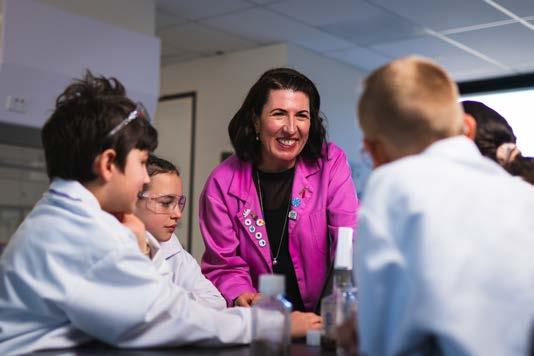
Ruth Dircks Scholarship winner Leanne Smith
A ‘Makerspace’ recycled plastics STEM activity
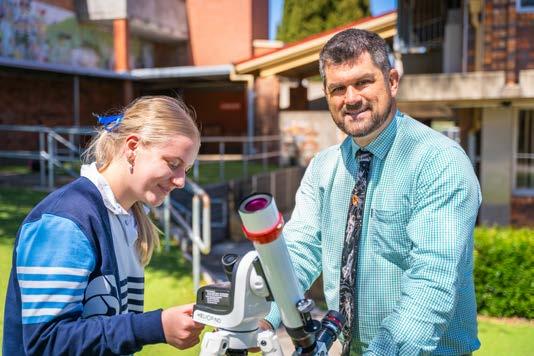
Jon Roberts & Helen Georgiou
Lucky’s Star: The story of a meteorite
The Journal of the Australian Science Teachers Association
AUSTRALIAN SCIENCE TEACHERS ASSOCIATION
Teaching Science is a quarterly journal published by the Australian Science Teachers Association. This journal aims to promote the teaching of science in all Australian schools, with a focus on classroom practice. It acts as a means of communication between teachers, consultants and other science educators across Australia. Opinions expressed in this publication are those of the various authors and do not necessarily represent those of the Australian Science Teachers Association or the editorial advisory committee.
Academic contributions to Teaching Science are peer reviewed.
Contents indexed in Australian Education Index (ACER) and Current Index to Journals in Education (ERIC).
Unattributed images supplied by ASTA or from Adobe Stock.
Editor John Glistak
Editorial Advisory Committee
As/Prof. Christine Preston, The University of Sydney, NSW
Dr. Joe Ferguson, School of Education, Deakin University, VIC
Prof. Ange Fitzgerald, RMIT University, VIC
Sonia Hueppauff, Just Think Cognition, WA
As/Prof. Rekha Koul, Curtin University, WA
As/Prof. Kieran Lim, Deakin University, VIC
As/Prof. Reece Mills, QUT, QLD
Geoff Quinton, Pearson Australia
Richard Rennie, Fremantle Light and Sound Discovery Centre, WA
Dr. Emily Rochette, The University of Melbourne, VIC
Julie-Anne Smith, Eye for Detail, WA
Dr. Emma Stevenson, The University of Melbourne, VIC
Dr. Fiona Trapani, St Columba’s College, VIC
Prof. Russell Tytler, School of Education, Deakin University, VIC
As/Prof. Dr Peta White, School of Education, Deakin University, VIC
From the President Margaret Shepherd
As I conclude my term as President of the Australian Science Teachers Association, I’m filled with gratitude and pride. Serving this science teaching community over the past two years has been one of the most rewarding experiences of my professional life. Together, we’ve advanced science education with purpose, integrity and innovation.
I want to thank our Board of Directors for their thoughtful leadership and tireless commitment. Your support has been instrumental in shaping our direction. The ASTA executive have been so supportive and energetic and made leadership so pleasant. To the Presidents of our state science teachers associations – thank you for your collaboration and shared vision. And to our incredible staff: your behind-the-scenes brilliance has made our work not only possible, but impactful.
My term has been marked by meaningful progress. We ratified a new constitution to better reflect our evolving mission with a new Board charter and by laws to be developed early in 2026. We structured board portfolios to align with strategic priorities and empower more focused leadership. We’ve reviewed our association and look forward to implementing a new governance and working model into our new strategic plan in 2026.
We published a position paper exploring the dynamic interplay between inquiry-based learning and explicit instruction – sparking valuable debate and reflection. And we’re preparing to release a new paper on climate change education, a critical step in equipping teachers to lead in this global conversation.
We’ve held amazing national conferences, ConASTA, and in this year, in Perth with STAWA, which provided high quality professional learning, networking and connections. Thanks to ROWE for funding opportunities to support each state and territory science fair and the national science fair, i3 (inquiry, innovation and ingenuity). I3 as a face to face student science fair is coming! Stay tuned so you don’t miss out. We provided school grants for National Science Week so that every school could participate. Our peer reviewed teaching journal, Teaching Science, has produced four useful journals this year, and is now free for all teachers.
We have a new team of practicing teachers working with CSIRO to keep them informed of teachers' needs. We worked with STANSW to pilot a new critical thinking program from Berkeley University and roll out for all states.
From
the
President Margaret Shepherd
Congratulations must go to the winners of the PM prizes for science this year; Paula Taylor and Matthew Dodd. Both teachers are outstanding educators with innumerable hours of volunteering and giving back to the science education community. If you know an amazing science teacher please consider nominating them for 2026.
Sadly we said farewell to the amazing Ruth Dircks who was the inaugural winner of the PM prize. ASTA is proud to continue offering her scholarship to support new teachers attending ConASTA to show our respect for her contributions to science education.
As I pass the torch, I’m thrilled to welcome Paula Taylor as our incoming President for 2026. Paula brings exceptional insight, energy, and heart to this role. Our future is in excellent hands.
I’ll leave you with a quote that has guided me throughout my presidency: “Education is not the filling of a pail, but the lighting of a fire.” – William Butler Yeats
Thank you for allowing me to help kindle that fire.
With appreciation,
Margaret Shepherd FTGN
President, Australian Science Teachers Association (ASTA)
From the Editor John Glistak
Welcome to Issue 71.4 of Teaching Science.
Another year is nearing its end.
Plastics are a major source of pollution in all the world’s ecosystems, with microplastics (resulting from the breakdown of larger plastic pieces) found in most of the world’s organisms.
Very little plastic waste is ever recycled as recycling programmes around the world struggle to adapt to the scale and economics of the process.
In recognition of this issue, many individuals or small organisations have engaged within a ‘circular economy’ movement of local recycling, where plastics are collected, sorted and repurposed into other products.
In their paper, Jon Roberts and Helen Georgiou discuss a STEM activity, as an example of such a process, presently being undertaken with both preservice teachers and Stage 3 students in NSW schools.
Please take time to read about the winners of the Prime Minister's Prize for Science Teaching and the farewell President's Report from Margaret Shepherd. All should be commended and celebrated for their dedication to science teaching.
In closing, have you considered submitting a paper to Teaching Science? If not, your potential contribution will be most welcome.
John
Seeds of science: Nurturing knowledge for all
The Australian Science Teachers Association (ASTA) is excited to announce that National Science Week 2026 will run from Saturday 15 to Sunday 23 August, with the schools theme Seeds of science: Nurturing knowledge for all.
This theme invites students across Australia to explore the power of curiosity, inquiry and shared learning in growing scientific understanding. Just as seeds need the right conditions to grow, knowledge flourishes when it is nurtured, shared and applied to real-world and authentic challenges across all the scientific disciplines.
The theme encourages schools to explore how ideas take root, develop and spread – from the first spark of a question to the sharing of discoveries that benefit the wider community. It’s a celebration of how knowledge grows when tended with care, creativity and collaboration.
‘Seeds of Science is about inspiring the next generation to plant ideas, ask questions and grow innovative and creative solutions,’ said Margaret Shepherd, ASTA President. ‘It’s an invitation for students to see science as a living, evolving process that they can shape and share. There are many scientific concepts that can be investigated through this theme such as biotechnology, agriculture, aquaculture, quantum sensing and nanotechnology.’
Engagement opportunities for schools
As part of this initiative, schools and preschools are encouraged to apply for grants of up to $500, funded by the Australian Government, to support their National Science Week activities. With a total grant pool of $110,000, administered by ASTA, these funds will enable educators to bring the theme to life in classrooms across the country, fostering curiosity and a passion for STEM (Science, Technology, Engineering and Mathematics) learning. Applications for grants will open in March 2026, with more details available on the National Science Week website (www.scienceweek.net.au/schools) and www.ASTA.edu.au following the Minister’s announcement.
Resource book for teachers
To support teachers in delivering engaging and educational experiences, ASTA will produce its annual teacher resource book, packed with information, classroom activities, experiments, diagrams, photographs and website links. The resource book, centred on the 2026 theme, will be an invaluable tool for both primary and secondary science teachers, providing them with the resources needed to explore complex concepts in an accessible and interactive way.
National Science Week partners
National Science Week is a program of Inspiring Australia, a national strategy dedicated to engaging Australians with the sciences. In 2025 there were more than 2,550 events registered on the National Science Week website across every state and territory. Key partners include the Commonwealth Scientific and Industrial Research Organisation (CSIRO), the Australian Broadcasting Corporation (ABC) and the Australian Science Teachers Association (ASTA), all working collaboratively to make this week a memorable and impactful experience for students and educators alike.
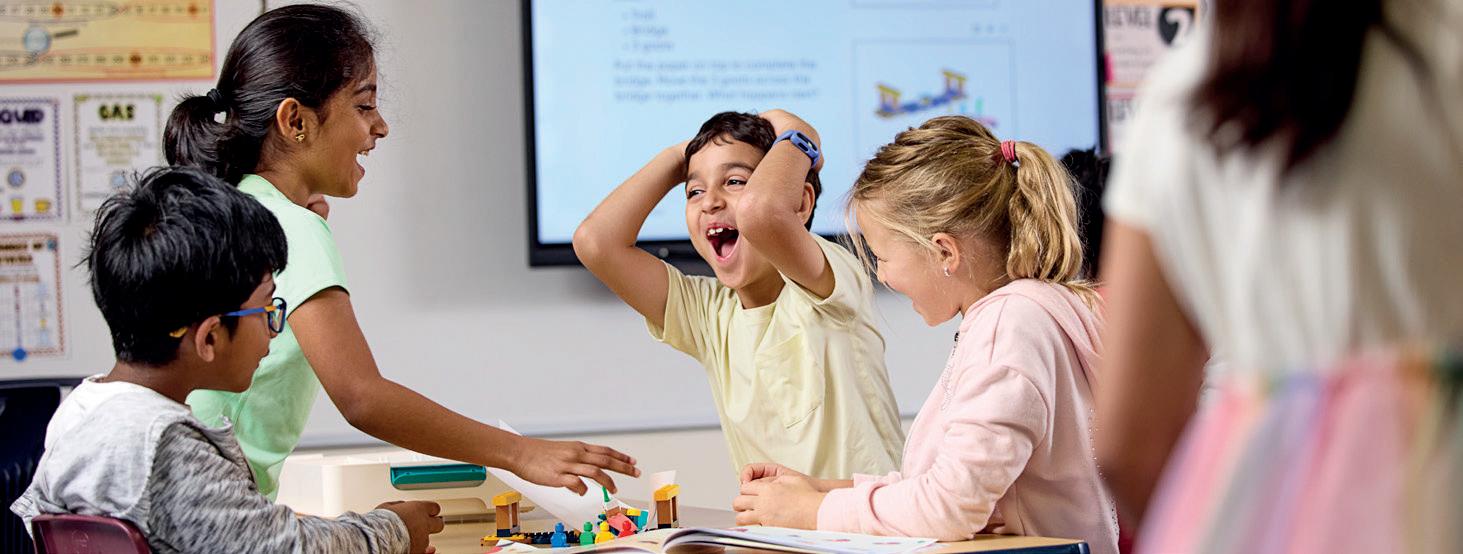
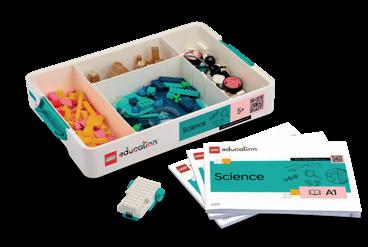
LEGO® Education Science Solution
LEGO® Education Science Solution
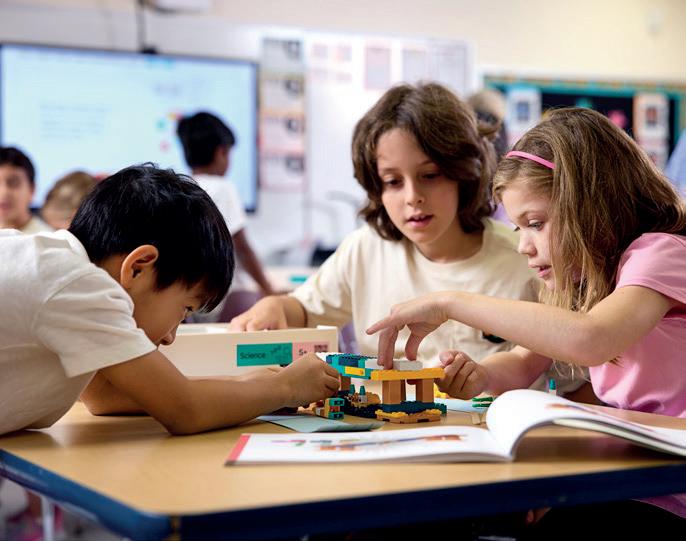
A hands-on solution that connects students to science concepts in a way that unlocks exciting discoveries and engages the whole classroom.
A hands-on solution that connects students to science concepts in a way that unlocks exciting discoveries and engages the whole classroom.
Designed to drive science learning outcomes, LEGO® Education Science equips teachers with lessons for ages 5-11+ that empower every student to succeed and foster collaboration as they tackle science enquiry hands-on.
Designed to drive science learning outcomes, LEGO® Education Science equips teachers with lessons for ages 5-11+ that empower every student to succeed and foster collaboration as they tackle science enquiry hands-on.
Packed with LEGO® bricks, building instructions, interactive hardware, and a USB charging cable, every hands-on kit engages students, turning the classroom into a curiosity hub bubbling with exciting discoveries. Each kit includes 40 Australian curriculum-aligned, enquiry-based science lessons that are intuitive to set up and implement, maximising class time and ensuring instant classroom engagement.
Packed with LEGO® bricks, building instructions, interactive hardware, and a USB charging cable, every hands-on kit engages students, turning the classroom into a curiosity hub bubbling with exciting discoveries. Each kit includes 40 Australian curriculum-aligned, enquiry-based science lessons that are intuitive to set up and implement, maximising class time and ensuring instant classroom engagement.
Throughout these age-appropriate lessons, students tackle Science as Enquiry, Science as the Human Endeavour and Science as Knowledge whilst maintaining hands-on and collaboratively exploring their way to a solution. Get ready to fascinate students with enquiry-based exploration of real-world science concepts.
Throughout these age-appropriate lessons, students tackle Science as Enquiry, Science as the Human Endeavour and Science as Knowledge whilst maintaining hands-on and collaboratively exploring their way to a solution. Get ready to fascinate students with enquiry-based exploration of real-world science concepts.
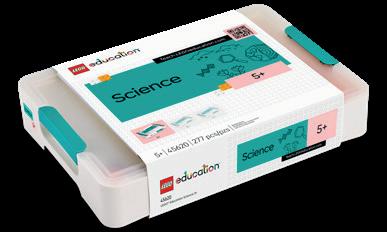
LEGO® Education Science
LEGO® Education Science
Age 5+
Age 5+
• 40 curriculum-aligned lessons with building instructions
• 40 curriculum-aligned lessons with building instructions
• Sturdy stackable box (1 kit: 4 students)
• Sturdy stackable box (1 kit: 4 students)
• 278 LEGO® bricks + 1 double motor per kit
• 278 LEGO® bricks + 1 double motor per kit
• 1 USB charging cable
• 1 USB charging cable
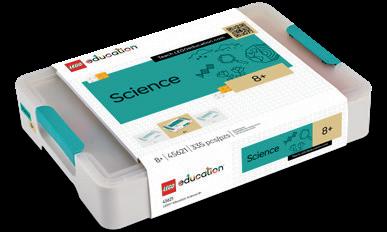
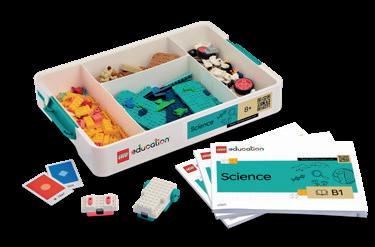
Age 8+
Age 8+
• 40 curriculum-aligned lessons with building instructions
• 40 curriculum-aligned lessons with building instructions
• Sturdy stackable box (1 kit: 4 students)
• Sturdy stackable box (1 kit: 4 students)
• 336 LEGO® bricks + 1 double motor + 1 controller + 2 connection cards per kit
• 336 LEGO® bricks + 1 double motor + 1 controller + 2 connection cards per kit
• 1 USB charging cable
• 1 USB charging cable
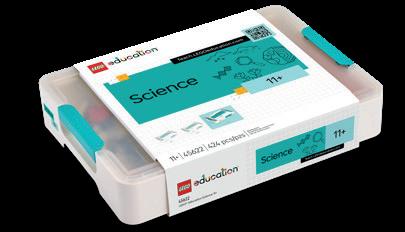
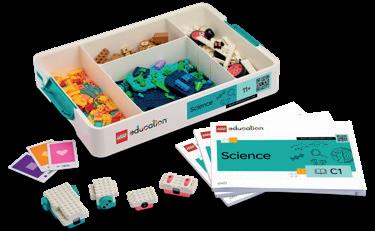
Age 11+
Age 11+
• 40 curriculum-aligned lessons with building instructions
• 40 curriculum-aligned lessons with building instructions
• Sturdy stackable box (1 kit: 4 students)
• Sturdy stackable box (1 kit: 4 students)
• 424 LEGO® bricks + 1 double motor + 1 controller + 1 single motor + 1 colour sensor + 3 connection cards per kit
• 424 LEGO® bricks + 1 double motor + 1 controller + 1 single motor + 1 colour sensor + 3 connection cards per kit
• 1 USB charging cable
• 1 USB charging cable
Free Teacher Portal includes:
Free Teacher Portal includes:
• Getting started materials
• Getting started materials
• Lesson library
• Lesson library
• Teacher support
• Teacher support Lesson Library includes:
Lesson Library includes:
• Student-facing lesson presentations
• Student-facing lesson presentations
• Teacher facilitation notes
• Teacher facilitation notes
• Australian curriculum alignment, 21st century skills, and pre-requisite knowledge info.
• Australian curriculum alignment, 21st century skills, and pre-requisite knowledge info.
Professional learning & implementation support upon request
Professional learning & implementation support upon request
As a future-focused team of teachers and innovators, at LEGO® Education, we’ve built engaging learning experiences for 45 years. But what we bring to formal education is more than just fun – we’re serious about curriculum-aligned learning outcomes.
As a future-focused team of teachers and innovators, at LEGO® Education, we’ve built engaging learning experiences for 45 years. But what we bring to formal education is more than just fun – we’re serious about curriculum-aligned learning outcomes.
We work alongside teachers across the globe to integrate curriculum-aligned science and STEAM programmes for primary through to secondary school.
We work alongside teachers across the globe to integrate curriculum-aligned science and STEAM programmes for primary through to secondary school.
We want to help create a world in which all students have access to engaging hands-on experiences during their classes at school each day.
We want to help create a world in which all students have access to engaging hands-on experiences during their classes at school each day.
Read about our solution at LEGOeducation.com
about our solution at LEGOeducation.com
The Prizes are Australia’s most prestigious and highly regarded science awards. They celebrate demonstrated achievements in scientific research, research-based innovation, the practice and preservation of Aboriginal and Torres Strait Islander knowledge systems and excellence in science teaching.
Science Prizes – recipients
Prime Minister’s Prize for Science
Distinguished Professor Lidia Morawska from Queensland University of Technology is recognised for pioneering research about the air we breathe and translating scientific discoveries into actions that safeguard public health and our environment.
Prime
Minister’s
Prize for Innovation
Dr Vikram Sharma from QuintessenceLabs is recognised for translating deep Australian research in quantum science into world-leading cyber security solutions that are used by companies around the world to protect information.
Frank Fenner Prize for Life Scientist of the Year
Dr David Khoury from Kirby Institute, UNSW Sydney is recognised for using applied mathematics to translate scientific research into actionable evidence, which has guided drug development for malaria and vaccine policies for COVID-19 and mpox.
Malcolm McIntosh Prize for Physical Scientist of the Year
Professor Yao Zheng from The University of Adelaide is recognised for his groundbreaking work to produce clean hydrogen directly from seawater, helping to accelerate Australia’s green hydrogen industry in the transition to net zero.
Prize for New Innovators
Dr Nikhilesh Bappoo from VeinTech and Lubdub is recognised for novel and accessible medical technologies, driven by his vision of a world where no life is lost because healthcare was too complex, too late or out of reach.
Knowledge Systems Prize – recipient
Prime Minister’s Prize for Aboriginal
and Torres Strait Islander Knowledge Systems
Professor Michael Wear from Tidal Moon is recognised for developing a model that improves Indigenous livelihoods through the respectful practice of Aboriginal knowledge systems for Sea Country conservation and sustainable commercial practices.
Science Teaching Prizes –
recipients
Prime Minister’s Prize for Excellence in Science Teaching in Primary Schools
ASTA President Elect Mrs Paula Taylor from the ACT Education Directorate’s Academy of Future Skills, co-located with Caroline Chisholm School in Canberra, has received the Prime Minister’s Prize for Excellence in Science Teaching in Primary Schools in the 2025 Prime Minister’s Prizes for Science.
Mrs Taylor has worked to transform science, technology, engineering and mathematics (STEM) education for over 25 years. She creates innovative programs that ignite curiosity and build confidence in students of all abilities. She brings complex scientific concepts to life through problem-based learning, making STEM inclusive and accessible for thousands of students.
She is also passionate about supporting teachers to be exceptional STEM educators. She co-teaches with educators and models lessons that lead to unprecedented levels of student engagement and achievement.
In her time with the Academy, Paula has worked with more than 10,000 students and 480 classroom teachers.
Mrs Taylor is a highly respected educator and recognised nationally and internationally. She is regularly called upon to lead workshops that inspire and shape future educators and students.
Mrs Taylor’s dedication to teaching and mentoring is nurturing the next generation of students to take up STEM careers.
“As a science teacher, I get to inspire students to think about their future as a scientist. And I do that by telling the Australian story. What are we doing in our local communities? What are we doing across the nation that is relevant to them as they pursue STEM careers? We're punching well above our weight, and I want students to know that they are the future workforce for science in Australia.
“What I'm observing is that our teachers are becoming champions of change. They are taking the lead with such confidence and capability in teaching STEM in such an impactful way. And we're doing this across all our schools. It's very important that we have equitable access to high-quality STEM learning.
STEM doesn't just end in the classroom. Science is all around us and we're very lucky to live in a nation that provides so much STEM outreach, whether it's a science fair, in our museums or with our science communicators. Together, we are creating such an opportunity to tell a great story – and Australia has a great story to tell.
Being the recipient of the Prime Minister's Prize for Excellence in Science Teaching in Primary Schools is such an honour. It recognises the impact I've had across the ACT with the students and the teachers who trust me. It brings such warmth to my heart to know that I have done amazing things with teachers who allow me to come into their classrooms, work with them, and help their students thrive.”
– Paula Taylor
Science Teaching Prizes
– recipients
Prime Minister’s Prize for Excellence in Science Teaching in
Secondary Schools
Physics and Biology teacher, Mr Matt Dodds from Glen Innes High School in NSW has received the Prime Minister’s Prize for Excellence in Science Teaching in Secondary Schools in the 2025 Prime Minister’s Prizes for Science.
Mr Dodds inspires students with his unwavering commitment to science, technology, engineering and mathematics (STEM) education. He is passionate about promoting STEM to students from a range of backgrounds, including those from rural areas and low-socioeconomic communities.
Mr Dodds takes a real-life approach to teach abstract concepts in practical ways. He inspires students to pursue STEM careers through immersive learning experiences. He created the annual two-day Astronomy and Astrophysics Depth Study Program held at Siding Spring Observatory in Coonabarabran (NSW), which is now in its seventh year and has been attended by over 280 students from regional schools. His innovative methods have significantly increased the number of female students studying Physics at his school and the number of students pursuing higher education in STEM.
Mr Dodds also supports teachers in his school and across the country by sharing resources designed to excite students in STEM.
“I've always been curious about how the universe works on a deeper level, as it gives us an appreciation of the world around us.
I tell students that studying science – and particularly physics – teaches you how to think critically and can open many career pathways, including engineering, dentistry, medicine, rocketry and even economics.
I'm passionate about teaching in regional areas of Australia. Just because we're in rural Australia, it doesn't mean that students shouldn’t have access to high-quality STEM experiences.
I always want to learn more science and share that with my students. It's important for teachers to embrace the ‘lifelong learner’ mentality, embrace new technology and learn new discoveries in science. Students are inspired when they see their teacher also has a deep passion for the subject matter.
I'm humbled to receive the Prime Minister's Prize for Excellence in Science Teaching in Secondary Schools. It's great recognition for the science teaching that happens not just at Glen Innes High School, but around Australia in regional and remote areas.”
– Matt Dodds
Nominations for the 2026 Prizes are now open and will close on Thursday 18 December 2025. Nominating someone for the Prime Minister’s Prizes for Science acknowledges their achievements and encourages them to continue to excel in their work.
Encourage your organisation and networks to nominate inspiring people around them!
Learn more about the nomination process on business.gov.au: science teaching prizes
News from our State and Territory Associations
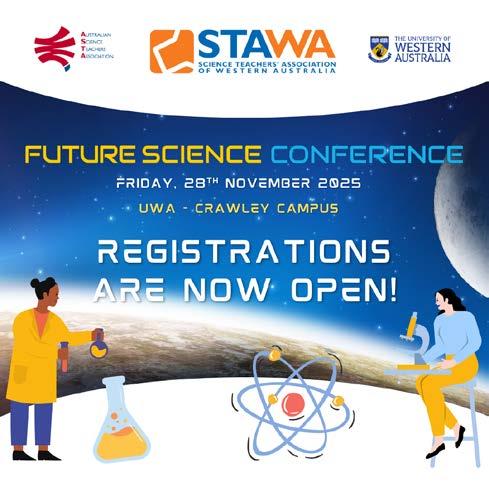
2025 STAWA Future Science Conference
For WA Science Teachers and Lab Technicians
We would like to invite you to the 2025 STAWA Future Science Conference happening on Friday, 28th November 2025 at the University of Western Australia (E-ZONE).
The STAWA Future Science Conference is designed specifically for secondary teachers and lab technicians in Western Australia.
The full day event features workshops that support the implementation and planning of the revised SCSA Science Curriculum. Be equipped with the tools to embrace curriculum changes with confidence.
Connect with fellow educators, academics, and industry partners who share a passion for innovative, future-focused science teaching.
Registrations are now open: cvent.me/Zab4za
ConSEAACT 2026
Are you passionate about science education? Do you have a great lesson, strategy, or idea worth sharing? Now is your time to shine!
SEAACT is excited to announce that ConSEAACT is returning on Saturday, 28 February 2026 –a full-day conference for K–12 science teachers and school laboratory technicians to share practice, resources and research.
Now’s your chance to present a workshop and showcase your expertise! The call for abstracts is open, with 30, 60 and 90-minute session options.
You don’t need to be a researcher – every classroom practitioner has something valuable to share, and the success of the conference depends on contributions from educators like you.
Click here to apply.
Join us for a relaxed and inspiring afternoon tea designed especially for Canberra primary science educators Connect with fellow teachers, explore exciting science education resources, and hear from leading experts in the field
Meet other educators, ask questions, and discover new professional learning (PL) opportunities, such as Questacon’s Starting in STEM and ACT STEM network meetings
STALLS FROM ACT SCIENCE PROVIDERS
Geoscience Australia
Questacon University of Canberra Academy of Future Skills Robogals Mt Stromlo Observatory Twistyfic
Australian Academy of Science WaterWatch + MORE
3:30-5:30PM TUESDAY 25 NOVEMBER TWO OPTIONS TO ATTEND:
Geoscience Australia 101 Jerrabomberra Ave, Symonston TIME TO NETWORK!
3:30-5:30PM WEDNESDAY 26 NOVEMBER
News from our State and Territory Associations
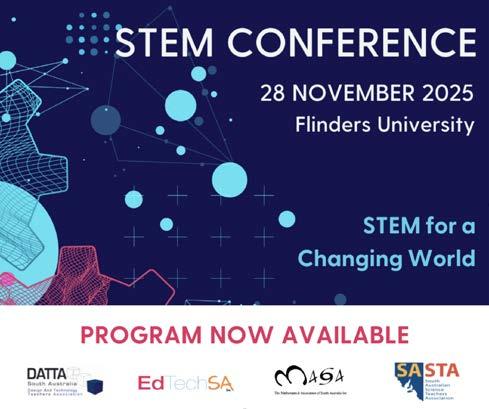
STEM Conference 2025
Date: Friday 28 November 2025
Location: Flinders University, Bedford Park campus
More information & registration: www.sasta.asn.au/professional_learning/stem_ conference
Hosted collaboratively by DATTA SA, EdTechSA, MASA and SASTA, the STEM Conference 2025 is an annual professional learning event for R–12 educators across all areas of science, technology, engineering and mathematics.
This year’s theme, STEM for a Changing World, highlights how STEM learning can help students understand and respond to global challenges.
Educators will explore innovative classroom practices through hands-on workshops, curriculum-aligned sessions and an inspiring keynote.
This year’s sessions include:
• AI and emerging technologies – including The Maths behind AI, AI Without Borders, and AI, Data Science and Outbreaks
• Sustainability and systems thinking –through From E-Waste to Opportunity, From Earth to Orbit, and STEM for a Changing World
• Aboriginal and Torres Strait Islander perspectives – including The ‘M’ in STEM: First Nations Rangers Caring for Country and Embedding Aboriginal Contexts
• Design thinking and creative problemsolving – with sessions such as Exploring a Design Thinking Process, Project X, and Tiny Homes, Big Thinking
• Space and astronomy education – with Integrating Space Technologies, CubeSats for hands-on STEM, and Space and Astronomy as a Middle School Elective
Join teachers, researchers and industry professionals for a day of collaboration and inspiration.
Registrations are now open.
Find out more & register: www.sasta.asn.au/professional_learning/stem_ conference
News from our State and Territory Associations
Meet the Markers 2026
The Science Teachers' Association of NSW (STANSW) is excited to announce the dates and venue for Meet the Markers 2026. Be sure to mark your diaries!
Meet the Markers of the 2025 HSC Science Exams – Exam Analysis
Virtual
Sessions
Online sessions presented by the markers of the 2025 HSC Science Examinations. There will be a session on each HSC science subject, unpacking the latest exam and showcasing what students did well, and what could be improved, to help you improve student outcomes.
Wednesday 11 March: Investigating Science
Thursday 12 March: Chemistry
Monday 16 March: Science Extension
Tuesday 17 March: Physics
Wednesday 18 March: Biology
Thursday 19 March: Earth & Environmental Science
Face to Face Meet the Markers Event
This full-day, in-person event provides HSC Science Teachers with deep, collaborative professional development that moves beyond 2025 exam-specific analysis. The goal is to fundamentally shift your teaching approach by giving you a simulated marker experience and a macroscopic understanding of the entire HSC assessment process.
Understand the Process: Exclusive NESAfocused session on how the HSC exam is built, moderated, and judged.
Apply the Standards: Subject-specific, collaborative session where you unpack band descriptors and marking criteria using sample materials.
Shift Your Strategy: Learn high-impact teaching methods from expert teachers to prepare students to achieve top bands.
Friday 20 March: All subjects at Chifley Senior Campus, Mt Druitt
You can register your interest for the above events by sending your RSVP on each event page. (See links above in blue.)
News from our State and Territory Associations
Secondary Science
Register at www staq qld edu au/ pd-events/professional-development/
Wednesday 26 Nov | Gardens Point Campus QUT register at staq qld edu au/pd-events/professional-development Members $99 Non-Members $150
This year ’ s focus is on Explicit and Inquiry Teaching, with the aim of exploring how these approaches are applied in Years 7–12 science classrooms
our
C I E N C E T E A C H E R E V E N T S & U P D A T E S
Become a STAQ member today FREE for Pre-Service Teachers
Support your Professional Body and we will support you!
For more information contact us at staq@staq.ld.edu.au
Secondary Sciences
This year’s focus is on Explicit and Inquiry Teaching, with the aim of exploring how these approaches are applied in Years 7–12 science classrooms.
Wednesday 26 Nov 8am - 4pm QUT, Gardens Point
Primary STEM PD Day 9am - 3pm Sunday 1 March 2026 st Coorparoo State School FREE PreService Teachers PD 4-8pm Friday Evening 13th March 2026 UQ St Lucia Campus
Register for events at staq qld edu au/pd-events/professional-development/
Lighting the way: Teaching science with purpose & possibility
Leanne Smith | Science Teacher St. Francis of Assisi Primary School Wodonga
During the semester break, I had the privilege of travelling to Perth to attend ConASTA 72, the annual science education conference hosted by the Australian Science Teachers Association (ASTA). Perth, famously known as the 'City of Light' (after switching on all its lights in 1962 so astronaut John Glenn could see it from space), was a fitting host for this event dedicated to illuminating the future of science education.
I was fortunate to attend as a recipient of the Ruth Dircks Scholarship. This year, a moving tribute was held in memory of Ruth, a beloved leader in science education who passed away recently. Many delegates shared how Ruth had influenced them and it served as a beautiful reminder that one teacher’s impact can be lifelong and far-reaching. The event offered rigorous academic PD, along with invaluable opportunities to connect, collaborate and explore the deeper purpose of my work as a science educator.
One of the most rewarding parts of the conference was meeting fellow educators, some for the first time in person after some time of online connection. I met Chris Lamb, a WA science teacher whose YouTube channel and innovative classroom ideas
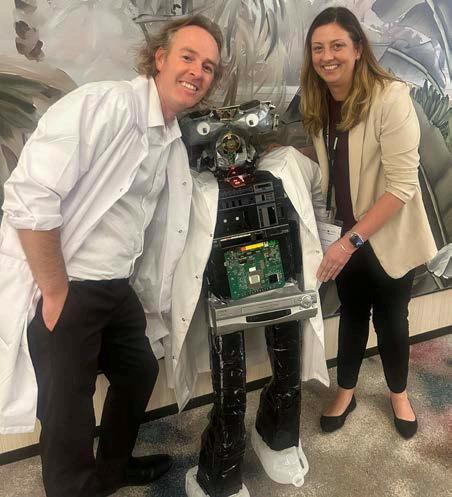
I’ve been following along with Michaela Patel, administrator for ‘Primary Science Teachers Australia’ Facebook group. We had the chance to exchange ideas, particularly around National Science Week and briefly on how cool robots are.
I finally met Jacob Strickling, inventor of the Tiny Science Lab, whose science kits I use
with students. Jacob’s enthusiasm for handson, practical learning is inspiring and it was fantastic to meet in person and collaborate to build a microbiome, enabling microorganisms from a single drop of water to be examined under laser light.
Another special moment was meeting Dr. Wanchai Yingprayoon, a physicist visiting from Thailand. I’ve long admired his work on fostering curiosity and intrinsic motivation in science learners, so it was a privilege to learn directly from him and even work alongside his elementary students. His ideas on cultivating problem-solving skills, creative thinking and meaningful engagement in physics were memorable.
These educators, along with others… again and again conversed about how even the most complex topics can become accessible and exciting when introduced with the right tools and mindset. It’s not about simplifying the science but elevating the learning.
Adding to this was a keynote speech from Professor Cathryn Trott, an astrophysicist whose research sits on the edge of what we currently understand about the universe. What stayed with me, though, wasn’t just the scale of her work; it was her tribute to teachers. She spoke about how often her PhD
students arrive with a spark already alight, thanks to passionate science teachers who once inspired them to explore and made them feel capable.
The conference theme, 'Eyes to the Future', was the focus in every workshop, keynote and conversation I had. In all this, a strong throughline emerged: the importance of early science education and the increasing relevance of quantum science. We still largely teach forces and motion using classical physics, which is foundational but incomplete. Today’s world, and much of our everyday technology (smartphones, lasers, the internet, GPS) runs on quantum principles. Introducing modern physics in an age-appropriate way is needed to help students develop a clearer and more accurate understanding of the science behind the everyday technologies we use.
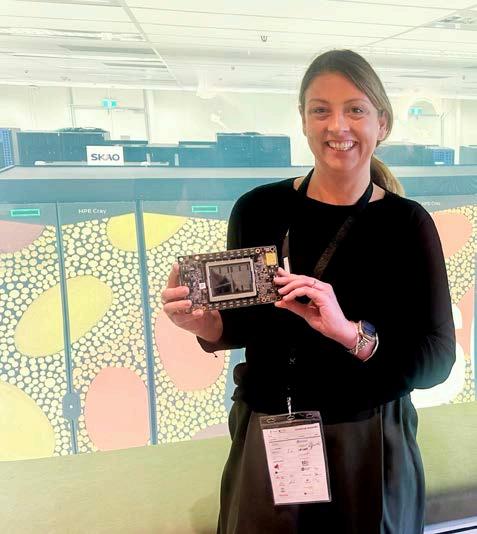
I had the opportunity to visit several of Australia’s leading science research facilities. At the Pawsey Supercomputing Research Centre, I was introduced to Setonix, one of the most powerful supercomputers in the Southern Hemisphere and “Yes!”… I even got to hold a component of its hardware! Their visualisation lab demonstrated how advanced computing supports fields as diverse as climate modelling and neuroscience. The visit further highlighted the growing significance of quantum science, including key concepts like entanglement, superposition and interference. I left determined to make these ideas more accessible to students through engaging, hands-on strategies.
My visit to Curtin University included a memorable meeting with Professor Igor Bray, a leader in atomic and quantum physics education. Our conversation highlighted the urgent need to bring contemporary physics into classrooms and the crucial role of teacher PL in making that possible. His insights affirmed my belief in the importance of this work and strengthened my commitment to embedding Einsteinian principles into my teaching practice. At the John de Laeter Research Centre, I toured labs investigating ion-atom collisions, fission energy and cutting-edge cancer therapies (all examples of how modern physics research connects to global challenges).
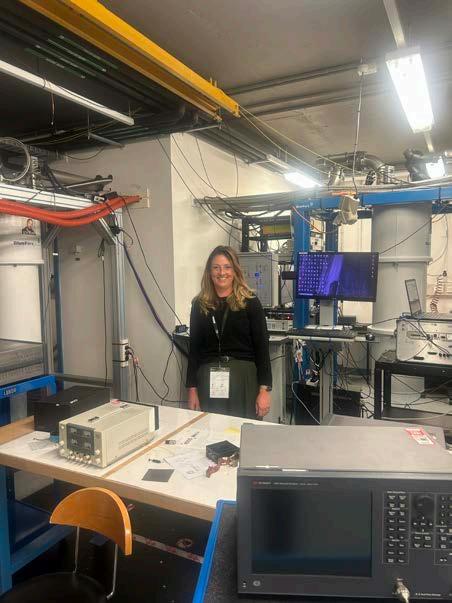
Later, at UWA, I had the opportunity to visit the EQUS labs (the Australian Research Council Centre of Excellence for Engineered Quantum Systems), where researchers are investigating phenomena like dark matter. Experiencing this cutting-edge research underscored a key message repeated throughout the conference: fostering curiosity and confidence in science must begin early. Many curricula delay introducing concepts like particle physics or quantum science until secondary school, assuming they’re too advanced. But this underestimates what younger students are capable of when teaching is hands-on, wellsupported and meaningful.
Mr David Wood, Adjunct Senior Research Fellow at the School of Physics, Maths and Computing, is a passionate advocate for introducing modern physics earlier in education. I had the privilege of joining him at the UWA’s School of Physics, where we explored the idea that gravity is not simply a force, but the result of warped space-time and a concept that can be introduced at a primary level using simple tools. This experience led me to enrol in a microcredential in Einsteinian Science and I am now studying with his team to deepen my understanding of how to teach modern physics effectively to young learners. Back at school, I’ve since developed a spacetime simulator and am preparing student investigations into how light bends around massive objects, the same principles that underpin black holes and gravitational waves. Students are captivated and it’s clear that this kind of learning leaves a lasting impression.
One of the final talks I attended was delivered by Liam Hall, Principal Research Scientist at CSIRO Quantum Biotechnology. He outlined how teachers can introduce students to the language and concepts of quantum science early on, laying the foundation for deeper learning and future careers. His presentation reinforced that this is the job we need to do now!
Thank you to the Australian Science Teachers Association for making this experience possible and for honouring Ruth Dircks, whose dedication to science education continues to guide and inspire.
I returned from WA not just with fresh resources and teaching strategies, but with a sharper focus on why our work is relevant.
The future doesn’t arrive fully formed. It’s shaped by what we teach and how we teach it.
We’re not just preparing students for the future, we’re helping them build it.
"The future doesn’t arrive fully formed. It’s shaped by what we teach and how we teach it. We’re not just preparing students for the future, we’re helping them build it"
Leeane Smith – Ruth Dircks ConASTA Scholarship winner
A ‘Makerspace’ recycled plastics STEM activity
Jon Roberts & Helen Georgiou
The plastic problem
Hundreds of millions of metric tonnes of plastic are produced every year, with the amount continuing to increase on a per capita basis. Plastics are now a major source of pollution in all the world’s ecosystems, with microplastics (resulting from the breakdown of larger plastic pieces) found in a majority of the world’s organisms1
Very little plastic waste is ever recycled (approximately 15%) as recycling programmes around the world struggle to adapt to the scale and economics of the process. For a long time in Australia for example, much of our plastic waste has been shipped overseas, ending up in landfill2.
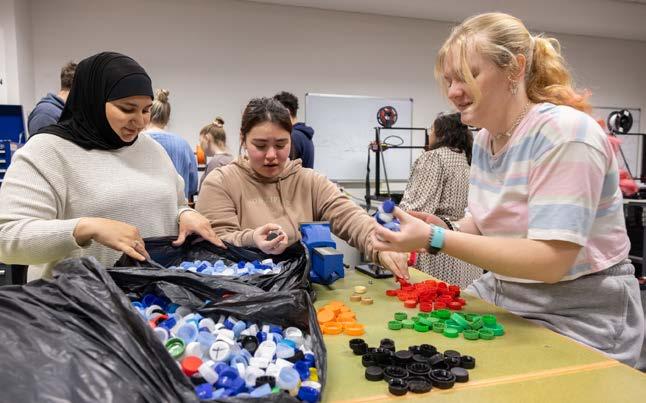
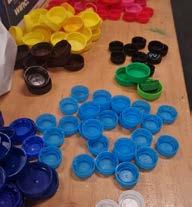
In recognition of this issue, many individuals or small organisations have engaged within a ‘circular economy’ movement of local recycling, where plastics are collected, sorted and repurposed into other products. This STEM activity is an example of such a process, and has been undertaken with both preservice teachers (see Figure 1) and Stage 3 students in schools in NSW.
The project
In this project, students are tasked with designing a product made from recycled plastics. Key skills involve designing using Computer Assisted Design (CAD) (specifically, TinkerCAD), learning about the different plastics and their properties, and undertaking a process of melting, re-forming and cutting plastics using a laser cutter to create a new product.
Designing in TinkerCAD
TinkerCAD is a free online platform designed to introduce students to 3D design, electronics and coding. It has become popular with teachers because it requires no downloads, works in any web browser, can be used without student account set-up and supports a range of hands-on STEM learning experiences. TinkerCAD allows students to create 3D models for printing, simulate simple circuits and even write code to control electronic components.
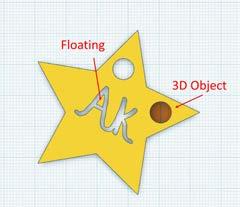
1. Initial design in TinkerCAD.
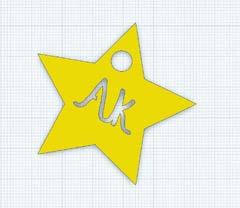
2. Updated to remove 3D objects and floating elements.
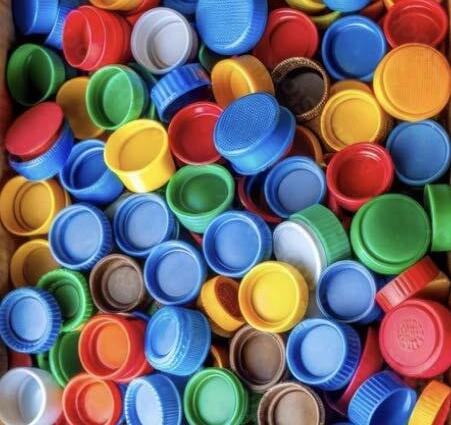
Figure 1. Preservice teachers sorting through discarded bottle caps for recycling to contribute to circular economy
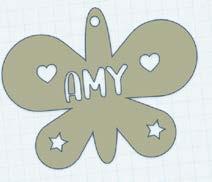
In this iteration of the activity, aimed at Stage 3, students are tasked with creating a unique bag tag, responding to a brief which identified the issue of easily identifying similar-looking school bags. In TinkerCAD, students consider the dimensions and unique elements of their design. As TinkerCAD uses 3D representation, students require support when considering a 2D object/space within TinkerCAD and are explicitly taught direct modelling techniques such as adding and subtracting simple objects to create more complex designs. Designs for 2D objects can also be downloaded as svg files from websites such as https://www.svgrepo.com and https://www.thingiverse.com
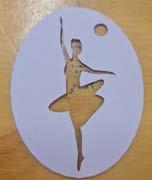
Initial prototypes are cut on cardboard with a vinyl cutting machine (e.g. Cricut), so students review their designs and make amendments before finally cutting with the laser cutter. Key challenges include letter/shape cut outs and translating from 3D to 2D shapes (see Figure 2.1).
3. Trial using Cricut vinyl cutter.
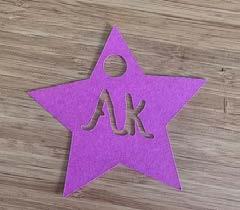
4. Final cut using laser cutter.
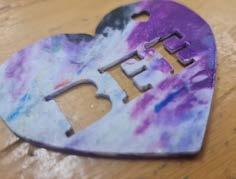
Figure 2. Examples of designs at different stages (from TinkerCAD troubleshooting, to Cricut prototyping and the final product)
The brief could be adjusted to support the creation of a range of other products (e.g., jewellery) and year groups.
Properties of materials
The activity provides the opportunity to explore the characteristics of plastics, in particular, thermoplastics. Key concepts that could be discussed include the usefulness of plastics, the different types of plastics and how thermoplastics can be melted and re-formed into new products. As part of the unit of work, students learn about waste, plastic categories and plastic manufacturing.
The two main plastics used in this activity are HDPE and PLA (see Figure 3). Both are thermoplastics (can be melted and reformed), with similar ‘physical’ characteristics, such as being durable, available in different colours and being waterproof. However, they differ slightly in terms of their physical properties
including melting points, how quickly they heat or cool and how much they expand/contract whilst being heated or cooling. For instance, the melting point range for HDPE is around 130-150°C, and PLA sits around 160-200°C. HDPE heats/cools more quickly and expands contracts more than PLA. How quickly the plastics melt primarily depends on their particle size.
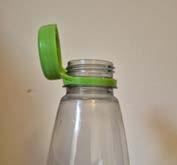
HDPE stands for High Density Polyethylene, and is a strong plastic commonly used for bottle caps and containers such as those that hold laundry liquid. Currently in Australia, bottle caps are not recycled consistently, as most councils are unable to process them as part of kerbside recycling programs, meaning most will end up in landfill. Interestingly, in Europe, this recycling challenge has led to the requirement for manufacturers to produce bottles with tethered bottle caps (see Figure 3) 3
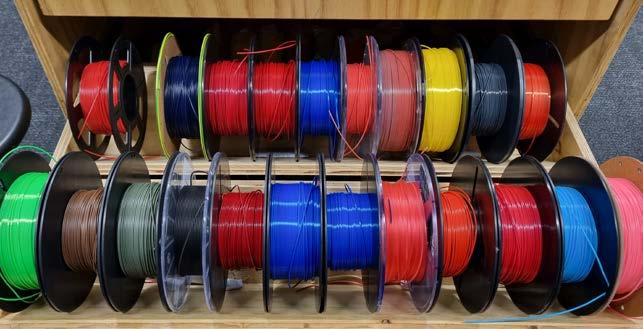
PLA is the main plastic used as part of this project. PLA stands for Polylactic Acid and is a plastic used in the filament for 3D printing. Unlike most other plastics, which are made using fossil fuels such as petroleum (such as HDPE), PLA is made from sugar cane or corn starch. Whilst this makes PLA more sustainable than other plastics, it can still take the same amount of time to biodegrade if sent to landfill (~80 years), though it can be biodegradable under industrial composting conditions. The long time required for plastics to biodegrade makes it desirable to recycle PLA, HDPE and other thermoplastics for reuse where possible.
Figure 3. HDPE tethered bottle cap improves recycling rates (left) and spools of PLA for 3D printing use (right)
Safety and risk assessment
Plastics can release toxic fumes at their ignition temperatures (around 300-600°C). Temperatures of the sandwich presses used to melt these plastics in this activity are around 160-200°C, so the plastics are melted, but not burned. However, molten plastic is hot and viscous, and poses a burn risk. This is particularly important for the HDPE activity, as it required manual handling to place into forms. Supervision is required for melting and handling the plastics and PPE such as masks and gloves are recommended, as is working in a well-ventilated area. Teacher handling with silicon gloves for the HDPE activity is strongly recommended.
The construction process
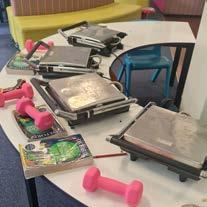
Two different construction methods are showcased in this project; one involves using HDPE to demonstrate the melting and reforming process by making spinning tops, the second involves producing the PLA flat sheets required for the bag tag. The use of HDPE to make the spinning tops allows students to experience and compare working with two different plastics, and is an illustration of a slightly different re-forming process. Both involve first preparing and melting the plastics in a regular inexpensive sandwich press, using baking paper to avoid the plastics sticking to the hot plates.
1. Sort bottle caps into colours and machine-grind or cut into smaller pieces.
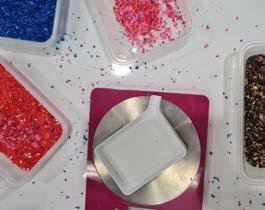
2. Weigh out 5g of HDPE into containers. A mixture of colours works well. (PLA can also be used for this)
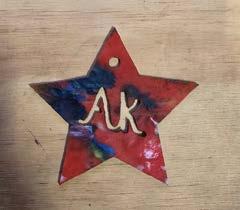
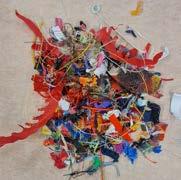
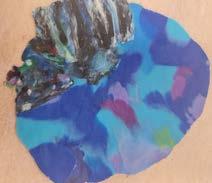
In this project, we used an industrial plastic grinder to produce ideal particle sizes for both activities. For HDPE, these were ground quite small (~1-2mm), as these allowed fast melting in order to produce a class set of spinning tops within around an hour (See Figure 4.2). For PLA, it wasn’t necessary to grind it into smaller pieces, as we simply selected smaller pieces that were discarded as part of the 3D printing process (see Figure 5.1). However, when the grinder was used for PLA, the particle sizes could range from smaller (1-2mm) or larger (5-7mm) and this variety added to the design element because the size and shape of the PLA particles contributed to the overall aesthetics of the plastic sheet. For instance, longer strips will produce distinct lines in the flat sheets, whilst smaller particles produce more of a ‘confetti’ design. It is possible to manually cut both the HDPE and PLA with tin snips, and the bottle caps will also melt in the sandwich press without further cutting; however this will take longer.
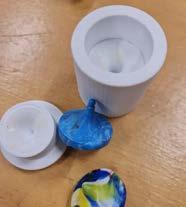
In the first method, students melt and reform HDPE in a mould as an illustration of the potential of thermoplastics. The instructions for this process are provided below in Figure 4. Moulds need to be printed in Acrylonitrile Butadiene Styrene (ABS) or Acrylonitrile Styrene Acrylate (ASA), which are easily accessible filaments for 3D printing and have higher melting points than PLA/HPDE to ensure the mould does not deform during the process.
3. Melt in sandwich press in between sheets of baking paper.
4. Roll into ball while molten (use gloves) and place into mould. Press firmly in mould (1-2mins), release, cool in water.
Figure 4. Process of making spinning tops from HDEP using mould
The first method introduces students to the fundamentals of melting and re-forming plastics so they are ready for the second construction method using a laser cutter (shown in Figure 5) to create their individual bag tags (each step represents a different example of a product, to illustrate range).
1. Assemble PLA scraps into required arrangement.
2. Melt in sandwich press with baking paper, add weights on top to ensure flatter sheets.
Student and teacher reception
This activity was trialed in two schools with Stage 3 students (approximately 200 students in total). In the first trial, students had difficulties with the design process, and as such, more explicit instructions and the Cricut prototyping stage were introduced into the process. Overall, students enjoyed this activity, stating that they enjoyed the hands-on aspects, as well as developing their own designs. The activity resulted in more positive attitudes towards STEM and STEM careers and students reported having discussions about the experience with friends and family.
Final note
This activity was designed to take place in a Makerspace. Makerspaces are flexible, creative, hands-on learning environments where students can design, experiment, build and invent using a variety of tools and materials. They are typically equipped with resources like 3D printers, electronics kits, craft supplies, and digital tools. A basic Makerspace can be easily set up in a school but connecting with the local high school, University or public Makerspace might also be an option if your school does not have the space or resources to maintain a Makerspace. In this example, all steps (until laser cutting) were undertaken in a regular classroom, and final designs were cut by UOW Makerspace facilitators off-site. As such, access to a laser cutter for the final cuts would be ideal.
Links to Australian Curriculum
Changes to materials can be reversible or irreversible (ACSSU095).
– Exploring how reversible changes can be used to recycle materials.
Generate, develop and communicate design ideas and processes for audiences using appropriate technical terms and graphical representation techniques (ACTDEP025).
Select appropriate materials, components, tools, equipment and techniques and apply safe procedures to make designed solutions (ACTDEP026).
Negotiate criteria for success that include sustainability to evaluate design ideas, processes and solutions (ACTDEP027).
3. Design tag in tinkerCAD.
4. Cut using Cricut on cardboard.
5. Cut using laser cutter.
Figure 5. Process of making personalised bag tag from PLA
Acknowledgements
This work was supported by a UOW Global Challenges grant and Australian Government Women In STEM and Entrepreneurship grant.
About the authors
Jon Roberts is a senior lecturer in Mechanical Engineering and Makerspace coordinator. He undertakes engineering research and runs Makerspace workshops with teachers, students and the public.
Helen Georgiou is an Associate Professor in science education and former teacher, interested in helping to support students’ conceptual understanding and attitudes towards Science.
References
1. Lamichhane, G., Acharya, A., Marahatha, R. et al. Microplastics in environment: global concern, challenges, and controlling measures. Int. J. Environ. Sci. Technol. 20, 4673–4694 (2023). https://doi.org/10.1007/s13762-022-04261-1
2. Plastic waste in Australia and the recycling greenwash, The Australia Institute (2024) https://australiainstitute.org.au/wp-content/ uploads/2024/01/P1482-Plastic-Waste-inAustralia-Web-1.pdf
3. Kachef, R.L. Why Plastic Bottles Now Have Their Caps Attached, The Conversation, October 2, 2024 https://theconversation. com/why-plastic-bottles-now-have-their-capsattached-239886
Engage your students with hands-on science!
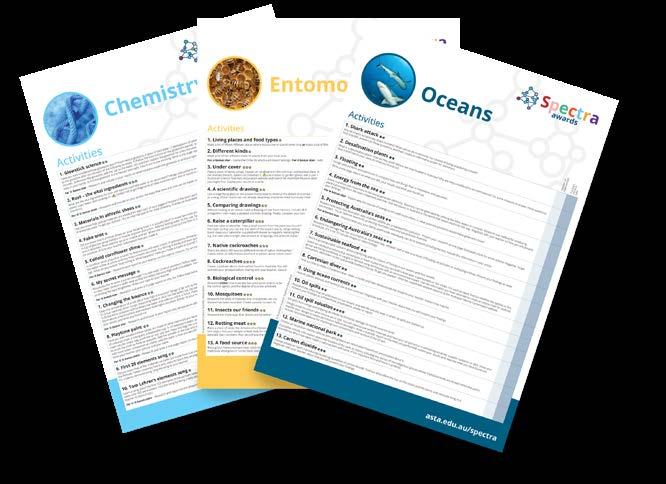
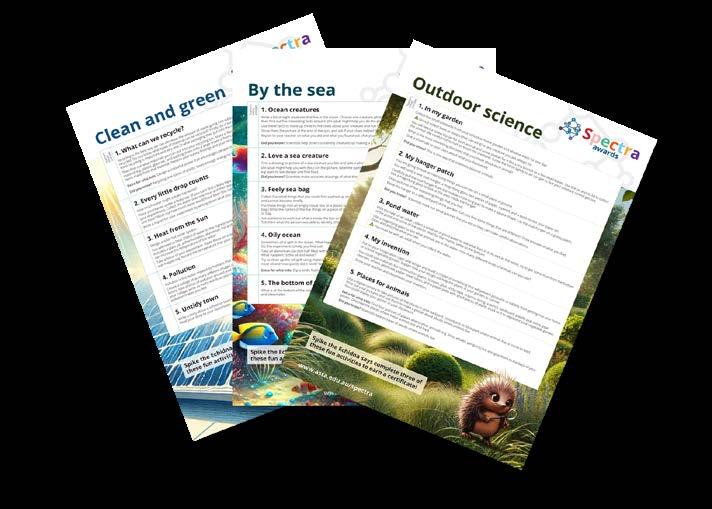
Looking for a fun and engaging way to spark a love of science in students? Spectra is a hands-on, nationally recognised program designed to inspire curiosity and encourage scientific exploration in students from Years 1 to 10. Whether used in the classroom, with extension students, in science clubs or by homeschooling groups, Spectra provides a structured yet flexible approach to learning through experiments, research, and hands-on investigations.
With vibrant, full-color activity cards – featuring Spike the Echidna in Junior Spectra (Yrs 1–4) – students can explore a wide range of science topics at their own pace. Plus, they’ll be awarded a certificate upon completion!
Available as digital downloads, Spectra cards are continuously updated to align with the Australian Curriculum: Science, ensuring fresh and relevant content. Explore the full range of topics and order today at asta.edu.au/spectra For more information call 02 9346 9600 or email asta@asta.edu.au
Spectra Card Topics
Active Earth ^
Aeronautics ^
Animals *^
Astronomy ^
Biodiversity ^
By the sea *
Carbon ^
Chemistry * ^
Clean and green *
Electricity ^ Energy ^
Entomology ^
Finding out about ourselves *
Heat *
Horticulture and agriculture ^
Indigenous science *^
Inventing and designing *
Looking into liquids *
Moving with air *
Nuclear power ^
Oceans ^
Outdoor science *
Pets and gardens *
Plants *^
Polar science ^
Predators and prey *
Rocks *^
Science and the environment ^
Science on the move *
Seasons *
Sight, light and colour ^
Sound science *^
Space science ^ Technology, designing and engineering ^ The human body ^
Tools, toys and machines ^
Spectra cards Yrs 5–10 ^
Water *^ What is it made of? *
Spectra Junior cards Yrs 1–4 *
asta.edu.au/spectra
Book
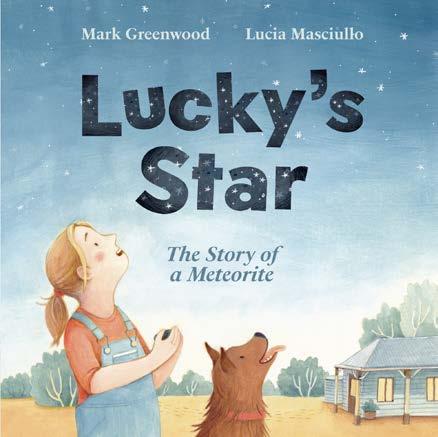
Lucky’s Star: The Story of a Meteorite
Written by: Mark Greenwood
Illustrator: Lucia Masciullo
Published by CSIRO Publishing
Review by G. Constanti
A fireball streaks across the sky! What is it? Could it be carrying alien germs? Lucky’s Star by Mark Greenwood brings to life the unlikely events of 1969 when the Murchison meteorite fell to Earth, revealing events of international astronomical significance.
The story follows the actions of the main character, the young girl, Lucky, as she tries to understand the strange meteor shower over her hometown in country Victoria. Lucky collects one of the strange rocks and tries to understand its connection to space and the
stars. “If a star falls,” she wonders, “does it leave an empty space in the sky?”
At the centre of Lucky’s Star, lies the real-life Murchison meteorite which contains the oldest known material ever found on earth, namely 7 billion year old stardust grains. One of the most studied rocks in history, its story is told with warmth and wonder. Although, its characters are fictional, the story remains historically accurate, concluding with a double page spread outlining the history of the Murchison Meteorite and other meteorite mysteries. This provides a springboard for further exploration and research for young readers. A glossary of terms is also included.
The book has a recommended reading age of five to nine but can be accessed by younger space enthusiasts with their adults. The illustrations complement the story, capturing both Lucky’s wonder and the atmosphere of Australia in 1969.
In the classroom Lucky’s Star links to NSW Science and Technology Syllabus content in Stage 1 where students examine and consider the night sky and the significance of heavenly bodies including the stars. Lucky’s Star can also be used as a hook in stage 3, to prompt further questions and inquiry, as students are expected to recognise stars, galaxies, nebulae as astronomical features that exist beyond our solar system.
CSIRO Publishing has also developed supporting teacher notes that align to the Australian Curriculum.
The night sky has always been a field of wonder for both children and adults. Lucky’s Star offers a captivating way to unlock some of its mysteries, inviting curiosity and inspiring the next generation of stargazers.
Advertising space is available in Teaching Science, on our website asta.edu.au and social media platforms. Get in touch for advertising rates, email communications@asta.edu.au
Science Safety Matters and we're here to help SCIENCE ASSIST
We care about the safety of school science educators, technicians and students. Science Assist provides comprehensive support for science educators, offering expert advice, best-practice guidelines, and hands-on resources on lab safety, management and design. As Australia’s go-to service, we’re here to help you create a safe and effective learning environment. Subscribe for exclusive access to up-to-date resources and personalised support.
Visit asta.edu.au/scienceassist to sign up for a rolling 12–month subscription or contact us on (02) 9346 9600 or email scienceassist@asta.edu.au.
Register your school or create an individual account today for only $150 (ex GST).
'The support and knowledge provided by Science Assist is a godsend to all of us in labland overwhelmed with safety issues.'
Science Assist subscriber
Expert advice: Get access to high-quality teaching and learning resources curated by experts. Get personalised support by asking our panel of experts a question.
Curriculum support: Assistance with implementing the Australian Curriculum: Science.
Lab safety: Reliable guidance on all aspects of laboratory safety, management and design.
Hands-on activities: A vast range of safe, practical activities for an inquiry-based approach to science education.
AUSTRALIAN SCIENCE TEACHERS
ASSOCIATION
ASTA Executive Committee
President Margaret Shepherd Science Education Consultant NSW
President Elect
Paula Taylor Department of Education ACT
Member Associations
Science Teachers Association of Northern Territory (STANT)
President: Justine Small PO Box 1168, Nightcliff NT 0814