









March 14–17, 2026



March 14–17, 2026
In striving to become an effective ally in anti-oppression activism, it’s important to understand that the term “ally” does not denote an identity. It’s not who you are, it’s what you do!
Allyship involves more than words. It means taking concrete action in solidarity with people from equity-deserving groups.
An ally respectfully listens to people from equity-seeking groups with an open heart and mind.
An ally makes the effort to learn about personal privilege, historical injustices, and the impacts on the lived experience of oppressed people.
An ally is mindful to avoid monopolizing conversations, interrupting, patronizing, and speaking for others. Instead, we yield space for others.
2026 Reports and Resolutions
BC Teachers’ Federation
110th Annual General Meeting
This booklet is divided into sections as follows:
Part 1 is the Leadership Report of the Executive Committee.
Part 2 consists of recommendations of the Executive Committee and Representative Assembly on a variety of other topics, and resolutions received from locals.
Part 3 consists of committee reports, which cover the period since the last Annual General Meeting.
Part 4 covers the report of the Representative Assembly and Nominating Committee.
Part 5 is an outline of voting rights at the Annual General Meeting. Please take note of the section on “Voting Cards.” This is a crucial item. The Standing Rules of Order of the Annual General Meeting are also included in this section.
The “business” of the Annual General Meeting will consist of the recommendations in Part 1 and the various recommendations and resolutions in Part 2.
To help readers distinguish between recommendations of the Executive Committee and/ or Representative Assembly, and resolutions submitted by locals, recommendations have been numbered 1 to 14 and resolutions have been numbered 101 to 160. “Late” resolutions will be numbered starting at 200, and “new” resolutions will be numbered starting at 300.
Any supplementary recommendations of the Executive Committee and any “late” resolutions will be contained in the information kits distributed to delegates at the Annual General Meeting.
The headings used in this booklet are, as far as possible, the same as those used in the policies and procedures section of the Members’ Guide
The topic headings in both publications are arranged in alphabetical order. Page numbers in
parentheses throughout the booklet also refer to the Members’ Guide
Readers can therefore very easily check current policy and procedure statements on matters dealt with by the various recommendations and resolutions. Copies of the Members’ Guide were distributed last fall to each staffroom, and copies were sent to all locals. The Members’ Guide is also available online.
Under Procedure 2.C.02 (p. 26), locals are encouraged to submit recommendations to the Executive Committee and resolutions to the Representative Assembly throughout the year, for matters that can be dealt with by these bodies. This procedure has a two-fold benefit: action can be obtained sooner, and the amount of Annual General Meeting business is reduced, permitting a more thorough discussion and completion of more Annual General Meeting items.
These are covered in 6.C.1 (p. 180) of the Standing Rules of Order of the Annual General Meeting. A “late” resolution must be on a matter that arose too late for inclusion in Reports and Resolutions. The Executive Committee must rule prior to the Annual General Meeting on whether or not the resolution meets the definition of “late” as per the standing rules.
The Executive Committee will be meeting on March 13, 2026, to deal with any resolutions submitted for consideration as “late.”
These are covered fully in 6.D (p. 180) of the Standing Rules. To qualify as a “new” resolution, the resolution must meet all the following criteria:
The new resolution:
1. arises directly out of the business of the meeting.
2. could not have been submitted in time to become either a regular or late resolution. 3. must relate to an issue that must be dealt with before the spring meeting of the Representative Assembly.
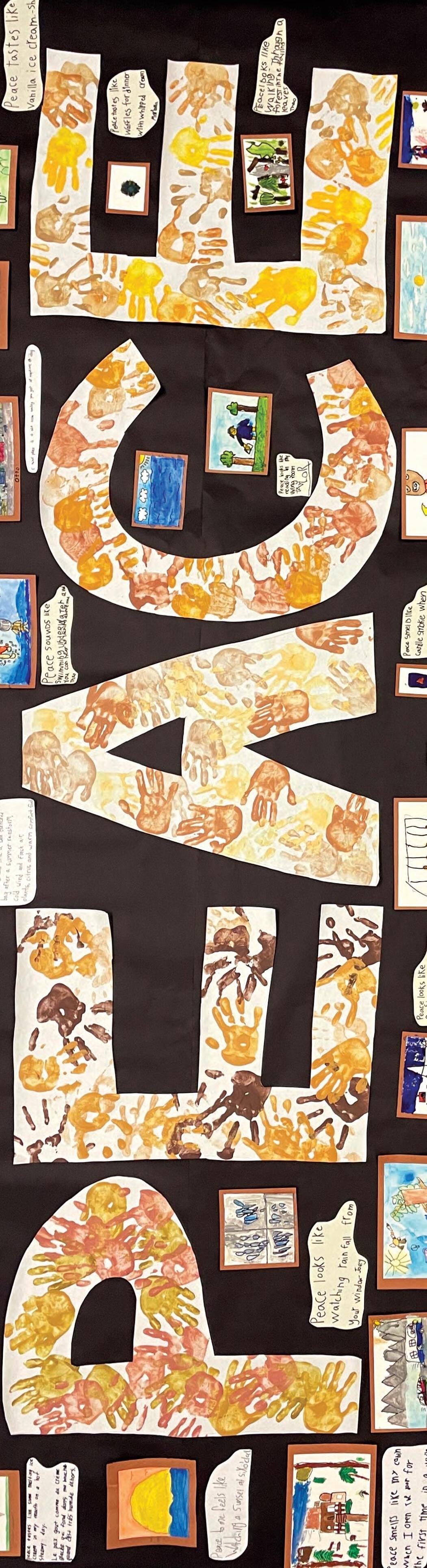
Materials
• What Does Peace Feel Like by V. Radunsky
• whiteboard and markers
• paper or journals
• pencils
• art supplies.
Ask students what peace means. Work with your class to come up with a definition for the word peace. Write this on the whiteboard.
Compare the class definition with the dictionary definition of peace: a state of tranquility or serenity.
Read the book What Does Peace Feel Like by V. Radunsky to your class. If you don’t have access to this book in your school library, you can find videos of the book being read aloud by others online.
(read more)


Read the full article in the Teacher magazine Jan/Feb 2025 edition or click below for the online version.
BCTF Procedures 2.A.02 to 2.A.06 address the annual expectation that the Executive Committee recommend leadership priorities for the ensuing year to the Annual General Meeting, and to present those recommended priorities to the Winter Representative Assembly for feedback.
Outlined below are the leadership priorities being recommended to the 2026 Annual General Meeting:
That the following be the 2026–27 Leadership Priorities:
1. Reclaiming professional dignity to reconnect to joy, purpose, and worker solidarity.
2. Asserting trust in teachers as experts in education.
3. Enhancing local and member political organizing capacity toward electing progressive school trustees and mobilizing on working conditions.
4. Responding to immediate member needs related to excessive workload, violence in classrooms, and the influence of the far right.
5. Enhancing suppor t and protection for members experiencing marginalization.
Supporting statement
The Executive Committee recommends leadership priorities for the following year to the Annual General Meeting. Development of the priorities begins with a facilitated session that includes reflection and dialogue between the Executive Committee, directors, and staff of the Federation.

Lesson ideas to commemorate Red Dress Day, the National Day

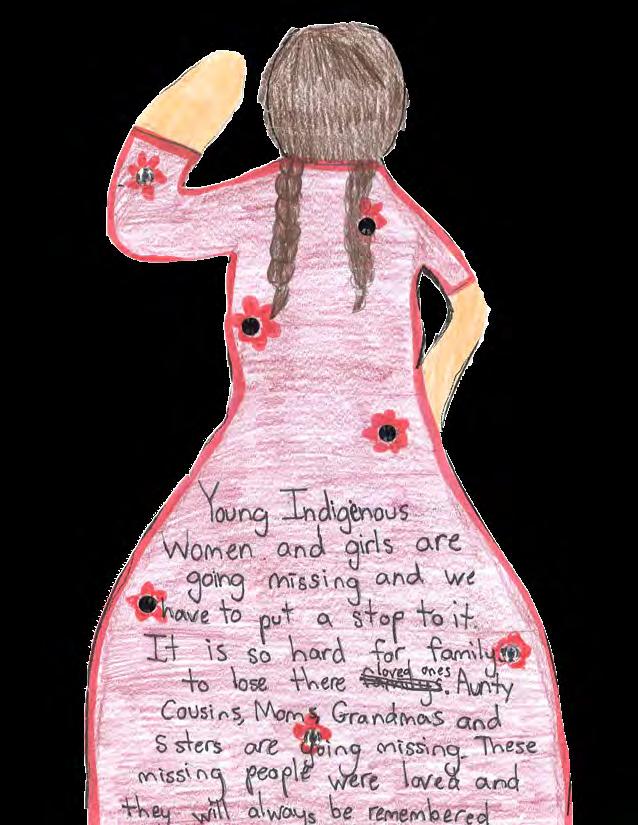
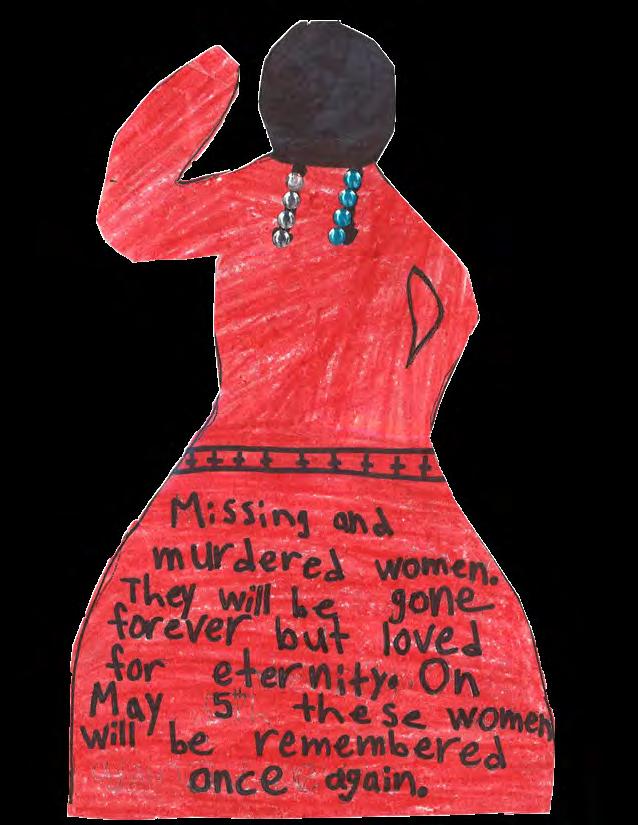
PRIMARY GRADES
By Jean Moir, teacher, Langley
AS A NON-INDIGENOUS TEACHER, I only use children’s stories written and, hopefully, illustrated by Indigenous authors and artists. For my Grade 3 class, the story I use is Together We Drum, Our Hearts Beat as One, written by Métis author Willie Poll and beautifully illustrated by Métis author and artist, Chief Lady Bird. This story can be used to approach the subject of…

SECONDARY GRADES
By Penny Carnrite teacher, Langley


IT IS IMPORTANT for students to make the connection between the past and the present; they must see history as something that is in progress. Historicizing events as things that happened in the past and are now over, without examination, can lead to social injustice and inaction.
My unit on MMIWG has several components. Each component is guided by the following questions:
What is MMIWG?

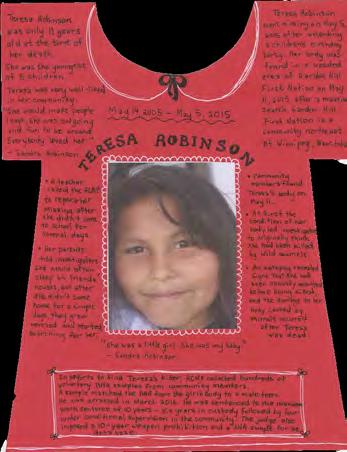
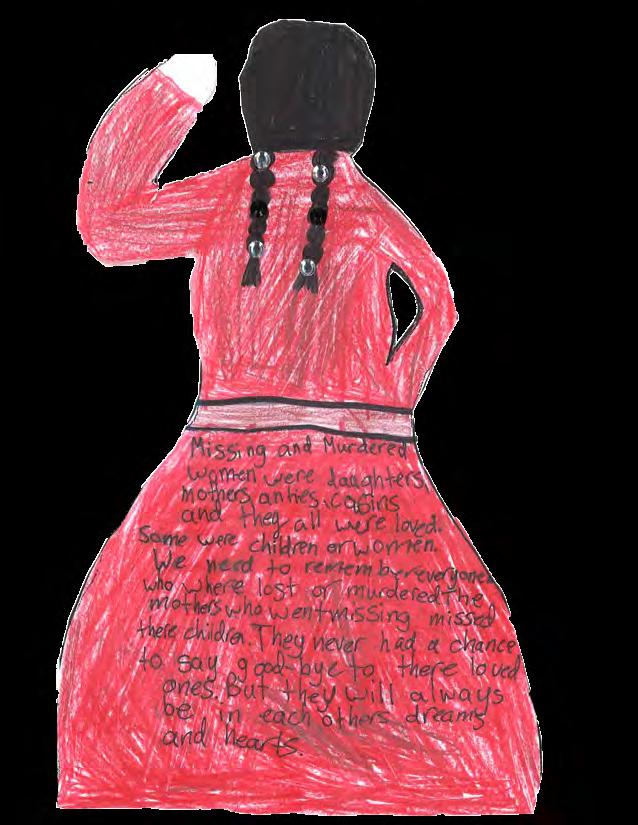

Who are the women and children who are missing and murdered? What are their individual stories? Are Canadians aware of MMIWG? How can knowledge about MMIWG be shared?… (read more) (read more)
Read the full article in the Teacher magazine March 2025 edition or click below for the online version.
By-law amendments must be passed by special resolution at an AGM, which requires a two-thirds majority to pass (see By-law 20). Special resolutions require advance notice to the membership and cannot be amended from the floor at the AGM.
That By-law 5.1(a) be amended as follows: There shall be an Executive Committee, which shall consist of a President, First Vice-President, Second Vice-President, an Immediate Past President (when applicable), and ten Members-at-Large, elected in such a manner as to ensure that at least three Member-at-Large vacancies are filled at each Annual General Meeting. One Memberat-Large position shall be designated to be held by a Member of Colour, one shall be designated to be held by an Aboriginal member, and one shall be designated to be held by a 2SLGBTQ+ member, and one shall be designated to be held by a disabled member/member with a disability. The designated positions shall have the same term and role as the non-designated positions. The Executive Committee positions are elected by the Annual General Meeting and shall take office on the following July 1. Each member of the Executive Committee shall be a member in good standing entitled to vote, in accordance with By-law 1.1. An Executive Committee member may be removed from office under the provisions of By-law 1.7, By-law 5.21, or By-law 7.
Supporting statement
The 2025 Annual General Meeting (AGM) carried a motion of intent regarding this designated position, and the by-law language required is now provided in order for this position to be elected at the 2027 AGM. The language provided is in alignment with the United Nations Disability-Inclusive Language Guidelines.
That By-law 5.1 be amended by adding a new item (h) as follows with subsequent items renumbered accordingly:
The Member-at-Large position designated to be held by a disabled member/member with a disability is open to the election of a member who identifies as a disabled person/person with a disability.
Supporting statement
The 2025 Annual General Meeting (AGM) carried a motion of intent regarding this designated position, and the by-law language required is now provided in order for this position to be elected at the 2027 AGM. The language provided is in alignment with the United Nations Disability-Inclusive Language Guidelines.
That By-law 5.1 be amended by adding a new item (i) as follows:
Members of the Provincial Bargaining Team may not run for positions as released officers (President, First Vice-President, and Second Vice-President) concurrently.
Supporting statement
Members of the Provincial Bargaining Team and Full-Time Table Officers (FTTOs) hold heavy responsibilities in the Federation, and these positions demand a great deal of time, energy, and skill. For a member to hold both positions at once risks overtaxing leaders within the Federation and misses an opportunity to share the workload equitably and to build capacity.
Due to the high profile of the Provincial Bargaining Team and their work, team members get a great deal of positive press while working in that role. This translates to a heavy advantage over other candidates during the campaign for a FTTO position. Because the Provincial Bargaining Team is appointed by the FTTOs, a culture where team members regularly run for other leadership positions is one where current FTTOs have an outsized influence on who might become the next FTTO.
This resolution is brought in the interest of keeping our democratic playing field level, keeping the workload of our Federation leaders manageable, and building capacity among a greater number of members.
That By-law 8.2(a) be amended as follows: The voting body of an Annual General Meeting or Special General Meeting shall consist of the members of the Executive Committee, the Local Representatives, and additional delegates from each local (“Delegates”) elected in accordance with By-law 2. Each local is entitled to one Delegate for each 0.2% 0.25%, or fraction thereof, of the total voting membership of the Federation as of the previous November 1.
Supporting statement
Changing By-law 8.2 and the delegate entitlement is a way to shrink the number of delegates to the Annual General Meeting (AGM). Currently, delegate attendance at the AGM sits at approximately 700 people. Shrinking it by 20% would put it closer to 550 people. There are several benefits to doing this. First is the obvious cost savings that would come with approximately 140 less people requiring accommodation, food, and transportation. Next is the decrease in the carbon footprint of this meeting. As a social justice union, the BCTF should be setting an example not only to its membership, but to other observers that the climate crisis is real and that we are taking what steps we can to lessen our impact. Finally, it would solve a space concern that is currently impacting the AGM. At its current size and with its ancillary requirements, there are very few sites in BC that are capable of serving as a venue for the meeting, and one of those, the Hyatt Regency Hotel, that has served as the site for the majority of the AGMs in the 21st Century, is growing increasingly tighter and tighter due to the AGM’s various needs. With the BCTF being a society and each member voting for their share of their local’s representation, a changing of our delegation size would not decrease the proportional representative power of each local. Yes, this may decrease the voices in the room, but it would then become the responsibility of the
delegates who are in attendance to make sure those missing voices are represented. By making this change, the work of the AGM can continue, but in a more financial and climate-friendly fashion.
That the Federation commit to conducting elections using a ranked-choice voting system for electing provincial Full-Time Table Officers and provincial Executive Committee members.
The current runoff election system creates several challenges that undermine democratic participation and efficiency.
The problems with the current system:
• Runoff elections on contested ballots result in declining delegate engagement as voting extends through multiple rounds. The Judicial Council elections at the Spring Representative Assembly exemplify this issue, where an excessively lengthy candidate list and repeated ballots led to voter fatigue and reduced participation.
• Our current voting system promotes strategic voting wherein members and representatives must choose the “most preferred and most likely to win” option rather than the choice that most represents their membership’s best interests. By using ranked choice and a 50%+1 election formula, we insert nuance into our election system, ensure that the majority of the membership supports a candidate to some degree, and reduce the chance of multiple rounds of voting for the same position.
In terms of implementation, Simply Voting already has an article titled “Understanding Preferential Voting,” which lays out how this election model can be implemented using their system. While there are multiple kinds of ranked voting systems, the 2018 BC referendum showed us that there is significant interest in this system. At the same time, the multiple possibilities for ranked choice and the confusing campaigns used to advertise these systems ensured that voters were confused and diluted in their ability to endorse ranked voting.
Should we commit to using this system, we can start with agreeing that ranked choice would benefit our democracy without leaving the decision to BCTF leadership that benefits from the election system remaining the same.
Note: This motion expresses intent only. If it is carried, any necessary by-law amendments would be brought forward to a future Annual General Meeting, as a special resolution, and would need to meet the required special resolution threshold at that future meeting before taking effect.
That By-law 6.9 be amended as follows: The Representative Assembly shall meet at the call of the President. The President shall call a special meeting of the Representative Assembly upon demand in writing of at least 20% of the Local Representatives. In years when the collective agreement is expiring or has expired, and there is not yet a newly negotiated contract in place, nor an agreement in-committee, the President shall call a special bargaining-focused Representative Assembly between the regular spring and fall meetings.
Supporting statement
In many past bargaining years, there has been a Special Representative Assembly (RA) held during the Summer Leadership Conference in August. To go from having an RA in May, when bargaining at the table has barely started, to November, when we’ve already been at the table for many months, means that there is a lack of opportunity for locals to provide input during a crucial time in the bargaining process. This lack of opportunity to provide input was felt by many members this year when the August RA didn’t happen, so it is important that we put this language into the Members’ Guide to formalize this process.
That the Federation implement a direct member voting system for the election of FullTime Table Officers, whereby all members in good standing have the right to cast one vote for each position.
Supporting statement
Representative democracy through delegates was established when direct member voting was logistically challenging, but modern technology now enables secure, accessible voting for all members. Other major unions have successfully transitioned to direct member voting for top leadership positions, resulting in increased member engagement and legitimacy. The current system limits voting rights to approximately 680 delegates out of over 50,000 BCTF members, meaning that 98.6% of members cannot directly vote for their provincial leadership. Direct member voting would ensure that Full-Time Table Officers are accountable to the entire membership rather than a small subset of delegates.
Note: This motion expresses intent only. If it is carried, any necessary by-law amendments would be brought forward to a future Annual General Meeting, as a special resolution, and would need to meet the required special resolution threshold at that future meeting before taking effect.
That Policy 3.A.07—1. be amended as follows: Honour full, free collective bargaining, with a preference for the local bargaining.
Supporting statement
This motion does not seek to eliminate local bargaining, but rather to ensure our Members’ Guide accurately reflects our practices and the stances of the BCTF. To our knowledge, the Federation has no public or internal campaign stating a preference for local bargaining. Our practices must match our policies and procedures, and this does not currently seem to be the case. By striking this line in the Members’ Guide, it would reflect the current practice of the Federation’s participation in both local and provincial bargaining structures.
That the Federation add one day to a Bargaining Conference dedicated to the discussion and production of a bargaining strategy.
Supporting statement
In the time allotted for the Bargaining Conference, there is barely enough time to get through setting the objectives and priorities, let alone have discussions surrounding bargaining strategy. This leaves major strategic decisions solely to the Provincial Bargaining Team and the Executive Committee, with little opportunity for influence and input from locals and the wider membership. Strategy may include items such as (but not limited to) how we work together with other public sector unions, or how communication with members is done. While the Provincial Bargaining Team and Executive Committee would have to make decisions based on how bargaining progresses in any given year, they would be guided by the voices of the rest of the membership, based on what was discussed at the Bargaining Conference.
That Procedure 3.E.02 be deleted.
Supporting statement
Procedure 3.E.02 states that the BCTF opposes provincial bargaining. This position is not reflected in the Federation’s actual practice.
For more than 30 years, the BCTF has actively participated in provincial bargaining under the Public Education Labour Relations Act. Provincial bargaining is not a theoretical or conditional activity—it is an established and ongoing part of how teachers’ collective agreements are negotiated in BC. There is no public, internal, or operational campaign in which the BCTF actively opposes provincial bargaining.
As such, Procedure 3.E.02 misrepresents the Federation’s current position. While the BCTF continues to support the principle of local bargaining and local autonomy, this support does not equate to opposition to provincial bargaining. The language in this procedure creates a false
dichotomy between local and provincial bargaining that does not align with how bargaining actually occurs.
Removing Procedure 3.E.02 does not mandate exclusive provincial bargaining, nor does it weaken local bargaining. It simply removes inaccurate opposition language from the Members’ Guide and ensures that Federation policy reflects our lived practice and bargaining reality.
The Members’ Guide should accurately represent what the BCTF does and stands for. Maintaining a procedure that claims opposition to provincial bargaining, while the Federation actively engages in it creates confusion and undermines the credibility and clarity of our policy framework.
Procedure 3.E.02:
That the BCTF continue to support the principle of local bargaining and oppose provincial bargaining.
109. Greater Victoria That Policy 3.G.14—1. be amended as follows: That bargaining be a component of the Summer Leadership Conferences and, in particular, that the Summer Leadership Conference prior to each new round of bargaining, and during any round of bargaining, hold discussions and provide training on the objective-setting process and or related matters such as bargaining strategy and bargaining-centred political action.
Supporting statement
The Summer Leadership Conference is an excellent opportunity for hundreds of BCTF members to connect and confer, discuss issues from around the province, and share information and skills that benefit others. While great training and discussions happen at this conference, there is a missed opportunity to strengthen our collective through regular training on bargaining. Every Summer Leadership Conference should include indepth discussions and training on bargaining, not only about objective setting, but about strong and appropriate strategies surrounding bargaining, and how we can use political action to our advantage, both as a Federation, and within locals.
110. Vancouver Elementary and Adult Educators
That the Federation advocate for the Teacher Qualification Service to acknowledge Indigenous lived experience as equivalent to academic preparation, and, as an act of reconciliation, to expressly confirm that teachers with a Master of Arts in Indigenous Languages and Linguistics will be placed into Category 6.
Supporting statement
This motion seeks to acknowledge Indigenous lived experience as equivalent to academic preparation, Indigenous languages having an equal status to other official languages in Canada, and to strengthen our commitment to reconciliation. Indigenous language teachers with a Master of Arts in Indigenous Languages and Linguistics should be automatically placed at Category 6 and beginning language teachers who finish a four-year bachelor’s degree should be automatically placed at Category 5.
Making these changes for Indigenous language teachers would impact a very small number but provide the needed support for a small number of Indigenous language teachers who are currently not paid on par. Before addressing the referral recommendation, it is essential to examine the current state of Indigenous languages in the province of BC and the challenges faced by Indigenous language teachers. The land known today as BC is one of the most culturally diverse areas in the world. Within Indigenous communities, 204 of them belong to approximately 40 nations and cultural groups. There are also approximately 35 Indigenous languages and over 90 language dialects within 7 language families that are Indigenous to BC. There are 22 First Nations languages that are reported almost exclusively in BC. They are the primary home to three distinct language families (Salish, Tsimshian, and Wakashan) and two isolated languages (Haida and Ktunaxa [Kutenai]) that are not related to any other language. Many of these languages have fewer than 1,000 speakers.
Recommendation 4
That Policy 9.K. of the Members’ Guide be replaced with the following:
Policy 9.K.01
That the Federation support a vision for arts education (dance, drama, music, and visual arts), recognizing the role of arts education in fostering creativity, critical thinking, cultural awareness, and emotional expression.
Policy 9.K.03
That the Federation advocate to the provincial government to:
1. provide adequate funding for universal, sustainable, accessible, and quality arts education province-wide.
2. uphold ar ts education as curricular rather than extra-curricular within the educational framework.
3. ensure the continuity and sustainability of arts programs with specialist teachers.
4. value arts education to the same extent as other academic subjects.
5. suppor t the implementation of arts programs by ensuring access to appropriate facilities, educational support materials, resources, and information equitably across the arts.
6. recognize the role of the arts in supporting students’ emotional wellbeing, social skills, and critical thinking.
7. ensure accessibility and accommodation for students with disabilities and diverse abilities and provide support for students with diverse learning needs and individual education plans to participate fully in arts programs.
8. commit to equity and cultural diversity across arts education.
9. guarantee that all students, regardless of socioeconomic status, have access to materials, instruments, and resources necessary for participation.
Policy 9.K.05
That the Federation support the decolonization and Indigenization of arts
education practices and instructional spaces in all schools in the province. The aim of this work would be to advance truth and reconciliation, to encourage a connection with Aboriginal Knowledge Keepers, and include understanding of cultural protocol related to Aboriginal practices.
That the Federation continue to help implement relevant studies and initiatives that strengthen arts education in BC, including, but not limited to:
1. providing ongoing training and professional development for arts educators.
2. encouraging participation in workshops, conferences, or partnerships with contemporary and traditional Indigenous visual and performing artists to improve pedagogy and best practices.
That the Federation advocate for health and safety guidelines for arts education governing:
1. the use of potentially hazardous materials, equipment, or environments.
2. appropriate care and use of supplies and equipment specific to the arts in order to prevent injury.
3. training in maintenance of facilities and equipment for teaching and support staff.
Supporting statement
At the 2018 Annual General Meeting, a motion was put forward to delete Section 9.K. of the Members’ Guide (the section related to fine arts education) and replace it with new language; however, the new language was not added back into the Members’ Guide and Section 9.K. remained empty. Recently, the error was noticed, and the language was found and restored. Since 2018, the accepted motion has become outdated, and in need of revision.
Arts education has been under attack in BC for over 30 years. Many school districts in BC were once global leaders in arts education, but this is
no longer the case. The BCTF has recognized arts educators as specialist teachers for some time, but many of these specialist positions have been dissolved. We know that the arts are crucial for the intellectual and social-emotional development of all students, and research has shown that the arts have been successfully used as a targeted strategy to transform culture and school success for vulnerable and at-risk students. There is a huge creative economy in BC, therefore, K–12 education should be prioritizing arts education province-wide. This policy update aims to reflect the vital role of the arts in schools, the need for continuous and sustained arts education advocacy, and the very specific needs of arts education environments.
That Procedures 9.A.10, 9.A.34, 9.A.36, 9.A.50, and 9.A.58 be replaced with a new Foundation Skills Assessment Procedure 9.A.10 as follows:
The Federation encourages and supports locals to conduct Foundation Skills Assessment (FSA) campaigns to:
1. increase awareness of the Federation’s policy on the FSA through various direct to parent, community, and public communication and lobbying avenues.
2. encourage and support members to not participate in the administration and marking of the FSA.
3. encourage and support all parents’ right to withdraw children from the FSA.
4. suppor t, through materials and grants, co-ordinated local advocacy campaigns against the FSA.
5. encourage respectful dialogue with families and communities about the FSA, district mandated assessments, and alternative options for meaningful student assessment.
A significant FSA review project was convened in May 2023. Through the 2024–25 year, over 50 members participating in BCTF advisory committees had the opportunity to learn about the history of the FSA, the Federation’s ongoing lobbying efforts, as well as the various successes and challenges of the FSA campaign, and provide
feedback. From these sessions, two additional representatives per advisory committee came together for a “deep-dive” facilitated day to make several recommendations to the Executive Committee in September 2025. This work affirmed the Federation’s positions on the FSA, and no significant changes to Federation position were recommended. However, a key recommendation was to review the numerous references in policy and procedure toward one clear, plain language policy and procedure that would ensure any member could easily and quickly understand the Federation’s core beliefs and ongoing work regarding the FSA.
The proposed procedure consolidates a number of pre-existing procedures or deletes where the information contained was more appropriately included in policy. Therefore, the recommended deletions do not negate the positions expressed in the original procedures, which are incorporated into the new policy and procedure, or were already covered under existing policies elsewhere.
Recommendation 6
That Policies 9.A.47, 9.A.49, 9.A.51, and 9.A.65 be replaced with a new Foundation Skills Assessment Policy 9.A.47 as follows:
1. The Federation holds that the compulsory, system-wide use of the Foundation Skills Assessment (FSA) is not appropriate when it is used for accountability, evaluation, or comparison. FSA results must not be used as goals, measures of success, or instruments for school, district, or system evaluation, accreditation, accountability, or ranking.
2. The Federation affirms that the primary purpose of assessment is to nurture, inform, and support student learning. Assessment should honour the richness and complexity of learning, respond to the diverse strengths and needs of students, and be grounded in the professional judgment of teachers in their classrooms and schools.
3. The Federation maintains that FSA testing does not provide meaningful or
complete information about individual student learning. Such testing can unintentionally narrow teaching and learning, may be discouraging or harmful to students, and often reflects social and economic factors more than educational quality.
4. The Federation recognizes the public education system serves diverse communities with distinct needs, priorities, and governance structures, and remains committed to working thoughtfully and respectfully with all communities while upholding these principles. The Federation believes that every child’s learning journey is unique, that our members are committed to assessing student learning with care and professionalism, and that meaningful outcomes are best achieved through shared responsibility and increased resources to meet all children’s needs— not through high-stakes FSA testing.
A significant FSA review project was convened in May 2023. Through the 2024–25 year, over 50 members participating in BCTF advisory committees had the opportunity to learn about the history of the FSA, the Federation’s ongoing lobbying efforts, as well as the various successes and challenges of the FSA campaign, and provide feedback. From these sessions, two additional representatives per advisory committee came together for a “deep-dive” facilitated day to make several recommendations to the Executive Committee in September 2025. This work affirmed the Federation’s positions on the FSA, and no significant changes to Federation position were recommended. However, a key recommendation was to review the numerous references in policy and procedure toward one clear, plain language policy that would ensure any member could easily and quickly understand the Federation’s core beliefs on the FSA.
The recommended deletions do not negate the positions expressed in the original policies, which are incorporated into the new policy and
procedure, or are already covered under existing policies elsewhere, including policies on provincial education goals (9.A.07), assessment (9.A.17), systems of accountability (9.A.27), standards and accountability (9.A.25), and district-wide tests (9.A.61).
That the Federation connect with locals and investigate changes in support for students with designations who transition from primary to intermediate, or as students move from one grade to another, with a report back to the 2026 Fall Representative Assembly.
Supporting statement
In our local, the district is making decisions to significantly reduce the support for students with designations as they enter upper intermediate. As an example, we had a student, who up until Grade 5, was receiving full-time support. This year, now that they are in Grade 6, the Ministry of Education and Child Care decided they needed to “become independent,” allotting them only one hour of support per day. This is overt ableism and is completely unacceptable.
The ignorance and sheer lack of care this demonstrates for neurodiverse students and students with disabilities is appalling and unacceptable. It takes time for students to become independent, and sometimes this isn’t possible, and there is nothing wrong with that. Nobody, especially children with exceptionalities, should have to experience such a drastic withdrawal of support and utter disregard from a system that is supposed to prioritize their rights and access to education.
Additionally, as students enter intermediate grades, they begin an incredibly challenging part of their lives, where they have to navigate puberty, complex social dynamics, and more academic pressure between increased curricular content while preparing for high school. This notion that as students get older, they should be more independent or without support is
incredibly harmful and far from the reality of what neurodiverse students and students with disabilities experience.
Please support this motion so districts can be held accountable for their blatant disregard for the wellbeing and academic support of our neurodiverse and disabled students.
Note: The following recommendation was approved by the Executive Committee and the Representative Assembly.
That Procedure 10.B.18—1. be amended as follows:
That for the 20256–267 membership year, the fee for those who are members under By-law 1.1(a) shall be 1.690% of the actual salary of the member, allocated as follows:
1.259% to the General Operating Fund
0.310% to the Collective Bargaining Defence Fund
0.066% to the Public Education Defence Fund
0.028% to the Provincial Bargaining Fund
0.027% to the W.R. Long Memorial International Solidarity Fund
Except that the fee for voting members who are teachers teaching on call shall be 1.590%.
Supporting statement
This is an overall status quo fee recommendation, including allocations to the various funds remaining the same. The fee recommendation and allocations will support the Federation’s cost structure in fiscal 2026–27, if there are no significant changes to the budget compared to the fiscal 2025–26 budget.
In addition, the results of provincial collective bargaining remain unknown, and therefore, recommendation is a status quo fee recommendation. Should the needs arise, the current fund balances should be able to continue bargaining activities in fiscal 2026–27.
Note: The following recommendation was approved by the Executive Committee and the Representative Assembly.
That Procedure 10.B.18—2.–4. be amended as follows:
2. That for the 20256–267 membership year, the fee for affiliate members, under By-law 1.2, be $100.
3. That for the 20256–267 membership year, the fee for associate members under By-law 1.3 shall be $100.
4. That for the 20256–267 membership year, a member who is on leave of absence either without pay or on deferred salary leave, remains a voting member, without payment of fees.
Supporting statement
This recommendation maintains a status quo fee for these categories. Since there were no changes from the previous year, the Finance Committee is making this recommendation as one motion.
That the Federation appoint the audit firm
KPMG as its auditor for the fiscal year ending June 30, 2026.
Supporting statement
An extensive request for proposal process was conducted last year, which included inviting several audit firms to provide proposals. The current auditor at that time, KPMG, was also invited to provide a proposal. Based on that process and proposals submitted, the Federation would be best served by KPMG as the Federation’s auditor. That has not changed this year, and KPMG is recommended to be the auditor for the BCTF financial statements for the fiscal year ending June 30, 2026.
Islands
1. That the Federation develop and present, no later than the 2026 Fall Representative Assembly, a revised expenditure policy that guides the use of union purchases in a manner consistent with the Boycott, Divestment, Sanctions
(BDS) efforts aimed at creating pressure for a ceasefire, achieving a sustainable peace, and ending the occupation of Palestinian territories. This policy shall remain in effect until the United Nations determines that Israel is in compliance with international law.
2. That the Executive Committee be encouraged to establish a committee to review the Federation’s investment portfolio, evaluate its alignment with BDS principles, and recommend changes or divestment strategies where misalignment is identified.
Supporting statement
The United Nations (UN) Commission has found that Israel has committed genocide against Palestinians in the Gaza Strip. As the Federation is a social justice union and supports the end of war and violence, it is imperative that BCTF membership not support or benefit from the ongoing genocide of Palestinians. We need to ensure that our investments and union purchases do not finance genocide, occupation, and war. As of the September 2025 UN report, 60,199 Palestinians have been killed, including 18,430 children.
Recommendation 10
That Salary Indemnity Plan Regulations 14.1, 15.1, and 23.1 be amended as follows:
14.1 For a claimant to remain eligible to receive benefits, any return to normal employment duties on a part-time basis must be recommended by a physician or registered professional and approved by the administrative agent.
15.1 For a claimant to remain eligible to receive benefits, any remunerative employment other than the claimant’s normal employment duties must be recommended by a physician or registered professional and approved by the administrative agent.
23.1 For a claimant to remain eligible to receive benefits, any remunerative employment must be recommended by a physician or registered professional and approved by the administrative agent.
Supporting statement
The addition of “or registered professional” aligns the accommodation approval related regulations with Regulation 3.7.
Recommendation 11
That Salary Indemnity Plan Regulation 19.1 be amended as follows:
Subject to Regulation 7.7 7.2, the benefit shall be 65% of the first $40,000 $50,000 of gross annual salary, 50% of the next $40,000 $50,000 of gross annual salary, and 40% of the balance. Notwithstanding Regulation 7.7 7.2, the basic benefit shall never be less than 50% of gross annual salary.
Supporting statement
The current brackets were last amended in 2012 to align with federal tax brackets. As the average salary of teachers has increased, a greater proportion of the long-term disability (LTD) benefit is calculated at the lowest rate (40%). By 2024, the first two federal tax brackets had increased to $55,867 and $111,733. Using brackets of $50,000 and $100,000 better approximates the same inflation-adjusted, after-tax income, when considering provincial taxes on the average salary BCTF uses as a benchmark.
Our plan actuaries identified two alternatives for consideration:
The following table summarizes the current LTD benefit formula salary brackets, and two alternatives adjusting for recent increases in average salaries and tax rates:
The [following] table summarizes the expected impact to existing liabilities (assuming all claims incurred during or after Plan year 2018 are adjusted to the new benefit brackets) and ongoing Plan costs:
Change in Plan Cost $000s +$753 to +$3,012 +$753 to +$3,756
These estimates are consistent with the factors that Canada Life provided based on its book of business.
1 Includes Short Term.
The Board of Trustees recommends Alternative 1 as striking the best balance between aligning the benefit brackets more closely to the income tax brackets, while moderating the financial cost to the Plan. For clarity, the recommended changes would not be retroactive.
Note: The change from 7.7 to 7.2 is a housekeeping item.
Recommendation 12
That Salary Indemnity Plan Regulation 11.4 be amended as follows:
The benefit shall be 50% 55% of salary up to the maximum annual insurance earnings (MIE) for that year under the Employment Insurance Act, SC 1996, c 23, plus where needed, an additional amount to bring the total benefit to 50% of salary with the basic benefit never less than Employment Insurance benefits. Notwithstanding 7.7 7.2, the basic benefit shall never be less than the benefit which would have been provided by the Employment Insurance Corporation.
Supporting statement
The Salary Indemnity Plan (SIP) qualifies as a Weekly Indemnity Plan under the Employment Insurance Act and Employment Insurance Regulations, which reduces the premium for the employer, a portion of which is provided to the union, pursuant to Article B.4 of the Collective Agreement. Service Canada reviews any changes we make to the SIP Regulations to ensure the Plan continues to meet the program requirements. Upon their review of the changes to the SIP Regulations following the 2024 Annual General Meeting (AGM), Service Canada advised the BCTF that Regulation 11.4 was not compliant with program requirements. Under section 63(d) of the Employment Insurance Regulations, the benefit level must be at least 55%. While the current wording of the Regulations provides that the amount of benefits will not be less than Employment Insurance benefits, Service Canada requires us to amend the Regulations to reflect the language contained in the Employment Insurance Regulations.
The proposed amendment will not result in any actual change to the benefit amount, this amendment is solely to comply with the language in the Employment Insurance Regulations
Service Canada has raised a second concern with the Regulations that is currently still under review by Service Canada. If we hear back from Service Canada in advance of the AGM and are required to make additional changes to the Regulations,
we will bring this to the Executive Committee’s attention with a recommendation for a special resolution to be brought to the AGM.
Note: The change from 7.7 to 7.2 is a housekeeping item.
That the Federation review progress on Policy 13.D.71 through consultation with members and re-open discussion with the BC Public School Employers’ Association and WorkSafeBC as needed.
Supporting statement Policy 13.D.71:
That the BCTF:
1. raise with BCPSEA the employers’ responsibility to ensure that all administrators be adequately trained in health and safety to WorkSafeBC standards, prior to assuming their supervisory roles.
2. communicate our intention to seek orders from WorkSafeBC should the situation not be rectified.
This was adopted in 2009, but it appears that not all administrators are trained to WorkSafeBC standards. In Vancouver, school administrators often direct teachers not to report health and safety violations for a variety of reasons, none of which are supported by WorkSafeBC legislation.
That the Federation recalculate and adjust the benefits of members who are currently on Salary Indemnity Plan/long-term disability claims that involve an offset of WorkSafeBC benefits using the updated Procedure 13.C.02—19.4(b) passed at the 2025 Annual General Meeting.
Supporting statement
The amendment to Procedure 13.C.02—19.4(b) was introduced to provide better support for members currently receiving Salary Indemnity Plan/long-term disability (SIP/LTD) benefits who have extra needs because of their WorkSafeBC injury.
In order for our injured colleagues to sustain themselves into the future and ensure their increased medical needs are met, it’s important that they are able to receive their disability benefit that compensates them for their losses. To this, the 2025 Annual General Meeting (AGM) agreed.
What was not known at the time, was that under current BCTF policy motions such as this are not recalculated or “retroactive” at the time of the motion. Therefore, the amendments to our policy didn’t actually benefit anyone currently covered by these benefits. The AGM was provided with costing and believed that this would apply to members that were on a current claim, not only members that may be injured after September 1, 2025. Therefore, we have created a new motion that all SIP/LTD cases that have a WorkSafeBC component be recalculated retroactively only to September 2025 so the members that this applies to are supported.
The goal was to ensure that both current and future claimants would benefit from the policy, especially those presently affected by WorkSafeBC benefit offsets. Although only a small number of members may be impacted, they require and deserve the additional support this amended policy provides.
That the Federation investigate district supervision practices with an eye to teacher workload, focusing specifically on lunchtime supervision capacity in elementary schools, and report back to the 2026 Spring Representative Assembly
Supporting statement
In Vancouver, there were changes made to lunchtime routines and eating schedules during the COVID-19 pandemic that have resulted in some ambiguity and differences from school-toschool regarding whether teachers are required
to supervise students while they eat lunch in the classroom. Many teachers are not receiving a dutyfree lunch as a result.
That the Federation develop a formal definition of unreasonable administrative directives and create a provincial process for challenging them, including guaranteed union representation and timelines for employer responses.
Supporting statement
The Members’ Guide references professional autonomy, but it is not clearly defined or protected.
That the Federation investigate issues impacting teachers’ right to privacy in districts, including photographs, public staff lists, and other employment information, including providing advice to teachers about the use of personal devices in the classroom, and report back to the 2027 Annual General Meeting.
Supporting statement
There are many privacy implications for teachers when their names, photographs, and other employment information are published online. Teachers are able to provide their contact information to the caregivers of students in their own classes every year, and their information therefore does not need to be published online. Having public access to teachers’ personal information puts members at potential risk of harm.
That the Federation communicate to the Commissioner for Teacher Regulation and directly to the Minister of Education and Child Care the concerns with respect to teacher investigations, including but not limited to, unnecessary reports to the Commissioner by districts and the impact of investigations and timelines on teachers.
Supporting statement
We find ourselves in a context of litigious school districts with incongruent investigation processes. Whether it is the immensely high percentage of referrals to the Teacher Regulation Branch, like we find in Vancouver, an improper implementation of progressive discipline, or a generally inconsistent framework for what constitutes requiring investigation or discipline, we feel that a review and clarification of the pathways is needed at the systemic level. By illuminating and reviewing these processes, the BC Teachers’ Council can provide a level of understanding and protection for educators that may otherwise be eroded by the opacity of the current processes.
Recommendation 13
That Procedure 20.D.02 be deleted.
Supporting statement
The 2024 Annual General Meeting made substantial changes to By-law 1: Membership categories. This recommendation is to delete this procedure as this is no longer a distinct category in the by-laws.
Procedure 20.D.02 states:
That affiliate administrative membership entitle the member to:
1. participate in the Salary Indemnity Plan, subject to the restrictions in By-law 1.6;
2. participate in the BCTF/BCSTA Group Life Plan, the BCTF/Seaboard Voluntary Group Life Plan, and/or the Citadel Life Insurance Plan, or their equivalents, where applicable;
3. receive pension and income security advice, such as advice on BCTF benefit plans, unemployment insurance, WCB, the teachers’ pension plan and the Canada pension plan, and have the right to attend pension seminars;
4. receive the Members’ Guide, on request;
5. receive the Teacher, or their equivalents;
6. join provincial specialist associations;
7. participate in BCTF PD activities, as appropriate.
Recommendation 14
That Procedure 20.E.04 be deleted.
Supporting statement
The 2024 Annual General Meeting made substantial changes to By-law 1: Membership categories. This is one of a series of recommendations required thereafter to various governance bodies (the Executive Committee, Representative Assembly, and Annual General Meeting) in order to align the procedures to the amended by-law that was changed. This recommendation is to delete this procedure to reduce duplication of information and clarity, as Procedure 20.E.02 (a procedure already revised by the Executive Committee to align with the new by-law) already references the primary source of the applicable By-law 1.5 regarding honorary membership status.
Procedure 20.E.04 states:
1. Voting and retired members who have given outstanding service to education at a provincial level may be nominated for honorary life membership.
2. The rights of honorary life membership vary with employment and be equivalent to the membership category related to employment status of the individual.
3. That fees be waived for all honorary life members.
4. That honorary life members be granted voice at BCTF Annual General Meetings.
5. That, while serving on the Executive Committee, Executive Committee members not be eligible for nomination to be granted Honorary Life Membership.
That the Federation advocate for clear provincial guidelines on the use of artificial intelligence (AI) in education by:
1. communicating with the Ministry of Education and Child Care that AI tools shall not be used to mandate, replace, or standardize teachers’ professional autonomy.
2. asser ting that any district adoption of AI technologies must involve meaningful teacher consultation, uphold Aboriginal ways of knowing and being, prioritize student critical thinking, and ensure AI use remains optional for all educators.
Supporting statement
Educators recognize that AI can be a powerful and helpful tool—many of us have explored how it can generate rubrics, provide feedback, differentiate materials, and draft lesson resources with impressive speed. However, as the Ministry of Education and Child Care, school districts, and various levels of leadership grow increasingly excited about these possibilities, we are also noticing how closely some applications align with the potential to replace or standardize aspects of our professional expertise. Lesson design, assessment creation, and pedagogical decisionmaking belong to teachers, and they are central to our professional identity. At a time when we are already addressing certain levels of problematic student usage of AI and working hard to sustain critical thinking in our classrooms, it becomes even more important that AI remains optional, used only when it truly supports rather than replaces our craft. This motion is not anti-AI; it is about ensuring that as AI becomes more present in education, it is integrated ethically, in ways that respect Indigenous ways of knowing and being, and in ways that safeguard teacher autonomy, creativity, and professional judgment.
That the Federation lobby the Ministry of Education and Child Care to create mandatory disclosure requirements for districts to provide locals with timely class-size, class-composition, staffing, and budget-impact data, with penalties for noncompliance.
Supporting statement
There is no mechanism ensuring timely access to district-level data such as class size, composition, or staffing changes.
That the Federation lobby the Ministry of Education and Child Care and Ministry of Post-Secondary Education and Future Skills for the inclusion of flexible practicum placements in non-traditional and/or nonenrolling educational settings—including programs supporting marginalized youth, Indigenous education programs, and inclusive learning environments—within teacher education programs across BC.
Supporting statement
Our education system has become increasingly diverse, with students having a variety of needs and learning styles. Programs such as alternative education, specialized support services, and unique program offerings (e.g., district choice programs, alternative education placements, learning support etc.) require teachers who are specifically trained to meet these needs.
Broadening practicum opportunities to include these areas ensures that new teachers are better prepared to work with all students in different learning environments, thus promoting equity in education and improving outcomes for underserved student populations.
Beyond special education roles, many new teachers enter the profession as teachers teaching on call and take on their first long-term placement or contract in a special education setting such as learning support, resource, or English language
learning without the training or experience to feel confident implementing an individual education plan, case managing, and differentiating for our most complex learners. It is time for the teacher education system to recognize this gap and allow for teacher candidates to get some exposure in these areas.
That the Federation lobby the Ministry of Education and Child Care for province-wide minimum standards for inclusive education supports—such as education assistant staffing ratios, caseload caps for specialists, and assessment timelines—and that the Federation report annually on district compliance.
Supporting statement
The Members’ Guide outlines goals for inclusion but lacks enforceable standards.
That the Federation advocate for the Ministry of Education and Child Care to fund inservice, release time, increased literacy support teachers, and resources as part of any new mandated literacy screening programs.
Supporting statement
This year, the Ministry of Education and Child Care has directed districts to implement a new literacy screener for Kindergarten. Not all districts provided release time in order for teachers to become acquainted with this new screener. Additionally, there has been no promise to increase literacy support in light of this new mandated assessment. The Fall Representative Assembly passed a motion to ask the Federation to advocate for in-service, release time, and increased literacy support teachers and resources as part of the new mandated Kindergarten screening program. We know that the Ministry is going to extend the screening to include all grades up to and including Grade 3 next year and that they plan on extending it eventually to include all grades up to and including Grade 12. As such, the Federation should advocate for in-service training, release
time for administering, and more support when the Ministry of Education and Child Care mandates that a literacy screening must be administered by teachers.
That the Federation advocate and/or work with the Ministry of Education and Child Care collaboratively to provide professional support for teachers in BC on artificial intelligence which include considerations such as:
1. approved tools
2. data security
3. understanding of bias and ethics
4. impact on climate issues
5. child and youth mental health.
Supporting statement
Artificial intelligence (AI) is rapidly transforming teaching, learning, and the broader social landscape. Our BCTF members (teachers and associated professionals) are increasingly expected to navigate AI-enabled tools, address student use of AI, and understand the ethical, social, and environmental implications of these technologies. Members currently receive inconsistent access to training, guidance, and reliable information. We need clarity on safe, approved tools; strong understanding of data security; and the skills to recognize algorithmic bias and ethical concerns. As AI expands, its environmental footprint and its impact on youth mental health cannot be ignored. Teachers must be equipped to address these realities with students. To ensure that our members and students are supported, it is essential that the BCTF work collaboratively with the Ministry of Education and Child Care to provide clear, comprehensive, and provincially co-ordinated professional support.
That the Federation work with the Ministry of Education and Child Care to support members in addressing misogyny and cis/ heterosexism from students in schools and report back to the 2026 Fall Representative Assembly.
Supporting statement
Local members who teach upper intermediate grades report that they have observed many of their male students engage in overt misogyny. Such as physical assault toward female students, rape jokes, overpowering female students and their opinions, amongst other sexist and misogynist behaviour. This is a result of the rise of alt-right “alpha” traditional ideologies becoming popular among young boys and the male population in general. People such as Andrew Tate and Jordan Peterson are two of the many men who are making a name for themselves among youth. Their ideologies are rooted in objectification and violence against women, with the main goal to silence and oppress. Many BC teachers are currently having to navigate the very real and very scary reality of the rise of misogyny in our classrooms and the ways in which it’s affecting the behaviour of our students, making many classrooms and schools unsafe for girls.
Teachers need to be supported in dealing with this issue and it needs to be talked about more in our educational and union spaces. We shouldn’t have to teach our teenage students what rape jokes are, and why they’re harmful. But this is the reality we’re living in—we need to not shy away from this issue but feel supported in dealing with misogyny in our classrooms.
That the Federation urge the Ministry of Education and Child Care to conduct a comprehensive review of the necessity, cost, and effectiveness of elected school boards in BC
Supporting statement
In a time when the budget can be a determining factor for whether or not a vital program or a significant class will run, why does BC still have school boards? What do they actually do? School boards of trustees were originally created to deal with hiring, curriculum, maintenance, and a budget generated from local taxation. Over the past decades, school board trustees have become little more than aspiring politicians with rubber stamps. In some cases, we have seen where trustees have
used their platforms to publicly malign issues that BCTF members have fought hard to uphold. All the while, school trustees take in excess of $10 million annually from district budgets, with littleto-no oversight. We have seen trustees endorse their own wage and benefit hikes, often with no connection to reality. This motion seeks to have the Ministry of Education and Child Care review what school boards actually do, and if they are even necessary given their current role regarding budgets, human resources, and bargaining.
That the Federation lobby, in collaboration with speech language pathologists, the Ministry of Education and Child Care to:
1. formally recognize Developmental Language Disorder (DLD) as a diagnosis and that it be given a distinct designation in the education system.
2. protect professional autonomy of all members impacted by the implementation.
3. provide adequate evidence-based resources and training to support students with DLD.
Supporting statement
Developmental Language Disorder (DLD) affects a student’s ability to communicate and understand language, preventing academic progress and impacting social and emotional well-being. DLD affects 7.5% of the population (Kraljevic, 2023) or around 43,000 students in BC (total number of students in BC in 2023 was 577,000; news.gov. bc.ca/factsheets/education-by-the-numbers). It is five times more prevalent than autism (McGregor, 2020). DLD is not recognized by the Ministry of Education and Child Care as a formal designation, so students are missing out on identification and formal support. BC is the most populous province without a language disorder designation. Finally, communication is a human right and barriers to it are both inequitable and lead to life-long ramifications including affecting mental health and employment outcomes.
That the Federation investigate how allegations of racism or discrimination within the Federation, including actions or omissions of the Executive Committee, are dealt with and report back to a Representative Assembly or Annual General Meeting.
Supporting statement
This motion builds on the Federation’s existing equity and anti-racism commitments by increasing transparency and accountability through regular public reporting. An annual report on initiatives, progress on past recommendations, disciplinary actions, and complaint data will allow members to assess how commitments are being implemented and where further work is needed. By tracking outcomes over time, the Federation can identify systemic issues, measure progress, and strengthen equity-focused policies and practices across the organization.
That the Federation lobby the Ministry of Education and Child Care to establish a school complexity and safety response team to address incidents of aggression and promote secure learning spaces in schools which includes the BC Confederation of Parent Advisory Councils, BC Principals’ and Vice-Principals’ Association, British Columbia School Trustees Association, Canadian Union of Public Employees, and First Nations Education Steering Committee.
Supporting statement
Violence in our schools is a top concern and impacts multiple aspects of teachers’ lives including mental health, self-esteem, physical wellbeing, job satisfaction, and retention. Teachers are not the only ones impacted—our Canadian Union of Public Employees colleagues and our administrators are also embattled by this growing issue. Classroom disruptions do not stop at our border—it is a national concern. In response to this, Alberta has established an Aggression and Complexity in Schools Action Team (www.alberta. ca/aggression-and-complexity-in-schools-action-
team) whose mandate is to address classroom complexity and improve safety in schools, and hopefully find ways to reduce disruptions and strengthen supports. Bringing together educational partners in BC to do a similar examination may produce similar conclusions and responses but considering there are policy and cultural differences between our provinces, establishing our own team would not only have value in its potentially unique findings, but also in the establishment of a team/community approach to this issue.
That the Federation produce an annual report on equity and anti-racism initiatives, including:
1. initiatives undertaken during the reporting year.
2. progress on past recommendations (status of items from previous reviews).
3. aggregate data on complaints related to discrimination (number and general categories, without identifying individuals).
4. representation targets and progress for underrepresented groups in Federation staff.
Supporting statement
This motion builds on the Federation’s existing anti-racism commitments by adding external verification and transparency. It addresses member concerns about accountability and ensures the Federation models the anti-racist practices it promotes in schools and locals. An independent review provides credible data and actionable recommendations to guide structural reform, policy updates, and cultural changes throughout the organization.
That the Federation advocate for the Government of Canada to reverse its decision to slash immigration targets in 2025.
Supporting statement
Canada’s decision to slash its immigration targets in 2025 onward are the result of a strawman argument that blames newcomers for the current and ongoing housing crisis, a means by which we can scapegoat a potentially vulnerable population for the greed of housing speculators, builders, and the disinterest of governments in providing adequate and affordable housing options. The federal government got out of the housing business starting in the 1980s and allowed prices to rise. By blaming immigrants, they are abdicating their responsibility to provide affordable housing and seeking to avoid doing something.
That the Federation lobby the provincial government to re-establish the BC Student and Family Affordability Fund.
Supporting statement
While affordability has become a greater challenge for all BC citizens, the impacts on lower income families is far more significant. When the affordability issue begins to impact students’ opportunities and education, it is important that we advocate for measures to help the families in these positions. The family affordability fund allowed schools to provide various small supports for these families, be it in the form of school supplies, student fees, grocery cards, clothing donations, or extra curricular activity cost coverage. It was a fund that helped schools ensure that students were not left out and struggling families were supported in small but meaningful ways. We as a body should advocate for this fund to be restored so that we can help our vulnerable students to be the best they can be.
That the Federation advocate for the Government of Canada to withdraw from the Canada-United States Safe Third Country Agreement or remove the designation that the United States is a Safe Country under the Agreement.
Supporting statement
The Safe Third Country Agreement provides that persons seeking refugee protection must
make a claim in the first of the two countries they arrive in. Also, a Safe Country designation is generally meant to mean no persecution, no torture or inhumane or degrading treatment, or no threat of violence to the person. The president’s ongoing declarations, mass deportation schemes, and plans to implement other laws that are discriminatory and will remove rights from potentially millions of people, put vulnerable people at risk—both American citizens and refugees entering the United States. The Canadian government’s Safe Third Country Agreement makes it illegal for refugees to pass through the United States to seek asylum in Canada and makes it illegal for persecuted Americans to seek asylum from their government as well. Canada cannot continue to enable the atrocious actions of the United States government.
That the Federation make it clear to the provincial government that we oppose any amendments or changes to the Declaration on the Rights of Indigenous Peoples Act.
Supporting statement
The Federation has a longstanding and clearly articulated commitment to reconciliation, Indigenous rights, and the implementation of the United Nations Declaration on the Rights of Indigenous Peoples (UNDRIP). The Declaration on the Rights of Indigenous Peoples Act is a critical legislative framework that affirms these commitments by requiring the province to align laws, policies, and practices with UNDRIP and to work in co-operation with Indigenous Peoples.
That the Federation, upon conclusion of provincial bargaining, embark on a public awareness campaign regarding the prevalence of violence in our workplaces.
Supporting statement
We are facing more violence and have fewer supports than ever before. It is time the BCTF raise awareness of this, and focus public attention on the untenable situation in our schools. Our jobs should not hurt us. That is one of the major
premises of health and safety. We should do everything possible to minimize the risk of harm, especially resulting from violence, for every teacher, education assistant, administrator, and person working in our schools. Currently, there is not enough funding from the government to allow us to adequately meet the needs of our colleagues, and the public does not have a sufficient understanding of this issue to pressure the government for more resources. If we, the caring professionals that we are, are not willing to make this a public issue, then we are failing to support each other and the folks we work with.
That the Federation lobby the provincial government and other responsible authorities to ensure that all public schools, students, and teachers in BC have access to publicly provided, universally safe and clean drinking water available at the tap; and that the Federation educate the membership on the number of BCTF members and public schools in BC that do not currently have such access.
Supporting statement
Most members of the Prince Rupert District Teachers’ Union currently live and work in a community without routine access to safe and clean drinking water. Routine and long-term boil water notices and advisories impact the residents and workers of Prince Rupert. The city’s public water infrastructure is crumbling, resulting in ongoing notices and advisories for over half a decade now. While the municipality is attempting to address the public water system’s infrastructure deficits (by rebuilding the system), members living and working in Prince Rupert face the potential that limited, intermittent, or longterm clean water disruptions will continue into the foreseeable future. Worse, mitigations that would ensure universal access to clean drinking water during the time of rebuilding are not provided. As a social justice union of teaching professionals, we can work together to help make universal access to clean water (provided through public water systems) a priority. Declining public services undermine the public sector as a whole. This directly impacts the living and working conditions
of our membership. As a public sector union, the Federation should not accept ongoing boil water notices or advisories as routine for any teacher, student, or other member of the public in this province.
That the Federation investigate the application of its Code of Ethics to Executive Committee members accused of discrimination, with a report back to an Annual General Meeting.
Supporting statement
This motion builds on the Federation’s existing anti-racism commitments by adding verification and transparency. It addresses member concerns about accountability and ensures the Federation models the anti-racist practices it promotes in schools and locals. An independent review provides credible data and actionable recommendations to guide structural reform, policy updates, and cultural changes throughout the organization.
That the Federation endorse the use of divestment, boycott, and sanctions to create pressure for a ceasefire, sustainable peace, and end to the occupation of Palestinian territories.
Supporting statement
This motion proposes that the BCTF officially and publicly endorse and support the Boycott, Divestment, Sanctions (BDS) movement. BDS is a proven, peaceful global campaign—modeled on the successful boycott campaign against South African Apartheid—that aims to pressure Israel to abide by international humanitarian law and respect Palestinian human rights. Israel
has been accused of committing genocide by Amnesty International, Doctors Without Borders, Human Rights Watch, International Association of Genocide Scholars, Oxfam, and the United Nations in Gaza, with the killing of over 70,000 people and injuring of over 170,000. Currently, Gaza has the most child amputees per capita in the world.
There are numerous companies that are financially and materially complicit in Israel’s actions, such as Amazon, Chevron, Cisco, Dell, HP, Indigo, Intel, McDonald’s, WIX, and many more. Supporting this motion aligns the BCTF with other unions in Canada such as the Canadian Union of Postal Workers, Canadian Union of Public Employees (CUPE) BC, CUPE Manitoba, CUPE Ontario, Public Service Alliance of Canada, Quebec Teachers’ Union, Unifor, and other unions who support human rights and the dignity for all. Let us work in solidarity to ensure human rights for all.
139. Haida Gwaii
That the Federation:
1. recognize the longstanding international movement of Boycott, Divestment, Sanctions (BDS) initiated by Palestinian civil society and trade unions, as a nonviolent framework for advancing human rights, peace, and equality in Israel and Palestine, and publicly announce the commitment of the Federation to being guided by its core principles when considering its own advocacy, purchasing, and investment decisions.
2. encourage the use of targeted BDS as one set of tools to hold governments and corporations accountable for violations of international law and human rights, consistent with the Federation’s purposes of advancing equity, antiracism, peace, and global solidarity in the face of the harm done to students, teachers, and the education system in the occupied Palestinian territories.
3. develop and present, no later than the 2027 Annual General Meeting, an ethical procurement and investment review policy that evaluates how Federation funds, purchases, and investments
align with the principles of the BDS movement, based on the Federation’s own values, policies, and independent judgment.
4. establish a committee to review current investments and purchasing practices under this policy and bring recommendations to the Executive Committee and membership.
5. develop and disseminate workshops and educational materials to support member learning about the global mass movement for BDS strategies and their use in advancing human rights in Palestine and the world.
Supporting statement
Boycott, divestment, and sanction tactics are some of the key non-violent tactics that have been used in the global movement of political action to bring about positive social change. The Haida Gwaii Teachers’ Association is one of many locals that have now made local motions to support this call, and to bring about changes at our local level for how our monies are invested and spent. This motion is to bring similar changes to the BCTF.
That the Federation lobby government bodies, using appropriate channels, to cease the financial and material support of the Israeli military.
Supporting statement
Since October 2023, the Israeli military has been accused of committing genocide by Amnesty International, Doctors without Borders, Human Rights Watch, International Association of Genocide Scholars, Oxfam, and the United Nations (UN) in Gaza, with the killing of over 70,000 people and injuring of over 170,000. Currently, Gaza has the most child amputees per capita in the world.
In addition to this, according to the UN agencies, by early 2025 more than 90% of Gaza’s school and university buildings have been damaged or destroyed. These actions by the Israeli military have been deemed “scholasticide” according to the UN. As educators, we must hold the Israeli military
accountable for its crimes against humanity in Gaza. As a result, we must lobby the BC and federal government to cease financial and material support for the Israeli military.
That the Federation endorse and support the Palestinian-led Boycott, Divestment, Sanctions movement.
Supporting statement
This motion proposes that the Federation officially and publicly endorse the Boycott, Divestment, Sanctions (BDS) movement and commit to educating members through its weekly newsletter. BDS is a proven, peaceful, and global campaign— modelled on the successful global campaign against South African Apartheid—that aims to pressure Israel to comply with international law and respect Palestinian human rights. In light of the ongoing genocide, ethnic cleansing, and Apartheid policies enacted by the Israeli state—with the backing of Western governments and corporations—it is vital that educators take a principled stand against complicity in oppression, especially given that in Gaza, “more than 97 percent of schools have been damaged or destroyed, and 91.8 percent of all education facilities will require either full reconstruction or major rehabilitation to become functional again.”— UNICEF, 2025. Countless companies that many of us purchase from are directly and materially complicit in Israel’s actions, such as Airbnb, Amazon, Dell, Indigo, McDonald’s, WIX, and many more. Supporting this motion aligns the Federation with a growing international consensus for justice, human rights, and the right of peoples to stand against colonization and genocide.
142. qathet
That the Federation:
1. suppor t the call of the global mass movement for Boycott, Divestment, Sanctions (BDS) for Palestinian human rights, and publicly announce this support via official BCTF social media accounts, the BCTF website, the newsletter, and Teacher magazine, with
explanation given that this support aligns with our values given the harm done to students, teachers, and the education system in the occupied Palestinian Territories.
2. write and implement a new spending policy, to be presented no later than the 2027 Annual General Meeting, that purchases made by the Federation, with union funds, are aligned with current boycott campaigns of the BDS movement.
3. examine any investments of the Federation, whether they are BDSaligned, and, if they are not, how they can be changed or moved.
4. update BCTF workshops and other educational materials to include information about the Israeli-Palestinian conflict and the global mass movement for BDS.
The Federation has already taken several significant steps in response to the ongoing human rights violations and violence in Gaza, including calling for a ceasefire and committing to protecting members and students from antiPalestinian racism. However, since the Canadian government continues to supply weapons to Israel, more pressure from the labour movement will be necessary before there can be peace in Palestine and human rights for Palestinians.
This is also in line with Members’ Guide Policy 34.109:
That the BCTF urges the Canadian government to promote a peace settlement in the Middle East which will advance the struggle of the people of Palestine for national sovereignty and human rights, and protect the citizens of both Israel and Palestine from further violence.
The BCTF has already met with the General Union of Palestinian Teachers in 2023, who continue to face the destruction of schools and the killing of teachers and children. Given this unimaginable horror they’re dealing with, we need to show our solidarity in meaningful ways, and this resolution seeks to do just that.
143. Nanaimo
That the Federation:
1. suppor t the call of the global mass movement for Boycott, Divestment, Sanctions (BDS) for Palestinian human rights, and publicly announce this support via official BCTF social media accounts, the BCTF website, the newsletter, and the President’s address in Teacher magazine, with explanation given that this support aligns with our values given the harm done to students, teachers, and the education system in the occupied Palestinian Territories.
2. write and implement a new spending policy, to be presented no later than the 2027 Annual General Meeting, that purchases made by the Federation, with union funds, are aligned with current boycott campaigns of the BDS movement.
3. form a committee to investigate any investments of the Federation, whether they are BDS-aligned, and, if they are not, how they can be changed or moved.
4. create a BCTF workshop and other educational materials and disseminate them regularly to locals in order to help members learn about the global mass movement for BDS.
Supporting statement
Many of our members, students, and community members have been personally affected by the devastating violence inflicted by the Israeli military on the Palestinian people. The United Nations Special Rapporteur puts the estimated death toll as 680,000 people killed in Gaza in the past two and a half years, with close to half of those being children. In response to this violence, the Federation has passed resolutions calling for a ceasefire, signed onto the Arms Embargo Now campaign, and committed to protecting members and students from anti-Palestinian racism. However, since the Canadian government continues to supply weapons to Israel, more pressure from the labour movement will be necessary before there can be peace in Palestine and human rights for Palestinians.
The BDS movement was inspired by activists around the world who, from 1959–94, effectively used non-violent pressure tactics to encourage South Africa to end its policy of Apartheid. Many Canadian unions, including the BCTF, endorsed such tactics at the time. In 2005, Palestinian labour unions and civil society organizations asked the people of the world to use BDS tactics to help them pressure Israel to end its occupation and colonization of Arab lands, recognize the rights of Palestinian citizens of Israel to full equality, and to honour UN Resolution 194 by respecting, protecting, and promoting the right of Palestinian refugees to return to their homes and properties. They hoped that the same tactics that helped end South African Apartheid might also end their own oppression.
Today, all major Palestinian labour unions support the Palestinian-led BDS movement, and ask the people of the world to show solidarity by refusing to cross what Palestinian labour activists call a global picket line. Though participants in this global mass movement unite around the same principles grounded in international law, participants set their own targets and decide on the tactics that best suit their economic and political environment, understanding that context sensitivity is necessary for successful campaigns.
Many Canadian unions such as the Canadian Association of Professional Employees (CAPE), Canadian Union of Postal Workers, Canadian Union of Public Employees (CUPE) BC, CUPE Manitoba, CUPE Ontario, Fédération nationale des enseignantes et des enseignants du Québec, Ontario Public Service Employees’ Union, Public Service Alliance of Canada, and Unifor have already pledged some form of support for the Palestinian-led BDS movement. By joining them, the Federation would not only join labour activists around the world in principled support for human rights, but also would carry on the tradition in the Federation of prioritizing international solidarity initiatives.
That the Federation support the call of the global mass movement for the Palestinian-led Boycott, Divestment, and Sanctions (BDS), commit to aligning union spending with the principles of the movement, and investigate ways that the Federation can divest from investments that support the Israeli occupation of Palestine.
Supporting statement
The Boycott, Divestment, Sanctions (BDS) campaign is movement led by Palestinians. This movement is based on the fact that the Palestinian people are entitled to the same human rights as the rest of the citizens of the world.
The aim of the BDS movement, as stated on the website www.bdsmovement.net/bds-call, is to pressure the state of Israel into recognizing the Palestinian people’s right to self-determination by:
1. ending its occupation and colonization of all Arab lands and dismantling the Wall.
2. recognizing the fundamental rights of the Arab-Palestinian citizens of Israel to full equality.
3. respecting, protecting, and promoting the rights of Palestinian refugees to return to their homes and properties as stipulated in UN Resolution 194.
According to the website www.bdsmovement. net, the BDS movement is intended to target companies that are complicit in Israel’s occupation of Palestine. As such, the movement calls to boycott brands that have been proven to be in support of the Israeli Apartheid. It also calls to place pressure on certain targets by boycotting, lobbying, and using social media. Additionally, the movement calls to divest from complicit companies especially financial institutions, companies involved in weaponry, and tech companies.
As a social justice union and citizens of the world, it is our responsibility to call for freedom, justice, and equality for all.
That the Federation:
1. suppor t the call of the Palestinian-led, internationally recognized Boycott, Divestment, Sanctions (BDS) movement, and publicly announce this support via official BCTF social media accounts, the BCTF website, the newsletter, and the President’s address in Teacher magazine.
2. write and implement a new spending policy, to be presented no later than the 2027 Annual General Meeting, that purchases made by the Federation, with union funds, are compliant with current boycott campaigns of the BDS movement.
3. form a committee to investigate any investments of the Federation whether they are BDS-compliant, and, if they are not, how they can be changed or moved.
4. create a BCTF workshop and other educational materials and disseminate them regularly to locals in order to help members learn about the BDS movement.
Supporting statement
Many of us have been personally affected by the devastating violence inflicted by the Israeli military on Palestinians in Gaza. The United Nations Special Rapporteur puts the estimated death toll as 680,000 people killed, with about half being children.
Standard 1 of the BC Teachers’ Council
Professional Standards for BC Educators reads that “educators are responsible for the physical and emotional safety of students.” The standard does not specify that this responsibility is only to our own students. But, it is also true that we have Palestinian children in our classrooms; we cannot fulfill our responsibilities to them while our union investments finance the killing of their people. The Federation has already passed resolutions calling for a ceasefire, and signed onto the Arms Embargo Now campaign. As the Canadian government continues to supply weapons to Israel, continued action is needed for peace.
The Palestinian-led BDS movement was inspired by past activists around the world who in the 1980s and 1990s effectively used non-violent pressure tactics to encourage South Africa to end its policy of Apartheid. Many Canadian unions, including the BCTF, endorsed such tactics at the time. Further, Canadian unions such as the Canadian Association of Professional Employees, Canadian Union of Postal Workers, Canadian Union of Public Employees (CUPE) BC, CUPE Manitoba, CUPE Ontario, Fédération nationale des enseignantes et des enseignants du Québec, Ontario Public Service Employees Union, Public Service Alliance of Canada, and Unifor have already endorsed the Palestinian-led BDS movement and currently participate.
That the Federation endorse and publicly support the Palestinian-led, Boycott, Divestment, Sanctions (BDS) movement for Palestinian human rights, and commit to the following:
1. Announce this endorsement through official BCTF social media, website, newsletter, and the President’s address in Teacher magazine.
2. Adopt a purchasing policy for Federation operations that aligns with BDS campaigns, to be implemented by the 2027 Annual General Meeting.
3. Form a committee to review any Federation investments and divest from companies not aligned with BDS principles.
4. Create and distribute educational resources to all locals to support member understanding of the BDS movement and its connection to BCTF values of educational equity and human rights.
Supporting statement
The Federation has a history of supporting social justice causes around the globe, moreover, in 1990 we supported the BDS campaign against Apartheid in South Africa. The BDS movement is a grassroots movement and our colleagues in Palestine need our support. As workers and
teachers, it is important that we take steps to ensure that we are not complicit in any kind of harm. Not using our worker/human rights to boycott only shackles us and disempowers us in our fight for strong public education and liberation for workers worldwide. Currently, our silence is equivalent to being complicit in genocide. It is important that as a union we live the values we espouse.
That the Federation:
1. endorse and move to align our economic and social influences with the principles of Boycott, Divest, Sanctions (BDS).
2. create a Federation workshop and other educational materials and disseminate them regularly to locals to help members learn about the use of BDS tactics in supporting human rights in Palestine.
Supporting statement
By aligning our considerable economic and social influences with BDS tactics, the Federation can use its influence to actively support Palestinians, including teachers and students, by applying pressure on Israeli companies, investments, and business partners abroad. The BCTF would join Canadian unions such as the Canadian Association of Professional Employees, Canadian Union of Postal Workers, Canadian Union of Public Employees (CUPE) BC, CUPE Manitoba, CUPE Ontario, Fédération nationale des enseignantes et des enseignants du Québec, National Federation of Teachers of Quebec, Ontario Public Service Employees’ Union, Public Service Alliance of Canada, and Unifor who have already worked to align their economic strategy with BDS principles.
In addition to aligning with the principles of the campaign, this motion calls on us to educate ourselves on this movement, including why supporting Palestinian human rights is so critical, and how non-violent action can support oppressed peoples effectively and humanely.
As educators and as a union we should make every effort to ensure our funds are not complicit in the harm of others, and in this case specifically the
people and our colleagues in Palestine. Supporting BDS principles would help align our funds and social influence with the values we espouse as a social justice union.
148. Greater Victoria
That the Teacher magazine include substantive content on class consciousness, labour issues, and the labour movement, as well as issues relating to our contract.
Supporting statement
A lot of time and resources are put into producing Teacher magazine throughout the year. It is our union magazine, yet it feels more like a teaching pedagogy magazine and often has very limited content about unionism and the topics surrounding it. At the 2024 Annual General Meeting, a motion was passed to “actively promote greater class consciousness among its members and engage in activism that works to improve workers’ rights and reduce inequality in all its forms.” Teacher magazine could be a great avenue for this kind of work. In addition to that, highlighting issues in the wider labour movement would keep members more informed on non-teacher issues that still greatly affect their profession. Including contract issues such as successes at local offices, some grievance wins, or ways contract language is used to benefit members around the province, would empower members to become more informed and active when it comes to our collective agreement. While there are rare stories like these in some issues of the magazine, it is something that should be a much more substantive focus of every issue.
149.Greater
That the Federation collect data provincially on climate-related health and safety concerns (including but not limited to extreme heat, cold, flooding, and poor air quality) and use this data to launch a public media campaign calling on the provincial government to invest in climate-safe schools.
Supporting statement
Educators and students across BC are increasingly affected by climate-related conditions such as wildfire smoke, heat waves, and flooding, which pose direct threats to health and disrupt learning. Currently, there is no co-ordinated provincial system to document these events or their impacts on school safety and staff well-being. Many locals have begun tracking incidents independently, but this work remains fragmented.
By collecting and centralizing provincial data, the BCTF can:
• quantify the scope of climate-related health and safety issues in schools.
• amplify teacher and student experiences through a public media campaign.
• put pressure on government to prioritize infrastructure investments in ventilation, cooling, heating, and flood resilience.
This motion positions the Federation as a provincial leader in climate advocacy and ensures that the lived experiences of teachers and students are reflected in public and political conversations about safe schools.
That the Federation research the degree to which the promise for “a counsellor for every school” has been met by teacher-counsellors and to what degree that has impacted other staffing and programs, with a final report to be published on a public dashboard no later than October 2026.
Supporting statement
The purpose of this motion is to secure legislative transparency and hold the government accountable for its commitment to improve students’ access to mental health care.
There is a high prevalence of child and youth mental health problems in BC and across Canada. Meanwhile, most young people who need care do not receive it, which harms their learning, wellbeing, and future prospects. This gap between needs and availability of services has been called a crisis in children’s mental health by researchers in BC. Access to care is a fundamental human right under Article 24 of the Convention on the Rights of the Child, and our students are entitled to no less.
In many parts of BC, teacher-counsellors are spread across multiple schools and may be present for only one day per week, or less. The third BCTF membership survey found that onein-six teachers reported their school had no counsellor at all. Teacher-counsellors are master’slevel mental health professionals and BC certified teachers; this dual competence renders them an essential school resource. They counsel students, consult and collaborate knowledgeably with teachers, co-ordinate and liaise between school and mental health systems, and more. This work cannot be replaced by non-counsellors, nor outside contractors. Furthermore, our aim must be to extend access without diminishing other essential services.
Presently, we lack a clear picture of how many student-facing teacher-counsellor full-time equivalents existed prior to the NDP’s commitment as compared with today. The Ministry’s education by numbers presents a monolithic aggregate figure that raises more questions than it answers. Where are the gaps? What is the net change? What is the timeline and plan for fulfilling this commitment? The public deserves transparency. Conducting this research ourselves, and publishing it openly, will provide the BCTF and locals with an evidencebased foundation for advocacy and accountability.
That the Federation change the Standing Rules of Order to require meeting chairpersons to test the room on whether it is ready to call the question after there have been four speakers in the affirmative and four speakers in the negative.
Supporting statement
While there are some topics that require vigorous debate and need a thorough examination for delegates to determine where they stand on an issue, others create more entrenched positions where further debate is not going to alter how they see the issue and how they will vote. By requiring the “calling of the question” after three speakers in the affirmative and three speakers in the negative, it gives the room the opportunity to decide if they want to hear more debate on a topic or if they are ready to vote without having to rely on someone in line being willing to use their opportunity at the mic to “call the question,” giving more power to the room in determining the continuation of debate rather than the timely selection of speakers at the mic.
That Standing Rule of Order 2.3 be amended as follows:
The proposed agenda shall include time after the report from the President provide opportunities for delegates to ask questions concerning the reports of the Representative Assembly, the Executive Committee, or any other BCTF committee or task force. This provision does not preclude additional time for questions to be scheduled elsewhere on the agenda.
Supporting statement
It is important that there should be time for members to read and respond to reports provided. Presently, members are able to ask questions when verbal reports are presented, however this is not always clear to members. This would formalize the practice of allotting time for a question period and invites members to ask questions of the Executive Committee.
153. Nanaimo
That the Annual General Meeting Standing Rules of Order be amended by adding a new item 2.9 as follows:
The agenda of the Annual General Meeting shall be structured so that at least 70% of meeting time is spent debating and voting on resolutions and recommendations, with no more than 30% of the time set aside for presentations, reports, and guests.
Supporting statement
In past years, a number of resolutions have fallen off the table at the Annual General Meeting (AGM). The passion of our members is reflected in the number of resolutions they bring about issues that matter to them and their colleagues, and the thorough debate of each resolution. Members are disheartened when they are unable to debate the issues that matter to them. There have been instances where the lack of meeting time meant necessary and time-sensitive action was not taken because there was not enough time to debate and vote.
Members spend months of work writing rationales, submitting motions, and organizing actions. The Federation pays for delegates to travel and attend the AGM. It is our responsibility to ensure that this time and money is put to good use. Our members are passionate about the issues that affect their classrooms, schools, and communities; they deserve to have their voices heard, their opinions considered, and actionable decisions thoughtfully made on their resolutions. The only way to get through more of the business is to set aside more time to get it done.
Many presentations, reports, and guest speeches could be delivered to delegates in another way— for example, through emails sent to delegates before arrival at the AGM. This would give delegates the same access to information as they have had in the past, while also freeing up more time for the essential business of the AGM.
That the Federation change the Standing Rules of Order to require meeting chairpersons to alter the speaking order after there have been three consecutive speakers on the affirmative of an issue.
Supporting statement
The Annual General Meeting, as the governing body of the BCTF, has many specific tasks that it needs to complete, but in addition, there are many motions that are brought forward by locals with the goal of securing the support of this body. Many of these topics have numerous passionate supporters who all want to share their thoughts and ideas on a motion and will continue to provide support for a motion even though there has been no opposition. By changing the Standing Rules of Order, it can be made more obvious to those who are speaking and those in the room that there is no opposition to the motion, thus encouraging speakers to then call the question.
That Policy 47.B.01—5.a. be amended as follows:
In order to facilitate the preservation of Aboriginal Indigenous language and culture, that additional pathways to full certification be made available, endorsed certificates be granted including recognizing fluency in an to Aboriginal Indigenous language as equivalent to coursework and culture teachers.
Supporting statement
The current wording of this policy was adopted in 1992. It is important that steps be taken to preserve Indigenous languages in BC and to increase the opportunities for Indigenous languages to be taught in BC public schools. This requires steps to be taken to recognize the knowledge of individuals who are fluent in Indigenous languages as being equivalent to coursework that certificate holders might otherwise need to have in order to be certified in BC.
That the Federation implement a teacher education program (TEP) plan that includes, but is not limited to, reaching out yearly at minimum to every BC post-secondary institution that offers a TEP to offer a union education workshop that would be presented to every TEP in BC at least once per school year, with a progress report on this planning to be presented to the 2026 Spring Representative Assembly and an implementation report presented to the 2027 Annual General Meeting.
Supporting statement
At the 2024 Annual General Meeting, the following motion was passed:
That the Federation investigate a formalization of relationships with teacher education programs in BC and report back to the 2024 Fall Representative Assembly.
The report was completed and shared, highlighting many of the opportunities that the BCTF has available for new teachers and teacher candidates, including the high number of memberships (over half) that teacher candidates have with the Early Career Teachers’ Association. These are great opportunities, but more formalization of relationships with all TEPs, not just the students who seek out these opportunities, needs to happen. Some cohorts going through the education program will get speakers from the BCTF or the local in the area, but there is no formal process to offer this or encourage TEPs to include this for all students consistently. While we cannot mandate that universities include any form of union education or BCTF guest speaker, we can formalize our process to encourage and offer this, which is what this motion aims to do.
That Policy 47.C.03 be replaced with the following:
That the Federation encourage the Teacher Qualification Service to explore additional methods of recognizing coursework and/ or fluency in Indigenous languages as
equivalents for the requirements of Category 6.
Supporting statement
The current wording of this policy was adopted in 1994 and no longer has any practical application. A few years ago, the Teacher Qualification Service (TQS) did make some changes to its policies regarding how individuals with a graduate level degree in Indigenous linguistics could be given a higher salary category than they would otherwise give that they might not have an undergraduate degree or Bachelor of Education. There may be additional ways that the TQS could address the need to preserve Indigenous languages in BC and to increase the opportunities for Indigenous languages to be taught in BC by individuals who are fluent in Indigenous languages—and that their knowledge of Indigenous languages is recognized as being as important or even more important than coursework that a practicing teacher might otherwise have.
That the Federation advocate to reduce barriers and enhance access to master’s degree programs in counselling psychology for BC teachers. This may include, but is not limited to, financial incentives, (e.g., bursaries, grants, loan forgiveness, scholarships, and subsidies) and flexible cohorts (e.g., online, part-time, summer programs).
Supporting statement
The purpose of this motion is to make master’s degree programs in counselling psychology more accessible to teachers who wish to become teacher-counsellors, thereby increasing the number of qualified teacher-counsellors available to students.
Across BC, many students are struggling with their mental health. Every child should have guaranteed access to mental health care when they need it, within their school community. Teacher-counsellors can provide services free of charge to families and since students spend most of the week at school, they can self-refer and avoid transportation
barriers. Yet, many schools lack a full-time teachercounsellor, limiting students’ access to care.
The government has pledged to expand schoolbased counselling. To make this commitment real, our universities must graduate more qualified teacher-counsellors. The Ministry’s Inclusive Education Services Manual states that “school counsellors should meet the following qualifications: 1. a professional teaching certificate, 2. a master’s degree in counselling psychology or a related discipline with a focus in counselling.” BC certified teachers have already satisfied half of these requirements, making them ideal candidates for the expedient expansion of the workforce. Obstacles face teachers who wish to complete their training. Tuition costs may be prohibitive, and many programs require full-time, in-person study. Teachers with dependants and those who must relocate for school may simply be unable to attend. Practical measures such as financial incentives and flexible program delivery options remove impediments so that experienced and skilled teachers may undertake the graduate training required to serve students, improve access to care, and build capacity within the school system at large.
159. Comox
That the Federation take steps to address the issues created by extended screen time, including the following:
1. Increase awareness within the BCTF membership of the impacts of screen time on adolescents.
2. Encourage members to consider the impacts of screen time on students when developing lessons and activities.
3. Lobby the Ministry of Children and Family Development and the Ministry of Education and Child Care to develop resources to educate parents on longterm impacts of extended screen time on children’s development and mental health.
Supporting statement
There are a variety of studies on the impacts of screen time on children’s development with those “whose screen time exceeded two hours a day had [the] worst mental health outcomes, including higher levels of depression and anxiety… caus[ing] social isolation… mak[ing] it harder to develop critical social skills”—Al Muktadir Munam. We are seeing a decline in students abilities to connect, executive functioning skills, and ability to focus on tasks. Taking actions that not only recognize these impacts but also look toward finding ways of limiting these impacts on students is a responsibility of teachers and educational leaders.
That the Federation lobby the Ministry of Education and Child Care, the BC Public School Employers’ Association, and WorkSafeBC to develop and publish a standardized school-specific provincial violence prevention and incident response framework that all districts must follow, including clear reporting timelines, followup requirements, protection from reprisal, mandatory hazard assessments, and minimum district obligations following any violent incident toward a worker.
Supporting statement
The Members’ Guide identifies violence prevention as a priority but lacks detailed standards or timelines.

“The kids get fired up. They know this is something the scientists are going to use and haven’t researched yet; it’s real and it’s hands-on.”
– Sara Peerless


“The watershed restoration is a form of reciprocity, a chance for us to not only show gratitude for what our watershed offers the people and all beings within the ecosystem but also for us to give back for all that we receive,” said Sara. She references Mi’kmaq Elder Albert Marshall’s two-eyed seeing as an approach that guides her course. Two-eyed seeing is a holistic approach to science that combines the strengths of Indigenous ways of knowing and western knowledge systems.
The class started out by taking on a whole-class soil study at the watershed, followed by a detailed soil microbiology and morphology analysis in the lab. Through this preliminary research project, students hypothesized which soil was from the watershed forest floor, which was from the Johnson-Su incinerator (a type of forest composter), and which would be most conducive to sustaining growth. Students learned how to present their findings to CARL scientists, back up their findings with evidence, and speak to scientific limitations in experimentation.
(read more)
Read the full article in the Teacher magazine May/June 2025 edition or click below for the online version.
Actions arising from the decisions of the 2025 Annual General Meeting (AGM) will be included in the information kits distributed at this AGM. Members will also be able to access this document on the BCTF website. In addition, key decisions from each Executive Committee (EC) meeting are posted on the BCTF website, along with stewardship reports outlining the work completed in response to those decisions.
The following are the reports of the advisory committees to the EC and are based on their work since the last AGM.
Terms of Reference
Composition: Nine members
1. Advise the Executive Committee on:
a. Aboriginal education issues.
b. workplace climate for Aboriginal teachers.
c. the implementation of an employment equity program for Aboriginal teachers.
d. outreach activities.
e. challenging thinking, structures, and systems that perpetuate colonialism and working together with others to ensure that the Truth and Reconciliation Commission Calls to Action, the United Nations Declaration on the Rights of Indigenous Peoples, and Declaration on the Rights of Indigenous Peoples Act are implemented.
2. Facilitate the Aboriginal education portion of zone meetings and Summer Leadership Conference.
3. Assist in the development of local, zonal, and provincial networks of members, and consult on Aboriginal education issues.
4. Review research on the level of success of Aboriginal students in BC public schools, and provide advice on initiatives to enhance success for Aboriginal students.
5. Work with the Aboriginal Education Association Provincial Specialist Association and teachers to improve the level of success for Aboriginal students.
6. Challenge thinking, structures, and systems that perpetuate racism and work together with BIPOC members to create and maintain anti-racist environments.
The Aboriginal Education Advisory Committee (AEAC), comprising nine members representing various locals across BC, plays a vital role in advising the EC on Aboriginal education policies and facilitating communication among its members and the Federation.
The Federation is committed to the Truth and Reconciliation Commission’s 94 Calls to Action and the United Nations Declaration on the Rights of Indigenous Peoples. To support these commitments, new workshops are being offered across the province. Notable workshops include the Indigenous-focused Graduate Requirement, the Aboriginal Lens, and the Canadian Geographic Indigenous Floor Map. These workshops provide valuable opportunities to enhance Aboriginal education.
In June, the BCTF held a conference titled: Walking Together: A Wellness Gathering for Strength and Healing. This event aimed to foster connections with local contacts for Aboriginal education, featuring esteemed keynote speaker Gabor Maté. Attendees engaged in a variety of dynamic workshops, contributing to an overwhelmingly positive reception of the event.
During the 2025 Summer Leadership Conference, guest speaker Jaime Black joined local contacts to discuss her recent publication, REDress. Many student initiatives inspired by Ms. Black and the REDress Project were showcased to honour the memories of Missing and Murdered Indigenous Women and Girls (MMIWG). These initiatives
demonstrate the dedicated and compassionate efforts of both teachers and students. Additionally, this K–12 student work complemented the Federation’s collaboration with the Legacy of Hope Foundation to present the impactful exhibit, Waniskahtan
This year marks the 11th anniversary of the release of the Project of Heart resource, and the BCTF is launching a new edition to include important new themes, such as MMIWG, Le Estcwicwéỷ (the missing), confronting denialism, and the vital role of allyship, resilience, and resurgence. Teachers and students across the province continue to engage with the Project of Heart, which sheds light on the hidden history of Indian Residential Schools. With 47,000 copies distributed and over 91,000 online impressions, its importance in educational settings remains strong.
Alongside these initiatives, the AEAC continues to actively oppose and consistently raise awareness about the harmful impacts of the Foundation Skills Assessment. Employment equity also remains a vital issue. Through these combined efforts, the Federation strives to create a more inclusive and responsive educational environment that honours and respects Indigenous histories and perspectives.
We are committed to fostering strong relationships with educational partners and maintaining close ties with the Aboriginal Education Provincial Specialist Association.
The AEAC would like to thank the BCTF EC and all Federation members for their ongoing support, as well as their efforts to incorporate the Aboriginal Lens and Aboriginal Ways of Knowing and Being throughout the Federation’s work.
Aboriginal Education Advisory Committee 2025–26
Jessica Bell, Coquitlam
Susan Chang, Mission
Denise Hendry, Kamloops Thompson
Jenna Hopper, Kootenay Lake
Coreen Loe, Fort Nelson
Claire Shannon-Akiwenzie, Vancouver Elementary and Adult Educators
Wal’aks Tait, Nisga’a
Mary Lawrence, Executive Committee liaison
On the committee 2024–25
MaryDawn MacWatt, Cowichan Valley
Terms of Reference
Composition: Seven members
1. Advise the Executive Committee on all matters related to adult education.
2. Review education policy and research, and provide advice on initiatives to increase opportunities for adult learners.
3. Advise the Executive Committee on the needs and concerns of adult education teachers, including as they pertain to bargaining.
4. Develop strategies for achieving parity in funding for adult education and achieving equity in working conditions for adult education teachers.
5. Challenge thinking, structures, and systems that perpetuate colonialism and work together with others to ensure that the Truth and Reconciliation Commission Calls to Action, the United Nations Declaration on the Rights of Indigenous Peoples, and Declaration on the Rights of Indigenous Peoples Act are implemented.
6. Challenge thinking, structures, and systems that perpetuate racism and work together with BIPOC members to create and maintain anti-racist environments.
The Adult Education Advisory Committee (AdEAC), consisting of seven members from locals throughout BC, meets three times each year.
The committee continues to work on ways to increase the profile of adult education teachers within the Federation and to ensure the membership is aware of the funding disparities in adult education. Members of the committee presented at the 2025 Facilitators’ Institute
Training for BCTF facilitators regarding teaching adults and created and delivered a presentation explaining the complexity of the adult education landscape at the 2025 Summer Leadership Conference.
AdEAC continues to advocate for parity per full-time equivalent funding for adult education students, equal to that of K–12 students. Adequate and equitable funding can ensure these students can graduate or upgrade, have a solid chance to rise above minimum-wage jobs, and improve their quality of life. This disparity in funding disincentivizes districts to maintain or invest in their adult education programs.
Many adult education teachers do not have the same collective agreement rights as their K–12 colleagues. Inequities in preparation time, paid professional development days, instructional time, class-size and composition limits, work schedules, and course load continue to create inferior work conditions. These conditions impact the recruitment and retention of adult educators. AdEAC is also exploring the impacts of online learning on both adult educators and on the student population supported by them.
The committee looks forward to continuing their advocacy for adult educators and exploring ways to challenge thinking, structures, and systems that perpetuate colonialism. They are also looking forward to exploring possible ways to provide adult educators with a sense of agency and belonging within BCTF structures, including encouraging locals to include an adult education representative on their executives and facilitating two digital meet-ups for adult educators in the 2025–26 school year.
Robert French, Nicola Valley
James Hanson, qathet
Jason Karpuk, Kamloops Thomson
Julie Kelly, Delta
Rob McGowan, Vancouver Elementary and Adult Educators
Tamiko Nicholson, Abbotsford Meaghan Storey, Greater Victoria Hallan Mtatiro, Executive Committee liaison
Composition: Seven members
1. Make recommendations to the Executive Committee on the needs and concerns of French as a first and working language (FFWL) teachers relating to bargaining, working and learning conditions, and professional development.
2. Facilitate the French education portion of zone meetings and Summer Leadership Conference.
3. Assist in the development of local, zonal, and provincial networks of FFWL members, and consult on French education issues.
4. Advise the Executive Committee on the need for equity in the allocation and the distribution of funding and resources for French education programs.
5. Collaborate and strengthen working partnerships between provincial specialist associations and other language associations to support in the delivery of French education programs.
6. Review BCTF policy statements and objectives as they relate to FFWL members.
7. Review educational change as it pertains to French education, as a first and additional language.
8. Challenge thinking, structures, and systems that perpetuate colonialism and work together with others to ensure that the Truth and Reconciliation Commission Calls to Action, the United Nations Declaration on the Rights of Indigenous Peoples, and Declaration on the Rights of Indigenous Peoples Act are implemented.
9. Challenge thinking, structures, and systems that perpetuate racism and work together with BIPOC members to create and maintain anti-racist environments.
Termes de référence
Composition: sept membres
1. Conseiller le Comité exécutif quant aux besoins et aux préoccupations des enseignant·e·s des programmes de de français langue première et seconde (FLTP) concernant les négociations, les conditions de travail et d’apprentissage et du développement professionnel.
2. Animer la por tion sur l’éducation en français aux réunions de zones et à la conférence d’été sur le leadership.
3. Appuyer le développement des réseaux local, provincial et des zones pour les membres FLTP et mener des consultations sur les enjeux de l’éducation en français.
4. Conseiller le Comité exécutif sur le besoin d’équité dans l’affectation et la distribution du financement et des ressources pour les programmes d’éducation en français.
5. Collaborer et renforcer les partenariats de travail entre les associations provinciales de spécialistes et d’autres associations linguistiques pour appuyer la prestation des programmes d’éducation en français.
6. Examiner les énoncés de politique et les objectifs de la FECB en ce qui a trait aux membres FLTP.
7. Examiner les changements en matière d’éducation en ce qui a trait à l’éducation en français en tant que langue première et langue supplémentaire.
8. Remettre en question la pensée, les structures et les systèmes qui perpétuent le colonialisme et collaborer avec les autres pour veiller à la mise en œuvre des appels à l’action de la Commission de vérité et de réconciliation, de la Déclaration des Nations Unies sur les droits des peuples autochtones, et de la Déclaration sur la Loi sur les droits des peuples autochtones
9. Remettre en question la pensées, les structures et les systèmes qui perpétuent le racisme et travailler en collaboration avec les membres BIPOC pour créer et maintenir des environnements antiracistes.
During 2024–25, the Advisory Committee for French Programs and Services (ACFPS) supported virtual and in-person spaces for members to network with French as a first or working language (FFWL) members across the province, especially those with limited access to meet and/or connect with colleagues who also teach the same subject/grade. Committee members facilitated conversations and responded by integrating their feedback across the events they support, including zone meetings, Summer Leadership Conference, and the BCTF French Coalition.
To build on the momentum of working toward achieving BCTF priorities, the ACFPS:
• hosted the French Coalition with the theme of: Supporting teachers of French as a first and working language to foster successful learning communities. The Coalition’s three key themes were: Promoting the development of a linguistic identity among teachers and students; Weaving together decolonized and Indigenous approaches and practices in education; and Building an inclusive and involved community.
• ensured member-driven selection of themes for the French Coalition, leading to broader diversity in participating organizations. Three universities attended this year (Simon Fraser University, University of Victoria, and University of British Columbia (Vancouver/ Okanagan), with University of Fraser Valley unable to attend), and two new community partners, the Federation des Francophones de la Colombie-Britannique and the Comité FrancoQueer de l’Ouest, participated for the first time.
• took the pulse at zone meetings by providing a snapshot of members seeking support through various structures, including mentorship, representation for French education language chairpersons (FELC), local members-at-large, French education language chairperson members attending zone meetings, and more.
• participated in the bilingual video highlighting the Commitment to Solidarity.
• supported the Federation’s work and leadership priorities by advocating for FFWL members working in K–12 French programs across local, zonal, and provincial opportunities for FELC and FFWL teachers.
• built respectful and reciprocal relationships to address the specific needs of FFWL teachers in ways that honour both their linguistic and cultural diversities and those of their larger learning communities.
• promoted accessibility and content for French-speaking members with respect to the BCTF website and increased the number of French language online/material resources available, including BCTF posters and classroom resources.
Au cours de l’année 2024–25, le Comité consultatif des programmes et services en français (CCPSF) a appuyé la mise en place d’espaces virtuels et en personne pour permettre aux membres de faire du réseautage dans toute la province avec les membres dont le français est la langue première ou la langue de travail (FLTP), en particulier ceux qui ont moins d’opportunités de rencontres et/ou pour entrer en contact avec ceux qui enseignent la même matière ou dans le même niveau. Les membres du Comité ont facilité les conversations et ont répondu en intégrant leurs commentaires dans les événements qu’ils soutiennent, y compris les réunions de zones, la Conférence d’été sur le leadership de la FECB et la Coalition du français de la FECB. Le CCPSF afin d’atteindre les priorités de la FECB et du Comité a:
• accueilli la Coalition française sur le thème: Soutenir le personnel enseignant en Français langue première et de travail (FLTP) afin de favoriser des communautés d’apprentissage réussies
• Les trois thèmes clés de la Coalition étaient : Promouvoir le développement d’une identité linguistique chez le personnel enseignant et les élèves, Le tissage des approches et des pratiques décolonisées et autochtonisées dans l’enseignement, et Bâtir une communauté inclusive et impliquée pour le personnel du français langue de travail et langue première.
• assuré une sélection des thèmes de la Coalition par les membres eux-mêmes, ce qui a mené à une plus grande diversité des organisations participantes. Trois universités étaient présentes cette année (l’Université Simon Fraser, l’Université de Victoria et l’Université de la Colombie-Britannique (Vancouver/Okanagan), l’Université de Fraser Valley n’ayant pu participer) et deux nouveaux partenaires communautaires, la Fédération des francophones de la ColombieBritannique et le Comité FrancoQueer de l’Ouest, ont aussi participé pour la première fois à la Coalition.
• pris le pouls des zones en dressant un portrait des membres qui recherchent du soutien par l’intermédiaire de diverses structures, notamment le mentorat, la représentation, le FLTP, les membres des comités exécutifs des syndicats locaux, les membres des présidences locales l’éducation en français (PLEF)
• participé à la vidéo bilingue soulignant l’Engagement à la solidarité.
• appuyé le travail et les priorités de leadership adoptées par la Fédération en défendant les intérêts des membres FLTP qui travaillent dans les programmes en français de la maternelle à la 12e année et en offrant des opportunités à l’échelon local, provincial et des zones à la fois aux membres de la PLEF et aux membres enseignants du FLTP.
• établi des relations respectueuses et fondées sur la réciprocité afin de répondre aux besoins spécifiques des membres enseignant FLTP de manière à respecter leur diversité linguistique et culturelle ainsi que celle de leurs communautés d’apprentissage.
• favorisé l’accessibilité et le contenu du site Internet de la FECB aux membres francophones et augmenté le nombre de ressources en ligne et matérielles disponibles en français, y compris le nombre d’affiches de la FECB et de ressources pour la salle de classe.
Committee on French Programs and Services
2025–26
Vanessa Broadworth, Burnaby
Sonja Gowda, Peace River South
Jocelyne Lepine, Nechako
Kayleigh MacMillan, Coquitlam
Astérie Ndikumana, Nicola Valley
Nicholas Renaud, Langley
Elizabeth Rush, SEPF
Trevana Spilchen, Executive Committee liaison
On the committee 2024–25
Patrice Oscienny, Fernie
Terms of Reference
Composition: 28 members, consists of four members on each of the seven action groups
1. Promote safe, healthy, nurturing, respectful, and inclusive environments for all members, students, and families in which to live, work, and learn, where all diversity is celebrated.
2. Create and promote resources for members and locals on social justice issues specific to each action group with an intersectional lens.
3. Advise the Executive Committee on social justice issues and related BCTF policy, procedures, and events, and on advocacy for equitable, systemic, social justice-related change both within the BCTF and throughout the province of BC.
4. Work on developing links with other unions, community groups, non-government organizations, and others on social justice issues.
5. Assist locals and zones in developing social justice programs, projects, and events, particularly those that involve the concerns of the individual action groups.
6. Promote and assist in the development of local, zonal, and provincial networks of members on action group issues.
7. Facilitate the social justice portion of BCTF zone meetings, Summer Leadership Conference, and the Provincial Social Justice Conference.
8. Challenge thinking, structures, and systems that perpetuate colonialism and work together with others to ensure that the Truth and Reconciliation Commission Calls to Action, the United Nations Declaration on the Rights of Indigenous Peoples, and Declaration on the Rights of Indigenous Peoples Act are implemented.
9. Challenge thinking, structures, and systems that perpetuate racism and work together with BIPOC members to create and maintain anti-racist environments.
The Committee for Action on Social Justice (CASJ) comprises 28 dedicated members who bring diverse experiences and expertise to focused action groups. In 2024–25 CASJ held three inperson meetings to advance equity, inclusion, and systematic change within the BCTF and across BC.
CASJ’s work is grounded in relationship building, reflection, and mutual respect. Members engaged in ongoing learning and facilitation training, emphasizing the importance of collaboration and self-awareness as the foundation for effective social justice work. This commitment has enabled the committee to develop policies, recommendations, and resources that promote dignity, well-being, and inclusion within the education community.
The committee continues to challenge the status quo, foster critical dialogue, and strengthen connections among members from across the province. Through a decolonizing approach to governance, CASJ has refined its consensusbased decision-making model to ensure all voices are heard and valued. Training in the fist-to-five method and consensus facilitation has enhanced members’ capacity to engage constructively with difference and conflict.
CASJ’s seven action groups have contributed significantly to the broader union through new and revised resources, workshops, Teacher magazine publications, and initiatives such as the 2SLGBTQIA+ and neurodivergent teacher
meet-ups. The committee’s recommendations to the BCTF EC have informed ongoing efforts to address barriers to equity and inclusion. Members also participated in the Disability Justice and 2SLGBTQIA+ summits, focusing on relationship building, leadership, and community empowerment.
Beyond the Federation, CASJ members actively collaborate with local, provincial, and national organizations to share expertise, strengthen networks, and amplify collective efforts toward social justice.
The following are events, campaigns, and professional development that CASJ supported or participated in:
• Sanctuary Schools—CASJ continued to amplify the campaign
• Be the Change Earth Alliance—members of CASJ have worked with this climate organization in the past year
• Social Justice Film Night—members of CASJ hosted a film night during the Summer Leadership Conference where we screened The Magnitude of all Things, followed by a conversation with the film’s director, awardwinning Jennifer Abbott
• Youth Climate Corp—members of CASJ helped host a social justice dinner with Seth Klein, the Executive Director of the Climate Emergency Unit, and Abbey Piazza, the Executive Director of Youth Climate Corp during the AGM
• 2024 BCTF Social Justice Conference “Summer Camp” (Evans Lake, BC), including speaking at the following workshops:
- 2SLGBTQIA+ Inclusion
- Talking about Palestine in Schools - Anti-Oppression—Crossroads Chronicles
- Traditional Squamish Weaving - Squamish Territory Tours
- Educating for Eco-Justice
- Teaching Inclusive Sexual Health
- Youth-led Climate Campaign and Program—Youth Climate Corp - Climate Resilience.
Committee for Action on Social Justice 2025–26
2SLGBTQIA+ Action Group
Christina Billingham, Chilliwack
Juliet Brown, Burnaby
Amanda Culver, Sooke
Emily Macpherson, Peace River North
Anti-Racism Action Group
Terry-Ann Gunter, Gold Trail
Catherine Hendry, Prince George
Sunny Jun, Greater Victoria
Sharmila Miller, Maple Ridge
On the committee 2024–25
Ann Alexander, Surrey
Disability Justice Action Group
Missy Caswell, Mission Koreen Duckhorn, Langley
Kayleigh MacMillan, Coquitlam
Natalie Raedwulf Pogue, Campbell River
On the committee 2024–25
Louise Gonsalvez, Fernie
Heather Sallows, Sea to Sky
Erin Woodford, Kootenay Lake
Economic Justice Action Group
Toby Lemay, Cowichan Valley
Brandon Mulholland, Burnaby
Chrisoula Poulos, Vancouver Elementary and Adult Educators
Melissa Reeves, Vernon
Environmental Justice Action Group
Sheldon Etheridge, Campbell River
Patrick Gale, Sooke
Aaron Korbacher, Nelson
Lindsay Lockhart, Sooke
On the committee 2024–25
Tara Ehrcke, Greater Victoria
Sarah Newton, Revelstoke
Peace and Global Education Action Group
Chris Bonshor, Chilliwack
Kimberly Jung, North Vancouver
Peter Lorian, Comox
Tahmineh Sarbazzadeh, Burnaby
On the committee 2024–25
Nazli Izmirli, Richmond
Catherine Quanstrom, Bulkley Valley
Christopher Rolle, Vancouver Island West
Status of Women Action Group
Kari-Lynn Hatt, Nelson
Regie Plana-Alcuaz, Surrey
Tzara Skalnik, Surrey
Judy Yuen, Richmond
On the committee 2024–25
Angela Marcakis, Surrey
Shannon Bowsfield, Executive Committee liaison
Terms of Reference
Composition: Seven members
1. Financial Management
a. Assist the Executive Committee, and through the Executive Committee, the Representative Assembly, in carrying out the financial responsibilities of the Federation.
b. Develop financial objectives and policies that ensure the Federation operates in a financially prudent manner that results in a sound financial position.
c. Monitor revenues and expenditures in the various funds of the BCTF and Salary Indemnity Fund operations and report to the Executive Committee significant variations from budgeted amounts, on a quarterly basis.
d. Review annually financial aspects of 6th and Ash building operations including the budget and financial statements.
e. Advise the Executive Committee and the Representative Assembly on the setting of the annual fee.
f. Assist the Executive Committee in specific areas such as the Staff Pension Plan Advisory Committee.
g. Act in an advisory/consultative capacity to the treasurer when necessary.
h. Monitor the performance of all BCTF investment funds and review annually the BCTF’s investment policies and practices and advise the Executive Committee on such.
i. Review annually all insurance coverage.
j. Review annually the BCTF expense policies, including compensation and allowance policies, and provide advice for change to the Executive Committee.
a. Provide the auditors with a means of access to the Executive Committee and preserve the auditors’ independence in their relationship with the treasurer and other staff.
b. Ensure that the auditors would have the right to appear before, and be heard by, the Finance Committee at any meeting of the Audit Committee.
c. Before the start of the annual audit to discuss with the auditors, in general terms, the scope of the examination as set out in the engagement letter and the audit fees, and recommend the terms of the engagement letter to the Executive Committee.
d. At the completion of the annual audit, meet with the auditors:
i. to review the financial statements prior to approval by the Executive Committee and submission to the Annual General Meeting.
ii. to review and investigate any items covered in post-audit letters or recommendations on internal control.
e. At other times, to discuss quality and depth of accounting and financial staffing; implementation of new accounting systems and the need to extend the audit examination into areas beyond those required under a normal statutory audit; and to report on these discussions to the Executive Committee.
f. Review the Federation’s system of control, accounting policies, and audit cost, and report, with advice, to the Executive Committee.
g. Recommend, through the Executive Committee, the external auditors for appointment by the Annual General Meeting.
h. Challenge thinking, structures, and systems that perpetuate colonialism and work together with others to ensure that the Truth and Reconciliation Commission Calls to Action, the United Nations Declaration on the Rights of Indigenous Peoples, and Declaration on the Rights of Indigenous Peoples Act are implemented.
i. Challenge thinking, structures, and systems that perpetuate racism and work together with BIPOC members to create and maintain anti-racist environments.
Fund reports for the year ended June 30, 2025.
The purpose of the General Operating Fund (GOF) is to meet the Federation’s strategic objectives through planned expenses that are approved annually by the Representative Assembly (RA). The EC, however, with at least two-thirds majority, may authorize expenditures in excess of the approved budget by the RA. The GOF also holds tangible capital assets, intangible, and other assets.
The GOF had a fee allocation of 1.259% (2024— 1.259%) and the fund had a surplus of $2.4 million in fiscal 2025, compared to a surplus of $4.6 million in fiscal 2024. In fiscal 2025, there was a decrease of $660,000 in employee future benefit liability remeasurement, compared to a decrease of $6,000 employee future benefit liability remeasurement in fiscal 2024. In addition, the GOF had a net transfer of $3.2 million to other funds, compared to a net transfer of $11.9 million in the prior year. As a result, the GOF’s fund balance at June 30, 2025, decreased to $28.0 million, compared to $28.2 million at June 30, 2024.
The GOF Contingency Fund (CF) was newly established in fiscal 2024, and in conjunction with the GOF Emergent Issues Fund, replaces the Contingency Fund.
The purpose of the GOF CF is to set aside a reserve of funds to cover unforeseen significant expenditures. It is to be used for unexpected expenditures (or financial circumstances) that are outside the range of the operating budget and cannot be funded from the existing programs in the GOF. Expenses from the GOF CF are made in accordance with policies and procedures approved by the RA. Transfers to the fund from the GOF are planned, in advance, and approved by the RA.
The Contingency Fund wrapped up in fiscal 2024 and the entire balance was transferred to the GOF CF. During the year end, June 30, 2025, there was a transfer of approximately $2.0 million. The fund incurred approximately $35,000 in expenses in fiscal 2025 compared to $31,000 in 2024. The fund had a balance of $6.7 million at June 30, 2025, compared to $4.5 million at June 30, 2024.
The GOF Emergent Issues Fund (EIF) was newly established in fiscal 2024, and in conjunction with the GOF CF, replaces the Contingency Fund.
The purpose of the GOF EIF is to ensure the Federation has the ability to meet emergent items that could not been anticipated when setting the annual budget. Expenses from the GOF EIF are made in accordance with policies and procedures approved by the RA. Transfers to the fund from the GOF are planned, in advance, and approved by the RA.
During the year-end, June 30, 2025, there was a transfer of approximately $70,000 from the GOF to the GOF EIF. The fund incurred approximately $28,000 in expenses in fiscal 2025. In fiscal 2024, the Contingency Fund incurred $103,000 in emergent items, more specifically donations. The fund balance as of June 30, 2025, was $482,000, compared to $415,000 as of June 30, 2024.
The purpose of the GOF Finance Capital Fund (FCF) is to accumulate resources for future capital expenditures related to the BCTF building common elements. Contributions to the fund are by budgeted allocation from the GOF, as approved by the RA.
During the year-end, June 30, 2025, there was a transfer of approximately $500,000 (2024— $500,000) from the GOF to the GOF FCF. The GOF FCF reimbursed the GOF approximately $34,000 (2024—$425,000), made by the GOF for capital-related payments made during the year. As a result, the fund balance at June 30, 2025, increased to $2.0 million compared to $1.5 million at June 30, 2024.
The purpose of the GOF Non-Pension PostEmployment Benefit Fund (NPPEBF) is to accumulate funds for the non-pension postemployment benefit plan for BCTF staff. Actuarial estimates determine the non-pension postemployment liability and amounts are set aside to fund the liability into the future. Contributions to the fund are by budgeted allocation from the GOF and approved by the RA. Transfers from the fund are comprised of annual benefit payments. Expenses from this fund represent retirement allowances and health benefit payments.
During the year-end, June 30, 2025, there was a transfer of $2.4 million (2024—$10.0 million) from the GOF to the NPPEBF. The NPPEBF reimbursed the GOF approximately $1.7 million (2024— $847,000) made by the GOF for non-pension post-employment payments made during the year. The fund had a balance of $36.7 million at June 30, 2025, compared to $33.9 million at June 30, 2024.
The purpose of the Collective Bargaining Defence Fund (CBDF) is to pay costs directly related to strikes, lockouts, the honouring of picket lines in third-party disputes, and contract enforcement in accordance with policies and procedures approved by the RA.
The CBDF had a fee allocation of 0.310% (2024— 0.310%) and ended the fiscal year 2025 with a surplus of $18.1 million compared to a surplus of $15.8 million in the prior year. During fiscal 2025, the fund incurred approximately $189,000 (2024—$152,000) in expenses. The fund balance at June 30, 2025, increased to $111.2 million, compared to $93.1 million at June 30, 2024.
The purpose of the Provincial Bargaining Fund (PBF) is to pay costs related to provincial contract negotiations. Expenses from the fund are budgeted and approved by the RA.
The PBF had a fee allocation of 0.015% (2024— 0.015%) and the fund ended the year with a deficit of $675,000 compared to a deficit of $1.1 million in the prior year. During fiscal 2025, the fund continued to incur expenses related to bargaining activities. The fund balance at June 30, 2025, decreased to $3.7 million, compared to $4.4 million at June 30, 2024.
The purpose of the Public Education Defence Fund (PEDF) is to ensure that adequate resources are available to effectively respond to an attack upon public education launched by the government and to support the implementation of the Federation’s Public Education Advocacy Plan. Expenses are budgeted and approved by the RA.
The PEDF had a fee allocation of 0.079% (2024—0.079%) and had a surplus of $1.1 million compared to a surplus of $689,000 in the prior year. The fund balance at June 30, 2025, increased to $7.3 million, compared to $6.3 million at June 30, 2024.
The purpose of the William R. Long Memorial Fund (W.R. Long Fund) is to be used in developing countries to:
1. build partnerships with teacher organizations.
2. promote universal quality education.
3. foster equality, mutual respect, and reciprocal growth.
4. support self-determination and empowerment.
5. develop understanding of global interdependence.
6. strengthen teacher union links and cooperation.
The W.R. Long Fund had a fee allocation of 0.027% (2024—0.027%). In fiscal 2025, the W.R. Long Fund had a deficit of $225,000 compared to a surplus of $127,000 in the prior year. The fund balance at June 30, 2025, decreased to $536,000, compared to $761,000 at June 30, 2024.
The Salary Indemnity Fund (SIF) is a legal notfor-profit trust which is controlled by the BCTF.
The SIF is designed to meet the short-term and long-term obligations of the Salary Indemnity Plan (SIP), which provides income benefits to members disabled from employment as a result of illness or accident.
During the year-end, June 30, 2024, the Federation has, through a general meeting, approved a transition of the SIF to a newly established independent trust fund, the BCTF SIP Board of Trustees. In accordance with the Agreement and Declaration of Trust, the transfer of the SIF into an employee life and health trust, known as the BCTF Salary Indemnity Trust (SIT), was completed and the Board of Trustees of the SIT was established effective January 1, 2025.
The SIT has a fiscal reporting period from January to December, which does not coincide with the Federation’s fiscal period. As a result of the transition, the SIT was required to complete an audit for the six-month transition period from July to December 2024, with the next audit scheduled for April 2026 to cover the fiscal 2025 year.
A summary of the financial position of the SIF as of December 31, 2024, and June 30, 2024, is as follows:
December 31, 2024 June 30, 2024
Total assets $349,818 $340,558
Total liabilities $2,142 $1,510
Net assets available for benefits $347,676 $339,048
A summary of the SIF’s change in net assets available for benefits for the period from July 1, 2024, to December 31, 2024, and for the year-end, June 30, 2024, is as follows:
Period from July 1, 2024, to December 31, 2024
Year ended June 30, 2024
Increase in net assets $44,993 $102,525
Decrease in net assets $(36,365) $(77,088)
Change in net assets available for benefits $8,628 $25,437
Actions and activities undertaken by the Finance Committee in the 2024–25 fiscal year During 2024–25, the Finance Committee engaged in a number of major activities including:
1. recommending an update in the per diems based on a yearly change effective July 1.
2. investigating dependant care and animal care expenses to better align the needs of the membership in accordance with Procedures 10.I.28 and 10.I.48.
3. monitoring the various investment funds and making investment-related recommendations.
4. continuing to investigate a plan for the Federation’s funds to divest from investment in fossil fuel companies.
5. investigating how grants are locally distributed by conducting a grants analysis.
Robin Brenner (Langley)
Caroline Carl (Golden)
Randy Chau (Peace River South)
Jessa Clark (North Okanagan-Shuswap)
Tara Elliot (Fernie)
Ishar Litt (Kamloops Thompson)
Jessica Sylte (Prince George)
Brenda Celesta, Executive Committee liaison
On the committee 2024–25
Dana Neidig, Income Security Committee representative
Steve Querenjung, Haida Gwaii, Representative Assembly
Terms of Reference
Composition: Nine members
1. Advise the Executive Committee on members’ health and safety matters, including health and safety policies at the provincial level.
2. Review WorkSafeBC issues and provide advice to the Executive Committee with respect to the BCTF’s positions and strategies on such.
3. Act in an advisory capacity to improve mental and physical health and safety in the workplace.
4. Advise and assist the BCTF on strategies and supports for pandemic recovery, as they relate to health and safety concerns.
5. Advise and assist the BCTF in the improvement of violence prevention programs in the workplace.
6. Advise and assist the BCTF in the improvement of mental health programs in the workplace.
7. Facilitate the health and safety portion of BCTF zone meetings and Summer Leadership Conference.
8. Develop and review BCTF health and safety programs and review other health and safety programs.
9. Assist in developing health and safety training.
10. Bring awareness of current trends in health and safety to the Executive Committee and health and safety contacts.
11. Advise the Executive Committee on provincial and local health and safety issues for collective bargaining.
12. Challenge thinking, structures, and systems that perpetuate colonialism and work together with others to ensure that the Truth and Reconciliation Commission Calls to Action, the United Nations Declaration on the Rights of Indigenous Peoples, and the Declaration on the Rights of Indigenous Peoples Act are implemented.
13. Challenge thinking, structures, and systems that perpetuate racism and work together with BIPOC members to create and maintain anti-racist environments.
The 2024–25 Health and Safety Advisory Committee (HSAC) concluded its school year with a significant number of members completing their first and second terms, which brought in a fair number of new faces, experiences, and perspectives to our committee in 2025–26. Leading up to this past June, HSAC continued to support the development and promotion of training to our members, specifically with the right to refuse unsafe work as it relates to workplace violence, indoor air quality in our schools, and basic health and safety knowledge applicable to all members. The committee members facilitated health and safety sessions at zone meetings, and the Summer Leadership Conference. HSAC has and will continue to collaborate with other advisory committees and endeavour to create meaningful and appropriate recommendations to the EC.
Through HSAC, the BCTF continues its partnership with the BC Labour Heritage Centre’s Day of Mourning BC Schools Project and has offered support for the BC Lung Foundation’s Healthy Indoor Environments program, advocating for radon testing at our school sites. HSAC plans to continue to collaborate with CAREX Canada, maintaining awareness of workplace exposure to suspected carcinogens. The BCTF maintains its association in the BC Federation of Labour’s Occupational Health and Safety Standing Committee and the Canadian Labour Congress
by having an HSAC member serve on those committees.
BCTF health and safety workshops continue to be in high demand for both School Union Representative Training and tripartite training. The BCTF offers 15 health and safety workshops in English and French, with the option of an in-person or online workshop, and all have been reviewed and updated to deliver health and safety content and information through an intersectional lens. These workshops have now been presented in full and preview format at the 2024 and 2025 Facilitators’ Institute Training and the Summer Leadership Conference.
Tasha Bussell, Kootenay Columbia
Lisa Dugaro, Cariboo-Chilcotin
Christa Duttchen, Vancouver Secondary
Christina Kempenaar, Sooke
Shane Kennedy, Coquitlam
Karin Krueger, New Westminster
Jessica Okayama, Okanagan Skaha
Dawn Procter, Prince George
Linda van Barneveld, Terrace
Adrienne Demers, Executive Committee liaison
Michelle Chapman, Prince George Darren Companion, Greater Victoria
Larry Dureski, Cranbrook Sabha Ghani, Burnaby
Cindy Hewitt, Alberni
Terms of Reference
Composition: 12 persons; six members, three members that are also trustees, two Retired Teachers’ Association (RTA) members appointed by the RTA, and one RTA member that is also a trustee.
1. Participate as BCTF representatives on the Teachers’ Pension Plan Advisory Committee (TPPAC).
2. Provide advice to the BCTF Executive Committee on pension matters.
3. Provide advice, through the TPPAC, to Plan Member Partner Trustees on amendments to the pension plan rules, administration of the pension plan, and investment of the pension funds.
4. Monitor and review the BCTF group registered retirement savings plans (RRSPs).
5. Monitor and report on the environmental, social, governance, and climate action practices of the Teachers’ Pension Plan.
6. Challenge thinking, structures, and systems that perpetuate colonialism and work together with others to ensure that the Truth and Reconciliation Commission Calls to Action, the United Nations Declaration on the Rights of Indigenous Peoples, and Declaration on the Rights of Indigenous Peoples Act are implemented.
7. Challenge thinking, structures, and systems that perpetuate racism and work together with BIPOC members to create and maintain anti-racist environments.
The Pensions Committee met three times in 2025. The committee meetings included the following actions:
• monitoring the BCTF Group RRSPs relative to compliance with the Canadian Association of Pension Supervisory Authorities guidelines
• monitoring members’ pension issues.
The members of the Pensions Committee also attended three meetings as part of the Teachers’ Pension Plan Advisory Committee (TPPAC), which includes representatives of the BCTF, the BCRTA, the BC Principals’ and Vice-Principals’ Association, and the BC School Superintendents’ Association. All the constituent members are members of the Teachers’ Pension Plan, to which the BCTF is a Plan Member Partner in a Joint Trust Agreement with the BC Government—the Plan Employer Partner.
The role of TPPAC is to:
• review the activities and reports of the Teachers’ Pension Board of Trustees.
• recommend the appointment of pension trustees to the BCTF Executive Committee.
• make recommendations to the BCTF appointed trustees.
• make recommendations from TPPAC to the member organizations regarding pension issues.
• communicate regularly amongst the member organizations.
In 2025, members of TPPAC engaged in two days of specialized training sessions related to pension matters. These included education sessions on actuarial valuation, British Columbia Investment Management Corporation stewardship, rural and remote health care, life transitions and retirement, women’s health, BC Pension Corporation communication strategies, artificial intelligence, and legal and legislative updates.
Pensions Committee 2025–26
Trustees (4): Liz Baverstock (BCTF), Al Cornes (BCRTA), Chung Yan Ip (BCTF), Leslie Roosa (BCTF)
BCTF (6): Reid Clark (from July 2025), Glen Hansman, Lisa Kishkan (from July 2025), Amos Lee (from July 2025), Paula Sidhu, Elaine Ting
BCRTA (2): Carolyn Prellwitz (from July 2025), Judy Stewart
Winona Waldron, Executive Committee Liaison
On the committee 2024–25
BCTF: Joanne Hapke, Kathy Johnson, Kristie Oxley, David Peterson
BCRTA: Elizabeth MacKenzie
Carole Gordon, Executive Committee Liaison
Teachers’ Pension Plan Advisory Committee members in 2025
Trustees (5): Liz Baverstock (BCTF), Ankie Carswell (BCPVPA), Al Cornes, (BCRTA), Chung Yan Ip (BCTF), Leslie Roosa (BCTF)
BCTF (7): Reid Clark (from July 2025), Glen Hansman, Lisa Kishkan (from July 2025), Amos Lee (from July 2025), Paula Sidhu, Elaine Ting, Winona Waldron (from July 2025)
BCRTA (2): Carolyn Prellwitz (from July 2025), Judy Stewart
BCPVPA (1): Trevor Wrinch
BCSSA (1): Ben Eaton (from July 2025)
On the committee 2024–25
BCTF: Carole Gordon, Joanne Hapke, Kristie Oxley, David Peterson
BCRTA: Elizabeth MacKenzie
BCSSA: Lawrence Tarasoff
Terms of Reference
Composition: 12 members, 3 selected annually by the Provincial Specialist Association Council
1. Advise the Executive Committee on education policy, including but not limited to:
a. curriculum review, development, and implementation.
b. professional development and inservice.
c. teacher education, certification, and evaluation.
d. teachers’ professional autonomy.
e. privatization, commercialization, and corporatization.
f. enhancing teaching practice and supporting teachers in all stages of their careers.
g. classroom assessment and communicating student learning to parents.
h. district assessment and province-wide system evaluation.
i. inclusion and suppor ts for students school-wide and support for students with disabilities, special needs, and marginalized youth.
j. proliferation of technology including issues in relation to privacy, access, and teacher workload.
k. tools and opportunities to amplify teachers’ voices on professional issues. l. structures and systems that perpetuate colonialism, racism, and climate change. m. the funding model for K–12 education in British Columbia.
2. Advise the Executive Committee on the promotion of democratic processes that support teachers’ professional voice and influence issues at their schools and in their school districts.
3. Advise, consult, and advocate for professional issues in dialogue with professional development chairpersons, with locals, in zones, at Summer Leadership Conference, and with the Provincial Specialist Association Council.
4. Challenge thinking, structures, and systems that perpetuate colonialism and work together with others to ensure that the Truth and Reconciliation Commission Calls to Action, the United Nations Declaration on the Rights of Indigenous Peoples, and Declaration on the Rights of Indigenous Peoples Act are implemented.
5. Challenge thinking, structures, and systems that perpetuate racism and work together with BIPOC members to create and maintain anti-racist environments.
• Promoted the Professional Development (PD) Lens as a tool to protect and strengthen professional development and encouraged locals and PD chairpersons to maintain teacher control over professional development.
• Promoted the Professional Autonomy Lens as a tool to support teachers in being consciously reflective of their professional autonomy as well as their rights and responsibilities as a teacher.
• Participated in discussions with the BCTF Information, Research, and International Solidarity Division and rightsholders regarding the future of inclusive education.
• Participated and facilitated in zone meetings and the Summer Leadership Conference.
•Participated in discussions with various BCTF rightsholders regarding BCTF policy on the Foundation Skills Assessment.
•Participated in, and gave advice regarding ministry initiatives, including assessment and reporting, artificial intelligence, and inclusive education.
•Participated in the Trinational Conference in Defense of Public Education.
•Supported PD chairpersons in locals with networking opportunities.
•Supported early and new career teachers with professional development opportunities.
•Advocated to the ministry to modify the communication core competency to include an elaboration on using additional languages.
•Participated in the Canadian Teachers’ Federation’s Advisory Committee for the Teaching Profession.
•Participated in advocacy for sexual orientation and gender identity education.
Erin Coleman, Surrey
Jessica Dmytruk, Peace River North
Lesley Johnson, Comox
Shawn Lank, Nechako
Dennis Mousseau, Mount Arrowsmith
Patrice Oscienny, Fernie
Lena Palermo, Greater Victoria
Stephen Price, West Vancouver
Ruth Wadsworth, Saanich
Chris Perrier-Evely, Executive Committee liaison
Runa Bjarnason-Wilson, Golden
Adrienne Demers, Fernie
Yuri Watanabe, Richmond
Terms of Reference
Composition: The president of each provincial specialist association (PSA)
1. Provide, as a community of PSAs, a forum for:
a. the discussion and sharing of mutual concerns.
b. developing and helping to support strategies that grow and enhance PSAs.
2. Advise the Executive Committee on:
a. matters of particular concern to individual PSAs, or to all PSAs.
b. professional matters such as education policy; design, review, and implementation of curriculum, assessment, reporting, and graduation requirements; and professional development and in-service.
c. bargaining objectives and building public awareness regarding the importance of learning specialist teachers.
d. requirements, resources, and advocacy strategies for quality in public education.
e. strategies to raise the profile of PSAs.
f. PSA finances and other policies and procedures related to PSAs.
3. Provide local presidents and local committee chairs strategies to promote PSAs and local specialist associations.
4. Foster the creation of, promote, and support PSA chapters provincially.
5. Liaise, consult with, and provide advice to the Professional Issues Advisory Committee.
6. Challenge thinking, structures, and systems that perpetuate colonialism and work together with others to ensure that the Truth and Reconciliation Commission Calls to Action, the United Nations Declaration on the Rights of Indigenous Peoples, and Declaration on the Rights of Indigenous Peoples Act are implemented.
7. Challenge thinking, structures, and systems that perpetuate racism and work together with BIPOC members to create and maintain anti-racist environments.
The following is a brief representative selection of the activities and actions undertaken by the BCTF Provincial Specialist Association Council during the 2024–25 calendar year.
• For the October 2025 PSA Day, PSAs offered conferences in a variety of formats, including in-person, dual in-person and online, and hybrid. Federation members responded positively to the different formats—offering online options enabled better engagement with members outside the Lower Mainland.
• Provided member support and advocacy dedicated to challenging systemic oppression and decolonizing existing structures within the K–12 education system.
• Continued provision of learning support resources and other support materials to members through both PSA websites and the Federation’s TeachBC site.
• Supported the BCTF in advocacy meetings with the Ministry of Education and Child Care, in the areas of online learning, inclusive education, learning resources, and school counselling.
• Provided Federation input into the Ministry of Education and Child Care’s Primary Program document.
• Provided advocacy around district cuts to balance budgets.
• Supported the development of regional networks and communication across Canada and internationally.
• Continued to provide ongoing advocacy related to Ministry of Education and Child Care policy, including: - curriculum, assessment, reporting, and graduation requirements - changes to online learning policy - early literacy - health and safety - mental health - sustainability and climate change responses - anti-racism - inclusive education.
PSA Council
Carol Arnold, Aboriginal Education Association (AEA)
Sophie Bergeron, Association Provinciale des Professeurs de l’Immersion et du Programme-Francophone BC (APPIPC)
Celia Brogan, BC Teachers of English Language Arts (BCTELA)
Sarah Brooks, Teachers of Inclusive Education BC (TIEBC)
Tianay de Andrade, BC Alternate Education Association (BCAEA)
Maddy de Shield, BC Dance Educators’ Association (BCDEA)
Rebeka delaMorandiere, BC Teachers of English to Speakers of Other Languages (BCTESOL)
Kevin Dent, BC Association of Mathematics Teachers (BCAMT)
Melissa Edstrom, Teachers of Home Economics Specialist Association (THESA)
Janine Fraser, BC Primary Teachers’ Association (BCPTA)
Norberta Heinrichs, BC School Counsellors’ Association (BCSCA)
Janet Irvine, BC Music Educators’ Association (BCMEA)
Nicole Jarvis, BC Early Career Teachers’ Association (BCECTA)
Christine Knight, Association of BC Drama Educators (ABCDE)
Trish Kolber, BC Association of Teachers of Modern Languages (BCATML)
Tammy Le, BC Teacher-Librarians’ Association (BCTLA)
Dawn Lessoway, BC Montessori Teachers PSA (BCMTPSA)
Preet Lidder, Anti-Oppression Educators Collective (AOEC)
MyraJean Marshall, BC Art Teachers’ Association (BCATA)
Dale Martelli, BC Social Studies Teachers’ Association (BCSSTA)
Dave McCristall, Computer-Using Educators of BC (CUEBC)
Pete McKay, Educational Assessment, Support, and Intervention Association (EASI)
John Munro, BC Science Teachers’ Association (BCScTA)
Josh Ogilvie, Physical Health Education British Columbia (PHEBC)
Pam Parenty, BC Educators for Digital Learning (BCEDL)
Kristina Preston, Provincial Intermediate and Middle Years Teachers’ Association (myPITA)
Trevor Randle, BC Culinary Arts Specialist Association (BCCASA)
Martin Runge, BC Business Education Association (BCBEA)
Sarah Soltau, Learning Assistance Teachers’ Association (LATA)
Andy Strothotte, BC Technology Education Association (BCTEA)
Patricia Summers, Specialist Association of Gifted Educators of BC (SAGEBC)
Nick Townley, Environmental Educators’ Provincial Specialist Association (EEPSA)
Carole Gordon, Executive Committee Liaison
Robin Tosczak, Executive Committee Liaison
Winona Waldron, Executive Committee Liaison
Terms of Reference
Composition: Five members
1. Ensure that the objectives of the magazine are met.
2. Conduct periodic surveys of the effectiveness of the magazine.
3. Participate in the annual planning and review of the magazine.
4. Participate in developing themes and content for upcoming issues.
5. Challenge thinking, structures, and systems that perpetuate colonialism and work together with others to ensure that the Truth and Reconciliation Commission Calls to Action, the United Nations Declaration on the Rights of Indigenous Peoples, and Declaration on the Rights of Indigenous Peoples Act are implemented.
6. Challenge thinking, structures, and systems that perpetuate racism and work together with BIPOC members to create and maintain anti-racist environments.
The Teacher Magazine Advisory Board met twice in 2025 to review recent issues and discuss plans for upcoming issues. The advisory board worked collaboratively to come up with ideas for lesson plans, articles, and themed editions for upcoming issues of the magazine. The board also investigated subscription models for the magazine.
Teacher Magazine Advisory Board 2025–26
Nandini Aggarwal, Surrey
Alexa Bennett-Fox, North Vancouver
Robyn Ladner, Vernon
Tamiko Nicholson, Abbotsford
Kristin Singbeil, Nanaimo
Carole Gordon, Executive Committee Liaison
Robin Tosczak, Executive Committee Liaison
Winona Waldron, Executive Committee Liaison
On the committee 2024–25
Mahima Lamba, Delta
Terms of Reference
Composition: Nine members
1. Advise the BCTF Executive Committee on:
a. the diverse identities and varying needs of teachers teaching on call (TTOCs) across the province of BC.
b. policies, procedures, and activities regarding TTOCs.
c. strategies for improving the quality of life and professional recognition for TTOCs.
d. structures, resources, and activities which encourage and support the participation of teachers, who teach on call in the locals and the BCTF.
2. Understand and consider in its advocacy, the diverse experiences, backgrounds, geographical locations, and working conditions of TTOCs.
3. Advise, consult, and advocate for TTOC issues with TTOC contacts, with locals, in zones, at the BCTF Summer Leadership Conference, and at the BCTF New Teachers’ Conference.
4. Suppor t communications with members on TTOC issues.
5. Challenge thinking, structures, and systems that perpetuate colonialism and work together with others to ensure that the Truth and Reconciliation Commission Calls to Action, the United Nations Declaration on the Rights of Indigenous Peoples, and Declaration on the Rights of Indigenous Peoples Act are implemented.
6. Challenge thinking, structures, and systems that perpetuate racism and work together with BIPOC members to create and maintain anti-racist environments.
The Teachers Teaching on Call Advisory Committee’s (TTOCAC) work this year continues to centre on advocating for TTOCs across the province. The TTOCAC has taken every opportunity this year to ensure that TTOCs are well-informed and feel supported by their union.
The TTOCAC members facilitated training sessions for new and experienced local TTOC contacts. The separate sessions focused on strategies to improve support for TTOCs within their locals, highlighting the importance of active engagement, and establishing TTOC networks to promote communication and collaboration. Participants explored ways to work effectively with local executive committees to raise awareness of TTOC-related issues, such as callouts, redeployment, and advocating for job retention and sick day entitlements. A game designed for TTOC representatives and chairs from various parts of the province illustrated the pros and cons of being a TTOC through a simulated experience. It examined the implications of a recent arbitration win, demonstrating how TTOCs can access sick days. These sessions provided participants with practical tools and insights to strengthen their advocacy and support systems for TTOCs in their locals.
The TTOCAC has been exploring new ways to connect with the TTOC zonal networks. The TTOCAC continues to share information on upcoming professional development opportunities, health and safety updates, and workshops for TTOC representatives across the province. The TTOCAC also met with TTOC representatives during the Summer Leadership Conference and facilitated discussions, summarizing issues raised by TTOC representatives at the 2025 fall and 2026 spring zone meetings.
The TTOCAC members planned and facilitated the discrete sessions at two zone meetings for the 2025–26 year. The focus has been on bargaining. Through their work with TTOC contacts at zone meetings, advisory committee members developed a strong communications network for TTOCs, both locally and provincially. The TTOC representatives at the zone meetings also contributed their bargaining ideas to the advisory committee members. The TTOC representatives also compared their local priorities and provided union basics to new TTOC representatives, helping to introduce and support new members.
TTOCAC members who participate as part of their local delegation to the AGM plan and host an annual breakfast on Sunday during the BCTF AGM for TTOC delegates attending. BCTF EC members and those running for a position on the BCTF EC are invited to attend the breakfast.
The TTOCAC members worked with BCTF administrative staff to develop this week’s communications, guidelines, and promotional materials. The fifth annual celebration honoring TTOCs will occur during the first full week of May 2026.
TTOCAC members host an information table and support the conference co-ordinators at the February and May New Teachers’ Conferences.
Committee members also attend the conference, using their time to hear from new teachers and network with conference attendees.
Paul Chalkman, Vancouver Secondary
Casey Cook, Cowichan Valley
Kelly Dosen, North Okanagan-Shuswap
Kristina Gerk, Kamloops Thompson
Doug Kearney, Comox
Carla Lowther, Peace River North
Chris McQuaid, Greater Victoria
Kara Mitchell, Maple Ridge
Jodi Thompson, Fernie
Jelana Bighorn, Executive Committee liaison
On the committee
Paul Falardeau, Vancouver Secondary
Balwinder Grewal, Surrey
Raphaela Tuchscherer, Fernie
Terms of Reference
Composition: 10 members
1. Raise awareness of, and advocate for, the improvement of teaching and learning conditions throughout the province to ensure success for each student.
2. Study and analyze information on the equitable provision and allocations of resources to districts and schools.
3. Study and analyze the workload of members and the quality and equity of learning opportunities provided to students.
4. Develop strategies and provide advice for locals in strengthening and achieving effective local bargaining and other actions.
5. Provide ongoing advice on all matters related to bargaining.
6. Facilitate the bargaining chair portion of zone meetings and Summer Leadership Conference.
7. Assist in the development of local, zonal, and provincial networks of local bargaining chairs.
8. Suppor t grassroots member engagement with respect to local and provincial bargaining.
9. Challenge thinking, structures, and systems that perpetuate colonialism and work together with others to ensure that the Truth and Reconciliation Commission Calls to Action, the United Nations Declaration on the Rights of Indigenous Peoples, and Declaration on the Rights of Indigenous Peoples Act are implemented.
10. Challenge thinking, structures, and systems that perpetuate racism and work together with BIPOC members to create and maintain anti-racist environments.
The Working and Learning Conditions/Bargaining Advisory Committee (WLC/BAC) engaged in three regularly scheduled meetings in January, June, and September 2025.
Committee members planned and facilitated training for WLC representatives/bargaining chairs for the 2025 spring and fall zone meetings. Topics included:
• wrapping up local bargaining
• member engagement to support bargaining
• building support for 2SLGBTQIA+ members
• impact of artificial intelligence on working and learning conditions
• organizing locals for job action
• bargaining history, timelines, and communications
• joint meetings between local presidents and bargaining chairs.
Committee members also provided plenary sessions at zone meetings for all participants. Topics included:
• employment equity
• organizing to support provincial bargaining.
Committee members planned and delivered two days of training for WLC representatives, bargaining chairs, and Women in Leadership who attended the 2025 Summer Leadership Conference. Discreet session topics included:
• BCTF bargaining history
• know your collective agreement
• split of issues
• working conditions
• SOGI and building supports
• building capacity for political action.
Working and Learning Conditions/Bargaining Advisory Committee 2025–26
Kevin Amboe, Surrey
Doug Brown, North Okanagan-Shuswap
Anna Donaldson, Cariboo-Chilcotin
Tara Elliot, Fernie
Britt Hailstone, Chilliwack
Andre Kozak, New Westminster
Konrad Langenmaier, Mount Arrowsmith
Janise Nikolic, Mission
Andrea Ouellette, Peace River North
Don Peterson, Saanich
Frano Marsic, Executive Committee liaison
On the committee 2024–25
Mary Lawrence, Prince George Preet Lidder, Burnaby
Amrit Sanghe, Surrey
Terms of Reference
Composition: Four members
1. Provide advice to the Executive Committee on:
a. strategies and priorities for the development and carrying out of international solidarity projects that strengthen public education and teacher unions.
b. projects and grants for international solidarity projects based on the priorities.
c. activities that build relationships of solidarity between BC teachers and teachers in other countries, including union exchanges and volunteer projects.
d. communications that increase member awareness of global education issues and the Federation’s international solidarity work.
2. Approve funding of projects, on amounts not to exceed $5,000 for a project.
3. Challenge thinking, structures, and systems that perpetuate colonialism and work together with others to ensure that the Truth and Reconciliation Commission Calls to Action, the United Nations Declaration on the Rights of Indigenous Peoples, and Declaration on the Rights of Indigenous Peoples Act are implemented.
4. Challenge thinking, structures, and systems that perpetuate racism and work together with BIPOC members to create and maintain anti-racist environments.
Over the decades, our Federation’s international solidarity work has deepened and broadened— both geographically and in terms of the range of issues addressed. The focus is primarily on solidarity work in the Americas—South, Central, and North—through an approach of long-term relationships that are mutually respectful and cooperative in developing the nature of projects. The program aims to support and strengthen teacher unions as agents of change and defenders of universal, democratic, and quality public education.
Some highlights from activities in 2025–26 Emancipatory pedagogies
In Central America, the Non-Sexist and Inclusive Pedagogy (NSIP) program is a learning and teaching process in classrooms that addresses issues of gender stereotyping, sexism, and exclusion in the classroom and other areas of students’ lives. The project was first developed by Costa Rican teachers and is now being advanced by partners working with pre-school, elementary, and high school students in Honduras and El Salvador. NSIP teaching resources, photos, and workshop outlines developed by partners are available at pedagogianosexista.com
Women’s secretariats and gender equity-seeking groups within partner organizations in Costa Rica, Peru, and the Central American teachers’ organizations are developing and implementing various workshops and learning opportunities for women within union governance structures. The aim of these projects is to ensure greater and better participation of women within the union, as well as to encourage the political scope of gender equity in their countries.
Latin American partners are using research to better understand issues considered a priority for each union. The results of investigations are presented back to teachers for feedback and to determine strategies and action plans to resolve them. In each case, public education is seen as essential for promoting democratic societies. In Colombia, teachers are developing peace education through the national project “Schools as Territories of Peace.” In Mexico and Guatemala, Indigenous teachers are working together to develop teaching and learning processes rooted in anti-colonial and anti-racist approaches that respond to community needs. In Central America, teachers’ organizations are engaged in a deep analysis of migration in the region. The Paulo Freire Institute, based in Brazil, has facilitated dialogues on emancipatory education with teachers’ organizations in Costa Rica, Colombia, Cuba, El Salvador, Honduras, Mexico, Peru, and Puerto Rico.
Coalition building is supported through the Initiative for Democratic Education in the Americas (IDEA) Network and the Trinational Coalition in Defense of Public Education. In September 2025, the IDEA Network held a seminar to present the findings on the rise of the right across the Americas. IDEA conducted the research from 2024–25 to identify the characteristics of the “new rights,” how their agendas intersect with public education, and map processes of resistance.
International partners face many diverse sociopolitical circumstances that pose institutional or existential challenges to their union and
institutional strengthening takes different forms according to the specific situations of the partners. These include funding union leave for membership campaigns in Peru, a union leadership exchange with colleagues in Cuba, and supporting a unionrun community school in Puerto Rico.
Engaging in international solidarity work is an opportunity for BC teachers to build collective power as teachers and union members. BCTF delegates to the Women’s Institute had the opportunity to learn from the experiences and perspectives of two union leaders from Honduras who fight for gender equity in their classrooms and unions. BCTF delegates participated in the Sixth Continental Indigenous Educators encounter, deepening learning on the theme of Countering the New Right’s Offensive in Abya Yala through the Decolonization of Education. Representatives from the W.R. Long International Solidarity Committee took part in a Common Frontiers (commonfrontiers. ca) exchange focused on sharing strategies and ideas on how to engage Canadian union members on the importance of international solidarity.
The International Solidarity Program of the BCTF is funded through member dues through the W.R. Long International Solidarity Fund. Every year, a percentage of member fees is allocated by the AGM for this fund. This has allowed the BCTF to have a significant impact in working with colleagues and their unions, particularly across the Americas.
The BCTF International Program works in close collaboration with CoDevelopment (CoDev) Canada, a BC-based NGO that works for social change and global education in the Americas. Many BCTF members are members of CoDev and have served on its board. More information about CoDev can be found at www.codev.org
Members of the W.R. Long Memorial
International Solidarity Committee—2025–26
Karen Andrews, Terrace
Rozhin Emadi, West Vancouver
Katherine O’Connor, Greater Victoria
Annie Ohana, Surrey
Carole Gordon, Executive Committee Liaison
Robin Tosczak, Executive Committee Liaison
Winona Waldron, Executive Committee Liaison
Alexandra Adhikary, Peace River North

By Sarbdeep Kaur Johal (she/her), teacher, Surrey
AS A HIGH SCHOOL TEACHER, one of my core missions is to provide students with opportunities to learn both inside and outside of the classroom. The best lessons often happen when students are immersed in the richness of history, culture, and the connections we share with the past. During my maternity leave, I took the opportunity to research into an incredible part of Canadian history: the early Sikh Canadians who resided in Paldi, a small but historically significant community, near Duncan, British Columbia, in the Cowichan Valley.
THE HISTORY OF PALDI and its significance Paldi, once a thriving community in the Cowichan Valley, holds a unique place in the history of multicultural Canada. In the early 20th century, Paldi became home to one of Canada’s first
multicultural communities. A melting pot of different cultures, the village was established by a blend of people from various backgrounds, including Sikhs, Japanese, Chinese, and Europeans. These communities came together and created a town that was not only diverse but also prosperous, forging relationships that transcended race and culture. The history of Paldi is a testament to the resilience and adaptability of immigrant communities. The Sikh Canadian community played a particularly significant role in Paldi’s growth. Sikh men, many of whom had arrived in Canada as early as the late 19th century, worked tirelessly in the logging industry, agriculture, and construction. Over time, they built lives for themselves, contributing immensely to the
development of the region. The early Sikh Canadians in Paldi forged a bond with their neighbors, resulting in a uniquely harmonious multicultural settlement.
In 2023, I had the incredible opportunity to take a group of 26 Grade 12 students from my Punjabi 12 class on a trip to explore the history of Paldi. This was …
(read more)
Read the full article in the Teacher magazine Sept/Oct 2025 edition or click below for the online version.
The Representative Assembly (RA) held three regular meetings in 2025: January 31–February 1, May 30–31, and November 7–8, 2025.
The RA consists of local representatives (LRs) chosen based on the formula outlined in Procedure 25.B.02 (p. 103) of the Members’ Guide to the BCTF. Local presidents (LPs) and members of the Executive Committee (EC) are non-voting members of the RA.
Voting at the RA is by voting cards issued to LRs based on one card for each 0.2%, or fraction thereof, of the total membership of the BCTF.
Each meeting of the assembly gives representatives the opportunity to review all minutes of the EC. This review assists assembly members in exercising their constitutional responsibility to advise the EC on any question affecting BCTF policy as well as to authorize or prohibit any proposal of the EC deemed to be contrary to, or beyond the scope of, BCTF policy. Each RA also receives a stewardship report outlining action on the implementation of RA decisions.
The following is a brief outline of some of the major issues considered by the 2025 RAs.
Winter meeting—January 31–February 1, 2025
• elected delegates to the Canadian Teachers’ Federation Annual General Meeting (AGM)
• replaced Policies 3.K.09 and 9.W.09
• deleted Policies 8.A.33 and 8.A.43
• deleted Procedures 10.J.04 and 27.34
• amended Procedures 10.J.02—1.–2., 10.J.02—3., 10.J.02—4., and 25.A.26—2.
• agreed to the 2025–26 membership fee AGM recommendations
• referred motions on the following topics to the EC:
- accounting and audit expenses grant
- funds investment in the Vancity Affordable Housing Accelerator Fund
- pet dependant care amount
- provincial specialist association executive grant.
• advocated against utilizing hybrid learning to mitigate the crisis of overcrowding in public schools
• recommended the creation of a designated BCTF Member-at-Large position for a member self-identifying as having a disability/being disabled to the AGM
• requested the Federation investigate how grants are distributed and develop a simplified, more accessible structure
• agreed to publicly denounce the Minister of Education and Child Care’s firing of the Board of Trustees of SD 61
• urged the EC to form a joint task force with the chairs of the Provincial Specialist Association Council for an investigation into a province-wide society for provincial specialist association’s finances
• requested the Federation work with the Ministry, BCPSEA, and BCSTA to address body shaming in our schools
• lobbied the government to amend the School Act’s prescribed minimum hours of instruction to reflect the addition of the Family Day and National Day for Truth and Reconciliation Day
• agreed to lobby for the expansion of the Teacher Qualification Service integrated program to include Red Seal trades credentials.
• elected delegates to the BCFED Executive Council, Finance Committee, health and safety representatives, Judicial Council, Judicial Council equity-deserving seat, Judicial Council Indigenous, Black, and people of colour seat, Judicial Council chairperson, Judicial Council chairperson designated seat, Nominating Chairperson, Nominating Chairperson (alternate), RA Agenda Committee, RA chairpersons, RA ombudspersons, RA ombudsperson Indigenous, Black, and people of colour seat
• deleted Policies 12.29 and 52.01
• amended Procedures 10.I.06—3. and 36.08
• agreed to stand in solidarity with workers across Canada and the United States for labour rights and protections
• agreed to call on the Ministry of Education and Child Care for support with SOGI 123 resources and funding
• donated to Filipino BC
• recommended the Federation create an ad hoc BIPOC committee
• agreed to incorporate anti-Palestinian racism into policies, practices, and procedures
• agreed to lobby the provincial government to fund capital projects including purchasing/ moving portables
• created a new policy to support freedom of expression and gender identity by advocating for the elimination of dress codes for both staff and students
• agreed to create a visually accessible infographic highlighting the history of the Federations job action in the past 35 years
• agreed to clearly communicate the availability of monetary advances for events and meeting expenses at the point of BCTF event registration
• referred motions on the following topics to the EC:
- local support grant—vice-president release
- professional development officers release grant
- top-up grant
• agreed to advocate for better implementation of safe, livable, and affordable district housing for educators.
• agreed to provide financial and legal support and express public solidarity to the Alberta Teachers’ Association
• created a new RA procedure regarding local resolution requirements
• amended Procedure 10.L.12—1.f.
• opposed the use of American Kindergarten to Grade 3 screeners
• encouraged locals to collect information on the amount of preparation that districts are requiring their teacher-librarians to provide
• agreed to develop and implement a robust, intersectional, anti-racism policy to ensure racism within our union spaces and structures are addressed
• agreed to survey local presidents to identify which actions locals consider reasonable in reducing the BCTF’s carbon footprint
• agreed to have all documents relating to EC meetings remain available to members until after the meeting minutes have been reviewed by the RA
• referred to the following motions to the EC: - grant to support the annual purchase, renewal, and implementation of software
- heat stress effect workshop
• agreed to advocate to the Ministry of Education and Child Care to fund in-service release time, and increased literacy support teachers and resources
• agreed to encourage locals to host activities designed to encourage members to elect politicians who support public education
• agreed to advocate to the Ministry of Education and Child Care to include the Roma (Gypsy) Genocide during the Holocaust in the Grade 10 social studies curriculum elaborations
• agreed to continue to lobby the BC government to adopt a province-wide Sanctuary School Policy and encourage locals to ask their districts to adopt policies that ensure all children have access to public education
• agreed to advocate to the Ministry of Education and Child Care to amend the current K–12 Student Reporting Policy on late submissions and insufficient evidence
• agreed to compile and circulate a summary of substantive gains achieved by locals in the most recent round of local bargaining.
The Nominating Committee presents the following names (in alphabetical order for each position) of BCTF members who have been nominated pursuant to By-law 5.4 (p. 12–13 of the Members’ Guide to the BCTF) for positions on the EC. Additional nominations may be made from the floor of the AGM.
For President—one to be elected
Carole Gordon (she/her), Central Okanagan
For First Vice-President—one to be elected
Robin Tosczak (she/her), Greater Victoria
For Second Vice-President—one to be elected
Winona Waldron (she/her), Greater Victoria
For Members-at-Large:
Designated 2SLGBTQ+—one to be elected
Frano Marsic (he/him), Richmond
Trevana Spilchen (they/them), Delta
Designated Aboriginal—one to be elected
Brenda Celesta (she/her), Kamloops Thompson
Designated Member of Colour— one to be elected
Maryam Adrangi (she/her), Sea to Sky Jatinder Bir (she/her), Surrey
Non-designated—three to be elected
Alexandra Adhikary (she/her), Peace River North Jelana Bighorn (she/her), Vancouver Secondary
Marla Gamble (she/her), Prince Rupert
Shawn Holland (he/him), Comox Chris Perrier-Evely (they/he), Nanaimo


ELEMENTARY has a history of celebrating the festive season with a focus on compassion and empathy. Students in the Everybody Deserves a Smile (EDAS) club, in collaboration with over 23 partnering school commun-ities in Comox Valley, spend months exploring compassion education, collecting community donations, and preparing and decorating care packages with personalized cards for people experiencing homelessness in their communities.
The project started in 2004 when Madame Chantal Stefan and her three friends left 88 handmade care packages around downtown Edmonton. The packages were filled with sugar cookies, baked following her mom’s recipe, a pair of Costco socks, and a handwritten note expressing love and connection for anyone alone on the streets of Edmonton that Christmas. Those 88 care packages were hung from garbage bins, and overnight they all disappeared.
Madame Chantal introduced this project to her principal, Kevin Reimer, during her last teaching practicum at École Puntledge Park Elementary
(read more)

Read the full article in the Teacher magazine Nov/Dec 2025 edition or click below for online version.
By-law 8.2 (p. 15 of the Members’ Guide) specifies that the voting body at the Annual General Meeting (AGM) consists of three different groups of people: (1) the local representatives (LR), elected by the local and sublocals, (2) members of the Executive Committee (EC), elected by the AGM, and (3) the delegates, elected by the local and sublocals. Each of the three groups has certain voting rights and responsibilities.
The information that follows outlines those for each of the groups and outlines the rights and responsibilities of locals in selecting their LRs and AGM delegates.
1. Each delegate must be elected by a general meeting of their local or sublocal.
2. A delegate attends the AGM as a representative of the local or sublocal. Each voting card is therefore assigned to the delegate by the local.
3. By-law 8.3 (p. 16 of the Members’ Guide) allows delegates and LRs from the same local to exchange and exercise each other’s voting cards, subject to any rules the local has made regarding the transfer of voting cards. If a delegate or LR leaves the meeting room temporarily, therefore, they may pass the voting cards to another delegate or LR from the same local. This provision ensures that all locals can be fully represented in any vote that occurs at the AGM.
4. Delegates are free to vote as they see fit on questions at the meeting.
5. Having stood for election as an AGM delegate, each delegate has the obligation to attend the sessions of the AGM, to ensure that colleagues are represented in all votes.
1. Each LR or alternate LR must be elected by a general meeting of the local or sublocal.
2. Each LR attends the AGM as a member of the Representative Assembly (RA) at BCTF expense. Their voting card is therefore issued by the BCTF office.
3. By-law 8.3 (p. 16 of the Members’ Guide) permits an LR or alternate LR to pass their voting card to another LR from the same local or to a delegate from the same local.
4. By-law 8.3 also permits an LR to exercise both LRs’ voting cards and delegates’ voting cards, provided that the cards are transferred to them by members of the same local, subject to any rules made by the local or sublocal regarding the transfer of voting cards.
1. Each EC member is elected by the AGM and is therefore responsible to the BCTF as a whole, not to their local.
2. Each EC member attends the AGM as a member of the BCTF EC, at BCTF expense, not as a representative of any local or sublocal.
3. Each EC member receives a voting card as an individual and may therefore vote only their own card. They may not pass the card to anyone else, including other members of the EC.
4. An EC member may not exercise an LR’s voting card or a delegate’s voting card because the EC member does not represent any local or sublocal.
1. A local must elect its LR(s) at a general meeting.
2. A local must elect its AGM delegates at a general meeting.
3. By-law 6.7 (p. 14 of the Members’ Guide) allows the president or an “authorized agent” of the local to appoint a substitute if the LR and alternate are both unable to attend a meeting of the RA and, by extension, the AGM.
4. A local may elect a person to serve in more than one capacity. For example, the local may have a by-law specifying that the vicepresident will automatically be a LR and/or a member of the local’s AGM delegation.
5. A local may make rules regarding the custody and issuance of delegates’ voting cards to ensure that all the local’s cards are present in the meeting room at all times during the business sessions. Such rules may be made to ensure that the members of the local have a voice in all decisions made at the AGM. Please note, however, that such rules cannot infringe on the voting rights of individual delegates.
6. By-law 8.3 (p. 16 of the Members’ Guide) allows local or sublocals to make rules regulating the transfer of voting cards between its delegates and LRs. Such rules must be made by a general meeting of the local.
1.1 All members of the BCTF shall have the right to attend the meeting.
1.2 Sur viving spouses shall have the right to speak on pension matters.
1.3 The right to speak shall be on recognition of the chair and obtained by standing at one of the microphones. Every person shall identify themself when granted recognition by the chair.
1.4 The chair shall, in recognizing speakers, have the right to deviate from the order in which persons seek recognition to permit a speaker or speakers to present a contrary point of view from that of those who have already spoken.
1.5 No speaker shall, without the consent of the delegates, speak more than once or for longer than two minutes on each motion, main or secondary, except for the mover of the motion, who shall have the right to
speak for three minutes. This rule shall not deprive the mover of the right to close debate, provided that there has not been a procedural motion to close debate. A motion to change these times shall be in accordance with the AGM Standing Rule 7.2.iii.c.
1.6 Asking and answering questions shall not constitute speaking to a motion.
1.7 a. Questions and answers thereto shall be directed through the chair.
b. A member may address the meeting in their working language and, when the working language is not English, may have another delegate accompany them to the microphone to provide a translation of their remarks to English. Both the delegate addressing the meeting and the delegate providing the translation shall each have up to three minutes to speak to a motion and up to four minutes when moving a motion, in accordance with Annual General Meeting Standing Rule of Order 1.5. The delegate providing the translation will identify themself when granted recognition by the chair.
1.8 No delegate shall comment on any matter immediately before moving a motion.
1.9 The chair can call for the question to be put, if there has been debate on both sides of the issue, when the time on the agenda for the next item has arrived. If the assembly declines to put the question at that time, the matter automatically goes to unfinished business unless another procedural motion arises.
2.1 The preparation of the proposed agenda shall be the responsibility of the President.
2.2 The proposed agenda shall contain the hours at which each session will convene and adjourn, and shall indicate the business to be transacted during each session. Recommendations and resolutions shall be referred to by number. The numbers shall correspond to those assigned in a document entitled Reports and Resolutions, Annual General Meeting.
This document shall be made available to members as long as possible before convening of the meeting and shall, insofar as is possible, contain all information pertinent to the items to be included in the proposed agenda of the meeting.
2.3 The proposed agenda shall provide opportunities for delegates to ask questions concerning the reports of the Representative Assembly, the Executive Committee or any other BCTF committee or task force.
2.4 Committee reports shall be published in Reports and Resolutions or, in exceptional cases, included in the information kits distributed to delegates.
2.5 Because the proposed agenda must be printed and circulated, provision shall be made for late reports and resolutions. It shall be the responsibility of the Executive Committee to propose the inclusion in the proposed agenda of matters so arising. Component parts of the BCTF shall submit to the Executive Committee resolutions arising too late for inclusion in the printed proposed agenda.
2.6 The Annual General Meeting shall, from time to time, make rules concerning which of its component parts shall have the right to submit matters for the consideration of the meeting.
2.7 (i) The proposed agenda shall commence with the election of chairpersons.
(ii) A co-chairperson not in the chair should be available to assist the chair and the meeting by providing parliamentary opinion.
(iii) The chairpersons shall be either voting members or honorary associate members.
2.8 That the agenda will include scheduled times in advance of the commencement of elections for the Executive Committee positions to allow for speeches from:
(i) candidates for Full-Time Table Officer positions, with a limit of four minutes allocated to each candidate.
(ii) candidates for Member-at-Large positions, with a limit of three minutes allocated to each candidate.
Debatable, amendable, but cannot be referred, postponed or tabled.
3.1 The agenda shall be circulated to the meeting. The chair shall bring to the attention of the meeting any changes to the proposed agenda that have originated with the Executive Committee, and shall cause to be presented to the meeting an explanation of why the item(s) could not be included in Reports and Resolutions
3.2 Subject to the provisions of these rules, the constitution and by-laws, and the policies and procedures of the Federation, when a motion to adopt the agenda is made, the meeting can, by motions requiring simple majorities, add items to, delete items from, or rearrange the order of items on the proposed agenda.
3.3 Recommendations and resolutions printed in Reports and Resolutions or contained in the information kits distributed to delegates shall be part of the proposed agenda, and may not be withdrawn except by motions to amend the proposed agenda.
Debatable, amendable, but cannot be referred, postponed or tabled, require a two-thirds majority.
4.1 Once the proposed agenda has been adopted, it becomes the property of the meeting. Items on it may therefore not be withdrawn without the unanimous consent of the voting delegates present. However, any change to the agenda, once it has been adopted, can be made by motion, but any such motion shall require at least two-thirds majority to pass. This includes any motion that limits or extends specified time allocations, changes the order of items remaining on the agenda, or designates specific times for items.
4.2 Debate on changes to the agenda will only be permitted in the first session of each day and will be limited to 30 minutes. The Resolutions Committee will have the ability
to propose amendments at any time they deem necessary and appropriate, and if the proposed amendments are brought to the floor by a member of the Resolutions Committee after a session has begun, that debate on those amendments will be limited to 10 minutes.
Not debatable, amendable as to errors in fact only.
5.1 There shall be a motion to adopt the minutes of the previous meeting. These minutes shall have been circulated to locals, geographical representatives, members of the Executive Committee, and school staffs.
Debatable, amendable, may be referred, tabled, postponed or reconsidered.
6.1 A main motion is defined as a motion that introduces a substantive question as a new subject. AGM main motions are introduced as resolutions or as recommendations.
6.2 Main motions must be moved and seconded. It shall be the primary responsibility of the sponsoring body of a main motion to move and second the motion, but it shall be the right of any delegate to move or second any main motion.
6.3 No recommendation or resolution shall be discussed or voted on until copies of it have been distributed to the meeting.
6.4 The names of the mover and seconder, and their locals, shall be included on the printed copies of “late” and “new” resolutions.
Resolutions and Recommendations (as circulated to delegates).
6.A.1—A “resolution” shall be defined as a main motion, sponsored by a component body of the BCTF, other than BCTF committees, the Executive Committee, or the Representative Assembly, that has been published in Reports and Resolutions. (See also section 6.D of these rules of order and statement 2.C.04.)
6.A.2—A “recommendation” shall be defined as a main motion sponsored by the Executive Committee or the Representative Assembly. 6.A.3—Recommendations shall take precedence over resolutions.
6.B.1—Special resolutions shall be defined as recommendations or resolutions that seek to amend the Constitution and by-laws of the Federation and other resolutions so defined in the Societies Act. Such special resolutions shall require a two-thirds majority vote to pass, with the exception of changes to the Salary Indemnity Plan Regulations, which shall require a three quarters majority vote to pass.
6.B.2—The Societies Act requires notice of motion of any special resolution.
6.C “Late” resolutions.
6.C.1—A “late” resolution shall be defined as a resolution that deals with a matter that arose too late for the sponsoring group to have the resolution published in Reports and Resolutions. “Late” resolutions must be submitted to the Executive Committee prior to the AGM. If the Executive Committee rules that a resolution is a “late” resolution as defined herein, it shall recommend that resolution for inclusion in the proposed agenda.
6.D.1—To be acceptable for consideration by the AGM as a “new” resolution, a resolution must meet all of the following criteria: 1. arises directly out of the business of the meeting; 2. could not have been submitted in time to become either a regular or “late” resolution; 3. must relate to an issue that must be dealt with before the spring meeting of the Representative Assembly.
6.D.2—Before accepting a “new” resolution, the chairperson of the meeting shall ask the chairperson of the Resolutions Committee to indicate to the meeting whether or not
the Resolutions Committee believes that the resolution meets the criteria for new resolutions, as stated in rule 6.D.1.
6.D.3—When a new resolution has been proposed for consideration by the meeting, it shall be duplicated and distributed to the meeting at a later session or displayed to the meeting.
6.D.4—A new resolution shall receive consideration only with the consent of the meeting expressed by majority vote on a procedural motion to accept the resolution for consideration. The motion to accept for consideration shall not be proposed until copies of the new resolution have been made available to the meeting.
6.D.5—All of the foregoing rules shall apply to resolutions intended for consideration under the heading “new business” at the final session, provided that the chairperson may suspend rule 6.D.3 if this resolution clearly deals with a matter of urgent concern that was not evident early enough for rule 6.D.3 to have been applied.
6.D.6—If, when the AGM adjourns, it has not considered a resolution submitted as a “new” resolution, the resolution shall die— that is, it shall not be considered to be unfinished business of the meeting.
6.E Alternative wording for resolutions.
6.E.1—Alteration of the wording of a resolution, or consolidation of more than one resolution, is permissible, provided that the alteration or consolidation is for clarification and does not change the intent. The normal procedure shall be that such alteration of wording will be prepared in consultation between the sponsor of a resolution and the Resolutions Committee. The alternative wording shall be printed and distributed or displayed to the meeting, prior to consideration of the resolution. If the meeting agrees by a simple majority, the alternative wording may be moved instead of the original wording. A motion to accept alternative wording must be seconded, is debatable, not amendable, and requires a simple majority.
6.F Procedures for presenting resolutions.
6.F.1—A motion to adopt the resolution may be made from the floor. This motion is the primary responsibility of the delegates representing the sponsoring association.
6.F.2—Attention to any broader implications, inherent in the motion, of which the meeting needs to be aware in disposing of the resolution, may be found in the Advice Booklet.
6.F.3—The chairperson of the Resolutions Committee may recommend an appropriate method of dealing with the resolution, such recommendation to be made prior to the resolution being placed on the floor for debate.
6.F.4—The motion to adopt the resolution is then open for debate, during which procedural motions to give effect to the Resolutions Committee’s recommendations may be proposed from the floor.
(A secondary motion is any motion that is in order when a main motion is being debated.)
7.1 A secondary motion can be made and considered while a main motion is pending. After a secondary motion has been made and has been admitted by the chair as in order it must be acted on or disposed of before direct consideration of the main question can be continued. Secondary motions that will be accepted by the chair are those listed in rule 7.2.
7.2.i—Subsidiary motions (A subsidiary motion is intended to assist a meeting in treating or disposing of a main motion.) No subsidiary motion, other than an amendment, shall be in order until after the chair is satisfied that an opportunity has been given to present the affirmative and negative points of view.
7.2.i.(a) Postpone main motion indefinitely. Debatable (including debate on the main motion). Not amendable and may be reconsidered only if the motion to postpone indefinitely is passed. A motion to postpone indefinitely allows the meeting the privilege of declining to take a
position on a main motion. Its adoption kills the main motion and avoids a direct vote on the question.
7.2.i.(b) Postpone main motion to a subsequent annual general meeting.
Debatable (only as to the appropriateness of postponement), amendable (only as to year). Requires majority vote.
Postponement to a subsequent annual general meeting has the effect of ordering the inclusion of that item on the agenda of a subsequent meeting.
7.2.i.(c) Amend.
Debatable, amendable*, may be referred, postponed, or tabled.
An amendment is a motion to change, to add words to, or to omit words from, an original motion. The change is usually to clarify or improve the wording of the original motion and must not be contrary to the intent of that motion.
*Motions for amendments to amendments of main motions are in order but are not themselves amendable.
7.2.i.(d) Refer to main motion with or without amendment. Debatable (only as to the propriety or advisability of referral), amendable (only as to instructions contained in the referral motion).
A motion to refer must indicate the body to which the motion is to be referred, may empower action, or may require a report to a subsequent annual general meeting, to the Executive Committee, or to the Representative Assembly.
7.2.i.(e) Postpone main motion to a certain time. Debatable (only as the appropriateness of postponement), amendable (only as to time). Requires a two-thirds or larger majority vote because it has the effect of amending the agenda.
Postponement can be to a later time in the same session or to a later session of the meeting.
7.2.i.(f) Previous question (that the question be put).
Not debatable, not amendable, requires a two-thirds majority.
This motion may be moved only by a delegate who has been recognized by the chair. After the motion has been seconded, it must be voted on immediately. If it passes, all previous commitments to allow persons to speak are eliminated. The chair may call the question to be put if there has been debate on both sides of the issue, when the time on the agenda for the next item has arrived. If the assembly declines to put the question at that time, the matter automatically goes to unfinished business unless another procedural motion arises.
7.2.i.(g) Table.
Not debatable, not amendable, requires a majority vote.
A motion to table has the effect of delaying action on a main motion. If the motion is not lifted from the table later (see rule 8.1), the effect of the motion to table is to prevent action from being taken on the main motion.
7.2.ii—Privileged motions (A privileged motion does not relate directly to the pending business, but has to do with special matters that, without debate, should be allowed to interrupt the consideration of anything else.)
7.2.ii.(a) Call for orders of the day.
May interrupt speaker, not debatable, not amendable.
If the adopted agenda is not being followed or if there is a deviation from the agenda, a single delegate can require that the agenda be followed.
A call for orders of the day must receive immediate attention from the chair. The ruling of the chair shall be subject to challenge.
7.2.ii.(b) Question of privilege (point of privilege). May interrupt speaker, seconder is required if a formal motion is made.
The question or point must concern the welfare, reputation, right, privilege or physical comfort of a member, a group of members or the BCTF as a whole. The chair shall rule immediately on the validity
of the point. The ruling of the chair shall be subject to challenge.
7.2.ii.(c) Recess.
May not interrupt speaker, not debatable, amendable as to length of recess, cannot be reconsidered.
A recess is a short intermission in the meeting’s proceedings, after which business will immediately be resumed at exactly the point where it was interrupted.
The privileged motion to recess is a motion that a recess being immediately, made while another question is pending.
A motion to recess that is made when no question is pending is a main motion and follows the normal rules for handling a main motion. This applies whether the recess is to begin immediately or at a future time.
7.2.ii.(d) Adjourn.
May not interrupt speaker, not debatable, not amendable, cannot be reconsidered.
A motion to adjourn means to close the meeting.
The privileged motion to adjourn can be made only where provision for another meeting or session exists.
7.2.iii—Incidental motions (Incidental motions are incidental to the motions or matters out of which they arise. With few exceptions, they are related to the main question in such a way that they must be decided immediately, before business can proceed.)
7.2.iii.(a) Point of order. May interrupt speaker. The point must concern an alleged breach of standing rules and must receive an immediate ruling from the chair. The ruling shall be subject to challenge.
7.2.iii.(b) Appeal (challenge the chair). Debatable by challenger and chair only.
An appeal or challenge of the chair is in order when another has the floor, but the challenge must be made at the time of the ruling. If any debate of business has intervened, it is too late to appeal. If any delegate is dissatisfied with any ruling of the chair, the ruling may be challenged. A motion to sustain the chair shall take precedence over all other business.
When a ruling of the chair is challenged by a delegate, all other business shall be suspended.
The delegate making the challenge shall have the right to present argument to the meeting as to why the ruling is in error. The chair shall have the right to defend the ruling. The vote on the motion to sustain the chair shall follow immediately without further debate.
7.2.iii.(c) Suspend the standing rules.
May not interrupt speaker, not debatable, not amendable, cannot be reconsidered. Except where obviously impossible (such as wanting to suspend the rule(s) during a final session of an AGM), a motion to suspend a standing rule shall require notice at a previous session of the meeting and a twothirds majority vote. Standing rules may be suspended without notice by unanimous consent provided that the suspension is not contrary to the constitution and/or by-laws. Notwithstanding this provision, the meeting may, at any time, on recommendation of the Resolutions Committee, suspend the standing rules with a two-thirds majority vote.
7.2.iii.(d) Objection to the consideration of the question.
Not debatable, not amendable, two-thirds vote against consideration is required. Can be reconsidered only if objection is sustained.
A motion to object to the consideration of the question can be made when another member has been assigned the floor, but only if debate has not begun or a subsidiary motion has not been accepted by the chair.
7.2.iii.(e) Division of a question.
May not interrupt speaker, not debatable, amendable, may not be reconsidered. When a motion relating to a single subject contains several parts each of which is capable of standing as separate proposition, the parts can be separated to be considered and voted on as if they were distinct questions. Such a procedure is consideration seriatim. When the decision
has been made to consider a question seriatim, each part of the motion shall be separate and any procedural motion shall be applied only to the part being debated.
7.2.iii.(f) Requests and inquiries.
Note: The first two types of inquiry are responded to by the chair, or by a member at the direction of the chair; the other requests can be granted only by the meeting.
(1) Parliamentary Inquiry—a request for the chair’s opinion—not involving a ruling—on a matter of parliamentary procedure as it relates to the business at hand.
(2) Point of Information—a question about facts affecting the business at hand— directed to the chair or, through the chair, to a member.
(3) Request to be excused from a duty.
(4) Request for any other privilege.
8. Motions that bring a question again before the meeting
The following three motions will be the only ones accepted by the chair to bring a question again before the meeting.
8.1 Take from the table.
Not debatable, not amendable, cannot be reconsidered.
A motion to take from the table must be passed before any motion that has been tabled can be reconsidered. Because the motion will have the effect of amending the agenda, it shall require a two-thirds or larger majority vote to pass. If passed, the motion shall be dealt with at the earliest opportunity.
8.2 Rescind something previously adopted. Debatable (including discussion on the motion to be rescinded or amended). Amendable. Two-thirds or larger majority vote required because the effect is to amend the agenda. Negative votes only can be reconsidered.
A motion to rescind is a proposal to cancel or annul an earlier decision. A motion to rescind, if passed, cancels the earlier
motion and makes it possible for a new motion to be placed before the meeting.
8.3 Reconsider
Debatable (provided the motion to be reconsidered is debatable, in which case debate may also go into the original motion). Not amendable. Cannot be reconsidered. Two-thirds or larger majority vote required because the effect is to amend the agenda.
A motion to reconsider has the following unique characteristics:
a. It can be made only by a delegate who voted with the prevailing side—i.e., voted in favor if the motion involved was adopted, or voted contrary if the motion was defeated.
b. The motion can be made and seconded at times when it is not in order for it to come before the meeting for debate or vote. In such a case it can be taken up later, even after it would be too late to move it in the first place.
c. A motion to reconsider is in order at any time, even after the meeting has voted to adjourn provided that the mover of the motion has addressed the chair before the chair declared the meeting adjourned.
9.1 The chair may call the question to be put if there has been debate on both sides of the issue, when the time on the agenda for the next item has arrived. If the assembly declines to put the question at that time, the matter automatically goes to unfinished business unless another procedural motion arises.
10.1 The meeting may, when considering any item on the agenda, resolve itself into a committee of the whole. The procedure shall normally be used for either of two reasons: 1. The topic is sufficiently complex to warrant interim decisions that will become binding only after passage of a final composite resolution recommended to the meeting by the committee of the whole.
2. The matter is a sensitive one and it is the opinion of the meeting that only BCTF members and staff should be in attendance.
10.2 The procedure shall be for delegates to move and second that the meeting resolve itself into a committee of the whole, naming the chairperson of the committee. After discussion, during which the standing rules may be waived, the committee of the whole shall move to rise and report to the meeting.
10.3 A motion that repeats the words of the report of the committee shall then be placed before the meeting. Only the motion carried by the meeting in regular session shall appear in the minutes.
11.1 Prior to pension matters being considered, the meeting shall move into a special committee of the whole with delegates, staff, representatives of honorary associate members and others, as appropriate, present.
11.2 The number of honorary associate member representatives shall be determined on the same basis as local delegates.
11.3 During the special committee proceedings, the honorary associate member representatives shall be governed by all applicable rules contained in section 11 of the BCTF Standing Rules of Order of the AGM as if they were a local of the Federation.
11.4 The delegates and honorary associate member representatives shall consider the recommendations and resolutions placed before the meeting in the special committee of the whole.
11.5 All recommendations and resolutions that were considered in the special committee of the whole proceedings must be considered out of committee by voting members.
12.1
a. Voting cards shall be issued to locals, to local representatives, and to members of the Executive Committee in accordance with By-law 8.2. These cards shall be distributed at the time and place designated on the proposed agenda.
b. The following process has been adopted for the replacement of lost voting cards:
i. a member of the voting body advises the Resolutions Committee, in confidence, that a voting card or cards have been lost.
ii. without indicating in any way the local or individual, members of the Resolutions Committee move and second that the rules be suspended to allow number of voting card(s) to be replaced.
12.2 No local may elect more delegates than it is entitled under By-law 8.2. This rule does not preclude the right of a local to elect “alternate” delegates who can replace their elected delegates if the need arises.
12.3 When a local elects fewer delegates than it is entitled to under By-law 8.2, the local shall make rules regarding the distribution of the extra voting cards among its delegates.
12.4 Delegates are free to vote as they see fit on questions at the meeting.
12.5 All voting, except for elections and recounts—the latter as specified in rule 12.10—shall be conducted solely by show of voting cards. There shall be no roll call votes.
12.6 Delegates may vote only the cards of their own locals and/or the cards issued to the local’s representatives.
12.8 Call for a count of voting cards. Call must be supported by 100 people. Is not debatable, not amendable, and may not be reconsidered. When a delegate considers the chair to have erred in discerning the result of a vote, they may call for a count of voting cards.
13.1 a. Election of Executive Committee members shall be conducted by secret ballot.
b. Ballots will display candidate names, including traditional Indigenous, chosen and/or legal names, at the discretion of each candidate.
13.2 a. Ballots shall be distributed to delegates at the time and place designated on the agenda. No replacement ballots shall be permitted and no ballots shall be distributed at any other time or place than that specified on the agenda.
b. The following is the process has been adopted for late pick-up of ballots:
i. a member of the delegation advises the Resolutions Committee, in confidence, that a ballot or ballots have not been picked up;
ii. that without indicating in any way the local or individual, members of the Resolutions Committee move and second that the rules be suspended to provide a local or an individual, with the appropriate ballot(s).
13.3 That the election be conducted in the following order:
a. President
b First Vice-President
c Second Vice-President
d. Member-at-Large designated for an Aboriginal member
e. Member-at-Large designated for a Member of Colour
f Member-at-Large designated for a 2SLGBTQ+ member
g. Members-at-Large.
13.4 Nominations made in accordance with Bylaw 5.4 shall be circulated to the meeting. Further nominations for any office may be made from the floor during any session prior to that at which the election will be conducted.
13.5 That should a Member-at-Large, partway through their term of office, accept nomination for a table officer position, their position as Member-at-Large shall be declared vacant as of the following July 1,
and the AGM shall fill the position for the unexpired portion of the term.
13.6 All nominees shall be introduced at the close of nominations, and all candidates for an office shall be introduced as a group immediately preceding the balloting for that office.
13.7 A ballot for election of Members-at-Large shall be valid if marked for at least one candidate, but shall not be valid if marked for more candidates than the number of vacancies to be filled.
13.8 Should the validity of any ballot be questioned by any person assigned to count the ballots, it shall be the sole responsibility of the chairperson of the Nominating Committee to decide whether or not that ballot is valid.
13.9 On the completion of each ballot the chairperson of the Nominating Committee shall report to the meeting the number of votes received by each candidate, without attaching names to the numbers. Following an indecisive ballot, and before each candidate is identified with their vote count, the candidate receiving the fewest votes shall be dropped from the ballot. At this time the meeting may at its discretion order the dropping of additional candidates from the next ballot. If at the time of balloting for a particular office there is a sole nominee for that office, that person shall be declared elected. If at the time of the first ballot there are more candidates for an office than positions available, the meeting shall go through the process of dropping candidates as described above. When this process has the number of candidates remaining equal to the vacant positions, such remaining candidates must still obtain more than 50 percent of the number of valid ballots cast in a subsequent vote to be declared elected.
13.10 No candidate shall be declared elected unless they receive more than 50 per cent of the number of valid ballots cast. Blank ballots and any ballots declared by the chairperson of the Nominating Committee
to be spoiled, pursuant to rule 12.8, shall not be valid ballots. If at the time of balloting for a particular office there is a sole nominee for that office, that person shall be declared elected.
13.11 At any time prior to the conducting of a ballot any candidate may, by giving notice to the meeting, withdraw from any or all positions for which the candidate has been nominated.
13.12 In the elections for Members-at-Large, the first persons elected for the number of two-year vacancies shall be declared to be elected for two-year terms. Persons declared elected after all two-year terms have been filled shall be elected for oneyear terms. If on any ballot more persons can be declared to be elected than there are two-year terms vacant, the one(s) with the highest number of votes shall be declared elected to two-year terms. If on any ballot more persons can be declared elected than there are one-year terms vacant, the one(s) with the highest number of votes shall be declared elected to oneyear term(s).
13.13 When there is a tie vote for a single position, there shall be another ballot held. If the subsequent ballot results in another tie vote, then another ballot shall be held. This process shall continue until one candidate receives more votes than the other.
13.14 Ballots from Annual General Meeting elections will be automatically destroyed unless there is a motion to retain them.
Debatable, amendable; but cannot be referred, postponed or tabled.
14.1 A motion to amend the Standing Rules of Order shall require a two-thirds majority unless notice of amendment has been given in Reports and Resolutions
15.1 When the chair is required to make a ruling not covered by these rules, guidance shall be sought from Robert’s Rules of Order, Newly Revised.
Que la Déclaration d’engagement pour la solidarité suivante, guide la conduite des membres participant aux réunions de la FECB :
1. Nous croyons que la solidarité syndicale est fondée sur le principe de l’égalité des membres et de leur droit au respect mutuel.
2. Nous comprenons qu’un syndicat inclusif est un syndicat plus fort et nous nous engageons à accepter à la fois l’unité et la diversité.
3. Nous nous engageons à nous assurer que les membres des groupes en quête d’équité se fassent accueillir, inclure et traiter de manière équitable et respectueuse lors de toutes les réunions et de tous les événements de la Fédération.
4. Nous croyons que l’ensemble des membres a le droit de se sentir en sécurité et de se faire traiter avec dignité lors des réunions de la FECB.
5. Nous nous engageons à mener toutes les réunions de la Fédération dans un environnement libre de toutes formes de harcèlement, de discrimination et d’intolérance.
6. Nous nous engageons à accorder toute notre attention aux membres, aux personnes qui présentent et aux personnes invitées à nos réunions.
7. Nous valorisons les discussions dynamiques et la participation active. Nous encourageons les membres à partager leurs perspectives et à débattre de leurs positions, car grâce à ces débats, nous élaborons des politiques et des pratiques solides.
8. Nous apprécions que notre syndicat ait pour longue et solide tradition de défendre fermement ses opinions à l’interne ou à l’externe en tant qu’organisation.
9. Nous respectons nos processus démocratiques et comprenons qu’une fois que nos décisions sont prises, la position collective l’emporte.
That the following Commitment to Solidarity guide the conduct of members participating in BCTF meetings:
1. We believe that union solidarity is based on the principle that all members are equal and deserve mutual respect.
2. We understand that an inclusive union is a stronger union, and commit to embracing both unity and diversity.
3. We commit to ensuring that members of equity-seeking groups are welcomed, fully included, and treated equitably and respectfully at all Federation meetings and events.
4. We believe that all members have the right to feel safe and be treated with dignity at BCTF meetings.
5. We commit to conducting all Federation meetings in an environment free from harassment, discrimination, and intolerance.
6. We undertake to give our full attention to members, presenters, and invited guests who are addressing our meetings.
7. We value vigorous discussion, welcome active participation, and encourage members to share perspectives and debate positions because through such debate we develop strong policies and practices.
8. We appreciate that our union has a long and spirited tradition standing up for firmly held views, and that we do this internally with each other and externally as a collective.
9. We respect our democratic processes and understand that, once our decisions are made, the collective position prevails.