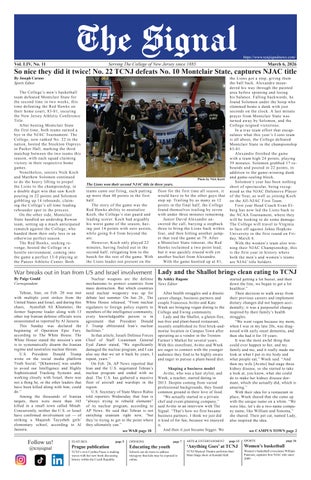
So nice
they did
By Joseph Caruso Sports Editor
![]()
they did
By Joseph Caruso Sports Editor
The College’s men’s basketball team defeated Montclair State for the second time in two weeks, this time defeating the Red Hawks on their home court, 83-81, securing the New Jersey Athletic Conference Title.
After besting Montclair State the first time, both teams earned a bye in the NJAC Tournament. The College, now ranked No. 22 in the nation, hosted the Stockton Ospreys in Packer Hall, marking the third matchup between the two teams this season, with each squad claiming victory in their respective home games.
Nonetheless, seniors Nick Koch and Matthew Solomon continued to do the heavy lifting to propel the Lions to the championship, in a double digit win that saw Koch pouring in 22 points and Solomon gobbling up 14 rebounds, claiming the College’s all time leading rebounder spot in the process.
On the other side, Montclair State handled an underdog Rowan team, setting up a much anticipated rematch against the College, who handed them their only loss in an otherwise perfect season.
The Red Hawks, seeking revenge, hosted the College in a hostile environment, coming into the game a perfect 13-0 playing at the Panzer Athletic Center. Both

teams came out firing, each putting up more than 40 points in the first half.
The story of the game was the Red Hawks ability to neutralize Koch, the College’s star guard and leading scorer. Koch had arguably his worst game of the season, having just 14 points with zero assists, while going 0-4 from beyond the arc.
However, Koch only played 22 minutes, having fouled out in the second half, relegating him to the bench for the rest of the game. With the Lions leader not present on the
War breaks out in Iran from US and Israel involvement
By Paige Gould Correspondent
Tehran, Iran, on Feb. 28 was met with multiple joint strikes from the United States and Israel, and during this chaos, Ayatollah Ali Khamenei, the former Supreme leader along with 13 other top Iranian defense officials were assassinated as reported by Al Jazeera.
This Sunday was declared the beginning of Operation Epic Fury, according to The White House. The White House stated the mission’s aim is to systematically disarm the Iranian regime and neutralize nuclear threats.
U.S. President Donald Trump wrote on the social media platform Truth Social, “[Khamenei] was unable to avoid our Intelligence and Highly Sophisticated Tracking Systems and, working closely with Israel, there was not a thing he, or the other leaders that have been killed along with him, could do.”
Among the thousands of Iranian targets, there were more than 165 killed in a small town called Minab. Concurrently, neither the U.S. or Israel have confirmed involvement yet — of striking a Shajareh Tayyebeh girls’ elementary school, according to Al Jazeera.


Nuclear weapons are the defense mechanisms to protect countries from mass destruction. But which countries need nuclear weaponry was up for debate last summer. On Jun 26., The White House released, “From nuclear regulators to foreign policy experts to members of the intelligence community, every knowledgeable person is in agreement that President Donald J. Trump obliterated Iran’s nuclear facilities.”
In that article, Israeli Defense Forces Chief of Staff Lieutenant General Eyal Zamir stated, “We significantly damaged the nuclear program, and I can also say that we set it back by years, I repeat, years.”
On Feb. 26, AP News reported that Iran and the U.S. negotiated Tehran’s nuclear program and ended with no deal. The U.S. has gathered a massive fleet of aircraft and warships in the region.
U.S. Secretary of State Marco Rubio told reporters Wednesday that Iran is “always trying to rebuild elements” of its nuclear program, according to AP News. He said that Tehran is not enriching uranium right now, “but they’re trying to get to the point where they ultimately can.”
see WAR page 10
floor for the first time all season, it would have to be the other guys that step up. Trailing by as many as 12 points in the final half, the College found themselves trailing by seven with under three minutes remaining.
Junior David Alexandre answered the call, burying a stepback three to bring the Lions back within four, and then hitting another jumper that tied the game at 79. After a Montclair State timeout, the Red Hawks reclaimed a two point lead, but it was quickly erased with yet another bucket from Alexandre.
With the game knotted up at 81,
By Ashley Ragone News Editor
After health struggles and a drastic career change, business partners and couple Francesca Avitto and Kate Wnek are bringing vegan dining to the College and Ewing community.
Lady and the Shallot, a gluten-free, nut-free and plant-based restaurant, recently established its first brick-andmortar location in Campus Town after operating as a vendor in the Trenton Farmer’s Market for several years. With this storefront, Avitto and Wnek are eager to connect with the younger audience they find to be highly aware and eager to pursue a plant-based diet.
Shaping a business model
Avitto, who was a hair stylist, and Wnek, a teacher, started dating in 2013. Despite coming from varied professional backgrounds, they found common ground in their love of food.
“We actually started in a private chef and event-planning company,” said Avitto in an interview with The Signal. “That’s how we first became business partners. I think we just did it kind of for fun, because we enjoyed it.
And then it just became bigger. We
the Lions got a stop, giving them the ball back. Alexandre meandered his way through the painted area before spinning and losing his balance. Falling backwards, he found Solomon under the hoop who slammed home a dunk with just seconds on the clock. A last minute prayer from Montclair State was turned away by Solomon, and the College reigned victorious.
In a true team effort that encapsulates what this year’s Lions team is all about, the College defeated Montclair State in the championship 83-81.
Alexandre finished the game with a team high 24 points, playing 39 minutes. Solomon grabbed 17 rebounds and poured in 22 points, in addition to the game-winning dunk and game-sealing block.
Solomon’s year has been nothing short of spectacular, being recognized as the NJAC Defensive Player of the Year, as well as joining Koch on the All-NJAC First Team.
First year Head Coach Evan Elberg has now led the Lions back to the NCAA Tournament, where they will be looking to do some damage. The College will travel to Virginia to face off against Johns Hopkins University in the first round on Friday, March 6.
With the women’s team also winning their NJAC Championship, this is the first year in history where both the men’s and women’s teams are NJAC title holders.
started getting a lot busier, and then down the line, we began to get a lot healthier.”
Their decision to walk away from their previous careers and implement dietary changes did not happen accidentally; it was a purposeful change inspired by their family’s health struggles.
“We went vegan because my mom, when I was in my late 20s, was diagnosed with early onset dementia, and then she had it for 10 years.
It was the most awful thing that could ever happen to her, and my family and me, and it really made me look at what I put in my body and what people eat,” Wnek said. “And then my wife [Avitto] had stage three kidney disease, so she started to take a look at, you know, what she could do to make her kidney disease dormant, which she actually did, which is amazing.”
With their idea for a restaurant in place, Wnek shared that she came up with the unique name on a whim. “We were like, let’s do a two-name company name, like William and Sonoma,” she shared. Their pet cat, named Lady, also inspired the idea.

By Jennifer Ampofo Correspondent
The College’s women’s, gender and sexuality studies department is showcasing the “Amandla is Unity” exhibit from Feb. 6 to March 6. The dates chosen coincide with both Black History Month and Women’s History Month, as a way to spotlight the women and black South Africans who contributed to the end of South African apartheid.
This year also marks 50 years since the 1976 Soweto Uprising, which was a pivotal protest that marked the shift towards South African liberation.
The Soweto Uprising was a series of protests mostly led by middle school students in opposition to the implementation
of the language Afrikaans in schools. The language was seen as an attempt to erase South African culture since it was being pushed onto them by their white oppressors.
The choice to display the exhibit during the 50th anniversary of the student-led Soweto Uprising was intentional. “It’s important to show how student activism was very prevalent then and now, it shows we still have work to do,” said junior WGSS major Emma Giancristoforo. “I hope it gives people hope and confidence that things will change.”
Marla Jaksch, a WGSS professor at the College, came up with the idea of the exhibit after receiving the artifacts and collection from her late colleague Ángel
David Nieves.
“I really wanted to honor him in a
meaningful way, and this was the most meaningful thing I could think to do,” said Jaksch.
Roughly two years after the collection was handed over to Jaksch, she asked senior WGSS and English double major Ebony Riley and Nieves’s former graduate student, Cassie Tanks, to help make sense of the collection and find a way to bring Nieves’s vision to life. After planning the exhibit over the entirety of winter break alongside Tanks and Riley, Jaksch invited students from the College to intern in the curation of the exhibit. Giancristoforo was one of these interns.
“I learned that [curating] is very tedious, when you go into a museum or an art show you only see the final product,” said Giancristoforo. “You never really know how fine the details are until you’re actually a part of it.”
It was very important to Jaksch that
the display was a collaborative effort and everyone involved had a say in the final product. “I was able to tell the students, ‘Hey I’m not an expert in all this, you have a place and a role in all this,’” she said. “‘Let’s learn this together, we can teach each other new things.’”
One figure heavily depicted in posters and photographs is Hector Pieterson, a 12-year-old boy who was murdered by police. The photo of his lifeless body taken by Sam Nzima was broadcast all over the country, and eventually the world. This image became the face of the movement and symbolized all the young people who sacrificed their lives.
“It went across South Africa, the continent, and the globe and it sparked outrage because it was really the first time people got to see the reality of the apartheid system,” Jaksch said.


Continued from page 1
Early beginnings at the farmer’s market
The Trenton Farmer’s Market, which has been operating since 1939, was the first home to Lady and the Shallot — and saw the business prosper for several years.
Initially, the pair connected to the market through their neighbor who operated a barbeque stand there.
“When it was time that we were going to start looking for locations, we had never even looked at another location,” said Avitto. “We said to each other, we should look at the farmer’s market, because we’re going to be farm-to-table.”
Having been eating vegan and wanting to prioritize fresh ingredients, they knew they wanted to bring locally sourced and
fresh produce into their dishes. They believed the farmer’s market was the obvious choice, as they could use their fellow vendors as a great resource.
Despite warnings that their corner slot would never prosper as it was “cursed,” the duo never fell victim to such luck; Lady and the Shallot ran to great success for seven years.
In their time at the market, they would be able to provide the closest farm-to-table dining experience possible, while maintaining menu flexibility and accommodating the variety of crop harvests throughout the year.
“We literally would, in the morning, walk around and just get whatever we needed,” said Wnek. “And it was seasonal. So for corn season, we would do street corn and in the fall for root vegetable season,
we’d be doing soups and all kinds of stuff.”
Though Lady and the Shallot is still farm-to-table, Wnek shared that the ease and speed at which the market could provide such locally sourced food is one of the aspects they miss the most.
Building a future in Campus Town
With their small business truly starting to prosper at the farmer’s market, Avitto and Wnek wanted more creative freedom, and square footage, to manage their restaurant.
“We were catering weddings, we were doing baby showers and parties and stuff, and we would have to close the business, because we didn’t have the space,” Wnek said. “Our kitchen was so small.”
Along with the consideration of space, they wanted to build more of a sit-down restaurant, as opposed to the take-out style they found was more manageable with the smaller space of the market, where they could decorate and establish their own hours.
After announcing their relocation last May, Lady and the Shallot officially reopened in Campus Town on Dec. 2, 2025 and have been building a young customer base among the campus community.
“The feedback we’re getting is positive. We have a lot of returning customers already, so that’s cool,” Wnek said.
Avitto added, “We’ve always loved having a target audience of young people… More young people are not only health conscious, but you’re very aware. You’re aware of the ‘whys’ of being vegan, and not just the health aspect, not just the trend of it.”
So far, Avitto and Wnek have found that their chipotle crunchwrap is among their most popular dishes, with their own favorites being the lady’s rancheros and rainbow greens bowl, respectively. Their lady’s rancheros, which uses tofu scramble instead of eggs, was inspired by Wnek’s father.
When asked about their goals for Lady
and the Shallot’s future, the pair hope to create more resources for their customer base.
“We want to get our business to a place where we can kind of branch out, we want to write cookbooks. Customers have asked us for them for years,” Avitto shared. “
And we finally actually have some time, because we have such an amazing team that really got the way we do things, and we are able to step away a little bit.”
One member of that new team is Cara Shapley, a junior Deaf and inclusive education major, who works front of house and enjoys being able to connect with customers through her role.
Since first connecting with Avitto and Wnek through a mutual friend, she shared that she has truly enjoyed getting to work at the restaurant.
“They’re everything you would want in a boss: respectful, fair, easygoing, every single good adjective in the dictionary could describe them in some capacity. They’ve easily become people I know I could go to if I ever needed anything, even outside of work,” Shapley said. “Every customer who has had an encounter with them, which they probably have, always has something nice to say about them. They instantly made my coworkers and I feel like a part of their family.”
She has also seen first-hand how Lady and the Shallot has maintained their supporters from Trenton Farmer’s Market, and already made a positive impact on the lives of students from the College.
“Some of my peers from my classes have come into LATS and ordered from here, to which they are now regulars,” she said. “During finals week, some athletes also came into LATS and said this is one of the first times they’ve had a healthy meal since the semester started, and they’re glad LATS relocated so close to TCNJ.” Lady and the Shallot is now open in Campus Town. More information can be found on their website and through their social media.

By Abigail Holliday Copy Editor
Gov. Mikie Sherrill signed an executive order on Feb. 13 to extend a COVID-19-related state of emergency in New Jersey until 5 p.m. on Apr. 2. The state of emergency, which was established through Executive Order No. 103, on March 9, 2020 by former Gov. Phil Murphy declared
New Jersey as in both a public health emergency due to COVID-19.
This order gave power to state officials, such as the director of the New Jersey Division of Consumer Affairs and the Commissioner of the Department of Health, allowing them to make necessary decisions to best protect public health against the rapidly spreading coronavirus, including implementing emergency contingency plans to best anticipate and prevent the effects of the virus.
This order was expected to end on Feb. 16, but Sherrill signed the new executive order to add 45 days, as a way to allow healthcare providers time to adapt.
In a press release explaining the extension, Sherrill said, “With today’s executive order, we are providing more time for advanced practice nurses and physician assistants to adjust to this new regulatory landscape, delivering on our commitment to make it easier for small businesses to thrive in New Jersey.”
“Many health care professionals across New Jersey are bracing for impact as years-long state of emergency provisions come to an abrupt end.” She continued,
“These sudden regulatory changes will have wideranging impacts

that account tax-free, we can help more people onto the path of their first home.”
Although recent findings from The Harris Poll suggests that 85% of Americans believe homeownership remains part of the “American Dream,” it can seem a distant one About 71% of aspiring homeowners say they are postponing marriage or children until they can afford to buy a home, according to the poll. And a majority of first-time buyers –53% of people surveyed – do not expect to own a home until age 40 or later.
on health care professionals and patients alike –potentially even forcing clinics and small, independent practices to close their doors, making it more difficult for New Jerseyans to access critical health care services.”
The press release warns that, at the end of this extension, it is highly likely that the delivery of healthcare will be disrupted with the possibility of clinics, surgery centers, medical spas and independent practices facing closure. The implications of closing of these institutions would be so severe for the patients relying on them and even whole areas in New Jersey that are medically underserved. Additionally, ending the state of emergency order will affect nurse practitioners and physician assistants. During the order, any restrictions
withholding any advanced practice nurses and PAs from expanding their scope of practice was, and will continue to be, waived.
After the extension is no longer in effect, APNs must have a joint protocol agreement, which is a contract with a physician that governs their chart review, prescribing authority and physician availability requirements, in order for them to be able to prescribe any medications or medical devices. Similarly, PAs will be required to work solely under statutory supervision and a physician delegation agreement, according to JDSUPRA.
These healthcare providers have been operating for multiple years under a relaxed supervision order. Sherrill’s 45-day extension order is to allow NPs and PAs to bind themselves to their respective agreements before the state of emergency is officially lifted.
Those who are without agreements when the order has ended, can no longer prescribe medication or devices, will be exposed to licensing and disciplinary action, face billing and insurance compliance issues and be the result of corporate practice and supervision violations, according to JDSUPRA.
Healthcare institutions are advised to take advantage of this grace period and ensure all of their workers are signed under agreements, secure physician supervision and get their documentation in order.

By Andre Paras Video Editor
From the State House is a series that spotlights proceedings in the New Jersey Legislature. The Signal reports on hearings and legislative activity directly from the State House in Trenton.
As young Americans believe homeownership is slipping out of reach, New Jersey legislators are attempting to lower barriers to help first-time homebuyers save for a downpayment.
A bill, S1756, sponsored by Sen. Troy Singleton, a Democrat from Palmyra, and Sen. Vin Gopal, a Democrat from Long Branch, would create state income tax incentives for residents who tuck away money in a designated homebuyer savings account.
“We all recognize that New Jersey is experiencing a housing affordability crisis that hits young homebuyers and families who are first-time homebuyers especially hard,” Gopal said after a Feb. 5 committee hearing. “By providing tax incentives such as allowing a credit against their gross income tax of 5% of up to $15,000, and making the earnings on
More and more middle-class New Jerseyans are being priced out of the housing market, but this is not a unique problem to the state. Nationally, there’s become a trend of housing focused saving incentives. According to Redfin, New Jersey lawmakers hope to follow the lead of states like Colorado, Iowa, Minnesota and Virginia, who’ve already implemented similar housing incentives.
New Jersey’s bill would offer incentives, with qualified buyers having the chance to receive a state incometax credit equal to 5% of up to $15,000 in annual contributions to a designated homebuyer savings account. For qualified home-purchase expenses, things like down payment or closing costs could get a tax break.
Under the bill, a taxpayer who is a certified first-time home buyer is allowed a credit against the gross income tax in an amount equal to five percent of up to $15,000 of contributions (or up to $7,500 of contributions if married filing separately) that are made during the taxable year to one first-time home buyer savings account.
The bill would also create a taxadvantaged savings program to aid qualifying New Jersey residents who save funds for a down payment. The program is aimed at first-time homebuyers with an annual income under $175,000.
By Isabella Darcy Editor-in-Chief
From the State House is a series that spotlights proceedings in the New Jersey Legislature. The Signal reports on hearings and legislative activity directly from the State House in Trenton.
New Jersey law enforcement agencies would not be allowed to share certain data collected by license plate readers with other states under a bill sponsored by Sen. Linda Greenstein, a Democrat from Plainsboro. The restriction would apply to investigations involving reproductive health care services that are legal in New Jersey.
The Senate Law and Public Safety Committee held a 20 minute hearing on the bill on Feb. 19 before unanimously voting to release it.
New Jersey law enforcement agencies gather information on vehicles using devices that scan license plates. When a person travels to New Jersey from another state to seek reproductive health care, their attendance in the state could be confirmed by these devices.
Abortion and other reproductive health care services are legal in New Jersey, but not nationwide, forcing some patients to
cross state borders for care.
Kaitlyn Wojtowicz, public affairs executive director at Planned Parenthood Action Fund of New Jersey, testified in favor of the bill, telling the committee that the state’s 19 Planned Parenthood health centers see roughly 100 patients each month who are from out of state.
“The hundreds of people traveling to New Jersey every month to receive abortion care should not have to worry about whether their license information will be tracked in New Jersey and used to criminalize them in their home state,” Wojtowicz ‘10 said.
Pro-life opponents of the bill told the committee that they view it as a politically motivated measure that would hinder sex trafficking investigations and set the precedent that the state can choose which out-of-state law enforcement investigations it cooperates with.
Sen. Owen Henry, a self-proclaimed pro-life Republican from Old Bridge, pushed back against the idea that the bill would impede sex trafficking investigations. Henry said he didn’t see how opponents could make the “jump” to believe anything other than investigations into reproductive health care would be protected, considering that the bill is “pretty specific.”
By Devyn Briones Arts & Entertainment Editor
The Signal and Campus Police work together on a weekly basis to inform the campus community about crime on and around campus. All records given to The Signal are public records and do not contain personal information. Some information provided may be triggering for some students.
Feb. 17: Fire alarm
Campus Police were dispatched to Cromwell Hall for an activated fire alarm coming from a resident’s room. During the time of the alarm, only one resident of the suite was present, who stated he was in his room when the alarm went off.
Ewing Township Fire Squad 39 arrived on scene, checked the area and confirmed that it was an unknown cause of activation.
Feb. 20: Another fire alarm
At approximately 10:11 a.m., a fire alarm went off in Cromwell Hall and the entire building was evacuated. A building technician worker stated that they were replacing sprinkler heads in the building. The fire pump was put into test mode and the building was deemed safe to reoccupy by the fire department.
Feb. 21: Cooking gone wrong
A smoke alarm was activated in Decker Hall at approximately 9:43 a.m. There were no signs of fire located inside the room of activation, but the resident said he was cooking when the smoke detector was activated. The resident was advised to open the window and air out the room. The cause of activation was determined to be the steam from cooking.
Feb. 22: Dirty toaster oven
Campus Police was dispatched to Decker Hall for an activated fire alarm, set off in one of the rooms. Campus Police met with the resident, who stated he was
using his toaster oven when it began to smoke, causing the alarm to go off. The student said the smoke detector had gone off the day before for the same reason. Campus Police advised the student to clean or dispose of the toaster oven to prevent any further alarm activations.
Feb. 23: The importance of adding water to microwave mac n’ cheese
A fire alarm was activated in Townhouses East in one of the houses. A resident of the
threatening text messages and calling the student. The student is unsure as to why he was receiving these messages.
The unknown sender threatened him and his family if the student did not go to Western Union and send him $5,000.
The sender also sent the student photos of people being abused and mutilated. The student says he doesn’t know how the sender could have gotten his phone number, but said he did use an
house admitted that she forgot to add water to her
microwave mac and cheese, causing smoke and a burning smell to linger throughout the house and initially set off the smoke detector.

At approximately 8:40 p.m., Ewing Township Fire Squad 30 arrived on scene. Once firefighters finished checking the area, the alarm system was reset.
Feb. 24: Threatening calls from the so-claimed “cartel”
At approximately 2:49 p.m., Campus Police received a call from a resident at the College. The student claims that at around 2:20 p.m., he began to receive text messages from someone who claimed to be part of the “cartel,” sending
adult search website that allows you to speak with
someone for money.
He says the website provided him with a phone number to contact, which he did reach out to, but did not give any personal information except for the fact that he lives in Ewing Township and goes to college, not specifying which one.
The student did not send any personal information or money to this sender as well, along with any photos that could be used against him. Campus Police advised the student to block both phone numbers to prevent any future communications.
Feb. 24: Donuts “do-nut” make you look cool
Around 8:31 p.m., a car was reported
to be recklessly driving on the top floor of the Decker Hall parking garage. When Campus Police arrived, they could hear tires screeching from the top level. The driver left the lot when Campus Police reached the top lot, and there were no signs of damage or any seen vehicle fleeing at that time. Security cameras picked up the car, a silver 2013 Lexus GS, but is registered to a non-resident at the College.
Campus Police called the suspected driver at approximately 9:07 p.m. to talk with them at Campus Police headquarters. When asked if the suspect drives a silver Lexus and if he was driving in the Decker Garage, he responded yet. The suspect denies doing donuts on the top floor, though video footage says otherwise. He was ticketed with failure to maintain lane and careless driving.
Feb. 25: Electrical burns
At approximately 1:19 p.m., Campus Police were dispatched to Phelps Hall for an activated fire alarm. There were no signs of fire located inside the room with the activated alarm, but there was a strong odor that resembled an electrical burn. The cause for the activation was determined to be a burnt belt inside an HVAC vent.
Feb. 25: Chemical smells
Campus Police were dispatched to the STEM Building in regards to a gas smell around 4:10 p.m. There was a strong chemical odor coming from room 222, but no apparent source. It was determined that the smell may have migrated from the STEM shop.
Feb. 28: Burnt parchment paper
Campus Police were dispatched to Decker Hall for an activated smoke alarm coming from the fourth floor at approximately 1:09 a.m. The resident of the room claims the alarm sounded after he microwaved mozzarella sticks with parchment paper, causing it to smoke.

By Franc Romanowski Staff Writer
A quilt made by the College’s community members could be heading to Washington, D.C. in the near future, following a series of climate quilt workshops throughout February.
The current plan is for the quilt to be part of a larger project, the Climate Quilt Project, which is seeking to display quilts from all 50 states in Washington to highlight the challenges each state is facing due to climate change, according to the project’s website. The project’s goal is to have 1,200 quilts before they plan a national demonstration.
The on-campus workshops were organized by Kathleen Webber, professor and program coordinator of journalism at the College, and run in
collaboration with the Environmental Club, Kappa Pi and an arts education class. The workshops began on Feb. 11 and ended Feb. 25.
According to Webber, the planning for the project began in the fall semester, at the same time the planning was going on for Rachel Breen’s exhibit “Unraveling Threads: Climate, Labor, and the Clothes We Wear,” which opened Jan. 28 and is focused on the impacts of the fashion industry. Before the spring semester, Webber met with members of the clubs to work out the design of the College’s quilt.
The decided design includes an image of New Jersey in the center with three different shades of green, from light to dark. The outer perimeter is composed of different images, mainly of plants and animals across the state that are being impacted by
the changing climate. It also includes images of how the environment is impacted, such as through forest fires and rising seas, along with an image of wind turbines, to represent a way to improve the climate. Workshop participants individually stitched the fabric together by hand using reused and recycled fabrics.
Peggy Cooke, one of the instructors of the workshops and president of the Central Jersey Modern Quilt Guild, sees the project as quilting returning back to its roots. As she explained, quilters used to use worn out clothing and recycled fabrics, like what workshop participants were using, instead of buying new materials. This, she said, is like giving “a middle finger to the fast fashion industry.”
According to the Government Accountability Office, based on 2018 statistics provided by the Environmental Protection Agency, 66% of clothing from the fast fashion industry gets tossed in landfills. This results in the global production of nearly 92 million tonnes of textile waste annually, according to the United Nations Environment Programme.
In the landfills, this waste releases greenhouse gases and has other chemicals that can leech into the soil and drinking water, and can become hazardous to the environment and human health, according to the GAO.
That’s why, for the workshop participants, they’re glad they’re able to have the chance to draw attention to climate change and do something good for the environment in the process.
One of those participants, Stephanie Sookram, a freshman accounting major, said she took an environmental science
course and knows about the landfill issue. She also enjoys art projects like this, so “combing them together seems like a good…plan just to spread awareness,” Sookram said.
“We’ve taken these things that have added so much waste to our planet and we’re trying to turn it on its head and…speak that through a quilt,” Cooke said.
“With this climate quilt, it’s been really cool to see students and faculty and professors come from all different backgrounds that you wouldn’t even think they would be interested in doing this,” said Brigette Wixted, president of the Environmental Club.
But for Wixted, the issue is more personal.
“I live on the shore right now,” Wixted said. “I’m seeing how the sea level rises; they’re affecting the shoreline and they’re also affecting the people there.” She added, “[T] his is our only planet, and if we kill it, if we destroy it and if we don’t care about it, then nobody will. And eventually, we’re just not going to be here anymore.”
In addition to the one quilt, a second climate quilt was worked on but for now remains incomplete.
As for the first quilt, the plan is for it to be displayed on-campus by the closing of Breen’s exhibit, according to Wixted and Tamar MacLean, a quilt instructor for the workshops. At the latest, the quilt will be displayed oncampus by Earth Day, MacLean said.
Editor’s note: Professor Kathleen Webber is The Signal’s faculty advisor. She was not involved in the editorial production of this story.

By Sky Pinkett Features Editor
“Like berets hurled into the air / Berets of boys, cocottes and cardinals … / Yet also like a town of umbrellas opened skyward as a shield against rockets / All this is Prague”
So begins one of the College’s own, history professor Cynthia Paces’s, expansive nonfiction tour de force, “Prague: The Heart of Europe.” These opening lines of the book’s introduction, taken from Vítězslav Nezval’s 1936 poem “Panorama of Prague,” foreshadow all that the reader can expect from the journey through Prague that the book takes us through: times of joy and of pain, of turmoil and of triumph.
“It was one of the largest cities in Europe, and now it’s not. Now it’s one of those little gems of Europe, I suppose,” Paces said about the city.
Covering a mere 192 square miles as the capital city of the Czech Republic, which
shares a border with Germany, Poland, Slovakia and Austria, modern day Prague is best known today as a popular tourist destination with fairytale-like architecture. With her recently published book, Paces peels back the layers of Prague’s over 1,000 year history, reaching back into the ninth century.
“I was actually approached by Oxford University Press to see if I would be interested because I had written an earlier book that was more specific about Prague in the 20th century,” Paces said. “And they wanted me to do one that was all of Prague’s history, which was kind of crazy because it was like over a thousand years.”
The writing, editing and publishing process took about six years in total, starting in 2019. Despite the various challenges that came with the writing process, such as the COVID-19 pandemic and Paces’s teaching obligations, the personal motivation for writing the book kept her inspired.
“My father was actually born in Prague during World War II,” Paces said. “The city was under Nazi occupation when he was born. So then after the war, that’s when the communists took over. My grandfather’s business was taken over and politically, he was against the communists.”
“My father was about 7-years-old and he had to escape with his brothers and his mother and his father had escaped to Germany earlier. So, I grew up always hearing about these crazy stories of my dad’s childhood.”
Once the Berlin Wall fell in 1989 and communism in many Eastern European nations ended, Paces was able to participate in a study abroad program in Prague. That is where she truly fell in love with the city.
“I felt really connected to it. I met some of my father’s family there that we had never met before. And so I just started going back and then I went to graduate school to actually study that part of the world,” Paces said. “I
went to Columbia University for my doctorate and I focused on Central Europe…here I teach courses all on modern Europe.”
Visiting the physical city of Prague was not only helpful in Paces feeling connected to her heritage, it was also instrumental in her writing.
“When I went to Prague and just could see all the history right in front of me…I mean, you can see like a cathedral from the 14th century and it might be next to a more modern 20th century building, which was really exciting. It kind of got me very interested in that particular place, but definitely my family heritage played a role.”
The city of Prague itself has seen much political and social change over the years, from being the capital of the Holy Roman Empire in the 1300s, to the 1419 and 1618 defenestrations (where Prague citizens would literally throw their opponents out of windows) to the WWII event that shook all of Europe: The Holocaust.
“At one point, like in around 1700, there was the highest Jewish population in Europe. There was a lot of culture, a lot of rabbis kind of going to Prague as a center of learning,” Paces said. “Unfortunately, early, early in the war, there were Jewish people, as well as artists from the 1930s, who were being oppressed by the Nazi leadership and came to Prague to escape from being part of the Nazi empire. But it didn’t last long.”
The Nazi invasion of Poland escalated matters in Europe. By 1941, the Nazis found their way to the Prague area.
“Unfortunately, the Jewish people there also were deported to concentration camps and most Czech and Prague Jews died,” Paces said.
Even though many Holocaust survivors left Prague and Europe as a whole after WWII, Paces explained how a lot of people visit Prague today to learn about the Jewish
heritage in Europe.
“The Jewish quarter in Prague is probably the most intact Jewish quarter in all of Europe,” Paces said. “It has this beautiful old cemetery and several historical synagogues. Because that was not what the Nazis’s main objective was there, those buildings just remained and then they were able to sort of be revived more in recent years since the fall of communism.”
All of this engrossing history is part of what makes Prague such a popular place to visit today. Seeing the famous Prague Castle in person, learning about the city’s history and even visiting the many homes of Prague-native Franz Kafka are just some of the activities tourists look forward to. According to Paces, there is still another reason why people should learn more about Prague.
“I think that as Americans, even though communism ended 35 years ago, there’s still a little bit of a mystery about Eastern Europe,” Paces said. “We know obviously about France and Paris and London and Madrid maybe, but the Central European countries are, for a lot of people, kind of undiscovered, which makes it exciting too.”
Paces’s book is helping to break down the mystique of Central and Eastern Europe for those of us living in the West, as it is the first English book that covers the history of Prague in its entirety.
“One of the goals was to kind of write a history that’s accessible to anyone,” she said. “It’s not very specialized, like only historians will understand this. It’s for anyone who wants to travel there or just learn something more about that area. So in a way, I was kind of lucky that it’s a little more undiscovered than, you know, some place like London or Paris where there are hundreds and hundreds of books already about it.”
The book’s high ratings on consumer sites like Amazon show that it certainly fits that need. It is currently available to buy.
By Natalia Tomczak Opinions Editor
Period poverty, the lack of or uncertain access to menstrual products due to financial restraints, is on the rise in the United States and globally. In the U.S., One in four teens struggle to afford period products. This is a human rights concern, public health crisis and a reflection of gender inequality.
Women are most susceptible to period poverty between the ages of 18 and 25, a time when many people leave their family home to pursue an education or career. This has a greater impact on mental health, creating a feeling of disempowerment as basic needs are not met. Period stigma can also make it harder to ask for help.
When women experiencing period poverty were asked how their lives would be different with unlimited access to period products, 37% said they would worry less about finances, 24% said they would explore different profession opportunities, and 17% said they would explore different educational opportunities. For women in school who are currently experiencing period poverty, school attendance, grades and class participation are affected.
At the College, health concerns are assessed through the ACHA-National College Health Assessment (NCHA). This is a nationally recognized research survey that the College emails to students for them to complete every other year in the spring semester. It asks questions about physical, mental and sexual health, but there was only one question regarding periods, which asked about the degree to which
Premenstrual Syndrome, painful periods or menstrual cramping have affected academic performance.
The College has a few different locations for providing products for free. The Title IX office on the second floor of Brower Student Center distributes products while the student center is open, which is from 7 a.m. to midnight Monday through Friday, and from 9 a.m. to midnight on Saturday and Sunday. Products are distributed from The Shop in Campus Town, the Dean of Students office in the Student Center and through Student Health Services in Eickhoff Hall as well.
Period products can be found in the bathrooms of various buildings as well, but that process is not centralized through the College’s facilities for them to distribute throughout campus.
Beth Gallus, associate dean of students at the College, said that in regards to funding, “We’ve gotten grants every year for The Shop, and so The Shop will make purchases from the grant. Sometimes we might make larger purchases, and so we’ve had a lot of big quantities.” The Shop also accepts donations, and through its Amazon Wishlist, needs can be met.
Jordan Draper, associate vice president for student affairs and dean of students, said, “I think we had a period of time, three or four years ago, where there were requests, and then when we started giving them out for free, the requests stopped coming in. So I think anecdotally, we felt like we were meeting a need. But certainly there’s always ways to improve it. We’re always happy to address that if students are needing that.”
Sophomore Sophia Kim, an early childhood education and women’s gender and sexuality studies major, when asked about access to period products at the College, said that it could be better. She says, “I am aware that the campus claims they provide free menstrual products, however I’ve only seen them in two buildings. All of the bathrooms I’ve noticed had ‘free period products’ were empty and not restocked. I’ve only ever seen consistency in the second floor of Roscoe West and in the Student Center in front of the Title IX Office.”
Kim adds, “Something I have seen in some bathrooms is a QR code to fill out when the menstrual products are out of stock, however I’ve only ever noticed it in the education building, and I’m not sure of the accuracy and urgency provided.”
Sophomore Isabella Dani, a fine art major, said that a variety of period products are lacking.
“The College, in my opinion, does not provide adequate access to menstrual products,” Dani said. “I wish that both pads and tampons were disturbed in bathrooms, especially since women may not be comfortable using either/or.”
She also adds that access to other period-related products, via an “area on campus for women to feel safe coming to get not only pads and tampons, but other period-related supplies like Midols, menstrual cups, etc.” would be beneficial.
Additionally, Dani says, “Sometimes access can be challenging since products aren’t typically disturbed in the bathrooms. While I bring my own pads, it can sometimes be embarrassing walking to the

bathroom with my little bag of supplies and there may be times where I forget to bring pads to the bathroom with me.”
Spreading awareness about access to menstrual products at the College will be imperative.
Sophomore Zahara Anglin, a graphic design major, said, “while I know menstrual products are probably supplied by health services on campus, the topic has never been something that was stressed or brought up to me by anyone here — CAs, advisors, mentors or other support systems. Access to menstrual products has never really been a talking point in any of the conversations I’ve had regarding oncampus health and hygiene support.”
In regards to emergency funding for students who need access to menstrual products or other supplies, Draper said, “I can understand the stigma around wanting to request certain products, particularly around trans students.” Emergency funds are offered through the Mental Health Resiliency Fund, overseen by Nicole Harris, the College’s Health Promotion & Resiliency manager, and CARES.

By Zo Terrana Staff Writer
College campuses across the United States are levying their voices to create a more sustainable campus for their students and community. The College is no exception in trying to achieve these goals.
President of the College’s Environmental Club, Brigette Wixted is embarking on new ways to advance sustainability on campus and in surrounding communities to help combat the global threat of climate change.
Wixted, a junior political science and environmental studies dual major, has taken charge of the club this semester. With her new leadership Wixted is trying to advance the College’s climate initiatives and sustainability this spring with specific projects whilst furthering the Ewing area’s environmental goals.
Even before embarking on her college journey, Wixted has always had a passion and calling for the environment.
“In high school senior year I took an environmental studies course and then I
really fell in love with it,” Wixted said. “I really fell in love with trying to protect our environment and our only home that we have.”
Wixted started out as the treasurer of Environmental Club during her sophomore year, and was later named president the following year.
The College’s Environmental Sustainability Council works to implement initiatives to reduce greenhouse gas emissions through three themes of energy conservation, sustainable transportation and recycling and waste reduction, according to the College’s ESC website. The ESC works in tandem with the Environmental Club to achieve a more sustainable campus life and overall future.
A recent project that Wixted has forwarded with the College’s Environmental Club is the national climate quilt project. The project is spearheaded by Pam Mischen, an environmental studies professor at Binghamton University and climate activist.
The project is designed to spread awareness of climate change on campuses
across the U.S. This semester, the College’s art gallery is open to working with students on campus, offering quilting workshops in a call for climate activism.
“I am really excited about the climate quilt project we’re contributing to,” Freya Sewell, an Environmental Club member and junior environmental studies and history double major said. “It’s an art project that always gets good engagement.”
The Environmental Club is also pursuing a food forest project. A food forest or forest garden is a diverse plantation of edible plants that mimics an ecosystem similar to nature. The College’s medicinal food forest will be planned near Decker Hall, according to Wixted.
“The food forest is really important to me,” Sewell said. “Having more native plants on campus is a huge deal ecologically, especially for bugs, which rely on specific plant species. It is especially important because of the biodiversity crisis the world is experiencing right now and people need to have opportunities to get out in nature or to learn about ecosystems that make our region unique.”
The food forest will also help feed the local Ewing community through “sustainable food production,” Sewell said. The food that is produced through the food forest will be donated to food pantries while helping sustain a local ecosystem.
These projects and initiatives are designed to bring the College into the climate justice conversation within New Jersey, according to Wixted.
“If you travel an hour away to Stockton University, they’re so environmentally sustainable and there’s more initiatives,” Wixted said. “I was completely amazed by how much they had. Rutgers, even though they have more funding than us, is so environmentally evolved.”
The College has received little funding from the state due to funding cuts and the
College also doesn’t fund environmental initiatives. “We have to start looking for other options, like applying for grants,” Wixted said.
To advance the College’s sustainable outlook, Wixted said that revamping and adding plant life to the campus environment would assist in sustainability around the campus.
Plant life “boosts urban biodiversity, providing vital habitats for pollinators and beneficial insects,” according to consumer advocacy group Community Gardens.
The College has strived for having a voice in helping with the threat of climate change with students and professors alike taking action.
“I think TCNJ has made significant strides in both the operations and the teaching,” said Miriam Shakow, an anthropology professor at the College. “The college president signed a university Presidents’ Climate Commitment, committing the college to carbon neutrality by 2040, Energy Manager and Sustainability Director Paul Romano has created wa ‘decarbonization’ plan for campus energy use, and Dr. Diane Bates has led the recent creation of TCNJ’s new environmental studies major.”
Shakow has called on the College’s students to get in contact with elected state representatives such as Assembly members to help fund renewable energy initiatives.
Wixted said that to move the College towards a more sustainable future, the student body must prioritize the present issue of climate change. However, with students facing various stressful challenges such as student loans, college course work and navigating the future job market, prioritizing a global issue like climate change can seem unattainable.
“I feel like people have no room to care about environmental problems we’re facing,” Wixted said. “People need to help themselves before they can help the environment.”
By Tasnim Oyshi Staff Writer
When Trenton local Francisco Guerra began his academic journey at the College as a psychology major, he knew that he wanted to be involved in the neighboring community. Since his freshman year, he has been a part of the Bonner Scholars Program, which allows students to complete 300 hours of service in exchange for a tuition scholarship per year. Having started his volunteering at Mercer Street Friends, Guerra is now a co-site leader in his final year, along with fellow senior Halyn Principe.
As one of the many community partners of the Bonner Institute at the College, Mercer Street Friends is a nonprofit organization that works with various medical, social and human service organizations and schools to aid families in Mercer County. They serve as a food bank, provide resources to parents and render educational support to children.
Through their Community Schools Initiative, they are currently partnered with six schools in the area, including Gregory Elementary School in Trenton, where Guerra has volunteered for nearly four years now. According to Guerra, Mercer Street Friends’ partnership with Gregory Elementary has existed since one of the years when COVID-19 was still prevalent. It was originally a virtual program started by a former Bonner Scholar and has expanded since. The number of Scholars since he has been a part of the site has grown from four to 12.
Now, he and the other Bonner Scholars at the school assist kids and teachers in the classroom, at after school programs and extracurricular activities, as well as at events like Community Saturdays, which include activities such as roller skating, yoga and chess.
“We’re trained to make sure that we’re being an emotional support to the students and not really correcting them,” says Guerra. “Sometimes the kids come from different, unbalanced households so we just want to make sure that the students feel like school is a safe environment for them and provide that support.”
According to Nigel Johnson, assistant director for Community Schools, teachers are also heavily reliant on the help that Bonner Scholars supply. “I don’t think a lot of people understand that teachers have a lot to do when it comes to lesson plans,” Johnson said. “They have a lot to do with managing their kids and managing different temperatures in the room and those Bonners providing an extra set of eyes, extra set of hands, really help those teachers.”
In addition to aiding in classrooms, Guerra also hosts student council at Gregory Elementary. Planning for this allows him to complete his weekly eight to 10 hours outside of physically being on site, which can be difficult with the added duty of his senior capstone.
“I used to go four times a week for like 10 hours,” he said. “Now I only go three times a week but I still try to maintain myself doing things out of school. So I usually help with whatever preparation the teacher might need for some kind of curriculum they have planned, or if there’s maybe an arts and crafts or after school program.”
As their work involves interacting with kids, there is a training process the Scholars have to go through. Each Scholar is fingerprinted, background checked and trained with trauma-informed care. While the procedure can be simple, Johnson highlights its importance.
“Sometimes it’s new for them,” he says. “But it’s just having them recognize that they are working with kids and how they’re supposed to behave, how they’re supposed

to act, how they’re supposed to dress, as a role model in a sense.”
During their time at the school, Bonner Scholars often build solid relationships with the students there. “I think it’s always important that people understand that students want to be loved, students want to be cared for, or they want to be noticed, to be seen,” Johnson said. “So when they come to school, and they have a Bonner and that extra role model that sets the example for them, it goes a long way to show them what’s right from wrong, help them feel special, help them feel like they’re being heard and listened to, which sometimes is all kids want.”
With all his responsibilities at Mercer Street Friends, his on-campus involvements and regular classes, Guerra finds that staying organized and keeping a calendar can be crucial in managing his time. “As a first year, it was very difficult but now as a senior, I feel like it’s been a lot easier to go through that process because I know what’s going to come and I know the deadlines,” he said, adding that Bonner encourages their Scholars to put education first.
However, Guerra considers his time spent at the school fulfilling. “I feel like I’ve
made a family in that school and everyone knows me,” Guerra says. “I’ve made such an amazing connection with every single person I’ve come across and even some of the parents as well.”
Johnson credits the Bonner Scholars for aiding with the dynamics in the school. “The most influential change they’ve contributed to is helping create a family environment in the schools,” he says. “Bonners have been able to help with the family dynamics and family environment. Teachers feel less stressed. Ms. Harris, the principal over at Gregory Elementary, is able to feel a little more relaxed knowing that some of her teachers have support.”
While volunteering at Gregory Elementary has had a positive impact on the students and teachers there, Guerra will leave the program with a lasting impression as well.
“I wanted to join Bonner because I wanted to know more about my community and it has exposed me to so much more, especially when it comes to the education system and the students here,” he says. “It’s very rewarding because you’re able to really experience something that not everyone gets to experience.”


By Natalia Tomczak Opinions Editor
How far should a society go in order to correct a power imbalance between groups of people? What happens when the side effects of this power imbalance are ignored? On one scale, it is casual; the president of the United States insulted the women’s olympic hockey team, meanwhile the men’s hockey team erupted in laughter at this degradation of achievement by female athletes competing in the same sport.
On another scale, it is deadly. Statistics from the National Domestic Violence Hotline show that roughly 1-in-4 women have experienced severe physical violence from an intimate partner, and 1-in-3 have experienced rape, physical violence and/or stalking by an intimate partner. This should not be a fact of life.
Where is the outrage? Where is the action? Where is the policymaking? Waiting for action when facing such a deadly matter is tiring. A change must be ignited, and policy must start by educating young people and adults on these truths so society can truly be bettered. Empathy is the key to compassion — the motor that puts positive change into motion.
When it comes to education on
misogyny, many react with dismissal. It is understandable why people might have the mindset that it is strange and unnecessary to talk about this with young people. I have heard the argument that speaking about misogyny merely alienates people based on gender, assuming that issues of hatred towards women are sporadic instances, not systemic patterns.
People may also point to how misandry, contempt or prejudice against men, seems to be a common sentiment among many women. While online, misandrist posts may circulate, it is not a systemic, oppressive force with deep-rooted history the way that misogyny is.
This misandrist sentiment does not manifest in the same violent ways misogyny does.
It is ironic that this fear many women have for the violence they may be subject to in a patriarchal society, is often misinterpreted by men as rudeness and a lack of respect, furthering a sentiment of disrespect towards women as a whole.
While misogyny is men’s anger towards those that are oppressed, misandry is women’s anger towards their oppressors. This means that addressing misogyny in schools means addressing misandry as well.
At the end of the day, it isn’t about who
deserves respect more, it is about who pays the highest price when respect is missing. Ego can recover from a blow, whereas a life cannot.
Moreso, patriarchy defines society. Boys are raised to limit emotional expression, taught to live a lifetime of disconnection. And in school, the way that boys socialize is often through misogyny, where banter is founded on a language of diminishing women. Meanwhile, girls are taught that to be a woman means to be less. This hierarchy ultimately harms everyone, encouraging people to fit into these boxes.
This is an issue in the U.S. The oppression of women persists through legal, political and social structures. There is no equivalent to this kind of systemic oppression for the current generation of white men in the U.S. Ignorance may be bliss, but that doesn’t mean ignorance is harmless. The Women’s Rights movement’s peak in the U.S. coincided with the Civil Rights movement during the 1970s — a relatively recent development in history. A significant amount of time has passed since this era, and perhaps people have forgotten their history.
Many influencers, who have presented themselves to be role models for young men, have been critical of feminism. Famously, figures like Andrew Tate, Jordan Peterson and Nick Fuentes have promoted rhetoric that feminism has “gone too far” and women need to take on a more traditional, submissive role in society.
When people hear the word feminism, they often shift in their seats. Young men may feel a desire to resist this change, seeing feminism as a term dragged online and among their friends. Proper education could be the key to changing this misconception.
Contrary to popular belief, women who are feminists report lower levels of hostility toward men than non-feminists. Still, the misconception persists that feminism excludes men.
Positive feminist role models, as opposed to misogynistic mentors, could change the way young men view traditional masculinity and women’s progress.
What can be done in schools to address this?
The department of education statutory guidance in the United Kingdom since July 2025 says that secondary school students should be taught about consent, the negative impacts of pornography on sexual relationships and that sharing and viewing indecent images of children is a crime.
The updated guidance, to begin in September 2026, says students should be equipped to recognise misogyny, its links to violence, and understand the importance of challenging it. This change was sparked, in part, by the 2025 Netflix drama “Adolescence,” which called attention to the impact online misogyny is having on teenage boys.
Guidelines in the U.S., however, seem to be falling short. In New Jersey, for example, curriculums must include education on pregnancy outcomes, contraception, sexual orientation, gender identity, consent and healthy relationships.
This is completely missing the nuances specifically called out in the U.K.’s statutory guidance, and this vagueness ignores key dilemmas.
Education promotes understanding, and this is essential in order to address the ways in which patriarchy and misogyny harm everyone. It shows up in people’s everyday lives, and it is important that we are properly equipped to handle it. Without this education, youth in the U.S. will fall behind, with mental health issues and violence on the rise.
What kind of future do we want for our young people? One where violence and gender polarization persists? Or one fostered on support, safety and equality? These conversations matter.
By Isabella McHugh Staff Writer
Emily Brontë’s classic gothic tale of obsession and vengeance, set in the windy Yorkshire moors, has structurally metamorphosed into the most recent cinematic adaptation (and sensation, might I add) of “Wuthering Heights.”
To the moviegoer who has not immersed themself in Brontë’s multifaceted narrative, Emerald Fennell’s “Wuthering Heights” is a tragic, spicy love story featuring MargotBarbie-Robbie and 6 ‘5 Jacob Elordi. Oh, and let’s not forget that banger soundtrack by Charli XCX.
To certain literary scholars, however, this straying interpretation is exactly the issue. Some have called the film overly sexualized, aesthetically indulgent and even racist, claiming it sacrifices the novel’s thematic depth for spectacle.
I may not hold the polished titles some critics claim. However, as someone who has read, analyzed and adored Brontë’s “Wuthering Heights,” I believe the film has its own place beside the long-standing novel.
The film presents a far more romanticized, aestheticized version of “Wuthering Heights” — but honestly, why shouldn’t it? Fennell’s reasoning for placing quotation marks around the title was to signal her intention to deviate from
its predecessor.
In a YouTube interview, Fennell said, “You can’t adapt a book as dense and complicated and difficult as this book. I can’t say I’m making ‘Wuthering Heights.’ It’s not possible.” She also mentioned that this adaptation reflects her fourteen-yearold interpretation of the novel.
While the film is undeniably more sexualized, it is far from the ‘porn-fest’ many viewers anticipated. The explicit nature of certain scenes is magnified through raw sensory detail rather than overt nudity.
I suspect Fennell even intended to mislead audiences in the film’s opening moments. At first, the sounds we hear resemble someone experiencing pleasure. Instead, we soon realize they are the stifled groans of a man being hanged, a cloth bound tightly around his head.
In this way, she shocks us. We enter expecting a sexually driven period piece, yet fail — at least initially — to grasp the deeper intentionality behind the film’s intricate staging.
Moreover, the explicit imagery mirrors the nature of Catherine and Heathcliff’s relationship: messy, lustful and carnal. True to the novel, the film portrays their obsession with one another as a form of mutual control.
Despite taking copious liberties, the story’s essence remains intact, skillfully
woven into a plot even those unwilling to pick up Brontë’s dense novel can admire.
For those unaware, the film concludes halfway through the book when (spoiler) Catherine dies. However, an entire second generation follows her death in the book. In short, the consequences of Catherine Linton (previously Earnshaw) and Heathcliff’s tragic romance continue to unfold.
There is compelling evidence suggesting Fennell merges the two generations. Catherine (Earnshaw) Linton adopts several characteristics of her daughter in the book, Cathy. Likewise, Heathcliff assumes traits of Hareton Earnshaw, the second-generation character who ultimately marries Cathy.
In the film, Elordi is styled in a way that looks practically identical to Hareton. Most people did not bring up this point amidst the flood of criticism that erupted over Fennell casting Elordi as Heathcliff, who in the novel is described as a person of color.
While I do believe Heathcliff should have been portrayed by a person of color, especially given the novel’s engagement with racism, the physical similarities between Elordi and Hareton helped me to map the inner landscape of Fennel’s generational merging.
The coincidence of Heathcliff taking on Hareton’s physical appearance seems even less likely when looking at Catherine (Earnshaw) Linton. In the film, she bears a
strong resemblance to Cathy of the second generation. Cathy the second is described in Chapter 18 as having “yellow curling hair,” whereas Catherine in the novel is dark-haired.
Another key point is that several scenes originally occurring between Hareton and Cathy in the novel are reimagined between Catherine and Heathcliff in the film.
Early on, we see Catherine attempting to teach Heathcliff to read, a moment that does not occur between those characters in the novel. However, a nearly identical scene unfolds between Cathy and Hareton in Chapter 32.
The same applies to Mr. Earnshaw’s birthday scene. In the film, Heathcliff defends Catherine from her father. In the novel, however, it is Hareton who defends Cathy from Heathcliff in Chapter 33. Additionally, Mr. Earnshaw in the film assumes aspects of Hindley’s role from the book.
There is an abundance of nuanced detail bridging Fennell’s film to Brontë’s novel, and the liberties it takes are beautifully executed. The soundtrack feels both relevant and immersive. I especially loved “Dark-Eyed Sailor” and the slowed-down reunion scene which, cinematically, was stunning. The intimate moments between Heathcliff and Catherine are deliberately slowed, making them all the more hypnotic. Read more on the website!

By Ally Uhlendorf Editorialist
Just last week, New Jersey experienced its most extreme blizzard in 30 years. The College shut down for two days, and students as well as faculty did not have to come to campus. However, not every member of the College’s staff was excused during this storm — essential workers, such as building assistants and facilities staff, were still required to come to campus and continue working, and that deserves to be highlighted.
Essential workers do a lot more for our campus community than they are recognized for. In order for this campus to be successfully run, there must be people who ensure that the walkways and streets are cleared, the residence halls remain safe and that facilities continue to work
even through dangerous conditions. While the rest of the campus is told to stay home for safety reasons, these workers are working through the rough conditions to return the College to normal as soon as possible.
It is not often recognized by members of the campus community just how much these employees do for us. Without these individuals, we would not have the privilege of returning to campus safely and quickly, and would be at risk of losing power, heat and resources.
Oftentimes, essential workers are the invisible backbone of the College. Their work tends to happen behind the scenes, and it seems to be forgotten that there are actual, dedicated people behind these jobs. Most of the time, these workers are not only ensuring that these problems are solved, but also ensuring they

are doing so without interrupting the campus’s routine.
Beyond giving these workers the gratitude they deserve, there is a bigger conversation to be had about how institutions value manual labor. Essential workers are often among the lowest-paid employees on college campuses, despite the demanding work they do. The services these employees provide for the campus, such as snow removal, sanitation and food service, are foundational to the function of the College, and they should be fairly compensated for their work.
There are also intense personal sacrifices that come with these jobs. While most of the College’s community spent the snow day as a “day off,” safely indoors with family or friends, these workers were out navigating icy roads and dangerous travel conditions just to get to
https://www.tcnjsignalnews.com/
Email: signal@tcnj.edu
Business Email: thesignalbusiness@gmail.com
Editorial Staff
Isabella Darcy Editor-in-Chief
Eddie Young Alena Bitonti Managing Editors
Ashley Ragone News Editor
Devyn Briones Arts & Entertainment Editor
Natalia Tomczak Opinions Editor
Sky Pinkett Features Editor
Joseph Caruso Sports Editor
Lake DiStefano Nation & World Editor
campus. They, too, have families, responsibilities and concerns about their own safety. Yet, their commitment to getting the job done ensures that the rest of us can safely return to campus. That level of dedication should not be normalized to the point of invisibility and lack of appreciation.
As students, it can be easy to only view the College through our own lens: classes, clubs and socialization. But, the campus itself relies on hard work and labor that often goes unnoticed until something goes wrong, and even when something does go wrong, the individuals who fix those issues are often overlooked. Our education depends on people who maintain buildings, prepare food, remove waste and respond to emergencies, work that is just as essential to the student experience as classes and organizations.
Moving forward, appreciation for these essential workers should not be only in times of crisis, but in everyday passings. Learning their names, saying “thank you” and advocating for their appreciation are simple acts that can go a long way. Administrators, too, should take instances like this past blizzard as opportunities to reassess how these roles are supported and compensated. When we return to a cleared and safe campus, we should remember that those comforts did not happen automatically. A college community is strongest when each and every role is acknowledged and valued. Essential workers deserve as much respect as any other employee at the College, and their work should be appreciated, not expected.
Administrative Staff
Sandra Abrantes Multimedia Coordinator
Andre Paras Video Editor
Abigail Holliday Copy Editor
Amanda Incalcaterra Erin Reilly Social Media Editors
Ally Uhlendorf Editorialist
Jenna Weldon Web Editor
Sky Stewart Editorial Cartoonist
Cristina Collins Business Manager
Kathleen Webber Faculty Advisor
The Signal is published bi-weekly during the academic year and not financed by the Student Activity Fund, but solely by advertisement revenue. Any student may submit articles to The Signal. Publication of submitted articles is at the discretion of the editors. All materials submitted become the sole property of The Signal.
The Letters section is an open forum for opinions. Submissions that announce events or advertise in any way will not be printed.
The Signal willingly corrects mistakes. If you think we have made a mistake, contact us at signal@tcnj.edu.


By Isabella McHugh Staff Writer
Citizens of Mexico experienced a surge of fear across the country after drug lord “El Mencho” was killed in a military operation run by Mexican authorities on Feb. 22, according to the New York Times. His real name was Nemesio Oseguera Cervantes, and he was the head of the Jalis-
co New Generation Cartel, CNN reports. He was an infamous boss of a fast-growing drug-trafficking cartel in Mexico. Oseguera was known for trafficking fentanyl, methamphetamine and cocaine into the United States.
His death ignited a fury among the cartels, who responded with violence across the country, according to AP News.
Over the past week the country has

Continiued from page 1
U.S. intelligence agencies assess that Iran has yet to restart a weapons program, but has “undertaken activities that better position it to produce a nuclear device, if it chooses to do so.”
Some Iranian officials have spoken openly about the country’s readiness to produce a bomb if that decision is taken.
U.S. Secretary of Defense Pete Hegseth gave Anthropic’s CEO a deadline on Feb. 28 to open the company’s artificial intelligence technology for unrestricted military use or risk losing its government contract, according to AP news.
As artificial intelligence en -
been ridden with roadblocks, shootings and fire, the New York Times reports. Mexican officials have declared they arrested 70 individuals and killed 34 who they suspected were cartel members.
Schools are temporarily being closed as violence breaks out in the streets, according to AP News. Almost 10,000 Mexican troops were deployed to suppress the brutality, the New York Times reports.
Citizens in these drug war-zones describe their horrific experience. “The fear is everywhere and the fear is constant,” said Héctor Torres, a paramedic in a BBC report. The journalist states, “I spent with Héctor and Julio almost every incident they responded to ended the same way, with a dead body in a building or by the side of the road, and grief-stricken relatives nearby asking for answers.”
The BBC report also asserts that most victims of the cartels do not make it out alive. There isn’t anywhere that this violence doesn’t touch. It impacted schools, hospitals and even funerals.
The Mexican government’s recent action was taken soon after repeated insistence by U.S. President Donald Trump. Trump previously posed a threat that if their government didn’t crack down on the issue, the U.S. military would have to do so instead.
Oseguera had evaded capture for two decades, but was felled in “one of the most aggressive offenses against the cartels in more than a decade,” wrote the New York Times.
This mutual exchange in security has essentially reconstructed the U.S. and Mexico’s relationship, the New York Times wrote.
Many people are questioning whether it is still safe to travel to Mexico, and
experts say it’s probably fine, according to ABC News. Every year, millions of tourists visit Mexico, and the vast majority end up fine.
During the violence this past week, no tourists have been harmed or targeted. Those impacted the most by violent crimes are citizens of the country, especially since tourists are mostly sheltered in resorts and doing low-crime-risk activities, according to ABC.
Tourism also helps fund Mexico’s economy, which is why security is taken seriously to ensure no loss in visitors, the New York Times reports.
The events that unfolded this week rocked the nation, nevertheless, with witnesses describing their experiences in chilling detail.
“I was making breakfast with a Netflix series on in the background,” said Tanya Dittmar, a trainee doctor on the northern edge of Guadalajara. “At first I thought I was hearing drills from a building site. But I have six dogs and they got very nervous. I paused the series and then I realised they were gun shots,” she told The Guardian. She hid in her closet for hours waiting for the shots to cease.
“I had never heard a bullet before,” she said When the sounds grew closer, she became even more frightened.
Susana Carreño is a local journalist who documented the damage in a city that had over 200 vehicles set ablaze by men dressed all in black. She said that nothing like this had ever happened before, according to The Guardian.
“Maybe some [tourists] left with the idea that this was a rare, isolated event,” Carreño said. “But when you see these kinds of things, I don’t think you fancy coming back, to be honest.”
By Zo Terrana Staff Writer
In his 2026 State of the Union address on Feb. 24, President Donald Trump spoke on key topics such as immigration and the economy, while taking aim at his Democrat counterparts.
Trump’s speech bested his own record for 1 hour and 48 minutes making this address one of the longest by recent memory, according to NPR.
After Trump addressed fellow members of Congress and made opening remarks, he declared that “our nation is back: Bigger, better, richer and stronger than ever before,” according to AP News.
economy is “roaring,” according to AP News.
However this runs counter to the American people’s perspective, according to a poll conducted by ABC News/Washington Post.
About two-thirds of Americans disapprove of how Trump is handling inflation, while over 6 in 10 disapprove of how he is handling tariffs on imported goods and U.S. relations with other countries. 58% disapprove of how he is handling immigration and 57% disapprove of how he is handling the economy.
croaches upon military involvement globally, “the Pentagon used artificial intelligence services from Anthropic, including its Claude tools, during its attack on Iran,” according to Reuters.
Trump said, “I’m not worried about anything, and things are going well,” Al Jazeera reported. “Iran would have had a nuclear weapon within two weeks if it weren’t for our strikes against its nuclear facilities, and then this type of attack wouldn’t have been possible.”
Israel Prime Minister Benjamin Netanyahu stated that the Israeli force, with the aid of the U.S., will ensure the existence and future of Israel, according to Al Jazeera.
The president began his address slowly, speaking on his thoughts about the direction of the nation, with claps in between his beginning remarks. Many Republicans stood and applauded the president’s statements during the address.
The president then took aim at the Biden administration stating, “The Biden administration and its allies in Congress gave us the worst inflation in the history of our country. But in 12 months, my administration has driven core inflation down to the lowest level in more than five years.”
This statement by the president has been reported as false according to Yahoo!news. In fact, the president with the worst inflation rate was president Jimmy Carter with a staggering average inflation rate of 9.9%.
Using this attack on the previous administration, Trump focused the spotlight on his administration, touting the economy as a key talking point. Stating that his
Transitioning to immigration, the president boasted of lower border crossing and spoke on his administration’s immigration policy.
Taking aim at specific immigrant communities like Minnesota’s Somali population, Trump said, “The Somali pirates who ransacked Minnesota remind us that there are large parts of the world where bribery, corruption and lawlessness are the norm, not the exception. Importing these cultures through unrestricted immigration and open borders brings us problems right here to the USA,” Ap News reported.
The most heated moment of the address came as Trump and various Democrats exchanged words. Trump, asking lawmakers to stand if they agreed that “the first duty of the American government is to protect American citizens, not illegal aliens,” instigated a verbal confrontation after Trump stated that anyone who didn’t stand “should be ashamed of themselves,” according to ABC News.
Read more on our website!
“animal lover;” ancient
quickly recovered after heist in Australia.

By Frankie Sanchez Correspondent
Good News Lions is the Nation & World section’s bi-weekly news segment, highlighting positive news in the country and around the world. The theme of this article is highlighting different governmental actions around the globe that have the youth’s best interest at heart.
Good samaritan rescues baby from Lake Michigan
Lio Cundiff was on the phone with his aunt to wish her a happy birthday when he noticed the wind pick up and push a nearby stroller with a 8 month old baby girl inside straight into Belmont Harbor.
Cundiff quickly jumped into
the water after the stroller, “I made sure to keep the stroller up because the baby was stuck in the stroller, so I needed to keep the stroller and her head up the whole time,” Cundiff told WGN9.
Cundiff was able to bring the stroller over to a nearby ladder, where another pedestrian and the mother of the baby helped raise both of them up. Emergency assistance had already been called and Cundiff and the baby were out of the water upon their arrival.
WGN9 also reported that both Cundiff and the baby were in stable condition following the incident.
Two dogs rescued from Long Island Highway by “animal lover”
Two dogs were rescued from a run along Sunrise Highway in Babylon, New York, during near white-out conditions in the middle of last week’s blizzard. The rescuer in question was Kenny McGowan, who was driving his plow truck and spotted two dogs running together in the middle of the highway.
“I immediately put my sirens on, and stayed right behind them,” McGowan said to CBS.
When it was safe, McGowan parked his truck and, with the help of other bystanders, was able to catch the two dogs and safely take them to
the local animal shelter.
The two dogs were both lab mixes and clearly very bonded to each other according to McGowan. One was found with a microchip and the pair were able to be reunited with their family who picked them up the following day.
Ancient Egyptian artifacts stolen, quickly recovered after heist in Australia
Multiple ancient Egyptian artifacts including a 2,600 year old wooden feline, a 3,300 thousand year old necklace, a mummy mask and a collar from a mummy were stolen from an Australian museum in Queensland on Feb. 13.
A window was smashed early on Feb. 13 at the Abbey Museum of Art and Archaeology in Caboolture and a suspect fled with the artifacts in hand. “Police located the vehicle in a parking lot at a ferry terminal at around 1:30 p.m. on Feb. 14, roughly 50 miles from the museum, following a two-day search,” according to CBS.
The 52-year-old suspect himself was found later, in possession of the last missing item on Russel Island off the coast of Queensland. He was set to be charged with breaking and entering as well as three counts of willful damage at the Cleveland Magistrates Court the following Monday, Feb. 16.

By Isabella McHugh Staff Writer
Three audience members were shot and killed at a high school hockey game in Rhode Island on Feb. 16, according to AP News.
Two of the victims were identified as Rhonda and Aidan Dorgan, the suspect’s ex-wife and son, Fox News reported. The third victim was more recently pronounced dead. He has been identified as Gerald Dorgan, Rhonda’s father and Aidan’s grandfather according to Fox News.
Rhonda’s mother and father, as well as a family friend, were in critical condition and rushed to the hospital after being shot, according to BBC News.
The suspect, Robert Dorgan, was al-
legedly transgender and also went by Roberta Esposito and Roberta Dorgan, the police reported. The suspect was found dead inside the Dennis M Lynch Arena from what appeared to be a self inflicted gunshot wound, wrote BBC News.
Rhonda and Robert were married for nearly 30 years prior to her filing for divorce, according to AP News. Court filings show that Rhonda originally wrote “gender reassignment surgery, narcissistic + personality disorder traits” as reasons for divorce. She later crossed that out and instead put “irreconcilable differences which have caused the irremediable breakdown of the marriage.”
There are also documents which show that the pair shared the same last name prior to being married, but no further information has been provided on that mat-
ter, according to AP News.
On X, Robert wrote that Rhonda “hates the person who stole her husband,” and a year later wrote “Transwoman, 6 kids : wife – not thrilled.”
Only a day prior to the shooting, Robert responded to anti-transgender posts by actor Kevin Sorbo and Infowars conspiracy theorist, Alex Jones, by saying the turmoil of criticism against transgender people is “why we Go BERSERK,” AP News reported.
Robert had watched many hockey games in the past without an incident, Pawtucket Police Chief Tina Goncalves alleges, AP News reported.
Robert’s daughter, Amanda Wallace-Hubbard alleges that the suspect had a “vendetta” against their family. “I just want to make sure people understand this was one person’s vendetta against their family,” she said, “we were targeted. This was very specific. It wasn’t random.” She is Robert’s daughter from a separate relationship.
Wallace-Hubbard was seated in the stands with the rest of the family when the suspect opened fire, Fox News reported.
She was with her two young boys.
Wallace-Hubbard extended her thanks to an unidentified good samaritan, who she credits with saving her and her sons’ lives, Fox News reported. In a video of the incident, he is seen tackling Robert.
“I’m certain my sons and I are alive because of him,”Wallace-Hubbard said. “Until that good Samaritan incapacitated him, I really feared that my sons were next,” she told Fox News.
The police found two guns at the scene: aGlock 10mm pistol and a SIG Sauer P226.Both weapons were legally owned, BBC reported.
The video showed a horrific scene of people screaming and scrambling out of their seats during the game. The sounds of over a dozen shots are heard amidst the noise, according to Fox News.
“It’s absolutely mind-boggling that this could happen to people we know and love and support through everything,” Amy Goulet said. She is the mother of another hockey player in that community.
Michael Steven, who recorded a video after the shooting said this type of tragedy “happens far too often in our nation.”


By Devyn Briones Arts & Entertainment Editor
TCNJ Musical Theatre set sail on Kendall Hall, transforming the stage into a luxury ship traveling from New York to London on Feb. 26, 27 and 28. With intertwined romance, comedy and plentiful disguises, “Anything Goes” follows Billy Crocker, played by Brendan Branosky, a senior special education and history major, chasing after his true love, Hope Harcourt, portrayed by Verina Belmonte, a freshman kinesiology and health sciences major, who is already engaged.
The music, lyrics and play itself were written and produced by Cole Porter, a composer and songwriter, in 1934. TMT took its audience back in time with their version, setting an oldfolksy vibe.
Jonathan Wierzbicki directed TMT’s take on the musical, and it was his first production with the organization. Before working with the College, Wierzbicki has also directed “To Kill a Mockingbird,” “The Pillowman” and “The Nerd” for other productions. Before the play itself began, the stage was set in a bar, initially setting the scene for the opening. Reno’s angels, dressed in white, 1930s styled dress, took the stage and shared laughs with the bartender.
This then set the scene for Billy and Reno Sweeney, played by Aniela Erwin, a senior English major with minors in graphic design and marketing. Reno confesses her hidden love for Billy, who has been her longtime friend, but he admits his heart belongs to someone else. Erwin expressed how she loved bringing the iconic character
to life.
“Reno Sweeney is also an incredible character that still resonates today because of her ability to hold her own as a self-assured, bold woman,” Erwin said. “Getting to play out her balance of sentimentality and charisma was such a great challenge.”
Billy decides to follow the woman he desires onto a boat to London, despite the fact that she’s accompanied by Lord Evelyn Oakleigh, played by Frank Murphy, a senior art education major. Billy disguises himself as a sailor to hide from his boss while trying to convince Hope that she loves him equally as much.
Through his journey on seas, the musical includes countless performances. While it’s undoubtedly clear that each and every cast member is talented, their passion for theatre is undeniable.
“All the musical numbers were really entertaining,” said Grace Mazet, a sophomore psychology major. “The acting was phenomenal.” Mazet then stated that “Blow Gabriel, Blow” was her favorite scene. “Something about the choreography and the song itself,” Mazet said. “It all came together really nicely.”
All of the music in the show was performed by the College’s very own orchestra, allowing the organizations to come together and perform songs such as “You’re the Top,” “Easy to Love” and “All Through the Night.”
In the end, romance wins and the couples realign. Billy finds his way to hope, while Reno and Gabriel realize
their love for one another. Everyone ends up with their perfect match.
While watching the performance, the audience would have never guessed that the cast and crew had only seven days to prepare the sets, costumes and backstage shenanigans.
“We had just a week to build and paint the two story set, get costumes together, set up sound equipment and program the lights for the show,” said Lauren Diaz, a junior communications major, and co-producer for the show. “It’s so difficult to make sure all the departments are getting the time they require, especially because we have so little time as is, but we always find a way to make it work.”
With a tight timeline to pull last minute requirements and dress rehearsals, TMT did an incredible job of bringing the boat and beats to Kendall Hall stage.
Students, or any curious audience members interested in following TMT’s musical journey, can follow them through their Instagram. The organization is much more than just acting, so those who want to work behind the scenes have a place in it as well.
“Even if auditioning or being on stage frightens you, there is so much more to TMT than just performing,” said Branosky. “You can work for the props team, help build the set, be a choreographer, or even just a social member of the organization! TMT changed me for the better and I am so grateful that TCNJ has an organization as special as this one.”

By Tasnim Oyshi Staff Writer
Former child star Shia LaBeouf was charged with two counts of misdemeanor battery during New Orleans’ Mardi Gras celebration on Feb. 17. He allegedly assaulted two people at Royal Street Inn & R Bar while shouting homophobic slurs. Police were at the bar after receiving calls at 12:45 a.m. about “disturbance” and “aggressive behavior” from LaBeouf. When an employee brought him outside, he started hitting a man repeatedly, ac-
cording to AP News,
“Witnesses told police that LaBeouf left the area but later returned and continued to act aggressively,” reported AP News. Police said that he was being restrained until they got to the premises.
In addition to hitting the first man, LaBeouf allegedly hit him again and punched another man in the face. Local entertainer Jeffrey Damnit was revealed to be one of the people allegedly assaulted in a police report that AP News acquired.
According to Damnit, LaBeouf punched and pushed him and threatened
others that he would assault them as well.
Earlier that night, LaBeouf had allegedly called Damnit homophobic slurs, while pushing him from behind and making threats to his life. “Damnit was wearing eye makeup and lipstick and said he believes his appearance motivated LaBeouf’s attack,” reported AP News.
The second man was reported to be Nathan Thomas Reed, who identifies as queer, according to The Guardian. While Reed said that he was not looking to fight, LaBeouf had also repeatedly called Reed the same slur and punched him in the
nose.
LaBeouf was released without having to pay a bond. He had also posted “Free me” to his X account on Feb. 18. “LaBeouf was seen partying on Bourbon Street – a lively spot during New Orleans’s Mardi Gras revelry – after his release from jail,” stated The Guardian. “He had Mardi Gras beads around his neck and danced with his jail release papers in his mouth at one point.”
On Feb. 19, Damnit said he wanted to see LaBeouf charged under hate crime law in the state, according to The Guardian. He expressed how the actor’s behavior could normalize his actions if he did not face actual consequences.
LaBeouf had moved to New Orleans after a split with ex-wife Mia Goth a year ago. According to People, there had been a 911 response to a verbal altercation at their home in Los Angeles a year before their separation. The call included a woman asking a man to leave. While a police spokesman informed People that the woman and man were living in the house, the 911 report did not include any names. LaBeouf has been known to be a controversial figure in the past, struggling with alcoholism and addiction and previous criminal charges. In 2017, he was arrested in Georgia for public intoxication and disorderly conduct. In 2020, FKA Twigs filed a lawsuit against him with allegations of “sexual battery, assault and infliction of emotional distress,” according to People. LaBeouf is currently scheduled to appear in court on March 19.

Eric Dane was known for his roles in “Grey’s Anatomy” and “Euphoria.”
Devyn Briones
Arts & Entertainment Editor
Eric Dane died at 53-years-old on Feb. 19 in a Los Angeles hospital, just under a year after his diagnosis of amyotrophic lateral sclerosis.
Dane made his diagnosis public in June 2025, saying he first noticed symptoms about a year earlier. By this time, he only had one functioning arm.
“I will never forget those three letters,” he said in an interview with
ABC News. “It’s on me the second I wake up. It’s not a dream.”
ALS is a rare, fatal type of motor neuron disease, which slowly damages and destroys nerve cells in the brain and spinal cord over time. As of now, it is unknown what exactly causes ALS or how to cure it.
Dane first noticed weakness in his right hand and blamed it on his use of excessive texting. He met with a hand specialist and was referred to a neurologist, who then referred him to another neurologist. After
nine months of countless doctor appointments and specialists, he was diagnosed with ALS in 2024. His symptoms grew rapidly. He predicted he would soon lose functionality in his left hand as he slowly began to struggle with his speech. In September 2025, Dane was seen using a wheelchair at an airport in Washington, D.C.
Dane is most notably recognized for his roles as Mark Sloan on “Grey’s Anatomy” and Cal Jacobs in “Euphoria,” but behind the screens, Dane was a loving father to two children.
Actress Rebecca Gayheart and Dane married in 2004. Six years later, the two had their first daughter, Billie, and their second, Georgia, in 2011. Gayheart filed for a divorce in February 2018, but it was never finalized. She withdrew the divorce filing in March 2025.
At just 7-years-old, Dane lost his own father to suicide. “I’m angry because, you know, my father was taken from me when I was young,” he said. “And now, you know, there’s a very good chance I’m going to be taken from my girls while they’re very young.”
Dane also had a girlfriend, Janell Shirtcliff, a director and photographer. Their relationship went public in June 2025 at the premiere of “Countdown.”
The two walked the red carpet together, holding hands and laughing.
Patrick Dempsey, the actor who portrayed Derek Shepherd in
“Grey’s Anatomy,” dedicated a post to Dane. He wrote, “RIP. The world was a better place because of you.” In the series, Dempsey and Dane’s characters were portrayed as best friends, being nicknamed “McSteamy” and “McDreamy.”
Throughout his time with ALS, Dane was committed to advocating for the disease and raising further awareness. Dane used his platform as a voice for those affected by ALS, and emphasized the importance of research, care, and community support needed for the disease. In September 2025, Dane was named the recipient of the Advocate of the Year Award.
“Eric has transformed personal challenges into powerful advocacy,” said Sheri Strahl, the president and CEO of the ALS Network. “He has turned his ALS journey into a catalyst for progress, uniting people with his voice, his heart and his determination. The ALS community is stronger, more visible and more hopeful because of him.”
Netflix also released “Famous Last Words: Eric Dane” on Feb. 20, in which Dane talks about his life and sends a powerful message to never give up, regardless of how difficult the battle may seem. At the end of the interview, he faces the camera and speaks directly to his daughters. “Billie and Georgia, you are my heart. You are my everything,” he said. “Good night. I love you. Those are my last words.”

By Tasnim Oyshi Staff Writer
Netflix released Eric Dane’s last interview as a part of the series, “Famous Last Words” on Feb. 20. Hosted by Brad Falchuk, the series gives celebrities one final opportunity to share their final messages with the world. Dane’s interview is the second addition to the show, with Jane Goodall’s interview having come out on Oct. 3, 2025.
The 50-minute episode started with emotional, instrumental music playing while the following words faded in on top of a black screen in three lines: “When someone important dies, all you long for is a just a little more time with them.”
The screen then faded to a set with two chairs sitting on a raised circular platform facing each other, as Falchuk urged the audience to imagine the chance to hear from a “cultural icon” after their death. “A chance for them to shape their own legacy,” he said. “To be heard one last time in their own words.”
What followed is a narration, not unlike a tribute, of Dane’s life and the iconic roles he played over the years as Mark Sloan on “Grey’s Anatomy” and Cal Jacobs on “Euphoria.” The camera then switched to Dane being wheeled on a ramp to the platform by Falchuk, starting the interview.
Dane and Falchuk were the only two people on set with the camera operators in a separate room, unable to hear their
conversation. Falchuk made a joke about the two being stuck with each other before asking if Dane still had a humor about everything, to which he replied, “very much so.”
He explained how amyotrophic lateral sclerosis, the illness that he was battling and advocating for, and its mechanics interested him, going on to describe his attitude about his situation. “I’m a complainer,” he said, the words a little slow and strained. “I’ve always historically been, like, the guy that would b---- and moan on his way to do anything but my spirit has been surprisingly pretty buoyant throughout this journey.”
Falchuk mentioned how their intention for this interview was more specific than just allowing viewers to learn about the interviewee. Through this interview, Dane wanted his two teenage daughters, Billie and Georgia Dane, to know him through a lens they wouldn’t have the ability to.
Falchuck proceeded to read out Dane’s bio to him, mentioning his father’s death, his wife from whom he separated, his children and his famous roles. When Falchuk concluded reading, Dane revealed how hearing about his father is difficult. “Stuff about my father is always hard to hear, you know, because that was such a wasted life,” he said. “He was so talented.”
William Dane Melvin, who Dane’s first daughter is named after, died when Dane was 7-years-old. Having been intoxicated at the time of his death, there had been debate about whether it was suicide or an accident, stated Falchuk, asking what Dane thought it was. He thought about how his father must have thought he was not enough.
“I don’t think someone who’s that intoxicated would play with a gun in a bathroom by themselves for fun,” he replied, getting emotional. “So I think my father in that moment meant to do it. I just…I kept thinking about how lonely my father must have been and how scared he must have been.”
Dane confessed how he can relate to that feeling of loneliness, comparing
himself to his character in “Euphoria” and how he has also led a double life with his struggles with drug and alcohol addiction. He had often felt “detached” from those around him and found it hard to connect with others.
The two also discussed how Dane’s grandmother, who he’d been living with at the time, died four months after his dad. Dane reminisced how she used to compare him to Dennis the Menace and played the same song every day. He sang a little of “Quando Quando Quando” by Engelbert Humperdinck, sharing a laugh with Falchuck.
They went on to talk about Dane’s relationship with his mother and he talked about how she has a “black belt in denial,” which was the reason she was still hoping for a “miracle cure” for ALS and didn’t want to admit the trauma his father’s death would leave on him. He then elaborated on his own role as a parent. “I’m a good dad,” he said.
He reminisced on a trip he took with his family, driving in the countryside of France. Dane thought his children would describe him as reactive, loving, endearing, compassionate, empathetic, trustworthy and resilient when he passed. He explained that although he wasn’t there for everything, he was there when it mattered, during Billie’s ballet recitals and Georgia’s beach volleyball games.
The topic of resiliency becomes a significant part of their conversation, and Falchuk asks Dane the difference between resilience and perseverance. He said resilience was a coping mechanism and perseverance was more proactive and something one chooses to do.
“I’ve always been envious of people who fight and persevere,” he said. “Rebecca’s a fighter, and she perseveres.”
Falchuk discussed how waking up every day and choosing sobriety was a conscious choice and that was a quality of perseverance.
By Mahnoosh Arsalan Staff Writer
Graceful composition, silky vocals and gut-wrenching lyricism come together to form Mitski’s brand new album “Nothing’s About to Happen to Me.” With occasional messy and loud singing with heavy drums and disorderly guitar, Mitski reminds fans of her glorious roots with this return to music.
The album epitomizes the transition from winter to spring, with lyricism that encapsulates the sad nature of winter. Then, Mitski’s implementation of acoustic guitar, violins and organs brings elegance to the music, creating a whimsical environment for listeners. This album makes one yearn for green grass and the sun beating down on their face as the snow slowly melts away.
Introducing the album is “In a Lake,” a peaceful anecdote on the struggles of smalltown life. Mitski’s ability to romanticize a lake as well as big city life is incredible, urging the listeners to leave all their belongings behind and backstroke in a lake for eternity or move to a big city and start over.
Track 2, titled “Where’s My Phone?” serves as the beginning of the album’s angst. Mitski is continuously asking the titular question while simultaneously telling an angry tale. This song highlights the mind-consuming feeling of frustration; having so many things on one’s mind, along with the minor inconveniences, like not being able to find one’s phone. Mitski wishes her mind was a “clear glass with nothing going on,” emphasizing her need for a break within her own life while also relating to her listeners.
Following “Where’s My Phone?” is “Cats,” a simple song with profound lyricism exemplifying the difficulties of growth within two people. Marking the potential end of some sort of relationship, Mitski’s comparison of cats to someone close to her truly captures the beauty behind how hard it is when someone

grows to leave.
“If I Leave” is classic Mitski. Somber instrumentals and soft silky vocals until it isn’t. A common trend within Mitski’s catalog is the destruction of her music towards the end of a song, and she brought this trend back excellently.
“Dead Women” and “Instead of Here” carry instrumentals so lovely and quaint it almost makes listeners disregard the lyrics – dark, painful and relevant. “Dead Women,” a brutal discussion on women’s autonomy and “Instead of Here,” a tale on self-isolation and instability, both fulfill Mitski’s mission of hitting listeners where it hurts most while wanting to skip around and lay in flower-packed fields.
“I’ll Change for You” is an agonizing
track on self-torture for one’s affection. The inability to move past a heartbreak can be tumultuous and self-deprecating, which Mitski presents perfectly.
Following that is “Rules” which quickly switches the atmosphere. Mitski tracks the changes she yearns to make within herself and is backed by cheery trumpets and a fanciful French horn. From great heartbreak to uncertain determination, Mitski vulnerably invites her listeners into her mind.
“That White Cat” brings us back to Mitski’s heavy bass and haunting vocal roots. A song filled with anticipation, listeners are left at the edge of their seats. “Charon’s Obol” contradicts that completely with a beautiful, 70s inspired
organ, as well as an incredible orchestra. This song ensures Mitski’s title as a legendary songwriter, bringing alive a captivating story for audiences to invest in.
“Nothing’s About to Happen to Me” closes with “Lightning.” Noting the ethereality of death, rain and independence, Mitski goes out with a bang. Heavy guitars mixed with synth, the album is over.
Mitski brings beauty to every project she works on, but “Nothing’s About to Happen to Me” is special. This album is exquisitely charming and well made, deepening listeners’ love for her music. With a voice that needs to be heard, Mitski sets the tone for this year in music.

By Gracie Gorsline Staff Writer
Mars, the legendary singer, songwriter and dancer first rose to fame with some of his singles from his “Doo-Wops & Hooligans” album such as “Just The Way You Are” and “Grenade.” Known for his retro vibe and high energy, he is back again with another exciting album that will have you up and dancing.
The preview to this masterpiece of an album started with Mars’s single, “I Just Might,” which sounded similar to his original style of music: funky, hype and joyous. This lead single took his listeners back to some of his older albums like “24K Magic” and “Unorthodox Jukebox” with its incredibly danceable vibe and uplifting message.
Diving into the album itself, some of the hits include “Risk It All,” “God Was Showing Off” and “Something Serious.” Each tells a small story of love, invoking warm feelings within every listener.
“Risk It All” starts with the beautiful melody of trumpets and the guitar. It inspires gratitude for the love we have around us. He calls us to “risk it all” for our loved ones. He reminds us of the sacrifices and the passion that comes with loving someone. He shows the beauty that comes with romance, and the lengths he would go to for the people he loves.
“God Was Showing Off” prompts listeners to feel appreciative of their loved ones. It is filled with
adoration, tenderness and passion as each note hits a new key of love. Listeners can not help but sway with the song as Mars’s voice carries the sound of romance.
In addition, “Something Serious” makes listeners want to clap along to the beat. Mars sings about the excitement that comes with having a crush and starting a new relationship. His smooth voice and melodic rhythm has his listeners reminiscing on their first “something serious” in the most nostalgic way.
With this new album has also come a new twist on Mars’s style. The incorporation of some aspects of Latin music in “The Romantic” is really what sets this album apart from his previous work, especially in his songs “Risk It All” and “Cha Cha Cha.”
Inspired by his Puerto Rican roots, Mars added some mariachi elements to “Risk It All,” including use of the guitarron and trumpets. To build on this, he embraced much of the salsa and bolero styles of Latin music throughout “Cha Cha Cha” and many of the other songs in the album.
Overall, “The Romantic” has listeners intrigued with the album already gaining over 26 million streams. It is filled with love, warmth and passion. It has kept his fans listening and prompted feelings of joy to spread throughout his fanbase.

By Jhett Laurie Staff Writer
The College’s baseball team has been off to a slow start, winning two out of the first five games. The Lions faced off against the likes of Rochester Institute of Technology, Wilkes and No.4 Salisbury.
The Lions started the season off with a win against RIT, giving new head coach Chris Collazo his first career win. After giving up two runs in the top of the first inning, the Lions bounced back strong in the bottom of the first and second innings.
Led by a slew of walks and hits from junior Braden Dromboski and senior Tyler Provost, the Lions put up eight unanswered runs to give the Lions a comfortable six-run lead. The team held onto this lead, racking up five more runs across the next five runs.
Sophomore Owen Hoffman held it down on the mound for the team. Hoffman came in to relieve sophomore Ryan Greenstein in the top of the fourth and held the Tigers to just one run through five innings. Senior Brian Lovaglio had a standout game, going 3-4 with two RBIs and a double.
The Lions took on RIT again the next day in a double header at Farleigh Dickenson University. The Tigers did not come to play, sweeping the Lions in the subsequent games.
RIT got up early, taking advantage of a Lions error in the field which brought home a run and set up a sac fly for the next batter. The College saw the chance to flip the table in the fourth inning, as freshman Joe Tammaro was at the plate with the bases loaded. Tammaro grounded into a double play, bringing home a run but bringing an
By Eddie Young Managing Editor
The College’s softball team went 2-2 in their opening weekend, winning two games against No. 18 Swarthmore and losing two to No. 25 Salisbury in their Maryland trip. The performances by the Lions led to them sweeping the New Jersey Athletic Conference awards for the week, with freshman infielder Emily Evans winning Player of the Week, junior pitcher Maya Knasiak winning Pitcher of the Week, freshman infielder Morgan Leonhauser winning Rookie of the Week and freshman pitcher Emily Gill winning Rookie Pitcher of the week.
The season started for the College with a doubleheader on Feb. 28, with the Lions facing up against Swarthmore in the first game. The Lions made quick work to get out ahead offensively, stringing together hits in the fourth inning, taking a 2-0 lead on RBIs from sophomore catcher Grace Brouillard and junior infielder Amelia Santos.
Knasiak got the opening day start for the Lions, and the junior had a nice performance throughout the first four innings. However, some trouble in the fifth led to her getting pulled for Gill, and Swarthmore tied the game at two apiece.
Swarthmore eventually took hold of the lead in the top of seventh inning, and the Lions were unable to claim it back in the bottom half, ultimately giving Swarthmore a 4-2 victory.
The College only had an hour of downtime before they had to turn around and face Salisbury for their second matchup of the day. Senior southpaw Elizabeth Gosse rocked the circle for the Lions in this matchup, controlling every aspect of the game from the first inning to the seventh. She threw a complete game shutout in only 59 pitches, allowing just five hits and one walk.
A two-RBI double in the sixth inning from
Kitchin added
end to the Lions opportunity.
The Lions tied the game in the next inning, as senior Jack O’Donnell was able to swipe home on a double steal. Senior John DiCostanzo worked hard on the mound from the fourth inning, striking out six batters and not letting up an earned run. RIT was able to jump on top in the eighth inning, as a single forced in a run. RIT was able to hold onto their lead for the final inning, winning the game 3-2.
The second game was much the same, as RIT got up 3-0 early in the first inning. Sophomore Michael Contiliano and Lovaglio doubled and hit a home run, respectively, to give the Lions two runs. RIT piled it on in the final two innings, scoring four additional runs to squall any hope of comeback.
The Lions secured their second win of the season on Feb. 26 at Wilkes. The Lions pitching staff played exceptionally well, with Hoffman and Greenstein combining for eight innings of one run ball. Lovaglio continued his strong start to the season with another double and homerun to help give the Lions a 6-1 victory. The Lions were extremely efficient, bringing in those six runs on just seven hits.
The team traveled down to Maryland to take on No. 4 ranked Salisbury. The Lions came out strong, scoring two runs in the top of the second on a pair of singles from junior Jake Carter and Contiliano. Salisbury showed why they’re the No.4 ranked team, and fought back hard, answering with five unanswered runs across the next three innings. The Lion’s bats fell silent, racking up 10 strikeouts and only one hit after their initial surge.
The Lions look to turn around the momentum March 5 as they take on Ursinus at Diamond Nation.
Baseball
Thursday, March. 5
Neutral site against Ursinus
Men’s and Women’s Track
Friday, March. 6
AARTFC Championships
New York, NY.
Softball
Friday, March. 6
Away against Tufts
Men’s Basketball
Friday, March. 6
Away against Johns Hopkins
Women’s Baskeball
Friday, March. 6
Away at John Carroll
Men’s and Women’s Track
Saturday, March. 7
AARTFC Championships
great insurance for the Lions, and they took home a 3-0 victory in their second matchup of the day.
The Lions were ready to run it back the following day with another doubleheader against the same two opponents. Sophomore pitcher Saraih Llano took the bump for the College in the opening game against Swarthmore, giving up one early run but settling in nicely after that.
Brouillard reaching on an error in the top of the fifth gave the Lions the run they needed to tie the game at one, but Swarthmore got to work quickly in the bottom of the inning, scoring three runs, running Llano from the game for Gosse and going up 4-1.
The College responded likewise in the top of the sixth, loading the bases and causing havoc for the Garnet, and with the help of Gill and Evans, tying the game back up at four.
However, an RBI-single in the bottom of the sixth from Swarthmore would be the final time anyone crossed home plate in this one, and the Lions would go on to lose the opening leg of their second doubleheader 5-4.
Knasiak made her second start in two days in the back half of the doubleheader, and in this one, she shut down Salisbury, going all seven innings, giving up three hits and one earned run, adding seven strikeouts.
A big fourth inning gave the Lions a 4-0 lead, with freshman centerfielder Brooke Hamaty hitting a bases loaded double to get her first two career RBIs. Evans followed in suit in the following at bat, also hitting a two-RBI double.
Salisbury fought back, scoring one run in both the bottom of the fourth and fifth innings, but that would be all for them, and the Lions would hold on to win 4-2.
The College will head to Raleigh, North Carolina, to play four games in the Grand Slam Triangle Classic before going to Myrtle Beach, South Carolina, to play 10 games in the Fastpitch Dreams Spring Classic.

By Tyler Fennell Staff Writer
Saturday, Feb. 21, marked the season and home opener for the College’s women’s lacrosse team. The College won their first game of the season, against Catholic University of America with a final score of 12-8.
Senior Marissa Lucca took control of the game scoring six goals and three assists for nine points. For this dominant performance in the season opener, she was named Division III Player of the Week by USA Lacrosse. After two spectacular seasons as a sophomore and a junior, an NJAC Rookie of the Year campaign, followed by a second team All-American honor, Lucca looks to build on her illustrious collegiate career, with this first game setting the tone.
Junior CJ Kole also had a dominant performance scoring four goals. Kole is looking to build on her 50 goal campaign from last season. Kole also had four caused turnovers and two draw controls, helping the team maintain a high possession game.
Freshman Evie Campbell also scored a goal in her first game as a Lion.
Wednesday, March 4, was their second game of the season. The College won against Moravian with a final score of 17-5.
Kelly Nevins, who scored her first collegiate goal last year against Moravian, posted five goals and one assist for six points. Cole and Lucca tallied five goals and four goals, respectively. Kole also racked up six assists, more than the rest of the team’s assists combined. Sophomore Abbie Teefy scored twice to follow up her home opener goal.
Freshman Ella Okurowski made her collegiate debut and scored in her first game.
The first two games of the season so far have showcased the Lions high octane offense that they’ve been known for the past few years. Lucca and Kole seem to be taking the reins of the team after three-time NJAC Player of the Year and four-time All-American Ally Tobler departed the program after her last year at the College.
Kicking off the season with a 2-0 start, the College is looking to win another NJAC Championship, as legendary head coach Sharon Pfluglar is back in the saddle eager to pad her resume. Pflugar owns a mind-boggling record of 603-84 as head coach, and has appeared in three consecutive NJAC Championships.
The College is back in action and looks to remain undefeated when they kick off a fourgame homestand against Ursinus on Saturday, March 7.


By Joseph Caruso Staff Writer
The College’s women’s basketball team steamrolled the New Jersey Athletic Conference tournament, defeating Rutgers-Camden in the semifinal before demolishing William Paterson 78-55 to take home the NJAC Championship.
After starting the season losing their first six games, the College faced an uphill battle if they wanted to play meaningful basketball in 2026. With that being said, the Lions never faltered, going a blistering
14-4 in NJAC play and ending the season winning nine of their last 10 games en route to the championship game.
As a result of their resurgence, the Lions held a first round bye in the NJAC Tournament, hosting Rutgers-Camden in the second round. In their third faceoff of the season, a well-balanced Lions attack led to an early lead for the College, who jumped out to a double-digit first half lead, 40-22.
The Lions offense didn’t cool down, tallying 10 three-pointers and shooting extremely well from the
field. Three different Lions cracked double digit points, including sophomore Amanda Baylock who led the squad with 15 points. Sophomore Brooke McFadden and senior Katie Fricker each chipped in 13 points.
In the end, the College took care of business, beating RutgersCamden 79-58 to advance to the NJAC Championship, their fourth appearance in the last five seasons, having yet to win any of them.
In order for the College to get over the hump, they would have to go on the road to face off against
No.23 William Paterson, who beat the College by double digits in each of their first two meetings.
The Lions came out playing suffocating defense, holding William Paterson to just eight points in the first quarter, despite scoring just nine themselves. The College’s defense was the story of the night, as they completely stymied the topseeded Pioneers, forcing them to shoot just 32.1% from the field and 2-17 from three.
After the first quarter, the College’s offense woke up, improving their points total in each quarter, scoring 50 total points in the second half en route to a 78-55 victory.
The College saved their best offensive performance for their final game, shooting a scorching 54.5% from the field in the final three quarters of the game. Another balanced attack from the Lions saw four different players in double digits.
Fricker led the way with 17 points, concluding her stellar NJAC career with a much deserved championship. The senior was also named to the NJAC All-Second Team.
Junior Riley Ahrens followed with 16 points and a team-high five rebounds. McFadden and junior Grace Kowlaski each chipped in 14 points. Kowalski also dished out seven assists in an impressive all around effort.
The turnaround of the College was nothing short of remarkable, and a perfect way to finally secure an NJAC Championship for the first time in over 15 years. The Lions now get to play March basketball, being granted an automatic bid to the NCAA Tournament as a result of winning the NJAC.
The Lions will travel to Ohio to face off against No.11 John Carroll University on Friday, March 6.
By Jhett Laurie Staff Writer
The College’s wrestling team secured their sixth-consecutive regional championship on Feb. 28 in the Rec Center. This effort was led by six different Lion wrestlers who qualified for the National Championship tournament.
Junior Garrett Totten secured the 133-lbs. bracket with a win against New York University. Totten pinned his opponent late in the first round of the semi-finals. This proved to be enough to lift him to the championship as his opponent from Arcadia was forced to withdraw from the tournament. With this win, Totten secured his spot in the national tournament and then took home his second region championship.
Junior Vinnie Santaniello picked up his first region championship in the 141-lbs. weight division. Santaniello dominated his opponent from Albright and secured a tech fall early in the second period with
a takedown. This lifted Santaniello to the championship and advanced him to the national tournament.
Junior Hunter Mays came out victorious in a clash of unbeaten 174-lbs. wrestlers against NYU. Mays was able to scrape together enough points to secure a 7-5 victory and his second consecutive region championship. With this victory, he also lifted himself to his second national tournament appearance.
Junior D.J. Henry joined his teammates as the fourth Lion to secure their regional championship. Henry secured an underdog victory against an unbeaten York wrestler after taking him to a 10-3 decision. This gave Henry his second tournament appearance as well as his second regional championship.
Juniors J.J. Giordano and Matthew Griffin each aided the Lion’s road to victory, each securing a victory in their respective third place matches. Each was rewarded with a trip to the National Championship with their other four teammates for their efforts.

continues dominance in regionals.
Henry’s superhuman victory over the previously No.1 ranked York wrestler earned him the Outstanding Wrestler award. In one of his most dominant seasons during his historic tenure as the College’s wrestling coach, Joe Galante was named the
Region III Coach of the Year. The National Championship takes place over the weekend of March 13-14 in Cedar Rapids, Iowa. The College looks to produce its 25th National Champion this upcoming weekend.