Issue No. 10 Spring '26

Page 1


The Signal

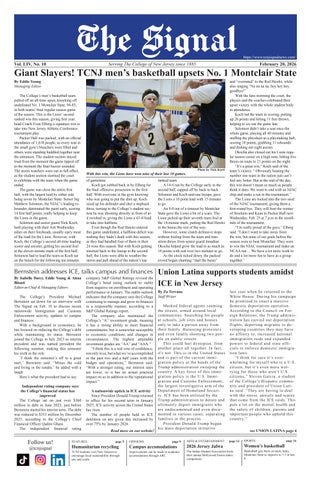
Giant Slayers! TCNJ men’s basketball upsets No. 1 Montclair State

The College’s men’s basketball team pulled off an all-time upset, knocking off undefeated No. 1 Montclair State, 94-85, in both teams’ final regular season game of the season. This is the Lions’ second ranked win this season, giving first year head Coach Evan Elberg a signature win to take into New Jersey Athletic Conference tournament play.

Packer Hall was packed, with an official attendance of 1,618 people, as every seat in the small gym’s bleachers were filled and others were standing huddled together near the entrances. The student section stayed loud from the moment the game tipped off to the moment the final buzzer sounded. The storm watchers were out in full effect, as the student section stormed the court to celebrate with the team when the game ended.

The game was close the entire first half, with the largest lead by either side being seven by Montclair State. Senior big Matthew Solomon, the NJAC’s leading rebounder, dominated the paint early, scoring 14 first half points, really helping to keep the Lions in the game.

Solomon and senior guard Nick Koch, both playing with their Ash Wednesday ashes on their foreheads, usually carry most of the load for the Lions. However, with Koch, the College’s second all-time leading scorer and assister, getting his second foul at the eleven minute mark of the first half, Solomon had to lead the team as Koch sat on the bench for the following ten minutes

With this win, the Lions have won nine of their last 10 games.

of gametime.

Koch got subbed back in by Elberg for the final offensive possession in the first half. With everyone in the gym knowing who was going to put the shot up, Koch sized up his defender and shot a stepback three, turning to the College’s student section he was shooting directly in front of as it swished in, giving the Lions a 43-41lead to take into halftime.

Even though the Red Hawks entered this game undefeated, a halftime deficit was nothing they hadn’t dealt with this season, as they had handled four of them in their 24 wins this season. But with Koch getting inserted back to the lineup in the second half, the Lions were able to weather the storm and pull ahead of the nation’s top

Bernstein addresses ICE, talks campus and finances

The College’s President Michael Bernstein sat down for an interview with The Signal on Feb. 18 to discuss recent nationwide Immigration and Customs Enforcement activity, updates to campus and finances.

With a background in economics, he has focused on reducing the College’s debt while maintaining its status. Bernstein joined the College in July 2023 as interim president and was named president the following summer, making this semester his sixth in the role.

“I think the semester’s off to a great start,” Bernstein said. “Minus the cold and living in the tundra,” he added with a laugh.

Here’s what the president had to say:

Independent rating company says the College’s financial status has improved

The College sat on just over $360 million in debt in June 2023, just before Bernstein started his interim term. The debt was reduced to $353 million by December 2025, according to the College’s Chief Financial Officer Qadim Ghani.

The independent financial rating

company S&P Global Ratings revised the College’s bond rating outlook to stable from negative on enrollment and operating performance in January. The stable outlook indicates that the company sees the College continuing to manage and grow its finances in a responsible manner, according to a S&P Global Ratings report.

The company also maintained the College’s “A” investment grade, meaning it has a strong ability to meet financial commitments, but is somewhat susceptible to economic conditions and changes in circumstances. The highest attainable investment grades are “AA” and “AAA.”

“I think this is a real vote of confidence, not only in us, but what we’ve accomplished in the past two and a half years with the budget and operations,” Bernstein said. “With a stronger rating, our interest rates are lower, so it has an actual practical impact on us in addition to the reputational impact.”

A nationwide uptick in ICE activity

Since President Donald Trump returned to office for his second term in January 2025, ICE activity across the United States has risen.

The number of people held in ICE detention on any given day increased by over 75% by January 2026.

ranked team.

A 14-4 run by the College early in the second half, capped off by back to back Solomon and Koch and-one layups, gave the Lions a 10 point lead with 15 minutes to go.

An 8-0 out of a timeout by Montclair State gave the Lions a bit of a scare. The Lions picked up their seventh team foul at the 14-minute mark, putting the Red Hawks in the bonus the rest of the way.

However, some clutch defensive stops without fouling from the team and transition threes from senior guard Jonathan Okocha helped grow the lead to as much as 14 points with just over two minutes to go.

As the clock ticked down, the packed crowd began chanting “start the buses”

and “overrated” to the Red Hawks, while also singing “Na na na na, hey hey hey, goodbye!”

With the fans storming the court, the players and the coaches celebrated their upset victory with the whole student body in attendance.

Koch led the team in scoring, putting up 26 points and hitting 11 free throws, helping to ice out the game late.

Solomon didn’t take a seat once the whole game, playing all 40 minutes and stuffing the playsheet as a playmaking hub, scoring 18 points, grabbing 11 rebounds and dishing out eight assists.

Okocha also closed out his Lions regular season career on a high note, hitting five threes en route to 21 points on the night.

“It’s a great win,” Koch said of the team’s victory. “ Obviously beating the number one team in the nation just can’t feel any better. But at the end of the day, this win doesn’t mean as much as people think it does. We want to end with an NJAC chip and make a run in the tournament.”

The Lions are locked into the two seed of the NJAC tournament, giving them a first-round bye. They will host the winner of Stockton and Kean in Packer Hall next Wednesday, Feb. 25 at 7 p.m in the semifinals of the tournament.

“I’m really proud of the guys,” Elberg said. “I don’t want to take away from the win, but none of our goals before the season were to beat Montclair. They were to win the NJAC tournament and make an NCAA run… We have a lot more work to do and a lot more fun to have as a group together.”

Union Latina supports students amidst ICE in New Jersey

Masked federal agents roaming the streets, armed around local communities. Searching for people at schools, job sites and houses only to take a person away from their family. Harassing protesters and even fatally shooting two people on public streets.

This could feel dystopian, from another place all together. In fact, it's not. This is in the United States and is part of the current immigration policy at the hands of the Trump administration sweeping the country. A key force of this immigration policy is the U.S. Immigration and Customs Enforcement, the largest investigative arm of the Department of Homeland Security. ICE has been utilized by the Trump administration to detain and ultimately deport immigrants who are undocumented and even documented in various cases, separating families in the process.

President Donald Trump began his mass deportation initiative

last year when he returned to the White House. During his campaign he promised to enact a massive domestic deportation operation. According to the Council on Foreign Relations, the Trump administration has carried out deportation flights, deporting migrants to developing countries they may have no affinity to, increased national immigration raids and expanded powers to federal and state officials to enforce domestic immigration laws.

“I think for sure it’s overwhelming for myself who is a U.S. citizen, but it’s even more worrying for those who aren’t U.S. citizens,” Steven Garcia, a student of the College’s Hispanic community and president of Union Latina said. “They are having to deal with the stress, anxiety and scares that come from the ICE raids. This puts a lot on the mental health and the safety of children, parents and important people who uphold this country.”

Photo by Nick Kurti

Vermin vandalism: Mice make themselves at home

written statement.

The College encourages students to take active preventative measures against the mice including reducing clutter in dorms and common areas, avoiding leaving out food and disposing of trash regularly. Dodd prompts those who have seen any evidence of a mouse in their room to submit a Facilities work order promptly.

“By combining proactive facilities management with preventative steps taken by residents, we can effectively minimize these occurrences and maintain a comfortable living environment for everyone,” Dodd said.

While these tactics may work for some students, they have not been successful for Dani and Hernandez-Lujan.

The College’s facilities have placed mouse traps on either side of their door, but it hasn’t been enough. They had put all of their food in boxes and placed it on top of their closets, used towels under their door while the door stopper they

purchased was on its way and had pest control come and install peppermint mouse repellent.

“Why [mice] in our room out of everybody,” Dani said, “we’re not the type of people to leave food out.”

The two roommates expressed that having mice in the dorms was seen as “so common,” as if the mice were to be expected due to Eickoff Hall being a dining hall. Outside of being told which number to call for Campus Police if encountering a mouse, they were not talked to by their CA or another college official to address the issue.

Dodd said that the College has partnered closely with a contracted pest control team as a way to allow an increase in the amount of visits and widen the range of mitigation methods.

“As a result of these enhanced efforts, we have already seen a measurable decrease in reported concerns, declining from 40 in January to seven thus far in February,” Dodd said.

Two years ago, Isabella Dani and her mother were touring the College when they came across Matthew Kaufman’s article for The Signal, “Rodent residents: Mice make themselves at home in residence halls.” They had hoped that this issue would have been solved by the time Dani moved into the dorms.

They never expected Kaufman’s article would come around full circle.

Dani, a sophomore fine arts major, and her roommate Ana HernandezLujan, a sophomore history secondary education major, live on the second floor of Eickhoff Hall where they, and many other students, have experienced mice in their rooms.

Dani and Hernandez-Lujan have encountered mice in their room on two separate occasions. Once, a mouse ran into their room and took residence in their

closet until they enlisted help to chase it away. The second time, Hernandez-Lujan was frightened by a loud snapping sound at 4 a.m.; they subsequently found a dead mouse caught in one of their traps.

She had to wait until 8 a.m. that same day to call Campus Police, who told her they would try to send someone over. It wasn’t until Dani’s mother herself called, and Pest Control was sent to remove it.

Dani and Hernandez-Lujan aren’t the only ones experiencing these encounters. According to Emily Dodd, a spokesperson for the College’s, there has been an increase in mice-related work orders.

“As temperatures drop, mice naturally seek food, warmth, and shelter indoors. Over the past several weeks, as snow accumulation increased and temperatures remained well below seasonal averages, we experienced an uptick in work orders related to mice in several residence halls, particularly Eickhoff Hall and the Townhouses,” Dodd told The Signal in a

Cop Shop: Unknown sender, mischief behavior and everlasting fire alarms

The Signal and Campus Police work together on a weekly basis to inform the campus community about crime on and around campus. All records given to The Signal are public records and do not contain personal information. Some information provided may be triggering for some students.

Feb. 3 & Feb. 10: Sprinkler outburst

At approximately 4 p.m., a Campus Police officer noticed water leaking from a pipe from Building 700, a building near the Fitness Center in Campus Town. The fire alarm went off, and both Building 700 and those occupying the Fitness Center were evacuated. A sprinkler head burst was the cause.

Prospect Heights Fire Department Engines 31 and 33 arrived at the scene and told residents that they could not reenter the building. Harring Fire Protection was contacted to fix the sprinkler head, but would not arrive for another two and a half hours. Affected residents received an email stating they could not reenter the building until the sprinkler head is fixed, but could go to any of the lobbies in Campus Town, retail stores, Brower Student Center and the Recreation Center.

At approximately 8:05 p.m. on Feb. 10, Campus Police officers were driving along Pennington Road when they observed a firetruck in

Campus Town. Ewing Fire Squad 30 and Prospect Heights Engine 31 were on scene, and students had already evacuated the building.

It was found that a sprinkler pipe, the same one from Feb. 3, burst on the opposite side of Building 700, causing water to leak from the door. The cold temperature was found to be the reason for its second burst.

Feb. 9: Swiped laptop

A student in possession of a laptop belonging to the College reported it as stolen, along with her apartment being

Feb. 4-14, occurring in Forcina Hall, Decker Hall, Eickhoff Hall and others. The causes for the alarms ranged from smoke alarms, burnt popcorn, hair straightening and marijuana. There was no smoke or fire reported in any instances.

Feb. 10: Off-key break-in Campus Police were dispatched to the Music Building basement to obtain information about a possible theft. The “instrument storage” room, which holds high-value items such as

remained unlocked.

burglarized the same morning. It is concluded that the approximate value of the laptop, and monetary loss to the College, is approximately $240.

Feb. 4-14: Fire alarms on fire alarms on fire alarms

There were six fire alarms from

instruments, seemed to be tampered with. An urgent repair was submitted immediately after noticing the damage to the door, but the maintenance worker concluded it would be best to involve Campus Police as evidence pointed that the door was forcibly broken into and

The card reader was hanging off the wall and appeared to be stricken. The inner lock of the door itself had a pencil wedged inside, and the interior door handle was stuck in the downward position, ultimately preventing proper securing of the room.

There were no other significant damages and no information that would lead to what items have been taken. Currently, there are no suspects.

Feb. 14: Anonymous articles

At approximately 11:30 a.m., Campus Police met with the College’s Men’s Basketball coach along with a student/basketball player, who received a manila envelope in the Men’s Basketball mailbox. The envelope did not have a return address, but was mailed from the zip code 08542, which is Princeton, New Jersey.

The envelope contained 19 pages of various articles and comic strip cartoons about prowomen’s reproductive rights, prosex education, pro-vaccine and anti-religion, although it wasn’t identified which religion(s) to be problematic.

The student and coach were unaware of who could have possibly mailed the articles. However, there was an article in the Trentonian newspaper about the College’s Men’s Basketball which could have publicized the name and randomly caused someone to send them.

Mice continue to cohabitate with students in the College’s buildings despite preventative efforts.
Mice traps are commonly used to catch and discard of rodents found in student dorm buildings.
Photo by Erin Reilly

Campus to Capitol Mentorship Program begins 7th year

Students of the Campus to Capitol Mentorship Program connected with their fellow peers and mentors as the program kicked off its seventh year with a party on Feb. 4 in Trenton Hall.

The program, which accepted 12

students this year — the most in its history — pairs undergraduate students with alumni working in government or public policy, preparing the students for a career in those fields. This was the first year students outside of the School of Humanities and Social Sciences could participate.

Each student met one-on-one with

their mentor, the first time many of them had met each other in-person. As more students and mentors arrived, the one-on-one meetings turned into larger group chats, where students and mentors formed circles around tables and talked to one another, slowly opening up about their interests and lives before conversations flowed like everyone knew each other.

Networking with others and what can be learned from those connections is one of the key reasons some students chose to apply to the program.

Hope Margarum, a senior international studies major, told The Signal she applied because the program will allow her to make connections, and will assist in her career prep and job search.

For a similar reason, Owen Konowicz, a junior political science major, said he wanted to be part of the program to form connections, which he believes “doesn’t happen enough on campus.”

The mentors, reflecting back on their own time at the College, see the importance of the program and their role as guides for their mentees.

“As an alumni, I feel like it’s

kind of your job to give back to the institution and be able to help students,” said Jessica Rueb ‘20, a research analyst for the New Jersey Office of Legislative Services. “You remember being in their shoes, and you remember applying for jobs and you remember trying to network. And I always wish that I had had more people who had helped me.”

Another mentor, Tre Scott ‘23, who works for a lobbying firm in Trenton, told The Signal he wants to pass along his experiences to prepare students for their future career.

Over the course of the semester, the students will meet with their mentors for at least two hours every month, according to the Campus to Capitol Mentoring Program website. The students can collaborate with their mentors on anything from career advice to developing skills essential before applying for a job, and everything in-between.

The next time the group will get back together will be Feb. 18, where members of the program will head to the New Jersey State House to meet with government officials and staffers and receive a tour of the building, according to the program’s website.

Gitenstein-Hart Sabbatical Prize uplifts waterborne bacteria research

Alexis Mraz has been chosen to receive the Gitenstein-Hart Sabbatical Prize for the 202627 year, sponsoring her research into Legionella and its persistent habitation in water.

Mraz, who is both an associate professor of public health and affiliated within the environmental studies department, will take a sabbatical year to further study the bacteria, and aim to reduce the morbidity and mortality of the associated Legionnaires’ disease.

The prize, which was created by the College’s former President R. Barbara Gitenstein and her husband Don Hart, recognizes and supports a faculty member taking a year-long sabbatical for scholarly work. The prize is awarded based on the research’s overall merit and potential contribution to its wider field, including the educational benefits students of the College may receive, according to the prize’s website.

Legionella, a bacteria known to thrive in warm water ecosystems, is an opportunistic pathogen that is most common in the plumbing of

hospitals and hotels.

Mraz will be continuing her longstanding work with the bacteria, a bug that she finds to be an ideal long-term case study, as it won’t be going away anytime soon.

“My dissertation focuses on Legionella and it really came out of, at the time, regular Legionellosis outbreaks, specifically Legionnaires’ and specifically in hospitals and large apartment buildings in this area,” she said.

Legionellosis, the name for any disease caused by the bacteria, and Legionnaires’, a lung infection spread through water droplets, are both prevalent within communities and individuals already vulnerable; this includes those already sick, the immunocompromised and the elderly.

“You have this bacteria that’s really ubiquitous, so it’s present in a lot of different places, but it’s really challenging to treat. It’s opportunistic, so it’s not making everybody sick, but the people who it is making sick, it tends to make them really sick,” Mraz said.

Part of Mraz’s research examines how water quality in community distribution systems affects the concentration of the Legionella

bacteria. Common sources include travel-associated infections from hotel premise plumbing, community-acquired infections from poorly maintained cooling towers, or aerosolized bacteria in a hospital setting. She noted how problematic this infection could be, as patients on contaminated ventilator systems can be left with bacteria buried deep in their lungs.

Particularly worrisome is the high case fatality rate of the disease.

“The case fatality rate in the general population is about 10%,” Mraz said. “To put that in perspective, COVID-19, during the beginning, was about 1.8%. But the case fatality rate when we’re looking at hospital-associated infections is closer to 25%, and sometimes has been recorded as high as 40%.”

In the Northeast U.S., the older status of water distribution systems and high biofilm build-up also contributes to the high rates of Legionellosis incidents. A 2015 outbreak in New York City resulted in 138 diagnoses and 16 deaths from one Bronx cooling tower alone, and New Jersey health data reports hundreds of new cases every year.

Mraz’s research efforts, however, have faced a share of obstacles. Recently, she lost funding that resulted in her inability to complete data analysis and risk assessment.

“I was working on an [Environmental Protection Agency] grant where we collected a lot of data throughout the country,” she said. “So we had a whole lot of data about Legionella concentration, different disinfected byproduct concentrations, and other water quality parameters, but that grant was canceled by the [Department of Government Efficiency].”

Mraz shared that the reason given for the sudden cancellation was that “it was no longer a national priority.”

With growing tensions and issues in funding surrounding DEI–based work in the federal government, Mraz could not find any logical

explanation for her grant’s elimination. “We thought we might get through because the work really had nothing outlined that was, you know, ‘woke.’ It wasn’t focused on minority groups, or women, or even impoverished people. I don’t know,” she said.

“There were four of these grants that were funded at the same time with the same goal, to reduce morbidity from opportunistic pathogens…but all four of them were cancelled. We got the notice, and like two weeks later, there was another incident in the Bronx, where I think like 14 people died,” Mraz said.

Mraz hopes that her research in this coming sabbatical will at least answer some questions in the field of microbiology and allow for further improvements in the maintenance and treatment of Legionella.

“The overarching, ideal end-goal is that we’re reducing morbidity and mortality from Legionella. I mean, obviously, that’s lofty, right?” Mraz said. “But really, the first thing I’m trying to figure out is how Legionnella is working within the biofilm…it’s like a protein matrix that’s built out by all the different microbes that are going to end up living in the [plumbing system].”

Mraz recognizes she may not realistically solve the issue of Legionella growth in water sources, but her goal is to understand the bacteria’s ability to thrive within plumbing based on the water quality. This information would provide a useful framework to further tackle the future elimination of Legionella entirely.

“I think the goal has to be how can we control it in a way that’s effective in not getting people sick,” she said.

Following her return from the 2026–27 sabbatical, Mraz is expected to present a collegewide lecture based on her research’s findings, according to the Gitenstein-Hart website.

Photo by Franc Romanowski
Students of the Campus to Capitol Mentorship Program talking to their mentors at a kick-off party on Feb. 4.
Photo courtesy of Peter Murphy
Alexis Mraz, an associate professor of public health, was awarded the prize for the 2026–27 academic year to further her study of the Legionella bacteria.

Features

UNION LATINA / A support system for Hispanic student body

Continued from page 1

Union Latina helps spread unity within the College’s Latine student body. The organization is now working as a support system to members of the College’s community who are affected by the current ICE enforcement. The organization strives to lend a helping hand to those in need of advice during these difficult times.

The College has felt the impact of the president’s immigration policy. Faculty members and students alike, specifically of the Hispanic community, expressed fears and concerns over ICE’s recent conduct in the Trenton area near the College.

“Students here and children around the country are scared that they go to school and might not find their mom at home when they come back. It’s all about the fear of losing someone you love to ICE,” Garcia, a junior history and philosophy double major said.

Garcia, a second generation MexicanAmerican whose grandparents immigrated

from Puebla, Mexico has voiced concern over the Trump administration’s harsh immigration crackdown within Trenton.

His family, like many other Hispanic families, have been intertwined with immigration enforcement since the early 2000s while going through the U.S. citizenship process. During the late 2010s, Garcia’s grandparents achieved their citizenship. However his family are still nervous about ICE’s recent activity in the state due to the agency’s treatment of Hispanic immigrants.

“I think the advice I would give to someone who is scared is searching for a person who is a rock for you in the way that they are someone who is the most supportive. Knowing that you aren’t alone and things will eventually get better,” Garcia said.

The threat of ICE detaining parents has had an influence on college students with siblings, as the students’ academic and personal well-being is at risk.

“It creates incredible levels of stress because if the students are not worried about themselves or their own status, many are worried about other family members, and this impacts their ability to focus on their studies.” said Regina Morin, a former Spanish linguistics faculty member of the World Languages and Cultures department at the College.

Morin, in her college teaching career, has an extensive history with first generation Latino Spanish-speaking students. Morin said that the Trump administration’s policy on immigration doesn’t just center around ICE, rather, “It revolves around a concerted effort to penalize anyone who was not born in the U.S., naturalized citizens as well as legal residents and undocumented immigrants. It also penalizes anyone who cannot access services in English.”

“Section 1557 of the Affordable Care Act,” Morin said, “requires all US medical facilities that receive funding from the federal government to provide interpretation services free of charge to all patients who need them. Language could not be used as a proxy for racial discrimination.”

The College’s World Languages and Cultures department received approval for certificate programs in medical Spanish and Spanish for social services, mental health and law enforcement. A sizable amount of students within these programs are Latino heritage speakers of Spanish. Materials used for these programs were drawn from U.S. government websites which were published in multiple languages. Now these materials are non-existent.

“The fight against DEI is also a fight against providing culturally and linguistically appropriate care to nonEnglish speaking people of color,” Morin said. “It also limits our access to the best materials for our students, which are both free and of excellent quality. The attack

on DEI and on immigrants, documented and undocumented, will have an effect on our ability to prepare our students to work with non-majority populations in health care, human services, public health and law enforcement.”

This heightened enforcement has garnered widely unpopular support after the fatal shootings of Renee Good, 37, on Jan. 7 and Alex Pretti, 37, on Jan. 24 in Minnesota at the hands of ICE agents. According to a YouGov poll, 57% of Americans somewhat or strongly disapprove of the way ICE is handling its job.

The detainings conducted by the agency have prompted a psychological toll on families targeted for detention due to their citizenship status, thus splitting families.

“Immigrants facing the threat of detention or deportation can lead to depression and other mental health symptoms. Parents facing family separation are more likely to keep their child out of school, harming children’s academic future,” The American Psychology states.

A Sept. 8, 2025 Supreme Court decision allows ICE to use the following criteria when making investigative stops: The type of location at which they were found; the type of job they appeared to work; whether they speak Spanish or English with an accent; their apparent race or ethnicity according to the Brookings Institute.

On July 4, 2025, the president signed the “One Big Beautiful Bill,” into law. According to the American Immigration Council, it provided $170.7 billion in additional funding for immigration and border enforcement activities to the DHS and its various sub-agencies like ICE through spending federal tax dollars. H.R.1 also expands the construction of new detention centers, some even family detention centers with the assistance of $45 billion in funding.

How Justin Yuen ‘27 turned cookies into a successful small business

From middle school bake-offs to partnerships with busy breakfast nooks on the Jersey Shore, junior finance major Justin Yuen has turned a love for cookies into a successful business, J Bakes.

“I was just challenging a friend,” Yuen said. “And then the following week, people were like, ‘we want to buy some cookies.’”

He began selling his sweet treats in middle school through hosting fundraisers.

Though some assumed his baking talent came from family recipes, Yuen says he is entirely self-taught. He dedicated countless hours watching baking shows and videos, teaching himself to perfect his recipes and improve his technique.

Over time, baking became more than just a hobby for Yuen, it flourished into his passion, and as time went on, a business. “Eventually, I figured out how to turn that passion into something more,” Yuen said.

During high school, Yuen was enrolled in his school’s culinary program where he met seniors that he considered mentors. Some of them would even fund his early efforts.

“They would give me money for ingredients,” Yuen said. They all had one simple request: “‘Just bake us cookies.’”

Still, the road wasn’t immediately profitable. For the first three to four years, J Bakes was operating at a loss, Yuen added. He was often selling to middle school and high school kids with limited money. Family members and friends

questioned his decisions and told him to join clubs and get a part-time job.

“When you have a vision, it’s on you to nurture it and grow it,” Yuen said when talking about the questions he got from those around him. “If you tell the wrong people, then it’ll disappear.”

Instead of listening to the doubt from others, he used people’s words as “receipts” for when he needed fuel. “When faced with all of that background noise, it really is make or break,” he said.

Today, Yuen says his campus fundraisers have been among some of the most rewarding aspects of his journey.

“People kept sharing my cookies and spreading the word,” he noted. “Today, when I do a fundraiser, I’ll get a few hundred people who come and support me here on campus.”

Balancing academics with running a business isn’t easy, but Yuen says the pressure has taught him to adapt.

“All the pressure from running the business, being a student, and commuting, eventually you kind of adapt in your mindset,” Yuen said. “You have to learn to do things more efficiently, and it ultimately saves you time.”

After seeing the success of his school fundraisers, he was influenced to start doing pop-ups within his community. You can find him at market places, outside of stores and on Long Beach Island in the summer.

“I would say 70-80% of my business I do myself,” Yuen said. “And then when I do need help, I’ll have my sister or my mom do a little bit of work, or my

hometown friends.”

In terms of baking, Yuen operates out of a commercial kitchen in Monmouth County, which serves as the central hub for J Bakes.

“Once a week, I pop in, and I do what I have to do for the next week,” he said.

As J Bakes began to grow, Yuen was open to adding items to his menu. A latenight scroll on Instagram sparked the idea to add matcha to his menu. He saw a video for a new matcha cafe in Lawrenceville, NJ called Ooika. Yuen pitched an idea for a homemade matcha cookie in-person. He now supplies monthly cookie drops at Ooika and uses their fresh-ground matcha at his pop-ups.

Because of his collaborations with Ooika and marketplace vendors, people started to notice him, Yuen said. While doing a pop-up at the Baker’s Grove in Shrewsbury, NJ, the owner of a popular breakfast nook on Long Beach Island

called Birdy’s reached out to Yuen and invited him to do a summer-long pop-up down the shore, where he sold both his cookies and Ooika’s matcha.

When asked about his personal favorite cookie, Yuen’s face lit up.

His personal favorite, the same as his best seller, is his hot cocoa cookie. “It’s a chewy chocolate cookie with roasted marshmallows.”

In addition to J Bakes and managing his coursework, Yuen is a licensed real estate agent. He says that his work in real estate is not only to help people find longterm homes, but to also pay for his dream of opening a brick-and-mortar location for J Bakes somewhere in Monmouth County.

For Yuen, J Bakes’ journey has been about so much more than just baking. “It’s so fulfilling to create something for yourself and make progress toward your ideas.” Yuen said.

Photo courtesy of Steven Garcia
Union Latina is providing a safe and communal environment for the TCNJ Hispanic community amidst ICE activity.
Photo courtesy of Anthony DePrimo
Justin Yuen setting up shop in the Stud.

Humanitarian Engineering lends a helping hand in New Orleans

For most students at the College, winter break is a time to rest, rejuvenate and reflect on what we’d like to improve on in the upcoming semester. For others, such as the student members of the College’s very own Humanitarian Engineering club, winter break became a time of giving back to the community.

“We’re a service engineering based club that helps do things that better our environment,” Terrell Osei-Kyei, Humanitarian Engineering’s president told The Signal. “We do cleanups throughout the year and we do service projects.”

From Jan. 14-18, nine Humanitarian Engineering members took a trip to New Orleans to participate in efforts to creatively recycle materials.

about recycling and reusing materials, so we helped with that for three days this year,” Osei-Kyei, a senior civil engineering major said. “People would send in their trash to the Green Project and we would try to figure out ways to restore and reuse it. A lot of the work we did was working with paint. They take paint and find a way to recycle it or reuse it. We would first figure out if the paint was usable and

if it wasn’t we would recycle it and put it in this wood chipper.”

Humanitarian Engineering has a history of taking trips to better the environment within the state, nationally and even internationally. This recognized student organization, which is open to both engineering majors and non-engineering majors, has previously gone to New Orleans in partnership with Rebuilding Together New Orleans to assist in building a community garden, and has traveled to Thailand to help build a water treatment system.

“It was pre-COVID that we would do annual trips, and we just started it up again last year. We’re definitely looking to go back next year,” said Jaclyn Ladas, a junior biomedical engineering major and Humanitarian Engineering’s upcoming president.

This year’s trip saw the club partnering with The Green Project, a New Orleans-based organization whose mission is to “promote a culture of creative reuse by diverting usable materials from landfills and cultivating a respect for their value.”

“The Green Project began as a volunteer Paint Recycling Program in 1994 when it became clear that New Orleans needed a responsible alternative to dumping paint polluting regional

waterways,” Erin Genrich, The Green Project’s program manager for environmental education and outreach, told the Signal. “With equity in mind, our founding members sought to recycle usable paint and resell it to the community at an affordable price…We extend our work into the community through a free K-12 Environmental Education program.”

The Green Project and Humanitarian Engineering used those four days over winter break to establish “plant recycling programs, storefronts and environmental education programs” for the New Orleans area.

“A cool thing about it is the paint that we would recycle would go to the city for children because it was basically for education. It’s cheaper for them to get the paint through The Green Project, and so it would help support inner-city kids in New Orleans with paint recycling,” Osei-Kyei said.

Funding for this altruistic venture was made possible by the RSO’s fundraising efforts, as well as the Student Finance Board and the Dean of the School of Engineering.

“The School of Engineering happily supports interdisciplinary clubs like Humanitarian Engineering,” Dean Andrea Welker of the School of Engineering said. “I want to recognize the effort the students put into fundraising to support their travel.”

Humanitarian Engineering also felt the full support of the College’s Center for Community Engagement, as staff member Katherine Sheridan told the Signal, “The Center for Community Engagement was proud to support the Humanitarian Engineering Club’s service trip. They utilized our TCNJ Service MiniGrant funding opportunity, which provides awards for student-led service activities of up to $1,000 per event.”

The effort put into making this trip possible paid off in the academic and humanitarian impacts it left upon students and the New Orleans area as a whole.

“Going to NOLA was truly a life changing experience for me,” said Christian Ambio, a senior mechanical engineering major who

attended the trip. “I felt that for the first time my community service efforts made a difference. I grew a new appreciation for seeing positive effects of a good group of people, doing great things, for an even better cause.”

Genrich explained that The Green Project is used to collaborating with colleges and universities on a local and international scale. “TCNJ just reached out with interest via email and we were happy to host them.”

“The volunteers helped us tremendously by sorting various hardware materials and waterbased house paint, and helped us also process waste paint - an activity that requires adding sawdust to bad paint and mixing,” Genrich said.

The members of Humanitarian Engineering who took part in this trip also derived great academic benefit from it, they told The Signal. In addition to feeling proud at their work in helping communities in need, the students said they enjoyed the larger imprint this trip would leave on their academic work and future career goals.

“These students take what they have learned in class and apply it to solve problems to improve the quality of life of the communities they serve,” Welker said. “These trips provide real world and immediate proof of the ability of engineers to make the world a better place.”

“It’s definitely nice to see the humanitarian aspect of [engineering],” Ladas said. “I think a lot of it has to do with the help that we can do for the environment, especially surrounding natural disasters like Katrina when we went down and helped…I loved helping a community besides ours.”

The future of engineering is looking bright with the existence of clubs like Humanitarian Engineering, especially as it pertains to the declining state of the world’s natural environments.

“I didn’t get into engineering because I wanted money. Money is nice and everything but I wanted to help design solutions for the environment,” Osei-Kyei said. “Climate crisis is a pressing issue and we need to start thinking of ways to design systems that will last longer.”

The AI epidemic: How chatbots have been creeping into the therapy space

College students are increasingly sharing their lives with artificial intelligence chatbots, trusting them with emotional problems that traditionally are disclosed to friends or therapists. Their real-life support systems are worried.

“A lot of students talk about AI,” Alex Turpin, associate director of Clinical Services at the College, said. “Recently a number of students will come in and you know, pit what I have to say against what they looked up on ChatGPT.”

Turpin said he has noticed an overreliance on technology among students — even though they know it raises their anxiety and keeps them from thinking independently.

He recalled a recent case where a student consulted ChatGPT about emotional symptoms they were experiencing.

He said that the student was “really fishing for a diagnosis” from ChatGPT, which he sees as part of this overreliance on technology to validate what students already believe. The greatest issue, he said, is that AI often tells students what they want to hear rather than what they need to hear.

After hearing concerns about this trend on campus, The Signal interviewed members of the College’s student body.

Tyson Van Pelt, a freshman accounting major, turns to ChatGPT for practical uses like making lists or doing schoolwork. He considers it a useful tool, but said the information it produces is often generic.

He said there have been times where ChatGPT didn’t understand his situation or what he was trying to describe, and that for an emotional situation it could also be misguiding.

Audrey Hall, a sophomore speech language pathology and audiology major,

believes that using ChatGPT for emotional guidance is partly a response to the negative stigma associated with going to therapy.

“I feel like it’s gotten better in recent years, but I feel like especially just a couple years ago, it was so stigmatized like you’re going to therapy because something’s wrong with you,” Hall said, adding that she thinks this is why the anonymity factor of ChatGPT is appealing.

Turpin said there is danger in this comfortable anonymity. Students need to be able to face their issues without the shame of speaking out, he explained, because if they feel like they can’t talk to anybody about it, there is still something they need to confront.

This trend extends beyond the College.

James Stewart, a freshman finance major at Penn State University, shared his own experience using AI as a form of emotional support.

“Sometimes I’m looking for answers as to why I’m feeling a certain way, but sometimes, you know, I just want someone to talk to,” he said in a virtual interview.

Stewart believes there are many positive factors associated with using AI instead of going to an actual therapist. For him, talking to “the bots” is much easier than talking to a real person. He also pointed out that ChatGPT and similar features are available 24/7.

Even though it is their job, therapists cannot physically be available 24/7. Students across campuses felt that AI’s availability was one of the biggest reasons they turn to it for emotional support.

Turpin said disciplined use of AI can be helpful and should only be used as a supplemental tool. He doesn’t think it should be relied upon, especially for subconscious validation-seeking, and he does not think it can replace speaking with another human being.

Gabriella Albuquerque, a criminal justice

major at Kean University, has friends who use ChatGPT. She talked about her best friend who uses it for her anxiety.

Albuquerque said her friend thinks it’s helpful, “but I don’t really like what it gives out to her.” Albuquerque said answers were very generic, and something she could read about anywhere.

She believes this issue is growing as AI tools themselves advance. Whenever she brings up therapy, her friends often suggest just using AI.

Turpin believes there will be more “sophisticated” technologies for therapy in terms of the relationship between AI and traditional therapy evolving together in the next few years.

“However, what is therapeutic is being vulnerable with somebody else,” he said.

Stewart thinks more students are choosing AI for its convenience and anonymity. He does not want to go somewhere to get therapy, and likes that it is so accessible with ChatGPT.

Although he never went to a therapist, Stewart believes there are more benefits psychologically to doing so rather than just using AI.

He describes it as being different from speaking with friends about problems he is facing. The AI chat bot tells him things that are very similar to what he already knows. For him, it doesn’t really solve the problem even when he is searching for answers.

“I think that there is a dark side to using AI, in that it’s much more secretive. It’s not like a real person telling you things, and I’m aware of cases where this has gone very wrong,” he said.

Zane Shamblin, 23, was allegedly talked into committing suicide by ChatGPT, according to CNN. He had just graduated from Texas A&M University with his master’s degree.

The source reports he was in his car by

himself with a loaded handgun. In his final moments, he spoke to ChatGPT, which appeared to be encouraging Shamblin to commit suicide.

It wrote chilling messages like “Rest easy, king,” or “You’re not rushing. You’re just ready.” The last moments this person knew were that ‘someone’ thought he should die.

Shamblin’s parents are suing ChatGPT’s creator, contending that there weren’t enough safeguards in the feature to prevent life threatening cases like their son’s.

“I feel like the mental health field, especially like therapists, I feel like it’s going to start shrinking soon,” Albuquerque said.

To get more students to seek help from actual therapists instead of AI, she said it would be beneficial for therapists to give a phone number the client can call at any time. This could be a personal phone number, or even having a network of real individuals to speak with.

Students seeking mental health resources have options at the College:

Counseling and Prevention Services (CAPS) Eickhoff Hall, Suite 107

TCNJ Campus Police

Dial 911 from any campus phone or 609771-2345 from a cell phone.

Suicide and Crisis Lifeline Call 988

UWill

Uwill offers students free, immediate, 24/7 access to teletherapy.

Dean of Students

If you would like to submit a CARE referral for yourself or someone you may know, please utilize our website.

Photo courtesy of Terrell Osei-Kyei
From left to right: Terrell Osei-Kyei, Jaclyn Ladas, Christian Ambio, Max Mancuso, Joe Allen, Steven Ioannidis, Liam Curran, Henry White and Vincenzo Lepore.

Internship and career culture is quietly excluding students

The biggest question college students constantly hear from professors, family members and peers: “What are your plans after graduation?” The question is not “what are you learning?’ or “what interests you?” — it’s whether you are career-ready or not before even earning your degree.

Career culture, referring to the pressure to have your career plan mapped out while still in college, has slowly become the dominant framework through which students are evaluated. While yes, of course, preparing students for their future and encouraging them to enter the work force early is important, the intensity and immense pressure of this culture is quietly excluding many students. These pressures narrow definitions of success, and students are only

measured based on their internships and experiences.

Today, education is only seen as a transaction. The expectation is simple: earn your degree and you will secure a job. In reality, this is not the case for most students. Getting internships while in college is not as simple as it seems for all students. Many internships require previous experience, excluding students who are just starting out and eager to learn. Others require extensive applications and multiple-round interviews, just to be rejected in the end. Additionally, many internships are unpaid, which is not ideal for all students. Some students cannot afford to work for free, and it is not fair to pressure them to do so.

This imbalance reinforces inequality in the job market. Students who come from financially stable households have the privilege of relocating, accept unpaid offers and place work above

their education. Students who do not have this privilege may work in roles unrelated to their career goals, not because they are unambitious, but because they have no other choice. However, only one type of experience tends to be celebrated.

It is constantly overlooked how much valuable experience students can gain from part-time jobs, oncampus organizations, classes and extracurriculars. Some students even do more work within these than they would do in an internship, but employers choose to ignore that when choosing candidates.

Beyond financial pressures, students additionally feel pressure from observing their peers’ success, especially with platforms such as LinkedIn. Everyday, there are a dozen posts from fellow students sharing their success stories in getting internships and jobs, leaving students who lack

The Signal

https://www.tcnjsignalnews.com/

Email: signal@tcnj.edu

Business Email: thesignalbusiness@gmail.com

Editorial Staff

Isabella Darcy Editor-in-Chief

Eddie Young Alena Bitonti Managing Editors

Ashley Ragone News Editor

Devyn Briones Arts & Entertainment Editor

Natalia Tomczak Opinions Editor

Sky Pinkett Features Editor

Joseph Caruso Sports Editor

Lake DiStefano Nation & World Editor

POLICIES

those opportunities to feel less-than. While seeing your peers’ success is a positive, it can also result in other students feeling as though they are “behind” or it is “too late” to reach their goals. Students who are still exploring or applying to jobs may feel the urge to just give up due to beliefs that their peers are way ahead of them anyway. However, all students face the same process when going through the job process: sending in countless applications, receiving rejections or getting ghosted by an employer with no explanation. But, only the success stories are highlighted — causing students to rarely get the full picture. Career culture also discourages exploration. Not every single student knows exactly what they want to do as a career when entering college, and that should not be frowned upon. There is a reason colleges offer an “undecided” option when choosing a major, and that should not reflect poorly on the student. College is meant to be a time of intellectual and self discovery, and it is completely normal for students to feel the desire to explore multiple fields before committing to a career. Switching majors and exploring classes is developmentally normal, and it does not mean you are falling behind.

Preparing for a career should be a part of college education, but it should not overshadow everything. Colleges need to recognize that success looks different for everyone and that college is a stepping stone, not a catapult. Students deserve the freedom to discover themselves and explore opportunities before being expected to brand themselves. The point of college is to not be chasing a job, but to be chasing your dreams and discoveries.

Administrative Staff

Sandra Abrantes Multimedia Coordinator

Andre Paras Video Editor

Abigail Holliday Copy Editor

Amanda Incalcaterra Erin Reilly Social Media Editors

Ally Uhlendorf Editorialist

Jenna Weldon Web Editor

Sky Stewart Editorial Cartoonist

Cristina Collins Business Manager

Kathleen Webber Faculty Advisor

The Signal is published bi-weekly during the academic year and not financed by the Student Activity Fund, but solely by advertisement revenue. Any student may submit articles to The Signal. Publication of submitted articles is at the discretion of the editors. All materials submitted become the sole property of The Signal.

The Letters section is an open forum for opinions. Submissions that announce events or advertise in any way will not be printed.

The Signal willingly corrects mistakes. If you think we have made a mistake, contact us at signal@tcnj.edu.

Photo courtesy of Flickr
Internships and post-grad careers are not as accessible as they seem to be.

Sudoku

Celebrity speeches on political issues should produce actions

Celebrity opinions during times of political and social tension have long been controversial. This is understandably so, as they do not face the typical experiences of the average citizen without money and fame to spare.

Within the last year, the number of Immigration and Customs Enforcement raids around the country has increased severely since the passing of President Donald Trump’s “Big Beautiful Bill.” According to a report by the American Immigration Council, “The Trump administration has dramatically changed

Katseye

the profile of who is being arrested by increasing the use of ‘at-large’ arrests in American communities by 600%.”

Throughout the last few months, several celebrities like Olivia Rodrigo, Bruce Springsteen and SZA have been vocal about their opinions against ICE and their cruel treatment and deportation of immigrants. At the 68th Annual Grammy Awards on Feb. 1, artists like Bad Bunny, Billie Eilish and Justin Bieber expressed their disapproval of ICE through either speeches or “ICE Out” pins.

After winning the Grammy for Best Música Urbana Album, Bad Bunny, who recently performed at the Super

Bowl halftime show, made a speech saying,

“Before I say thanks to God, I’m going to say ‘ICE out.’ We’re not savage. We’re not animals. We’re not aliens. We are humans, and we are Americans.”

Bad Bunny has been constantly criticized by the president, despite being a citizen of U.S. territory of Puerto Rico and having American citizenship. In his case, speaking out against ICE is personal and he has been consistent and vocal in his opinions. Eilish is another example of an artist who has frequently called out ICE and the president, saying during her speech that, “No one is illegal on stolen land.”

Although no one, including celebrities, has an obligation to speak on any topic, being explicitly against ICE brings attention to the issue at hand. While celebrities do not have political power, they do have large fanbases that listen to them and support the causes they talk about.

However, communicating one’s outlook on social and political issues can look different than making speeches or posts on social media. Despite sever-

al attendees at the Grammy’s wearing pins, many did not talk much about it on their social media or live.

While all these methods are forms of protests, it can end up looking shallow when someone makes one post about a social issue or wears a pin once to protest. It can seem as though these privileged people are taking part in the smallest part of activism when the issue is at its height to save face or not get backlash for not saying anything later.

Everyone is entitled to the way they support the topics they feel passionate about but celebrities have certain power in the media that can affect people who are being targeted by ICE or even physically going to protests. With this in mind, one post online has no impact compared to a consistent, overt, and thorough form of activism.

Currently, protests have been going on for months in states like Minnesota and have been spreading all throughout the country. Even colleges, universities and high schools have had student protests on campus. Columbia University is probably the most well-known example of this at the moment.

At a time when the country is facing such a crisis, activism should not be small for those who have the convenience of doing it from their home without facing consequences. Even though celebrities do not have to protest for human rights, when they do, it should be done with effort.

could be the unstoppable, but only if their labels let them

Beginning way back in 2022, new trainees were brought into talent agencies Hybe and Geffens “pop academy,” a place meant to form the world’s next global girl group. The goal of the academy was to take these young women and train them in dance, vocal and stage presence skills, so that they may rise above the competition and take the performance industry by storm.

After completing their training and being chosen to form Katseye, the group made its official debut, with a single release of “Debut” in June 2024. Since then, they have released an EP titled “SIS: Soft Is Strong” in August 2024, and a

second EP “Beautiful Chaos” in June 2025.

Katseye has quickly risen in popularity, that’s undeniable, but fans (called eyekons) have been begging across social media for Hybe and Geffen to allow the girls to either write their own music, or receive better songs from the labels in general. With their latest release of “Internet Girl,” containing the lyric “eat zucchini,” many believe that the group is capable of so much more.

My personal theory is that they’re being marketed towards a younger audience, and thus some of their songs aren’t to be taken the most seriously. While I understand that point of view, these are talented young women who have gone

through Avengers-level performance training and deserve to be given material fitting for them.

As much as I personally love “Internet Girl,” I much prefer some of their more mature songs such as “M.I.A” or “My Way.” Both songs showcase a range of talent all the while keeping it clean and yet mature for a range of audiences.

Recently, Katseye member Lara Raj has released a snippet of a song that she and her fellow member Megan Skiendiel had worked on in the past that features a hyperpop vibe, similar to Charli XCX. Upon this snippet being released, fans have been begging the labels to let them produce and write their own music.

Even if we look back at some

of their missions that they had done during their time at Dream Academy, “Confident” by Demi Lovato and “Buttons” by The Pussycat Dolls, both show just how powerful Katseye could be with the right combination of choreography and music.

As we’ve seen from their recent Grammy’s performance, the dance ability is there, and is only rivaled by Tate McRae in the current pop industry. That being said, though they can dance, who thought it would be a good idea for Katseye to sing the lyrics “fried chicken, gnarly” in front of the recording academy? The worst part about it, was that they have other songs that showcase their vocals more, such as “Gabriela.”

Was the performance entertaining? Yes. Did it show what powerhouses they could truly be? Not at all. It’s just a waste of years of training to have them performing such juvenile pieces. The girls clearly crave more just as much as the fans do, their labels just need to get it together.

They are no longer the 16-yearolds who came into Pop Academy bright-eyed and innocent. These are talented women who deserve to be taken seriously. Given their training, anyone could see that they could be the next, if not bigger, than The Pussycat Dolls, and definitely Fifth Harmony.

All we can do is hope that the labels are listening to the fans and that when it comes time for Katseye to drop an album, it gives us everything we want and need. Now that would be gnarly.

Photo courtesy of IMDb
After completing their training at Dream Academy, Katseye became a global sensation.
Artists like Bad Bunny spoke out against ICE at the Grammy’s on Feb. 1.
Photo courtesy of IMDb

ARC can do better regarding students’ academic accommodations

The Accessibility Resource Center at the College offers an opportunity for students with disabilities to receive accommodations in whatever regard they require. This is a necessary resource to have in order to maintain the College’s mission of Division of Excellence to persons with disabilities. ARC does not offer the opportunity and help that it has said to allow, but there is still room to improve and truly offer a fully inclusive and easier process for students struggling.

As an individual who has accommodations due to severe anxiety, I am very familiar with the process of asking for the help I need in regards to my disability. I have had accommodations since I was in eighth grade, and my circumstances have changed from then until now. But what has

remained is the need for accommodations in order to perform my best academically.

In middle school, the accommodations process relied on a therapist or doctor note stating the need for such, and a meeting with the vice principal discussing the terms for extra help. What that meant for me was being removed from the classroom during any kind of test or quiz, and taking it in a separate room entirely to ease the overwhelming anxiety I felt during them. I was also allotted extra time to complete exams if the class period was not enough time.

In high school, this changed slightly, and I no longer had to discuss my accommodations with any of my teachers, because these details were included on the attendance roster. This greatly eased the anxiety I felt in asking each teacher for help and to respect my requests. It was understood that my accommodations would

change by moving schools, and it came as no surprise that I was expected to take exams in the same room as other students and would have to communicate with each teacher when extra time was needed occasionally, but with this interaction being minimal, I found I was performing better academically for these four years.

Upon applying to college I was aware that the accommodations process would once again change, but I remained positive about ARC and moved forward with asking for help in leveling the academic playing field.

In the fall semester of my freshman year I first attempted to apply for accommodations. In order to apply for accommodations students must fill out an ARC Affiliation Form which provides information on who you are, the details of your disabilities, what accommodations you are requesting and the documentation proving you require them.

After this is completed, you will be made aware if you are approved for accommodations, and assigned an accessibility specialist with whom you must have a meeting with to set up your plan. In addition, you must then submit a semester request for your accommodation plan to be active, as well as set up meetings with each professor whose class you expect your plan to be active in. If you do not discuss this plan with your professor, then your request for accommodations will not be honored.

This process is slightly different depending on the student, since each individual’s accommodations vary, yet the process remains to be more difficult than necessary. In order to have academic accommodations at the college level absolutely requires more than it would at a high school or elementary level school.

Considering this fact, I believe that in my experience of receiving academic accommodations for as long as I have, there

is a simpler way of achieving these accommodations that puts less stress on the applicant, as well as makes the process simpler and therefore more easily accessible to students.

This would include the ARC Affiliation Form that is already required, as it is important to ensure that only those who really need help are receiving it. Additionally, it would include the option to select an accessibility specialist based on when they are available.

One struggle I found was that it was hard to find a time when my specialist and my schedules overlapped. This fact made me lose confidence and induce more anxiety in reaching out to figure out when we could meet to discuss my plan.

Similarly, I feel most comfortable when I do not have to approach my professors about my accommodations, given that I struggle with anxiety. I believe this step is not necessary, as it simply adds an extra step that without it, would lessen worry surrounding asking for help, as well as encourage more people to apply.

This action could be taken by allowing students to choose whether they approach their professors or not. In this case, the consequence is that students will be able to communicate with their professors in a digital sense, whether that be email, or a virtual meeting to ease their anxiety.

Through these means of change, I believe more people interested in using ARC will be more inclined to do so. Before I received my accommodations, I felt overwhelmed by the process and intimidated by the anxiety it would cause me, which is why it took me an entire year to apply and go through with this process.

With the proper amount of communication and information on how to better improve these established processes, I believe that ARC can do more good for the College community.

Frankfurt might be your perfect study abroad destination

Have you ever thought about spending a semester abroad? Germany may not have made it onto your top three list, right? The combination of lederhosen, beer, techno and half-timbered houses is not exactly… enchanting. In the unlikely cases where Germany does find its way onto the list Frankfurt rarely does. For many, it’s either “the airport,” or “that city with bankers.”

But here’s the plot twist: Frankfurt is one of Europe’s most international, ambitious and quietly iconic cities and a surprisingly perfect place for an American semester abroad.

Welcome to Frankfurt am Main: One of Germany’s most global cities and its only real skyline. Main character energy included.

Frankfurt serves! Frankfurt does not do subtle. The city runs on efficiency, ambition and an international mindset. Skyscrapers rise next to historic buildings, the Main River cuts

through the city centre and people from over 170 nations live and study here side by side. It’s fast-paced, global and refreshingly honest.

Locals lovingly call it ‘Mainhattan,’ and for once, the nickname actually delivers.

By day, Frankfurt is all business: public transport that works, coffee that fuels entire economies and a rhythm that keeps things moving. By night, the city softens into riverside hangouts, student bars, underground clubs, museums and late-night conversations in more languages than you can count.

Frankfurt: Accidentally iconic since forever Frankfurt has history. Founded in 794 and as the birthplace of Johann Wolfgang von Goethe, the city has deep cultural roots, but it’s never been stuck in the past. International book fairs, global conferences, art exhibitions and political summits shape everyday life here. Tradition and modernity coexist.

Geographically, Frankfurt is a flex. Lo-

cated in the heart of Europe, it offers fast connections to Paris, London, Berlin, Amsterdam and beyond. Weekend travel isn’t just a dream but a realistic plan. Studying abroad here means Europe becomes your extended campus.

Enter: Goethe University Frankfurt

Right in the middle of this all sits Goethe University Frankfurt.

With around 43,000 students across five campuses, Goethe University is a smidge larger than the College. Yet despite its size, it remains approachable and student-centred. Its academic range is broad, its research reputation strong, and its international orientation unmistakable.

The standout is the Westend Campus, often named one of the most beautiful campuses in Europe. Historic buildings, green spaces, and modern lecture halls create an atmosphere where getting lost feels more aesthetic than stressful.

For American students, Goethe University offers a wide range of English-taught courses. They have strong programs across the humanities, social sciences, economics and sciences, with a diverse, international student body and long-standing academic and cultural ties to the United States.

Student life without the bubble

Student life flows directly into city life. One moment you’re in class, the next you’re studying by the river, attending a public lecture or grabbing dinner with friends from three different continents. English is widely spoken, making the transition easier, while everyday life naturally introduces you to German culture.

It’s immersive without being overwhelming, and challenging without being isolating. This is the kind of semester that doesn’t just earn credits. It builds indepen-

dence, confidence and perspective.

Why Frankfurt works for students Frankfurt may not be the obvious study abroad choice and that’s exactly why it stands out.

It offers a real European city experience, not a tourist simulation. It has academic rigor with global relevance, easy access to Europe without losing structure or support and direct connection to transatlantic academic and cultural networks.

For students thinking about international careers, graduate school or simply seeing the world differently, Frankfurt delivers.

How to make it happen

Students interested in studying abroad in Frankfurt can contact Ann Liberona in Green Hall 107 or via liberona@tcnj.edu. She supports you regarding study abroad opportunities and guides students through the application process, program selection, and preparation.

In Frankfurt, the Global Office of Goethe University Frankfurt is the main point of contact for exchange students. They provide information on: exchange programs and eligibility, English-taught courses, housing and arrival logistics and academic and cultural life in Frankfurt.

Final Take: Main character abroad

Studying abroad is about more than changing locations. It’s about changing perspective.

Frankfurt offers a version of Germany that’s modern, international and deeply connected to the global world. It’s ambitious without being flashy, serious without being boring and iconic without trying.

So, if you’re looking for a study abroad experience with real main character energy — Frankfurt is waiting.

The Accessibility Resource Center helps with accomodation at the College.
Photo by Erin Reilly
The Main River, the old town and the skyline all in one place.
Photo courtesy of Pexels

Top European diplomats resign over links to Jeffery Epstein

Amidst the political chaos of files surrounding the deceased and disgraced child sex trafficker, Jefferey Epstein, being released to the public, a wave of resignations have occurred across 10 countries.

The release of the Epstein files have prompted 15 high ranking international figures to resign from various positions, because of their ties to Epstein.

The United Kingdom has seen the largest amount of resignations thus far with other nations like Slovakia, Sweden and Norway seeing top diplomats and ministers stepping down from their official positions according to TimesNow News.

The UK has witnessed former ambassador Peter Mandelson, adviser Adam Perry and Prime Minister Keir Starmer’s chief of staff Morgan McSweeney all step down due to the “mounting pressure over the files.”

Other parts of Europe, particularly

Slovakia and Sweden, have experienced a shake up of officials.

Former foreign minister and national security adviser, Miroslav Lajcak of Slovakia, resigned along with Sweden’s senior diplomat Joanna Rubinstein and Norway’s ambassador Mona Juul all announcing their resignation, according to TimesNow News.

These diplomats’ controversial links to Epstein initiating their resignation has led to formal inquiries. In the UK, Prime Minister

Starmer apologized to the English population, saying the UK police has opened up a review into claims against former Prince Andrew of Britain and second child to Queen Elizabeth II.

In Norway, a probe has been launched against former prime minister Thorbjørn Jagland and Senior diplomat Terje Rød-Larsen is also under investigation, TimesNow News reports.

Former Minister Jack Lang of France was issued an official summons by the French government while Poland, Latvia and Turkey have created special investigative teams to examine human trafficking claims and potential collusion with high ranking government officials.

European and Nordic countries have not been the only nations under scrutiny. Prominent United States officials, billionaires and personnel have been linked to Epstein.

Microsoft co-founder Bill Gates, expressing regret over meeting with Epstein, stepped down from the board of his own foundation. Gates said he was “foolish” for associating himself with Epstein according to ABC News

President Donald Trump is mentioned approximately 38,000 times within the files according to TimesNow News.

The president dismissed the nearly 3 million files released by the Department of Justice saying it’s “really time” for the country to move on from Epstein, the Hill reported.

Members of Congress have begun reviewing unredacted versions of the Justice Department’s files on Epstein on Feb. 9, according to NBC News.

ACLU and Idaho families sue over mass immigration ICE raid

Following an October immigration raid in Idaho, the American Civil Liberties Union filed a putative class action lawsuit against local, state and federal police on behalf of the families that were detained.

La Catedral, a racetrack in Wilder,

Idaho frequented by Latino visitors, is where the raid occurred. According to a lawsuit press release by the ACLU, officers detained “400 spectators – including U.S. citizens and children – for four hours of detention in inhumane conditions.”

Behind the masks law enforcement wore, “parents and children were zip tied at gunpoint” and agents “shoved compliant

people to the ground, forcibly dragged people out of their cars, shot rubber bullets, and threw flashbang grenades into cars that had people sitting inside.”

Once detained, they were also denied food and water.

Tricia McLaughlin, a spokesperson for the Department of Homeland Security, denounced the lawsuit, calling it an

“attempt to obstruct President Trump from delivering on the American people’s mandate for mass deportations of illegal aliens.”

In a statement obtained in NBC News she wrote, “The facts haven’t changed: ICE helped dismantle an illegal horseracing, animal fighting, and a gambling enterprise operation out of a property known as [La Catedral] Arena in Wilder, Idaho and lawfully arrested more than 105 illegal aliens…ICE didn’t zip tie, restrain, or arrest any children.”

Juana Rodriguez, a United States citizen present at the raid, alleges that racial slurs were hurled at the families by Immigration and Customs Enforcement agents as they inflicted an “incredible amount of violence.”

Initially, a FBI spokesperson said that no “restraints or rubber bullets” were used on “children,” but later changed her statement to specify “young children” instead, according to the Associated Press.

The raid resulted in a few people being taken into custody on suspicion of illegal gambling, with over 100 others were arrested due to being assumed to be undocumented immigrants. A federal judge ordered the release of 16 detainees in November on the grounds that their due process rights were being violated by being jailed without bond.

The ACLU has filed the lawsuit on the behalf of three Latino families, who are either permanent residents or U.S. citizens. The lawsuit seeks damages, but as of now, they remain unspecified.

Photo courtesy of Wikimedia Commons
Peter Mandelson, pictured here, is one of the political leaders affected by the backlash of the Epstein files.
Photo courtesy of Wikimedia Commons
This comes as tensions around ICE continue to rise nationally.

New York City protests after Trump administration takes down Stonewall pride flag

The Trump administration removed a large pride flag from the Stonewall Monument in Manhattan according to a Fox 5 New York brief. This order followed a restriction of what types of flags are permitted to be flown in National Park sites, CNN reports.

Bar employees and elected officials said they noticed the flag was missing on Monday morning and were surprised to see it taken down, an owner of the bar, Stacy Lentz, told the New York Times. She also discussed how it had been a year since

the administration removed transgender references from the Stonewall monument website and other informative locations.

The park services claim they only wish to act in accordance with the new guidelines issuing flag restrictions, reports AP News. LGBTQ+ rights activists, including Ann Northrop, counters saying “It’s just a disgusting slap in the face.”

Since President Donald Trump’s inauguration last January, his administration has loosely been cutting down on various diversity enterprises which include flags and other historical representations, according to the New York Times.

Other advocates and council members

gathered on Feb. 10 to plan rallies and even talk of raising the flag up again. Manhattan Borough President Brad Hoylman-Sigal said that removing the pride flag was a “petty and vindictive” move.

“On one level, removing a flag seems extremely, I guess, pedestrian. But the symbolism of doing it here at Stonewall is what is so profoundly disappointing and frightening,” he further stated to AP News.

The protests boil down to resentment against an administration that appeared to heedlessly stab a monumental part of American history. The Stonewall Inn was like the seeds of the LGBTQ+ rights movement, CNN reports. The bar was

raided by police in 1969, which ignited the fire of retaliation posed by its devotees which lasted for days. Since then, Stonewall became really important in the LGBTQ+ community, and taking away that symbol of pride in that space was an offense to that community.

Steven Love Menendez, another LGBTQ+ activist, opened up about what the pride flag means to him as written by ABC News. “For me, [the rainbow flag] is a sense of pride and joy and celebration and victory for our community,” he said. “[Removing] it feels like a slap in the face to the community, you know, a punch in the gut. They’re taking away our symbol of pride.”

Outside of Stonewall, over 100 people rallied in protest of the administration’s action. Maddie Bordeaux, a pediatric nurse who is originally from Florida, told the New York Times. “I was under the impression that New York was above it all, the nonsense that’s happening in this country,” she stated, and furthered, “But this is the administration’s way of proving the point that they have full power over us.”

Chloe Elentári, a 45-year-old transgender protester, professed that removing the flag was an act of “hate,” and “erasure.” Her message to the LGBTQ+ community is to be unafraid in the face of adversity and to “live their lives and be happy,” the New York Times reports.

In commemoration of this historical event, former President Barack Obama “designated the monument” during his second term as president according to CNN.

In 2016, he made a distinguished speech in which he declared, “Stonewall will be our first national monument to tell the story of the struggle for LGBT rights. I believe our national parks should reflect the full story of our country, the richness and diversity and uniquely American spirit that has always defined us. That we are stronger together. That out of many, we are one.”

Trump administration launches new prescirption drug website: TrumpRx

The Trump administration launched TrumpRx on Feb. 5, a prescription drug website intended for consumers to find medicine at a cheaper rate.

The White House called it “a transformative new government platform that gives Americans direct access to dramatically lower prices on dozens of common, high-cost brand-

name prescription drugs.”

The site does not sell drugs directly to consumers and instead just displays lower prices. It works as a portal so that users can find medication at a cheaper cost.

“Anyone can use TrumpRx, provided they have a prescription. For now, however, the platform doesn’t accept insurance and is limited to patients who buy medications out of their own pocket,” reported CBS News.

Kaye Pestaina, the vice president and director of KFF’s patient and consumer protections program, told CBS News, “It might be a good thing for some people, but for most folks they are paying less through insurance.”

Still, this may provide a benefit to some Americans. Some drugs, especially popular weight loss drugs, are not covered through insurance.

As of right now, users of TrumpRx have access to 43 different drugs

from brand name manufacturers, that range from aiding conditions like diabetes to infertility. However, it does not list or provide any abortion related medications in its database, such as mifepristone and misoprostol.

When clicking on a potential product to buy on trumprx.gov, the site specifies, “This is an out-ofpocket price. If you have insurance, check your co-pay first—it may be even lower.”

“This launch represents the largest reduction in prescription drug prices in history by many, many times. And it’s not even close. You’re going to see numbers that you’re not going to believe,” Trump affirmed in an event, according to PBS.

The New Republic isn’t as convinced of how much Trump’s website actually helps customers. “In reality, clicking on the link on TrumpRx redirects the user to the manufacturer’s website to see if the buyer qualifies for hardship discounts. As the user pointed out, these discounts are available regardless of whether TrumpRx is involved,” they reported.

“It’s more about information than actually purchasing the medication,” said Dan Diamond, a reporter for The Washington Post. “But, notably, a lot of these drugs are older and there are generic alternatives for these medications. The pharmaceutical companies that are participating were not looking to give discounts on their bestsellers, their newest drugs. So, in many cases, these are drugs where there might have already been discounts available.”

Photo courtesy of Wikimedia Commons
The pride flag is the main symbol for the LGBTQ+ community.
This news comes amidst many other controversial initiatives on part of the Trump administration.
Photo courtesy of Wikimedia Commons

TCNJ Department of Music Showcase: A symphony of talent

The College’s Department of Music Showcase is a coming together of a variety of musical styles. Musicians and singers alike perform, letting their talents shine through. This year’s showcase was a wonderful display of hard work paying off.

The show started with the College’s Chorale, directed by John P. Leonard, featuring songs such as “This Little Light of Mine,” arranged by Moses

Hogan and “Hold On!,” arranged by Jester Hairston. The fresh spin on “This Little Light of Mine” was melodic and soft, yet passionate and empowering. It called the audience to shine their light while embracing the light of others. Following the Chorale, instrumental soloists took the stage. One of which, Emily Bielski, a junior music and psychology major, played the flute with passion. Her solo was remarkably rhythmic and fluid. Her back and forth with pianist Stefanie Watson, a professional pianist and piano teacher, was

CUB Alt presents: Throwback ‘80s Rock Show

The College’s CUB Alt put on its first show of the spring semester on Feb. 5.

From 7-9 p.m. in Brower Student Center, students were able to travel back in time and rock out. The room was transformed into an 80s fever dream, with a decorated throwback stage, glow sticks, concert posters and inflatable guitars to match.

CUB Alt booked two local bands to perform: Fire N Ice and The Bellas. Both bands were dressed in the infamous hair metal looks of the time period and rocked the stage with their attitude and appeal.

Artists from Jon Bon Jovi to Van Halen and Motley Crüe were covered over the course of the night, with both bands also introducing some of their originals to the small but mighty crowd. Overall, event attendees were seen nodding their heads and tapping their feet to the beat.

Julia Fonti, a senior communications major, works as the event programming organization’s executive event coordinator, and gave insight on how all of their themed shows came to be.

“We find artists through word of mouth,

soulful.

“This was my favorite piece I’ve ever played, so I felt so lucky that I got to share it with everyone today,” Bielski told The Signal.

Another highlight of this year’s showcase was the Lincoln String Quartet. The musicians served as a bright spot on the stage with splashes of color on each of their outfits. Their performance stood out — a combination of music from the cello, violin and viola.

The College’s Wind Ensemble, directed by Professor Eric Laprade was also not to be missed. The use of symbols as well as the bass drum and kettledrums were delightful surprises for the audience. What was most intriguing about this performance was the way Laprade directed the musicians; it was as if each instrument was in a race or speaking to one another.

The Trumpet Ensemble was also a stand out, playing Erik Morales’s “Infinite Ascent” and despite there only being one type of instrument, the performance felt like a harmony of tunes. Nikki Hayden, the student director of this ensemble, pulled the musicians together to create an intricate melody.

Another feature that deserves much emphasis was Lyric Theatre’s performance. Nathan Brewer, the director and

pianist, ensured that the performance was joyous and vibrant. With choreography by Daniel Jurago and music direction by Peter de Mets, the students sang a variety of sections from “Hairspray.”

The performers were full of passion and special student soloists, including sophomore English and secondary education major Travis Martin and junior elementary education major Meg Hurley. The concluding song from the Lyric Theatre was “Good Morning Baltimore,” which was absolutely beautiful.

The final three performances included the MAMA Quartet, the Opera Theatre and the Jazz Ensemble, all of which were lively and dynamic. The Jazz Ensemble was a great way to finish the show as most of their songs were upbeat, smooth and catchy, especially their first song, “Cute” by Neal Hefti and their last song, “Sandunga” by Arturo Sandoval. The energy of their music radiated with a Roaring ‘20s vibe.

Overall, the showcase was breathtaking. Every performance was unique, highlighting the several different forms of music that were used to evoke emotion, show self expression and draw attention to the intricacy that comes with music.

Bad Bunny: The only thing more powerful than hate is love

TikTok, Instagram, Spotify and by looking at past lineups from nearby venues,” Fonti said. “We primarily focus on talent in the tri-state area.”

She also noted, “It feels meaningful to support artists from nearby communities. Being able to introduce and market underground musicians to a college audience is one of the most rewarding parts of the project.”

Fonti took on quite the daunting task of recruiting bands to perform at CUB Alt shows when she accepted her position. But to her, it is a “fun challenge” to research bands that may perform niche genres of music.

By reaching out to groups and figuring out the aspects from availability to budget, Fonti is able to negotiate contracts and book the bands that students of the College get to see perform throughout the course of the year.

A completely student-led organization, CUB Alt plans shows months in advance. While research and artist prep starts around two months in advance, the board also preps their merchandise and publicization strategies weeks before.

Read more on our website!

For a storied six decades, football fans across the nation have anticipated the annual Super Bowl as the ultimate sports event of the season. As a mainstay of American tradition, the event offers something for every viewer to enjoy, whether their head is in the game, with the music or just there for the snacks.

For music lovers, the most exciting part of the Super Bowl is two quarters of the way through the game. Appeasing both fervid football fans and those who are more concerned with watching a good performance from their favorite artist, the halftime show galvanizes the game with an invigorating burst of music and excitement.

Three months before the Super Bowl LX, the NFL and Apple Music announced that the PuertoRican singer and record producer Bad Bunny would headline the halftime show. While many audiences responded with excitement, others balked at inviting a Latin artist to perform at the historically American event.

Following an exorbitant amount of

public discourse, the response to the announcement led to Bad Bunny, born as Benito Antonio Martínez Ocasio, receiving hostile threats. Fans worried that the artist would rescind his performance to protect his safety, but the Puerto Rican native remained steadfast in his decision to deliver an incredible show.

In the face of bigotry and hatred, Bad Bunny performed a 13-minute set studded with long-time favorites and select songs from his latest album, “DeBÍ TiRAR MáS FOToS.”

Busy with back-up dancers, cultural backdrops, a real wedding and Latin America flags, Bad Bunny’s performance paid homage to his heritage and home country of Puerto Rico. The singer lent his spotlight to special appearances, with Ricky Martin singing Bad Bunny’s topical song “Lo Que Le Pasó a Hawaii” and Lady Gaga performing an ambitious Salsa remix of “Die With a Smile.”

Just a mere week before, Bad Bunny took home three Grammy awards, most notably for the esteemed Album of the Year category.

Photo by Grace Gorsline
The College’s wind ensemble applauds Director Eric Laprade.
The Bellas rock the stage.
Photo by Danica Ward
Bad Bunny performs “Safaera” at Levi’s Stadium in Santa Clara, Calif.
Photo courtesy of IMDb

Jersey Jalwa 2026: A celebration of passion and culture

Jersey Jalwa, a Bollywood fusion dance competition between teams from different schools across the nation, is an outlet for culture to be shared and celebrated on the College’s campus. Run by the College’s Indian Student Association, this year’s competition was hype and full of surprises.

“We are proud to host JJ annually, making 2026 the ninth annual

competition, which is part of greater network of collegiate Bollywood fusion dance competitions called Desi Dance network,” said Meera Bhatt, 2025 and 2026 director of Jersey Jalwa.

Eight teams competed, including: Temple Agni, Tulane Jazbaa, VCU Ishaara, SBU Junoon, UT Punjabbawockeez, Queen City Isharee, Philly Maza and JHU Zinda. The judges included Rahul Birewar, Pranav Patel and Harsh Agarwal, all of

Chappell Roan leaves talent agency after found- er named in Epstein Files

Chappell Roan announced to her fans on Feb. 9 that she had left sports marketing and talent management agency Wasserman through an Instagram story. This was in response to Casey Wasserman, the founder of the company, being named in the Epstein Files and revealed to have shared emails with convicted sex offender Ghislane Maxwell in 2003.

Roan detailed the reason for her departure and her ethical perspective on the situation. “As of today, I am no longer represented by Wasserman, the talent agency led by Casey Wasserman,” she wrote. “I hold my teams to the highest standards and have a duty to protect them as well. No artist, agent or employee should ever be expected to defend or overlook actions that conflict so deeply with our own moral values.”

“This decision reflects my belief that meaningful change in our industry requires accountability and leadership that earns trust,” she continued. In light of the amount of celebrities and public figures that have been found to be connected to Jeffrey Epstein, Roan has joined musicians Bethany Cosentino of Best Coast, Beach Bunny and Wednes-

whom were experienced, professional dancers and choreographers who were passionate about every dance.

The College’s’s two exhibition teams, TCNJ Jiva and TCNJ Saathiya, performed as well. The Jiva team took a more traditional approach with their dance, and told a beautiful story of a woman escaping a relationship to find herself. The music that came with it was impactful, filled with passion, energy and light. The love for dance was palpable throughout the stage.

Among those performers, one that stood out especially was firstyear Jiva member, but long time Bharatanatyam dancer, Savinaya Rajagopal, a freshman psychology major. Jersey Jalwa has added to her experience at the College and her love for dance. She was a bit nervous stepping back into dance, but was very quickly embraced by the Jiva community.

“Jersey Jalwa gave us the chance to perform, collaborate, and celebrate our love for dance and culture together. Being part of this team has made my TCNJ experience full and meaningful, and it has reminded me why I fell in love with dance in the first place,” she said.

The winners of the competition from first to third were Ishaara at

VCU, Queen City Isharee and Philly Maza. VCU’s performance was a retelling of the “Coraline” story and took on a Bollypop style. What made their dance stand out was the contrast between Coraline’s real world and the “button” world.

There was a shift in movement, mood and energy with each transition between worlds that was so beautifully executed and choreographed by the team. The makeup, outfits and color contrast all played a part in making the story told through dance more emotional and exciting for viewers.

Second place team Queen City Isharee told the story of “Hotel California” in their performance and how it was haunted by a “soul keeper” who needed to collect one more human soul to be freed from the hotel. The backdrop music included artists like The Weeknd, and of course, Don Henley, the singer of “Hotel California.”

Due to the story’s Halloweenesque nature and spooky vibe, several of the dances were more rigid and sharp to evoke a bit of fear within the audience to give them the full effect. It was bone-chilling for the viewers as the synchronization was on point.

Read more on our website!

‘Bridgerton’ returns with new plotline in Season 4

day in condemning Wasseman’s actions, according to Deadline.

This is not the first time that Wasserman lost a major artist over a sex scandal. In August of 2024, Billie Eilish left the agency after a report by the Daily Mail was released, calling him a “serial cheater” and accusing him of sleeping with his employees, according to Variety.

Although Wasserman himself has not been charged for any criminal activity, his emails with Maxwell were provocative and suggested an intimate relationship. “I think of you all the time. So, what do I have to do to see you in a tight leather outfit?” he asked in one message.

According to the Associated Press, he also boarded Epstein’s plane in 2002 to go on a philanthropic trip with former President Bill Clinton. Since the revelation, Wasserman has come out with an apology and explanation of his actions, stating that he never did business with Epstein and only met him once.

In a staff memo sent out on Feb. 13, Wasserman announced that he would be selling the company and Mike Watts will be in charge for the time being, according to USA Today.

The first part of the fourth season of “Bridgerton” was released on Netflix on Jan. 29 to expectant fans who have waited nearly two years for the show to return. Like the previous season, this one is also split into two parts, with Netflix planning to release the second on Feb. 26.

Taking inspiration from the classic “Cinderella” tale, the series has introduced its first commoner protagonist, Sophie Baek, who lives as a maid to her stepmother and two stepsisters. The first episode includes a masquerade ball, to which Sophie sneaks in and meets Benedict Bridgerton, who will be her love interest. Characters dress up as Zeus and pirates, and Lady Violet. Bridgerton is even dressed in a similar fashion to the Fairy Godmother, reflecting her well-known meddling in her children’s love lives.

Unlike “Cinderella,” however, the series starts off with a focus on the familiar characters of the Bridgerton family having breakfast, from which Benedict is missing. His introduction as the leading man follows soon after,

when his mother finds him sleeping nude with two ladies in his room.

The show maintains its erotic nature but keeps the first part relatively tame, with episode one and four having the most sexual content. The season also follows the nature of the Bridgerton brothers to be rakes. “Bridgerton” book series author Julia Quinn’s quote is echoed in episode one by Sophie’s stepmother that, “Everyone knows reformed rakes make the best husbands.”

It is not until the end of the episode that Sophie is finally on screen, having received a dance lesson from Benedict before leaving when midnight strikes, abandoning her glove in the process. The episode concludes with Sophie’s identity being revealed and Benedict determined to find her.

The plotline strays further from “Cinderella” in the second episode, with other servants taking the place of Cinderella’s mouse helpers. Rather than making an announcement about finding the woman he danced with, Benedict enlists the help of Penelope Bridgerton, or rather Lady Whistledown.

Photo by Grace Gorsline
The VCU Ishaara champions celebrate after their first place finish.
Roan has been under Wasserman’s agency since 2023.
Photo courtesy of IMDb
Graphic by Ananya Maddali
Season 4 focuses on the love story of Benedict.

The fiercest Lion: Nick Koch’s path to basketball stardom

Nick Koch became the College’s second all-time leading scorer on Feb. 7. One week later, he became their second all-time leading assister. However, it wasn’t always guaranteed for him that he would be a superstar college athlete the moment he first touched a basketball.

It took Koch until sixth grade to start playing basketball. In years when other kids were playing recreation and travel ball, trying to refine their skills in their earliest developmental stages, the College’s star guard was testing his athleticism wherever he could.

“I was in the stage of trying every sport and seeing which one I liked,” Koch, a senior finance major, said. “I played soccer, wrestling, football and baseball.”

After giving basketball a shot, playing with his local Catholic Youth Organization team in Bergen County, basketball became the sport he loved, playing all throughout middle school and committing to it full time once he got to high school.

The Hawthorne native took his talents to Don Bosco Prep in Ramsey, New Jersey, citing the higher level of competition basketball-wise. Playing for one of the schools that is consistently towards the top of the basketball pyramid in Bergen County, Koch knew he’d be competing against the best in practice and in games week in and week out.

“He’s very competitive in everything he does,” Kevin Diverio, Don Bosco’s head coach since 1995 and a threetime state champion, said. “He always channeled tough coaching into making him better, and it was always a competitive edge of his.”

Koch got a taste of the varsity level throughout his sophomore year while playing on junior varsity before getting consistent minutes his junior and senior years. However, the New Jersey Athletic Conference’s leading scorer wasn’t necessarily lighting up the box score in high school like he does nowadays. Playing alongside three eventual Division I athletes and three other Division III athletes meant that the ball was going to have to be shared during his senior year.

“I realized I needed to play my role to help my team win,” Koch said.

While Koch entered this season listed at six-foot-one-inch, 180 pounds, he did not always have this size to him, especially in his high school days.

“I think people saw his size and took him for granted and didn’t give him

credit for how good he was,” Diverio said. “It was good for us.”

That Don Bosco team ended up 25-5, making runs to both the Bergen County Jamboree final and the state sectional final. However, it wasn’t necessarily just Koch’s quickness and intensity on the court that caught the eyes of the College’s head basketball coach at the time, Matthew Goldsmith, but the respect he garnered from his teammates.

Koch’s most notable Don Bosco teammate during his senior year was then-sophomore Dylan Harper, who became the second overall pick in the 2025 NBA Draft and has been one of the best rookies in the NBA this season.

“When we were leaving a Bosco game,” Goldsmith, now the coach of Middlebury College, said, “I said to my assistant ‘If Dylan Harper, who’s gonna play in the NBA, trusts Nick to have the ball in his hands, we should probably trust that he’s going to be pretty good for us long term.’”

That, along with great performances on the AAU circuit with the NJ Panthers, gave Koch the opportunity to become a Lion.

For the five-time NJAC Player of the Week, going from being more of a role player on his high school team to the focal point of the Lions’ offense was not a change that just happened overnight.

“When nobody was watching, that was when I thrived,” Koch said. “Going into college, my whole mindset flipped. I’m thinking immediately, ‘I’m the best point guard here, I’m gonna go prove it.’”

Even with all the hard work entering his freshman year, Koch still struggled to find consistent playing time, coming off the bench 20 times, averaging 10 minutes a game. However, sitting and learning from some of the more experienced guards on the team ended up working in Koch’s favor.

“When it came to practice, they were always working me,” Koch, the NJAC’s current minutes played leader, said. “I never back down to competition, so I’d always go at them as well. That level of competitiveness and drive and tenacity would bring us individually over the top. Going into my sophomore year, I kept that same tenacity and transitioned it to as many guys on the team as I could.”

In his sophomore year, Koch announced his presence to the NJAC. He started all 28 games he played in for the Lions, averaging a team best of 17.7 points per game on an efficient 48% from the field and 4.5 assists per game, good for second in the conference.

“He went into that freshman to sophomore summer and just killed it, got so much better,” Goldsmith said. “He really worked hard and came back a confident playmaker who was ready to explode onto the scene.”

The team went 20-9 in his first year running the offense, and they made a run as a five seed to become NJAC champions, knocking off the top two seeds in the conference on the road en route to their title.

“Winning the NJAC my sophomore year was by far my greatest accomplishment and by far the greatest feeling I’ve ever felt at TCNJ,” Koch, a 2025 First-Team and 2024 Second-Team All-NJAC player, said. “The feeling of being on the court after a win with people I love is just unforgettable.”

“Part of the reason why we won was we were a little naive to how difficult it was to go win one of those,” Goldsmith said. “We were just playing, and he was the king of that. He was out there just enjoying every moment and playing.”

After already taking a massive step in his development from year one to year two, Koch stepped up his game even more entering his junior year. He put on ten pounds, and scored 21.4 points per game, putting him third in the NJAC, on 49% from the field. The team once again rallied behind his consistent performances, going 20-8 and securing an at-large berth for their second NCAA tournament appearance in a row.

“After his sophomore year, going into his junior year, he came back a different person,” Goldsmith said. “Just so much stronger. He had done so much work in the weight room to try to solidify his body and be more healthy. That was because of what a competitor he was.”

Koch’s work improved his health, as his junior year was his first year he played in every single game, although he only missed one during his sophomore year and missed some games due to coach’s decisions in his freshman year.

However, after Koch’s junior year, Goldsmith left to take the head coaching job at Middlebury, leading Koch to test the waters in the transfer portal. But after getting contacted by other Division III schools, and even some Division II schools, Koch decided it would be best to stay and run it back for one final ride at the College with his teammates that he had been working hard with every day for the past few years.

Taking over the mantle as the head coach was a former assistant under Goldsmith, Evan Elberg, who had also coached Koch’s older brother, Michael, on AAU with the New Jersey Road Runners.

“When I got the job, [Nick] was my first phone call,” Elberg said. “His energy, his selflessness, his ability to sacrifice for the betterment of the program, it jumped out of the phone.”

Elberg entered a program that had had two years of success and had a great

culture developed, and he relied on Koch, along with senior Matthew Solomon, the NJAC’s current rebounding leader at 11.3 per game, to keep that culture alive.

“He allows me to coach him really hard and he has great mental toughness where I can get on him pretty good and he always responds with ‘yes coach’,” Elberg said. “It creates a great environment where I’m allowed to hold everyone to that standard. When I get on our fourth, fifth, sixth guy in the rotation, they’re able to take it because Nick gets it too.”

The Lions started off the season fairly well under Elberg, winning a bunch of early games and even making their way into the Top 25 nationally. However, it was an eight game win streak in conference play at the turn of the new year where Koch and the Lions really hit their stride.

Koch averaged 28.5 points per game during that win streak, including a 33-point performance in a double overtime home win over Stockton where he played 49 of the 50 minutes and hit a buzzer-beater three to send the Ospreys home. Also in that stretch was a career high 38-point performance at RutgersNewark, where he went a perfect 18-18 from the free throw line.

“Instead of trying to go to the game, I started letting the game come to me,” Koch, who is on the top 25 watchlist for the Trevor Hudgins Award, said.

“The game has slowed down for him,” Elberg said. “Through the second half of the year, he’s done a really good job of taking what the defense gives him. He’s getting games with seven, eight, nine assists.”

This run has seen the College solidify the two seed for the conference tournament, and will almost surely get them a spot in the NCAA tournament once again. After losing out on the award last season, Koch has put himself in an even greater position to be the NJAC Player of the Year this season.

As his final season of college basketball nears a close, Koch doesn’t know what the future holds for him. He could try out playing professionally overseas, or could stay in Bergen County and get a job in the area. But no matter what comes next, Koch will have left one of the biggest legacies any Lion has left on the program.

“All he wants to do is win, it just shows daily,” Elberg said. “He’s a really good basketball player too, but he’s an even better person and he’s got a big heart.”

“Nick is a competitor and a worker and everything he’s been able to achieve on the court is because he’s worked his tail off for it,” Goldsmith said. “If he wanted to improve an area of his game, he put hours into it, and that’s what’s made him the player he is today. The accolades and the love he’s received this season, he has earned every single minute of it through his work.”

Photo courtesy of Nick Kurti Koch led the NJAC in scoring this season with 22.8 points per game.
Photo courtesy of Nick Kurti
Nick Koch ranks second in school history in points and assists.

Women’s basketball gets back on track, finishes NJAC play with a win

Basketball wins seven of last eight

The College’s women’s basketball team went 2-1 this week, including wins over Rowan and Montclair State. The Lions have now won seven of their last eight games in the New Jersey Athletic Conference.

Last Wednesday, Feb. 11 the College’s team looked to extend their five game win streak, as they hosted Rowan in Packer Hall. The game was as close as can be, with

both teams tied after the first quarter, and the College holding just a two point lead at the halftime break. Junior Grace Kowalski exploded in the second quarter, scoring 16 of her game-high 25 points for the Lions in a row, single-handedly keeping the College in front in the first half.

Sophomores Brooke McFadden and Amanda Baylock each cracked doubledigits for the Lions, scoring 14 and 11 points respectively. A late run that saw the College score eight unanswered points proved too

Wrestling dominates York en route to NCAA championships

The Colleges wrestling team capped off a dominant regular season with their 17th dual win of the season. They handily defeated York College, with a dominant score of 47-5. They finished the season with a 17-2 record in duals, falling only to the number one and two ranked teams in the nation.

No. 5 ranked junior Mattew Griffin got the day started off right, pinning his opponent in 1:03. This decisive win would set the tone for the Lions, as only one match would make it to decision in route to their win. Griffin posted a record of 12-1 on the season, proving a key piece to the Lion’s team. No. 2 ranked junior Garett Totten would win his match with a forfeit from the York team.

No. 7 ranked junior Vinnie Santaniello defeated his opponent via 17-1 tech fall after taking down his opponent early in the second round. Santaniello finished the dual season with a record of 13-1.

No. 14 ranked junior J.J. Giordano would follow in the footsteps of Santaniello, scoring

a 16-1 tech fall on a takedown in the second period.

Sophomore Colin Menier was the only Lion to take his opponent to decision, comfortably beating him 12-5. Freshman Jordan Ayyash took home another victory for the Lions via forfeit.

No. 1 ranked senior Hunter Mays finished off his senior season holding a 15-0 record in duals following a 19-1 tech fall win in the first period. Mays finds himself at No. 9 in the poundfor-pound rankings in the nation, meaning that he is the ninth best wrestler in NCAA Division III among any weight division.

Junior Luke Theis secured the College’s second pin of the day late in the second round. This would be Theis’s third pin of the season. Junior Isiah Ruiz would take the Lion’s only loss on the day, as he took on the No. 2 ranked wrestler in his weight class.

Junior Alajandro Camarena would seal the Lions’ victory with a 19-3 tech fall win in the second period.

The Lions are set to host the Region III Championship Friday, Feb. 27 and Saturday, Feb. 28 in the Rec Center before the NCAA Championships in March.

40-36.

The Lion defense stymied NJCU in the third quarter, holding them to a measly eight points, however, the College only scored 12 of their own in a low scoring third period. Nonetheless, the game was tied heading into the final ten minutes.

Kowalski had a stellar game yet again, leading the team with 17 points in an otherwise low scoring affair. However, a costly turnover from the junior led to a game winner from the home team, as the College lost their first game in nearly a month, 66-65.

Looking to get back in the win column, the Lions hosted Montclair State tonight in the first game of a double-header, the latter of which saw the men take down the No. 1 team in the country.

In the final game of the regular season, the College came out playing angry, holding a double-digit lead after the first quarter, where the Lions came out of the gate on a 15-3 run.

Montclair State, who came into the day with a better record than the Lions, continued to claw their way back into the game, with a huge third quarter that saw them outscore the College 19-12, to cut the deficit to just five points with the final quarter remaining.

much for Rowan, as the College took their sixth in a row, beating the Profs 69-62.

Kowalski’s 25 points is a season high for her, as the two-time All-NJAC player looks to build confidence heading into the playoffs.

The College traveled to face off against New Jersey City University to try and extend their win streak to seven games, but was up for a tough test. In a sluggish start, the College scored just 11 points in the second quarter and trailed at halftime,

The Lions quickly hit back, going on a 10-2 run to start the fourth quarter, distancing themselves from the Red Hawks once and for all, winning 72-60. It was an inspiring performance from senior Katie Fricker who had a 13-point, 13-rebound double-double in the victory.

The College finishes their regular season winning seven of their last eight games, concluding one of the best single-season turnarounds in school history, having a final record of 15-10 after starting 0-6.

The College looks ahead to the NJAC Tournament, where they hold the two seed, and will face off against in the semifinals on Tuesday, Feb. 24, at Packer Hall.

Swimming dominates NJAC Championships

The College’s men’s swimming team took home first place in the New Jersey Athletic Conference Championships, dominating all four days in the Virginia contest.

On the first day, the Lions set a NJAC Championship record, beating their own previous best time in the 200-medley relay, finishing in first with a time of 1:26.82.

Senior Andrew Kidchob, along with sophomores Tyler McGeehan, Joe McChesney and M.J. Hoban led the way for the College.

The Lions also had three of the top seven divers, featuring senior Wyatt Marble, junior Josh Bouchard and sophomore Joshua Kosukhin. The College concluded the first day atop the leaderboard, registering 201 points.

The second day saw the Lions flexing their muscles yet again, winning every event and further distancing themselves from the competition. The crew of Kidchob, McChesney, Hoban and McGeehan had another record-breaking performance, this time in the 400-medley relay, finishing in 3:12.55, with Kidchob’s opening split setting a record as well.

Junior Steven Bendoraitis set an NJAC record of his own, finishing the 500 freestyle in 4:26.12 to take home another first place finisher for the Lions. The College had four of the top five finishers in the event, including senior Gavin Formon who came in second.

Hoban and McChesney concluded the day with first and second place finishes in the 50-IM, with times of 20.05 and 20.85. The College remained atop the standings

after sweeping the day, leading the championships with 613 points through two days.

The Lions started the weekend picking up where they left off, winning five different events on Saturday. The College started off winning the 200 freestyle relay, led by McChesney, Kidchob, Hoban and junior Bradley Frank, setting an NJAC record with a time of 1:21.08.

McChesney narrowly edged out teammate Kidchob in the 100-butterfly, where the Lions finished first and third with times of 47.19 and 48.58.

The Lions headed into the fourth and final day of the NJAC Championships with a firm grasp on first place, holding the top spot with a commanding 1,188 points.

On the final day, the College looked to put together one final masterclass on the season, and earned wins in five different events, led by a plethora of swimmers.

Kidchob wrapped up his amazing season with days worth of first place finishes and record-setting performances. His laundry list of accomplishments cement him as one of the best swimmers in school history, including five NCAA All-American nods, and soon to be three NCAA qualifications.

McGeehan and McChesney also had stellar seasons, and have a chance to bolster their careers as they look to improve in their junior and senior years.

When it was all said and done, the College completed the wire to wire championship victory, totaling 1,709 points on their way to their fifth straight NJAC Championship. The divers will look to finish their season on Saturday, Feb. 27, in the diving regionals.

Photo by Nick Kurti
Women’s basketball ends regular season in the win column.
Wrestling continues historic season.
Photo courtesy of Elizabeth Gladstone

Turn static files into dynamic content formats.

Create a flipbook