President, San Antonio Criminal Defense Lawyers Association, 2011-2012
Board of Disciplinary Appeals, Vice Chair 2021-2024, Member 2018-2024
Defender of the Year, San Antonio Criminal Defense Lawyers Association, 2008
Defender of the Year, San Antonio Criminal Defense Lawyers Association, 2009
Named in Best Lawyers in America, 2005-2025
Named Best Lawyers San Antonio Non-White-Collar Lawyer of the Year - 2015, 2017, 2024
Named in Texas Super Lawyers in Texas Monthly Magazine, 2004-2025
Named Top 50 Texas Super Lawyers in Central and West Texas Region, 2010-2012, 2014
Named Top 10 Criminal Defense Attorneys in San Antonio by Scene Magazine - 2013
AV rated by Martindale Hubble
COURT ADMISSIONS
Supreme Court of the United States, 1991
Supreme Court of the State of Texas, 1987
United States Court of Appeals for the Armed Forces, 1990
United States Court of Appeals for the Fifth Circuit, 1990
United States Court of Appeals for the Tenth Circuit, 1998
United States District Court for the Northern District of Texas, 1990
United States District Court for the Southern District of Texas, 1991
United States District Court for the Eastern District of Texas, 1991
United States District Court for the Western District of Texas, 1992
TABLE OF CONTENTS
VI. Character evidence
A. TRE 404(a)(2)(A) – Character of the accused
B. TRE 404(a)(3)(A) – Character
C.
–
–
1. Reputation or Opinion
2. Specific Instances of Conduct.
APPENDIX
I. Key rules to know regarding error preservation
A. Timely, specific objection is required - TRAP 33.1(a)(1)
Rule 33.1 of the TRAP states that, in order to present a complaint for appellate review, the record must show that the complaint was made to the trial court by a timely request, objection, or motion that: (1) stated the grounds for the ruling that the complaining party sought from the trial court with sufficient specificity to make the trial court aware of the complaint, unless the specific grounds were apparent from the context; (2) complied with the requirements of the Texas Rules of Evidence or the TRAP; and (3) the trial court ruled on the request, objection, or motion, either expressly or implicitly, or the trial court refused to rule and the complaining party objected to the refusal.
The record must reflect a specific objection in order to preserve error for appeal. For example, a generic reference to the federal and state constitutions is not a specific objection and fails to preserve error. Burks v. State, 876 S.W.2d 877, 903 (Tex. Crim. App. 1994). An objection as to hearsay fails to preserve error where the claim on appeal was the evidence was not a prior consistent statement pursuant to Rule of Evidence 801(e)(1)(B). Meyers v. State, 865 S.W.2d 523, 524-525 (Tex. App. - Houston [14th Dist.] 1993, pet. ref’d).
“[A]ll a party has to do to avoid the forfeiture of a complaint on appeal is to let the trial judge know what he wants, why he thinks himself entitled to it, and to do so clearly enough for the judge to understand him at a time when the trial court is in a proper position to do something about it.” Lankston v. State,
827 S.W.2d 907, 909 (Tex. Crim. App. 1992). An appellate court should apply waiver only if the nature of the defendant’s complaint was unclear. Id A general objection will preserve error if its grounds are apparent to the trial judge. Id. at 908.
Error called to the court’s attention will lead to reversal if there was some harm to the appellant, but unobjected-to error calls for reversal only if it was so egregious as to deprive the appellant of a fair and impartial trial. Flores v. State, 224 S.W 3d 212 (Tex Crim App. 2007).
Texas Rule of Evidence 103(d) authorizes an appellate court to take notice of fundamental errors affecting substantial rights although they were not brought to the attention of the court. Blue v. State, 41 S.W.3d 129 (Tex. Crim App. 2000). Some rights, such as the presumption of innocence, are widely considered so fundamental to the proper functioning of our adjudicatory process as to enjoy special protection in the system. Id. A principal characteristic of these rights is that they cannot be forfeited. Id. Such rights are not extinguished by inaction alone. Id. Instead, if a defendant wants to relinquish one or more of them, he must do so expressly. Id A violation of a fundamental constitutional right, such as when a judge’s comments to the jury violates an appellant’s presumption of innocence, is not subject to the requirements of Rule 33.1 and requires no objection. Id. It is possible, however, to waive a constitutional error by failing to object and comply with Rule 33.1. See Briggs v. State, 789 S.W 2d 918, 924 (Tex. Crim. App. 1990).
B. Constitutionalized objection has best standard of review - TRAP 44.2(a)
TRAP 44.2(a) states that, “If the appellate record in a criminal case reveals constitutional error that is subject to harmless error review, the court of appeals must reverse a judgment of conviction or punishment unless the court determines beyond a reasonable doubt that the error did not contribute to the conviction or punishment.” TRAP 44.2(b) states that, “Any other error, defect, irregularity, or variance that does not affect substantial rights must be disregarded.”
A reviewing court reviews the harm resulting from the denial of a suppression motion regarding evidence obtained in violation of the Fourth Amendment under the constitutional harmless-error standard of TRAP 44.2(a). Hernandez v. State, 60 S.W.3d 106, 108 (Tex. Crim App. 2001). Under Rule 44.2(a), a reviewing court must reverse the conviction unless it concludes “beyond a reasonable doubt that the error did not contribute to the conviction or punishment.” Under this standard, a reviewing court presumes reversal is required, and the burden is on the State to show the error is harmless. See Morris v. State, 554 S.W.3d 98, 124 (Tex. App. - El Paso 2018, pet. ref’d).
C. Trial objection must comport with appellate point of error
For a complaint to be preserved for appellate review, the trial objection must comport with the complaint on appeal. See Lovill v. State, 319 S.W.3d 687, 691-92 (Tex. Crim App. 2009); see also Thomas v. State, 505 S.W.3d 916, 924 (Tex. Crim App. 2016) (noting that, “[i]f a trial objection does not comport with arguments on appeal, error has
not been preserved”); Bekendam v. State, 441 S.W.3d 295, 300 (“We are not hyper-technical in examination of whether error was preserved, but the point of error on appeal must comport with the objection made at trial.”);Wilson v. State, 71 S.W.3d 346, 349 (Tex. Crim App. 2002); Coffey v. State, 796 S.W.2d 175, 180 (Tex. Crim. App. 1990).
1. State procedural default
If the State is the appellant, State procedurally defaults point at issue if that point was not argued at trial. State v. Mercado, 972 S.W.2d 75 (Tex. Crim App. 1998). There is no such duty to preserve error on an appellee. Najar v. State, No. PD-1049-19 (Tex. Crim. App., March 3, 2021). An appellant must object and preserve error, but not an appellee. Id. citing Darcy v. State, 488 S.W.3d 325, 329 (Tex. Crim App. 2016) (“Ordinarily, the appealing party must have raised a particular complaint at trial before he can raise it on appeal.”); Bonilla v. State, 452 S.W.3d 811, 813 (Tex. Crim. App. 2014) (party complaining about trial court’s ruling bears burden of preserving error for review). Preservation rules are “judge-protecting”" rules. Martinez v. State, 91 S.W 3d 331, 335 (Tex. Crim App. 2002). That means that “appellate courts may uphold a trial court’s ruling on any legal theory or basis applicable to the case, but usually may not reverse a trial court’s ruling on any theory or basis that might have been applicable to the case, but was not raised.” Id. at 336. It does not matter whether the trial court relied on the alternative theory or whether the prevailing party raised it. State v. Castanedanieto, 607 S.W.3d 315, 327 (Tex. Crim App. 2020). A legal theory is applicable as long as the appellant had “an adequate opportunity to develop a complete factual record with respect to the theory.” Id.
2. Failure by state or defense to preserve error
Rule 33.1(a) of the TRAP states that preservation of an issue for appellate review ordinarily requires an appellant to have first raised the issue in the trial court. Burt v. State, 396 S.W.3d 574, 577 (Tex. Crim. App. 2013); see State v. Rhinehart, 333 S.W.3d 154, 160 (Tex. Crim. App. 2011) (noting that court of appeals erred by not sustaining defendant’s argument that State failed to preserve claims presented for first time on appeal). The general requirement of error preservation by timely objection in the trial court applies to the State as appellant. State v. Esparza, 413 S.W.3d 81, 88 (Tex. Crim. App. 2013) (“We have explained that the rules of procedural default, such as the contemporaneous objection rule codified in Rule 33.1(a) of the Texas Rules of Appellate Procedure should apply equally to all appellants, whether defendants or the State.”); Martinez v. State, 91 S.W.3d 331, 336 (Tex Crim. App. 2002) (“This ‘raise it or waive it’ forfeiture rule applies equally to goose and gander, State and defendant.”).
D. Offer of proof - TRE 103(c)
Rule 33.2 of the TRAP requires a formal bill of exception to include matter in the record that is absent from the record. An informal bill of exception may be made at trial pursuant to Rule of Evidence 103(c). If the record fails to reflect the substance of the offered evidence, all appellate issues regarding that evidence is not preserved for appeal. Fuller v. State, 827 S.W.2d 919, 929 (Tex. Crim. App. 1992).
A TRE 103(c) “offer of proof” and TRAP 33.2 “bill of exception” are used interchangeably but are governed by different rules, and the manner of error preservation
under each is different. If a judge excludes evidence, the proponent may preserve error by making a timely offer of proof which TRE 103(c) states means before the court’s charge has been read to the jury. If an offer of proof is untimely and a party fails to preserve error through other means, the error is not preserved. Hernandez v. State, 127 S.W.3d 206, 217 n.14 (Tex. App. - Houston [1st Dist.] 2003, pet. ref’d); Darnes v. State, 118 S.W.3d 916, 919 (Tex. App. - Amarillo 2003, pet. ref’d).
E. Obtain an adverse ruling on objection - TRAP 33.1(a)(2)
An adverse ruling is obtained by: (1) objecting, and if sustained; (2) requesting an instruction to disregard, and if granted; (3) moving for a mistrial. Nethery v. State, 692 S.W.2d 686, 701 (Tex. Crim. App. 1985). “All right, anything else?” is not an adverse ruling. Darty v. State, 709 S.W 2d 652, 654-655 (Tex. Crim App. 1986). “Jury will recall the evidence” is not an adverse ruling. Mayberry v. State, 532 S.W.2d 80, 84 (Tex. Crim. App. 1975). If the trial judge refuses to rule, Rule 33.1 of the TRAP states that error is preserved by objecting to the court’s refusal to rule.
Rule 33.1 states that the trial court must rule on the request “either expressly or implicitly.” If the trial court did not make an express ruling, the appellate court must determine if the trial court made an implied ruling. Gutierrez v. State, 36 S.W.3d 509 (Tex. Crim. App. 2001); State v. Kelley, 20 S.W.3d 147, 153 (Tex. App. - Texarkana 2000, no pet.) (where no express ruling on defendant’s motion, court of appeals considered whether ruling was implicit).
Rule 33.1 generally makes it clear that unless the record reflects a timely, specific
objection and an adverse ruling by the trial court, no complaint has been preserved for appeal. The objection must be made once the ground for the objection becomes apparent, not after the answer, for instance. Dinkins v. State, 894 S.W.2d 330, 355 (Tex. Crim App. 1995).
F. Renew objection if necessary
An objection is required each time inadmissible evidence is offered. Ethington v. State, 819 S.W.2d 854, 858 (Tex. Crim. App. 1991). If similar evidence is later admitted without objection, the error in admission is waived absent a running objection. Brown v. State, 757 S.W.2d 739, 740-741 (Tex. Crim. App. 1988).
G. Evidence conditionally admitted and motion to strike
A motion to strike must be made at the earliest opportunity to preserve error if the State fails to tie up the relevance of the evidence after the evidence was conditionally admitted pursuant to Rule of Evidence 104. Fuller v. State, 829 S.W.2d 191 (Tex. Crim. App. 1992).
H. Excluded evidence offered by you
Objected to evidence that is later offered by the defendant results in waiver unless the defendant established on the record that the defendant introduced the evidence to meet, rebut, destroy, deny, or explain the challenged evidence. Leday v. State, 983 S.W.2d 713, 715720 (Tex. Crim App. 1998); Rogers v. State, 853 S.W.2d 29, 35 (Tex. Crim App. 1993). If a defendant testifies to overcome the effect of an improperly admitted confession, error remains preserved on the inadmissible confession unless the State can establish the obtaining of the illegal confession did not impel
the defendant’s testimony. Thomas v. State, 572 S.W.2d 507, 516 (Tex. Crim. App. 1976).
II. Preservation of error pretrial
A. MMA letter - TCCP 39.14
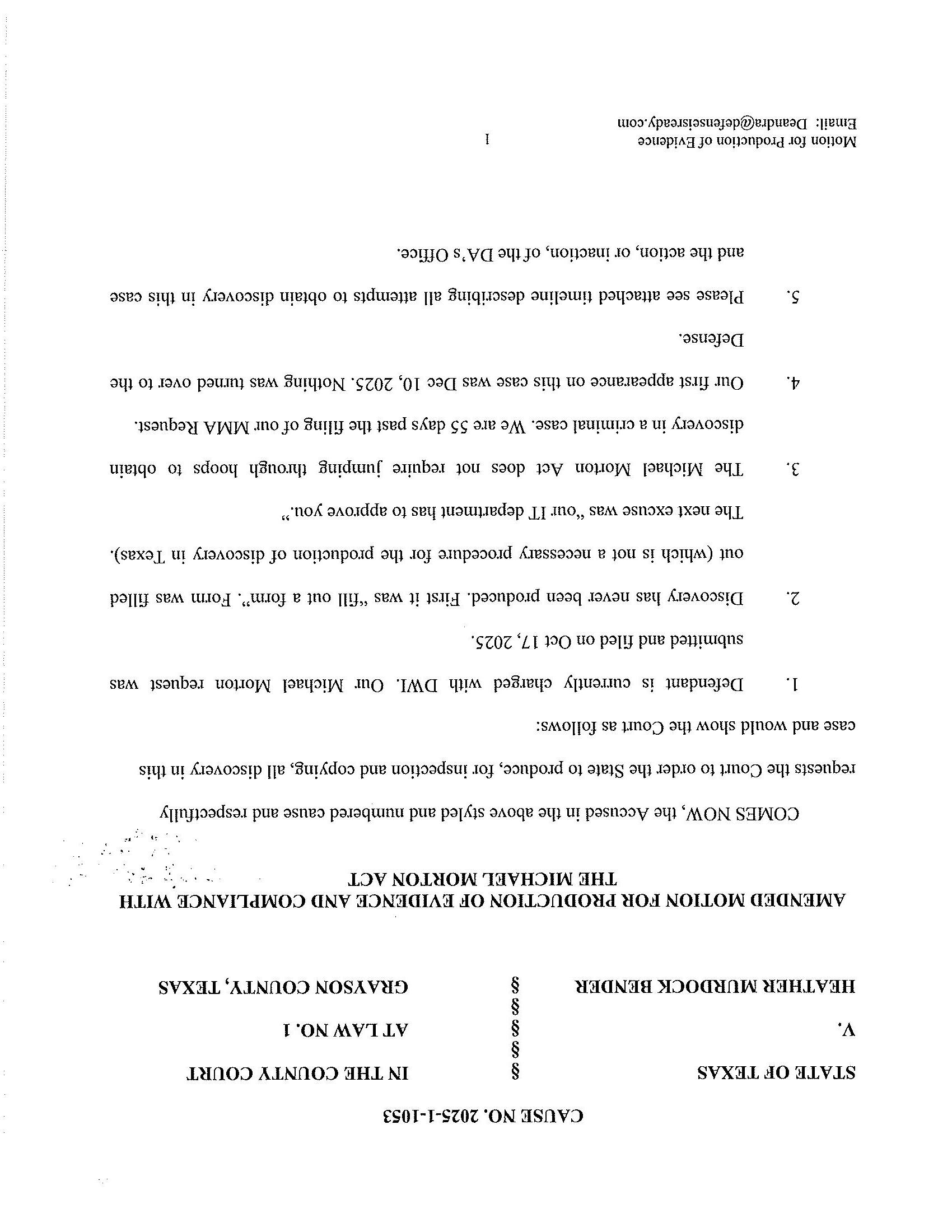
Article 39.14 of the Texas Code of Criminal Procedure (the Michael Morton Act) sets forth the discovery rule in criminal cases. The MMA constituted “an overhaul of discovery in Texas.” Watkins v. State, No. PD1015-18 (Tex. Crim App., March 3, 2021).
Pursuant to 39.14, once a defendant makes a timely request for discovery (not later than the 30 day before jury trial or beginning of evidence in a bench trial), the State must “as soon as practicable” produce and permit the inspection and/or electronic duplication, copying, and photographing by and on behalf of the Defendant: (1) any offense reports regarding this cause; (2) any documents, papers, written/recorded statements of the Defendant or a potential witness; (3) any photos, audio/video recordings of the Defendant, witnesses, complainants, or alleged crime scenes; (4) books, accounts, ledgers/letters,photos, or other objects involved in the investigation and/or prosecution of this case; and (5) names and addresses of witnesses which may be called by the State pursuant to Texas Rules of Evidence 702, 703, and 705.
An MMA (Michael Morton Act) letter is filed with the court clerk in the case and served on the State. A sample MMA letter is attached to this paper. “According to the plain text of Article 39.14, criminal defendants now have a general statutory right to discovery in Texas beyond the guarantees of due process. Under this new version of this statute, we interpret the word ‘material’ as it appears in context to mean ‘having some logical
connection to a fact of consequence.’” Watkins v. State, supra. The State errs “by failing to produce [requested material information] prior to trial in violation of Article 39.14(a).” Id.
B. Preserving a claim of error pretrial or outside jury presence - TRE 103
Once evidence is objected to outside the presence of the jury pursuant to TRE 103, an objection need not be reurged in front of the jury to preserve error. Klein v. State, 191 S.W.3d 766, 779 (Tex. App. - Fort Worth 2006, no pet.), rev’d on other grounds, 273 S.W.3d 297 (Tex. Crim App. 2008). If counsel, however, states “no objection” in front of the jury when the evidence is offered, error is waived. Moody v. State, 827 S.W.2d 875, 889 (Tex. Crim. App. 1992).
C. Motions in limine and preliminary questions - TRE 104
A motion in limine does not preserve error, so an objection is still required at trial. McDuff v. State, 939 S.W.2d 607, 618 (Tex. Crim. App. 1997). A true motion in limine merely requests “that the State not be permitted to mention any evidence of prior convictions to the jury until a hearing had been held outside the presence of the jury to determine their admissibility.” Geuder v. State, 115 S.W.3d 11, 14 (Tex. Crim. App. 2003). “A trial judge’s grant or denial of a motion in limine is a preliminary ruling only and normally preserves nothing for appellate review.” Id.
“The purpose of a motion in limine is to prevent particular matters from coming before the jury. It is, in practice, a method of raising objection to an area of inquiry prior to the matter reaching the ears of the jury through a posed question, jury argument, or other means.
As such, it is wider in scope than the sustaining of an objection made after the objectionable matter has been expressed. However, it is also, by its nature, subject to reconsideration by the court throughout the course of the trial. This is because it may not be enforced to exclude properly admissible evidence.” Norman v. State, 523 S.W.2d 669, 671 (Tex. Crim. App. 1975).
TRE 104(a) and (b) provides that preliminary questions concerning admissibility of evidence should be determined by the court, subject to provision (b). Rule 104(b) provides: “Relevancy that Depends on a Fact. When the relevance of evidence depends on whether a fact exists, proof must be introduced sufficient to support a finding that the fact does exist. The court may admit the proposed evidence on the condition that the proof be introduced later.”
D. Pretrial motions and trial briefs and court awareness of each
Trial briefs, law memos, and other written documents in the record will preserve error if timely brought to the attention of the trial court. Taylor v. State, 863 S.W.2d 737, 738 (Tex. Crim. App. 1993).
If no ruling on a pretrial motion is reflected in the record, the appellate court must determine if an implicit ruling existed and, if not, the error is waived. Gutierrez v. State, 36 S.W.3d 509 (Tex. Crim. App. 2001). When a trial court overrules a pretrial motion to suppress evidence, error is preserved as to the subject matter of the motion presented to the trial court, without the necessity of a further trial objection. Martinez v. State, 437 S.W.2d 842 (Tex. Crim. App. 1969).
III. Preservation of error during trial
A. Coded objections and motions in limine
During trial, it is very difficult to remember and express correct citations to the multiple rules discussed in this paper in order to properly preserve error for appeal. It is also very difficult to keep from alienating the jury while preserving error especially if you repeatedly request a hearing outside the presence of the jury to discuss an issue. To address these two concerns, it is very helpful to carefully craft a motion in limine for each issue that you anticipate arising during trial. You should be able to anticipate about 95% of the issues that will arise and the corresponding objections that should be raised to preserve error on these issues. You should file pretrial one motion in limine per issue. Each motion in limine should be numbered and, during trial, you may refer to that particular motion in limine by number and reurge the arguments and law cited in that motion in limine. “Judge, I object to that and reurge Motion in Limine No. 5 and the law and arguments cited in that motion in limine.” You have now preserved error and not alienated the jury by talking about various rules and why the evidence is admissible and have not requested the jury be sent out of the courtroom while arguing the issue. You may then cite the law and argument in your appellate brief and be assured that the complain on appeal comports with the objection at trial and that error was properly preserved during trial.
B. Limiting instructions - TRE 105
To preserve error, the party who objects to evidence must also request a limiting instruction at the time of the introduction of the evidence. Garcia v. State, 887 S.W.2d 862,
878-879 (Tex. Crim. App. 1994), overruled in part on other grounds, Hammock v. State, 46 S.W.3d 889 (Tex. Crim. App. 2001).
C. Voir dire of expert outside presence of jury - TRE 705(b)
TRE 705(b) states, “Before an expert states an opinion or discloses the underlying facts or data, an adverse party in a civil case may – or in a criminal case must – be permitted to examine the expert about the underlying facts or data. This examination must take place outside the jury’s hearing.”
You should always request this hearing to test the admissibility of the expert’s opinion, to obtain discovery, to ensure you have copies of everything the state expert has used to form an opinion, and to get a record of what the expert has to say.
TRE 705(c) states,“An expert’s opinion is inadmissible if the underlying facts or data do not provide a sufficient basis for the opinion.”
TRE 702 states, “A witness who is qualified as an expert by knowledge, skill, experience, training, or education may testify in the form of an opinion or otherwise if the expert’s scientific, technical, or other specialized knowledge will help the trier of fact to understand the evidence or to determine a fact in issue.”
TRE 703 states, “An expert may base an opinion on facts or data in the case that the expert has been made aware of, reviewed, or personally observed. If experts in the particular field would reasonably rely on those kinds of facts or data in forming an opinion on the subject, they need not be admissible for the opinion to be admitted.”
“‘The Texas Rules of Evidence set out three separate conditions regarding admissibility of expert testimony.’ Vela v. State, 209 S.W.3d 128, 130 (Tex. Crim App. 2006). Rule 104 requires that ‘[p]reliminary questions concerning the qualification of a person to be a witness . . . be determined by the court . . . . ’ TEX. R. EVID. 104(a). Under Rule 702, ‘[i]f scientific, technical, or other specialized knowledge will assist the trier of fact to understand the evidence or to determine a fact in issue, a witness qualified as an expert by knowledge, skill, experience, training, or education may testify thereto in the form of an opinion or otherwise.’ Id at 702. Finally, Rules 401 and 402 render testimony admissible only if it ‘tend[s] to make the existence of any fact that is of consequence to the determination of the action more probable or less probable than it would be without the evidence.’ Id. at 401, 402. ‘These rules require a trial judge to make three separate inquiries, all of which must be satisfied before admitting expert testimony: “(1) the witness qualifies as an expert by reason of his knowledge, skill, experience, training, or education; (2) the subject matter of the testimony is an appropriate one for expert testimony; and (3) admitting the expert testimony will actually assist the fact-finder in deciding the case.” Rodgers v. State, 205 S.W.3d 525, 527 (Tex. Crim App. 2006). ‘These conditions are commonly referred to as (1) qualification, (2) reliability, and (3) relevance.’ Vela, 209 S.W.3d at 131.” Escamilla v. State, 334 S.W.3d 263 (Tex. App. - San Antonio 2010, pet. ref’d).
Under TRE 702, the trial court must be satisfied that three conditions are met before expert testimony is admitted: (1) the witness qualifies as an expert by reason of his or her knowledge, skill, education, training, or experience; (2) the subject matter of the
testimony is an appropriate one for expert testimony; and (3) admitting the expert testimony will actually assist the jury in deciding the case. Malone v. State, 163 S.W.3d 785 (Tex. App. - Texarkana 2005, pet. ref’d).
TRE 702 contains two initial hurdles that must be overcome before expert testimony will be admissible. Roise v. State, 7 S.W.3d 225 (Tex. App. - Austin 1999, pet. ref’d). The proponent of the testimony must establish: (1) that the scientific technical, or other specialized knowledge will aid the trier of fact; and (2) that the expert is qualified to testify on the subject. Id., citing Penry v. State, 903 S.W.2d 715, 762 (Tex. Crim. App. 1995).
Unlike the common-law requirement, a trial court under Rule 702 may admit an expert’s testimony on a matter within most jurors’ understanding if the testimony concerns some type of technical or specialized knowledge and would assist the jurors in their fact-finding function. Glasscock v. Income Prop. Serv., Inc., 888 S.W.2d 176, 179-81 (Tex. App. - Houston [1st Dist.] 1994, writ dism’d).
The inquiry regarding whether or not an expert is qualified is “a flexible one.” Daubert v. Merrell Dow Pharms., Inc., 509 U.S. 579, 594, 125 L.Ed.2d 469, 113 S.Ct. 2786 (1993). No rigid formula exists for determining whether a witness is qualified to testify as an expert. 2 Steven Goode, Olin Guy Wellborn, III, & M. Michael Sharlot, Guide To The Texas Rules of Evidence: Civil and Criminal § 702.3, at 54 (Texas Practice Supp. 2000). The expertise must be measured against the particular opinion the expert is offering. Roise v. State, 7 S.W.3d 225 (Tex. App. - Austin 1999, pet. ref’d). While the proponent of the testimony has the burden of establishing the expert’s qualifications, the trial court has the responsibility to ensure that
the experts truly have expertise concerning the actual subject about which they are offering an opinion. Broders v. Heise, 924 S.W.2d 148, 152 (Tex. 1996).
A degree alone is not enough to qualify a purported expert to give an opinion, as the case may be, on every conceivable medical question, legal question, or psychological question. Roise, 7 S.W.3d at 234. “The inquiry must be into the actual qualification. That is, there must be a “fit” between the subject matter at issue and the expert’s familiarity therewith.” Broders, 924 S.W.2d at 153. The proponent must establish that the expert has knowledge, skill, experience, training, or education regarding the specific issue before the trial court which would qualify the expert to give an opinion on that particular subject. Id.
The proponent of the expert has the burden to first establish that the expert is qualified to testify about scientific, technical, or other specialized matters. Penry v. State, 903 S.W.2d 715, 762 (Tex. Crim. App. 1995). Pursuant to TRE 104(a), the trial judge makes a preliminary determination about whether the witness is sufficiently knowledgeable to be considered an expert. Id
The qualifications of a witness to testify as an expert is within the discretion of the trial judge. See TRE 104(a); Ventroy v. State, 917 S.W.2d 419 (Tex. App. - San Antonio 1996, pet. ref’d). A judge’s decision to permit a witness to testify as an expert will not be disturbed on appeal absent a showing of an abuse of discretion. Id
“‘It is almost impossible to lay down any definite guidelines for determining knowledge, skill or experience required in a particular case or of a particular witness.’
Rogers v. Gonzales, 654 S.W.2d 509, 513 (Tex. App. - Corpus Christi 1983, writ ref’d n.r.e.). ‘Special knowledge’ may be acquired by virtue of the witness’s experience. Reece v. State, 878 S.W.2d 320, 325 (Tex. App. - Houston [1st Dist.] 1994, no pet.). Moreover, contrary to appellant’s trial objection, licensure, or certification in the particular discipline is not a per se requirement. Southland Lloyd’s Ins. Co. v. Tomberlain, 919 S.W.2d 822, 827 (Tex. App. - Texarkana 1996, writ denied); Guentzel v. Toyota Motor Corp., 768 S.W.2d 890, 897-99 (Tex. App. - San Antonio 1989, writ denied).
The proponent of scientific evidence must show, by clear and convincing proof, that the evidence is sufficiently reliable and relevant to assist the jury in understanding other evidence or in determining a fact issue. Weatherred v. State, 15 S.W.3d 540, 542 (Tex. Crim App. 2000); Salazar v. State, 127 S.W.3d 355, 359 (Tex. App. - Houston [14th Dist.] 2004, pet. ref’d).
In Nenno v. State, 970 S.W.2d 549, 561 (Tex. Crim. App. 1998), the court stated “an appropriately tailored translation of the Kelly test” for expert testimony outside the hard sciences. When the expert is from a discipline which involves technical or other specialized knowledge, experience, and training as opposed to the scientific method, the test for reliability is: (1) whether the field of expertise is a legitimate one, (2) whether the subject matter of the expert's testimony is within the scope of that field, and (3) whether the expert's testimony properly relies on and/or utilizes the principles involved in the field. Weatherred, 15 S.W.3d at 542; Nenno, 970 S.W.2d at 561.
“To be considered reliable, evidence based on a scientific theory must satisfy three criteria: (1) the underlying scientific theory
must be valid; (2) the technique applying the theory must be valid; and (3) the technique must have been properly applied on the occasion in question. Hartman v. State, 946 S.W.2d 60, 62 (Tex. Crim App. 1997) (citing Kelly v. State, 824 S.W.2d 568, 573 (Tex. Crim App. 1992)); see Daubert v. Merrell Dow Pharms., Inc., 509 U.S. 579, 125 L.Ed.2d 469, 113 S.Ct. 2786 (1993). Under Texas Rule of Evidence 104(a) and (c) and Rule 702, the proponent must establish all three criteria outside the presence of the jury, before the trial court may admit the evidence. Kelly, 824 S.W.2d at 573.” Gregory v. State, 56 S.W.3d 164 (Tex App. - Houston [14th Dist.] 2001, pet. granted).
A trial judge’s gate keeping obligation under Rule 702 – to insure that the expert witness’s testimony rests upon a reliable foundation and is relevant to the task at hand applies to all expert testimony not just scientific expert testimony. Roise, 7 S.W.3d at 235-36 (citing Kumho Tire Co. Ltd. v. Carmichael, 526 U.S. 137, 143 L.Ed.2d 238, 119 S.Ct. 1167 (1999)); see also Jackson v. State, 17 S.W.3d 664, 670 (Tex. Crim. App. 2000).” Harnett v. State, 38 S.W.3d 650 (Tex. App. - Austin 2000, pet. ref’d).
Before an expert may give an opinion in a case, three criteria must be met: (1) the witness must be competent and qualified to testify; (2) the subject must be one upon which the aid of an expert’s opinion will be of assistance to the jury; and (3) his testimony may not state a legal conclusion. Sattiewhite v. State, 786 S.W.2d 271 (Tex. Crim App. 1989). To be admissible, expert testimony must assist the jury on a matter in which the jury is not qualified to intelligently determine the matter without the help of the expert. Schutz v. State, 957 S.W.2d 52 (Tex. Crim. App. 1997). The
expert testimony, however, must aid – not supplant – the jury’s decision. Id.
An expert’s testimony regarding scientific evidence is admissible if three criterion are met: (1) the underlying scientific theory is valid; (2) the technique applying the theory is valid; and (3) the technique was properly applied. Kelly v. State, 824 S.W.2d 568, 572 (Tex. Crim. App. 1992).
With nonscientific expert testimony involving technical or other specialized knowledge, experience, or training, the expert may testify if three criterion are met: (1) whether the field of expertise is a legitimate one; (2) whether the subject matter of the expert’s testimony is within the scope of that field; and (3) whether the expert’s testimony properly relies on or utilizes the principles involved in the field Nenno v. State, 970 S.W.2d 549, 561 (Tex. Crim App. 1998), overruled in part on other grounds, State v. Terrazas, 4 S.W.3d 720 (Tex. Crim. App. 1999).
D. Bench conferences and court reporter
It was previously held that the defense had no burden to request a court reporter because TRAP 13.1 requires the court reporter to transcribe all proceedings. The failure of the court reporter to record bench conferences after trial begins was error under Rule 13.1 and a defendant was not required to object to preserve error. Tanguma v. State, 47 S.W.3d 663, 674 (Tex. App. - Corpus Christi 2001, no pet.). One court, however, has declared Rule 13.1 void. Polasek v. State, 16 S.W.3d 82, 88-89 (Tex. App. - Houston [1st Dist.] 2000, pet. ref’d).
E. Indictment/information/ complaint
To preserve error regarding defects in charging instruments or a statute of limitations problem, a defendant must object prior to trial pursuant to Article 1.14(b) of the Texas Code of Criminal Procedure or the error is waived for appeal. Floyd v. State, 983 S.W.2d 273 (Tex. Crim. App. 1998); Studer v. State, 799 S.W.2d 263 (Tex. Crim. App. 1990). An exception to this rule is if the charging instrument alleges an offense that did not exist at the time of the alleged conduct, or fails to charge a specific person with an offense, it is fundamental error not requiring an objection. Ieppert v. State, 908 S.W.2d 217 (Tex. Crim. App. 1995).
F. Multiple defendants at trial
If the case involves multiple defendants, an objection by one defendant does not preserve error for the other defendants unless the record shows the objection was adopted by the other defendants. Woerner v. State, 576 S.W.2d 85, 86 (Tex. Crim. App. 1979).
G.
Jury selection
Jury selection must be recorded to preserve error for appeal Villarreal v. State, 617 S.W.2d 702 (Tex. Crim App. 1981). Error is preserved for denial of a defendant’s challenge for cause if counsel makes the strike lists part of the record, counsel uses a peremptory on that venireman, counsel exhausts all peremptories and requests additional ones, and counsel asserts that if counsel had not been forced to use a peremptory after the challenge for cause was denied, counsel would have used the peremptory against an identified objectionable venireman. Johnson v. State, 43 S.W.3d 1 (Tex. Crim. App. 2001).
Error is preserved for the erroneous granting of a state’s challenge for cause, but no harm results unless the appellant establishes that the jury was unlawfully constituted. Jones v. State, 982 S.W 2d 386 (Tex. Crim App. 1998), cert. denied, 528 U.S. 985, 120 S.Ct. 444, 145 L.Ed.2d 362 (1999).
Error is preserved for a court’s limitation of counsel’s time for voir dire if there was a timely and specific objection to the limitation, additional time was requested, the questions were relevant and not repetitious, counsel made a bill of exception on what the answers might have been from the veniremen, and counsel identified which veniremen sat on the jury who counsel was unable to question. Thomas v. State, 658 S.W.2d 175 (Tex. Crim. App. 1983).
H. Running objections
Running objections preserve error if the scope of the objection is clear. Sattiewhite v. State, 786 S.W.2d 271, 283 (Tex. Crim. App. 1989); Ford v. State, 919 S.W.2d 107, 113-114 (Tex. Crim. App. 1996).
I. Objections to exhibits
An objection to all of an exhibit will not preserve error if counsel failed to specify what part of the exhibit was not admissible. Williams v. State, 927 S.W.2d 752, 760 (Tex. App. - El Paso 1996, pet. ref’d). If counsel offers an exhibit to which an objection is sustained, counsel must specify which portion is admissible to preserve error. Jones v. State, 843 S.W.2d 487, 492-493 (Tex. Crim App. 1992), overruled on other grounds, Maxwell v. State, 48 S.W.3d 196 (Tex. Crim. App. 2001).
A. Defined
“Same transaction contextual evidence” is evidence reflecting the context in which a criminal act occurred. Wesbrook v. State, 29 S.W.3d 103, 115 (Tex. Crim. App. 2000). Extraneous acts may be admissible as same transaction contextual evidence when several crimes are intermixed or blended with one another or so connected that they form an indivisible criminal transaction. Prible v. State, 175 S.W.3d 724, 731-732 (Tex. Crim. App.), cert. denied, 546 U.S. 962, 126 S.Ct. 481, 163 L.Ed.2d 367 (2005). Such evidence exists when an extraneous matter is so intertwined with the State’s proof of the charged offense that avoiding reference to it would make the State’s case difficult to understand or incomplete. Id. at 732.
Evidence that is necessary for a jury to understand the charged offense is defined as “same transactional contextual evidence.” Buchanan v State, 911 S.W.2d 11, 15 (Tex. Crim App. 1995); Rogers v. State, 853 S.W.2d 29, 33 (Tex. Crim App. 1993). It is not always easy to determine if evidence is “same transactional.” Evidence may be “same transactional” in situations where two offenses are so intertwined that in describing the charged offense, it is impossible to also describe the uncharged offense. McDonald v. State, 179 S.W.3d 571, 577 (Tex. Crim App. 2005). An example of evidence that was not “same transactional” was testimony that the defendant kissed the complainant’s breast and had the complainant straddle the defendant’s leg which could be described without also testifying that the defendant later pulled down the complainant’s cousin’s pants. Id.
B. Example
An example of “same transactional”
evidence was testimony (in a case where the defendant was charged with acts of inappropriate touching of a child) that the defendant french kissed the child on an occasion during which he also inappropriately touched the child. Gregory v. State, 56 S.W.3d 164 (Tex. App. - Houston [14th Dist.] 2001, pet. dism’d). The court held that these acts were so blended and intertwined with the other evidence of the defendant’s sexual contacts with the complainants that it was necessary for the jury’s understanding of the circumstances and context of the offenses. Id.
C. No notice requirements
The State is not required to provide notice for use of “same transactional” evidence. Buchanan v. State, 911 S.W.2d 11, 15 (Tex. Crim App. 1995); Rogers v. State, 853 S.W.2d 29, 33 (Tex. Crim App. 1993).
V. EXTRANEOUS EVIDENCE UNDER RULE 404(b)
A. Extraneous evidence defined
Rule 404(b) of the Texas Rules of Evidence states, in part, that evidence of other crimes, wrongs, or acts is not admissible to prove the character of a person in order to show action in conformity therewith. It may, however, be admissible for other purposes, such as proof of motive, opportunity, intent, preparation, plan, knowledge, identity, or absence of mistake or accident.
If extraneous offenses are admitted, error is preserved if the record reflects a timely 404(b) objection, a timely 403 objection, and a timely requested limiting instruction pursuant to TRE 105. Montgomery v. State, 810 S.W.2d 372, 387 (Tex. Crim. App. 1991).
This list of exceptions is illustrative, not exhaustive. Fox v. State, 283 S.W.3d 85, 92 (Tex. App. - Houston [14th Dist.] 2009, pet.
ref’d).
Extraneous acts have been defined to mean any crime, wrong, or bad act not described in the indictment or an offense described in the indictment that occurred outside the statute of limitations. Rodriguez v. State, 104 S.W.3d 87 (Tex. Crim. App. 2003).
“An extraneous offense is ‘any act of misconduct, whether resulting in prosecution or not, which is not shown in the charging instrument and which was shown to have been committed by the accused.’” Martinez v. State, 190 S.W.3d 254, 262 (Tex. App. - Houston [1st Dist.] 2006, pet. ref’d) (citation omitted). When an indictment alleged that the defendant touched the child’s vagina and anus, testimony from the child that the defendant touched the child’s vagina and anus many times is “[e]vidence of multiple occurrences of the defendant’s same conduct against the same victim [and] is admissible and such evidence does not amount to evidence of extraneous offenses.” Id. at 262-263. Where an indictment alleged aggravated sexual assault of a child, child’s testimony that the defendant molested the child “at least over a hundred times” was not extraneous offenses. Worley v. State, 870 S.W.2d 620 (Tex. App. - Houston [1st Dist.] 1994, pet. ref’d).
B. Request for Rule 404(b) notice
Rule 404(b) of the Texas Rules of Evidence states, in part, that extraneous acts may be admissible provided that upon timely request by the accused in a criminal case, reasonable notice is given in advance of trial of intent to introduce in the State’s case-in-chief such evidence other than that arising in the same transaction.
If a court has a standard pretrial order requiring the State to provide notice to the
defense of any intended use of extraneous acts, such an order triggers the Rule 404(b) duty to provide notice apparently without any request by the defense. Hartson v. State, 59 S.W.3d 780, 787 (Tex. App. - Texarkana 2001, no pet.). The safer practice, however, is to submit a notice request anyway.
1. Rebuttal evidence
The State is not required to provide notice for use of extraneous offenses in rebuttal. Stringer v. State, 845 S.W.2d 400, 403 (Tex. App. - Houston [1st Dist.] 1992, pet. ref’d); Yohey v. State, 801 S.W.2d 232, 235 (Tex. App. - San Antonio 1990, pet. ref’d).
2.
Open file
An open file policy fails to comply with the notice requirement of Rule 404(b) even if the open file establishes that the State is aware of extraneous acts committed by the defendant. Buchanan v. State, 911 S.W.2d 11, 14 (Tex. Crim. App. 1995).
3. Timely request
A request made on the day of trial is not timely. Espinosa v. State, 853 S.W.2d 36, 39 (Tex. Crim App 1993); Umoja v. State, 965 S.W.2d 3, 7 (Tex. App. - Fort Worth 1997, no pet.). A request made “well before” trial is not untimely for failure to obtain a ruling on the request until the day of trial since a request does not require action by the trial court. Buchanan v. State, 881 S.W.2d 376, 379 (Tex App.Houston [1st Dist] 1994), rev’d in part on other grounds, 911 S.W.2d 11 (Tex. Crim App. 1995).
4. Form of request
Do not request 404(b) notice in a motion that requires court action. If a notice request is
contained within a motion that requires action by a court, that notice request does not become effective (even if a copy is served on the State) until and unless the court enters an order directing the requested relief. Espinosa v. State, 853 S.W.2d 36, 38-39 (Tex. Crim App. 1993); Padron v. State, 988 S.W.2d 344, 345 (Tex. App. - Houston [1st Dist.] 1999, pet. ref’d). A sample request is attached to this paper.
5. Sufficiency of notice
“Since the notice requirement of Rule 404(b) is a rule of evidence admissibility, then it is error to admit Rule 404(b) evidence when the State has not complied with the notice provision of Rule 404(b).” Hernandez v. State, 176 S.W.3d 821, 824 (Tex. Crim. App. 2005). “This is not to say that a trial court is without discretion to utilize its powers (such as granting continuances to reduce surprise) to permit the State to bring itself in compliance with the notice provision of Rule 404(b). Id. “But, a trial court must use these powers to ensure compliance and not to excuse noncompliance.”
Id. In assessing harm for violating the notice requirement of Rule 404(b), an appellate court determines the existence of any surprise on the part of the defense, whether the defense strategy would have been different had the notice been properly given by the State, how the defense was injuriously affected by the improper notice, and whether the defendant was unable to prepare a defense because of the State’s failure to give proper notice. Id. at 825-826. Appellate courts will also determine whether the lack of reasonable notice affected the defendant’s ability to mount an adequate defense such as affecting the defendant’s ability to prepare cross-examination or present mitigating evidence. McDonald v. State, 179 S.W.3d 571, 579 (Tex. Crim. App. 2005); Wallace v. State, 135 S.W.3d 114, 118-119 (Tex. App. - Tyler 2004, no pet.). If the State fails to provide proper notice, the defendant must also request
a continuance or, by failing to do so, the defendant waives any complaint that he was surprised by the State’s improper notice. Martin v. State, 176 S.W.3d 887, 900 (Tex. App. - Fort Worth 2005, no pet.), citing Koffel v. State, 710 S.W.2d 796, 802 (Tex. App. - Fort Worth 1986, pet. ref’d); Lindley v. State, 635 S.W.2d 541, 544 (Tex. Crim. App. 1982).
If the request for notice was made months before trial, notice is insufficient if given Friday before trial starting on Monday even if the defense received the notice that Friday afternoon. Hernandez v. State, 914 S.W.2d 226, 234 (Tex. App. - Waco 1996, no pet.); Neuman v. State, 951 S.W.2d 538, 540 (Tex. App. - Austin 1997, no pet.). Such notices are not, however, per se unreasonable. Sebalt v. State, 28 S.W.3d 819 (Tex. App.Corpus Christi 2000, no pet.). Courts look to the totality of the circumstances such as the length of time the defense request had been pending, but the primary consideration is whether notice was given in sufficient time to prevent unfair surprise. Id. Notice provided on Thursday regarding a pivotal witness for trial to begin on Monday allowed only one business day to prepare, so such notice was insufficient given the importance of the extraneous act to the case. Webb v. State, 36 S.W.3d 164, 177178 (Tex. App. - Houston [14th Dist.] 2000, pet. ref’d). The longer before trial notice was requested, the more likely notice given a few days before trial is likely to be found unreasonable. Id. Naming on a subpoena witness list the name of the complainant in an extraneous offense is insufficient notice since it fails to give the defense notice of the State’s intention to introduce evidence of a particular extraneous offense. Id. at 178-179.
The State is not required to make a written response concerning its intent to offer evidence of extraneous acts, but this is the recommended procedure. Hayden v. State, 66
S.W.3d 269, 272 (Tex. Crim. App. 2001). Under certain circumstances, delivering a witness statement to the defense, considered in light of the earlier defense request for notice, may constitute sufficient notice under 404(b). Id. Courts will look at the amount of time between the request for notice and the delivery of the statement, how prominent the statement establishes the witness’ knowledge of the extraneous act, and how many other documents were delivered from the State to the defense at the same time. Id.
If the defense did not make a request for notice, but the State provided notice anyway, a defendant may later complain that the notice was incomplete. Blackmon v. State, 80 S.W.3d 103, 108 (Tex. App. - Texarkana 2002, pet. ref’d).
C. Admissibility of Rule 404(b) evidence
1. Propensity evidence
“Courts that follow the common-law tradition almost unanimously have come to disallow resort by the prosecution to any kind of evidence of a defendant’s evil character to establish a probability of his guilt even though such facts might logically be persuasive that he is by propensity a probable perpetrator of the crime.” Michelson v. United States, 335 U.S. 469, 475, 69 S.Ct. 213, 218, 93 L.Ed 168 (1948). Such propensity evidence “weigh[s] too much with the jury and to so overpersuade them as to prejudge one with a bad general record and deny him a fair opportunity to defend against a particular charge.” Id., 335 U.S. at 476, 69 S.Ct. at 218. “The general rule in all English speaking jurisdictions is that an accused is entitled to be tried on the accusation made in the State’s pleading and not on some collateral crime, or for being a criminal generally. The rule is now deemed axiomatic and is followed in all jurisdictions.” Young v. State, 159 Tex. Crim. App. 164, 165, 261 S.W.2d 836, 837 (1953).
2. Prerequisites under 404(b)
If extraneous offenses are admitted, error is preserved if the record reflects a timely 404(b) objection, a timely 403 objection, and a timely requested limiting instruction pursuant to TRE 105. Montgomery v. State, 810 S.W.2d 372, 387 (Tex. Crim. App. 1991).
Before any evidence of other crimes, wrongs, or acts of misconduct is admissible, the prosecution must meet the following prerequisites: (1) the court must make a preliminary finding that the jury can find, by a preponderance of the evidence, that the defendant committed the extrinsic act; (2) the other crimes must not be too remote in time from the charged offense; (3) the evidence of the other crimes must be introduced for a purpose sanctioned by Rule 404(b); (4) the element of the charged offenses that the evidence of other crimes is introduced to prove must be a material issue in the case; and (5) there must be a substantial need for the probative value of the evidence of other crimes. Huddleston v. United States, 485 U.S. 681, 690, 108 S.Ct. 1496, 1501, 99 L.Ed.2d 771 (1988).
3. Rule 403 standard
If evidence is deemed admissible under Rule 404(b), such evidence may be excluded under Rule 403 if its probative value is substantially outweighed by the danger of unfair prejudice. A Rule 403 analysis includes, but is not limited to, a determination of: (1) the probative value of the evidence; (2) the potential to impress the jury in some irrational yet indelible way; (3) the time needed to develop the evidence; and (4) the proponent’s need for the evidence. State v. Mechler, 153 S.W.3d 435, 440 (Tex. Crim. App. 2005); Erazo v. State, 144 S.W.3d 487, 489 (Tex. Crim App. 2004). A trial court is not required to conduct a separate hearing on the Rule 403 matter or even to announce on the record that it conducted a Rule 403 balancing test. Williams
v. State, 958 S.W.2d 186, 195-196 (Tex. Crim. App. 1997); Franco v. State, 25 S.W.3d 26, 28 (Tex. App. - El Paso 2000, pet. ref’d).
In determining a Rule 403 objection, the trial court balances the probative force of and the proponent’s need for the evidence against any tendency of the evidence to: (1) suggest a decision on an improper basis; (2) confuse or distract the jury from the main issues; (3) be given undue weight by a jury not equipped to evaluate the probative force of the evidence; and (4) consume an inordinate amount of time or repeat evidence already admitted. Gigliobianco v. State, 210 S.W.3d 637, 641 (Tex. Crim. App. 2006).
4. Steps to follow
If a proponent offers evidence of other crimes, wrongs, or acts, the following steps apply: (1) the opponent must timely object that the evidence is inadmissible under Rule 404(b); (2) the proponent must show the court that the evidence has relevance apart from character of a person; (3) the opponent must request the proponent or court state on the record the purpose for which the evidence is offered or admitted; (4) the opponent must timely object that the evidence’s probative value is substantially outweighed by the danger of unfair prejudice under Rule 403; (5) the court may then ask the opponent what the prejudice is and ask the proponent what the need is for the evidence; (6) the court then conducts a balancing test to include if the evidence makes more or less probable a fact of consequence, if the opponent in fact did the extraneous act, if the evidence will impress the jury in an irrational manner, how much time is needed to develop this evidence, and how great is the proponent’s need; and (7) the opponent must request a limiting instruction under Rule 105. Montgomery v. State, 810 S.W.2d 372, 387 (Tex. Crim. App. 1991).
If a defendant fails to request a limiting instruction when a defendant first had the opportunity to do so – when the testimony was admitted – the complainant’s extraneous misconduct testimony will be deemed to have been admitted for all purposes. Hammock v. State, 46 S.W.3d 889, 895 (Tex. Crim. App. 2001).
5. System/modus operandi
In Owens v. State, 827 S.W.2d 911, 915 (Tex. Crim App. 1992), the extraneous acts were not so similar to the charged offense that they would fall within an exception of Rule 404(b). The trial court had admitted evidence of a prior sexual assault of a young female on the basis that such evidence established a “system,” and the Court of Criminal Appeals analyzed that basis as one relating to the defendant’s “modus operandi” or “methodology.” Id. at 914-915 The Court of Criminal Appeals concluded that the extraneous offense was not so similar to the charged offense that it would establish such a “system.” Id. “When the State seeks to admit extraneous offense evidence under a theory of ‘system’ or modus operandi, there must be a showing that the extraneous offense which was committed by the defendant was so nearly identical in method [to the charged offense] as to earmark them as the handiwork of the accused.” Id. at 915. The court then concluded that the extraneous offense and the charged offense were not so idiosyncratically similar as to show that “the two offenses were the handiwork of the same individual.” Id.
6. Scheme/plan
The Court of Criminal Appeals has explained, “Unfortunately, courts frequently admit evidence of extraneous acts under this exception not to show acts the defendant took in preparation for the ultimate charged offense, but
to show repeated acts that are similar to the charged offense. Repetition of the same act or same crime does not equal a ‘plan.’ It equals the repeated commission of the same criminal offense offered obliquely to show bad character and conduct in conformity with that bad character – ‘once a thief, always a thief.’ This bad-character-conformity purpose, whether express or not, is precisely what is barred by Rule 404(b). Thus, if the proponent is unable to articulate exactly how an extraneous act tends to prove a step toward an ultimate goal or overarching plan, the evidence is not admissible to prove part of a ‘plan.’” Daggett v. State, 187 S.W.3d 444, 452-453 (Tex. Crim. App. 2005).
In Pittman, the defendant was charged with a single offense of aggravated sexual assault of two children, and the State unsuccessfully attempted to consolidate the charge with three other offenses under Section 3.01 of the Texas Penal Code. Pittman v. State, No. 14-08-00710-CR (Tex. App. - Houston [14th Dist.], June 17, 2010, no pet. h.). The State introduced, over objection, evidence that the defendant used drugs, other sexual offenses allegedly committed by the defendant and five others including multiple sexual offenses involving three other children to show the defendant’s “scheme” or “plan ” Id. The trial court admitted the sexual offenses evidence as evidence of the defendant’s “plan” to engage in a sexual exploitation scheme with other adults. Id. The appellate court referenced Daggett, supra, and held that the extraneous acts evidence did not show a plan to sexually assault the two children named in the indictment, but rather was evidence of repeated occurrences of the same bad act compounded by numerous additional bad acts. Id. The court further found that “this extraneous-offense evidence had an extremely strong tendency to suggest a decision on an improper basis, to confuse or distract the jury from the main issues in this case, and to be given undue weight by a jury not equipped to
evaluate its probative force.” Id. “After balancing the lack of probative force and necessity here versus the potential harm of the evidence, we hold that the trial court abused its discretion in overruling appellant’s Rule 403 objections.”
7. Doctrine of chances
“Where the material issue addressed is the defendant’s intent to commit the offense charged, the relevancy of the extraneous offense derives purely from the point of view of the doctrine of chances – the instinctive recognition of that logical process which eliminates the element of innocent intent by multiplying instances of the same result until it is perceived that this element cannot explain them all. Without formulating any accurate test, and without attempting by numerous instances to secure absolute certainty of inference, the mind applies this rough and instinctive process of reasoning, namely, that an unusual and abnormal element might perhaps be present in one instance, but that the oftener similar instances occur with similar results, the less likely is the abnormal element likely to be the true explanation of them.” Plante v. State, 692 S.W.2d 487 (Tex. Crim App. 1985). Before an extraneous offense is admissible to negate the possibility of accident under Wigmore’s doctrine of chances, such offense must be sufficiently similar in nature to the charged offense that the inference of improbability of accident logically comes into play. Id.; Morgan v. State, 692 S.W.2d 877, 881-882 (Tex. Crim App. 1985) (under doctrine of chances, it was proper to admit evidence of defendant’s touching of the genitals of complainant and her sister on occasions that were not part of the criminal conduct charged in the indictment), overruled in part on other grounds by, Gipson v. State, 844 S.W.2d 738, 741 (Tex. Crim. App. 1992).
A defendant may also use the doctrine of chances defensively if the series of unusual events, alone or with other evidence, tends to negate the defendant’s guilt of the crime charged. Jackson v. State, 551 S.W.2d 351, 351-353 (Tex. Crim App. 1977) (trial court erroneously excluded evidence that a complainant in another criminal proceeding had erroneously identified defendant as the perpetrator and later identified as the perpetrator an inmate serving five life sentences who had also confessed to the offense with which defendant was charged in this case).
Under the doctrine of chances, extraneous evidence offered by the defendant of the allegations of three child complainants is material if it is addressed to proof of a fact of consequence – the defendant’s defensive theory that the allegations of these girls were false and were planted by the defendant’s estranged wife. Fox v. State, 115 S.W.3d 550 (Tex. App.Houston [14th Dist.] 2002, pet. ref'd). This evidence is also probative because it makes the existence of this defensive theory more probable than it would be without the evidence. Id. Under the doctrine of chances, the jury could infer that these young girls made these similar and arguably implausible allegations on the same day and in a similar manner because they were making false allegations at the instigation of the estranged wife. Id. Therefore, this evidence is relevant and admissible. Id.
8. Rebuttal of defensive theory/attack on child
Rebuttal of a defensive theory raised in opening statement or cross-examination is another purpose for which extraneous acts may be admitted under Rule 404(b). Williams v. State, 301 S.W.3d 675, 687 (Tex. Crim. App. 2009), cert. denied, ___U.S.___, 130 S.Ct. 3411, 177 L.Ed.2d 326 (2010); Bass v. State,
270 S.W.3d 557, 563 (Tex. Crim. App. 2008) (involving defensive theory of fabrication based on premise that defendant, as a “real deal” and “genuine pastor,” would not molest a child); Wheeler v. State, 67 S.W.3d 879, 887-888 (Tex. Crim App. 2002) (involving defensive theories of conspiracy or frame-up motivated by greed and that the appellant “was never alone” with the complainant); Powell v. State, 63 S.W.3d 435, 438-440 (Tex. Crim. App. 2001) (involving defensive theory of lack of opportunity to molest the complainant); Isenhower v. State, 261 S.W.3d 168, 181 (Tex. App. - Houston [14th Dist] 2008, no pet.) (involving defensive theory of retaliation after the defendant and the complainant's mother ended their relationship); Bargas v. State, 252 S.W.3d 876, 890 (Tex. App. - Houston [14th Dist.] 2008, no pet.).
Rebuttal of an attack on the credibility of the complainant is another purpose for which extraneous acts may be admitted under Rule 404(b). Easter v. State, 867 S.W.2d 929 (Tex. App. - Waco 1993, pet. ref’d). If the State offers extraneous acts into evidence under this theory but the acts do not rebut the defense challenge to the child’s credibility, then reversible error occurs. Hill v. State, 852 S.W.2d 769 (Tex. App. - Fort Worth 1993, pet. ref’d).
9. Prior false accusations
For a defendant to be able to admit 404(b) extraneous acts into evidence in a sexual assault case, the defendant must show the accusations were false and similar to the current accusation. Lopez v. State, 18 S.W.3d 220, 226 (Tex. Crim. App. 2000); Garcia v. State, 228 S.W.3d 703, 705 (Tex. App. - Houston [14th Dist.] 2005, pet. ref’d); Lempar v. State, 191 S.W.3d 230, 239 (Tex.App. - San Antonio 2005, pet. ref’d).
VI. Character evidence
A. TRE 404(a)(2)(A) – Character of the accused
In a criminal case, D may offer evidence of D’s pertinent trait, and if evidence admitted, ADA may offer evidence to rebut it. TRE 404(a)(2)(A) states, “In a criminal case, a defendant may offer evidence of the defendant’s pertinent trait, and if the evidence is admitted, the prosecutor may offer evidence to rebut it.”
B. TRE 404(a)(3)(A) – Character of victim
In a criminal case, D may offer evidence of V’s pertinent trait, and if the evidence is admitted, the prosecutor may offer evidence to rebut it. TRE 404(a)(3)(A) states, “In a criminal case, subject to the limitations in Rule 412, a defendant may offer evidence of a victim’s pertinent trait, and if the evidence is admitted, the prosecutor may offer evidence to rebut it.”
C. TRE 404(a)(3)(B) – Homicide & V was aggressor
In homicide case, ADA may offer evidence that V peaceful so as to rebut evidence that V was the first aggressor. TRE 404(a)(3)(B) states, “In a homicide case, the prosecutor may offer evidence of the victim’s trait of peacefulness to rebut evidence that the victim was the first aggressor.”
D. TRE 405(a) – Methods of proving character: opinion and reputation
1. Reputation or Opinion
Rule 405 of the Texas Rules of Evidence states, in part, that when evidence of a person’s character or character trait is
admissible, proof may be made by testimony as to reputation or by testimony in the form of an opinion.
This rule governs how the character of a person other than a witness is to be proven when admissible. Character here includes honesty, temperance, or peacefulness as examples. See e.g. Duren v. State, 87 S.W.3d 719 (Tex. App. - Texarkana 2002, pet dism’d).
2. Specific Instances of Conduct
Rule 405(b) states that in cases in which a person’s character or character trait is an essential element of a charge, claim or defense, proof may also be made of specific instances of that person’s conduct. This is almost always a civil matter.
E. TRE 608 - Evidence of Character and Conduct of a Witness
1. Opinion and Reputation Evidence of Character
Rule 608(a) states that, “The credibility of a witness may be attacked or supported by evidence in the form of opinion or reputation, but subject to these limitations: (1) the evidence may refer only to character for truthfulness or untruthfulness; and (2) evidence of truthful character is admissible only after the character of the witness for truthfulness has been attacked by opinion or reputation evidence or otherwise.”
Rule 404(a)(3) allows for proof of a witness’s character for veracity. It is error for a judge to refuse to allow counsel to demonstrate the mendacious character of a witness. Cook v. State, 646 S.W.2d 952, 953 (Tex. Crim. App. 1983).
An expert may not testify that a
particular witness is truthful. “[E]xpert testimony that a particular witness is truthful is inadmissible under Rule 702.” Yount v. State, 872 S.W.2d 706, 711 (Tex. Crim. App. 1993). Thus, the State may not elicit expert testimony that a particular child is telling the truth, or that child complainants as a class are worthy of belief. Pavlacka v. State, 892 S.W.2d 897, 903 n.6 (Tex. Crim. App. 1994); Yount, 872 S.W.2d at 711; cf. Barshaw v. State, 320 S.W.3d 625, 629-630 (Tex. App. - Austin 2010), rev’d on other grounds, 342 S.W.3d 91 (Tex. Crim. App. 2011). Nor may an expert offer an opinion on the truthfulness of a child complainant’s allegations. Schutz v. State, 957 S.W.2d 52, 59 (Tex. Crim. App. 1997).
“The State asserts that the detective’s testimony was admissible as a lay opinion to rebut assertions that C.E. was lying. We disagree. If a witness’s general character for truthfulness has been attacked, Rule of Evidence 608(a) allows, for purposes of rehabilitation, the presentation of opinion or reputation evidence of that witness’s good character for truthfulness. We also disagree with the State’s contention that Detective Carrasco’s testimony was admissible as an expert opinion ‘because it merely aided the jury in its factual determination.’ Expert testimony must aid, not supplant, the jury’s fact-finding role.” Sandoval v. State, No. 03-11-00416-CR, 2013 Tex. App. LEXIS 11657 (Tex. App.Austin, September 13, 2013)
2. Specific Instances of Conduct
Rule 608(b) states that specific instances of the conduct of a witness, for the purpose of attacking or supporting the witness’ credibility, other than conviction of crime as provided in Rule 609, may not be inquired into on crossexamination of the witness nor proved by extrinsic evidence.
VII. TCCP Art. 38.36 – Testimony in murder cases
A. TCCP Art. 38.36(a) – All facts surrounding the killing
TCCP Art. 38.36(a) states, in part, that, “In all prosecutions for murder, the state or the defendant shall be permitted to offer testimony as to all relevant facts and circumstances surrounding the killing . . .”
B. TCCP Art. 38.36(a) – Previous relationship between D & comp
TCCP Art. 38.36(a) states, in part, that, “In all prosecutions for murder, the state or the defendant shall be permitted to offer testimony as to . . . the previous relationship existing between the accused and the deceased . . .”
C. TCCP Art. 38.36(a) – All facts show D’s state of mind at the time of offense
TCCP Art. 38.36(a) states, in part, that, “In all prosecutions for murder, the state or the defendant shall be permitted to offer testimony as to all relevant facts and circumstances going to show the condition of the mind of the accused at the time of the offense.”
VIII. EXTRANEOUS EVIDENCE UNDER ARTICLE 38.37
A. Extraneous evidence defined
Article 38.37 of the Texas Code of Criminal Procedure states, in part, that in cases regarding a child under 17 years of age and for offenses involving sexual offenses, assaultive offenses, prohibited sexual conduct, sexual performance by a child, or an attempt or conspiracy to commit any of the above,
evidence of other crimes, wrongs, or acts committed by the defendant against the child who is the victim of the alleged offense shall be admitted for its bearing on relevant matters including the state of mind of the defendant and the child and the previous and subsequent relationship between the defendant and the child. On timely request by the defendant, the State shall give the defendant notice of the State’s intent to introduce in the case-in-chief such evidence described above in the same manner as required by 404(b).
Article 38 37 makes evidence admissible to show the state of mind of the defendant and the child and their previous and subsequent relationship, notwithstanding rules of evidence 404 and 405. Under Article 38.37, in certain sexual abuse cases, evidence of other crimes, wrongs, or acts committed by the accused against the child victim are relevant and admissible under rule 402 for its bearing on relevant matters including state of mind and parties' previous and subsequent relationship. Hinds v. State, 970 S.W.2d 33, 35 (Tex. App.Dallas 1998, no pet.); Stahle v. State, 970 S.W.2d 682 (Tex. App. - Dallas 1998, pet. ref’d); Ernst v. State, 971 S.W.2d 698 (Tex. App. - Austin 1998, no pet.); McCoy v. State, 10 S.W.3d 50 (Tex App. - Amarillo 1999, no pet.).
B. Request for Article 38.37 notice
Article 38.37 requires notice in the same manner as Rule 404(b). Martin v. State, 176 S.W.3d 887, 900 (Tex. App. - Fort Worth 2005, no pet.). For request of notice issues, therefore, see above under Rule 404(b) form of request for issues and case law.
C. Sufficiency of notice
Article 38.37 requires notice in the same
manner as Rule 404(b). Martin v. State, 176 S.W.3d 887, 900 (Tex. App. - Fort Worth 2005, no pet.). For sufficiency of notice issues, therefore, see above under Rule 404(b) sufficiency of notice for issues and case law.
D. Admissibility of Article 38.37 evidence
When evidence of a defendant’s extraneous acts is relevant under Article 38.37, the trial court is still required to conduct a Rule 403 balancing test upon a proper objection or request. Colvin v. State, 54 S.W 3d 82 (Tex. App. - Texarkana 2001, no pet.); Walker v. State, 4 S.W.3d 98, 103 (Tex. App. - Waco 1999, pet. ref’d); Poole v. State, 974 S.W.2d 892, 897 (Tex. App. - Austin 1998, pet. ref’d); Ernst v. State, 971 S.W.2d 698, 700-701 (Tex. App. - Austin 1998, no pet.).
Article 38.37 allows extraneous acts to be admitted when relevant, but it does not restrict the defendant’s right to have the State elect the incident it will rely upon in seeking a conviction. Phillips v. State, 193 S.W.3d 904, 911 (Tex. Crim. App. 2006). The requirement of an election is distinct from a limiting instruction. Id. An election provides notice to the defense and promotes jury unanimity. Id.
IX. EXTRANEOUS
EVIDENCE UNDER ARTICLE 37.07
A. Extraneous evidence defined
Article 37.07 states that during punishment, the State and the defendant may offer evidence as to any matter the court deems relevant to sentencing, including but not limited to any other evidence of an extraneous crime or bad act that is shown beyond a reasonable doubt by evidence to have been committed by the defendant or for which he could be held
criminally responsible, regardless of whether he has previously been charged with or finally convicted of the crime or act.
Article 37.07, Section 3(a) states that a party may offer evidence “as to any matter the court deems relevant to sentencing including but not limited to” the defendant’s prior criminal record, the defendant’s general reputation or character,an opinion regarding the defendant’s character, the circumstances of the offense for which the defendant is being tried, and even evidence of unadjudicated extraneous crimes or bad acts.
This is an inexhaustive list. Ellison v. State, 201 S.W.3d 714, 722 (Tex. Crim. App. 2006). The trial judge must still restrict the admission of 37.07 evidence to that which is “relevant to sentencing” – in other words, a trial judge must operate within the bounds of Texas Rules of Evidence 401, 402, and 403. Id. A probation officer may give an opinion on a defendant’s suitability for probation in a sex assault case. Id.
B. Request for Article 37.07 notice
Article 37.07, § 3(g) states that, “On timely request of the defendant, notice of intent to introduce evidence under this article shall be given in the same manner required by Rule 404(b), Texas Rules of Evidence . . . notice of that intent is reasonable only if the notice includes the date on which and the county in which the alleged crime or bad act occurred and the name of the alleged victim of the crime or bad act. The requirement under this subsection that the attorney representing the state give notice applies only if the defendant makes a timely request to the attorney representing the state for the notice.”
The State is not required to give notice
under this article of “same-transaction contextual evidence” that it intends to offer in the punishment stage of a noncapital trial. Worthy v. State, 312 S.W.3d 34 (Tex. Crim App. 2010).
C. Sufficiency of notice
When the State provides notice of extraneous acts that did not result in a final conviction, and when the notice includes the date on which the act occurred but the act actually occurred on a different date, the notice is still sufficient unless the defendant is able to establish surprise or that the defendant was ambushed by the evidence and the defendant must then request a continuance to prepare to meet the evidence. Burling v. State, 83 S.W.3d 199, 203 (Tex. App. - Fort Worth 2002, pet. ref’d) (variation of 6 weeks between date offense in notice and actual date offense is reasonable); Hohn v. State, 951 S.W.2d 535, 537 (Tex. App. - Beaumont 1997, pet. ref’d) (3.5 month variance reasonable); Splawn v. State, 949 S.W.2d 867, 870-871 (Tex. App.Dallas 1997, no pet.) (18 month variance reasonable); Nance v. State, 946 S.W.2d 490, 493 (Tex. App. - Fort Worth 1997, pet. ref’d).
D. Admissibility of Article 37.07 evidence
Article 37.07 governs the admissibility of evidence during the punishment stage of a non-capital criminal trial. McGee v. State, 233 S.W.3d 315, 318 (Tex. Crim. App. 2007). The rule allows evidence to be offered on any matter the court deems relevant to sentencing, including extraneous crimes and bad acts. Id. The trial court, during the punishment stage, admitted evidence offered by the State for the purpose of showing that appellant lied on the witness stand during the guilt stage. Id. The trial court could have reasonably concluded that
such evidence would be helpful to the jury in determining the appropriate sentence for appellant. Id. “A defendant’s truthfulness or mendacity while testifying on his own behalf, almost without exception, has been deemed probative of his attitudes toward society and prospects for rehabilitation and hence relevant to sentencing.” Id.
When evidence of extraneous offenses is presented at the punishment phase of a trial, those acts must be proven beyond a reasonable doubt. Huizar v. State, 12 S.W.3d 479, 483-484 (Tex. Crim App. 2000); Allen v. State, 47 S.W 3d 47, 50 (Tex. App. - Fort Worth 2001, pet. ref’d) (Trial court is required, when punishment phase evidence of extraneous offenses or bad acts evidence is admitted, to sua sponte instruct the jury on the reasonable-doubt standard of proof concerning the extraneous offenses and bad acts regardless of whether such evidence was introduced at the guilt-innocence or punishment phase); Fields v. State, 1 S.W.3d 687, 688 (Tex. Crim. App. 1999) (holding that Article 37.07 requires that extraneous offense evidence may not be considered in assessing punishment until the fact-finder is satisfied beyond a reasonable doubt that these prior acts are attributable to the defendant).
Admissibility of punishment phase evidence that the court deems relevant is still subject to a Rule 403 analysis. Rogers v. State, 991 S.W.2d 263, 266-267 (Tex. Crim. App. 1999). A trial court is not required to perform a Rule 403 balancing test in a formal hearing on the record or to even announce that it has conducted the test since, once the rule is invoked, it is presumed that the court conducted the test. Williams v. State, 958 S.W.2d 186, 195-196 (Tex. Crim. App. 1997).
MICHAEL C GROSS
BOARD CERTIFIED - CRIMINAL LAW
BOARD CERTIFIED - CRIMINAL APPELLATE LAW
TEXAS BOARD OF LEGAL SPECIALIZATION
BOARD CERTIFIED - CRIMINAL TRIAL ADVOCACY
NATIONAL BOARD OF TRIAL ADVOCACY
GROSS & ESPARZA, P.L.L.C.
1524 NORTH ALAMO STREET
SAN ANTONIO, TEXAS 78215
WWW TXMILITARYLAW COM (210) 354-1919
Fax: (210) 354-1920
JOSEPH A. ESPARZA
BOARD CERTIFIED - CRIMINAL LAW
TEXAS BOARD OF LEGAL SPECIALIZATION
BOARD CERTIFIED - CRIMINAL TRIAL ADVOCACY
NATIONAL BOARD OF TRIAL ADVOCACY
Joe Gonzales, District Attorney DAcc4@bexar.org 101 West Nueva San Antonio, Texas, 78205
RE: Cause No. ___________, State v. , In the ___ District Court, Bexar County, Texas
Dear Mr. Gonzales:
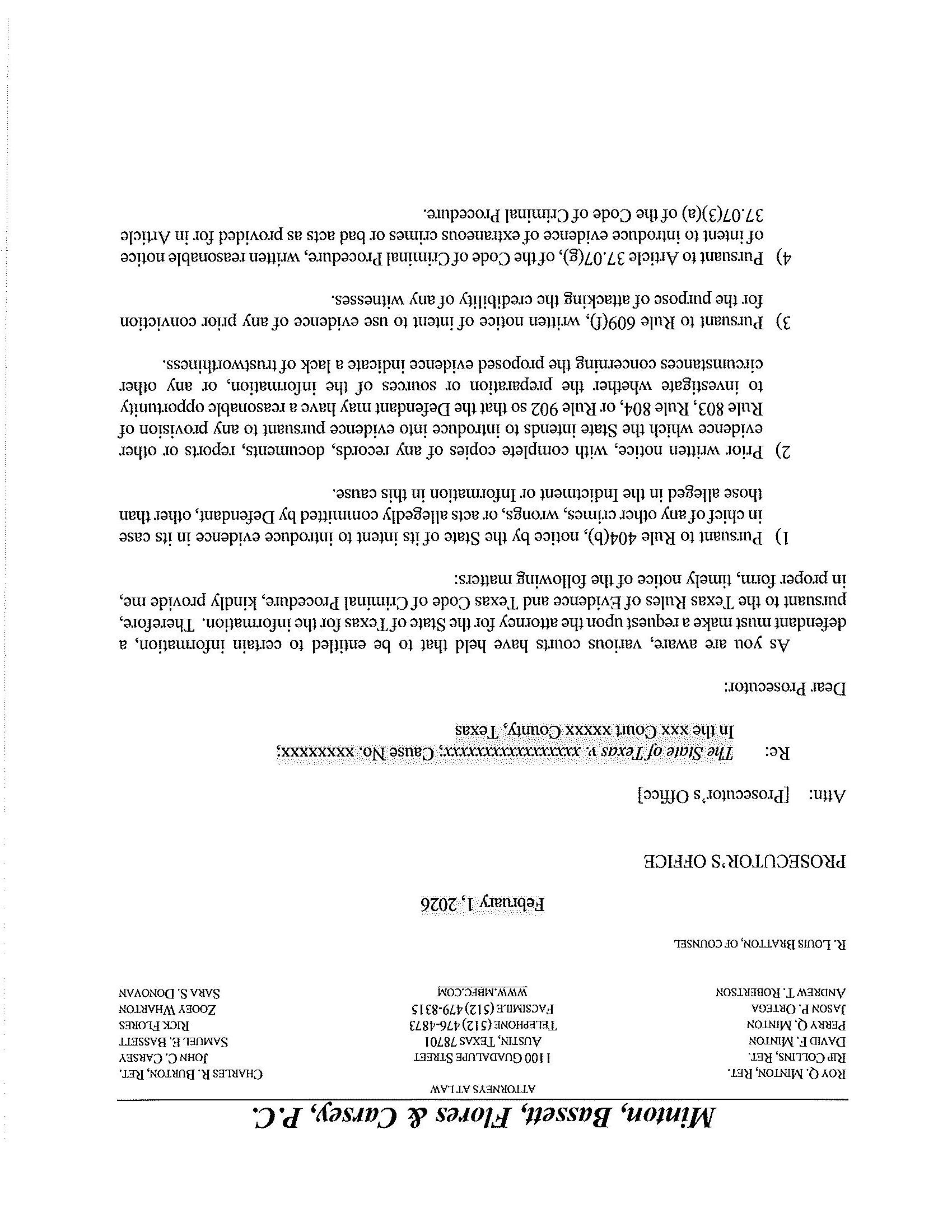
Pursuant to Rules 404(b) and 609(f) of the Texas Rules of Evidence and Article 37.07 (and 38.37 if sex or assault case and 37.071 if capital) of the Texas Code of Criminal procedure, I hereby request that you provide me in writing before trial of your intent to introduce: (1) evidence of other crimes, wrongs or acts allegedly committed by the Defendant; and (2) evidence of conviction of a crime to impeach the Defendant.
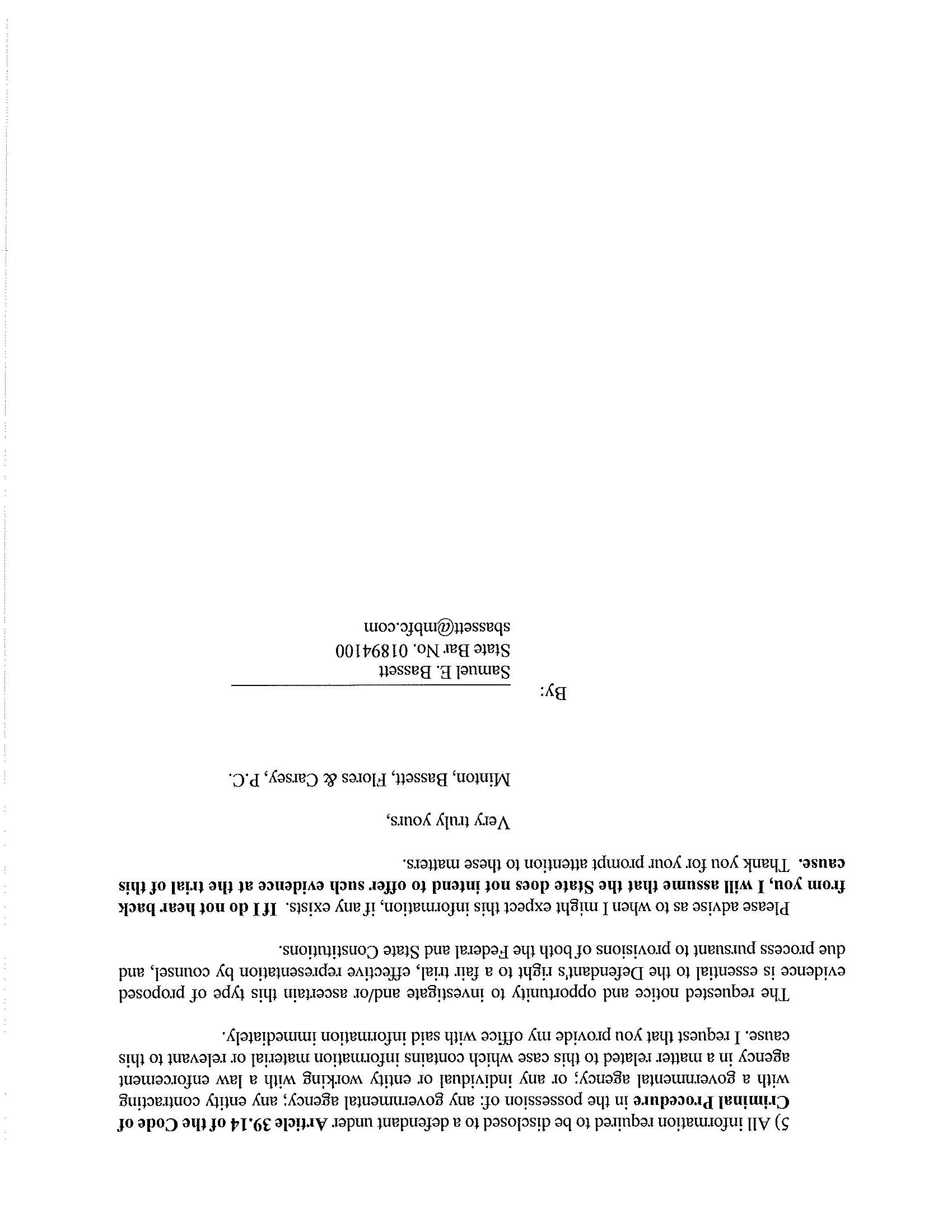
Pursuant to Article 39.14 of the Texas Code of Criminal Procedure, I also request your office produce any privilege logs or law enforcement logs and produce and permit the inspection and/or electronic duplication, copying, and photographing by and on behalf of the Defendant: (1) any offense reports regarding this cause; (2) any documents, papers, written/recorded statements of the Defendant or a potential witness; (3) any photos, audio/video recordings of the Defendant, witnesses, complainants, or alleged crime scenes; (4) books, accounts, ledgers/letters, photos, or other objects involved in the investigation and/or prosecution of this case; (5) property seized regarding this case; (6) exculpatory, impeachment, or mitigating evidence in the State’s possession; (7) names, addresses, telephone numbers of witnesses which may be called by the State pursuant to Texas Rules of Evidence 702, 703, and 705; and (8) the criminal history of witnesses the State may call as witnesses in this case. My client also requests a speedy trial.
Sincerely,
404(B) PRESERVATION OF ERROR
1. Question presented. How does counsel preserve error when 404(b) evidence is introduced?
2 Summary of facts. The state offers into evidence evidence of other crimes, wrongs, or acts.
3. Discussion.
Propensity evidence
“Courts that follow the common-law tradition almost unanimously have come to disallow resort by the prosecution to any kind of evidence of a defendant’s evil character to establish a probability of his guilt even though such facts might logically be persuasive that he is by propensity a probable perpetrator of the crime.” Michelson v United States, 335 U.S. 469, 475, 69 S.Ct. 213, 218, 93 L.Ed 168 (1948). Such propensity evidence “weigh[s] too much with the jury and to so overpersuade them as to prejudge one with a bad general record and deny him a fair opportunity to defend against a particular charge.” Id., 335 U.S. at 476, 69 S.Ct. at 218. “The general rule in all English speaking jurisdictions is that an accused is entitled to be tried on the accusation made in the State’s pleading and not on some collateral crime, or for being a criminal generally. The rule is now deemed axiomatic and is followed in all jurisdictions.” Young v. State, 159 Tex. Crim. App. 164, 165, 261 S.W.2d 836, 837 (1953).
Prerequisites under 404(b)
Before any evidence of other crimes, wrongs, or acts of misconduct is admissible, the prosecution must meet the following prerequisites: (1) the court must make a preliminary finding that the jury can find, by a preponderance of the evidence, that the defendant committed the extrinsic act; (2) the other crimes must not be too remote in time from the charged offense; (3) the evidence of the other crimes must be introduced for a purpose sanctioned by Rule 404(b); (4) the element of the charged offenses that the evidence of other crimes is introduced to prove must be a material issue in the case; and (5) there must be a substantial need for the probative value of the evidence of other crimes. Huddleston v. United States, 485 U.S. 681, 690, 108 S.Ct. 1496, 1501, 99 L.Ed.2d 771 (1988).
Rule 403 standard
If evidence is deemed admissible under Rule 404(b), such evidence may be excluded under Rule 403 if its probative value is substantially outweighed by the danger of unfair prejudice. A Rule 403 analysis includes, but is not limited to, a determination of: (1) the probative value of the evidence; (2) the potential to impress the jury in some irrational yet indelible way; (3) the time needed to develop the evidence; and (4) the proponent’s need for the evidence. State v. Mechler, 153 S.W.3d 435, 440 (Tex. Crim. App. 2005); Erazo v. State, 144 S.W.3d 487, 489 (Tex. Crim. App. 2004). A trial court is not required to conduct a separate hearing on the Rule 403 matter or even to announce on the record that it conducted a Rule 403 balancing test. Williams v. State, 958 S.W.2d 186, 195-196 (Tex. Crim. App. 1997); Franco v. State, 25 S.W.3d 26, 28 (Tex. App. - El Paso 2000, pet. ref’d).
In determining a Rule 403 objection, the trial court balances the probative force of and the proponent’s need for the evidence against any tendency of the evidence to: (1) suggest a decision on an improper basis; (2) confuse or distract the jury from the main issues; (3) be given undue weight by a jury not equipped to evaluate the probative force of the evidence; and (4) consume an inordinate amount of time or repeat evidence already admitted. Gigliobianco v. State, 210 S.W.3d 637, 641 (Tex. Crim. App. 2006).
Steps to follow
If a proponent offers evidence of other crimes, wrongs, or acts, the following steps apply: (1) the opponent must timely object that the evidence is inadmissible under Rule 404(b); (2) the proponent must show the court that the evidence has relevance apart from character of a person; (3) the opponent must request the proponent or court state on the record the purpose for which the evidence is offered or admitted; (4) the opponent must timely object that the evidence’s probative value is substantially outweighed by the danger of unfair prejudice under Rule 403; (5) the court may then ask the opponent what the prejudice is and ask the proponent what the need is for the evidence; (6) the court then conducts a balancing test to include if the evidence makes more or less probable a fact of consequence, if the opponent in fact did the extraneous act, if the evidence will impress the jury in an irrational manner, how much time is needed to develop this evidence, and how great is the proponent’s need; and (7) the opponent must request a limiting instruction under Rule 105. Montgomery v. State, 810 S.W.2d 372, 387 (Tex. Crim. App. 1991).
If a defendant fails to request a limiting instruction when a defendant first had the opportunity to do so – when the testimony was admitted – the complainant’s extraneous misconduct testimony will be deemed to have been admitted for all purposes. Hammock v. State, 46 S.W.3d 889, 895 (Tex. Crim. App. 2001).
CAUSE NO. _________
THE STATE OF TEXAS § IN THE DISTRICT COURT OF
V.
BEXAR COUNTY, TEXAS
JUDICIAL DISTRICT
MOTION IN LIMINE (Extraneous Act_________)
TO THE HONORABLE JUDGE OF SAID COURT:
COMES NOW ____________, the Defendant in the above styled and numbered cause, and pursuant to the Due Process Clauses of the Fifth and Fourteenth Amendments to the United States Constitution; the Confrontation Clause of the Sixth Amendment to the United States Constitution; Article I, §§ 10 and 19 of the Texas Constitution; and Rules 103, 104, 402, 403, 404, 602, 611, 701, 702, 802, and 805 of the Texas Rules of Evidence, respectfully moves this Court to prevent the State, its Assistant District Attorney, and its witnesses from referring to or mentioning, in any way, either directly or indirectly, during its voir dire, opening statement, presentation of its evidence, or closing argument, that (describe the extraneous act). In support of this motion, the Defendant would show as follows:
Propensity evidence
“Courts that follow the common-law tradition almost unanimously have come to disallow resort by the prosecution to any kind of evidence of a defendant’s evil character to establish a probability of his guilt . . . even though such facts might logically be persuasive that he is by propensity a probable perpetrator of the crime.” Michelson v. United States, 335 U.S. 469, 475, 69
S.Ct. 213, 218, 93 L.Ed 168 (1948). Such propensity evidence “weigh[s] too much with the jury and to so overpersuade them as to prejudge one with a bad general record and deny him a fair opportunity to defend against a particular charge.” Id., 335 U.S. at 476, 69 S.Ct. at 218. “The general rule in all English speaking jurisdictions is that an accused is entitled to be tried on the accusation made in the State’s pleading and not on some collateral crime, or for being a criminal generally. The rule is now deemed axiomatic and is followed in all jurisdictions.” Young v. State, 159 Tex. Crim. App. 164, 165, 261 S.W.2d 836, 837 (1953). Evidence that (describe the extraneous act) is inadmissible under the Due Process Clauses of the Fifth and Fourteenth Amendments to the United States Constitution and Article I, §§ 10 and 19 of the Texas Constitution, because such evidence would merely serve as improper propensity evidence and would result in the Defendant not receiving due process, due course of law, or a fair trial.
II.
Evidence that (describe the extraneous act), without the testimony of (name witness), is inadmissible under the Confrontation Clause of the Sixth Amendment to the United States Constitution because such evidence would violate the Defendant’s right of confrontation.
III.
Evidence that (describe the extraneous act), without the testimony of (name witness), is inadmissible, under Article I, § 10 of the Texas Constitution, because such evidence would violate the Defendant’s right of confrontation.
IV.
Evidence that (describe the extraneous act) is inadmissible, under Article I, § 19 of the Texas Constitution, because such evidence would merely serve as improper propensity evidence and would result in the Defendant not receiving due course of law or a fair trial in this cause.
Evidence that (describe the extraneous act) is inadmissible, under Rule 402 of the Texas Rules of Evidence because such evidence is irrelevant.
VI.
Prerequisites under TRE 404(b)
Before any evidence of other crimes, wrongs, or acts of misconduct is admissible, the prosecution must meet the following prerequisites: (1) the court must make a preliminary finding that the jury can find, by a preponderance of the evidence, that the defendant committed the extrinsic act; (2) the other crimes must not be too remote in time from the charged offense; (3) the evidence of the other crimes must be introduced for a purpose sanctioned by TRE 404(b); (4) the element of the charged offenses that the evidence of other crimes is introduced to prove must be a material issue in the case; and (5) there must be a substantial need for the probative value of the evidence of other crimes. Huddleston v. United States, 485 U.S. 681, 690, 108 S.Ct. 1496, 1501, 99 L.Ed.2d 771 (1988). The prosecution has failed to meet any of these prerequisites, so the evidence that is inadmissible under TRE 404(b).
VII.
TRE 403 standard
If the evidence is deemed admissible under TRE 404(b), the evidence should be excluded under TRE 403 because its probative value is substantially outweighed by the danger of unfair prejudice, confusion of the issues, and misleading the jury. A Rule 403 analysis includes, but is not limited to, a determination of: (1) the probative value of the evidence; (2) the potential to impress the jury in some irrational yet indelible way; (3) the time needed to develop the evidence; and (4) the proponent’s need for the evidence. State v. Mechler, 153 S.W.3d 435, 440 (Tex. Crim. App.
2005); Erazo v. State, 144 S.W.3d 487, 489 (Tex. Crim. App. 2004). In determining a Rule 403 objection, the trial court balances the probative force of and the proponent’s need for the evidence against any tendency of the evidence to: (1) suggest a decision on an improper basis; (2) confuse or distract the jury from the main issues; (3) be given undue weight by a jury not equipped to evaluate the probative force of the evidence; and (4) consume an inordinate amount of time or repeat evidence already admitted. Gigliobianco v. State, 210 S.W.3d 637, 641 (Tex. Crim. App. 2006). The evidence that ___________ be excluded under TRE 403 because its probative value is substantially outweighed by the danger of unfair prejudice given the lack of probative value of the evidence, the potential to impress the jury in some irrational yet indelible way, the time needed to develop the evidence, and the proponent’s lack of need for the evidence. A balancing of the probative force of and the proponent’s need for this evidence is far outweighed by the tendency of the evidence to suggest the jury’s decision on an improper basis, confuse or distract the jury from the main issues, be given undue weight by the jury not equipped to evaluate the probative force of the evidence, and consume an inordinate amount of time or repeat evidence already admitted. VIII.
The Montgomery analysis requires exclusion of the evidence
Given the prosecution has offered evidence that _________, the Defendant hereby timely objects that the evidence is inadmissible under Rule 404(b). The prosecution has clearly failed to show the court that the evidence has relevance apart from the Defendant’s character. The Defendant has requested the prosecution or court state on the record the purpose for which the evidence is offered or admitted, and the Defendant has timely objected that the evidence’s probative value is substantially outweighed by the danger of unfair prejudice under Rule 403. The Defendant requests the court ask the prosecution what the need is for the evidence and the court conduct a balancing test
to include if the evidence makes more or less probable a fact of consequence. The Defendant requests the court determine if the Defendant in fact did the extraneous act, if the evidence will impress the jury in an irrational manner, how much time is needed to develop this evidence, and how great is the proponent’s need. Should the evidence be deemed admissible, the Defendant requests a limiting instruction under Rule 105 be given at the time the evidence is admitted. Montgomery v. State, 810 S.W.2d 372, 387 (Tex. Crim. App. 1991); Hammock v. State, 46 S.W.3d 889, 895 (Tex. Crim App. 2001) (If a defendant fails to request a limiting instruction when a defendant first had the opportunity to do so – when the testimony was admitted – the complainant’s extraneous misconduct testimony will be deemed to have been admitted for all purposes.).
IX.
Evidence that (describe the extraneous act) in the form of lay witness opinions is inadmissible under TRE 602 because such opinions are not based upon the personal knowledge of the lay witnesses.
X.
Evidence in the form of lay witness opinions that (describe the extraneous act) is inadmissible, under Rule 611 of the Texas Rules of Evidence because they are assuming facts not in evidence, they are speculative, and they are conjecture.
XI.
Evidence in the form of lay witness opinions that (describe the extraneous act) is inadmissible under TRE 701 because they are not rationally based upon the perception of the lay witnesses.
XII.
Evidence in the form of expert opinions that (describe the extraneous act) is inadmissible under TRE 702 because: (1) the witnesses are not competent to testify as experts in this area; (2) no
proper predicate can be laid to qualify the witnesses as trained experts in the science underlying this area; (3) there is no evidence that the reasoning or methodology underlying this testimony is scientifically valid; and (4) there is no evidence that the technique applying the scientific theory was properly applied by the witnesses. XIII.
Evidence that people allegedly claimed that the Defendant allegedly (describe the extraneous act) is inadmissible under TRE 802 because such evidence is inadmissible hearsay in that it is a statement, other than one made by the declarant while testifying at the trial or hearing, offered in evidence to prove the truth of the matter asserted.
WHEREFORE, PREMISES CONSIDERED, the Defendant prays that this Court instruct the State, its Assistant District Attorney, and its witnesses not to refer to or mention, in any way, either directly or indirectly, during its voir dire, opening statement, presentation of its evidence, or closing argument the above evidence and opinions without first obtaining a prior ruling on the admissibility thereof from the Court outside the presence and hearing of the jury.
Respectfully submitted, Attorney for the Defendant,
CERTIFICATE OF SERVICE
I hereby certify that a true and correct copy of the foregoing was delivered to _____________, Assistant District Attorney, on the _________________ 2026.
Mastering Evidence At Trial: Mastering The Rules March 5-6, 2026
Aloft Dallas Downtown Dallas, Texas
Topic:
Taming the Digital Flood & Millions of Documents
Speaker: Catherine Stanley
Kearney Law Firm
3100 W. 7th St. Ste. 420 Fort Worth, TX 76107-2793 903 235 9095 phone cstanley@kearneylawfirm.com email
Taming the Digital Flood & Millions of Documents
In some cases, particularly complex white collar fraud cases, defense counsel is inundated with afloodofmillions ofdocuments.To effectively represent aclient in acaselikethis, reviewing each document is essential, but often not possible. If you are faced with this dilemma, taming the flood of documents is critical. Although it may seem impossible, anyone can tame the flood by implementing a system to efficiently and productively review discovery.
I have personally seen this work even in the most extreme document-intensive cases. In 2021, I was hired to represent the only person criminally charged in connection with the Boeing 737 MAX crashes in Ethiopia and Indonesia. Working with some of the best criminal defense lawyers, including David Gerger and Jeff Kearney, we were faced with 67.2 million pages of discovery. David assembled an incredible team, but with trial set only months away, even if Defense Counsel reviewed 100,000 pages a day (which would not be possible), it would take 672 days almost two years to review all the discovery. With exceptional leadership and teamwork, we were able to obtain an acquittal in federal court after only forty-five minutes of deliberation.
Afterworking on this and manyotherdocument-intensivecases, Ihavedevelopedasystem for productively and efficiently reviewing discovery even when it seems impossible to determine and present your client’s best case. You can too if you plan, prepare, process, and then pull everything together.
The key to success is to not immediately dive in and start reviewing documents. Careful planning will make your review much more productive and efficient. It is important to create a system or procedure for reviewing discovery in document intensive cases. The easiest way to do this is to start at the very beginning. First, ask yourself, “What is my client charged with?” In other
words, what does the Government have to prove to convict your client? This may sound obvious, but if you don’t have a clear understanding of what the Government must prove, you will get lost in the documents. This is your initial framework for your document review. Start by reading the indictment to learn the charges, read the relevant statutes to understand the law, and read the jury charge to make sure you know each element the Government must prove. Sometimes the statute will even list some potential defenses. Once you know what they have to prove, make a list of terms or other items you need to look for when reviewing discovery. Also, start a running to-do list and set deadlines for yourself and your team so you do not get behind.
At this point you will likely have an idea of how complicated the discovery review process will be You will know how complex the legal issues are and how much discovery there is to review. Normally, you would probably just review the discovery from your firm’s cloud or from your computer’s local storage. However, in complex document-intensive cases, you likely need to consider another platform to organize the discovery. Online databases are an essential tool in cases like these because they allow you to use your search terms to identify the potentially relevant documents, mark them, and organize them into folders. Some platforms even have functions that allow you to build a timeline from these folders and track your review progress. These are often costly If your client cannot afford this, then make an outline or excel spreadsheet to help you manage the discovery.
The last phase of planning is fully understanding the Government’s theory of the case. Start with the indictment, 302s, and law enforcement reports. Summarize these materials, making a note of what is consistent and inconsistent with the Government’s theory. At this point you will know what the important facts and issues are as well as the important witnesses. I also like to prepare one comprehensive summary of the Government’s case against my client. These summaries will
save you so much time while you are reviewing the discovery. Having summaries in electronic form allows you to quickly run searches to make your review much more productive and efficient. Lastly, make a list of the important players and who they are. It is much easier to keep track of all the players when you have a cheat sheet.
Acritical part of this process is discussing the Government’s theory with your client. Your client will be able to tell you whether the Government’s theory is correct, incorrect, or somewhere in the middle. They should also be able to where to look to find relevant documents. For example, they may tell you that there are communications with a particular witness which support a defensive theory. Or they may help you make sense of complicated technical information or confusing financial transactions. Sometimes, it is a good idea to actually include your client in the discovery review process.At this point you are ready to prepare to dive in.
To prepare, set up your tags and folders for your database or to save locally on your computer. You will know what these tags and folders will be from your review of the indictment, 302s, and law enforcement reports. Prioritize which issues, witnesses, or search terms you want to tackle first. It makes it much easier to assign tasks when you have a clear and complete to-do list. When you have carefully crafted your discovery review plan exactly, it is time to perform.
Start reviewing the terms on your to-do list and take detailed notes. The notes will not only help you locate relevant discovery more quickly, but it will also help you filter out irrelevant material If you have a team, schedule check-ins to make sure you are on task and on time. Also, so you can address any issues that come up like missing discovery or corrupted files
Once you have completed your review, process the strengths and weaknesses of the Government’s case as well as any potential defenses you have. Now it is time for you to do your
own investigation. Do not solely rely on what the Government gives you in discovery. Keep a running list of what you do not already have that would be helpful. Ask yourself what witnesses you want to interview and what documents you need to subpoena or ask your client for. Then, interview witnesses and review your subpoenaed documents, saving the relevant material in the same manner you processed the discovery from the Government.
Once you have reviewed all the relevant materials, it is time to put it all together to assess the strengths and weaknesses of your case.This would be impossible if you didn’t keep meticulous notes and organize all the documents related to the important issues in your case.
At this point you will be able to make an informed decision about how to present your client’s best case. For example:
• You may have some evidence that your client was a bona fide employee and his commission payments were not illegal kickbacks. However, if you don’t have any witnesses to get those documents into evidence, you aren’t going to be able to prove your defense. You can then have an informative and productive conversation with your client about entering into a plea agreement.
• You may find plenty of documents that show certain transactions which appeared to be personal were actually made for a legitimate business purpose. You can then use these documents to lessen the loss amount for a client who intends to plead guilty to making unauthorized personal expenditures with Government funds which resulted in a significantly lower guidelines range
• You may find evidence that a tech pilot did not disclose a particular change to an aircraft’s flight control software, but you find evidence that he was not informed of the
change. Thus, the failure to disclose was not knowing and intentional resulting in the acquittal of your client.
You will then be able to make an informed decision about how to advise your client to proceed in the case If you follow these steps, you will be able to effectively represent any client even if you are looking at a flood of millions of documents
Mastering Evidence At Trial: Mastering The Rules March 5-6, 2026
Aloft Dallas Downtown Dallas, Texas
Speaker: Lisa Greenberg
Law Office of Lisa Greenberg 622 S Tancahua St Corpus Christi, TX 78401-3426 361.446.5020 phone lisagreenberglaw@gmail.com email https://lisagreenberglaw.com/ website
The Confrontation Clause Today: Smith v.Arizona & Beyond
Lisa Greenberg
Law Office of Lisa Greenberg, PLLC
622 S. Tancahua St.
Corpus Christi, TX 78401
Lisagreenberglaw@gmail.com
The Confrontation Clause:
The SixthAmendment’s Confrontation Clause protects the right of the accused in a criminal prosecution to be “confronted with the witnesses against him.” The seminal case was Crawford v. Washington, 541 U.S. 36 (2004), which created an understanding that the Confrontation Clause required those who give testimony against the accused must testify face-to-face, under oath, subject to cross examination. With new science being developed daily, new issues with the Confrontation Clause have arisen.
a. Crawford- Confrontation clause generally bars the admission of “testimonial hearsay.” Hearsay- an out of court statement offered for the truth of the matter asserted, and “testimonial” if it was made in “circumstances which would lead an objective witness reasonably to believe that the statement would be available for use at a later trial.” Melendez-Diaz v. Massachusetts, 557 U.S. 305, 311 (2009).
What about Experts?
The Confrontation Clause applies to lab witnesses who make a lab report that is clearly going to be used in prosecution. That lab report’s creator is now subject to a face-to-face cross examination. But what happens with the original analyst is absent from trial and the prosecution instead calls a substitute expert to offer an independent opinion based on the absent analyst’s work? Some prosecutors have argued the lab report is not being introduced of the truth of the matter asserted, but rather, only in support of the expert opinion, meaning they do not believe the confrontation clause applies.
Important Cases regarding this issue:
Melendez-Diaz, Bullcoming and Williams: Three cases where the Supreme Court addressed whether evidence made by a non-testifying forensic analyst was testimonial hearsay.
1. Melendez- Diaz- Court held that it violated the Confrontation clause to admit an affidavit created by a non-testifying analyst stating that a substance was illegal narcotics. 557 U.S. 305 (2009).
2. Bullcoming- The US Supreme Court held that it was a violation of the Confrontation Clause where an analyst who was not involved with the case attempted to sponsor a lab report written by another non-testifying analyst. 564 U.S. 647 (2011).
3. Williams v. Illinois- The issue in this case was whether a testifying expert could form an expert opinion based on a lab report created by a nontestifying witness and testify to some facts in that lab report.A 4-justice plurality said it was not hearsay because it was “not offered for the truth of the matter asserted”, rather just used to support the expert’s opinion. 567 U.S. 50 (2012). (CONFUSING! Will be overturned by Smith).
2024: Smith v. Arizona:
The Supreme Court takes up the issue again, this time in a more clarifying and understandable way with the case of Smith v. Arizona, 144 U.S. 1785 (2024). The legal issue in Smith is not a new one.
The facts of the case are summarized as these: Officers found drugs in Jason Smith’s shed. The State sent the drugs off for forensic testing with an analyst named Elizabeth Rast. She tested them and said the drugs were illegal narcotics. Smith is indicted inArizona and goes to trial. By the time Smith went to trial on the drug charges, Rast no longer worked for the lab. The State then changed its witness list to a different expert, Longoni. Longoni knew about the lab’s standard protocol and procedures but did not know anything about Rast’s testing beyond what she wrote in the records. Longoni then testified that based on what Rast notated, it was his independent expert opinion that the drugs were illegal narcotics that Smith was charged with possessing, for each item tested, Longoni came to the same conclusion as Rast Smith was convicted.
The case was appealed on the confrontation clause, Smith alleged that although he could confront Longoni, he could not contest what Rast wrote- and Longoni’s opinion was based on Rast’s notations, so Smith would have to be able to contest Rast as the witness against him.
TheArizona Court ofAppeals rejected Smith’s issue and distinguished Smith’s case from Bullcoming and Melendez-Diaz and said that because Rast’s documents were not admitted, but Longoni testified as an expert witness based on Rast’s documents, it was not violative of the confrontation clause, and consistent with Williams v. Illinois
The case is appealed to the U.S. Supreme Court. The opinion of the court is written by Justice Kagan, who dissented in Williams. Justice Kagan described the issue as “The application of (Confrontation Clause) principles to a case in which an expert witness restates an absent lab analyst’s factual assertion to support his own opinion testimony.” The court narrowly focused on whether the non-testifying analyst’s factual assertions are being offered “for the truth of the
matter asserted”. Kagan noted thatArizona looked to its own rules to see if this was admissible and faulted them for not following the Constitution. Kagan stated a court who is addressing a constitutional challenge should “conduct an independent analysis of whether an out of court statement is admitted for its truth”.
Analysis: The analysis is simple and straightforward: “If an expert…conveys an out-of-court statement in support of his opinion, and the statement supports that opinion only if true, then the statement has been offered for the truth of what it asserts.” Kagan illustrated this point from the transcript and looked to Longoni’s testimony in which he stated he looked to Rast’s writings where Rast had performed appropriate scientific analysis of the drugs, and based on her analysis, Longoni believed the drugs were illegal narcotics. That, according to the Supreme Court, is hearsay. Kagan stated the problem with the lower courts’opinion is that any expert could serve as a sponsor of a non-testifying analyst’s work so long as they phrased it an “independent opinion”. Since Rast was not in the courtroom subject to cross-examination, the Confrontation Clause was implicated.
To summarize: basis evidence implicates the Confrontation Clause’s ban on testimonial hearsay without an opportunity for cross examination. This holding provided a much-needed clarification of an issue left hazy after Williams v. Illinois, giving a straightforward approach to clarify the longstanding issue.
What Smith left unanswered:
What was left open for discussion is what is “testimonial” for purposes of the confrontation Clause. The Supreme Court could not tell what it was that Longoni testified from; was it informal notes of Rast or the formal report. The importance is that “testimonial” relates to the purpose for which the statement was made. The Supreme Court in Smith noted that Longoni could permissibly have testified to his personal or general knowledge of lab practices, or to hypotheticals, assuming as true facts the State would have to separately prove.
Practical Note: Prosecutors will argue Paredes- an analyst who reviewed raw data created by others could testify to his own independent analysis of the data so long as he did not act as a “surrogate” for an out-of-court analyst’s opinion. Paredes v. State, 462 S.W.3d 510, 517 (Tex. Crim.App. 2015).
Other Current Confrontation Issues:
Live Testimony:
Children: Pitts v. Mississippi: 607 U.S. ___ (2025) (No. 24-1159).
US Supreme Court case (November 2025) Held- The Supreme Court of Mississippi fell well short of procedures and findings that case law required before screening a child witness from
defendant on trial on child abuse charges, where although the prosecution presented that the child’s guardian believed it would be difficult for her to testify face-to-face with her father, the prosecution expressly chose to rely on Mississippi’s mandatory right to screening (Miss. Code. Ann. 99-43-101(2)(g) (2020), thereby violating defendant’s SixthAmendment right to confrontation. On remand, the State was free to argue and the Supreme Court of Mississippi was free to consider whether the error warranted a new trial as the denial of the right to face-to-face confrontation was among those errors subject to that harmless- error analysis.
Facts:
In May 2020,A.G.C. visited her father for the weekend, Jeffrey Pitts. She came home and outcried. Criminal charges ensued.At trial, the State requested a screen be put betweenA.G.C. and her father by motion and citing Miss. CodeAnn. 99-43-101(2)(g) (2020). Pitts objected to the terms of the Mississippi statute as impinging on his constitutional rights. The trial judge granted the State’s motion, stating the statute “appears to be mandatory”, expressing “concerns about (his) ability to declare the statute unconstitutional and fail to follow it”. He was convicted by the jury and appealed. The Mississippi Supreme Court, though divided, rejected Pitts’s arguments. They did no dispute that the trial court failed to make a case-specific finding of necessity and held Mississippi’s mandatory statute provided sufficient authority for the screening in this case.
Analysis:
The SixthAmendment guarantees the defendant a face-to-face meeting with witnesses appearing before the trier of fact, however, in child abuse cases, the rule sometimes is bent. The court may screen a child witness from the defendant when “necessary to protect (the child) from trauma that would be caused by testifying in the physical presence of the defendant, at least where such trauma would impair the child’s ability to communicate.” Maryland v. Craig, 497 U.S. 836 (1990).
However, the court must proceed with care and hear actual evidence and make a “case specific” finding of the requisite necessity.
Holding:
The Supreme Court reversed here because the court did not do so but left it for the Mississippi court to do what they wanted.
Implications:
The case probably would have turned out differently, according to Maryland v. Craig, which was cited, which would require it to 1) further an important public policy and 2) reliability of the testimony is otherwise assured, meaning if there was something like a camera behind the screen. Screens, masks, testifying via video, etc.
Note: these seem to be about “concerns” about traumatizing children? No real science offered.
Video Testimony and the Confrontation Clause:
“traveling to appear in court an testify can be frustrating and difficult for various reasons: finances, hectic schedules, health issues, sheer distance, etc. But the right to a physical face-toface confrontation lies at the core of the Confrontation Clause, and it cannot be so readily dispensed with based on the mere inconvenience to a witness” Haggard v. State, 612 S.W. 3d 318 (2020). However subject to harmless error. Here the SANE nurse moved to Montana but would voluntarily travel to Texas. State offered to reimburse expenses. Friday afternoon before trial, the SANE nurse said she would not voluntarily testify. State asked the trial court to allow SANE nurse to testify via FaceTime as they needed her for the chain of evidence for the SANE kit. Trial court allowed over defense’s objection. State did not subpoena SANE nurse, and SANE nurse said it was financially burdensome for her to travel and testify. Because she was not subpoenaed, she decided she would not testify. The State did not seek a continuance.
Issue here was whether the Confrontation Clause was violated when the trial judge allowed the SANE nurse to testify via a two-way video system. The CCA concluded it did and reversed and remanded. There was no important public policy that was furthered, merely an inconvenience to a witness. The reasons given to dispense with face-to-face confrontation were also insufficient. “Traveling to Traveling to appear in court and testify can be frustrating and difficult for various reasons: finances, hectic schedules, health issues, sheer distance, etc. But the right to physical, face-to-face confrontation lies at the core of the Confrontation Clause, and it cannot be so readily dispensed with based on the mere inconvenience to a witness.” (Id. At 328).
More to think about: Confrontation- only a trial right?Available at punishment/sentencing?
Adversarial process does not end at guilt/innocence – must test the veracity of statements and evidence in punishment and sentencing!Argue where testimonial statements are material to punishment and where cross-examination will assist the fact finder in assessing truth, confrontation is a right.
Mastering Evidence At Trial: Mastering The Rules March 5-6, 2026
Mastering Evidence At Trial: Mastering The Rules March 5-6, 2026
Aloft Dallas Downtown Dallas, Texas
Speaker: David Guinn
Hurley, Guinn, Singh & VonGonten
1805 13th St
Lubbock, TX 79401-3823
806.771.0700 phone david@hurleyguinn.com email
I.ARTICLE VIII. HEARSAY
(RULES 801 TO 806)
RULE 801. DEFINITION THATAPPLY TO THIS ARTICLE; EXCLUSIONS FROM HEARSAY
(a) Statement. “Statement” means a person's oral or written verbal expression, or nonverbal conduct that a person intended as a substitute for verbal expression.
(b) Declarant. “Declarant” means the person who made the statement.
(c) MatterAsserted. “Matter asserted” means:
(1) Any matter a declarant explicitly asserts; and
(2) Any matter implied by a statement, if the probative value of the statement as offered flows from the declarant's belief about the matter.
(d) Hearsay. “Hearsay” means a statement that:
(1) The declarant does not make while testifying at the current trial or hearing; and
(2) Aparty offers in evidence to prove the truth of the matter asserted in the statement.
(e) Statements ThatAre Not Hearsay. Astatement that meets the following conditions is not hearsay:
(1) A Declarant-Witness's Prior Statement. The declarant testifies and is subject to cross-examination about a prior statement, and the statement:
(A) Is inconsistent with the declarant's testimony and:
(i) When offered in a civil case, was given under penalty of perjury at a trial, hearing, or other proceeding or in a deposition; or
(ii) When offered in a criminal case, was given under penalty of perjury at a trial, hearing, or other proceeding--except a grand jury proceeding--or in a deposition;
(B) Is consistent with the declarant's testimony and is offered to rebut an express or implied charge that the declarant recently fabricated it or acted from a recent improper influence or motive in so testifying; or
(C) Identifies a person as someone the declarant perceived earlier.
(2) An Opposing Party's Statement. The statement is offered against an opposing party and:
(A) Was made by the party in an individual or representative capacity;
(B) Is one the party manifested that it adopted or believed to be true;
(C) Was made by a person whom the party authorized to make a statement on the subject;
(D) Was made by the party's agent or employee on a matter within the scope of that relationship and while it existed; or
(E) Was made by the party's coconspirator during and in furtherance of the conspiracy.
(3) A Deponent's Statement. In a civil case, the statement was made in a deposition taken in the same proceeding. “Same proceeding” is defined in Rule of Civil Procedure 203.6(b). The deponent's unavailability as a witness is not a requirement for admissibility.
RULE 802. THE RULEAGAINST HEARSAY
Hearsay is not admissible unless any of the following provides otherwise:
• A statute;
• These rules; or
• other rules prescribed under statutory authority.
Inadmissible hearsay admitted without objection may not be denied probative value merely because it is hearsay.
RULE 803. EXCEPTIONS TO THE RULEAGAINST HEARSAY—REGARDLESS OF WHETHER THE DECLARANT ISAVAILABLEASAWITNESS
The following are not excluded by the rule against hearsay, regardless of whether the declarant is available as a witness:
(1) Present Sense Impression.Astatement describing or explaining an event or condition, made while or immediately after the declarant perceived it.
(2) Excited Utterance.A statement relating to a startling event or condition, made while the declarant was under the stress of excitement that it caused.
(3) Then-Existing Mental, Emotional, or Physical Condition. Astatement of the declarant's then-existing state of mind (such as motive, intent, or plan) or emotional, sensory, or physical condition (such as mental feeling, pain, or bodily health), but not including a statement of memory or belief to prove the fact remembered or believed unless it relates to the validity or terms of the declarant's will.
(4) Statement Made for Medical Diagnosis or Treatment. Astatement that:
(A) Is made for--and is reasonably pertinent to--medical diagnosis or treatment; and
(B) Describes medical history; past or present symptoms or sensations; their inception; or their general cause.
(5) Recorded Recollection. Arecord that:
(A) Is on a matter the witness once knew about but now cannot recall well enough to testify fully and accurately;
(B) Was made or adopted by the witness when the matter was fresh in the witness's memory; and
(C)Accurately reflects the witness's knowledge, unless the circumstances of the record's preparation cast doubt on its trustworthiness.
If admitted, the record may be read into evidence but may be received as an exhibit only if offered by an adverse party.
(6) Records of a Regularly ConductedActivity. Arecord of an act, event, condition, opinion, or diagnosis if:
(A) The record was made at or near the time by--or from information transmitted by--someone with knowledge;
(B) The record was kept in the course of a regularly conducted business activity;
(C) Making the record was a regular practice of that activity;
(D)All these conditions are shown by the testimony of the custodian or another qualified witness, or by an affidavit or unsworn declaration that complies with Rule 902(10); and
(E) The opponent fails to demonstrate that the source of information or the method or circumstances of preparation indicate a lack of trustworthiness. “Business” as used in this
paragraph includes every kind of regular organized activity whether conducted for profit or not.
(7)Absence of a Record of a Regularly ConductedActivity. Evidence that a matter is not included in a record described in paragraph (6) if:
(A) The evidence is admitted to prove that the matter did not occur or exist;
(B)Arecord was regularly kept for a matter of that kind; and
(C) The opponent fails to show that the possible source of the information or other circumstances indicate a lack of trustworthiness.
(8) Public Records.Arecord or statement of a public office if:
(A) It sets out:
(i) The office's activities;
(ii)Amatter observed while under a legal duty to report, but not including, in a criminal case, a matter observed by lawenforcement personnel; or
(iii) In a civil case or against the government in a criminal case, factual findings from a legally authorized investigation; and
(B) The opponent fails to demonstrate that the source of information or other circumstances indicate a lack of trustworthiness.
(9) Public Records of Vital Statistics.Arecord of a birth, death, or marriage, if reported to a public office in accordance with a legal duty.
(10)Absence of a Public Record. Testimony--or a certification under Rule 902--that a diligent search failed to disclose a public record or statement if the testimony or certification is admitted to prove that:
(A) The record or statement does not exist; or
(B)Amatter did not occur or exist, if a public office regularly kept a record or statement for a matter of that kind.
(11) Records of Religious Organizations Concerning Personal or Family History.Astatement of birth, legitimacy, ancestry, marriage, divorce, death, relationship by blood or marriage, or similar facts of personal or family history, contained in a regularly kept record of a religious organization.
(12) Certificates of Marriage, Baptism, and Similar Ceremonies. A statement of fact contained in a certificate:
(A) Made by a person who is authorized by a religious organization or by law to perform the act certified;
(B)Attesting that the person performed a marriage or similar ceremony or administered a sacrament; and
(C) Purporting to have been issued at the time of the act or within a reasonable time after it.
(13) Family Records. Astatement of fact about personal or family history contained in a family record, such as a Bible, genealogy, chart, engraving on a ring, inscription on a portrait, or engraving on an urn or burial marker.
(14) Records of Documents ThatAffect an Interest in Property. The record of a document that purports to establish or affect an interest in property if:
(A) The record is admitted to prove the content of the original recorded document, along with its signing and its delivery by each person who purports to have signed it;
(B) The record is kept in a public office; and
(C)Astatute authorizes recording documents of that kind in that office.
(15) Statements in Documents ThatAffect an Interest in Property. A statement contained in a document that purports to establish or affect an interest in property if the matter stated was relevant to the document's purpose--unless later dealings with the property are inconsistent with the truth of the statement or the purport of the document.
(16) Statements inAncient Documents. Astatement in a document that is at least 20 years old and whose authenticity is established.
(17) Market Reports and Similar Commercial Publications. Market quotations, lists, directories, or other compilations that are generally relied on by the public or by persons in particular occupations.
(18) Statements in Learned Treatises, Periodicals, or Pamphlets. A statement contained in a treatise, periodical, or pamphlet if:
(A) The statement is called to the attention of an expert witness on cross-examination or relied on by the expert on direct examination; and
(B) The publication is established as a reliable authority by the expert's admission or testimony, by another expert's testimony, or by judicial notice.
If admitted, the statement may be read into evidence but not received as an exhibit.
(19) Reputation Concerning Personal or Family History. Areputation among a person's family by blood, adoption, or marriage--or among a person's associates or in the community--concerning the person's birth, adoption, legitimacy, ancestry, marriage, divorce, death, relationship by blood, adoption, or marriage, or similar facts of personal or family history.
(20) Reputation Concerning Boundaries or General History. A reputation in a community--arising before the controversy--concerning boundaries of land in the community or customs that affect the land, or concerning general historical events important to that community, state, or nation.
(21) Reputation Concerning Character. Areputation among a person's associates or in the community concerning the person's character.
(22) Judgment of a Previous Conviction. Evidence of a final judgment of conviction if:
(A) It is offered in a civil case and:
(i) The judgment was entered after a trial or guilty plea, but not a nolo contendere plea;
(ii) The conviction was for a felony;
(iii) The evidence is admitted to prove any fact essential to the judgment; and
(iv)An appeal of the conviction is not pending; or
(B) It is offered in a criminal case and:
(i) The judgment was entered after a trial or a guilty or nolo contendere plea;
(ii) The conviction was for a criminal offense;
(iii) The evidence is admitted to prove any fact essential to the judgment;
(iv) When offered by the prosecutor for a purpose other than impeachment, the judgment was against the defendant; and
(v)An appeal of the conviction is not pending.
(23) Judgments Involving Personal, Family, or General History or a Boundary.Ajudgment that is admitted to prove a matter of personal, family, or general history, or boundaries, if the matter:
(A) Was essential to the judgment; and
(B) Could be proved by evidence of reputation.
(24) StatementAgainst Interest.Astatement that:
(A)Areasonable person in the declarant's position would have made only if the person believed it to be true because, when made, it was so contrary to the declarant's proprietary or pecuniary interest or had so great a tendency to invalidate the declarant's claim against someone else or to expose the declarant to civil or criminal liability or to make the declarant an object of hatred, ridicule, or disgrace; and
(B) Is supported by corroborating circumstances that clearly indicate its trustworthiness, if it is offered in a criminal case as one that tends to expose the declarant to criminal liability.
RULE 804. EXCEPTIONS TO THE RULE AGAINST
HEARSAY—WHEN THE DECLARANT IS UNAVAILABLEAS
AWITNESS
(a) Criteria for Being Unavailable.Adeclarant is considered to be unavailable as a witness if the declarant:
(1) Is exempted from testifying about the subject matter of the declarant's statement because the court rules that a privilege applies;
(2) Refuses to testify about the subject matter despite a court order to do so;
(3) Testifies to not remembering the subject matter;
(4) Cannot be present or testify at the trial or hearing because of death or a then-existing infirmity, physical illness, or mental illness; or
(5) Is absent from the trial or hearing and the statement's proponent has not been able, by process or other reasonable means, to procure the declarant's attendance or testimony. But this subdivision (a) does not apply if the statement's proponent procured or wrongfully caused the declarant's unavailability as a witness in order to prevent the declarant from attending or testifying.
(b) The Exceptions. The following are not excluded by the rule against hearsay if the declarant is unavailable as a witness:
(1) Former Testimony. Testimony that:
(A) When offered in a civil case:
(i) Was given as a witness at a trial or hearing of the current or a different proceeding or in a deposition in a different proceeding; and
(ii) Is now offered against a party and the party--or a person with similar interest--had an opportunity and similar motive to develop the testimony by direct, cross-, or redirect examination.
(B) When offered in a criminal case:
(i) Was given as a witness at a trial or hearing of the current or a different proceeding; and
(ii) Is now offered against a party who had an opportunity and similar motive to develop it by direct, cross-, or redirect examination; or
(iii) Was taken in a deposition under--and is now offered in accordance with--chapter 39 of the Code of Criminal Procedure.
(2) Statement Under the Belief of Imminent Death. Astatement that the declarant, while believing the declarant's death to be imminent, made about its cause or circumstances.
(3) Statement of Personal or Family History. Astatement about:
(A) The declarant's own birth, adoption, legitimacy, ancestry, marriage, divorce, relationship by blood, adoption or marriage, or similar facts of personal or family history, even though the declarant had no way of acquiring personal knowledge about that fact; or
(B)Another person concerning any of these facts, as well as death, if the declarant was related to the person by blood, adoption, or marriage or was so intimately associated with the person's family that the declarant's information is likely to be accurate.
RULE 805. HEARSAY WITHIN HEARSAY
Hearsay within hearsay is not excluded by the rule against hearsay if each part of the combined statements conforms with an exception to the rule.
RULE 806.ATTACKINGAND SUPPORTING THE DECLARANT'S CREDIBILITY
When a hearsay statement--or a statement described in Rule 801(e)(2)(C), (D), or (E), or, in a civil case, a statement described in Rule 801(e)(3)--has been admitted in evidence, the declarant's credibility may be attacked, and then supported, by any evidence that would be admissible for those purposes if the declarant had testified as a witness. The court may admit evidence of the declarant's statement or conduct, offered to impeach the declarant, regardless of when it occurred or whether the declarant had an opportunity to explain or deny it. If the party against whom the statement was admitted calls the declarant as a
witness, the party may examine the declarant on the statement as if on cross-examination.
II. HEARSAY RULES & CASE LAW
RULE 801. DEFINITION THATAPPLY TO THIS ARTICLE; EXCLUSIONS FROM HEARSAY
(a) Statement. “Statement” means a person's oral or written verbal expression, or nonverbal conduct that a person intended as a substitute for verbal expression.
(b) Declarant. “Declarant” means the person who made the statement.
(c) MatterAsserted. “Matter asserted” means:
(1) Any matter a declarant explicitly asserts; and
(2) Any matter implied by a statement, if the probative value of the statement as offered flows from the declarant's belief about the matter.
(d) Hearsay. “Hearsay” means a statement that:
(1) The declarant does not make while testifying at the current trial or hearing; and
(2) Aparty offers in evidence to prove the truth of the matter asserted in the statement.
(e) Statements ThatAre Not Hearsay. Astatement that meets the following conditions is not hearsay:
(1) A Declarant-Witness's Prior Statement. The declarant testifies and is subject to cross-examination about a prior statement, and the statement:
(A) Is inconsistent with the declarant's testimony and:
(i) When offered in a civil case, was given under penalty of perjury at a trial, hearing, or other proceeding or in a deposition; or
(ii) When offered in a criminal case, was given under penalty of perjury at a trial, hearing, or other proceeding--except a grand jury proceeding--or in a deposition;
(B) Is consistent with the declarant's testimony and is offered to rebut an express or implied charge that the declarant recently fabricated it or acted from a recent improper influence or motive in so testifying; or
(C) Identifies a person as someone the declarant perceived earlier.
(2) An Opposing Party's Statement. The statement is offered against an opposing party and:
(A) Was made by the party in an individual or representative capacity;
(B) Is one the party manifested that it adopted or believed to be true;
(C) Was made by a person whom the party authorized to make a statement on the subject;
(D) Was made by the party's agent or employee on a matter within the scope of that relationship and while it existed; or
(E) Was made by the party's coconspirator during and in furtherance of the conspiracy.
(3) A Deponent's Statement. In a civil case, the statement was made in a deposition taken in the same proceeding. “Same proceeding” is
defined in Rule of Civil Procedure 203.6(b). The deponent's unavailability as a witness is not a requirement for admissibility.
TEXAS CASES REGARDING RULE 801.
Willover v. State, 70 S.W.3d 841 (Tex. Crim.App. 2002). The trial court’s exclusion of two videotapes depicting interviews a child abuse specialist conducted with child victim was not an abuse of discretion, in prosecution for aggravated sexual assault; the videotapes contained some prior inconsistent statements from the victim, some prior consistent statements, and many statements which were irrelevant and inadmissible hearsay, and the defendant failed to extract from the tapes only the prior inconsistent statements he sought to use to impeach victim. When a trial judge is presented with a proffer of evidence containing both admissible and inadmissible statements and the proponent of the evidence fails to segregate and specifically offer the admissible statements, the trial court may properly exclude all of the statements.
Russeau v. State, 171 S.W.3d 871, 880 (Tex. Crim.App. 2005), cert. denied, 548 U.S. 926 (2006). “[A]ppellant argues that the trial court violated his SixthAmendment right to confront the witnesses against him when the court admitted into evidence, at the punishment phase [...] Smith County Jail ‘incident reports,’and [...] TDCJ ‘disciplinary reports.’The trial court admitted these reports under the business records exception to the hearsay rule. See TEX R. EVID.803(6).” (At 880-81) “The reports in question contained testimonial statements which were inadmissible under the Confrontation Clause, because the State did not show that the declarants were unavailable to testify and appellant never had an opportunity to cross-examine any of them. Indeed the statements in the reports amounted to unsown, ex parte affidavits of government employees and were the very type of evidence the Clause was intended to prohibit. The trial court erred in admitting those portions of the reports that contained the testimonial statements.” (Citations omitted)
Saavedra v. State, 297 S.W.3d 342, 343 (Tex. Crim.App. 2009). “The appellant in this case made certain qualified admissions to a police officer through an interpreter. The police officer was permitted to testify to those statements, even though the State did not call the interpreter to the stand.” (¶) The day after he talked to the complainant, Irving Detective James Sears telephoned the appellant and asked him to come to the police station for questioning. The appellant agreed to do so. Sears understood ‘very little’Spanish, and the appellant spoke no English, so they communicated through an interpreter, Jaime Casas. Outside the presence of the jury, Sears testified that Casas was a records clerk with the police department. Sears did not know what expertise, training, or certifications Casas might have had to qualify him to interpret from Spanish to English, but he testified that Casas was on a list of approved translators for the department and that ‘he's the one that we normally use.’The appellant objected ‘on the grounds
that this is hearsay upon hearsay.’” (At 344) “On appeal the appellant maintained that Casas’s translation of his statement to Sears constituted an inadmissible layer of hearsay, and the trial court therefore erred in permitting the State to introduce it.” (At 349) “We therefore hold that [...] if the proponent of an out-of-court translation of an out-of-court statement of a party can demonstrate to the satisfaction of the trial court that the party authorized the interpreter to speak for him on the particular occasion, or otherwise adopted the interpreter as his agent for purposes of translating the particular statement, then the out-of-court interpretation may properly be admitted under Rule 801(e)(2)(C) or (D) of the Texas Rules of Evidence. If the trial court is not so satisfied, it should sustain a hearsay objection to the out-of-court translation, under Rule 802 of the Texas Rules of Evidence.”
McMinn v. State, 558 S.W.3d 262, 268-69 (Tex. App. Houston [14th Dist.] 2018, no pet.). “For there to be hearsay, there must be a ‘statement. ... Aphotograph itself is not a statement [but] may contain statements amounting to hearsay. [¶] Nonverbal conduct may be a ‘statement’for purposes of the hearsay rule if the conduct 'is an assertive substitute for verbal expression.’For example, conduct may be a substitute for verbal expression if ‘a declarant is asked a specific question and responds assertively to that question in a non-verbal manner.’Non-assertive conduct, however, is not a statement.” Held: Still photograph from a video interview of a child that showed an object she made out of Play-Doh during the interview was not hearsay when the child made the object spontaneously and not in response to a specific question.
RULE 802. THE RULEAGAINST HEARSAY
Hearsay is not admissible unless any of the following provides otherwise:
• A statute;
• These rules; or
• other rules prescribed under statutory authority.
Inadmissible hearsay admitted without objection may not be denied probative value merely because it is hearsay.
TEXAS CASES REGARDING RULE 802.
Dansby v. State, 530 S.W.3d 213, 229 (Tex. App. Tyler 2017, pet. ref’d). “Once an opponent of hearsay objects, it becomes the burden of the proponent to establish that an exception makes the hearsay admissible.”
Lee v. Dykes, 312 S.W.3d 191, 198 (Tex. App. Houston [14th Dist.] 2010, no pet.).
“[I]nadmissible evidence is [not] necessarily probative [even] if it is admitted without objection or is uncontroverted.”
Colone v. State, 573 S.W.3d 249, 253 (Tex. Crim. App. 2019). “Appellant was convicted of capital murder for killing two individuals during the same criminal transaction.” (At 263)
“Appellant contends that the trial court erred in admitting evidence that he committed the aggravated robbery that Mary talked to the police about.Appellant claims that the evidence was inadmissible hearsay because it consisted of out-of-court statements made by Mary[.]” (At 265)
“There is currently a statute that prescribes a doctrine of forfeiture by wrongdoing, but that statutes applies only to the offenses committed on or after September 1, 2013. Because the offense inAppellant’s case was committed in 2010, the statute does not apply. We are aware of no other statute or rule that would allow the doctrine of forfeiture by wrongdoing to trump the rule against hearsay. (¶) Nevertheless, Gonzalez [Gonzalez v. State, 195 S.W.3d 114 (Tex. Crim. App. 2006)] recognized the rule of forfeiture by wrongdoing as a rule of estoppel. Rules of estoppel will bar relief even for a trial court ruling that violates a mandatory provision in a statute and may even bar relief on what would otherwise be an absolute requirement. Far from being an absolute requirement, hearsay is a rule that is forfeited by inaction, and Rule 802 specifically contemplates that when such a forfeiture occurs, the evidence ‘may not be denied probative value merely because it is hearsay.’Although the forfeiture here is not by inaction, it is by affirmative conduct, byAppellant himself, rather than just his attorney, and as such, logically relinquishes any right conferred by the hearsay rule. This view is consistent with the wide application of the doctrine of forfeiture by wrongdoing to hearsay as well as to confrontation claims. We conclude that the common-law doctrine of forfeiture by wrongdoing, as a doctrine of estoppel, trumps the hearsay rule even in the absence of a statute or another rule so providing.”
“Statements made by a third party to an officer, who uses these statements to determine probable cause, are not hearsay under [TRCE] 802 [now TRE 802]. … In a hearing to determine the admissibility of certain extraneous evidence where probable cause is questioned, trial judges are not looking at the statements to determine the truth of the matter, but rather, only to see what knowledge the officer actually had, and whether it was reasonably trustworthy…. However, an officer who testifies to why another officer believed he had probable cause to search or arrest a particular defendant offers the testimony for the truth of the matter asserted.”
RULE 803. EXCEPTIONS
TO THE RULEAGAINST HEARSAY—REGARDLESS OF WHETHER THE DECLARANT ISAVAILABLEASAWITNESS
The following are not excluded by the rule against hearsay, regardless of whether the declarant is available as a witness:
(1) Present Sense Impression.Astatement describing or explaining an event or condition, made while or immediately after the declarant perceived it.
(2) Excited Utterance.A statement relating to a startling event or condition, made while the declarant was under the stress of excitement that it caused.
(3) Then-Existing Mental, Emotional, or Physical Condition. Astatement of the declarant's then-existing state of mind (such as motive, intent, or plan) or emotional, sensory, or physical condition (such as mental feeling, pain, or bodily health), but not including a statement of memory or belief to prove the fact remembered or believed unless it relates to the validity or terms of the declarant's will.
(4) Statement Made for Medical Diagnosis or Treatment. Astatement that:
(A) Is made for--and is reasonably pertinent to--medical diagnosis or treatment; and
(B) Describes medical history; past or present symptoms or sensations; their inception; or their general cause.
(5) Recorded Recollection. Arecord that:
(A) Is on a matter the witness once knew about but now cannot recall well enough to testify fully and accurately;
(B) Was made or adopted by the witness when the matter was fresh in the witness's memory; and
(C)Accurately reflects the witness's knowledge, unless the circumstances of the record's preparation cast doubt on its trustworthiness.
If admitted, the record may be read into evidence but may be received as an exhibit only if offered by an adverse party.
(6) Records of a Regularly ConductedActivity. Arecord of an act, event, condition, opinion, or diagnosis if:
(A) The record was made at or near the time by--or from information transmitted by--someone with knowledge;
(B) The record was kept in the course of a regularly conducted business activity;
(C) Making the record was a regular practice of that activity;
(D)All these conditions are shown by the testimony of the custodian or another qualified witness, or by an affidavit or unsworn declaration that complies with Rule 902(10); and
(E) The opponent fails to demonstrate that the source of information or the method or circumstances of preparation indicate a lack of trustworthiness. “Business” as used in this paragraph includes every kind of regular organized activity whether conducted for profit or not.
(7)Absence of a Record of a Regularly ConductedActivity. Evidence that a matter is not included in a record described in paragraph (6) if:
(A) The evidence is admitted to prove that the matter did not occur or exist;
(B)Arecord was regularly kept for a matter of that kind; and (C) The opponent fails to show that the possible source of the information or other circumstances indicate a lack of trustworthiness.
(8) Public Records.Arecord or statement of a public office if:
(A) It sets out:
(i) The office's activities;
(ii)Amatter observed while under a legal duty to report, but not including, in a criminal case, a matter observed by lawenforcement personnel; or
(iii) In a civil case or against the government in a criminal case, factual findings from a legally authorized investigation; and
(B) The opponent fails to demonstrate that the source of information or other circumstances indicate a lack of trustworthiness.
(9) Public Records of Vital Statistics.Arecord of a birth, death, or marriage, if reported to a public office in accordance with a legal duty.
(10)Absence of a Public Record. Testimony--or a certification under Rule 902--that a diligent search failed to disclose a public record or statement if the testimony or certification is admitted to prove that:
(A) The record or statement does not exist; or
(B)Amatter did not occur or exist, if a public office regularly kept a record or statement for a matter of that kind.
(11) Records of Religious Organizations Concerning Personal or Family History.Astatement of birth, legitimacy, ancestry, marriage, divorce, death, relationship by blood or marriage, or similar facts of personal or family history, contained in a regularly kept record of a religious organization.
(12) Certificates of Marriage, Baptism, and Similar Ceremonies. A statement of fact contained in a certificate:
(A) Made by a person who is authorized by a religious organization or by law to perform the act certified;
(B)Attesting that the person performed a marriage or similar ceremony or administered a sacrament; and
(C) Purporting to have been issued at the time of the act or within a reasonable time after it.
(13) Family Records. Astatement of fact about personal or family history contained in a family record, such as a Bible, genealogy, chart, engraving on a ring, inscription on a portrait, or engraving on an urn or burial marker.
(14) Records of Documents ThatAffect an Interest in Property. The record of a document that purports to establish or affect an interest in property if:
(A) The record is admitted to prove the content of the original recorded document, along with its signing and its delivery by each person who purports to have signed it;
(B) The record is kept in a public office; and
(C)Astatute authorizes recording documents of that kind in that office.
(15) Statements in Documents ThatAffect an Interest in Property. A statement contained in a document that purports to establish or affect an interest in property if the matter stated was relevant to the document's purpose--unless later dealings with the property are inconsistent with the truth of the statement or the purport of the document.
(16) Statements inAncient Documents. Astatement in a document that is at least 20 years old and whose authenticity is established.
(17) Market Reports and Similar Commercial Publications. Market quotations, lists, directories, or other compilations that are generally relied on by the public or by persons in particular occupations.
(18) Statements in Learned Treatises, Periodicals, or Pamphlets. A statement contained in a treatise, periodical, or pamphlet if:
(A) The statement is called to the attention of an expert witness on cross-examination or relied on by the expert on direct examination; and
(B) The publication is established as a reliable authority by the expert's admission or testimony, by another expert's testimony, or by judicial notice.
If admitted, the statement may be read into evidence but not received as an exhibit.
(19) Reputation Concerning Personal or Family History. Areputation among a person's family by blood, adoption, or marriage--or among a person's associates or in the community--concerning the person's birth, adoption, legitimacy, ancestry, marriage, divorce, death, relationship by blood, adoption, or marriage, or similar facts of personal or family history.
(20) Reputation Concerning Boundaries or General History. A reputation in a community--arising before the controversy--concerning boundaries of land in the community or customs that affect the land, or concerning general historical events important to that community, state, or nation.
(21) Reputation Concerning Character. Areputation among a person's associates or in the community concerning the person's character.
(22) Judgment of a Previous Conviction. Evidence of a final judgment of conviction if:
(A) It is offered in a civil case and:
(i) The judgment was entered after a trial or guilty plea, but not a nolo contendere plea;
(ii) The conviction was for a felony;
(iii) The evidence is admitted to prove any fact essential to the judgment; and
(iv)An appeal of the conviction is not pending; or
(B) It is offered in a criminal case and:
(i) The judgment was entered after a trial or a guilty or nolo contendere plea;
(ii) The conviction was for a criminal offense;
(iii) The evidence is admitted to prove any fact essential to the judgment;
(iv) When offered by the prosecutor for a purpose other than impeachment, the judgment was against the defendant; and
(v)An appeal of the conviction is not pending.
(23) Judgments Involving Personal, Family, or General History or a Boundary.Ajudgment that is admitted to prove a matter of personal, family, or general history, or boundaries, if the matter:
(A) Was essential to the judgment; and
(B) Could be proved by evidence of reputation.
(24) StatementAgainst Interest.Astatement that:
(A)Areasonable person in the declarant's position would have made only if the person believed it to be true because, when made, it was so contrary to the declarant's proprietary or pecuniary interest or had so great a tendency to invalidate the declarant's claim against someone else or to expose the declarant to civil or
criminal liability or to make the declarant an object of hatred, ridicule, or disgrace; and
(B) Is supported by corroborating circumstances that clearly indicate its trustworthiness, if it is offered in a criminal case as one that tends to expose the declarant to criminal liability.
TRE 803(1)
TEXAS CASES REGARDING RULE 803.
Fischer v. State, 252 S.W.3d 375, 376 (Tex. Crim.App. 2008). Law enforcement officer’s factual observations of defendant, a DWI suspect, contemporaneously dictated on his patrol-car videotape, were not admissible as a present sense impression exception to the hearsay rule under Tex. E. Evid. 803(1). “This case presents a novel question in Texas evidentiary law:Are a law enforcement officer's factual observations of a DWI suspect, contemporaneously dictated on his patrol-car videotape, admissible as a present sense impression exception to the hearsay rule under [TRE] 803(1)? They are not. An officer may testify in the courtroom to what he saw, did, heard, smelled, and felt at the scene, but he cannot substitute or augment his in-court testimony with an out-of-court oral narrative. This calculated narrative in an adversarial setting was a 'speaking offense report.' It was not the type of unreflective, street-corner statement that the present sense impression exception to the hearsay rule is designed to allow.” See also Eggert v. State, 395 S.W.3d 240, 243 (Tex. App.--SanAntonio 2012, no pet.).
Beauchamp v. State, 870 S.W.2d 649, 653 (Tex.App. El Paso 1994, pet. ref’d). When there’s an opportunity for the declarant to have reflected upon an event or a condition such that his or her statement is no longer contemporaneous, then the statement does not fall within the present sense impression exception. “[T]here is no per se rule for determining whether too much time has passed between the making of the statement and the occurrence of the events or conditions which precipitated the comment. [A] functional test should be applied, namely, whether the proximity in time is sufficient to reduce the hearsay dangers of faulty memory and insincerity. [W]here the declarant has had time to reflect not only upon the events and conditions previously observed but also upon those facts that he has subsequently learned about the events and conditions, … then the statement is no longer sufficiently contemporaneous so as to be reliable.”
See also Wilkinson v. State, 523 S.W.3d 818, 826 (Tex.App. Houston [14th Dist.] 2017, pet. ref’d); Castillo v. State, 517 S.W.3d 363, 378 (Tex. App. Eastland 2017, pet. ref’d).
TRE 803(2)
Volkswagen v. Ramirez, 159 S.W.3d 897, 908-09 (Tex. 2004). “To be admissible as an excited utterance, a statement must be (1) a spontaneous reaction (2) to a personal observance of (3) a startling event (4) made while the declarant was still under the stress of excitement caused by the
event. [¶] [The statement] must occur before the declarant has the opportunity to reflect on or ponder the shocking incident.Accordingly, we also consider the lapse in time between the startling event and the statement [as well as the] declarant’s tone and tenor of voice….”
Apolinar v. State, 155 S.W.3d 184 (Tex. CrimApp. 2005). To determine whether a statement is an excited utterance, a trial court should determine whether the declarant was still dominated by the emotions, excitement, fear or pain of the event or condition when the statement is made. If the time between the event and the statement is long enough to permit reflective thought, the statement should be excluded barring some proof that the declarant did not in fact engage in reflective thought process.
McCarty v. State, 257 S.W.3d 238 (Tex. CrimApp. 2008). Child indecency case, the victim’s grandmother was allowed to testify to statements that the complainant made by while being tickled by another relative. The court ruled that the event triggering the statements did not have to be the event which the utterances were about.
Wall v. State, 184 S.W.3d 730 (Tex. Crim.App. 2006).A homeless man was in the emergency room and made statements about his injuries to a deputy. The trial court ruled that the statements could come in as excited utterances. The Court of CriminalAppeals disagreed and said that the statements were testimonial and violated the defendants right to confrontation
Rodriguez v. State, 274 S.W3d 760 (Tex.App.--SanAntonio 2008). Officers responded to an assault call and when they arrived they questioned the complainant who said that she had escaped from inside the house and that her attacker was in the master bedroom. The Court ruled that these statements were not testimonial: they were made during an emergency response by authorities. Later after the defendant was arrested, officers questioned the victim further regarding what had happened. The court held that the second set of answers were testimonial and therefore inadmissible under Crawford.
TRE 803(3)
Power v. Kelley, 70 S.W.3d 137, 141 (Tex.App. SanAntonio 2001, pet. denied). “‘Statements admitted under [TRE 803(3)] are usually spontaneous remarks about pain or some other sensation, made by the declarant while the sensation, not readily observable by a third party, is being experienced.’‘The exception does not extend to statements of past external facts or conditions.’”
Dorsey v. State, 24 S.W.3d 921, 928-29 (Tex.App. Beaumont 2000, no pet.). “[T]estimony recounting [D's wife's] statement that if anything strange happened to her, like a car crash, it meant that [D] had killed her … represents a belief held by [her], [so] we conclude it does not fall under the exception in Rule 803(3). [¶] Likewise, inadmissible are [wife's] out-of-court statements that [D] had once held her down on the bed with a knife to her throat, that he held a gun to her head and throat and had put a gun into her mouth, and that he followed her every day
to work to make certain she was there. Such statements are not reflective of her state of mind or a belief, but simply recount her memory of events.”
Pena v. State, 864 S.W.2d 147 (Tex.App.--Waco 1993, no pet.). If hearsay statements are not offered for the truth of the matter asserted but merely to show what the declarant’s state of mind was at the time, they are admissible as hearsay exceptions under Rule 803(3).
Garcia v. State, 246 S.W.3d 121 (Tex.App.–SanAntonio, 2007, pet. Ref’d.). In Garcia, the complainant made statements that she was afraid of the defendant. The court held that a victim’s statement regarding her emotional response to a particular person qualifies as a statement of an existing state of emotion under rule 803 (3).
Chambers v. State, 905 S.W.2d 328 (Tex.App.–Fort Worth 1995, no pet.). Astatement that is nothing more than a statement of memory or belief is not admissible under rule 803 (3).
TRE 803(4)
Taylor v. State, 268 S.W.3d 571, 580 (Tex. Crim. App. 2008). “‘Atwo-part test flows naturally from [the] dual rationale [behind TRE 803(4)]: first, is the declarant's motive consistent with the purpose of [TRE 803(4)]; and second, is it reasonable for the physician to rely on the information in diagnosis or treatment.’At 587:Adeclarant's statement made to a non-medical professional under circumstances that show he expects or hopes it will be relayed to a medical professional as pertinent to the declarant's diagnosis or treatment would be admissible under [TRE 803(4)], even though the direct recipient of the statement is not a medical professional.At 589: The effectiveness of on-going treatment, and especially of mental-health treatment, we have no doubt, will at least sometimes depend, in some particulars, upon the patient's veracity. When that is the case, and so long as the patient can be made to understand that dependency, there is little reason to question his motive to be truthful in the interest of improving his own mental health. [¶] In [certain] contexts, … adults, and even children of a sufficient age or apparent maturity, will have an implicit awareness that the doctor's questions are designed to elicit accurate information and that veracity will serve their best interest. This explains the almost universal tendency of courts under these circumstances to assay the record, not for evidence of such an awareness, but for any evidence that would negate such an awareness, even while recognizing that the burden is on the proponent of the hearsay to show that the Rule 803(4) exception applies.At 590-91: [N]ot every statement made in the course of mental-health treatment will be admissible just because they are likely to be truthful. [¶] We think it is appropriate, therefore, to require that the proponent of the hearsay exception make the record reflect that it was important to the efficacy of the treatment that the mental-health professional know the identity of the perpetrator. [W]e also think it is appropriate, at least in the context of long-term, on-going, after-the-fact mentalhealth treatment, that the proponent should make it readily apparent on the record (1) that it was important to the efficacy of the treatment (if, in fact, it was important) for the child-declarant to disclose the true identity of the perpetrator and (2) that the child, prior to the disclosure,
understood that importance.” See also State v. Sanchez, __ S.W.3d __, 2025 WL 1006287 (Tex. App. Fort Worth 2025, n.p.h.) (No. 02-24-00254-CR; 4-3-25) (proponent of statements made to sexual assault nurse examiner is not required to affirmatively show that declarant was aware of purpose of statements or need for veracity); Gohring v. State, 967 S.W.2d 459, 462 (Tex. App. Beaumont 1998, no pet.) (statement to nonmedical professional lacked trustworthiness required by TRE 803(4) when child-declarant did not appreciate that statement was for purpose of medical treatment).
Berkeley v. State, 298 S.W.3d 712 (Tex.App.–SanAntonio 2009, pet.). A sexual assault examination report is not testimonial when the purpose of the examination is to render medical treatment to the complainant.
Estes v. State, 487 S.W.3d 737 (Tex.App. Fort Worth 2016). The identity of an offender falls within a rule 803 (4) exception because it is relevant to treatment, particularly in incest and family violence cases, in so far as it presents an environmental and safety issue that could frustrate diagnosis and treatment
TRE 803(5)
Johnson v. State, 967 S.W.2d 410, 416 (Tex. Crim.App. 1998). “The predicate for past recollection recorded is set forth in [TRCE] 803(5) [now TRE 803(5)] and requires that four elements be met: (1) the witness must have had first-hand knowledge of the event, (2) the written statement must be an original memorandum made at or near the time of the event while the witness had a clear and accurate memory of it, (3) the witness must lack a present recollection of the event, and (4) the witness must vouch for the accuracy of the written memorandum. In particular, to meet the fourth element, the witness may testify that she presently remembers recording the fact correctly or remembers recognizing the writing as accurate when she read it at an earlier time. But if her present memory is less effective, it is sufficient if the witness testifies that she knows the memorandum is correct because of a habit or practice to record matters accurately or to check them for accuracy.At the extreme, it is even sufficient if the individual testifies to recognizing her signature on the statement and believes the statement is correct because she would not have signed it if she had not believed it true at the time. However, the witness must acknowledge at trial the accuracy of the statement.An assertion of the statement’s accuracy in the acknowledgment line of a written memoranda or such an acknowledgment made previously under oath will not be sufficient. No statement should be allowed to verify itself, especially by boilerplate language routinely added by police, lawyers, or others experienced in litigation.” Priester v. State, 478 S.W.3d 826, 838-39 (Tex. App. El Paso 2015, no pet.). “[A] trial court may allow a party to read a witness’s prior statement into evidence under Rule 803(5), when the witness has a partial memory of an event, but cannot remember all of the details in question, thereby rendering the witness unable to ‘fully and accurately’testify at trial. [¶] We conclude the trial court could have reasonably determined that, although [witness] may have had
some present recollection of what occurred the night of the shooting, he had no present recollection regarding various key details, and therefore could not testify ‘fully and accurately’at trial. [Witness’s] grand jury testimony supplied those key details, was given at or near the time of the events in question, and was, by [witness’s] own admission, truthful and accurate. Accordingly, we conclude that the trial court properly allowed the State to read [witness’s] grand jury testimony into the record as a recollection recorded under Rule 803(5).” Phea v. State, 767 S.W.2d 263, 267 (Tex.App. Amarillo 1989, pet. ref’d). “The language ‘unless the circumstances of preparation cast doubt on the document’s trustworthiness’found in [TRCE] 803(5) [now TRE 803(5)] does not require any ‘indicia of reliability’over and above the other provisions of the rule. The admissibility of hearsay under the past recollection recorded exception remains within the sound discretion of the trial court, and the trial court’s ruling will not be disturbed absent an abuse of that discretion.”
TRE 803(6)
Garcia v. State, 126 S.W.3d 921, 926-27 (Tex. Crim.App. 2004). “When a business receives information from a person who is outside the business and who has no business duty to report or to report accurately, those statements are not covered by the business records exception. Those statements must independently qualify for admission under their own hearsay exception such as statements made for medical diagnosis or treatment, statements concerning a present sense impression, an excited utterance, or an admission by a party opponent.”
Savoy v. National Collegiate Student Loan Trust, 557 S.W.3d 825, 831-32 (Tex.App.--Houston [1st Dist.] 2018, no pet.). “‘Adocument authored or created by a third party may be admissible as business records of a different business if: (a) the document is incorporated and kept in the course of the testifying witness’s business; (b) that business typically relies upon the accuracy of the contents of the document; and (c) the circumstances otherwise indicate the trustworthiness of the document.’” See also Rogers v. RREF II CB Acquisitions, LLC, 533 S.W.3d 419, 432-34 (Tex. App.--Corpus Christi 2016, no pet.).
TRE 803(7)
Coleman v. United Sav. Ass’n, 846 S.W.2d 128, 131 (Tex.App. Fort Worth 1993, no writ). “Testimony that is offered as evidence that a matter is not included in records to prove the nonoccurrence or nonexistence of the matter is inadmissible hearsay evidence unless rule 803(7) is satisfied. The initial foundational predicate of rule 803(7) is that the records that would include the matter, if it were not absent from those records, are kept in accordance with the provisions of rule 803(6). [D’s] affidavit does not even attempt to satisfy the requirements of rule 803(6) and therefore cannot support the summary judgment.”
TRE 803(8)
Fort Bend Cent. Appr. Dist. v. American Furniture Whs. Co., 630 S.W.3d 530, 537 (Tex.App. Houston [1st Dist.] 2021, no pet.). “It is undisputed that the [United States Postal Service (USPS)] is a public office. It is also undisputed that the delivery of mail is one of the USPS’s activities; indeed, the delivery of mail is the USPS’s essential activity. Thus, the USPS Certified Mail Receipt … qualifies as a public record under Rule 803(8) because (1) it is a record of a public office, the USPS, and (2) it sets out the office’s principal activity, the delivery of mail…. [¶] For the same reasons, the page from the USPS Track & Confirm website likewise qualifies as a public record under Rule 803(8). Various courts interpreting Rule 803(8) and its federal counterpart have held that documents printed from government websites including specifically documents printed from the USPS Track & Confirm website qualify as public records excepted from the hearsay rule.”
Martinez v. State, 22 S.W.3d 504, 508 (Tex. Crim.App. 2000). Expert “testified at trial as to his present opinion of the test results. While [expert] relied on [a] report to form the opinion he testified to, the report itself was never offered into evidence. The underlying data and facts were never elicited before the jury. [¶] Since the trial court implicitly found [witness] qualified as an expert, the State had no burden to invoke an exception to the hearsay rule. [Expert] was free to offer his opinion based on [the] report.And since [D] never challenged [expert’s] qualifications, his present opinion regarding the test results was properly admitted over [D’s] hearsay objections.”
TRE 803(10)
Towne Square Assocs. v. Angelina Cty. Appr. Dist., 709 S.W.2d 776, 777 (Tex.App. Beaumont 1986, no writ). “[Ds’] affidavits stated that, after a diligent search, [Ds] could find no notice of appeal filed in the records. [Ps] assert these affidavits are insufficient in that they contain hearsay and do not have some of the predicate language required for a business record in accordance with [TRE] 902. [Ps’] complete reliance on this rule is misplaced. The affidavits are controlled by [TRE] 803(10)…. While it is true the affidavits do not meet the authentication requirements of Rule 902, they do contain testimony that a diligent search failed to disclose the notice of appeal.”
TRE 803(14), (15)
Tri-Steel Structures, Inc. v. Baptist Found., 166 S.W.3d 443, 451 (Tex.App. Fort Worth 2005, pet. denied). TRE 803(15) requires “that the document have some sort of official or formal nature, which an unsigned letter does not possess. [D]ealings with the property [must] not be inconsistent with the statement after it was made.”
Compton v. WWV Enters., 679 S.W.2d 668, 671 (Tex.App. Eastland 1984, no writ). “Hearsay exceptions [TRE 803(14) and (15)] must … be construed to relate to recitals or statements made in deeds, leases, mortgages and other such ‘documents affecting an interest in property’and not
to affidavits of heirship which more properly fall within the hearsay exception stated under [TRE] 804(b)(3).”
TRE 803(15)
Guidry v. State, 9 S.W.3d 133, 147 (Tex. Crim.App. 1999). “[D] correctly views State’s Exhibit No. 1 as hearsay. It is an out-of-court statement offered for the truth of the matter asserted (that [co-D] had a property interest in [car]). The document falls within the parameters of the hearsay exception provided in [TRCE] 803(15) [now TRE 803(15)]. … State’s Exhibit No. 1 does not ‘establish’or ‘affect’an interest in property in the sense of a deed or mortgage, but reflects [coD's] interest in the property listed there and it ‘bears more than an adequate indicia of reliability.’”
TRE 803(16)
Guthrie v. Suiter, 934 S.W.2d 820, 825 (Tex.App. Houston [1st Dist.] 1996, no writ).
“Statements contained in documents 20 years old or older qualify as an exception to the hearsay rule, provided the documents are properly authenticated. To qualify for this exception, the document must be shown (1) in such condition as to create no suspicion concerning its authenticity; (2) that it was in a place where it would likely be if it were authentic; and (3) that it has been in existence 20 years or more at the time it is offered.”
TRE 803(17)
New Braunfels Factory Outlet Ctr. v. IHOP Rlty. Corp., 872 S.W.2d 303, 310 (Tex.App.-Austin 1994, no writ). “The hearsay exception provided by [TRE] 803(17) permits the admission of certain objective data….At common law, survey results were also admissible provided that the party opposing admission was given the opportunity to cross-examine the person who had conducted the survey.”
TRE 803(18)
Loven v. State, 831 S.W.2d 387, 397 (Tex .App. Amarillo 1992, no pet.). TRCE 803(18), now TRE 803(18), “does not extend to videotapes by virtue of its express language. However, we believe that rule 803(18) should be read contextually in order to promote the growth and development of the law of evidence. Videotapes are nothing more than a contemporary variant of a published treatise, periodical or pamphlet. [V]ideotapes may qualify as learned treatises for purposes of the learned treatise exception to the hearsay rule.”
King v. Bauer, 767 S.W.2d 197, 199-200 (Tex.App. Corpus Christi 1989, writ denied). Under TRE 803(18), P introduced a medical textbook that was published two years after P’s therapy, but the earlier edition of which was recognized by D as a learned treatise. “The fact that the third edition [of the textbook] was not published until 1980 does not serve to disqualify the evidence
which was aimed at illustrating an appropriate treatment plan for [P] in 1978. Treatises which directly refer to the standard of care in use at the time of the occurrence are material, relevant and therefore admissible.”
TRE 803(19)
Akers v. Stevenson, 54 S.W.3d 880, 885 (Tex.App.--Beaumont 2001, pet. denied). The hearsay exception for evidence concerning personal or family history arises “from necessity and [is] founded on the general reliability of statements by family members about family affairs when the statements by deceased persons regarding family history were made at a time when no pecuniary interest or other biased reason for the statements were present.”
TRE 803(20)
Roberts v. Allison, 836 S.W.2d 185, 191 (Tex.App. Tyler 1992, writ denied). “Areason for the exception [in TRE 803(20)] is ‘[t]he fact that a prolonged observation and discussion of certain matters of general interest by a whole community will sift possible errors and bring the result down to us in a fairly trustworthy form furnishes a guarantee of correctness.’[Ps’] proposed testimony pertains to an individual family’s assertion of an easement; there is no contention of the … community’s knowledge of [Ps’] claim to access [D’s] property. … There was no proof of the recognized ‘vehicles of reputation,’such as ‘declarations of residents, old maps, surveys, deeds and leases’of the claimed easement. … The trial court did not abuse its discretion in excluding [the] testimony of a claimed oral agreement granting an easement to [Ps] over the subject property.”
TRE 803(22)
McCormick v. Texas Commerce Bank, 751 S.W.2d 887, 890 (Tex.App. Houston [14th Dist.] 1988, writ denied). “Where (i) the issue at stake was identical to that in the criminal case, (ii) the issue had been actually litigated, and (iii) determination of the issue was a critical and necessary part of the prior judgment, the judgment is established by offensive collateral estoppel and is within the hearsay exception of [FRE] 803(22). [¶]Applying the standards of the federal judiciary to [TRE] 803(22), we hold that the trial court did not err in refusing to permit [D] to explain the circumstances of his criminal conviction.”
TRE 803(24)
Dewberry v. State, 4 S.W.3d 735, 751 (Tex. Crim. App. 1999). “In order for a declaration against interest to be admissible under [TRCE] 803(24) [now TRE 803(24)], the statement must be selfinculpatory with corroborating circumstances to indicate the trustworthiness of the statements. It is not necessary for the declarant to be unavailable as a witness.Astatement which is selfinculpatory can be admissible against a defendant who is not the declarant of the statement. [¶]A trial court should consider [the following factors for corroboration of a statement against interest]: (1) whether guilt of declarant is inconsistent with guilt of defendant, (2) whether
declarant was so situated that he might have committed the crime, (3) the timing of the declaration, (4) the spontaneity of the declaration, (5) the relationship between the declarant and the party to whom the statement was made, and (6) the existence of independent corroborative facts.” See also Woods v. State, 152 S.W.3d 105, 112-13 (Tex. Crim.App. 2004).
Bingham v. State, 987 S.W.2d 54, 57 (Tex. Crim. App. 1999). “Any determination regarding the admissibility of a statement in accordance with rule 803(24) requires a two-step inquiry. First, the trial court must determine whether the statement in question tends to expose the declarant to criminal liability. Second, the trial court must determine if there are corroborating circumstances that clearly indicate the trustworthiness of the statement. If both these criteria are met, then rule 803(24) is satisfied.”
RULE 804. EXCEPTIONS TO THE RULE AGAINST
HEARSAY—WHEN THE DECLARANT IS UNAVAILABLEAS AWITNESS
(a) Criteria for Being Unavailable.Adeclarant is considered to be unavailable as a witness if the declarant:
(1) Is exempted from testifying about the subject matter of the declarant's statement because the court rules that a privilege applies;
(2) Refuses to testify about the subject matter despite a court order to do so;
(3) Testifies to not remembering the subject matter;
(4) Cannot be present or testify at the trial or hearing because of death or a then-existing infirmity, physical illness, or mental illness; or
(5) Is absent from the trial or hearing and the statement's proponent has not been able, by process or other reasonable means, to procure the declarant's attendance or testimony. But this subdivision (a) does not apply if the statement's proponent procured or wrongfully caused the declarant's unavailability as a witness in order to prevent the declarant from attending or testifying.
(b) The Exceptions. The following are not excluded by the rule against hearsay if the declarant is unavailable as a witness:
(1) Former Testimony. Testimony that:
(A) When offered in a civil case:
(i) Was given as a witness at a trial or hearing of the current or a different proceeding or in a deposition in a different proceeding; and
(ii) Is now offered against a party and the party--or a person with similar interest--had an opportunity and similar motive to develop the testimony by direct, cross-, or redirect examination.
(B) When offered in a criminal case:
(i) Was given as a witness at a trial or hearing of the current or a different proceeding; and
(ii) Is now offered against a party who had an opportunity and similar motive to develop it by direct, cross-, or redirect examination; or
(iii) Was taken in a deposition under--and is now offered in accordance with--chapter 39 of the Code of Criminal Procedure.
(2) Statement Under the Belief of Imminent Death. Astatement that the declarant, while believing the declarant's death to be imminent, made about its cause or circumstances.
(3) Statement of Personal or Family History. Astatement about:
(A) The declarant's own birth, adoption, legitimacy, ancestry, marriage, divorce, relationship by blood, adoption or marriage, or similar facts of personal or family history, even though the declarant had no way of acquiring personal knowledge about that fact; or
(B)Another person concerning any of these facts, as well as death, if the declarant was related to the person by blood,
adoption,
or marriage or was so intimately associated with the person's family that the declarant's information is likely to be accurate.
TEXAS CASES REGARDING RULE 804.
Elsik v. State, 714 S.W.3d 27, 30 2024 WL 4898042 (Tex. Crim.App. 2024). “Even though attorneys are officers of the court, their unsworn statements generally are not evidence. When an attorney’s statement is based on personal knowledge, however, such a statement may be considered evidence. [A]t [D’s] trial for … human smuggling, the prosecutor told the trial court that he believed the witnesses/victims had been deported and were therefore unavailable to testify. But he also admitted that he assumed they had been deported, did nothing to verify that deportation had in fact occurred, and also did nothing to determine whether he could procure the witnesses’testimony or presence at trial. [T]he prosecutor’s statements in this case were insufficient to demonstrate the witnesses’unavailability under [TRE] 804(a)(5)….At 33-34: The State asks us to adopt a bright-line rule that all witnesses who have been deported are categorically unavailable for purposes of Rule 804. But the State has not presented any persuasive facts or argument to support the adoption of such a rule. … To prove unavailability under [TRE] 804(a)(5), … the State needed to demonstrate that it had ‘not been able’to procure the witnesses’attendance or testimony through ‘other reasonable means.’‘Reasonable means’ requires more than making assumptions and doing nothing. The State failed to establish unavailability when it took no steps to determine whether it could secure the declarants’ attendance or testimony. The court of appeals indicated that the State was required to demonstrate that it made a ‘good-faith effort’to obtain the declarants’trial attendance. In that, it erred, because the hearsay at issue did not overlap with the Confrontation Clause, and the ‘good faith’standard derives from the Confrontation Clause. Nevertheless, to establish unavailability under Rule 804, the State needed to demonstrate that it undertook ‘reasonable means’to secure the declarants’attendance or testimony, and it failed to do so here.”
Davis v. State, 961 S.W.2d 156, (Tex. Crim.App. 1998). The defendant who invokes his fifth amendment privilege does not become unavailable under Rule 804 when he seeks to offer his own prior testimony. The state did not make him unavailable by causing him to invoke his fifth amendment right. “[A] defendant who invokes his [U.S. Const.] FifthAmendment privilege does not become unavailable under [TRCE] 804 [now TRE 804] when he seeks to offer his own prior testimony. [¶] The exception to unavailability found in Rule 804(a) did not apply because the State was the proponent of the evidence, and the State did not procure [D's] invocation of [his] FifthAmendment privilege.At 157 n.1: The procurement provision in Rule 804(a) is inapplicable to the State here simply because it is the opposite party not because it is the ‘State.’
If the State were to procure the absence of a witness, then the State would be barred from using
that witness’s former testimony by the hearsay rule, even though [D] could utilize the witness’s former testimony under Rule 804.” See also Castro v. State, 914 S.W.2d 159, 163 (Tex. App. SanAntonio 1995, pet. ref’d).
Jones v. State, 843 S.W.2d 487 (Tex. Crim.App. 1992). When a witness is unavailable because of an invocation of the fifth amendment and the witness has testified in front of a grand jury on the same facts, the grand jury testimony is admissible against the state under the former testimony exception to the hearsay rule.
Reyes v. State, 845 S.W.2d 328 (Tex.App. – El Paso 1992, no pet.). The determination of whether the efforts to secure the presence of the witness were sufficient to meet the test of 804(a) is within the sound discretion of the trial judge. The test has been described as good faith efforts undertaken prior to trial to locate and present that witness.
RULE 805. HEARSAY WITHIN HEARSAY
Hearsay within hearsay is not excluded by the rule against hearsay if each part of the combined statements conforms with an exception to the rule.
TEXAS CASES REGARDING RULE 805.
Houston Lighting & Power Co. v. Klein ISD, 739 S.W.2d 508, 519 (Tex.App. Houston [14th Dist.] 1987, writ denied). “[C]harts summarizing studies of power lines and health effects [were] objected to … as hearsay because the underlying studies were hearsay. [T]he error [in admitting the charts did not] cause the rendition of an improper verdict.”
RULE 806.ATTACKINGAND SUPPORTING THE
DECLARANT'S CREDIBILITY
When a hearsay statement--or a statement described in Rule 801(e)(2)(C), (D), or (E), or, in a civil case, a statement described in Rule 801(e)(3)--has been admitted in evidence, the declarant's credibility may be attacked, and then supported, by any evidence that would be
admissible for those purposes if the declarant had testified as a witness. The court may admit evidence of the declarant's statement or conduct, offered to impeach the declarant, regardless of when it occurred or whether the declarant had an opportunity to explain or deny it. If the party against whom the statement was admitted calls the declarant as a witness, the party may examine the declarant on the statement as if on cross-examination.
TEXAS CASES REGARDING RULE 806.
Sohail v. State, 264 S.W.3d 251, 261-62 (Tex.App. Houston [1st Dist.] 2008, pet. ref'd). "[T]he State cannot try a case based largely on complainant's hearsay statements, without calling complainant as a witness, and then legitimately object when appellant seeks to admit complainant's other inconsistent hearsay statements to impeach complainant. Evidence that a complainant later disavows his or her prior statements reflects on the credibility of that complainant, and such evidence pertaining to credibility would be admissible if complainant had testified as a witness.Although impeachment evidence is admissible under Rule 806, the evidence offered can be utilized only for that single purpose. If the evidence is submitted primarily to prove the truth of the matter asserted, and not wholly for purposes of impeachment, the trial court should exclude it."
Enriquez v. State, 56 S.W.3d 596, 600-01 (Tex. App. Corpus Christi 2001, pet. ref’d).
“[D]efense counsel asked [officer] (1) why he returned to the impoundment yard and took more pictures of the vehicle, and (2) if [D] had told him that he was hit from behind. [C]ounsel was trying to find out why [officer] returned to the impoundment yard in order to take photos of the back of [D’s] vehicle. [Officer’s] answer contained out-of-court statements told to him by [D] about how the accident allegedly occurred. There is no indication that the statements were offered to prove the truth of the matter asserted. Rather, they were offered as an explanation of the officer’s return to reinspect the car. [¶] Because the statements were not offered to prove the truth of the matter asserted they were not hearsay. The State’s attack on the credibility of [D] was wholly predicated on the statements being hearsay under Rule 806.Accordingly we hold that the trial court abused its discretion in admitting [D’s] three prior convictions into evidence in order to impeach [D’s] credibility.”
Anthony Pools, Inc. v. Charles & David, Inc., 797 S.W.2d 666, 676 (Tex.App. Houston [14th Dist.] 1990, writ denied). “Texas courts long have allowed the use of affidavits to impeach a witness. The jury could have been allowed to consider any inconsistencies between the affidavit and the deposition as damaging to the credibility of [witness’s] deposition, but not as substantive evidence. [¶] Upon timely request and objection, … the court was required to instruct the jury of the limited use to be made of the affidavit.”
Victor M. Solis Underground Util. & Paving Co. v. City of Laredo, 751 S.W.2d 532, 537 (Tex. App. San Antonio 1988, writ denied). “If a declarant is unavailable as a witness, [TRE] 806 … provides that testimony by that person at a former hearing is not excluded as hearsay if the party against whom the testimony is offered, ‘or a person with similar interest, had an opportunity and similar motive to develop the testimony by direct, cross, or redirect examination.’”
III. HOW TO GET THINGS IN/KEEPTHINGS OUT OF EVIDENCE
As defense lawyers we spend more time trying to keep things out of evidence than getting things in. Thus, notwithstanding the title, I will tackle these two topics in reverse.
I. KEEPING THINGS OUT
A. Methods
1) Motion to suppress
Amotion to suppress is a request by a defendant to exclude evidence from being presented in court. UnderArticle 38.23 no evidence obtained in violation of the state and federal Constitutions is admissible against a criminal defendant. See Tex. Code Crim. P. art. 38.23(a). “When a court overrules a pretrial motion to suppress evidence, the defendant need not subsequently object to the admission of the same evidence at trial to preserve error.” Garza v. State, 126 S.W. 3d 78, 84 (Tex. Crim.App. 2004).Article 38.23(a) also forbids the admission of evidence obtained in violation of “the laws of the State of Texas,” i.e. statutory violations. Le v. State, 993 SS.W. 2d 650, 656 (Tex. Crim.App. 1999) (evidence obtained following violation of Family Code in juvenile case violated state law and was thus not admissible).
2) Motion In Limine
Agood method to help keep out potentially prejudicial evidence is through motion in limine. But keep in mind motions in limine do not preserve error, whether granted or denied. Webb v. States, 760 S.W. 2d 263, 275 (Tex. Crim.App. 1998); Willis v. State, 785 S.W. 2d 378, 384 (Tex. Crim.App. 1985).Atraditional motion in limine amounts to a request that a party be directed to approach the trial court before offering certain types of evidence, asking certain questions, or otherwise going into particular areas before the jury. Norman v. State, 523 S.W. 2d 669, 671 (Tex. Crim.App. 1975).
Regardless of a trial court’s ruling on a motion in limine, counsel must object to the admission or exclusion of evidence when it is offered in order to preserve the issue for appeal. See Harnett v. State, 38 S.W. 3d 650, 566 (Tex. App. Austin 2000, pet. ref’d); Brazell v. State, 481 S.W. 3d 130, 132 (Tex. Crim.App. 1972).
3) Timely Objection
Counsel must make contemporaneous objection at time evidence is offered. See Ethington v. State, 819 S.W. 2d 854, 858 (Tex. Crim.App. 1991). Counsel also must object “each time inadmissible evidence is offered.” Id. (emphasis added).Any error arising from the erroneous admission of evidence is “cured where the same evidence comes in elsewhere without objection.” Hudson v. State, 675 S.W. 2d 507, 510 (Tex. Crim.App. 1984).
There are two exceptions to the rule requiring contemporaneous objection each time the evidence is offered. First, counsel may obtain a running objection to the evidence in question if granted by the trial court. Geuder v. State, 115 S.W. 3d 11, 13 (Tex. Crim.App. 2003). Second, counsel may request a hearing outside the presence of the jury. Id. Rule 103(b) of the Texas Rules of Evidence provides that “[w]hen the court hears a party’s objections outside the presence of the jury and rules that evidence is admissible, a party need not renew an objection to preserve a claim of error for appeal.”
If the court refuses to rule on your objection, counsel must object to the trial court’s refusal to rule. Objection to the refusal to rule on an objection is sufficient to preserve error to the admission of the evidence. Ethington, 819 S.W. 2d at 858.
B. Legal Bases for Exclusion
1) Product of Constitutional Violation
Constitutional claims receive more scrutiny on direct appeal. Under TRAP Rule 44.2(a), the court of appeals “must reverse a judgment of conviction or punishment” for any constitutional error “unless the court determines beyond a reasonable doubt that the error did not contribute to the conviction or punishment.” In other words, the State has to prove the Constitutional error was harmless beyond a reasonable doubt. See Haggard v. State, 612 S.W. 3d 318, 328 (“Constitutional error is harmful unless a reviewing court determines beyond a reasonable doubt that the error did not contribute to the conviction”).
By contrast, other errors “must be disregarded” if they do “not affect substantial rights.” Tex. R.App. P. 44.2(b). That is, a non-constitutional error must have a “substantial and injurious effect or influence in determining the jury’s verdict.” King v. State, 953 S.W. 2d 2d 266, 271 (Tex. Crim.App. 1997).Anon-constitutional error will be ignored if there is “fair assurance that the error did not influence the jury, or had but a slight effect.” Motilla v. State, 78 S.W. 3d 352, 355 (Tex. Crim.App. 2002).
Keep in mind that the Constitution and the Rules of Evidence are separate inquiries and not necessarily coterminous. The Supreme Court recently reaffirmed this principle in Smith v. Arizona, 144 S. Ct. 1785 (2024), a case involving the SixthAmendment Confrontation Clause. The Court observed that “federal constitutional rights are not defined expanded or contracted by reference to non-constitutional bodies of law like evidence rules.” Smith, 144 S. Ct. at 1797.
2) Product of a statutory violation
Again,Article 38.23 also provides that “no evidence obtained by an officer in violation of . . . laws of the State of Texas . . . shall be admitted into evidence.” See Tex, Code Crim. P. art. 38.23(a) (emphasis added). To obtain this remedy, there must be a “causal connection between the illegality and the evidence.” Roquemore v. State, 60 S.W. 3d 862, 870 (Tex. Crim.App. 2001).
Keep in mind that the Texas and federal exclusionary rules are not coterminous. Exceptions to the federal exclusionary rule do not apply in Texas if they are inconsistent with the plain language ofArticle 38.23. See Wehrenberg v. State, 416 S.W. 3dd 458, 473 (Tex. Crim.App. 2013). For example,Article 38.23(b) limits the good-faith exception to circumstances where an officer is acting “in objective good faith reliance upon a warrant issued by a neutral magistrate based on probable cause.” Thus,Article 38.23 “does not provide a good faith exception for an illegal warrantless search or seizure perpetrated by the police.” McClintock v. State, 541 S.W. 3d 63, n. 7 (Tex. Crim.App. 2017).
3) Does not comply with the Rules of Evidence
Don’t forget that any item in question must comply with all the rules of evidence to be admissible.As recently as Hart v. State, 688 S.W. 3d 883 (Tex. Crim. 2024), the Court of CriminalAppeals found the admission of rap videos and lyrics violated Rule 403 of the Rules of Evidence. Thus, even though the Court found the evidence had at least some relevance to the trial and apparently satisfied the other rules, the (modest) probative value was substantially outweighed by the danger of unfair prejudice. Hart demonstrates that even when every other avenue is closed, always consider objecting under Rule 403.
4) Jury instruction to not consider the evidence
Even if illegally obtained evidence comes in,Article 38.23 may help you keep “it out” with an instruction to the jury. Pursuant toArticle 38.23(a), a jury may be instructed to “disregard any evidence it finds was
unconstitutionally or illegally obtained.” Chambers v. State, 663 S.W. 3d 1, 4 (Tex. Crim.App. 2022) (citing Hamal v. State, 390 S.W. 3d 302, 306 (Tex. Crim.App. 20212)); see Tex. Code Crim. P. art. 38.23(a). To obtain this instruction, the trial court must find “a genuine dispute about a material fact, and the disputed fact must be essential to deciding the lawfulness of the challenged conduct.” Chambers, 663 S.W. 3d at 4.
II. GETTING THINGS INTO EVIDENCE
A. Easy Scenarios
1) Rules of Evidence Don’tApply
In some circumstances, there should be very little barrier to “getting things into evidence.” In Texas, the rules of evidence do not even apply to an open plea where a PSI has been requested. See, e.g., Fryer v. State, 68 S.W. 3d 628, 631 (Tex. Crim.App. 2002). Nor do they apply to a suppression hearing. Granados v. State, 85 S.W. 3d 217, 227 (Tex. Crim.App. 2002). Nor do the rules of evidence apply to a bond-reduction hearing. See, e.g. Ex Parte Prelow, 929 S.W. 2d 54, 56 (Tex.App. SanAntonio 1999, no pet.); Tex. R. Evid. 101(e)(3)(c).
The same is true for a vast array of federal criminal proceedings. The rules of evidence do not apply to a federal sentencing. United States v. Morton, 951 F.3d 639, 645 (5th Cir. 2020).And federal statute expressly provides that “no limitation shall be placed on the information concerning the background, character, and conduct of a person” for a court to consider in a federal sentencing. 18 U.S.C. § 3661 (emphasis added). Nor do the rules of evidence apply to a federal revocation hearing. United States v. Williams, 847 F.3d 251, 253 (5th Cir. 2017). Nor do they apply at a federal suppression hearing. United States v. Posado, 57 F.3d 428, 435 (5th Cir. 1995). Nor do they apply to a federal detention hearing. United States v. Trosper, 809 F.2d 1107, 1111 (5th Cir. 1987); 18 U.S.C. § 3142(f).
In these circumstances, no matter what the evidentiary item, Counsel should be able to easily get an item into evidence by simply offering it. The manner in which you choose to do it may go the weight, but not the admissibility of the evidence.
2) Stipulation
This is straightforward. There will be circumstances where getting an item into evidence could be accomplished by agreement between both parties.
B. Trial
In a trial setting, getting things “into evidence” may require more work. It is perhaps axiomatic to say that any item you want admitted into evidence will need to comport with the rules of evidence. Here are some big-ticket items to keep in mind when trying to admit your smoking-gun widget into evidence.
1) Relevance
“Irrelevant evidence is not admissible.” Tex. R. Evid. 402. So the first hurdle you must clear is to establish that the evidence is relevant. Relevant evidence may still be inadmissible, but it definitely can’t come in if the court finds it’s not relevant. Relevance is a necessary but not sufficient condition for admissibility. See Tex. R. Evid. 402 (relevant evidence admissible unless Constitutions, statute, other evidentiary rules, or other rules prescribed under statutory authority provides otherwise).
Fortunately, relevance is a relatively permissive standard. See Tennard v. Dretke, 542 U.S. 274, 284 (2004); Ex Parte Smith, 309 S.W. 3d 53, 56 (Tex. Crim.App. 2010). Evidence is relevant if “it has any tendency to make a fact more or less probable than it would be without the evidence” and “the fact is of consequence in determining the action.” Tex. R. Evid. 401 (emphasis added); see Tienda v. State, 358 S.W. 3d 633, 638 (Tex. Crim.App. 2012).
2) Authenticity
Authenticity is another “condition precedent” to admissibility. Tex. R. Evid. 901(a). To admit your widget into evidence, you’ll need to put forth some showing of authenticity under Rule 901. Rule 901 does not require “conclusive” proof but instead requires “some evidence sufficient to support a finding that the evidence in question is what the proponent claims.” Fowler v. State, 544 S,W, 3d 844, 848 (Tex. Crim.App. 2018). In other words, there only needs to be enough developed “to support a reasonable jury determination that the proffered evidence is authentic.” Id. at 849; Druery v. State, 225 S.W. 3d 491, 502 (Tex. Crim.App. 2007) (“reasonable juror could find that the evidence has been authenticated or identified”).
The requirement for 901 is generally quite straightforward under the rule. Rule 901(b) provides a non-exhaustive list of examples of how an item can be authenticated. However, 901(b)(1) provides the method that will apply in most cases. Under that subsection, to authenticate an item you need “testimony of a witness with knowledge.” Tex. R. Evid. 901(b)(1).And the rule tells you exactly what it wants. It wants that witness to provide “[t]estimony that an item is what it is claimed to be.” Tex. R. Evid. 901(b)(1).
To authenticate a photograph or video, authenticity is established “when it can be proved that the images accurately represent the scene in question.” Fowler v. State, 544 S.W. 3d 844, 849 (Tex. Crim.App. 2018). For an eyewitness, the person need only testify that the photograph or video of an object or scene “truly and accurately represents that object or scene.” Huffman v. State, 746 S.W. 2d 212, 222 (Tex. Crim.App. 1988). But a witness need not necessarily have actually witnessed what was depicted on a videotape. For example, a convenience store clerk can testify to the contents of a video “upon evidence that the process or system that produced the video is reliable.” Reavis v. State, 84 S.W. 3d 716, 719 (Tex.App. Fort Worth 2002); see Tex. R. Evid. 901(b)(9) (citing as an example “[e]vidence describing a process or system and showing that it produces an accurate result”).
3) Not otherwise barred by statute or evidentiary rules
If you’ve established relevance and authenticity, the ball is in the State’s court to explain why the evidence is not admissible. This could be any number of statutes or rules depending on the particular item at issue. Be prepared to explain why those putative theories of exclusion do not apply.
4) Fail Safe: the Constitution
Even if the Court finds the evidence excludable by statute or rule, nothing trumps the Constitution. Thus, as a last resort, you should argue that the proffered evidence is essential to your client’s constitutional right to present an adequate defense. See Holmes v. South Carolina, 547 U.S. 219, 324 (2007) (“[w]hether rooted directly in the Due Process Clause of the FourteenthAmendment, or in the Compulsory Process or Confrontation Clauses of the SixthAmendment, the Constitution guarantees criminal defendants a meaningful opportunity to present a complete defense”); Holmes v. State, 323 S.W. 3d 163, 173 (Tex. Crim.App. 2010).
5) Preservation for appeal
The denial of evidence will not be appealable unless “the substance of the evidence” is made known to the court “by an offer of proof.” Tex. R. Evid. 103(a)(2). This may be accomplished in two ways: 1) “question-andanswer form” with a witness or “a concise statement by counsel.” Holmes v. State, 323 S.W. 3d 163, 168 (Tex. Crim.App. 2009).Any statement by counsel must include “a reasonably specific summary of the evidence offered” and “state the relevance of the evidence.” Id. Keep in mind that an offer of proof must be made “before the court reads its charge to the jury.” Tex. R. Evid. 103(c).
Mastering Evidence At Trial: Mastering The Rules March 5-6, 2026
Aloft Dallas Downtown Dallas, Texas
Speaker: Mario Merendon
Founder/Chief Forensic Examiner VX Digital Defense, LLC 2400 E. Hebron Pkwy Carrollton, TX 75010 817.360.2360 phone mario@vxdigitaldefense.com email http://www.vxdigitaldefense.com website
AI: The Impact on Digital Evidence and Forensics
Mario Merendon, Carrollton
VX Digital Defense, LLC
March 5-6, 2026 | Dallas
Texas Criminal Defense Lawyers Association
Mastering Evidence at Trial: Mastering The Rules, Records, and Roadblocks
Highly experienced and detailed Digital Forensic Expert with over 18 years of law enforcement experience including lead criminal investigator roles and managing a county digital forensic lab in North Texas Possesses a robust background in computer forensics, mobile forensics, internet crime investigations, crimes against children, digital investigations and cybersecurity frameworks. Experienced in leading complex digital investigations, consulting, and case reviews involving criminal and civil cases for federal and state jurisdictions. Actively leads training worldwide for digital forensic examiners at the federal, state, and local level including private examiners and criminal/civil trial attorneys. Skilled in analyzing and interpreting digital evidence and criminal investigation processes to uncover critical information for legal and investigative purposes. Adept at handling sensitive information and providing expert witness testimony in court. Proficient in the use of various forensic tools such as Cellebrite, Magnet Axiom, open-source tools, and industry accepted methodologies to ensure the integrity and accuracy of evidence.
Education and Qualifications
• M.S. Information Assurance and Cybersecurity - 2023 Sam Houston State University
• B.A. Criminal Justice Administration – 2012 Columbia College
• Certified Computer Forensic Examiner (CFCE)
• IACIS Certified Mobile Device Examiner (ICMDE)
• CompTia Security+ce
• CompTia A+
• Certified CMMC Professional (CCP) with verified Tier 3 background
• Secret Security Clearance (2022)
• Life Saving Award and Police Medal of Valor
• TCOLE Master Peace Officer License with over 5600 Training Hours
• TexasBarCLE – Prosecuting & Defending Truck and Auto Collision Cases –2025 – Houston, TX – Smartphone Confessional: Data Discovery for Devices
• Texas Criminal Defense Lawyers Association 22nd Annual Forensics – 2025 –Digital Forensics & Mobile Forensics: The Silent Witness in the Digital Crime Scene
• TexasBarCLE 38th Annual Advanced Evidence and Discovery – 2025 –Beyond the Tools: Overcoming Forensic Tool Limitations and Why You Are Missing Evidence in Your Discovery
• Publication in IEEE Xplore Digital Library – ISDFS 2024 – iOS Mobile Forensics Methodologies, Extracting Biome Artifacts, and Overlooked Artifacts Needed To Improve Investigations by Mario Merendon, Cihan Varol, Narasimha K. Shashidhar, Kirk Burns
• Online Blog 2024 – iOS Password Encrypted Notes in Plaintext Located Within Biome file – www.vxdigitaldefense.com/blog-1
• Online Article Published by Forensic Colleges – Quoted in Mobile Forensics: How Digital Forensic Experts Extract Data From Phones. https://www.forensicscolleges.com/blog/guide-to-mobile-forensics .
• Online Technical Blog – 4n6aviator.com
• IACIS Mobile Device Forensics Training Manual – 2021-2025, contributing content developer and peer reviewer.
Notable Expert Witness Testimony
• 16th Judicial District Court (Denton County)- Continuous Sexual Abuse of a Child – Texas vs Henry Rodriguez– State witness
o Provided testimony regarding digital forensic artifacts including browser data.
• 431st Judicial District Court (Denton County)– Capital Murder – Texas vs Daniel Greco - State witness
o Provided testimony regarding digital evidence belonging to the suspect which included camera metadata, SD card metadata, file system structures, and best practices.
• 211th Judicial District Court (Denton County)– Murder – Texas vs Jay Rotter –State witness
o Provided testimony on key digital evidence located on suspect’s computer that was not parsed/decoded by the forensic tools. Testimony included research conducted to support the analysis.
• 371st Judicial District Court (Tarrant County)– Capital Murder – Texas vs Fayaka Dunbar– Defense witness
o Provided testimony for defense regarding mobile phone text messages and browser search history.
• 371st Judicial District Court (Tarrant County) – Capital Murder – Texas vs Valerian Will Osteen – Defense witness
o Provided testimony for defense regarding Historical Call Detail Records, CDR mapping, GPS mapping for an ankle monitor, and mobile device forensics artifacts.
The Impacts on Digital Evidence and Forensics Mario Merendon, MSc, CFCE, ICMDE
• 362nd Judicial District Court (Denton County)- Murder – Texas vs Alec Adamson – Defense witness
o Provided testimony for defense regarding mobile device forensic artifacts including logs supporting deleted phone application and reinstallation, and images located.
• 403rd Judicial District Court (Travis County) – Murder – Texas vs Yaseen Naz –Defense witness
o Provided testimony for defense regarding mobile device forensic location data, extraction processes, and authentication of call logs.
• 393rd Judicial District Court (Denton County) – Linne DePasquale vs Anthony DePasquale III– Petitioner witness
o Provided testimony for petitioner regarding timestamp modifications and file systems related to an audio recording device.
• 258th Judicial District County (Trinity County) – Capital Murder – Texas vs Jacob Chrones – Defense witness
o Provided testimony for defense regarding Historical Call Detail Records, Timing Advance and mobile device forensic call logs related to deleted calls and messages
I. Introduction
Abstract - The proliferation of AI-generated imagery and widespread digital media manipulation has fundamentally transformed criminal defense practice. As AI tools become increasingly sophisticated and accessible, defense attorneys face an unprecedented challenge; how to authenticate digital evidence when the traditional markers of genuineness can be fabricated, masked, and AI-generated evidence can be mistaken for real.
A critical reality underlies this entire analysis, the source and handling of digital evidence determines its forensic value and admissibility. Evidence that has been screenshot, uploaded to social media, converted between file formats during the process of sharing, or passed through multiple devices experiences progressive degradation that can reduce AI detection accuracy by 55-60% or more.
Furthermore, the guide confronts a dangerous misconception gaining traction in legal circles. Many attorneys incorrectly believe that AI detection tools provide definitive answers about image authenticity. Current AI detection technologies face severe limitations when analyzing compressed, converted, or recompressed files. This presents a critical problem because most evidence received by attorneys exists in exactly this degraded condition. Detection tools trained on pristine images fail dramatically when applied to screenshots or social media downloads.
Moreover, sophisticated actors can deliberately exploit these limitations through “masking ” or “laundering ” techniques. In these scenarios, AI-generated images are intentionally compressed or converted to mask their synthetic signatures. The uncomfortable truth is that AI fighting AI is not a comprehensive solution. Expert human analysis, proper evidence preservation, hashing, and rigorous chain of custody documentation remain irreplaceable components of digital evidence authentication. No automated detection system can substitute for the combination of forensic expertise and meticulous evidence handling protocols that ensure reliability in court proceedings.
II. The AI Evidence Revolution
Artificial intelligence (AI) technologies were introduced to the workforce with promises of enhanced and efficient productivity, cost savings, and revolutionary creative capabilities that enamored the public. The rapid adoption of its intended uses and subsequent exploitation in the commission of offenses have outpaced the justice system’s ability to adapt. State and defense professionals alike have experienced success in its uses, overreliance, and misleading expectations of AI results, creating more confusion and uncertainty over what is reliable. More importantly, the authenticity of critical evidence continues to be plagued with doubt, uncertainty, and over-reliance on the technology that created the problem to begin with.
Authenticity serves as a foundational pillar of the justice system The technological advancements such as artificial intelligence have created an unintended consequence of eroding trust in digital evidence which shifted the focus from fact finders evaluating what happened to questioning whether anything happened at all. Now, more than ever, the criticality and forensic evaluation of digital evidence is needed to ensure its reliability and origination. These sources of evidence range from cellphone photos, videos, audio recordings, digital communication, documentation, metadata, and surveillance.
The authenticity crisis with digital evidence is playing a significant role for both state and defense attorneys. Attorneys need to be keenly aware of potential issues with key digital evidence and can no longer trust its mere existence or what a forensic tool produces to determine validity of evidence. Human validation, knowledge, and an expertise understanding behind the scenes of data is more important than ever.
III. Potential Workflow Issues and Handling of AIGenerated Evidence Defense Attorneys Will Encounter
It is no secret that digital forensic units and labs across the nation are experiencing an influx of digital evidence to process and a backlog that inhibits an agency’s ability to thoroughly process and meticulously examine digital evidence that may be pertinent to a case. The digital forensic community is aware of the limitations both in time and staying ahead of the multitude of datastores seen within mobile and computer devices that can be processed or decoded fully and correctly Even today, a forensic tool may incorrectly flag a text message as having been deleted when in fact, it is not deleted and temporarily resided in another area of memory as part of the normal process of the operating system.
AI: The Impacts on Digital Evidence and Forensics Mario Merendon, MSc, CFCE, ICMDE
Many agency workflows involve processing of data and sharing decoded information using popular programs such as Cellebrite Reader and Magnet Axiom Portable Case. These tools enable investigators and attorneys to navigate the data easily, but still risk displaying misinterpreted timestamps, incomplete decoding of information, and failing to display all the available data As a digital forensic instructor and practitioner, I have witnessed the fallacies of these supplemental forensic “reports”, knowing they can change the trajectory of data interpretation if not properly examined and validated by a qualified defense expert with a forensic copy of the original extraction, not with pre-processed data.
Within the troves of data being handled and processed, easily identifiable data categorization within these tools allows potential evidence to be located and saved for reference in a case. Commonly located digital evidence that are susceptible to AIgeneration and manipulation are videos, photographs, voice recordings, documents, emails, text messages, screenshots, metadata stored for digital evidence, and even location data. Depending on the agency and individual investigators, validation or further investigation into the digital evidence located may not be explored be yond its identification and how it fits into the case or narrative. Backlogs and a culture of push-button-forensics creates a dangerous environment of dumping information, relying solely on a tool to properly decode, then passing along that information to an unqualified person to interpret the information without validation,then subsequently prosecuted.
The reliance on such digital evidence comes great responsibility to ensure its authenticity, or so we wish. This brings up an interesting question to both sides; who must prove authenticity and who must prove fabrication? Again, authentication may be overlooked in the existing workflow for the state, but is essential to the defense. In a perfect world, consistency across the State practices would validate and authenticate all key pieces of digital evidence, addressing such methods taken and their findings, reported comprehensively for all parties down the line to review. But this is far from reality and the norm, unfortunately.
Expert review of the files in question paired with forensic tooling and resources is paramount to determining authenticity or potential fabrication. In the next section, we will explore what is necessary to gain full context of the digital evidence in question to prepare a strategy to defend or attack with the often hidden information that is key to unraveling the question whether you are dealing with AI-generated, manipulated, or real digital artifacts.
The Impacts on Digital Evidence and Forensics Mario Merendon, MSc, CFCE, ICMDE
IV. The Source of the Digital Evidence is Key
How many times have we come across key pieces of evidence that were handpicked or saved to prove or disprove an allegation in a case such as a screenshot, or video taken from a cell phone or external device, without having access to the source of where it came from? Such evidence may have been shared via email, text message, Airdropped, or uploaded to a secure cloud to be reviewed by an investigator that uses this information in their report, saves it in their case file, waiting to be reviewed by the defense months or years later. These types of independent files inherently lose some properties or links to its source that allow proper authentication methodologies to ensure their authenticity. Whether the evidence comes in a form as mentioned above, and with or without the potential to be AI-generated or manipulated, having the source available to analyze is critical to determining authenticity and origination of evidence.
The source, such as a cell phone, computers, or video recorders to name a few, provide the ability for forensic examiners to explore device events and other media surrounding the main digital evidence in question. For situations where a photo or video have been potentially manipulated using AI, the potential for an original photo or video within the source is necessary and should be explored by a qualified expert to ensure full context.
A. Impacts on Timestamps
When saving digital evidence to a new drive whether it be a picture, video, or audio file for example, inherently there may be changes to a timestamp about that file. Additionally, metadata attached to the file itself, may or may not be available depending on where it was saved or where the file was obtained from. Metadata is often described as “data about data” that holds information about the file depending on the file type (.doc, .pdf, jpg, png, mp4, etc) such as author, time spent working on a document, EXIF data containing the type of camera or phone model used to take a photo, creation dates, location data, the type of encoders used to process a video, or software information used to manipulate data to name a few.
For instance, in this example below, a photo from an iPhone was emailed, saved from the email received and placed on a drive. At face value, the associated timestamps from the saved photo show this photo was created on January 25, 2026 12:52:52PM and modified on January 25, 2026 at 12:53:29PM.
The Impacts on Digital Evidence and Forensics Mario Merendon, MSc, CFCE, ICMDE
Each time this file is saved or copied over to a new drive, the creation timestamps and modification timestamps begin to change, distorting the true timestamps associated with the creation of this photo. An analysis of the data directly from the phone itself reveals the timestamp it was taken, January 24, 2026 at 8:35AM.
AI: The Impacts on Digital Evidence and Forensics Mario Merendon, MSc, CFCE, ICMDE
Figure 1 - File System Creation Timestamp
Figure 2 - iPhone Photo Metadata
A review of the EXIF data that was retained with the photo during the saving and copy and paste also indicates additional information about the creation of the photo, as displayed from the tool IrfanView.
Although this is a simple analysis of timestamps from where the photo or file is stored versus what is shown in the metadata, not all files contain this type of information and are often falsely labeled as being created or modified solely on the file system dates shown. It’s important to keep in mind the source from which the file originated will provide additional information and context to better identify its authenticity.
B. Media Uploaded to Social Media
When media is uploaded to social media, changes to the photo or video will occur, compromising analysis attempts and losing fine detail and resolution that are available from the original. Compression (discussed more in- depth later), takes place, reducing images and videos to smaller file sizes, losing fine detail, sharp edges becoming softer, additional noise may be added, removing of pixels, and stripping of important metadata and EXIF data. Creation dates are also unreliable as they are known to only reflect when they were uploaded to the social media platform. Careful consideration should be taken
AI: The Impacts on Digital Evidence and Forensics Mario Merendon, MSc, CFCE, ICMDE
Figure 3 - EXIF data from Photo from IrfanView tool
when authenticating media from a social media platform versus the valuable data held with the source of the media.
V. Traditional Metadata Analysis Between Real Photos, AIGenerated, and Modified post AI Generation
For this research, I took a photo using an Apple iPhone 15 Pro Max (Figure 4 –IMG_5947.jpeg). The original photo was taken from the front door showing the front yard and a neighbor’s home with ice covered sidewalks and road.
Using a popular AI application to manipulate photos and videos, Kling AI, the original photo was uploaded to the site and a “Restyle” prompt was entered to add subtle flowers and snow covering. The site generated 4 variations of the photo restyle request and I chose and downloaded the photo in Figure 5, IMG_5966.png. When downloading the photo, it used the next available photo number in the phone and saved as a PNG file, a portable network graphics file. There was also a noticeable watermark on the bottom right hand corner of the image due to a free version being used. Paid versions allow for this watermark to be removed or not included in the downloaded photo.
AI: The Impacts on Digital Evidence and Forensics Mario Merendon, MSc, CFCE, ICMDE
Figure 4 – IMG_5947.jpeg - Original Photo
Below, the traditional analysis of the metadata reveals very little about AI generated photo and notable, does not offer any EXIF data to indicate additional indicators of the source.
A simple way to remove the watermark and to further manipulate the photo, I simply used the crop function in the photos and removed a small portion of the bottom of the photo to
AI: The Impacts on Digital Evidence and Forensics Mario Merendon, MSc, CFCE, ICMDE
Figure 5 – IMG_5966.png - AI Generated photo using Kling AI
Figure 6 - Image Properties for IMG_5966.png
crop out any sign of its origination (Figure 6 – IMG_5966.jpg). This is assumed to be a common action taken by individuals to pass off AI generated images as real.
7 – IMG_5966.jpg Cropped AI photo removing the Kling AI Watermark and shared via email
8 - Image Properties and EXIF Data for IMG_5966.jpg
AI: The Impacts on Digital Evidence and Forensics Mario Merendon, MSc, CFCE, ICMDE
Figure
Figure
Another common tactic to mask its origination or source is to take a screenshot of the AI generated image, as seen in Figure 7 – IMG_5969.jpg. Masking is experienced both intentionally or to those with less technical experience that may believe this method to be an easy way to share with others; unbeknownst to its effects, later discussed.
AI: The Impacts on Digital Evidence and Forensics Mario Merendon, MSc, CFCE, ICMDE
Figure 9 – IMG_5969.jpg Screenshot of Cropped Photo and shared via Email - Converted to JPG by iPhone automatically
AI: The Impacts on Digital Evidence and Forensics Mario Merendon, MSc, CFCE, ICMDE
Figure 10 - Image Properties for IMG_5969.jpg
Figure 11 -IMG_5969.png Screenshot of Cropped Photo in Original PNG Format
It does not take long to recognize the shortcomings of what used to be a breakthrough method to identifying where a piece of media has originated. Pile on additional methods readily available on the device itself and countless other standalone applications on the market with the ability to alter the metadata timestamps and location. With the increasing methods of communication, simple to advanced editing features, and advanced AIgeneration technology itself, traditional metadata analysis and single file evaluation will not be enough, but is still important when combined with other methodologies.
Another observation noted is the degradation of the quality of photo, the changes in unique colors between file types, and sizing that can all play a role in further analysis.
C. Considerations when Photos are Shared from Apple Phones
When photos are shared from the Photos gallery of an iPhone, the photos are automatically altered by the phone to accommodate the best format for the destination it is being sent to. This option panel resides at the top of the screen once you select a photo to share, displayed as “Options >”, an often- overlooked area and feature by users.
Figure 12 - Options Menu to Preserve Original Photo
This alteration can change the file type of the file, losing original data, pixel quality, unique colors, and file size unless specifically selected by the user to keep the current format. For the files saved in the phone as PNG and automatically converted to JPG after sharing them, the conversion can have an impact on an analysis for authenticity. Similarly, when taking a screenshot, the iPhone uses PNG instead of a JPG or HEIC file type or format. When using the camera, the iPhone can use JPG or HEIC depending on the settings used by the user. Each conversion while sharing, or screenshot of an original, changes a number of items while layering a different compression on top of existing ones. Whether your digital evidence is related to AI or not, these features and inherent alterations and potential authenticity issues need to be recognized. For those investigators or examiners looking at file types at face value without looking at the source from where they originated, an image could easily be mistaken in how it was actually created. This is another reason why individual files should not be solely relied upon without the source from where it originated.
D. A Deeper Analysis by Forensic Examiners with Photos Database in iPhones
Separate from the traditional metadata analysis of media evidence, resides a SQLite database that contains additional information about media and associated applications they have originated from For those that rely on commercial forensic tools to automatically parse out this information to be displayed in Reader or Portable cases without further analysis, data from within this database can be missed in its entirety or partially due to inherent limitations of the tool or examiner settings.
The necessity of having the source from which digital evidence originated from can be easily recognized with the type of data that resides within an area called photos.sqlite database. Aside from traditional metadata and EXIF data attached to the photo or video itself, the iPhone’s operating system stores resourceful information associated with alterations to metadata within the device, alterations to locations associated with the media, as well as the origination of photos and videos to applications being used. Each application contains a unique identifier in reverse DNS format and is referenced in multiple areas of the operating system. For instance, Snapchat is associated with com.toyopagroup.picaboo, TikTok is associated with com.zhiliaoapp.musically, Adobe Lightroom is com.adobe.lrmobilephone, Facetune is com.lightricks.Facetune, and KlingAI is Kling.ai.video.chat , to name a few.
For forensic examiners, these are key in identifying and narrowing a scope of data to an area where a large majority of data remains unparsed, undecoded, and often overlooked in investigations, which could be another whitepaper in itself. Photo.sqlite also stores additional timestamps associated to dates when media was shared, when it was moved to
AI: The Impacts on Digital Evidence and Forensics Mario Merendon, MSc, CFCE, ICMDE
the trash, along with associated cloud storage and imported dates. It also contains data initiated by the operating system that has the ability to describe the photo in simple context, such as “a child standing in front of a wooden door” or “a child standing on a stone patio near a wooden fence and a red umbrella”. Again, this information like many other areas of data that is extraction is not automatically parsed out by a forensic tool to be displayed easily, nor is it searchable using the global search in its default configuration.
This information is important for attorneys to be aware of to ensure not only the state is exploring these areas to determine authenticity and origination, but also a defense expert the ability to research it themselves on behalf of your client and to reveal any potential shortcomings of due diligence during the investigation.
E. Device Events and Other Patterned Behavior Surrounding
Timeline of Digital Evidence
When verifying the authenticity of digital evidence, the source of the evidence such as a cell phone, can offer additional key artifacts that provide context to the singled- out image or video in question. When piecing together a timeline of events as it relates to human behavior or digital evidence, mobile devices such as Apple iOS and Android record interactions with the device including timestamps when an application is opened, when a camera is used, when a screenshot is taken, which website was visited, and as we discussed earlier, additional information about the photos or videos.
The naming convention of files such as seen with iOS in the format of IMG_#### with “#” being the next available sequential number in the phone at that time or with Android where the photos contain the timestamp the photo was taken save files in the format of YYYMMDD_HHMMSS; all lend clues to identifying the origination of media. Missing photos or videos from the gallery before and after with device events indicating a digital artifact should be present should also be noted. This clue paired with identifying how it fits with other available data in the normal process of being created or modified is necessary for the defense. This allows the team an opportunity use their digital forensic expert to get a clear picture and important context that may have been overlooked by the original examiner or prosecution.
VI. Changes to Photos Affecting Chain of Custody and Quality
To further elaborate on the changes to photos whether sharing external of the source from which is originated or was saved, or intentional masking of the file by screenshots, these
AI: The Impacts on Digital Evidence and Forensics Mario Merendon, MSc, CFCE, ICMDE
changes have lasting effects on analysis and chain of custody of the digital evidence being used. The following are a glimpse of many factors that can play a role in misinterpreted authentication.
A. HEIC vs PNG vs. JPG: The Compression Difference
For better understanding and to get a bit technical, two terms used to describe a particular type of compression are lossless compression and lossy compression. Lossless compression means the compressed file can be decompressed to produce data that is bit-for-bit identical to the original. No information is lost or discarded during compression [1] When you open a losslessly compressed file, you get back exactly what was originally captured, with every pixel preserved perfectly. PNG uses lossless compression, which is why it is preferred when absolute accuracy is required, such as for text documents, line art, or images that will undergo further editing.
Lossy compression means some information is permanently discarded during compression to achieve smaller file sizes. The compression algorithm analyzes the image and removes details it determines are less important or less noticeable to human perception. Once a file is saved with lossy compression, the discarded information cannot be recovered; the process is irreversible. When you open a lossy compressed file, you see an approximation of the original that looks similar but is not mathematically identical. JPEG and HEIC both use lossy compression, which is why converting between formats or repeatedly saving them causes progressive quality degradation.
HEIC stands for High Efficiency Image Container. HEIC uses lossy compression based on High Efficiency Video Coding (HEVC/H.265). Like JPEG, some image detail is deliberately discarded to reduce file size, but HEIC employs significantly more sophisticated algorithms developed in the 2010s compared to JPEG's 1990s technology. The image is divided into variable-sized blocks that adapt to image complexity, ranging from small 4×4 pixel blocks for detailed areas to large 64×64 pixel blocks for smooth regions like clear skies. This adaptive approach allows HEIC to preserve sharpness where it matters while efficiently compressing uniform areas. HEIC achieves approximately half the file size of JPEG at the same visual quality, or delivers noticeably better quality at the same file size.
PNG (Portable Network Graphic) uses lossless compression. Every single pixel in the original image is preserved exactly. No data is discarded, no approximations are made. The file is smaller than a raw/uncompressed format, but the image data is mathematically identical to the original.
AI: The Impacts on Digital Evidence and Forensics Mario Merendon, MSc, CFCE, ICMDE
JPG (Joint Photographic Experts Group, also referred to as JPEG) uses lossy compression based on the Discrete Cosine Transform (DCT). The image is divided into 8×8 pixel blocks, and frequency information within each block is approximated and quantized; meaning some detail is deliberately discarded to reduce file size. The higher the quality setting, the less is discarded, but some loss is always present.
B. What Happens When Converting PNG → JPG & Screenshots
When a lossless PNG is converted to a lossy JPG, several things happen. The pixel-perfect data gets run through DCT compression, which introduces subtle blocking artifacts (especially visible in smooth gradients or flat color areas)[1]. Fine detail and sharp edges get slightly softened [2] Color information can shift slightly, particularly in areas of high contrast. And critically, the statistical fingerprint of the image changes.
If additional masking such as a screenshot of a JPG occurs, it could add a second compression, especially if saving the screenshot as another JPG. This further degrades the quality, moves forward without retaining any EXIF data or metadata from the previous image, resulting in lost artifacts and a lesser ability to detect AI artifacts if present.
A. What Happens When Converting HEIC → JPG
When converting HEIC to JPG, the HEIC file is first decompressed to reveal the full pixel data, then that data is re- compressed using JPEG's less efficient compression algorithm. This causes degraded visual quality and may be larger in file size. HEIC's adaptive compression preserves smooth gradients and fine details effectively. S ome of the most notable differences visually if you look closely, JPEG's fixed 8×8 block structure introduces visible blocking artifacts, particularly in areas of smooth color transition like skies or skin tones. Sharp edges become slightly blurred, and smooth gradients develop banding where continuous color transitions appear as step -like jumps between distinct color values.
B. How Changes to Image Files Affects Analysis and AI Detection
Forensic tools and AI- detection algorithms rely heavily on analyzing artifacts and statistical signatures that are present (or absent) in an image. Several specific signals get disrupted:
1) Error Level Analysis
Error Level Analysis is a widely used forensic method that recompresses a JPEG image at a known quality setting and compares the result to the original file. Regions that have been digitally manipulated will exhibit different compression behavior than untouched areas, revealing inconsistencies.
Impact of additional compression: When a new JPEG compression layer is applied (via screenshot, conversion, or email), it can mask prior manipulation signatures or create false-positive indicators of tampering in areas that were never altered. The reliability of ELA is substantially reduced.
2) Double-Compression Detection
Forensic analysts frequently test whether a JPEG file has been saved twice, which is a common indicator of post- capture editing. The first save occurs when the image is initially captured or exported; the second occurs after editing and re-saving.
Recompression introduces new quantization tables that can overwrite the signatures of earlier compression cycles. This may either mimic double- compression in an unaltered image (producing false positives) or obscure genuine double- compression in a manipulated image (producing false negatives).
3) Noise and High-Frequency Analysis for AI Detection
AI-generated images often contain distinctive patterns in their high-frequency components (fine textures, noise characteristics, and subtle artifacts) that differ from camera- captured
AI: The Impacts on Digital Evidence and Forensics Mario Merendon, MSc, CFCE, ICMDE
photographs. Detection algorithms analyze these patterns to identify synthetic or AIgenerated content.
Impact of additional compression: JPEG compression smooths and alters high-frequency detail, which is precisely the type of information these detection algorithms rely upon. A single screenshot or format conversion can degrade detection accuracy from over 90% to as low as 30-60%, depending on the method and quality settings used.
4) Metadata Loss
Metadata stripping is a side effect too. Screenshots typically discard all EXIF metadata (camera model, GPS, timestamps, software used). This removes one layer of forensic evidence entirely.
C. Attacking Chain of Custody
The principle mirrors the 'fruit of the poisonous tree' doctrine in evidentiary law. Just as evidence derived from an illegal search becomes tainted and inadmissible regardless of its inherent reliability, media that undergoes transformation through sharing, compression, or re- encoding becomes fundamentally altered from its original state. This transformation contaminates the evidentiary chain, making authentic detection of AI-generated content increasingly unreliable or impossible.
The critical distinction is that the 'poison' here isn't illegality, but rather chain of custody degradation. Each step of transmission or modification, however innocuous, compounds the alteration of forensic markers. What begins as detectable AI-generated content can, through successive transformations, become forensically indistinguishable from authentic media or vice versa.
This creates a parallel to the exclusionary rule's underlying concern. Just as courts cannot reliably determine what evidence police would have found through lawful means, forensic analysts cannot reliably determine what indicators would have existed in the original, unaltered media. The initial conditions, the 'genesis' of the file, fundamentally determine the viability of all subsequent analysis.
Hashing produces a unique alphanumeric value that acts as a digital fingerprint for a file, enabling investigators, attorneys and forensic experts to verify that evidence has not been modified from the time it was originally preserved. As an example, if a Word document was hashed and a hash value was given for that file, then we open the file, add a small change, even a space or a letter, would change the entire hash value if it were hashed again. The same applies to digital media and any other file. Free programs such as 7-zip, with this capability, are widely available to the public to use. Hashing has been a standard practice
AI: The Impacts on Digital Evidence and Forensics Mario Merendon, MSc, CFCE, ICMDE
in the digital forensic community for years to identify files in CSAM cases, to identify files on a computer or cell phone, and to verify the integrity of complete extractions of devices. These uses have supported chain of custody for other digital media for years. It’s standard practice to hash all files being analyzed during a digital forensic examination and to compare that hash value with other media in question received. Times are changing where it should be strongly considered for law enforcement to start exercising care with all digital media being used as evidence with hashing and obtaining the source as the top priority. When a standalone media file produces a different hash value than the original file stored on the source device, or when no hash was created to begin with to verify integrity, the evidence has been altered. This alteration, modification, whether intentional or sharing, can change how it is viewed, analyzed, and possibly interpreted in that state. This altered state compromises chain of custody and provides grounds to challenge authenticity.
VII. AI Fighting AI is not the Answer: Limitations of AI Detection Tools
AI created or manipulated media is not currently regulated to append certain tags or leave traces of data to indicate that AI was used. There is no universal evidence or technology available, yet many companies and technologies tout their methods are the best at detecting AI by using none other than, AI to combat it. The lack of standardization both on the creation of AI generated media and to detect AI media leaves many with false hopes and false impressions of the current capabilities.
A . Examples of Image and Video files with Masking and AI Detection Results
A s discussed, these early methods of sharing media or masking techniques can have adverse consequences on detection. To illustrate this, I used multiple sources to determine whether the photos I took and subsequent manipulations and masking techniques affected detection. Previously mentioned photos, Figures 5, 7, 9, and 11 were processed with various AI Detection engines. Figure 4 remained original and unmodified. I used the following AI Detection resources: 1) Isgen.ai Detector, 2) Hive Moderation Detection, 3) AI or Not, 4) Magnet Verify (commercial tool), and 5) Cellebrite Intelligence (built into Inseyets Physical Analyzer, a commercial tool). Additionally, I explored the metadata of each photo and the origination artifacts within the photo.sqlite database. Below, in Figure 13, the original and unaltered photo taken with the iPhone was found to be “likely original and not generated by AI”, and a score of “100% Human.”
AI: The Impacts on Digital Evidence and Forensics Mario Merendon, MSc, CFCE, ICMDE
The AI manipulated photo using KlingAI in Figure 14, inaccurately scored this to be “87% Human”.
Figure 14 – IMG_5966.png with KlingAI watermark - https://isgen.ai/ai-image- detector
The shared photo via email which was reformatted by the operating system to a JPG file type, (Figure 15), also indicated “100% Human”, likely affected by the loss of characteristics during the conversion. Sharing the photo emulated commonly shared items to friends or to law enforcement prior to defense receiving a copy.
AI: The Impacts on Digital Evidence and Forensics Mario Merendon, MSc, CFCE, ICMDE
Figure 16 was screenshot then subsequently cropped to further mask any indication of it being manipulated using AI, then shared using email. Surprisingly, the detector scored it as “82% AI”.
Finally, I took a screenshot of Figure 16 which created a new image, saved as Figure 17 to mask indication of it being manipulated using AI was accomplished and returned a suprising score of “100% human”.
Similar attempts were made to use various AI Detectors to determine whether masking techniques or sharing of images where colors and compression were altered, impacted a determination of authenticity. An additional video file that was created using AI (IMG_5875.mp4) and received via WhatsApp, depicting sliding down a bowling alley lane, was added to the list to test.
As noted in the following table, detection of AI was inconsistent when analyzing the AI manipulated photos or the applied masking techniques. Most notable was positive detection by Hive Moderation Detection, but notable changes in likelyhood depending on the type of masking or changes to the photo during sharing or file type changes. There were also artifacts within the source cell phone, that provided evidence of the source application and sequential artifacts that supported changes to the photos.
IMG_5947.jpeg
IMG_5966.png - AI
Generated photo using Kling AI
using com.apple.camera.C ameraMessagesApp (Photo taken while using the Messaging App)
by Kling.ai.video.chat application
IMG_5966.jpg
Cropped AI photo
IMG_5969.jpg
Screenshot of Cropped Photo shared via email
Timestamp only when saved/cropped. EXIF tag, no device information
Shared externally – not saved in iPhone; Other forensic artifacts show it was shared using Microsoft One Drive
IMG_5969.png
Screenshot of Cropped Photo in Original PNG Format
Timestamp only when saved/cropped. EXIF tag, no device information Shared externally –not saved in iPhone; Other forensic artifacts show it was shared using email.
IMG_5875.MP4 (AI-generated video shared by thirdparty and saved by user)
Timestamps only when saved com.apple.springboard (Consistent with a Screenshot taken by the source iPhone)
AI gener ated
Potential non cameraoriginal file / Structural Consistenc y Analysis –Passed All Modificatio n / Passed All Validation Tests
gener ated Potential non cameraoriginal file / Structural Consistenc y Analysis –Passed All Modificatio n / Passed All Validation Tests
Real Does not support PNG files
Timestamp only when saved WhatsApp album Not Supported Likely to contain AIgenerated or deepfake content 99.9% Video is Likely AI Gener ated 99% Automated Analysis is inconclusiv e as to the authenticity and/or provenance of this file.
Not saved in iPhone
Not saved in iPhone
Device Captured –Screenshot App GenAI
Indicators: null
Saved Copy from WhatsApp GenAI
Indicators: null
B. Future Uses of JPEG AI Affecting AI Detection
In February 2025, the Joint Photographic Experts Group’s standardized committee published JPEG AI as a new image coding standard based on end-to - end learning. While this new form of coding and compression are still relatively new and not yet widely used, the improvements to this newer format versus that of the older JPEG file will achieve significantly better compression rations and improve image quality at lower file sizes. The use of neural network-based compression and decompression will now add machine learning to image optimization [3]. Unfortunately, this type of improvement escapes traditional artifacts and patterns left by AI generators or widely known compression methods and noise that some detectors have the ability to detect AI.
VII. Conclusion
The intersection of artificial intelligence and digital evidence has fundamentally changed the landscape of criminal defense. As this demonstration has shown, the authenticity and reliability of digital media can no longer be taken at face value. The creativity and ability of AI-generated media causes great concern where synthetic content can pass as authentic to the untrained person yet simultaneously, legitimate evidence captured on modern devices facing skepticism of authenticity.
Combining methodologies of identif ying and having the source device forensically analyzed, exploring corresponding device events and sources of information associated with the media, and validating the media independently through several tools to aid in AI detection capabilities, will build strong cases for or against media authenticity. Just as important, the human element in recognizing the anomalies, being aware of the inherent changes to media when sharing or with screenshots, and just being critical and curious about the digital evidence is absolutely necessary in today ’s cases. The uncomfortable truth that "AI fighting AI" is not a comprehensive solution for litigation strategy.
As detection models scramble to retrain on new advancements such as JPEG AI images, the need for qualified digital forensic examiners becomes not just important but critical. Surface-level detection tools will no longer suffice. Expert analysis must combine technical forensic examination with metadata review, compression history analysis, and careful consideration of digital evidence chain of custody. With the volatility of data and some time sensitive artifacts within cell phones, engaging with an expert early could be instrumental in preserving evidence and adding critical context through digital evidence.
REFERENCES
[1] Gupta, M., & Garg, A. K. (2012). Analysis of image compression algorithm using DCT. International Journal of Engineering Research and Applications (IJERA), 2(1), 515-521.
[2] Mumtaz, M. R., Bachmid, M. A., Fathoni, H. I., Utaminingrum, F., & Pinandito, A. (2024).
Performace Analysis of Lossy Image Formats with Huffman Encoding Across Different Resolutions.
[3] Edoardo Daniele Cannas, Sara Mandelli, Natasa Popovic, Ayman Alkhateeb, Alessandro Gnutti, Paolo Bestagini, Stefano Tubaro (2025). Is JPEG AI going to change image forensics?. Proceedings of the IEEE/CVF International Conference on Computer Vision (ICCV) Workshops, 2025, pp. 15641575
AI: The Impacts on Digital Evidence and Forensics Mario Merendon, MSc, CFCE, ICMDE
Digital Evidence Checklist for Attorneys
Provided by VX Digital Defense, LLC
Case Name:
Case Number: ______________________________________________________________
Date:
SECTION 1: SOURCE AUTHENTICATION
☐ Are screenshots authenticated from the original source device or application?
• Date of consultation: _______________________________________________________
☐ Has your expert reviewed all items checked above?
• Complete review conducted: YES ☐ NO ☐ IN PROGRESS ☐
AI: The Impacts on Digital Evidence and Forensics Mario Merendon, MSc, CFCE, ICMDE
OUR HISTORY
Since 1971, Texas Criminal Defense Lawyers Association has provided a statewide forum for criminal defense lawyers. TCDLA is the only voice in the legislature interested in basic fairness in criminal cases.
From its beginning as a small association of 260 members, to today with a full staff, officers, board members and more than 2,500 members, TCDLA has played an important role among criminal defense lawyers, providing assistance, support and continuing education.
TCDLA has developed a number of affiliations over the last few years which provided a presence and eagerness to help criminal defense lawyers across the state of Texas. TCDLA continues to foster these relationships and develop additional affiliations.
As part of this association you share a voice with 2,500 like mind individuals in more than 150 counties across the state.
ABOUT TCDLA
The Texas Criminal Defense Lawyers Association strives to protect and ensure by rule of law those individual rights guaranteed by the Texas and Federal Constitutions in criminal cases; to resist the constant efforts which are being made to curtail these rights; to encourage cooperation between lawyers engaged in the furtherance of these objectives through educational programs and other assistance; and through this cooperation, education and assistance, to promote justice and the common good.
ABOUT CDLP
The Criminal Defense Lawyers Project strives to improve the competency of defense lawyers through designing and promoting a series of continuing legal education seminars and producing legal publications available at low cost to attorneys throughout the state.
ABOUT TCDLEI
The Texas Criminal Defense Lawyers Educational Institute is committed to ensuring the fair administration of justice in Texas through the continuing legal education of criminal defense lawyers and their staffs.
For more information about the association, or to learn about upcoming CLE seminars and events, please visit www.tcdla.com.
texAs criMinAl defense lAwyers AssociAtion
Your membership is effective upon approval of application and receipt of annual membership dues. Please allow two to four weeks for confirmation and certificate receipt.
q Mr q Ms q Mrs
* These questions are optional and for internal statistics only. The information provided will not be distributed at any time.
Nominating Endorsement (must be completed for new members)
As a current member of TCDLA, I believe this applicant to be a person of professional competency, integrity and good moral character.
printed name of endorser signature of endorser
Communication Preferences (legislative, sdr’s, seminars, events and other announcements related to criminal defense) q exclude me from fax communication q exclude me from email communication
Please check appropriate category. Prices are for one year.
q first time member reg • 75
q voluntary sustaining member (required for tcdla officers and directors) vs • 300
q tcdla past president member ppres • 50
q law student member stu • 20
q affiliate member Aff • 50
q paralegal pArAl q investigator inv q expert exp q other (law professors and other persons approved by the board of directors)
q I would like to donate to the TCDLEI scholarship, 501(c)(3) organization, in the amount of $ .
Tax Notice: $36 of your annual dues ($19 if a student member) is for a one year subscription to the VOICE for the Defense. Dues to TCDLA are not deductible as a charitable contribution but
q Yes! Include me in the online lawyer locator.* You may list up to
(example: DWI,
Texas Criminal Defense lawyers assoCiaTion
TCDLEI Bylaws, Art. III, § 3. Fellows and Super Fellows
A. A member of the Institute becomes eligible for election as a Fellow Member by (a) making outstanding contributions to the Institute, or (b) contributing at least $1,500 in cash or pledge to the Institute or (c) a person who has in the opinion of the Board of Texas Criminal Defense Lawyers Educational Institute made a contribution of time and effort in the furtherance of the education and training of criminal defense attorneys in the State of Texas.
B. A member of the Institute becomes a Super Fellow Member if the member (a) makes outstanding contributions to the Texas Criminal Defense Lawyers Educational Institute, or (b) contributes at least $3,000 in cash or pledge to the Institute. A current Fellow can become a Super Fellow by contributing an additional $1,500.
C. An affirmative vote of the majority of the Board of Directors of TCDLEI is required to elect a member as a Fellow or Super Fellow.
, pledge to contribute
Payment
q pay full pledge amount q payment schedule (please contact our office to make arrangements) *If you are currently a TCDLEI Fellow, a second contribution of $1500 will make you a Super Fellow.
TCDLA, CDLP AND TCDLEI SEMINARS
Schedule as of 7/01/10
Dates are subject to change. Visit www.tcdla.com for the most current seminar information.
JULY 2010
TCDLEI: Orientation
July 17
Austin – New Home Office
TCDLEI Incoming Chair Brent Cahill
TCDLA: Members’ Retreat & TCDLA and CDLP Orientation
July 23-24
Boerne – Tapatio Springs Resort
TCDLA President Bill Harris
CDLP: Getting It: Understanding the science and Language of DNA co-sponsored w/ACDLA
August 12
Projected attendance: 100
Austin – Wyndham Garden Hotel
Amber F. Elliott and Carlos Garcia
TCDLA: 8th Annual Top Gun: DWI Trial Acquittal - From Start to Finish
August 13
Projected attendance: 125
CDLP: SACDLA Ultimate Cross-Examination
August 20
Projected attendance: 175
CDLP: Trial Tactics – The Art of War
September 2
Projected attendance: 75
TCDLA: Voir Dire
September 2-3
Projected attendance: 125
Austin – Wyndham Garden Hotel
Grant Scheiner and Danny Easterling
San Antonio – Cadena-Reeves Justice Center
Michael Gross
Kerrville - TBD
David Moore and Jeanette Kinard
Austin - Wyndham Garden Hotel
SEPTEMBER 2010
Keith Hampton, Marjorie Bachman, and Nicole DeBorde
TCDLA/TCDLEI Boards and CDLP Committee Meetings
September 4
CDLP: PD DWI Training
September 10
Projected attendance: 75
CDLP: 8th Annual Forensics
October 14-15
Projected attendance: 150:
TCDLA: Defending Juveniles
October 21
Projected attendance:
TCDLA: Drug Seminar
October 22
Projected attendance:
CDLP: Nuts and Bolt co-sponsored LCDB
October 28
Projected attendance: 50
Austin - Wyndham Garden Hotel
*TCDLA Board Meeting open to all Criminal Defense Attorneys
El- Paso - TBD
Gary Trichter, Troy McKinney, and Doug Murphy
OCTOBER 2010
Dallas – Holiday Inn Select
Philip Wischkaemper
Houston – TBD
Kameron Johnson
Houston – TBD
Kent Schaffer
Lubbock - Texas Tech Law School
Sarah Gunter
CDLP: 30th Annual Prairie Dog Lawyers Advanced Criminal Law co-sponsored LCDB
October 29-30
Projected attendance: 200
Lubbock - Texas Tech Law School
Sarah Gunter
CDLP: Public Defenders Mentally Ill Co-Sponsored w/El Paso Bar Family Law Group
October 29
Projected attendance: 75
El Paso - TBD Carole Powell
TCDLA, CDLP AND TCDLEI SEMINARS
Schedule as of 7/01/10
Dates are subject to change. Visit www.tcdla.com for the most current seminar information.
NOVEMBER 2010
CDLP: Nuts N’ Bolts – co-sponsor with SACDLA
November11-12
Projected attendance: 150
El Paso Criminal Law Group
November 12-13
San Antonio – Cadena-Reeves Justice Center
TBD
Ruidoso, NM
TCDLA: Stuart Kinard Memorial Advanced DWI
November 18-19
Projected attendance:150
TCDLA: Sexual Assault
December 2-3
Projected attendance: 125
San Antonio – Menger Hotel
Gary Trichter and Troy McKinney
Fort Worth - Radisson
TBD
TCDLA/TCDLEI Boards and CDLP Committee Meetings
December 4
DECEMBER 2010
Fort Worth - Radisson
*TCDLA Board Meeting open to all Criminal Defense Attorneys
CDLP: Jolly Roger Hal Jackson Memorial Criminal Law Seminar
December 10
Projected attendance: 75
CDLP: Trial Tactics – The Art of War
January 14
Projected attendance: 75
CDLP: Trial Tactics – The Art of War
January 21
Projected attendance: 75
CDLP: Capital and Habeas
February 3-4
Projected attendance: 150
CDLP: Indigent Defense Summit
February 15
Projected attendance: 150
TCDLA: Member’s Trip
February 17-20
TCDLA: NACDL Reception
February 18
TCDLA: Cross Examination
March 3-4
Projected attendance:
Denton - TBD David Moore and Jeanette Kinard
Abilene - TBD
David Moore and Jeanette Kinard
Edinburg - TBD
David Moore and Jeanette Kinard
Houston - TBD
TBD
Austin – Texas State Capitol
TBD
Puerto Rico - TBD
TBD
San Antonio - TBD
TBD
Houston - TBD
TBD
TCDLA: TCDLA/TCDLEI Boards and CDLP Committee Meetings