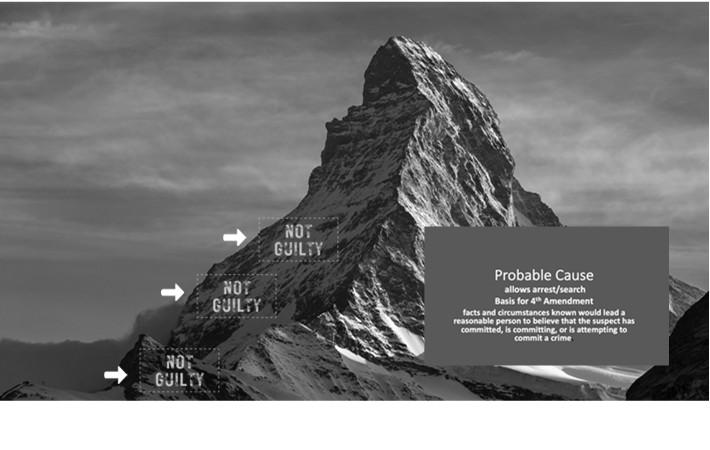
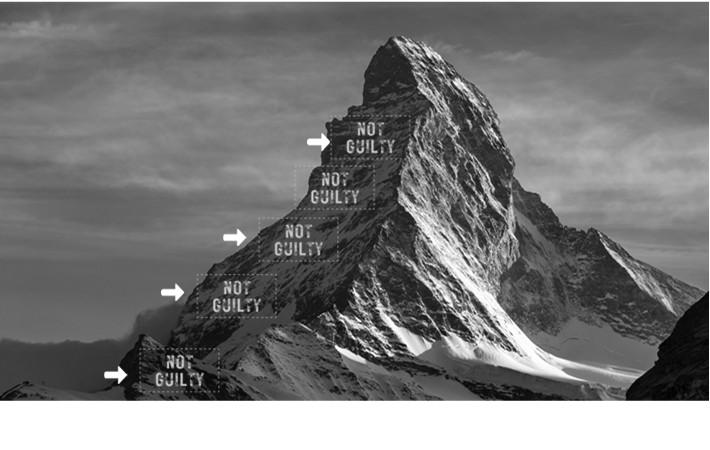
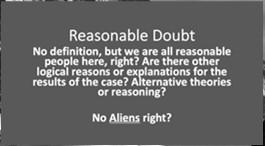
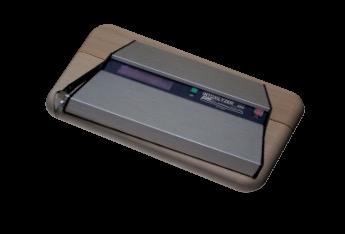
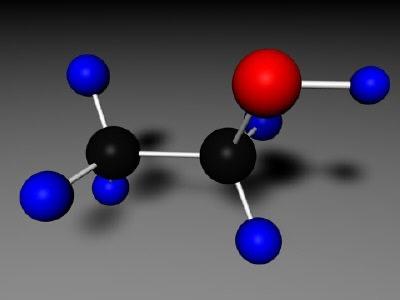
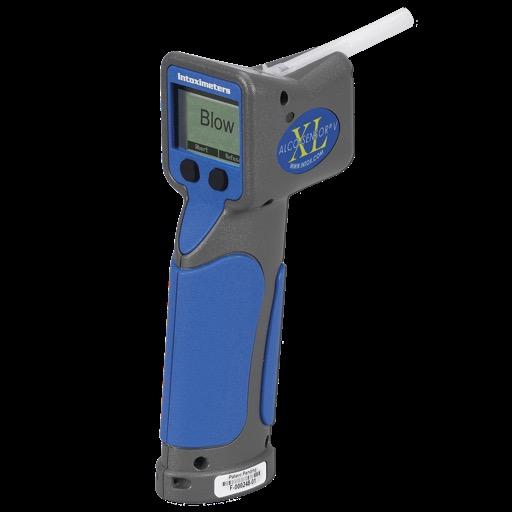
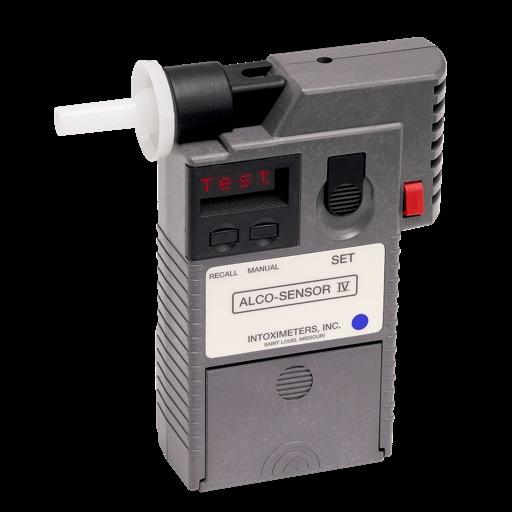
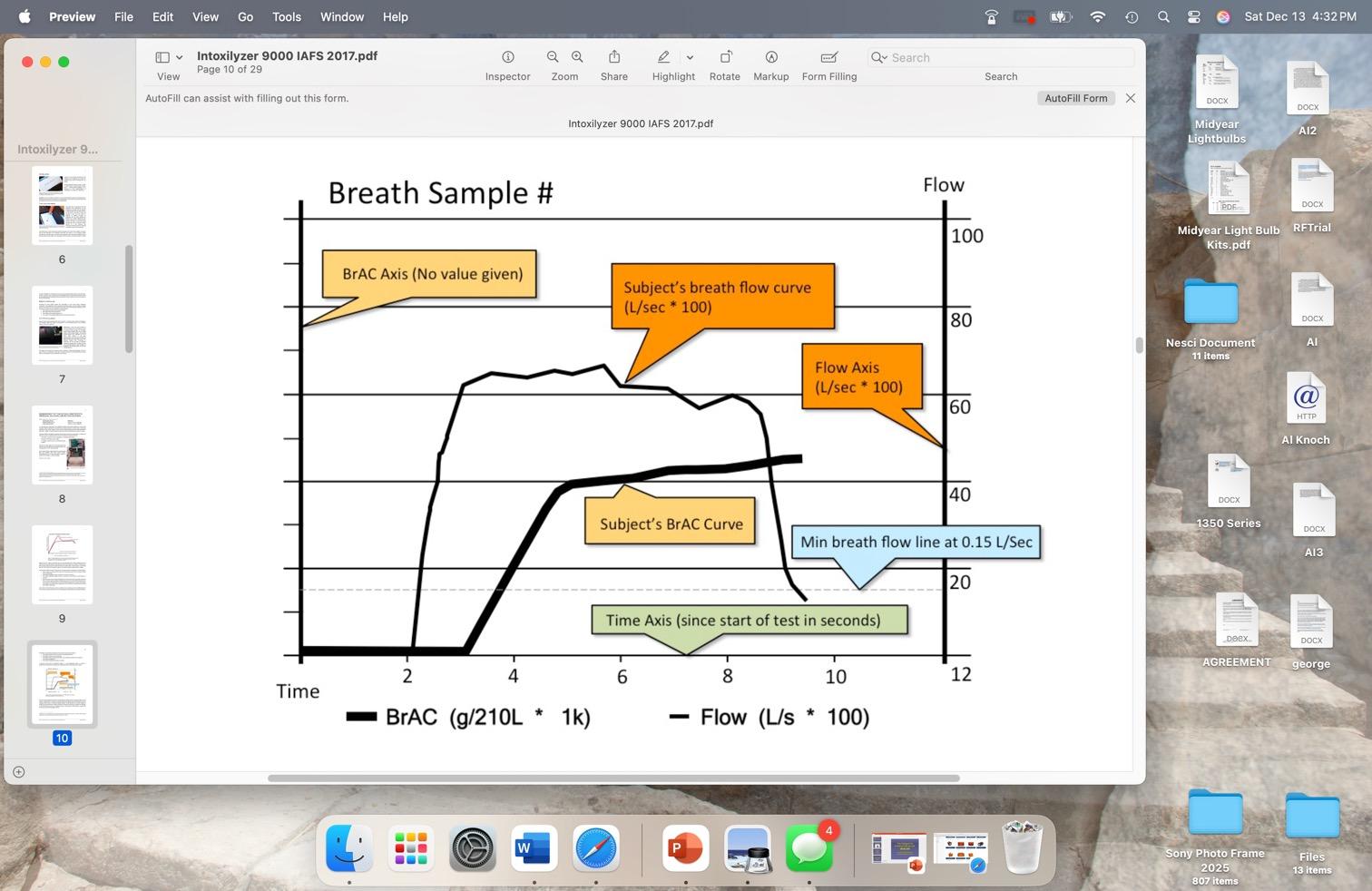
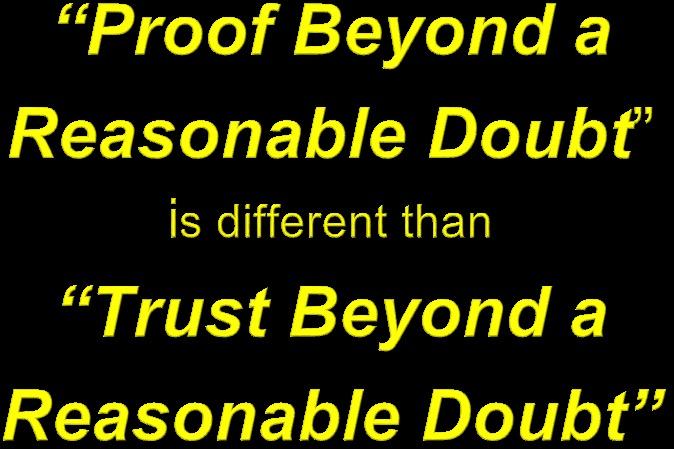
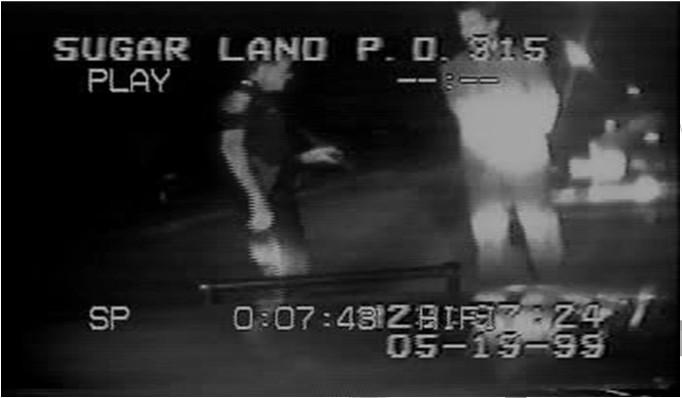
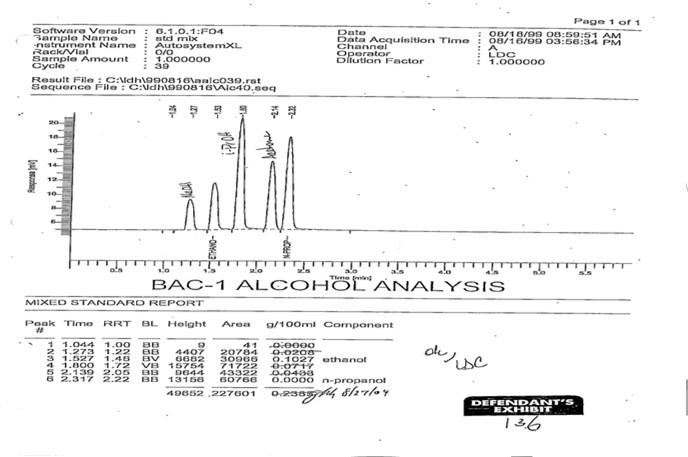
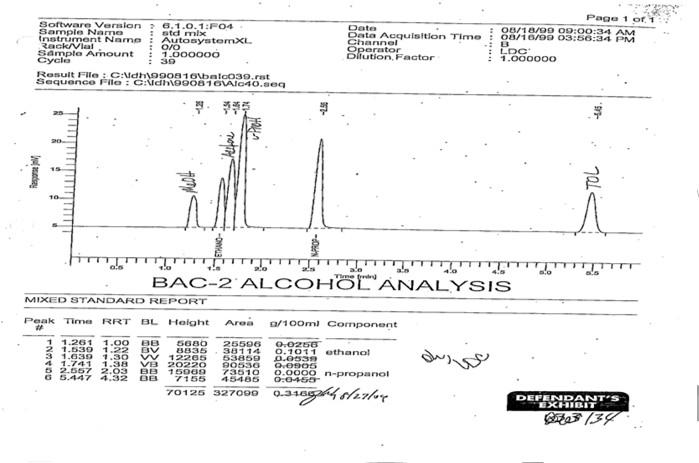
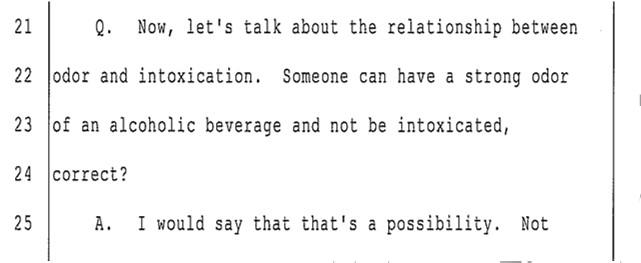
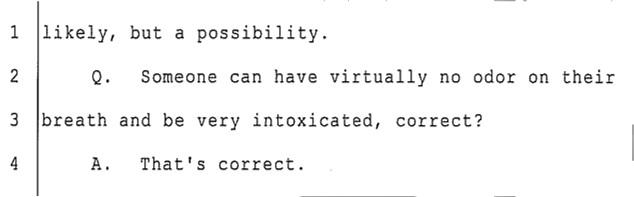
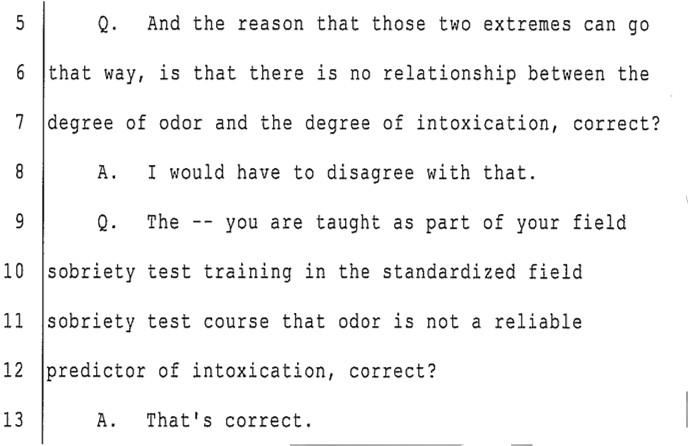
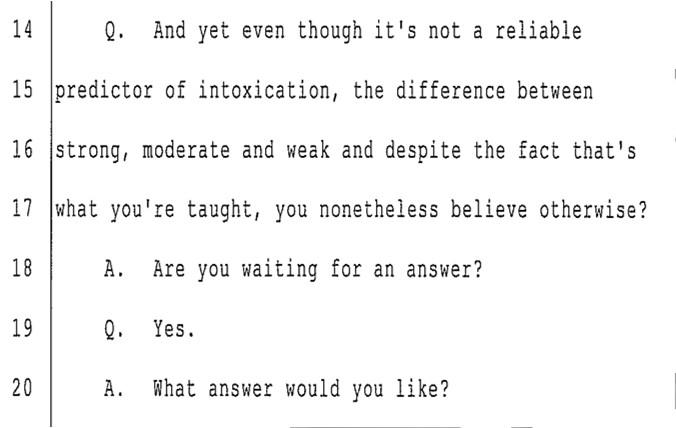
To be successful in trying DWI/DUI cases, lawyers must understand what stands in their way—the prospective jurors personal beliefs about drinking, personal beliefs about drinking and then driving, personal beliefs and trust in police officers, and personal beliefs or misplaced trust in the fallacies of field sobriety testing, and breath and/or blood testing. The aim of this paper and presentation is not to re-hash what has been written extensively about the science of field sobriety testing and breath testing, but to provide a few trial tips that begin in jury selection that can be used to effectively to persuade juries to think differently about field sobriety tests and breath testing and help link your voir dire through final argument. If we can plant seeds of unfairness in jurors minds before the case begins, we will have a much easier time demonstrating reasonable doubt. Unfairness is to jurors for establishing reasonable doubt as what standardized field sobriety tests clues are to officers in creating probable cause. A good voir dire does not just help us eliminate bad jurors, but it also helps set up and bridge the gap to final argument.
We as lawyers all know that every DWI/DUI case is different. There is no standard voir dire outline, or cross-examination formula or matrix a lawyer can use for every DWI/DUI case. You must formulate the winning outline for each case based upon your facts, your client, and the location where the case will be tried. In order to be successful, we need to develop a theme of our case. Once we know what the case is about, we must then think who is going to be most receptive to our side of the story and our theme. The purpose of voir dire is finding who will be
receptive to our story and theme, and eliminating those potential jurors who we believe will reject our theme or story. The secret to figuring this out is providing the potential jurors with a hypothetical sneak peek of what our closing argument will be
Most trial lawyers worth their salt all agree that cases are won in jury selection. One fine lawyer once joking told me that the case “is not just won in jury selection, it’s over after jury selection.” The point is that if we do not select the right people to hear our case, jurors will not be receptive to our theme, our story, and the seeds of reasonable doubt will not take root and grow into a favorable verdict. There is no doubt that you win cases by getting the right people to hear your case. Jury selection is the only chance you have to learn how your prospective jurors feel and think about the hurdles in the way of your case. Using one juror, by way of looping, to educate another is a valuable tool. Learning about a potentially bad juror is as important as learning about a good juror. Learning who the State will strike is as important as figuring out who you need to strike. Listening, learning and educating is what voir dire is all about.
The aim of this paper and presentation is to provide lawyers with ideas and thoughts for jury selection for different types of evidence we routinely see in DWI/DUI cases. Below are some thoughts, ideas, tactics and sample voir dire outlines to share with you that have been successful. Keep in mind, these thoughts, tactics and outlines are only being provided as ideas to help you with routine hurdles we face in most DWI/DUI cases. Some of these ideas will not fit your case, some of the ideas will not fit your style. You cannot and should not ask
all of these things in a given case, but you can pick and choose items that you believe will help in your case on issues that stand in the way of the correct verdict.
In sharing these ideas with you, I am obligated to give several lawyers credit for some of these ideas and tactics that I have either copied in whole or in part, or were created or spurned by them. I would like to thank Texas lawyers Gary Trichter, Troy McKinney, Todd Overstreet, Lewis Dickson, Paul Nugent, George Milner, David Burrows, Chip Lewis, Robert Hirschhorn, and many others whose I failed to recognize for their ideas that I either borrowed, or their ideas spurned particular thoughts and strategies.
Preparing for Jury Selection
In terms of trial preparation, I prefer to begin my trial preparation backwards. I start first with preparing my closing arguments I intend to make based upon the evidence. My theme is based on these arguments. I then prepare my cross examination with the intent of repetitiously weaving my theme throughout my questions. My opening statement comprises the power statement, theory, and client’s story to empower the jury to assemble the pieces of the puzzle they receive from our vantage point. Once I know the strengths and weaknesses of my case, I know what I want to voir dire about. A good voir dire is like a test drive. I want to take jurors on a test drive on a hypothetical set of facts that in some way relate to my case and my concerns. I want jurors who are going to be receptive to my argument. What is it going to take jurors to get there? What feelings do they harbor that stand in my way? Do they have a prejudice against anyone arrested? Not can they follow the law, but will they follow the law and uphold the law and
make the state prove the highest standard in our law of beyond a reasonable doubt? What bad evidence stands in my way? These are just a few questions we need answers to. But how jurors respond is just as important as what they say. Gerry Spence wrote that he would rather take an honest person who told him he was against his client than a liar who was for his client. When you are down to your last peremptory challenge, these types of people reading skills are invaluable and you need to trust your intuition, or your gut, and your people reading skills.
Use Your Client
Use your client for feedback. It is his/her trial. Inform them up front on how jury selection really works so that they know you really are not selecting jurors, it is a process of elimination, and you are stuck with who is left. Once your client grasps the concept of focusing on jurors that are the most antagonistic to your case, they will be better equipped to focus and pick up on negative vibes, bad body language, etc. This feedback while making strikes is vital because you may not have picked it up while you were conversing with another potential juror.
Do not Rely Solely on Stereotypes
Stereotypes are sometimes applicable, but they should never be utilized as a bright line rule for selecting a jury. A few years ago, I was in jury selection on a total refusal case. We were down to our last strike. It was between a very talkative, non-drinker, female pediatrician who donated money to MADD, and a male school bus driver who my client said had “bad mojo.” I was all about striking the MADD loving and non-drinking opinionated doctor. My client felt he connected with her. So we struck the bus driver, and the doctor ended up being the jury foreperson on
a 15 minute not guilty verdict. After the verdict and outside the courtroom, the doctor ran up to him in the hallway and gave him a hug. If I had followed the stereotype, we might have lost this case because she had an Oprah like effect on the rest of the jurors. The other female jurors gave him a hug too. It was a valuable lesson. This is not to say you should always follow their advice, but it should be at least taken in account.
Credibility
Credibility is the currency with which you use with the jury. If you don’t have it, they will not buy what you are saying. Jury selection is the perfect time to come out of the gates and start earning your credibility. A great way to start out your jury selection is to let the jury know that we (you and your client) are not here in defiance of DWI/DUI laws. We drive down the same roads and we do not want drunks on the road either. DWI laws are good laws that protect all of us. We are only here because we have a difference of opinion. Anyone ever watch a sporting event where you disagreed with the officials call? Ever seen a bad call by an umpire on a ball or strike in a baseball game? Have you ever seen an instant reply on tape where it clearly showed the referee was wrong? Can you disagree with that person without calling that person a liar? Can you understand that two people can view the same thing and have a difference of opinion? By opening up your jury selection in this manner you defuse some of the negativity potential jurors may associate you and your client for being a defendant and criminal defense lawyer involving in a DWI/DUI case.
Time
Time limitations are more than ever preventing lawyers from conducting a meaningful and effective voir dire due to a lot of judges desire to move the trial along. Some of this is caused by judge’s quest to move their dockets, but some of it is caused by lawyers who waste time and do not know how to voir dire Lawyers who practice in jurisdictions who are allowed to voir dire, or are fortunate to still have the right to a jury trial in misdemeanor DWI/DUI cases, need to be aware of the law in your jurisdiction as to what time limitations and restrictions a trial judge can impose. Know your case law and statute so that you can protect the record in the event you are cut short of conducting voir dire in a manner that will allow you to fulfill the legal purpose of voir dire to allow a lawyer to intelligently exercise their peremptory challenges. Make your record by reading the questions you would have asked on the record so that you have a valid basis for appeal, and also to demonstrate to the judge that you your questions were relevant and not wasting time. You need to know that you need to stand your ground. The judge is giving you less time because lawyers before you did not respectfully fight for enough time for you to do your job. Judges respect lawyers who are prepared, who challenge respectfully and make cogent legal arguments in support.
Challenges for Cause / Commitment Questions
Most jurisdictions do not allow questions in voir dire that commit a juror to decide a fact of the case. Commitment questions are permissible, however, when it comes to following the law. My preference is to use the 5th Amendment right to remain silent, the presumption of innocence, or burden of proof beyond a
reasonable doubt combined with an unfavorable hypothetical fact to set up unfavorable jurors to be excused with a challenge for cause.
Let the Jurors know their Role
The following instruction is what the jury usually receives throughout the country in a jury charge:
“Members of the jury, you are the exclusive judges of the facts proved, of the credibility of the witnesses, and the weight to be given to their testimony.”
This is important so that when they view the evidence from that viewpoint, and not thinking they have to accept the evidence because it comes from the government and they are pawns of the judge. Remember: The citizen accused is entitled to the only presumption in this case – the presumption of innocence. Breath test are not presumptively reliable and accurate. It is better for jurors to know this up front, than for them to hear it for the first time when they receive the jury charge at the end of the case.
Jurors need to know that just because a machine registers a number that purports to be above the legal limit, they are not required to swallow that number hook, line and sinker. When jurors are empowered individually they can help other jurors create doubt that have not already seen it. Use of analogies in voir dire that are consistent with your case facts will help jurors to be inclined to disregard breath, blood or sobriety tests, or when they see other evidence that creates disbelief or doubt about the breath, blood or sobriety tests.
Presumption of Innocence
Under our law, there is only one presumption in a DWI criminal case and that is that the driver/defendant is presumed innocent? What does that presumption of innocence mean to you?
Under our law, is it permissible for a juror to presume that:
1. a police officer is telling the truth? Explain?
2. a police officer properly performed a breath test? Explain?
3. a breath test machine can accurately and reliably test a person? Explain?
4. a breath test result is a true and accurate reflection of a person’s sobriety or lack of sobriety? Explain?
5. an arrested person is actually innocent? Explain?
6. She must accept the breath test machine as reliable and accurate because the government purchased it and now uses it in DWI prosecutions? Explain?
Disconnect Defense
Outside of having a demonstrated problem with the breath test machine or a demonstrated error by the officer who conducted the breath test, the disconnect defense, in my experience and opinion, is the best breath test defense theory. In essence, the State is trying to get the jury to believe what they hear, and not what they see. The Defense wants the jury to focus on what they see, i.e., excellent use of mental and physical faculties that demonstrates no impairment, and not the breath test public relations scheme the state’s witnesses are selling. Using this defense requires, of course, requires the accused to perform well on balance and coordination exercises. Use of this defense also requires identifying in voir dire which jurors you believe are most likely to follow this logic and reasoning, and
discard breath or blood test results. The analogies are endless, and several analogies have been provided below. Doctors and nurses may not always be the best jurors in DWI/DUI cases, but they do make great educators for the rest of the venire concerning the science and their experience. And by using them to educate the panel for you, you may cause the State to use their strikes on the doctors and nurses that you did not want sitting on your jury anyway.
I like to commit medical professionals to a scenario where one hospital lab test runs contrary to all other tests performed and contrary to all observations. Ask them if their tests are always 100% accurate? Ask them if they go ahead and rush a person into surgery if only one of these tests indicates surgery is needed when all the other tests and observations indicate it is not needed? The answer, of course, is an emphatic “no”. They disregard the test and look further with others tests. Medical professionals live by a maxim that doctors do not treat test results, they treat the patient. They will say that you cannot base your decision on just one test standing alone. This is really powerful in a breath or blood test case. You take the whole picture into account. Or, to use police jargon most appropriately: “You take the totality of the circumstances. We don’t just rely on one test.”
Here is an example outline I have used numerous times successfully in breath and blood test cases using a disconnect defense.
“MAN V. MACHINE” – BREATH TEST VOIR DIRE I. CASE THEME – MAN v. MACHINE
A. You are the exclusive judges of the facts, the credibility of the witness, and of the weight to be given to the evidence. Who decides the law?
B. Why do you think this is so? Because . . . Do machines make mistakes?
II. HOW DO WE KNOW WHETHER TO TRUST A MACHINE AND TRUST IT’S RESULTS?
A. Learns how it works?
1) Taxalyzer 5000 hypotheitical:
a) Check must precisely accurate or you go to jail.
b) Must use IRS issued calculator to add it up.
What thoughts go through your head? I hope I add this up right?I sure hope this calculator works? Who maintains it? Who created it? What happens to me if it does not work properly?
2) Is it reliable?
a) Yes, with a 20% margin of error
b) Yes, but only if you are in the correct tax bracket. If your tax bracket is higher or lower, the calculator could end up paying more in taxes, or pay too little and go to jail.
c) Broken down? Malfunctioned. Not a lot. It checks itself. (space shuttle) and we check it in person once a month.
d) Does it have a warranty? Yes, but it expires after a year, and it did not warranty that it was fit for adding up taxes.
3) Anything else I should know?
a) Well, a couple of things, but they are not a big deal.
b) Calculator doesn’t treat anybody the same. Rich folks and poor folks are not treated the same.
c) Can I buy one and check it out? No.
d) Can you tell me something about the computer program running it? NO.
B. Know something about the person operating it?
1) Inspector Doolittle can type in numbers if you want to just call them out. “Don’t worry, he’s certified.”
2) What is his track record?
3) What about his friend who works on these things? Can he/she be here while Doolittle adds up these numbers? No, but don’t worry, he’s a friend of mine…he’ll check his work later and say it was okay.
C. Use common sense!
1) At the end of the day you get a result . . . a number.
2) Despite machine working, despite witnesses telling you it was working…can your common sense cause you to have doubt about whether the number result was correct?
a) Space shuttle computers. Was everything really alright? No, there was a disconnect between what the computers told us and what was really happening and what we saw in the sky?
3) Disconnect.
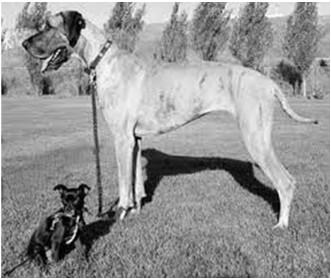
a) What if you heard that Mr. Jones broke the world record in the 100 meter dash by running under 10 seconds? (Show picture of fat man)
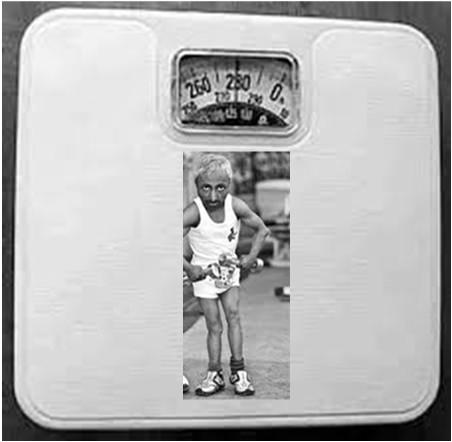
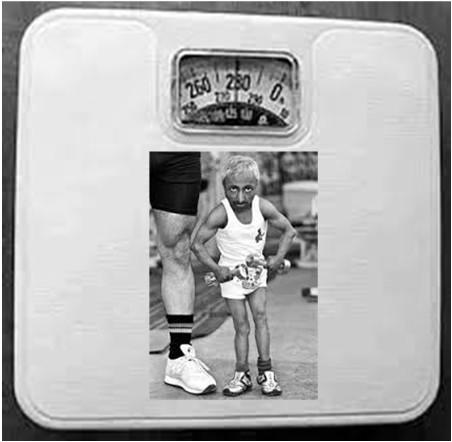
b) What if you heard that Mr. Jones broke the world record by lifting 500 lbs.? (Show picture of 102 emaciated man)
c) What do you expect to see if you hear that a person was over the legal limit?
d) What do you expect to see if you hear that a person was twice over the legal limit?
e) If there is a disconnect, are you more likely to rely on what you see or hear?
III. DRINKING
A. Any non-drinkers?
B. Donations of time or money to MADD?
CAUSE: Will the fact that you don’t drink alcohol or your relation with MADD affect your ability to sit on a juror in a DWI case?
IV. DWI LAW
A. Is the law strict enough? (CHART)
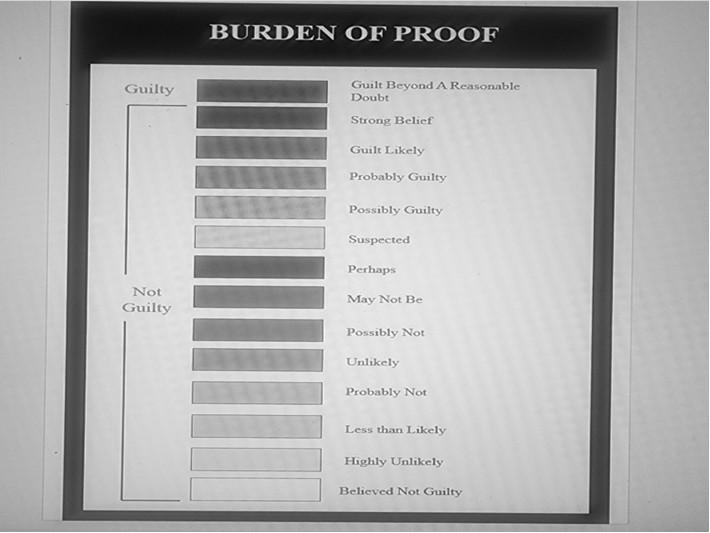
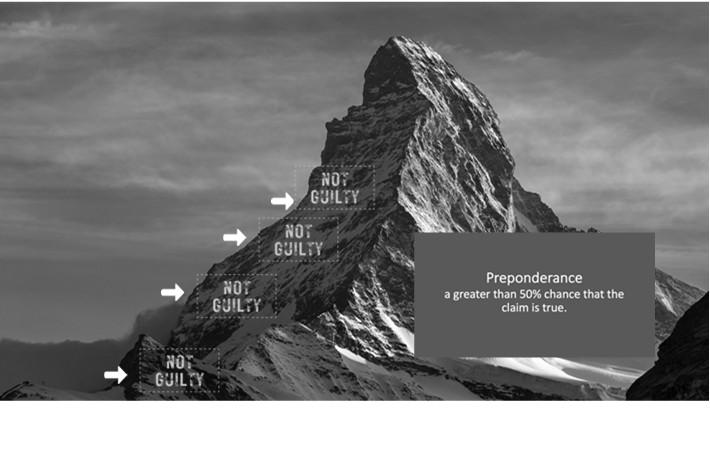
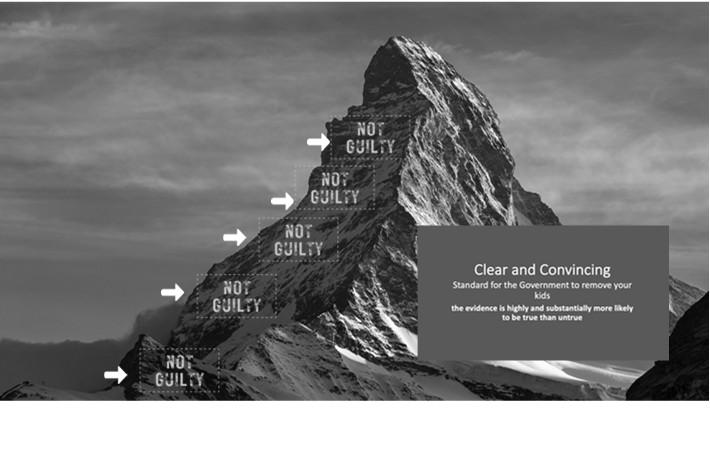
V. PRESUMPTION OF INNOCENCE / BEYOND A REASONABLE DOUBT (CHART)
A. Will everybody agree that there are 2 sides to every story?
B. How many of you have received a traffic ticket that you disagreed with?
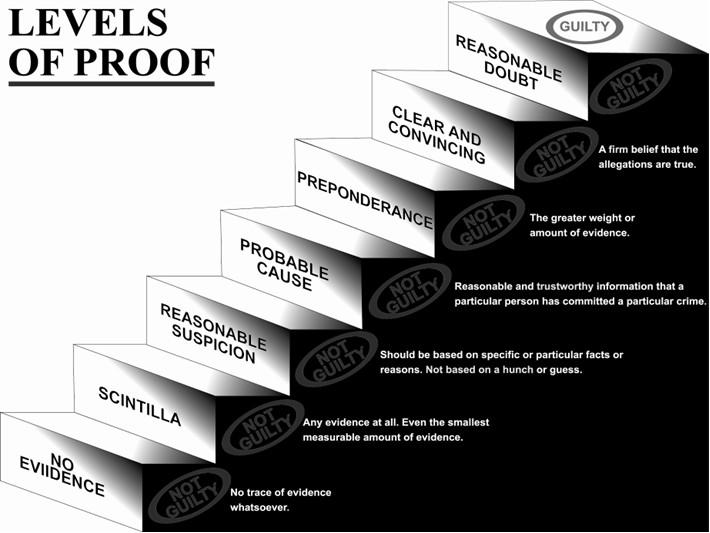
C. What level of proof is required before the officer can write that ticket? PC
D. Can everyone see how your level of proof to find someone guilty …”BRD”…is much higher than the officer’s level of proof to make the arrest in this case?
E. What is reasonable doubt to you?
F. Other than be here, what is the citizen accused required to do in this case? Not require Defendant to prove his innocence or produce any evidence at all. On a scale of 1 to 10, how strongly do you agree with that law?
G. Is reasonable doubt too high in a DWI case?
Remember: PI + BRD = defer to Defendant in close of case
Cause: More important to enforce laws and support law enforcement or protect innocent people from being wrongfully convicted?
VI. RIGHT NOT TO TESTIFY
A. Reasons why an innocent person would not testify?
1) Nervousness. Afraid of being cross-examined by a skilled lawyer?
2) Lawyer told him not necessary to win and drag case on. What kind of lawyer would you want if you were accused?
3) Ability to communicate.
4) What if you answered every question, did every test, but it still wasn’t good enough for the officer?
B. The Law
“If the Defendant does not testify…you will not consider the decision of the defendant not to testify as a circumstance against him and you will not in your deliberations allude to, comment on, or in any manner refer to the fact that the defendant has not testified.”
Magnet – What would you do if you are in deliberations about this case and someone begins to comment on the citizen not testifying?
VII. WITNESS TESTIMONY AND CREDIBILITY
A. All witnesses are created equal. No witness is presumed to more or less credible.
B. Are you more likely to believe a police officer than a non-police office witness due to training?
D. Who is likely to look better on the stand? A witness whose job is to regularly testify or a person who has never testified?
E. Anyone here have a friend or family member who is a PO? Would you automatically give that person more credibility?
F. Going back to the traffic ticket you disagreed with. Did anyone call the police officer a liar?
These are not cases where the police officer is accusing the officer of being a liar.
Magnet – Can you disagree with a person’s opinion without calling that person a liar?
VIII. “Normal use”
A. This is the law. You cannot change it. You cannot add to it.
B. This is not a DUI case.
C. How many of you were straight “A” students in school?
D. What is my point? I think everyone will agree that there is a range of being normal.
E. On a scale of 1 to 10, if you were arrested, what would your stress level be?
IX. Final Question
Can each of you look at _______ and say sir, I’ll give you a fair trial?
This next voir dire outline is a combination of ideas from the lawyers I previously referred to, and some of my own. These ideas worked for them, they worked for me, and I hope these ideas will work for you too.
VOIR DIRE – Sample Outline #2
Why I’m Here
I intend to be very thorough. I intend to be reasonably respectful, but of course, I intend to challenge. I intend to get answers to my questions, which oftentimes lawyers don’t get from witnesses. And I intend to be thorough. That takes some time and it takes some patience.
What Kind of Jurors I’m Looking For
I’m looking for jurors who want to be just as good as a juror as I want to be as a lawyer. That’s what I’m looking for. I’m looking for jurors who want to be thorough. I’m looking for jurors who see the need for a challenge as they put their mind and heart to the test.
Not Here in Defiance of DWI Law – DWI is Opinion Crime
Not here to call police officers liars. DWI is an opinion crime. Not against the police.
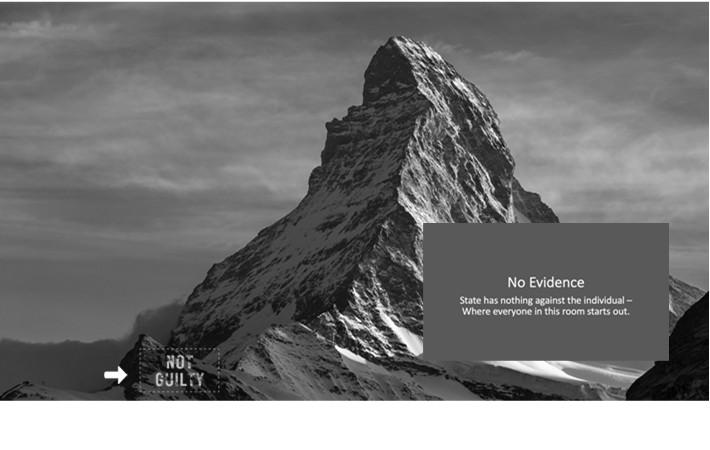
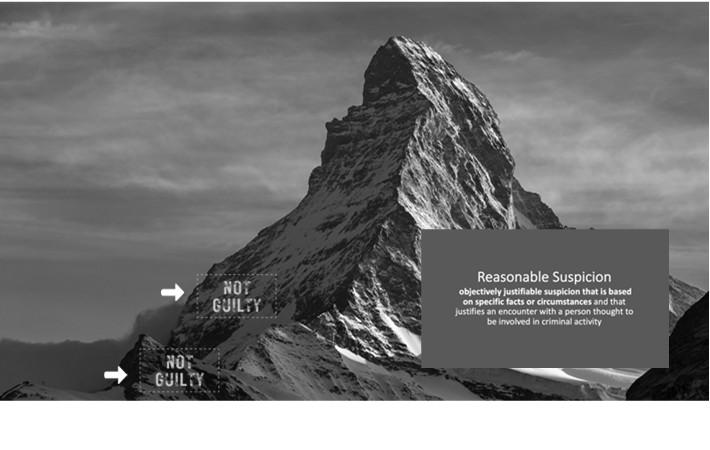
If you ask two different reasonable people the same question, do you think you might get 2 answers? Does that seem logical? The policeman when he comes down here, he has a job to do, and at the stage of probable cause, that police officer can lawfully handcuff someone and has the authority to take them to jail before a judge. The police officer is only asked one question: Based on everything I heard, based on everything I’ve seen, smelled, etc. what I have been told, do I have probable cause to believe that this person was DWI? You the jury, on the other hand, is asked a wholly different question: Does the evidence presented in the courtroom prove BRD that a person was DWI. You may very well find, and many juries do, that a police officer did it exactly right, did not lie about a thing and had PC to arrest for DWI and there is no problem with that.
A jury can say: Officer you did it 100% right, but our verdict is not guilty and in our system of justice that is exactly how it works.
DRINKING
A. Regularly
B. Socially
C. Not Anymore
D. Never Have
CAUSE #1: For those who do not drink, do you agree that it may make it harder for you to judge whether someone has lost the normal use of their mental and physical faculties?
CAUSE #2: It is okay to say: “I’m not comfortable to say someone drank so much that they became intoxicated.”
Burden of Proof
Were not just talking about sending someone to jail, but their good name, right to be free from a conviction of a crime, unless its done lawfully and all the I’s and t’s are dotted and crossed.
Three Rules – To assure a person is not wrongfully convicted:
1. Presumption of Innocence – Were all presumed innocent. It’s like a cloak that we are given by our government and they can’t strip it from us. They cannot make us give any evidence.
As you sit here, do you presume Mr. ___ is innocent.
2. Burden always on State – It never shifts to the Defendant. We do not have to call any witnesses. If the state rests and if I think the case is already riddled with reasonable doubt and I’m ready to argue it to you, that’s my prerogative
If the State puts on their case, you’ve got reasonable doubt, plus zero of what evidence I put on, what does that equal? Reasonable doubt.
3. Reasonable Doubt - Not finding someone innocent. You are asked to find not guilty because the government did not prove their case beyond a reasonable doubt. Has the state proven their allegations beyond a reasonable doubt? If we have any doubt about the evidence, we have to acquit. It is not our fault the state did not have any evidence.
Doesn’t mean we don’t care about DWI laws, dislike the police officer, or the prosecutor.
You might say that there is a strong likelihood that a person is guilty, and in my gut I think maybe the person’s guilty, but I can’t say that it was proven beyond a reasonable doubt by evidence that was brought here and admitted into court before us, so I have no choice but to acquit.
Can’t go outside the evidence, can’t speculate. You can’t fill in the holes for the state. You cannot speculate about what the results of the test may have been had they been given.
Judge will instruct you that if a fellow juror starts talking about things that aren’t in evidence, its your duty as fellow jurors to stop ’em and say: Wait a minute that’s not in evidence.
If you want answers to how much beer a person drank, it’s up to the prosecutor to find out, beat the streets, find out who the person was with, where they were, and investigate the case. It is not just sufficient to say we asked a few questions and did what we could do that night and shut the file and went home. It’s the state’s burden. It is the prosecutor’s burden to gather evidence, and if the Defendant won’t give it to you, try and find someone else that will. A Defendant doesn’t have to answer questions or do anything? Does everyone understand that?
Refusal – Anyone here who feels that regardless of what the facts are that if a person doesn’t do the obstacle court on the side of the road that means they’re guilty?
You get charged with a crime for being non-compliant, then you basically come down here and fight your fight.
You will be asked to weigh the evidence, not the evidence you wish you had, not the evidence you thought you should have because the prosecutor did not gather evidence, then you must hold that against the state. That’s the law.
Design of Tests – How would you design a test to cause balance?
Nervousness & Test Taking
Do you think you are driving down the road after leaving a family wedding reception having a few glasses of wine, maybe a glass of champagne, you leave, you have normal use of mental/physical ability you are driving home and a policeman pulls. Is it natural or appropriate to feel that way? What are you thinking now? Drinking? Do you think I’m going to believe you? Tell me how nervous you are now? How scared are you now? As we walk to the back, you notice a couple of my friends pull up in their squad car. All the focus is on you. How scared are you now?
You’re a teacher? Is it a well-known indisputable fact within the teaching profession, that some students will perform poorly on a test not because they didn't study material but because of nervousness and anxiety of testing?
Lets say you do not perform my testing to my level of satisfaction, what do you think is going to happen to you? Probably going to be arrested. Does that mean your guilty? The fact that person is arrested does not mean a person is guilty.
Jurors are the Exclusive Judges of the Facts
You are not required to use or believe any evidence you hear. You can do whatever you want with it.
Why do you think the Great State of Texas selects 6 people to sit on a jury?
IRS – TAX MACHINE - Taxilyzer 5000
Machine says you’re guilty of tax fraud and destroyed your tax return
What if I told you that we had to take the machine out of service for 13 days starting the day after the test?
Destroyed tax return, but could have saved it?
What if the person who maintains it does not know it calculates?
Rather trust 6 people or a machine?
Video taping – why is it important in a breath test case?
Balance and Coordination – why are they important in a breath test case?
How would you design balance test if you want to cause people to lose their balance?
Believe what you see v. what you hear
Computers
Do computers ever have problems?
Ever had a computer crash on you?
If the breath test machine or the officer goofs up, who pays the price?
Why did it crash?
Space shuttle computer did not tell us anything was wrong, but what we saw in the sky and on TV showed us a very different picture
What do you expect an impaired or legally drunk person to look like?
You know you did not drink so much that you became legally drunk, but a machine says you did? How do you prove your innocence?
Who has something to hide: someone who is not intoxicated, or someone who is legally drunk?
Breath Test
There is no law that says if the breath box spits out a number of .08 or higher that that means a person is intoxicated. That is not the law, and it will never be the law. It does not matter what the breath box says.
The question becomes what was the BAC at the time of driving? Was that -08 or higher? Was that proven BRD? Breath box is like any other measuring machine like a bathroom scale. Lets say we have 3 different scales: I step on one scale and it says I weigh 150 lbs. Would you have a reason to question the accuracy? Would you have a reasonable doubt about the accuracy of that scale? I go over to the 3rd scale and it says I weigh 300 lbs. Do you have a reasonable doubt about the accuracy of that scale? I go to the one in the middle, and I wish it said 170, but it says 210, do you have any reason to question that? Probably not.
Who here in their honest belief believes that breath testing is accurate most of the time? How many here believe it is accurate 75% of the time? How many of you believe it is accurate 90% of the time?
How many believe 100% of the time? If so, is it true then you are going to presume its accurate and shift burden to me to prove on this occasion it was wrong, and absent me proving it was wrong, you are going to convict on that right now?
Lets give them the benefit of the doubt and presume its 90% accurate although during the trial we can only presume that Defendant is innocent and it is used 100000 times each year here in Texas and is accurate only 90% o the time, how many times is it wrong? 10,000. So what is at issue here? For purposes of this trial, what is the only breath test that matters out of the 100,000? His breath test, you are going to be asked whether the state has proven beyond a reasonable doubt that he is not one of the 10,000 breath test where the machine was not accurate or working properly.
Breath Test Contract
We draw up a contract to say that if we suspect you of DWI, were going take you to jail and ask you to take a BT. If our machine says you are below the legal limit, there is a possibility we are still not going to release you from jail. If the machine
says you are over the legal limit, then you agree to sign up for a DWI conviction, 1year probation, or jail.
You agree to be tried by a machine. That’s it. You put your whole faith in that, regardless of other evidence, what witnesses would say, you agree to be tried by a police machine.
Would you agree that before a person takes the BT they would need to have some reason to believe that the machine is accurate?
Don’t know anything about the test? The person operating it? Whether it can be jimmied with? The person who maintains the machine? Whos giving the test? Etc.
Who would you rather place your faith in: A machine, or 6-12 smart, reasonable people?
Compliance (use in a total refusal case)
Lets say we enact a new law. Lets assume that the police department suspects you of a crime, they knock on your door. They tell you about it or send you a letter that says: “we suspect you of a crime and here’s our new deal.” Your report to use, and you cooperate with us. If you fully cooperate with everything we want from you, we may or may not prosecute you, depending upon what turns up upon compliance.
But if you refuse, and don’t bring no lawyer here with you, our new policyis we are going to prosecute you, even if it is based upon the same suspicions we had to start with, even if we did not get any more evidence against you. You are going to get charged and prosecuted even if we don’t have a case, even if we can’t prove guilt beyond a reasonable doubt. Only because you refused to comply? Does that rub anyone the wrong way?
We do not have to prove were innocent! We do not have to prove the officer’s suspicions are unfounded.
1. Is it against the law to be non-compliant?
2. Would you automatically infer a person is guilty because they were non-compliant?
3. If you see nothing more in evidence to speak of than what the officer had at his command when he felt he had probable cause out on the street, what is your verdict?
RIGHT NOT TO TESTIFY
A. Reasons why an innocent person would not testify?
1) Nervousness. Afraid of being cross-examined by a skilled lawyer?
2) Lawyer told him not necessary to win and drag case on. What kind of lawyer would you want if you were accused?
3) Ability to communicate.
4) What if you answered every question, did every test, but it still wasn’t good enough for the officer?
B. The Law
“If the Defendant does not testify…you will not consider the decision of the defendant not to testify as a circumstance against him and you will not in your deliberations allude to, comment on, or in any manner refer to the fact that the defendant has not testified.”
Magnet – What would you do if you are in deliberations about this case and someone begins to comment on the citizen not testifying?
WITNESS TESTIMONY AND CREDIBILITY
A. All witnesses are created equal. No witness is presumed to more or less credible.
B. Are you more likely to believe a police officer than a non-police office witness due to training?
G. Who is likely to look better on the stand? A witness whose job is to regularly testify or a person who has never testified?
H. Anyone here have a friend or family member who is a PO? Would you automatically give that person more credibility?
I. Going back to the traffic ticket you disagreed with. Did anyone call the police officer a liar?
These are not cases where the police officer is accusing the officer of being a liar.
Magnet – Can you disagree with a person’s opinion without calling that person a liar?
Final Question
Can each of you look at _______ and say, I’ll give you a fair trial?
DUI VOIR DIRE QUESTIONS
by Michael Hawkins Atlanta, Georgia
(Driving Under the Influence)
1. You will hear ___________________________ referred to today as the defendant, the accused, etc. I would like to introduce you to _________________. Does anyone know or recognize _______________________? (if so how?)
2. Anyone know me or my law firm? (if so how?)
3. Is anyone familiar with the area of _____?
4. Does anyone have little or no experience driving cars?
5. Is there anyone here who for personal, moral or religious reasons does not drink alcohol?
6. Of those who choose not to drink alcohol, do any of you oppose other people drinking alcohol?
7. Has anyone here ever been to a wine tasting event?
8. Has anyone here ever toured a winery, or a brewery or distillery?
9. Has anyone on this panel seen a person who has had too much to drink?
10. Has anyone here seen someone driving so erratically that you felt the driver must be impaired?
11. Do any of you consider yourselves social drinkers, or one who would drink to relax in the evening or on weekends?
12. Have any ever had several drinks on one particular occasion?
13. Did you feel the effect of those drinks?
14. Does everyone agree that different people have different tolerance levels for alcohol?
15. Has anyone seen someone under the influence of alcohol to the extent that
(a) their balance was affected?
(b) their reflexes were affected?
(c) their eyes were bloodshot and/or watery
(d) they had a strong odor of alcohol about their breath or person?
(e) their speech was thick or slurred?
(f) you felt they would not be safe to drive a car?
16. Does everyone agree that alcohol affects:
(a) physical coordination?
(b) memory?
(c) judgment
(d) a person’s inhibitions?
17. Does anyone feel that driving under the influence should not be a crime?
18. Does anyone believe that it is unfair for the police to require a driver suspected of DUI take a blood-alcohol test?
19. How about a breath test?
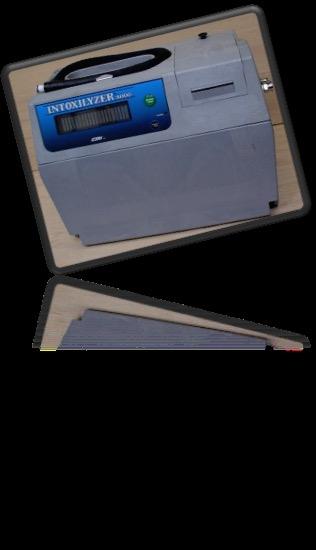
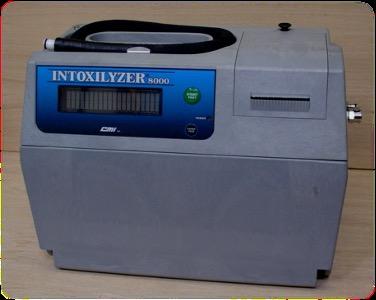
20. Has anyone here read the recent news articles about the challenges to the internal workings of the Intoxilyzer 5000 breath testing machine?
21. Does anyone have an opinion or knowledge about the accuracy of a breath test compared to the accuracy of a blood test?
22. Has anyone here ever had a computer or a copy machine crash?
23. Has anyone had any unpleasant dealings with a police officer? If so,
(a) Was that in _______________County?
(b) How long ago was that?
(c) Do you mind sharing what happened?
24. Has anyone here ever been cited for a traffic violation?
25. OK let me ask that a different way, has anyone here NEVER been cited?
26. Was there a trial by the court or by a jury or did you just plead guilty?
27. Were you treated fairly or unfairly by the police and/or the court?
28. If you thought you were not guilty of what the police charged you with, would you willing to ask for a jury to decide whether the State could prove you guilty beyond a reasonable doubt?
29. Has anyone been asked to produce their driver’s license and insurance proof at the request of an officer?
30. Has anyone been asked to say their ABC’s; walk a straight line; blow or perform any other test at the request of a police officer?
31. Has anyone ever seen field sobriety tests done on TV shows like COPS?
32. Has anyone ever been required to submit to a breath test at the police station or a blood test at the hospital to test for alcohol consumption?
33. Has any member of the panel, or any member of your family, or a close friend, been charged with driving under the influence?
34. Were you (or were they) treated fairly or unfairly?
35. Has anyone here ever contributed money or worked on fundraising for any organization such as Mothers Against Drunk Driving (MADD) or Students Against Drunk Driving (SADD)?
36. Has anyone here ever contributed money or worked on fundraising for any organization such as The Georgia Innocence Project or The Justice Project?
37. Is there any reason you know of that would prevent any of you from being a fair and impartial juror in this case both for the Defendant and for the State as well?
Conclusion
Conducting an effective voir dire is not just about asking a bunch of questions, it is about listening to jurors and learning about the jurors. Asking the right questions only helps you to learn more so that you know how to exercise your peremptory challenges. Equally as important, is planting the seeds of reasonable doubt so that you can link your argument to voir dire and find jurors that will accept and understand your argument. Do not try to emulate someone else’s style. Be yourself, be genuine, be humble, be professional, be polite, be nice, and be sincere. Do not try to look like a DWI/DUI expert, or a hotshot lawyer. The only person you will impress is yourself. Learn what works for you, and continue to tweak it. Good verdicts to all!
32nd Annual Mastering Scientific Evidence
March 26-27, 2026
Hyatt Centric French Quarter New Orleans, LA
Topic: Voir Dire in Breath & Blood Test Cases Lecture
Panama City Beach, FL 32417 404.822.4003 phone topduitraining@gmail.com email http://www.duiexpertronlloyd.com/ website
32ND ANNUAL
MASTERING SCIENTIFIC EVIDENCE IN DUI/DWI CASES
NEW ORLEANS, LA
MARCH 26, 2026
STANDARDIZED FIELD SOBRIETY TESTING (SFSTS)
MATERIALS PREPARED BY
RON LLOYD
PANAMA CITY BEACH, FLORIDA
(Excerpts from the 2/2023 Edited 4/2025 NHTSA SFST Manuals were used in this presentation)
The 2/2023 Edited 4/2025 NHTSA SFST Manual is the Current Revision
Covers of the Current NHTSA SFST Student and Instructor Manuals
Overview of the SFSTs
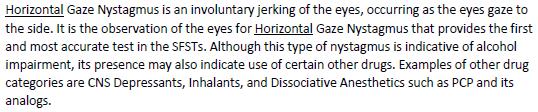
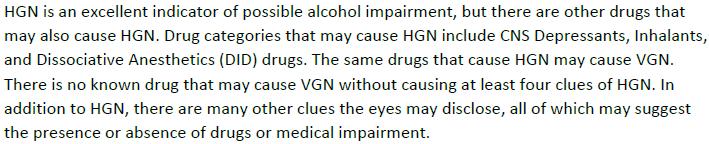
Horizontal Gaze Nystagmus (HGN)
HGN
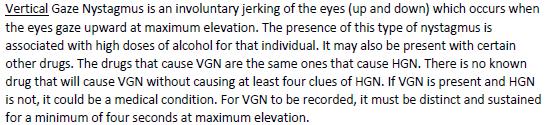
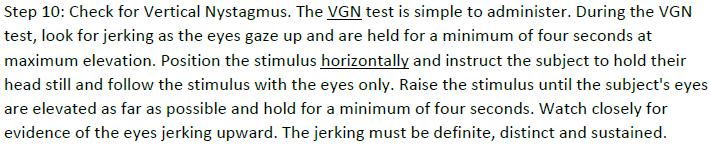
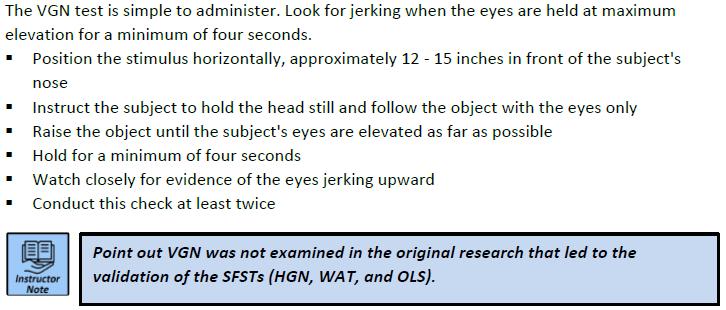
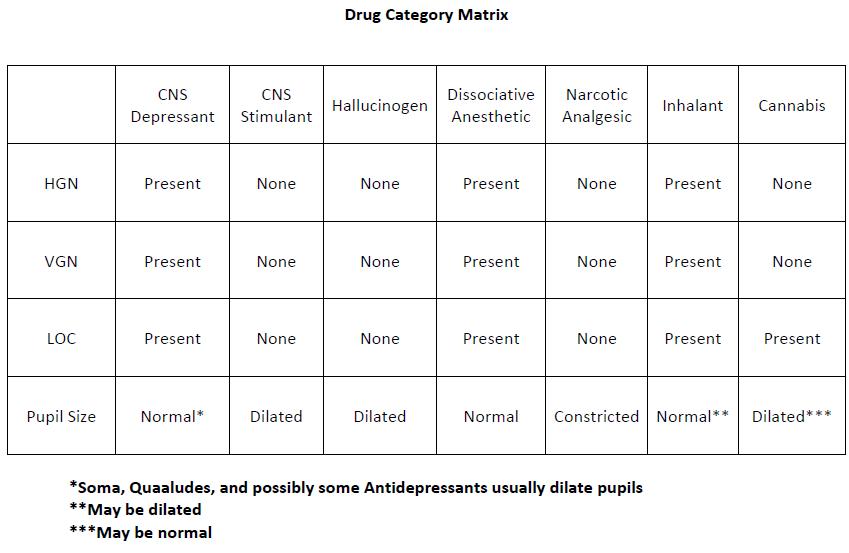
VGN (Not an SFST - Not Validated)
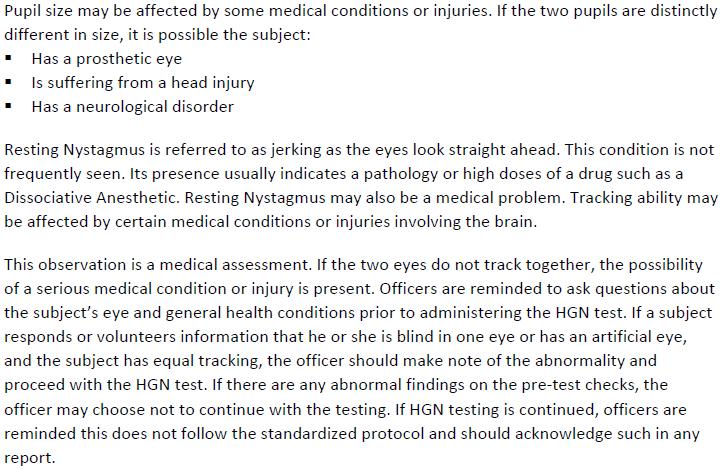
Medical Impairment
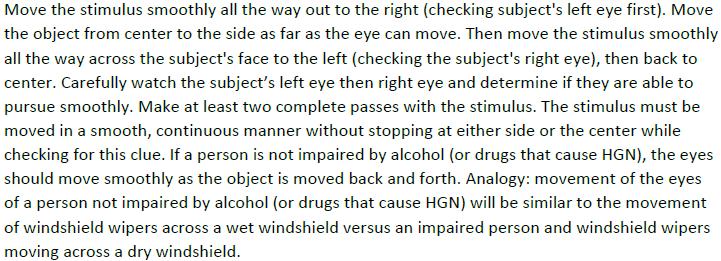
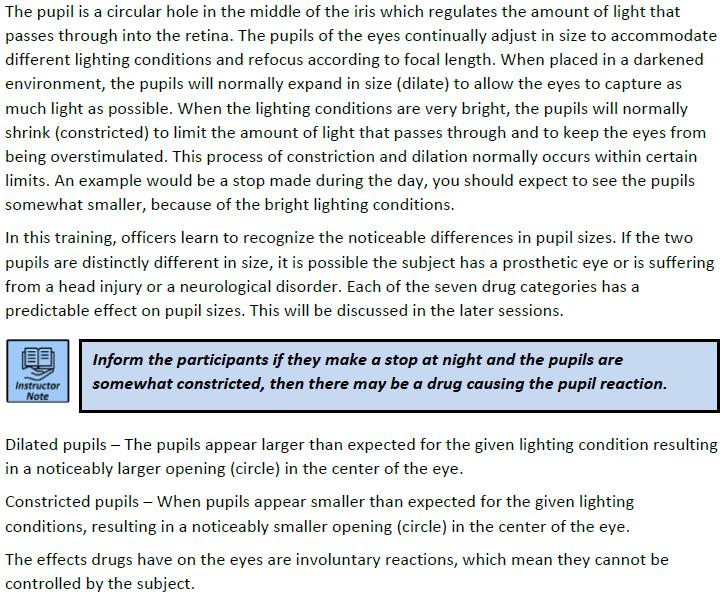
Prior to an officer administering the HGN evaluation to check for the validated clues, the subject must first be screened for possible medical impairment. Officers are trained to ask questions about the subject’s eye and general health conditions and then check for equal pupil size, resting nystagmus and equal tracking.
See Excerpts Below From the 2/2023 Edited 4/2025 NHTSA SFST Participant Manual
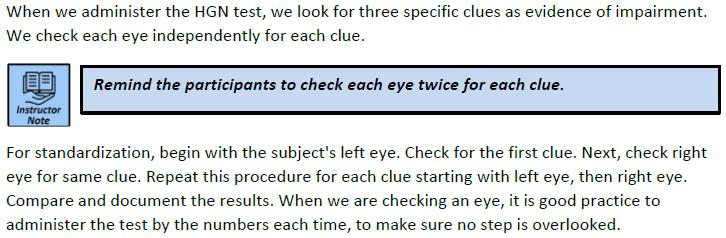
The 3 Validated Clues of HGN
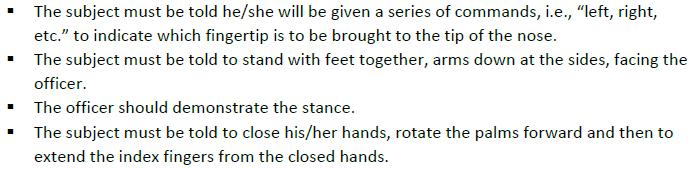
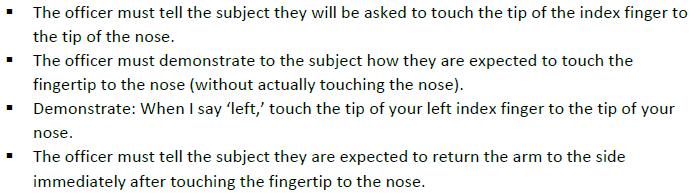
Administrative Procedures
HGN
10
Mechanics of the 3 Validated Clues of HGN
Clue #1 - Lack of Smooth Pursuit
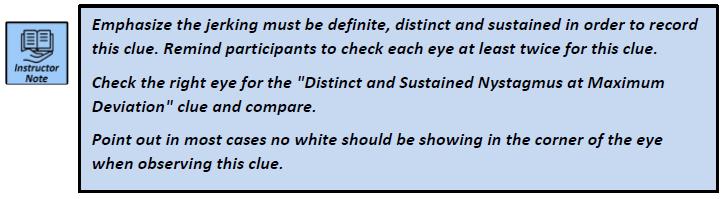
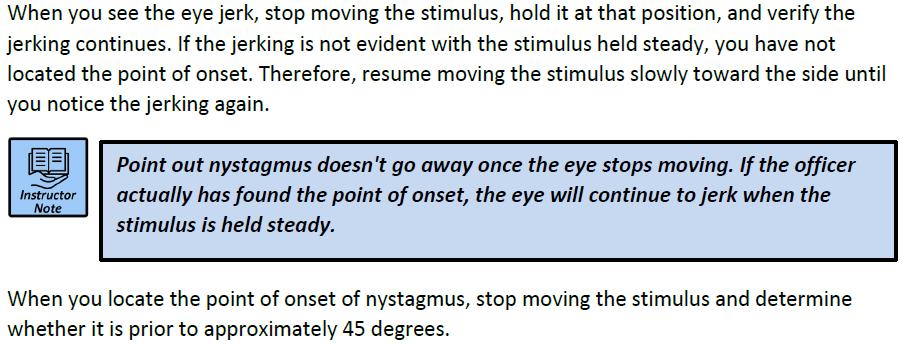
Clue #2 - Distinct and Sustained Nystagmus at Maximum Deviation
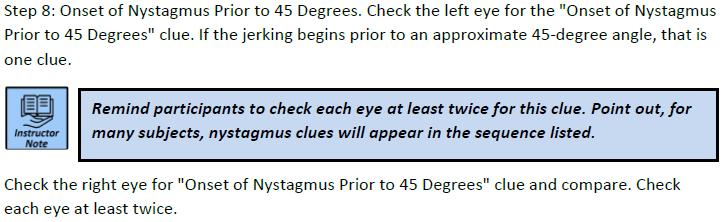
Clue #3 - Onset of Nystagmus Prior to 45 Degrees
HGN Criterion and Accuracy
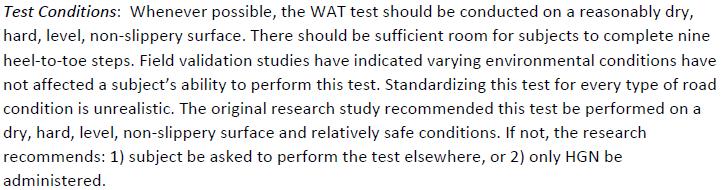
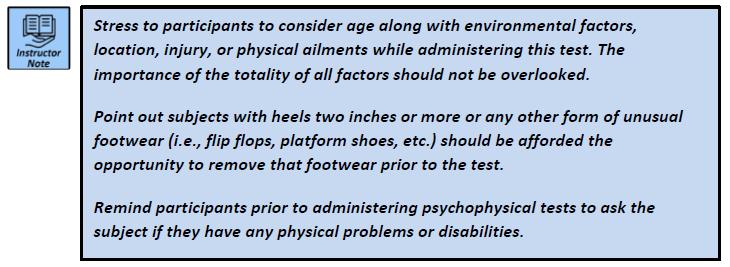
Test Conditions
Vertical Gaze Nystagmus (VGN)
Walk and Turn
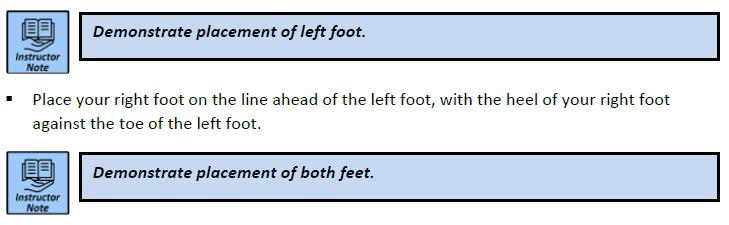
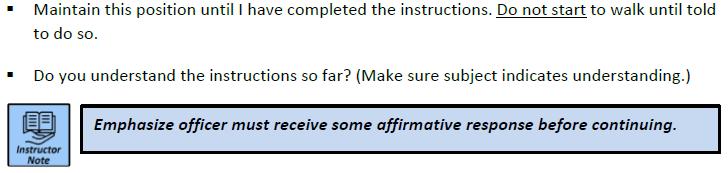
Administrative Procedures (Walk & Turn)
Instruction Stage
Walking Stage
Test Interpretation of the Validated Clues (Walk and Turn)
• Officers often ignore or forget what actually constitutes a validated clue, which leads to subjects being incorrectly assessed clues that weren’t actually present.
• It’s important to understand what’s required to constitute a validated clue so that errors by officers can be identified for cross-examination or plea negotiations
Walk & Turn Criterion and Accuracy
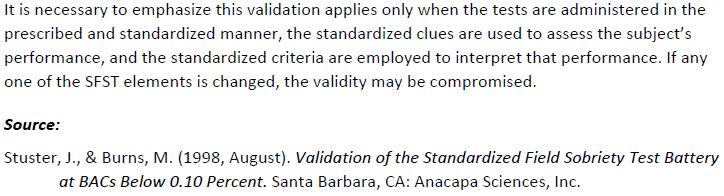
Walk & Turn Validation
One Leg Stand
Test Conditions
Administrative Procedures (One Leg Stand)
Instruction Stage
Balance and Counting Stage
Test Interpretation of the Validated Clues (One Leg Stand)
One Leg Stand Criterion and Accuracy
One Leg Stand Validation
Final Thought
By understanding the NHTSA SFST test conditions, administrative procedures and how to properly interpret the validated clues, you will be better prepared to recognize common errors by officers that can compromise the validity of these tests.
32nd Annual Mastering Scientific Evidence
March 26-27, 2026
Hyatt Centric French Quarter New Orleans, LA
Speaker: Michelle Behan
Behan Ramsell PLLC 945 North Stone Avenue Tucson, AZ 85705 520.308.7994 phone michelle.behan@missduiarizona.com email
I. INTRODUCTION
A. A CLAIM OF FRAUDULENT SCIENCE –
1. SFST BATTERY PRESENTED AS SCIENTIFICALLY VALIDATED TOOL
2. CLAIMED TO ACCURATELY ESTIMATE DRIVER BAC OVER .08.
3. REPORTED ACCURACY OFTEN RANGES 80-90%
4. UNDERLYING RESEARCH REVEALS:
a. EFFORTS TO HIDE UNFAVORABLE RESULTS
b. DELIBERATE DECEPTION AND MISREPRESENTATION OF FACT
c. CRITICISM DEFLECTED OR MINIMIZED
B. THE CENTRAL QUESTION
1. WHAT DO THE VALIDATION STUDIES ACTUALLY SHOW?
2. HOW WERE THOSE NUMBERS DERVIED?
3. DO THE TESTS MEET ACCEPTED SCIENTIFIC AND PSYCHOMETRIC STANDARDS?
II. FOUNDATIONAL PREMISE OF THE SFST BATTERY
***SOURCE: VALIDATION OF THE SFST BATTERY AT BACS BELOW .10
PERCENT, FINAL REPORT, PAGE 28.***
A. THAT PSYCHOMOTOR TESTS WHICH ARE ADMINISTERED ROADSIDE ARE CAPABLE OF REVEALING A PROHIBITED ALCOHOL CONCENTRATION.
B. THE QUESTION THE SFSTS ANSWER FOR THE POLICE IS WHETHER THIS DRIVER IS, AT THE TIME OF THE TEST, ABOVE OR BELOW .08.
C. CANNOT DETERMINE DRIVING IMPAIRMENT
D. USED SOLELY AS A TOOL TO ALLOW LAW ENFORCEMENT TO ESTIMATE BAC.
E. THE IMPLICATION:
1. IF THE BATTERY OF TESTS TRULY ESTIMATES BAC, IT MUST SURVIVE STATISTICAL AND SCIENTIFIC SCRUTINY.
2. ACCURACY CLAIMS MUST BE EVALUATED IN LIGHT OF STUDY DESIGN AND STATISTICAL STRUCTURE
III. A FEW BASIC CONCEPTS
A. SENSITIVITY: THE ABILITY OF THE TEST TO REVEAL THE PRESENCE OF THE CONDITION
B. SPECIFICITY: THE ABILITY OF THE TEST TO REVEAL THE ABSENCE OF THE CONDITION
C. PREVALENCE: THE LIKELIHOOD THAT THE POPULATION BEING TESTED IS POSITIVE FOR THE CONDITION
b. COMPLEX HUMAN PERFORMANCE CANNOT BE RELIABLY MEASURED ROADSIDE.
***PATTERN OBSERVED: AS PREVALENCE INCREASES, REPORTED ACCURACY INCREASES. TRANSLATION: THE STRUCTURE OF THE SELECTED SAMPLE POPULATION INFLUENCES THE STATISTICS.***
V. REVELATION OF (MIS)REPRESENTATIONS
A. WEIGHTING BIAS
1. EARLY STUDIES WERE WEIGHTED TO LOWER BAC POPULATIONS
a. UNTIL THE COLORADO STUDY,NHTSA USED A BAC DECISION POINT OF .10, WITH LESS THAN 30% OF THE STUDIES POPULATION OVER .10, AND NEVER GOT BETTER THAN 68% ACCURATE
2. LATER STUDIES FLIPPED THE PREVALENCE TO THE MAJORITY OF PARTICIPANTS BEING OVER THE LEGAL LIMIT.
a. COLORADO AND FLORIDA FLIPPED THE PREVALENCE PERCENTAGE AROUND, TO 72% OF PARTICIPANTS OVER THE DECISION POINT BAC, AND THE BEST THEY WERE ABLE TO DO WAS 82%.
B. THE RAW DATA REVEALS THE TESTS DON’T ADD MUCH TO THE OFFICERS’ DECISIONS – THEY ARE ONLY SLIGHTLY BETTER THAN IF THEY JUST GUESSED.
C. FOCUS ON OVERALL CORRECT DECISION
1. EMPHASIS ON GLOBAL ACCURACY RATHER THAN ERROR RATES
2. KANE (2021): THIS IS A PROPERTY OF THE INFLATED STATISTICAL MANIPULATION, AND NOT A RESULT OF THE TEST
D. FAILURE TO EMPHASIZE FALSE POSITIVES
1. LIMITED DISCUSSION OF CLASSIFICATION ERRORS AMONG PARTICIPANTS UNDER THE LEGAL LIMIT
2. RUBENZER (2008): NO ADEQUATE CONSIDERATION OF PREVALENCE.
E. REDEFINITION OF FOUR CLUES ON HGN TEST
1. SFST MANUAL (2018; 2023):4 CLUES =.08 OR HIGHER
2. ROBUSTNESS STUDY: 4 CLUES =.06 OR HIGHER
3. DRE MANUAL (THARP’S EQUATION)4 CLUES =.05 OR LOWER
4. NO NEW VALIDATION STUDY SUPPORTING SHIFTING DEFINITIONS
a. BOOKER,J.L.,THE HORIZONTAL GAZE NYSTAGMUS TEST: FRAUDULENT SCIENCE IN THE AMERICAN COURTS. SCIENCE AND JUSTICE,VOL.44,NO.3 (2004).
b. COLE,S.,&NOWACZYK R.H.(1994). FIELD SOBRIETY TESTS: ARE THEY DESIGNED FOR FAILURE? PERCEPTUAL AND MOTOR SKILLS, VOL 79,99-104.
c. COLE AND NOWACZYK,“I MAY FLUNK BUT I AIN’T DRUNK,” CLEMSON UNIVERSITY
d. HLASTALA,M.PH.D, ET.AL.,STATISTICAL EVALUATION OF STANDARDIZED FIELD SOBRIETY TESTS. J FORENSIC SCI,MAY 2005, VOL.50,NO.3.
e. KANE,G. M.D.,CRYING WOLF: WHAT NEVER BEFORE PUBLISHED DATA PROVES ABOUT STANDARDIZED FIELD SOBRIETY TESTS. TRIAL TALK,AUG./SEPT.2008, PGS.35– 40.
f. KANE,G.M.D.,THE HIGH REPORTED ACCURACY OF THE STANDARDIZED FIELD SOBRIETY TEST IS A PROPERTY OF THE STATISTIC, NOT OF THE TEST. LAW,PROBABILITY, AND RISK,NOV.29, 2021.
g. RUBENZER,S. THE PSYCHOMETRICS AND SCIENCE OF THE STANDARDIZED FIELD SOBRIETY TESTS. THE CHAMPION,MAY/JUNE, 2003.
h. RUBENZER,S.J.,THE STANDARDIZED FIELD SOBRIETY TESTS: A
REVIEW OF THE SCIENTIFIC AND LEGAL ISSUES,LAW AND HUMAN BEHAVIOR,VOL.32,NO.4 (AUG.2008).
i. RUBENZER AND STEVENSON.HORIZONTAL GAZE NYSTAGMUS: A
REVIEW OF VISION SCIENCE AND APPLICATION ISSUES. JFORENSIC SCI.,MARCH 2010,VOL.55,NO.2.
j. WALDEN,T.J. 19LEARNING MISTAKES. AVAILABLE: NCDD
717 S Houston Ave Ste 500 Tulsa, OK 74127-9008 918 582.26333 phone bruce@edgelawfirm.com email
Prosecutorial Misconduct in Voir Dire, Opening Statement and Summation: An
Ethical Dilemma
I. Introduction
Although movies and literature often depict prosecutors as the white-hat wearing courtroom protectors of all things good and pure, cases are replete with instances of prosecutors committing acts of misconduct—some of which result in the reversal of a conviction—and manyof which also constituteethicalviolations. Thepotentialformsoftrial misconduct byprosecutorsarevaried,butperhapsmostfrequentlyoccurduringsummation and, to a lesser extent, during voir dire and opening statements. The purpose of this outline is to consider some of the common types of prosecutorial misconduct in voir dire, opening statements and summations and to provide examples of conduct which thecourts have found to sink to the level of misconduct.
This is not intended to be a comprehensive treatment of all prosecutorial trial misconduct, noreven an in-depth look at all forms ofmisconductduringthesethreephases of the trial, but rather is intended to illustrate some improper arguments and tactics that have captured the attention of courts. It is hoped that providing real-life examples will help encourage discussion about various prosecutorial conduct during these stages of trial and will help defense counsel be alert for potential improper conduct and comments that may serve to deny their clients a fair trial. Because the author practices in Kansas, many of the illustrative cases are from that state. The general principles behind these decisions, however, should applyacross the country, although the treatment by courtsmay varyfrom jurisdiction to jurisdiction.
II. Importance of curbing misconduct during prosecutorial voir dire, opening statement and summation
There are numerous theories as to why prosecutorial misconduct appears to be so pervasive: ambitious prosecutors, using the criminal justice system as a tool in whatever the current “war on” is, the blending of prosecutions and politics, the useofconvictionrates as a measure of professional success, and the pursuit of state and federal grant money
Whatever the cause, the conduct has serious ramifications. The most immediate effect is that the defendant is denied a fair trial by having irrelevant and improper matters brought before the jury and by having the jury urged to make its decision on something other than the evidence. Voir dire misconduct can taint the evidence before it is even presented,thus putting the defendant at an unfair and unconstitutional disadvantage from the start. Summation errors are a particularly egregious form of misconduct because the defendant has virtually no opportunity to right the wrong that has been done. And,whenaprosecutor repeats an inappropriate theme throughout all three trial phases, it can contaminate the proceedings beyond repair.
In addition to the serious impact it can have on the lives of individual defendants, there are also costs to society. The late Justice Robert L. Gernon, of the Kansas Supreme Court, wrote about some of those in his article, Prosecutorial Misconduct in Kansas: Still Hazy After All These Years, 41 Washburn Law Journal 245 (2002)
Prosecutors who cross the line of fair comment and zealous prosecution interfere with the administration of justice, and their conduct results in costs to the system at several levels. The public’s perception of the courtsand the justice system suffers. On a monetary level, it costs the taxpayers public fundsto retry cases that are reversed. In addition, prosecutionsonretrialare sometimes difficult because witnesses cannot be located or other pieces of evidence may not be found.
Courts have eloquently written about the responsibilities of prosecutors and the widespread harm that can be caused when prosecutors stray from those responsibilities. Some examples of these passages are contained below. If, however, defense counsel can keep only one phrase at hand when faced with lodging an objection concerning improper prosecutorial comments during summation, a good choice might be the often quoted phrase from Berger v. United States, 295 U.S. 78, 88, 55 S.Ct. 629, 633, 79 L.Ed. 1314 (1935):
[A prosecutor]may prosecute with earnestnessandvigor--indeed,heshould do so. But, while he may strike hard blows, he is not at liberty to strike foul ones. It is as much his duty to refrain from improper methods calculated to produce a wrongful conviction as it is to use every legitimate means to bring about a just one. Id. at 88.
The New York Court has said the “the paramount obligation [of the prosecutor] is to the public, he must never lose sight of the fact that a defendant, as an integral member of the body politic, is entitled to a full measure of fairness. Put another way, hismission is not so much to convict as it is to achieve a just result. People v. Bailey, 58 N.Y.2d 572, 460 N.Y.S.2d 912 (1983), quoting People v. Zimmer, 51 N.Y.2d 390, 393, 434 N.Y.S.2d 206 (1980).
III. Source of rules and guidelines
The conduct of criminal defense attorneys is shaped by considerations springing from many sources: ethics rules, the Constitution, personal and moral standards, statepromulgated ethics rules, criminal procedure, the law of professional malpractice, and the threat of contempt. Prosecutors are guided or at least ought to be guided by not only these same rules, but also by the ABA Criminal Justice Standards. 1 Although there are specific standards that govern various aspects of trials, it seems that the overriding standard for prosecutors ought to be: “The duty of the prosecutor is to seek justice, not merely to convict.”2 If this tenet were consistently followed by prosecutors, defense attorneys would not have to remain so vigilant in their efforts to be certain that improper conduct did not affect their client’s right to a fair trial. But so it goes.
A. American Bar Association Criminal Justice Standards
These standards are intended to be a guide for prosecutors and are often looked to by the courts in determining whether a prosecutor’s conduct was improper.
Standard 3-5.8 deals with arguments to the jury.
(a) In closing argument to the jury, the prosecutor may argue all reasonable inferences from evidence in the record. The prosecutor should not intentionally misstate the evidenceormisleadthejuryasto the inferences it may draw.
(b) The prosecutor should not express his or her personal belief or opinion as to the truth or falsity of any testimony or evidence or the
guilt of the defendant.3
(c) The prosecutor should not make arguments calculated to appeal to the prejudices of the jury.
(d) The prosecutor should refrain from argument which would divert the jury from its duty to decide the case on the evidence.”
Standard 3-5.9 discusses references to facts outside the record.
The prosecutor should not intentionally refer to or argue on the basis of facts outside the record whether at trial or on appeal, unless such facts are matters of common public knowledge based on ordinary human experience or matters of which the court may take judicial notice.
B. State Rules of Ethics
Prosecutors and defense counsel are, of course, bound by the disciplinary rules adopted by each state. Some of the specific Model Rules of Professional Conduct which impact the content and delivery of voir dire, opening statement and summation are set forth below.
Rule 3.4
A lawyer shall not: …(e) in trial, allude to any matter that the lawyer does not reasonably believe is relevant or that will not be supported by admissibleevidence,assertpersonalknowledgeoffacts in issue except when testifying as a witness, or state a personal opinion as to the justness of a cause, the credibility of a witness, the culpability of a civil litigant or the guilt or innocent of an accused;
Rule 8.4
It is professional misconduct for a lawyer to … (c) engage in conduct involving dishonesty, fraud, deceit or misrepresentation; (d) engage in conduct that is prejudicial to the administration of justice.
Just a bit of history and background may be somewhat helpful at this juncture. The Rules ofProfessional Conduct were a revisionofthepreviousCodeof Professional Responsibility. The Rules of Professional Conduct were adopted by
the ABA House of Delegates in 1983. Most, but not all, states have adopted the Rules of Professional Conduct. Each state, however, interprets its rules or code within each disciplinarysystem.Therefore,theethicalruleinonestate--ordiscussed in any one case--may not be the same as in another jurisdiction. Also, the interpretation of one disciplinary body or courtmaynot be the same as wouldbethe interpretation by other state’s commissions or courts.
C. Constitutional Principles
When the appellate courts addressclaimsofprosecutorialmisconductduring voir dire, opening statement and summation in criminal appeals, it is almost always in the context of constitutional rights which have been violated as a result of the conduct. That is, whena prosecutor violatesethicalprinciplesortheABAstandards in arguing his or her case to the jury, it is just not the state of the profession that suffers. Rather, these violations can lead to the violation of a number of constitutionally protected rights and principles, including the right to a fair trial, the right to not be a witness against oneself, the right to remain silent, the right to proceed to jury trial, the right of counsel, and the right to be presumed innocent.
IV. Common types of misconduct during opening statements and summations
The following are examples of various forms of prosecutorial misconduct during opening statements and summation These instances of misconduct did not always result in an order for a new trial or sanctions. The remedy ifany for misconduct dependsona variety of factors including whether a contemporaneousobjection was lodged,whetherthe jury was admonished to ignore the improper argument, and the strength of the evidence against the defendant. The fact, however, that the prosecutor’s conduct was found to be improperisimportant,becauseunderadifferentsetofcircumstances—acontemporaneous objection, no curative instruction, less damaging evidence it could haveresultedinanew trial for the defendant.
A. Inflammatory Remarks
Prosecutors are not supposed to use arguments designed to inflame the fears, passions and prejudices of the jury. “Emotional arguments, by their very
nature, introduce irrational elements into the jury’s decision, an unacceptable condition in a system of adjudication based on evidence and reason.” Gershman, Bennett L., Prosecutorial Misconduct (2nd ed. 2003), §11.2.
1. Name-calling
Sticks and stones can break my bones, but…..
The use of derogatory names is designed to inflame the prejudices and passions of the fact finders.
Calling the defendant “a pimp” during opening statements in a trial for criminal possession of a weapon, prompted a mistrial. People v. Mitchell, 602 N.Y.S.2d 923, 197 A.D.2d 709 (1993).
A New York court noted that generalizing a defendant’s conduct during opening rather than limiting it to the conduct in the case “exceeded the bounds of propriety” but didnotwarrantreversal. Theprosecutordescribed the defendant, during her opening statement like this: “a man…who has a temper and…absolutely no hesitation about threatening people, terrorizing people and whipping out a knife whenever his bad temper is getting the best of him and whenever things aren’t going his way.” People v. Hagi, 572 N.Y.S.2d 663, 169 A.D.2d 203 (1991).
Calling the defendant a “predator” is improper because the implied message is that the jury should get this predator off the street or they could be next. State v. Maybin, 27 Kan.App.2d 189, 2 P.3d 179 (2000).
“Wickedly vicious man, monster, drug dealer” are all things not to call a defendant. United States v. Hands, 184 F.3d 1322 (11th Cir. 1999).
Referring to the defendant as a “liar and con man” was improper. United States v. Francis, 170 F.3d 546 (6th Cir. 1999).
Calling the defendant “an animal” was improper. State v. Gammill, 2 Kan.App.2d 627, 585 P.2d 1074 (1978).
Characterizing the defendants as “hunting each other like animals” and killing each other “with no mercy” was inflammatory and improper. United States v. Martinez-Medina, 279 F.3d 105 (1st Cir. 2002).
“Cold-blooded killer,” “ruthless killer,” “violent to the core, violent in every atom of his body,” served to improperly dehumanize and demonize the defendant. Urbin v. State, 714 So.2d 411 (Fla. 1998).
“Dragon Lady, beautiful, cunning, and evil,” were not appropriate terms to use to refer to the defendant-attorney. The court held that it was improper to “apply offensive epithets to defendants or their witnesses, and to engage in vituperative characterizations of them.” Green v. State, 427 So.2d 1036 (Fla.Dist.Ct.App. 1983).
A “psychopath” with a “diseased criminal mind.” State v. Moss, 180 W.Va. 363, 376 S.E.2d 569 (1988).
Comparing the defendant to these infamous folks has been held to be improper:
Adolph Hitler
Martin v. Parker, 11 F.3d 613 (6th Cir. 1993)
Saddam Hussein
Harris v. People, 888 P.2d 259 (Colo. 1995)
Charles Manson
Meggett v. State, 599 P.2d 1110 (Okla. Crim. App. 1979)
O.J. Simpson
DeFreitas v. State, 701 So.2d 593 (1997)
Patty Hearst
Ryan v. State, 457 So.2d 1084 (1984)
2. Scare tactics
a. Protect potential victims or become part of law enforcement.
It is improper for prosecutors to divert the jurors from deciding the case on the evidence and asking them to protect the community or to predict the consequences of their verdict.
The prosecutor impermissibly urged the jury to convict in order to alleviate societal problems but encouraging them to enter a guilty verdict: “Convicting Mr. Witherspoon is gonna make you comfortable knowing there’s not convicted felons on the street with loaded handguns, that there’s not convicted felons carrying around semiautomatic… “Helatercommentedthat “the law of being a felon in possession of a firearms, that protects a lot of people out there too,” and “finding this man guilty is gonna protect other individuals in the community.” The Court, in finding reversible error, explained the rationale for this rule. “A prosecutor may not urge jurors to convict a criminal defendant in order to protect community values, preserve civil order, or deter future lawbreaking. The evil lurking in such prosecutorial appeals is that the defendant will be convictedforreasonswhollyirrelevantto
his own guilt or innocence. Jurors may be persuaded by such appeals to believe that, by convicting a defendant, they willassistinthesolutionofsome pressing social problem. The amelioration of society’s woes is far too heavy a burden for the individual criminal defendant to bear.” United States v. Weatherspoon, ___ F.3d ___ (9th Cir. 2005) 2005 WL 1354341, quoting United States v. Koon, 34 F.3d 1416, 1443 (9th Cir. 1994).
The prosecutor’s comment, in her opening statement, urging the jury to convict the defendant so this would be the “final time” that the victim had to “relive this experience,” was better left unsaid, but not unduly prejudicial. People v. Rapp, 784 N.Y.S.2d 923, 2004 N.Y. Slip.Op. 50099(2004)(unpublished opinion).
A New York court found that although it would have been better not said, the following remark was not so inflammatory as to have denied the defendant his right to a fair trial: “Now ladies and gentlemen, again, this defendant is not accused of running through the streets of Albany with a sword hacking people up and mutilating them and it could be said that what he did he accomplished with the stroke of a pen.” People v. Mahan, 601 N.Y.S.2d 638, 195 N.Y.S.2d 881 (1993).
The courtfound itto be improper for the prosecutor to argue themeritsand goals of DUI legislation in a DUI trial. She had argued: “The law in Wisconsin is good law. Some of you have even told me when we did our jury selection that you liked the law….It says that we are not waiting until there is an accident….We’re not asking you to see whether this defendant hit anybody when he was intoxicated or if anybody got hurt. Those are different charges. We are saying that we will no longer wait in this state to find an accident to find carnage on our highways.” State v. Nesbitt, 145 Wis.2d 907, 430 N.W.2d 381 (1988)(unpublished opinion).
“When [K.T.] was little, and even today, her father failed to protect her. He raped her.You can protect her. You can find him guilty. Thank you." State v. Tosh, 77 P.3d 1008, 2003 WL 22175994 (2003) (unpublished case)
A New York court condemned the prosecutor’s inflammatory and prejudicial opening statement and summation which was “designed to scare the jury with warnings that any mistake on his part would mean that the ‘murderer goes free.’” People v. Ivey, 443 N.Y.S.2d 452, 83 A.D.2d 788 (1981).
“He [the defendant] has raped this victim once. If he is found not guilty, he will get away with it again." The court found the prosecutor's statement, as a prediction regarding the effect of an acquittalandresultinglawlessnessinthe
community, to lie beyond the scope of trial issues. State v. Zamora, 247 Kan. 684, 803 P.2d 568 (1990)
“At the same time you may have other victims’ lifes [sic] in yourhands ifwe release him.” State v. Spresser, 257 Kan. 664, 896 P.2d 1005 (1995).
“…if you want to live in a community where a person can kill another person…in the manner that this was conducted and excuse it because he had a few drinks, that’s up to you.” State v. Jordan, 250 Kan. 180, 825 P.2d 157 (1992).
“Fact is, you can acquit the defendant, and he can take his gun and go back to his truck, and he can roam the streets again.” State v. Gibbons, 256 Kan. 951, 889 P.2d 772, 780 (1995).
It was improper to tell the jury that a not guilty verdict would allow the defendant to “go laughing out that door of this courtroom.” Aliwoli v. Carter, 225 F.3d 826 (7th Cir. 2000), cert. denied, 531 U.S. 1167, 121 S.Ct. 1129, 148 L.Ed.2d 995 (2001).
The prosecutor argued, in summation, that the defendant had been responsible for providing guns and drugs to neighborhood kids. He then exhorted the jurorsnot to “let other kids be succored [sic] in by that flash,that cash, that deception.” This was an improper prediction of consequences of the verdict. United States v. Whiting, 28 F.3d 1296 (1st Cir. 1994).
Saying that “[w]e don’t want people making meth in our communities….” and commenting regarding thepreventionof“peoplefrommakingmethinthe community” were improper because they, inferentially, asked the jury to render a verdict to protect the community. State v. Finley, 273 Kan. 237, 42 P.3d 723 (2002).
The prosecutor told the jurors, in closing arguments, to follow the law and that to do otherwise would be “to lower this standard in our community of Dickinson County, Kansas, to lower that standard around our state…and to lift a veil of protection that we have on our children.” State v. Price, 24 Kan.App.2d 580, 948 P.2d 1145 (1997).
It was improper to urge conviction so that the defendant would “never be released to slaughter women and children of Kanawha County.” State v. Moss, 180 W.Va. 363, 376 S.E.2d 569 (1988).
b. Appeals to juror’s self interest
10
Even the District Attorney conceded that itwas improper fortheprosecutor to say, during summation, that “if anybody here becomes a victim of a crime, you would be very fortunate to have those two officers come to your aid.” People v. Ortiz, 116 A.D.2d 531, 497 N.Y.S.2d 678 (1986).
It was an improper appeal to the prejudices of the jurors for the prosecutor to argue that as parents of children, they might “find out their own children use this crap, this junk, this heroin….” People v. Reyes, 64 A.D.2d 657, 407 N.Y.S.2d 55 (1978).
It was reversible error when the prosecutor, in part, painted a grim picture of death coming “to anyone’s son or daughter” who might have made the purchase of methadone rather than the undercover narcotics officer. People v. Moralex, 53 A.D.2d 517, 383 N.Y.S.2d 620 (1976).
The New York appellate court also found that it was improper for the prosecutor to try to make the jurors feel guilty if they did not believe an elderly veteran witness’ description of events. He said: “He is a war hero. He fought in combat. He has experiences the rest of you can't imagine. You can watch the Discovery Channel. You can watch the History Channel, but you can't imagine what he's been through. And you're supposed to believe that his experiences don't count anymore? Now that he came before you, everything he's been through, he forgot? He doesn't know how to use those talents? He didn't go through combat for nothing. He certainly didn't go through combat to be called a doddering fool who can't make an I.D. The difference perhaps between you and me and him,thecombatherocameout. He's seen guns. He's been shot. He sees a gun. He knows to make decisions. The difference is he decided, he told you, I had to defend myself. I had to protect myself. I don't know if this guy is a nut or not, a nut with a gun. What do you think he thought was going to happen? He didn'tknowiftheguy was going to shoot him. He made a decision. He didn't panic. He's been under fire, and in that decision he said, I'm going to remember this guy. That's the difference. That's the difference. You realize that people are different. That's why his background is important. You're judging Mr. Willie Frison. Remember that at all times when you get back there. You're not judging some abstraction, Mr. Willie Frison. It is a tragedy if someone is wrongfully identified. It's also a tragedy when someone plays by the rules their whole life, and they do have the capability to make an identification and they make that identification and they come into court and they get told by twelve people of their own county, you can't do it.” People v. LaPorte, 762 N.Y.S.2d 55 (2003).
It is improper to suggest to jury members that God would punish them for their actions in not sentencing the defendant to death. State v. Gibbons, 256
Warning the jurors during closing arguments that if they voted to acquit theyhad better “beat defendants back to their cars” was improper. People v. Blackman, 44 Ill.App.3d 137, 358 N.E.2d 50 (1976).
It was improper to tell the jury that “your conscience must have been screaming at you, screaming at you that [the defendants] were guilty.” And to then add, “if you know in your head and your heart that these defendants are guilty then you must return the only verdictthattheevidencecommands.”
United States v. Martinez-Medina, 279 F.3d 105 (1st Cir. 2002).
“You know, they say all the time that our police department enforces our laws in this county, that’s not true. It’s you guys. We have people in Topeka that make our laws, we have people in myoffice thatprosecutethem,butyou all have the job of enforcing them. You all can find that he committed these crimes and hold him responsible for them. We cannot tolerate this kind of drug use in our community, especially when a person dies. You have to find him guilty. Thank you.” State v. Finley, 268 Kan. 557, 998 P.2d 95 (2000).
The prosecutor told the jury, during closing arguments, that the officers were trying to “stop the possession of heroin, heroin, which is a despised drug in our community, which ... everyone knows, it kills people.” State v. Jacques, 2 Kan.App.2d 277, 579 P.2d 146 (1978).
“[T]hank God we happened to get him….We have the jury, you have to determine whether he is going to be allowed to go out and repeat this same thing that he went through here and has already been proved as established by the evidence which was produced in this court room, and your home and my home is at stake. And I point out to you that everyone who got up here in his behalf and asked you to let him go out there and do that again not a one of them have a home and a family, a wife and children to protect, here." State v. Majors, 182 Kan. 644, 647, 323 P.2d 917 (1958).
3. Appeals to prejudice
The comments to the ABA Standards for Criminal Justice §3-5.8(c) explain that arguments which rely on racial, religious, or ethnic prejudices of jurors introduce into the trial elements or irrelevance and nationality that are improper. There, obviously, can be some instances when the race or ethnic background of a defendant or witness is proper if, for example, it has a legitimate bearing on some issue in the case. For example, in State v.
12 Kan. 951, 889 P.2d 772 (1995).
Moose, 310 N.C. 482, 492, 313 S.E.2d 507, 515 (1984), the court held that the white defendant’s reference to the African-American victim as a “damn nigger,” along with evidence that victim was seen driving through a white community, was sufficient to support the State’s jury argument that the murder was, in part, racially motivated. If the reference is intended to engender prejudice, however, the defendant has a solid argument that he has been deprived of his right to a fair and impartial trial.
Because the courtroom is a true microcosm of society as a whole, it is not surprising to find that the focus of cases in this category has shifted through our history. In different time periods, cases have dealtwithimproper comments about defendants and witnesses of Japanese heritage, those of the Jewish faith, Germans, and African-Americans, to name a few It is reasonable to believe, during our current “War on Terrorism,” that defense counsel should have a heightened awareness of potential prosecutorial misconduct in cases involving witnesses or defendants of Middle Eastern descent.
a. Racial prejudice
The New York appellate court found that the prosecutor made improper racial remarks in his summation when he told the jurors that he wished he “could use the adjective that I’d like to use in attempting to get the two votes of two Negro men sitting on the jury.” People v. Mathews, 33 A.D.2d 679, 305 N.Y.S.2d 919 (1969).
In People v. Hearns, 241 N.Y.S.2d 75 (1963), the prosecutor, in his summation, stressed that two of the principal witnesses a police officer and a correctionsofficer had testified against the defendant despitethefactthat the officers were the same race asthe defendant. The defendant'sobjection to such reference to race and color was overruled. The appellate court held that “such a plea to the jury, based on color and race, no matter how artfully phrased, constitutes an appeal to prejudice and passion; it violates every basic concept of fair trial; and it vitiates the resulting judgment of conviction….”
A New York court criticized the prosecutor for saying, during his opening statement, that defense counsel’s reference to race during voir dire was a
13
“smoke screen” and pointing out that the arresting officer was also black. The court found that, although improper, the comment did not warrant reversal of the conviction. The dissent, however, believed that the “prosecutor’s suggestion that Trooper Crawford was not likely to lie, against defendant because both are African-Americans offends due process,” and ought to have led to reversal. People v. Glenn, 592 N.Y.S.2d 175, 185 A.D.2d 84 (1992).
“Think about having to divulge to your husband that you were raped by a black male. Think about havingtodivulgethatinformationtolawenforcement officers.” “Both of the females are white—both of the victims white females, forties.” The State did not argue that there was any basis for the attacker’s race being significant to the victim’s husbandor to the police, but arguedthat the comment was not intended to be derogative. The court found it was improper. State v. Richmond, 258 Kan. 449, 904 P.2d 974 (1995).
It was a clearly inflammatory appeal to race for the prosecutor, in prosecuting an African-American military service member for sexual assault of a 12-year-old to say that it was “every mother’s nightmare” to “[l]eave your daughter for an hour and a half, you walk back in, and here’s some black, military guy on top of your daughter…” State v. Rogan, 91 Haw. 405, 984 P.2d 1231 (Haw. 1999).
Remark, in an assault with intent to commitmurder case,thatthecasewas “another senseless shooting in the City of Detroit and almost another dead young black man” was improper because the reference to the victim’s race was an improper consideration in determining the defendant’s guilt. People v. Cooper, 236 Mich. App. 643, 601 N.W. 2d 409 (1999).
b. Country of Origin
It went far beyond any legitimate argument that the defendant,whowasan illegal alien, had used false identity, to say that the defendant was “here illegally and is basically living a lie from day to day makes it easier for him on a day-to-daybasis to continue to lie” and that lying and deceiving was a “way of life” for him. United States v. Cruz-Padilla, 227 F.3d 1064 (8th Cir. 2000).
Repeated references to the “Dominicans” gratuitously highlighted the defendant’s ethnic background and deprived him the right of a fair trial. Commonwealth v. Lara, 39 Mass.App.Ct. 546, 658 N.E.2d 692 (1995).
It was improper to argue, during the sexual assault trial of an American citizen born in Iran, that “in this country we don’t allow foreigners to rape little girls.” Zakkizadeh v. State, 920 S.W.2d 337 (Tex.App. Houston 1st Dist.
Prosecutor’s repeated references to the “Arabs” in trial of adefendantfrom Iraq, during the Persian Gulf War, were improper. This was particularly true since during the trial, when told to rephrase questions that referred to persons as Arabs, he directed the witness not to mention the “A word.” People v. Bahoda, 202 Mich. App. 214, 508 N.W.2d 170 (1993), rev’dby531 N.W.2d 659 (1995)(held that althoughremarksimproper,theydidnotdeprive the defendant of a fair trial )
But, a New York court found that references to the ethnic origin of the defendant during the opening statement did not constitute a “thematic reference…to race,” such as would warrant reversal. People v. Dominguez, 713 N.Y.S.2d 129, 275 A.D.2d 468 (2000).
c. Religious Faiths
The court found a constitutional violation when the prosecutor argued that all those of the Sikh faith are prone to violenceto avenge thedishonoringofa family member. Bains v. Cambra, 204 F.3d 964 (9th Cir. 2000), cert. denied, 531 U.S. 1037, 121 S.Ct. 627, 148 L.Ed.2d 536 (2000).
d. Homelessness
In People v. LaPorte, 762 N.Y.S.2d 55 (2003), the prosecutor focused on the defendant’s homeless status as a barometer of his character. Even though the defendant had done nothing to place his character into controversy, the prosecutor urged the jury, during summation, to infer from his homelessness that the defendant chose to live on the streets so that he could fulfill his propensity to commit crime. After reminding the jurors that at the time of hisarrest, defendant said he was homeless but received mail at a particular address, theprosecutor commented, "Someoneknowshe'souton the street and won't let him live there. Why? What does that tell youabouthis character? You're not supposed to listen to anything that proves he's guilty. Remember that. It's either that someone won't let him live there or he's choosing not to. He would rather [live on] the street than follow rules. You know that because Mr. Frison [sic] told you he doesn't follow the rules, and that's corroboration from his own mouth. He doesn't like the rules."
4. Sympathy for the victim/family of the victim
The appellate court held that it was error for the prosecutor to present, during opening statement, a “‘Norman Rockwellesque’pictureofthevictims’
15 1995), reh’g overruled (1996).
B. Statements of Personal Opinions or Beliefs
1. Regarding the guilt of the defendant
The United States Supreme Court has discussed the risks created when a prosecutorexpresses his personal opinion concerningtheguiltofthe person accused. It enumerated two risks that are inherentinsuchapractice:
[S]uch comments can conveythe impressionthatevidencenot presented to the jury, but known to the prosecutor, supports the charges against the defendant and can thus jeopardize the defendant’s evidence presented to the jury; and the prosecutor’s opinion carries with it the imprimatur of the Government and may induce the jury to trust the Government’s judgment rather than its own view of the evidence. United States v. Young, 470 U.S.1,1819, 105 S.Ct. 1038, 84 L.Ed.2d 1 (1985).
A prosecutor cannot indicate that he has special knowledgeaboutthe guilt or innocence of the defendant because of his job position. So, it was improper for a prosecutor to compare his job to that of a defense attorney who can “advocate for whatever my client tells me to say,” by saying that:
My job, by law, is I I can only advocate for cases where I believe that it’s true, where I believe that it happened. If I think it’s a close case, if I think it’s a case I could win, and I still don’t feel good about it, I’m required by law not to go through with it. That’s a very different job than [defense counsel] has. Very different. State v. Cheney, 171 Or.App. 401, 16 P.3d 1164 (2000).
It was improper for a prosecutor to tell jurors that they should not believe defense witnesses because “they’re guilty of exactly the same bankruptcy fraud that these two defendants are guilty of.” United States v. Zehrbach, 47 F.3d 1252 (1995), cert. denied, 115 S.Ct. 1699 (1995).
16 lives” just before they were killed in an accident, telling thejurythattheywere engaged to be married and had just spent the night looking at Christmas lights on the Plaza. These comments bythe prosecutorwerelatersupported by a witness called by the State who testified that he was going to be the best man at the victims’wedding. The appellate courtordered a newtrial,on other grounds, but instructed that these types of comments were inappropriate as designed only to engender sympathy for the victims. State v. Kunellis, 276 Kan. 461, 78 P.3d 776 (2003).
“What in the world have I … got to gain by even trying to convict an innocent person?” Cargle v. Mullin, 317 F.3d 1196 (10th Cir. 1995).
“[T]his defendant is guilty.” State v. McHenry, 276 Kan. 513, 78 P.3d 403, 410 (2003).
“[T]he truth is there’s your murderer right there.” State v. Gholston, 272 Kan 601, 35 P.3d 868 (2001), cert. denied 536 U.S. 963,122S.Ct.2672,153 L.Ed.2d 845 (2002)
“Someone is responsible for the murder of Onzie. Somebody is, and that somebody, ladies and gentlemen, is only feet from you. That someone as you know is Damon LaSwawn McCray. Look at him, ladies and gentlemen, you have to look at him. That’s what a murderer looks like, ladies and gentlemen.” State v. McCray, 267 Kan. 339, 347, 979 P.2d 134 (1999).
“You have an overwhelming amount of evidence. One of the strongest cases I’ve ever had the luck to be a part of.” State v. Smith, 224 Kan. 662, 585 P.2d 1006 (1978).
2. Liar, Liar, Pants on Fire
“A prosecutor may not insinuate that the defendant is a ‘liar’ when such remark ismerely the prosecutor’s personal impression of the evidence. Courts caution prosecutors against characterizing the testimony as a ‘lie’ because such categorical and conclusory opinions make the prosecutor an unsworn witness and invade the province of the jury to determine credibility.” Gershman, Bennett L., Prosecutorial Misconduct (2nd ed. 2003), §11.26.
The defendant was granted a new trial following a burglary conviction because, in part, during summation the prosecutor repeatedly characterized the defendant’s testimony as “lies” and “tall tales.” She also referred to the defendant’s possession of a Bible as a “prop” and said that his crying on the stand was an attempt to evoke juror sympathy. People v. Russell, 307 A.D.2d 385, 761 N.Y.S. 2d 400 (2003). See also People v. Bennett, 65 A.D.2d 801, 410 N.Y.S.2d 304 (1978)(error to repeatedly comment that the defendant had lied); People v. Wallason, 62 A.D.2d 1026, 404 N.Y.S.2d 23 (1978).
In People v. Richards, 78 A.D.2d 664, 432 N.Y.S.2d 217 (1980), the New York appellate court called the use of the term “liar” an “inflammatory tactic
In People v. Collins, 784 N.Y.S.2d 489 (A.D. 1 Dept. 2004) the prosecutor improperly termed the defendant’s testimony as “unbelievable,” “ridiculous,” “absurd, ” and “fantastical ” She also said that the defendant’smotivetolieis gigantic. And we know that he is a liar….. He’s lied before.” Id. at 492.
Repeatedly saying that the defendant “lied” during his testimony and made up testimony was improper. So was suggesting that the defendant had lied on the stand by telling the jury that the defendant “should be told by you ladies and gentlemen that perjury is no defense to a crime.” Wilson v. People, 743 P.2d 415 (Colo. 1987).
A New York court granted a new trial based on a number of acts of prosecutorial misconduct in People v. Ivey, 443N.Y.S.2d452,83A.D.2d788 (1981). One inappropriate comment was to refer, during summation, to the defendant’s alibi witnesses as “liars” and to suggest that “[w]e should wash that chair [the witness chair] after she [defendant’s alibi witness] leaves.” The court said: “Portraying alibi witnesses as bad citizens for their failure to cooperate with the District Attorney is improper.”
It is also improper to attack the defendant’s credibility during opening statements. In State v. Spicer, 30 Kan.App.2d 317, 42 P.3d 742 (2002), the prosecutor repeatedly characterized the defendant as a liar, saying in particular that he had “lied to law enforcement to avoid the trouble that he knows he would be in….” The prosecutor also said, “In summary…I think it will be clear to you when you wade through the smoke and mirrors of the defendant’s lies and look at the bare facts of the case that you’ll be convinced that the legal elements of aggravated battery are present….” The appellate court held that this line of comments “grossly cross[ed] the line separating persuasive argument upon the inference to be drawn from the evidence adduced at trial and impermissible character attacks upon the credibility of the defendant.” It emphasized that improper comments about the defendant’s credibility were especially inappropriate during opening statements when the jury has not yet been exposed to evidenceuntaintedby comments of the parties. Id. at 322.
3. Regarding the credibility or lack of credibility of a witness
It is improper for the prosecutor to impugn the credibility of a defense witness during opening statements or summation. This resulted in the reversal of the conviction in People v. Levandowski, 8 A.D.3d 898, 780 N.Y.S.2d 384 (2004). The prosecutor, during summation, referredtothefact
18 long condemned.”
that the defendant’s mother took the stand and gazed “lovingly across the courtroom towards defendant.” According to the Court, the prosecutor then “exclaimed sarcastically, ‘It looked like they were a couple of newlyweds. I wanted to puke.’” Id. at 386. This amounted to the prosecutor expressing a personal opinion on the mother’s credibility which, the Court held is “patently improper.” Id.
The court found it to be “egregious” that the prosecutor, during summation and without any basis in the evidence, implied that a restaurant customer who testified on behalf of the defense was the defendant’s accomplice, had connections with criminal elements and shared in the proceeds of the robbery. People v. Dombrowski, 163 A.D.2d 873, 558 N.Y.S.2d 401 (1990).
“The point of not allowing a prosecutor to comment on the credibility of a witness is that expressions of personal opinion by the prosecutor are a form of unsworn, unchecked testimony, not commentary on the evidence of the case.” State v. Pabst, 268 Kan. 501, 996 P.2d at 321, 326 (2000)
On the flip side, it is also improper for the prosecutor to vouch for the credibility of a prosecution witness. See, e.g., People v. Santiago, 78A.D.2d 666, 432 N.Y.S.2d 216 (1980).
Vouching for the credibility, duringclosingargument,ofalmostallthemajor witnesses for the Government resulted in mistrial in United States v. Weatherspoon, ___ F. 3d ___ (5/6/05) (9th Cir. 2005) 2005 WL 1384341. The prosecutor discussed the testimony of the officers by saying:
“We, first of all, heard from Officer Kelly, Metro officer; credible police officer.” The trial court upheld the defense objection and instructed the AUSA not to vouch. During rebuttal, however, he said that the officers “had no reason to lie in this case or not tell the truth.” On he went: “They had no reason to come in here and not tell you they truth. And they took the stand and they told you the truth. I guess, if you believe Mr. Valladeres [defense counsel], they must have lied at the scene there; they came into this court and they lied to you; they lied to this judge; they lied to me; they lied to the agent, Agent Baltazar. I guess they lied to the dispatcher when they called it in. These are officers that risk losin’ their jobs, risk losin’ their pension, risk losin’ their livelihood. And, on top of that if they come in here and lie, I guess they’re riskin' bein’ prosecuted for perjury. Doesn’t make sense because they came in here and told you the truth, ladies and gentlemen.”
Telling a jury that they can be “darn sure” an agent who testified would be
fired for perjury if he did not tell the truth on the stand, was improper vouching. United States v. Combs, 379 F.3d 564, 574-76 (9th Cir. 2004).
It was improper for the prosecutor to pose the rhetorical question, during summation, of “do you think that agents for thefederalgovernmentaregoing to risk their career to get on the stand and commit perjury?” United States v. Gallardo-Trapero, 185 F.3d 307 (5th Cir. 1999), cert. denied, 528 U.S. 1127, 120 S.Ct. 961, 145 L.Ed.2d 834 (2000).
Telling the jury that if four cooperating witnesses had been lying that they would have concocted more damaging storiesin order to curry favorwith the Government was clearly improperandtheprosecutorswerewarnedthatthey would be “well advised to strike such commentary from their repertoires.” United States v. Martinez-Medina, 279 F.3d 105 (11th Cir. 2002).
It was improper for a prosecutor to tell the jury that a key state’s witness “was telling the truth. We couldn’thave her if she wasn’t.”….“TheStateisnot permitted to and has no right to permit or to call any witness to that witness stand that it cannot vouch for that witness’ credibility to you one hundred per cent.” State v. Parker, 235 Or. 366, 384 P.2d 986 (1963).
It was error for the Prosecutor to “guarantee” that the governmentdoesnot use liars as witnesses. United States v. Dispoz-O-Plastics, Inc., 172 F.3d 275 (3rd Cir. 1999).
C. References to Facts Not in Evidence
“No rule governing oral argument is more fundamental than that requiring counsel to confine remarks to matters in evidence. The stating of facts not in evidence is clearly improper. However, in summing up a case, a prosecutor may draw reasonable inferences from the evidence and is allowed considerable latitude in discussing the evidence." State v. Heath, 264 Kan. 557, Syl. ¶ 12, 957 P.2d 449 (1998)
1. Speculation as to what the victim might have been thinking.
"[P]rosecutorial commentsreferringtowhatthevictimwasthinkingare improper because theyask the jury to speculate on facts not inevidence.Itis improper for a prosecutor to create an 'imaginaryscript'inordertocreateand arouse the prejudice and passion of the sentencing jury." State v. Kleypas,
20
272 Kan. 894, Syl. ¶ 83, 40 P.3d 139 (2001).
"In essence, [M.J.] was hearing Investigator Davis say, hey, look, I'm your friend. I'm here to protect you. I know your dad has told you you're not supposed to talk to anyone or me about shooting the dog or getting naked with your best friend down in the basement, and I know yourdadhastoldyou he may go to jail if you talk to me, but forget about that and talk to me anyway." The prosecutor continued: "[I]t can be argued that [M.J.] wished that anyone else would tell. Someone help me bear thisburden,atleasthelp me." M.J. did not testify at trial and thus the prosecutor's comments were outside the scope of the evidence presented and did not constitute fair and vigorous argument. State v. Jeffrey, 31 Kan.App.2d 873, 75 P.3d 284 (2003).
2. Status of criminal proceedings against witnesses
It was improper to tell the jury not to assume that two defense witnesses were “not going to get what’s coming to them,” because it referred to information outside of the record and “effectively encouraged the jury to reach a guilty verdict on irrelevant and illegitimate grounds.” United States v. Zehrbach, 47 F.3d 1252 (3rd Cir. 1995), cert. denied, 514 U.S. 1067, 115 S.Ct. 1699, 131 L.Ed.2d 502 (1995).
3. Comments on trial court’s evidentiary rulings
“[E]very time that the defendant objected to the admission of their evidence, you noticed that it was overruled because there’s no basis in law for that objection. They didn’t do anything wrong.” The appellate court, in finding the comment improper stated: “It is a well-established law in this state that rulings of the trial court on objections to evidence are not a proper subject for a prosecutor’s summation. Why any prosecutor would conclude otherwise and mention such rulings in summation to bolster its case before the jury is beyond any good answer. When the law is so clear we cannot understand why such errors occur.” State v. Finley, 273 Kan. 237, 42 P.3d 723 (2002).
4. Comments about uncharged crimes
It was improper for the prosecution to insinuate during summation, that an informant had been killed by those he told on, one of whom was the defendant. “This suggestion that the defendant, or friendsof his, might have committed homicide in order to affect the outcome of the trial was certainly not a fair comment on the evidence. More important, it was totally irrelevant to any legitimate issue presented at the trial.” People v. Ashwal, 347 N.E.2d
It is also error to refer to uncharged crimes during openingstatements. For example, in People v. Hendricks, 747 N.Y.S.2d 820, 298 A.D.2d 852 (2002), the court found that it was improper for the prosecutor to state, during the opening statement, that the police had determined from prior investigations that the defendant may have been selling cocaine. This error was cured, however, by an instruction to disregard the comment.
It was improper for the prosecutor to tell the jury, during summation, without any evidence in support, that the defendant returned to the victim’s place of business “and again he brazenly took her money.” The court held that “commenting on irrelevant uncharged crimes is one of the most egregious of trial errors.” People v. Richards, 78 A.D.2d 664, 432 N.Y.S.2d 217 (1980).
It was error for the prosecutor to stress the defendant’s criminal history not for the limited legitimate purpose of testing the defendant’s credibility, but rather for the inappropriate purpose of trying to establish a propensity to sell drugs. People v. Reyes, 64 A.2d 657, 407 N.Y.S.2d 55 (1978). This was particularly egregious when combined with other comments, during summation, by the prosecutor suggesting that although only two drug transactions were charged, that the jury had a right to speculate that more were involved and that they shouldn’t let an “admitted pusher” walk out the courtroom door. This was especially bad since there was no evidence that the defendant was, in fact, an “admitted pusher.”
5. Unfulfilled Representations in Opening Statements
Prosecutors must base their opening statements on facts which they reasonably believe will be admitted into evidenceduringthetrial. However,a mistrial will only be granted, generally, if there is a showing of bad faith or undue prejudice. People v. DeTore, 34 N.Y.2d 199, 207, 313 N.E.2d 61, cert. denied, 419 U.S. 1025, 95 S.Ct. 503, 42 L.Ed.2d 300. See also People v. Evans, 662 N.Y.S.2d 651, 242 A.D.2d 948 (1997).
So, because there was no bad faith shown, no mistrial was granted when the prosecutor referred to the anticipated testimony of a witnesswho fled the
22 564, 383 N.Y.S.2d 204 (1976).
country and, thus, did not testify at trial. People v. Santiago, 735 N.Y.S.2d 852, 289 A.D.2d 1070 (2001). See also People v. Torres, 529 N.Y.S.2d566, 141 A.D.2d 682 (1988)(witness refused to testify).
Also, unfulfilled representations are not error if they are the result of defense counsel’s successful objections to the prosecutor’s questions to a witness. People v. Castro, 722 N.Y.S.2d 854, 281 A.D.2d 935 (2001).
6. Other Comments
The appellate court found that the prosecutor improperly suggested that the testimony of the Child Sexual Abuse Syndrome expert was really evidence of sexual abuse when, in fact, it was only admissible as a tool to explain the victim’s behavior. There was no reversal, however, because the references were “fleeting.” People v. Barber, 13 A.D.3d 898, 787 N.Y.S.2d 424 (2004).
It was improper, but not reversible error, for the prosecutor to refer to stricken testimony during his closing argument. Roman v. Filion, 2005 WL 1383167 (S.D.N.Y.) (6/10/05).
It was improper, but not reversible error, for the prosecutor to bang a hammer on the table during his opening remarksandlatertrytointroducethe hammer into evidence even though he knew that it was not the one used in the assault. The appellate court found that the trial court’s prompt action in instructing the jury cured the error. People v. Canada, 550 N.Y.S.2d 392, 157 A.D.2d 793 (1990).
A mistrial was granted after the prosecutor made improper references to suppressed portions of an oral confession. The court held, however, that because there was no evidence of deliberate prosecutorial misconduct, the Double Jeopardy Clause did not bar retrial. Schoendorf v. Mullen, 544 N.Y.S. 2d 170, 152 A.D.2d 715 (1989).
It was an improper reference to facts not in evidence, in a DUI trial, for the prosecutor to argue: “I have a four-year-old child. I ask her to recite the alphabet. She can do it. I ask her to touch the tip of her nose with her finger. She can do it. I think she’s precocious.” State v. Nesbitt, 145 Wis.2d 907, 430 N.W.2d 381 (1988)(unpublished opinion).
It was an improper attempt to enhance a witness’ credibility by arguing: “[S.F.] did her interviews and she did her testimony without notes. Something even professional law enforcement officers, trained sex nurses, MDs, social workers, lawyer [sic] have a very, very difficult time doing in this
23
It was improper to insinuate that “hefty fees” paid to defense experts caused them to testify favorably for the defendant. State v. Smith, 167 N.J.158, 770 A.2d 255 (2001).
A suggestion, during argument, that the defendant was a member of a street gang was improper when there was no evidence presented to support that fact. State v. Robinson, 261 Kan. 865, 934 P.2d 38 (1997).
D. Comments on Constitutional Protections
1. Defendant chose not to testify
The Fifth Amendment to the United States protects the right of the defendant to exercise his privilege not to testify and forbids comment by the prosecution on the defendant’s silence. Griffin v. California, 380 U.S. 609, 615, 85 S.Ct. 1229, 14 L.Ed.2d 106 , reh denied 381 U.S. 957, 85 S.Ct. 1797, 14 L.Ed 2d 730 (1965).
“The defendant also makes the claim that he’s remorseful, that he’s sorry. Let’s talk about remorse. He sat here for a whole month and you’ve had an opportunity to observe the defendant.” State v. Kleypas, 272 Kan. 894, 40 P.3d 139 (2001).
Defense counsel said, during opening statements, that the defendant would testify as to what had occurred. He did not testify. The prosecutor argued, in summation: “Doyourecallinopeningstatement….aboutwhatyou were told by the defendant you were gonna be shown in this case. Think about what he said he was gonna prove to you, and think about how he said he was gonna prove it, and ask yourselves if he proved any of it. Now, he told you that it wasn’t his burden to prove anything, and he’s right. The burden’s on me to prove everything beyond a reasonable doubt. But, I want you to think about what the defendant said he was gonna show, and ask yourselves if he showed it, and I think you’ll conclude that he did not.” State v. Beebe, 244 Kan. 48, 766 P.2d 158 (1988).
“What explanation has been given to us by the defendant for having the leather goods? Zero, none.” Smith v. State, 367 Md. 348, 787 A.2d 152
24 courtroom.” State v. Jeffrey, 31 Kan.App.2d 873, 75 P.3d 284 (2003).
2. Defendant remained silent at arrest
The United States Supreme Court has held that a prosecutor violates due process when he uses a defendant’s post-arrest, post-Miranda silence against him in examination of witnesses or arguing to the jury. Doyle v. Ohio, 426 U.S. 610, 96 S.Ct. 2240, 49 L.Ed.2d 91 (1976).
In People v. Collins, 784 N.Y.S.2d 489 (A.D.1Dept.2004)thecourtfoundit proper for the prosecutor to argue to the jury that the defendant must have had something to hide because he did not provide information in his CJA interview.
It was improper for the prosecutor to have “entertained the jury with an extensive exploration of the motivations for defendant’s silence. The State repeatedly asked, if defendant was innocent why did he not protest his innocence at the time of his arrest?” State v. Higgins, 243 Kan. 48, 755 P.2d 12 (1988).
3. Denigration of defense counsel and/or theories
“A defendant’s constitutional right to the assistance of counsel can be infringed by a prosecutor’s comments that denigrate defense counsel. Prosecutorial attacks on defense counsel usually take three forms: remarks about counsel’s reasons for interposing objections; insinuationsthatdefense counsel does not believe his client; and attacks on counsel’s ethics and integrity. Since these remarks offend a specific constitutional guarantee, some courts invoke a more stringent standard of review in determining whether the error was harmless.” Gershman, Bennett L., Prosecutorial Misconduct (2nd ed. 2003), §11.2.
It crossed the line into impropriety to argue, during summation, that “it’s a shame that a person with a law degree feels the need to twist the complainant’s testimony.” Thisimpugnedthedefensecounsel’sintegrityand was misconduct, although not reversible error. Roman v. Filion, 2005 WL 1383167 (S.D.N.Y.) (6/10/05).
The court found that it went far beyond proper comment for the prosecutor to state, after hearing defense counsel's summation, "I don't know if it's up or down now, left means right, day means night, and I'm pretty certain that the
25 (2001).
moon is made of green cheese." He persisted with this theme, repeatedly characterizing the defense theoryas"mumbojumbo"anddescribingdefense counsel's remarks as "double talk." He also warned the jurors several times that defense counsel was manipulating them and trying to preventthemfrom using their common sense.” People v. LaPorte, 762 N.Y.S.2d 55 (2003).
In summation, the prosecutor commented on an unflattering remark made by the victim about defense counsel, stating “she called [counsel] a bastard under her breath. I don’t know if you heard that, but she was going after him.” Not only was this remark not part of the record and wholly irrelevant, but it was also denigrating and disparaging of counsel. People v. Levandowski, 8 A.D.3d 898, 780 N.Y.S.2d 384 (2004).
It was improper to call the defense theory a “lie,” “made up,” and “cooked up.” People v. Nunez, 74 A.D.2d 805, 426 N.Y.S.2d 2 (1980). This, combined with other prosecutorial misconduct resulted in the reversal of a conviction. But see, People v. Barber, 13 A.D.3d 898, 787 N.Y.S.2d 424 (2004), in which the court held that the prosecution’s characterization of defense counsel’s arguments as “fiction” and “fantasy” was an appropriate response to the defense’s trial theory.
It was error for the prosecutor to describe the defense counsel’s summation as “the art of twist and the art of exaggeration” and asking the jurors to consider whether he is “trying to distort the facts in your eyes?”
People v. Ortiz, 116 A.D.2d 531, 497 N.Y.S.2d 678 (1986). These comments, however,paled in comparison totheprosecutor’sinsinuationthat defense counsel might know where the knife used during the robbery might be. The appellate court characterized this comment as an “egregious accusation” that also bordered on an impermissible comment on the defendant’s failure to testify.
It was improper for the prosecutor to accuse defense counsel of having invented an entrapment defense “when all otherdoorswereclosed.” People v. Morales, 53 A.D. 517, 383 N.Y.S.2d 620 (1976).
Referring to the defense theoryas “hogwash” and “baloney”wasimproper
People v. Dombrowski, 163 A.D.2d 873, 558 N.Y.S.2d 401 (1990); State v. Esher, 74 P.3d 1020, 2003 WL 22005897 (Kan. 2003) (unpublished opinion).
It was improper to characterize the defense summation as a “fairy tale.”
People v. Simms, 130 A.D.2d 525, 515 N.Y.S.2d 105 (1987).
It was an unfair attack on the integrity of defense counsel to argue that he had “the dastardly gall of a lawyer” to state that the defense attorney was
pulling “the rubber band beyond its capacity” and to describe the defense summation as “about as sly and cunning a one as you are going to hear.” People v. Matthews, 33 A.D.2d 679, 305 N.Y.S.2d 919 (1969).
“Now there’s a real common defense tactic that is used over and over in criminal trials….What do you typically hear about a rape case? You hear about the defense attorney putting the victim on trial. They do that because they focus the attention away from the client, what the client did, and focus the attention on what the victim did.” State v. Salitros, 499 N.W.2d 815 (Minn. 1993).
The defense summation was described by the prosecutor as “smoke screens floated your way by defense counsel…[who are] very able people here.” United States v. Whiting, 28 F.3d 1296 (1st Cir. 1994).
The prosecutor attacked the defense attorney’s “whole method of operation. Crank up the fog machine. Let’s try and conjure up a reasonable doubt.” State v. Hart, 94 Ohio App.3d 665, 641 N.E.2d 755 (Ohio Ct. App. 1994).
The Court of Appeals of Indiana recently discussed the issue of “smoke screen” arguments. The prosecutor had argued that defense counsel had stated “a common smoke screen,” which was “a tactic used by defense counsel” in an “effort…to distort the facts” to make them appear “smokey” [sic].” The court agreed with the defendant’s position that the courts need to “put a stop” to such improper comments, and cautioned prosecutors to be mindful of the propriety of their arguments. It held, however, that “smoke screen” arguments do not always cross the line. “However, this is not what happened here. Rather, the prosecutor commented that it is a common defense tactic…to distort the facts. We admonishcounselforsuchremarks.” Nevel v. State, 818 N.E.2d 1 (Ind. 2004).
In some jurisdictions, “smoke screen” arguments are not always improper. When the terms refers to a defense strategy of presenting what is perceived to be irrelevant evidence, then some courts allow the term to be used. It is not proper, however, to argue that this is a common strategy for defense counsel to use. “From the record it is clear that the government's rebuttal was an attack on the arguments and strategy of defense counsel rather than an ad hominem attack on defense counsel themselves. The government used the "smoke screen” trope to attack the defense's strategyof presenting the jury with what the government believed were irrelevant arguments, such as the argument that the prosecution's case was weak because more culpable parties had testified as witnesses pursuant to plea-bargains. None of the arguments made by the government suggested that defense counsel
27
were dishonest or unethical;rather,theimplicationthatdefensecounselwere "showmen" who were setting up "smoke screens” wasdirectedspecificallyto defense counsel's trial strategy. The district court correctly concluded that these characterizations were ‘fair argument to be drawn from the evidence and the arguments.’ The district court did not abuse its discretion in overruling Travers' objections to argument by the government.” United States v. Travers, 114 Fed.Appx. 283, 2004 WL 2203903 (9th Cir. Cal.)
“As noted by the state, we have repeatedly cautioned against too loose a use of "smoke screen” or similar expressions, because theytendtoinsinuate ‘that defense counsel is suborning perjury bymanufacturing,conceiving,and fashioning lies.’ State v. Stroud, 2002-Ohio-1780; State v. Hooper (June 1, 2000), MontgomeryApp.No.18375.However,wheretheprosecutor'ssmoke screen comment is meant merely to redirect the jury's attention to the evidence and point out that the defense is diverting attention rather than suggest the defense counsel suborned perjury, it is proper. State v. Herron, Ohio App. 2 Dist.(2004)(unpublished opinion).
Calling the defense theory“innuendo,speculation”anda”seaofconfusion” the defense counsel “prays you will get lost in” was improper. D’Ambrosio v. State, 736 So.2d 44 (Fla.Dist.Ct.App. 1999).
“What you see is a classic defense tactic of pointing the finger pointing the finger at the police, at the prosecutor, anything to divert your attention from the elements and the facts in this case and the evidence.” Spees v. State, 1987 OK Cr. 62, 735 P.2d 571, 576 (Okla.Ct.Crim.App. 1987).
“The funny thing is that’s not the that’s not the only rape that tookplacein this case. The second rape…took place when she had to come in here and had her character attacked and her memory attacked.” State v. Villanueva, 274 Kan. 20, 49 P.3d 481 (2002).
Telling the jury that the defense attorney was “not interested in the truth” and was more interested in “snowing” them so that he would not be held responsible for his actions was clearly improper. State v. Burden, 30 Kan.App.2d 690, 46 P.3d 570 (2002), reversed on other grounds in275Kan. 934, 69 P.3d 1120 (2003).
“Boy, if you’re going to be look at the credibility of the witnesses, you might also start with some of these lawyers.” State v. Pham, 27 Kan.App.2d 996, 10 P.3d 780 (2000).
E. “Golden Rule” Arguments
A “golden rule” argument is the suggestion by counsel that jurors should place themselves in the position of the victim or the family of the victim. These arguments are not permitted because they encourage the jury toabandonneutrality and to decide the case on the improper basis of personal interest and basis. See 75A Am.Jur.2d, Trial §650.
Asking the jurors “to place themselves in the position of the state’s sole witness the supposed ‘victim’ of the crime involved was an entirely unjustified ‘Golden Rule’ argument of a type which has been universally condemned.” Jenkins v. State, 563 So.2d 791, 792 (Fla.Dist.Ct.App. 1990).
“It’s a gun. It’s a real gun. It’s a gun with a laser on it. Just imagine how terrifying this laser would be if it was on your chest?” The court found this improper, saying, “as far as golden rule arguments are concerned, the lines are clear and bright, simply put they are improper. In short, they enjoy no safe harbor in the trial of a criminal case.” DeFreitas v. State, 701 So.2d 593 (Fla.App. 1997).
F. Distortion of the Burden of Proof
It is improper for the prosecutor to argue that the jury cannot properly acquit unless it finds that the state’s witnesses were lying or mistaken. This type of argument misstates the law because a jury is not required to find that the witnesses are lying to acquit, but rather are required to believe the truth of the State’s witnesses. However, the New York Court has allowed this sort of argument as fair commentary when the defendant had made witness credibility a central issue in the case. In People v. Cunningham, 12 A.D.3d 1131, 785 N.Y.S.2d 244 (2004), the prosecutor told the jurors that “[i]n order to believe the defendant’s version of what happened, you would have to believe that every witness the People called was lying, including the police officer…or had some hidden agenda.”
“For you to find the defendants…not guilty of the crime of rape in the second degree…you would have to find eitherthat [the victim] has lied about what occurred in that bedroom orthat she was confused; essentiallythatshe fantasized what occurred back in that bedroom.” State v. Fleming, 83 Wash.App. 209, 921 P.2d 1076 (Wash. Ct.App. 1996), rev. denied, 936P.2d 417 (Wash. 1996).
The Court noted that the jury was required to have an “abiding conviction in the truth” of the victim’s testimony. “Thus, if the jury were unsure whether D.S. was telling the truth, or unsure of her ability to accurately recall and recount what happened…it was required to acquit. Neither of these instances would the jury also have to find that D.S. was lying or mistaken, in order to acquit.” Id. at 1078.
It is likewise improper to argue that the jury must convict if it finds that the defendant lied while testifying. This is not the proper burden of proof and, indeed, the jury could find that the defendant lied but that the State still did not meet its burden of proof.
“[I]f you don’t believe [the defendant’s testimony], then he’s guilty.” State v. Pabst, 268 Kan. 501, 996 P.2d 321 (2000).
The Iowa court has also condemned this type of burden shifting. “But perhaps most disturbing is the following statement by the prosecutor in his rebuttal argument: ‘If you believe Officer Steil, there is no question he [Graves] is guilty as charged.’ Courts considering such comments have held they are improper because they distort the burden of proof. United States v. Reed, 724 F.2d 677, 680 (8th Cir.1984); United States v. Nwankwo, 2 F.Supp.2d 765, 769 (D.Md.1998); Williams, 803 A.2d at 930; Freeman, 717 So.2d at 106; see also State v. Bishop, 387 N.W.2d 554, 563-64 (Iowa1986) (expressing concern about prosecutorial arguments that shift the burden of proof). In addition, such an argument is a misstatement of the law. Richter, 826 F.2d at 209 (holding prosecutor's argumentthatifFBIagentsweretelling the truth, then the defendant was guilty "was an improper statement of the law" and "patently misleading"). See generally 5 Wayne R. LaFave et al., Criminal Procedure §24.7(e), at 556 (2d ed.1999) (stating "misrepresentations of the law also constitute improper argument"). As the Seventh Circuit Court of Appeals has observed, even if the jury believes the government witnesses have told the truth, it might still conclude guilt has not been proved beyond a reasonable doubt. United States v. Vargas, 583 F.2d 380, 386-87 (7th Cir.1978). "The test for reasonable doubt is not which side is more believable, but whether, taking all of the evidence in the case into consideration, guilt as to every essential element of the charge has been proven beyond a reasonable doubt." Clewis v. State, 605 So.2d 974, 975 (Fla.Dist.Ct.App.1992) State v. Graves, 668 N.W.2d 860 (Iowa 2003).
It is also improper to misstate the burden of proof and the standard of proof during summation. In People v. Bussey, 62 A.D.2d 200, 403 N.Y.S.2d 739
Id.
It was also error to refer to the defendant’s failure to introduce evidence that the complainant had not, as she claimed, purchased a watch just before the alleged robbery. This argument created the impression that the witnesses had something to hide. “It is, of course, absolutely improper for a prosecutor to suggest that a defendant has an obligation to call witnesseson his own behalf.” People v. Ortiz, 116 A.D.2d 531, 497 N.Y.S.2d 678 (1986).
This was also the situation in People v. LaPorte, 762 N.Y.S.2d 55 (2003) when the prosecutor impermissibly shifted the burden of proof from the People to the defendant by posing certain rhetorical questions to the jury. The prosecutor asked, "You didn't hear anything from them that that's not how the crime happened, did you? No." He also asked, "If there were lineup experts to give you, why didn't they give you one? They put on a case. You want lineup experts, call one. Two sets of lawyers in this case. No lineup experts called. They don't exist."
In People v. Grice, 100 App.Div.2d 419, 474 N.Y.S.2d a52 (4th. Dept. 1984), the prosecutor referred to thedefendant’sfailuretoperformaballistics test. In reversing the conviction, the Court noted that it was “absolutely improper for a prosecutor to suggest that a defendant has an obligation to call witnesses on his own behalf….”
31 (1978),the prosecutordisparaginglyreferredtothe“so-calledpresumptionof innocence” and argued to the jury that “you have to find him not guilty by a reasonable doubt.” Despite repeated objections from defense counsel and warnings from the bench, the prosecutor persisted in this type of argument. Part of his summation was as follows: “All of those tens of thousands of people who have been convicted of crimes have the very same protection, not so unique to thisman, the so-called presumption of innocence, this cloak of truth.” Id. at 204. The appellate court reversed the conviction saying that the prosecutor displayed a flagrant disregard of the law and resulted in an “intolerable interference with defendant’s rights and the court’s province….”
G. What has been held not to constitute error in opening statements.
It is sometimes useful to examine what conduct has been found not to be misconduct in opening statement, in order to better determine what is misconduct. Courts have found that the following behaviors during opening statements did not constitute prosecutorial misconduct:
The prosecutor’s repeated use of the personal pronoun,“I,”duringopening statements was “merely stylistic and did not constitute an impermissible expression of belief or opinion.” People v. Grajales, 742 N.Y.S.2d 687, 294 A.D.2d 657 (2002).
Although the prosecutor’s opening statements were “emotive rather than factual,” anyprejudicewas cured by the court’s admonition to the prosecutor to “stick with the proof.” People v. Gutkaiss, 614 N.Y.S.2d 599, 206 A.D.2d 628 (1994).
It was ok for the prosecutor to display a poster displaying excerpts of statements the defendant made to the police, including, “I hit the guy intentionally” and “I know what I was doing when I did it.” It is important to note, however, that these statementshadbeenthesubjectofpretrialmotions which resulted in a pretrial order of admissibility. State v. Caenen, 270 Kan. 776, 19 P.3d 142 (2001).
It was ok for the prosecutor to comment, in a child sexual abuse case, on the difficulty of recalling events whichhappenedayearearlier especiallyfor a young child. This was not, the court ruled, a comment on the credibility of the defendant or a witness, and thus was not impermissible. State v. Jowers, 2004 WL 292078, 83 P.3d 1270 (Kan. 2004) (unpublished opinion).
It was not impermissibly argumentative to refer to say that the State would be attempting to prove that the victim was “brutally murdered.” The court held that because the charge was murder, that the State could refer to it in opening, even though there had not been any evidencepresentedofmurder. State v. McCorkendale, 267 Kan. 263, 979 P.2d 1239 (1999).
Although the appellate court described it as “rather excessive,” the prosecutor did not deprive the defendant of a fair trial when, during opening statements, he pounded the table and shookhis finger near the client’s face. State v. Walker, 252 Kan. 279, 845 P.2d 1 (Kan. 2003) (1993).
It did not erode the jurors’ neutrality for the prosecutor to describe himself
V. Prosecutorial Misconduct During Voir Dire
Although aside from Batson challenges, there are not nearly as many case involving claims of misconduct during voir dire, the same ethical and constitutional principles apply during this phase of the trial. Included in this outline are cases in which defendants have objected to the conduct or comments of prosecutors during the jury selection process. Many of these claims were not successful in that they did not result in new trials--but they are instructive as to what types of comments ought to draw objections and in providing ideas for presenting these claims to both the trial court and the appellate court.
A. The role of voir dire
Some of the cases provide excellent reminders of what jury selection is supposed to be about. It might well be effective to include language concerning the goals of, and parameters of, voir dire, when arguing that the State has overstepped it bounds. For example:
“The function of voir dire examination is not to educate jurors, but to ascertain whether jurors can render a fair and impartial verdict in accordance with the law and the evidence.” Bannowsky v. State, 677 N.E.2d 1032, 1034 (Ind. 1977). A prosecutor’s attempt to indoctrinate the jury during voir dire may require reversal if his or her questions amount to misconduct, and if that misconduct subjects the defendant to grave peril. Bardonner v. State, 587 N.E.2d 1353, 1357 (Ind.App. 1992), trans. denied. The gravity of the peril is “determined by the probable persuasive effect on the jury’s decision, not by the degree of impropriety of the conduct.” Id.
”Questions which seek to shape a favorable jury by deliberate exposure to the substantive issues in the case are improper.” Robinson v. State, 260Ind.
33 as a “small town attorney.” State v. Gales, 2003 WL 21981941, 74 P.3d 594 (Kan. 2003)(unpublished opinion).
517, 297 N.E.2d 409 (1973). The court must be mindful that jurors are to be examined to eliminate bias but not to condition them to be receptive to the questioner’s position. Conversely, it must afford each party reasonable opportunity to exercise his peremptory challenges intelligently through inquiry. VonAlmen v. State, 496 N.E.2d 55 (Ind. 1986).
The voir dire process is “designed to insure, to the fullest extent possible, that an intelligent, alert, disinterested, impartial, and truthful jury will perform the duty assigned to it.” Armstrong v. State, 897 S.W.2d 361, 363 (Tex.Cr.App. 1995)(en banc).
B. Examples of Potential Misconduct
1. Comments on the roles of the prosecutor and defense counsel
The prosecutor described himself as a “minister of justice” and told prospective jurors that, unlike overzealous prosecutorson television,hewas not “out to win,” but just wanted to ensure a fair trial by protecting the defendant’s rights. The defendant objected at trial and also argued that when prosecutors call themselves “ministers of justice” that, by implication, they cast defense counsel in a subordinate role. The appellate court found that, while the trial court might well have been warranted in curtailing the prosecutor’s comments, that it was not error to allow them to stand. Coy v. State, 720 N.E.2d 370 (Ind. 1999).
During voir dire, the prosecutor made comments which the defendant claimed were intended to confuse the jurors concerning the roles of the prosecutor and the judge. These included, in part, telling the potential jurors that the job of a prosecutor was to ensure that the defendant received a fair trial The defendant objected to other comments made throughout the trial and the court found that although no one comment would have warranted a new trial, that, cumulatively they were prejudicial. Ohio v. Burks, 1997 WL 360844 (Ohio App. 10 Dist.)(1997) (unpublished opinion).
The prosecutor read excerpts from Justice White’s separate opinion in United States v. Wade, 388 U.S. 218, 87 S.Ct. 1926. 18 L.3d2d 1149 (1967) during his discussions with prospective jurors. He used the quotes to discuss, with the veniremen, the roles of the prosecutor and defense attorney. Although somewhat lengthy, it is worth readingtheexactquestions and responses. First, he asked a juror if both sides have an obligation to seek the truth. Following an affirmative response, he stated:
Does everybody feel that way? Both sides in this courtroom have an
obligation to seek the truth. How many people would be surprised if I told you that wasn't the law? Let me, just so we can discuss it a little bit, read you something here. This is from a United States Supreme Court case in 1967 and it's by Justice Byron White. 'Law enforcement officers have the obligation to convict the guilty and make sure they do not convict the innocent.' [citation omitted.]
"Does everybody agree that that's the way it should be? I think on this side we should have an obligation to make sure we don't convict innocent people ... an innocent person. All right.
"So from this side there is an obligation to seek the truth. The State's obligation in a criminal prosecution 'is not that it shall win a case but that justice shall be done.' [citation omitted ] The prosecutor 'may prosecute with earnestness and vigor indeed, he should do so. But while he may strike hard blows he's not a liberty to strike foul ones. It is as much his duty to refrain from improper methods calculated to produce a wrongful conviction as it is to use every legitimate means to bring about a just one.' [citation omitted]
"Does that sound like the system that you would expect coming into the courtroom?
'Defense counsel need present nothing even if he knows what the truth is.’ [citation omitted] That's in line with what I told you that he doesn't have any obligation to do anything. The burden is on the State of Indiana. 'He [defense counsel] need not furnish any witnesses to the police or reveal any confidences of his client, or furnish any other information to help the prosecution's case. If he can confuse a witness, even a truthful one, or make him appear at a disadvantage, unsure or indecisive, that will be his normal course.' [citation omitted]
'Undoubtedly, there are some limits which defense counsel must observe but more often than not, defense counsel will cross-examine a prosecution witness, and impeach him if he can, even if he thinks the witness is telling the truth ... .’ 'In this respect, as part of our modified adversary system and as part of the duty imposed on the most honorable defense counsel, we countenance or require conduct which in many instances has little, if any, relation to the search for the truth.' " [citation omitted].
The trial court overruled defense counsel’s objectionsandmotionsfor mistrial. The appellate court found the error to be misconduct, saying that the “only purpose for the prosecutor’s comments on the respective roles of defense and prosecution is to prejudice the jurors intoviewingtheprosecutor as a ‘good guy’ and the defense counsel as a ‘bad guy.’” “The import of the
prosecutor’s comments was to portray the defense counsel as not a decent, honorable person, but a shyster.” This, the appellate court found, ran afoul of the presumption of innocence, the ethical rule requiring fairness to opposing party and counsel, and defendant’s right to effective assistance of counsel. It was, further, grounds for reversal and remand for a new trial. Id.
2. Discussion about constitutional principles
It was error for the prosecutor to tell a potential juror that he could begin making a decision about guilt or innocence whenever he wanted to. The prosecutor said: “Now, the defense lawyer has been asking everything [sic] to wait until the end until they decide. You understand the law is you are going to have to wait until the end to deliberate together as a group?” After the prospective juror answered in the affirmative, the prosecutor continued, “Based upon the evidence that comes before you at trial. You can decide whatever you want to, but as far as deliberation, you wait until the end. You are not to talk to anyone.” He then later added “You can start deciding whenever you want to decide.” The appellate court found, however, that because the trial court corrected this clear misstatement of the law and promptly admonished the jury, that this one comment did not warrant a new trial. State v. Klinge, 92 Hawaii 577, 994 P.2d 509 (2000).
3. References to inadmissible evidence or issues
The prosecutor repeatedly advised potential jurors “that the complaining witness had related her allegations of molestations to other individuals who would not be permitted to testify.” This was found to be improper by the appellate court because the “prosecutor thus intimated that the victim had repeated her story of the crime to numerous responsible care-providers,and further that such witnesses could verify her believability, but that they were not ‘allowed by the law’ to testify regarding such matters. The State thereby presented admittedly inadmissible evidence to the jury in order to bolster the credibility of itsprincipal witness.” However,becausenoobjectionwasmade at the time of trial, the issue was waived. Bannowsky v. State, 677 N.E.2d 1032 (Ind. 1997).
The courttook a lunch recessduring voir dire. While the prospectivejurors were at lunch, the prosecution team set up a display of four photographs of the victim in the courtroom. The jurors saw the display when they returned from lunch. The prosecutor claimed that he believed the courtroom was to have been locked and the pictures taken down before the potential jurors returned. The trial court granted the defendant’s motion for mistrial. Napier v. Commonwealth, 2004 WL 537903 (Ky. 2004).
The prosecutor told the jury panel that he wanted to know each person’s opinion on the O.J. Simpson verdict aboutwhattheyunderstoodtheverdict to be, whether they thought the verdict was right or wrong, and whether they followed the trial. Defense counsel objected but, at the time of trial, did not raise the objection that injection of the O.J. verdict was racially polarizing Thus, because race was not specifically stated as an objection,theappellate court held that it had been waived for purposes of appeal. Shelling v. State, 52 S.W.3d 213 (Tex. 2001).
The defendant claimed that during voir dire, the prosecutor laid down the indictment, which included an enhancement paragraph—listing prior convictions face up and close enough to the panel, so that the potential jurors could read it. The prosecutor, though, claimed that it was at least five feet away from the jurors and that he did not intentionally display it to them. Based on this state of the record, the appellate court could find no error. Goodrich v. State, 671 S.W.2d 920 (Tex. 1984).
In State v. Soares, 72 Haw. 278, 815 P.2d 428 (1991), the prosecutor made numerous comments during voir dire which the court found to disregard the defendant’s right to a fair trial. For example, he asked a prospective juror her feeling about someone who did something wrong but did not have adequate counseling in his or her “formative years.” After defense counsel objected to the reference to someone doing something wrong, the prosecutor remarked, ”if nobody has done anything wrong, we wouldn’t be here.” The court found that this comment, along with other comments throughout the trial, amounted to misconduct that substantially prejudiced the defendant’s right to a fair trial.
During voir dire, the prosecutor asked the prospective jurors to imagine themselves driving a car. He then asked some of the jurors if they had ever thought another driverwas “crazy.” He then distinguishedbeing“crazy”from “legally insane.” The defense argued that this played on the jury’s fear and called upon their prejudices by indicating that a person could do crazy things without being legally insane. The appellate court found that the trial court’s decision to allow the comments was within his discretion. VonAlmen v. State, 496 N.E.2d 55 (Ind. 1986).
4. Withholding information about potential jurors
This case actually began in an unrelated jury trial which resulted in an acquittal of one defendant and the conviction of his co-defendant. Following the verdict, the judge told the jurors that a previous jury had convicted the defendant, but that the verdict had been reversed on a technicality. Then,
outside, the courtroom, a police officer commented, in the presence of several of the jurors, that they had convicted the wrong man and the officer confronted one of the jurors and demanded toknow why thejuryhadrefused to convict the one defendant.
Some of these same jurors including the juror confronted by the officer-were then called to jury service in this case. The Assistant United States Attorney knew about this overlap, but did not tell the judge or defense counsel. They found out after the jury had been sworn. The judge granted the defense counsel’s motion to dismiss, based on a finding that the prosecutor had acted improperly in failing to inform the court of the potential jury contamination.
The appellate court found, though, that there was no double jeopardy problem because the misconduct was not so outrageous to raise the double jeopardy bar. A dissenting judge, however, termed the prosecutor’s conduct as “morally and legally indefensible” because it tended “to destroy the public confidence in the integrity of the judicial process… . ” United States v. Harvey, 392 A.2d 1049 (D.C. 1978).
An issue was raised by the defense as to whether the State committed misconduct by failing to timely tell the defense that an alternate jurorhad lied about his criminal history during voir dire. Because the prosecutor said that she had not looked at the print out before jury selection, the trial court properly refused to grant the motion for mistrial. People v. Bradford, 15 Cal.4th 1229, 65 Cal.Rptr. 145 (Cal. 1997).
The personal life of a prosecutor caught up with him during voir dire in People v. Williams, 2002 WL 1150820 (Cal.App. 2002). When jury questionnaires were reviewed, the prosecutor mentioned that the name of one of the potential jurors was the same as a woman he had dated 14 or 15 years earlier. No mention was made of this fact when her card was called and neither side asked her any questions about the relationship. She was chosen to sit on the jury and late in the trial she sent a note to the judge that revealed that she believed that the prosecutor had abused his position of authority and had stalked her. This consternation caused her to be released from the jury. The court, however, held that because the prosecutor had mentioned that he might have dated her, that his failure to provide additional information did not constitute misconduct.
5. Use of other persons to assist in jury selection
During jury deliberations it was discovered that a criminaldefenseattorney who, for some reason, had helped the prosecutor pick the jury, had also met
It was not prosecutorial misconduct to ask thecountyclerkquestionsabout individual jurors because the county clerk just provided information, but did not actually select jurors, and because she would have also provided information to the defense team, if theyhad asked. Nicholson v. Mississippi, 672 So.2d 744 (1996).
6. Improper terminology
Reference by the prosecutor to the complaining witness as a “victim” drew objections from the defense counsel on appeal in Michigan v. Alexander, 2004 WL 1621189 (Mich.App.)(2004)(unpublishedopinion). Specifically,the prosecutor asked “how does everyone feel about the law, which specifically makes it a crime to have sex with a child…even if the child or the victim doesn’t resist?” She also said, “[i]f a victim gets up on the stand, the [c]omplainant gets up on the stand, and tells what happened to her, and that proves the case beyond a reasonable doubt, is that enough for every single person here to convict?” The appellate court held, however, that the issue was not preserved because there was no contemporaneous objection and also noted that it appeared that the prosecutor was referring to victims in general, not necessarily the complaining witness in this case.
The court held that although the topic of the jurors’ views on an insanity defense could be the subject of question, that the trial court acted appropriately in ordering the prosecutorto rephrasethequestionsin“neutral, nonargumentative form.” So, the prosecutor had to eliminate the “colorful language” of referring to the insanity defense as “the last refuge of a scoundrel.” People v. Fields, 35 Cal. 3d 329, 197 Cal.Rptr. 803 (1983).
7. Appeals to prejudice
Although these facts came to light in the form of a claim of ineffective assistance of counsel, the appellate court termed the prosecutor’s conducta “crass attempt to prejudice the jury…..” The defendant was charged with possession of drugs but during jury selection and throughout the trial process—the prosecutor repeatedly made references to the fact that the defendant was from Saudi Arabia and that hehadpossessedflightmaterials. During jury selection, he told the jury panel that appellant was from Saudi
39 with the defendant regarding the possibility of representing him in the case. Upon discovery of this fact the trial court granted a mistrial but a second trial was not barred because the court found no intentional misconduct by the prosecutor, because she did not know about the interview and because the consulting attorney testified that he had forgotten about the interview. Wicker v. State, 181 Ga.App.612, 353 S.E.2d 40 (1987).
Arabia and told them that “other factors” would come out at trial. He even said: “After September 11, 2001, our senses might have become a little more attuned to what was happening, what is happening in our country related to certain people from certain countries who were doing certain things.” He went on to insist that he did not “want any consideration as to the defendant being guilty…to rest on his nationality.” Himat v. State, 2005 WL 957824 (Texas 4/27/05)(unpublished opinion).
C. Batson Challenges
As criminal defense practitionersarewellaware,theEqualProtectionClause of the United States Constitution is violated when a defendant is tried before a jury from which members of his or her race are purposefully excluded. Batson v. Kentucky, 476 U.S. 79, 106 S.Ct. 1712, 90L.Ed.2d69(1986). Whilethesematerials cannot cover the entire scope of Batson, nor all the procedural requirements of raising a Batson challenge, it is important to note that Batson violationsareatypeof intentional misconduct by the prosecutor. Commonwealth v. Basemore, 2005 WL 1189034 (Pa. 2004). Although thus far there have been no cases whichhavefound that a Batson violation was so egregious that double jeopardy would bar a retrial, there could be facts that would support such an argument.
In any event, counsel ought to be well acquainted with the Batson jurisprudence and be prepared to properly object to any violations during voir dire.
D. Importance of timing and cumulative effect of errors
The appellate courts, in determining whether a new trial is warranted, will often examine the whole record in order to decide if an improper comment was limited to voir dire, or if it amounted to a them that was repeatedduringotherphases of the proceedings. Reversal is, of course, more likely if the jury was repeatedly subjected to the misconduct.
In Himat v. Texas, the court noted that references to the defendant as being from Saudi Arabia were not limited to voir dire, but were repeated throughout the trial. It noted that “The State appeared to take every opportunity it was given to portray appellant as a Saudi Arabian foreigner … .”
”Although no single instance of prosecutorial misconduct substantially prejudiced appellants’ right to a fair trial, we find that the cumulative weight of the prosecutor’s improper conduct was so prejudicial as to deny appellants a fair trial.” State v. Soares, 72 Haw. 278, 815 P.2d 428 (1991)
Reading from Wade, concerning the roles of prosecutors and defense counsel may not have been misconduct during closing argument, but it is during voir dire. The court in Bardonner distinguished these practices, emphasizing that when it is done during jury selection, the evidence is then “tainted.” “[I]f jurors are tainted by the viewpoint that only the prosecutor is presenting the truth and the defense counsel’s role is to obstruct the search for truth, they may evaluate every bit of evidence from this perspective.” Bardonner at 1360.
VI. DEFENSE COUNSEL DUTIES
A. Consider taking preemptive action
Some defenseattorneyshavestartedcombatingprosecutorialmisconductby filing motions in limine delineating many of the more common genres of prosecutorial misconduct. This may be particularly appropriate in jurisdictions in which improper argument is known to occur with some frequency or when in trial against a particularly aggressive prosecutor. Asamplepre-trialmotion,whichwould need to be tailored to the facts and circumstances of any specific case, is included at the end of these materials.
To help prevent misconduct during opening statements, it also may be wise to file a motion in limine in order to determine what evidence will be admitted during the trial. If this is done pre-trial, then the State is on notice of what testimony and/or evidence ought not be referred to during opening statements. Forexample,in State v. Ruebke, 240 Kan. 493, 731 P.2d 842 (1987), the defense attorney did not try to suppress a witness’ statements untilafter the opening statements. The motion was granted, but the jury had already heard a summary of what she would have said. If, however,the motion had been presentedpre-trial,thedefensewouldhavebeenina much better position to claim bad faith on the part of the prosecutor.
B. Do not provoke the error
In determining whethercomments in any phase of the trial were (1) improper and (2) grounds for reversal of a conviction, courts will look to see if defense counsel provoked the error. If so, it is highly unlikely that any relief will be forthcoming. Defense counsel should be mindful to not raise any arguments in summation that they do not want the prosecutor to respond to during rebuttal.
In Lawn v. United States, 355 U.S. 339, 78 S.Ct. 311, 2 L.Ed.2d 321 (1958), the defendants argued that their conviction should be overturned because of the prosecutor’s summation. Defense counsel had, in his summation, attacked the Government for “persecuting” the defendants. He said that the case had been started in bad faith and that the Government’s key witnesses were perjurers. The prosecutor responded by vouching for his witnesses and told the jury that the Government believed they had testified truthfully. The Court held that the prosecutor’s remarks did not deprive the defendants of a fair trial because defense counsel “clearly invited the reply.” Id.
Similarly, in People v. Barber, 13 A.D.3d 898, 787 N.Y.S.2d 424 (2004), the New York appellate court held that when the defense has attacked the credibility of the prosecution witnesses in summation a responsive argument by counsel that his witnesses have testified truthfully is not vouching for their credibility. See also People v. Ruiz, 8 A.D.3d 831, 778 N.Y.S.2d 559 (2004), lv. denied 3 N.Y.3d 711, 785 N.Y.S.2d 39, 818 N.E.2d 681 (2004). But see People v. Matthews, 33 A.D.2d 679, 305 N.Y.S.2d 919 (1969) in which the New York appellate court stated that “[r]egardless of provocation by defense counsel, the public prosecutor, by virtue of his office and his duty, is obligated to address himself to the issues and avoid the injection of personalities and undue emotional involvement.”
This can even occur during voir dire. For example, in People v. Vasquez, 1996 WL 33349372 (Mich. 1996) (unpublished opinion), the court found that because the defense counsel first asked prospective jurors if they believed children
could make up a claim of sexual abuse, that the State was entitled to then ask whether “they would consider the defendant’s 34 years on the planet to hone [his] ability to lie and deceive.” Id. at 1.
C. Make Timely Objections
Unfortunately, some prosecutors believe that if a clearly improper remark is not objected to, he has received a green light to continue with the improper argument. At the hearing on the motion for a new trial, on the basis of improper argument, an assistant district attorney acknowledged that he made a number of personal opinion statements as to the veracity of the State’s witnesses. When asked why he believed he could make these statements he testified: “Because nobody objected otherwise. I don’t believe it’s illegal. It’s impermissible if a lawful objection is made. None was made, so I did it a couple more times. Pushed the envelope, so to speak.” Woods v. State, 275 Ga. 844, fn7,573 S.E.2d 394 (2002).
Even more important, however, is that the absence of a contemporaneous objection in most, if not all jurisdictions, will change the standard of review. Some courts will not entertain the issue if an objection was not lodged during the argument; most courts apply a less stringent standard of review if an objection was not made.
The courts have held that thecontemporaneousobjectionruledoesnotapply to statements made during openings because “it is impossible to foresee which comments counsel might fail to establish through the evidence at trial.” State v. Hermosillo, 272 Kan. 589, 35 P.3d 833 (2001); State v. Ruebke, 240 Kan. 493, 731 P.2d 842 (1987). However, it is still necessary to object to any other form of misconduct during opening statements and is prudent to object to any statements which you believe are unlikely to be able to be proved by the prosecutor.
D. Always Ask For an Admonition and Curative Instruction
Don’t stop at an objection. If the objection is sustained, be sure to request the immediate remedies of an admonition and curative jury instruction. First, such
actions may help your client in the short run and secondly, these requests may well be necessary to preserve the issue on appeal.
This is what happened in a Kansas case:
“The Dickinson County Attorney argued, ‘[S.G.] and [A.O.] verify one another's stories. So does Heather Kabler, and if time permitted, who knows how many other instances that we could find.’ (Emphasis added by the court.) Defense counsel interposed a timely objection, and the trial court responded, ‘I agree.’ Defense counsel apparently was satisfied with the ruling and did not request a mistrial or ask that the jury be admonished to disregard the remark. “As a general rule, reversible error cannot be based upon improper argument bycounsel unless there isatimelyobjectionanda request that the jury be admonished to disregard the improper statements.” State v. Price, 24 Kan.App.2d 580, 948 P.2d 1145 (1998).
In State v. Bird, 238 Kan. 160, 708 P.2d 946 (1985), a similar situation was addressed: “The record reveals defendant made no objection during the State’s argument. Nor was a request made to admonish the jury to disregard the allegedlyimproperremarks. Under such circumstances, we must conclude the defendant waived this claim of error concerning the closing argument. Reversible error cannot be predicated upon a complaint of misconduct of counsel during argument where no contemporaneous objection is lodged. State v. Pink, 236 Kan.715, 724, 696 P.2d 358 (1985); State v. Lilley, 231 Kan. 694, 698, 647 P.2d 1323 (1982); State v. Arney, 218 Kan. 369, 374, 544 P.2d 334 (1975); State v. Johnson, 210 Kan. 288, 297, 502 P.2d 802 (1972); State v. Fleury, 203 Kan. 888, 896, 457 P.2d 44 (1969).”
E. Request a Mistrial
The final step after taking preventive actions, listening attentively, immediately objecting, asking for an admonition and curative instructions –is to request a mistrial. In an article on prosecutorial misconduct, the late KansasSupreme Court Justice RobertGernonwrotethatalthoughtheuseof a curative instruction may prevent the reversal of a conviction, it does not
ensure that the trial is fair. “The court must recognize the limits of such instructionsand that there is some conduct that simplycannotbecured.” He noted that at least one judge, in dissent, hascalled such curativeinstructions a kind of “judicial lie.” Prosecutorial Misconduct in Kansas: Still Hazy After All These Years, 41 Washburn Law Journal 245 (2002)
F. What’s good for the goose is good for the gander. Most of the time.
It is also important to remember that because many of the rules pertaining to misconduct during argument are based on rules of professional conduct, that they apply to defense attorneys as well as prosecutors. There is, of course, no doubt that prosecutors have the additional consideration of speaking for, and with the authority of, the State. But defense counsel must also tow the line during summation. “It should be accepted that both prosecutor and defense counsel are subject to the same general limitations in the scope of their argument.” ABA Standards for Criminal Justice §4-7.8.
In 2004 Kansas prosecutors after having been repeatedly chastised by the appellate courts in Kansas for calling defendants liars and commenting on the credibility of witnesses during argument filed an appeal on the reserved question of whether the defense attorney’s statements and question lack of veracity of the State’s main witness violated the professional conduct rule governing fairness to opposing party and counsel. The State asked the court to “state quite plainly that it is misconduct for any attorney, prosecutor or defense, to call witnesses liars when such statements are not supported by the evidence during closing argument or at any other time.” The State asked that the court “clarify a misconception that exists in the State of Kansas that defense counsel may comment on the credibility of witnesses during closing argument with the evidence does not support such comment. State v. Johnson, 32 Kan.App.2d 619, 621 86 P.3d 551 (2004).
The Court held:
We believe that the State’s question is one of statewide importance because of the many cases that are brought to our court when prosecutorial misconduct is alleged…. KRPC 3.4(e) does not distinguish between prosecutor and defense counsel. When defense
counsel calls a State witness a liar, he or she violates KRPC 3.4(e). Defense counsel, like the prosecutor, is prohibited from commenting on the credibility of a witness. Here, defense counsel clearly violated KRPC 3.4(e) by commenting on the credibility of a witness. A trial court which overrules a prosecutor’s objection to defense counsel calling a State witnessa liar compounds the violation of KRPC 3.4(e). Here, since the trial court overruled the prosecutor’s objection to defense counsel’s improper remark and further proceeded without instructing the jury to disregard the comment,wefindthatthisconduct is a matter of statewide importance. Both counsel and judge are officers of the court and are required to abide by the rules of conduct. The trial court erred in overruling the prosecutor’s objection.
The United States Supreme Court has also addressed defense counsel’s ethical duties. In United States v. Young, 470 U.S.1, 105 S.Ct. 1038, 84 L.Ed.2d 1(1985), the Court said:
It is clear that counsel on both sides of the table share a duty to confine arguments to the jury within proper bounds. Just as the conduct of prosecutors is circumscribed, ‘[t]he interests of society in the preservation of courtroom control by the judges are no more to be frustrated through unchecked improprieties by defenders.’ Sacher v. United States, 343 U.S. 1, 8, 72 S.Ct. 451, 455, 96 L.Ed. 717 (1952). Defense counsel, like the prosecutor, must refrain from interjecting personal beliefs into the presentation of his case…. Defense counsel, like his adversary, must not be permitted to make unfounded and inflammatory attacks on the opposing advocate.
VI. Judicial Duties
The American Bar Association Standards forCriminal Justice §3-5.8(e)directsthat: “It is the responsibility of the court to ensure that final argument to the jury is kept within proper, accepted bounds.”
Courts have acknowledged this responsibility. In State v. Moss, 180W.Va.363,376 S.E.2d 569 (1988) the court said, “Likewise, the trial court has a duty to independently protect the accused’s right to a fair trial free from improper remarks by the prosecuting attorney.”
The Kansas courts have long placed the obligation on the trial judge to prevent misconduct. In an 1878 case, the Court wrote: “Courts ought to confine counsel strictly
46
within the facts of the case; and if counsel persistently go outside of the facts of the case in their argument to the jury, then the courtshould punishthembyfineandimprisonment;and if they should obtain verdict by this means, then the court should set such verdicts aside.” State v. Comstock, 20 Kan. 650 (1878).
According to the late Justice Gernon, in his Washburn Law Journal article, Prosecutorial Misconduct in Kansas: Still Hazy After All These Years, 41 Washburn Law Journal 245 (2002), judges have an obligation to report prosecutorial misconduct to the disciplinary administrator. “Prosecutorial misconduct, whether intentional or due to carelessness or inexperience, is subject to mandatory reporting by judges. Kansas Supreme Court Rule 207(d) is unambiguous: ‘It shall be the duty of eachjudgeofthisstate to report to the Disciplinary Administrator any act or omission on the part of an attorney appearing before the court, which, in the opinion of the judge, may constitute misconduct under these rules.’ He goes on to say, “Kansas judges, at all levels, must recognize that prosecutorial misconduct not only places an immediate trial at risk of reversal, but it also constitutes an ethical violation by the attorneycommitting the misconduct,whichshouldbe reported.“
VII. Conclusion
Having a keen awareness of the types of comments that are improper in voir dire, opening statement and summation is critical to both effectivelyrepresentingyourclientand to staying out of trouble. Listening carefully for improper arguments–and then following through with the appropriate curative and remedial requests can benefit your client, the criminal justice system, and the state of the profession.
1 ABA Standards for Criminal Justice. These can be found at the ABA website. See www.abanet.org/crimjust/standards/pfunc_blk.html.
2 ABA Standards for Criminal Justice, 3-1.2(c).
3 The comments to Standard 3-5.8 discuss the prohibition against expressing a personal opinion on the truth or falsity of testimony:
The prosecutor’s argument is likely to have significantpersuasiveforcewiththejury. Accordingly,the scope of argument must be consistent with the evidence and marked by the fairness that shouldcharacterize
all of the prosecutor’s conduct. Prosecutorial conduct in argument is a matter of special concern because of the possibility that the jury will give special weight to the prosecutor’s arguments, not only because of the prestige associated with the prosecutor’s office but also because of the fact-finding facilities presumably available to the office.”
I ABA Standards for Criminal Justice 5-5.8, Commentary at 3.88 (2d ed. 1980).
32nd Annual Mastering Scientific Evidence
March 26-27, 2026
Hyatt Centric French Quarter New Orleans, LA
Speaker: James Nesci
Law Office of James Nesci 13891 East Speedway Blvd Tucson, AZ 85748 520.331.6278 phone jamesnesci@aol.com email http://www.azdefense.com/ website
The Cure for Bad Breath 4.1 Breathe Easy
James Nesci, Esq. (Retired) Fellow, National College for DUI Defense jamesnesci@aol.com
The Cure for Bad Breath 4.1 Breathe Easy
§ General Principles of Breath Testing
§ General Areas of Attack
§ Selected Specific Attacks that you can use in court on Monday morning
§ Demonstration with NCDD Fellow Don Ramsell
§ How this adds up to Reasonable Doubt
Methods of Breath Analysis
§ There are only two methods of breath analysis for alcohol used in forensic lawenforcement (they may be combined in the same device):
§ Infrared Spectroscopy
§ Fuel Cell Technology
§ Let’s look at how they detect and quantify the alcohol molecule . . .
Infrared Breath Testing Devices measure the characteristic vibrational energy of the molecular bonds created when IR light strikes an organic molecule.
IR Breath Tester Wavelengths (IR measured in microns)
EC/IR Breath Tester Wavelengths (IR measured in microns)
Intoximeters EC/IR II
3.45 (EtOH) & 4.26 (carbon dioxide) but it only uses infrared for sample volume & slope detection. It quantifies with the electrochemical fuel cell.
Draeger Alcotest 7110 1 Filter:
9.5 (EtOH) only but may quantify with both technologies: infrared spectroscopy and the electrochemical fuel cell if one technology is not disabled.
Fuel Cell Breath Testers are designed to consume only certain molecules. The resulting energy produced is measured and converted to a printed result.
The problem is that, like a gasoline engine designed to burn only gasoline, the fuel cell may consume other molecules. After all your car will run on an ethanol/gasoline mix.
EC/IR Breath
Tester Wavelengths
(IR measured in microns)
Note that the Intox 8000, Intox 9000 & the Draeger 7110 measure an IR wavelength that is found at a different part of the EtOH Molecule than most other devices.
Intoxilyzer 8000 9.36 (EtOH)
Intoxilyzer 9000 9.** (EtOH)
§ Most PBTs are fuel cell devices. § Be aware that no PBT device has a slope (mouth alcohol) detector.
Three Areas of Attack
§ There are three areas of attack for any breath test:
§ Operator Based Attacks
§ Subject Based Attacks
§ Device Based Attacks
§ They are not mutually exclusive
Operator Based Attacks
§ Computer Records (to track the operator)
§ Forced Agreement between Samples
§ Inadequate Deprivation Period
§ Breath Holding
Subject Based Attacks
§ Subject Body/Breath Temperature
§ Abnormal Lung Physiology
§ Ketogenic Diets & Fasting
§ Mouth Alcohol & GERD
§ Breathing Patterns
§ Diabetes Mellitus
§ Partition Ratio
§ Hematocrit
Device Based Attacks
§ Dry Gas vs. Wet Bath Calibration Curve
§ Computer Record Manipulation/Deletion
§ Radio Frequency Interference (RFI)
§ Inherent Margin of Uncertainty
§ Single point Calibration Check
§ Intermittent Problems
§ Warranty
Device Based Attacks
§ Lack of Concurrent Calibration Checks
§ Certification (both Federal & State)
§ Software & Source Code Issues
§ Suppressed Histogram (let’s look at one):
Federal Register
The Role of Federal Regulations & Evidential Breath Testers (EBTs)
How does an EBT get listed in the Federal Register in the first place?
Federal Register
58 FR 48705 (Effective: October 18, 1993)
Supplementary Information
§ “NHTSA is also expanding its definition of alcohol to better reflect State laws and the capabilities of testing devices.”
§ Let’s look at the expanded definition of alcohol
22
Federal Register
58 FR 48705 (Effective: October 18, 1993)
Model Specifications for Evidential Breath Testers
3. Definitions
§ 3.1 Alcohol. The intoxicating agent in beverage alcohol, ethyl alcohol or other low molecular weight alcohols including methyl or isopropyl alcohol.
Federal Register
§ Low Molecular Weight Alcohols Include:
23
§ Ethanol C H OH
§ Beverage Alcohol
§ Methanol CH OH
§ Wood Alcohol
§ Isopropanol C H OH
§ Rubbing Alcohol/Disinfectant
§ Butanol C H OH
§ Perfume & Aftershave Base
Federal Register
58 FR 48705 (Effective: October 18, 1993)
Model Specifications for Evidential Breath Testers
Purpose & Scope of Testing:
§ “EBTs measure the alcohol content of deep lung breath samples with sufficient accuracy for evidential purposes.”
§ No “deep lung” air is required.
§ No “alveolar” air is required.
§ No breath volume measurement is specified. 24
25
Federal Register
26
58 FR 48705 (Effective: October 18, 1993)
Model Specifications for Evidential Breath Testers
§ No RFI Testing Required
§ No Mouth Alcohol Testing Required
§ No Testing below 0.020 is Required
§ No Testing above 0.160 is Required
§ (That means the Range is: 0.020 to 0.160)
§ No Human Testing is Required !!!!!
Federal Register
58 FR 48705 (Effective: October 18, 1993)
Model Specifications for Evidential Breath Testers
4.2 Acetone Interference Testing
§ Only tested in combination with 0.020 BrAC
§ Only tested with Ethyl Alcohol
§ Only tested in concentrations of 70µl & 115µl per 500ml
§ No other interference testing is performed
§ (Acetone is a metabolite of isopropanol)
Federal Register
58 FR 48705 (Effective: October 18, 1993)
Model Specifications for Evidential Breath Testers
Test 4.5 Input Power
§ “If the EBT is powered by nominal voltages of 120 volts AC or 12 volts DC, condition the device for one half hour at the appropriate input voltage specified below, then test at that voltage.”
§ “Monitor the input power with a voltmeter accurate to +/ 2% full scale in the range used and readjust the voltage, if necessary.”
Federal Register
58 FR 48705 (Effective: October 18, 1993) Model Specifications for Evidential Breath Testers
Test 4.7 Vibrational Stability
§ A shake table is used to vibrate the machine along each of its three major axes.
§ Vibrations are required for a total of 5 minutes, sweeping through 2 specific frequencies and amplitudes.
§ Testing is done after vibration has ended.
Federal Register
58 FR 48705 (Effective: October 18, 1993) Appendix C. Alternate Breath Sampling Test
§ “Select 8 human subjects who are in good health. Their oral temperatures prior to the start of testing shall be between 97.0 F and 99.7 F.”
Federal Register
§ So, how do I use this?
§ Make four copies of 58 FR 48705 and bring them to Court with you.
§ Have the Court take mandatory judicial notice of 58 FR 48705 pursuant to the Rules of Evidence.
§ Cross the state’s witness or do direct of your own witness on the regulation.
Extrapolation
Extrapolation
§ Two initial thoughts on weight per volume measurements:
§ First: The breath reported is 210L, which is a measure of its volume.
§ But, the subject did not blow 210L.
§ And the sample chamber does not hold 210L.
Extrapolation
§ Second: Alcohol is reported in grams, which is a measure of its weight.
§ But, the breath tester never weighed the alcohol, did it?
Extrapolation
§ What do we call this thing?
§ A “fraction.”
Extrapolation
§ Statistical Fact: Seven Fifths of all people are confused by fractions.
2 4 1 2 =
Extrapolation
§ Statistical Fact: Seven Fifths of all people are confused by fractions.
3 9 1 3 =
Extrapolation
§ No breath tester, in the world, has a sample chamber volume of 210L.
§ The Intoxilyzer 8000, for example, has a sample chamber volume of just 29.4mL.
§ (1mL is the same volume as 1cc)
Extrapolation 40
210L is about the same volume as a 55 Gallon Drum.
Extrapolation
§ Yet, BrAC is reported in grams of alcohol per 210L of breath not per 29.4mL of breath in the Intox 8000.
§ Note this has nothing to do with the measured breath volume as it passes through the device (that ensures a deep lung sample). 41
Extrapolation
§ Q. What is 210L 7,142.85?
§ A. 0.0294L or 29.4mL
§ That’s the volume of the Intox 8000 sample chamber.
§ So, how much alcohol is in the sample chamber when it reads exactly 0.08?
Extrapolation
§ If we divided the denominator by 7,142.85, we must divide the numerator by the same amount to figure that out.
Extrapolation
Extrapolation
§ CMI will not disclose the sample chamber volume, but in disclosure from Georgia Bureau of Investigation, it is 17ml.
§ (Special thanks to Matthew Malhiot for the (Intoxilyzer 9000)
Photo: CounterPoint Journal/Jan Semenof
Extrapolation
(Intoxilyzer 9000)
§ And special thanks to Jan Semenoff for the photo of the Intox 9000 sample chamber.
Extrapolation
Matthew E. Malhiot, PhD
(Intoxilyzer 9000) 47
Forensic Alcohol Consulting and Training, LLC
1353 Riverstone Parkway, Suite 120-382
Canton, GA 30114
1(678) 880-3171
https://www.forensicalcoholconsulting.com
Extrapolation
(Intoxilyzer 9000)
Jan Semenoff, B.A., E.M.A.
Industrial training & Design
67 Baldwin Crescent
Saskatoon, SK, Canada, S7H 3M5
Toll Free: 1(888) 470-6620
info@counterpointjournal.com
Photo: CounterPoint Journal/Jan Semenof
Extrapolation
49
Extrapolation
§ What’s the difference between Guilty & Not Guilty in an Intox 8000?
§ The highest you can be and still be legal is .079, but your client is .105
§ The difference between .079 & .105?
§ .105g .079 = .026
§ That’s drink in your 150lb male client. 50
Extrapolation
Extrapolation
52
§ Divide it into 10 Million piles and separate out 4 piles. (Intox 8000: 29.4mL)
§ How much is 4 Ten Millionths of a gram?
§ Take this Sweet’N Low 1 gram packet.
Extrapolation
53
Nesci’s Extrapolation Argument®
§ Small errors at the lower level, before multiplication are magnified thousands of times making it seem as if your 150lb male client had way more drinks than the one drink he claimed to have consumed.
Extrapolation
§ So, now what’s the difference between Guilty & Not Guilty?
§ The difference between .079 & .105 is not .026.
§ It is 4 Ten Millionths of a Gram!
Extrapolation
55
§ Forget .105 try it with a .205 BrAC
§ The difference between .205 & .079 is .126. Reduce that number (.205) by 7,142.85 times and you get . . .
Eighteen Millionths of a Gram!
Extrapolation
Breath Tester
Multiplication Factor
§ Intoxilyzer 5000
§ 2,592.59 (81.0mL)
§ Draeger 7110 & 9510
§ 3,000 (70.0mL)
§ DataMaster cdm
§ 5,316 (39.5mL)
§ Intoxilyzer 8000
§ DataMaster DMT
§ Intoxilyzer 9000
§ EC/IR II
56
§ 7,142.85 (29.4mL)
§ 9,130 (23.0mL)
§ 12,352.94 (17.0ml)
§ Any device at 1mL
§ 210,000 (1mL)
§ 210,000 (1mL)
Extrapolation
§ “So, how do I use this?”
§ Use it by inference with your own expert and Partition Ratio.
§ “But, I can’t use Partition Ratio in my state, can I?”
§ Yes, you can. You just don’t know it yet.
57
Intoxilyzer 8000
Partition Ratio
Partition Ratio Variability
§ First, establish Nesci’s Extrapolation Argument using your own witness or government’s witness.
§ Next, equate your client’s BrAC with a number of drinks ( breath alcohol concentration not blood alcohol concentration).
Partition Ratio Variability
§ Do NOT ask:
§ Does the breath test result reflect Mr. Cuervo’s true blood alcohol content?
§ Instead, ask:
§ Does the breath estimate reflect the number of drinks Mr. Cuervo had?
Partition Ratio Variability
§ Can the breath test overestimate the number of drinks?
§ Under what conditions?
§ By how many drinks?
§ What should his true BrAC have been if it wasn’t overestimated?
Sample Agreement
Agreement Between Samples
§ How to take a mouth alcohol safeguard and turn it to your advantage.
§ We’re going assume Sample 1 is .135 and Sample 2 is .130 with a required15 minute deprivation period, and required 0.02 agreement valid samples, no error codes.
Agreement Between Samples
§ If the first sample was .135, the second could be as high as .155.
§ If the first sample was .130, the second sample could be as low as .110.
§ Therefore the actual acceptable margin of accuracy is 0.045 in this case.
Agreement Between Samples
Reasonable Doubt
§ You do not have to prove that the result is inaccurate.
§ The government must prove that it is accurate.
§ They must prove it beyond, and to the exclusion of, every reasonable doubt.
§ In other words, the jury must be 100% free of reasonable doubt if they convict.
Reasonable Doubt
§ It’s just a box that prints numbers.
§ It is subject to many variables that the government cannot account for yet they exist and they affect every test result.
Reasonable Doubt
§ Did the government explain how Infrared Spectroscopy works?
§ Did the government explain how Fuel Cell Technology works?
§ Did they explain it well enough for you to explain it to someone else?
67
68
Reasonable Doubt
§ If they did not explain it well enough for you to explain it to someone else, then you don’t know how it works.
§ If you don’t know how it works, you cannot convict.
§ Imagine telling a friend that you said someone was guilty, but you don’t know why you just trusted the word of someone you don’t even know.
Reasonable Doubt
§ What is the Standard of Proof?
§ Proof Beyond a Reasonable Doubt
§ It is not Trust Beyond a Reasonable Doubt
Totality of the Circumstances
REASONABLE DOUBT
REASONABLE DOUBT
REASONABLE DOUBT
REASONABLE DOUBT
REASONABLE DOUBT
REASONABLE DOUBT
Totality of the Circumstances
REASONABLE DOUBT
REASONABLE DOUBT
REASONABLE DOUBT
REASONABLE DOUBT
REASONABLE DOUBT
REASONABLE DOUBT
32nd Annual Mastering Scientific Evidence
March 26-27, 2026
Hyatt Centric French Quarter New Orleans, LA
Topic: Daubert & Evidentiary Challenges to Scientific Evidence
DWI/DUI FIELD SOBRIETY TESTING REVISITED: A COMMON SENSE VOIR DIRE & CROSS-EXAMINATION TO SHOW THE TESTS ARE DESIGNED TO CAUSE AND SCORE FAILURES
I. Introduction
With the advent of the United States Department of Transportation’s and National Highway Traffic Safety Administration’s (N.H.T.S.A.) development of the “Standardized Field Sobriety Testing Procedures”, the horizontal gaze nystagmus (HGN) one leg stand, and walk and turn tests have become “skud type” law enforcement weapons directed at our citizens in an effort to detect the intoxicated driver.1 Regrettably, like the real skud missiles, because of their innate inaccuracy, many innocent people become casualties. Ostensibly, law enforcement agencies, the judiciary, and many jurors have blindly accepted these police balance/coordination tests as accurate indicators of intoxication. In truth, these police balance tests have no correlation to intoxication. The same is true for other non-standardized balance/coordination tests such as the Rhomberg (head tilt) and the Nose Touch. 2
At best, the latter two of the three standardized tests, as do the unstandardized test, relate only to coordination, or a lack thereof, and no more. It is the role of defense counsel to show the judiciary and the jury what these balance/coordination tests really show and don’t show. This task can be easily accomplished through skillful voir dire and cross examination. The following voir dire and cross examination questions and voir dire answers are illustrative of how a defense
1 The Horizontal Gaze Nystagimus Test, HGN, is not a test responsive to this voir dire and cross examination strategy. The HGN, however, is one which is open for other attacks on its lack of scientific validity and on the tester’s lack of competence - neither of which will be addressed here. Typically, in the context of a criminal trial where defense counsel has been effective in his examination of the testing officer, the meaning of HGN changes to “here goes nothing”.
2 The validity of other type motor skills test can also be exposed using this truth finding technique.
attorney can show the fact finder that these prosecution and police “smart bombs” are really “dumdum bombs” programmed to self-destruct upon proper questioning.3
II. Voir Dire & Cross-examination Gems
The validity of the standardized and nonstandardized balance/coordination field test results become immediately suspect when properly viewed. The trick to undermining the tests as reliable indicators of intoxication is to show exactly what they are designed to do from the juror’s perspective. This can be a fun part of both voir dire and cross examination because the jury and the arresting officer will be compelled to admit the tests are designed to cause imbalance and sway. By breaking the respective tests down into their basic elements and applying the rule of common sense, it becomes abundantly clear that the tests are actually designed to cause imbalance. Moreover, since cross examination has its genesis in the voir dire, it is there that defense counsel will set the stage for it in jury selection.
The following examples show typical juror responses to counsel’s teaching questions. These questions relate to the One Leg Stand, Rhomberg and Walk And Turn tests:
Q. If you are asked to design a test that would both cause a person to become less balanced and sway, would you have the person stand keeping his feet together or would you have him keep his feet apart about shoulder width? Why?
A. I would keep a person’s feet together because it would give them less of a base to balance on.
Q. If you were asked to design a test that would both cause a person to become less balanced and sway would you have the person keep his feet together as he stands or would you have him raise one out in front 6 inches off the ground? Why?
3 The Standardized Field Sobriety Test Instructor and Student Manuals may be purchased by calling N.H.T.S.A. at 1-800-553-6847 or writing to P.O. Box 25082, Springfield, VA. 22161 and asking for the Instructor Manual (Order #PB94-780210) and Student Manual (Order #PB94-780228). Both books can be purchased for $101.00. Counsel cannot properly prepare to defend a DWI case without these manuals. They contain a great deal of impeachment information and are great tools for cross examination by learned treatises.
A. I would require the person to pick one foot up as that would give them less support and less of a base to balance on.
Q. If you were asked to design a test that would both cause a person to become less balanced and sway, would you have the person keep his arms down by his sides or would you allow him to hold them out away from his sides at shoulder level? Why?
A. I’d make a person keep his arms down by his side. It is a normal human reaction to balance with one’s arms out. In fact, it is an unthinking normal response to extend your arms out in an attempt to regain your balance when you loose it. Circus performers on the high wire always have their arms out or use poles in the horizontal position to maintain their balance. Requiring a person to balance while keeping his arms by his side is unnatural and not normal.
Q. If you were asked to design a test that would both cause a person to become less balanced and sway, would you have the person keep his head straight and level or would you have him tilt it back at a forty-five to ninety degree angle? Why?
A. I would make the person tilt his head back. Tilting of the head moves the fluid in the ear. It is the fluid in the ear that helps us maintain our balance.
Q. If you were asked to design a test that would both cause a person to become less balanced and sway, while he was required to keep his head tilted back, would you have him close or open his eyes? Why?
A. Are you serious? I would have the person close his eyes because that would take away any visual reference he had. That alone would cause sway and adding that to the tilting of the head would only enhance the imbalance.
Q. If you were asked to design a test that would both cause a person to become less balanced and sway would you have him stand with his feet shoulder length apart or with one foot in front of the other where the toes of one foot are touching the heel of the other? Why?
A. I would have the person stand with one foot in front of the other. It does not take a rocket scientist to know that a person is less balanced that way.
Q. If you were asked to design a test that would both cause a person to become less balanced and sway as he walked, would you have him take steps his normal way or would you have him walk on a line with his heel touching his toe on each step? Why?
A. I would have the person walk heel to toe. This is not a normal way to walk.
Q. When you applied to receive your original driver’s license or you renewed your license, did you have to perform balance tests such as the one leg stand , head tilt, or walk the line tests in order to get the license? If not, why not?
A. I have never heard of anyone having to do any type balance test in order to get a driver’s license. In my view, just because a person cannot do these tests does not mean that they cannot safely operate a vehicle safely.
Q. What would happen if the government required prospective drivers to take these balance tests before they could get licenses?
A. There would be a lot less people driving. Many people could not do those tests no matter how hard they tried. Heck, I could not do them now. In fact, I doubt I could do them even if I practiced.
Q. Do you have an idea as to whether it would be normal for a person to make innocent mistakes on these tests if they were unpracticed in them and they were nervous about taking them (i.e. they would be arrested for failing)? Why?
A. I think it would be very normal for a person to make mistakes on these tests. This would be especially true if I were unpracticed nervous or frightened. Indeed, if I thought I would be arrested if I were unable to do them, that reason alone would probably prevent me from doing them at all.
II. Committing the Jury to “Common Sense”
Of course, all of the aforementioned questions only require a juror to use “common sense” to answer them. Asking them to share their thoughts out loud, however, has the effect of committing the entire panel to the notion that all of the balancing tests are designed to cause imbalance and sway. Moreover, having different jurors answer different questions has the equal effect of committing your jury to the fact that one’s inability to do these police balance tests might relate to coordination, but they do not relate to intoxication. Further, asking these questions and having the jurors respond with there “common sense” answers sets the stage for your cross examination. Officers who respond differently than the jurors did, i.e., the tests do not cause imbalance and sway, are perceived to be less than truthful.
All of these questions can and should be asked of the officer on cross examination. The difference in the question between voir dire and cross examination is that the officer is not asked “why?” The officer is not to be asked the open ended question.
IV. Miscounting Designed To Lie - A Diverted Attention Test
Time to switch horses. Whereas the first part of this article focused upon the actual performance of the standardized field sobriety tests, we will now scrutinize the method by which the National Highway Traffic & Safety Administration (NHTSA) and the arresting officer misscore a citizen’s performance on the tests. Just like the tests are designed to cause failure, so too, is the scoring process designed to cause failure. Cleverly, the scoring or grading process utilized diverts attention away from the normal, sober, good or passing performances of a citizen doing field sobriety tests. NHTSA uses the term “clue” as a unit of measurement in assessing whether or not a citizen, given a total number of clues, either passes or fails the tests. Under the designed mis-scoring methodology, a citizen gets no positive clues for performing as instructed, rather, he only gets negative clues for not performing as directed. For simplicity sake, consider that a “clue” is a “point”.
This skewed scoring process need not be all the jury sees and hears. Learned defense counsel can uncover for the jury the mis-scoring deception preferred by the government. If we change the negative counting methodology to one which also includes positive points, the citizen’s good performance will then be fairly credited and properly scored.
Counsel can use all the numbers to not only bring out the truth as to the totality of the citizen’s performance, but also, to expose the government’s negative numbers lie.
The first step to the truth is to examine each field sobriety test given and to break it down into its respective parts. For example, scrutiny of the one leg stand shows it is comprised of a
total of 151 instructive things for the citizen to do, i.e., follow the officer’s instruction = 1; not swaying = 30; not using arms for balance = 30; not hopping = 30; keeping foot off ground = 30; and, counting properly = 30.
Defense counsel should consider each instructive item to equal a point and score accordingly. For example, during his field sobriety one leg stand test, citizen Jose Cuervo used his arms once for balance and dropped his foot twice. The officer scores this as a 3 which is a failure.
Application of the fair scoring methodology yields an entirely different result. Using the positive and negative points, the citizen’s actual performance can be divided and computed as follows:
STEP NO. 1: Subtract the number missed from the total possible performance, e.g.: 151 total possible performance - 3 total missed 148 total performed correctly
STEP NO. 2: Divide the 148 (total performed correctly) into 151 (total possible performance) yields a quotient of .9801324:
.980324 148│151.
STEP NO. 3: Counsel then should multiply that number by 100 to yield a percentage of 98%.
STEP NO. 4: Apply Jose Cuervo’s (or your client’s) actual and total performance to the academic grading methodology. Wow! 98% cannot be a failure! Failing with 98% flies in the face of our past educational experiences. Remember the following:
A = 100 - 90
B = 89 - 80
C = 79 - 70
D = 69 - 60
F = 59 - 0
STEP NO.5: Create demonstrative exhibits for the field sobriety tests used. It is suggested that counsel use art size poster or have reusable professionally made poster size exhibits which has all the above information and computations on it. Defense counsel can score the exhibit during the cross examination of the testing officer. Further, it is suggested on exact duplicate of the exhibits information and computations be made on preprepared letter size paper and that this smaller exhibit be admitted into evidence in lieu of the larger demonstrative exhibit.
The following examples of the “One Leg Stand” and “Walk and Turn” Field Sobriety Tests exhibits are just samples of what learned defense counsel can do with a little creativity.
SCORING THE ONE LEG STAND
1 Following Cop’s Instructions 30 Not Swaying 30 Not Using Arms For Balance
Not Hopping 30 Keeping Foot Off The Ground 30 Counting Properly
Tot. 151 points ÷ 151 = .__________ A = 100- 90
B = 89 - 80 C = 79 - 70 ._________ x 100 = __________% D = 69 - 60
F = 59 - 0
EXHIBIT 2
SCORING THE WALK & TURN
These exhibits can be used for other field sobriety tests too, such as the finger to nose test; the Rhomberg, etc. These exhibits are not just useful cross examination tools, but also, they are invaluable aids for closing argument. Moreover, inasmuch as they are admissible as computation summaries, they continue to speak the defensive theme of fairness to the jury in the deliberation room even after summation has ended.
V. Scoring Voir Dire and More Cross-Examination Gems
Voir Dire on NHTSA FST scoring can be just as effective as it is on NHTSA FST application. Indeed, it can even be more devastating if the teaching questions are properly formulated. It is suggested that the questions be worded for the jurors to formulate a “fair” scoring system to determine how a person did on motor skill exercise. For example:
Q. If you are asked to design a scoring system for a motor skill exercise, would you give credit for proper performance?
Q. Some people say that the best way to set up a fair scoring system for a motor skill exercise is to break it down by the number of things to be done and establish a percentage credit for each item to be performed. Other people say such a system is not fair. What do you think?
Q. Some people say that on a motor skill exercise test that had 100 items to do and remember, that if you gave each of those items a percentage point for grading purposes, that it would be passing to do a 95% and that would be fair. Other people say that not being able to do 5% of the test would be failing and that would be fair. What do you think?
Q. How many of you have children in elementary or junior school? What words would you have for your child’s physical education teacher and school principal if you were told that your child scored a 95% on a motor skill exercise, but that was a failure of the test?
VI. Conclusion
“KISS” is a formula for attacking the Field Sobriety Test presumption of accuracy in counsels’ voir dire and cross examination. Each letter of the word has a special meaning. For purposes of voir dire and cross examination there is a double meaning. As to the first, “K”
requires a thorough knowledge of the facts, “I” requires a thorough “investigation” (get the manuals!) to determine those facts, “S” requires that a “strategy” be designed to put forth those facts in the best defensive light, and the best, “S” requires that we put those facts and strategy before the jury in a “sexy” way so that they are easily recognized and remembered. As to the second meaning of “KISS”, keep the voir dire and the cross examination on the “keep it simple stupid” basis.
Remember, it is the prosecution’s desire to shroud their beloved standardized field sobriety tests in the aura of science with the hope that the jury will simply accept them as valid indicators of intoxication and not use their common sense. It is the government’s strategy to make the tests appear to be complicated so that the jury will not think about them. Knowing this, counsel for the defense must undermine that “aura” and expose it’s falsity by showing that the validity of the tests are contrary to “common sense”.
In closing, the below passage is particularly appropriate to note:
“Perhaps the sentiments contained in the following pages, are not yet sufficiently fashionable to procure them general favor; a long habit of not thinking a thing wrong, gives it a superficial appearance of being right, and raises at first a formidable outcry in defense of custom. But the tumult soon subsides. Time makes more converts than reason.
In the following pages I offer nothing more than simple facts, plain arguments, and common sense; and have no other preliminaries to settle with the reader, than that he will divest himself of prejudice and prepossession, and suffer his reason and his feelings to determine for themselves.”
With those words Thomas Paine began his pamphlet entitled “Common Sense,” a pamphlet that would change the way the American people thought about their government and individual rights. All Paine asked his reader to do was to have an open mind--all defense
attorneys need do to undermine the accuracy of the police field sobriety tests is ask the jury to do the same thing.
32nd Annual Mastering Scientific Evidence
March 26-27, 2026
Hyatt Centric French Quarter
New Orleans, LA
Speaker: Joseph St. Louis
Nesci & St. Louis P.L.L.C St. Louis Huffman Law Tucson, Arizona 85701 520 622 1222 phone
An Introduction to Blood Alcohol Testing: Pre-analytical Issues
Joseph P. St. Louis
St. Louis Huffman Law Tucson, Arizona 85701 (520) 622-1222
joestlouis@azdefense.com
Setting the Table:
When I lecture on blood testing, a common question that I’m asked is: How do you get a jury to understand blood testing? Or maybe: How do you get a jury to understand science? The truth is, I think DUI cases are won or lost in the crossexamination of the arresting officer. Every juror I’ve ever had has been perfectly willing to convict my client when they walked into the courtroom. But once you show them that they can’t trust the arresting officer, that changes. Once they doubt the validity of the arrest, you just need a “hook” – a reason for them to doubt the accuracy of the blood test that they can articulate. They need to be able to go home, look at their loved ones or friends and say“The cop just really screwed up that blood sample. The results just weren’t reliable.”
To get there, you have to make sure that whatever issue you have in the case sticks – that it lands with the jury. I do that by starting with a cause and effect diagram (called and Ishikawa diagram), where I set up what is required for an accurate blood test.
So I start my cross of the state’s expert by asking if they’ve ever heard the phrase “garbage in, garbage out”and I ask them what it means. Then I will ask about howtheyreceivedavial of bloodthat was (supposedly) drawnfrom myclient,tested it and obtained a result – a number. But for the result they obtained in the lab to accurately reflect how much alcohol was in my client’s blood when the sample was drawn, they need to be testing a valid sample. And there are requirements for what constitutes a valid sample.
When we are dealing with preanalytical issues, the first thing we need is a properly collected sample. This is a hard concept for the state’s witness to argue with.
Then I will get them to agree that in order for the result they obtained in the labtoaccuratelyreflect howmuchalcohol wasinmyclient’sbloodwhenthesample was drawn, the sample can’t have changed since it was drawn. You may get some e exact verbiage, but the basis concept is something that is hard for them to argue with.
I will continue with listing analytical issues (the quality assurance must show that there were no problems with the blood run; there must be properly working equipment; all testing must produce expected results, etc. Whatever fits with the issues in your case). But since we are talking about preanalytical issues, let’s focus on the state needing to prove that the sample was properly collected and in the same condition as when it was drawn.
So we have now set it up – the jury has a chart in front of them laying out what is required before they can show that the blood test result is valid and accurate and –thisphrasecannot berepeatedtoomanytimes -toaccuratelyreflect howmuch alcohol was in my client’s blood when the sample was drawn.
Blood Collection Issues:
When blood is collected for a blood alcohol test, the law enforcement agency typically provides a blood kit containing two gray-topped tubes. (See example below). Gray-topped tubes are not designed for alcohol testing, however. In fact, even though there are many different types of blood collection tubes designed for many different purposes (all differentiatedbythe color of thetubetop). Gray-topped tubes were designed for collecting blood samples for glucose testing, where the amount of sugar in the blood needs to be stabilized after the sample has been collected, so that it may be accurately tested.
Gray-topped tubes are used for collecting samples for blood alcohol testing because they contain two chemicals used to maintain the stability of the blood sample: Potassium oxalate, an anti-coagulant, to keep the blood liquid and prevent it from clotting; and sodium fluoride, a preservative, to slow down bacterial growth in the blood after collection.
Three things can happen to the alcohol concentration in the gray-topped tube after the blood sample has been drawn: It can do down. It can stay the same. Or, it can go up.
The alcohol concentration in a gray-topped tube will go up after it has been drawn when fermentation occurs in the tube after collection. Blood can and does contain bacteria. Bacteria can also be introduced into blood samples during the collection process, when they are not collected properly. There are yeasts that live on the skin, such as Candida Albicans. They can be introduced into a blood sample when the sample is not properly drawn. Yeast eats sugar and produces alcohol. If that occurs after a sample has been drawn, the lab analyst may get an accurate BAC result from the sample collected from your client – but it will be higher than the alcohol concentration that was in your client’s blood when the sample was drawn. So the whole collection process is designed to prevent bacteria from being introduced into a blood sample when it is collected, and to prevent any bacteria that is in the blood sample from increasing the alcohol concentration in the gray-topped tube after it has been collected.
Collection Procedures:
An individual’s arm needs to be sterilized blood sample is drawn. Drawing a blood sample on a dirty surface (your client’s arm) can introduce bacteria and contaminants into the blood sample during the collection process. First, an alcoholfree wipe needs to be used to collect the sample. The area that the blood is being drawn from needs to be scrubbed clean before blood is drawn. The required method used to direct the phlebotomist to start in the center of the collection site and work
out in concentric circles. Now the recommendation is that the area be vigorously scrubbed, back and forth. If the site is cleaned incorrectly, for example by someone dragging dirt into the draw site, bacteria can actually be brought into the draw site during the “cleaning” process. By contaminating the draw site in this manner, the blood sample can be contaminated with bacteria.
There is no prescribed period of time to scrub the area to draw blood for a blood alcohol test, but for collectingsome blood samples, such as for a blood culture collection, the required time is at least 30 seconds.
In Arizona, Benzalkonium Chloride (BZK) wipes are commonly used. When the American Journal of Infection Control was studying the effectiveness of BZK wipes, they used samples that had been allowed to air dry for one to two minutes to ensure that the area had been sterilized. Demonstrating the persistent antibacterial efficacy of a hand sanitizer containing benzalkonium chloride on human skin at 1, 2, and 4 hours after application, Bondurant, S., Duley, C. and Harbell, J., American Journal of Infection Control, 2019 Aug; 47(8):928-932.
This is not a minor detail. The purpose of sterilizing a defendant’s skin prior to drawing their blood is to ensure that the blood collection tube is not contaminated with bacteria during the blood draw. As noted above, bacteria that live on the skin, such as candida albicans, if drawn into a blood tube will create additional alcohol in the collected blood tube, artificially increasing the defendant’s reported blood
alcohol concentration when the tube is tested. See generally Carrie R. Valentine & JimmieL.Valentine, Collection and Preservation of Forensic Blood Specimens: The Fermentation Defense, in Understanding DUI Scientific Evidence 235, 235-71 (Aspatore 2013), 2013 WL 6140722, at **1–21; Joyce Chang & S. Elliot Kollman, The Effect of Temperature on the Formation of Ethanol by Candida Albicans in Blood, 34 J. Forensic Sci. 105, 105–09 (1989).
Surfaces, including the human skin, do not become sterile as soon as a disinfectant is applied. The disinfectant needs adequate time to air dry in order to sterilize the surface. Even Lysol spray must be allowed to air dry for three minutes in order to disinfect a surface. Once the area has been cleaned, it must be allowed to dry. Thus, in order to collect a reliable blood sample, the phlebotomist must scrub the collection cite for a minimum of thirty seconds, and allow the site to become sterile by allowing it to dry for a minimum of one to two minutes.
The manufacturer instructs individuals collecting the blood sample to mix the chemicals into the tube “by gentle inversion.” The collection tube manufacturer is clear that the tubes must be rotated one hundred and eighty degrees, eight to ten times. The manufacturer provides an illustration for anyone collecting blood, set out below.
. Shaking the tubes to mix in the chemicals may “lyse” - tear open – the blood cells, changing the composition of the materials inside the tube.
Many gray-topped tubes contain 1% sodium fluoride (when the tube is full, 1% of the contents will be sodium fluoride). According to some researchers, this is actually half the concentration of sodium fluoride needed to preserve the alcohol concentration in a blood sample. See Dick and Stone, Alcohol Loss Arising from Microbial Contamination of Drivers’ Blood Specimens, 34 Forensic Science International 17 (1987).
Blood collection tubes do not have air inside. Instead, all air has been removed, and they contain a vacuum. The rubber stopper on top of the tube is designed to prevent air or liquid from getting into the tube. The blood collection kit containsa two-sided needle. The needle onone side goes intothe suspect’s arm. The needle on the other side is covered with a plastic guide, called a “hub,” into which a
blood collection tube can be inserted. After the needle is inserted into the arm, a blood tube is inserted into the hub.
When the stopper on the tube is pierced with a needle, it will draw in blood from the suspect’s arm. If the vacuum is intact when the needle pierces the septum, it will draw in up to 10 milliliters of blood. The tubes are warrantied to draw in over 9 milliliters of blood. All blood collection tubes have an expiration date. It is not the expiration date of the chemicals in the tubes - it is the last date on which the blood tubes are guaranteed to hold their vacuum. If the vacuum is lost, air enters into the tube, and whatever is in the air gets into the tube. If there is alcohol in the air when the tube loses vacuum, there will be alcohol in the blood tube.
This is a problem if blood kits lose vacuum while being transported or stored in a vehicle, such as the trunk of a police car, where gasoline fumes may be present.
At least part of the year, gasoline contains ethanol. (See example below)
When blood collection tubes lose vacuum, they do not always lose all of their vacuum; sometimes tubes lose part of their vacuum. When this happens, air, and whatever is in the air is still drawn into the tube to replace the vacuum that was lost. However, under these circumstances, there is still some vacuum in the tube, so it will still draw in blood - It just won’t fill the tube all the way. You can determine that a tube has lost part of its vacuum when the tube will not draw in at least 9 milliliters of blood, if it was properly collected
The Indian Journal of Clinical Biochemistry did a study on how often blood collection tubes fail to fill all the way when used in hospitals. Influence of Blood Specimen Collection Method on Various Preanalytical Sample Quality Indicators, Tester FAshavaid,SuchetaPDandekar,Bhamini KenyandVishaal RBhambhwani, Indian Journal of Clinical Biochemistry, 2008 / 23 (2) 144-149. They found that blood collection tubes don’t fill up all the way far less than 1% of the time – in only “18 per 10,000 cases.”
All individuals qualified to draw blood are trained to fill blood tubes completely, until the tubes will not draw in any more blood. This means that in any case where you havelessthan 9milliliters of blood in the tube, we would expect that it is underfilled because it lost part of its vacuum. If the gray-topped tubes have less than9ml of bloodas aresult ofthetubehavinglost vacuum, andalcohol was present in the air drawn into the tube when it lost vacuum, there will be alcohol in the blood
tubethat didnot comefrom your client.Whenthebloodsampleistestedinthecrime laboratory, there will be no way for the analyst to know that the alcohol in the blood tube came from the loss of vacuum, and the test result being reported will be higher than your client’s actual blood alcohol concentration.
Finally,whenbloodiscollectedthechainof custodymust bemaintained. The state must demonstrate that the blood kit that the laboratory believes contains your client’s blood actually does. There are many places on the blood kit where the arrestingofficerisrequiredtoinputinformation.Always double-checktoensurethat there are no discrepancies between the information the officer claims to have put on your client’s blood kit, and the sample actually tested by the crime laboratory.
Ending where we began: If the state cannot show the blood sample was properly collected and stored, it doesn’t matter what the result is that the lab obtains. The state cannot show that the blood test results are accurate and reliable and demonstrate what was in your client’s blood when the sample was drawn, and you will have given the jury the hook they need to acquit your client.
Gas Chromatography & Method Validation: Issues in Modern BAC Analysis & Litigation
Kevin A. Schug, Ph.D.
Professor, Department of Chemistry & Biochemistry, The University of
Texas at Arlington
Partner, Medusa Analytical, LLC
An overview is given here of modern blood alcohol concentration (BAC) analysis, which involves the use of analytical techniques, such as headspace sampling, gas chromatography, and flame ionization detection. The specific combinations of steps and instrumentation used to perform sample preparation, chemical separation, detection, and data analysis comprise a method. The use of this method requires comprehensive method validation prior to conducting routine chemical analysis, as well as ongoing quality control, during the use of the validated method for blood alcohol determinations on a routine basis. There are specific requirements for method validation and quality control during blood alcohol determinations. These requirements are necessary because the chemical analysis is being performed in a complex sample matrix, human whole blood. The complexity of the sample can cause analytical issues known as matrix effects, which if not controlled and characterized, can yield imprecisions and inaccuracies in the BAC result. Matrix effects can occur in any part of the instrumentation exposed to sample components. There are a variety of considerations to be made when assessing the veracity of a forensic chemical analysis. This also includes the proper upkeep of instrumentation and revalidation of the method when major maintenance is performed on the instrument. Overall, there exists detailed guidance on the proper validation and routine quality control to ensure reported results are scientifically reliable. 1, 2, 3 Unfortunately, it is my experience that many accredited forensic analysis laboratories operating throughout the country do not conform to even minimal expectations for method validation and quality control, as recommended by accrediting bodies and scientific communities centered on forensic science, and as recognized by practicing members of the analytical science community as being crucial to performing quality measurements.
Headspace sampling (HS) is an integral part of BAC determination. HS sampling allows for volatile molecules in a complex matrix to be sampled from the headspace volume above that sample in a closed heated vial. HS vials are 10 – 20 mL in volume and they can be sealed using a cap that contains a sampling port and septa, which can be accessed by a syringe. The sample is pipetted into the HS vial, diluted, and mixed with internal standard. The vial is capped and then heated (~80 °C) and allowed to equilibrate (~5 min). Upon equilibration, Henry’s law is obeyed, and the amount of the volatile molecule (e.g. ethanol) in the headspace is directly proportional to its amount in the liquid sample. The headspace is then sampled by a syringe and a large volume of headspace gas (~300 μL) is injected into the gas chromatograph. This is all performed in an automated fashion on instrumentation that is commercially available from a range of established and reputable instrument manufacturers. Headspace – gas chromatography (HS-GC) is an established technique for measuring volatile analytes from complex samples, beyond its use in forensics labs for BAC determination. It is an established method, but it is not a “valid” method until the method has been fully validated on the specific instrumentation that will be used to perform the specific measurement. Once fully validated and put into routine operation, the method needs to be continually quality controlled to ensure continued reliable performance.
The HS-GC has a variety of important hardware components. These include the HS autosampler rail (for rail-based HS sampler designs), which has a rack for headspace vials, a heater/agitator for sample equilibration prior to sampling, a sampling syringe and housing for taking the sample and
injecting it into the GC, and a control module. The syringe injects the sample into the GC through a heated injection port. The sample is transferred from there into the columns, which are housed in the column oven. The columns are connected to the inlet using a y -splitter, so that a portion of the sample will be injected onto column 1 and a portion (approximately equal) will be deposited onto column 2. Each column is connected to a separate flame ionization detector, which generates a signal when chemical compounds exit the column. The GC instrument face also usually has a manual control pad and instrument monitor panel, but instrument control, data acquisition, and data processing are generally performed on a separate computer connected to the HS-GC instrument.
Different HS-GC instrumental configurations do exist. The two common types of HS-GC are railbased HS systems and pressure-loop HS systems. These two instrument types accomplish the transfer of the headspace sample to the GC in different ways. The rail-based system, as described above, uses a syringe to withdraw the HS sample from the HS vial and inject it into the GC inlet. In the pressure loop HS system, the GC inlet is connected to a transfer line, the end of which is transferred to different vials on the headspace autosampler rack. The pressure loop system uses gas displacement to sample a volume of headspace and transfer it to the GC inlet through the transfer line. There are different maintenance requirements for rail-based and pressure-loop -based HS-GC configurations.
The HS-GC includes multiple pieces of hardware that are combined to create a functioning instrument. The use of a dual column – dual detector configuration adds additional hardware to the standard HS-GC. Each piece of hardware has specific settings which are optimized to perform the method and provide high quality and reproducible data. These settings include a multitude of different pressures, temperatures, times, and flow rates that must be set to appropriate values during the analysis for the method to work properly. In addition, the method includes any sample preparation that is performed prior to analysis and any data manipulation that is performed after analysis. The bottom line is that a BAC determination method performed using HS-GC requires the precise setting of multiple variables throughout the instrument, the alteration of any of which could have a marked effect on the outcome of the measurement.
Documentation of method parameters should be provided in the litigation packet by the laboratory. This document lists all aspects of the method, including instrument variable settings, sample preparation steps, column information, and data analysis parameters. The method document should be specific to a single instrument and that specific instrument should be indicated on the method parameters document. It is important to reiterate that there are a lot of parameters to optimize for a method and each instrument is different, as much as two cars of same make and model are different. The methods may be widely applied and established, but the instruments and methods are complex. Each instrument is different and each needs to be individually fully validated. It is improper to rely on a validation performed on any other instrument except the instrument that performed the test. Method parameter settings used during validation should be identical to the method parameter settings used to measure a particular sample during routine use of the method. A method parameters document should be made available for the instrument when method validation was performed and when the case sample was analyzed, for comparison
Method validation is the comprehensive performance and documentation of measurements to verify a method is reliable and fit for purpose. Method validation is essential to any reported analytical measurement. The failure to appropriately validate and document the validation of a
method makes it impossible to prove the validity of the scientific test performed by that method on that instrument. Results from such a test would be scientifically unacceptable and invalid 4
Method validation guidance is provided by accrediting and professional scientific organizations. Accredited forensics laboratories are generally accredited to follow ISO 17025, an international standard that specifies requirements for testing competence, especially for laboratories that report quantitative results. ISO 17025 provides no specific guidance on the specific steps that should be taken by a forensic toxicology laboratory to validate measurements for BAC determination. Specific guidance on the series of measurements needed to validate a method for forensic toxicology is provided by the American National Standards Institute (ANSI) and the American Academy of Forensics Sciences Standards Board (ASB) in the form of ANSI/ASB Standard 036.1
Particular instruments are needed for particular forensic toxicological measurements. For BAC determination, a laboratory will purchase a HS-GC instrument. The instrument will be installed by the manufacturer and checked to ensure it meets manufacturer specifications. A series of installation checks and performance verifications will be performed and documented. These checks performed by the manufacturer are not designed or sufficient to prove the performance of a particular method.
Once the instrument is installed and verified to be operational by the manufacturer, a method validation plan will be devised by laboratory personnel. Method validation should be performed by an analytical chemist or instrument specialist with sufficient experience. The process involves method optimization to define all the sample preparation, operational parameters, and data analysis steps for the method. Once these are set, method validation can commence. ANSI/ASB Standard 036 provides detailed steps for the specific series of measurements that must be performed to fully validate a method, such as that for BAC determination. The performance and results of these measurements should be fully documented and made available for inspection when requested. During the validation, a specific plan for routine quality control should also be devised. ANSI/ASB Standard 054 provides minimum requirements for quality control in a forensic toxicology laboratory during the routine operation of the instrument.3
When maintenance is performed on the instrument, additional method performance evaluations should be performed. If major maintenance is performed or significant changes to the method are made, then the method needs to be re-validated. Re-validation may be in the form of a partial validation or full validation, depending on the nature of the change.
ANSI/ASB Standard 036 was developed by ANSI, which also operates the ANSI National Accreditation Board (ANAB), a major accrediting body for forensic toxicology laboratories across the country. Standard 036 provides the minimum standard of procedures for method validation to satisfy ISO 17025 in forensics toxicology. ANSI/ASB Standard 036 was released in 2019. It is essentially directly identical to method validation guidance released by the American Academy for Forensics Science Scientific Working Group on Forensics Toxicology (SWGTOX) in 2013.2 Both of these standards state that current methods, which do not meet these minimum standards should be re-validated to conform to these standards. However, most forensic toxicology laboratories have not revalidated their method according to these guidance documents and most forensic toxicology laboratories have not performed method validation to sufficient extent to satisfy these guidance documents.
ANSI/ASB Standard 036 provides guidance on when to develop methods, how to perform method development, establishing a validation plan, the scope of required validation, specific experiments for validation, and when to revalidate a method.
There are several key terms, which are useful to review, before reading ANSI/ASB Standard 036 and Standard 054:
• Matrix: The chemical components of a sample; everything except the target analyte
o Can exert “matrix effects” that compromise accuracy; absence must be confirmed
• Blank matrix sample: A biological fluid without target analyte or internal standard; a negative matrix control sample
o Used to check for matrix effects that interfere with signals of interest
• Fortified matrix sample: A blank matrix sample spiked with known amount of target analyte and internal standard; a positive matrix control sample
o Used to check accuracy of the calibration model, especially when using “surrogate” calibration standards (e.g. aqueous calibrators)
ANSI/ASB Standard 036 makes extensive use of blank and fortified matrix samples. For example, interference studies must be performed where blank matrix samples from a minimum of ten different sources without addition of internal standards are analyzed. This is to demonstrate absence of matrix interferences at retention times of interest, especially ethanol and the internal standard, as well for generally checking the presence of extra signals or so -called ghost peaks. The presence of aberrant signals in blank matrix samples is generally indicative of laboratory contamination, poor sample fidelity, or poor instrument maintenance, if the signal cannot otherwise be attributed to some other medical or situational condition associated with the sample donor.
Bias (i.e. accuracy) and precision studies are central to the validation of analytical methods. These measurements require that pooled matrix samples be prepared in triplicate, each at high, medium, and low concentration and each analyzed a minimum of five times. These standard samples of known concentration are analyzed against the instrument calibration model to determine the degree of error (nearness to “true” value) and precision (reproducibility) of the method. When calibrations are performed in aqueous solutions, it is essential that quality control samples are analyzed in pooled whole blood sample matrices to prove that an accurate reading can be made for whole blood samples (i.e., case samples) when an aqueous-based calibration is performed. The difference in matrix components between whole blood and water (or salt water) can cause distinct differences in the amount of a volatile compound in the headspace above each sample in an equilibrated HS sample vial. The chemical make-up of the liquid phase sample alters the degree to which some molecules are vaporized into the headspace. Matrix-matched standard samples must be analyzed to prove there is no systematic error associated with using aqueous calibrators for the determination of BAC in whole blood samples. Unfortunately, many forensic toxicology laboratories that practice BAC determinations have never demonstrated the lack of matrix effects using matrix-matched standard samples during method validation.
In Section 4, ANSI/ASB Standard 036 provides guidance on when to validate methods. Common examples include, for a new analytical method, for modifications to an existing method to improve performance or extend usage, to demonstrate equivalence between an established method and a new method, and for existing analytical methods that do not meet the minimum requirements set forth in that document. This last condition precludes any “grandfather-in” situations where
methods were claimed to be validated prior to the issuance of this guidance. One should also remember that while Standard 036 was released in 2019, the contents of the document and guidance are virtually identical to the SWGTOX guidance originally released in 2013. The requirements of these standards for quantitative determinations of substances in biological fluid is consistent with the expectations of the larger scientific community of analytical chemists. For example, new methods are not published in the scientific literature until they have been properly validated; if the method involves measurement from a biological fluid, then matrix-matched blank and fortified standard samples must be measured to prove method performance for samples in the in that matrix.
Section 10 of ANSI/ASB Standard 036 provides guidance on when to revalidate methods. The section does not provide a comprehensive list of instances when revalidation is required. Rather, it depends on whether the modification is believed to potentially affect method performance. It is also possible that only a partial validation is needed after some method modification. Those properties of the method that might be affected by the modification should be checked and revalidated. Some changes listed in the section as examples, include changes in analytical conditions, instrumentation, sample processing, or data software.
Major maintenance events should trigger re-validation of the method. For HS-GC instruments used to perform BAC determinations, annual preventative maintenance often involves the replacement of virtually every component of the instrument that touches the sample during sample analysis, from the HS sampler to the inlet, the columns, and the detectors. The overall goal is to demonstrate the impact changes have on the performance of the method. Bias and precision are two very important performance metrics that can be adversely affected by changes in hardware Human hands have reassembled the new parts into the instrument, and humans make errors. The potential for errors should be checked comprehensively through the analysis of fortified and blank matrix-matched standard samples during re-validation.
Because major maintenance should trigger partial or full re-validation of the method, it is essential to examine the maintenance logs for the instrument. Instrument logs since the last full validation was performed should be provided by the laboratory. Partial or full re-validation of the instruments should have been performed following major maintenance events, and the instrument should also have been well-maintained in the interim, through routine maintenance events, such as changing the septa and liner.
ANSI/ASB Standard 054 is the “Standard for a Quality Control Program in Forensic Toxicology Laboratories.”3 This document provides minimum requirements for quality control during the routine operation of the instrument to run case samples. Consistent quality control is essential, because an instrument failure or error can happen at any time. Just as anything that is used over time, performance of the instrument will eventually decline, and maintenance will be required. The point at which this maintenance is needed should be apparent when the results for quality control samples included in the sample batch fail to meet acceptance criteria. If any of the quality control samples in a batch fail, then the batch should be reanalyzed. It may also be necessary for the entire batch samples to be prepared again fresh from the sample tubes. The scope of ANSI/ASB Standard 054 includes sections on the importance of quality control, selection of materials used to prepare QC samples, proper preparation and use of calibrator and control samples, and quality control requirements for different types of measurements.
Some important requirements set forth in ANSI/ASB Standard 054 include the use of certified reference materials. These certified reference materials must be used according to the manufacturers specification. Routine analysis should include calibration daily, using at least four calibration points, and the line should not be forced through the origin. The use of historical calibrations must be proven to be a reliable strategy during validation. For example, if the laboratory only calibrates every two months, then this practice must have been carefully documented and shown to be reliable during method validation, before it could be implemented. The use of four calibration points is minimal, but this also assumes that the calibration model was established during method validation using six or more points.
Throughout the batch sequence, calibration check standards should be incorporated to ensure that the calibration remains valid throughout the batch run. These calibration check standards should be prepared in the sample matrix. This, for BAC determination from human whole blood, means that quality control samples should be prepared in human whole blood. Standard 054 specifies that the minimum quality control during a batch should be the analysis of: a) one negative whole blood sample, to check for interferences; and b) two positive fortified whole blood standard samples to assess accuracy. For the two positive fortified whole standard samples, one should be prepared at a low concentration, not to exceed 3xLLOQ (three times the lower limit of quantification) (i.e., the low standard should be prepared at ~0.03 g/dL for most methods) and the other should be prepared at not less than 80% of the highest calibrator (i.e., the high standard should be prepared at ~0.40 g/dL for most methods). It is good practice to intersperse quality control samples throughout the batch at regular intervals. Typically, quality control samples should be run after every eight to ten case samples in a large batch.
What is not specified in Standard 054 is that a blank should be incorporated between every case sample. Such a practice can ensure that no carry-over exists. Carry-over is when the ethanol from one analysis carries over into the next analysis and artificially increases the measured ethanol signal. Without the use of blanks between case samples, carry- over can not be ruled at as a contributor to measured ethanol concentration. Very few laboratories incorporate banks between case samples in their batch sequences.
In summary, regarding method validation prior to analysis of real case samples, ANSI/ASB Standard 036 provides the minimum consensus standard for method validation in a forensic toxicology laboratory. Unfortunately, many states to do not require laboratories to comply with Standard 036 guidance. ISO 17025 provides no language about the specific steps needed to adequately validate a forensic toxicology measurement method. Did the lab perform proper method validation? If not, then no results generated by that instrument and method are scientifically reliable. 5 Regarding, calibration and quality control during routine case sample analysis, ANSI/ASB Standard 054 is the minimum consensus standard. Does the lab run matrix-matched blank and fortified standard samples throughout the batch sequence? If not, then they are not controlling for potential interferences or inaccuracies that can develop at any time throughout the continued use of the instrument. It is important to remember that most laboratories use a surrogate matrix for calibration. They use water-based calibration standards to calibrate the instrument for measurement of real samples in whole blood. Thus, quality control samples in whole blood are needed to monitor instrument performance. Quality control samples prepared in water will not reveal many interferences and matrix effects that can unexpectedly alter measured BAC results. 6, 7
A few additional points to consider when evaluating the veracity of BAC measurement results for a toxicology laboratory:
Certificates of Analysis should be provided for every certified reference material used in the BAC analysis, for validation, calibration, and quality control. Different suppliers exist for certified reference materials for ethanol. All of them specify that the standard, which is supplier in a sealed ampule, must be used immediately after opening. They should not be stored and used again at a later date. Doing so, nullifies the guarantee that the standard contains a specific concentration of ethanol. Doing so also violates Standard 054, which says that analysts must follow the manufacturer’s specifications for the use of the material. The problem is that ethanol is volatile. As soon as the standard is opened, some ethanol is lost. Over time, if the standard is used again and again, then each time it will lose more ethanol. After some time, a significant amount of ethanol can be lost and this will bias ethanol measurements for real samples high.
When you plot points on the x-axis of a calibration curve, you place them at known concentrations based on the standards prepared from the certified reference materials. The analysis of these standards prepared fresh will yield a certain signal on the instrument, which is plotted on the y-axis; the signal will increase as the concentration of ethanol at each subsequent calibration point increases. If the standards have been stored and reused, then they actually contain less ethanol than they did when they were freshly opened. Although the points will be placed at the same points on the x-axis, because a certain concentration of ethanol is believed to be there, the real reduced ethanol concentration will provide lower signals on the y-axis. As a result, the slope of the line will be shallower (lower), and when a reading is made for an unknown sample, the calibration curve generated from used standards will return a higher ethanol content in the sample than is actually present.
As one means to control for this problem, it is specified that quality control standards run in the sample batch be prepared from a different source of certified reference material than that used to prepare the calibration standards. The quality control standards should be prepared from certified reference materials from a different manufacturer, or at least from a different production lot if from the same manufacturer. This provides a check on the quality of the certified reference materials. It can also reveal whether the use of old calibration solutions are beginning to bias ethanol measurements higher. Without the use of independent controls from a different lot or manufacturer, the quality control checks could be subject to the same systematic error as the calibration standards, and this systematic error would not be revealed during quality control. Using the same lot and manufacturer of controls for calibration and quality control is akin to using a weight to calibrate a bathroom scale and then using the same weight to check if the calibration is correct. Any systematic error will not be detected by this procedure.
Matrix effects can occur when complex sample matrices, such as human whole blood, are analyzed. Matrix effects are aberrations in the analysis caused by the complexity of the sample matrix. They alter measured signals and increase bias and uncertainty. The best practice would be to prepare both calibration standards and quality control standards in whole blood. However, ANSI/ASB Standards allow for the use of aqueous calibration standards, if their accuracy has been demonstrated during method validation and quality control through the use of sufficient analysis of matrix-matched quality control standards. Blood is a much more complex matrix than water. Matrix effects can develop at any time through the continual use of the instrument or following changes to instrument hardware. The failure to use whole blood controls during quality control for a method
that uses aqueous calibrators means that method is blind to the potential presence of interferences and systematic bias that can occur when whole blood real samples (i.e. case samples) are analyzed. Matrix effects can manifest and occur in any part of the instrument, in the headspace sampler, in the injection port, in the column, or at the detector. Common matrix effects are carry- over, interference peaks, or other processes (e.g. hardware malfunctions, poorly maintained instrument connections) that can increase or decrease peak area from the “true” value.
A calibration curve is generated by plotting the concentration of ethanol along the x-axis and the area ratio of signal response for ethanol and the internal standard on the y -axis. Any increase in the area ratio, through for example matrix effects, will artificially raise the measured ethanol concentration. The area ratio can increase when an interference or process causes either or both an increase in the measured ethanol peak area, and/or a decrease in the internal standard peak area.
In one case study, 8 it was realized that the internal standard peak area was consistently 20% lower when measurements were made in whole blood compared to when measurements were made in a water matrix. This directly translates to a 20% higher reporting of ethanol concentrations for blood samples when a water-based calibration is used. The problem was evident in both the data from column 1 and column 2. Thus, this indicates that the matrix effect was occurring in the headspace sampler or the injection port. The problem was eventually traced to an improper heating of the headspace sampler, a hardware malfunction. The internal standard was partitioning into the headspace 20% less from the blood matrix than from the water matrix. This laboratory did not use whole blood standard samples for quality control during regular operation; thus, they were blind to this issue without a more in depth analysis of data.
So, how should a laboratory avoid or monitor for matrix effects? During validation of a method for BAC determination on HS-GC, they must perform accuracy, bias, quantitation limit, and interference studies using blank and fortified whole blood samples, as well as other measures, such as carry- over studies, as indicated in ANSI/ASB Standard 036. They must perform routine quality control in accordance with ANSI/ASB Standard 054, which requires the use of blank matrix control samples to monitor for interferences and fortified matrix control samples to monitor measurement accuracy. The laboratory should include blanks between each case sample to monitor for carry- over, but this is a rare practice. Without it, carry-over cannot be ruled out and carry- over is a common matrix effect. The laboratory should also maintain and collate internal standard reference charts, where the peak area of internal standard response is monitored over a long time period. Though, these will be of limited value if they are only include the monitoring of internal standard responses from aqueous-based control samples. The laboratory should also engage in regular maintenance of their instrumentation, as prescribed by the instrument manufacturer. Oftentimes, major maintenance is performed by the manufacturer on an annual or semi-annual basis when many instrument components are replaced. This should trigger the revalidation of a method, but this rarely appears to happen. When insufficient experiments are performed to monitor for matrix effects, then there is no way to prove or disprove their occurrence, and this is poor science.
Of course, there are many other important things to consider when assessing the veracity of a BAC measurement:
Was the sample collected and stored properly? The chain of custody document should be examined, along with refrigeration logs, blood draw reports, and body cam footage, to ensure that the sample was collected according to accepted legal blood draw procedures and that it was not subjected to any conditions, such as elevated temperatures. Processes can occur that both raise the level of ethanol (e.g. fermentation) or reduce the level of ethanol (e.g. leaking) during improper storage. In either case, a representative and accurate ethanol reading will not be rendered by the measurement if the sample no longer reflects the biology of the individual at the time it is collected.
Does the analytical protocol used by the laboratory analyst match the standard operating procedures (SOP) guidelines? The SOP provides specific instructions for every step of the BAC analysis, and these steps should be followed explicitly by the analyst.
Do you see extra signals or peaks in the chromatogram? This may be due to matrix effects. This may be due to laboratory contamination. This may be due to an improperly maintained instrument. The presence of extra signals or peaks in the chromatogram should trigger a deeper llok into the level of quality control and instrument maintenance being implemented by the laboratory.
It is interesting to consider what should create a preponderance of doubt in terms of propagated uncertainty from multiple aberrances in a method. Remember that the uncertainty value assigned to the measured ethanol concentration assumes the measurement was performed perfectly. 9 Even that perfect measurement has some uncertainty, but as additional sources of uncertainty arise, due to poor sample integrity, matrix effects, or improper peak integration, these errors propagate and increase the overall uncertainty of a measurement. At some point, enough uncertainty brings accuracy into question. An inaccurate result is not a scientifically reliable result.
1 ANSI/ASB Standard 036, First Edition 2019. Standard Practices for Method Validation in Forensics Toxicology. https://www.aafs.org/sites/default/files/media/documents/036_Std_e1.pdf (Accessed July 21, 2025).
2 Scientific Working Group for Forensic Toxicology (SWGTOX) Standard Practices for Method Validation in Forensic Toxicology. J. Anal. Toxicol. 37 (2013) 452-474.
3 ANSI/ASB Standard 054, First Edition 2021. Standard for a Quality Control Program in Forensic Toxicology Laboratories. https://www.aafs.org/sites/default/files/media/documents/054_Std_e1.pdf (Accessed July 21, 2025).
4 Schug, K.A. Forensics, Lawyers, and Method Validation Surprising Knowledge Gaps. The LCGC Blog. June 8, 2015. http://www.chromatographyonline.com/lcgc-blog-forensics-lawyers-and-method-validationsurprising-knowledge-gaps
5 Schug, K.A. Full Method Validation is Still a Glaring Deficiency in Many Forensics Laboratories. The LCGC Blog. August 30, 2021. https://www.chromatographyonline.com/view/the-lcgc-blog-full-method-validationis-still-a-glaring- deficiency-in-many-forensics-laboratories
6 Schug, K.A.; Hildenbrand, Z.L. Accredited Forensics Laboratories Are Not Properly Validating and Controlling Their Blood Alcohol Determination Methods. LCGC North America 2022 (August), 40, 370-371. https://www.chromatographyonline.com/view/accredited-forensics-laboratories-are -not-properly-validatingand- controlling-their-blood-alcohol- determination-methods
7 Schug, K.A. and Hildenbrand, Z.L. Ensure good science backs DWI convictions: Texas needs a legal standard for best practices in blood testing. Dallas Morning News Op -Ed. March 19, 2024. https://www.dallasnews.com/opinion/commentary/2024/03/19/dwidui- convictions-in-texas-may-use-badscience/
8 Schug, K.A. An Indisputable Case of Matrix Effects in Blood Alcohol Determinations. The LCGC Blog. Sept. 7, 2016. http://www.chromatographyonline.com/lcgc-blog-indisputable- case-matrix- effects-blood-alcoholdeterminations
9 Schug, K.A.; Hildenbrand, Z.L. The LCGC Blog: Forensics Laboratories Underassess Uncertainty in Blood Alcohol Determinations. The LCGC Blog. May 2, 2023. https://www.chromatographyonline.com/view/thelcgc-blog-forensics-laboratories-underassess-uncertainty-in-blood-alcohol- determinations
Gas Chromatography & Method Validation: Issues in Modern BAC Analysis & Litigation
Kevin A. Schug, Ph.D.
Partner, Medusa Analytical, LLC
Professor, Department of Chemistry & Biochemistry,
The University of Texas Arlington
Mastering Scientific Evidence (MSE), New Orleans LA (March 27, 2026)
Outline
• Headspace Sampling
• Headspace – Gas Chromatography
• Instrumentation
• The Method
• Method Validation and Quality Control
• Matrix Effects
• Maintenance and Other Considerations
• Summary
Headspace Sampling
• Volatile analytes in complex matrices (ethanol in blood)
• Large volume sample vial (e.g. 10 – 20 mL)
• Sample diluted and mixed with internal standard
• Vial heated (e.g. 80 oC) and equilibrated (5 min)
• Headspace sampling and large volume (e.g. 300 μL) injection
• An established method; a “valid” method (?)
• Requires additional hardware
• Requires method validation and quality control
Gas Chromatography
COLUMN
Headspace
Gas Chromatography
Flame Ionization Detection (HS-GC-FID)
Autosampler Rail
Manual AS Control
Heater/Agitator
Heated Injection
Port with Splitter
GC Column Oven
2 x BAC Columns
Sampling Syringe/Housing
Headspace Vials and Racks
Dual Flame Ionization Detectors (1/column)
Instrument Monitor
Manual
GC Control
Shimadzu GC-2010 with AOC 5000 HS Sampler
HS-GC (Different Configurations)
“HS-20”
Shimadzu Perkin-Elmer
Turbomatic”
Agilent “7697A” (“76XX”)
Thermo “ TriPlus 500”
Shimadzu
HS-GC-FID Method Variables
The Method
“Volatile Multipoint”
- A Blood Volatiles Method
- A specific application of HS-GC-FID
“HOGC701” – A specific instrument
- There are different types of HS-GC-FID - A lot of settings to optimize - Each instrument is different
The Method
The Method Description may include:
- Type of instrument and general sample preparation
- Column info (serial #, install date)
- Specific and precise settings for autosampler, injection port, column oven, and detector
- Details of peak integration and quantitative analysis settings
- Retention time information
A relevant question: Does the method used to measure your client’s sample match the method that was used when the instrument was last validated?
These Instruments and Methods are Complicated!
Each Instrument is Different and Each Needs to be Individually Validated!!
Method Validation
• The comprehensive performance and documentation of measurements to verify a method is reliable and fit for purpose.
• Essential to any reported analytical measurement.
• The failure to appropriately validate and document a method makes it impossible to prove the validity of the scientific test performed by that method on that instrument. Results from such a test would be scientifically unacceptable.
Schug, K.A. Forensics, Lawyers, and Method Validation—Surprising Knowledge Gaps. The LCGC Blog. June 8, 2015. http://www.chromatographyonline.com/lcgc-blog-forensics-lawyers-and-methodvalidation-surprising-knowledge-gaps
Method Validation
Technician
Routine Operation
• Day-to-day use (real samples)
• Quality controls, calibration ANSI/ASB 054
• Maintenance re-validation/verification
• Reporting, documentation
• Method optimization
Analytical Chemist/
Instrument Specialist
Method Validation
Devise/document method validation plan
Manufacturer
Governing Bodies
Instrument Installation
• According to Std 036
• Full validation, documentation
• Designate required QC
Method Validation Guidance
• Appropriate for method
• Meets specifications
• Installation checks and verification
• Documentation
ISO 17025, ANSI/ASB 036
ANSI – American National Standards Institute – U.S. member of ISO
ASB – AAFS Standards Board
Acc. to ANSI/ASB… The minimum standard of procedures for method validation to satisfy ISO 17025 in forensics toxicology
• Matrix The chemical components of a sample; everything except the target analyte
Can exert “matrix effects” that compromise accuracy; absence must be confirmed
• Blank matrix sample A biological fluid without target analyte or internal standard
Used to check for matrix effects that interfere with signals of interest
• Fortified matrix sample A blank matrix spiked with known amount of target analyte and internal standard
Used to check accuracy of the calibration model, especially when using “surrogate” calibration standards (e.g. aqueous calibrators)
Blank and Fortified Matrix Samples
• Interference Studies
Blank matrix samples from minimum of ten (10) different sources without addition of internal standard.
Demonstrate absence of matrix interferences at retention times of interest (analyte and internal standard); no extra signals/ ghost peaks
• Bias and Precision Pooled fortified matrix samples prepared at high, medium, and low concentration (n = 3 for each), analyzed five times.
Demonstrate that the [surrogate] calibration model provides accurate and precise results.
When
to…
Validate / Re-validate
When to Validate / Re-validate
When to Validate / Re-validate
Implications:
Bias and precision are key performance metrics.
- Need instrument maintenance logs (since last full validation) Significant hardware changes (to HS, GC, and/or FID); new data software… Re-validate (partial or full)
ANSI/ASB Standard 054
“Standard for a Quality Control Program in Forensic Toxicological Laboratories”
• According to ANSI/ASB… “This document establishes minimum requirements for quality control practices in forensic toxicological laboratories.” [Section 1]
• Scope: Importance of QC, selection of materials used to prepare QC samples, proper preparation and use of calibrator and control samples, and requirements for different types of measurements.
ANSI/ASB Standard 054
Minimum requirements for quality control in BAC determination
• Certified reference materials
• Calibration daily using at least four points, not forced through origin
• Use of historical calibrations has to be proven reliable during validation
• Calibration model established during validation, with six points
• Calibration checks
• Matrix-matched quality controls
• One negative whole blood
• One low positive control, not to exceed 3xLLOQ (e.g. 0.03 g/dL)
• One high positive control, not less than 80% of highest calibrator (e.g. 0.40 g/dL)
• Controls bracket case samples during batch design
Key Points
• ANSI/ASB Standard 036 is the minimum consensus standard to comply with ISO17025 in the forensic toxicology laboratory. Did the lab perform proper method validation?
• ANSI/ASB Standard 054 is minimum consensus standard for routine calibration and quality control Was the batch designed properly?
• Most BAC measurements use a surrogate (aqueous) calibration model. Must have validation and batch quality control: Are there blank matrix samples to demonstrate lack of interferences? Are there fortified matrix samples to demonstrate accuracy?
Schug, K.A. Full Method Validation is Still a Glaring Deficiency in Many Forensics Laboratories. The LCGC Blog. August 30, 2021. https://www.chromatographyonline.com/view/the-lcgc-blog-full-method-validation-is-stilla-glaring-deficiency-in-many-forensics-laboratories
“Use Immediately After Opening”
“The standard should be used immediately after opening to avoid concentration changes due to evaporation”
Documentation of vial opening dates and times often lacking.
“Use
Immediately After Opening”
“The
product should be used shortly after opening to avoid concentration changes due to evaporation.”
“Warranty does not apply to ampoules stored after opening.”
According to Standard 054…
• Section 5.4: “When provided, the manufacturer’s recommended storage conditions for reference materials shall be followed.”
• Section 6.2: “When provided, the manufacturer’s recommended storage conditions of commercial calibrators and controls shall be followed.”
“Use
Immediately After Opening”
CALIBRATION CURVE
Calibration curve with fresh standards
Calibration curve with used standards (previously opened multiple times)
Case sample area ratio
“Use Immediately After Opening”
PARTIAL BATCH LIST
Calibrators and Calibration Checks from same lot (likely same vial) – same bias
Highest QC check using a different lot is 0.15Does not adequately control for biases at high concentrations
Water ≠ Whole Blood (“Matrix Effects”)
• What are matrix effects?
• Aberration caused by components in the sample matrix; alter recorded signals
• What do matrix effects do?
• Increase error. Increase bias and uncertainty
• When can matrix effects occur?
• Following changes in the instrument hardware
• Develop over usage of the instrument; instrument performance degrades over time
• Where can matrix effects occur?
• Headspace sampler
• Injector
• Column
• Detector Most forensic laboratories use water-based calibrators to measure whole blood samples
Common matrix effects: carryover; peak area increases/decreases
Water ≠ Whole Blood (“Matrix Effects”)
Measured case sample area ratio due to matrix effects
CALIBRATION CURVE
Blank and ethanol-fortified whole blood controls must be analyzed to prove absence of matrix effects.
True case sample area ratio (no matrix effects)
Water ≠ Whole Blood (“Matrix Effects”)
CHROMATOGRAM
0.05 g/dL ethanol standard in aqueous sol’n
Case Study
Area cts (n-PrOH) = 1374465
Case sample (whole blood)
Area cts (n-PrOH) = 1225529
Case Study
The fact that this change appears similarly for both columns indicates that the matrix effect occurs either in the headspace sampler or the inlet.
Schug, K.A. An Indisputable Case of Matrix Effects in Blood Alcohol Determinations. The LCGC Blog. Sept. 7, 2016.
Schug, K.A. An Indisputable Case of Matrix Effects in Blood Alcohol Determinations. The LCGC Blog. Sept. 7, 2016. http://www.chromatographyonline.com/lcgc-blog-indisputable-case-matrix-effectsblood-alcohol-determinations
Case Study
Peak area for IS is 20% lower in blood matrix; increases area ratio
Reported concentration is 20% higher based on calibration –sample matrix mismatch
Schug, K.A. An Indisputable Case of Matrix Effects in Blood Alcohol Determinations. The LCGC Blog. Sept. 7, 2016. http://www.chromatographyonline.com/lcgc-blog-indisputable-case-matrix-effectsblood-alcohol-determinations
Water ≠ Whole Blood (“Matrix Effects”)
• How do you avoid/monitor matrix effects?
• Validation – ANSI/ASB Standard 036
• Accuracy and Bias with whole blood controls
• Interference Study with blank whole blood controls
• Carryover Study
• Quality control – ANSI/ASB Standard 054
• Blank whole blood controls – matrix effects
• Fortified whole blood controls – accuracy
• Blanks before each case sample – carryover
• Internal standard control charts
• Regular maintenance
“When possible, matrixmatched controls shall be used.” – ANSI/ASB Std 054 (6.1) “Negative and positive controls shall be included with each analytical batch.” – ANSI/ASB Std 054 (8.1b; 8.2.5)
Other Important Questions
• Sample collection and storage? – chain of custody
Time to analysis? Proper collection? Variable storage?... Fermentation?
• Does the analytical protocol used match the SOP?
• Do you see extra signals/peaks in the chromatogram?
• What provides a preponderance of doubt in terms of propagated uncertainty?
Propagation of Error (Uncertainty)
Total variance of the measurement in question Variance from a perfectly executed test
2 from sample contamination during collection
2 from ethanol coelution (matrix effect)
2 from internal standard coelution (matrix effect)
Here, a 0.15 g/dL BAC is arguably indistinguishable from 0.07 g/dL at the 95% confidence level
DiscoveryCheckTM
Lab Accreditation
Audit Reports
Standard Operating Procedures Case Sample Report Chain of Custody and Sample Storage Chromatogram Reports (Raw/processed data)
Batch Sequence Design
QC Reports and Calibration Model
Validation Reports (Instrument Install, Full & Partial Method Validation)
Instrument Maintenance Logs
DiscoveryCheckTM
Blood alcohol concentration
Drugs of abuse (GC or LC)
Cannabis potency and product testing
$600 per check, ~1 week turn-around
Follow on consultation for interpretation, reporting, and testimony available.
We will tell you what is missing, what is wrong, and what you may need to still ask for. www.medusaanalytical.com
1. Complete validation file for the blood alcohol method used to analyze evidence in the subject case, including validation plan, raw and processed data, results, statistical analysis of data, conclusions, and approval. If the laboratory relies on external method validation, include references and internal verification records
2. Validation and verification records of any laboratory-prepared or laboratory-revised software or any data processing applications (e.g., Excel templates) used to process blood alcohol data prior to reporting
3. Blood alcohol Standard Operating Procedure (however named) for each method used in the subject casework. If any aspect of blood alcohol testing was addressed in separate procedures (e.g., sample preparation; instrument calibration; and acquisition, preparation, verification, and use of reference materials), include those procedures*
4. Quality Manual (however named; the controlled document with quality policies) in effect during the subject casework
5. Nonconformance reports and corrective actions (however named) related to blood alcohol operations, equipment, staff, or evidence, during the year prior to and the year of the subject testing
6. Internal and external audit reports (e.g., surveillance reports; assessment reports) applicable to toxicology that were generated during the four year period ending with the year of the subject testing
7. Management review reports from the year prior to and the year of the subject testing
8. During the accreditation period that included the subject testing, correspondence between the lab and its accrediting agency or its inspectors regarding laboratory changes, nonconformances, corrective actions, or anomalous incidents
9. Accreditation or certification of the laboratory or the responsible analyst(s), and in effect at the time of the subject casework
10. Floor plan of the laboratory facility, with areas relevant to blood alcohol testing identified (e.g., blood sample storage, blood sample preparation, headspace GC analysis, report preparation)
11. Operational productivity data available to management during the year that included the subject testing (e.g., for each qualified alcohol analyst, the number of cases
completed per unit time)
12. Contamination control policies and procedures applicable to blood alcohol testing. If formal procedures are not available, any relevant guidelines, memoranda, instructional materials, or other documentation
13. Records documenting the scope, approach, and results for any environmental monitoring performed in the laboratory to assess volatile organic contaminants
14. Records of meetings led or attended by toxicology managers or staff members (e.g., periodic staff meetings or technical meetings, however named) during the two-year period ending with the year of the subject testing
15. List of instruments (manufacturer/model/serial number/assigned identifier) and accessories (headspace autosampler) in use for blood alcohol testing at the time of the subject casework
16. Résumés for each of the individuals responsible for receipt, preparation, or testing of the subject samples, or technical review of the subject casework
17. The responsible analyst’s permit or certification issued pursuant to state regulations, as appropriate; include documentation as to whether or not the responsible analyst has ever had their permit or certification suspended, canceled, or revoked
18. Records demonstrating the relevant qualifications of the responsible analyst(s) and technical reviewer in the subject case, include: employment application; academic transcripts; disciplinary files; training records; and personnel files. Personal information may be redacted from the requested quality records
19. Internal and external blood alcohol proficiency records from the four year period ending with the year in which the subject testing was performed, for the responsible analyst(s) and technical reviewer(s) in the subject case; include sponsoring agency(ies), date(s) performed, procedure used, reported results, scores, related correspondence, and corrective action records, as appropriate
20. Evidence intake and control records for the subject blood specimen(s), including: evidence receipt log (documenting packaging, sample volume, type and lot number of tube, labeling, and security); photographs of blood kit and tube(s); and custody records for specimen and derived analytical samples (provide custody report through the date of this request)
21. Temperature monitoring records from each storage location during the period used for the subject specimen(s) or derived analytical sample(s); include relevant calibration certificate for each measurement device used
22. Records of internal and external communication related to the subject case,
(including telephone logs, e-mails, records of conversation), documenting the parties to and substance of communication
23. Bench notes, log books, and any other records pertaining to case samples, instruments used during testing, or methods used to analyze case samples
24. Source, preparation and usage records documenting the origin, traceability and shelf life of reference materials used for calibration and quality control purposes in the subject case, including copies of product inserts or certificates of analysis provided by manufacturers
25. Records of the storage temperature for reference materials used in the subject casework, from the initial date of receipt/preparation through the date of the subject analysis; include calibration certificate for each measurement device used
26. Records documenting preparation of all analytical samples in each batch in which the subject case sample(es) was tested, including batches which were not reported
27. Records documenting verification of reference materials used in each batch in which a subject case sample was tested
28. All GC calibration records relevant to the subject case (e.g., traceability of calibrators and controls; calibrator chromatograms; curve and calibration algorithm; and calibration verification)
29. If mass spectrometry was used, tuning records applicable to the subject testing*
30. Calibration and verification records for each volumetric device used to prepare dilutions or aliquots of samples, calibrators, and controls in the analytical batch(es) that included the subject sample(s)
31. Maintenance and repair logs and records for each instrument (e.g., gas chromatograph, headspace sampler, mass spectrometer, pipettor/diluter) used to perform the subject testing, for the year prior to and the year of the subject testing
32. Calibration and verification records for each analytical balance used in support of blood alcohol testing (e.g. preparation of standards; gravimetric verification) for the year prior to and the year of the subject testing; include records for calibrated weights, documenting their ASTM class and traceability
33. Records generated, used, or relied upon during estimation of the blood alcohol measurement uncertainty as reported with the subject results. Include records of each Type A and Type B component identified and considered as a potential contributor, the basis for excluding each potential component deemed unnecessary, the data or information used for the uncertainty determination; and the final uncertainty budget spreadsheet (if applicable)
34. Instrument or equipment run logs (sometimes called sequences, injection logs or load lists) for the instrument(s) used on case samples on each day a case sample was tested
35. Records documenting deviations from approved procedures or policies during the subject casework
36. Records for each analytical batch run that included a sample from the subject case; include user-defined instrument operating parameters, and results with chromatograms (and mass spectra if applicable) for every sample in the batch, including all data excluded or not reported by analyst
37. Records documenting the scope and performance of internal independent reviews of case results and reports
38. Report(s) issued by the laboratory (including amended or supplemental reports, if applicable)
Toxicology – Hospital Collection and Assay
Reference: Subject name
1. Records reflecting the identity of each person(s) involved in the collection, storage, transportation, testing, or disposal of a specimen(s) from the subject in this case
2. Records demonstrating the relevant qualifications and competence for each individual responsible for collection or testing of the subject specimen(s)
3. Records documenting everything administered to the subject by Emergency Medical Service or hospital personnel prior to the time the subject forensic specimen(s) was collected
4. Records documenting laboratory test results for each specimen collected from the subject at the same time or prior to collection of the forensic specimen
5. If a specimen collection kit was used for the subject specimen(s), records documenting its source (e.g., internally prepared, provided by law enforcement; purchase specifications) and contents (e.g., manufacturer, number and size of tubes, certified contents of tube(s))
6. If an evacuated tube(s) or container from hospital inventory was used for the subject specimen(s), records documenting the manufacturer, product number, nominal fill volume, and certified contents
7. Procedure(s) for collection and management of forensic toxicology specimens, version in effect at the time of the subject casework. If a formal procedure was not in use, any documents, guidelines, or instructions relied upon by collection or testing personnel
8. Records documenting collection of subject’s toxicology specimen(s), including but not limited to: date and time of collection; identity of collector; description of collection site and method (e.g., syringe method; evacuated tube method; distal to IV site; vascular access device); volume collected. For evacuated tubes: nominal volume; color of tube top; additives present; manufacturer and lot number; and expiration date
9. If video (e.g., body camera or security camera) captured any part of the blood specimen collection process, provide a digital copy
10. As appropriate, record of the specific product used to cleanse the subject’s venipuncture site, including manufacturer, lot number, and expiration date
11. Records documenting the storage location and temperature of the subject
toxicology specimen(s) between collection and the date of this request (or, as appropriate, until transfer or destruction)
12. Chain of custody records for the subject toxicology specimen, from collection through final disposition (or through the date of this request)
13. Records documenting the validation study for each toxicology method(s) used to analyze the subject specimen. If the laboratory relies on external validation, a reference to the original validation and internal method verification records.
14. The approved toxicology analysis procedure(s) used to test the subject specimen. If any aspect of alcohol or drug testing was addressed in separate procedures (e.g., instrument calibration and operation, quality control, data reporting), include those procedures
15. The laboratory’s Quality Manual (however named; documentation of laboratory quality policies) in effect at the time of the subject toxicology analysis
16. Nonconformance reports or corrective action reports (however named) related to the staff, equipment, instrumentation, reagents, or method used for toxicology testing, generated during the year prior to and the year of the subject testing
17. Internal and external audit reports related to toxicology staff, equipment, instrumentation, reagents, or methods, for the laboratory’s accreditation period ending with the year in which the subject testing was performed
18. A copy of the accreditation or certification agency’s standard(s) that served as the basis for accreditation and/or certification of the laboratory or its responsible analyst at the time of the subject testing
19. A copy of any accreditation or certification received by the laboratory or the responsible analyst from an independent agency or organization and applicable to toxicology testing during the subject period
20. The laboratory’s production data for clinical and forensic toxicology testing completed during the year that the subject testing was performed (i.e., the number of clinical alcohol specimens tested per month, the number of forensic alcohol specimens tested per month, the number of drug screens performed per month, and the number of qualified toxicology analysts)
21. Identify the instrument (manufacturer/model/serial number) and accessories (e.g., autosampler, reagent module, etc.) used to perform the subject testing, including confirmatory testing, as applicable
22. Current résumés for each of the individuals responsible for collection, testing, or review of the subject analysis
23. A copy of the responsible analyst’s permit or license issued pursuant to state regulations, as applicable; include documentation as to whether or not the responsible analyst has ever had a professional permit, license, or certification suspended, canceled, or revoked.
24. Records demonstrating the education and competence of the responsible analyst(s) and reviewer(s) in the subject case; include a copy of academic transcripts, disciplinary files, and training records. Personal information may be redacted.
25. Internal and external proficiency records for the method(s) used to perform the subject toxicology testing, during the accreditation period ending with the year in which the subject testing was performed, for the responsible analyst(s) and technical reviewer(s) in the subject case
26. Specimen intake and control records, including assignment of laboratory identifiers and accession tracking
27. Records of internal and external communication regarding the subject case, including telephone logs, e-mails, records of conversation, and any other record documenting the parties to and substance of communication
28. Records documenting the traceability of concentrations, and the shelf life of reference materials and reagents used for calibration and quality control in the subject casework
29. Records of the laboratory’s storage temperature for refrigerated reagents and reference materials used in the subject casework, for the period from the initial date of receipt through the date of the subject analysis
30. Copy of product inserts or certificates of analysis provided by manufacturers for purchased reference materials and reagents used in the subject casework
31. Calibration and verification records applicable to the screening assays and confirmatory tests performed in the subject case. Records should identify the instrument, date of calibration, method, operating parameters, lot numbers for each reference material used for calibration, calibration algorithm and results.
32. Calibration and verification records for each specific volumetric device used to prepare the subject analytical samples or associated reference materials for quantitative toxicology analysis
33. Records of results for each quality control sample applicable to the alcohol or drug testing performed on a subject specimen, including the source, specifications, and lot number of each reference material
34. Instrument maintenance and repair records for the instrument used to perform the subject toxicology testing, for the year ending with the date of the subject testing
35. Copy of control charts used to monitor toxicology instrument and/or method performance during the one year period ending with the date of the subject testing
36. Records generated during preparation/extraction of the subject specimen, as applicable, to include reagents and consumables used, identity and preparation of associated calibrators and controls, identity of volumetric devices used
37. Instrument or equipment run logs (sometimes called load lists or sequence lists) for confirmatory testing of the subject specimen, including identification of all unknown samples and controls
38. Records documenting any deviations from the laboratory’s approved procedures or Quality Manual that occurred during testing of the subject samples
39. Copies of instrumental output for each analytical run that included samples from the subject case; include chromatograms, mass spectra, and results for all applicable calibration, quality control, and subject samples, including all data excluded or not reported by analyst
40. If a mass spectrometer was used for confirmation, tune records applicable to use of the instrument for the subject testing
41. Copy of the toxicology result(s) issued by / resulted by the laboratory (including amended reports, if applicable)
Toxicology Specimen (Blood/Urine) Collection
Reference: Subject name
1. Records identifying each person involved in the collection, storage, transportation, or other possession or manipulation of the blood and/or urine specimen(s) reportedly collected from the subject
2. Records demonstrating the relevant qualifications of the individual(s) responsible for collection of the specimen(s) in the subject case
3. If a specimen kit was used for the subject specimens, records documenting the source (e.g., internally prepared, provided by law enforcement; purchase specifications) and contents of the kit (e.g., manufacturer, number and size of containers, certified contents of container(s)); include instructions received with the specimen kit, whether or not they were removed from the kit prior to its use
4. If an evacuated tube(s) or container from local inventory was used to collect a subject specimen, records documenting the manufacturer, product number, nominal fill volume, and certified contents of tube(s) or container(s)
5. The approved procedure(s) for collection and management of forensic toxicology specimens (venous blood and/or urine, as appropriate). If a formal approved procedure was not in effect at the time of the subject collection, provide a copy of any available memos, guidelines, or instructions relied upon by the individual(s) who collected the specimen(s).
6. All records related to the collection of blood and/or urine evidence in the subject case, including but not limited to: location, date and time of specimen collection; identity of collector; site and means of collection (e.g., evacuated tube venipuncture; syringe venipuncture; central venous catheter; catheterized collection; clean catch collection; etc.); volume of specimen collected; type, lot number and expiration date(s) of tube(s).
7. If video (e.g., body camera, security camera) captured any part of the blood specimen collection process, provide a digital copy
8. If applicable, a record of the specific product used to cleanse the subject’s blood draw site, including manufacturer, lot number, and expiration date
9. Record documenting toxicology specimen(s) collection from the subject (e.g., police report)
10. All chain of custody records for the subject evidence item(s)
11. All evidence/property records for the subject specimen(s)
12. Records of the temperature in each location where the subject specimen was stored between collection and delivery to the laboratory, during the relevant period
Toxicology Testing Laboratory Discovery
Reference: Subject casework
1. Complete validation file for each qualitative and quantitative method used to analyze biological evidence in the subject case, including validation plan, raw and processed data, results, statistical analysis of data, conclusions, and approval. If the laboratory relies on external method validation, include references, and internal verification records
2. Validation and verification records of any laboratory-prepared or laboratory-revised software or any data processing applications (e.g., Excel templates) used to process the subject toxicology data
3. Approved Standard Operating Procedure(s) (however named) for each method used in the subject case. If any aspect of the testing was addressed in separate procedures (e.g., sample preparation, reference material preparation, instrument calibration, quality control), include those procedures
4. Quality Manual (however named; the controlled document with quality policies) version in effect during the subject casework
5. Nonconformance reports and corrective actions (however named) related to toxicology operations, equipment, staff, or evidence, during the year prior to and the year of the subject testing
6. Internal and external audit reports (e.g., surveillance reports; assessment reports) applicable to toxicology that were generated during the four year period ending with the year in which the subject testing was performed
7. Management review reports from the year prior to and the year of the subject casework
8. During the accreditation period that included the subject testing, correspondence between the lab and its accrediting agency or its inspectors regarding laboratory changes, nonconformances, corrective actions, or anomalous incidents
9. Accreditation or certification of the laboratory or the responsible analyst(s), and in effect at the time of the subject casework
10. Floor plan of the laboratory facility, with areas relevant to toxicology testing identified (e.g., specimen storage, extractions, assay instrument, instrumental analysis, report preparation)
11. Operational productivity data available to management during the year that included
the subject testing (e.g., for each qualified toxicology analyst, the number of cases completed for each type of test per unit time)
12. Contamination control policies and procedures applicable to toxicology testing. If formal procedures are not available, include guidelines, memoranda, instructional materials relied upon
13. Records documenting the scope, approach, and results for environmental or background monitoring performed in the laboratory
14. Records of meetings led or attended by toxicology managers or staff members (e.g., periodic staff meetings or technical meetings, however named) during the two-year period ending with the year of the subject testing.
15. List of instruments (manufacturer/model/serial number) and major accessories (e.g., autosampler) used for toxicology testing during the period of the subject testing.
16. Résumés for each of the individuals responsible for receipt, storage, aliquoting, preparation, extraction, testing, or technical review of toxicology samples in the subject case
17. Records demonstrating the education and qualifications of each responsible analyst(s) and technical reviewer(s) in the subject case, include: employment application, academic transcripts, disciplinary files, training records, and personnel files; personal information may be redacted from the requested quality records
18. Internal and external toxicology proficiency records from the four year period ending with the year in which the subject testing was performed, for the responsible analyst(s) and technical reviewer(s) in the subject case; include sponsoring agency(ies), date(s) performed, procedure used, reported results, scores, related correspondence, and corrective action records, as appropriate
19. Evidence intake and control records, including: evidence receipt log (documenting sample volume, type and lot number of container, packaging, labeling, and security); photographs of specimen kit and specimen(s); field-to-lab custody transfers; intralaboratory custody records for evidence and derived analytical samples
20. Temperature monitoring records from each storage location during the period used for the subject specimen(s) or derived extracts/analytical sample(s); include relevant calibration certificate for each measurement device used
21. Records of internal and external communication regarding the subject case (including telephone logs, e-mails, records of conversation), documenting the parties to and substance of communication
22. Bench notes, log books, and any other records pertaining to case samples,
instruments used during testing, or methods used to analyze case samples.
23. Source, preparation and usage records documenting the traceability and shelf life of reference materials, stock, and working solutions used for calibration and quality control purposes in the subject case, including copies of product inserts or certificates of analysis provided by manufacturers
24. Records of the storage temperature for the reference materials used in the subject casework, from their initial date of receipt/preparation through the date of the subject analysis; include calibration certificates for measurement devices used
25. Records documenting extraction / derivatization / preparation of analytical samples in each batch in which the subject case sample(s) was tested, including batches which were not reported
26. Records documenting verification of reference materials applicable to each batch in which the subject case samples were tested
27. Instrument calibration records relevant to all quantitative testing in the subject case (e.g., chromatograms, spectra, calibration, calibration algorithm, and verification applicable to case samples)
28. Procedure for maintenance, control, and use of each mass spectral reference library used for mass spectral library searches in the subject casework
29. Results from mass spectral library searches performed on results from the subject specimen; including traceability records for each reference spectra used
30. Calibration and verification records for each instrument or device used to measure aliquots or dilution volumes of samples, calibrators, and controls in each analytical batch that included the subject samples (e.g., pipettes, diluters, volumetric flasks)
31. Maintenance and repair records for each instrument (e.g., chemistry analyzer, immunoassay, gas or liquid chromatograph, mass spectrometer(s), pipettor/diluter) used to perform the subject testing, for the year prior to and the year of the subject testing
32. Balance calibration and verification records for each balance used in support of toxicology testing (e.g. preparation of standards; gravimetric verification of pipettes) for the year prior to and the year of the subject testing; include records for calibrated weights, documenting their ASTM class and traceability
33. Control charts or logs used to monitor instrument or method performance during the one year period ending with the date of the subject testing
34. Mass spectrometer instrument tune records applicable to the subject testing
35. Records generated, used, or relied upon during estimation of measurement uncertainty as reported with the subject results. Include records of each Type A and Type B component identified and considered as a potential contributor, the basis for excluding each potential component deemed unnecessary, the data or information used for the uncertainty determination; and the final uncertainty budget spreadsheet (if applicable)
36. Instrument or equipment run logs (sometimes called sequence lists, injection logs or load lists) for each instrument(s) used on case samples on each day(s) case samples were tested, including identification of all unknown samples and known controls
37. Records documenting deviations from approved procedures or policies during the subject casework
38. Records for each analytical batch run that included a sample from the subject case; include sample preparation records (e.g., extraction, derivatization, etc.), instrument operating parameters, and results with instrument results (e.g., chromatograms, mass spectra) for every sample in the batch, including all data excluded or not reported by analyst.
39. Records documenting the scope and performance of internal independent reviews of case results and reports
40. Report(s) issued by the laboratory (including amended or supplemental reports, if applicable)
Blood Drug Analysis using Gas Chromatography – Mass Spectrometry (GC -MS) and Liquid Chromatography – Tandem Mass Spectrometry (LC -MS/MS)
Kevin A. Schug, Ph.D.
Professor, Department of Chemistry & Biochemistry, The University of Texas at Arlington Partner, Medusa Analytical, LLC
Blood drug analysis is performed using a variety of analytical instrumentation in the forensic toxicology laboratory. Each has its advantages and disadvantages. The process of blood drug analysis involves sample preparation in order to perform trace quantitative analysis from a complex biological fluid, human blood, using gas chromatography, liquid chromatography, and mass spectrometry instrumentation. The sample preparation will vary depending on the instrumentation used for chemical analysis. It is essential that the drug targets to be quantified are separated from many of the interferences that are present in a whole blood sample, before they are introduced into the analytical instrument. Here, I will discuss different sample preparation techniques and their combinations with different analytical instruments. Blood drug analysis generally involves a screening analysis, followed by a quantitative confirmation analysis for any positive hits. Screening methods are usually performed using either gas chromatography – mass spectrometry (GC-MS) or liquid chromatography – quadrupole – time- of-flight – mass spectrometry (LC-QTOF-MS). Quantitative analysis method might also be performed using GC-MS; however, liquid chromatography – triple quadrupole – mass spectrometry (LC-QQQ-MS) is the gold standard for the trace quantitative analysis of drugs and metabolites in biological fluids.
It is important to remember, the level of a drug molecule in a person’s body cannot be tied to impairment. Every person, based on various factors, responds differently to drug effects and amounts.
Compared to blood alcohol concentration analysis, blood drug analysis requires: a) much greater sensitivity (measures are made in the parts-per-billion concentration (e.g. ng/mL), rather than parts-per-thousand concentration (e.g. 0.08%)); b) more sample preparation to remove interferences and prepare the blood sample for direct injection (not headspace sampling) into the analytical instrument; c) more sophisticated instrumentation, including GC-MS and LC-MS; and d) many more drug and metabolite targets desired to be measured.
The process of blood drugs analysis includes sample collection, sample preparation, screening analysis, and confirmation analysis. Samples should be collected using standard legal blood draw procedures. Choices for sample preparation vary; their choice is often dictated by the type of instrument being used to perform the chemical analysis. Common sample preparation techniques, include protein precipitation (PPT), liquid-liquid extraction (LLE), and solid phase extraction (SPE). For GC analysis, it is common to perform chemical derivatization, which will transform some target drug molecules and make them more amenable for GC analysis. The screening analysis may be performed using enzyme-linked immunosorbent assay (ELISA), GC-MS, or LC-QTOF-MS. Samples are prepared again for confirmation analysis, which is performed using GC-MS or LC-QQQ-MS. Screening analysis is qualitative and meant to test the presence or absence of specific drugs or metabolites in the blood sample. For positive detects during the screening analysis, a quantitative confirmation analysis is performed, where the actual drug or metabolite concentration is determined. Each chemical analysis, including its associated sample preparation steps must be fully validated before they can be implemented for routine case analysis.
Each chemical analysis performed on real case samples must be accompanied by appropriate quality control samples. There exists standard guidance on the minimum requirements for method validation and quality control procedures in a forensic toxicology laboratory. 1, 2, 3
Screening analyses are designed to detect a broad range of different drugs. Confirmation analyses are designed to target a smaller more limited set of related drug compounds. There may be one screening analysis performed by a lab, but there could be five or more different confirmation analysis methods. These methods are all designed to quantitate trace amounts of drugs and metabolites from human whole blood. They involve sample preparation steps to remove interferences and make the sample most amenable for either GC-MS or LC-MS analysis. GC generally involves the analysis of volatile and semi-volatile organic compounds. Many drug molecules are either nonvolatile or thermally labile, so might not survive the high heat of the GC injection port. Chemical derivatization is an important step in the preparation of samples for GC analysis, because it can make nonvolatile molecules more volatile, and it can increase their thermal stability. The downside is that it involves a chemical transformation of the target compound and this chemical transformation adds another step in the sample preparation process. Liquid chromatography is used to analyze non-volatile compounds that dissolve readily in solution. Many drug molecules and metabolites are amenable to LC-based separations. Sample preparation does not include the need for a derivatization process, so the target molecule is detected directly without any chemical transformation. Both GC and LC are interfaced with MS detectors, which are superior in the market for providing both qualitative and quantitative information.
There are a variety of different sample preparation techniques. These are chosen based on a variety of metrics, including performance, time, and cost, but also must be matched with the subsequent chemical analysis technique. For example, derivatization of samples prior to GC analysis is common. Other sample preparation techniques include protein precipitation (PPT), liquid-liquid extraction (LLE), and solid phase extraction (SPE); these may need to be supported by centrifugation, evaporation, dilution, or other processes. Obviously, it is desirable to reduce the number of sample preparation steps, but the performance of the method must be appropriate. Screening measurements are typically performed by ELISA, GC-MS, or LC-QTOF-MS. Confirmation analysis are performed by GC-MS or LC-QQQ-MS.
Whether for screening or confirmation, a GC-MS analysis likely involves a derivatization step in the sample preparation. There are a variety of possible derivatization reagents. These reagents are added to a prepared extract to chemically react with the target drug or metabolite compound. The targeted chemical compound then becomes the derivatized compound. This derivatized compound is more amenable to GC analysis as it is more volatile and more thermally stable, as a result of the chemical derivatization reaction.
A common sample preparation that can be performed before derivatization for GC-MS analysis is liquid-liquid extraction. An organic solvent is used to extract the target molecules. This organic solvent should be immiscible with the blood sample, meaning it will not mix, and thus, molecules of interest partition from the blood sample layer to the organic solvent layer. Once in the organic solvent layer, the extract can easily be subject to chemical derivatization reactions to prepare the sample for GC-MS analysis.
For LC-MS screening (LC-QTOF-MS) or confirmation (LC-QQQ-MS) analysis, it may be sufficient to perform protein precipitation, centrifugation, and dilution prior to injection into the instrument.
Protein precipitation involves the addition of a reagent/solvent that reduces the solubility of proteins and makes them crash out of solution, as solid particles, a precipitate. This reduces the complexity of the blood sample, because it removes a large number of proteins and other molecules that may be bound to the proteins. For a sample, such as human blood, it is the least performing sample preparation technique in terms of reducing sample complexity compared to liquid-liquid extraction and solid phase extraction.
It is possible that laboratories use a liquid chromatography-based screen and a gas chromatography-based confirmation analysis. However, this is likely less common than either a) a GC-MS based screening, followed by LC-QQQ-MS confirmation or b) LC-QTOF-MS-based screening, followed by LC-QQQ-MS analysis. It is important that lawyers understand the differences between LC- and GC-based chemical analysis, because they have different advantages and limitations.
Solid-phase extraction is one of the most effective sample preparation techniques to isolate drugs and metabolites from human blood prior to instrumental analysis. SPE removes the most interferences, compared to liquid-liquid extraction and protein precipitation, but it is also more time consuming and expensive. It provides higher recoveries for drugs and metabolites compared to LLE and PPT. The extract from SPE can either be subjected to derivatization for GC-MS analysis, or dilution for LC-MS analysis.
There are a wide variety of drugs and metabolites desired to be analyzed from blood samples for the purpose of litigation. These include hallucinogens and anesthetics, antidepressants and sedatives, anabolic steroids, stimulants, narcotic analgesics, beta-agonists, anti-inflammatory agents, and anti-psychotics.
ELISA kits are available to perform screening tests across a range of different classes of drug compounds. The process of ELISA, including its advantages and limitations, is not discussed further.
The process of blood drugs analysis begins with sample collection. Blood should be drawn by a trained professional, such as a phlebotomist or a registered nurse. The attendant should be wearing gloves, should apply appropriate alcohol-free disinfection and allow time for it to dry (1 – 2 min), and should not touch the injection site once disinfected. Sample should be collected in graytop vacutainer tubes, which contain a preservative (sodium fluoride) and an anticoagulant (potassium oxalate). The tubes should be visually inspected to ensure these powders are present. The lot number and expiration date for the tubes should be noted, as some lots of tubes have been recalled in the past due to lack of containing preservatives and expired tubes should not be used. The vacutainer tubes should be directly connected to the venipuncture port for blood collection. The tubes should be completely filled with blood and then gently inverted 180° eight to ten times to ensure mixing of the blood with the powders in the tube. The tubes should be appropriately sealed, labeled, and packaged. If the tubes are not immediately measured (same day as collection), then they should be promptly placed into refrigeration until time of analysis. Failure to perform any of these procedures can compromise sample integrity, meaning that the sample when analyzed is no longer reflective of the biology of the individual when it was taken. In other words, the abundance of sample components desired to be measured could have changed since the blood sample was collected.
The blood matrix is complex and contains many potential interferences for chemical analysis. Whole blood includes red blood cells, lipids (fats), proteins, salts/minerals, and an abundance of various small molecules. It is the goal of sample preparation to isolate the compounds of interest desired to be measured from the majority of interferences present in the sample, prior to introduction of the prepared sample into the instrument for chemical analysis.
Liquid-liquid extraction (LLE) is a common sample preparation procedure. It is based on the extraction of chemical species from a sample using an immiscible extraction solvent. The immiscible extraction solvent does not mix with sample solvent. To an aliquot of blood, a volume of extraction solvent (such as ethyl acetate) is added. The system is mixed thoroughly and then allowed to rest until the phases separate. Drug compounds are enriched in the extraction solvent, whereas many interferences are left behind in the sample. The extraction solvent is then removed from the system for further processing. If the sample is to be analyzed using GC-MS, then a derivatization reagent can be applied to derivatize the target compounds. If the sample is to be analyzed by LC-MS, then the extract will be dried to remove solvent and then it will be reconstituted in a solvent (e.g. a water/methanol mixture) that is amenable for injection into the LC -MS instrument. LLE is relatively fast and inexpensive, but it does not always provide high recoveries for all drug compounds of interest. A low recovery means that a significant portion of the drug compound remains in the sample after extraction. To improve recovery, it is not uncommon to perform multiple LLE of the same sample, and then to combine the extracts before further processing. Using multiple LLE steps requires significantly more time to complete the extraction
Solid-phase extraction (SPE) is another common sample preparation procedure. It performs better than LLE at removing interferences, but it is more costly and takes more time. Drug and metabolites can also be more easily concentrated using SPE, which leads to lower detection limits for methods. There are many types of SPE, but the most common is cartridge-based SPE. In this format, a bed of particles is packed in the bottom of a cartridge housing. The space above the bed is used to add sample and then extraction solvents. The bed of particles, the solid phase, is usually made from silica gel particles (30 – 60 μm in diameter) that have been chemically functionalized. C18-functionalized silica gel is commonly used. For this product, the silica gel is functionalized with long carbon chains (18 carbons in length, hence “C18”), which act as a greasy surface to attract and segregate drug molecules and metabolites from the blood.
Cartridge-based SPE is usually carried out on a vacuum manifold. The cartridges are affixed to the top of the manifold via a connector with a stopcock (for controlling liquid flow). Inside the manifold, where the liquid that passes through the cartridge flows, is held under reduced pressure by connection to a vacuum line. It is this negative pressure that induces flow when the stopcock is opened.
The SPE cartridge is first affixed to the manifold with stopcock closed. A volume (2 – 3 times the reservoir volume) of wash solvent (e.g. 100% methanol) is used to first wash the cartridge. The wash solvent is placed in the reservoir and the stopcock is opened until the flow is ~1 drop/second and the wash solvent is depleted This may be repeated two to three times. The next step is to equilibrate the cartridge. For this, two to three volumes of an aqueous solution is passed through the SPE cartridge bed. Next, the blood sample is loaded. The drugs of interest and many matrix components and interferences will be concentrated at the top of the packed particle bed. A volume of aqueous wash can then be used to remove some matrix components, like salts, while the drug and other interferences are left behind in the packed bed. Next, an optimized mixture of solvent
(e.g. 70/30 methanol/water) will be used to elute the drug compounds of interest, leaving behind many unwanted interference compounds, like lipids and proteins. The liquid containing the drug compounds of interest is collected. This mixture can be diluted and injected for LC-MS analysis or subjected to derivatization for subsequent GC-MS analysis.
Another common sample preparation technique for biological fluids is protein precipitation (PPT). Through the addition of a miscible solvent, like acetonitrile or acetone, some proteins can be induced to precipitate, or crash out of solution, as a solid. Only a small fraction of some drugs may be lost due to their association with proteins, but most will remain in the sample solution. The proteins can be centrifuged and removed. The remaining sample is cleaner in terms of having less proteins, but it still contains many other interferences, like fats and salts. This is the least rigorous sample preparation, relative to LLE and SPE. Used alone to prepare a sample for LC-MS analysis, the instrument would probably need more regular maintenance due to the introduction of larger numbers of interferences, which would make the instrument dirty faster. However, PPT can be a useful step prior to LLE or SPE, to help further reduce sample complexity prior to instrumental analysis.
Derivatization is a common sample preparation process prior to GC analysis. The chemical modification of some compounds makes them more thermally stable and more volatile, two requirements for molecules that will be analyzed by GC. This is because the sample is subjected to a hot injection port (250 °C) to vaporize the sample prior to entering the GC column. The GC column will be heated to high temperature (~280 °C) and chemical compounds that exit the column next encounter the heated detector unit. Silylation is a common derivatization strategy. Reagents such as MSTFA and BSTFA will silylate (e.g. attach Si-(CH3)3) to hydroxyl, amine, and carboxylic acid groups. Methylation is another common derivatization strategy. The derivatization reaction is fast, efficient, and virtually quantitative when carried out under optimum conditions.
Many molecules can still be analyzed by GC without derivatization. Usually, many drug compounds, if not derivatized, will chromatograph as broader peaks. This can be seen in the example of cannabinoids, chromatographed with and without derivatization. 4 Derivatizing the cannabinoids creates much narrower peaks and a more efficient separation; it also preserves all of the forms of the cannabinoids, since without derivatization, acidic cannabinoids would undergo decarboxylation in the hot injection port. The derivatization protects the acid groups and prevents decarboxylation. While cannabinoid analysis can be performed without derivatization, it is not recommended, because without derivatization, all of the acidic analytes will be converted to their non-acidic form (e.g. THCA will show up as THC and CBDA will show up as CBD in the chromatogram).
In summary, sample preparation is used to remove interferences from the complex blood matrix and prepare it for injection into a GC-MS or LC-MS. For GC-MS, we need thermally stable and volatile chemical compounds; thus, derivatization is a common step in the sample preparation process for GC-MS analysis. LC-MS can analyze non-volatile and thermally labile compounds. No derivatization is needed to be performed prior to LC-MS analysis. In order of increasing cost, time, and performance, the common sample preparation techniques are PPT, LLE, and SPE. PPT may be performed prior to LLE or SPE as a separate step. Generally, the more sample preparation steps, the greater will be the error (uncertainty) of the final method.
Chromatography is a widely applied chemical mixture separation technique. In chromatography, molecules are separated based on their differential retention on a stationary phase, as they are passed through the stationary phase by a mobile phase. Different molecules exit the stationary phase (i.e., the column) at different times; this is their retention time. Retention times for individual chemical compounds (each drug and metabolite) will remain consistent each time the method is performed, as long as none of the parameters of the method are changed. Consistent retention time for a signal in a sample and for a pure standard analyzed by the same method is one strong indicator toward confidence in assigning the presence of that compound in the sample.
The analysis of drugs and metabolites in blood at trace concentrations is different from the measurement of blood alcohol concentration by headspace – GC. Blood drug analysis requires more sample preparation, because the sample, once prepared, is directly injected into the GC-MS or LC-MS instrument. There is no headspace sampling. Chromatographic methods are designed to detect many chemical compounds; this necessitates temperature programming for GC and solvent programming for LC. In blood drug analysis, a mass spectrometer detector is used. This detector provides both qualitative (mass-to - charge ratio) and quantitative information for the molecules it detects. A valid retention time match and a mass spectral match of at least three major ions between a standard and an unknown provides strong confidence in assigning the identity of an unknown.
A standard GC instrument might be represented by a carrier gas cylinder connected to an injection port via a two -stage regulator. The carrier gas cylinder provides the carrier gas or mobile phase for the separation (He, H2, or N2). The injection port interfaces with the column, where the stationary phase resides. As molecules exit the column at their characteristic retention time, they encounter a detector, which records a signal at that retention time on a chromatogram. A flame ionization detector (FID) is a common detector for GC, but it does not provide enough specificity for blood drug analysis. The FID detector does not provide any qualitative information about the compounds it detects. Data is collected and processed using a computer data station.
A GC-MS is commonly used for blood drugs analysis. In this configuration, a mass spectrometer (MS) is placed at the end of the column, rather than an FID. The MS provides information on compound abundance (magnitude of peak area) and it provides information on compound identity in the form of a mass spectrum.
A GC-MS uses a split/splitless inlet as the heated injection port. The injection port is designed to split the injected sample. It can be operated in splitless mode, but that is less common. In split mode, a large portion of the injected and vaporized sample is sent to waste. In this example, 50 mL/min gas flow goes out the split vent and 1 ml/min goes to the column. This is a 50:1 split. One part in fifty of the vaporized sample injected is sent to the column for chromatographic separation. A small volume is injected onto the column. This is necessary because there is a very small volume of stationary phase on the walls of the capillary column. For good chromatography, the stationary phase should not be overloaded by the injection. An overloaded injection will result in poor peak shape (fronting). The split/splitless inlet has rubber septa and glass inlet liners that need to be replaced after ~100 injections.
The capillary column is the heart of the gas chromatograph. It is a polymer- coated glass capillary. The polyimide coating on the outside of the glass capillary makes it flexible. On the inner wall of the capillary is deposited a thin film of stationary phase, along the entire length (30 m) of the column.
The stationary phase can have different chemical properties, which can change the elution times for different drug compounds. On a given stationary phase, with consistent instrument settings, drug compounds will have reproducible retention times. Different retention times occur due to differences in interactions between the drugs and the stationary phase, as they are pushed down the column by the carrier gas. A common stationary phase used for blood drugs analysis is called a “5” column, which indicates a stationary phase composed of 95% methyl and 5% phenyl polydimethylsiloxane. This material is a thick viscous polymer which is deposited on the inner wall of the capillary column at a well- defined thickness. Common column length is 30 m, inner diameter is 250 μm, and film thickness is 0.25 μm, but these dimensions can vary.
The GC column is housed in a column oven. The column oven controls the heating of the column during the run and the cooling of the column after a run if temperature programming is used. Temperature programming is used in drug analysis because complex mixtures are injected onto the column. It is necessary to increase the temperature of the column during the run to facilitate elution of different drugs from the column, since the drugs have different degrees of volatility and polarity. Also, ramping to high temperatures following each analysis helps keep the column clean. Blood alcohol measurements can be performed isothermally because the mixture of compounds injected into the column is not complex.
The mass spectrometer detector used most to perform GC-MS is the electron ionization – mass spectrometer (EI-MS). A mass spectrometer sorts ions (charged molecules) using electric fields to separate them and measure their abundance. Electron ionization (EI) bombards the molecule with high energy electrons (70 eV) to create ions and fragment ions Fragment ion mass spectra generated for different drug molecules are consistent from instrument to instrument. The EI-MS has excellent linear range, very good sensitivity, good stability, provides virtually universal detection, and provides qualitative information in the form of mass-to - charge (m/z) ratio. The consistent fragment ion spectra allow for the generation and use of libraries of mass spectra to aid in compound identification and assignment.
Mass spectrometers, in general, are composed from common hardware elements. They have an inlet that allows introduction of the sample, a source to create ions, a mass analyzer to separate ions, and a detector to detect ions. The mass spectrometer is operated under high vacuum (very low pressure). A computer data system is used to capture and handle data. A common type of mass analyzer is a quadrupole mass analyzer. This mass analyzer works as a mass filter and can control which ions pass through it based on the application of direct current and radiofrequency fields.
The output of a mass spectrometer is a mass spectrum, which is a plot of ion abundance versus mass-to - charge (m/z) ratio. Different ion fragments appear at different points in the mass spectrum according to their atomic mass.
High performance liquid chromatography (HPLC) is another common analytical separation technique. It can be applied to analyze thermally labile and non-volatile molecules. A primary requirement is that all components must remain dissolved in solution throughout the analysis, and they are not subjected to substantial heat HPLC is different than the GC, for the following reasons:
• Separation in liquid phase rather than gas phase
• Liquids are pumped at high pressure (e.g. 5000 psi)
• Mobile phase composition can be changed and has large effect on separation
• More instrument modules; more moving parts (pumps)
• No heat applied to sample
• Column temperature not often varied
• Column is a short stainless steel tube (e.g. 10 cm)
• Stationary phase is bonded to small (5 µm) particles packed in s.s. tube
• More amenable to “polar” analytes, like drugs/metabolites (no derivatization)
• More complicated and more difficult to operate well
HPLC is coupled with mass spectrometry (LC-MS) to provide a powerful tool for quantitative and qualitative chemical analysis. It is commonly used to analyze drugs of abuse in blood or urine. It can be preceded by a number of different sample preparation techniques but does not require derivatization. The HPLC is typically operated in so -called reversed-phase mode and the MS is typically an electrospray ionization-based instrument, either a ESI-QTOF-MS for screening or a ESIQQQ-MS for quantitative confirmation.
An HPLC instrument is composed generally from the following hardware: solvent reservoirs, solvent pumps, pressure readout, injector (or autosampler), column, detector, and data station. In reversed phase HPLC. A solvent combination of water (and perhaps some additives) in one reservoir and methanol or acetonitrile in the other reservoir will be used to create the mobile phase. Each solvent is pumped in a specified proportion throughout the analysis. Water is the weak mobile phase component – more water will make compounds stay in the column longer. Methanol or acetonitrile is the strong mobile phase component – more methanol or acetonitrile will reduce the retention of chemical compounds on the column. The column is a packed bed of chemically functionalized silica gel, similar to the packing used previously for SPE. HPLC column packing materials are much finer in size (2 – 5 μm diameter) and they are packed under high pressure to create a uniform bed to provide high efficiency separations. The silica gel particles are functionalized with units like C18 or biphenyl functional groups. These stationary phases provide good general selectivity for the separation of a wide variety of chemical compounds. In reversed phase, polar molecules (like drugs and metabolites) are retained and eluted based on their degree of hydrophobicity. Over the course of the HPLC analysis, the mobile phase composition is changed from high water to high methanol/acetonitrile over time to achieve “gradient elution”. Reversed phase HPLC interfaces well with ESI-MS.
LC-MS is different from GC-MS. In LC-MS: a) ions are created by electrospray ionization (ESI), not electron ionization (EI); b) ESI creates intact molecular ions with generally no fragment ions; c) fragment ions are generated further into the mass spectrometer, through a process called tandem mass spectrometry. Fragments are generated through collisional dissociation in the mass spectrometer to create diagnostic fragmentation patterns, but there is no library ; fragmentation patterns from different instruments can vary, especially in relative intensity of the fragments. Thus, d) more complicated mass spectrometers are used in LC-MS. In GC-MS, single quadrupole mass analyzers are used. In LC-MS, QTOF and QQQ mass analyzers are common. The QTOF is best for qualitative screening and the QQQ is best for trace quantitation. LC-MS is also, e) more susceptible to matrix effects compared to GC-MS. Method validation includes additional ion suppression studies. Because of the susceptibility to change in responses from presence of interferences, sample preparation should be rigorous. A SPE-based sample preparation is recommended for trace LC-MS quantitation of drugs and metabolites from human blood.
Electrospray ionization is performed by passing the liquid through a capillary, the tip of which is subjected to high voltage. The high electric field creates a mist of highly charged droplets. As these droplets traverse the atmospheric pressure spray chamber, they reduce in size and subdivide. Ultimately, they emit charged ions from the droplet surface, which are sampled into the mass spectrometer for mass analysis.
ESI is ideal for the ionization of biological molecules, drugs, and metabolites. It provides a low limit of detection due to high ionization efficiency. Although ESI does not cause fragmentation of molecules, it can generate different ion forms. ESI generally produces protonated (by H+) ions, but it can also form adduct ions. These adduct ions can include charging by sodium or ammonium cations, among other possibilities. ESI has a low tolerance for nonvolatile salts. These need to be removed during sample preparation. It does not have a very wide linear range, just two to three orders of magnitude. Importantly, ESI ionization efficiency varies dramatically for different molecules. Careful calibration is required. Calibration should also be performed in matrixmatched (i.e., prepared blood) solutions to match the interferences expected to be present in processed samples. Stable-isotope-labelled internal standards are necessary to correct for matrix effects that can enhance or suppress ionization efficiency.
ESI is a soft ionization source that does not produce fragment ions. Therefore, tandem MS techniques are used to generate diagnostic fragments of the ions formed during ESI. For qualitative screening, a QTOF mass analyzer is used. Fragment ion spectra and retention times are matched with those from standards to identify unknowns in blood samples. For quantitative confirmation analysis, a QQQ is used in multiple reaction monitoring mode This is a highly specific and sensitive measurement technique that requires calibration. It uses stable-isotope-labelled internal standards and matrix-matched calibration and quality control to control for matrix effects and interferences.
A QQQ mass spectrometer is arranged to have an initial quadrupole, followed by a collision cell (the second quadrupole) to perform tandem MS, and then a third quadrupole to separate the ions generated during fragmentation. Operated in multiple reaction monitoring (MRM) mode, it is highly sensitive and provides high specificity for quantitative analysis. In MRM mode, the fragment ion of the target ion is measured. Thus, a double mass filter helps remove interferences. Generally, for any given target ion, such as fentanyl, two or three precursor-to -product ion transitions will be developed, one which is used for quantitative analysis and the others are used for qualitative confirmation. All MRM events are optimized using pure standards during method development and optimization. Some laboratories place requirements on measured fragment ion ratios as part of their identification process; this is a good practice, but these requirements likely include the potential for significant variability (e.g. 25 – 30%) in ion ratios, because the ratios of fragment ion abundance do change from scan to scan.
A QTOF mass spectrometer is arranged to have an initial quadrupole, followed by a collision cell to perform tandem MS, and then a time- of-flight (TOF) mass analyzer is used to separate and detect the fragments. The TOF is like a racetrack for ions. A packet of ions is accelerated with an electrical field, so that all ions are given the same kinetic energy. At the same kinetic energy, smaller ions will travel faster than larger ions; ions reach the detector in order of size from smallest m/z to largest m/z. The TOF provides a higher resolution mass measurement, so it is better than a QQQ for qualitative identification. The higher resolution mass measurement allows for a more accurate measurement of m/z (more decimal places) than a QQQ.
LC-MS has been shown applicable to separate and determine a wide variety of chemical compounds in even one analysis. Overall, LC-MS is more complicated than GC-MS. It requires more skill to operate successfully. It does not require derivatization, but sufficient sample preparation must be performed to reduce interferences that can cause matrix effects. LC-MS is more subject to matrix effects than GC-MS. Internal standards must be used for quantitative analysis. Daily calibration of LC-MS is a must, because the instrument experiences more signal drift over time. LC-MS does not directly produce diagnostic fragment ions, like those formed during GC-MS, so LC-MS requires more sophisticated MS systems that can perform tandem MS.
1 ANSI/ASB Standard 036, First Edition 2019. Standard Practices for Method Validation in Forensics Toxicology. https://www.aafs.org/sites/default/files/media/documents/036_Std_e1.pdf (Accessed July 21, 2025).
2 Scientific Working Group for Forensic Toxicology (SWGTOX) Standard Practices for Method Validation in Forensic Toxicology. J. Anal. Toxicol. 37 (2013) 452-474.
3 ANSI/ASB Standard 054, First Edition 2021. Standard for a Quality Control Program in Forensic Toxicology Laboratories. https://www.aafs.org/sites/default/files/media/documents/054_Std_e1.pdf (Accessed July 21, 2025).
4 Leghissa, A.; Hildenbrand, Z.L.; Foss Jr., F.W.; Schug, K.A. Determination of cannabinoids from a surrogate hops matrix using multiple reaction monitoring gas chromatography – triple quadrupole – mass spectrometry. J. Sep. Sci. 2018, 41, 459-468.
Blood Drug Analysis using Gas Chromatography – Mass Spectrometry (GC-MS) and Liquid Chromatography –Tandem Mass Spectrometry (LC-MS/MS)
Kevin A. Schug, Ph.D. Professor, Department of Chemistry & Biochemistry,
The University of Texas Arlington
Partner, Medusa Analytical, LLC
Mastering Scientific Evidence (MSE), New Orleans LA (March 27, 2026)
Topics in this Lecture
• Process of blood drug analysis
• Sample preparation
• Screening analysis methods
• GC-MS and LC-QTOF-MS
• Quantitative analysis methods
• GC-MS and LC-QQQ-MS
Most important thing to remember…
The level of a drug molecule in a person’s body cannot be tied to impairment. Every person, based on various factors, responds differently to drug effects and amounts.
Blood Drugs vs. Blood Alcohol Analysis
Blood Drug Analysis requires:
• Greater sensitivity
• parts-per-billion vs parts-per-thousand = 106 difference
• More sample preparation
• Blood is a complex sample matrix
• Removal of interferences
• Preparation directly injected (not headspace)
• More varied and sophisticated instrumentation – mass spectrometry
Matrix Components/ Interferences Chemical Analysis - dilute and LC-MS - derivatize and GC-MS
Sample
Preparation (Protein Precipitation)
Whole Blood Sample
Dilute and LC-MS analysis
Liquid – liquid extraction and Derivatization for GC-MS Analysis
Sample Preparation (Derivatization for GC)
Drug molecule with amine, hydroxyl, or acid functionalities
Derivatizing reagent
Derivatized drug molecules
Methylsilyltrifluoroacetamide
Sample Preparation (Derivatization for GC)
Sample Preparation (Summary)
• Removes interferences from complex blood matrix
• GC-MS: Need volatile and thermally stable drug compounds
• LC-MS: Can analyze non-volatile and thermally labile compounds
• Protein precipitation (PPT)
Increasing:
- cost
- time
- performance
• Need LLE and derivatization for GC-MS; Dilute and shoot for LC-MS
• Liquid – liquid extraction (LLE)
• Derivatization for GC-MS; Dry and reconstitute for LC-MS
• Solid phase extraction (SPE)
• Derivatization for GC-MS; Dilute and shoot for LC-MS
Chromatography
• Widely applied chemical mixture separation technique
• Molecules are separated based on their differential retention on a stationary phase, as they are passed through the stationary phase by a mobile phase
• Different molecules exit the stationary phase at different times, their retention time
• Retention times remain consistent from run-to-run if there are consistent instrument settings.
Sample introduction Headspace sampling Direct liquid injection
Column type BAC-1/BAC-2 Rtx-5 or other
Column oven Isothermal Temperature programming
Detector Flame Ionization Detector (FID); quant only Electron ionization – mass spectrometer (EI-MS); qual and quant
Detection limits 0.01% 100 pg /mL (0.00000001%)
Gas Chromatograph
(FID)
Gas Chromatograph
Mass Spectrometer
GC-MS (Capillary Column)
The capillary column is the heart of the gas chromatograph. It is a polymer-coated glass capillary. On the inner wall of the capillary is deposited a thin film of stationary phase, along the entire length (30 m) of the column. The stationary phase can have different chemical properties, which can change the elution times for different drug compounds. On a given stationary phase, with consistent instrument settings, drug compounds will have reproducible retention times. Different retention times occur due to differences in interactions between the drugs and the stationary phase, as they are pushed down the column by the carrier gas.
µm i.d.
Stationary phase (e.g. “Rtx-5”)
30 m length x 250 μm i.d. x 0.25 μm df 5 % phenyl, 95% methyl polysiloxane
Viscous liquid polymer deposited on inner wall of capillary column
Polyimide coating
GC-MS (Column Oven)
H18 C9H20 C10H22
C12H26 C13H28 C14H30 C15H32
The column oven controls the heating of the column during the run and the cooling of the column after a run if temperature programming is used. Temperature programming is used in drug analysis because complex mixtures are injected onto the column. It is necessary to increase the temperature of the column during the run to facilitate elution of different drugs from the column, since the drugs have different degrees of volatility and polarity. Also, ramping to high temperatures each run helps keep the column clean. Blood alcohol measurements can be performed isothermally because the mixture of compounds injected into the column is not complex.
GC-MS (Mass Spectrometer)
Electron Ionization – Mass Spectrometry (EI-MS)
• Mass spectrometer sorts ions (charged molecules) using electric fields
• Electron ionization (EI) bombards the molecule with high energy electrons to create fragment ions
• Fragment ion mass spectra generated for different drug molecules are consistent from instrument to instrument.
• Excellent linear range (106)
• Very good sensitivity (pg)
• Good stability
• Virtually universal
• Qualitative info (m/z)
• Library spectra
GC-MS (Mass Spectrometer)
Quadrupole mass analyzer Mass Spectrometer
Source
Analyzer Detector
Ion detection and amplification Sample Inlet (GC)
Ion formation and collimation
Ion separation and speciation
Vacuum Manifold
GC-MS (Mass Spectrum)
A mass spectrum is a graph of ion abundance vs. mass-to-charge ratio
High
Performance Liquid Chromatography and Liquid Chromatography – Mass Spectrometry
High Performance Liquid Chromatography (HPLC)
HPLC is different than GC…
• Separation in liquid phase rather than gas phase
• Liquids are pumped at high pressure (e.g. 5000 psi)
• Mobile phase composition can be changed and has large effect on separation
• More instrument modules; more moving parts (pumps)
• No heat applied to sample
• Column temperature not often varied
• Column is a short stainless steel tube (e.g. 10 cm)
• Stationary phase is bonded to small (5 µm) particles packed in s.s. tube
• More amenable to “polar” analytes, like drugs/metabolites (no derivatization)
• More complicated and more difficult to operate well
LC-MS for Blood Drugs Analysis
Varies; SPE; No
Derivatization
SAMPLE SAMPLE PREP
Electrospray Ionization –
Tandem Mass Spectrometry
DATA STATION
Drugs of Abuse in Blood or Urine
Reversed Phase Liquid Chromatography
High Performance Liquid Chromatography (HPLC)
Reservoirs Pressure Gauge
Solvent
“Reversed Phase” HPLC
Methanol or Acetonitrile “strong” C18 or Biphenyl, 100 mm L x 2 mm i.d.
Solvent
Reservoirs Pressure Gauge Water “weak”
Mass spectrometer
Mechanism: Polar molecules retained and eluted based on their relative degree of hydrophobicity
(High water to high organic; “mobile phase gradient”)
HPLC Columns
SILICA
FRIT
C-18
Reversed Phase HPLC
• Mechanism: Retention of analytes based on partitioning between a hydrophobic stationary phase and polar mobile phase
• Application to polar compounds with differing degrees of hydrophobicity
• Highly hydrophobic compounds would be irreversibly retained and would not dissolve in mobile phase
ADVANCED ROADSIDE IMPAIRED DRIVING ENFORCEMENT (ARIDE) OFFICERS AND DRUG RECOGNITION EXPERTS (DRE)
MATERIALS PREPARED BY
RON LLOYD
PANAMA CITY BEACH, FLORIDA
(Excerpts from the 2/2023 Edited 4/2025 NHTSA ARIDE and DRE Manuals were used in this presentation)
2/2023 Edited 4/2025 NHTSA ARIDE Manual is the Current Revision
Excerpts Below are From the 2/2023 Edited 4/2025 NHTSA ARIDE Participant Manual and Instructor Manual
ARIDE Training Goal
ARIDE Prerequisites
Important Note for ARIDE Officers
ARIDE Officers are NOT Qualified to Select a Specific Drug Category
Eye Examinations used by ARIDE Officers
HGN – VGN – Lack of Convergence
Pupil Size Observations
ARIDE Additional Tests
Modified Romberg Balance – Finger to Nose
Finger to Nose
Relationship Between the Eye Examinations and the 7 Drug Categories
Conditions that May Mimic Drug Impairment from ARIDE Manual
CNS Depressants
CNS Stimulants
Hallucinogens
Dissociative Anesthetics
Conditions that may mimic dissociative anesthetic drug impairment are mental illnesses, according to the NHTSA ARIDE Manual.
Narcotic Analgesics
Inhalants
Cannabis
2/2023 Edited 4/2025 NHTSA DRE Manual is the Current Revision
Excerpts Below are from the 2/2023 Edited 4/2025 NHTSA DRE Participant Manual and Instructor Manual
DRE Classroom Training Goals and Objectives
The 3 Phases of Training for the Drug Recognition Expert (DRE) Program
DRE Certification Involves 3 Phases of Training:
1. Phase I – Two Day (16 – hour) Pre-School
2. Phase II – Seven Day (56 Hour) DRE School
3. Phase III – Field Certifications
Phase I – The DRE Pre-School (16 Hours)
Overview of the Drug Recognition Expert (DRE) Pre-School Training
Excerpts are from the 2/2023 Edited 4/2025 DRE Pre-School Instructor Manual
Phase II – The 7 Day DRE School (56 Hours)
Overview of the Drug Recognition Expert (DRE) Training
Excerpts are from the 2/2023 Edited 4/2025 DRE Instructor Manual
Objectives Required to Pass the 7-Day DRE School
Course Content Covered in the 7 Day DRE School
Phase III – Field Certifications
Field Certification Requirements - 2/2023 Edited 4/2025 NHTSA DRE Instructor Manual
Certification Knowledge Exam
IACP Certification Progress Log
DRE Certification – Maintaining Proficiency
Drug Recognition Expert (DRE) Rolling Log
• All DREs are required to record every DRE evaluation they administer on their personal DRE Rolling Log.
• All currently active certified DREs will maintain possession of their personal DRE Rolling Log.
Below on the Next Page is a Blank DRE Rolling Log
DRE Drug Symptomatology Matrix
• The Drug Symptomatology Matrix outlines the expected results of the DRE Evaluation for each drug category
• It also lists general indicators, duration of effects, methods of administration and overdose signs for each of the 7 drug categories.
Below on the next page is the DRE Drug Symptomatology Matrix
SAMPLE
Drug Influence Evaluation (Face Sheet) from DRE Instructor Manual
CANNABIS - SAMPLE
SAMPLE Drug Influence Evaluation (Narrative) from DRE Instructor Manual
CANNABIS - SAMPLE
Medical Conditions and Injuries that May Mimic Drug Impairment
Below is from the 2/2023 Edited 4/2025 NHTSA DRE Instructor Manual
Sample DRE Defense Cross Examination Questions from the DRE Manual
Below is from the 2/2023 Edited 4/2025 NHTSA DRE Instructor Manual:
Final Thought
Having a basic understanding of the ARIDE and DRE training and what indicators suggest impairment, the lack of impairment or medical impairment, is vital to an effective investigation of your client’s DUI case and cross-examination of the ARIDE and DRE officer.
TCDLA began more than 45 years ago as a small, nonprofit association and has grown into a state-of-the-art organization, providing assistance, support, and continuing education to its members. TCDLA provides a statewide forum for criminal defense lawyers and is one of the few voices in the legislature interested in basic fairness in the defense of criminal cases. We are proud that many of our 3,800 members are elite criminal defense professionals in Texas. TCDLA hosts more than 60 seminars each year, providing the highest-quality legal education available for new lawyers as well as seasoned veterans. Our seminars are attended regularly by our members, non-members, judges, and professionals in related fields. Our yearly seminars have increased to over 9,000 people continuing their educational opportunities each year.
Join today and become part of a long history of providing services and assistance in the great state of Texas, while accessing valuable resources, services, support, and discounts on seminars, travel, and technology.
How to Apply:
Submit an application online at tcdla.com
Email application to mduarte@tcdla.com
Mail application to:
Texas Criminal Defense Lawyers Association 6808 Hill Meadow Drive Austin, TX 78736
TCDLA Benefits
See the full list at tcdla.com
Resources:
• Networking opportunities with the best criminal defense lawyers in Texas
• Strike Force
• TCDLA APP includes criminal codes, statutes, and case law
• Online Resources, a library including motions, transcripts, briefs, seminars, & more
• Voice for the Defense magazine, the only statewide magazine written specifically for criminal defense lawyers
• Listserv connecting our community on important issues
• Significant Decisions Report emailed weekly
• Legislature lobbyists advocating on behalf of Members
• Expert list for experts in a multitude of practice areas
• Moot Court provided on request
Services:
• Ethics Hotline the only anonymous ethics hotline
• Membership Directory provided annually and updated online daily