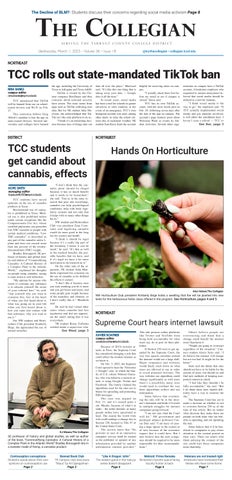
The Decline of BLM?- Students discuss their concerns regarding social media activism Page 8
Wednesday, March 1, 2023 – Volume 36 • Issue 18
@tccthecollegian • collegian.tccd.edu
NORTHEAST
TCC rolls out state-mandated TikTok ban NINA BANKS
campus editor nina.banks@my.tccd.edu
TCC announced that TikTok will be banned from use on schoolissued devices and Wi-Fi on Feb. 17. This restriction follows Greg Abbott’s mandate to ban the app on state-issued devices. Several universities and colleges have banned
the app, including the University of Texas at Arlington and Texas A&M. TikTok is owned by the Chinese company ByteDance and thus concerns about national security have arisen. The issue stems from apps such as TikTok collecting user data. But for NE student Julia MacLeod, she acknowledged that TikTok isn’t the only platform to do so. “I think it’s an interesting decision because tons of things take our
DISTRICT
managing editor hope.smith393@my.tccd.edu
TCC students have mixed opinions on the use of cannabis products in Texas. Recreational use of cannabis is prohibited in Texas. Medical use is also prohibited unless under certain exceptions like the Compassionate-Use Act, where certified physicians can prescribe low-THC cannabis to people with certain medical conditions. “Low THC-cannabis” is described as any part of the cannabis sativa L. plant and does not exceed more than one percent of the tetrahydrocannabinol (THC) weight. Bradley Borougerdi, SE professor of history and global studies and author of “Commodifying Cannabis: A Cultural History of a Complex Plant in the Atlantic World,” explained his thoughts on people using cannabis, saying it came down to self-reflection. “My opinion for anyone who wants to consume any substance is to educate yourself. Be aware of your cultural lens,” he said. “Ask yourself why you want to consume this. Get at the heart of when you first heard about it, what was going on in your life when you first heard about it, how you came into contact with that substance, why you want to use it.” For NW student and Horticulture Club president Kimberly Birge, she appreciated the use of natural remedies.
helpful for receiving alerts on campus. “I actually check there first before my email to see if campus is closed,” Knox said. TCC has its own TikTok account, with the most recent post on Feb. 24, following seven days after the ban of the app on campus. The account’s page features posts about Welcome Week or events by Student Activities. Several other orga-
nizations on campus have a TikTok account. A bookstore employee who requested to remain anonymous believed that social media should be utilized as a tool for students. “I think social media is the way to go,” the employee said. “If TCC actually implemented social media and got students involved, it will affect the enrollment here. I haven’t seen a school — TCC or
See Ban, page 3
NORTHWEST
TCC students get candid about cannabis, effects HOPE SMITH
data all over the place,” MacLeod said. “It’s like this one thing that is taking away your data — Google does it all the time.” In recent years, social media has been a tool for schools to garner attraction or alert students in the event of an emergency. TCC’s own Instagram account was used, among other alerts, to relay the school closures due to inclement weather. NE student Sam Knox finds the account
“I don’t think that the cannabis plant should be illegal because it has so much benefit and it needs to be researched,” she said. “Just as in the same research that goes into microfungi, cannabis can help psychological conditions, help with body regulatory systems and not only that it helps with so many other things for us.” NW student and Horticulture Club vice president Zane Coonsalso said legalizing cannabis would do more good in the long run for science and health. “I think it should be legal because it’s a really big part of the economy. I mean, it can be taxed,” he said. “It’s that as well as the medical benefits, the possible benefits that we have, and if it’s legal we have a lot more motivation to do research on it.” On the other side of the argument, TR student John Mendiola expressed his concerns on the use of cannabis as he disliked the effects it caused. “I don’t like it because once you start smoking you do it more and you get lazier and lazier, and some people gain weight because of the munchies and whatnot, so I don’t really like it,” Mendiola said. He said he had visited other states where cannabis had less regulation and did not appreciate the smell, noting that it was everywhere. TR student Reese Tydlaska worked under a supervisor who
Hands On Horticulture
Alex Hoben/The Collegian
NW Horticulture Club president Kimberly Birge holds a seedling that the will be planted into new beds for the herbaceous herbs class offered in the program. See Horticulture, pages 4 and 5.
NORTHEAST
Supreme Court hears internet lawsuit
See Weed, page 3
SE professor of history and global studies, as well as author of the book, “Commodifying Cannabis: A Cultural History of a Complex Plant in the Atlantic World” Bradley Borougerdi sits in a sweater made of hemp, a cannabis product.
Because of 2015s terrorist attacks in Paris, the Supreme Court has considered changing a rule that could affect the modern internet as we know it. On Oct. 3, 2022, the Supreme Court agreed to hear the “Gonzalez v. Google” case, in which the family of U.S. citizen Nohemi Gonzales, who was killed in a terrorist attack, is suing Google, Twitter and Facebook. The family claimed the algorithms used for the sites are to blame for spreading and promoting ISIS messages. The case was argued on Feb. 21, and it’s caused quite a stir. Mainly, because of what’s at stake – the entire internet, as many people online have speculated at least. The reason the world wide web could undergo a change lies in Section 230, located in Title 47 of the United States Code. The section states that “No provider or user of an interactive computer service shall be treated as the publisher or speaker of any information provided by another information content provider.”
This rule protects online platforms like Twitter and YouTube from being held accountable for what users say, do or post on their platforms. If Section 230 were to get upended by the Supreme Court, the way free speech circulates around the internet would see a large shift. Major companies and websites would likely crack down on what users are allowed to say in order to avoid potential lawsuits. The way websites use algorithms could change significantly as well since there’s a possibility many sites would need to overhaul the way their algorithms collect and use information. Some believe that overturning the rule will be to the internet’s detriment and think it’ll result in multiple struggles for internet companies going forward. “I am not sure what the Court will do,” NE government and paralegal adjunct professor Caesar Diaz said. “I am leery of causing a huge uproar to the system as of now because of the economic impact that it could have. But I also believe that the tech companies should be required to be more responsible for their recommendations.”
Others believe people are overreacting and think that a change could benefit the internet more than harm it. “People are going to overreact regardless of the situation,” Connect student Alexis Seitz said. “I do believe the internet will change but not too bad. It might be for the better.” Seitz said she thinks that sites should not have to be liable for the actions of users, but should try and find new methods of keeping userposted content in check. “I feel like they shouldn’t be fully accountable,” she said. “But I do think these sites should definitely have a way to monitor the site.” The Supreme Court has yet to make a decision on whether or not to overturn Section 230 as of the time of this article. But no matter what decision they make there are people on both sides who see benefits to upending and not upending the rule. Some believe that it’d be beneficial to companies to pay closer attention to the content posted on their sites. There are others who think policing the content of the site could hurt these companies more than help.
Contraception conceptions Students speak about their own opinions on contraception use Page 2
“Like A Dragon: Ishin” The newest game in the Yakuza series doesn’t disappoint Page 6
Metroid: Prime Remake Nintendo’s favorite space-faring bounty hunter is back Page 6
Veterans are not treated right Americans have mistreated their heroes who have come home Page 7
XAVIER BOATNER
campus editor xavier.boatner@my.tccd.edu
KJ Means/The Collegian
Banned Book Club TR Campus club discusses “Maus” by Art Spiegalman Page 2