The Collegian collegian.tccd.edu
“Call of Duty: Warzone” review Page 3
S E RV I N G T H E TA R R A N T C O U N T Y C O L L E G E D I S T R I C T
Wednesday, March 25, 2020 – Volume 32 • Issue 21 News
Entertainment
Viewpoint
Editorial
Feature
STUDENTS WEIGH IN Students discuss how their lives are affected. PG. 2
“AFTER HOURS” The Weeknd returns with a fantastic fourth album. PG. 5
FACE MASK IS NECESSARY Why does one expose their face to hoard groceries? PG. 7
TCC COULD’VE DONE MORE It’s not shocking why the community is angry. PG. 7
WOMEN’S HISTORY MONTH Learn about successful and historic Texas women. PG. 8
DISTRICT
Founder of TCC dies at 95
Photo: TCC archives
Dr J. Ardis Bell, the NE Campus library’s namesake, was the president of board of trustees for 32 years. MALIK GILES
campus editor
Brooke Baldwin/The Collegian
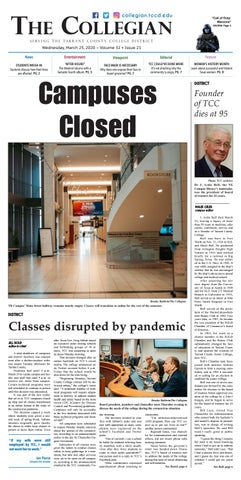
TR Campus’ Main Street hallway remains mostly empty. Classes will transition to online for the rest of the semester.
DISTRICT
Classes disrupted by pandemic JILL BOLD
editor-in-chief
A total shutdown of campuses and district facilities was enacted soon after a shelter-in-place order was issued Tuesday afternoon for Tarrant County. Students had until 5 p.m. March 24 to vacate campus and faculty and staff had until 9 p.m. to retrieve any items from campus. Certain technical programs were still scheduled to continue in person until this decision was announced. It was part of the new reality that set in as TCC campuses closed up shop and all classes transitioned to an online format in the wake of the coronavirus pandemic. The decision capped a week where students were given a second week of spring break. Administrators originally gave faculty the choice to either keep classes in person or move them online. Even
“If my wife were still employed by TCC, I would not want her to work.”
Ian Pierce
Arlington ISD educator
after Texas Gov. Greg Abbott issued an executive order closing schools and forbidding groups of 10 or more, TCC was preparing to open its doors Monday morning. That decision changed after an online backlash on TCC’s social media. The college announced on its Twitter account before 6 p.m. Friday that the school would be shut down for the time being. “Beginning Monday, Tarrant County College courses will be delivered online,” the college’s tweet said. “A minimum number of technical programs will require adjustment in delivery to address student health and safety based on the most recent CDC [Centers for Disease Control and Prevention] guidelines. Campuses will only be accessible to the few students associated with those technical programs and limited staff.” All campuses were scheduled to reopen Monday despite concerns about the spread of the coronavirus, according to an announcement earlier in the day by Chancellor Eugene Giovannini. Instructors in all courses were given the option to conduct classes online to keep gatherings to a minimum, but labs and other services were set to be open on all campuses, according to the announcement emailed to the TCC community Fri-
Brooke Baldwin/The Collegian
Board president, members and chancellor meet Thursday evening to discuss the needs of the college during the coronavirus situation. day morning. The decision seemed to conflict with Abbott’s order and was met with opposition as many complaints were registered on the school’s Facebook and Twitter posts. “Out of curiosity - can a school be liable for students infecting family members with a likely deadly virus after they force students to come to class under quarantine?” one person said in a reply to TCC’s Facebook post. Other commenters expressed apprehension about returning to
classrooms. “I'm immunocompromised AND pregnant. How can TCC expect us to put our lives at risk?” another person commented. Reginald Gates, vice chancellor for communication and external affairs, did not return phone calls seeking comment. Hours before the governor’s order was handed down Thursday, TCC’s board of trustees met to address the needs of the college during this time of social distancing and self-isolation. See Board, page 6
J. Ardis Bell died March 22, leaving a legacy of more than 50 years in medicine, education, community service and as a founder of Tarrant County College. Bell was born in Fort Worth on Nov. 21, 1924 to B.B. and Hazel Bell. He graduated from Arlington Heights High School in 1941 and worked briefly for a railroad in Big Spring, Texas. He was enlisted in the U.S. Navy in 1942. It was while assigned to the ship’s sickbay that he was encouraged by the ship’s physician to attend college and medical school. After acquiring his science degree from the University of Texas at Austin in 1949 and his M.D. from UT Medical Branch in Galveston in 1955, Bell served as an intern at John Peter Smith Hospital in Fort Worth. Bell served as the president of the Hurst-Euless-Bedford Rotary Club in 1962. Five years later, in 1967, he became the vice president of the H-E-B Chamber of Commerce’s board of directors. In 1963, his work as a charter member in the H-E-B Chamber and the Rotary Club substantially changed the face of education in Tarrant County and spurred the creation of Tarrant County Junior College, now TCC. Bell’s Chamber task force joined with attorney Jenkins Garrett to form a steering committee, and in 1965 it succeeded in calling for an election to establish the junior college. Bell was one of seven candidates put forward by the committee for election to the board of trustees.Voters approved creation of the college by a 2-to-1 margin, and he began to serve for the board of trustees for 43 years. Bill Lace, retired Vice Chancellor for Administration who earned both his bachelor’s and master's degrees in journalism, was in charge of writing Bell’s speeches. He said Bill wasn’t really good at public speaking. “I guess the thing I remember most is my knees knocking when I had to get up to address someone,” Bell told Lace. “But I had a sincere drive and desire, and I guess my fear was one of whether I could get my point across.” See Bell, page 6
News
Page 2 • March 25, 2020
The Collegian
Brooke Baldwin/The Collegian
TCC district decides to shut down all campuses due to a shelter-in-place order. A rare photo demonstrates the once-busy TR Campus now eerily vacant.
DISTRICT
Virus causes drastic change for students LISSETTE SALGADO campus editor
Everything is changing for students and fast. While courses shift entirely online, one student who works for a disinfection company had his workload double, while another working for an event center had his hours cut entirely. “I have never been successful with online courses in general and highly doubt I’m about to suddenly be great at them,” NE student Harley Need said. “Plus this was supposed to be my last semester.” Need is a photography student who was excited to shoot some upcoming projects but can no longer access the camera equipment she needs at school. Then they have new worries — Will their immunosuppressed relatives be OK? And how long will their household goods last? Will they still graduate? “It’s causing me a lot of anxiety,” NE student Ande Floyd said.
At least 123,000 U.S. public and private schools have closed as of March 23, affecting 55 million students according to edweek.org.. TR student Maleena Wang has completed online classes before, but math is a problem for her. While she believes she can get through speech and federal government online, she said her math professor uses complex math verbiage. “I have to try to figure out how to solve all my problems with the examples online,” Wang said. TR student Diane Wanger saw that TCC recently posted videos of how to use Blackboard. “Wow, that would have been nice when I first started taking courses last semester,” Wanger said. NE English as a Second Language student Chin-hua Mu says she is OK with online classes but is uncertain how her professors will teach with the lack of faceto-face communication. She worries that online classes will prevent ESL students like her from learning
the proper pronunciation she gets through in-person communication. “If we have any questions, our professor would try to explain slowly,” Mu said. ”But now, I’m not sure anymore.” NE student Floyd loved being in her classes. It is her last semester before graduating but worries if that will even happen. “To have them isolated to strictly screen time, it’s heartbreaking,” Floyd said. SE student Kylie Hodges is also a UTA student, Zeta Tau Alpha sorority member and a dance teacher at a local studio. She says she values the additional free time and less time on her phone. “Personally, it has given me more time to spend with my family and my new puppy,” Hodges said. There are students like Wang who find themselves staying home but have family members who continue to go out to workplaces that don’t require the face masks for employees staying six feet apart. Wang is also worried about her
father who works in a restaurant. He cooks in the kitchen so he was able to keep his job for those ordering food curbside. “I know his respiratory and immune system isn’t the best, but I know he has no other choice to keep working, sadly,” she said. Students like Need have family members who are either immunocompromised or have health issues. More than schoolwork, she says she constantly worries about whether or not they will be OK if they contract the virus. “I’m not stressed immensely about getting it, my bigger fear is my mom getting it,” Need said. While some students have had their hours cut back, or they were laid off, others like Need have had their hours increase. Need works for a disinfection company. “While most people are stressing about how they’re going to survive without a job, I’m out here wondering when I’m finally going to sleep,” Need said. “I’m working a good 60-70 hours a week. Maybe
upwards of 80.” But she feels blessed to at least still have money coming in. NW student Ja’Lun Morris worked at AT&T stadium but all events have been canceled. He said his classes have labs this semester. This is hands-on work, and at one point he said his teacher instructed him to visit the labs once a week. All campuses are now closed to everyone. But Morris does not feel comfortable going out in public anyway. “I’m staying home, maybe forever,” he said. “I do not feel comfortable going up to TCC.” Younger people have been testing positive yet not presenting symptoms, he said. It’s not safe to be around anybody. Students now have much more than schoolwork to worry about as COVID-19 infects every part of their lives. “I’m a little concerned on how the rest of the semester will turn out and how everything will go down,” Hodges said.
DISTRICT
Staff raises concern with protocol during pandemic DANG LE
managing editor
Some students and staff members have expressed frustration with both TCC’s decisions and the way the college has communicated them in the wake of the coronavirus. TR student Diane Wanger said she tried to look for information about her classes on the morning of Friday, March 13, yet there was nothing on Blackboard. “I asked myself, ‘Why is there no push notification of this to the students, and further, why is nothing regarding this on Blackboard?’” Wanger said. Wanger called both the chancellor’s office and the NE Campus president to leave messages of concern and frustration that day. Associate vice chancellor David Ximenez returned her call Monday, and she told him the college should communicate daily with the students. “He said that he would pass that message on, but by the tone of his voice, it did not seem as though he thought that there was any chance that daily emails would be forthcoming,” she said. Wanger’s prediction turned out to be true, as TCC did not communicate daily to students. The college made two official responses ever since the coronavirus, and they were exactly a week apart on March 13 and 20. In contrast, The University of Texas at Arlington posts daily updates on its social media accounts regarding the situations. It, along with Baylor University and many other colleges have announced since Tuesday that they would move to online instruction for the remainder of the semester. TCC, though, allowed individual instructors to choose the method of course delivery, according to an
Brooke Baldwin/The Collegian
South Campus Jenkins Garrett library is devoid of any students or staff as all campuses close completely March 24. Online resources are still available to students through library.tccd.edu. email sent March 20. “Faculty have chosen the appropriate mode of instruction for their respective classes and should have emailed details to each student's myTCC email address,” according to the site. This decision came after Texas Gov. Greg Abbott announced in an executive order March 19 that social gatherings should be limited to no more than 10 people and to close all schools until April 3. TCC posted on its website and social media accounts March 13 that spring break would be extended a week.
Yet faculty heard they would resume normal operations to their respective campuses on March 16 and hold campuswide meetings to discuss how to move forward. This, too, ignored recommendations of social distancing. It was not until the evening of Sunday, March 15 that faculty got the official word that they were not to report in person March 16 but would hear from their department chairs and divisional deans about what to do next. The Collegian reached out Friday to vice chancellor of communication and external affairs Reginald
Gates but did not receive an immediate response. While Baylor University offered online classes until April 3 in its first Instagram post on March 11, TCC students were still hanging. It also took a lot of students bombarding TCC’s previous posts across all social media handles and even creating an online petition to move classes online before the college responded March 13. Before college officials updated students Friday, the international admissions office sent out an email March 18, allowing international students to take more online cours-
es. Previously, only one three-hour course was allowed for international students. Staff members also shared frustration that they had to report to their offices while faculty could work from home and students were out. NE Campus support services coordinator Aaron Carrillo was supposed to report to work in person Monday. While his job is to support staff and faculty members’ IT and media needs, he believes things can be addressed via WebEx, a software that allows meeting online. “It doesn’t make sense to me that we would encourage students and faculty to come to campus,” he said. Carrillo currently works from home and attends WebEx meetings as needed as he traveled to Colorado, a high-risk state. While TCC did not ask him to quarantine, he didn’t feel comfortable being around fellow staff members, but he didn’t see it as a requirement. “I don’t see TCC requiring people to quarantine if they visit high-risk areas,” he said. NE general maintenance staffer Jeremy Greene expressed similar concerns. Greene is a single parent of two and a full-time employee. With most schools close to maximizing social distancing, he said he needed to stay at home with his children. He is using his sick leave and vacation time to take time off work. Greene will have a week before the sick and vacation leave runs out, and it will affect his pay, which is detrimental for a single parent. “I think TCC is doing what it can to protect the student body and the community the best they can,” he said. “I just don’t think they’ve taken into consideration employees, their families or an employee’s particular situations.”
The Collegian
News
March 25, 2020 • Page 3
NORTHWEST
Doctor provides lifestyle habits to improve health for all women LAUREN ROBERTS reporter
Every woman wants to live her best life, but some just don’t know how to, and a Fort Worth family medicine doctor told women they can start living healthy lives with several simple steps. In observance of Women’s History Month in March, Dr. Brighton Richie Miller presented Living Your Best Life toward total wellness for women on NW campus March 4. Granting one hour every day to “you” provides a way to feel better daily. “Do something you enjoy that does not include social media,” she said. “It has to be for you and you only. I got my nails done before coming to give this presentation.” Restful sleep is essential and requires no screen an hour before bed. “Put away work-related things and never go to bed angry because you’ll be up all night thinking about it,” Miller said. To get better sleep, she suggested setting a bedtime alarm and going to bed at the same time every night.
Exercise contributes to well-being, and doing so at night instead of drinking caffeine or coffee is beneficial, she said. One out of three people in the U.S. is overweight, which causes a lot of health problems. While many people don’t enjoy exercising, she told the participants to try a favorite activity and start with 10 minutes. “Women’s number one cause of death is heart disease, so it is very important to exercise,” she said. Miller stressed the need to eat a healthy diet. “Have a rainbow plate, eat something of every color, in every food category,” she said. “Fast food places are starting to have healthy options, so that’s not an excuse. Choose a kid’s meal to reduce portion size.” Miller said to lose weight, women need to eat 500-1,000 fewer calories for seven days to lose one pound. But she reminded that losing weight did not mean one should starve themselves. For those things in life a person just can’t control, Miller suggested prayer or meditation. Meditation can
be difficult. It’s natural for our minds to wander. “Just come back to your breathing and focus on that,” Miller said. “It helps depression, anxiety, internal pain and more. There is evidence that if you meditate, you’ll live longer.” Miller said that food is the most common drug people tend to lean on when dealing with anxiety, and she emphasized that, “It’s okay to take medications for anxiety.” Miller warned that as important as it is for women to have a social life, they should not abuse substances when going out and having fun. “Smoking is the worst thing to do to yourself,” she said. “Quitting isn’t easy, but if someone is ready to quit, cold turkey will help.” NW kinesiology administrative assistant April Miske told the audience about the free access students have to the campus gym. Intramural sports students can join to get a good workout in. NW student Aldera Amore said she learned a lot from Miller. “It was very educational, and she was very engaging with the audience,” she said.
Brooke Baldwin/The Collegian
Dr. Brighton Richie Miller discusses simple steps to help women in the audience towards a balanced lifestyle on NW Campus March 4.
Christian Garza/The Collegian
Independent art teacher Lindsay Whittenberg (right) demonstrates to TR student Ciara McMurry (left) how to utilize painting to express motivational quotes.
TRINITY RIVER
Students learn empowerment through watercolors MALIK GILES
campus editor
Art is one of the many different ways for women to express their opinion about everyday society. Whether it’s a masterpiece portrait or water coloring painting, it’s still empowering, said independent art teacher Lindsay Whittenberg, who brought her art cart to
TR’s Idea Store to give students that empowerment on March 5. “A lot of people haven't thought about art since 6th grade when they did in elementary school, so this will get the students out of their comfort zone,” Whittenberg said. Students participated in a water coloring activity where they wrote a meaningful quote from their idols in the pictures they painted. “My past exposed the light,
and now my future is even brighter because of it” was TR student Marquita Reynolds’ quote. She said the person she looked up to was herself and created this quote to put in her painting. TR student Tyon Wesley, who is majoring in forensic psychology, takes pride in women's history month and quoted Marilyn Monroe who said, “I don’t mind being in a man’s world as long as I can be a woman in it.” TR film student Mariana
Nasir said that art is her favorite which was why she attended the event. Nasir quoted her best friend saying, “This is all a test” and explained that when someone is having a bad day or is in a bad place, one should remember that life is testing them to succeed. Though this event was originally for women to be empowered through art, men from TCC participated. TR student Tristian Brooks
said actor Keiynan Lonsdale’s, who played in Love, Simon and The Flash, quotes were the inspiration behind his art. For some of the students, water coloring was not only empowering but also stress-relieving. Whittenberg wanted students to learn that everyone has a creative side, even if it’s just water coloring. “Once people learn that, it can be very therapeutic to tap into that,” she said.
The Collegian is
Now Hiring for fall semester
Located on NE campus
Apply now
@ collegian.tccd.edu
Office Assistant
Must be work study eligible and available Tue & Thu during lunch hours
Editors
Must have taken or are currently enrolled in Media Writing
JUSTIN T. HOLT Mallory, Lollar, Holt & Associates, P.C.
Follow us online @TCCtheCollegian
3 Tarrant County Locations 817-831-4321 www.TrafficTX.com
TRAFFIC TICKETS
Drug Offenses • DWI Assault • Speeding Accident Citation Class C Misdemeanors
WARRANTS LIFTED
Join the discussion collegian.tccd.edu
News
Page 4 • March 25, 2020
The Collegian
Brooke Baldwin/The Collegian
TR student Yorli Ceili Munoz attends the poetry workshop to learn how to improve her creative writing knowledge through comparing styles of writing.
TRINITY RIVER
Poems, lyrics guide writing perspectives FAITH FISHBURN reporter
Instructional associates from TR Writing and Learning Center devoted its final workshop from their learning series to spark students’ interest in poetry March 3. The poetry workshop originated from students’ general lack of interest in relating to poetry, a common theme that TR assistant manager Shawn Stewart said he noticed among students when asked whether or not they like poetry. “I use a lot of music when I am presenting in my poetry workshop, which is cool because people can relate to it a lot more than something that was written 200 years ago,” Stewart said. He encouraged the audience to share their favorite quotes from poetry. The students offered quotes from modern musicians like Frank Ocean, as well as a quote from French Renaissance painter Francois Boucher. Stewart incorporated music into the workshop to help students open up to poetry and find personal relevance. The three songs Stewart played were, “Ironic” by Alanis Morissette, “This is America” by Childish Gambino and “Icon” by
Jaden Smith. “He’s got some beautiful lyrics, and dang that dude can dance,” said Stewart, as he introduced Jaden Smith and went on to play Smith’s “Icon” music video. “Some really good rhymes in this one too.” Stewart presented multiple forms of poetry ranging from conventionally written poetry to advertisements and music, which then turned into an opportunity for the audience to become involved in analyzing the poetry introduced. Stewart asked the audience to share favorite quotes, write two-rhymed line poetry and give interpretations of the different poetry shown. TR student Devin Jones has attended some of the other events in the series and said he finds them to be informative. “I really like coming to the workshops to soak up the information like a sponge,” Jones said. “I think poetry is something that younger generations can really take an interest in because it’s a form of expressionism. It’s another platform to tell who you are.” TR instructional associate Jennifer Solomon helped coordinate the final learning series. “All students, whether they realize it or not, have an author inside of them,” Solomon said.
Brooke Baldwin/The Collegian
TR assistant manager Shawn Stewart leads the final workshop of the learning series, which talks about poetry and helps students compose rhymes from lyrics March 3.
NORTHWEST
Chamber orchestra pays tribute to famous classical compositions JOSHUA HATHAWAY reporter
Musicians from the NW Campus Chamber Orchestra talked about where the classical genre is heading and how to keep it alive. On March 3, students in the orchestra taught and conducted by music instructor Benson Lee, performed several compositions by famous composers, including Tchaikovsky and Mozart.
The orchestra was a mix of seasoned and beginner performers, and the compositions they played were different compared to what the Chamber Orchestra usually performs. Lee said this was the first event that was a strictly classical-style performance with Mozart’s “Requiem.” Lee said they were happy to accept the challenge. After the performance, NW student Caleb Torres, who plays trumpet, said the reason people were drifting away from classical music was because of the quick culture that has sur-
here to help you
do what you love with the products you need MOBILE | ONLINE | IN PERSON
rounded the music industry today. “It resonates. It tugs at your heart, and I think that’s really important,” Torres said. Lee said people want their music in five, three and even two minutes, but that can’t be done with classical music. It takes not only time to build but detailed listening to truly understand it. And in what Lee called today’s “fast-food culture,” that’s becoming a rarer event. “Music is an art of time, not an art of space,” he said.
NW student Catherine Livesay, who plays piano and sings, said orchestra music includes a much wider field, including film compositions. Popular movies like “The Avengers” and “Pirates of the Caribbean” all have scores that draw in people. “Orchestra music isn’t just classical,” Livesay said. Torres and Livesay agreed that this kind of exposure would help the genre altogether. “I think everybody has a love for classical music,” Torres said. “They just need to find it.”
Entertainment
The Collegian
March 25, 2020 • Page 5
GAME REVIEW
Battle royale gaming returns with solid features and design MALIK GILES
campus editor
After Hours, The Weeknd
The Weeknd showcases his unique artistic direction to tell a story of a villainous character in a relationship for his fourth studio record, “After Hours.”
MUSIC REVIEW
R&B trap meets 80s synth pop in fourth studio album DANG LE
managing editor
After releasing his first EP “My Dear Melancholy” in 2018, The Weeknd continues to dig deeper with the darker sound in his newest record. His fourth studio album, “After Hour” is a psychedelic record that could have fit perfectly with the film “Uncut Gems” or Martin Scorsese’s filmography. Lyrically, the album addresses his relationship with Bella Hadid, his drug usage and celebrity life in Los Angeles. That did not mean it was shallow or tried to cater to younger generations by any means. If one ever feels lost in the city, regrets their life choices or is willing to do anything for their lovers, they will relate to what The Weeknd feels and experiences through this album. The production on this album is insane, giving the album both expensive yet rugged vibes. In a project
that requires a lot of personalities like “After Hour,” The Weeknd was able to distinguish himself thanks to the producers. Interestingly, The Weeknd put three Metro Boomin’ tracks together, followed by three tracks produced by Max Martin. It strangely helps with the cohesiveness of the album sonically, seeing how different the approaches are. Boomin’ uses a lot of trap elements to help the singer build tensions for the songs’ storyline, and Martin focuses on the 80s’ synthheavy production. But Martin was able to create a more intricate production to showcase The Weeknd’s smooth and beautiful vocals. With five tracks in this album and their perfect track record The Weeknd and Max Martin are becoming a powerful duo in music. Although the album has multiple highlight moments, the saxophone part towards the end of “In Your Eyes” guarantees the track as a bon-
afide hit. The album was not vocally challenging to The Weeknd, as the producers have done their job to cater to his ability beautifully. However, the soulful ballad “Scared to Live” is the definite shining moment when it comes to showcasing The Weeknd’s voice. Using an interpolation from Elton John’s famous hit, “Your Song,” The Weeknd craftily adds his own twist to make the track the best of the already-no-filler record. In a digital era where most R&B and hip-hop artists try to cram as many songs possible in hopes of inflating their streaming numbers and something will stick with the public (erm, looking at you - Nicki Minaj, Drake, Post Malone, Jhene Aiko). But with “After Hours,” The Weeknd has proved one thing: an artist’s best bet is a tight, cohesive body of work.
Why Transfer to Texas Woman’s University? •
Easy transfer process, and we help maximize transfer credits
•
Variety of program formats
•
Open to women and men
•
Financial aid & scholarships available for transfer students
•
Family housing available or live off campus if you’ve earned more than 60 credit hours
•
We know transfer students — half of TWU’s undergraduate students are transfers
Learn more at TWU.edu/transfer or attend a recruiting event online
For the past few years, battle royale has been the hot new genre in video gaming. PlayerUnknown's Battlegrounds brought the genre to light, Fortnite perfected it with continued updates while more and more gaming companies gravitated toward making their own unique battle royale. Warzone is Call of Duty’s second battle royale game mode, and while the objective is still being the last alive, calling it unique is an understatement. It is the first game in the genre to support 150 players with a decently sized map. Verdansk is a heavily populated map making the gameplay so fast-paced that the players will have to think on their feet before landing. The game has a conscientious currency system in which players can earn money to buy things that are essential to winning a match. These essentials include
things like killstreak rewards and loadout drops which are both components from the multiplayer. Loadout drops are the players’ created weapon classes. This feature has mixed reviews from players but also brings a nice blend of classic Call of Duty multiplayer into battle royale. Warzone gives the players two ways to respawn back to the battlefield. Currency is also a great way to revive fallen teammates but players must be cautious because this will alert other players. Players must go to buy stations to buy whatever they need. There are 50 buy stations scattered across the map which is a good amount. The other way to respawn is through a Gulag match given once to each player. This is a great concept but it needs improvement. One aspect the developers can change is to remove equipment. Random weapons are just fine. Armor is crucial to
survival. Players take five seconds to start regenerating their health. Armor can protect a player from losing health points but once it breaks players are naked without it. Warzone is an original take on battle royale but still has flaws. Killstreaks should be disabled for the last circle, and calling airstrikes in a small space can be unfair to the players who are in an open zone of the circle. Occasionally, games would lag and frames would drop. This is the game’s early stage, so the developers should take notice of these mistakes in future updates. There are currently only trios, solos and the plunder game mode with future updates to come. Players are hoping for them to add duos and squads. Call of Duty Warzone is a good game binge with friends during these times of social distancing.
Photo courtesy of Infinity Ward
In “Call of Duty: Warzone,” players will join in a group of three to battle against other 49 groups in Verdansk, which divides into five main sectors.
News
Page 6 • March 25, 2020
Board
(continued from page 1)
Giovannini submitted a resolution to the board in response to the ever-changing coronavirus situation which “grants authority to the chancellor, until July 1, 2020, to establish rules and procedures he deems necessary and appropriate to combat the spread of the COVID19 virus and to facilitate the continuity of the district’s operations during the state of emergency and its aftermath.” The spread of the coronavirus has led to federal, state and local authorities to declare a state of emergency, district associate general counsel Carol Bracken said. “A robust response by the district may require operational adjustments that are different from the standard policies established by the board of trustees in order to facilitate a flexible and timely
Bell
The Collegian
response to changing conditions,” Bracken said. The resolution called for the chancellor to report to the board what actions he has taken in the first board meeting after July 1. However, board member Diane Patrick asked that this resolution be amended to have the chancellor report monthly to the board starting in April. At each board meeting, any changes that the chancellor put in place would be ratified, chief operating officer Susan Alanis said. The amended resolution passed unanimously. Public comment from Arlington ISD educator Ian Pierce, whose wife is a former South Campus library employee, came via telephone. He expressed concern about TCC’s decision to have the staff
continue to attend work despite students and faculty having the option to stay away from campus. “For the safety of everyone, TCC should employ a full shutdown,” Pierce said. “If my wife were still employed by TCC, I would not want her going to work.” He said his worry extends to the older relatives they come in contact with as well as immuno-compromised friends and family that need protection from exposure. Pierce cited Abbott’s recommendation to shut down nonessential businesses and services and schools as support for his argument. “I would urge TCC to take the time to consider this decision and shut down the campus in full and not require staff members to come to work,” Pierce said.
South Campus president Peter Jordan practices social distancing at the board of trustees meeting March 19.
Photo by: TCC Archives
Photo by: TCC Archives
Bell was a civic and education leader. His journey started when the U.S. Navy noticed his keen interest in the medical field in 1942.
Bell speaks to a graduating class at commencement. He was instrumental for the creation of NE Campus in 1967.
Brooke Baldwin/The Collegian
(continued from page 1)
Bell held the presidency for 32 years until his retirement from the board in 2008. Bell continued to follow TCC events, and the school honored him by naming the NE Campus library after him. “It is really hard to ignore Dr. Bell’s work in the creation of the college,” Lace said. Bell was a member of the North Richland Baptist Church for more than 40 years. He had been married to the Doris Lou Chester in 1948, and the couple had four sons and two daughters. Bell was preceded in death by Doris, his wife of 57 years. He is survived by son Ardis Bell Jr.; daughter Melody Bell Fowler and husband Larry; daughter Lisa Bell Holman and husband Dixon; son Britt Bell and wife Nancy; son Greg Bell and wife Shelly; son David Bell and wife Elizabeth; nine grandchildren and two great-grandchildren.
FINISH STRONG
ONLINE Degree Completion for Working Adults The online Bachelor of Applied Arts and Sciences degree from MSU Texas offers individualized degree plans tailored to your personal, professional, or academic goals. Program concentrations include: > > > > > >
NEW - Childhood/Adolescent Studies NEW - Technology Criminal Justice Healthcare Administration Human Services General Studies BAAS with Business Minor
Our program provides a direct pathway to a bachelor’s degree and accepts the following: • Transfer credit from workforce or technical courses taken at a community college or technical college • Transfer hours from accredited colleges and universities • Credit for military training and experience • Credit for qualifying work experience • College credit for law enforcement training certifications and correctional officer certification
Contact us today for a degree evaluation!
msutexas.edu/flowermound
Opinion
The Collegian
Viewpoints
Religious stereotypes must be reconsidered
LISSETTE SALGADO campus editor
People have the freedom to express their religion. However, religious background doesn’t dictate a person’s identity, but how they interact and communicate does. Basing an opinion on a person just for what religion they practice or lack of doesn’t reflect who they may or may not be. They may be a nice person who happens to practice a religion that isn’t accepted by the majority of the people but is tolerant towards others despite their religion’s rules or misconceptions. It originates from the misunderstanding of what a person’s religion is about or what they practice. One of my sisters, Lindsey, had the displeasure of encountering individuals hostile to her Roman Catholic religion. She did not brag, nor did she
show any hate towards those of the LGBT+ community. Instead, she told someone what she practiced. Someone from the group eavesdropped the conversation and became blindly aggressive, gathering their group to confront her. Lindsey was met with hatred and name-calling but kept her composure, explaining that her religion did not dictate who she is as a person. There was no need for anyone to become hostile at each other based on their different beliefs. Rather, it shows that they were victims of others attacking their beliefs creating an endless cycle of loathing towards those with different views. Despite what people believe about a certain religion, there shouldn’t be a reason to be outright aggressive to the individuals who practice it. Yet, there should be no reason for people in religious groups to use their own practices to validate unnecessary aggression against others. There is a chance that they may become good friends despite clashing views of lifestyles or opinions. If everyone were tolerant towards one another despite disagreements, then there would be less hatred towards religious groups.
Americans shouldn’t disregard face masks
DANG LE
managing edfitor
Coronavirus has become an international pandemic, and in the U.S., most people flock to their nearby markets to stock up groceries, hand sanitizers, disinfecting wipes and toilet paper. However, in Texas, people rarely wear face masks. It’s frustrating because the government and citizens continue to promote social distancing and avoiding touching one’s face. Yet the one thing that helps with those issues, which is a face mask, is not used nearly enough in public places. Coronavirus has been a problem in Asian countries since early this year, and most of their citizens wear face masks in public areas. But it’s not the same in America. In February, a woman wearing a face mask was assaulted and called “a
disease” in New York City. Similarly, multiple attacks on Asians have been reported just because they’re wearing face masks, which is different from American culture. On March 17, China reported zero new local infections, according to The New York Times. In Vietnam, most of the new cases are immigrants and people flying in from outside of the country. While its government has officially said their citizens have to start wearing face masks since March 16, most people have sought out for it since the early days. The result? As of now, there have been just more than 100 official cases with zero deaths out of 90 million citizens in the country, most of them are foreigners or Vietnamese flying back from other countries. But people cannot just expect the officials to stop the spread while going to Target to stock their grocery bags without prevention. A single cough or sneeze can leave the virus in the air for a long time, and with such a highly contagious virus, people need to be aware of wearing face masks more than ever. Wearing a face mask is a precautionary step, and there’s nothing wrong with it. Sometimes, prevention better than cure, and some people just don’t notice that.
March 25, 2020 • Page 7
Editorial
TCC shows lack of control and direction
Michael Harp/The Collegian
No one could have predicted how quickly the coronavirus has spread. So, if the board of trustees needs some time to figure out ways to support students, faculty and staff members, it’s understandable. But for the past week, TCC has shown a lack of preparation and timeliness in its decisions regarding its response to the coronavirus pandemic, and it’s seriously hurting the college, not only in the public’s eyes, but also the eyes of students’ and employees.’ When Baylor University announced its students will transition online until April and that it will extend spring break, TCC students heard no new announcement on how their college would proceed until March 13, three days after Baylor, on the college’s website and social media platforms. Then when other local colleges followed suit and announced that their students will have a longer break, it took hundreds of objections from the students and parents on social media platforms for TCC to notice and announce that it will also transition to the extended break schedule. This reaction by TCC makes it seem as though the college may have had no public plan before spring break despite concerns regarding the outbreak, which had been discussed since late Feb. With such a large and diverse body of students, TCC should have been one of the first to acknowledge the situation. But they didn’t, and that was disappointing to the entire community. Yet when they officially announced that students would have a longer break, they required staff and faculty members to continue working. It portrayed a lack of regard for the health of TCC employees. For some unknown reason, their health problems were not properly addressed. It’s difficult for parents who aren’t offered child care to go to work, knowing that they may need to use all of their sick time or paid time off to accommodate their family’s needs. One single father posted on social media that he was using all of his sick leave. And any staff member who had a weak immune system would have to risk their
health to attend work. The following week, when other colleges and universities updated their students daily, or even hourly, TCC students, faculty and staff were left largely in the dark. There was no information regarding how classes will meet or how students will be graduating — just silence. At the board meeting March 19, the problem was barely addressed even as fear of spreading the virus resulted in four out of seven members calling into the meeting as a means of practicing social distancing. But by the next day, they announced that classes would resume March 23, and the professors would decide whether in-class attendance for their courses is mandatory. By shifting the burden of troubleshooting, the faculty shouldered the transition from in-class to online instruction and the responsibility of figuring out how an online setup would work. It was not right for the school to put undue pressure on students and faculty to cope with the changes without more guidance. By March 20, TCC had announced it would close all campuses until further notice. Since then, the college has sent out multiple emails to remind and also assist its student body in how to navigate online courses. Governor Greg Abbott closed schools through April 3, and Tarrant County issued a shelter-inplace order March 24. Faculty members who thought they could teach in person as recently as the morning of March 20 are now scrambling to move online. TCC continues to play catch up with the medical professionals’ recommendations urging further quarantine and school closures. TCC is a good college that has helped many students of all ages and circumstances find success. However, in this particular issue, it could have done more to support its students, faculty and staff. One may have to wonder: Had they listened to their community earlier, would they have solved all these problems more effectively?
Join the discussion at collegian.tccd.edu Facebook.com/ TCCtheCollegian
Meet
the
Staff
Letter Policy
EDITOR-IN-CHIEF Jill Bold
MANAGING EDITOR Dang Le
MARKETING AND ADVERTISING COORDINATOR Conner Love
LAYOUT & DESIGN Abbas Ghor Thami Santos
FEATURE EDITOR Michael Foster-Sanders
MULTIMEDIA EDITORS Juan Ibarra
PHOTO EDITOR Brooke Baldwin
ILLUSTRATOR Michael Harp
CAMPUS EDITORS Malik Giles Lissette Salgado
WEB COORDINATOR Ivy Glaze
The Collegian is a weekly student publication serving the Tarrant County College District. Editorial statements and advertisements do not necessarily reflect the opinion of the TCC administration. Letters to the paper should be 150 words or less, free from libel and poor taste and include the writer’s Colleague ID or telephone number (the numbers will not be published). Letters may be brought to The Collegian office (NCAB 1124A, NE Campus), or mailed to:
PROFESSIONAL STAFF PRODUCTION MANAGER Stacy Luecker
Instagram @TCCtheCollegian
Twitter @TCCtheCollegian
ADVISERS Chris Whitley, Jocelyn Tatum
The Collegian • 828 Harwood Road Hurst, TX 76054 Office: 817-515-6391 Editor: 817-515-6394 Advertising: 817-515-6619 email: collegian.editor@tccd.edu TCC is an equal opportunity institution that provides educational and employment opportunities on the basis of merit and without discrimination because of race, color, religion, sex, age, national origin, veteran status or disability.
Page 8 • March 25, 2020
Feature
The Collegian
Famous women from all over the Lone Star state impact society in politics, music, sports
Selena Quintanilla-Pérez
(April 16, 1971-March 31, 1995): Born in Lake Jackson, Texas, she is a Grammy-winning artist and also one of the best-selling female artists in Latin music history.
Barbara Jordan
(Feb. 21, 1936Jan. 17, 1996): From Houston, she was the first African American elected to the Texas Senate after Reconstruction and the first southern African American woman elected to the U.S. House of Representatives.
Simone Biles
(March 14, 1997-): From Spring, Texas, she is the most decorated American gymnast with 30 Olympic and World Championship medals.
Wendy Davis
Sandra Day O’Connor
(March 26, 1930-): The first woman to serve on the Supreme Court of the United States was born in El Paso.
Illustration by: Abbas Ghor/The Collegian Photo Credits: Barbara Jordan/Library of Congress. Selena Quintanilla-Pérez/IMDB. Simone Biles/DFree/Shutterstock.com. Sandra Day O’Connor/Library of Congress. Wendy Davis/Eugene Powers/Shutterstock.com
(May 16, 1963-): The former TCC alumna is a Democratic politician from Fort Worth. She blocked Senate Bill 5 in 2013, which included more abortion regulations in Texas.