collegian.tccd.edu
Evil never dies PG. 3
Wednesday, October 27, 2021 – Volume 34 • Issue 8 DISTRICT
Booster shots fully authorized by CDC JUAN SALINAS campus editor
The Centers for Disease Control and Prevention on Oct. 21 recommended COVID-19 booster shots for individuals who received a Pfizer or Moderna vaccine. The booster is recommended for people who are either 65 and older, have underlying medical conditions, live or work in high-risk areas more than six months after receiving a second vaccine dose. The CDC also allowed people who are fully vaccinated to get a booster shot different from their original vaccine. “These recommendations are another example of our fundamental commitment to protect as many people as possible from COVID-19,” CDC director Dr. Rochelle Walensky said in a statement. “The evidence shows that all three COVID-19 vaccines authorized in the United States are safe – as demonstrated by the over 400 million vaccine doses already given. And, they are all highly effective in reducing the risk of severe disease, hospitalization and death, even in the midst of the widely circulating Delta variant.” This was followed by a Food and Drug Administration panel that recommended a Moderna booster shot to people over the age of 65 and other vulnerable groups. Two
Alex Hoben/The Collegian
COVID-19 vaccinations put into a biohazard bin on NE Campus.
weeks ago, the same panel recommended that Johnson & Johnson vaccine recipients older than 18 receive a booster shot two months after receiving the first. These recommendations come after health experts and scientists earlier this month asked the Biden administration to halt its plans to distribute booster shots to fully vaccinated Americans, saying there is not enough data to justify it yet. Also, the federal government has received criticism from the World Health Organization about pursuing booster shots while third-world countries still have a low percentage of the population to receive the first dose of the vaccine. “I definitely think that they would come first as far as a priority over us since we already have access to that,” NW student Sara Patterson said. In Tarrant County, 60.2% of the population has been fully vaccinated, and with the authorization of boosters, the number of people getting vaccinated is increasing, according to the Centers for Disease Control and Prevention. NW student Connor Gax said he is open to getting a booster shot but won’t because he isn’t in the risk groups that the FDA and CDC approved. “I’m fine with my two doses already,” he said. Twenty-five people voted in an online poll The Collegian conducted, and 83% of those students said they would get a booster shot if given the opportunity. On the state level, Gov. Greg Abbott signed a new executive order Oct. 11 banning private businesses from having vaccine mandates for entry. NW student Cynthia Maldonado expressed her disapproval of the order. She said if the government doesn’t actively try to enforce vaccination, Texans will be stuck in a COVID roller coaster. “I understand that not everybody wants to get the vaccine, but then they don’t want to wear the mask either,” she said Abbott called a special session on the issue, but the Legislature failed to pass anything by the Oct. 19 deadline after business groups lobbied against it, according to the Texas Tribune. TCC is currently offering booster shots to anyone who is immune-compromised and over the age of 12. To schedule an appointment, visit the COVID-19 updates page on the TCC website.
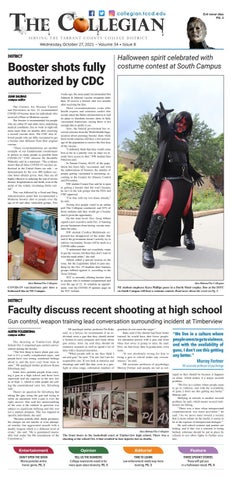
Halloween spirit celebrated with costume contest at South Campus
Alex Hoben/The Collegian
NE student employee Kara Phillips poses in a Darth Maul cosplay. Boo at the SSTU on South Campus will host a costume contest. Read more about the event on Pg. 2
DISTRICT
Faculty discuss recent shooting at high school Gun control, weapon training lead conversation surrounding incident at Timberview AUSTIN FOLKERTSMA campus editor
The shooting at Timberview High School Oct. 6 resparked gun control conversations among the faculty. “The first thing to know about gun control is it’s a really complicated topic, and people have very strong, emotional feelings about it, and the laws vary from state to state,” NE paralegal studies professor Karen Silverberg said. Some laws prohibit people from carrying a gun in a high school and those laws supersede and are superior to the new law as of Sept. 1, which is what people are calling the constitutional carry law, Silverberg said. There's no question for Silverberg that taking the gun, using the gun and trying to settle an argument with a gun is ever the right answer. She said her understanding of the case is the student in question was subject to significant bullying and this was not a random situation. This was targeted at specific individuals, she said. “Because nobody died, thank goodness, the charges are not murder or even attempted murder, but aggravated assault with a deadly weapon which is a different level of crime,” she said. “He is guaranteed reasonable bail under the 8th amendment of the Constitution.”
NE paralegal studies professor Pat Rake said, as a lawyer, he recommends if an individual owns a gun that they should attend a license-to-carry program and learn about gun safety. Also, he said they should do extensive research as well as spend a lot of time with a licensed instructor. “When people talk to me they think I am anti-gun,” he said. “I’m not, but I am for responsible care. If you look at statistics and shootings and stuff like that, even in a gunfight at close range, substantial numbers of
gunshots do not reach the target.” Rake said if the shooter had been better trained, he would have shot fewer people. An untrained person with a gun and from three feet away is going to miss, he said. Five, six feet away, they’re gonna miss, even more. “It was absolutely wrong for him to bring a gun to school under any circumstances,” he said. NE associate professor of psychology Murray Fortner said people are not as out-
Alex Hoben/The Collegian
The front doors to the basketball court at Timberview high school. There was a shooting at the school Oct. 6 that resulted in four injuries but no deaths.
“We live in a culture where people seem to go to violence, and with the availability of guns, I don’t see this getting any better.”
Murray Fortner
NE associate professor of psychology raged as they should be because it happens so often, which makes it a major societal problem. “We live in a culture where people seem to go to violence, and with the availability of guns, I don't see this getting any better,” Murray said. Bullying in schools is another societal problem, he said, which means several institutions are failing. “There was a time when interpersonal communication was more prevalent,” he said. “As we move more toward a society that is more reliant on the media, it seems to be at the expense of interpersonal dialogue.” He said school systems and parents are failing, and if this was a reaction to being bullied, solutions should be put in place by schools to not allow fights to further escalate.
Entertainment
Opinion
Editorial
Feature
DON’T OPEN THE BOOK Movie parodies entire horror genre. PG. 3
TELL US THE NUMBERS College newsrooms need to be more open about diversity. PG. 5
TIME TO LEARN Law enforcement needs way more training. PG. 3
THREE SPOOKY STORIES These will get you in a Halloween mood. PG. 4
NEWS
2 • Wednesday, October 27, 2021 NORTHWEST
Dance company prepares for fall concert
Photo courtesy of Lacreacia Sanders
NW Campus dance company Mosaic Dance Project rehearses ahead of its concert Oct. 30. The concert is titled “Mosaic and Friends in Motion.”
Concert brings in multiple dance programs for collaborative effort LOGAN EVANS
managing editor
NW dance company Mosaic Dance Project will perform their annual Fall concert “Mosaic and Friends in Motion” Oct. 30 on NW campus. This comes during the first semester back for the company after nearly three semesters of performing virtually. Company director Lacreacia Sanders hopes to rekindle the spirit of past years. “Students are excited, and there’s just so much energy that’s come back into the space,” she said. “We’re trying to catch our breath.” Unlike past years, the Oct. 30 event will
feature contributions from dancers outside the company, including jazz and ballet students and guest dancers from Chisholm Trail High School. “We really wanted to make sure the title of our concert shows that it’s not just about Mosaic,” Sanders said. “It’s really about this whole community.” Sanders said many of her students felt isolated performing virtually and are excited to showcase their work in person. NW associate dance professor Amy Jennings believes the return to in-person performance is a return to the essence of what the art form is about. “Dance is so visceral,” she said. “I always talk about it as the soul pushing past the bones, through the flesh and out to the
SOUTH
Free Halloween event provides tricks, treats JOSE ROMERO editor-in-chief
Free food, carnival games and more will be offered at South Campus’ Boo at the SSTU event Oct. 28. “Boo at the SSTU is a family-friendly event where students and their families can participate in free games and activities,” said Ana Contreras, South Student Activities coordinator. Information about various student organizations will be handed out, and tables
with activities will also be set up with prizes and candy for attendees. There will be a trackless train ride, face painting, cookie decorating, carnival games, free pizza and a costume contest. “I'm excited about the costume contest for all ages,” Contreras said. “It's fun to see the little ones dress up.” She encourages students to bring canned foods to donate to the food pantry. The event will begin at 6:00 p.m. and will be hosted at the SSTU patio. Other Halloween events can be found on the TCC event calendar.
audience.” The Oct. 30 event will consist of a 1 p.m. matinee performance and a 4 p.m. afternoon performance. Right before the concert, NW Dance Club will participate in the 2021 Walk To End Alzheimer ’s. Students and faculty will walk six miles around the lake by NW campus from 9 a.m. to 11 a.m. to help raise money for Alzheimer’s research. The campus walk is tied to a larger event happening throughout Fort Worth, centered around the main walk at The Shops at Clearfork. Jennings — who has done extensive work with dance and memory loss — spearheaded the Dance Club’s inclusion. “This semester, I just really wanted to give back,” she said.
Build a Bolder Future
Outside of NW Campus, dance programs across the district continue to rebuild. On October 16, TCC held “ C o n v e rg e R e - i m a g i n e d , ” a c o n c e r t featuring local high school dance companies, local dance studios and TCC faculty. The event was a success, said SE associate dance professor Brandy NiccolaiBelfi. She points to the cooperation of dance programs across the district in bringing the art form back to TCC. “It really was a collaboration between my campus, NW Campus and the South Campus,” she said. “If I didn’t have those other campuses on my side, I don’t know if it would have gone as smoothly.”
with a degree from Texas Woman’s
Join us at our next ‘First Saturday’ event in Denton
Saturday, Nov. 6, 10 a.m.-1 p.m. Learn about: • Admissions • Financial Aid • Scholarships
SOUTH
Breast cancer gets spotlight during virtual presentation BLAIR PEACOCK reporter
Health services put on a virtual presentation Oct. 21 helping people understand more about breast cancer. Dr. Jeremy Ross, an oncologist in Fort Worth, hosted the presentation and outlined what breast cancer is all about. ”Breast cancer is very common,” he said. “What is the main risk factor for breast cancer? Being a woman.” Students had many questions for Ross, mainly about risk. NW administrative assistant Diane Alvarado asked if breastfeeding affects breast cancer risk. Ross answered yes, it would decrease the risk due to estrogen levels being lowered. Ross said 12 out of every 100 women
right now have been diagnosed with breast cancer. “It’s something I think as a woman, she has to plan for,” Ross said. Student Crystal Martz asked how the pandemic has impacted breast cancer screenings and diagnoses. Ross said there are more patients who have not been screened or diagnosed simply because of waiting too long to get an appointment. The pandemic impacts the health world in a whole different way now, but for some patients, it is important to not wait, he said. “Mammograms save lives,” he said. “Remember, it is not always a lump. Just any change should make someone want to get screened.” Students applauded Ross after the indepth explanation of breast cancer and the number of resources that women and even men can use to help themselves or others.
Register today Tour the campus — Families welcome!
ENTERTAINMENT
Wednesday, October 27, 2021 • 3
MOVIE REVIEW
Haddonfield bands together to fight Myers
Photo courtesy of Universal Pictures
“Halloween Kills” is a sequel of the 2018 film just called “Halloween.” Jamie Lee Curtis reprises her role as Laurie Strode, the main protagonist of the original 1978 movie. Thought to be dead, Michael Myers returns to terrorize the citizens of Haddonfield. MICHAEL FOSTER-SANDERS senior producer
The slasher genre has had its share of killers, but not like Michael Myers. He is a void of a man whose sole purpose is to kill. The franchise started as a one-off idea from John Carpenter and the late Debra Hill but then became a convoluted, greedy mess because of its success, which brought an unnecessary amount of sequels. Myers was reduced from an apex predator into a dummy for rappers to do kung fu moves on. “Halloween Kills” undoes the malarky and brings Michael Myers back like a prime Mike Tyson out for blood. People may be confused about the “Halloween” series’ timeline, but there are only three movies that are officially canon now. “Halloween 1978,” “Halloween 2018” and “Halloween Kills.” Other movies that have been omitted from the timeline are honored in the movie with Easter eggs that fans will geek out over once dis-
covered. Critics say the first trailers gave away too much of the movie, but that was just a ruse because it was only a snippet of the carnage Myers inflicts on Haddonfield — the fictional neighborhood the film is based in. The movie starts at the end of 1978’s “Halloween” as the sheriffs are looking for Michael after he survived six gunshots to the chest by Dr.Loomis. “Halloween Kills” answers how he landed back in a mental institution on “Halloween 2018.” The movie brings viewers back to the present — the night of Halloween after the Strode family trapped him in the burning family compound. The town of Haddonfield isn’t aware of the new killing spree that Myers did, so Halloween festivities are still going as normal. The survivors of Myers’ first string of murders from 40 years ago are in a pub commemorating the fallen with their hero Laurie Strode when phone alerts start pinging, and a newscast alerts them that a new reign of terror has started.
The original scream queen Jamie Lee Curtis returns as Laurie Strode for her second showdown with Myers. She is a grandmother, and a mother, who wants to protect her family and town but is sidelined in the hospital with injuries as the town seeks mob justice when finding out Michael is still alive. The reason this movie works is because of the character development that makes you feel for the characters afflicted by Myers’ evil — especially with flashbacks for certain characters. Thus giving people old enough in the town to remember the first murders he committed PTSD, and the new generation an uneasy feeling, contemplating whether or not the boogeyman is really real. But make no mistake, they will know evil is real by the time the movie is over. There are two standout actors in this movie. Judy Greer plays Karen Strode, and she plays the daughter and mother role to a tee. She lies to her mom, reassuring her that Michael is dead so she could heal, and tries to stop her
daughter Allyson from joining the mob to kill Michael. Anthony Michael Hall plays the grown-up Tommy Doyle with such conviction that the viewer feels his past childhood trauma with his encounter with Myers. Michael is mean in this movie. There is no other way to say it. His brutality is cranked up to the max, making each kill feel like a personal vendetta. The camera angles intensify the rage that Myers has and could make a veteran horror movie viewer say “holy shit.” No horror movie is complete without a score, and “Halloween” creator John Carpenter and his son update the classic theme two more times to creep out the viewers. The supplemental tracks throughout the movie will keep viewers on the edge of their seats with suspense. No cheap jump scares here, only pure terror. Viewers can catch the movie as a same-day release in theaters or on NBC’s Peacock.
MOVIE RETROSPECTIVE
Reading sacred text always leads to bad results AUSTIN FOLKERTSMA FOLKERTSMA campus editor
Illustration by Abbas Ghor/The Collegian
“Cabin in The Woods” is a stereotypical horror film and that’s on purpose. Chris Hemsworth and Kristen Connolly star in this Universal Studios production about five college students that vacation to a relative’s cabin, but little do they know, the choices they make are about to cost them. Things go away after one of them opens a diary and starts reading it. After reading the sacred Latin text, their doom is soon to be discovered. As monsters began assaulting them, the five parted ways, coming face-to-face with a family of redneck zombies in their fight to survive. When running for their lives, they find out that they’re being manipulated by scientists and discover that they are forcefully participating in a worldwide ritual and have been given the illusion of free will. When the other participating countries fail to complete the ritual, it is up to America to complete the blood sacrifice to appease the ancient gods below the earth's crust. Director Drew Goddard and
Photo courtesy of Mutant Enemy Productions
Group of five college students stand around in a relative’s cabin before things go awry. The film can be watched on Peacock. writer Joss Whedon came together to try and bring a resurgence to the slasher film genre, creating an ironically sadistic film. It’s all about that horror feeling that we are all used to, but it puts a twist to it. It references older horror movies, and modern ones, like crazy. It pays homage to “Hellraiser’s” Pinhead with a monster called “Hell Lord.” There are a lot of references to “Ash vs. The Evil Dead” such as the titular cabin, the reading of Latin text in the diary and the
way they summoned the evil entities. The movie made a reference to “Silent Hill” with an appearance of a monster from the game. H.P. Lovecraft’s work is referenced in the film because his style of writing incorporates ancient deities. This film is reference galore. Pennywise the Clown, the masked people from “The Strangers,” a merman referencing “Creature from the Black Lagoon,” creatures from various pantheons and even a reference to an Asian horror film called
“Ringu.” I don’t think the one nude scene in the movie was inherently necessary. I get it. Every horror movie has to have a dumb blonde, but I also thought the scene ruined the tempo of the movie. I like how the make-up and special effects paid homage to the original screenplays it’s referencing. The visuals of the movie presented themselves in a much higher quality than the source material they’re taken from. In the typical movie, there's always a happy ending and the world is saved. However, “The Cabin in the Woods” doesn’t do what’s usually expected. It takes time to subvert expectations and exceeds in doing so. Do not expect “Cabin in the Woods” to have this marvelous, blockbuster ending because if you do, I guarantee you will be greatly disappointed. I watched this movie and I thoroughly enjoyed it, but when I watched the ending, I sat there and was in awe by how garbage it was. It would have been better if they would have gone more indepth about what was to come next.
SCARY STORIES
4 • Wednesday, October 27, 2021
Fictional tales to summon Halloween spirit written by Logan Evans, Managing Editor
Lost Cat. Answers to ‘Ash’ The boy spent the afternoon tracing the suburbs on foot, taping up posters on doors and mailboxes and telephone poles, keeping a watchful eye for any place his missing cat could be tucked away. Ash had always been drawn to small spaces. She had a tendency to wander off and it wasn’t uncommon for her to stay gone for hours at a time. When evening began to settle and she was still outside, the boy would stand out in the garden, hold his breath and listen. The cat was always nearby, a ball of soot tangled in beet leaves or lodged beneath a bucket. Looking up at him with pale green eyes and a tiny whimper that said “here I am.” Only last evening that whimper never came. “Give it time,” Mama told him. “Cats explore. They get lost. They find their way back. Don’t worry.” But the boy wasn’t so sure. Grown-ups had a knack for taking his concerns and wringing them out until he felt silly for having thought them up at all. The idea of Ash out there and alone felt —
to him — like a worthy worry to have. That morning he snuck into his father’s study and collected materials — paper, pens, tape — and set to work. Lost Cat. Black. Red Collar. Longhaired. Answers to Ash. The pictures were crude, but they would do. The boy thought a moment, then added in scratchy pen “Has a sweet, small meow.” “Ash!” the boy called, walking down the curving lane. “Ash! Where are you?” A sharp chill bit at the boy’s ankles. Every Texas October pits the seasons in a tug-of-war. On one end is summer, holding on for dear life, fighting to keep its kiss of heat over the rest of the month. On the other end is winter, fighting for pine needles and woodsmoke and cold. For weeks, the seasons tug, spitting and thrashing, until a loser is pulled headfirst into the dirt. The boy looked around at the already-barren trees, their fallen leaves brown and crushed into front porches and storm drains. Winter was winning this year.
“Ash! Ash, where are you?” The boy pulled the last poster from his backpack and took his time posting it to a nearby streetlight. Evening was setting. Just as the boy finished smoothing over the tape, the light flicked on. “Ash?” Of course, no answer. The streets were still. The boy returned home and sat out on the back porch, listening. The setting sun bled out into the sky like a cracked egg, casting the sharp branches of skeletal trees from the yard into spiderweb silhouettes. The biggest tree — an ancient oak in the corner of the yard — had a deep hollow set into the middle, which fell into absolute shadow as the evening grew dark. From across the yard, the boy looked deep into the hollow. Then, he heard it — quiet at first, a small sound barely even there. Meow. The boy jumped up. “Ash?” He crept towards the tree, stepping over patches of garden and overgrown weeds. The sound came again, louder this time. The boy stepped up to the
Home Movies
It was an old VHS tape with a label that read “DO NOT REWIND.” Aster held it in her hands and laughed. She looked around the dark attic and raised her eyebrows at Sasha and me. Beside us, the pile of Mom’s things sat unsorted. A whole life in a pile of junk. “I wonder what’s on it,” Sasha said, pointing at the tape. “A home movie, probably,” Aster said. “Precious moments.” Sasha laughed. Mom never took video of us when we were little. The attic, not changed since the 90s, had a small shoebox television set on a table in the back corner. Sasha fed the tape into a dusty VCR and it disappeared into the box with a hiss. The television set erupted into static like a million bees trapped in a mason jar. Aster pressed the rewind button and the tape began to turn back. First, there was nothing. Just darkness whirring backwards over itself. Then, foggy splotches bled out onto the screen. There was a flash of blue, and then an image. It was us, but not us when we were younger. Us now. Sitting in front of the same TV set, watching. It was like looking into a fuzzy, grain-soaked mirror. Nobody said a word. Sasha reached out to pause the tape, but Aster held her hand out and stopped her. We kept watching. As the VCR rewound, the images of ourselves on the screen were growing younger, twitching back and forth in a thousand
tiny movements. Weeks, months, years shed away like the skin of a dead bird in a time-lapse video. Our eyes were cold onscreen, fixed straight to the apparent camera. “Aster, stop it,” Sasha said. “Are you doing this?” Aster shook her head. I looked down at my fingers, wriggled them around to make sure this was real. When I looked back to the screen, the versions of ourselves sitting in the attic were only toddlers, shrinking smaller around the bones. Then, we were infants. Then, nothing. Three black marks sat in the video-version of the attic where we once sat. It was like three dark stains on the tape itself. Sasha pushed Aster aside and practically tore the cassette out from the VCR. We heard a shrill ripping sound and looked down and saw a trail of glossy black tape spooling out from the cassette. Sasha yanked harder, but the tape was stuck inside the box. The VCR began screeching, On the screen, the black marks started convulsing. Out from their darkness sprouted three white, pallid faces. They were our faces, but only hardly discernible as us. It was like looking into the deepest makeup of our souls — all the grime and guilt burned away. The faces were smiling. Tears streaming down her face, Sasha started pulling at the tangled tape, but Aster and I were quiet. We knew there was no stopping this. We sat shaking and watched our home movie.
Amber Davis/The Collegian
hollow and strained his eyes to look inside. He turned his ear to the darkness. The voice sounded like Ash, but there was something wrong. It was warbled, unclear, pained — but it was unmistakably her. No other cat had a voice that sweet meow. The boy stepped up to the hollow and began reaching his hands inside when a splash of color caught his eye in the fallen leaves below. It was a collar — torn apart and frayed on the edges. “Ash?” The boy strained his
eyes. There was a shape moving in the hollow, rocking back and forth, convulsing. The soft mewling voice distorted. The shape sulked into the dim light. It wasn’t Ash. The thing in the hollow opened a sawtoothed mouth, spitting past a reptile tongue with Ash’s exact voice. Meow. The boy was yanked deep into the hollow. The creature spat the boy’s torn-up clothes out from the tree and sat a moment, trying out its new voice. Making it sound just right. “Ash? Ash, where are you?”
Sickly Sweet
Logan Evans/The Collegian
The old legend went like this: on Halloween night, if you left your trick-or-treating candy out on the Miller overpass, Sickly Sweet would pull himself up from the bridge and trade you all your bucket for just one red piece of hard candy. It was supposed to taste better than anything. It wasn’t a story we heard very often. Ten years ago, a kid fell off the overpass while trying to summon Sickly. The police report omits any mention of the ritual, but everyone knows that’s what he was doing. They found an empty pillowcase and a red crinkle-wrapped piece of candy in his mouth. Still wrapped. Nobody told the story much after that. The boy who died was the older brother of my friend Ellie. This Halloween, she wanted to visit the overpass. To finally see what her brother saw. We didn’t want to spend all night trick-or-treating, combing through the houses of our little town for one piece of candy at a time, so I stole money from my mom’s purse and bought an assortment pack at the grocery store. We wanted to recreate the specifics of that night, so I poured the whole bag into an old pillowcase. Ellie’s brother was dressed as a skeleton, so we did the same — glow-in-thed a r k bones on a b l a c k jumpsuit with a skull mask — and set out into the night. It took an hour to reach the
overpass. The night was black, pricked with razor wire stars. The last cicadas of the summer sang a funeral dirge. I tossed the bag as far as I could and it landed about halfway down the bridge. Then, we waited. We didn’t expect anything. We were doing this as a memorial. For fun, really. I started to turn back when Ellie drew a sharp breath. I looked and she was pointing in the direction of the bag. There was a shape snaking its way up the side of the bridge. A tattered striped sweater. Matted yellow hair. The shape unfurled a handful of spindly fingers and began sorting through the candy bag, piece by piece. Taking its time. Trees rustling. Cicadas droning. When he reached the bottom, Sickly Sweet rose up from the ground, a wiry frame stretching into the carnivorous sky. He threw the bag over the side of the bridge. Ellie started shaking. “No,” she said. “No, wait. It’s not right.” I was stunned, watching the creature trace the length of the bridge toward us. “We didn’t do it right.” Sickly Sweet was just ahead of us. In the moonlight, I saw that he had no mouth. Just smooth, pale skin. As he drew closer, the skin began parting, revealing a set of jagged teeth. “We got the candy the wrong way. We didn’t— “Trick or Treat,” Sickly Sweet said. His fingers unfurled and dropped a single piece of crinkle-wrapped candy. But it wasn’t red. It was the most empty black. Sickly Sweet opened his mouth.
Logan Evans/The Collegian
Illustration by Abbas Ghor/The Collegian
OPINION
Wednesday, October 27, 2021 • 5
EDITORIAL
Law enforcement needs stricter guidelines Social media has provided us with videos of shootings, racial issues and riots, making it apparent that some police officers are pushing their authority too far. The Black Lives Matter movement was about bringing justice for those who have been misjudged by law enforcement. It was also one of the largest movements in U.S. history since tens of millions participated, according to The New York Times. During this movement, there was an outcry for police reform. One of the sparks to the discussion was the murder of George Floyd by former police officer Derek Chauvin. The discussion had been ongoing before the murder, but mass news coverage of it brought the topic back to the forefront. Unfortunately, this was one of many cases of police brutality. Cases like Breonna Taylor and Daunte Wright showed even after Floyd was murdered that this is an ongoing issue that has yet to be solved. The biggest issue with police officers’ behavior in these situations is how brutal they act, and that can be attributed to a multitude of reasons. Officers in these situations seem to judge by a person’s appearance rather than how a person acts. They are quick to make assumptions rather than figure out the facts. The way some officers rush to violence instead of determining another solution is indicative of a lack of training. Oftentimes when training is discussed people hear about how harsh the aptitude trials are, gun handling and how officers are taught to handle the equipment.
Amber Davis/The Collegian
The mental side of training is rarely heard about such as how officers are taught to act in certain situations. That’s because instead of funding various training catered toward dispute resolution, funds are allocated toward weapons and gear when they could be used more efficiently elsewhere. The U.S. has spent over $15.4 billion on the militarization of law enforcement,
according to Insider. These funds should be used for proper education for young cadets so they can be taught how to handle situations in a non-violent manner. That’s not to say officers aren’t trained at all. Recruits are required to take a psychological exam in a screening that’s designed to evaluate whether they can handle the stress that accompanies a career in law
enforcement. But, here’s the kicker. Police academies last five to six months in total and only about eight hours are spent on mediation skills, according to the Harvard Kennedy School Institute of Politics. Fortunately, it is required for police officers to take a course that helps them determine if they’re dealing with someone that has a mental illness, according to the De-
partment of Justice. Also, they take an exam called the Multiphasic Psychological Inventory. The MMPI only asks how a person is doing psychologically; it does not place a person with the current action sequence. It asks questions on how a person is doing mentally, but it doesn’t ask how they will handle themselves under very serious situations with a victim. This makes room for questions that can be easily manipulated by the person taking them. The test does not help determine how cadets will act upon going out into the field and being put in a serious altercation, and it also doesn’t determine if they’re using the proper protocol. Another thing that needs to be implemented is stricter punishments for officers who have committed a crime and abused their power. A recurrence in cases such as Floyd’s is that the officer is given paid leave, even though there was evidence showing Chauvin killing him. Innocent people lose their lives to a situation that could’ve been prevented with the proper training. Families mourn over a loved one while these officers are having a good time off knowing they will be paid, lacking the proper repercussions. While schools can barely get funds for educational materials, officers continuously get money for equipment they shouldn’t even be using. Their money should be more focused on the training they provide these officers. There needs to be a change. The fear of police won’t go away until something is done about it. The world doesn’t need a repeat of 2020.
VIEWPOINTS
Labor shortage is going to be rude awakening for employers
JOSE ROMERO editor-in-chief
The way some employers are behaving is not very labor shortage of them. About 4.3 million people in the workforce left their jobs, according to a report by the Labor Department. It seems as if a lot of people are finally fed up with toxic workplaces that told them they were “essential workers” but continuously treat them like trash. This is the perfect storm, and an opportunity to improve work conditions. One of my favorite types of posts on social media right now are ones where an employee sasses their boss or calls them out on their wrongdoings. The bosses in these posts usually respond by telling the employee they’re going to be disciplined for talking to them like that, so the employee responds by quitting and the boss gives a pitiful “No, wait. We can talk about this.” It’s disgusting how nothing has changed over a year into COVID. Delivery drivers, cashiers and stockers all continuously worked during the height of the pandemic and were compensated meagerly, or sometimes not at all. Actually, that’s a lie. Some Walmarts gave their employees stickers. Initially, I believed this would be the major push for raising the minimum wage in Texas. There was no way employers would
Lack of diversity isn’t addressed in college newsrooms as it should be
risk the lives of their employees every day without proper compensation, right? Wrong. As nearly 70,000 people died in Texas, workers had to continue working for breadcrumbs to stay afloat. Nothing has changed. Conditions haven’t gotten better, so workers are revolting. Even though COVID has been terrible, the cultural changes brought by it are here to stay. People are realizing that happiness matters. That they matter. In realizing how much they matter, they determined that a company can be crippled without them. If a McDonald’s wants to continue overworking, abusing its employees, they’ll just leave. The whole staff. I feel really bad for uber-wealthy owners. They’re going to have to start treating their employees with respect. This is the world those darn snowflakes want. One with fair wages, a happy workforce and a normalized division between work and life. All jokes aside, seeing workers demonstrate their power and sticking it to the man is fantastic. It’s a change that could be felt for generations. People are finally realizing that working all your life to retire at 60 might not be ideal. Companies have a huge demand for labor, but the deck is in its hands. If employers need workers, then show them how much they’re needed. A living wage in Texas is $14.01 for an adult with no children, according to the Massachusetts Institute of Technology Living Wage Calculator. If children are added to the equation, it almost doubles. Meanwhile, the minimum wage is $7.25, and it’s been that way since 2009. COVID has taken a lot away from people, but hopefully, not everything about it will be negative. Workers have the chance to have their voices heard.
JUAN SALINAS II campus editor
Two weeks ago, I attended a virtual round table for Hispanic journalists with my editor-in-chief. It was nice to talk with my brothers and sisters that want to pursue journalism as a career. The question about how diverse our newsrooms are was asked, and the answers shocked me. I was culture-shocked by the low numbers of Hispanics in these college newspapers. Even while researching for this piece, I had trouble finding concrete numbers for diversity in college newsrooms. This is upsetting because college newspapers should be more transparent about how many people of color have positions in the newspapers. What I was able to find didn’t paint a pretty picture. An investigation was done in 2021 by Voices — a student program from the Asian American Journalists Association — showing that out of 72 editors-in-chief from across the country, only 12 of these positions are held by a Hispanic. In comparison, 43 of these editors-in-chief are white. The rest are from different racial backgrounds. During the discussion, the other journalists discussed the lack of diversity in their newsrooms. As my shock subsided, the speaker asked us how we could address this.
The answer to how we can make college newsrooms more diverse seems pretty apparent to me — better wages or, in some cases, pay reporters and editors in the first place. The same Voices investigation shows that 25 of 72 editors-in-chief get paid more than $7.25 per hour. Our editor-in-chief gets paid $12 per hour, and I’m happy that he is getting a suitable amount of money — still not enough, mind you — for his hard work. But, on the other hand, Campus Editors like myself only get paid $8.75. Based on the 2019 Survey of Consumer Finances conducted by The Federal Reserve, the most recent year available, white families had a median wealth of $188,200, compared to $24,100 for Black families and $36,100 for Hispanic families. This statistic just reinforces that it’s much harder for people of color to pay for higher education. We often rely on scholarships to pay for it. First-generation students already have a considerable workload with school, jobs and having to apply for scholarships all at the same time. The worst part is, there’s a lack of support in our journey. Expecting first-generation Hispanic students that are scratching and crawling for upward mobility to have the time to work at a newspaper for the current low wage, or none at all is just insulting. I understand that I have a socioeconomic privilege to take this job as I don’t have socalled “grown-up bills” to pay yet. However, suppose I didn’t have my family’s support while in school. Then I probably wouldn’t have been able to quit my $15 an hour retail job for the paper. To have a more diverse newsroom, offer better wages. It’s as simple as that.
Letter Policy The Collegian is a weekly student publication serving the Tarrant County College District. Editorial statements and advertisements do not necessarily reflect the opinion of the TCC administration. Letters to the paper should be 150 words or less, free from libel and poor taste and include the writer’s Colleague ID or telephone number (the numbers will not be published). Letters may be brought to The
The Collegian 828 Harwood Road Hurst, TX 76054
TCC is an equal opportunity institution that provides
Office: 817-515-6391 email: collegian.editor@tccd.edu
color, religion, sex, age, national origin, veteran status or
Meet EDITOR-IN-CHIEF Jose Romero MANAGING EDITOR Logan Evans LEAD DESIGNER Abbas Ghor
CAMPUS EDITORS Juan Salinas II Austin Folkertsma Meghan Schilling
@TCCtheCollegian
Collegian office (NCAB 1124A, NE Campus),or mailed to:
the
educational and employment opportunities on the basis of merit and without discrimination because of race, disability.
Staff
ILLUSTRATOR/DESIGNER Amber Davis PHOTO EDITOR Alex Hoben WEB COORDINATOR/DESIGNER Kristal Blankinship
SENIOR PRODUCER Michael Foster-Sanders
ADVERTISING COORDINATOR Camille Compton
Professional Staff PRODUCTION MANAGER Stacy Luecker
ADVISERS Chris Whitley • Jocelyn Tatum
FEATURE
6 • Wednesday, October 27, 2021
Offerings on an ofrenda Important items for Día de Muertos JOSE ROMERO editor-in-chief
Día de Muertos — Nov. 1 and 2 — is a Mexican holiday that celebrates loved ones or prominent figures who have died. The holiday has many items associated with it and one of the most prominent ones is an ofrenda, an altar people place offerings on for the dead. An ofrenda is usually surrounded by bright yellow flowers called cempasúchil, or marigold in English. The reason the petals are placed along the ground of the ofrenda is to guide the dead to the offerings. Disney’s “Coco” references this idea since the flower forms a bridge between the land of the dead and the living.
Each item put up to offer on an ofrenda has significance. Pan de muerto is a bread roll with sugar sprinkled on top, giving it a white, shiny layer. It’s left out so the dead can absorb its essence. Similar reason for most of the other foods left on the altar. Candy, alcohol, tamales, atole — a hot, corn-based beverage that usually has cinnamon on top — and candy skulls. Calaveras, or candy skulls, are usually used to represent Día De Muertos. The skulls are designed to highlight the personality of the person it’s being left for. Vibrant colors such as blue, green and red are painted onto the calavera along with patterns or floral designs. Even though it’s a “candy skull,” it can be edible but some people choose to make it out of clay instead of sugar.
A n o t h e r i t e m t h a t ’s u s u a l l y surrounding an ofrenda is veladoras, candles. Veladoras have a similar purpose to the cempasúchil petals. The light from the wick and the scent of the wax is said to guide spirits to their grave to retrieve their gifts. Many of the items of an ofrenda are put there specifically to ensure that spirits can find it. One of the most important items of an ofrenda is a picture of a loved one. The loved one who passed is the reason an ofrenda is made. It’s used as a way to honor and remember their life. A picture is also put so the loved one knows which ofrenda is for them. NE Campus will host a Día de Muertos event Nov. 1 in the student center and will have an ofrenda on display in the NSTU north hallway.
Illustration by Amber Davis/The Collegian