collegian.tccd.edu
Run the streets PG. 4
Wednesday, November 3, 2021 – Volume 34 • Issue 9 Entertainment
Opinion
Opinion
Editorial
CAN’T MOVE ON New season of “You” shows consequences of past PG. 4
NOT JUST A GENRE Real humans are at the heart of true crime. PG. 5
CUBICLES AREN’T THAT BAD The pros and cons of in-person work after COVID. PG. 5
EDUCATE YOURSELF Critical race theory is the right move . PG. 5
SOUTHEAST
Actors prepare for upcoming production JOSE ROMERO editor-in-chief
Director Drew Hampton instructed Lily Clouse and Zachary Donelson to change up a scene so it reads better for the audience. It’s a common practice in theater, but this was the first time in over a year that a physical audience would be present. SE’s theater production “Almost, Maine” will be the return of in-person performance for the department Nov. 4 and Nov. 5, and admission is “Pay What You Can.” All proceeds will go to the drama scholarship fund. The performances will begin at 7:30 p.m. in the C.A. Roberson Theater, but the box office will open one hour before. The production is about the residents of a fictional place called Almost, Maine. Each one finds themselves falling in and out of love in unexpected, humorous ways. The cast is made up of eight actors playing multiple roles. Donelson will play Randy, Dave and East while Clouse plays Glory and Marci. “Honestly, it feels natural and quite wonderful to get back to the intended state of live theater,” Hampton said. He said he has prioritized the safety of the cast and crew. For example, he reimagined some scenes to be socially distanced. “With that said, the heart and humor of the play are both as robust as ever,” he said. Clouse has been doing theater since she was 10 years old. She said she took a break from it in high school, so this is the first time she’s back in a show in several years. The last time she was in a production was in the eighth grade, and she said it’s nerve wracking. “Starting to do it again, I was scared I lost my touch or something, but it’s also been really comforting,” she said. “I feel like I’m back where I’m supposed to be.” Donelson was a theater tech in high school, but this is his first production as an actor. He used similar
Alex Hoben/The Collegian
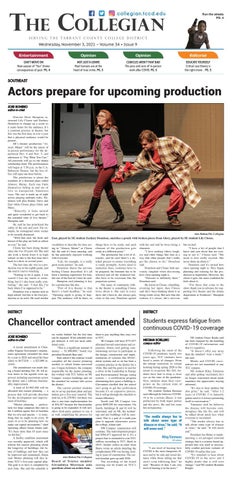
East, played by SE student Zachary Donelson, snatches a pouch with broken pieces from Glory, played by SE student Lily Clouse. vocabulary to describe his time acting in “Almost, Maine” as Clouse did. He said it’s been amazing, and he has genuinely enjoyed working with everyone. “Lily, for example, is a really great scene partner,” he said. Donelson shares the nervous feeling Clouse described. It’s all been a learning experience for him, but one of the best he’s had, he said. Hampton said planning is key for a production like this. “Part of live theater is that there’s a hard deadline,” he said. “Opening night is going to happen. The audience will be there, so
things have to be ready, and each element of the production gets ready at a different point.” The production has a lot of elements, and he said there’s a detailed process to ensure everything is ready promptly. Actors need to memorize lines, costumes have to be prepared, the furniture has to be selected and all the technical hurdles have to be overcome like the projection system. The sense of community within the theater is something Clouse loves about it. She said in every show she’s been in, she always gets close to the cast. Donelson agreed
with her and said he loves being a character. “I love making others laugh, cry and other things like that in a way that other people don’t really get the chance to do,” Donelson said. Donelson and Clouse both nervously laughed when discussing how close opening night is. “Pressure is definitely there,” Donelson said. He stared at Clouse, chuckling, awaiting her input, then Clouse said she’s been thinking about it as being weeks away. But now that she realizes it’s closer, she’s nervous
but excited. “I have a lot of people that I know and care about that are coming to see it,” Clouse said. “My mom is also really excited. She never shuts up about it.” Donelson said it’s surreal how close opening night is. They began planning and training for the production in September. However, the closer it gets, the more confident he feels about it. “For those that come to the show, thank you in advance for supporting live theatre and the drama department at Southeast,” Hampton said.
DISTRICT
DISTRICT
Chancellor contract amended
Students express fatigue from continuous COVID-19 coverage
JOSE ROMERO editor-in-chief
A recent amendment to Chancellor Eugene Giovannini’s employment agreement extended his term by a year to 2024 and raised his base salary to $437,836 — a $25,000 increase. The amendment was made during a board meeting Oct. 28. All action items in the agenda were approved, including renovations across the district and a software functionality improvement. A total of $1,902,300 will be allocated into master planning — a process that will provide direction for the development and improvement of facilities. “Master planning — particularly for large campuses like ours in the 4 million square feet of facilities that we own and operate — is something that we ought to do every 10 years or so to be planning how we make our capital investments,” chief operating officer Susan Alanis said. “It’s been more than 10 years since we did this.” A facility condition assessment was recently approved, which will inform the master planning about the longevity of buildings, the future of buildings and how they can be improved and maintained, Alanis said. Master planning will also inform TCC’s five-year capital plan. The goal is to have it completed by next June. She said the schedule is
six weeks behind, but the lost time can be regained. If the schedule does get delayed, it will not incur additional costs. “This is a significant amount of money — $1,900,000,” board vice president Kenneth Barr said. Barr asked if the contract would complete all the master planning needed, to which Alanis answered yes. Corgan Architects, the company responsible for the master planning, has worked with TCC before on NE Campus’ science buildings and set the standard for science labs across the district. The current product students use to set up payment plans and pay tuition got a five-year renewal. The total fee is $1,259,981, but there was also a one-time implementation fee of $54,367 because the functionality is going to be expanded. It will now allow third-party partners to use it as well, simplifying the process for
Alex Hoben/The Collegian
Board of Trustee member Gwendolyn Morrison asks questions about an action item.
them to pay anything they may owe to TCC. SE Campus will have $772,877 allocated toward renovations and expansion. Alanis said getting commissioning services to participate in the design, construction and implementation of systems like HVAC, alarm systems and so on has been a common practice in the district for a while. She said the goal is to aim for a silver in the Leadership in Energy and Environmental Design rating system — a certification program determining how green a building is. Giovannini clarified that the school isn’t going to get the certification because it’s an expensive process, but it will go through the checklist to ensure efficiency. South and NE Campus was given $699,250 for renovations. On South, buildings B and D will be renovated, and on NE, the technology and arts buildings will be renovated. This is a part of a multi-year plan to upgrade classrooms across the college, Alanis said. NW Campus’ construction will continue. The redevelopment project had $584,473 approved for it. It’s a project that is estimated to cost $311 million, according to TCC. Back in 2019, former editor-in-chief Juan Ibarra wrote an article detailing the complications NW was having, leading to years of construction. The current timeline goes up until 2026. The recording of the board meeting can be found on TCC’s website.
MEGHAN SCHILLING campus editor
Following the onset of the COVID-19 pandemic nearly two years ago, TCC students have faced a series of changes. From the abrupt transition to virtual learning during spring 2020 to the return to in-person this fall, students have had to keep a close eye on the state of the pandemic. Now, students share their viewpoints on the current state of COVID-19 coverage. NE student Nathen Brenner said although he believes COVID19 to be a serious illness, it was politicized by both major parties and the news. He said his issue lies in hypocrisy.
“The media always has to talk about some type of disease or virus,” he said. “It will never end.”
Riley Timmons NE student
“I am tired of hearing how COVID is the most dangerous illness and to be safe and social distance while those telling me that aren’t even following that,” he said. “Because of that, I am very tired of hearing it in the news.”
NE student Grace Kadia said she feels fatigued by the handling of COVID-19 information and that it’s repetitive. “It doesn’t offer any more than the standard ‘wear a mask,’” she said. Masks and COVID vaccinations are not mandated at any TCC campus. NE student Riley Timmons said after getting vaccinated, he’s no longer concerned about mask mandates but appreciates staying informed. “It's nice to hear updates but also grim,” he said. “After 1-2 years of COVID, I’ve honestly gotten used to it always presenting itself in conversation.” Timmons said he believes the disease will become commonplace like the flu, and will be talked about much less when everyone is vaccinated. “The media always has to talk about some type of disease or virus,” he said. “It will never end.” President Joe Biden is implementing a six-pronged national strategy that is a science-based approach that was used to successfully combat previous variants of COVID-19 earlier this year. “It's standard to hear about COVID-19 in the news and I highly doubt that it will ever change,” said NE student Brandon Knight.
NEWS
2 • Wednesday, November 3, 2021 NORTHEAST
SOUTHEAST
Tennis tournament Hidden garden brings raises awareness beauty to campus life ALEX HOBEN photo editor
Photo courtesy of Tanner Chessman Lucas
A player competes in a tennis tournament for Breast Cancer Awareness Month. Half of the proceeds will go to the tennis program and the rest to an organization. TANNER CHESSMAN LUCAS reporter
The wind was relentless, and the merchandise was holding on for dear life amid a tennis and pickleball tournament for Breast Cancer Awareness Month Oct. 26 on NE Campus. The event was organized by the kinesiology department to promote health and fitness, along with breast cancer awareness. Previously, it was an eight-year tradition, but COVID-19 caused the department to cancel the tournament in May 2020. “I was actually super happy,” tennis captain Tony Jacinto said when he realized the event was going to return. Jacinto enjoyed the last event because of all the items like the pink bandanas and pink tennis racket grips. If there were any doubts the event would ever take place, tennis coach Kim Kerby Dickman had none. Dickman said COVID-19 doesn’t prohibit anything they do since it takes place outside. “But I think I would have been very surprised if we had not been able to hold it,”
Dickman said. At the end of the event, the two teams were left tied. After the tournament concluded, the winners were awarded cans of pink tennis balls, while Jane Poquiz and Vieng Nguyen received T-shirts from the kinesiology department. “I think we did really well,” Poquiz said. She described herself to be the net player, and her partner is more of a lobber, making a great team. Poquiz counts herself in on showing up for the next tournament in May 2022. Altogether, the tournament had 28 players with 14 teams which raised $280 on the day of the event. However, that does not include a big donation yet to be received from two pro players from the Hurst Tennis Center. The total is believed to be around $800. Half of the money will be going toward the tennis program, and the other half will go to Cancer Care — an organization dedicated to providing financial support and information for people facing the challenges of cancer.
SOUTH
Halloween celebration gives families chance to unwind ALFREDO PADRON reporter
Students, faculty dressed up in costumes to gather and celebrate Halloween with family and friends at South Campus’ Boo at the SSTU Oct. 28. “This is an opportunity for our campus community to come together,” said Ana Contreras, South student activities coordinator. She said she loved seeing students bring their kids and families to the event. This event held activities such as a facepainting station, photo booth, costume contest and a gaming station for students interested in playing “Madden,” a football video game. Conteras said this is just the second time Boo at the SSTU has been held. “What we are aiming for is for a community outreach to bring everyone together for a good time,” said Gordon Dean, South student activities staff member. Dean said something different about this event than other TCC events is the number of people that showed up. “A lot of students want to excel their academic experience, but we want to provide an experience where they can meet new peers, join clubs and activities that we provide here at our campus,” Dean said. The winner of the costume contest was selected by the audience. This contest was
held for different ages from kids, teens and college students who won gift cards ranging from $75 to $25 for the bookstore. “This is my first school event in my entire school academic year since I started in 2019, and I’ve actually had a lot of fun meeting new people, and everyone was very welcoming,” South and TR student Arlene Olvera said. Olvera was the winner of the costume contest for the college students. She dressed as a plague doctor during 17th century Europe. “I’m really looking forward to using it to get some new merchandise from TCC and also for my scantrons,” she said. “ This event was a very nice experience. It wasn’t really overcrowded and very spaced out because of social distancing.” This event also had a small train ride for those who wanted to tour South Campus like TCC students who brought their siblings or friends that were interested in attending. Olvera said that she’s thankful to all the students and the workers who came to the event. “One thing I liked from the event was being able to ride the train and have a bit of fun touring South Campus in a different way,” South student Maria Garcia said. Garcia said that one thing she would change from the event is having it earlier than it was, perhaps in the morning or early afternoon.
In the far corner of SE Campus is a secluded garden with an intricate circulation system that has cultivated and flourished with plantlife for years. This garden features two major parts: the plots available for faculty and students to rent and an aquaponics garden maintained by SE history professor Bradley Borougerdi. The plots, while tended to by their respective renters, are under the administration of Laurie Ertle, an assistant biology professor on SE. The SE Sustainability Committee — which promotes sustainable practices related to campus activities —- turned the area next to the pond outside of the ESCT building into a rentable space that can give back to the school. The garden was the first initiative the committee took, beginning with an abandoned field of land. “There was a wooden, rickety brokendown fence,” Ertle said. “It went around three sides, not the other side. It was just wide open.” The garden officially opened in 2016 with the above-ground plots prefilled with soil. For the past five years, it has been rented out to students and faculty for both professional and personal use. “There are some people that have been the same people to rent for the past five years while there’s also been turnover,” Ertle said. The garden is available for those who have rented a space, but Ertle was clear that not every student is allowed in. They must be enrolled in a course that incorporates the gardens through in-service learning or, if part of a club, must have signed a waiver with Student Activities clarifying they can enter. Students
are free to enjoy the outside area where there are benches to sit and watch the pond. “It’s a good place to clear your head,” SE student Sev Lohse said. Lohse is the only student employee for the aquaponics garden in front of the rentable plots doing daily checks of the plants and fish. He tends to the growing okra and herbs in the top level of the aquaponics structure while Borougerdi is the main authority on the circulation system. “Aquaponics is the mixture of hydroponics and raising fish,” he said. “They go into each other.” Borougerdi said the garden was a mutual cycle of turning the ammonia from the fish waste to nitrates, which are pumped into the rocks where the plants live. While larger systems can house catfish and tilapia the fish currently in the system are hardy goldfish. Borougerdi and Ertle said they would like to see the project expanded further and have more student involvement. Next spring, they plan on having a learning community that combines BIOL. 1409 and HIST. 1302, which would heavily incorporate the gardens into the course structure. They hope to supply the cooking department with produce, creating a self-sustained system to supply curriculum. “That’s the dream,” Borougerdi said. “To have this whole place covered in a greenhouse, to expand it.” Lohse is experimenting with his own plants in the garden under permission from Borougerdi and has seen great progress in his gardening skills since being hired for the gardens. “There’s a weird sort of pride that you feel coming in day after day and seeing how the plants evolve and grow, same with the fish,” Lohse said.
Alex Hoben/The Collegian
SE history professor Bradley Borougerdi overlooks the aquaponics garden. It’s located in the back corner of the parking lot of the campus along with rentable plots.
Build a Bolder Future
with a degree from Texas Woman’s
Join us at our next ‘First Saturday’ event in Denton
Saturday, Nov. 6, 10 a.m.-1 p.m. Learn about: • Admissions • Financial Aid • Scholarships
Register today Photo courtesy of Jason Holly
DJ Arre plays some music during Boo at the SSTU Oct. 28. The event had a costume contest, face painting station and other activities for attendees.
Tour the campus — Families welcome!
FEATURE
Wednesday, November 3, 2021 • 3
Artwork by Jada Gray
This work is entitled “Candy Mural.” The piece was a part of an assignment for NE student Jada Gray’s class. Multiple illustrations were put up in the hallway.
Preparing students for future careers JUAN SALINAS SALINAS II campus editor
NE is home to the graphic communication department — the only one districtwide. The department focuses on setting the foundation for a career in graphic design. Lynn Dally, the coordinator of the graphic communication program, was working in the industry when designs were handmade instead of using technology. “My goal is for each student to have an appreciation for the graphics profession by recognizing that it is not at all an easy major to pursue,” Dally said. Graphic design is a highly competitive field and takes on many different forms. Texas is the fourth in the nation with job openings for graphic designers, according to the U.S. Bureau Of Labor Statistics. Graphic design is incorporated into things like web pages, magazine covers, billboards, social media posts and so on. “If they have knowledge of its difficulty, then they may understand why the costs can be high, deadlines tight and the standards rigorous,” Dally said. “These are essential requirements of the ever-trending field of visual communication. Its influence is boundless.” When the field adapted to a digital age, Dally had to deal with a major learning curve. There was no instruction for new software. “This is what drives my desire to ensure that students have an understanding of how the technology works, along with applying the principles of good design,” she said. “I teach students to use their critical thinking skills to problem solve
Th i Tr s wor ain k by Kit is en Jad e,” titl a G and ed “ ray wa Iro for s ill n H cla ustr orse ss. ate d
the real-world advertising challenges they will encounter when they move into a graphic design career.” Dally doesn’t like using the same projects and is always looking for ways to tweak them toward the skill set for each class she teaches. “It is gratifying watching students having that light bulb moment where their solutions go beyond what they have seen before and they have the skills to execute that idea at a professional level,” Dally said NE student Jada Gray intends to get a bachelor’s degree in graphic design. She said the instructors in the department are passionate. Gray obtained a paid internship with help from the department and has been working for them since the summer. “I have learned a lot from working them,” she said NE student Taquanton “Cortez” Johnson has been working on an album cover for a local artist called “Cemo.” Johnson is passionate about art and feels like this program is going to take his work to the next level, making him ready to secure a job in the industry. “I like when people can admire art,” he said. “It gives us artists sense of belonging and purpose” Instructor of graphic communication Sean Fousheé said many students come in not wanting to be designers, animators or page layout artists. “However, I hope my students learn to appreciate these parts of our industry, enjoy the creative process by producing clientready projects while expanding their knowledge and creativity in ways they did not expect,” Fousheé said.
Ar
tw
ork
by
J
a ad
Photos by Alex Hoben/The Collegian
Robert Pham and James Chacon Gonzalez working on their assignments in Lynn Dally’s Illustrator 1 course as they listen to a lecture.
0 002021 101810
Artwork by Taquonton Johnson
This piece was made as part of an assigment in which students had to make an ancient magazine cover.
Artwork by Jada Gray
Part of the same assignment for her course, Jada Gray illustrated a sarcophagus of a pharaoh.
ay
Gr
Joshua Davoli works on his project for Sean Fousheé’s animation class in the NE graphic design department, the only one districtwide.
ENTERTAINMENT
Wednesday, November 3, 2021 • 4
GAME RETROSPECTIVE
2008 classic refused to play things safe
Photo courtesy of Deep Silver
The player destroys a drug lab and shoots the rival gang’s, Sons of Samedi, helicopter as they attempt to escape. The game originally released on PS3, PC and Xbox 360. JUAN SALINAS II campus editor
Refusing to be an escape from the harsh reality of the 2008 Great Recession, Rockstar Games focused on critiquing the American dream and the political climate at the time in the highly melodramatic “Grand Theft Auto IV.” In contrast, Volition just wanted to throw sewage on nearby citizens in the silly but grounded “Saints Row 2.” It was released Oct. 14, 2008, for sixth-generation consoles, and a year later for PC. The “Saints Row” series came during a time when every new open-world game was dismissed and called a cheap “‘Grand Theft Auto’ clone.” But, “Saints Row 2” does more than enough to discredit that stigma. The version I’m playing is the PC port which is a buggy mess and only playable with a community mod called “Gentleman of the Row” made by Idolninja, — formerly known as Mike Watson. He was Volition's senior community developer who was working on an official patch to fix the PC port. He was going to add missing downloadable content when he found the original source code for the game but sadly died in August. Still, even with this unoptimized port, there is a gem here.
“Saint Row 2” is set in Stilwater, and like the promotional material said, “It’s with one ‘L,’ b----.” The fictional city is influenced by Detroit and has 22 districts — seven more than the original "Saints Row." Each one has a different feel. One minute you could be passing a virtual joint around with college students at the university district, then the next riding four-wheelers with hillbillies at the trailer park district. “Saints Row 2” starts where “Saints Row 1” left off. After waking up from coma, the player is tasked with breaking out of jail and retaking the streets of Stilwater from various gangs and Ultor, a corporation that started as a clothing brand in the first game but five years later, have Infiltrated every aspect of people’s
lives. Think of Amazon for a real-life comparison. Volition did an excellent job making Stilwater a believable, breathing world. You could see non-playable characters do various things. Handing out flyers, reading the newspaper, playing the guitar for spare change, college students running late for class. I can go on and on about how much detail went into the civilians of Stilwater. The gameplay is your classic early openworld game. You’re let loose in a big sprawling city, left up to your own devices. But the twist I like is that the “Saints Row” series incorporates the side activities into the main story. To progress in the game, you must have enough “respect” to play the mission. The only
way to gain respect is to do side activities. The side activities are a blast to play. Of course, you expect basic activities from an open-world game like racing, turf wars or carjacking. But the unique ones steal the show. From running into on-coming traffic committing insurance fraud to driving around the city on fire with a flame-proof suit on trying to cause as much chaos as you can while going through all the checkpoints, these are really moments to remember. What I like most about the “Saints Row” series is how customizable it is. It lets you design things like your character for your safe houses. The customization is so deep that you can even select how fat or muscular your character is. “Saints Row 2” was the first open-world game to have the courage to go head-to-head with the juggernaut that was “Grand Theft Auto,” and makes a good case for itself. Its over-the-top and crude nature is why it’s so enjoyable. It chooses not to dwell on the sociopolitical themes of similar games, but that's what sets it apart. You don't need to be a sociology major to enjoy this one. “Saints row 2” is available on PlayStation Now, Steam and The Xbox Store.
The Saints, primary gang of the game, watches a news report on a casino heist they committed. The casino was owned by a rival gang called “The Ronin.”
SHOW REVIEW
New season of psychological thriller delivers on its premise MEGHAN SCHILLING campus editor
What would you do for love? Move to a suburban neighborhood with a bunch of rich upper-class families even though you hate preppy people? Hide the past full of your crimes of killing your beloved ex-girlfriends? Find out your wife and the mother of your baby is just as crazy as you and will kill anyone to keep your marriage together? Welcome to the life of Joe and Love Quinn Golberg. Season three of the Netflix original “You” dropped Oct. 15, and let’s just say the story couldn’t have gotten any better. Joe started his new life with Love in the suburbs with a new bouncing baby boy. In the delivery room, we find out Joe and Love were expecting a girl. However, they had a boy, something Joe was not too thrilled about. If anything, it put a huge wedge between Joe and Henry. Even if there is this wedge between Henry and Joe, you see character development with Joe’s character. Joe is trying to put aside his murderous past for Henry, however, Love is destroying any chance of salvation for Joe. Love is murdering, hurting anyone that harms or gets in the way of her family. Which, hon-
estly, is very annoying because I really want to see some redemption for both of their characters. We get to meet tons of new characters this season that contribute to the story line, but I feel as if some of the characters were kind of pointless. They really didn’t add to the story rather than just help fill a scene. Speaking of character arcs, I did like how we got to see more of Love’s mom and understand her viewpoint after the last season. We also got to see how Love’s mom suspected her of killing her last husband before Joe. It shows that Love’s mom suspects her daughter of being crazy. This season of “You” was by far the best season Netflix has offered us. It showed how Joe would do when faced with someone exactly like him. We see him outsmart Love, but we also see how Love was a close competitor. I am disappointed with Love this season because Joe really did try to love her the best he could, but she kept hurting people and it prevented them from living a normal life. The ending leaves tons of questions for season four. This season is definitely worth bingewatching, and I can’t wait for season four. Photo courtesy of Netflix
Joe Goldberg and Love Quinn, played by Penn Badgley and Victoria Pedretti, stare out a window. Netflix confirmed that season one is currently in the works.
OPINION
Wednesday, November 3, 2021 • 5
EDITORIAL
Everyone should be educated on racism A recent viral video on Twitter has rekindled the conversation surrounding critical race theory, and for good reason. The video is hard to get through. It’s a high school math teacher from California wearing a stereotypical indigenous headdress chanting “SoCahToa” — a way to remember trigonometry ratios — as she parades around the classroom. She was howling, jumping up and down in front of the class. She then sat on her desk, mockingly asking the “water goddess” to tell her the “secret Indian chant.” An indigenous student started recording, wondering if the actions were directed toward him. It’s hard not to wonder if the teacher realized how offensive she’s being, and if it is pure ignorance, it could’ve been prevented if she knew why it was offensive. Critical race theory focuses on how racial bias is prevalent in many systems in America, which creates a caste system where people of color are relegated to the bottom. It focuses on how oppression in the past still has an impact today. For example, how the racism associated with slavery has had a long-lasting effect on the Black community. Last September, former President Donald Trump issued an executive order banning diversity training because of its “divisive” nature. Critical race theory fell into this category, meaning the conversation was halted, ignored even. The vague executive order has since been overturned by Biden, but the discussion surrounding it at the time was interesting. The reason for the order was because the Trump administration
Amber Davis/The Collegian
didn’t want there to be any false beliefs about how irredeemably racist and sexist America is. But, if racism and sexism weren’t prevalent, then there would be no need to acknowledge it since no conversation on the topics would exist whatsoever. It’s akin to sweeping things under a rug. Everything is still there, but now it’s covered in a dusty, torn rug with holes everywhere that offer a glimpse
of all the items crammed under it. Critical race theory pissed off Republican lawmakers. Even with the executive order, Republicans in the Senate still found it necessary to introduce a resolution ensuring teachers won’t be required to have any training in it to teach. The most common retort became that it created too much division. But, oftentimes, they had difficulty defining exactly
what it entails, leading to the vagueness in these orders and proposals. They were banning something they didn’t understand. They were just using the term as a scapegoat to enforce racist policies and fearmonger. Critical race theory is an important subject to teach anywhere. It’s important to know about the oppression marginalized communities face. It creates a sympathetic world in
which more people are understanding of each other. A poll conducted by USA Today and Ipsos shows that parents aren’t too resistant to having their children learn about how slavery and racism are prevalent still since 63% support having it taught in school. But, critical race theory has 49% support and 30% opposition. There’s a disconnect. It doesn’t make sense that parents would be willing to have their children learn about modern-day racism, but not about everything else critical race theory entails. Both of those topics intertwine, so if slavery and racism are being taught, then so is critical race theory. The weaponization of the term has created a toxic mindset. Texas is seeing this firsthand. In June, Gov. Greg Abbott signed a bill that banned teaching critical race theory in K-12 schools. Students are now being withheld information that could be vital to understanding entire communities. Parents have concerns that the material could be too grim for their kids to learn, which is fair. Genocide, slavery and segregation are all difficult topics to discuss. But, kids, teens and adults need to know these things. They need to know how those past travesties have permeated throughout history. Erasing it is not the answer. Another concern some parents have is that it may single out some students. For example, when it comes to slavery, they’re afraid white students will feel like they have a target on their heads. But, what they fail to realize is that it’s not about them. This discussion is for the marginalized to realize their adversity is not being ignored.
VIEWPOINTS
Office environment offers interpersonal relationships
AUSTIN FOLKERTSMA campus editor
For over a year, people have transitioned from working in offices to working from the comfort of their homes. Now, they don’t want to go back. A lot of factors go into why people prefer working in the office versus working at home and vice-versa. First is the aspect of productivity. According to Flydesk, an application for remote team management, 59.4% of workers love that they don’t have to commute to and from work so they could be more productive. The average at-home employee clocked in 8.2 hours of work — seven of those being hours of productivity. The average in-office employee clocks in 8.29 hours — with 6.52 of those hours being productive. At home, employees don’t have their boss there to constantly check on them about due dates. Working from home, one could develop their own routine, but to me, it is easier to develop a routine if I am in the office. For example, my weekly schedule is, on Fridays, we have a staff meeting at The Collegian and finish some edits. I brainstorm some ideas of people to interview, and then I set a few days aside to interview said people. From there, I pick out whose information was more viable and type up their responses.
True crime fans must think about real people involved
According to Flydesk, the mental aspect of it is that 61.5% of at-home employees feel valued by their workplace compared to 51.4% of in-office employees. Being in an enclosed area by myself messed with my mental state. When I am at home, juggling work and leisure time is hard. I found there are more distractions. Maybe I get an Instagram notification, or some new show on Netflix comes out and it alerts my phone. When in the office, the focus is there. According to Flydesk, the social aspect of it is that 25.4% of at-home employees feel a disconnect between themselves and their workplace, whereas 19.1% of in-office employees feel a disconnect between themselves and their workplace. Opportunities to get to know your boss and grow within your business in the workplace are almost nonexistent. The reality is when in the office, employees tend to be more active — both physically and socially. If you are like me, an extrovert, you want to be around people. Office shenanigans are fun. Office parties are fun. The stereotypical conversations by the water dispenser are fun. When you work from home, employees have everything they need within an arm’s length, but when you are in the office, you have to physically get up and go to the department that you are trying to reach and be like, “Hey, can you print this off for me?” Out of everything that has been mentioned, the mental, physical and the social side of a job, I think what ties it all together is if you ask yourself — “Do I really like my job?” If one goes into the office hating their job, their mind is going to be the same. On the other hand, if one goes into their job loving it and having a positive mindset, they will have a positive attitude.
LOGAN EVANS
managing editor
We are all drawn to darkness — especially when it’s real. There’s no better example of this than the current popularity of true crime. The genre is bigger than ever, but it’s been relevant for over half a century, and the same problems have followed since its inception. Truman Capote published “In Cold Blood’’ in 1966. A groundbreaking work of true crime storytelling, the novel recounts the murder of a Midwest family and the manhunt for their killers. It’s one of the greatest novels of the 20th century — a touching, heavy and empathetic look at human nature and the makeup of evil. It delves deeper into the mind of a killer than likely any piece of popular journalism had before. I think it’s a masterpiece, but it’s not without some controversy. Many have accused Capote of altering details to fit his story. According to some close to the case, he manufactured dialogue to imbue his story with drama and played up certain character’s traits. I don’t believe this ruins the novel as its own work. I think it was inevitable for Capote to be rough with what was essentially a new form of storytelling, but it does expose an issue that still plagues the world of true crime — when dealing with
real tragedy, things can get messy. With the rise of online true crime content, this is more prevalent than ever. From long-form investigative stories that handle cases with upmost respect to ten-minute videos of YouTubers delivering sensationalized accounts of murder while applying makeup, there’s something for everyone. Many forms of true crime are incredibly accessible and interactive. For many, coming up with theories is part of the fun. Because of this, I think it’s easy to get swept up in the drama. Last month, the disappearance and death of vlogger Gabby Petito spurred a frenzy of internet speculation. While some of this was helpful in filling out clues police might have missed, many theories were characterized by an unhealthy glee. It seemed as if many theorizers were more excited to be an open case than they were about doing any real good. This must have been terrible for anyone close to her to read. I don’t actually believe there’s anything wrong with speculating on cold cases if properly informed, but I do think “web sleuthing” — positioning yourself as an armchair investigator — can be harmful to current, ongoing cases. In 2014, a woman named Elisa Lam was found dead in the water tank of the Cecil Hotel in Los Angeles. A portion of web sleuths pinned her death on musician Pablo Vergara based on zero credible information. The harassment that followed nearly ruined the man’s life. I am a true crime fan. I believe at its best, the genre is a powerful form of narrative journalism that can inform, entertain and make change. But fans of the genre must remember that real people exist at the heart of these stories.
Letter Policy The Collegian is a weekly student publication serving the Tarrant County College District. Editorial statements and advertisements do not necessarily reflect the opinion of the TCC administration. Letters to the paper should be 150 words or less, free from libel and poor taste and include the writer’s Colleague ID or telephone number (the numbers will not be published). Letters may be brought to The
The Collegian 828 Harwood Road Hurst, TX 76054
TCC is an equal opportunity institution that provides
Office: 817-515-6391 email: collegian.editor@tccd.edu
color, religion, sex, age, national origin, veteran status or
Meet EDITOR-IN-CHIEF Jose Romero MANAGING EDITOR Logan Evans LEAD DESIGNER Abbas Ghor
CAMPUS EDITORS Juan Salinas II Austin Folkertsma Meghan Schilling
@TCCtheCollegian
Collegian office (NCAB 1124A, NE Campus),or mailed to:
the
educational and employment opportunities on the basis of merit and without discrimination because of race, disability.
Staff
ILLUSTRATOR/DESIGNER Amber Davis PHOTO EDITOR Alex Hoben WEB COORDINATOR/DESIGNER Kristal Blankinship
SENIOR PRODUCER Michael Foster-Sanders
ADVERTISING COORDINATOR Camille Compton
Professional Staff PRODUCTION MANAGER Stacy Luecker
ADVISERS Chris Whitley • Jocelyn Tatum
FEATURE
6 • Wednesday, November 3, 2021
NE Fall Fest is in Charlie Brown-themed event brings in new season AUSTIN FOLKERTSMA campus editor
Yuaneu Carza playing the corn hole game at NE’s Fall Fest.
Karmien Bowman throwing pottery on a wheel at NE’s Fall Fest.
Early 2000s music blared over loudspeakers, vendors handed out popcorn and hot dogs as students gathered around booths during NE’s Fall Festival. The Oct. 27 festival marked an in-person return for the event after going virtual in 2020 due to COVID-19. This year’s theme was “It’s The Great Pumpkin, Toro,” a reference to the classic Charlie Brown cartoon. Ve n d o r s f r o m a r o u n d the Tarrant County area participated in the event, providing information about various companies like Six Flags and In-NOut. A 360-degree photo booth gave s tudents a chance to capture photos by standing on a platform and posing for the camera as it circled them. Attendees could also
express their creativity by painting a pumpkin. “My favorite part about [Fall] Fest is that I love how much this campus wants people to have a good experience here,” NE student Emily Spencer said. “I think this Fall Fest just shows how much they care about their students and just seeing how much energy they put into this.” Spencer said she loves the free snacks and Charlie Brown-themed T-shirts available at the event. NE academic adviser David Carillo was at the festival promoting the advising and counseling o ff i c e , w h i c h r e c e n t l y moved next to the NE bookstore. TCC offers online and in-person counseling to whoever needs it, Carillo said. He wanted to stress that anyone is welcome — whether they’re dealing with difficult life situations or just wanting someone to talk to.
Students, faculty play a big game of connect four at Fall Fest.
Jane Dubrow waving a pride flag behind pride pumpkins at NE’s Fall Fest
“My favorite part about the Fall Festival is seeing all of these different booths out here that everyone can enjoy and have a good time,” he said. NE student Claire Thompson was at the Pride Club booth, representing one of the many clubs present at the Fall Festival. “My favorite part of the Fall Festival is all of the activities that there are,” she said. ”It builds community within the campus.” NE Writing Center student employee Tish Buford was there in attendance promoting the Writing Center. She said if students need help with any of their writing assignments, then go down to the Writing Center in NACB 1114. “I think that the Fall Festival is a lot of fun,” she said. “I enjoy learning about all the different clubs and o rg a n i z a t i o n s a n d j u s t having a fun time.”
Various booths set up in front of the NSTU building at NE for Fall Fest
Students dance at NE’s Fall Fest.
Students working on their respective pumpkins at the the pumpkin decorating table at Fall Fest.
Photos by Joel Solis/The Collegian
Najwa Seyedmorteza working in-costume on her pumpkin at Fall Fest.
Illustration by Amber Davis/The Collegian