collegian.tccd.edu
Justice League is PG. 6
Wednesday, April 7, 2021 – Volume 33 • Issue 22 News
Feature
Entertainment
Opinion
Editorial
HEALTHY TRANSITIONS Making the switch back to everyday life. PG. 2
GHOST TOWN One final look before fall reopening. PG. 4&5
‘80s DRUG EPIDEMIC Show covers crack cocaine scandal PG. 6
YOU DON’T GET IT Parents don’t always understand teens. PG. 7
A TREND IN HATE Discussing recent crimes against Asian-Americans. PG. 7
DISTRICT
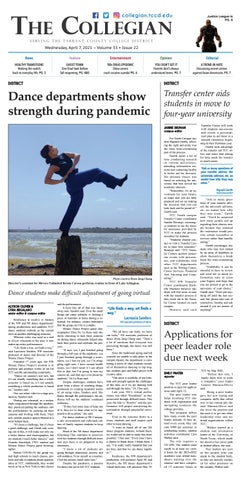
Dance departments show strength during pandemic
DISTRICT
Transfer center aids students in move to four-year university JANINE SHUMAN campus editor
Photo courtesy Hyun Jung Chang
Director’s assistant for Movers Unlimited Krista Carson performs routine in front of Lake Arlington.
Dance students make difficult adjustment of going virtual ALYSON OLIVER & LYDIA REGALADO
senior editor & campus editor
Resilience to resolve — themes of the NW and NE dance departments’ spring productions and qualities TCC dance students embody as the curtain rises on another challenging semester. Whereas video was used as a tool to review rehearsals in the past, it now makes up entire performances. “Life finds a way, art finds a way,” said Lacreacia Sanders, NW associate professor of dance and director of the Mosaic Dance Project. Founded 17 years ago, the NW Mosaic Dance Project’s mission is to perform and produce works of art for TCC and the surrounding community. “Dance on camera’s not new, but it’s not usually something that a whole semester is based on, it’s not usually something a whole production is based on,” Sanders said. One can relate video to a stage production, Sanders said. During one rehearsal, as a melancholy song played through the speakers, they practiced pulling the audience into the performance by picking up their cameras and twirling with them. Their new, remote practice spaces blurred in a swirl behind them. “It’s been a challenge, but it’s been a good challenge, and I think only coming out of this, it will make not only me a better dancer and choreographer, but my students I teach better dancers,” said Deardre Randolph, TWU student and Mosaic Dance Project guest choreographer. Before COVID-19, the group visited high schools to teach classes, perform and talk to students about opportunities at TCC. Additionally, they would travel as far as New York to take classes
and do performances. It feels like all of that was taken away now, Sanders said. Even the small things can cause setbacks — kicking a piece of furniture at home during a rehearsal, for instance, creates frustration that the group can’t be in a studio. Mosaic Dance Project guest choreographer Elisa De La Rosa said students choosing to turn their cameras on during dance rehearsals helped take back their power and celebrate the process. “It says, yes, I just finished going through a full year of the pandemic, yes I just finished going through a snowstorm, yes I lost my job, yes I’m struggling right now, I have mental health issues, yes I don’t know if I can afford this or that, but I’m going to turn my camera on, and that says a lot about the students,” De La Rosa said. Despite challenges, students have gone from a place of crushing disappointment to creating beautiful works of art using video, Sanders said. She hopes through the performance, the audience will see the students’ continued resiliency. “If they feel some type of hope out of it, then we’ve done what we’re supposed to do as artists,” she said. For dance students at NE Campus, a safe environment and cultivated culture of family inspires students to keep dancing. Head of the NE dance department Kihyoung Choi continues to persevere with her students through difficult times and says there is no judgment in the classroom. “I know a lot of students are going through depression, anxiety and self-isolation. Even myself as a teacher, I feel the anxiety much more now.” Despite the pandemic, a passion for dance has never left TCC students.
“Life finds a way, art finds a way.”
For South Campus student Rignald Gartth, selecting the right university was the most time-consuming part of the process. Gartth spent a lot of time conducting research on various universities, attending information sessions and contacting faculty to better aid his decision. His ultimate choice was based on selecting the university that best served his academic interests. “Remember, it's an investment for your future, so make sure you are fully prepared and set on making the decision that you can look back and be proud of,” Gartth said. TCC South campus Transfer Center coordinator Sandra Bermejo encourages students to use the transfer assistance provided by TCC to make the process smoother for students. “Students should contact or visit a Transfer Center in their first semester,” Bermejo said. “TCC Transfer Centers sponsor numerous events with universities, and collaborate with other TCC departments such as the Writing Center, Career Services, Financial Aid, Advising and Counseling.” TCC NW Transfer Center coordinator Rachelle Montero believes students will feel more at ease with the transfer process if they reach out to the Transfer Center located on each campus. Montero said each
Transfer Center will work with students one-on-one and create a personalized plan to aid them in a smooth transition beginning in their freshman year. Gartth took advantage of the transfer aid TCC offers and notes that asking for help made his transfer so much easier.
“Ask as many questions of your transfer advisor, the university advisors, etc. no matter how silly they may seem.”
Rignald Gartth
South Campus student
“Ask as many questions of your transfer advisor, the university advisors, etc. no matter how silly they may seem,” Gartth said. “You'd be surprised how many people end up regretting their choices simply because they assumed the institution would provide certain necessities or services rather than humbly asking.” Gartth encourages students who may feel rushed by an array of deadlines to allow themselves a break from the time-consuming process. “Truthfully, it can be stressful to have to review and send out so much information only to cross your fingers and hope that you are picked to go to the university of your choice,” Gartth said. “Don't put anything off until the last second, but, please take care of yourselves, breathe and ask around if you are unsure of anything!”
Lacreacia Sanders
NW associate professor of dance
“We all have our body, we have our tools,” NE associate professor of dance Hyun Jung Chang said. “There’s a lot of emotions that everyone was processing through, but dance was still there.” Since the traditional spring and fall concerts are unable to take place in the campus theater, the department is combining a series of clips students recorded of themselves dancing to hip hop, tap, modern, jazz and ballet pieces with creative edits. "Our piece is symbolic of our fortitude and strength against the challenges of this time, as if we are dancing with and through the tides,” Dr. Choi said. Last year, NE’s virtual performance was titled “Resolution” as they persevered through difficult times. This year, the title is “Resolve” and the performance will project unwavering determination through purposeful movement. Even as the semester draws to a close, students and staff inspire each other to keep dancing. “I want to thank all of our NE dance program students, without them, we would not be able to make this show possible,” Choi said. “Every time I have a chance to thank them, I thank them. I say, ‘I’m really really thankful that you are here, and that we can dance together.’” Resilience, the NW department’s production, will premiere April 30, and Resolve, the NE dance department’s virtual showcase, will premiere May 10.
DISTRICT
Applications for peer leader role due next week EMILY PRATER reporter
The TCC peer leader position is open for applications until April 12. The peer leader role helps incoming TCC students with registration and navigating resources the college provides. The program tallies how many events the peer leader attends. If they attend every event, they can earn $500 per semester in scholarship money, student activities coordinator Cara Walker said. The role requires a 2.0 GPA. The student must enroll in at least six credit hours for the 2021–2022 academic year, attend mandatory training over the summer and have completed 12 semester hours at
TCC by May 2021. “Before this role, I barely knew how to work a computer,” peer leader Lauren Maenza-Oliver said. Being a peer leader gave her new typing and computer skills that rolled over to her current job, she said. Maenza-Oliver said she loves the position and has used it to get into other leadership roles and national organizations within TCC. Walker started as a student and orientation leader at the University of North Texas, which made her discover her career path in student affairs, she said. Peer leaders are seen as the people who can speak to the student body, so they are actively recruited for other positions on the campus, Walker said.
April 7, 2021 • Page 2
News
DISTRICT
Moving forward to reclaim normalcy LYDIA REGALADO campus editor
Counseling centers at each of TCC’s five campuses continue to help students in all areas, including gaining skills and resources to make the healthy transition back to everyday life and in-person classes for the fall semester. Even though everything is moving forward, sudden and unexpected changes in students’ lives from the past year should be addressed, assistant director of counseling and advising Ronda Isaacs said. “In other words, if you’re punching me in the face and you stop punching me in the face, that doesn’t mean that I don’t have bruises and contusions,” NE veterans counselor Christopher Hunt said. Hunt said showing self-compassion is a great start to acknowledging emotions without letting them take control. “Don’t tell yourself to shut up,” Hunt said. “The same empathy and compassion that you would provide for a friend, I want you to give yourself permission to turn that same type of compassion towards yourself.” Hunt said no matter what, when returning to an in-person world, there are going to be people who work your nerves. NE counselor Masika Zawadi Smith said it’s important not to ignore those feelings and that it is normal to feel frustrated with others. Counselors can offer guided meditation to help students learn how to reprocess feelings and develop a calm, safe place in their minds. For some, it’s the back porch at their parents’ house because that’s where they used to sit, talk and remain calm. For others, it’s in a meadow while on a hike, or on a beach or mountaintop, Hunt said. For him, it’s in a cabin at the foot of a mountain in Alaska, at dusk during the wintertime. Isaacs said certain scents can tie in with a safe place and can help create relaxing sensations. Scents such as eucalyptus and lavender are associated with calmness and other scents can help bring back memories of easier times.
“Maybe it’s being back in the kitchen with your grandmother and making sugar cookies, and that scent makes you feel that safety net,” Isaacs said. “You can keep candles or essential oils, whatever it may be in order to bring that sense of relaxation and calm center back to yourself.” Smith said unplugging from social media and the news can help control the amount of negative emotions we feel. Social media has become an extension of us, which is why she encourages internal awareness when using phones or watching the news and recommends scheduling breaks from media intake. “It’s OK to be informed, it’s OK to want to find out more information about what’s going on and how to be prepared, but at the same time it’s really important to take a break to help our minds, bodies and spiritual connections,” she said. Specialized counselors are available for different needs and every student can find the right counselor for them, Isaacs said. For example, Hunt is a U.S. Air Force veteran and specializes as a veterans counselor. Isaacs is a vocational counselor who can help students determine their strengths and find suitable career paths. Smith is someone who is very empathetic, Hunt said, and works with a lot of international students. Seeking help is not a sign of weakness, Isaacs said. “Sometimes the hardest people to talk to are the people closest to you,” she said. “Give yourself that freedom to say, ‘I need to talk to somebody outside myself.’” Advisers encourage students to take advantage of counseling services, which are included with tuition at no additional charge. The offices can be reached through the TCC website or by calling (817) 515-4238 to schedule an appointment. The next virtual event for coping with trauma tips will be held on April 21. “We are here for you. You don’t have to go through this journey alone,” Smith said.
INCREASE your OPPORTUNITIES
Complete your bachelor’s in health
The Collegian
DISTRICT
TCC looks forward to an in-person fall semester
ALYSON OLIVER senior editor
TCC will return to in-person learning this fall semester. “Given that I think the College has been very conscientious this past year about prioritizing the safety of students, staff, and faculty, I feel okay about this decision,” South English instructor Lindsey Davis said. She trusts if anything happens beforehand to compromise the safety of the TCC community’s return, the chancellor will react accordingly, she said. “I believe it is very difficult to determine when the ‘right’ time is to return to campus given a variety of variables,” South speech instructor Paige Carr-Lovelace said. But because the chancellor said in-person learning would restart once the COVID19 vaccine had been available for three months, she thinks this is an appropriate choice, she said. While some students may struggle with the transition, it will likely benefit most, especially since online learning is not ideal for some classes and learning styles, she said. Adjunct journalism instructor Gemeral Berry said he prefers teaching classes faceto-face. Class discussions are easier since students can hear clearly and respond to him immediately, he said. “However, when it’s online, there may be technical issues that students may have,” he said. NE student Chester Vitug said while online learning made it more challenging to stay engaged and meet deadlines, it taught him how to keep on top of his work. “I realized that organization and diligence are crucial,” he said. Davis said the virtual experience has a silver lining — she learned valuable technology and communication skills that have enriched learning and community in her classes. “I plan to implement some of those tools from now on, no matter what modality I deliver classes in,” she said. She hopes once students return to campus, there will not be issues regarding compliance with safety measures like wearing
“Given that I think the College has been very conscientious this past year about prioritizing the safety of students, staff, and faculty, I feel okay about this decision,” said.”
Lindsey Davis
South English instructor
masks and social distancing, she said. “I don’t want to be put in a position to have to ‘police’ students who don’t follow safety protocols, and even more importantly, I don’t want to see anyone endangered by someone else’s negligence,” she said. TR associate geology professor Taylor Hughlett said she is very apprehensive about the return. “Herd immunity hasn’t been established yet, and even with the vaccine, it is still possible to transmit and carry the virus,” she said. Vitug said he feels making vaccination a requirement would require much consideration, but for students’ safety, he would at least like getting the vaccine to be a suggestion. “I’ll leave that up to the professionals; perhaps there can be a compromise somewhere,” he said. Eligibility to receive the vaccine has opened up in Texas, and anyone aged 16 or over may now set up an appointment. Berry said he hopes basic safety measures will still be in place regardless of whether the vaccine is required to return to campus. While wearing masks may be cumbersome, requirements such as those will better ensure a safe environment for students, he said. If Governor Abbott has taken steps toward having residents under the age of 40 vaccinated, there should be many students who have had the vaccine by the fall for TCC to be safer, he said. Fall classes begin Aug. 23.
Texas Woman’s offers dozens of health-related options, including online/hybrid degrees: • Health Studies • Health Sciences • Kinesiology (Sports Mgmt.) • Dental Hygiene, RDH-BSDH • Nursing, RN-BSN
Learn more at TWU.edu/health
The Collegian
News
April 7, 2021 • Page 3
DISTRICT
Netflix gives students look into industry LOGAN EVANS campus editor
The Radio/TV/Broadcasting department joined forces with Netflix to give students an inside look at a career in post-production. The world of post-production — any work done on a film after shooting has wrapped — offers a vibrant path for budding creatives, said Netflix employees Brandie Konopasek and Nicole LaLoggia to a virtual room of RTVB students. “It’s getting it all together into the pretty package that you see onscreen so that it’s not just a rough cut that someone has done in their basement,” Konopasek said. Konopasek, who worked on Marvel and Disney films before her move to Netflix, said that big-picture elements of post-production like editing and sound design are instrumental to any production, but sometimes the small touches bring a scene together. When working on the now-iconic scene from “The Avengers” where The Hulk slams Loki into the ground, Konopasek and her coloring team found a problem with the footage they received of Loki laying on the torn-up floor after his beating — there wasn’t a scratch on him. It was a minor detail, but it undercut the intensity of the
Photo courtesy Frameworkstock
A career in post-production can include anything from film editing to sound design. scene, and the team was just one week away from their deadline. One of Konopasek’s colorists had an idea. He went into the footage and added light shading to give the impression of dirt and bruising. It was a simple fix, but it did the trick. “What you see onscreen today wasn’t makeup on set. It wasn’t a visual effect. It was just our colorist going in at the last second,” Konopasek said. For any final product to come together,
DISTRICT
all elements of post-production need to work in tandem with one another, she said. Konopasek recalled sitting in on the final coloring session of “The Avengers.” To fully assess their work, the color team had to sit through an entire screening of the movie. Because the sound mix wasn’t done yet, that meant watching it all without audio. “I sat there for the full two hours and I thought ‘This movie’s going to bomb,’” she said. But by the time the film had gone
through its full sound design, editorial and mix, Konopasek rewatched it with an audience and realized just how wonderful it had turned out. It was a testament to the power of countless creatives funneling their talents into a single vision. No project could turn out well without having people willing to dedicate time to these individual elements, said Konopasek. LaLoggia, who produced the cult film “Swingers” said that work in post-production might not spring to mind as an accessible career path for many students, but there is fulfilling work to be done by those willing to step into it. “What I always wanted to do was edit, but I didn’t even know how to do that,” she said. “I didn’t even know who to talk to. We want you to see how viable this is.” Cinematography instructor Chad Jones, who moderated the session, hopes it gave students new ideas of career paths available to them in the industry. “I was just astonished at the number of post-production positions available to graduates like yourselves one day,” he said. Netflix will continue to offer students insight into the post-production process through a monthly seminar called Netflix Post Pals, available to all RTVB students.
DISTRICT
COVID-19 relief grants International students’ gives financial assistance academic plight at TCC GAEUN LEE reporter
File Photo/The Collegian
The COVID Relief Grant II offered $1000 to students who were eligible. Disbursements automatically went out to those who fit the criteria. LINDA PUGA
campus editor
A school bus drives away at 6:45 a.m. carrying two young boys. Their mother gets the youngest child, 2-year-old Josiah, ready for daycare. She gets ready, heads to work, comes back to do homework, study and pack snacks, all before heading back to the daycare at 5 p.m. to pick up her boys. This is a typical day in the life of South student Jennifur Johnson. As a student, Johnson said she works fewer hours to give herself time to prioritize her academics and her family. So, when she heard about the COVID-19 Relief Grant — which provides $35 million in aid to students — she was ecstatic. “I am a single mother of three boys and I am working while going to school,” Johnson said. “It was truly a blessing to receive.” TCC students recently received their COVID-19 Relief Grant, funded by the Higher Education Emergency Relief Fund II to award students with a $1,000 stimulus for the spring semester. This grant may be used for tuition, food, healthcare and any other needed expenses. To be identified as an eligible recipient, students must be U.S. citizens or eligible non-citizen, have a completed FAFSA, demonstrate financial need and be enrolled in one credit hour. Students will be automatically notified about the grant and no additional applications are needed.
“The money I received will be helpful with things such as gas for the car, a daycare bill, an electricity bill, make sure the boys have everything they need and then I will be saving the rest,” Johnson said. After dinner, playtime and getting ready for bed, the boys get some quiet time which is when Johnson gets a chance to finish her school work for the night. With the ongoing pandemic and financial difficulties, Johnson said her little family has grown to follow a daily routine to keep progressing when plans change. “Having come from homeless shelters, that part of my life was not easy to go through,” Johnson said. “I made the best of what our situation was and made sure that my boys were taken care of and happy.” South student Alfredo Ornelas also thinks the COVID-19 Relief Grant came at a time when many students needed it. “COVID has definitely changed things, to say the least, so this is a great opportunity for students who are in financial need to take advantage and take care of some expenses,” Ornelas said. Ornelas felt relieved after getting the email that he was eligible to receive the grant so he didn’t have to go through the process of applying for it, rather it was given based on his financial aid. As far as his grant, Ornelas said he will be putting the money in savings plus putting some towards his hobby and career pursuit of acting and filmmaking. For information about eligibility, go to TCC’s Coronavirus Updates page on its website.
Some international students have been worried about protecting their student visas with all the restrictions the pandemic has placed on higher education learning. One requirement is they must take a minimum of one face-to-face course if new. However, this year that hasn’t been so easy. The classes offered are limited, leaving international students with few options. “It is too hard and I’m tired of how the system works,” TCC international student Sooa Pyo said. “There aren’t many in-person classes open for international freshman students.” Many TCC students may say convenience is the biggest advantage of online classes, but the international students search for their in-person classes among few options, drive all the way to TR Campus no matter how far they are and take classes they may not even need without meeting new friends in a new country. “Since the Trinity River campus is the only place that opens for the class, transportation becomes the problem every week,” said Pyo. The selection of in-person courses available for Spring 2021 was more difficult than the fall, assistant director of admissions Jennifer Minke said. And the students who entered in fall 2020 were still required to be enrolled in in-person classes per USCIS guidance, she said. International student Jiwon Choi said he met with an academic adviser before registering for classes but still ran into problems. “However, those changes and decisions made me take designated in-person classes
that aren’t even necessary for my major and which I don’t want to take,” he said. The responsibility for assigning faculty to specific classes and campuses is up to academic departments from TCC once the decision is made about what courses they will offer in-person, Minke said. When TCC returns to predominantly in-person classes, all F1 students will need to register for in-person classes, with the prior allowance of one online class, to make up their required full-time course load, Minke said. TCC is considering the best process for international students to receive college instruction in the U.S. while respecting COVID-19 safety guidelines. TCC follows the Student and Exchange Visitor Program as instructed by the U.S. Citizenship and Immigration Services.Once the TCC international office received notices from these two departments regarding how to handle the enrollment of international students, Minke collaborated with director Rebecca Griffith to determine how to best provide for and protect the visa statuses of the international students. When she learned how much of a struggle this was for international students, Griffith reached out to the Faculty Association and vice president of Academic Affairs at TR Campus expressing the need for instructors willing to instruct a course on campus. “I am a part of an academic institution that thrives on reaching one teaching one here at Tarrant County College,” TR economic instructor Avis Brown said. “When I stand among those internationalj students and teach them about the United States economy, that represents an international agreement that our U.S. government established so many years ago.”
Image by Marek Studzinski from Pixabay
International students have been imposed with many difficulties concerning their enrollment at TCC during COVID-19.
Page 4 • April 7, 2021
Feature
April 7, 2021 • Page 5
An overgrown garden located on South Campus greets the spring season this year with newly grown plants and lush greenery.
A faculty member walks through the main entrance into an empty hall on SE Campus.
The interactive chessboard on the NE Campus, fallen leaves scattered on its surface.
Photos by Azul Sordo/The Collegian
A student walks through a vacant hallway at the NSCE building on NE Campus. The building, typically used for science classes, awaits the TCC community’s return in the fall semester.
One last glimpse at empty TCC campuses After lengthy virtual hiatus, vacated buildings await the community’s return for the fall semester
Plastic chairs, absent of students, staff and faculty, sit lined up inside the student center at South Campus, which offers localized services to students.
Student study areas remain almost empty on the SE Campus, despite many technical programs still remaining on-campus.
Unopened newspapers pile up outside of the NCAB building on NE Campus, despite teachers still working and holding limited classes inside the building.
Tables and chairs in the student area of the TR Campus were removed during the online transition.
Digital theater posters for productions taking place spring of 2020 still glow in the empty theater space on NW Campus.
Page 6 • April 7, 2021
Entertainment
The Collegian
MOVIE REVIEW
Director finds closure in new movie edit
Photos courtesy of Warner Bros. Pictures
All six members of the Justice League stand united on a crumbling ledge. A version of this shot first appeared in the 2017 theatrical cut with different framing and color scheme. LOGAN EVANS
campus editor/photographer
“Zack Snyder’s Justice League” is a director’s cut with a big backstory. In early 2017, Snyder left the already troubled production of “Justice League” to grieve the loss of his daughter, Autumn. He had still been working on the film for several months after her death, hoping to bury himself in his work, but finally decided it was best to hand the project off. The original cut of “Justice League” was released later that year to mostly negative reviews. Word began to spread that replacement director Joss Whedon had fundamentally changed the story Snyder was trying to tell. Then, there were rumblings. Fan blogs and comment threads spoke of a fabled “Snyder Cut” — the unmarred vision of Snyder — completed and locked away somewhere in a vault. It’s not clear if a version of that cut really did exist at the time, but it does now. HBO Max has released a four-hour edit of the film that embodies everything Zack Snyder is as a filmmaker. The premise is mostly the same — the Justice League must stop an alien villain named Steppenwolf from harnessing the power of the “mother boxes” to conquer planet Earth.
Everything else, however, is either changed, improved or expanded on from the theatrical version. Snyder is most famous for his dynamic visual style, and the look of this film is gripping from the start. Originally shot for IMAX viewing, the footage is presented in a square 4:3 aspect ratio to “preserve the integrity of Zack Snyder’s creative vision,” according to HBO. This lets many shots play out like panels from a comic book. Colors sulk in muted saturation. Characters move in and out of Snyder’s indulgent slow-motion. It looks gorgeous. The tone of the film is much darker from the Avengers-like snappiness of Whedon’s cut, but there’s enough levity to stop the movie from feeling too heavy, mostly delivered through Ezra Miller’s Flash. The emotional core of the film comes through a character that was mostly cut from the original version — Ray Fisher’s Cyborg. Even with reports of behind-the-scenes conflict between Fisher and Whedon, it’s baffling that so much of Cyborg was taken out. In a series that treats superheroes like gods, the half-human Cyborg is given the most human arc. Critics of Snyder ’s style won’t be won over with this version. He uses more slow-motion than ever, more rock songs play over gritty “badass” moments. The story is
broad. The colors are dark. Batman says the F-word. But what else would you expect from a Zack Snyder-directed movie with his name in the title? Taken in as a single feature, “Zack Snyder’s Justice League’’ has some problems. It’s about an hour too long, with over thirty minutes of epilogue tacked on. Ironically, it might have benefited from a little editing. But as the passion project of a divisive
director working through a personal tragedy, it does exactly what it should do. “Zack Snyder’s Justice League” is the embodiment of Zack Snyder. It’s his unfiltered vision. For all its grand themes of gods and superhumans, the film ends with a small bit of text on a black screen: “For Autumn.”
Zack Snyder directs Joe Manganiello as villain Death Stroke in an epilogue scene. Filmed in 2017, Death Stroke’s appearance was meant to set up a future sequel.
SEREIS REVIEW
Singleton’s pet project carries on despite his passing MICHAEL FOSTER-SANDERS editor-in-chief
The coca leaf — a plant used to make cocaine and crack — has influenced international commerce, destroyed communities and ruined lives. FX’s “Snowfall” gives the viewer a time machine to see this unfold uncut and raw. Franklin Saint, played by Damson Idris, is a teenager in 1980s South Central Los Angeles who watches his mother struggle to make ends meet. To help out, he deals weed for his uncle and works at a store so he doesn’t tip off his mother to his illegal activities. His life changes by being at the right place at the wrong time and he becomes a cocaine kingpin — not by choice. But once the money starts rolling in, it’s hard for him to renounce the kingpin life. Now on its fourth season, “Snowfall” shows what “heavy is the head that wears the crown” means. Franklin is caught between a gang war, police surveillance, family drama and a journalist looking to uncover a government conspiracy while the Central Intelligence Agency floods inner cities with drugs to fund a coup in Nicaragua. Franklin is going to have to make some tough decisions that are going to change his life and the lives around him. If he survives, that is. “Snowfall” is the brainchild of late director John Singleton of “Boyz in Da Hood”
fame, who passed during the third season of the show. Singleton wanted to tell a fictionalized account about how crack cocaine affected not just Black communities, but Latino and White communities, just in different forms. Singleton also wanted to show no one should blindly trust their government just because they tell you to. Any show worth its weight in gold is due to its actors, and “Snowfall” has a solid cast that pushes this show to primetime television. Franklin’s best friend is a street-tough kid named Leon Simmons, played by Isaiah John. Leon goes from being Franklin’s righthand man to his boss as the series progresses. The writing captures the realistic ups and downs of friendships as people grow. The matriarch of the Saint family is Franklin’s mother Cissy, who knows what her son is doing is wrong, but is determined to get him out unscathed by any means necessary — even if that means laundering money to make him a legit businessman. Cissy is played by veteran TV actress Michael Hyatt of HBOs’ “The Wire” fame, who brings an authentic motherly protection to the role. The only bad thing about the show is that the episodes are 45 minutes long, because it keeps the viewer wanting more of the good stuff it delivers. Other than that, make sure to check out this excellent show that has been renewed for a fifth season.
Photo courtesy of Disney
After a falling out, best friends Franklin Saint and Leon Simmons must come together to survive a coup by Los Angeles gangs for drug turf.
Opinion
The Collegian
Viewpoints
Parents don’t know all about teens’ lives
LINDA PUGA
campus editor
A lecture from a parent or guardian can leave feelings of hurt and disappointment, which can often cause emotional wounds. Parents, regardless of how often you see your children, remember they are people with their own thoughts and feelings, which go unknown behind closed doors. Sometimes there’s not much that I can do, and sometimes I’m not OK, but they don’t see that. Instead, they see right past me and a day spent crying is masked with a “My day was good” at the dinner table. An achievement that might mean nothing to a parent means the world to their child. A great test grade is overlooked, a college acceptance letter is shrugged off and an amazing opportunity is insignificant in their eyes. I’m a first-generation college
student and the oldest sibling in the family. I get it. I’m held to a higher standard because I’m capable of more, even though I’ve never been able to reach that caliber. I haven’t been able to live up to the expectations surrounding me. No one deserves to feel invalidated or should feel the need to apologize because others judge their circumstances. Sometimes all a child needs from their parents is grace. An “I’m proud of you” goes a long way when they are feeling beat down, unworthy and unmotivated. The words a parent speaks to their teenager or young adult will always stay with them and cause insecurity or a sense of resentment. The comparisons a parent makes between you and a sibling, another family member or whoever it may be, only serves as a reminder of everything you aren’t. They don’t understand me, and that’s OK. I am on my own timeline. I have every right to feel stressed, angry, anxious, sad and unhappy for hours, days and even weeks. My mistakes, failures and losses are making me a better person in the long run. I know they mean well and I acknowledge that I have to do better too, but sometimes I need reassurance, not correction. Is that too much to ask for?
editor-in-chief
Being tried by the court of public opinion is one of the worst things that can happen to a person. Especially if not all the facts are present, or someone has a machine behind them like America’s sweetheart Taylor Swift, who can do no wrong in the eyes of her psychotic fans. Case in point, Swift cried wolf to the public about her arch-enemy Kanye West using her name in a song without her permission. Swift’s army on Twitter called for West’s head with memes and GIFS. From the two artists’ history, a person could see why Swift fans have a disdain toward West, due to him interrupting her award presentation at the Grammy Awards. But regardless of his past actions, he deserved the benefit of the doubt which he didn’t receive because of Swift’s power on social media.
Editorial
Transgressions lead to more oppression
Amber Davis/The Collegian
When crying wolf, leave zero receipts
MICHAEL SANDER-FOSTERS
April 7, 2021 • Page 7
Fortunately for West, his wife Kim Kardashian recorded the conversation between Swift and West showing Swift blatantly lying about West not asking her permission to mention her in his song. Instead of eating crow and accepting her “L,” she still tried to paint the picture she was wronged, which is asinine. The latest Swift drama is with her masters recordings from her first record deal landing in the hands of another person that she hates, music mogul Scooter Braun. Swift claims her record label at the time — Big Machine Label Group — kept her from reclaiming her original recordings by giving her outrageous conditions, which has been proven false by Vox Magazine’s investigation. Swift’s father has been revealed to be a stakeholder in the record company and was privy to all the company’s actions before Braun acquired the label and masters, so nothing was a surprise to Swift. Braun eventually ended up selling the masters to an investment company for more money than he bought them for, and Swift was still crying victim about not being consulted on the sale, which Braun didn’t have to do. Before you take sides in any situation, make sure you know all the details so you won’t look like a fool.
“Kung flu,” “Wuhan flu” and “Chinese flu” — these phrases echoed through a church, spoken by former President Donald Trump, provoking an eruption of laughter from 3,000 of his supporters, filling the air with blatant hatred. While his supporters reacted by laughing, the words penetrated the spirits of 20 million Asian Americans across the nation. The former President’s remarks brought even more baggage along with the pandemic as Asian Americans are still experiencing blame for COVID19. The pandemic outbreak incited a 150% increase in Asian-American hate crimes, according to the Washington Post. It seems as though Americans are always quick to point fingers at an entire race or religion when calamity strikes rather than focus on the matter at hand. Instead of unifying during desperate times, many people resort to violence, which only shatters people’s lives more than before. On March 16, a man murdered six Asian women in an alleged racially-motivated rampage. The carnage provoked fear in Asian Americans who feel their lives are at risk due to their ethnicity. In the weeks following, multiple reports of hate crimes against Asians surfaced, many of them against the elderly. “You don’t belong here,” a man shouted as he finished beating and kicking a 65-year-old Asian woman in the head in a video released by the New York City Police Department on March 31. While the broadcasting of xenophobia and racism has increased, these hate crimes are not uncommon for minorities living in America.
From the massacring of Indigenous people to slavery and xenophobia, U.S. history sets no example regarding inclusivity, and Asians are not strangers to tragedies throughout American history. There is no question about it: America has a race problem, and minorities suffer daily, often without justice. As violent crimes begin to increase, people are left scrambling for a solution. Many suggest more stringent gun control laws, calling for reform. According to a poll conducted by USA Today, twothirds of Americans support instating stricter gun laws. Strict gun laws may decrease fatalities caused by mass shootings. However, discriminatory crimes will not disappear. The solution to virtually everything is to resolve all conflicts by addressing the root problem. Racially motivated hate crimes will not be eradicated unless people grow from their inherent ignorant beliefs. Education can play an integral role in shattering racially discriminatory narratives. While racism will probably never be fully eliminated, efforts to educate the current and future generations on the importance of inclusivity and unity may lower the staggering statistics that continuously rise today. Instead of blaming an entire race for the pandemic, people should redirect their energy into striving to take measures to get through these difficult times. The anti-Asian rhetoric has spread like wildfire, and it’s time to rise from the bigotry and put the fire out.
Letters to the Editor The Collegian staff welcomes letters to the editor concerning articles that have run in the paper or on other subjects that may be of interest to the general public. All letters should be signed by the writer, who should include his or her Colleague ID or telephone number. The numbers will not be published. They are used for verification only. Letters should be typed and not longer than 150 words. They will be edited for grammar, style and space and will run as space is available and at the discretion of the editor. Letters should be e-mailed to: michael.foster-sanders@my.tccd.edu
Join the discussion at collegian.tccd.edu Facebook.com/ TCCtheCollegian
Meet
the
Staff
EDITOR-IN-CHIEF Michael Foster-Sanders
MANAGING EDITOR Maddy Remington
CAMPUS EDITORS Linda Puga Stayce Petties Logan Evans Lydia Regalado Janine Shuman
SENIOR EDITORS Alyson Oliver Jose Romero WEBSITE COORDINATOR Kristal Blankinship Amanda Cole
PROFESSIONAL STAFF PRODUCTION MANAGER Stacy Luecker
ADVISERS Chris Whitley, Jocelyn Tatum
Instagram @TCCtheCollegian
Twitter @TCCtheCollegian
Letter Policy PHOTO EDITOR Azul Sordo ILLUSTRATOR Amber Davis DESIGN & LAYOUT Abbas Ghor Amber Davis Kristal Blankinship Alejandro Meza Amanda Cole
The Collegian is a weekly student publication serving the Tarrant County College District. Editorial statements and advertisements do not necessarily reflect the opinion of the TCC administration. Letters to the paper should be 150 words or less, free from libel and poor taste and include the writer’s Colleague ID or telephone number (the numbers will not be published). Letters may be brought to The Collegian office (NCAB 1124A, NE Campus), or mailed to:
The Collegian • 828 Harwood Road Hurst, TX 76054 Office: 817-515-6391 Editor: 817-515-6394 Advertising: 817-515-6619 email: collegian.editor@tccd.edu TCC is an equal opportunity institution that provides educational and employment opportunities on the basis of merit and without discrimination because of race, color, religion, sex, age, national origin, veteran status or disability.
Feature
Coffeespots
Page 8 • April 7, 2021
Top
Best places in Tarrant County to fuel up, study and take a break AMBER DAVIS illustrator
With restrictions loosening and vaccinations being made available to more people, it is safe to say that there will be more opportunities to get out of the house and study at a coffee shop in the near future. To help students get a better idea of places to visit, let’s take a quick trip around Tarrant County to find the best mom and pop coffee shops.
BEST LATTE: Lazy Daisy
Such a lovely shop that offers the coolest dairy alternative: macadamia milk. This shop is on the small end, but has a very cozy and warm atmosphere. Do yourself a favor and stop by and ask for their a Honey Bee Latte, add lavender and sub macadamia milk and you won’t be disappointed.
BEST DESIGN: Black Coffee
The inside of this coffee shop is as indulgent to the eye as their coffee is to the taste buds. Each square foot offers something new to take in. From the lovely mural wall to the neon yellow sign. Located about 15 minutes from TCC South Campus, this East side Fort Worth location is a great place to study, grab a bite and enjoy a great roast. Come for the Honey Lavender Latte and stay for the ambiance.
BEST STUDY SPOT: Common Grounds With its open-air concept and vaulted ceilings you will find yourself in awe of the atmosphere in Common Grounds. Located off of Berry Street, right around the corner from Texas Christian University, this coffee shop offers table space for group study, lounging space for the solo artist and all of the charging outlets a student can desire. Bonus: if you like it quiet, this is your spot. The acoustics are set up for live music. When that is not happening the place soaks up sound like your local library. This gem of a coffee shop is located about ten minutes drive from Trinity River Campus.
BEST SECRET SAUCE: Summer Moon
Oh Summer Moon, how do I love thee? There is so much greatness to what Summer Moon has to offer, as is evident in the consistent crowd coming through the doors. With locations in both Keller and South Side, this little shop is sure to be within reach. In the center of a pandemic it may not be ideal for those not yet vaccinated to study or take a break, but the coffee is worthy of a take out. Their signature sauce, Moon Milk, is like a taste of a soft cloud on a sunny day. Many have tried to crack it, no one has succeeded.
BEST VEGAN OPTIONS: Fire Cup
One of the newest coffee shops in Fort Worth, Fire Cup has a great deal to offer every coffee lover. Their most notable attribute is the assortment of vegan and gluten free options. This little shop is located in the heart of Haltom City, and nearly splits the difference between NE and NW Campus. It is a little loud inside because they offer smoothies and the blender lets you know it works, but the hemp milk latte more than makes up for it.
BEST HOMEMADE ROAST: Babylon
This little shop is like no other. Family run and operated, this coffee shop specializes in Turkish Coffee. If you love strong coffee but can’t quite find your match, then this is your spot. The Turkish Coffee is a highly concentrated brew that is served in a very small, ornate metal cup and poured into a petite porcelin glass. Babylon is also a roastery and sells its own beans. Alongside the unique coffee you can also smell the homemade pastries. Located around the corner from NE Campus, this spot is sure to fill with studious sudents.
BEST CONCIENTIOUS CUP: Axiom
Axiom Coffee specializes in being from the mile-high region in Honduras and works with WGO to employ single moms and house neglected and abused children. This mission-forward company is between NE and NW campus in Keller and has ample space inside to have a meeting with a large group or to just sit and enjoy a private cup of joe.
Illustration by Amber Davis /The Collegian