collegian.tccd.edu
Looter shooter genre gone crazy PG. 4
Wednesday, April 28, 2021 – Volume 33 • Issue 25 News
Feature
Entertainment
Opinion
Editorial
MAYORAL DUTIES Two TCC alumni run for Arlington mayor. PG. 2
SPEAK FOR THE TREES Earth Day events sprout cause for caring. PG. 3
YOUR SOUL IS MINE Mortal Kombat’s movie reboot lacks impact. PG. 4
THEY’RE ANIMALS NOT PALETTES One step closer to a cruelty-free world. PG. 5
ACCOUNTABILITY FOR OFFICERS An unintended movement toward justice. PG. 5
DISTRICT
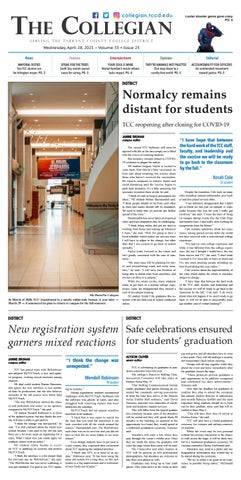
Normalcy remains distant for students TCC reopening after closing for COVID-19 JANINE SHUMAN campus editor
File Photo/The Collegian
In March of 2020, TCC transitioned to a mostly online-only format. A year later — March 29 — it announced its plan to return to campus for the fall semester.
DISTRICT
The vacant TCC hallways will soon be injected with life as the once-empty air is filled with the voices of returning students. But normalcy remains distant as COVID19 continues to plague the nation. TR student Gregory Taylor is excited to come back. Now that he’s fully vaccinated, he feels safe about returning, but worries about those who haven’t received the vaccination. He expects campuses to enforce masks and social distancing until the vaccine begins to push herd immunity. It’s a little annoying, but necessary to protect those at risk, he said. “I think it's safe as long as precautions are taken,” NE student Maram Hammoudeh said. “I think people should sit far from each other in class and masks should still be mandated. We need to make sure we prevent any further spread of the virus.” Hammoudeh has never taken an in-person class, and fears adaptation may be challenging. “I think being online just got me used to working from home and waking up whenever I want,” she said. “Now I'm going to have a fixed schedule which makes me nervous since I will have to adjust to the change, but other than that I am excited to go back to school normally.” Taylor looks forward to the return and isn’t greatly concerned with the ease of transition. “My main issue will be planning for travel, and remembering roads and room numbers,” he said. “I will miss the freedom of being able to attend class from anywhere, and not have to drive to a campus.” While the return excites many students ready to get back to a normal college experience, some are disappointed they missed a year of on-campus learning. SE student Xorah Cole graduates this semester, with her final year of school conducted online.
“I have hope that between the hard work of the TCC staff, faculty, and leadership and the vaccine we will be ready to go back to the classroom by the fall.”
Xorah Cole SE student
Despite the transition, Cole took on many roles including campus ambassador, peer leader and also joined several clubs. “I am definitely disappointed that I didn't get to finish my last year on campus — especially because this was the year I really got involved,” she said. “I miss the buzz of being on campus during events like the Club Expo and transfer fairs. I also really miss working on assignments from the library.” Cole remains optimistic about her experience, having gained several skills she would not have received with a conventional college experience. “I've had my own college experience and while it was different from the college experience, the one I thought I would have, the one from movies and TV,” she said. “I don't think I missed it. I've been able to learn so much and I've met some amazing people including my best friend during this year online.” Cole worries about the unpredictability of the virus which makes the return to normalcy subject to change. “I have hope that between the hard work of the TCC staff, faculty, and leadership and the vaccine we will be ready to go back to the classroom by the fall,” Cole said. “I do worry about what will happen if we aren't ready to go back — will we be able to successfully manage another year of virtual learning?”
DISTRICT
New registration system Safe celebrations ensured garners mixed reactions for students’ graduation JANINE SHUMAN campus editor
TCC has parted ways with WebAdvisor and adopted MyTCCTrack, a new and updated program, evoking mixed reactions among students. NE dual credit student Maram Hammoudeh agrees the new interface is less outdated than its predecessor, but she also believes elements of the old system were better than MyTCCTrack. “The way WebAdvisor showed the classes and professors was easier, in my opinion, compared to MyTCCTrack,” she said. TR student Wendell Robinson is in favor of the updated system, but also thinks the new site will take a while to get used to. “I think the change was unexpected,” he said. “I’m still confused about the whole new system because I am used to the old one and there are a lot more steps on registering for a class. What I liked was you could apply for multiple classes with no issues.” NE student Alma Sardas is excited TCC is updating its systems and prefers MyTCCTrack. “I think the interface is a lot cleaner than the previous one on WebAdvisor,” she said. “The WebAdvisor one was never confusing, it was just outdated. I’m glad to see TCC updat-
“I think the change was unexpected.”
Wendell Robinson TR student
ing its systems.” During registration, students encountered challenges with MyTCCTrack. Robinson felt the software was glitchy at times, and also struggled with removing classes that were added into the schedule. MyTCCTrack did not appear seamless and sleek to all students. “I liked that it was easier to search for the class that you want but sometimes it can look crowded with all the words around the classes,” Hammoudeh said. “On WebAdvisor, each class was on its own line and you did not have to click the see more button to see more classes.” Even though students have to get used to a new system, they expressed their excitement about TCC updating the outdated interface. “I think that TCC is in need of an update,” Robinson said. “It has been using the same old system for a long time, so this new system is a big improvement and a well-needed new fresh coat of paint.”
ALYSON OLIVER senior editor
TCC is celebrating its graduates in pandemic-conscious ways this year. The college’s first-ever Rolling Commencement Ceremony will take place at Dickies Arena May 15. “Our Rolling Commencement format entails graduates and guests forming an extended but constantly moving processional from the time they arrive at the Dickies Arena Exhibit Hall entrance,” said David Ximenez, associate vice chancellor of enrollment and academic support services. This will differ from the typical graduation ceremony because none of the attendees will be seated and they will spend about 30 minutes in the building, as opposed to the approximate two hours they would spend at a traditional graduation ceremony, Ximenez said. Attendees will enter a line where they pass through the venue’s exhibit area. Once they are inside the arena, the graduates will cross the stage where their name will be read. The Chancellor and other leaders at TCC will be present, as will professional photographers, but attendees are welcome to take their own photos as well. Graduates may bring up to four adult guests. They must arrive at the venue in their
cap and gown, and all attendees have to wear a face mask. They will all undergo a security and temperature check before entering. Groups will all stay together while they attend the event and leave immediately after the graduate crosses the stage. “These protocols provide graduates a safe opportunity to be publicly recognized and celebrated for their achievement,” Ximenez said. Now that the deadline for graduates to confirm they plan to attend the ceremony has passed, district director of admissions and records Rebecca Griffith said the most important thing students should do is look out for their graduate name card that will be mailed to them May 3. “This will have their time of arrival at Dickies Arena,” she said. TCC will also have a virtual graduation ceremony for veterans and military-connected students. While the event may be less personal without face-to-face interaction or the chance to walk across the stage, it will be fairly similar to a traditional graduation ceremony, SE veterans counselor Christy McDonald said. Attendees may send in a photo and any biographical information they would like to be shared during the ceremony. “We try to make it as good of an experience as possible being online,” McDonald said.
Feature
The Collegian
April 28, 2021 • Page 3
Earth Day unites community
Photo courtesy of Thien Nguyen
A photo of a squirrel relaxing on a turquoise bench won first place in the animal category for the photo contest. There were nearly 400 entries submitted in total.
There was something for everyone during TCC’s virtual and in-person Earth Day events LYDIA REGALADO campus editor
A cause for caring united students on Earth Day during festivities including art and photo contests, baking, fun-runs, events and ceremonies. SE chef Alison Hodges kicked off the virtual events by demonstrating how to make Earth Day sugar cookies as a delicious way to celebrate. The baking activity turned into an art project when she added blue and green food coloring. Since the earth is over 70% water, there should be more blue dough than green, Hodges said. In another event, City of Arlington stormwater education specialist Melissa Walker shared how water connects people and places. Stormwater that isn’t soaked into the ground is dispensed into our local waterways, she said. “Right behind Southeast Campus is Fish
Creek, so all of the runoff from the parking lot is going to go into that creek,” Walker said. “It’s not a treated system, so any trash that’s left on the parking lots or sidewalks, all of that’s going to get washed into that creek.” Our drinking water comes from groundwater — water from rain, melted snow, ice or hail soaked into the ground — and surface water, which is stored in rivers, streams, lakes and other waterbodies. Someone who fertilizes their yard often, uses harmful detergents when washing their car or disposes of wastewater improperly may not realize they are contributing to toxic aquatic conditions, Walker said. Sewer overflows and water breaks also pose threats. Simple solutions to minimize harmful chemicals include composting or properly disposing of yard waste, washing vehicles over a grassy area or using a carwash with a storm drain and utilizing low phosphorus fertilizers and detergents, Walker said. During a food waste and composting event, material management marketing ana-
Photo courtesy of Deedra Parish
Alumna Autumn Henry and South student MaKayla Gunthrie plant a magnolia tree on South Campus.
lyst Flavia Paulino shared a 2014 Fort Worth landfill audit. The results showed that only 30% of what ended up in the landfill was garbage, Paulino said. The rest was 35% of materials that could have been composted and 35% recyclable items. “A lot of people are now thinking that recycling is not worth it anymore, because the cost of recycling has gone up and the value of recyclable material has gone down,” Paulino said. “However, it is still cheaper to recycle than to throw all that stuff in the garbage and having to keep building new landfills.” Over 20% of the compostable material was pure food waste. Thirty percent of U.S. food goes from farm to table to landfill and in the end, 43% of food is wasted. Over-buying, spoilage and disposal of food in homes account for 43% of the the total food waste weight. Farms accounted for 16%, manufacturers 2% and consumer-facing businesses 40%, Paulino said. Students and faculty gathered safely
during a Phi Theta Kappa event, which celebrated the beautifying of South Campus by planting four trees. Each participant, including South Campus president Daniel Lufkin, took turns shoveling dirt on one of the magnolia trees. “I can’t think of a better way, on Earth Day of all days, to promote unity and the values associated with higher education through the planting of this tree,” Lufkin said. “When I think of a tree, it’s a universal symbol, a symbol of strength and growth.” A plaque will commemorate perseverance for the project, which began with the Rho Chi Service committee in 2019. “Twenty years from now, 30 years from now when someone comes on campus, they may not know but they’re going to walk past this tree,” student Makayla Guthrie said. “This is a legacy that we all made together.” Resources and event recordings can be found on TCC’s Earth Day website.
Artwork by Hannah Kay Ingram Biffel
A scene of ocean waves, sand and sunshine won first place in the landscape category for the art contest.
Artwork by Agnieszka Niewiadomska
“Atlantic Salmon” won the animal category for the art contest. Niewiadomska was inspired by her childrens’ animal guides.
Artwork by Tyson Shepherd
Shepherd’s art portrays his feelings on humans’ destruction of the planet, yet still represents optimism.
Photo courtesy of Emma Torrez
“Trees Hold Our Planet Together” won first place in the ceramic art category.
Page 2 • April 28, 2021
News
The Collegian
DISTRICT
Two alumni run for mayor of Arlington
Dewayne Washington and Marvin Sutton are among the candidates in the May 1 election
Photo courtesy Dewayne Washington /Facebook
Washington attended TCC and obtained a bachelor’s in organizational leadership from Bethel University. He owns multiple businesses including a film company. LYDIA LY DIA REGALADO REGALADO campus editor
Alumni Dewayne Washington and Marvin Sutton gained some of their first political experiences at TCC. Now, both are among candidates on the ballot for City of Arlington Mayor. “I think my time at TCC, then TCJC, absolutely impacted my decision to run,” Washington said. Washington went to O.D. Wyatt High School, right next door to South Campus, and was on his way to the University of North Texas until a counselor reached out and told him about the opportunities at TCC. It changed the trajectory of his life. He started a student exchange program where he learned to respect different cultures and other students’ journeys. It was an opportunity to look beyond what can be seen, he said. “The way I can understand different peo-
ple’s mentality, where they’re coming from, their background and being able to speak the language, I learned those ideas at TCC,” Washington said. By his second year, he was student body president and a member of the Texas Junior College Student Government Association, a student government for the entire state of Texas. Before he could vote, he was writing laws, and at 18 years old he was on the Senate floor. “I truly believe TCC is a gem that a lot of people have no idea that it’s really there,” he said. Upon his many goals, Washington wants to improve education. He said a good school ecosystem begins at home. A family who is struggling economically affects a child’s school performance. He wants to make sure children receive the education they deserve in order to help sustain their own economy. “Let’s not just bring in a ton of developers from outside the city and outside the
Photo courtesy Marvin Sutton/Facebook
Sutton obtained several associates degrees at TCC before obtaining a bachelor’s degree in accounting from the University of Texas at Arlington. state,” Washington said. “You don’t want a city with great buildings and it looks phenomenal, but has broken people.” Washington obtained a degree in organizational leadership from Bethel University. Now, he is a senior pastor at Love Church in Arlington and owns several businesses including a film company. Arlington councilman and Air Force Veteran Marvin Sutton was new to politics before he took a government class with professor Anita Hill. He voted in the Texas primary for the first time in 2000 and learned about precinct conventions using his textbook as a guide. After he became a delegate for the county convention, he sent professor Hill an email saying he had become a delegate for presidential candidate Al Gore. “I learned about politics from Tarrant County College,” Sutton said. Sutton obtained several degrees from TCC — an associate of applied science and an arts degree — and went on to graduate
DISTRICT
SOUTH
KYLE ELLIS
LOGAN EVANS
The Texas tax deadline was extended to June 15 because of the winter storm that crippled the state. As college students prepare to file, it is important to know how to get the most cash back. There is more to tax season than just filing. Renee Brooks, CEO of Brooks Books Accounting and Bookkeeping in Southlake, recommends preparing taxes all year long and keeping receipts. Many school expenses are deductible, including tuition and fees, textbooks and supplies. Students should take advantage of tax deductions, NW accounting adjunct instructor Christopher Mitchell said. “The tuition and fees deduction allows eligible taxpayers to deduct up to $4,000 in qualified higher education expenses for themselves, a spouse and dependent children as an above-the-line exclusion from income,” Mitchell said. Scholarships that have been applied to a school account may be taxable too. Every student should take advantage of two credits, the American Opportunity Credit and the Lifetime Learning Credit, Mitchell said. “This can save them thousands of dollars,” he said. Robert Gill, a Certified Public Accountant from Grapevine, said when possible, parents should claim students as dependents so more deductions are available to them. Mitchell agreed that understanding dependency status can greatly impact potential refunds. Students can deduct student loan interest and file state tax returns in other states if they work or pay tuition to a school outside of
Student Charles Jackson was reciting a poem about the normalization of Black trauma in America when the murder conviction of Derek Chauvin was announced. His performance was setting up a virtual Toro Talks interview between activist Marc Lamont Hill and South Intercultural Network coordinator Michael Russ. The session was organized to discuss Hill’s book “We Still Here: Pandemic, Policing, Protest and Possibility.” But as news of the verdict broke, their conversation veered towards their reaction to it. “I feel heavy,” Hill said. He recalled the initial pain he felt watching the video of Chauvin kneeling on Floyd’s neck. To him, it signified a cold disposability of Black life in America. Hill said while he understands the joy many feel in the aftermath of the trial, he still doesn’t place his faith in the criminal justice system. As a police abolitionist, he dreams of a world where the term “criminal justice” is radically redefined. “We can’t allow this verdict to make us believe that the system works,” he said. Russ asked Hill about the “two systems of justice” theory — the idea that people of color are treated differently within the system as if they’re being brought into a second one. He said he fears some people will point to the guilty verdict to downplay claims of racial injustice in the future. Hill said the justice system is built to make compromises. “The argument that there’s two systems of justice doesn’t mean that Black folk never get an outcome they want,” he said. “We’re talking about systems and structures. White
magna cum laude from the University of Texas at Arlington. “I would have never thought in a million years that I would have an opportunity to run for mayor,” he said. Sutton’s journey to becoming a current council member for District 3 in Arlington was difficult. He lost five consecutive times, but won in 2019. He became the first African American to be elected to the single-member district since its inception, and the fourth public office holder for that district. One of his main goals is to build trust and reconnect citizens back to Arlington City Hall. “City hall belongs to the people, and I never forget that,” Sutton said. General election for Arlington Mayor is on May 1. Washington and Sutton encourage students to become involved with their community and make their voices heard. “Never ever walk away from your vote,” Sutton said.
Extended tax deadline Marc Lamont Hill reacts gives students leeway to Chauvin trial verdict campus editor/photographer
reporter rep orter
Photo courtesy Kelly Sikkema/Unsplash
The June 15 deadline gives students more time to prepare their taxes. Texas. For example, if a student is a Texas resident but goes to school and works in Arkansas, the student will need to file an Arkansas state return in addition to their normal federal tax return. Gill said students should also know their employment status. If they get a W-2, then taxes have already been withdrawn. However, if the student does contract work for a set payment, taxes will have to be paid. “This is why keeping those receipts is important,” he said.
supremacy is a quite durable system. Hill said he’s more concerned with what the verdict means for the everyday Black person, who still faces racism on a regular basis. “One hundred Derek Chauvins won’t change that reality,” he said. When Hill was a young activist, he fought to lock up corrupt police officers and integrate police forces. Now, he looks to the new generation that is taking a step further with calls to defund police, something he doesn’t believe is as radical as it might sound. “We’ve lived much longer in human history without police than with them,” he said. To introduce people to an abolitionist vision, Hill said he doesn’t begin by describing a world he doesn’t want. Instead, he encourages people to envision a world where all of their needs are met. He recalled the shooting of Walter Wallace by Philadelphia police in October of 2020. Wallace’s death spurred debate when it was learned he was holding a knife and suffering a mental breakdown at the time of the shooting. Some claimed the officer who shot Wallace was justified. Hill said that these debates are counterintuitive. They work under the assumption that police are the only way to solve problems. “When the one tool you have is a hammer, everything is going to look like a nail,” he said. Hill believes money taken from defunded police stations should be reallocated to social workers, care centers and the creation of a public safety force that is trained to de-escalate high-stress situations. “What would the world look like if Walter Wallace’s needs had been met?” he said.
Page 4 • April 28, 2021
Entertainment
The Collegian
MOVIE REVIEW
Reboot does not achieve flawless victory
Photos courtesy of Warner Bros. Pictures
Jax, played by Mehcad Brooks, approaches Sub-Zero, played by Joe Taslim, and shoots him point-blank with a shotgun. Sub-Zero freezes the bullets, stopping them midair.
JOSE ROMERO senior editor
“Mortal Kombat” is a franchise best described as a techno-heavy gorefest in which ninjas meet the U.S. military. The new film reboot does a pretty decent job at conveying just that. The plot revolves around a new character made for the film called Cole Young, played by Lewis Tan. He was born with a dragon symbol on his chest, which means he has been chosen to fight in a multi-world contest called “Mortal Kombat.” His objective is to help others with the symbol defeat the evil sorcerer Shang Tsung, played by Ng Chin Han, before he conquers Earthrealm. Cole is an uninteresting character with nothing special about him. His character arc is generic and predictable in almost every way. He isn’t written well enough to be the central focus of the movie. Most of the other characters weren’t any better. All of the main characters felt as if they were in layers of plot armor, negating any kind of tension a scene could have. It didn’t help that the pacing and editing were inconsistent. Scenes would end abruptly, and characters needing more time for development were left in the dark. The only character that managed to stand out was Josh Lawson’s Kano.
He offered some decent comedic relief in scenes that would have been dull without it, but there are multiple instances where he just goes on and on, not stopping to let the plot explain itself, which it heavily needed to do. “Mortal Kombat’s” story goes back to 1992, so there are times where the film gets stuck in its complexity. Having to explain what Outworld and the Netherealm mean while also explaining why people can control elements is a juggling act the movie can’t do. But who’s really here for the plot? “Mortal Kombat” is about sweet, bloody action scenes between superpowered individuals. The opening scene shows Scorpion, played by Hiroyuki Sanada, as he fights for his life against Sub-Zero, played by Joe Taslim. Sub-Zero and his goons invade Scorpion’s home and kill his family. The scene is scored by a badass synth-heavy riff as Scorpion decimates his foes in a gory, well-choreographed battle. Each fight scene has a nice weight and visual flair to it and takes heavy inspiration from the games, as most of the movie does. Costumes, one-liners and even stances are faithful to their origin. Except for Scorpion’s iconic “Get Over Here” line. Should’ve used Ed Boon. Fatalities look almost exactly as one would imagine they would in live-action. They’re gory displays of mangled flesh as the character who inflicted the damage says something super corny. It’s pretty dope.
Cole Young, played by Lewis Tan, trains in a hidden temple for “Mortal Kombat,” a tournament between Earthrealm and Outworld. The fight scenes would leave a longer impact if the special effects accompanying them weren’t so lackluster. Rushed effects jobs are noticeable nowadays as the standard for computer-generated graphics has increased. “Mortal Kombat” is filled with moments that take the audience out of the film because of how unpolished a scene looks. That’s what happens when artists aren’t given enough time by a studio to clean
things up. Overall, it’s nothing special. It will satisfy fans of the games and audiences wanting an action movie that doesn’t take itself too seriously. The film has a messy plot and a generic main character anchoring it, but it’s hard not to get hyped when a dude rips the heart out of a giant humanoid lizard.
GAME REVIEW
Science fiction game is full of dumb fun with friends MICHAEL FOSTER-SANDERS editor-in-chief
Photo courtesy of Square Enix
“Outriders” is the latest game to enter the looter shooter genre. It’s a third-person action game developed by People Can Fly.
Oh boy, not another looter shooter. When “Outriders” was announced, this was the stance most gamers took after being bombarded throughout the years with games like “Destiny” and “The Division.” But does “Outriders” break the mold to bring something fresh to the tired genre? Yes, it does, and so much more. Earth is dying, and people are in a frenzy to reach lifeboats so they can escape to an Earth-like planet called Enoch. A group of mercenaries named the Outriders leads the charge to inhabit the planet. Looks can be deceiving because once the planet is reached, they didn’t imagine it would be a hell-onEarth-like planet with carnivorous aliens and lightning storms that destroy everything in their path. The Outriders are then betrayed by the scientist who tries to kill them to stop word from getting out about the planet’s conditions. This is where your character comes into play as they become altered with powers during one of the storms and then wake up 30 years later as the few Outriders who are left in this wasteland apocalypse. The gameplay is simple, smooth and fun. You basically kill everything coming at you and complete quests to build up your character in the world tiers. The weapons system is simple at face value, but complex
enough to get lost in creating the best way to eviscerate your opponents. The gameplay can get tedious with the rinse, wash and repeat elements of looter shooters. The fresh elements from the game are in the form of the three classes called anomalies that you can choose from which alter the way players will approach the game. Fair warning: this game does not hold your hand, and will test the player’s skills with its foot full-throttle on the gas. Only the strong should attempt to tackle this game by themselves, and all others should develop online friends to clique up and party with. Dumb fun is the name of the game, and Outriders takes its cues from a B sci-fi film with its hokey story mixed with heart-pumping action. The game launched as a playable, buggy mess — not to the magnitude of the “Cyberpunk 2077” fiasco. But Square/People Can Fly has been committed to making constant updates to make the game bugs such as crossplay not working or player data not saving. This game is close to a “Gears of War” type game, so Playstation gamers should buy it without fail. Xbox users don’t have anything to lose because it’s on Game Pass. Go ahead and buckle up your seatbelt and go on this wild ride that will leave you exhausted, but fulfilled in the end.
Opinion
The Collegian
Viewpoints
Editorial
New laws lead way for animals’ rights
LYDIA REGALADO campus editor
Consumer awareness, changing laws and alternative testing methods are shifting the scope further away from cosmetic animal testing. Current legislation in China requires all imported cosmetics to undergo animal testing. However, starting May 1, ordinary cosmetics, which are products made for everyday use like makeup, hair care and perfumes, will no longer be subject to these methods. Special-use cosmetics will still require testing. This includes products that make any sort of claim — for example, anti-aging, hair growth, whitening products, sunscreen and hair dyes. The words ‘cruelty-free’ have more or less become a marketing ploy by big corporations, but not everyone considers all brands that make these
claims to be 100% ethical. For example, even though a label such as Urban Decay’s says, “Our products are 100% cruelty-free, and we never test on animals,” they are owned by L’Oréal, a brand who sells products in Mainland China. For transparency, L’Oréal’s website says they have been working with Chinese authorities and scientists for over 10 years to have alternative testing methods recognized. But the ugly truth is that rats, rabbits, monkeys and dogs are some of the animals used for testing. Chemicals are injected into their blood, dripped into their eyes, rubbed on their skin and sometimes lethal doses are given, causing seizures and convulsions. They are then observed for redness, swelling, hemorrhaging, blindness and other irritations. Afterward, most animals are killed. A few ingredients that cause other ethical concerns include carmine — beetles used for red color in makeup — beeswax and lanolin. Small but steady waves are making a big difference in the lives of animals toward a kinder world. The first step for those who want to help is to simply be aware. At the end of the day, it’s up to consumers to make conscious decisions about the purchases that they are making.
Paving better future with more funding
ALYSON OLIVER senior editor
It would take almost $90 billion to complete all the repairs needed to modernize public transportation, and despite its benefits to the economy, the environment and more, 45% of Americans have no access to it, according to the American Public Transportation Association. Public transportation might be easy to take for granted, but more should be invested in it for various reasons. It makes travel more accessible. The need for a private vehicle puts people unable to afford one, or those unable to drive, at a disadvantage. Public transport gives these groups a reliable way to travel to work or school. And by giving people the means to travel, the economy receives a boost. According to APTA, there
April 28, 2021 • Page 5
are $5 in economic returns generated for every $1 spent on public transportation. Passengers can expect to arrive at their destination safely. Modes of public transport — especially intercity busses — have much lower fatality rates than private vehicles do, according to the Journal of Public Transportation. And using public transportation is an excellent way to benefit the environment. Cars contribute massively to an individual’s carbon footprint. But if an individual began using public transportation for a 20-mile commute, they would save 48,000 pounds of CO2 emissions in a year, according to the Kansas City Area Transportation Authority. Two final benefits are a lack of isolation and increased productivity. While using public transportation, passengers have more opportunities to interact with one another, a benefit they would miss out on when operating a private vehicle. Because they are not busy driving, they are able to spend their commute doing other tasks. Using and investing in public transportation is worth advocating for. The next time someone needs to commute to work, school or any other destination, it’s something they should consider giving a try.
Pelosi falters with misguided message
Amber Davis/The Collegian
There’s been a lot of celebration following the murder conviction of former Minneapolis police officer Derek Chauvin, and rightly so. Chauvin’s conviction comes after a history of police not being held accountable for the killing of unarmed Black men. But it’s important to remember in all of this: George Floyd did not sacrifice himself. According to Speaker of the House Nancy Pelosi, though, he did. “Thank you, George Floyd, for sacrificing your life for justice,” Pelosi said during a press conference the evening the verdict was announced. “For being there to call out to your mom — how heartbreaking was that — call out for your mom, ‘I can’t breathe.’” The phrase “I can’t breathe” became famous as the last words of Eric Garner, another unarmed Black man, when he was killed by police in 2014. Although it’s since become a mantra to be spit in the face of injustice, Floyd said those words beneath Chauvin’s knee because he too could not physically breathe. He was dying. To pretend otherwise is to downplay the loss of Floyd’s life. He didn’t die as part of some necessary evil conducted by the universe to draw attention to police brutality. He died because he encountered a crooked cop, just like Eric Garner did and just like so many others before and after them did. Pelosi may have been well-meaning in her remarks. She might have been searching for a profound meaning in such a cruel and easily avoidable murder, but the reason Floyd’s death
ignited a movement wasn’t because he intended it to. It was for the exact opposite reason. Thanking Floyd for dying ignores the helplessness he faced in the minutes before his death. It ignores the hopes and dreams he held that were taken from him as his life drained on video. It ignores the fact that he didn’t have a choice. This isn’t to say the attention Floyd’s death brought to issues of racism and police brutality isn’t important, or that his death didn’t plant seeds of change. It did, but had it not been Floyd, it would have been another unarmed Black man down the line when it should never have been anyone at all. After a storm of Internet backlash, Pelosi clarified her statement in a tweet, writing, “George Floyd should be alive today. His family’s calls for justice for his murder were heard around the world. He did not die in vain. We must make sure other families don’t suffer the same racism, violence and pain.” The verdict reached in the Chauvin trial is a step in the right direction from a place that was so far from it. Pelosi and others are pushing the recently introduced “George Floyd Justice in Policing Act,” which, if passed, will combat police misconduct and racial bias in policing. These changes are good. It’s important, though, to remember that the loss of life they sprouted from wasn’t some grand design of cosmic willpower, but was something that shouldn’t have happened at all.
Letters to the Editor The Collegian staff welcomes letters to the editor concerning articles that have run in the paper or on other subjects that may be of interest to the general public. All letters should be signed by the writer, who should include their Colleague ID or telephone number. The numbers will not be published. They are used for verification only. Letters should be typed and not longer than 150 words. They will be edited for grammar, style and length. Letters will run at the discretion of the editor. They should be e-mailed to: michael.foster-sanders@my.tccd.edu
Join the discussion at collegian.tccd.edu Facebook.com/ TCCtheCollegian
Meet
the
Staff
EDITOR-IN-CHIEF Michael Foster-Sanders
MANAGING EDITOR Maddy Remington
CAMPUS EDITORS Logan Evans Lydia Regalado Janine Shuman
SENIOR EDITORS Alyson Oliver Jose Romero
SOCIAL MEDIA MANAGER Mary K. Maturo
WEBSITE COORDINATOR Kristal Blankinship Amanda Cole
PROFESSIONAL STAFF PRODUCTION MANAGER Stacy Luecker
ADVISERS Chris Whitley, Jocelyn Tatum
Instagram @TCCtheCollegian
Twitter @TCCtheCollegian
Letter Policy PHOTO EDITOR Azul Sordo ILLUSTRATOR Amber Davis DESIGN & LAYOUT Abbas Ghor Amber Davis Kristal Blankinship Alejandro Meza Amanda Cole
The Collegian is a weekly student publication serving the Tarrant County College District. Editorial statements and advertisements do not necessarily reflect the opinion of the TCC administration. Letters to the paper should be 150 words or less, free from libel and poor taste and include the writer’s Colleague ID or telephone number (the numbers will not be published). Letters may be brought to The Collegian office (NCAB 1124A, NE Campus), or mailed to:
The Collegian • 828 Harwood Road Hurst, TX 76054 Office: 817-515-6391 Editor: 817-515-6394 Advertising: 817-515-6619 email: collegian.editor@tccd.edu TCC is an equal opportunity institution that provides educational and employment opportunities on the basis of merit and without discrimination because of race, color, religion, sex, age, national origin, veteran status or disability.
Feature
Page 6 • April 28, 2021
PERMIT-LESS CARRY Concerns arise amid permitless gun carry bill JANINE SHUMAN campus editor
With mass shootings on the rise, Texas is working on passing House Bill 1927, which will allow all Texans 21 years and over to carry a firearm openly and without permits. “Just knowing that someone who didn’t even need to get a proper permit for carrying a gun is scary,” NE dual-credit student Abrar Hammoudeh said. “It’s just so unsafe for the people around them if things go wrong.” TR government adjunct instructor Cindy Stormer was a prosecutor and police officer who worked as a TCC campus officer for some time. Stormer stresses the importance of training when handling deadly weapons, explaining that police officers must undergo extensive training before carrying a firearm. While Stormer understands why some people may support the easing of gun laws, especially in rural and more conservative areas, she disagrees with the concept. “There are 329 million Americans,” she said. “There are 390 million guns. No other country has this kind of ratio. We as a nation must do more to stop mass shootings and unnecessary deaths.” NE government adjunct instructor César Díaz is concerned about a lack of training while carrying. “Even though proponents argue that carrying a handgun without a permit would still require a background check and could be disqualified by federal and state safeguards, this does not account for the training that the current license to carry requires,” he said. “The danger is that people could begin holstering without even minimal gun safety training.”
César worries the passing of the bill will only further increase the rampant violence in the country. “More people with guns in a situation where there is an active shooter has a high probability of increased casualties due to crossfire,” César said. “It will also create an environment where heated debates lead to people escalating violence from hand-to-hand combat to old west-styled shootouts.” Hammoudeh believes the country would significantly benefit from reform, saying this bill is a step in the wrong direction. “There are already enough shootings and horrible events going on around the world,” Hammoudeh said. “Giving free rein on carrying would not make it any better. If anything, there should be more regulations. Not just anyone should be able to obtain a gun.” César thinks gun laws are already minimal and non-costly, believing the only benefit will be strictly political. “The benefits will be reaped by gun manufacturers and gun lobbyists,” he said. “I believe that the people who support this legislation do it just to pander to the gun lobbying groups and to instill an unfounded fear in a core group of people that the government is attempting to limit their 2nd Amendment rights.” NE government professor Lisa Uhlir believes the solution lies in solving the root of the problem. “I would argue that gun violence is highly correlated to mental health issues, and we need to focus on where the problem lies,” she said. “I don’t know if we ignore the connection in the media or the discussions on gun violence because of the stigma on mental health issues or out of a political goal.” Uhlir credits the rise of gun sales during the pandemic and post-election as a lack of trust in government protection. “With the individualistic political culture here, the people don’t wait for the government to solve their problems,” she said. “They want to feel they are doing something themselves to protect themselves.” Stormer believes there is a wide array of possible preventative measures that can significantly decrease gun violence in the United States. A study conducted showed that having to obtain a license to purchase and own a gun reduces deaths, Stormer said. A license to drive is already needed to prove ownership and proficiency, why not apply the same rule to guns as well? Stormer also proposes the use of more thorough background checks and mental health exams can be beneficial, also issuing another concerning point to consider. “Guns can now be made with a 3D printer,” she said. “The monitors by the Transportation Safety Administration do not detect these guns. Should this be regulated?” School shootings are valid points of concern for many students and their families. Stormer said schools need to do more to provide safety in case of an event, including a single and monitored entrance, multiple cameras, clear backpacks, armed officers and more recognition of mental health issues. “Taking self-defense classes or learning to use any type of weapon properly I think is necessary if only to give people the knowledge of what they can do in response,” Uhlir said. “Like any type of education, it is invaluable to practice what you would do before it happens to prevent the situation from becoming worse.”
Illustration by Amber Davis /The Collegian