collegian.tccd.edu
Kaiju showdown for king of monsters PG. 4
Wednesday, April 14, 2021 – Volume 33 • Issue 23 News
Feature
Entertainment
Opinion
Editorial
TELLING A STORY Author and students tell personal stories. PG. 2
TURN THE IGNITION Automotive program helps students build skills. PG. 3
A SWIFT RETURN Taylor rights the wrongs of her past. PG. 4
A LACK OF ACCESSIBILITY Why college students need mental health resources. PG. 5
GARBAGE HEALTH CARE SYSTEM An old method needs a long overdue update. PG. 5
DISTRICT
TCC gives support to LGBTQ+ students
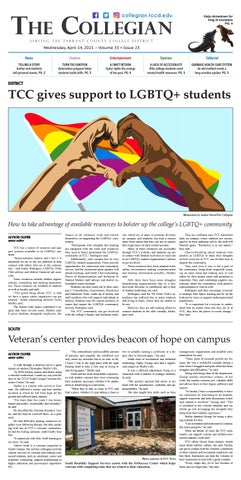
Illustration by Amber Davis/The Collegian
How to take advantage of available resources to bolster up the college’s LGBTQ+ community ALYSON OLIVER senior editor
TCC has a variety of resources and support systems available to its LGBTQ+ students. “Representation matters and I feel it is important for me to use my platform to help connect with others who are in the community,” said Andee Rodriguez, LGBTQ+ Pride Club adviser and district financial aid associate. Some resources include student organizations, counseling and training opportunities. These resources are available to students as well as faculty and staff. “The good thing about TCC is that we have a space where employees can get trained,” South counseling director Ticily Medley said. The district Safe Space committee’s origins date back several years, Medley said. It gives students, alongside employees, the
chance to do volunteer work and inform themselves on supporting the LGBTQ+ community. “Participants who complete this training are equipped with the tools and resources they need to better understand the LGBTQ+ community at TCC,” Rodriguez said. Additionally, each campus has its own LGBTQ+ student organization. These provide opportunities for connection and community service, and the occasional guest speaker will attend meetings, said Sarah Chavez-Reckling, Power of Representation and Inclusion of Student Matters staff adviser and district information center assistant. Students can also reach out to their campus’s Consultation, Assessment, Resources and Education Team, made up of faculty and staff members who will support individuals in distress. Students may file reports inclusive of issues that impact the LGBTQ+ community directly, Rodriguez said. The TCC community can get involved with the college’s Equity and Inclusion coun-
cils, which are in place to promote diversity on campus, and students can find a chosen name form online that they can use to replace their legal name on their school account. Many of these resources are accessible through TCC’s website, and students can get in contact with Student Activities or reach out to an LGBTQ+ student organization’s adviser to get involved. These resources have been adapted to the online environment, making communication and sharing information possible, Medley said. Still, there have been some struggles maintaining organizations due to a district-wide decrease in enrollment and a lack of student leadership, she said. Rodriguez said the NE Pride Club’s attendance has suffered due to many students still living at home, where they are unable to be out. However, they are still making efforts to connect students to the club virtually, Rodriguez said.
They are confident once TCC transitions back on campus, where students are encouraged to be their authentic selves, the club will flourish again. “Resilience is in our nature,” they said. Chavez-Reckling asked students who identify as LGBTQ+ to share their thoughts on how everyone at TCC can do their best to support the community. They said even if one is not a part of the community, being kind, respectful, keeping an open mind and making sure to call others by their proper name and pronouns is important. They said combating negative stereotypes about the community with positive representation is vital as well. Rodriguez said they encourage everyone to undergo Safe Space training and be on the lookout for ways to support underrepresented populations. “It is important for everyone to understand that no matter what role they are in at TCC, they have the power to create change,” they said.
SOUTH
Veteran’s center provides beacon of hope on campus
ALYSON OLIVER senior editor
A walk through a doorway led to a great impact on student Christopher Shelby’s life. “In 2018, broken, unsure and afraid, using a wheeled walker/seat, I made my way into the door of the TCCD South Campus Veterans Resource Center,” he said. Shelby is a veteran who served in Vietnam. He suffered a stroke and had another accident in which he fell from high off the ground and suffered many injuries. “For more than two years I was homebound physically, emotionally and mentally,” he said. He described the Veterans Resource Center, and the help he received there, as a godsend. He had difficulty putting sentences together even following therapy, but after speaking with one of TCC’s veterans’ counselors, he had the feeling someone could finally hear him. “It started out with Mrs. Groll listening to my story,” he said. Valerie Groll is a veterans counselor at South Campus. She and her colleagues provide various services to veterans and military-connected students, such as emotional, career and academic counseling, support transitioning to higher education and peer-to-peer opportunities.
“The extraordinary and incredible amount of patience and empathy she exhibited, not only eased my anxieties but in no time at all, I knew I was in the right place with the right helping hand to take a first step at trying to start living again,” Shelby said. Groll said her most memorable experiences with student veterans have been witnessing their academic successes, whether it be graduation or transferring to a university. “When they’re able to come to TCC and find a place, whether it’s just taking a class or
two or actually earning a certificate or a degree, they’re relevant again,” she said. South chair of mechanical and industrial technology Sophy George also had a significant impact on Shelby’s life. It was a difficult adjustment being in a classroom with a number of younger students, he said. “She quickly quieted that storm in my head with her genuineness, cordiality and approachability,” he said. She also taught him skills such as time
Photo courtesy of TCC News
South Disability Support Services assists with the VetSuccess Center which helps veterans with completing tasks that are related to their education.
management, organization and mindful communication, he said. “These areas of personal growth are because she was a wonderful example during a time when I struggled and quite often hid those struggles and difficulties,” he said. Along with being chair of the department, George teaches electronics courses. In her work, she teaches veterans new, valuable skills and advises them in their degree pathways and careers. “As faculty I have a responsibility to have my classrooms be welcoming to all students, support teamwork and hold discussions where each student is involved,” George said. “This is extended to our veteran students and my efforts go into leveraging the strengths they bring from their military experience.” Shelby thanked George for being a shining example for him. “I am reminded and motivated to continually learn and grow,” he said. There are plenty of ways the TCC community can support veteran and military-connected students, Groll said. TCC offers Green Zone classes, which teach about military culture, she said. Faculty can get in contact with the veterans’ counselors on their campus and on-campus employers can hire them. Instructors can trust the veterans in their classrooms to lead with a great example. “Every single day, we’re free because of them, and we forget that,” she said.
April 14, 2021 • Page 2
News
The Collegian
DISTRICT
Students, author share meaning of home LOGAN EVANS
campus editor/photographer
Growing up, author Cristina Henriquez never stayed long in the same place. She was born to a Panamanian father and an American mother and spent her youth being whisked around the country, never putting down roots anywhere. This left her with lingering questions. “I’m so used to that feeling of trying to assess where my home is,” she said. “Where do I belong? Who do I belong with?” Henriquez channeled these questions into her 2014 novel “The Book of the Unknown Americans,” which follows several immigrant families living in an apartment building. Last summer, the book was chosen by TCC as the “common reader” book for the current school year, to be read in more than 36 classes. On April 6, four students — winners of an essay contest — were given the chance to share their own interpretation of “home” with Henriquez during a live virtual event, “Conversations with Cristina Henriquez.” Each student read their winning essay and received personal feedback from the author. South student Sueyon Kwon’s essay described feeling overwhelmed when she first moved to Texas from her native South Korea. “I felt as if I were born again,” she read. She recalled sitting in a library and shuddering from the cold. Nobody had warned her about air-conditioning in Texas; that temperatures indoors were often much cooler than the temperature outdoors. In South Korea, she said,
Photo courtesy of Cristina Henriquez
Cristina Henriquez is the author of “The Book of the Unknown Americans.” there’s no need to bring a jacket inside. Being surrounded by a new environment with what felt like a million little differences adding up, Sueyon became depressed. Then, she made a friend — a girl named Grace — who comforted her and suggested she open herself up to the adventure of living somewhere new. “Her advice changed my perspective,” Sueyon read. Henriquez praised the detail of Kwon’s writing. “When you tell those specific experiences that you think are unique to you, those are the exact things people relate to,” she said. NW student Maried Toro wrote about celebration, comparing Navidades in her native Puerto Rico to Christmas
NORTHWEST
in the U.S. She misses the music and food of her homeland, but finds holidays in Texas to be special as well. “I enjoy visiting the city of Grapevine, seeing all the decorations and feeling the Christmas spirit,” she read. Toro said living in Texas has provided her a sense of security that was missing in Puerto Rico following the impact of Hurricane Maria in 2017, which left the island without electricity and supplies. In Texas, Toro and her family enjoy exploring new things. They eat brisket and listen to country music, but they still hold the traditions of their home close. “We keep memories of mountains and sunsets from Puerto Rico,” she read. Henriquez called attention to the richness of Toro’s essay, and the poetry in how she presented a blending of cultures. South student Sooa Pyo wrote that home is not defined by a place, but by the people living in that place. In South Korea, Pyo’s family lives in a building with two other families. Her village has “huge lawns, a running track, a swimming pool, a cafe and many other houses,” but more than any of that, Pyo values the people and activities that give it life. “I am a goalkeeper on my soccer team,” she read. “We play in stocking feet on huge lawns.” Pyo said that although her team sometimes struggles, the sport brings them closer together. “The precious thing about playing soccer is that people can play, squabble and share their lives,” she read. Henriquez related Pyo’s essay to the themes of community that she searched for in “The Book of the Unknown
“When you tell those specific experiences that you think are unique to you, those are the exact things people relate to.”
Cristina Henriquez author
Americans.” “It makes the whole piece feel so cohesive,” she said. TR student Sahar Lateef centered themes of family and community around a specific memory of her family making Dolma — a Middle Eastern dish — in her childhood kitchen in Iraq. “My grandmother says, ‘Sahar, come wash and slice the onions. Come cry with us,’” she read. She described her family gathered in a small kitchen with tiled walls and yellow and blue floors while her grandmother and mother playfully gossip about other family members. Experiences like this made an impact on her, she said, and she hopes to give her future children something similar. “I will teach my daughter and granddaughter our secret process to make Dolma,” she read. Henriquez highlighted the care taken in the way Lateef described her family. “That is just so lovely,” she said. Closing the event, professor Krista Rascoe thanked Henriquez for the opportunity given to students to share their experience. “It means a lot to them, and to us,” she said.
DISTRICT
Former officer talks Students hesitant to get civilian interactions COVID-19 vaccination LYDIA REGALADO campus editor
Recent media discourse over police liberties led the NW Criminal Justice Club to host an event which helped students understand their rights during police stops. NW criminal justice training coordinator Jim McGregor, a former Bexar County police officer, said there is a lot of misunderstanding about when a police officer can stop someone. “It’s a little bit more involved than just saying, ‘Well, this guy looks suspicious,’” McGregor said. The difference between reasonable suspicion and probable cause, and whether one is being detained or under arrest affects the rights of officers and citizens. Reasonable suspicion is necessary for detainment — holding an individual for further investigation — and is when a person is in a suspicious place under unordinary circumstances. For example, although uncommon, a person carrying a T.V. down the sidewalk is not doing anything illegal, McGregor said. “They could have bought it at a garage sale, or are taking it over to watch a game at a friend’s,” McGregor said. “Now take the same person in the same place carrying the same television at three o’clock in the morning. Because of the time of day it is much more unusual and therefore more suspicious.” An officer can detain the citizen to investigate why they are out at that time of night and where the television came from, McGregor said. They are not under arrest, but they cannot just turn around and walk away either. “I can ask him some questions, but he’s not required to answer any of these questions,” McGregor said. “If he does decide to tell me his name, he has to tell me the truth.” There has to be the higher legal level of probable cause — specific facts of a particular crime being committed — before other actions can be taken. “It is not enough proof to convict someone in a court of law, but it is enough to get a search warrant, arrest someone, or conduct a search of a
“I think it is important to open dialogue with citizens and officers to enhance trust, understanding and mutual respect,” she said. “Hopefully today’s event did that.”
Tracy Hearn
NW associate professor of criminal justice
vehicle.” McGregor said being under arrest is the only time it is required to identify oneself. Although citizens have a right to question the police, he advises against talking to officers in a challenging or spiteful way. “It’s going to extend the length of time that you’re going to be detained and you could get handcuffed because the officer is going to interpret this behavior as belligerent and potentially as a threat to their safety,” McGregor said. There is a lot of misinformation on social media which paints police in a negative light, he said. “The last thing we do is sit in the squad room at the beginning of our shift and say, ‘Alright, let’s go and pick on people today,’” he said. “We’re responding to calls, we’re out there trying to help people, we don’t try to hurt folks.” NW student Shacori Johnson said although she has been pulled over many times for speeding, officers were always respectful. “It’s all about how you treat people and it goes both ways,” Johnson said. NW associate professor of criminal justice Tracy Hearn, a former Dallas police officer, said the ability to have discussions can help everyone understand each other. “I think it is important to open dialogue with citizens and officers to enhance trust, understanding and mutual respect,” she said. “Hopefully today’s event did that.” The club’s next event will cover the trial of Derek Chauvin, the former officer accused of murdering George Floyd. Students can join the organizationon through Blackboard.
Photo courtesy of Gustavo Fring/Pexels
In Texas, 20.2% of people are fully vaccinated, according to The New York Times.
CRISTIAN MONROIG reporter
Texas Health and Human Services announced Texas will receive more than 1.9 million COVID-19 vaccine doses April 9, but not everyone plans to get it. Sixty-nine percent of Americans are currently vaccinated or plan to receive one, according to Pew Research Center. Despite this, there remains some hesitation among those who now qualify. NE student James White said his concern was he thought it was rushed. “I don’t trust it yet,” he said. Forty percent of Americans were reluctant to receive the vaccine in November, according to the same Pew Research Center poll. “It’s hard when you have family members who aren’t big supporters of the vaccine and who didn’t take COVID-19 seriously,” NE student James Bullard said. “If my family members had it, I would definitely try getting it, but I’ve been fortunate enough to not really be around anybody that’s had it.” Almost 14 million vaccines have bee administered in the state, and about 5 million people are now fully vaccinated,
according to Texas Health and Human Services. “I wanted to get it for the continued safety of my kids, my colleagues and my own family because many of us are high-risk individuals,” NE student Alex Hoben said. “I decided to go through with it and I have not regretted it since.” Hoben has not had any major side effects and now feels safer in public areas. For Hoben and TR student Gianna Medina, the vaccine is a welcome response to the lifted mask mandate as they spend their time around those considered high risk. “I have a lot of people I want to protect, and although the virus isn’t likely to cause me any true issues or kill me, it can be extremely dangerous to my loved ones and I don’t want to ever become a risk to them,” Medina said. According to The New York Times, cases in Texas have been on a steady decline over the past month. However, a return to pre-masking behavior will lead to a sharp increase in cases similar to what was seen during the winter, according to medical forecasts from UT Southwestern.
The Collegian
Feature
April 14, 2021 • Page 3
Photos by Azul Sordo/The Collegian
TCC’s automotive program gives students quality, hands-on training that gets them ready for jobs in the field. They work on real car parts in the classroom.
Automotive students prepare for careers ALYSON OLIVER senior editor editor
Walking into the South Campus automotive lab, one is met with bright lights, a sleek gray and silver interior, high-tech equipment and rows of vehicles. Surrounding it are classrooms full of car parts, and outside is a fleet of practice cars. “The automotive program is something of a little-known secret that has been in existence for over 40 years,” South instructor and auto department coordinator Justin Ferreira said. The program lays the foundation for students to enter the automotive field, South automotive service technology instructor Orlando Grijalva said. Classrooms are more than just chairs and desks — they become workshops where students can work on real car parts hands-on. The program is certified by the National Automotive Technicians Education Foundation. Its eight areas of study cover engine repair and performance, automatic and manual transmissions, steering and suspension, brakes, automotive electrical systems and heating and air conditioning. Students are taught on all current vehicle operating systems and have the opportunity to receive a college degree rather than just a certificate. In addition to mechanics, they learn about the ethics and responsibilities automotive technicians must uphold, Grijalva said. Because individuals’ lives depend on a vehicle’s mechanical condition, technicians must ensure any car is safe to operate. Responsibility and honesty are crucial. “We hope when they leave here they are ready to join today’s job market,” Ferreira said. The program can benefit more than just the future automotive technician. The do-ityourselfer and the everyday consumer can take away valuable skills as well, South automotive service technology instructor Tony
Edwards said. “Students receive general textbook learning, lots of hands-on experience and they have access to several different manufacturer’s technician training curricula,” he said. Some individuals go on to become automotive technicians after completing the program. Others become service advisers, business owners or do insurance claims, Grijalva said. “Many simply use their newfound knowledge to save themselves tons of money in car repairs by doing the repairs themselves,” Edwards said. The program continues during the age of COVID-19 but has undergone some changes. After a short period of virtual learning came the realization that the hands-off approach wasn’t going to cut it, Ferreira said. In January, in-person classes returned. “You can only talk about the subject for so long,” Grijalva said. “It has to come a point where you have to have hands-on training and experience.” Ferreira said rallying together in the wake of the shutdown was a memorable experience. “It was amazing how we could all be at our own homes and still work together so well to help each other out however possible,” he said. Class sizes are smaller now and heed CDC and college guidelines. This means taking temperatures, wearing face masks, social distancing and sanitizing classrooms. “I personally have enjoyed the current classes because we are covering more material while getting more one-on-one time with students,” Ferreira said. While he has only been in the program for just over two years, the comradery he’s experienced, and the willingness everyone has to help one another, have been amazing, he said. “We have some great leaders in place and I think it will only get better,” he said.
Instructor Orlando Grijalva demonstrates proper equipment use. Grijalva ensures all his students are masked and frequently washing hands during hands-on lessons.
Students learn how to replace ball joint bushings in a hands-on learning session supervised by instructor Orlando Grijalva.
The automotive program is fully equipped with an automotive collision repair shop to prepare them for real-world jobs. Every car was donated to the program.
Page 4 • April 14, 2021
Entertainment
The Collegian
MOVIE REVIEW
Classic monsters revive their film rivalry
Photos courtesy of Warner Bros. Pictures
After a surprise attack by Godzilla, Kong fights for his life while sedated aboard a military carrier. The two haven’t faced off since since the 1962 film “King Kong vs. Godzilla.” LOGAN EVANS
campus editor/photographer
King Kong leaps toward Godzilla from the top of a skyscraper, snarling, drowned in neon light. He holds above his head a glowing axe built from the scale of an ancient Godzilla. As Kong brings the weapon smashing down, Godzilla spits a ray of blue nuclear energy at him. Buildings crumble around them. This is why we come to a movie called “Godzilla vs. Kong.” The fourth film in Legendary’s series of Kaiju movies dubbed “The MonsterVerse,” “Godzilla vs. Kong” is the highest-grossing film of the pandemic, according to IGN, and a good fit to signify a possible return for movie theaters; it’s unabashed, big-screen, blockbuster fun. The most crucial element this kind of movie needs to get right is the fight scenes, and here, they excel. Director Adam Wingard and writers Eric Pearson and Max Borenstein have created locations, set-pieces and scenarios for the two monsters to showcase their strengths and weaknesses in creative ways. From an at-sea battle on a military aircraft carrier to a nighttime fight in neon-lit Hong Kong, nothing
Skull Island native Jia, played by Kaylee Hottle, presents Kong with a makeshift doll of himself. Jia is the last surviving member of her tribe.
feels played-out, which is notable when there have been over 40 films featuring the two characters since each of their inceptions. A few set-pieces even shine outside of the fighting, specifically when the film treads into the fantasy element of Kong’s world. The
“hollow earth theory,” which has been referenced in past films, is fully explored here, and the result is the most engaging portion of the film. Much of the action is propelled by its dynamic visuals. Kong and Godzilla are often
shot from angles a camera could realistically be mounted from, which creates a grounded quality that makes action scenes feel more tangible. There isn’t much to talk about in terms of the plot here. Almost every story beat and character motivation is specifically designed to direct an angry Kong and an angry Godzilla to the same place at the same time, usually with scores of helpless people around. As a result, most of the characters in the film are flat or hollow. It’s been a decades-long complaint that Kaiju movies lack compelling characters, and while that trope still mostly rings true here, Kong himself is actually given a fully realized character arc. A bond between him and a small native girl from Skull Island provides a strong emotional through-line. “Godzilla vs. Kong” isn’t reinventing the wheel. It’s not turning monster movies tropes on their heads or searching for a deeper meaning. It’s a movie about two 500-foot monsters punching each other. But after a year without big movies, that might be just what people need.
MUSIC REVIEW
Taylor Swift rewrites history by re-recording songs ALYSON OLIVER senior editor
“Fearless (Taylor’s Version)” evokes sepia-hued nostalgia. “Fearless” was originally released as Taylor Swift’s sophomore album in 2008. The idea for a remake came after her previous record label was sold to Scooter Braun, along with the recordings of her older songs. Swift decided to revisit the songs independently, allowing her to make her own profits. Thus, a re-recording of “Fearless” was released, along with six never-before-heard songs “from the vault.” Altogether, the 26track album clocks in at an hour and 46 minutes. Much of “Fearless (Taylor’s Version)” is the same as the original record. Musical differences are scant and hard to pick out, but 13 years after the release of the original, the new version’s mix is modernized. The album has a fuller, more polished sound. Swift’s voice, too, has undergone a clear evolution. Her performances sound effortless, those of a seasoned artist, coupled with a richer, smoother tone. Revisiting the popular songs from “Fearless,” it’s clear they’re standouts for a reason. “Love Story” retells Romeo and Juliet (“So I sneak out to the garden to see you / We keep quiet, ‘cause we’re dead if they knew”), taking listeners on a dynamic and lyrical jour-
ney. “White Horse” is packed with emotion, “Fifteen” evokes high school nostalgia and “You Belong With Me” is perfect to sing along and dance around to. But the new songs are perhaps the highlight of the re-release. “We Were Happy” is laid back and melancholy, and bittersweet “You All Over Me” sounds like a summer night. It features vivid lyrics (“With your hands in your pockets / And your ‘Don’t you wish you had me’ grin”) and an appearance by Maren Morris, whose voice pairs nicely with Swift’s. “Mr. Perfectly Fine” is as fun as it is brutally honest. “Bye Bye Baby” is groovy, “That’s When” is ethereal and “Don’t You” changes things up by using lots of glowy synths. Swift rallying her fanbase behind her for the release of this record has been an interesting phenomenon to watch. Foregoing the old version of “Fearless” for the new one feels like sticking it to the man without actually sticking it to the man, and it’s sure to spark conversations about fan culture and how people connect with and stand behind celebrities. While some of the lyrics on the record didn’t age so well — for instance, the notlike-other-girls mentality in “You Belong With Me” — they show Swift’s growth as a storyteller and a person. Some songs on the tracklist leave a bit more to be desired. They could use some
Photo courtesy of Republic
The original release of “Fearless” peaked at #1 on the Billboard 200 chart and sold over 12 million copies. “Fearless (Taylor’s Version)” is expected to top charts as well. more of the dynamic variation “Love Story” exhibits so well. But overall, the record is sure to evoke feelings of nostalgia in its audience. Older listeners may reflect on their own growth as well, as they think back on life 13 years ago, perhaps at a time when the record was a staple of their personal soundtrack.
Whether you’re a casual listener or a dedicated fan, if you’re looking to revisit Swift’s country roots or take a trip down memory lane, give “Fearless (Taylor’s Version)” a try.
Opinion
The Collegian
Viewpoints
Include free therapy in higher education
JANINE SHUMAN campus editor
The world swirls into a blur as feelings of disassociation make their paralyzing assault. One becomes overly aware of their racing heart, but their mind works even quicker. This is what life is like for people suffering from an anxiety disorder which troubles 42% of college students, according to the American Psychological Association. Life with mental health strug gles leads to more harm, including academic burnout, progressing mental disorders and even suicidal ideation. The World Health Organization estimates that 30% to 80% of people with mental health disorders avoid seeking therapy. While therapy can significantly benefit people struggling with their mental health, it can cost up to $250 an hour per session, according to
GoodTherapy. Many colleges offer free counseling sessions for students, but there is usually a limited number available before students pay out of pocket. College is already expensive, and the cost alone can stress students out. At the very least, the added fees of tuition costs should include free therapy and counseling until graduation. After all, a lot of the stress students face stems from the pressure of their studies. Students deal with a lot — having to meet deadlines in multiple classes, participating in extracurriculars for their resumes and preparing for graduate school or their careers. People also seem to forget that many do so while working jobs and raising families. Stress is inevitable. Students need a healthy outlet and should not feel scared to go into debt to get support when things get too overwhelming. By developing free mental health support, student’s academic performances are likely to improve. Health care, physical or mental, should not be a privilege. Mental illness among college students continues to rise, and free therapy is a good step in the right direction to stop these alarming statistics from increasing.
Other holidays need visibility in America
MADDY REMINGTON managing editor
It’s baffling Christmas is considered a national holiday and no other religious holiday is. What about Ramadan, Hanukkah and Diwali? In a country that prides itself on diversity and inclusion, it’s peculiar to see these religious holidays aren’t considered national holidays. Where is the separation of church and state? Why is it that the federal government considers Christmas — a Christian holiday — a federal holiday? Independence day, Labor day, Thanksgiving, Veteran’s day — it would make sense for all of these to be federal holidays, but Christmas is the outlier. I honestly don’t care if 65% of the population in the country are Christian. That’s not an adequate justification for making it a federal holiday because in using this as your rea-
soning, you are actively ignoring the minority — the 35% of people that practice other religions. So many people like to make the argument that this is a “Christian nation.” Well, actually, no. This is not a Christian nation. The U.S. is not affiliated with any religion as emphasized by the first amendment. So why is it that we are still catering to all the Christians but none of the Muslims, Hindus, Jews, Buddhists and people of other religions? Acceptance can be achieved through accommodations but true equality and inclusivity can only be achieved through actively working to include the religious practices of all faiths. It’s not necessarily fair that people of other religions have to go out of their way to let their employer or school know they practice a different religion so they can receive religious “accommodations.” Other religions should not have to be “accommodated.” They should be included in the federal holidays, especially if the government is going to include Christians in their holiday calendars. There either needs to be a requirement for all religious holidays of all faiths to be federal holidays, or none of them. I’m sorry if that puts a damper on your Christmas plans, but federal holidays shouldn’t be exclusive to those who are in the majority.
April 14, 2021 • Page 5
Editorial
Cost of getting sick can lead to poverty
Amber Davis/The Collegian
America has a health care problem. Because of the exorbitant cost, one in four Americans refuses to seek medical care, according to CNBC. A poll they conducted discovered about 44% of respondents did not purchase a necessary drug prescription because of the high price. The U.S. is the richest country in the world according to The New York Times. Things should not be this way. People’s reluctance to visit an emergency room cannot be blamed when the average price ranges from $150 to $3,000 depending on the situation, according to the financial advice site The Balance. Even the ambulance ride to the hospital can put a $1,000 hole in someone’s pocket. There are numerous instances displaying America’s tendency to treat health as a business rather than a right. Take, for example, diabetes. People with Type 1 diabetes require insuli ncial drain, it may seem as if a person with diabetes is being punished for something they cannot control. Vials of insulin can cost hundreds of dollars for a monthly supply, according to GoodRx. A story from an endocrinologist published in The Washington Post pointed out the irony of high insulin prices since the original patent of the medicine was sold to the University of Toronto for a dollar to avoid monopolization. The U.S. can afford to have universal health care. Since 2003, it has annually spent over $600 billion on the military, according to Statista. That is a lot of money considering this spending comes
from the same government refusing to pass Medicare for All without fear-mongering about how it will have to raise taxes. Tax increases are usually one of the main counters when mentioning free health care, but in a piece from The New York Times, they identified over $300 billion in military spending that could be invested in health. From returning troops home to ending the development of unnecessary weapons, there are multiple areas where the multi-billion dollar fat could be trimmed. But, as long as interest groups such as Blue Cross Blue Shield continue spending millions lobbying against health care reform, nothing will change. It would be incorrect to say a hospital will refuse service to someone for lacking the necessary funds. The Emergency Medical and Treatment Labor Act — passed in 1986 — prohibits emergency departments from denying a patient care due to lack of funds, according to the Centers for Medicare & Medicaid Services. Nonetheless, if someone does not pay their bills, they will be treated like a criminal. Their credit score will be shot, and a collections agency may form a lawsuit against the person. The last thing someone needs after recovering from a hospital visit is a multi-thousand dollar bill in the mail. It is difficult to be optimistic about future changes to the health care system since the current way works in favor of the U.S. Businesses do not close if they are making immense amounts of money.
Letters to the Editor The Collegian staff welcomes letters to the editor concerning articles that have run in the paper or on other subjects that may be of interest to the general public. All letters should be signed by the writer, who should include their Colleague ID or telephone number. The numbers will not be published. They are used for verification only. Letters should be typed and not longer than 150 words. They will be edited for grammar, style and length. Letters will run at the discretion of the editor. They should be e-mailed to: michael.foster-sanders@my.tccd.edu
Join the discussion at collegian.tccd.edu Facebook.com/ TCCtheCollegian
Meet
the
Staff
EDITOR-IN-CHIEF Michael Foster-Sanders
MANAGING EDITOR Maddy Remington
CAMPUS EDITORS Stayce Petties Logan Evans Lydia Regalado Janine Shuman
SENIOR EDITORS Alyson Oliver Jose Romero
SOCIAL MEDIA MANAGER Mary K. Maturo
WEBSITE COORDINATOR Kristal Blankinship Amanda Cole
PROFESSIONAL STAFF PRODUCTION MANAGER Stacy Luecker
ADVISERS Chris Whitley, Jocelyn Tatum
Instagram @TCCtheCollegian
Twitter @TCCtheCollegian
Letter Policy PHOTO EDITOR Azul Sordo ILLUSTRATOR Amber Davis DESIGN & LAYOUT Abbas Ghor Amber Davis Kristal Blankinship Alejandro Meza Amanda Cole
The Collegian is a weekly student publication serving the Tarrant County College District. Editorial statements and advertisements do not necessarily reflect the opinion of the TCC administration. Letters to the paper should be 150 words or less, free from libel and poor taste and include the writer’s Colleague ID or telephone number (the numbers will not be published). Letters may be brought to The Collegian office (NCAB 1124A, NE Campus), or mailed to:
The Collegian • 828 Harwood Road Hurst, TX 76054 Office: 817-515-6391 Editor: 817-515-6394 Advertising: 817-515-6619 email: collegian.editor@tccd.edu TCC is an equal opportunity institution that provides educational and employment opportunities on the basis of merit and without discrimination because of race, color, religion, sex, age, national origin, veteran status or disability.
Page 6 • April 14, 2021
Ramadan Feature
A glimpse into the holy month JANINE SHUMAN campus editor
For a month straight, 1.8 billion Muslims worldwide go without food or water from sunrise to sunset for Ramadan, but it’s not as bad as it sounds. For Muslims, Ramadan is a peaceful and spiritual opportunity to reset and spend time getting closer to God. While fasting, Muslims can spend their time praying, studying religion and committing charitable acts. Fasting is a requirement in Islam for healthy Muslims as a part of one of the five pillars. However, many are exempt from fastings, such as children, people with health com-
plications, the elderly, travelers and pregnant women. Ramadan is a crucial time for Muslims to self-reflect. It becomes difficult for people to assess their character when minutes swiftly pass while fulfilling life’s daily obligations. Muslims are encouraged to take time off during Ramadan to improve themselves and give to people in need. During Ramadan, Muslims fulfill many pillars of Islam, all five pillars are duties obligatory on all capable Muslim individuals. The first pillar fulfilled is fasting, the second is prayer as Muslims take part in optional additional prayers other than the five mandatory daily prayers. Charity is the third pillar fulfilled at the end of Ramadan, and
the last pillar is participation in Hajj, an annual pilgrimage taking place in Saudi Arabia shortly after Ramadan. Fasting is required so Muslims can experience what it feels like to go without food and empathize with the less fortunate. While fasts are broken at sunset, many people go without food and water for much longer, some dying of starvation. This is a valuable lesson in Ramadan: to always remain humble and to be grateful for the blessings in life. For those who may not have access to food to break their fast, all mosques are open to serve families and individuals in need of a meal. Everyone is welcome to break their fasts at the mosque and encouraged to stay for the nightly prayers. Throughout the month, Muslims do-
nate food to the homeless, and all leftover food at mosques is donated. At the end of Ramadan, all financially capable Muslims must donate to charity and fulfill another one of the five pillars of the religion. Ramadan commences April 13 with the sighting of a crescent moon in accordance with the Islamic lunar calendar and ends with the Eid celebration a month later. Ramadan is a time of unity for Muslims who look forward to hosting family dinners, get-togethers and congregating at mosques. While the pandemic may put a dent in some of these plans, and despite missing out on food and water for several hours a day, Muslims around the world look forward to a peaceful and spiritual month ahead.
Illustration by Amber Davis /The Collegian