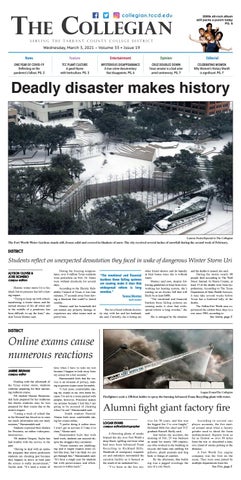
collegian.tccd.edu
2000s alt-rock album still packs a punch today PG. 6
Wednesday, March 3, 2021 – Volume 33 • Issue 19 News
Feature
Entertainment
Opinion
Editorial
ONE YEAR OF COVID-19 Reflecting on the pandemic’s fallout. PG. 2
TCC PLANT CULTURE A good thyme with horticulture. PG. 3
MYSTERIOUS DISAPPEARANCE A true crime documentary that disappoints. PG. 6
CRUZ DOUBLES DOWN Texas senator is a bad actor amid controversy. PG. 7
CELEBRATING WOMEN Why Women’s History Month is significant. PG. 7
Deadly disaster makes history
Lauren Foster/Special to The Collegian
The Fort Worth Water Gardens stands still, frozen solid and covered in blankets of snow. The city received several inches of snowfall during the second week of February.
DISTRICT
Students reflect on unexpected devastation they faced in wake of dangerous Winter Storm Uri ALYSON OLIVER & JOSE ROMERO campus editors
Historic winter storm Uri is finished, but its presence has left a lasting impact. “Trying to keep up with school, transferring, a winter storm, and the normal stresses of life all while still in the middle of a pandemic has been difficult, to say the least,” student Teresa Montez said.
During the freezing temperatures, over 4 million Texas residents were powerless on Feb. 16. Some were without electricity for several days. According to the Electric Reliability Council of Texas, it was four minutes, 37 seconds away from having a blackout that could’ve lasted months. Montez said her household did not sustain any property damage or experience any other issues such as power loss.
“The emotional and financial burdens these failing systems are causing make it clear that widespread reform is long overdue.”
Teresa Montez south student
She let a friend without electricity stay with her and her husband, she said. Currently, she is letting an-
other friend shower and do laundry at their house since she is without water. Montez said now, despite following guidelines to keep from overworking her heating system, she’s waiting on an electric bill that will likely be at least $400. “The emotional and financial burdens these failing systems are causing make it clear that widespread reform is long overdue,” she said. She is outraged by the situation
and the deaths it caused, she said. During the storm, nearly 80 people died according to The Wall Street Journal. In Harris County, at least 15 of the deaths were from hypothermia. According to The Texas Department of State Health Services, it may take several weeks before Texas has a finalized tally of the deaths. The Dallas-Fort Worth area experienced the coldest three days in a row since 1983, according to See Storm, page 5
DISTRICT
Online exams cause numerous reactions JANINE SHUMAN campus editor
Dealing with the aftermath of the Texas winter storm, students continue preparing for their upcoming midterm exams. NE student Maram Hammoudeh feels prepared for her midterms but thinks students may be less prepared for their exams due to the storm's impact. “Losing a week of school due to the blizzard has forced us to cram too much information into our study sessions,” Hammoudeh said. Students expressed their disdain for Proctorio, an online video-proctored service. TR student Gregory Taylor has had trouble with the service in the past. “Having to deal with an unstable program that alerts professors students are cheating just because they happen to move or look past the screen is really inconvenient,” Taylor said. “It’s such a waste of
time when I have to redo my test because I happen to look away from my screen for a few seconds.” Hammoudeh feels that the service is an invasion of privacy, making in-person exams more favorable. “I feel more comfortable taking my exams in my own home because I’m not in a room packed with people, however, Proctorio makes me anxious because I feel like I am going to be accused of cheating when I’m not,” Hammoudeh said. South student Nantzui Alonso feels more comfortable taking her exams online. “I prefer doing it online since I won’t get as nervous if I take it in class,” Alonso said. Hammoudeh feels that with hard work, students can succeed despite the struggles they encounter. “Exam seasons are challenging and it might require more effort this time, but I do think we can get through this,” Hammoudeh said. “It’s been a rough year for students but with perseverance and effort, success is within reach.”
Logan Evans/The Collegian
Firefighters scale a 150-foot ladder to spray the burning Advanced Foam Recycling plant with water.
Alumni fight giant factory fire LOGAN LO GAN EVANS
campus editor/photographer
A flowering plume of smoke bruised the sky over Fort Worth a deep black, spilling out from what had once been Advanced Foam Recycling in Richland Hills. Hundreds of emergency responders and onlookers surrounded the caved-in facility as it burned — the result of an industrial fire. “I’ve been in the fire ser-
vice for 30 years, and this was the biggest fire I’ve ever fought,” Richland Hills fire chief and TCC graduate Russell Shelly said. Just before the accident, the morning of Feb. 25 was business as usual for nearly 100 employees who worked in the building to recycle old foam into stuffing for pillows, plush animals and dog beds — things of comfort. By the afternoon, that building was a jagged wreckage the size of a city block.
According to several employee accounts, the fire started around noon when a factory grinder used to shred the foam malfunctioned. Reports from as far as Denton — over 30 miles from the site — described a massive cloud of smoke pulsing in the distance. A Fort Worth fire engine company was the first on the scene. They were soon joined by multiple departments from the See Fire, page 5
News
Page 2 • March 3, 2021
The Collegian
DISTRICT
Texas opens up 100% as vaccines roll out
Azul Sordo/The Collegian
A masked woman walks through a Downtown Fort Worth shopping center. As of next Wednesday, all Texas businesses will be able to open at full capacity.
Texas becomes one of 13 states with no mandates as COVID-19 restrictions lift March 10 LYDIA REGALADO campus editor
Gov. Greg Abbott addressed Texans on Tuesday and stated that beginning March 10 Texas will be open 100%. Mask mandates will also end. “Hospitalizations are the lowest that they have been in four months,” Abbott said. “The number of active COVID cases is the lowest since November, and is less than half of what it was just a month ago. That means that far more Texans are recovering from COVID than contracting it.” Abbott said the vaccinations are increasing so rapidly that soon the categories of people who will be able to receive the shots will expand. As of Tuesday, the total number of people fully vaccinated in Texas was nearly 2 million according to Texas Health and Human Services. The Janssen vaccine, manufactured by Johnson & Johnson, is the latest vaccine available and was declared safe for people
18 years and older, according to the Centers for Disease Control and Prevention. Unlike Pfizer and Moderna, Janssen is a single-dose vaccine. Abbott said that just because mandates are ending does not mean that people should ignore personal responsibility or caring for others. “To stay safe, Texans should continue following medical advice preventing COVID just as they do on other medical issues,” Abbott said. Abbott said businesses have the right to choose to operate however they see fit, whether that means continuing to limit capacity or implementing additional safety measures. As a part of Abbott’s executive order, if COVID-19 hospitalizations in any of the 22 hospital regions in Texas rise above 15% bed capacity for seven straight days then a county judge may use COVID-19 mitigation strategies, however, Abbott said that he does not expect this to happen. NE student Kristina Randerson said she is excited for the mandates to end and that
businesses will be able to open up. “To me, this signals a return to normalcy, whatever that is now,” NE student Kristina Randerson said. “People can still wear a mask if they choose to.” Rake said an emergency meeting was held last Thursday to discuss suggestions for if and when campuses will open up again. In the meeting, staff gave suggestions on how many students should be in a class, social distancing measures and other protocols. “I think we’re just gathering initial information and suggestions for ways that we could get back,” Rake said. “I think it’s just on the preliminary, preliminary stage right now.” Captain Terry D. Moak with the TCCD Police Department said that they will continue to take the necessary steps to keep everyone safe. “We will continue to support whatever actions the State of Texas, the CDC, and the Tarrant County Health Department suggest in our continued effort to support their cause to help combat Covid 19,” Moak said. Rake said he’s proud of the way TCC
faculty and leadership have stepped up during the process. “Good leadership, good cooperation, everybody has one goal, and that’s help the students, that’s just what we do,” Rake said. Texas is now among 12 other states with no restrictions which include Alaska, Florida, Georgia, Idaho, Iowa, Missouri, Montana, Nebraska, North Dakota, Oklahoma, South Dakota and Tennessee, according to the New York Times. Flags across the U.S. continue to fly at half-mast in memory of the more than 500,000 Americans who have died from COVID-19. “Texas is doing more than ever to save lives, and to reduce the spread of COVID,” Abbott said. “We will continue to grieve for all those that have suffered through this pandemic, and we will always mourn the loss of lives.” The CDC recommends staying vigilant and consistent in following safety recommendations while working towards mass vaccinations.
DISTRICT
Students draw from changing world in poetry slam LOGAN EVANS
campus editor/photographer
After almost a year of COVID-19 restrictions, student Jasmine Torres felt cramped by her belongings. Because a less in-person world meant more online shopping, she found her room filling up with packages. She stepped around the boxes that were crowding her bedroom floor and realized she could no longer reach the mirror to look at herself. When she finally tripped over one of the boxes, she came to terms with her problem. “I saw all the things I bought around my room that I don’t even look at,” she said. “I used shopping as a coping mechanism for my emotions.” Using this premise, Torres wrote the poem “My Packages” — one of five that earned her first place at TCC’s Lift Every Voice poetry slam.
“The packages are piling up. Boxes lounging across the floor, bubble wrap spilling out after I cut them open,” Torres read to a virtual audience. “I used to get so excited to open them and see my new things. And now, I’m just thinking about the next package.” Torres ended “My Packages” with a comment on the cyclical nature of coping. “I don’t have time for these dramatic exaggerated philosophical thoughts,” she read. “I have a package waiting for me at the door.” The work Torres performed illustrated a link between mundane activities of modern life and the darker feelings that can lurk behind them. “Salsa” examined an isolation and numbness felt during home cooking. “Dinner Table” described a lonely narrator feeling trapped in their childhood bedroom while their family waits at the table. The pandemic forced Torres to step back and find meaning in smaller things. “Before, I was very preoccupied by
things outside,” she said. “But now that we have more time to live with our thoughts, it’s stimulated me to write more poetry and go deeper.” Second place winner Rabbia Molai also turned to the changing world for influence on her work. Among the poems she performed was “I Refuse” — a rebuke of voices that silence others. “I refuse because if I don’t, then somewhere another little girl won’t either,” Molai read. “Because the hands that once held mine as I was learning to walk taught me that I’m better than what they say.” Molai drew from her admiration of the Black Lives Matter movement and the overall force of change. “I think it’s great to be part of a generation that’s trying to break social norms,” she said. In an unnamed poem, third place winner Stephanie Booker mourned the loss of a loved one.
“Although our bodies lie in different realms, your soul and your spirit will forever remain in the deepest part of my heart,” she read. Fourth place winner Alexandria Manzo performed an unnamed poem about self-discovery. “I dig into myself like an excavation site, finding fossils like gold, as if dinosaur bones can reveal a future that died in the past,” she read. Although the poetry slam was delivered virtually, NE English instructor and poetry club advisor Geoffrey Saari, who moderated the event, believes students had as much to gain by sharing their work with an online audience as they would an in-person one. “It’s hard for these students to get up there and bare their souls,” he said. “I think it does help them advance themselves and feel more confident about interacting with other people and sharing their feelings and thoughts.”
Join the discussion at collegian.tccd.edu Facebook.com/ TCCtheCollegian
Twitter @TCCtheCollegian
Instagram @TCCtheCollegian
The Collegian
Feature
March 3, 2021 • Page 3
Photos by Azul Sordo/The Collegian
NW student Ardem Maynard inspects the tray of plants, evaluating their losses after the winter storm in February. The greenhouse is a staple of the science building.
NORTHWEST
Horticulture leaves blooming impression
Program coordinator David Bulpitt demonstrates the visual indicators of iron deficiency in vinca plants. They are one of the few plants that survived the freezing temperatures.
NW horticulture club president Chrisynthia Rodriquez carefully piles the plant plugs suited for transfer to a starter tray.
A wall of horticulture-related tools in the potting room of NW Campus. Students will learn how to properly use many of these tools, as well as how to maintain them.
Horticulture program persists in spite of challenges caused by pandemic, winter storm Uri AZUL SORDO photo editor
A soft glow emanates from within the glass-paneled walls of two greenhouses, the steady hum of their ventilators echoing through an otherwise silent NW Campus. Nestled in this corner of campus, horticulture students usher in the spring season and all its lush greenery. Until now, they’ve remained largely under the radar. “We’re the best kept secret at TCC, if not Fort Worth,” horticulture program coordinator David Bulpitt said. Despite many classes transitioning to online or hybrid formats, the horticulture program has seen a 30% increase in enrollment this semester, according to Bulpitt. Between the fall and spring semesters, Bulpitt reported 80 students enrolled in the introductory horticulture class — the highest he’s seen in his six
years at TCC. This trend exists even beyond the academic sphere. According to a survey by Garden Center Magazine, 71% of independent gardeners located in the U.S. or Canada saw their sales increase significantly since the COVID-19 outbreak. “Because people have to stay home so much, they're more attuned with their home surroundings and want to beautify them or whatnot, and I think that's the core of it,” Bulpitt said. Bulpitt is optimistic the redevelopment project taking place on campus will allow their department to expand in size, preparing them for the influx of new students. “We’re really the only game in the metroplex,” Bulpitt said. “I think if people realize more that we’re here, that would just explode interest even more.” Horticulture lab manager David Cole be-
lieves this green movement reaches beyond the social isolation of the pandemic, citing growing interest in eco-conscious lifestyles. “There's a part of us that wants to get back to being in the natural world — cooperating with it, the beauty of it, the mystery of it, and even the satisfaction of hard work in a vegetable garden and seven months later getting to eat that with your family for dinner,” Cole said. “It's a very empowering thing.” NW student Arden Maynard doesn’t mind digging her freshly painted nails deep into damp soil — as an aspiring viticulturist, she enjoys the hands-on approach. “I was nervous about the online part,” Maynard said. “We’re all plant people, so we like to get our hands dirty.” Unfortunately, the challenges didn’t end with the online transition. When February’s record-breaking winter storm cut all power from the campus greenhouses, the plants inside quickly succumbed to the cold. Students
lost nearly two-thirds of all plant life. There was little to do but move forward, Bulpitt said. Horticulture students sorted through packages of seedling trays, carefully moving the surviving plugs into larger trays. It seems tedious, but for horticulture club president Chrisynthia Rodriquez, the reward lies in the work itself. Rodriquez tenderly held up a marigold seedling no bigger than her pinkie finger. “This is life. You’re helping nurture life,” Rodriquez said. “You’re kinda giving back to the planet.” For many academic programs, these trials would have spelled the end of their time at TCC, but the horticulture program’s roots run deep. “We have all ages, all demographics... coming from all different places,” Cole said. “Then we all get together and it's kind of like it all belongs.”
Page 4 • March 3, 2021
News
DISTRICT
Competition focuses on carbon removal
Giovanni Rebosio/The Collegian
Elon Musk is funding a carbon removal competition focused on lowering the price of the process while also ensuring it’s being done in an environmentally safe way.
Global warming is the primary topic of interest in XPRIZE’s multi-million dollar contest JOSE ROMERO campus editor
Charity foundation XPRIZE is holding a four-year-long competition with the largest prize incentive in history. A total of $100 million will be distributed to the chosen participants. The top 15 teams must demonstrate a solution to pull carbon dioxide directly from the atmosphere or oceans and lock it away permanently in an environmentally benign way, according to The Verge. The teams will receive $1 million as an operating budget and 25 students will be awarded a $200,000 scholarship, according to XPRIZE. The team in first place will receive $50 million, second place $20 million and third
place $10 million. Carbon removal was chosen as the subject of the competition as a way to combat climate change. Scientists estimate that six gigatons — one billion metric tons — of CO2 per year may need to be removed by 2030, and 10 gigatons per year by 2050 to avoid the worst effects of climate change. Every year, about 40 gigatons of CO2 are produced, according to Forbes. “Because of the way the world economy is built, there is a lot of infrastructure that requires the use of fossil fuel,” South chemistry instructor Martha Gilchrist said. “This gives a large financial incentive to companies to continue emitting CO2. If we could remove some of that CO2 from the atmosphere, it would give a larger allowance of CO2 emission for a particular amount of climate consequence.”
The primary issue with carbon removal is how expensive it is, Gilchrist said. Storing natural-gas-fired emissions is about $80 per ton, according to peer-reviewed scientific journal The Royal Society Publishing. At $80 per ton and 40 gigatons produced annually, that’s $3.2 trillion. There are natural ways our environment removes CO2, but it takes too long NE chemistry instructor Steven Rooney said. “If the goal is to slow down or reduce the amount of CO2 in the atmosphere, then a quicker method of sequestering from the atmosphere is needed,” Rooney said. “That is where competition can assist an individual or a team and push them to develop new/original ideas.” Elon Musk — SpaceX founder, chief executive officer of Tesla and the richest man in
the world, according to CNBC — is funding the competition. Rooney believes Musk is guided by principle and is effectively trying to avoid threatening his own privilege by preserving the system that keeps him rooted in his current lofty position. NE chemistry club vice president Margarita Shestereva has an opposing viewpoint. “I love Elon Musk, I think he will be in our history books,” Shestereva said. “This man is a hero and altruist who truly wants to make our world better. I do not necessarily agree on his COVID-19 opinions, nor do I support him in some of his personal life choices, but I think he is one of the greatest businessmen out there.” Team registration and full competition guidelines open on Earth Day, April 22. The competition ends Earth Day 2025.
DISTRICT
Students share conflicting opinions on impeachment ALYSON OLIVER campus editor
Former President Donald Trump’s second impeachment trial and eventual acquittal stirred mixed reactions among TCC students. “You should be held accountable for your actions no matter what they are and when they were,” TCC student Brant Timberman said. Whereas TCC student Barbara Kadow said the charge was dead on arrival. “Free speech is not a crime,” she said. Trump’s impeachment trial was spurred on by the events at the Capitol on Jan. 6, according to The New York Times, for which some people think he should be held responsible. Kadow said Trump was not encouraging violence by telling his supporters to fight for the win.
“He said peacefully, do these things,” she said. “There is no merit to the case.” However, TCC student Kenneth Pascua said Trump directly contributed to the events by assembling people in Washington D.C. and riling them up. He said Trump’s efforts to subdue the rioters were ineffective, and he hardly made an effort to stop them. In the U.S. impeachment process, the House Judiciary Committee recommends articles for impeachment. If the House of Representatives approves them, the Senate holds a trial where they act as the jury. If two-thirds of the Senate vote to convict, the defendant is removed and banned from holding public office. Kadow said the impeachment would be unconstitutional because it means removal from office, and the Senate has no legal power over private citizens. Trump is fit to hold office again because
millions of people know he cannot be bought by anyone, and he does what’s right rather than trying to benefit himself, Kadow said. “His only goal is to put Americans first,” she said. But Pascua said impeachment should not only exist as a check on executive power but as a threat to anyone who abuses their power. They shouldn’t receive protection outside of the office, he said. “There is now a significant portion of the American population that openly supported an insurrection against a peaceful transfer of power,” he said. “This is unforgivable.” Kadow said she’s been following the process with news sources such as Fox News and the Golden State Times. Timberman has used CNN and live streams on YouTube and Pascua has used foreign news outlets such as BBC. TCC student Evelyn Martinez said while
she followed Trump’s first impeachment trial, she hasn’t followed this one because she fears he’ll get away with what he has done. “It is absolutely embarrassing what our country has been through these four years that he has been in office,” Martinez said. Timberman said he thinks things are going badly for Trump. He said his lawyers are scrambling, and he hopes Trump is at least disallowed from running for public office. Pascua said he thinks the impeachment will probably not happen due to a lack of support in the Senate, even though the Democratic party seems to “want their pound of flesh.” “I hope they get it, but I know they won’t,” he said. “It takes 67 votes to be convicted, 45 senators already said it was unconstitutional and won’t change their vote,” Kadow said. The trial concluded on Feb. 13.
The Collegian
News
March 3, 2021 • Page 5
Azul Sordo/The Collegian
Icy water floods a kitchen and dining area after pipes froze and burst. This was a common result of Winter Storm Uri’s record-breaking, below freezing temperatures.
Storm
(continued from page 1)
WFAA. The average temperature from Feb. 14–16 was 10.8 degrees, 0.9 degrees colder than the previous record. “State leadership was more concerned about large corporations saving money and avoiding Federal regulations than they were about the well-being of their fellow citizens,” Montez said. She’s learned she can’t trust the current Texas government to protect and take care of its citizens, she said. It will not be the storm that pushes Texas to change the way they handle energy, she said. Rath-
Fire
er, it will be its citizens raising their voices and making it clear they don’t accept the officials that allowed this situation to happen. “We cannot expect change, we must demand it,” Montez said. Feb. 15, student Hunter Brown lost power and expected electricity would return within minutes, but it was off for a day and a half. The inside of her home was 45 degrees, 13 degrees away from freezing temperatures. “That night we lit a fire in our fireplace to stay warm,” Brown said. “We weren’t prepared for our power to go off so we didn’t have
much firewood.” The cats in her home were freezing as well, she said. Brown and her family members had to cuddle up together to retain warmth. On the second day of no power, she contacted her friend after seeing a post by the local law enforcement’s social media account saying the outages could potentially last until Thursday morning. “The cold really does start to break you after a certain time,” Brown said. “I started to cry on the phone with her. I debated on taking my cat with me and in the end, I knew I couldn’t do that to my
friend’s cats and my cat as they had never met before.” The blame is on the Electric Reliability Council of Texas — energy supplier to over 25 million Texans, according to its website — and government officials, she said. ERCOT should’ve prepared the power grid and had the proper supplies to deal with the snow, she said. “I’m pissed with how the situation was handled,” she said. “ERCOT knew the storm was coming and they did nothing to prepare. Then, we have basically all of our government officials in different
states or flying to Cancun.” Student Otarius Napoleon recently moved into his house Jan. 21 and having his power go out left a permanent impact. He had a collection of exotic fish estimated to be worth around two thousand dollars, he said. The filters and heaters in the tank lost electricity which resulted in him trying to transport the fish to a safe location in the cold, but he wasn’t able to save them. “They were the same as family and I have been in a state of shock ever since,” Napoleon said
(continued from page 1)
greater Fort Worth area, all of which played a part. “Our guys were on I-20 finishing a car accident and turned around to see this huge column of smoke,” Shelly said. “They immediately responded.” Within minutes, the scene burst with activity. The growl of the flames and the wail of emergency vehicles clashed in a wall of sound. Smoke spun over streams of water as the wind shifted, at one point blowing back onto a gathering crowd of onlookers. Some Tarrant County residents saw the smoke from over a dozen miles away and thought it was coming from just outside their neighborhoods — a testament to the size of the inferno. Fort Worth resident Dmtrio Valsadua was driving down a nearby highway when his truck was flushed overhead with smoke. At first, he thought it was storming. Fearing the smoke may be the result of a chemical accident, he decided to drive to the scene and learn more. “My wife was scared. She didn’t want me to go,” Valsadua said as he studied the fire from his open driver side door. “Sometimes, people die.” Despite the magnitude of the fire and the number of people involved, only three minor injuries were reported, believed to be employees hurt while evacuating.
Logan Evans/The Collegian
Over 125 emergency personnel fought the fire as it burned from noon Feb. 25 to evening the next day for a total of 29 hours. Founded in 1997, Advanced Foam Recycling is one of the country’s largest scrap foam supplies. Because of the high flammability of the foam and the sheer amount of it stored in the warehouse — what Shelly said totaled 100,000 pounds — the building burned long into the night. The metal roof collapsed early on, making it difficult for responders to subdue the fire. Benbrook firefighter Valarie Willis — another TCC graduate — arrived with her company early the
following morning as the building was still smoldering. Heavy rain had fallen through the previous night, but because of how the roof fell, hardly any of it had reached the burning foam. “I ended up going to the tip of the ladder to get a better view of it so we could find the right spots,” she said. Willis and her company sprayed hot spots for over five hours. It wasn’t until 5:30 that evening — 29 hours into the fire —
that responders cleared the scene. For the next two days, drivers on the nearby highway reported small flames in the wreckage as hot foam reignited beneath the collapsed roof. Shelly’s department dispatched to the site several times to subdue the flare-ups. Until the building owners settle with their insurance company and demolish the wreckage, this may continue to happen, Shelly said. Shelly graduated from TCC Fire Training Academy in 1995 and
worked as a firefighter in Azle, Colleyville and Southlake before joining the Richland Hills Fire Department in 2014. To know that the biggest fire of his long career was fought without a single death or major injury makes him proud. “To get through an incident that long with so many people involved and not have any injuries is a testament to everybody’s professionalism and the care that they took,” he said. “It was a big one.”
Page 6 • March 3, 2021
Entertainment
The Collegian
NETFLIX REVIEW
Mysterious death makes average series
Photo courtesy of Netflix
Hotel Cecil gained notoriety for being the location where Elisa Lam died in 2013. Her body was found in the hotel’s water tank after guests complained of dirty water.
JANINE SHUMAN campus editor
True crime fans hoping to uncover valuable information regarding the disappearance of Elisa Lam may be disappointed by Netflix’s latest hit docuseries, “Crime Scene: The Vanishing at the Cecil Hotel.” After recurring complaints of dark, foul water spewing from the faucets at the notoriously ominous Cecil Hotel in Los Angeles, missing 21-year-old Lam was found lifeless in the hotel’s water tank. Eight years later, her demise remains a mystery, and The Vanishing provides no tangible information or theories regarding the case. The series begins by displaying the digital breadcrumbs Lam left behind on her Tumblr page before her disappearance and quickly shifts to telling the history of the hotel’s surrounding area. While this may emphasize the danger prowling around the hotel, the constant repetition only takes the spotlight away from Lam’s story. The series features a diversified portfolio of interviews including various hotel staff, conspiracy theorists and law enforcement officers. The only interview that provided any substance to Lam’s story was Santiago Lopez, the maintenance worker who discovered her body. There are inconsistencies in his story as
he claims he found the tank open, but is also documented saying he found it closed — a major contention in the case. The hotel manager Amy Price, featured throughout, seemed to perceive the docuseries as an opportunity to clear the name of the hotel that has witnessed 16 known murders within its walls. “I believe in the 10 years I was working there, there were about 80 deaths,” Price said. The series displayed some of the many bad reviews left defiling the reputation of the hotel to which Price said, “I don’t think it’s fair.” When the grainy, eerie last-seen footage of Lam on the Cecil elevator was released to the public in 2013, internet sleuths began dissecting every element of the video. Was it murder, something supernatural, an elaborate inside job committed by the hotel or the Los Angeles Police? These were just a few theories crowding up screen time by incredulous theorists. Perhaps the worst part of the series was the platform the conspiracy theorists were given, despite how baseless their speculations were. The series withheld last-seen footage and worthy information regarding Lam’s autopsy report until the end for dramatic effect, quickly discrediting many of the theories relayed by internet theorists. Between the lines of pointless information, the series informs the audience Lam
Hotel Cecil was built in 1924 as a luxury destination. In the decades to follow, it gained a reputation for violence, suicide and murder. suffered from bipolar disorder and had been skipping out on her medication. Viewers who impatiently waited for a satisfying ending may end up disappointed when the series ties up with its own theory that Elisa had stumbled in the tank herself as a result of her bipolar disorder. The series would have benefitted from a mental health professional to credit their theories surrounding Lam’s disorder contributing to her death. While some may believe this theory to
be plausible, the question remains: was the tank really closed on Elisa? And if so, who did it? Viewers interested in a four-hour investigation into the Cecil Hotel may enjoy the series. However, true crime fans interested in learning more about Elisa Lam’s case will only leave more perplexed than before.
MUSIC REVIEW
Looking back at thriving ‘00s alternative rock scene ALYSON OLIVER campus editor
“Riot!,” Paramore’s sophomore album, is a pedal-to-the-metal listening experience. The record came out in 2007, at the per-
fect time for its sound and aesthetic to thrive, and the band found droves of success following its release. Lead vocalist Hayley Williams described it as a lightning in a bottle moment in a 2017 interview with Track 7. Fittingly, the album is jam-packed with electricity.
Photo courtesy of Dirty Hit
“Riot!” was Paramore’s breakout album. It spent several weeks on the Billboard 200 chart, soaring to the 15th spot on Aug. 31, 2007.
It starts off strong by delivering four solid tracks blow-by-blow, with anthemic guitar octaves kickstarting the opener, “For a Pessimist, I’m Pretty Optimistic.” It ends with a halftime chorus and makes a quick transition into earworm “That’s What You Get.” Syncopated bass drives the verses and a singsong melody carries the chorus. The lyrics declare, almost joyfully, “I still try holding onto silly things, I never learn.” And “Hallelujah,” the third track, takes an optimistic turn (“Somehow, everything’s gonna fall right into place”). It showcases Williams’ vocal chops from falsetto to belt notes. The fourth track “Misery Business,” while a pivotal hit for Paramore, is no longer a song the band plays live. Some have coined it anti-feminist, and Williams, who wrote the lyrics at 17, openly distanced herself from them in 2015. She stopped singing a specific pair of offending lines (“Once a whore, you’re nothing more / I’m sorry, that’ll never change”) during concerts. In 2018, the band retired the song from its live shows completely. Musically, however, “Misery Business” is phenomenal. Dark, palm-muted power chords drive the verses, and the song opens up seamlessly during the chorus, making for a dynamite hit single. The band sustains this energy throughout most of the album’s tracklist. “crushcrushcrush” amps things up with its heartbeat-like drum opening and punchy chorus. Attitude-laden “Fences” explores the lack of privacy that goes along with fame (“You’re
always on display / For everyone to watch and learn from / Don’t you know now?”). However, the album suffers a bit of a sag near the middle. “Let the Flames Begin” and “Miracle” aren’t disappointing tracks, but they aren’t necessarily standouts. “When It Rains” and “We Are Broken,” tell beautiful stories lyrically. Musically, though, Paramore’s more laid-back songs can veer a bit into weaker territory. What’s more, “When It Rains” falls after “Misery Business” and “We Are Broken” after “crushcrushcrush,” making for some whiplash-inducing thematic dissonance. Despite its flaws near the middle, “Riot!” ends just how it began — on a powerful note. The closing track “Born for This” describes the band’s relationship with its fans (“With your faith, you’ll trigger a landslide”). Fittingly, it features power-chord-punctuated audience call-and-response sections during the bridge and outro. “Riot!” is a successful album for a reason — a time capsule to the dyed hair, heavy makeup, alt-rock days of yore. While a few songs may be a bit lackluster and the order of the tracks may not be perfect, none of the album is solidly unenjoyable. Even today, Paramore sustains its popularity as a band. Crank up your car stereo and give “Riot!” a listen. Just make sure you keep a watchful eye on that speedometer.
Opinion
The Collegian
Viewpoints
Editorial
Ted Cruz is failing trying to be Trump
LOGAN EVANS campus editor
When a historic winter storm devastated Texas and left millions cold, scared and without power, Senator Ted Cruz booked a flight to Cancun. He was met with widespread backlash, and he’s responding with a page out of the Donald Trump playbook — play it up, and they can’t hurt you. Last week, Cruz spoke at the Conservative Political Action Conference in Orlando, his first major appearance since the controversy. “Orlando is awesome!” Cruz screamed with uncharacteristic energy. “Not as nice as Cancun, but it’s nice,” he joked. For nearly 20 minutes, Cruz leaped around the stage hurling conservative buzzwords and pop culture references, often in the same breath. His performance was brash, animat-
ed, angry — a far cry from the stately act he put on for his 2016 presidential run. The notable change was pulled together by his newly-cultivated mullet and rouge troubadour beard. In 2016, Cruz tried to be a cleancut alternative to Trump. When Trump became a serious threat in that election, Cruz drew a hard line between himself and the eventual president by fake-earnestly-squinting-and-nodding his way through appeals to “reason” in the face of Trumpism. He tried to come off as the sane guy. Now, Cruz has abandoned that act to dance in the spirit of Trump. “Let me tell you right now,” Cruz said at CPAC. “Donald Trump ain’t going anywhere.” It sounds like Cruz is referring to Trump as an idea. He knows that much of his party wants the soul of the former president to live on — and he’s angling to be the body it lives in. Such a calculated change in only five years begs the question — is it possible for a politician to make their name in a post-Trump world without becoming a cartoon character? I’m not naive enough to think that elected officials haven’t always been playing characters, or that those characters haven’t grown increasingly more cartoonish when needed. I just wish Cruz was drawn better.
Greg Abbott or the tin man, you decide
MADDY REMINGTON managing editor
Over 500,000 deaths, and 1 year later, Texas is reopening 100% and eliminating mask mandates. What kind of precedent does this set when half a million people are dead, and we are acting like everything is fine and dandy? I’m sick of Texans acting like this pandemic isn’t serious. We are nowhere near back to business as usual, yet tons of people are going out in public for unnecessary reasons, violating physical distancing protocols and not wearing masks. What part of wearing a simple piece of fabric on your face and standing farther away is too complex for you all to understand? This COVID-19 thing is no joke. People are being hospitalized, coming out with serious long-term and short-term effects or even dying,
March 3, 2021 • Page 7
for God’s sake. If you are hanging out with your friends and not following safety protocols, I hate to break it to you, but you are the problem. Just because vaccines are in distribution doesn’t mean this pandemic is over. We are still fighting it. Only 5.1% of Texans have even been vaccinated. Herd immunity is only achieved at 70–80% vaccination rates. For the sake of the frontline workers, for the sake of the immunocompromised among us, for the sake of you, your friends, family and coworkers: please stay home and wear your mask. Don’t risk all the progress we have made in the past year on a chance to go out to eat or hang out with your friends. There are ways to safely do all of those things. Zoom meetings exist for this very reason — to allow you to make connections and stay social. Wearing a mask while in public, no matter if you are inside or outside, is crucial to the eradication of the pandemic. Please, I beg you to continue following COVID-19 safety protocols so we can get back to normal sooner rather than later. Just because they are no longer mandated by the state doesn’t mean they are any less important.
Celebrating women who shaped history
Amber Davis/The Collegian
A nurturer, a caretaker, a hard worker, a leader, an inspiration: a woman. Taking a month to recognize the hardships, obstacles and efforts women have made throughout the decades showcase the progress the country has made thus far. The story of achieving women’s equality is far from over, but we’re one chapter closer. March 1 is the start of Women’s History Month — the celebration of women and recognition of figures who have contributed to women’s rights. This month highlights the accomplishments women in history have made and celebrates where we are now. Before the 19th amendment was in place, granting women the right to vote, women hopelessly fought for years just to have their voices heard. Women like Susan B. Anthony, Elizabeth Cady Stanton, Abigail Adams, Alice Paul, Maud Wood Park and countless others contributed to the right to vote and various other women’s rights movements. Trials surfaced time and time again, but the power of a single voice went a long way in the end. According to the U.S. Department of Labor, 76.3% of women between the ages of 25 to 34 worked in 1998 versus 34.0% in 1950. In 2008, women made up 48% of the labor force and men were 52%. To compare, in 1988 the shares were 45% and 55%. T h e c e l e b r a t i o n o f Wo m e n ’s H i s t o ry Month means looking back at how things used to be, where women never worked but instead catered to a husband and family. Today, a woman decides to be whatever she wants to be.
In 1851, the Women’s Convention was held in Akron, Ohio. Sojourner Truth, abolitionist and women’s rights advocate, delivered the powerful speech “Ain’t I A Woman?” As a person of color, Truth touches on her struggles with being seen as an equal not only to a man, but to a white woman. “That man over there says that women need to be helped into carriages, and lifted over ditches, and to have the best place everywhere,” she said. “Nobody ever helps me into carriages, or over mud-puddles, or gives me any best place! And ain’t I a woman? Look at me!” Tr u t h c o n t i n u e s a s s h e m e n t i o n s how even though she worked as hard as a man and endured the pain they did, she never felt heard. The young girls of this generation are witnessing history being made with the first African American and Asian American woman becoming vice president, signaling hope they too can be capable of anything when they grow up. The power of the voices of millions of women continues to be heard while fighting for equal pay, reproductive rights and more representation in government to this day. This month is meant to celebrate women of color and those in minority groups who face oppression more than they ever should, single moms who live day by day to provide for their children, military women who help protect our country every single day and every woman in between continuing to break the stigma against what women are capable of. The power of a single voice will never go away.
Letters to the Editor
The Collegian staff welcomes letters to the editor concerning articles that have run in the paper or on other subjects that may be of interest to the general public. All letters should be signed by the writer, who should include his or her Colleague ID or telephone number. The numbers will not be published. They are used for verification only. Letters should be typed and not longer than 150 words. They will be edited for grammar, style and space and will run as space is available and at the discretion of the editor. Letters should be e-mailed to: michael.foster-sanders@my.tccd.edu
Join the discussion at collegian.tccd.edu Facebook.com/ TCCtheCollegian
Meet
the
Instagram @TCCtheCollegian
Twitter @TCCtheCollegian
Staff
Letter Policy
EDITOR-IN-CHIEF Michael Foster-Sanders
MANAGING EDITOR Maddy Remington
PHOTO EDITOR Azul Sordo
CAMPUS EDITORS Janine Shuman Linda Puga Alyson Oliver Jose Romero Stayce Petties Logan Evans Mary Maturo Lydia Regalado
LAYOUT & DESIGN Abbas Ghor Amber Davis Kristal Blankinship Alejandro Meza Amanda Cole
ILLUSTRATOR Amber Davis
The Collegian is a weekly student publication serving the Tarrant County College District. Editorial statements and advertisements do not necessarily reflect the opinion of the TCC administration.
WEBSITE COORDINATORS Kristal Blankinship Alejandro Meza Amanda Cole
Letters to the paper should be 150 words or less, free from libel and poor taste and include the writer’s Colleague ID or telephone number (the numbers will not be published).
PROFESSIONAL STAFF PRODUCTION MANAGER Stacy Luecker
ADVISERS Chris Whitley, Jocelyn Tatum
Letters may be brought to The Collegian office (NCAB 1124A, NE Campus), or mailed to:
The Collegian • 828 Harwood Road Hurst, TX 76054 Office: 817-515-6391 Editor: 817-515-6394 Advertising: 817-515-6619 email: collegian.editor@tccd.edu TCC is an equal opportunity institution that provides educational and employment opportunities on the basis of merit and without discrimination because of race, color, religion, sex, age, national origin, veteran status or disability.
Feature
Page 8 • March 3, 2021
The long road to having a voice LYDIA REGALADO campus editor
Every day is a day to celebrate how far women have come in terms of equality. Although last year’s celebrations were curtailed due to the virus, people continue to recognize the women who persisted and paved the path for women’s rights today. This year, National Women’s History Month’s theme is “Valiant Women of the Vote; Refusing to be silenced,” according to The National Women’s History Alliance. One hundred years ago, women gained their right to vote when the 19th Amendment was ratified. Before it was passed, old English common law stated, “The very being and legal existence of the woman is
suspended during the marriage, or at least is incorporated in that of her husband under whose wing and protection she performs everything.” In 1977, The 13 Colonies passed laws preventing women from voting. Abigail Adams wrote that laws should not be bestowed on people who had no choice. Elizabeth Cady Stanton used her education and desires to make her visions a reality. As a regular attendee of anti-slavery conventions, she met other passionate women, and in 1848, she and abolitionist Lucretia Mott held the first Woman’s Rights convention at Seneca Falls, New York. It was there that the “The Declaration of Sentiments” was presented, which called for equal rights and marked the beginning of the women’s rights movement.
Victoria Woodhull was the first woman to run for U.S. president in 1872, where she ran for the Equal Rights Party. Before then, in 1871, she became the first woman to address a congressional committee. She argued the 14th and 15th amendments already granted women the right to vote and Congress should declare a 16th amendment to guarantee these rights. Susan B. Anthony was at the forefront of fighting for women’s suffrage with Stanton. They collaborated in their efforts towards making the 14th and 15th Amendment voting rights not only apply to Black men, but to women as well-when Anthony was arrested in 1872 for voting, the effects rippled throughout the nation and brought widespread attention to the women’s suffrage movement.
Sojourner Truth, a former slave, pioneered for complete equality. In 1851, Truth spoke on suffrage in her “Ain’t I A Woman?” speech where she confronted racial and gender-based injustice. She believed suffrage for Black men and women should be of equal importance and one should not occur before the other. She pioneered through the years and continued to take action against racial and gender-based injustice. Although women have come a long way, the work is never done. A few core issues women face today include reproductive rights, racial justice and wage equality. Let’s celebrate the women of the past and present and support our young women of the future as we continue the journey towards equality.
Illustration by Amber Davis/The Collegian