Running head: LEGAL CASE STUDY – DISCUSSION
1
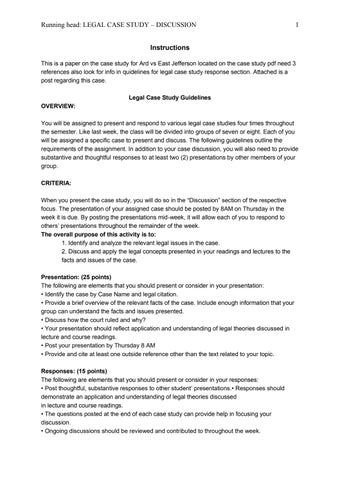
Instructions This is a paper on the case study for Ard vs East Jefferson located on the case study pdf need 3 references also look for info in quidelines for legal case study response section. Attached is a post regarding this case. Legal Case Study Guidelines OVERVIEW: You will be assigned to present and respond to various legal case studies four times throughout the semester. Like last week, the class will be divided into groups of seven or eight. Each of you will be assigned a specific case to present and discuss. The following guidelines outline the requirements of the assignment. In addition to your case discussion, you will also need to provide substantive and thoughtful responses to at least two (2) presentations by other members of your group. CRITERIA: When you present the case study, you will do so in the “Discussion” section of the respective focus. The presentation of your assigned case should be posted by 8AM on Thursday in the week it is due. By posting the presentations mid-week, it will allow each of you to respond to others’ presentations throughout the remainder of the week. The overall purpose of this activity is to: 1. Identify and analyze the relevant legal issues in the case. 2. Discuss and apply the legal concepts presented in your readings and lectures to the facts and issues of the case. Presentation: (25 points) The following are elements that you should present or consider in your presentation: • Identify the case by Case Name and legal citation. • Provide a brief overview of the relevant facts of the case. Include enough information that your group can understand the facts and issues presented. • Discuss how the court ruled and why? • Your presentation should reflect application and understanding of legal theories discussed in lecture and course readings. • Post your presentation by Thursday 8 AM • Provide and cite at least one outside reference other than the text related to your topic. Responses: (15 points) The following are elements that you should present or consider in your responses: • Post thoughtful, substantive responses to other student’ presentations.• Responses should demonstrate an application and understanding of legal theories discussed in lecture and course readings. • The questions posted at the end of each case study can provide help in focusing your discussion. • Ongoing discussions should be reviewed and contributed to throughout the week.
LEGAL CASE STUDY – DISCUSSION • Provide and cite at least two outside references other than the text related to your topic. Additional Tips: • Because this is a “discussion” – your responses to other classmates is as critical as your own case presentation. Your comments should be more than “I agree” – if you do agree, then why? Or why not? The most interesting and valuable discussions occur when the participants feel comfortable expressing opposing views. Plus you will get more points for that! ☺ So be respectful, but don’t hesitate to offer opposing opinions, even if it is just to stimulate a good debate! • You will be tempted to discuss your opinion on the “appropriateness or lack there of” of medical or nursing care...When you do this, base your opinion and discussion on the appropriate legal theory or rule of law. • Again, I do not expect a long detailed presentation – Remember this should be like a discussion you are having in class. As the presenter, you present the case, apply the relevant principles and your classmates respond to your presentation. • Sometimes it is difficult to come up with an original thought after your colleagues have responded. The questions at the end of each case study are to facilitate discussion. In addition, you may provide examples of similar situations you have encountered, where the ethical or legal principles at issue were relevant to your experience. If you do offer examples, be sure you present the facts in terms that do not compromise confidentiality. Then apply the ethical or legal principles that are relevant to the situation. • Notice that the word “brief” has been included in the criteria for posting legal case studies. That is so you know there is no expectation of spending “hours & hours” with the case studies. • All postings should reflect clarity of writing, correct grammar and spelling. References: o You may use Pozgar and Garrett as references, and I would encourage you to do so, but they do not count towards the three additional references you need to post. Do make an effort to post your references using APA format, but I will not deduct points if your references are incorrectly formatted. o Your secondary sources should reflect quality references. They can be from legal or medical professional web sites, law firms, journal articles, etc. Don’t use Wikipedia, About.com and other sites of this type. o A good source for references are the primary laws that relate to you topic. That may be nurse practice acts from the states involved in the litigation, other state or federal statutes and administrative codes. o Please post the URL web link to references you refer that you found online so others may access the sites. GRADING: Please refer to the grading rubric for this assignment which is included within the Legal Case Study Section of Focus 4 and under the Grading Rubrics in the Course Home
Ard v. East Jefferson Gen. Hosp., 636 So.2d 1041 (La. Ct. App. 1994).
2
LEGAL CASE STUDY – DISCUSSION
3
Mr. Ard was admitted to East Jefferson Hospital in 1984, for history of MI, stroke, and angina. He underwent coronary bypass surgery during his hospital stay and spent time in both the ICU and CCU, which were complicated with respiratory problems. On the day he was transferred out of CCU to another unit, he had a significant event. During this event, the pt’s wife contended that over an hour and 15 minutes she continually asked for her husband’s nurse to no avail due to complaints of nausea, vomiting, and difficulty breathing. At the end of the time period, Mr. Ard’s wife was witnessed yelling for help in the hallway. Mr. Ard’s nurse had just stepped off the elevator after a meal break; shortly thereafter a code was called. Mr. Ard passed away 2 days later. The case involved a wrongful death accusation against the hospital; the district courted granted judgment to Mr. Ard’s family. The hospital appealed the decision and the judgment was upheld the lower court’s decision and raised the awarded damages to Mr. Ard’s wife and daughter. One of the main reasons that the court granted judgment to the patient’s family was that there was enough evidence and testimony to show that the nurses breached the standard of care. Specifically, the nurses failed to document, observe, or respond to changes in Mr. Ard’s condition, this can lead to liability on the nurse’s part because this is a standard of care (Pozgar, 2016). Some of the conflicting evidence related to the nurse’s testimony, was that she said she saw the patient at 6PM which is not evident in Mrs. Ard’s testimony. A standard of care related to documentation was breached with this. Neil (2015) stated that standards of care are determined from the policies of a facility, state nurse practice acts, and job descriptions; what gets sticky is when the standards are in conflict and the courts must decide if there is negligence and which standard of care to is part of the element of duty. A second aspect of this case was on the element of causation. There was not enough evidence to prove that the negligence of the nurse caused Mr. Ard’s death. It was determined that aspiration was part of his death but it could not be proven when this occurred, whether it was during the code or before. The court based the judgment on the doctrine of loss of chance, basically if the nurse would have responded to Mrs. Ard’s calls during the hour and 15 minutes prior to the code and observed the changes in Mr. Ard, he may have gone back to the CCU and had a better chance of survival. Bal and Brenner (2014) described this doctrine as assigning value to life, and that it leads to speculation that alternative care would have led to a better outcome. Not all states have adopted this theory in medical malpractice.
References Bal, B., & Brenner, L. (2014). Medicolegal sidebar: The law and social values: Loss of chance. Clinical Orthopaedics & Related Research, 472(10), 2923-2926. doi:10.1007/s11999-014-3847-8 Neil, H. P. (2015). Legally: What is quality care? Understanding nursing standards. MEDSURG Nursing, 14-15. Retrieved from http://www.medsurgnursing.net/cgibin/WebObjects/MSNJournal.woa
Pozgar, G. D. (2016). Legal aspects of health care administration. Burlington, MA: Jones & Bartlett Learning.