

Organisations operating in the public sector, including councils and shared services such as Tayside Contracts, face increasing financial uncertainty arising from constrained public funding, rising costs and growing demand for services. In this environment, a clear financial strategy is essential to support sustainable financial planning, ensure resources are aligned with organisational priorities, and manage risk over the medium to long term. A financial strategy provides a structured framework for informed decision-making, helps maintain balanced and affordable budgets, and supports the delivery of efficient, high-quality services while achieving value for money for the public purse. In line with Best Value duties, the Strategy supports the effective use of public resources, continuous improvement and accountability for financial performance.
This Financial Strategy sets out how Tayside Contracts will manage its financial resources in a sustainable and prudent manner, reflecting its role as the commercial trading arm of Dundee City Council, Perth & Kinross Council and Angus Council. The Strategy recognises the significant financial pressures facing local government, including reduced funding for services, increasing costs and growing demand, and the impact these have on the councils’ medium and long-term financial plans. In this context, the Strategy provides a framework for ensuring that Tayside Contracts’ financial planning is aligned with the financial strategies and budget assumptions of its constituent councils, supports informed and transparent decision-making, manages financial risk, and maintains financial sustainability while continuing to deliver efficient, high-quality services and value for money. The Strategy supports the delivery of Best Value by ensuring that financial planning decisions are affordable, sustainable and aligned to service priorities and outcomes agreed by the constituent councils.
This section sets out Tayside Contracts’ medium-term financial outlook over the period 2026/27 to 2028/29. It explains the projected financial position, the key assumptions underpinning the projections, and the principal risks and uncertainties that could affect outcomes over the period. The purpose of the outlook is not to predict future budgets with precision, but to provide a structured and transparent assessment of the financial pressures facing the organisation and to support informed strategic decision-making, service planning and risk management.
The projections have been developed using a high-level review of Tayside Contracts’ main income streams and cost drivers, focusing on those areas that are most material to the organisation’s financial position. Given the volatility of the external environment, the projections deliberately avoid detailed line-byline modelling and instead use reasonable, evidence-based assumptions.
dependence on funding decisions made by UK Government, Scottish Government and constituent councils national pay bargaining arrangements; and exposure to inflation and wider economic conditions
These factors, combined with recent global economic disruption and elevated inflation, significantly increase forecasting uncertainty. As a result, the projections represent a broad indication of potential outcomes, rather than a fixed financial plan, and will be refined annually through the budget-setting process.
This approach enables the organisation to understand the range of possible financial outcomes and the sensitivity of the projections to changes in key assumptions.
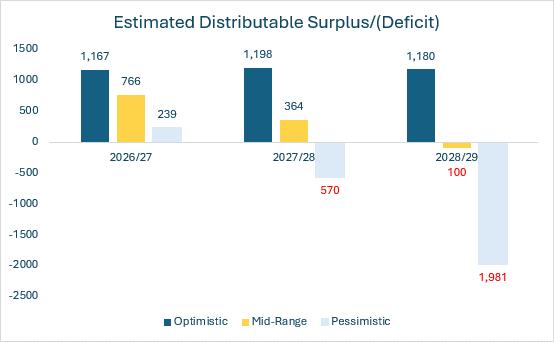

Under the optimistic scenario, continued favourable assumptions result in a cumulative surplus of approximately £3.5 million. In contrast, the pessimistic scenario shows a cumulative deficit of approximately £2.3 million, highlighting the scale of downside risk.
These projections are in addition to over £25 million of savings already delivered over the past decade and demonstrate the increasing difficulty of closing funding gaps through efficiencies alone.


Pay costs are the most significant and volatile element of the financial outlook. Historical national pay awards have been weighted towards lower-paid employees, increasing costs disproportionately for Tayside Contracts, where approximately 74% of employees are on the lowest local authority hourly rate.
These assumptions are aligned with current national bargaining positions. While the 2025/26 and 2026/27 pay settlements do not fully reflect this trend, proportionally higher increases for the lower-paid workforce have a significant impact on Tayside Contracts, given its comparatively greater share of lower-paid employees than its constituent councils.
A 1% variation in pay assumptions equates to approximately £0.5 million per annum. There is also a longer-term risk associated with erosion of pay differentials, which could impact workforce sustainability.
Changes to employers’ National Insurance contributions implemented from April 2025including an increase in the contribution rate from 13.8% to 15% and a reduction in the earnings threshold from £9,100 to £5,000have resulted in an additional £1.5 million per annum in payroll costs for Tayside Contracts.
The projections assume a gradual return to more stable inflation levels following recent exceptional increases. However, several service-specific costsincluding food, energy and fuel - may continue to rise at rates above general inflation.
This creates a risk that inflationary pressures may exceed budgeted provisions, particularly if general inflation falls more slowly than anticipated or if servicespecific inflation persists.
Employer pension contributions are assumed to remain at 15.7% for the period, following the most recent actuarial valuation. While the risk of significant change is considered low, a 1% increase would represent an additional cost of approximately £600k per annum.
National climate change targets will require significant investment to decarbonise services. While the objectives for decarbonisation do not directly fall within the medium-term, increased investment in green technologies maybe required if Government funding is not made available or does not meet the full costs of the transition to net zero.
Approximately 93% of Tayside Contracts’ income is derived from services provided to the constituent councils. The projections therefore reflect the councils’ own medium-term financial planning assumptions and recognise the significant funding pressures they face.
The councils project significant budget gaps by 2029, which presents a material risk to the affordability of existing service levels. Where funding constraints require changes to service specifications, Tayside Contracts will adjust service delivery and costs in line with council decisions.
11 of 18
The medium-term outlook demonstrates that, while Tayside Contracts remains financially sustainable in the short term, pressures increase significantly over the planning period. Without continued efficiency, income growth and service transformation, there is a clear risk that funding gaps will emerge that cannot be addressed without changes to service provision. This reinforces the importance of the Financial Strategy, Business Plan and Change Plan in providing a coherent and realistic framework for maintaining financial sustainability in a challenging and uncertain environment.
The medium-term outlook is subject to significant uncertainty, particularly in relation to:
The scenario-based approach highlights the sensitivity of the projections to these variables and underscores the importance of ongoing monitoring and flexibility. It is neither practical nor affordable to eliminate all financial risk; instead, the focus is on understanding, managing and mitigating risk through prudent planning, transformation and income generation.
To address the medium-term financial challenges facing the organisation, Tayside Contracts will adopt the following financial principles. These financial principles provide a clear framework for decision-making and support the delivery of Best Value by promoting financial sustainability, affordability, transparency and continuous improvement:
Tayside Contracts will aim to achieve an overall financial outturn where trading accounts at least break even over a 3-year rolling period, ensuring the organisation remains financially sustainable over the medium term.
Financial planning will be aligned with the medium-term financial strategies and funding assumptions of Scottish Government, Dundee City Council, Perth & Kinross Council and Angus Council, recognising the financial pressures they face and the need for affordability and value for money.
Savings and efficiencies will be delivered primarily through transformation, service redesign and prioritisation, supporting continuous improvement and protecting service outcomes.
Income generation will be pursued where it supports financial sustainability and Best Value, is affordable and deliverable, and does not adversely impact the quality or availability of services to constituent councils.
Reserves will be maintained and used prudently. They will only be applied for earmarked purposes and to support the budget through approved spend-to-save and transformation initiatives.
The overall target is to maintain reserves at 1% of turnover, in line with the position agreed by the Joint Committee (JC 14/22).
Wherever possible, cost pressures will be managed through prioritisation within individual Divisions, Units and Sections.
The Improvement and Innovation budget will be used solely for one-off, non-recurring expenditure and will not be relied upon to support ongoing service costs.
Budget provision will be made for pay awards and unavoidable inflationary pressures, based on the best available information at the time of budget setting.
Financial decisions will be transparent, evidence-based and subject to appropriate governance and scrutiny through the Joint Committee.
Financial performance will be monitored regularly, with early corrective action taken where variances or risks emerge.
14 of 18
Given the significant uncertainty around future costs, funding levels and demand, Tayside Contracts will adopt a structured and planned approach to addressing the medium-term financial challenge. This will be underpinned by a clear focus on sustainability, affordability and value for money, and delivered through a combination of service efficiencies, strong budget management and both collaborative and commercial income generation.
To support this, Tayside Contracts will progress activity across four key themes, which collectively provide the framework for responding to financial pressures while continuing to deliver services effectively.
Divisions and Units will continue to identify and deliver year-on-year efficiencies within existing budgets through changes that do not adversely impact on service outcomes or statutory requirements. This will include a focus on service redesign, improved processes and more effective use of resources. In addition, managers will identify opportunities for asset rationalisation, particularly where this supports efficiency and reduces ongoing costs.
Robust budget management will remain a core requirement. Budget holders will be expected to actively manage expenditure throughout the financial year and minimise costs wherever possible, provided this can be achieved without impacting on service delivery, health and safety or quality standards. This approach recognises the importance of in-year financial discipline in managing volatility and emerging pressures.
A key strength of Tayside Contracts, as a commercial trading organisation, is its ability to generate additional income to offset reductions in funding from constituent councils and to support the protection of employment. Income generation from non-constituent council sources will therefore remain a strategic priority, along with continuing to explore opportunities from existing council funding through the Strengthening Collaborative Initiative. Income targets set out in the Business Plan are intended to mitigate projected funding gaps over the strategy period, recognising that delivery is subject to market conditions and capacity.
Delivery of Tayside Contracts Change Plan will continue to be central to addressing the mediumterm financial challenge. The Plan brings together a range of initiatives and projects aligned to the organisation’s strategic priorities, with a focus on improving efficiency, increasing income and strengthening financial sustainability. Progress will be monitored regularly, with updates reported to the Joint Committee, and the Plan will be refreshed to reflect emerging risks, opportunities and the evolving financial landscape.
Together, these themes provide a coherent framework for managing financial pressures while supporting continuous improvement and value for money
This Financial Strategy provides a clear and robust framework for managing Tayside Contracts’ financial resources over the medium term in a challenging and uncertain financial environment. It recognises the significant funding pressures facing the constituent councils and the importance of aligning Tayside Contracts’ financial planning with their medium and long-term financial strategies.
The Strategy sets out a prudent and realistic approach to financial sustainability, underpinned by clear financial principles, strong governance and a structured response to managing financial pressures through service efficiencies, effective budget management, income generation and transformation. Delivery of the Business Plan and Change Plan will be central to achieving the objectives of this Strategy and to addressing projected funding gaps over the medium term.
The medium-term financial plan will be monitored annually with, financial performance, risks and delivery of savings and income generation reported to the Joint Committee. The Strategy will be kept under review and updated as necessary to reflect changes in the financial landscape, funding assumptions and organisational priorities, ensuring that Tayside Contracts remains financially sustainable and continues to deliver efficient, high-quality services and value for money for its constituent councils and customers.