FISCAL REALITY CHECK
The reckoning in numbers

Photo by Sam Ferrara on Unsplash
THE FISCAL RECKONING IN NUMBERS
We are sleepwalking towards a fiscal crisis, and the conflict in Iran has made our already fragile finances even more uncertain. Weak growth and soaring borrowing costs will pile more pressure on New Zealand families at a time when few can afford it.
Since 2008, each household’s share of government debt has risen from $29,000 to $140,000. This ballooning debt shows no signs of shrinking in the foreseeable future, and by 2030, it is expected to reach more than $160,000 for every household in the country.
We all know what happens if you consistently spend more than you bring in, yet the Government is doing just that. There is not one single surplus forecast for any time this decade. Each dollar of deficit spending adds to the growing debt pile, and servicing that debt gets more expensive by the day. And even when the Government’s preferred measure of ‘surplus’ is achieved, borrowing keeps increasing in the official forecasts.
Each household’s bill to cover the interest has more than quadrupled over the last five years, from $1025 in 2021 to $4274 this year. By 2030, we’ll be paying more on interest alone than the entire budgets for primary and secondary schools, the police, and the Ministry of Justice combined.
All the while, the size of the public service expanded by nearly 40 percent in just six years under the last Government. The Coalition have barely managed to unwind one ninth of that blowout, and the costs keep stacking up.
The figures in this paper show just how bad the government’s finances have become, why that matters for Kiwi families’ own standards of living, and what this all means for our ability to weather whatever shock comes next.
We cannot keep running the country on the credit card. Sooner or later, Kiwis will have to settle up.
GOVERNMENT DEBT IS NOW 6X LARGER THAN 2008
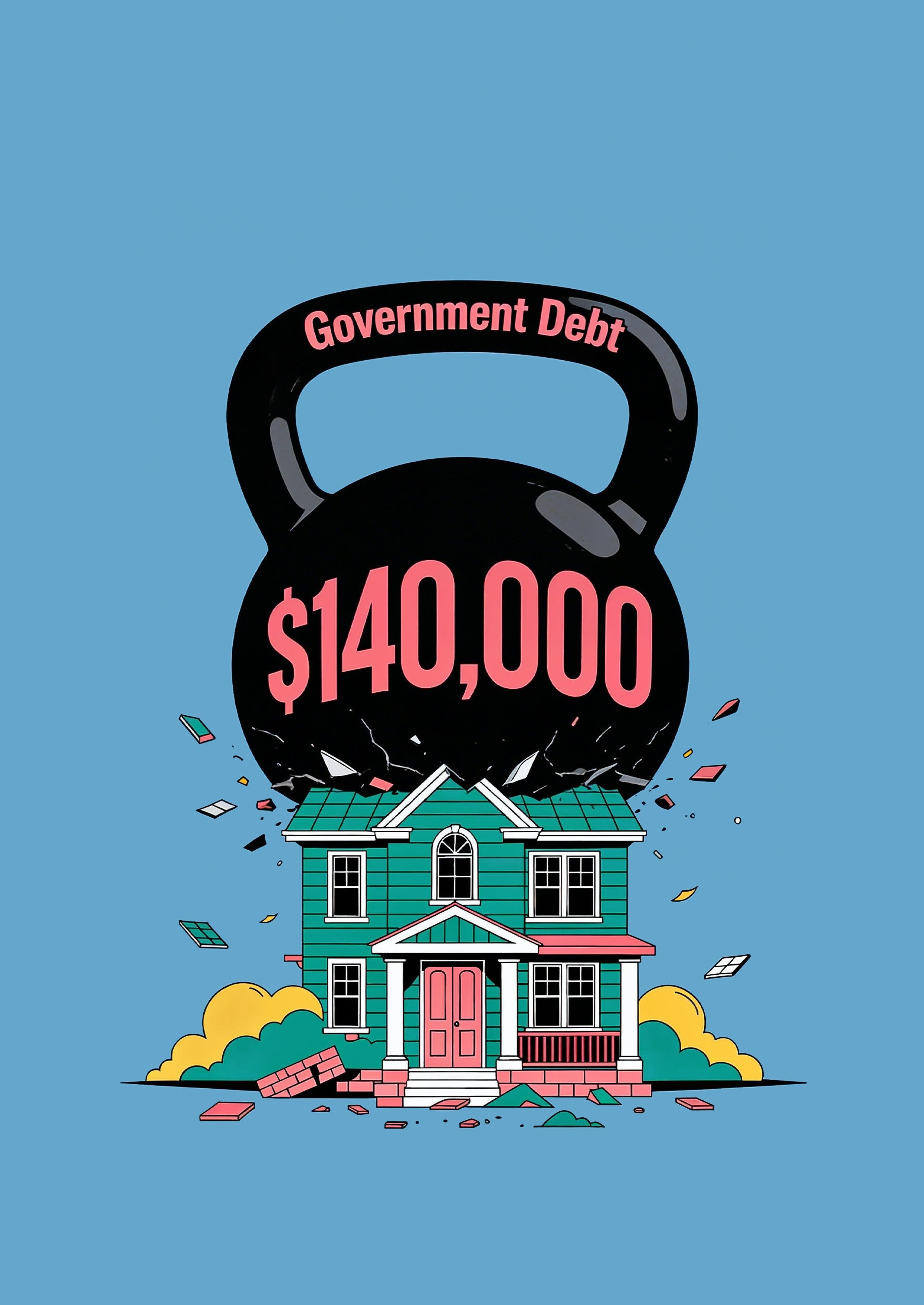
Each New Zealand household is carrying a $140,000 share of government debt. In 2008, that figure was $29,0001. By 2030, it is forecast to reach $161,0002, and the Government has presented no credible path to starting to pay this down.
• Total government debt has grown from $46 billion in 2008 to $294 billion this year, and is forecast to reach $363 billion by 2030.
• Each household’s share has risen nearly fivefold in less than twenty years.
• Measured against the size of the economy3, debt has grown from 24 percent of GDP in 2008 to 65 percent today, compared to 33 percent in Australia4
New Zealand borrowed to weather COVID, the Christchurch earthquake, and the Global Financial Crisis. On our current trajectory, the next shock will arrive into a country that has already spent its reserves. The higher the debt, the less room governments have to respond to the next crisis.
Every dollar borrowed needs paying back. We’re handing our kids and grandkids the bill.
Government borrowing was exploding even pre-COVID and is forecast to continue its steep upward trajectory.
1 Treasury (2025) Fiscal time series. Available at: https://www.treasury.govt.nz/publications/information-release/data-fiscal-time-series-historical-fiscal-indicators (Accessed 25 March 2026)
2 Treasury (2025). Half year economic and fiscal update. Available at: https://www.treasury.govt.nz/sites/default/files/2025-12/hyefu25.pdf (Accessed 25 March 2026). p. 96
3 Treasury (2025). Fiscal time series. Available at: https://www.treasury.govt.nz/publications/information-release/data-fiscal-time-series-historical-fiscal-indicators (Accessed 25 March 2026)
4 Australian Bureau of National Accounts (2025). Australian system of national accounts. Available at: https://www.finance.gov.au/sites/default/ files/2025-12/2024-25-consolidated-financial-statements.pdf (Accessed 27 March 2026). p. 113)
Government borrowing will see each household’s share of Government debt quadruple between 2008 and 2030
Debt has more than doubled as a share of our economy since 2008, weakening our financial resilience.
NO SURPLUS AT ALL THIS DECADE
New Zealand has not balanced its books since 2019, and is not likely to do so at any point this decade.5 In 2019, the government was effectively saving $4,700 per household. This year, it is borrowing $6,6566 per household simply to meet its annual operating spending commitments.
The deficit reached $20.9 billion in 2020 as COVID hit. The real concern is that it never recovered. The deficit this year is forecast to be $13.9 billion, or 3.05 percent of GDP.
• Outside of the immediate COVID response in 2020, the Government is currently running New Zealand’s largest deficit since the aftermath of the Global Financial Crisis.
• Every year of deficit spending adds directly to the debt burden that households are already bearing. Governments run deficits during crises. What is harder to justify is running them year after year during normal times, when the bills keep growing and no correction is in sight.
On our current track, New Zealand will not record even one surplus in the 2020s.
No surplus this decade means no repayment of debt
5 Treasury (2025). Half year economic and fiscal update. Available at: https://www.treasury.govt.nz/sites/default/files/2025-12/hyefu25.pdf (Accessed 25 March 2026). p.122
6 Treasury (2025). Fiscal time-series. Available at: Treasury (2025) Fiscal time series. Available at: https://www.treasury.govt.nz/publications/information-release/data-fiscal-time-series-historical-fiscal-indicators (Accessed 25 March 2026)
The Government will spend $6,650 more per household this year than it raises.
The deficit this year will be equal to 3.05 percent of the economy.
INTEREST COSTS HAVE INCREASED
BY 4.6X
IN 5 YEARS
In 2021, each household’s share of the government’s annual interest bill was $1,025. This year it is $4,2747. By 2030, interest is forecast to cost nearly $6,000 each8. That is just interest, not debt repayment.
• Finance costs stood at $2.5 billion in 2008 and stayed consistently below $4 billion for over a decade. This year, interest costs hit $8.9 billion.
• By 2030, interest costs alone are projected to reach $13.4 billion annually, more than the budgets for primary and secondary schools, the Police, and the Ministry of Justice combined.
• Unlike almost every other area of government spending, interest cannot be deferred, reprioritised, or cut. It has to be paid when it is due.
• 1 in every 50 dollars in our economy this year will be spent paying this interest.
• Since the outbreak of the Iran conflict, New Zealand’s bond yields have risen a further 40 basis points. Borrowing is now 20 percent more costly than Treasury assumed in December.
This spending delivers no services or assets, and every dollar going to creditors is a dollar not going to hospitals, roads, or tax relief. The bill grows larger every year that debt continues to climb.
As long as borrowing continues, taxpayers’ interest bills will keep getting bigger.
7 Treasury (2025). Fiscal time-series. Available at: Treasury (2025) Fiscal time series. Available at: https://www.treasury.govt.nz/publications/information-release/data-fiscal-time-series-historical-fiscal-indicators (Accessed 25 March 2026)
8 Treasury (2025). Half year economic and fiscal update. Available at: https://www.treasury.govt.nz/sites/default/files/2025-12/hyefu25.pdf (Accessed 25 March 2026). p.122 Exploding debt means soaring costs to service that debt.
Core crown covers core government departments and ministries, but excludes Crown entities and state-owned enterprises.
Households are on track to pay $6,000 per year in interest on Government debt by 2030
Servicing Government debt is consuming a greater amount of New Zealand’s economic output.
CREDITORS NOW CHARGE NEW ZEALAND A ‘RISKY BET’ PREMIUM
Bond markets are forward-looking. Investors are not just pricing what New Zealand has borrowed. They are pricing what they expect the Government to do next. A rising risk premium is a signal that confidence in New Zealand is weakening.
New Zealand used to borrow at similar rates to other developed countries, and prior to 2021 New Zealand was seen as a safe bet for investors. Today we pay a significant premium over other countries, and the cost of borrowing is soaring.
• In 2008, New Zealand’s 10-year bond yield was 6.3 percent. It consistently tracked down to a historic low of around 1.0 percent in 2021, then reversed sharply. By 23 March 2026, yields had reached 4.9 percent.
• Against an average bond yield of comparable economies (Canada, US, UK, Germany, and Japan)9, New Zealand is currently paying a risk premium of around 126 ‘basis points’. In other words, it currently costs New Zealand a quarter more to borrow than similar countries pay. In 2021, the risk premium was less than a third of that.
• Every additional basis point adds $10 million to the annual interest bill for every billion borrowed. The Government plans to borrow another $69 billion over the next four years.
Now, with 10-year bond yields rising to 4.910 percent and Fitch Ratings11 being the first international credit agency to revise New Zealand‘s outlook to negative, investors are losing faith in New Zealand’s credibility.
The bond markets are making their judgement. New Zealand is a much riskier investment than similar countries.
9 Aggregate 10-year government bond yield (US, UK, Canada, Germany, Japan, Australia). Average of 10-year benchmark government bond yields for the United States, United Kingdom, Canada, Germany, Japan, and Australia. Individual country yields sourced from Trading Economics and the Federal Reserve Bank of St. Louis (FRED), as at 1 January each year and 23 March 2026. Historical figures are approximate and subject to revision.
10 Investing.com (2026). New Zealand 10 years bond yield historical data. Available at: https://www.investing.com/rates-bonds/new-zealand-10-years-bond-yield-historical-data (Accessed 24 March 2026)
11 Fitch Ratings (2026). Fitch revises outlook on New Zealand to negative; affirms at AA+. Available at: https://www.fitchratings.com/research/sovereigns/fitch-revises-outlook-on-new-zealand-to-negative-affirms-at-aa-20-03-2026 (Accessed 24 March 2026)
10-year bond yields rose sharply from 2021, as Government borrowing increased. Yields are currently spiking due to pressures from the Iran conflict.
KIWIS HAVE BEEN GETTING POORER SINCE 2023
Economic growth is ultimately what pays the bills, funds services, and keeps people in jobs. However, New Zealand is going backwards. The economy peaked in size in 2023 with GDP amounting to $146,000*12 per household. New Zealanders have become poorer since then, and by 2025 GDP per household had fallen to $141,000*.
In other words, New Zealanders are 3.7 percent worse off than they were only two years ago, and GDP per household is not expected to recover any time before 203013.
• The economy shrank 0.614 percent in 2025, contracting for the second time in the last three years. Between 2023 and 2025, each household lost roughly $5,500* of economic output.
• Post-COVID growth averaged just 0.9 percent annually between 2022 and 2025, which is less than a third of the growth rate between 2010 and 2019.
• Treasury forecasts growth of 2.0 percent15 this year, and 3.5 percent next year. Taking these projections at face value, Kiwis won’t be better off than they were in 2023 at any other point this decade.
• The economic shock from the conflict in Iran has made that growth very unlikely this year. Without that growth, deficits will be larger, and debt will grow faster.
As people enter employment and wages rise, a growing economy sees tax revenues climb and government costs fall. A shrinking economy leads to the opposite.
Weak growth and rising debt are not separate problems. They’re two sides of the same coin.
12 Statistics New Zealand (2026). Series, GDP (E), chain volume, actual, total (annual-mar). Available through infoshare at https://infoshare.stats.govt.nz/infoshare/ (Accessed 25 March 2026)
13 Treasury (2025). Half year economic and fiscal update. Available at: https://www.treasury.govt.nz/sites/default/files/2025-12/hyefu25.pdf (Accessed 25 March 2026)
14 Reserve Bank of New Zealand (2026). Gross domestic product. Available at: https://www.rbnz.govt.nz/statistics/series/economic-indicators/gross-domestic-product (Accessed 24 March 2026)
15 Treasury (2025). Half year economic and fiscal update. Available at: https://www.treasury.govt.nz/sites/default/files/2025-12/hyefu25.pdf (Accessed 25 March 2026). p.123
*Real GDP is measured in 2009/10 prices. One dollar in June 2010 would be worth $1.48 today.
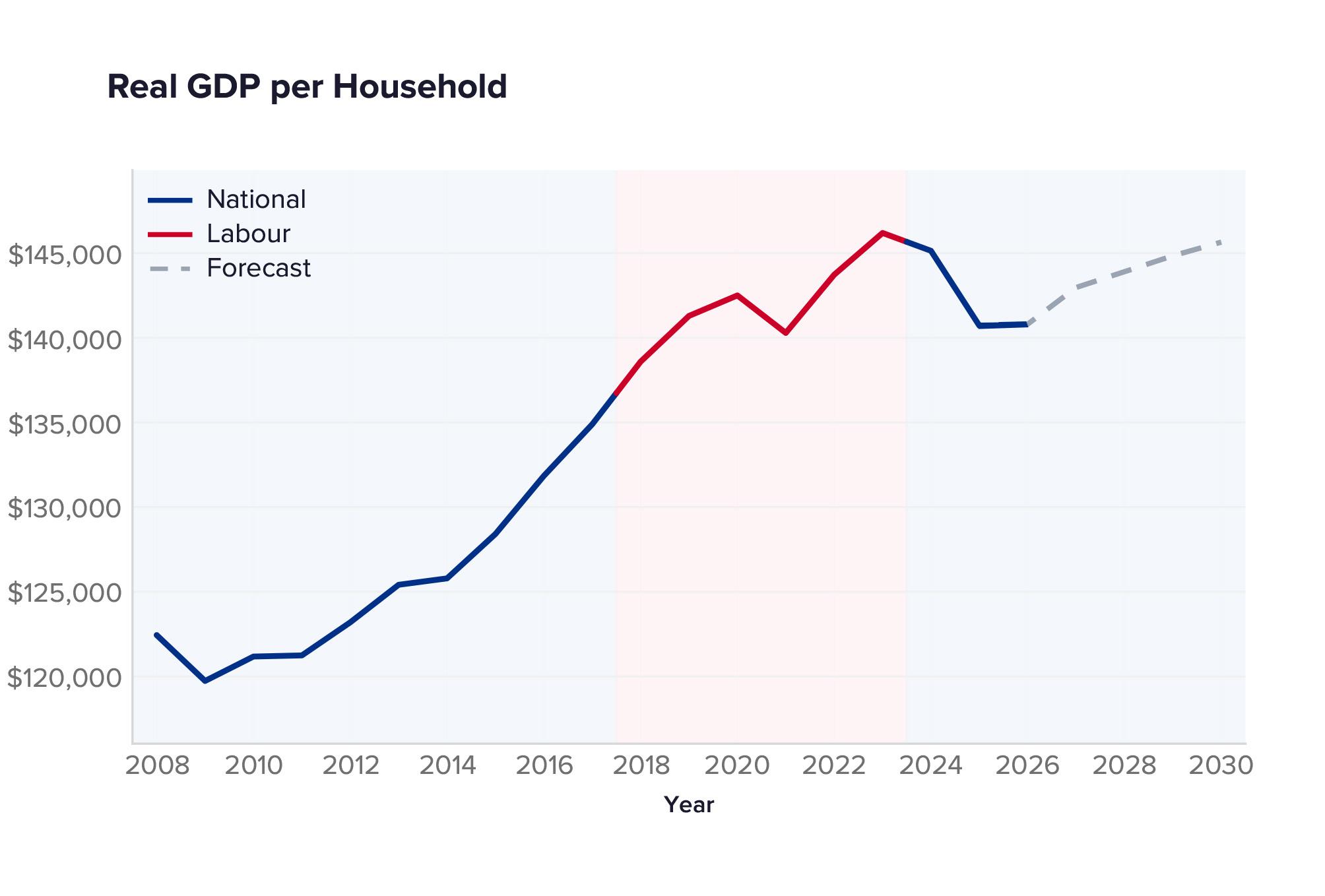
This has declined under the current Government, and so households have got poorer.
The spike in 2021 resulted from Government and Reserve Bank cash injections following COVID. This crashed quickly, and growth has been weak since. The Iran conflict will weaken forecast growth further.
GOVERNMENT HAS GROWN BY 46 PERCENT SINCE 2008
While each household’s debt burden was growing, New Zealand’s government was on a hiring spree. Between 2008 and the latest figures from December 2025, the number of public servants has grown by 46 percent.
Under John Key and Bill English’s Governments, the number of bureaucrats remained relatively steady. The number exploded under the Labour-led Government between 2017 and 2023.
• Headcount grew sharply from 2017, rising from 47,25216 in June 2017 to 65,69917 in December 2023. That is an increase of more than 18,000 in just six years.
• Under the last Labour Government, the public service expanded by 39 percent. More than 85 percent of the net increase since 2008 happened under the Labour Government.
• The current Government has barely trimmed these numbers. There are now 2,042 fewer public servants than when the Coalition took office, equivalent to removing just one ninth of the increase between 2017 and 2023.
• There are still 16,405 more public servants than there were in 2017, or nearly 35 percent.
It is not a coincidence that the government is not expected to balance the books at all this decade. Following this significant growth in the size of the state, New Zealand is borrowing simply to pay for thousands of extra salaries.
The public service grew by nearly half. Taxpayers are well within their rights to ask what they’re getting for their money.
16 Public Service Commission (2026). Workforce data: Data drilldown. Available at: https://www.publicservice.govt.nz/data/workforce-data/data-drilldown (Accessed 24 March 2026)
17 Public Service Commission (2026). Workforce size. Available at: https://www.publicservice.govt.nz/data/workforce-data/public-sector-composition/workforce-size (Accessed 24 March 2026)
The number of core ministry and departmental staff surged by more than 18,000 under the last Government. Numbers have only marginally decreased under the current Government.
CONCLUSION
New Zealand’s rapidly deteriorating finances are the result of decisions made by every government since 2008, and every household is bearing the consequences.
The debt is real and growing. The interest bill is real. Our declining prosperity and the overgrown public service are real, and successive governments have simply been unwilling to tackle the root causes.
New Zealand has faced crises before and come out the other side, because we have had the luxury of borrowing more. We are wasting that ability. The next major shock – whether it is a result of the conflict in Iran, the next earthquake, or another pandemic – will hit a country with far less room to respond than we have been used to in the past.
The longer we delay making the hard choices to fix the books, the less control we will have over what choices we take. A government living beyond its means today is stealing opportunities from Kiwis tomorrow.
Wellington March 2026

Photo by Casey Horneron on Unsplash