Law stated in this book is as updated till 25th December, 2025
Published by : Taxmann Publications (P.) Ltd.
Sales & Marketing : 59/32, New Rohtak Road, New Delhi-110 005 India
Phone : +91-11-45562222
Website : www.taxmann.com
E-mail : sales@taxmann.com
Regd. Office : 21/35, West Punjabi Bagh, New Delhi-110 026 India
Printed at :
Tan Prints (India) Pvt. Ltd.
44 Km. Mile Stone, National Highway, Rohtak Road Village Rohad, Distt. Jhajjar (Haryana) India
E-mail : sales@tanprints.com
Disclaimer
Every effort has been made to avoid errors or omissions in this publication. In spite of this, errors may creep in. Any mistake, error or discrepancy noted may be brought to our notice which shall be taken care of in the next edition. It is notified that neither the publisher nor the author or seller will be responsible for any damage or loss of action to any one, of any kind, in any manner, therefrom. It is suggested that to avoid any doubt the reader should cross-check all the facts, law and contents of the publication with original Government publication or notifications.
No part of this book may be reproduced or copied in any form or by any means [graphic, electronic or mechanical, including photocopying, recording, taping, or information retrieval systems] or reproduced on any disc, tape, perforated media or other information storage device, etc., without the written permission of the publishers. Breach of this condition is liable for legal action.
For binding mistake, misprints or for missing pages, etc., the publisher’s liability is limited to replacement within seven days of purchase by similar edition. All expenses in this connection are to be borne by the purchaser. All disputes are subject to Delhi jurisdiction only.
10. Delivery of persons sentenced by Presidency Magistrates 5
11. Delivery of persons committed for trial by High Court 5
12. Custody pending hearing by High Court under section 350 of the Code of Civil Procedure of application for insolvency 5
13. Delivery of persons arrested in pursuance of warrant of High Court or Civil Court in Presidency-town 5
PART IV
PRISONERS OUTSIDE THE PRESIDENCY-TOWNS
14. References in this Part to prisons etc., to be construed as referring also to Reformatory Schools 6
15. Power for officers in charge of prisons to give effect to sentences of certain Courts 6
16. Warrant of officer of such Court to be sufficient authority 7
17. Procedure where officer in charge of prison doubts the legality of warrant sent to him for execution under this Part 7
18. Execution in the States of certain capital sentences not ordinarily executable there 7
PART V
PERSONS UNDER SENTENCE OF PENAL SERVITUDE
1927. [Omitted by the Criminal Law (Removal of Racial Discriminations) Act, 1949, w.e.f. 6-4-1949] 8
PART VI
REMOVAL OF PRISONERS
28. References in this Part to prisons etc., to be construed as referring also to Reformatory Schools 8
29. Removal of prisoners 8
30. Lunatic prisoners how to be dealt with 9
31. [Omitted by the Amending Act, 1903] 10
PART VII
PERSONS UNDER SENTENCE OF TRANSPORTATION
32. Appointment of places for confinement of persons under sentence of transportation and removal thereto 10
PART VIII
DISCHARGE OF PRISONERS
33. Release, on recognizance, by order of High Court, of prisoner recommended for pardon 10
PART IX
PROVISIONS FOR REQUIRING THE ATTENDANCE OF PRISONERS AND OBTAINING THEIR EVIDENCE
3452. [Omitted by the Prisoners (Attendance in Courts) Act, 1955, w.e.f. 1-1-1956] 11
53. [Omitted by the Repealing and Amending Act, 1914] 11
FIRST SCHEDULE [Omitted by the Prisoners (Attendance in Courts) Act, 1955, w.e.f. 1-1-1956] 11
SECOND SCHEDULE [Omitted by the Prisoners (Attendance in Courts) Act, 1955, w.e.f. 1-1-1956] 11
THIRD SCHEDULE [Omitted by the Repealing and Amending Act, 1914] 11 SUBJECT INDEX 13
PRISONS ACT, 1894
CHAPTER I
1. Title, extent and commencement 15
2. [Omitted by the Repealing Act, 1938] 16
3. Definitions 16
CHAPTER II
MAINTENANCE AND OFFICERS OF PRISONS
4. Accommodation for prisoners 18
5. Inspector General 18
6. Officers of prisons 18
7. Temporary accommodation for prisoners 18
CHAPTER III
DUTIES OF OFFICERS Generally
8. Control and duties of officers of prisons 18
CHAPTER VI FOOD, CLOTHING AND BEDDING OF CIVIL AND UNCONVICTED CRIMINAL PRISONERS
31. Maintenance of certain prisoners from private sources
32. Restriction on transfer of food and clothing between certain prisoners
33. Supply of clothing and bedding to civil and unconvicted criminal prisoners
CHAPTER VII
34.
35.
43.
44.
CHAPTER VIII
45. Prison-offences
46. Punishment of such offences
47. Plurality of punishments, under section 46
48. Award of punishments under sections 46 and 47
49. Punishments to be in accordance with foregoing sections
50. Medical Officer to certify to fitness of prisoner for punishment
51. Entries in punishment-books
52. Procedure on committal of heinous offence
53. Whipping
54. Offences by prison-subordinates
55. Extramural custody, control and employment of prisoners
56. Confinement in irons
57. Confinement of prisoners under sentence of transportation in irons
58. Prisoners not to be ironed by Jailer except under necessity
59. Power to make rules
60. [Omitted by the Government of India (Adaptation of Indian Laws) Order, 1937]
61. Exhibition of copies of rules
62. Exercise of powers of Superintendent and Medical
PRISONERS (ATTENDANCE IN COURTS) ACT, 1955
3. Power of courts to require appearance of prisoners to give evidence or answer a charge
4. Power of State Government to exempt certain persons from operation of section 3
5. Prisoners to be brought up 51
6. Officer in charge of prison when to abstain from carrying out order 52
7. Commissions for examination of prisoners 52
8. Certain provisions of the Code of Criminal Procedure and the Code of Civil Procedure to apply 53
9. Power to make rules 53
10. Repeal 53
FIRST SCHEDULE 54 SECOND SCHEDULE 54 SUBJECT INDEX 55
TRANSFER OF PRISONERS ACT, 1950
1. Short title and extent 57
2. Definitions 57
3. Removal of prisoners from one State to another 58
4. [Omitted by the Repealing and Amending Act, 1957, w.e.f. 17-9-1957] 58 SUBJECT INDEX 59
REPATRIATION OF PRISONERS ACT, 2003
1. Short title and commencement 61
2. Definitions 61
3. Application of Act 62
4. Application for transfer by a prisoner 63
5. Consideration of request by Central Government 63
6. Comments of contracting State 63
7. Consideration of request by Central Government 64
8. Provision to issue warrant for transfer 64
9. Operation of warrant and retaking prisoner 65
10. Transfer of record 65
11. Power of court and Central Government shall not be affected 65
12. Transfer into India 65
13. Determination of prison and issue of warrant for receiving transfer in India 65
14. Power to make rules 66
15. Laying of rules, etc.
CRIMINAL PROCEDURE (IDENTIFICATION) ACT, 2022
1. Short title and commencement
2. Definitions
3. Taking of measurement
4. Collection, storing, preservation of measurements and storing, sharing, dissemination, destruction and disposal of records 73
5. Power of Magistrate to direct a person to give measurements 74
6. Resistance to allow taking of measurements
7. Bar of suit
8. Power to make rules
9.
CRIMINAL PROCEDURE (IDENTIFICATION) RULES, 2022
1. Short title and commencement 79
2. Definitions 79
3. Taking of measurements 80
4. Manner of taking of measurements of a person who resists or refuses to allow taking of measurements 80
5. Manner of collection, storing, preservation, processing, sharing, dissemination, destruction and disposal of measurements 80
6. Compliance with the Standard Operating Procedure issued by the Bureau 81
REPATRIATION OF PRISONERS RULES, 2004
1. Short title and commencement 82
2. Definitions 82
3. Form of application 82
4. Means of forwarding the application 82
5. Form of warrants 82
FORM 1: Application for transfer of sentenced person 83
FORM 2: Form of warrant 84
FORM 3: Form of warrant 85
SAMPLE CHAPTER
Prisoners Act, 1900
[3 OF 1900]1
An Act to consolidate the law relating to Prisoners confined by order of a Court. WHEREAS it is expedient to consolidate the law relating to prisoners confined by order of a Court; it is hereby enacted as follows:—
PART I PRELIMINARY
Short title and extent.
1. (1) This Act may be called the Prisoners Act, 1900. 2[(2) It extends to the whole of India except 3[the territories which, immediately before the 1st November, 1956, were comprised in Part B States,] 4[***]] (3) 5[***]
COMMENTS
SECTION NOTES
1.1 Short title [Section 1(1)]
This Act is formally called the Prisoners Act, 1900.
1.2 Extent of applicability [Section 1(2)]
The Act applies throughout India, with the exception of:
The territories that were, before 1st November 1956, part of the Part B States. Part B States were states that did not have the same level of autonomy as others and included areas like Jammu & Kashmir, some smaller regions, and princely states that were integrated after independence.
Definitions.
2. In this Act, unless there is anything repugnant in the subject or context,—
1. Dated 2-2-1900.
2. Substituted by the Adaptation of Laws Order, 1950, w.e.f. 26-1-1950.
3. Substituted for “Part B States” by the Adaptation of Laws (No. 2) Order, 1956, w.e.f. 1-11-1956.
4. Word “and” omitted by the Repealing and Amending Act, 1914.
5. Sub-section (3) omitted, ibid
S. 3
PRISONERS ACT, 1900 2
(a) “Court” includes a Coroner and any officer lawfully exercising civil, criminal or revenue jurisdiction; and
(b) “prison” includes any place which has been declared by the 6[State Government], by general or special order, to be a subsidiary jail;
7[(c) “States” means the territories to which this Act extends.]
COMMENTS
SECTION NOTES
2.1 “Court” [Section 2(a)]
The term “Court” is defined broadly to include:
A Coroner, who is an official responsible for investigating deaths, especially those that are sudden, unexplained, or violent.
Any officer who lawfully exercises civil, criminal, or revenue jurisdiction.
2.2 “Prison” [Section 2(b)]
The term “prison” is not limited to the conventional prisons but also includes:
Any place that the State Government designates as a subsidiary jail through a general or special order.
PART II GENERAL
Officers in charge of prisons to detain persons duly committed to their custody.
3. The officer in charge of a prison shall receive and detain all persons duly committed to his custody, under this Act or otherwise, by any Court, according to the exigency of any writ, warrant or order by which such person has been committed, or until such person is discharged or removed in due course of law.
COMMENTS
SECTION NOTES
3.1 Duty of the Officer in charge of a Prison
The officer in charge of a prison has the legal responsibility to:
Receive and detain individuals who have been duly committed to their custody, whether by order of a Court or through any other legal process under the Act or otherwise.
3.2 Detention according to legal orders
The officer’s detention of prisoners must be in line with the specific requirements of the commitment. This means that the terms of the:
6. Substituted, for “Provincial Government” by the Adaptation of Laws Order, 1950, w.e.f. 26-1-1950.
7. Substituted by the Adaptation of Laws (No. 2) Order, 1956, w.e.f. 1-11-1956, Earlier clause (c) was inserted by the Adaptation of Laws Order, 1950, w.e.f. 26-1-1950.
Writ, Warrant, or Order
must be followed precisely, ensuring that the reasons for and the terms of imprisonment are respected.
3.3 Duration of detention
The detention will last:
Until the person is discharged—either through a legal order, such as bail or a judicial decision, or
Until the person is removed in due course of law, meaning they may be transferred or released based on the lawful authority (e.g., judicial review, parole, or completion of sentence).
Officers in charge of prisons to return writs, etc., after execution or discharge.
4. The officer in charge of a prison shall forthwith, after the execution of every such writ, order or warrant as aforesaid other than a warrant of commitment for trial, or after the discharge of the person committed thereby, return such writ, order or warrant to the Court by which the same was issued or made, together with a certificate, endorsed thereon and signed by him, showing how the same has been executed, or why the person committed thereby has been discharged from custody before the execution thereof.
COMMENTS
SECTION NOTES
4.1 Return of writs, orders, and warrants after execution or discharge
The officer in charge of a prison has the duty:
To return any writ, order, or warrant that has been executed or a person has been discharged from custody.
Exceptions – Warrant of commitment for trial
Section 4 does not apply to a warrant of commitment for trial, as these cases involve pending court proceedings and are outside the scope of this provision.
4.2 Endorsement and certification requirement
The officer must return the writ, order, or warrant to the Court that issued it and include a certificate that is:
Endorsed on the document,
Signed by the officer,
PART III
PRISONERS IN THE PRESIDENCY-TOWNS
Warrants etc., to be directed to Police officers.
5. Every writ or warrant for the arrest of any person issued by the High Court in the exercise of its ordinary, extraordinary or other criminal jurisdiction shall be
directed to and executed by a Police officer within the local limits of such jurisdiction.
COMMENTS
SECTION NOTES
5.1 Direction for execution of writs and warrants
Section 5 mandates that any writ or warrant issued by the High Court for the arrest of a person—whether in the exercise of its ordinary, extraordinary, or criminal jurisdiction— must be:
Directed to a police officer,
And executed by a police officer within the local limits of the High Court’s jurisdiction.
Power for 8[State] Governments to appoint Superintendents of Presidency prisons.
6. The 9[State Government] may appoint officers who shall have authority to receive and detain prisoners committed to their custody under this part.
Explanation.—Any officer so appointed, by whatever designation he may be styled, is hereinafter referred to as “the Superintendent”.
Delivery of persons sentenced to imprisonment or death by High Court.
7. Where any person is sentenced by the High Court in the exercise of its original criminal jurisdiction to imprisonment or to death, the Court shall cause him to be delivered to the Superintendent together with its warrant, and such warrant shall be executed by the Superintendent and returned by him to the High Court when executed.
Delivery of persons sentenced to transportation by High Court.
8. Where any person is sentenced by the High Court in the exercise of its original criminal jurisdiction to transportation 10[***] the Court shall cause him to be delivered for intermediate custody to the Superintendent, and the transportation 10[***] of such person shall be deemed to commence from such delivery.
Delivery of persons committed by High Court in execution of a decree or for contempt.
9. Where any person is committed by the High Court, whether in execution of decree or for contempt of Court or for any other cause, the Court shall cause him to be delivered to the Superintendent, together with its warrant of commitment.
8. Substituted for “Provincial” by the Adaptation of Laws Order, 1950, w.e.f. 26-1-1950.
9. Substituted for “Provincial Government”, ibid
10. Words “or penal servitude” omitted by the Criminal Law (Removal of Racial Discriminations) Act, 1949, w.e.f. 6-4-1949.
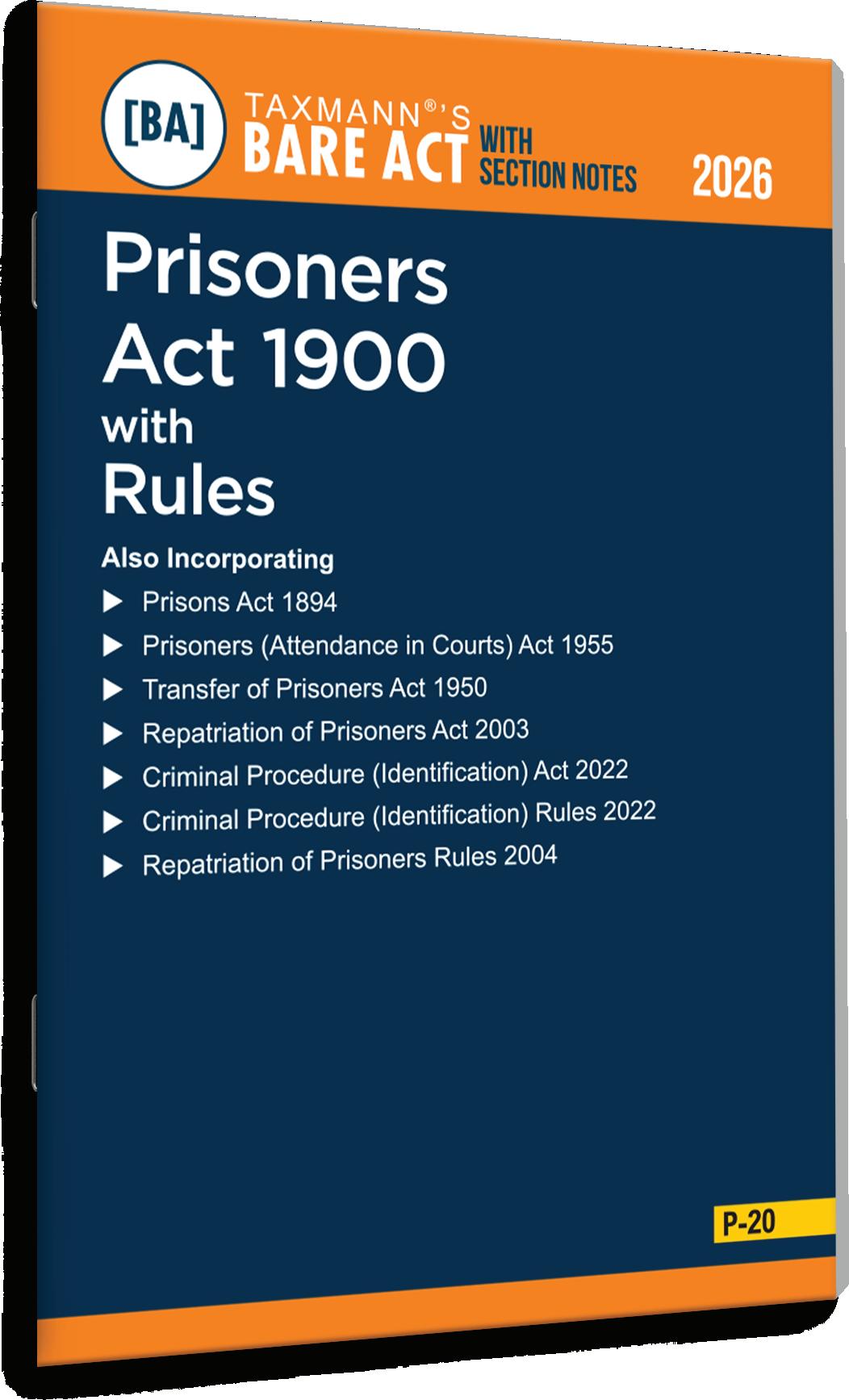
PRISONERS ACT 1900 WITH RULES –BARE ACT WITH SECTION NOTES
AUTHOR : Taxmann's Editorial Board
PUBLISHER : Taxmann
DATE OF PUBLICATION : January 2026
EDITION : 2026 Edition
ISBN NO : 9789371269421
NO. OF PAGES : 104
BINDING TYPE : Paperback
Rs. 145
DESCRIPTION
Prisoners Act 1900 with Rules [Bare Act with Section Notes] by Taxmann is a concise and up-to-date statutory reference to India's legal framework governing prisoners confined by order of courts and the administration of prisons. This Edition presents the complete text of the Prisoners Act 1900, as amended up to date, together with structured section-wise notes, explanatory comments, and legislative history. The publication enables a clear understanding of the statutory provisions relating to custody, detention, transfer, production before courts, discipline, and discharge of prisoners, along with the powers and duties of prison authorities and courts.
In addition to the principal Act, the book consolidates all major allied legislations governing prison administration, inter-state and international transfer of prisoners, attendance of prisoners in courts, and identification procedures, making it a dependable reference for criminal justice and correctional governance. This book is intended for the following audience:
• Advocates & Legal Practitioners
• Judges & Judicial Officers
• Police Officers & Prison Administration Officials
• Government Officials & Policymakers
• Academicians & Law Students
• Libraries & Research Institutions
The Present Publication is the 2026 Edition, covering the amended and updated text of the Prisoners Act [Act No. 3 of 1900] and Rules, with the following noteworthy features:
• [Comprehensive Text with Section Notes] Contains the complete and updated text of the Prisoners Act 1900, supported by clear, section-wise explanatory notes
• [Updated and Amended Law] Incorporates all statutory amendments, adaptations, and omissions as in force, with the law stated as updated
• [Pre-amendment Provisions in Footnotes] Includes pre-amendment text in footnotes to enable under standing of earlier legal positions and transitional applicability