







[30 OF 1934]1
An Act to consolidate and amend the law relating to the import, transport, storage, production, refining and blending of petroleum 2[***]
WHEREAS it is expedient to consolidate and amend the law relating to import, transport, storage, production, refining and blending of petroleum. It is hereby enacted as follows:
Short title, extent and commencement.
1. (1) This Act may be called the Petroleum Act, 1934.
(2)It extends to the whole of India 3[***].
(3)It shall come into force on such date4 as the Central Government may, by notification in the official Gazette, appoint.
Definitions.
2. In this Act unless there is anything repugnant in the subject or context-
(a)“Petroleum” means any liquid hydro-carbon or mixture of hydro-carbon and any inflammable mixture (liquid, viscous or solid) containing any liquid hydro-carbon;
5[(b) “petroleum Class A” means petroleum having a flash-point below twenty-three degrees centigrade;
1. Dated 6-9-1934.
This Act has been extended to Berar by the Petroleum (Berar Extension) Act, 1937; extended to Goa, Daman and Diu (with modification) by Regulation 12 of 1962; extended to Pondicherry w.e.f. 1-10-1963 vide Regulation 7 of 1963; extended to Dadra and Nagar Haveli w.e.f. 1-7-1965, vide Regulation 6 of 1963 and to Lakshadweep w.e.f. 1-10-1967, vide Regulation 8 of 1965.
2. Words “and other inflammable substances” omitted by the Petroleum (Amendment) Act, 1970, w.e.f. 1-8-1976.
3. Words “except the State of Jammu and Kashmir” omitted by the Jammu and Kashmir (Extension of Laws) Act, 1956, w.e.f. 1-11-1956.
4. W.e.f. 30-3-1937
5. Clauses (b) to (bbb) substituted for clause (b) by the Petroleum (Amendment) Act, 1970, w.e.f. 1-8-1976.
(bb) “petroleum Class B” means petroleum having flash-point of twenty-three degrees centigrade and above but below sixty-five degrees centigrade;
(bbb) “petroleum Class C” means petroleum having a flash-point of sixty-five degrees centigrade and above but below ninety-three degrees centigrade;]
(c) 6[“flash-point”] of any petroleum means the lowest temperature at which it yields a vapour which will give a momentary flash when ignited, determined in accordance with the provisions of Chapter II and the rules made thereunder;
7[(d) “to transport petroleum” means to move petroleum from one place to another in India and includes moving from one place to another in India across a territory which is not part of India;]
(e) “to import petroleum” means to bring it into 8[India] by land, sea or air otherwise than during the course of transport;
(f) “to store petroleum” means to keep it in any one place, but does not include any detention happening during the ordinary course of transport;
(g) “motor conveyance” means any vehicle; vessel or aircraft for the conveyance of human beings, animals or goods, by land, water or air, in which petroleum is used to generate the motive power;
(h) “prescribed” means prescribed by rules made under this Act.
(i) 9[***].
Import, transport and storage of petroleum.
3. (1) No one shall import, transport or store any petroleum save in accordance with the rules made under section 4.
(2) Save in accordance with the conditions of any licence for the purpose which he may be required to obtain by rule made under section 4, no one shall import 10[petroleum Class A], and no one shall transport or store any petroleum.
Cancellation of no objection certificate without hearing - The petitioner, having been allotted a retail petroleum outlet by Hindustan Petroleum Corporation, obtained
6. Substituted for “’flashing-point’” by the Petroleum (Amendment) Act, 1970, w.e.f. 1-8-1976.
7. Substituted, ibid.
8. Substituted for “the territories to which this Act extends” by the Jammu & Kashmir (Extension of Laws) Act, 1956, w.e.f. 1-11-1956.
9. Omitted by the Part B States (Laws) Act, 1951.
10. Substituted for “any dangerous petroleum” by the Petroleum (Amendment) Act, 1970, w.e.f. 1-8-1976.
a No Objection Certificate (NOC) from the District Magistrate for using the site. Later, based on a complaint from a third party with no ownership over the said land, the District Magistrate cancelled the NOC without issuing any prior notice or giving the petitioner a chance to be heard. The complaint had already been rejected earlier by the same authority due to lack of standing, but it was reconsidered without informing the petitioner. The petitioner challenged this ex parte cancellation on grounds of breach of natural justice. The High Court observed that under the proviso to Rule 150 of the Petroleum Rules, 2002—framed under section 4 of the Petroleum Act, 1934—it is mandatory to provide an opportunity of hearing before cancellation of a NOC. Since no such opportunity was given, the cancellation order was held to be in violation of both statutory mandate and natural justice principles. The Court also declined to relegate the petitioner to the appellate remedy under Rule 154, emphasizing that the order was non est in law due to this fundamental breach and thus allowed the writ petition. - Rekha Mishra v. Hindustan Petroleum Corporation Ltd. AIR 2024 (NOC) 115 (ALL).
4. The Central Government may makes rules–
(
a) prescribing places where petroleum may be imported and prohibiting its import elsewhere;
(
(
b) regulating the import of petroleum;
c) prescribing the periods within which licences for the import of 11[Petroleum Class A] shall be applied for, and providing for the disposal, by confiscation or otherwise, of any 11[Petroleum Class A] in respect of which licence has not been applied for within the prescribed period or has been refused and which has not been exported;
(
(
d) regulating the transport of petroleum;
e) specifying the nature and condition of all receptacles and pipelines in which petroleum may be transported;
(f) regulating the places at which and prescribing the conditions subject to which petroleum may be stored;
(g) specifying the nature, situation and condition of all receptacles in which petroleum may be stored;
(h) prescribing the form and conditions of licence for the import of Petroleum Class A and for the transport or storage of any petroleum, the manner in which applications for such licences shall be made, the authorities which may grant such licences and the fees which may be charged for such licences;
(
i) determining in any class of cases whether a licence for the transport of petroleum shall be obtained by the consignor, consignee or carrier;
(
j) providing for the granting of combined licences for the import, transport and storage of petroleum, or for any two of such purposes;
(k) prescribing the proportion in which any specified poisonous substance may be added to petroleum and prohibiting the import, transport or
11. Substituted for “dangerous petroleum” by the Petroleum (Amendment) Act, 1970, w.e.f. 1-8-1976.
storage of petroleum, in which the proportion of any specified poisonous substance exceeds the prescribed proportion; and (l) generally, providing for any matter which in its opinion is expedient for proper control over the import, transport and storage of petroleum 12[including the charging of fees for any service rendered in connection with the import, transport and storage of petroleum].
Cancellation of NOC – Improper exercise of discretion - The petitioner, Vijaya Oil Company, established a petrol filling station in Guntur after obtaining a No Objection Certificate (NOC) from the District Collector, following requisite approvals from the Fire Services Department, Revenue Authorities, Municipal Corporation, and Explosives Department. Subsequently, based on general objections raised by local residents alleging environmental and safety hazards due to the petrol pump’s proximity to residential buildings, the Urban Development Authority suspended the construction permission and the District Collector later cancelled the NOC. The High Court held that the installation of a petrol station in a residential area is not per se prohibited under the applicable Zoning Regulations and that all mandatory approvals had been obtained before operation commenced. The objections raised were found to be vague and not based on any specific statutory violation. It was further held that cancellation of the NOC at a belated stage, after substantial investment and compliance, was not a proper exercise of discretion under the Petroleum Rules. The impugned cancellation orders were quashed. - Vijaya Oil Co. v. Vijayawada, Guntur Tenali Urban Development Authority AIR 2007 (NOC) 694 (A. P.).
Storage in underground tank – Licence in Form XI not sufficient - The appellant, a licensee under Form XI of the Petroleum Rules, 1976, was directed by authorities to stop storing High Speed Diesel (a Class B petroleum) in an underground tank and selling it via a dispensing pump. He challenged this, arguing that Form XI allowed such use. The Supreme Court rejected this argument, clarifying that under Rule 2(xv) read with Rule 2(xxii), any receptacle exceeding 1000 litres constitutes a “tank,” and storage in it amounts to “petroleum in bulk.” Form XI permits storage “otherwise than in bulk” in containers not exceeding 1000 litres each, up to a total of 25,000 litres. To store in a tank—even if underground—requires a separate licence in Form XII, to be issued by the Chief Controller or authorised Controller of Explosives. Since the appellant did not hold a Form XII licence, his underground tank storage was illegal. The Court held that licensing provisions are to be strictly followed in the interest of public safety and rejected the plea that underground storage is safer. The appeal was dismissed. - Durga Oil Co. v. State of U.P. 1998 AIR SCW 2619.
Grant of no objection certificate – No right to object by rival dealer - The petitioner, already operating a petrol pump near Gaurisagar Road Junction, challenged the grant of a No Objection Certificate (NOC) to respondent for establishing another petrol pump at the same junction. The petitioner alleged that the site was hazardous, being close to crude oil overflow points and educational institutions, and that the new pump violated the 15 km minimum distance norm prescribed in a government letter. The Gauhati High Court held that the petitioner had no locus standi to challenge the NOC since he had
12. Inserted by the Petroleum (Amendment) Act, 1970, w.e.f. 1-8-1976.
no legal right over the site and the respondent was exercising his fundamental right to carry on business without infringing any statutory rights of the petitioner. It further held that the 15 km distance norm in the government letter was not a statutory rule and thus could not override the provisions of the Petroleum Rules framed under section 4. The Court also found no evidence that the respondent had lost the right to use the site, and hence, there was no ground to cancel the NOC under Rule 151. The writ petition was dismissed. - Ganesh Chandra Hazarika v. State of Assam AIR 1981 GAUHATI 36.
Suspension of LPG supply – Independent from show cause withdrawal - Savita Sharma and Vivek Sharma, legal heirs of a deceased LPG dealership holder, continued operating under a reconstituted dealership with Hindustan Petroleum Corporation Ltd. Complaints regarding irregularities, including LPG cylinder losses and breach of marketing guidelines, led the Corporation to suspend supplies and issue a show cause notice. The petitioners challenged the suspension, arguing that withdrawal of the show cause notice rendered the suspension void. The Allahabad High Court held that the suspension of petroleum supplies under the dealership agreement was a distinct power flowing from Clause 29A, independent of the show cause notice. The Court further ruled that even if the show cause notice was withdrawn due to technical lapses, the suspension remained valid given the serious allegations that required further inquiry. Thus, the Court upheld the suspension and directed the petitioners to pursue arbitration as per the agreement terms. - Savita Sharma v. Union of India 2014 (2) ALJ (NOC) 102 (All.).
Assessment of financial capability – Rejection of LPG dealership application valid - The appellant challenged his non-selection for LPG distributorship under Indian Oil Corporation’s 2006 advertisement. His application was assessed under prescribed norms, including “capability to provide finance.” He submitted three sale deeds and a valuation report showing assets worth ` 68 lakhs. However, due to discrepancies between the sale deeds and the valuation report—particularly mismatches in khata and khasra numbers and village names—the report was disregarded. Even if the report was excluded and only sale deeds were considered, his assets amounted to ` 5.95 lakhs, earning him only one mark under the evaluation chart. Despite representations, the Corporation found no basis to revise the score. The Punjab and Haryana High Court upheld this decision, noting that even with the extra mark, the appellant’s score (89.30) remained below that of the selected candidate (90.17). Thus, the refusal of distributorship was held proper and the appeal was dismissed. - Amarjit Singh v. Indian Oil Corporation Ltd. AIR 2014 (NOC) (SUPP) 961 (P&H).
Unlicensed storage of petroleum – Justified repudiation of insurance claim - The appellant, M/s. Baspa Organics Ltd., acquired a chemical factory and stored large quantities of Hexane, a petroleum Class A substance with a flash point of -23°C. A fire broke out, and the appellant claimed insurance under a Fire and Special Perils Policy. The insurer repudiated the claim, citing the appellant’s failure to obtain a mandatory licence under the Petroleum Act, 1934 and Petroleum Rules, 1976. The Supreme Court held that Hexane, being stored in tanks exceeding 1000 litres, constituted storage “in bulk,” requiring a licence under Article 6 of the Rules. The Court rejected the appellant’s reliance on an exemption under the Essential Commodities Act’s Solvent Order of 2000, ruling that such exemptions are independent and do not override licensing obligations under the Petroleum Act. As the appellant stored more than 90 kilolitres of Hexane without the requisite licence, the Court upheld the insurer’s repudiation, holding that the non-disclosure of this fact was material and violated the insurance policy terms. - Baspa Organics Ltd. v. United India Insurance Co. Ltd. AIR 2020 SUPREME COURT 1712.
Maintainability of appeal – Communication not equivalent to cancellation of NOC - The petitioner challenged the jurisdiction of the Additional Sessions Judge
in entertaining an appeal under Rule 154(2) of the Petroleum Rules, 2002, against a communication from the District Magistrate stating that no No Objection Certificate (NOC) was ever issued to the respondent-firm’s petrol pump. The respondents had argued that this communication amounted to a cancellation of NOC, making it appealable. The Bombay High Court held that unless there is a formal order refusing to grant or cancelling an NOC, an appeal under Rule 154 is not maintainable. The communication dated 13-6-2016 was a reiteration of earlier findings and merely confirmed the fact that no NOC had been issued; it was not an operative order of cancellation. Furthermore, the Court clarified that the Additional Sessions Judge is not the “immediate superior” to the District Magistrate for the purposes of appeal under the Petroleum Rules. Accordingly, the appeal was held to be not maintainable, and the Sessions Judge’s order remanding the matter for reconsideration was quashed. - Deepak Sundarlal Murarka v. Harjimal Onkarmal AIRONLINE 2021 BOM. 492.
Environmental objections to NOC – No interference if due procedure followedThe petitioner, a local resident, challenged the issuance of a No Objection Certificate (NOC) under Rule 144 of the Petroleum Rules, 2002 to Bharat Petroleum Corporation Ltd. for establishing a petroleum retail outlet in a residential area. He alleged violations of IRC Guidelines and raised environmental and safety concerns. The Kerala High Court dismissed the petition, noting that all statutory authorities, including the District Police Chief, Fire Officer, PWD, and Pollution Control Board, had granted clearance. A personal hearing was conducted, and the Environmental Engineer reported that the proposed outlet fell under the “Green Category” with no objection to its establishment. Furthermore, the Court observed that the IRC Guidelines had been withdrawn by the Central Government as of 1-12-2019 and thus had no binding effect. The petitioner’s claims were found to lack factual basis, and the Court held that there was no illegality in granting the NOC. - Philip John v. State of Kerala AIRONLINE 2021 KER. 233.
Compliance with safety rules – Mandamus denied - The petitioner sought a writ of mandamus directing authorities to ensure that the transport of Liquefied Petroleum Gas (LPG) by road complied with the Petroleum Rules, 2002 and the Static and Mobile Pressure Vessels (Unfired) Rules, 1981. He raised concerns about road safety, LPG tanker accidents, and inadequate rescue operations, especially along National Highway 213. In response, oil companies including HPCL, BPCL, and IOC filed detailed counter affidavits outlining safety protocols such as statutory compliance checks, rigorous driver training, emergency response mechanisms, and vehicle safety fittings in line with Oil Industry Safety Directorate guidelines. The Kerala High Court, after reviewing these affidavits, found the measures satisfactory and declined to issue any writ, holding that safety protocols under the Petroleum Act and Rules were adequately followed by the respondents. Accordingly, the writ petition was closed. - Jose Baby v. Chief Controller of Explosives, Chennai AIRONLINE 2019 KER. 720.
Storage in bulk – Requirement of proper licence - The appellant, a licensee under Form XI of the Petroleum Rules, 1976, was restrained from storing High Speed Diesel (HSD) in an underground tank and selling it through a dispensing pump. The issue arose because Form XI permits storage of Petroleum Class B (like HSD) only “otherwise than in bulk” and limits it to 25,000 litres in containers not exceeding 1000 litres each. The Supreme Court held that any receptacle exceeding 1000 litres qualifies as a “tank” under Rule 2(xxii), and any storage in such a receptacle is “petroleum in bulk” under Rule 2(xv), regardless of the actual quantity stored. Thus, for storing HSD in an underground tank (a bulk storage), a licence in Form XII is required under the Rules. The appellant lacked such a licence, making the underground tank storage and sale operation illegal. The Court rejected the plea that underground tanks are safer, holding that statutory licensing provisions must be strictly followed. The appeal was dismissed. - Durga Oil Co. v. State of U.P. 1998 AIR SCW 2619.
AUTHOR : TAXMANN’S EDITORIAL BOARD
PUBLISHER :
TAXMANN
DATE OF PUBLICATION : NOVEMBER 2025
EDITION : 2026 EDITION
ISBN NO : 9789371261159
NO. OF PAGES : 280
BINDING TYPE : PAPERBACK
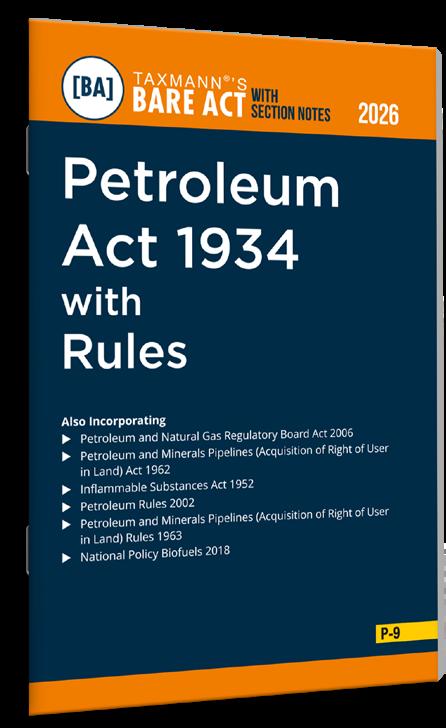
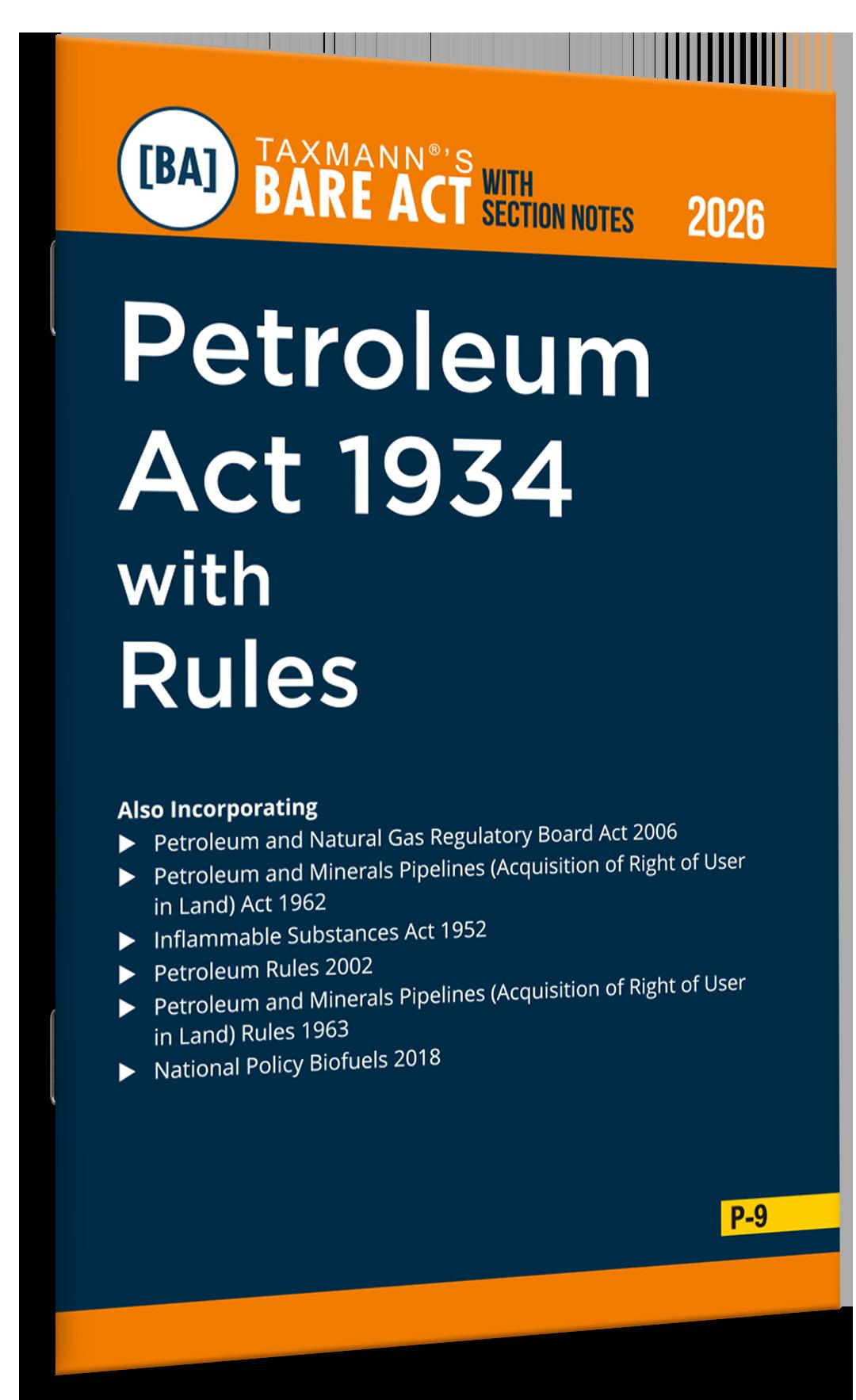
Petroleum Act 1934 with Rules [Bare Act with Section Notes] by Taxmann is a comprehensive and updated reference on India’s primary legislation regulating the import, transport, storage, refining, testing, and handling of petroleum and allied substances. This Edition consolidates the Act with relevant Rules and Allied Acts, including the Petroleum Rules 2002, the Inflammable Substances Act 1952, and the Petroleum & Minerals Pipelines (Acquisition of Right of User in Land) Act 1962, ensuring complete alignment with the law as amended up to date.
This book is intended for the following audience:
• Petroleum and Energy Sector Regulators
• Oil Marketing Companies, Refineries, and Transport Operators
• Legal Practitioners & Corporate Counsels
• Academicians, Researchers, and Students
The Present Publication is the 2026 Edition, covering the amended and updated text of the Petroleum Act [Act No. 30 of 1934] and Rules, with the following noteworthy features:
• [Authentic & Updated Text] Incorporates all amendments and notifications in force as of date
• [Pre-amendment References] Footnotes reproduce provisions as they existed before amendment for historical context
• [Comprehensive Coverage] Includes all allied legislations and relevant procedural rules
• [Section-wise Notes] Provides concise interpretative guidance and judicial insights
• [Ease of Reference] Includes a detailed Subject Index and structured Table of Contents for Acts, Rules & Schedules
• [Practical Utility] Equally useful for compliance professionals, litigators, and researchers in the petroleum value chain