



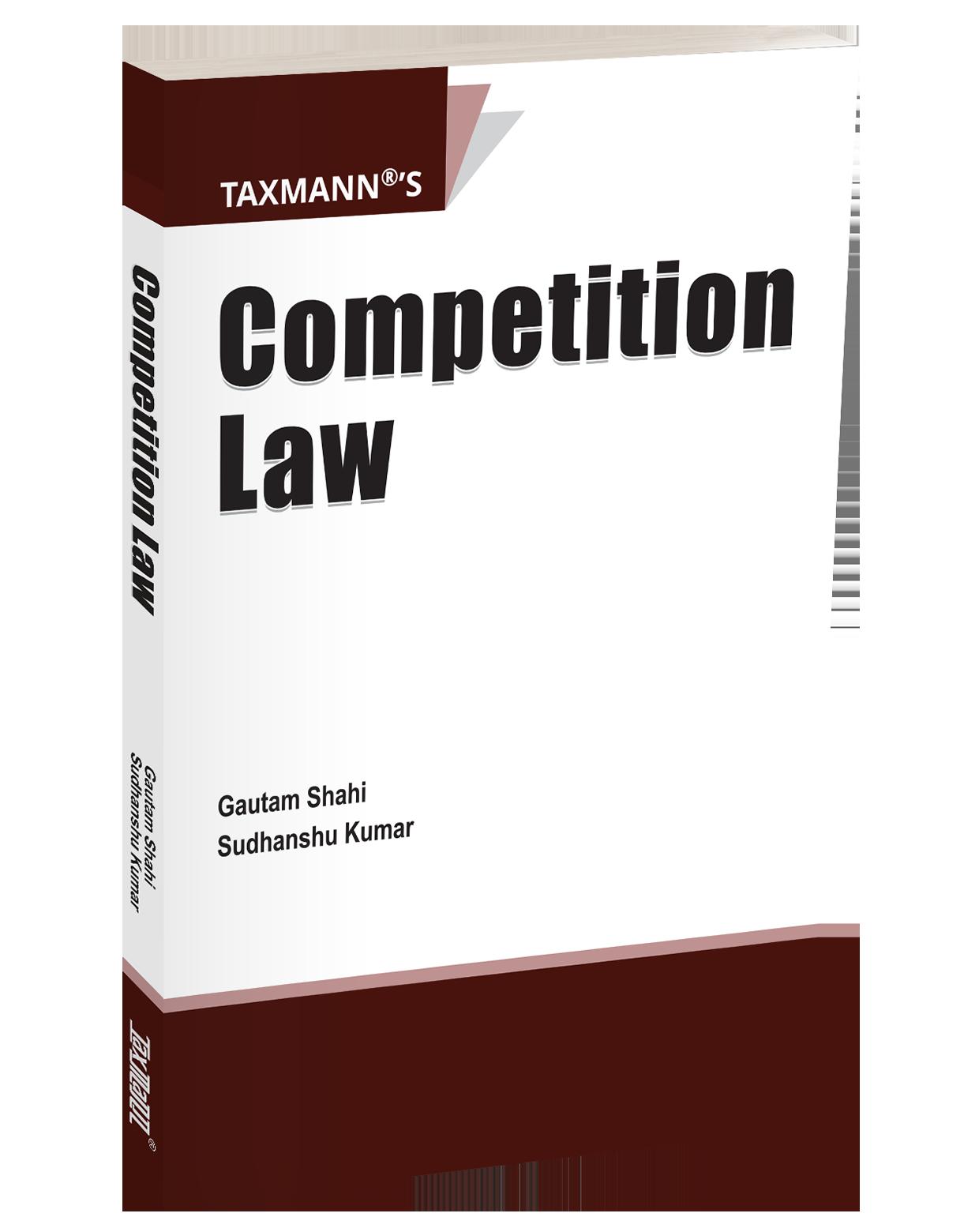


The Indian competition regime, rooted in the Competition Act, 2002, has matured significantly over the past one and a half decades. From dealing with classic cases of cartels and abuse of dominance to engaging with complex merger reviews and digital platform conduct, the Competition Commission of India (CCI) has developed a robust jurisprudence. However, new challenges— arising from algorithmic pricing, AI-powered collusion, and the concentration of data and digital power—have necessitated a forward-looking re-evaluation of existing frameworks. These developments require us to revisit the foundational assumptions of competition law, particularly around market definition, consumer harm, and remedy design.
This book is a collaborative effort to provide a comprehensive and critical account of Indian competition law as it stands in the rapidly evolving economic and technological landscape. Authored by Gautam Shahi, a seasoned competition law practitioner, and Sudhanshu Kumar, a legal academic deeply engaged in the doctrinal and policy analysis of economic regulation, the book is intended to serve as a bridge between theory and practice. It is written for students, legal professionals, economists, policymakers, and anyone interested in understanding how competition law operates in India and how it is being reshaped by digital markets, platform economies, and data-driven business models.
The authors have sought to combine clarity with depth, doctrinal analysis with practical grounding, and legal rigour with accessibility. We hope this book contributes meaningfully to the scholarship and practice of competition law in India and equips the reader with the tools to navigate its current complexities and future directions.
GAUTAM SHAHI SUDHANSHU KUMAR
3.6.1

Abuse of dominance, governed by Section 4 of the Competition Act, 2002, plays a central role in safeguarding markets from the harmful exercise of market power. In contrast to collusive practices addressed under Section 3, this provision targets the unilateral actions of an enterprise that occupies a dominant position within a defined market. Importantly, Indian competition law does not consider dominance itself to be unlawful—only its abusive use invites regulatory scrutiny. The legislative focus is on ensuring that dominant firms do not use their market strength to exclude competitors, exploit consumers, or impede innovation and market access. The law thus seeks to strike a careful balance between allowing firms to grow and compete on the merits, while preventing distortive practices that undermine the competitive process.
Section 4 of the Competition Act, 2002, prohibits abuse of dominant position. Section 4 of the Competition Act does not prohibit market dominance or even monopoly itself but abuse thereof. Explanation (a) to section 4 of the Act defines ‘dominant position’ as a position of strength, enjoyed by an enterprise, in the relevant market, in India, which enables it to operate independently of competitive forces prevailing in the relevant market; or affects its competitors or consumers or the relevant market in its favour.1 Section 4 gives an exhaustive list of actions/activities which amount to abuse of dominant position.
A section 4 analysis has the following four sequential steps2:
Determine as to whether the entity whose conduct is alleged to be abusive is an enterprise or group as defined respectively in Section 2(h) and Explanation (b) to Section 5 of the Act.
Determine the ‘relevant market’ as defined under Section 2(r) of the Act with due regard to the factors listed in Section 19(6) and 19(7) of the Act.
1. DGCOM Buyers and Owners Association, Chennai v. DLF Ltd., New Delhi and DLF Southern Homes Pvt. Ltd., Chennai [2012] 28 taxmann.com 240 (CCI).
2. Coal India Limited v. Competition Commission of India [2017] 80 taxmann.com 199 (CAT - New Delhi).
Determine whether the enterprise/group enjoys a dominant position in the relevant market based on consideration of the factors listed in Section 19(4) of the Act.
Only if an enterprise or group is dominant, analyze its conduct to ascertain whether it has abused its dominant position through behaviour described in Section 4(2) of the Act.
Section 4(1) of the Competition Act prohibits an ‘enterprise’ or ‘group’ from abusing its dominant position. Hence, the first question is whether the alleged perpetrator of abusive conduct is an enterprise or a group of enterprise.
Section 2(h) gives a wide definition for the term ‘enterprise’. An enterprise includes individuals, firms or department of government engaged in any kind of commercial activity. However, it makes an exception for the activities of the government relatable to its sovereign functions ‘including all activities carried on by the departments of the Central Government dealing with atomic energy, currency, defence and space’. Only primary, inescapable, inalienable and non-delegable functions of a government would qualify for exemption under sovereign functions.3 Thus, welfare or economic activities carried on by government departments or undertakings would be covered within the ambit of the definition. To qualify as an enterprise, it is required that any person or department of the Government is, or has been, engaged in any activity, relating to the production, storage, supply, distribution, acquisition or control of articles or goods, or the provision of services, of any kind, or in investment, or in the business of acquiring, holding, underwriting or dealing with shares, debentures or other securities of any other body corporate, either directly or through one or more of its units or divisions or subsidiaries.4
The thrust of the definition of the term ‘enterprise’ is on the economic nature of the activities discharged by the entities concerned. It is immaterial whether such economic activities were undertaken for profit making/ commercial purpose or for philanthropic purpose. Thus, even non-commercial economic activities would be subject to the discipline of the Act as the Act does not distinguish economic activities based on commercial or non-commercial nature thereof. Like the European Courts,5 the CCI has adopted a functional approach6 to assess whether an entity is an enterprise under section 2(h) of the Competition Act. This means that the CCI will look at the various functions/ activities that an entity is
3. Bangalore Water Supply and Sewage Board v. A. Rajappa (1978) 2 SCC 213.
4. Manju Tharad v. Eastern India Motion Picture Association [2012] 114 SCL 20 (CCI).
5. Hofner and Elser v. Macrotron GmBH, C-41/90; SAT Fluggesellschaft v. Eurocontrol C-364/92; FENIN v. Commission C-205/03P.
6. Confederation of Professional Baseball Softball Club v. Amateur Baseball Federation of India [2021] 129 taxmann.com 242 (CCI).
indulging in before deciding whether such entity is an enterprise. For instance, while analysing whether or not Indian Railways was an enterprise under section 2(h) of Competition Act, the CCI was of the view that various activities of the enterprise are to be considered individually and if some of the activities of the enterprise are in the nature of sovereign functions that does not mean that all other activities of the enterprise have to be considered non-economic.7
In a catena of cases the CCI has held that a department of government, as far as it carries out commercial ventures, is an enterprise in terms of section 2(h) of the Competition Act. In various cases it has held that New Okhla Development Authority, 8 Haryana Urban Development Authority9 and Indian Railways10 , Ghaziabad Development Authority11, Public Works Department12 are enterprises under section 2(h) of the Competition Act. Sports federations pursuing income generating economic activities would also come under the definition of ‘enterprise’.13 Even the Supreme Court of India has encouraged Government bodies to submit themselves to the jurisdiction of regulators like the CCI. In the case of Lucknow Development Authority v. M.K. Gupta, 14 the Hon’ble Supreme Court while deciding the issue of jurisdiction of the National Commission, the State Commission and the District Forum under the Consumer Protection Act, 1986, stated as under:
“…When private undertakings are taken over by the Government or corporations are created to discharge what is otherwise State’s function, one of the inherent objective of such social welfare measures is to provide better, efficient and cheaper services to the people. Any attempt, therefore, to exclude services offered by statutory or official bodies to the common man would be against the provisions of the Act and the spirit behind it...”
“Under our Constitution sovereignty vests in the people. Every limb of the constitutional machinery is obliged to be people oriented. No functionary in exercise of statutory power can claim immunity, except to the extent protected
7. Arshiya Rail Infrastructure Limited v. Ministry of Railways [2013] 112 CLA 297 (CCI), Meet Shah v. Union of India [2020] 114 taxmann.com 73 (CCI).
8. R & R Tech Mach Limited v. Chief Executive Officer [2014] 126 SCL 395 (CCI).
9. Jatin Kumar v. Estate Officer [2016] 74 taxmann.com 286 (CCI).
10. Arshiya Rail Infrastructure Limited v. Ministry of Railways [2013] 112 CLA 297 (CCI). See also, Meet Shah v. Union of India [2020] 114 taxmann.com 73 (CCI).
11. Satyendra Singh v. Ghaziabad Development Authority [2018] 91 taxmann.com 305 (CCI).
12. Rajat Verma v. Haryana Public Works (B&R) Department 2016 SCC OnLine Comp AT 53.
13. Surinder Singh Barmi v. Board for Control of Cricket in India (BCCI) [2013] 113 CLA 579 (CCI); In the Matter of Dhanraj Pillay v. Hockey India 2013 SCC OnLine CCI 36; Hemant Sharma v. Union of India [2018] 96 taxmann.com 35 (CCI). See also, Confederation of Professional Baseball Softball Clubs v. Amateur Baseball Federation of India [2021] 129 taxmann.com 242 (CCI)
14. 1994 AIR 787.
by the statute itself. Public authorities acting in violation of constitutional or statutory provisions oppressively are accountable for their behaviour before authorities created under the statute like the commission or the courts entrusted with responsibility of maintaining the rule of law. Each hierarchy in the Act is empowered to entertain a complaint by the consumer for value of the goods or services and compensation.”
Notwithstanding the above, a distinction is to be made for statutory bodies acting in terms of their parent statutes and rules/ regulations made thereunder. Section 2(w) of the Act defines the term Statutory Authority.
‘“statutory authority” means any authority, board, corporation, council, institute, university or any other body corporate, established by or under any Central, State or Provincial Act for the purposes of regulating production or supply of goods or provision of any services or markets therefor or any matter connected therewith or incidental thereto;’
In the Motion Pictures Case15 the CCI observed that Central Board of Film Certification (CBFC) is a statutory body formed under the Cinematograph Act, 1952 and functions as per the said Act and the Cinematograph (Certification) Rules, 1983. Based on the functions attributable to CBFC, the CCI held that CBFC is not engaged in the activities mentioned in section 2(h) of the Act. Hence, it is not an ‘enterprise’ within the meaning of section 2(h) and consequently, its conduct too cannot be examined within the meaning of section 4 of the Act. Similarly, in the IRDA Case16, CCI held that IRDA was not an ‘enterprise’ as it has been set-up under the Insurance Regulatory and Development Authority Act, 1999 to provide inter alia for the establishment of an Authority to protect the interests of holders of insurance policies, to regulate, promote and ensure orderly growth of the insurance industry and for matters connected therewith or incidental thereto. The Bureau of Indian Standards (BIS)17 established under BIS Act performing statutory functions has also not been held to be an enterprise under Section 2(h) of the Act.
The Delhi High Court interestingly has recently held that the Institute of Chartered Accountants of India (ICAI) falls under the definition of ‘enterprise’ because the functions performed by ICAI, in respect of providing education to its chartered accountants or to students, cannot be termed as ‘sovereign functions’. The High Court noted the ICAI cannot be considered the Government and, therefore, even if it carries on regulatory functions (regulation of a profession), it is not excluded from the wide definition of the term ‘enterprise’. Moreover, it was observed that the functions performed by ICAI, in respect of providing education to its chartered accountants or to students, cannot be termed as ‘sovereign functions’.18 This approach is different from previous occasions where the CCI
15. Mrs. Manju Tharad v. Eastern India Motion Picture Association (EIMPA), Kolkata and the Central Board of Film certification (CBFC) [2012] 110 CLA 136.
16. Shri Dilip Modwil v. Insurance Regulatory and Development Authority 2014 SCC Online CCI 106.
17. Prem Prakash v. Bureau of Indian Standards 2017 SCC Online CCI 33.
18. Institute of Chartered Accountants of India v. Competition Commission of India (2023) 3 HCC (Del.) 467.
in the matter of Bar Council of India19 or IRDA excluded regulatory functions from the ambit of Section 2(h). It is relevant to note here that although the Delhi High Court in the ICAI matter held ICAI to be covered under the definition of enterprise, it set aside the earlier decision of the CCI by holding that the exercise of powers and decisions taken by ICAI with respect to enrolment of chartered accountants and maintaining the standards of the profession; would not be a subject matter of review by the CCI. Observing that a decision in exercise of regulatory powers, is required to be taken by the regulator and its discretion to do so can only be fettered by the provisions of the statute, which clothes the regulator with such powers, the High Court held that the regulatory powers are not subject to review by the CCI.
The corresponding term for ‘enterprise’ in European Union is ‘undertaking’. In the FIFA Case, 20 European Commission was assessing whether FIFA was an enterprise. It held that any entity, regardless of its legal form, which engages in economic activity, constitutes an undertaking. FIFA is a federation of sports associations and accordingly carries out sports activities, yet it also carries out activities of an economic nature. These include, among other things, the conclusion of advertising contracts and television broadcasting rights which account for around 65% of total World Cup revenue. Consequently, European Commission concluded that FIFA was an undertaking. In FENIN v. Commission, 21 the question before the European Court of Justice (ECJ) was whether the provision of medical treatment is itself economic in nature and therefore makes the purchasing activity an economic activity subject to the competition rules. ECJ, approving the General Court’s order held that ‘there is no need to dissociate the activity of purchasing goods from subsequent use to which they are put in order to determine the nature of that purchasing activity, and that the nature of purchasing activity must be determined according to whether or not the subsequent use of the purchased goods amounts to an economic activity’. Similarly, in Compass-Datenbank GmbH v. Republik Osterreich, 22 ECJ held that a State or a State entity may act as an undertaking, in relation to part of its activities, and be treated as an undertaking subject to competition provisions. Group – Group has been defined in clause (b) of the Explanation to section 5 of the Act. The term ‘Group’ has been defined by the Act to mean two or more enterprises which, directly or indirectly, are in a position to: exercise twenty-six per cent or more of the voting rights in the other enterprise; or appoint more than fifty per cent of the members of the board of directors in the other enterprise; or control the management or affairs of the other enterprise.
19. See, Thupili Raveendra Babu v. The Competition Commission of India 2021 SCC Online NCLAT 2321.
20. [1992] OJ L326/31.
21. [2006] ECR I-6295 (ECJ).
22. [2012] 5 CMLR 13 (ECJ).
The Central Government vide Notification No. S.O. 673(E) dated March 4, 2016, had exempted a ‘Group’ exercising less than 50 % of voting rights in other enterprise from the provisions of section 5 of the Competition Act for a period of five years from the date of notification.
Further, the term ‘control’ has been defined in an inclusive manner in clause (a) of the Explanation to section 5 of the Competition Act. It “includes controlling the affairs or management by:
(
i) one or more enterprises, either jointly or singly, over another enterprise or group;
(
ii) one or more groups, either jointly or singly, over another group or enterprise.
Control can be both positive and negative. It can be singular or joint. Control may arise in case a person or enterprise enjoys certain affirmative rights in other company including, inter alia, the rights pertaining to approving the business plan or annual budget, commencement of any new business activity and appointing or dismissing any director, Company Secretary and the Chief Executive Officer, etc.23 It implies control over the strategic commercial operations of the enterprise by two or more persons. In such a case, each of the persons in joint control would have the right to veto/block the strategic commercial decision(s) of the enterprise which could result in a deadlock situation. Joint control over an enterprise may arise because of shareholding or through contractual arrangements between the shareholders. The assessment of joint control over an enterprise would depend on the facts and circumstances of each case with due consideration of relevant factors such as the statutory and contractual rights of the shareholders.24
For the application of Section 4, the enterprise must enjoy ‘dominant position’ in a ‘relevant market’. Dominance is the notion of “power over the market” which is the key to analysing the competitive issues arising out of the conduct of an enterprise.25 For the purposes of investigating the possible dominant position of an enterprise on a given product market, the possibilities of competition must be judged in the context of the relevant product market comprising of substitutable products or services.26 A relevant market definition is an economic
23. AXA India Holdings and Société Beaujon, In re 2015 SCC OnLine CCI 247. See also, Aviva International Holdings Limited, In re 2015 SCC OnLine CCI 214.
24. In re, SPE Holdings 2012 SCC OnLine CCI 132. See also, In re, Independent Media Trust 2002; In re, Century Tokyo 2012 SCC OnLine CCI 138; In re, FIH Mauritius Investments Limited 2015 SCC OnLine CCI 127 and In re, AIA International Limited 15 SCC OnLine CCI 276.
25. Competition Commission of India v. Coordination Committee of Artistes and Technicians of West Bengal Film and Television (2017) 5 SCC 17.
26. British Airways v. Commission [2003] ECR II – 5917; Michelin v. Commission [1983] ECR 3461; Kish Glass v. Commission [2000] ECR II – 1885
tool recognised by the Act and used by the CCI for identifying the dominant enterprise. Market definition is a tool to identify and define the boundaries of competition between enterprises. It serves to establish the framework within which competition policy is applied by the Commission. The main purpose of market definition is to identify in a systematic way the competitive constraints that the enterprises involved face. The objective of defining a market in both its product and geographic dimension is to identify those actual competitors of the enterprises involved that can constrain those enterprises behaviour and of preventing them from behaving independently of effective competitive pressure. Therefore, the purpose of defining the “relevant market” is to assess with identifying in a systematic way the competitive constraints that enterprises face when operating in a market. This is the case for determining if enterprises are competitors or potential competitors and when assessing the anti-competitive effects of conduct in a market.27
The determination of the relevant market is not an end by itself, but is a means to analyze the position of strength, enjoyed by an enterprise in such a market, as per the provisions of explanation (a) to section 4(2) of the Act, to determine if such an enterprise is in a dominant position in such a relevant market.28 The contours of relevant market guide the CCI, both in terms of product/service and geographic reach, as to what competitive constraints are faced by such market player.29 Hence, it is important to define the relevant market before analysing the dominant position of an entity.30 In fact, an inquiry by the CCI in to any violation will be incomplete unless the CCI defines the relevant market.31 However, when the dominance of an enterprise remains unchanged in a market even with an alternative market definition, technicality of the product market need not be dwelled further.32
As has been noted by the Apex Court in Coordination Committee of Artistes and Technicians of West Bengal Film and Television and Ors., 33 “the relevant product and geographic market for a particular product may vary depending on the nature of the buyers and suppliers concerned by the conduct under examination and
27. Competition Commission of India v. Coordination Committee of Artistes and Technicians of West Bengal Film and Television (2017) 5 SCC 17; See also, Competition Commission of India v. Bharti Airtel Limited (2019) 2 SCC 521.
28. Shri Shamsher Kataria v. Honda Siel Cars India Ltd. 2015 SCC OnLine CCI 114.
29. Pankaj Aggarwal v. DLF Gurgaon Home Developers Private Limited and Mr. Sachin Aggarwal v. DLF Gurgaon Home Developers Private Limited 2015 SCC OnLine CCI 77.
30. Toyota Kirloskar Motor (P) Ltd. v. CCI 2016 SCC OnLine Comp AT 176.
31. Hyundai Motor India Ltd. v. Competition Commission of India 2018 SCC OnLine NCLAT 513.
32. Ashutosh Bhardwaj v. DLF Limited 2014 SCC OnLine CCI 30. See also, Ashutosh Bhardwaj v. DLF Limited 2017 SCC OnLine CCI 1.
33. Para 33-34, Competition Commission of India v. Coordination Committee of Artistes and Technicians of West Bengal Film and Television (2017) 5 SCC 17.
their position in the supply chain. The process of defining the relevant market starts by looking into a relatively narrow potential product market definition. The potential product market is then expanded to include those substituted products to which buyers would turn in the face of a price increase above the competitive price. Likewise, the relevant geographic market can be defined using the same general process as that used to define the relevant product market.
Relevant market means the market which may be determined by the CCI with reference to the relevant product market or the relevant geographic market or with reference to both the markets.34 Section 2(r) of the Competition Act defines the relevant market with reference to the relevant product market and relevant geographic market.
Section 2(t) defines the relevant product market as comprising “ all those products or services which are regarded as interchangeable or substitutable by the consumer, by reason of characteristics of the products or services, their prices and intended use”. The relevant product market delineation classifies all those products/services which act as competitive constraints on each other to keep the conduct of market players under check.35 The concept of relevant market implies that there could be an effective competition between the products which form part of it and this presupposes that there is a sufficient degree of inter changeability between all the products forming part of the same market insofar as specific use of such product is concerned.36
Relevant product market is the market in which substitutable products are sold. It can be seen from the definition of the relevant product market that it is defined primarily based on demand side substitutability i.e. whether consumers consider different products to be substitutable. For example, in case enough purchasers of product A regard product B as an alternative to product A and would switch from product A to product B in response to a small change in relative prices, then product A and product B are part of the same relevant market. In Matrimony.com Limited v. Google LLC and Ors., 37 the CCI held that online general web search services are not interchangeable or substitutable with online specialised search services. While general purpose search engines allow internet users to search information on a wide range of topics, specialised search services permit online searches for information limited to topics or areas such as news, shopping, travel, entertainment, etc. Further, in response to a search query, general purpose web searches show information from across the web
34. Three D Integrated Solutions Ltd. v. VeriFone India Sales Pvt. Ltd. 2015 SCC Online CCI 55. See also, Matrimony.com Limited v. Google LLC [2018] 91 taxmann.com 428 (CCI).
35. Id.
36. Competition Commission of India v. Coordination Committee of Artistes and Technicians of West Bengal Film and Television (2017) 5 SCC 17.
37. Matrimony.com Limited v. Google LLC 2018 SCC OnLine CCI 1.
while specialised search results yield information from a limited source, i.e., either its own contents or from the contents of certain specified websites. Additionally, pricing and registration requirements stipulated by general purpose online searches and specialised searches are also different.
In United Brands v. Commission, 38 the ECJ was considering whether bananas for a separate relevant product market. It observed that for the banana to be regarded as forming a market which is sufficiently differentiated from other fruit markets it must be possible for it to be singled out by such special features distinguishing it from other fruits that it is only to a limited extent interchangeable with them and is only exposed to their competition in a way that it is hardly perceptible. It is widely recognised that enterprises in the market are subjected to three kinds of competitive constraint i.e. demand substitutability, supply substitutability and potential competition. Since demand substitutability is the most effective and immediate constraint on an enterprise, it plays a major role in defining relevant market.
European Commission also recognizes the role of supply side substitutability in defining the relevant market.39 It is defined as the extent to which alternative suppliers would switch, or begin, production in response to a hypothetical price increase. Supply-side substitutability may also be considered when defining markets in those situations in which its effects are equivalent to those of demand substitution in terms of effectiveness and immediacy. In India, the CCI referred to supply side substitutability in the Apple case40. Dealing with the differences between GSM and CDMA technologies, it relied on the different handsets requires for these technologies and stated that ‘(E)ven from the supply side, the two are not substitutable in as much as each require set of equipments that are not compatible with other’.
The current definition of “relevant product market” under Section 2(t) of the Competition Act focuses on substitutability of the product from a consumer side or a demand side perspective. It is equally important to consider the supply side perspective while assessing substitutability between different products. For instance, suppliers may be able to switch production from other products to the product in question, in the short term and without incurring significant costs and risks. In cases where a supplier can easily switch production and market the products without incurring significant cost or risk, the additional production will have an impact in the market and should be considered as part of the relevant product market. This concept focuses on the supplier’s perspective, assessing whether competing firms can quickly and economically shift their production to constrain the market power of a dominant firm. Supply-side substitutability
38. United Brands v. Commission [1978] ECR 207 (ECJ).
39. EC Notice on the definition of relevant market for the purposes of Community competition law (97/C 372 /03).
40. Sonam Sharma v. Apple Inc. USA
ensures that the market definition accounts for producers who can readily enter the market to counter price increases or anti-competitive behaviour.
The Competition (Amendment) Act, 2023 seeks to add supply side substitutability as an alternate means to delineate RPM. The amended definition now reads as:
‘i. “relevant product market” means a market comprising of all those products or services— which are regarded as inter-changeable or substitutable by the consumer, by reason of characteristics of the products or services, their prices and intended use; or
ii. the production or supply of, which are regarded as interchangeable or substitutable by the supplier, by reason of the ease of switching production between such products and services and marketing them in the short term without incurring significant additional costs or risks in response to small and permanent changes in relative prices;’
In addition, “costs associated with switching supply or demand to other areas” has been added as a factor under Section 19(7) to delineate RGM. The application of supply-side substitutability is conditional and depends on factors such as:
Ease of switching production without significant costs.
Availability of production assets for the relevant product.
Incentives for suppliers to switch (e.g., profitability from price increases).
Consumer perception of the switched products as equivalent substitutes. Number of suppliers capable of switching production in response to price changes.
Section 19(7) of the Competition Act gives the following factors which the CCI will consider which defining the relevant product market:
(a) Physical characteristics or end-use of goods – CCI will consider the physical characteristics or end-use of goods/ services. In Three D Integrated Solutions Ltd. v. VeriFone India Sales Pvt. Ltd.41 the CCI distinguished between Electronic Ticketing Machines (ETM) and Point of Sale terminals (POS) as the physical characteristics and end use of ETMs which do not have electronic payment system are entirely different from the POS. In Apple case,42 CCI distinguished between CDMA and GSM technologies as the handset to be used for availing service from CDMA and GSM technologies were different from each other. In Exclusive Motors Case, 43 CCI distinguished between market for super sports car and market for
41. Three D Integrated Solutions Ltd. v. VeriFone India Sales Pvt. Ltd. 2015 SCC OnLine CCI 55. 42. Sonam Sharma v. Apple Inc. USA 2013 SCC OnLine CCI 25.
other automobiles because of its characteristics, price, intended use etc. The CCI has in context to different products delineated separate product markets by distinguishing the product or service in question with others (animation course in comparison to other vocational courses44; residential units in comparison to commercial space 45; mobile data services in comparison to land-line services46; bottled water in comparison to tap water47; smart phones in comparison to feature phones48; online market platform in comparison to online retail store49; instant communication applications in comparison to traditional electronic communications50) on the basis of their physical characteristics.
Similarly, the CCI has noted that there is a clear distinction between residential and commercial real estate projects. This is because all the relevant stakeholders, including, the Government/ statutory authorities, builders/ developers, brokers/ sales agents etc. distinguished residential properties such as residential apartments, villas and plots from other types of properties such as commercial spaces, commercial plots, farm houses and agricultural lands primarily on the basis of their usages. Further, the development norms for residential properties are entirely different from those relating to other types of properties.51
In Grasim Industries Limited52, the CCI defined the relevant market as the market for supply of VSF to spinners in India. The CCI noted that textile fibres can be classified into two broad categories based on the source from which they are obtained: natural fibres and man-made fibres. Owing to the difference in characteristics such as composition, resilience, moisture absorption power, and resistance to moth, the CCI opined that natural and man-made fibres ought to be considered as two distinct categories of products which are used as raw materials by spinners to manufacture yarn. Further, the CCI noted that within man-made fibres, VSF possessed characteristics which made it distinct
44. Picasso Animation Pvt. Ltd (PAPL) and Picasso Digital Media Pvt. Ltd (PDMPL) [2016] 75 taxmann.com 237 (CCI) [25-10-2016].
45. Oberoi Cars Pvt. Ltd v. Imperial Housing Ventures Pvt. Ltd. 2016 SCC OnLine CCI 86; Shri Sameer Agarwal v. Bestech India Pvt. Ltd. 2016 SCC OnLine CCI 56.
46. Vishwambhar M. Doiphode v. Vodafone India Limited 2016 SCC OnLine CCI 82.
47. Aniket Sitaram Kokane v. Ganesh Agency 2016 SCC OnLine CCI 24.
48. Tamil Nadu Consumer Products Distributors Association v. Fangs Technology Private Limited 2018 SCC OnLine CCI 95.
49. All India Online Vendors Association v. Flipkart India Private Limited 2018 SCC OnLine CCI 97.
50. Vinod Kumar Gupta v. WhatsApp Inc. 2017 SCC OnLine CCI 32.
51. Sunil Bansal v. Jaiprakash Associates Ltd. 2015 SCC OnLine CCI 178.
52. XYZ v. Association of Man-made Fibre Industry of India 2016 SCC OnLine CCI 71.
AUTHOR : GAUTAM SHAHI, SUDHANSHU KUMAR
PUBLISHER : TAXMANN
DATE OF PUBLICATION : NOVEMBER 2025
EDITION : DECEMBER 2025
ISBN NO : 9789371263054
NO. OF PAGES : 336
BINDING TYPE : PAPERBACK
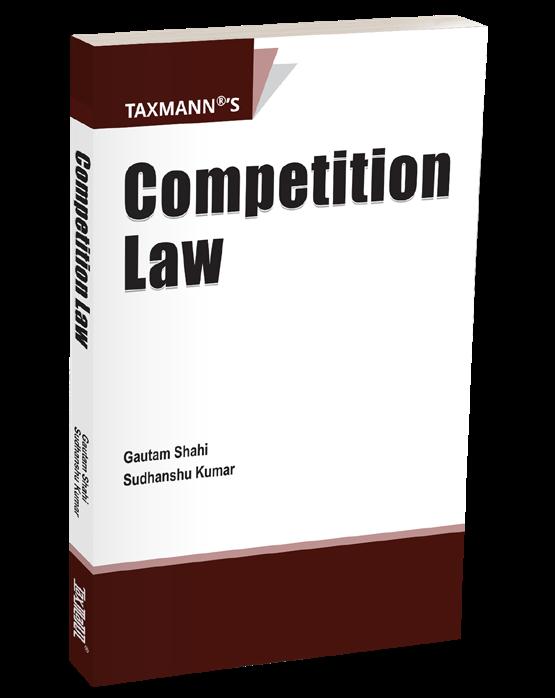
Competition Law offers a clear, analytical, and student-focused introduction to India’s competition regime. It blends foundational legal principles with enforcement trends, providing balanced coverage of theory, case law, procedure, and policy. The book explains the evolution of competition regulation—from traditional antitrust issues such as cartels, bid rigging, vertical restraints, dominance, and merger control to contemporary challenges involving digital markets, platform economics, algorithmic pricing, and AI-driven collusion. It also highlights the developing jurisprudence of the CCI, NCLAT, and the Supreme Court. It shows how concepts like market definition, consumer welfare, and regulatory oversight are being reshaped by technological and economic change.
This book is intended for the following audience:
• LL.B. & LL.M. Students
• Business and Economics Students
• Aspirants Preparing for Judicial Services
• Students Participating in Moot Courts, Research Writing & Internships
• Early-stage Legal Practitioners
The Present Publication is the Latest Edition, authored by Gautam Shahi and Dr Sudhanshu Kumar, with the following noteworthy features:
• [Clear, Step-by-Step Explanations] of agreements, dominance, and mergers, supported by illustrations and logical breakdowns to strengthen conceptual learning
• [Comprehensive Statutory & Case Law Coverage] including major CCI decisions, NCLAT judgments, Supreme Court rulings, and updates under the Competition (Amendment) Act 2023, enabling students to understand how legal principles evolve in practice
• [Digital-Era Topics Explained Simply] covering algorithmic pricing, AI collusion, data-driven market power, the Digital Competition Bill, and Big Tech regulation—making it one of the few student textbooks addressing future-facing competition issues
• [Learning Tools Across Chapters] including summaries, definitions, examples, enforcement workflows, annotated case references, and step-wise procedural explanations to support study and revision
• [Balanced Academic–Practical Perspective] combining Adv. Gautam Shahi’s industry experience with Dr Sudhanshu Kumar’s doctrinal clarity and teaching expertise