The publishers reserve the right to refuse, withdraw, amend or otherwise deal with all advertisements without explanation. All advertisers must comply with the British Code of Advertising practice.
The views expressed in this publication are not necessarily those of the publishers.
All written and image rights are reserved by the author as displayed.
Reproduction in whole or in part without prior permission from the publisher is strictly prohibited.
Copyright brand TaxiPoint 2025. Creative Common image licences displayed where applicable.
2025 WITH FROM THE EDITOR
It’s a busy end to the year for the taxi world, and this edition lands right in the thick of it. The Chancellor’s Budget has set the industry talking, not least with the changes around VAT and the wider impact on fares and operators. Add to that the Department for Transport’s plans for national standards and the proposal to streamline licensing authorities down to seventy regions, and you’ve got a sector bracing for real structural change.
There’s also the ongoing Transport Committee Inquiry, which I’ll be feeding into from the viewpoint of someone behind the wheel. It feels important that working drivers also have their say at a time when rules and regulations are being pulled apart and rebuilt. Decisions taken over
the next few months will shape how we all work for years to come.
All in all, it’s full steam ahead. As ever, we’ll keep bringing clear coverage of the developments that matter to drivers, passengers and operators across the UK.
Thanks to everyone who has followed and supported TaxiPoint throughout 2025. Your readership keeps this magazine moving. Wishing you a merry Christmas and a Happy New Year, and here’s to a successful 2026 on the road.
Be lucky!
Perry Richardson
CLOSING THE GAPS:
GOING BEYOND NATIONAL MINIMUM STANDARDS FOR PRIVATE HIRE LICENSING
ARTICLE BY WESLEY BISHOP CHIEF COMMERCIAL OFFICER AT ADDISON LEE
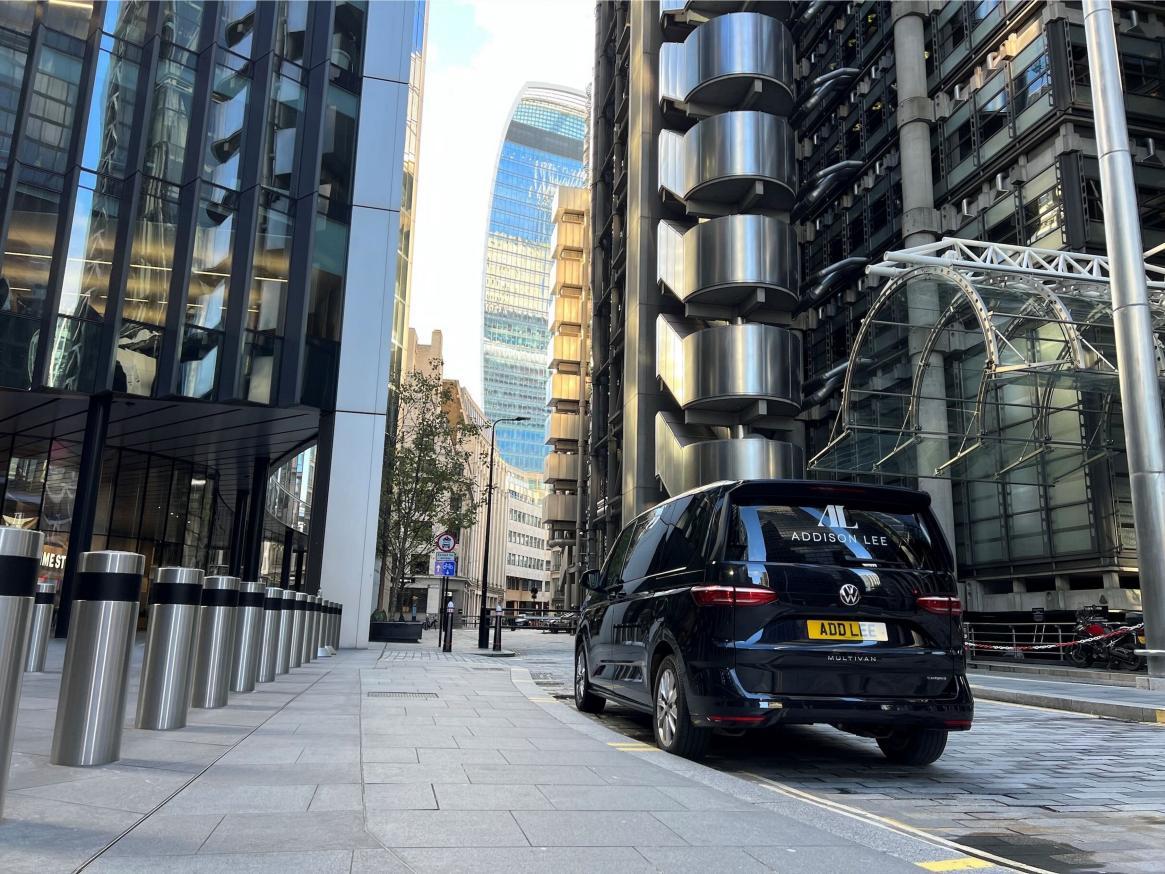
Addison Lee marked its 50th year of operating in the capital in 2025, and throughout its existence it has been a champion for the need for effective licensing, regulation, enforcement and public safety.
The Government’s move to introduce national minimum standards for the private hire industry is a welcome development in closing a critical regulation gap. Passengers rightly expect and deserve a reliable service wherever they travel, and the decision is an important first step in establishing a consistently high safety standard across the sector.
There is, however, an opportunity to make these reforms even stronger through increased
enforcement powers for licensing operators, and percentage-based systems to disincentivise out-ofarea working even further.
Giving licensing officers real enforcement powers
Passenger safety must be at the heart of any decision making on cross-border hiring.
While baseline standards have been confirmed, under the current rules, enforcement officers are still not able to stop vehicles licensed by a different authority. This has become an increasingly pressing issue as more drivers are being licensed outside of the areas in which they work. It means that even basic checks such as confirming the driver is licensed, insured, operator-registered, and in a roadworthy vehicle, cannot be carried out.
At Addison Lee, we are urging the introduction of stronger enforcement powers for licensing officers
and committees. Officers should have the authority to stop and inspect any licensed vehicle or driver, no matter which authority has issued the licence. Likewise, licensing committees must be able to act when drivers operating in their area, but licensed elsewhere, breach local rules. Where vehicles or documents are inadequate or invalid, enforcement officers should be able to take the vehicle off the road until the issues are resolved. If a driver commits an offence, such as plying for hire, the authority where it occurred should be empowered to investigate and take licensing action. These reforms would tighten compliance and deliver a meaningful boost to public safety across the country.
Accountability and flexibility
The issue of cross-border hiring extends beyond the issue of passenger safety - there are also questions around fairness for drivers. While the government’s announcement provides a stable baseline to disincentivise out-of-area working, it is not a silver bullet which will solve the issue alone.
A percentage-based system on out-of-area bookings would give operators flexibility while going one step further in preventing excessive licence shopping. This would maintain local accountability and ensure authorities retain oversight of services in their communities. For example, operators could be limited to fulfilling no more than 20% of bookings entirely outside their licensed area.
There are also practical considerations that warrant local flexibility. Authorities should be able to set this in line with operational geography. For example, an operations centre close to a border with another licensing authority will receive significant volumes of cross-border bookings. Other geographical considerations should also be made. Likewise, if there’s an airport, station or venue just outside their licensed area, they may get frequent requests by its customers to provide its services.
Additionally, events like train breakdowns or airline diversions often require taxis and cars from across a region to provide services due to high passenger volumes. The journeys are unlikely to return to an operator’s licensed area and may in fact terminate anywhere in the country.
The clearest benefit of a percentage-based system is that it would be measurable. All operators have to record details of bookings, including pick up and drop off addresses, and they could be required to submit weekly, monthly or quarterly data providing details of total bookings and any with pick-ups and drop offs outside of their licensed area.
Closing the door
We welcome the Government’s decision to address the private-hire industry’s concerns. By fully closing the door on licence shopping, empowering licensing officers, and keeping local authorities accountable, passengers will have greater confidence, drivers would compete on equal terms, and the public would regain confidence in the services operating within their boundaries.
GOVERNMENT OVERHAUL: NEW NATIONAL TAXI LICENSING STANDARDS AND PLANS TO REDUCE LICENSING AUTHORITIES TO JUST 70 REGIONS
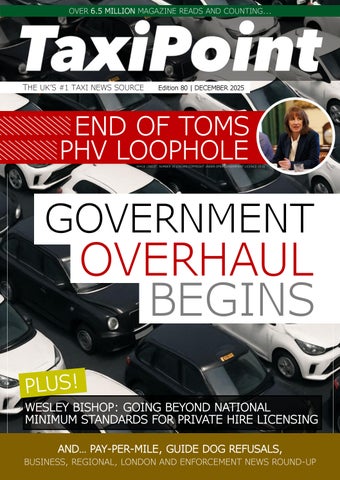
The Government is preparing to overhaul taxi and private hire vehicle licensing rules by giving the Transport Secretary the authority to impose national minimum standards across England.
The move follows Baroness Casey’s audit into groupbased child sexual exploitation and abuse, published in June, which urged ministers to address inconsistent licensing practices.
The amendment, debated in Parliament on 25 November as part of the English Devolution and Community Empowerment Bill, would allow ministers to establish uniform requirements for drivers, vehicles and operators. The Department for Transport said the framework would centre on safety and accessibility, aiming to give passengers confidence that licensed vehicles meet the same baseline checks regardless of location.
Current taxi and PHV licensing is managed by 263 local authorities, leading to significant variation in vetting processes, wheelchair-accessible provision and operational oversight. Baroness Casey noted that most licence holders are law-abiding and provide a vital public service, but warned that gaps in the system can be exploited by a small minority. Her report made 12 recommendations, including action to tackle fragmented licensing regimes.
Ministers set out plans for national minimum standards covering all taxi and private hire licensing regimes following recommendations in the Casey audit.
Industry groups, safety campaigners and Baroness Casey herself have welcomed the Government’s intention to move quickly following the audit. The plans would formalise a single national benchmark, with consultation expected before the rules are
drafted. While the scope of the standards remains under development, officials indicated that safeguarding requirements will sit at the core of the proposals.
Alongside the national standards, ministers are reviewing options to address out of area working, an issue that has long caused concern among operators and licensing teams. The Government confirmed that it will shortly consult on reducing the number of authorities responsible for taxi and PHV licensing from 263 to 70. Consolidating oversight is aimed at improving consistency, reducing administrative complexity and supporting enforcement.
If approved, the reforms would represent the most significant change to licensing in over a decade. Operators, local authorities and trade bodies are expected to scrutinise how national rules might interact with existing regional policies, particularly in areas with stricter vetting or accessibility requirements.
Further details on the consultation timetable are expected from the Department for Transport in the coming weeks.
Secretary of State for Transport, Heidi Alexander, said: “While the vast majority of taxi and private hire vehicle drivers are responsible, passenger safety is our top priority. We are therefore working quickly and decisively to address the concerns around taxi and PHV licensing highlighted in Baroness Casey's report.
“This amendment is a first step and shows the Government is committed to delivering robust national minimum standards so passengers can travel with confidence." If the Government had acted earlier to balance supply and demand and protect accessibility, the industry would arguably be
Baroness Casey said: “The vast majority of taxi drivers are law-abiding people who provide a vital service to the public. Yet, for too long, weaknesses in the taxi licensing system have left it open to exploitation by those intent on sexually exploiting children.
“I welcome this announcement as an important first step towards introducing new, rigorous standards that will help protect the most vulnerable.”
Patrick Gallagher, Chief Operating Officer, Addison Lee, said: “Having operated at the heart of London for 50 years, we welcome the Government’s important move to introduce national minimum standards for taxi and PHV licensing. Passengers rightly expect and deserve a reliable service wherever they travel, yet the current system undermines passenger safety and fairness for responsible operators.
“A clear, legal baseline applied across every local authority is essential to establish a consistently high safety standard across the sector and to crack down on unscrupulous operators exploiting the law. We look forward to working closely with the Government to make these reforms a reality.”
Eamon O'Hearn, GMB National Officer, said: "GMB has long called for national standards that provide rights and protections for drivers.
"But the voice of drivers and their representatives must be a major part of developing new standards.
"For too long sustainable transport networks have ignored the role and welfare of private hire drivers. "This overhaul is the perfect opportunity to address that."
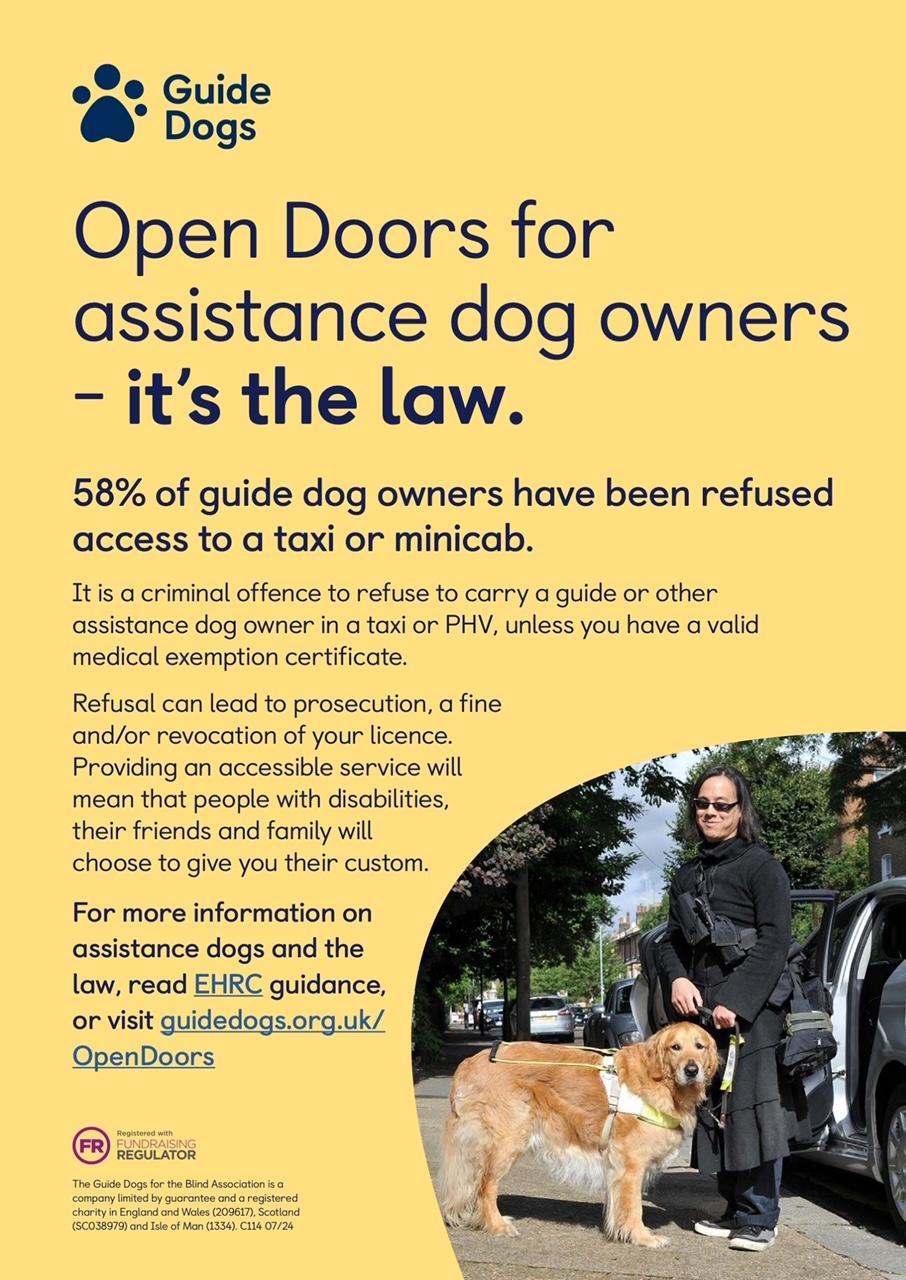
W RESPONSIBILITY FOR GUIDE DOG REFUSALS LIES WITH THE INDIVIDUAL DRIVER
hen a private hire driver in Manchester recently refused to carry a blind passenger because she was accompanied by her guide dog, the issue once again exposed a fundamental failing not of the app-based platform he was using, but of the individual behind the wheel.
Mohamed Abid Hussain, working via Uber, pulled up to collect the passenger from Grafton Street, only to refuse the journey after seeing her guide dog. Despite the dog wearing a high-visibility harness, he reportedly told the passenger she could not bring her “pet” into the vehicle. The passenger explained the situation clearly, but the driver still declined. The case ended in court, with Mr Hussain pleading guilty to three offences and being fined and told to compensate the victim. His licence had already been revoked following a local authority hearing.
It’s an outcome that rightly sends a clear message. But what should not be lost in this is where the real responsibility lies: with the individual driver, not the app. The law is clear. So is the responsibility.
Under the Equality Act 2010, it is a legal requirement for both taxi and private hire drivers to carry assistance dogs without additional charge,
unless they hold a valid exemption certificate. This certificate is only granted on medical grounds such as severe allergies. Drivers cannot claim ignorance as a defence. Local licensing authorities make this clear in training and guidance. Operators like Uber also make it a core part of their driver policies.
That makes cases like this entirely avoidable. The idea that a trained, badged private hire driver cannot distinguish a guide dog, even when wearing a high-vis harness, raises serious questions about that individual’s suitability to hold a licence. Councils have been consistent in taking action in such cases, with licence revocation typically the first step. Courts are also showing a willingness to impose fines and compensation where discrimination is proven.
Are platforms doing enough?
In the wake of such incidents, attention often turns to the platform involved. App-based services have transformed the private hire sector, and some critics point to the digital nature of the work as a barrier to proper engagement between drivers and passengers. But in practice, platforms like Uber and others have taken multiple steps to ensure drivers are aware of their legal responsibilities.
Training material includes guidance on accessibility, including the duty to carry assistance dogs. Drivers are asked to acknowledge these policies before being allowed to accept bookings. If a refusal is reported, platforms can suspend or remove driver access, in addition to the statutory actions taken by licensing authorities. They also share data with councils to support enforcement.
The reality is that digital platforms are not the barrier here. The barrier is personal choice. The driver made a decision not to accept the fare. It was not the app’s decision. No amount of policy or platform controls can replace the judgement of the person in control of the vehicle.
are not issued lightly, and they must be clearly displayed if approved. If you don’t have an exemption, and you refuse a guide dog, you are committing an offence.
Importantly, drivers should also be aware that passengers do not have to prove their disability or the dog’s role. The presence of a harness or clear indication is enough. If in doubt, the correct action is always to complete the journey and seek clarification later, not to refuse service on the spot.
Better information, but also better enforcement
FOR THE PUBLIC TO TRUST THE SYSTEM, THERE MUST BE CONFIDENCE THAT DISCRIMINATORY BEHAVIOUR WILL BE ADDRESSED EVERY TIME.
What drivers need to know
Private hire and taxi drivers should treat this case as a reminder of their obligations. Carrying assistance dogs is not optional. The rules apply to every licensed driver in England, Wales and Scotland. You do not need to be based in a large city to encounter such passengers. You do not need to take dozens of trips a day to be reported for a breach. One refusal is enough to bring the weight of the law down.
Drivers with medical concerns must seek a proper exemption through their licensing authority. These
The current legal and platform-based controls are extensive. What is needed is consistent enforcement across licensing authorities, along with continued pressure from platforms to report and remove drivers who breach the rules.
For the public to trust the system, there must be confidence that discriminatory behaviour will be addressed every time. That means clear procedures, published outcomes, and visible penalties. It also means supporting drivers to understand their responsibilities from day one, through training and licence renewal processes.
But beyond all of that, it comes down to driver responsibility. The person in control of the vehicle must take ownership of the decisions they make. It is not enough to blame confusion, personal belief or poor judgement. Licensed drivers are professionals, and they should be held to professional standards.
The case in Manchester is not the first of its kind, and it likely won’t be the last. But the solution remains the same: educate, enforce, and expect more from those trusted to serve the public.
GRANTS CREDITED
LIFE ON THE ROAD IN LONDON
HOW THE CITY’S UNIQUE PACE DEMANDS SMARTER TAXI TECHNOLOGY, AND HOW VTS DELIVERS
Driving a black cab in London is unlike anywhere else. With constant traffic, busy streets, and over 20 million overnight visitors each year, every shift is unpredictable. Cabbies need tools that keep up, and that’s where Curb’s VTS comes in – built to handle the city’s pace and challenges.
Built for London Shifts
London drivers contend with tight schedules, heavy traffic, and unexpected mobile signals and outages. VTS includes Offline Protection, so payments go through even if the network drops.
This ensures drivers never lose a fare, even in areas where mobile signals are weak or during high traffic periods. Security is also crucial: the system integrates a TfL-approved taxi CCTV for drivers and passengers, fully compliant and easy to install at no extra cost.
The 8.7-inch tablet makes transactions simple and professional, with clear displays, smart tipping, receipt printing, and seamless meter integration.
“It feels like this system was built for cab drivers,” added driver Stephen Jay. “Transactions are quicker, offline mode works perfectly, and I can focus on my passengers without worrying about tech issues.”
Helping Drivers Earn More
VTS helps drivers save up to 26% on credit-card processing fees compared to other providers,* putting more money in their pockets. For cabbies navigating London’s competitive and busy streets, every saving counts. Beyond fees, the system gives drivers greater control and confidence, ensuring every journey runs
smoothly, whether it’s a short city ride or a long airport run.
“I've saved over £700 in card processing fees in a year,” said driver Scott De Garis.
*Compared to competitor rates of 3.75% + 20p per transaction.
Support That’s Close By
Even the best tech needs support. Curb’s Driver Hub in Bethnal Green provides direct guidance, with additional teams in West and North London nearby. Whether it’s a quick question or a more complex issue, help is always within reach. Backed by 65+ global markets and used in over 45,000 cabs, VTS combines proven technology with local insight to keep London drivers moving efficiently and confidently.
Join the Driver-First Journey
New drivers signing up today can receive a £250 welcome bonus, one year of free meter, and £50 for each friend they refer. Offer valid for new drivers only.
For more information, call 0333 666 1000 or visit gocurb.co.uk
THE END OF TOMS
Operators using TOMS will now need to absorb the additional VAT cost, pass it on to passengers, renegotiate driver contractual terms or reconfigure their business models. The scale of the financial impact will vary by operator, but PHV prices in the capital could rise as the sector aligns with the traditional VAT structure used in most other comparable services.
Andrew Brem, Uber’s Regional General Manager, UK, said: “The government’s action today to change the rules will mean higher prices for passengers in London, and less work for drivers, when people are already struggling with the cost of living.
“The courts have twice ruled that the Tour Operators’ Margin Scheme applied to operators like Uber. This decision also establishes the absurd situation where a trip in London will be taxed at a different rate than a trip anywhere else in the UK.”
Outside London, the Supreme Court’s Uber v Sefton judgment upheld that operators may continue using the agency model, meaning the driver is treated as the supplier of the transport service. As most drivers fall below the VAT threshold, full-fare VAT is NOT charged on typical bookings, and operators only apply the 20% VAT rate to their commission where applicable. With TOMS also being removed for the whole sector, the prevailing agency model remains the main determinant of VAT treatment outside the capital, ensuring that the whole of the passenger’s fare does not automatically attract 20 percent VAT, just the commission.
McNamara called the decision “a victory for common sense” and said the LTDA welcomes the Government’s commitment to closing the gap between small domestic firms and multinational operators.
McNamara said in full: “Today’s decision by the Government to apply VAT to all private hire journeys is a landmark moment for fairness and integrity in our industry.
“For years, multinational behemoths like Uber and other companies with staggering global wealth and resources have exploited the Tour Operators Margin Scheme (TOMS) loophole, a mechanism designed for traditional travel companies, to pay an effective VAT rate of less than 5% on billions in revenue. This has cost the British taxpayer billions to date, creating a grossly uneven playing field for tens of thousands of small operators who have always complied with the rules.
“This change is not just about tax. It is about restoring balance to a market that has been distorted for far too long. Drivers and small businesses have been competing against global corporations that enjoy special treatment, while hardworking operators pay the full 20% VAT rate. Today’s announcement finally levels that playing field and ensures competition is based on service and quality, not tax avoidance.
“We welcome this decision and congratulate the Government on taking this decisive action to close the loophole. This is a victory for common sense, for fairness, and for the thousands of our drivers who have been disadvantaged for years.”
FURTHER TRADE REACTION
Nathan Bowles, CEO of Veezu, said: “We welcome the Government’s decision to rule out 20% VAT on private hire journeys. This is the right outcome for passengers, drivers and local communities. We are pleased the Government has listened not just to operators, but to the millions of people who rely on
private hire everyday to get to work, hospital appointments and family commitments. The Supreme Court’s unanimous and clear ruling in Uber v Sefton confirmed that our long-standing operating model works and keeps services affordable, reliable and safe. Today’s clarity gives everyone in the sector the stability we need to keep Britain moving.”
Cristina-Georgiana Ioanitescu, President of ADCU, said: “We support the principle behind the Chancellor’s proposal. Drivers, like everyone else, rely on properly funded public services and they want to contribute fairly. But fairness must apply across the board. The companies that dominate this industry must not use VAT as an excuse to further squeeze drivers’ incomes.
“The burden must sit where it belongs: with the app operators who profit from drivers’ labour, and with passengers through transparent, regulated pricing not with the workers who can least afford it.”
Jonathan Main, VAT Partner at MHA, said: “The Government has just published its long-awaited
response to the private hire consultation launched in April 2024. It looks like the worst possible outcome for ride hailers such as Uber and Bolt, as opposed to the status quo for more traditional private hire operators.”
Patrick Gallagher, COO of Addison Lee, said: “We welcome the Chancellor’s decision to mandate 20% VAT on standard fares from January 2026.
“Addison Lee has operated as a responsible business in the heart of London for 50 years. We have always complied with regulatory guidance from TfL and HMRC and paid what we owe to the public purse.
“Up until now, some operators have exploited loopholes to get around applying full VAT. This has put responsible operators who have complied with changed tax obligations at a significant disadvantage.
“Today’s Budget provides much needed clarity and creates the level playing field necessary to maintain a fair and competitive marketplace in the private hire industry.”
NEW EV ROAD CHARGE
TRIGGERS
WARNINGS FROM MAJOR TAXI AND PRIVATE HIRE OPERATORS OVER RISING DRIVER COSTS
P PAY-PER-MILE: CHANCELLOR’S
rivate hire and taxi firms say the 2028 pay-per-mile levy could slow electric vehicle adoption despite fresh government support for charging and grants.
The Government’s plan to introduce a road charge for electric and hybrid vehicles from April 2028 has drawn sharp criticism from leading operators in the private hire and chauffeur sectors, who warn the new measure risks derailing fleet electrification efforts already under strain.
The Budget confirmed that electric vehicles will be subject to a 3p per mile charge, while plugin hybrids will face 1.5p per mile, with both rates rising annually with inflation. The Treasury intends to collect the charge using annual mileage checks at MOTs or registration anniversaries, feeding the data into the existing Vehicle Excise Duty system. The Government acknowledges the risk of
increased odometer tampering and is consulting on safeguards.
Addison Lee’s chief operating officer Patrick Gallagher said the new levy, combined with diminishing EV incentives, creates an increasingly unviable environment for operators managing high-mileage fleets. He cited internal estimates that place the annual cost of the scheme at around £840 per EV and £420 per plug-in hybrid for its drivers. Gallagher added that the removal of the Congestion Charge exemption for EVs next year will add up to £4,700 in extra annual costs for a typical driver in London. The company had previously electrified at scale, but Gallagher said national and local decisions had forced a return to greater use of plug-in hybrids to maintain service reliability and price stability.
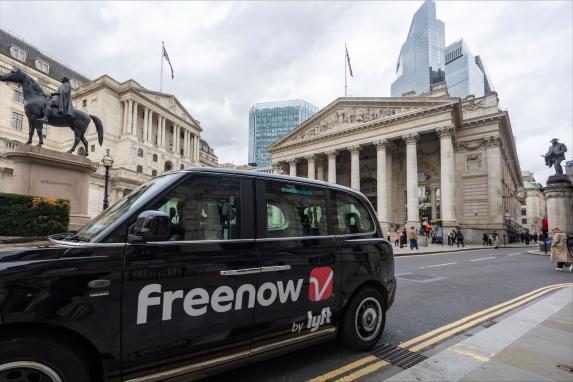
Freenow by Lyft UK general manager Danny O’Gorman
welcomed measures in the Budget to expand charging infrastructure and extend the Electric Car Grant to 2030, arguing they are essential for making EVs cost effective for drivers with limited access to home charging. He said only 42 percent of London’s black cab drivers can charge at home, making VAT on public charging a
continuing barrier to adoption. O’Gorman warned that unless taxis and private hire vehicles are exempted from the 2028 charge, operators covering significantly higher annual mileage will face disproportionate increases in operating costs that would feed through to passengers.
Blacklane’s UK and Ireland general manager, James Dow, raised similar concerns, warning that the combination of the new levy and the end of Congestion Charge exemptions risks undermining progress in highadoption cities such as London. He said operator collaboration with policymakers will be essential to prevent a slowdown in EV uptake and called for a review of public charging VAT alongside targeted support for professional drivers facing rising ownership costs.
According to the Office for Budget Responsibility, the scheme is forecast to raise £1.1
billion in 2028–29, rising to £1.9 billion by 2030–31, although the yield remains uncertain as it depends on the pace of EV adoption. The OBR expects the levy to increase lifetime ownership costs and reduce EV demand, projecting 440,000 fewer sales, partially offset by other government measures. The tax will apply to all UK-registered EVs regardless of where they are driven, but foreign-registered EVs used in the UK will not be charged.
The Budget also confirmed the extension of the 5p fuel duty cut until September 2026, before duty begins rising annually with
RPI inflation. EVs remain subject to Vehicle Excise Duty, including a higher rate for models costing above £50,000, which rises to £440 in April 2026.
While ministers set out the framework for a system intended to replace declining fuel duty revenue, operators warn the timing and structure risk weakening already fragile industry confidence in large-scale EV deployment. With the Government now consulting on implementation, the sector is expected to lobby for exemptions, mitigations or parallel incentives to prevent a slowdown in its transition plans.
F RETIREMENT ROADBLOCK: WHY THE VAST MAJORITY OF TAXI DRIVERS ARE HEADING TOWARDS A PENSION SHORTFALL
or the thousands of drivers who keep Britain’s streets moving day and night, the idea of a well-earned retirement is becoming more distant with every fare. The latest stats for self-employed workers as a whole suggest that around seven in ten drivers are heading for their later years with little or no pension savings in place. It’s a sobering reality that cuts right to the heart of how the industry is structured and how the self-employed workforce as a whole has been left behind when it comes to financial security.
drivers are classed as self-employed, the safety net of an employer contribution or HR-department reminder simply doesn’t exist. It’s entirely down to the individual to plan, save and invest, and when your earnings depend on the next booking, that’s easier said than done.
Across the wider self-employed population, the numbers make grim reading. Only about 20% of those working for themselves have a private pension in place. A think tank recently reported that “over four in five” self-employed workers make no retirement contributions at all. The taxi and private hire world fits neatly into that statistic. While hard data focused purely on the trade is limited, anyone with experience in the sector will confirm that pension saving is low, sporadic and often nonexistent.
Why drivers are particularly exposed
The problem isn’t new, but it is deepening. Two forces collide to create the issue: the self-employed nature of taxi driving, and the lack of automatic pension enrolment that regular employees enjoy. When most
Driving a taxi has long been a profession built on independence. Most drivers operate as sole traders or small limited companies, with no formal employer structure. That freedom brings flexibility
but also removes many of the financial guardrails that traditional employment offers. No HR department, no matched pension contribution, and no one to nudge you to set something aside for later.
The income pattern doesn’t help either. Some weeks are busy, others painfully quiet. Fuel costs, insurance, maintenance and vehicle finance can quickly swallow up a large slice of takings. After that, there’s little left to lock away in a pension fund. The average driver is more likely to be thinking about keeping the car on the road this month than about life in 20 years’ time.
There’s also a knowledge gap. Many drivers simply don’t know where to start with pension saving, and the process can feel detached from daily working life. When cashflow is king, it’s difficult to part with money for something that won’t pay back until you’ve hung up the keys.
The age profile of drivers adds another twist. Increasingly, people enter the trade later in life sometimes after redundancy, career changes or early retirement from other roles. That means fewer years to build up a decent pension pot, and many end up driving well into their sixties or even seventies. For some a pension has already been amassed and the job of driving a taxi is simply to top up those pots.
Life at the wheel without a pension
For those with no private or workplace pension, the State Pension becomes the only dependable source of income in retirement. At just over £11,000 a year, it’s designed as a basic safety net, not a full replacement for a working income. Once rent, council tax, and rising utility bills are paid, there’s not much left for a comfortable standard of living, let alone for the occasional holiday.
Many drivers quietly accept that they’ll keep working for as long as their health allows. There’s an unspoken reality that “retirement” in the traditional sense, clocking off and enjoying a slower pace,
over how and when they work.
Following the 2021 Supreme Court ruling Uber drivers are classified as “workers” when they are logged into the app and ready for jobs. This means Uber must pay at least minimum wage (for logged-in time), provide holiday pay and auto-enrol eligible drivers into a workplace pension.
However, away from the Uber platform some PHV drivers remain classed as self-employed contractors
in the eyes of their chosen operator. This means they are not entitled to such benefits just mentioned. Instead, they are responsible for managing their own tax and National Insurance contributions and do not receive auto-enrolment pension contributions from the companies they work with.
The wake-up call
The trade needs a frank discussion about what comes next. The days when a good run of work could see you into a comfortable retirement are over. With rising costs, volatile fuel prices and uncertain demand, drivers can’t rely on goodwill or luck to secure their future.
contribution started today can make a difference later. For those already paying into a pension, it’s worth checking if the pot is on track to last through 20 or 30 years of retirement.
A glimmer of hope
It’s not all bad news. Financial advisers say that careful planning, even started later in life, can still help drivers improve their position. Regular, manageable contributions, no matter how small, add up over time. There are also tax benefits: pension contributions can reduce taxable income, offering some immediate relief from the yearly bill to HMRC.
Getting professional
advice is a smart move.
Change can only happen in two ways: drivers take personal steps to save, or the system evolves to help them. The responsibility falls to individuals. Every driver should ask themselves what, if any, pension arrangements they currently have. Even a small
An independent financial adviser familiar with selfemployed earnings can help tailor a plan that fits irregular income patterns and seasonal fluctuations. Even drivers who feel they’ve left it too late can often find ways to strengthen their finances before stepping away from the wheel.
AIRPORT FIXED PRICE FARES AS EVER IN THE TAXI TRADE, ONE REGION COMMON SENSE IS ANOTHER’
There’s no shortage of opinion when it comes to airport fares, and TaxiPoint’s latest industry question about whether drivers would support fixed price airport taxi fares has stirred up quite a mix of responses. From Glasgow to the Wirral, cabbies had plenty to say, and the split in opinions shows just how complex this issue is across different licensing areas.
For some, fixed airport fares are nothing new. In places like Glasgow, Bristol, and Liverpool, drivers say it’s already standard practice. As Allan Nugent put it,
S CHAOS
Glasgow has long used fixed rates to simplify things, especially since the airport isn’t even in the city itself. The surcharge system there can be a headache, so quoting a flat price “saves all the hassle”. Others like Craig Robertson echoed that sentiment, noting Glasgow taxis have done it “for years”.
Down south, several drivers reported similar setups. Andy Robinson said his firm has been fixed “for 20 years” for airports and hospitals, while Mark Blurton and Nathan Plattini both said all their airport jobs are set at flat rates. The trouble,
though, is the new wave of undercutting by app-based platforms. Blurton, who runs an eight-seater, pointed to ridehail “ridiculous prices” ranging from £67 for Derby to Manchester Airport and £52 to Birmingham, which is roughly half of what traditional operators charge. His verdict?
“It’s blatantly obvious they’re aiming to put small operators like myself out of business.”
Many echoed frustrations about that same price race. “Price wars kill the game,” said Garry Metcalfe bluntly. Others, like John Paul Leasing, see no point in trying to fix fares: “Set what
you like, someone will still undercut you.”
Then there’s the practical side. Several drivers questioned how a fixed system would even work given all the variables. Eddie Baker asked how fares could be fixed when pick-up and drop off addresses vary so much. John Minshall added that differing passenger numbers, vehicles, and pick ups make standardisation a headache.
Some drivers pointed out the elephant in the room: airport fees. With dropcharges climbing, the idea of a single “set fare” can quickly unravel. “Ten quid tariff to exit the airport,” pointed out Gary Causer. Others like David Barlow argued the meter’s there for a reason: “Why should drivers sit for 20 minutes in traffic and not be paid?” It’s a fair question, especially when some airports are notorious for gridlock at peak hours.
Then there’s the debate over fairness. Steven Hunter said: “Drivers have to make an acceptable living or they simply won’t do airport work. Why not ask plumbers or electricians to do the same? It’s a free market.” His point reflects the view that airports and passengers shouldn’t dictate prices in a trade already squeezed by rising costs.
Some drivers, like Douglas Brown in Edinburgh, say fixed fares can actually backfire. At the airport there, private hire operators run flat rates, but “from what I hear those fixed prices are a shocker”. For him, the meter gives fairer value to both driver and
level. Ride-hail platforms are distorting expectations. As multiple drivers pointed out, when passengers can sometimes get a 60-mile trip for a fraction of the price, local firms struggle to justify sustainable rates. The problem isn’t the idea of fixed fares itself, it’s who’s setting them and whether they reflect the real cost of running a licensed taxi or private hire vehicle.
As ever in the taxi trade, one region’s common sense is another’s chaos. While some licensing authorities might fancy the idea of regulating airport fares, most drivers see it as either unnecessary or unworkable. For many, the system’s already working just fine or at least as fine as it can in a market
warped by app-based pricing, airport fees, and rising fuel costs. The trade’s too diverse, the airports too different, and the economics too unpredictable.
C CASH NO LONGER KING AS TAXI DRIVERS SAY THEY GO ‘ENTIRE WEEKS’ WITHOUT HANDLING BANKNOTES
ash once ruled the taxi trade up and down the UK. Drivers would finish their shift with a pocket full of notes and coins, ready to refuel or take their earnings to the bank the following day. That era has all but vanished. In today’s licensed taxi industry, digital payments have taken near total control.
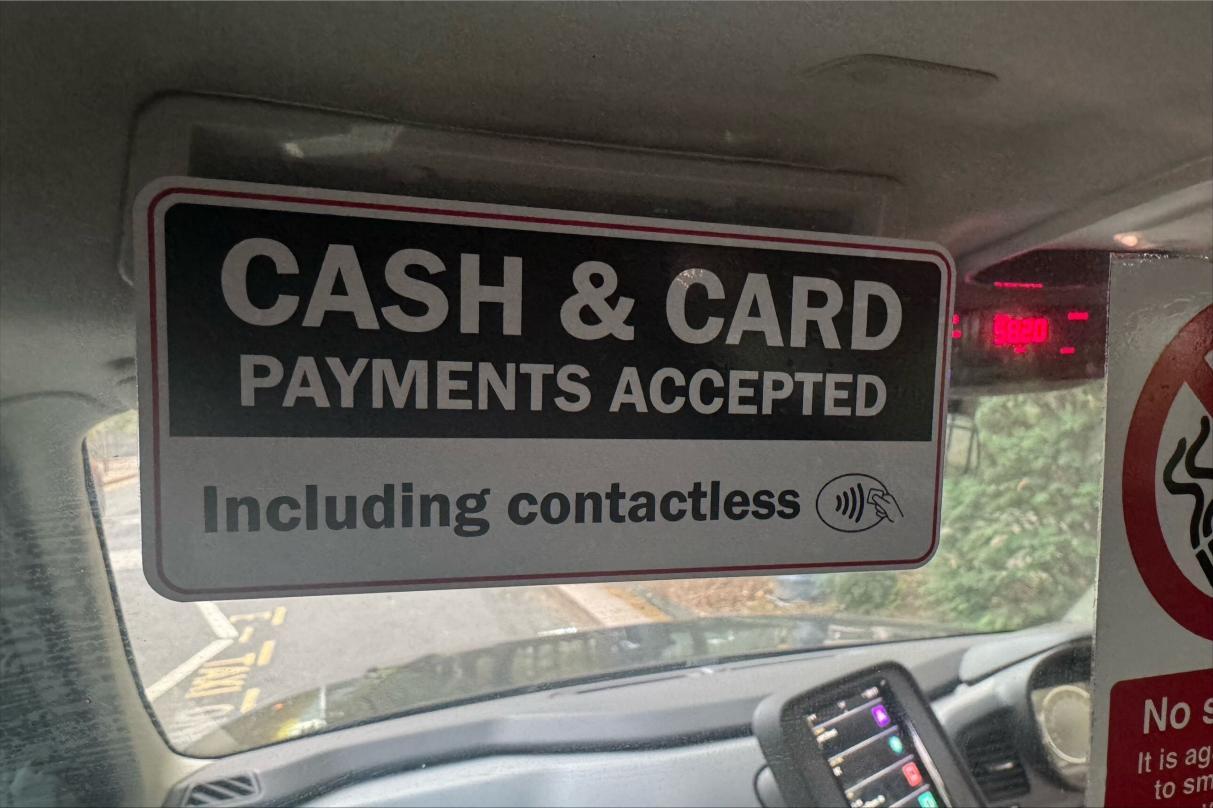
In London, card acceptance has been mandatory for black cabs since 2016. Every taxi must carry an approved card terminal, and all passengers must be given the option to pay by card or contactless. What started as a convenience for passengers has now become the standard. One driver told TaxiPoint that he could “easily go a whole week without a single cash fare” thanks to the dominance of digital booking apps and contactless payments.
The transition was gradual at first. Card machines were once seen as a backup for tourists or business users. Over time, passengers began to prefer the ease and speed of contactless payments, particularly after the introduction of Transport for London’s contactless system across buses and the Underground. Then came the pandemic, which effectively ended cash handling in many sectors overnight. For taxis, the habit stuck.
Today, most fares are processed either through inapp transactions on platforms such as Freenow by
Lyft or Gett, or via an in cab card terminal. These services automatically quickly charge the passenger bank account, leaving no opportunity for cash to change hands. For drivers, this has created a new reality: takings are now digital, often transferred several days later, minus processing or commission fees.
Many drivers acknowledge that card payments bring advantages. They reduce the risks of theft, disputes, and counterfeit notes. Digital transactions also provide a clear record of income, which simplifies accounting and supports access to finance. But the loss of immediate access to cash has changed how drivers manage their work and finances.
Cash once offered flexibility. A driver could finish a long shift, fill the tank, and still have money in hand for personal use. Now, with earnings tied up in digital transfers, that immediacy has gone. Some drivers also highlight the impact of card payment transaction fees, which can range from 1.5% to 5% per fare depending on the platform. Over time, those charges add up to a noticeable cut in income.
Other small businesses that rely on face-to-face transactions, such as takeaways, market traders, and corner shops, share the same frustration.
Digital payments are convenient for customers but carry costs for the business. For the self-employed, those small deductions can make a real difference, especially during quiet periods.
While a small number of passengers still offer cash, it is now the exception rather than the rule. Tourists, particularly from regions where cashless systems are less common, occasionally hand over notes, but even they are adapting quickly. In many London taxis, the coin tray now sits empty for days at a time.
The shift reflects a wider social trend. According to UK Finance, only around 6% of transactions nationwide were made in cash in 2024, down from more than 50% a decade earlier. Contactless cards, mobile wallets, and online banking have all contributed to the steady decline of physical money.
For the taxi trade, this marks a defining change. What was once a cash-led business has become fully digital within a single generation. The trade has adapted, but many drivers still miss the simplicity and control that came with counting their earnings by hand at the end of the night.
BUSINESS NEWS
ZOOM CARS SECURES BRISTOL AIRPORT TAXI CONCESSION FROM FREENOW BY LYFT LINK WITH CONCUR EXPENSE TO STREAMLINE CORPORATE TAXI TRAVEL
Freenow by Lyft has confirmed a new enterprise link with Concur Expense, giving companies a single connected system for managing taxi travel and related costs. The move is pitched as a major step in reducing admin work for both employers and staff.
The link allows employee details held by a company to sync automatically with the Freenow Admin Panel. Each user profile is then matched to their SAP Concur account. Every taxi trip booked on a corporate account is sent straight to Concur Expense with a digital receipt. Staff no longer need to handle manual entries or keep paper records.
Freenow says the setup gives firms a clear view of all ground transport activity. Trips are shown in one place, helping employers track usage and control spend. The link also ensures staff only use approved payment options, helping firms stick to their own rules.
Companies using Freenow by Lyft for Business already gain full oversight of taxi travel through its software. The app gives staff access to licensed taxis while offering firms straightforward management tools. More than 15,000 companies now use the service across nine countries and over 180 European cities.
Zoom Cars has been awarded the contract to run Bristol Airport’s dedicated taxi and private hire concession, with operations scheduled to begin on 1 February. The appointment follows an Invitation to Tender launched in September for a single operator to deliver a round-the-clock service for passengers and airport staff.
The concession gives Zoom Cars access to a premium on-site taxi office close to the terminal and the newly built Public Transport Interchange.
As part of the tendering process Bristol Airport said the contract runs for five years with the possibility of a two-year extension. Advertising support is also included as part of the agreement, reflecting the airport’s plan to keep a consistent branded presence across its transport offer.
The selection criteria placed heavy emphasis on sustainability and operational reliability. The chosen operator must field a fleet with vehicles under three and a half years old, with 75 per cent hybrid or electric from the outset. By the end of 2025, a minimum of 25 per cent must be fully electric. High levels of cleanliness and service standards were listed as essential requirements during the tendering phase.
LEVC LAUNCHES NEW SOCIAL MEDIA CAMPAIGN TO INSPIRE NEXT GENERATION OF LONDON CAB DRIVERS
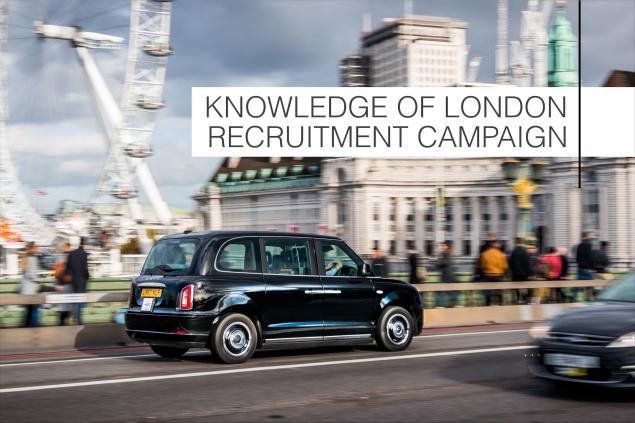
LEVC has launched a new campaign designed to celebrate London’s worldrenowned taxi trade and inspire more people to take on the Knowledge of London.
The paid social media campaign highlights the skill, commitment and tradition behind the capital’s black cab industry. Through a series of short films and digital adverts, LEVC aims to remind Londoners and visitors of the expertise required to become a licensed taxi driver and to encourage new recruits to join the trade.
The campaign focuses on The Knowledge, the demanding test of memory and navigation that every London taxi driver must pass. Candidates spend years mastering more than 20,000 streets, along with thousands of landmarks, routes and key locations. It remains one of
the most respected vocational achievements in transport anywhere in the world.
LEVC says the initiative is part of its wider support for the profession and its long-term sustainability. The firm continues to work closely with the taxi trade to provide electric vehicles through its TX model, which has become the standard bearer for zeroemission capable taxis across the city.
The campaign was created to shine a light on the skill, dedication and heritage that make London’s taxi drivers world-class and to remind the public of the professional standard that sets black cab drivers apart. The company hopes the campaign will reach a broad audience and motivate people to consider a career behind the wheel of an iconic cab.
EDINBURGH TAXIS TO CARRY EMERGENCY BANDAGES
Taxi drivers in Edinburgh are joining efforts to improve public safety by carrying emergency bandages that can help control serious bleeding after accidents or violent incidents.
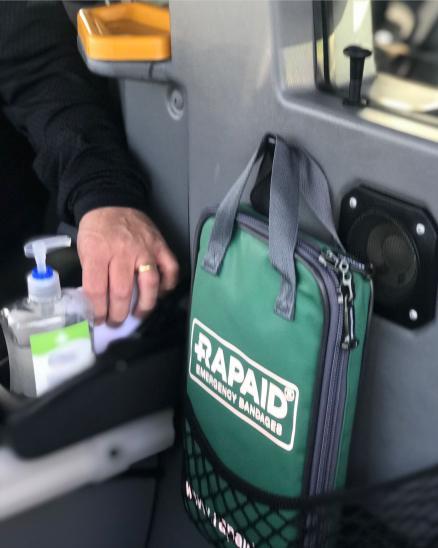
Two hundred Central Taxis vehicles across the city have been fitted with the kits, supplied by Oxfordshirebased charity RAPAID. Each participating cab displays a window sticker so the public knows they can flag it down and access first aid support in an emergency.
The RAPAID emergency bandage kits are designed to treat severe bleeding quickly, potentially saving lives in the crucial minutes before medical help arrives. They can be used in road accidents, major incidents, or cases of knife crime where blood loss poses an immediate danger.
‘FANTASTIC OPPORTUNITY’: FREENOW BY LYFT AND SALTIRE PRIVATE HIRE CELEBRATE SIX MONTHS OF SUCCESS IN GLASGOW PARTNERSHIP
Six months after Freenow by Lyft launched its Glasgow ride-hailing service in partnership with Saltire Private Hire, both firms are said to be marking a period of strong growth and collaboration.
The partnership, first announced in May, introduced the European multi-mobility platform’s app-based service to Glasgow. The move built on its existing network in Edinburgh and over 150 other cities across Europe.
Rob Finlayson, Operations and People Specialist at Driving Edge, reflected on the progress made since launch, describing it as a period of “fantastic
opportunity and growth” for both Saltire and City Cars. He highlighted how the partnership has simplified driver onboarding, refined coverage areas and introduced new training initiatives.
Finlayson said the collaboration had been “a real breath of fresh air” from day one, pointing to the shared approach between Saltire and Freenow as key to its success. The fleet has reportedly seen “explosive growth” over the six months, with increased demand and expanded driver options.
Freenow’s platform offers features such as upfront pricing, real-time arrival estimates and prebooking up to four days in advance. Passengers
can pay using Apple Pay, Google Pay, PayPal, card or cash, while safety measures include driver and vehicle details provided at booking and a tripsharing option for passengers.
The Glasgow partnership marked Freenow’s first collaboration of its kind in the UK.
As both firms look ahead, Freenow’s continued investment in regional partnerships and driver support suggests further growth across Scotland is likely.
Rob Finlayson said: “Hard to believe it's already been six months since we launched our partnership with Freenow back in May.
“From day one, it's been a real breath of fresh air from starting with the basics of simplifying and streamlining our onboarding processes to adjustments to coverage and changes to training for new drivers both to City cars and Freenow. Its been a genuine Collaboration from the outset, a
rare thing these days. We've been fortunate enough to be able to learn, grow and develop on the back of.
“The partnership has gone from strength to strength, we've seen explosive growth over the period both with our partnership and through our own system due to extra options now afforded to our drivers.
“Absolutely delighted to have been the first fleet in the UK to partner up with Freenow, despite it being a long time in the making with great support from wonderful people such as David Marks, Kyle, Acarkan and Dylan from Freenow by Lyft.
“Whilst it’s been a whirlwind 6 months i'm delighted to say its been a period of fantastic opportunity and growth for both myself and Saltire/ City Cars. Here's to the next six months and beyond.”
LONDON NEWS
KNOWLEDGE OF LONDON APPLICANT NUMBERS SHOW PROMISING SIGNS OF IMPROVEMENT AS APPLICANTS ON COURSE FOR NEAR DECADE LONG HIGH
Fresh figures released by Transport for London (TfL) reveal how the Knowledge of London has shifted over the past decade, with entry numbers, completion volumes and test performance all changing shape since 2015. The data was provided in response to a Freedom of Information request covering activity up to September 2025.
The number of new entrants have remained well below the peak seen in the last ten years, when 1,315 applicants began the process in 2015. Numbers fell sharply after that year and only started to recover post-pandemic onwards. The total of 605 applicants by September 2025 already exceeds all annual totals since 2018, suggesting interest is moving upward again and is on course to become its highest totals since the 2015 peak.
TfL confirmed 1,260 candidates are currently progressing through the stages of the Knowledge as of September 2025.
Completions have been falling for several years. In 2016, 870 candidates finished the process. By 2023 this had dropped to 114 and by 2024 just 110. Only 91 have completed so far in 2025. The fall reflects a smaller pipeline of applicants in previous years and longer average completion times. With more students joining the Knowledge in 2025 it may take 2-3 years for these applicants to complete the process.
TfL does not record annual withdrawals, so there is no clear data on dropout trends over the decade.
The average time taken to complete the Knowledge rose steadily from 2015 through to 2021, peaking at over five years. Times only began to fall again from 2022. Candidates completing in 2025 finished in an average of 38 months, which is the quickest since the mid-2010s. The shorter period likely reflects a smaller more focused cohort, improved exam scheduling after the pandemic period or changes in candidate ability.
Pass rate data, measured on stages three to five, offers a mixed picture. The pass rate dropped from 53 per cent in 2019 to 46 per cent in both 2023 and 2024. It stands at 38 per cent for 2025 so far. This raises questions about exam preparedness when making the move from learning the ‘Blue Book’ routes to being able to call-over routes asked by the examiner.
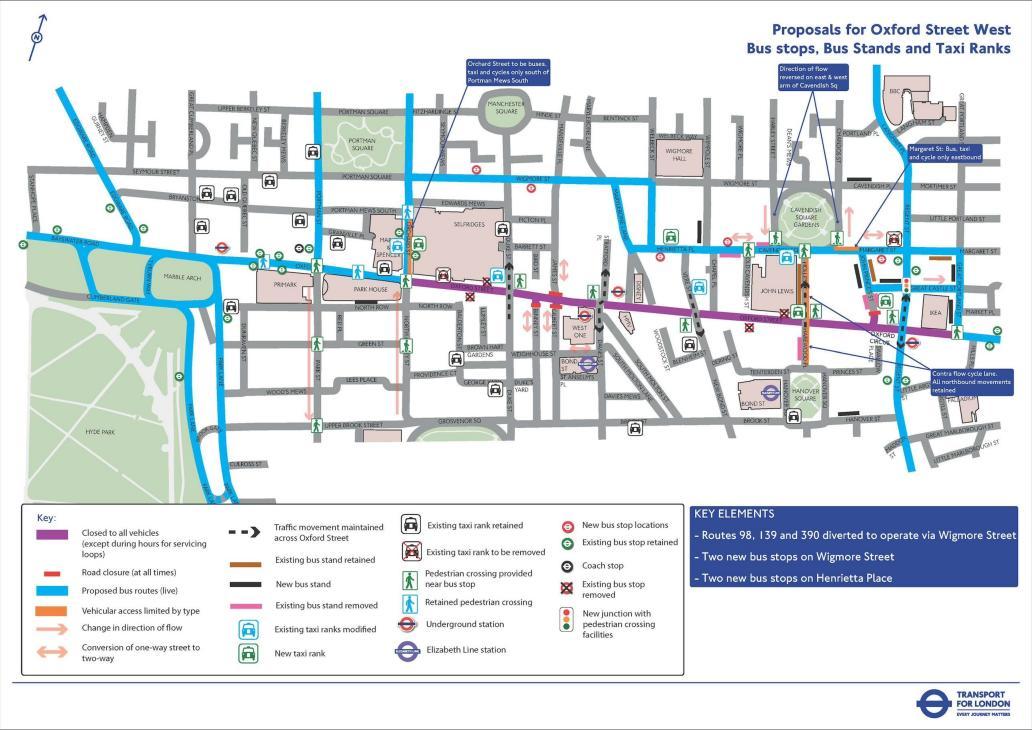
OXFORD STREET PEDESTRIANISATION PLAN RELEASED RAISING FRESH OPERATIONAL QUESTIONS FOR TAXI AND PHV TRADE
The Mayor of London and Transport for London (TfL) have set out a detailed proposal to pedestrianise a major section of Oxford Street, triggering renewed scrutiny from the taxi and private hire industry over how drivers and passengers would be affected.
The eight week consultation has opened and runs until 16 January 2026.
The scheme centres on the stretch between Orchard Street and Great Portland Street. Under the plan, taxis, private hire vehicles, buses, cycles and scooters would all be excluded from the zone, with access limited to emergency services at all times and to servicing vehicles only between midnight and 7am.
The move goes further than the current daytime traffic ban applied to general vehicles and marks the most significant access change for the trade on the street in decades.
For licensed taxis, TfL intends to position ranks and passenger drop off points as close as possible to the edge of the pedestrian zone.
Discussions are underway with Westminster City Council about whether more kerbside space can be reassigned to ranks on surrounding streets. The Mayor’s office says blue badge parking provision will be maintained, though the overall pattern of passenger access is set to shift once vehicles are no longer able to enter the street itself.
IMAGE CREDIT: TRANSPORT FOR LONDON
P CRAWLEY TAXI AND PHV SET FOR NEW LOOK, ROOF LIGHT CHANGES AND CARD PAYMENTS FROM 2026
assengers in Crawley will start to notice visible changes to the town’s licensed taxis from next April as the council introduces new livery rules and payment options.
Under updates agreed by the Licensing Committee, all private hire and hackney carriage vehicles will move to new branding that removes roof boxes and most external signage. The changes aim to modernise the fleet’s appearance and make it easier for passengers to distinguish between different types of licensed vehicle.
Private hire cars will no longer display top boxes or door stickers, while those operating from Gatwick Airport will switch from teal rear plates to yellow, matching the airport’s current colour scheme.
Hackney carriage taxis will adopt a revised permanent design featuring Crawley Borough Council branding.
The new policy also makes it compulsory for every licensed vehicle to accept electronic payments. From April 2026, all taxis and private hire vehicles must provide passengers with the option to pay by card or contactless in addition to cash. The move is intended to reflect changing travel habits and improve convenience for both residents and visitors.
Licensing officers said the new rules will help align Crawley with national best practice and other local authorities. Drivers will be given time to adapt
before enforcement begins, with the formal rollout period beginning next spring.
Committee members said the measures would modernise the trade and improve customer experience, particularly at Gatwick where passengers often expect to pay electronically. There’s also one most significant change that will see all Crawley-licensed taxis and private hire vehicles fitted with CCTV systems by October 2027. Recordings will activate automatically when the vehicle engine is switched on and remain active until it is turned off. Both drivers and passengers will have access to panic buttons to trigger audio recording in emergencies.
Committee members discussed privacy concerns raised by trade representatives, including the Crawley Hackney Carriage Association and Unite the Union. Drivers argued that the systems could intrude on personal privacy and impose high installation costs. Officers confirmed that data would be tightly controlled, with access limited to trained staff and all footage deleted after 31 days unless required for investigation.
The council will act as data controller and prepare a full Data Protection Impact Assessment before rollout. A two-year lead-in period will allow a procurement process to secure best value and explore rental options for drivers.
FAULTY TARIFF: TRAFFIC COMMISSIONER HALTS NEW MIDLOTHIAN TAXI FARE PROPOSAL AFTER OPERATORS APPEAL
Midlothian Council’s new taxi tariff plans have been suspended following an appeal by local operators to the Traffic Commissioner.
Members of the General Purposes Committee met on 4 November to address an error discovered after the new tariffs were approved in September, but were informed that the matter was now out of their hands.
Derek Oliver, Chief Officer Place, told councillors that an appeal had been lodged by members of the taxi trade. He said: “There has been an appeal submitted to the Traffic Commissioner from the taxi core with regards to the new tariffs set by Midlothian Council. The Traffic Commissioner has notified us that it is in effect suspending the fare scale as published by the council.”
The issue centres on an unintentional change in the council’s agreed tariff. The new table of fares, due to take effect on 11 November, mistakenly doubled the period of “additional waiting time” from 30 seconds to 60 seconds. Although the price per period rose from 25p to 30p, the increased time interval meant drivers would earn less for time spent waiting.
REVOKED: BUCKINGHAMSHIRE
TAXI DRIVER LOSES LICENCE COURT APPEAL AND MUST PAY NEARLY £7,000 IN COSTS
secured a court victory after magistrates backed its decision to revoke a hackney carriage driver’s licence over concerns about his driving. The ruling reinforces the authority’s stance on prioritising passenger safety when assessing taxi and private hire drivers.
The council revoked the licence of Malik Paracha in March 2025 after officers identified several motoring offences on his record. A subsequent investigation highlighted what the council described as a clear decline in his driving standards, prompting concerns about his suitability to continue working as a licensed driver.
decision, but on 17 November 2025 the Magistrates’ Court upheld the revocation. The court found that his driving offences, a recent collision and his explanations around those incidents pointed to a pattern of deteriorating behaviour that did not meet the high threshold required under the council’s licensing policy.
The court concluded that the cumulative evidence indicated a risk to public safety and dismissed the appeal in full. Magistrates also ordered Mr Paracha to pay the council’s costs totalling £6,805.52.
WELSH GOVERNMENT UPD GUIDANCE SETS RULES FOR DASHCAM USAGE IN TAXIS AND
Fresh updated guidance has been released covering how dashcams can be used in licensed taxis and private hire vehicles. The document sets out what drivers and vehicle proprietors must do if they choose to fit a Video Point of Impact System that records the road ahead.
squarely on the driver or proprietor. Under UK GDPR, anyone controlling footage must ensure it is stored and managed correctly. Operators are also expected to check whether they need to register with the Information Commissioner’s Office and pay a data protection fee.
The rules keep the focus strictly on external footage. Dashcams are not allowed to record the inside of a vehicle, and they cannot capture audio during normal operation. Any device with a built-in microphone must have the audio function switched off unless a recognised panic switch system is activated.
Only equipment carrying a UKCA or CE mark is permitted. Drivers fitting their own device must get approval from the vehicle proprietor first. Once a camera goes in or comes out, the proprietor has five working days to tell the council in writing. Licensing teams will then log the vehicle as using a dashcam, which can help later when dealing with complaints or incident reports.
If the police or an authorised council officer
make every effort to supply the unedited material promptly, with a response given within seven days.
Clear notices are required whenever a dashcam is in use. The signs must face in the same direction as the recording. A simple strip at the top of the windscreen is acceptable for a front-facing camera, provided it does not interfere with visibility. Cabling must also be positioned safely and kept out of the driver’s field of view.
Reversing cameras and similar live-view tools fall outside the rules as they do not record images. Only recording devices are covered.
The updated policy aims to give the trade clarity while ensuring dashcam use stays within legal boundaries.
TELFORD AND WOLVERHAMPTON BEGIN FIRST JOINT TAXI
ENFORCEMENT OPERATION UNDER NEW CROSS-BOUNDARY POWERS
Telford and Wolverhampton have carried out their first shared taxi enforcement operation under newly granted crossboundary powers, marking a significant shift in how authorities across the region can act on noncompliant vehicles.
The Multi Agency Targeted Enforcement Strategy operation brought together Telford & Wrekin Council, City of Wolverhampton Council, Shropshire Council and West Mercia Police for coordinated inspections across two sites in the borough.
The activity follows Wolverhampton’s decision to grant Telford & Wrekin enforcement powers that allow its officers to inspect and suspend Wolverhampton-licensed vehicles operating locally if they are found to be unroadworthy. Wolverhampton officers now hold the same authority in reverse, enabling action against Telford & Wrekin licensed vehicles working inside the city.
The reciprocal agreement aligns with measures in the Department for Transport’s Best Practice Guidance, which seeks to close gaps that have allowed drivers to operate far from their licensing base with limited oversight.
Councillor Richard Overton, Deputy Leader and Cabinet Member for Highways, Housing and Enforcement, said: “This operation has proven the value of cross-boundary enforcement. By working together, we are closing the gaps that once allowed unsafe vehicles to operate unchecked. By working together we are sharing knowledge and improving our ability to ensure vehicles are safe for our residents.
“Public safety must always come first. These new powers allow us to act swiftly and decisively, to act against vehicles which are not operating to the required standards.”
CHELTENHAM OPERATOR MUST PAY COSTS AND FINE TOTALLING OVER £3,000 AFTER PROVIDING PRIVATE HIRE BOOKINGS WITHOUT REQUIRED LICENCE
ACheltenham private hire operator has been handed fines and costs totalling over £3,000 after continuing to take bookings without a valid operator’s licence.
On 27 October 2025, Mr Victor Whitham pleaded guilty at court to operating a private hire business without the required licence. The offence followed the suspension of Spa-Tax Cheltenham’s private hire operator licence in October 2024 due to nonpayment of fees.
Despite the suspension, Cheltenham Borough Council’s (CBC) licensing officers found that Whitham continued to dispatch Cheltenham licensed private hire vehicles. Although he held an operator’s licence with Tewkesbury Borough Council, this licence did not permit the use of Cheltenham-licensed vehicles or drivers.
The Magistrates imposed the maximum fine available of £1,000. Whitham was also ordered to
pay a £400 victim surcharge and £1,706.40 in costs, bringing the total to £3,106.40.
Cheltenham Borough Council confirmed that its licensing enforcement team led the investigation, with legal support provided by One Legal, a shared legal service for Cheltenham Borough Council, Gloucester City Council, Stroud District Council and Tewkesbury Borough Council.
Officers said they had continued to monitor the operator after the suspension was issued to ensure compliance with local licensing laws.
Councillor Victoria Atherstone, cabinet member for safety and communities, said: “Cheltenham Borough Council is committed to ensuring the safety and legality of taxi and private hire services in our community.
“This successful prosecution sends a very clear message that we will not tolerate illegal activity in our town and will take decisive action to protect Cheltenham residents and our visitors.”
ENFORCEMENT NEWS
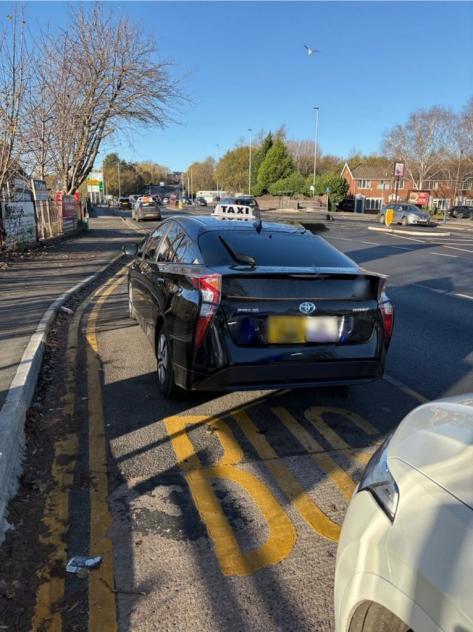
SHADY RIDE: TAXI IN STOKE STOPPED AFTER POLICE FIND FRONT WINDOW TINTS ALLOWING JUST 17
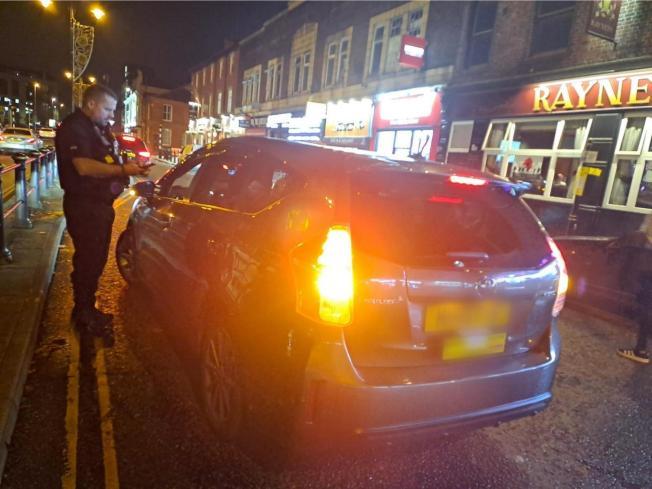
Police in Stoke ticket to a taxi driver after roadside checks revealed the vehicle allowing just 17 percent of light into the cabin, well below the 70 percent legal minimum for front side windows.
Staffordshire Police’s Dogs and Armed Response Unit reported that the inspection took place in the city, with officers describing the level of tint as far outside permissible limits for any road user. They stressed that the requirement carries added weight for licensed drivers carrying passengers for hire and reward.
The officers said the tints were removed at the roadside following the ticket being issued. The vehicle involved was a Toyota Prius operating as a taxi. No further details were released on the driver or licensing authority, and it remains unclear whether any licensing review will follow.
JOINT WOLVERHAMPTON COUNCIL AND GREATER MANCHESTER POLICE OPERATION TARGETS UNBOOKED AND UNINSURED PHV JOURNEYS
A joint enforcement operation between Wolverhampton Council’s Public Protection team and Greater Manchester Police took place across Bury and Trafford.
The late-night initiative checked private hire vehicles to ensure drivers were fully licensed, compliant and operating legally. Officers from both agencies worked together to identify vehicles working without correct licensing or insurance.
Wolverhampton’s licensing officers reminded the public that any private hire trip not pre-booked through a licensed operator is not insured. The message follows ongoing efforts to raise awareness about the risks of
A council spokesperson said drivers and vehicles were inspected to confirm documentation, insurance and booking compliance, helping maintain safety standards across local taxi and private hire services.
The operation is part of continuing partnership work between Wolverhampton Council and police forces in other areas to uphold licensing standards and protect passengers using vehicles licensed outside their home authorities.
Members of the public are urged to report any concerns about licensed taxis or private hire vehicles through the council’s website, using the details shown on the vehicle’s rear plate.
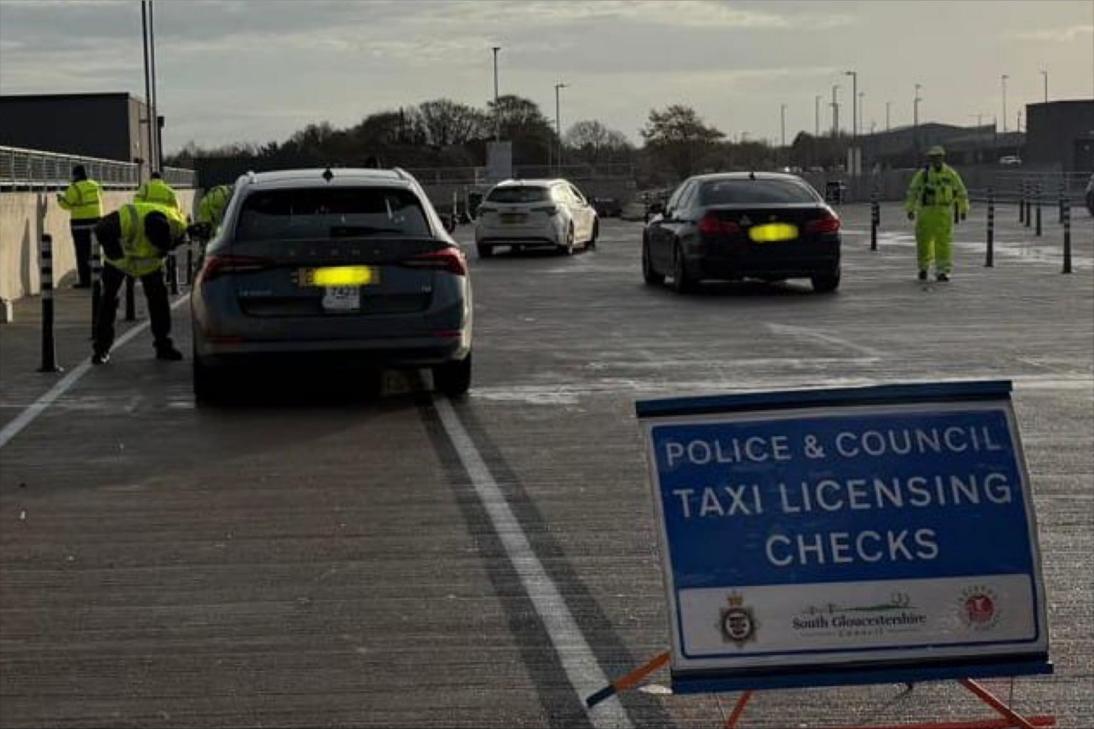
BRISTOL AIRPORT ENFORCEMENT: 92 TAXI AND PRIVATE HIRE CHECKS SEE STRONG COMPLIANCE ACROSS TEN DIFFERENT LICENSING AUTHORITIES
Alarge-scale taxi and private hire vehicle enforcement operation at Bristol Airport has shown high levels of compliance, according to Avon and Somerset Police.
The joint operation, carried out on Wednesday 5 November, involved officers from the DVSA and licensing teams from South Gloucestershire, Bristol, North Somerset and Merthyr Tydfil councils.
A total of 92 licensed vehicles from across ten different licensing authorities were stopped and checked. The vehicles came from North Somerset, South Gloucestershire, Bristol, Somerset, Cheltenham, Wolverhampton, North Devon, Monmouthshire, Cardiff and Gloucester.
Only two vehicles were immediately suspended due to tyre-related safety concerns. A further twelve vehicles were found to have minor issues, which were dealt with on site.
PC Patrick Quinton, Taxi Cop for Avon and Somerset Police, said the results showed good compliance across the trade, with particular praise given to
South Gloucestershire drivers for their high standards.
He added his thanks to the drivers for their patience and cooperation during the checks, noting that such operations are a key part of keeping passengers and drivers safe.
PC Quinton said on Thursday 6 November:
“Yesterday I was working at Bristol Airport with the DVSA and Licensing Officers from South Glos, Bristol, North Somerset and Merthyr Tydfil.
"We stopped and checked 92 licensed vehicles from: North Somerset, South Glos, Bristol, Somerset, Cheltenham, Wolverhampton, North Devon, Monmouthshire, Cardiff and Gloucester.
“As a result, only 2 vehicles were immediately suspended (for tyre issues), and 12 minor issues were dealt with. Good compliance rates, and particularly good standards from South Glos drivers
- thank you!
“As always, thanks for your patience and cooperation whilst we complete our necessary checks.”