

Everyone and Everywhere
Mitigating risk in your school district
Igniting Futures
Harlingen CISD Firefighter Academy sparks real-world career pathways
Q&A: Banding Together
Gregory-Portland ISD board governs by design
Featured Event
TASB GOVERNANCE CAMP GALVESTON MARCH 4-7
TASB Officers 2025-26
Tony Hopkins, President, Friendswood ISD
Mary Jane Hetrick, President-Elect, Dripping Springs ISD
Dan Micciche, First Vice President, Dallas ISD, Region 10C
Sylvia Sánchez Garza, Second Vice President, South Texas ISD, Region 1B
Justin Chapa, Secretary-Treasurer, Arlington ISD, Region 11C
Rolinda Schmidt, Immediate Past President, Kerrville ISD
TASB Board of Directors 2025-26
Carlos Bentancourt, Slaton ISD, Region 17
Lynn Boswell, Austin ISD, Region 13A
Darlene Breaux, Alief ISD, Region 4B
Steve Brown, Ector County ISD, Region 18
Marlene Bullard, Tornillo ISD, Region 19
Kevin A. Carbó, Mesquite ISD, Region 10D
Crystal Carbone, Pearland ISD, Region 4C
Julie Cole, Hurst-Euless-Bedford ISD, Region 11A
Thomas Darden, Cooper ISD, Region 8
Dynette Davis, Frisco ISD, Region 10E
Rebecca Fox, Katy ISD, Region 4E
Ginger Friesenhahn, East Central ISD, Region 20A
Angie Hanan, Fort Bend ISD, Region 4G
Carol Harle, Northside ISD-Bexar County, Region 20B
Regina Harris, Richardson ISD, Region 10B
Marques Holmes, Humble ISD, Region 4A
Bryan Holubec, Thrall ISD, Region 13C
Elizabeth Ivey, Montgomery ISD, Region 6A
Todd LeCompte, Cypress-Fairbanks ISD, Region 4F
Angela Lemond Flowers, Houston ISD, 4D
Mark Lukert, Wichita Falls ISD, Region 9
Stephen Mackey, Blanco ISD, Region 13B
Raymond P. Meza, San Felipe Del Rio CISD, Region 15
James Morton, ESC 8, ESC Representative
Steven Newcom, Eagle Mountain-Saginaw ISD, Region 11D
Nicholas Phillips, Nederland ISD, Region 5
Quinton “Q” Phillips, Fort Worth ISD, Region 11B
Margaret Pruett, Victoria ISD, Region 3
Tony Raymond, Sabine ISD, Region 7
Keri Roberts, Goldthwaite CISD, Region 12
Alison Savage, Lyford CISD, Region 1A
Robert Selders Jr., Garland ISD, Region 10A
Rich Sena, Boerne ISD, Region 20D
Cindy Spanel, Highland Park ISD-Potter County, Region 16
Greg Welch, Clyde CISD, Region 14



Mitigating risk in school districts is a team effort
Harlingen CISD Firefighter Academy sparks real-world career pathways
Texas Lone Star • Volume 44, Number1
Texas Association of School Boards P.O. Box 400 • Austin, Texas • 78767-0400 512-467-0222 • 800-580-8272
Laura Tolley • Managing Editor Shu-in Powell • Graphic Designer
Lalo Garcia • Photographer Prisma • Printer
Contributors: Sylvia Wood, Sara Butler, Theresa Gage-Dieringer, Beth Griesmer, Mary Ann Lopez, Matt Mitchell, Zachary Roberts, John Pyle, Vanessa Diamos, Tobi Bello, Jennifer Barton
Cover design: Shu-in Powell
Texas Lone Star (ISSN 0749-9310) is published six times a year by the Texas Association of School Boards. Copyright© 2026 by the Texas Association of School Boards (TASB). All rights reserved. Reproduction, adaptation, distribution, and exhibition in whole or in part are prohibited under penalty of law without the written license or permission of TASB. Copies of Texas Lone Star are mailed to trustees of TASB member school boards and their superintendents as part of their membership. Subscriptions are available to nonmembers for $36 (1 year), $69 (2 years), and $99 (3 years). Single copies are $5.
Address changes should be sent to Michael Pennant, TASB, P.O. Box 400, Austin, Texas 78767-0400.
Articles in Texas Lone Star are expressions of the author or interviewee and do not represent the views or policies of TASB. Permission to reprint should be emailed to communications@tasb.org or addressed to the Managing Editor, P.O. Box 400, Austin, Texas 78767-0400.
Texas Lone Star does not guarantee publication of unsolicited manuscripts.
Postmaster: Send address changes to TASB, P.O. Box 400, Austin, Texas 78767-0400.




April 26-28
Kalahari Resorts and Conventions
Round Rock, Texas
Registration open now for the Fund’s premier learning and networking event!
Don’t miss out on this opportunity exclusive to Fund members.
• Learn about timely and relevant risk management topics
• Connect with your peers
• Enjoy one complimentary hotel stay at Kalahari Resorts and Conventions for up to two nights per Fund member organization.
Register today at tasbrmf.org/conference
Connecting and Learning
Our voices are stronger together
by Tony Hopkins
It is hard to believe that the 2025-26 school year is already more than halfway complete, and that spring is quickly approaching.
I hope each of you felt genuinely appreciated by your communities during School Board Appreciation Month in January. The work you do as trustees is vital to the future of Texas and to the success of every public school student you serve. Your leadership, governance, and advocacy shape opportunities for children today and strengthen our state for years to come.
As we move further into the year, I also hope you have the opportunity to participate in your region’s TASB Grassroots Meeting. These meetings are the essential first step in developing legislative priorities for the 90th legislative session. They begin with you — locally elected trustees who bring real experiences and challenges from your communities.
The work then continues through two meetings of the Legislative Advisory Council in April and June, when representatives from all 20 regions come together in Austin and San Antonio to refine the regional recommendations into a unified set of statewide priorities. The results of LAC meetings culminate at Delegate Assembly at txEDCON, where delegates vote on the final Advocacy Agenda that will guide TASB’s work during the session. This locally built process ensures that our message to lawmakers reflects the needs of districts of all sizes and from every corner of Texas.
Building connections with lawmakers
The period between legislative sessions is one of the best times to connect with your state legislators while they are in their home districts and have more availability
for meaningful conversations. Strong relationships built now will pay dividends in 2027 when the next session begins.
Invite your city, county, and state leaders to your campuses, events, and celebrations. Let them see firsthand the great work happening in your schools! When elected officials hear your district’s stories directly from you — and see the impact on students — they better understand the challenges you face and the successes you create every day. These connections help ensure that public education remains supported, protected, and prioritized.
One of the most memorable stories this year came in November during the UIL State Open Class Marching Band Contest in San Antonio. As members of the Vandegrift High School band traveled to the event, their equipment truck was struck by a train, damaging instruments and casting doubt on whether they could perform.
When other schools heard what happened, bands from Flower Mound, Reagan, Cedar Park, and other districts immediately responded. They opened their trailers and loaned their own instruments so Vandegrift’s students would not lose their chance to compete.
In the end, Flower Mound won the championship, and Vandegrift earned the bronze medal — but the real victory was the inspiring example of collaboration, generosity, and unity among our public schools. It is stories like these that remind legislators and communities why our public education system matters and why investment in it is so essential.
trustees to continue learning and connecting with one another through TASB. Governance Camp in Galveston remains one of the highlights of the year, especially for its focus on student voice. Hearing directly from student leaders across Texas is inspiring and affirming.
Highlighting student success stories is the focus of Our Future Is Public, a campaign TASB launched last fall to showcase how districts of all sizes are helping students discover their passions and develop their talents in meaningful ways. Follow the campaign on Instagram at @ourfutureispublictx.
TASB’s Regional Workshops are also right around the corner. These sessions will offer access to expert training that is close to home and tailored to the real challenges districts face. With multiple breakout sessions to choose from, each region can select the topics most relevant to their community. These workshops will not only strengthen your governance skills, but they also will help you build connections with fellow trustees who share similar goals and responsibilities.
As we continue through 2026, I encourage you to take full advantage of these opportunities: connect with your elected officials, share the inspiring stories from your schools, and invest in your own learning through the many TASB trainings available.
Thank you for your service, your advocacy, and your unwavering commitment to the students of Texas.H
Learning opportunities at TASB
As spring approaches, remember there are excellent opportunities for
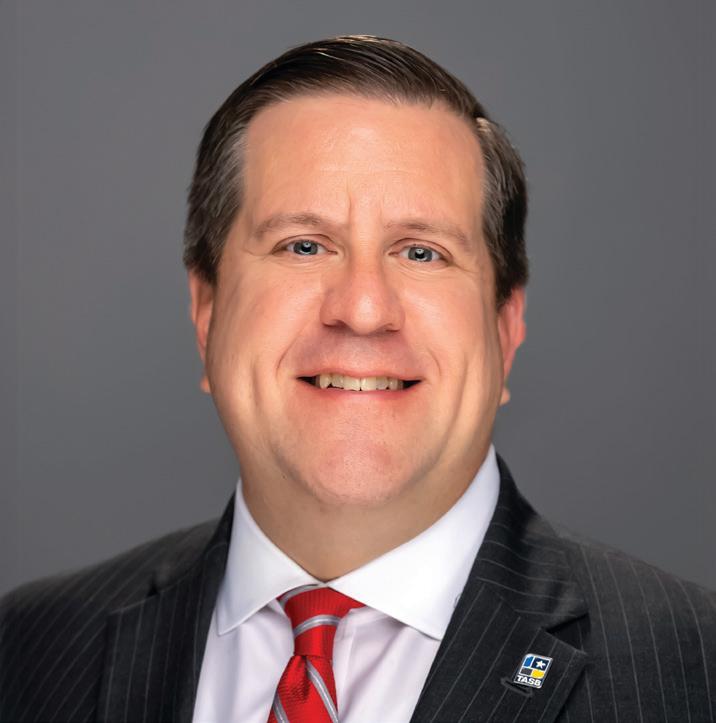
Tony Hopkins, Friendswood ISD’s board president, is the 2025-26 president of TASB.
Tony Hopkins

Serving Our Members
TASB works to help trustees and districts in 2026
by Laura Tolley
The new year is off to a productive start here at TASB and at Texas Lone Star. In this issue, the first of 2026, we offer a range of stories and columns that focus on strong board governance, innovative TASB programs and services, and inspiring school programs that benefit students.
Our cover story, which begins on page 8, highlights an important new training program at TASB designed to help school-district risk managers. This is a complex and weighty role in districts, and the responsibilities that come with it can feel overwhelming at times.
Last year, the Risk Management 101 Training Program was launched for risk managers whose districts are members of the TASB Risk Management Fund. The program is for risk managers who are tasked with a wide range of duties, including coordinating safety programs and navigating workers’ compensation issues. Participants also can network with other risk managers across Texas.
Kendra Estes, manager of risk management resources for TASB Risk Management Services, relied on her own experience and knowledge as a risk manager at Hutto ISD to develop the program. It’s just one example of TASB staff members using what they know to create
Texas public schools are preparing students for a wide range of bright futures — and the whole state of Texas benefits from their efforts.
solutions for members and their districts.
Another project that TASB staff members worked on throughout last year is launching in March. Read on page 38 about our reimagined Regional Workshops, which will bring trustees, superintendents, and other school leaders together in their own communities for expert training that is customized and responsive to the individual needs of each region.
School board governance
Want to know how one district leadership team stays focused on the top priority — student outcomes? Read an insightful Q&A with two school leaders at Gregory-Portland ISD in South Texas: Tim Flinn, school board president, and Michelle Cavazos, the district’s superintendent.
Flinn credits Cavazos for working on creating a high-functioning team through processes and dynamics that promote collaboration on meeting goals. Read more about this strong governance structure and collaborative culture in the story that begins on page 18.
The Gregory-Portland ISD board and superintendent often make presentations at conferences, including TASB’s Summer Leadership Institute and txEDCON. I thought it would be beneficial to have a story about them in the magazine to reach an even wider audience.
Districts always innovating
At the magazine, we love to highlight interesting and innovative programs in Texas school districts, and that continues in this issue with a story about Harlingen CISD’s Firefighter Academy on page 14.
Years ago, district leaders restructured existing CTE programs to develop 12

academies in response to survey data they had collected regarding Cameron County’s workforce demands and students’ interests. Harlingen CISD and many other districts across Texas are working diligently to create a wide range of career opportunities for students as well as respond to their local workforce needs.
Back when I was in high school, aka the Ancient Times, the range of career courses was pretty limited to shop and home-economic classes. Those are worthy classes, and I wish I had taken shop. I took home ec twice — but I’m not going to talk about the time my friend Cathy and I left a giant ball of pizza dough in the oven over the weekend, except to say that thankfully, there was no resulting fire at Albuquerque’s Del Norte High School.
I was never going to be a pizza chef. But I am grateful I had Mrs. Eakin in high school English and bestselling author Tony Hillerman at the University of New Mexico to help cultivate my love for writing.
Still, I’m a bit envious when I learn about all the different programs and courses offered in Texas public schools today. These schools are preparing students for a wide range of bright futures — and the whole state of Texas benefits from their efforts.
We truly enjoy writing about school districts in the pages of TLS — and we hope you find some inspiration in learning about what your fellow districts are doing.H

Laura Tolley is managing editor of Texas Lone Star.
Laura Tolley

Everyone and Everywhere
Mitigating risk in your school district
by Beth Griesmer




Behind every safe bus ride, every well-maintained playground, and every sturdy gymnasium roof is a risk manager focused on the next challenge.
For many Texas school districts, particularly smaller and fast-growing ones, the role of risk manager is often added to an already full plate. A director of maintenance, for example, may find themselves responsible for navigating safety protocols, loss prevention, or emergency response plans. Those responsibilities can feel overwhelming.
Kendra Estes remembers wishing for some kind of roadmap to navigate the sprawling responsibilities of school health, safety, and risk management when she started her role at Hutto ISD, a growing district northeast of Austin.
“I distinctly remember the first day at Hutto and sitting down at the desk thinking, ‘Where’s the manual?’” Estes said. “There wasn’t a framework there.”
A risk manager may be tasked with a range of duties, including managing property and transportation risks, navigating workers’ compensation, coordinating safety programs, and analyzing data to uncover risk trends in their district.

Like many risk managers stepping into the role for the first time, Estes felt the weight of responsibility immediately. The importance of this role in Texas school districts and other educational settings inspired Estes to develop a solution to help new risk managers when she joined TASB Risk Management Services and became the manager of risk management resources in October 2024.
The Risk Management 101 Training Program was launched last year to specifically support district employees who are new to the complex world of risk management and who work in districts that are members of the TASB Risk Management Fund (Fund). The program aims to help the cohort build foundational skills and professional confidence.
Modeled after Grow Your Own teacher apprenticeships, Risk Management 101 is designed to meet people where they are, regardless of job title, to give them a framework. The program also gives them guidance on building a network of supportive staff throughout their districts because risk can be anywhere.
Creating an opportunity
Before joining TASB’s Risk Solutions division, Estes spent years in healthcare risk management as a nurse in Illinois. When her
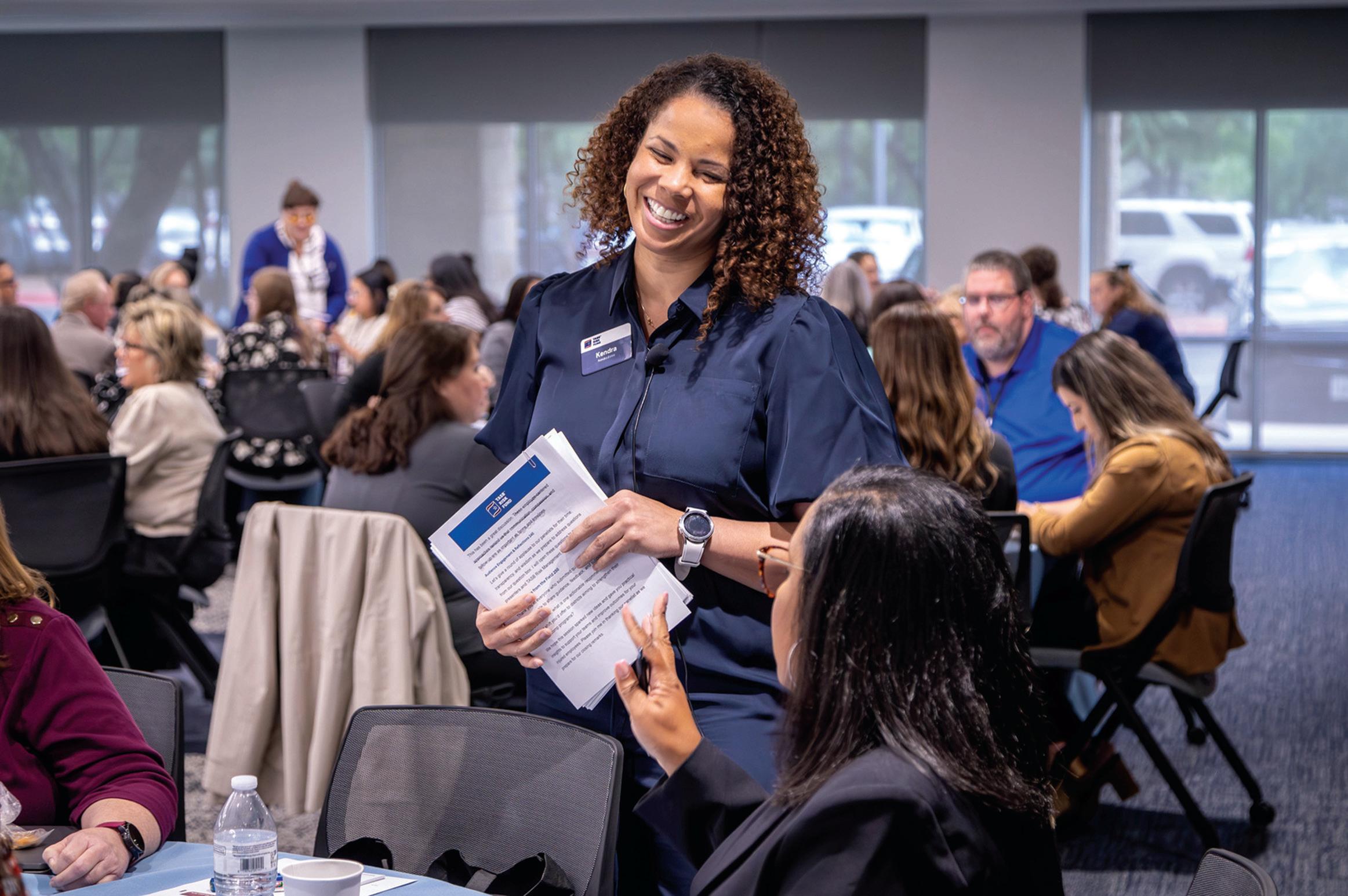
Kendra Estes interacts with members at a Fund event last year. She oversees the Risk Management 101 Training Program.
Photos by TASB Media Services
family moved to Texas in 2017, she became Hutto ISD’s director of health, safety, and risk management. That role expanded during her seven years in the district to include oversight of campus nurses and the safety officer, as well as districtwide risk management responsibilities.
During the COVID-19 pandemic, she leaned heavily on a group of nurse leaders organized through Region 13 ESC who shared information, experience, and moral support. That collaborative model stayed with her.
“It was that peer-based relationship that I wanted to emulate in the Risk Management 101 Training Program,” Estes said. “Everyone needs that safe space to share information and support.”
Participants of the training program commit to monthly online meetings and must attend at least 75% of the sessions. The 30-member cohort stays together throughout the training program, building relationships and trust along the way. The training is free, with no prerequisites, and will culminate in recognition at the Fund’s Members’ Conference in April.
The goal for this inaugural cohort, Estes said, is to educate and prepare them to be risk-ready while building a network of support across Texas, as well as within their own district.

Program expands the Fund’s work
The new program is part of the Fund’s overall efforts to help districts reduce risk. Formed under the Texas Interlocal Cooperation Act administered by TASB and overseen by a 21-member board, the Fund provides a range of comprehensive coverage, including unemployment compensation, workers’ compensation, auto, liability, cybersecurity, and property programs. The Fund also offers loss prevention resources, training, and grant programs, among other services.
“The ultimate goal of the Fund as a risk pool is to reduce risk as well as manage costs efficiently through sharing exposures across districts,” said Mary Barrett, associate executive director for TASB Risk Management Services. “One of the best ways to do that is to help the Fund’s members make informed decisions and mitigate risks where they can.”
When the Fund’s Board raised concerns over turnover among district risk managers — and the loss of institutional knowledge that comes with it — the Risk Solutions team saw that as an opportunity to support and empower members through knowledge.
Ellen Akers, director of employee health and wellness at Goose Creek CISD, is already experiencing the benefits of that empowerment.
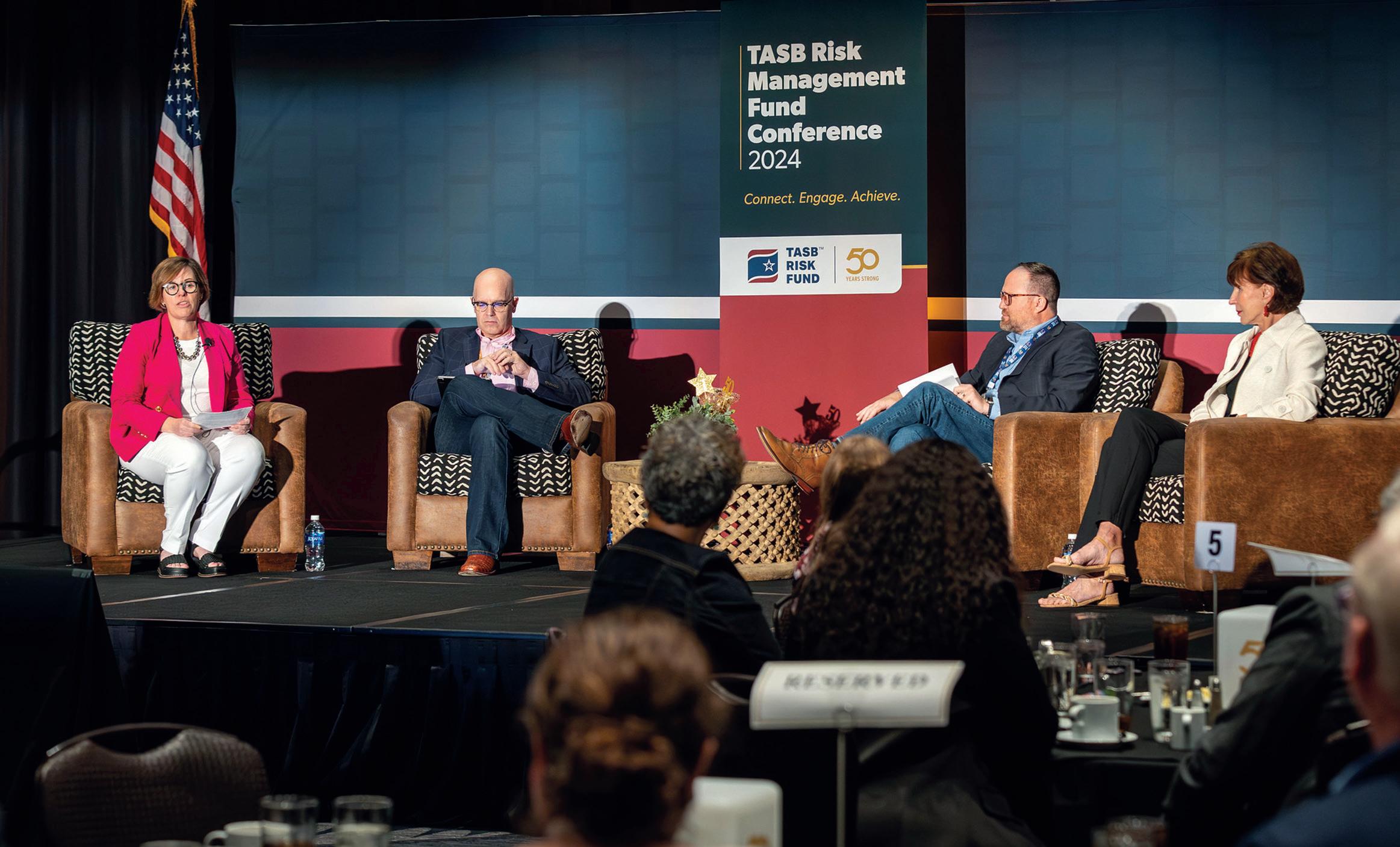
Mary Barrett, associate executive director for TASB Risk Management Services, speaks on a panel at Fund Member Conference in 2024.
Photos by TASB Media Services
“Participating in risk management training is valuable because it directly strengthens my ability to protect both employees and the district,” Akers said.
Being part of the Fund’s pilot program has impacted her work by reducing avoidable costs, improving employee safety, helping her navigate compliance, and providing operational consistency. She said the Risk Management 101 training has already given her “a strong grasp of risk trends such as injury patterns, leave usage, or health plan claims and helps me identify where strategic changes in benefits, wellness programs, or district procedures can reduce financial exposure.”
Building a community
The training schedule offers an overview of district risk management fundamentals, including liability basics, risk financing, workers’ compensation, cybersecurity, property and auto risks, and legal pitfalls.
Each session includes expert-led presentations and interactive conversations that allow participants to learn from one another. That sense of community is perhaps the most powerful thread running through the training program.
“It is a tough position,” Estes said of the role of risk manager in a district. “Most risk managers are a team of one on an island of none.”
New risk managers across the state often discover they are facing similar challenges of tight budgets, aging facilities, changing weather patterns, and competing demands on time. It can feel like risks are around every corner.
“As a director, part of my role is anticipating problems before they grow,” Akers said. “Risk management training equips me with a proactive mindset, so I can help implement preventive measures and not just respond after issues occur.”
This training has helped her promote a culture of awareness and prevention in Goose Creek CISD, a district of more than 21,000 students east of Houston. It gives participants the knowledge and confidence to build a community of risk-ready employees across their districts.
Building regional support
Bradley Berry is the director of school safety and security for Region 11 ESC, supporting school systems throughout the region in all areas of safety and security. His role includes overseeing school health initiatives and behavioral threat assessment processes for the public, charter, and private schools in the north central Texas region. The Risk Management 101 Training Program has been an opportunity for him to connect with others and gain insight into effective processes being used across the state.
“This experience has enhanced my communication skills around risk-related topics, allowing me to more clearly articulate both identified risks and the strategies we are implementing to address them,” Berry said.
“It’s not just risk managers keeping students safe,” Estes noted. “Every district employee plays a role.”
Berry agrees. “While one individual may lead and champion the overall process, it is essential for all employees to engage actively in maintaining a safe and secure environment.”
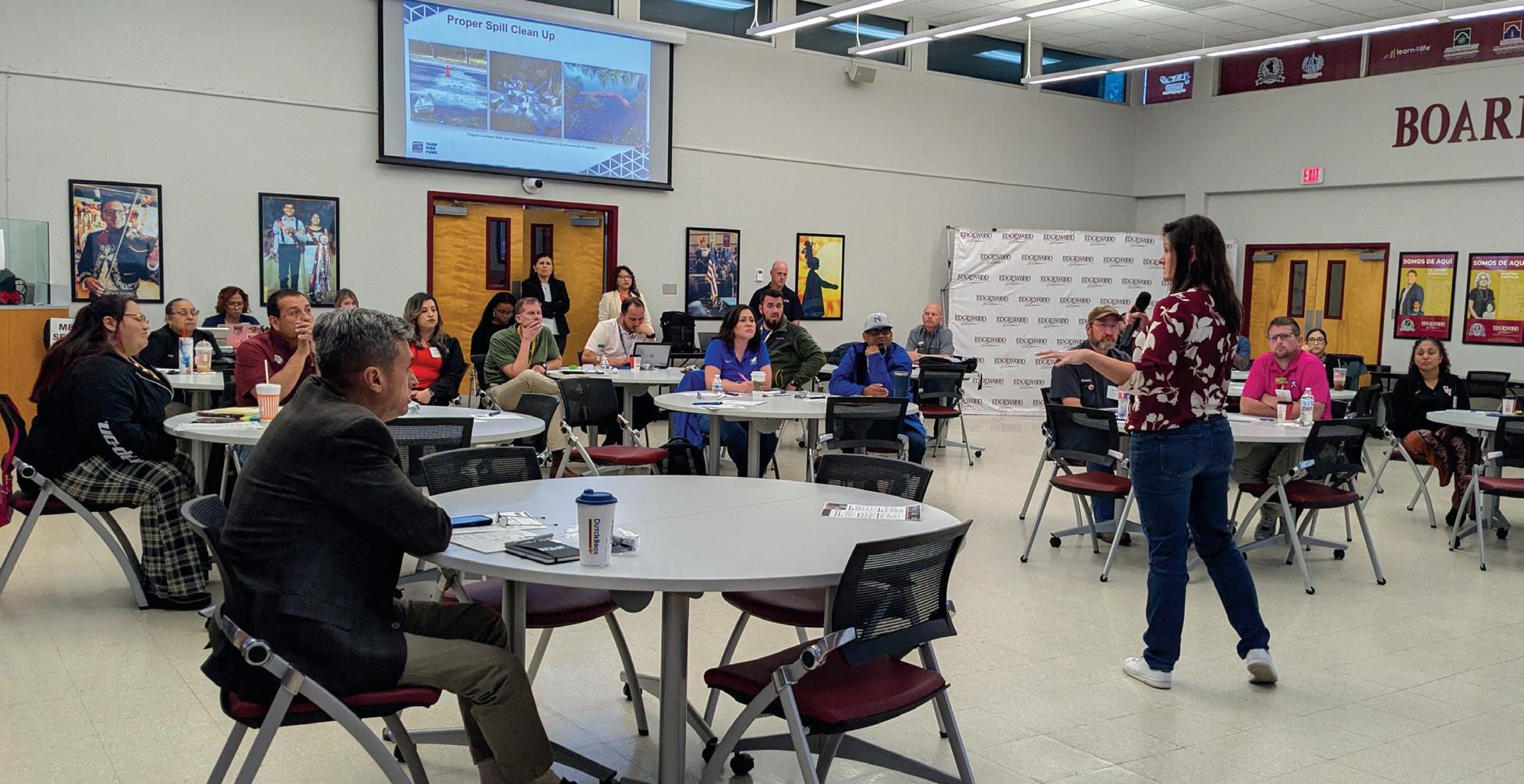


The TASB Risk Solutions team led a Vehicle Collision Investigation training for the transportation staff at Edgewood ISD last April.
Photo courtesy of TASB Risk Solutions

Members
To that end, Region 11 implemented monthly staff safety training. “We are working to embed safety, security, and risk-management practices into the daily routines of every employee, empowering them to make informed decisions and contribute to a safer organization,” Berry said.
Vanessa Turner, HR coordinator for Medina Valley ISD, a district of about 8,000 students west of San Antonio, believes risk management should involve the whole team.
“I feel it is extremely important for campus administrators and supervisors to understand and help support mitigating risk,” she said. “It cannot be the sole responsibility of safety and HR to make improvements.”
Through her Risk Management 101 training, she is working with district employees to increase awareness and change processes to streamline medical attention for all employees.
Everyone is a risk manager
The Fund membership includes community colleges, and Jessica Alaniz, executive director of administration at Del Mar College in Corpus Christi, jumped at the chance to be part of Risk Management 101.
“When I received communication that I was selected, I was excited at the opportunity to learn from experts and from my peers in the field,” Alaniz said.
Although she has been over risk management at the college since 2016, Alaniz felt she had much to gain from being part of the cohort and gaining new insights into the ever-evolving world of risk mitigation.
“We all have the same goal of serving our students,” Alaniz said of her colleagues at Del Mar College. “And it is my job to share the knowledge that I have in risk management to contribute to the success of that goal.”
Alaniz, like many risk managers across the state, needs her co-workers to support risk mitigation through daily decisions.
“I always tell my colleagues that my role is not to say no but to present the opportunity to find other ways of achieving the same goal without increased risk to others and the institution,” Alaniz said. “Mitigating risk is everyone’s responsibility in any workplace.”
Risk Management 101 reflects the Fund’s belief that strong, confident leaders strengthen entire school systems. By equipping new risk managers with foundational knowledge, practical tools, and a statewide support network, the program is helping districts create safer environments for students and staff.
“Effective risk management is complex,” said Barrett. “Resilient and proactive members strengthen the Fund. Informed decisions lead to fewer claims and fewer claims save all Fund members money in the long run.”
Knowledge is priceless
Estes stresses the fact that all training through the Fund is at no cost to its members. “It’s one of the many benefits of being a member.” The Fund’s training offerings go beyond Risk Management 101, including online courses through a new platform with more than 400 compliance-focused training courses.
The focus of all training is on meeting members where they are in
of the Goose Creek CISD marching bands pose with the color guard. District facilities and activities pose unique challenges for risk managers.

their risk mitigation and compliance journey, said Estes, which can include in-person training customized to the organization’s needs.
Akers, Berry, Turner, Alaniz, and the rest of the Risk Management 101 cohort will be recognized at the Fund’s April conference. That moment will reveal the arc of growth: newcomers becoming knowledgeable practitioners and, hopefully, mentors to the next Risk Management 101 group.
Perhaps most importantly, all 30 members of the cohort will meet each other in person for the first time. As a member-governed risk pool, the Fund depends on strong relationships across districts. Collaboration and sharing best practices are built into the mission.

“We want this program to grow with the emerging needs of our members,” Estes said. “We want longevity, innovation, and, most importantly, community.”
While risk managers across the state may be a staff of one or have risk management as one of many varied responsibilities, in the Fund and its membership, they have the support they need to help their districts become safer for everyone.
“The Risk Management 101 Training Program is one part of a greater strategy to help members make informed decisions, mitigate risks where they can, and steward their district’s financial resources,” Barrett said. “The Fund thrives when its members are safer. That takes everyone, everywhere making solid risk management decisions every day.”H
Beth Griesmer is a staff writer for Texas Lone Star
Fund Members’ Conference in April
The TASB Risk Management Fund will hold its biennial members’ conference on April 26-28 at Kalahari Resorts and Conventions in Round Rock. The conference is an opportunity to network with peers and celebrate success.
Conference details:
• No cost to members as part of Fund membership
• One complimentary hotel stay for up to two nights per Fund member organization (based on availability)
• More than 20 educational sessions led by school risk management experts
• Opportunities to make lasting connections and learn from peers
• Welcome reception, first-time attendee breakfast, membership luncheon, and member awards dinner



Scan to learn more about the conference



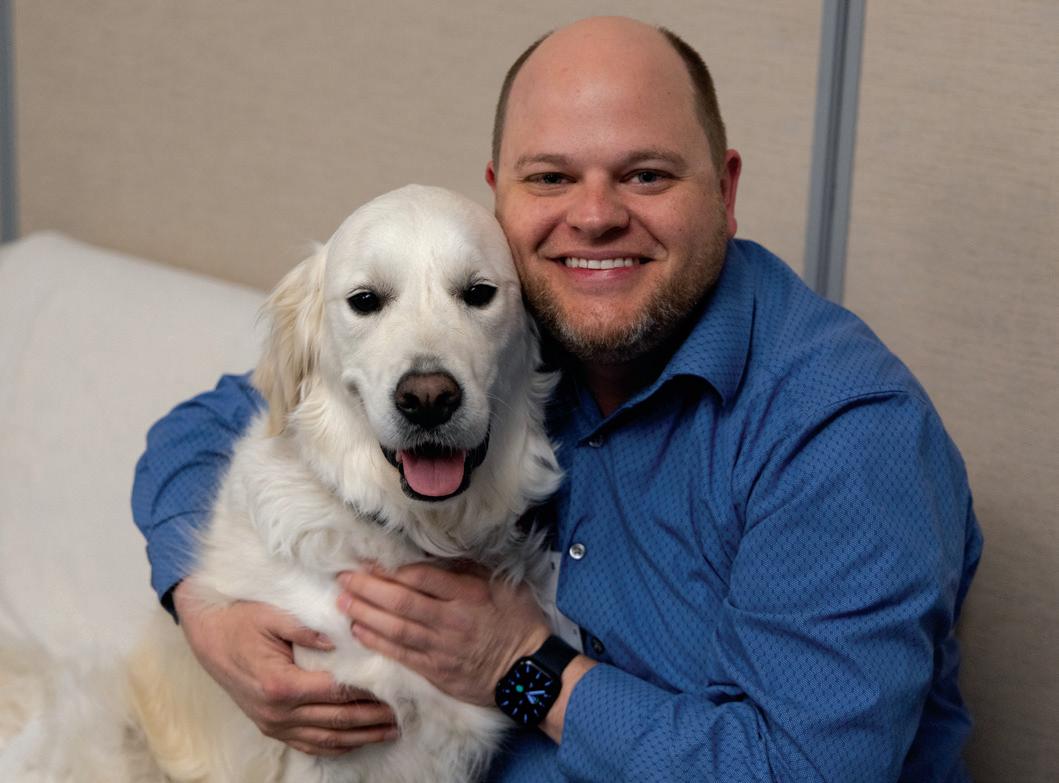
Bradley Berry, director of school safety and security for Region 11 ESC, poses with an emotional support dog used at a district in the region. Promoting student well-being is an important component of safe campuses.
Photo courtesy of Goose Creek
Photo courtesy of Region 11

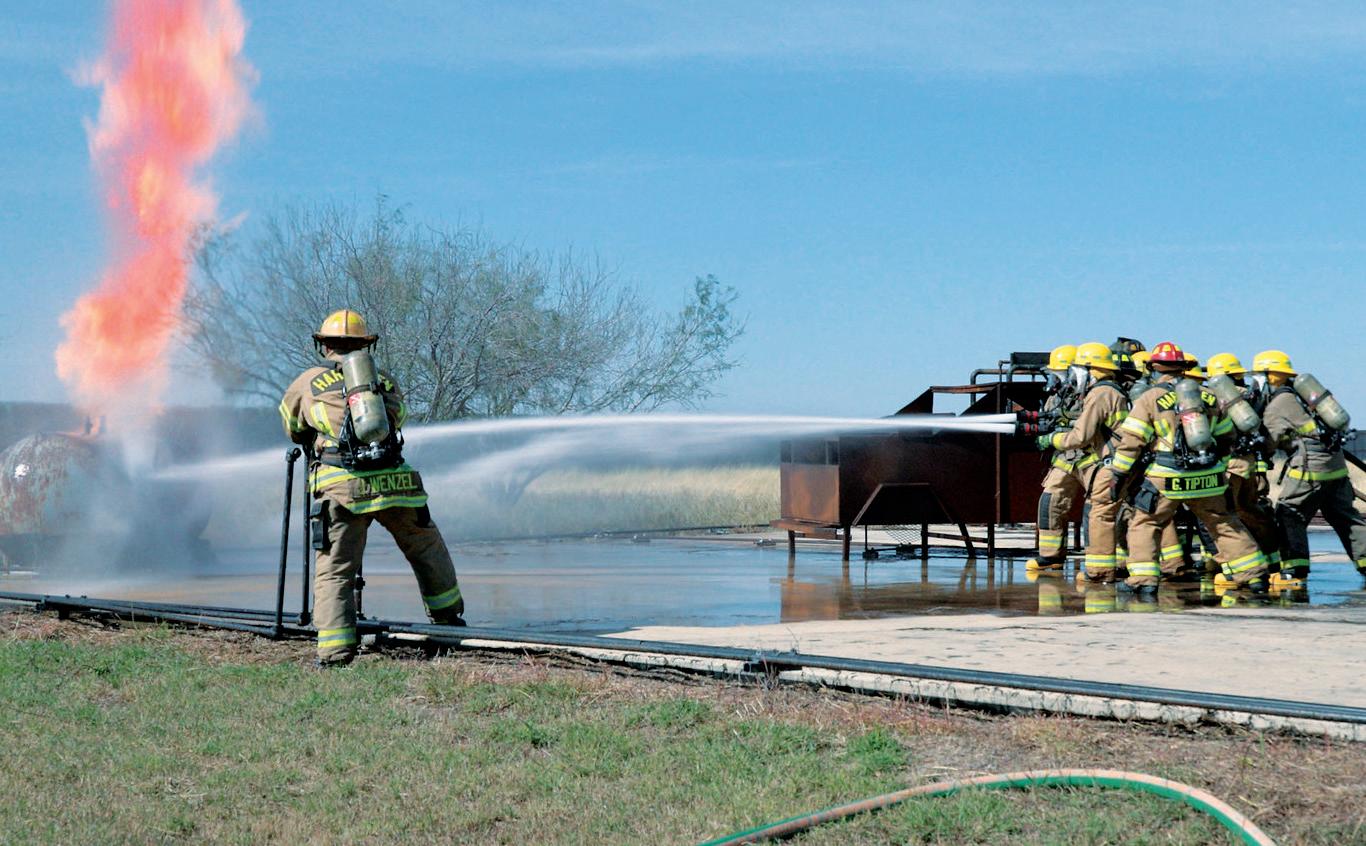
Students in Harlingen CISD’s Firefighter Academy battle a staged fire as part of their training.
Photo by TASB
Services
Harlingen CISD Firefighter Academy sparks real-world career pathways
by Laura Tolley

Gavin Price keeps the childhood photograph that seems to be peeking into his future. Dressed in oversized gear borrowed from a “real” firefighter, a smiling young Price poses in front of a fire truck in Harlingen, Texas.
Today, 22-year-old Price is the proud firefighter responding to fires, assisting at accident scenes, aiding people with medical emergencies, and more. And when he’s in the bay cleaning equipment at a Harlingen Fire Department station, children occasionally wander in wanting to get a selfie with a real firefighter.
“It’s definitely a full-circle moment from when I was a kid,” Price said. “I really like what I do. I like to help people.”
Price started chasing his dream job a few years ago at an unexpected place — Harlingen High School South, where he went through the Firefighter
Academy. It’s one of a dozen career and technical training academies created by the South Texas district for students interested in getting a head start on a career before graduating.
Harlingen CISD and districts across Texas understand that public schools are an essential component of the Texas workforce pipeline and that it’s their mission to prepare students for bright futures.
“At HCISD, we believe that talent is universal, but opportunity is not,” said Dr. Nolan Perez, the district’s school board president. “Our Firefighter Academy is one of the ways we bridge that gap for students.
“When we create programs that open real doors to service and high-skill careers, we show our young people that their future is not limited by circumstance but expanded by opportunity,” Perez said. “Our board is incredibly proud of the students and partners who make this academy a model for what public education can be.”
Harlingen
Fueling the workforce pipeline
Nearly a decade ago, Harlingen CISD leaders restructured existing CTE programs to support a comprehensive four-year vocational graduation plan that included work-based learning placements and dual enrollment opportunities, said Nelda Alonzo, director of the district’s CTE Department. Twelve academies were developed in response to Cameron County’s workforce demands and student interest survey data.
The academies include a total of 32 programs of study, giving students opportunities in engineering, welding, culinary arts, cosmetology, health science, business, the arts, and more. Each academy provides a structured pathway with hands-on learning, dual credit, certifications, and work-based experiences. Teachers connect students with business professionals and experts in each of the fields of study. This means students get real-world experiences, career training, and certification opportunities.
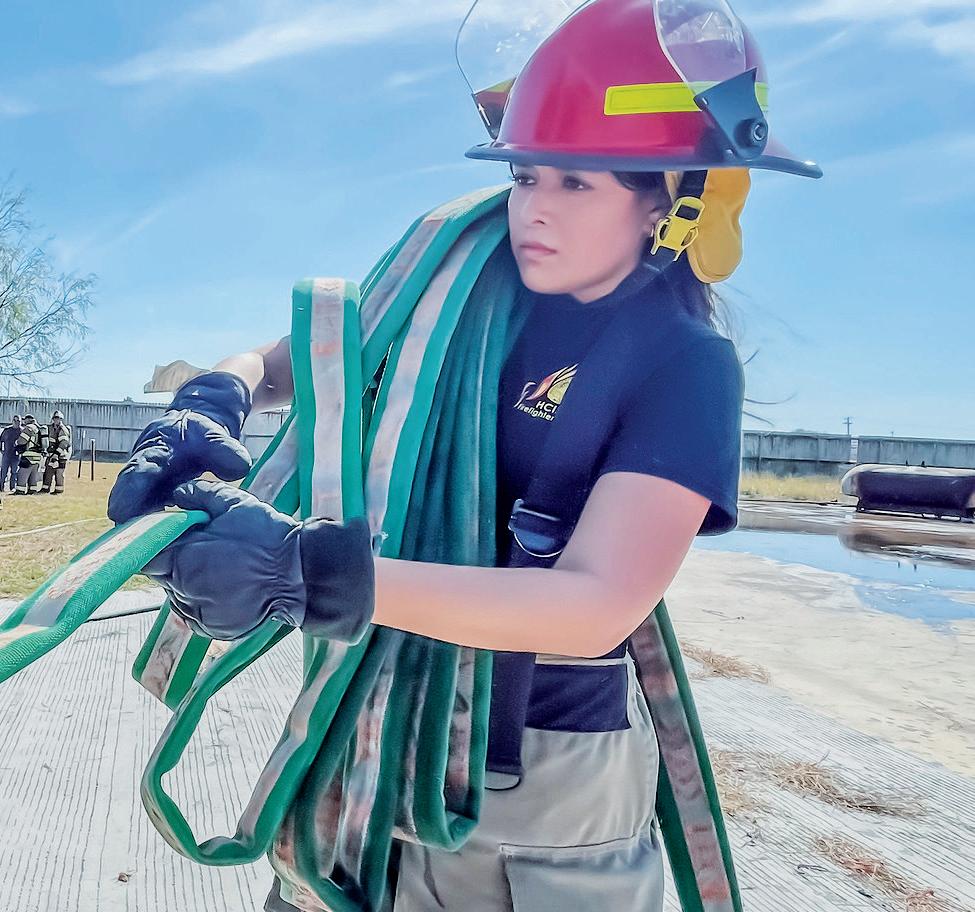
For Madison Garcia, a junior at Harlingen High School, the academy offers her a chance to become part of a family tradition.
“This has been my goal. Being here has been my dream ever since my dad has been in the workforce; that’s all I knew — just firefighting,” Garcia said. Her mother also works in the industry as well as others in her extended family.
Garcia believes it’s beneficial, both physically and mentally, for her and other students to be able to start firefighting training at a younger age, rather than having to wait until after graduation or later.
“I think it’s amazing that HCISD has this program. It gives us so much knowledge at our age,” she said. “I believe it’s better for us — and the Harlingen Fire Department.”
Garcia said she learns in the classroom, the field, from teachers, and even older students as she watches and studies what they are doing. “It’s just honestly really cool.”
Expanding, improving to meet needs
Since it was first opened in 2017, the Firefighter Academy has grown into a full First Responders Academy that includes fire, EMT, and law enforcement pathways. The program “stands out as an example of what makes HCISD CTE strong — deep community partnerships, alignment to labor market needs, and meaningful choices for students,” Alonzo said. “It truly demonstrates our commitment to preparing every student for college, career, or industry training with purpose and confidence.”
Harlingen CISD, which serves 16,200 students, has
Photos by TASB Media Services
Madison Garcia , a junior at Harlingen High School, learns how to wrap a water hose as part of her training at the Firefighters Academy.
“I think it’s amazing that HCISD has this program,” she said.
Getting real-world training on fighting fires is a key component of Harlingen CISD’s Firefighter Academy.
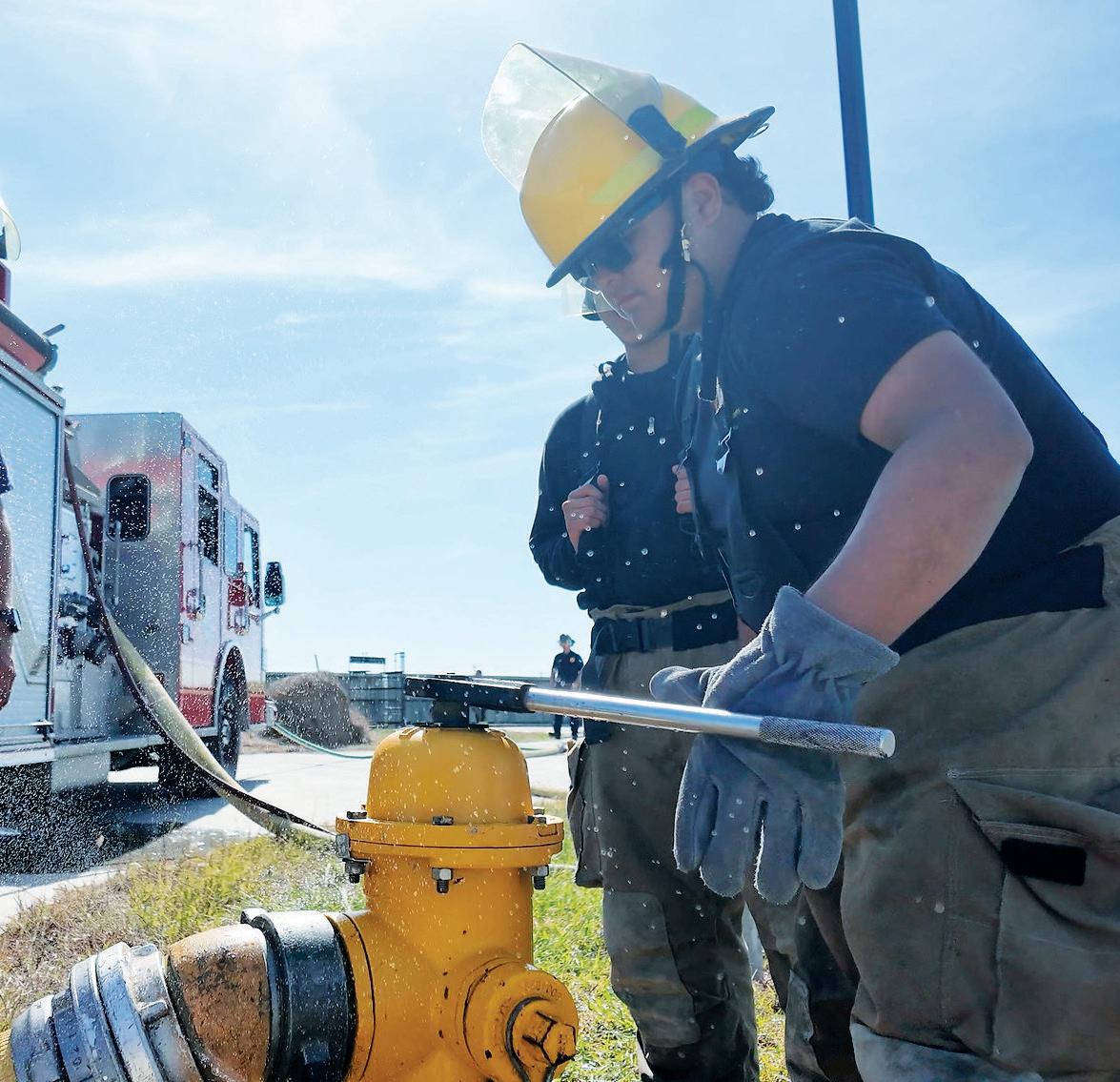
A student in the Firefighter Academy gets direct training on handling a fire hydrant.
extended these CTE programs through partnerships with surrounding school districts that are smaller and don’t have facilities for this specialized training. Students from La Feria ISD, which has 2,882 students, and Lyford CISD, which has about 1,440 students, travel to Harlingen to participate in the academies. Alonzo hopes the program will add partnerships with other neighboring districts so that even more students can be served.
Additionally, the academy has moved from a high school campus environment to a dedicated training facility where students have access to realistic training opportunities. They fight fires!
“Public safety is a highdemand field in our region, and this academy gives students authentic training environments, industry-level equipment, and direct mentorship from Harlingen fire, EMS, and law enforcement professionals,” Alonzo said. “More broadly, it strengthens our full CTE ecosystem.”

The quality of student training has been bolstered through such additions as the purchase of a fully equipped ambulance for EMT training. A grant from the Jobs & Education for Texans Grant Program allowed the district to build a burn center that’s located at the City of Harlingen’s fire department administration building.
Alonzo said the academy has maintained its state designation as an approved fire training center.
“This demonstrates HCISD’s commitment to high standards, strong partnerships, and preparing students for real careers in public safety,” she said.
Firefighters teaching students
A key component of the academy is the chance for students to learn directly from local firefighters. Kristopher Armstrong, a Harlingen Fire Department captain who has overseen the academy for about five years, said this partnership also allows the fire department to share its equipment and other items to operate the academy. Instructors are Harlingen firefighters who teach at the academy on their days off.
“The training the HCISD students receive is the exact same as any firefighter in the state of Texas receives,” Armstrong said, adding that the program follows guidelines from the Texas Commission on Fire Protection, which certifies firefighters in Texas.
“I think the program gives students an opportunity to explore a career that they are interested in; it gives
them a lot of options for right out of school,” said Armstrong, who has been with the Harlingen Fire Department for about 25 years. “The completion of the academy also gives students a sense of accomplishment, whether they choose to continue in this field or go off to other ventures.”
The program has had a real-world impact on students and the community. So far, the academy has trained about 60 students, five of whom immediately got jobs after completing the Firefighter Academy.
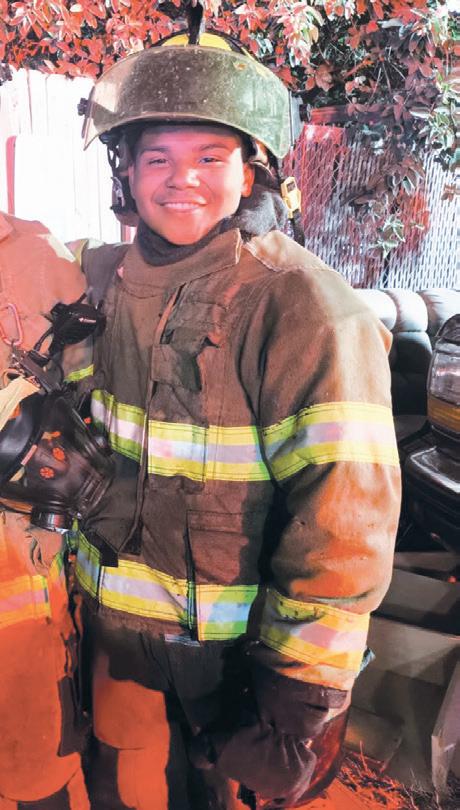
Price loved attending the academy and how it prepared him for a career — the intense training, the opportunities to learn from those already in the field, and the chance to form friendships with fellow students as well as the teachers.
“You get real close with your buddies,” he said. “The guys in my class, I work with some of them now. They’re real good people.”
In addition to direct firefighting skills, Price said he learned about the equipment on a fire truck, search-andrescue skills, vehicle extraction, and CPR. They also practiced how to get ready to go on a call — fast. It’s called bunkering up, which means getting your gear on effectively in less than two minutes. “We got a lot of practice on that,” he noted.
After graduation, Price attended Texas State University, earning an associate degree in fire science. He briefly went to work for the San Juan Fire Department before joining the Harlingen Fire Department in February 2025, where he went through the department’s academy and earned his EMT certification.
At Harlingen, he reunited with some of his teachers back in high school. “A lot of these guys, we work with now. It’s super nice.”
In less than a year, Price has worked on a variety of calls, including structure fires, brush fires, gas smells, motor vehicle accidents, and medical emergencies. Price also enjoys the camaraderieand the welcoming response from the community.
“This is what I came here for,” he said. “It’s a role I’m proud to serve in my community. It’s the most rewarding thing ever. I’m so grateful.”H

Scan to read about Texas CTE programs.
Laura Tolley is managing editor of Texas Lone Star.
Childhood Aspiration: Gavin Price poses in oversized firefighting gear as a kid, years before becoming a firefighter.
Dream Achieved: Price is now a proud member of the Harlingen Fire Department.
Photos Courtesy of Gavin Price


Banding Together
Gregory-Portland ISD board governs by design
BY MARY ANN LOPEZ






For Tim Flinn, board president at Gregory-Portland ISD, when it comes to governance and the decision-making process, keeping the number one thing the number one thing, means that student achievement is always the primary focus for the district’s leadership team.
Flinn credits Superintendent Michelle Cavazos, who began her leadership role at the district in July 2020, with creating processes and dynamics that create a high-functioning team, ensuring her administrative team and the board of trustees each stay in their own lanes, while working collaboratively to meet goals.
But it wasn’t always that way, Flinn said. When he was first elected in 2015, he said there wasn’t really an official onboarding process in the South Texas district, which serves more than 5,000 students. As a result, he was uncertain what his role was as a trustee.
“If you don’t have a vision or mission statement, you do not have board operating procedures, or if you don’t have board norms, you’re just going from the hip, and you have no structure,” Flinn said. “The structure she’s allowed us to put into place is a strong structure. If I stepped down tomorrow, the board would not miss a thing; they would not flinch because we have all of those things in place.”


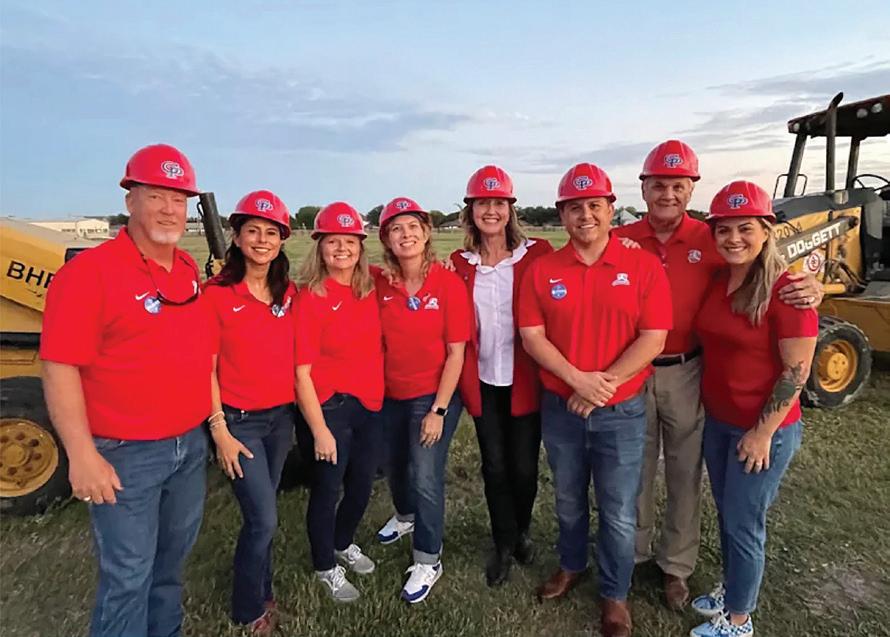
SHOWING THEY HAVE A PLAYFUL SIDE, THE LEADERSHIP TEAM FROM GREGORYPORTLAND ISD POSES AS A ROCK BAND.
ALL PHOTOS COURTESY OF GREGORYPORTLAND ISD. Portland

Building a high-functioning team that stays focused on its mission and vision doesn’t happen overnight or without effort, Flinn and Cavazos shared. Creating a collaborative culture requires action in and out of the boardroom. From Flinn’s and Cavazos’ standing breakfast meeting to scheduling meals with individual trustees and attending district events to incorporating special team-building workshops, the goal is to build a leadership team that stays focused on outcomes.
Cavazos and the trustees often make presentations at conferences, including TASB’s Summer Leadership Institute and txEDCON. That is intentional and another way the leadership team builds collaborative relationships, she said.
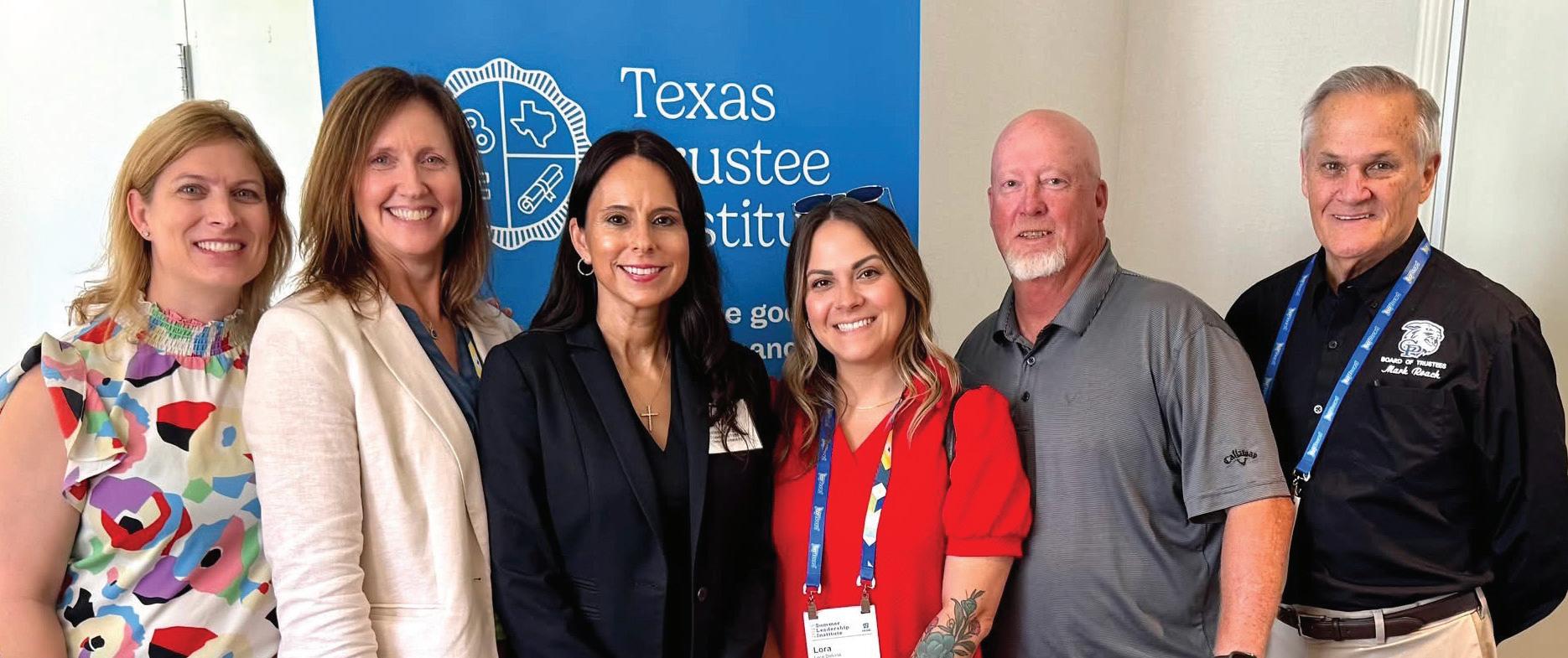
At SLI in June 2025, the leadership team presented a session titled “Keeping the Band Together,” which focused on how tuning up, practicing, and harmonizing is needed to make great music, and how those actions
are similar to the work it takes to create a collaborative leadership team. Texas Lone Star spoke with Flinn and Cavazos about what boards and superintendents can do to maximize effectiveness, build relationships, and prepare for the board’s future. Their comments have been condensed and lightly edited.
When working to build a strong leadership team, is there a suggested starting point?

FLINN: Governance is such an important thing, but when you have a room with eight people who are all Type A personalities, you have to keep the focus on the number one thing, student achievement. Not on your agenda, not on your personal beliefs. That starts with good governance. It starts with really focusing on what is a trustee’s job and what is our lane.

CAVAZOS: Part of building the team is knowing what
our strengths are, each of our quirks, and what drives us. That helps us navigate better situations and scenarios, and to know how to better support each other to be successful as a team.
What do you think are the key elements that go into creating a collaborative and productive team?
CAVAZOS: Tim mentioned governance, and we do governance workshops quarterly, which allow us in that time to really work on ourselves as a team. For example, one workshop we did recently related to trust within the team. We consider what are some things that can derail a governance team in working in the strategic lane. We try and talk through situations before they arise.
FLINN: It takes mature individuals to be able to sit and discuss and have a difference of opinions. Governance is huge, but when we look at our board scorecard, we don’t all have to think


TO BUILD COLLABORATION, THE LEADERSHIP TEAM OFTEN PRESENTS AT CONFERENCES SUCH AS TXEDCON, WHICH WAS HELD LAST YEAR IN HOUSTON.
alike; we don’t all have to vote alike. We know we can all disagree.
What role does the district’s mission (and mission statement) play in the work you are doing to create a strong team?
CAVAZOS: Mr. Flinn mentioned that when we keep our focus on the students, that makes everything — or most things — fall into place. For example, we read our mission, vision, and beliefs at each board meeting, as well as at every meeting we have throughout our district. If there’s a decision and it doesn’t align with our mission, it’s an easy no or yes, depending on what it is. It keeps us very focused on our work.

At your SLI session, you spoke about finding the right players for the board. How can a leadership team do this in a way that allows for openness and diversity of thought?
FLINN: Our job is to allow her to lead, and all those things (the mission, vision, board norms) remind us about governance, who’s in charge, who runs things, who is the voice of the district. We have been blessed to have people who have servant hearts who are there for the right reason. And even though you are there for the right reason, if
FLINN: When I’m out talking to people, I may know them and may not know them. I’ve been in sales management my whole career; I understand peoples’ characters. I don’t care if they are left, right, center. If they have a good heart and they are coming from that direction, I will push them in that direction — toward being on the board. I start coaching the next leaders. I’m out talking to people all the time.
CAVAZOS: Since I’ve been here, we’ve had several different district committees, and we’re very strategic about who we invite. And we have an open invitation to the community at the end of each year for people interested in being on committees. I ask our current trustees to name two or three people who they would have represent them on their behalf. There’s a lot of learning about the district through the different committees, such as what is our financial status or what do our academics look like. So, we are building capacity within community

THE GREGORY-PORTLAND ISD BOARD OF TRUSTEES AND SUPERINTENDENT MICHELLE CAVAZOS ATTEND A GROUNDBREAKING CEREMONY.
MEMBERS OF THE GREGORY-PORTLAND ISD BOARD OF TRUSTEES AND DISTRICT LEADERSHIP, INCLUDING SUPERINTENDENT MICHELLE CAVAZOS, GATHERED FOR A GRADUATION CEREMONY.
members or family members of our students who then could be potential future trustees.
How do you tune up over time?
What are some key things you do as a leadership team to ensure that you continue to work well together?
CAVAZOS: We do quarterly governance workshops. We do an annual selfevaluation and review where we are with our trust with each other. And it leads to conversations that are more vulnerable than just about the work. It lets us work on the team.
FLINN: And we have our clear communication matrix that Dr. Cavazos brought to the district. That is a huge tool for us. If one board member asks a question, it gets put into that matrix and that way every board member knows the answer to that question, and it’s not just answered to that one board member. Keeping that open line of communication is huge.
One thing about our board, we always have an open line to the superintendent. In other words, you don’t have to go through the board
president to ask the superintendent a question; it’s nice if you copy me, but you don’t have to go through me. She’s built really strong relationships with the seven board members to the point where they are calling to ask advice about other things. We’ve developed this relationship. This team is stronger — we don’t have a weak link.
What steps do you take to build trust and connection as a team?
CAVAZOS: I work really hard so that my board isn’t blindsided by good, bad, or ugly information. And they’ve learned that sometimes things happen really fast, so maybe I’m not able to get the information to them, but they have learned to say, ‘The district has it under control, thank you so much.’ I guess I call it feeding forward; we have other mechanisms to let them know what is going on. They have talking points and points of pride, so they can talk about it with community members. It empowers them.
Trust is built by small daily actions over time. Yes, someday there may be something bad that happens at our district, but hopefully we’ve made enough deposits with our board and
our community so that they know, ‘Hey, this is a one off.’ And we continue to have that trust and build that trust over time.
What else should readers know about your knowledge and understanding of leading by example?
CAVAZOS: A great team doesn’t happen by accident. It’s not a one-time event; it is something worked on daily and with great intentionality. When a team is willing and puts in the work, they can be unstoppable for kids and for the organization as a whole.
FLINN: One thing that I’ve tried to do in probably the last 12-18 months, when I talk to people, is to try to explain to them the difference between a trustee and a representative. When you are elected to the board of trustees, you are not there to represent. You are there — you are trusted to do what is right by the students, the staff, and the taxpayers. It’s not a group over here that has a loud voice. You’re trusted to do what is right by the students, staff, and the taxpayers. H
Mary Ann Lopez is a staff writer for Texas Lone Star.
THE MEMBERS OF THE GREGORY-PORTLAND LEADERSHIP TEAM ATTENDED SLI TOGETHER IN JUNE 2025 AND POSE FOR A PHOTO.
How to Build a High-Functioning Team
1
Engage outside of the boardroom
Gregory-Portland ISD Board President Tim Flinn says that good working relationships require teams to build bonds, and the work doesn’t just take place during a regularly scheduled meeting; it also happens when sharing a meal or attending a district event.
2
Offer candidate-trustee orientation and onboarding
If elected, a candidate is working for the greater good. Having a candidate orientation before a trustee is elected helps clarify what their role will be. Then, once they get elected, the onboarding process is critical. That orientation brings them on board and shortens the learning curve.
3
Remember your ‘why’
For a leadership team ready to do the work to become a high-functioning team, GregoryPortland ISD Superintendent Michelle Cavazos says it’s vital to center on why trustees and superintendents are there in the boardroom. “Our moral imperative is to educate our kids to be successful and to be well equipped, and so any team embarking on this needs to focus and get in the same room and talk about it and hash it out.”

4
Stay in your lane
Flinn said that when he was first elected, he was constantly questioning things. “It’s not my job to figure out what kind of utensils we are using in the cafeteria.” Cavazos said it’s like a multi-lane highway, “When everybody stays in their own lane, traffic flows really smoothly. When people are getting in each other’s lane and are moving at different speeds, that’s when things slow down. Our forward movement slows down.”
5
Know when to bring in a third-party consultant
Cavazos and Flinn agree that a neutral thirdparty consultant can benefit the team. “They can say some of the things that help us grow as a team or ask some of the uncomfortable questions,” Cavazos said. While their leadership team has evolved so that they don’t always need an external voice, there are times when that external voice or partner can be helpful to challenge the team, and they can be the “bad guy” who helps the group grow.

If your team is ready to take its leadership to the next level but not sure where to begin, TASB Board Development Services’ consultants can be that third-party guide to support you with in-district consulting based on your team’s needs. Learn more about BDS consulting opportunities.



Plan Your 2026 Learning

Local Training. Trusted Expertise.
TASB Regional Workshops offer customized training to help school board members serve schools and communities. Trainings feature statewide and local experts. Choose the location that works best for you.
Region Location Date Regional Workshops: Spring

Learning Journey
Upcoming Events
MARCH
4-7
Governance Camp
The conference that inspires collaboration and amplifies student voice in school leadership. Galveston
Summer Leadership Institute
TASB’s signature conference builds trustee skills and connections for effective governance. Especially valuable for new board members.
10-13
17-20
OCTOBER
8-11
txEDCON
Texas education leaders unite to connect, collaborate, and advance student success.
Houston
TASB Delegate Assembly
The annual event where Active Members shape TASB’s direction, elect TASB officers and directors, and approve the Advocacy Agenda.
Houston
• Board Member’s Guide to Understanding Employee Benefits
• Staffing and Compensation Ideas for a Tight Budget
• School District Compensation (HB 2)
for more online learning opportunities? Stay sharp and in the know with TASB’s Online Learning Center (OLC) — your anytime, anywhere resource for school board trustee development.
Conflicts and Gifts
What trustees should know about changes in rules
by TASB Legal Services
The 2025 legislative session brought sweeping changes to conflict-of-interest and gifts rules affecting Texas public schools. While the core disclosure statutes remain in place, lawmakers added new prohibitions and penalties designed to restrict vendor relationships and outside employment by administrators.
“Recent legislation significantly changes the rules around conflicts and gifts,” said Mark Tilley, division director of TASB Legal Services. “And TASB is ready to assist trustees with compliance so they can focus on good governance and serving students.”
Here is what’s new, what’s unchanged, and the practical steps board members can take right now to stay compliant and protect their district’s integrity.
Changes from the 2025 session
New civil penalties for administrators’ outside personal services (Educ. Code § 11.006)
Lawmakers created a clear-cut rule: school district administrators (people with significant administrative duties,
which include campus, program, or division leadership) may not receive any financial benefit for performing personal services for:
• Any business that does or solicits business with the administrator’s district
• An education business providing curriculum or administrative services to any district
• Another school district, openenrollment charter school, or regional ESC
Limited exception: Administrators other than superintendents, assistant superintendents, or board-of-managers members may contract for such services only if the home district’s board approves a written contract that won’t harm the district, avoids a conflict of interest, and is performed on the administrator’s personal time. The contract is subject to public disclosure. Failure to comply could result in a penalty charged to the administrator up to $10,000 per violation.
Trustee takeaway: This is a prohibition, so disclosure alone doesn’t suffice. Expect to be asked to approve contracts
Trustees with small businesses or who have family members with businesses that previously were able to compete for district contracts as long as they made the proper disclosures could now face criminal charges. Vendors who have connections with trustees will need to police their contacts and gifts.

from lower-level administrators for work they may perform outside their school district duties.
Criminal liability for vendors with prohibited trustee relationships (Educ. Code § 11.067)
Vendors now risk criminal charges if they bid for or receive a district contract and a prohibited relationship exists with a trustee. A prohibited relationship includes where a trustee:
• Has a substantial interest in the vendor or its subcontractor (more than 10% ownership/profits)
• Is related to someone with a substantial interest within the second degree by blood or marriage
• Has received or been promised a gift or in-kind services over $250 from the vendor
Penalty ladder:
• First offense: Class C misdemeanor; second: Class B; third: Class A; fourth or more: state jail felony
• Automatic elevation to a state jail felony if the vendor directly or indirectly compensates a member (money, gifts, or in-kind services) as consideration for awarding the contract
Trustee takeaway: This new criminal offense may affect longstanding relationships with vendors. Trustees with small

businesses or who have family members with businesses that previously were able to compete for district contracts as long as they made the proper disclosures could now face criminal charges. Vendors who have connections with trustees will need to police their contacts and gifts. Expect vendors to ask you and your family mem bers more questions, and earlier.
What didn’t change
The three foundational disclosure laws still apply and still work independently. Complying with one doesn’t satisfy the others:
• Local Gov’t Code ch. 171 — Substantial interest in a business or real property
n A person has a substantial interest if they own 10% of a business, or 10% of the person’s income comes from the company. For real property, substantial interest is ownership with a fair market value of $2,500 or more.
n Affidavit + abstention is when the board action has a special economic effect on the business entity or the real property’s value that is distinguishable from the effect on the public.
n First-degree relatives count (example: parents, siblings, children); violations may void board action and can be a Class A misdemeanor.
Tax Season Is Here!
Lone Star Investment Pool take some of the stress out of gathering and allocating state
and local property tax funds. Lone Star’s State and Local Direct Deposit Program allows you to:
• Streamline the tax collection process
• Invest funds immediately
• Eliminate collateral requirements imposed by banks
• Set up easily with your county appraisal district
• Avoid unnecessary faxing through the use of an online platform

Outside work by administrators is now tightly restricted; board-approved written contracts are the rare exception and must meet strict
findings.
• Local Gov’t Code ch. 176 — Conflicts with vendors (trustees/ superintendent/others who exercise discretion)
n The Texas Ethics Commission’s Form CIS is required to be filed within seven business days after awareness when income, gifts (more than $100 aggregate over 12 months), or family relationships with a vendor (or prospective vendor) exist.
n Vendors must file a Texas Ethics Commission Form CIQ on a parallel timeline.
n Criminal penalties scale with the contract amount; a timely cure after district notice can avoid liability.
• Gov’t Code ch. 553, subch. A — Interest in real property to be acquired with public funds
n File a separate affidavit with applicable county clerk(s), in addition to any ch. 171 affidavit.
n Failure to file can be a Class A misdemeanor.
Additionally, School FIRST requires annual public reporting of certain gifts ($250+) to executive officers and board members from entities paid by the district in the prior fiscal year (note a limited travel-reimbursement exception).
Gifts: What the Penal Code Still Says and How 2025 Rules Apply
The Texas Penal Code continues to prohibit bribery (in any dollar amount) and restricts gifts to public servants from those under their jurisdiction, with narrow safe harbors (e.g., items under $50 — not cash or gift cards — and food accepted as a guest when the donor reports as required). Honoraria are generally prohibited for services requested because of the official position, though travel/ lodging for substantive speaking may be permissible.
Why this matters more now: The new vendor-liability statute (Educ. Code § 11.067) raises the stakes around vendor gifts. A vendor that gives a trustee an item worth more than $250 and later bids or contracts could face criminal exposure, even if the board member’s acceptance fits a Penal Code safe harbor and even if the trustee made a timely Form CIS disclosure.
Quick Reference: Who Files What, When
• Chapter 171 (Substantial Interest): Trustee files affidavit before action and abstains if special economic effect is distinguishable from public. First-degree relatives count.
• Chapter 176 (Vendor Conflicts):
n Trustee/superintendent/other officers: File form CIS within seven business days after awareness if income, gifts (> $100 aggregate), or family relationship exists with a vendor or prospective vendor.
n Vendors: File form CIQ on the same timeline and when facts change.
n Cure: Timely filing after district notice can avoid criminal penalties.
• Chapter 553 (District Land Acquisition): Trustee/candidate files separate affidavit with county clerk(s); this is in addition to ch. 171, if applicable.
• School FIRST (Annual Report): Publicly disclose gifts of $250+ to executive officers/board members from paid outside entities in the prior fiscal year (limited travel reimbursement exception).
Bottom Line for Trustees
• Disclose early, abstain when required, and keep records clean.
• Assume vendors will avoid gifts altogether — and your safest course is to decline or donate items
that even arguably exceed minimal value.
• Outside work by administrators is now tightly restricted; board-approved written contracts are the rare exception and must meet strict findings.
• One interest can trigger multiple laws. Check 171, 553, and 176 every time, and don’t forget School FIRST reporting.
For tailored guidance, consult TASB Policy BBFA(LEGAL) and related local policies, and reach out to TASB Legal Line at 800-580-5345. We’re here to help you navigate these changes with clarity and confidence.H
This article is provided for educational purposes and contains information to facilitate a general understanding of the law. References to judicial or other official proceedings are intended to be a fair and impartial account of public records, which may contain allegations that are not true. This article is not an exhaustive treatment of the law, nor is it intended to substitute for the advice of an attorney. Consult your own attorney to apply these legal principles to specific fact situations.
More Resources Available
For comprehensive information on gifts and conflicts of interest, scan to read the following eSource documents (TASB login required):
• Gifts to Public School Trustees and Employees
• Conflict Disclosures for Board Members and District Employees





Laying the Foundation
Trustees begin work on legislative priorities
by Dax González
Trustees from across the state have been gathering at regional meetings to discuss and adopt area priorities that are the foundation of the TASB Advocacy Agenda Priorities, which guide the advocacy efforts of TASB Governmental Relations staff.
Beginning in January and running through the end of February, the TASB Grassroots Meetings give school leaders an opportunity to be heard and to have their concerns included in the Association’s legislative program.
These meetings are designed to gather input from local school leaders on what they need from the Texas Legislature so that TASB staff can convey that voice to state lawmakers during the 2027 session. It is crucial that trustees participate in their local meetings to ensure that TASB is representing its members.
Issues facing public schools
In the meetings, attendees heard updates on the Texas Legislature. They also discussed many of the important issues facing Texas public schools and students, and they identified the most critical items to include in their regional lists. Many regions chose to include, among other issues, teacher recruitment and retention, school funding increases, and additional support for school safety in their priorities.
This cycle, TASB worked to incorporate more engagement among attendees. Many expressed their appreciation for the ability to share their thoughts with other trustees and learn that they share many of the same concerns, even though their district characteristics may differ.

Once all Grassroots Meetings have concluded and local priorities have been established, the Legislative Advisory Council — consisting of trustees elected during the regional Grassroots Meetings — will gather in Austin on April 18 and again during the TASB Summer Leadership Institute in San Antonio in June to merge them into one statewide list of priorities. That list will be considered by the TASB Delegate Assembly this fall and potentially become the Advocacy Agenda
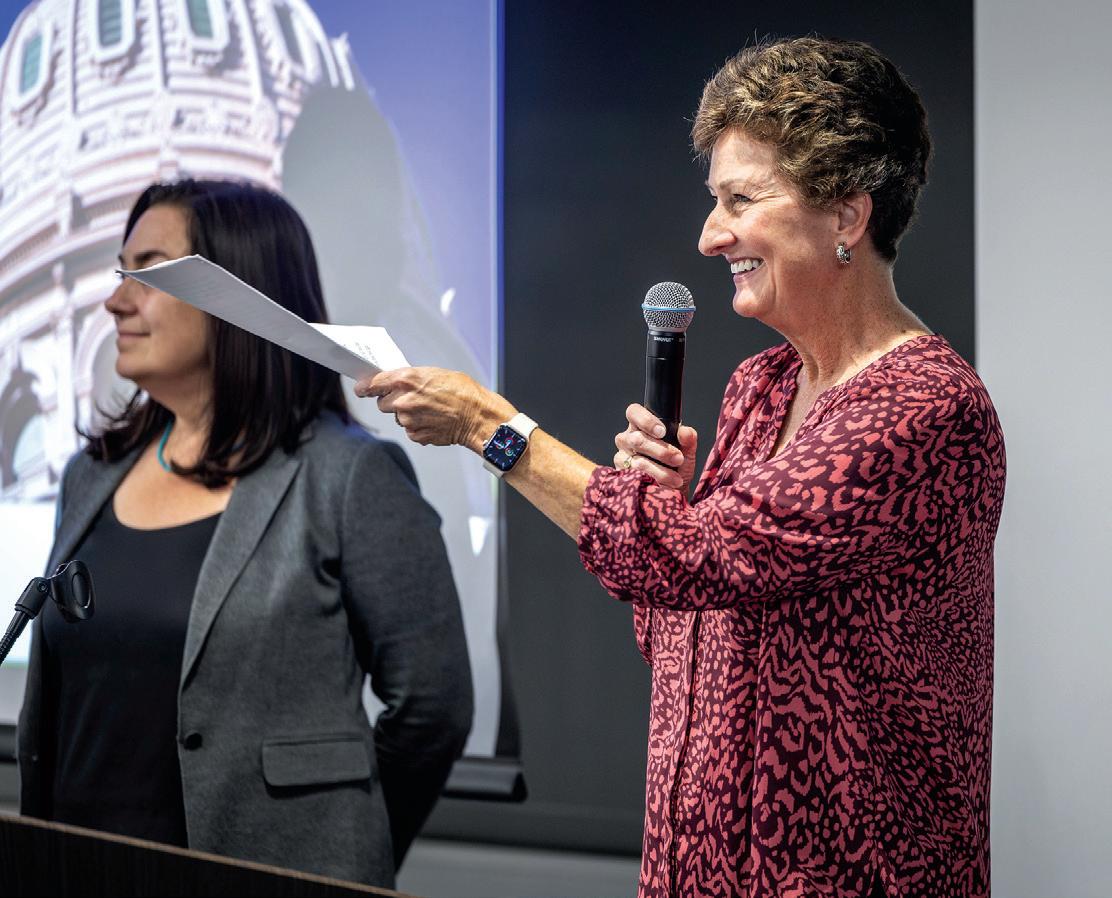
TASB President-elect Mary Jane Hetrick, a Dripping Springs ISD trustee, addresses the first Grassroots Meeting of 2026. TASB Director Lynn Boswell, an Austin ISD trustee, is to her left.
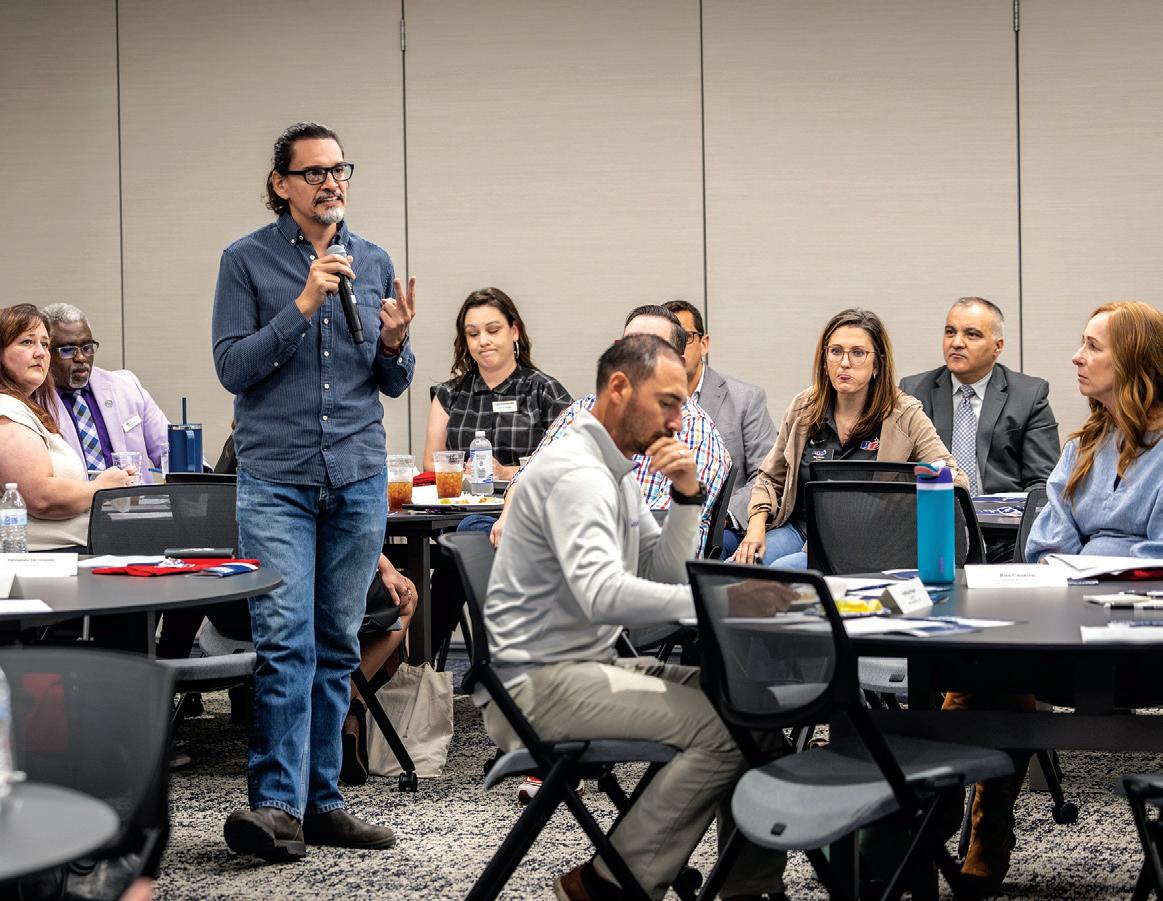
Fernando Lucas de Urioste, an Austin ISD trustee, asks a question during the first Grassroots Meeting, which was held Jan. 7 at TASB’s headquarters in Austin.
Photos by TASB Media Services
Trustees in Region 13 ESC met at TASB's headquarters in January.

Working on local priorities
The work happening at these Grassroots Meetings is also good preparation for boards working on their own local priorities. We encourage boards to gather community input and work together to develop a list of advocacy priorities that can be shared with local legislators, parents, the business community, and other stakeholders.
Additional resources
For more information on the TASB Advocacy Agenda and related issues, visit tasb.org/advocacy. You can also contact Dax González at 800-580-4885 or dax. gonzalez@tasb.org if you have questions.
TASB also has developed A Toolkit for Community Advocacy to help boards develop and adopt a list of legislative priorities for their districts.
Scan to access the toolkit, which provides school board members step-by-step instructions and helpful tips for engaging your communities.H


Dax González is division director of TASB Governmental Relations.
• Meet the expectations of current and prospective employees
• Show your investment in staff well-being
• Fill gaps in traditional healthcare plans
Priorities for the upcoming legislative session.
Legislative Changes in HR
Navigate compliance with these strategies
by Jennifer Barton
The 89th legislative session introduced sweeping changes that are influencing HR decisionmaking for Texas districts this year and well into the next. As with any legislative session, there were many changes and updates to laws and requirements. However, three primary areas impact strategic planning for the current and 2026-27 school years: employee compensation, staffing, and teacher certification.
Balancing expectations and reality
House Bill 2 brought needed state funding to districts for substantial teacher pay raises and helped supplement pay for support staff. While specific spending requirements applied to certain teachers, many districts managed to provide increases for all employees this year using additional allotments and local funds. The reality for 2026-27 may look very different for many districts. While employee expectations for annual pay increases remain high, providing pay increases may place additional pressure on future budgets for many districts. It will be a challenge for district leaders to determine how to honor the expectations of employees while minimizing the impact on the district’s budget.
There are some key questions to consider as districts decide how to balance fair compensation and rewarding employees:
• Are we prioritizing competitive pay, performance-based rewards, or financial stability?
• What is the maximum and minimum raise we can offer, and what’s the impact at each end?
• Are pay increases sustainable when looking at budgets in the long term? Are there lower-cost alternatives to reward staff? Should increases be targeted at certain employees?
• How do health insurance and other benefits factor in compensation decisions? Do costs offset available funds for pay increases?
Once compensation goals and priorities are clear, it will be important for district leaders to communicate intentions openly to staff. Transparency builds trust, even when raises are modest. It is better to be honest about current budget constraints so employees are aware of what they may or may not receive for compensation adjustments for the next school year.

Staffing: A powerful tool for stability
Personnel costs account for 80-85% of the district budget, making staffing one of the most effective levers for financial stability. For districts under budget constraints or already in a deficit, staffing adjustments may help unlock cost savings without sacrificing student outcomes.
A good way for district leaders to analyze current staffing practices is the benchmarking process, which provides the opportunity for the district to compare current staffing patterns to other districts with similar enrollment and demographics. The comparison offers some key areas to consider:
• Are we over- or understaffed compared to peers?
• Do staffing allocations align with enrollment trends?
• Where can we improve efficiency without compromising quality?
• Are we using the correct data sources for comparison?
A good way for district leaders to analyze current staffing practices is the benchmarking process, which provides the opportunity for the district to compare current staffing patterns to other districts with similar enrollment and demographics.
After analysis, the district can adjust staffing based on student, campus, and district needs. It’s important for district leaders to understand how adjustments will affect campuses and departments. The following staffing strategies can have a high impact with fewer disruptions to staff and campuses:
• Optimize secondary master schedules to balance teacher workloads, student offerings, and teacher planning time.

• Eliminate vacancies to free up budgeted funds.
• Review staffing at low-enrollment campuses to ensure allocations match capacity.
• Analyze current instructional models to determine efficiencies and restructure models to meet student and staffing needs.
Conducting an intentional review of current staffing practices often reveals opportunities for cost savings that can occur by restructuring, reassigning duties, and making changes through attrition. When looking for a positive budget impact, staffing practices may be key to unlocking new opportunities and sources of funds.
A new compliance challenge
Another challenge for district leaders from recent legislation is the phasing out of District of Innovation certification exemptions for teachers of foundation curriculum classes. DOI districts can seek to delay the implementation of that requirement by applying to the Texas Education Agency by March 2. Otherwise, they will be required to staff certified teachers in all foundation classrooms next school year.
Additionally, even for districts that seek and are approved for delayed implementation, the burden of hiring and assigning certified teachers for core classes begins sooner rather than
later. As in past years, districts must be creative in finding qualified teachers and ensuring they hold the credentials for their teaching assignment. The urgency is high for school districts that have leaned heavily on DOI certification exemptions. Following are strategies to help adhere to new certification requirements:
• Develop a roadmap for compliance with the new certification standards and assign district personnel to assist with implementation.
• Create a delayed implementation plan and submit to TEA for approval if the district wants to use DOI certification exemptions, as allowed.
• Support current uncertified teachers in obtaining required credentials and ensure they become certified, as required.
• Begin hiring certified teachers for foundational curriculum classes and in other core areas for the 2026-27 school year and beyond.
Complying with new certification requirements will have a significant impact on many school districts across the state. District leaders need to be informed of the new rules, prepared to address the needs of current uncertified teachers, and ready to hire teachers under the new requirements in the next year.
A pragmatic path forward
Urgency matters, but so does strategy. Collaboration is critical, and shared leadership makes hard decisions manageable. Engage principals, HR teams, and finance leaders in joint planning sessions. Build a timeline for budget analysis and forecasting, benchmarking for staffing, and creating a certification compliance plan. Change management requires transparency and teamwork. While change is inevitable, foresight and a clear plan help make it manageable.
The HR Services team works with HR leaders throughout the state to offer insight and guidance on district human capital needs. Contact them at 800-5807782 or at hrservices@tasb.org
Jennifer Barton is an assistant director with TASB HR Services.

Student Solutions’ workload staffing analysis turns special education data into clear staffing recommendations that:
• Boost efficiency
• Support better services
Schedule a free meeting today!
Master Class
Leadership TASB visits the Rio Grande Valley
by Mary Ann Lopez
Editor’s note: Leadership TASB is a unique board development program designed to take experienced board members to a new level of service and leadership by introducing them to a variety of issues, people, activities, and locations.
As part of the Leadership TASB experience, each LTASB class visits districts across the state to learn more about best practices in board governance, better understand educational challenges, and experience innovative programming.
Texas Lone Star is asking some members from the Class of 2026 to share their personal perspectives and experiences from these visits to offer insight into the
LTASB experience and how it impacts cohort members, their board service, and their knowledge of governance and leadership.
In November, the class visited the Rio Grande Valley, specifically Lyford CISD and Brownsville ISD. Class member Ariel Cruz-Vela, who has been a member of the San Benito CISD Board of Trustees since May 2021, discussed the cohort’s visit with TLS. Her responses have been condensed and lightly edited.
Q: Why did you apply to participate in Leadership TASB and how has the experience been so far?
I truly believe that a public school district runs best with an effective school board. I wanted to participate in Leadership TASB for several reasons: to strengthen my knowledge regarding governance, to experience the strengths and

struggles of other school districts in the state of Texas, to build a community that I can always rely on for questions or advice, and to learn how to be a better advocate for the 5.5 million students in Texas public schools.
This experience has been amazing so far. It is so refreshing to get together with 31 other school board members from across the state to share our individual struggles and to celebrate the accomplishments from each of our respective school districts. Also, it has been amazing to visit the different school districts during our trips.
Q: With this being your second LTASB trip, before hitting the road for Harlingen, what were you most excited for and hoping to learn from the visit?
Because my home is one town over from Harlingen, I was most excited to have my Leadership TASB classmates


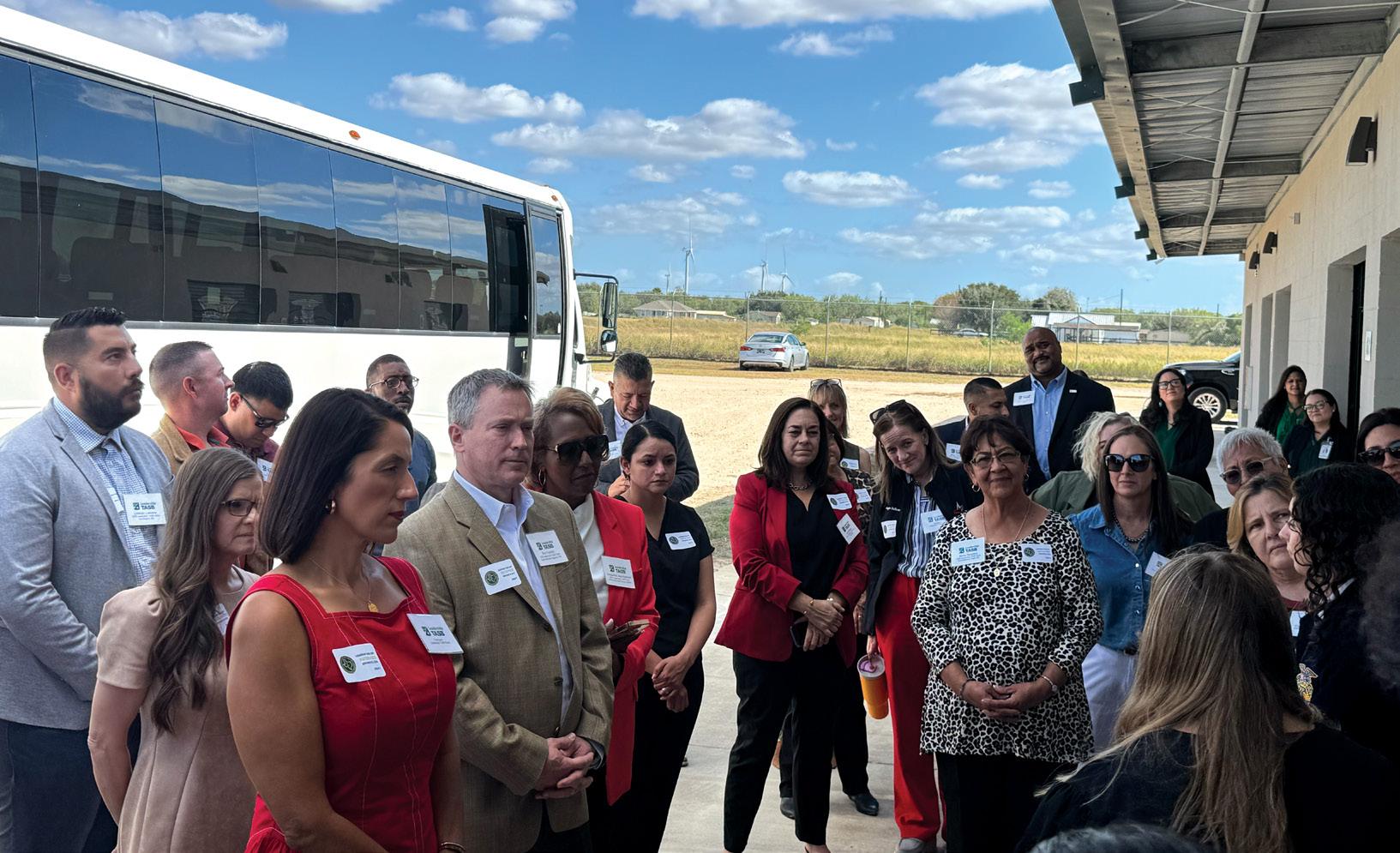
come visit the Rio Grande Valley. I am extremely proud to be a native of the Rio Grande Valley, and it was such a blessing to have Leadership TASB make a stop here. Many times, border communities are presented in a negative light, and it was important to me that my classmates
experience a positive visit that highlighted the students and staff of the region and our culture.
Q: What were some of the top highlights for you during the school visits?
While visiting Lyford CISD, I was
A: Keeping with tradition, the LTASB Class of 2026 poses for a group photo during their trip to Lyford CISD.
B: The LTASB Class of 2026 is greeted by staff and administrators before taking a tour of the district.
C: Albert Johnson III, a trustee at Alvin ISD, has a fun conversation with a Lyford Elementary School student.
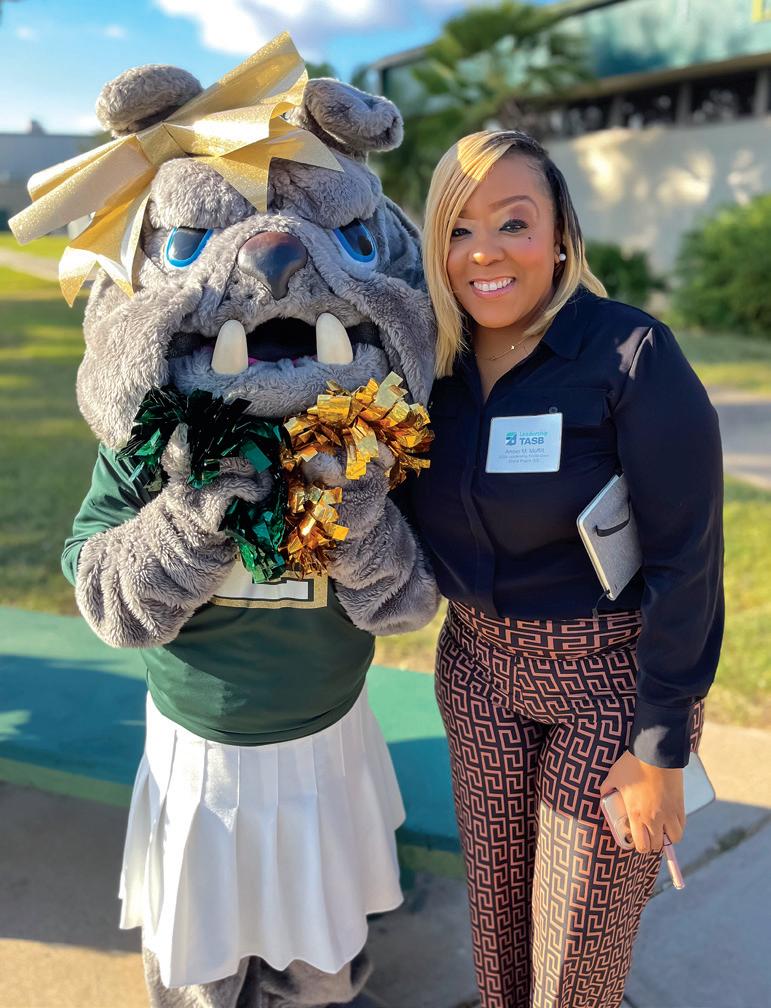
D: Amber Moffitt, board president at Grand Prairie ISD, and the Lyford High School Bulldog mascot pose for a photo during the LTASB visit.
May 7-8 | 10 a.m.-3 p.m. | Zoom
Photo A, courtesy of Lyford CISD
Photos B, C, and D, by TASB Media Services
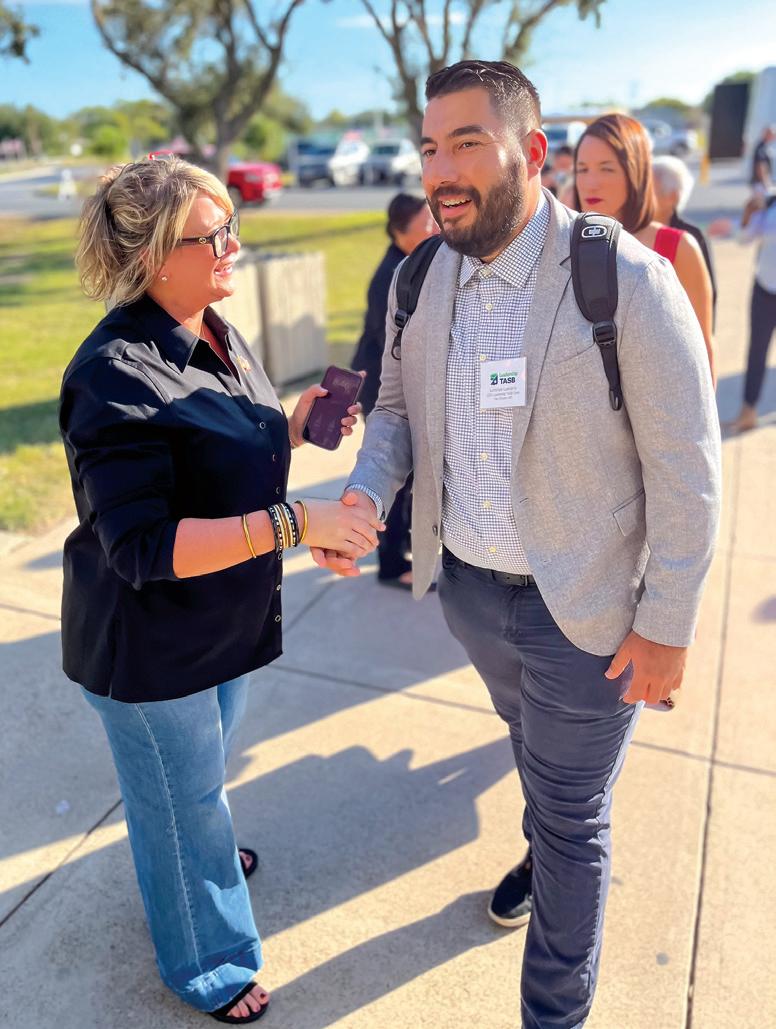
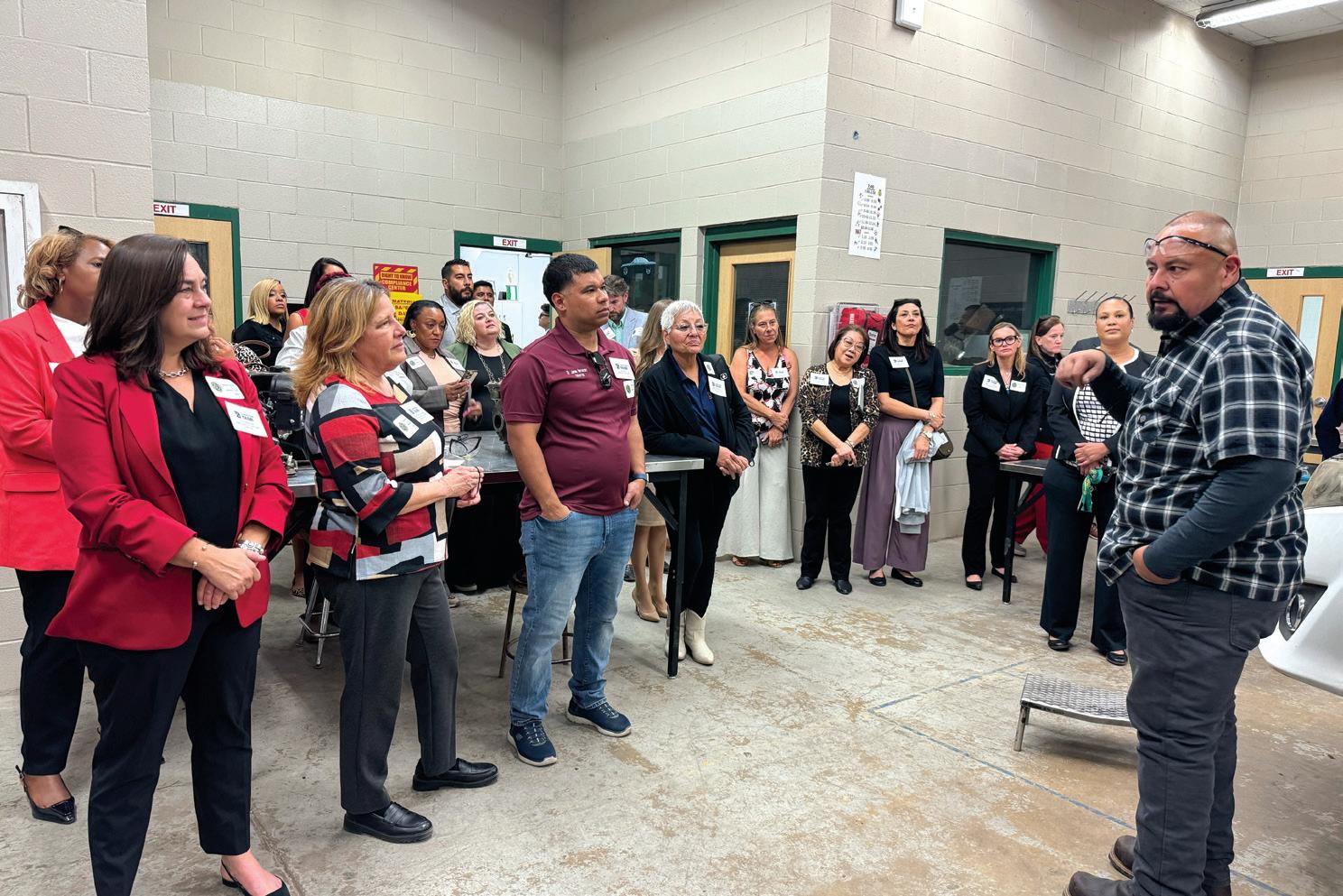
F: Trustees take a tour of Lyford High School and learn more about the district and its programming.
impressed with how the high school students were the ones who gave the presentation and the tour of the district’s facilities. Each student was articulate and professional. It was amazing to see the different career technology education programs that are offered to students as well as how some of the rural communities in Region 1 ESC have pulled their resources together to provide the best opportunities for their students.
At Brownsville ISD, we were able to witness the exciting things that elementary students at Ben Brite were involved in such as chess, dance, and Greenpower USA electric car races. The Greenpower love continued at Oliviera Middle School as we were able to see the all-girl racing team that represents Brownsville at a national level. These girls were so knowledgeable and passionate about the work they put into their cars. At Hanna Early College High School, Superintendent Jesus Chavez spoke with us about the challenges of declining enrollment and
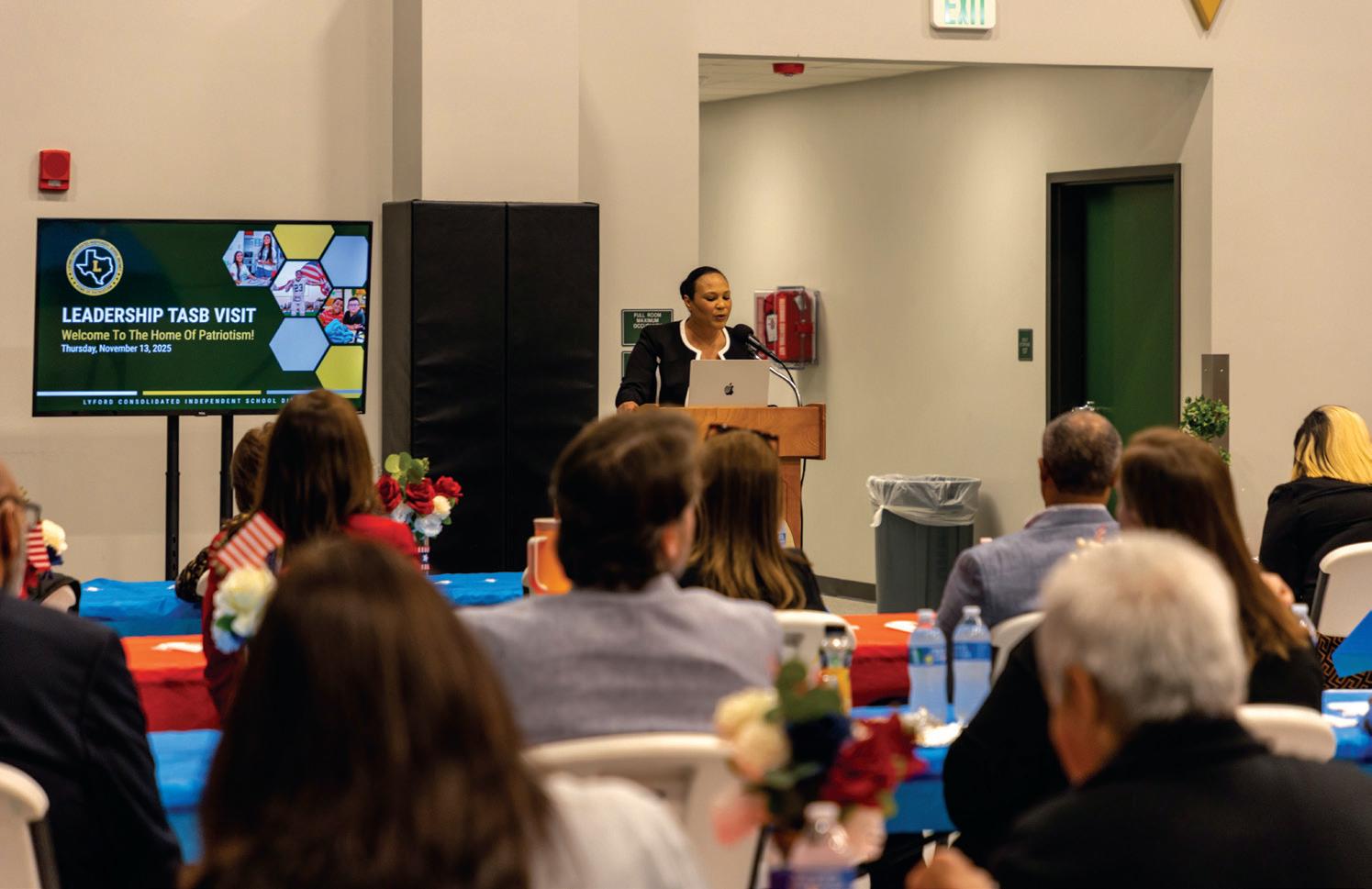
how BISD has adjusted by combining CTE programs, housing them at one of the high schools and transporting students from across the district to be able to participate in that career pathway.
Q: How did the visits to the schools/ districts align with what you are learning and have learned so far through Leadership TASB?
Through Leadership TASB, we are learning how to advocate and better govern our respective school districts. One key thing that we have been learning is how to maximize our resources. At both Lyford CISD and Brownsville ISD, you can see how the board members work collaboratively to ensure that students are being given the skills they need to be successful
once they leave the halls of Texas public schools.
Q: How do visits like this help you do your job?
Leadership TASB visits, the entire program in general, gives me the strength to do my job. Going into different districts, we can see that even though the needs of our respective districts are different, we all have struggles. It is in the struggles that we must innovate and find ways to provide our students with the best education possible. This higher level of thinking is evident in our site visits.
Q: Do visits like this change your understanding of your role, and if so, in what way?
E: Alison Savage, a Lyford CISD trustee and a TASB Director, greets Lorenzo Luevano, a San Elizario ISD trustee.
G: The LTASB Class of 2026 gathers at Lyford CISD, learning about the district during its visit in November.
Photo E by TASB Media Services
Photos F and G courtesy of Lyford CISD
These visits do not change my understanding of the role. What these visits do is they expand what my role could and should be. As board trustees for public schools, we cannot be doing the same thing that has been done for years before. It is up to board members to align our district goals to innovate and adapt our current practices to those of the changing world around us. These visits allow me to question my approach: Am I doing everything in my power to allow the students in my school district to have a successful life?
Q: Are there any key takeaways that you will share with your board?
I will urge each of my board members to apply for Leadership TASB. This is such a unique program that everyone should participate in. I will also make sure that, as a board, we are doing our best to advocate for the students in our district at the state level.
Q: If you could sum up your trip in one sentence, what would it be?
This was an extraordinary experience that showcased the students and the culture of the Rio Grande Valley.
Q: Is there anything else you would like to add or think readers should know about your experience?
During our visit to the Rio Grande Valley, the state representative for District 38, Erin Gámez, came to speak with our class. It is important that we, as school board members, make connections with our state representatives. We should be inviting them to our campuses to make sure they can see and feel the value of public education in the state of Texas.
Applications for Leadership TASB open May 1. Scan to learn more about LTASB and how to apply.H

Ariel Cruz-Vela is a member of the San Benito CISD Board of Trustees and a member of the LTASB Class of 2026.
Mary Ann Lopez is a staff writer for Texas Lone Star
Why do school boards choose TASB Executive Search Services?

It was important that we get the right person right from the jump. I can’t say that would have happened without ESS and TASB. I think that you guys really played a big part in helping us do that so perfectly. And now we’ve got the perfect superintendent.
In its more than 30-year history, ESS has conducted over 800 searches on behalf of districts across Texas.
With a team of search consultants who know Texas and its diverse school districts, ESS has proven itself to be the go-to search firm for leadership recruiting.
ESS brings experience to the table and a guarantee, so trustees can feel confident they’ve found the best leader for the job.
– Garrett Wilson, trustee, Boerne ISD school board
TASB Is Coming to You!
Regional Workshops offer customized training
Connect, learn, and earn continuing education credit this year without leaving your region through TASB’s Regional Workshops. These workshops will bring school board members, superintendents, and educational leaders together in their communities to deliver training that is customized, relevant, and responsive to the unique needs of each region.
These regional learning experiences are being reimagined to address the real challenges that districts face in their own areas. Attendees will be able to choose from multiple breakout sessions that will help strengthen governance skills while also earning CEC hours and building important connections with fellow trustees within their region.
“We’ve heard from members that they want opportunities to train closer to home, not only because of the convenience but also because they value being able to learn with trustees from their areas,” said TASB Executive Director Dan Troxell. “One of our goals with these workshops is to customize the sessions to what matters most in each area.”
The topics to be covered in each Regional Workshop are developed in collaboration with local school board mem-
bers. Trustees may attend the workshop in their region, but they also can attend one in any location.
A TASB task force met throughout 2025 to design workshops that could deliver effective programming, deploy
TASB-led training to each region at least two times this year, and amplify TASB’s visibility across the state.
Registration is open. Find the workshop that works best for you and join us. We can’t wait to see you!H
TASB Regional Workshops — Spring 2026
Region 6 ESC, Huntsville
16
Region 9 ESC, Wichita Falls March 26
Region 17 ESC, Lubbock
Region 2 ESC, Kingsville
Region 1 ESC, McAllen
March 31
April 7
April 8
Region 4 ESC, Houston April 8
Region 11 ESC, Dublin
Region 5 ESC, Beaumont
April 9
April 16
Region 19 ESC, San Elizario April 23
Region 18 ESC, Alpine
Region 10 ESC, Commerce
May 6
May 12
Region 13 ESC, Hutto May 13
Region 12 ESC, Waco May 19
Region 16 ESC, Canyon
May 20

SOTY Award
Nominations open for superintendent honor
Nominations are open for the 2026 Superintendent of the Year Award, established in 1984 to recognize excellence and achievement among district leaders in Texas. School boards that want to have their superintendent considered for the annual award are encouraged to submit a nomination packet to their regional ESC by the April 17 deadline.
Those considered for this prestigious honor must display:
• Exemplary and visionary leadership toward improving student performance
• Strong leadership skills
• Dedication to improving the quality of education in their district
• Commitment to public support and involvement in education
Nominated superintendents will be interviewed by regional selection committees, with a finalist selected from each ESC region that submits a nominee being announced in June. Each ESC finalist is then interviewed by the state selection committee, which narrows the pool to five state finalists announced in late summer.
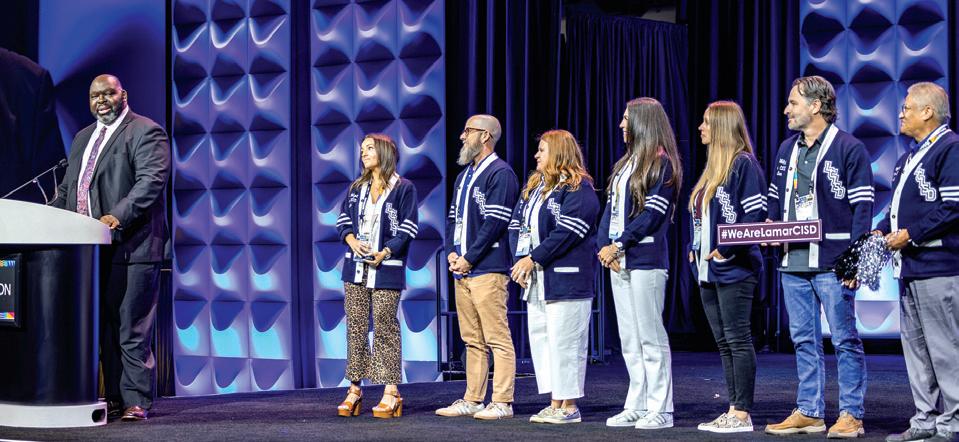
Finalists will be interviewed Oct. 9 and the SOTY winner will be announced the next day at txEDCON, which will be held in Houston. The recipient of the SOTY award receives $5,000 and a special ring from Balfour, the program sponsor. Districts of the four state finalists also receive $1,000 each.H

Scan for more information about how to nominate a superintendent for this award.
New training for maintenance directors
Build a strong foundation for your operations program. Get the tools and knowledge needed to lead with confidence and set your department up for long-term success.

Lamar CISD Superintendent Roosevelt Nivens was named the 2025 Superintendent of the Year. Trustees joined him on the stage at txEDCON in Houston for the ceremony.
Photo by TASB
Bulletin Board
H-E-B Announces 2026 Excellence in Education Awards
H-E-B has selected five early childhood facilities, five public school boards, and eight school districts throughout Texas as finalists in the 2026 H-E-B Excellence in Education Awards program, which awards cash prizes to educators who go the extra mile to serve their students and their communities.
This year, H-E-B will award $90,000 to the 18 finalists ($5,000 each), and additional prize money to the winners, who will be announced May 3. To determine the winners, a panel of judges will tour each finalist’s campus to engage with administration, staff, parents, and community members. The 2026 finalists are:
Early childhood education facilities:
• Bonham Pre-Kindergarten School (San Marcos CISD)
• Goodwill Exploration Center (Austin)
• Gregory-Portland Early Childhood Center (Gregory-Portland ISD)
• Lena Pope Early Learning Center (Fort Worth)
• Menchaca Early Childhood Center (Southside ISD) School boards:
• Alice ISD
• Corpus Christi ISD
• Garland ISD
• Lake Dallas ISD
• Mesquite ISD Large school districts:
• Carrollton-Farmers Branch ISD
• Dickinson ISD
• Garland ISD
• Pearland ISD
• Pharr-San Juan-Alamo ISD Small school districts:
• Alice ISD
• Angleton ISD
• Midway ISD (Woodway, Texas)
School Board Recognition Month Honors Trustees Across Texas
Each January, TASB starts the new year by honoring Texas school board members for their work, leadership, and commitment to improving public schools across the state. This year’s theme was Our Future Is Public, which is an ongoing campaign to highlight success stories in Texas public education. Districts across the state paid tribute to their school board members through a wide range of social media posts. Thanks for highlighting the commitment and dedication of Texas school boards!

TASB’s Executive Search Services is currently accepting applications for these positions listed below:
▄ Angleton ISD Superintendent
▄ Blanco ISD Superintendent
▄ Brooks County ISD Superintendent
▄ Columbus ISD Superintendent
▄ Culberson CountyAllamoore ISD Superintendent
▄ Lorena ISD Superintendent
▄ South Texas ISD Superintendent
For more information about vacancies, call 800-580-8272, email executive.search@tasb.org, or scan: Scan for more information about the awards program


Richardson ISD was one of many districts across Texas to honor its trustees during School Board Recognition Month.
Photo courtesy of Richardson
Salary Survey
Average pay for Texas superintendents up 2.3%
by Beth Griesmer
The median salary for a Texas school superintendent for 2025-26 is $156,818, an increase of 2.3% from the prior year, according to the TASB and Texas Association of School Administrators Superintendent Salary Survey.
“The most important responsibility entrusted to school board members is hiring and evaluating a superintendent,” said Amy Campbell, division director of TASB HR Services, which administers the survey. “This annual survey helps school districts across the state understand compensation trends and offer competitive salaries while also being good stewards of district resources.”
This year’s survey, released last November, included participation from 746 districts, representing 74% of districts in Texas. There was a wide variation in median salaries based on district size, with a range from $120,000 in districts with fewer than 500 students to $367,303 in districts with enrollments of 50,000 or more.
The survey also looks at trends in superintendent experience. Of the 121 districts with a new superintendent for 2025-26, 60% of districts hired a superintendent with no previous experience in the position. This is down from the number of districts hiring a first-time superintendent in 2024-25.
Campbell said a trend that has stayed relatively constant in recent years is the median amount of time a superintendent spends in a district, which is about three years. The median experience for superintendents overall is four years. Most superintendents (70%) have only served as superintendent in their current district.
Salaries comprise only one part of a superintendent’s overall compensation package. The survey results also include data on bonuses, transportation benefits, health insurance benefits, and cell phone reimbursement, all of which can add significant value.
Key findings include:
• 17% of responding districts (118) pay a car allowance to their superintendents, which is slightly down from last year. The median vehicle allowance is $6,000, a number that has stayed consistent. Only 9% of districts provide a vehicle for the sole use of the superintendent.
• 89% of districts reported paying health insurance benefits for their superintendent, with a median contribution of $4,458 annually, which is up from last year.
• 31% of districts (212) reported providing their superintendent with a cell phone allowance. The median is $1,200 annually, an amount unchanged from last year.
• 39% of districts (264) reported paying a portion of the superintendent’s required Teacher Retirement System contribution, an increase from last year. The median contribution is $17,710.
• 12% of districts (81) provide either a residence or housing allowance. The median housing allowance is $6,000.
• 62% of districts pay membership dues for superintendents to be part of civic, professional, or private organizations, making this one of the more popular and affordable benefits at a median annual expense of $1,000.
“It’s important for school board trustees to have resources and information that help them make the best financial decisions,” Campbell said. “The survey data provides crucial insights that can be used to develop superintendent contracts that reflect the market while meeting the needs of the district.”H
Beth Griesmer is a staff writer for Texas Lone Star


School Funding at the Ballot Box
Texas school districts can raise additional revenue through bond elections or Voter-Approval Tax Rate Elections, depending on the funds’ purpose. Last November, more than 100 districts across Texas held bond elections or VATREs. Here’s a closer look at what voters decided in those elections.
Board Members: MAP YOUR JOURNEY TO SUCCESS
TASB supports trustees at every point along the board leadership journey, offering training and programs to excel at board governance.
New Trustees
Texas Trustee Institute
TTI offers a comprehensive program to build skills, dive into governance, and develop a leadership network.
Key offerings: Texas Open Meetings Act, Board Governance, Consensus Building.
Coming soon!
Master Trustees
Leadership TASB
For experienced trustees, meet with innovative districts and leaders, while learning what makes them successful. LTASB’s one-of-a-kind experience will expand your view of education leadership.
Learn more! leadershiptasb@tasb.org
Whole Board Training
Need support with your superintendent evaluation process? Board Development Services’ consultants are here to help! Get training tailored to your district’s needs.
board.dev@tasb.org
Foundational Training
Find on-demand courses for new trustees, including the Top 10 Things to Know bundle of essential courses, in the Online Learning Center.
onlinelearning.tasb.org
Experienced Trustees
Board Officer Institute
For veteran trustees and board officers, BOI imparts knowledge and tools for effective and efficient meetings.
Key offerings: Important Tools for Meeting Preparation, Effective Meetings, Focused and Productive Board Discussions.
Coming soon!
Continuing Education
With the Online Learning Center, you can find courses to support your board service, including: Preparing for Superintendent Evaluation, Board Officers Forum, and Advocacy 101 and 201.
onlinelearning.tasb.org
For additional information on any of these offerings: 800-580-8272, ext. 2453 • board.dev@tasb.org
onlinelearning.tasb.org
Session submissions are open Feb. 15-March 15. Visit tasb.org/sli for details.
Thank you to our sponsors