FFA success, but also prepares students for college, careers, and entrepreneurship.” Agriculture influences the life of every Texan, every day, said Stacy K. Vincent, professor and head of the Department of Agricultural Leadership, Education, and Communications at Texas A&M University. “With one in seven Texas jobs — more than 4.4 million positions — connected to the agriculture and natural resources sector, agricultural education is not simply an elective; it is a vital component of our state’s economic strength and community resilience,” Vincent said. For school districts, the impact is both immediate and long term, he said. “Agricultural education provides a direct pathway to high‑demand careers while culti‑ vating informed, engaged citizens who contribute to the well‑being of their local communities.”
Photos courtesy of Canadian ISD
Buzzworthy business
A community cornerstone Canadian ISD’s FFA program was chartered in 1936 and has 144 active members in high school and 24 junior members at the middle school. The district, located in the small town of Canadian about 100 miles northeast of Amarillo, has about 800 students. The district’s rural setting in the Texas Panhandle makes opportunities like FFA even more meaningful, said Superintendent Julia McMains. “Agriculture remains a cornerstone of our community, and our students benefit from learning in ways that are connected to their surroundings, their families, and the industries that help sustain our region,” McMains said. “Our agricultural science teachers have done an excep‑ tional job building a program that not only supports
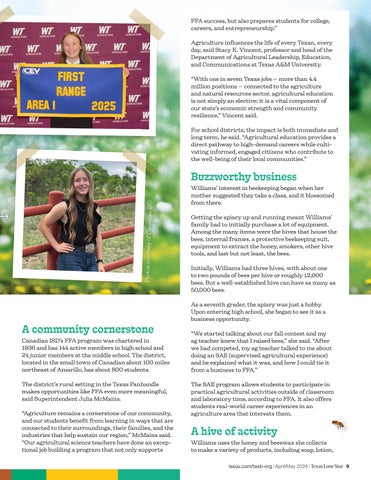
Williams’ interest in beekeeping began when her mother suggested they take a class, and it blossomed from there. Getting the apiary up and running meant Williams' family had to initially purchase a lot of equipment. Among the many items were the hives that house the bees, internal frames, a protective beekeeping suit, equipment to extract the honey, smokers, other hive tools, and last but not least, the bees. Initially, Williams had three hives, with about one to two pounds of bees per hive or roughly 12,000 bees. But a well-established hive can have as many as 50,000 bees. As a seventh grader, the apiary was just a hobby. Upon entering high school, she began to see it as a business opportunity. “We started talking about our fall contest and my ag teacher knew that I raised bees,” she said. “After we had competed, my ag teacher talked to me about doing an SAE (supervised agricultural experience) and he explained what it was, and how I could tie it from a business to FFA.” The SAE program allows students to participate in practical agricultural activities outside of classroom and laboratory time, according to FFA. It also offers students real-world career experiences in an agriculture area that interests them.
A hive of activity Williams uses the honey and beeswax she collects to make a variety of products, including soap, lotion, issuu.com/tasb-org | April/May 2026 |
9