

Featured Event TASB Regional Workshops
Happening now across Texas

TASB Officers 2025-26
Tony Hopkins, President, Friendswood ISD
Mary Jane Hetrick, President-Elect, Dripping Springs ISD
Dan Micciche, First Vice President, Dallas ISD, Region 10C
Sylvia Sánchez Garza, Second Vice President, South Texas ISD, Region 1B
Justin Chapa, Secretary-Treasurer, Arlington ISD, Region 11C
Rolinda Schmidt, Immediate Past President, Kerrville ISD
TASB Board of Directors 2025-26
Carlos Bentancourt, Slaton ISD, Region 17
Lynn Boswell, Austin ISD, Region 13A
Darlene Breaux, Alief ISD, Region 4B
Steve Brown, Ector County ISD, Region 18
Marlene Bullard, Tornillo ISD, Region 19
Kevin A. Carbó, Mesquite ISD, Region 10D
Crystal Carbone, Pearland ISD, Region 4C
Julie Cole, Hurst-Euless-Bedford ISD, Region 11A
Thomas Darden, Cooper ISD, Region 8
Dynette Davis, Frisco ISD, Region 10E
Rebecca Fox, Katy ISD, Region 4E
Ginger Friesenhahn, East Central ISD, Region 20A
Angie Hanan, Fort Bend ISD, Region 4G
Carol Harle, Northside ISD-Bexar County, Region 20B
Regina Harris, Richardson ISD, Region 10B
Marques Holmes, Humble ISD, Region 4A
Bryan Holubec, Thrall ISD, Region 13C
Elizabeth Ivey, Montgomery ISD, Region 6A
Todd LeCompte, Cypress-Fairbanks ISD, Region 4F
Angela Lemond Flowers, Houston ISD, 4D
Mark Lukert, Wichita Falls ISD, Region 9
Stephen Mackey, Blanco ISD, Region 13B
Raymond P. Meza, San Felipe Del Rio CISD, Region 15
James Morton, ESC 8, ESC Representative
Steven Newcom, Eagle Mountain-Saginaw ISD, Region 11D
Nicholas Phillips, Nederland ISD, Region 5
Quinton “Q” Phillips, Fort Worth ISD, Region 11B
Margaret Pruett, Victoria ISD, Region 3
Tony Raymond, Sabine ISD, Region 7
Keri Roberts, Goldthwaite CISD, Region 12
Alison Savage, Lyford CISD, Region 1A
Robert Selders Jr., Garland ISD, Region 10A
Rich Sena, Boerne ISD, Region 20D
Cindy Spanel, Highland Park ISD-Potter County, Region 16
Greg Welch, Clyde CISD, Region 14
8 A Buzzworthy Adventure
FFA bee project nurtures lifelong skills
12 The Power in Sharing
TASB tool gives insight on statewide priorities 16 Excellence Awards
Districts honored for efforts to reduce risk
Texas Lone Star • Volume 44, Number 2
Texas Association of School Boards P.O. Box 400 • Austin, Texas • 78767-0400 512-467-0222 • 800-580-8272
Laura Tolley • Managing Editor Shu-in Powell • Graphic Designer Lalo Garcia • Photographer Prisma • Printer
Contributors: Sylvia Wood, Sara Butler, Theresa Gage-Dieringer, Beth Griesmer, Mary Ann Lopez, Matt Mitchell, Dax González, Jala Mason, David Wylie, Vanessa Diamos, John Pyle, Zachary Roberts
Cover design: John Pyle
Texas Lone Star (ISSN 0749-9310) is published six times a year by the Texas Association of School Boards. Copyright© 2026 by the Texas Association of School Boards (TASB). All rights reserved. Reproduction, adaptation, distribution, and exhibition in whole or in part are prohibited under penalty of law without the written license or permission of TASB. Copies of Texas Lone Star are mailed to trustees of TASB member school boards and their superintendents as part of their membership. Subscriptions are available to nonmembers for $36 (1 year), $69 (2 years), and $99 (3 years). Single copies are $5.
Address changes should be sent to Michael Pennant, TASB, P.O. Box 400, Austin, Texas 78767-0400.
Articles in Texas Lone Star are expressions of the author or interviewee and do not represent the views or policies of TASB. Permission to reprint should be emailed to communications@tasb.org or addressed to the Managing Editor, P.O. Box 400, Austin, Texas 78767-0400.
Texas Lone Star does not guarantee publication of unsolicited manuscripts.
Postmaster: Send address changes to TASB, P.O. Box 400, Austin, Texas 78767-0400.





Celebrating Our Students
Graduation and other events remind us why we
by Tony Hopkins
serve

As we approach the end of another school year, our calendars fill with celebrations that mark both completion and commencement. For me, nothing compares to standing on the graduation stage for Friendswood High School and shaking the hand of every graduate.
After more than 17 years serving on the board of Friendswood ISD, I have had the privilege of watching many of these students grow from their earliest days in our classrooms to the moment they cross that stage. I know their stories — the challenges overcome, the perseverance developed, the quiet determination that carried them forward. Graduation is more than a ceremony; it is a reminder of our shared responsibility to prepare students not only for the next step, but for meaningful lives of contribution and service.
Spring is filled with other celebrations as well — banquets, concerts, playoff games, award ceremonies, and employee recognitions. These events are joyful, but they are also important opportunities to reflect on the year’s accomplishments and to express gratitude to those who make public education possible. Celebrating success strengthens culture, reinforces community trust, and reminds us why the work matters.
Preparing for the year ahead
As the final events conclude and the school year comes to a close, however, we know that summer signals not a pause, but preparation. Budgets must be finalized, goals reviewed, and priorities clarified for the year ahead.
This season also brings transition. To the many new trustees elected in May across Texas, thank you for stepping
forward to serve your communities and students. Board service requires time, thoughtfulness, and commitment to the students of your district. To those returning to the board table, thank you for your continued willingness to lead. If you are new to board service, I strongly encourage you to attend TASB’s Summer Leadership Institute in Fort Worth or San Antonio in June.
Using your voice in Austin is about ensuring that the perspectives of local communities are thoughtfully represented in discussions that affect our schools.
SLI offers focused sessions designed for new trustees, the Texas Trustee Institute provides essential grounding in governance roles, superintendent relations, legal responsibilities, and fiscal oversight. This preparation is especially important because significant decisions — including adoption of the annual budget — often occur soon after trustees assume office. A strong start sets the tone for effective governance and productive teamwork.
Building relationships with lawmakers
As districts prepare locally, it is also important to look outward and build constructive relationships beyond district boundaries. The months ahead of a legislative session provide a valuable opportunity to connect with members of the Texas House and Senate who repre-
sent your communities. Establishing relationships early fosters understanding and open communication. Inviting legislators to visit campuses, attend student events, or meet with district leadership helps them see firsthand the impact of public education in their communities.
When discussing district priorities, it is helpful to share both the challenges districts face and the practical solutions that could support students and educators. TASB members also have access to our new Local Legislative Priorities Tool, which can help identify shared interests among districts statewide. Collaboration among districts strengthens understanding and ensures that conversations with policymakers reflect common experiences across Texas communities. Read more about this initiative on page 12.
Using your voice in Austin is not about politics; it is about stewardship. It is about ensuring that the perspectives of local communities are thoughtfully represented in discussions that affect our schools. The relationships built during this season — within our districts and beyond them — lay the groundwork for thoughtful decision-making in the year ahead.
The season of celebration is also the season of preparation. As we shake hands at graduation, welcome new trustees to the board table, and engage constructively with those who serve at the state level, we are doing more than marking milestones. We are strengthening the foundation that supports students, educators, and communities across Texas.H
Tony Hopkins, Friendswood ISD’s board president, is the 2025-26 president of TASB.
Tony Hopkins
Stronger Boards Start at SLI
Registration and Housing Open April 15
The Summer Leadership Institute (SLI) is TASB’s flagship training conference for new and experienced school trustees. Build your governance skills, explore emerging trends, and connect with education leaders from across Texas.
Choose the location that fits your schedule.
Register beginning April 15 at tasb.org/sli.
June 10-13
Focused on Members
TASB training reflects commitment to school boards
by Laura Tolley
Here at TASB, staff members are in the midst of their own version of spring training, though they don’t generally wear baseball caps or matching uniforms.
This spring, TASB began a series of Regional Workshops that offer customized, relevant, and responsive training to meet the unique needs of each region. It’s an important new initiative and reflects TASB’s continuous efforts to provide innovative programs that serve member school boards and their districts.
A TASB task force met throughout last year to design these workshops, and topics covered in each one were developed in collaboration with local school board members. Task force members wanted the Association to deploy TASB-led training to various regions at least twice a year.
The spring round of workshops began in Huntsville and ends later in May in Canyon, in the Texas Panhandle. I encourage Texas trustees to sign up for a workshop.
These workshops are part of a broad range of trusted services TASB offers to members. Another initiative launched this year is TASB’s Local Legislative Priorities Tool, an online resource that is featured in an article that begins on page 12.
This new tool collects publicly available legislative priorities from Texas school districts and houses them in an easy-to-navigate display map. This makes it easier for districts to learn what fellow
districts are doing in regard to forming legislative priorities. The tool was discussed earlier this year at TASB’s Grassroots Meetings, which were held around the state. These meetings are the first step in the development of the TASB Advocacy Agenda Priorities, which guide TASB’s work on behalf of members during the legislative session.
Important partnerships
This month in Texas Lone Star, we continue our efforts to highlight interesting programs in Texas school districts. Our cover story features the venerable partnership between public schools and the FFA. The story, which begins on page 8, focuses on how one student learned new skills and found a new career path through her local FFA program at Canadian ISD in the Texas Panhandle.
Many Texas students learn important skills through FFA. At Canadian ISD, the FFA program was chartered in 1936 and now has 168 active members – that’s out of a district population of about 800 students. Imagine how many young lives have been influenced by the FFA at this one district over the past 90 years!
Partnerships between public schools and organizations, businesses, and other community stakeholders benefit students as well as the Texas economy, which depends on a well-trained, homegrown workforce to thrive.
Partnerships between public schools and organizations, businesses, and other community stakeholders benefit students as well as the Texas economy, which depends on a well-trained, homegrown workforce to thrive.

And the FFA has grown beyond the traditional farm programs. I won’t tell you what this student’s project is about or what career she plans to pursue — you will have to read the story — but both stretch beyond the traditional agriculture avenues.
Awards season
As TASB President Tony Hopkins noted in his column, spring also is a time for treasured graduation ceremonies and other celebrations. We have our own story about how the TASB Risk Management Fund has named five member school districts as recipients of the Fund’s Excellence Award for 2026. Learn how these districts developed effective solutions to risk management challenges in a story on page 16.
And don’t miss the great news on page 34. If you haven’t already heard, Lamar CISD Superintendent Roosevelt Nivens has been named the 2026 National Superintendent of the Year®, an award given by AASA, The School Superintendents Association.
Nivens, the first Texas superintendent to receive the top honor in 25 years, was named the 2025 Texas Superintendent of the Year last fall. Our SOTY program has recognized exemplary superintendents for excellence and achievement in educational leadership since 1984.
Congratulations to all the honorees!H

Laura Tolley is managing editor of Texas Lone Star.
Laura Tolley





When Kenzi Williams entered Canadian High School as a freshman, she was pretty sure she knew the career path she wanted to follow.

“I wanted to go into physical therapy, and that’s definitely a lot different than what I’m planning on doing now,” Williams, a junior, said. “That mainly is just because I got involved in FFA. It really opened up my eyes to what all the (agriculture) industry has to teach me and what I can do in the industry.”
Now, Williams has her eyes set on a career in agribusiness and agricommunications
When people hear the name FFA, they likely aren’t thinking about beekeeping. FFA was founded in 1928 in Kansas City, Missouri, by a group of farmers wanting to prepare future generations for the challenges of feeding a growing population. Originally known as Future Farmers of America, the name was updated in 1988 to reflect the grow ing diversity and new opportunities in the agricul ture industry. by

where she can share stories about those in the industry, she said. Though she started participat ing in FFA in seventh grade, it was in high school where she began to blossom and hone her leadership and business skills to support her business, Middle of Nowhere Bee Farms, which she manages on her family’s property in Higgins.
Mary Ann Lopez
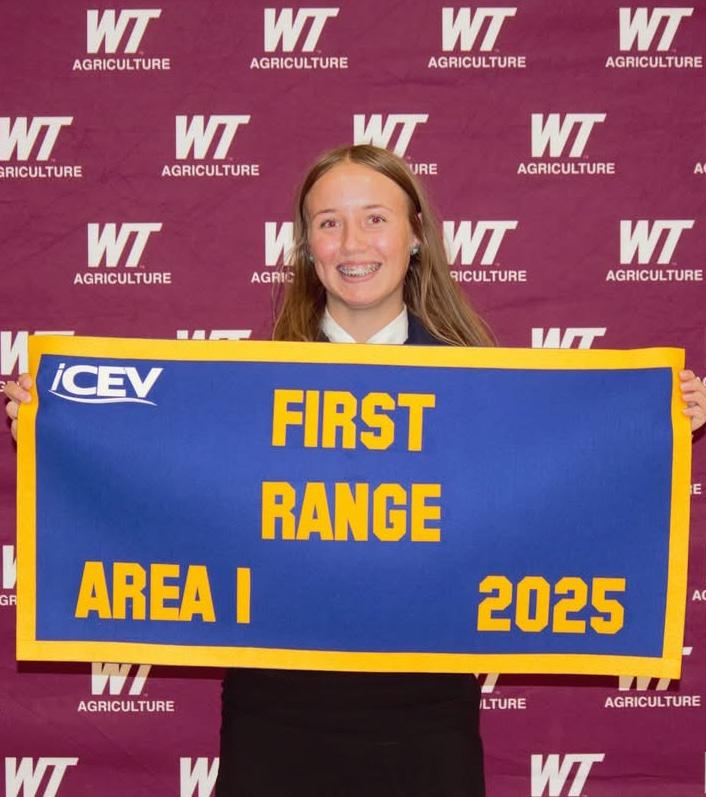
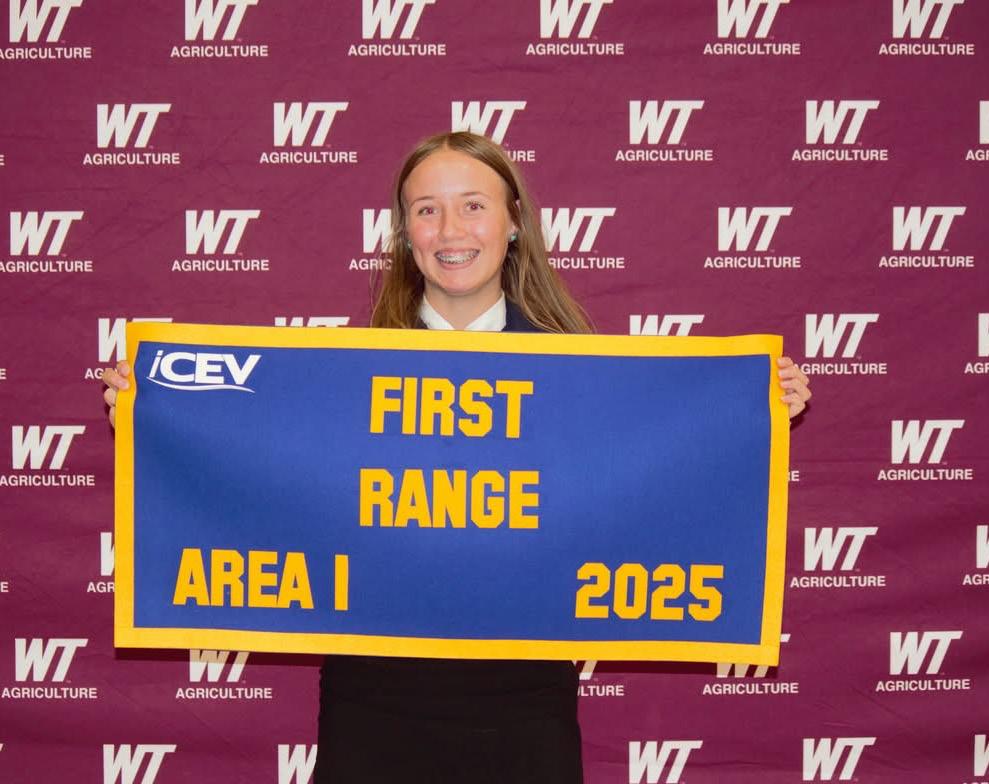
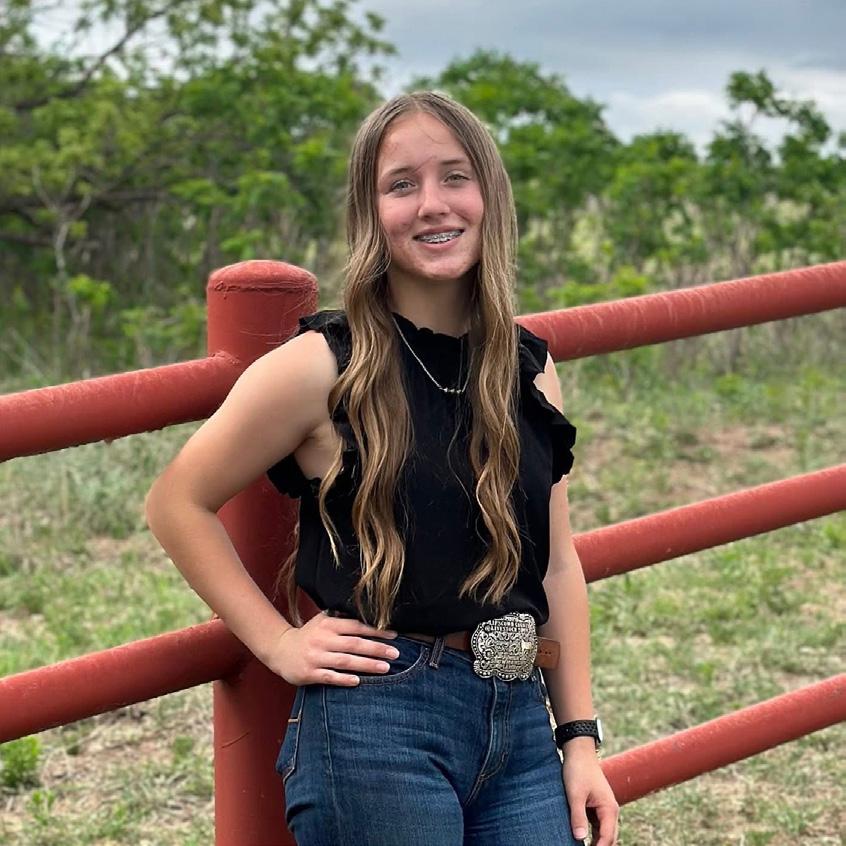
Kenzi Williams poses for a photo winningafteran FFA competition.
Kenzi Williams, a junior at Canadian High School, started a bee business through FFA.


A community cornerstone
Canadian ISD’s FFA program was chartered in 1936 and has 144 active members in high school and 24 junior members at the middle school. The district, located in the small town of Canadian about 100 miles northeast of Amarillo, has about 800 students.
The district’s rural setting in the Texas Panhandle makes opportunities like FFA even more meaningful, said Superintendent Julia McMains.
“Agriculture remains a cornerstone of our community, and our students benefit from learning in ways that are connected to their surroundings, their families, and the industries that help sustain our region,” McMains said. “Our agricultural science teachers have done an excep tional job building a program that not only supports
FFA success, but also prepares students for college, careers, and entrepreneurship.”
Agriculture influences the life of every Texan, every day, said Stacy K. Vincent, professor and head of the Department of Agricultural Leadership, Education, and Communications at Texas A&M University.
“With one in seven Texas jobs — more than 4.4 million positions — connected to the agriculture and natural resources sector, agricultural education is not simply an elective; it is a vital component of our state’s economic strength and community resilience,” Vincent said.
For school districts, the impact is both immediate and long term, he said. “Agricultural education provides a direct pathway to high‑demand careers while culti vating informed, engaged citizens who contribute to the well‑being of their local communities.”
Buzzworthy business
Williams’ interest in beekeeping began when her mother suggested they take a class, and it blossomed from there.
Getting the apiary up and running meant Williams' family had to initially purchase a lot of equipment. Among the many items were the hives that house the bees, internal frames, a protective beekeeping suit, equipment to extract the honey, smokers, other hive tools, and last but not least, the bees.
Initially, Williams had three hives, with about one to two pounds of bees per hive or roughly 12,000 bees. But a well established hive can have as many as 50,000 bees.
As a seventh grader, the apiary was just a hobby. Upon entering high school, she began to see it as a business opportunity.
“We started talking about our fall contest and my ag teacher knew that I raised bees,” she said. “After we had competed, my ag teacher talked to me about doing an SAE (supervised agricultural experience) and he explained what it was, and how I could tie it from a business to FFA.”
The SAE program allows students to participate in practical agricultural activities outside of classroom and laboratory time, according to FFA. It also offers students real world career experiences in an agriculture area that interests them.
A hive of activity
Williams uses the honey and beeswax she collects to make a variety of products, including soap, lotion,
Photos courtesy of Canadian ISD
salves, lip balms, shampoo, and she is working on formulating a hair conditioner. She sells the items at farmers’ markets, including the one in Canyon, and through her family’s retail space.
“We didn’t start out with a plan to make the soap, but my mom owns dairy goats, and she was having a lot of milk production and was wondering, ‘What can we do with all this extra milk?’” she said. “Over time, as we both figured out how to make the soap, we decided to start adding in some of the bee products.”
Williams’ business also provides bee extrication services. When she does a removal, she may try to keep the bees — if she has the space — or rehome them to other hives.
Tending her apiary keeps her busy, requiring care year round, even in winter. She leaves enough honey for the hive as a food source for the winter. “Then, they eat the honey and make more. And them working is what helps heat the hive,” she said.
More than ‘cows, plows, and sows’
While FFA has its roots in production agriculture, over the years, agriculture has grown and changed, said Kristy Meyer, communications manager for the National FFA Organization, which is headquartered in Indianapolis.
“Agriculture is all around us — from the food we eat to the fuel we use to the clothes we wear,” Meyer said. “With more than 350 careers in agriculture, we strive to prepare our members to be the next generation of leaders. We see that leadership every day in our mem bers — from their dedication in the classroom, in their leadership skills, and how they continuously give back to the communities around them through various community services.”
Williams is a fitting example of that leadership, McMains said, adding that through FFA, she has developed leadership skills, confidence, and a strong work ethic.
“Combined with the academic knowledge she gained in the classroom, those experiences allowed her to create and grow an entrepreneurial venture beyond school,” McMains said. “Stories like hers reflect the purpose of these programs and the lasting impact they can have on students’ lives.”
Williams takes honors classes, dual credit courses, participates in National Honor Society, student council, and helps with yearbook. She also has a 4.3 GPA and is president of her FFA chapter.


Rebecca Noggler, an agriculture teacher and FFA advisor at Canadian High School, said Williams has won multiple awards for the work she’s done with her SAE. She has won proficiency awards in the specialty animals area and the Star Greenhand award, where she was a state finalist in agribusiness. Last year, she was the Star Chapter State Winner in Agribusiness.
Noggler wished similar opportunities were available when she was a student.
“It was more cows, plows, and sows, farming and animal raising. But now, it’s bigger,” she said. “There are more leadership opportunities. These kids have a chance to grow and meet people in the community, and they get to start the internships a lot younger. And that sets their pathway, whether they want to go career based, or they want to go research based, or anything in that direction.”
The students tend a variety of animals, Noggler said. From sheep to goats, steers to heifers, rabbits to pigs, and chickens to bees. And their interests aren’t limited to just animals.
Today’s agricultural education programs extend far beyond traditional farming, Vincent said. They prepare students for careers in medical sciences, community development, food security, environmen tal management, and economic analysis.
“As Texas communities continue to evolve, these programs help develop a workforce that is innovative, adaptable, and prepared to meet the challenges ahead,” he said.
Bee public
Across the U.S., there are more than 1 million FFA members and 9,407 local chapters. While 64% of members are in

In 2025, Kenzi Williams was named the State Winner in Agribusiness at the FFA annual convention in Fort Worth.
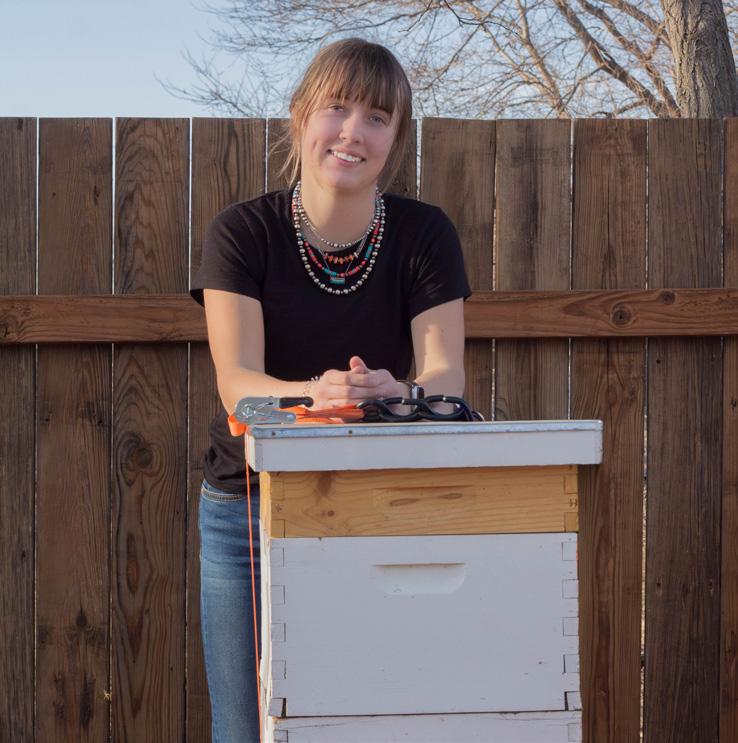
Working with bees requires care and Kenzi Williams protects herself with her beekeeper suit.


rural communities, the remaining 36% are in cities, towns, and suburbs, according to FFA.
And the connection between FFA and public schools is still strong, with 92% of chapters publicly funded.
“By supporting robust agricultural education programs, school boards ensure that Texas students are equipped not only to succeed academically, but also to contribute meaningfully to their local economies and to the long‑term vitality of our state,” Vincent said.
Canadian ISD provides funding for the program as needed, said Rudy Godino, Canadian ISD Board of Trustees president.
“We encourage partnerships with local businesses, including HVAC, plumbers, and welders, to name a few,” he said. “We support the advisors in their professional growth because it benefits our students.”

McMains said the Canadian ISD board is intentional and forward thinking when it comes to ensuring students have ac cess to a wide range of opportunities to explore their interests and career goals.
“FFA is one important part of that commitment, but it is not the only one,” she said. “Our students can earn college credit through dual credit and dual enrollment courses, and they can pursue certifications in health science, information technology, drone aviation, agricultural science, and other career and technical education pathways. These options allow students to personalize their educational experience while gaining practical skills that matter.”
Bee positive
Williams’ teachers have watched her grow through the program, and this year, she is like a different per son, said Marshall Swafford, another Canadian High School agriculture teacher and FFA advisor.
“Kenzi is most definitely the type of young person who benefits from all that the FFA has to offer,” Swafford said. “By participating on a variety of CDE (career development events) teams, she has learned the value of teamwork and how to be a good team member to support her fellow members/students.”
The hands on learning through FFA, tied with what students gain in the classroom, are both important skills for students, Godino said.
“Through these experiences, it helps students be better prepared for the real world as they move on to their next steps in their careers,” he said.
All that Williams has learned about bees and her business couldn’t prepare her for some of the challenges she has experienced.
In February 2024, the Smokehouse Creek Fire — the largest wildfire in Texas history, affected towns in Hemphill, Roberts, and Lipscomb counties, including Canadian and Higgins, where Williams’ family lives. The fire grew to more than 1 million acres, destroying homes and causing two deaths.
“After the fire happened, the smoke stayed for a week or two, and that is when we started noticing that our hive health was decreasing,” she said. “Over time, the hives that decreased in health just ended up leaving, probably looking for somewhere else where they could have better vegetation without some of the environmental stressors.”
Between the fires and other environmental factors such as pests and drought, Williams has had her share of obstacles.
“I think one of my biggest takeaways is that sometimes things don’t always go your way,” she said. “Like your bees have gone, but you can always come back stronger. After all my bees had left, I’ve had to plant a bunch of flowering plants near their hive and then bring new bees in. So, I think that is just one of the biggest takeaways: Adapt and adjust.”
Mary Ann Lopez is a staff writer for Texas Lone Star.
Kenzi Williams, a junior at Canadian High School, has an apiary on her parents’ property in Higgins.
Kenzi Williams poses with her FFA jacket, which is a symbol of pride, achievement, and tradition for those who participate in the program.
THE POWER IN SHARING
TASB tool gives insight on statewide priorities
by Laura Tolley
Texas school leaders are quick to lend each other a helping hand, share ideas, and even offer comfort when needed. Trustees, superintendents, and other school leaders know there is strength in connecting, and they often discuss what to do with pressing challenges.
One such example came earlier this year, when snow and ice blanketed much of Texas, said TASB President Tony Hopkins, who also heads the Friendswood ISD school board. Hopkins said Houston-area school leaders huddled virtually, talking about possible school closures, road conditions, staffing, and more.
“District-to-district communication is important on so many levels,” Hopkins noted.
Engagement and connections also are important when it comes to advocating for students and schools. Districts know they share some of the same challenges, such as funding, campus safety, and teacher retention — even if they haven’t seen each other’s priority list.
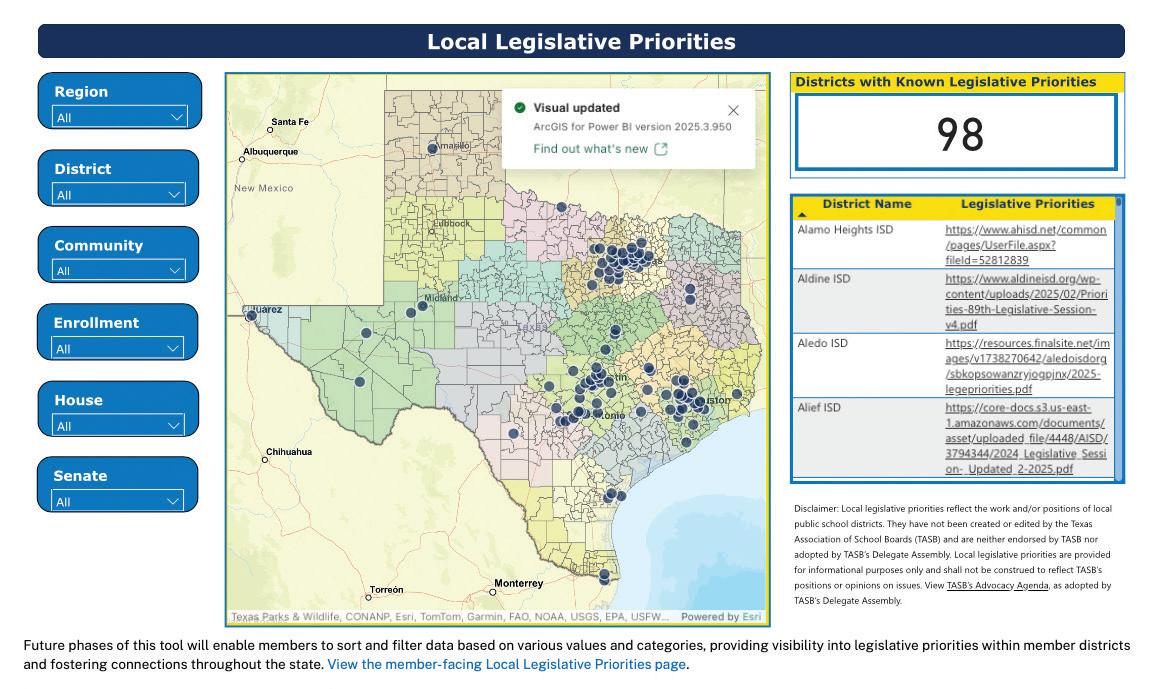
Now, TASB is making it easier for district leaders to gain awareness and learn from each other’s legislative priorities with the recent launch of its Local Legislative Priorities Tool, a new online resource that collects publicly available legislative priorities from Texas school districts in a display map with easy-to-navigate filters.
“A primary goal for the TASB Board in creating this tool was to provide a convenient way for district officials to see other districts’ legislative priorities,” Hopkins said. “We hope this will increase districts’ ability to understand each other’s concerns and perhaps join forces in addressing those challenges at the state level. It was important to start this initiative now so that districts can use it ahead of the 2027 legislative session.”
While enhancing the visibility of local legislative priorities is a key objective, TASB members can use the new online tool to explore this information in ways that is most helpful for them. TASB leaders hope the tool also can help districts form their own legislative priorities, if they haven’t already.
“We’re thrilled to see this tool come to life,” said TASB Director Nicholas Phillips, who chairs the board’s Delegate Outreach Committee, which oversaw the project’s development. “This initiative aims to foster collaboration and connections among districts with similar concerns and underscore the importance of school boards establishing their local legislative priorities to engage more deeply in Texas public education advocacy.”
Phillips, who also is board president at Nederland ISD, said the tool allows school boards to easily access legislative priorities of districts within and beyond their regions. “For districts without established priorities, seeing regional focuses may inspire them to develop their own district priorities or collaborate with nearby boards for regional priorities.”







TASB’s new Local Legislative Priorities Tool collects publicly available legislative priorities from Texas school districts in a display map with easy-to-navigate filters.
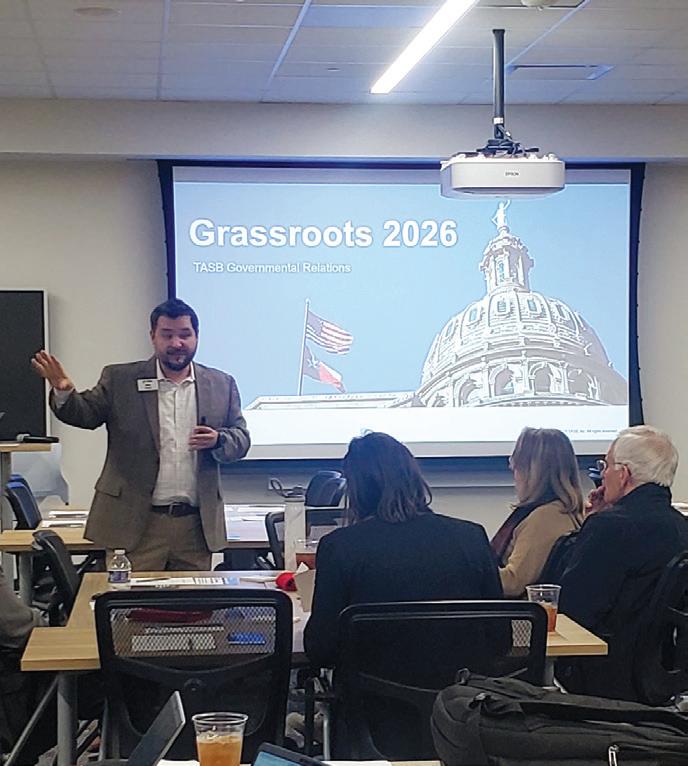
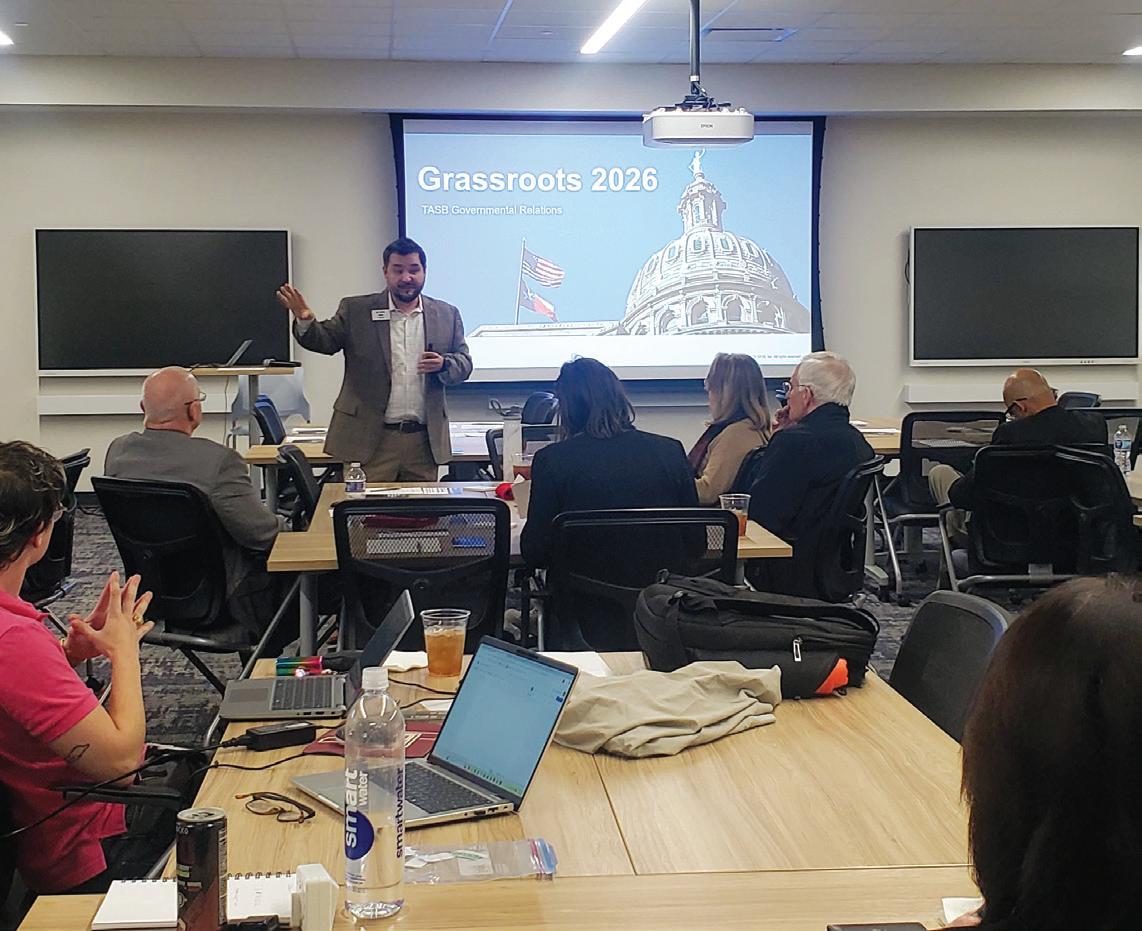
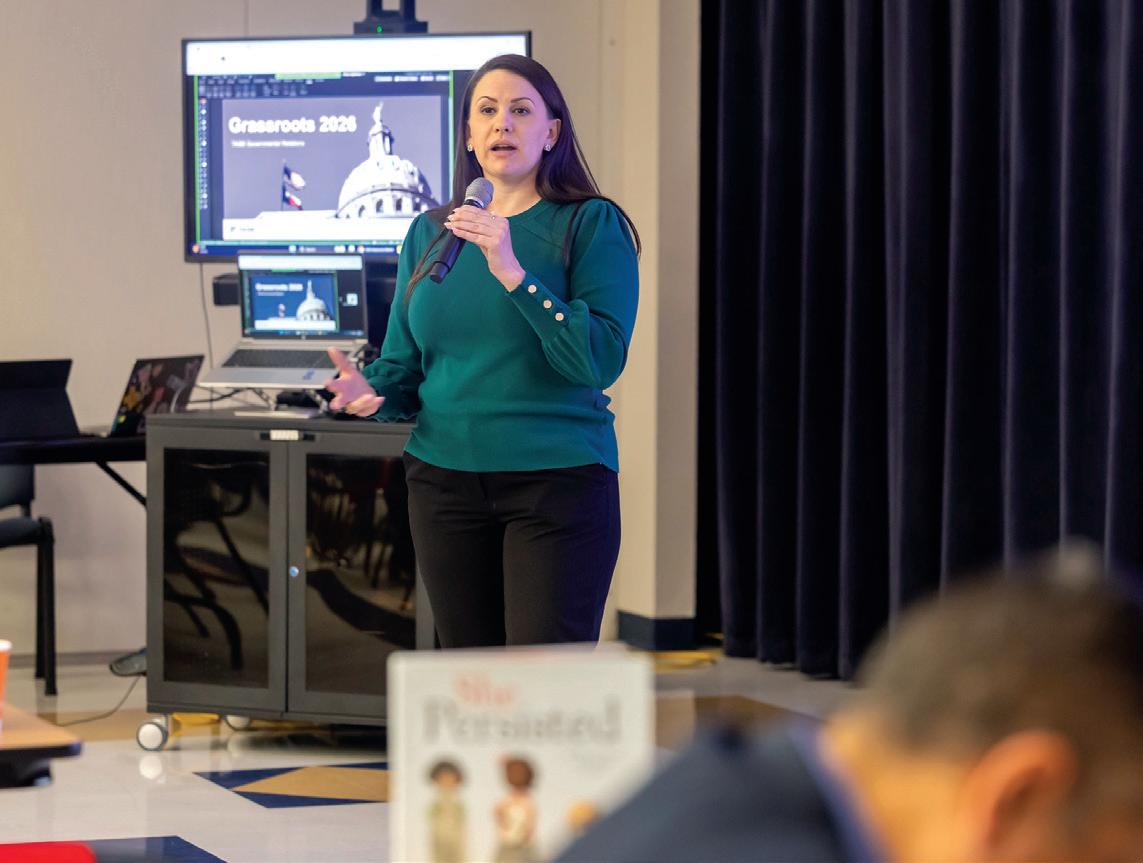
Dax González (standing), division director of TASB Governmental Relations, talks to trustees attending the Grassroots Meeting in Region 6 in Montgomery, where the new tool was discussed.
Photo by TASB Media Services

Off and running
So far, the legislative priorities of nearly 100 districts are represented on the tool. Also, TASB Governmental Relations staff discussed the new initiative during regional Grassroots Meetings across the state.
“At our regional Grassroots Meetings, local priorities identified with the help of the tool have become a useful conversation starter as trustees compare experiences and identify shared areas of focus,” said Kelly Rasti, associate executive director of TASB Governmental Relations.
For school board members, advocating for the needs of their district, its students, staff, families, and the community is one of their most important responsibilities. This takes many forms, from talking to local and state policymakers to raising awareness within the community about important district issues to even traveling to Austin to discuss a legislative topic.
“Making it easier for districts to see how others are shaping their legislative priorities is especially important before the next legislative session begins in January 2027. Establishing local legislative priorities helps trustees have a clear framework for conversations with their elected officials and other stakeholders about what matters most to their students and school communities,” Rasti said.
Additionally, these local legislative priorities allow districts to establish and collaborate on initiatives that go beyond TASB’s Advocacy Agenda, which represents the Associationwide legislative program.
“We’re hoping one impact of this project is to encourage more school boards to take the time to establish local legislative priorities, especially ahead of the next legislative session,” TASB Executive Director Dan Troxell said. “It will be powerful to see all the points of shared concern among our members and help us as an Association connect the dots with relevant and timely support.”
Building the tool
The new member benefit, which reflects TASB’s push to continuously innovate, is the result of a collaboration between the TASB Board’s Delegate Outreach Committee and Association staff members, particularly in the Data and IT area.
“This initiative was an outgrowth of the TASB Board of Directors’ conversations over multiple years,” said Joy Baskin, associate executive director of TASB’s Policy and Legal Services and Education Counsel. “Directors believed a member-facing, easy-to-use tool would be beneficial to school leaders seeking to discover what other districts are doing in regard to setting legislative priorities.”
Kelly Rasti, associate executive director of TASB Governmental Relations, said the Grassroots Meetings provided a helpful forum to discuss the new tool.
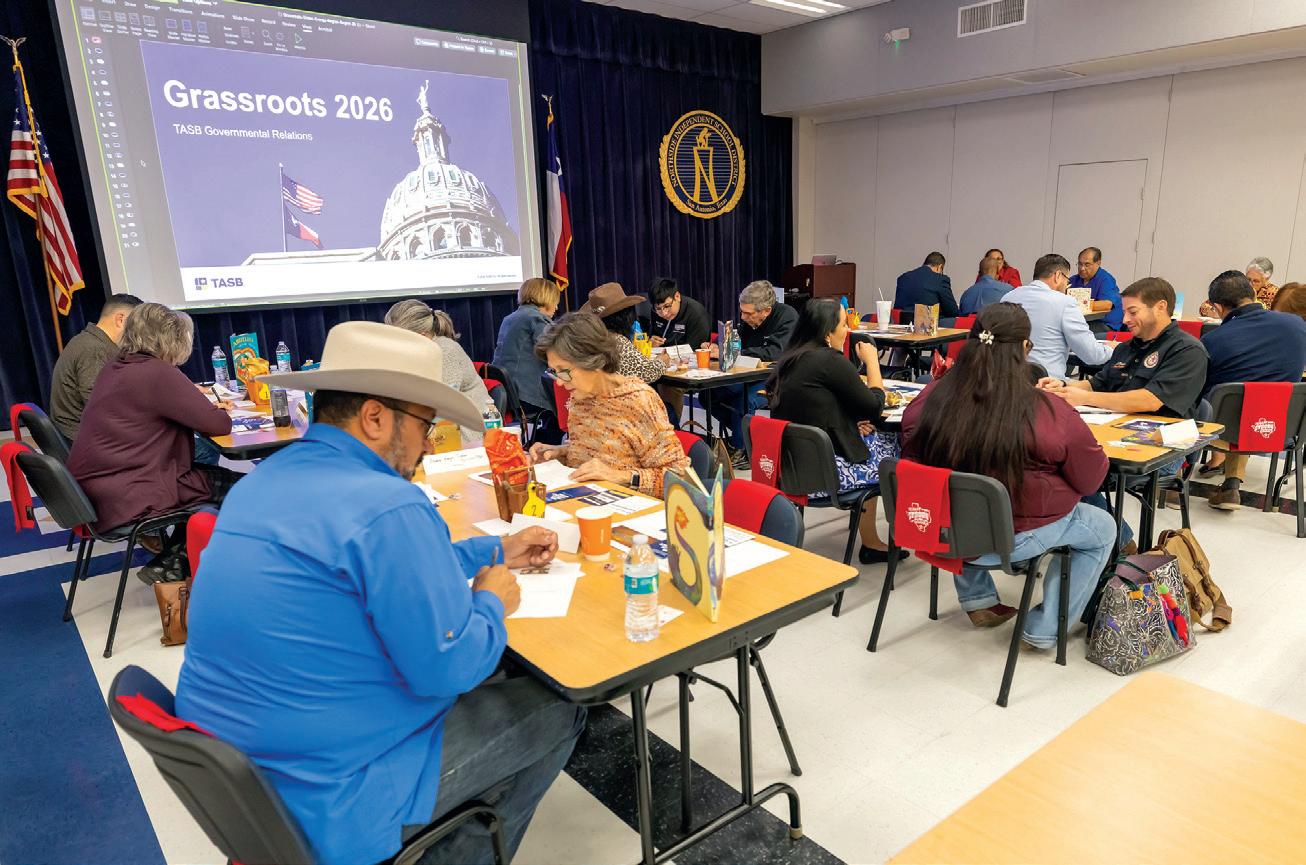
Trustees from Region 20 gathered at East Central ISD in San Antonio for a Grassroots Meeting on Feb. 12.
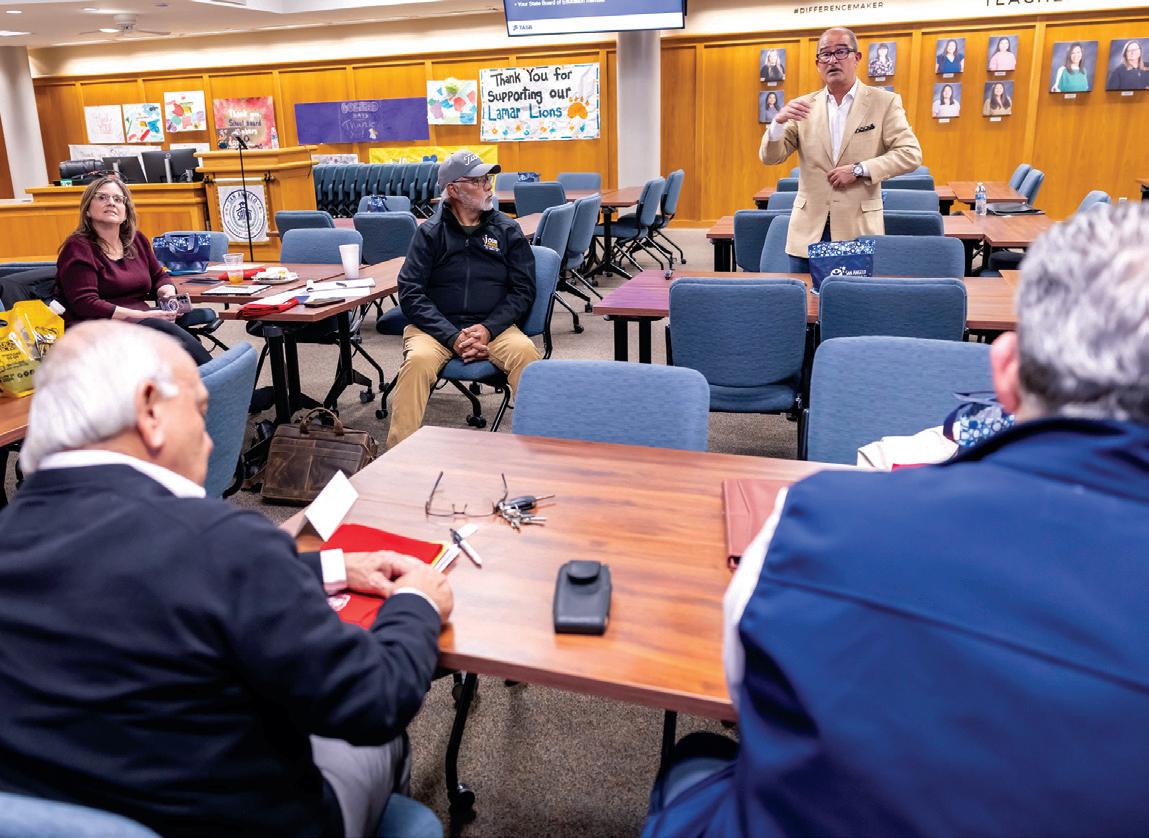
Raif Calvert (standing), assistant director of TASB Governmental Relations, met with trustees from Region 15 at a Grassroots Meeting in San Angelo on Jan. 22.
The tool gives TASB members “the ability to identify which districts care about which issues in a way that helps districts connect with each other and talk to their local legislators. It facilitates district-to-district connections to strengthen their local advocacy,” Baskin said.
The tool was launched in January, and there will be additional enhancements added, including the ability to see specific priorities by district and filter by various categorizations. TASB provides support and training for members interested in learning more about how to establish local legislative priorities.
“This has been a huge undertaking by TASB staff to make trustee connections easier,” Phillips noted.
Additionally, this tool builds on the popularity of TASB’s Toolkit for Community Advocacy, an online resource that provides step-by-step guidelines that members can use for their advocacy efforts, Baskin said.
Having improved access to districts’ legislative priorities also helps TASB better understand what matters to individual districts, she said. During the legislative session, as bills are filed on various subjects, districts and TASB can use the tool to get an understanding of which districts consider that topic a priority.
“State lawmakers want to hear directly from local leaders,” Baskin said. “TASB wants members to feel confident, relevant, and well-prepared to engage directly in that advocacy with state leaders or even federal leaders. This new tool will help our members in their advocacy efforts.”H
DISCOVER THE LOCAL LEGISLATIVE PRIORITIES TOOL
TASB members can access the Local Legislative Priorities Tool online and view other districts’ publicly available priorities. So far, nearly 100 school districts are represented on the tool. Any board that does not want to have its legislative priorities available through the tool has the ability to opt out. If your district has local legislative priorities that are not reflected in our online tool, please send them to us via the link on the webpage.

Scan to access and learn how to use the tool.
DEVELOPING LOCAL LEGISLATIVE PRIORITIES
The online Toolkit for Community Advocacy includes guidelines and tips for members who are developing or revising local legislative priorities. These local legislative priorities are different from TASB’s official Advocacy Agenda, which is developed through a grassroots process that ends with the Agenda being voted on annually by TASB membership at Delegate Assembly.
Using the toolkit, school board members can create a priority list that reflects the unique needs of their students and school community. The toolkit offers a step-by-step guide, but it also allows for each part of the process to be customized and tailored to what works best for individual districts and their communities. More importantly, the process used in developing the list will help build buy-in and engagement in your district’s advocacy work. When you get more people on the same page, amplifying the same message, that’s where there’s the most potential to positively influence the laws and policies that shape Texas public education.

Scan to access the toolkit.
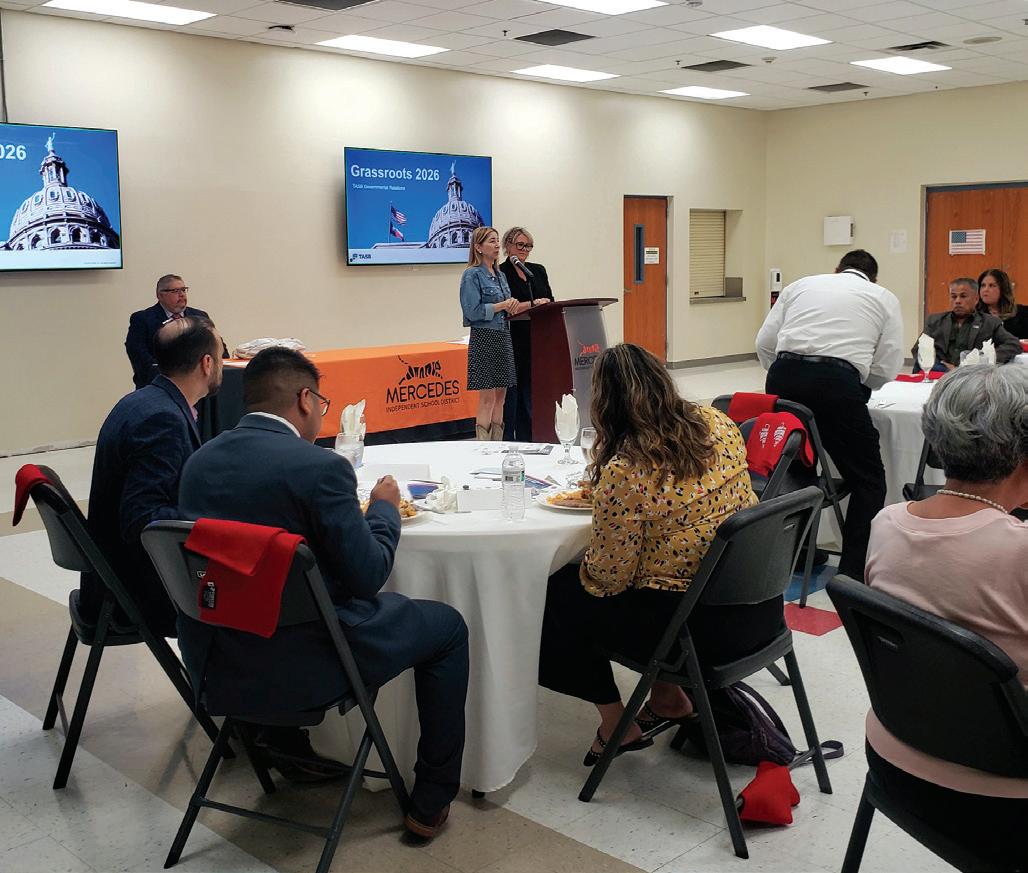
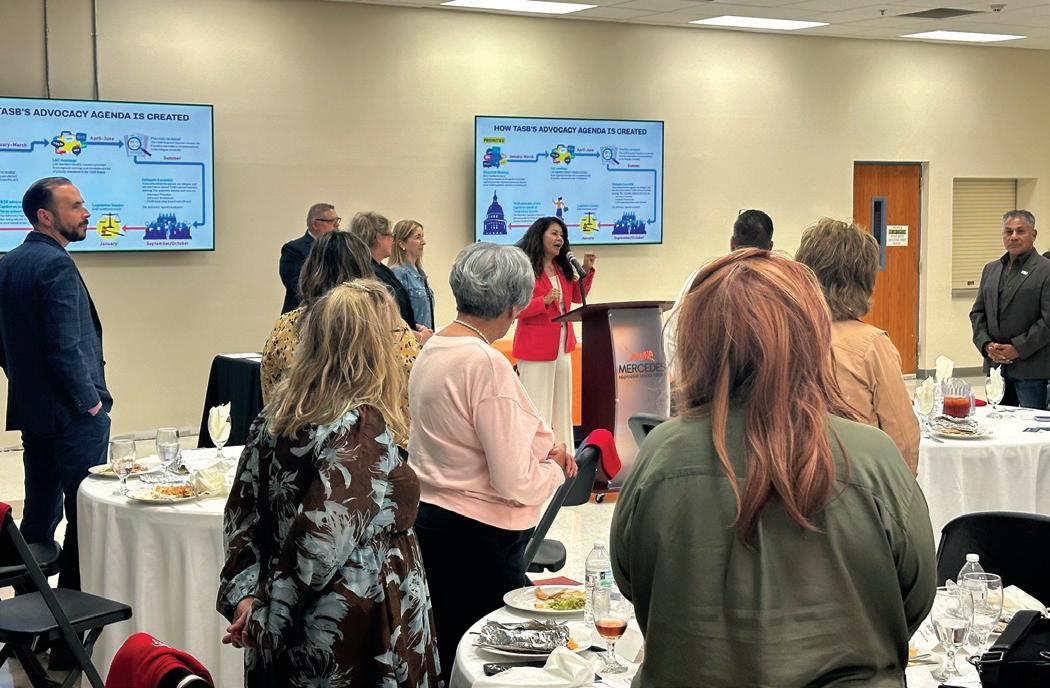
Trustees met at Mercedes ISD in Region 1 for a Grassroots Meeting on Jan. 8.
Laura Tolley is managing editor of Texas Lone Star.
Photos by TASB Media Services
TASB RISK MANAGEMENT FUND
EXCELLENCE AWARDS
Districts honored for efforts to reduce risk
In honor of their commitment to developing innovative and effective solutions to risk management challenges, the TASB Risk Management Fund has named five member school districts as recipients of the prestigious Excellence Award for 2026.

BY JALA MASON AND DAVID WYLIE
From reducing injuries to improving school safety to addressing transportation issues, these Excellence Award winners reflect Fund members’ exemplary efforts to find solutions to risk challenges and protect valuable resources. The 2026 recipients will be honored for their commitment to innovation and risk management excellence during the Fund Members’ Conference April 26-28. Each winner receives $5,000 to apply toward risk management efforts.
Here are the Excellence Award winners for 2026. Texas Lone Star talked to each of the winners about their initiatives. Their comments have been condensed and lightly edited.
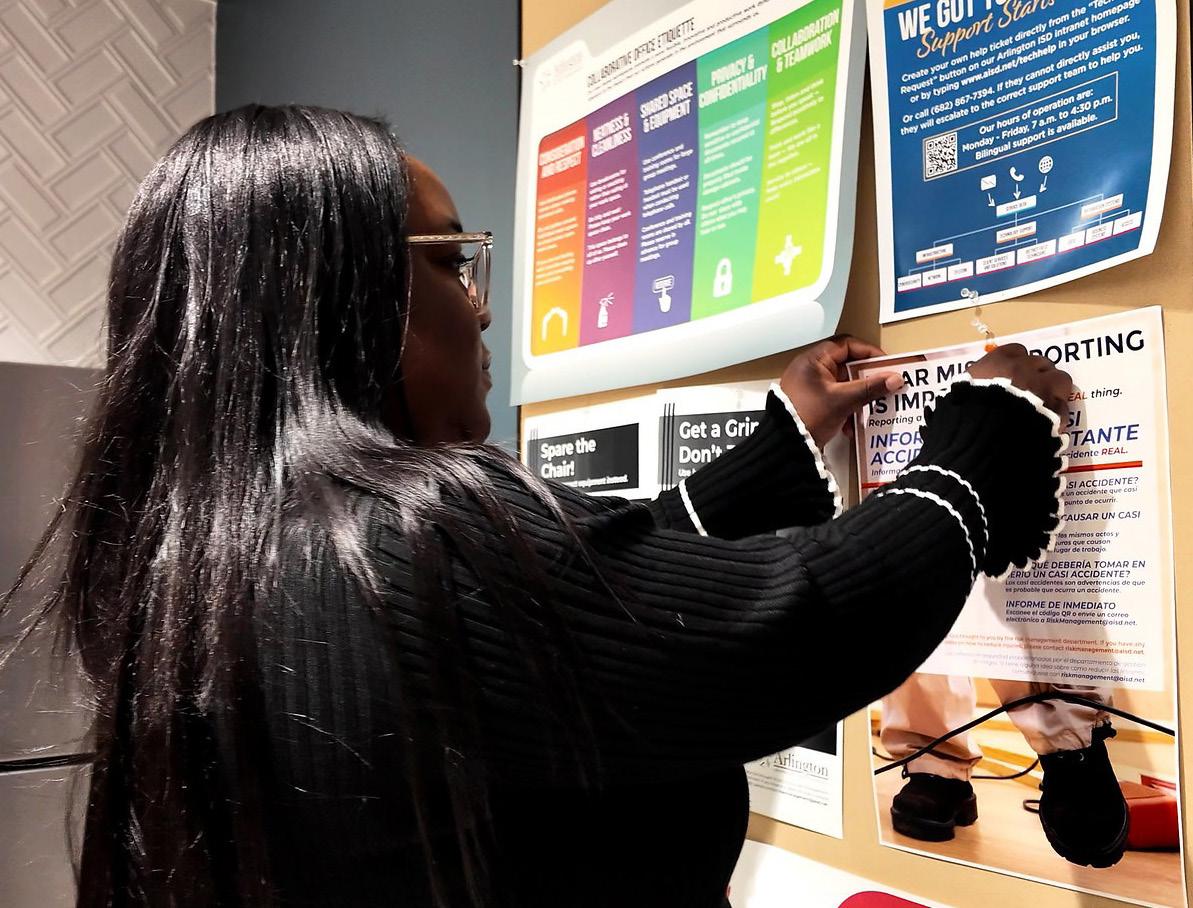
Arlington ISD’s Near-Miss Reporting Program aims to reduce workplace injuries. As part of the initiative, Jennifer Bakare-Brown — the district’s safety manager — helps place posters with a QR code linking to a simple form that makes it easier to report hazards that could cause injuries.
ARLINGTON ISD
Near-Miss Reporting Program
When workplace injuries were on the rise in Arlington ISD, staff investigated the facts and identified the root causes. It turned out that many incidents could have been prevented. Arlington ISD’s award-winning solution? The Near-Miss Reporting Program.
The risk management team strategically placed posters across the district that included a QR code linking to a simple form that made it easy for employees to report hazards that could cause injuries. The initiative has not only reduced injuries, but it also strengthened the district’s safety culture.
Communication and follow-up are just as important as reporting. If employees take time to report a near miss, leadership must take corrective action. Otherwise, participation drops.
? WHAT WAS THE PURPOSE OF IMPLEMENTING THIS PROGRAM?
“Arlington ISD emphasized near-miss reporting to prevent injuries before they happen,” said Jennifer Bakare-Brown, the district’s safety manager. “We wanted to bring forth a proactive approach to all the injuries we were having here within the district.”
? WHAT HAS THE PROGRAM ACCOMPLISHED?
“By reporting early and making sure it’s done in a very methodological and structured way, we don’t have those losses, those costs,” said Curt Fernandez, director of Risk Management.
“We have seen an increased number of near misses being reported, meaning that employees are engaged with the process,” Bakare-Brown said.
? WHAT DOES WINNING AN EXCELLENCE AWARD MEAN TO YOUR DISTRICT?
“It means a lot, especially for Arlington ISD because this department is fairly new, and it’s a new program,” Bakare-Brown said. “It’s very important that our employees see that we’re being recognized and we’re able to share this information with other districts so they may implement similar programs.”
“This Excellence Award underlines the commitment of our leadership,” Fernandez said. “This particular award recognizes our NearMiss Reporting Program, and the essence of that is making sure that everybody contributes and lets us know that we have issues before those issues turn into injuries.”
BEEVILLE ISD
Communitywide Emergency Drill Simulations and Reunification Planning
Strong risk management programs include a healthy dose of self-evaluation. The goal: Identify and address gaps before they cause incidents. That’s what Beeville ISD did with its security program. While the district had implemented foundational safety protocols, leadership recognized the need to bolster emergency response capabilities. The awardwinning effort was a communitywide emergency drill simulation program that included:
• Coordination with community partners such as law enforcement, EMS, fire departments, and hospitals
• Realistic, but age-appropriate, active-shooter drills
• Training to ensure staff and students know what to do during an emergency
• A formal process for reunifying students with their families
Beeville ISD’s initiative positioned the district to better respond to emergencies, and it strengthened trust with the community.
PHOTO BY TASB MEDIA SERVICES

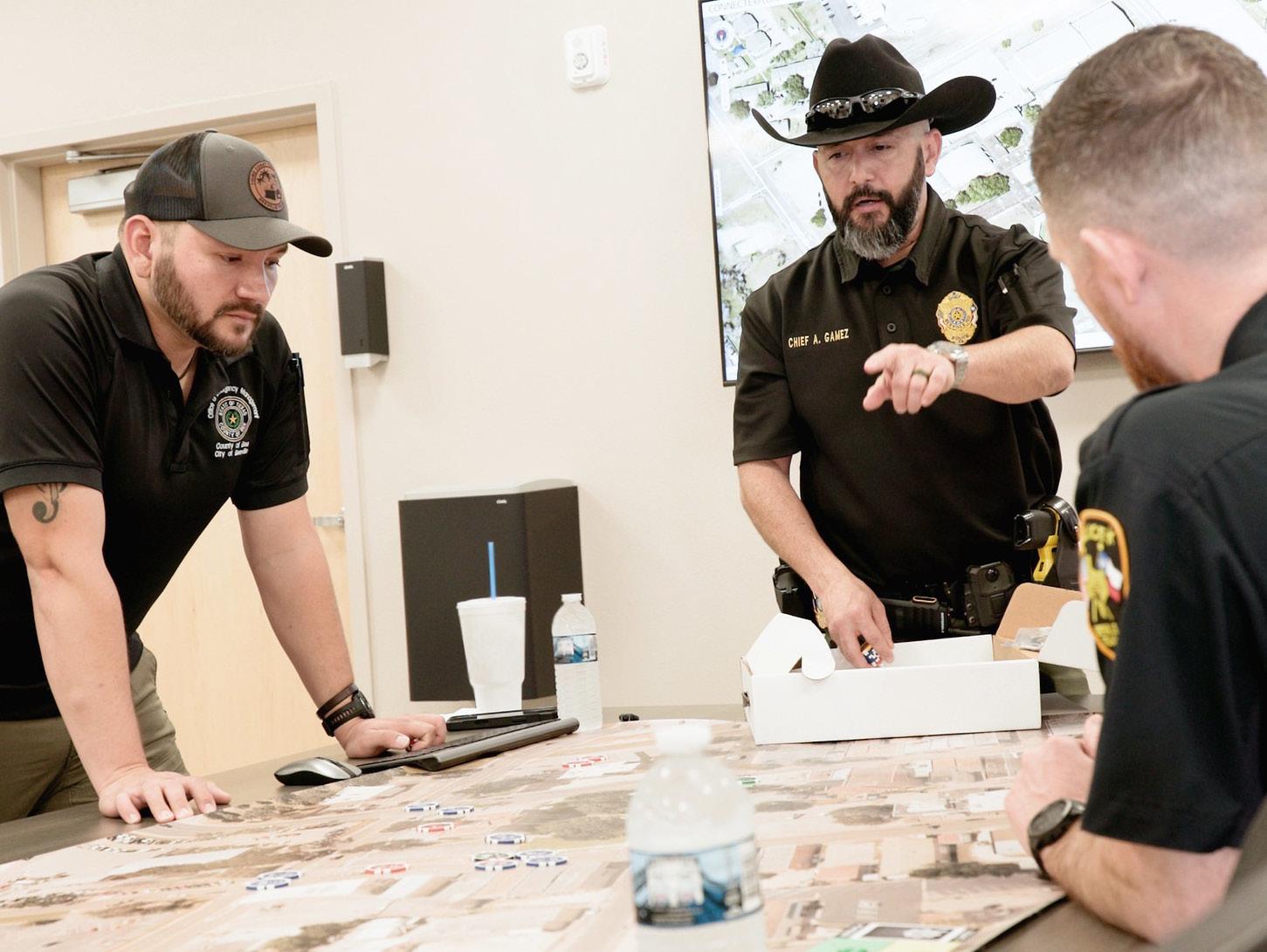
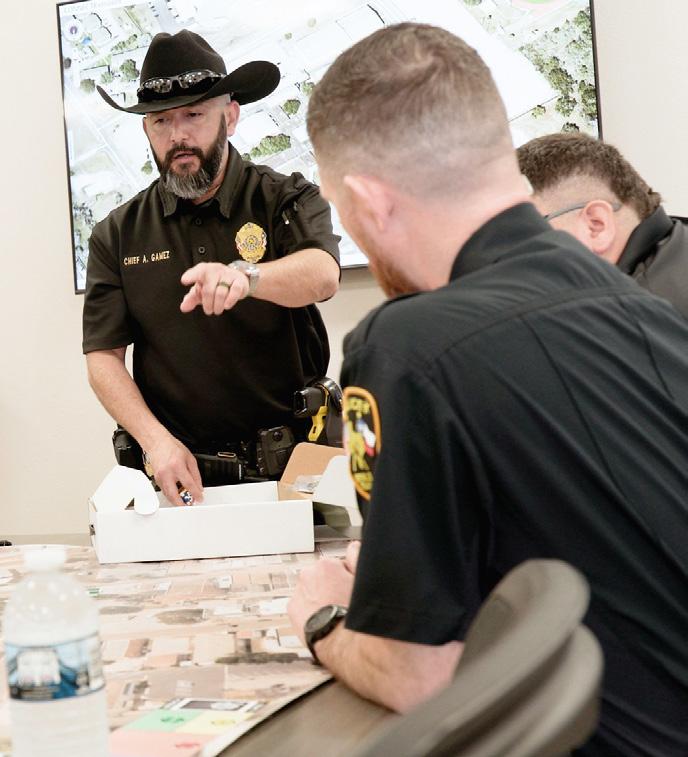
Beeville ISD bolstered its emergency response capabilities with a communitywide emergency drill simulation program that includes table-top training exercises with district staff and community partners such as law enforcement officials.
The district included student actors and simulated gunshot systems to deliver a realistic drill and training experience.
? WHAT WAS THE PURPOSE OF IMPLEMENTING THE PROGRAM?
“Our ultimate goal is to make sure that our staff and our students come to school and return home to their loved ones each and every day,” said Beeville ISD Superintendent Travis Fanning. “Students cannot be productive and they cannot learn in an environment where they don’t feel safe and secure.”
? WHAT MAKES THIS A STANDOUT PROGRAM?
“What stood out to me the most with Beeville ISD’s planning for these events is just their willingness to collaborate with all these different entities and bring everybody to the table,” said Ryan Garza, emergency management coordinator for Bee County and the City of Beeville.
? WHY IS THIS PROGRAM BENEFICIAL TO YOUR DISTRICT?
“Practicing reunification makes us more efficient and more effective,” said Art Gamez, the district’s chief of police. “It allows them to test themselves and how they’re going to perform and be able to work through those stressful situations. Instead of having to think, you’re starting to do.”
? WHAT DOES WINNING AN EXCELLENCE AWARD MEAN TO YOUR DISTRICT?
“Kudos to everybody involved. It is a testament to what Beeville stands for,” Gamez said. “We want other communities to take hold of what we’re doing and really start their own program.”
“Receiving the Excellence Award helps us realize that people are watching the great work that we’re doing each and every single day,” Fanning said. “It’s bringing recognition that we are truly centered and focused on students first and safety as our priority.”
HAWLEY ISD Transportation Safety
In Illinois, a 6-year-old boy was left alone at a bus stop for an hour in freezing temperatures because the driver dropped him off early without notifying his parents. A similar situation played out in Maryland, where a student was put on the wrong bus and ended up miles from home.
With an eye toward protecting students and avoiding route delays, Hawley ISD purchased bus-tracking and student check-in software.
The system empowers transportation staff to monitor bus locations in real time and address delays
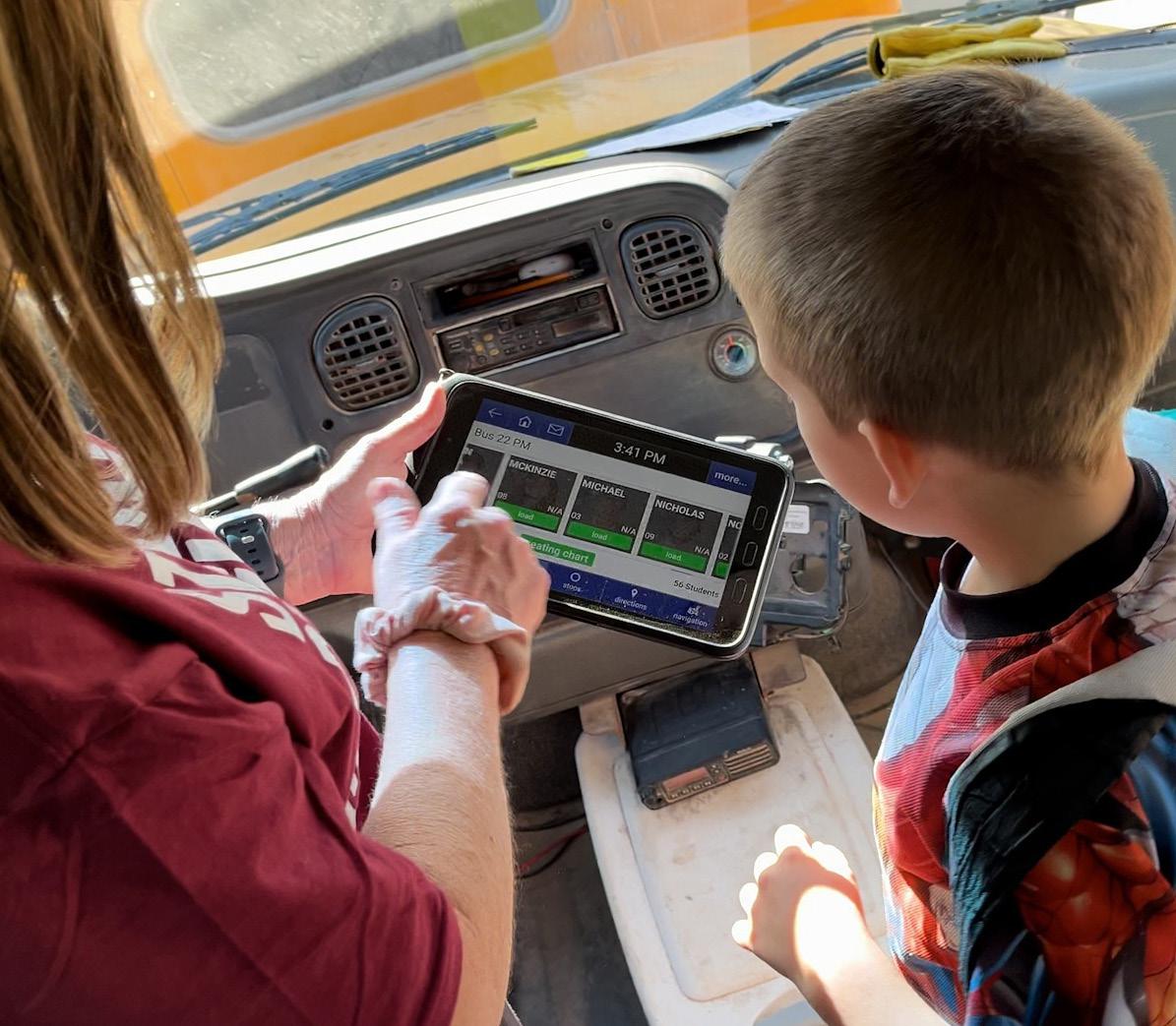
Hawley ISD purchased and implemented bustracking and student check-in software to improve operations.
PHOTO BY TASB MEDIA SERVICES
PHOTO BY TASB
Technology has streamlined Hawley ISD’s operations, but it’s no substitute for human-tohuman communication. The district launched a dedicated, after-hours phone line for parents to get answers and report concerns.
? WHAT WAS THE PURPOSE OF IMPLEMENTING THE PROGRAM?
“Making sure we get kids to the right stops and making sure that parents know where their kids are is important,” Superintendent Cassidy McBrayer said. “We’ve always struggled with identifying truly where an address is, and this technology is very accurate as far as mapping. That way, if we have a bus driver who’s substituting or you know, somebody new gets on the bus, then we have a good tracking of where all those kiddos are.”
? WHAT HAS THE PROGRAM ACCOMPLISHED?
“One of the things that we like about it is that it syncs up with our student software. So, if we have kids who aren’t at school that day, the bus driver knows that getting on the bus. It helps with delays. They’re not sitting waiting on kids who weren’t at school today,” McBrayer said.
“The after-hours transportation line has given us a method for parents to get hold of somebody. Typically, in any school district, the campus office is mayhem at release time. We’ve got our office people everywhere wrapping up at the end of the day. So, this gives one phone number that if a parent has a bus router and they need to get hold of someone, they have somebody who’s just dedicated to answering those phone lines,” McBrayer said. “Our bus drivers are always very concerned and take those kids’ safety very seriously, and administration makes things easier for everybody.”
? WHAT DOES WINNING AN EXCELLENCE AWARD MEAN TO YOUR DISTRICT?
“Our bus drivers, a lot of times that’s a group of employees that doesn’t necessarily get recognition, but they have one of the most critical jobs that we have. And so, it’s really important, and I think exciting, for them to be recognized,” McBrayer said.
IRVING ISD
Rebuilding Engagement and Safety Culture Through a Revamped Loss Control Committee
There is no template for managing risk in schools. Custodial staff face different hazards than teachers. The same goes for maintenance teams and grounds crews. Irving ISD’s Loss Control Committee harnesses employees’ perspectives to drive continuous improvement in the safety program.
The revamped committee includes representatives from HR, special education, maintenance, athletics, technology, the Fund, and more. With an influx of new members, meeting attendance increased by an eye-popping 200%.
The committee’s collaborative structure, open forums, and cross-departmental discussions provide insight into the unique safety challenges faced across the district. Powered by fresh insights and expertise, the committee and its work have informed updates to safety protocols and training initiatives.
Structured facilitation — clear agendas, rotating facilitators, and open discussion — keep loss control committee meetings focused and productive.
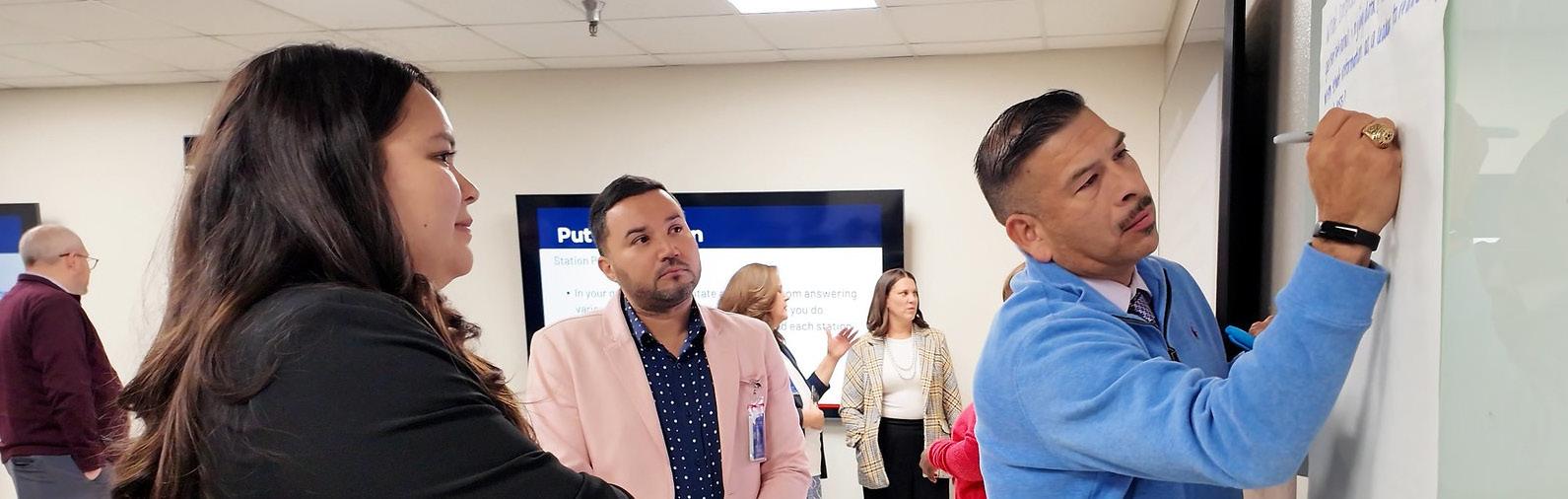
Irving ISD leaders revamped the district’s Loss Control Committee to harness a range of employee perspectives to drive continuous improvement in its safety program. This collaborative structure and cross-departmental discussions provide insight into the unique safety challenges faced across the district.
PHOTO BY TASB MEDIA SERVICES
?
WHAT IS THE PURPOSE OF THE COMMITTEE?
“The Loss Control Committee was created as an opportunity to allow for different departments to come together to review our loss data,” said Ashly Witek, director of Benefits, Risk Management, and HRIS Operations. “We’re just wanting to add more perspectives so that we can engage more with our loss data to hopefully reduce risk and injury in the district.”
? WHAT MAKES THIS A STANDOUT INITIATIVE?
“I think that what makes it unique is that people show up and they care, and they have really good ideas,” Witek said. “We’re able to look at data in a way that’s meaningful and to come up with real solutions to challenges that we’re facing, not only just in specific departments, but districtwide.”
? WHY IS THE COMMITTEE BENEFICIAL?
“It brings together a lot of different departments, and the environment is fun, I think, and we collaborate a lot,” Witek said. “So, by engaging different departments, we get a lot of different perspectives, but we also have different solutions that come up, and it just allows the opportunity for collaboration. Nothing feels better than coming up with a solution as a team that works well and causes improvement for the district.”
? WHAT DOES WINNING AN EXCELLENCE AWARD MEAN TO YOUR DISTRICT?
“Receiving the Excellence Award to our district is such a great honor,” Witek said. “It’s really just a validation of the work that the team has done to improve our processes. It highlights a culture where departments have input in reducing loss for the district, which is so important as a public school.”
PROSPER ISD
Driven to Safety — A Proactive Approach to Accident Reduction
Policies and procedures should be part of every school’s safety program. But genuine efforts to protect employees must be built on more than decrees like “employees shall” and “up to and including termination.” At Prosper ISD, workplace safety thrives because employees and leadership share responsibility for ensuring everyone goes home injury-free.
Under the district’s award-winning initiative, employees draw on their experiences and observations to submit ideas for improving workplace safety. When an idea leads to measurable improvement, the employee is publicly recognized and awarded a gift card.
Prosper ISD’s safety incentive program empowers front-line staff to take an active role in preventing workplace injuries. The result: fewer injuries, improved morale, and stronger safety culture.
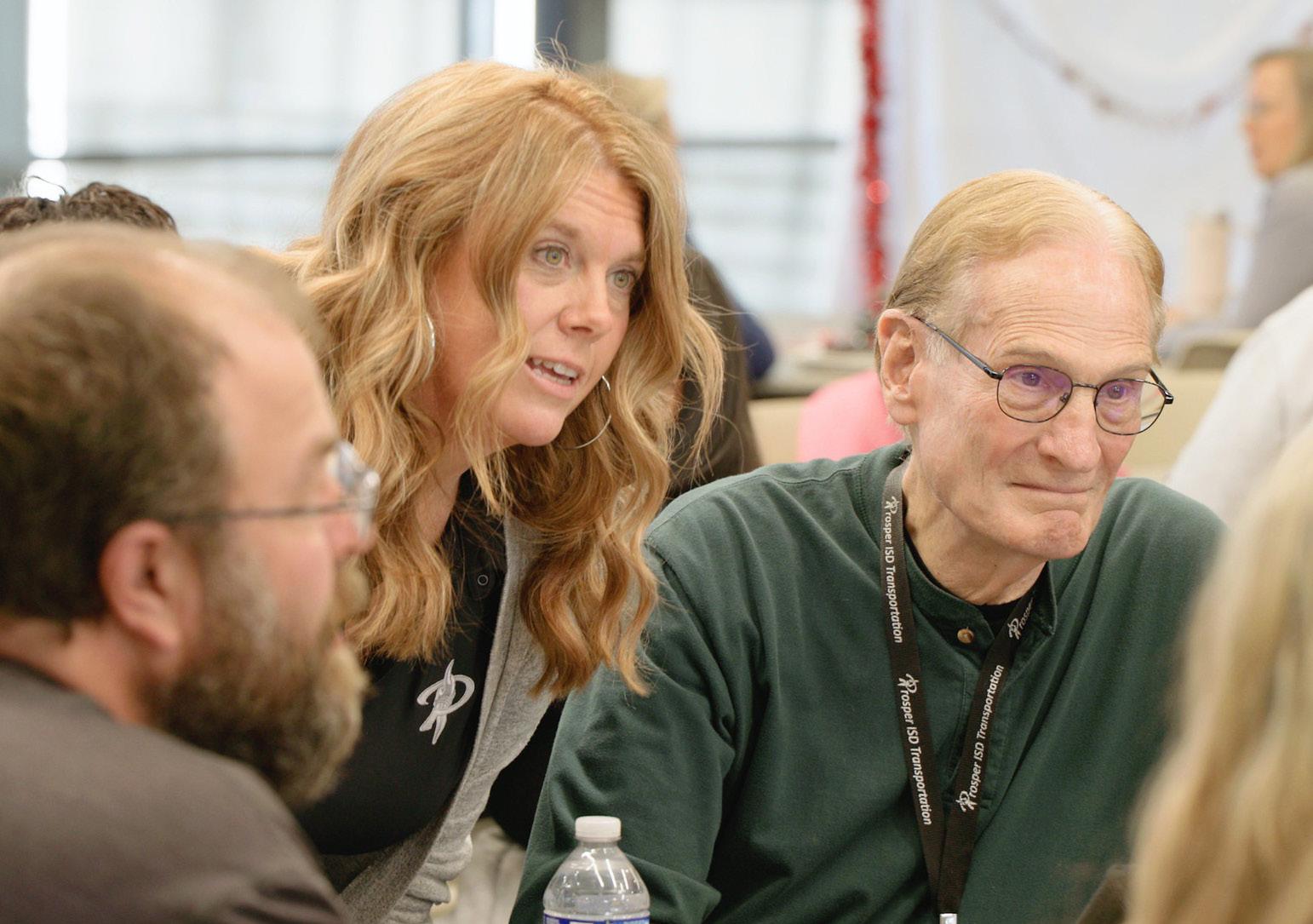
Prosper ISD’s safety incentive program empowers front-line staff to take an active role in preventing workplace injuries. This results in fewer injuries, improved morale, and a stronger safety culture.
“We created a simple and nonintimidating way for employees to submit safety ideas based on what they observe in daily operations,” said Mapengo (center), director of Transportation.
Even small ideas, such as repositioning equipment and improving bus-loading protocols, can move the needle in meaningful ways.
? WHAT IS THE PURPOSE OF THE PROGRAM?
“We were seeing a pattern of minor preventable incidents — mirror strikes, cone hits, tail swing issues, and tight campus loading situations,” said Teri Mapengo, director of Transportation. “Each one by itself might seem small, but together they were affecting safety exposure, morale, retraining time, repair costs, and public confidence. It became clear that if we didn’t address these smaller incidents proactively, they could lead to larger risks.”
PHOTO BY TASB MEDIA SERVICES
? WHAT MAKES THIS A STANDOUT INITIATIVE?
“We created a simple and nonintimidating way for employees to submit safety ideas based on what they observe in daily operations,” Mapengo said. “Everyone who submits a safety suggestion is entered into a gift card drawing, which encourages participation and reinforces that every observation matters.”
? WHAT IS THE IMPORTANCE OF FRONT-LINE EMPLOYEE INVOLVEMENT?
“They see traffic flow issues, campus congestion, student behavior patterns, and visibility challenges in real time,” Mapengo said. “They often spot risk trends long before leadership sees them in reports. If you want meaningful safety improvement, you have to include the people doing the job every day.”
? WHAT DOES WINNING AN EXCELLENCE AWARD MEAN TO YOUR DISTRICT?
“Receiving this recognition is meaningful because it reflects the work of our entire transportation team — not just leadership,” Mapengo said. “For the district, it reinforces that investing in culture, training, and employee engagement produces real results.”H
Jala Mason is a communications specialist and David Wylie is content developer for TASB Risk Management Services.





Plan Your 2026 Learning

Regional Workshops: Spring
Local Training. Trusted Expertise.
TASB Regional Workshops offer customized training to help school board members serve schools and communities. Trainings feature statewide and local experts. Choose the location that works best for you.
Keep an eye out for fall dates announced during summer.

Learning Journey
Upcoming Events
10-13
17-20 JUNE Fort Worth
Summer Leadership Institute
TASB’s signature conference builds trustee skills and connections for effective governance. Especially valuable for new board members.
San Antonio
OCTOBER txEDCON
8-11
Texas education leaders unite to connect, collaborate, and advance student success.
Houston
TASB Delegate Assembly
The annual event where Active Members shape TASB’s direction, elect TASB officers and directors, and approve the Advocacy Agenda.
Houston
• Legislative Update: 2025 Update to the 89th Legislature Regular Session
• Child Abuse Prevention: What Board Members Need to Know
• Emergency Management: What Board Members Need to Know

Looking for more online learning opportunities?
Find courses to meet your CEC requirements just in time for your district’s April credit reporting deadline! TASB’s Online Learning Center is your anytime, anywhere resource for school board trustee development.
Class Honor Policies
Review your district’s guidelines before graduation
by TASB Legal Services
Graduation is approaching for Texas students. It’s important for district leaders to review the policies they have in place regarding graduation, local honors, and class rank, which is particularly important because state law ties it to higher education benefits, including scholarships and automatic university admission.
Having a well-defined system in place that establishes clear rules for students and parents ensures fairness. Graduation season is an emotional time. The stakes can feel incredibly high for both parents and students. Having clearly written policies in place that have been effectively communicated can minimize the risk of complaints or litigation.
Following are answers to key questions about policies regarding graduation, GPA calculation, class rank, and local honors.
Q: Where is a district’s policy on class ranking and graduation requirements?
A district’s policies regarding class
rank are found in your district’s policy manual under EIC, while graduation policies are located under EIF.
Q: How is a student’s GPA calculated to determine their class ranking for graduation?
Currently, GPA and class rank calculations are determined entirely by local school district policies. This is set to change with the recent passage of Senate Bill 1191. Previously, under Texas Education Code section 28.0252, the commissioner of the Texas Education Agency was authorized to develop a standardized method for calculating high school GPAs, including assigning additional weight for advanced courses, but this authority had never been exercised.
With the passage of SB 1191, the commissioner is now required to develop a standardized method for computing a student’s high school GPA, which must provide equal additional weight for advanced placement, international baccalaureate, OnRamps dual enrollment, and dual credit courses.

Based on the language of the bill, the commissioner must develop the standardized method “as soon as practicable” after the bill’s effective date, which was June 20, 2025. According to TEA’s 89th Legislature Updates Implementation Timeline webpage, the method, or at least information regarding high school GPA calculations, is expected to be released in the winter.
Until the commissioner’s standardized method is released, calculating GPA and class rank is based entirely on local school district policy, and each school district is likely to have unique rules regarding class rank.
Q: What factors should my district consider when developing a class rank policy, and what details are usually included in EIC(LOCAL)?
Policy EIC(LOCAL) should specify which classes are included in or excluded from a student’s GPA calculation and whether any of the courses will be awarded special weight. Many districts elect to award extra weight to more demanding courses — such as honors, advanced placement, and international baccalaureate courses — when calculating GPA. If a district chooses to adopt a weighted grading system, the district policy should specify the method of weighting grades and state how the district will weigh, if at all, transfer credits, credit by examination, dual credit, correspondence courses, and elective courses. The policy should also specify whether failing grades are included in a student’s GPA.
Q: How are the valedictorian and salutatorian chosen?
Local honors and awards, including designations like valedictorian, salutatorian, and honors graduates, are determined at the discretion of each school district. A district’s EIC(LOCAL) should outline the criteria for these honors and specify when the district will calculate class rank for the purpose of these designations. Typically, the policy also outlines eligibility requirements for receiving these honors, such as the minimum number of semesters a student must attend before graduation, or any other qualifications adopted by the district. As long as a school board does not exercise its discretion in a manner that is disallowed by law, the board has a great deal of latitude in determining the manner in which local academic honors
will be awarded. Generally, Texas courts and the commissioner of education will uphold local decisions that are not arbitrary, capricious, or unlawful.
It is also important for districts to specify in their policies how ties for valedictorian or salutatorian will be handled. Often, ties are broken by comparing the number of rigorous courses each student has taken, such as advanced, AP, or dual-credit courses, though the exact method varies by district. If a tie cannot be resolved, some districts recognize all students involved in the tie as valedictorian or salutatorian. Alternatively, districts that want to avoid ties may calculate GPAs to a sufficient number of decimal places.
Q: What provisions will I find in Policy EIF regarding graduation?
Policy EIF(LEGAL) provides the legal framework for high school graduation, including the state’s minimum requirements for a student to graduate from a Texas high school, called the foundation high school program. While students are required to complete courses mandated by the state under the foundation program, districts have the option to require addi-
tional course credits beyond the state’s minimum requirements. Your district’s choices regarding requirements in addition to the foundation program are found in Policy EIF(LOCAL).
Q: Can we change our district’s class rank or graduation policies?
Yes, however, TASB Legal Services strongly recommends not changing class rank rules or graduation requirements during a current student’s high school education. If a school board changes its class rank policy midway through students’ high school education, and it makes the change effective immediately upon adoption, students could be negatively affected. These students have already made academic decisions based on the previous policies and relied on them in their pursuit of honors. Legal complaints could be filed. Since academic honors often come with monetary awards, such as scholarships, a student who is denied an honors position due to policy changes may claim monetary damages in a potential lawsuit. When a district plans to change its class rank or graduation policy, including how class rank is calculated and
which classes are considered, TASB Legal Services advises adopting the changes prospectively, applying them only to incoming freshman classes. This approach reduces the risk of litigation by ensuring that current students are not affected by policy changes midway through their high school education. If different calculation methods are used for different graduating classes, the district’s policy should clearly specify which system applies to each cohort of students.
If you have questions about these issues, consult your district’s attorney or call TASB Legal Services at 800-580-5345.H
This article is provided for educational purposes and contains information to facilitate a general understanding of the law. References to judicial or other official proceedings are intended to be a fair and impartial account of public records, which may contain allegations that are not true. This article is not an exhaustive treatment of the law, nor is it intended to substitute for the advice of an attorney. Consult your own attorney to apply these legal principles to specific fact situations.
TASB’s Advocacy Agenda
Trustees wrap up first step of developing priorities
by Dax González
Trustees from across the state met at their local Grassroots Meetings to draft regional priorities that will move on to become TASB’s Advocacy Agenda Priorities.
During these meetings, trustees discussed many of the important issues facing Texas public schools and students and identified the most critical items to include on their regional lists. Many regions chose to include issues such as teacher recruitment and retention and an increase in school funding, and many regions showed a renewed focus on restoring local control to school boards.
Attendees expressed their appreciation for the ability to share their thoughts with other trustees and to learn that they have many of the same concerns, even though their district characteristics may differ.
The Legislative Advisory Council
Now that the regional priorities have been established, the Legislative Advisory Council — consisting of trustees elected during the regional Grassroots Meetings — will gather in Austin on April 18 and in San Antonio on June 11.
At these meetings, LAC members will merge regional priorities into one statewide list of priorities that will be considered by the TASB Delegate Assembly and potentially become the Advocacy Agenda Priorities for the upcoming legislative session.
We strongly encourage your board to send a trustee to the TASB Delegate Assembly in Houston this October to represent your board and support your advocacy positions during the discussion and adoption of the priorities.
Federal advocacy conference
Dozens of Texas school leaders traveled to Washington, D.C., in February for the annual Texas Federal Advocacy Conference. The TASB-hosted event offers attendees the opportunity to learn about federal education issues and to meet with their federal lawmakers.
On the first day, attendees heard from education policy experts about issues affecting public schools. On the second day, trustees visited with their legislators
A: Trustees discuss the development of TASB’s Advocacy Agenda Priorities at a Grassroots Meeting held Jan. 8 in Mercedes.
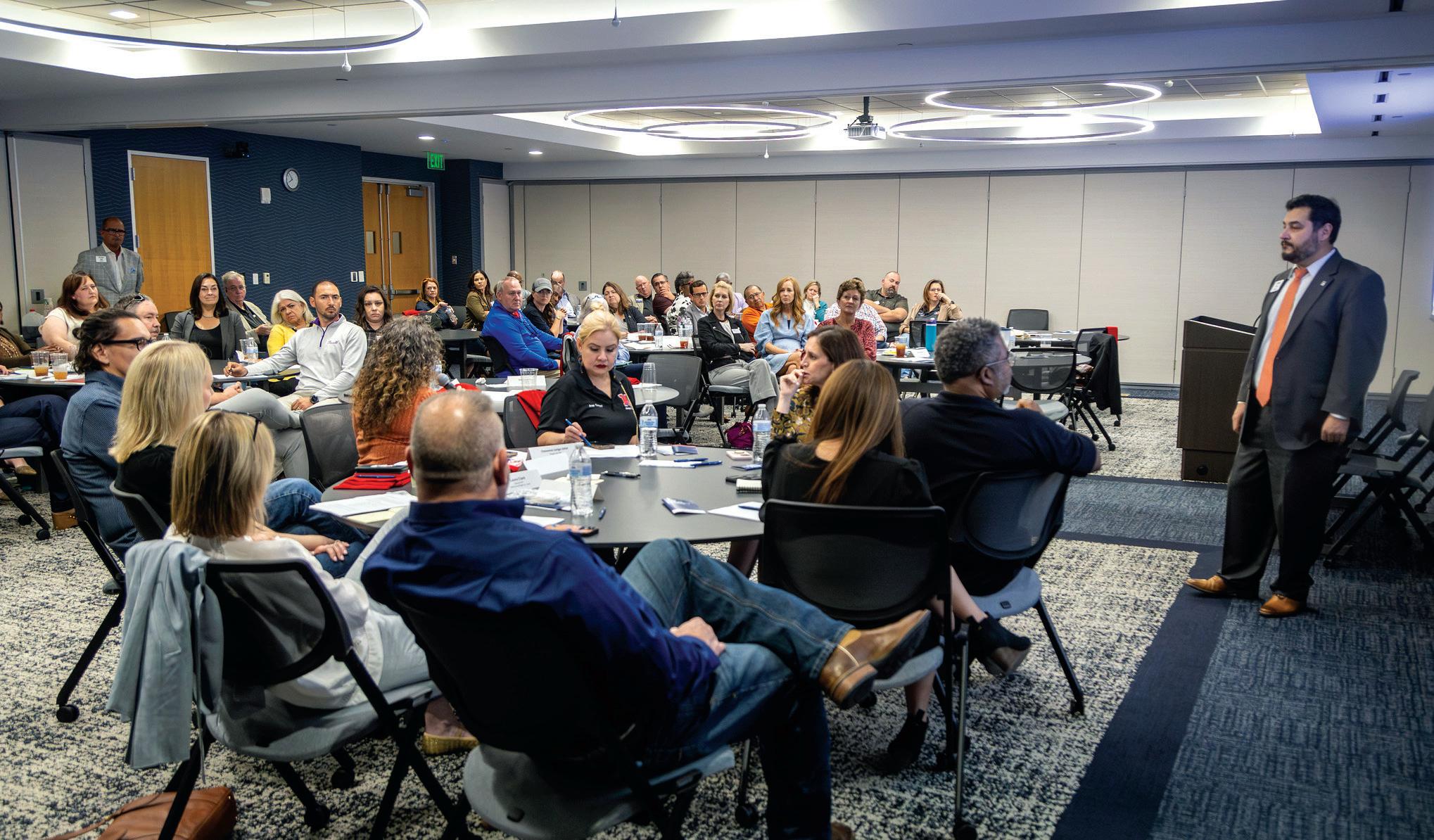
B: Dax González, division director of TASB Governmental Relations, talks to trustees in Region 13 at a Grassroots Meeting held Jan. 7 in Austin.
and staff to share how federal policy impacts local public schools and students.
TASB provided attendees with copies of their District Data Overviews highlighting curated, publicly available data that show a snapshot of their local districts. Trustees used these overviews when meeting with their lawmakers to share the demographic and budget information of their schools. School leaders can view their District Data Overviews on their TASB website member dashboards.
My thanks to everyone who braved the cold and attended the conference, which offered trustees the opportunity to make connections with federal lawmakers and their staff and to learn more about education issues at the national level.
If you have questions about any of these issues, please contact Dax González at 800-580-4885 or dax. gonzalez@tasb.org. Scan the code to learn more about TASB’s Delegate Assembly.H

Dax González is division director of TASB Governmental Relations.


Governance in Focus
Leadership TASB travels to Amarillo
by Mary Ann Lopez
Editor’s note: Leadership TASB is a unique board development program designed to take experienced board members to a new level of service and leadership.
As part of the Leadership TASB experience, each class visits districts across the state to learn more about best practices in board governance, better understand educational challenges, and experience innovative programming.
Texas Lone Star is asking some members of the Class of 2026 to share their personal perspectives and experiences from these visits to offer insight into the LTASB experience and how it impacts cohort members, their board service,
and their knowledge of governance and leadership.
In February, the class took its third trip and was at the halfway point in the program. The cohort traveled to Amarillo, making visits to Highland Park ISD (Potter County) and Amarillo ISD. Lynn Boswell, Austin ISD’s board president and a TASB Director, shared her personal experience on the trip with TLS. Boswell is in her sixth year of service on the Austin ISD board. Her responses have been condensed and lightly edited.
Q: Why did you apply to participate in Leadership TASB and how has the experience been so far?
Friends who are LTASB graduates always rave about the program. It has been on my wish list since I became eligible to apply, and I’m so glad and so grateful to be part of this LTASB class. I love spending
time with trustees from other parts of Texas, and with people who represent districts very different from mine. The chance to do that together over the course of a year, while visiting campuses and learning new skills together, is even more powerful than I expected it would be. I’m learning so much. I’m developing wonderful new friendships.
Q: With this being your third LTASB trip and having some experience with the program and the visits, what were you most excited about and hoping to learn from the visit to Amarillo?
I’m learning with the class when we travel. But I’m also learning from the class because everyone brings so much to this work and to the LTASB experience.

When we get together, I know that I will learn so much by sharing this experience with other people and through talking about what we’ve seen together. That’s a big part of what makes LTASB such a powerful experience to me.
One highlight of this trip was the chance to get fantastic advice about communication from Sheleah Reed, who has worked in many Texas school districts and brings a deep understanding of the work. She shared clear and useful advice about
communication, and I heard it referred to in conversations throughout the rest of the session. She was funny, engaging, and clearly an expert among experts. I will be excited to talk with my classmates in Texarkana [the next LTASB trip location] about how everyone is using what we learned from her.
We also took a deep dive into some advocacy for the first time, with presentations from Robert Long (TASB Board Development Services division director and
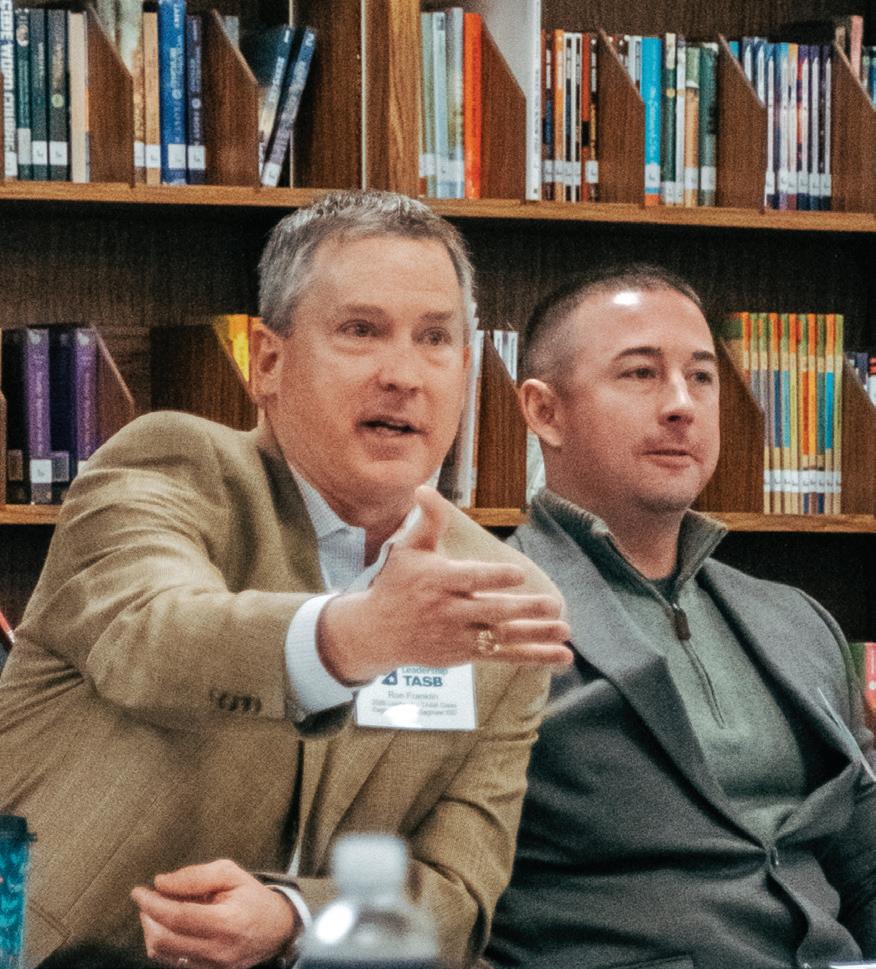
A: Ron Franklin (left), a trustee from Eagle Mountain-Saginaw ISD, participates in a discussion during the class visit to Amarillo ISD.
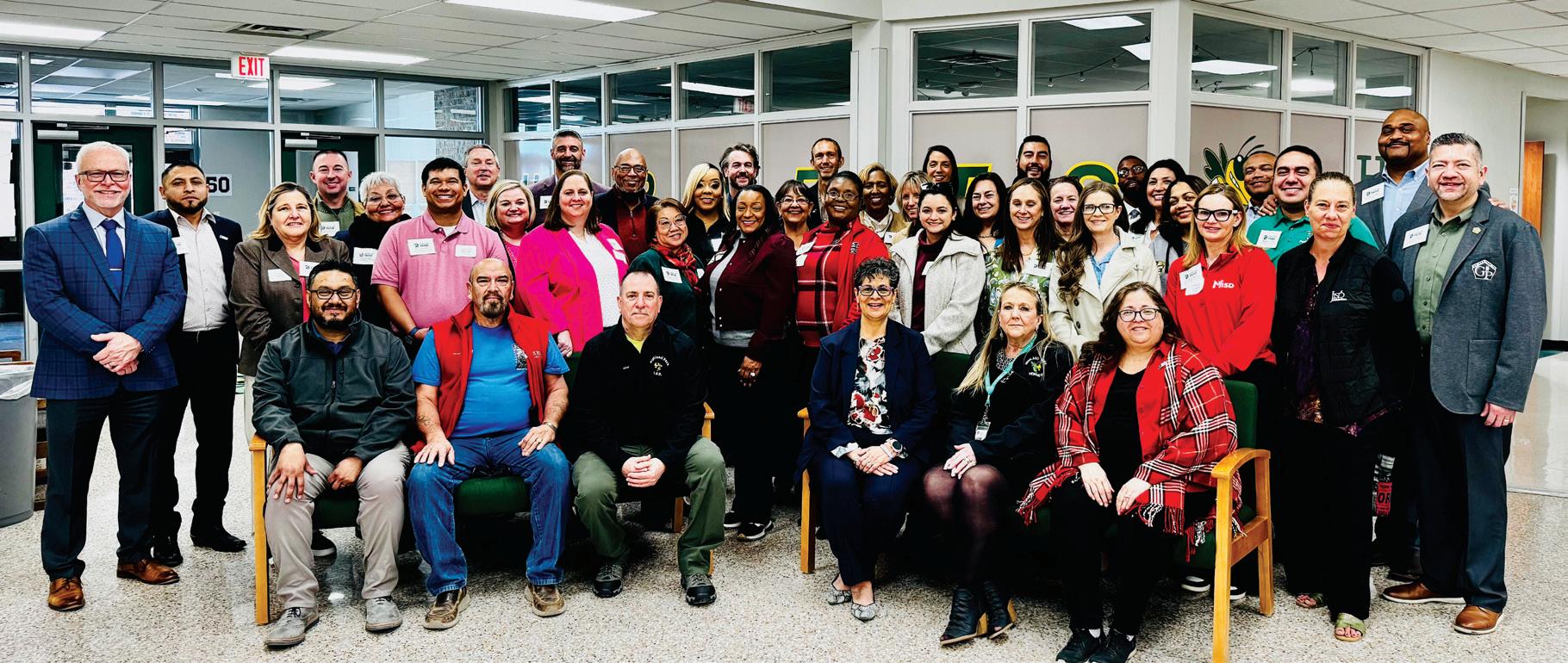
B: During their visit to Highland Park ISD (Potter County), class members paused for a photo with district staff members.
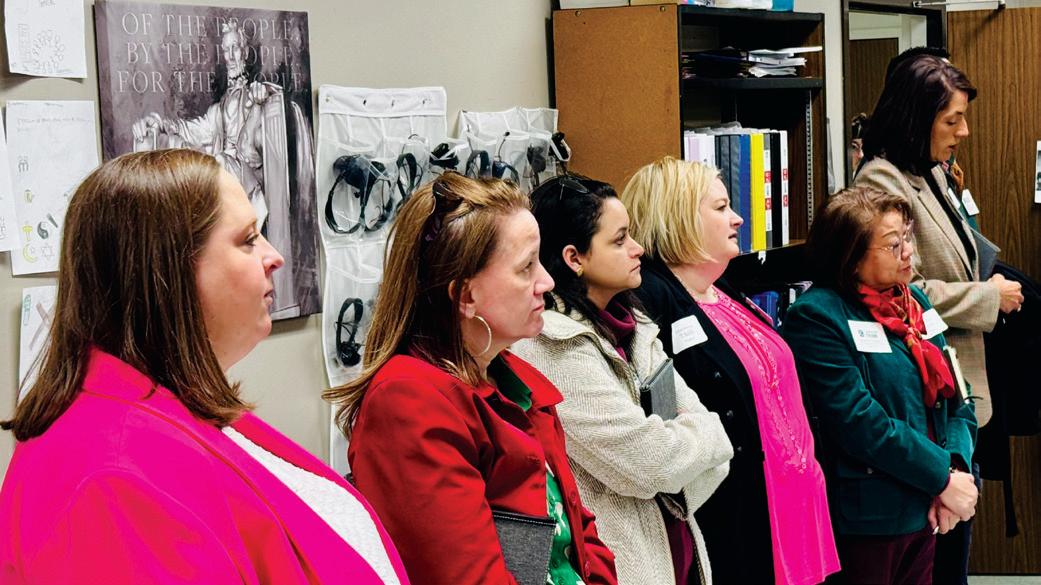
C: Amarillo ISD Superintendent Deidre Parish made a classroom visit at Eastridge Elementary School along with LTASB members.
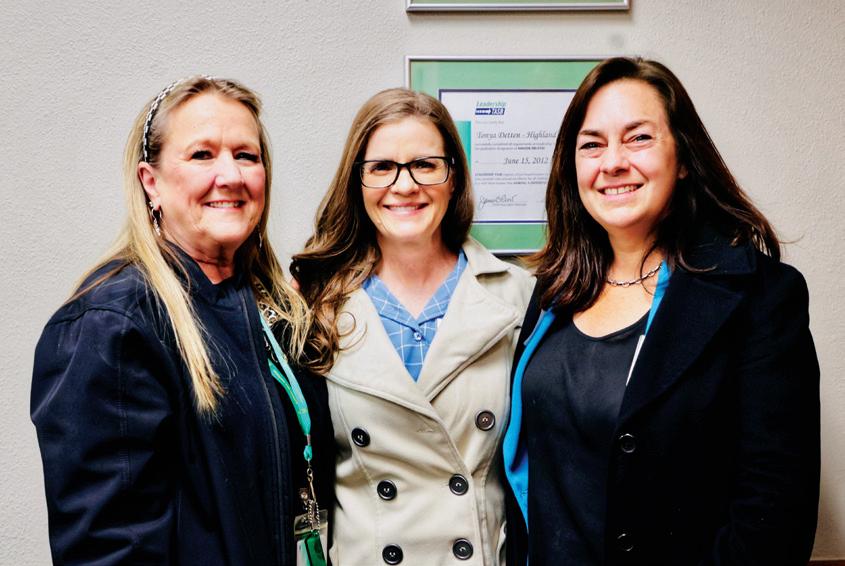
D: Cindy Spanel, left, a Highland Park ISD (Potter County) trustee and a LTASB Class of 2010 alum, connects with current LTASB class members Ginger Friesenhahn, an East Central ISD trustee, and Lynn Boswell, Austin ISD’s board president, during the visit to the district. All three trustees are TASB Directors.
Photos A and C, courtesy of Amarillo ISD
Photos B and D, courtesy of Matthew Aguilar, Pearsall ISD’s board president
LTASB program manager) about governing with purpose and Skylar Gallop from Raise Your Hand Texas. Skylar is from the Panhandle, so she was able to share some valuable history and context with us while sharing information about the impact of legislation on education in the region.
Q: What were some of the top highlights for you during the school visits?
At Highland Park ISD (Potter County), it was so exciting to learn about the board’s


vision for building enrollment in a way that is uniquely theirs. They have very little housing in their district, so they decided to purchase 550 acres of land that they are using to build a new community [Buffalo Highlands housing development] that should benefit from increased job growth in the area. They will use part of the land for new school facilities, including an early learning academy and a career and technical education center. And they are working to sell the remaining land to partners for residential and commercial opportunities. The district’s hope is that new housing will bring new students so it stays strong both in enrollment and in funding.
At Amarillo ISD, we visited an elementary school, a middle school, and a high school that feed into one another. The neighborhood serves a very high number of students who are refugees or children of refugees from around the world, so it was beautifully diverse. The student body speaks dozens of different languages at home, and some had limited access to school before they came to the U.S.
We had the chance to visit classrooms on tours that were guided by students, and we saw teaching and learning that was authentic, engaging, rigorous, and joyful in classroom after classroom. The use of computers was limited and strategic, which really struck many trustees.
Students were clearly excelling in a huge variety of disciplines. We saw kindergartners reading fluently, a middle school band playing beautiful music, and high school students tackling tough subjects with confidence. Teachers were engaging students in inquiry and hands-on learning in many classrooms. And students shared how much they like their schools. It was clear that great things are happening in these schools and for these students. It was inspiring and exciting to see.
Q: With only one more trip before the final session in Fort Worth and your completion of the program, how was this trip different from your first visit?
We have developed comfort and warmth among our class, so we are now friends in addition to being colleagues. That brings a depth and sense of safety to our conversations with each other. We can be more open and more vulnerable because we know each other well. We have developed a deep sense of trust and respect. And that also brings a depth to what we are experiencing together and the ways in which we are using what we learn.
To me, this trip was when the true power of LTASB really became clear.
Q: How do visits like this help you do your job?
E: LTASB members learn more about Amarillo ISD during a session at the district.
F: LTASB class members Jacqueline Jean-Baptiste of Stafford Municipal School District (left) and Lynn Boswell, Austin ISD’s board president and a TASB Director, observe a class during their visit to Highland Park ISD (Potter County).
G: LTASB members visit classrooms at Highland Park ISD (Potter County and observe student learning.
I am lucky to serve on a board with eight fantastic colleagues who each bring a different mix of expertise and experience. But I also know that we can learn a great deal from people in other districts who are facing many of the same challenges we are facing. It’s exciting to have relationships with trustees from other Texas communities who can serve as sounding boards and sources of ideas and inspiration. And it’s always powerful to spend time on campuses seeing how other Texas districts are serving their students. Time spent with LTASB makes me a better trustee. And between sessions, our class is increasingly sharing and seeking advice and ideas on some of the challenges and choices we are all facing.
Q: Do visits like this change your understanding of your role, and if so, in what way?
LTASB keeps our governance role at the center of everything we do. We talk about it when we visit campuses, when we meet other trustees, and when we hear from experts. It’s the filter for everything we do. There’s always robust discussion about how our governance choices shape our students’ experience in the districts we serve. And we also talk about important board roles, including understanding and approving budgets, shaping policy,
Photo E, courtesy of Amarillo ISD
Photo F and G, courtesy of Matthew Aguilar, Pearsall ISD’s board president
E F G
connecting with our communities, and engaging in advocacy. I feel strongly that the time I spend with LTASB is an investment in my effectiveness and growth as a trustee.
Q: Are there any key takeaways that you will share with your board?
Like Amarillo, Austin is a community that welcomes refugees from around the world. I saw two of my board colleagues the day after I got back from our trip, and I was so excited to share some of what I saw and learned at the campuses we visited in Amarillo. Great things were happening for their students, and it’s exciting to talk with my colleagues about how we can support our superintendent in our district’s work to serve our students with joy, ambition, and impressive success.
Q: If you could sum up your trip in one sentence, what would it be?
Our Panhandle trip highlighted the possibilities of innovative thinking in Highland Park ISD (Potter County) and of celebrating and supporting a beautiful diversity of students from kindergarten through graduation in Amarillo.
Q. Is there anything else you would like to add or think readers should know about your experience?
It can be hard to find opportunities to meet and spend time with people from communities that are very different from our own. That’s part of what I love most about TASB, and it’s a key part of what makes LTASB so powerful. We come from every corner of Texas, from districts with a few hundred students and districts with tens of thousands. Our communities look different politically, economically, and demographically. And we have so much in common and so much to learn both from and with each other.
Applications for Leadership TASB open May 1. Scan to learn more about LTASB and how to apply.H

Lynn Boswell is president of the Austin ISD Board of Trustees, a member of the LTASB Class of 2026, and a TASB Director.
Mary Ann Lopez is a staff writer for Texas Lone Star
Trustees: The Time Is Now!
Join the more than 1,000 Leadership TASB members who have been at the forefront of board service in Texas.
Applications open May 1
Take the bold step to improve your leadership and advocacy skills, while expanding your board governance knowledge.
Be the next trustee to say: I Am LTASB!
Learn More Questions?
Texas needs our public schools and needs advocates for public schools. We are able to do that and be that.
Alison Savage Lyford CISD trustee, TASB Director
BRI G HT FUTURES
STUDENTS TAKE CENTER STA G E AT G OVERNANCE CAMP
by Beth Griesmer and Mary Ann Lopez
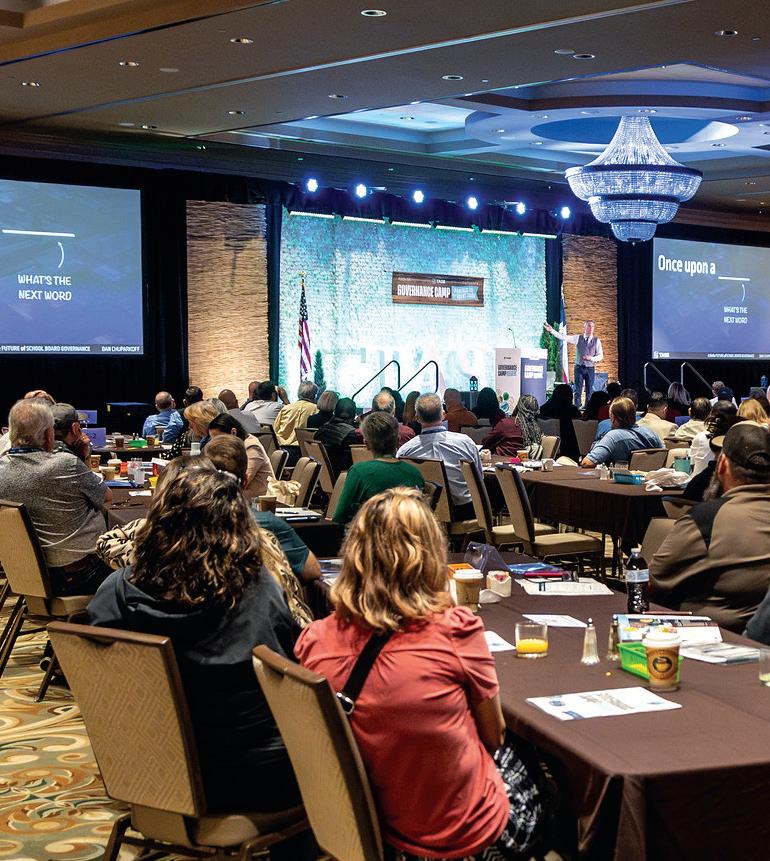
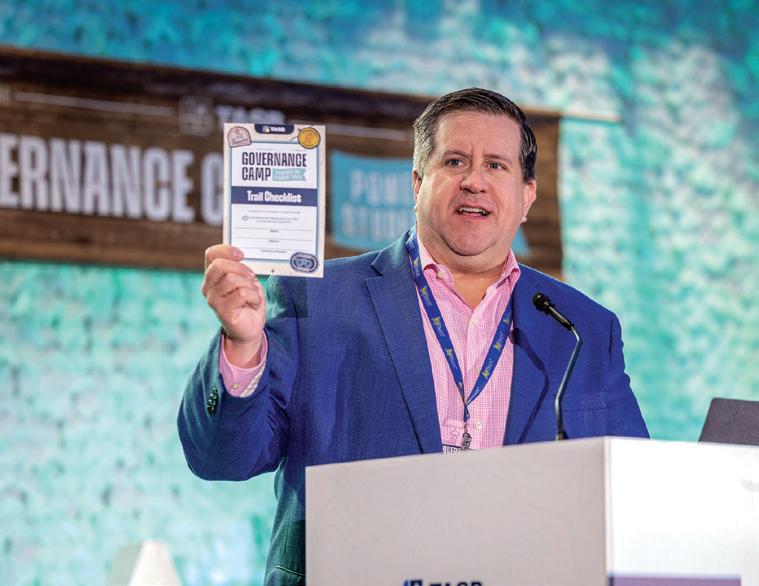
Hundreds of school leaders from across Texas gathered in Galveston for TASB’s Governance Camp to attend a range of educational sessions, network with fellow trustees, and gain insight into students’ learning experiences.
The annual event, held March 4-7 this year, provides attendees with leadership and good governance training as well as the unique opportunity to connect with Texas public school students through panel discussions, sessions presented and co-presented by students, and an expo where students shared their projects and innovations.
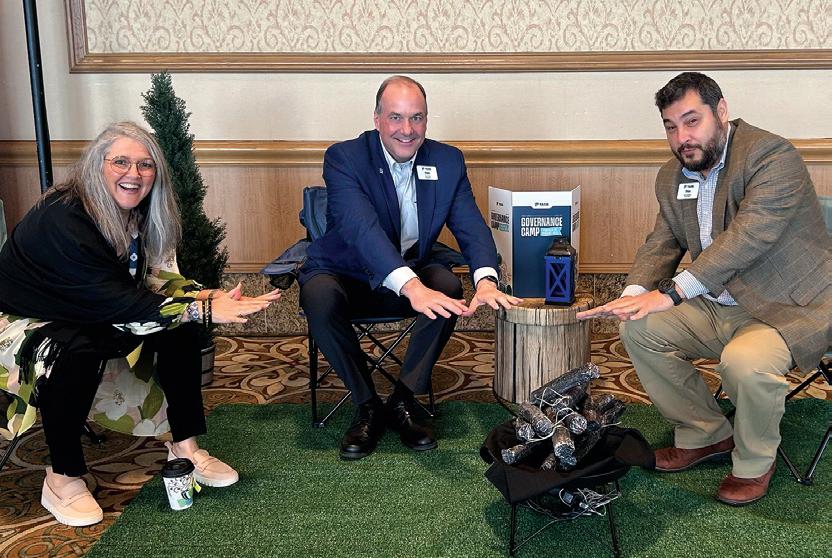
Camp began with the glow of heartfelt “campfire conversations” as small groups gathered to share ideas about public education. The flames flickering in the plastic logs at this new Camp experience may not have been real, but the aspirations trustees expressed for students in their districts certainly were.
The first full day of Camp focused on governance topics, including legislative and legal updates, budget planning, school safety, accountability ratings, and more.
“This is my first Governance Camp, and I didn’t know what to expect,” said Greg

Kresta, who is serving his first term on the Columbia-Brazoria ISD board. “I learned a lot today, especially from the TASB-led sessions. It’s good to hear from other boards and their solutions, too.”
A session by San Felipe Del Rio CISD on leading effective board conversations about budget planning quickly filled as districts prepare for the upcoming budget season.
“We have lots of discussions,” said Carlos Rios, the San Felipe Del Rio CISD superintendent, about the board in his 9,000-student district in South Texas. Rios, members of his administration, and trustees discussed best practices for creating a balanced budget. “It’s easy to have those discussions when they have the information.”
During the first general session, keynote speaker Dan Chuparkoff shared his insights into the impact of AI on districts. “It will change the world you are preparing your students to be in.”
Chuparkoff, a former technology leader at Google and McKinsey encouraged school board members to embrace the technology and use it in their own lives. “It’s your job, as the shepherds of your education system, to see what’s real and what’s useful
and what people are actually going to use to do work in the future of your students’ lives.”
Donny Hill, a first-time Camp attendee and vice president of Stephenville ISD’s school board, enjoyed the general session and Chuparkoff’s follow up session on AI. “I’m very interested in AI and how to better our district as far as students, because they are already using it.”
There were over 50 sessions offering continuing education credits at Camp, and more than 100 students in attendance the second day.
LEARNIN G FROM STUDENTS
Kresta, the trustee from ColumbiaBrazoria ISD, a small district south of Houston that serves about 2,950 students, said boards need to hear more from “the shop floor” as they make decisions. And he got to do just that as students on the second day of Camp demonstrated aerospace projects, a student-coded AI chatbot, a profitable entrepreneurship, and even the laws of physics with carnival games.


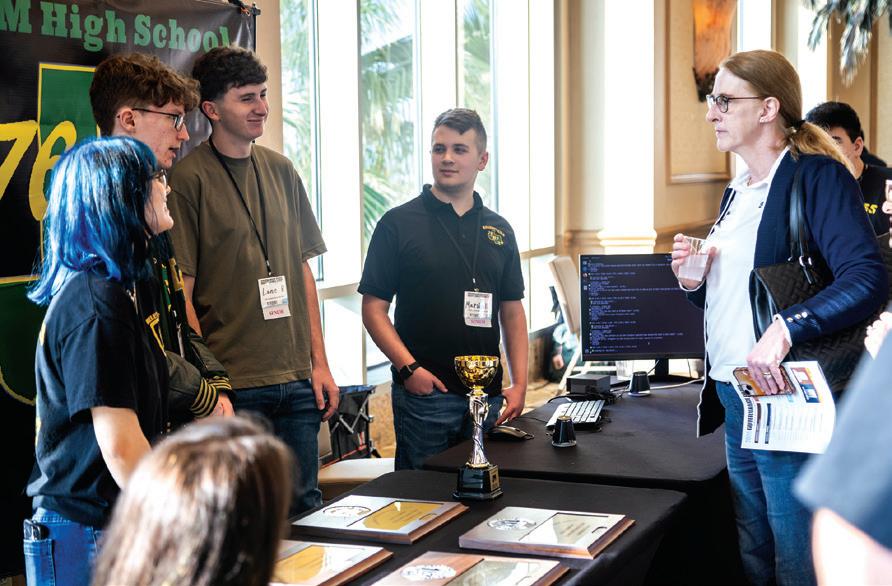
The student-led sessions included Cleveland ISD’s aviation program, where students build an FAA-certified aircraft, as well as many opportunities to hear innovative ways districts have found to include student voice in decision-making.
Wanese Butler, president of the Aransas Pass ISD school board, enjoyed the Cleveland ISD presentation. Butler said she was amazed by what students can accomplish when they are given opportunities to explore, learn, and succeed in school.
“And it’s not about how rich your district is; it’s about how committed your school district is,” said Butler, who was attending her fourth Camp. “We have to remember that as trustees, [we need] to give students the opportunity to do what they can do.”
Butler said she looks forward to sharing what she learned with her fellow trustees at Aransas Pass ISD, which serves about 1,730 students. The “partnering and collaborating and the networking here have been fantastic.”
STUDENT SCHOLARSHIP PANEL
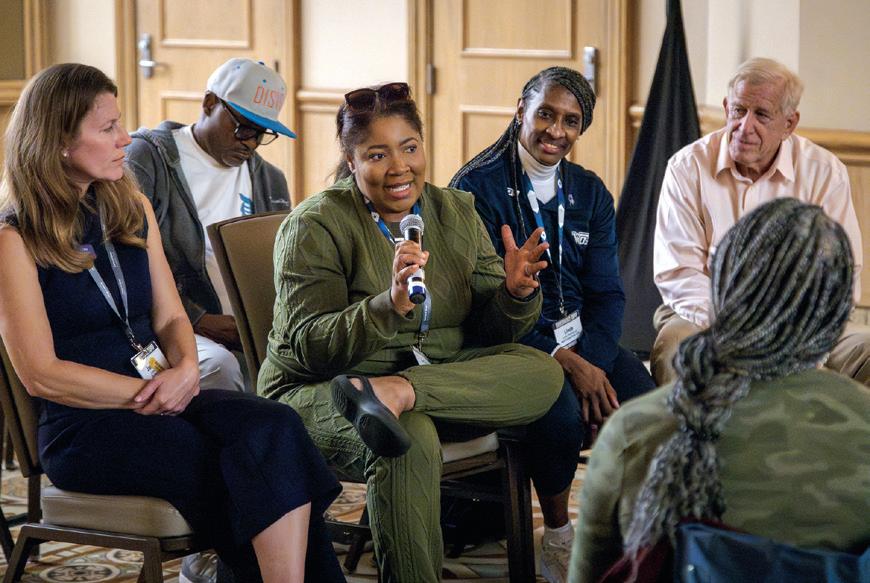
Among the highlights of the second day was the Student Voice Scholarship Panel, moderated by Jim Walsh from the law firm and Camp sponsor Walsh, Gallegos, Kyle, Robinson, and De Los Santos P.C. During the panel discussion, the five scholarship recipients shared their experiences as Texas public school students with school leaders.
“This is a great opportunity for school board members to hear directly from the students they serve, so they can better lead and govern their districts,” said TASB Executive Director Dan Troxell.
Scholarship winner and Thrall ISD senior Addison Wall summed up the importance of public education when she thanked her agriculture CTE teacher for attending the panel discussion. “She helped me take my passion and make it purposeful.”H
Beth Griesmer and Mary Ann Lopez are staff writers for Texas Lone Star.
A: Manor ISD trustees demonstrate the joy and camaraderie felt by attendees at Camp. The conference leaves no doubt that Our Future Is Public.
B: From left: Angie Hanan, Fort Bend ISD trustee and a TASB Director, enjoys the “campfire conversations” gathering with TASB Executive Director Dan Troxell and Dax Gonzales, division director of TASB Governmental Relations.
C: Camp attendees hear about the governance role in AI integration in districts from technology expert Dan Chuparkoff.
D: Tricia Stroud, president of the West Orange-Cove CISD school board, shares her idea to create shared resources for challenging conversations during the “campfire conversations.”
E: Camp leader and TASB President Tony Hopkins highlights the Trail Checklist during morning announcements. The Friendswood ISD board president kept campers informed and on schedule throughout the conference.
F: The Student Voice Scholarship Panel, moderated by Jim Walsh from the law firm and Camp sponsor Walsh, Gallegos, Kyle, Robinson, and De Los Santos P.C., included students from Lyford CISD, and Clear Creek, Hutto, Thrall, and Victoria ISDs.
G: Little Cypress-Mauriceville CISD students show off their UIL success in a variety of computer science projects.
Photos by TASB Media Services
E G
Lamar CISD’s leader receives top national award Superintendent Honored
Lamar CISD Superintendent Roosevelt Nivens has been named the 2026 National Superintendent of the Year®, an award given by AASA, The School Superintendents Association. Nivens is the first Texas superintendent to receive the top honor in 25 years, and the second ever.
Nivens and three other finalists were chosen from among the state Superintendents of the Year for the national award program, co-presented by AASA, Corebridge Financial, and Sourcewell. It recognizes exceptional superintendents for their outstanding leadership and dedication to advancing public education in their communities.
TASB named Nivens the 2025 Texas Superintendent of the Year in September 2025. The Association’s SOTY program has recognized exemplary superintendents for excellence and achievement in educational leadership since 1984.
The top national honor was announced at

Lamar CISD Superintendent Roosevelt Nivens has been named the 2026 National Superintendent of the Year.
Photo by TASB Media Services
AASA’s National Conference on Education, which was held in February in Nashville.
Nivens has served as superintendent of Lamar CISD, one of the fastest-growing districts in Texas, since 2021. He is passionate about ensuring that students have choices and opportunities, and he deeply believes in the power of “speaking life” into others, shaped in part by his own experience of having a teacher believe in him when he was a struggling student.
“Every day you walk into the boardroom, every day you walk into the office, every day you walk into the classroom, remember there’s a young person in there that is thirsty and hungry for you to see them and to help them,” Nivens said. “That’s what we do as educators. This is our purpose. And our purpose isn’t what we do. Our purpose is what happens to others when we do what we do.”
Nivens is president-elect of the Texas Association of School Administrators, which nominated him for the national award.
“It is no surprise to anyone who knows Dr. Nivens that he has received this tremendous honor,” said Kevin Brown, TASA executive director. “He is a passionate public education champion who knows first-hand through his own personal experience the life-changing impact of great teachers and schools. His personal faith and love for people shine through everything he does as a servant leader.
“Kind, courageous, mission-driven, and charismatic, Dr. Nivens is an inspiration to all who know him and are served by him. What an honor to have such a humble ambassador for all of the superintendents in the nation,” Brown said.
Scan to learn more about TASB’s SOTY program and how to nominate your superintendent for this prestigious honor.H


Accidents happen. Are your students covered?
Why choose student accident and athletic insurance from TASB Benefits Cooperative’s awarded provider, Texas Kids First?
• Coverage on or off campus designed to insure students participating in University Interscholastic League (UIL) activities
• Trusted by trainers; it’s endorsed by Texas State Athletic Trainers’ Association and Southwest Athletic Trainers’ Association
• Connected statewide insuring more than 275 school districts and a network of over 3,000 medical providers in Texas
• Top rated by A.M. Best Company, a leading insurance rating authority*
Voices from the Classroom
Students have a role in superintendent searches
by Beth Griesmer
Finding the right person to lead a school district requires valuable input from stakeholders across the community, which means superintendent searches often involve hearing from parents, administrators, teachers, and community members. A recent superintendent search in Canutillo ISD took the process a step further by including students.
Input from students can play a unique and meaningful role in an effective superintendent search, said George Kazanas, TASB division director of Executive Search and Field Services. He has helped districts all over the state find superintendents through his role leading Executive Search Services, including the Canutillo ISD search.
“Students offer a perspective that no other group can provide,” Kazanas said. “They experience the outcomes of leadership decisions every day in classrooms, activities, and school culture. When districts intentionally include students in the search process, they gain insights that help define the qualities of a leader who will connect with the entire school community.”
Purpose and preparation
During Canutillo ISD’s search process last October, Kazanas spoke with more than 70 students who participated in structured conversations designed to gather feedback on the traits and priorities they want to see in their next superintendent. Staff at the 5,400-student district north of El Paso coordinated closely with campuses to ensure a broad and representative group of students were involved.
“We loved our student involvement piece for the superintendent search,” said Canutillo ISD Communications Director Gustavo Reveles. “The conversations students had were very meaningful. Because we’re a smaller ISD with only 10 schools, it was easier to coordinate, but the effort still required strong collaboration with principals and teachers to make sure students were prepared and ready to share their perspectives.”
Reveles said secondary campuses were asked to bring 10 to 20 students each, with an emphasis on representing a wide range of interests and experiences. Elementary principals selected student council officers, about five students per campus, giving older elementary students an opportunity to participate.
“Preparation was a key component of the process,” Reveles noted. Principals received clear instructions and expectations, including guidance on helping students understand the purpose of the sessions and the role of a superintendent.
The sessions also included Canutillo ISD’s two student advisors to the board of trustees, an approach that further empowered students and demonstrated the district’s long-standing commitment to student voice.
As districts look for ways to build trust and transparency in leadership transitions, Kazanas said Canutillo ISD demonstrates that student involvement is highly effective.
“Our role is to help districts hear from all stakeholders,” Kazanas said. “When students participate in feedback sessions and surveys, it strengthens the overall process and leads to more informed decisions. By listening to student voices, districts ensure that the leaders they select are prepared to meet the needs of the entire school community, starting with the students they serve.”
Finding the right leader
Canutillo ISD welcomed Josue Borrego as their new superintendent in January.
“From the beginning of this process, the board sought a superintendent who understands the heart of a school district like ours,” said Sergio Martinez, Canutillo ISD board president. “We wanted someone who values students, respects educators, and recognizes the importance of strong partnerships with families and the community.”
Kazanas noted that Executive Search Services partners with districts to meet
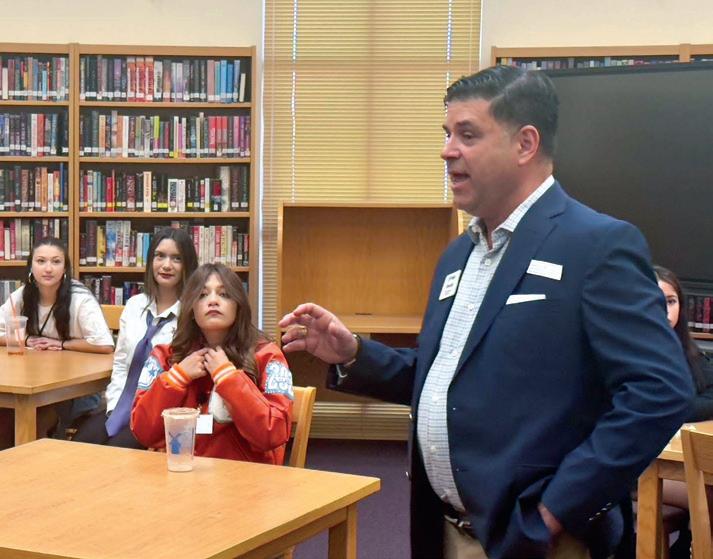
the unique needs of their leadership search. The ESS team brings decades of experience and has had hundreds of successful placements, but each superintendent search is different.
The process in Canutillo ISD extended beyond student meetings to include in-person sessions and online surveys designed to gather input from a broad cross-section of the community. Participants were asked to share their views on preferred candidate traits, district strengths, challenges, and priorities that should influence the selection of the next superintendent.
“In the end, we had amazing participation from all stakeholders,” Martinez said. “The students took the responsibility seriously, asked thoughtful questions, and shared insights that genuinely helped shape our understanding of what the community wants in its next superintendent. It reinforced our belief that students should have a seat at the table.”H
Beth Griesmer is a staff writer for Texas Lone Star. Find out more about Executive Search Services.

Photo courtesy of Canutillo ISD
George Kazanas, TASB Division Director of Executive Search and Field Services, leads a discussion with students in Canutillo ISD.


Federal Advocacy Conference
Texas trustees convene in nation’s capital
by Matt Mitchell
More than 50 Texas trustees braved the cold and snow to convene in Washington, D.C., Feb. 2-3, for the 2026 Texas Federal Advocacy Conference. The annual TASB-hosted event returned to the historic Willard Hotel, just steps from the White House, for a fourth consecutive year.
Attendees gained valuable insights into public education policy through informative panel discussions with experts in the field. They then put their knowledge and advocacy skills to the test in meetings with federal lawmakers.
On the heels of a consequential year for public education, TASB Executive Director Dan Troxell stressed the importance of this year’s conference and was pleased to see the turnout.
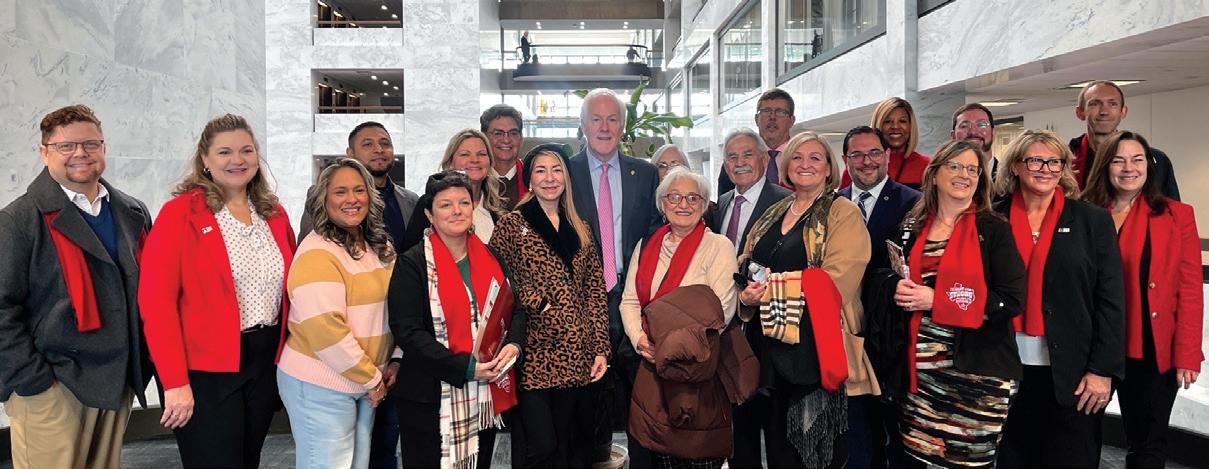
“It was exciting to see this year’s conference so well-attended even in spite of the cold weather in Washington,” Troxell said. “Our Texas trustees understand the importance of connecting with their federal lawmakers as they advocate on behalf of their students. This event offers an opportunity to make connections and
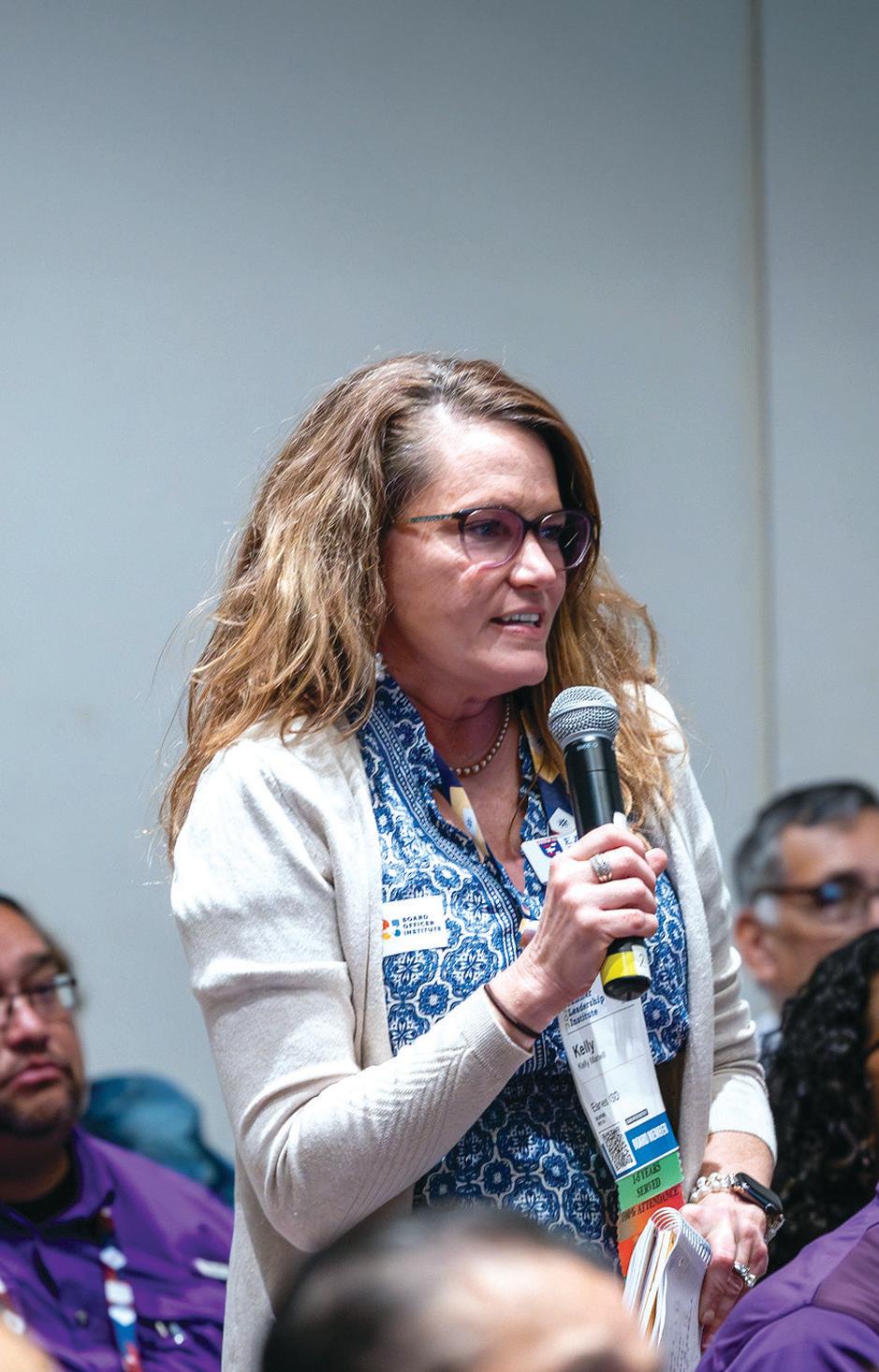
get a deeper understanding of how issues at the national level have local impacts.”
Timely public education items
Ruben Longoria, director of federal affairs for TASB Governmental Relations, noted that when putting together the lineup of speakers for this year’s confer-
Specialized Training for Board Officers
Conference attendees pose with Texas Sen. John Cornyn at the Hart Senate Office Building.
Photo by TASB staff
ence, he wanted to include topics that will be on trustees’ minds 2026.
“So much has happened around the federal funding for public schools, the Department of Education moving key divisions to other federal agencies, and just the overall federal policy climate,” Longoria said. “We felt those things needed to be addressed, so we worked with our federal partners to find the right people to do that for our membership.”
Sasha Pudelski, director of advocacy for AASA, The School Superintendent’s Association, opened the conference with a federal update touching on many of those issues. She also discussed school choice programs at both the state and federal levels and noted Texas trustees’ advocacy efforts back home during the 89th legislative session.
“I was so impressed from afar,” Pudelski said. “It was a master class in advocacy at the state level.”
Pudelski then guided discussions with other speakers throughout the rest of the first day of the conference on a variety of issues, including immigration policy, student wellness and mental health, school law and recent U.S. Supreme Court decisions, and other public education trends to watch this year.
Visiting Capitol Hill
The conference shifted to Capitol Hill for its second day, as trustees went to meet with federal lawmakers. They first met as a group with Sen. John Cornyn’s office before later splitting up to visit with their own representatives in the House. Attendees also had the chance to interact with Sen. Ted Cruz during a public meet-and-greet in the Russell Senate Office Building.
These meetings centered on issues relating to budget deficits, funding concerns, and accountability, with an emphasis on e-learning programs, special education services, and the effects of school choice programs on public education.
“We need to explain to our legislators the realities of our budget cycle, and that we are making those decisions right now for 2026-27,” said Mary Jane Hetrick, TASB president-elect and a Dripping Springs ISD trustee. “It’s very important that we have some sort of degree of clarity on our funding streams.”H
Matt Mitchell is a staff writer for Texas Lone Star

Helping you achieve your bond goals
Whether you are planning for the next year, decade, or generation, find the bond investment solution you need with Lone Star Investment Pool. Contact our experienced team for advice on investing any amount and to see how Lone Star can help your district achieve its financial goals.
Large amounts or small, Lone Star invests it all.
Bulletin Board
Range of Learning Opportunities at Summer Leadership Institute
TASB’s Summer Leadership Institute is just around the corner! Offered in San Antonio and Fort Worth, TASB’s flagship training conference is designed to provide new and experienced trustees the opportunity to create their own learning journey.
The San Antonio event will be held June 10-13, and the Fort Worth event is June 17-20. The two SLI events are nearly identical in schedule, session offerings, and general session speakers, which gives members the opportunity to attend the conference that best fits their schedule and location preference.
At each venue, presenters will:
• Share key information with new board members.
• Offer practical tips for newly elected board officers.
• Provide experienced trustees with innovative practices and emerging trends.

Scan to learn more about SLI.
TASB Wins 40 Awards in Statewide Contest
TheTASB Communications, Marketing, and Events team has earned 40 awards from the Texas School Public Relations Association in the organization’s 2025 Star Awards Program.
“These awards showcase TASB’s commitment to high-quality creative work and underscore our ongoing dedication to our members,” said Tiffany Dunne-Oldfield, TASB’s deputy executive director.
TSPRA’s awards program draws hundreds of entries from across the state, including submissions from small, medium, and large public schools, charter schools, ESCs, and other associations in Texas. The honors, announced at TSPRA’s annual conference in February, reflect communicators’ dedication and commitment to promote education in Texas.
The honors for TASB include a Crystal Certificate of Merit for TASB’s 75th Anniversary Celebration and a Best of Category for the February/March 2025 issue of Texas Lone Star
In 2024, TASB embarked on a yearlong project to honor the Association’s 75th anniversary, especially as it connects to the overall history of public education in Texas. This included the launch of TASB’s new brand and website and culminated in the publication of a special commemorative book that featured a range of stories about the Association’s evolution and its many efforts to serve members.
The magazine’s February/March 2025 issue focused on the then-upcoming 89th Texas Legislature, offering a range of information designed to help members better understand the legislative process, advocacy, and the education issues expected to be debated by lawmakers.
TASB’s Executive Search Services is currently accepting applications for these positions listed below:
▄ Alvin ISD Superintendent
▄ Angleton ISD Superintendent
▄ Clarendon CISD Superintendent
▄ Columbus ISD Superintendent
▄ Culberson CountyAllamoore ISD Superintendent
▄ Edna ISD Superintendent
▄ Lorena ISD Superintendent
▄ Troy ISD Superintendent
For more information about vacancies, call 800-580-8272, email executive.search@tasb.org, or scan:



Strategy in Action
New initiative takes aim at better serving our members
by Tiffany Dunne-Oldfield
TASB released its new strategic plan earlier this year, and it’s not business as usual.
I’m pleased to report that there’s been a lot of work done already to ensure that this important five-year project, called TASBnext, is making progress on the promises made to you — our members.
It’s worth noting that everything about this new strategic plan is different, including the fact that it was developed with the intentional goal of fostering transparency, trust, and accountability among both TASB members and the communities they serve.
In the past, the Association’s strategic plan served only as an internal blueprint to guide the work of TASB staff in support of our members. This time, our Board of Directors — many of whom have experience with strategic planning within their own districts and professional careers — challenged us to go further. We worked deliberately over the course of a year with them to develop a plan that would be shared externally, so our members across the state can see firsthand that we’re an organization committed to fulfilling both our mission and our promises to them.
This is more important than ever, considering the challenges facing Texas public education. Our five Strategic Imperatives, approved by our TASB Board, offer a cohesive framework that will not only make our Association stronger, but will help you, our members, strengthen your unique school communities.
Improving access to training
That’s why I’m especially proud of the work that we’ve already accomplished in the few short months since TASBnext launched. We’ve reimagined how we
deliver training at the local level, a direct result of our Strategic Imperative to Deliver High-Quality Services and Programs that Evolve with Member Needs
We’ve heard loud and clear that our members can’t always travel to our larger events because of time and budget constraints. So, we’re bringing training closer to you, both in the spring and fall. We hope you’ll take a look at the schedule of events and sign up for a Regional Workshop that is closer to home. Your ongoing feedback about what kind of training you want and need will help us ensure that these training opportunities are both engaging and relevant.
That’s not all. Under the Strategic Imperative of Strengthen Member Relationships and Engagement, we’re taking steps to build and sustain strong trustee outreach across the school board service journey. We already have specialized trustee training options — like Leadership TASB, Texas Trustee Institute, and Board Officer Institute — depending on a school board member’s level of experience. But this imperative is about creating more intentional connections, starting at the moment a trustee gets sworn in. We’re kicking off this work in May after the elections. All new trustees will be receiving onboarding packets designed to create a warm welcome to school board service and ensure a strong start. We’re also planning more regular touchpoints during that first year of service, when adjusting to all the demands and challenges of the job can feel like drinking from a firehose.
Fostering advocacy at the local level
As you know, advocacy has been central to TASB’s work since our inception in 1949. Under the Strategic Imperative of
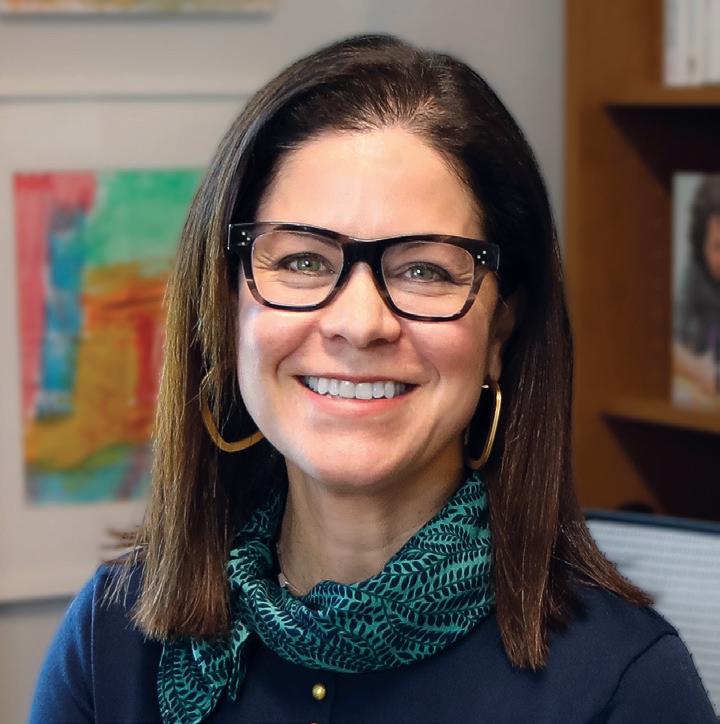
Champion Public Education Through Nonpartisan Advocacy, we’re working on new ways to foster advocacy at the school board level, where it can better connect to the priorities and needs of our members.
Hopefully, you’ve already had a chance to check out our new Local Legislative Priorities Tool in your member dashboard that uses a display map to help visualize what our members see as top concerns in their districts. We want more districts to participate in this process and more school boards to set their own legislative priorities as a way to empower members to be strong public education advocates. You’ll see on the tool that there is a lot of work to do here. With 98 districts currently represented on the map, we have a long way to go.
Our last two Strategic Imperatives — Empower and Grow Our People and Drive Operational Excellence — are no less important. TASB has a long legacy of supporting our members with more than 75 years of service to Texas school boards. These two imperatives will help ensure that our legacy continues into the future, with staff who continue to prioritize excellent customer service and with internal systems and processes that advance organizational sustainability and responsiveness, no matter the political or educational climate.
I’m excited about TASBnext and everything this strategic plan is going to help us accomplish. There’s a lot of work to be done, but we’re rolling up our sleeves. We hope you’ll join us. Together, we’re embarking on the next leg of our journey with our members leading the way.H
Tiffany Dunne-Oldfield is TASB’s deputy executive director.
Tiffany Dunne-Oldfield
It was important that we get the right person right from the jump. I can’t say that would have happened without ESS and TASB. I think that you guys really played a big part in helping us do that so perfectly. And now we’ve got the perfect superintendent.
– Garrett Wilson, trustee, Boerne ISD school board
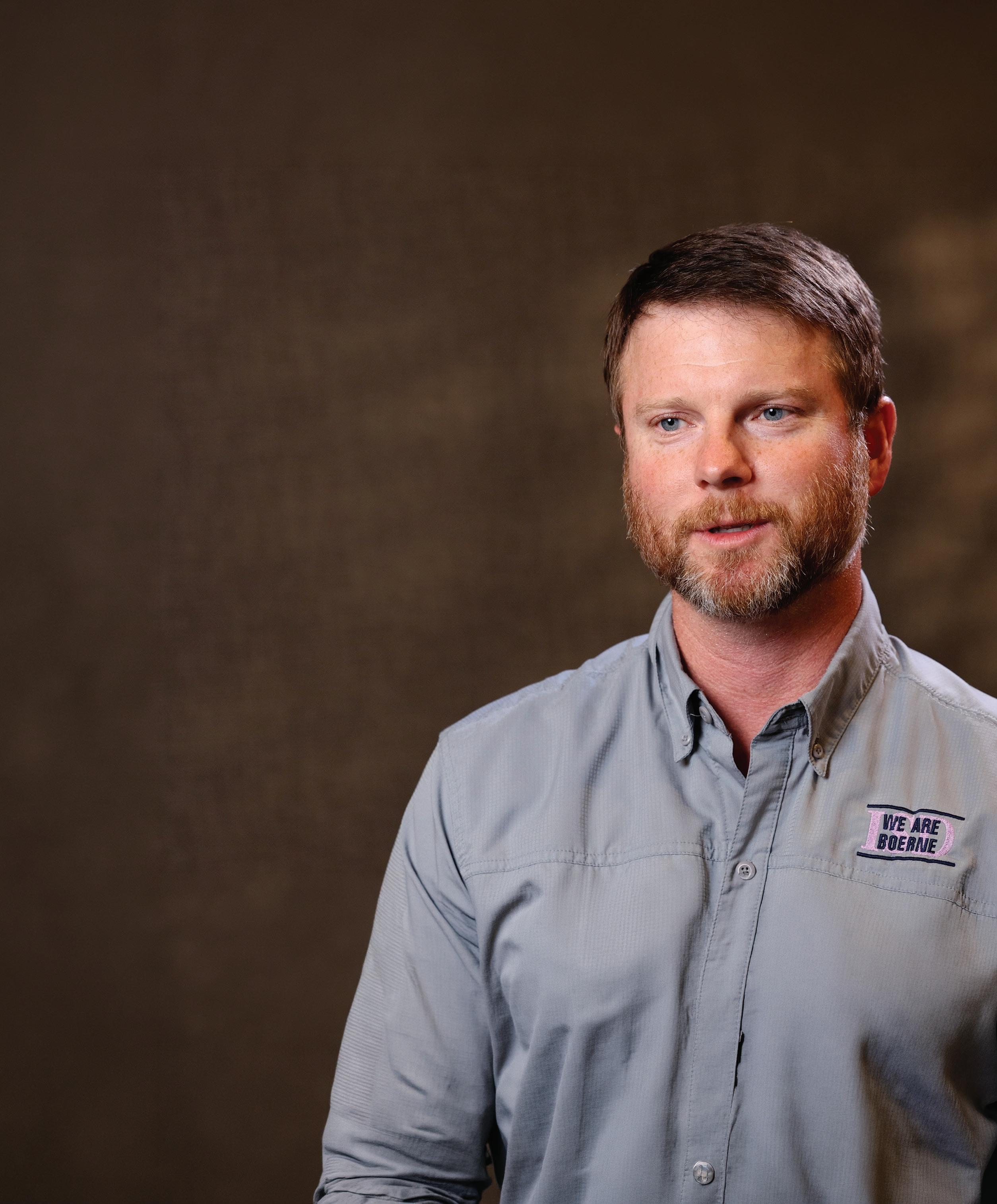
In its more than 30-year history, ESS has conducted over 800 searches on behalf of districts across Texas.
With a team of search consultants who know Texas and its diverse school districts, ESS has proven itself to be the go-to search firm for leadership recruiting.
ESS brings experience to the table and a guarantee, so trustees can feel confident they’ve found the best leader for the job.
tasb.org/ess • 800-580-8272 • executive.search@tasb.org