


President...................................Marvina
President-Elect..............................John
Vice
Secretary-Treasurer...........................Joe
Director...........................................Antoinette

Appointed
Appointed
Appointed


President...................................Marvina
President-Elect..............................John
Vice
Secretary-Treasurer...........................Joe
Director...........................................Antoinette
Appointed
Appointed
Appointed
*List Reflected Below is as of November 10, 2025
Adams, Lynch & Loftin, P.C
Albert, Neely & Kuhlmann, LLP
Anderson & Cummings, LLP
Anderson & Riddle, LLP
Baker Monroe, PLLC
Barlow Garsek & Simon, LLP
Blaies & Hightower, L.L.P.
Bonds Ellis Eppich Schafer Jones, LLP
Bourland, Wall & Wenzel, P.C.
Brackett & Ellis, P.C.
Brown, Proctor, Peck & Piwetz, LLP
Bruner & Bruner, PC
City Attorney’s Office – City of Fort Worth
Cook Children’s Health Care System
– Legal Department
Curnutt & Hafer, LLP
Decker Jones, P.C.
Dismuke & Waters, P.C.
Factor, Campbell & Baker
Freeman Mills PC
Friedman, Suder & Cooke, P.C.
Gardner Smith & Vaughan, PLLC
Griffith, Jay, & Michel, LLP
Harris, Finley & Bogle, P.C.
Harrison Steck, P.C.
Haynes and Boone, LLP
Holland Johns & Penny LLP
Jackson Walker LLP
Kelly Hart & Hallman LLP
Killen & Dennis, PC
KoonsFuller, P.C.

Law Offices of Paup, Shutt & Associates, P.C.
Linebarger Goggan Blair & Sampson, LLP
Lively & Associates, PLLC
McDonald Sanders, P.C.
Naman, Howell, Smith & Lee, PLLC
Nelson Bumgardner Conroy PC
Noteboom – The Law Firm
Padfield & Stout, LLP
Patterson Law Group
Pham Harrison, LLP
Phelps Dunbar LLP
Pope, Hardwicke, Christie, Schell, Kelly & Taplett, L.L.P.
Robbins Travis PLLC
Ross & Matthews P.C.
Second Court of Appeals
Stoy Law Group, PLLC
Tarrant County District Attorney’s Office
Taylor, Olson, Adkins, Sralla & Elam, LLP
The Blum Firm, P.C.
The Colaneri Firm, P.C.
Underwood Law Firm, PLLC
Varghese Summersett PLLC
Vartabedian Hester & Haynes LLP
Watson, Caraway, Midkiff & Luningham, LLP
Whitaker Chalk Swindle & Schwartz PLLC
Whitley Penn, LLP
Wick Phillips
Winstead PC
To be eligible for the 100 Club, any law firm, government agency, law school, or corporate legal department with four or more members must attain 100% TCBA membership compliance for the 2025–2026 bar year. This qualifies them for the “100 Club.” The firms/ organizations listed above have already paid their membership dues and qualify for 100 Club membership
for the new bar year. Any firm/organization that qualifies in the future will have its name published in every issue of the Bar Bulletin for this bar year. TCBA takes pride in the participation of these law firms and other groups. The new bar year began on July 1. If you have not paid your renewal invoice, please contact Tiffany Myles at tiffany@tarrantbar.org. g

“I think it pisses God off if you walk by the color purple in a field somewhere and don’t notice it.” —Alice Walker, The Color Purple
“If there is a book that you want to read, but it hasn’t been written yet, then you must be the one to write it.” —Toni Morrison
pause today to recognize the color purple among us, a man who has dedicated decades of his life to a career of difficult choices, always finding a way through and blazing a trail. This gentle giant’s contributions will forever be written in the annals of Tarrant County, the State of Texas, and the history of the United States.
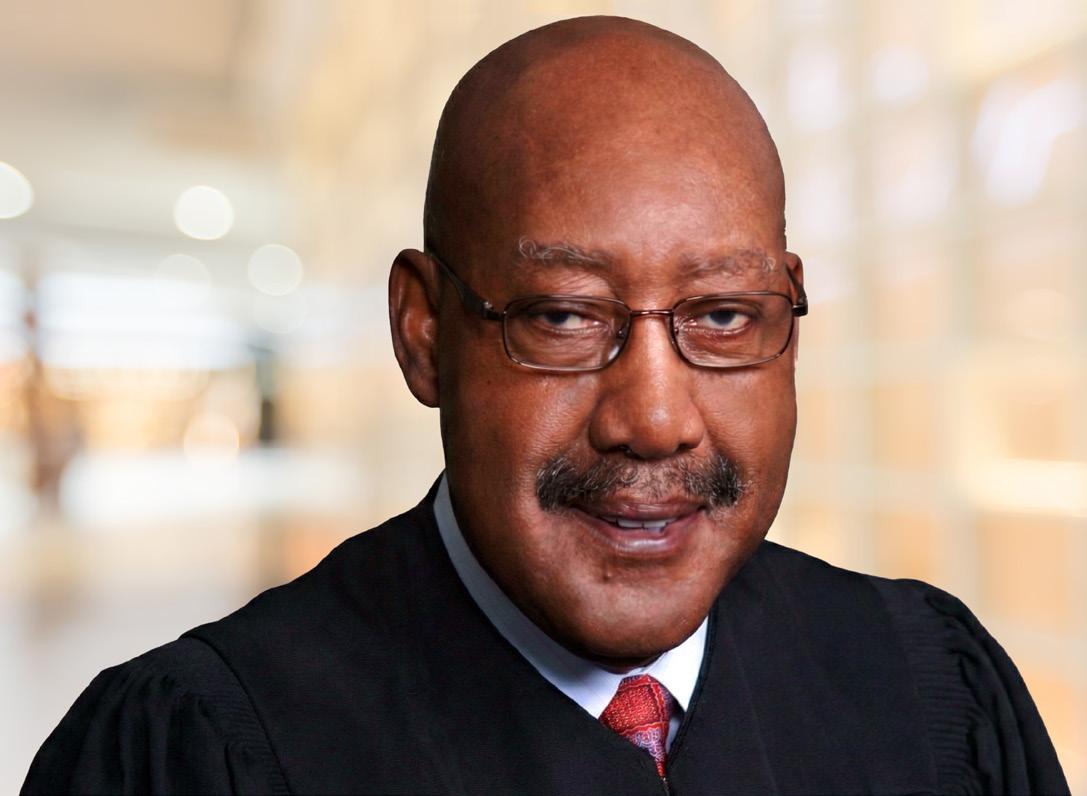
Recently, Judge Louis E. Sturns spent time talking with me about his storied career. What a treat it was! Here are some excerpts from our conversation. May we be forever thankful for Judge Sturns’ dedication to justice.
MR: Judge Sturns, you’ve said you never set out to make history. You just wanted to do your job and to be the best you could. Can you tell us about the early years in Fairview, Texas, and what first led you toward a career in law?
JLS: First of all, you’d have to know just a little bit about Fairview. It’s located in East Texas, roughly 40 miles from the Texas–Louisiana border. It’s a very small community. Most of the people who live there are my relatives. I grew up there in an era when all of Texas, and particularly East Texas, was very segregated. And I went to a segregated school from grade school all the way through graduation. I didn’t know any lawyers growing up.
I met a lawyer, a Black lawyer, for the first time when I was about 13 years of age. He had come to speak at a church there in East Texas. He was a lawyer who had been one of the guys who represented Muhammad Ali. I had a chance to talk with him for a few brief minutes. So that was somewhat inspiring to me.
I was the kind of kid who had an interest in current events, and I was aware that the Voting Rights Act had been passed. I was aware of the public accommodation law. One day, a cousin and I went to the county seat of Henderson, and we decided that we were going to go into this restaurant and be served. Because I knew what the law was—I knew they were supposed to serve us. Well, we went into the restaurant and asked for service, and they refused the service. So, being all of I think maybe 15 years of age, my cousin who was a year older than I, we sought legal redress.
We went to the courthouse and asked to speak with the local county attorney, who would not help us. We asked to speak
with the local district judge, who would not help us. So that experience left me with a desire to become a lawyer, and it stuck with me from that point on.
MR: After your service as a captain in the U.S. Army JAG Corps, you began practicing law here in Fort Worth with civil rights legend L. Clifford Davis. What lessons from that experience have stayed with you the most?
JLS: Oh boy, there were a lot of lessons that he imparted, as well as some of the others who practiced in his office. At one point or another, it was myself, Leslie Johns, and John White too.
Clifford always told us to make certain that our opponent in court knew there was a lawyer on the other side of the table. He emphasized the importance of being ready for trial. One other thing that he told me early on was that he had a habit that he had picked up from another legendary lawyer, W.J. Durham,
who, by the way, is Judge Mary Ellen Hicks’ uncle, I believe. Mr. Durham would go to his office on Saturday morning and read the advance sheets, as Clifford called them, you know, the case law that came from the courts of appeal. And so I began to do that; I began to go and read the advance sheets. I won’t say I was as disciplined as maybe he was about it, but I did it often on Saturday mornings because one of his words of wisdom to me was to be prepared and stay on top of the law.
MR : You went on to become the first African American criminal district court judge in Tarrant County and later served as the first African American on the Texas Court of Criminal Appeals. What did those firsts mean to you personally, and how did you handle the responsibility that came with them?
JLS: Well, you know, the criminal district court appointment meant a lot to me because back in 1982 and ‘83, we had not had an African-American judge in Tarrant County at the county level. We had formed an organization, the Fort Worth Black Lawyers Association, and we had decided that we were going to submit names to the governor’s office for appointment as a district judge. We gathered the name of five of us who had the min-imum experience, basically, to qualify as a district judge. And initially, none of us were selected. But then in ‘83, with the assistance of state representative E.B. Carey, I was able to be appointed as the first African American judge in the county. So that meant a lot to me personally. But it meant more to me from the standpoint that a barrier was being broken. We were going to at last have some legal representation in the courthouse in Tarrant County. I thought it was important for people who look like me, and when they come to court to at least see someone in a position of authority who they could relate to and to convey to them the belief that the system was fair and just for all.
I definitely did not plan on the Texas Court of Criminal Appeals happening. It was a surprise when I received a call from the governor's office asking if I would accept that appointment. It was a difficult decision to leave Fort Worth. But it was one that I felt like I had to make under the circumstance because we had not had an African American at that court or at the Supreme Court in history.
MR: Do you feel like a responsibility came along with those two positions?
JLS: Yes, I think there’s a responsibility. I think there is a responsibility to try to be as competent as one can be and try to be as fair and impartial, and to administer justice the way it should be administered. I think that responsibility does come along with the position because people are looking to see, first of all, if you can do it. I think it’s important that you try to do the job as well as possible to make the case for others to follow.
MR: One of the defining moments in your judicial career was
presiding over the Court of Inquiry in the Michael Morton case. Can you take us back to what it was like leading that investigation, one that revealed withheld evidence, led to the arrest of a former prosecutor, and ultimately inspired the Michael Morton Act?
JLS: Well, initially when I was asked to do it, my first question was, quite naturally, “What is the Court of Inquiry?” I had no experience with that and never read the statute on Court of Inquiry. I did some research, and I just found the statute, and read it.
Then the next question was, “Is there any legal precedent?”
Of course, it’s not the type of thing that’s reported, so there’s very little legal precedent for it. But it was laid out in the statute how it’s to be conducted, so I wanted to make sure that I conducted it in accordance with the statute.
Probably the first hurdle in the case was to determine who would be the special prosecutor. And in my mind, I wanted someone who was not so closely aligned with either the state prosecutors or the State Criminal Defense Lawyers Association. I wanted someone who was highly respected but also kind of considered to be neutral in that regard.
So that’s why I ended up calling this lawyer out of Houston that I had known a little bit and asking him if he would conduct the Court of Inquiry. I will never forget, however, that I had a conversation with one of the people there in Williamson County who suggested to me that I appoint a prosecutor from one of the adjacent counties. And that didn’t strike me as being the balance that I wanted to have in the situation, so I didn’t do that.
It was a very interesting case because there had been a great deal of work done on that case by the Innocence Project, as well as the lawyers helping them. And so there were deposition testimonies to review. I do remember they sent me several boxes with 5,000–6,000 pages of documents to be read.
I spent the better part of a couple of months on weekends going through those and trying to get a feel for what the case was about. Once we had the Court of Inquiry, which lasted five days, it was impressive to me to see how Mr. Morton himself had taken this experience and to see my dismay with what had been done to this gentleman and understand, to some extent, how it happened. It was disappointing to me that the system let this citizen down as it did.
MR: In your findings, you wrote that the prosecutor made a “conscious choice to hide mitigating evidence.” What was it like to make that determination? And how do you think that case changed the conversation about integrity in our justice system?
on page 8
Continued from page 7
JLS: Well, as I said earlier, I did review deposition testimonials and all of the evidence that had been amassed even before the Court of Inquiry. Once we conducted the Court of Inquiry, that testimony was presented through direct examination, as well as cross-examination, and so the issues were fully eliminated and presented. And as a result of the presentation of all the evidence, it was pretty apparent to me that evidence that could have exonerated Mr. Morton certainly was hidden.
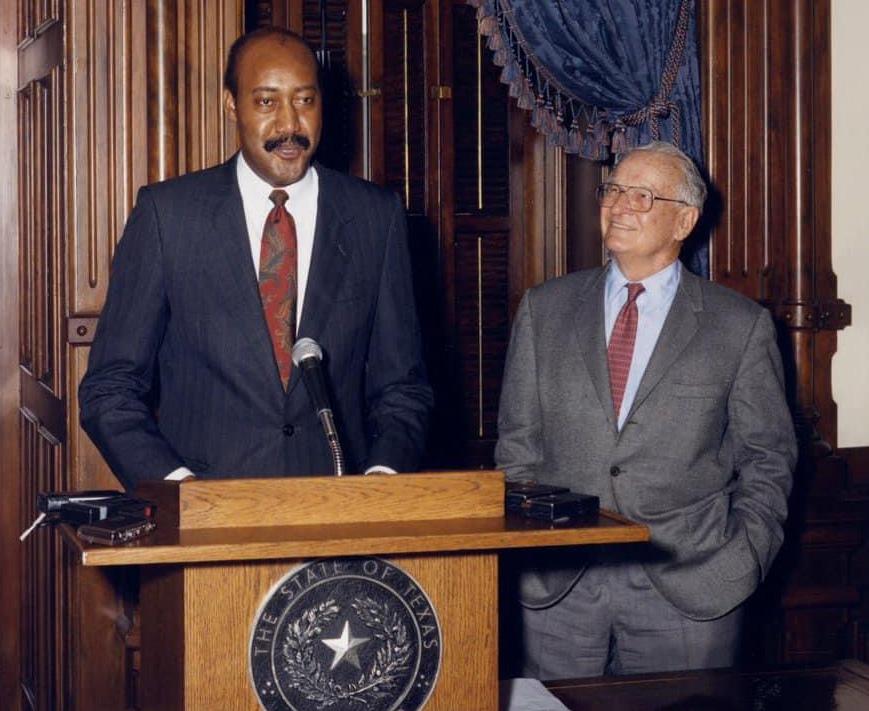
Judge Sturns with Texas Governor William P. Clements Jr Photograph courtesy of the Texas State Library and Archives Commission.
Judge Sturns is pictured alongside Texas Governor William P. Clements Jr, capturing a moment of historical significance in Texas legal history.
Particularly the testimony concerning a green van, testimony concerning a man being in the neighborhood earlier, testimony concerning what Mr. Morton’s brother-in-law had found when he found that bandana, which later was determined to have blood that matched the assailant and the victim—that was withheld. And then, of course, there was a testimony concerning what the Morton’ three-year-old son had told his grandmother about his father not being there when his mama was hurt. All of that, along with the testimony about a credit card having been used afterwards, all of that evidence was withheld from the defense. So it was, in my opinion, quite apparent and quite clear that a conscious decision was made to keep this away from the defense, realizing that this evidence could very well lead to this man’s acquittal and exoneration. That made my decision easier once I had a full view of the evidence that had been withheld.
Another point about it that was disturbing to me was that even after the appellate process had started and there was evidence that this bandana had blood on it that did not match Michael Morton’s blood, but in fact matched the blood of this other gentleman, there was still an effort to withhold the evidence.
So, for years, there was evidence to withhold that evidence, even though it should have been apparent that this man was entitled to a new trial at the least. He could have been released from prison earlier had they been more forthright. So that bothered me. That was a matter a lack of ethics in candor with the tribunal by the prosecutor. So that bothered me a great deal.
MR: You were recently featured in the new documentary, Unlocked Voices: Bridging the Future, alongside Ms. Opal Lee and the Honorable Judge L. Clifford Davis. What was it like seeing your story told in that film? And what does it mean to you to have your journey memorialized for future generations?
JLS: Well, it meant a lot to me. To be featured in a film with those two people who I’ve known really for all of my career. I had known Ms. Lee dating back to when she and another lady founded the Tarrant County Black Historical Society —you know, our society. I’ve always admired her for her steadfastness and dedication to whatever she put her mind to.
And then obviously I had known Clifford for so many years, and he was a mentor and a friend. To be in a film with those two iconic figures meant a lot to me. And to have my family there, my wife and my children there, my brothers and their wives, it meant a lot.

Judge Louis Sturns with L. Clifford Davis
As featured on the cover of the Fort Worth Business Press: “Judge Sturns: Legal Heavyweight Steps Down.”
Judge Sturns, Tarrant County’s first African American criminal court judge, is pictured with civil rights attorney L. Clifford Davis.
MR: You spent decades mentoring young attorneys and serving on state and local boards. What continues to drive
your commitment to public service, and what advice would you give to the next generation of lawyers and judges?
JLS: I was raised by parents who were involved in the community. My parents were quite active in the parent-teachers’ association. They themselves were not educated people. They both had ninth grade education, but they believed in education, notwithstanding their lack of it, to the point that they made certain that all of us, me and my siblings, all attended college. And my father was involved to the extent that he was one of the first African Americans down there to be elected for the school board in the community.
I come from that kind of family background of service. And my brother, Verneal Sturns, came to Fort Worth and was involved in all sorts of organizations from the Black Chamber to the Minority Citizens Leadership Council and all kinds of organizations. He was my mentor in terms of encouraging me to be involved in community events and organizations.
I had the good fortune to serve on several state boards and commissions and serve on the boards of many local organizations. All of that made me want to do my part to make our communities better places to live and to try to bring people together. Having grown up in a segregated period of time, I recognize the importance of people being able to sit down and talk and understanding how much we have in common, because we have a whole lot more in common than we have that separates us. We just simply need to take the time to discover it and nourish the commonality that we have. So I guess that’s what still motivates me.

Judge Louis Sturns with His Family Judge Sturns is pictured with his family at his retirement celebration, marking the conclusion of a distinguished 45year legal career and honoring his legacy of fairness, civil rights advocacy, and service to the Texas legal community.
MR: Reflecting back on your extraordinary career, what are you most proud of? And what do you hope your lasting legacy will be in the Tarrant County legal community?
JLS: Well, I am proud of the fact that I was able to preside over 213th district court at a fairly late stage in my life, and that I was called upon to handle some pretty important cases,
including the Michael Morton case.
Prior to my judicial career, I was involved in some other cases that I thought were pretty significant. One case that probably most people are not aware of was that I got to work with a lawyer named Don Gladden, who was a legendary civil rights lawyer back in late ‘70s, maybe early ‘80s. We filed a redistricting lawsuit that compelled the redrawing of the county redistricting line for Precinct 1. Out of that lawsuit, we were also able to get that sub-courthouse that was built on Miller Avenue. That’s something that I've been very proud of throughout my career. I wasn’t the lead attorney on that. I was just a young lawyer carrying the briefcase of Don Gladden and learning, and I learned a great deal from him.
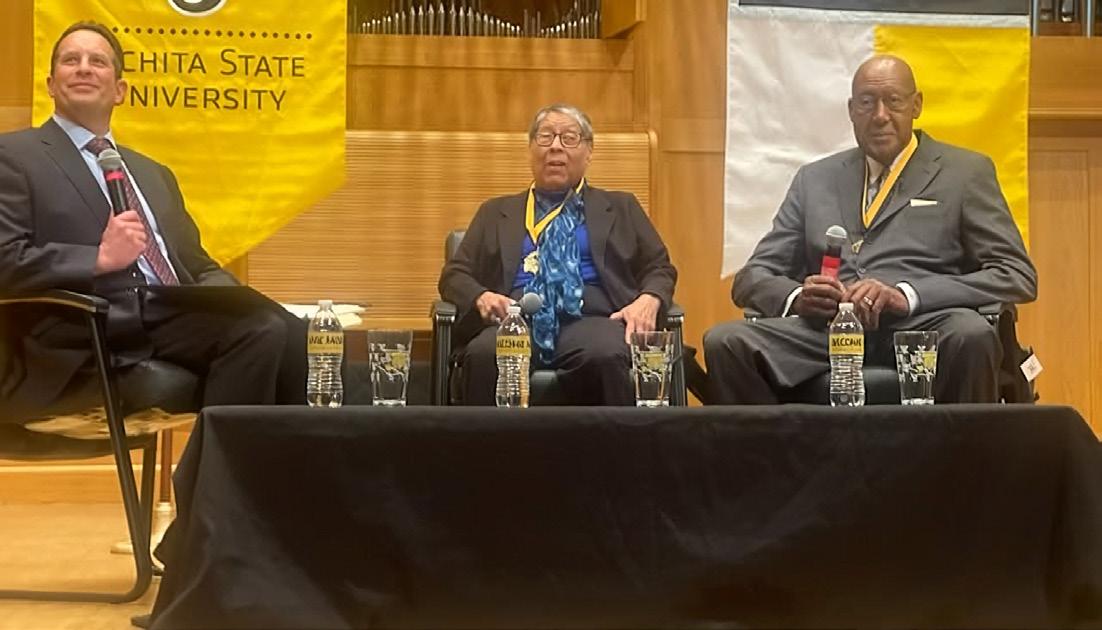
Judge Louis Sturns at Wichita State University
Judge Sturns was inducted into the Fairmount College of Liberal Arts and Sciences Hall of Fame, honoring his trailblazing legal career and civil rights accomplishments, including serving as the first African American on the Texas Court of Criminal Appeals.
MR: My last question is one I just want to ask you personally. So, in the 105 presidencies of the history of the Tarrant County Bar Association, there have only been a few female presidents and no Black female presidents. What were your thoughts about my election?
JLS: Well, Marvina, you and I hadn’t had a lot of interaction. It was at one of the Past President’s luncheons, when you told me you were President-Elect, and I was happy. You told me you were President-Elect, and it was like, “Okay, it’s time.”
I said to young Black lawyers years ago “Look, guys, we have to get involved in the Tarrant County Bar, because it’s like being an electrician or something. If you’re not involved in an organization that makes a decision that affects your livelihood, they can make some negative decisions, and you won’t even have a seat at the table.” So, minority lawyers have to be involved in the Tarrant County Bar, I think, to make sure that you have a voice. And so, I was elated with your election— very proud. Still am. g


2025–2026
2024–2025
s another productive year draws to a close, the Tarrant County Young Lawyers Association is finishing strong with a full slate of events. Here is what we have been up to and what is ahead:
TCYLA is pleased to welcome Blake Bobo of McDonald Sanders, P.C. to its Board of Directors. Blake has been a familiar face at nearly every TCYLA event and has already invested significant time and energy into our organization. We are excited to have her help shape the coming year.
In September, TCYLA hosted its annual Fall Fête, which was well attended by our local lawyers, law students, and judiciary.


The evening’s food, drinks, and live music were made possible through the generous support of our sponsors and the continued participation of our members and guests. We extend our sincere thanks to all who contributed your support helps these traditions thrive.
Order on the Court – Pickleball Tournament & Costume Contest
In October, TCYLA held its annual Pickleball Tournament— complete with a Halloween costume contest. Participation exceeded expectations, and friendly competition was alive and well (with only a few questionable line calls). Congratulations to this year’s champions, Travis Fortune and Preston Spivey! An honorable mention for the “Last Place Legends” and “Punniest Costumes” went to Megan McKenna and Dakota Frizzell.
In November, we had our final TCYLA Happy Hour of 2025 at Birdie’s Social Club. It was a relaxed opportunity to connect before the holiday season begins, and attendees were encouraged to bring a friend.
As we approach the close of 2025, TCYLA extends our best wishes to you, your families, and your firms. Thank you for your continued support and your dedication to the legal profession. We look forward to a new year of growth, service, and leadership together. g




K u b e s J e w e l e r s i s c o m m i t t e d t o p r o v i d i n g t h e h i g h e s t l e v e l o f s e r v i c e , q u a l i t y a n d
v a l u e t o o u r c u s t o m e r s . W e a r e a m u l t i - g e n e r a t i o n a l f a m i l y - o w n e d j e w e l r y s t o r e a n d
m a i n t a i n a l o n g - t e r m p e r s p e c t i v e i n e v e r y a s p e c t o f o u r b u s i n e s s . W e p r o v i d e t h e
s a m e f a m i l y a t t r i b u t e s t o o u r c u s t o m e r s – T r u s t , R e l i a b i l i t y a n d R e s p e c t .


8 1 7 - 9 2 6 - 2 6 2 6
s a l e s @ k u b e s j e w e l e r s c o m
2 7 0 0 W e s t B e r r y S t . F o r t W o r t h , T e x a s 7 6 1 0 9
k u b e s j e w e l e r s . c o m


By Mike Ware Executive Director, Innocence Project
of Texas | mike@ipoftexas.org
By an order dated August 27, 2024, the Supreme Court of Texas announced its approval and adoption of additional ethical rules for prosecutors in post-conviction matters. The additions to the Texas Disciplinary Rules of Professional Conduct became effective October 1, 2024, and address a prosecutor’s ethical obligations should he or she encounter information that a convicted defendant is likely innocent.
Until October 1, 2024, the Texas Disciplinary Rules of Professional Conduct did not address or even acknowledge post-conviction claims of actual innocence or a prosecutor’s post-conviction ethical duties in cases of wrongful convictions.
Having played an active role in what turned into the twoyear process of getting the new rules passed, I can say that the new ethical rules for prosecutors were inspired in part by the thousands of exonerations of innocent people in Texas and around the nation, as documented by the National Registry of Exonerations1 and were informed by the American Bar Association Model Rules passed in 2008, which by 2024 had already been implemented in many states.
By the time Texas implemented its version of the 2008 Model Rules, on October 1, 2024, 24 other state judiciaries

had already adopted their own versions.23
The new Texas subsections (f)-(h) were added to already existing Rule 3.09 (“Special Responsibilities of Prosecutors”) and read as follows:
(f) When a prosecutor knows of new and credible information creating a reasonable likelihood that a convicted defendant did not commit an offense for which the defendant was convicted, the prosecutor shall, unless a court authorizes delay, (1) if the conviction was obtained in the prosecutor’s jurisdiction:
(i) promptly disclose that information to: (A) the defendant; (B) the defendant’s counsel, or if there is none, the indigent defense appointing authority in the jurisdiction, if one exists; (C) the tribunal in which the defendant’s conviction was obtained; and (D) a statewide entity that examines and litigates claims of actual innocence.
(ii) if the defendant is not represented by counsel, or if unable to determine whether the defendant is represented by counsel, move the court in which the defendant was convicted to determine whether the
1 The National Registry of exonerations is a project of the Michigan State University College of Law, the Newkirk Center for Science & Society, at the University of California – Irvine, and the University of Michigan Law School. It is “a living archive of injustice,” that collects, analyzes and publishes comprehensive information of all known exonerations of criminal defendants in the United States since 1989.The National Registry of Exonerations, https://exonerationregistry.org/
2 See ALASKA RULES OF PRO. CONDUCT r. 3.8(g) (Westlaw through Oct. 15 2022); ARIZ. RULES OF PRO. CONDUCT ER 3.8(g)–(i) (Westlaw through Jan. 15, 2023); CAL. RULES OF PRO. CONDUCT r. 3.8(f)–(g) (Westlaw through Dec. 15, 2022); COLO. RULES OF PRO. CONDUCT r. 3.8 (g)–(h) (Westlaw through Feb. 1, 2023); CONN. RULES OF PRO. CONDUCT r. 3.8(6) (Westlaw through Feb. 1, 2023); DEL. RULES OF PRO. CONDUCT r. 3.8(d)(2) (Westlaw through Feb. 1, 2023); HAW. RULES OF PRO. CONDUCT r. 3.8(c)–(d) (Westlaw though Jan. 1, 2023); IDAHO RULES OF PRO. CON DUCT r. 3.8(g)–(h) (Westlaw through Nov. 15, 2022); ILL. RULES OF PRO. CONDUCT r. 3.8(g)–(i) (Westlaw through Feb. 1, 2023); IOWA RULES OF PRO. CONDUCT r. 32:3.8(g)–(h) (Westlaw through Feb. 1, 2023); MASS. RULES OF PRO. CONDUCT r. 3.8(i)–(k) (Westlaw through Jan. 1, 2023); MICH. RULES OF PRO. CONDUCT r. 3.8(f)–(h) (Westlaw though Jan. 1, 2023); MONT. RULES OF PRO. CONDUCT r. 3.8(g)–(h) (Westlaw through Dec. 1, 2022); N.Y. RULES OF PRO. CONDUCT r. 3.8(c)–(e) (Westlaw through Mar. 15, 2022); N.C. RULES OF PRO. CONDUCT r. 3.8(g)–(h) (Westlaw through Nov. 15, 2022); N.D. RULES OF PRO. CONDUCT r. 3.8(g)–(h) (Westlaw through Jan. 1, 2023); OKLA. RULES OF PRO. CONDUCT r. 3.8(h)–(j) (Westlaw through Jan. 1, 2023); S.C. RULES OF PRO. CONDUCT r. 3.8(g)–(i) (Westlaw through Dec. 1, 2022); S.D. RULES OF PRO. CONDUCT r. 3.8(g)–(h) (Westlaw through laws of 2023 Reg. Sess. effective Feb. 1, 2023 and Sup. Ct. Rule 23-01); TENN. RULES OF PRO. CONDUCT r. 3.8(g)–(h) (Westlaw through Feb. 1, 2023); WASH. RULES OF PRO. CONDUCT r. 3.8(g), (i) (Westlaw through Jan. 1, 2023); W. VA. RULES OF PRO. CONDUCT r. 3.8(g)–(h) (Westlaw through Dec. 1, 2022); WIS. RULES OF PRO. CONDUCT SCR 20:3.8(g)–(h) (Westlaw through Jan. 1, 2023); WYO. RULES OF PRO. CONDUCT r. 3.8(f)–(g) (Westlaw through Jan. 1, 2023).
3 Green, “Should Prosecutors Be Expected to Rectify Wrongful Convictions?,” 10 Tex. A&M L. Rev. 167, 172 (2023). 12 www.tarrantbar.org ▪ NOVEMBER/DECEMBER 2025
defendant is indigent and thus entitled to the appointment of counsel.
(iii) cooperate with the defendant’s counsel by providing all new information known to the prosecutor as required by the relevant law governing criminal discovery. (2) if the conviction was obtained in another jurisdiction, promptly disclose that information to the appropriate prosecutor in the jurisdiction where the conviction was obtained.
(g) A prosecutor who concludes in good faith that information is not subject to disclosure under paragraph (f) does not violate this rule even if the prosecutor’s conclusion is subsequently determined to be erroneous.
(h) In paragraph (f), unless the context indicates otherwise, “jurisdiction” means the legal authority to represent the government in criminal matters before the tribunal in which the defendant was convicted.
Effective October 1, 2024
The comparable ABA Model Rule passed in 2008 reads as follows:
ABA Model Rule 3.8: “Special Responsibilities of a Prosecutor”
(g) When a prosecutor knows of new, credible and material evidence creating a reasonable likelihood that a convicted defendant did not commit an offense of which the defendant was convicted the prosecutor shall:
(1) promptly disclose that evidence to an appropriate court or authority, and
(2) if the conviction was obtained in the prosecutor’s jurisdiction,
(i) promptly disclose that evidence to the defendant unless a court authorizes delay, and
(ii) undertake further investigation, or make reasonable efforts to cause an investigation, to determine whether the defendant was convicted of an offense that the defendant did not commit.
(h) When a prosecutor knows of clear and convincing evidence establishing that a defendant in the prosecutor’s jurisdiction was convicted of an offense that the defendant did not commit, the prosecutor shall seek to remedy the conviction.
The Texas Committee on Disciplinary Rules and Referenda “initially proposed robust provisions, based on Model Rules 3.8(g) and (h) requiring prosecutors who achieve a conviction but later learn of significant new evidence of innocence to investigate and, if convinced of a defendant’s innocence, to try to rectify the wrongful conviction. In capitulation to state
and federal prosecutors’ vociferous opposition, however, the CDRR then scaled back is initial proposal.” Green, 10 Tex. A&M L. Rev. at 174 (footnote omitted).
In essence, although the new Texas rules (subsections (f)-(h)), require disclosure of “new and credible information creating a reasonable likelihood” that a completely innocent person has been wrongfully convicted for a crime they did not commit, unlike the comparable ABA Model Rule, it does not require further investigation of this information by the prosecutor and does not require the prosecutor to take reasonable steps to rectify the wrongful conviction, even when the prosecutor believes there is clear and convincing evidence of the defendant’s innocence. The organized efforts of Texas prosecutors, both federal and state, succeeded in squelching the effort to impose these additional ethical duties which have been adopted by many other states. Their many, often contradictory arguments against adopting the Model Rule for Texas are catalogued, analyzed, and effectively rebutted in Professor Bruce Green’s 2023 law review article, “Should Prosecutors Be Expected to Rectify Wrongful Convictions?”, 10 Tex. A&M L. Rev. 167 (2023).
No one knows how many innocent men and women are confined in the Texas prison system after being wrongfully convicted of crimes they did not commit. Respected academics have made the case that between 4% and 6% are innocent. I have never seen a plausible case made, or any case made, that the percentage is lower. The current Texas prison population is 138,972 LBB Monthly Correctional Population Report, State of Texas Legislative Budget Board (August 2025) https://cjda.lbb.texas.gov/TDCJ. If four percent were wrongfully convicted and incarcerated for crimes they did not commit that number is 5,558 innocent people, in prison.
New Texas Disciplinary Rules 3.09(f)(g) & (h) should encourage and even incentivize prosecutors to disclose information of wrongful convictions to courts, defense attorneys, and organizations such as the Innocence Project of Texas. Through such disclosures, a greater number of these roughly “5,558” innocent people can be identified. Once they are identified they have at least a shot at rectifying their unjust criminal convictions, which they otherwise would not have. g

Mike spoke during September’s Brown Bag Seminar Series: Ethics
Watch the recorded session and earn 2.25 hours of ethics CLE at www.tarrantbar.org/ brown-bag-ethics-2025.
3 These figures do not include men and women serving felony probations, are out on parole, or who are simply living with the crippling adverse collateral consequences of a final felony conviction for which they have completed their term of actual imprisonment, parole, or probation.
By Kayla Dailey Executive Director
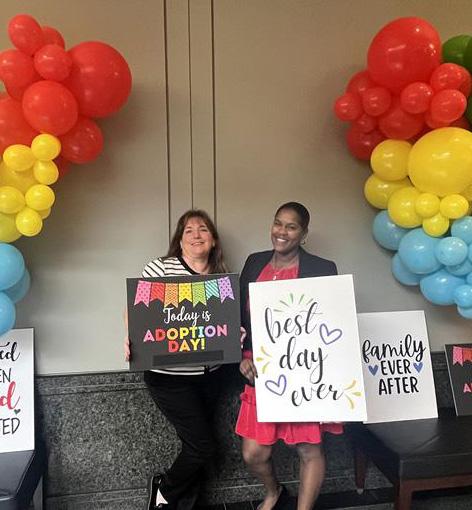
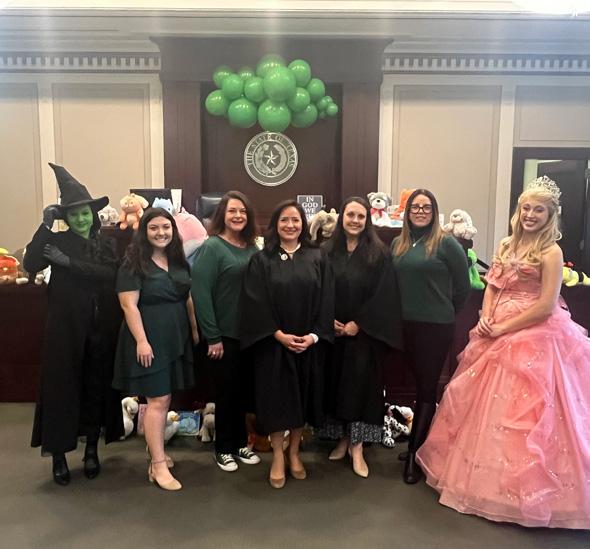
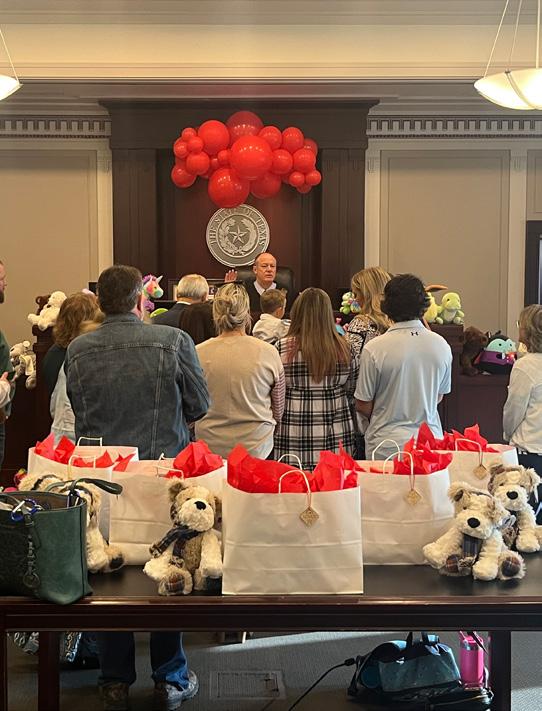
National Adoption Day brings together more than 400 communities nationwide to celebrate adoption and finalize foster care adoptions. This year, Tarrant County proudly continues this tradition in its 24th year.
We celebrated 22 families finalizing the adoptions of 38 children. Each adoption was more than a legal process; it began a new story of belonging, stability, and opportunity.
This day was made possible through the efforts of many. We thank Judge Kim Brown, Judge John Eck, the family court judges, and the Tarrant County Commissioner’s Court. We also recognize CASA, the Family Law Bar Association, Our Community Our Kids, the Tarrant County Family Law Courts, the District Clerk’s Office, and members of the Tarrant County Bar Association. Their dedication ensures National Adoption Day brings hope and joy to children and families.
On Friday, November 21, we celebrated these families with festivities honoring the impact of adoption. This day reflected the resilience of children, the commitment of adoptive families, and the support of the professionals and volunteers who made it possible. Tarrant County remains committed to building brighter futures, one adoption at a time. g







By Scott Lindsey Partner, Boyd Powers Williamson | slindsey@bpwlaw.com
2024–2025 TCBA Immediate Past
President
Texas law uses “good cause” in many different contexts. Between January 2022 and February 2025, “good cause” appeared in more than 900 Texas appellate opinions. Understanding when “good cause” applies and how to prove it or defend against it is thus important in civil litigation.
Tex. R. Civ. P. 10 governs attorney withdrawal, and its first sentence states: “An attorney may withdraw from representing a party only upon written motion for good cause shown.” Rule 1.15(b) of the Texas Disciplinary Rules of Professional Conduct defines good cause here. McGowen v. Vanderbilt Mortgage, No. 06-22-00047-CV, 2023 Tex. App. LEXIS 5615 (Tex. App.—Texarkana July 31, 2023, no pet.) (mem. op.). Rule 1.15(b) includes, among other things, a client persisting in conduct “the lawyer reasonably believes may be criminal or fraudulent,” a client used the lawyer “to perpetrate a crime or fraud,” the lawyer considers the client’s objective “repugnant or imprudent” or “with which the lawyer has fundamental disagreement,” the client has been given reasonable warning but does not substantially fulfill its obligation to the lawyer, and continuing representation would lead to “an unreasonable financial burden on the lawyer or has been rendered unreasonably difficult by the client.” Id. at *9-10 (quoting Rule 1.15(b)).
In McGowen , the trial court abused its discretion by granting a motion to withdraw. Counsel notified the appellants of his intent to withdraw only three days before the summary judgment hearing and had not filed a response to the motion. Counsel also filed a motion for continuance, but it was not properly verified. The trial court abused its discretion because counsel’s withdrawal prejudiced the client. Id. at *12-13.
Good cause is required to move deadlines, hearings, or trial settings. Rule 5 allows a court to extend or modify a time to act “for cause shown” before a deadline or “where good cause is shown” after a deadline. Tex. R. Civ. P. 5.
The seminal Rule 5 case is Carpenter v. Cimarron Hydrocarbons Corp., 98 S.W.3d 682 (Tex. 2002). Cimarron defined “good cause” for Rule 5 purposes as conduct that “was not intentional or the result of conscious indifference, but the result of accident or mistake,” and allowing an extension would cause “no undue delay or otherwise injure” the opposing party. Id. at 688. The Cimarron Court held that the trial court did not abuse its discretion by denying leave to file a late summaryjudgment response because the motion only argued lack of prejudice and included no evidence explaining the failure to timely respond. Id.
The Supreme Court recently applied the Cimarron standard, this time with a different result. In Verhalen v. Adriana Akhtar, 699 S.W.3d 303 (Tex. 2024), counsel’s calendaring error led

to a day-late summary judgment responses. But along with the summary-judgment responses, the Verhalens filed a verified motion for leave explaining the “calendaring issue” and affirmatively arguing no prejudice. Id. at 304-05. In this instance, the trial court abused its discretion by denying leave to file the late response because counsel’s affidavit and the motion for leave established each element of Cimarron’s good cause standard. Id. at 306.
Not all mistakes constitute good cause. In Woods v. Woods, 193 S.W.3d 720 (Tex. App.—Beaumont 2006, pet. denied), counsel’s ignorance of the deadline was inadequate. The court wrote that “not every mistake of law is a sufficient excuse, because otherwise a party could, in any case, claim a mistake of law and be entitled to relief” and that a “party who files suit on a claim governed by a statute is charged with knowledge of the statute and its requirements.” Id. at 723 (citations omitted).
Rule 253 address continuances for absence of counsel. “Except as provided elsewhere in these rules, absence of counsel will not be good cause for a continuance or postponement of the cause when called for trial, except it be allowed in the discretion of the court, upon cause shown or upon matters within the knowledge or information of the judge to be stated on the record.” Tex. R. Civ. P. 253.
The text of rule 253 is itself cautionary. Absence of counsel is not alone good cause, and the trial court has discretion to deny a continuance. Id. For example, courts have found no good cause when a prior lawyer withdrew more than a month before trial, particularly when the withdrawal is because of nonpayment or other fault of the client (and thereby justifying the denial of a continuance that would benefit the offending party). In re J.P., 365 S.W.3d 833, 836 (Tex. App.—Dallas 2012, no pet.).
Good cause frequently applies to discovery procedures. Rule 191.1 states: “Except where specifically prohibited, the procedures and limitations set forth in the rules pertaining to discovery may be modified in any suit by the agreement of the parties or by court order for good cause. An agreement of the parties is enforceable if it complies with Rule 11 or, as it affects an oral deposition, if it is made a part of the record of the deposition.” Tex. R. Civ. P. 191.1. The Supreme Court addressed this rule at length in In re BP Prods. N. Am., Inc., 244 S.W.3d 840 (Tex. 2008) and held that a trial court’s discretion is not unbounded because discovery agreements should be encouraged and that a trial “court should be particularly reluctant to set aside a Rule 191.1 agreement after
Continued on page 18
Continued from page 17
one party has acted in reliance on the agreed procedure and performed its obligations under the agreement” because an “easy disregard for partially performed agreements would discourage parties from committing to discovery agreements for fear that the other party would avail itself of the benefit of the bargain and then attempt to avoid its own obligations.” (citations omitted).
Rule 193.2 addresses the failure to timely object to discovery requests. “An objection that is not made within the time required, or that is obscured by numerous unfounded objections, is waived unless the court excuses the waiver for good cause shown.” Tex. R. Civ. P. 193.2(e). One case offers a cautionary tale. In In re M.M.H., No. 05-02-00009-CV, 2002 Tex. App. LEXIS 4161, *5-6 (Tex. App.—Dallas 2002, no pet.) (mem. op.), the father received discovery requests and believed the responses were due after the discovery deadline. Rather than file objections, he waited until trial to argue a response was not required after the discovery deadline. The trial court found the requests timely, found any objections waived, and deemed the admissions as requested in the discovery requests. See id. Cautious counsel will therefore respond within the deadline to ensure that objections are not waived.
Good cause also applies to the withdrawal of deemed admissions. In Wheeler v. Green, the Texas Supreme Court held that the standard for withdrawing deemed admissions is the same as for leave to file late summary judgment responses. 157 S.W.3d 439, 442 (Tex. 2005). A clerical error can establish good cause, even if the party is negligent, so long as the negligence does not rise to the level of conscious indifference. In re Abercrombie, No. 02-23-00395-CV, 2024 Tex. App. LEXIS 1494, *6 (Tex. App.—Fort Worth Feb. 29, 2024, orig. proceeding) (mem. op.). Indeed, good cause “is not a high bar,” and it might even mean the absence of ‘evidence of flagrant bad faith or callous disregard for the rules.’” In re Euless Pizza, LP, 702 S.W.3d 543, 546 (Tex. 2024) (quoting Marino v. King, 355 S.W.3d 629, 632 (Tex. 2011)).
Rule 204 addresses mental and physical examinations. A party may obtain an order requiring a party to submit to a physical or mental examination “only for good cause shown and only” when “mental or physical condition” is in controversy or when the non-moving party has designated a psychologist as a testifying expert or disclosed a psychologist’s records for possible use at trial. Tex. R. Civ. P. 204.1(a), (c). Good cause for a Rule 204.1 examination requires “show[ing] that (1) the examination is relevant to the issue in controversy and is likely to lead to relevant evidence, (2) there is a reasonable nexus between the examination and the condition in controversy, and (3) the desired information cannot be obtained by less intrusive means.” Id. at 371. In particular, “courts ‘should consider whether the exam is likely to reveal information necessary to assess the complained-of injuries beyond what could be obtained from reviewing medical records available to the expert.’” Id. (quoting In re Auburn Creek L.P., 655 S.W.3d
837, 842 (Tex. 2022)).
Rule of evidence 902(10) requires that business records affidavits be served at least fourteen days before trial. Tex. R. Evid. 902(10). However, for “good cause shown, the court may order that a business record be treated as presumptively authentic even if the proponent fails to comply” with subparagraph (A)’s service requirement.” Id.
Rule 193.6(a) also includes an oft-litigated good cause standard. It provides that the failure to make, amend, or supplement discovery requires the automatic exclusion of the evidence “unless the court finds that: there was good cause for the failure to timely make, amend, or supplement the discovery response; or the failure to timely make, amend, or supplement the discovery response will not unfairly surprise or unfairly prejudice the other parties.” Tex. R. Civ. P. 193.6(a). The burden of showing good cause or unfair surprise is on the party seeking to admit the evidence, and the record must support the trial court’s finding to excuse the failure to supplement. Id. 193.6(b).
The 193.6(a) good cause exception “allows a trial judge to excuse a party’s failure to comply with discovery obligations in difficult or impossible circumstances.” PopCap Games, Inc. v. MumboJumbo Distrib., LLC, 350 S.W.3d 699, 718 (Tex. App.— Dallas 2011, pet. denied). Inadvertence of counsel, lack of surprise, and uniqueness of the excluded evidence are not good cause. Alvarado v. Farah Mfg. Co., 830 S.W.2d 911, 915 (Tex. 1992).
Be aware, though, that the good cause standard under Rule 193.6 is probably different than the Cimarron-Rule 5 standard. Cresson Int., LLC v. Rooster, No. 02-21-00366-CV, 2022 Tex. App. LEXIS 6707 (Tex. App.—Fort Worth Aug. 31, 2022, pet. denied) (mem. op.). The Court held that the “grounds for excusing a tardy summary-judgment response differ from Rule 193.6’s framework and burdens.” Id. at *15-16; but see In re Meyer, No. 04-24-00022-CV, 2024 Tex. App. LEXIS 5799, at *9-12 (Tex. App.—San Antonio Aug. 14, 2024, orig. proceeding) (mem. op.) (applying Cimarron good cause standard in 193.6 context).
Careful practitioners should know that even in the face of strong evidence of good cause (such as an extended illness or a hurricane), if the trial court could have excluded the evidence for another reason (such as inadequate initial discovery responses), appellate courts are not likely to find an abuse of discretion, even if the reviewing judges might have reached a different decision. Cresson Int., , 2022 Tex. App. LEXIS 6707, at *8, *15 (“[W]e cannot say that the trial court abused its discretion by not finding good cause for Cresson’s tardy evidence even though, again, we may have decided differently.”).
The TCPA also uses “good cause.” Section 27.003(b) of the civil practice and remedies code requires a motion to dismiss be filed within 60 days of service absent agreement or a motion “showing of good cause.” Tex. Civ. Prac. & Rem. Code § 27.003(b). Section 27.004(a) requires a hearing within 60 days of filing of the motion to dismiss absent agreement or “a showing of good cause” to extend the deadline to 90 days. Tex. Civ. Prac. & Rem. Code § 27.004(a). Section 27.006(b)
provides that after the filing of a motion to dismiss, the court may allow limited discovery “[o]n a motion by a party or on the court’s own motion and on a showing of good cause.” Tex. Civ. Prac. & Rem. Code § 27.006(b). Interpreting “good cause” under the TCPA, the Fourteenth Court of Appeals has applied the standard applicable to withdrawing deemed admissions and late-filed summary judgment responses but rejected the good cause argument. Simmons v. Taylor, 651 S.W.3d 499, 505 (Tex. App.—Houston [14th Dist.] 2022, no pet.).
Rule 165a states that a case may be dismissed for want of prosecution and that “at the dismissal hearing, the court must dismiss for want of prosecution unless there is good cause for the case to be maintained on the docket.” Tex. R. Civ. P. 165a(1). In this context, “good cause” was originally a “more stringent” standard than “reasonable explanation.” Folsom v. Folsom , 01-22-00531-CV, 2024 Tex. App. LEXIS 321 (Tex. App.—Houston [1st Dist.] Jan. 18, 2024, no pet.) (mem. op.). But more recently, the Supreme Court used the two standards interchangeably, suggesting there is no difference. Id. (quoting In re Conner, 458 S.W.3d 532, 535 (Tex. 2015)). Since Conner, courts typically apply the reasonable explanation standard. In re Lloyd’s, No. 13-24-00395-CV, 2024 Tex. App. LEXIS 6240, *10 (Tex. App.—Corpus Christi Aug. 26, 2024, no pet.) (mem. op.). Tex. R. Civ. P. 13 and Civil Practice & Remedies Code Chapter 10 have the same “good cause” standard for imposing sanctions. Pace v. Aces Autos, LLC, No. 08-23-00127-CV, 2024 Tex. App. LEXIS 2063, at *25 (Tex. App.—El Paso Mar. 22, 2024, no pet.) (mem. op.). Each requires that the trial court’s order state the grounds for the sanctions. Rule 13 requires that the order “state the particulars of the good cause” while Chapter 10 requires that the order describe “the conduct the court has determined violated section 10.001 and explain the basis for the sanction imposed.” Flores v. Garcia, No. 13-15-00047-CV, 2015 Tex. App. LEXIS 10383, at *18-19 (Tex. App.—Corpus Christi Oct. 8, 2015, no pet.) (mem. op.). Sanctions orders are routinely affirmed, but common reasons for reversal include the absence of supporting evidence and no findings that the order did not contain the required findings or that the trial court did not have evidence before it to make a good cause finding. In re Jamison, No. 09-21-00223-CV, 2024 Tex. App.
Wow, what a crazy year! It’s hard to believe another calendar year has flown by like it has. Please take a minute to stop and reflect on the year and the great things you’ve done, learned, gained and even lost. Think about the new friends you’ve made and the old friends you should reach out to and stay in touch with. There’s no better time to appreciate those around you
LEXIS 7584, at *11-14 (Tex. App.—Beaumont Oct. 24, 2024, orig. proceeding) (mem. op.); Pace, 2024 Tex. App. LEXIS 2063, at *30-31.
Rules 131 and 141 address court costs. The “successful party to a suit shall recover of his adversary all costs incurred therein, except where otherwise provided.” Tex. R. Civ. P. 131. Rule 141 in turn provides that the “court may, for good cause, to be stated on the record, adjudge the costs otherwise than as provided by law or these rules.” Tex. R. Civ. P. 141. Courts strictly construe Rule 141’s requirement that the good cause “be stated on the record.” Sirius Sols., LLLP v. Trimont Energy, LLC, 14-22-00538-CV, 2025 Tex. App. LEXIS 300, at *17 (Tex. App.—Houston [14th Dist.] Jan. 23, 2025, no pet.). For a collection of cases finding good cause to retax costs, see Boyce v. Eberstein, 636 S.W.3d 708, 713-14 (Tex. App.—Dallas 2021, pet. denied).
Many other rules and statutes have good cause standards. They include but are not limited to: (a) Tex. R. Civ. P. 21d; (b) Tex. R. Civ. P. 60; (c) Tex. R. Civ. P. 171; (d) Tex. R. Civ. P. 320; (e) Tex. R. App. 2; and (f) Tex. R. App. 18. Good cause also applies to late responsible third-party designations, certificates of merit, and many provisions in the education code and family code. There are likely others not mentioned here.
In conclusion, given that “good cause” is typically reviewed under an abuse of discretion standard, winning in the trial court is critical because of how difficult it can be to reverse discretionary rulings that go against your client. I hope this paper helps you and your client prepare and prevail when litigating good cause. g
Scott spoke during September’s Brown Bag Seminar Series: Ethics
Watch the recorded session and earn 2.25 hours of ethics CLE at www.tarrantbar.org/ brown-bag-ethics-2025.

By Tracy Card TCBA Sections & CLE Director
and the little milestones along the way.
I also hope during this season you’re able to enjoy some of the special holiday gatherings hosted by the sections and the TCBA. Don’t forget to check out our extensive list of CLE events available on our website. We hope to see you around! g

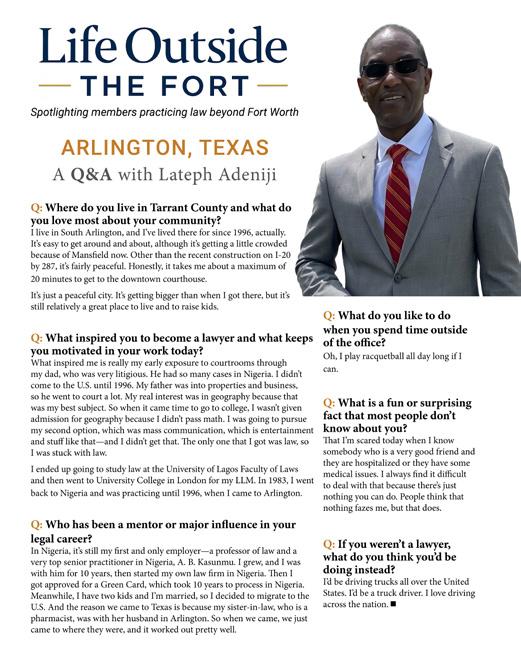
Spotlighting members practicing law beyond Fort Worth
Q: Where do you live in Tarrant County and what do you love most about your community?
I live in South Arlington, and I’ve lived there for since 1996, actually. It’s easy to get around and about, although it’s getting a little crowded because of Mansfield now. Other than the recent construction on I-20 by 287, it’s fairly peaceful. Honestly, it takes me about a maximum of 20 minutes to get to the downtown courthouse.
It’s just a peaceful city. It’s getting bigger than when I got there, but it’s still relatively a great place to live and to raise kids.

Q: What inspired you to become a lawyer and what keeps you motivated in your work today?
What inspired me is really my early exposure to courtrooms through my dad, who was very litigious. He had so many cases in Nigeria. I didn’t come to the U.S. until 1996. My father was into properties and business, so he went to court a lot. My real interest was in geography because that was my best subject. So when it came time to go to college, I wasn’t given admission for geography because I didn’t pass math. I was going to pursue my second option, which was mass communication, which is entertainment and stuff like that—and I didn’t get that. The only one that I got was law, so I was stuck with law.
I ended up going to study law at the University of Lagos Faculty of Laws and then went to University College in London for my LLM. In 1983, I went back to Nigeria and was practicing until 1996, when I came to Arlington.
Q: Who has been a mentor or major influence in your legal career?
In Nigeria, it’s still my first and only employer—a professor of law and a very top senior practitioner in Nigeria, A. B. Kasunmu. I grew, and I was with him for 10 years, then started my own law firm in Nigeria. Then I got approved for a Green Card, which took 10 years to process in Nigeria. Meanwhile, I have two kids and I’m married, so I decided to migrate to the U.S. And the reason we came to Texas is because my sister-in-law, who is a pharmacist, was with her husband in Arlington. So when we came, we just came to where they were, and it worked out pretty well.
Q: What do you like to do when you spend time outside of the office?
Oh, I play racquetball all day long if I can.
Q: What is a fun or surprising fact that most people don’t know about you?
That I’m scared today when I know somebody who is a very good friend and they are hospitalized or they have some medical issues. I always find it difficult to deal with that because there’s just nothing you can do. People think that nothing fazes me, but that does.
Q: If you weren’t a lawyer, what do you think you’d be doing instead?
I’d be driving trucks all over the United States. I’d be a truck driver. I love driving across the nation. g
By Taylor White and Alex Amerine Winstead PC
For attorneys, HR professionals, or business owners, an EEOC charge can be daunting. Curating an effective response to a charge of discrimination is about more than legal acumen; it also requires a well-prepared and informed approach to manage and reduce risks. This strategic approach starts before a charge is even filed. And it should be considered at every step of the EEOC investigation.
This guide provides a concise overview of what employers and attorneys need to know to minimize risk and respond effectively to discrimination charges, focusing on preparation, managing client expectations, the investigation process, and employer rights.
An employee alleging workplace discrimination or retaliation must first exhaust their administrative remedies before they can pursue their claims in court. To do this, the employee must file a “charge of discrimination” with the applicable federal and/or state agencies.
The Equal Employment Opportunity Commission (EEOC) investigates claims of discrimination or retaliation under federal law, including Title VII, the Americans with Disabilities Act (ADA), the Age Discrimination in Employment Act (ADEA), the Equal Pay Act (EPA), and the Genetic Information Nondiscrimination Act (GINA).
States also have their own counterparts to the EEOC (generally called Fair Employment Practices Agencies, or FEPAs), which enforce state employment laws. State employment laws tend to mirror federal employment statutes, but can sometimes offer more expansive protections.
Employees may dual-file charges of discrimination with the EEOC and a state FEPA. However, the EEOC often maintains authority over the charge and the investigation.
The best way for an employer to set itself up for success at the EEOC stage—apart from crafting a persuasive and effective position statement—is to be prepared for the EEOC before a charge of discrimination arrives on its desk. Below are two easy—but pivotal—steps that employers can do in that regard.
Policy and Handbook Review. An employer’s employment policies and handbook can be critical in overcoming a charge of discrimination. To that end, employers should be mindful of common mistakes often made in employment handbooks and policies:
• Avoid generic, “one size fits all” handbook templates that

may not accurately reflect the actual practice of the employer, or that “over-regulate” the employer and include policies or benefits not required by law of that particular employer;
• Regularly review policies to ensure they are up to date and compliant with recent changes in the law;
• Include fundamental provisions, including anti-discrimination, anti-harassment, and at-will employment provisions, as well as procedures for complaining of discrimination or retaliation;
• Review discipline policies and ensure that they are flexible and allow for immediate termination, depending on the facts and circumstances; and,
• Assure that these policies are distributed to employees, and that the employer obtains signed acknowledgements of the policies from employees.
Training Managers and Supervisors. Investing in the training of managers and supervisors is also essential for any employer hoping to prevail at the EEOC stage. A well-prepared management team can make the difference between a smooth resolution and an uphill legal battle.
First, employers should train managers to be deliberate and thorough in what is documented in employee files, particularly as it pertains to performance and misconduct issues. For purposes of EEOC charges of discrimination, performance-based terminations are often the trickiest to overcome, and a strong paper trail can make all the difference. Employers should therefore:
• Document communications of performance expectations with specific suggestions on how to improve;
• Document the employee’s opportunities to improve and deadlines for improvement; and
• If applicable, document any legitimate, non-discriminatory reason(s) for why two employees with the same or similar performance issues are treated differently.
Persuasive documentation can come in many forms, and can include informal (but contemporaneously created) notes from verbal coaching sessions, general email correspondence about performance issues, or more formal written warnings or performance improvement plans (PIPs).
Second, challenges can arise from the inconsistent treatment of employees. For example, the charging party may claim that someone outside of their protected class was treated more favorably, or did not receive the same treatment for similar misconduct. To protect against these claims, employers should keep thorough
Continued on page 22
Continued from page 21
records of disciplinary and termination decisions, review such records prior to implementing any new employment decisions to maintain consistency in decision making, and document legitimate and non-discriminatory reasons for any deviations. Finally, employers should ensure that supervisors and managers know what to do if they receive an employee complaint directly, and what the employer’s rights are when they receive an EEOC charge.
Navigating the EEOC process can feel like a careful balancing act—cooperation is essential, but so is protecting the company’s interests. Early on, employers should adopt the principle of “cautious cooperation,” in which the employer cooperates with the EEOC, but never loses sight of their rights along the way, including the following:
• Right to legal representation. All EEOC communications should go through the employer’s attorney. EEOC investigators should not contact the employer or its managers without the attorney’s knowledge—and employers should remind managers of this. Further, a legal representative may be present during investigative interviews with management personnel. Note though, employers cannot prevent the EEOC from speaking directly to its non-management employees outside the employer’s (or its representative’s) presence.
• Right to seek limitation or clarification of document requests. Employers are not required to blindly turn over all documents and information requested by the EEOC—but remember, cautious cooperation.
• Right to protect confidential information. Use redactions and mark documents appropriately to protect the employer’s confidential and proprietary information.
An employer receives a charge of discrimination. Now what? Below is a guide to managing expectations, meeting deadlines, and laying out your strategy.
Setting Expectations. First, set expectations about the EEOC process early on. The EEOC process can be a long road from the point a charge is filed to the date the EEOC ceases their investigation, especially when back logs, understaffing, or political changes (or government shutdowns!) slow things down.
Document Deadlines. Once a charge is filed, time is of the essence. Employers typically only have 30 days to file a position statement in response to a charge, so it’s important to act quickly and begin considering the employer’s available options. Additionally, when presented with a charge, the employer may also receive an invitation to mediate. If the employer elects to participate, it will not have to submit a position statement until after mediation (if it does to resolve the charge). Be mindful of any deadlines to elect mediation.
Gathering Information and Building Your Case. For purposes of preparing a position statement, employers will need to gather the necessary documents and information for an initial assessment of the allegations and potential defenses. Below are basic documents that employers should begin gathering in order to respond to a charge:
• Relevant policies and procedures, including employee handbooks (and acknowledgement of the charging party of the same);
• The charging party’s personnel file, termination documents, and performance and disciplinary records;
• Contact information for managers and other witnesses;
• Relevant emails and communications with the charging party; and
• Claim-specific documentation (for example, medical documents and accommodation communications for disability-related claims).
While affidavits may be prepared (or even requested by the agency) where the paper trail is thin, employers should proceed with caution. Affidavits can be used against the witness and employer later if there are any inconsistencies with facts developed in a lawsuit.
Strategy and Legal Defenses. This is also the time to begin carving out the employer’s defense strategy.
From the offset, employers should determine whether Employment Practices Liability Insurance (EPLI) applies. EPLI policies usually require notice of a charge (or even a demand letter before a charge is filed) to trigger coverage. If the deadline to provide notice under the EPLI policy passes, many insurers will simply deny the claim, and the employer has waived coverage for that claim. Employers should also consider “silver bullet” defenses that can stop an EEOC investigation in its tracks:
• Size of the Employer. One common defense is that the employer doesn’t have enough employees to meet the definition of “employer” under the relevant federal statutes. For example, the ADA and Title VII only apply to employers with at least 15 employees, while the ADEA applies to employers with at least 20 employees. State laws may expand coverage, so always confirm the requirements within the relevant jurisdiction.
• Employee Status. Another common silver bullet defense is that the employee is not an employee, but is, instead, an independent contractor. Be sure to verify the status and classification of the charging party. Note that this is a highly factual analysis, so it may require some investigation and evidence to establish that the classification is proper.
• Statute of Limitations. When you first receive a charge, verify that the charge is not time-barred. Under federal law, an employee must file a charge within 180 days from the date the discrimination/retaliation took place. This statute of limitations is increased to 300 days, if the state or local agency enforces a state law that prohibits discrimination on the same grounds. Accordingly, confirm the applicable statute of limitations based on the claims asserted in the charge and laws applicable to the same.
The position statement is an employer’s first opportunity to present its defenses and evidence to the EEOC. As a general matter, position statements should be clear and concise—the easier you make the position statement to understand and grasp for busy EEOC investigators, the better. Below are additional tips for an effective position statement:
• Check Every Box. Address each alleged discriminatory act raised in the charge, no matter how insignificant it may seem. If an employer skips a point, the EEOC may circle back with follow-up questions, or worse, take the charging party’s claim as the truth. Answer every allegation and, when possible, include supporting records, emails, and documentation.
• Set the Scene. The employer should include a description of its business, such as its primary products and services, number of employees, and locations. This description should cast the employer in a favorable light—like a marketing or advertising piece.
• Highlight Policies. Employers should also include a section about its relevant policies and procedures—including at-will employment and anti-discrimination, anti-harassment, and anti-retaliation policies. If there is a claim for retaliation, the employer’s complaint procedures may also be relevant and helpful to discuss.
• Tell Your Side of the Story. The employer should then include information on the employer’s view of the facts and how those facts interplay with the legal elements of the charging party’s claims.
• Don’t Dodge “Bad” Facts. If there are details that aren’t particularly flattering—or if the charging party raises certain facts that aren’t great—address them head-on by, for example, outlining how they are not sufficient to establish a claim under applicable law. This will help build credibility with the EEOC and allow the employer to control the narrative, rather than leaving it in the hands of the charging party.
• Organize Exhibits. Employers should support the position statement with well-organized exhibits (such as a bookmarked PDF) with any confidential information or personally identifiable information (PII) redacted.
• Focus Legal Arguments. Employers may want to include key legal arguments, supported by statutory or case law, particularly on discreet or specific issues. Be sure to use, if possible, only favorable case law where the court found for the employer—there’s no need to do the plaintiff’s attorney research for them! Of course, if there is binding case law precedent that cuts against the employer’s defense, then it must be addressed by distinguishing it.
And as a final, critical reminder: The position statement and exhibits will be shared with the charging party and their attorney. A charging party may later use the position statement as evidence against the employer in subsequent litigation, so it behooves employers to get the information right the first time to avoid issues down the road.
Once the employer files its position statement, the ball is in the EEOC’s court. The EEOC will begin its investigation into the charging party’s claims, which could result in the following requests from the investigator:
• Requests for Information (RFIs). The EEOC may send the employer RFIs, which are similar to requests for production or interrogatories. The EEOC does not always send RFIs but may send some (or many) in more complicated cases. While employers can certainly object to RFIs, objections should remain as concise and relevant as possible. Moreover, RFI responses should always include a disclaimer and reservation of rights providing for the employer to supplement or amend its responses as the EEOC’s investigation proceeds.
• Witness Interviews. The EEOC may request to interview certain employees and managers. Witness preparation for managers is similar to preparing a fact witness for a deposition—discuss the facts and the witness’ version of events, and discuss questions you anticipate the EEOC investigator might ask.
• Onsite Visits. The EEOC may also request onsite visits, so employers should be prepared to defend against those as well.
At the end of its investigation, the EEOC will make one of the following determinations on the merits of the charge:
• The EEOC may decline to rule, one way or another, whether discrimination occurred;
• The EEOC may find that there is no reasonable cause that discrimination occurred; or
• The EEOC may issue a “reasonable cause” finding if it finds a violation of the law.
After making its determination, the EEOC will issue a “notice of right to sue” to the charging party, which is required for the employee to file a lawsuit. The EEOC will almost always issue a notice of right to sue, even if it does not find that discrimination occurred. If the EEOC has not concluded its investigation within 180 days from the date the charge was filed, the charging party can request a notice. In any event, the employee generally has 90 days from the date the notice is issued to file a lawsuit.
***
For employers, effective preparation for the EEOC process starts well before a charge of discrimination is filed. By routinely reviewing employment policies, providing targeted training for management staff, and thoroughly documenting workplace actions, employers can position themselves for success at every stage of the EEOC process. Additionally, remaining informed of an employer’s rights, while maintaining open and careful communication with the EEOC, is key to navigating investigations while protecting the employer’s organization. With careful planning and diligence, employers can navigate EEOC charges with confidence and reduce potential legal risks. g
New Members of the TCBA:
Dango Allen
Maxwell Appel
William Boone
Constance Broome
Elizabeth Chappell
Guillermo Chavez
Kyle Chrisman
Ben Clements
Tyler Craig
Shelby Curry
Devon Davis
Ricardo
De Los Santos
Eliza DeWalt
Anna Eckhoff
Jess Gambrell
John Gillett
Robert Haslam
Bret Helmer
Manuel Hernandez
Stephen Howell
Allan Howeth
Fred Howey
Edwin Jensen
Chrys Jones
Adam Kamal
Jennifer Luethke
Gregory Martin
Makenzie Mays
Randyl Meigs
Claire Monsour
Vanessa MurraKapon
Isaac Olson
Austin Opara
Rodney Patterson
Seth Paulger
Brandon Robinson


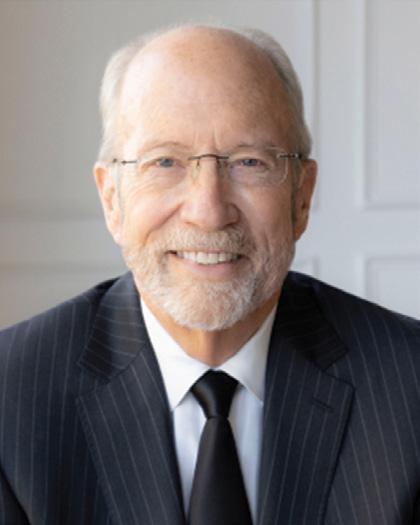
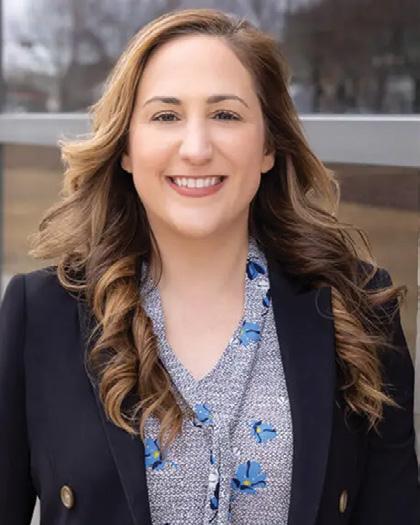
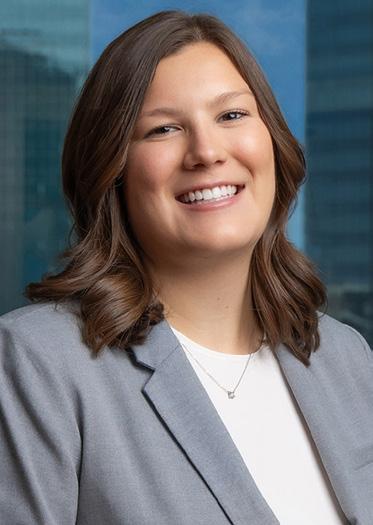
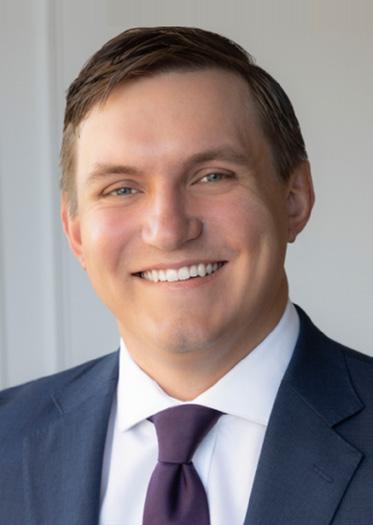
Harris, Finley & Bogle, P.C. is pleased to announce the addition of Shelby Curry as an associate attorney in the firm’s estate planning and probate department. She recently graduated from Texas Tech University School of Law, where she served as Editor-in-Chief of the Estate Planning and Community Property Law Journal. Shelby holds a B.S. in Agricultural Economics from Tarleton State University. Originally from Boerne, Texas, she now lives in Aledo. Shelby is excited to start putting roots down and start her legal career in Fort Worth.
Ian Klein
Brackett & Ellis, P.C. is thrilled to welcome Ian Klein to it litigation and school law practice. Ian brings a strong passion for writing, learning, and public speaking—skills that will serve our clients and cases exceptionally well. Ian earned his J.D. from Texas A&M University School of Law in 2020, graduating magna cum laude. He also holds a Bachelor of Arts from the University of Texas at Arlington, where he graduated magna cum laude in 2016. His dedication to education and advocacy makes him a valuable addition to our team, and we look forward to seeing his impact in these practice areas.
Kaylee Maxon joins Brackett & Ellis, P.C. with a strong focus on commercial litigation, bringing a thorough and creative approach to every case. She earned her J.D. from the University of Oklahoma College of Law, graduating summa cum laude in 2024, and holds a Bachelor of Arts from the Univ-
ersity of New Mexico, where she graduated magna cum laude in 2017. Her passion for advocacy and commitment to excellence make her an outstanding addition to our firm.
Harris, Finley & Bogle, P.C.
Harris, Finley & Bogle, P.C. is pleased to announce that Spencer Muskopf has joined the firm as an associate in the firm’s commercial real estate department. Spencer earned his Juris Doctor magna cum laude from Stetson University College of Law, where he served as Executive Editor of the Stetson Law Review and competed as a member of the Moot Court Board. He also gained valuable experience as a judicial intern to the Honorable Susan C. Bucklew of the United States District Court for the Middle District of Florida. Spencer holds a Bachelor of Science from the University of North Texas. A Fort Worth native, Spencer is excited to start his legal career close to home and contribute to the region’s commercial real estate market.
Brackett & Ellis, P.C. is delighted to welcome Amy Panchal to its firm. Amy brings a fresh perspective to litigation, combining her passion for problemsolving with a strategic approach to complex cases. Amy earned her J.D. from the University of Leicester in London, England, and completed her Master of Laws (LL.M.) at SMU Dedman School of Law in 2024. Her commitment to building meaningful relationships with clients by helping them navigate challenging issues with confidence and clarity aligns perfectly with our core values, making her a valuable asset to our team.

Harris, Finley & Bogle, P.C.
Harris, Finley & Bogle, P.C. is pleased to announce that Caroline Sullivan has joined the firm as an associate attorney in the firm’s oil and gas transactional department. Caroline earned her J.D. from SMU Dedman School of Law, where she served as an Articles Editor for the International Law Review She holds a Bachelor of Business Administration in Finance, with a minor in Energy, Technology, and Management, from Texas Christian University. A proud TCU alumna, Caroline is excited to return to Fort Worth and begin her legal career with Harris, Finley & Bogle. She looks forward to serving the firm’s clients in the energy industry and contributing to the Fort Worth legal community.
Bourland, Wall & Wenzel, P.C. would like to welcome its newest associate attorney, Ashley Tran. Ms. Tran graduated Baylor University School of Law and recently passed the July 2025 Texas Bar Exam. Her practice has primarily focused on general civil litigation. Ms. Tran has experience assisting clients at all stages of the litigation process and works diligently to obtain the best outcome for her clients. She can be reached at 301 Commerce Street Suite 2500, Fort Worth, TX 76102, 817.877.1088.
Named to Fort Worth Magazine’s 2025 Top
Goranson Bain Ausley announces that Chris Nickelson, Gary L. Nickelson, Cassidy Pearson, Andrew Tisdale, and Cindy V. Tisdale have been named to Fort Worth Magazine’s 2025 Top Attorneys list. This annual list recognizes peer-nominated attorneys in the Fort Worth area. Honorees
Chris Nickelson — Double Board Certified in Family Law and Civil Appellate Law. Leads high-asset divorce, complex property, and high-conflict custody cases. Recipient of the Dan Price Award and recognized annually as a Top Attorney by Fort Worth Magazine since 2007.
Gary L. Nickelson — Over 50 years of family law leadership in Fort Worth. Past president of both the Texas and national chapters of the American Academy of Matrimonial Lawyers. Recognized annually as a Top Attorney by Fort Worth Magazine since 2007.
Cassidy Pearson — Board Certified in Family Law. Represents professionals and parents in complex custody and property cases. Known for her calm, child-centered approach. A Top Attorney by Fort Worth Magazine since 2023.
Cindy V. Tisdale — Board Certified in Family Law; Past President, State Bar of Texas. Advises clients in high-net-worth divorces and contested custody disputes. Named to Top 50 Women Texas Super Lawyers (2024) and President of the Texas Chapter of the American Academy of Family Lawyers (2025).
Andrew Tisdale — Active leader in State Bar of Texas and Fort Worth legal community. Provides practical, client-centered solutions in divorce, custody, and property division. Serves on the Texas Young Lawyers Association Board of Directors and State Bar of Texas Standing Committee for Professionalism and Civility. g

If you are a TCBA member and would like to place an announcement in the Bar Bulletin, we would like to hear from you.
Please submit information by email to Elizabeth Banda, Communications Director, at elizabeth@tarrantbar.org.

Ashley Tran
Tyler Scattolini
Kenneth Shetter
Lauren Somerlot
Jacob Spicer
Emily Terry
Frederick Torti
Ashley Tran
Tashawn Treadwell
Jennifer Van Bevers
Marilyn Walters
Katrina Washington
Ryan Webb
Remington Weis
Craig Woodcook
Kyle Wortham
JUDICIARY
Hon. Maryellen Hicks
Hon. Deborah Nekhom
Hon. Charles Vanover
FACULTY
Terence Cook
ASSOCIATES
Darionne Abdullahi
Tanya Boyce
Amira Golden
Brittany Johnson
Jerry Scott
Denise Tomlinson
Marisela Zaragoza
LAW STUDENTS
Nneoma Ajoku
Victoria Alsina
Raquel Cephus
Alpesh Chapagai
David Chapek
Brianna Collora
Angelica Deaton
Spencer Kent
Andrew Liguez
Claire Nelson
Bailey Snyder
Marlene Stancil
Samira Zolala

Judge Carey Walker, County Criminal Court No. 2
by Judge Bob McCoy g County Criminal Court No. 3
What is “subject-matter jurisdiction”?
Subject-matter jurisdiction “[i]nvolves a court’s power to hear a case.” Subject-matter jurisdiction “exists when the nature of the case falls within the general category of cases the court is empowered, under applicable statutory and constitutional provisions, to adjudicate.”
(a figure of speech in which the latter part of a sentence or phrase is surprising or unexpected; frequently humorous)
I’m missing you, but my aim is improving.


Abigail, Mary, and Martha Elijah

If I sit down on a bench, he is at my side at once and takes up a position on one of my feet. For it is a law of his being that he only runs about when I am in motion too; that when I settle down, he follows suit.
—Thomas Mann, “A Man and His Dog”
Successful bull riding is about the feet, not the seat.
1. Extraneous Offense
“An extraneous offense is any type of misconduct, whether resulting in prosecution or not, which is not shown in the charging instrument and which was shown to have been committed by the accused.” State v. Nunez, 704 S.W.3d 598 (Tex.App.—Houston [1st Dist.] 2024).
In general, aggravated sexual assault of an adult has a ten-year


limitation period. However, during the time relevant to this case, Texas Code of Criminal Procedure Article 12.01, which has since been amended, provided a no-limitation exception to the general ten-year statute of limitation under certain circumstances, specifically providing that there is: “(1) no limitation for (B) sexual assault, if during the investigation of the offense biological matter is collected and subjected to forensic DNA testing and the testing results show that the matter does not match the victim or any other person whose identity is readily ascertained.”
Verdines v. State, 705 S.W.3d 398 (Tex.App.—El Paso 2024).
An “‘element of offense’ means: (A) the forbidden conduct; (B) the required culpability; (C) any required result; and (D) the negation of any exception to the offense.”
Tucker v. State, 706 S.W.3d 379 (Tex.App.—Austin 2024).
When performing a probative-prejudicial balancing test analysis, courts generally balance, as a non-exhaustive list, (1) how probative the evidence is, (2) potential of the evidence to impress jury in some irrational, but nevertheless indelible way, (3) time proponent needs to develop the evidence, and (4) proponent’s need for the evidence.
Lozano v. State, 706 S.W.3d 429 (Tex.App.—Austin 2024).
A statement is not voluntary if there is “official, coercive conduct of such a nature that any statement obtained thereby was unlikely to have been the product of an essentially free and unconstrained choice by its maker.”
State v. Cielencki, 706 S.W.3d 634 (Tex.App.—Austin 2025).
Our federal constitution guarantees “in all criminal prosecutions, the accused shall enjoy the right to have the Assistance of Counsel for his defense.” U.S. Const. amend. VI. “Designed to remedy any imbalance in our adversary system, the Sixth Amendment promises that an accused is entitled to defense counsel in all criminal prosecutions.” This constitutional right encompasses all critical stages of the criminal proceeding. Villarreal v. State, 707 S.W.3d 138 (Tex.Crim.App. 2024).
When deciding whether to conduct formal competency
hearing in criminal proceeding, court must focus on three matters: (1) it must determine whether there is some evidence of incompetency to stand trial; (2) trial court must consider only evidence of incompetency, and it must not weigh evidence of competency against evidence of incompetency; and (3) some evidence must be presented at informal inquiry stage to show that defendant’s mental health condition is source of his inability to participate in his own defense.
Williams v. State, 707 S.W.3d 233 (Tex.Crim.App. 2024).
1. Ambiguous or Unambiguous
If a contract is ambiguous, we must remand the case for a factfinder to determine its meaning as a matter of fact. If a contract is unambiguous, meaning its language creates a definite or certain legal meaning, we will determine its meaning as a matter of law.
Baylor Cty. Special Util v Seymour, 709 S.W.3d 5 (Tex. App— Eastland 2025).
We are loathe to use the equitable process of mandamus to circumvent a process adopted by the people through their legislative representatives.
In Re Arce, 708 S.W.3d 51 (Tex. App—Amarillo 2025).
3. Jurisdictional Facts
A party can also challenge the existence of jurisdictional facts through a motion for no-evidence summary judgment. In that instance, the initial burden of proof is on the nonmovant, though it is a lesser burden: the nonmovant need only put forward enough evidence to raise a fact issue as to the challenged jurisdictional facts – i.e., “more than a scintilla.” Here too, if the evidence creates a fact issue on jurisdiction, the court cannot grant the motion, and the party asserting jurisdiction must prove it by a preponderance of the evidence at trial.
C Ten 31 LLC v Tarbox, 708 S.W.3d 223 (Tex. Bus. Ct. 2025).
4. Judicial Economy
It is fundamental that a focus on judicial economy cannot supersede the bedrock requirement of subject-matter jurisdiction.
Cypress Towne Ctr v Kimco Realty Serv., 708 S.W.3d 265 (Tex. Bus. Ct. 2025).
5. Justice Court
The strict rules of pleading required in courts of record do not apply in justice court. We conclude a written pleading affirmatively requesting attorney’s fees was not required because the rules of civil procedure applicable to civil cases in justice court did not require it.
Brazos Valley Roadrunners, LLC v Herrera, 708 S.W.3d 289 (Tex. App.—Waco 2025).
When a trial court denies a plea to the jurisdiction, a 20-day deadline for filing an interlocutory appeal applies, and cannot be extended by moving to reconsider or filing an amended plea that is substantively the same.
Rivera v. Sonnenschein, 708 S.W.3d 294 (Tex. App. (15 Dist.) 2025).
Sovereign immunity generally bars suits against the State and its agencies, absent a clear and unambiguous waiver of immunity by the Legislature. Nazari v State, 561 S.W.3d 495, 500 (Tex. 2018). Because sovereign immunity implicates a trial court’s subject-matter jurisdiction, it may be properly asserted in a plea to the jurisdiction.
Eriksen v Nelson, 708 S.W.3d 302 (Tex. App. (15 Dist.) 2025).
You can’t throw a skunk into the jury box and ask the jury not to smell it.
Hance v State, No. 02-19-00237-CR (Tex. App Fort Worth, Feb. 27, 2025).
The thing wrong with socialism is that you eventually run out of other people’s money.
—Margaret Thatcher g

The Sheriff’s Department has begun the processing 2026 Attorney ID badges. Completed applications may be emailed to leslie@tarrantbar.org, dropped off or mailed to the Tarrant County Bar Association Office at 1315 Calhoun Street, Fort Worth, Texas 76102.
Please note: Attorney ID badges are exclusively designated for use in criminal and juvenile courts.
Applicants will receive an email notification from TCBA once the Sheriff’s Department approves their badges.
For any inquiries, please reach out to Leslie Silvey at leslie@tarrantbar.org.
Download the 2026 Attorney ID Badge application at www.tarrantbar.org/Attorney-ID-2026.


Connecting Top Employers with Premier Professionals.
• PLACE your job in front of our highly qualified members
• SEARCH our resume database of qualified candidates
• MANAGE jobs and applicant activity right on our site
• LIMIT applicants only to those who are qualified
• FILL your jobs more quickly with great talent
• POST a resume or anonymous career profile that leads employers to you
• SEARCH and apply to hundreds of new jobs on the spot by using robust filters
• SET UP efficient job alerts to deliver the latest jobs right to your inbox
• ACCESS career resources, job searching tips and tools tarrantbar.careerwebsite.com
Contact TCBA Career Center 's customer service department at clientserv@communitybrands.com for more information.

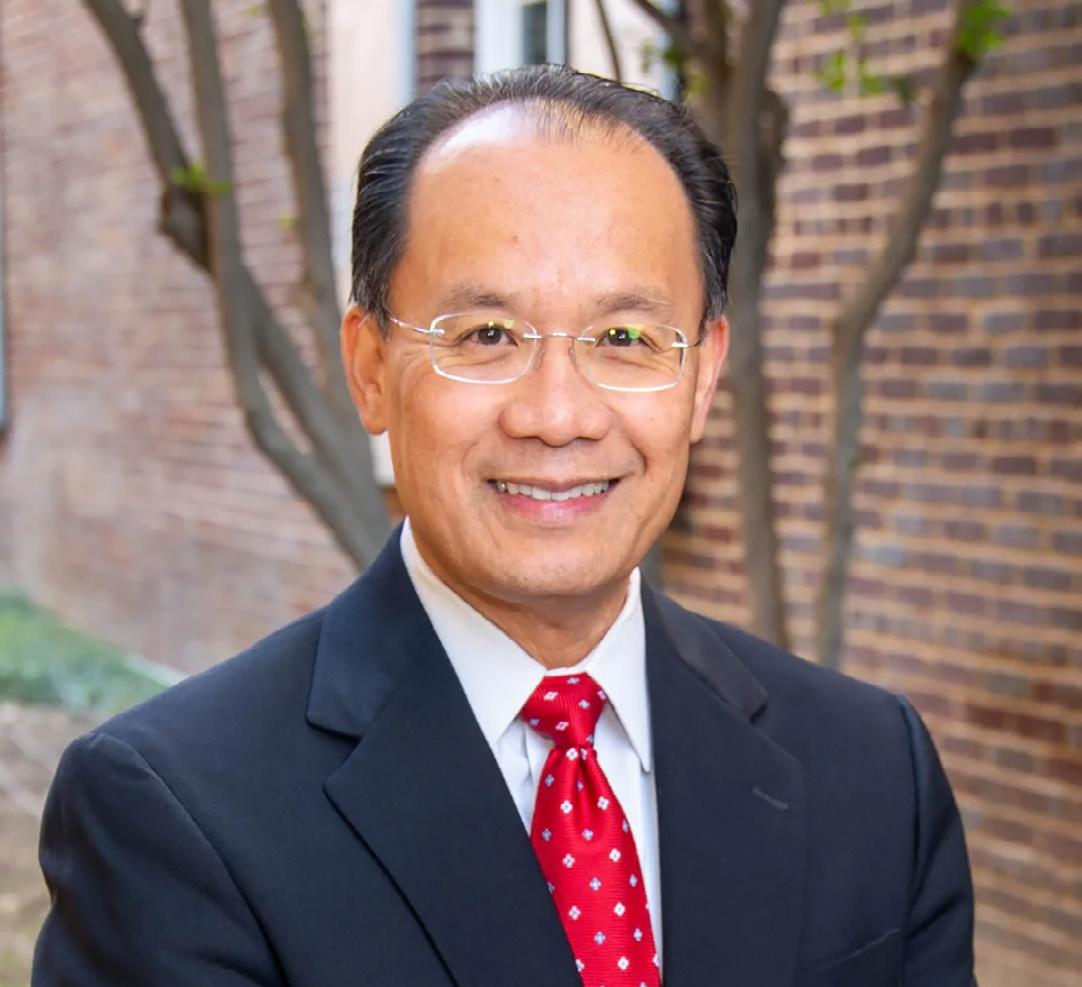
Q: What drew you to employment law, and what has kept you passionate about this area of practice?
Employment law, to me, is real people law. I had opportunities to go into other areas of practice, but the fact that employment law impacts so many people, and it’s a way for me to stay grounded.
Q: What advice do you have for lawyers on maintaining professionalism and credibility with clients and opposing counsel?
With regard to opposing counsel and even your colleagues, develop a rapport early on. Even when you don’t have cases against a lawyer, you never know who you’re going to meet in the courtroom or be adverse to. My whole philosophy to practicing law is doing whatever I can to put my client in the best possible position to resolve whatever legal issues they have.
Part of that means I must have a good working relationship with opposing counsel, because you need to keep the channels of communication open.
Second is civility. We talk about that so often, but having done this for 35 years, I’ve actually seen it in action.
Third, be accommodating to opposing counsel, or basically anybody involved in the lawsuit—whether it’s rescheduling, vacations, or things that come up. I want to have a reputation for being accommodating and easy to work with for opposing counsel.
Q: What are some of the most frequent mistakes you

see lawyers make in employment cases, and how can those be avoided?
I represent employers, so my view of things is from the management side. The mistake that I see on the other side coming at us is they try to turn it into a bigger case than it actually is, instead of just calling me up and saying, “Hey, here’s the dispute that we have. Here are our expectations. I don’t know if you can meet that expectation, but…” At an early stage, try to see how big the gap really is before we start firing off discovery and filing lawsuits. We can disagree without being disagreeable.
On the management side, I think the biggest mistake is not managing clients’ expectations early on—get the expectations out early, early on. For example, in Fair Labor Standards Act cases, the damages aren’t really the issue; it’s the attorney’s fees. It’s automatic attorney’s fees for the other side, and many, many, many times the attorney’s fees are much greater than the amount in controversy. So managing my client’s expectation that all they have to do is get $1 in damages and we’re paying for all of their attorney’s fees as well as our attorney’s fees, is critical. You need to be able to manage those clients’ expectations early on.
Q: Who were some of your mentors early in your career, and how did they shape the way you practice law today?
Betty Springer on employment law was probably the biggest impact as far as my trial skills are concerned, because Betty was willing to let go and let me run with cases. She would always say, “This is your case. You do what you think is appropriate, and I’ll carry your briefcase. I’ll be your second chair. I’ll jump in when you need me to, but I’ll be there to support you.” This was after I’d gotten about four or five years under my belt.
So Betty taught me at an early stage that when somebody has that level of trust in you and now it’s your call, your shot, you have a different view of what your responsibilities are. Before, your responsibilities were to get this motion in order or write this memo and get it to the partner in charge. Well, now you’re in charge. At an early stage, that helped form who
Lu spoke during October’s Mentor Monday Seminar, part of the Mentor Monday Seminar Series, a session moderated by Steve Laird.
I am as a litigator, and it happened at the correct time.
But there have been many other mentors in my career who have helped me more in terms of client relationships. I’ve had many mentors who have mentored me on how to deal with clients and how to develop clients. And I’ve had mentors who have helped me with how to deal with difficult lawyers on the other side.
But Betty is the one who saw in me what I didn’t see in myself at an early stage. So for that, I’m always thankful to Betty.
Q: How have you seen employment law evolve over your career, and what trends should new lawyers be watching for?
We definitely have many, many more employment laws now than we did when I started practicing in 1990. I think that employment lawyers fall into the trap of getting too deep in the weeds. They know about the law, they know about the nuances, but they don’t look at it from a practical human perspective, right? I know what the law says, but from a practical standpoint, how do we resolve this personnel issue?
We get into the situation where we have so many laws that are pointing us in different directions, and we end up with paralysis by analysis. We overanalyze legal issues, and we don’t get to the bottom of “What do we need to do?”
Q: If you could offer one piece of advice to young attorneys starting out, what would it be?
Choose an area of law, a substantive area of law, and learn it
and get depth of knowledge. Become an expert in that one area of law. It doesn’t mean that you have to limit your practice to just that one area, but choose one substantive area and really, really become the expert at it, to the point where whenever other lawyers think of this substantive issue, they think, “This is the person who does it.”
And I mean, I’ve got lots of ideas on how you put yourself in that position, but I think that young lawyers, when they first start practicing, need to think about what substantive area they’re going to specialize in. g

The Law Day Professionalism Award Selection Committee is accepting nominations for the Law Day Professionalism Award. Anyone in the legal community, attorney or nonattorney, may nominate a TCBA member who best exemplifies, by conduct and character, professional traits that others in the bar should try to emulate.
Nominations Deadline: March 24, 2026 by 5 p.m.
Download nomination form at www.tarrantbar.org/2026-Nomination-Form

By Tiffany Myles, Membership Director
Hello TCBA Members, thank you for your continued support of our Bar. Our membership continues to grow, and we have welcomed 58 new members since our last Bulletin. Member engagement is stronger than ever, and I have been working closely with our committees to create programming that reflects your feedback and interests.
Program Highlights
Holiday Party Committee
Boo at the Bar was a great success. More than 38 children came out to collect candy from our 12 Judges, and the Committee kept families entertained with crafts, snacks, face painting, and balloon animals.
Wellness Committee
In October, the Wellness Committee launched the first of four planned trail walks with a three-mile hike through Arlington’s River Legacy Park. We hope to see even more members at our December walk in the Clearfork area.
In November, members came together for a Sound Bath session led by Jay Laine, LMT, which offered an hour of rest and quiet. The Committee is also seeking speakers for The Balanced Bar, a mental wellness CLE series. If you know someone
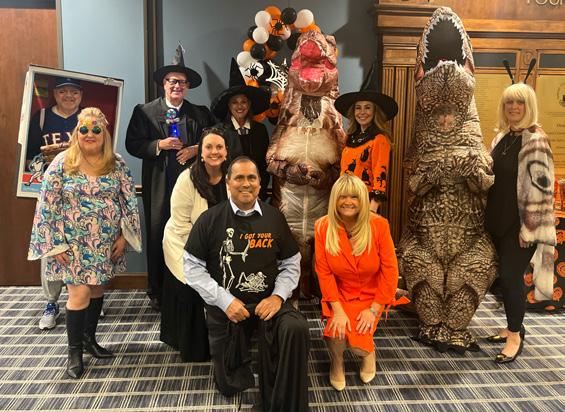
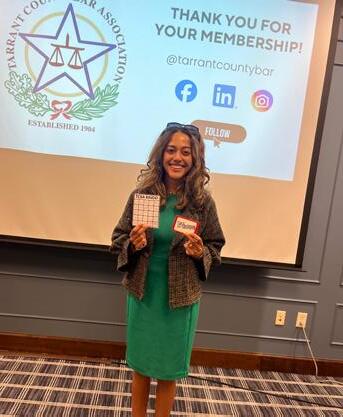
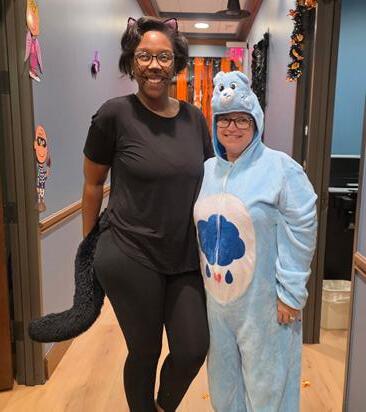

with a background in psychology, counseling, psychiatry, or another mental health field who can share practical, evidencebased strategies for the legal profession, please send recommendations to tiffany@tarrantbar.org.
Membership Committee
Thank you to everyone who joined us for the Local Bars
Membership Social. We welcomed more than 80 guests, and the turnout exceeded expectations.
Members from BWLA, LCDLA, TCCDLA, TCPBA, TCBA, and the State Bar Litigation Section gathered for an evening of connection and community. Guests enjoyed food truck selections, networking activities, and opportunities to learn more about each bar association. The speed networking rounds created strong momentum and opened the door for new relationships across our legal community.
Thank you to all who attended and contributed to such a strong event. We look forward to hosting the next one.
If you are looking for a way to get more involved with TCBA, consider joining one of our committees. Email me at tiffany@tarrantbar.org, and we can find the place where you fit best! g
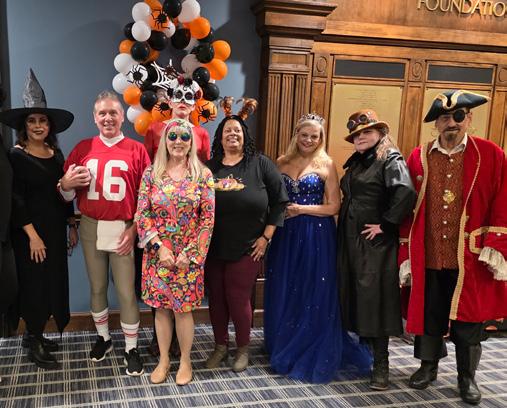
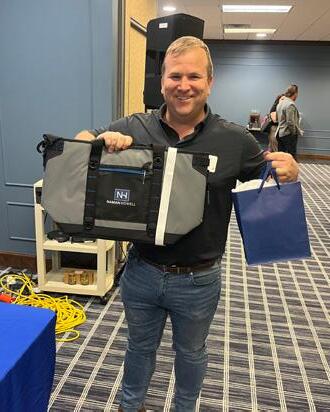

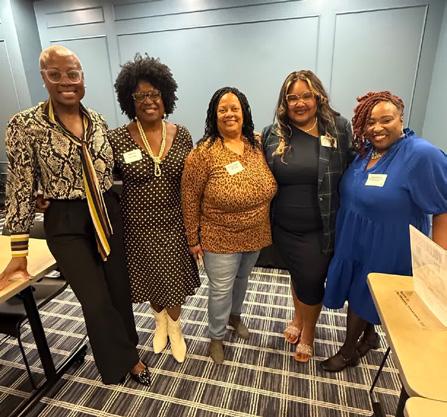




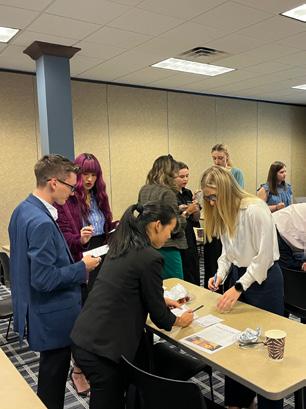

By Spencer Mainka Pham Harrison, LLP Committee Chair
The TCBA Community Service Committee has been busy this fall! In October, we partnered with Texas A&M University School of Law for a blood drive. Together, we collected over 20 units of blood and welcomed five first-time donors.
On November 8, we volunteered at Opal’s Farm, an urban farm on the banks of the Trinity River owned by Opal Lee. Many hands made light work as we helped with fall gardening tasks. The Opal’s Farm team shared that the amount we accomplished in just a few hours would have taken their regular volunteers three weekends to complete. It was a rewarding day of service in beautiful fall weather.
Looking ahead to the holiday season, we have two special projects planned. First, we are hosting a Virtual Angel Tree in partnership with the Center for Transforming Lives, a Fort Worth–based nonprofit that partners with single mothers and their children to help them thrive. Thanks to the generosity of TCBA members, we able able to help make these children’s holidays bright. Then, on December 13, we will join Habitat for Humanity for a build day on a new development in southwest Fort Worth.
We hope that you will consider attending one of our upcoming events, joining the committee, or sponsoring one of our projects. g




The Eldon B. Mahon Inn of Court is hosting the regional rounds of the Texas High School Mock Trial Competition and needs attorney volunteers to serve as judges for the competition.



TCBA Board of Directors


67th District Court
Appellate Law Section
Bench Bar Committee
Black Women Lawyers
Criminal Law Section
Environmental Law Section
Membership Committee
Probate Bar Association
Real Estate Section
Sheats & Muckleroy, LLP

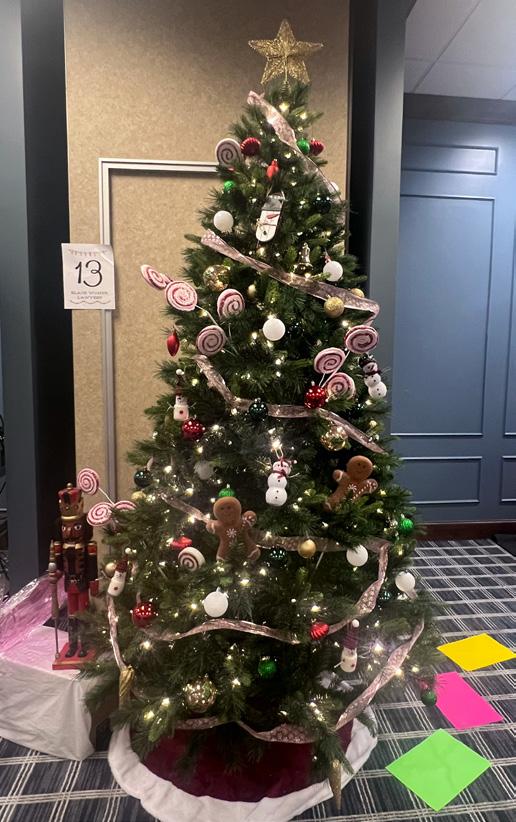

67th District Court Black Women Lawyers
Solo and Small Firm Section
TCBA Board of Directors
Texas Lawyers for Texas Veterans Tortfeasors
All sponsored trees and decorations are donated to



Probate Bar Association

Environmental Law Section

Sheats & Muckleroy, LLP

Texas Lawyers for Texas Veterans
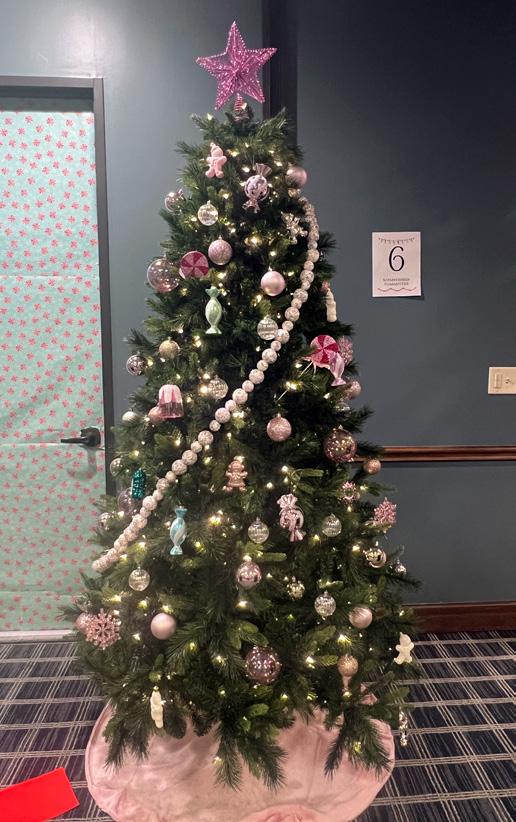
Membership Committee
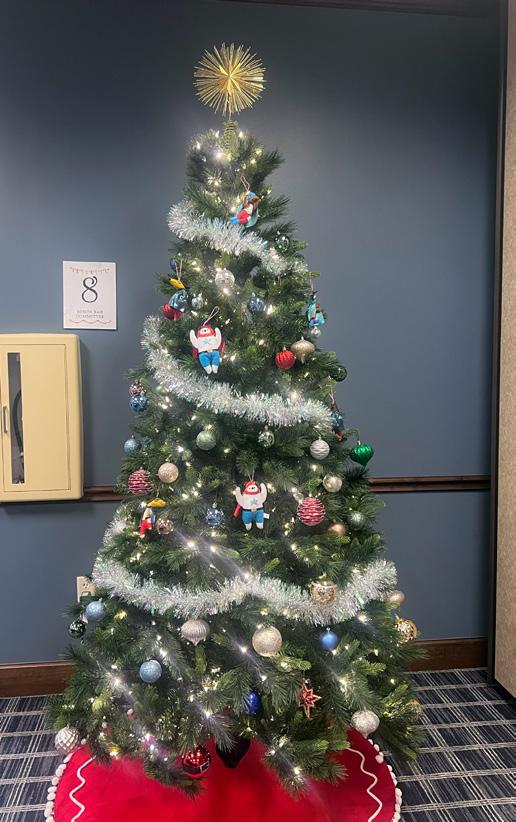
Bench Bar Committee
THANK

The Medlin Law Firm, PLLC
Boyd Powers & Williamson
Brackett & Ellis, P.C.
Juris Fabrilis, Inc.
Pham Harrison, LLP
TONER Home Performance
Cities Real Estate – David Pannell
Law Office of John J. Corbin
Blair Beene
Abigail Garcia
The Law Office of Constance K. Hall, PLLC
Denise Tomlinson
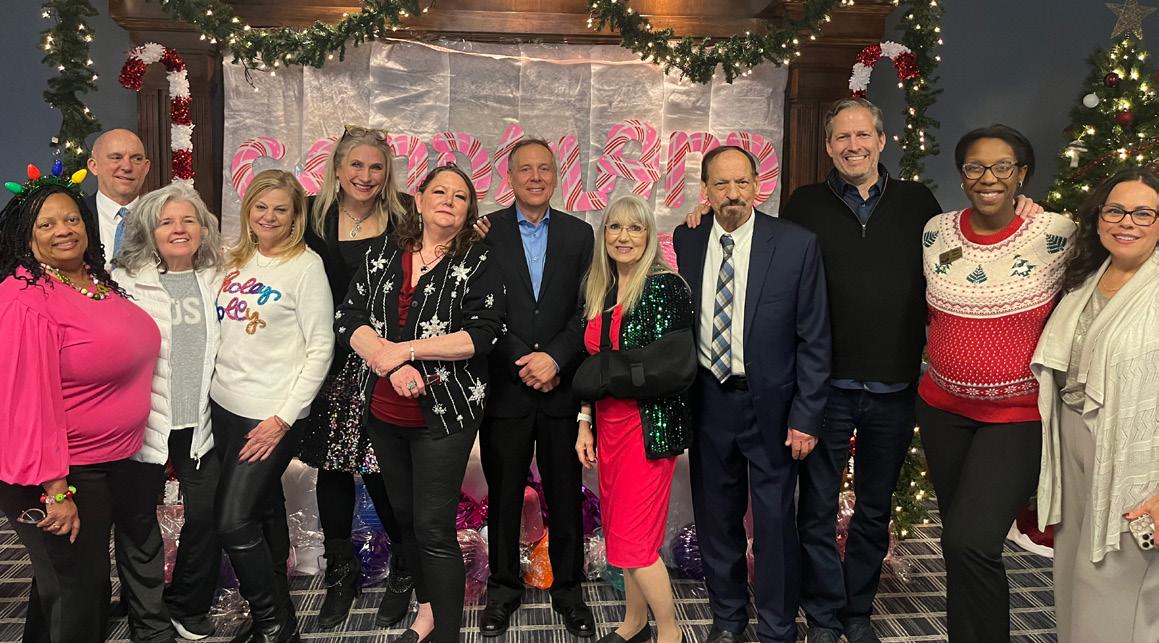









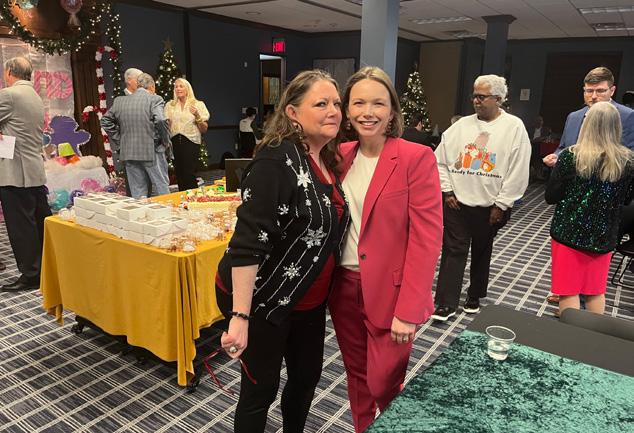

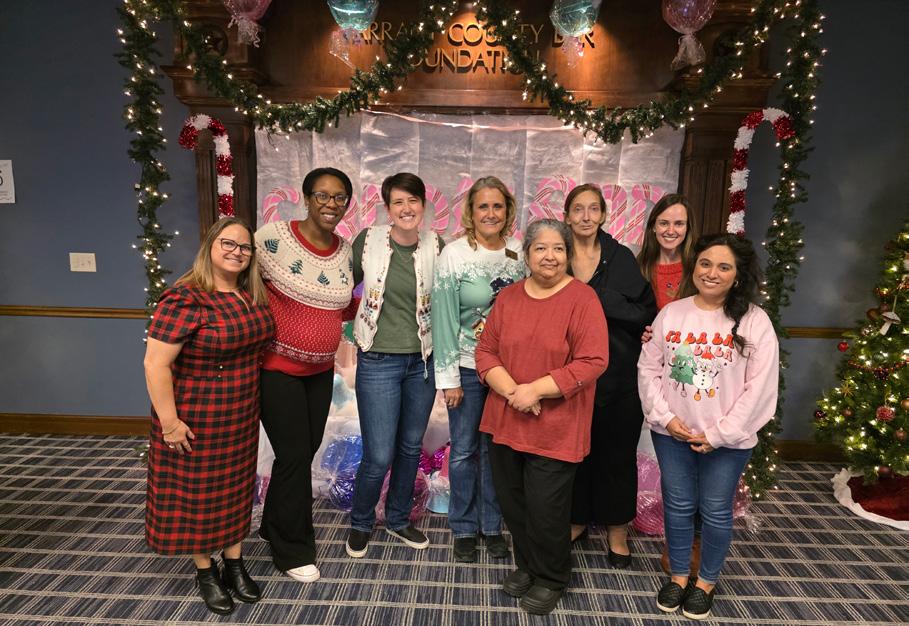
By Monique Lopez-Hinkley Managing Attorney, Legal Aid of NorthWest Texas | lopezm@lanwt.org
of Directors

As a member of the Tarrant County Bar Association Board of Directors, I have the good fortune to be surrounded by attorneys who have been practicing in their fields for years, each comfortable and familiar within their legal community. As an adjunct professor of a Public Externship class at the Texas A&M School of Law, I am privileged to work with the next generation of attorneys, bearing witness to the beginning of their careers. So how are these two groups connected?
Service: Each of them wishes to better their communities. Despite the tired punchlines, I firmly believe that every attorney went to law school with the intention of making a positive change and to help people. The core role of an attorney, after all, is to translate the word of law to those whom they serve and to advocate on their behalf. This is true regardless of the type of law one practices or the amount they may charge to do so. Life, however, means that sometimes our best intentions get lost, and our focus must shift. We take the jobs necessary to make ends meet, to raise our families, and helping our fellow humans is no longer at the core of our work.
The term “pro bono” comes from the Latin phrase pro bono publico , which means “for the public good.” We are taught in law school that pro bono work is important and necessary, with many institutions now requiring students to complete a minimum number of hours of pro bono work before they are eligible to graduate. Once licensed, however, there is no actual requirement that attorneys continue to do any pro bono legal work throughout their career. Even so, it is clear that the American Bar Association recognizes the importance of pro bono work, as demonstrated by the ABA Model Rule 6.1:
“Every lawyer has a professional responsibility to provide legal services to those unable to pay. A lawyer should aspire to render at least (50) hours of pro bono publico legal services per year. In fulfilling this responsibility, the lawyer should… provide a substantial majority of the (50) hours of legal services without fee or expectation of fee to… persons of limited means or… organizations… that are designed primarily to address the needs of persons of limited means”1
1 Center. (2025). Model Rules of Professional Conduct, 2025 Edition.

Additionally, the State Bar of Texas’ (SBOT) pro bono policy has an “aspirational goal of 50 hours of pro bono legal services [provided] to the poor each year for each Texas attorney.”2 This policy is also key in SBOT’s establishment of a voluntary reporting system. It is crucial for attorneys who provide pro bono services to report their hours, as the metrics from this data can be used to advocate for legal aid programs and raise awareness of the scale of pro bono work that is needed.
Pro bono attorneys have historically been at the heart of impact litigation and landmark cases, often representing marginalized individuals and groups in cases ranging from education rights, voting rights, and veteran benefits, to marital rights and fraudulent schemes targeting vulnerable populations. To help connect attorneys with volunteer opportunities in their fields, the State Bar of Texas has developed initiatives such as the New Opportunities Volunteer Attorneys (NOVA) program.
Tarrant County attorneys in particular have a rich history of providing free or reduced-fee legal services to low-income individuals and families. In December 1951, the then-directors of the Tarrant County Bar Association recognized the need for equal access to the courts and created the Fort Worth Legal Foundation.3 This was the first nonprofit corporation in Texas dedicated to the singular purpose of providing legal assistance to those who could not afford the services of an attorney. This nonprofit eventually evolved into West Texas Legal Services and later Legal Aid of NorthWest Texas, which still operates today and is the fifth-largest legal aid organization in the country.
In the same decade, L. Clifford Davis, a civil rights attorney who worked with the then–civil rights attorney Thurgood Marshall and future member of the U.S. Supreme Court on the landmark case Brown v. Board of Education of Topeka, 347 U.S. 483 (1954), took up the fight against segregation in Tarrant County. In September 1955, Judge Davis filed suit against Mansfield ISD, seeking desegregation in the school district. According to Bobbie Edmonds, a Tarrant County attorney who knew him well,
“Judge Davis was local counsel for Fort Worth Tarrant County NAACP. His legal expertise was essentially
2 Pro Bono Policy – FAQ 2014. (2014). https://www.texasbar.com/Content/NavigationMenu/LawyersGivingBack/LegalAccessDivision/ ProBonoFAQ.pdf
3 Who We Are | Legal Aid of NorthWest Texas. (2025, September 5). Legal Aid of NorthWest Texas. https://legalaidtx.org/who-we-are/ 38 www.tarrantbar.org ▪ NOVEMBER/DECEMBER 2025
pro bono due to the lack of funding and limited resources. He and other Black lawyers were doing pro bono before pro bono became popular with the Texas State Bar. He continued to work on civil rights cases throughout the years.”
In April 2008, another landmark case unfolded in Eldorado, Texas, at the Yearning for Zion Ranch. The crisis played out before the nation’s eyes, and there was a need for free legal services unlike anything Texans had seen. Attorneys from all over the state answered the call, migrating en masse to San Angelo in Tom Green County. Led by attorney Carmen Symes Dusek of San Angelo, a team of 263 volunteer attorneys was assembled over the course of nine days to represent the children who were removed from their parents. 4 Many of these attorneys had no experience in family law, but it didn’t matter. They were willing to provide their legal expertise to ensure that the children were protected in what turned out to be the largest custody case in United States history.
Though a crisis can mobilize people to help those in need, once that crisis is perceived to be over, many attorneys go back to their lives and await the next one. The sad truth, however, is that Texas is in a constant state of crisis when it comes to meeting the legal needs of its low-income residents. According to the U.S. Census Bureau, more than 4 million people live below the federal poverty level in Texas alone. Despite this staggering number, the Texas Access to Justice Foundation reports that there is only one legal aid attorney for every 7,000 Texans who qualify for services. Ranking 47th nationally in access to legal aid lawyers,5 Texas has a lack of
resources that means fewer than 10% of low-income Texans receive civil legal services, according to the ABA.
By filling this need within the Texas legal system, attorneys can access opportunities for professional and personal development. Taking a pro bono case outside one’s area of expertise is an effective way to learn a new type of law while still operating within the safety net of support from local legal aids or bar associations. Additionally, if one is not a litigator but wants to get into court, pro bono work can provide that opportunity as well.
Aside from its impact on the community, many attorneys find pro bono work addictive because it is deeply rewarding. They get to meet people they might not have otherwise and gain perspectives they might never have known. Pro bono work can make a difference in someone’s life and inspire others to do the same, setting off a ripple effect of good within the community. Though the likelihood of taking on an eventual landmark case is low, the work will always be impactful to somebody, and that matters.
Now more than ever, the attorneys of this country must connect with the person they were in law school, the version of themselves who wanted to change the world and who was ready to fight for that world before judge and jury. In the words of U.S. Supreme Court Justice Hugo Black, “there can be no equal justice when the kind of trial a man gets depends on the amount of money he has.” Not much in this life is within our control, but by taking on pro bono work we have the ability to open doors for those who are outside waiting to be welcomed in. g
4 Media, A. (2018, November 14). Lawyer From Historic Child Custody Dispute Returns to Court—as Judge. Yahoo Finance. https://finance.yahoo.com/news/lawyer-historic-child-custody-dispute-092038107.html?soc_src=social-sh&soc_trk=ma&guccounter=1
5 Justice Index | NCAJ. (2022). Ncaj.org. https://ncaj.org/state-rankings/justice-index

9/1/2025–10/31/2025 sorted by judgment date.*
*Does not include cases designated as “on appeal” with the Clerk’s Office as of 11/15/2025.
Jared Rydrych v. Rebecca Perez-Irofuala
096-351139-24
Hon. Pat Gallagher (96th District Court)
Trial: August 25–26, 2025 Judgment: September 2, 2025
Attorney – Plaintiff: Felipe Link
Attorney – Defendant: Kelsey Folingo
Summary:
Defendant was driving behind Plaintiff when Plaintiff swerved to avoid a trash can, and Defendant rear-ended him. In an 11–1 verdict, the jury found neither party negligent.
Tania Gonzalez v. Cameron Benton
048-325218-21
Hon. Chris Taylor (48th District Court)
Trial: July 29–30, 2025
Judgment: September 5, 2025
Attorneys – Plaintiff: Ramon E. Gonzalez and Rachel Verich
Attorneys – Defendant: Morgan Reinhardt and Kenneth F. Sheets
Summary:
Plaintiff was struck at an intersection after Defendant failed to stop at a stop sign. The jury found Defendant negligent and awarded
Plaintiff $40,000 for physical pain, impairment, mental anguish, and medical expenses.
Rosemarie Ortiz, et al. v. Herc Rentals, Inc.
352-343357-23
Hon. Josh Burgess (352nd District Court)
Trial: August 18–27, 2025
Judgment: September 10, 2025
Attorney – Plaintiffs: Christopher Simmons
Attorney – Defendant: James Fendley
Summary:
Plaintiff’s son was burned while operating a forklift around hazardous materials and later died. The jury found no fault on the part of the forklift rental company, and judgment was entered in its favor.
Beatriz Carreon, individually and as next friend of D.C. and D.C. v.
Sergio Morales
048-333850-22
Hon. Chris Taylor (48th District Court)
Trial: September 8–9, 2025
Judgment: September 12, 2025
Attorney – Plaintiff: Michael Galyen
Attorney – Defendant: Michael A. Smith
Summary:
Defendant struck Plaintiff while traveling on I-35. The jury found both parties negligent and awarded no damages.
Laytishia Smalls v. Terbish Tserenchunt and Eternal Blue Sky Corp.
017-345399-23
Hon. Melody Wilkinson (17th District Court)
Trial: August 19–28, 2025
Judgment: September 16, 2025
Attorney – Plaintiff: Mitch Myers
Attorney – Defendant: Daniel Buechler
Summary:
Plaintiff was struck when Defendant, acting within the scope of his employment, backed his truck into her vehicle. The jury awarded $868,928.52 in damages and apportioned responsibility 40% to the employee and 60% to the employer.
Angel Francisco Cruz v. Uber Technologies, Inc., et al.
017-344951-23
Hon. Melody Wilkinson (17th District Court)
Trial: September 16–17, 2025
Judgment: September 24, 2025
Attorney – Plaintiff:

Brandon Steffey
Attorney – Defendants: Jeffrey Hacker
Summary:
Defendant failed to yield while turning left and collided with Plaintiff. The jury awarded $425,522.94 for medical care, physical pain and impairment, and vehicle repair.
Lindell Kitchens v. DGR Properties, LLC, et al. 067-341513-23
Hon. Don Cosby (67th District Court)
Trial: September 16–17, 2025
Judgment: September 26, 2025
Attorney – Plaintiff: Christopher Sisk
Attorney – Defendants: David J. Metzler
Summary:
Plaintiff was attacked by his neighbor’s dog, causing him to fall and break his hip. The jury awarded $200,000 to Plaintiff’s estate for physical pain, mental anguish, and physical impairment.
Jonathan Richard Reyes v. Ashton Micah Backs 141-347901-23
Hon. John Chupp (141st District Court)
Trial: September 15–16, 2025
Judgment: October 8, 2025
Attorney – Plaintiff: Larry Rolle
Attorney – Defendant: Malcom Renwick
Summary:
Defendant rear-ended Plaintiff, but the jury found Defendant’s negligence was not the proximate cause of the occurrence and entered judgment for Defendant.
Couto Homes, Inc. v. Terry Gipson
342-350834-24
Hon. Kimberly Fitzpatrick (342nd District Court)
Trial: August 14–21, 2025 Order: October 13, 2025
Attorneys – Plaintiff: Bradley Rice, Eamonn Wiles, and Kaila Ellingson
Attorney – Defendant: Brian Smith
Summary:
The jury found Plaintiff’s water well was properly located. A prior partial summary judgment had already been granted in Plaintiff’s favor. Plaintiff
recovered attorney’s fees totaling $211,780.00. reduced by 50%.
Rex Performance Products, LLC v. James Donald Tate, et al. 141-314043-19
Hon. John Chupp (141st District Court)
Trial: August 24–29, 2025 Judgment: October 15, 2025
Attorneys – Plaintiff: Stephen Davis
Attorney – Defendants: William L. Kirkman
Summary:
Defendant, president of Plaintiff company, failed to disclose self-dealing during the company’s sale. The jury awarded Plaintiff $1,000,000 from one Defendant and $200,000 from another.
Deanna Rivera v. Derrick McGee and Mary McGee 067-352476-24
Hon. Donald J. Cosby (67th District Court) Trial: September 29–
October 2, 2025
Judgment: October 16, 2025
Attorney – Plaintiff: Michael S. Francis
Attorney – Defendants: Matthew R. Gelina
Summary:
Plaintiff was sitting in her parked car when Defendant struck her vehicle. The jury awarded $127,000 for medical expenses, physical pain, mental anguish, and physical impairment.
Kyle Gallagher v. River Oaks Health and Rehabilitation Center, et al.
153-304612-18
Hon. Susan McCoy (153rd District Court)
Trial: May 19–29, 2025
Judgment: October 23, 2025
Attorney – Plaintiff: William J. Dunleavy
Attorney – Defendants: G. Michael Stewart
Summary:
Plaintiff alleged false imprisonment and injuries
caused by the rehabilitation center and its staff. Due to a prior settlement exceeding the jury’s damages finding, the Court entered a takenothing judgment. The facility was found negligent, but the employees were not.
Rhonda Hathaway v. Stagecoach Ballroom
017-353347-24
Hon. Melody Wilkinson (17th District Court)
Trial: October 7–8, 2025
Judgment: October 27, 2025
Attorney – Plaintiff: Steven Wright
Attorney – Defendant: John-Paul Chidgey
Summary:
Plaintiff slipped on dance wax inside Defendant’s business. The jury apportioned fault at 45% to Plaintiff and 55% to Defendant, awarding $22,212 in past medical expenses. g



By C.D. Peebles
The Peebles Law Firm | cd@peebleslaw.com
Chapter 53 of the Texas Property Code sets out the statutory framework for mechanic’s, contractor’s, and materialman’s liens and prescribes the procedural steps required to create and perfect a lien against improved real property in Texas. Perfection under Chapter 53 is not a single act but a sequence of notice, filing, and sometimes bond-related steps that convert an unpaid claim for labor or materials into an enforceable security interest in real property.
Parties, Property, and the Constitutional Foundation
Mechanic’s lien rights for non-public works projects1 in Texas arise from both Article 16 of the Texas Constitution and Chapter 53, which together protect those who furnish labor, materials, or design services that enhance real property. Typical lien claimants include original contractors who contract directly with owners, subcontractors and suppliers at various tiers, laborers, and certain design professionals.2 The class of lienable “improvements” is broad and encompasses buildings, structures, utilities, grading, and other permanent enhance-ments to land.3
A claimant’s ability to preserve lien rights depends on timely notices. Subcontractors and many suppliers must provide preliminary notice to the property owner and the original contractor to preserve later lien rights; the statutory notice deadlines vary with the claimant’s tier and the type of project.4 After the claim has accrued, those seeking to assert a lien claim must prepare and file a sworn lien affidavit with the county clerk in the county where the property is located. The affidavit must include the claimant’s sworn statement of the amount claimed, the owner’s name and address, a description of the work performed or materials furnished, and a legal description of the property.5

Chapter 53 imposes tiered deadlines that distinguish original contractors from subcontractors and lower-tier suppliers. Subcontractors and suppliers have an earlier notice requirement, the deadline for which is generally tied to the month the labor or materials were provided. 6 Missing the applicable filing or notice deadline is fatal to a lien claim in most cases. After filing, claimants are required to send a copy of the filed affidavit to the owner and original contractor within five days to alert the parties and lay the groundwork for enforcement proceedings.7
When projects are bonded, the mechanics of recovery change. Rather than attaching the property directly, claimants often must assert claims against the payment bond posted for the project. Chapter 53 provides notice and claim provisions for pursuing bond recovery, and specific sections require notice to the original contractor and the surety to perfect a claim against a bond.8 Generally, a lien affidavit is not required; rather, the claimant is to provide notice to the original contractor and surety.9
Perfection under Chapter 53 presents several practical traps. Homestead protections in Texas are robust; to lien a homestead, claimants frequently must rely on strict written-contract requirements and notices—absent statutory formalities the lien may be invalid.10 Retainage and completion definitions also affect timing: claims tied to retainage require attention to the project completion date and follow-up filing deadlines.11 The statutory scheme is detailed and unforgiving; minor errors in document form, property description, or service of notice can trigger counterclaims for wrongful or fraudulent liens and permanently foreclose recovery.
1 See Chapter 2253 of the Texas Government Code for public works projects that are not the subject of this article.
2 See § 53.021 for complete list of persons entitled to lien.
3 See § 53.022 for complete list of property to which a lien extends.
4 The procedures for perfecting a lien claim are in Subchapter C of Chapter 53.
5 See § 53.052 for the filing requirements and deadlines.
6 See § 53.056 (non-retainage claims) and § 53.057 (retainage claims).
7 See § 53.055 for the filed affidavit notice requirements.
8 See Subchapter I for a complete discussion of bonded private projects.
9 See §§ 53.205 and 53.206 for the notices required to assert a bond claim.
10 Subchapter K contains provision pertaining to residential construction projects in addition to those found in other portions of the statute.
11 See § 53.052 for the retainage affidavit filing deadline.
www.tarrantbar.org
A properly asserted lien is a prerequisite to foreclosure or judicial enforcement, but the described filings and notices alone do not guarantee recovery. To enforce a lien, a claimant must timely perfect the lien into an enforceable security interest, and state statutes establish limitations on how long a claimant may wait suit to foreclose the lien or perfect a bond claim. tegic considerations include: preserving contemporaneous records of delivery and performance; verifying legal property descriptions; and serving all statutory notices with proof of service. Because the statute’s deadlines and service requirements are jurisdictionally specific and technically detailed, many claimants engage counsel early to mitigate the high procedural stakes.
Chapter 53 creates powerful remedies for unpaid contractors, subcontractors, and suppliers, but those remedies are conditioned on strict compliance with a plethora of notice, filing, and procedural requirements that vary by claimant tier, project type, and whether a bond covers the project. Successful perfection demands meticulous calendar management, precise drafting of sworn affidavits, careful service of notices, and a proactive strategy about whether to pursue bond remedies, lien enforcement, or negotiated resolution to avoid clouded title and costly litigation.13 g
12 See § 53.158 for lien claims and § 53.208 for bond claims.
13 Attorney fees are recoverable and mandatory (see § 53.156).

www.dochollidayfw.com




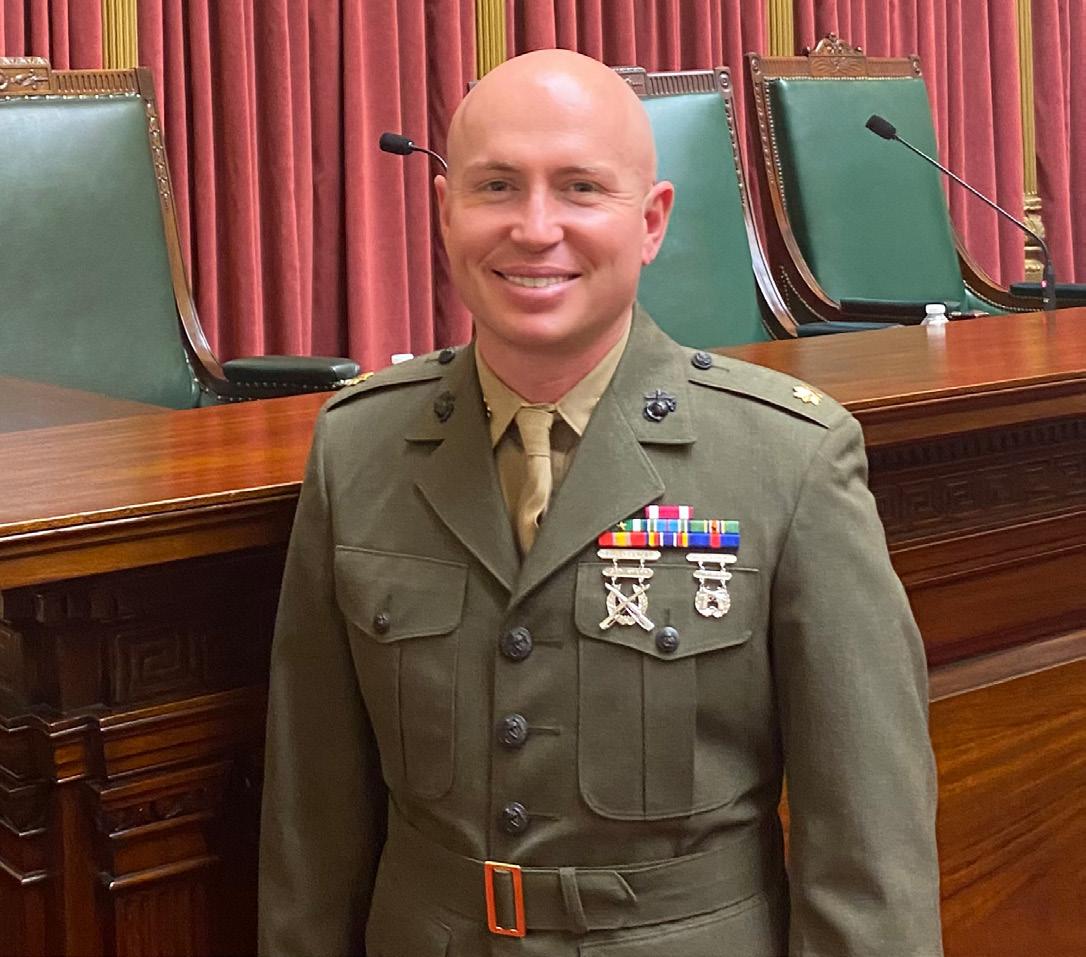
Q: How has your experience in the Marine Corps shaped your approach to leadership and decision making in the legal profession?
If I could sum it up, it would be the phrase that we use that is on the entrance to the basic school, and it’s a Latin phrase, Ductus Exemplo, which means “lead by example.” That’s what being a Marine and being a Marine officer is all about. From day one, you are held to the highest standards in all things, from physical fitness to how you keep your uniform to all these little militaryisms. What I think works well is translating that principle into legal practice: making sure that you’re meeting deadlines, you’re interacting well with counsel, not taking things personally, and really trying to set an example of what right looks like.
Q: The military emphasizes discipline and ethics at every level. How do you think those principles of discipline and ethics translate to the daily practice of law?
For the ethics side, your reputation and integrity are everything. If you don’t have integrity, then you can’t lead, and you shouldn’t lead, because ultimately, we’re entrusted with the lives of America’s sons and daughters.
We all know that, in culture, lawyers get a bad rap. We have a responsibility to be truthful, a duty of candor to the court, and to lead with integrity with our clients and opposing counsel. That’s very much the Marine Corps’ ethos applied to law.
Q: What advice would you give young lawyers about developing and protecting their reputation?
There are intentional ways, but from my experience, it’s really the

unintentional ways that do the most to form your reputation. That really comes out of who you are as a person. So, while I do think it’s important to be intentional about managing your reputation, most of it’s just going to come out of who you are as a human being, and that’s not a legal skill. That’s leadership and life experiences. We call it being a good Marine—being a good human being, I think, is the most important thing to focus on. And I think when you interact with people that way, that’s how your reputation develops.
Q: Have you had mentors who made a lasting impact on your career? And if so, what lessons from them have you carried forward into your own leadership style? I’ve been fortunate. I joined the military later in life, so I went to college, worked a little bit, and then decided to join. What I try to lead by is just giving my time to people and having an open door—not just having an open door, but seeking out those who are a step behind you and really pouring into them: bringing them alongside you as you do certain things and introducing them to people. People have done that for me, and it really made an impact, so that’s what I try to do for others.
Q: What’s one piece of advice you would give to lawyers about maintaining balance, purpose, and resilience throughout their careers?
I’ve spent most of my time in litigation and it’s kind of like a roller coaster. I don’t know if balance is the right term, because I think, in the military, if you're in a deployed environment, you’re there and you’re giving it your all. What I tried to instill in the new counsel that worked for me and the Marines that worked for me was while you’re at work, be at work. Keep your phone to the side; give me all that you’ve got here and I’m going to make sure that you get your time back. If you’re in a trial week, you’re going to work. But I’m going to make sure that you can take your son or daughter to school and pick them up and do all those things.
Q: If you weren’t a lawyer, you would be what?
A farmer. g
at the November

Step inside the Dell DeHay Law Library of Tarrant County, and you’ll discover a resource center dedicated to making the law more accessible. For over eight decades, the Law Library has served attorneys, judges, legal professionals, students, and self-represented litigants, offering reliable legal information, research support, and tools to help users navigate the legal system. By tapping into the Library’s collection and databases, individuals gain access to valuable legal resources that might otherwise be out of reach. For law firms and attorneys, it is an opportunity to save on costly subscriptions and materials, while still having access to the best tools and information available.

The Library’s roots date back to 1944, when the Tarrant County Commissioners Court approved a resolution to establish a county law library. 1 The facility officially opened its doors on October 1st, 1945, in the historic 1895 Courthouse. Over the years, the Library moved to the Old Civil Courts Building in 1958 and returned in 1983 to the fourth floor of the renovated 1895 Courthouse.
A pivotal period in the Library’s growth occurred under the leadership of Dell DeHay, who served as the Library’s first professional law librarian from 1962 to 1979. In June 1979, the Library was renamed in her honor, recognizing her strong leadership in expanding collections, services, and the professional reputation of the institution.2
When people learn that the Law Library is not funded through general tax revenue, they are often surprised. Under the
1 Tarrant County Commissioners Court Minutes (Nov. 20, 1944).
2 Tarrant County Commissioners Court Minutes (June 4, 1979).
3 Tex. Loc. Gov’t Code Ann. § 323.023 (West 2024 Supp.).
4 Tex. Loc. Gov’t Code Ann. § 323.023(d) (West 2024 Supp.).
Texas Local Government Code, the Library operates through a dedicated Law Library Fund supported by civil filing fees, rather than allocations from the county’s general fund.3
In other words, every time a civil case is filed, a small percentage of that filing fee helps keep the Library running. If a case is filed with a Statement of Inability to Afford Payment of Court Costs, no fees are collected from that case and, as a result, no funds are deposited.
The funds can be used only for purposes that directly support the Library or improve access to legal information. This includes everything from purchasing print and digital legal research materials to maintaining the library’s physical space, acquiring furniture or equipment, paying staff, and providing access to major online legal databases like Westlaw and Lexis.
In addition, up to $175,000 from the Law Library Fund may be used each year for legal research materials supporting Tarrant County judges.4 This funding allows the Dell DeHay Law Library to provide access to trusted print and digital resources which enhance judicial decision-making and courtroom efficiency.

The Law Library welcomes an average of 115 visitors per day, along with many more who receive help by phone or email. To support these patrons, the Library offers a wide range of legal resources. Its print collection focuses primarily on Texas
“The Dell DeHay Law Library ensures legal resources are accessible.”
law and includes an extensive selection of titles covering every major practice area. A select number of federal materials are also available in print, ensuring patrons have access to both state and federal authorities when conducting research.
In addition to its print holdings, the Library offers access to several premier legal databases, including Westlaw, Lexis+, Bloomberg Law, and HeinOnline, all of which are available for use while visiting the Law Library. Patrons also have access to the Lexis Digital Library, which allows registered users to check out eBooks remotely. Popular titles include the Texas Litigation Guide, Texas Transaction Guide, Texas Probate Forms and Procedures, and Texas Family Law Practice and Procedure. In addition, the State Bar of Texas has granted the Library permission to make its Practice Manuals available through this digital platform, expanding access to popular resources for practitioners and the public alike.
The Library provides a variety of technology and convenience services to support its users. Printing, copying, and scanning are available on-site, and the Library also houses a Virtual Court Kiosk, created in partnership with the Texas Legal Services Center.5 This dedicated computer station includes a camera, microphone, scanner, and headphones, allowing individuals to attend virtual court hearings, scan and file documents, or chat with legal aid representatives.
Educational and outreach programs form another key part of the Library’s mission. Each month, the Library partners with the Tarrant County Domestic Relations Office to host Family Law Workshops that help attendees better understand family law processes and available resources. Patrons can also use the Library’s “Connect with a Librarian” feature to schedule one-on-one appointments for personalized research guidance. During these sessions, librarians can help patrons develop research plans, explain how to use legal databases, or identify materials for specific topics. The program also allows community members to request librarian presentations for firms, bar groups, and other professional events.

Behind every research question answered and resource request filled is a team of dedicated professionals who bring experience, expertise, and a shared commitment to public service. Each
Tarrant County Commissioners Court Minutes (Feb. 3, 2023).
staff member plays an essential role in ensuring patrons have access to the information they need to navigate the law.

Cara Sitton is the Director of the Dell DeHay Law Library, a position she has held since 2019. She holds a Master’s in Library Science, a J.D., and is licensed to practice law in Texas. Prior to joining the Law Library, she worked in both an academic law library and a municipal public library. She is actively involved in the legal and library communities, serving as Secretary of the TCBA Solo and Small Firm Section, and Chair of the TCBA People’s Law School. Cara also serves on the Texas Unauthorized Practice of Law Committee and is a member of SWALL, DALL, and AALL.

Amanda Hill has served as the Assistant Law Library Director since 2021. She started with Tarrant County in 2014 as an archival intern. She holds a Master’s in History from Texas Christian University, with experience in material culture studies and archives. She is the unofficial editor-in-chief, and oversees the Law Library’s website, research guides, and historical collections. She is currently serving as Vice President of Dallas Association of Law Librarians and as Secretary of the Log Cabin Heritage Foundation Executive Board. She is also an active member of SWALL and AALL.

Colleen Hardy has served as Law Librarian at the Dell DeHay Law Library since 2024. She holds a Bachelor’s Degree in History with a minor in music from Texas Tech University and a Master’s in Library Science from Texas Woman’s University. Before joining the Library, she worked with the Tarrant County District Attorney’s Office for five years and brings nearly a decade of experience in criminal law, along with a strong interest in legal research and public service. She is a member of Cleburne’s Animal Shelter Advisory Board and AALL. Outside of her professional work, Colleen is passionate about rescuing elderly animals, giving them loving homes and a better quality of life in their later years.

Brittany Schick has served as a Law Librarian with the Dell DeHay Law Library since 2022. She earned her Master’s in Library Science from the University of North Texas in 2011 and holds a bachelor’s degree from Dallas Baptist University. Brittany brings over a decade of experience in academic librarianship and public service. Prior to joining the Library, she worked at Dallas College from 2012 to 2021, where she honed her expertise in research support and information services. She is also an active member of DALL, SWALL, and AALL.
Continued on next page
Continued from previous page

Yancy Aden serves as Legal Information Specialist and joined the Dell DeHay Law Library in 2023. She completed college coursework in business education with an emphasis on communication, customer relations, and business operations. With a career grounded in customer service, Yancy brings valuable experience engaging with the public and fostering positive interactions. Her bilingual skills, combined with her professional background, enhance the Library’s mission of providing accessible legal information to the Tarrant County community.
Deneshia Garner is presently the longestserving member of the Dell DeHay Law Library, where she has been part of the team since 2004. She brings more than twenty years of combined experience in legal, medical, and public library systems. She completed coursework at Tarrant County College (formerly Tarrant County Junior College) and has held several roles throughout her tenure, currently serving as Legal Information Specialist. Over the years, Deneshia has witnessed firsthand the transition of the law library world, giving her a unique perspective on the evolution of the profession.

Nancy Ventura serves as Legal Information Specialist and joined the Dell DeHay Law Library team in 2019. She holds an Associate Degree in Criminal Justice and has completed a continuing education program in Spanish Court Interpretation. Before joining the Library, Nancy spent ten years working for a criminal defense attorney, where she gained extensive experience in legal research, case management, and client communication. Her bilingual skills and legal background enable her to assist a diverse range of patrons with expertise.
The Dell DeHay Law Library will soon welcome a third Law Librarian to its team. The addition, approved by the Tarrant County Commissioners Court for Fiscal Year 2026, reflects ongoing support for the Library’s growing needs. The position will be posted soon for applicants.
The Dell DeHay Law Library is located on the fourth floor of the historic 1895 Courthouse at 100 West Weatherford Street, Room 420, in downtown Fort Worth. The Library is open Monday through Friday from 8:00 a.m. to 4:00 p.m., except on County holidays. Patrons can reach the Library by email at lawlibrary@tarrantcountytx.gov or by phone at 817.884.1481.
Patrons can contact the Reference Desk to schedule
6 Tarrant County Commissioners Court Minutes (Dec. 15, 2020).
time with a librarian for research assistance, arrange group workshops, receive training on specific databases, or get help with a wide range of other legal topics. Visitors are also encouraged to explore the Law Library’s website and subscribe to The Clock Tower Quarterly to stay up to date on Library news, research tips, and newly added services.

This year, the Dell DeHay Law Library remembers Peggy Martindale, affectionately known as the “Tarrant County Legal Angel,” who passed away in April. Peggy dedicated 34 years of her life to serving Tarrant County before retiring in 2020, leaving an enduring impact on the Law Library and on the many staff she trained.6
For those who were fortunate enough to work with Peggy, she was more than a mentor—she was a teacher, a source of wisdom, and an inspiration. She shared her expertise generously, guiding generations of librarians in legal research, library services, and public service. Peggy’s compassion was legendary, and many patrons returned simply for a moment of her warmth and encouragement.
Peggy Martindale’s spirit and dedication are woven into the fabric of the Dell DeHay Law Library. Her commitment, care, and resilience continue to inspire the staff and the services they provide. The phrase she often shared with others has become the Library’s unofficial motto. In every challenge and in every pursuit, may her words guide you:
“Keep Persevering” g

By Hon. Mollee Westfall Partner, Cantey Hanger LLP | mwestfall@canteyhanger.com
2025–2026 TCBA
Board of Directors
What kind of law does your son want to practice?”
This is the question I hear repeatedly from wellmeaning non-attorney friends and family when they find out that my son is in his first year of law school. Little do they know that my son, along with almost every law student in America, is reading 100-year-old cases about foundational legal concepts like proximate cause and personal jurisdiction.
So, yes, while he and other law students likely have vague thoughts about their future careers in law, their real focus is on learning to learn the law, make outlines, not embarrass oneself when called on in class, write a legal memo, and score well on the exam. Most law students are not yet thinking seriously about their future practice.
When I entered law school, the late 80s television smash hit “LA Law,” set at the fictional “McKenzie Brackman” law firm was selling law firm life as glamorous, meaningful, highly lucrative—the opening credits featured the trunk of a Jaguar XJ or a Bentley Continental being closed—and a great place to hook up. Needless to say, “LA Law” drove law school applications and many of my fellow students showed up to law school with dreams of joining a similar firm, buying a Bentley and settling into a stable lifetime career.
However, to paraphrase Jane Austen, there are simply not so many openings at law firms, as there are worthy law students to deserve them. Most new lawyers did not have a job at graduation back then and many still had no more idea about what kind of law they wanted to practice than they did on their first day of Torts. I left law school with no idea what kind of law I might be good at or would even like to try.
I landed initially in a one-lawyer firm and handled mostly discovery responses for a year, back in the bad old days when discovery answers involved either one hundred percent objections with no production or full-on document dumps. The firm did not have any trials that year, so I had no conception of where the discovery we were producing, exchanging, and reading might lead, if anywhere. I sat in a multi-party client deposition to observe, and when the first attorney finished his questioning, he stood in front of the window and balanced a pen on his forehead during the next round of questioning. (He later became a judge.)
Feeling discouraged and baffled by my first job, I let my husband persuade me to try something completely different. This was my first big pivot: I accepted a job in the misdemeanor division of the Tarrant County DA’s Office. Gone was my life of delicately crafting the perfect objection. On my second


day of work, I was making an opening statement in a DWI trial. Although I had never pictured myself as a trial lawyer, there is truly nothing like being thrown in front of a jury week after week to lessen one’s fear of public speaking. The pay was terrible, but the camaraderie of the criminal bar and the challenge and complete spontaneity of practicing with a group of young, talented attorneys was priceless.
After about a decade of criminal prosecution, the road forked again. Continuing as a prosecutor would likely mean retiring as a prosecutor and I just could not see doing that. I then added politician, yet another role I thought I would never pursue during my legal career, to my plate and ran for a bench. And won. After fifteen years of hearing everything from gruesome murders to an inane criminal mischief in a holdover cell, I pivoted again to run for DA. That pivot did not go as planned, so I made yet another plan. Why not try law-firm life? And civil work? And hey, why not just start over from scratch?
What this unexpected journey has taught me is, first, it’s never too late, never the wrong time, to reinvent your practice. A law degree is an endlessly flexible ticket to a different career. Too often, I have seen unhappy lawyers that feel trapped practicing law that they no longer like. Change is hard, but many times staying the same is even harder.
Second, try to rediscover your inner first-year lawyer: enthusiastic, up for anything, and curious. I have spent two years reading the rules of civil procedure, case law, and O’Connor’s, as well as questioning my generous colleagues, to make sure that I am taking care of my clients.
Third, combine the humility of a new lawyer about what you don’t know with the confidence of an experienced lawyer about what you bring to a new role. Learning new causes of action and procedural rules is harder now than it was at twenty-five, but my thirty-one years of trial experience and legal practice are completely portable. So are yours. Our law licenses give us endless opportunities to try something new and reinvent ourselves.
Stable, lifetime law careers are rare, but they are also overrated. Every turn I have taken has been difficult but immensely rewarding and kept my interest in practicing law high. Alas, I never got the Bentley … but I never wanted it. g
“It’s never too late, never the wrong time, to reinvent your practice.”

By Perry Cockerell Perry Cockerell, P.C. | perry@perrycockerell.com
For the past four years, I have been spending time during the summer in Tours, France, working remotely (“télétravail”), becoming familiar with the French legal system, and attending a French language school at the Institute of Touraine. For the August 2023 edition of the Tarrant County Bar Bulletin, I interviewed French attorneys, David Athenour and Françoise Cros. This past summer, I returned and rented an office from the firm of Hugo Avocats, a law firm in Paris with an office in Tours.
France is seven hours ahead of Texas. You can enjoy a full day, and then around 4 p.m. the day starts in Texas when the emails begin. It becomes dark around 10 p.m. The French have dinner around 8 p.m., and they dine out late; it is common for people to stay up until midnight.
When I was not attending the language school in the morning, I would arrive early at the law office. The French do not brew pots of coffee in the morning, so every day I made the trip down to a boulangerie for coffee. The summer is extremely hot, and the French generally do not use air conditioning. I had to buy a fan for the office and keep the window open.
David Athenour, the partner in charge of the Hugo Avocats office in Tours, practices civil trial law. He let me go to court with him and watch him handle hearings. One afternoon, he argued a civil motion that was similar to our version of a motion for summary judgment. The briefs to the court from both sides relied entirely on statutory law and the facts of the case. The French are a nation of laws, whereas the U.S. is a nation of precedent and relies on statutory law and prior case law; it is the the nuanced case law that can cause problems in our country when courts diverge in their rulings. The hearing lasted 30 minutes with oral arguments. He said attorneys usually do not request oral arguments in these kinds of motions.
Appeals from the cases tried at the Palais de Justice in Tours go to the Court of Appeals in Orléans, which is an hour away by train from Tours. The Court of Appeals in Orléans covers cases from the Indre-et-Loire, Loir-et-Cher, and Loiret departments in France. The court is only a few minutes’ walk from the train station in Orléans
The day I arrived, the security guard at the Court of Appeals said that the court was closed. I explained that I had come all the way from Texas to see the court. The security guard then opened the court and allowed me to take photographs of the courtroom.
It was quite a courtroom. The colors gave a rich sense of history. The blue and gold made you feel that something

historical had taken place there and that important cases were being decided.
There are thirty-six courts of appeals in France, serving a nation the size of Texas with a population of 65 million— more than double the population of Texas.

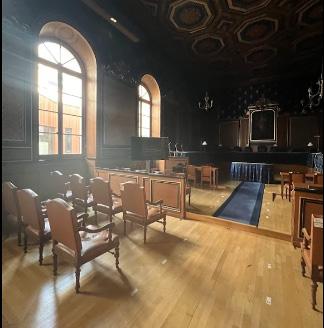

After leaving the court, I toured Orléans. A tourist train circles the city frequently from the main square. There are restaurants and bookstores nearby. Not far from the court of appeals is a large public square with a statue of Jeanne d’Arc on horseback.
Orléans was a stop for Jeanne d’Arc in April 1429, when she arrived on horseback with a military escort after spending twenty-four days in Tours, where she received her armor. The Siege of Orléans lasted for six months, from 1428 to 1429.

The reconstructed home where Jeanne d’Arc stayed is now a museum. On the first floor, a theater shows a film about her, while the second floor holds archives and historical information. The story of Jeanne d’Arc continues to fascinate the public. Every year, new books are written that revisit her story, adding another layer to her history.
Christine Vazereau
Back in Tours, Christine Vazereau worked in the office next door to mine at the Hugo Avocats law firm. She practices civil
and appellate law, including cases in the Court of Appeals in Orléans. She was born in Saumur, France, a small town of 30,000 inhabitants.
“It is a Catholic city with a military population, part of the French army. It’s a small town but well known in France.”
Her father was an engineer and died when she was five years old. She was raised by her mother and her sister, to whom she is very close, “since there’s less than a year’s difference.”

She studied at the University of Tours (François Rabelais) and in Bordeaux (Montesquieu). She has a degree in commercial law and two master’s degrees—one in law and one in business management. After passing the law exam, she practiced commercial law for 15 years, ten of those years with a banking law firm. Now she handles commercial litigation, banking, and fraud cases.
Everyone knows that the French are efficient and do not like repetition. “I’m always looking for efficiency. It’s very important for me to be efficient,” she said.
Christine values her relationship with clients. “I consider it to be a partnership. I explain that I can’t win without them.
I need them to be invested in their file.”
It is not uncommon for her to exchange multiple emails with a client to ensure everthing is precise. “I like victory. I like to win.”
She realizes that while she maintains a mindset of combativeness, if she believes a client’s case is weak, she will not accept it and advises her clients accordingly. If she and her clients do not agree on a strategy, “then they should consult with another attorney.”
She is careful to provide the court with relevant evidence. “Since in France, we’re dealing with written testimonies, not like in the United States, you have to make this selection. Your judge doesn’t have time to read fifteen certificates (affidavits). You have three very good certificates, and you’re good.” g


Purpose-built for your path forward
Designed specifically for legal, accounting, and client-focused professionals
Smarter workflows that drive efficiency and deliver the insights you need to succeed
Supported by experts you can trust From onboarding to live support, our team is here to help you—every step of the way
Powerful solutions built to support every part of your business and simplify your day

By Steven C. Laird
Law Offices of Laird & McCloskey | laird@texlawyers.com

Going to trial means choosing your battles carefully. You would think from reading John Grisham novels and watching legal shows on television that every lawsuit has to end up in a trial. Not so.
The reality is that most lawsuits never make it to trial, even though many people still think that being in a lawsuit automatically means going to court.
Studies show that 95 percent of lawsuits filed (all types of civil and family law cases) are settled before they go to court. This means that only 5 percent of lawsuits actually make it to a judge and jury. But the problem is that neither you nor your lawyer will know which category you will fall into at the beginning (or even in the middle) of a lawsuit. Ironically, preparing a case for trial actually helps it get settled before going to court.
The reason most lawsuits are settled out of court is the mediation process. Almost every court now requires the parties involved in a lawsuit to attend mediation at some point before the trial date.
At mediation, each lawyer gets an opportunity to present a summary of his client’s case. After each side has an opportunity to present his position, the mediator usually separates the parties and begins “shuttle diplomacy,” negotiating back and forth between the parties. Many people want to know if they have to settle if the court orders them to attend mediation.
Since mediation is not binding (unlike arbitration, which

The Tarrant County Bar Association developed the Elder Law Handbook to help residents of Tarrant County and nearby communities better understand the legal challenges often encountered by an aging population. While the focus is on issues commonly affecting seniors, much of the information is also useful to the broader public. Every person and family faces unique situations, and what may be appropriate for one may not be suitable for another. The Handbook serves as a helpful starting point, but it is not a replacement for professional legal advice. We are currently seeking volunteers to assist with editing the upcoming edition of our Elder Law Handbook.
is binding), there is no requirement that a settlement be reached.
Why is mediation important? Wade McMullen, a respected mediator in Tarrant County, says, “The mediation process serves a number of beneficial purposes for all involved in a dispute. It allows parties the opportunity to have open and candid discussions about the facts in dispute and the proper application of the law to the facts of the case. It also allows the parties to have control over the decisions that affect their lives. It gives the parties an opportunity to settle their differences in a way that is much less costly than a full-blown courtroom battle.
Mediation is here to stay and can be just as productive as a trial for a plaintiff or defendant in a lawsuit. A good lawyer knows how to pick his or her battles carefully for the client’s best interest. After all, a little compromise can often go a long way, and life is too short to spend in the courtroom if you don’t have to. You can always watch trials on TV.”
Published in the Official Visitor’s Guide to Fort Worth, TX, Special Issue May 2002, the official publication of the Fort Worth Convention & Visitors Bureau.
This article is reprinted with permission from the author. Although written years ago, its insights continue to resonate and hold renewed significance today. g
By Sarah Hall Hoffman, Pro Bono Programs Director

We are looking for volunteers to help us:
• Review and edit existing sections for legal accuracy and clarity
• Update any outdated laws or references (most recent edition: Spring 2024)
• Ensure the Handbook continues to reflect current best practices and legal standards
Your expertise can make a meaningful impact by helping individuals and families navigate important legal issues with confidence and clarity. If you are interested in volunteering, please contact Sarah Hoffman at sarah@tarrantbar.org. g


General CLEs
Annual Joint Meeting of Metroplex Inns - Hosted by Eldon
B. Mahon Inn of Court CLE
Topic: Stevenson v. Johnson: The Disputed Election of 1948 and the Fort Worth Federal Case that Changed American History
CLE: 1 hour ($20 for TCBA Members)
Foster Youth Grant Project - What It Can Do for Your Client
Speaker: Samuel Sanchez, Texas A&M University School of Law
CLE: 1 hour (FREE for TCBA Members)
OurFamilyWizard Presents: Implications of Technology and Social Media for Domestic Violence and Family Court Cases
Speaker: Lindsay Morris, OurFamilyWizard
CLE: 1 hour (FREE for TCBA Members)
Section CLEs
Appellate Law Section
Topic: How Lawyers Can Uphold the Constitution & Rule of Law
Speaker: Dr. Bill Chriss, Chair of the Appellate Section of the State Bar of Texas
CLE: 1 hour ($40 for TCBA Members)
Business Litigation Section
Topic: Charting New Territory: Texas Business Courts’ First Year
Speakers: Judge Jerry Bullard, Eighth Business Court Division
Judge Brian Stagner, Eighth Business Court Division
Moderator: Judge Chris Taylor, 48th District Court
CLE: 1 hour ($20 for TCBA Members, $10 for Law Students)
Construction Law Section
Topic: Truth or Tech – Navigating AI Generated Evidence in the Courtroom
Speaker: Beth Silverman, ArcherHall
CLE: 1 hour ($20 for TCBA Members, $10 for Law Students)
Topic: Design Professional Contract Negotiations
Speaker: James Pruden, Freese and Nichols, Inc.
CLE: 1 hour ($20 for TCBA Members, $10 for Law Students)
Topic: Change Order Reviews: Validity & Reasonableness
Speaker: Akshaya Iyer, Peritia Partners
CLE: 1 hour ($20 for TCBA Members, $10 for Law Students)
Topic: Private Equity in the Real Estate Development and Construction Industries
Speaker: Benton Wheatley, Duane Morris LLP
CLE: 1 hour ($20 for TCBA Members, $10 for Law Students)
Topic: Preventing Design Professional Malpractice
Speaker: James Pruden, Waddell Serafino Geary Rechner
Jenevin, PC
CLE: 1 hour ($20 for TCBA Members, $10 for Law Students)
Energy Law Section
Topic: Navigating Safe Harbor: The Texas Division Order Statute
Speaker: Megan Knell, Steptoe & Johnson, PLLC
CLE: 1 hour ($40 for TCBA Members)
Topic: Produced Water in Texas: A Fluid Frontier
Speaker: Kyle Weldon, James D. Bradbury, PLLC
CLE: 1 hour ($40 for TCBA Members)
Topic: Getting Paid in the Oilpatch: Oil & Gas Mineral Liens & Chapter 67 Production Proceeds Letters
Speaker: Brent R. Doré, Doré Rothberg Law, P.C.
CLE: 1 hour ($40 for TCBA Members)
Fort Worth Business & Estate Section
Topic: Creative Income Tax Strategies
Speaker: Marvin E. Blum, Founder and Managing Partner, The Blum Firm. P.C.
CLE: 1 hour (FREE for Section Members)
Topic: Planning Update for 2025
Speaker: Alan L. Stroud, Senior Vice President / Wealth
Strategies Advisor, Bank of America Private Bank
CLE: 1 hour (FREE for Section Members)
Topic: 2025 Hot Topics in Estate Planning Seminar
Speakers: Mike Bourland, Bourland Wall & Wenzel, P.C.
John Porter, Baker Botts LLP
Lee Schwemer, Current Lecturer - UTA
Steve Akers, Bessemer Trust, Dallas
CLE: 1 hour (FREE for Section Members)
Intellectual Property Law Section
Topic: Trade Secret – Litigation in Federal Court
Speaker: Chris Granaghan, Nelson Bumgardner Conroy PC
CLE: 1 hour ($20 for TCBA Members)
Real Estate Section
Topic: The Platting Process with the City of Fort Worth
Speaker: Alex Parks, City of Fort Worth
CLE: 1 hour ($25 for TCBA Members)
Mentor Monday Seminar Series with Steven C. Laird
Guest Speaker: Glenn Lewis, Linebarger Goggan Blair & Sampson, LLP
1 hour Ethics (FREE for TCBA Members)
Guest Speaker: Federal Magistrate Judge Hal R. Ray, Jr.,
United States District Court for the Northern District of Texas
1 hour Ethics (FREE for TCBA Members)
Guest Speaker: Judge Pat Gallagher, 96th District Court
1 hour Ethics (FREE for TCBA Members)
Guest Speaker: Lu Pham, Pham Harrison, LLP
1 hour Ethics (FREE for TCBA Members)
Guest Speaker: Major Brandon Reese, United States Marine Corps
1 hour Ethics (FREE for TCBA Members)
Brown Bag Seminar Series
Topic: Federal Litigation
CLE: 3.25 hours
($65 for TCBA Members, $25 for Paralegal/Staff)
Topic: Hot Topics
CLE: 3.25 hours
($65 for TCBA Members, $25 for Paralegal/Staff)
Topic: Legislative Update & Trial Practice
CLE: 3.25 hours
($65 for TCBA Members, $25 for Paralegal/Staff)
Topic: Ethics
CLE: 2.25 hours
($65 for TCBA Members, $25 for Paralegal/Staff)
Topic: Wills & Estate
CLE: 3 hours
($65 for TCBA Members, $25 for Paralegal/Staff)
Child Welfare 2025 Seminar
CLE: 3 hours
($65 for TCBA Members, $25 for Paralegal/Staff)
ADR Seminar
CLE: 3.5 hours, .5 hour Ethics
($20 for TCBA Members, $15 for Paralegal/Staff)
Bench Bar 2025 Conference
Civil Law Track
CLE: 3 hours
• What I Wish You Knew About Immigration
• Recent Supreme Court Cases for PI Attorneys
• Assault and Defense: Expert Witnesses Under Robinson and its Progeny
Criminal Law Track
CLE: 3 hours
• Disappearing Acts: Exploring the World of Expunctions & Nondisclosures
• Evolving Discovery Landscape in Criminal Cases
• Trying FV Cases When They Overlap with a Family Law Case
Family Law Track
CLE: 3 hours
• Takes a Village- Strengthening Your Client and Their Story
• Divorcing a Pro Se
• Enforcement Actions in Family Law Cases
General Session
CLE: 3 hours, 2 hours Ethics
• Borderline – True Crime Podcast
• Non-Economic Damages in the Wake of Gregory v. Chohan
• Weaponizing Race to Attack Tribal Sovereignty, Tribal Citizenship & Democracy in America
• Life in the Law and the Balance Between Them [Ethics]
Judicial Family Violence Track
CLE: 3 hours
• Medical Findings in Civil Cases (d)(12)
• Dynamics of Family Violence (d)(13)
• Trafficking of Persons (d)(11)
The Balanced Bar - A Mental Wellness CLE Series
Topic: Session 1 – Law & Loss: Navigating Grief While Practicing
Speaker: Kate Casey, LPC, JD, Autumn Ridge Counseling and Wellness
CLE: 1 hour Ethics (FREE for TCBA Members)
Topic: Session 2 – Mind-Body Law: Integrative Wellness for Legal Professionals
Speaker: Mary Johndroe, Cantey Hanger LLP
CLE: 1 hour Ethics (FREE for TCBA Members)
Topic: Session 3 – When You’re Not Okay to Practice
Speaker: Lara Bubalo Manor, Filuent
CLE: 1 hour Ethics (FREE for TCBA Members) g NOVEMBER/DECEMBER


The Lawyer Referral & Information Service (LRIS) is a service of the Tarrant County Bar Association that benefits both TCBA member attorneys and the public.
*


Family Law 917 Referrals
Consumer 691 Referrals



Probate 359 Referrals



Personal Injury 164 Referrals
Labor/ Employment 175 Referrals


Civil 809 Referrals
Landlord/ Tenant 533 Referrals
Criminal 284 Referrals
Real Estate 213 Referrals
Insurance 159 Referrals
Approved by the American Bar Association, LRIS allows member attorneys to receive client referrals and build their business, while helping callers quickly find an attorney in the area of law they need.
The program is intended to help individuals who are able to pay normal attorney fees but have difficulty finding legal representation due to lack of experience with the legal system, lack of information about needed services, or fear of costs.
LRIS is pleased to announce that Jonathan Wharton has earned the title of Top Referral Attorney for TCBA’s Lawyer Referral & Information Service for the period from July 1, 2025, to present. Through his dedicated participation in the program, Seibert earned $64,000!

• Maximize Your Earnings: Like Jonathan, you can earn substantial rewards by offering quality referrals.
• Grow Your Practice: Connect with clients in need of your expertise and grow your client base.
• Build Your Reputation: Build valuable relationships and be recognized for your exceptional service.
*Time Frame: November 2024–November 2025
For more details about joining LRIS, please visit www.tarrantbar.org/JoinLRIS or reach out to us at lris@tarrantbar.org.
By Sarah Hall Hoffman, Pro Bono Programs Director

January 16, 2026
February 20, 2026
Clinics are from 1 p.m.– 4 p.m.
Veterans Affairs Outpatient Facility
2201 SE Loop 820, Fort Worth, TX 76119
Interested in volunteering? Email sarah@tarrantbar.org.

Thank You to Our Volunteers Who Assisted With Recent Clinics
Robert Blankenship
Scott Conyers
John Corbin
Wendy Hart
John Johnson
Samantha Kehl
Deborah Krane
Angelia Megahan
George Muckleroy
Emily Teel
Dwight Tom
Looking for ways you can support TLTV but unable to volunteer?
CONSIDER SPONSORING A CLINIC!
Contact sarah@tarrantbar.org for more details.

By Kayla Dailey Executive Director
The Tarrant County Bar Foundation gathered supporters, Fellows, and friends for its annual Celebration Luncheon, marking another year of meaningful accomplishments and deepened community commitment. Outgoing Chair Brad Parker opened the event by reflecting on the question posed at the start of last year: Would the Foundation’s partners— law firms, judges, lawyers, and friends—continue to support its mission without a costly fundraising event?
That question, Parker noted, was met with a “resounding yes,” and this year’s results reaffirmed that confidence. The Foundation has continued to thrive, building on the momentum created last year and demonstrating that meaningful impact does not require an extravagant event—only a committed community.
Thanks to that continued generosity, the Foundation again awarded $30,000 in grants to local organizations that offer legal assistance and promote the rule of law in Tarrant County. Each grantee represents a vital extension of the Foundation’s mission, and this year’s luncheon offered attendees a firsthand look at that impact. Aaryn Lamb, Executive Director of Methodist Justice Ministry, shared powerful insights into her organization’s work supporting vulnerable women and children and described how Foundation funding strengthens their ability to serve families in crisis.
In addition to its charitable outreach, the Foundation remains responsible for owning and maintaining the building that houses both the TCBA and the TCBF. This year marked a milestone as the organization completed its first major renovation in 19 years, creating a refreshed, functional, and


welcoming space for members, staff, and programs.
The luncheon concluded with the announcement of this year’s fundraising total: $116,940, made possible through the collective support of firms, individual donors, and the Foundation’s Board of Directors. Attendees were thanked with a Tarrant County Bar Foundation coffee mug, a warm gesture symbolizing the shared effort that continues to energize the Foundation’s mission.
Thanks to your support, the Foundation enters the coming year ready to build on this momentum and deepen its impact across Tarrant County. g

• 17 free legal clinics held throughout Tarrant County
• 130 veterans provided with pro bono advice and over 4,000 veterans have been assisted since the start of Texas Lawyers for Texas Veterans.
• 77 individuals received representation or advice through Tarrant County Volunteer Attorney Services.
• 860 LegalLine calls were provided
• Over 60 people were served through the People’s Law School
• 200 Elder Law Handbooks were distributed to senior citizens
• Over 80 volunteer attorneys and paralegals provided pro bono services and 15 law students volunteered with pro bono programs this year.
January 1, 2025–November 11, 2025




Alli Allman
Derek Carson
Scott Colley
Ashley Dierker
Jacob Fain
Randall Fluke
Adam Fulkerson
Tyler Goldthwaite
Michael Goodrich
Zach Halbur
Kate Hancock
Sara Harris
Raleigh Hart
Joel Heydenburk
John David Kirby
Chris Knight
Carson Lacy
Desireé Malone
Seth McCloskey
Kirsten McIntyre
Sara Norman
Katie Owens
Heather Phillips
Adam Plumbley
Sierra Quinonez
Cailin Ringelman
April Robbins
Preston Sawyer
Scott Settle
Philip Spencer
Cole Stenholm
David Wagenmaker
Eamonn Wiles
John Wright



avid Laurance Yett, former Fort Worth City Attorney, died September 1, 2025, leaving behind a deep legacy of public service in the city he loved and called home. Born on January 15, 1955, in Rosebud, Texas to Adrian Laurance and Jacqueline Depew Yett, David graduated from Rosebud-Lott High School in 1973 and was admitted to Baylor University where he earned a Bachelor of Business Administration degree in 1977. In 1979, he received his law degree from Baylor Law School. He was admitted to the State Bar of Texas and subsequently to practice in the Fifth Circuit Court of Appeals and the Northern District of Texas.
For over three decades David dedicated his career to the City of Fort Worth. In 1980, he joined the city’s legal department where he was involved in a variety of issues related to economic development. In February 2000, he was appointed Fort Worth City Attorney. In that role David was recognized for his good judgment, decisiveness, intellect, and organizational skill. He took pride in his work on transformative projects that helped shape the city’s identity, including the creation of the Texas Motor Speedway, the renovation of downtown’s Blackstone Hotel, and his collaborative work on the repeal of the Wright Amendment. He served as City Attorney until January 29, 2011. Upon his retirement, he was recognized by the 82nd Texas Legislature via Senate Resolution 284 for his outstanding service to the City of Fort Worth.
He was a member of the International Municipal Lawyers Association and a Life Fellow of the Texas Bar Foundation, whose membership is comprised of Texas attorneys of high professional standing dedicated to the law and to the cause of justice. Since its inception, the Foundation has awarded more than $29 million in grants to charitable organizations across Texas. David also served on the Board of Directors of the Fort Worth City Credit Union.
Outside of work, David was deeply loved by his family and close-knit circle of friends. They loved him for his kindness, wisdom, laser sharp wit, and his wicked sense of humor. He and his wife, Maureen were avid baseball fans who, along with friends, faithfully supported the Texas Rangers from yearly spring training to the culminating World Series victory in 2023. David and Maureen also celebrated all Baylor athletic programs and rarely missed a Baylor Bears football game. As devoted patrons of the arts, David and Maureen celebrated the wealth of cultural and concert opportunities in Fort Worth, including David’s love for “classic” country music. Together they traveled extensively across the United States and abroad to attend operas, classical concerts, and art exhibitions.
David and Maureen’s willingness to participate in a host of memorable (and always entertaining) adventures will be missed, and he will be remembered for his remarkable ability to face life’s challenges with a characteristic brand of courage, dignity and grace. David was preceded in death by his wife, Maureen; his parents, Jacqueline and Adrian Yett; his brother, Michael Depew Yett; his twin brother, Daniel Lee Yett; and Maureen's parents, Minnie and Art Rice. He was survived by sister, Melanie Pritchett and husband, James of Austin, TX; brother, Stephen Yett and wife, Kristi of Brenham, TX; sister-inlaw, Jennyne Bilsky and husband, Irvin of Austin, TX; sister-in-law, Marlena Rice of Kyle, TX; and brother-in-law, Tom Rice of Baton Rouge, LA. David is also survived by a number of nephews and nieces, for whom he will always be remembered as a fun loving and favorite uncle. Published by Star-Telegram from Oct. 16 to Oct. 26, 2025. g

By Sarah Hall Hoffman, Pro Bono Programs Director
Thanks to our volunteers for the Fall Uncontested Divorce Clinic:
Bryan Berens
John J. Corbin
Devon Davis

Wendy Hart
Stephanie Lugo
Ryan Nordhaus
Kenesha Phillips
Joshua Ross
Carol Traylor

Tarrant County Bar Association 1315 Calhoun Street
Fort Worth, TX 76102-6504 ADDRESS
If any of your contact information is incorrect, please submit the corrected information to the TCBA office at 817.338.4092, or email admin@tarrantbar.org



TCBA members may take advantage of discounts provided by the following vendors:
AMO Office Supply guarantees the lowest prices on office supplies for TCBA members, with next-day delivery and free shipping. Call 800.420.6421.
For the last 17 years EVERNET Consulting has been established in the legal industry, growing nationwide to support law firms across the country. Our wide range of services include email, network, and computer support, as well as practice management solutions. Our expertise also extends to website development, marketing, social media management, online reviews, and new client outreach. Contact us today and receive a discount on our services: https://evernetco.com/lp/tarrant-county-form/.
Falcon Document Solutions delivers fast, reliable process service, scanning, printing, copying, e-discovery, litigation displays, and trial boards. Available 24/7 at 817.870.0330 or falcondocs.com. TCBA members receive discounted rates.
Fort Worth JSB Co., Inc. offers a 10% TCBA member discount on business cards, letterhead, envelopes, brochures, flyers, and more. Call 817.577.0572 for a quote.
Fort Worth Zoo offers discounted tickets for TCBA members—$20 adult, $16 child/senior. Contact Tracy Card at tracy@tarrantbar.org or 817.338.4092.
Martinizing Cleaners offers TCBA members VIP service and exclusive savings: $25 off your first order and 15% off all services, plus convenient home and office pickup and delivery. Visit 5950 Cityview Blvd., Fort Worth, go to www.martinizing.com/Fort-Worth-Cityview or call 817.292.0605.
Thomson Reuters offers TCBA members 15% off new Westlaw subscriptions or upgrades, including Westlaw Edge. Contact Ben Galloway at Ben.Galloway@TR.com.
Juris Fabrilis provides members with discounted rates on web-based tools to assist in managing their law practices. For more information, call 817.481.1573 ext. 101.
Magic Shred is a secure shredding business that offers TCBA members a 10% discount to TCBA members. They provide on-site document shredding services. TCBA also organizes 4 free shredding events per year exclusively for its members. Members can bring up to five boxes for shredding free of charge. Call 940.783.6580 for details. g