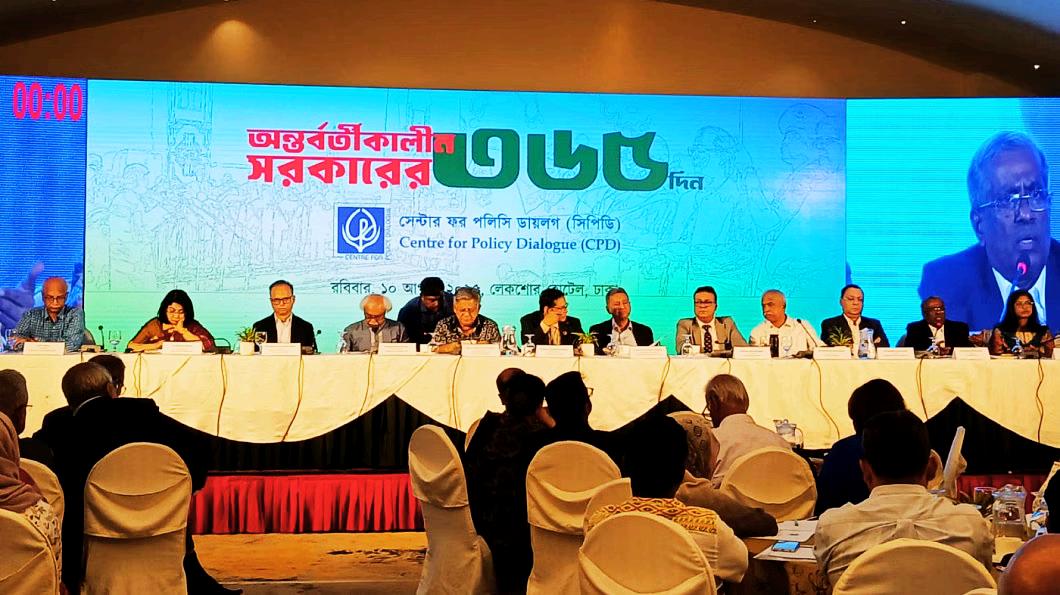
Bangladesh’s economy has been spared a large-scale crisis thanks to a raft of reforms and policy measures implemented by the interim government over the past year, the Centre for Policy Dialogue (CPD) has said. Speaking at a dialogue titled “365 Days of the Interim Government” in Dhaka on Sunday, CPD Executive Director Dr Fahmida Khatun credited banking sector reforms, stronger remittance inflows, improved export earnings, and a stabilised foreign currency reserve for halting what had been a rapid decline.
“Inflation may have eased, but many persistent challenges remain,” Dr Fahmida cautioned, pointing to weak revenue collection and structural shortcomings that could undermine recent gains. CPD’s one-year scorecard, using green, yellow, and red markers to assess 38 indicators, placed inflation control in the “green zone ” but flagged unemployment, slow public sector reform, and inadequate governance improvements as continuing concerns.
been met. “Now the challenge is to turn stability into investment and job creation,” he said.
The CPD review praised several central bank actions, including the adoption of international loan classification standards, the dissolution and reorganisation of the boards of 14 banks, the formation of three reform task forces, and the offering of Tk 23,000 crore in special credit lines to boost lending. SME lending quotas, a youth fund, and increased support for migrant workers were also welcomed.
But the think-tank warned of lingering risks: weak capital market oversight, insufficient export diversification, delays in updating labour policy, and gaps in energy security. Agricultural subsidies and a new renewable energy policy were seen as positives, but investment in social sectors remains limited.
Exports, imports, reserves, and remittances have improved, and the trade balance has narrowed. However, CPD noted that reforms in investment policy, labour standards, and post-LDC tariff structures lag behind expectations.
Distinguished Fellow Professor Mustafizur Rahman said the interim government’s primary goal last August was to restore macroeconomic stability a target he believes has largely
With elections scheduled for February 2026, CPD expects few major reforms in the immediate future. It urged the government to keep inflation in check, maintain macroeconomic stability, expand open market sales, and sustain support for the poorest households.
CPD dialogue titled “365 Days of the Interim Government,” held at a hotel in Gulshan, Dhaka, on 10 August
Commerce Adviser Sk Bashir Uddin has confirmed ongoing efforts to lower the reciprocal tariff imposed by the United States on Bangladeshi exports from the current 20% to 15%.
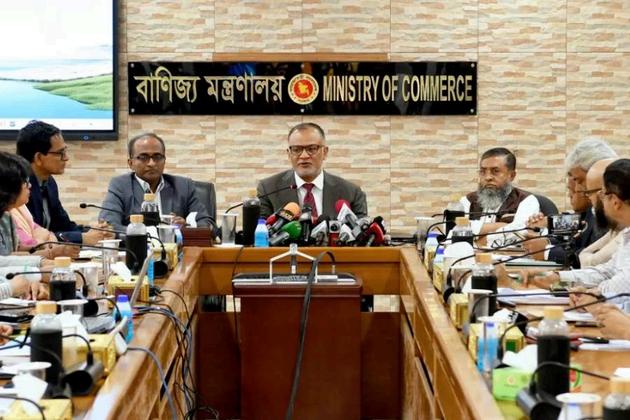
“There is a collective effort from all levels of the government to bring down the tariff from 20% to 15%. Discussions with the United States are still going on, and the adjustment could happen before the final agreement is signed,” Sk Bashir told reporters at a press briefing at the Secretariat on Tuesday (12 August). The adviser was speaking following a meeting focused on setting export targets for the upcoming fiscal year 2025-26 He expressed optimism that the government’s initiatives to address the bilateral trade deficit could pave the way for tariff reduction. However, he cautioned that the final decision rests with US authorities, and no specific date for a formal agreement has been fixed yet.
The United States had recently cut tariffs on Bangladeshi goods from 35% to 20% on 1 August after intensive negotiations in Washington.
Talks between the two nations are continuing, with a deal expected to be finalised by the end of this month. The US Trade Representative’s office is currently drafting the agreement.
Responding to concerns over the recent spike in onion prices, Sk Bashir said imports will be guided by supply and demand dynamics. “Imports will not be limited only to India.
Traders will be allowed to import onions from wherever they can procure them at lower prices,” he said. “Our main goal is to reduce the price of onions and increase supply, and for this, onions will be imported from wherever they can be obtained at a lower price.”
Commerce Secretary Mahbubur Rahman, Bangladesh Trade and Tariff Commission Chairman Dr Moinul Khan, Additional Secretaries Abdur Rahim Khan and Dr Nazneen Kauser Chowdhury, and Bangladesh Knitwear Manufacturers and Exporters Association President Mohammad Hatem also attended the briefing. The developments signal cautious progress in Bangladesh’s efforts to ease trade tensions with its key export market as the government seeks to boost export growth and stabilise domestic prices ahead of the new fiscal year.
Commerce Adviser Sk Bashir Uddin spoke at a press briefing at the Secretariat on Tuesday, focusing on setting export targets for the upcoming fiscal year 2025-26
Bangladesh Bank (BB) has set an ambitious target of disbursing Tk 39,000 crore in agricultural and rural loans for the fiscal year 2025-26 (FY26), marking a 2.63% increase from the previous year ’ s target of Tk 38,000 crore.
BB Governor Dr Ahsan H Mansur announced the new agricultural and rural credit policy and programme at a press conference held at the central bank’s Jahangir Alam Conference Hall on Tuesday. He stressed the importance of adequate credit flow to the agricultural sector as a key driver to achieve GDP growth, control inflation, and bolster national food security
“The target has been increased to support farmers and ensure higher agricultural output, with the ultimate aim of ensuring national food security and encouraging investment in the sector,” Dr Mansur said. The new target allocates Tk 13,880 crore for state-owned commercial and specialised banks and Tk 25,120 crore for private and foreign commercial banks.
A web-based Agri-Credit Management Information System (MIS) software was also launched during the event, aimed at improving monitoring and policy formulation for agricultural lending.
Highlighting policy measures, Dr Mansur noted the mandatory Credit Information Bureau (CIB) reporting for all agricultural credit or investment, with service charges waived for loans up to Tk 2.50 lakh.
Additionally, the livestock sector’s credit disbursement target has been raised from 15% to 20%, and a new 2% target has been introduced for irrigation and agricultural equipment financing.
To expand the range of supported crops, new inclusions are jackfruit, beetroot, cucumber, taro, black seed, and bag cultivation of ginger, garlic, and turmeric, alongside molasses production.
Dr Mansur encouraged banks to adjust credit disbursement by up to 20% based on regional demand and called for awareness programmes to educate farmers about credit access and loan recovery processes. He also proposed rewarding farmers who repay their loans punctually.
“To alleviate poverty, create employment, increase the income of marginalised and poor people, and establish a sustainable economy, the timely supply of sufficient funds to the agriculture and rural sectors is essential,” the governor emphasised. He expressed hope that these policies will aid macroeconomic management, control inflation, and promote sustainable development by boosting agricultural production and the incomes of rural communities.
Onion and fruit prices across Bangladesh have climbed sharply over the past week, intensifying the strain on household budgets and prompting renewed calls for tighter market monitoring. Traders, consumers, and analysts warn that the situation could worsen in the coming weeks if the government fails to intervene swiftly.
On 8 August, in Dhaka’s Karwan Bazar, local onions are now selling wholesale for Tk 70 to Tk 75 per kilogram, while retail prices have reached Tk 80 about Tk 15 higher than just seven days ago. This marks an increase of roughly 24 per cent in one week The surge follows the suspension of imports from India, reduced supplies from major farming districts, and seasonal weather disruptions that have slowed deliveries. Retailers say they are paying more to secure onions from key producing areas such as Pabna and Faridpur. With only local stock available, some farmers are reportedly holding back part of their harvest in hopes of fetching higher prices later in the season a tactic that recalls last year ’ s market tensions. The supply squeeze has left shoppers cutting back. “Last week I bought three kilos, this week only one, ” said a Dhaka customer, adding that the price hike was making onions a luxury for everyday cooking. Other essential kitchen items
are also becoming more expensive. Ginger prices have risen by about Tk 50 per kilogram to Tk 220–260, while most vegetables now cost around Tk 80 per kilogram. Bitter gourd, snake gourd, yardlong beans and okra are fetching between Tk 80 and Tk 120, brinjal is priced at Tk 100–120, tomatoes remain high at Tk 140–150, and green chillies have doubled in a month to Tk 200–260. Eggs have increased by Tk 5–10 per dozen, now selling for Tk 135–140. While broiler chicken prices remain steady at Tk 170–180 per kilogram, local ‘Sonali’ chicken costs Tk 320–330.
Fruit prices in the capital have seen equally steep increases. A single medium-sized orange is now selling for Tk 100. Last week’s Tk 150-per-kg BARI-4 mangoes are fetching Tk 180, while Jhinuuk mangoes have leapt from Tk 100 to Tk 140 per kilogram. Small watermelons are priced at Tk 200 each. Oranges that were Tk 450 per kilogram a week ago now range from Tk 500 to Tk 550, pomegranates have risen from Tk 420 to Tk 450 per kilogram, small apples from Tk 250 to Tk 280, and larger apples from Tk 320 to Tk 350. Red grapes have surged from Tk 350 to Tk 450, dragon fruit has jumped from Tk 160 to Tk 220, and guavas, once Tk 60, are now Tk 80 per kilogram.
For many shoppers, the hikes
feel excessive. They came to buy some fruit for their children, but the prices made head spin.
The price spike builds on a trend observed in June and July, when onions rose by over 20 per cent despite the peak harvest season. At the time, market watchers pointed to speculative hoarding and erratic weather as key factors. In late 2024, the government eliminated all import duties on onions to curb similar surges, but with imports from India now halted, that relief has vanished.
Analysts note that the market is once again displaying the familiar pattern of seasonal scarcity followed by price escalation, often exacerbated by farmer stockpiling and limited cross-border trade.
The volatility is especially worrying with the monsoon season under way and flood risks looming.
Consumer rights advocates accuse some traders of manufacturing artificial shortages and warn that if decisive measures are not taken soon, the coming weeks could see even sharper rises.
They are urging the government to step up market surveillance, crack down on hoarding, and explore immediate import alternatives.
For millions of households, the message is simple but urgent: without swift action to stabilise supply and rein in speculation, the nation’s dinner tables may soon be missing both staple vegetables and fresh fruit not because they are unavailable, but because they have been priced out of reach.
Bangladesh is witnessing a renewed wave of foreign interest, even in the face of global uncertainty and domestic challenges. Fresh figures and diplomatic efforts hint at a turning point in the country’s economic story.
Data released by Bangladesh Bank shows a remarkable rise in net foreign direct investment (FDI) for the first quarter of 2025 (January to March).
Net FDI more than doubled compared to the same period in 2024, shooting up to $864.6 million from $403 million. This represents an increase of over 114 per cent.
The surge was driven both by equity investments and intracompany loans. Equity investments rose to $304.4 million from $188.4 million a year earlier. Intra-company loans surged to $627 million, nearly two and a half times the amount of loans received in Q1 2024.
Experts and officials described the jump as a “vote of confidence” in Bangladesh’s potential, despite macroeconomic challenges like inflation, a volatile exchange rate, and rising external debt At the same time, the Bangladesh Investment Development Authority (BIDA) has received $1 billion worth of foreign investment proposals over the past nine months, spanning October 2024 to March 2025.
These include 739 registered industrial projects 66 wholly foreign-owned and 61 joint ventures
The Bangladesh Economic Zones Authority (BEZA) has also signed land-lease agreements with 16 companies, including both foreign investors and joint ventures.
Meanwhile, at the Bangladesh Investment Summit earlier in April, foreign firms such as Handa (China) pledged $150 million, Swedish company Nilorn pledged $13 million, and the New Development Bank signalled a $1 billion commitment. In addition, government plans include closing communication gaps with investors and monitoring the progress of pledges.
On 12 August 2025, Bangladesh and Malaysia held top-level talks in Putrajaya. The two nations aim to deepen cooperation in areas such as trade, investment and labour mobility.
The following day, 13 August, Chief Adviser Professor Muhammad Yunus, urged Malaysian investors to bring their investments to Bangladesh. He emphasised that the interim government had introduced measures to create a businessfriendly environment.
This diplomatic outreach echoes broader efforts to position Bangladesh as an attractive destination. With Malaysia’s interest now formally invited, there is optimism for new capital and partnerships to flow in.
Bangladesh has also set an ambitious export target of $63.5 billion for fiscal year 2025–26. The government hopes to leverage new US tariff advantages to boost shipments
However, exporters remain cautious, flagging issues such as energy shortages, banking constraints, and customs delays that must be addressed to meet this goal.
This export push complements the FDI story. Stronger exports could bolster investor confidence and justify further inward capital, especially in manufacturing and related sectors.
In the last five days alone, diplomatic steps and policy messaging particularly with Malaysia have underscored Bangladesh's outward-looking posture. Official data shows net FDI more than doubled in early 2025. Investment proposals worth $1 billion are queued up, and commitments voiced at the Investment Summit signal rising interest. Export targets reflect the hope that Bangladesh will ride the global trade wave. Yet, the path forward is not without hurdles. Domestic economic pressures and structural bottlenecks remain real concerns. The government’s challenge is to convert interest into investment and investment into sustainable, jobs-creating growth.
In essence, Bangladesh is at a crossroads: foreign capital is returning, and with sound policy and consistent delivery, this may well be the start of a new chapter.
DeskReport
UNDP has supported the transition through projects like the Hydrochlorofluorocarbon Phase-out Management Plan and the Kigali Implementation Plan.
HFCs,widelyusedinrefrigerationandairconditioning,arepotentgreenhousegaseswithhigh globalwarmingpotential.Bangladesh’splanfocusesonreplacingthemwithcleaner,energyefficientalternativeswhilestrengtheningthecapacityofinstitutionsandtheprivatesector. Bangladesh has renewed its pledge to protect the planet’s fragile ozone layer, unveiling a bold plan to slash hydrofluorocarbon (HFC) consumption by 85 per cent by 2045.
The commitment, made under the Kigali Amendment to the Montreal Protocol, was underscored at a recent national consultation workshop at the Department of Environment in Dhaka. Co-organised by the Ministry of Environment, Forest and Climate Change (MoEFCC) and the United Nations Development Programme (UNDP), the event brought together policymakers, technical experts, industry leaders and development partners under the theme “Advancing the Montreal Protocol in Bangladesh: Fostering Stakeholder Collaboration.”
HFCs, widely used in refrigeration and air conditioning, are potent greenhouse gases with high global warming potential. Bangladesh’s plan focuses on replacing them with cleaner, energy-efficient alternatives while strengthening the capacity of institutions and the private sector.
Speakers noted the country’s strong track record in phasing out ozone-depleting substances such as CFCs, halons and methyl chloroform, with Bangladesh having ratified the Kigali Amendment in 2020.
“Achieving the goals of the Kigali Amendment hinges on robust partnerships across government, academia, industry and civil society,” said Md Khayrul Hasan, Additional Secretary at the MoEFCC. “Through proactive collaboration and transparent communication, we can secure a sustainable environment for future generations.”
UNDP’s Resident Representative in Bangladesh, Sonali Dayaratne, reaffirmed the organisation’s commitment, saying it would continue to back the country’s efforts to meet its international obligations while engaging the private sector to adopt environmentally friendly cooling technologies.
Workshop chair Dr Md Kamruzzaman, Director General of the Department of Environment, called for urgency. “We must align with global protocols while addressing national priorities and industry needs,” he said. “That means stronger oversight, heightened awareness and swift action.”
The workshop’s high-level discussions explored the Kigali Implementation Plan, sectoral readiness for HFC phase-down, new technologies, public-private partnerships and the creation of bankable projects.
The consensus was clear: Bangladesh’s success will depend not only on policy but on people from factory engineers to household consumers embracing the transition to cleaner cooling.