Empress of the Pagodas by Maurice Ravel; arr. Christopher Retschulte © 2026 Tapspace Publications, LLC (ASCAP). All rights reserved.
tapspace.com
Notice of Liability: Any duplication, adaptation, or arrangement of this composition requires the written consent of the copyright owner. No part of this composition may be photocopied or reproduced in any way without permission. Unauthorized uses are an infringement of the U.S. Copyright Act and are punishable by law.
TSPCE26-002
PROGRAM NOTES
Maurice Ravel’s Mother Goose Suite, originally written as a five-movement piano duet in 1910, was orchestrated in 1911. Later that same year, he expanded it into a ballet, separating the five initial pieces with four new interludes and adding two movements at the start. The ballet was premiered on January 29, 1912, at the Théâtre des Arts in Paris.
What drew my attention to the Mother Goose Suite was Ravel’s inspiration from the beloved stories of Charles Perrault. Each movement represents a different fairy tale in the suite. With Ravel known for his masterful use of color and texture, I tried to match that with my variety of instrumental choices. Hopefully this will transport the listener to a realm of imagination and storytelling as Ravel intended.
In “Laideronnette, Empress of the Pagodas,” Ravel draws upon Eastern musical influences to portray a magical world of exotic beauty. I tried to adhere to the Ravel’s choices and keep the movement’s rich orchestral colors intact.
Maurice Ravel’s Mother Goose Suite remains a beloved gem in the classical repertoire, captivating audiences with its magical melodies, vivid orchestral colors, and the timeless allure of fairy tales. It stands as a testament to Ravel’s enduring legacy as a composer and his unique ability to create music that speaks to the childlike wonder and imagination in all of us.
Like some of my other arrangements, my daughter has inspired my working on such pieces. I would like to dedicate this work to my daughter, Lyric.
—Christopher Retschulte
PERFORMANCE NOTES
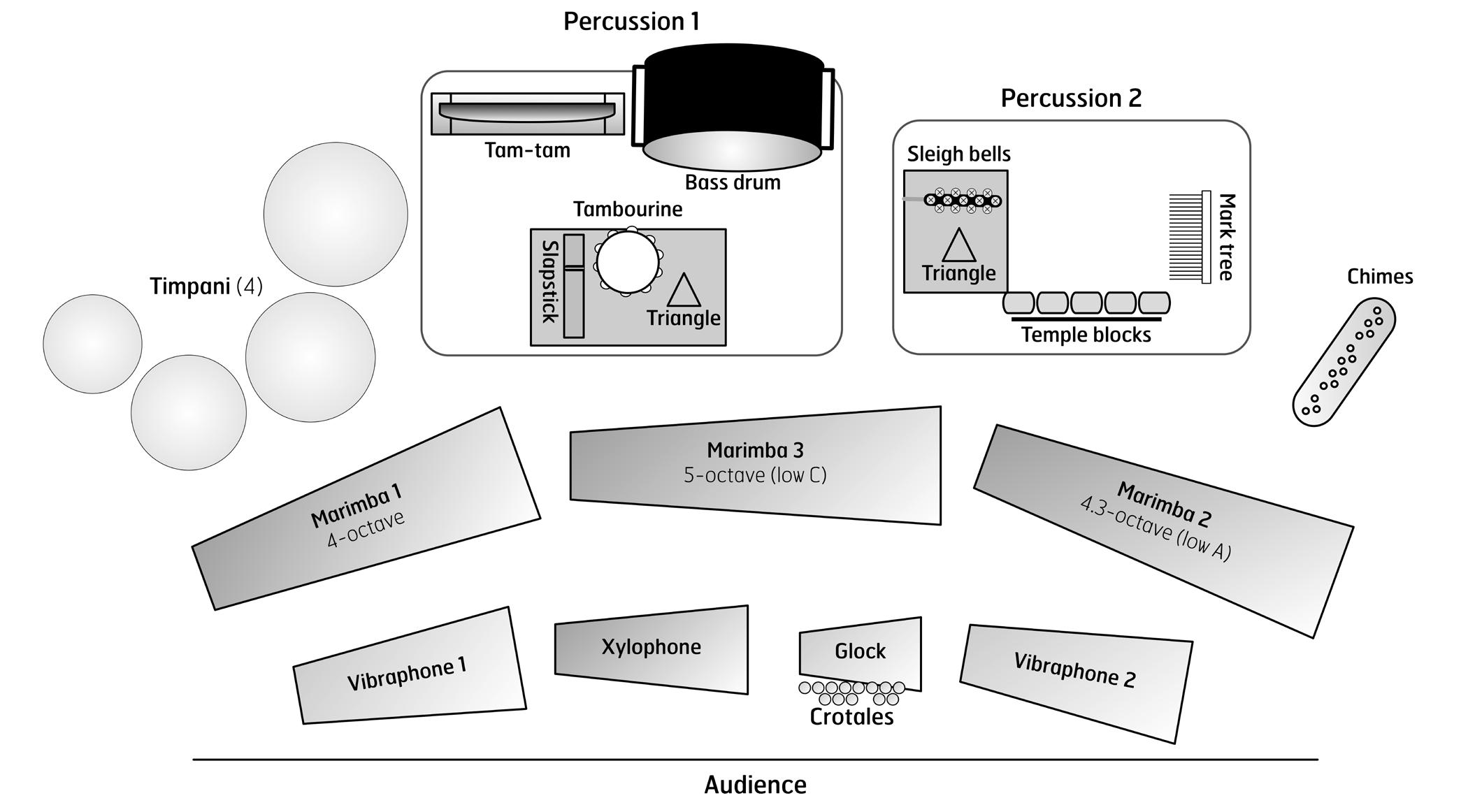
• The crotales should be mounted on or in front of the glockenspiel so they can be played by one player. They should also be set up so that the xylophone player can share the crotales with the glock player from letters H–K.
• Vibraphone pedaling is marked with slurs. If no slur mark exists, play dry or with little pedal. Pedal longer note values.
• The marimbas should pay particular attention to the phrasing in the roll sections. The slur marks indicate how to connect the rolls or when to reattack them.
• The timpani should pay close attention to the length of their sound. Controlling note values will help reinforce the melodic content.
• Percussion 1: Use a tambourine with a dark sound quality if possible. A 6" or smaller triangle is ideal.
• Percussion 2: Use a 9" triangle (or larger than percussion 1). For the mark tree, a double row would work, but experimenting with an echo tree or dream tree may provide a colorful addition to the soundscape.
• In general, there is a lot of overlapping melodic content. Try to lead the listener’s ear to what you want them to hear. Keep an eye on extreme subito dynamic changes. Expanding these levels will help generate the effect.
• Be thoughtful in choosing which hand starts the marimba and xylophone sixteenths. Some may lay well starting with a right while others may be comfortable beginning on the left.
PLAYERS AND INSTRUMENTATION
Empress of the Pagodas requires 11 players with the following instrumentation:
1. Glockenspiel + crotales (lower octave)
2. Chimes
3. Xylophone + crotales (shared)
4. Vibraphone 1
5. Vibraphone 2
6. Marimba 1 (4-octave or share w/ M3)
7. Marimba 2 (low A)
8. Marimba 3 (5-octave)
9. 4 Timpani (32", 29", 26", 23")
10. Percussion 1 — tambourine, slapstick, tam-tam, small triangle, concert bass drum (dampened with towel)
11. Percussion 2 — temple/granite blocks (5), large triangle, sleigh bells, mark tree
SUGGESTED SETUP