COVID-19 IN TAOS COUNTY: DEVASTATING HUMANITARIAN IMPACTS EXECUTIVE SUMMARY MARCH 26, 2021 MARJORIE LUCKEY MD WITH CHYNA DIXON MSC AND GILLIAN JOYCE MA IN COLLABORATION WITH THE SOCIAL SERVICES COMMITTEE OF THE ENCHANTED CIRCLE COAD
INTRODUCTION Taos County has long experienced high levels of poverty, food insecurity, lack of
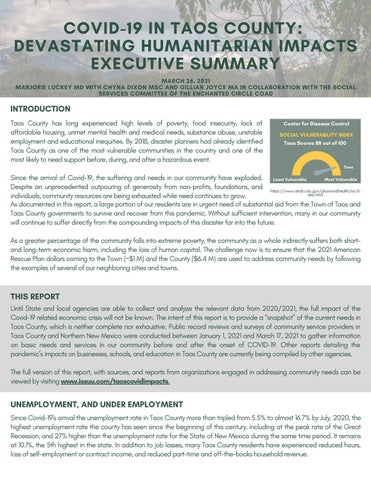
Center for Disease Control
affordable housing, unmet mental health and medical needs, substance abuse, unstable
SOCIAL VULNERABILITY INDEX Taos Scores 88 out of 100
employment and educational inequities. By 2018, disaster planners had already identified Taos County as one of the most vulnerable communities in the country and one of the most likely to need support before, during, and after a hazardous event.
Taos Since the arrival of Covid-19, the suffering and needs in our community have exploded. Despite an unprecedented outpouring of generosity from non-profits, foundations, and
Least Vulnerable
Most Vulnerable
https://www.atsdr.cdc.gov/placeandhealth/svi/in
individuals, community resources are being exhausted while need continues to grow.
dex.html
As documented in this report, a large portion of our residents are in urgent need of substantial aid from the Town of Taos and Taos County governments to survive and recover from this pandemic. Without sufficient intervention, many in our community will continue to suffer directly from the compounding impacts of this disaster far into the future.
As a greater percentage of the community falls into extreme poverty, the community as a whole indirectly suffers both shortand long-term economic harm, including the loss of human capital. The challenge now is to ensure that the 2021 American
~
Rescue Plan dollars coming to the Town ( $1 M) and the County ($6.4 M) are used to address community needs by following the examples of several of our neighboring cities and towns.
THIS REPORT Until State and local agencies are able to collect and analyze the relevant data from 2020/2021, the full impact of the Covid-19 related economic crisis will not be known. The intent of this report is to provide a “snapshot” of the current needs in Taos County, which is neither complete nor exhaustive. Public record reviews and surveys of community service providers in Taos County and Northern New Mexico were conducted between January 1, 2021 and March 17, 2021 to gather information on basic needs and services in our community before and after the onset of COVID-19. Other reports detailing the pandemic’s impacts on businesses, schools, and education in Taos County are currently being compiled by other agencies.
The full version of this report, with sources, and reports from organizations engaged in addressing community needs can be viewed by visiting
www.issuu.com/taoscovidimpacts.
UNEMPLOYMENT, AND UNDER EMPLOYMENT Since Covid-19's arrival the unemployment rate in Taos County more than tripled from 5.5% to almost 16.7% by July, 2020, the highest unemployment rate the county has seen since the beginning of this century, including at the peak rate of the Great Recession, and 27% higher than the unemployment rate for the State of New Mexico during the same time period. It remains at 10.1%, the 5th highest in the state. In addition to job losses, many Taos County residents have experienced reduced hours, loss of self-employment or contract income, and reduced part-time and off-the-books household revenue.
POVERTY Pre-Covid: Wages in Taos county have been consistently 28% lower than New Mexico averages, and median household income has been one of the lowest in the state: $11,000 below the state, and $23,000 below the U.S. median incomes. 21% of households in Taos County were below the Federal Poverty Line ($26,500 annual household income for a household of 4); 18% of households were living on less than $15,000 per year.
Since Covid: As a result of joblessness or reduced hours, many more residents have fallen into poverty, causing unmet basic needs in the community to skyrocket. Enos Garcia Elementary reports that 25% of their families have lost jobs and 40% have had their hours reduced. By August 2020, nearly 25% of parents reported struggling to pay for food, rent, and utilities.
HUNGER AND FOOD INSECURITY Pre-Covid: In 2019, approximately 5,000 Taos County residents (15.2% of the county’s population) were experiencing hunger or food-insecurity. The two major food pantries in Taos County served about 2,100 households per month, distributing nearly 57,000 pounds of food per year.
Since Covid: Food pantries have experienced extraordinary increases in the numbers of households in need of food. In Taos alone, monthly totals of households served increased by 38%, with total food distribution more than doubling. Most worrisome are sharp increases in the numbers of new families in need of food since Thanksgiving: a 180-family increase per month between the two pantries. An October 2020 report from Feeding America has predicted large increases in hunger, with up to 1 in 5 Taos residents and 1 in 3 Taos children experiencing hunger and food insecurity in 2021.
HOMELESSNESS AND HOUSING INSECURITY Pre-Covid: Taos County had the greatest disparity between incomes and housing costs in the entire state. 46% of renters pay more than 1/3 of their income for housing and 25% pay more than 1/2. The chronic shortage of affordable housing has resulted in a deficiency of more than 1,200 affordable rentals as well a severe shortage of affordable housing for purchase. Homelessness in Taos County has also been rising steeply, doubling every two years between 2015 and 2019.
Since Covid: As of late 2020, New Mexico was third in the nation for housing insecurity, with 13% of New Mexicans reporting limited or no confidence in their ability to pay the coming month’s mortgage or rent. In Taos County, all social service providers surveyed reported a marked increase in housing
insecurity
emergency
shelter
and
homelessness.
with
hotel
vouchers,
Despite the
nonprofits
growing
rate
more of
than
doubling
homelessness
90 TAOS STUDENTS ARE HOMELESS
has
completely overwhelmed the available space and resources. Wait lists for the three main emergency shelter and housing providers grew from 67 to 140 in a single month at the beginning of 2021. In addition, DreamTree Project has a growing wait-list for homeless youth ages 16-24 and its street outreach team is seeing higher and higher numbers of newly unsheltered youth living on the street, often after job loss. Not counted in these numbers are the 90 Taos Schools students who are currently homeless.
MENTAL HEALTH AND SUBSTANCE ABUSE Taos County consistently ranks as one of the most troubled counties in New Mexico in terms of mental health and substance abuse. Since Covid, four of the agencies that focus on drug, alcohol, and mental health issues in Taos County all report dramatic increases in mental health issues and substance abuse. Holy Cross Hospital has experienced a roughly 50% increase in ER visits for mental health and substance abuse since March, 2020. Rio Grande Alcoholism Treatment Program reports that overdose deaths have increased by 50%, and the number of Taos County clients have more than doubled (from 45 to 120) since 2019. Golden Willow Counseling has seen a 74% increase in clients, and Taos Behavioral Health’s numbers have increased an additional 150 clients since the onset of the pandemic.
CHILDREN AND FAMILY NEEDS According to Kids Count, the state of New Mexico already ranked lowest nationally for overall child well-being before the pandemic. A recent Save the Children report now ranks New Mexico among the worst 3 states in the country for children during the pandemic. The cumulative impacts of the pandemic on parents, children, and the extended family are difficult to quantify because none of the issues exists in a vacuum. Excessive stress disrupts children’s developing brains, causing damage to learning, behavior, and health. In addition, children’s wellbeing is tied inextricably to the health and wellbeing of their caregivers, many of whom are under enormous stress as they struggle to provide basic necessities, cope with isolation, and deal with all the challenges of online learning. In a recent Save the Children report, 3 in 5 adults in households with children nationwide reported little interest or pleasure in doing things. In New Mexico 68% to 70% of those surveyed reported feeling down, depressed or hopeless.
Youth, in particular, are experiencing compounding impacts from the multiple crises related to COVID: In addition to family stress, food and housing insecurities, the technical hurdles involved in successfully logging into classes from home can be overwhelming and many students have fallen behind or have dropped out entirely. Older students whose parents have lost jobs have become the breadwinners and others are having to juggle online schooling for younger siblings with their own studies. With reduced ability to seek health care and emotional support, many teens and adults are self-medicating in an attempt to alleviate anxiety, depression, loneliness, or other mental health issues. Since the pandemic’s onset, Youth Heartline, a provider of therapeutic support and trauma-informed services for children and families, experienced a 100% increase in unduplicated clients served. Taos Behavioral Health has had a 150-client increase since 2019, and reports “a 100% increase in the severity of distress - especially anxiety and depression.”
LOOMING DEBT CRISIS: UNPAID UTILITY BILLS AND RENT Pre-Covid:
New
Mexicans
living
in
rural,
low-income
households spend, on average, 15% of their income on energy bills alone. 900 Taos County households served by KCEC are known to have incomes below 150% of poverty levels, and there are many more households with economic hardship that have not been identified.
Since Covid: With decreased wages, many Taos families are struggling to pay utility bills. As of January 2021, over 2,000 KCEC and NM Gas residential customer accounts were in arrears for a total debt of more than $830,000. The moratorium on utility disconnection, in place for a year,
*Kit Carson Electric (Taos County as of 1/2021) **NM Gas (Taos area as of 3/8/21)
expired on March 20th for rural energy cooperatives. Payment plans are being offered, but they do not protect lowincome families from falling further into poverty as debt payments siphon off money needed to buy basic necessities. If unable to pay, some will face a “disconnection cliff” in early May and fall into deeper poverty and/or homelessness.
A debt crisis is also approaching for renters as the federal rent moratorium expires March 31st and the end date of the current New Mexico stay on evictions for economic hardship is uncertain. While rent arrears data aren’t available for Taos County, recent national data indicates that back rent owed by struggling households averaged around three-and-a-half months’ rent as of January 1, 2021. This amount has undoubtedly increased over the past three months and will be difficult or impossible to repay for those who remain under-or-unemployed. Without action, Taos County can expect a large surge in evictions and an unprecedented increase in homelessness in our community.
FINANCIAL RELIEF IS FAILING TO REACH MANY WHO NEED IT In addition to federal COVID-relief checks sent directly to individuals, or made available through loans, or grants to businesses, the majority of 2020 CARES Act funds available for humanitarian relief were disbursed from the state or sent to local governments, which then determined how and to whom the funds were distributed. In 2020, the Town of Taos and Taos County governments received a combined total of $1.5M in CARES Act funding, the majority of which was judiciously spent to respond to the pandemic and to keep our community and government employees safe. The Town of Taos also applied for, and is awaiting approval of, a roughly $2 Million Economic Development Grant for water and sewer utilities to the airport. Elsewhere in New Mexico several counties and towns were able to direct substantial amounts of their CARES funding towards direct relief efforts for vulnerable residents. These successful efforts, shown below, clearly demonstrate the feasibility of directing new, incoming, American Rescue Plan funds to humanitarian aid.
PERCENTAGE OF CARES ACT FUNDS SPENT ON HUMANITARIAN AID
NEW MEXICO ANTIDONATION CLAUSE
The Anti-Donation Clause of the New
Mexico
Constitution
is
sometimes viewed as a barrier to the provision of direct aid to constituents
by
County
governments and municipalities. The State Constitution clearly states the Anti-Donation Clause does not prohibit any county or municipality
from
making
provisions for the care and maintenance of sick and indigent persons. Further, the State of New Mexico has routinely taken the position that neither the Anti-Donation Clause nor the New Mexico Procurement Code apply to the pass through of Federal funds, as demonstrated by aid distributions from CARES Act funds by other NM County and municipal governments. For further conversation on this matter, please see Appendix C of the Full Report.
In New Mexico, funding for utility and housing debt relief has been distributed through the Low Income Home Energy Assistance Program (LIHEAP) and the New Mexico Mortgage Finance Authority (MFA), yet, excessively cumbersome applications and restrictive qualification criteria are blocking many Taos County residents from the help they need. 90% of KCEC customers living below 150% of the poverty line did not qualify for a one time $300 LIHEAP utility relief payment, and 80% of Taos County residents who applied failed to receive any rent relief through MFA. Immigrant households, with 13% of Taos County children, have been particularly hard-hit by Covid-related illness and job losses, yet the majority are also excluded from safety-net programs such as unemployment benefits, utility support through LIHEAP or the first federal stimulus checks.
CONCLUSION After a year of devastating impacts of COVID the humanitarian needs of our community are severe and growing. They cannot be met by nonprofits and private donations alone; instead, substantial investments from the new American Rescue Plan funds are urgently needed to help avert catastrophe, revitalize our community and begin the journey to a healthier, more resilient future. Entities that have contributed to the information contained in this report include: Community Against Violence, DreamTree Project, Enos Garcia Elementary School, Giving Tree, Golden Willow Counseling, Goodwill Industries of NM, HEART/Taos Cares Crisis Housing, Holy Cross Hospital, Kit Carson Electric Cooperative, Inside Out Recovery, Mountain Home Health, New Mexico Small Business Development Center, Taos County, Red Willow Center, Rio Grande Alcoholism Treatment Program, St. James Episcopal Church, Shared Table, Sin Fronterras NM, Self Help Inc., Taos Behavioral Health, Taos Chamber of Commerce, Taos Community Foundation, Taos County Senior Food Program, Taos County Administration, Taos Education Collaborative, Taos Immigrant Allies, Taos Main Street, Inc., Taos Men's Homeless Shelter, Taos School Zone, Valle del Sol, Veterans Off-Grid, and Youth Heartline. For more detailed information, please visit: www.issuu.com/taoscovidimpacts