Designing immersive spaces that blend sustainability, storytelling, and culture
I am a sustainable interior designer drawn to projects that explore the intersection of narrative, environment, and material. My work spans educational spaces, community hubs, and conceptual explorations—each grounded in storytelling and a strong sense of place. I translate vision into spatial clarity through design and graphic tool crafting spaces that are both immersive and intentional. Every project in my portfolio is a reflection of curiosity, care, and conscious design thinking.
EDUCATION
WATG & Wimberly Interiors
CO-WORKING TYPOLOGIES
Interior Design Studio 2 Parsons School of Design
2021 Collaboration with Lil Alvarez & Shania Dias AutoCAD | SketchUp | V-Ray Adobe Photoshop | Physical Modeling
Co-Working Typologies is an emerging concept that fosters collaboration, accessibility, and community for social impact. Designed for architecture graduates, this project encourages learning in a dynamic designer network. Inspired by the Japanese principle of kaizen (continous improvement), it promotes idea exchange, feedback, and critique. Featuring recreational spaces and a double-height library, it seamlessly integrates professional and home-like environments, enhancing community engagement and personal growth.
IDEATION
Exploring Russian Constructivist graphic style with circles and curves to evoke unity.
REFLECTED
SECTION CUT | FACING WEST
Showing the different angles of daylighting throughout the year.
PHYSICAL MODEL
Skylight integration explored through model representations.
7. Dark Grey Mosaic Tile Grid 8. Light Oak Wood Veneer
FIRST FLOOR
1. White Marble Slab
2. Olive Green Fabric
3. Mauve Fabric Circle
4. Warm Beige Matte Tile
5. Taupe Square Tile
6. Cream Limestone Tile
7. Plum Ribbed Tile
Fluted Concrete
THE SCALE EFFECT
Through iterative experimentation, this project explores a dynamic form adaptable to furniture, seating, occupancy, and wall coverings. It examines the interplay of space, human interaction, and functionality while considering the influence of natural light and shadows. By blending form exploration with a human-centered approach, the project pushes design boundaries, revealing new possibilities at the intersection of materiality, experience, and environment.
Exploring the verb “fold” through Bristol paper, this study examines the material’s permeability and its dynamic potential in design.
Experimenting the object in different applications
FURNITURE
OCCUPYING
ORTHOGRAPHICS
ELEMENTAL PLAYSCAPE
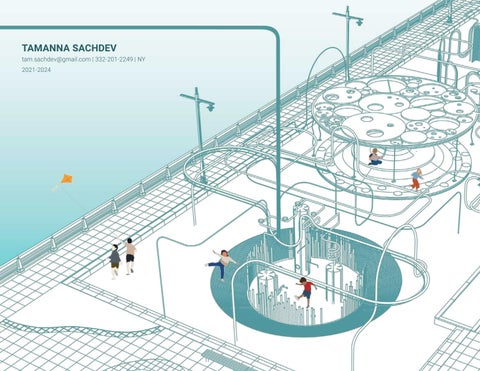
Elemental Playscape explores the symbiotic relationship between humans and nature, exemplifying collaboration between designers and parks to create sensory-rich playgrounds that promote kinesthetic learning. By harnessing children’s movements to generate kinetic energy, the project transforms playgrounds into educational hubs, fostering environmental awareness and responsibility through interactive play.
Social Community: Children Biotic Factor: Ring-Billed Seagull
PIER 46 PLAY AREA
Pier 46 hums with life—weathered piles double as living classrooms for curious kids and ecology buffs, while frisbees soar, seagulls squawk, and dogs strain at their leashes. On event days, the pier pulses with energy from concerts and outdoor films. Yet in stiller moments, beneath whispering Honey Locusts and shimmering reflections of Manhattan, it becomes a rare oasis—proof that even in New York’s chaos, calm can thrive.
Hudson River Greenway New York
Abiotic Factor: Waves / Water Spatial Agency: Movement
Water Play Structure (Fish Piles Inspired) Faucets and Tubes
Buckets to collect rainwater for seagulls
Water Tubes and Faucets
Soft foam-like material to create a barrier for safety concerns.
Water Play Structure (Fish Piles Inspired) Faucets and Tubes
Trampoline with visual access to the river underwater
Soft foam-like material to create a barrier for safety concerns.
with visual access to the river underwater
Non-slip flooring with drainage and water collection system.
found in oceans, lakes, rivers, and underground reservoirs. Water can be associated to the sense of taste, enabling a deep physical contact between the element and the human. It is vital for a child to learn about water in this
playground as Hudson River Park, particularly pier 46 is well known for its deep ecosystem and maritime history, thus creating awareness through fish pile
conservation sheds light on the importance of water and its aspects.
Water is one of the most essential elements of the earth and is vital for the
Greywater System: Wasted Water for Irrigation
SOLAR SPIN SHADOW PLAY |
Base
can develop a better understanding of the
and other celestial bodies. Shadows can be interpreted through the sensory of visual perception in which children are encouraged to make observations on shapes, expanding their creative imagination.
survival of all living organisms. It covers about 71% of the earth's surface and is found in oceans, lakes, rivers, and underground reservoirs. Water can be associated to the sense of taste, enabling a deep physical contact between the element and the human. It is vital for a child to learn about water in this
Collecting wasted water from the water element and using it for surrounding plants and irrigation purposes.
playground as Hudson River Park, particularly pier 46 is well known for its deep ecosystem and maritime history, thus creating awareness through fish pile conservation sheds light on the importance of water and its aspects.
Greywater System: Wasted Water for Irrigation
Collecting wasted water from the water element and using it for surrounding plants and irrigation purposes.
Base Push/Pull Ring for Magnet Support Lower Placed Shadow Discs
Discs with Shadow Holes (Solar Powered) Roof Base
Push/Pull Ring for Magnet Support Lower Placed Shadow Discs
Push/Pull Ring for Magnet Support
Sunken Buckets for Seagull Nesting/Sunbathing
Sunken Buckets for Seagull
Lower Placed Shadow Discs
Sunken Buckets for Seagull
Nesting/Sunbathing
Ropes at Different Heights
Seating / Standing Area
System Body with Tiles / Light and Dynamo System Inside
Play Ropes at Different Heights Seating / Standing Area System Body with Tiles / Light and Dynamo System Inside
Body Movement to Generate Light (Kinetic Energy) Using
Body Movement to Generate Light (Kinetic Energy)
Using
The sun and shadows are natural phenomena that can help children understand how the world around them works. By learning about how the position of the sun in the sky affects the length and direction of shadows, kids can develop a better understanding of the relationship between the earth, sun, and other celestial bodies. Shadows can be interpreted through the sensory of visual perception in which children are encouraged to make observations on shapes, expanding their creative imagination.
to
(Kinetic
Trampoline Sheet
Trampoline
Trampoline Sheet
/ Hanging Bars with Seats and Play Turbines
It is important for kids to learn about the wind and wind energy for several reasons. First, wind is a renewable energy source that can be used to generate electricity, and it is becoming an increasingly important part of our energy mix. By learning about wind energy, kids can understand the importance of renewable energy and the role that it plays in reducing our reliance on fossil fuels. Wind can be interpreted through an auditory passage that creates a familiarity and enables them to engage with the natural rhythm and beat.
EARTH EXPLORER | AXONOMETRIC
The earth and rocks are the building blocks of our planet, and understanding their composition and properties is essential for understanding the natural world. By learning about the earth and rocks, kids can gain a better understanding of geology, plate tectonics, and the formation of landforms. Rocks can be associated with the sensory of tactile nature in which children can interact with them on a physical level, climbing and getting a sense of the formation, creating a true connection between man and nature.
Monkey Bars and Standing Sills
Wind Energy to Power Light
Sitting
Concave Flooring Base
Hanging Play Chimes
Turbine
Light
Rock textures / mountain-like
Elevated Base
FANNY’S GARDEN RESTAURANT
Sustainable Studio 2 | New York School of Interior Design
Inspired by Alice Waters’ Fanny at Chez Panisse, this project reimagines dining as an interactive journey for families. A farmers market welcomes guests with seasonal, local produce accessible to the public. Children can purchase ingredients and bring them into the cellar learning center, where food becomes a tool for play and discovery. Parents enjoy a parallel fine dining experience, creating shared yet distinct moments. Biophilia anchors the design through tree-canopy ceilings, root-inspired structures, and natural textures, fostering connection to nature. The result is a joyful, sustainable environment where learning, storytelling, and dining come together seamlessly.
The design grows like a tree, where the restaurant above becomes the canopy — a lively, nourishing space and the cellar below extends as roots, grounding the experience in learning, growth, and cycles of renewal.
First Floor: Tree Canopy
Cellar: Roots
DESIGNING WITH SOUND & STRUCTURE
Dining Area | Acoustic & Illumination Design | Interactive Dining
BIOPHILIC CEILING DESIGN
Cellar Learning Space | Hanging Garden
The area is designed with circular tables anchored by tree-like structures, whose canopies integrate acoustic and lighting panels while allowing adjacent space for chef preparation and interactive dining.
Drawing inspiration from AeroFarms’ growing system, the ceiling transforms into a suspended garden, fostering biophilia by reconnecting occupants with nature through an immersive living environment.