Follow us on:
Sports
full story on page 7
Falcons roll past Vaqueros
AMPED
full story on page 5
Bad Bunny: Coquis against ICE
Opinion
full story on page 6
Gen Z stare: Generational burnout
@Talonmarks
September 17, 2025
Celebrating 70 years of utilizing the First Amendment
Volume 70 | Issue 1
ICE escalates in Los Angeles
COURTESY OF ISSAC CORDON
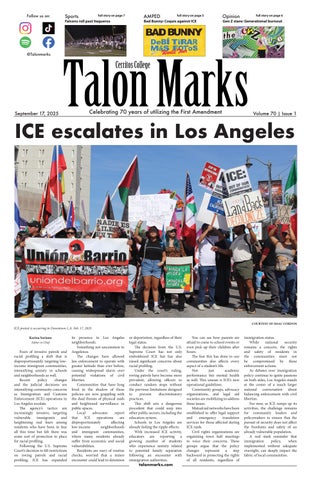
ICE protest is occurring in Downtown L.A. Feb. 17, 2025 Karina Soriano Editor in Chief
Fears of invasive patrols and racial profiling a shift that is disproportionately targeting lowincome immigrant communities, intensifying anxiety in schools and neighborhoods as well. Recent policy changes and the judicial decisions are intensifying community concerns as Immigration and Customs Enforcement (ICE) operations in Los Angeles escalate. The agency’s tactics are increasingly invasive, targeting vulnerable immigrants and heightening real fears among residents who have been in fear all this time but felt there was some sort of protection in place for racial profiling. Following the U.S. Supreme Court’s decision to lift restrictions on roving patrols and racial profiling, ICE has expanded
its presence in Los Angeles neighborhoods. Something not uncommon to Angelenos. The changes have allowed law enforcement to operate with greater latitude than ever before, causing widespread alarm over potential violations of civil liberties. Communities that have long lived in the shadow of these policies are now grappling with the dual threats of physical raids and heightened surveillance in public spaces. Local advocates report that ICE operations are disproportionately affecting low-income neighborhoods and immigrant communities, where many residents already suffer from economic and social vulnerabilities. Residents are wary of routine checks, worried that a minor encounter could lead to detention
or deportation, regardless of their legal status. The decision from the U.S. Supreme Court has not only emboldened ICE but has also raised significant concerns about racial profiling. Under the court’s ruling, roving patrols have become more prevalent, allowing officers to conduct random stops without the previous limitations designed to prevent discriminatory practices. This shift sets a dangerous precedent that could seep into other public sectors, including the education system. Schools in Los Angeles are already feeling the ripple effects. With increased ICE activity, educators are reporting a growing number of students who experience anxiety related to potential family separation following an encounter with immigration authorities. talonmarks.com
You can see how parents are afraid to come to school events or even pick up their children after hours. The fear this has done to our communities also affects every aspect of a student’s life. Not just academic performance but mental health as well. This unease is ICE’s new operational guidelines. Community groups, advocacy organizations, and legal aid societies are mobilizing to address these issues. Mutual aid networks have been established to offer legal support and emergency translation services for those affected during ICE raids. Civil rights organizations are organizing town hall meetings to voice their concerns. These groups argue that the policy changes represent a step backward in protecting the rights of all residents, regardless of
immigration status. While national security remains a concern, the rights and safety of residents in the communities must not be compromised by these enforcement actions. As debates over immigration policy continue to ignite passions on both sides, Los Angeles stands at the center of a much larger national conversation about balancing enforcement with civil liberties. For now, as ICE ramps up its activities, the challenge remains for community leaders and policymakers to ensure that the pursuit of security does not affect the freedoms and safety of an already vulnerable population. A real stark reminder that immigration policy, when implemented without adequate oversight, can deeply impact the fabric of local communities.