Small act of recognition disappears from our roads, better etiquette desired in Ladysmtih
As an immigrant to Canada in 2008, I have always marvelled at how polite Canadians are. They are known around the world for their courteous nature and etiquette, something I witnessed on my arrival in Ladysmith with my young family.
Coming originally from England, I was taught from day one that Mirror-Signal-Manoeuvre was how you drove a vehicle, to always acknowledge when someone lets you in with a raised hand off the wheel, and you are then acknowledged when you do something kind for other drivers.
It seems that this small act of recognition has disappeared from Ladysmith’s roads. I let drivers reverse out of a parking spot on First Avenue but get no wave of thanks, I witness drivers making a turn into a side road after braking but with no turn signal, and don’t get me started on Trans-Canada Highway driving techniques.
Good etiquette is the bedrock of how Ladysmith’s community functions and thrives, so let’s see if we can get some simple manners back onto our roads. You never know, you might become a better driver.
— Paul Mycroft, Ladysmith
French name for a stable meal . .
.
I enjoyed Paul Legacy’s article on French Canadian Pea Soup, in the March 2026 issue. I was raised in Québec, and this is certainly a staple meal.
I wish the spelling in French was correct. I think it is important to research the spelling of words if they are not in our mother tongue. Soupe aux pois
—Barbra King
Editor’s Note: Columnist Paul Legacy responded to this note in this way: “As for the soup name, it certainly is pea soup, but
I grew up in northern New Brunswick and not Quebec. Although my parents spoke French and I do a bit, this soup is from my Mom and her Mom and that’s what she had on her recipe, and what they called it. It translates to “Old- fashioned Pea Soup”.
Lack of information for Saltair water system filtration costs concerns taxpayer
As a Saltair citizen/taxpayer I’m concerned about the lack of information that was provided by the CVRD staff and Area G Director McClinton at the March 8 Area G director meeting.
Being shown a slide that indicates the Standalone Filtration system would cost $11 to $17 million and then the Hybrid with Ladysmith $4-$5.5 million is very deceiving when there is no breakdown on the costs involved in both these options.
Hearing that the CVRD staff is working behind closed doors to make an agreement with the Town of Ladysmith is very concerning. Reading the CVRD website link https://www. planyourcowichan.ca/saltair-water-treatment-upgrade only increased my concerns.
The Koers & Associates Feb. 2, 2024 report for the standalone option shows the current treatment plant being demolished and a new building being built and they are using an old system from 2017 - pre-ozonation & slow sand biological filtration that the CVRD Engineers moved away from in 2018.
Where is the Nano Filtration Modular skid system that was recommended by the CVRD Engineers starting in 2018 and what the 2020 grant application was based on? A backwash pond was required and additional hydro to operate the filtration system.
The CVRD staff stated that a new water pipe from the distribution box at Stocking Lake to the current treatment would be needed due to the age of the pipe. What exactly is the age of the Ladysmith pipe from Stocking Lake to the Ladysmith Water Treatment Plant? But what is the cost of a pipe from the Ladysmith Filtration plant to connect with the Saltair Water System? What is the cost of land agreements or purchases?
There are so many unknown costs with the hybrid system between Saltair use of groundwater and Ladysmith Filtration.
Ladysmith is working on $23 million worth of projects for their water system. Holland Lake dam increase, Stocking Lake dam increase, pipe between Holland Lake and Stocking Lake distribution connection and twinning the pipe from Stocking Lake to the Ladysmith Arbutus Filtration plant. What about Ladysmith needing to expand the capacity of their water treatment plant, increased storage capacity costs, and the list goes on and on? What costs will be downloaded to Saltair now and into the future?
What about the CVRD-Saltair Water System licences on Stocking Lake -2 Storage and 2 Diversion. Ladysmith only has one Diversion licence. What about the increase in the storage capacity with the new Stocking Lake dam moving 30m downhill? Will Saltair receive provincial storage and diversion licences for 50 per cent of that increase as Saltair is paying 50 per cent for the new dam?
What about the flow rates of the groundwater wells, climate change, etc?
In 2019 the Saltair residents stated they wanted to go with a standalone filtration system. The 2020 grant was successful for the standalone system with the governments providing $3.9 million. The Saltair residents/taxpayers authorized a $3.7 million loan for the standalone treatment plant based on if the grant was not successful to provide Island Health with assurance that the system would be moving ahead and Island Health would not fine the Saltair Water System for non-compliance. Are there other options out there that have not been explored? There are so many questions that need to be answered. Saltair Water users and taxpayers feel like they have been shut out of this process that has taken place without their inclusion. Email the CVRD staff to express your concerns: Darcy Mooney darcy.mooney@cvrd.bc.ca; Vanessa Thompson vanessa.thompson@cvrd.bc.ca; Area G Director jesse.mcclinton@cvrd.bc.ca; CVRD chair, chair@cvrd.bc.ca
— Lynne Smith, CVRD Area G Saltair
Letters to the editor are welcome. This is an open forum for readers to express their opinions on community matters and do not necessarily represent the opinion of TAKE 5 or its affiliates. Email us at editor@take5.ca
Volunteer Fair Celebrates National Volunteer Week
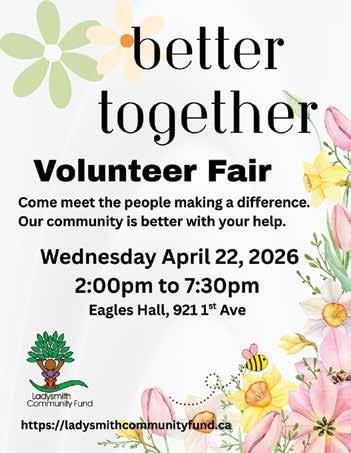
The Ladysmith Community Fund Society is hosting its third annual Better Together volunteer fair. The event will be held on April 22 from 2 p.m. to 7:30 p.m. at the Eagles Hall in Ladysmith and it is in celebration of Volunteer Week, which in 2026 runs from April 19 to April 25.
Volunteers make stronger communities, and Ladysmith thrives on its volunteers.
“Perhaps you’ve considered offering your skills and experience to one of the many organizations in our community, but where do you start?” asked event promoter Bruce Whittington.
“Are you an experienced boater? Could you help with a children’s story time program? Have you discovered an ability to fundraise? Do you enjoy putting second-hand items back into service? All these skills and more are in demand.
The Better Together! Volunteer Fair is a great place to “window-shop” for volunteer opportunities. Come and meet the people from the organizations who may need just what you are good at,” he said. Admission to the fair is free.
Community organizations can book a table for $25 at https://ladysmithcom-
munityfund.ca/events/ or by emailing them at events@ladysmithcommunityfund.ca.
“It’s a great opportunity to see who is doing good things in Ladysmith, and how you might have just the skills and experience needed to help our dedicated and hard-working community organizations. It really is true: We can be Better Together!,” said Whittington.
Kiwi Cove Community Garden: Building Food Security
BY N. TOXOPEUS
The need to build local food security remains as important as ever. Growing more food on the Island helps combat rising prices and poverty, while also providing a buffer against unexpected challenges. This is the goal of the volunteer-led Kiwi Cove Community Garden program.
Last year, the Kiwi Cove Community Garden focused on building up soil, growing healthy food and developing the community. The program achieved a record harvest, with volunteers delivering 5,500 pounds of fresh produce to the Ladysmith Resource Center Association (LRCA) Food Pantry.
The Kiwi Cove Community Garden grows vegetables exclusively for the Food Pantry (formerly the Food Bank). After twenty years of operation, the program has announced its incorporation into the LRCA, marking a new phase of collaboration for many more years ahead.
Local support for the garden continues to be outstanding. Kiwi Cove Lodge and neighbouring property owners generously permitted the use of their land and water, offering to help out as needed. Holden Lake Farm and Garden contributed
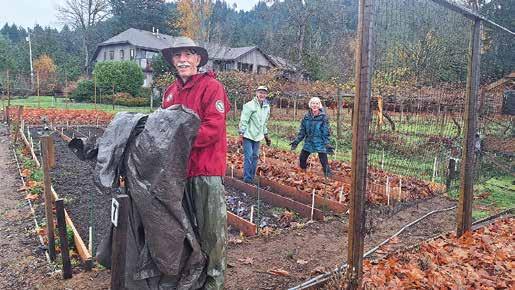
Volunteers at Kiwi Cove Community Garden. Photo: Nikki Toxopeus
greenhouses and soil for seed growing, along with valuable mentorship. West Coast Seeds supplied seeds, while volunteers eagerly accepted transplants donated later in the season by Dinter Nursery and Holden Lake Farm & Garden. These transplants were used for succession planting, maximizing every available inch of garden space. Many others, including Sawmill Direct and Silvermaple Holsteins, stepped forward to donate or help source sawdust, lumber, woodchips, manure, soil and signage. The list of contributors is endless.
The garden serves as a beautiful place for learning. Participants benefit from the expertise shared so generously by local professionals. Jake Thorburn of EarthCraft farm led a field day this year, demonstrating bed preparation using broad forks and no-till techniques and advising on cover crops. Amy LuckMacGregor of Spring Hill Soils Laboratory collaborated with volunteers to restore the soil microbiology. Jake was certainly impressed by how much the soil had improved. Linda Gilkeson reviewed soil mineral imbalances and plant health issues, offering recommendations for soil amendments. These experts, among others, have made substantial contributions to local food production for years, benefiting the entire community with their knowledge and wisdom.
The Kiwi Cove Community Garden offers countless opportunities for observation and learning each year. The garden’s ecosystem includes slugs that love the leaky drip irrigation system, prompting the addition of woodchips around the beds; the elk that graze on the apples and occasionally damage fences; a white-crowned sparrow that nested in the arugula patch and successfully raised three fledglings; mason bees in the fence posts that aid in pollination; and garter snakes that patrol the garden and the manure pile, helping to control the slug population. The garden also attracts passionate volunteers who advocate for unique vegetables and projects, donating so much of their time, resources and expertise to ensure its success. For nature and garden lovers, there is never a dull moment.
With the garden’s new relationship with the LRCA, the future of the Kiwi Cove Community Garden appears more
secure. This partnership aims to help secure funding to address challenges such as repairing broken fences, expanding drip irrigation, and implementing cover systems to combat heat and drought. It also seeks to manage the critters wanting to share the produce and, above all, ensure the consistent delivery of fresh produce to the Food Pantry.
The Kiwi Cove Community Garden welcomes volunteers of all backgrounds. The season runs into October, with regular volunteer sessions held on Tuesday and Thursday mornings.
Those interested are encourage to visit the garden and attend the Season Kick Off gathering on April 14 at 10 a.m. Coffee, snacks and a garden tour will be provided, offering an opportunity to learn more about joining the jolly volunteer team. For more information or to join the Kiwi Cove Garden email list, contact Bill at tillandb@gmail.com or call at 250-924-5269 .
The garden will also be featured on the Rotary Garden Tour on May 31. Those interested in visiting the garden during the tour should keep an eye out for additional details from the Rotary Club.
RCMP Townhall
BY JACKIE SHARP
Over 50 community members attended the 2nd annual RCMP Town Hall, hosted by the Ladysmith Residents Association at Eagle Hall on March 17, 2026.
Staff Sergeant Trevor Busch was accompanied by Corporal David Motley for a presentation on survey results, crime statistics, RCMP performance over the last twelve months, and key objectives going forward.
The annual survey – initiated by the RCMP – was completed by 59 residents, compared with 163 in 2025. The survey provided feedback on residents’ concerns about crime and safety, as well as priorities for the RCMP going forward.
This survey, along with the annual crime statistics, forms the basis of the Ladysmith Detachment’s Annual Performance Objectives for their next fiscal year, starting April 2026.
Staff Sergeant Busch was pleased to report that over 98% of respondents felt “very safe” in Ladysmith.
The call volume has increased by 19% since last year, with significant drivers being mental health-related calls and wellness checks.
Despite the rise in call volume, specific crimes, such as property-related offences, have decreased, as have reported assaults. Sexual assaults increased by 25%, but Staff Sergeant Busch cautioned that although this is a large percentage increase, the actual number of files is very low.
Staff Sergeant Busch and his officers exceeded last year’s key objective to work proactively by attending community events, liaising with schools, and increasing their visibility in the community, and this will remain a priority in the coming year.
Staff Sergeant Busch and Corporal Motley answered questions from the floor, and Murial Carlson gave a short presentation about the Blockwatch program.
Eva Vincent, President of Ladysmith Residents Association, said she was “very pleased with the turnout, but surprised how little engagement there was with the survey.”
For more information on crime-related news in Ladysmith, visit: https://rcmp.ca/en/bc/ladysmith/news
Ladysmith Spring Book Fest
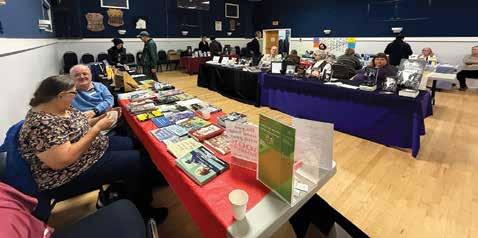
Looking for a good book to read? Then mark your calendars for the Ladysmith Spring Book Fest, 10 a.m. to 3 p.m. on April 11 at the Eagles Hall in Ladysmith.
“After the success of the Winter Book Fest in November, local authors suggested that we have another Book Fest in the Spring. When I announced the date, tables were booked in a very short time,” said Jackie Sharp, organizer of the event and, herself, an author of 14 books.
This is an opportunity for readers to meet local authors, purchase signed copies and merchandise. The genres represented will be wide-ranging.
“We have non-fiction authors, gothic
horror, romance, children’s fiction and much more. I’m really pleased that we’ll have such a diversity of literary talent for readers to choose from.”
Although the Spring event is fully booked for authors, the second Winter Book Fest on Nov. 21, at the Eagles Hall, still has tables available. Authors can register by emailing jackie@jackiesharpauthor.com
Rituals of Repair, Crease to Canvas highlight April arts
Arts are joyously celebrated in Ladysmith during the month of April.
Ladysmith Gallery at Unit 7 -32 High St. from April 1 to April 22 showcases a members art show titled ‘Rituals of Repair’ that invites viewers to explore how art can participate in healing — whether personal, cultural, ecological, or societal.
An art preview with light refresh-
Ladysmith Book Fest returns on April 11.
Photo: Marina Sacht
ments is set for Saturday, April 4 from 11 a.m. to 3 p.m. This is followed by a special fine art exhibition from Richard Brodeur who brings ‘From Crease to Canvas’, April 24 to May 3.
Affectionately known as King Richard, this show bridges the worlds of elite sport, creativity, and personal resilience. Two live painting sessions, on Saturday, April 25 and Wednesday, April 29, will anchor the exhibition where guests can witness Brodeur painting in real time.
And returning for another year is the Spring Art Escape, April 11 and 12 from 10 a.m. to 5 p.m. Both days will feature 180+ artists at 16 different locations across the communities of Ladysmith and Chemainus. More information and maps can be found at www.ladysmitharts.ca
Springtime Serenade at Cedar Community Hall
Celebrate the arrival of spring with an afternoon with the Yellow Point Singers offering A Springtime Serenade on Sunday, May 3 at 2 p.m. at Cedar Community Hall.
The program includes a wide variety of musical choral styles including Ian Tyson’s Four Strong Winds, The Welsh classic Ash Grove, Gospel styled pieces In Time of Silver Rain and Big House, and Morten Lauridsen’s beautiful classic Sure On This Shining Night, among other numbers. And for something completely different, the program will include the acapella, male quartet Charisma Bypass.
Directed by Doug Roszmann and Cheryl Satre, and accompanied by Pippa Williams, tickets are $20, and are available from choir members or at the door.
“Opera? Are You Kidding Me?” features beloved arias, duets: Cowichan Theatre
The Cowichan Performing Arts Centre is presenting a matinee performance of “Opera? Are You Kidding Me?” on Sunday, April 19, at 2 p.m. This performance is part of the CPAC’s spring presenting season, which is curated annually by the CVRD Arts & Culture manager.
Featuring the amazing Dutch Soprano, Anne Grimm; The Notorious Canadian Tenor, Benjamin Butterfield; The Infamous British Baritone, Alexander Dobson; South Korea’s virtuosic violinist, Jimin Shin Dobson, the show showcases Opera’s greatest hits.
“Opera? Are You Kidding Me?” features beloved arias and duets from the world’s most popular operas with a few hidden gems thrown in for thrills. With a fun and entertaining atmosphere, singers will be joined by solo violin and piano accompaniment. This is a can’t-miss show for those brand-new to the genre, as well as Opera aficionados.
The musicians included in this performance are world-class professionals who have traveled and performed globally.
Each have performed in Opera symphonies on renowned stages all over the world and many of whom are also teachers of their musical disciplines. The title “Opera? Are You Kidding Me?” pokes fun at a long-standing and revered genre that can seem intimidating but is equally as playful as it is stunning.
Tickets are $36 for adults and $18 for children/students, and can be purchased online, by calling 250-746-2722 or by visiting the Ticket Centre.
For further show information, and trailers, please visit www. cowichanpac.ca.
Natural Landscapes
BY PRISCILLA BREWER
Bring more beauty, joy and wonder into your own backyard by thoughtfully designing your outdoor spaces to celebrate nature and provide year-round interest. When properly designed, natural landscapes are low maintenance, functional and comfortable, and provide endless opportunities to observe and interact. More importantly, natural landscapes highlight biodiversity – the essential variety of all life on earth. A biodiverse landscape has a wide variety of plants, bugs, birds, fungi and microorganisms that all work together to create a healthy, sustainable ecosystem that feeds and nurtures itself.
Allocate a corner (or more) of your yard to “naturalize.” As with all proj-
ects, it’s important to start with a plan. You can hire a professional eco-friendly landscape designer or do your own research to create a working plan. When designing your nature-scape, work with, not against, the natural conditions of your site (sun/shade, wet/dry). Use natural materials like feature boulders, wood edges and rock steps. Avoid synthetic materials, such as plastic edging, weed barrier fabrics, chemical fertilizers and pesticides. Select the right plants for the right places and strive for a varied landscape that can provide four-season enjoyment, shelter, food and habitat for all species, including humans.
Start from the ground up. Soil is a living, often overlooked, precious resource. Buried beneath us, lives one-quarter of all the world’s biodiversity. Soil health directly impacts the well-being of all life on earth. Avoid tilling your soil, as it destroys the delicate balance of beneficial microbes. Protect and enhance your soil by mulching with layers of organic materials like leaves and compost. Over time, insects, worms and rain will help incorporate nutrients down into the soil. Plants (especially ground-covers and
moss) preserve the soil by acting as a “living mulch” – retaining moisture and preventing erosion. Miraculously, plant roots search for and form symbiotic underground relationships with mycelium fungus, where they work together to share nutrients with the whole ecosystem above.
If you plant it, they will come! Plant a variety of native trees, flowering shrubs, ground-covers, ferns, bulbs and mosses. Many of our region’s indigenous plants are highly ornamental, care-free and drought-tolerant, and provide vital food and shelter for birds and pollinators. Do your research, as different plants attract different species, in different seasons.
Many non-native (non-invasive) ornamental plants are valuable additions if they are chosen for their seasonal and ecological contributions. For example, include various native and non-native plants with winter berries/seed pods, and other plants with early spring flowers to provide much-needed nectar and food for birds throughout the seasons. Plant shrubs and trees to create summer shade, which will dramatically improve our backyard micro-climates during
heat waves. In autumn, deciduous shade trees have the added benefit of providing a plethora of leaves, which should be prized as a free source of nutrient-rich mulch every year.
Embrace the messiness of nature and resist the urge to “clean up” your garden. In a natural landscape, leaves and small branches are left to naturally decompose in garden beds. Larger branches can be used in “hugelkultur beds” (look it up). Logs and stumps can be left to age into mossy garden features that provide homes for many tiny species. In fact, a living tree may support hundreds of species – but a dead tree supports thousands! Decaying wood is a critical, irreplaceable component of a healthy, natural ecosystem.
Water is life. Every living thing needs water, so it’s crucial to provide a fresh source of water if you hope to increase biodiversity in your yard. A simple bird bath is a lovely way to attract more birds and can be quite entertaining to watch from inside, if thoughtfully placed within view. During summer droughts, a simple “bee bath” can be created to attract pollinators (simply fill a shallow saucer with water and pebbles). If it’s within your budget, consider installing a pond and waterfall to add an animated, sparkling element to your landscape. You will never tire of the peaceful sounds and sights of moving water. Your pond will attract a wide variety of birds, frogs, dragonflies, snakes and insects. It will also attract friends and neighbours. Get wild in your garden!
Priscilla Brewer is a naturalist, certified permaculture designer and teacher, horticultural technician, and multi-awardwinning landscape designer.
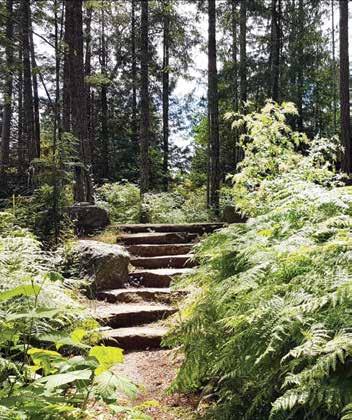
Plant a variety of native trees and shrubs. Photo: Priscilla Brewer.
Sushi Wara: Authentic Japanese cuisine a satisfying treat
BY PAUL LEGACY
As we travel Vancouver Island in search of restaurants that offer good food, excellent service and that welcoming feeling diners hope to experience, we are fortunate in Ladysmith to have authentic Japanese cuisine at Sushi Wara. The restaurant has been serving both locals and visitors since 2016.
For the past two years, Chef Jerry Hsia has been at the helm. He began his culinary training in Taiwan and brings many years of experience in Asian cuisine before making his way to Canada. His background and attention to detail are reflected in the consistent quality of
the food being served.
Having visited this restaurant at least 10 times over the last few years, I can say the experience has always been consistently enjoyable. Guests are warmly greeted upon entering and promptly seated, setting the tone for a relaxed dining experience.
On a recent visit, there were two of us in our party, and we ordered a wide variety of dishes from the menu. Our orders were taken quickly, and the food arrived in a timely manner. As always, the dishes were fresh and attractively presented on the plates.
They also offer GF soy sauce, vegetarian and vegan options. If you inform the wait staff, I am positive they will offer suggestions that will please your palate.
Throughout the meal, the wait staff were attentive and courteous, frequently refilling water glasses, drinks and making sure everything was to our liking without ever being intrusive.
The menu offers a wide selection of Japanese specialties, including teriyaki skillets, donburi, sashimi, nigiri sushi, combination plates and specialty rolls, along with many other options. They also offer party trays, a popular lunch box special from 11 a.m. to 3 p.m. and
dinner bento boxes available from 3 p.m. to 7:50 p.m. A full take-out menu is also available and appears to be well used by customers. Take-home boxes are readily provided if needed.
Between late April and early May, the restaurant will move to six days a week, closing on Mondays, with operating hours from 11 a.m. until 9 p.m. They also have an outside patio for the warm days ahead.
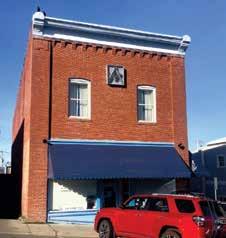
As an added bonus for the community, the owners of Sushi Wara will be opening a second location on First Avenue, called Sushi Kura shortly.
Judging by the steady flow of dine-in and take-out customers, this restaurant continues to be a popular dining destination – always a good sign and a reflection of the quality of both the food and the service.
We certainly look forward to our next visit.
You can follow Paul Legacy’s food blog: A Legacy in Thyme at https://www. facebook.com/share/1AvhVXYW3a/?mi bextid=wwXIfr
Food is fresh, and attractively presented at Sushi Wara. Photo: Paul Legacy.
Sushi Wara will be opening a second location, Sushi Kura on First Avenue in Ladysmith. Photo: Paul Legacy.
Friendships Lead to Help for Hundreds Cubans
BY KERITH WADDINGTON
A suitcase seems small unless it contains the wheelchair, which means you are no longer house-bound.
A suitcase seems small unless it contains the diabetic supplies that keep you out of the hospital.
A suitcase seems small unless it contains the food that keeps you alive.
A suitcase seems small unless it contains the school supplies that keep your child learning.
Helping an impoverished nation of millions one suitcase at a time may seem like an exercise in futility, but to those who receive aid, it’s life-altering – not only from a health perspective but also from a heart perspective. Since A Lot of Love (ALL) for Cuba first began delivering humanitarian aid by suitcase six years ago, friendships have been forged and extended families have formed. Like a rock thrown into the water, the ripples of health and goodwill have spread far and wide.
But just why am I, a Canadian citizen, writing about suitcases going to Cuba?
I had the good fortune of being a first-time snowbird this past February, but I inadvertently found myself caught up in US political manoeuvring. When Venezuelan oil shipments to Cuba suddenly halted, my fellow travellers and I had our return flights cancelled due to a lack of fuel. We were only repatriated after empty planes were flown from Toronto to Cuba with just enough fuel to bring us back to that Canadian city. From there, we were dispersed to other hotels and airports across the country until each of us made it home.
As surreal as the experience was, I became painfully aware that Cuba’s long-standing energy crisis was about to worsen –and with it, the hardship and poverty of its people. I now had new friends to worry about.
A bit of research upon arriving home led me to ALL for
Cuba, whose founders have longstanding personal friendships in Cuba spanning more than 25 years.
Beginning as an informal grassroots organization in 2020 and becoming a registered not-for-profit organization in 2024, ALL for Cuba relies completely on the goodwill of volunteers travelling to Cuba to deliver humanitarian aid. Their mission is to help alleviate poverty and improve the quality of life for vulnerable populations in Cuba. In 2025 alone, ALL for Cuba coordinated the delivery of 210 suitcases of humanitarian aid. Overall, they have facilitated the delivery of several hundred suitcases of medical, educational and essential supplies since 2020.
At any given time, dozens of Canadian travellers coordinate with the organization to carry humanitarian supplies as part of their baggage allowance. At the other end, ALL for Cuba works with trusted local partners, including physicians, nurses, community coordinators and volunteer leaders in regions such as Varadero, Morón, Santa Clara, Holguín and surrounding communities. Partners verify recipients and oversee distribution to reduce diversion and resale.
As Angela Harrison, executive assistant of ALL for Cuba, asserted, “accountability is central to our model. We do not ship aid into a system; we place it directly into the hands of the people who need it.”
Of course, the recent airline suspensions have significantly disrupted the traditional volunteer suitcase model. ALL for Cuba is adapting by coordinating travellers through alternative departure points where possible, exploring third-country routing options, increasing targeted financial support for local procurement when appropriate, and prioritizing seniors and children during this period of instability.
Angela acknowledged that at present, “we have sufficient do -
Brithany with her mom. ALL for Cuba has been supplying her with Libre 2 diabetic testing sensors since 2025. She is now 5 years old. Photo submitted.
nated supplies in Canada to fill a full shipping container. The limitation is not supply but securing funding for freight, insurance, customs coordination and secure distribution logistics. We are actively exploring partnerships to make this possible.”
Stephanie Mallet is the organization’s longest-standing volunteer; she started carrying suitcases in 2020 to Cayo Coco and quickly recruited her entire family and friends to do the same. She usually travels in a group, with each member taking one or two suitcases, multiple times a year. Depending on the location, the team has the supplies picked up by local members directly, while in others (such as Morón due to distance, and Holguín due to a volunteer’s circumstances), they arrange transportation. When a cab is used, it is with specific trusted drivers who work regularly with the teams and are considered part of the extended volunteer network.
Stephanie shared the hardest part of her work. “It is extremely frustrating when I hear the stories of suffering, even death, because of the lack of supplies. Cubans needing surgery have to supply their own supplies … down to even the suture needle. Hospitals are empty. … During the outbreak of mosquito-borne illnesses in the fall, my Cuban friend was so grateful because ALL for Cuba had the ultrasound gel available when it couldn’t be located anywhere else. Another friend told me she had to find a condom to cover the ultrasound wand, and it was so hard to find and expensive for them … simple things we as Canadians take for granted.”
According to Stephanie, ALL for Cuba is using this “downtime” by the airlines to sort and organize supplies here in Canada and in Cuba. “It takes countless people to make this happen,” she said.
Stephanie could not speak highly enough about what the organization means to her and to the people of Cuba.
“The work this organization puts into the helping of Cubans is truly amazing,” she said. “The appreciation of the Cubans is incredible. I have friends who are like family to me in Cuba, and it is astounding how far this mission has reached. It is the greatest feeling to provide something that someone so desperately needs and they either literally can’t get it, as it doesn’t exist in Cuba, or it is way too expensive [and] only available on the black market.”
Angela noted that people can support the work through donations, volunteering, or by carrying supplies when travelling to Cuba. Anyone interested in getting involved with ALL for Cuba is invited to reach out at alotofloveforcuba.com. They are also on Facebook.
Angela summed it up: “A suitcase is small, but it can have huge significance.”
Above:
Kerith Waddington (left) with friends in Cuba. Photo submitted.
Bending the Green Twig
BY RICK RAKE
“How you bend the twig is how the tree grows” perfectly captures the approach ThINC – Thetis Island Nature Conservancy – takes to environmental education, inspiring people of all ages interested to protect the environment.
Ann Eriksson, ThINK’s volunteer executive director, is an author and biologist who penned three non-fiction ecological literacy titles for young readers. Since Ericksson and her husband, Gary Geddes, move to the Island in 2008, their influence on environmental education – bolstered by a dedicated team of volunteers in 2012 – led to the creation of one of the youngest nature conservancies in the Gulf Islands.
It won a Community Stewardship Award in 2019 from the Islands Trust for its work on creating the Fairyslipper Forest Nature Reserve – the first publicly accessible nature reserve on Thetis Island.
Among its programs – including a Nature House and Sea Life Centre – ThINC hosts Project Re-Generation (ReGen), a youth-focused sustainability initiative on Thetis. Led by Charlotte Fesnoux, ThINC’s education and stewardship coordinator, ReGen gives young people hands-on opportunities like mushroom foraging, compost cultivation, and gardening in the nearby People’s Apothecary Garden. This program is designed for a group of homeschoolers from both Thetis Island and Vancouver Island.
Fesnoux, a part-time ThINC employee and the facilitator of the Project Garden Re-Generation, is responsible for the organization’s comprehensive website (https://www.thetisislandnatureconservancy.org/). She also runs workshops for teachers, helping them organize and conduct environmental projects as part of a “place-based education” approach.
For ThINC and its team, education is key to fostering environmental stewardship.
When asked about the top three things one can do to protect the ocean, Eriksson emphasized awareness as the first step. Be aware of the species that live there – “that which we can’t see when we look out on the ocean. Educate our-
selves to know what amazing marine life there is and why it is important to the world.”
Secondly, she highlighted the impact of pollution: “Don’t put things down the drain that don’t belong there.”
Thirdly, Eriksson – who is currently working on a major report for the Pacific Salmon Foundation – stressed the importance of protecting near-shore ecosystems, such as kelp, salt marshes and certain kinds of grasses. They ecosystems play a critical role in protecting shorelines, trapping pollutants and sequestering carbon. “As boaters,” she advised, “don’t anchor in these places and don’t discharge any substances off your boat there.”
Eriksson’s top three conservation practices – goals we can all strive for – include:
1. Educate yourself about the species and ecosystems in your region and understand what is most at risk.
2. Remove invasive species and replace them with native plants that are adapted to the local ecosystem.
3. Boost biodiversity by participating in nature stewardship programs, such as those offered by ThINC, which work with landowners to create reports on ways to promote pollinator species and conservation actions.
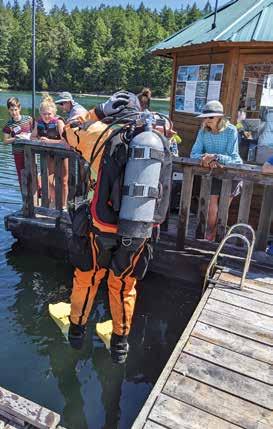
Dive demo at the Nature House on Thetis Island. Photo: Ann Eriksson
Green Champion
BY MOIRA WALKER
We, humans, are entirely dependent on the natural world. It is the source of our food, water and air. According to David Attenborough, “the natural world is the most precious thing we have, and we need to defend it.”
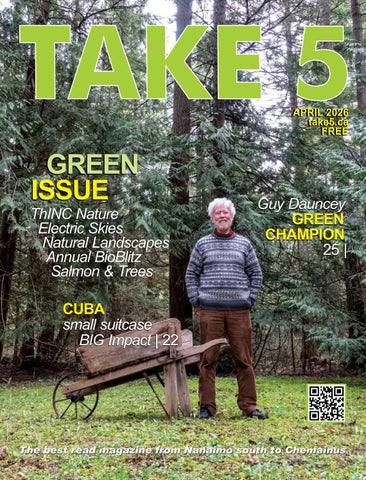
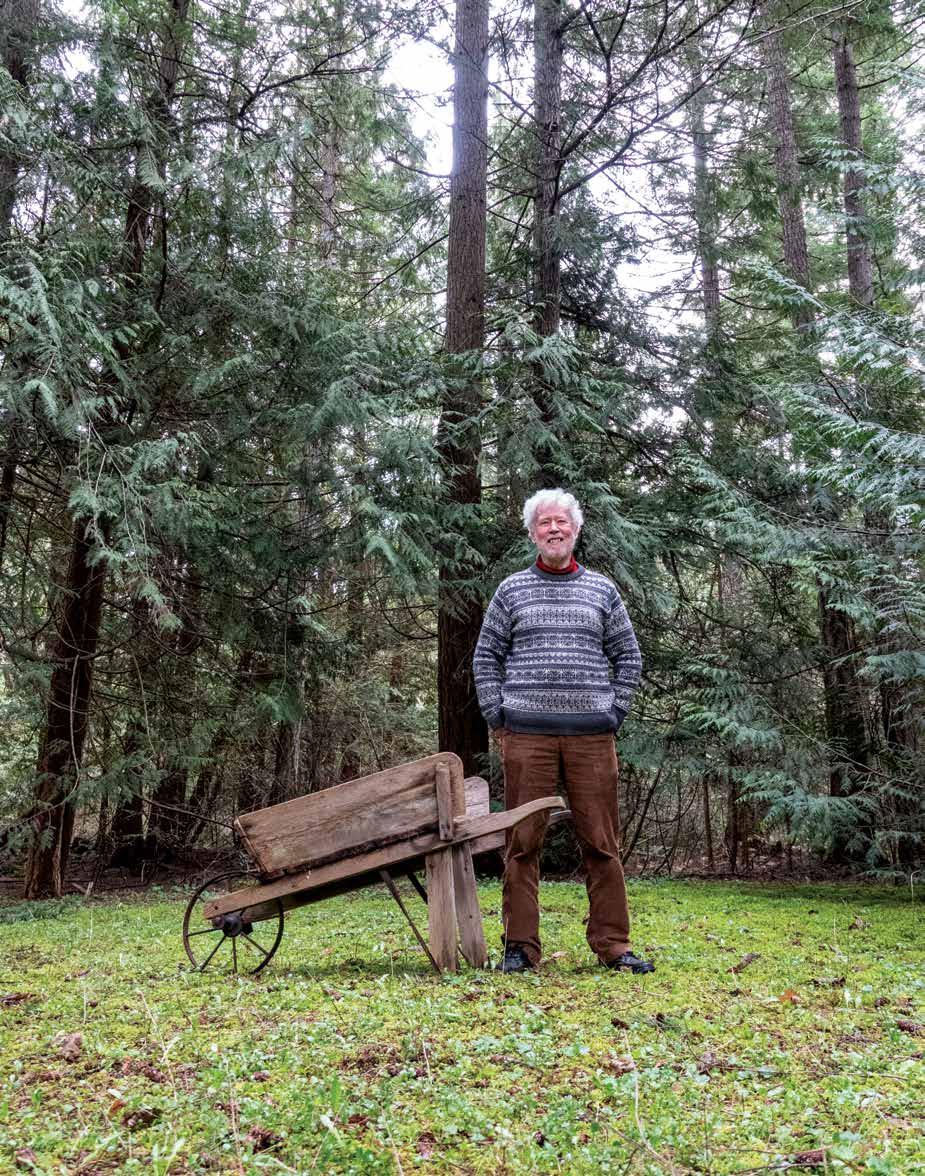
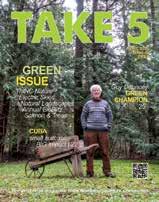
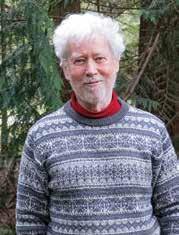
Because local resident Guy Dauncey –the man whose face graces this month’s cover – is so motivated and optimistic about defending our patch of the natural world, he is this year’s worthy recipient of the Green Champion Award. His outlook on life and the work he has done on behalf of the natural world can be simply put as that of a “practical utopian.” He certainly is an optimistic person. Perhaps that’s why he is so sought after as a speaker and a documentarian.
Guy has written ten books, including The Climate Challenge: 101 Solutions to Global Warming and the novel Journey to the Future—A Better World is Possible. His new book is The Economics of Kindness: The End of Capitalism and the Birth of a New Ecological Civilization. He serves as the president of YES, is an honorary member of the Planning Institute of BC, and is the founder of the BC Sustainable Energy Association. He is also a co-founder of the Victoria Car Share Cooperative
and the West Coast Climate Action Network. Beyond his organizational roles, Guy hosts a TV show called Change the World and is a recipient of the 2025 King Charles III Coronation Medal, awarded to individuals who “have made a significant contribution to Canada.” When he’s not busy with these pursuits, Guy enjoys life as a loving husband and owner of a spirited dog named Charlie. In short, Guy is one engaged guy.
Before settling in BC in 1990, Guy travelled throughout China, crossed the Sahara Desert, and was part of the Gandhian Village development movement in India in the late 1960s. He is a fellow of both the Findhorn Foundation in Scotland and the Royal Arts Society for the Arts (UK).
Guy believes we all can do something – and we must. In his 2009 TEDx talk in Vancouver, he quoted the American environmentalist Paul Hawken, who told students they were “brilliant and the earth is hiring.” Guy ended his talk by singing. Re-writing the lyrics of a rallying World War II song, he urged his audience to envisage a “tomorrow when the world is green.” When his audience stood to give him a standing ovation, many had tears in their eyes. What will his message be in his next TED talks? Stay tuned!
We in the Ladysmith area are richer and greener for having Guy Duancy living among us. His vision of a beautiful, kind, sustainable future is infectious. As YES member Denis Hughes recently said to Guy, “If there were more people like you in the world, it would be a better place.”
Guy Dauncey.
Photo: Bob Burgess
Flying Electric
BY FRANCESCA PACCHIANO
The sky was a perfect mix of blue with billowing clouds when I had my first flight in the Velis Electro by Pipistrel. The “Pip,” as it’s been nicknamed by the team at Sealand Flight, is well-suited to sightseeing trips of the beautiful Campbell River coastline, and for anyone interested in zero-emission flying.
Sealand Flight is the first flight school in Canada to use an electric airplane commercially. Based in Campbell River, they also operate sub-base flying schools at Nanaimo Airport, as well as Powell River, Courtenay, and Qualicum Beach. The company purchased the Velis Electro in 2024 and has now successfully completed the trial period. “It’s actually open to any flight school across Canada now to start purchasing and operating these aircraft,” said Mike Andrews, a pilot and spokesperson for Sealand Flights.
Pipistrel, the manufacturer of the Velis Electric, is an ItalianSlovenian company which has been developing small, electric aircraft in Europe over the last thirty years. Sealand Flights wanted to bring that evolution of flying to Canada.
When Pipistrel was designing the aircraft, they used glider technology to maximize the time the Velis Electro could stay in the air without fully draining the battery. It has long, thin wings that help it take off and stay aloft. The aircraft is lightweight enough that Mike could push it out of the hangar without assistance. “It’s all carbon fiber. It makes it very nimble.”
The sound of the aircraft is much lower than that of an internal-combustion plane of the same size. Pipistrel, in its description of the plane, says, “The Velis Electro produces zero emissions during operation and with noise levels of only sixty dBa, is ultra-quiet both on the inside and outside.” Mike described it as no louder than a dishwasher.
As a commercial school, Sealand began integrating the Velis Electro into its program as soon as regulations allowed. Mike noted that students find it easier to learn on the electric model. “There’s a lot less going on in it. There are basically four switches. When you get into the internal combustion engine aircrafts, there’s all these different systems that you have to manipulate.” It’s easier to focus on flying when students don’t need to also manage the systems that keep the plane in the air.
Catherine Check was the first student to train and solo on the electric. “You want to take every opportunity that you’re given, and I think that was important for a woman to do it.” She described the plane as being sleeker than the combustion planes. “The Pipistrel is definitely a lot lighter and it’s [easier] to control, more maneuverable…It’s almost like a powered glider.”
There are limitations with an electric airplane. “The big one is the limited range. The battery capacity is still evolving.” The Velis Electro that Sealand has, was certified in 2019, but it was designed in 2016. The battery technology, Mike said, is ten years old. “That limits the flights to about forty-five minutes.”
Another limitation is temperature. Mike had already warmed the batteries to an optimal temperature of 19 degrees Celsius before I arrived for our interview. Cold affects the batteries’ performance, and while it’s certified down to negative fifteen, Mike said it was best practice not to fly it in the cold.
The Velis Electro requires specific electrical infrastructure in the hangar to charge properly. Once students reach their first solo stage, their training includes travelling to different airports. Due to the technology’s newness, the Velis Electro is currently available only in Campbell River.
The goal, Mike said, is to expand. Sealand plans to utilize its own locations over the next few years and develop more opportunities for pilots to experience zero-emission aviation. “We’re ultimately trying to create a network between Courtney, Qualicum Beach, and Nanaimo, so that we can fly the airplane from place to place.”
Other companies, like Helijet and Harbour Air, are working on their own versions of electric aircrafts. Travel will soon include electric options. But if you want to lead the way, then flying might be for you. “Come learn to fly. It’s really fun. It’s really freeing, and we can do it in a zeroemissions way.”
Above: Mike Andrews, of Sealand Flight. Right: Velis Electro at the Campbell River Airport. Photos: Francesca Pacchiano
RDN Area A
I’ve been relatively silent on this year’s budget for three reasons: 1) Our proposed tax increase was not very high; 2) There seemed to be little wiggle room in this year’s budget unless we engaged in service cuts; and 3) I was waiting for some issues that would impact our tax rates to be settled. The purchase of Hamilton Marsh was one of the issues that recently settled with negotiations and fundraising finalized.
The biggest sources of this year’s tax increases in the RDN were related to water and sewer. Most properties in Area A do not receive these services from the RDN. While some receive water from North Cedar Improvement District, most rely on wells and septic systems. Since we don’t have these RDN services, we do not pay for the significant infrastructure maintenance and replacement costs that other areas are experiencing.
Reminder: We only pay for the services that we are eligible to receive. Money collected for RDN services can only be used for those specific services – no transferring from one budget area into another. Most of us in Area A live in areas of Improvement Districts and we pay for their services separately – including our fire departments. This is entirely separate from the RDN and those taxes are determined by those boards.
When we talk about the Area’s RDN tax rate, it includes our portion of general RDN services (e.g., Solid Waste
or Bylaw services), our area’s unique combination of services (e.g., Area A Recreation and Culture), and the library (which is determined by the library board). This does not include other sources of taxation like schools, police, or hospital.
This year, the average home (valued at $821,241) will pay $962 in RDN General Services taxes. This will be an average increase of $37 which is a 4 per cent increase.
The mill rate, which is what you pay per $100,000 of property value, is $115.21. A parcel tax of $16 that funds the Drinking Water and Water Protection Program is added on to the General Services rate for the average RDN General Services tax rate ($115.21 x 8.21241 + $16 = $962.15). Last year’s mill rate was $114.87.
Like last year, our top three sources of taxation are the Vancouver Island Regional Library, Southern Community Recreation (which pays for our access to Nanaimo’s sports fields, pools and community centres), and Electoral Area Community Planning. Also like last year, Area A will have the 2nd lowest average taxation rate among the electoral areas (not including Area B which also has Island Trust taxes).
Our biggest increases come from Community Parks, Southern Community Recreation, and Electoral Area Community Planning. While our community parks are our area of biggest increase, we continue to have the 3rd lowest com-
munity parks funding despite being the 3rd highest in population among the electoral areas.
Notably, the tax requisition for Solid Waste and for Regional Parks went down this year. That was not a typo. Solid Waste taxation decreased by 38.3 per cent and Regional Parks taxation decreased by 14.3 per cent for 2026. No, local pigs are not flying. While these decreases are abnormal and for this year only, we were able to take advantage of unique circumstances that allowed for a reduction. Prior to these changes and removing a couple of recommended positions from the proposed budget, the proposed increase was between 6 to 7 per cent. Staff and board members worked hard to find ways to reduce the proposed budget out of consideration of the current economic instability and financial challenges that are impacting most of us.
So, what are we getting for the increase in our Community Parks funding? Lots of good things are happening all over Area A. In Cassidy, we are building a community park with playground. In Cedar, we are building a playground and a pickleball court, plus funding improvements to the basketball court at Cedar Community Secondary School (this is subject to final upcoming Board approval). Those projects will go to tender at the same time in hopes of achieving cost savings. That means a delay for Cassidy (sorry, Cassidy), but it is an attempt to use tax dollars more efficiently. Also, there is the Cedar Village road safety project that will consider, among other things, the Cedar Village Trail. The open house to review the consultant’s recommendations and provide local knowledge and feedback has not yet been announced but is tentatively scheduled for April 20. Please keep your eyes open for the announcement and potential change of date.
I hope you feel these are good use of your tax dollars. Pooling our money makes it possible to build community amenities. These decisions were made in response to community feedback and
discussions at the Parks, Recreation, and Culture Committee.
As always, I am open to your feedback. Please feel free to contact me about any community concern. Email: jessicastanley@rdn.bc.ca Phone: 250-268-7359
CVRD Area H
From the Heart: Marcotte
It is with deep sadness that we share the passing of Mary Marcotte, a longtime director for Area H with the Cowichan Valley Regional District and, more importantly, a trusted friend and neighbour to so many in our community.
For 25 years, Mary gave her energy, heart and unwavering commitment to the rural communities of North Oyster and the Diamond – places she loved deeply and worked tirelessly to protect. She had a rare ability to listen, connect and build lasting relationships, earning the trust and respect of those she served. Many of us knew her not only as a dedicated public servant but also as someone who would always “sort it all out” with care and determination.
Mary’s legacy is woven into the fabric of Area H – in its farms, its parks, its
fire department, its strong sense of community – and in the countless lives she touched along the way. She will be deeply missed and warmly remembered.
Upcoming Events
Local Area Plan Public Information Meetings for Electoral Areas G and H
will be held on Monday, April 13, from 5 p.m. to 7 p.m., at Diamond Hall, with a formal presentation beginning at 5 p.m. Planning staff from the CVRD will present an updated draft of the Local Area Plan.
In May, there will be public information meetings to review the draft Comprehensive Zoning Bylaws project. More details will be shared in the May TAKE 5.
Comprehensive Zoning Bylaws (CZB)
If you are fortunate enough to own a home or property, think back to the day you bought it. You probably looked closely at the condition of the house, the view from the deck, the well or septic system and perhaps what the neighbours’ yards looked like. Many buyers hire inspectors and carefully review property disclosures before signing on the dotted line.
But here’s a question that often doesn’t receive much attention until later: What exactly is the zoning on the property –and on the land next door? For many people, zoning rules sit near the bottom of the checklist. Yet they can have significant consequences. Across British Co -
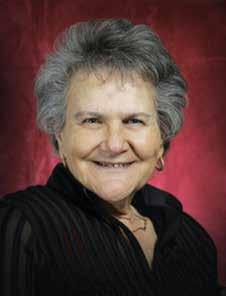
Mary Marcotte: Photo: CVRD
lumbia there have been many situations where property owners later discovered zoning rules affected their plans – whether that involved adding a rental suite, operating a home-based business, subdividing land or discovering that a neighbouring property could legally be used in ways they hadn’t anticipated.
Zoning may not be the most exciting topic, but it quietly shapes the character of our communities every day. Right now, an important piece of planning work is underway across the electoral areas of the Cowichan Valley Regional District: the development of a CZB that will eventually replace the patchwork of existing zoning rules.
To understand why this matters, it helps to step back and look at how community planning works.
Several years ago, during planning work in our region, I used a simple metaphor: a tree. The trunk represented the Official Community Plan (OCP), the large limbs represented major policy areas and the smaller branches represented zoning bylaws that shape how land is actually used. Today, that tree has grown.
The modernized OCP is now in place, and the next step is the CZB project led by the Cowichan Valley Regional District. While the work may sound technical, it will directly influence how land is used across rural communities throughout the Cowichan Valley. In simple terms, if the OCP provides the vision for the future, zoning is the rulebook that helps make that vision real.
A zoning bylaw is the principal tool used to implement landuse policies expressed in an OCP. It regulates how land, buildings and other structures may be used and where they may be
located. Good zoning must balance two goals: reflecting the long-term vision of the OCP while allowing property owners reasonable use and enjoyment of their land. In practical terms, zoning regulates things such as building size and placement, home-based businesses, agricultural uses and sometimes setbacks or parking requirements. These rules may seem technical, but they influence everyday decisions about how properties develop. Zoning also affects neighbours. A property that appears to be a quiet field today may have zoning that allows different uses tomorrow. Understanding these rules helps create predictability for both property owners and surrounding communities.
In much of our region, there is another layer beyond local zoning: provincial agricultural regulations administered by the Agricultural Land Commission through the Agricultural Land Reserve. The ALR was created to preserve farmland and encourage agricultural activity. If a property lies within the ALR, provincial rules apply alongside local zoning bylaws. Even if zoning permits something, it may still require approval under ALR regulations – or may not be permitted at all. These rules influence farmland subdivision, additional dwellings on agricultural properties, non-farm uses and certain farm-based businesses. In this way, local and provincial regulations work together to protect farmland while allowing agriculture to remain economically viable.
In parts of the Cowichan Valley, there is also a provincial designation affecting privately owned forest properties: private managed forest land, regulated under the Private Managed Forest Land Act and overseen by the Private Managed Forest Land
Council. These lands are enrolled in a provincial program intended to encourage long-term forest management. In exchange for maintaining the land primarily for forestry use, property owners receive favourable property tax treatment. Like the ALR, this designation adds another regulatory layer. Subdivision, development and land-use changes may be limited because the land is intended to remain in forest production. Local zoning still applies but must operate within the provincial framework.
Currently, the regional district operates under nine separate zoning bylaws. Over time, they have been amended many times through rezonings and planning initiatives. Because they were created separately, inconsistencies have developed in definitions and regulations – such as how building height is measured or the size of accessory buildings. For staff, applicants, builders and the Board, navigating multiple bylaws can be complicated. Provincial regulatory changes can also require amendments across several bylaws rather than just one.
The CZB project aims to address these issues by creating a single, consistent zoning framework across the electoral areas while still recognizing the unique character of individual communities. Several practical topics are being reviewed as part of the project, including secondary suites, accessory buildings such as garages and workshops, smallscale residential food production like backyard chickens or beehives, food trucks and the use of shipping containers for storage. These may seem like small details, but they illustrate how zoning affects everyday life in rural communities.
Zoning rarely makes headlines, but it quietly shapes the places we live. Taking a few minutes to understand it – and share your perspective – helps ensure the Cowichan Valley continues to grow in a way that reflects the values of the community. To stay up to date, visit to www.planyourcowichan.ca.
ben.maartman@cvrd.bc.ca 250-5105930
CVRD Area G
CVRD director Jesse McClinton’s report was not submitted by deadline. Please check next month.
The Grand Symbiosis of salmon and trees
BY RACHAEL MACDONALD, WILDWOOD ECOFOREST
At Wildwood, we hold a deep respect for the cyclical nature of, well, nature. We witness countless exchanges within the environment each season, each year. The carbon cycle, in growth and decay among our plants, animals and fungi; the water cycle, in the flooding and drying of seasonal ponds; and the reproductive cycle, in flowers, fruit, seeds and sprouts. Two cycles that we don’t get to see here are the intertwined lives of salmon and trees.
To our dismay, Wildwood does not host any salmon-bearing streams, nor does Quennel Lake have any of the Pacific salmon species grace its waters. However, across BC, in sight of any of the Pacific salmon’s spawning grounds, salmon and trees are inextricably linked. Around this time of the year, juvenile Pacific salmon stocks are ready to make their journey into the ocean. Depending on the species, they’ve spent a few weeks or up to a year in freshwater and are at the threshold of the next step in their life cycle. Meanwhile, adult salmon have already been at sea for a couple of years and are gearing up to migrate back to their inland places of origin. The sea provides a plethora of vitamins and nutrients essential to the salmon’s growth and then some; salmon need full reserves for the long journey to their juvenile watersheds, as they stop eating after the switch from salt water to fresh. Plants and trees require vitamins and minerals just like us, just like the salmon. However, they aren’t always accessible in a form that can be taken up by roots. One very important building block – nitrogen – must be “fixed”
Young Western red cedars (Thuja plicata) that could surely benefit from ocean-derived nitrogen. Photo submitted.
by bacteria and can be hard to come by. In the late summer and fall, grizzly and black bears with hibernation on the mind gather at rivers and streams to pluck jumping salmon out of the water, attracted to the fish’s nutrient and fat stores. The bears often only eat the skin, head and eggs of the salmon, leaving the rest to be scavenged on the forest floor. Decomposers and detritivores work their magic, and the tree roots finally receive their share of the ocean-derived nutrients. Trees closer to the salmon streams present a higher value of marine minerals than their kin further from the spawning grounds.
At the end of a tree’s life – whether felled by diseases, pests, winds or other forces – it finds itself horizontal. Those trees that lucked out as seeds and grew up along the riverbank, nourished by ocean-rich nitrogen and other nutrients from salmon carcasses, play a vital role in sustaining the intertwined cycle between trees and salmon. When a tree falls into a stream, its trunks and branches provide essential shade and shelter for salmon in the first few stages of their lives, ensuring that new generations safely reach adulthood and return to spawn and feed the forest again.
On the third Sunday of every month, Wildwood offers guided tours of our forest. For more information and to register, please visit our website: https://www.ecoforestry.ca/tours/public-tour.
Yard Makeover Contest!
Have a yard that needs work? How would you like an opportunity to help a friend or loved one win a $10,000 yard makeover?
If your yard has become a Big Shop of Horrors, your luck could be turning!
Rusty Shovel, with its hardscaping, landscaping, and design services in the region, is hosting a Yard Rebuild Contest.
“Contestants must be nominated and deserving of some help to redo their yard in a way to tidy up and simplify future maintenance,” said Rusty Shovel owner Matthew Tufts.
A prize budget of roughly $10,000 is offered for the yard rebuild. Design work by Rusty Shovel will be approved by the recipient for completion this winter or Spring 2027.
A photograph of the winner(s) yard before/after will be published. Those entering the contest must live in Ladysmith, Cedar or Yellow Point and say they saw the contest details ad in TAKE 5 Newsmagazine. TAKE 5 is also a contest sponsor and will be providing judges.
To enter, send a couple of photographs of the yard and a short paragraph describing why this yard and owner should win to Matt at design@rusty-shovel.ca. Deadline for nominations is June 15, 2026.
Top entrants will be featured on the Rusty Shovel website. Rusty Shovel is encouraging those interested to nominate their grandparents, neighbours, siblings, mom or dad or anyone who deserves a little extra help.
It’s the Season for Blitzing
BY PAMELA WALKER AND NIKKI TOXOPEUS
Have you ever noticed that there seem to be two kinds of people out there? One type knows an awful lot about the plants, bugs, birds and buzzing things, while the other type knows very little about them at all. Eager to learn more, the former are always on the lookout for new things. And the latter? They often need a little encouragement – and perhaps a helpful app – to get started.
That’s where the annual BioBlitz comes in. This community event invites everyone to record local wildlife using the iNaturalist app. Now in its fifth year, the BioBlitz continues to grow, with participants discovering more about the little creatures in our area and contributing valuable information to iNaturalist’s global database.
To inspire participation, the events offer prizes and bring both seasoned enthusiasts and newbies together. Last year’s prize winners included Elyse, Brian and Hayden Curley (Bioblitz enthusiasts), Evan Hessels (fish biologist), Kim Lagimodiere (Cowichan Tribes program coordinator for the S-hwuhwa’us Thi’lut
Kw’atl’kwa), Allison Krauza (hiker and mountain climber) and Braden Judson (fish biologist).
This year, the 2026 YES BioBlitz runs from April 24 to 27, featuring more guided walks and educational talks than ever before. The goal is to attract more participants, gather more data, strengthen community connections and advance community science – all in support of local conservation plans. For more details, check out our poster or website, but here’s a bit of a run-down:
DAY 1, Friday, April 24: The BioBlitz starts at 6 a.m. Make sure you’ve downloaded iNaturalist and know how to take and upload photos or record sounds. Or get help from our iNaturalist, YES’s fancy QR code, or a buddy.
DAY 2, Saturday, April 25: Did you stop at night? You don’t have to. Nature doesn’t stop when the sun goes down, so
why should the BioBlitz? Go out tonight and record what you hear or see. Owls, bats, raccoons, beavers, moths, aardvarks, turtles and many other creatures are nocturnal.
10 a.m. Holland Creek Trail Guided Tour, hosted by Friends of Holland Creek: Start at the Dogwood Drive Trail head. Check out the fish traps downstream with fish biologists or head up the trail with our bird and plant biologists. Kids are encouraged to attend.
5 p.m. Intertidal Talk with Fish Biologist: Bring your gumboots suggested and head to 5066 Brenton Page Road. Bring appies and a drink if you’d like to stay for a sunset social on the beach.
DAY 3, Sunday, April 26: Carry on exploring our parks and special places or join these community events.
10 a.m. Hemer Park Camas Meadow Tour: We can support the VIU students who are doing a vegetation survey by BioBlitzing using iNaturalist. Learn how it can be used to monitor restoration sites. Meet at Morland Road entrance and come into the meadow.
2 p.m. Cable Bay Trail Walk with Jain Alcock-White of Champagne Hill Botanicals: Meet at Cable Bay trailhead on Nicola Road. Walk to Dodd Narrows and back – a four-kilometre round-trip walk. Some uphill sections. Dress for the weather.
Day 4, Monday, April 27: This is your last chance to run around and take lots of photos. Download them onto the app, and identify as many as you can by 8 p.m. Remember, identifying others’ contributions reinforces your own learning – and it’s kinda fun to do. You have until May 8 to finish uploading. Will we get more participants this
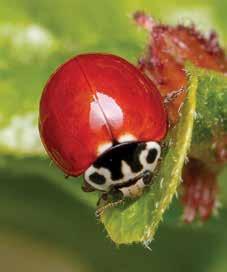
Western Polished Lady Beetle.
Photo: Evan Hessel
year? More observations? Will someone submit an endangered or critical species? Last year, participants recorded 16 threatened species, including the northern red-legged frog and the rusty click beetle! Will someone find something we didn’t even know lived here? The little sharp-tailed snake was seen last year, previously known only on some Gulf Islands. Whether you’re a Luddite, a technophile, a baker, a homemaker, a biologist or anything in between, we encourage you to join us!
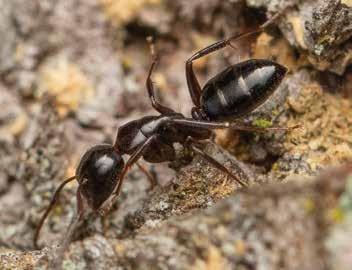
Carpenter Ant. Photo: Evan Hessel
Staying the Course in Uncertain Times
BY ALEX SHANNON
With all the headlines and uncertainty right now, most individual investors’ first reaction is to panic and sell. It is completely understandable. However, being a reactive investor can cause you to easily lose sight of your end goal and cost you in the future.
What many investors do not realize is that missing just a handful of the market’s strongest days over time can have a major effect on long-term returns. This is why having a sound financial plan is so important. A good plan brings a level of certainty, even when things feel uncertain.
When you are working with a financial planner like me, the focus is not on trying to time the market. It starts with understanding what you are working towards, whether that is retirement, supporting your family or having more flexibility in your life. From there, we build a plan that outlines how to get there and adjust it as life changes. When markets become unsettled, that plan gives you something to come back to instead of reacting to every headline.
At LDCU Financial Management and Wealth Strategies, our approach is centred on thoughtful planning. We focus on tax, retirement and estate planning, with the goal of helping you keep more of your money and use it in ways that matter most to you. It is a disciplined process built around experience – not guesswork.
Our investment approach is tailored to each client, but one thing remains consistent. We focus on protecting against the downside. I have always believed that strong defence leads to better longterm results. By managing risk during difficult periods, we help position our
clients for stronger outcomes over time and give them confidence in the path they are on.
If you are feeling uncertain, now is the time to have a conversation. Reviewing your plan, or putting one in place, can make all the difference. If you do not currently have a plan, our doors at LDCU Financial Management are always open.
Alex Shannon, QAFP is Ladysmith Credit Union senior financial advisor. Contact him by calling 50-591-4077 or emailing ashannon@avisowm.ca.
LDCU Financial Advisor Alex Shannon.
Photo submitted
Charmed?
“Third time’s a charm.”
– James Kelly, 1721, Scottish proverb
So it’s been a few months since I last put pen to paper, digits to keyboard. But I have my reasons – pretty good ones –and I’m sticking to them! You know that old saying that you never know the true value of something until it’s gone? Well, that’s what I’ve been thinking about for the last two months.
Just a small aside first, though. I distinctly remember asking Santa for a Dictaphone. When he ignored my wish (my plea) on Christmas 2024 and then again last Christmas, I really should have clued in and just got one myself. It would have come in “handy” now (no pun intended). A picture says a thousand words.
Am I getting more stubborn with age, denser or maybe just forgetful? I ask this because it seems my life events have to happen a few times before I get the hint and “listen up.” And that’s where this wee submission gets its quote. In my case, it was after my third (and last) accident down on the farm, when a wellmeaning friend said, “Well, bad things come in threes, so that’s it for you.”
It got me thinking about the number three. My thoughts, of course, went first to my childhood – Goldilocks and the Three Bears, The Three Little Pigs, and that nightmarish rhyme about the “Three Blind Mice.” Then, to writing rules: a good story has (1) a beginning to set the scene, as it were; (2) a middle – the meat, the telling of the tale; and (3) the end – the moral of the story, the resolution.
And then just for the H-E-doublehockey-sticks of it, I went to Ms. Google. Wow, did I open a can of worms. I had to stop reading all the meanings of the number three and its significance. Like the spiritual connotations in so many religions – not just the Christian Holy
Trinity but also in Hinduism, Buddism, Taoism and Judaism. And other triads like the past, present, and future; birth, life, and death; mind, body, and soul; and the goddess symbol, waxing, full, and waning moon. The mind boggles!
But back to me, me, me, and will Jackie ever learn her lesson? The answer is a resounding YES, but it took the magic three – more like farm baseball: three strikes and you’re out.
First, it was my ten-foot fall. I had a six-week recovery time, so I decided to get help with the horses. Enter my horse whisperers, Jan and Carys. I enjoyed the freedom to just schmooze with my steeds so much so that they’re still here doing the work part. I should have taken the hint and hired others to do the almost endless work of running this farm. I had hired my wonderful carpenter, Tony, and a couple of ever-energetic “studly farmhands” for fencing, wood-clearing and heavy work, but for some reason, I figured I could be that Energizer Bunny.
So mid-January, I was on my hands and knees, scrubbing floors, and BANG! It happened: a mallet finger on my dominant (left) hand. I was in a splint for eight weeks. But I still had my right hand. But doing anything I’d normally do with both hands – brushing your long hair and putting it up, opening cans of cat food, washing dishes, making a bed, the list goes on – was slower and awkward, to say the least.
Now, at this point, any normal person would’ve yelled, “Enough!” But not me. There were fruit trees – close to eighty of them – that needed pruning. Remember that story I wrote about my lovely new electric gardening toys, especially that battery-operated electric pruner –perfect for those aging, pre-arthritic fingers? Well, they are best used when you have two good hands. Actually, like my wonderful orchard ladder, they are also off limits from now on.
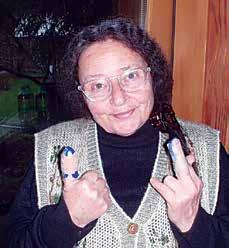
Accident number three? Bad, real bad. I decided it would be a perfect cautionary tale to include a picture with this article, but very few folks – except my horse whisperers and nurse friends – wanted to see it. I’m naming my right thumb Frankie, short for Frankenstein’s thumb!
Merriam-Webster’s Dictionary says that the idiom “Third time’s a charm” means that after two failed attempts, the third try is likely to be successful or
lucky. It is used to encourage persistence, implying that the third effort will finally bring the desired result. And that it has.
I’m in the midst of hiring a cleaning lady for this four-level farmhouse and a professional fruit-tree pruner. I consider myself very lucky. Our health-care system has been remarkable. My previous fractures have healed. The emergency doc who basically reattached my thumb was super-talented. Barb, my hand physiotherapist, is ever-vigilant, and the uber-skilled (and handsome) plastic surgeon Dr. Liu is understanding to my wimpiness and low threshold of pain! But the ones that stand out the most in my heart are all the friends who came to my rescue – the visits from my WI women, their cards and their treats – especially the turkey dinners from Debra – Jen coming to clean my house, Jan and Carys helping out more than just with the horses and Laurie being my chauffeur, my chef and a constant reminder for me to take it easy and heal. And of course, Marina, who not only gave me an arborist connection but also my new snazzy electric bed connection.
I’m a glass-half-full sort of gal. Lots to be thankful for. Hey, I’m even getting faster at one-finger typing and using the mouse on the left-hand side!
One question: Does anyone know where I can get a Dictaphone?
Jackie is feeling lucky and charmed to still have all her parts, have wonderful friends and is still able to enjoy her best life as she continues to carefully farm that 20 acres of organic paradise in Cedar.
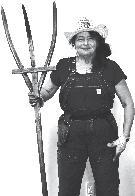
Jackie Moad with her recent injuries. Photo submitted.