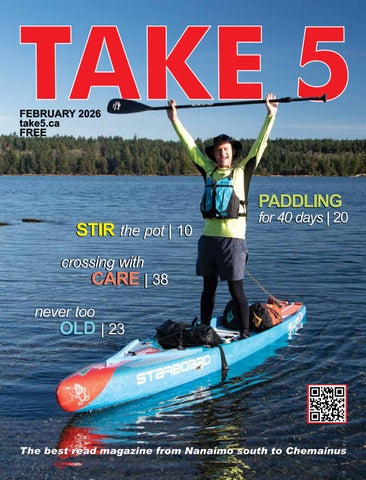
TAKE 5 February 2026

Page 1


Letters

Greetings from offshore

The water is a light emerald green here with patches of dark that hide colourful corrals and reef fish. The ocean is 28C. The same temperature of the air.

Its been almost a week since I joined the sailboat Maiatla II owned by Cedar residents Andrew and Janet Gunson. Andrew is working his way on a circumnavigation that started in 2012 but some bad storms and covid slowed him down. But for the past few years he is in the Caribbean and I am fortunate to be invited to join in some small part of his adventure. Also on board are his sister Jackie and Ladysmith’s Owen Pallot.

You can follow Andrew Gunson’s adventures via his blog nakedcanadian.ca.

I am writing this while on anchor in Belize, home of the world’s second largest barrier reef. This is a land of lush vegetation, bountiful variety of birds and a diverse ecology. Lots of Canadians retire here, but to make a living, one has to be a “jack of all trades”. For instance Deon and his wife Crystal, who moved here from Calgary work as professional drivers, tour guides, and in their spare time they harvest seaweed and are building a food forest.

There’s a lot of talk of Trump of course and unease in the Caribbean. The Canadian boats are flying bigger flags, and travelers are sporting Maple leafs ensigns on their backpacks or hats.

I met some residents of California who felt the need to apologize to us when they discovered we were Canadian. I said, we love the country and the people...we are not taking things personally.

But this is not about politics. This is about unplugging from an office with walls and living outside. In the moment. Feeling alive. And being outside the comfort zone long enough to expand one’s horizons.

There are a lot of similarities in Belize with our communities of Ladysmith, Cedar and Chemainus area. Friendly folks, the need to diversify and often hold down several jobs, and the love of the planet, the birds, the wildlife. Proof that you can expand your horizons right here at home. - Marina Sacht

Letters to the editor are welcome. This is an open forum for readers to express their opinions on community matters and do not necessarily represent the opinion of TAKE 5 or its affiliates. Email us at editor@take5.ca

Hot Diggity Hot Dogs!

Ladysmith Kinsmen presented a cheque to Ladysmith Food Bank over the holidays thanks to hot dog sales spearheaded by Jim Delcourt (pictured) aka the Hot Dog King in honour of the thousands he has raised through hot dog sales.

Some members of the Ladysmith Kinsmen Club at Country Grocer in Ladysmith. Photo: Marina Sacht
Kinsmen volunteer Jim Delcourt holding packages of weiners. He has sold thousands of the tasty sausages as part of hot dog sales.
Photo: Marina Sacht
Sailing in Belize. Photo: Marina Sacht

BC Heritage Week 2026:

Community heritage awards and dinner an opportunity to explore, celebrate our multicultural community

The goal of BC Heritage Week, a province-wide celebration held each year during the third week of February, is to inspire people to connect with local heritage and to raise awareness of the many ways it shapes our communities, identities and daily lives.

Take advantage of BC Family Day and Canada’s National Heritage Day (Monday, February 16) and BC Heritage Week (February 16–22) to visit the Museum and Archives and stroll the heritage walks about town (brochures available at City Hall, the Visitor Centre, the Archives and the Museum). You can also view the railway artifacts on Oyster Bay Drive and explore the artifacts and displays near Transfer Beach.

The Annual Ladysmith Heritage Awards are held in conjunction with Heritage Week to recognize those individuals or groups within our community who have played a significant role in preserving and promoting local heritage through their actions or initiatives.

This year, four very worthy recipients

will be honoured:

• Ladysmith Secondary School’s Land and Language Program (tumuxul’ ‘i’ hul’qum’i’num ‘qun ta’ta tul-s ct) – an innovative, immersive curriculum for grades 10–12 focused on Coast Salish language and culture through landbased, experiential learning;

• Bruce Mason, for his cultural contributions through the Ladysmith Little Theatre;

• Michael Dean, for documenting local heritage through his art;

• Michael Robinson, for his Heritage Timeline in the Credit Union.

Each year, a theme for Heritage Week celebrations is chosen to spark creativity and guide events across the province. The theme for 2026 is “Stir the Pot.”

In this case, “Stir the Pot” has a double

meaning. First, it is an invitation to celebrate food as a form of heritage that is both deeply personal and widely shared. Food reflects who we are and where we come from, and this year’s theme invites us to explore it as a vessel of memory and identity.

Second, it is an opportunity to spark cultural conversations, address issues of cultural recognition and build intercultural relationships within our community. By stirring this pot, we not only recognize and honour different traditions but also create space for dialogue and discussion.

In the spirit of this year’s “Stir the Pot” theme, volunteers from the Ladysmith & District Historical Society and participants in the Ladysmith Secondary School’s Land and Language Program

Ladysmith Heritage Awards in 2025. Photo: Bob Burgess

are welcoming you to a First Nation Traditional Dinner on Thursday, February 26, at 5:30 p.m., at Ladysmith Secondary School. The dinner will be followed by the presentation of Ladysmith’s Annual Heritage Awards.

The meal is offered to the community in accordance with Stz’uminus cultural tradition: all are welcome, and there is no charge. Volunteers would love for you to celebrate with them and take advantage of an opportunity to meet your neighbours.

To help with planning, those in Ladysmith wishing to attend are asked to collect a printed invitation from the Ladysmith Archives by February 20 and bring it with them to the event. Arrangements are also being made for invitations to be available to the Stz’uminus First Nation; details to be provided later on Facebook.

We here in Ladysmith and the surrounding area are blessed not only with beautiful surroundings but also with a rich multicultural legacy – one that should be treasured and explored.

Toonie Tuesday (for Seniors!)

Did you know the North Oyster & Area Historical Society (NOAHS) hosts Toonie Tuesday, a welcoming bi-weekly gathering where Yellow Point/Cedar residents can enjoy a cuppa and homemade dessert, chat with friends, play cards or crib, share books or puzzles, or simply soak up the friendly ambience of the room?

Over the years, Toonie Tuesday has also featured special guests who spoke on a wide range of area-related topics, including the local library, North Oyster Volunteer Fire Department, RCMSARLadysmith, RCMP-Safety Tips, Yellow Point Farms, and VIU’s senior’s programs.

At the 2017 NOAHS AGM, the president, Irene Hawthornthwaite, made a request to the membership for a volunteer to start up a senior’s drop-in at the North Oyster Hall. Sheila McMillan, Marilyn McKenzie and Barb Ferguson all volunteered to start a regular program,

Toonie Tuesday at NOAHs. Sheila McMillan, Lesley Oliver, Sue Wisely Photos: Nadine Wong

offering coffee, tea, and homemade goodies as an opportunity for seniors in the community to gather – and Toonie Tuesday was born. “I had worked at a senior’s recreation centre on the lower mainland and loved it, and was happy to be involved in the new program at the hall” said Sheila. Marilyn added, “I ran a seniors lunch program in Calgary and wanted to become involved in a new program as well.” Today, Toonie Tuesday is coordinated by Sheila, Sue Wisely, and Lesley Oliver, with other community members stepping in as needed. Sue said, “when I first moved to the area, Marilyn invited me to get involved

after our husbands met volunteering at the North Oyster Fire Hall—an easy way to meet new neighbours.”

I recently enjoyed attending one of their bi-annual lunches, where a toonie became a five-dollar bill in exchange for a hearty meal; soup, build-your-own sandwiches, tasty treats, and endless tea and coffee. The afternoon was made even more enjoyable with live music from the Dusty Roads Duo—Keith Oliver and Sig Reuter—who had toes tapping and hands clapping with their lively mix of country blues, roots and swing. Adding to the entertainment was Poet Laureate, John Edwards, who shared two of his newest poems, inspired by beavers and elk.

I asked Lesley how she got involved, she laughed and said, “My husband Keith played in a band that practiced in the hall, so it was easy to say yes when he volunteered me after COVID.” Participants are especially grateful for Lesley’s culinary talents—she is a superb soup maker, and I can personally attest that she makes some of the best soups around. While Barb Ferguson still attends Toonie Tuesday, she has stepped

back from organizing to allow others to bring fresh perspectives. Sheila, Sue and Lesley prepare most of the baked goods, though many members contribute.

More recently Shelia, Sue, and Lesley have committed to the second Tuesday of each month while Irene Hawthornthwaite and Isabel Bunning have committed to promoting the fourth Tuesday of each month. It is a community effort.

“A few years ago, we invited the choir from the Ecole North Oyster Elementary to come to sing for us,” Sheila recalled with a laugh. “The group enjoyed

the choir’s performance and the choir enjoyed the treats.”

Residents gather on the second and fourth Tuesdays of each month, typically from 10a.m.to 12 noon (special lunches start one hour later). Everyone is welcome—it’s not limited to seniors. Toonie Tuesday ($2) is a wonderful way to meet new neighbours, chase away the winter blues, swap spring gardening ideas, and, most importantly, get out of the house and connect.

If you would like to be included on the contact list for upcoming drop-ins please email Sheila at:

Email:toonietuesday.island@gmail. com

Maritime Society hits milestone, achievements noted

Ladysmith Maritime Society (LMS) has hit a milestone, marking its 40th annual general meeting Jan. 13 at Eagles Hall.

The meeting began with a prayer song by Stz’uminus Elder, Grace Elliott Nielson, who spoke about her life working and advocating for her community for over 60 years, and the power of connection and friendship, said Jackie Sharp, LMS president.

Achievements of the LMS year were highlighted, including a subsequent honour for the “talented boat restoration volunteers” who collected the 2025 Classic Boat Award for Best Tender for Dorothy’s Skiff.

The board reported on a successful Harbour Tour season, a well-attended Sea Life Festival, ongoing collaborations with the Maritime Museum of BC, Thetis Island Nature Conservancy and others, plus the society’s first ever online auction which raised nearly $9,000.

“We are thankful for our many supporters in the community who continue to donate and attend our events,” said Sharp.

“We are also very appreciative of the work done by our members and volunteers, and the society is looking forward to serving the community for another 40 years.”

To become a LMS member or volunteer, visit www.lmsmarina.ca.

Dusty Roads Duo, Keith Oliver and Sig Reuter, provide live music.

Life’s a cabaret: Little Theatre

Ladysmith Little Theatre and Ladysmith Musical Arts presents the iconic musical Cabaret, based on the play by John Van Druten and stories by Christopher Isherwood, Feb. 19 to March 15.

Set in 1930s Berlin as the shadows of the Nazi regime begin to fall across Germany, Cabaret tells the story of the seedy Kit Kat Klub and the people whose lives intersect within its walls.

This musical explores themes of love, politics, and the human spirit in the face of rising darkness, all set to an unforgettable score featuring songs such as “Willkommen,” “Maybe This Time,” and the haunting title number, “Cabaret.”

This collaboration between Ladysmith Little Theatre and Ladysmith Musical Arts brings together local talent to deliver one of musical theatre’s most celebrated productions. Cabaret remains a timeless classic that continues to resonate with audiences decades after its debut.

For information, visit www.ladysmiththeatre.com.

Bid For the Build seeks art for fundraising auction

The Arts Council of Ladysmith invites you to support the ‘Bid For the Build’, a fundraiser in support of an exciting and transformative project - the creation of a rejuvenated arts space at the Arts and Heritage Hub (formally known as the Machine Shop).

It is seeking original 2D works of art with a minimum value of $200, in ready-to-install condition. These works of art will be auctioned off at a big event

scheduled for March 27, 2026, with funds going towards the leasehold improvements estimated at $400,000. All donated works will be juried into the auction, and in accordance with CRA guidelines, a charitable tax receipt will be issued for the donated artworks sold. Any artworks not sold at the end of the event will be returned to the donor.

Artworks donated can be your own personal works of art or purchased works of art that you have collected. For details email info@ladysmitharts.ca

Charlotte Wright as Sally Bowles (top), Jenn Grace (left), Lauren Semple as The Emcee (centre), and Rebecca Baglo (right.)

Barry Strasbourg-Thompson presents an audio video on Art is My Refuge at main floor of Ladysmith Museum on Tuesday Feb. 3 at 7 p.m. as part of Cultural Voices presentation celebrating heritage, history and local fine art. Photo above: Nadine Wong

Art: Cultural Voices heard at museum

A new free monthly Art Event at Ladysmith Museum entitled Cultural Voices begins with a Feb. 3 presentation by H.B. (Barry) Strasbourg-Thompson BFA, a fulltime working artist who helps anyone at any level who is passionate about visual art to create their own happy, fun art. Strasbourg’s self portrait is the drawing above. Showtime is 7 p.m.

David Goatley is set to present as part of the series at 7 p.m. on Tuesday, Feb. 17. The events celebrate local art, heritage and history.

Tea and coffee will be available. For more information email Hbarryst@gmail.com.

Prayer Tree: Give us a sign in a cedar grove

If you walk along Rocky Creek and follow the pathway toward the back of Ladysmith’s Trillium Park, you’ll come across a grove of cedar trees. They are sturdy, evergreen, and adorned with strips of fabric and colourful ribbons. If you watch for a while, you’ll likely see individuals of all kinds approach. A few wander over, quietly reflecting. Some take a look at the sign—it reads, “Be still, reflect, say a prayer, make a wish, or set a positive intention as you tie a ribbon on a branch.” This tree, this space, welcomes all who come seeking peace and renewal. Others still fasten one more decoration to one of the limbs.

This is the Prayer Tree, an initiative started by longtime Ladysmith residents and friends Robin Billas and Trudy Reynen. Six years ago, Reynen introduced Billas to Trillium Park, where they’d head to walk, converse, and spend time together in a manner that complied with the pandemic's ongoing restrictions.

It was during one of these outings that inspiration struck Billas. “This idea came to me, I don't know how or where, but it's based on their tradition in Celtic countries.” Billas is referring to clootie wells. These sacred springs, creeks, or rivers situated by trees are the location of an ancient celtic practice. Those seeking healing dip fabric in the water and tie it to the tree’s branches whilst reciting a prayer to the well’s spirit. The idea of the act is that one’s sickness or worries will fade as the rag disintegrates over time.

“I thought, ‘why don't we create our own clootie tree here?’ We have everything we need. We have the sacred waters, Rocky Creek.…We have our tree, the sacred tree of the Salish people,” Billas explains. “And so we looked at each other,…we stood in reflection, and we asked the tree, ‘would you please give us a sign? Would this be okay with you if we used you as a conduit for healing…and peace and renewal?’ And…I know this might sound very weird to people who are not used to talking to trees, but we both got the message that yes, the cedar would be honored to be that.”

Within a week, Reynen and Billas had started bringing ribbons and fabric strips over to the grove. Soon after, they started to share the place with family and friends. After about a year, they put up a sign and made sure materials were available on-site. They realized others may be curious about the project or interested in participating, and it was important to them that everyone was welcomed. “It doesn't matter if you're religious or not, it doesn't matter if you're agnostic, atheist, what colour you are, what culture you're from, if you are a human being, this is for you,” Billas says.

Soon, both groups and individuals were regularly making use of the space. As the tree’s popularity began to grow, the pair began to take note of the Prayer Tree’s habitat. “We [noticed]...the environment was struggling with invasive species, particularly ivy,” Reynen begins. So, we thought, ‘let's invite the people we know… who come to this space, and we'll pull ivy around it, and then [do the same] out in the park.’”

Reynen and Billas set out with some others to do just that. They began with just their own hands and tools, working until Billas’s pickup truck was filled with plants. Eventually, they learnt the Cowichan Valley Regional District was carrying out similar ini-

Gathered around the Prayer Tree. ‘It’s spiritual.’ Photo submitted

tiatives in other parks, and they suggested a collaboration. Nowadays, Reynen and Billas are joined by family, friends, and local community groups—including high school classes, music collectives, and volunteer intitivates—to reintroduce certain species and eradicate harmful ones in the park. The CRVD provides additional resources, information, and tools, and the initiative takes place around Earth Day and then once more in the autumn. “It's a sacred relationship of mutual giving and receiving between us and Mother Nature,” Billas notes. “Nobody is separate from the earth and we're a part of nature. It's really important to recognize that.”

In many ways, the project has left a lasting impact on those involved. “I think it confirmed that so many people care. So many people are willing to connect to the spiritual, to the physical, to… beauty, to…scien[ce],” says Reynen. “This kind of experience confirms…that it's possible to make a difference,…to connect to others, and to work together towards [something]. [That something] will evolve. Not as you plan it, but as it needs to.”

Billas echoes these sentiments “We've heard kind of vicariously or through the grapevine how people find this spot to be so special.…People feel [it] in their bones.…You go there, and the stream is bubbling along in the background,…the trilliums are out,… you're down in a ravine,…and you're just surrounded by the beauty of the forest,” she explains. “I find that I can get some manner of peace when I'm there and we all need some peace in our lives, no matter who you are.” Though Reynen and Billas find joy in talking about or sharing images of the tree, they seem to agree that the true power of the cedar lies in the quiet, simple moments one experiences when in its presence. And so, for all those in need of peace, community, or a little solace, the Prayer Tree will remain in Trillium Park, always open to all who need it.

Ed Note: Thanks to Joseph Gary Chandler who suggested this story. We always welcome readers’ input.

Appetit Food For Thought: A Ladysmith hidden gem

In my search for restaurants and cafés—both new and long-standing— across the Island, I’m always drawn to places that serve food made with love, fresh ingredients, and flavours that keep us coming back for more. Those hidden gems are usually small, often busy, and full of character. I believe I’ve found one such spot, and it’s called Appetit Food For Thought.

We are lucky in Ladysmith to have this restaurant, which has been serv-

ing the community for 25 years. Appetit Food For Thought opened in October 2001 and is owned by Martin Tang, who likes to think of his place as a local diner - and that’s exactly how it feels.

Originally from Hong Kong, Martin Tang began his formal chef training at just 17 years old. He later moved to Berlin, Germany, to continue his culinary career before eventually settling in Can-

ada and, finally, Ladysmith. Martin has designed his entire menu himself, focusing on fresh, locally purchased ingredients from nearby businesses-something that’s becoming increasingly rare these days.

The menu offers a wide variety of dishes, ranging from Asian flavours to Canadian classics, and no matter what you choose, the food is consistently de -

Owner Martin Tang’s food is consistently delicious at Appetit Food For Thought. He likes to think of his place as a local community diner. Photos: Paul Legacy.

licious. As we entered the small but inviting diner, we were warmly greeted by Lauren and shown to our seats. With just 16 seats inside, the place was nearly full, buzzing with conversation. It felt like the kind of place where people come not just to eat, but to chat, share stories, and connect—often with Martin himself.

Lauren’s attention to detail stood out immediately. She was constantly checking in, refilling glasses, and making sure everything was just right. Easily one of the most attentive servers I’ve encountered in a long time.

It’s hard to find places where food truly brings people together the way it once did, but Appetit Food For Thought does exactly that. It feels a bit like your mom’s kitchen—you just know it’s going to be good.

My wife ordered the soup, while I went for the Big Breakfast. And let me tell you, the name does not disappoint. Three eggs, three strips of bacon, ham, hash browns, beans, and toast— all beautifully presented on a massive plate. Everything was cooked to perfection. My eyes were definitely bigger than my appetite, and I couldn’t quite finish it all, but every bite was excellent.

My wife’s coconut chicken miso soup arrived in a large bowl, presented like something from a five-star restaurant. The aroma alone was incredible, and the flavours were rich, comforting, and absolutely delicious.

Martin also offers daily specials. One standout is his soup meal, which comes loaded with vegetables and your choice of udon, ramen, or Chinese egg noodles for just $14.99.

The restaurant has 16 indoor seats and a small outdoor patio during nice weather. The restaurant is open Monday to Friday from 8:30 a.m. to 2:30 p.m. Sometimes, the search for great food leads you right to your own backyard. I wholeheartedly recommend Appetit Food For Thought —whether you’re looking for a satisfying meal or a cozy spot to meet a friend. The food is wonderful, and the service alone will make you smile.

You can follow Paul Legacy’s food blog: A Legacy in Thyme at https://www.facebook.com/share/1AvhVXYW3a/?mibextid= wwXIfr

Chef Martin Tang of Appetit Food For Thought restaurant in Ladysmith. Photo: Paul Legacy

Paddling into history: Verchere

Paul Verchere paddled north from Transfer Beach in the early hours of June 25, 2025. He left quietly with camping gear and enough food and water to last 40 days, all packed into his dugout paddleboard.

As his unassuming figure disappeared around the curve of the harbour, Paul made history as the first person to circumnavigate Vancouver Island on a paddleboard.

The plan started when Paul was recovering from an ankle-replacement surgery. As a life-long athlete, Paul had done everything from skiing in the Alps to hiking summits in the Himalayas. But he struggled for a decade with a painful limp following a mountain-biking accident. He had to put training for races and dreams of running or biking across Canada on hold. Eventually, he needed the replacement just to walk.

Paul’s recovery left him hungry for a challenge. Races that spanned a long weekend weren’t enough for him. “When I was recovering from the ankle

transplant, I kept thinking of something I could do when I could walk again.”

Paddleboarding was a natural choice for him because he was already doing it and had raced in Thailand.

He had previously spent 10 years living in Bangkok as a yoga instructor and was familiar with the quiet islands

he chose. But his paddleboard was also manufactured in Bangkok, and he hoped training there would drum up support. “I went there to hopefully get sponsorship – which I didn’t get – but I also wanted to paddle consecutive days in February, to make sure I’d be ready to do big long days.”

Paul Verchere: World traveller with a history of personal challenges. Photo: Selfie

Despite his training, the first week of the journey was still an adjustment. “My first five days paddling, my back was killing me. My body felt horrible. I was trying to do yoga in my tent at night, but after about a week, my back felt better. After two weeks, I felt great. By the time the trip ended, I felt amazing.”

A typical day for Paul started at 2:45 a.m. He wanted to be on the water at first light. Then he would paddle as far as he could before making landfall in the evening. Good camping spots and fires were luxuries he quickly gave up on. His routine became finding a safe spot to land, setting up his tent, rehydrating his food and going to bed.

The hardest part was the headwinds. Pushing against him as he paddled north, the wind slowed him to a gruelling pace. “I was [moving] one metre at a time, hiding behind rocks, by

trees – behind anything I could find as a wind shield.”

This slow pace and the relentlessness of the wind made him doubt whether he’d be able to complete the journey. But instead of giving up, he kept going, just a little farther. “Every time you get around a point, there’s usually a wind shield, and when you go into a bay, you can regroup or recover. And then I do it again and again.” Eventually, he made it to the top of the island.

Cape Scott is notorious for having extreme weather and waves. In his preparation, Paul had read horror stories of sailors and kayakers risking dangerous waves and storms. When he arrived, he thought they may have exaggerated.

“When I got there, I thought, ‘This isn’t too bad.’ [But] about 15 or 20 minutes later, [I was] surrounded by waves as big as a three-storey home. And because all the water comes from dif-

ferent directions there, the waves were all coming from different directions – giant waves [that] looked like houses coming from three different directions all at the exact same time.”

Sitting in his dugout paddleboard, Paul had nothing to protect him if he capsized. He had no choice but to ride the waves. “I skyrocketed, like on a rollercoaster, going way up on the top of these waves, and I could see for almost a hundred kilometres in any direction. Then I dropped into the canyon … and suddenly powerful waves were above me. I [was] almost afraid they were gonna crash because … they would crush me. But my paddleboard is like a cork, and I just shoot back up.”

Wildlife abounded on the northern tip of the Island. He saw 15 bears during the trip, and while he had a close call with one of the bears, whales caused him more trouble.

It was one particularly stormy day when he got his first sighting. Wind pushed him to a speed of 12 kilometres an hour. He described not being able to paddle but instead, “you can only point and shoot.” The mountains met the sea in jagged cliffs. There was no safe place to land. When the waves crashed against the rocks, “the white spray was going up a hundred feet.” That’s when the humpback whale breached. “It was a beautiful sight. It just froze in my mind. And I yelled, ‘F* yeah!’”

After that, whales were everywhere. “I was so nervous that one of them was just gonna come up right underneath me. … I was constantly trying to avoid them. [It] became almost comical.”

The trip south went faster. The wind was at Paul’s back, and he easily reached more than 50 kilometres in a day. He saw the sun and felt summer’s warmth when he reached Sooke . “The last two days [paddling] were the first summer days I had that were warm and hot.”

Arriving back in Ladysmith on August 3, Paul finished his circumnavigation of Vancouver Island 40 days after he set out. The journey covered 1,300 kilometres.

Now, a few months after the adventure, Paul is ready to do it again, going the other direction. He recommends living as physically active a life as one can. The nature of the Island is what he loved most about the journey, and he hopes everyone can “get out and enjoy the incredible place we’re living.”

Over-nighting meant some beautiful camping spots along the wild coast of Vancouver Island. Photo: Paul Verchere

Don’t let the old man in

Last summer I broke my hand but I decided to go anyway on the family boat trip. But I couldn’t do anything, and that was frustrating.

So I found myself sitting on a bench listening to the grandkids playing on the beach. It was too steep for me to climb down with my hand. And this older fellow came over and he said, can I come and sit next to you? I nodded and he went on to tell me his story. His dream had been to go to Thailand and spend the winters there. But his daughter had said, “No, you’re too old,” and wanted him to move in with her family.

He loved his family but this was one of the last items on his bucket list.

As he got up to leave I asked him what he had finally decided.

“I’m going to move in with my daughter,” he sighed. “My friend had warned me, not to let the old man in, but it’s too late. He’s here.”

This song became a hit for Toby Keith who died six months after it was released from stomach cancer. He was inspired to write it by Clint Eastwood. While golfing he asked Eastwood how he managed to be so active so late in life.

His reply: “I get up in the morning, I go outside and I don’t let the old man in.”

That is good advice for all of us regardless of our age.

So here are a few tips to keep the old man or woman out.

Cultivate a young spirit and mindset. Stay active and busy. Learn new skills. Try new hobbies. Just keep moving.

Stay curious. Never stop asking questions and wondering.

Stay positive. Surround yourself with positive people. Do what brings you joy.

Be physically active. Enjoy the great outdoors.

Practice healthy habits that are going to make you a healthier person.

Cultivate good relationship. If you have an issue with somebody, talk it out.

Focus on the present. Enjoy the moment that you are in. And don’t worry about the future.

Be creative. Don’t just do the same thing. Try new things.

Motivate yourself by finding your purpose whatever it is.

Don’t be resigned to going quietly into the night. Fight for your independence and your dreams, It’s not too late. If you can no longer do something, find an alterantive. You are not too old. Don’t fall into that trap. Age appropriate is just in your mind.

Live your life as if it’s your last day. Full of enthusiasm, vitality and meaning.

Never be resigned to thinking that aging means giving up our dreams. And you will keep the old man or woman out.

Fore more tips follow Aging Well with Polo Sisiters podcast on Spotify or on YouTube at Marco Polo Family Ties podcasts.

Flagship HMS Norfolk anchors, entertains in

Ladysmith

Harbour

As reported in The Ladysmith Chronicle, HMS Norfolk anchored at 5 p.m., on Monday, August 6, 1934, in Ladysmith Harbour. A Royal Navy-class heavy cruiser, she served as the flagship of the American and West Indies Squadron of His Majesty’s fleet, carrying aboard Vice-Admiral Sir Reginald Aylmer Ranfurly Plunkett-Ernle-ErieDrax, commander-in-chief of that station and a British seaman of considerable note – and not just because of his long name! Mayor Walkhem, members of the City Council and a few other representatives went aboard as guests.

Later that evening, a softball game was held, at which the ship’s band played a much-enjoyed musical selection. A Smoking Concert was also held in the Army & Navy Veterans Quarters, with the sailors playing “an important part in the programme as they had some very talented artists, who rendered some

exceptionally clever numbers.”

On Tuesday morning, the town’s children were guests aboard the ship, thrilled to watch a seaplane take off from its moorings on the top deck and fly over Saltspring Island. Someone in Ladysmith took the photographs accompanying this article (which are now in the Ladysmith Archives collection).

In the afternoon, the vessel was open to the public, and many took advantage of the opportunity to see one of the most up-to-date cruisers in His Majesty’s Navy. A party of about 50 crew members was given a tour of the Victoria Lumber Company mill in Chemainus.

Also on Tuesday afternoon, a soccer match was played between a local XI and a team from the ship, the latter winning 2 to 1. That night, a spectacular searchlight display lasting over half an

hour radiated from the ship, and when the national colours (red, white and blue) were shown from the three searchlights, it was “magnificent.” This was followed by a dance held in Aggie Hall, at which all men in uniform were guests of the town. Proceeds went to the officers of the Norfolk for donation to the Sailors’ Orphanages charity.

After a brief but busy visit to Ladysmith, HMS Norfolk departed at 7 a.m., Wednesday, August 8, for Comox, where she participated in manoeuvres with other Navy ships.

HMS Norfolk was built in the Scottish shipyards at Goven near Glasgow and launched in December 1928. She was 633 feet long, had a beam of 66 feet and a draught of 17 feet. Displacing up to 13,670 tons fully loaded, she was propelled by four steam turbines driving four screw propellers, with steam provided by eight oil-fired boilers. She had a top speed of 32.25 knots (60 kmph) and a cruising radius of 12,379 nautical miles (23,000 km) at a speed of 12 knots. Crew numbered 710 officers and enlisted men.

On commissioning, she was fitted with eight eight-inch guns in four twin turrets, and a second battery consisted of four twin four-inch dual-purpose guns. For spotting purposes (her launch predated the development of radar), she carried two Supermarine Walrus flying boats, which were launched by catapult. (The small aircraft onboard at Ladysmith Harbour is not one of these; by its identifier [CF-ANF], it appears to be a Canadian Fleet Model 2 biplane, possi-

Seaplane propelled from top deck of HMS Norfolk, flies over Salt Spring Island in 1934. Photo: Ladysmth Archives.

bly a trainer). Later, in World War II, anti aircraft armament and two quadruple 21-inch torpedo tubes were added.

At the onset of World War II, Norfolk was part of the Northern Patrol guarding the Denmark Strait between Iceland and Greenland against German blockade runners and convoy raiders. In November 1939, she was involved in an unsuccessful chase of the battleships Scharnhorst and Gneisenau, which were harassing allied shipping. After surviving a Junkers 88 dive-bombing at the Allied naval base at Scapa Flow in the Orkney Islands in 1941, she went on to play an important role in sinking the powerful German battleship Bismark – the pride of Hitler’s fleet.

HMS Norfolk was then employed to protect Arctic convoys supplying the Soviets via shipping from the UK, Iceland and North America. In 1943, she partook in the Battle of North Cape, off the northern tip of Norway, inflicting several hits on the German battlecruiser Scharnhorst and subsequently participating in its eventual sinking.

At the end of the war, HMS Norfolk transported the Norwegian Royal Family back to Oslo after their five-year exile in London. In 1950, she was outdated, sold out of service and scrapped.

HMS Norfolk, anchored in Ladysmith Harbour. Below: Broadside view of ship. Photos Ladysmith Archives.

Le Petite Store’s treaures about to be discovered

La Petite Store formerly the La Petite Auction in Chemainus is re-opening Feb. 11-19 to accept consignments for its official re-open on March 4, reports Chemainus and District Chamber of Commerce.

The store, located at 9686 Chemainus Road, features a wonderful collection of quirky collectibles, curated home décor and furniture.

Shoppers are encouraged to “stop in and explore the showroom floor . . . you never know what treasures you’ll find!”

To ask about consignments, call 250701-2902.

Godspell a folk-rock hit at Chemainus Theatre

Get ready for Godspell, the classic folk-rock hit from Wicked’s composer, Stephen Schwartz, Feb. 20 to March 29 at the Chemainus Theatre Festival.

This celebration and exploration of creating community and sacrificial love explodes with catchy music, a talented cast of actor-instrumentalists and playful parables in vibrant, contemporary, and fresh theatrical magic.

The production was conceived and originally directed by John-Michael Tebelak and was originally produced on the New York Stage by Edgar Lansbury, Stuart Duncan and Joseph Beruh.

Content Advisory: Depictions of crucifixion and biblical references. Recommended for ages 8+.

Join the theatre for lunch or dinner in the Playbill Dining Room. Dining can be added to your order after selecting your theatre tickets, available on the theatre website at www.chemainustheatrefestival.ca.

Wood sculptures and murals are appealing features of downtown Chemainus. Photo: Rick Rake

RDN Area A

I write this February Director’s Notes on Jan. 9, shortly after the New Year and amidst a lot of uncertainty and tumult in the world. This time of year is often a time for reflection. It’s also the last year of my term as Area A director. As such, I’ve been thinking about what I want to achieve and questioning if I have done what I said I would do during the election. Being true to one’s word is a value that I hold dear, and one I think is particularly important for anyone who bears the moniker “politician.”

Let’s lay bare what I said in my information card:

“A vote for Jessica is a vote for:

• Prioritizing affordability and community well-being

• Protecting the rural character, agricultural interests and natural environment of Area A

• Sustainability and environmental resilience action

•Reviewing and prioritizing our OCP to ensure progress

• A community road safety plan that includes safe and active routes to school

• Responsive and active representation that promotes the interests of Area A to all levels of government”

The very first item – affordability –is perhaps my biggest challenge of this term. Who could have imagined the cost increases we were about to face back in the fall of 2022?! All major government projects experienced significant cost increases; concrete, wood and steel have gone up more than groceries and gas. During budget time each year, I attempted to remove new staff positions from the budget, questioning if we needed the additional cost. Sometimes, it was a clear “yes,” as in the need for building and bylaw staff. Several times, I attempted to remove or delay new staff positions, but I was rarely successful at the Board table in those debates. Overall, affordability always played a factor in my decision-making and voting, but reality is that cost increases were unavoidable in recent years. Gratefully,

Area A experienced fewer increases than other areas and remains the electoral area with the second-lowest tax rate in the RDN.

I have had more success in protecting the rural, agricultural and natural character of Area A and in achieving environmental action. Through my work on the Agricultural and Climate Action committees, the RDN updated their Agricultural Area Plan and their Climate Action Plan. Further, the approval of the Regional Growth Strategy directs density to the municipalities, alleviating growth pressures on the electoral areas. These decisions help retain the rural character and agricultural roots of Area A. The OCP for Area A is now slated for update in the coming years behind the much older OCP for Area C. As well, we are in the process of evaluating road safety in the Cedar Village area and will develop a road safety plan. I’ve asked that a multipurpose pathway between Cedar Elementary and Secondary schools be included in this plan.

Evaluating whether I have been responsive and active in my representation remains in the hands of Area A residents. That being said, I have strongly advocated for our community at the Board table, with all other government entities when relevant (yes, about roads), and have attempted to be responsive in my communication.

The above goals and work deserve a much more thorough analysis, but I want to focus on my stated priority of enhancing community well-being. The sense of community and connection within Cedar, South Wellington, Cassidy and Yellow Point is what makes our community special. Creating playground or park space in all our communities was a priority for me because these amenities provide the opportunity to meet our neighbours and develop relationships. As well, I have attempted to increase supports for our community organizations because it is those people who strengthen our community through their service. The events they organize get us

out of our houses, give us opportunities to chat and find commonalities, and help us all become more familiar with one another. We move from strangers to acquaintances, from acquaintances to friendly interactions, and perhaps to friendships – each step offering an opportunity to feel less lonely, gain access to needed skills, services and support, or simply have someone to say hi to at the grocery store.

As simple as this is, it is profoundly important because it improves mental health, increases likelihood of participating in recreational events and gets us out in the community more often, which in turn decreases the likelihood of crime. Building community connections provides significant return on investment. In this time of increasing uncertainty and anger, our best antidote to division is community familiarity and connection. This is why public spaces and social/recreational opportunities are crucial to well-being.

In closing, I want to highlight some of the people providing the importance social service to our community. I’ll start with Levi Grandin. This fabulous 13-year-old has been doing random acts of goodness in our community. He’s cleaned up parks. He volunteered at Santa’s Breakfast at the Cranberry Fire Hall. I am so impressed by Levi’s willingness to put himself out there and help out others. Thank you, Levi!

Next is the amazing Cedar Community Hall group. They are all fabulous, but I want to single out Jim Fiddick. Jim’s lifelong list of acts of community service is deeply humbling. To list a few, he has volunteered his time with Search and Rescue, the RDN Parks, Recreation and Culture Committee, various equestrian groups and Cedar Community Hall. Jim gives a lot to Cedar and has expected the same from me. Jim is just one member of the thoroughly enjoyable Cedar Community Hall crew. I encourage other community members to consider volunteering with the group.

Finally, I want to acknowledge the SWACA members, who are working

hard to bring a community-run community centre to life. Lately, they’ve been in the nut and bolts of operation planning. The South Wellington Community Centre will be open soon and will offer multiple rooms and an outdoor space for all of us to gather, connect and play. The RDN will provide some recreational programming at the community centre, with other services to be determined by providers who rent the space. If you are interested in learning more about space rental or want to contribute to the creation of a community space, please contact Rebeca at helloswaca@gmail.com

Your thoughts and comments are always welcome.

Email: jessica.stanley@rdn.bc.ca

Phone: 250-268-7359

CVRD Area H

Mark Your Calendar

Area H Director Town Hall at 7 p.m. on Thursday, Feb. 5 at North Oyster Community Centre. This Townhall was added to provide a Budget 2026 update before final decisions are made on Feb. 12.

Area H Director Town Hall at 7 p.m. on Thursday, February 19, 2026, at North Oyster Community Centre. The agenda includes a budget update, Comprehensive Zoning Bylaw update, and Gas Tax funds.

On Thursday, March 19, 2026, there will be a combined Town Hall with RDN and CVRD directors, Jessica and Ben, featuring guest speaker Dave Devana, president and CEO of Nanaimo Airport Commission. The time and place will be determined.

Transparency, Data Centres and Staying Informed in Area H

As your Area H Director, I spend a lot of time hearing from residents who care deeply about what happens to the land, water and rural character of our community. A recent Times Colonist article about resistance to large datacentre proposals across North America struck a chord with me – not because Area H is facing a proposal of that kind, but because it highlighted a concern I hear locally again and again: Why does it sometimes feel like the public hears about things later than government does?

The short answer is that there is a gap between early conversations and formal applications. The longer answer is more nuanced – and it matters, because how that gap is handled can either build trust or erode it.

Why data centres and similar projects raise red flags

Modern data centres are enormous industrial facilities. They run 24/7, draw heavily on electrical infrastructure and require constant cooling through mechanical systems, water-intensive processes or diesel backup generators. In rural areas, concerns quickly arise around noise, air quality, groundwater and the loss of farmland or forest.

While data centres are an extreme example, the same land-use questions apply closer to home. In Area H, residents regularly raise concerns about impacts on Agricultural Land Reserve (ALR) lands, increased pressure on wells, traffic on rural roads and gradual changes to the quiet character many people moved here to protect.

Why there is an information gap

One of the strongest reactions described in the Times Colonist article

came from residents who learned – sometimes through leaked emails or last-minute reports – that governments had known about proposals for months or even years before the public was notified. That sense of secrecy understandably fuels frustration.

But it is important to understand that this gap does not only protect large developers. It also protects local residents.

A common Area H example is a resident considering subdividing a property, adding a secondary suite, starting a homebased business or exploring agri-tourism on ALR land. Before committing time and money, they contact CVRD planning staff to ask basic questions: Is this allowed? What approvals would be needed? What studies might be required?

At that stage, people reasonably expect confidentiality. Plans change. Financing falls through. Family circumstances evolve. It would not be fair for preliminary ideas to become public – or spark neighbourhood concern – before the resident even knows whether the idea is feasible.

The same principle applies, in part, to larger proposals. Preapplication meetings are meant to identify issues early and avoid costly mistakes. These discussions are typically confidential, and staff are legally constrained in what they can share.

Another important piece of this puzzle is legislation. The CVRD regularly receives Freedom of Information (FOI) requests for internal communications. How they respond is governed by provincial law – specifically the Freedom of Information and Protection of Privacy Act (FOIPPA). This legislation clearly outlines what information must be released and what must be protected, including personally identifying or legally restricted material. Staff do not arbitrarily decide what is or is not confidential; the rules are set by statute.

Other reasons the gap exists include:

• Incomplete applications – until a proposal is formally submitted and deemed complete, it may not appear on public agendas.

• Legal limits – privacy legislation restricts what information governments can release.

• Process-based notice – public notification is tied to specific stages, such as rezoning hearings, not early conversations.

Understanding these constraints does not eliminate frustration, but it does explain why “knowing about” something is not the same as being able to publicly discuss it.

Why timing and transparency still matter

When residents first hear about a proposal, just weeks before a decision, trust is strained. People feel rushed, governments appear defensive, and developers feel cornered.

Earlier awareness – even if details are limited – allows for better questions, calmer discussion and more meaningful participation. Transparency is not just about meeting legal notice requirements; it is about ensuring residents feel respected and included in decisions that affect their community.

How to stay informed in Area H

There is no perfect system, but there are practical ways residents can stay informed about what is moving forward at the CVRD:

1.Review CVRD agendas and minutes: These are posted online before meetings and can provide early notice of rezoning applications, ALR referrals or policy discussions.

2. Watch development and rezoning applications: Once ap -

plications are formal, staff reports and supporting documents are posted online.

3. Subscribe to CVRD email notifications: This is a simple way to stay current without constantly checking the website.

4. Read Area H updates: I share information through newsletters, emails and community meetings to provide context beyond technical reports. If you would like to received updates, please send me your email.

5. Ask questions early: Residents are welcome to contact planning staff or me to ask what stage a proposal is at and how to participate.

A Shared Responsibility

The experience of communities elsewhere shows that trust can disappear quickly when people feel left out. Maintaining that trust requires balance: respecting confidentiality early on while ensuring openness and meaningful public input once proposals become real.

Area H has a long tradition of people paying attention, asking questions and speaking up. By understanding how the process works – and by using the tools available – residents can stay informed and engaged, and local government can continue working to improve transparency where it matters most. It should not feel like “them and us.”

Ben.maartman@cvrd.bc.ca, 250-510-5930

CVRD Area G

The Middle Path: Why I Voted “No” on a Plan I Largely Support

Politics often demands simple answers to complex questions. You are either for or against; yes or no; win or lose. But real leadership usually lives in the uncomfortable middle – the space where good policy must meet the integrity of the democratic process.

Recently, the modernized Official Community Plan (OCP) was ratified by the Cowichan Valley Regional District with a 7 to 3 vote. I was one of the three “no” votes. To some, this may seem contradictory. I support much of the policy direction for Area G, but leadership isn’t just about the destination – it’s about the journey, and whether the public trust needed for longterm planning truly exists across our region.

Evolution, Not Erasure

Much of Saltair is currently zoned at one acre or larger. In the 1990s, this was a necessity; smaller lots relying on older septic technology created serious public health concerns. Today, that context has changed.

Advances in septic engineering mean those constraints no longer apply in the same way. Responsible planning requires us to revisit old assumptions with modern tools, rather than clinging to the status quo simply because it’s familiar. Area G is not meeting its 20-year housing targets, and we cannot ignore that reality.

The updates in Saltair are measured and incremental, affecting less than 10 per cent of properties. This is not blanket upzoning, but a form of locally informed planning that aims to:

• protect our character by safeguarding the rural beauty that defines us;

• support families by providing flexibility for accessory

dwelling units so families can stay together; and

• promote smart growth to ensure development fits the community rather than overwhelming it.

The Regional Trust Gap

If the policy for Area G is sound, why vote “no”? Because my oath of office requires me to represent the entire region.

During the public hearings, a stark contrast emerged. While Area G was largely supportive, hundreds of residents from neighbouring Areas E, F and I strongly opposed it. This was not a fringe movement; it included forest landowners, industry operators, Advisory Planning Commission Chairs and representatives from other levels of government.

Public hearings are the heartbeat of local democracy. When they reveal a broad, sustained trust gap across multiple areas, it is a signal to slow down and listen. Supporting the OCP at that moment would have been an endorsement of a process that many found rushed. Good policy cannot succeed without “social licence,” and trust cannot be forced to meet a deadline.

Moving Forward: From Policy to Practice

It is essential to be clear about where we stand today: the Modernized OCP has passed and is now in effect. While I voted “no” to signal that the process needed more work, the democratic decision has been made. My role now – as your director – is to ensure this plan is implemented responsibly, fairly and successfully.

For Area G, there is much to be optimistic about. The policy direction reflects years of local input and delivers the practical tools that property owners have been asking for. My focus is now firmly on making this work for us by:

• hosting regular community meetings to ensure ongoing, transparent engagement;

• advocating for infrastructure to ensure growth is well served and sustainable; and

• exploring ways to strengthen economic resilience, including industrial land expansion west of the Island Highway to support local jobs.

Responsible Leadership

My vote was never about standing in the way of progress; it was about standing up for regional legitimacy. Now that the path is set, I am committed to doing the work that comes next – supporting Saltair’s evolution while continuing to push for better collaboration across the entire Cowichan Valley.

That is what responsible leadership looks like: respecting the decision, supporting the community and staying committed to the work ahead.

The Unnoticed Activity of the Wintertime Forest

When we think of nature in the winter, we often picture trees without leaves, bears hibernating in cozy dens and ponds frozen over.

At Wildwood, it’s a pleasure to walk through old-growth forests and watch the seasons progress. Springtime is my favourite, with the multi-layered choruses of birdsong and short-lived ephemeral flowers. Summer is cool under the healthy canopies that reach across the trails, with the busy Western thatching

“Although trees don’t have eyes, brains or nerves, they can still sense the changes in daylight....”

ants scurrying around at our feet. When fall comes, we are treated to a live art show, with the changing leaves and fungi flourishing in the autumn rains. Winter brings its own beauty, especially when we get a crisp snowfall. One might assume that all is quiet and sleepy.

Although trees don’t have eyes, brains or nerves, they can still sense the changes in daylight and temperature, and as the days become shorter and colder, our trees begin the process of shutting down for the winter. Saturated fatty acids within tree cells are switched out for unsaturated acids, which have a lower freezing temperature.

As the season progresses, water is also moved out of the cell to the areas in between.

Water in these pathways may still freeze, but will do less damage outside the cell. A tree that hasn’t acclimated properly, or faces an unexpected extreme cold snap, can actually explode! If

A culturally modified Douglas fir at Wildwood. Photo: Kali Brauckmann

the water in sap freezes, it expands and pushes out against the bark, resulting in a big bang.

The wildlife at Wildwood gets ready for winter with a number of different adaptations. Our white-tailed deer grow layered, shaggy, insulating winter coats to protect themselves from the cold temperatures, snow and rain. Bald eagles might leave their usual range in search of food and opt to roost together to conserve warmth. The outwardly unremarkable shrew, of which Vancouver Island hosts three species, doesn’t hibernate or store food for the winter. They shrink their body size – bones and all – to maintain their high metabolic rate with less food available.

Our rough-skinned newts dabble in a form of hibernation called torpor. In areas with access to year-round bodies of water, they remain active through the winter. If those ponds or streams aren’t available, they find a nice, moist log to camp out under for the cold season and embrace lethargy.

I think we can all see ourselves in the Wildwood critters’ physical and behavioural winter adaptations, and thankfully with the solstice behind us, we can soon shed our winter coats and lethargy.

As we collectively blink awake, take long stretches and get ready for spring, embrace the promise of sunshine and make plans to get outside. Beginning again in March, the Wildwood naturalists are offering public tours of our sustainably managed old-growth forest on the third Sunday of each month.

Register ahead of time at ecoforestry. ca/events-tours, where your small fee will go directly towards the continued protection and preservation of this endangered coastal Douglas-fir ecosystem.

Helping Wildlife

Have you ever encountered a sick or injured animal or a seemingly abandoned seal pup and weren’t sure what to do? Fortunately, several organizations exist regionally that can help in such circumstances. Below is a compilation of their advice and contact information for when wildlife might need assistance. Finding a distressed animal

Here are some signs an animal may need help:

• Obvious injury from a vehicle collision or a window strike

• Disoriented, stumbling or not reacting when approached; discharge around eyes or nose

• If a baby: prolonged crying, laboured

breathing; covered in bugs; cold; no adult around; dead sibling nearby

Before attempting to assist the distressed animal, it’s best to call a certified wildlife rehabilitator, who can offer advice on the best course of action. If you have to help them alone, rehabilitators recommend the following until assistance is obtained:

• DON’T try to capture an animal if you think it may be unsafe for you or the animal. Birds of prey can be dangerous to handle without knowledge and experience.

• Use a towel to confine it and protect yourself. Place in a ventilated, dark container in a quiet place. If it’s wet or a baby, place a heating pad on “LOW” under half the container.

• Minimize handling. DON’T GIVE FOOD OR WATER. Death or complications may result.

• Don’t attempt to rehabilitate wildlife. It’s illegal without a permit.

How to tell if a baby is orphaned? Animals are sometimes abandoned by families even when their behaviour is normal. A newborn fawn is the size of a housecat and cannot follow its mother

for several weeks after birth. If you happen upon one and it appears healthy and uninjured, leave the area and keep pets and children away. If able, return the following day to check on the animal. If it’s in the same spot, crying out, or following people, contact a rehabilitator.

Birds

Normal bird behaviour is sometimes misinterpreted as something requiring intervention, resulting in babies being unnecessarily removed from their families. Nestlings can’t stand or perch and rely on their parents for care. If you find one out of the nest, look for the nest first. When you find it, make sure any nestmates are the same species before returning the bird. If the nest is damaged or missing, contact a rehabilitator.

Fledglings leave their nest learn to fly. If you find an uninjured fledgling, leave it alone. Watch to see if any adults return. If it’s on a road or path, it can be safely moved 10 to 20 feet. Ducklings and goslings stay with their parents. If the parents don’t return for their babies, contact a rehabilitator.

Found an injured animal? Not sure what to do? Often, you leave the solution to the professionals. Photo submitted

Seal pups

Harbour seal pups are regularly left onshore when weaned at four to six weeks. If you find a pup that you believe is orphaned, observe from a distance to see if Mom returns. Don’t try to coax or push the pup into the water. Other seals in the area may indicate that the baby is not orphaned. Contact the Vancouver Aquarium or DFO if concerned.

Think before you act

Sometimes, helping wildlife means not helping them at all. Sometimes leaving them alone is best. But sometimes we do harm even when we don’t know it.

Think before you throw that apple core out your car window. Will a mouse come to the edge of the road to eat it? And will an owl come down to eat the mouse? And will another car hit the owl? It’s probably best save the core for your compost bin at home. The same goes for setting down rat poison. Will a bird of prey come and eat the rat and become poisoned itself? And don’t just feel badly every time a bird strikes your window. Go out and purchase window stickers or a series of dots now. You won’t save all 40 million that get killed each year in Canada, but you will save the ones that were going to hit your house.

Resources

BC SPCA Wild ARC: 1020 Malloch Rd., Metchosin; www.spca. bc.ca/locations/wild-arc/; 1-855-622-7722.

Central Island Veterinary Emergency Hospital: 6550 Metral Dr., Nanaimo; www.civeh.com; 250-933-0913.

Department of Fisheries and Oceans: BC Marine Mammal Response Hotline at 1-800-465-4336.

Island Wildlife Natural Care Centre: Salt Spring Island; www. sealrescue.org; 24-hour hotline at 250-537-0777. Government of British Columbia: BC Conservation Service at 1-877-952-RAPP (7277).

North Island Wildlife Recovery Centre: 1240 Leffler Rd., Errington; www.niwra.org; 250-248-8534; for emergencies, call 250-927-6025.

The Raptor Rescue Society: Duncan; www.raptorrescuesociety. com; 778-936-0732.

Ensuring Pedestrian Safety in Ladysmith: A Call for Action

Pedestrian safety is more than a matter of statistics – it’s about the real lives of our neighbours and families. Across British Columbia, an average of 53 pedestrians lose their lives, and 2,266 are injured in more than 3,000 crashes each year. Alarmingly, the majority of these incidents – 79 per cent – occur at intersections.

Ladysmith is no exception to this troubling trend. Our own community members bear the scars of crosswalk collisions. Matt Henn, who was hit in the crosswalk near the Royal Bank in 2011, still suffers from chronic pain. Leslie Davey, injured in 1993 in the crosswalk between the CIBC and the Wild Poppy, continues to endure multiple health conditions.

Joe Frisenhan has been hit twice: once in 2015 by the graveyard, and again as recently as last November. This time, his injuries are much worse. Besides numerous broken bones, he suffered a brain bleed that resulted in brain surgery. It is likely that he will be confined to the hospital for more than 70 days, and his life will never be the same. These are not just names –they are our friends and neighbours.

Responsibility for pedestrian safety falls into three areas:

1. Pedestrians must obey signals, use crosswalks and stay visible.

2. Drivers must yield to pedestrians and remain alert, especially at crosswalks.

3. Local government has a duty of care to ensure crosswalks are safe for intended users.

More than 100 local Facebook users have posted on the subject. Most relay numerous incidents where they have nearly been hit by cars or trucks while being a pedestrian in a crosswalk. Additionally, numerous drivers have reported incidents where they nearly hit a pedestrian because the pedestrian was wearing dark clothing or suddenly stepped out into the flow of traffic without checking if it was safe to do so.

Light Up, in late November and in December, creates unique problems. Light Up is a time when we encourage visitors to visit our town and view the lights of Ladysmith’s Festival of Lights. Both drivers and pedestrians are often distracted by the lights. Pedestrians often want to step into the street to take photographs of the light, while drivers may be distracted by these same lights. In addition, the population of the town has doubled in the last 30 years, and so has the traffic on First Avenue. Many of our citizens and visitors fail to use the many crosswalks and instead jaywalk across First Avenue.

In fall, the rising sun causes problems for drivers, as it rises directly in line with First Avenue, thereby blinding drivers.

Later in the afternoon, the sun aligns itself so that drivers travelling up streets such as High, Buller and Roberts are again looking directly into the sun.

Because of the seriousness of pedestrian safety, many local communities have installed solar-powered, pedestrian-activated flashing lights at many of their crosswalks. Ladysmith has only one of these solar pedestrian-crosswalk signals – on Dogwood Drive – but there are none in the downtown core.

Are there plans to install more of these signals? I am not sure, as the Town has failed to respond to my request for a meeting with the manager of Public Works. I raise this question because when the General Capital and General Operations Update was presented to Council on December 2, 2025, there was no reference to crosswalks improvement, even at the lowest priority level, despite the most recent pedestrian being hit.

This leads me to respectfully suggest that the Town engage the services of a traffic-flow consultant to determine the best way to ensure that our citizens can safely cross our streets, especially those in high-traffic areas.

At least, that is as I see it. …

FOOTNOTE: On Jan 6, I sent the following to the City Manager, for my article

“I am respectfully, asking you or the Director of Finance:

“In the proposed 2026 budget, has any town department asked for funding to improve the safety at crosswalks within the town and particularly in the downtown area?”

As of press time on Jan. 26 I have not received a reply

I will accept an answer that could be a simple yes or no.

Button triggers Ladysmith’s lone solar pedestrian crosswalk signal on Dogwood Drive. Crossings elsewhere requires care.

Turn static files into dynamic content formats.

Create a flipbook
Issuu converts static files into: digital portfolios, online yearbooks, online catalogs, digital photo albums and more. Sign up and create your flipbook.
TAKE 5 February 2026 by Take 5 Print & Digital Media - Issuu