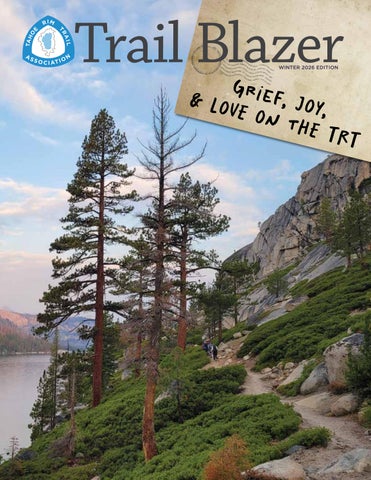

GrIef, joy, & love on the TRT
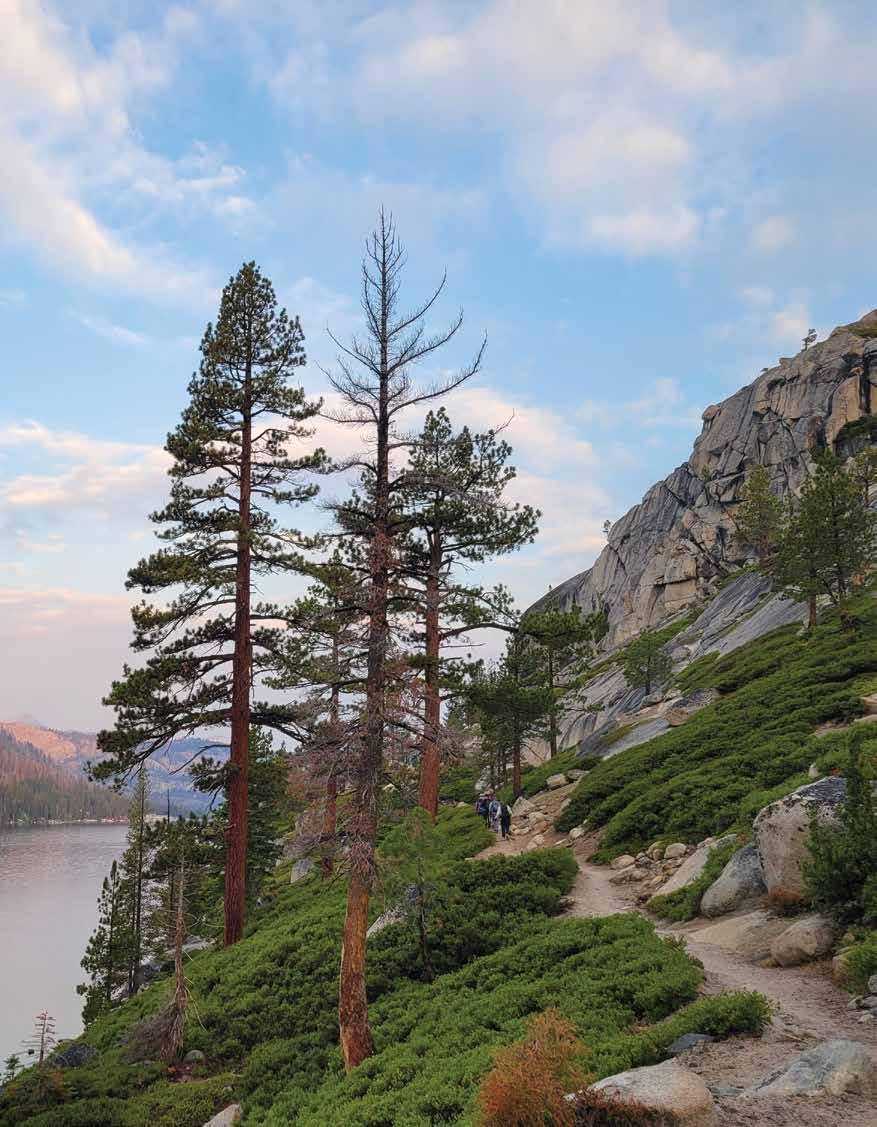

PROTECTING EVERY FOOT OF THE TAHOE RIM TRAIL
When the Tahoe Rim Trail Association was founded more than 40 years ago, our purpose was clear: to build, maintain, and protect a world-class trail system that showcases the natural beauty of the Lake Tahoe region. That mission has not changed.
In recent months, we’ve had to stand guard against several challenges that could have altered the trail we know and love. From a grant funding scare, to a federal land sale proposal that would have put 80 miles of the Rim Trail corridor at risk, to the overturn of the Roadless Rule that would impact nearly 50 miles of the trail—these issues have reminded us why the TRTA exists.
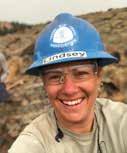
by Lindsey Schultz Executive Director
And when the recent federal government shutdown temporarily limited communication with many of our agency partners, it was a sobering reminder of how interconnected our work is. Stewarding this trail requires collaboration at every level from local volunteers to federal land managers, and moments like these highlight just how vital those partnerships are to protecting and maintaining every foot of the Rim Trail.
I’m reminded of a hiker I met last summer near Tahoe Meadows. She had just finished her first solo backpacking trip, three days on the Rim Trail, and with a huge grin, she told me she had never felt so free, so alive, or so connected to the mountains. That moment captured what’s at stake. This trail is not just dirt underfoot, it’s opportunity, challenge, healing, and joy.
Through it all, our message is simple and steadfast: this trail belongs to everyone. It is a national treasure, a community cornerstone, and a living classroom. And it is our responsibility to maintain its raw beauty and protect every foot of its 200-mile system for generations to come.
We take this responsibility seriously and we believe everyone who loves the outdoors should too. That’s why we work with leaders across the spectrum, partner with local, state, and federal agencies, and engage with communities around the basin. Whether you hike, bike, ride, or simply find peace knowing the Rim Trail endures, you are part of this shared story of protection and preservation.
The trail belongs to all of us. And together, we can ensure it remains what it has always been: a trail like no other. I invite you to stand with me and with the entire TRTA community in protecting every foot of it for generations to come.
Lindsey Schultz, Executive Director, TRTA
Rim Trail Association
The Trail Blazer is the official publication of the Tahoe Rim Trail Association, a 501(c)3 non-profit whose mission is to maintain and enhance the Tahoe Rim Trail system, practice and inspire stewardship, and preserve access to the natural beauty of the Lake Tahoe Region.
STAFF
Executive Director
Lindsey Schultz
Deputy Director
Veronica Palmer
Trail Operations Director
Sam Donnelly
Outdoor Programs Director
Michelle Witte
Communications Manager
Daniel Corona
Development Manager
Brooke Clayton
Engagement Manager
Colleen Hoffman
Guided Programs Manager
Fiona Pedrick
Trail Operations Manager
Briegan Aguilar
Finance & Administration Manager
Judi Van Fleet
BOARD OF DIRECTORS
President Tricia Tong
Executive Vice President Rishi Batra
Treasurer Larry Stites
Trail Ops Chair Jim Crompton
Trail Use Chair
Sharell Katibah
Secretary Faye Provenza
Board Members
Amy Cornelius, Rebecca Cremeen, Dori King, Justin Knowles, Anna Lijphart
John McCall, Theresa Papandrea, & Robin Soran


The Tahoe Rim Trail Association works in partnership with the USDA Forest Service and Nevada Division of State Parks


Tahoe


BPACKED WEIGHT Carrying grIef on the trt
ackpackers spend hours deliberating over every ounce of weight they will put on their shoulders. We spend the extra money on lighter gear, put our dehydrated food into ziplock bags that might weigh a miniscule amount less than their original packaging, and do our best to calculate exactly how much—or how little—water is needed to get to the next stream crossing.
by Brooke Clayton Development Manager
his own therapist handed him a letter at the end of their last session before his trip, explaining with tears in her eyes how rare it was to experience such a full circle moment, to have the person she’d been helping ask if she needed any help. She explained that the truth is, we all do.
Yet when John McGowan planned his thruhike of the TRT, he knew that he would be stepping on to the trail with a heavy heart. There was no way to ignore or neglect the impact that weight would have on his journey. He was struggling to love himself, or even know himself, after his partner left him suddenly.
“People told me love myself but I didn’t even know who I was, and the version I did know, I didn’t like,” McGowan told the TRTA in a heartfelt interview.
“And then I woke up one day and I basically said…this is BS, I can’t continue to live like this unless I at least try to search for what this is other people are seeing in me.”
He wrote a Facebook post explaining his plan: to carry a letter about the grief that had been pulling down for the duration of the 165 mile Tahoe Rim Trail, moving through grief with each step he took, then burn the letter on the last day of his journey. He asked if he could do the same for anyone else, and to his surprise, he received letters from friends, family, and even strangers. Even
John began his journey on August 8, 2025 with his food, sleeping bag, tent, water…and 37 letters from people seeking relief from whatever had been weighing them down.
He had come far for his journey, all the way from New Jersey. Yet he’d been hoping to visit Tahoe already, especially so that he could check Nevada off of his list of states that he’d been to (New Mexico is the only one left, now). But more than any other factor, he was drawn to the TRT because of the fact that he would be able to end his hike in the same place he’d started.
“I didn’t want to leave behind who I was,” he said. “I wanted to come back to who I was.”
He decided that he would choose a theme for each day of his journey, an idea or mantra of some sort that he could ruminate on as he moved through the forest, over the ridges, and along the lakeshores of the Tahoe Basin.
The first theme emerged in Tahoe City, where John stayed the night before starting his journey.
He remembers a cute restaurant and the sound of people nearby, some live music. He stood at a pier and looked out at the lake and thought, “this is crazy.”
HIS WAS PLAN WAS TO CARRY A LETTER ABOUT HIS GRIEF FOR THE DURATION OF THE 165 MILE TAHOE RIM TRAIL THEN BURN THE LETTER ON THE LAST DAY OF HIS JOURNEY. HE ASKED IF HE COULD DO THE SAME FOR ANYONE ELSE, AND TO HIS SURPRISE, HE RECEIVED OVER THIRTY LETTERS.
Then, he thought to himself, “just be in the moment.”
“I had a big issue with that for most of my life,” he said in the interview. “I would get so focused on tomorrow, or so worried about yesterday, that I wouldn’t be focusing on the moment.”
So, he scratched out the original theme for the first day of his hike. This one had come to him naturally, and it would stay with him the whole time:
Theme 1: Be in the Moment.
Aside from the more philosophical aspect of this theme, John quickly realized that he also had no choice but to stay present if he was going to safely pass over the loose rock that characterized a lot of his first day on the trail.
Tahoe City is an ambitious place to start a thru-hike of the TRT, as it’s the lowest point on the trail. There’s only one way to go from there: up. John set up heading clockwise, reminded between heavy breaths that he was really here, really doing it.
I thought, “Give yourself grace, man. I mean, you’re out of here doing a thru-hike, and its hot weather and elevation and just…you’re human.” Rather than giving any more energy to the negative voice in his mind, John hopped online and wrote an update to those following his journey on social media.
“Ordinarily I would beat myself up, saying to myself that I failed,” he wrote on his Facebook page. “But, considering that was day one of the hike and my ‘hiking legs’ were still being found…I think whatever mileage I put in was perfectly fine.”
Comments came flying in, telling him, “That’s awesome,” and “You Achieved 12 miles of discovery, that’s never a failure,” and “We all know you can do this.”
The words of his supporters were reassuring, but he knew that they weren’t going to get him up and hiking again the next day. Words wouldn’t heave that backpack back onto his tired shoulders and sunburnt neck the next morning. That was all on him.
Throughout the hike, any time he got too focused on an end goal or caught up in thought, he would remind himself, “there’s no guarantee this will be here tomorrow. Literally stop and look at the flowers, look at the lake off in the distance.”
And when it was time to un-pause, to keep the feet moving when they felt like lead, John found his second theme.
Theme 2: Give Yourself Grace…You Are Human
The first night in his tent, John was being hard on himself. He’d fallen two miles short of his day one goal. The vision of switchback after switchback haunted him as he closed his eyes, feeling like he’d made no progress. He thought, already? But luckily, the thought didn’t last long. He’d grown familiar with this negative voice in his mind, and he had an answer.
Theme 3: Find Your Strength Within
Day three. John was approaching Mt. Rose and thought, ‘Do I really want to keep doing this?’”
But again, he recognized the voice he’d come to the Tahoe Rim Trail to quiet.
“There was no way I was going to quit,” he said. “At the end of the day, it’s your heart and your brain. As long as you have those two things in line, you can get through anything.”

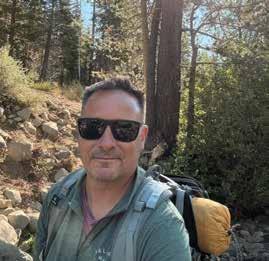
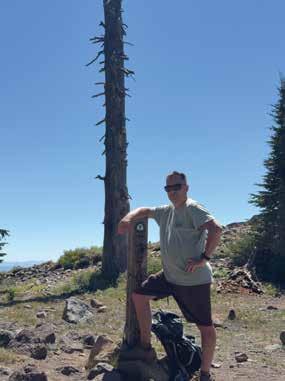
With each step, he answered the question from that negative part of his mind. Yes, yes he did really want to keep doing this. With his next online update, he was able to tell his followers that he was ahead of pace.
Theme 4: Be Resilient
On day four, the trail’s voice grew louder than John’s. After pushing through immense physical exhaustion early in his trip, he had his “trail legs” under him, was finding more moments of quiet contemplation, where he began to learn from the landscape around him.
He’d been approaching a burn scar for some time, and on day four, he got up close; he could see the ash, but also, the growth. It wasn’t the destroyed landscape he had seen from afar. It had been through something trying, and it had changed, but it was growing.
John told the TRTA, “to the common eye, people that are going through grief, it looks like they’re devastated. And I mean they might be. They might be scarred, they might be devastated, and they’re certainly burned, you know, by life. But as long as they remain resilient and know that there’s a rebirth in there somewhere, then they’ll come out of it too, just like that area that I was walking through.”
Online, he shared a link to an article about serotiny, a property that makes many conifers
dependent on heat for germination. Fire, presumably an enemy to the forest, actually helps these trees complete their seed cycle. The metaphor was exactly what John needed, a reminder that overcoming struggle with resilience is part of what it means to be alive.
“So in times of what looks like destruction, look closer,” he wrote online. “That so called destruction is actually allowing for growth.”
Theme 5: Permit Yourself to Experience Emotion
John chose his fifth theme before the day had begun. He lay in his tent after day four and was struck by how freely, and how immensely, he was feeling every emotion.
“And…that’s okay.” He wrote. “It is always okay to be able to embrace your emotion.”
He reflected on his two daughters, who were leaving that day for a trip to Alaska. A proud “girl dad,” John was inspired by the way his daughters had supported him through heartbreak and grief. He knew that life would have its own slew of challenges in store for them. And he found himself struck by how important it would be for them to feel it all. To share it. To grow, like they had helped him to do.
“The emotion was always there,” John said in his interview. “I think what helped me at night is when I began to take my feelings and put it on to paper or put it into a post. It was my way to express it.”
John was also particularly aware that it was Suicide Awareness Month. The CDC reports that in 2023, one person in the U.S. died by suicide every 11 minutes. Perhaps even more shocking? That is less than 1% of people who seriously considered it, and only slightly above 1% of those that went as far as to make a plan for suicide.
That is a lot of suffering, but also a reminder that sharing your suffering can save your life, or someone else’s.
“We need to normalize the universal language of emotion,” John wrote on Facebook, and set out on day five immersed in just that.
Theme 6: Face Your Fears
Day six started abruptly, with the sound of an airhorn and shouting. A universal language of its own, at least in Tahoe: someone had a bear in their camp.
“I felt like I was in TSA,” John said, “patting down every pocket on me and in my tent to
make sure I didn’t have anything scented.” He was diligent about leaving food and deodorant in his bear canister, in his bag, away from the tent. Fear has a way of making you second guess things, though. At least he knew he had the letters. Those, he took out of his pack and into his tent each night.“If a bear was gonna take my pack, go ahead,” he said. “That bear was not gonna take those letters, though, because that was an extension of those people.”
The reminder of why he was out there was stronger than the fear of what else was out there with him.
“If you allow fear to paralyze you, you’ll never quite know your limit,” he said.
The extra adrenaline as he packed up and set out that day was just a reminder that he was getting close to what he came for. After all, could a bear really be scarier than the person he had felt himself becoming before this trip?
The negativity he was dwelling in, and the selfhatred that had sent him spiraling?
He posted a photo on the morning of day six: his silhouette on the trees beside the trail.
“Starting the day,” he wrote. “Just me and my shadow. Today is another big day.”
Theme 7: Don’t Be Scared to Be Uncomfortable: Stretch Yourself
That big day came with a light at the end of the tunnel: a resupply and a real pillow waiting for him in South Lake Tahoe.
“I don’t care if I get tired today,” John wrote in a lunch time update from the trail. “Because tonight these achy bones are in the hot tub.”
Yet when he got to his rest stop in town, aptly named Basecamp, he noticed something strange.
“My brain kept thinking, I want to be back out on the trail,” he said. “I want to continue to be uncomfortable.”
After a shower, some laundry, and grabbing his re-supply, he was back at it.
He hopped online and shared his theme for the day on Facebook, writing, “as I can attest, don’t sit still too long or otherwise you grow more sore. Keep moving, work out the pain, and as you pick up your pace, your pain will soon dissolve.”
Theme 8: Make Noise in Life, You Have a Voice
As John made his way toward Big Meadow, he couldn’t help but think about his near
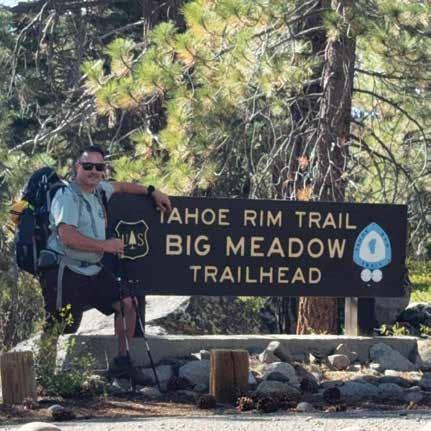
John poses at the California and Nevada stateline.
bear encounter the last night he’d slept in the woods. He took extra care to make sound as he moved across the trail so as not to scare any unsuspecting wildlife.
It felt uncomfortable at first, out of place. Yet the more he listened, the more he realized that he was far from the only voice. He heard hundreds of chipmunks, birds, and bugs. Even the trees had sound.
“Nature makes its noise all the time,” John told the TRTA. “You’re in a soundtrack of nature, you know, every moment you’re on that trail, and the only people that are silent are us.”
He thought of how often silence only serves to isolate humans. How it stunts growth: in careers, lives, and relationships. He thought of how silence felt like a weapon when his partner left him those months back, with no explanation and no goodbye.
And he thought of his daughters—in fact, it seemed that he rarely wasn’t thinking of them. “I never want them to think their voice isn’t as important,” he told the TRTA.
Theme eight was brought to life by other voices, strangers that became friends in John’s brief conversations with them, from the family with a son headed off to his daughter’s dream college to the PCT hiker that helped John get a ride into town to fix a broken water filter. Yet in an irony only the trail could deliver, John’s post about making noise and having a voice was one of the last before he entered the more remote sections of trail in Desolation Wilderness, and lost cell phone service.
The next two themes would be the most challenging for John, and he would sit with them alone.
Theme 9: Forgive Yourself, Before Forgiving Others
“Today I hiked through some of the most beautiful parts of the trail,” John wrote in a post that he knew wouldn’t actually upload that day. “I passed several lakes, one being Lake Aloha. Aloha is love in Hawaiian so I saw it fitting to reflect on that for theme 9, which is about love. But it’s about loving yourself.”
The idea of forgiveness was a theme that John had planned before his hike, but by the time he reached Desolation wilderness, he understood something that he didn’t before his hike. In carrying his letter, he’d been hoping to move on from the pain that was
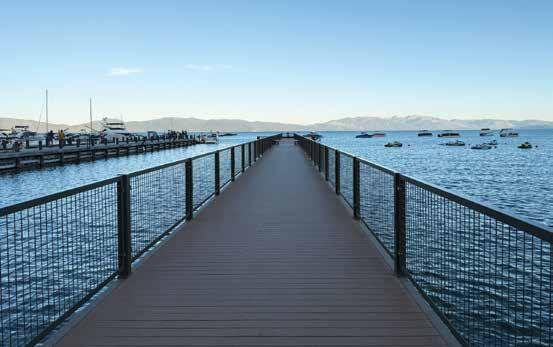
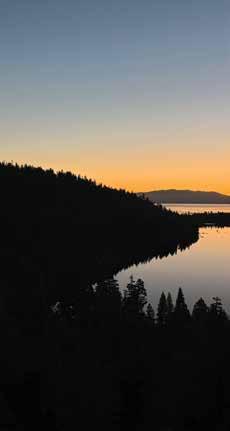
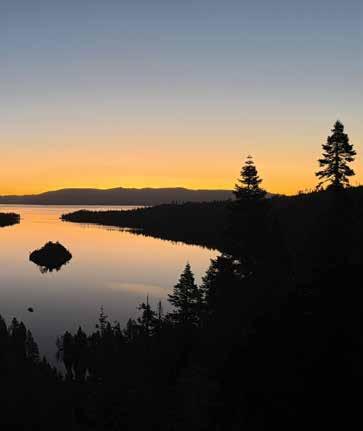
The view from the Tahoe City Marina, the night before John’s thru-hike.
inflicted on him. What he eventually realized is that he’d been inflicting pain on himself. “There was no excuse for what she did,” he said. “And I blamed myself for it. I thought I should have been better, I should have been different, I should have been better looking. I should have been more.”
It’s easy to imagine John, beside the lake, looking for the right words to hold together the moment he was inside of. To transmute the past into the future, the pain into the progress.
“I allowed myself to take the blame, without even knowing the why,” he wrote. Below the words was a video of the signpost at Lake Aloha, panning up over the engravement, the worn wood, over the TRT and PCT emblems, and out across the water, dotted with granite and stubborn trees growing between the cracks in the rock.
“But, throughout this time on this hike I have reflected on the moment.” He continued. “And, I forgive myself for: not giving me a chance…[for] allow[ing] myself to question the one thing we have and are born with, which is love.”
When his partner left and John felt like he wasn’t loved, he forgot the most powerful antidote: to love himself.
Reflecting on the hike in his interview, John said, “I think if I [was] hyper focused on doing that to only find forgiveness for her, I never would have succeeded. I would have quit.”
He did this for himself.
Theme 10: Let Go Of Things That Harm or Hinder Your Growth
Of course, he did want to forgive her. Or forget her. Just to move on. He’d been moving his body for miles and miles every day, but as he said bluntly in his interview, “grief is a bitch.”
The weight he started his hike with was still there.
What had changed was the new tools he’d discovered to manage it.
He had pushed himself to his physical limits, faced his fear, found presence and persistence and resilience. He knew that he could overcome immense challenges, and what’s more, had faith in himself that he would. That he would embrace discomfort, stretch himself, experience emotion, have a voice. All the lessons were colliding on the last days of the thru-hike, crystalizing into something he’d been missing for a long time: hope.
He stopped in a patch of cell service, about an hour from his final camp. The next day, he would have just 9 miles left.
He wrote, “our final theme which will be marked with your letters in a fire pit tomorrow is: Let go, have the courage to say goodbye. And most importantly, you are never nor will you ever be alone.”
The next day, he reached Richardson Lake, and the fire pit he’d been making his way to the entire time.
During his interview, at this point in his story, John was uncharacteristically lost for words. Tears filled his eyes. Across thousands
of miles, through the screen of a laptop, his emotion gave me goosebumps.
In the moment he watched paper turn to ash, it wasn’t just the wight of his own grief that he felt.
“Even though I had no idea what was in those letters,” he said, “I know some people really struggled to write things down.”
“It was heavy,” he told me, and I knew that there would be hundreds of people who would read this story and know exactly what he meant—that no matter how much you trim down the weight of your pack on a thru-hike, we all carry more.
The 37 letters were gone. John’s hike was almost over. There was only one more goodbye, and that was to the trail itself.
“The trail becomes your only family for that period of time,” John told the TRTA. “I was very successful in hitting my themes and recovering and healing while I was on the trail. But I had fear of what was going to happen after.”
So, he stopped at Ward Creek, about 6 miles from where his journey began.
“I remember sitting there and some women walked by,” he said. “They kind of crossed the creek, and I began talking to them, just ‘Hey, what’s your story?’ and so on and so forth. And that’s when one of the women out of the blue said, ‘Hey, are you the guy carrying the letters?’”
It was the perfect ending to the script that the trail had been writing for him. He had put his heart on his sleeve to show anyone else
suffering that they were not alone, and here was a group of strangers reminding him that neither was he.
He hadn’t just completed a thru-hike. He hadn’t just burnt the letters. He had started something bigger than himself, and in that moment, he realized that it would not be over when his hike was.
“Our message, our mission spanned across the Country,” he wrote in his final post from the trail. “So, let’s not stop now. This is the beginning of so much more.”
***
John has a degree in clinical psychology. He studied pediatric trauma with a desire to work in the mental health field. Of course, life sometimes has other plans.
His career ended up taking him a different direction. He worked as a First Responder for years and today, he is the Deputy Director of Emergency Management at the National Oceanic and Atmospheric Administration (NOAA). A blue checkmark shines next to his name on Facebook, dubbing him a Government Official.
Yet in his journey through grief and around the Tahoe Rim Trail, he reignited a passion for delving into the mind to help people. When he came home, he was eager to continue his project, to share his 10 themes and encourage people to get outside as a way of managing grief.
But he also wanted to honor the person who really inspired him to get out there. The
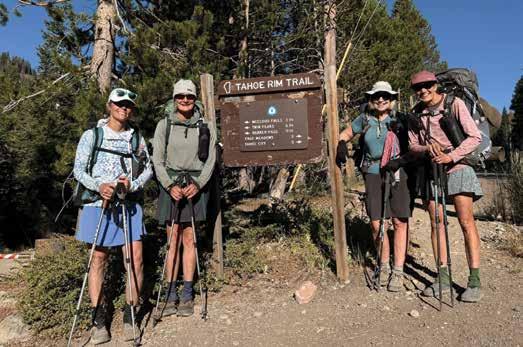
person who told him in one of his darkest moments, “choose love.”
That person was his youngest daughter. When he got home, they gave a name to the project he was envisioning: Liminal Pathways. They created a Google Form where anyone in the world can log a hike, share where their journey took them, what their motivation was to get outside, and how far they traveled. They even made a couple of T-shirts. Then, he passed the project off to her, as something she could take ownership over.
His Facebook slowly became dominated once again by photos of his daughter’s soccer games and dinners he enjoyed cooking.
And he felt good.
“It’s been fairly easy to hang on to the lessons,” he told the TRTA. “I think for the first time I could say in a very long time, probably most of my adult life, I actually like myself. And I like hanging out with myself…I can be pretty cool at times.”
One of the greatest attributes of the outdoors is its impartiality. The forest has little sense of right and wrong, struggle and success, grief and joy. The trail dictates life along more grounded dichotomies: hungry and fed, tired and rested, moving and still. It’s a place where every human can be fully human and learn to understand themselves on the simplest terms. It’s a place where we can learn to love ourselves, just for waking up each morning. Just for being.
“I think what I wanted people to take away from this is that it was not just a walk in the woods,” John said. “This was a journey of discovery. And I used the rawness of mother nature to get me through.”
If you’d like to learn more about Liminal Pathways or hear more about John’s story in his own words, visit his Facebook page.
If you or someone you know is experiencing grief, stress, or another mental health challenge, please know you’re not alone. Support is available. You can call or text 988 to reach the Suicide and Crisis Lifeline for free, confidential support 24/7.
We are more powerful together. Thank you for being a part of our community. It is your stories and experience that make the TRT more than a trail: it is a resource to find resilience, and the TRTA will always fight to preserve it.
A group that John met at the end of his thru-hike. They had heard his story before meeting him and shared how it had inspired them.
VOLUNTEER SPOTLIGHT:
Melissa Russell and Brian King
What started as an idea between two longtime friends has grown into a shared adventure filled with purpose, challenge, and camaraderie. Continuing a summer tradition they began three years ago, Melissa Russell and Brian King, Carson City locals and proud Tahoe Rim Trail Association (TRTA) volunteers, spent this past season in the heart of Desolation Wilderness, giving back to the trail that has given them so much.

Their story with the TRTA began in 2023, when Melissa, who was eager to try backpacking, convinced Brian to join her for the TRTA’s Backpacking 101 course. At about half the cost of similar programs, it offered an approachable way to learn backcountry basics while exploring Tahoe’s beautiful landscapes. What they found, however, was much more than a backpacking class. They left with new skills to get them out backpacking, a better understanding of the efforts required to maintain and enhance this trail system for the public, and, most of all, inspiration from the passionate volunteer backpacking instructors who shared their knowledge and enthusiasm for the trail and sustainable recreation.
by Briegan Aguilar Trail Ops Manager
in Desolation Wilderness. This backcountry camp required volunteers to backpack, carrying gear and food, over ten miles and then camp out for four days to make the most of their time at backcountry worksite. Due to the difficult access, this section of trail was in desperate need of attention. The crew made the most of their time in the backcountry and worked hard hauling and crushing granite to mitigate the erosion and water issues on the trail. After their physically demanding workdays at over 8,000 feet, volunteers enjoyed laughter around camp, shared meals, and refreshing plunges into the Heather Lake. “It was my first time swimming in an alpine lake,” Brian said, grinning. “We were like kids at summer camp.”
For Melissa and Brian, this experience captured everything they love about the Tahoe Rim Trail community: the chance to challenge themselves, support access to a place they cherish, and connect with others who share the same love for Tahoe’s wild spaces.
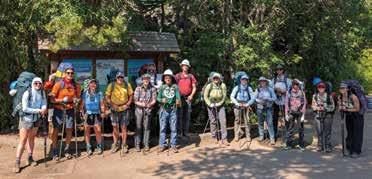
Melissa and Brian pictured with fellow participants for the Heather Lake Backcountry Camp.
Their Backpacking 101 experience inspired them to get involved even more as members and volunteers. The following summer, Melissa and Brian signed up for their first front-country trail work camp at Armstrong Pass, a four-day project that blends meaningful trail work with the joys of car camping and community. Volunteers spend their days building and repairing the Tahoe Rim Trail and their evenings together sharing delicious meals prepared by the TRTA’s volunteer camp chefs and sleeping in tents. The experience left a lasting impression: the breathtaking views, the sense of accomplishment from a hard day’s work, the “best salmon they’ve ever eaten”, and the easy camaraderie that forms when camping and working together. Two of the friends they met at camp are still part of their lives today.
This past season, the pair decided to put their backpacking skills to the test by joining the Heather Lake Backcountry Camp
Looking ahead to 2026, they already plan to return for another backcountry camp in Desolation Wilderness. In addition, Brian hopes to join his trail crew friends for part of their TRT thru-hike and complete the final segments needed for him to join the TRTA’s 165 Mile Club.
Melissa and Brian encourage anyone who loves Tahoe’s trails to get involved. Whether it’s a regular workday, an overnight camp, joining a public program, or becoming a member, supporters of the Rim Trail system are valuable and necessary for the TRTA to maintain the trail, inspire stewardship, and preserve access to the natural beauty of the Lake Tahoe region.
To learn more about joining a volunteer trail crew visit tahoerimtrail.org/events-calendar/ and for the 165 Mile Club visit tahoerimtrail.org/165-mile-club/
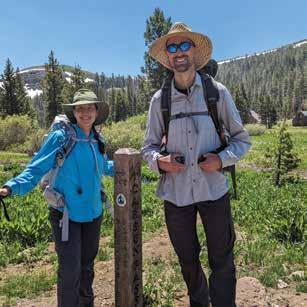
On the Trail Towards Joy
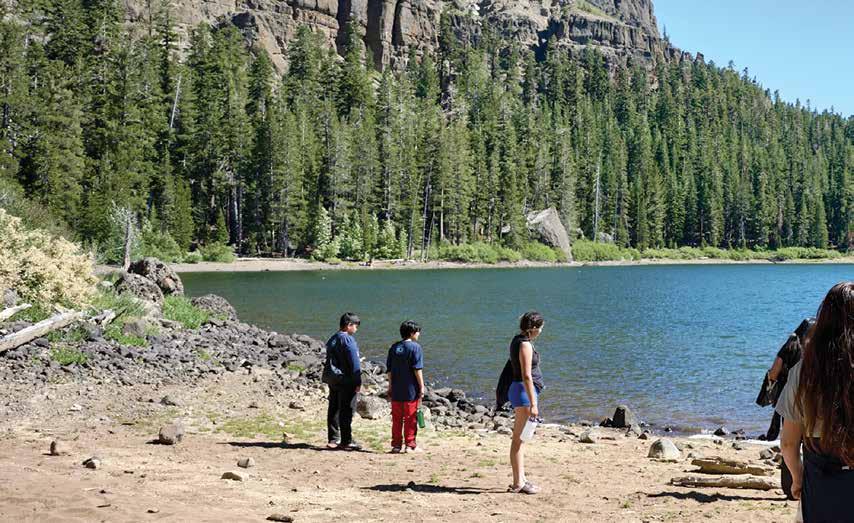
Recent data coming out of the US states that young people are experiencing unprecedented levels of stress, anxiety, and self-doubt. Academic pressure, social media comparisons, and uncertainty about the future weigh heavily on their emotional well-being, feelings of belonging, and resiliency. On the other hand, countless studies confirm what most of us experience when we do take time to hit the trail, sit by a creek, or watch a sunset; that time in nature builds resilience, promotes emotional regulation, fosters personal growth and initiative, and creates a sense of belonging in all of us, but especially in youth. For youth in our Tahoe Rim Trail Association’s Youth Backcountry Camps (YBCC), over 40% of 2025 participants experience some sort of mental health challenge, and over half of them experience barriers in accessing outdoor recreation. However, in post-trip data collection the results show that after spending time on the trail in our programs, 84% of them feel more resilient, 81% feel more confident,
by Michelle Witte Outdoor Programs Director
and 90% feel a deeper sense of social connection to others.
Beyond what studies and statistics confirm, we time and time again see proof of the impact on youth that nature and having time together has on what our YBCC participants through what they share after their four-day trip on the trail. As youth have the time in nature to experience these benefits, they also have time to connect with one another. The problems they face in the ‘real world’ do not disappear in nature. Yet they have a place to talk about their experiences and learn that they are not alone. We are constantly inspired and reminded of the profound effect of time outside in community by what YBCC participants have to say in post trip surveys. The following quote by Summer 2025, 15-year-old participant, Zoshie, says it all, “On this trip I learned about the experiences others have been through which helped me understand myself deeper. I learned to enjoy every moment and respect myself in every situation…Participating in this experience made me feel connected to
nature and gave me a peace of mind being away from technology and society, I had a lot of fun on this trip and enjoyed learning about myself and others… What stood out to me the most and that I will walk away with from this trip was listening to others share their stories and gaining knowledge on different aspects of life.”
Statistics and quotes like Zoshie’s, underscore the importance of the Tahoe Rim Trail Association’s Youth Programs. Knowing the deep need and incredible impact that time in nature has on today’s youth fuels our dedication to serving tomorrow’s leaders. Knowing that creating spaces that promote youth’s ability to cultivate joy and build resilience is foundational to long-term success and well-being is a responsibility the Youth Program’s team doesn’t take lightly, regardless of how fun it all is in practice. We work to ensure that our programs are inclusive to diverse backgrounds, learning styles, and abilities. We incorporate a mix of facilitated and free flowing group discussions and activities around community belonging, ecology and Leave No Trace, as well as wilderness skills.
YBCC youth enjoys swimming at Round Lake.
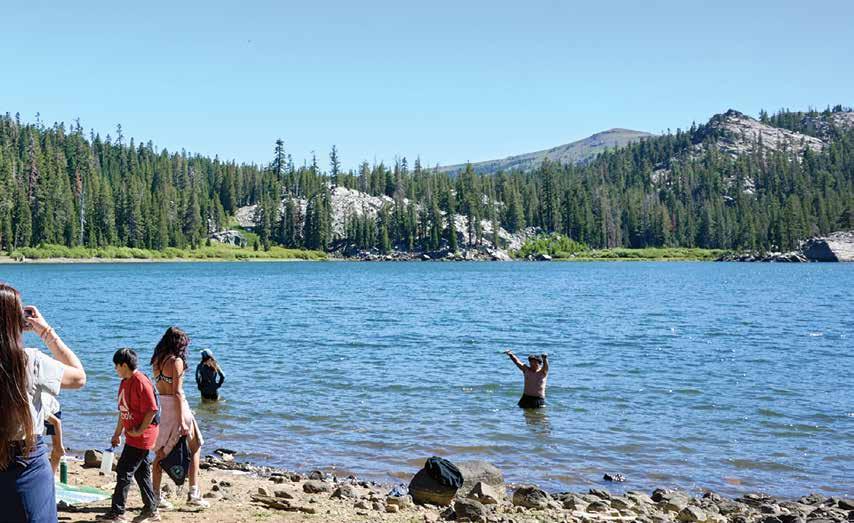
All of these fundamental curriculum pillars of YBCC foster independence, resilience, belonging, communication and critical thinking skills among many other transferable life skills.
There’s an undeniable connection between resilience and the ability to experience joy despite challenges, and outdoor activities and experiential education are perfect to support growth in this area for young people. Allowing young folks to simply be kids in nature away from technology and their daily lives, connecting with one another and the wilderness around them can reduce their anxiety and feelings of hopelessness, setting the stage for more healthy futures for them. There’s no denying that life can be hard and full of a wide range of individual and collective challenges. As a young person is transitioning from adolescence to adulthood it can be overwhelming to conceptualize how to overcome all that their life may contain. Attending programs like YBCC that focus on fun, adventure, community-building, challenge by choice, autonomy, responsible decision making, wilderness skills, selfexpression, and connection to nature may be an essential puzzle piece in giving young
people tools to navigate life’s ups and downs and remind them that they don’t have to go through it by themselves.
When teens or anyone choose to put one foot in front of another, regardless of the weight of their pack, the weather, or incline, they face fear in a healthy way and overcome obstacles ultimately seeing themselves as capable and brave. Each step forward chips away at avoidance behaviors like shutting down when things feel hard and replaces those behaviors with persistence and courage. Over time, these moments of choice and accomplishment help young bodies and minds carry new confidence that translates to all areas of their lives.
The beauty of creating resilient young people in our Youth Programs at TRTA is that it invites the entire community to remember the importance of creating space for new experiences, choosing to do something intimidating in order to grow and the power that creating and strengthening community bonds can be a platform for hope to thrive, especially with the incredible Tahoe wilderness as the venue. If we can practice overcoming challenges in nature and with others through shared wilderness experiences, it can become
so much more approachable to face the big stuff that life hands us with an outlook of confidence, perseverance, and joy.
Backpacking may not always be easy, in fact many people call several elements of the experience in the backcountry as “type two fun”, meaning fun you only admit is fun after the challenge is over. This, I think, can point to how important resilience is and that accessing joy is often a choice. I often reflect on this quote by Henri Nouwne “Joy does not simply happen to us. We have to choose joy and keep choosing it every day.” This points to how a foundation of resilience and positive experiences builds a mindset in our young folks to navigate life in the practice of cultivating joy regardless of the challenges and inevitable changes. May we always cherish and prioritize the special moments in the backcountry with one another, trusting the intelligence that nature provides us to move through life as the resilient and joyful people we all are worthy of being.
“We need Joy as we need air. We need Love as we need water. We need each other as we need the earth we share.”
—Maya Angelou
THE COMPASS
Trail Science
Before joining the Tahoe Rim Trail Association as the Guided Programs Manager, I spent seven years studying geology. The desert of Southern California introduced me to geology as a freshman at Occidental College and I continued my studies as a graduate student at UC Davis. My master’s thesis involved an adventure to the Alaska Range that included helicopters and grizzly bears as well as metamorphic rocks. Although I no longer work as a field scientist, I can’t help but think like a field scientist every time I step outside and onto our trail systems.
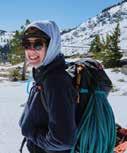
by Fiona Pedrick
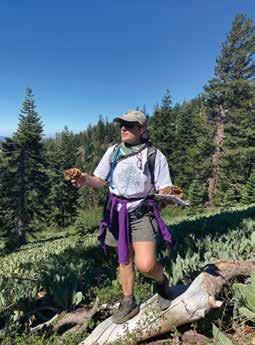
So, what does thinking like a scientist even mean? To me, thinking like a scientist primarily means making observations and asking questions. As a field geologist, my observations included making geologic maps, collecting rock samples, taking photos, and drawing sketches. My questions included everything from “what type of rock is this?” to “how do these rocks fit into the geologic history of the area and what does that imply for earth processes in general?”
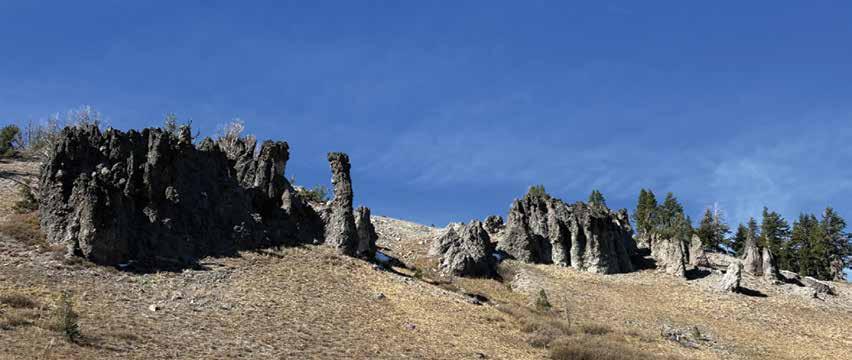
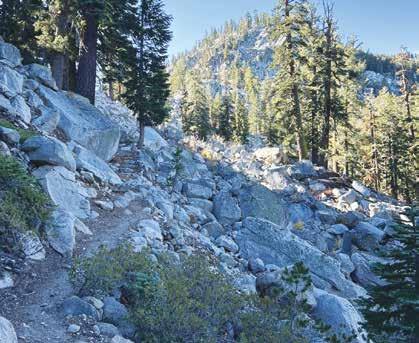
For example, I recently hiked the Tahoe Rim Trail from Echo Lakes to Big Meadow. My morning started in granodiorite—the iconic white rock that is synonymous with Tahoe. Geologists classify granodiorite as an intrusive igneous rock meaning it cooled from liquid magma into solid rock slowly below the surface of the earth. Granodiorite is famous for weathering into slabby boulders and cracking overtime. I am
particularly fond of this rock type as a mountain biker and rock climber. However, the Tahoe Basin has many other exciting rocks! When I reached the Showers Lake area, I encountered some chaotic volcanic rocks. I saw pillars that almost looked like they were made from concrete— smaller rocks glued together in a fine matrix. I was looking at Miocene lahar deposits! Lahars are mudslides that form when hot volcanic material mixes with water and flows downhill picking up and incorporating other rocks along the way. As the material cools, it cements together. I wondered what the area may have looked like when those lahars were hot and actively flowing sometime between 23 and 5 million years ago.
That being said, you don’t need to have a scientific background to make observations and ask questions—you just need curiosity! The first step is to simply slow down and intentionally notice the world around you. This could include looking at rocks around the trail, listening to nearby birds, or smelling plants you’d normally walk past. I find that as I pay attention to these details, questions naturally follow. You might ask yourself, why are the rocks on the north side of the lake so different than those on the south side? Why are Clark’s nutcrackers always near whitebark pines? Why do different wildflowers grow at different elevations? You can take that curiosity one step further and pack a guidebook for your trail
Guided Programs Manager
excursion or search for the answers to your questions once you get
If setting out on your own scientific adventure sounds intimidating, fear not! Here is a list of suggested activities to help you hike, bike, and ride like a scientist:
• Join us for one of our guided day hikes with local naturalist organizations such as the Sugar Pine Foundation or the Tahoe Institute for Natural Science (see upcoming events on page 17)
• Contribute to the Spooner Summit Wildlife Crossing citizen science project with our partners at Pathways for Wildlife (find out more at tahoerimtrail.org/pathways)
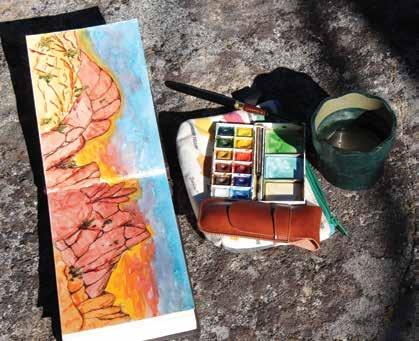
• Bring a sketchbook and pause to sketch a natural feature that catches your eye—don’t worry about making a piece of art, focus on making observations!
• Pack a guidebook such as The Laws Field Guide to the Sierra
Nevada (John Muir Laws) or Roadside Geology of Northern and Central California (David Alt and Donald Hyndman)
• Download the app “Seek” by iNaturalist—like Pokémon GO but for real plants and animals
Although hitting the trail to move your body and get exercise is critical for physical health, spending time in nature can also be beneficial for your mental health. Slowing down and interacting with your surroundings as a scientist is a great way to deepen your relationship with all the other living beings that share your home—whether it’s a city, a suburban neighborhood, or the Tahoe Basin. Focusing on small details like the shape of a leaf or the sounds a bird makes is a great way to calm our busy minds. This practice helps me be more present in my surroundings and feel more deeply connected to my home—maybe it will for you too!
Fiona’s sketch pad & supplies on a recent hike.
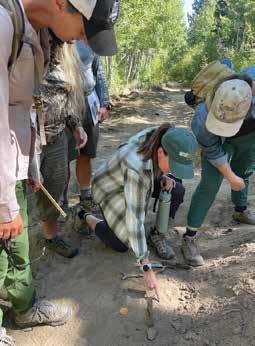
Tanya Diamond from Pathways For Wildlife teaches volunteers how to identify animal tracks.
A TINS instructor teaching participants about local flora.
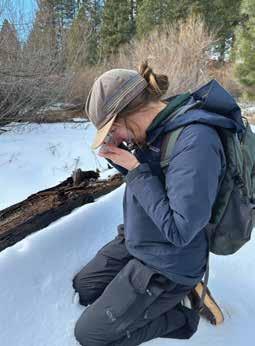
Taking a closer look at snow with TINS.
Granodiorite
back home.
Views we love
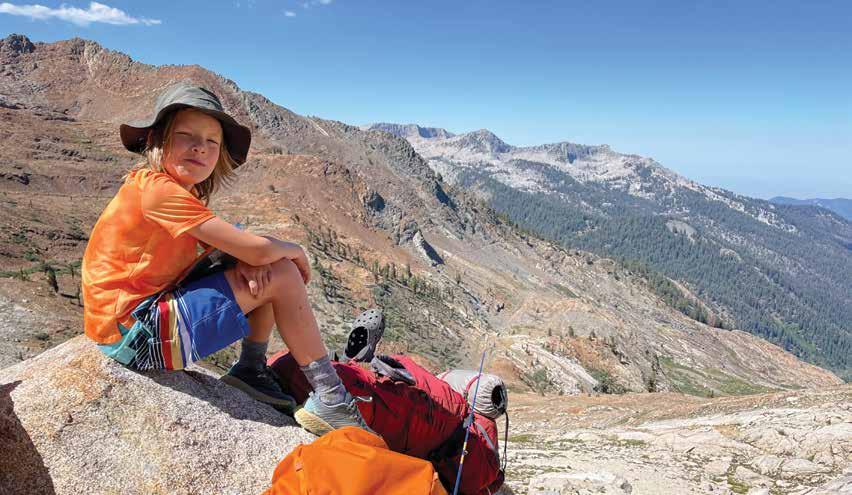
Individuals, families, and organizations can help to ensure the continuing legacy of the Tahoe Rim Trail by adopting their own vista or mile! Donors have the opportunity to be a steward of the trail by giving back to something they love—the trail and the Lake Tahoe Basin. Here are this season’s adopted vista and their special dedications. If you are interested in learning more about this program, email Veronica Palmer, veronicap@tahoerimtrail.org or visit tahoerimtrail.org/adopt-vista-adopt-mile/
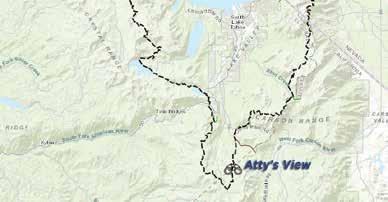
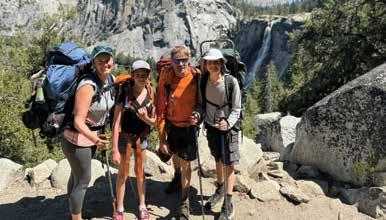
Atty’s View
Born in Tahoe, he was a force of nature. Untamed. His love of the outdoors led him on long backpacking trips, stargazing and cliff jumping. A born leader. God only knows where his life was headed and who he would have influenced, but I know he touched souls and changed lives in his short time here. May the four winds blow you safely home.
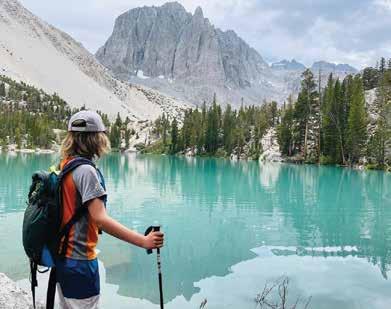
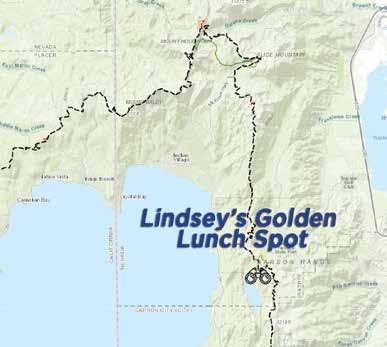
Lindsey’s Golden Lunch Spot
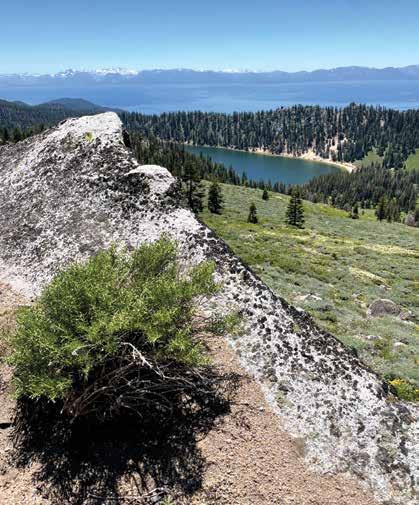
In 2020, I helped build this stretch of the Tahoe Rim Trail, not knowing then how much this little overlook would come to mean to me. From here, Marlette Lake glimmers below and Lake Tahoe opens wide in the distance—a two-lake view that never gets old.
Ellen Goldsmith dedicated this vista to me, and it’s become my “Golden Lunch Spot” because it’s exactly where I love to sit with a sandwich and soak in the sweep of this place and think of my dear trail friend and mentor, Ellen. It’s a reminder that the work we do on the trail lives on in moments like this.
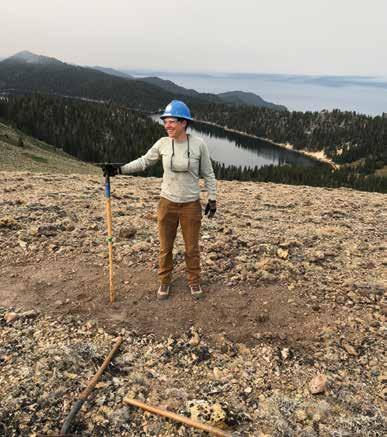
Lindsey building her future vista.
The Dirt On Trail Operations

TRAILBLAZER SPOTLIGHT: Jim Large
Building the Foundation of the NV Kiosk Project
When trail users pause at the gleaming new kiosks along the Nevada side of the Tahoe Rim Trail, they see clean designs, clear maps, and a welcoming sense of place. What they don’t see are the countless hours of planning, testing, and teamwork that made these structures possible. At the heart of it all stands Jim Large, a thoughtful and deeply respected volunteer whose steady leadership turned an ambitious idea into reality.
Finding His Way to the Trail

by Colleen Hoffman Engagement Manager
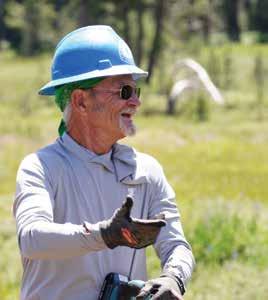
Jim first discovered the Tahoe Rim Trail Association in 2019 during a hike near Velma Lakes. Hearing the unmistakable rhythm of rock crushing in the distance, he wandered over to find a TRTA backcountry crew at work. Intrigued, he went home, filled out the volunteer forms online, and soon joined his first project at Echo Summit under crew lead Don Bailey. “By the end of that day,” Jim recalled, “I was sketching diagrams at home to show my wife how we hooked up the rocks to move them. I was sold.”
Originally from Woodstock, New York, Jim moved west in 2017 after retiring from his career as an administrator at SUNY Albany. Drawn to the wide-open views and accessibility of the Sierra Nevada, he quickly fell in love with the region’s trails. “I’d never really been a day hiker back east,” he laughed. “Here, you pull into a parking lot and the views just blow you away.”
A Builder at Heart
Though Jim’s professional background was in healthcare and higher education administration, his lifelong passion has always been building. Inspired by his father’s masonry hobby, Jim developed a natural aptitude for hands-on projects. “My career didn’t shape my skills for this project, my passions did,” he said. “I’ve always liked building things, from balsawood airplanes to boats and houses.”
That combination of curiosity, craftsmanship, and problem-solving became essential when the TRTA began planning the Nevada Kiosk Installation Project, a multisite effort to design and install seven large, permanent wayfinding kiosks across the state line.
The NV Kiosk Project: From Theory to Trail
When TRTA’s Chris Strohm and Don Bailey were tasked with figuring out how to make the kiosks work, they immediately thought of Jim. “Chris knew I liked to build things,” Jim said. “He also knew this wasn’t going to be a one-anddone project, it needed structure, planning, and persistence.”
The team’s first challenge was engineering. Each kiosk required two angled steel posts, carefully aligned mounting brackets, and concrete footings weighing nearly half a ton each. “If those bolts didn’t line up,” Jim explained, “you’d be staring at 1,000 pounds of concrete in the ground and wondering what to do next.”
To solve this, Jim, Chris, and Don built a full-scale model in the TRTA office to perfect a reusable plywood template, ensuring exact alignment for every future kiosk. “That was our master template,” Jim said. “We did it in a controlled environment so we could inventory our tools, test the materials, and make sure everything fit before we ever touched dirt.”
Their first installation at Kingsbury North was a nail-biting moment. “We pulled the template off, set the mounting bracket, and everything fit,” Jim said with a grin. “Huge exhale. Then it started snowing.”
Quiet Leadership, Loud Results
As construction continued, Jim’s calm and methodical approach set the tone for the team. “I’m not a manager by nature,” he admitted. “I’d rather just get out there and build. But this project depended on everyone’s different skill sets. Once I stepped back and trusted the group, that’s when it really worked.”
That core crew, including Paul Sinnott, Don Bailey, Chris Strohm, Mike Kuckenmeister, Bob Anderson, Chuck McVicker, Jim Crompton, and Mark Wynne-Wilson, became a model of collaboration and mentorship. Not only did they bring unique skills sets to the table that complimented the project they are also great people who Jim was excited to work with. The TRTA’s paid trail crew provided critical support in brute strength, with Trail Ops Director Sam & Trail Ops Manager Briegan providing logistical support. “Everyone had a little piece of the puzzle,” Jim said. “We all wanted to make it work.” “Each
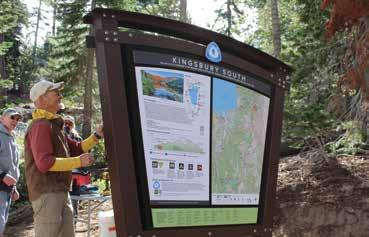
Jim inspects the completed Kingsbury South kiosk.
of those people brought something unique to the table,” Jim said. “They were my mentors and my peers. I learned from them every day, and I hope they learned a few things from me too.”
Leaving a Lasting Mark
For Jim, the kiosks represent far more than physical structures. They’re a testament to shared purpose, ingenuity, and the enduring spirit of TRTA volunteers. “What I’m most proud of,” he reflected, “is that the methods and materials worked, the templates, the reusable forms, the process. We created something sustainable and repeatable for the future.”
He hopes that when trail users stop at the kiosks, they see more than maps. “I hope they think, ‘This thing isn’t going anywhere… ever,’” Jim said, laughing. “And I hope they feel that the trail and the people behind it, will be here for a long time.”
The Spirit of the Trail
Now Jim’s winters are spent operating lifts at Mt. Rose, and he dedicates his summers to the TRTA. For him, volunteering hits the perfect balance, being outdoors, staying productive, and working alongside people who share his passion. “After a career behind a desk, this is where I want to be,” he said. “Outside, learning, and building something that lasts.”
As the Nevada kiosks stand proudly along the trail, they reflect the craftsmanship and care of a volunteer who embodies what it means to be a Trailblazer, someone who builds not for recognition, but for the love of the land and the community it brings together. Interested in joining Jim and others in building and maintaining the Tahoe Rim Trail?
Looking ahead, the TRTA is planning to install 14 more kiosks on the California side of the trail over the next two to three years, a large-scale project that will significantly enhance the experience for all trail users. This is a fantastic opportunity to join Jim and the TRTA team in an ongoing effort that combines hands-on work, community impact, and trail stewardship. Whether you’re interested in building, planning, or supporting logistics, your participation will help create a legacy on the Tahoe Rim Trail. If you’re ready to get involved, visit tahoerimtrail.org/volunteer or email us at info@tahoerimtrail.org to learn more and sign up, come be part of a project that will leave a mark for years to come.

TRTA EVENTS
January 7: Youth Backcountry Camp Registration Opens
January 10: Winter Wellness Series with Lake Tahoe Yoga: Natural Integration
January 15: Winter Wildlife Nordic Ski with TINS
January 24: Echo Lake Snowshoe with Sugar Pine Foundation (SPF)
February 6: Winter Wellness Series with Lake Tahoe Yoga: Meadow Meander
February 12: Hydrology Snowshoe with TINS
February 14: Sweatheart Snowshoe with Nevada Nordic
February 16–20: Hybrid Wilderness First Responder with NOLS Wilderness Medicine
February 22: Tahoe Meadows Snowshoe with SPF
February 24: Guided Thru-Hike TRTA Member Early Bird Registration Opens
February 25: Guided Thru-Hike Registration Opens
February 28: Winter Animal Tracking with Pathways for Wildlife
March 7: Snow Camping 101
March 10: Segment Hike TRTA Member Early Bird Registration Opens
March 11: Segment Hike Registration Opens
March 12: Disconnect for Tech Nordic Ski with TINS
March 21: Castle Rock Snowshoe with SPF
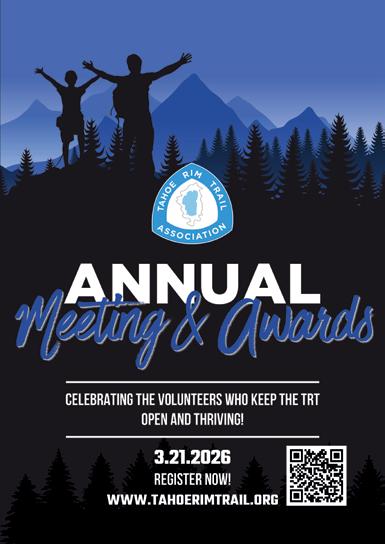
March 21: Annual Meeting and Awards Ceremony
March 24: Taste of TRT Member Early Bird Registration Opens
March 25: Taste of TRT Registration Opens
March 29: Winter Wellness Series with Lake Tahoe Yoga: Sunset Sounds
April 4–5: Wilderness First Aid with NOLS Wilderness Medicine
April 7: Backpacking 101 TRTA Member Early Bird Registration Opens
April 8: Backpacking 101 Registration Opens
May 9–10: Wilderness First Aid with NOLS Wilderness Medicine

Find out more on our website’s calendar! tahoerimtrail.org/events:calendar
Badger
Bobcat
Coyote
Marten
Osprey
Porcupine
Ref Fox
Pines & Pawprints
& Pawprints
Stellars Jay
Beaver
Quaking Aspen
Western Juniper
Beaver
Cedar
Cedar
Jeffrey Pine
Mountain Chickadee
Peregrine Falcon
Snowshoe hare
Sugar Pine
Black Bear
Chipmunk
Marmot
Mule Deer
Pika
Raccoon
Squirrel
Turkey Vulture
Grantors
The Tahoe Rim Trail Association is fortunate to receive grant funding from a wide range of private and public sources, both local and national. Thank you to each one of these incredible grantors for helping us “inspire stewards and preserve the trail.” For more information on making a grant to the TRTA, contact Lindsey at lindseys@tahoerimtrail.org.
American Trails
Athletic Brewing Co
Caesars Foundation
California Alpine Club Foundation
California Tahoe Conservancy
City of South Lake Tahoe
Jack Van Sickle Foundation
John Ben Snow Foundation & Memorial Trust
John W. Altman Charitable Foundation
Joseph and Vera Long Foundation
Lake Tahoe Visitors Authority
Lana Vento Charitable Trust
Martis Camp Foundation
Nancy Eccles and Homer M. Hayward Family Foundation
National Forest Foundation
Nevada All-State Trail Riders
Nevada Department of Transportation
Nevada Division of Outdoor Recreation
NV Energy
Nevada State Parks
OK To Be Different Foundation
Pacific Crest Trail Association
Parasol Tahoe Community Foundation
Tahoe Fund
Tahoe Mountain Resorts Foundation
Tahoe Truckee Community Foundation
The Latrobe Fund
Heavenly Mountain Resort Epic Promise Foundation
William H. Moffat Jr Foundation
Business Members
TRTA Business Members are essential partners that help us fulfill our mission. These partners help ensure the Tahoe Rim Trail remains just as phenomenal in the future as it is today and help us inspire the next generation of environmental stewards. For more information on becoming a Business Member, contact Veronica at veronicap@tahoerimtrail.org.










Trail Blazer
The Official Publication of the Tahoe Rim Trail Association