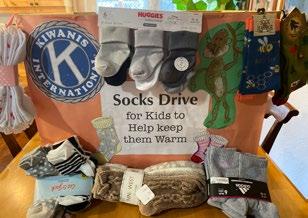
Photo Petal Kindness
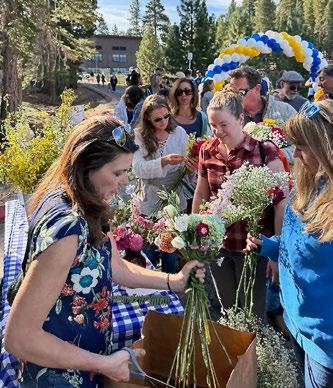
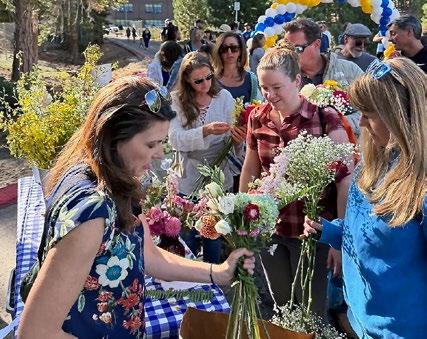
Petal Kindness repurposes flowers for distribution throughout the community.
Serving Lake Tahoe’s South Shore Since 1994
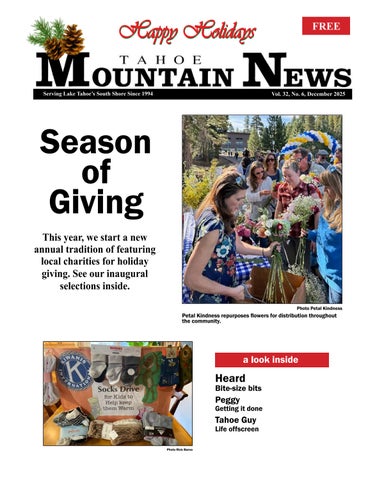
Photo Rick Barna

























We
Call






For years and years, our December “Made in Tahoe” issue of the Mountain News featured local artisans and craftspeople who actually made things here in town. It was kind of a local gift guide for the holidays. This year, we decided to flip things and feature local charities people can donate to. We plan on this being a new yearly tradition in our pages.
There was no rhyme or reason to those non-profits we chose to feature. We were just looking for a variety of missions and programs. If you have a favorite charity you support, by all means, continue. If generosity strikes and you can’t decide where to donate, please consider one of the organizations we profile here. If money is tight this year but you have a little extra time, these and other charities have numerous volunteer opportunities.
I’m going to take this opportunity to give a little plug for a non-profit that is not local. For years, news organizations such as the Mountain News have relied on the First Amendment Coalition for advice and guidance. The organization has helped me understand and determine my rights, obtain public information—especially when agen-
cies are recalcitrant—and lobbied and litigated to protect and expand the public’s free speech and government access liberties. FAC is an especially valuable resource for smaller, local publications such as ours who do not have money for on-staff attorneys and advisers.
But the FAC isn’t just for journalists—it’s for any member of the public who wants answers about speaking out, combatting censorship, obtaining government information, and more. Visit firstamendmentcoalition.org to learn more or to donate.
FAC was instrumental in helping me secure information from the Lake Tahoe Unified School District regarding sexual harassment claims against a former administrator. And I have relied on the First Amendment Coalition to help me find and acquire information as I go about researching the embezzlement affair involving former mayor, Tamara Wallace.
We have been continuing to diligently research aspects of that story and I thank everyone who has sent in tips and leads about this and other local matters. Stay tuned for future updates.


This month, Mike writes about such abuses of trust and betrayals in life and decides the answer is to double down on community instead of withdrawing. Peggy has some ideas on that front. Trish believes there is no other alternative but to laugh at the absurdity of life, so if you’re looking for some gallows humor, turn to page 24. Gary shares some technical knowledge, gratis, about getting your backcountry skis in shape for the coming season (continued prayers for snow needed! Or just wash your car.) And if all the holiday cheer is a bit too much at times, settle down with one or two non-seasonal films recommended by Dave. Tahoe Guy writes about his Thanksgiving celebration where cell phones were totally banned for the day. The result was a fun, interpersonal time that strengthened ties and showed screen time is a pale imitation of real life. I think I’ll try it in my household for Christmas. I’ll let you know how it goes. Here’s to making it through another year. Talk to you in 2026! -Heather
Our city is better than the headlines might lead you to believe. We are not all liars and thieves or people who carouse at the casinos and get arrested. South Lake Tahoe may not be Mayberry, but we are also not Gotham City. We aren’t plagued by crime and corruption. There are liars and thieves among us and some who abuse drugs and alcohol and get into trouble. Domestic violence exists. But the vast majority are engaged citizens who contribute to the greater good of our town. Letting the greed of an embezzler define us can’t be how this story ends.
If only we could burn enough white sage to cleanse the negative energy from this scandal, but instead, it is going to take time and effort to rally the town to come back from this assault on our identity.
Presbyterian Church members and the community are generously donating to help restore the $400,000 that was taken by Tami Wallace. Lake Tahoe Pizza has stepped up to sponsor a fundraiser.
Members of the public have come forward at council meetings to call out and call on council members to get their act together. Resident Larry Pedigo took David Jinkens to task for the financial fiasco known as the “hole” that happened on his watch as

city manager. A Google search reveals that Mr. Jinkens has a checkered and dubious history of city manager employment in California. Keith Roberts was questioned about his conflicts of interest. Other members of the public have demanded that Cody Bass resign while tourism representatives criticize Scott Robbins for believing locals are as important as tourists.
With the resignation of Mayor Wallace came worries of municipal instability. To be clear, the operations of the city are the responsibility of the city manager (Joe Irvin) who has successfully navigated the city through Covid, Caldor and now the Tami Wallace scandal. He is well paid and earns every dollar of his salary. The city’s financial health is strong with sales and hotel tax revenues reported for 2025 at record high levels.
According to author Lisa Barbash (Four Women and a Mountain: Legends and Legacies of the Sierra), “Place is not only geology. It is made by people who choose
to stay, to fight, and to care. Not as owners of a view, but as stewards of a living community.” Residency in Tahoe becomes meaningful when it produces institutions and values that last for generations.
South Lake Tahoe has no shortage of residents with legacy: Father Grace (beloved priest who started Bread and Broth), Laurel Ames (environmentalist who worked to incorporate the city), Bill Crawford (educator and civic leader), Wendy David (Tahoe Magic founder), Roberta Mason (LTCC founder), Carol Spain (Valhalla Tahoe founder), Patty Olson (Barton Hospital advocate), John Cefalu (civic leader), Taylor Flynn and Heather Gould (started the Tahoe Mountain News in 1993 to provide honest news to the South Shore), and most recently, Sean Fannan (Marcella Foundation). He’s a young man who thinks big and is already making a difference.
Our town wasn’t built by bureaucrats or tech bros. It was built by hard work, determination and inspiration. It was built by people who show up, 24/7, in blizzards and pandemics, to keep the lights on and the
shelves full. It was built by people who work two jobs just to make ends meet and might be living in a motel room or sleeping in their car. Life can be challenging if you want to live in the mountains.
We call ourselves “mountain people.”
We are often considered the crazy ones, the misfits, the rebels. We ski, hike, bike and climb mountains. We are badass. We’re not fond of rules. We consider “flatlanders” an inferior species. We love and hate snow. We can’t be ignored. We are crazy enough to think we can change things. We said goodbye to the mothership (El Dorado County) in 1965 and created our own city. We get shit done.
BRAVO!
To Meg Peart (executive director of the Valhalla Tahoe historic site) whose passion and creativity along with her staff and volunteers have raised the bar on art, music and theatre in our community. To Ethan Niven (STHS Theatre Director) who is continuing the tradition of high impact theatre productions that manage to engage students at all levels. This guy is a rock star.
Happy Holidays!

“What are the differences between the various air medical transport services?”
—Beth Andreozzi
Three air medical transport companies operate in the region, with one based in South Lake Tahoe.
Consolidation and newcomers have created some confusion as to who does what. All essentially do the same thing— fly injured people to medical care while providing treatment onboard, transport
of flights are inter-facility transfers. An example of this is a patient might be stabilized by Barton Memorial Hospital staff, then flown elsewhere when a higher level of care is needed or when a service is unavailable locally.
AirMedCare Network is the organization’s membership division.

patients between facilities, and sometimes fly people home from far-flung locales. This could be in a helicopter or airplane.
A main difference is where each is based and therefore the service area. The smaller the operation, the fewer the resources.
Calstar and Reach merged in 2011. They are part of Global Medical Response, or GMR. GMR is the largest health care provider in the air transport arena. In terms of its fleet, it is the sixth largest of all carriers in the United States—competing with United, Southwest and the like for that designation—and the ninth largest in the world.
Calstar opened its base at Lake Tahoe Airport in 2001. By the second quarter of 2026, operations are expected to be rebranded as Reach.
The helicopter is staffed with a pilot, nurse and medic. Weather permitting, they fly 24/7, 365 days a year. About 80 percent
Care Flight is a division of REMSA. The latter is based in Reno and has a base in Truckee.
Rural Medevac Alliance, based in Yerington, Nev., under which Battle Born Medevac operates, is expanding regionally. It has a partnership with East Fork Fire Department, which is headquartered in Minden. Battle Born Air 12, a helicopter, is based at a fire station in Carson City. This company also services Alpine County, as does Calstar.
All three medical air ambulance companies offer memberships. Which one is right for you is a personal choice. As of now, there is no membership that consolidates the three, so they must be bought individually.
Add-ons are another layer to the decision-making. Do you want to be able to be flown home or have short-term “insurance” while traveling?
Sometimes service clubs, other
nonprofits and workplaces offer membership discounts. For instance, TAMBA members are offered a savings for Calstar.
Ask about senior discounts as well as family coverage.
Those on Medicare should first find out what their primary and supplemental plans cover in terms of ground and air medical transport. Medicaid recipients should also look into coverage through their policies before buying a membership.
One reason for a membership is to reduce or eliminate the six-figure expense of being transported in a flying ambulance. Some insurance companies cover part of the costs, some none of the expenses.
The 2022 federal No Surprises Act helps a bit with what could be an unexpected bill. After all, in an emergency one may not have the choice of being airlifted or the ability to decline the service.
“The No Surprises Act covers most emergency services, non-emergency
services from out-of-network providers at certain in-network healthcare facilities, and services from out-of-network air ambulance service providers,” the U.S. Department of Labor website says. “However, if your plan does not cover air ambulance services at all or if a ground ambulance transports you, then you may be responsible for the uncovered amount.”
Reread that last sentence. That’s why one or more air ambulance memberships could save you a bundle.
Email: mountainnews2@gmail.com
Mail: P.O. Box 8974, South Lake Tahoe, CA 95618.






Publisher’s note: This is one in a series of stories written about immigrants living on the South Shore. Names are being withheld to protect the individual who wrote the story and their family.
Pine filled the air in the only way an early summer day in Tahoe could smell, wild and somber. I remember the vivid greens and blues as I huddled with my classmates, eagerly awaiting the release of a bright orange butterfly. We raised this butterfly together in our small classroom for months, observing the complexities and mysteries of metamorphosis, and today was the day we watched her leave.





reflection of the natural state of the world like no other ideological or political system ever could be.
decreasing over the last decade. Our symbol of immigration, freedom and resilience is facing extinction at a point where immigrant communities are facing increased levels of violence, forced separations, and cruel treatment from ICE. This parallel reminds us of the urgent need to fight against repressive and unjust systems.
How can we protect ourselves and our immigrant communities? Reconnect with nature. Lake Tahoe may be known and sought after for luxury, the million-dollar homes, the ski resorts, the casinos, the privilege of it all. Nature speaks louder; history echoes into today.


As we said our goodbyes and she flapped her wings toward the blue sky, the teacher explained she would start her incredible journey to Mexico and reunite with thousands of her friends. Tiny voices rose to the sky, shouting and smiling that their family was from Mexico. I smiled, feeling immense joy, and thought to myself: mine too.
This migration can span up to 3,000 miles across North America and often takes multiple generations of butterflies to complete. There, the butterflies cluster together in dense forests to survive the winter months— no single butterfly makes the entire journey alone. Science is still marveling at how these delicate creatures accomplish such an extraordinary feat.
My family's journey mirrored that of the monarch, crossing vast distances into the unknown. Called to by hope, financial security, or something beyond, many of my family members left Mexico and planted their roots in Lake Tahoe. That moment of quiet pride as a child deeply resonates with me now as an adult. I was born of migration, something normal, something beautiful, and I carry that legacy.
I have an endless gratitude that I can call Lake Tahoe my home. I was able to connect with the monarchs, with nature. I've learned that each part of nature flows freely, unrestrained, in constant unison. Nature is a
Observe the serenity: the blues of the sky intertwine with the lake, the earth provides sustenance, and animals all depend on each other.
This is a land of beauty and deep sorrow, the silenced footsteps of thousands of the Waší·šiw (Washoe) people who were brutally murdered, starved, and pushed away. A violence that to this day keeps them from their lands—a violence perpetrated by the same systems that detain, dehumanize, and hurt immigrant communities across the United States. The same fear looms over our shoulders, fueling our anxieties.
The famous line “no one is illegal on stolen land” rings louder than ever.
In a world where rivers find their course and butterflies cross continents, we see that movement is inherent and natural. We don't need justification to move freely upon the earth, across borders. We exist, we breathe, we love, we laugh. We move freely. Just as the caterpillar transforms into a butterfly, transformation is vital to humans.
Every person in my family moved for change, to obtain something in themselves, something inherent. They went into the unknown. Some came and went, and even in my family the range of “legal” documentation is based on luck and is very arbitrary. I see past whatever paperwork they signed. My father made his journey
over. He worked in construction, speaking little English and relying on the kindness of others. My grandfather, orphaned young and never speaking English, raised seven children while working on a dairy farm. My grandmother began working at 15 and was a teen mother; her wisdom is a gift I carry with me.
I see a pain that flows through my family. Due to their “legal status,” some of my family members were never able to say their last goodbyes to their loved ones; some have to face the fear of losing a parent, the possibility of being separated from their children. Their value is not in what their body produces or how many hours they can work a day, not 16-hour workdays for 13 years. That’s not what makes up my father. It’s the way he smiles, his jokes, his ambitions, his life, his voice, his soul. His greatest dream was to financially support his family. That’s all I’ve ever seen in our people—resilience, community, and love.
The monarch butterfly population has been severely
The Washoe people were the original stewards of this land and lived here for thousands of
years. Their voices and their presence are needed in Lake Tahoe today. Fight against that same oppressive and violent system that hurt our immigrant communities. The people who are your neighbors, friends, and coworkers are the people who keep this town functioning. I want to express my gratitude to those who share their life stories with us. All their stories are beautiful. I read each of these stories and they are a reminder that immigration is beautiful, our cultures inherently resilient, strong, and full of love. We are all monarchs— symbols of endurance, transformation, and the courage to survive.



Groceries, dairy, bulk food, organic beer and wine, coffee, energy bars, cereal, snacks, body care products
PRODUCE DEPARTMENT
One of the largest selections of organic produce at Tahoe NUTRITIONCENTER
Complete selection of vitamins, supplements & herbs

Alpine County Unified School District’s board of education is in search of a superintendent with a skill set its ousted leader didn’t have.
The district parted ways with Ken Burkhart because it is “seeking different leadership qualities.” What traits Burkhart lacked are not being made public.
“Per Ken’s contract with a ‘not for
cause’ separation we paid him till the end of this contract year, June 30, and additionally the cost of an additional six months of benefits. This was all paid in one lump sum,” Amber Watts, ACUSD board president, said.
Burkhart’s total payout was $122,500—$101,988 in salary at $12,748.50/month, plus $10,512 for
benefits. He was hired in August 2022; his last day was Oct. 21. He did not return calls.
Board members on Nov. 13 appointed
Bill Roderick, director of student services, interim superintendent.
Alpine County is enlisting the help of El Dorado County Office of Education to find a superintendent.
“As our neighbors, they understand our distinct location and its unique challenges. Mainstream search agencies often lack insight into Alpine County's culture and geographic challenges,” Watts said. “Living here isn't easy, and it gets more complicated as we operate as a single district and a single county office of education.”
On July 24, the Lake Tahoe Unified School District Board of Trustees unanimously passed a resolution allowing it to borrow from restricted funds to pay

salaries, vendors or ongoing expenses. Specifically, the district is looking to borrow from Measure U bond monies.
This raised some eyebrows as voters were told when the measure was on the ballot that it could only be used for facilities repairs and upgrades and would not go
toward salaries or other expenditures.
Lauri Kemper, president of the school board, said such borrowing is allowed under state Education Code 42603. The board passed the resolution as a stopgap measure, if needed. Sometimes, said Kemper, promised funding from the state is delayed and the district has expenses that must be covered in the interim. She also said the district was concerned about some possible federal monies being delayed or withheld with the proposed elimination of the Department of Education under the Trump administration.
Chris Campion, a member of the citizen’s bond oversight committee, which independently monitors bond money expenditures to ensure compliance with the measure and the law and issues an annual report, told the Mountain News the CBOC did receive questions regarding whether borrowing from the bond was legal. “It’s on our radar.” He said the CBOC determined limited borrowing was acceptable. “They can’t use it like a credit card.”
Any borrowed funds must be repaid within the fiscal year or the following fiscal year if the district demonstrates a financial
hardship. Campion said he will be keeping a close eye on any loans against bond funds by the district. “Anything untoward and I’ll
be raising it.” The CBOC meets quarterly with the next scheduled meeting in January. CBOC meetings are open to the public.


El Dorado County Community Action Council has vacancies. For info or an application, call (530) 621-6255 or email rebecca.johnson@edcgov.us.
The three-cart system rolled out by South Tahoe Refuse a year ago is proving successful: residential yard waste increased 481 percent, with 10.5 million pounds sent for composting, while the year before it was 1.8 million pounds. Recycling increased by 34 percent, with 5 million pounds collected in the last year compared to 3.6 million the prior year.
El Dorado County Treasurer-Tax Collector K.E. Coleman is retiring Dec. 26. She was first elected in 2018.
This fall the Sugar Pine Foundation planted 14,000 seedlings.
Barton Health’s new chief medical officer is Kandra Yee, who has been a local doc since 2009.
Outdoor recreation is an economic driver in Nevada according to a report from the Nevada Division of Outdoor Recreation. The $24 billion industry generates $13.7 billion in economic output, supports more than 75,000 jobs, and contributes $8.8 billion to the state’s gross domestic product.
Starting later this month Mohammad Qureshi will be South Lake Tahoe’s public works director.
TRPA has allocated $11.4 million in federal and state funding around the basin.
It includes more than $5 million to replace the bridge across the Upper Truckee River in Johnson Meadow connecting to the South Tahoe Greenway, $1 million to keep transit free, $540,000 for Emerald Bay summer shuttles-parking management, and $193,000 for evening buses. Through Black Bear Lodge’s room
Right after foot shoe may have been the most used word in Paul Ryan’s recent talk titled Basic Foot Care: From Injury to Infection.
maneuvers—and weight loss are the two main preventative options.

night donation program, the South Lake Tahoe business will donate more than $5,000 this year to the League to Save Lake Tahoe.
An undisclosed family-owned construction company in South Lake Tahoe lost more than $1.4 million to Kami Elois Power of Gardnerville, money she stole while working as an office manager from November 2019 to May 2023. Sentencing is scheduled for February on the 11 counts of wire fraud, three counts of bank fraud, and three counts of aggravated identity theft.
The future of Barton Health’s hospital in Stateline is stalled because the draft environmental impact statement is on hold while Barton “receives guidance from the Cleveland Clinic teams to integrate their expertise throughout the design of the new hospital programming.”
California Tahoe Conservancy wants input via this survey https://shorturl.at/ q9hHF about Van Sickle Bi-State Park
Because of ongoing demand for non-perishable goods, the Feed Tahoe Holiday Food Drive (https://shorturl.at/ RBJI0) has been extended through Dec. 12.
Lucky Beaver Bar & Burger in partnership with The Shops at Heavenly Village donated more than $10,000 to fill shelves at Christmas Cheer More donations are needed: drop off at 1120 Third St., South Lake Tahoe or call (530) 542-4934. Pies, candied yams, cranberry sauce and stuffing are needed so clients can enjoy a full, holiday meal.
Compliance with California’s non-functional turf ban for businesses and government properties starts in 2027. For more info, go here https://shorturl.at/
BMvpG. Contact STPUD about its turf buy-back program: (530) 544-6474 or conservewater@stpud.us.
South Lake Tahoe’s Festival of Winter Lights is Dec. 12-13, 4-8 p.m. The outdoor holiday market-style event is in Lake Tahoe Historical Museum’s parking lot—3058 Lake Tahoe Blvd.
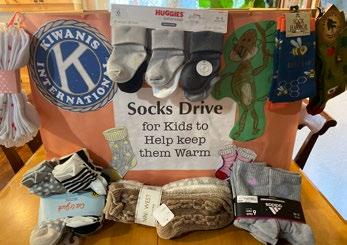
If the feet are cold, the whole body feels cold. The Kiwanis of Lake Tahoe annual sock drive is underway through December 31. Drop off socks at the South Lake Tahoe Library, STPUD, Catalyst, Ernie’s, Guild Mortgage and South Tahoe Refuse to help local kiddos stay warm and toasty.
A record-breaking crowd gathered for the Heavenly Village Tree Lighting on November 28. The event received a proclamation from state Senator Marie Alvarado-Gil and kicked off five weeks of holiday festivities.
The popular and tasty B.E.C (bacon, egg, cheese) food trailer has relocated to The Hangar for winter. Hours: Thursday-Monday, 8am to 2pm.
The Humane Society of Truckee-Tahoe is offering pet care grants for low income, seniors, disabled and other qualified pet owners to help pay for approved veterinary care. For more information and to apply, visit https://hstt.org/services-resources/community-pet-financial-assistance/ or contact HSTT’s Community Resource Dept at 530-582-2484.
Barton Memorial Hospital has earned an A for patient safety from the Leapfrog Group, an independent, national non-profit focusing on patient care.
The Tahoe Fund has launched a “Million for the Marsh” campaign to raise funds for the complete restoration of the
natural ecosystem at the former Motel 6 site. To learn more and donate, visit tahoefund.org/millionforthemarsh.
Learn more about the city of South Lake Tahoe’s roadway, greenbelt, watershed and other 2025 projects at www.cityofslt.gov.CityProjects.
An unprecedented number of grant applications from Tahoe non-profits have identified child care support and mental health care as the top two issues for the Tahoe Community Foundation. Funds awarded to the Boys & Girls Club and the Family Resource Center helped address those needs. Visit https://www.TahoeCF. org for more information.
Tara Styer has been named deputy director of the Tahoe Transportation District. She was previously capital program manager among other positions she has held at the agency.
Santa will be dropping by Kahle Community Center on December 20 from 8:30am to 10:30am. Visits with St. Nick are free. Pancake breakfast, $3.
If 100 people donate $35 or more by the end of the year to the Tahoe Backcountry Alliance, the Tahoe Fund will donate $10,000 to the organization. The alliance helps people stay safe year-round while recreating, offers snowshoe and cross-country ski expeditions for Washoe youth and provides free sno-park passes and gear for checkout at local libraries. Visit tahoefund.org/tahoebackcountry to contribute to the campaign.
Got a community item for Heard? Email mountainnews2@gmail.com, subject line “Heard.”

Ryan is a foot and ankle specialist with Barton Heath.
“Shoes should look like your feet,” he said. “No doctor out there wants you in tiny pointy shoes. Those smaller shoes will cause issues with your feet.”
If you do wear heels, the doctor advices not keeping them on all day at work.
Shoe stability is another concern. If shoes easily bend in the middle, this means they are not providing enough support.
Orthotics might be an easy—though not often an insurance-covered—solution to problems. Over-the-counter help might be available, too.
“I’d rather modify your shoes than your feet,” Ryan said.
No one shoe is perfect for everyone. It depends on what a person has going on. Those with knee pain might want to consider a lower drop shoe, while Achilles or plantar fasciitis issues respond better to a higher drop shoe.
Barton offers gait analysis that could help with shoe style options and provide other information.
Nerve issues are a common topic for Ryan at Barton’s foot and ankle clinic.
“We can trace where the pain is on the foot to see if there is an area where it’s impinged and you can get release,” he explained. “A lot of time foot pain is coming from your back.”
Exercise—in particular Achilles lengthening and strengthening
Corns and callouses seem to be issues everyone has at some point. They are the same thing, though corns are on the top of a foot and callouses on the bottom. Using a pumice stone at home can often take care of them—or wearing thicker socks or different shoes.
Toenails are important to pay attention to. Hardening of the nails is normal with aging, but often should be looked at by a doc to make sure it’s not a symptom of something else.
Keeping feet clean helps prevent fungal infections, which can turn into serious ailments.
People with neuropathy and diabetes in particular need to be concerned about foot care.
Ryan recommends people with nerve damage in their feet do daily checks for cracked skin, blisters, scrapes, callouses, toenail issues and hot spots.
For more severe cases, where a wound has not healed, Ryan refers people
• Clean feet in warm soapy water, including between the toes; consider getting a shower chair if you can’t reach them
• Moisturize feet every day with vitamin E lotion-cream; avoid moisturizing between toes
• Avoid wearing tight-fitting shoes; shoes should look like a foot
• Rotate your shoes, check for asymmetric wear
• Trim toenails straight across; file corners if needed to prevent nail from going into the skin.
Source: Paul Ryan, Barton Health physician
to Barton’s wound center that opened last summer. There you can receive care for all types of wounds—not only feet—that have not healed in a timely manner.










Generally, the longer you’ve lived somewhere and put down roots, the more you feel ownership, which of course doesn’t make sense in the long view since none of us has any kind of permanence here or any other geographical place. But still, it doesn’t stop us from caring about what we see going wrong—the failings of others that cause harm. And as a bonus, it keeps us from looking too long at our own failings.
But certain recent local developments you’re all aware of got me wondering why we get so upset about breakdowns in the town’s fabric of integrity—and quality control in general. It’s not like it’s a new phenomenon that hasn’t been going on since humans first took breath. It’s probably the one thing we can count on— that our fallibility will emerge at some point.
Sure, there are the obvious reasons for our outrage like we hate to see our resources wasted because we know that threatens us in various ways, as individuals and as a community. In some cases, it’s a more personal outrage because it’s specifically our resources being abused whether it’s our time, money, energy or otherwise.
But less obvious is what’s going on beneath the surface. Being duped or taken advantage of makes us question our own judgment, and it’s that judgment we rely on for our survival and thriving. We come to understand that our radar system has flaws, which leads us to a train of uncertainties, and we don’t like uncertainty. Even if we sense that we have vulnerabilities, we don’t like them exposed and it makes us angry when they are—especially if we don’t see any way to resolve them.
Then there’s the loss of faith in others—in humanity, maybe. This, too, has both temporal and spiritual elements. To the former, that faith in others is basically the atavistic trust that they will support us in our bid to survive, and we will do likewise; the other side of that coin is more far-reaching.
In 1623, Anglican cleric John Donne wrote “Meditation 17”; its thesis was that “No man is an island, entire of itself; every man is a piece of the continent, a part of the main,” and “any man's death diminishes me, because I am involved in mankind.” I know we’re not talking about
death here, but the idea holds, nonetheless. We tend to feel betrayal of trust not only as a personal loss of faith but as a collective one; it turns us even more cynical than we were before. And I can’t think of a time I’ve ever thought, boy, humanity could use some more cynicism.
Indeed, the natural temptation after experiencing betrayal upon betrayal— whether it’s of your resources, faith or ideals—is to trust nobody and shift your faith onto dogs rather than people—not a completely insensible move. Regardless, we have to resist that urge and do almost the opposite. We have to continue to invest in each other—even when we’re let down; we have to try to treat every day as a clean slate for ourselves and others with the assumption that we are going to do right—even though we’re often not going to.
Bonus year
I don’t know if you’ve ever experienced this—and granted, you need to be at least into your forties or probably beyond to do so—but it’s when you’ve lost track of your age and you assume you’ve turned a year older than you actually have.
Trish mentions this phenomenon in her column this month—the whole getting older and forgetting one’s age thing.
This happened for me once several years back and again just the other day when Anne corrected me on my age. She may be lying but I don’t really care because all I know is I have a bonus year now. The real question is what to do with it and what rules govern those choices.
In those “free” years, are we accountable for what we do, or is it like it didn’t happen? So many questions.
As of this writing, your Tahoe Knight Monsters sit atop of the ECHL’s western conference.
After wrapping up a homestand on Dec. 6, the TKM will head out for a threegame road trip, returning to the Tahoe Blue Event Center Dec. 17.
As always, email mikesmutterings@ gmail.com










Looking to spread a little holiday cheer? On the following pages, find profiles of four, local non-profits for seasonal giving consideration. From flowers to books, the Mountain News takes a look.
about $15,000 in funding, leaving it around $10,000 short. Much of the increase is due to inflation. “A box of crayons costs more than it did last year,” said President Jeanne Benin. The kids and adolescent programs go through a lot of materials and snacks, she said. Recently, the El Dorado Hills Library donated
development and training for library employees.
$250 for a lifetime membership.
A library may bring to mind books. But to the South Lake Tahoe Friends of the Library, the institution is so much more—a place of community, connectivity, support.
One simple, inexpensive, but key function FOL serves is providing refreshments at its affairs. “When you’re reaching for the same cookie, it facilitates conversation,” said Haerr.
The 2025 FOL budget was approximately $21,000. The projected 2026 budget is almost $25,000. So far, FOL has projected
“It’s a ‘third place’ (not work, not home), where people can go and they’re not expected to spend money. It’s encompassing to anyone, regardless of income. It’s open, it’s warm. Show up and gain community,“ said Melissa Trader, FOL board member. FOL plays a key role in making the South Lake Tahoe Library an engaging place to be. It sponsors four book clubs— including sci-fi, romance and true crime—a speaker series free and open to the public, children and teen activities, a fiber arts circle, local author readings, a senior story swap, a chess club and other assorted programs and events. “You automatically have something in common with someone you don’t know when you show up,” said FOL board member, Denise Haerr. “It’s very powerful for meeting new people and creating community.”
an extra 3-D printer to the South Lake Tahoe Library, but FOL is committed to providing the supplies to operate it, which can be pricey. The addition of the 3-D printer will dovetail with STEAM activities in local schools, Benin said.
The largest item in the FOL budget is almost $11,000 dedicated to the library’s annual acquisition fund. This accounts for about one-quarter of the total monies for new books and magazines. An ongoing, twoyear commitment of $5,000 annually helps fund the Dolly Parton Imagination Library, where children receive a free book in the mail every month from birth through age five. The local Marcella Foundation is the other local sponsor. So far, 485 local youth are enrolled in the program, but FOL wants even more to experience the benefits of early literacy. “We go to the farmers’ market and track down people with strollers,” said Benin. FOL also funds staff
The main FOL fundraisers are its thrice-yearly used book sales, which bring in about $5,000. The library is continuously accepting donations of used books to stock these sales, though the library itself gets first choice of any contributions for its collections.
Members receive early admission to the book sales. Want to join?
Pick up a green membership form at the library front desk. All monies raised by SLTFOL stay in Tahoe to fund local efforts.
South Lake Tahoe Library Branch Manager Katharine Miller said FOL has been around

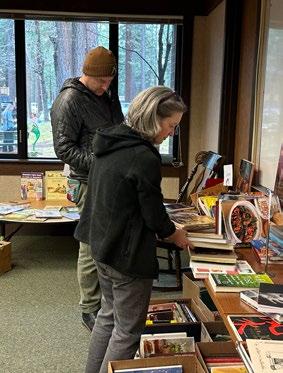
At the November sale, Bridget Carberry and Laurens Kraal browsed the selection. Kraal said he enjoys the opportunity to find hidden gems for his home collection. Cyndi Cooper told the Mountain News she takes advantage of the book sales to stock her neighborhood free library in front of her home.
Cooper’s friend, who identified herself by her first name, Julie, said “I always like to support local things like this. I love books, I love to touch them, I love to feel the pages.”
FOL also applies for numerous grants. And those grants are supported by its membership numbers. “We have 215 members, but we want more. Our membership numbers say ‘these people support us’ so when we reach out for grants, we can show we are a valuable organization in our community,” said Benin.
The several membership levels range from $10 annually for an individual membership to
since before the library had a permanent home and was located at various places around town, including residents’ homes.
“They have always stepped up. They’re always providing extra support and asking, ‘how can we help.’ They’re key to keeping the library open and flourishing.“
In years past, said Miller, FOL has even helped equip the library with basic furnishings and apparatus. “Without Friends of the Library, we would not have a lot of the books on our shelves. We wouldn’t even have shelves.”
FOL board meetings are held the third Wednesday, every other month beginning in January at 1pm at the library and are open to members and the public.
To donate to Friends of the Library, send checks to: Friends of the Library
South Lake Tahoe Branch 1000 Rufus Allen Blvd. South Lake Tahoe, Ca. 96150
One and done is often the life of a floral arrangement. This is because after a wedding or some other event, flowers wind up in the trash.
weeks in advance, then works with entities like Barton Health, schools and nonprofits to see who might need or want flowers.
“We donated a lot to what
It doesn’t have to be that way, thanks to Tawni Janvrin, executive director of Petal Kindness.
The South Lake Tahoe nonprofit that started in May 2024 is all about taking floral arrangements from one event and repurposing them for another.
“In the event industry, unfortunately there is a lot of waste in food, décor, plastics and floral,” Janvrin said. “The lowest hanging thing to tackle is the flowers.”
Janvrin is in the event planning business, having owned Pomegranate Occasions in South Lake Tahoe since 2011. This makes her well qualified to assess what is going on in this industry and to help it become more sustainable.
For about a decade before launching Petal Kindness, the idea of giving flowers a second life was percolating in Janvrin’s creative mind. Finally, she pulled the trigger.
Before launching the service, she spoke to local florists because the last thing she wants to do is cut into their profits.
“Create with T and Twine Floral Co. are the two predominant South Lake Tahoe florists. Both are very kind and community driven,” Janvrin said.
“I knew if I could get those two to understand and have their support, the rest would kind of follow.”
After an event, the arrangements are far from their peak, so it’s not like they are representative of the work professional florists do.
Timing is everything to bring a second life to flowers.
Ideally, Petal Kindness knows of an event like a wedding a couple
was Live Violence Free. What we heard from their clients is ‘it brightened my day’ and ‘this is the first time I had ever gotten flowers’,” Janvrin said.
At the start of the school, year Petal Kindness took a large donation of flowers to South Tahoe High School during a staff kickoff event.
“We set up a flower bar at that event. We got fabulous feedback. All the teachers could make an arrangement for their classroom,” Janvrin said.
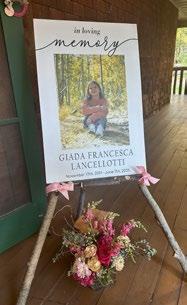
It was the August memorial for 13-year-old Giada Lancellotti that proved to Janvrin her idea was bringing joy even when the event was far from joyful.
“It was probably the highlight of the year; to think of the power that this organization
can be,” Janvrin said. “We got seven different hosts to donate flowers. That place was drowning in flowers as it should be for a celebration of life. A whole host of volunteers made that happen. They did some beautiful work.”
Petal Kindness has forms on its website (https://www. petalkindness.org/) for donors and recipients to help facilitate the matching process, as well as a link for potential volunteers.
No promises are made to recipients because the quality, color, quantity or even type of flowers is not known until they are retrieved.
Angie Reagan with Access Tahoe could be named volunteer of the year for Petal Kindness.
“She did a lot of our pickups and lot of arrangements to get flowers to senior centers and suicide prevention group meetings,” Janvrin said.
Petal Kindness reps cannot just go around picking up flowers on a whim.
It’s a process. The event host owns the flowers, so their permission is needed to do anything with them.
Vases must to be left behind because florists own and reuse them.
“Part of the challenge is the late-night pickups,” Janvrin said. “We are always looking for volunteers.
immediately dropped off with the prearranged recipient for them to make bouquets or arrangements as they like.
With most events during the summer, Petal Kindness operates from May to October.
Some of our overhead is having to pay people. We need professionalism with volunteers. They could be walking into a wedding.”
The event host is asked to donate to Petal Kindness to offset the cost of retrieval.
Volunteers have buckets in their vehicles to put the flowers in. They are then often
Janvrin knows she has just scratched the surface of possibilities for recycling flowers because most South Shore wedding venues don’t participate. She gave a shoutout to Valhalla for being the most receptive to this concept. She estimates Petal Kindness receives less than 20 percent of the local wedding flowers.
“I don’t know anyone who doesn’t want flowers. There are enough recipients,” Janvrin said. For more information, email PetalKindness@gmail.com
Since Rotary was founded in Chicago in 1905 as a way to bring male professionals together, it has evolved to include women and not just the top person at a business.
Now more than 45,000 clubs encompassing upward of 1.2 million members operate throughout the world.
Rotary Club of South Lake Tahoe was chartered in January 1947, making it one of the oldest service clubs on the South Shore.
Linne Nelson of the now closed Nel’s Hardware was the first president. Other presidents through the years included: Spec Rahbeck, Harold Buchanan, Everett Bull, Dick Shehadi, John Wynn, Terry Finney, John Cefalu, Dave Huber, Chris Proctor, Dick Derby and Roger Pratt. The current president is Dave Kurtzman. His wife, Karen, is the past president. Nicole Ramirez Thomas will have the job starting in July.
Until the mid-1980s all Rotary clubs were off-limits to women. When countries, including the United States, passed laws prohibiting this type of discrimination, Rotary International took a vote. Jim Duke, who was president of the local chapter in 1986-87, was at that meeting in Munich with 29,000 others.
“It was a heated issue worldwide. People said they would quit. Many thought Rotary would be torn apart,” Duke recalled. “But it was handled so beautifully and smoothly. It was decided if it was required in a
country, you are to let women in, if not, then it is up to that Rotary club.”
He said two local members out of about 100 at the time left when women were invited to join.

Today the club has about 25 people, with most qualifying for Medicare. The club has a desire to recruit younger members, but the prestige of being in a service club isn’t what it was. Plus, there are endless other ways for people to be involved in the community.
“Rotary offers people an opportunity to be part of something bigger. It is very international,” Kurtzman said.
One way to attract younger people is through the resurrection of the Interact Club at South Tahoe High School, which is open to boys and girls. About 30 youngsters are involved this year.
When Duke, the first president of Lake Tahoe Community College, came to town, he joined this club in 1974 as a transfer; he had been a Rotarian in Fremont and Redwood City.
At the time, attendance was mandatory at what were weekly gatherings. Bill Harrah

insisted meetings be at his place even though he wasn’t a Rotarian. He put speakers up for free, according to Duke.
Make-up meetings were possible a week prior or after at another club, though a certain percentage of meetings had to be at the person’s home club.
“(Skiing pioneer)
Hugh Killebrew was a member of the San Francisco Rotary Club, but he made up meetings at our club constantly,” Duke said. “He always made the minimum number of meetings, but not at his home club.”
Two things used to be unique about the South Lake Tahoe club.

People had to live here for six months before being allowed to join. The reason, according to Duke, is that many people got into trouble with gambling so they didn’t stay around long.
The other rule was you
The six-month rule went by the wayside shortly after women were allowed because Rotary discovered all the new women in town went to Soroptimist and other organizations. When so many people were
South Shore can belong to either club though they still must be sponsored by a member and voted in; it’s not automatic.
Rotary Club of South Lake Tahoe built the large gazebo in Bijou Community Park, is responsible for a number of the covered bus shelters, was involved with starting a floating library in the Philippines, and has worked with the international contingency to eradicate polio.
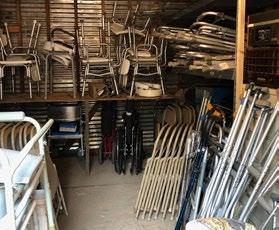
Providing medical mobility equipment for people is now the club’s big project.
“We don’t rent or loan. We give them to people with no expectation of any compensation,” Kurtzman explained. “The goal of the program is to get it out of garages and into use. About 75 percent of what is given out is returned to us.”
Wheelchairs, canes, walkers, shower chairs, crutches, and indoor lifts are some of the equipment exchanging hands.
In the five years since the program was launched, about 1,000 pieces of equipment have come to Rotary, with about 600 people being the beneficiaries.
Sometimes you need a little help from your friends.
In this case California State Parks needs the assistance because it has neither the money nor the human resources to adequately manage its 280 parks. That’s where nonprofits come in.
Sierra State Parks Foundation raises and spends about $1 million every year to help with programs, upkeep and more at Washoe Meadows State Park, Emerald Bay State Park, D.L. Bliss State Park, Sugar Pine Point State Park, Tahoe State Recreation Area, Burton Creek State Park, Donner Memorial State Park, and Kings Beach State Recreation Area.
Half a million goes directly to park projects, while the other $500,000 is allocated for overhead, operation of visitor centers and running tours.
About 1.5 million people visit these eight parks every year.
“The bottom line is the state budget doesn’t always have enough money for state parks. This and last fiscal year every state department was tasked with cutting 8 percent of costs across the board,” Michael Myers, executive director of the local foundation, said. “That has an impact on state parks, especially staffing levels, and the amount of projects they can complete.”
Much of what takes place is a collaboration between the state and SSPF. This summer saw the state finish three projects at Vikingsholm: turret stability, morning room repairs and chimney upgrades. It was the foundation that more than a decade ago funded the report that uncovered these needs.
Without nonprofits like SSPF helping California, parks throughout the system likely would not be what they are today. Myers said it's possible parks would close or have hours cut and services reduced.
ultimately the visitor experience would suffer,” Myers said. The sole mission of SSPF is to support the state agency. Myers said while the needs have changed through the years, the goal remains consistent.
A bit of history
“friends of” organizations, the Sierra district became what it is today.
These groups came to the rescue in 2012 in another California budget crisis year.
has been closed for the last two years for a water line project and is expected to reopen Memorial Day weekend.
board that approves its annual budget, which will happen this month.
had to be the top person—the president or the like—of a company, not No. 2 or lower on the totem pole.
part of Rotary, it was decided a second club was needed. In September 1962 the Tahoe Douglas club was chartered. Today anyone on the
For more info about Rotary Club of South Lake Tahoe, contact Dave Kurtzman at dkurtzman@me.com or (530) 545-3283.
“At the end of the day there might be negative impacts to historic, cultural and natural resources. Assets would suffer and
Sierra State Parks Foundation’s origin dates to the early 1970s when the HellmanEhrman Mansion at Sugar Pine Point State Park was slated to be torn down. The state in 1965 acquired the house and 1,975 acres. The plan was to demolish the structure and turn the land into a campground.
SSPF took over interpretive tours at Vikingsholm and HellmanEhrman. All these years later, “temporary” is the status for SSPF to operate the tours.
Fees from tours at the Vikingsholm and Ehrman are sources of income, as are hosting fund-raising events, grants, and individual donations.
A collaborative approach between the state, SSPF staff
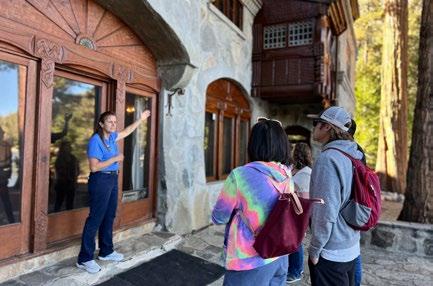
“Some things like education and interpretive programs we will support every single year, along with supplies and equipment to make those programs happen,” Myers said.
The sod roofs, landscaping, repairing water damage, and other facilities upgrades are noted needs at Vikingsholm.
This winter a yurt will be installed at Sugar Pine for cross country skiers and snowshoers. SSPF is working with the state to upgrade the nature-visitor center there as well.
Phase 2 of the Donner project will break ground in 2026. The $300,000 landscaping, erosion and trail project should go out for bid in January. SSPF still needs $50,000 to pay for it, with the hope grants will come through. Native Sons of the Golden West is paying half of the costs.
A West Shore women’s group said not so fast. Public outcry prevailed, with the mansion acting today as a symbol of yesteryear Tahoe.
SSPF, which was granted non-profit status in 1974, started with the purpose of overseeing Sugar Pine Point. Then more sites were added to its purview. At one time, Bodie State Historic Park was part of the nonprofit. As other areas started
Today and tomorrow
In November, SSPF moved its offices from Tahoe City to Kings Beach.
Myers, who has been at the helm since May 2024, is looking at the big picture, wanting to be more strategic about long-term planning so funds can be raised in a timely manner.
“We are putting together a long list of projects that could be more than a year out so we know what to prepare for, where additional funding might be needed,” Myers said.
SSPF makes its money from operating the visitors centers at Donner, which is the only one open year-round, Vikingsholm, and D.L. Bliss. Bliss, which
and its board determines where money is spent and the projects undertaken. Some ideas the state comes up, some are locally driven.
Ultimately, it’s the SSPF
SSPF has a year-round staff of six, with it doubling during the summer. About 60 volunteers put in 1,600 hours of time each year. Myers is hoping to grow the volunteer pool going forward. For more information about Sierra State Parks Foundation, go online https://www. sierrastateparks.org/. From there you may donate money, find out about volunteering, learn about programs, and sign up for the newsletter.


While I am comfortable throwing food together without a recipe, I’m no bartender. I don’t have a good feel for what types of alcohol go with other ingredients.
That’s why I rely on others to be the mixologist or I follow a recipe.
This time of year begs for hot beverages. And with it being the holiday season, well, some of the adults out there are going to want to doctor those drinks a bit.
Years ago, friends and I were on a quest to find the best hot cocktail in the greater Lake Tahoe area.
At the time I wrote: “From the Z Bar inside the Zephyr Lodge at Northstar came my favorite winter drink of the season because it didn’t involve coffee or hot cocoa.
African Winter is dark rum, hot African tea, peach liqueur, lemon, and orange bitters. It was hot and refreshing at the same time.”






I don’t know if it’s still available at the ski resort, but I have found another teabased drink that is a keeper and is pretty easy to make at home.
Since I’m no bartender, I turned to the pages of Classic Cocktail Revival (The University Press of Kentucky, 2025) by Jennifer Brian for this recipe. Still, I did tweak it. Her recipe calls for a syrup that has orange liqueur. I didn’t want more alcohol so instead I used her jalapeño syrup.
(A simple syrup is equal parts sugar and water heated until sugar is dissolved; then it can be flavored.)
Those who read my summer column about margaritas won’t be surprised the alcohol in this drink is tequila. It reminds me a bit of a hot lemonade, which is my mom’s go-to drink for a winter cold. So, maybe this recipe has medicinal qualities as well. (Wink, wink!)


2 jalapeños, including seeds—chopped
Heat water and sugar on lowium heat until dissolved. Turn off heat. Add chopped jalapeños; let steep for at least three hours. Strain the jalapeños
Syrup can keep for a couple weeks in an air tight container in the fridge.
While much of the hubbub about bears has come from the California side of the basin, these animals don’t know there is a state
providing them meals.
“They are attracted to various smells, food sources and many of the things we have around our homes,” Carniello
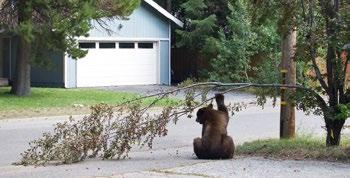

Aaron Keller and Bobby Jone, hosts of the podcast Nevada Wild produced by the Nevada Department of Wildlife, recently had game biologist and bear expert Becca Carniello as a guest.
NDOW says, “black bears have been in Nevada long before we lived here, but by the early 1900s they had been extirpated from the state. Conservation efforts and habitat regeneration allowed black bears to begin coming back into Nevada and reinhabit their old stomping grounds. Since the 1980s we have watched Nevada’s bear population in the western part of the state increase dramatically.”
On average Carniello gets 600 calls a year about bears. (That’s in the state, not the basin.) In what she calls “years when there are natural food failures” that number can reach 1,500.
Food failure means Mother Nature has not provided enough sources of nutrition for bears either because of drought, a hard freeze, or prolonged winter. Bears then either travel farther to find something natural to eat or begin roaming neighborhoods to see what’s available.
Attractants are the same no matter the state or neighborhood, with garbage being the No.1 problem.
“It’s not healthy for them. They get blockages and really, really painful abscesses in their teeth,” Carniello said.
Once a bear finds an easy food source—natural or human—it is going to keep coming back. People are essentially training them to do so by repeatedly
said. “Bird feeders, that’s a huge one. One pound of black oil sunflower seeds contains 2,600 calories. That is a ton of calories for a bear. That is a huge food reward for them.”
She suggests finding another way to attract birds to one’s property, like planting flora they are attracted to.
Carniello also said it’s important to thoroughly clean grills and smokers on a regular basis to prevent a bear from looking for leftovers.
Keep pet food indoors and think twice about feeding domestic animals outdoors.
“Make sure you pick up fruit from trees before it is ripe because those bears can smell it before we can,” Carniello said.
Carniello and her team work with homeowners to ensure attractants don’t exist. NDOW loans non-lethal electric fencing to people that is not dangerous to children or domestic animals. It’s an educational tool of sorts for bears to learn this is a location that’s off-limits and no longer has easy pickings.
NDOW will also trap bears, then haze them to chase them back into the wild. Carniello admits this hazing creates temporary changes in bear behavior; it’s people who have to make the permanent changes to co-exist with bears.
For resources to better live with bears, NDOW has info on its website (https://shorturl.at/HCnL3) and Bear Wise (https://bearwise.org/) is a national organization the state is affiliated with.

Menopause. While it’s a normal part of a woman’s life, it isn’t something that has been well studied or something doctors discuss much with patients.
Meg Jewell, an ob/gyn with Barton Health, is doing her part to change the narrative. In October she gave a talk titled “Insights into Midlife Hormonal Health for Women.”
She is the only doctor within Barton’s system who has specialized training in menopausal medicine.
“Women’s health research is historically underfunded, receiving only about one percent of health care research and development for female-specific conditions beyond oncology,” Jewell said. “Keep this in mind when you are voting.”
She pointed out it’s common for doctors to receive zero training in menopausal health. Considering it’s possible for a woman to spend 40 percent of her life in this phase, there is a huge void in expert knowledge.
Jewell said the medical system in the
U.S. is not designed to evaluate the whole person because people are referred to specialist after specialist. She said it’s not uncommon for a primary doctor to prescribe anti-anxiety medication when “often hor-

mones are the cause of underlying symptoms.”



Mood changes are the norm, with 58 percent of perimenopausal women ages 45-55 reporting anxiety and 62 percent showing signs of depression. The cause is often fluctuating hormones and sleep disturbance.
Perimenopause is the transition from reproductive years to menopause. On average the transition takes four to ten years.
Post-menopause is defined as one year after the final menstrual period. This occurs because of the reduced function of the ovaries.
“It is a time of rapid hormone change,” Jewell said.
While menopause is making headlines of late and is a common topic on social media, Jewell warns people to be careful where they get their information and medicine from.
What most people associate with the transition is hot flashes and night sweats, with four out of five women experiencing these—often starting in perimenopause.
Only 20 to 30 percent of women seek medical advice even though these symptoms can last seven or eight years and into menopause.
More than half of women say menopause affects their sex life—and not in a good way other than no longer having to worry about getting pregnant. Jewell hopes more research will go into why women can have a low libido.
She said exercise is the most important thing a woman can do because it improves mood, sleep, stress level, cognitive
abilities, and metabolic health. She advocates for 150 minutes of moderate or 75 minutes of vigorous intensity every week, along with two days of resistance training.
Movement is also necessary because weight gain is common. Eating “real” food and getting enough fiber and protein are key. Calcium and vitamin D need to be monitored as well to ensure women are getting enough; this can be achieved through nutrition.
Other negatives associated with menopause include increased risk of cardiovascular disease, which is the leading cause of death for women. This includes heart attack, stroke, high blood pressure and heart failure. Osteoporosis is another threat. In fact, there is a high mortality rate for those who sustain a hip fracture after the age of 65.
Muscle mass decreases, cholesterol increases and increased insulin resistance are also normal.
Drugs can help with some issues. Hormone replacement therapy (HRT) is another option to counteract the depletion of estrogen and progesterone. HRT got a bad rap for years, but more recent studies are proving its effectiveness.
Alternative therapies showing promise include cognitive behavioral therapy, hypnosis and mind body therapies like yoga, deep breathing and meditation.
Jewell first likes to start with working on sleep, nutrition, exercise and stress management.
*$2,000



Well, it’s been one heck of a year in Tahoe. Lots and lots of problems. I think that might be the only thing we can agree on.
And now it’s Christmas. What better time to review our year of problems and poor choices?
Of course, there were all the usual problems—greedy world leaders and local mayors, remembering what color trash goes in which color garbage can, dodging free-range bark-a-holics and snoopy ex-bosses. Coincidentally, two of my former bosses were arrested and jailed on larceny and drug charges. The rest are running for city council. Keeping with a long Tahoe tradition, our local politicians continue to get arrested. City council meetings resemble the battle scenes in Game of Thrones And the rising cost of paid parking in Tahoe guarantees that, unless you have obtained additional financial resources the traditional way, from robbing a local church, you will never park in Stateline again.
Fun fact: Jeff Bezos fulfilled the secret desire of husbands around the world by loading his wife and her girlfriends into a rocket and blasting them into space. Sometimes problems should be expected. Like letting Hubby walk out the door wearing tennis shoes mid-winter. Yes, I warned him. But he’s oblivious to the laws of gravity and the proven mathematical theory of a wife always being right. He needs a helmet, a muzzle and a leash to get through a day unscathed. It only took one slip, a spectacular icy vault and an aerial spin to tear both a rotator cuff and bicep muscle. Naturally, I deducted points because he didn’t stick the landing. Yet, in typical couple’s fashion, I managed to injure my knee. Not by doing the fun stuff, like wailing and dancing to Prince’s song, “Kiss,” showing off all my slick moves to my dog while she contemplated reporting me to the authorities for animal cruelty (another reason she’s not getting an

iPhone for Christmas.) Nope, my knee injury was from playing the most dangerous and cruel sport ever invented for oblivious old people. Pickleball. If you don’t believe me, just watch a game some time. Everyone is wearing splints, slings and braces, along with an occasional eye patch. This makes it really hard to tell the teams apart. And listening to players repeatedly describe their injuries, surgeries and choice of pickleball shoes is incredibly painful. Then there’s always AARP and Medicare chipping at us to practice preventative health care. Since we’re senior citizens, we’ve had all the recommended conga line of vaccines, as we are now,
officially, the lab rats of society.
Fun fact: old people can’t remember how old they are. Hubby says, “It’s like counting the rings on a tree to determine its age. If you want to know my age, just count my fishing poles.”
After a consultation with his doctor recently, Hubby announced he was changing his ways.
“The doc told me coffee is dehydrating and I need more water, so now I drink my coffee in the hot tub. And when I mentioned that I drink a Manhattan in the sauna, the doc told me that was dehydrating, too. So, I take another hot tub.” Problem solved.
Fun fact: one of us has shrunk. Hubby and I are now both five foot, four inches tall. Which is the same height as his coffee mug.
If we actually go to a coffee shop, I can’t help but ask, when did trendy fashions become more important than the behavior of the fashionista wearing them?
Look around—nobody pouts and complains about the color of their
matcha latte unless they’re wearing Lululemon.
And why are seniors forced to rise to a level of mediocrity in tech? Sure, our incompetence is humiliating. But we’re used to that by now. So, the next time someone says, “get the app” or “scan and download” or “put it in the cloud,” I am going to smother them with my unfashionable Walmart artificial-down pillow.
Problems are the stuff of life. Without them, we’d be clueless, matcha latte, church-robbing, rocket wife-launching junkies. With them, we’re forced to rise to the challenges of life on Planet Wackadoodle.
So when faced with the demands of blizzards, bills and over-baked turkeys, friends and family, it’s really not a problem. It’s just Christmas.
Wishing you a cheery Christmas and adventurous New Year —



Ok… I’ll give it a break and take a one-month hiatus from the traffic speed and road safety obsession. There are a few of us working on a warrant analysis for a stop sign or other traffic-calming measure at the intersection of Sawmill and Lake Tahoe Boulevard… so stay tuned for that.
But for now, I’d like to talk about phones. We have four kiddos and we made a deal with them a few years ago that as long as they had all A’s, they could have their phones in their rooms at night, a.k.a. “total anarchy.”
That’s what Wifey and I called it on the little chart we hung up on the fridge. As soon as they start getting B’s, then we confiscate phones at 9pm every night. For C’s, we just take the phones completely. There are other nuances, like good deeds can raise them one category, friends can spend the night only if you have A’s, and getting in trouble at school will drop them one level, but that’s the basic structure.
Status Report: it has worked a little… uhhh, too well. I mean, Wifey and I are stoked that they have good grades and are relatively well-behaved, but “total anarchy” perhaps is not the
best incentive strategy, and like many parents, we have serious qualms about excessive screen time. Phones are a doubleedged sword. I love that they use phones to connect with friends, to ChatGPT rebuttals for discussions with my conservative parents, to navigate around town and to beat me in “Block Blast” or chess, but phones are yucky and do yucky things to your brain and body, especially for kids. The blue light, stimulation, and notification pings delay sleep onset, cause irritability, chronic sleep debt, memory and learning problems, and higher risk of nervousness and depression, according to the American Academy of Pediatrics and the American Academy of Sleep Medicine.
Another long-term study of adolescent brain development using MRIs and neuroimaging by the American Psychological Association and National Institutes of Health found that higher total screen time was associated with greater negative somatic symptoms of sadness, anxiety, ADHD, and anger. Let’s face it. We’ve all seen it in our kiddos and probably also felt
it in ourselves after too much time plugged into our little black mirrors. It’s just unhealthy. It’s just kind of gross.
So, this holiday season, I’m thankful for activity. For real human-to-human friendship and for getting out and experiencing life, not just watching it. Two of our kiddos were lucky enough to be involved in the absolutely amazing production of Chicago at STHS this past month. The authentic connections and joy and purpose that they felt was so wonderful to bear witness to. Our two other kiddos came with me at the start of the Thanksgiving break to Bishop for a bit of “campsgiving.” It was fanfreakingtastic to see so many other Tahoe peeps down there climbing in Owen’s River Gorge, where there is zero cell phone reception, having a total blast. But perhaps the best idea for unplugging came from my parents who graciously offered to host Thanksgiving this year and made it clear that no phones were allowed in their home. We brought books and boardgames; they had puzzles and corn hole set up for us. The kids wrestled and had handstand contests on the lawn. It was a good lesson
and our kids probably enjoyed it more than the adults: it’s okay to ditch the device. Leave the phone at home or in the car. Life will go on and you’ll be better for it.
M.C. Behm is a full-time resident of South Lake Tahoe. To learn more or respond to columns visit www.behmbooks. com or email mcbehmbooks@ gmail.com.



A perfect blue bird day— four inches of fresh powder on the ground, no other cars at the parking area and you are with a couple friends you have always wanted to ski with. Just awesome, boots on, packs on, dogs excited, climbing skins on, off you go, headed for the top of the peak, dreaming of some phenomenal turns. Suddenly you realize the skins are sliding
off to the side of your ski base, no longer sticking . . . nightmare! This can’t be happening today. The dream of those turns has just come to a disappointing end—time to go back to the car, ugh. Back at home the realization sets in that there were signs this day was


coming—skins not quite sticking like they used to, peeling off super easily at the top of a climb and then leaving little bits of glue on the ski base so the skis are grabby, making it tough to ski down. The frantic search for new skins starts immediately, only to find, wow, skins are not cheap! And hopefully I can find the size I need nearby . . . because it is always best to shop locally.
Well, there is an alternative—less expensive and better than throwing away a nice pair of climbing skins. You can touch up or completely reglue your existing skins. This can be a messy and somewhat toxic job, but if you are cautious, it is worth the effort. Some shops will do it for you; we used to at the shop but have stopped for those reasons. One or two—no big deal; dozens—maybe not so good. So now we sell the glue and you can DIY. You will need a surface
to work on, ideally to work with the ski upside down, some clamps to hold the skins in place, an iron or heat gun, a metal scraper, some newspaper and the new glue.
Flip the ski over on the bench, put the skin on it glue side up, clamp tip and tail down taut. If you just have spots missing glue, it is easy to add glue to those open areas using a tube such as Black Diamond Gold Label (very good product). Spread a little around following their instructions, working in a well-ventilated area!
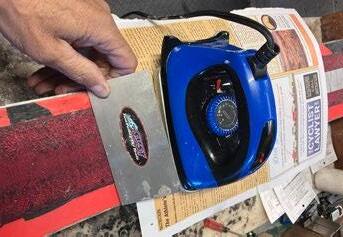
If you are doing a full reglue, removing the old glue is the first step. Heat up your iron to medium heat; if this is your hot wax iron, use that waxing temperature. Next, I like to lay a sheet of newspaper on the glue surface, or better yet, magazine pages, which are a little thicker and stronger. Start at one end with the iron on the paper, moving back and forth in small sections, heating the glue. Then lift the paper at the edge of the iron, moving it along and lifting paper. The paper will remove some glue, but while it is still hot, use the metal scraper to scrape the skin clean. Work in small sections, making sure you have clean fabric remaining. This
part takes the most time and effort, but the outcome is worth it. Get ‘em both nice and clean, tip to tail, and go get some fresh air. Get all that sticky paper off the floor so the dog won’t get stuck to it. Glue time. There are two common types of glue. There are rolls you lay onto the skin and iron on—a clean method that requires a bit of practice to get a nice final product. The more common application is glue in a tube. I find this easier to control and possibly just a better type of glue. The tube also makes it easier to make small corrections where needed. Spread a nice thin layer, working in small 8-to-10-inch sections. If your skins have that center nylon strip, do not put glue on that section. Hang them up over night before folding them. In the morning, fold each skin in half and then pull them apart; repeat a couple times to be sure your new glue job is staying nice and smooth. You just saved a wad of cash, and hopefully only lost a few brain cells.
It stayed cold last night. I bet that four inches of fresh is still in really nice shape. Even better, those guys yesterday set a nice skin track to the top for you!
Let’s play
Weather, topography and fuels are three main indicators that predict the severity of a wildfire.
That’s the conclusion of Andrew Latimer, UC Davis professor in the

Department of Plant Sciences and faculty director for the UC Davis Natural Reserve System.
He recently gave a talk hosted by the Tahoe Environmental Research Center titled Fire Risk, Fire Behavior, and PostFire Forest Resilience.
Latimer singled out the 2007 Angora Fire that burned more than 3,000 acres and wiped out 254 homes as a “good case study of how fuel treatments work.”
Despite the devastation on the South Shore, it could have been worse. Structures and trees survived in areas that had previously been treated.
Latimer’s team of researchers went to 12 areas in California where fuel treatments had occurred prior to a fire, then contrasted those places with land that had not been thinned. The conclusion—controlled burns work.
For decades the prevailing philosophy was to douse flames as soon as they ignited. That thinking has left overgrown forests throughout the country. It’s a laborious and potentially expensive process to create a healthy forest.
The lack of controlled (good) fire and hot summers can result in a scorched landscape. A forest’s dryness and the continuity of fuel are key factors in the firestorms that are becoming the norm, Latimer said.
He equated the ecosystem to a solarcharged battery.
“How fast and when the stored energy gets released makes all the difference,” Latimer said. “Ideally, you would not want that battery overcharged. If the energy is going to be released, it is better if it’s slowly.”
Slowly means through intentional, controlled fire.
Trees and other forest flora are naturally “charged” year after year. If they aren’t managed, a combustible inferno is possible.
“They found sequoias are about five times less likely to die if there was a previously prescribed burn.”
Research also has found replanting is crucial for a future healthy forest.
The conundrum, Latimer said, is California has a backlog of more than
Ongoing projects Latimer and his associates are involved with include digitizing and analyzing thousands of CalFire and U.S. Forest Service cone collection records going back 60 years to forecast the best time to harvest them. Those seeds are future forests.
“Fuel moisture is the biggest single factor controlling the rate of energy release,” Latimer explained.
In some ways, though, it’s a doubleedged sword because in wetter years everything grows faster. Still, it’s better if the flora has a high moisture content if fire strikes. That water has to evaporate, which means the intensity and spread of flames will be slowed.
Latimer said there is a definite correlation between atmospheric dryness and how fast fuels dry out.
Technology is helping evolve the conversation about fire.
LiDAR (light detection and ranging) data generates three dimensional images that can map individual trees. Latimer spoke about a study in Sequoia National Park using LiDAR with high resolution satellite images from PlanetScope.
“Putting together those tools gets data of survival and mortality,” Latimer said.
one million acres needing to be planted.
Resources aren’t in place to make this happen today.
Ideally, seedlings are planted one or two years post-fire. This way unwanted shrubs are less likely to have taken hold.
Using drones to create a photo mosaic of plots could help with the replanting process. Scientists are also looking at whether seeds could survive high-severity fires.


Frankenstein—the iconic story of a man and his monster. Since Mary Shelley broke the mold on the gothic novel in 1818, Frankenstein has been part of our culture. There have been over 400 films made featuring Frankenstein’s creature, starting with a silent film, Life Without Soul in 1915, and followed by the classic Frankenstein in 1931 featuring Boris Karloff as the creature. The story has been filmed as horror, comedy, parody, psychological drama, romance, and everything in between.
The latest filmmaker to bring the iconic story to the screen is Guillermo Del Toro, the director of such diverse films as Pan’s Labyrinth, Pacific Rim, Blade II and the best picture winner of 2018, The Shape of Water (which he also wrote, directed and produced). Oh, and he also won for best director. He has been in love with Frankenstein since he was a kid. He calls it "the quintessential teenage book," also saying, “You don't belong. You were brought to this world by people that don't care for you and you are thrown into a world of pain and suffering, and tears and hunger." For him, these elements are a big part of the story, which has largely influ-
enced his film.
His film starts with a Dutch ship stranded in the ice while attempting to make it to the North Pole in 1847. They pick up a man they find injured on the ice, whom we discover is Dr. Victor Frankenstein, and he is being chased by a monster. As he tells his story, we flash back to his upbringing by an overly strict and unfeeling father, a prestigious medical doctor, who teaches Victor all the elements of medicine. When he is still young, Victor’s mother dies giving birth to his younger brother, William. This event fuels Victor’s obsession with conquering death.
We then jump to a grown-up Victor, now a doctor, who is rejected at the medical academy for his outlandish ideas on how to reanimate a human being. However, he is taken in by Heinrich Harlander, a weapons manufacturer whose fortune is put at Victor’s disposal. Harlander has an ulterior motive we will find out later. Victor chooses a properly dark gothic tower in which he builds his lab and several special effects later, creates his creature. The creature, however, is not simply a lumbering monster, and though capable of rage, is in essence, a
gentle, intelligent being trying to learn about the world. Del Toro makes his creature a 19th century superhero as somehow, through his creation, he has been given super strength (like push an entire sailing ship strength) and the ability to rapidly heal any injury, including gunshots, fire and explosions, which basically makes him immortal. Victor, (not knowing this), soon tires of his creation, seeing it as a thing he built rather than a living, thinking being, and in a fit of rage, sets fire to the entire castle, leaving the creature inside. But he escapes, leaving Victor to try and hunt him down, and after a time, the tables are turned. We also get a flashback to the creature’s story, finding out what his journey has been, how he is learning of the world, all leading to the inevitable confrontation.
The film is a visual feast of rich, dark, gothic settings and if you know Del Toro, you know his violence will be bloody and messy. Beyond the dark gothic horror, the film is really a fantasy tale of ideals and morality, exploring the value of a soul. It is full of intense emotion while trying to discover who is the real monster. Teresa was really moved
by the film, though grossed out by the bloody violence. You can now catch Frankenstein on Netflix.
There’s a small, quiet film you can also catch on Netflix called Train Dreams. The film follows the life of Robert Grainier, whose life unfolds at the beginning of the 20th century in northern Idaho. Orphaned at a young age, Robert grows into adulthood working in the forests of the West, cutting timber, and building the railroads to connect the West Coast to the forests of the northern Rockies. After falling for local girl, Gladys, they get married and build a small cabin on a river. There they start a family and plan for a future where they might try to build a small lumber mill so Robert won’t have to leave every logging season. They have a daughter, Kate, and life is moving happily forward. But life doesn’t always move the way you want and when tragedy strikes, Robert must find a way to keep moving forward and find meaning in his world.
Joel Edgerton gives a deeply moving and understated performance as Robert with Felicity Jones as Gladys. The film is soft, unpretentious, and beautifully crafted with a soulful elegance.
It is a film reminiscent of a Hemingway novel and is pure American. Dramatic moments are not sensationalized so much as deeply felt. Robert is an honest man who carries the guilt of a tragic event from early in his life. He has had his share of life’s ups and downs but only wants to live the best way he can and love and take care of his family.
William H. Macy sneaks in a great role as Arn Peebles, an old timer who has been working as a logger for years and waxes philosophic about the forest and their place there. Macy creates Arn as a pleasantly weird old coot full of superstition and paranoia.
The film is also about the relentless movement of time, not only for Robert and his life, but the intrusion of humans in the old forests and the relentless movement toward progress.
Train Dreams is sentimental but doesn’t push too hard; it stays within Robert’s world. It is a film about life and loss, but lifts you beyond that. Unfortunately, Teresa missed this one, though I’m sure she’d love it.

An El Dorado County planning commissioner was selected by a supervisor who knew nothing about the man’s past infraction with the California Fair Political Practices Commission.
“I learned about this with your email on (Nov. 29),” Supervisor Greg Ferrero, who represents much of El Dorado Hills, told the Mountain News
David Spaur was appointed by Ferrero in January, with both men beginning their roles then. Commissioners are approved by the entire Board of Supervisors.
The FPPC’s website says: “David Spaur, as a Monterey County Economic Development Department Executive Director, failed to timely disclose a gift of travel to China from the Chinese Government on his 2014 Annual Statement of Economic Interests, in violation of Government Code Section 87300.” The code relates to conflict of interest.
The only FPPC 700 form online for Spaur is for his current position, with nothing disclosed.
Spaur did not respond to a Mountain News inquiry asking why he didn’t
originally disclose the trip, what the value of the excursion was, or any other consequences.
His FPPC fine was $100.
“This minor event would not have changed my decision to appoint him to this volunteer role serving El Dorado County,” Ferrero said.
EDC planning commissioners receive $100 per meeting—usually two per month—as well as mileage to travel to the meetings. They are not reimbursed mileage when they visit a project site.
Spaur’s Linked-In page lists his former title as director of Housing, Economic Development and Workforce for Monterey County. This is a job he had from 2014-18. He was laid off in a cost-cutting move. At the time his total compensation package was $209,381.
In 2018 he told Monterey County Now: “I was surprised. I thought the county wanted to create jobs and generate revenue.”