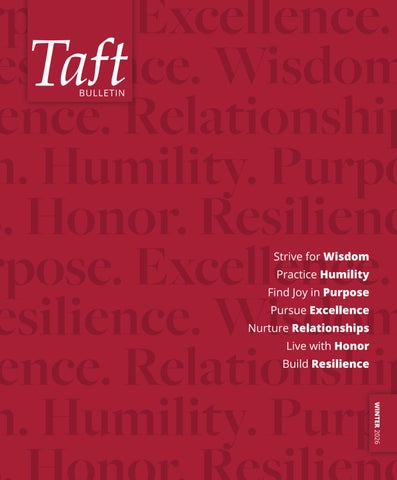
Winter 2026, Taft Bulletin

Page 1


Purpose. Excellence. Resilience. Wisdom. Excellence. Relationships. Wisdom. Humility. Purpose. Relationships. Honor. Resilience. Purpose. Excellence. Resilience. Wisdom. Excellence. Relationships. Wisdom. Humility. Purpose. Relationships. Honor. Resilience.

Strive for Wisdom Practice Humility Find Joy in Purpose Pursue Excellence Nurture Relationships

Live with Honor Build Resilience

Tatum Jaroch ’26 traveled to Kathmandu, Nepal, to work on a women’s empowerment initiative this past summer, supported by a grant awarded by Taft. Read about her experience and other students in Summer Journeys on page 18.

18

Around the Pond

Stories of energized fall life at Taft, and highlights of students’ summer experiences and travels. P

OTHER DEPARTMENTS

3 On Main Hall

6

Alumni Spotlight

From shipyards to hospital operating rooms, from aviation fuel programs to restaurants, Taft alumni use their skills everywhere.

P

36 A Conversation About Taft’s Strategic Design Plan

What it means, the process, and why now P

WINTER 2026

Volume 95, Number 3

DIRECTOR OF MARKETING AND COMMUNICATIONS

Kaitlin Thomas Orfitelli

SENIOR ASSOCIATE DIRECTOR OF MARKETING AND COMMUNICATIONS

Debra Meyers

EDITOR

Linda Hedman Beyus

ASSOCIATE EDITOR

Lee Juvan

Wisdom. Humility. Purpose. Excellence. Relationships. Honor. Resilience. Wisdom. Humility. Purpose. Excellence. Relationships. Honor. Resilience. Wisdom. Humility. Purpose. Excellence. Relationships. Honor. Resilience. Wisdom. Humility. Purpose. Excellence. Relationships. Honor. Resilience. Wisdom. Humility. Purpose. Excellence. Relationships. Honor. Resilience. Wisdom. Humility. Purpose. Excellence. Relationships. Honor. Resilience.

WEBSITE AND SPORTS INFORMATION MANAGER

Seamus F. Conway

PHOTOGRAPHY

Robert Falcetti

DESIGN

Good Design, LLC | gooddesignusa.com

SEND ALUMNI NEWS TO taftbulletin@taftschool.org or write

Taft Bulletin 110 Woodbury Road Watertown, CT 06795-2100

CLASS NOTES DEADLINES

Winter–September 1

Spring–December 1

Fall–May 1

860-945-7777

TAFTALUMNI.COM

CONTACT

EDITOR

Email lindabeyus@taftschool.org or write

Linda Hedman Beyus, editor Taft Bulletin 110 Woodbury Road Watertown, CT 06795-2100

SEND ADDRESS CORRECTIONS TO taftrhino@taftschool.org or write

Alumni Records

The Taft School 110 Woodbury Road Watertown, CT 06795-2100

ON THE COVER

Our cover lists the elements of Taft’s Portrait of a Learner Informed by community feedback and rooted in Taft’s mission and core values, Taft’s Portrait of a Learner defines the mindsets and habits we seek to cultivate in every student. It reflects our commitment to nurturing a growth mindset, fostering lifelong learning, and preparing students for purposeful lives beyond Taft. Our mission is to ensure that Taft Graduates will:

> Strive for Wisdom

> Find Joy in Purpose

> Nurture Relationships

> Build Resilience

> Practice Humility

> Pursue Excellence

> Live with Honor

On MAIN HALL

A WORD WITH HEAD OF SCHOOL PETER BECKER ’95

Portrait of a Learner: From Vision to Practice

AS TAFT BEGINS TO ENACT THE NEWLY-ADOPTED strategic plan, I will dedicate this column to highlighting various aspects of the plan, the ideas that animate it, and the tangible results created by its implementation. The Core Values and Portrait of a Learner (POL) are the plan’s foundation: they serve as both guides and aspirational goals. They require us to ask: “Where are we living out these values already, and where aren’t we?” and “In what ways is the Taft ecosystem already designed to lead to the Portrait of a Learner outcomes, and where isn’t it?” We have years of good work ahead to answer these questions.

One of the positive early results of the work to articulate these goals is seeing faculty and students integrate them into their lives at school. Last spring, when the ink was still wet on the board resolution adopting the plan, a varsity head coach used the POL to frame his team’s learning plan. As they work on Xs and Os and winning games, how do team culture and the learning that occurs each day of a season contribute to Taft’s Portrait of a Learner? More recently, as Dr. Rachel Jacobs, Taft’s director of counseling and community health, works with her colleague Lauren Henry ’99 and others to create the school’s integrated health and wellness plan, their first step was to frame the work using the Core Values.

I will use the rest of this particular column to highlight the work of another colleague, Lisa Parente, Taft’s dean of academic affairs. Lisa used her opening School Meeting talk to help students see how the elements of the Portrait are the deeper “why” behind the daily work of school—and to highlight specific students who exemplify different elements of the Portrait. The following is Lisa’s excellent talk adapted for this column.

I’m Mrs. Parente, and I am Taft’s dean of academic affairs. At this point in the year, most of you know me as the “course change” lady, but it is also my job to oversee the entire academic program at Taft. I am here this morning to speak with you about the exciting opportunities that lie ahead this year in the classroom and to focus you on engaging fully in your academic experience.

Returning students, I am hopeful that you are already familiar with the following quotation from our Student Handbook, specifically the section on scholarship:

“All Taft students are scholars; they seek knowledge, understanding, and mastery in an academic setting. They find joy in collaborating with others, exploring new ideas, and becoming lifelong learners.”
Peter Becker ’95

“All Taft students are scholars; they seek knowledge, understanding, and mastery in an academic setting. They find joy in collaborating with others, exploring new ideas, and becoming lifelong learners.”

This is how your teachers view you, and this is what we are excited about doing in our work with you. We hope that you start to think of yourselves in this way: as scholars who approach your classes with excitement, inspiration, and enthusiasm rather than passively progressing through your assigned class meetings and submitting your graded work. Put another way, we want you to focus not just on the product of what you submit in each class, but on the process of what and how you are learning.

You may be less familiar with our newly published Portrait of a Learner—this builds upon the previous statement about academic scholarship and describes the ideals of what we want each of you to strive to exemplify. These behaviors and attributes apply outside of the classroom as well, but for this morning, I want you to consider these seven aspects of the Portrait of the Learner as goals for your work within our academic program. They describe the true purpose of why you are here, which is not to check off a prescribed list of assignments in order to earn credit.

Look at the specific features of the Portrait of a Learner. You’ll notice that they are written about a person in the process of learning— someone striving, building, practicing, and pursuing. Nowhere does it say that we want our students to graduate having submitted 10 errorfree papers and having solved 1,000 math problems. Perfect papers and problem sets can be proof of someone living out these ideals, but, frankly, we know that the technology exists to do these things for you, removing yourself from the need to think critically and apply your learning; the product itself doesn’t reflect any learning unless you have truly engaged in the process. We want you to focus deeply on the process of learning itself, not on the output of your work.

As you are getting settled in your classes this year, please give yourself the time and grace to learn something new—even if that means that you get a “bad” grade or two along the way. You are here to learn! Not just to learn French, biology, or world history, but to learn how to adjust when your approach isn’t working and to learn how to contribute to the goals of a group growing and working together. Does this sound unattainable? Idealistic? We don’t think so, and we think that you are the proof of this. I asked my colleagues to recall examples of their students already living out the ideals of our Portrait of a Learner, and their responses will illustrate how we see you putting these tenets into action:

Mrs. Ludlow nominated The Anh as a student living out the tenet of striving for wisdom. Over the summer, he collaborated with two friends on developing a new product: a clean, smokeless incense. The trio ultimately patented their invention and placed second in an international entrepreneurship competition.

Nominated by her Lower Mid English teacher, Erin is a student who finds joy in purpose. Last year, she gave her “This I Believe” speech about her belief in the power of smiling.

Dr. Hill nominated Meredith as someone who nurtures relationships. Meredith is friendly with a diverse group of people, engages in conversations with genuine curiosity, and is often seen with a smile or giving an encouraging word.

Carson’s upper mid English teacher nominated him as a student who builds resilience. He fully invested himself in the process of writing by being open to feedback and changing the way he was interacting with text.

Practicing Humility can be shown in a variety of ways. Ms. Beam spoke with Valentine at sit-down dinner about how, several years ago, students cleaned up after meals. After dinner, he went straight for the cart of cleaning supplies and not only cleaned his own table, but encouraged others to clean the rest of the section.

For pursuing excellence, Lincoln’s Upper Mid English teacher noticed his willingness to contribute to class discussions and activities each day. His buy-in to their class influenced those around him positively.

Finally, we come to the seventh tenet: Live with Honor. This one is harder to praise publicly, as being honest, taking responsibility, and acting with integrity sometimes only happen after someone has done the opposite. In an ideal world, all of our students would be honest, take responsibility, and act with integrity all of the time, but we also recognize that all humans make mistakes, and we are here to work with you when you do.

This is a perfect segue into another topic I need to discuss frankly with you as a student body: the Taft Honor Code. The Honor Code was established first in 1913, meaning that over 100 years of Taft students have pledged to uphold these same ideals of scholarship.

By now, you have had multiple graded assessments across your classes, and I am hopeful that you are familiar with the pledge that you are expected to sign at the conclusion of each quiz, test, or any assessment: I have neither given nor received aid on this paper. Whether you write this pledge in full or just sign your name, you are swearing that you have upheld the following expectations:

> be honest with respect to all academic matters

> generate and submit work that is exclusively their own, unless collaboration is permitted and appropriately acknowledged

> when collaborating with others, abide by the teacher-prescribed guidelines

> appropriately cite works or individuals consulted

> sit for assessments, including exams, without assistance from others or from unapproved devices

> do not copy or cheat from another student’s work

The most common theme we hear in cases of academic dishonesty is that the student felt overwhelmed by their workload and made a poor choice out of stress and fear of missing a deadline. Please understand that your teachers are here at Taft because we love working with you and we want you to succeed. Talk to your teacher, or reach out to your advisor or class dean, before you make a choice in violation of the academic honor code.

It is a tale as old as time that technology will continue to learn skills that previous generations felt were irreplaceable. I graduated from high school in 2005, which means that I was learning math, from algebra to calculus, during the advent of the graphing calculator: my classmates and I began to question the point of memorizing our mathematical formulae when we could just run a program on our trusted TI-83s. Google Translate’s early versions came out in 2006, when I was a college student majoring in Latin and Ancient Greek. The temptation to use this new tool was strong: I had to fight competing forces of wanting to learn deeply while also wanting to finish my work so that I could socialize or just sleep.

I want to acknowledge the great temptation that exists for your generation to use generative artificial intelligence as a shortcut in your schoolwork. Simultaneously, there exists an extraordinary opportunity for your generation to use it responsibly in order to accelerate and deepen your learning. Not all AI is bad: we still don’t want you to use it to write your paper for you, but if it is 9:30 p.m. and you’re studying the forms of the first declension for my Latin I test, you can have generative artificial intelligence walk you through the steps of how to decline a noun and provide examples for practice.

To be clear, our expectations for use of generative artificial intelligence in graded academic work have not changed. I am not endorsing the use of any form of generative artificial intelligence to complete graded work without the express permission of the teacher. The faculty believe that you can understand the distinction between submitting work created with assistance from generative AI and using generative AI to learn.

Most importantly, if you are ever unsure about what the parameters for a particular assignment are—just ask your teacher! Before I close today, I want to return to the more positive and, I hope, inspirational part of today’s talk: my charge for each of you to engage with the tenets of the Portrait of the Learner in guiding your own academic experience. You’ve heard examples of your peers already leaning into this work meaningfully, and I hope that you leave today’s gathering feeling excited to engage deeply and throw yourself into the process of learning. B

“I hope that you leave today’s gathering feeling excited to engage deeply and throw yourself into the process of learning.”

Alumni SPOTLIGHT

Renewed Great Lakes Shipyard

WHEN PATRICK KELLY ’80 FIRST walked into Fraser Shipyards in Superior, Wisconsin, he saw more than rusting steel and underutilized land. He saw possibility. Fraser Shipyards has been operating continuously since 1888, serving as a critical link in North America’s industrial heartland. Located on Lake Superior in the Duluth-Superior Harbor—the nation’s

15th largest port by volume—the shipyard has been a workhorse for the Great Lakes, repairing massive “Lakers” that haul

Below: Patrick Kelly ’80, CEO of Fraser Shipyards, with U.S. Sen. Tammy Baldwin (Wisconsin) next to the Honorable James L. Oberstar, one of about 100 Great Lakers that operate on the Great Lakes, in for repair work at Fraser’s Dry Dock Number 2 in Superior, Wisconsin.

Ships in for winter repair at Fraser Shipyards docks

his MBA from Northwestern’s Kellogg School of Management. He has built a career taking on complex business expansions and turnarounds. For him, the appeal is simple: people.

everything from iron ore to grain. But when Kelly and his partners acquired Fraser in 2021, they found an under-managed facility that needed new energy, new vision, and above all, new investment in its people.

“I enjoy new career challenges, and one step led to the next in my career path. I started on the technical side of things in geology and geophysics,” Kelly says. “I used that to branch into the business side of the oil and gas industry, and from there into many different things business related over the years.”

Kelly, who was head monitor at Taft before studying geology at St. Lawrence University and Wright State University, ultimately earned

“I’ve seen the power of people aligned around a common objective, beginning at Taft and throughout my career. And I’ve always enjoyed that. I really enjoy identifying an opportunity and then figuring out how to get there or get close, or maybe modifying entirely midstream. It’s a bit of a puzzle, and I enjoy putting those puzzle pieces together,” he says.

One of his first moves at Fraser was to bring transparency to the yard’s operations. Production teams, previously cut off from performance data, suddenly had access to daily metrics. Most importantly, Kelly and his leadership team focused on safety.

“When we arrived, the yard had about 18 injuries per million hours worked,” Kelly says. “That was unacceptable. Four years later, we average close to zero. That focus tells the team that we care, first and foremost, about people going home in the same shape they arrive each day.”

The results speak for themselves. Fraser has increased repair work for Great Lakes fleets to levels not seen in decades, and its reputation for quality has brought in new customers. At the same time, the yard has expanded its new construction business, growing from a single U.S. Navy contract to four separate vessel lines.

But Kelly’s ambitions stretch beyond repair and construction. Fraser is working to transform itself into a tri-modal terminal, adding rail access to its already strong truck and water connections. With 100

“When we arrived, the yard had about 18 injuries per million hours worked,” Kelly says. “That was unacceptable. Four years later, we average close to zero.”

Above: The Lee A. Tregurtha, pictured at Fraser Shipyards, was originally used in World War II as a tanker, Chiwawa. It was present at the Battle of Midway and in Tokyo Harbor during the signing of the Armistice that ended World War II. Over several decades, it has been one of the most altered vessels on the Great Lakes. DOUGLAS HILDEBRANDT
“A true tri-modal facility will open a northern gateway for products moving east and west across the continent. That means new business, new industries, and most importantly, new jobs for an underemployed region.”

acres of waterfront property—and only 20 acres currently in use—the potential is enormous. “A true tri-modal facility will open a northern gateway for products moving east and west across the continent,” Kelly says. “That means new business, new industries, and most importantly, new jobs for an underemployed region.”

Job creation, in fact, is one of Kelly’s deepest motivations. “Year-round, we employ 200 people currently, maybe just a little bit more than that. And then during our heaviest time of the year, we triple that headcount to 600 for about three months,” he says. “Every January, February, and March, we bring in union folks from all over the country to help during our winter repair season.”

Kelly adds, “When the Great Lakers come off the water because of ice and bad weather, they all come in for repairs. And we’re like an Indy 500 pit crew. A vessel arrives in January. It is absolutely leaving in March. There’s never a debate with the owner about when that vessel is leaving. They tell us when they need the vessel back on the water, and we work to their requirements, typically by about March 15 each year.”

For Kelly, the work at Fraser is as much about legacy as it is about ships. “I like solving puzzles, especially when the solution creates opportunities for people—some of whom come from second- and thirdgeneration maritime families,” he says. B

—Bonnie
Blackburn-Penhollow ’84
Below: Patrick Kelly ’80 and his wife, Maria, in Kenmare, County Kerry, Ireland
Bottom: Ships in for winter repair at Fraser Shipyards docks SCHAUER PHOTO IMAGES

Sustainability in the Sky

GROWING UP ON CAPE COD, BELLA Horstmann ’16 loved everything about the ocean. She learned to scuba dive in middle school and spent high school and college planning to become a marine biologist.

Her career focus has since shifted from the sea to the sky—although her passion for environmental protection hasn’t changed.

Today, she runs JetBlue Airways’ sustainable aviation fuel (SAF) program,

leading efforts to procure alternative fuels for the airline’s fleet.

“I am lucky to feel like I am making an impact every single day,” Horstmann says. “With every molecule of SAF that I procure and every partnership I create, I’m directly avoiding carbon from being emitted into the atmosphere and actually making a difference in terms of our greenhouse gas emissions.”

Top: Horstmann connecting with a peer at the IATA Aviation Energy Forum
Above: Bella Horstmann ’16, lead for JetBlue’s sustainable aviation fuel program

“With every molecule of SAF that I procure and every partnership I create, I’m directly avoiding carbon from being emitted into the atmosphere and actually making a difference in terms of our greenhouse gas emissions.”

Horstmann earned a bachelor’s degree in marine science and biology from the University of Miami. After graduation, she worked for Woods Hole Oceanographic Institution—a leading ocean science nonprofit—studying sharks and how climate change impacts coastal communities. It should have been a dream job. But she found herself feeling impatient with the slow pace of academic research and itching to more directly tackle climate change. “I felt this climate anxiety, candidly,” Horstmann says.

Horstmann knew some energyintensive industries are particularly hard to decarbonize, such as aviation, steelmaking, and chemical manufacturing. She decided she could have the impact she was seeking if she worked to shift one of those industries away from fossil fuels.

So she went back to school, earning a master’s degree in sustainability management from Columbia University. An internship with JetBlue in 2023 led to her current role as head of the company’s SAF program.

SAF is a biofuel made from renewable products such as agricultural waste and used cooking oil. The raw materials are refined, blended with conventional petroleum-based fuel and pumped into planes using existing airport infrastructure. Sustainable alternatives can cut jet fuel carbon emissions by 80% on a lifecycle basis, Horstmann says. But SAF accounts for less than 1% of jet fuel used globally, mostly because it costs up to three times as much as conventional fuels.

Still, SAF use is growing. JetBlue started using sustainable fuels in 2020 and has, on average, doubled its use of such fuels every year since then, Horstmann says. The airline’s planes now fuel with a SAF blend at three U.S.

airports and some airports overseas.

Horstmann divides her time between selecting SAF suppliers and seeking creative ways to cover the cost of sustainable fuels, such as by partnering with eco-conscious companies or asking passengers to donate to help support SAF use.

“I love that I’m doing something new every day when it comes to SAF at JetBlue,” Horstmann says. “Shifting

airlines away from fossil fuels is an immense global challenge, and working in a nascent industry can be challenging.”

But Horstmann says she loves being able to use her scientific and business skills to make a difference.

And for anyone wondering, she still scuba dives whenever she can. B

—Sophie Quinton ’06
Right: Horstmann and her colleague at a New York SAF celebration, marking the first regular delivery of SAF into NYC at JFK Airport

Cutting Edge

THUNDEROUS APPLAUSE FILLED THE halls of the American Museum of Natural History one evening this past June. At the Hospital for Special Surgery’s (HSS) annual Tribute Dinner, hundreds rose to honor a man who had changed their lives.

Dr. Todd J. Albert ’79 was receiving the HSS Lifetime Achievement Award for his groundbreaking contributions to spinal surgery and his distinguished leadership.

“As a surgeon, he is world-class—calm under pressure, able to make every patient feel like they’re part of his family,” says his colleague Dr. Sheeraz Qureshi. “As a leader, his résumé is almost fictional.”

Albert’s career backs that claim. He is surgeon-in-chief emeritus at HSS and a professor of orthopedic surgery at Weill Cornell Medical College, where he once chaired the department. He previously served as president of the Rothman Institute and is the only orthopedic surgeon ever to head two of the world’s premier spine societies. A neurosurgical scholarship bears his name.

“As a surgeon, he is world-class—calm under pressure, able to make every patient feel like they’re part of his family. As a leader, his résumé is almost fictional.”

“The most remarkable thing about Todd is that none of that changed who he is,” Qureshi says. “Todd has remained humble, warm, generous, human.”

Albert’s humility and sense of care trace back to his childhood. His father was a podiatrist in Waterbury, Connecticut, and Albert often visited the practice, marveling at the trust he built with patients. “His relationship with his patients was something that was enamoring to me and made me want to have that similar relationship,” Albert says.

He knew early he wanted to be a doctor, but not necessarily a surgeon. In some ways, Taft set him on that course. Football played an important role. “It defined a direction for me in life that was really significant,” Albert says.

As a freshman, he was a guard on the offensive line. The late Jerry Romano, one of his first mentors, encouraged him to switch to center, a specialized position that would make him more recruitable.

“I was working in the summer at Taft as a carpenter to make extra money, and I would go every day at lunch and snap balls to Mr. Romano,” Albert recalls. “It made a difference.”

Recruiting letters poured in, and Albert matriculated at Amherst College. There, a teammate introduced him to his father, a prominent orthopedic surgeon. Albert spent a weekend with the family and left convinced he wanted to follow the same path.

Today, Albert is known for his innovative approach and dedication to patients and colleagues. He has patented several medical devices and helped pioneer spinal disc replacement,

which has produced better long-term outcomes than spinal fusions.

In 2024, he cofounded See All AI, a company using artificial intelligence to revolutionize intraoperative surgical imaging. Surgeons rely on special X-rays to navigate a patient’s body during procedures, much like GPS. The most

Left: Dr. Todd Albert ’79, surgeon-in-chief emeritus at the Hospital for Special Surgery and a professor of orthopedic surgery at Weill Cornell Medical College

Below: Albert at the 40th Annual Hospital for Special Surgery’s Tribute Dinner in June, when he received a Lifetime Achievement Award

advanced machines, however, use heavy radiation and are exceedingly rare.

“Those machines are only available in a few hundred hospitals around the world,” Albert says.

See All has developed a system that uses two X-rays to create 3D images on platforms found in every hospital. “We can get the same type of imaging with 3,000 times less radiation per procedure,” says Albert, who serves as chief medical officer.

The company recently raised $33 million

and is pursuing FDA approval, with clinical use expected by the end of 2026.

Some wondered if the lifetime achievement award signaled retirement, but Albert has no plans to slow down. In addition to his work with See All, he meets with patients every Monday, performs surgery on Tuesdays and every other Wednesday, and always makes time to mentor younger doctors and savor moments with his family.

As his colleagues made clear at the tribute dinner, Albert’s career is defined

not only by surgical breakthroughs and visionary leadership, but also by a relentless devotion to the people around him. For Albert, the real achievement has always been the lives he touches. B

Above: Albert with his family and colleagues when he received a Lifetime Achievement Award at the 40th Annual Hospital for Special Surgery’s Tribute Dinner in June

Good Food & Love of Community

“WHEN WE FIRST PUT OUT THE LINE in the morning, there are probably 15 different pies all laid out. It’s beautiful. It’s a work of art,” says John Ordway ’85, whose chain of Pennsylvania-based pizza restaurants, Jules Thin Crust, recently celebrated its 20th anniversary. But while the team at Jules has been serving up their unique take on the Italian classic for two decades, when Ordway launched his first location in 2005, he never imagined that his dream of creating a restaurant for young families like his would eventually grow into a mini pizza empire.

Ordway first had the idea to open a pizzeria while, as parents of two small daughters, he and his wife struggled to find places to take their family out to dinner near their home in Bucks County,

Pennsylvania. Using some of the knowhow that had led him to a successful career in advertising, he threw himself into researching the new venture, traveling around Europe and the United States to sample numerous pizza variants. “I realized that for us to stand out, it couldn’t just be another pizza place,” Ordway says. Ultimately, he landed on the formula that would become their signature: a long, narrow pie inspired by Roman-style pizza, but with a distinctive thin crust. “No one had seen anything like it,” he adds. But more than just the shape was novel. “It’s not your typical pepperoni and sausage,” he says. “Everything is fresh, with seasonally grown vegetables. We want people to walk out feeling satisfied but not overly full, whereas in typical pizza places, they walk out feeling dreadful an hour later.” They also led the way in providing allergy-friendly options, offering gluten-free alternatives from the very beginning and introducing vegan pizzas soon afterward—long before plant-based cooking had become ubiquitous. Within months of opening, the first Jules Thin Crust—named after one of Ordway’s daughters—was already a hit with the local community in Doylestown, Pennsylvania, and Ordway quickly expanded to additional locations over the next few years.

Inspiration struck again in 2017 when, on a trip to London, Ordway noticed the wild popularity of chicken restaurants. It was only a matter of time before he launched Lovebird, specializing in fried chicken, and again he wasn’t content to just follow the standard recipe book. “Rather than use buttermilk, we discovered that the gluten-free buckwheat flour we used at Jules was by far the best dredge for the chicken. It was light and airy and didn’t leave the chicken greasy,” he says. “We do everything ourselves. We cut and blanch the French fries ourselves and use really good brioche buns. Nothing’s frozen—we don’t even have freezers in the restaurants!”

Ordway now operates seven Jules and four Lovebird restaurants across Pennsylvania and New Jersey. But beyond the delicious food, he says the real secret ingredient is that “there’s a soul to our brand. The environment is clean, and the staff are bubbly. We recently had a number of former employees—who were in high school when they worked at Jules—back to celebrate our 20th anniversary. Many have kids of their own now, and I realized we had come full circle. All these years later, it’s still a place where parents can enjoy a good meal with their children.” B —Christopher Browner ’12

Opposite top: The lineup of pizza offerings at Jules Thin Crust, a restaurant group started by John Ordway ’85—now in its 20th year PAUL BARTHOLOMEW
Opposite bottom left: Ordway’s Lovebird restaurants serve locally sourced fried chicken. SARAH MILLER PHOTOGRAPHY
Opposite bottom right: Pizza from Jules Thin Crust PAUL BARTHOLOMEW
Above: John Ordway ’85 and his family enjoy a meal at one of his Jules Thin Crust restaurants.

Eco-minded Entrepreneur

WHEN TAFT GRAD AND CURRENT

University of Miami business student

Jimmy Ayash ’22 cofounded Kong, an ecofriendly toilet paper company in October 2023, he never expected his blue gorilla mascot to spark as much conversation as the product itself. “I’ve always loved animals, especially gorillas,” Ayash says. “They’re funny, intelligent, and live in environments surrounded by bamboo—and bamboo is exactly what our toilet paper is made from.”

For Ayash, bamboo wasn’t just a quirky idea. It was a solution to a problem most people never think about. Every year, 66 million trees are cut down— many from Canada’s boreal forest, one of North America’s most critical carbon sinks—just to meet U.S. demand for toilet paper. “That’s not just about carbon emissions,” he says. “It’s about animals losing their homes every single day.”

But the environmental impact wasn’t the only motivation. Ayash and his business partner, Carlos Polo, also wanted to address the health risks hidden in traditional toilet paper. “Household brands use PFAs, BPAs, chlorine, and even formaldehyde,” Ayash says. “These are chemicals you’d never want near your skin. We knew we could do better.”

Kong launched in July 2024 after months of planning, sourcing bamboo from China and El Salvador, and packaging products in Miami. The company quickly gained traction, not just for its sustainability message, but for its community-focused ethos. Customers don’t just buy toilet paper—they call Ayash directly, sometimes for hour-long conversations about improving the brand.

Right: Entrepreneur Jimmy Ayash ’22 and celebrity Alix Earle holding his Kong eco-friendly product (Ayash was awarded the Alix Earle Scholarship for innovation and impact at the University of Miami).

“I believe everyone has something to bring to the table,” he says. “That feedback matters deeply to us.”

Ayash’s entrepreneurial roots run deep. The son of a Lebanese father and Balinese mother, he grew up in Connecticut surrounded by his parents’ cultural collectibles business. Selling crystals as a teenager sparked his love for connecting with people through products. But it was a visit to his mother’s village in Bali that left the most lasting impression.

“People there had so little, but they were always smiling and giving,” he says. “It taught me that true happiness isn’t about wealth—it’s about gratitude and community. That’s the foundation I want for Kong.”

That foundation was recently recognized when Ayash was awarded the prestigious Alix Earle Scholarship—an award that celebrates innovation, creativity, and entrepreneurial drive among University of Miami Herbert Business School students.

The scholarship, created in 2023 by University of Miami alumna and social media figure Alix Earle, provides financial support to juniors and seniors who demonstrate strong academic

potential and entrepreneurial vision that can make an impact beyond the classroom.

“Honestly, I didn’t feel more special than anyone else,” he says. “But receiving it inspired me to give back as much as possible, just as Alix Earle has done.”

Looking forward, Ayash is preparing Kong for retail shelves with updated branding, new packaging, and an expanded product line that stays true to its ecofriendly, chemical-free promise. While big names like Charmin and Cottonelle dominate the market, Ayash isn’t intimidated. For him, success is about more than

sales metrics. It’s about building trust, community, and impact on and for people.

“I’ve always wanted to express that no matter what—what stage you are in your life, how old you are, what background you have, what grades you have in school—you really can do anything if you put your mind to it, and you should never, ever give up. I really want to inspire people who want to also become entrepreneurs that, you know, if you really, really try your hardest, how can you lose? How can you fail?” B

—Bonnie Blackburn-Penhollow ’84

Below: Ayash and business partner Carlos Polo, who started Kong

Around THE POND

For more information, visit www.taftschool.org/news.

Summer Journeys 2025

EVERY SUMMER, TAFT STUDENTS TRAVEL THE GLOBE EMBRACING THE SCHOOL’S CORE VALUES: SERVE GENEROUSLY, LEARN DEEPLY, BUILD PURPOSE, PURSUE EXCELLENCE, AND LEAD WITH COURAGE. SOME STUDENTS PARTICIPATE IN PROGRAMS WITH SUPPORT FROM TRAVEL AND EXPERIENCE GRANTS AWARDED BY TAFT AND FUNDED BY GENEROUS ALUMNI AND DONORS. OTHERS WORK THROUGH TAFT’S PARTNERSHIPS OR SERVE IN THEIR OWN GLOBAL COMMUNITIES. WE ARE GRATEFUL TO THOSE STUDENTS WHO WERE WILLING TO SHARE THE STORIES OF THEIR SUMMER JOURNEYS WITH US THIS YEAR.

WILLIAM W. HATFIELD ’32 GRANTS

Hatfield Grants are supported by an endowed fund established in 2010 and made possible through the generosity of Guy Hatfield ’65, Ross Hatfield, and the ongoing support of William W. Hatfield’s family. The grant celebrates the ideals

of Horace Dutton Taft—service above self—and is given annually to one or more students whose commitment to volunteerism brings to life the message behind Taft’s motto: Non ut sibi ministretur sed ut ministret—Not to be served but to serve.

1

Building Connections in Costa Rica

Kaylee Graham ’26

Last summer, I spent two weeks serving in Alajuela Province, Costa Rica, through a program that works to improve youth literacy and empowerment through education. I was tasked with lesson planning to teach English, classroom management, and outdoor gardening to help refurbish the school. Each week, we worked in different groups designed to make our lessons engaging and purposeful for the kids, while also bonding with them through outdoor activities.

This trip taught me not only how to connect with people who may not share common identifiers with me, but also

how to appreciate life’s simple pleasures. I am deeply grateful to the Hatfield Grant for making this experience possible, and I can truly say it was lifechanging.

2 Universal Connections Sarah Rochester ’26

I was fortunate to participate in a transformative service trip to Costa Rica. Over two weeks, I taught math, English, and other subjects to underprivileged elementary school students whose eagerness to learn and grow was beyond inspiring. This experience combined service, cultural immersion, and a focus on personal growth.

One of my most memorable moments was the back-to-school celebration filled with music, different games, and a schoolwide cross-country race. Seeing the kids so happy to be back at school showed me how much our presence truly meant to them. It also reminded me that empathy, curiosity, and care are universal, and through any cultural, language, and economic differences, we remain connected.

Sarah, back left, with students in Costa Rica

3

Curiosity and Appreciation in Bali Chelsea Soetemo ’27

I spent two weeks in Bali, Indonesia, teaching English to fourth-grade students. I chose to volunteer in my home country to practice my speaking skills in Bahasa, reconnect with Indonesian culture, and serve my fellow Indonesians. The ability to speak, read, write, and understand English is essential to Balinese people, as many of them are employed in the hospitality and tourism industries and are required to use English daily.

Each day my partner and I would decide on a topic, such as animals, weather, or clothing, then gather relevant resources. After lunch, we spent time teaching students new words, playing games, reading books, completing worksheets, or singing songs that incorporated those new words. Finally, we challenged them to write and read out a simple sentence using some of those words.

4

Humbled and Inspired Steven Zhang’26

I spent six weeks in Gaborone, Botswana, serving as a teaching assistant at Marua-Pula (MaP) School while immersing myself in the country’s culture.

While there, I worked with violinists and other musicians and spent a lot of

time rehearsing with the orchestra and marimba ensembles. I also supported academic classes, helped faculty with student activities, and mentored younger students. I also took part in Tutti and Soli, MaP’s annual student music festival. Experiencing the festival as a mentor, collaborator, and audience member gave me a deeper appreciation of how music fosters community.

My six weeks in Botswana was humbling and inspiring, and it pushed me to think more deeply about my own goals and the impact I want to make in the world.

KILBOURNE SUMMER ENRICHMENT FUND

Established by John Kilbourne, Class of 1958, in memory of his parents Samuel W. and Evelyn S. Kilbourne, the Kilbourne Summer Enrichment Fund provides students with opportunities in the summer to participate in enriching programs in the arts.

5

Pursuing Passion Erin Arole ’28

I studied at the Institute of Culinary Education in New York City. Each day, I was able to learn from incredible professional chefs, cook amazing food, and experience New York City! Working in a commercial-grade kitchen was amazing.

Our study focused on the fundamentals. I learned to break down a whole chicken and to chop vegetables using techniques like julienne, batonnet, and brunoise to make a perfect chicken noodle soup. Another highlight was learning to fillet a whole salmon and tuna and make fresh sushi.

On the final day, I participated in a Chopped-style cook-off. My team created a creamy lobster pasta with a spicy kick. The intensity of the competition strengthened my love for cooking.

Steven, with violin, rehearses with Maru-a-Pula’s orchestra and marimba players for Tutti and Soli, MaP’s student music festival.

6

Creatively Catalytic Isaac Obeng ’26

I spent two weeks at Brown University in their Introduction to Playwriting: Finding Voice, Building Words course. I chose this course to explore my passion for theater in a new and intriguing way.

In class, we analyzed a range of plays, studied the techniques used by different playwrights, and applied those strategies to our own work.

Uncovering more about playwriting deepened my appreciation for the craft and helped me grow as an actor. I gained insight into the elements of theater that bring characters to life, captivate audiences, and make them feel.

7

En Pointe in Scotland

Naomi Thompson ’28

I had the incredible opportunity to study ballet and modern dance at the Royal Conservatoire of Scotland during a one-week summer intensive.

The Royal Conservatoire of Scotland is consistently ranked among the world’s top 10 performing arts schools and acts as a feeder program to the Scottish Ballet and other international dance companies. The training was challenging and productive. Our daily schedule consisted of classes in technique, pointe, classical variations, and contemporary dance. Dancing alongside other students who are equally driven and passionate also motivated me to grow as both a dancer and an artist.

8

New Standards of Interpretation and Musical Discipline

Steven Zhang ’26

I studied Bruch’s Violin Concerto with Chen Qiumei, a first violinist with the Shenzhen Symphony Orchestra and a distinguished soloist in China and abroad. Bruch’s Concerto No. 1 in G minor is one of the most significant and iconic works in the violin repertoire. What mesmerizes me most about the piece is the depth and range of emotions and expressions; it is passionate, mysterious, romantic, and brilliant.

What was most eye-opening about learning from a musician of such a high caliber was seeing just how much effort it took to make something sound effortless. Ms. Chen taught me to practice intentionally and methodically, and I learned how to dissect difficult passages and implement my own musical thoughts and interpretations into them.

MEG PAGE ’74 FELLOWSHIPS

These fellowships honor Meg’s commitment to compassionate health care. They are awarded annually to students who wish to explore an experience or course of study devoted to the provision of better health care in areas such as public health, family planning, medical research, mental health, and non-Western practices of healing.

9

Research at the Highest Level Veronica Antov ’27

I spent seven weeks as an intern in Dr. Stephania Libreros’ Vascular Biology and Therapeutics Lab at Yale University. Dr. Libreros investigates the biochemical, immunological, and molecular mechanisms behind the resolution of inflammation— the process during which tissue returns to homeostasis. We screened for receptors of a class of pro-resolving lipid mediators called resolvins. Knowing a molecule’s

Veronica pipetting at the bench for an assay
Steven performs at Carnegie Hall with Taft adjunct piano teacher Ray Pierpont.

receptors has salient implications for pharmacology: drugs can modulate receptors by acting as agonists or antagonists that bind to them to exert their effects. One day, there could be resolvin receptor agonist drugs that control resolution for people who suffer from chronic inflammation.

10

Health Care in Jamaica Teni Arole ’26

Last summer I traveled to Mandeville, Jamaica, to complete a medical internship. The primary goal of the program was to improve access to health care for vulnerable populations.

I designed and led two health fairs for local residents and performed basic medical tests, including blood pressure, glucose levels, weight, and temperature. I recorded these numbers and referred patients to a local doctor if their values fell outside the reference range. I also shadowed hospital staff.

At a local day care, I promoted personal hygiene and physical activity to young kids. My partner and I created a lecture discussing why these topics are important and the consequences of not following them, and led a game of bingo to reinforce their learning. Addressing the younger generation about these topics is particularly important because they are our future; educating them now allows them to make more informed decisions in the future.

11

Empowering Women Tatum Jaroch ’26

I traveled to Kathmandu, Nepal, to work on a women’s empowerment initiative. During my three weeks there, I worked closely with staff to create lesson plans for a local women’s school. Many of the women we taught, ranging from ages 45 to 65, had been unable to finish their schooling earlier in life, as social norms lead many to marry and raise families at a young age.

Each morning, I accompanied the teacher to a local carpet factory. We would spend an hour teaching English, math, and Nepali. After that, we walked 20 minutes up the road to a women’s school. There, I rotated between teaching three class levels. By the end of my trip, I had found a second home with my host family and formed close friendships with the students and mentors I met along the way.

12

Global Health and Education Jasleena Thind ’26

I spent three weeks on the island of Palawan, the Philippines, where I participated in a volunteer program focused on educating local children. I taught daily lessons on subjects that included health care and hygiene, math, and English. We were often given important and more complex

topics to cover, including mental health.

One of the most meaningful parts of the experience was the opportunity to educate children while building genuine connections with them. Each day, they showed their appreciation for me as their teacher, which made the work feel truly impactful. Their ability to retain information and their eagerness to learn amazed me; they demonstrated a level of resilience I admire. This experience has inspired me to continue exploring public health and to raise greater awareness at Taft about global health challenges and the importance of community-based education.

Teni teaches a personal hygiene lesson at a daycare in Jamaica.
Jasleena with one of her students in the Philippines

13

Building Connections

Maniah Williams ’26

I participated in a volunteer program in the Philippines. For three weeks, I worked with children in grades 3–5, leading lessons that focused on wellbeing and personal growth. We talked about kindness, respect, healthy friendships, and how to handle challenges like bullying. I also helped them with practical topics like hygiene and health, as well as academic skills in math and English.

My days were filled with time in the classroom, followed by exploring the village and experiencing local traditions. Each week also included community activities like cultural dance nights, which brought together volunteers from all over the world.

The most meaningful part of the experience was connecting with the children. Their joy and positivity left a lasting

impression on me, reminding me that happiness doesn’t come from material things but from how we approach life and the connections we make with others.

ROBERT KEYES POOLE ’50 FELLOWSHIPS

Established in memory of Robert Keyes Poole ’50, Taft teacher from 1956 to 1962, Robert Keyes Poole ’50 Fellowships are awarded each year to enable Taft students to engage in travel or in projects consistent with Mr. Poole’s lifetime interest in wildlife and the environment.

14

Climate Change in Acadia National Park

Anthony Joszczyk ’28

I traveled to Acadia National Park with the Earth Watch Institute to study biodiversity and how it is being affected by

climate change. The program focused on climate change refugia, a developing theory that suggests certain areas are more prone to climate change based on the geography surrounding the areas. For example, the top of a mountain may be more resistant to climate change because of the high altitude, or forests around the shore because of the cold air blowing from the sea. Knowing how certain areas can be more affected by climate change allows us to focus conservation efforts on these particular areas for at-risk species.

15

Rainforest Conservation Caroline Traina ’26 and Annie Wagner ’26

We traveled to an ecological reserve and wildlife sanctuary in the heart of the Amazon Rainforest in Peru. Since we share an interest in conservation and environmental studies, we chose to spend a week rehabilitating animals and helping the ongoing efforts of rainforest conservation. Each day, we headed into the forest to do maintenance work on the reserve’s trail network or to conduct a bird census on one of South America’s tallest tree canopy lookouts. We also aided the resident veterinary staff in feeding and caring for the animals in the rehabilitation center, worked on facilities maintenance, and analyzed trail camera data. Twice a week, we gathered data for the ongoing Taricaya turtle research project, which

Anthony, far right, with his Earth Watch Initiative colleagues
Spectacular Acadia sunset

included sanitizing the turtle tanks and measuring the lengths of 1,200 turtles.

A meaningful aspect of our trip was the relationships that we built with the other volunteers and staff based on our common interest in environmental awareness. Though we all came from a wide range of backgrounds and cultures, we all connected and became a part of something much bigger than ourselves.

NEW YORK BOTANICAL GARDEN

16

Collaborative Research Anny Qian ’27

I completed a nine-week internship at the New York Botanical Garden (NYBG) with Dr. Brad Oberle, associate curator at NYBG’s Center for Conservation and Restoration Ecology. We studied the functional traits of different bromeliad species and assessed how these traits impact their growth cycle and nitrogen use. I participated in a variety of tasks to start and lay the foundation for a research grant, which will carry on for several years.

Each day was different. One day we collected samples from living bromeliad plants, while another day I spent time in the lab grinding plant tissue

samples and preparing them for nitrogen concentration analysis.

Research is a very collaborative process, and working together with my mentor and another intern was one of the most fun parts of the internship. More importantly, I learned how to effectively collaborate and communicate with a team, which I will carry on into other aspects of my life apart from science.

SERVING GENEROUSLY

17

Others Before Self Andi Gega ’26

I went to Albania to volunteer with the Initiative for Social Change, ARSIS. ARSIS provides support to people in vulnerable situations, especially children and Albania’s Roma and Egyptian minorities. For the first two weeks, I taught the children English. The children’s skills varied wildly. Some were already speaking English while others were barely speaking Albanian. Still, I did my best to reach all of them. I taught them the alphabet and its phonics and syllables, along with some common words and phrases.

This experience showed me the person I can be—someone capable, who puts others before himself and works for a better future for others. What more could a high school student want than knowledge of their capabilities and a glimpse of the person they’ll become?

18

Fostering a Love for Music Madison Kirkland ’27

I had the opportunity to work with young musicians at the Kids Community Music Camp Connecticut. The camp is designed primarily for kids who want to explore their love of music but don’t have access to resources that allow them to do that. A typical day included violin group exploratory class, dance, singing, a

performance and Q&A with a guest artist, and “Bucket Band”—a percussion ensemble with a plastic utility bucket as the central instrument. The guest artists ranged from professional organists and singers to me—I played two cello pieces, then talked about my experiences with music and how it has shaped me into the person I am today. I got my start in music with a similar program about 10 years ago, also led by violinist Calida Jones, who teaches violin at Kids Community Music Camp. I am grateful to have been able to contribute to a cause I find so impactful: providing others with the opportunity to foster their love for music, because music should be open for everyone to learn and enjoy. B

Transformative Explorations

The 2025–26 Taft School Speaker Series

THE TAFT SCHOOL SPEAKER SERIES IS PART OF A YEARLONG COMMUNITY EXPLORATION OF A SINGLE TOPIC OR THEME DEFINED BY A GUIDING QUESTION. IN ADDITION TO THE INSIGHTS AND PERSPECTIVES THAT OUTSIDE SPEAKERS BRING TO THE PROCESS, TAFT’S ALL-SCHOOL SUMMER READING SELECTION, WORK BY FACULTY IN AND OUTSIDE OUR CLASSROOMS, AND COMMUNITY PROGRAMS AND CONVERSATIONS FORM THE BASIS OF THE WORK.

This year, five diverse and highly regarded speakers are helping shape conversation around the guiding question: “What does it mean to be human?” Along the way, they will also consider questions (explicitly and implicitly) embedded in the inquiry: How do the ways we tell our stories shape (or deform) our humanity? How do we understand our humanity in a world of AI and other technological advances? What do our bodies tell us about our humanity? What does it mean to be human amidst physical, ethnic, intellectual, and social diversity? How do our different intellectual disciplines reflect our humanity?

1

Daniel Nayeri

Author and publisher Daniel Nayeri kicked off the 2025–26 series in September. His personal story of a childhood as a refugee and Iranian immigrant, Everything Sad is Untrue (a true story), was Taft’s 2025 allschool summer read. During a three-day campus residency, Nayeri addressed the full community in Bingham Auditorium, met with lower mid English classes, led a How to Tell Your Story workshop, spoke with Human Geography students about immigration, and shared his knowledge of the publishing industry with students involved with Taft publications.

2

Max Stossel

As a millennial, Max Stossel is among the first generation of true digital natives, giving him the insights, experiences, and street cred he needs to effectively speak to students, parents, and educators (more than a million to date) about the impact of technology—social media, phones, and

more—on focus, learning, relationships, and mental health. His organization, Social Awakening, offers resources and educational experiences to help manage that impact. In addition to sharing his insights and strategies with the Taft community, Stossel engaged with Taft parents via Zoom.

3 Pilobolus

In January, Pilobolus will take the stage in Bingham Auditorium; they will also lead student workshops during their time on campus. Known worldwide as a “rebellious” dance company, Pilobolus has “tested the limits of human physicality to explore the beauty and the power of connected bodies, since 1971. As educators, Pilobolus members teach dancers, non-dancers, and organizations how to harness the creative potential of groups using the company’s methods of storytelling with the human form to “maximize group creativity, solve problems, create surprise, and generate joy through the power of nonverbal communication.”

4

Clint Smith

New York Times bestselling author Clint Smith will talk with students and faculty about how the way we tell our stories shapes (or deforms) our humanity. His book How the Word Is Passed: A Reckoning with the History of Slavery Across America won the National Book Critics Circle Award for nonfiction, the Hillman Prize for Book Journalism, the Stowe Prize, the Dayton Literary Peace Prize, and was selected by The New York Times as one of the 10 Best Books of 2021. He is also the author of two books of poetry—Above Ground and Counting Descent. He is currently a staff writer at The Atlantic and host of the YouTube series Crash Course Black American History.

5

Jennifer Wallace

Jennifer Wallace is the founder of The Mattering Institute, whose mission is to create cultures of mattering in workplaces and communities, and cofounder of The Mattering Movement, a nonprofit whose mission is to create cultures of mattering in schools and educational spaces. She will address the student body, talk with parents via Zoom, and meet with faculty during her time at Taft. Wallace’s first book, Never Enough: When Achievement Culture Becomes Toxic—And What We Can Do About It , was a New York Times Bestseller. Mattering: The Secret to a Life of Deep Connection and Purpose will be published in 2026. B

Convocation 2025

“We know that our capacity for service is built with authentic relationships in a diverse and pluralistic community, a commitment to care for ourselves and others, and the demonstration of compassion, healthy habits, and responsibility for our wellbeing and the wellbeing of our neighbors.

I hope we all hear in unequivocal terms that at the very center of Taft is a commitment to learning—first and foremost, to developing a rigorous life of the mind—and also learning to live well together; a commitment to care for one another, to demonstrate compassion and shared responsibility for this diverse and pluralistic community as preparation for going out into the world.”

—Head of School Peter Becker ’95, 2025 Convocation Address

Honoring Excellence

CELEBRATING THE WORK OF OUR extraordinary faculty is critical to who we are as a school and as a community. One of the many ways Taft acknowledges and supports exceptional faculty is by awarding endowed teaching chairs.

“The practice of endowed chairs dates back to 1502 at the University of Cambridge,” Head of School Peter Becker ’95 explained during a ceremony honoring 11 existing and 10 new chairholders at the start of the 2025–26 school year. “This is an age-old practice created to attract top scholars in specific disciplines, enhance institutional prestige, and perpetuate a donor’s legacy. Today, endowed chairs remain a cornerstone of academic excellence and, here at Taft, faculty chairs offer the school an opportunity to honor faculty based on their discipline, role,

or community impact. This is all due to the generosity of those donors who create endowed funds with their financial support, knowing the direct impact this has on the individual faculty member and, in turn, the greater community.”

Newly Awarded Faculty Chairs (2025–26)

Thomas Antonucci, Independence Foundation Chair II; Amanda Benedict, Bradford C. Laube ’51 Senior Master Chair; Dana Bertuglia, Edwin C. Douglas Chair; Eileen Bouffard ’98, William E. Sullivan Chair; Robert Campbell ’76, John B. Small Chair; Jen Chandler, Independence Foundation Chair I; Helena Fifer, van Beuren Family Chair; Brianne Foley, Littlejohn Family Chair; Caitlin Hincker, Holcombe T. Green

Chair of English; F. Michael McAloon, Wold Family Chair in Environmental Studies and Stewardship

Previously Awarded Faculty Chairs

Peter Becker ’95, Frances L. and E. Philip Snyder Jr. ’38 Head of School’s Chair; Erin Duffy, Parish Family Chair; Shannon Guidotti, Henry L. Hillman Chair; Michael Hoffman ’97, John W. Dayton ’64 Family Chair; Jack Kenerson ’82, Robert Congdon Memorial Chair of History; James J. Lehner, Leonard R. Sargent Chair; Brian Norledge, Mary and Robert Stott Chair; Sean Padgett, Library Science Chair; Alvin I. Reiff, Jr. ’80, Holcombe T. Green Chair of Mathematics; Mark Traina, Donald Oscarson ’47 Master Chair; Jingci Wei, Kathryn Wasserman Davis Chair of Distinguished Teaching B

Back row, left to right, Michael Hoffman ’97, Michael McAloon, Alvin Reiff ’80, Peter Becker ’95, James Lehner; second row from top, left to right, Mark Traina, Erin Duffy, Amanda Benedict, Brianne Foley, Jingci Wei; second row from bottom, left to right, Caitlin Hincker, Jack Kenerson ’82, Thomas Antonucci, Shannon Guidotti, Sean Padgett; front row, left to right, Dana Bertuglia, Helena Fifer, Robert Campbell ’76, Eileen Fenn Bouffard ’98. Missing from photo: Brian Norledge, Jen Chandler

CAIS Taps Thomas Allen for Advocacy Role

TAFT DEAN OF COMMUNITY, JUSTICE, and Belonging Thomas Allen has been invited to serve on the Connecticut Association of Independent School’s Commission on Diversity in Independent Schools (CODIS). Allen is serving a three-year term that began at the start of the 2025–26 academic year.

CODIS serves in a dual role, supporting and advocating for Connecticut’s independent schools, while also developing and operating professional development programs for adults and providing

opportunities for learning and growth for students. CODIS commissioners support and oversee the CAIS Student Diversity Leadership Conference, an important gathering that takes place annually.

During his time at Taft, Allen has worked to amplify student voices, broaden perspectives on our nation’s history across the Taft community, and elevate the shared work and discourse in ways that bring understandings of justice into clear focus for all, while creating space for each member of our community.

Jackie Maloney

Retires

SINCE 2017, JACKIE MALONEY, P’10 has occupied an office on Taft’s Main Hall, supporting students, parents, and faculty alike through her position as Taft’s registrar. It’s a big job—really big—but Jackie made it look easy.

“Her attention to detail was appreciated and key to her success,” says Jennifer Kenserson, who, in her role as academic dean, worked closely with Jackie for six years. “She was always thinking of ways to improve the systems in our office and executed them well.”

Jackie retired from Taft earlier this year, leaving big shoes to fill in the Registrar’s Office. But that wasn’t the only place she made her mark at Taft. Over the course of her 28-year career, Jackie held

five different posts at Taft, four of them in the Alumni & Development Office. Jackie first brought her extensive experience to Taft in 1997 as assistant to the director of development. She soon began working directly with Taft alumni, first as assistant then as director of alumni relations. Those positions allowed Jackie’s creativity to shine. She put her degree in graphic design to work developing a 50th reunion keepsake book, class reunion photoboards, and some enduring memorabilia for reunion attendees. In 2011, Jackie was tapped for a research position in the Alumni Office. One of the most important components of her research role was working with the Horace Dutton Taft Alumni Medal Committee

Founded in 1950, the Connecticut Association of Independent Schools (CAIS) is an association of 90 nonprofit independent schools serving over 32,000 students from all Connecticut towns and many other states and countries. The CAIS mission is to foster a courageous, connected, and inspired community of schools. It is built on values of authentic collaboration, courageous leadership, joyful engagement, and true belonging. One of the Association’s foremost priorities is to create a work environment that reflects the diversity of the world in which we live and the schools CAIS represents. B

each year to identify award candidates and support the extensive work done throughout the selection process.

“Jackie was an incredibly dependable, diligent, and compassionate person to work with in her role as the registrar,” Kenerson says. “She will be greatly missed at Taft.” B

Peter Burnett

Retires

AFTER NEARLY FOUR DECADES

of dedicated service, Peter Burnett— known fondly to generations of Tafties as “Bookstore Pete”—has retired.

Since 1987, Peter has led the school store, making sure students had the textbooks they needed (a thankless but essential task!) and stocking shelves with every variety of Taft swag—mugs, pennants, T-shirts, sweatshirts, and more. He has been a steady and familiar presence on campus,

known to countless alumni and families.

“It’s been a long, entertaining road,” Peter said. “How long? When I started, the students shopped from the hallway through a corrugated window, and I hand wrote every transaction.”

Beyond the bookstore, Peter has been an enthusiastic supporter and constant presence at Taft athletic events during his nearly 40 years on campus. Earlier in his career, he devoted time

Adding Up!

TAFT’S MATHEMATICS TEAM ONCE again took home top honors in the region for their performance in the 2024–25 New England Mathematics League Regional High School Championship title. It is the fourth consecutive win for Taft’s mathletes.

“It is tremendously satisfying to see these kids reap the rewards of their hard work throughout the year,” said coach Kevin Coleman. “The consistency of this team is a testament to the type of student that we get at Taft. They are very talented and demonstrate a superior work ethic.”

The annual New England Mathematics League (NEML) competition spans the academic year and challenges competitors at the highest level. The event is built on six monthly mathematics challenges, starting in October of each year. The monthly contests, completed at each school’s home site, challenge competitors with sets of six problems of increasing complexity. The Math League notes that the sixth question “is challenging, even for the most gifted students.” Students work individually to solve each problem,

earning one point for each correct answer; each team reports its top five scores from the round to build a cumulative ranking.

More than 100 schools and 600 mathletes participated in the 2024–25 competition. In the end, Taft’s Kevin Jin ’25 and Sophia Zhao ’27 earned recognition as cumulative high scorers in the competition. In addition to their regional win, Taft was also named one of the overall competition’s top scoring schools.

Taft’s Mathematics Team is an afternoon activity open to everyone on campus with an interest in exploring mathematics through practice, discussion, and competition. Mathletes compete in events at the local, national, and international level, including NEML, The American Mathematics Competition, and the American Invitational Mathematics Examination.

NEML is part of the broader Math League and is dedicated to bringing challenging mathematics materials to students. More than 1 million students from fourth grade to high school participate in Math League contests each year. B

and energy to coaching, sharing his love of tennis with Taft students. He notes, “Frew and I loved to challenge varsity players to doubles—and we never lost.”

Always full of school spirit, Peter has assured us that retirement won’t keep him away—he looks forward to continuing to cheer on the Rhinos from the sidelines. B

Math Team captains Tim Kasian ’27 and Sophia Zhao ’27 with the NEML award, and Math Team coach Kevin Coleman

Death on Deck

SINCE HE FIRST ARRIVED ON CAMPUS, Jabari King ’26 has been wowing the Taft community with his extraordinary talent— He can sing! He can act! He can dance! And he does it all with incredible joy and charisma. Earlier this year, he took the stage again, this time in a musical he wrote and produced himself: Death on Deck. Death on Deck was part old-school whodunit, part farcical romp, and wholly a testament to the breadth of Jabari’s talent. The musical was a labor of love for Jabari; it was also his Independent Study project. Jabari spent

much of his upper-mid year developing the concept—murder at sea—drafting the music and dialogue, and conceptualizing simple costumes and sets as part of Taft’s Independent Studies Program (ISP). When he returned to campus for his senior year, Jabari and a cast of six talented student performers mounted the show for a twonight run in Woodward Black Box Theater. In 1964, Taft launched an Independent Studies Program. It was the first of its kind in the nation. Now, more than 60 years later, it continues to challenge Taft

students to think about learning in new ways, offering ISP scholars both avenues and opportunities to extend their learning beyond the traditional curriculum. B

Above left: Jabari King ’26 acts on the Black Box Theater stage in Black Box Theater in Death on Deck, the show he wrote and produced.

Above middle: Isaac Obeng ’26 and Melissa Maselli ’26 on stage in Death on Deck

Above right: Daniel Kaminju ’26 on deck in Jabari King’s original production

Off and Running

RENOVATIONS TO THE WILLIAM Weaver Track were completed just in time for the start of the school year. Added to our athletic facilities in 1999, updated in 2016, and now completely resurfaced in 2025, the state-of-the-art 400-meter allweather track encircles Rockefeller Field, and was originally a gift of William Weaver, father of Wendy ’79. We are grateful for the generous support of the David, Helen, and Marian Woodward FundWatertown, the Kinoshita family, and the Fougere family for making the 2025 renovations possible.

Come One, Come All

THIS YEAR ARRIVAL DAY was a bit different than it has been in the past. Instead of staggered Arrival Days for international students, athletes, new students, day students, and different grade levels, every Taft student arrived on campus on the same day. What followed were many days of intentional programming and activities designed to deepen students’ connections to each other and to Taft—a truer orientation to life as a Taft student.

Rainbow Connections

WHEN TAFTIES ARRIVED ON CAMPUS THIS YEAR , they immediately became part of the color teams that traditionally form around the Colors Dance and Super Sunday. From the start, students built color team connections at lunches, barbecues, lawn games, friendly competitions, and more. After a little more than two weeks, the fun culminated in Taft’s traditional colors events. On Super Sunday, the pristine, individual team colors began to blend as students shared the colorful love and paint rained down to start the day. By the time the egg toss, tug-of-war, three-legged and wheelbarrow races, human pyramids, sack races, Crisco slide, and full-on colorful paint shenanigans bring Super Sunday to a close, the individual colors and teams have melded into one complete, connected, and colorfully blended school community.

#LifeatTaft

THERE IS RHYTHM AND FLOW TO EVERYDAY LIFE AT TAFT. STUDENTS ATTEND CLASSES AND CONNECT THROUGH ARTS, ATHLETICS, AND SIT-DOWNS. THEY SNEAK IN PRECIOUS STUDY TIME WHEN AND WHERE THEY CAN BETWEEN CLASSES, GRAB A SNACK IN THE JIG, AND HANG OUT ON JIG PAT. FACULTY ARE EVERYWHERE, GUIDING, SUPPORTING, AND CONNECTING. THERE IS COMFORT IN THE RHYTHM THAT DEVELOPS QUICKLY AT THE START OF EACH SCHOOL YEAR. AND THERE IS A SENSE OF EASE AND CONTENTMENT THAT COMES WITH THE FLOW.

A Conversation About Taft’s

Strategic Design Plan

The Taft Bulletin recently sat down with Head of School Peter Becker ’95 and faculty members Eileen Fenn Bouffard ’98 and Ozzie Parente, who are co-chairing the implementation of the Strategic Design Plan, to learn more about how and why the plan came to be and to hear about next steps.

TAFT BULLETIN

What is a strategic design plan, and why is Taft undertaking this work now?

Becker

At its heart, a strategic design plan is a roadmap for the future. It helps us articulate who we are, what we value, and where we want to go as a school. Taft is in a strong position—we have exceptional students, dedicated faculty and staff, supportive

Now is the right moment to take stock, to ask bold questions, and to ensure that our mission and values remain relevant and powerful for the generation ahead.

families, and loyal alumni. But education is evolving rapidly. The skills students need to thrive in college, in careers, and in life look different than they did even a decade ago. This plan is about making sure Taft not only adapts to those changes but leads with clarity and purpose. Now is the right moment to take stock, to ask bold questions, and to ensure that our mission and values remain relevant and powerful for the generation ahead.

BULLETIN

What makes this process different from a traditional strategic plan?

Becker

A traditional plan often feels static—it lays out a list of goals, tasks, and timelines. But schools, like the world, don’t stand still. We wanted something more dynamic. Strategic design emphasizes both vision and flexibility. It’s about designing for the future in ways that honor our timeless values but also allow us to pivot when new opportunities and challenges arise.

Strategic Design Plan

BULLETIN

Who has been involved in creating the plan?

Bouffard

This has truly been a community-wide effort. We began with a committee made up of faculty, trustees, alumni, and outside experts in education. They have been instrumental in shaping the process. We’ve also conducted surveys, hosted focus groups, and had countless one-on-one conversations. We wanted to hear from everyone who cares deeply about Taft, including current students. That breadth of input has been invaluable—it’s helped us see where there’s strong alignment and where we need to think more carefully about trade-offs or competing priorities.

BULLETIN

What are some of the central themes that have emerged?

Parente

While the plan will speak to many areas of school life, a few key themes have risen to the top. First, we remain deeply committed to academic excellence— helping students become not just knowledgeable but also adaptable, creative, and ethical thinkers. Second, we’ve heard again and again about the importance of community and belonging. Families, alumni, and students alike value the sense of connection at Taft, and we want to strengthen that even further. Third, we’ve talked a lot about preparing students for purposeful lives—lives of service, leadership, and meaning. Those threads run throughout the design. The strength and utility of the Portrait of a Learner lie in its applicability to every facet of life at Taft. Whether in the classroom, on the athletic field, in the dormitory, or during advisory, the goals we’ve outlined in the Portrait of a Learner are always relevant and always at work. That’s one of Taft’s greatest advantages—our mission and values aren’t confined to a single space or moment; they shape the entire student experience.

Portrait of a Learner (POL)

Taft graduates will…

> Strive for Wisdom

> Find Joy in Purpose

> Nurture Relationships

> Build Resilience

> Practice Humility

> Pursue Excellence

> Live with Honor

Our mission and values aren’t confined to a single space or moment; they shape the entire student experience.

BULLETIN

Can you walk us through the process itself? How did you go from big questions to a coherent plan?

Bouffard

We started with discovery—listening to as many voices as possible and collecting data. From there, we identified patterns and themes. Then came design workshops where we refined those ideas into more concrete priorities. What was important in this stage was balancing aspiration with pragmatism—pushing ourselves to think big, but also grounding the work in Taft’s mission and our actual capacity. Once we had draft priorities, we tested them with different groups, refined them further, and eventually arrived at the version we’ve shared with the community.

BULLETIN

Why is a process like this so important for a school with Taft’s history and strength?

Becker

One of the things I love most about Taft is the strength of our traditions—our values, our community spirit, our motto: Not to be served but to serve Those have endured for generations and will continue to guide us. At the same time, resting on tradition alone isn’t enough. We need to make sure that the experience we’re offering today’s students—and tomorrow’s—is as relevant and transformative as it has always been. Strategic design allows us to bridge the timeless with the timely. It helps us steward Taft’s legacy while ensuring we remain innovative, inclusive, and forward-looking.

Taft’s Core Values

These five core values reflect what we believe matters most—today and in the future. They guide our decisions, shape our programs, and inspire our community. We honor our past and build our future grounded in these values.

> Learn Deeply

> Build Purpose

> Serve Generously

> Pursue Excellence

> Lead with Courage

BULLETIN

How does this plan connect to Taft’s mission?

Becker

The mission is the North Star. Everything we do has to flow from it. The plan doesn’t replace our mission—it amplifies it. It asks: How do we live into our mission more fully in today’s context? How do we make sure every student, in every corner of campus, feels the power of Taft’s commitment to academic rigor, character, and service? The plan provides a framework for answering those questions.

BULLETIN

When will the plan be operationalized? How will the community see it in action?

Bouffard

The plan is already living in the work we do every day—new initiatives, enhancements to programs, and ongoing reflection on how well we’re meeting our goals. Implementation isn’t a one-time rollout; it’s a continuous process of aligning our choices and resources with the design we’ve set forth. For example, this fall we changed our onboarding for all students—bringing the whole community back on one day and having very structured, purposeful community-building activities for a week before classes began in earnest. This meant that new students were welcomed with practical knowledge (tours of campus, IT orientation sessions, dorm meetings to set expectations) and communitybuilding activities (lunches by advisory and dorm, class-specific outings, color team activities).

The mission is the North Star. Everything we do has to flow from it. The plan doesn’t replace our mission—it amplifies it.

BULLETIN

Looking ahead, what do you hope this plan accomplishes?

Parente

We hope it provides clarity, inspiration, and direction. We hope it strengthens our sense of shared purpose across students, faculty, staff, families, and alumni. And we hope it helps us continue to be a school where students not only achieve at the highest levels but also discover who they are, what they care about, and how they can make a difference in the world.

We hope it helps us continue to be a school where students not only achieve at the highest levels but also discover who they are, what they care about, and how they can make a difference in the world.

Becker

The values we hope to instill—wisdom, purpose, resilience, relationships, excellence, humility, and honor—are increasingly at odds with the forces shaping young people beyond our walls. There’s no single culprit, but the pace and pressures of modern life often train habits of attention and ways of being that erode our students’ deepest human capacities and their potential for meaningful, purposeful lives. We can’t change those forces on a global scale—but we can make a profound difference here by creating an environment that is intentionally designed to nurture their growth. That happens in classrooms and dormitories, on fields and stages, and in small groups and one-on-one moments with trusted teachers. Often a single conversation or experience moves a student a step closer to wisdom, resilience, or honor. That’s why we’re here—and that’s what makes this work so essential.

BULLETIN

How can Taft parents and alumni help?

Becker

First, stay engaged: ask questions, learn about what’s happening, and connect with the great work underway by reading this magazine, opening our emails, and following Taft on social media. Second, remember that a school like Taft simply doesn’t exist without the generosity of its community— alumni, parents, past parents, and grandparents. Our success depends not only on the hard work of many but also on the philanthropic support that sustains and strengthens Taft for the future. B

Strategic Design Team

The strategic design process was led by a Strategic Design Team composed of Taft constituents in partnership with Greenwich L eadership Partners. Their charge was to articulate a vision and strategy for Taft that clarifies the school’s identity and value proposition, focuses the school’s work, and drives implementation planning and decisionmaking over the next three to five years. The team included:

> Emily Bakemeier, Vice Provost for Arts and Faculty Affairs, Yale University

> Peter Becker ’95, Head of School, The Taft School

> Eileen Fenn Bouffard ’98, Director of Teaching and Learning, English Department Head, The Taft School

> Justin Hudak, Dean of the Lower Mid Class, Latin and English, The Taft School

> Michael Humphreys ’93, Taft Trustee; Teacher, Harlem Renaissance High School

> Christian Jensen ’01, Partner and Co-Head of Private Investments, Dragoneer Investment Group

> Paul Klingenstein ’74, Former Taft Trustee; Founder, Aberdare Ventures

> Gina Ludlow, Director of Learning Services, The Taft School

> Amanda Costanzo McGovern ’93, Taft Trustee; Cofounder, Seas It; Development and Communications Manager, The Sconset Trust

> Ozzie Parente, Associate Dean of Students, Chemistry, The Taft School

> Brynne McNulty Rojas ’06, Cofounder and CEO, Habi

> Launa Schweitzer, Head of School, Washington Montessori School

The Taft School

110 Woodbury Road

Watertown, CT 06795-2100

860-945-7777

taftschool.org/bulletin

Turn static files into dynamic content formats.

Create a flipbook
Issuu converts static files into: digital portfolios, online yearbooks, online catalogs, digital photo albums and more. Sign up and create your flipbook.